Author: Nick Lanciani

  • Flyers fan Fanelli is our crazed Philly [ph]an

    By: Nick Lanciani

    This season on Down the Frozen River we’re going to write some more feature stories, starting with ourselves, of course. Here’s one about DTFR member, Frank Fanelli.

    A tall, young, bearded man ambles up to the door of a four-story brick building with a Philadelphia Flyers jacket on that makes him look like he should be behind the bench as the equipment manager, at least— if not athletic trainer— and approaches with a grin. We exchange pleasantries then head up to the Down the Frozen River studio to begin this interview.

    Born in Arlington, Texas, Frank Fanelli has moved a total of seven times in 18 years. He’s lived in Texas, Connecticut, Massachusetts, New Jersey, New York, Pennsylvania and now currently resides in North Carolina, though he doesn’t remember much up until about New Jersey. Fanelli and his family have bounced around the country as his father’s job has called them to new and exciting lands within the United States.

    The middle child, technically by 20 minutes, says he was reminded a lot when he was younger of the fact that his older twin sister was born first. Fanelli grew up in a household with two siblings, his older twin sister and a younger sister. He says they’ve always been pretty tight and have never argued much, but that they have always had a bit of healthy competition between the three of them.

    While Fanelli and his family were living in Pennsylvania, he fell in love with hockey. Fanelli quickly became a Philadelphia Flyers fan when Mike Richards was with the team and playing in his prime, however, Fanelli’s love for the Flyers was not easily reciprocated by the people he was surrounded by. You see, he was a Flyers fan, living in Pittsburgh Penguins territory. Unlike the City of Brotherly Love, there’s no love in Pittsburgh. At least if you’re a Flyers fan.

    Yet for Fanelli’s sake, he could take comfort in knowing that only his closest friends knew he was a Flyers fan and that “no one really [other than them] knew or would give me trash [otherwise] unless I wore a Flyers jersey.” Fanelli proudly wore Philadelphia apparel to Penguins-Flyers matchups at Mellon Arena growing up.

    “People would lay into you and I wanted to say something back, but unfortunately I couldn’t. It bothered me, but I got used to it over the eight years of living there,” Fanelli recalled. He explained how the atmosphere of a Penguins vs. Flyers game is unlike any other he has experienced in that there’s usually a brawl, intense momentum swings, lead changes and lots of blown leads between the two teams. But that’s all part of the highs and lows of the sport.

    One of the more memorable highs of the sport in Fanelli’s lifetime was when the Flyers went on to face the Chicago Blackhawks in the 2010 Stanley Cup Final. He explained the emotional rollercoaster of a ride that the then 13-year old version of himself was part of during the Flyers comeback in the Eastern Conference Quarterfinals against the Boston Bruins that led to the unthinkable, though ultimately disappointing 2010 Stanley Cup Final run.

    Despite the fact that the Flyers lost, Fanelli took residence in the holistic approach to hockey— the experience of the sport in one of its best forms, on one of its largest stages. Fanelli was at Game 1.

    “I remember a lot— I probably won’t remember a lot when I’m 80 though,” Fanelli remarked. “My dad worked for Dick’s [Sporting Goods] at the time and got tickets from the NHL. We were sitting behind one of the nets.” Fanelli remembers the remarkable atmosphere of an Original Six arena, long dehydrated from a Stanley Cup run. “[Chicago’s] goal horn and ‘Chelsea Dagger’ got embedded in my mind. Usually when your team scores five goals, you expect them to win, but that wasn’t the case for the Flyers that night.”

    Philadelphia dropped Game 1, 6-5. While leaving the United Center, Fanelli experienced some trash talk from the notoriously passionate Blackhawks fans, but he took it in stride as part of the road game experience.

    Aside from attending Game 1 of the 2010 Stanley Cup Final, Fanelli’s other most enjoyable experience as a fan happened when he went to the 2012 Bridgestone NHL Winter Classic between the Philadelphia Flyers and the New York Rangers. Although, once again, Fanelli watched his team lose, the overall atmosphere of an outdoor NHL game as the home team made it that much better at the end of the day.

    “The United Center [in 2010] had the best overall atmosphere, but the 2012 Winter Classic is definitely a close second,” Fanelli remarked as he then explained how he became a Flyers fan. “It’s because I played hockey at the time— I still do— but becoming a professional hockey player was something I wanted to be when I was five years old.”

    scVdlCBC.jpg
    Fanelli celebrates his favorite goal that he ever scored from his days of youth hockey. (Photo via Frank Fanelli)

    When Fanelli was young and just started to get into the sport, his eyes latched onto one Flyers forward in his prime— Mike Richards. There was just something about the way that Richards played that drew Fanelli to the TV for every game broadcast, combined with the style of play Philadelphia has long been accustomed to.

    Brash, hard hitting, tough; the Broad Street Bullies have been shoving their weight around the NHL since 1967, but have been number one in the hearts of their city and fans forever, as the team has matched the work ethic of the citizens of Philadelphia— never give up. Fanelli admits to not being as “successful” as some players are growing up playing youth hockey, scoring many goals and mimicking their heroes, but his style of play has always had a role on any team. He doesn’t give up on a play and knows when to come in clutch— like the work ethic of many Flyers over the years.

    For a while, Richards was Fanelli’s favorite player (and not just because 18 was Richards’ jersey number and Fanelli’s favorite number— though it was his favorite number before associating it with Richards ever since. “It just came naturally,” he exclaimed). He was devastated when Philadelphia traded their captain, Mike Richards, and Flyers prospect, Rob Bordson, to the Los Angeles Kings in June 2011.

    Although the Flyers got Wayne Simmonds, Brayden Schenn and the Kings’ 2012 2nd round pick in the deal, Fanelli was less than thrilled. In fact, Fanelli has had a few qualms to say about former Philadelphia GM, now President of the Flyers, Paul Holmgren’s time with the organization. Fanelli hated the Richards trade and wasn’t a fan when Holmgren traded Simon Gagne to the Tampa Bay Lightning in exchange for Matt Walker and a 2011 4th round pick in July 2010.

    But by now, Fanelli’s used to the revolving door side of the business of hockey— and that’s helped grow his interest in the sport. Players come and players go— sometimes a lot quicker than you want, other times agonizingly too slow to watch as a fan. Prior to being a fan of Richards, Fanelli’s favorite Flyer was Daniel Briere. Since Mike Richards, it’s been Claude Giroux.

    His all time favorite Flyer “would have to be either Eric Lindros or Bobby Clarke.” From the mindset of a player, Fanelli understands the business side of the sport and the urge to win, but as a Sport Management major at Queens University of Charlotte, Fanelli’s passion for the front office has grown.

    “I want to work for a sports team— preferably a hockey team [in any league]. I want to work for the business operations side or hockey operations side— GM, Vice President, President, Owner, Coach; you name it. Mainly I want to work as a marketing or analytics guy,” Fanelli added, while also mentioning that he wouldn’t mind working in a scouting department too. “It may change, but that’s what I have my mind set on.”

    Change is part of the sport, but one thing remains the same, his love for Philadelphia. To help celebrate 50 years of the single largest moment of expansion in NHL history (when the league doubled in size from six teams to 12 with the addition of the California Golden Seals, Flyers, Pittsburgh Penguins, Los Angeles Kings, Minnesota North Stars and St. Louis Blues), this season’s Coors Light NHL Stadium Series game is being held between the Penguins and the Flyers at Heinz Field.

    And like any Philly fan, Fanelli wants to be there, in enemy territory, to cheer on the Flyers. February 25, 2017 won’t just be his third outdoor game; it might become his favorite moment in Flyers history, if his team is able to pull off the win.

    “I’m looking forward to the atmosphere. Just seeing the atmosphere and an outside game… …it’s the greatest thing in the world.” But it could be said that anywhere there’s a rink is the greatest thing in the world. There’s not a day that goes by that Fanelli isn’t wearing something associated with the Flyers (or any Philly sports team for that matter).

    While graduation is just a couple of years away, one can only assume that Fanelli is not that far away from nesting his home somewhere in the realm of one of his favorite teams, whether it’s the Flyers, the Philadelphia Phillies, the Philadelphia Eagles, the Philadelphia Union or the Philadelphia 76ers, the time is almost now for him to begin the ascension to the throne of a front office position in Philadelphia sports.

  • Down the Frozen River Podcast #36- 2016-2017 Season Preview: Pacific Division

    Down the Frozen River Podcast #36- 2016-2017 Season Preview: Pacific Division

    The Down the Frozen River crew fills you in on all of the biggest offseason moves in the Pacific Division and previews how each team in the division will do in the upcoming 2016-2017 season. Also discussed, a general disgust for Team USA’s World Cup exit and who the crew thinks will make the Championship game.

    Join Colby, Connor, Frank and Nick as they discuss several of the Pacific Division’s offseason’s biggest acquisitions and other tidbits of information. As always, stayed tuned for weekly coverage of the latest news and notes around the NHL every week on the Down the Frozen River Podcast.

  • Down the Frozen River Podcast #35- 2016-2017 Season Preview: Atlantic Division

    Down the Frozen River Podcast #35- 2016-2017 Season Preview: Atlantic Division

    The Down the Frozen River crew is back with yet another week of exciting hot takes and a preview of every Atlantic Division team for the 2016-2017 season. Join Colby, Frank and Nick as they discuss several of the Atlantic Division’s offseason’s biggest acquisitions and other tidbits of information. As always, stayed tuned for weekly coverage of the latest news and notes around the NHL every week on the Down the Frozen River Podcast.

    Join the conversation, make a suggestion, or ask a question for our next podcast using #AskDownTheFrozenRiver or #DTFRPodcast on Twitter and/or drop us a line on Facebook– your thoughts might make it on our show!

  • Down the Frozen River Podcast #34- 2016-2017 Season Preview: Central Division

    Down the Frozen River Podcast #34- 2016-2017 Season Preview: Central Division

    The Down the Frozen River crew is back with yet another week of exciting hot takes and a preview of every Central Division team for the 2016-2017 season. Join Colby, Frank and Nick as they discuss several of the Central Division’s offseason’s biggest acquisitions and other tidbits of information. As always, stayed tuned for weekly coverage of the latest news and notes around the NHL every week on the Down the Frozen River Podcast.

    *Editor’s note: Due to another technological issue this week, a big change may be coming to the podcast. Stay tuned.*

    Join the conversation, make a suggestion, or ask a question for our next podcast using #AskDownTheFrozenRiver or #DTFRPodcast on Twitter and/or drop us a line on Facebook– your thoughts might make it on our show!

  • Down the Frozen River Podcast #33- We’re Baaack!

    Down the Frozen River Podcast #33- We’re Baaack!

    The Down the Frozen River crew returns as Colby, Frank and Nick discuss several of the offseason’s biggest stories, including Las Vegas, the day hockey Twitter erupted and some of the best and worst free agent signings. As well, the DTFR crew talks about some World Cup of Hockey replacements. As always, stayed tuned for weekly coverage of the latest news and notes around the NHL every week on the Down the Frozen River Podcast.

    *Editor’s note: Due to a technological crisis that was averted, this episode was recorded on Friday of last week and finally salvaged to being released this week. We’ll have another episode that should go smoothly this Friday. Oh and don’t mind the flushing toilet sound in this one… Connor’s not our next door neighbor anymore so stuff like that might happen because we can’t control strangers (please come back Connor).*

    Join the conversation, make a suggestion, or ask a question for our next podcast using #AskDownTheFrozenRiver or #DTFRPodcast on Twitter and/or drop us a line on Facebook– your thoughts might make it on our show!

  • Reflection

    By: Nick Lanciani

    Five years ago, the hockey world suffered collectively from several of the greatest tragedies in the history of the sport. In the warm months of 2011, the hockey world lost Derek Boogaard, Rick Rypien, Wade Belak and the entire Lokomotiv Yaroslavl (KHL) team over the course of one offseason.

    In the summer of 2011, I personally was celebrating the success of my favorite NHL team’s Stanley Cup championship. I had grown up dreaming of one day seeing them raise the Cup, but none of that seems to matter when you remember that at the end of the day, every player of the game is human.

    Hindsight is 20/20 and we could say that there were warning signs and better ways we could’ve helped players like Boogaard, Rypien and Belak, but the fact of the matter is that nothing can bring them back and we must move on, remembering them, and committing ourselves to doing more. We have to do more.

    Enough is enough when it comes to senseless fighting in the NHL. It’s not the 1970s anymore.

    But even I seem to battle with the existential question of whether fighting in the NHL should be allowed to continue. In some respects it sets apart the sport from any other (but it is after all, still a penalty). In others, I can see where it is deemed barbaric.

    If the league were to follow a protocol similar to the OHL’s newly introduced rules on fighting, I do not think it would be all that bad for the marketability of the sport. Hockey, in its purest form, will always go on. And the NHL will always be the top league in the hockey world for talent and superstar work ethic, skill, coaching and leadership.

    Especially at the Junior level, we all have to remember, the players are just kids.

    When Marc Savard suffered an estimated six concussions in his Junior days alone, we should’ve realized when to step in and step up. Sadly, new studies and discoveries about the brain are too late to repair the shattered and fragmented careers of far too many Junior players who went on or did not go on to see the days of life in the NHL.

    Likewise, it’s too late to undo what’s been done to those former NHLers now suffering from Alzheimers, dementia and other debilitating diseases caused, in part, by head trauma.

    In the summer of 2011, I was riding the highs of victory, but the dark shadows cast by the losses of Boogaard, Rypien and Belak cemented the fruition of what my eyes only see when I look at any player on the ice— another human.

    They’re not heroes in the sense that they are far above me as an individual or that they are superhuman, but every NHL player is ultimately just another human being with a right to a life after their career. They are heroes in the sense that they get to play a game for a living that I’m sure most of us could only dream of ever doing for a living.

    They are heroes in every win and every loss, but not every win or loss should come in the form of winning a lawsuit for the loss of a life.

    The dark days of 2011 were only blackened some more when the Lokomotiv Yaroslavl plane crash occurred.

    How could such joys of watching a team win the Cup be mirrored with the lows of tragedy?

    I remember watching Karlis Skrastins, Pavol Demitra and Ruslan Salei at one point or another in person or on TV. I had never seen Brad McCrimmon play, but I remember hearing about him and his short stint with the Boston Bruins from 1979-1982.

    I think of every member of that team, their families and that entire organization every September 7th. I remember how a community came together to memorialize them all and mourn as one family. I remember that so much good has come from so much bad and horrible memories of the summer of 2011.

    We owe it to every player to do more. To be more as they’ve been more. To be with them as they’ve been alongside others.

    Our lives are short. We never know when the last time might be.

    But there is always time for a first time for a better tomorrow. And I want to see us live it well.

    It sickened me when I heard last year that cocaine abuse in the NHL was on the rise. Both the NHLPA and the NHL have to do more to help their players— their colleagues, their friends, their fellow humans.

    It disgusts me that NHL Commissioner, Gary Bettman, continues to deny a link between CTE and head injuries. The emails that were leaked earlier this year show that Brendan Shanahan should really be commended for speaking out and starting the conversation for change.

    Even the NFL is beginning to take things seriously as they give studying head injuries a second thought.

    The league has to do more. I’m not interested in whether or not the league accepts blame or admits defeat at this point, but rather that they will commit themselves to doing more to protect their players and help them move forward with their lives after hockey. Let’s start talking about solutions instead of finger pointing and blaming.

    Let’s always remember the good times we had with Derek Boogaard, Rick Rypien and Wade Belak.

    And let us never forget the tremendous people of Lokomotiv Yaroslavl, the tremendous hockey players, coaches, trainers and more, that were killed five years ago today.

    As we reflect, we move forward in their memory.

  • Chayka-ing things up

    By: Nick Lanciani

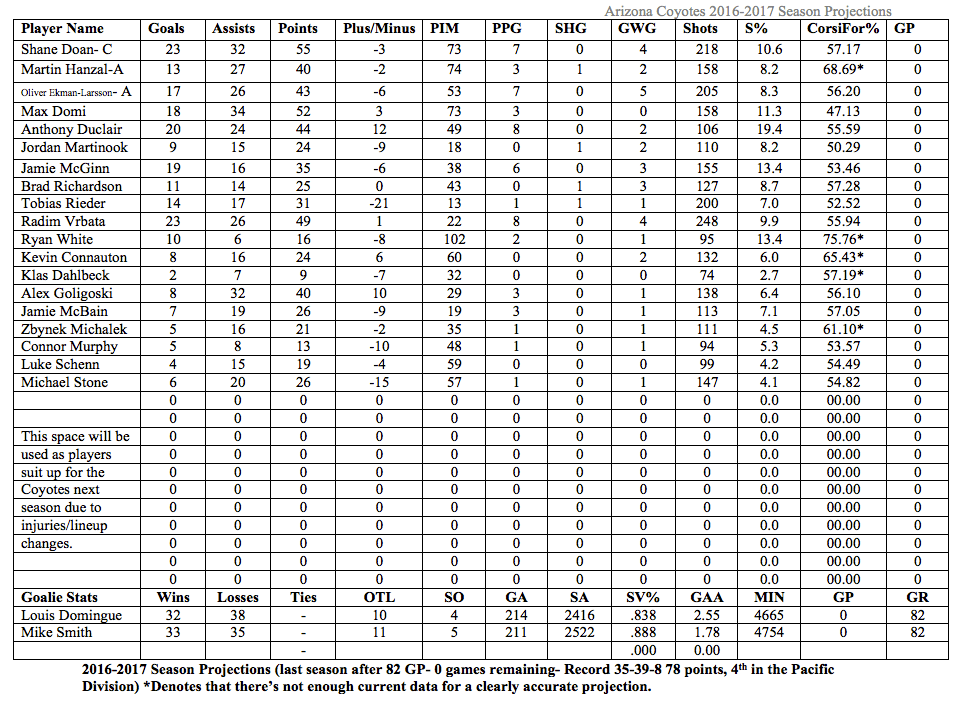
    Unknown-3Since the Arizona Coyotes follow us on Twitter (shouts to you, Coyotes social media department), I’m going to do my best to keep track of some projections for how their players will perform next season.

    And since the season’s not even here yet and I’m not quite as organized as I would like to be to formally present these numbers to you, the reader, I’m just going to leave you with a look at how things might go next season for Arizona.

    But that’s not all, I’m not just leaving you with one chart for now, but two charts! One is before John Chayka was hired as the Coyotes general manager and the other incorporates all of the moves Chayka’s made since becoming Arizona’s GM.

    Just by giving Chayka’s roster a quick glance it is evident that the Coyotes will be much better this season. Continuous improvement among their youth will be evident as they develop in time, but a huge thing for Arizona next season will be the addition of Alex Goligoski on the blue line.

    In fact, nearly all of the defensemen that Chayka picked up for the club will have a solid impact on keeping the score close and limiting the amount of work Mike Smith and Louis Domingue have to put in on a nightly basis.  Closing the gap on the scoring differential is essential to give your offense room to grow, if you’re building from the back-out.

    Analytics aside, Chayka has made very tactical moves.

    The Coyotes model is clear on building up their defense where necessary, while allowing their young forwards to develop. They aren’t rushing to add any young blue liners, but they did draft Jakob Chychrun, so it’s not like it’ll be too long before Arizona inserts a highly coveted, tactical, young defenseman. Besides, Anthony DeAngelo should be good enough for now, in terms of rotating some youth on the back end this year.

    Needless to say, the Coyotes won’t be a number one team, but they’ll certainly be a competitive team that’ll be exciting to watch come February and March (and maybe deep into April too). And there’s a good chance a rookie or two could still surprise us all and crack the roster.

    A note about my projections: For each stat, I amass the totals of every season in a player’s NHL career onto a spreadsheet in Excel and simply use the Forecast function, so some stats might not line up with one another in the projected outcome (i.e. shots and shooting percentage). Likewise, if I find something cooler than just using Excel, I’ll figure that out and make changes accordingly. For a better look at the charts, I advise that you zoom-in or click on each chart, thanks.

    Screen Shot 2016-05-20 at 6.16.13 PM.png
    Expected performances for the 2016-2017 season of every player on the Arizona Coyotes 2015-2016 roster (regardless of where they are now).

    If last year’s team came back to play this year (above), it doesn’t appear they’d be much different than the current roster (below) heading into the 2016-2017 season, except for the fact that Chayka’s a genius on paper so far (contract wise, in relation to performance, that is).

    Screen Shot 2016-08-17 at 1.54.55 AM.png
    Expected performances for the 2016-2017 season of every player currently on the Arizona Coyotes roster (including Radim Vrbata, who signed with the team on Tuesday and made me have to adjust more than I had to at first).
  • Vesey’s Pieces

    By: Nick Lanciani

    Bad forced play-on-word attempts are my middle name, so in “Vesey’s Pieces” I take a look at what teams have the right pieces in place to lock up Jimmy Vesey on August 15th (if he doesn’t re-sign with the Buffalo Sabres before then).

    Here’s a list of teams that could sign Vesey:

    Anaheim Ducks, Arizona Coyotes, Boston Bruins, Buffalo Sabres, Calgary Flames, Carolina Hurricanes, Chicago Blackhawks, Colorado Avalanche, Columbus Blue Jackets, Dallas Stars, Detroit Red Wings, Edmonton Oilers, Florida Panthers, Las Vegas, Los Angeles Kings, Minnesota Wild, Montreal Canadiens, Nashville Predators, New Jersey Devils, New York Islanders, New York Rangers, Ottawa Senators, Philadelphia Flyers, Pittsburgh Penguins, St. Louis Blues, San Jose Sharks, Tampa Bay Lightning, Toronto Maple Leafs, Vancouver Canucks, Washington Capitals, Winnipeg Jets

    Yes, that list includes Las Vegas, because wouldn’t it be funny if Jimmy Vesey decided to wait another year just to mess with everyone and give him 31 options instead of 30?

    Also, I know the salary cap exists, but teams are allowed to exceed the cap by 10% without facing penalty in the offseason. By training camp each organization must be cap compliant, meaning that any team could sign Vesey to the maximum amount of $925,000 on August 15th and spend the rest of the offseason figuring out who they’ll trade or send down to the AHL to fit under the salary cap.

    Realistically, let’s take a look at who’s in play, shall we?

    The fact of the matter is that Jimmy Vesey’s agent seems to confirm just about anything that’s been asked. Are the Bruins interested? Are the Blackhawks interested? Are the Sabres interested? Is Toronto interested? Does Jimmy think a hot dog is a sandwich?

    All of these questions seem to be met with a “yes” or “there’s a mutual interest something something they’re expected to be on the short list something something get out of here with your hot dog takes.”

    Enough foolishness aside, Colby Kephart and I agreed on Tuesday in a private conversation that we’re both tired of the media circus that’s become the Vesey Decision 2016. It’s nothing against Vesey as a player, or his right to explore all of his options per the collective bargaining agreement in the manner that he is, but rather it’s the hype that we’re annoyed about.

    Nobody is questioning his ability, having amassed 24-22-46 totals in 33 games this season with the Harvard Crimson and 32-26-58 totals the year before that in 37 games played. That’s 104 points in 70 games over his final two seasons with the Crimson, if you can’t do the math. Vesey’s numbers have grown and his playing style has developed as he’s gone through four years at Harvard, in the midst of one of the greatest college hockey cities in the United States- all while not being put against Hockey East universities on the regular, mind you.

    That’s not to discredit the ECAC either. Vesey is a college standout. He’s the real deal, but like any prospect, there’s a chance he won’t make as much of an impact as one would expect.

    And that is what hinges me from being able to say without a doubt he’s apt to be going to one team or another, because it all depends on how much of a risk teams are willing to take.

    Could he sign with his hometown team in Boston? Absolutely, but it’s not like the Bruins won’t be fine offensively if they don’t sign Vesey. Their top-six forwards are Patrice Bergeron, Brad Marchand, David Pastrnak, David Krejci, Matt Beleskey, David Backes and/or Frank Vatrano (which technically breaks the rules of limiting the discussion to just six players if one includes Vatrano).

    Would a solidified top-nine make the Bruins a better team? I guess you could say so, but that does nothing to improve their defense.

    Buffalo has been trying their hardest to keep Vesey around longer than just for this summer with their Jack Eichel diplomacy, but even there, it’s not like they’ll be that much better of a team or that much worse if they lose out on Vesey for only the cost of a third round pick. Keep in mind Boston traded a third round pick for Zac Rinaldo after all.

    The Sabres have a quality roster with the addition of Kyle Okposo this offseason and rising sophomore Eichel and friends. Tim Murray’s been making the right moves as their general manager and this could be the season that they get back into the playoffs if they play their cards right, their guys stay healthy and the right additions without subtracting reveal themselves throughout the season.

    They won’t lead the Atlantic Division, because hello, the entire state of Florida is good at hockey right now. Yet Buffalo will definitely be more competitive against a weakened, P.K. Subban-less Montreal Canadiens, the Ottawa Senators (who’ll end up overpaying Cody Ceci, just watch), Detroit Red Wings (who’ll probably miss the playoffs for the first time in forever) and Bruins (what’s a defense).

    As for Chicago, what are the odds that Vesey will win the Cup in his first season if he signs with them? Pretty great probably, but what are the odds that he’d get traded that offseason or in his first few years in the league from the Blackhawks? Also pretty good, since his last name isn’t Kane, Toews, Panarin, or Hossa (or any of their other core guys).

    It’s hard to crack the core in Chicago, even if they are to move Marian Hossa in the coming season(s). But it also looks like poor salary cap management may finally be catching up to them, ignoring the fact that this is what is said every other year about the Blackhawks.

    The Maple Leafs seem to be largely at play, what with Auston Matthews being a main attraction and Vesey’s family ties to the organization. While we’re on the subject of Toronto, why not take a look at the Arizona Coyotes who have done everything the Maple Leafs have dreamed of in one offseason at this point?

    There’s a great chance he’ll end up with an Original Six team, because that’s where it seems his interest resides. In the end it’s all about the best fit, which could sway Vesey to a team like the Coyotes where he has the chance to standout on the roster and against other teams, if that’s what he’s after. Or he could stay with the Sabres.

    Then again, he’ll probably sign with a team none of us expected him to sign with and disappoint every fanbase that was on edge, awaiting a signature on a piece of paper with their team’s logo on it.

    But hey, for the record, I’ve never had Reese’s Pieces which might shock you even more than Jimmy Vesey getting your hopes up and signing with a different team. ¯\_(ツ)_/¯


  • 2016 NHL Free Agency-July 1st Signings Recap

    By: Nick Lanciani

    This post will be updated throughout the day as signings are officially announced. Be sure to check our Twitter account (@DtFrozenRiver) for all of the latest signings, news, and analysis throughout the day.

    Free agency begins at noon (technically 12:01 PM ET) on July 1st. All that is known is shown and will be updated throughout the day. More analysis will come later as the day wraps up.

    NHL Logo

    LW Loui Eriksson signed a 6 year, $6.000 million AAV contract with the Vancouver Canucks.

    F Andrew Ladd signed a 7 year deal with the New York Islanders worth $38.5 million ($5.500 million AAV).

    D Stuart Percy has signed a 1 year, two-way contract with the Pittsburgh Penguins worth $575,000 at the NHL level, $200,000 at the AHL level.

    G James Reimer signed a 5 year, $3.4 million AAV contract with the Florida Panthers.

    LW Milan Lucic has signed a 7 year deal with the Edmonton Oilers worth $6.000 million AAV.

    D Michael Kostka signed a 1 year, two-way contract with the Ottawa Senators.

    RW Colton Sceviour signed a 2 year deal with the Florida Panthers.

    F Jonathan Marchessault signed a 2 year, $750,000 contract with the Florida Panthers.

    G Anton Khudobin has signed a 2 year, $1.2 million contract with the Boston Bruins.

    F David Perron signed a 2 year, $3.75 million contract with the St. Louis Blues.

    C Frans Nielsen and the Detroit Red Wings agreed to terms on a 6 year deal worth $5.250 million AAV.

    G Alex Stalock signed a 1 year deal with the Minnesota Wild.

    C David Backes signed a 5 year, $6.000 million AAV contract with the Boston Bruins.

    D John-Michael Liles signed a 1 year, $2.000 million contract with the Boston Bruins (re-signed).

    D Brian Campbell signed a 1 year contract with the Chicago Blackhawks.

    F Kyle Okposo signed a 7 year, $6.000 million AAV, contract with the Buffalo Sabres.

    F Phil Varone signed a 1 year, two-way contact with the Ottawa Senators.

    F Troy Brouwer signed a 4 year, $4.5 million AAV contract with the Calgary Flames.

    C Eric Staal has signed a 3 year, $3.500 million AAV deal with the Minnesota Wild.

    G Carter Hutton signed a 2 year, $1.125 million deal with the St. Louis Blues.

    D Tom Gilbert signed a 1 year, $1.400 million deal with the Los Angeles Kings.

    The Chicago Blackhawks signed F Sam Carrick and F Pierre-Cedric Larie to 1 year contracts.

    F Jason Chimera signed a 2 year, $2.250 million contract with the New York Islanders.

    G Chad Johnson signed a 1 year, $1.700 million deal with the Calgary Flames.

    D Ben Lovejoy signed a 3 year, $2.666 million AAV deal with the New Jersey Devils.

    C Casey Bailey signed a 1 year, two-way contract with the Ottawa Senators.

    LW Matt Lorito signed a 2 year deal with the Detroit Red Wings.

    F Chris Stewart signed a 2 year, $1.150 million AAV contract with the Minnesota Wild.

    F Jamie McGinn signed a 3 year, $10 million contract with the Arizona Coyotes (worth $3.300 million AAV).

    F Vernon Fiddler has signed a 1 year, $1.250 million contract with the New Jersey Devils.

    D Adam Clendening signed a $600,000 contract with the New York Rangers, worth $300,000 at the AHL level.

    D David Warsofsky signed a 1 year, two-way contract with the Pittsburgh Penguins.

    The San Jose Sharks signed D David Schlemko to a 4 year contract worth $2.100 million AAV.

    D Klas Dahlbeck signed a 1 year, $750,000 contract with the Arizona Coyotes.

    F Max McCormick signed a 1 year, two-way contract with the Ottawa Senators.

    F Dale Weise signed a 4 year contract with the Philadelphia Flyers worth $2.350 million AAV.

    D Cameron Gaunce signed a 1 year, two-way contract with the Pittsburgh Penguins.

    D Zach Trotman signed a $650,000 contract with the Los Angeles Kings.

    G Jonas Gustavsson signed a 1 year contract worth $800,000 with the Edmonton Oilers.

    F Viktor Stalberg signed a 1 year deal with the Carolina Hurricanes.

    F Christian Thomas signed a 1 year deal with the Washington Capitals.

    D Chad Ruhwedel signed a 1 year, two-way contract with the Pittsburgh Penguins.

    D Jamie McBain signed a two-way contract with the Arizona Coyotes.

    F Michael Chaput signed a two-way contract with the Vancouver Canucks.

    G Al Montoya signed a 1 year, $950,000 deal with the Montreal Canadiens.

    F Shawn Matthias signed a 2 year deal with the Winnipeg Jets worth $2.125 million AAV.

    F Andy Miele signed a 1 year deal with the Philadelphia Flyers.

    F Devante Smith-Pelly signed a 2 year deal with the New Jersey Devils worth $1.300 million AAV.

    D Matt Irwin signed a 2 year deal with the Nashville Predators.

    F Andrew Miller signed a 1 year, two-way contract with the Carolina Hurricanes.

    F Alexander Radulov signed a 1 year, $5.750 million contract with the Montreal Canadiens.

    The New Jersey Devils signed D Jon Merrill to a 2 year contract.

    D Dan Hamhuis signed a 2 year contract with the Dallas Stars worth $3.750 million AAV.

    G Jeff Zatkoff signed a 2 year, $900,000 AAV deal with the Los Angeles Kings.

    The New Jersey Devils re-signed F Beau Bennett to a 1 year contract worth $725,000 (they had acquired him at the NHL Draft).

    F Michael Grabner and the New York Rangers agreed to terms on a 2 year contract worth $1.600 million AAV.

    The Colorado Avalanche signed D Ryan Stanton and F Turner Elson to two-way contracts.

    D Zach Redmond signed a 2 year, $1.225 million contract with the Montreal Canadiens.

    F Nathan Gerbe signed a deal with the New York Rangers.

    F Boyd Gordon and the Philadelphia Flyers agreed to a 1 year contract, worth $950,000.

    F Michael Latta signed a 1 year deal with the Los Angeles Kings.

    F Andrew Agozzino signed a 1 year deal with the St. Louis Blues.

    D Chad Billins signed a contract with the Vancouver Canucks.

    F Lee Stempniak signed a 2 year, $2.5 million AAV contract with the Carolina Hurricanes.

    The Ottawa Senators signed F Chad Nehring to a 1 year, two-way contract.

    F Pat Cannone signed a 1 year, two-way contract with the Minnesota Wild.

    D Patrick Wiercioch signed a 1 year, $800,000 deal with the Colorado Avalanche.

    C Joe Colborne signed a 2 year, $2.500 million AAV contract with the Colorado Avalanche.

    D Fedor Tyutin signed a 1 year, $2 million contract with the Colorado Avalanche.

    D Ian McCoshen signed an Entry-Level Contract with the Florida Panthers.

    RW Brett Connolly signed a 1 year, $850,000 contract with the Washington Capitals.

    D Justin Falk signed a 1 year, $850,000 contract with the Buffalo Sabres.

    F Jeremy Morin signed a 1 year, two-way, deal with the Tampa Bay Lightning.

    D Mikhail Sergachev signed a 3 year Entry-Level Contract with the Montreal Canadiens.

    F Quinton Howden signed a 1 year, two-way contract worth $650,000 with the Winnipeg Jets.

    D Kevin Connauton signed a 2 year deal with the Arizona Coyotes.

    F Patrick Eaves signed a 1 year, $1 million contract with the Dallas Stars (re-signed).

    F Greg Carey signed a deal with the Philadelphia Flyers.

    D Will O’Neill and the Philadelphia Flyers agreed to terms on a contract.

    D Philip Larsen signed a 1 year, $1.025 million contract with the Vancouver Canucks.

    F Michael Bournival signed a 1 year, two-way contract with the Tampa Bay Lightning.

    F Gabriel Dumont signed a 1 year, two-way contract worth $575,000 with the Tampa Bay Lightning.

    The Montreal Canadiens signed LW Daniel Carr to a 2 year contract worth $725,000 AAV.

    D Mark Fraser signed a 1 year, two-way contract with the Edmonton Oilers.

    F Pierre-Luc Letourneau-Leblond signed a 1 year deal with the Tampa Bay Lightning.

    G Justin Peters signed a 1 year contract with the Arizona Coyotes.

    F Matt Martin signed a 4 year contract with the Toronto Maple Leafs, worth $2.500 million AAV.

    G Joe Cannata signed a deal with the Washington Capitals.

    D Darren Dietz agreed to terms with the Washington Capitals.

    F Thomas Vanek signed a 1 year, $2.600 million deal with the Detroit Red Wings.

    F Ryan White signed a 1 year deal, worth $1.000 million, with the Arizona Coyotes.

    F Steve Ott signed a 1 year, $800,000 contract with the Detroit Red Wings.

    The Winnipeg Jets and D Brian Strait agreed to terms on a 1 year, $600,000 contract.

    F Mikkel Boedker signed a 4 year contract with the San Jose Sharks.

    D Victor Bartley  signed a 1 year, two-way contract, worth $650,000 in the NHL/$350,000 in the AHL with the Minnesota Wild.

    F Spencer Abbott signed a 1 year contract with the Chicago Blackhawks.

    The Dallas Stars signed D Andrew Bodnarchuk to a 2 year contract.

    D Dustin Stevenson agreed to a 1 year contract with the Dallas Stars. 

    F Michael Blunden signed a 2 year, two-way contract with the Ottawa Senators.

    D Michael Paliotta agreed to terms with the New York Rangers.

    D Karl Stollery signed a 1 year, two-way contract, worth $575,000 at the NHL level with the New Jersey Devils.

    The Vancouver Canucks signed C Jayson Megna to a 1 year deal.

    RW Borna Rendulic signed a 1 year, two-way contact with the Vancouver Canucks.

    The Detroit Red Wings signed G Edward Pasquale to a 1 year contract.

    F Chris Mueller signed a 1 year, two-way contract with the Arizona Coyotes.

    F Dennis Yan signed a 3 year Entry-Level Contract with the Tampa Bay Lightning.

    D Yannick Weber signed a 1 year contract with the Nashville Predators.

    F Riley Nash signed a 2 year contract, worth $900,000 AAV with the Boston Bruins.

    G Jeremy Smith signed a 1 year contract with the Colorado Avalanche.

    The Colorado Avalanche also agreed to terms with F Jim O’Brien, F Mike Sislo and F Joe Whitney to 1 year deals.

    F Reid Petryk and F Trent Vogelhuber signed 2 year deals with the Colorado Avalanche.

    RW Carter Camper signed a 1 year, two-way contract, worth $575,000 at the NHL level with the New Jersey Devils.

    D Andrew MacWilliam signed a 1 year, two-way deal with the New Jersey Devils, worth $575,000 at the NHL level.

     

  • Numbers Game: Top-5 Pending RFA Goalies

    By: Nick Lanciani

    12:01 PM ET on July 1st (precisely) marks the start of the NHL’s free agency period, so of course, you’ve found yourself scavenging the Internet for the freshest hot takes and the best indications of where players will end up. Likewise, you probably just want to know who’s available out there (and I’m not talking about Tinder).

    Well fear not, because I’m here to set things straight with a short series of posts about the Top-5 free agents in every category you can think of (UFA forwardsUFA defensemenUFA goaliesRFA forwards, RFA defensemen and RFA goalies) in this latest edition of Numbers Game posts. RFAs are fun, RFAs are cool, but here’s the thing, other general managers will hate you forever apparently if you offer sheet one of their guys. Also, shouts to you if you’re still reading these. That shows commitment. And heart. And grit. I’ll be done with these— for now.

    Down the Frozen River- Smaller Circular Logo

    1. G Petr Mrazek (27-16-0-6, 2.33 GAA, .921 SV% with the Detroit Red Wings)- $737,500 cap hit, 23 years old

    Petr Mrazek is the only starting goaltender of this bunch and he’s due for a payday with the Detroit Red Wings. The only problem is, they still have Jimmy Howard and are paying him a bunch. So while Mrazek’s in the waitroom, you might as well give him a call if you’re a GM that needs a starting goalie that hasn’t even reached his full potential or tapped into his best play.

    2. G Darcy Kuemper (6-7-0-5, 2.43 GAA, .915 SV% with the Minnesota Wild)- $1.250 million cap hit, 25 years old

    The Minnesota Wild would be smart to keep Darcy Kuemper around long enough to turn him into a valuable asset that they could cash in, which sounds exactly like what they’re planning on doing. Let’s just say that Kuemper’s not a starter if Devan Dubnyk goes down with an injury, but until you find a rental replacement, he’ll be able to hold you over.

    3. G Calvin Pickard (7-6-0-1, 2.56 GAA, .922 SV% with the Colorado Avalanche)- $850,500 cap hit, 23 years old

    Calvin Pickard has the chance to be a decent backup, but is nowhere near the projections of taking over the number one spot in Colorado just yet. In a related story, the Avalanche should really keep him and get him a defense, just in case Semyon Varlamov gets hurt again and/or Pickard plays better than Varlamov for whatever reason.

    4. G Anders Nilsson (10-13-0-2, 3.12 GAA, .901 SV% with the Edmonton Oilers/St. Louis Blues)- $1.000 million, 25 years old

    Anders Nilsson has played in 52 career NHL games over three seasons and has never ended a season with a GAA less than 2.75, so yeah, offer sheet him all you want. Whoever owns him would be glad to get a 7th rounder (at best).

    5. G Kristers Gudlevskis (0-0-0-1, 1.00 GAA, .969 SV% with the Tampa Bay Lightning)- $608,333 cap hit, 23 years old

    Kristers Gudlevskis has had two solid starts to his NHL career as the presumptive backup to Andrei Vasilevskiy once the Tampa Bay Lightning eventually (probably) move Ben Bishop or lose him at the 2017 expansion draft to Las Vegas.

    Honorable Mention

    Me if I were still playing DekHockey (I forget my stats, good GAA, decent SV%)- $0 cap hit

    I mean, seriously, there’s only 14 RFA goalies available (if that by 12:01) and there’s hardly enough to make a top-5 from them.