Tag: Minnesota Wild

  • Numbers Game 2018-19: One Month Down

    Folks, it’s no longer October.

    You can once again begin asking the question “is it October yet?” without facing any legal ramifications, despite the fact that the 2018-19 regular season is very much alive and in effect.

    Canadian Thanksgiving has come and gone, but for all of you urban legend believers in postseason fate, American Thanksgiving has yet to pass– meaning every team’s playoff hopes is still technically alive. The majority of teams in playoff position by American Thanksgiving– in this case, Nov. 22nd– make the playoffs.

    If you’re new to hockey, this is a thing, but it’s not set in stone. There’s always that one or two teams that sneak their way in from outside the picture frame. Likewise, there’s always that team that blows it down the stretch.

    The Tampa Bay Lightning are off to a hot start, working their way to 1st place in the Atlantic Division by the end of October, with the Toronto Maple Leafs and Boston Bruins hot on their tail just as we all expected.

    Though the Maple Leafs have a fiery offense and solid goaltending, defense has been the most apparent area for improvement. In Boston, depth scoring, injuries and a slow start in net for Tuukka Rask have held the Bruins back from realizing their full potential, but the depth of their defenders and backup netminder Jaroslav Halak have kept them in good-standing.

    In the surprise of the month for the Atlantic Division, the Montreal Canadiens sit 4th and the Buffalo Sabres sit 5th– both with 14 points on the season so far. Meanwhile, to no surprise the Ottawa Senators are 6th, the Detroit Red Wings are in a rebuild and the Florida Panthers simply haven’t played as many games as their opponents.

    Taking a look at the Metropolitan Division and you won’t be surprised to see the Pittsburgh Penguins back in control with Sidney Crosby at the steering wheel, but you might be surprised by the other current divisional playoff spot holders.

    The New York Islanders are 2nd and the Carolina Hurricanes are 3rd after the Hurricanes led the division for most of the month, only to begin a recent skid.

    Just on the outskirts of a wild card spot are the Washington Capitals, Columbus Blue Jackets and New Jersey Devils.

    Washington’s off to a slower start than expected, but overall not feeling as bad as a Stanley Cup hangover as it could’ve been– given how many fountains around D.C. they dove in and the number of beers consumed.

    Columbus is just over .500 and the Devils have also played fewer games than anyone in their division, much like the Panthers.

    The Philadelphia Flyers sit 7th in the Metropolitan Division in a tight race, but have shown weaknesses on the blue line and in the blue paint (goaltending, again) and the New York Rangers are in a full-scale rebuild to start things off this season.

    In the Western Conference, the Nashville Predators are staking a case for defending their President’s Trophy season last year currently sitting atop the Central Division, as well as the league.

    Filling out the remaining Central Divisions spots, last season’s biggest improvers, the Colorado Avalanche sit 2nd with the Minnesota Wild in 3rd. There’s two wild card berth in the Central Division, currently held by the Winnipeg Jets and Chicago Blackhawks(!?!)– that’s right, last season’s division bottom feeders are able to keep their heads barely above the surface with Corey Crawford back in the net.

    The Dallas Stars sit 6th and the St. Louis Blues have had the wheels fall off in just a month’s time.

    In the Pacific Division, the Vancouver Canucks lead the San Jose Sharks, Calgary Flames, Edmonton Oilers, Arizona Coyotes, Anaheim Ducks, Vegas Golden Knights and the 31st place team in the league– the Los Angeles Kings.

    Yes, the Pacific Division is that wide-open so far with legitimate playoff contenders from last season (San Jose, Anaheim, Vegas and Los Angeles) all over the place. The Sharks haven’t hit their stride, the Ducks are suffering from injuries and defensive breakdowns, while the Golden Knights are looking for last season’s inaugural season magic.

    Oh and the Kings? Yeah, everything’s pretty bad right now and Jonathan Quick‘s out indefinitely.

    Meanwhile, pleasant surprises in Vancouver, Calgary, Edmonton and Arizona are being led by… youth?

    Nothing makes sense anymore.

    Luckily, that’s just a quick recap of the first month in about as bland an outlook as you can get when the meat of this post is really about what’s to come. That’s right, everything above? Forget most of it. Let’s use a little foresight and figure out how November through April should go.

    2018-19 Projected Standings after One Month

    Eastern Conference

    Atlantic Division

    1. y-Boston Bruins, 104 points (12 GP so far)
    2. x-Tampa Bay Lightning, 103 points (11 GP so far)
    3. x-Toronto Maple Leafs, 94 points (12 GP so far)
    4. wc1-Montreal Canadiens, 93 points (11 GP so far)
    5. Florida Panthers, 84 points (9 GP so far)
    6. Ottawa Senators, 84 points (11 GP so far)
    7. Detroit Red Wings, 81 points (12 GP so far)
    8. Buffalo Sabres, 76 points (12 GP so far)

    What’s bound to happen in the Atlantic?

    The forecast is so close between the top-three teams in the division that none of their positions in the standings are truly set in stone, unlike how the Red Wings will undoubtedly land somewhere in the bottom-three spots in the Atlantic.

    There’s a chance the Panthers never get off the ground and there’s a chance the Sabres are able to continue turning heads around the league by not currently being in the basement of the division. However, since this forecast takes into consideration recent seasons in addition to current gameplay…

    Check back in another month.

    (Is it too early to do one of these? Yeah, probably.)

    Metropolitan Division

    1. p-Washington Capitals, 107 points (10 GP so far)
    2. x-Pittsburgh Penguins, 106 points (10 GP so far)
    3. x-Columbus Blue Jackets, 93 points (11 GP so far)
    4. wc2- New York Islanders, 89 points (11 GP so far)
    5. Philadelphia Flyers, 89 points (12 GP so far)
    6. New York Rangers, 89 points (12 GP so far)
    7. New Jersey Devils, 87 points (9 GP so far)
    8. Carolina Hurricanes, 85 points (12 GP so far)

    The biggest takeaway from the Metropolitan forecast is after the top-two teams, anything goes.

    Washington will be able to right the ship and land in a divisional spot– whether that’s top-dog or behind the Penguins remains to be seen. Columbus should even out as they’ve been doing as of late and settle in for another First Round exit (probably).

    But between the Islanders, Flyers, Rangers, Devils and Hurricanes? Yeah, anything goes.

    The Islanders are better than the Rangers, but the Rangers might somehow be better than the Flyers. Meanwhile, if New Jersey can get things going like they did last season, they’ve got a chance to box out the competition. Plus, Carolina remains unpredictable and foreseeably within striking range of a wild card spot in the 2019 Stanley Cup Playoffs.

    Again, it’s only been one month. There’s still a little more than five months left in the regular season.

    Western Conference

    Central Division

    1. z-Nashville Predators, 105 points (12 GP so far)
    2. x-Minnesota Wild, 100 points (12 GP so far)
    3. x-Chicago Blackhawks, 98 points (13 GP so far)
    4. wc1-St. Louis Blues, 96 points (10 GP so far)
    5. wc2-Winnipeg Jets, 94 points (12 GP so far)
    6. Dallas Stars, 90 points (11 GP so far)
    7. Colorado Avalanche, 85 points (12 GP so far)

    In the Central Division, the Nashville Predators continue to reign supreme. Cool.

    Minnesota, Chicago and St. Louis are all somehow destined for the postseason. This, after the Wild make it every year, Crawford’s return lifts the Blackhawks over the competition and supposedly the Blues will figure things out.

    Wait, the Avalanche can’t be that bad.

    Once again, it’s an extremely early forecast that takes into account recency bias from the last few seasons. Colorado won’t be last. Winnipeg shouldn’t be a wild card team.

    But Dallas? Yeah, they’re definitely not making the playoffs if they keep playing like they have been.

    Pacific Division

    1. y-San Jose Sharks, 101 points (12 GP so far)
    2. x-Anaheim Ducks, 98 points (13 GP so far)
    3. x-Calgary Flames, 89 points (13 GP so far)
    4. Los Angeles Kings, 87 points (11 GP so far)
    5. Vancouver Canucks, 84 points (14 GP so far)
    6. Edmonton Oilers, 83 points (11 GP so far)
    7. Arizona Coyotes, 77 points (11 GP so far)
    8. Vegas Golden Knights, 75 points (12 GP so far)

    By now everything you’ve read should indicate what’s going to be written below.

    San Jose? Good team. No surprise, given Erik Karlsson, Brent Burns and Marc-Edouard Vlasic are on the blue line with Joe Pavelski, Logan Couture, Tomas Hertl, Timo Meier and Evander Kane at forward. Oh and Martin Jones in net.

    Anaheim? If they can whether the storm, they can make it in one of the most unpredictable divisions based on how bad the other teams are or should be.

    Calgary? Bill Peters finally coaches a team to a playoff berth? Yeah. That should happen.

    The Kings can recover from this slow start– if they don’t mess things up in November.

    As for the Canucks, Oilers, Coyotes and Golden Knights, well, Vancouver might make some noise. Edmonton could be a pretender as long as Connor McDavid is a contender. Arizona remains to be seen and the situation looks like it’s only going to get worse for Vegas before anything gets better– if it even does.


  • DTFR Podcast #130- Boo: A Very Merry Boone Jenner Halloween (Part II: Pierre-Luc DuBOOis)

    DTFR Podcast #130- Boo: A Very Merry Boone Jenner Halloween (Part II: Pierre-Luc DuBOOis)

    Injuries are scaring the masses across the league, while old ghosts haunt Colorado (then lose), the Los Angeles Kings’ reign of terror is spooked, Mark Borowiecki is back again, Nick and Connor do their best to talk about the Columbus Blue Jackets and the thing that goes bump in the night? That’s the Tampa Bay Lightning thundering their way to the top. We also reviewed Bohemian Rhapsody before it comes out.

    Subscribe to the podcast on Apple Podcasts (iTunes)Stitcher and/or on Spotify. Support the show on Patreon.

  • DTFR Podcast #129- Top Line Stars

    DTFR Podcast #129- Top Line Stars

    Nick and Connor talk Alex Tuch’s extension with the Vegas Golden Knights, superstars Auston Matthews, Sidney Crosby and Connor McDavid, as well as Charlie McAvoy extension options, the New York Rangers, Boston’s first line vs. Colorado’s top line and the week’s biggest matchup.

    Subscribe to the podcast on Apple Podcasts (iTunes)Stitcher and/or on Spotify. Support the show on Patreon.

  • DTFR Podcast #128- Celebration Hardcore Brother (a.k.a. Celly Hard Bro)

    DTFR Podcast #128- Celebration Hardcore Brother (a.k.a. Celly Hard Bro)

    Nick and Connor rant about retired numbers, anniversary patches, showing emotion in hockey, the Toronto Maple Leafs and William Nylander, coaches that might get fired, “the code” and Mike Matheson’s antics.

    Subscribe to the podcast on Apple Podcasts (iTunes)Stitcher and/or on Spotify. Support the show on Patreon.

  • DTFR Podcast #127- Tip Of The Hat(s)

    John Tavares and Patrice Bergeron both had hat tricks in the last week, so Nick and Connor discuss hat trick ethics and more, since celebrations are hot topics these days. Also, everything else that happened in the first week of regular season action.

    Subscribe to the podcast on Apple Podcasts (iTunes)Stitcher and/or on Spotify. Support the show on Patreon.

  • Vegas Golden Knights 2018-19 Season Projections

    It’s forecasting season, well, actually it’s the regular season and I’m just a little behind, but until I pointed that out, you didn’t know I was behind on my little passion project here, did you?

    I know I wrote “[i]n the coming days I’ll reveal what teams I’ll be forecasting/tracking all season long, so stay tuned because it’s about to get messier than ever before and I’m up for the challenge,” in my Boston Bruins 2018-19 forecast, but life and the fact that I’m moving all my data into a new format has slowed my turnaround for the time being.

    Nevertheless, my Vegas Golden Knights forecast for 2018-19 is here and let’s pretend the first week of the regular season hasn’t already happened or something.

    Additionally, if you’re wondering what other teams I’m preparing to post (before we get too far into the first quarter of the season) they are the Carolina Hurricanes and Columbus Blue Jackets.

    I always keep tabs on the Bruins every year because I grew up a Boston fan and I decided to track Vegas last season because there hadn’t been nearly as much hype surrounding an expansion team since Columbus and the Minnesota Wild in 2000. Additionally, I’ve previously tracked the Arizona Coyotes simply because they follow us on Twitter (and I’ll get back around to them hopefully before season’s end, if you’re interested).

    But I’m adding Carolina and Columbus to my forecast portfolio this season because 1) the Hurricanes are supposed to be better than last season, plus they have some exciting youth in the lineup and 2) a lot of Blue Jackets fans are also fans of our brand around here, so shouts 5th Liners.

    Please be patient on the timeline for when I’ll get my Hurricanes and Blue Jackets forecasts posted– it’ll be by the end of the month for sure.

    Anyway, on with the Golden Knights, shall we?


    Vegas is coming off of their inaugural season having finished 1st in the Pacific Division with 109 points and a 51-24-7 record under head coach Gerard Gallant. Not only did they finish at the top of their division in their first season, but they did so with over 100 points and a 50-plus win season.

    Oh yeah and they played the Washington Capitals in the 2018 Stanley Cup Final.

    Despite the loss in five games to Washington, the Golden Knights were and still are well ahead of owner Bill Foley’s “Cup in three [seasons]” masterplan– what with General Manager George McPhee‘s offseason additions of Paul Stastny and Max Pacioretty and everything.

    This year, of course, the competition has gotten a lot tougher. There are expectations now when opponents play the Golden Knights.

    Gallant and his Vegas lineup are going to have to get more creative than ever before in franchise history to avoid the hangover of a Stanley Cup Final appearance run and to avoid getting too predictable.

    Things are different now. They’re no longer the new kids on the block. They’re the 2018 Western Conference champions and a team to beat.

    As always, I’d like to remind you my degree is in communication– not math– therefore anything that looks wrong is either adjusted with a little gut-feeling and/or Microsoft Excel’s fault. My expertise resides in the written, spoken and nonverbal language of communicating– not numbers on a spreadsheet.

    These forecasted stats are to be seen as an utopian perspective, as though nothing bad could happen this season at any point to any player– where every player at least lives up to their forecast and then some.

    Some will pan out and some will fall flat. It’s a suggested outcome for a sport that’s played on ice in a highly unpredictable collective environment of action and sheer puck luck.

    vegas_golden_knights_logo

    Vegas Golden Knights Forecast Through 0 Games (82 Games Remaining)

    This slideshow requires JavaScript.

    After a breakout 78-point season (43 goals, 35 assists) for William Karlsson, the Golden Knights number-one center is prime for a respectable 41-point season as part of the natural regression of the game– unless Karlsson is truly an outlier, like he was coming from Columbus to Vegas last season.

    Meanwhile, Reilly Smith (19-27–46 expected totals) and Jonathan Marchessault (28-35–63 expected totals) bolster the Golden Knights first line with respectable performances of their own, while the point spread has really been shared with the second line.

    Newcomers Paul Stastny (22-43–65 expected totals) and Max Pacioretty (33-30–63 expected totals) are set to become the key contributors to the fiery Vegas offense in their first season with the club.

    The Golden Knights top-six core of forwards is deeper than last season, whereas the majority of their offense was reliant upon Marchessault, Karlsson and Smith. This year there’s more emphasis on Alex Tuch and Erik Haula inside the top-nine.

    On defense, Gallant’s crew will have to do without Nate Schmidt for the first 20 games of the season while Schmidt serves a suspension for a performance enhancing drug.

    Luckily, Brad Hunt, Colin Miller and Shea Theodore are prime for an uptick in time-on-ice and production, with Hunt and Miller expected to reach the 30-point plateau, while offseason addition, Nick Holden should see a pleasant rebound from his 17 points split between the Bruins and New York Rangers last season to a 25-point effort in 2018-19 with Vegas, provided he can remain in the top-six on the depth chart.

    Upon Schmidt’s return, he should still have 4-23–27 totals from the blue line, which is not great like last season’s 5-31–36 totals, but not terrible for a top-four defender.

    In goal, Marc-Andre Fleury is expected to return to Earth from his superhuman season last year (a 2.24 goals against average and .927 save percentage in 46 games) to a 2.49 GAA and .913 SV% in 2018-19. As the Golden Knights starter continues to get older, limiting his workload to keep him fresher for the postseason is the way to go.

    Granted, Fleury’s playing time was limited last season due to a concussion, he still went on to have solid regular season numbers and an impeccable 2018 Stanley Cup Playoff run up until the Stanley Cup Final.

    Meanwhile, Malcolm Subban‘s 2.68 GAA and .910 SV% in 22 games played look to be improved upon to a 2.65 GAA and .911 SV% in somewhere around 30 appearances as the backup netminder for Vegas.

    As always, we’ll get more into the goalies once the team has played through a quarter of the season.

  • 2018-19 NHL Mascot Power Rankings: 31st-21st

    I never thought I’d be doing this again, yet here we are. It’s time to begin the continuation of a now annual tradition around here at DTFR. It’s time to rank the NHL mascots.

    For the first time since January 2017, here’s the latest look at things.

    31) New York Rangers Last year’s ranking 30th

    They don’t have a mascot, which the old me would’ve said “that’s OK for a franchise that’s over 90-years-old and has one of the easiest nicknames to create a mascot for”, but the new me says “why wouldn’t they want to get in on the post-Gritty hype-train newscycle?” Petition to make Henrik Lundqvist the mascot when he retires someday? Who says “no”?

    download

    30) Al the Octopus (Detroit Red Wings) Last year’s ranking 26th

    I understand the tradition (8 wins used to win you the Cup back in the day), but 1) inflation exists (it takes 16 wins now to take home the Cup) and 2) it’s a lot easier to make an octopus costume than it is to raise and lower a giant octopus from the rafters every night. I’m just saying.Unknown

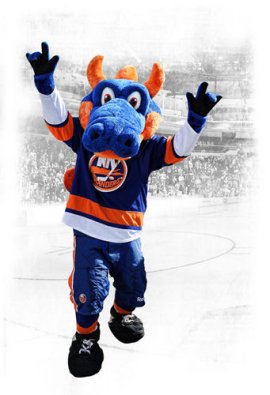
    29) Sparky the Dragon (New York Islanders) Last year’s ranking 25th

    Seriously, I still don’t get why they haven’t switched things up to the Gorton’s Fisherman™. Sparky was once the mascot for the Islanders and the New York Dragons (makes sense) Arena Football team until 2009.

    sparky-twitter-avatar-400
    @SparkyNYI on Twitter hasn’t tweeted anything. Perhaps he’s retired?

    28) Nordy (Minnesota Wild) Last year’s ranking 24th

    Nordy just has a lot going on around the eyes and on the back of his jersey. 18,001? I feel bad for the poor equipment manager that has to iron that on all the sweaters Nordy goes through in a season. Also, he’s got a mullet– this isn’t the Minnesota North Stars, it’s the Wild. I don’t care what you say, I will never be a fan of that hairstyle unless it’s Jaromir Jagr.

    27) Howler (Arizona Coyotes) Last year’s ranking 21st

    Unlike how his team should be rising in the standings this season, Howler’s stock is falling. At least temporarily. It’ll be fun to see Howler in a kachina sweater every Saturday of the regular season, but that’s about it.

    26) Hunter (Edmonton Oilers) Last year’s ranking 23rd

    Hunter was named after the original owner of the Oilers, William Hunter, and wears No. 72 in reference to the team’s founding as the Alberta Oilers in the World Hockey Association (WHA). He’s a Canadian lynx, so that’s cool, I guess. Other than that, he scares people.

    25) Stanley C. Panther/Viktor E. Ratt (Florida Panthers) Last year’s ranking 20th

    Not many fans outside of Sunrise, Florida might realize that yes, the Panthers have two official mascots. There’s Stanley C. Panther, which, if you look deep enough into his eyes you’ll start hearing a Sarah McLachlan song for some reason and Viktor E. Ratt, who… exists. 1996 was a weird time.

    24) Stormy (Carolina Hurricanes) Last year’s ranking 28th

    Be on the lookout for Stormy to take the world by… storm. Since the Hurricanes updated their home jerseys to one of the best in the league, Stormy’s appearance on the outside has improved drastically. Aside from asking the important question, will Stormy wear a Whalers sweater on Whalers Night or will Pucky the Whale make a return to his former franchise? Let’s not negate the fact Stormy likes to roll around in the mud all day.

    23) Harvey the Hound (Calgary Flames) Last year’s ranking 18th

    As the league’s oldest mascot, there’s a certain charm to the nostalgia of his look. He’s also the only mascot in the league to not be wearing a jersey, excluding Al the Octopus, which shouldn’t really even technically count as a mascot, Detroit. Harvey’s great, but have you seen what googly eyes can do for you these days? Or at least give the poor hound a sweater– preferably one of those sweet alternates the Flames are bringing back.

    22) Bernie the St. Bernard (Colorado Avalanche) Last year’s ranking 22nd

    The ADIZERO jersey style brought back the mountain design to the Avalanche’s sweaters and that’s improved Bernie’s overall aesthetic, but part of me still misses Howler the Yeti. But hey, dogs like kids, kids like dogs and even cranky old adults (so everyone that’s not a kid) like dogs that save people from avalanches.

    21) Spartacat (Ottawa Senators) Last year’s ranking 9th

    Spartacat’s fell on hard times and it’s not just because of the Erik Karlsson trade and full-on rebuild in Ottawa. It’s occurred to me since last year nobody’s gotten around to giving his hair a good washing and he doesn’t even have whiskers. So yeah, Spartacat took a fall in the rankings and didn’t land on all-fours, contrary to that myth about cats.

  • Winnipeg Jets 2018-19 Season Preview

    jetslogo

    Winnipeg Jets

    52-20-10, 114 points, 2nd in the Central Division

    Lost in Western Conference Final to VGK, 4-1

    Additions: D Simon Bourque (acquired from MTL), G Laurent Brossoit, F Dennis Everberg, F Seth Griffith

    Subtractions: F Joel Armia (traded to MTL), F Chase De Leo (traded to ANA), D Toby Enstrom (signed, SHL), F Matt Hendricks (signed with MIN), G Michael Hutchinson (signed with FLA), D Jan Kostalek (signed, ELH), G Steve Mason (traded to MTL, subsequently bought-out, current UFA), D Julian Melchiori (signed with FLA), G Jamie Phillips (signed with Charlotte Checkers, AHL), F Buddy Robinson (signed with CGY), F Michael Sgarbossa (signed with WSH), F Paul Stastny (signed with VGK)

    Still Unsigned: F Jimmy Lodge, F Shawn Matthias

    Re-signed: G Eric Comrie, F Marko Dano, G Connor Hellebuyck,F Nicolas Kerdiles (acquired from ANA and re-signed), F JC Lipon, F Adam Lowry, D Josh Morrissey, F Nic Petan, D Tucker Poolman, D Cameron Schilling, F Brandon Tanev, D Jacob Trouba

    Offseason Analysis: For a city with the word “win” in its name, the Winnipeg Jets sure did a lot of winning last season. Paul Maurice coached his club to a 52-20-10 record– good enough for first place in a normal year, but the Nashville Predators were just three points better in the Central Division. Winnipeg finished second in the Central with 114 points.

    They won their first playoff series in franchise history, eliminating the Minnesota Wild in five games in the First Round, then upset the Predators in a Game 7 on the road in the Second Round.

    The Jets didn’t just set franchise records, they established the bar for future benchmarks of success (minus a Cup), but while Winnipeg soared into the Western Conference Final, they were in for a crash landing in five games against the Vegas Golden Knights despite having home-ice advantage.

    Three wins. Just three wins shy of their first Stanley Cup Final appearance for both renditions of the Jets.

    Connor Hellebuyck emerged as a legitimate starting goaltender and General Manager Kevin Cheveldayoff made sure to lock him up by re-signing the 25-year-old goaltender to a six-year extension worth $6.167 million per season.

    Hellebucyk’s deal is a manageable cap hit and carries him through his mid-prime, leaving Cheveldayoff’s options open for more in the future, let alone vitally important cap space in the now as there’s kind of a big deal in Winnipeg this season.

    Patrik Laine‘s entering the final year of his entry-level contract. Based on his abilities alone, he’ll see upwards of $9.000 million per season. Based on his comparison in play to Connor McDavid, Auston Matthews, Jack Eichel and more– he could be seeing John Tavares money (in the $11.000 million AAV ballpark).

    Oh yeah, Matthews is a pending-RFA in July 2019 too.

    Laine’s play was elevated in the postseason by offseason departure, Paul Stastny, after Stastny was acquired by the Jets at the trade deadline. Winnipeg wanted to retain his services, but Stastny chose the Golden Knights over a return to Manitoba.

    Despite losing a quintessential playmaker in the short run, the Jets gained an edge on cap space in the long run. Cap space that will come in handy for Laine and other pending-RFAs including Kyle Connor, Marko Dano, Jacob Trouba and trade deadline depth pickup turned playoff scoring bottom-pair defender, Joe Morrow.

    Trouba went through arbitration this offseason as the ongoing saga continues with his future in Winnipeg– whereas the last couple of seasons it appeared he was on his way out in a transaction, the Jets and the 24-year-old defender have mulled things over on a mutual relationship.

    It’s just taking one little step at a time, as the defender was awarded a one-year, $5.500 million extension this summer.

    There’s hope for reconciliation in a post-Toby Enstrom era, where Dustin Byfuglien and Tyler Myers are two of the three most important blue liners in Winnipeg– with Trouba as the third.

    Backing up Hellebuyck this season is Laurent Brossoit, who’s coming off of a career-worst (min. 10 games played) 3.24 goals against average and .883 save percentage in 14 games with the Edmonton Oilers last season.

    While Brossoit was with the Oilers (of all teams), that doesn’t scream breakout season by a backup goaltender. In fact, it’s on par with Michael Hutchinson’s 3.26 GAA and .907 SV% in three games with Winnipeg last season and Steve Mason’s 3.24 GAA and .906 SV% in 13 games with the Jets.

    Unless Brossoit taps into the once-touted potential he had in his WHL days of Junior hockey, Cheveldayoff’s made a lateral move behind Hellebuyck on the depth chart and lends Maurice to over-rely on his starter to compensate for goaltending struggles.

    That’s where things can get ugly.

    Otherwise, the Jets should be just fine in 2018-19.

    Offseason Grade: C

    The Jets introduced an alternate sweater for the first time in Manitoba since the franchise relocated from Atlanta in May 2011. It’s not the low-point of the offseason, however, it will take off a few grade points for such a bland script font as its crest.

    Otherwise, Winnipeg’s offseason was par for the course for a roster that has the potential to go just as far– if not further– this season as they did last season. However, next summer is where things could get muddy.

  • Minnesota Wild 2018-19 Season Preview

    Unknown-2

    Minnesota Wild

    45-26-11, 101 points, 3rd in the Central Division

    Lost in First Round to WPG, 4-1

    Additions: D Matt Bartkowski, F J.T. Brown, F Eric Fehr, G Andrew Hammond, F Matt Hendricks, F Mike Liambas, D Greg Pateryn, F Matt Read

    Subtractions: F Patrick Cannone (signed, DEL), F Matt Cullen (signed with PIT), F Kurtis Gabriel (signed with NJ), D Alex Grant (signed, KHL), D Dylan Labbe (signed with Wichita Thunder, ECHL), D Viktor Loov (signed, KHL), G Steve Michalek (signed, Austria), F Zack Mitchell (signed with LA), D Zac Palmquist (signed with Lehigh Valley Phantoms, AHL), G Niklas Svedberg (signed, SHL), F Daniel Winnik (signed to a PTO with BOS), G Adam Vay (signed, Kazakhstan)

    Still Unsigned: F Adam Gilmour, D Kyle Quincey

    Re-signed: D Matt Dumba, D Nick Seeler, F Jason Zucker

    Offseason Analysis: Despite a late-season decline, Devan Dubnyk managed to backstop the Minnesota Wild to a third place finish in the Central Division standings– locking up their sixth consecutive postseason appearance and guaranteeing a First Round matchup with the Winnipeg Jets.

    Unfortunately for the Wild, they had a First Round matchup with the Winnipeg Jets. Oh and Minnesota’s head coach is Bruce Boudreau, so everyone knows about the playoff curse surrounding him by now, right?

    Kidding aside, Minnesota lasted five games against Winnipeg when they realistically should’ve been swept by the jumpin’ Jets.

    After nine seasons of being in charge, Chuck Fletcher was fired and Paul Fenton was hired as Minnesota’s new General Manager.

    Fenton, of course, served as the assistant GM for the Nashville Predators (2006-18) and had been familiar with Wild owner, Craig Leipold– given their two seasons of overlap as employee and employer in Nashville from 2006-08 before Leipold sold the Predators and bought Minnesota.

    Additionally, Fenton was highly-touted as the best “available” prospective General Manager that was potentially on the market for going big time and moving up in the rankings. Under the guidance of David Poile for over a decade with the Preds, Fenton is more than ready for his new role with the Wild.

    Unfortunately, he’s inheriting a mess. Yes, even though the Wild have made the playoffs six seasons in a row now, they haven’t gotten past the Second Round.

    Plus Zach Parise and Ryan Suter are under contract for forever (slight exaggeration) and both have an injury history (Parise’s career was nearly over and Suter’s going to miss the start of this season). They’re also on the books at over $7.500 million per season each with no movement clauses.

    Parise, 34, and Suter, 33, aren’t going anywhere anytime soon, unless someone’s willing to eat some cap hit.

    Minnesota has about $1.770 million in cap space with seven pending free agents (including two RFAs) next offseason. Eric Staal is one of them and he’s already indicated he’s willing to be more than patient while the Wild figure themselves out.

    Staal’s currently making $3.500 million per season and reached the 40-goal plateau last season in a rejuvenating 76-point year (42 goals, 34 assists). At 33, he’s not going to get any younger, but he’s still a vital component of the roster with at least a couple more decent seasons left in him. Perhaps he’ll be the next ageless wonder, even.

    Eric Fehr was given a second chance after the San Jose Sharks acquired his services from the Toronto Maple Leafs last season and he impressed the Wild enough to sign him to a one-year deal. Either that or Minnesota found their perfect placeholder while a) youth develops and b) they figure out how to free up cap space next offseason.

    While the performance on the ice is to be determined– what with an underrated goaltender in Dubnyk and a solid blue line now that Matt Dumba is locked up through the 2022-23 season– this season will be a season in transition, no doubt, for the front office.

    Perhaps Boudreau’s next to go after Fletcher’s roster building couldn’t get the Wild over the Second Round hump, does Leipold start pointing fingers behind the bench? Is it only natural that a new General Manager bring in their own plan for the bench to go along with the personalities on their roster?

    It’s a make or break season for Minnesota, whether anyone wants to accept it or not.

    Offseason Grade: C-

    Hiring the best “GM prospect” as your new General Manager was Minnesota’s biggest move this offseason. Well, that and re-signing Matt Dumba to a friendly long-term deal worth $6.000 million per season through 2022-23.

    But Paul Fenton’s got plenty of headaches ahead, regardless of team performance on the ice and that’s where the navigation of this franchise gets tricky. Besides, none of the free agents added to the roster this offseason scream “steal of the century”, though signing Andrew Hammond as a third-string goalie doesn’t hurt– goaltending depth is all too often over-looked.

  • Anaheim Ducks 2018-19 Season Preview

    Unknown-1

    Anaheim Ducks

    44-25-13, 101 points, 2nd in the Pacific Division

    Swept in the First Round by San Jose, 4-0

    Additions: G Jared Coreau, F Chase De Leo (acquired from WPG), F Brian Gibbons, F Anton Rodin, F Carter Rowney, D Luke Schenn, F Ben Street, D Andrej Sustr

    Subtractions: D Francois Beauchemin (retired), G Reto Berra (signed, Switzerland), F Jared Boll (retired), F J.T. Brown (signed with MIN), F Derek Grant (signed with PIT), F Chris Kelly (retired), F Nicolas Kerdiles (traded to WPG), F Mike Liambas (signed with MIN), F Andre Petersson (signed, KHL), F Corey Tropp (signed with San Diego Gulls, AHL)

    Still Unsigned: D Kevin Bieksa, F Jason Chimera, F Nick Ritchie, F Scott Sabourin, F Antoine Vermette

    Re-signed: F Ondrej Kase, F Kalle Kossila, D Brandon Montour, F Kevin Roy, D Andy Welinski

    Offseason Analysis: Despite finishing one point ahead of the San Jose Sharks in the final standings at the end of the regular season, the Sharks took a bite out of the Anaheim Ducks in the First Round of the 2018 Stanley Cup Playoffs. So much of a bite, in fact, it swept the Ducks off their feet.

    Get it? Because they got swept in the postseason.

    Despite winning the Cup with Randy Carlyle behind the bench in 2007, Anaheim needs to recognize just how much has changed in the last 11 years. The Ducks got back with their ex and fell into their old habits in a new-age game.

    Corey Perry, Ryan Getzlaf and Ryan Kesler aren’t the players they used to be. It’s not that Perry can’t score, it’s just that he’s not as effective. As for the Ryans (Getzlaf and Kesler), one’s still existent (Getzlaf) though he’d be much better on the second or third line– or at least flanked by youth on his wings– and the other (Kesler) has become irrelevant.

    Rickard Rakell would be better at center and well… the key is Carlyle has to revamp the lines, given what General Manager Bob Murray‘s handed to him this offseason (not much).

    Brian Gibbons and Carter Rowney are fourth liners, so depth down the bottom-six is covered, at least. Meanwhile Luke Schenn and Andrej Sustr provide excellent coverage as sixth defensemen fighting for the last spot on Anaheim’s blue line, which is one of two bright spots for the Ducks heading into 2018-19.

    Anaheim’s defensive core is strong with Hampus Lindholm, Josh Manson, Cam Fowler and Brandon Montour as their top-four defenders. As one of the most under-the-radar defensive core, they’ve kept John Gibson‘s workload to a manageable– wait, actually, Gibson faced 435 shots more in eight additional games last season than he did in 2016-17.

    For the record, Gibson faced 1,437 shots against in 52 games (25-16-9 record) in 2016-17, while he faced 1,872 shots against in 60 games (31-18-7) last season. Though the workload increased, Gibson’s save percentage improved from a .924 to a .926. He also won over half the games he played in last season.

    So Anaheim’s main strong point is the best American goaltender in the game, while having one of the better than average defenses in the game. Meanwhile, Nick Ritchie remains an unsigned RFA that Murray has to manage carefully.

    Quintessential to the transition from the 2000s/2010s style Ducks to the 2020s era Ducks, the 22-year-old left winger is Anaheim’s biggest blue chip roster player outside of the crease. Ritchie is just waiting to emerge with a breakout year as Troy Terry joins the fold on offense.

    The fact of the matter remains– play the kids more.

    It can only help manage the workload of the physically worn out Ducks that have been around for the last decade. Perry might still produce, but it’s time to break him free from Getzlaf on the first line.

    Ondrej Kase could move up a line, but Jakob Silfverberg isn’t actually the problem on the second line.

    Anaheim’s in the middle of something– middle of the road, middle of a transition or middle of mediocrity. Whatever it is, they didn’t do much this offseason to fix it this season, but there’s still time to turn things around in the next few years– wait, Perry, Getzlaf and Kesler all have NMCs in their contracts that have three, three and four-years remaining respectively?

    Oh boy.

    Offseason Grade: D+

    No you can’t get an “A” by default after having Francois Beauchemin, Jared Boll and Chris Kelly retire in one offseason from your roster.

    John Gibson might be the closest thing to Dominik Hasek that we’ve seen since Dominik Hasek led the nonchalant 1999 Buffalo Sabres (seriously, look up the scoring leaders for that team, it trails off after Miroslav Satan— shouts Puck Soup) in the dead puck/trap era to the Stanley Cup Final– that’s if Gibson single handedly leads the Ducks to the 2019 Stanley Cup Final, mind you, and the mountain looks too steep.