Tag: Mikhail Grigorenko

  • Columbus Blue Jackets 2021-22 Season Preview

    Columbus Blue Jackets 2021-22 Season Preview

    2020-21 record 18-26-12, 48 points

    8th in the Discover NHL Central Division

    Missed the postseason for the first time since 2016

    Additions: F Sean Kuraly, F Zac Rinaldo, F Jakub Voracek (acquired from PHI), D Jake Bean (acquired from CAR), D Adam Boqvist (acquired from CHI)

    Subtractions: F Cam Atkinson (traded to PHI), F Zac Dalpe (signed with FLA), F Mikhail Grigorenko (KHL), F Mikko Koivu (retired), F Ryan MacInnis (signed with BUF), F Stefan Matteau (signed with COL), F Cliff Pu (ICEHL), F Kole Sherwood (signed with OTT), F Daniel Zaar (KHL), D Adam Clendening (signed with PHI), D Michael Del Zotto (signed with OTT), D Seth Jones (traded to CHI)

    Still Unsigned: F Brandon Dubinsky, F Calvin Thürkauf (NL, CBJ reserve list)

    Re-signed: F Patrik Laine, F Alexandre Texier, D Gavin Bayreuther (expansion, SEA, then signed as UFA with CBJ), D Mikko Lehtonen

    Offseason Analysis: First off, where do we even start with how hard this offseason has been for the Blue Jackets organization?

    The loss of Matiss Kivlenieks is paramount in how Columbus approaches the season– honoring their fallen teammate along the way– as well as where they go from here with respect to future decisions in the crease.

    Kivlenieks had potential to be selected by the Seattle Kraken at the expansion draft. He had potential to become the Blue Jackets’ backup in the near future if the team had moved Joonas Korpisalo or Elvis Merzlikins prior to choosing one or the other next July anyway as both Korpisalo and Merzlikins are pending-unrestricted free agents.

    In what’s become an all too familiar reminder lately, tragedy, as with death, is part of life.

    He was a kind soul that was taken from us too soon.


    Columbus welcomed home Dublin, Ohio native, Sean Kuraly on a four-year contract worth $2.500 million per season as the 28-year-old departed his bottom-six role with the Boston Bruins for more money and a change of scenery as his production dropped from 23 points (six goals, 17 assists) in 69 games in 2019-20 to nine points (four goals, five assists) in 47 games last season.

    The Blue Jackets are hoping Kuraly’s arrival will feature a resurgence unlike when Riley Nash left Boston on a high-note and faltered in his Columbus tenure before being traded at last season’s trade deadline to the Toronto Maple Leafs.

    Whereas Mikko Koivu joined Columbus for the 2020-21 season prior to retiring from the NHL after seven games in a Blue Jackets uniform, Blue Jackets General Manager, Jarmo Kekäläinen, can count on Kuraly to patch up the bottom-six– especially the fourth line– without the prospect of sudden retirement.

    There’s a familiar face in town this season as Jakub Voracek is back in a Blue Jackets jersey for the first time since the 2010-11 season after Kekäläinen dealt Cam Atkinson to the Philadelphia Flyers in a one-for-one trade as the Flyers looked to save some salary for other important areas.

    Voracek, like Kuraly, could use a bit of a resurgence as of late after his numbers dropped from 66 points in 78 games with Philadelphia in 2018-19 to 56 points in 69 games with Philly in 2019-20 and, most recently, 9-34–43 totals in 53 games with the Flyers last season.

    Interestingly enough, the 32-year-old forward has never scored more than 23 goals in a season (set back in 82 games in 2013-14 with Philadelphia) and had three consecutive seasons of 20 or more goals from 2012-13 through 2014-15 and again from 2016-17 through 2018-19.

    Columbus also grabbed the rights to Jake Bean in a trade with the Carolina Hurricanes and signed Bean to a three-year extension– incorporating the 23-year-old defender as part of the Blue Jackets’ blue line reform in the aftermath of one of the biggest trades this offseason.

    After stating that he wouldn’t sign an extension with Columbus, Seth Jones was dealt to Chicago with a 2021 1st round pick (32nd overall, Nolan Allan) and a 2022 6th round pick for Adam Boqvist, a 2021 1st round pick (12th overall, Cole Sillinger), a 2021 2nd round pick that was when flipped to Carolina for Bean and a conditional 2022 1st round pick.

    If Chicago wins one of the 2022 draft lotteries, then the 2022 1st round pick becomes a 2023 1st round pick and in any case, the Blue Jackets aren’t paying Jones $9.500 million per season when his new extension kicks in next season.

    Except Columbus then turned around and gave Zach Werenski a six-year extension worth $9.583 million that goes into effect starting with the 2022-23 season through 2027-28.

    At the very least, it shows that the Blue Jackets are willing to commit dollars and term to a player in their organization, though with the steep prices paid by teams for defensive talent via free agency, trades and in extensions this offseason, only time will tell if it was truly worth it.

    Werenski is 24-years-old and will be turning 31 shortly after this extension expires.

    The good news is that it’ll cover his defensive prime, as long as he can stay healthy and at that high level of competition.

    The bad news is that Columbus could be playing with fire if their ongoing overhaul doesn’t pan out soon enough.

    Speaking of the changing of seasons, Brad Larsen went from being an assistant coach with the team to being named the 10th head coach in franchise history after John Tortorella was told his contract would not be renewed.

    Larsen’s been around in the Blue Jackets organization since the 2010-11 season when he was named as an assistant coach with the Springfield Falcons (AHL). He spent two seasons in that role before becoming the Falcons’ head coach from 2012-14, prior to being called up to being behind the bench in Columbus as an assistant coach from the 2014-15 season through 2020-21.

    Perhaps Patrik Laine can get a chance to relax and play his game his way– as with the rest of the young Blue Jackets players– growing and developing in accordance with their preferred styles instead of being told to conform to a universal 200-foot style game.

    That’s not to say that Tortorella’s tenure with Columbus wasn’t worth it, but rather to point out that it takes the right kind of players to perform under a certain structure and the Blue Jackets shifted away from that over the years.

    Offseason Grade: C

    Columbus didn’t do anything irrational and avoided the potential salary cap hell that might come with Jones’ extension in Chicago given his recent decline.

    That said, they also then willingly gave Werenski what Jones was asking for and then some because surely they weren’t afraid of history repeating itself or anything.

    Regardless, Kekäläinen still has about $10.4 million in cap space for 2021-22, which means they won’t necessarily be good enough for playoff contention, but that’s the point.

    Either Columbus will get lucky and strike it rich with what they’ve got, the systems Larsen develops and the new additions here and there or they’ll fall further in the standings and get lucky in the 2022 Draft Lottery.

  • Columbus Blue Jackets 2020-21 Forecast and 20-Game Update

    Columbus Blue Jackets 2020-21 Forecast and 20-Game Update

    Welcome back to another exciting rendition of “let’s trust the guy with a degree in communication to do some basic math stuff”.

    As you are hopefully already aware, I kept the 2019-20 forecasts under wraps simply because I didn’t have the time and/or motivation to write up an explanation for each and every one of them.

    Even still, I’m “behind” on 2020-21 posts given that the Columbus Blue Jackets have already reached the 20-game mark of the season.

    That’s why we’re looking at both what the expectations were coming into the condensed 56-game schedule, as well as how things are holding up after the first, well, almost half the season.

    If you’re a fan of numbers and things, you probably already read about this “catch-up format” in my first forecast for the Boston Bruins roster entering 2020-21. If you’re just a Blue Jackets fan, I’ve done my best to paraphrase my own writing, but you can go back and read it if you feel inclined.

    As always, keep in mind that my degree is in communication and my minor was in sport management. My Intro to Stats class only fulfilled the math portion of my “general education” and met once-a-week at night for two-and-a-half hours in the fall 2013 semester.

    I actually learned how to use the forecast function in Microsoft Excel in one of my sport management classes. Besides that, I got a “C” in that Intro to Stats class, so my credentials for doing this seem promising, right?

    First year players are impossible to predict until they’ve had at least one National Hockey League game under their belt.

    Young players that have had minimal NHL experience may also reflect “inflated” results– Liam Foudy’s forecasted assists entering the 2020-21 season has been highlighted for this reason.

    Entering this season, he had only been part of two career NHL games and had one assist in that span. The forecasting function accounts for a player’s entire career and does some mathematics to come up with something over a predetermined number of games for the upcoming season (in this year’s case, 56).

    In other words, Foudy’s forecast after 20 team games played should look a bit more “realistic”, for the lack of a better term.

    A forecast is not the same as predicting pace.

    Foudy has three assists in 12 games played in 2020-21, for example, and is forecasted to finish with about 11 on the season, whereas he is currently on pace for about eight helpers.

    There are numerous variables that can, and will, impact a players’ performance throughout the year, including injuries, being a healthy scratch (or on the taxi squad), other American Hockey League related or waiver related transactions, sickness, COVID protocol, suspensions and general superstitions related to individual routines, beliefs, etc. (getting enough sleep before a game, wearing a certain lucky tie, using the same undershirt or shoulder pads for the last 13 years or whatever).

    Players can get “hot” or “cold” at any point.

    It’s not something that can be accounted for in a numerical forecast that sets aside the “eye test” until you try to figure out the nuances of how or why a player is playing the way they are playing.

    In a perfect timeline, this forecast pretends nothing bad could ever happen and every Blue Jackets player lives up to their expectations. In reality, some will pan out, some will exceed expectations and some will fall short for whatever reason.

    It’s an educated guess for an outcome in a sport that’s highly unpredictable due to its collectivistic nature and sheer puck luck.


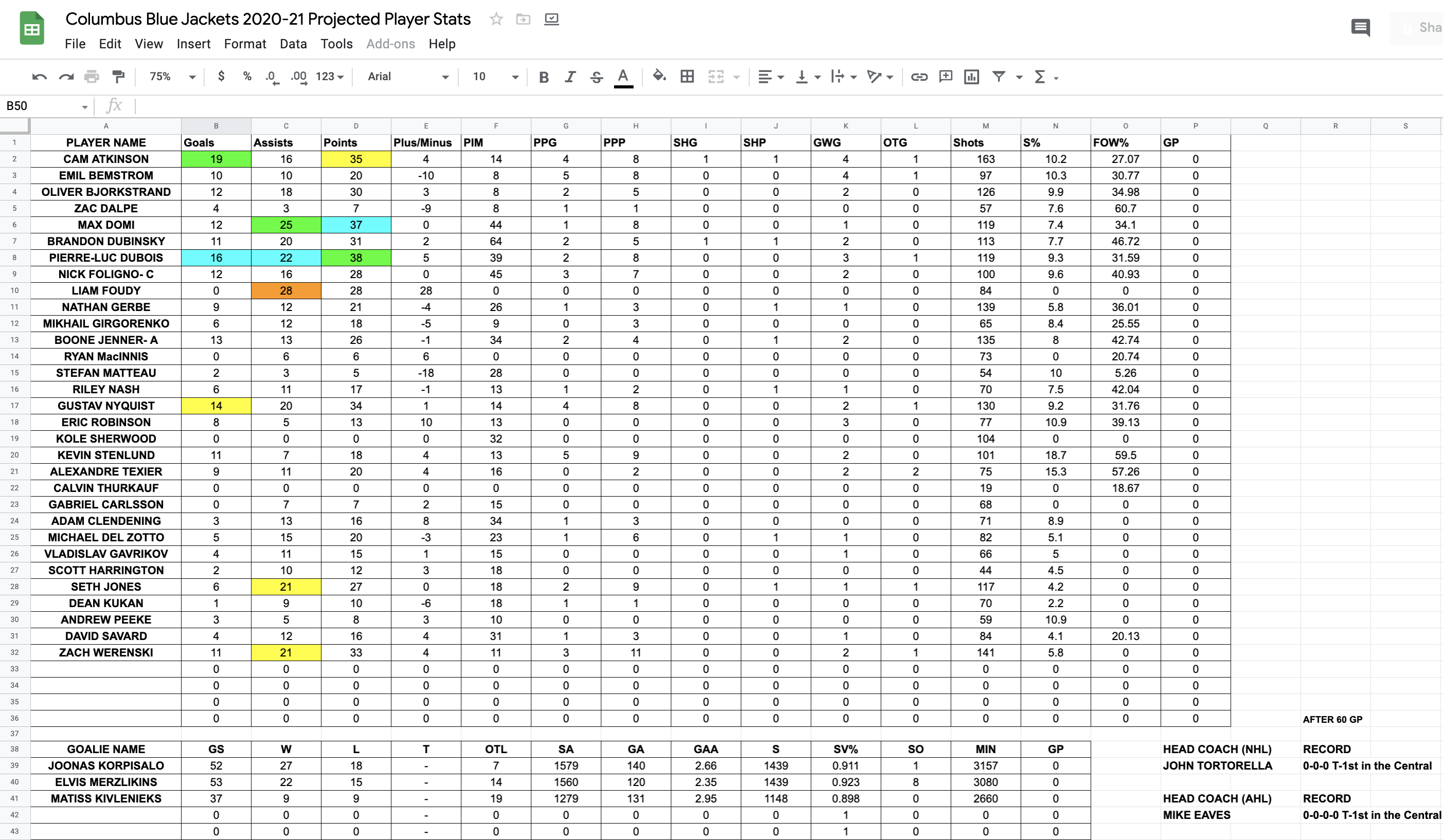
    Columbus Blue Jackets Forecast Through 0 Games (56 Games Remaining)

    First up, let’s take a look at how things were expected to go coming into the 2020-21 season.

    Prior to being traded to the Winnipeg Jets for Patrik Laine and Jack Roslovic, Dubois was forecasted to lead Columbus in scoring with 16-22–38 totals this season.

    New acquisition, Max Domi, was forecasted as a close second to Dubois with 37 points– leading the team in assists in the process with 25 (among NHL regulars last season, since Foudy technically was forecasted to lead in assists among Blue Jackets with 28).

    Of course, Dubois was traded and Laine and Roslovic are off to hot starts with Columbus– scoring goals in bunches when they find the scoresheet, it seems. We’ll get to that in a minute.

    Cam Atkinson was forecasted to score 19 goals prior to the start of the 2020-21 season, which leads Dubois’ 16 forecasted goals and Gustav Nyquist’s 14 forecasted goals on the roster.

    Dubois, of course, was traded and Nyquist is out due to injury for most of this season, so… that checks out.

    On defense, Zach Werenski and Seth Jones were expected to continue to lead with the way with 33 and 27 points, respectively, from the blue line.

    Both defenders are expected to amass 21 assists this season– good enough for the third most forecasted among Blue Jackets skaters entering this season.

    In the crease, John Tortorella will have to find the right balance between Joonas Korpisalo and Elvis Merzlikins.

    There’s potential for a really solid goaltending duo in Columbus if Korpisalo is the starter and can best his 2.66 forecasted goals against average, as well as his forecasted .911 save percentage, while Merzlikins manages to find a way to reach his 2.35 forecasted GAA and .923 forecasted SV%.

    Of course, after 20 team games played, Merzlikins is currently out with an upper body injury, so time will tell if he can return to form.

    Columbus Blue Jackets Forecast Through 20 Games (36 Games Remaining)

    Through 20 games of the 2020-21 season, the Blue Jackets are three points outside of the last playoff spot in the Discover NHL Central Division, trailing the Chicago Blackhawks for this season’s 4th place cutoff line.

    The acquisition of Laine and Roslovic have been quite a welcome sight for Columbus fans, though consistency from the rest of the lineup remains to be an issue.

    Laine, however, is currently forecasted to lead the team in goals (26) and points (46), while Roslovic is on track for 10-17–27 totals, which is about what he had in 71 games with the Jets last season (29 points).

    Using the current forecasted totals, Roslovic is on track for about .551 points per game this season. He had .408 points per game with Winnipeg in 2019-20.

    Atkinson remains in the top-three in scoring, trailing Laine in goals and points with 20 forecasted goals and 39 forecasted points, respectively, while Oliver Bjorkstrand is currently forecasted to amass 15-21–36 totals (the third most on the current roster).

    On the blue line, Jones leads the way among defenders in points (32), as well as all skaters in assists with 27 forecasted assists through 20 team games played in the 2020-21 season.

    Werenski is more in line with what you’d expect from a young defender of his caliber (8-16–24 forecasted totals) and has missed time due to injury, so that’s clearly a factor in his forecasted drop from before the season began to now.

    In the crease, Korpisalo is sure to get more starts than Merzlikins as the latter is currently injured.

    Korpisalo’s current forecast yields a goals against average between 2.59-2.63, while Merzlikins is on track for a 2.29-2.33 in however many games he ends up getting.

    Why the range in GAA?

    That’s new for this season.

    It’s just to show a range between what the forecasted total is according to the model and what the adjusted forecast shows (calculated based on the forecasted goals allowed/forecasted minutes multiplied by 60, as one would traditionally do with goals allowed/minutes played multiplied by 60 to determine GAA).

    I’m no statistician and I felt like there might be a way to try to get a better read on how things are going for goaltenders (with or without enough necessary data to yield a “realistic” result).

    Don’t make any bets using only this forecast. If you’re a professional, you probably already know that.

    Anyway, Korpisalo has a forecasted range between .912 and .913 in save percentage through 20 team games played and Merzlikins is on track for between a .923 and a .924 in SV%.

    Again, a similar principle applies here.

    One end of the range is the straight up forecast, while the other is influenced by forecasted saves/forecasted shots against.

    Well, that does it for this forecast. Tune in after 40 team games played to see how things might go down the stretch (the final 16 games this season).

  • DTFR Podcast #201- Summer School (Since Summer Camp Is A Sponsored MLB Thing Now)

    DTFR Podcast #201- Summer School (Since Summer Camp Is A Sponsored MLB Thing Now)

    Dates, awards finalists, opting out, new faces, exhibition schedule and the Ottawa Senators rebrand.

    Subscribe to the podcast on Apple PodcastsStitcher and/or on Spotify.

  • Men’s and Women’s Ice Hockey at the 2018 Winter Olympic Games

    We’ve talked a lot in DtFR Podcasts about who is – and maybe even more about who isn’t – going to the XXIII Winter Olympic Games in Pyeongchang, South Korea. However, we haven’t had too many discussions yet about the tournament itself.

    What nations are going to be there? What is the format of the tournaments? What time will those games be? Will the United States get those games broadcast live? And, most importantly, who’s taking gold?

    Let’s tackle those questions one at a time.

    What nations are going to be at the Olympics this year?

    In total, there will be 14 nations represented between the two tournaments – though that number does come with a catch.

    Starting with the women’s tournament (which drops the first puck February 10 at 2:40 a.m. Eastern time), there will be two groups of four sides apiece competing to qualify for six spots in the knockout tournament.

    Group A consists of:

    • Canada
    • Finland
    • Olympic Athletes from Russia (OAR)
    • United States of America

    One of these things is not like the others, so now sounds like as good a time as any to discuss one of our “wildcard” nations.

    With a press release on December 5, 2017, the International Olympic Committee (IOC) suspended the Russian Olympic Committee for the 2018 Games for “the systematic manipulation of the anti-doping system” during the 2014 Winter Games in Sochi.

    While that is a hefty charge, the IOC did offer an avenue for clean Russian athletes to compete. Every Russian who passes the IOC’s drug tests is eligible to compete for the Olympic Rings instead of for the Russian Federation, meaning any medals won by Russian athletes will not count towards Russia’s all-time medal counts. No Russian flags will be raised, nor will the State Anthem of the Russian Federation be heard, but at least those athletes will still have an opportunity to compete.

    Group B consists of:

    • Japan
    • Korea
    • Sweden
    • Switzerland

    Ooh, our other “wildcard!” It’s hidden a bit better than the Russian situation, but there’s a hint in one team’s name.

    You probably noticed there was no specification associated with Korea. That’s because North Korea and South Korea are fielding a unified team of 35 players (the standard 23 from South Korea with an additional dozen from North Korea) in the women’s hockey tournament.

    This is a weird and highly politicized (Politics at the Olympics? *insert sarcastic ‘No!’ here*) decision that was finalized only 24 days before Korea’s first game, and that crunched timeline may yield unfortunate results on the ice. Steve Mollman of Quartz provides some excellent information about the politics of the situation, but the only rule Head Coach Sarah Murray, a dual-citizen of Canada and the USA, must follow is three North Korean players must be active for each game.

    Meanwhile, the men’s tournament is a bit larger and features three groups of four teams for a total of 12 nations.

    Group A consists of:

    • Canada
    • Czech Republic
    • South Korea
    • Switzerland

    …Group B:

    • Olympic Athletes from Russia
    • Slovakia
    • Slovenia
    • United States

    …and Group C (the group I’m affectionately calling “The Euro Cup.” Original, I know):

    • Finland
    • Germany
    • Norway
    • Sweden

    All 12 squads will qualify for the knockout stage, but there is a major reward for each nation that wins its group: an automatic entry into the quarterfinals. The best second-place team will also earn a bye in the playoff round that will feature the remaining eight teams.

    What is the format of each tournament?

    Like many international sporting events, both the men’s and women’s Olympic hockey tournaments will begin with a group stage.

    Each team in a given group will play one game against the other three teams in its section. For example, the unified Korean team in the women’s tournament will play Switzerland (February 10 at 7:10 a.m. Eastern time), Sweden (February 12 at 7:10 a.m. Eastern time) and Japan (February 14 at 2:40 a.m. Eastern time).

    Standings will be tabulated in a way similar to the NHL, however there are a few differences: wins count for three points, while overtime and shootout wins only count for two. Overtime and shootout losses will still count for one point, and a regulation loss is… well, a major bummer.

    Okay, we’ve completed the group stage. How does this turn into a knockout tournament?

    This is the phase where things start to look a bit different between the men’s and women’s tournaments. Let’s start with the women’s competition, which will begin its knockout stage on February 16 at 10:10 p.m. Eastern time.

    Did you notice how stacked Group A is? The IOC and IIHF did that intentionally, but they also paved the way for those teams into the tournament as all four will qualify for at least the quarterfinals. The top two teams from the group (A1 and A2) will receive automatic bids into the semifinals, while the remaining sides will square off against the winner and runner-up of Group B (A3 versus B2 and A4 versus B1) in the quarters. B3 and B4 will continue play, but the best they’ll be able to finish in the consolation tournament is fifth place.

    The winner of A3vB2 will take on A1 in the semis, and A2 will square off against the victor of A4vB1. Once those tilts are done, it will boil down to the Gold Medal game, which is scheduled for February 21 at 11:10 p.m. Eastern time. The Bronze Medal match is slated for February 21 at 2:40 a.m. Eastern time.

    As stated before, the group stage in the men’s tournament has no bearing on which nations advance into the knockout – all 12 teams will do just that. However, playoff matchups are dependent on success in the group stage.

    Once group play is complete, all 12 teams will be pooled into one table with the three group winners listed 1-3, the runners-up 4-6 and so on, so forth. Within those four trios, they’ll be ordered by the number of points they earned in the group stage. Should there be a tie in points, it will be decided by goal-differential, then goals for, then – hopefully it doesn’t come to this one – the superior 2017 IIHF ranking.

    I won’t bore you with the seeding process, but the first round of the men’s knockout tournament will begin February 19 at 10:10 p.m. Eastern time. The top four teams from the group stage enter during the quarterfinals, which are scheduled for February 20 at 10:10 p.m. Eastern time, followed by the semifinals three days later. Bronze medals will be awarded after the game at 7:10 a.m. Eastern time on February 24, followed by the Gold Medal tilt at 11:10 p.m. Eastern time that night.

    What time are these games happening, and are they being televised?

    To our readers not from the United States, the broadcasting part of this section doesn’t apply to you. Then again, most of you probably don’t want puck drops listed in Eastern time anyway, so thanks for reading this far if you’re still here!

    Since the women’s tournament begins first, let’s start with their schedule. Remember, OAR means Olympic Athletes from Russia.

    2018 Women’s Tournament
    Date/Time in PyeongChang Date/Time (EST) Group/
    Round
    Matchup USA Live Broadcast
    February 10 at 4:40 p.m. February 10 at 2:40 a.m. B Japan v Sweden
    February 10 at 9:10 p.m. February 10 at 7:10 a.m. B Switzerland v Korea USA
    February 11 at 4:40 p.m. February 11 at 2:40 a.m. A Finland v USA NBC Sports Network
    February 11 at 9:10 p.m. February 11 at 7:10 a.m. A Canada v OAR
    February 12 at 4:40 p.m. February 12 at 2:40 a.m. B Switzerland v Japan NBC Sports Network
    February 12 at 9:10 p.m. February 12 at 7:10 a.m. B Sweden v Korea NBC Sports Network
    February 13 at 4:40 p.m. February 13 at 2:40 a.m. A Canada v Finland NBC Sports Network
    February 13 at 9:10 p.m. February 13 at 7:10 a.m. A USA v OAR NBC Sports Network
    February 14 at 12:10 p.m. February 13 at 10:10 pm B Sweden v Switzerland NBC Sports Network
    February 14 at 4:40 p.m. February 14 at 2:40 a.m. B Korea v Japan USA
    February 15 at 12:10 p.m. February 14 at 10:10 pm A USA v Canada NBC Sports Network
    February 15 at 4:40 p.m. February 15 at 2:40 a.m. A OAR v Finland USA
    February 17 at 12:10 p.m. February 16 at 10:10 pm QF Quarterfinals CNBC
    February 17 at 4:40 p.m. February 17 at 2:40 a.m. QF Quarterfinals USA
    February 18 at 12:10 p.m. February 17 at 10:10 pm CONS Classification (5-8 place)
    February 18 at 4:40 p.m. February 18 at 2:40 a.m. CONS Classification (5-8 place)
    February 19 at 1:10 p.m. February 18 at 11:10 pm SF Semifinals NBC Sports Network
    February 19 at 9:10 p.m. February 19 at 7:10 a.m. SF Semifinals NBC Sports Network
    February 20 at 12:10 p.m. February 19 at 10:10 pm CONS Classification (7-8 place)
    February 20 at 4:40 p.m. February 20 at 2:40 a.m. CONS Classification (5-6 place)
    February 21 at 4:40 p.m. February 21 at 2:40 a.m. BMG Bronze Medal Game USA
    February 22 at 1:10 p.m. February 21 at 11:10 pm GMG Gold Medal Game NBC Sports Network

    And now, the men’s tournament:

    2018 men’s Tournament
    Date/Time in PyeongChang Date/Time (EST) Group/
    Round
    Matchup USA Live Broadcast
    February 14 at 9:10 p.m. February 14 at 7:10 a.m. B Slovakia v OAR USA
    February 14 at 9:10 p.m. February 14 at 7:10 a.m. B USA v Slovenia NBC Sports Network
    February 15 at 12:10 p.m. February 14 at 10:10 pm C Finland v Germany CNBC
    February 15 at 4:40 p.m. February 15 at 2:40 a.m. C Norway v Sweden NBC Sports Network
    February 15 at 9:10 p.m. February 15 at 7:10 a.m. A Czech Republic v South Korea USA
    February 15 at 9:10 p.m. February 15 at 7:10 a.m. A Switzerland v Canada NBC Sports Network
    February 16 at 12:10 p.m. February 15 at 10:10 pm B USA v Slovakia CNBC
    February 16 at 4:40 p.m. February 16 at 2:40 a.m. B OAR v Slovenia NBC Sports Network
    February 16 at 9:10 p.m. February 16 at 7:10 a.m. C Finland v Norway USA
    February 16 at 9:10 p.m. February 16 at 7:10 a.m. C Sweden v Germany NBC Sports Network
    February 17 at 12:10 p.m. February 16 at 10:10 p.m. A Canada v Czech Republic NBC Sports Network
    February 17 at 4:40 p.m. February 17 at 2:40 a.m. A South Korea v Switzerland NBC Sports Network
    February 17 at 9:10 p.m. February 17 at 7:10 a.m. B OAR v USA NBC Sports Network
    February 17 at 9:10 p.m. February 17 at 7:10 a.m. B Slovenia v Slovakia USA
    February 18 at 12:10 p.m. February 17 at 10:10 pm C Germany v Norway NBC Sports Network
    February 18 at 4:40 p.m. February 18 at 2:40 a.m. A Czech Republic v Switzerland NBC Sports Network
    February 18 at 9:10 p.m. February 18 at 7:10 a.m. A Canada v South Korea USA
    February 18 at 9:10 p.m. February 18 at 7:10 a.m. C Sweden v Finland NBC Sports Network
    February 20 at 12:10 p.m. February 19 at 10:10 pm Q Qualifications NBC Sports Network
    February 20 at 4:40 p.m. February 20 at 2:40 a.m. Q Qualifications NBC Sports Network
    February 20 at 9:10 p.m. February 20 at 7:10 a.m. Q Qualifications USA
    February 20 at 9:10 p.m. February 20 at 7:10 a.m. Q Qualifications NBC Sports Network
    February 21 at 12:10 p.m. February 20 at 10:10 pm QF Quarterfinals CNBC
    February 21 at 4:40 p.m. February 21 at 2:40 a.m. QF Quarterfinals NBC Sports Network
    February 21 at 9:10 p.m. February 21 at 7:10 a.m. QF Quarterfinals NBC Sports Network
    February 21 at 9:10 p.m. February 21 at 7:10 a.m. QF Quarterfinals USA
    February 23 at 4:40 p.m. February 23 at 2:40 a.m. SF Semifinals NBC Sports Network
    February 23 at 9:10 p.m. February 23 at 7:10 a.m. SF Semifinals NBC Sports Network
    February 24 at 9:10 p.m. February 24 at 7:10 a.m. BMG Bronze Medal Game NBC Sports Network
    February 25 at 1:10 p.m. February 24 at 11:10 pm GMG Gold Medal Game NBC Sports Network

    A master schedule is available at the bottom of this article, but there’s one question left to answer first.

    So, who’s going for the gold?

    Ah, perhaps the most important question of them all.

    As we’ve been doing this whole time, we’ll stick with tradition and predict the women’s tournament first.

    Just examining the format of the tournament, the IIHF and the IOC are simply begging for another Gold Medal Game between Canada and the United States, the world’s top-two ranked women’s teams.

    There’s obviously potential for either team to stumble in a group that features the four best squads in the world and be forced to play in the quarterfinals, but I just don’t see it happening. Should my prediction prove correct, the world’s best teams would square off in a third-straight Olympic Final, with Canada playing for its fifth-consecutive gold.

    As for the men’s tournament, it’s been well reported that the NHL keeping its players at home will play a major role in determining which nations are taking home hardware.

    In my opinion, that leaves the door wide open for the Olympic Athletes from Russia, especially since they’re playing in what I believe to be the weakest group of the bunch. The OAR boasts players such as F Pavel Datsyuk, C Mikhail Grigorenko, W Ilya Kovalchuk, D Alexey Marchenko, D Nikita Nesterov and F Vadim Shipachyov – all of whom have NHL experience. Tack on the fact that they all play in the second-best league in the world, and they’re more than prepared for every challenge that can come their way in Pyeongchang.

    Of course, we all saw what happened the last time the Russians were favorites to win the Olympics. Should this team crumble like 2014’s squad (even though F T.J. Oshie will be preoccupied playing with the best Russian player in the world, W Alex Ovechkin), I’m leaning towards the winner of the mini Euro Cup taking full advantage. All four of those teams are in the top-10 of the current IIHF World Rankings, with Sweden and Finland respectively leading the way as numbers 3 and 4.

    But don’t leave the predicting work to me. Here’s what all of us here at Down the Frozen River – and even our old pal Frank Fanelli, now of Student Union Sports – think is going to happen:

    Down the Frozen River’s Olympic Picks
    Cap’n Colby Connor Frank Jordan Nick Pete
    Women’s Tournament
    Gold Canada Canada Canada USA USA USA USA
    Silver USA USA USA Canada Canada Canada Canada
    Bronze Finland Sweden Finland Sweden Sweden Finland Sweden
    Fourth Sweden Japan OAR Finland Finland Sweden Finland
    Men’s Tournament
    Gold Sweden Sweden OAR Sweden OAR Sweden Sweden
    Silver Canada USA Finland USA Canada OAR OAR
    Bronze Finland Canada Sweden Canada USA Canada Canada
    Fourth OAR OAR Canada Finland Sweden USA USA

    It seems I’m not alone in my prediction of a Canada-USA Gold Medal match in the women’s tournament! All seven of us have the two squaring off in the final, with a slim majority believing Captain Meghan Duggan and co. can lead Team USA to its first gold since 1998.

    As for the women’s Bronze Medal game, we’re leaning towards a Scandinavian country taking home some hardware – with most of us favoring Sweden over Finland. However, Colby and I think underdogs are going to make it to the semifinals before falling, as I’m pegging the fourth-ranked Olympic Athletes from Russia to end up in fourth and Colby’s picking ninth-ranked Japan.

    In the men’s tournament, it seems Sweden is the nearly consensus favorite to come away with the medals that match its tri-crowned sweaters. However, who Captain Joel Lundqvist‘s – yes, the twin brother of the Rangers’ G Henrik Lundqvist – team beats in that Gold Medal game is anyone’s guess, as we’ve picked four different teams to take home silver.

    We seem to be in a bit more agreement about the winner of the bronze medal, as four of us have pegged Captain Chris Kelly‘s Team Canada to come home with its third-consecutive medal.

    While we may all have our own rooting interests, I think we can all agree that this should be a fun and exciting two weeks of hockey.

    2018 Olympic Hockey Tournament
    Date/Time in PyeongChang Date/Time (EST) Sex Group/
    Round
    Matchup USA Live Broadcast
    February 10 at 4:40 p.m. February 10 at 2:40 a.m. W B Japan v Sweden
    February 10 at 9:10 p.m. February 10 at 7:10 a.m. W B Switzerland v Korea USA
    February 11 at 4:40 p.m. February 11 at 2:40 a.m. W A Finland v USA NBC Sports Network
    February 11 at 9:10 p.m. February 11 at 7:10 a.m. W A Canada v OAR
    February 12 at 4:40 p.m. February 12 at 2:40 a.m. W B Switzerland v Japan NBC Sports Network
    February 12 at 9:10 p.m. February 12 at 7:10 a.m. W B Sweden v Korea NBC Sports Network
    February 13 at 4:40 p.m. February 13 at 2:40 a.m. W A Canada v Finland NBC Sports Network
    February 13 at 9:10 p.m. February 13 at 7:10 a.m. W A USA v OAR NBC Sports Network
    February 14 at 12:10 p.m. February 13 at 10:10 pm W B Sweden v Switzerland NBC Sports Network
    February 14 at 4:40 p.m. February 14 at 2:40 a.m. W B Korea v Japan USA
    February 14 at 9:10 p.m. February 14 at 7:10 a.m. M B Slovakia v OAR USA
    February 14 at 9:10 p.m. February 14 at 7:10 a.m. M B USA v Slovenia NBC Sports Network
    February 15 at 12:10 p.m. February 14 at 10:10 pm W A USA v Canada NBC Sports Network
    February 15 at 12:10 p.m. February 14 at 10:10 pm M C Finland v Germany CNBC
    February 15 at 4:40 p.m. February 15 at 2:40 a.m. W A OAR v Finland USA
    February 15 at 4:40 p.m. February 15 at 2:40 a.m. M C Norway v Sweden NBC Sports Network
    February 15 at 9:10 p.m. February 15 at 7:10 a.m. M A Czech Republic v South Korea USA
    February 15 at 9:10 p.m. February 15 at 7:10 a.m. M A Switzerland v Canada NBC Sports Network
    February 16 at 12:10 p.m. February 15 at 10:10 pm M B USA v Slovakia CNBC
    February 16 at 4:40 p.m. February 16 at 2:40 a.m. M B OAR v Slovenia NBC Sports Network
    February 16 at 9:10 p.m. February 16 at 7:10 a.m. M C Finland v Norway USA
    February 16 at 9:10 p.m. February 16 at 7:10 a.m. M C Sweden v Germany NBC Sports Network
    February 17 at 12:10 p.m. February 16 at 10:10 pm W QF Quarterfinals CNBC
    February 17 at 12:10 p.m. February 16 at 10:10 p.m. M A Canada v Czech Republic NBC Sports Network
    February 17 at 4:40 p.m. February 17 at 2:40 a.m. W QF Quarterfinals USA
    February 17 at 4:40 p.m. February 17 at 2:40 a.m. M A South Korea v Switzerland NBC Sports Network
    February 17 at 9:10 p.m. February 17 at 7:10 a.m. M B OAR v USA NBC Sports Network
    February 17 at 9:10 p.m. February 17 at 7:10 a.m. M B Slovenia v Slovakia USA
    February 18 at 12:10 p.m. February 17 at 10:10 pm M C Germany v Norway NBC Sports Network
    February 18 at 12:10 p.m. February 17 at 10:10 pm W CONS Classification (5-8 place)
    February 18 at 4:40 p.m. February 18 at 2:40 a.m. M A Czech Republic v Switzerland NBC Sports Network
    February 18 at 4:40 p.m. February 18 at 2:40 a.m. W CONS Classification (5-8 place)
    February 18 at 9:10 p.m. February 18 at 7:10 a.m. M A Canada v South Korea USA
    February 18 at 9:10 p.m. February 18 at 7:10 a.m. M C Sweden v Finland NBC Sports Network
    February 19 at 1:10 p.m. February 18 at 11:10 pm W SF Semifinals NBC Sports Network
    February 19 at 9:10 p.m. February 19 at 7:10 a.m. W SF Semifinals NBC Sports Network
    February 20 at 12:10 p.m. February 19 at 10:10 pm M Q Qualifications NBC Sports Network
    February 20 at 12:10 p.m. February 19 at 10:10 pm W CONS Classification (7-8 place)
    February 20 at 4:40 p.m. February 20 at 2:40 a.m. M Q Qualifications NBC Sports Network
    February 20 at 4:40 p.m. February 20 at 2:40 a.m. W CONS Classification (5-6 place)
    February 20 at 9:10 p.m. February 20 at 7:10 a.m. M Q Qualifications USA
    February 20 at 9:10 p.m. February 20 at 7:10 a.m. M Q Qualifications NBC Sports Network
    February 21 at 12:10 p.m. February 20 at 10:10 pm M QF Quarterfinals CNBC
    February 21 at 4:40 p.m. February 21 at 2:40 a.m. W BMG Bronze Medal Game USA
    February 21 at 4:40 p.m. February 21 at 2:40 a.m. M QF Quarterfinals NBC Sports Network
    February 21 at 9:10 p.m. February 21 at 7:10 a.m. M QF Quarterfinals NBC Sports Network
    February 21 at 9:10 p.m. February 21 at 7:10 a.m. M QF Quarterfinals USA
    February 22 at 1:10 p.m. February 21 at 11:10 pm W GMG Gold Medal Game NBC Sports Network
    February 23 at 4:40 p.m. February 23 at 2:40 a.m. M SF Semifinals NBC Sports Network
    February 23 at 9:10 p.m. February 23 at 7:10 a.m. M SF Semifinals NBC Sports Network
    February 24 at 9:10 p.m. February 24 at 7:10 a.m. M BMG Bronze Medal Game NBC Sports Network
    February 25 at 1:10 p.m. February 24 at 11:10 pm M GMG Gold Medal Game NBC Sports Network
  • TRADE ANALYSIS: Preds, Sens solidify contender status, Avs profit later

    Breakups are hard.

    Joe Sakic was one of Matt Duchene‘s all-time heroes growing up– right up there with golden age era Colorado Avalanche counterpart, Peter Forsberg. Now, Sakic has traded away the player that was meant to carry the torch as Colorado transitioned from their franchise’s greatest player of all-time to the 3rd overall pick in the 2009 NHL Entry Draft.

    Unknown-1

    Last year’s Colorado Avalanche sealed the deal for Duchene. He had waited long enough for a franchise that has only made the playoffs twice in his career to rebuild.

    His days were numbered and had been rumored to be on his way out since things really began to go south last season, but Avalanche general manager, Joe Sakic, held on until the very last minute– demanding quite the return in hopes of making up for the lost time in talent acquisition and development after the Ryan O’Reilly trade with the Buffalo Sabres at the 2015 NHL Entry Draft.

    Nikita Zadorov hasn’t lived up to the hype– though he is on their roster, J.T. Compher isn’t as prolific as O’Reilly, Mikhail Grigorenko‘s now playing in the KHL and the 31st overall pick was flipped by the Avs at the draft to the San Jose Sharks. The O’Reilly deal had a clear winner (Buffalo) and setback Colorado further than they expected to have been in the post-O’Reilly Era, already depleted at center a season after losing Paul Stastny to the St. Louis Blues in free agency.

    For Duchene, the drama’s over.

    No more questions about who’s going to step up, when thing’s are going to turn around or how long things will last.

    The deal is done.

    Sunday night, while playing at Barclays Center against the New York Islanders, Matt Duchene was pulled off the ice during a stoppage to assist now former teammate, Blake Comeau, out of the rink with an injury. Duchene had been traded– mid-game. The first in recent memory since Janurary 12, 2012, when the Montreal Canadiens sent Mike Cammalleri to the Calgary Flames during a matchup with the Boston Bruins at TD Garden.

    Unknown-6Duchene will be closer to home, bringing his 4-6-10 totals in 14 games with Colorado so far this season to Canada’s capital. His Senators debut will be against his former team later this week as Ottawa takes on Colorado in the 2017 SAP NHL Global Series this Friday and Saturday in Stockholm, Sweden.


    The 26-year-old center had 428 points (178 goals, 250 assists) in 586 games played with the Avalanche since being drafted in 2009 and is moving on to greener pastures with the Ottawa Senators after a career worst minus-34 in 77 games last season.

    Ottawa is going through a little breakup of their own as part of this three-team trade, sending the other largest part of the deal, Kyle Turris, to the Nashville Predators, while dealing Andrew Hammond, Shane Bowers, a 2018 1st round pick (with top-ten protection) and a 2019 3rd round pick to Colorado.

    In perhaps the biggest underrated pickup from this trade, Turris brings his 3-6-9 totals in 11 games with the Sens this season to the Nashville Predators. The 28-year-old center is coming off of a career best 27 goals last season and finished the 2016-17 campaign with 27-28-55 totals in 78 games played.

    A strong, two-way player, Turris’s current contract expires at the end of the season, but fear not, Preds fans, he’s already signed a six-year extension that’ll keep him in Nashville through the 2022-23 season at a $6.000 million cap hit (beginning next season).

    Predators GM David Poile knows he’ll need plenty of depth down the middle for a long playoff run. Nashville has their sights set on a Cup run and given their last Stanley Cup Final appearance, they’ll need one of the best group of centers down the middle, in the event of injury (a la Ryan Johansen).

    Unknown

    Luckily, that’s where Kyle Turris fits the bill. In 544 career NHL games with Ottawa and the Phoenix Coyotes, he’s had 136 goals and 184 assists (320 points). The 3rd overall pick by the Coyotes in the 2007 NHL Entry Draft seeks to win it all with his third team in the NHL.

    To complete the deal, the Predators sent Samuel Girard, Vladislav Kamenev and a 2018 2nd round pick to the Avalanche. Girard is a highly touted prospect once log-jammed in Nashville’s immense depth on the blue line, now free to flourish with Colorado and was the 46th overall pick in the 2016 NHL Entry Draft. Kamenev was the 42nd overall choice by the Predators in the 2014 NHL Entry Draft.

    While Sakic kept his demands high throughout the entire process of trading Duchene, he may reap the rewards of a plethora of picks, prospects and much needed depth in goal that is all-too-often overlooked (but becomes quite apparent when goalies are injured, let alone one of them– hello, Vegas).

    Whether or not Sakic will flip the assets he attained for more remains to be seen– if he’s even the one to do so (there’s no guarantees in the midst of a rebuild, even if the draft picks are one or two calendar years away).


    tl:dr The Colorado Avalanche finally traded Matt Duchene to the Ottawa Senators in a three-team trade in which Kyle Turris got shipped from the Sens to the Nashville Predators. In all, Colorado acquired Shane Bowers, Andrew Hammond, Samuel Girard, Vladislav Kamenev, a 2018 1st round pick (OTT), a 2018 2nd round pick (NSH) and a 2019 3rd round pick (OTT).

    Colorado makes off with the most assets that could pay off if they draft the right guys or flip for more roster components at a later date, Ottawa got a center that they won’t have to worry about giving a raise this offseason (though they’ll still have to re-sign other large components in the next year or two) and Nashville got Turris locked up to a six-year extension going into effect next season, while also legitimizing themselves as a contender for the Cup this season with a solid core down the middle.


    Some fun facts:

    Duchene’s contract expires at the end of the 2018-19 season. His current cap hit is $6.000 million. Ottawa has about $3.700 million in cap space currently, according to CapFriendly and will need to re-sign players like Mark Stone and Cody Ceci next July (2018), as well as Erik Karlsson in 2019.

    Nashville’s current cap hit of about $70.270 million, with Turris signed to a 6-year, $6.000 million per extension going into effect next season, will be even tighter heading into July 2018, which means they could be the new Washington Capitals in terms of everyone’s “Cup or bust” team this season.

    Colorado’s cap hit is now about $66.741 million with a little over $8.000 million in cap space with more to offer throughout the season in terms of potential transactions and expendable rental players come this year’s trade deadline.

  • Colorado Avalanche 2017-2018 Season Preview

    Unknown-1Colorado Avalanche

    22-56-4, 48 points, 7th in the Central Division (’16-’17)

    Additions: F Andrew Agozzino, G Jonathan Bernier, G Joe Cannata, D Jared Cowen (PTO), D Jesse Graham, D David Warsofsky, F Colin Wilson, F Nail Yakupov

    Subtractions: D Mat Clark (signed with HC Bolzano, EBEL), F Turner Elson (signed with DET), D Eric Gelinas (PTO with MTL), F Mikhail Grigorenko (signed with HC CSKA Moscow, KHL), F Brendan Ranford (signed with San Antonio, AHL), F Mike Sislo (signed with ARI), G Jeremy Smith (signed with CAR), D Patrick Wiercioch (signed with VAN)

    Still Unsigned: F Troy Bourke, F Rene Bourque, D Cody Goloubef, F Samuel Henley, F John Mitchell, F Jim O’Brien, D Fedor Tyutin, D Nikita Zadorov

    Offseason Analysis: Colorado Avalanche general manager, Joe Sakic, had one thing– and one thing only— to do this offseason– improve the team by any means necessary. The 2016-2017 Avs were the worst team in the lockout era (since the 2004-2005 season long lockout).

    The 2006-2007 Philadelphia Flyers went 22-48-12, amassing 56 points along the way to collecting a -89 goal differential. The 2016-2017 Colorado Avalanche were eight points worse and had a -112 goal differential. So yeah, things were that bad.

    Sakic could’ve traded forwards Matt Duchene and Gabriel Landeskog at any point this offseason, but he hasn’t.

    While relationships between the front office and Landeskog may be mended the longer this drama goes on, the same cannot be said for Duchene. Colorado has promoted the likes of Nathan MacKinnon, Landeskog and others on their social media platforms all summer, but fans haven’t seen much of Duchene, save for photos from his wedding.

    The rumor mill has gone quiet– we did just wrap up August after all, and that’s when all of the GMs go into hibernation, unlike Boston Celtics general manager, Danny Ainge, and Cleveland Cavaliers general manager, Koby Altman, but basketball has long been different from NHL offseason traditions.

    Not to get all sports talk radio host on the Avalanche, but what are they thinking?

    Duchene, whether he regains top-notch form or not, is a sought after, star-quality center that is only one season removed from a nearly 60-point year. Yes, 18-23-41 totals in 77 games played in 2016-2017 won’t cut it for most teams paying an expected first or second line center $6.000 million a year, but here’s the thing– Colorado was the exception to the rule in just about everything last year.

    Carl Soderberg ($4.750 million cap hit) only had 14 points last season after amassing a career year in scoring (51 points in 2015-2016). Everyone’s production was off a cliff– or down a mountain, if you’d like– in Avalanche territory.

    So Sakic had a chance to hit the reset button and completely shut things off-and-on-again (with the hopes that last season was the “off-year”) and brought in some help in the crease. Granted, that doesn’t fix their porous blue line and lack off offensive production, but Jonathan Bernier provides more of a cushion in case Semyon Varlamov goes down with another season ending injury.

    Bernier’s 2.50 GAA in 39 games with the Anaheim Ducks last season was his best goals against average since his days in a Los Angeles Kings uniform (2007-2013). As one of the best underrated backup goaltenders, Bernier could soar with the right combinations on the ice in front of him.

    Speaking of combinations, head coach Jared Bednar has got quite the conundrum on the blue line to figure out defensive pairings. Colorado’s oldest defenseman is 29-year-old Erik Johnson. That would be a good thing under normal circumstances, however, Tyson Barrie, 26, and Mark Barberio, 27, are the only other defensemen under contract with Nikita Zadorov, 22, in a holding pattern as an unsigned RFA according to CapFriendly.

    That’s a lot of minutes split between three defensemen (obviously Jared Cowen is signed to a PTO and could receive an offer/any AHL defenseman in their system– ‘sup David Warsofsky– could fill out the remaining spots/trades could be made).

    While Varlamov looks to bounce back to full health and the Mile-High City collectively prays for a mile-high miracle turnaround in offense, not much has changed. Sure Colin Wilson was acquired from Nashville and Nail Yakupov was signed, but one is a clutch depth scorer and the other is a former 1st overall pick on his third team in three years.

    Down the Frozen River statistical models* show the Colorado Avalanche as a team that can put up around 80 points on the season, which is certainly feasible if everything falls into line, but it seems to make more sense to go with gut instinct on this one and predict the Avalanche will finish 31st in the league with a slightly less dismal (depending on how you look at it) season than last year.

    Offseason Grade: D

    “D” as in trade Duchene, add a Defenseman (or two).

    *Coming soon, stay tuned. *eyes emoji*

  • October 17 – Day Six – Someone must lose

    Up until last night, the Edmonton Oilers had been a fun, high-flying offense. Then Buffalo gave them a taste of their own medicine, beating them 6-2 in yesterday’s Game of the Day.

    2:37 after taking the ice for the first time this season, Kyle Okposo (Sam Reinhart and First Star of the Game Ryan O’Reilly) scored the first goal of the game, followed 4:37 later by O’Reilly (Okposo and Rasmus Ristolainen) doubling the Sabres‘ lead. The first period ended tied though, as Benoit Pouliot (Zack Kassian and Ryan Nugent-Hopkins) and Milan Lucic (Third Star Leon Draisaitl and Jordan Eberle) scored 100 seconds apart before the first intermission.

    Buffalo continued their trend of scoring twice a period in both the second and third frames. O’Reilly (Ristolainen and Cody Franson) takes credit for the winner, with Marcus Foligno (A), Second Star Brian Gionta (2G), Johan Larsson (A), Jake McCabe (A), Matt Moulson (G), O’Reilly (A) and Ristolainen (A) all participating in the three insurance tallies.

    Robin Lehner earns the victory after saving 31-of-33 (93.9%) shots faced, while Cam Talbot takes the loss after saving 17-of-23 (73.9%). He was replaced with 10:04 to go by Jonas Gustavsson, who saved the lone shot he faced for no decision.

    Although the road team won this time, the home squads still own a 5-3-0 record and a two-point lead over the roadies in the DtFR Game of the Day series.

    We’ve got four games to choose from this evening, starting with two at 7 p.m. (San Jose at the New York Rangers [NHLN] and Colorado at Pittsburgh [SN1]). Ottawa visits Detroit half an hour later (RDSI), and the night starts to find its end at 8 p.m. with Boston at Winnipeg (TVAS). All times eastern.

    I must admit, none of the games are extremely enticing. Ottawa at Detroit is the only contest between teams of the same conference, but the Red Wings would probably prefer we didn’t watch them right now. Although it is early in the season, Colorado at Pittsburgh is the lone game between undefeated teams, so we’ll head to the Steel City.

    Unknown-1pittsburgh_penguins_logo


    The Avalanche come to PPG Paints Arena owning an incredible 1-0-0 record. Their lone game so far this season was a 6-5 barn-burner against the Dallas Stars at the Pepsi Center. Tyson Barrie‘s then-unassisted insurance goal with 6:03 remaining in the game ended up being the game-winner Saturday night. Francois Beauchemin (2A), Joe Colborne (3G), Blake Comeau (A), Mikhail Grigorenko (A), Erik Johnson (A), Gabriel Landeskog (A), Nathan MacKinnon (G/A), Carl Soderberg (G), Patrick Wiercioch (A) and Nikita Zadorov (A) all participated in the scoring explosion.

    In addition to their opening thriller against the Washington Capitals, the Penguins have also bested the Anaheim Ducks without leaving the comforts of home. Phil Kessel (Patric Hornqvist) takes credit for the game-winner 2:02 before the halfway point of the contest. Ian Cole (G), Matt Cullen (A), Trevor Daley (A), Chris Kunitz (A), Evgeni Malkin (A) and Conor Sheary (G) all earned the honor of being listed on the score sheet.

    Some players to keep an eye on include Colorado‘s Colborne (three goals [tied for third-most in the league]) and Pittsburgh‘s Marc-Andre Fleury (two wins [tied for the league-lead] and a .948 save percentage [fifth-best in the NHL]).

    Last season, Pittsburgh won both games against the Avalanche by a combined 8-5 score. It was the first time either team had swept the other since 2012, which capped a four-game winning streak by the Penguins over Colorado over the span of three seasons.

    The Pens opened in Vegas favored at -155, and bettors have continued to bet against the visitors. Although the Avs outscored one of the most potent offenses from the comforts of home, I have a hard time believing they can duplicate that success against a Pittsburgh team with a better defense and goaltender. I pick the Pens to win by at least two goals.

    Hockey Birthday

    • Francis Bouillon (1975-) – Bouillon played 776 games over 14 seasons in the NHL, 581 of which were with the Montréal Canadiens. Though only 5′ 8″,  Bouillon was always in the thick of things and helped the Habs  reach the playoffs six times during his tenure.
  • Monday Roundup- 2015 Offseason Thoughts

    Monday Roundup- 2015 Offseason Thoughts

    By: Nick Lanciani

    It’s been a busy offseason around the NHL- and by that I mean it’s been a rather unusual offseason around the NHL.

    The Ryan O’Reilly saga finally ended in Colorado and began in Buffalo, but took a side trip into the side of a Tim Horton’s somewhere in Ontario. While the Sabres could use his offense, they could do without his legal offenses (moral of the story, everyone, don’t drink and drive- have a designated driver, be responsible- use common sense).

    Mikhail Grigorenko’s been reunited with Patrick Roy in Colorado, although sadly the rest of the 2011-2012 and 2012-2013 Quebec Remparts will not be joining the party in Denver.

    T.J. Oshie, Brandon Saad, Milan Lucic, Dougie Hamilton, Patrick Sharp, Cam Talbot, Phil Kessel, and others have all been on the move as the result of blockbuster trades.

    600x400_Sweeney_Development_Camp
    Boston Bruins general manager, Don Sweeney (pictured), has been wheeling and dealing this offseason- in stark contrast of his predecessor, Peter Chiarelli (bruins.nhl.com).

    Don Sweeney’s been on a rampage (more on that later), Peter Chiarelli’s turned around the Edmonton Oilers in one offseason (at least on paper), and the Toronto Maple Leafs front office might be the smartest guys in the game for the first time in a longtime. Wait, what did I just say?

    That’s right, on Thursday, 72-year-old hockey front office legend, Lou Lamoriello, resigned as president of the New Jersey Devils only to join the Toronto Maple Leafs (announced on Twitter a mere two minutes apart) as their 16th general manager in franchise history.

    Fun fact: Back in 1987, Lamoriello drafted now fellow colleague, Brendan Shanahan, 2nd overall in his first season as the president and general manager of the Devils.

    Now, Lamoriello joins Shanahan in Toronto’s front office. Things certainly are weird right now in New Jersey, in the meantime, by the way- where Ray Shero is currently their GM and Marty Brodeur is, well, among the front office of the St. Louis Blues. Yep, it’s safe to say nobody would have predicted that both Brodeur and Lamoriello would move on from the Devils.

    In 2009, Lamoriello praised Shanahan after Shanahan attempted one final go in the NHL, with the Devils, only to decide he would not continue his career and thus stepped aside from playing, retiring before the 2009-2010 season. Lamoriello expressed so much praise, in fact, that he blatantly stated that should Shanahan want a job in the Devils front office, Lamoriello would go out of his way to make it happen.

    But here we are in 2015, where Shanahan recently transitioned to the helm of the Maple Leafs front office and instead of going to his former boss for a position, he brought in his former boss.

    Brendan Shanahan (left) introduces Lou Lamoniello (right) as the new general manager of the Toronto Maple Leafs. (Galit Rodan/The Canadian Press via AP)
    Brendan Shanahan (left) introduces Lou Lamoniello (right) as the new general manager of the Toronto Maple Leafs. (Galit Rodan/The Canadian Press via AP)

    Lamoriello spent 28 years with the New Jersey Devils organization, but now he’s about to embark on his first season with a different organization- just his second as a general manager- the Toronto Maple Leafs.

    The Maple Leafs, if you recall, hired Mike Babcock this offseason as their latest head coach, by the way. Babcock too, left an organization he spent a lot of time with for the Maple Leafs this summer. Babcock spent the last 10 years with the Detroit Red Wings before joining Toronto.

    Both Lamoriello and Babcock have something in common, they both left teams that used red as a primary color for a team that wears a blue maple leaf proudly displayed prominently on their jersey (it’s a bit slow right now in the offseason, cut me some slack).

    In other news, the National Hockey League began the formal expansion process this summer, having accepted expansion applications up until Monday.

    Two cities formally submitted a bid before the deadline- Las Vegas, Nevada and Quebec City, Quebec.

    Las Vegas billionaire, Bill Foley, continues to headman the construction of an arena in Las Vegas as well as a drive for season tickets while aiming to land an expansion team. Meanwhile, Montreal-based media conglomerate, Quebecor, aims to bring the NHL back to Quebec City.

    One of Canada’s hockey gods, Don Cherry, has already provided his blessing for a return to Quebec City.

    This is the first time the league has formally gone through the expansion process since the late 1990s when the league quickly grew in size adding the Nashville Predators, the Atlanta Thrashers, the Minnesota Wild, and the Columbus Blue Jackets between 1998 and 2000 to become the 30 team league that we all know and love today (with the minor relocation of the Thrashers to Winnipeg having occurred prior to the 2011-2012 season, of course).

    Since the Thrashers relocation to Winnipeg, the NHL has continued to take a firm stance against having to move another team for a while. Prior to the formal announcement of the expansion process being officially explored, the Arizona Coyotes and the City of Glendale, Arizona were at odds with one another.

    Despite IceArizona’s firm commitment to the State of Arizona, many thought the Coyotes would be on their way out of Glendale this offseason. Given how a short move back to Phoenix in such a short period of time would not be feasible, speculation led to the Coyotes packing their bags and moving to an NHL ready arena.

    Downtown Phoenix does not have an appropriate sporting arena for hockey currently, thereby handing the Coyotes a double whammy when their Gila River Arena lease agreement with Glendale was pulled out from under them by the city.

    After threatening substantial legal action, IceArizona and the City of Glendale came to terms on amending their agreement- eliminating an outclause from its initial version and adjusting some revenue sharing between the hockey club and the city (the team will now get a larger share, with the city footing less of the bill).

    Again, the Coyotes are staying put. No escape route to Seattle, no move from one desert to another desert (Las Vegas), and no move to Quebec City that would further imbalance the conferences in the league.

    But then again, the amended lease agreement is only for two years, so the Coyotes aren’t fully out of the woods yet.

    There remains so much yet to be seen concerning the Arizona Coyotes and their strained relations with the City of Glendale. While a short-term deal is necessary for their immediate survival in the market, their ultimate situation is not comforting. Things still could get quite ugly in a couple of years, yet the two sides have something to work with right now and can always chip away at improving viability of the franchise in Glendale.

    CIdjKkyVEAAIx7x
    The Arizona Coyotes will be debuting new jerseys this season, but their future in Arizona, despite glimmers of hope, is still uncertain in the long run (coyotes.nhl.com).

    If not, perhaps the next two years is all the time the Coyotes need to convince Phoenix, Arizona and the NBA’s Phoenix Suns to construct a new- joint- arena that would be suitable for hockey in the desert and a return to downtown Phoenix for the Coyotes franchise. Otherwise, it could be enough for Seattle to scrap together some plans for a NHL-ready arena and sway the Coyotes into relocation.

    Or there’s always Quebec City or Las Vegas, that, should either location not see the expansion process include them in the more immediate future of the league, could always have a stronger say in relocation. Both cities have strong interest from potential ownership groups and physical arena’s that are state of the art and nearing completion.

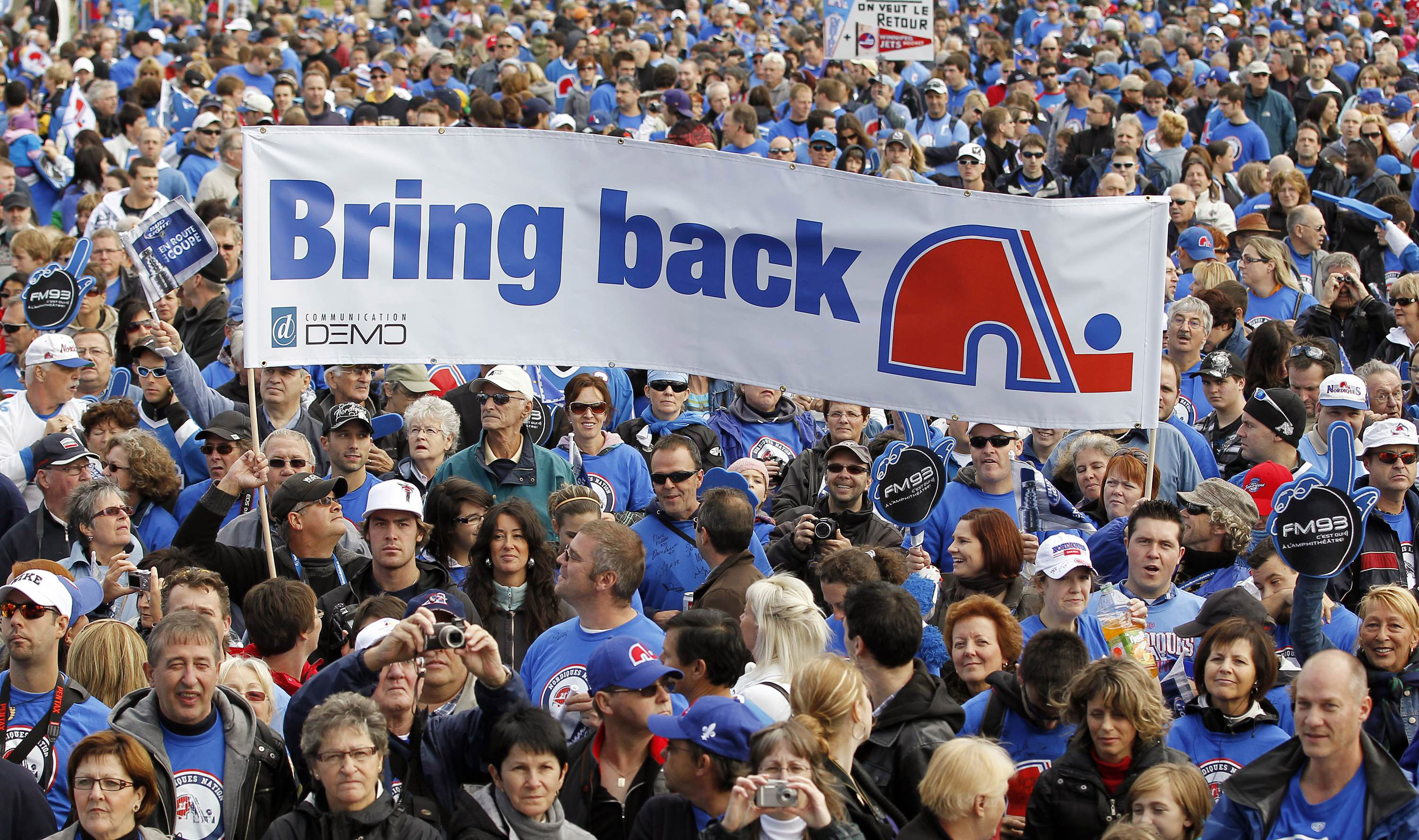
    Speaking of Quebec City and Las Vegas, now is the perfect time to reach into these markets. A return of the Nordiques to the hockey crazed Ville de Québec would be a golden opportunity for the league to return the game to where it belongs and can further drive marketability.

    For those that are opposed to adding another team in the Eastern Conference, kindly show yourself to the door. Realignment is never a fun topic, but I think we can all agree that sending the Detroit Red Wings and the Columbus Blue Jackets back to the Western Conference would be a good thing. As fans, we’d see a return of more Detroit and Chicago matchups, providing more fuel to the fire- built into the regular season schedule- when it comes to that longstanding rivalry.

    And with the addition of a team in Las Vegas, well, it’s the same old, same old. It’s a never before seen market in all of professional sports and it would balance the conferences under the aforementioned scenario.

    REUTERS/Mathieu Belanger
    REUTERS/Mathieu Belanger

    So at the end of the day, why disappoint the good people of Quebec City once again, NHL?

    Then again, balanced conferences are overrated, aren’t they?

    Come to think of it, the European model for professional sports isn’t too bad when it comes to league structure. Yet, the North American model of conferences, divisions, and such makes for a much more exciting game. We’ll never see the NHL switch to a relegation model based upon Premier League association football, but maybe we’ll see the NHL become more at ease with unbalanced conferences.

    Hey if the game works in a market, why ruin it by taking it away from that market just to satisfy conference structure? If the owners are going to squabble over that then they really aren’t looking out for the best interest of the league are they? Management’s number one goal is to profit from growing the game.

    Without an interest, there aren’t any fans. Without any fans, there aren’t any marketing opportunities from potential sponsors looking to reach fans. Without any cash flow, there is no game. If there’s an economically viable market or situation, go for it.

    UnknownLast, but not least, the Boston Bruins have been a busy team this offseason. One can only think that the B’s will make another move or two before training camp in September. Don Sweeney and the Big Bad Bruins front office are in on trying to sign defensemen, Cody Franson, or Christian Ehrhoff.

    The Boston fanbase continues to grumble and gripe about the presence of Chris Kelly and Dennis Seidenberg on the Bruins roster. One of the two could be moved before the puck drops in October.

    And while we’re still at it, the Bruins still need a backup goaltender. While Peter Budaj or Jonas Gustavsson may not be the first names that come to mind when it comes to free agent backup goalies that are still available and could be dispensable for the Bruins, well, one of them might be all that the Bruins need.

    Of course, Ray Emery and Ron Zepp are always still out there, granted Emery is a proven goaltender in the league (well mostly- he could be a backup for Tuukka Rask, but he’s past his number of chances of ever being a number one goalie in the NHL) and Zepp parallels Tim Thomas thus far in his career (minus the two Vezina Trophies, a Conn Smythe, and a Stanley Cup championship).

    Stephen Dunn/Getty Images
    Matt Beleskey (airborne) has found a new landing spot with the Boston Bruins this offseason. Stephen Dunn/Getty Images

    I’ll go more into detail about the Boston Bruins offseason conundrum in another post prior to the season. Quite frankly, I’m still trying to piece together what their plan might be. For now it looks as though Patrice Bergeron could be set with (a recently spotted dancing in Montreal) Brad Marchand and David Pastrnak, with Matt Beleskey-David Krejci-Jimmy Hayes, Loui Eriksson-Ryan Spooner-Brett Connolly, Zac Rinaldo-Chris Kelly-Max Talbot filling out the forward lines.

    Their blue line still needs work, but can be corrected within a few seasons. What’s more important right now is that the Bruins sign a top four defenseman and obtain a backup goaltender (or at least, implement a plan for a successful backup goaltender). While not necessarily a problem with an elite starting goaltender of Rask’s quality, the revolving door of backup goalies the Bruins have had the last few seasons is something they must work on for the remainder of Rask’s dominance in net.

    Anyway, this ends my stream of consciousness. I’ll go back to waiting for Cody Franson to make up his mind and sign somewhere now.

  • Colby’s Corner: Buffalo Sabres from #EmbraceTheTank to Playoff Contenders?

    Colby’s Corner: Buffalo Sabres from #EmbraceTheTank to Playoff Contenders?

    In the final edition of Colby’s Corner for the 2014-2015 season- and unofficial first edition of Colby’s Corner for the 2015-2016 season- Colby Kephart takes a look into the future of the Buffalo Sabres based on their offseason moves. Don’t fret, Colby’s Corner will return next season on an even more regular basis!

    #EmbraceTheTank –> #2016StanleyCupPlayoffs?

    By: Colby Kephart

    I have been holding back on writing about the rumor that the Sabres might be playoff-bound next year. I may not have that answer, but I do know that this might be one of the most controlled rebuilds I have ever seen.

    Sabres fans were excited going into this year’s draft, knowing that they would almost definitely be drafting Jack Eichel. However, the day turned out even better as Sabres general manager, Tim Murray, the mastermind that he is, pulled off his first trade on draft day- acquiring goaltender, Robin Lehner, and center, David Legwand, from the Ottawa Senators in exchange for the 21st overall pick in the draft.

    Robin Lehner has a chance to become a number 1 goaltender with the Buffalo Sabres in the 2015-2016 season. Photo via QMI Agency
    Robin Lehner has a chance to become a number 1 goaltender with the Buffalo Sabres in the 2015-2016 season. Photo via QMI Agency

    Robin Lehner is 6’4”, 23 years old and has experience in the NHL, having started in 86 games as the backup for the Senators for nearly 3 seasons. Lehner has a career save percentage of .914. With Lehner only being 23 years old and having a chance as the Sabres’ number 1 goalie, the big Swede has an opportunity to continue to improve, and for Sabres fans’ sake, he will become their new franchise goalie.

    Also part of the deal was David Legwand, a veteran center at 34 years old, who according to Tim Murray, was “part of the deal, a take it or leave it situation”. Most people write him off and do not think he will have an impact on the team. As for me, I believe that his impact will be big off the ice.

    He has more than a thousand games in the NHL under his belt. With young centers like Zemgus Girgensons, Sam Reinhart, Eichel, and Johan Larsson, Legwand will be able to give little tips and tricks, as well as show guys like Reinhart and Eichel that they don’t have to be center stage to be successful. Legwand was in Nashville for years racking up points, but still the average fan wouldn’t even know his name.

    So at this point, the Sabres have their goalie, and I finally was able to breathe knowing Buffalo’s future. Then the mastermind, Tim Murray, struck again with the man everyone in the league wanted: Mr. Ryan O’Reilly. Murray traded defenseman Nikita Zadorov and forwards Mikhail Grigorenko and J.T. Compher, as well as the No. 31 pick in the 2015 NHL Entry Draft to the Colorado Avalanche for Ryan O’Reilly and Jamie McGinn.

    O’Reilly, a 24 year old center, is a high-caliber player who might turn out to be the Sabres’ first truly number one center in years, dating back to the days of Daniel Briere and Chris Drury. O’Reilly comes with a year remaining on his $6 million AAV contract.

    However, Tim Murray didn’t waste much time on locking him up longterm, giving O’Reilly a 7 year, $7.5 million AAV contract extension. Critics believe he was overpaid, as he received a front loaded contract, noting that when the contract kicks in beginning in the 2016-2017 season, O’Reilly will receive 11 million dollars (without a bonus).

    Also included in the deal was 3rd/4th liner Jamie McGinn, a power forward with a scoring touch and is only 26 years old. In the 2013-2014 season, McGinn had a great total of 38 points (19 goals and 19 assists). He can provide some offense to 3rd or 4th lines, and could also be played with Marcus Folgino, as they have a similar style of play.

    Or he could be put on the 4th line and hold his own with the big guys of the league and become a spark plug for the Sabres’ offense in games where they start off slow.

    Finally, free agency opened up with the hopes of Sabres fans centered on finding a defenseman and, more importantly, a defenseman with a left-handed shot. Looking at big names like Johnny Oduya and Paul Martin (both of whom shoot left), the bar was set high and fans might have felt let down when the only moves made on July 1st were the signings of forward Jason Akeson and defenseman Matt Donovan, to one-year deals, while Martin signed a 4-year contract with the San Jose Sharks.

    Both players are depth players, but Donovan has a chance to bust into the D pairs. He has some NHL games under his belt, but I, like the rest of all the Buffalo fans, was still waiting for a bigger name to help solidify the defense. The 3rd of July saw the Sabres sign 27-year-old Bobby Sanguinetti to a one year deal, who will more than likely be playing with the Rochester Americans in the AHL.

    On our nation’s birthday, the 4th of July, the Sabres announced the signings of forward Cal O’Reilly (older brother of Ryan O’Reilly) to a two year deal. This adds another depth player to the Sabres and similar to Akeson, he will spend time in the AHL.

    Buffalo signed another defenseman with a lot of NHL experience, and mileage around the league, Carlo Colaiacovo. Colaiacovo spent last year with the Flyers and played 33 games, amassing 8 points during that period.

    The 32-year-old signed a 1-year deal worth $900,000. Colaiacovo is a left-handed shot, and with the experience that he has, will make the team on the Sabres 3rd defensive pair.

    I envision Buffalo’s first D-pair will be Zach Bogosian and Josh Gorges, followed by Rasmus Ristolainen and Mike Weber, with the 3rd D-pair of Mark Pysyk, if he re-signs, (he’s a current RFA with a qualifying offer having already been tendered by the Sabres) and Colaiacovo. I would imagine other depth defensemen would be Donovan and Jake McCabe, which would be perfect with the injury issues the Sabres usually face during the season.

    Obviously, all of this could change since as of July 7th Cody Franson and Johnny Oduya are both still unsigned, left-handed shot, defensemen. If either are signed by the Sabres, they would walk into their defensive plans and into the fans’ open arms. Yet, both want long-term deals, and in this off-season, Murray has only been handing out one-year deals to players.

    Other defenseman that could be targets would be Matt Irwin, Tim Gleason, David Schlemko and Ryan Wilson, all left-handed shots ages 27-31 and with cap hits around $1m- $2.2m. All of them also have experience within the NHL and could be a replacement if Pysyk doesn’t sign with the Sabres.

    Now to the person that’s been all over Buffalo’s media, 2015 2nd overall pick: Jack Eichel. On July 1st, the Buffalo Sabres signed Eichel, or ‘the future’, as Sabres fans will eventually start calling him, solidifying himself onto the team. My expectation would be that Eichel slides into the second line center with a chance to play on the first line if he shines and has chemistry with Evander Kane or Tyler Ennis.

    Jack Eichel is ready for a big debut season as the 2nd overall pick in this year's draft behind Junior superstar, Connor McDavid. (Getty Images)
    Jack Eichel is ready for a big debut season as the 2nd overall pick in this year’s draft behind Junior superstar, Connor McDavid. (Getty Images)

    Speaking of 2nd overall picks, Sam Reinhart (taken 2nd overall in 2014), after having an amazing World Junior Championship tournament- leading the tournament in points- has a legitimate chance at making this year’s roster, according to some. But I am not one of those people.

    I believe he will get all of the preseason to prove something, and depending on how he performs in the AHL with the Amerks, he will have a chance about midway through the season to make a run at truly breaking into the lineup.

    Obviously, he will be one of the first choices to be called up should the team run into injury problems, like last season.

    As for all the talk about the playoffs, here are my thoughts: I feel like the Sabres are one Top-4 defenseman away- and if everyone plays as expected, the Sabres will be looking at a wildcard spot or will be just out of the playoffs. The major issue is that nobody knows exactly how well Eichel will perform alongside Evander Kane; let alone how Kane will play in a new location. Everyone should be happy if Eichel puts up 15 goals and 20 or more assists in his first season. Another player to watch will be Girgensons. If he puts up a 20-goal season, then the Sabres will be set and fans should be eyeing a playoff run and a bright future.

    As for the thinking surrounding a deep playoff run, I don’t think so. They will be matched up against a high seed, and fans should hope for a deep series to stand a chance. I understand this is a lot to think about, seeing how development camps just began. But this is for the Sabres fans who are unsure about next season and the other fans who will be caught off-guard by the Sabres next season.

    I will end my prediction for next season with this; I believe the Sabres will be in an end-of-the-season battle for points, and we will either miss the playoffs by 2 or 3 points, or will steal a wildcard spot in the Eastern Conference.

  • The First Round of the 2015 NHL Entry Draft (a Recap)

    The First Round of the 2015 NHL Entry Draft (a Recap)

    By: Nick Lanciani

    2015 NHL Entry Draft

    1. Edmonton Oilers C Connor McDavid, Erie (OHL)
    2. Buffalo Sabres C Jack Eichel, Boston University (Hockey East)
    3. Arizona Coyotes C Dylan Strome, Erie (OHL)
    4. Toronto Maple Leafs C Mitch Marner, London (OHL)
    5. Carolina Hurricanes D Noah Hanifin, Boston College (Hockey East)
    6. New Jersey Devils C Pavel Zacha, Sarnia (OHL)
    7. Philadelphia Flyers D Ivan Provorov, Brandon (WHL)
    8. Columbus Blue Jackets D Zach Werenski, Michigan University (BIG10)
    9. San Jose Sharks RW Timo Meier, Halifax (QMJHL)
    10. Colorado Avalanche RW Mikko Rantanen, TPS (FIN)
    11. Florida Panthers LW Lawson Crouse, Kingston (OHL)
    12. Dallas Stars RW Denis Guryanov, Ladia Togliatti (MHL)
    13. Boston Bruins (from LA) D Jakub Zboril, Saint John (QMJHL)
    14. Boston Bruins LW Jake DeBrusk, Swift Current (WHL)
    15. Boston Bruins (from CGY) RW Zach Senyshyn, Sault St. Marie (OHL)
    16. New York Islanders (from PIT via EDM) C Mathew Barzal, Seattle (WHL)
    17. Winnipeg Jets LW Kyle Connor, Youngstown (USHL)
    18. Ottawa Senators D Thomas Chabot, Saint John (QMJHL)
    19. Detroit Red Wings LW Evgeny Svechnikov, Cape Breton (QMJHL)
    20. Minnesota Wild C Joel Eriksson Ek, Farjestad (SWE)
    21. Ottawa Senators (from NYI via BUF) C Colin White, USA U18 (USHL) 
    22. Washington Capitals G Ilya Samsonov, Magnitorgotrsk (MHL)
    23. Vancouver Canucks RW Brock Boeser, Waterloo (USHL)
    24. Philadelphia Flyers (from NSH via TOR) C/RW Travis Konecny, Ottawa (OHL)
    25. Winnipeg Jets (from STL via BUF) F Jack Roslovic, USA U18 (USHL)
    26. Montreal Canadiens D Noah Juulsen, Everett (WHL)
    27. Anaheim Ducks D Jacob Larsson, Frolunda Jr. (SWE-JR)
    28. New York Islanders (from NYR via TB) LW Anthony Beauvillier, Sherwinigan (OHL)
    29. Columbus Blue Jackets (from TB via PHI and TOR) D Gabriel Carlsson, Linkoping, Jr. (SWE-JR)
    30. Arizona Coyotes (from CHI) C/RW Nicholas Merkley, Kelowna (WHL)

    Pre Draft Trades

    • The Buffalo Sabres acquired G Robin Lehner and F David Legwand from the Ottawa Senators for the 21st overall pick in the 2015 NHL Entry Draft.
    • The Boston Bruins traded D Dougie Hamilton to the Calgary Flames for the 15th, 45th, and 52nd overall picks in the 2015 NHL Entry Draft.
    • The Los Angeles Kings acquired F Milan Lucic from the Boston Bruins for the 13th overall pick, G Martin Jones, and D Colin Miller. Boston retained $2.7 million of Lucic’s salary.

    Trades Made During the Draft

    • The Buffalo Sabres acquired F Ryan O’Reilly and F Jamie McGinn from the Colorado Avalanche for F Mikhail Grigorenko, D Nikita Zadorov, and F J.T. Compher and the 31st overall pick.
    •  The Edmonton Oilers trade the 16th and 33rd overall picks to the New York Islanders for D Griffin Reinhart.
    • The Toronto Maple Leafs sent the 24th overall pick to the Philadelphia Flyers in exchange for the 29th and 61st overall picks.
    • The Tampa Bay Lightning swapped the 28th overall pick with the New York Islanders for the 33rd and 72nd overall picks.
    • The Toronto Maple Leafs sent the 29th overall pick to the Columbus Blue Jackets for the 34th and 68th overall picks.
    • The Anaheim Ducks acquired the 41st overall pick and a 2016 draft pick from the New Jersey Devils for Kyle Palmieri.