Tag: Jakub Zboril

  • Leafs can advance in Game 6 after, 2-1, win in Boston

    For the first time since the 2004 Stanley Cup Playoffs, the Toronto Maple Leafs can advance to another round of postseason play after their, 2-1, victory on road ice against the Boston Bruins.

    The TD Garden crowd was silenced Friday night after the Leafs took the, 3-2, series lead with them out the “exit” doors.

    Frederik Andersen (3-2-0 record, 2.62 goals against average, .925 save percentage in five games played this postseason) made 28 saves on 29 shots against for a .966 SV% in the win for Toronto.

    Bruins goaltender, Tuukka Rask (2-3-0, 2.65 GAA, .922 SV% in five games played this postseason) stopped 25 out of 27 shots faced (.926 SV%) in the loss.

    Auston Matthews and Kasperi Kapanen had the goals for Toronto, while David Krejci scored the lone goal for the Bruins.

    Connor Clifton (upper body) and Kevan Miller (lower body) remain out of the lineup for the Bruins due to injury, while Sean Kuraly (fractured right hand) was back in action for Boston in Game 5 after missing the last 12 games.

    Kuraly was placed on the fourth line left wing with Noel Acciari at center and Chris Wagner on the opposite wing.

    B’s head coach, Bruce Cassidy, kept his lines the same otherwise, with Joakim Nordstrom joining Paul Carey, Steven Kampfer, Jakub Zboril, Dan Vladar and Karson Kuhlman as Boston’s healthy scratches on Friday.

    The first period started with a heavy defensive presence from both clubs as the players trailed up and down the ice.

    Toronto dominated the first half of the period, but missed wide of the net more than a few times before Boston started to kick into gear in the latter end of the opening frame.

    Late in the period, Zach Hyman tripped up Charlie McAvoy and sent the Bruins on their first power play of the night at 17:00 of the first period. The B’s did not convert on the resulting skater advantage.

    After one period of play, the score was tied, 0-0, while Toronto led in shots on goal, 7-6. The Maple Leafs also led in takeaways (10-5) and face-off win percentage (64-36), while the Bruins led in blocked shots (8-1), giveaways (5-2) and hits (14-11).

    Entering the first intermission, the Leafs had yet to see any time on the power play and Boston was 0/1.

    Early in the second period, Patrick Marleau hooked Krejci and was assessed a minor penalty at 4:13.

    The Bruins didn’t convert on the ensuing power play, but had another chance on the skater advantage when Mitch Marner sent the puck over the glass for the automatic delay of game penalty at 8:24 of the second period.

    Once again, Boston failed to capitalize on the power play for the third time of the night.

    There was no scoring in the second period, as the second intermission commenced with the score still tied, 0-0.

    Through 40 minutes of play, Toronto maintained the advantage in shots on goal (16-15) and takeaways (14-5), while the B’s led in blocked shots (10-2), giveaways (8-4) and face-off win% (57-43).

    Both teams had 21 hits aside through two periods, while the Maple Leafs had yet to see any time on the skater advantage.

    Boston was 0/3 on the power play entering the third period.

    Almost midway through the third period, the Bruins were caught with too many skaters on the ice and Boston was charged with a bench minor. Marcus Johansson served the penalty at 7:14 of the third period.

    Despite killing off the infraction, the B’s were caught up behind the pace of play and lagging in the aftereffects of the vulnerable minute.

    That’s when Toronto pounced.

    Jake Muzzin sent a pass across the ice to Matthews (4) for the one-timer past Rask at 11:33 of the third period to give the Leafs the lead, 1-0.

    Muzzin (2) and Kapanen (1) tallied the assists on the game’s first goal.

    The Bruins used their coach’s challenge arguing that Hyman had interfered with Rask in the crease prior to the shot on goal, thereby inhibiting Rask’s ability to play the puck and make a save across the crease.

    After review, had the call on the ice been reversed, it likely would’ve been the softest goaltender interference call in the history of the coach’s challenge.

    Regular season? You might get that one.

    In the playoffs? Not a chance. The absolute right call has to be made and it was made.

    As a result of losing the challenge, Boston lost their timeout. That would’ve come in handy later…

    A little over two minutes later, the Maple Leafs caught the Bruins on a rush the other way and waltzed into the attacking zone with the chance to convert on another one-timer– and convert they did.

    Kapanen (1) scored his first goal of the postseason and perhaps the most important goal of the series so far at 13:45 of the third period to give Toronto the two-goal lead.

    Andreas Johnsson (3) and Morgan Rielly (4) notched the assists on and the Leafs led, 2-0.

    Toronto scored two goals in a span of 2:12 and took a stronghold on the eventual outcome.

    With about 2:49 remaining in regulation, the Bruins pulled their goaltender for an extra attacker.

    Boston continued to hold onto the puck for too long trying to set up the “perfect” play, but caught a break after entering the zone and setting up Krejci (2) for a one-timer to cut the lead in half and make it a, 2-1, game.

    David Pastrnak (2) and Torey Krug (3) were credited with the assists on Krejci’s goal at 19:16 of the third period.

    After sending the goal through video review to confirm that the Bruins had not entered the zone offside, Boston pulled Rask again for an extra skater with about 30 seconds left in regulation.

    Hyman iced the puck for the Leads with 13.2 seconds to go.

    Boston couldn’t convert.

    Toronto iced the puck again with 1.2 seconds remaining.

    Boston couldn’t get a next to impossible shot into the back of the twine as time expired.

    At the sound of the final horn, Toronto had won, 2-1, and finished the night trailing in shots on goal, 29-27.

    The B’s finished Friday night with the advantage in blocked shots (13-9), giveaways (13-5), hits (29-26) and face-off win% (65-36), while both clubs failed to record a power play goal.

    Toronto went 0/1 on the skater advantage and Boston went 0/3.

    The Maple Leafs enter Game 6 back on home ice at Scotiabank Arena on Sunday with the chance to eliminate the Bruins and punch their ticket to the Second Round of the 2019 Stanley Cup Playoffs.

    Puck drop is set for 3 p.m. ET and viewers in the United States can tune in on NBC. Canadian residents can catch the action on CBC, SN or TVAS.
  • Bruins hold on for, 6-4, win in Game 4, tie series, 2-2

    Ten combined goals in 60 minutes of action tipped the way of the Boston Bruins, 6-4, over the Toronto Maple Leafs in Game 4 of their 2019 Stanley Cup Playoffs First Round matchup at Scotiabank Arena on Wednesday.

    With the win for the Bruins, the series is now tied, 2-2.

    David Pastrnak had a pair of goals Boston, while Auston Matthews matched Pastrnak’s effort and had a pair of goals for Toronto.

    Tuukka Rask (2-2-0 record, 2.77 goals against average, .921 save percentage in four games this postseason) made 38 saves on 42 shots against (.905 SV%) in the win for the B’s.

    Maple Leafs goaltender, Frederik Andersen (2-2-0, 3.03 GAA, .917 SV% in four games this postseason) stopped 25 out of 30 shots faced (.833 SV%) in the loss.

    Bruins head coach, Bruce Cassidy, re-inserted John Moore and Marcus Johansson into his lineup after Moore (upper body) missed the first three games of the series and Johansson (illness) missed Games 2 and 3.

    Cassidy also juggled his lines, starting Brad Marchand, Patrice Bergeron and Danton Heinen on the first line and dropped Pastrnak to the second line right wing with Jake DeBrusk at his usual spot at left wing and David Krejci in his usual role as the center.

    Johansson suited up on the left side of the third line with Charlie Coyle at center and David Backes on the right wing.

    The fourth line trio of Joakim Nordstrom, Noel Acciari and Chris Wagner was left alone, as were the top-four defenders.

    On the third defensive pairing, Matt Grzelcyk was partnered with Moore in Moore’s first game back from injury.

    As a result of the returning players to Boston’s lineup, forward Karson Kuhlman and defender Steven Kampfer joined Paul Carey, Jakub Zboril and Dan Vladar as the healthy scratches for the Bruins, while Sean Kuraly (fractured right hand), Connor Clifton (upper body) and Kevan Miller (lower body) remained out of the action.

    Early in the action, Connor Brown held Nordstrom and was assessed a minor infraction at 1:08 of the first period.

    Late on the ensuing power play, the B’s sent the puck around the horn as Charlie McAvoy (1) snuck into the slot to receive a pass and one-timed a shot past Andersen to give the Bruins the lead, 1-0.

    Coyle (1) and Grzelcyk (3) tallied the assists on McAvoy’s power play goal at 3:03 of the first period.

    Moments later, Marchand (2) capitalized on the momentum swing as Boston again maintained tremendous pressure in the offensive zone, yielding the two-goal lead from Marchand.

    McAvoy (1) and Heinen (2) notched the assists on the goal that made it, 2-0, for the Bruins at 6:38 of the first period as the B’s pocketed a pair of goals in a span of 3:35.

    Midway through the opening frame, Bergeron tied up Mitch Marner and was penalized for interference at 13:29.

    Boston managed to kill off their first shorthanded bid of the evening, but was not as successful in the vulnerable minute after McAvoy was also penalized for interference at 15:44.

    Just 11 seconds after making the kill on McAvoy’s minor infraction, the Bruins failed to clear the zone and the Maple Leafs pounced.

    Morgan Rielly fired a shot from the point that Zach Hyman (1) tipped past Rask and cut the lead in half, 2-1, as Toronto got on the scoreboard for the first time of the night at 17:55 of the first period.

    Rielly (2) and John Tavares (3) were credited with the assists on Hyman’s first goal of the postseason.

    Entering the first intermission, Boston led on the scoreboard, 2-1, and in shots on goal, 14-12.

    The Bruins also held the advantage in blocked shots (6-5), while the Maple Leafs led in takeaways (3-1), giveaways (4-3), hits (15-13) and face-off win percentage (53-47).

    Heading into the second period, Toronto was 0/2 on the power play and Boston was 1/1 on the skater advantage.

    Despite trailing by a goal at the end of the first period, Toronto emerged rejuvenated for the second period with a stretch pass off the boards that yielded a break-in for Matthews about a minute into the middle frame.

    Matthews (2) scored as the Bruins bungled a line change and tied the game, 2-2, at 1:07 of the second period.

    Andreas Johnsson (2) and Ron Hainsey (1) collected the primary and secondary assists, respectively, on the goal as the Leafs surged.

    A couple minutes later, Marchand entered the attacking zone for Boston with Pastrnak (1) speeding to the net to redirect the pass in front of the crease past Andersen– reminiscent of the days of Mark Recchi scoring grungy goals in an NHL rink– to give the Bruins the lead once again, 3-2, at 3:16 of the second period.

    The game was tied for a span of 2:09 before Boston pulled back into the lead.

    A little over a minute later, Matthews caught McAvoy with a high-stick in front of the Bruins net and was penalized at 4:37, yielding a Boston power play for the second time of the night.

    Less than 20 seconds into the resulting power play, Marchand worked a pass through the low slot for the one-timer goal from Pastrnak (2) as No. 88 for the black-and-gold acted as a bumper and gave Boston a two-goal lead, 4-2, at 4:51 of the second period.

    Marchand (4) had the only assist on the goal and collected the primary assist on back-to-back goals from Pastrnak for his third point of the game.

    Through 40 minutes of play, Boston led, 4-2, on the scoreboard.

    Toronto held the advantage in shots on goal (26-22) after two periods– including a, 14-8, advantage in the second period alone. The Maple Leafs also led in takeaways (6-2) and hits (30-24), while the Bruins led in blocked shots (20-8) and face-off win% (54-46) entering the second intermission.

    Both clubs had nine giveaways each as the Leafs were 0/2 and the B’s were 2/2 on the power play heading into the third period.

    Early in the third period, after keeping the puck in the zone, Zdeno Chara (1) rocketed a shot from the point that beat Andersen as Bergeron screened the Maple Leafs goaltender.

    Chara’s goal was unassisted at 5:39 of the third period and gave the Bruins a three-goal lead, 5-2.

    With the goal, Chara (42 years, 30 days), became the second-oldest defender in NHL history to score a goal in the Stanley Cup Playoffs, trailing Chris Chelios (45 years, 86 days) for the record.

    Midway through the period, McAvoy’s stick rode up Hyman’s shaft and caught the Maple Leafs forward in the face, yielding a high-sticking infraction and presenting Toronto with their third power play of the night at 11:42.

    Ten seconds into the ensuing skater advantage, after working the puck around the zone, Marner floated the puck through the low slot for the redirection from Matthews (3) past Rask for the power play goal and Matthews’ second goal of the game.

    Marner (2) and Rielly (3) tallied the assists as the Leafs pulled to within two-goals, 5-3, at 11:52 of the third period.

    With momentum on their side, Travis Dermott (1) unloaded a shot from the point past the Bruins goaltender to make it a one-goal game at 13:27.

    Jake Gardiner (1) and Brown (1) notched the assists as Boston’s lead was cut to one, 5-4, after Toronto scored a pair of goals in a span of 1:35.

    Maple Leafs head coach, Mike Babcock, pulled his goaltender for the extra attacker with 1:55 remaining in regulation.

    Despite every last effort by the Leafs, Boston held the line and mustered the puck out of the zone, including the final drive initiated by Krejci up to Nordstrom (1) for the empty net goal at 19:58 of the third period to put the game away, 6-4, on the road.

    Krejci (1) had the only assist on the goal– Nordstrom’s first career Stanley Cup Playoff goal.

    At the final horn, the Bruins had secured the victory, despite trailing in shots on goal, 42-31.

    Boston finished the night leading in blocked shots (25-12) and face-off win% (59-41), while Toronto led in giveaways (14-13) and hits (37-35).

    The Maple Leafs finished 1/3 on the power play on Wednesday and the B’s finished 2/2 on the skater advantage.

    With his ninth and tenth career postseason goals in 22 career Stanley Cup Playoff games (all with Boston), Pastrnak trails only Gregg Sheppard (14 games), Barry Pederson (15 games) and Derek Sanderson (19 games) for the fastest to reach 10 career postseason goals.

    The two clubs square off in Game 5 at TD Garden in Boston on Friday night with the series tied, 2-2. Viewers in the United States can tune in for puck drop at 7 p.m. ET on NBCSN, while Canadian fans can catch the action on CBC, SN, or TVAS.

  • Boston Bruins 2018-19 Forecast Through 60 Games

    The Boston Bruins and the rest of the NHL are nearing the annual trade deadline. Through 60 games played, the Bruins are currently 2nd in the Atlantic Division with a 35-17-8 record (78 points) behind the Tampa Bay Lightning (46-11-4, 96 points).

    Wednesday night, the B’s will play their 61st game of the season when they visit the Vegas Golden Knights (new forecast coming soon for that club too), but before they do that, here’s a quick review and a glimpse of what could be based on this latest forecast with 22 games remaining in the 2018-19 regular season for Boston.

    After getting off to a quick start in October, despite a blowout on Opening Night, the Bruins fell into a bit of a lull in November and December.

    Jaroslav Halak (15-9-4 record, 2.35 goals against average, .923 save percentage in 30 games played) helped carry the weight through November, before regressing towards the end of December into January. As long as the wins rolled in, the team was making progress.

    Tuukka Rask (20-8-4, 2.45 GAA, .918 SV% in 33 GP) has not lost in regulation in his last 15 starts as the B’s carry a six-game winning streak into Vegas for Wednesday night’s matchup.

    Though Halak is expected to start against the Golden Knights, Rask and his counterpart have formed a solid 1A/1B option for the Bruins all season long– considering league scoring is up and the B’s have allowed the 3rd fewest goals against (155) in the league, behind only the New York Islanders (138) and Dallas Stars (154).

    The Bruins went 7-7-0 in December and improved to 6-3-3 in January.

    Yes, I know that’s still a .500 win-percentage, but points percentage wise, that’s 14 out of 28 possible points in December and 15 out of a possible 24 points in January (progress!).

    Yet, by the end of January and through all of February thus far, the B’s have been starting to reach another gear.

    The first line has been consistent all year, while General Manager Don Sweeney is in search of the last missing piece among top-six forwards to complete the second line.

    Meanwhile, Sweeney was working the trade deals on Wednesday, acquiring Charlie Coyle (10-18–28 totals in 60 games played this season, 91-151–242 totals in 479 career games) from the Minnesota Wild in exchange for Ryan Donato (3-6–9 totals in 34 games, 11-7–18 totals in 46 career NHL games) and a conditional 2019 5th round pick.

    If the Bruins advance to the Second Round of the 2019 Stanley Cup Playoffs, then the 5th round pick becomes a 2019 4th round pick (originally belonging to the New York Rangers, previously acquired by the Bruins along with Steven Kampfer in exchange for Adam McQuaid on Sept. 11, 2018).

    Coyle will boost Boston’s third line and can play second line minutes if necessary, but isn’t the end-all, be-all solution for a Cup run.

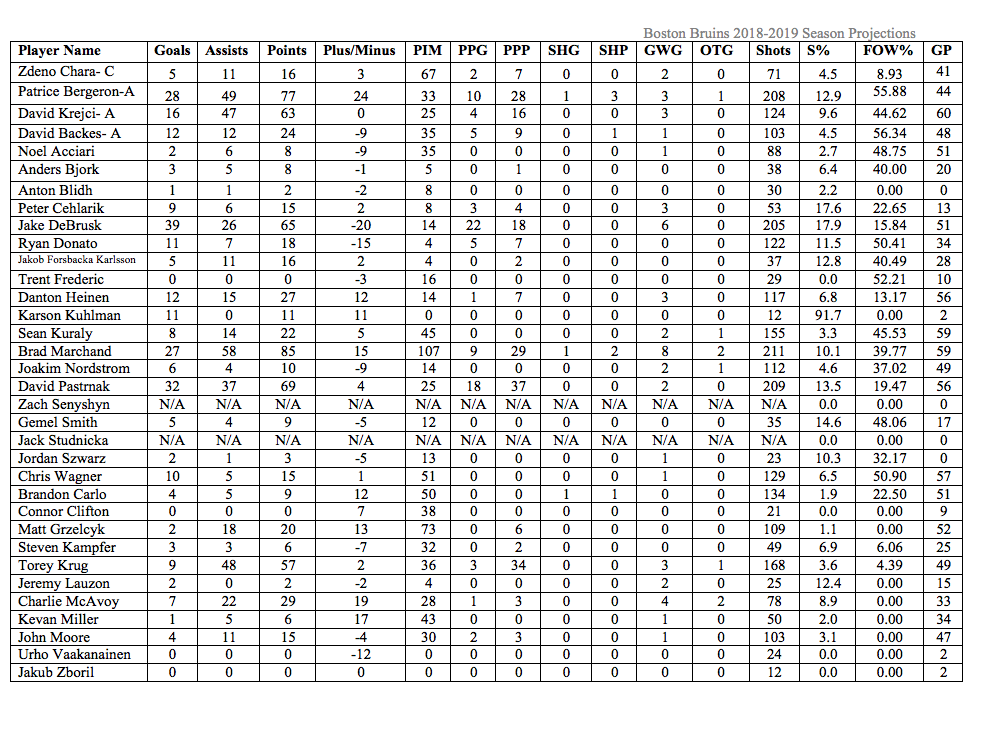
    Anyway, without further ado, here’s a look at the latest Bruins forecast– keeping in mind there are many variables that can and will change things, like injuries and/or being called up, assigned, traded, lucky or unlucky.

    This forecast is a glimpse at expected outcomes.

    If a player does better, then they exceeded expectations. If said player does worse, then they didn’t meet expectations (for one reason or another).

    My degree is in communication– not math– and hockey is naturally steeped in context and holistic unpredictability. Nothing can account for sheer puck luck, the odd bounce or a blown call.

    Whatever’s on the scoresheet every night can indicate general trends that can be deciphered to make educated guesses.

    Boston Bruins Forecast Through 60 Games Played (20 Games Remaining)
    I really miss the days of making a nice gallery, but WordPress messed around with that feature…

    First, I know what you’re thinking, “but Nick, how come you still have Donato on the roster still and haven’t included Coyle?”

    There’s two parts to my answer: 1) I ran this forecast after the conclusion of Monday night’s, 6-5, overtime win against the San Jose Sharks, so 2) the Coyle-Donato trade was made early in the writing of this post, so Coyle’s forecast will be reflected at a later date.

    Second, I know you’re also looking at Jake DeBrusk’s expected stats saying “uh, there’s only 20 games left, he can’t possibly score 21 more goals and amass 16 more assists for a total of 65 points this season” and you’re right.

    With DeBrusk’s recent scoring stretch over the last 20 games, his latest forecast gives a bit of a look at what could have been if he hadn’t been going through streaks like he has.

    The same can be applied to David Pastrnak’s expected 32-37–69 totals. Prior to getting injured, Pastrnak’s last forecast had him around the 40-goal plateau.

    After his left thumb surgery– in addition to having missed the last few games, as well as his recent decline in goal scoring over the last 20 games– his numbers are more in line with what to expect when he returns, whenever that is.

    At best, Pastrnak misses the “at least” two weeks he was supposed to miss, makes his return and picks up as close to where he left off as possible.

    At worst, he only scores a few more goals this season after returning later than expected (in the best-case scenario), but is back to being his normal self in a postseason run.

    Anyway, Boston’s offense looks like it’ll be led by Brad Marchand with 85 points on the season. Marchand also looks to lead the team in assists with 58 expected apples, topping Patrice Bergeron (49 expected assists), Torey Krug (48) and David Krejci (47).

    In goal scoring, Pastrnak remains supreme with 32 expected goals, leading Bergeron (28 expected goals), Marchand (27) and Krejci (16).

    On defense, Krug (9-48–57 expected totals) dominates the two-way aspect of the game from the blue line, despite missing a chunk of time due to injury earlier in the season.

    Meanwhile, Charlie McAvoy (7-22–29 expected totals) and Matt Grzelcyk (2-18–20 expected totals) continue to be vital assets alongside their captain and anchor, 41-year-old (soon to be 42-years-old on March 18th), Zdeno Chara (5-11–16).

    In goal, Rask is destined to settle in with a 2.37 GAA and a .921 SV%, while Halak backstops the team to a 2.40 GAA, as well as a .921 SV% himself.

    That’s some consistent goaltending in the crease and plenty to smile about if Sweeney can add more offensive prowess in secondary scoring and perhaps add a depth blue line asset for the playoffs.

  • Boston Bruins 2018-19 Forecast Through 40 Games

    In keeping with true fashion to cranking out these forecasts this season, once again I am a couple of games behind in terms of timeliness.

    Nonetheless, the last few games don’t matter– they’re not taken into account for this latest forecast, but they are taken into consideration for future performance as a whole over the remaining “42” games at the time these projections were forecasted.

    Halfway through the season, the Boston Bruins find themselves in 3rd place in the Atlantic Division standings. Despite all the injuries, despite the lack of depth scoring and despite all other areas of regression, the B’s are holding their own weight in a competitive division.

    Bruce Cassidy‘s coaching style and compete level is something to be praised as they’ve weathered the storm, but now the question remains– can they take it to the next level?

    General Manager, Don Sweeney, probably could opt for a scoring winger before the team goes down the stretch and into the playoffs, where, last year’s depth scoring dried up thanks, in part, due to a gamble that didn’t pay off in acquiring Rick Nash to help provide a spark on the second line.

    This season’s team is righting the ship, but are they peaking too early? When will they peak if they aren’t starting to peak now?

    Doubt will always enter the mind. True professionals ignore it and achieve.

    Anyway, to avoid getting too much into coaching philosophy or whatever, let’s take a look at the most recent forecast for Boston and remember there are many variables that can and will change things. Being injured, called up, assigned, scratched, traded, lucky or unlucky will incur damage to the expected stats.

    Unpredictable variables happen. Microsoft Excel knows none of that.

    As always, my degree is in communication– not math. This forecast is just an utopian outlook for the Bruins if every player met expectations.

    Should they do better, then they will have exceeded expectations. If they fall short, then they were injured, out of the lineup or whatever– they didn’t meet expectations and next season’s numbers will reflect a new benchmark for meeting expectations.

    The nature of hockey is both contextually analytical and holistically unpredictable– nothing can account for sheer puck luck or the odd puck bounce, but whatever’s on the scoresheet every night can indicate general trends and be utilized for educated guesses.


    Boston Bruins Forecast Through 40 Games (42 Games Remaining)

    (Just click on the image if you’re having trouble seeing it– WordPress changed their layout so there’s no more slideshow options.)

    Boston’s expected leaders in points indicates an 80-point season for David Pastrnak for the second season in-a-row– and not only that, but a career-high in goals and points.

    Pastrnak is forecasted to lead the Bruins with 39 goals and 43 assists (82 points) with linemate Patrice Bergeron (26-41–67 forecasted totals) expected to be second in the club’s scoring.

    Second line center, David Krejci (15-45–60 expected totals) is bound to be third in Bruins scoring this season with Jake DeBrusk emerging from the haze of injury and a slow start to his sophomore season.

    While Pastrnak is destined to lead his club in goals with 39 in the latest forecast, it appears he’ll be the only Bruin to reach the 30-goal plateau this season, as Brad Marchand is currently forecasted to end up with 27 goals this season.

    Marchand has reached 30-goals for the last three consecutive seasons and the 20-goal plateau in seven out of his eight full seasons he’s played since 2010-11.

    Should he reach 20 goals as expected this season, he’ll extend his scoring prowess to eight out of his nine seasons in the NHL.

    Bergeron’s expected to follow suit with his teammates on what is one of the best lines in the league, ranking third in goals by season’s end with 26, despite missing 16 games due to a rib/sternoclavicular injury.

    In assists, Marchand has emerged as much of a playmaker as he is a natural scorer with the current expectation of 47 assists this season, leading his teammates, Krejci (45 expected assists) and Pastrnak (43 expected assists).

    Marchand set a career-high in assists with 51 last season and is on pace to reach at least 40 assists for the third consecutive season.

    Noted playmaker and usual assist leading suspect, Krejci’s 45 assists would be his best since he had 46 assists in 72 games during 2015-16. Of note, Krejci has not missed a game so far this season.

    Fellow Czech native, Pastrnak is the only other player to have appeared in every game so far.

    On defense, Torey Krug remains supreme with 10-40–50 expected totals, despite missing 11 games thus far. Another 50 points this season would be the third consecutive season of reaching the 50-point plateau for Krug.

    He matched his career-high in goals (14) and set a new career-high in assists (45) last season en route to a career-high 59-point year in 76 games played.

    It’s very likely Krug may exceed expectations, so long as he’s healthy.

    Young stallion, Charlie McAvoy is still on pace for breaking the 30-point benchmark this season, despite missing 23 games through this forecast due to a couple of injuries (namely, a concussion and a lower body injury after blocking a shot).

    While McAvoy’s health may be worrisome this season, Matt Grzelcyk has stepped into more minutes with the expectations of a career-year with 3-19–22 forecasted totals.

    John Moore and Zdeno Chara are both expected to reach 15 points with Kevan Miller adding another 12 from the blue line this season.

    In goal, Boston has seen some stellar action from Jaroslav Halak— though recently he has been trending in the other direction, Tuukka Rask has picked up his pace of play back to where it’s expected night-in and night-out.

    Halak is on pace for a 2.42 goals against average, despite his 2.28 GAA in 22 games played as of this forecast. Still, a 2.42 GAA would be equivalent to his 2.43 GAA in 59 GP in 2014-15 with the New York Islanders.

    His workload shouldn’t reach nearly 60 games this season, so there’s still hope he exceeds expectations and keeps his GAA low, while increasing his expected save percentage.

    Currently, Halak is forecasted to finish the 2018-19 regular season with a .920 SV%– his highest since attaining a .920 SV% in 52 games in 2013-14 for the Islanders. He had a .919 SV% in 36 games with New York in 2015-16.

    Whether Halak will regress back to his usual form remains to fully be seen.

    As has been since Halak’s stellar performances early in the season outplayed Tuukka Rask, Cassidy will have to manage both of his goaltender’s time in the crease– keeping each fresh enough to remain hot and rested for a playoff stretch.

    Rask, in the meantime, is currently forecasted to reach a 2.38 GAA, which would be the second consecutive season of a slightly worse goals against average since he had a 2.23 in 65 games played in 2016-17 (he had a 2.36 GAA in 54 GP last season).

    However, a 2.38 GAA is still respectable, considering his 2.63 GAA in 20 appearances through Boston’s first 40 games this season.

    Boston’s usual starting goaltender is on track for a .919 SV%, which would be Rask’s highest since amassing a .922 SV% in 70 games played in 2014-15– a season in which he was drastically overworked.

    Rask’s career-high .931 SV% came in 2009-10, when he had stolen the starting job from Tim Thomas and played in 45 games.

    He’s also had back-to-back seasons at .929 in 23 games in 2011-12 (while serving as Thomas’ backup) and in 36 games in 2012-13 (during the 48-game lockout-shortened season, in which Rask backstopped Boston to their 2013 Stanley Cup Final appearance).

    Anything at or above .920 in terms of save percentage is usually widely praised. A .919 SV% is not that far off and might actually be more reflective of the increased offense league-wide, but that’s something to research on a different day.

    Regardless, two goaltenders around .920 in save percentage and close to a 2.30 goals against average isn’t a bad thing to have. That’s what some might refer to as an effective “1A/1B” scenario.

    Now fight it out in the comments over who is “1A” and who is “1B” in this case.

  • Trading B’s-ness: Sweeney’s Promise

    Don Sweeney is having his Peter Chiarelli moment.

    The current Boston Bruins General Manager is at a crossroads similar in nature to that of his predecessor in Chiarelli– except this time it’s forward thinking.

    No, not that forward thinking.

    Sweeney’s masterplan has made up for Chiarelli’s deficits in both defense and cap management. Yet, for a team that’s tied with the Nashville Predators for allowing the fewest goals against (88), its offense is nothing spectacular– ranking 25th in goals for so far this season (94).

    Through 34 games, the Bruins are 4th in the Atlantic Division with a 18-12-4 record and 40 points on the season despite numerous injuries.

    At one point in time this season, five of Boston’s regular six defenders were injured.

    In Chiarelli’s final years with the Bruins, defense became a problem. 

    The 2013-14 President’s Trophy winning Bruins team amassed 117 points on the season with a plus-84 goal differential. The 2014-15 Bruins missed the postseason and had 93 points on the season and a plus-10 goal differential.

    The franchise’s second ever President’s Trophy winning roster had Johnny Boychuk in his prime to rely on. The 2014-15 team did not, thanks to a trade made by Chiarelli prior to the start of the season.

    Boychuk was traded out of salary cap constraints that could have been avoided had Chiarelli a) moved other assets or b) not signed those other assets to such inflated extensions in the first place.

    Chiarelli promised he’d find a fix for the opening he created, but that never came to fruition as he was later fired in the 2015 offseason.

    Upon Sweeney’s hiring, it was clear the Bruins needed a revival on the blue line.

    In addition to that, Sweeney was walking into an organization that was needing to negotiate with then pending-RFA Dougie Hamilton.

    Hamilton was coming off his entry-level contract and emerging as a prominent two-way defender with the offensive likes of Torey Krug, in addition to that of a more traditionally framed defender.

    When Hamilton wanted out of Boston, Sweeney was looked at poorly for trading the RFA defender to the Calgary Flames in the midst of a foundation collapse in defense.

    The problem was that the problem didn’t start then.

    It worsened as a result of Chiarelli’s dealing of Boychuk, while Dennis Seidenberg got older and more susceptible to injury without anything in the pipeline to act as an adhesive bandage in a worst case scenario (Sweeney would later use a buyout on Seidenberg’s contract on June 30, 2016).

    Sweeney’s Hamilton trade was meant to address the long-term scope, as Zach Senyshyn, Jakob Forsbacka Karlsson and Jeremy Lauzon were all selected with the 1st and 2nd round picks in the 2015 Draft the Flames gave the Bruins in return for adding Hamilton.

    Though Forsbacka Karlsson has only emerged as far as the third line center in Boston for now, his chemistry alongside Ryan Donato and Danton Heinen is to be lauded with pleasure as those three forwards remain central to the core in a not-so-distant post-Patrice Bergeron era (Forsbacka Karlsson may end up centering the first or second line someday).

    Senyshyn’s been seasoning in Providence as Sweeney brought in the Washington Capitals’ approach to “over-cooking” their prospects in the AHL before calling them up for a seamless transition to the NHL (though, in fairness, it remains to be seen where Senyshyn fits into the long-term plan, if he even makes it).

    And Lauzon is near the top of the depth chart in defensive prospects within the organization alongside Urho Vaakanainen and Connor Clifton– if not number one.

    Though the blue line is not of concern for Boston, when healthy, the depth of the team in the top-six forwards, as well as run-of-the-mill finds to play on the fourth line has come into question.

    Sweeney must take an action to address the need for a winger to play alongside David Krejci and Jake DeBrusk on the second line– something Sweeney aimed to bring in since he began his tenure with the Bruins as General Manager.

    Again, scoring fell from the 2013-14 dominant team to Chiarelli’s missteps in 2014-15, so Sweeney dealt a struggling Milan Lucic to the Los Angeles Kings at the 2015 Draft for a 1st round pick (Jakub Zboril), Colin Miller and Martin Jones.

    Jones was flipped later that summer to the San Jose Sharks for a 2016 1st round pick (Trent Frederic) and Sean Kuraly. More recently, Miller was claimed by the Vegas Golden Knights at the 2017 Expansion Draft.

    In the aftermath of the Lucic trade– and with a spot on the second line to fill– Sweeney signed 2015 Stanley Cup Playoffs star, Matt Beleskey to a five-year deal worth $3.800 million per season.

    Beleskey set career-highs in assists (22) and points (37) in 80 games played in his first season in Boston (2015-16), then injuries cut his sophomore season with the Bruins to just eight points in 49 games.

    In 2016-17, Beleskey had yet to score a point in 14 games with the B’s prior to being assigned to the Providence Bruins (AHL). He was added as an afterthought turned salary cap balancing equation in the Rick Nash trade last season with the New York Rangers.

    When Beleskey’s first season with Boston didn’t yield as much of a breakout as Sweeney expected, he signed David Backes to a five-year, $6.000 million AAV contract on July 1, 2016, expecting the forward to shift from center to right wing alongside Krejci.

    In his first season with Boston, Backes had 17 goals and 21 assists (38 points) in 74 games played. He followed that up with 33 points (14 goals, 19 assists) last season in 57 games while battling injury.

    Though he has been plagued by injury the last two seasons, Backes  (3-5–8 totals in 29 games) has been relegated to the fourth line when DeBrusk is in the lineup.

    Sweeney’s plan to let the kids takeover led to exceeded expectations last season, but with that comes an even higher benchmark for success set for this season. Anything less is a disappointment.

    Add to that the expectation for a Cup in three years time from when Sweeney was hired. At least, that’s what Boston’s internal operations was calculating when the front office sat down with Sweeney to interview for his current job.

    For a GM that was active in his first month on the job and laid out a plan to take the organization up to where it is now– what’s next?

    Sweeney’s not in the hot seat from the standpoint about imminent job security, but rather, he’s being put to the test.

    This season, of all seasons, matters that much more.

    His track record at the trade deadline hasn’t had any staying power, save for an extra year of John-Michael Liles as a depth defender for 2016-17.

    He doesn’t have to hit it out of the park with a trade if he truly believes in the youth movement, which is why the Bruins probably aren’t going to be in the market for acquiring the services of Artemi Panarin.

    Then again, if DeBrusk is going to be out long term and head coach Bruce Cassidy can’t split up Donato, Forsbacka Karlsson and Heinen, then it’s going to be worth acquiring a top-six forward that’s a legitimate top-six forward.

    Adding Jeff Carter from the Los Angeles Kings would be like adding Rick Nash last season, except for the fact that the 33-year-old Carter is signed through the 2021-22 season at about $5.273 million per season.

    If you even want to have a chance to potentially sit down with a guy like Panarin or pending-UFA Jeff Skinner in July, you can’t afford to chip away at your available spending money.

    Unless Krejci or Backes is involved, that is.

    Even still, Carter’s not set on playing anywhere outside of Los Angeles and might retire if he’s shipped elsewhere. Besides that,  he only has six goals and nine assists (15 points) in 35 games this season.

    The only other recent rumors swirling around have been tied to Minnesota Wild forward– and Weymouth, Massachusetts native– Charlie Coyle and New York Rangers forward– and Boston native– Kevin Hayes.

    Both Coyle and Hayes are 26-years-old with Coyle having a cap hit of $3.200 million through 2019-20 and Hayes as a pending-UFA this offseason at $5.175 million.

    Minnesota’s in the hunt for a wild card spot currently in the Western Conference and sits 17th in the league table. The Rangers are fifth in the Metropolitan Division, 21st in the league standings and falling.

    Coyle has five goals and 10 assists (15 points) in 33 games. Though he has the same offensive production as Carter has with the Kings, Coyle is younger and in the midst of his prime, leaving room for potential– especially should he be placed on a line with Krejci and DeBrusk.

    But Coyle (6-foot-3, 220 pounds) has only surpassed the 20-goal plateau once in his career (21 goals in 82 games, 2015-16).

    Hayes has 9-18–27 totals in 33 games with New York so far this season. At 6-foot-5, 216 pounds, he’s had the hotter hands of the three potential trade targets.

    He’s also only reached the 20-goal plateau once in his career (25 goals in 76 games last season), but never had a season below 36 points.

    Both the Wild and the Rangers will have enough cap room at the deadline should Boston look to flip a player like Backes to fit either player comfortably on their payroll and still have something to give pending-RFAs Charlie McAvoy, Brandon Carlo, Forsbacka Karlsson, Donato and Heinen in the offseason.

    (Regardless, if there’s a team willing to take on Backes’ $6.000 million cap hit now as opposed to flipping him to the Arizona Coyotes later…)

    Plus there’s the odd hold-out that the Bruins find themselves in conversation with one of the offseason’s biggest prizes like how they were finalists in the John Tavares arms race last summer.

    Sweeney has a plethora of prospects to wager if– and only if– he can lop off one of the larger contracts on his books and land a legitimate top-six forward.

    Can he do what Chiarelli failed to do in his final year with Boston and deliver on an as of yet unfulfilled promise?

    Come to think of it, if he does acquire a top-six forward that can play with Krejci and leads to a Cup, then he does have a lot more in common with Chiarelli.

    It’d just be more like when Chiarelli traded Dennis Wideman to the Florida Panthers in June 2010 for Nathan Horton and Gregory Campbell.

  • Athanasiou’s two-goal night lifts Red Wings over the Bruins, 3-2, in OT

    Detroit Red Wings forward Andreas Athanasiou scored the game-tying goal in the third period, then added his second goal of the night for the sudden death victory in overtime, 3-2, over the Boston Bruins Wednesday night at Little Caesars Arena.

    Jimmy Howard (7-6-2, 2.60 goals against average, .924 save percentage in 15 games played) made 34 saves on 36 shots against for a .944 SV% in the win for Detroit, while Tuukka Rask (4-4-2, 2.79 GAA, .909 SV% in 10 GP) got the start for the Bruins and picked up the loss, despite making 24 saves on 27 shots faced for an .889 SV%.

    Unknown

    The Red Wings improved to 10-9-2 (22 points) on the season and leapfrogged the Ottawa Senators for 6th place in the Atlantic Division standings. Boston fell to 11-6-4 (26 points), but improved to 4th place in the Atlantic by virtue of having one game in-hand over the Montreal Canadiens.

    Wednesday night was the 300th meeting in Detroit between the two franchises, with the Bruins now holding an all-time record of 86-159-55 in Hockeytown, while the Red Wings are now 8-3-3 in their last 14 home games against Boston.

    Detroit is also 9-2-0 in their last 11 games. Boston is 5-4-2 in their last 11 games as a result of the loss.

    Patrice Bergeron missed his second straight game after being ruled out for at least four weeks with a sternoclavicular injury sustained in last Friday’s matchup on the road against the Dallas Stars. As a result, Colby Cave was recalled from the Providence Bruins (AHL) ahead of Wednesday’s game in Detroit.

    Bruce Cassidy made some minor adjustments to his lineup from Saturday’s game in Arizona against the Coyotes as Kevan Miller returned to action after missing the last 13 games with a hand injury.

    Anders Bjork played alongside David Krejci and David Pastrnak on the first line, with Brad Marchand, Joakim Nordstrom and Jake DeBrusk rounding out the top-six forwards.

    Danton Heinen, Jakob Forsbacka Karlsson and Noel Acciari were left intact on the third line with Chris Wagner playing to the left of Sean Kuraly on the fourth line and David Backes on the right wing.

    Miller was paired with Matt Grzelcyk on the first defensive pair, while Torey Krug continued to play alongside Connor Clifton and Jeremy Lauzon was paired with Steven Kampfer.

    Jakub Zboril was a healthy scratch and ultimately reassigned to Providence during the first intermission.

    Among other scratches, Brandon Carlo (upper body), Cave (healthy scratch), John Moore (lower body), Zdeno Chara (lower body- left MCL), Bergeron (upper body), Urho Vaakanainen (concussion) and Charlie McAvoy (concussion) all missed Wednesday night’s action as well.

    Mike Green took the game’s only penalty at 13:22 of the first period for tripping Krejci.

    The Bruins were not able to convert on the ensuing power play and the game remained tied, 0-0, all the way into the first intermission.

    Both teams went to the dressing room with three giveaways each and Boston leading in shots on goal (12-4). Boston also held an advantage in blocked shots (3-2) and takeaways (3-1), while Detroit led in hits (12-6) and face-off win percentage (67-33). The Bruins were 0/1 on the power play in the game’s only skater advantage.

    Unknown-7

    Forsbacka Karlsson (2) notched his second goal of his young NHL career after following up on a rebound that bounced off of Howard and a Detroit defender before Forsbacka Karlsson found the puck back on his stick and jammed it in at 4:08 of the second period.

    Boston led, 1-0, but only for about five minutes until Nick Jensen fired a shot from the point that Tyler Bertuzzi (6) redirected through Rask’s five-hole to tie the game, 1-1, while Kampfer failed to tie-up the Red Wings forward (and goal scorer) in front of the goal.

    Jensen (4) and Danny DeKeyser (3) had the assists on Bertuzzi’s goal at 9:48 of the second period.

    After 40 minutes of play, the Bruins outshot Detroit, 25-13, in a, 1-1, tie. The Red Wings led in blocked shots (7-6), takeaways (4-3), giveaways (10-8), hits (21-12) and face-off win% (51-49) after two periods.

    Early in the third period, Sean Kuraly threw the puck on goal as Chris Wagner (2) crashed the net and tabbed the garbage goal to give Boston a 2-1 lead at 6:45 of the third period. Kuraly (3) had the only assist on the goal.

    Athanasiou (8) followed up with a quick equalizer at 8:59 after Gustav Nyquist fired a shot up high, glove side, that Rask couldn’t get a full handle on, generating a rebound for Athanasiou’s quick reaction and goal.

    Nyquist (14) had the only assist and the game was tied, 2-2.

    Through 60 minutes of play, regulation was not enough, despite the Bruins leading the Red Wings in shots on goal (35-25). Detroit actually outshot Boston, 12-10, in the third period and held an advantage in just about every other statistical category, including blocked shots (11-6), giveaways (13-8), hits (29-16) and face-off win% (57-43).

    The Bruins, meanwhile, led in takeaways (6-4) entering overtime.

    Just 49 seconds into overtime, Athanasiou swooped in on a face-off in the attacking zone to steal the puck after Frans Nielsen took the draw to a stalemate.

    Athanasiou (9) then spun in front of the goal and scored from point blank to seal the victory, 3-2, for Detroit. Nielsen (11) had the only assist on the game-winning goal.

    At the final horn, the Bruins finished the night leading in shots on goal, 36-27, but trailing on the scoreboard, 3-2. Detroit finished Wednesday’s effort with the advantage in blocked shots (11-6), giveaways (14-8), hits (30-16) and face-off win% (60-40).

    Boston is now 1-4 in overtime this season as a result of the loss.

    The B’s and Red Wings will meet again in ten days back in Boston, then they won’t meet again this season until March 31, 2019 in Detroit.

    For now the Bruins head home after going 1-1-2 on a four-game road trip to face the Pittsburgh Penguins at TD Garden this Friday night. Puck drop is scheduled for a little after 7:30 p.m. ET with Boston playing the first of back-to-back games on back-to-back days at home and on the road in Montreal against the Canadiens on Saturday.

  • Boston Bruins 2018-19 Forecast Through 20 Games

    I’ve been away from the blog for a week (shouts road trips) and look what happens– the Boston Bruins are off to a 1-1-1 start on a four-game road trip, having lost in Colorado, 6-3, against the Avalanche on Nov. 14th, then losing in overtime, 1-0, to the Dallas Stars on Nov. 16th before beating the Arizona Coyotes, 2-1, on Nov. 17th thanks to goals from Jakob Forsbacka Karlsson (his first career National Hockey League goal) and Jake DeBrusk (8)– so there’s a quick little recap for you, if you’ve been wondering where the last two games have been around here on the site.

    Oh and the Bruins have reached the quarter-mark of the regular season having completed 20 games, which means it’s time to update my forecasted stats for Boston.

    Really couldn’t have timed a quick trip outside of New England better than I did, thank you very much.

    In all seriousness, the Bruins lost Zdeno Chara due to injury in Colorado– leaving my personal road trip off to a poor taste– then Patrice Bergeron went down with an injury in Dallas while I helplessly streamed the radio broadcast from the NHL app in a hotel room.

    The Hockey Gods don’t believe in having fun outside of the sport.

    My neurotic bumblings were eased with the support of the “next man up” mentality in the dressing room and, well, Connor Clifton beating the crap out of a guy against the Stars in his first career NHL fight (in his NHL debut, nonetheless).

    That guy being Jason Spezza, who’s actually kind of a big deal and not a jerk(?).

    Anyway, Boston is 5th in the Atlantic Division through 20 games played this season with an 11-6-3 record (25 points), a plethora of injuries and a lackluster depth scoring situation.

    Through 20 games last season, the B’s were 9-7-4 (22 points) and 4th in the division.

    This season, 25 points in the Eastern Conference is good enough for the 2nd wild card spot (for now). Last season, 22 points wasn’t good enough to be ahead of the playoff cutoff line.

    If anything, they’re managing to weather the storm well, despite having more injuries to the roster this year than this time last November– but they’re still not showing signs of the dominant Eastern Conference team that we saw from January through March of last season.

    Peaking at the right time is of the utmost importance in sports.

    In high school, when you’re running the mile, it’s the second lap that’s the most important before you begin to drop the hammer on the third lap and go all out on the fourth lap. The second lap is make or break.

    For Braden Holtby and the Washington Capitals last season it meant having Holtby get off to a rocky start, lose his starting job for the first two games of the postseason, then go on to win the Stanley Cup by virtue of Holtby regaining his rhythm on top of the ridiculous depth scoring capabilities of guys like Devante Smith-Pelly and Brett Connolly.

    For the Bruins last season, it meant being in contention for the President’s Trophy hunt late into the regular season, falling short, beating the Toronto Maple Leafs in seven games in the First Round, then being too worn down to even match the compete level of the Tampa Bay Lightning in the Second Round.

    Boston was done in five games– 12 postseason games total.

    What all of this has to do with this season is that basically, the Bruins are a combination of the team on the ice last season and their mirror image below-average start to this season as Washington had last season.

    Their starting netminder has struggled, their scoring depth isn’t apparent and they’re clinging to a playoff berth.

    In other words, it’s too early to rule them out– as evidenced last season, Mike.

    But– and this the important part– the window for optimal peak performance is closing. The B’s are running the second lap of the mile in high school track right now, if you will.

    Another ten games of whatever has plagued them from October until now will leave them just barely on the outside of the postseason looking in like the Florida Panthers did last season with 96 points.

    They won’t set a PR (personal record), nor will they get a chance to compete for the Cup.

    Tuukka Rask is back from his personal leave of absence and kept Boston close in Dallas, despite allowing the game’s only goal– in overtime– with a defense that featured Torey Krug as the only regular, Matt Grzelcyk as the usual seventh defender turned regular for now and Steven Kampfer as the go-to blue liner when Chara, Brandon Carlo, Kevan Miller, Charlie McAvoy and John Moore are all out of the lineup.

    Plus Jakub Zboril and Clifton made their NHL debuts in Dallas, with Jeremy Lauzon continuing to see ice-time since Urho Vaakanainen was an emergency recall that sustained a concussion in his 2nd career game while in Ottawa.

    We haven’t seen what a full, well-rested, Bruins lineup is capable of yet so far this season.

    They spent training camp and part of the preseason with split squads and most of their NHL regulars in China, returned with jet-lag that slowed their legs down through the first couple of weeks of October, got banged up and since then have been waiting for the return of… everyone? Is that fair to say at this point?

    Without further ado, here’s an updated look at the forecasted stats for the Bruins roster. As always, keep in mind there are many variables that can or will change things as seen here due to injuries, being a healthy scratch, being assigned to the minors (or called up), sickness and general hot and cold streaks unbeknownst to the formulas of Microsoft Excel.

    My degree is in communication– not math.

    These forecasted stats are an utopian outlook on the remaining 62 games of the regular season for Boston. If a player exceeds the forecast, they’ve exceeded expectations. If a player matches the forecast, they’ve met expectations. If a player falls short, they were either hurt a lot or simply didn’t live up to expectations.

    Hockey is both quantifiably predictable because of its concrete stats (goals, assists, points– everything on the scoresheet each night) and certifiably unpredictable due to its collective nature and sheer puck luck.

    Unknown-7

    Boston Bruins Forecast Through 20 Games (62 Games Remaining)

    This slideshow requires JavaScript.

    One player that’s been consistent all season long thus far is David Pastrnak. Brad Marchand‘s become more of a playmaker through the first 20 games while Pastrnak’s emerged as a superstar in the making– drawing comparisons to Jaromir Jagr from Czech Republic’s other legendary player, Petr Klima.

    Pastrnak’s success should land him his third consecutive season amassing 70 points or more, while also surpassing the 40-goal plateau for the first time in his career. In doing so, Pastrnak would be the first 40-goal scorer for the Bruins since Glen Murray had 44 goals in 2002-03.

    With Bergeron missing some games due to injury, David Krejci looks to reemerge as the leading assist collector for the B’s, reaching 46 expected assists this season.

    In the meantime, DeBrusk surpasses the 20-goal plateau and solidifies himself as a top-six forward, while Danton Heinen continues to grow as a candidate for top-six minutes in spite of Boston not having a guy like Artemi Panarin alongside Krejci and DeBrusk.

    On defense, Krug rebounds from missing time to a 43-point season, leading McAvoy (38 expected points) and crew in scoring from the point.

    Though Jaroslav Halak has won playing time with the hot hands in goal at the quarter-mark, Rask settles into his rhythm with an expected goals against average of 2.32 and an expected save percentage of .920 to backstop his team to perhaps one of the best 1-2 matchups in net– if not, 1A-1B– of the entire league.

    Halak, in the meantime, should cool to a 2.43 GAA and .919 SV%, but both numbers are highly valuable for backup goaltending duties especially if the Bruins can continue to get healthy and limit the shot attempts against.

    Healthy competition for playing time in the crease isn’t a bad thing if both goaltenders are performing thanks to a limited workload from their teammates.

    The next forecast review (through 40 games played) should determine whether or not the Bruins are serious playoff contenders or large-scale pretenders with a lot to lose in 2018-19.

  • Avalanche mount third period comeback, beat B’s, 6-3

    The Colorado Avalanche’s first line was more prominent than the Boston Bruins’ first line in Wednesday night’s, 6-3, loss for Boston as the two top-line superpowers collided at Pepsi Center in Denver.

    Mikko Rantanen (1-2–3 totals), Nathan MacKinnon (1-1–2) and Gabriel Landeskog (1-0–1) combined for six points on the night for Colorado, while Boston’s David Pastrnak (1-1–2), Patrice Bergeron (0-1–1) and Brad Marchand (0-0–0, minus-1) combined for three points.

    Semyon Varlamov (6-5-2 with a .926 save percentage and 2.32 goals against average in 13 games played) made 20 saves on 23 shots against for an .870 SV% in the win for the Avs, while Jaroslav Halak (6-2-2, .932 SV%, 2.16 GAA in 12 GP) made 19 saves on 25 shots faced for a .760 SV% in the loss for the B’s.

    Boston maintained 3rd place in the Atlantic Division with a 10-6-2 record (22 points) on the season, while Colorado improved to 4th place in the Central Division with a 9-6-3 (21 points) record.

    The Bruins had been on a two-game winning streak coming off of a 5-1 victory over the Toronto Maple Leafs on Saturday and a 4-1 win on Sunday against the Vegas Golden Knights.

    Head coach, Bruce Cassidy, kept the same lineup from the weekend for Boston, but with the added advantage of Tuukka Rask back with the team as a backup goaltender Wednesday night in his return from a personal leave of absence.

    Rask will get the start against the Dallas Stars on Friday or Arizona Coyotes on Saturday.

    Defenseman, Jakub Zboril, was recalled from the Providence Bruins (AHL) the other day as Dan Vladar was sent back down to Providence.

    Brandon Carlo, Charlie McAvoy and Urho Vaakanainen may join the team at some point on the road trip, but did not make the initial journey to Colorado on Tuesday. Fellow injured blue liner, Kevan Miller traveled with the team to Denver, but is aiming to return on the road in Detroit against the Red Wings on Nov. 21st.

    Cassidy indicated that Jeremy Lauzon and Jakob Forsbacka Karlsson would remain on the roster as regular recalls on Tuesday.

    Wednesday night’s scratches for Boston were as follows: Carlo (upper body), Noel Acciari (healthy scratch), Vaakanainen (concussion), Zboril (healthy scratch), McAvoy (concussion) and Miller (hand).

    Unknown-1

    The Battle of the Best First Lines began with Gabriel Landeskog (12) striking first at 10:16 of the first period as the Bruins couldn’t clear the puck out of their zone.

    Zdeno Chara‘s turnover led to Mikko Rantanen finding Joakim Nordstrom out of position and sending Landeskog a pass without pressure for the snipe and a 1-0 lead for Colorado. Rantanen (12) had the only assist on Landeskog’s goal.

    Avalanche defender, Mark Barberio, was guilty of cross checking Bruins forward, David Backes, at 14:50 of the first period and received a minor penalty– sending Boston on their first power play of the night.

    Late in the ensuing power play, David Krejci worked a slap pass from the face-off circle on Varlamov’s right side along the dasher to David Pastrnak (17) in the low slot for the redirection and power play goal that tied the game, 1-1.

    Backes (1) tipped the puck in the midst of Krejci’s (14) pass to Pastrnak, thereby lending the Three Davids to collect all of the possible points on the goal (Backes and Krejci the assists and Pastrnak the goal) at 16:43.

    Moments later, on a turnover, turned breakaway opportunity, Jake DeBrusk (6) capitalized on an unassisted effort by getting Varlamov to commit and roof the puck into the the twine at 19:20 of the first period– giving the Bruins a 2-1 lead.

    As both teams entered the dressing room for the first intermission, the B’s led in shots on goal (10-7) and on the scoreboard, 2-1. Boston also led in shot attempts that hit the post, 4-0, as well as hits, 8-4. Colorado had the advantage in takeaways (2-1), giveaways (3-1) and face-off win percentage (92-8) after the first period.

    Both teams had three blocked shots each and the Bruins were 1/1 on the power play after one period. The Avs had yet to see time on the skater advantage.

    Colin Wilson hooked Matt Grzelcyk 77 seconds into the second period and put Boston on the power play for the second time Wednesday night in Colorado.

    Unknown-7
    DeBrusk (7) scored his second goal of the night (and first on the power play) after Grzelcyk kept the play alive in the offensive zone, completing a pass to Bergeron for the bumper back to Pastrnak who then one-timed a shot from the point that redirected off DeBrusk in front of Varlamov to give the Bruins a 3-1 lead.

    Pastrnak (8) and Bergeron (17) were credited with the primary and secondary assists at 3:05 of the second period.

    Pastrnak later hooked Barberio at 7:52 of the middle frame and the Bruins were shorthanded as a result for the first time in the action Wednesday night.

    The Avalanche matched Boston’s puck moving efforts on their first power play of the evening with Tyson Barrie working the puck to MacKinnon for a cross-ice pass to Rantanen.

    The young Colorado forward then snapped a shot past Halak’s blocker side to make it a one-goal game on the power play.

    Ranatnen’s (7) goal at 8:47 of the second period was assisted by MacKinnon (14) and Barrie (14) and gave the Avs a distinct swing in momentum for the rest of the period.

    With Bruins captain, Zdeno Chara, unable to return to the game having sustained a lower body injury in the first period, Colorado pounced on the already weakened Boston blue line.

    This, even after Nikita Zadorov had a brief visit to the penalty box for interfering with Bruins forward, Chris Wagner at 9:14. Colorado killed off Zadorov’s minor infraction with ease and kept the momentum going, leading in just about every statistical category by the end of the period.

    Late in the second period, Bergeron hooked Rantanen who then embellished the infraction and received an unsportsmanlike conduct minor penalty himself and the teams would see 4-on-4 action at 19:11 of the second period.

    Both teams would start the third a skater short for a little over a minute into the final frame.

    Through 40 minutes of play, the Colorado Avalanche looked more and more like the complete 60-minute game playing style team that they have been so far this season and the Boston Bruins were looking like they were on the brink of collapse.

    Boston still led the game, 3-2, entering the second intermission, but shots on goal were even, 14-14, with the Avs leading, 7-4, in the second period alone. The Bruins led in blocked shots (10-6), but the Avalanche led in everything else including, takeaways (6-5), giveaways (5-1), hits (13-10) and face-off win% (69-31).

    Colorado was 1/1 on the power play, while Boston was 2/3 with the extra skater.

    Early in the third period, Matt Calvert (2) converted on his second goal of the season after following up with the original play and crashing the net for a haphazardly taken backhand spin-o-rama that eyes set for the twine after a wacky bounce resulted off of Halak.

    Calvert’s goal was unassisted at 2:11 of the third period and tied the game, 3-3.

    From there, it was all Avalanche as the Bruins tumbled down the mountain that is the immense comeback capability of Colorado.

    MacKinnon (12) added a goal of his own with a wrist shot that beat Halak cleanly from about the blue line on a rush into the attacking zone, giving the Avs their 2nd lead of the night, 4-3, at 9:02.

    Rantanen (22) and Ian Cole (5) had the assists on what would become MacKinnon’s game-winning goal.

    Krejci was guilty of holing Tyson Jost at 13:40 of the third period and with one second remaining on the ensuing power play, Jost (3) made the Bruins pay as former Bruin, Carl Soderberg, initially swiped at the puck through the legs of the Boston netminder, leaving the puck sitting at the goal line behind Halak, whereby Jost tapped it into the empty net.

    Samuel Girard (7) and Alexander Kerfoot (10) had the assists on Jost’s power play goal at 15:39 and Colorado led by two-goals, 5-3.

    With about three minutes remaining in regulation, Cassidy pulled his netminder for an extra attacker. Jared Bednar’s Avalanche were too much for the Bruins to handle, narrowly missing the empty net goal if it weren’t for Krejci’s heroics by the time the loose puck reached the crease on one empty net attempt.

    However, while in the offensive zone on a last-ditch effort, Bergeron hooked his stick around MacKinnon and was penalized with a two-minute minor infraction at 18:57.

    The Avalanche completed the hat trick on the power play with their third power play goal of the night on the ensuing skater advantage when Kerfoot (8) tipped a blast from Soderberg past Halak at 19:45 of the third period.

    Soderberg (6) and Girard (8) had the assists on the goal and Colorado secured the 6-3 win as time expired.

    At the final horn, the Avs led in shots on goal (25-23), giveaways (6-2), hits (22-15) and face-off win% (59-41), while the B’s led in blocked shots (20-18). Colorado was 3/3 on the power play and the Bruins were 2/3 on the skater advantage.

    The Avalanche outscored Boston, 10-3, in their two meetings last season.

    Boston is now 0-1-0 to begin a four-game road trip that swings through Dallas (Nov. 16th), Arizona (Nov. 17th) and Detroit (Nov. 21st)– after Wednesday night’s loss in Denver– before heading back home for a Black Friday (Nov. 23rd) matchup with the Pittsburgh Penguins.

  • Boston Bruins 2018-19 Projected Stats

    Well, technically it’s a forecast.

    In the coming days I’ll reveal what teams I’ll be forecasting/tracking all season long, so stay tuned because it’s about to get messier than ever before and I’m up for the challenge.


    The 2018-19 regular season gets underway Wednesday night in Washington, D.C. as the Boston Bruins visit the United States capital and defending Stanley Cup champion Washington Capitals to kick off their own run to the Cup.*

    *Subject to change based on injuries and performance.

    As has been tradition for the last– oh I don’t know– several seasons now, here’s a look at some things to expect from each and every member of the Bruins roster that has played in at least one career NHL game. Keep in mind there are many variables that should be taken into account when everyone reads this in April and points and laughs.

    For starters, injuries, being a healthy scratch, being sent down or called up, sickness and general superstitions (which may or may not actually exist) disrupt a player’s season pretty well, as well as more things I won’t bother to mention.

    You’re either here to hear about how David Pastrnak is going to lead Boston in scoring this season or you’re wondering when the next post will appear and you can keep scrolling on by.

    Before we dive in– just for the record– I’d like to remind you all that my degree is in communication– not math– therefore anything that looks “out-of-whack” is Microsoft Excel’s fault. My expertise is in words, which…

    These forecasted stats come with an utopian view– as if nothing bad could ever happen and every player actually lived up to their projections– but of course some will pan out, some will exceed expectations and others will miss the mark entirely.

    Think of it as a suggested outcome for a sport that is highly unpredictable based on its collective nature and sheer puck luck.

    Unknown-7

    Boston Bruins Forecast Through 0 Games (82 Games Remaining)

    This slideshow requires JavaScript.

    The Bruins 2018 Stanley Cup Playoffs run came to a disappointing end in quick fashion against the Tampa Bay Lightning in the Second Round, but the experience– both tangible and intangible– will be enough to a) leave everyone wanting more and b) leave a lot of players with something to prove.

    After entering 2017-18 to the tune of “[they’re] too young– too, too young” (shouts Mike Felger of 98.5 The Sports Hub), Boston turned a lot of eyes with a 50-win season, finishing 2nd in the Atlantic Division with 112 points– one point behind the Lightning. In fact, had Boston won their final game of the regular season against the Florida Panthers, they would’ve clinched the division title.

    This, of course, all after a First Round exit to the Ottawa Senators in 2017 following two straight postseason misses in 2015 and 2016.

    Now the Bruins enter Phase Three of General Manager Don Sweeney‘s masterplan– win a Cup. Now.

    First Sweeney retooled on-the-fly, beginning with the Milan Lucic and Dougie Hamilton trades at the 2015 Draft. Then he worked youth into the lineup of Claude Julien and Bruce Cassidy‘s teams. Finally, here we are, the third year of the secret plan to win a Cup in three years as most Bruins front office members determined they’d be at this point, three years ago.

    But enough about that, here’s a look at some of Boston’s expected top performers of 2018-19 before the puck even drops on the regular season.

    David Pastrnak leads the way in scoring with 71 points (33 goals, 38 assists) from one of the league’s best first lines, comprised of Pastrnak on the right side, Brad Marchand (32-32–64 expected totals) on the left and Patrice Bergeron (25-38–63 expected totals) down the middle.

    After injuries limited Bergeron to 64 games last season, the rejuvenated 33-year-old alternate captain in the Hub finally reaches back-to-back 60-point seasons since his pre-Randy Jones induced concussion days. Bergeron had 73 points in his sophomore NHL season (81 games) in 2005-06 and 70 points (77 games) in 2006-07.

    The Bruins expected second line of Jake DeBrusk, David Krejci and Ryan Donato doesn’t show any signs of slowing down as DeBrusk (19-32–51 expected totals) enters his sophomore season and Donato (34-27–61 expected totals) enters his first full season in the NHL.

    For the first time since the days of the Lucic-Krejci-Nathan Horton line, it seems the Bruins have finally found the right combination of skill, speed and scoring to compliment Krejci’s tremendous two-way playmaking abilities.

    Krejci’s 43 assists are expected to lead his team, provided he can stay healthy as the 32-year-old enters his 13th season with Boston since entering the league in 2006-07 (six games played).

    Meanwhile, Danton Heinen‘s 50 points (17 goals, 33 assists) are expected to be a key contributor to improved play from Sean Kuraly and David Backes on the third line.

    On defense, Charlie McAvoy steps up with 42 points on the season (nine goals, 33 assists) in his sophomore year– uninterrupted by injury or health scares.

    Despite missing the start of the regular season Torey Krug still found a way to put up 49 points (11 goals, 38 assists) from the blue line in his fourth consecutive season of 40 or more points. In fact, the only time Krug’s missed the 40-point plateau, he had 39 points in 2014-15 (his 2nd full-season, 78 games played).

    Zdeno Chara‘s 12-26–38 expected totals are sensational from a 41-year-old defender entering his 21st professional season in the National Hockey League. Meanwhile, Brandon Carlo‘s going to bounce-back from a sophomore slump to produce three goals and eight assists (11 points) in his junior season as a bottom-three blue liner, sharing duties with Krug, John Moore, Kevan Miller and Matt Grzelcyk on any given night.

    In goal, Tuukka Rask remains confident in his defense and in the scoring power of the forwards in front of him, as he cruises along with a 2.28 goals against average and .921 save percentage at (regular) season’s end in April.

    Jaroslav Halak stabilizes as a backup goaltender in a system that actually works with good, talented, young defenders that help limit his workload, Halak amasses a 2.49 GAA and .916 SV% in his appearances. His play provides Boston with a nearly 1A/1B option, but ultimately gives way to Rask down the stretch and into the playoffs.

    We’ll get into exactly how many games each goalie should realistically see playing time in the next forecast.

  • Long-Awaited Offseason Krug Thoughts

    It’s only taken me all offseason, but don’t trade Torey Krug.*

    *At least in a one-for-one with the Edmonton Oilers, anyway.

    There’s been plenty of talk on hockey Twitter among experts, recreational bloggers and fans alike surrounding Boston Bruins top-four defender, Torey Krug, and whether or not the 27-year-old blueliner should be considered an expendable asset for the right return.

    At some point this offseason, rumors swirled that Bruins General Manager Don Sweeney had been in contact with Oilers General Manager Peter Chiarelli with both GMs expressing desire for a defender.

    For starters, Sweeney and Chiarelli are friends.

    Sweeney worked under Chiarelli during Chiarelli’s tenure with Boston and, while it’s likely they talked at some point this offseason– as all friends do– to what extent they delved into their roster concerns, well, that’s not for me to say.

    But with rumors comes speculation on Twitter.

    Polls were created, people became enraged because people tweeted their two cents and… people tweeted. Never tweet.

    In the aftermath of the Krug Twitter War, let’s take one more sensible look at if Boston and Edmonton had worked out a deal this offseason– salary cap be damned.

    Krug notched a career-high 59 points in 76 games for the Bruins in 2017-18. He had eight more points last season than he did in 2016-17 (51 points in 81 games played) and improved his plus/minus from a minus-10 in 2016-17 to an even rating last season.

    There’s a couple of things to takeaway from that.

    First, Krug had 59 points (a career high) last season, which was only three fewer points in five more games played than one of the league’s best blueliners– Erik Karlsson— had in a down season.

    Yes, you read that right, Karlsson had 9-53–62 totals in 71 games for the Ottawa Senators in 2017-18, while Krug had 14-45–59 totals (76 GP) for Boston. Anytime a defender scores more than 10 goals, that’s something to celebrate– let alone when that player reaches a new career-high in scoring.

    And second, Krug’s mistakes are still noticeable.

    When a defenseman makes a mistake it’s usually easier to spot, because it leads directly to a goal against. Krug’s positioning hasn’t always been spot on, but he spent all of last season working with Brandon Carlo on Boston’s second defensive pairing– a season that Carlo is looking to learn from and move on from after failing to score a goal in his sophomore slump.

    Krug’s best career plus/minus (plus-18) came in 79 GP in the President’s Trophy winning 2013-14 season for the Bruins. Since then he’s slipped to plus-13 in 2014-15, plus-9 in 2015-16 and a minus-10 in 2016-17, before rebounding to breaking even in 2017-18.

    Now, I’ll fully acknowledge plus/minus does not tell the full story. Plus/minus alone does not take into account situations like being on the power play, penalty kill or even strength (Krug had 24 power play points last season– only one shy of his career-high 25 points on the power play in 2016-17). That’s where the argument for Corsi Relative, Corsi Close, Corsi Even and all that jazz comes in as another way to measure situational play, but I digress.

    Back to the Oilers for a moment.

    If Krug were to have been swapped in a one-for-one with an Edmonton defender, the Bruins would’ve taken a major step back.

    Boston doesn’t need a young defenseman approaching his prime– they’ve got Charlie McAvoy, Carlo, and Matt Grzelcyk already in those roles with Urho Vaakanainen, Jakub Zboril and Jeremy Lauzon (just to name a few) coming down the pipeline in the system.

    In other words, a hypothetical Krug for current-RFA, Darnell Nurse, deal wouldn’t look good. Especially when you look at the stats.

    In just 2017-18 alone, Krug’s 14-45–59 totals in 76 games decimate Nurse’s 6-20–26 totals in 82 games with the Oilers. While shutdown defenders are favorable for their defensive purposes, giving up 33 points from the backend for one player alone isn’t sound. Especially with Krug as Boston’s offensive defenseman centerpiece over the two-way skills of McAvoy.

    Sure, Nurse is only 23, but he needs a new contract as things stand right now with Boston looking at pay raises for both McAvoy (likely a hefty one) and Carlo in the summer of 2019. Then there’s that whole “already in his prime” thing going on with Krug. It’s perfectly fine to hold onto a defender in their prime into their early/mid-30s.

    What about Oscar Klefbom? Could the Bruins improve in a one-for-one involving Krug for him?

    Again, the answer is no.

    Klefbom, 25, is two-years younger than Krug (so that whole “already in his prime thing”, yeah, that’s not favoring Klefbom in this hypothetical) and had 5-16–21 totals in 66 games for the Oilers last season. He was also a minus-12, which was surprisingly worse than everyone’s favorite Chiarelli overvalued blueliner in Edmonton– Kris Russell.

    Russell was a minus-seven in 78 games and had, yep, 4-17–21 totals at 31-years-old.

    Sure, adding Klefbom (6’3″) in place of Krug (5’9″) adds height, but it hinders skill.

    There’s always that change of scenery argument, but there shouldn’t be anything attractive in Edmonton. Hard pass on any and all one-for-ones unless Connor McDavid is involved for some insane reason.

    And for the record, Chiarelli’s prized possession in his biggest one-for-one trade in Edmonton (Taylor Hall to the New Jersey Devils for Adam Larsson) had 4-9–13 totals in 63 games last season. Larsson’s only reached the 20-point plateau once in his career (24 points in 64 games for New Jersey in 2014-15). Ouch.

    If you’re thinking of trading Krug for any reason, don’t let it be in a one-for-one with the Oilers.