Category: Nick’s Net

  • Vegas Golden Knights 2018-19 Season Preview

    vegas_golden_knights_logo

    Vegas Golden Knights

    51-24-7, 109 points, 1st in the Pacific Division

    Lost in Stanley Cup Final to WSH, 4-1

    Additions: F Daniel Carr, G Zach Fucale, F Alex Gallant, D Nick Holden, F Curtis McKenzie, D Jimmy Oligny, F Max Pacioretty (acquired from MTL), F Paul Stastny

    Subtractions: D Philip Holm (signed, KHL), F James Neal (signed with CGY), F David Perron (signed with STL), F Teemu Pulkkinen (signed, KHL), D Luca Sbisa (signed with NYI), F Nick Suzuki (traded to MTL), F Tomas Tatar (traded to MTL), F Paul Thompson (signed with FLA)

    Still Unsigned: D Chris Casto, D Jason Garrison, F Mikhail Grabovski, D Clayton Stoner

    Re-signed: F William Carrier, G Oscar Dansk, F William Karlsson, D Colin Miller, F Tomas Nosek, F Brandon Pirri, F Ryan Reaves, D Shea Theodore

    Offseason Analysis: Only one team in the NHL’s more than a century of existence has ever won the Cup in their inaugural season. The 2017-18 Vegas Golden Knights almost joined the 1917-18 Toronto Arenas as the only teams to win the Cup in their inaugural season. Toronto beat the Pacific Coast Hockey Association’s (PCHA) Vancouver Millionaires 3-2 in a best of five-game series.

    Vegas came up three wins short of winning it all in the modern-day best-of-seven game series against the Washington Capitals that the Stanley Cup Final has become.

    The Golden Knights didn’t have an unfair advantage in the 2017 Expansion Draft. General Manager George McPhee worked the trade market to his advantage, primarily building the inaugural season’s core group of players through acquisitions.

    Owner Bill Foley has touted the “Cup-in-three” mantra, meaning it’s his goal as an organization to win the Cup in their first three years of existence. Upon league expansion in 1967, it took the Philadelphia Flyers seven years to win their first Cup.

    Foley wants to do it in half the time.

    McPhee’s already gone to work on improving his roster from year one to year two. He’s added Paul Stastny via free agency and Max Pacioretty in a trade with the Montreal Canadiens.

    Stastny, 32, joins the Golden Knights after spending last season with the St. Louis Blues and Winnipeg Jets. In 82 games split between the Blues and Jets, Stastny had 16-37–53 totals.

    A deadline acquisition by Winnipeg, he had 13 points down the stretch in the remaining 19 games of the regular season, then had his best career performance in the postseason (15 points in 17 games) en route to the Western Conference Final against (his now current team) Vegas.

    Despite Stastny’s playmaking style and ability to elevate the players around him in Patrik Laine and friends in Winnipeg, the Jets were no match for the hard-charging Golden Knights.

    If you can’t beat them, join them.

    The old saying rings true for Stastny, despite Winnipeg’s intentions on re-signing the veteran NHL center entering his 13th season in the league. He’ll slide in on Vegas’ second line behind William Karlsson and play alongside one of his best friends since they played together at the 2010 Winter Games, Max Pacioretty.

    Yes, that’s right, Pacioretty is a Golden Knight– in case you’ve been under a rock since training camp.

    At its surface, the price of the Pacioretty trade is one well spent for both teams. Vegas acquired Pacioretty in exchange for Tomas Tatar, prospect Nick Suzuki and a 2019 2nd round pick. That’s right about what you’d expect as a going rate for a top-six scorer– one current roster player, a prospect and a draft pick.

    But for all that McPhee dealt to the Detroit Red Wings to add Tatar at the trade deadline last season, this Pacioretty deal carries a hefty trade-tree baggage, whereby a lot of assets were ultimately tossed in the pot for Pacioretty’s services.

    At the very least, McPhee not only added a five-time 30-goal scorer, but he signed him to a four-year extension right away too. So if things don’t work out this season, the Golden Knights will remain in the hunt for the next few years.

    Why’s that?

    On top of their solid core group of forwards, Vegas has a crafty defense that’s capable of doing more than turning heads like they did last season. There’s just one catch though– they’ll have to do it without Nate Schmidt for the first quarter of the regular season.

    Schmidt will be serving a 20-game suspension for a performance enhancing drug, leaving Colin Miller and Shea Theodore to do the bulk of the work with Brayden McNabb and Deryk Engelland rounding out the rest of the top-four defenders.

    Brad Hunt and Nick Holden, in the meantime, seek to use the first 20 games as an audition for the sixth defenseman role upon Schmidt’s return to the lineup.

    Miller signed a four-year extension this summer and Theodore signed a seven-year deal worth $5.200 million per season. While seven years might be a bit more than the Golden Knights can chew if Theodore’s play heads south, at least he’s signed to a manageable $5.200 million cap hit– up to 50% of which can be retained in a trade.

    With an immense top-nine group of forwards and questions surrounding who will step up on defense in Schmidt’s absence, head coach Gerard Gallant must adjust accordingly as he’s always done– on-the-fly and with the complete buy-in of the dressing room.

    In goal, Marc-Andre Fleury— now signed through the 2021-22 season, thanks to a three-year extension this summer on top of the remaining year on his current contract– must find a way to continue his rejuvenated play in net. Last season’s 2.24 goals against average and .927 save percentage are more than likely unattainable in back-to-back seasons.

    One thing working in Fleury’s favor is his reduced workload. In his second-straight season under 50 games played, Fleury appeared in 46 games last season after battling a concussion.

    Malcolm Subban (2.68 GAA, .910 SV% in 22 games played last season) is still in line to become the next Golden Knights starting netminder in the post-Fleury era, but he undoubtedly must see an increase in playing time this season.

    It’s not quite a 1A, 1B option for Vegas, but rather a precaution for Fleury and a means of keeping their starter fresh for what could be another long postseason run.

    Unless any of the other Pacific Division teams have anything to say about it.

    Offseason Grade: B+

    McPhee bolstered his top-six forward group this offseason with two simple moves, while preserving the large-scale depth of the Golden Knights prospect pool. They didn’t land Erik Karlsson, John Tavares or Ilya Kovalchuk, but they did get Max Pacioretty.

    And they still have quite an impressive amount of cap space to work with next offseason as the franchise continues to settle into existence.


  • 2018-19 NHL Mascot Power Rankings: 20th-11th

    I never thought I’d be doing this again, yet here we are. It’s time to begin the continuation of a now annual tradition around here at DTFR. It’s time to rank the NHL mascots.

    For the first time since January 2017, here’s the latest look at things. Be sure to check out yesterday’s ranking (31st-21st) and stay tuned for tomorrow’s top-10.

    20) Tommy Hawk (Chicago Blackhawks) Last year’s ranking 14th

    The Blackhawks jersey is a timeless classic, but time has been catching up on Tommy Hawk. First of all, he’s a hawk that looks more like a penguin and second, he’s now been traded to the Arizona Coyotes for cap relief purposes, I’m being told by my producer.

    19) Gnash (Nashville Predators) Last year’s ranking 17th

    Gnash isn’t that bad looking, but Nashville’s home jersey lost its edge in the transition from Reebok EDGE 2.0 to ADIZERO technology. Because of that, we get a pretty average looking mascot that has many talents including entertaining the Tennessee Titans when they aren’t chugging beers and swinging catfish around at a playoff game.

    18) Thunderbug (Tampa Bay Lightning) Last year’s ranking 15th

    Thunderbug may lay claim to having a dominant team on the ice in front of him, but that doesn’t ignore his electrifying averageness. That’s right, Thunderbug is average. He’s cute and cuddly, but he’s cuter in cartoon form on one of those pamphlets at the All-Star Game promoting the mascots game or whatever.

    17) Wild Wing (Anaheim Ducks) Last year’s ranking 3rd

    The Ducks introduced their one-year only third jerseys for 2018-19 and it cost them. Not necessarily on the ice– as a regular season game has yet to have been played– but it cost them in this mascot ranking because Wild Wing shouldn’t have to wear a sweater that screams “all 25 years of the franchise in one shirt”. Next!

    16) Mick E. Moose (Winnipeg Jets) Last year’s ranking 11th

    Winnipeg may be flying high, but like the Anaheim Ducks, the Jets introduced some sub-par alternate sweaters to the world this season. Now, they aren’t as bad as Anaheim’s, but something tells me Thrasher would look better in baby blue rather than Mick E. Moose.

    15) Stinger (Columbus Blue Jackets) Last year’s ranking 27th

    After careful consideration, Stinger’s moved up above a lot of the competition, but still has higher to climb. Another year has passed since Boomer working the mascot tandem with Stinger and the Blue Jackets brought back their quality third jerseys (albeit with the new-age number font and everything that they currently have on their home and road sweaters). It’s a redemptive year for Stinger, even though Columbus has still yet to win a playoff series.

    14) Louie (St. Louis Blues) Last year’s ranking 12th

    There’s nothing to complain about a plain looking bear, but Louie is kind of a Carlton the Bear knockoff. Nobody tell the Toronto Maple Leafs that though. It’s just another average year unless the Blues really wow him on the ice and finally win a Cup. Regardless, Louie puts on a smile every night and goes to work knowing one of these years Doug Armstrong will probably trade him and take the offseason to make the team that much better.

    13) N.J. Devil (New Jersey Devils) Last year’s ranking 16th

    Taylor Hall won the Hart Trophy last season as one of the hottest players on the ice, but there’s something even hotter in Jersey. It’s the Devil himself. Well, the N.J. Devil, that is. He’s on the rise and could be in the top-10 in 2019’s rankings depending on how he takes care of division rival, Gritty, trying to steal his spotlight. We’ll leave it up to his devilish plans.

    12) Victor E. Green (Dallas Stars) Last year’s ranking 19th

    A star is rising in the big-D and it’s not just Tyler Seguin’s cap hit beginning in the 2019-20 season thanks to his extension he signed with the Stars this month. Victor E. Green’s starting to take on more of the role of a veteran mascot, what with Chance and Gritty having been introduced after him now.

    11) Carlton the Bear (Toronto Maple Leafs) Last year’s ranking 13th

    John Tavares signed with the Leafs for $11.000 million a year through the 2024-25 season, so it’s fitting that Carlton finished 11th in this year’s ranking. Symbolism or something. Enough said.


  • 2018-19 NHL Mascot Power Rankings: 31st-21st

    I never thought I’d be doing this again, yet here we are. It’s time to begin the continuation of a now annual tradition around here at DTFR. It’s time to rank the NHL mascots.

    For the first time since January 2017, here’s the latest look at things.

    31) New York Rangers Last year’s ranking 30th

    They don’t have a mascot, which the old me would’ve said “that’s OK for a franchise that’s over 90-years-old and has one of the easiest nicknames to create a mascot for”, but the new me says “why wouldn’t they want to get in on the post-Gritty hype-train newscycle?” Petition to make Henrik Lundqvist the mascot when he retires someday? Who says “no”?

    download

    30) Al the Octopus (Detroit Red Wings) Last year’s ranking 26th

    I understand the tradition (8 wins used to win you the Cup back in the day), but 1) inflation exists (it takes 16 wins now to take home the Cup) and 2) it’s a lot easier to make an octopus costume than it is to raise and lower a giant octopus from the rafters every night. I’m just saying.Unknown

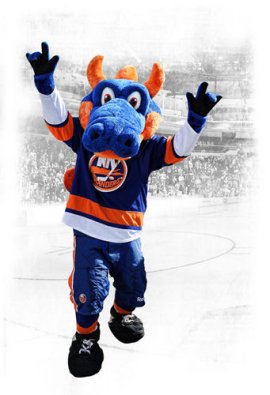
    29) Sparky the Dragon (New York Islanders) Last year’s ranking 25th

    Seriously, I still don’t get why they haven’t switched things up to the Gorton’s Fisherman™. Sparky was once the mascot for the Islanders and the New York Dragons (makes sense) Arena Football team until 2009.

    sparky-twitter-avatar-400
    @SparkyNYI on Twitter hasn’t tweeted anything. Perhaps he’s retired?

    28) Nordy (Minnesota Wild) Last year’s ranking 24th

    Nordy just has a lot going on around the eyes and on the back of his jersey. 18,001? I feel bad for the poor equipment manager that has to iron that on all the sweaters Nordy goes through in a season. Also, he’s got a mullet– this isn’t the Minnesota North Stars, it’s the Wild. I don’t care what you say, I will never be a fan of that hairstyle unless it’s Jaromir Jagr.

    27) Howler (Arizona Coyotes) Last year’s ranking 21st

    Unlike how his team should be rising in the standings this season, Howler’s stock is falling. At least temporarily. It’ll be fun to see Howler in a kachina sweater every Saturday of the regular season, but that’s about it.

    26) Hunter (Edmonton Oilers) Last year’s ranking 23rd

    Hunter was named after the original owner of the Oilers, William Hunter, and wears No. 72 in reference to the team’s founding as the Alberta Oilers in the World Hockey Association (WHA). He’s a Canadian lynx, so that’s cool, I guess. Other than that, he scares people.

    25) Stanley C. Panther/Viktor E. Ratt (Florida Panthers) Last year’s ranking 20th

    Not many fans outside of Sunrise, Florida might realize that yes, the Panthers have two official mascots. There’s Stanley C. Panther, which, if you look deep enough into his eyes you’ll start hearing a Sarah McLachlan song for some reason and Viktor E. Ratt, who… exists. 1996 was a weird time.

    24) Stormy (Carolina Hurricanes) Last year’s ranking 28th

    Be on the lookout for Stormy to take the world by… storm. Since the Hurricanes updated their home jerseys to one of the best in the league, Stormy’s appearance on the outside has improved drastically. Aside from asking the important question, will Stormy wear a Whalers sweater on Whalers Night or will Pucky the Whale make a return to his former franchise? Let’s not negate the fact Stormy likes to roll around in the mud all day.

    23) Harvey the Hound (Calgary Flames) Last year’s ranking 18th

    As the league’s oldest mascot, there’s a certain charm to the nostalgia of his look. He’s also the only mascot in the league to not be wearing a jersey, excluding Al the Octopus, which shouldn’t really even technically count as a mascot, Detroit. Harvey’s great, but have you seen what googly eyes can do for you these days? Or at least give the poor hound a sweater– preferably one of those sweet alternates the Flames are bringing back.

    22) Bernie the St. Bernard (Colorado Avalanche) Last year’s ranking 22nd

    The ADIZERO jersey style brought back the mountain design to the Avalanche’s sweaters and that’s improved Bernie’s overall aesthetic, but part of me still misses Howler the Yeti. But hey, dogs like kids, kids like dogs and even cranky old adults (so everyone that’s not a kid) like dogs that save people from avalanches.

    21) Spartacat (Ottawa Senators) Last year’s ranking 9th

    Spartacat’s fell on hard times and it’s not just because of the Erik Karlsson trade and full-on rebuild in Ottawa. It’s occurred to me since last year nobody’s gotten around to giving his hair a good washing and he doesn’t even have whiskers. So yeah, Spartacat took a fall in the rankings and didn’t land on all-fours, contrary to that myth about cats.

  • Winnipeg Jets 2018-19 Season Preview

    jetslogo

    Winnipeg Jets

    52-20-10, 114 points, 2nd in the Central Division

    Lost in Western Conference Final to VGK, 4-1

    Additions: D Simon Bourque (acquired from MTL), G Laurent Brossoit, F Dennis Everberg, F Seth Griffith

    Subtractions: F Joel Armia (traded to MTL), F Chase De Leo (traded to ANA), D Toby Enstrom (signed, SHL), F Matt Hendricks (signed with MIN), G Michael Hutchinson (signed with FLA), D Jan Kostalek (signed, ELH), G Steve Mason (traded to MTL, subsequently bought-out, current UFA), D Julian Melchiori (signed with FLA), G Jamie Phillips (signed with Charlotte Checkers, AHL), F Buddy Robinson (signed with CGY), F Michael Sgarbossa (signed with WSH), F Paul Stastny (signed with VGK)

    Still Unsigned: F Jimmy Lodge, F Shawn Matthias

    Re-signed: G Eric Comrie, F Marko Dano, G Connor Hellebuyck,F Nicolas Kerdiles (acquired from ANA and re-signed), F JC Lipon, F Adam Lowry, D Josh Morrissey, F Nic Petan, D Tucker Poolman, D Cameron Schilling, F Brandon Tanev, D Jacob Trouba

    Offseason Analysis: For a city with the word “win” in its name, the Winnipeg Jets sure did a lot of winning last season. Paul Maurice coached his club to a 52-20-10 record– good enough for first place in a normal year, but the Nashville Predators were just three points better in the Central Division. Winnipeg finished second in the Central with 114 points.

    They won their first playoff series in franchise history, eliminating the Minnesota Wild in five games in the First Round, then upset the Predators in a Game 7 on the road in the Second Round.

    The Jets didn’t just set franchise records, they established the bar for future benchmarks of success (minus a Cup), but while Winnipeg soared into the Western Conference Final, they were in for a crash landing in five games against the Vegas Golden Knights despite having home-ice advantage.

    Three wins. Just three wins shy of their first Stanley Cup Final appearance for both renditions of the Jets.

    Connor Hellebuyck emerged as a legitimate starting goaltender and General Manager Kevin Cheveldayoff made sure to lock him up by re-signing the 25-year-old goaltender to a six-year extension worth $6.167 million per season.

    Hellebucyk’s deal is a manageable cap hit and carries him through his mid-prime, leaving Cheveldayoff’s options open for more in the future, let alone vitally important cap space in the now as there’s kind of a big deal in Winnipeg this season.

    Patrik Laine‘s entering the final year of his entry-level contract. Based on his abilities alone, he’ll see upwards of $9.000 million per season. Based on his comparison in play to Connor McDavid, Auston Matthews, Jack Eichel and more– he could be seeing John Tavares money (in the $11.000 million AAV ballpark).

    Oh yeah, Matthews is a pending-RFA in July 2019 too.

    Laine’s play was elevated in the postseason by offseason departure, Paul Stastny, after Stastny was acquired by the Jets at the trade deadline. Winnipeg wanted to retain his services, but Stastny chose the Golden Knights over a return to Manitoba.

    Despite losing a quintessential playmaker in the short run, the Jets gained an edge on cap space in the long run. Cap space that will come in handy for Laine and other pending-RFAs including Kyle Connor, Marko Dano, Jacob Trouba and trade deadline depth pickup turned playoff scoring bottom-pair defender, Joe Morrow.

    Trouba went through arbitration this offseason as the ongoing saga continues with his future in Winnipeg– whereas the last couple of seasons it appeared he was on his way out in a transaction, the Jets and the 24-year-old defender have mulled things over on a mutual relationship.

    It’s just taking one little step at a time, as the defender was awarded a one-year, $5.500 million extension this summer.

    There’s hope for reconciliation in a post-Toby Enstrom era, where Dustin Byfuglien and Tyler Myers are two of the three most important blue liners in Winnipeg– with Trouba as the third.

    Backing up Hellebuyck this season is Laurent Brossoit, who’s coming off of a career-worst (min. 10 games played) 3.24 goals against average and .883 save percentage in 14 games with the Edmonton Oilers last season.

    While Brossoit was with the Oilers (of all teams), that doesn’t scream breakout season by a backup goaltender. In fact, it’s on par with Michael Hutchinson’s 3.26 GAA and .907 SV% in three games with Winnipeg last season and Steve Mason’s 3.24 GAA and .906 SV% in 13 games with the Jets.

    Unless Brossoit taps into the once-touted potential he had in his WHL days of Junior hockey, Cheveldayoff’s made a lateral move behind Hellebuyck on the depth chart and lends Maurice to over-rely on his starter to compensate for goaltending struggles.

    That’s where things can get ugly.

    Otherwise, the Jets should be just fine in 2018-19.

    Offseason Grade: C

    The Jets introduced an alternate sweater for the first time in Manitoba since the franchise relocated from Atlanta in May 2011. It’s not the low-point of the offseason, however, it will take off a few grade points for such a bland script font as its crest.

    Otherwise, Winnipeg’s offseason was par for the course for a roster that has the potential to go just as far– if not further– this season as they did last season. However, next summer is where things could get muddy.

  • Tampa Bay Lightning 2018-19 Season Preview

    Unknown-3

    Tampa Bay Lightning

    54-23-5, 113 points, 1st in the Atlantic Division

    Lost in the Eastern Conference Final to WSH, 4-3

    Additions: F Andy Andreoff (acquired from LA), D Cameron Gaunce

    Subtractions: F Carter Ashton (signed, KHL), D Mathew Bodie (signed, KHL), G Peter Budaj (traded to LA), F Erik Condra (signed with DAL), F Alex Gallant (signed with VGK), F Chris Kunitz (signed with CHI), F Matthew Peca (signed with MTL), D Andrej Sustr (signed with ANA)

    Still Unsigned: D Jamie McBain

    Re-signed: F Adam Erne, D Slater Koekkoek, F Kevin Lynch, F Cedric Paquette

    Offseason Analysis: The 2017-18 Tampa Bay Lightning had their best season in franchise history. Well, regular season, that is. Jon Cooper led his team from behind the bench to a 54-23-5 record (113 points) and the first seed in the Eastern Conference all the way to the 2018 Eastern Conference Final against the Washington Capitals– their former division rival in what was once the Southeast Division.

    It was their first postseason meeting since 2011 and the Bolts had home ice advantage in a Game 7. What could possibly go wrong? Washington was never supposed to get past the Second Round, let alone beat the Pittsburgh Penguins en route to landing in the Eastern Conference Final– plus Alex Ovechkin was always criticized for his Game 7 play in his career– and the Lightning had all of their offensive weapons, including Nikita Kucherov and Steven Stamkos.

    But Stamkos had no points in Game 7 against Washington, similar to the last five Game 7s he’s played. In six career Game 7s, Stamkos is pointless. Both literally and figuratively, if you may.

    Tampa was shutout on home ice and their 2018 postseason run came to a crashing halt, one win shy of reaching their second Stanley Cup Final in three years.

    For a team that’s made the Eastern Conference Final in three of the last four calendar years (2015, 2016 and 2018)– they’ve only gotten better, yet they haven’t had the results they’ve wanted (or expected) by now.

    Steve Yzerman walked into the Lightning front office with Stamkos and Victor Hedman already on the roster, he left its day-to-day duties having drafted Kucherov (2011) and Andrei Vasilevskiy (2012), while signing an undrafted Tyler Johnson and acquiring Ryan Callahan, Mikhail Sergachev, Ryan McDonagh and J.T. Miller over the years.

    Yzerman’s seamless transition from Tampa’s face of the franchise star in Martin St. Louis to Stamkos, Kucherov and Co. was destined to win a Cup while the former face of the Detroit Red Wings superstar was at the helm of operations.

    But Yzerman stepped down as General Manager, leaving the duties of cap management and roster creation to now former assistant GM Julien BriseBois earlier this month.

    BriseBois’ transition to power will be peaceful, as Yzerman was sure to lock up core members of the roster in Kucherov and McDonagh to extensions beginning in the 2019-20 season this offseason.

    It’d be unfair to grade BriseBois’ offseason maneuvers over the last 16 days at the same weight as the rest of the GMs in the league, but it’s worth noting– neither Yzerman nor BriseBois were able to snag Erik Karlsson in a trade with the Ottawa Senators.

    Instead, the biggest prize on the trading block this offseason went to the San Jose Sharks– a team the Lightning can only face in the postseason in the Stanley Cup Final. If they make it that far.

    Yzerman chose not to re-sign Chris Kunitz and Andrej Sustr, seeing the former as too old for Tampa’s core and the latter as an expendable asset that was a healthy scratch most nights. He did, however, re-sign glue guy forwards Adam Erne and Cedric Paquette, as well as defender Slater Koekkoek to one-year bridge deals.

    Their successful roster is largely intact, despite trading backup goaltender Peter Budaj to the Los Angeles Kinds for forward Andy Andreoff early this summer, but as Cooper seeks to decrease Vasilevskiy’s workload, Budaj’s 3.77 goals against average and .876 save percentage in eight games last season weren’t going to cut it– even with his injuries.

    Budaj’s back with the Ontario Reign (AHL) after Jack Campbell beat him out for the backup job behind Jonathan Quick in Los Angeles.

    Meanwhile, Louis Domingue looks to improve on his 2.89 GAA and .914 SV% in 12 appearances with the Lightning last season, after going winless in seven appearances with the Arizona Coyotes (4.33 GAA, .856 SV%) before being acquired by Tampa.

    Budaj’s eight appearances and Domingue’s 12 games in a Bolts uniform left Vasilevskiy to suit up for a career-high 65 games last season. He had a 2.62 GAA and a career-high .920 SV% in what was a Vezina Trophy finalist year with a 44-17-3 record.

    While Vasilevskiy is one of the top-starting netminders in the league, 65 games played in the regular season, plus a maximum 28 potential games in the postseason is nearly 100 games of hockey. Multiply that by 60 minutes and, well, you get the point (hopefully).

    Cooper has to rely on Domingue and his defense to reduce the minutes Vasilevskiy has to stand on his feet (or head) in order to keep his number one goaltender from getting fatigued.

    Goaltending is all about finding that sweet spot– both in the rhythm of the game while making saves and in the ebbs and flows of the season-long schedule (including the possibility of a deep postseason run).

    Offseason Grade: C+

    So that’s it really.

    Tampa didn’t create a mega-defense, because they didn’t get Karlsson. San Jose did.

    They didn’t cause a disturbance in the Force with two potential No. 91s that would’ve seen John Tavares assume a new identity on the roster, because the Toronto Maple Leafs signed the biggest free agent on the market.

    And that’s okay.

    For Tampa, an “average” offseason meant sticking with their guys– the ones that reached the Final in 2015, almost reached it in 2016 and were brought in for the Conference Final run in 2018. Other than nailing down a backup goalie, the Bolts are ready to defend their top of the table standing in the Atlantic Division.

  • Boston Bruins 2018-19 Season Preview

    Unknown-7

    Boston Bruins

    50-20-12, 112 points, 2nd in the Atlantic Division

    Lost in the Second Round to TB, 4-1

    Additions: D Cody Goloubef, G Jaroslav Halak, D Steven Kampfer (acquired from NYR), F Mark McNeill, D John Moore, F Joakim Nordstrom, F Chris Wagner

    Subtractions: F Kenny Agostino (signed with MTL), D Chris Breen (signed with Providence Bruins, AHL), D Tommy Cross (signed with CBJ), F Austin Czarnik (signed with CGY), F Brian Gionta (retired), F Justin Hickman (signed, Norway), D Nick Holden (signed with VGK), G Anton Khudobin (signed with DAL), D Adam McQuaid (traded to NYR), F Riley Nash (signed with CBJ), D Paul Postma (signed, KHL), F Tim Schaller (signed with VAN), F Tommy Wingels (signed, Switzerland)

    Still Unsigned: F Rick Nash

    Re-signed: F Anton Blidh, F Colby Cave, F Sean Kuraly

    Offseason Analysis: My fellow hearty New Englanders, we’ve reached the third year of Boston Bruins General Manager Don Sweeney‘s secret three-year Cup masterplan. This is the year– it’s make or break. Live free or die Do or die.

    Why? Because Charlie McAvoy, Brandon Carlo, Danton Heinen and Ryan Donato are all pending-RFAs at season’s end with about $16.500 million to spend next offseason– wait, actually, that’s not that bad. It’s tricky, tedious stuff, but manageable if they do it right (Sweeney’s not the last guy, so…?).

    Considering David Krejci ($7.250 million cap hit through the 2020-21 season), David Backes ($6.000 million cap hit through 2020-21) and for some reason Torey Krug ($5.250 million cap hit through 2019-20) have all been the topic of trade rumors this offseason, Sweeney will likely end up with well over $20.000 million to work with for the 2019-20 roster.

    Oh and 41-year-old ageless wonder and captain, Zdeno Chara‘s $5.000 million cap hit comes off the books after this season, but as long as he’s still trucking, he’ll be in a spoked-B sweater until he retires. (P.S. That’s right, Jaromir Jagr, I’m going with Chara as the new ageless wonder, at least in the National Hockey League.)

    But this? This is 2018-19.

    Gone are Tim Schaller and Riley Nash, two bottom-six forwards who– let’s be honest– you didn’t think would have the kinds of seasons they had in 2017-18.

    I’ve already gone over this plenty of times this offseason on the podcast and in writing, but Schaller legitimized himself as a third liner at best (and rightfully earned his new contract with the Vancouver Canucks), while Nash had a career-high 41-point season at 29-years-old– can that ever be repeated on his three-year deal with the Columbus Blue Jackets?

    Maybe at least once, but not at the price the Bruins could afford with a plethora of youth needing renewals in the next couple of offseasons (oh and coming for roster spots too).

    Gone as well are Anton Khudobin and Nick Holden– last season’s backup goaltender and depth piece acquisition on the blue line in February.

    In are Chris Wagner, Joakim Nordstrom and whoever makes the roster from Providence this season. John Moore’s new on defense too– he signed a 5-year, $2.750 million per season, contract on July 1st and as a result, became Adam McQuaid’s de facto replacement turned actual-facto (I’m making that a thing) replacement after McQuaid was shipped off to the New York Rangers on September 11th.

    The thought process is simple with Wagner and Nordstrom.

    Wagner likes to hit and Nordstrom’s coming in exactly like Riley Nash did two years ago. He’s a durable penalty-killer signed at $1.000 million AAV for the next two seasons. Low risk, high reward (as long as he reaches his goals).

    Jarolsav Halak’s in town as the backup goaltender for the next two seasons with a cap hit of $2.750 million. Head coach Bruce Cassidy almost has a 1A, 1B option in goal with Halak’s previous starting goaltender experience, though he’ll likely see about 30 games this season to Tuukka Rask‘s 50-plus starts. Both goaltenders will be right in their sweet-spot.

    Remember Steven Kampfer? The 2011 Stanley Cup champion doesn’t have his name on the Cup (he only played 38 games in 2010-11), but he’s back in black-and-gold as part of the return in the McQuaid transaction with New York.

    Kampfer’s signed through this season at $650,000 and will likely be utilized as an emergency recall from the Providence Bruins, unless Cassidy doesn’t mind carrying eight defenders (with Matt Grzelcyk already as the seventh defenseman). He’ll wear No. 44 this time around with Boston, as Krug is wearing his old No. 47.

    Fun fact, Krug wore No. 44 at Michigan State, but Dennis Seidenberg was already wearing that number when Krug signed as an undrafted free agent with the Bruins in March 2012.

    The Rangers also gave up a 4th round pick and a conditional 7th round pick in the 2019 NHL Draft, which could come in handy at the trade deadline as extra pieces in any Cup or bust making moves Sweeney might have up his sleeve.

    Also departed this offseason are Paul Postma (remember him?), Tommy Wingels (off to go explore the Swiss Alps), Brian Gionta (retired as a Sabre, technically) and Austin Czarnik (actually living up in Calgary with the Flames after the Bruins ran out of space didn’t tender a qualifying offer to at least feign interest in prolonging their relationship).

    Plus, Rick Nash is still undecided about coming back to play. Should he do so, Boston has about $5.060 million in cap space to spend on what would undoubtedly be his last chance at a Cup– if last season’s disappointing, concussion-filled, end to a season wasn’t already his last.

    Good on Rick Nash either way– if he decides to hang up the skates, nobody can blame him for taking his health seriously. If he waits it out until February or so and is 100% ready-to-go, then let him have a shot at going out the way he wants to– on his own terms.

    The 50-20-12, 112-point season Bruins we saw last year in Boston have a lot of pressure this season. A lot more is expected heading into 2018-19 than was expected heading into 2017-18, but it’s a good place to be in. Not to mention Cassidy is the right man behind the bench to get the job done.

    The time is now.

    Offseason Grade: C+

    Despite groans from the fanbase, right or wrong, the Bruins had a slightly above average offseason. Boston placed an emphasis on their youth when Sweeney came in and retooled the prospect pool, so they’ve stuck with the plan.

    They didn’t overspend, given John Moore’s potential as a quality top-four defender at precisely what Adam McQuaid (a bottom-pair blue liner) was making. They didn’t land John Tavares or Ilya Kovalchuk this offseason, but the fact they were even in the conversation lends them some serious credibility as a contender.

    In order to be enlightened and crowned champion, first you must climb a seemingly impossible mountain. This team has those expectations and it all starts from within.

  • Minnesota Wild 2018-19 Season Preview

    Unknown-2

    Minnesota Wild

    45-26-11, 101 points, 3rd in the Central Division

    Lost in First Round to WPG, 4-1

    Additions: D Matt Bartkowski, F J.T. Brown, F Eric Fehr, G Andrew Hammond, F Matt Hendricks, F Mike Liambas, D Greg Pateryn, F Matt Read

    Subtractions: F Patrick Cannone (signed, DEL), F Matt Cullen (signed with PIT), F Kurtis Gabriel (signed with NJ), D Alex Grant (signed, KHL), D Dylan Labbe (signed with Wichita Thunder, ECHL), D Viktor Loov (signed, KHL), G Steve Michalek (signed, Austria), F Zack Mitchell (signed with LA), D Zac Palmquist (signed with Lehigh Valley Phantoms, AHL), G Niklas Svedberg (signed, SHL), F Daniel Winnik (signed to a PTO with BOS), G Adam Vay (signed, Kazakhstan)

    Still Unsigned: F Adam Gilmour, D Kyle Quincey

    Re-signed: D Matt Dumba, D Nick Seeler, F Jason Zucker

    Offseason Analysis: Despite a late-season decline, Devan Dubnyk managed to backstop the Minnesota Wild to a third place finish in the Central Division standings– locking up their sixth consecutive postseason appearance and guaranteeing a First Round matchup with the Winnipeg Jets.

    Unfortunately for the Wild, they had a First Round matchup with the Winnipeg Jets. Oh and Minnesota’s head coach is Bruce Boudreau, so everyone knows about the playoff curse surrounding him by now, right?

    Kidding aside, Minnesota lasted five games against Winnipeg when they realistically should’ve been swept by the jumpin’ Jets.

    After nine seasons of being in charge, Chuck Fletcher was fired and Paul Fenton was hired as Minnesota’s new General Manager.

    Fenton, of course, served as the assistant GM for the Nashville Predators (2006-18) and had been familiar with Wild owner, Craig Leipold– given their two seasons of overlap as employee and employer in Nashville from 2006-08 before Leipold sold the Predators and bought Minnesota.

    Additionally, Fenton was highly-touted as the best “available” prospective General Manager that was potentially on the market for going big time and moving up in the rankings. Under the guidance of David Poile for over a decade with the Preds, Fenton is more than ready for his new role with the Wild.

    Unfortunately, he’s inheriting a mess. Yes, even though the Wild have made the playoffs six seasons in a row now, they haven’t gotten past the Second Round.

    Plus Zach Parise and Ryan Suter are under contract for forever (slight exaggeration) and both have an injury history (Parise’s career was nearly over and Suter’s going to miss the start of this season). They’re also on the books at over $7.500 million per season each with no movement clauses.

    Parise, 34, and Suter, 33, aren’t going anywhere anytime soon, unless someone’s willing to eat some cap hit.

    Minnesota has about $1.770 million in cap space with seven pending free agents (including two RFAs) next offseason. Eric Staal is one of them and he’s already indicated he’s willing to be more than patient while the Wild figure themselves out.

    Staal’s currently making $3.500 million per season and reached the 40-goal plateau last season in a rejuvenating 76-point year (42 goals, 34 assists). At 33, he’s not going to get any younger, but he’s still a vital component of the roster with at least a couple more decent seasons left in him. Perhaps he’ll be the next ageless wonder, even.

    Eric Fehr was given a second chance after the San Jose Sharks acquired his services from the Toronto Maple Leafs last season and he impressed the Wild enough to sign him to a one-year deal. Either that or Minnesota found their perfect placeholder while a) youth develops and b) they figure out how to free up cap space next offseason.

    While the performance on the ice is to be determined– what with an underrated goaltender in Dubnyk and a solid blue line now that Matt Dumba is locked up through the 2022-23 season– this season will be a season in transition, no doubt, for the front office.

    Perhaps Boudreau’s next to go after Fletcher’s roster building couldn’t get the Wild over the Second Round hump, does Leipold start pointing fingers behind the bench? Is it only natural that a new General Manager bring in their own plan for the bench to go along with the personalities on their roster?

    It’s a make or break season for Minnesota, whether anyone wants to accept it or not.

    Offseason Grade: C-

    Hiring the best “GM prospect” as your new General Manager was Minnesota’s biggest move this offseason. Well, that and re-signing Matt Dumba to a friendly long-term deal worth $6.000 million per season through 2022-23.

    But Paul Fenton’s got plenty of headaches ahead, regardless of team performance on the ice and that’s where the navigation of this franchise gets tricky. Besides, none of the free agents added to the roster this offseason scream “steal of the century”, though signing Andrew Hammond as a third-string goalie doesn’t hurt– goaltending depth is all too often over-looked.

  • Anaheim Ducks 2018-19 Season Preview

    Unknown-1

    Anaheim Ducks

    44-25-13, 101 points, 2nd in the Pacific Division

    Swept in the First Round by San Jose, 4-0

    Additions: G Jared Coreau, F Chase De Leo (acquired from WPG), F Brian Gibbons, F Anton Rodin, F Carter Rowney, D Luke Schenn, F Ben Street, D Andrej Sustr

    Subtractions: D Francois Beauchemin (retired), G Reto Berra (signed, Switzerland), F Jared Boll (retired), F J.T. Brown (signed with MIN), F Derek Grant (signed with PIT), F Chris Kelly (retired), F Nicolas Kerdiles (traded to WPG), F Mike Liambas (signed with MIN), F Andre Petersson (signed, KHL), F Corey Tropp (signed with San Diego Gulls, AHL)

    Still Unsigned: D Kevin Bieksa, F Jason Chimera, F Nick Ritchie, F Scott Sabourin, F Antoine Vermette

    Re-signed: F Ondrej Kase, F Kalle Kossila, D Brandon Montour, F Kevin Roy, D Andy Welinski

    Offseason Analysis: Despite finishing one point ahead of the San Jose Sharks in the final standings at the end of the regular season, the Sharks took a bite out of the Anaheim Ducks in the First Round of the 2018 Stanley Cup Playoffs. So much of a bite, in fact, it swept the Ducks off their feet.

    Get it? Because they got swept in the postseason.

    Despite winning the Cup with Randy Carlyle behind the bench in 2007, Anaheim needs to recognize just how much has changed in the last 11 years. The Ducks got back with their ex and fell into their old habits in a new-age game.

    Corey Perry, Ryan Getzlaf and Ryan Kesler aren’t the players they used to be. It’s not that Perry can’t score, it’s just that he’s not as effective. As for the Ryans (Getzlaf and Kesler), one’s still existent (Getzlaf) though he’d be much better on the second or third line– or at least flanked by youth on his wings– and the other (Kesler) has become irrelevant.

    Rickard Rakell would be better at center and well… the key is Carlyle has to revamp the lines, given what General Manager Bob Murray‘s handed to him this offseason (not much).

    Brian Gibbons and Carter Rowney are fourth liners, so depth down the bottom-six is covered, at least. Meanwhile Luke Schenn and Andrej Sustr provide excellent coverage as sixth defensemen fighting for the last spot on Anaheim’s blue line, which is one of two bright spots for the Ducks heading into 2018-19.

    Anaheim’s defensive core is strong with Hampus Lindholm, Josh Manson, Cam Fowler and Brandon Montour as their top-four defenders. As one of the most under-the-radar defensive core, they’ve kept John Gibson‘s workload to a manageable– wait, actually, Gibson faced 435 shots more in eight additional games last season than he did in 2016-17.

    For the record, Gibson faced 1,437 shots against in 52 games (25-16-9 record) in 2016-17, while he faced 1,872 shots against in 60 games (31-18-7) last season. Though the workload increased, Gibson’s save percentage improved from a .924 to a .926. He also won over half the games he played in last season.

    So Anaheim’s main strong point is the best American goaltender in the game, while having one of the better than average defenses in the game. Meanwhile, Nick Ritchie remains an unsigned RFA that Murray has to manage carefully.

    Quintessential to the transition from the 2000s/2010s style Ducks to the 2020s era Ducks, the 22-year-old left winger is Anaheim’s biggest blue chip roster player outside of the crease. Ritchie is just waiting to emerge with a breakout year as Troy Terry joins the fold on offense.

    The fact of the matter remains– play the kids more.

    It can only help manage the workload of the physically worn out Ducks that have been around for the last decade. Perry might still produce, but it’s time to break him free from Getzlaf on the first line.

    Ondrej Kase could move up a line, but Jakob Silfverberg isn’t actually the problem on the second line.

    Anaheim’s in the middle of something– middle of the road, middle of a transition or middle of mediocrity. Whatever it is, they didn’t do much this offseason to fix it this season, but there’s still time to turn things around in the next few years– wait, Perry, Getzlaf and Kesler all have NMCs in their contracts that have three, three and four-years remaining respectively?

    Oh boy.

    Offseason Grade: D+

    No you can’t get an “A” by default after having Francois Beauchemin, Jared Boll and Chris Kelly retire in one offseason from your roster.

    John Gibson might be the closest thing to Dominik Hasek that we’ve seen since Dominik Hasek led the nonchalant 1999 Buffalo Sabres (seriously, look up the scoring leaders for that team, it trails off after Miroslav Satan— shouts Puck Soup) in the dead puck/trap era to the Stanley Cup Final– that’s if Gibson single handedly leads the Ducks to the 2019 Stanley Cup Final, mind you, and the mountain looks too steep.

  • San Jose Sharks 2018-19 Season Preview

    Unknown

    San Jose Sharks

    45-27-10, 100 points, 3rd in the Pacific Division

    Lost in the Second Round, 4-2, to VGK

    Additions: D Cody Donaghey (acquired from OTT), D Erik Karlsson (acquired from OTT), F Francis Perron (acquired from OTT), D Kyle Wood (acquired from ARI)

    Subtractions: F Rudolfs Balcers (traded to OTT), D Julius Bergman (traded to OTT), F Mikkel Boedker (traded to OTT), D Dylan DeMelo (traded to OTT), F Eric Fehr (signed with MIN), F Jannik Hansen (signed, KHL), F Adam Helewka (traded to ARI), F Mike Hoffman (acquired from OTT, then traded to FLA), F Josh Norris (traded to OTT), F Daniil Tarasov (signed, KHL), F Chris Tierney (traded to OTT), F Joel Ward (signed to a PTO with MTL)

    Still Unsigned: F Brandon Mashinter

    Re-signed: F Tomas Hertl, F Evander Kane, F Joe Thornton

    Offseason Analysis: Stop me if you’ve heard this before, but the San Jose Sharks have a legitimate Cup contending roster on paper. They’re going to make a Cup or bust run this season.

    And perhaps the season after that and the next one after that too.

    Next to the Toronto Maple Leafs signing free agent forward John Tavares to a long-term seven-year, $77 million deal, the Sharks had one of the best offseasons in the league.

    Not only did San Jose General Manager Doug Wilson convince Ottawa Senators General Manager Pierre Dorion to trade goal-scoring winger Mike Hoffman to the Sharks, then flip the 28-year-old to the Florida Panthers for draft picks after Dorion originally wanted to avoid dealing with a division rival altogether, but Wilson managed to convince Dorion he wasn’t about to make the same mistake of making the Sharks way better than before twice in one offseason.

    No, actually, in a span of almost three months.

    Wilson got rid of cap space by clearing Mikkel Boedker from the roster for Hoffman, then dumping Hoffman in Florida and landed– oh yeah, that other guy in one of this offseason’s craziest stories involving alleged harassment on social media– Erik Karlsson.

    The Sharks cleared about $8.000-9.000 million in cap room by sending Chris Tierney, Dylan DeMelo and Boedker to the Senators over the course of the summer in exchange, ultimately, for Karlsson and his $6.500 million cap hit.

    Mind you, Karlsson is a pending-UFA in July 2019 still.

    They didn’t land Tavares, but defense wins championships is how the saying goes anyway.

    San Jose has the No. 1 and 2 defenders in blue line scoring in the National Hockey League and they have Marc-Edouard Vlasic who could conceivably earn some Norris Trophy consideration nods even without Brent Burns and Erik Karlsson.

    Speaking of Burns and Karlsson, which one of those guys will be on the Sharks second defensive pair?

    Peter DeBoer has a plethora of options and choices to make as he gears up for another season behind the bench in San Jose. Last season’s 45-27-10 record (100 points) should improve. Just how far past 50 wins can they go?

    How many shutouts will Martin Jones record with his new defender wearing No. 65 in front of him?

    Evander Kane signed a seven-year extension worth $49 million ($7.000 million per season) in May and is looking to maintain the ferocious pace of play and scoring alongside Joe Pavelski.

    Meanwhile, Joe Thornton’s back for what might be one last shot at a Cup.

    Tomas Hertl, Joonas Donskoi, Logan Couture, Kevin Labanc, Timo Meier, Melker Karlsson, Marcus Sorensen— the gang’s all here and, hell, the depth never ends!

    The third time, as they say, is a charm. Will DeBoer’s third trip back to the Stanley Cup Final be the one to do the trick and land the Sharks their first Cup in franchise history? Are we really going to get ahead of ourselves before October even begins?

    Hell yeah we are.

    If Toronto can do it with John Tavares, Silicon Valley should be going just as crazy for Erik Karlsson. Besides, the Maple Leafs still have to re-sign current-RFA William Nylander and the Sharks already have their crew assembled for victory.

    Offseason Grade: A

    Remember, there’s no such thing as an “A+” kids. Not in college, at least.

    Therefore, Doug Wilson and the San Jose Sharks hit it out of the park a la the Toronto Maple Leafs this offseason, but without John Tavares– and to think, the Sharks were once in on Tavares too!

    Erik Karlsson, Brent Burns and Marc-Edouard Vlasic. That is all. Defense. Wins. Championships.

    (At least, that’s the hope, anyway.)

  • Los Angeles Kings 2018-19 Season Preview

    Unknown-3

    Los Angeles Kings

    45-29-8, 98 points, 4th in the Pacific Division

    1st Wild Card in the West, swept in the First Round by VGK 4-0

    Additions: G Peter Budaj (acquired from TB), F Ilya Kovalchuk, F Zach Mitchell

    Subtractions: F Andy Andreoff (traded to TB), F Andrew Crescenzi (signed, Austria), D Christian Folin (signed with PHI), D Kevin Gravel (signed with EDM), F Michael Mersch (signed with DAL), F Torrey Mitchell (signed, Switzerland), F Tobias Rieder (signed with EDM), D Jordan Subban (signed with TOR), G Scott Wedgewood (signed with BUF)

    Still Unsigned: F Justin Auger

    Re-signed: D Paul LaDue, D Alex Lintuniemi, D Kurtis MacDermid

    Offseason Analysis: Cash-strapped in the era of the salary cap and nearing the end of their Stanley Cup contention window, the Los Angeles Kings went out and signed 35-year-old Ilya Kovalchuk to a three-year deal worth $6.250 million per season.

    Normally, $6.250 million per season isn’t a terrible deal, especially on a three-year contract for a player that’s over 30. One of the problems with this deal, however, is that Kovalchuk is 35.

    By the end of his current contract he’ll be 38.

    With just over $2.100 million in cap space right now, the Kings have all but sealed their fate to a rebuild after Kovalchuk’s playing days are done– assuming he’s going to retire for the second time after the 2020-21 season.

    Anze Kopitar (31) isn’t getting any younger, despite being under contract at $10.000 million through 2023-24. Dustin Brown (33) is signed for the next four-years and the same goes for Jeff Carter (33). Los Angeles’s core group of forwards is aging– and aging fast without anything screaming up the depth charts.

    Half of their forwards are 31 or older.

    On defense, Jake Muzzin‘s turning 30 in February, Dion Phaneuf (33) and Alec Martinez (31) lead the way among older blue liners. Oh yeah and Drew Doughty (28) is in the final year of his $7.000 million AAV contract.

    Don’t worry, Kings fans, General Manager Rob Blake took care of any doubts about Doughty’s future by signing the star defender to an eight-year extension beginning in 2019-20 at $11.000 million per season.

    That raise of $4.000 million? Yeah, that doesn’t help the cap situation. No amount of Norris Trophy’s or Selke Trophy’s can counteract rising salaries– in fact, they don’t help negotiations from a general manager’s perspective.

    But why worry about the future when Los Angeles is trying to win one more Cup now?

    After all, starting goaltender Jonathan Quick is 32-years-old and on a friendly $5.800 million per season through 2022-23. When things start to tumble, the Kings can flip Quick and retain some salary to… well, let’s not think about that– let’s assume Quick will be a King for life.

    There’s no bright scenario on the horizon for Los Angeles. Time is ticking away.

    While head coach John Stevens looks to improve from last season’s 45-29-8 record (98 points) on the season, he’s looking at doing so with an aging core and on the backs of a 32-year-old starting goalie and 36-year-old backup (Peter Budaj). Unless Jack Campbell, 26, is finally ready to emerge as an NHL backup.

    Oh and Stevens is at the helm of a team in California (did anybody see the Erik Karlsson trade the other day? The San Jose Sharks got a lot better, like, as good as– if not better than– the Nashville Predators defense)– let alone the rest of the Pacific Division (hello Vegas Golden Knights).

    But less about the worries for the Kings and more about just what will Kovalchuk do in his NHL return?

    He last had a 31-point season (11 goals, 20 assists) for the New Jersey Devils in 37 games during the lockout shortened 48-game 2012-13 season. Prior to that Kovalchuk had 37-46–83 totals in 77 games with the Devils in 2011-12, which was, oh yeah that season New Jersey went on to face the Kings in the 2012 Stanley Cup Final (he had one point in that series).

    Then came the summer of 2012 when “Kovy” retired. This, of course, came two-years into his 17-year (whoops, cap circumvention) 15-year, $100 million contract that he signed with New Jersey in 2010.

    Devils fans felt cheated, not that Atlanta Thrashers fans had already felt betrayed by Kovalchuk leaving their team for New Jersey in the first place.

    Kovalchuk returned to Russia, signing a four-year contract with SKA St. Petersburg (KHL), where he went on to have 16-24–40 totals in 45 games in 2013-14, then 55 points (54 games played) in 2014-15 , 49 points (50 GP) in 2015-16, 78 points (60 GP) in 2016-17 and 31-32–63 totals (53 GP) in 2017-18 with the club.

    So he hasn’t lost his scoring touch.

    At least, that’s what Stevens and Blake are hoping. A lot has changed in the NHL since his departure, namely speed and skill. It’s not a question of whether Kovalchuk can put pucks in the net, but rather, can he skate with the rest of the league’s teams zooming around on the ice?

    Especially as the Kings continue to rely on a burly version of the game– one that still emphasized more physicality than other teams, despite Stevens’s refined approach last season.

    Keeping a watchful eye on the stars in Los Angeles isn’t an uncommon thing. For Kovalchuk, it’s about to be part of his life again, but on a bigger scale than Atlanta or New Jersey.

    Offseason Grade: B-

    By default, landing one of 2018’s top unrestricted free agents not named John Tavares means the Los Angeles Kings improved and deserve an “above-average” rating for their offseason marks. But the Kings didn’t get any younger and let some expendable assets (Tobias Rieder, Kevin Gravel and Christian Folin) walk that helped spread a little depth down the lineup when necessary.

    This season and next offseason are crucial to the future direction of the organization, what with Adrian Kempe, 22, entering the final year of his entry-level contract this season and that salary cap thing again. Things cannot remain stagnant for too long.

    Or else the Kings might be the next Chicago Blackhawks.