Nick and Sean preview the Western Conference matchups in the First Round of the 2022 Stanley Cup Playoffs.
Subscribe to the podcast on Apple Podcasts, Stitcher, Spotify, Amazon Music and/or Audible.

Nick and Sean preview the Western Conference matchups in the First Round of the 2022 Stanley Cup Playoffs.
Subscribe to the podcast on Apple Podcasts, Stitcher, Spotify, Amazon Music and/or Audible.
Sean returns to the program to talk about the Boston Bruins, a plethora of injuries around the league, Doug Wilson, the Western Conference wild card race, Mike Bossy and more including an all-new segment where Sean flips the script and asks Nick stuff.
Subscribe to the podcast on Apple Podcasts, Stitcher, Spotify, Amazon Music and/or Audible.
It is time. The 2021-22 season is upon us.
Technically it already started, but we’ll ignore the fact that the Pittsburgh Penguins spoiled the Tampa Bay Lightning’s 2021 Stanley Cup champion banner night with a, 6-2, victory on the road before the Vegas Golden Knights held off a Seattle Kraken comeback in a, 4-3, win at T-Mobile Arena on Tuesday night.
And then Wednesday’s games happened too.
Let’s hit the “reset” button for a second and pretend the 2021-22 is about to get underway. All 32 National Hockey League teams have a chance at clinching 16 available playoff berths.
Any of the 16 teams that make the 2022 Stanley Cup Playoffs could etch 52 names from their roster, front office and organization on the Stanley Cup next June.
The usual divisions– Atlantic, Central, Metropolitan and Pacific– have returned as have the Eastern Conference and Western Conference. The regular playoff format is back (three teams per division, two wild cards per conference qualify, plus the Conference Finals round returns in place of the Stanley Cup Semfinals in 2021).
A full 82-game regular season schedule is slated from October through the end of April with a three-week break in February for the 2022 All Star Game in Las Vegas and the 2022 Winter Games taking precedence before a return to NHL action down the stretch with the postseason kicking off in May like last year and the 2022-23 season likely returning to the pre-pandemic timeline (2023 Stanley Cup Playoffs starting in April).
The 2022 NHL Entry Draft will be in Montréal on July 7th and 8th, while free agency begins on July 13th, but between now and then, we’ve got the 2021-22 regular season to enjoy.
Using last season’s team goals for and team goals against, plus some other “magic numbers” as part of an expected points model, we’re able to project what 2021-22 could be for all 32 teams (yes, even the Seattle Kraken, despite this year being their first season)– though you’ll have to pretend there were no transactions made in the offseason.
In other words, don’t think that any of what you’re about to see is set in stone– view it more as a suggestion for a possible outcome.
Also, please remember my degree is in communication, so any math beyond figuring out “goals + assists = season point totals” doesn’t exist.
In a normal year (like from 2017-18 to 2018-19, for example), you just take all the data from the 82-game schedule for each team plug it into a formula in a spreadsheet, then line things up accordingly in each division.
However, just like how the shortened 2019-20 season disrupted the regular process for projecting a 2020-21 standings outlook, going from last season’s stats in a 56-game schedule to projecting a regular 82-game season in 2021-22 necessitated the use of forecasting point pace as part of the formula.
As for Seattle, a simple means of taking the NHL stats from last season for every player on their roster and plugging it in for a 2021-22 result is exactly what I did.
We’re all just making it up as we go along, folks. These are projections. They are not absolutes.
For the sake of keeping it simple, here’s a look at how things could go (but probably not) in each division for the upcoming 2021-22 season.
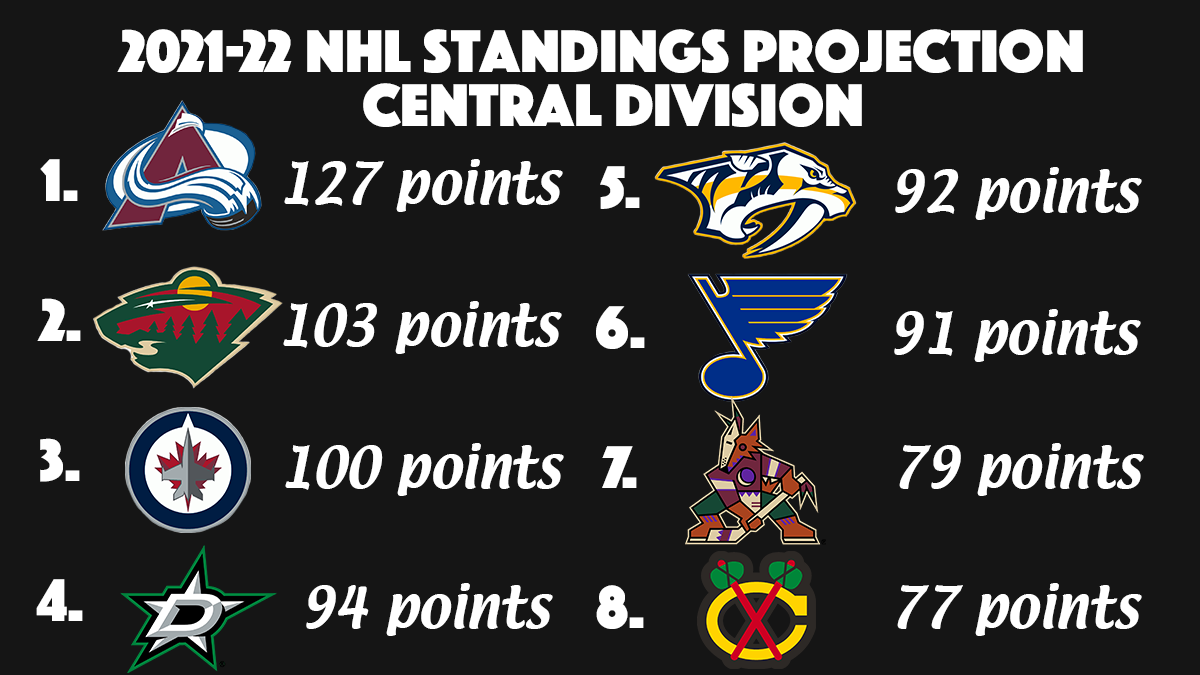
The overall vibe of the Central Division for 2021-22 is that it’s just more of exactly what you’d expect. The Colorado Avalanche are lightyears ahead of everyone else, while Kirill Kaprizov and the Minnesota Wild continue to be on the rise and everyone else fights for what they can earn.
Meanwhile, the jury is still out on whether or not the Winnipeg Jets can breakthrough as Canada’s team and break the Canadian curse (become the first Canadian club to win the Cup since 1993).
Are the Avalanche just the Toronto Maple Leafs but with a little more success? My column:
No, but really, it’s worth asking if the Avs making it back to the Western Conference Final for the first time since 2002, is more like Toronto’s struggle to make it out of the First Round for the first time since 2004, or is Colorado’s struggle more like the Washington Capitals pre-2018?
The Caps won three Presidents’ Trophies in 2009-10, 2015-16 and 2016-17, but couldn’t make it past the Second Round– let alone the Pittsburgh Penguins– until they finally did and ended up surging in momentum all the way to their first Stanley Cup in franchise history.
Colorado, on the other hand, has already won the Cup twice (1996 and 2001) and also has three Presidents’ Trophies to their name in 1996-97, 2000-01 and 2020-21, so if recent history has anything to tell us it’s that yet another team with high expectations for at least a few seasons now only to come up short could very well go on to win it all after winning the Presidents’ Trophy the previous year.
Either that or they’ll have to win it in back-to-back seasons like Washington did before they won the Cup in 2018.
Then again, the Tampa Bay Lightning tied the Detroit Red Wings’ record for most wins in the regular season (62), securing the Presidents’ Trophy in the process in 2018-19, then got swept by the Columbus Blue Jackets in the 2019 First Round.
The very next year, however, Tampa kicked off back-to-back Cup rings in 2020 and 2021, to be where they are now as the two-time defending champions likely standing in the path as the only other favorites outside of the Avalanche this season.
Anyway, the Avs mostly kept things the same from last season to this season, losing Joonas Donskoi to the Seattle Kraken in the 2021 NHL Expansion Draft, Brandon Saad to the St. Louis Blues in free agency and making minor swaps among replacement level bottom-six forwards and bottom-pairing defenders.
Oh, then there’s this whole thing about how Philipp Grubauer left for Seattle in free agency too, so Colorado acquired Darcy Kuemper from the Arizona Coyotes.
The Stars are projected to finish with about 94 points, the Predators sit at 92 points and the Blues are around 91 points in this one projection, but don’t let the points alone be your deciding factor.
Given the strength of the Central Division compared to the Pacific Division, you can bet on five teams making out of the Central among Western Conference playoff berths.
As such, the spread is the difference maker between these three teams expected to be in the wild card hunt– it’s going to come down to the wire one way or another.
Dallas bolstered their goaltending depth by signing Braden Holtby, Nashville traded Ryan Ellis to the Philadelphia Flyers and St. Louis is… …better than last season on paper?
I mean, the Blues signed Saad, acquired Pavel Buchnevich from the New York Rangers in exchange for Sammy Blais, let Seattle claim Vince Dunn at the expansion draft and let Mike Hoffman walk to the Montréal Canadiens in July.
You could say they took a hit here or there, but those aren’t “nobody names” by any means, however.
If Jordan Binnington and Ville Husso can stabilize things in the crease, then St. Louis has a better situation than the Predators.
The Stars, meanwhile, should benefit from a longer season where more of their core guys– like Tyler Seguin, for example– are healthy. Last season’s COVID-19 outbreak to kick things off in January really killed Dallas’ momentum as a team on the verge of being in the 2021 postseason.
Dallas should get back into the swing of things and St. Louis should be able to stay relevant for at least another year, but how hard the Preds rely on Juuse Saros as their starting goaltender will dictate whether or not they’re able to play spoiler with David Rittich as their backup since Pekka Rinne retired.
Anything is possible at this point. Loui Eriksson and Andrew Ladd were scoring goals in the postseason, so a fresh start could be just what both players needed for the last few years at least.
That said, Coyotes General Manager, Bill Armstrong, gave a Masterclass™️ in how to go about rebuilding by selling everything over the summer and taking on “bad” contracts with only one or two years remaining in hopes of playing just well enough to be bad enough without making it look obvious that you’re aiming to win the 2022 NHL Draft Lottery.

The Pacific Division is the new Scotia NHL North Division from last season. In other words, it’s the worst– which is great news for the Seattle Kraken as the league’s schedule allots more division play than any other opponents (though the Kraken will play every other team in the league at least twice).
Seattle’s riding the waves of new-age expansion, while the Vegas Golden Knights lead the charge for the Presidents’ Trophy campaign in 2021-22.
Yes, really.
The Kraken have a great front office that goes beyond just Ron Francis as General Manager and have done their due diligence in scouting the best talent available to try to replicate the success of the Vegas Golden Knights’ inaugural season in 2017-18, as well as grow beyond just 2021-22.
That said, Seattle probably isn’t going to make it out of the First Round of the 2022 Stanley Cup Playoffs, even if they have to face the Edmonton Oilers according to this projection.
It’s a best case scenario for the NHL’s newest expansion team to be in the weakest division, but aside from having recent Stanley Cup champions Yanni Gourde, Philipp Grubauer, Jaden Schwartz and Dunn on their roster, the Kraken have a plethora of players that are relatively inexperienced with deep postseason runs.
Head coach, Dave Hakstol, also hasn’t had the consistency of making the playoffs and making it out of the First Round in his NHL coaching days, but as a team that, again, is looking to develop long-term success, these are mere growing pains Francis and Co. are willing to accept as the fan base grows.
The simple answer is that everyone’s overrating Los Angeles when it comes to the “ready now” factor.
Sure, Kings General Manager, Rob Blake, did a good thing by getting Viktor Arvidsson in a trade with Nashville this summer to solidify his top-six forward group and signed Alex Edler to fortify his defense, but Los Angeles’ goaltending leaves something to be desired.
Here’s hoping Jonathan Quick can find a little resurgence at this point in his career, while Cal Petersen continues to come into his own.
If Los Angeles has any injuries– and they already have with Arvidsson likely missing some time due to an injury in the last preseason game– they’re already close enough to the bubble that they’ll only fall further behind.
That said, if the Kings don’t make it back to the postseason hunt in 2022, there’s a good chance they make it in 2023.
Los Angeles is improving, but by how much remains to be seen.
Eh, it’s hard to say.
The Golden Knights have packed in just about every type of heartbreak since their inception in 2017, that fans of other franchises have only experienced over the course of at least 50 years, so if Vegas pulls out the Presidents’ Trophy win in 2021-22, don’t be surprised when the inevitable happens and they win the Cup instead of doing what most other Presidents’ Trophy winners in the salary cap era have done.
Only the 2007-08 Detroit Red Wings and Chicago in 2012-13, have been able to win the Presidents’ Trophy and the Stanley Cup since the salary cap was introduced ahead of the 2005-06 season.
Vegas would probably join Detroit and Chicago in doing so just so the Hockey Gods can spite us again.
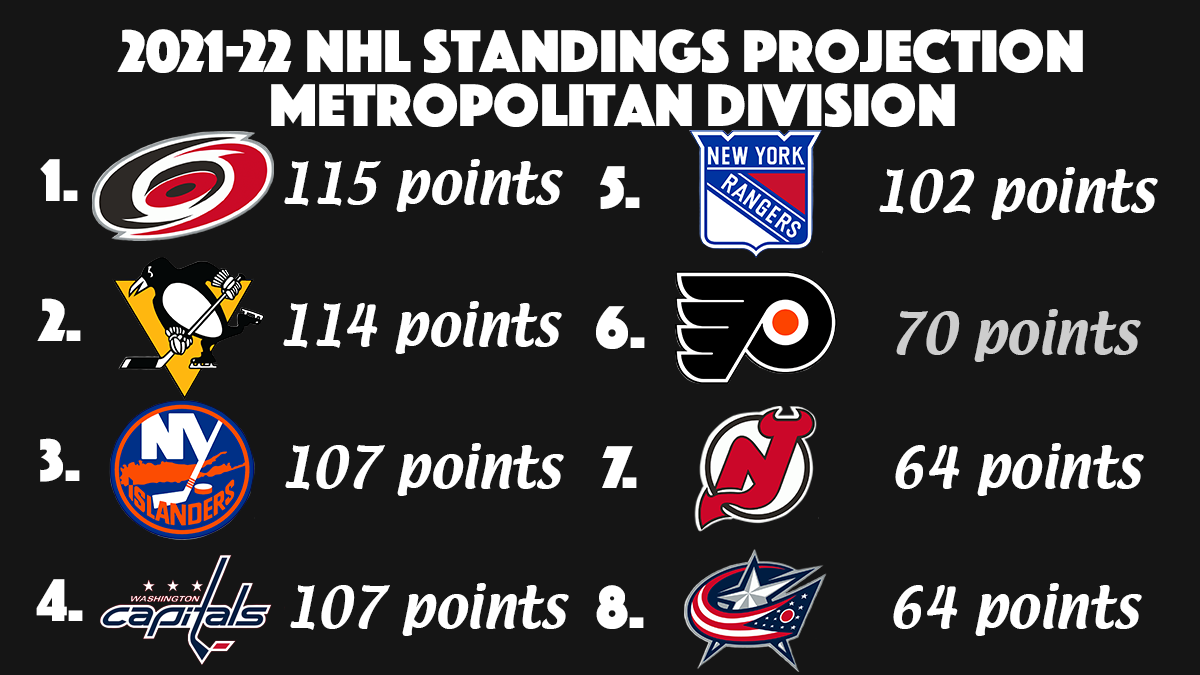
It’s not easy to be in the Metropolitan Division these days because, well, let’s save that for the three questions below.
Absolutely.
The Carolina Hurricanes decided to just get rid of a few parts and pieces that helped make them good for the last few seasons, so they’re bound to regress even with Sebastian Aho, Andrei Svechnikov, Teuvo Teräväinen and Martin Necas still existing.
The Pittsburgh Penguins since 2009, have always found a way to be near the top of the division standings by the end of the regular season no matter whether or not you believe they’ll inevitably miss the playoffs for the first time since 2006, so anything could happen there.
The New York Islanders have made back-to-back appearances in the Eastern Conference Final, so I’d expect them to be good.
The Washington Capitals are better than the Philadelphia Flyers and New York Rangers, at least, but are probably the only team on the bubble if the New Jersey Devils can come out of nowhere and be competitive this season after signing Dougie Hamilton, Tomas Tatar and Jonathan Bernier in the offseason.
Meanwhile, it’s time for a short rebuild in Columbus as the Blue Jackets would be quite pleased with a top draft pick in 2022.
They’d still fire David Quinn and hire Gerard Gallant. I don’t think that’s such a bad idea, but they’d definitely reconsider about 90% of the roster decisions made this summer.
There’s no reason why the Rangers have to go down this path and yet, here they are, fumbling at the one-yard line and possibly plunging their franchise back into the Dark Ages of another rebuild. Or is it the same ongoing rebuild?
I’m big on the Devils this season for some strange reason.
Maybe it’s because a part of me deep down misses the trap game of the 1990s and 2000s that led to Stanley Cups for New Jersey in 1995, 2000 and 2003.
Maybe it’s because they signed Hamilton, Tatar, Bernier and acquired Ryan Graves from the Colorado Avalanche as a supporting cast for Jack Hughes, Nico Hischier, Pavel Zacha, Yegor Sharangovich, Ty Smith and friends.
Seriously, the Devils should be good in the next few seasons, but this year could be the biggest stride forward in terms of their improvement from the basement to their development as a playoff contender.

First, pour one out for Jack Eichel. Now, let’s move on and talk about everyone else.
Just like how the Stars, Preds and Blues are all right on top of one another in the Central Division standings, the Atlantic Division is stacked from 1st through 4th, so though Toronto leads the way in this projection, I wouldn’t feel too comfortable as a Leafs fan.
The Maple Leafs played in the worst of the four divisions last year in the temporarily realigned divisions in wake of the ongoing pandemic.
No, it’s not just because they played all the other Canadian teams across 56 games, but rather it’s due to the fact that they haven’t been able to matchup with the Tampa Bay Lightning, Florida Panthers and even the Boston Bruins since the 2019-20 season.
A lot and not a lot has changed since then.
Tampa is still dominant as ever, Florida has emerged as a team that’s on the rise and Boston is unpredictable in that– much like the Penguins– it could really go either way with the Bruins this season.
So now Toronto has to take on better competition within their own division and square off with teams like the Vegas Golden Knights, Colorado Avalanche, New York Islanders and others that emerge towards the top of the standings outside of the Canadian teams that the Leafs are all too familiar with at this point.
That said, Toronto still has a great chance at winning the Atlantic Division regular season title or finishing 2nd and having home ice advantage in the First Round for the second-straight postseason.
No. Let’s be realistic here.
The Montréal Canadiens made it to the 2021 Stanley Cup Final despite being below .500 in the standings because every division produced four playoff berths and intra-divisional play through two rounds.
In 2020, they upset the Pittsburgh Penguins in the Qualifier despite finishing right at .500.
In any other non-pandemic timeline, the Canadiens would still be looking for their first playoff appearance since they lost to the New York Rangers in six games in the 2017 First Round.
That’s not to say that Nick Suzuki can’t lead the Habs back to glory, but rather that they need to improve all-around in the regular season and peaking in performance in the playoffs.
Though the Ottawa Senators promised unprecedented success from 2021-25, it’s looking like it’ll realistically be anytime between 2024-25 as in the 2024-25 season itself at this point.
Ottawa’s goaltending needs to improve, their defense could use some tweaks and the Sens are banking on their offense getting their feet underneath them and bursting in production in the coming years.
A little more patience won’t hurt them.
The same can be said for the Detroit Red Wings in that Red Wings fans already know– trust in General Manager, Steve Yzerman, is paramount. He’ll work his magic.
It just takes a little time to build a solid foundation and the first floor is almost ready to start going up.
As for the Buffalo Sabres, well…
At least they’ll hopefully give Rick Jeanneret a proper send-off before he retires as their play-by-play announcer for the last 51 years on television.
Hopefully.
Probably not.
I’m not ruling it out entirely, but the Lightning have a better chance of winning three Cups in four years than they do three Cups in as many years as things stand currently.
The loss of their entire third line (Blake Coleman, Yanni Gourde and Barclay Goodrow) from last season to this season is sure to leave a mark on the development and restructuring of their bottom-six forwards.
That said, Tampa’s top-six forwards still exist and, if you haven’t already noticed, they’re very good on their own, but the best teams in the playoffs have four lines that can roll without a doubt and the Bolts might just be off the ball for a year in terms of depth.
Alright, if you’ve made it this far, thanks for your patience. By now the season’s already going on a few days into the 2021-22 calendar, so the two of us (or more if you’re reading this to a group) should probably get back to watching games.
Stay tuned for more forecasts for both standings and assorted teams throughout the season.

The Seattle Kraken announced the results of the 2021 NHL Expansion Draft Wednesday night outdoors at Gas Works Park in Seattle, Washington on ESPN2 in the United States and Sportsnet in Canada, despite several NHL Insiders getting a hold of Seattle’s selections shortly after the Kraken turned in their picks to the league on Wednesday morning.
Seattle had to meet several requirements and select no more than one player from 30 out of the 31 other NHL franchises as the Vegas Golden Knights were exempted from the league’s latest round of expansion.
The Kraken had to draft at least 14 forwards, nine defenders and three goaltenders with a minimum of 20 players under contract for 2021-22 while being between 60-100% of the NHL’s $81.500 million salary cap in the process.
Kraken General Manager, Ron Francis, was allowed to talk to exposed pending-free agents prior to the draft and secured a few contracts in the process– thereby selecting said players as a result and counting towards the 30-player roster in the expansion draft.
Seattle’s selections were announced by division in alphabetical order by team, starting with the Boston Bruins of the Atlantic Division and so on until they finished the night with the teams that makeup the Pacific Division.
We’ve taken the liberty of sorting the draft results by forwards, defenders and goaltenders in the order they were announced.

Tampa Bay Lightning– C Yanni Gourde
Toronto Maple Leafs– C Jared McCann
Carolina Hurricanes– C Morgan Geekie
New Jersey Devils– RW Nathan Bastian
New York Islanders– RW Jordan Eberle
New York Rangers– C Colin Blackwell
Philadelphia Flyers– LW Carsen Twarynski
Pittsburgh Penguins– LW Brandon Tanev
Arizona Coyotes– C Tyler Pitlick
Chicago– LW/C John Quenneville
Colorado Avalanche– RW Joonas Donskoi
Nashville Predators– C Calle Jarnkrok
Winnipeg Jets– LW Mason Appleton
San Jose Sharks– C Alex True
Vancouver Canucks– RW Kole Lind
Boston Bruins– Jeremy Lauzon
Buffalo Sabres– Will Borgen
Detroit Red Wings– Dennis Cholowski
Montréal Canadiens– Cale Fleury
Columbus Blue Jackets– Gavin Bayreuther
Dallas Stars– Jamie Oleksiak
Minnesota Wild– Carson Soucy
St. Louis Blues– Vince Dunn
Anaheim Ducks– Haydn Fleury
Calgary Flames– Mark Giordano
Edmonton Oilers– Adam Larsson
Los Angeles Kings– Kurtis MacDermid
Florida Panthers– Chris Driedger
Ottawa Senators– Joey Daccord
Washington Capitals– Vitek Vanecek

There are four teams remaining in the 2021 Stanley Cup Playoffs and for the first time since 1981, there are no Conference Finals going on.
Due to the ongoing global pandemic, the National Hockey League was forced to temporarily realign the divisions and get rid of conferences for a season as the league and it’s players’ union did what they could to get an abbreviated 56-game regular season schedule and a full Stanley Cup Playoffs experience in the history books.
In May, ESPN‘s Greg Wyshynski reported that the league would not award the Prince of Wales Trophy and the Clarence S. Campbell Bowl to the victors of the equivalent third round, but after the Vegas Golden Knights eliminated the Colorado Avalanche in six games to conclude the Second Round of this year’s postseason last Thursday, the league apparently changed its mind.
With a regular all-Eastern Conference matchup between the Tampa Bay Lightning and New York Islanders, as well as 50% of the teams representing the Western Conference in the other Semifinal series, both trophies will be awarded to the third round series winners after all.
The winner of the Lightning and Islanders series will take home the Prince of Wales Trophy, while either the Golden Knights or the Montréal Canadiens will win the Clarence S. Campbell Bowl.
Montréal can join a short list of teams to have won both trophies in franchise history, as only the Detroit Red Wings, Philadelphia Flyers, Chicago Blackhawks and Islanders have won each before.
How is this possible, you ask?
Well, for starters, the Clarence S. Campbell Bowl was introduced in the 1967-68 season and awarded to the team that finished with the best regular season record in the West Division (the precursor to the Western Conference in the modern era), while the Prince of Wales Trophy dates back to the 1925-26 season and, you guessed it, eventually became the East Division (pre-Eastern Conference days) equivalent.
Ahead of the 1981-82 season, however, the league changed its postseason to include a Conference Finals round, thus involving these trophies in the playoffs and eventually leading to the creation of the Presidents’ Trophy for the team with the best regular season record since the 1985-86 season.
So anyway, the teams mentioned above that won both have changed conferences and divisions over time.
Now let’s talk about the other half of the Semifinal matchups– the Golden Knights and the Canadiens.
Vegas: 56 games played, .732 points percentage, 30 regulation wins.
Montréal: 56 games played, .527 points percentage, 20 regulation wins.

The Vegas Golden Knights eliminated the Minnesota Wild in seven games (4-3) in the First Round before ousting the 2020-21 Presidents’ Trophy winning, Colorado Avalanche, in six games (4-2) in the Second Round to advance to the 2021 Stanley Cup Semifinals as the representative club from the Honda NHL West Division.
Vegas is making their second appearance in the third round of the playoffs– their first since 2018– and is in search of the franchise’s first Stanley Cup ring in just their fourth season of existence.
Mark Stone (21-40–61 totals in 55 games) lead the Golden Knights in team scoring in the regular season and was named a finalist for the Frank J. Selke Trophy, while Max Pacioretty (24-27–51 totals in 48 games) and Jonathan Marchessault (18-26–44 totals in 55 games) rounded out the top-three in scoring on the roster.
Through 13 postseason games thus far, William Karlsson leads the Golden Knights in playoff scoring with 11 points (four goals, seven assists) in that span.
Marchessault, Stone, Pacioretty and Alex Pietrangelo are tied for the second-most points in the playoffs for Vegas so far with eight points each in 13 games (except for Pacioretty, who has eight points in seven games).
Alex Tuch, Mattias Janmark and Reilly Smith are tied for the sixth-most points on the roster in postseason scoring with seven points each.
In the crease, Marc-Andre Fleury led the way with a 26-10-0 record in 36 games played (36 starts) in the regular season, as well as a 1.98 goals-against average, a .928 save percentage and six shutouts in that span.
Meanwhile, Robin Lehner amassed a 13-4-2 record in 19 games (19 starts) to go with a 2.29 goals-against average, a .913 save percentage and one shutout.
Oscar Dansk even made an appearance with a 1-0-0 record in one game (one start), as well as a 3.93 goals-against average and an .862 save percentage, while Logan Thompson made a relief appearance in one game, earned no decision and had a 1.000 save percentage as a result.
Fleury’s gone on to have an 8-4 record in 12 games (12 stars) this postseason, as well as a 1.91 goals-against average, a .923 save percentage and one shutout entering the Semifinals.
Meanwhile, Lehner made one appearance (one start) thus far in the playoffs and went 0-1 with a 7.03 goals-against average and an .811 save percentage.

At the other end of the rink, the Montréal Canadiens were the winners of the Scotia NHL North Division, having overcome a 3-1 series deficit in seven games (4-3) against the Toronto Maple Leafs in the First Round prior to sweeping the Winnipeg Jets (4-0) in the Second Round to advance to the 2021 Stanley Cup Semifinals.
Poised as Canada’s team, the Habs have not won the Cup since 1993, and were last in the third round in the 2014 Eastern Conference Final– losing to the New York Rangers in six games (4-2) in the process.
The Canadiens haven’t even been back to the Stanley Cup Final since 1993, when they defeated Wayne Gretzky and the Los Angeles Kings in five games (4-1).
Tyler Toffoli (28-16–44 totals in 52 games) led the way for Montréal in team scoring this season in a prolific display of offensive prowess over a shorter than normal regular season schedule.
Jeff Petry chipped in 42 points (12 goals, 30 assists) from the defense in 55 games and Nick Suzuki (15-26–41 totals in 56 games) rounded out the top-three in Canadiens scoring in 2020-21.
Thus far in the 2021 Stanley Cup Playoffs, Toffoli’s continued to lead his teammates with 4-6–10 totals in 11 games, while Suzuki has eight points (four goals, four assists) in that span.
Joel Armia and Eric Staal are each tied for the third-most points on the Habs’ postseason roster, notching seven points through 11 games for Armia and 10 games for Staal.
In the crease, Jake Allen actually played in more games than Carey Price as Price dealt with injuries throughout the season.
Allen amassed an 11-12-5 record in 29 games (27 starts) and had a 2.68 goals-against average, as well as a .907 save percentage in the process, while Price managed to put up a 12-7-5 record in 25 games (25 starts) and had a 2.64 goals-against average, a .901 save percentage and one shutout in that span.
Cayden Primeau also had some action in the crease for Montréal this season, recording a 1-2-1 record in four games (four starts), as well as a 4.16 goals-against average and an .849 save percentage.
Thus far in the playoffs, it’s been all Price for Montréal as the Canadiens longtime starter has an 8-3 record in 11 games (11 starts), a 1.97 goals-against average, a .935 save percentage and one shutout in that span.
These two teams– the oldest in the league that predates the NHL (Montréal) and the new kids on the block (Vegas) at least until the Seattle Kraken pick players for their team next month in the 2021 Expansion Draft– are meeting for the first time in a playoff series in what is sure to be more than just an incredible experience.
They also didn’t get to play each other in the regular season because of the league’s temporary realignment, let alone the fact that the United States and Canadian border was closed.
It’ll be the first international matchup in the league this season with the Canadian government providing an exemption for games at Bell Centre.
Now, for starters, there’s the obvious “this would never happen regularly at least until the Stanley Cup Final” factor, but there’s also a shared history that has these clubs intertwined– the Max Pacioretty trade.
On Sept. 10, 2018, the Golden Knights made a splash by trading their second-highest drafted player in franchise history– Nick Suzuki at 13th overall in 2017– along with Tomas Tatar and a 2019 2nd round pick originally belonging to the Columbus Blue Jackets to the Canadiens for Pacioretty.
Vegas may have stumbled into “win now” mode to the average eye, but Golden Knights owner, Bill Foley, has long intended to replicate– if not beat– the Philadelphia Flyers’ emergence on the Stanley Cup scene.
Foley cried out for his team’s first Cup ring within three years of existence and something had to be done to spruce up their top-six forward group.
Enter Pacioretty, the longtime Canadien and former captain in Montréal in a bit of a disagreement regarding whether or not he and Habs General Manager, Marc Bergevin, could ever reach terms of a deal on an extension.
So Bergevin got bold.
He dealt Montréal’s most recognizable skater (not goaltender named “Price”, mind you) to Vegas for a high-caliber prospect, Tatar and a second round pick that he later flipped.
At the time, the Golden Knights claimed victory in the trade– acquiring the biggest star in the here and now, though they’re still searching for that elusive first Cup– while Canadiens fans lamented the loss of their prolific scorer in Pacioretty, but remained hopeful for the future with Suzuki coming into the fold as the team had just drafted Jesperi Kotkaniemi 3rd overall in the 2018 Draft in June.
Three years later, the Habs are a Cinderella team, while Vegas is right where they expected to be– except neither expected to play each other before the Stanley Cup Final, which only amplifies the magnitude of the Pacioretty trade even more.
Oh, then there’s the battle of Fleury and Price in net too, which by now, is worth pointing out that we haven’t even gotten into how each team could win the series.
For the Golden Knights, it’s their potent offense that’s generated throughout the lineup.
Vegas head coach, Peter DeBoer, rolls four lines and three defensive pairings and any and all players on the ice can find a way to wire a puck into the twine one way or another.
For the Canadiens, it all comes down to Price as the team’s offense has mostly relied upon a top-heavy approach.
That’s not to say that Corey Perry or Staal can’t be a determining factor in the clutch, but rather that in a standard “which team has the better offense, better defense and/or better goaltending” checklist, well, Vegas has scored 40 goals this postseason to Montréal’s 28 goals for.
Price should help the Canadiens steal a game or two in the series, but unless their miracle run finds a way to continue, the Golden Knights should wrap things up in six games.
Schedule:
6/14- Game 1 MTL @ VGK 9 PM ET on NBCSN, CBC, SN, TVAS
6/16- Game 2 MTL @ VGK 9 PM ET on NBCSN, CBC, SN, TVAS
6/18- Game 3 VGK @ MTL 8 PM ET on USA, CBC, SN, TVAS
6/20- Game 4 VGK @ MTL 8 PM ET on NBCSN, CBC, SN, TVAS
6/22- Game 5 MTL @ VGK 9 PM ET on NBCSN, SN, TVAS*
6/24- Game 6 VGK @ MTL 8 PM ET on USA, CBC, SN, TVAS*
6/26- Game 7 MTL @ VGK 8 PM ET on NBCSN, CBC, SN, TVAS*
*If necessary
There are four teams remaining in the 2021 Stanley Cup Playoffs and for the first time since 1981, there are no Conference Finals going on.
Due to the ongoing global pandemic, the National Hockey League was forced to temporarily realign the divisions and get rid of conferences for a season as the league and it’s players’ union did what they could to get an abbreviated 56-game regular season schedule and a full Stanley Cup Playoffs experience in the history books.
In May, ESPN‘s Greg Wyshynski reported that the league would not award the Prince of Wales Trophy and the Clarence S. Campbell Bowl to the victors of the equivalent third round, but after the Vegas Golden Knights eliminated the Colorado Avalanche in six games to conclude the Second Round of this year’s postseason on Thursday, the league apparently changed its mind.
With a regular all-Eastern Conference matchup between the Tampa Bay Lightning and New York Islanders, as well as 50% of the teams representing the Western Conference in the other Semifinal series, both trophies will be awarded to the third round series winners after all.
The winner of the Lightning and Islanders series will take home the Prince of Wales Trophy, while either the Golden Knights or the Montréal Canadiens will win the Clarence S. Campbell Bowl.
Montréal can join a short list of teams to have won both trophies in franchise history, as only the Detroit Red Wings, Philadelphia Flyers, Chicago Blackhawks and Islanders have won each before.
How is this possible, you ask?
Well, for starters, the Clarence S. Campbell Bowl was introduced in the 1967-68 season and awarded to the team that finished with the best regular season record in the West Division (the precursor to the Western Conference in the modern era), while the Prince of Wales Trophy dates back to the 1925-26 season and, you guessed it, eventually became the East Division (pre-Eastern Conference days) equivalent.
Ahead of the 1981-82 season, however, the league changed its postseason to include a Conference Finals round, thus involving these trophies in the playoffs and eventually leading to the creation of the Presidents’ Trophy for the team with the best regular season record since the 1985-86 season.
So anyway, the teams mentioned above that won both have changed conferences and divisions over time.
Now let’s talk about one-half of the Semifinal matchups– the Lightning and the Islanders.
Tampa: 56 games played, .670 points percentage, 29 regulation wins.
N.Y. Islanders: 56 games played, .634 points percentage, 24 regulation wins.

The Tampa Bay Lightning eliminated the Florida Panthers in six games (4-2) in the First Round before taking care of the Carolina Hurricanes in a five-game upset (4-1) to represent the Discover NHL Central Division in the 2021 Stanley Cup Semifinals.
They’re also the defending Stanley Cup champions looking to be the first team to repeat as such since the Pittsburgh Penguins won back-to-back Cups in 2016 and 2017.
The Bolts have followed the league’s salary cap rules to a “T”, which enabled them to spend almost $99 million as the playoffs began because Nikita Kucherov had been on the long term injured reserve all season long and due to the fact that the cap ceiling disappears for the postseason.
Brayden Point led the Lightning in the regular season with 23-25–48 totals in 56 games, while Ondrej Palat (15-31–46 totals in 55 games) and Victor Hedman (9-36–45 totals in 54 games) rounded out the top-three in scoring on the roster in 2020-21.
Through 11 games this postseason, Kucherov hasn’t missed a beat, leading his teammates with 18 points (five goals, 13 assists) in that span.
Tampa’s captain, Steven Stamkos, missed the last part of the regular season, but returned in time for the playoffs and has not missed any action due to injury.
As a result, he’s had 5-8–13 totals in 11 games– good enough for the second-most points by a Lightning skater in the 2021 Stanley Cup Playoffs, while Point (8-4–12 totals in 11 games) and Alex Killorn (6-6–12 totals in 11 games) are tied for the third-most on the postseason roster.
In the crease, Andrei Vasilevskiy led Tampa’s netminders with a 31-10-1 record in 42 games played (42 starts), yielding a 2.21 goals-against average, a .925 save percentage and five shutouts in the process.
Curtis McElhinney served as Vasilevskiy’s backup and amassed a 4-6-2 record in 12 games (12 starts), as well as a 3.09 goals-against average, an .875 save percentage and one shutout in that span.
Christopher Gibson even got a little time in net, recording a 1-1-0 record in two games (two starts), as well as a 2.65 goals-against average and an .875 save percentage.
Thus far in the playoffs, Vasilevskiy has yet to be chased from the crease– putting up an 8-3 record in 11 games (11 starts) to go with his 2.24 goals-against average and .934 save percentage.
Oh and he’s more than doubled his career postseason shutout total– recording two so far in Tampa’s quest for back-to-back rings.

At the other end of the rink, the New York Islanders beat two teams they’re used to beating in the history of the Stanley Cup Playoffs– defeating the Pittsburgh Penguins in six games (4-2) in the First Round and the Boston Bruins in six games (4-2), as well, in the Second Round to reach the 2021 Stanley Cup Semifinals as the MassMutual NHL East Division’s representation.
Head coach, Barry Trotz, is still using his modified trap, though New York’s potent offense is actually leading the way in the 2021 Stanley Cup Playoffs with 43 goals for thus far.
Vegas is second with 40 goals for, while Tampa sits third with 38 goals for and the best goal differential in the postseason so far with a plus-12 differential.
Mathew Barzal (17-28–45 totals in 55 games) led the Isles in scoring in the regular season. Josh Bailey (8-27–35 totals in 54 games), Brock Nelson (18-15–33 totals in 56 gmaes) and Jordan Eberle (16-17–33 totals in 56 games) rounded out the top-three in team scoring in 2020-21.
Through 12 games this postseason, Jean-Gabriel Pageau has emerged at peak performance at the right time of the year to be on top of one’s game, leading the Islanders in playoff scoring with 3-10–13 totals.
Bailey and Anthony Beauvillier each have 11 points in 12 games, while Nelson has the fourth-most points on the playoff roster with 6-4–10 totals in that span.
In net, Semyon Varlamov led the way as New York’s starter, amassing a 19-11-4 record in 36 games (35 starts), as well as a 2.04 goals-against average, a .929 save percentage and tied for the league lead in shutouts with Colorado Avalanche netminder, Philipp Grubauer, blanking opponents on the scoreboard seven times each this season.
Ilya Sorokin’s first season in the NHL was served in a backup role, going 13-6-3 in 22 games (21 starts) and accruing a 2.17 goals-against average, a .918 save percentage and three shutouts in that span.
Though Sorokin ultimately helped the Islanders get over the Penguins in the First Round, his Game 1 performance against Boston left something to be desired, forcing Trotz to hand the keys to the crease back to Varlamov.
Varlamov’s gone on to post a 4-3 record in seven games (seven starts) this postseason, notching a 2.62 goals-against average and a .925 save percentage in the process.
Sorokin, meanwhile, has a 4-1 record in five games (five starts), as well as a 2.32 goals-against average and a .934 save percentage.
With the way Varlamov’s been playing as of late– recording 40 saves against the Bruins some nights– it’s not likely that Sorokin will see any action against the Bolts.
Unlike how the Lightning got a key component of their roster in Kucherov back in time for when it counts, New York’s captain, Anders Lee, remains sidelined until the 2021-22 season with a knee injury.
These two teams are meeting for the fourth time in a playoff series, with the Lightning holding a 3-0 all time advantage, having defeated the Islanders in five games (4-1) in the 2004 Eastern Conference Quarterfinals, in five games (4-1) again in the 2016 Second Round, as well as in six games (4-2) in the 2020 Eastern Conference Final.
For the second year in a row, these two clubs are squaring off in the third round of the Stanley Cup Playoffs, but unlike last year’s neutral site at Rogers Place in Edmonton, Alberta, the home crowds may be a factor in 2021.
What’s more, these two teams have yet to play each other thanks to the temporary division realignment for 2020-21, due to the ongoing COVID-19 pandemic.
If history is any indicator, it’s that Tampa should win the series and extend their all time advantage to 4-0, but New York presented a challenge to the Bolts last year that is sure to be amplified by both rosters’ familiarity with each other, as well as the fact that the Lightning will have to go through the ringer that is known as Nassau Live at Nassau Veterans Memorial Coliseum.
This isn’t to say that the fans in attendance at Amalie Arena won’t be just as boisterous, but there’s something to be said about a Long Island crowd this time of year– especially one that’s been longing for their first Stanley Cup title since 1983.
Not only that, but it’d be a great way to send the building off into retirement as the Islanders move into their new home in Elmont, New York at UBS Arena next season.
That said, the Lightning have home-ice advantage in this series for the first time this postseason and they’ve been pretty good at stealing games on the road– winning two out of three games in the First Round at BB&T Center against Florida and all three games held at PNC Arena in their Second Round series with Carolina.
2020 Stanley Cup winning head coach, Jon Cooper, pitted against 2018 Stanley Cup winning head coach in Trotz (then of the Washington Capitals)– this rematch is sure to be one hell of a battle.
Though the Lightning have cruised thus far, there’s something to be said about the tenacity of the Islanders and the way momentum seems to be working in their favor.
For the first time, it looks like New York will come out on top against Tampa and they’ll likely do it over seven games of some of the best hockey fans desire leading up to the Stanley Cup Final.
If it’s anything shorter, it’ll be because Vasilevskiy continued to stay hot and the Islanders gave up too many power plays to the Lightning, but New York was one of the least penalized teams in the regular season.
If the offense doesn’t sputter, the Isles have their best chance at getting back to the Stanley Cup Final for the first time since 1984, when they lost in five games to the Edmonton Oilers.
Schedule:
6/13- Game 1 NYI @ TBL 3 PM ET on NBC, CBC, SN, TVAS
6/15- Game 2 NYI @ TBL 8 PM ET on NBCSN, CBC, SN, TVAS
6/17- Game 3 TBL @ NYI 8 PM ET on USA, CBC, SN, TVAS
6/19- Game 4 TBL @ NYI 8 PM ET on USA, CBC, SN, TVAS
6/21- Game 5 NYI @ TBL 8 PM ET on NBCSN, CBC, SN, TVAS*
6/23- Game 6 TBL @ NYI 8 PM ET on NBCSN, CBC, SN, TVAS*
6/25- Game 7 NYI @ TBL 8 PM ET on NBCSN, CBC, SN, TVAS*
*If necessary
The calendar flipped to September and it’s time to gear up for preseason hockey— I mean the Conference Finals!
Yes, for the first time in recorded history, the National Hockey League is hosting both the Western Conference Final and the Eastern Conference Final in one hub city as Edmonton, Alberta plays host to the third round of the 2020 Stanley Cup Playoffs, as well as the 2020 Stanley Cup Final, but we’ll get there in a moment.
First, there’s a little leftover business to take care of and that’s figuring out which of the two Western Conference finalists will emerge victorious at Rogers Place and remain in the bubble to contend for what every NHL player dreams of– raising Lord Stanley’s mug high over their shoulders and going for a skate.
Though they were at first excluded from the bubble, some family members will be allowed to partake in the Conference Final and Stanley Cup Final festivities as long as they are Canadian citizens that are currently in Canada, but they have to self-isolate at home for seven days and produce three negative COVID-19 tests before traveling.
Then, of course, they’ll have to remain in quarantine in a separate hotel room in the bubble and produce four more negative tests before they can interact with the players.
The NHL is still waiting for clearance from the Canadian government, as well as the provincial government in Alberta, with regards to allowing citizens from outside of Canada into the Edmonton bubble and remains in ongoing discussions with the NHLPA, as well as the respective governments to work on a plan.
And no, none of the family members and/or romantic partners of any the players are a distraction.
If anything, they are a welcome sense of normalcy while the four remaining teams, staff and workers in the bubble have been isolated from the outside world for the last six weeks.
For now, let’s get back to breaking down the 2020 Western Conference Final and trying to predict a winner in some number of games.
Vegas: 71 games played, .606 points percentage, 30 regulation wins.
Dallas: 69 games played, .594 points percentage, 26 regulation wins.
The Vegas Golden Knights are fresh off of a, 3-0, shutout of the Vancouver Canucks in Game 7 of their 2020 Second Round matchup and previously eliminated the Chicago Blackhawks in five games in their First Round battle.
Max Pacioretty led the Golden Knights in the regular season with 32-34–66 totals in 71 games in the regular season, while Mark Stone (63 points in 65 games) and Reilly Smith (54 points in 71 games) were second and third on the roster, respectively, in scoring.
In the 2020 postseason, Shea Theodore has emerged as the leader scorer all the way from the blue line with six goals and 10 assists (16 points) in 15 games after being treated for testicular cancer prior to the 2019-20 regular season.
Theodore set career-highs in goals (13), assists (33) and points (46) in 71 games in the regular season and was a plus-12 for Vegas.
Hot on his tail, Stone has 6-9–15 totals through 15 playoff games entering the Western Conference Final, while Smith has 13 points (four goals, nine assists) in 15 games for Vegas.
Alex Tuch, who’s goal scoring ability lead the Golden Knights with eight goals this postseason, is fourth on the roster in playoff points with 8-2–10 totals in 15 games.
In the crease, Marc-Andre Fleury led the way in the regular season as Vegas’ starter with a 27-16-5 record in 49 games played (48 starts) with a 2.77 goals against average, a .905 save percentage and a five shutouts in that span.
Malcolm Subban posted a 9-7-3 record in 20 games (19 starts) with a 3.18 GAA and an .890 SV% before being traded to the Chicago Blackhawks as part of a three-team trade at the deadline with the Toronto Maple Leafs mitigating the acquisition of Robin Lehner from Chicago to Vegas.
Lehner finished the regular season with a 3-0-0 record in three games played (all starts) for the Golden Knights, while amassing a 1.67 GAA, a .940 SV% and one shutout.
Oscar Dansk made an appearance in one game (one start) and had a 6.00 GAA, as well as an .838 SV% to go with his 0-1-0 record this season.
Controversy swirls Golden Knights head coach, Peter DeBoer, entering the Western Conference Final for going with Lehner as his playoff starter over Fleury, but the results speak for themselves.
Lehner is 8-4 in 12 games with a 1.99 GAA, a .918 SV% and three shutouts this postseason, while Fleury has a 3-0 record in three games with a 2.67 GAA, an .893 SV% and no shutouts in that span.

At the other end of the rink, the Dallas Stars beat the Calgary Flames in six games in the First Round and held off the Colorado Avalanche in a, 5-4, overtime win in Game 7 of their Second Round matchup– preventing a, 3-1, series lead collapse in the process.
Tyler Seguin led the way for Dallas in the regular season with 17-33–50 totals in 69 games, while Jamie Benn (39 points in 69 games) and Miro Heiskanen (35 points in 69 games) were second and third in scoring on the roster, respectively.
Second-year defender, Heiskanen has broken out into a two-way prowess leading the Stars with 5-16–21 totals in 16 playoff games entering the Western Conference Final.
First year-forward, Denis Gurianov, is second in points this postseason for Dallas with eight goals and seven assists (15 points) in 16 postseason games, while Benn rounds out the top-three in scoring for Dallas in the 2020 playoffs with 5-8–13 totals in 16 games.
Joe Pavelski– seeking revenge (despite his team winning the game) on the Golden Knights for his injury in Game 7 of the 2019 First Round series while a member of the San Jose Sharks– and John Klingberg each have 12 points in 16 and 15 games respectively heading into Sunday night’s Game 1 meeting with Vegas.
In net, Ben Bishop had a 21-16-4 record in 44 games (43 starts) with a 2.50 GAA, a .920 SV% and two shutouts as Dallas’ starting goaltender, while Anton Khudobin went 16-8-4 in 30 games (26 starts) and had a 2.22 GAA, as well as a .930 SV% in that span.
Bishop has been limited due to injury to a 1-2 record in three games this postseason– amassing a 5.43 GAA and an .844 SV% in the process.
Enter, Khudobin, the fringe starter turned de facto starter for the Stars that’s put up an 8-5 record in 14 games played (13 starts) with a 2.94 GAA and a .909 SV% in that span.
Vegas and Dallas went head-to-head in two games this season before the pandemic truncated the 2019-20 regular season– with the Golden Knights amassing a 1-1-0 record and the Stars going 1-0-1 in the season series.
As this is only the third season in Golden Knights franchise history, these two franchises have never met in the postseason until now.
Dallas is riding the hot hands of consistent scoring, while Vegas has the advantage in the crease if they play their cards right (it has to be Lehner).
The Stars are trying to make their first Stanley Cup Final appearance since 2000, while Vegas is hoping to make it back to the Stanley Cup Final after losing to the Washington Capitals in five games in 2018.
If Vegas can’t translate their numerous shots on goal into concrete goals like how they struggled to score against the Canucks, then Dallas has a great chance of dragging the series in favor of the Stars.
Regardless, this one feels like it’ll go all seven games in favor of the Golden Knights.
Regular season outcomes:
4-2 DAL at American Airlines Center on Nov. 25th, 3-2 F/OT VGK at American Airlines Center on Dec. 13th
Schedule:
9/6- Game 1 DAL @ VGK in Edmonton 8 PM ET on NBC, CBC, SN, TVAS
9/8- Game 2 DAL @ VGK in Edmonton 8 PM ET on NBCSN, CBC, SN, TVAS
9/10- Game 3 VGK @ DAL in Edmonton 8 PM ET on NBCSN, CBC, SN, TVAS
9/12- Game 4 VGK @ DAL in Edmonton 8 PM ET on NBC, CBC, SN, TVAS
9/14- Game 5 DAL @ VGK in Edmonton 8 PM ET on NBCSN, CBC, SN, TVAS*
9/16- Game 6 VGK @ DAL in Edmonton 8 PM ET on NBCSN, CBC, SN, TVAS*
9/18- Game 7 DAL @ VGK in Edmonton 9 PM ET on NBCSN, CBC, SN, TVAS*
*If necessary
The turnaround from the Qualifier to the First Round was too quick to get this out of the way (other than on the podcast), but at least the league and broadcasting partners gave us all a day or two between the First and Second Round– oh.
By the time that you’ll be reading this, the Colorado Avalanche and Dallas Stars will likely already be well into the first period (at least) of Game 1 in their 2020 Stanley Cup Playoffs Second Round matchup.
Once again, this postseason is unpredictable– and that’s besides whatever happens on the ice.
At any point in time things could be shutdown again, because– you know– of the ongoing COVID-19 pandemic.
The players, coaches, team and league staff, as well as broadcasting crews and essential arena/hotel employees have all been in the bubble for almost a month now.
There aren’t enough words to express how taxing on the mind the isolation really is, despite teammates being in the bubble together, etc.
None on the league staff or team staff will see their families, romantic partners, roommates back home, etc. until they’re either eliminated or heading home with the Stanley Cup in their arms *fingers crossed*.
Luckily, the league’s made it this far into Phase 4 with no positive tests for COVID-19 out of the thousands of tests they’ve conducted.
For one reason or another (TV broadcast deals, probably), they’ve decided to make the Second Round feature a multitude of “back-to-backs”– that’s two games in two nights, whereas normally by this point in the playoffs there’s always (except for extenuating arena availability circumstances) a day off between each game in a series.
Alas, being in two bubble cities (Edmonton and Toronto), the league can do whatever it wants.
For now, let’s focus on the Western Conference teams in the Second Round. We’ll get to the Eastern Conference later.
As a reminder, the Conference Finals and Stanley Cup Final will be held at Rogers Place in Edmonton, Alberta, if everything goes according to plan.
Sadly, families won’t allowed to join the players in the Conference Finals and beyond as was first anticipated at the beginning of the bubble.
Vegas: 71 games played, .606 points percentage, 30 regulation wins.
Vancouver: 69 games played, .565 points percentage, 27 regulation wins.
The Vegas Golden Knights took care of the Chicago Blackhawks in five games (4-1) in the First Round and (if you remember, they didn’t have to play in any Qualifier by virtue of being one of the best four Western Conference teams– seeding determined by a Round Robin tournament) are set to experience what it’s like to face the Vancouver Canucks in the Second Round.
Vancouver hasn’t been back to the Second Round since their 2011 Stanley Cup Final appearance, so good news for them– they won a series for the first time in nine years.
The Golden Knights were led by Max Pacioretty (32-34–66 totals in 71 games played) in the regular season, with Mark Stone (63 points in 65 games) and Reilly Smith (54 points in 71 games) rounding out the top-three scorers on the team.
Through eight games this postseason, Vegas has looked like their usual selves.
Sure, the goaltending is a hot topic these days, but the team can jump out to a quick, 1-0, lead or play a long-range game where the club takes absolute control of the third period and beats their opponent into submission– both on the ice and on the scoreboard.
Stone (four goals, four assists) and Smith (three goals, five assists) lead the Golden Knights with eight points each in eight games thus far in the 2020 postseason.
Shea Theodore (four goals, three assists) and Jonathan Marchessault (two goals, five assists) have the second most points thus far for Vegas– each of them have seven points in eight games.
Oh and William Karlsson– the other usual suspect for Golden Knights offense– has 2-4–6 totals in eight games.
In the regular season, Marc-Andre Fleury amassed a 27-16-5 record in 49 games (48 starts) for the Golden Knights with a 2.77 goals against average and a .905 save percentage in the process, as well as five shutouts.
Malcolm Subban played the role of the backup with a 9-7-3 record in 20 games (19 starts), a 3.18 GAA and an .890 SV% until he was traded at the deadline to the Blackhawks in a three-team trade that witnessed Robin Lehner exchange hands from Chicago to the Toronto Maple Leafs to Vegas.
Lehner, in the meantime, went 3-0-0 with a 1.67 GAA, a .940 SV% and one shutout for Vegas until the stoppage due to the pandemic.
Oscar Dansk also made one appearance in 2019-20 for the Golden Knights, amassing a 6.00 GAA and an .838 SV% to go with his 0-1-0 record.
In the playoffs, there’s a growing goalie controversy– no, not mentioning Fleury’s agent posting… …whatever that was— but Fleury’s posted a 2-0 record in two games (two starts) with a 2.50 GAA and an .886 SV.
Meanwhile, Lehner has amassed a 5-1 record in six games with a 2.44 GAA and a .904 SV% in the process.
Lehner’s had his moments, but he’s looked more confident and able to carry himself so far since returning after, what, five months off from the regular season to Phase 4?
Fleury, on the other hand, has let in some goals that are reminiscent of his pre-three Stanley Cup rings with the Pittsburgh Penguins days.
Is it his age or simply a byproduct of not being able to get quite restarted after a pandemic stoppage? Well, we may never know, because despite the “controversy” he still managed to win both games he was in and now– after more of a workload than Fleury– Lehner is regressing to some sort of standard trend for Vegas goaltenders this season.

At the other end of the rink, the Canucks broke through with their first series win since 2011, by beating the Minnesota Wild in four games (3-1) to make the playoffs, then defeated the St. Louis Blues in six games (4-2) to meetup with the Golden Knights in the Second Round.
J.T. Miller (27-45–72 totals in 69 games) led Vancouver in scoring, while Elias Pettersson (66 points in 69 games) had the second most points and Bo Horvat (53 points in 69 games) was third.
Pettersson leads his team through 10 games with 4-9–13 totals this postseason as Miller (5-5–10 totals) and Quinn Hughes (1-9–10 totals) each battle it out for second in Canucks playoff scoring.
Horvat (six goals, two assists) and Brock Boeser (three goals, five assists) each had eight points for the third most in offensive production for Vancouver thus far.
In the crease, Jacob Markstrom led the way in the regular season with a 23-16-4 record in 43 games (43 starts), as well as a 2.75 GAA, a .918 SV% and two shutouts in 2019-20.
Thatcher Demko put up a 13-10-2 record in 27 games (25 starts) and had a 3.06 GAA, as well as a .905 SV% as Vancouver’s backup, while Louis Domingue made an appearance this season while the Canucks were depleted due to injury and amassed a 4.08 GAA and an .882 SV% to go with his 0-1-0 record in one game.
In the playoffs, it’s been all Markstrom, who is 7-3 in ten games with a 2.44 GAA, a .929 SV% and one shutout in that span.
Golden Knights head coach, Peter DeBoer, usually makes it to at least the Conference Finals– if not Stanley Cup Final– in his first season/partial season with a new team after being fired by his old team.
Good news for Vegas fans, DeBoer is behind the bench.
Canucks head coach, Travis Green, has been a long-time coming coaching prospect turned annual “is he in the hot seat?”– but not really– extraordinaire that, with the help of youth, time and forward progress, has been presented a roster that can and will turn heads both in the now and near future.
Basically, these two teams met on Dec. 15th and Dec. 19th and each won a game.
Vegas beat Vancouver, 6-3, at T-Mobile Arena on Dec. 15th, while the Canucks took home a, 5-4, overtime win on Dec. 19th at Rogers Arena.
The Golden Knights had a combined 89 shots against the Canucks, who had a combined 63 shots against Vegas this season.
Neither team’s goaltending looked solid in their head-to-head matchups, but entering the Second Round, Markstrom clearly has the upper hand.
That said, Vegas has the powerful offense– with recent playoff experience to boot– and their tried and true defense that saw the addition of clutch playoff performer and underrated leader when it really counts, Alec Martinez, at the trade deadline from the Los Angeles Kings.
It’s their first time ever meeting and it’s likely one that will last longer than most fans might think– because, again, Markstrom is a huge factor. Whether or not he’s actually this good all the time doesn’t matter.
He’s a hot goaltender this year and he’s been consistent thus far since returning from the stoppage.
It won’t be easy, but the Golden Knights should advance, however, to the 2020 Western Conference Final in six games when all is said and done.
Regular season outcomes:
6-3 VGK at T-Mobile Arena on Dec. 15th, 5-4 F/OT VAN at Rogers Arena on Dec. 19th
Schedule:
8/23- Game 1 VAN @ VGK in Edmonton 10:30 PM ET on NBCSN, CBC, SN, TVAS
8/25- Game 2 VAN @ VGK in Edmonton 9:45 PM ET on NBCSN, CBC, SN, TVAS
8/27- Game 3 VGK @ VAN in Edmonton, 8 PM ET on NBCSN, CBC, SN, TVAS
8/29- Game 4 VGK @ VAN in Edmonton, 8 PM ET on NBCSN, CBC, SN, TVAS
8/31- Game 5 VAN @ VGK in Edmonton*
9/1- Game 6 VGK @ VAN in Edmonton*
9/3- Game 7 VAN @ VGK in Edmonton*
*If necessary
Colorado: 70 games played, .657 points percentage, 37 regulation wins.
Dallas: 69 games played, .594 points percentage, 26 regulation wins.

Both the Colorado Avalanche and Dallas Stars were good enough in the Western Conference to participate in the Round Robin tournament while the Stanley Cup Qualifier was going on, after which, the Avs beat the Arizona Coyotes in five games in the First Round, while the Stars eliminated the Calgary Flames in six games.
Nathan MacKinnon led the way for Colorado in the regular season with 35 goals and 58 assists for 93 points in 69 games played. Rookie defender, Cale Makar, was second in team scoring with 50 points in an injury shortened 57-game season, while offseason acquisition, Andre Burakovsky amassed 20-25–45 totals in 58 games for the third most points on the team.
In the postseason, MacKinnon is still leading the way for the Avalanche with 13 points (four goals, nine assists) in eight games entering the Second Round. Nazem Kadri is a close-second with 11 points (six goals, five assists) through eight games, while Mikko Rantanen is third with 10 points (three goals, seven assists) in eight games.
In the net, Philipp Grubauer split time with Pavel Francouz.
Grubauer amassed an 18-12-4 record in 36 games played (36 starts), while putting up a 2.63 GAA, a .916 SV% and two shutouts.
Francouz had a 21-7-4 record in 34 games (31 starts) and yielded a 2.41 GAA, a .923 SV% and one shutout in that span.
Meanwhile, Michael Hutchinson made one appearance and recorded a 1.00 GAA, as well as a .944 SV% in that game for Colorado after being acquired at the deadline.
In the playoffs, Grubauer’s carried the weight with a 5-0-1 record in six games, a 1.49 GAA, a .937 SV% and one shutout in that span, while Francouz has made two appearances with a 1-1-0 record, a 1.02 GAA, a .958 SV% and one shutout in that stretch.
Entering Game 1, Grubauer was likely to see more time in the crease (but that’s changed now with his lower body injury that he sustained).
Across the ice, the Dallas Stars advanced to the Second Round after ousting the Flames and were led by Tyler Seguin’s 50 points (17 goals, 33 assists) in 69 games in the regular season, while Jamie Benn (19-20–39 totals in 69 games) and Miro Heiskanen (8-27–35 totals in 69 games) also played major roles leading up to the pause.
Entering the Second Round, Heiskanen has emerged as a generational talent for Dallas’ blue line with three goals and nine assists (12 points) in nine games thus far. Free agent signing, Joe Pavelski, has paid off with his usual clutch playoff performance– eight points (six goals, two assists) in nine games so far.
Meanwhile, rookie, Denis Gurianov (6-1–7 totals in nine games) and John Klingberg (1-6–7 totals in eight games) are battling it out for the third most points on the roster thus far in the 2020 postseason.
Gurianov had four goals and an assist against Calgary in Game 6– tying Chicago’s Dominik Kubalik for the most points in a playoff game by a rookie this postseason with five– one shy of the NHL record (Mikko Leinonen had six points– all assists– for the New York Rangers in Game 2 of their Patrick Division Semifinal against the Philadelphia Flyers on April 8, 1982).
In net, Ben Bishop and Anton Khudobin made a solid goaltending tandem for the Stars with Bishop amassing a 21-16-4 record in 44 games (43 starts), a 2.50 GAA, a .920 SV% and two shutouts while battling injury at times.
Khudobin, meanwhile, held things down with a 16-8-4 record in 30 games (26 starts), a 2.22 GAA and a .930 SV%.
In the postseason, Bishop has been “unfit to play” for the majority of Stars games, while managing to put up a 1-1 record in two games, with a 4.04 GAA and an .862 SV%.
As a result, Dallas interim head coach, Rick Bowness, has had to rely on Khudobin, who’s amassed a 4-3 record in seven games, with a 2.49 GAA and a .919 SV% entering the Second Round.
Now is where the fun begins.
Despite all of their dominance in the regular season, Jared Bednar’s Avalanche have yet to crack the code on the Stars.
Dallas won all four matchups with Colorado, with the Avs dropping a game in overtime and in a shootout to the Stars this season.
Colorado outshot Dallas, 162-137, in combined shots on goal in their head-to-head meetings in 2019-20, but they managed exactly zero wins with Grubauer in net for all four matchups.
Now, of course, with Grubauer hurt in Game 1, they’ll have to be bailed out by Francouz if all else fails.
But coming into the series, for all the mighty strength the Avalanche have in scoring depth, a youthful defense that moves the puck with speed and skill– there’s a very real possibility the Stars overtake them.
For the most part, Colorado has a mix of playoff experience, but Dallas experienced the heartbreak of losing in a Game 7 to the St. Louis Blues that went to double overtime.
That alone is motivation enough for the Stars to make quick work of the Avs and get back to the Western Conference Final for the first time since 2008, when they lost to the eventual 2008 Stanley Cup champion Detroit Red Wings in six games.
For Colorado, however, it’s been an even longer wait since their last appearance in the Western Conference Final. The Avalanche last made it in 2002, when they lost in seven games to the eventual 2002 Stanley Cup champion Red Wings.
But then there’s Colorado’s recent strides to improve from a First Round exit in 2018 to a Second Round exit last year to consider. There’s a chance they just keep marching forward and at least make it to the Western Conference Final in 2020.
Entering the series, the Avalanche would be a lock for eliminating the Stars in seven games.
But with the result of Game 1’s injury to Grubauer, it’s possible the Avalanche can’t get over the mountain and collapse.
Regardless, the Stars are riding the momentum of an emotional comeback from a three-goal deficit in Game 6 against the Flames in the First Round that it shouldn’t be/wasn’t a surprise that Dallas wins/won Game 1.
The regular season record means nothing– especially more so when the playoffs are five months after a shortened regular season due to a pandemic and completely isolated to two buildings (one per conference).
Colorado can get over the Stars if they first shoot for the moon and a seven-game series victory. It’ll be a good test for how they’ll measure up with the Golden Knights in the predicted 2020 Western Conference Final in this post.
And, boy, what a series that would be.
But first, it’s two teams that haven’t met since the 2006 Western Conference Quarterfinal, when the Avalanche won in five games– like they did in the 2004 Western Conference Quarterfinal.
The all-time playoff series between Colorado and Dallas is even at, 2-2, since the Stars initially beat the Avs in the 1999 and 2000 Western Conference Final– both years went all seven games.
Regular season outcomes:
2-1 DAL at Pepsi Center on Nov. 1st, 4-1 DAL at American Airlines Center on Nov. 5th, 3-2 F/SO DAL at American Airlines Center on Dec. 28th, 3-2 F/OT DAL at Pepsi Center on Jan. 14th
Schedule:
8/22- Game 1 DAL @ COL in Edmonton 8 PM ET on NBC, CBC, SN, TVAS
8/24- Game 2 DAL @ COL in Edmonton 9:45 PM ET on NBCSN, SN, TVAS
8/26- Game 3 COL @ DAL in Edmonton 10:30 PM ET on NBCSN, SN, TVAS
8/28- Game 4 COL @ DAL in Edmonton 10 PM ET on NBCSN, SN, TVAS
8/30- Game 5 DAL @ COL in Edmonton*
8/31- Game 6 COL @ DAL in Edmonton*
9/2- Game 7 DAL @ COL in Edmonton*
Hockey’s back. In August!?! In this economy?!?
Yes, truer words have never been spoken. Hockey. Is. Back.
But not in the way you’re probably thinking if you’ve been under a rock for the last– let’s see, what month is it now?
The National Hockey League paused the 2019-20 regular season on March 12th due to the ongoing COVID-19 pandemic before canceling the rest of the regular season in late May and announcing a 24-team playoff format for 2020.
Make no mistake, whether you put an asterisk next to the winners of the 2020 Stanley Cup Final or not– it’ll be the hardest Cup to win since Lord Stanley of Preston announced he’d donate the silver rose bowl to the best hockey team in the world (so Canada) on March 18, 1892.
Despite all the training world class athletes do in contemporary times, nothing could prepare any athlete to stop playing, go through training camp after months of (in some cases) not being able to skate on any ice, then go full throttle for a championship tournament.
If anything, the asterisk next to the 2020 Stanley Cup champions will simply be a marker for the challenging times and remarkable feats of athleticism that team went through to put it all together and lift a 35-pound trophy at the end.
By now you’ve probably heard how the 2020 postseason will work– 24 teams vying for 16 spots, with eight teams (four in each conference) already locked into the playoffs, but fighting for the top-four seeds as the other 16 teams compete in a best-of-five series to punch a ticket into the playoffs.
Those 16 teams are in the 2020 Stanley Cup Qualifiers, which technically isn’t part of the 2020 postseason according to the NHL, but the individual player and team stats will count towards the playoffs in the record books.
So for Arizona Coyotes fans, the long standing playoff drought since 2012, technically isn’t over yet. They’d have to beat the Nashville Predators first.
With all of that in mind, let’s take a look at the Western Conference Qualifiers, while the St. Louis Blues, Colorado Avalanche, Vegas Golden Knights and Dallas Stars sort themselves out.
All Western Conference games will be at Rogers Place in Edmonton, Alberta, including the Western Conference Final and all of the Stanley Cup Final.
Edmonton: 71 games played, .585 points percentage, 31 regulation wins.
Chicago: 70 games played, .514 points percentage, 23 regulation wins.

The Edmonton Oilers finished second in the Pacific Division with 83 points– three points behind the Vegas Golden Knights for the division lead. That’s how good the Oilers were at times and/or how far behind the Pacific Division was at times leading up to the premature end of the regular season due to the ongoing COVID-19 pandemic.
One thing is for sure about the always home-ice even without fans in the bubble Oilers team, their top players were much better than they were last season.
2019-20 Art Ross Trophy winner and Hart Memorial Trophy finalist, Leon Draisaitl had 110 points this season in 71 games played. He was on pace for 126 points had the regular season reached its original conclusion.
That would’ve been 21 points better than his previous high of 105 points in 82 games last season. Luckily for Draisaitl, he still set a new career-high in a pandemic– two new career-highs, actually.
Though 43 goals this season did not top the 50 goals he scored in 2018-19, Draisaitl set career-highs in assists (67) and points (110)– and yet, somehow he still was a minus-seven on the season.
Is it worth exploring moving Draisaitl out of Edmonton? MY COLUMN:
(If you’re wondering, that’s four consecutive seasons of at least 70 points and back-to-back 100-plus point seasons for Draisaitl, so no, he’s not going anywhere.)
Oilers captain, Connor McDavid, had 34 goals and 63 assists (97 points) in 64 games this season, which was 19 points shy of his career-high 116-points last season in 78 games in 2018-19. McDavid was on pace for 124 points this season at the time of the stoppage.
Ryan Nugent-Hopkins was third in scoring for Edmonton with 22-39–61 totals in 65 games this season, then the next highest skater had 34 points in 59 games (Zack Kassian). This season marked back-to-back 60-point seasons for Nugent-Hopkins for the first time in his career.
In goal, Mike Smith (19-12-6 in 39 games played, 37 starts, 2.95 goals against average, .905 save percentage and one shutout) split time with Mikko Koskinen (18-13-3 in 38 GP, 34 starts, 2.75 GAA, .917 SV% and one shutout in that span) this season.
The 38-year-old veteran goaltender, Smith, has a 2.17 GAA, a .938 SV% and four shutouts over 24 career Stanley Cup Playoff games.
Meanwhile, 32-year-old Koskinen has yet to appear in a postseason NHL game.
Smith’s .938 SV% in the playoffs, however, is league-leading among active NHL goaltenders with a minimum of 20 Stanley Cup Playoff games played.
Oilers head coach, Dave Tippett, might be smart to start Smith over Koskinen in Game 1, considering Smith’s career playoff numbers, but he did post a 3.20 GAA and a .917 SV% in five games with the Calgary Flames in the 2019 First Round en route to Calgary’s defeat at the hands of the Colorado Avalanche.
Smith did record one shutout in last year’s playoffs, however, and faced 205 shots against in those five games against the Avs.
That was about 34% of the number of shots he faced (602) in 16 games with the then known as Phoenix Coyotes en route to their 2012 Western Conference Final appearance against the eventual 2012 Stanley Cup champion Los Angeles Kings.

At the other end of the rink, Patrick Kane led the way for the Chicago Blackhawks this season with 33-51–84 totals in 70 games, which was 24 points more than Jonathan Toews’ 60-point effort in 70 games for Chicago this season.
2019-20 Calder Memorial Trophy finalist, Dominik Kubalik, was third in Blackhawks scoring with 30 goals and 16 assists (46 points) in 68 games played.
For Kane, the pandemic shortened 2019-20 regular season marked five consecutive seasons with at least 70 points, while he was on pace for about 98 points had the regular season witnessed a full 82-game conclusion.
For Toews, he has never had a season with 82 games schedule below 50 points (though he had 48 points in 47 games in the lockout shortened 2012-13 season), but he did see a decrease in production from 81 points in 82 games last season to 60 points in 70 games this season. He was on pace for 70 points over an 82-game schedule in 2019-20.
In goal, Corey Crawford led the Blackhawks with a 16-20-3 record in 40 games played (39 starts), a 2.77 GAA, .917 SV% and one shutout this season.
Prior to being traded to the Vegas Golden Knights at the trade deadline via the Toronto Maple Leafs in a three-team trade– in which Chicago acquired, in part, Malcolm Subban– Robin Lehner served as Crawford’s tandem goaltender with a 16-10-5 record in 33 games played (31 starts), a 3.01 GAA, .918 SV% and no shutouts in that span with the Blackhawks.
Subban, on the other hand, made one appearance with Chicago after the trade and played in one minute as a Blackhawk. He had a 3.18 GAA and an .890 SV% in 20 games (19 starts) with the Golden Knights this season, however.
Should Blackhawks head coach, Jeremy Colliton, be given any reason not to opt for Crawford as his Qualifier starter, then there’s cause for concern as to whether or not Chicago can upset the Oilers if Subban can’t right the ship from his worst season as an NHL backup goaltender.
Four months off with plenty of rest to get in the right mindset might have been a good thing for his rhythm, however, as Crawford and Subban made a combined shutout effort in Chicago’s, 4-0, win over the St. Louis Blues in their exhibition matchup.
What’s more, the Blackhawks went 2-1-0 in three games against the Oilers this season, but before you start thinking there’s a chance Chicago upsets Edmonton with a sweep or anything, take caution as the Hawks had ten goals for and nine goals against in their season series.
This will be Colliton’s first appearance behind the bench as head coach in a postseason (but also not technically postseason) appearance for the Blackhawks– and Chicago’s first postseason action without Joel Quenneville at the reigns since before Quenneville was hired four games into the 2008-09 season.
It truly is a new era for Chicago, despite much of the core remaining from their three Cup championships in a five-year span.
Look for the Oilers to get the job done in four games with Tippett looking to punch his ticket back to the postseason since leading the Coyotes to the 2012 Western Conference Final, while The Hockey Gods favor Edmonton since the tragic loss of their teammate, Colby Cave, in April after the 25-year-old forward suffered a brain bleed and died days later after being placed in a medically induced coma.
Regular season outcomes:
3-1 CHI at United Center on Oct. 14th, 5-3 EDM at Rogers Place on Feb. 11th, 4-3 CHI at United Center on March 5th
Schedule:
8/1- Game 1 CHI @ EDM 3 PM ET on NBC, SN
8/3- Game 2 CHI @ EDM 10:30 PM ET on NBCSN, NHL.TV, SN
8/5- Game 3 EDM @ CHI in Edmonton 10:30 PM ET on NBCSN, NHL.TV, SN
8/7- Game 4 EDM @ CHI in Edmonton*
8/8- Game 5 CHI @ EDM*
*If necessary
Nashville: 69 games played, .565 points percentage, 28 regulation wins.
Arizona: 70 games played, .529 points percentage, 26 regulation wins.

There’s something in the water in Nashville– and it’s not just catfish. Predators defender– and 2019-20 James Norris Trophy finalist– Roman Josi led the Preds in scoring this season with 65 points (16 goals, 49 assists) in 69 games.
He was on pace for 77 points at the time of the stoppage and trailed Washington Capitals defender– and fellow Norris finalist– John Carlson by ten points for the most points by a defender this season.
It was a career-season for Josi in goals, assists and points, by the way.
Nashville’s top-three in scoring, in fact, nearly contained two defenders as Josi led the way and Ryan Ellis notched 38 points in an injury-riddled 49-game season (a 64-point pace had the full 82-game schedule been completed if the pandemic never happened).
Ellis trailed Filip Forsberg (21-27–48 totals in 63 games) and Matt Duchene (13-29–42 totals in 66 games) in scoring on the Predators roster.
Juuse Saros finally emerged as a de facto starting goaltender for Nashville after amassing a 17-12-4 record in 40 games played (34 starts), as well as a 2.70 GAA, .914 SV% and four shutouts on the season.
Pekka Rinne, meanwhile, had an 18-14-4 record in 36 games (35 starts), which wasn’t bad, but his numbers past his overall record were actually a career-worst with a 3.17 GAA and an .895 SV% in 2019-20.
Rinne previously had a 3.80 GAA in a season, but that was only when he played in two games in 2005-06.
This was a season to forget for Rinne, but perhaps a larger indicator of more worries to come for Nashville in the net– especially more so after Saros didn’t exactly light it up as a starter with a goals against average that would even make a backup goaltender look, well, average.

The Arizona Coyotes enter the 2020 Stanley Cup Qualifier with a new owner, as well as a new Interim General Manager in Steve Sullivan, as well as Nick Schmaltz leading the way in scoring with 11 goals and 34 assists for 45 points in 70 games played.
Not ideal, ideally speaking.
Clayton Keller had 44 points (17 goals, 27 assists) in 70 games and was on pace for 52 points had the pandemic not cut the regular season short.
Meanwhile, Conor Garland was third on the team in scoring with 39 points in 68 games, while establishing career-highs in goals (22), assists (17) and points (39) in the process.
Christian Dvorak and Phil Kessel each had 38 points in 70 games. Over an 82-game schedule, that’s about a 45-point pace, which would’ve still been a career-season for Dvorak and a disappointment for Kessel in his first season in the desert.
Granted, Kessel’s not playing with guys like Sidney Crosby or Evgeni Malkin in his new home in Arizona.
He failed to reach the 20-goal plateau for the first time since the 2007-08 season, in which Kessel scored 19 goals in 82 games for the Boston Bruins in his sophomore season.
Kessel also failed to reach 30-assists for the first time since his first season as a Toronto Maple Leaf in 2009-10, in which he had 25 helpers in 70 games.
Finally, No. 81 on Arizona’s roster failed to amass at least 40 points in a season for just the third time in his career (29 points in 70 games while missing time battling testicular cancer with the Bruins in his rookie season in 2006-07, and 37 points in 82 games the following season in 2007-08 with Boston).
Granted, Kessel likely could have passed the 40-point plateau had the COVID-19 pandemic not interrupted plans for him and his Coyotes teammates.
In goal, Antti Raanta appeared in 33 games (32 starts) and had a 15-14-3 record, as well as a 2.63 GAA, a .921 SV% and two shutouts in that span.
Darcy Kuemper went 16-11-2 in 29 games played (all starts) and amassed a 2.22 GAA, while putting up a .928 SV% and two shutouts this season for the Coyotes.
If there’s any doubt Rick Tocchet has over deciding which goaltender to start in Game 1 against Nashville, there shouldn’t be any question– it has to be Kuemper.
Simply put, it’s Kuemper’s net to lose right now in Arizona and a little healthy competition isn’t a bad idea to try to spur Raanta in the right direction if he wants to be a starter in this league.
Boy, home ice advantage really would be something in this series by default, right? After all, each team won their only home game in their regular season matchups prior to the premature conclusion to the 2019-20 regular season due to the pandemic.
Since home ice is without fans in Edmonton for all Western Conference teams in the 2020 postseason, there’s not much to go off of in terms of these two clubs’ head-to-head meetings.
But the Predators have more than a few things going in their favor among their forwards and defenders who could also play forward, arguably.
The one thing Arizona has that Nashville hasn’t seen much of this season is a consistent starter in the crease.
If the Coyotes win the series, it’ll likely have something with Kuemper stealing a few games.
If the Preds sweep Arizona, it might have something to do with the sheer fire power in a last-ditch effort at what’s otherwise a closing window for a potential Cup contending roster.
At the very least John Hynes probably doesn’t have to worry about getting the same treatment as Peter Laviolette– who Hynes replaced in January– if the Predators dropped the ball in this series.
Let’s say Nashville in three, but give props to Kuemper for honing in his talents to tend the crease this well in his career. It hasn’t been easy, but he’s arrived and here to stay, unlike former Coyotes GM John Chayka.
Regular season outcomes:
5-2 ARI at Gila River Arena on Oct. 17th, 3-2 NSH at Bridgestone Arena on Dec. 23rd
Schedule:
8/2- Game 1 ARI @ NSH in Edmonton 2 PM ET on USA, NHL.TV, SN360
8/4- Game 2 ARI @ NSH in Edmonton 2:30 PM ET on NHLN, NHL.TV, SN1, SN360
8/5- Game 3 NSH @ ARI in Edmonton 2:30 PM ET on NHLN, NHL.TV, SN360
8/7- Game 4 NSH @ ARI in Edmonton*
8/9- Game 5 ARI @ NSH in Edmonton*
*If necessary
Vancouver: 69 games played, .565 points percentage, 27 regulation wins.
Minnesota: 69 games played, .558 points percentage, 30 regulation wins.
Entering the 2019-20 season, Vancouver Canucks General Manager, Jim Benning, added J.T. Miller to the fold in a trade with the Tampa Bay Lightning.
Benning then went out and got Tyler Toffoli from the Los Angeles Kings leading up to the 2020 trade deadline.
As a result, the Canucks are much improved from last season to this season.
Miller led the team in scoring with 27-45–72 totals in 69 games played and was on pace for about 86 points at the time of the stoppage due to the pandemic.
Elias Pettersson (66 points in 69 games), Bo Horvat (53 points in 69 games) and Quinn Hughes (53 points in 69 games) rounded out the top-three in scoring for Vancouver.
Horvat and Hughes were tied for the third most points on the team as Hughes left his mark on the 2019-20 season by earning Calder Memorial Trophy finalist honors.
Meanwhile, Jacob Markstrom led the Canucks in the crease with a 23-16-4 record in 43 games played (all starts), as well as a 2.75 GAA, a .918 SV% and two shutouts in that span.
Thatcher Demko made 27 appearances (25 starts) as the backup goaltender and went 13-10-2 on the season with a 3.06 GAA and a .905 SV% in that span.
Louis Domingue also appeared in one game (one start) in the regular season for the Canucks and had a 4.08 GAA and an .882 SV%.
Markstrom will be the starter for Vancouver’s postseason run, but he’ll have to be a tad better in cutting down his goals against average for a deep run.
For Canucks head coach, Travis Green, it’s more of the same game plan to try to spur the Canucks back into the playoffs for the first time since their 2015 First Round appearance and elimination at the hands of the Calgary Flames in six games.

The Minnesota Wild removed the “interim” tag from their head coach, Dean Evason’s title since the pause in play and are looking to upset the Canucks and get back into the playoffs since missing the postseason last season.
Kevin Fiala led the way for the Wild in scoring with 54 points (23 goals, 31 assists) in 64 games played. He was on pace for 69 points had the season gone all 82 games, but still established career-highs in goals, assists and points in the shortened season regardless.
Ryan Suter led defenders and was second in scoring on the roster with 48 points (eight goals, 40 assists) in 69 games, while Eric Staal was ahead of Zach Parise by one point for third in scoring with 47 points in 66 games.
In goal, Alex Stalock (20-11-4 in 38 games played, 36 starts, 2.67 goals against average, .985 save percentage, four shutouts) outplayed Minnesota’s usual starter Devan Dubnyk (12-15-2 in 30 GP, 28 starts, 3.35 GAA, .890 SV%, one shutout) and will likely backstop the team in Game 1 against Vancouver.
Kaapo Kahkonen also made his NHL debut this season in the crease for the Wild in five games– amassing a 3-1-1 record, as well as a 2.96 GAA and a .913 SV%.
Both teams had nine goals for and nine goals against one another in their season series. They also each had 89 total shots on goal against one another in the 2019-20 regular season.
Though the Wild made strides this season at potentially avoiding a rebuild, it’s still an uphill climb for Minnesota against the Canucks on paper– regardless of their head-to-head matchups from the season.
Vancouver has the right combination of speed, skill and youth to limit Minnesota’s chances and, at times, lackluster offense.
The Canucks core is more defined than Minnesota’s fluid situation as Wild GM Bill Guerin evolves the roster over the next season or two.
It’s a transition period, nonetheless.
Benning and the Canucks are emerging from their transition and look to be ready to get back into the playoff hunt with what should be a four-game series win against the Wild.
Regular season outcomes:
4-1 VAN at Xcel Energy Center on Jan. 12th, 4-2 MIN at Xcel Energy Center on Feb. 6th, 4-3 F/SO MIN at Rogers Arena on Feb. 19th
Schedule:
8/2- Game 1 MIN @ VAN in Edmonton 10:30 PM ET on NBCSN, NHL.TV, SN
8/4- Game 2 MIN @ VAN in Edmonton 10:45 PM ET on USA, NHL.TV, SN
8/6- Game 3 VAN @ MIN in Edmonton TBD
8/7- Game 4 VAN @ MIN in Edmonton*
8/9- Game 5 MIN @ VAN in Edmonton*
*If necessary
Calgary: 70 games played, .564 points percentage, 25 regulation wins.
Winnipeg: 71 games played, .563 points percentage, 30 regulation wins.

The Calgary Flames were led in scoring this season by their hottest controversial player, Matthew Tkachuk. Tkachuk ruffled some feathers en route to re-igniting the “Battle of Alberta” and managed to amass 23-38–61 totals in 69 games played in 2019-20.
He was on pace for 72 points this season at the time of the stoppage, but still had back-to-back seasons with at least 60 points nonetheless.
Johnny Gaudreau was second on the roster in points with 58 points (18 goals, 40 assists) in 70 games played, which was down from his 99 points in 82 games last season. That said, Gaudreau was still on pace for about 68 points when the regular season was cut short by the ongoing pandemic.
Instead, his streak of consecutive 60-plus point seasons was over at five seasons thanks to the pandemic.
Finally, Elias Lindholm managed to set a new career-high in goals (29), while scoring 54 points in 70 games this season– ranking third on the team in scoring.
In the crease, Calgary was saved by David “Big Save Dave” Rittich, who went 24-17-6 in 48 games played (all starts), had a 2.97 goals against average, a .907 save percentage and two shutouts this season.
Actually, on second thought, maybe that’s not very good numbers to have for a *checks notes* starting goaltender.
Alright, let’s check the backup…
Cam Talbot went 12-10-1 in 26 games played (22 starts), had a 2.63 GAA, a .919 SV% and two shutouts this season. Hmm, not much better.
Oh and did you remember that interim head coach, Geoff Ward, replaced Bill Peters after everyone found out Peters is racist?

The Winnipeg Jets landed in fifth place in the Central Division with 80 points this season– two points behind the Dallas Stars, who were the fourth best team in the Western Conference by points percentage and have earned themselves home ice in at least the First Round, which only matters so much in a bubble, but still, this was meant to show how close the Jets came to being a Round Robin team instead of playing in a Qualifier series.
Anyway, Kyle Connor soared as a Jet this season– establishing new career-highs in goals (38), assists (35) and points (73) in the process while playing in 71 games until the pandemic cut the regular season short.
Connor was on pace for 84 points this season if the full 82-game schedule could’ve occurred uninterrupted.
Meanwhile, Mark Scheifele actually tied Connor for the most points on the roster with 73, as Scheifele tallied 29 goals and had 44 helpers in 71 games. Not quite a career-season, but still respectable after setting career-high totals (38-46–84) last season in all 82 games.
Winnipeg’s captain, Blake Wheeler, contributed more than just actions and words in defense of the Constitution and human rights this season, scoring 22 goals and amassing 43 assists for third place on the roster in points (65) in 71 games played.
Patrik Laine, for those wondering, was fourth on the team with 63 points, which was back to his usual self, albeit with more assists (35) than goals (28) in 68 games.
Laine hasn’t been a bust for the Jets– he’s never had a season with fewer than 50 points (last season, 82 games) and was on pace for about 76 points had the season been played in full.
This was, however, the first season he failed to reach the 30-goal plateau, but he only missed it by two goals and, hello, the pandemic? Remember it? Yeah, that’s why he missed the mark, otherwise he would’ve (probably) scored a pair of goals in the remaining 11 games for Winnipeg on the 2019-20 regular season schedule at the time of the pause.
In goal, Paul Maurice relied on old reliable to bail him out even more so in the wake of Dustin Byfuglien’s decision to sit out the 2019-20 season and eventual mutual termination of his contract with the club.
2019-20 Vezina Trophy finalist, Connor Hellebuyck, held the fort down with a 31-21-5 record in 58 games played (56 starts), amassed a 2.57 goals against average and had a .922 save percenrage– as well as a league-leading six shutouts this season.
Yeah, it was kind of a big season for Hellebucyk and if he’s not the favorite among the NHL GMs that vote for the Vezina, well, who knows what games they were watching (presumably their own).
Laurent Brossoit went 6-7-1 in 19 games (15 starts) this season and had a dismal 3.28 GAA and an .895 SV% in that span. Yikes.
The defense looks different without Byfuglien, but Hellebuyck remained stable as their primary alternative to keeping the puck away from their own net.
That might not pay off against some of the powerhouses in the league, but luckily the Jets have enough time to let Maurice come up with a plan and enact it to cut down on Hellebuyck’s workload in the Qualifier if they want a chance to advance.
Oh, speaking of the Winnipeg and Calgary series– nobody knows what to expect!
The Jets and Flames met once this season– back in the 2019 Heritage Classic outdoors at Mosaic Stadium in Regina, Saskatchewan.
Winnipeg won in overtime in comeback fashion that night, 2-1.
They peppered Rittich with 45 shots (43 saves) and kept Hellebuyck to an ideal workload of 30 shots faced (29 saves).
If the Jets don’t win this series, it’ll be a huge disappointment– perhaps even bigger than making the First Round and getting stomped out by their next opponent after the phenomenal performance by Hellebucyk in the crease all season.
Then again, momentum no longer exists since everyone had about five months off.
Let’s say this one goes all five games for one reason or another and that Winnipeg can pull it off and advance to the 2020 Stanley Cup Playoffs.
Regular season outcomes:
2-1 F/OT WPG at Mosaic Stadium, Regina, Saskatchewan on Oct. 26th
Schedule:
8/1- Game 1 WPG @ CGY in Edmonton 10:30 PM ET on NBCSN, NHL.TV, CBC, SN
8/3- Game 2 WPG @ CGY in Edmonton 2:30 PM ET on NHLN, NHL.TV, SN
8/4- Game 3 CGY @ WPG in Edmonton 4:45 PM ET on NHLN, NHL.TV, SN
8/6- Game 4 CGY @ WPG in Edmonton*
8/8- Game 5 WPG @ CGY in Edmonton*
*If necessary
Here’s a quick glance at the Round Robin schedule for the top-four Western Conference teams if you’re not at all interested in the Qualifiers for some reason.
Again, all games in the Western Conference are in Edmonton this year and all times Eastern.

42-19-10, 94 points, 71 GP, .662 PTS%, 33 RW
Aug. 2nd @ COL in Edmonton 6:30 PM ET on NBCSN, NHL.TV, SN360
Aug. 6th vs. VGK in Edmonton, TBD
Aug. 9th vs. DAL in Edmonton, TBD
42-20-8, 92 points, 70 GP, .657 PTS%, 37 RW
Aug. 2nd vs. STL in Edmonton 6:30 PM ET on NBCSN, NHL.TV, SN360
Aug. 5th @ DAL in Edmonton 6:30 PM ET on NHLN, NHL.TV
Aug. 8th vs. VGK in Edmonton, TBD
39-24-8, 86 points, 71 GP, .606 PTS%, 30 RW
Aug. 3rd vs. DAL in Edmonton 6:30 PM ET on NHLN, NHL.TV, SN1
Aug. 6th @ STL in Edmonton, TBD
Aug. 8th @ COL in Edmonton, TBD
37-24-8, 82 points, 69 GP, .594 PTS%, 26 RW
Aug. 3rd @ VGK in Edmonton 6:30 PM ET on NHLN, NHL.TV, SN1
Aug. 5th vs. COL in Edmonton 6:30 PM ET on NHLN, NHL.TV
Aug. 9th @ STL in Edmonton, TBD
This week’s DTFR Power Rankings are here! A quick look at the standings and a few tidbits of news from the week.
Subscribe to the podcast on Apple Podcasts, Stitcher and/or on Spotify. Support the show on Patreon.
 Down the Frozen River
You must be logged in to post a comment.