Tag: Vegas Golden Knights

  • Tuch ties series against former team in, 3-1, Vegas victory

    Tuch ties series against former team in, 3-1, Vegas victory

    Alex Tuch had a pair of goals– including the game-winner– as the Vegas Golden Knights tied their 2021 Stanley Cup Playoffs First Round matchup with the Minnesota Wild in a, 3-1, win at T-Mobile Arena in Game 2.

    The series is now tied 1-1 as Marc-Andre Fleury (1-1, 0.98 goals-against average, .969 save percentage in two games played) made 34 saves on 35 shots faced in the win for Vegas on Tuesday.

    Wild goaltender, Cam Talbot (1-1, 1.48 goals-against average, .957 save percentage in two games played) turned aside 25 out of 28 shots against in the loss.

    Once more, the Golden Knights were without the services of Max Pacioretty on Tuesday.

    No goals were scored in the opening frame, but there was one thing on the event sheet thanks to Alec Martinez’s hooking penalty at 4:13 of the first period.

    Minnesota did not convert on the ensuing power play, however.

    After 20 minutes of action, the score still read, 0-0, while the Wild led in shots on goal, 17-10.

    The Golden Knights held the advantage in takeaways (4-2), giveaways (3-2), hits (20-14) and faceoff win percentage (53-47), while Minnesota led in blocked shots (6-5).

    Only the Wild had seen any time on the skater advantage, though they were 0/1 on the power play heading into the first intermission.

    Midway through the middle frame, Matt Dumba (1) opened the game’s scoring with a shot from the point that beat Fleury over the blocker while Marcus Foligno acted as a screen in front of the crease.

    Jonas Brodin (1) and Jordan Greenway (2) had the primary and secondary assists, respectively, on Dumba’s goal as the Wild jumped out to a, 1-0, lead at 12:07 of the second period.

    It wasn’t long before Vegas evened things up, however.

    In fact, just 18 seconds after Dumba notched his fourth career Stanley Cup Playoffs goal, the Golden Knights shifted momentum their way as Reilly Smith fed Jonathan Marchessault while entering the zone.

    Marchessault (1) snapped a shot over Talbot’s glove, off the post and into the back of the twine to tie the game, 1-1, at 12:25.

    Smith (1) and William Karlsson (1) had the assists on Marchessault’s goal.

    Less than a few minutes later, Ian Cole tripped William Carrier and presented the Golden Knights with their first power play of the night at 15:04 of the second period. Vegas did not convert on the resulting skater advantage, however.

    Minnesota was caught in the vulnerable minute after special teams play, though, as Alex Pietrangelo kickstarted a rush, whereby Mattias Janmark found Tuch (1) for his first goal of the night– giving the Golden Knights their first lead thus far in the series.

    Janmark (1) and Pietrangelo (1) had the assists as Vegas took the lead, 2-1, on Tuch’s first goal of the game at 17:19.

    Heading into the second intermission, the Golden Knights led, 2-1, on the scoreboard, despite trailing, 27-22, in shots on goal (Vegas had the advantage in second period shots on goal alone, though, 12-10).

    The Wild led in blocked shots (21-10), while Vegas dominated in takeaways (8-4), giveaways (8-5), hits (44-32) and faceoff win% (52-48).

    Both teams were 0/1 on the power play heading into the final frame Tuesday night.

    Dumba and Pietrangelo got tangled up almost midway through the third period and received roughing infractions at 7:50 of the final frame, yielding 4-on-4 action for a pair of minutes.

    With 1:53 left in the action, Wild head coach, Dean Evason, pulled Talbot for an extra attacker only to lose the 6-on-5 advantage shortly thereafter when Kirill Kaprizov got a stick underneath Marchessault and tripped up the Golden Knights forward at 18:30 of the third period.

    It didn’t take Vegas long for Chandler Stephenson to to pinch along the boards, work the puck below the goal line, then send a pass to Tuch (2) in the low slot for a one-timer off of Talbot’s pad and through the short side.

    Stephenson (1) and Mark Stone (1) tallied the assists on Tuch’s power-play goal and the Golden Knights led, 3-1, at 19:07.

    Talbot vacated the crease once again with 52.3 seconds left but it was to no avail as the seconds ticked down until the final horn sounded and Vegas had officially sealed the deal on a, 3-1, win in Game 2– tying their best-of-seven series with Minnesota 1-1.

    The Wild finished the night leading in shots on goal, 35-28, including an, 8-6, advantage in the third period alone.

    Minnesota also held the advantage in blocked shots (26-20), while the Golden Knights dominated in just about every other category, including giveaways (11-7), hits (63-46) and faceoff win% (60-40).

    Vegas finished 1/2 on the power play, while the Wild went 0/1 on the skater advantage on Tuesday.

    The series is tied 1-1 heading into Minnesota for Game 3 at Xcel Energy Center on Thursday. Puck drop is scheduled for a little after 9:30 p.m. ET and fans in the United States can tune to NBCSN for national coverage, while those in Canada can catch the action on SN360 or TVAS2.

  • Talbot earns shutout in, 1-0, OT victory for Wild

    Talbot earns shutout in, 1-0, OT victory for Wild

    Cam Talbot stopped all 42 shots that he faced as Joel Eriksson Ek scored the game’s only goal early in overtime to lift the Minnesota Wild over the Vegas Golden Knights, 1-0, in Game 1 of their 2021 Stanley Cup Playoffs First Round matchup at T-Mobile Arena in Las Vegas.

    With the win, the Wild jumped out to a 1-0 series lead on the road as the Golden Knights are the higher seed in the series.

    Talbot (1-0, 0.00 goals-against average, 1.000 save percentage in one game) picked up his fifth career postseason shutout– his first with Minnesota– and is tied with six goaltenders behind Curtis Joseph for the most shutouts among different franchises in Stanley Cup Playoff history.

    Joseph had at least one shutout in his playoff tenure with the Toronto Maple Leafs, Edmonton Oilers, St. Louis Blues and Detroit Red Wings, while Talbot has now recorded at least one shutout in the postseason with the Oilers, Calgary Flames and Wild.

    At the other end of the rink, Marc-Andre Fleury (0-1, 0.95 goals-against average, .967 save percentage in one game) had 29 saves on 30 shots against in the loss for Vegas.

    As a result of starting the game, Fleury became the first goaltender in National Hockey League history to play in 15 consecutive postseasons.

    Fleury made his NHL debut in the 2003-04 regular season with the Pittsburgh Penguins before appearing in a playoff game with the club in 2007, as the team made the postseason for the first time since 2001.

    He’s amassed 15 shutouts in 147 career Stanley Cup Playoff games with the Penguins (10) and Golden Knights (5), which leads all active netminders in the postseason.

    The Golden Knights and Wild are meeting for the first time in a Stanley Cup Playoff series as the two teams have never met before the 2021 First Round.

    Vegas has never missed the postseason– making their 4th consecutive appearance in the playoffs since joining the league as an expansion team for the 2017-18 season.

    Minnesota is making their 11th appearance in franchise history in the postseason, dating back to their founding as an expansion club in the 2000-01 season.

    Max Pacioretty (undisclosed) wasn’t available for Game 1, so the Golden Knights clearly missed having one of their prolific scorers in the low-scoring matchup.

    Matt Dumba sent the puck over the glass and out of play, yielding an automatic minor infraction for delay of game and presenting the Golden Knights with the first power play of the afternoon at 2:55 of the first period.

    Vegas couldn’t convert on the ensuing skater advantage, however.

    Late in the opening frame, Kevin Fiala caught Alex Pietrangelo with a slash and was assessed a minor penalty– cutting a rut to the sin bin at 18:38.

    Though the resulting power play for Vegas would spill over into the middle frame, the Golden Knights weren’t able to beat Minnesota’s penalty kill.

    After one period of play on Sunday afternoon, the score remained even at, 0-0.

    The Golden Knights led in shots on goal, 19-5, while also holding the advantage in takeaways (5-1) and faceoff win percentage (65-35).

    The Wild held the lead in blocked shots (11-1) and hits (25-23), while both teams had yet to record a giveaway and only Vegas (0/2) had seen action on the power play.

    There were no goals in the second period as Fleury turned aside all 18 shots that he faced through 40 minutes and Talbot stopped 30 out of 30 shots against heading into the second intermission.

    Late in the middle frame, however, Pietrangelo tripped Nico Sturm, presenting the Wild with their first power play of the game at 19:33 of the second period.

    Minnesota’s skater advantage would yield some remaining time with 5-on-4 action to kick off the final frame of regulation.

    Though the score was tied, 0-0, the Golden Knights led in shots on goal, 30-18, despite the Wild outshooting Vegas, 13-11, in the second period alone.

    Minnesota held the advantage in blocked shots (17-7) and hits (53-40), while Vegas led in takeaways (9-5), giveaways (6-1) and faceoff win% (66-34) after two periods.

    The Golden Knights were 0/2 and the Wild were 0/1 on the power play in that span.

    Midway through the third period, Dumba hooked Mark Stone and presented the Golden Knights with another power play at 8:36, though Vegas was not able to capitalize on the skater advantage.

    After 60 minutes of action, the score remained tied, 0-0, despite Vegas leading in shots on goal, 40-27, including a, 10-9, advantage in the third period alone.

    Minnesota dominated in blocked shots (23-12) and hits 69-57), while the Golden Knights led in takeaways (12-10), giveaways (10-4) and faceoff win% (61-39).

    Vegas was 0/3 and the Wild were 0/1 on the power play heading into the extra frame.

    For the first time in NHL history, the league’s first three games in the Stanley Cup Playoffs all required overtime as the extra frame got underway at T-Mobile Arena Sunday afternoon.

    Jonathan Marchessault hooked Ryan Hartman as the Wild forward had a opportunity in the attacking zone, presenting Minnesota with a power play in sudden death overtime at 1:11 of the extra frame.

    Though the power play went unresolved, the Wild caught Vegas in the vulnerable minute after special teams action as Pietrangelo had a clearing attempt from behind his own goal line broken up.

    Minnesota jumped on the loose puck off the boards and cycled it down to the goal line before working it around to Eriksson Ek (1) in the slot for the game-winning goal off of Golden Knights defender, Alec Martinez, and in behind Fleury on the change in direction.

    Marcus Foligno (1) and Jordan Greenway (1) had the only assists on the goal at 3:20 of the overtime period.

    Vegas finished the afternoon leading in shots on goal, 42-30, though Minnesota held the advantage in overtime alone, 3-2.

    The Wild also wrapped up the afternoon leading in blocked shots (23-13) and hits (71-57), while the Golden Knights exited with the advantage in giveaways (10-5) and faceoff win% (62-38).

    Vegas finished 0/3 and Minnesota went 0/2 on the power play in Game 1.

    The Wild lead the series 1-0 with Game 2 scheduled for Tuesday night in Vegas. Puck drop is expected to be a little after 10 p.m. ET and viewers in the United States can catch national coverage on NBCSN, while fans in Canada can tune to SN360 or TVAS for the action from T-Mobile Arena.

  • 2021 Stanley Cup Playoffs First Round Preview: MassMutual NHL East Division

    Sometime in the last however many days (or perhaps years, maybe even centuries, for some, as it felt) the calendar went from reading “March 2020” to “March 2021”, then April and now May.

    Between then and now, the Tampa Bay Lightning were crowned Stanley Cup champions in the 2020 Stanley Cup Final over the Dallas Stars in six games after last year’s playoffs were held inside a bubble (well, technically two bubbles in Edmonton and Toronto before coming together in the former).

    Then a somewhat regular-looking 56-game 2020-21 season took place as the National Hockey League and the rest of the world started returning to a sense of normalcy from January through now– getting vaccinated and seeing the light at the end of the ongoing COVID-19 pandemic tunnel.

    Resiliency in life cannot be understated.

    That– even after so much loss and millions of deaths around the world– the course of nature goes on.

    There is still a lot of grieving to be done, a pandemic ongoing and tensions rising around the globe, yet here we are, arguing over who will win one game– the next four games, a series– the Stanley Cup.

    We, as hockey fans, have regressed to the mean. Our veins are pulsing as we hit “tweet” arguing between Toronto Maple Leafs and Montréal Canadiens fans for the first time since 1979.

    Our humanity goes on.

    Make no qualms about it, the 2020-21 season was one of the hardest seasons on all of the players in the NHL.

    Their seemingly lavish lifestyles were disrupted by isolation on road trips, isolation in COVID protocol and isolation from so many family members and friends that may not have been able to go see them play or be around at home due to local rules, regulations or the mere fact that a player is single and living on their own.

    No, there are no heroes. Only people.

    Even hockey players.

    As the dawn of the 2021 Stanley Cup Playoffs arises, we’ll call their clutch goals, big hits and key saves “heroic”, but after all, we’re just watching 10 skaters and two goalies on the ice at any given time play a game at the highest level that so few are ever so privileged to play.

    They’re making memories among their teammates on the ice that we’ll never be able to experience.

    We’ll never be able to see it from their eyes– until, at least, nano camera technology that can be worn in a contact lens becomes mainstream in sports anyway– but we’ll watch the game with our own eyes and try to memorize every little detail of a play as we try to recreate it in driveways, streets and ice rinks in our own town or others.

    It’s time.

    Let’s hockey together, friends.


    Four teams in each division made the postseason.

    The best team facing the fourth best team, the second best team taking on the third best team– the winners of the First Round will face each other in the Second Round staying within their own division as they’ve done through 56 regular season games.

    Each division will produce one winner heading to the Stanley Cup Semifinal in light of a Conference Finals round in usual years.

    The Semifinal will reseed based on how the four remaining teams finished in regular season points standings with the first best team taking on the fourth, as well as the second best team facing the third best team in a series narrowing down the field to the 2021 Stanley Cup Finalists as a result.

    Neither the Prince of Wales Trophy nor the Clarence S. Campbell Bowl will be awarded this year.

    No trophies, just vibes (until the Stanley Cup, that is).


    (1) Pittsburgh Penguins (37-16-3, 77 points) vs (4) New York Islanders (32-17-7, 71 points)

    Pittsburgh: 56 games played, .688 points percentage, 29 regulation wins.

    N.Y. Islanders: 56 games played, .634 points percentage, 24 regulation wins.

    The Pittsburgh Penguins and New York Islanders are facing each other for the sixth time in a Stanley Cup Playoffs series with the Islanders holding the lead in all time series wins, 4-1.

    New York beat Pittsburgh in seven games (4-3) in the 1975 Wales Conference Quarterfinal, in five games (3-2) in the 1982 Patrick Division Semifinal, in seven games (4-3) in the 1993 Patrick Division Final and in four games (4-0) in the 2019 First Round.

    The Penguins beat the Islanders in six games (4-2) in the 2013 Eastern Conference Quaterfinal, meanwhile.

    The Pens are making their 36th postseason appearance, while the Isles enter their 27th postseason in franchise history.

    Pittsburgh was led by Sidney Crosby (24-38–62 totals in 55 games played) in the regular season, with Jake Guentzel (23-34–57 totals in 56 GP) and Kris Letang (7-38–45 totals in 55 GP) rounding out the top-three scorers on the Penguins’ roster in 2020-21.

    Crosby and the Pens cruised to an 8-2-0 record in their last 10 games and an impressive 22-4-2 record on home ice this season, which bodes well for their return to the playoffs after missing out on First Round action last season thanks to an early exit on behalf of the Canadiens in four games (3-1) in the 2020 Stanley Cup Qualifier.

    Among active members of the current roster, Crosby leads the Penguins with 68-121–189 totals in 168 career Stanley Cup Playoff games, while Evgeni Malkin– suffering from a lower body injury as of late– has 63-106–169 totals in 166 career postseason games.

    Letang brings up the rear to round-out the top-three playoff performers currently on the roster with 80 points (21 goals, 59 assists) in 136 playoff games.

    In the regular season, Pittsburgh relied on Tristan Jarry for a 25-9-3 record as a starter in 39 games played (38 starts) and two shutouts, as well as a 2.75 goals-against average and a .909 save percentage.

    Casey DeSmith (11-7-0 in 20 games, 17 starts, 2.54 goals-against average, .912 save percentage, two shutouts) served as Jarry’s backup and even Maxime Lagacé made an appearance, recording a win in his only start, as well as a shutout.

    When it comes to playoff experience, only Jarry has ever touched the ice in a Stanley Cup Playoff game– earning one start in a loss, as well as a 1.02 goals-against average and a .952 save percentage.

    At the other end of the rink, the Islanders were led by Mathew Barzal in scoring with 45 points (17 goals, 28 assists) in 55 games, as Josh Bailey (8-27–35 totals in 54 games) trailed the prolific 23-year-old center with the second-most points on the team in the 2020-21 regular season.

    Brock Nelson (18-15–33 totals in 56 games) and Jordan Eberle (16-17–33 totals in 56 games) were tied for the third-most points in team scoring for New York.

    Isles captain, Anders Lee, had his season cut short by a knee injury that will keep him out of contention through the playoffs.

    Meanwhile, the Islanders went 3-4-3 in their last 10 games as they backed themselves into the postseason.

    Among active players on New York’s current roster, Bailey leads his teammates in postseason scoring with 10-27–37 totals in 52 career Stanley Cup Playoff games, while Nelson (16-13–29 in 48 games) and newcomer, Travis Zajac (11-17–28 totals in 57 games) round out the top-three playoff performers entering the Islanders’ 2021 postseason run.

    Zajac was acquired along with Kyle Palmieri from the New Jersey Devils ahead of the 2021 trade deadline back in April.

    In the crease, Semyon Varlamov led the way for the Islanders with a Vezina Trophy worthy season, amassing a 19-11-4 record in 36 games played (35 starts) to go with seven shutouts, a 2.04 goals-against average a .929 save percentage.

    Varlamov and Colorado Avalanche netminder, Philipp Grubauer, led the league in shutouts in 2020-21, while Vegas Golden Knights duo, Marc-Andre Fleury and Robin Lehner took home the William M. Jennings Trophy, having allowed the fewest goals against this season.

    Meanwhile, Ilya Sorokin served as Varlamov’s backup in his first NHL season and had a 13-6-3 record in 22 games played (21 starts), as well as three shutouts, a 2.17 goals-against average and a .918 save percentage.

    As Sorokin just completed his first season at the game’s highest level of competition, only Varlamov has had postseason experience and is expected to be New York’s starter in their 2021 First Round matchup with Pittsburgh.

    Varlamov has a 24-20 record in 46 career Stanley Cup Playoff games (44 starts), as well as four shutouts, a 2.38 goals-against average and a .917 save percentage in that span.


    The Penguins went 6-2-0, while the Islanders went 2-4-2 in their eight games against one another this season with Pittsburgh outscoring New York, 26-19, in that span.

    That alone should give a good indication of how Pens head coach, Mike Sullivan, is back on his regular routine and how Isles head coach, Barry Trotz, will need to get crafty to drag Pittsburgh’s offense down a bit more to the level of New York’s “defense first” mentality.

    Though it might be easier to slow down Crosby’s game than it is to ease Edmonton Oilers phenom, Connor McDavid, from his carousel around opponents, Pittsburgh has a deeper roster than New York’s stagnant core.

    Jeff Carter alone has made a bigger impact on the Pens so far than Palmieri and Zajac combined for the Islanders.

    That said, New York has the historical high ground over the Penguins in the playoffs– especially in light of their 2019 First Round sweep.

    This time around, however, expect Pittsburgh to get the job done in six games– just long enough to get a rhythm going into an epic clash with either the Washington Capitals or Boston Bruins in the Second Round.

    Regular season outcomes:

    4-3 NYI at Nassau Veterans Memorial Coliseum on Feb. 6th

    4-3 F/SO PIT at Nassau Veterans Memorial Coliseum on Feb. 11th

    4-1 PIT at PPG Paints Arena on Feb. 18th

    3-2 PIT at PPG Paints Arena on Feb. 20th

    4-3 F/OT PIT at Nassau Veterans Memorial Coliseum on Feb. 27th

    2-0 NYI at Nassau Veterans Memorial Coliseum on Feb. 28th

    6-3 PIT at PPG Paints Arena on March 27th

    2-1 PIT at PPG Paints Arena on March 29th

    Schedule:

    5/16- Game 1 NYI @ PIT 12 PM ET on NBC, SN, TVAS

    5/18- Game 2 NYI @ PIT 7:30 PM ET on NBCSN, SN, CBC, TVAS

    5/20- Game 3 PIT @ NYI 7 PM ET on NBCSN, SN360, TVAS

    5/22- Game 4 PIT @ NYI 3 PM ET on NBC, SN, TVAS

    5/24- Game 5 NYI @ PIT*

    5/26- Game 6 PIT @ NYI*

    5/28- Game 7 NYI @ PIT*

    *If necessary

    (2) Washington Capitals (36-15-5, 77 points) vs (3) Boston Bruins (33-16-7, 73 points)

    Washington: 56 games played, .688 points percentage, 29 regulation wins.

    Boston: 56 games played, .652 points percentage, 25 regulation wins.

    The Washington Capitals and Boston Bruins are meeting each other in a playoff series for the fourth time with the Capitals holding the lead in all time series wins, 2-1.

    Washington beat Boston in six games (4-2) in the 1998 Eastern Conference Quarterfinal and in seven games (4-3) in the 2012 Eastern Conference Final.

    Prior to the last two postseason series meetings between the two clubs, the Bruins swept the Capitals (4-0) in the 1990 Wales Conference Final.

    The Caps are making their 31st appearance, while the B’s are set to embark on their 74th appearance in the postseason in franchise history.

    Washington was led by Nicklas Backstrom (15-38–53 totals in 55 games played) in scoring this season, while John Carlson had the second-most points and T.J. Oshie rounded out the top-three in team scoring.

    Carlson had 44 points (10 goals, 34 assists) in 52 games, while Oshie notched 22-21–43 totals in 53 games for the Capitals in 2020-21.

    While battling injury at times this season, Washington captain, Alex Ovechkin, and Co. went 7-2-1 in their last 10 games of the regular season, amassing a 17-8-3 record on home ice.

    Ovechkin leads his current teammates in active career postseason scoring with 69-62–131 totals in 136 Stanley Cup Playoff games (all with the Capitals), while Backstrom is second and former Bruin captain, turned Washington defender, Zdeno Chara, has the third-most career Stanley Cup Playoff points on the Capitals’ current roster.

    Backstrom has 107 points (36 goals, 71 assists) in 128 career playoff games, while Chara has 18-52–70 totals in 195 career postseason games between the Ottawa Senators (45 games) and Boston (150 games).

    In the regular season, Washington relied on the emergence of Vitek Vanecek as their starter with Ilya Samsonov serving as the Caps backup and Craig Anderson getting a handful of appearances mixed in.

    Vanecek led the team with a 21-10-4 record in 37 games (36 starts), two shutouts, a 2.70 goals-against average and a .908 save percentage, while Samsonov amassed a 13-4-1 record in 19 games (18 starts) as Vanecek’s backup.

    Samsonov had a 2.69 goals-against average and a .902 save percentage to go along with a pair of shutouts, while Anderson went 2-1-0 in four games played (two starts) and yielded a 2.13 goals-against average, as well as a .915 save percentage in that span.

    Though Anderson is the only goaltender on the roster with previous playoff experience– including a 23-22 record in 46 games (46 starts) to go along with four shutouts, a 2.35 goals-against average and a .929 save percentage in the process– Vanecek will likely be the starter for the Caps for the foreseeable future.

    Especially with Samsonov still in COVID protocol on Friday (at the time of this writing).

    Brad Marchand led the Bruins in scoring with 29-40–69 totals in 53 games this season, while Patrice Bergeron and David Pastrnak were tied for the second-most points with 48 points each.

    Bergeron had 23-25–48 totals in 54 games, while Pastrnak had 20-28–48 totals in 48 games after getting a late start to the season due to offseason surgery.

    Meanwhile, David Krejci, for those wondering, had 8-36–44 totals in 51 games and had the fourth-most points on the roster this season.

    Boston’s current career postseason scoring leaders shapes up to be exactly what you expect– Krejci leads over Bergeron and Marchand.

    Krejci has 40-75–115 totals in 145 career Stanley Cup Playoff games entering 2021, while Bergeron has 111 points (42 goals, 69 assists) in 149 playoff games and Marchand has 95 points (37 goals, 58 assists) in 121 postseason games.

    The trio of Bruins define an era of consistent success not seen since the days of Phil Esposito in the spoked-B and are in search of their second Stanley Cup ring.

    Boston utilized four goaltenders this season due to injury and COVID protocol effecting the season as Tuukka Rask led the team with a 15-5-2 record in 24 games (24 starts)– amassing a 2.28 goals-against average, a .913 save percentage and two shutouts in the process.

    Rask’s “average” season was balanced out by Jaroslav Halak’s “average” season as a backup– posting a 9-6-4 record in 19 games (17 starts), as well as a 2.53 goals-against average, a .905 save percentage and two shutouts in that span.

    Despite Halak’s best efforts, the emergence of Jeremy Swayman has led to Swayman moving up in the depth charts from surefire starter in Providence (AHL) to current NHL backup (with the ultimate goal of taking over for Rask someday as the Bruins transition from their franchise goaltender to their 22-year-old first year professional).

    Swayman had a 7-3-0 record in 10 games (10 starts) and put up a 1.50 goals-against average, two shutouts and a .945 save percentage in his first taste of the NHL.

    Dan Vladar, meanwhile, contributed where it mattered most and, despite one, 8-1, loss on the second night of back-to-back games against Washington, managed to have a 2-2-1 record in five games played (five starts) with a 3.40 goals-against average and an .886 save percentage for Boston.

    With Halak relegated to the third string goaltender role, his 17-20 record in 39 postseason games (37 starts) and 2.48 goals-against average, as well as his .919 career playoff save percentage should remain untouched.

    Sure, Vladar made a relief appearance in the 2020 Second Round, but Rask is Boston’s starter, after all.

    And for good reason too– since Rask has a 51-42 record in 93 career Stanley Cup Playoff games (93 starts), as well as seven shutouts, a 2.20 goals-against average and a .926 save percentage in that span.

    No. 40 in black and gold is two wins away from tying Gerry Cheevers for the most postseason wins in franchise history (53).


    The Capitals went 4-4-0, while the Bruins went 4-2-2 in their eight games against one another this season with Boston outscoring Washington, 26-25, in that span.

    As noted, don’t let too many results in their head-to-head matchups from this season fool you.

    The Bruins dressed the equivalents of their AHL affiliate (Providence Bruins) about two times against the Capitals this season.

    The first time was due to a ton of injuries and the second time happened to be another final night of a back-to-back matchup in Boston’s schedule and the end of the regular season with both teams having clinched a playoff berth and not eligible for mobility in the standings.

    That said, the B’s and Caps are pretty evenly matched.

    Vanecek has the chance to ride the waves of his breakout season, while Rask is the steady hand that’s been the model of consistency in the crease this time of year.

    Bruins head coach, Bruce Cassidy, should get the most out of Krejci, Craig Smith and Taylor Hall to round out his top-six forwards, while Peter Laviolette can rely on Chara’s past knowledge of Boston’s systems to utilize as a strength for Washington.

    That said, the Bruins should try to wrap things up in six games and move on to the Second Round before worrying about what a Game 7 would look like on the road for the first time since 2011.

    Regular season outcomes:

    4-3 F/OT WSH at Capital One Arena on Jan. 30th

    5-3 BOS at Capital One Arena on Feb. 1st

    2-1 F/SO WSH at TD Garden on March 1st

    5-1 BOS at TD Garden on March 5th

    4-2 BOS at Capital One Arena on April 8th

    8-1 WSH at TD Garden on April 11th

    6-3 BOS at TD Garden on April 18th

    2-1 WSH at Capital One Arena on May 11th

    Schedule:

    5/15- Game 1 BOS @ WSH 7:15 PM ET on NBC, SN, CBC, TVAS

    5/17- Game 2 BOS @ WSH 7:30 PM ET on NBCSN, SN, CBC, TVAS

    5/19- Game 3 WSH @ BOS 6:30 PM ET on NBCSN, SNE, SNO, SNP, SN360, TVAS

    5/21- Game 4 WSH @ BOS 6:30 PM ET on NBCSN, SNE, SNO, SNP, SN360, TVAS

    5/23- Game 5 BOS @ WSH*

    5/25- Game 6 WSH @ BOS*

    5/27- Game 7 BOS @ WSH*

  • Bruins shred Flyers, 7-3, at Lake Tahoe

    Bruins shred Flyers, 7-3, at Lake Tahoe

    Philadelphia Flyers mascot, Gritty, and Boston Bruins mascot, Blades the Bruin, might have shared the slopes on Saturday, but their two teams weren’t in much of a sharing mood on Sunday when Boston defeated Philadelphia in a lopsided, 7-3, victory outdoors by the 18th hole of the Edgewood Tahoe Resort.

    David Pastrnak had a hat trick in the win for the Bruins, while Tuukka Rask (7-2-1, 2.56 goals against average, .901 save percentage in 10 games played) made 16 saves on 19 shots against (.842 SV%) for the win on the shores of Lake Tahoe.

    Flyers goaltender, Carter Hart (5-3-3, 3.68 GAA, .891 SV% in 11 games played) stopped 17 out of 23 shots faced for a .739 SV% before being replaced after two periods by Brian Elliott (3-1-0, 2.25 GAA, .928 SV% in six games played) in the loss.

    Boston improved to 11-3-2 (24 points) on the season and remained in command of 1st place in the MassMutual NHL East Division, while Philadelphia fell to 8-4-3 (19 points) overall, but stable in the division in 3rd place.

    The B’s also improved to 5-1-0 on home ice this season– yes, they were designated as the home team despite playing at a neutral rink in Stateline, Nevada.

    The Colorado Avalanche defeated the Vegas Golden Knights, 3-2, on Saturday night after an eight-hour sunny weather delay melted sections of the ice– deeming the playing surface too unsafe for both players and on-ice officials after the first period ended around midday on Saturday.

    The Avs and Golden Knights resumed play around midnight on the East Coast (9 p.m. local time Saturday) and finished the remaining 40 minutes of action unscathed.

    It was the first outdoor win for Colorado (1-2-0) and the very first outdoor appearance for Vegas (0-1-0) in the first of two games as part of the National Hockey League’s 2021 Outdoors at Lake Tahoe weekend.

    The Bruins were without the services of Ondrej Kase (upper body), Matt Grzelcyk (lower body), Jakub Zboril (upper body), David Krejci (lower body) and Kevan Miller (lower body) on Sunday.

    As a result, Boston recalled Urho Vaakanainen and Jack Studnicka from the taxi squad and head coach, Bruce Cassidy, made several adjustments to his lineup.

    Pastrnak was returned to his usual role on the first line right wing, having spent last Thursday’s, 3-2, loss at home to the New Jersey Devils on the second line with Krejci at center.

    Craig Smith and Charlie Coyle moved up to the second line with Krejci out due to injury and Jake DeBrusk demoted to the third line comprised of Anders Bjork at left wing, Studnicka at center and DeBrusk on the right side.

    Meanwhile, Nick Ritchie retained his role on the second line left wing.

    Trent Frederic, Sean Kuraly and Chris Wagner were reunited on the fourth line.

    On defense, Vaakanainen slid in on the left side of the second defensive pairing with Brandon Carlo as his partner and wearing an “A” as an alternate captain while Krejci is out of the lineup.

    John Moore and Connor Clifton were paired on the third pairing, while Jeremy Lauzon and Charlie McAvoy remained as the top blue liners.

    Kase, Krejci, Grzelcyk, Zboril, Karson Kuhlman, Miller, Greg McKegg, Steven Kampfer and Callum Booth were out of the lineup due to injury, being a healthy scratch and/or members of the taxi squad.

    All injured Bruins, in fact, did not travel with the team for Sunday’s matchup with the Flyers at Lake Tahoe.

    Several Flyers were also not in attendance, though the majority of them were in the league’s COVID protocol, including Travis Konecny, Oskar Lindblom, Scott Laughton, Jakub Voracek, Claude Giroux and Justin Braun. Meanwhile, Morgan Frost was already on the injured reserve.

    Pastrnak (7) opened the scoring 34 seconds into the first period after Patrice Bergeron blocked a shot in his own zone before sending Brad Marchand through the neutral zone with a pass that led to the two-on-one, one-timer opportunity for Pastrnak to rocket a shot past Hart.

    Marchand (10) and Bergeron (12) tallied the assists on the game’s first goal as the Bruins took a, 1-0, lead less than a minute into Sunday’s action.

    With the secondary assist on Pastrnak’s first goal of the game, Bergeron tied Bobby Orr for 5th place on Boston’s all time scoring list with 888 points in a Bruins uniform.

    Meanwhile, Lauzon left the rink after just 34 seconds and later was ruled out for the rest of the night with an upper body injury as the Bruins would later confirm in a tweet during the first intermission.

    Nearly six minutes into the opening frame, Joel Farabee (8) pounced on a puck that took a wild bounce off the endboards with enough juice to make it back into the slot while falling and fired it past Rask to tie the game, 1-1.

    Sean Couturier (4) and James van Riemsdyk (12) notched the assists on Farabee’s goal at 6:41 of the first period.

    In fact, van Riemsdyk’s secondary assist marked the 500th career NHL point for the 31-year-old New Jersey native.

    By the end of the night, he had 502 career points– 208 in 343 games with the Flyers and 294 in 413 games with the Toronto Maple Leafs– as a result of his 1-2–3 totals in the loss.

    Midway through the opening frame, Couturier tripped Marchand and was sent to the box with a minor infraction at 12:34.

    Boston’s first chance on the power play did not go as well as they had hoped and resulted in a goal against in the vulnerable minute after special teams play.

    Fresh out of the sin bin, Couturier (3) buried a loose puck from the low slot after McAvoy shattered his stick in the other end, then played catchup without a blade in his hands.

    Kevin Hayes worked the puck to van Riemsdyk, but Rask made the initial save.

    Hayes (8) and van Riemsdyk (13) still ended up grabbing the assists on Couturier’s goal as Philadelphia took their first lead of the night, 2-1, at 14:48.

    Boston answered back in a hurry, however, when McAvoy (2) sent a blast from the point while Bergeron screened Hart in front of the net.

    Marchand (11) and Clifton (1) tallied the assists on McAvoy’s goal at 15:27, as the Bruins tied the game, 2-2.

    Entering the first intermission, the score was tied, 2-2, despite the Flyers holding an, 11-8, advantage in shots on goal.

    Boston held the advantage in blocked shots (6-1), giveaways (1-0) and faceoff win percentage (58-42), while Philadelphia led in hits (13-8) after one period of action in Lake Tahoe.

    Neither team had a takeaway, while the B’s were 0/1 on the power play heading into the middle frame (Philly had yet to see time on the skater advantage).

    Less than a minute into the second period, Pastrnak (8) added his second goal of the night after ripping a shot high over Hart’s glove on short side under the bar.

    Ritchie (7) and Vaakanainen (1) picked up the assists as Boston took a, 3-2, lead 46 seconds into the second period.

    Vaakanainen’s secondary assist marked the first point of his NHL career in just his eighth game.

    Meanwhile, the Flyers were penalized for too many skaters on the ice at 6:17, but the B’s weren’t able to convert on the ensuing power play.

    Late in the second period, Boston kicked off a flurry of goals when Coyle (3) unleashed a shot off the post, off the back of Hart and into the net to give the Bruins a two-goal lead at 16:14.

    Smith (3) had the only assist on Coyle’s goal as the B’s led, 4-2, for less than a minute before Frederic (1) sniped a shot high-side side from about the faceoff circle to the left of the Philadelphia netminder to make it a three-goal lead.

    Moore (1) and Clifton (2) tallied the assists on Frederic’s first career NHL goal and the Bruins led, 5-2, at 16:47.

    After serving the bench minor for too many skaters, Andy Andreoff took out his frustrations after two quick goals against by delivering his stick to Kuraly’s face.

    The Flyers forward spent two more minutes in the penalty box– this time with a roughing infraction at 16:47.

    About a minute into the resulting power play, Ritchie (5) tipped in a shot from the point by Moore to give Boston a power-play goal and a, 6-2, lead on the scoreboard.

    Moore (2) and Smith (4) notched the assists at 17:53 of the second period as Boston riffled three goals in about 90 seconds.

    Less than a minute later, Bjork was penalized for holding and gave Philly a power play at 18:16 of the second period.

    After 40 minutes of play lakeside, the Bruins led, 6-2, on the scoreboard and, 23-14, in shots on goal, including a, 15-3, advantage in the second period alone.

    Boston also held the lead in blocked shots (13-6), takeaways (3-2), giveaways (5-3) and faceoff win% (59-41), while Philadelphia led in hits (22-13).

    The Flyers were 0/1 on the power play, while the Bruins were 1/3 on the skater advantage heading into the final frame of regulation.

    Flyers head coach, Alain Vigneault, swapped goaltenders in the second intermission, replacing Hart with Elliott for the final period at Lake Tahoe.

    Hart finished his night with six goals allowed on 23 shots, but in the process became the youngest goaltender to play in an outdoor NHL game at 22 years and 192 days old.

    He beat Semyon Varlamov’s previous record of 22 years and 249 days back when Varlamov was the netminder for the Washington Capitals in the 2011 Winter Classic at Heinz Field in Pittsburgh.

    Meanwhile, Bjork cut another rut to the penalty box for hooking Flyers defender, Shayne Gostisbehere at 9:31 of the third period– presenting another power play opportunity for Philadelphia.

    Philly didn’t have any luck on their second skater advantage of the evening, but as the saying goes “the third time’s a charm” as Carlo was assessed an interference minor when colliding with Travis Sanheim in front of the Boston net at 12:37.

    This time the Flyers won the ensuing faceoff, worked the puck around the attacking zone before Hayes found van Riemsdyk in front of the net in the low slot whereby van Riemsdyk (8) inadvertently sent the puck off Vaakanainen and into the twine behind Rask while trying to make a no-look between the legs pass.

    Hayes (9) and Ivan Provorov (6) picked up the assists on van Riemsdyk’s power-play goal and the Flyers trailed, 6-3, at 12:45 of the third period.

    Late in the game, Pastrnak (9) completed his hat trick thanks to a one-timer goal from one knee on a pass from Studnicka at 17:04.

    Studnicka (1) had the only assist on Pastrnak’s third goal of the game and the Bruins took a four-goal lead, 7-3, while Pastrnak picked up his 10th career hat trick, as well as his 2nd hat trick of the season and just the 2nd hat trick in an outdoor NHL game in league history.

    Tyler Toffoli scored a hat trick for the Los Angeles Kings in their, 3-1, win over the Avalanche at Falcon Stadium in Colorado Springs, Colorado for the first outdoor NHL hat trick in the 2020 Stadium Series game.

    Pastrnak’s hat trick, meanwhile, was the first outdoor hat trick in Bruins franchise history and gave Boston an outdoor record tying seven goals as the B’s matched the same outcome of the New York Rangers’, 7-3, victory against the New Jersey Devils in a 2014 Stadium Series game at Yankee Stadium.

    The Rangers (four wins outside) are the only team with more outdoor wins than Boston (three) and Washington (three) as the Bruins picked up another outdoor victory over the Flyers at the final sound of the horn.

    The Bruins finished the evening with a, 7-3, win on the scoreboard and a, 35-19, advantage in shots on goal.

    Boston also wrapped up Sunday’s effort leading in blocked shots (16-8) and faceoff win% (52-48), while Philadelphia maintained the advantage in giveaways (6-5) and hits (31-23).

    Both teams went 1/3 on the power play in the 60-minute effort.

    The B’s improved to 7-1-0 (4-0-0 at home) when scoring first this season, while the Flyers fell to 3-3-1 (2-2-0 on the road) when allowing the game’s first goal in 2020-21.

    Boston also improved to 4-2-0 (2-1-0 at home) when tied after the first period and 6-0-0 (4-0-0 at home) when leading after two periods this season.

    Meanwhile, Philadelphia fell to 2-2-1 (1-1-1 on the road) when tied after the first period, as well as 0-3-0 (0-2-0 on the road) when trailing after two periods this season.

    The Bruins improved to 3-1-0 all time in outdoor NHL games, while the Flyers fell to 1-3-1 all time outside.

    Boston and Philadelphia became the third pair of teams to face each other in an outdoor rematch (previous, Philadelphia vs. Pittsburgh– 2017 Stadium Series and 2019 Stadium Series, as well as Detroit vs. Toronto– 2014 Winter Classic and 2017 Centennial Classic).

    The B’s begin a three-game road trip on Long Island and in Manhattan with a meeting against the New York Islanders on Feb. 25th, as well as a pair of games against the New York Rangers to close out the month of February on the 26th and 28th.

  • Boston Bruins 2020-21 Forecast

    Boston Bruins 2020-21 Forecast

    Hello, friend.

    Last season, I didn’t get around to posting my forecasts for the Boston Bruins, Carolina Hurricanes, Columbus Blue Jackets and Vegas Golden Knights’ rosters.

    I kept track of everything before the 2019-20 season began and after each quarter mark (roughly 20 games) as I normally do, but I just didn’t quite have the time and/or motivation to do a write up here on the blog for each one– let alone any of them.

    This season, I’m already behind in presenting my findings entering 2020-21, but I’ve prepared all four teams’ player forecasts as usual.

    To kick things off, we’ll take a look at how the 2020-21 season could’ve panned out if all Bruins players were healthy entering the 56-game season, but by the end of the month, Boston will already be 20 games into the season (provided nothing else is postponed) so it’ll be time for an updated forecast.

    For the rest of the teams– including the addition of the Colorado Avalanche for a total of five teams being tracked this season– we’ll just take a gander at how things looked coming into 2020-21 and where each player is tracking after their respective 20-game mark.

    In other words, Boston gets two posts (this one and another one in March) while Carolina, Colorado, Columbus and Vegas will each get a joint “forecast before the season began and forecast through 20 team games played” post, probably.

    If you’re a fan of those teams and my… …expertise(?), I’m sorry. Please be patient. You’ve already been waiting since the last forecast I published in the 2018-19 season.

    If you’re a fan of the B’s, well good news, let’s get into the forecast details.

    As always, keep in mind that my degree is in communication and my minor was in sport management. I got a “C” in my Intro to Stats class in my first semester of college way back in *checks notes* the fall of 2013.

    It was a night class and it was terrible, but I digress.

    First year players are impossible to predict until they’ve had at least one National Hockey League game under their belt.

    Young players that have had minimal NHL experience may also reflect “inflated” results.

    No, Zach Senyshyn probably isn’t going to have 28 assists this season, but since he has two assists in six games over the last two seasons (his entire NHL career), the forecasting function in Microsoft Excel does math stuff based on his entire career as it would relate to if he played in all 56 games for Boston this season.

    This will fix itself as the season progresses.

    The same goes for Jack Studnicka’s forecasted 28 assists. Entering 2020-21, Studnicka has only played in two NHL games since just last season.

    He’s already had a goal in six games this season and in the next forecast (after 20 team games played), he’ll likely be forecasted to have 1-8–9 totals by season’s end (assuming he plays in the remaining 36 games).

    Forecast is different from pace.

    Injuries, being a healthy scratch or on the taxi squad, other American Hockey League related or waiver related transactions, sickness, COVID protocol and general superstitions (getting enough sleep the night before a game, taping your stick a certain way every time, putting on the right skate before the left skate or whatever) may disrupt a player’s season.

    These variables– tangible or not– are part of the game and cannot be accounted for in your everyday “straight up” forecast.

    In an utopian timeline, this forecast pretends nothing bad could ever happen and every player has a chance to live up to their expectations. Of course, some will pan out, some will exceed expectations and some will miss the mark.

    It’s merely a suggested outcome for a sport that’s highly unpredictable because of its collectivistic nature and sheer puck luck.


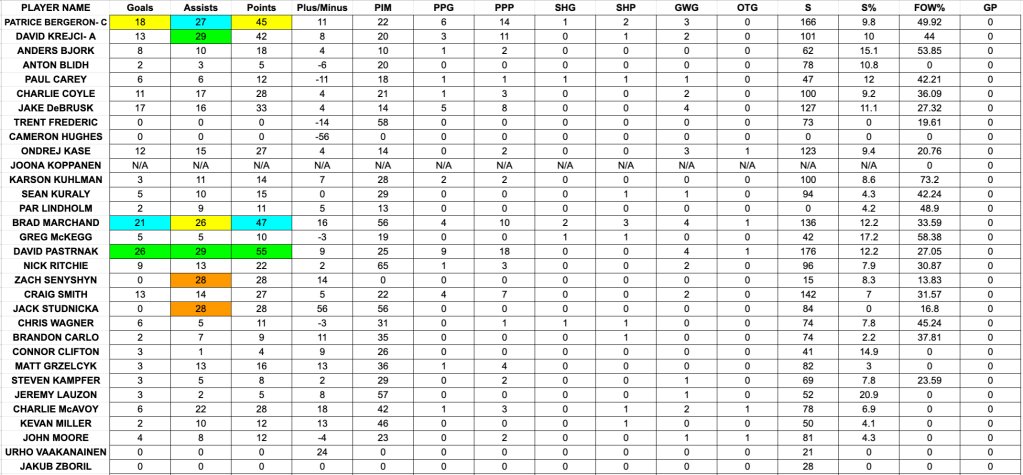
    Boston Bruins Forecast Through 0 Games (56 Games Remaining)

    Had the 2019-20 season gone according to schedule, David Pastrnak might not have missed any time to start the 2020-21 season.

    Nevertheless, we’ll pretend that an alternate timeline stills exists for a moment and mention that if he had played in all 56 games this season, he was forecasted to lead the Bruins with 26-29–55 totals.

    Brad Marchand was forecasted as the next highest scorer with 21 goals and 47 points, while David Krejci looked to lead the B’s in assists (29).

    Of course, none of this is how it really happened, but Pastrnak is still off to a hot start, Marchand is feeling “100-percent” and Krejci is only now just about to miss game action, having not traveled with the team to Lake Tahoe for their outdoor matchup with the Philadelphia Flyers on Sunday night.

    Senyshyn and Studnicka’s assist totals have been highlighted in the chart above in reference to what’s already been stated in the introduction to this post.

    Newcomer, Craig Smith, was forecasted to hit the twine 13 times and accrue 14 assists for 27 points this season, while Ondrej Kase was expected to notch 27 points in a 56-game season prior to injury.

    On defense, the loss of Zdeno Chara and Torey Krug is expected to be felt on the scoresheet, though we’re likely to see Charlie McAvoy’s stock rise in the next forecast after 20 team games played.

    Speaking of McAvoy, he was expected to lead the team in points from the blue line entering the 2020-21 season with 6-22–28 totals.

    In goal, Boston’s poised for another strong run from their goaltending tandem of Tuukka Rask and Jaroslav Halak.

    Though Rask is likely to get more starts than Halak, the two are prime for producing similar numbers this season in differing workloads.

    Rask is set for another season with a goals against average in the low two’s, between 2.28 and 2.34, while Halak is right on track for being one of– if not– the best “backups” in the league with a forecasted GAA between 2.48 and 2.72.

    Stay tuned for the next forecast in about four games– however soon that will be, provided nothing else is postponed and the Bruins can avoid piling up names on the league’s COVID Protocol list.

  • DTFR Podcast #218- Warning Sign

    DTFR Podcast #218- Warning Sign

    The NWHL’s Lake Placid “bubble” burst as the global COVID-19 pandemic continues, postponing the 2021 Isobel Cup Playoffs indefinitely, while the NHL faces an ongoing outbreak across the league, including at least 12 of its teams. Also the ethics of opening mail that isn’t yours is discussed after a New Jersey man received sticks intended for Washington Capitals defender, Zdeno Chara, delivered by mistake.

    Subscribe to the podcast on Apple PodcastsStitcher and/or on Spotify.

  • DeBrusk aims high in Boston’s, 5-4, shootout win over Flyers

    DeBrusk aims high in Boston’s, 5-4, shootout win over Flyers

    Jake DeBrusk dragged his foot before letting go of a chip shot over Carter Hart to give the Boston Bruins a, 5-4, shootout victory Thursday night at TD Garden.

    It was Boston’s home opener and second shootout win of the season– just their second shootout win since beating the Vegas Golden Knights, 3-2, in a shootout victory on the road on Feb. 20, 2019, as the club went 0-7 last season in shootouts.

    Tuukka Rask (2-1-0, 2.23 goals against average, .892 save percentage in three games played) made 22 saves on 26 shots against for an .846 SV% in the shootout win.

    Hart (2-1-1, 3.66 GAA, .902 SV% in four games played) stopped 39 out of 43 shots faced for a .907 SV% in the shootout loss for Philadelphia.

    The Bruins improved to 2-1-1 (five points) on the season and jumped from 6th in the MassMutual NHL East Division to 5th place, while the Flyers fell to 3-1-1 (seven points) on the season and remained in command of the MassMutual NHL East Division.

    Bruins head coach, Bruce Cassidy, made no changes to his lineup from Monday’s, 1-0, loss to the Islanders in New York.

    As such, Greg McKegg, Par Lindholm, John Moore, Urho Vaakanainen, Connor Clifton, Dan Vladar and Karson Kuhlman remained out of the lineup as taxi squad and healthy scratches.

    David Pastrnak missed his fourth game since undergoing a right hip arthroscopy and labral repair on Sept. 16th, while Ondrej Kase missed his second game of the season due to an upper body injury sustained in New Jersey on Jan. 16th.

    Early in the opening frame, Claude Giroux tripped DeBrusk and presented Boston with the first power play of the night at 3:42 of the first period.

    The Bruins did not convert on the resulting skater advantage, however.

    A few minutes later, Sean Kuraly was penalized for holding Mark Friedman at 6:57, yielding the Flyers their first power play of the game.

    Philadelphia was also unsuccessful on their first skater advantage of the night.

    Late in the period, Nicolas Aube-Kubel slashed B’s defender, Kevan Miller, and cut a rut to the penalty box as a result at 18:13.

    Boston couldn’t muster anything on the power play as time winded down, expired and signaled the start of the first intermission.

    After 20 minutes of action, the game remained tied, 0-0, though the Bruins outshot the Flyers, 14-3.

    The B’s also had the advantage in blocked shots (4-3), takeaways (5-4) and faceoff win percentage (77-24), while the Flyers led in giveaways (4-1).

    Both teams had eight hits aside.

    Philadelphia was 0/1 and Boston was 0/2 on the power play entering the dressing room for the first intermission.

    David Krejci caught Nolan Patrick with a high stick and cut a rut to the sin bin at 4:45 of the second period.

    Late in the ensuing power play Giroux (1) fired a snap shot from the faceoff circle over Rask’s blocker on the short side while Patrick screened the Bruins goaltender to give the Flyers the first lead of the night.

    Ivan Provorov (1) had the only assist on Giroux’s power-play goal as Philadelphia took a, 1-0, lead at 6:17 of the second period.

    It was the first goal allowed by Boston’s penalty kill this season, ending their run of 14 consecutive successfully killed infractions.

    Miller was assessed a minor for holding six seconds after Philadelphia scored the game’s first goal. With Miller in the box at 6:23, the Bruins went back on the penalty kill.

    This time the Flyers weren’t able to capitalize on the skater advantage.

    Midway through the period, Friedman initiated a wrestling match with Brad Marchand in the open ice of the neutral zone before falling awkwardly, bleeding and exiting the game.

    No penalty was called as a result of a usual event when two players get near each other while going for a line change without realizing they were charted on a collision course that ultimately went wrong.

    Though Friedman did not return to the game, Flyers head coach, Alain Vigneault, noted that he was held out as a precaution and should be fine.

    Anders Bjork hooked Jakub Voracek at 15:24 of the second period and was assessed a minor penalty.

    In the vulnerable minute after special teams action, the Flyers caught the Bruins behind the play as Voracek sent a pass to James van Riemsdyk (2) that was promptly redirected from its sloppy off-speed original path to one that guided the puck to the back of the net from point blank.

    Voracek (3) and Kevin Hayes (4) tallied the assists as Philadelphia jumped out to a two-goal lead, 2-0, at 17:31.

    Through two periods of action, the Flyers led, 2-0, despite trailing the B’s in shots on goal, 18-11.

    Philadelphia held the advantage in shots on goal in the second period alone, 8-4, while both teams had eight blocked shots and six takeaways each.

    The Flyers led in giveaways (5-4), while Boston led in hits (17-15) and faceoff win% (62-38).

    Philly was 1/4 and Boston was 0/2 on the power play heading into the second intermission.

    Less than a minute into the final frame of regulation, Jack Studnicka (1) redirected a pass from Krejci off of Hart’s leg pad before gathering his own rebound and pocketing it in the twine while crashing the net.

    Krejci (2) and Nick Ritchie (1) notched the assists on Studnicka’s first career NHL goal 57 seconds into the third period and the Bruins cut Philadelphia’s lead in half, 2-1.

    It was also the first goal at 5-on-5 for Boston this season.

    A mere 69 seconds later, Charlie Coyle (1) spun and fired home a rebound from inside the faceoff dot to the right of the Flyers netminder– tying the game, 2-2, in the process.

    Craig Smith (1) recorded his first point as a Bruin with the primary assist, while Miller (1) tallied his first point in almost two years with the secondary helper on Coyle’s goal at 2:06 of the third period.

    The game didn’t remain even for long as Voracek fired an intentional shot off of Travis Sanheim’s (1) skate past Rask to give Philly the lead once again, 3-2, at 7:13.

    Voracek (4) and Patrick (3) had the assists on Sanheim’s goal.

    Moments later, Scott Laughton cross checked Jakub Zboril at 13:04 of the third period and presented Boston with another power play opportunity.

    It didn’t take long for Patrice Bergeron to find Ritchie (2) wide open in the low slot, banking a shot off of Hart’s glove and into the open net behind the Flyers goaltender.

    Bergeron (2) and Krejci (3) had the assists on Ritchie’s power-play goal as the Bruins pulled even, 3-3, at 13:22.

    Less than two minutes later, Brandon Carlo (1) rocketed a slap shot from the point under the crossbar to give Boston their first lead of the night, 4-3, at 15:18 of the third period.

    Matt Grzelcyk (2) and Marchand (3) notched the assists on Carlo’s goal, but despite taking their first lead of the night, the B’s didn’t hold onto it for long.

    Kuraly delivered a cross check on Giroux and was assessed a penalty at 15:24.

    van Riemsdyk (3) went unchecked by Charlie McAvoy and Carlo before connecting on a power-play goal from in front of the net to tie the game, 4-4.

    Voracek (5) and Hayes (5) each picked up another assist while the Flyers knotted the game up with another power-play goal at 16:28.

    Boston led for all of 70 seconds in regulation.

    With 20.4 seconds left in the third period, Vigneault used his timeout, but the Flyers weren’t successful in the execution of whatever plan they drew up to win the game in the dying seconds.

    Overtime was necessary for the third time this season for the Bruins and for the first time for the Flyers.

    After 60 minutes, with Boston leading in shots on goal, 40-21, including a, 22-10, advantage in the third period alone, the game remained tied, 4-4.

    Philadelphia led in blocked shots (13-8), takeaways (9-7) and giveaways (8-5), while the Bruins held the advantage in hits (24-19) and faceoff win% (61-39) going into overtime.

    As no penalties were called in the extra frame, the Flyers finished Thursday night 2/5 on the power play, while the Bruins went 1/3 on the skater advantage.

    Vigneault started Giroux, Laughton and Provorov in overtime, while Cassidy countered with Bergeron, Marchand and McAvoy.

    In the end, Boston mustered just three shots on goal in the five minutes of 3-on-3 action, while Rask stood tall– denying Hayes on a one-timer with an aerial leg pad save.

    After overtime, the score remained, 4-4, while Boston finished the night leading in shots on goal, 43-26, despite trailing, 5-3, in shots in OT.

    Philadelphia finished the night leading in blocked shots (15-9) and giveaways (8-5), while the Bruins wrapped up Thursday’s action leading in hits (24-21) and faceoff win% (63-37).

    A shootout was necessary to determine a winner and Cassidy opted for his team to shoot first.

    He sent out Smith to get things going for Boston, but Smith’s shot was stopped by Hart as he tried to sneak one in through the five-hole.

    Voracek was Vigneault’s first round response, but despite his off-speed approach, Rask stoned him cold with a pad save on Voracek’s backhand shot.

    Coyle kicked things off in round two of the shootout with a shot wide on Hart’s glove side.

    Travis Konecny answered back with a shot that grazed Rask’s glove and also went wide.

    Finally, DeBrusk hit the back of the net with a chip shot over Hart’s blocker side after a nifty toe-drag approach to give the Bruins a, 1-0, advantage in the shootout.

    All that was left was for Rask to make a save and Boston would win.

    Vigneault sent out Giroux.

    Giroux waltzed his way into the attacking zone for his attempt, feigned a slap shot, slowed up and went for Rask’s glove side, but the Bruins goaltender denied him with a save.

    Boston emerged victorious with the, 5-4, shootout win.

    The B’s improved to 2-0 in shootouts this season and 2-1 past regulation overall, while the Flyers fell to 0-1 in both categories.

    Boston also improved to 1-1-0 when tied after the first period, 1-0-0 when trailing after two periods and 1-1-1 when allowing the game’s first goal this season.

    The Bruins began their four-game homestand with a, 5-4, shootout victory against Philadelphia on Thursday and will host the Flyers again on Saturday before hosting the Pittsburgh Penguins on Jan. 26th and Jan. 28th.

  • DTFR Podcast #216- Participation Trophies After One Game/One Week (Part V)

    DTFR Podcast #216- Participation Trophies After One Game/One Week (Part V)

    The 2020-21 season is underway and it’s already been a week, so let’s bring back our 5th Annual Participation Trophies After One Game awards ceremony!

    Subscribe to the podcast on Apple PodcastsStitcher and/or on Spotify.

  • Marchand helps Bruins beat Devils, 3-2, in shootout victory

    Marchand helps Bruins beat Devils, 3-2, in shootout victory

    The Boston Bruins kicked off the 2020-21 regular season with a, 3-2, shootout win against New Jersey Devils at Prudential Center on Thursday night.

    Tuukka Rask (1-0-0, 1.85 goals against average, .909 save percentage in one game played, one start) made 20 saves on 22 shots faced in the shootout win for the Bruins.

    Mackenzie Blackwood (0-0-1, 1.85 goals against average, .946 save percentage in one game played, one start) turned aside 35 out of 37 shots against in the shootout loss for the Devils.

    Boston improved to 1-0-0 (two points) on the season, while New Jersey fell to 0-0-1 (one point) on the season.

    B’s head coach, Bruce Cassidy, improved to 162-66-34 in 262 games with Boston.

    Devils head coach, Lindy Ruff, kicked off his new gig with a shootout loss as both teams will face each other seven more times this season in the temporarily realigned MassMutual NHL East Division for the 2020-21 season.

    For the first time in franchise history (97 seasons), the Bruins will not face the Montreal Canadiens at all in the regular season due to the ongoing COVID-19 pandemic and resulting temporary division realignment with the United States’ border with Canada currently closed.

    Prior to Thursday night’s action in New Jersey, Patrice Bergeron was named the 20th captain in franchise history on Jan. 6th, replacing Zdeno Chara, who served as the club’s captain from 2006-20, before departing for the Washington Capitals in free agency on Dec. 30, 2020.

    David Krejci and Brad Marchand will serve as alternate captains for Boston this season.

    Krejci has been an alternate captain since the 2013-14 season, while Marchand has worn an “A” on his jersey off-and-on since the 2018-19 season.

    As a result of the ongoing global pandemic, teams are allowed to carry extra players on a “taxi squad” that will not count against their daily salary cap limit.

    The Bruins have not announced who they will utilize on their “taxi squad” this season, but Trent Frederic, Urho Vaakanainen, Jack Studnicka, Dan Vladar and Greg McKegg all made the trip to New Jersey with the team.

    David Pastrnak (hip surgery in the offseason) was out of the lineup against the Devils Thursday night, but is expected to return to play ahead of schedule since his original prognosis when he underwent a right hip arthroscopy and labral repair on Sept. 16th.

    Craig Smith (lower body injury) missed Thursday night’s action and is yet to make his B’s debut since signing a three-year contract worth $3.100 million per season on Oct. 10th.

    Cassidy made a few adjustments to his lines as a result of the injuries and free agency departures in the offseason.

    The first line consisted of Marchand at left wing, Bergeron at center and Studnicka on right wing.

    Rounding out the top-six forwards on the second line were Ondrej Kase, David Krejci and Jake DeBrusk.

    Charlie Coyle centered the third line with Nick Ritchie at his left side and Anders Bjork on his right side, while Sean Kuraly centered the fourth line with Frederic and Chris Wagner as his wings.

    On defense, Cassidy started Matt Grzelcyk and Kevan Miller– honoring Miller in his first game back in 651 days since multiple knee injuries dating back to April 2019.

    Jeremy Lauzon was paired with Charlie McAvoy and Jakub Zboril was partnered with Brandon Carlo.

    Karson Kuhlman remains in COVID protocol, while Par Lindholm, John Moore and Connor Clifton were healthy scratches. Smith and Pastrnak were out of the lineup due to their injuries.

    Early in the opening frame, Jesper Boqvist slashed Frederic and presented the Bruins with their first power play opportunity of the night at 6:14 of the first period.

    Boston’s skater advantage didn’t last long as Grzelcyk caught Yegor Sharangovich with a slash at 7:16.

    After an abbreviated period of 4-on-4 action followed by a short New Jersey power play, neither team could muster anything on the scoresheet.

    McAvoy laid out Sharangovich with a crushing hit at 13:19, but was too far from the puck and assessed a minor infraction for interference.

    The Devils were not successful on the ensuing power play, however.

    Late in the first frame, Miles Wood collided with Rask and cut a rut to the box with a goaltender interference infraction at 17:02.

    Boston didn’t waste much time getting to work on the resulting power play as Marchand (1) one-timed a redirection past Blackwood from just outside the crease to give the Bruins the first lead of the night, 1-0.

    Krejci (1) and Bergeron (1) notched the assists on Marchand’s power-play goal at 17:40 of the first period.

    Entering the first intermission, the Bruins were dominating in possession, on the scoreboard, 1-0, and in shots on goal, 16-4.

    The B’s also held the advantage in faceoff win percentage, 67-33.

    New Jersey, meanwhile, led in blocked shots (7-3), giveaways (8-2) and hits (12-5), while both teams had one takeaway each in the first 20 minutes of game action.

    The Devils were 0/2 and the Bruins were 1/2 on the power play entering the middle frame.

    Kuraly tripped Sharangovich at 2:41 of the second period and presented New Jersey with an early skater advantage in the period, but Boston’s penalty kill remained strong.

    McAvoy was guilty of hooking Janne Kuokkanen at 7:56, but once again New Jersey’s power play couldn’t score.

    Midway through the game, the Devils committed a bench minor for too many skaters on the ice at 10:53.

    Newcomer, Andreas Johnsson, (acquired in the offseason via a trade with the Toronto Maple Leafs) served the penalty while Boston’s power play went powerless.

    Through 40 minutes of play on Thursday, the Bruins held onto the, 1-0, lead and led in shots on goal, 26-11– including a, 10-7, advantage in the second period alone.

    New Jersey led in blocked shots (10-6), takeaways (6-2), giveaways (16-4) and hits (20-8), while Boston led in faceoff win% (63-37) after two periods.

    The Devils were 0/4 on the power play, while the B’s were 1/3 entering the dressing room for the second intermission.

    Kuokkanen was penalized for holding Kuraly and yielded another power play to Boston at 6:18 of the third period.

    Shortly after killing off the infraction, Wood (1) broke free from the Bruins’ defense and snapped a shot over Rask’s blocker side to tie the game, 1-1, at 8:51 of the final frame of regulation.

    Jack Hughes (1) had the only assist on Wood’s goal.

    Moments later, Krejci hooked Travis Zajac and was sent to the sin bin at 10:14, but New Jersey’s power play didn’t last long as Wood ran into Rask again and picked up another goaltender interference infraction at 11:13.

    The two clubs had about a minute of 4-on-4 action before an abbreviated power play followed for the Bruins.

    Ritchie (1) scored a close range goal similar to Marchand’s to put the B’s back on top, 2-1, with a power-play goal of his own.

    Marchand (1) and Grzelcyk (1) tallied the assists on Ritchie’s goal at 13:12, but Boston didn’t hold the lead for long as they surrendered a wacky goal 34 seconds later.

    Ty Smith (1) scored his first career National Hockey League goal as the last Devils player to touch the puck before it bounced off of McAvoy, then Lauzon, Lauzon’s stick, McAvoy again and finally floated over Rask and into the twine.

    The fluke goal tied the game, 2-2, and was assisted by Matt Tennyson (1) and Hughes (2) at 13:46 of the third period.

    At the end of regulation, the score remained even, despite Boston outshooting the Devils, 35-18.

    The Bruins had a, 9-7, advantage in shots on goal in the third period alone, while New Jersey led in blocked shots (13-6), takeaways (11-3), giveaways (19-6) and hits (26-13) after regulation.

    Boston led in faceoff win%, 58-42, entering overtime.

    As no penalties were called in the extra frame, the Bruins finished the night 2/5 on the power play, while the Devils went 0/5 on the skater advantage.

    The two teams swapped chances in overtime– including a couple of heart-stopping moments where the Devils nearly completed the comeback, but neither side could seal the deal on an overtime win.

    Despite Cassidy’s best efforts starting Coyle, DeBrusk and McAvoy in overtime, as well as Ruff’s lineup of Hughes, Kyle Palmieri and P.K. Subban in 3-on-3 OT, a shootout was necessary.

    The Bruins finished the night leading in shots on goal, 37-22, despite being outshot, 4-2, in overtime alone.

    New Jersey finished Thursday’s effort leading in blocked shots (14-7), giveaways (19-6) and hits (26-13), while the Bruins settled for the final advantage in faceoff win% (57-43).

    The Devils elected to shoot first in the shootout and sent Nikita Gusev out to get the job in round one, but Rask stoned him cold as Gusev attempted to go five-hole on the veteran netminder.

    Coyle was denied by Blackwood with a pad save as the Bruins forward tried to pull the New Jersey goaltender out of position.

    Boqvist was stopped by Rask in a routine save while Kase couldn’t sneak one past Blackwood’s blocker side in the second round of the shootout.

    After Hughes lost the puck while attempting to dangle his way into the low slot, Cassidy sent Marchand to try to get the win for Boston.

    Marchand came through for his coach and the rest of the Bruins with an off-tempo shot through Blackwood’s five-hole after getting the New Jersey goaltender to commit to his fake handiwork before taking the shot.

    The Bruins won the shootout, 1-0, after three rounds and clinched the, 3-2, shootout victory over the Devils to start the 2020-21 season.

    It was Boston’s first shootout win since Feb. 20, 2019, when the B’s downed the Vegas Golden Knights on the road in what was also a, 3-2, shootout victory.

    With the win, the Bruins improved to 1-0-0 when leading after the first period, 1-0-0 when leading after the second period, 1-0-0 when scoring the game’s first goal and 1-0 in shootouts (1-0 past regulation) this season.

    Boston continues their three-game road trip on Saturday afternoon with a rematch against the Devils in New Jersey at 1 p.m. ET before heading to Nassau Coliseum on Monday (Jan. 18th) for a game with the New York Islanders.

    The Bruins return to Boston for their home opener at TD Garden on Jan. 21st against the Philadelphia Flyers.

    There will be no fans in attendance in Boston due to COVID-19 restrictions in the Commonwealth of Massachusetts.

  • What to expect from the San Jose Sharks this season

    What to expect from the San Jose Sharks this season

    The offseason has been long, very long for Sharks fans. But, the wait is finally over… almost! The last time the Sharks played a game was on March 11th, a 6-2 loss to the Chicago Blackhawks. But, that’s a thing of the past. Let’s get ready for this season, shall we?

    The Sharks made some moves this offseason trading for goalie Devan Dubnyk from the Minnesota Wild for a fifth round pick in the 2022 draft. They also acquired forward Ryan Donato in a seprate trade with the Wild, giving away a third round pick.

    In free agency, the Sharks were able to resign Kevin Labanc and bring back Patrick Marleau once again. The other notable free agents that signed with San Jose are Stefan Noesen and Matt Nieto. In simple terms, the Sharks offseason was uneventful for the most part.

    The Sharks have a tough opening stretch to start off the season. Due to COVID-19 restrictions in the Santa Clara County, there is chance the Sharks will have to play their home games elsewhere. With that being said, the season starts in Arizona on January 14th. This is the first of an eight game road trip to start the season. Yes, San Jose opens up with an eight game road trip.

    The first home game isn’t until February 1st against the Vegas Golden Knights. Again, there’s a chance that this game isn’t even played in San Jose. So what are the options for the Sharks this year for where they can play their home games?

    The Sharks could make the trip to Los Angeles and share the ice with the Kings, or make a trip down to Arizona (where they held training camp) and share the ice with the Coyotes.

    So what can fans expect on the ice this year? Well, fans sadly will no longer see Joe Thornton. Thornton took his talents to Toronto in the offseason hoping to win one more championship before he retires. Good luck with that Joe!

    As for everyone else, it’ll be a rough start. It’s been awhile since the players have played a meaningful game. But, expect to see leadership from Brent Burns and Erik Karlsson. With Thornton gone, there is a giant hole to fill in leadership. Don’t expect Logan Couture to take on that responsibility. If anything, it’ll be both Burns and Karlsson.

    Last season before the season got cut short, Burns had 12 goals and 33 assists. Don’t expect to see 33 assists. Expect more. Other than being a great defenceman, he sets up goals. It’s what he does best. Burns needs to step up in a leadership role this year, now that big Joe is gone.

    Then, there’s Karlsson, the other gem of the Sharks defencemen. His only issue is that he he cannot stay healthy. However, in an injury riddled shortened season, Karlsson managed to score six goals and have 34 assists. Just like Burns, expect Karlsson’s numbers to go up this season.

    A dark horse player everyone should keep their eyes on this year is Tomas Hertl. Hertl only played in 48 games last year netting 16 goals and 20 assists. Expect him to take his game to the next level this year. Hertl is a young explosive player who can score. Last season’s seasons numbers don’t do him justice. It shouldn’t be surpirisng if at the end of the season, Hertl is the team leader in goals this year.

    So, with all of that being said, it will be an up and down year for San Jose. But, fans get excited, the Sharks are finally back. Who knows, maybe with the new format for this year, the Sharks could be this year’s surprise team. Welcome back Sharks, the fans missed you.