Tag: Tomas Hertl

  • Bruins beat Sharks in first meeting in almost two years

    Bruins beat Sharks in first meeting in almost two years

    Jake DeBrusk’s second period goal proved to be the game-winner as the Boston Bruins withstood a third period surge and held off the San Jose Sharks in a, 4-3, victory at TD Garden on Sunday afternoon.

    Linus Ullmark (2-0-0, 2.00 goals-against average, .935 save percentage in two games played) turned aside 23 out of 26 shots against in the win for the Bruins.

    Meanwhile, Adin Hill (3-1-0, 2.93 goals-against average, .890 save percentage in four games played) and James Reimer (1-0-0, 0.65 goals-against average, .980 save percentage in two games played) split the effort in the loss for the Sharks.

    Hill made 10 saves on 14 shots faced for a .714 save percentage in 25:41 time on ice before he was replaced by Reimer, who stopped all 20 shots against in relief.

    Boston improved to 3-1-0 (six points) on the season and– at the time of this writing– moved into 3rd place in the Atlantic Division, while San Jose dropped to 4-1-0 (eight points) overall and remained in command of 2nd place in the Pacific Division standings.

    The B’s also improved to 2-0-0 at home this season, as well as 25-12-5-0 all time against the Sharks in 42 regular season meetings.

    The Bruins were without the services of Curtis Lazar (upper body), Nick Foligno (upper body), Anton Blidh (upper body) and Craig Smith (undisclosed) on Sunday afternoon.

    Foligno was placed on injured reserve, while Jack Studnicka and Oskar Steen were recalled from the Providence Bruins (AHL). Veteran defender, John Moore, was assigned to Providence as a result.

    B’s head coach, Bruce Cassidy, told reporters prior to Sunday’s matinee with San Jose that Foligno and Blidh are unlikely to play in the team’s upcoming road trip on Wednesday and Thursday.

    As a result of the recent rash of injuries, Cassidy continued to tweak to his lineup, promoting Tomáš Nosek to center the second line and sliding Charlie Coyle to the right wing in place of Smith as a result.

    Cassidy inserted Steen on the third line in Nosek’s usual spot and returned Trent Frederic to the fourth line left wing with Studnicka at center and Karson Kuhlman on the right wing.

    On defense, Connor Clifton returned to his spot on the third pairing alongside Derek Forbort with Moore assigned to Providence.

    Jakub Zboril was the only healthy scratch on Sunday.

    It only took 28 seconds into the action on Sunday afternoon for David Pastrnak to work the puck to Patrice Bergeron through the trapezoid behind the net before Bergeron found Brad Marchand (4) in the high slot for a catch and release goal to give the Bruins a, 1-0, lead.

    Bergeron (2) and Pastrnak (3) notched the assists on Marchand’s goal as Boston got off to a fast start in the first period.

    Less than a few minutes later, Clifton worked the puck to Marchand, who sent the rubber biscuit along the point to Forbort (1) for a wrist shot that floated past Hill’s blocker side as a Sharks defender partially screened his own goaltender– extending Boston’s lead to two-goals in the process.

    Marchand (3) and Clifton (1) had the assists on Forbort’s first goal in a Bruins uniform and the B’s led, 2-0, at 3:18 of the first period.

    Almost midway through the opening frame, Nosek tripped up Tomáš Hertl and cut a rut to the penalty box with a minor infraction at 9:44.

    San Jose’s power play, however, could not convert on the skater advantage.

    The Sharks got another chance on the power play moments later when Charlie McAvoy caught Logan Couture with a high stick at 13:01, but once again Boston’s penalty kill stood tall as Ullmark kept the puck out of the back of the net.

    Shortly after killing off McAvoy’s minor, Brent Burns knocked down Taylor Hall away from the puck and was assessed and interference minor at 15:59– presenting the Bruins with their first power play of the afternoon as a result.

    It didn’t take long for Boston to capitalize on the ensuing skater advantage as Bergeron rang a shot off the crossbar before setting up Pastrnak (2) for one of his trademark one-timer power-play goals from the faceoff circle– right above the dot– to give the Bruins a three-goal lead.

    Bergeron (3) had the only assist on Pastrnak’s goal as the B’s extended their lead, 3-0, at 16:12 of the first period.

    Less than a minute later, however, San Jose got on the scoreboard with a quick break into the attacking zone and a little bit of a give-and-go that resulted in a short side goal for Jasper Weatherby (2) to cut Boston’s lead back to two-goals.

    Jonah Gadjovich (1) and Andrew Cogliano (2) tabbed the assists on Weatherby’s goal at 16:44. With the primary assist, Gadjovich recorded his first career National Hockey League point in his second career game (Gadjovich made his season debut with the Sharks on Sunday and appeared in one game last season for the Vancouver Canucks).

    After one period of action, the Bruins led the Sharks, 3-1, on the scoreboard despite both teams amassing 11 shots on goal each.

    Boston also held the advantage in blocked shots (10-2), while San Jose led the way in takeaways (3-1), giveaways (4-3), hits (13-7) and faceoff win percentage (58-42).

    The Sharks were 0/2 and the Bruins were 1/1 on the power play heading into the first intermission.

    Early in the middle frame, Forbort sent Steen up through the neutral zone on a rush with DeBrusk before Steen bounced an indirect pass to DeBrusk off the boards.

    DeBrusk (2) entered the attacking zone and wired a shot over Hill’s glove to put Boston ahead by three goals once more, 4-1, at 5:41 of the second period.

    Steen (1) and Forbort (1) recorded the assists, marking the first career NHL point for Steen and the first assist as a Bruin for Forbort in the process.

    Sharks head coach, Bob Boughner, replaced Hill with Reimer as a result of DeBrusk’s goal and tried to spur momentum in San Jose’s favor as a result of the goalie change.

    Late in the period, Nick Bonino and Clifton exchanged pleasantries in a post-whistle scrum that resulted in minor penalties for roughing for each player as well as an addition two minutes for slashing for Bonino at 17:29.

    As a result, the Bruins finished off most of the rest of the second period on the power play, though they couldn’t muster anything past Reimer as the second intermission commenced.

    Through 40 minutes of action, the B’s led, 4-1, on the scoreboard and, 22-16, in shots on goal, including an, 11-5, advantage in the second period alone.

    Boston also held the advantage in blocked shots (12-6), while San Jose led in takeaways (8-5), giveaways (10-5), hits (20-13) and faceoff win% (53-48).

    The Sharks were still 0/2 on the power play, while the Bruins dropped to 1/2 on the skater advantage heading into the final frame.
    With tensions rising as the second period came to an end, Frederic and Jacob Middleton kicked things off in the third period with five-minute majors for fighting at 3:02 of the final frame in the first fight of the 2021-22 calendar for Boston.

    Less than a couple of minutes later, Mario Ferraro took an interference penalty at 5:48 of the third period, but the Bruins weren’t able to capitalize on the final power play of the afternoon.

    Midway through the third, the Sharks scored a pair of quick goals as Hertl (2) deflected a shot from Marc-Edouard Vlasic at the point amidst net front traffic to pull San Jose back to within two goals, 4-2, at 13:19.

    Vlasic (2) and Alexander Barabanov (1) tallied the assists on Hertl’s goal.

    Minutes later, Timo Meier (3) redirected a shot from Couture from outside the slot to bring the Sharks to a one-goal deficit, 4-3, at 15:08 of the third period.

    Couture (5) and Burns (4) had the assists on Meier’s goal which was reviewed for a high stick, but determined to be a good goal– the call on the ice was confirmed.

    Boston’s lead had shrunk to a close, 4-3, game in the dying minutes of Sunday’s action.

    Boughner pulled Reimer for an extra attacker with 1:45 remaining in the game and used his timeout with 1:02 left on the clock after a stoppage, but it wasn’t enough to rally his team to force overtime (at least) as the Bruins managed to hold off San Jose’s comeback.

    At the final horn, Boston had won, 4-3, and finished the afternoon leading in shots on goal, 34-26, including a, 12-10, advantage in the third period alone.

    The Bruins finished the afternoon leading in blocked shots (14-6) and faceoff win% (52-48), while the Sharks exited TD Garden with the advantage in giveaways (16-7) and hits (25-23).

    San Jose went 0/2 on the power play, while Boston went 1/3 on the skater advantage on Sunday.

    The B’s improved to 3-0-0 (2-0-0 at home) when scoring the game’s first goal, 3-0-0 (2-0-0 at home) when leading after the first period and 2-0-0 (1-0-0 at home) when leading after two periods this season.

    The Sharks dropped to 2-1-0 (1-1-0 on the road) when allowing the game’s first goal, 2-1-0 (1-1-0 on the road) when trailing after one period and 0-1-0 (0-1-0 on the road) when trailing after the second period in 2021-22 as a result of the loss.

    The Bruins hit the road for a pair of games against the Florida Panthers and Carolina Hurricanes at FLA Live Arena on Wednesday and PNC Arena on Thursday, respectively, before returning home to finish the month of October against the Panthers on Saturday (Oct. 30th).

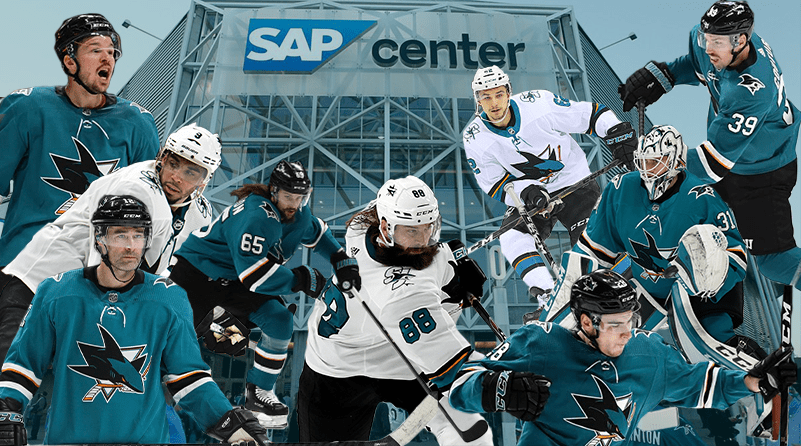
  • San Jose Sharks 2021-22 Season Preview

    San Jose Sharks 2021-22 Season Preview

    2020-21 record 21-28-7, 49 points

    7th in the Honda NHL West Division

    Missed the postseason for the second-straight year

    Additions: F Nick Bonino, F Andrew Cogliano, F Nick Merkley (acquired from NJD), F Lane Pederson, D Jaycob Megna, G Adin Hill (acquired from ARI), G James Reimer

    Subtractions: F Kurtis Gabriel (signed with TOR), F Fredrik Händemark (KHL), F Maxim Letunov (signed with CAR), F Marcus Sörensen (SHL), F Alex True (expansion, SEA), D Christian Jaros (traded to NJD), D Greg Pateryn (signed with ANA), G Martin Jones (buyout), G Josef Korenar (traded to ARI)

    Still Unsigned: F Ryan Donato, F Noah Gregor (RFA), F Patrick Marleau

    Re-signed: F Rüdolfs Balcers, F Joachim Blichfeld, F Jonathan Dahlén, F Dylan Gambrell, F Matt Nieto, F Jeffrey Viel, D Nicolas Meloche

    Offseason Analysis: The Sharks have been quiet– too quiet– this offseason for a team that proclaims they’re “definitely not rebuilding” and “totally going to be back in the playoffs in 2022”.

    Whether you buy into the speculation that Tomas Hertl is going to be shopped by the team or not, there is some uneasiness in the dressing room as Evander Kane’s bankruptcy court ongoings continue to unfurl in public amidst separation from his wife while San Jose is tight against the salary cap with about $3.361 million in cap space heading into the 2021-22 season.

    Erik Karlsson’s made it known that he doesn’t want to experience another rebuild in his career– having been dealt to the Sharks originally as a casualty of the Ottawa Senators’ demise and subsequent retool/rebuild.

    It’s not hard to feel empathy for the precarious position that Doug Wilson is in as General Manager, though it’s through much of his own doing.

    For starters, Karlsson carries an $11.500 million cap hit through the 2026-27 season, which contributed to Joe Pavelski leaving for the Dallas Stars via free agency on July 1, 2019, and with it San Jose’s character amongst the Sharks’ leadership core.

    Kane carries a $7.000 million cap hit through 2024-25, though he may reach a termination agreement at any point in time with San Jose to restructure his debt and may or may not end up signing for much less as a result with the Sharks if he isn’t forced to take a step back from hockey to focus on that whole debt thing that keeps getting mentioned.

    Seriously, we’re hoping for the best here.

    Forced to make minor moves due to a stagnant salary cap, Wilson signed Matt Nieto to a two-year extension worth $850,000 per season and continued to fill out his middle of the lineup/bottom-six forwards with Andrew Cogliano and Nick Bonino via free agency.

    Cogliano received a one-year, $1.000 million deal, while Bonino earned a two-year contract that carries a $2.050 million cap hit.

    Nieto recorded three consecutive seasons of 20 or more points with the Colorado Avalanche from 2017-18 through 2019-20 as he experienced a career resurgence as a bottom-six forward, prior to amassing 5-2–7 totals in 28 games last season with San Jose before a lower body injury cut his 2020-21 season short.

    After spending the last few seasons in Dallas, Cogliano left the Stars for the Sharks in free agency after managing 11 points (five goals, six assists) in 54 games last season.

    At this point, the 34-year-old center is just trying to hold onto what is likely the twilight of his career and looking for a way to either spice up his remaining playing days and extend his tenure in the league or find a way to be moved by the trade deadline to a Cup contender as the 14-year NHL veteran has only been to one Stanley Cup Final in his career thus far– losing in six games with Dallas to the Tampa Bay Lightning in 2020.

    Bonino, on the other hand, brings some Cup winning experience to San Jose’s dressing room as the 33-year-old center won his first of two Cup rings with the Pittsburgh Penguins in six games against the Sharks in the 2016 Stanley Cup Final.

    After winning back-to-back Cups in 2016 and 2017, with Pittsburgh, Bonino made his way to the Nashville Predators and, most recently, the Minnesota Wild, where he had 10-16–26 totals in 55 games while the Wild rose to prominence and endured a seven-game First Round series loss to the Vegas Golden Knights in the 2021 Stanley Cup Playoffs.

    Bonino may be at the point where he bounces around the league every other season or so, but he’s shown that he can still prove to be a valuable piece down the middle as a glue guy, which is welcome news for San Jose as they look for Logan Couture and Hertl to remain steady as a 1-2 punch at center on the first and second lines.

    Drafting William Eklund 7th overall in the 2021 NHL Draft, then signing him to a three-year entry-level contract was another quality move made by Wilson in the ongoing restructuring of the organization’s depth and future foundation.

    Ranked as the No. 1 European skater by NHL Central Scouting, Eklund fell to the Sharks in the draft and could end up playing this season for San Jose. Sure it might be throwing him to the fire a bit early, but if he’s as good as he looked with Djurgårdens IF, then it’s worth it to spur the *ahem* rebuild in San Jose as he managed to have 11-12–23 totals in 40 games in the SHL last season.

    But the biggest change this offseason for the Sharks comes in the crease, where San Jose has bought out Martin Jones– freeing themselves from his 15-13-4 record in 34 games last season, with a 3.28 goals-against average, an .896 save percentage and one shutout in that span– and traded for Adin Hill before signing Hill to an extension and landing James Reimer in free agency.

    Jones will carry a $1.917 million buyout penalty on San Jose’s cap through the 2026-27 season, but at least he’s the Philadelphia Flyers’ reclamation project now.

    In the meantime, Hill was acquired in exchange for Josef Korenar and a 2022 2nd round pick back on July 17th.

    The 25-year-old former Arizona Coyotes goaltender was given a two-year extension worth $2.175 million per season and went 9-9-1 in 19 games last season, recording a 2.74 goals-against average, a .913 save percentage and two shutouts in that span.

    It’s important to note that he had a 2.62 goals-against average and a .918 save percentage in 13 games in 2019-20 with the Coyotes and has shown that, perhaps, in a better defensive situation, he just might improve.

    Meanwhile, Reimer reunites with the Sharks for the first time since San Jose’s 2016 Stanley Cup Final appearance as he was acquired by the team on Feb. 28, 2016, with Jeremy Morin for a 2018 3rd round pick, Ben Smith and Alex Stalock in return to the Toronto Maple Leafs back in the day.

    Since then, Reimer had a stop with the Florida Panthers and, most recently, with the Carolina Hurricanes as a tandem duo with Petr Mrazek.

    The 33-year-old goaltender might have an edge going into the season over Hill as Reimer managed to record a 15-5-2 record in 22 games last season for Carolina and had a 2.66 goals-against average, as well as a .906 save percentage in that span.

    He signed a two-year deal worth $2.250 million per season with the Sharks on July 28th.

    In both cases, it’s a low-risk, high-reward move that Wilson can defend simply as a placeholder if it all goes south while searching for a long-term solution in net.

    Offseason Grade: C-

    It’s time for the Sharks to make some serious roster decisions in a proactive manner instead of forcing their own hands tied and reacting to the alarming situation that may only worsen as the team desperately tries to avoid using the term “rebuild”.

    San Jose’s unprecedented success in the regular season throughout the 2000s and 2010s meant that the team never really had to rely on the uncertainty of going through growing pains and struggles, but for the first time since franchise’s infancy it appears that it’s inevitable once more.

    Whether removing Wilson is something to be done sooner rather than later or not hinges upon whether or not Sharks ownership is informed of a solidified plan.

    There cannot be any wavering any longer for a team that, sure, finished ahead of the Anaheim Ducks last season, but is expected to bottom out in the Pacific Division by virtually every expert and analyst on paper going into 2021-22– and that’s even with the uncertain nature of the expansion, Seattle Kraken, to consider.

    San Jose is close to getting a “D+”, but cutting their losses and buying out Jones now brings them up to a “C-“.

  • What to expect from the San Jose Sharks this season

    What to expect from the San Jose Sharks this season

    The offseason has been long, very long for Sharks fans. But, the wait is finally over… almost! The last time the Sharks played a game was on March 11th, a 6-2 loss to the Chicago Blackhawks. But, that’s a thing of the past. Let’s get ready for this season, shall we?

    The Sharks made some moves this offseason trading for goalie Devan Dubnyk from the Minnesota Wild for a fifth round pick in the 2022 draft. They also acquired forward Ryan Donato in a seprate trade with the Wild, giving away a third round pick.

    In free agency, the Sharks were able to resign Kevin Labanc and bring back Patrick Marleau once again. The other notable free agents that signed with San Jose are Stefan Noesen and Matt Nieto. In simple terms, the Sharks offseason was uneventful for the most part.

    The Sharks have a tough opening stretch to start off the season. Due to COVID-19 restrictions in the Santa Clara County, there is chance the Sharks will have to play their home games elsewhere. With that being said, the season starts in Arizona on January 14th. This is the first of an eight game road trip to start the season. Yes, San Jose opens up with an eight game road trip.

    The first home game isn’t until February 1st against the Vegas Golden Knights. Again, there’s a chance that this game isn’t even played in San Jose. So what are the options for the Sharks this year for where they can play their home games?

    The Sharks could make the trip to Los Angeles and share the ice with the Kings, or make a trip down to Arizona (where they held training camp) and share the ice with the Coyotes.

    So what can fans expect on the ice this year? Well, fans sadly will no longer see Joe Thornton. Thornton took his talents to Toronto in the offseason hoping to win one more championship before he retires. Good luck with that Joe!

    As for everyone else, it’ll be a rough start. It’s been awhile since the players have played a meaningful game. But, expect to see leadership from Brent Burns and Erik Karlsson. With Thornton gone, there is a giant hole to fill in leadership. Don’t expect Logan Couture to take on that responsibility. If anything, it’ll be both Burns and Karlsson.

    Last season before the season got cut short, Burns had 12 goals and 33 assists. Don’t expect to see 33 assists. Expect more. Other than being a great defenceman, he sets up goals. It’s what he does best. Burns needs to step up in a leadership role this year, now that big Joe is gone.

    Then, there’s Karlsson, the other gem of the Sharks defencemen. His only issue is that he he cannot stay healthy. However, in an injury riddled shortened season, Karlsson managed to score six goals and have 34 assists. Just like Burns, expect Karlsson’s numbers to go up this season.

    A dark horse player everyone should keep their eyes on this year is Tomas Hertl. Hertl only played in 48 games last year netting 16 goals and 20 assists. Expect him to take his game to the next level this year. Hertl is a young explosive player who can score. Last season’s seasons numbers don’t do him justice. It shouldn’t be surpirisng if at the end of the season, Hertl is the team leader in goals this year.

    So, with all of that being said, it will be an up and down year for San Jose. But, fans get excited, the Sharks are finally back. Who knows, maybe with the new format for this year, the Sharks could be this year’s surprise team. Welcome back Sharks, the fans missed you.

  • DTFR Podcast #201- Summer School (Since Summer Camp Is A Sponsored MLB Thing Now)

    DTFR Podcast #201- Summer School (Since Summer Camp Is A Sponsored MLB Thing Now)

    Dates, awards finalists, opting out, new faces, exhibition schedule and the Ottawa Senators rebrand.

    Subscribe to the podcast on Apple PodcastsStitcher and/or on Spotify.

  • DTFR Podcast #182- Back In A New Year Groove

    The DTFR Podcast is back from hiatus as Nick provides a State of the Podcast, reviews a few things from the last couple of months and delves into all of the transactions leading up to the 2020 NHL trade deadline.

    Subscribe to the podcast on Apple PodcastsStitcher and/or on Spotify. Support the show on Patreon.

  • Bruins take bite out of Sharks, 5-1

    There were a lot of goals, a lot of penalty minutes, 11 players with at least a point and a lot of heart on Hockey Fights Cancer Night at TD Garden as the Boston Bruins defeated the San Jose Sharks, 5-1, Tuesday night.

    Three-year-old Weymouth, Massachusetts native, “The Mighty Quinn” Waters, took part in a special ceremonial puck drop, whereby his fellow Weymouth neighbor, Charlie Coyle, posed for a photo alongside Quinn, his father and Sharks captain, Logan Couture, prior to the game as part of the Bruins’ honoring of those who have fought or are currently fighting various forms of cancer.

    Bruins goaltender, Tuukka Rask (6-0-1 record, 1.42 goals against average, .951 save percentage in seven games played), made 16 saves on 17 shots faced for a .941 SV% in the win.

    Sharks netminder, Martin Jones (2-6-1, 3.57 GAA, .890 SV% in nine games played) stopped 36 out of 41 shots faced for an .878 SV% in the loss.

    Boston improved to their best start since 1929-30, with a 9-1-2 record (20 points) and tied the Buffalo Sabres for 1st in the Atlantic Division with the win on Tuesday night.

    Meanwhile, San Jose fell to 4-8-1 (9 points) overall and remained in 7th place in the Pacific Division.

    The B’s also improved to 5-0-1 at home this season and extended their current winning streak to four games.

    Kevan Miller (knee) and John Moore (shoulder) are still sidelined by injuries and have yet to make their season debuts for Boston.

    Meanwhile, David Krejci and Chris Wagner were back in the lineup against San Jose after missing some time due to injury (Krejci missed the last five games, Wagner missed the last game).

    Karson Kuhlman (fractured tibia), Joakim Nordstrom (infection, elbow) and Par Lindholm (upper body) also missed Tuesday night’s action against the Sharks.

    Bruins head coach, Bruce Cassidy, provided an update on Nordstrom before the game and told reporters that the forward “needs to let [his elbow infection] calm down”. Maybe he should try listening to Taylor Swift.

    After making his season debut on Sunday, Peter Cehlarik was returned from his emergency recall to the Providence Bruins (AHL).

    As a result of all the lineup changes, Cassidy reunited Danton Heinen on the second line right wing with Jake DeBrusk and Krejci, while moving Anders Bjork to the left of Coyle and keeping Brett Ritchie on Coyle’s right side– only this time on the third line.

    Wagner, Sean Kuraly and David Backes made up the fourth line, with “The Perfection Line” was untouched as usual.

    Steven Kampfer served as Boston’s only healthy scratch.

    Joe Thornton may have played his final game in Boston over his 22-year NHL career with the Bruins and Sharks, but then again he may never retire, so see you next year, “Jumbo Joe”!

    Early in the opening frame, Barclay Goodrow tripped Brad Marchand and was sent to the box at 6:15 of the first period, presenting the B’s with their first power play of the night.

    It didn’t take long before DeBrusk made a great play behind the net while on the skater advantage, freeing the puck to Patrice Bergeron for a bump pass over to David Pastrnak (12) for the wide-open one-timer power play goal.

    Bergeron (7) had the only assist on Pastrnak’s goal and the Bruins led, 1-0, at 7:49 of the first period.

    Despite a coach’s challenge from San Jose’s bench boss, Peter DeBoer, the call on the ice stood and the Sharks were charged with a delay of game penalty for falsely arguing that Boston was offside leading up to Pastrnak’s league-leading 12th goal of the season.

    Pastrnak, of note, is on a 10-game point streak (12-12–24 totals in that span)– two games shy of his career-high set from Nov. 22nd to Dec. 18, 2017– and is the third player in Bruins franchise history to score 12 or more goals in the month of October, joining Phil Esposito (14-10–24 totals in 10 games played in 1973) and Charlie Simmer (12-7–19 totals in 10 games played in 1985).

    Lukas Radil served San Jose’s delay of game infraction.

    The Bruins weren’t able to convert on their second skater advantage of the night– especially after Matt Grzelcyk was penalized for holding Couture at 9:18, resulting in 30 seconds of 4-on-4 play before the Sharks had an abbreviated 5-on-4 power play.

    Late in the first period, Tomas Hertl caught Charlie McAvoy with a high stick and was assessed a minor penalty at 16:25.

    This time around, it took about 90 seconds for the Bruins to work the puck around the attacking zone while on the power play, first with Marchand passing it back to Torey Krug, then Krug finding Krejci (1) in Pastrnak’s usual spot in the faceoff circle for the one-timer blast past Jones– giving Boston a two-goal lead and Krejci his first goal of the season in his first game back from injury.

    Krejci’s power play goal made it, 2-0, Bruins and was assisted by Krug (8) and Marchand (14) at 17:51.

    After 20 minutes of domination by the B’s, Boston carried a, 2-0, lead into the first intermission and a, 16-6, advantage in shots on goal.

    The Bruins also led in hits (9-7) and faceoff win percentage (53-47), while the Sharks led in blocked shots (6-1), takeaways (5-2) and giveaways (4-1).

    San Jose was 0/1 on the skater advantage heading into the second period, while Boston was 2/3 on the power play.

    Less than a minute into the middle period, Krejci was caught hooking Erik Karlsson and sent to the penalty box 52 seconds into the middle frame.

    It didn’t take long for Brent Burns (3) to cut Boston’s lead in half with a power play goal on a wrist shot from the point over Rask’s blocker side while Evander Kane screened the Bruins goaltender.

    Karlsson (8) and Hertl (8) recorded the assists on Burns’ goal at 1:31 of the second period and the Sharks were on the scoreboard, 2-1.

    It wasn’t much longer, however, before San Jose cracked under Boston’s tremendous pressure.

    First, Hertl tripped Pastrnak and was sent to the sin bin at 3:09.

    Then– just seconds after the Sharks killed off Hertl’s minor– Coyle (2) redirected a pass from Krejci into the back of the twine to put Boston up by two goals once more, 3-1, at 5:21.

    Krejci (2) and Heinen (2) tallied the assists on Coyle’s goal.

    About three minutes later, Backes flipped a pass up through the neutral zone to Wagner (1) whereby the Bruins fourth liner broke into the offensive zone all alone, deked and scored with a backhand shot through Jones’ five-hole to extend Boston’s lead to three goals.

    Backes (1) had the only assist on Wagner’s goal at 8:31 and the B’s led, 4-1.

    About a minute later, the Bruins went back on the power play when Radil tripped Grzelcyk at 9:36. This time, however, Boston couldn’t capitalize on the skater advantage.

    Brandon Carlo (2) was the last player to get on the scoreboard with a floating shot from the point that flew over heavy traffic in the slot and over Jones’ glove side shoulder into the net to make it, 5-1, Boston.

    Wagner (3) and Zdeno Chara (2) collected the assists on Carlo’s second goal in three games at 16:50.

    The B’s went back into the dressing room for the second intermission with a four-goal lead– dominating the Sharks, 5-1, on the scoreboared– and with a heavy advantage in shots on net (34-12) after 40 minutes of play, including a, 18-6, shot total for the second period alone.

    At least San Jose led in blocked shots (9-6), takeaways (5-4), giveaways (7-4) and hits (23-12), while Boston held onto the faceoff win% advantage, 54-46, entering the third period.

    The Sharks were 0/2 on the power play and the Bruins had fallen to 2/5 on the skater advantage heading into the final frame of the game.

    Just 68 seconds into the third period, Kane delivered a stick to McAvoy’s face, catching the attention of Chara in the process, who then tried to fight Kane.

    Luckily for Kane, there was no rematch from back in February, as Brendan Dillon stepped between the two and attempted to take on Chara himself before an official stepped in and handed out a high sticking penalty to Kane and roughing minors to Chara and Dillon.

    Moments later, McAvoy was again the victim of a high stick, only this time it was from Radil at 5:44 of the third period.

    Boston’s power play was short-lived as DeBrusk inadvertently tripped up Sharks defender, Marc-Edouard Vlasic, at 6:02.

    Both teams managed to survive their special teams chances and things started to cool off for a little bit.

    It didn’t last long.

    After making a good, clean, check along the boards on Kane, Ritchie found himself dropping the gloves with Goodrow at 12:39 of the third period.

    The two players exchanged fisticuffs with Ritchie getting a good rally going before the two received fighting majors and ten-minute misconducts.

    It was the first fight of the season for the Bruins and Goodrow’s first fight of the year for San Jose.

    Less than a minute later, Couture and Marchand found themselves tangled in each other’s arms before settling for an embrace and roughing minors, plus misconducts at 13:25.

    With the number of players on the bench dwindling in the game, Backes made a clean hit on Kane against the glass that Radil felt as though he had to respond in some manner.

    As such, Radil earned a roughing minor, Kane was charged with a misconduct– as well as Backes– and even DeBoer was thrown out of the game because of something the Sharks head coach must have said to an official at 15:42.

    With the seconds counting down, Timo Meier thought it’d be the perfect time to land one more cheap shot on Grzelcyk along the endboards– right about where the Bruins defender was knocked out of Game 2 of the 2019 Stanley Cup Final with a concussion.

    Grzelcyk quickly tackled his perpetrator as the rest of the skaters on the ice quickly found dancing partners in case a brawl was about to breakout.

    Meier received an interference penalty and an early invitation to the dressing room showers, while Grzelcyk picked up a roughing penalty and went to Boston’s dressing room at 19:43.

    At the sound of the final horn, the Bruins had won, 5-1, and finished the night leading in shots on goal, 41-17– including a, 7-5, advantage over San Jose.

    The Sharks finished Tuesday night’s action leading in blocked shots (12-8), giveaways (10-7) and hits (28-16), while going 1/3 on the power play.

    The B’s, meanwhile, went 2/8 on the skater advantage and split faceoff win% evenly with San Jose, 50-50.

    San Jose’s 17 shots on goal was the fewest allowed by Boston this season as the Bruins finished the month of October with a 9-1-2 record.

    The Bruins begin the month of November with a home game against the Ottawa Senators on Saturday, followed by the conclusion of their current three-game homestand next Monday against the Pittsburgh Penguins. The B’s head up to Montreal to face the Canadiens the following night (Nov. 5th) before traveling to Detroit on Nov. 8th.

  • San Jose Sharks 2019-20 Season Preview

    San Jose Sharks

    46-27-9, 101 points, 2nd in the Pacific Division

    Eliminated in the Western Conference Final by St. Louis

    Additions: F Jonny Brodzinski, D Trevor Carrick (acquired from CAR), D Nicolas Meloche (acquired from COL), D Dalton Prout

    Subtractions: F Joonas Donskoi (signed with COL), F Micheal Haley (signed to a PTO with NYR), F Jonathon Martin (signed with Tucson, AHL), F Gustav Nyquist (signed with CBJ), F Joe Pavelski (signed with DAL), F Francis Perron (traded to VAN), F Tom Pyatt (SHL), F Alex Schoenborn (signed with Orlando, ECHL), D Justin Braun (traded to PHI), D Michael Brodzinski (signed with Belleville, AHL), D Cody Donaghey (signed with Orlando, ECHL), D Cavan Fitzgerald (signed with Charlotte, AHL), D Joakim Ryan (signed with LAK), D Kyle Wood (re-signed, then traded to CAR), G Antoine Bibeau (traded to COL)

    Still Unsigned: F Rourke Chartier, F Tim Clifton

    Re-signed: F Kevin Labanc, F Maxim Letunov, F Timo Meier, F Antti Suomela, F Joe Thornton, D Nick DeSimone, D Tim Heed

    Offseason Analysis: After making it back to the Western Conference Final for the first time since 2016, the San Jose Sharks were looking to capitalize on their momentum from their miraculous comeback against the Vegas Golden Knights in Game 7 of their First Round matchup.

    Unfortunately for the Sharks, sometimes injuries pile up and get in the way of forward progress.

    Though they lost to the St. Louis Blues in six games in the Western Conference Final, the mere fact San Jose made it that far after nearly blowing it against Vegas is impressive– especially considering how close of a series their Second Round matchup with the Colorado Avalanche was, which also went seven games.

    Whether they were exhausted from multiple overtimes, one long series after another, the Sharks found themselves with a longer than anticipated offseason to rest and recover.

    In the meantime, General Manager, Doug Wilson, had his work cut out for him.

    Wilson signed Erik Karlsson to an eight-year, $92 million extension worth $11.500 million per season, making Karlsson the highest paid defender in the league.

    The Sharks GM also managed to re-sign 22-year-old star in the making, Timo Meier, to a four-year contract worth $6.000 million per season. By the end of the deal, Meier will still have one year of restricted free agency left, which really speaks to the fact that it’s a great– team friendly– extension at an affordable price with the future in mind.

    Last season, Meier had 30-36–66 totals in 78 games. He had 21 goals and 15 assists (36 points) in his first full season (81 games played) in 2017-18.

    But the cost of re-signing key pieces of San Jose’s core comes with a price– losing depth.

    First, Joe Pavelski priced himself out of the Sharks, in part, thanks to his consistent scoring and 38 goals last season at 35-years-old, as well as San Jose’s cap crunch thanks to Karlsson’s pay raise.

    Pavelski signed a three-year deal with the Dallas Stars worth $7.000 million per season, but it’s not about the money for San Jose (even though it was)– it’s about having to make up for a 38-goal deficit heading into this season.

    Second, to get themselves squared away with the salary cap, Wilson had to move one of his durable top-four defenders via a trade, sending Justin Braun to the Philadelphia Flyers on June 18th for a 2019 2nd round pick and a 2020 3rd round pick.

    Trading Braun left Wilson with no choice but to sign Dalton Prout as a cheap replacement and to perform this season’s Micheal Haley duties. Haley, himself, signed a PTO with the New York Rangers in hopes of filling New York’s Cody McLeod/Tanner Glass role opening.

    On the plus side, the Sharks will be able to replenish their pool of prospects with the transaction. On the other hand, Braun was a versatile component when others (like Karlsson) were injured.

    Even with the additional $3.800 million addition in cap space, San Jose was not able to convince Joonas Donskoi to stay in town, regardless of whether or not Wilson had any plans for the top-nine forward.

    Instead, Donskoi joined the Colorado Avalanche on a four-year deal worth $3.900 million per season– providing both job security and a chance to win the Cup, since the Avs are on the rise.

    Sharks fans were hoping to see a reunion of Patrick Marleau and Joe Thornton back on the same team, but Wilson guaranteed Marleau wouldn’t be signed as long as Thornton was back for his 22nd season in the National Hockey League.

    The good news? “Jumbo Joe” isn’t going anywhere– take that Father Time!

    The bad news? Marleau isn’t going anywhere in free agency (yet) either.

    It’s a good move for the Sharks though, as their younger players did exactly what Wilson explained– they played better and worked their way up the lineup to where Marleau had been prior to his departure to join the Toronto Maple Leafs on July 2, 2017.

    San Jose has something special in Meier, Kevin Labanc, Barclay Goodrow and even Dylan Gambrell, meanwhile Logan Couture was named captain in wake of Pavelski’s departure– fully cementing the Logan Couture Era legacy in Sharks history.

    Head coach, Peter DeBoer, will have a lot of leadership in the dressing room to rely on with Couture as captain and Karlsson, Thornton, Tomas Hertl and Brent Burns serving as alternate captains throughout the season.

    Offseason Grade: C-

    Considering Karlsson’s cap hit, it would’ve been a “D+” if it weren’t for the redeeming qualities of Meier’s contract. Other than that, the Sharks are destined to be a divisional berth in the Pacific Division as recent history has dictated, but they don’t seem to have what it takes on paper to be leapfrogging over the competition.

    Oh, and there’s the near 3.00 goals against average of both Martin Jones and Aaron Dell to consider from last season. That’s terrible for a team with or without Karlsson and Burns on the defense.

  • DTFR Podcast #169- 2019-20 Season Preview: Metropolitan Division

    DTFR Podcast #169- 2019-20 Season Preview: Metropolitan Division

    Mitch Marner finally re-signed with the Toronto Maple Leafs, the Boston Bruins announced a couple key extensions, more RFA deals were signed and the NHLPA decided not to re-open the current collective bargaining agreement as DTFR’s season previews continued with the Metropolitan Division.

    Subscribe to the podcast on Apple PodcastsStitcher and/or on Spotify. Support the show on Patreon.

  • DTFR Podcast #168- 2019-20 Season Preview: Pacific Division

    DTFR Podcast #168- 2019-20 Season Preview: Pacific Division

    The U.S. Hockey Hall of Fame Class of 2019 was announced, a major shakeup in the Board of Governors may be ahead, extensions were signed, Jake Gardiner joined the Carolina Hurricanes and it’s time for our DTFR Podcast season previews (starting with the Pacific Division).

    Subscribe to the podcast on Apple PodcastsStitcher and/or on Spotify. Support the show on Patreon.

  • 2019-20 Pacific Division Outlook

    As the entire hockey world awaits training camp action next month, let’s make some (un)educated guesses about the upcoming season that will totally pan out because everything always goes as expected. (It doesn’t.)

    The projected standings below are only a forecast.

    They are based on recent indications– as well as the last few seasons of stats– and cannot account for variations in roster construction (a.k.a. trades and free agency moves).

    There’s a lot of variables that will turn the tables upside down, including transactions, injuries and otherwise. Anything can happen.

    As always, it’s more important to remember 1) the spread and 2) the positioning.

    Just how many points separate the projected division winner from the last wild card spot (the spread) and where a team is supposed to finish in the division standings (the position) can imply that things aren’t always what they seem.

    A team that’s projected to win it all still has to play an 82-game regular season, qualify for the playoffs and go on to amass 16 wins in the postseason.

    Projected Standings After ZERO Months

    Pacific Division

    1. y-Vegas Golden Knights, 101 points
    2. x-San Jose Sharks, 100 points
    3. x-Anaheim Ducks, 96 points
    4. wc1- Calgary Flames, 93 points
    5. Los Angeles Kings, 89 points
    6. Vancouver Canucks, 83 points
    7. Arizona Coyotes, 78 points
    8. Edmonton Oilers, 77 points

    Vegas Golden Knights: Pros and Cons

    Despite a colossal collapse in Game 7 of their First Round matchup with the San Jose Sharks this spring, the Golden Knights are ready for what could be another deep playoff run in 2020.

    A full season of Mark Stone– plus the rest of the original and supporting cast (Jonathan Marchessault, Reilly Smith, Paul Stastny, Max Pacioretty, Marc-Andre Fleury, etc.)– should provide Vegas with enough scoring power, while Nate Schmidt anchors the defense with Shea Theodore, Brayden McNabb, Jon Merrill and adopted Vegas son, Deryk Engelland.

    Aside from working on the penalty kill and the peaceful transition of power from George McPhee to Kelly McCrimmon as General Manager of the organization (effective Sept. 1st), the Golden Knights have had a quiet offseason.

    Sure, they traded Colin Miller to the Buffalo Sabres which hurts their blue line depth in the event of injuries, but Vegas has a few notable prospects with the Chicago Wolves (AHL) in Jake Bischoff, Nic Hague and Jimmy Schudlt that should be ready for a taste of NHL action if necessary.

    Owner, Bill Foley, has his sights set on his original vision for the franchise– winning a Cup within the first three seasons of its existence.

    The only downside for the Golden Knights heading into the 2019-20 season? Goaltending.

    No, Fleury isn’t in decline from his status as one of the better goaltenders in the league, but his time in the crease has to be managed.

    Though he was limited to 46 games in 2017-18 due to injury, Fleury amassed a 29-13-4 record with a 2.24 goals against average and a .927 save percentage. Vegas’ backup goaltender, Malcolm Subban, managed a 13-4-2 record in 22 games played that season with a 2.68 GAA and a .910 SV% in his rookie season.

    Last season, Subban’s numbers took a turn for the worse.

    He had an 8-10-2 record in 21 games played with a 2.93 GAA and a .902 SV%– all while Fleury was forced to carry a heavier schedule load, seeing his stat line slip to a 2.51 GAA and a .913 SV% in the process, but improving his overall record to 35-21-5 in 61 games.

    Vegas added Garret Sparks, who carries a career GAA (3.09) and SV% (.898) that’s worst than Subban in six fewer games played over two full-time seasons as a backup (Sparks appeared in 37 games with Toronto, while Subban’s played in 43 with Vegas since 2017-18).

    Gerard Gallant can’t rely on a fallback plan if one of them doesn’t yield a significant turnaround at this point in their careers (because there isn’t one) and he also can’t overexert Fleury in the buildup to the postseason.

    This is why you can never have too many goaltenders in the system.

    How would the Golden Knights fail?

    If an Uber driver records their players complaining about their special teams play and/or said Uber driver can’t do a better job at not allowing four power play goals against on a five-minute major penalty kill.

    San Jose Sharks: Pros and Cons

    San Jose has about $4.683 million in cap space and Joe Thornton is still unsigned. Are we really ready to live in a world where Thornton isn’t on the Sharks and it’s not 1997-2005 again?

    Also, Patrick Marleau is still unsigned too, but that’s besides the point– plus he spent the last two years with the Toronto Maple Leafs.

    Anyway, the Sharks went all in on Erik Karlsson’s extension, shelling out $11.500 million per season for the next eight years through the 2026-27 season.

    As long as Karlsson can remain healthy (and the rest of the roster for that matter, unlike in this spring’s Western Conference Final run), then San Jose’s blue line remains one of the most dynamic forces of offensive capabilities from an otherwise non-traditional source of scoring production.

    Kevin Labanc is an emerging star in a Sharks uniform and will carry a bigger role this season with the departure of Joe Pavelski to the Dallas Stars via free agency.

    Meanwhile, it’s officially the Logan Couture Era in Silicon Valley– if General Manager Doug Wilson is truly moving on from the days of Thornton and Marleau– with supporting roles from Tomas Hertl and Evander Kane.

    While Karlsson’s cap hit tops the league on an otherwise unnerving contract if something goes wrong, Wilson managed to keep Timo Meier in teal for the next four seasons at an affordable $6.000 million cap hit.

    Other than injuries, the only thing that could scare the Sharks out of the waters of contention is the inconsistency of Martin Jones and Aaron Dell in the crease.

    Despite compiling 36 wins on the season in 62 games played, Jones had a career-worst GAA (2.94) and SV% (.896), while Dell also managed to have a career-worst performance as a backup with a 3.17 GAA and a .886 SV% in 25 games played (of which he won 10).

    Yikes.

    How would the Sharks fail?

    San Jose has had everything imaginable happen to them in the postseason, so what seems irrational, inexplicable and/or unimaginable, because that’s probably how they’d lose (again).

    Anaheim Ducks: Pros and Cons

    The Ducks have about $8.500 million in cap space with a good mix of pending-unrestricted free agents and pending-restricted free agents next summer, which means they’ll only have more money to spend and reallocate to their better, younger players like Troy Terry and Daniel Sprong.

    What’s the bad news?

    It’s Anaheim. They’re suffering from buying out Corey Perry’s contract for the next four seasons ($2.625 million in 2019-20, $6.625 million in 2020-21 and $2.000 million from 2021-23), Ryan Getzlaf is signed through 2020-21 and has a no-movement clause, Ryan Kesler may never play again and is also signed through 2021-22 with a no-movement clause and finally, Adam Henrique has a modified no-trade clause and is signed through 2023-24.

    Yes, Kesler can be place on long-term injured reserve and shelved for the remainder of his contract and/or traded elsewhere (after waiving his NMC) to free up cap space if he truly cannot return, but the fact of the matter is the Ducks are still too tied up to takeoff and fly.

    The depth of prospects is sketchy with the Ducks, considering not much is known about their overall plan.

    Are they overcooking some prospects for a better immediate impact in the NHL or should they just play the kids, wait around near the basement of the standings and rebuild?

    Though this forecast has Anaheim tabbed for a divisional spot, they’re likely to be looking from outside the division with perhaps only the saving grace of a wild card spot thanks to John Gibson’s existence as one of the best goaltenders in the game (until the skaters in front of him let him down).

    At the very least, Dallas Eakins is back as a head coach in the NHL, so all is right with the world (and he did a decent job resurrecting his career with a strong performance in San Diego (AHL) after his dismal days in Edmonton).

    How would the Ducks fail?

    General Manager Bob Murray holds onto his cards for too long, talent development stalls and/or Eakins turns out to not be one of those classic examples of a coach that just came into the league a little too early, then got a second chance and succeeded.

    Calgary Flames: Pros and Cons

    The Flames couldn’t win the Cup with two-time All Star goaltender, Mike Smith, on their roster, so they rolling with David Rittich and Cam Talbot– who joins Calgary from their intra-province rival Edmonton Oilers.

    Speaking of the Oilers, that’s where Smith ended up. Goalie swap! But without any actual trading involved, since Talbot was most recently serving as a “Plan C” for the Philadelphia Flyers if Carter Hart, Brian Elliott and Co. weren’t ready to go down the stretch.

    Anyway, back to the “C of Red”.

    Calgary sent James Neal to Edmonton in exchange for Milan Lucic and ended up saving $500,000 per season for the remainder of Lucic’s contract (signed through 2022-23) in the process. The Oilers retained salary in the trade. You heard that right.

    Matthew Tkachuk and Andrew Mangiapane are still unsigned RFAs and General Manager Brad Treliving has about $7.757 million to work with in cap space.

    Get a deal done with Tkachuk and the Flames will go on without any interruption as a team that pleasantly turned a lot of heads in the regular season last year, then sputtered out in the First Round in five games to the Colorado Avalanche.

    Bill Peters is ready for his second season behind the bench in Calgary and the roster looks set to remain in contention for a divisional berth, if not leading the Western Conference once again.

    How would the Flames fail?

    Simply put, if they flame out at the end of the regular season like they did last season– March was a bad month, which led to their demise in five games against Colorado in the First Round.

    Los Angeles Kings: Pros and Cons

    The good news for the Kings? Tyler Toffoli, Trevor Lewis, Kyle Clifford, Mario Kempe, Derek Forbort, Paul LaDue, Joakim Ryan and Jack Campbell are all pending-UFAs after next season and Carl Grundstrom, Austin Wagner, Sean Walker and Kurtis MacDermid are all pending-RFAs.

    The bad news? Drew Doughty is signed through 2026-27 at $11.000 million per season, Anze Kopitar is making $10.000 million per season through 2023-24 and Adrian Kempe is currently an unsigned RFA.

    General Manager Rob Blake has a lot to sort through this season, but he’s already made some corrections to his blunders in his first two seasons as an NHL GM.

    For starters, he replaced Dion Phaneuf with Ryan in free agency, brought back his stable backup goaltender in Campbell on a one-year deal and didn’t give up on Ilya Kovalchuk, but rather hired an actual NHL head coach fit for the contemporary game in Todd McLellan.

    Though Marco Sturm remains one of the best looking assistant coaches in the league, we’ll let this one slide, Los Angeles.

    Are the Kings actually that much better than they were last season? Time will surely tell, but one thing’s for sure– they can’t possibly be much worse, right? Right!?!

    If anything, the Kings are a wild card team at best or situated behind either Vancouver or Arizona at worst in the standings, but they should be lightyears from the basement in the division this season with some solid additions through the draft over the years in Alex Turcotte, Jaret Anderson-Dolan and Gabriel Vilardi.

    Los Angeles should be able to (somewhat) bounce back from their regression last season, but at the same time, the year isn’t 2012 or 2014 anymore. It’s time to start cutting the chord with former “glue guys” turned placeholders on a roster that needs an influx of youth sooner rather than later.

    How would the Kings fail?

    If Jonathan Quick gets hurt in any fashion and Blake can’t get rid of at least one of the eight players on the 23-player roster over aged 30 or older.

    Vancouver Canucks: Pros and Cons

    The Canucks are looking to make it back into the Stanley Cup Playoffs for the first time since 2015, but did General Manager, Jim Benning do enough this offseason to set Vancouver back on the right track for 2020?

    Benning went out and acquired J.T. Miller from the Tampa Bay Lightning in exchange for Marek Mazanec, a 2019 3rd round pick and a conditional 2020 1st round pick in June, then signed 29-year-old defender, Tyler Myers to a five-year, $30.000 million contract.

    Miller and Myers are two quality assets compared to previous transactions made in the offseason by the Canucks. For once, Benning didn’t overpay an aging veteran player, but he also hasn’t cleaned up what might be a costly (both in price and on ice) fourth line in a league that runs four lines deep.

    There’s a very real chance that none of the players on Vancouver’s fourth line any given night are making less than $3.000 million per season.

    That’s unfathomable in a salary cap driven sport and only speaks to the number of misguided happenings in asset management by the Canucks.

    Come to think of it, Vancouver only has five players out of a possible 23-player roster making less than $1.000 million per season. Sure, nobody’s making $10.000 million, but all those $2.000 million-plus, $3.000 million-plus, $4.000 million-plus and $5.000 million-plus contracts add up.

    At least Elias Pettersson, Bo Horvat and Brock Boeser are worth watching night-in and night-out. Plus, Thatcher Demko should pan out to be one of the league’s better goaltenders.

    There’s just one concern for Benning as the offseason continues– Boeser and Nikolay Goldobin are still unsigned RFAs.

    And Boeser is certainly worth the four-year, $7.000 million cap hit he’s looking for. Too bad the Canucks only have $5.058 million in cap space though.

    How would the Canucks fail?

    By being close, but not close enough in yet another race for the playoffs. Things are heading in the right direction, however.

    Arizona Coyotes: Pros and Cons

    Mastermind GM John Chayka has landed this offseason’s biggest prize in a trade with the Pittsburgh Penguins– two-time Stanley Cup champion, Team USA representative and hot dog enthusiast, Phil “The Thrill” Kessel.

    Kessel brings his goalscoring prowess to the Western Conference for the first time in his career, having been drafted by the Boston Bruins 5th overall in the 2006 NHL draft, then playing with Boston until being traded to the Toronto Maple Leafs in 2009 and then again the Pittsburgh in 2015.

    No. 81 had 82 points in 82 games played last season, which was down from career-high 34-58–92 totals in 2017-18. Additionally, he hasn’t missed a game since 2010.

    Along with Carl Soderberg– another offseason acquisition in a trade with the Colorado Avalanche– Kessel and the Coyotes are revamped and poised to make a run for the postseason.

    Arizona’s only ranked low in this forecast because of nearly a decade of middle of the road rosters and missed opportunities since losing in the 2012 Western Conference Final in five games to Los Angeles.

    The Coyotes haven’t been back to the playoffs since, but they’re trending upward.

    With Nick Schmaltz, Jakob Chychrun and Oliver Ekman-Larsson locked up on long-term contracts, the core has really come into fruition while Chayka remains active in the draft and trade market.

    Now they just need a little luck on their side to avoid losing Antti Raanta to the injury bug again.

    How would the Coyotes fail?

    If this forecast actually turns out to be true and Arizona finished 7th in the division, because otherwise who would actually want to see them fail?

    Edmonton Oilers: Pros and Cons

    Pro: New GM (Ken Holland) and a new head coach (Dave Tippett).

    Con: Another new GM and a new head coach.

    Pro: Connor McDavid!

    Con: Plays for the Oilers.

    Pro: They were able to trade Milan Lucic.

    Con: While acquiring James Neal and retaining part of Lucic’s salary in the process, thereby spending more money than in the first place.

    Pro: They should actually be better this year.

    Con: We keep saying every year, even about a team that has the second-greatest player in the game behind Sidney Crosby on the roster.

    Pro: There’s a lot of pending UFAs and RFAs on the roster.

    Con: That means at least half of them are now going to have a career-year in a contract year and be overpaid either by Edmonton or other teams in the next offseason.

    Pro: Two-time All Star Mike Smith signed a one-year deal to backup Mikko Koskinen.

    Con: The average age of Edmonton’s goaltending duo is 34.

    How would the Oilers fail?

    How there’s any such thing as optimism besides having McDavid and Leon Draisaitl in Edmonton is incredible. If they make it to a wild card berth, it’d take McDavid playing every position, probably.