Tag: Steve Yzerman

  • Your Team Will Rise/Fail: 2021-22 Standings Projections

    It is time. The 2021-22 season is upon us.

    Technically it already started, but we’ll ignore the fact that the Pittsburgh Penguins spoiled the Tampa Bay Lightning’s 2021 Stanley Cup champion banner night with a, 6-2, victory on the road before the Vegas Golden Knights held off a Seattle Kraken comeback in a, 4-3, win at T-Mobile Arena on Tuesday night.

    And then Wednesday’s games happened too.

    Let’s hit the “reset” button for a second and pretend the 2021-22 is about to get underway. All 32 National Hockey League teams have a chance at clinching 16 available playoff berths.

    Any of the 16 teams that make the 2022 Stanley Cup Playoffs could etch 52 names from their roster, front office and organization on the Stanley Cup next June.

    The usual divisions– Atlantic, Central, Metropolitan and Pacific– have returned as have the Eastern Conference and Western Conference. The regular playoff format is back (three teams per division, two wild cards per conference qualify, plus the Conference Finals round returns in place of the Stanley Cup Semfinals in 2021).

    A full 82-game regular season schedule is slated from October through the end of April with a three-week break in February for the 2022 All Star Game in Las Vegas and the 2022 Winter Games taking precedence before a return to NHL action down the stretch with the postseason kicking off in May like last year and the 2022-23 season likely returning to the pre-pandemic timeline (2023 Stanley Cup Playoffs starting in April).

    The 2022 NHL Entry Draft will be in Montréal on July 7th and 8th, while free agency begins on July 13th, but between now and then, we’ve got the 2021-22 regular season to enjoy.

    Using last season’s team goals for and team goals against, plus some other “magic numbers” as part of an expected points model, we’re able to project what 2021-22 could be for all 32 teams (yes, even the Seattle Kraken, despite this year being their first season)– though you’ll have to pretend there were no transactions made in the offseason.

    In other words, don’t think that any of what you’re about to see is set in stone– view it more as a suggestion for a possible outcome.

    Also, please remember my degree is in communication, so any math beyond figuring out “goals + assists = season point totals” doesn’t exist.

    In a normal year (like from 2017-18 to 2018-19, for example), you just take all the data from the 82-game schedule for each team plug it into a formula in a spreadsheet, then line things up accordingly in each division.

    However, just like how the shortened 2019-20 season disrupted the regular process for projecting a 2020-21 standings outlook, going from last season’s stats in a 56-game schedule to projecting a regular 82-game season in 2021-22 necessitated the use of forecasting point pace as part of the formula.

    As for Seattle, a simple means of taking the NHL stats from last season for every player on their roster and plugging it in for a 2021-22 result is exactly what I did.

    We’re all just making it up as we go along, folks. These are projections. They are not absolutes.

    For the sake of keeping it simple, here’s a look at how things could go (but probably not) in each division for the upcoming 2021-22 season.
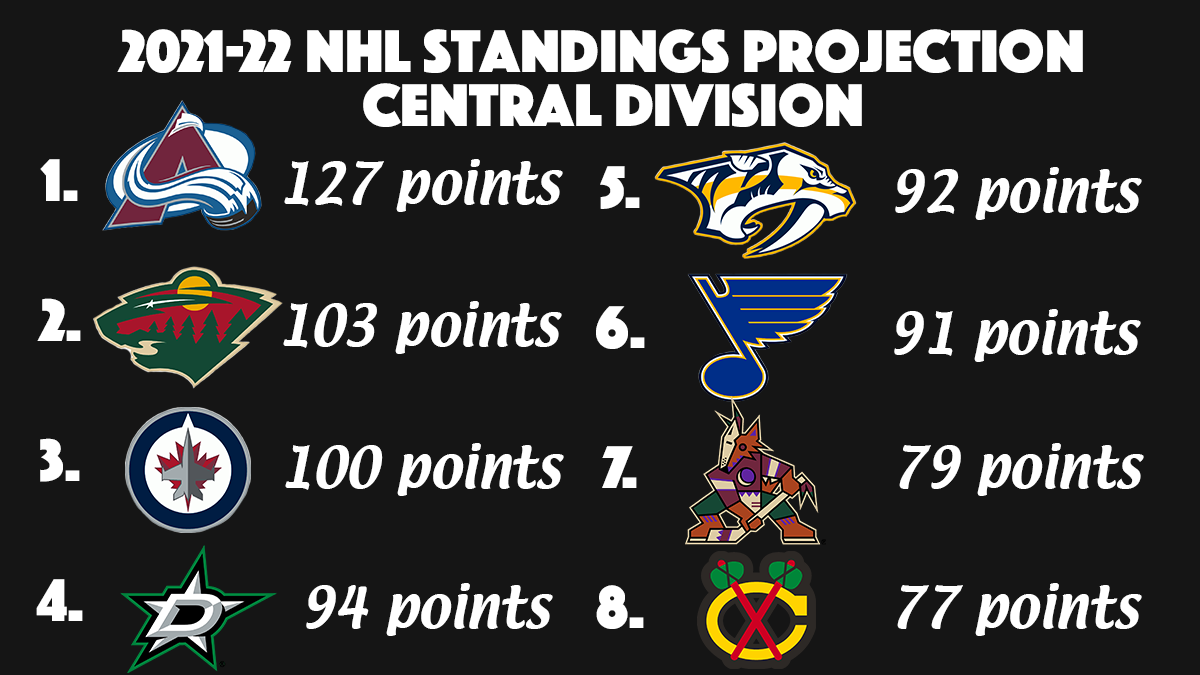
    The overall vibe of the Central Division for 2021-22 is that it’s just more of exactly what you’d expect. The Colorado Avalanche are lightyears ahead of everyone else, while Kirill Kaprizov and the Minnesota Wild continue to be on the rise and everyone else fights for what they can earn.

    Meanwhile, the jury is still out on whether or not the Winnipeg Jets can breakthrough as Canada’s team and break the Canadian curse (become the first Canadian club to win the Cup since 1993).

    Will Colorado finally break through the Second Round and win the Cup?

    Are the Avalanche just the Toronto Maple Leafs but with a little more success? My column:

    No, but really, it’s worth asking if the Avs making it back to the Western Conference Final for the first time since 2002, is more like Toronto’s struggle to make it out of the First Round for the first time since 2004, or is Colorado’s struggle more like the Washington Capitals pre-2018?

    The Caps won three Presidents’ Trophies in 2009-10, 2015-16 and 2016-17, but couldn’t make it past the Second Round– let alone the Pittsburgh Penguins– until they finally did and ended up surging in momentum all the way to their first Stanley Cup in franchise history.

    Colorado, on the other hand, has already won the Cup twice (1996 and 2001) and also has three Presidents’ Trophies to their name in 1996-97, 2000-01 and 2020-21, so if recent history has anything to tell us it’s that yet another team with high expectations for at least a few seasons now only to come up short could very well go on to win it all after winning the Presidents’ Trophy the previous year.

    Either that or they’ll have to win it in back-to-back seasons like Washington did before they won the Cup in 2018.

    Then again, the Tampa Bay Lightning tied the Detroit Red Wings’ record for most wins in the regular season (62), securing the Presidents’ Trophy in the process in 2018-19, then got swept by the Columbus Blue Jackets in the 2019 First Round.

    The very next year, however, Tampa kicked off back-to-back Cup rings in 2020 and 2021, to be where they are now as the two-time defending champions likely standing in the path as the only other favorites outside of the Avalanche this season.

    Anyway, the Avs mostly kept things the same from last season to this season, losing Joonas Donskoi to the Seattle Kraken in the 2021 NHL Expansion Draft, Brandon Saad to the St. Louis Blues in free agency and making minor swaps among replacement level bottom-six forwards and bottom-pairing defenders.

    Oh, then there’s this whole thing about how Philipp Grubauer left for Seattle in free agency too, so Colorado acquired Darcy Kuemper from the Arizona Coyotes.

    Between Dallas, Nashville and St. Louis, who will realistically make the playoffs?

    The Stars are projected to finish with about 94 points, the Predators sit at 92 points and the Blues are around 91 points in this one projection, but don’t let the points alone be your deciding factor.

    Given the strength of the Central Division compared to the Pacific Division, you can bet on five teams making out of the Central among Western Conference playoff berths.

    As such, the spread is the difference maker between these three teams expected to be in the wild card hunt– it’s going to come down to the wire one way or another.

    Dallas bolstered their goaltending depth by signing Braden Holtby, Nashville traded Ryan Ellis to the Philadelphia Flyers and St. Louis is… …better than last season on paper?

    I mean, the Blues signed Saad, acquired Pavel Buchnevich from the New York Rangers in exchange for Sammy Blais, let Seattle claim Vince Dunn at the expansion draft and let Mike Hoffman walk to the Montréal Canadiens in July.

    You could say they took a hit here or there, but those aren’t “nobody names” by any means, however.

    If Jordan Binnington and Ville Husso can stabilize things in the crease, then St. Louis has a better situation than the Predators.

    The Stars, meanwhile, should benefit from a longer season where more of their core guys– like Tyler Seguin, for example– are healthy. Last season’s COVID-19 outbreak to kick things off in January really killed Dallas’ momentum as a team on the verge of being in the 2021 postseason.

    Dallas should get back into the swing of things and St. Louis should be able to stay relevant for at least another year, but how hard the Preds rely on Juuse Saros as their starting goaltender will dictate whether or not they’re able to play spoiler with David Rittich as their backup since Pekka Rinne retired.

    Can Arizona avoid the basement?

    Anything is possible at this point. Loui Eriksson and Andrew Ladd were scoring goals in the postseason, so a fresh start could be just what both players needed for the last few years at least.

    That said, Coyotes General Manager, Bill Armstrong, gave a Masterclass™️ in how to go about rebuilding by selling everything over the summer and taking on “bad” contracts with only one or two years remaining in hopes of playing just well enough to be bad enough without making it look obvious that you’re aiming to win the 2022 NHL Draft Lottery.

    The Pacific Division is the new Scotia NHL North Division from last season. In other words, it’s the worst– which is great news for the Seattle Kraken as the league’s schedule allots more division play than any other opponents (though the Kraken will play every other team in the league at least twice).

    Seattle’s riding the waves of new-age expansion, while the Vegas Golden Knights lead the charge for the Presidents’ Trophy campaign in 2021-22.

    Wait, Seattle in 2nd in the Pacific, really?

    Yes, really.

    The Kraken have a great front office that goes beyond just Ron Francis as General Manager and have done their due diligence in scouting the best talent available to try to replicate the success of the Vegas Golden Knights’ inaugural season in 2017-18, as well as grow beyond just 2021-22.

    That said, Seattle probably isn’t going to make it out of the First Round of the 2022 Stanley Cup Playoffs, even if they have to face the Edmonton Oilers according to this projection.

    It’s a best case scenario for the NHL’s newest expansion team to be in the weakest division, but aside from having recent Stanley Cup champions Yanni Gourde, Philipp Grubauer, Jaden Schwartz and Dunn on their roster, the Kraken have a plethora of players that are relatively inexperienced with deep postseason runs.

    Head coach, Dave Hakstol, also hasn’t had the consistency of making the playoffs and making it out of the First Round in his NHL coaching days, but as a team that, again, is looking to develop long-term success, these are mere growing pains Francis and Co. are willing to accept as the fan base grows.

    Why aren’t the Kings making the cut this year when everyone else says they’ll be the most improved?

    The simple answer is that everyone’s overrating Los Angeles when it comes to the “ready now” factor.

    Sure, Kings General Manager, Rob Blake, did a good thing by getting Viktor Arvidsson in a trade with Nashville this summer to solidify his top-six forward group and signed Alex Edler to fortify his defense, but Los Angeles’ goaltending leaves something to be desired.

    Here’s hoping Jonathan Quick can find a little resurgence at this point in his career, while Cal Petersen continues to come into his own.

    If Los Angeles has any injuries– and they already have with Arvidsson likely missing some time due to an injury in the last preseason game– they’re already close enough to the bubble that they’ll only fall further behind.

    That said, if the Kings don’t make it back to the postseason hunt in 2022, there’s a good chance they make it in 2023.

    Los Angeles is improving, but by how much remains to be seen.

    Will winning the Presidents’ Trophy hurt Vegas?

    Eh, it’s hard to say.

    The Golden Knights have packed in just about every type of heartbreak since their inception in 2017, that fans of other franchises have only experienced over the course of at least 50 years, so if Vegas pulls out the Presidents’ Trophy win in 2021-22, don’t be surprised when the inevitable happens and they win the Cup instead of doing what most other Presidents’ Trophy winners in the salary cap era have done.

    Only the 2007-08 Detroit Red Wings and Chicago in 2012-13, have been able to win the Presidents’ Trophy and the Stanley Cup since the salary cap was introduced ahead of the 2005-06 season.

    Vegas would probably join Detroit and Chicago in doing so just so the Hockey Gods can spite us again.
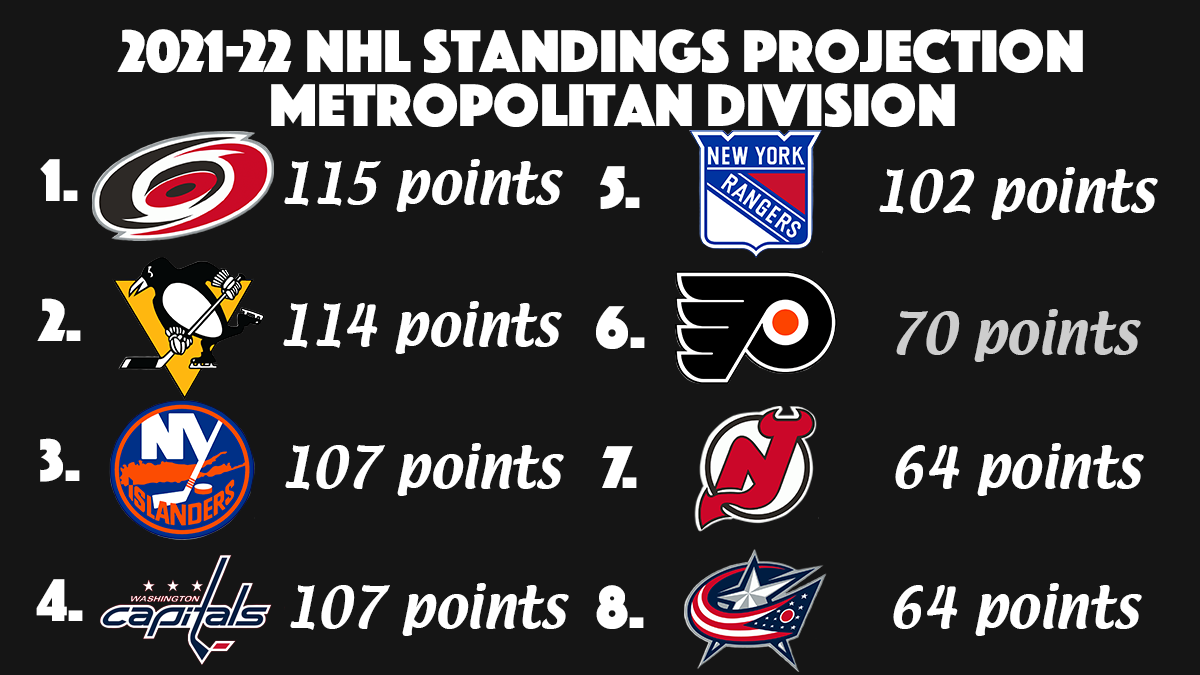
    It’s not easy to be in the Metropolitan Division these days because, well, let’s save that for the three questions below.

    Is this the toughest division to project?

    Absolutely.

    The Carolina Hurricanes decided to just get rid of a few parts and pieces that helped make them good for the last few seasons, so they’re bound to regress even with Sebastian Aho, Andrei Svechnikov, Teuvo Teräväinen and Martin Necas still existing.

    The Pittsburgh Penguins since 2009, have always found a way to be near the top of the division standings by the end of the regular season no matter whether or not you believe they’ll inevitably miss the playoffs for the first time since 2006, so anything could happen there.

    The New York Islanders have made back-to-back appearances in the Eastern Conference Final, so I’d expect them to be good.

    The Washington Capitals are better than the Philadelphia Flyers and New York Rangers, at least, but are probably the only team on the bubble if the New Jersey Devils can come out of nowhere and be competitive this season after signing Dougie Hamilton, Tomas Tatar and Jonathan Bernier in the offseason.

    Meanwhile, it’s time for a short rebuild in Columbus as the Blue Jackets would be quite pleased with a top draft pick in 2022.

    What if Chris Drury never was promoted as General Manager of the Rangers?

    They’d still fire David Quinn and hire Gerard Gallant. I don’t think that’s such a bad idea, but they’d definitely reconsider about 90% of the roster decisions made this summer.

    There’s no reason why the Rangers have to go down this path and yet, here they are, fumbling at the one-yard line and possibly plunging their franchise back into the Dark Ages of another rebuild. Or is it the same ongoing rebuild?

    What about a team to watch like New Jersey, for example?

    I’m big on the Devils this season for some strange reason.

    Maybe it’s because a part of me deep down misses the trap game of the 1990s and 2000s that led to Stanley Cups for New Jersey in 1995, 2000 and 2003.

    Maybe it’s because they signed Hamilton, Tatar, Bernier and acquired Ryan Graves from the Colorado Avalanche as a supporting cast for Jack Hughes, Nico Hischier, Pavel Zacha, Yegor Sharangovich, Ty Smith and friends.

    Seriously, the Devils should be good in the next few seasons, but this year could be the biggest stride forward in terms of their improvement from the basement to their development as a playoff contender.

    First, pour one out for Jack Eichel. Now, let’s move on and talk about everyone else.

    What does this mean for the Leafs?

    Just like how the Stars, Preds and Blues are all right on top of one another in the Central Division standings, the Atlantic Division is stacked from 1st through 4th, so though Toronto leads the way in this projection, I wouldn’t feel too comfortable as a Leafs fan.

    The Maple Leafs played in the worst of the four divisions last year in the temporarily realigned divisions in wake of the ongoing pandemic.

    No, it’s not just because they played all the other Canadian teams across 56 games, but rather it’s due to the fact that they haven’t been able to matchup with the Tampa Bay Lightning, Florida Panthers and even the Boston Bruins since the 2019-20 season.

    A lot and not a lot has changed since then.

    Tampa is still dominant as ever, Florida has emerged as a team that’s on the rise and Boston is unpredictable in that– much like the Penguins– it could really go either way with the Bruins this season.

    So now Toronto has to take on better competition within their own division and square off with teams like the Vegas Golden Knights, Colorado Avalanche, New York Islanders and others that emerge towards the top of the standings outside of the Canadian teams that the Leafs are all too familiar with at this point.

    That said, Toronto still has a great chance at winning the Atlantic Division regular season title or finishing 2nd and having home ice advantage in the First Round for the second-straight postseason.

    Can anyone other than Toronto, Florida, Tampa or Boston make it out of the Atlantic this year?

    No. Let’s be realistic here.

    The Montréal Canadiens made it to the 2021 Stanley Cup Final despite being below .500 in the standings because every division produced four playoff berths and intra-divisional play through two rounds.

    In 2020, they upset the Pittsburgh Penguins in the Qualifier despite finishing right at .500.

    In any other non-pandemic timeline, the Canadiens would still be looking for their first playoff appearance since they lost to the New York Rangers in six games in the 2017 First Round.

    That’s not to say that Nick Suzuki can’t lead the Habs back to glory, but rather that they need to improve all-around in the regular season and peaking in performance in the playoffs.

    Though the Ottawa Senators promised unprecedented success from 2021-25, it’s looking like it’ll realistically be anytime between 2024-25 as in the 2024-25 season itself at this point.

    Ottawa’s goaltending needs to improve, their defense could use some tweaks and the Sens are banking on their offense getting their feet underneath them and bursting in production in the coming years.

    A little more patience won’t hurt them.

    The same can be said for the Detroit Red Wings in that Red Wings fans already know– trust in General Manager, Steve Yzerman, is paramount. He’ll work his magic.

    It just takes a little time to build a solid foundation and the first floor is almost ready to start going up.

    As for the Buffalo Sabres, well…

    At least they’ll hopefully give Rick Jeanneret a proper send-off before he retires as their play-by-play announcer for the last 51 years on television.

    Hopefully.

    Will Tampa win three consecutive Stanley Cup championships?

    Probably not.

    I’m not ruling it out entirely, but the Lightning have a better chance of winning three Cups in four years than they do three Cups in as many years as things stand currently.

    The loss of their entire third line (Blake Coleman, Yanni Gourde and Barclay Goodrow) from last season to this season is sure to leave a mark on the development and restructuring of their bottom-six forwards.

    That said, Tampa’s top-six forwards still exist and, if you haven’t already noticed, they’re very good on their own, but the best teams in the playoffs have four lines that can roll without a doubt and the Bolts might just be off the ball for a year in terms of depth.


    Alright, if you’ve made it this far, thanks for your patience. By now the season’s already going on a few days into the 2021-22 calendar, so the two of us (or more if you’re reading this to a group) should probably get back to watching games.

    Stay tuned for more forecasts for both standings and assorted teams throughout the season.

  • Vegas Golden Knights 2021-22 Season Preview

    Vegas Golden Knights 2021-22 Season Preview

    2020-21 record 40-14-2, 82 points

    2nd in the Honda NHL West Division

    Eliminated in the Stanley Cup Semifinal by Montréal

    Additions: F Sven Baertschi, F Evgenii Dadonov (acquired from OTT), F Brett Howden (acquired from NYR), F Nolan Patrick (acquired from NSH, re-signed), G Laurent Brossoit

    Subtractions: F Reid Duke (signed with Henderson Silver Knights, AHL), F Cody Glass (traded to NSH), F Tyrell Goulbourne (signed with Belleville Senators, AHL), F Mikael Hakkarainen (acquired from VGK, signed with TPS, Liiga),F Tomas Nosek (signed with BOS), F Danny O’Regan (signed with ANA), F Ryan Reaves (traded to NYR), F Dylan Sikura (signed with COL), D Carl Dahlström (signed with TOR), D Nick DeSimone (traded to NYR), D Nick Holden (traded to OTT), D Jimmy Schuldt (signed with Rochester Americans, AHL), G Oscar Dansk (KHL), G Marc-Andre Fleury (traded to CHI)

    Still Unsigned: F Tomas Jurco

    Re-signed: F Patrick Brown, F Mattias Janmark, F Gage Quinney, D Dylan Coghlan, D Alec Martinez

    Offseason Analysis: Well, at least Vegas didn’t try to sign the market’s best free agent to a long-term deal this summer and instead chose to do some introspection.

    Looks like that didn’t last too long (on a technicality, of course).

    Sure, the Golden Knights didn’t sign anyone to a massive contract this summer, but they did dump quite a hefty salary in an otherwise inexplicable trade this offseason.

    Rather than lose out on recent acquisitions and stay the course with Marc-Andre Fleury and Robin Lehner as a goaltending tandem, Golden Knights General Manager, Kelly McCrimmon, did the one thing Vegas’ majority owner, Bill Foley, promised would never be done– McCrimmon traded Fleury.

    The move stunned the goaltender and nearly made the Sorel, Québec native retire, but after a quick tour of Chicago, Fleury decided to play out the remainder of his contract as a pending-unrestricted free agent after the 2021-22 season.

    With an additional $7.000 million to spend towards the cap ceiling, McCrimmon was able to keep Mattias Janmark and Alec Martinez in Vegas– despite likely angering some locals with the loss of Fleury.

    Before we discuss the extensions for Janmark and Martinez, let’s talk goaltending.

    Whereas Fleury had a 26-10-0 record in 36 games last season with six shutouts, as well as a 1.98 goals-against average and a .918 save percentage en route to his first Vezina Trophy in his 17-year NHL career, Lehner had a 13-4-2 record with one shutout, a 2.29 goals-against average and a .913 save percentage in 19 games last season.
    If you want a starting goaltender to be around 2.00 in goals-against average and about .920 in save percentage, while your backup is pegged around a 2.50 in goals-against average and .910 or so in save percentage, then the dynamic duo did just that last season for the Golden Knights.

    For the first time since his time with the New York Islanders in the 2018-19 season, Lehner is back to being a starting netminder. Back then, he went 25-13-5 in 46 games with six shutouts, a 2.13 goals-against average and a .930 save percentage.

    Now, he’ll be tasked with handling anywhere from four additional games to about a dozen more (give or take a few), since McCrimmon signed Laurent Brossoit on a two-year deal worth $2.325 million per season as Vegas’ backup.

    Last season, the Golden Knights spent about $12 million on goaltenders. This season, they’re spending a little more than Fleury’s cap hit alone– $7.325 million for Lehner and Brossoit, compared to Fleury’s $7.000 million price tag against the cap.

    Brossoit hasn’t been able to maintain consistency from year-to-year, but he’s a durable backup coming off of a solid performance with the Winnipeg Jets in 2020-21, amassing a 6-6-0 record in 14 games with a 2.42 goals-against average, one shutout and a .918 save percentage.

    Vegas was always going to transition from Fleury to Lehner once Lehner became a part of the equation for the future. Doing so now may look bad in the manner that they did it, but it was always going to be inevitable as long as the Golden Knights were spending close to the salary cap.

    Anyway, Janmark and Martinez are staying in town– Janmark on a one-year extension worth $2.000 million and Martinez on a three-year deal with a $5.250 million cap hit.

    In 56 games last season, Janmark had 11-13–24 totals between Chicago and Vegas, where he went on to contribute eight points (four goals, four assists) in 16 playoff games as the Golden Knights advanced to the 2021 Stanley Cup Semifinal before being eliminated by the Montréal Canadiens in six games.

    Martinez, meanwhile, amassed 9-23–32 totals in 53 games in his first full season with the Golden Knights since Vegas acquired him from the Los Angeles Kings ahead of the 2020 trade deadline.

    He had twice the points in 2020-21 than he had in 2019-20 in roughly the same number of games and chipped in six points (four goals, two assists) from the blue line in 19 playoff games in 2021 for Vegas.

    At 34-years-old, signing Martinez until he’s nearly 37 is both a risk and an assurance that he pretty much won’t be playing anywhere else for the rest of his career (unless Vegas flips him later on or he decides to sign elsewhere in the summer of 2024.

    For now, the extensions bolster Vegas’ vital depth for both regular season play and postseason clutch performances when you need it most from players you might otherwise least expect down the lineup.

    Among other choices made this offseason, McCrimmon was busy working the phones for trade calls and landed a pair of reclamation projects for the 2021-22 season and beyond in Nolan Patrick and Evgenii Dadonov, but first a quick recap of all the trades Vegas made this summer.

    On July 17th, the Golden Knights dealt defender, Nick DeSimone, and a 2022 4th round pick to the New York Rangers for forward, Brett Howden.

    That same day, Vegas completed a transaction with the Nashville Predators, acquiring Patrick in exchange for Cody Glass and sealed the door on trading all three of their 2017 1st round picks (Glass, Nick Suzuki and Erik Brännström) for other assets.

    At the second day of the 2021 NHL Entry Draft, McCrimmon got in touch with Detroit Red Wings General Manager, Steve Yzerman, and swapped draft picks all day– sending 2021 2nd round pick (36th overall) to Detroit for a 2021 2nd round pick (38th overall) and a 2021 4th round pick (128th overall) in one trade, as well as dealing a 2021 4th round pick (114th overall) and a 2021 5th round pick (155th overall) to the Red Wings for a 2021 4th round pick (102nd overall).

    A few days later on July 27th, the Golden Knights traded Fleury to Chicago for forward, Mikael Hakkarainen, who went unsigned and joined a team in Finland instead.

    The next day, Vegas traded defender, Nick Holden, and a 2022 3rd round pick to the Ottawa Senators for Dadonov.

    Then on July 29th, McCrimmon shipped fourth line forward, Ryan Reaves, to the Rangers for a 2022 3rd round pick.

    Alright, back to Patrick and Dadonov for a second.

    Last season, Patrick amassed 4-5–9 totals in 52 games with the Philadelphia Flyers in his first season back since missing all of 2019-20 due to migraines stemming from post concussion syndrome. The 23-year-old is feeling refreshed and looking for a career rejuvenation in the desert with the Golden Knights.

    Meanwhile, Dadonov is coming off a down year in which he recorded 20 points (13 goals, seven assists) in 55 games with the Ottawa Senators after amassing 25-22–47 totals in 69 games with the Florida Panthers in 2019-20 after back-to-back seasons with at least 65 points.

    The 32-year-old forward is looking to avoid further decline as he is soon to enter the twilight of his prime– approaching his mid-30s having yet to reach the 30-goal plateau or live up to his $5.000 million cap hit through 2022-23.

    Time will tell if Vegas can help right the ship.

    Offseason Grade: C-

    Trading Fleury in the way that they did is hard to swallow– especially since it broke up one of the better goaltending tandems in the league from last season to this season.
    At the very least, moving on from Fleury allowed Vegas to hold onto Janmark and Martinez in the manner that they did rather than court this summer’s top free agent, thereby forcing their own hand by trading another “core” player due to salary cap restraints and possibly disrupting the chemistry in the dressing room.

    Overall, McCrimmon’s moves this summer seem like lateral transactions for a team that has $0 in salary cap space and should be contending for a Cup ring, but always seems to fall short for one reason or another.

    Entering their fifth season of existence, the Golden Knights have this two more years to beat or match the Flyers’ record for the fastest expansion team to win their first Stanley Cup championship in league history.

    Though their offseason may be unconvincing on paper, let’s hope they’ll prove us wrong and surprise the hockey world like they did when they made the 2018 Stanley Cup Final in their first season, but with a different outcome.

  • Detroit Red Wings 2021-22 Season Preview

    Detroit Red Wings 2021-22 Season Preview

    2020-21 record 19-27-10, 48 points

    7th in the Discover NHL Central Division

    Missed the postseason for the fifth-straight year

    Additions: F Mitchell Stephens (acquired from TBL), F Pius Suter, D Nick Leddy (acquired from NYI), G Alex Nedeljkovic (acquired from CAR)

    Subtractions: F Mathias Bromé (NL), F Turner Elson (signed with Grand Rapids Griffins, AHL), F Valtteri Filppula (NL), F Luke Glendening (signed with DAL), F Darren Helm (signed with COL), F Frans Nielsen (buyout), F Richard Panik (traded to NYI), F Evgeny Svechnikov (PTO with WPG), F Dominic Turgeon (signed with MIN), F Hayden Verbeek (signed with Grand Rapids Griffins, AHL), F Henrik Zetterberg (retired), D Alex Biega (signed with TOR), D Dennis Cholowski (expansion, SEA), D Christian Djoos (NL), D Joe Hicketts (signed with MIN), D Dylan McIlrath (signed with WSH), G Jonathan Bernier (traded to CAR, signed with NJD), G Kevin Boyle (ICEHL), G Patrik Rybár (KHL)

    Still Unsigned: F Bobby Ryan, F Givani Smith (RFA)

    Re-signed: F Tyler Bertuzzi, F Adam Erne, F Sam Gagner, F Chase Pearson, F Jakub Vrana, D Filip Hronek, D Gustav Lindstrom, D Marc Staal, G Calvin Pickard

    Offseason Analysis: When Steve Yzerman resigned from the Tampa Bay Lightning, the foundation of his plan as General Manager and the years of development that it took had built up a few levels short of winning back-to-back Stanley Cup championships in 2020 and 2021, after Julien BriseBois picked up where Yzerman left off shortly before the 2018-19 season.
    On April 19, 2019, the prodigal son made his return to Detroit as the now current General Manager of the Red Wings– inheriting a mess left behind by Ken Holland who, despite winning the Cup three times as the executive vice president and GM in Detroit from 1997-2019, was promoted to senior vice president before walking away from the Red Wings altogether.

    Still with me here?

    Yzerman left the Lightning in September 2018, and BriseBois was named his replacement, then later in the 2018-19 league calendar year, the Red Wings hired Yzerman as their General Manager, while Holland stuck around for less than a month longer before leaving for his current role as General Manager and President of Hockey Operations for the Edmonton Oilers.

    In this pseudo-musical chairs endeavor, Tampa has won back-to-back Stanley Cups, while Holland’s Oilers have been mired in early postseason exits and Yzerman, well… …Yzerman’s just been biding his time.

    Though he hasn’t played since the 2017-18 season due to a career-ending degenerative back condition, Henrik Zetterberg’s $6.083 million cap hit is finally off the books.

    Yzerman is no longer looking to take on dead cap space to meet the salary cap floor, but he’s also not quite spending to the ceiling just yet.

    Instead, the Red Wings are setting the gears in motion for big strides sooner rather than later.

    This offseason sped things up, though the team hasn’t been kicked into high-gear just yet.

    For starters, Yzerman’s kept Tyler Bertuzzi, Adam Erne, Sam Gagner, Filip Hronek and Calvin Pickard around as top-six talent, glue guys and necessary goaltending depth in the event of injury.

    He also worked out a solid bridge contract with 25-year-old Jakub Vrana– giving the left wing that was acquired at the 2021 trade deadline a $5.250 million cap hit through the 2023-24 season and buying a year of potential unrestricted free agency in the process.

    Vrana’s short stint down the stretch with Detroit proved to be very productive amassing 8-3–11 totals in 11 games with the Red Wings after putting up 11-14–25 totals through 39 games with the Washington Capitals prior to the trade last season.

    Detroit also managed to snag Pius Suter on the open market after Chicago chose not to tender a qualifying offer for the would have been restricted free agent.

    Suter broke into the league as a 25-year-old rookie and scored 27 points (14 goals, 13 assists) in 55 games with Chicago. In a non-pandemic timeline, Suter would have been on pace for about 40 points in an 82-game schedule.

    That’s nothing to sneeze at for a guy that can work up and down the lineup in a top-nine role on a team that’s looking to get back into annual playoff contention.

    But that’s not all that Yzerman did this offseason.

    As the team said “goodbye” to many long-time Red Wings members, like Darren Helm– who’s now with the Colorado Avalanche– and other more recent placeholders, Yzerman was busy working the phones and dialing the NHL’s trade center.

    Aside from making a few trades involving nothing but draft picks at the 2021 NHL Draft– including one that led to Detroit moving up in the first round in a swap with the Dallas Stars that led to the Red Wings selecting Edmonton Oil Kings (WHL) goaltender, Sebastian Cossa– Yzerman continued to assemble depth down the lineup.

    On July 16th, Detroit sent Richard Panik and a 2021 2nd round pick to the New York Islanders for Nick Leddy as the Islanders looked to make cap space– clearing about $4.125 million in the process for New York and likely teaming Leddy up with Moritz Seider on the second defensive pairing for the Red Wings.

    Yzerman then dealt the negotiating rights for Jonathan Bernier and a 2021 3rd round pick to the Carolina Hurricanes for Alex Nedeljkovic on July 22nd, before signing the former Canes netminder to a two-year extension worth $2.000 million per season.

    Finally, Yzerman went back to the well in Tampa for Mitchell Stephens– sending a 2022 6th round pick in return to the Lightning on July 30th.

    Offseason Grade: B+

    Detroit won’t be great, but they should be better than last season and given the fact that the Red Wings looked competitive at times in 2020-21, they just might play spoiler for some of the teams in the Atlantic Division.

    Meanwhile, Leddy’s jump in production from 21 points in 60 games with the Islanders in 2019-20 to 31 points in 56 games last season should help jumpstart some two-way play in the backend for Detroit.

    A change of scenery and a reunification with Erne on the fourth line for Stephens should necessitate more production than his one point in seven games with the Bolts last season– though neither Erne, nor Stephens are looking to be leading goal scorers on the roster.

    Finally, Nedeljkovic established himself as a starting goaltender in the NHL– or a fringe starter, at least– amassing a 15-5-3 record in 23 games with Carolina last season to go with a 1.90 goals-against average, a .932 save percentage and three shutouts in that span.

    The improvements to Detroit’s defense should pave a way to letting the Red Wings’ offense to grow and the youth throughout the organization to develop while Nedeljkovic can focus on competing with himself to maintain a high-level of play as the goaltender of the future for now, unless Cossa has anything to say about it in the near future.

    For a team that’s been rebuilding in recent years, this is how you do it. Yzerman’s careful scouting, planning and execution is picking up speed.

  • Let’s pretend we have any say in jersey sponsors

    Let’s pretend we have any say in jersey sponsors

    Apparently the National Hockey League’s Board of Governors were up to something this month as it was reported by Sportico on Tuesday that the Board unanimously approved ads on the front of NHL jerseys beginning with the 2022-23 season.

    The ads will be no bigger than a 3-inch-by-3.5-inch rectangle, which is slightly larger than the ads featured on the front of National Basketball Association (NBA) jerseys.

    It was only a matter of time before the NHL followed the NBA in generating additional revenue by doing what professional hockey leagues outside of North America have been doing for many years, as well as what’s been done for at least a few seasons now in the American Hockey League (AHL) and ECHL minor league levels on this side of the pond.

    As always, hockey Twitter is taking the news well.

    Let’s embrace the chaos for a moment and pick some sponsors for all 32 NHL teams that would make so much sense they’ll obviously be overlooked for, well, actual revenue generating streams instead.

    Anaheim Ducks

    What we want: Disney+ or TCL
    What we’ll get: Honda

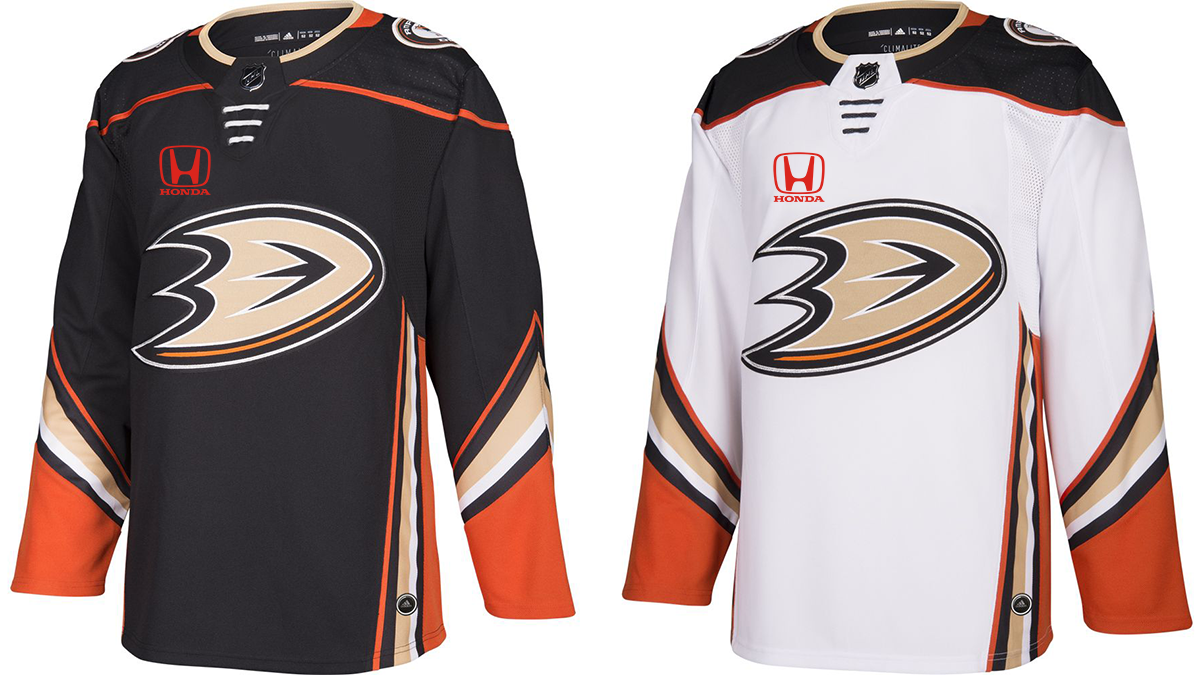
    The Ducks play at Honda Center and, yeah, there’s really nothing besides Disney swooping in and sponsoring the team that they used to own as a means of cross promoting both the Ducks and The Mighty Ducks: Game Changers on Disney+, so we’re stuck with a Honda logo at center ice and on the front of Anaheim’s jerseys.

    In any case, Honda’s red logo works pretty well with the Orange County orange featured as an accent color on Anaheim’s home and road jerseys.

    NHL teams have a tendency to go back to the well with their partners– think of how many teams have either the same helmet sponsor as another team or just slapped on the same brand as their venue’s naming rights deal– but if we want to expand the playground a little bit perhaps TCL could be of interest for the Ducks.

    Come to think of it, that’s probably a better option.

    *Opens up Photoshop*

    Arizona Coyotes

    What we want: P.F. Chang’s or Cold Stone Creamery
    What we’ll get: Fry’s or something, probably

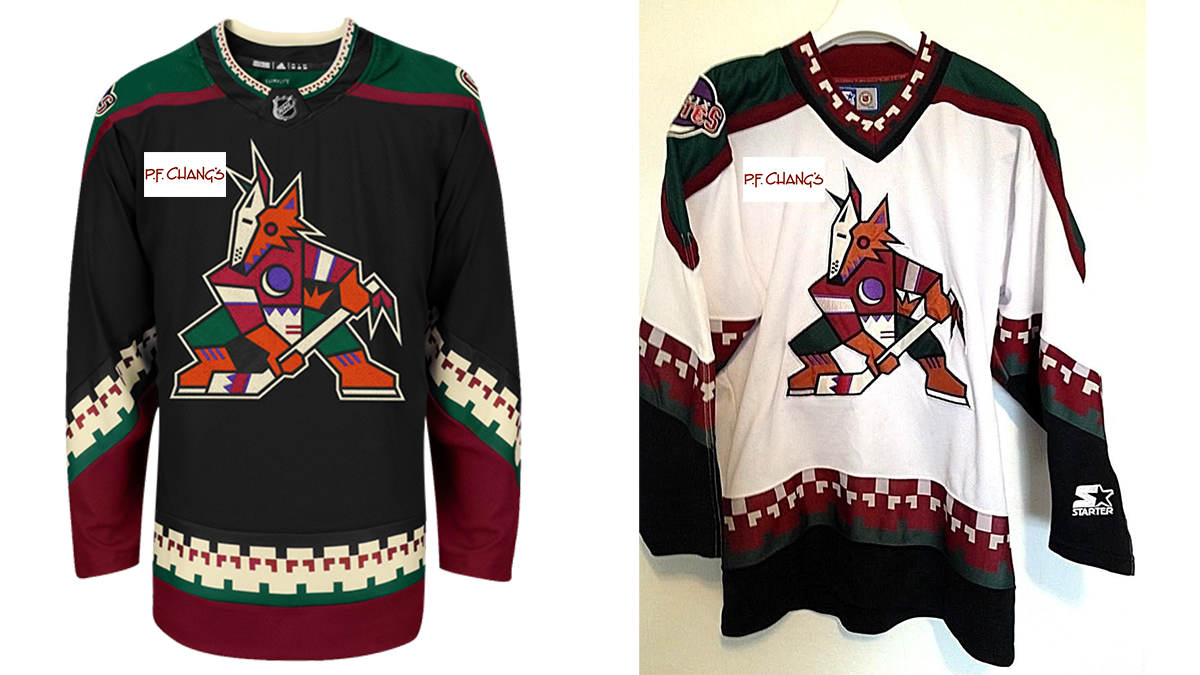
    Believe it or not the Los Angeles Chargers won’t be the only team tweeting about P.F. Chang’s for long as the restaurant chain was founded in 1993, and opened their first location in Scottsdale, Arizona, so it only makes sense to go back to their roots and toss an ad on the Coyotes’ jersey.

    Also founded in Arizona– Cold Stone Creamery.

    We figured that’d probably make sense on an AHL team’s jersey, though, despite the obvious cold ice, cold ice cream connection.

    The Coyotes had Mountain America on their helmets at home and Dignity Health on their road helmets in 2020-21, so in reality we’ll probably get one of those two on the front of their jerseys in 2022-23.

    Boston Bruins

    What we want: Dunkin’ or bust
    What we’ll get: TD Bank or O.R.G. Packaging, probably

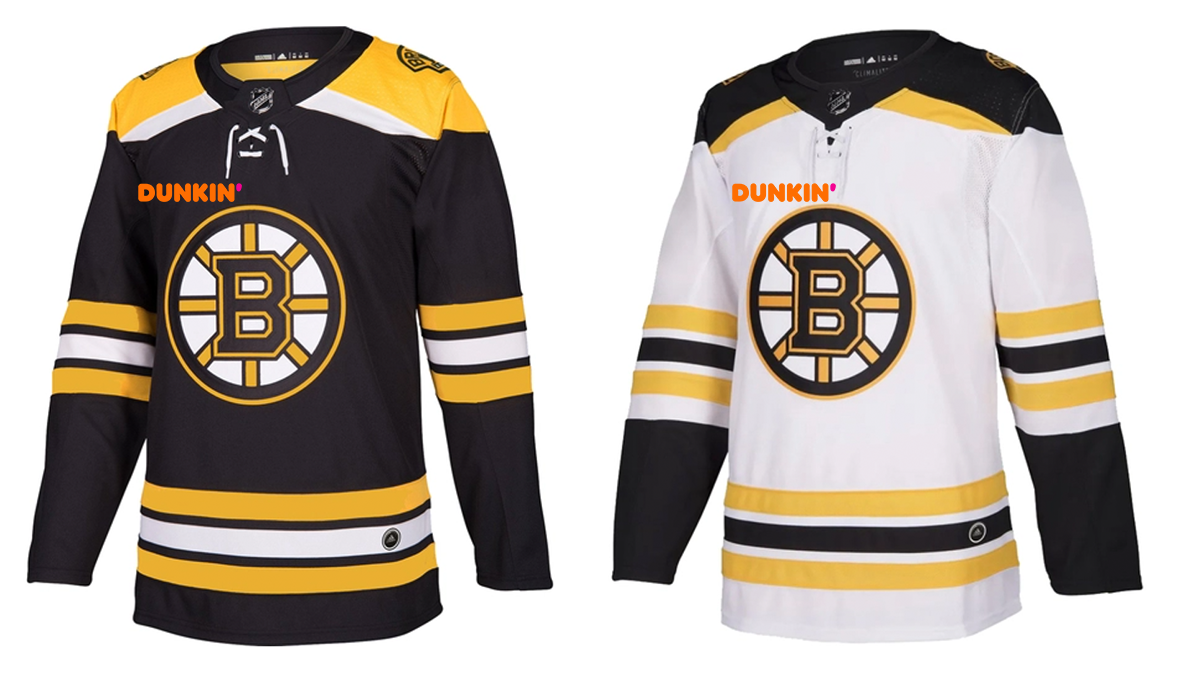
    What could possibly be more Boston than a Bruins jersey with a Dunkin’ logo on it?

    Their AHL affiliate– the Providence Bruins– already play in the Dunkin’ Donuts Center in Rhode Island and have a Dunkin’ ad patch on their jerseys. Why not call it up to the major league?

    That said, with some NBA teams earning up to about $20 million in jersey ad space revenue, the B’s likely will reach for a brand with deeper pockets than doughnuts and coffee.

    Delaware North likes their relationship with a certain bank from Toronto (TD Bank) and has had one of the league’s longest relationships with a Chinese company (O.R.G. Packaging) as part of the NHL’s intended growth beyond the continents of North America and Europe, so one of the two brands is more likely to appear on a Bruins jersey.

    Buffalo Sabres

    What we want: Super Chexx
    What we’ll get: KeyBank

    The Sabres could use some fun in their lives these days and you know what really helps put the mind at ease? Bubble hockey.

    That’s right, Innovative Concepts in Entertainment, Inc. (ICE)– the manufacturers of the popular bar and arcade classic, Super Chexx, that your rich friend down the street growing up also had in the comforts of their home– is based outside Buffalo and would be a match made in heaven right about now.

    Especially as Sabres fans are looking for something to do while the game’s on TV.

    So yeah, we’re definitely going to get KeyBank, Tim Horton’s or something else entirely instead.

    Calgary Flames

    What we want: WestJet or Duraflame
    What we’ll get: Scotiabank

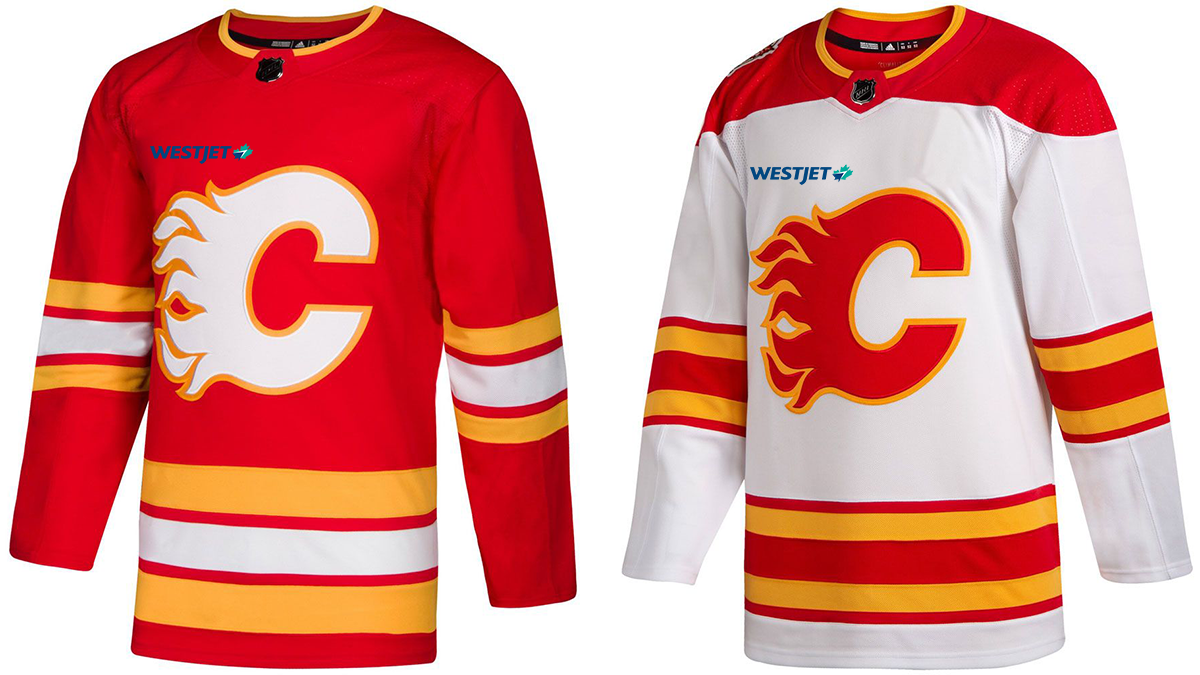
    If you, as an American, can name any other Canadian airline other than Air Canada, then congratulations. If you can’t, then may I introduce you to WestJet?

    WestJet’s headquarters are next to Calgary International Airport and it’d be nice to prove to the world that Canada is more than just a land of Tim Horton’s, Roots, Canadian Tire, Rogers, Scotiabank and Mr. Sub.

    If Duraflame isn’t available, then you might as well dip into the low-cost airline industry as a means of attracting tourists to Banff National Park, Calgary Stampede or whatever it is that sets Calgary apart from the rest of Alberta (so… not being Edmonton).

    Carolina Hurricanes

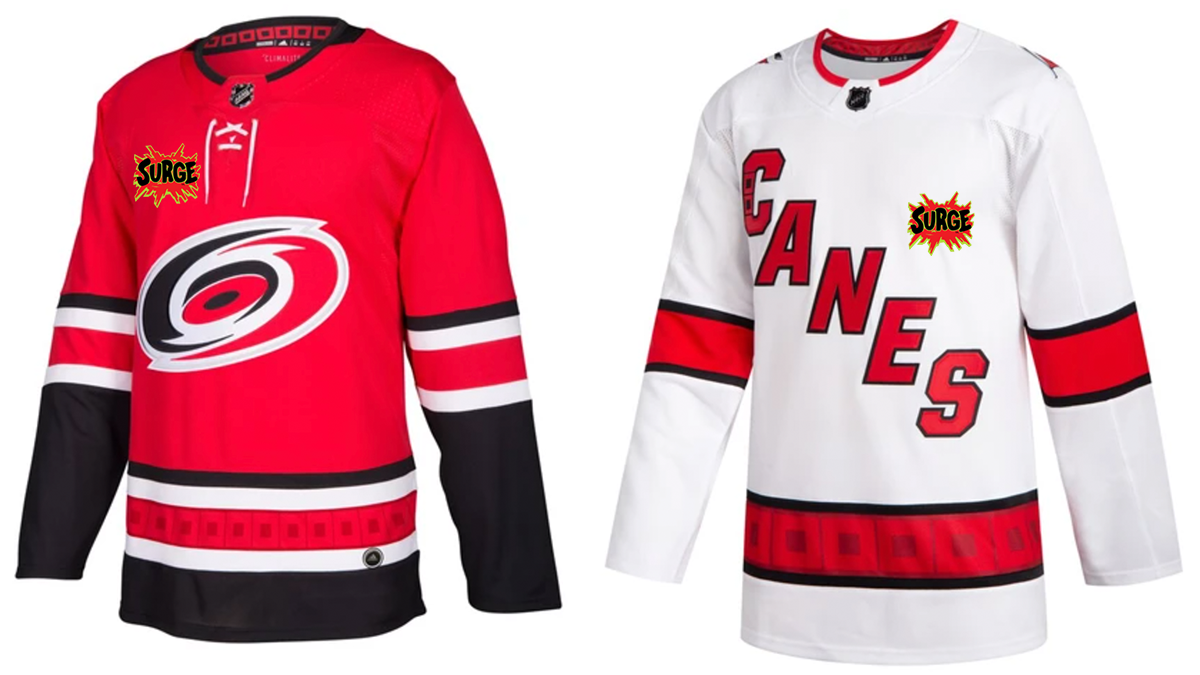
    What we want: Surge
    What we’ll get: PNC, Diehard, maybe Cheerwine or something else

    This should be obvious, but if you haven’t paid attention to the Hurricanes for at least the last few seasons now they do a “Storm Surge” celebration after every win on home ice in the regular season (and sometimes playoffs).

    Surge (the soda) is one of those drinks that makes headlines every few years for being pulled straight out of the vault and placed back on grocery store shelves– speaking of which, does anyone know if it’s currently available?

    If not, it’ll definitely be back by the 2022-23 season.

    Yes, it’s hard to envision where an ad will be placed on the road jersey as the prime real estate is used up by the diagonal “CANES” letters and– for a few players– the captain’s “C” or alternate captain’s “A”.

    Chicago

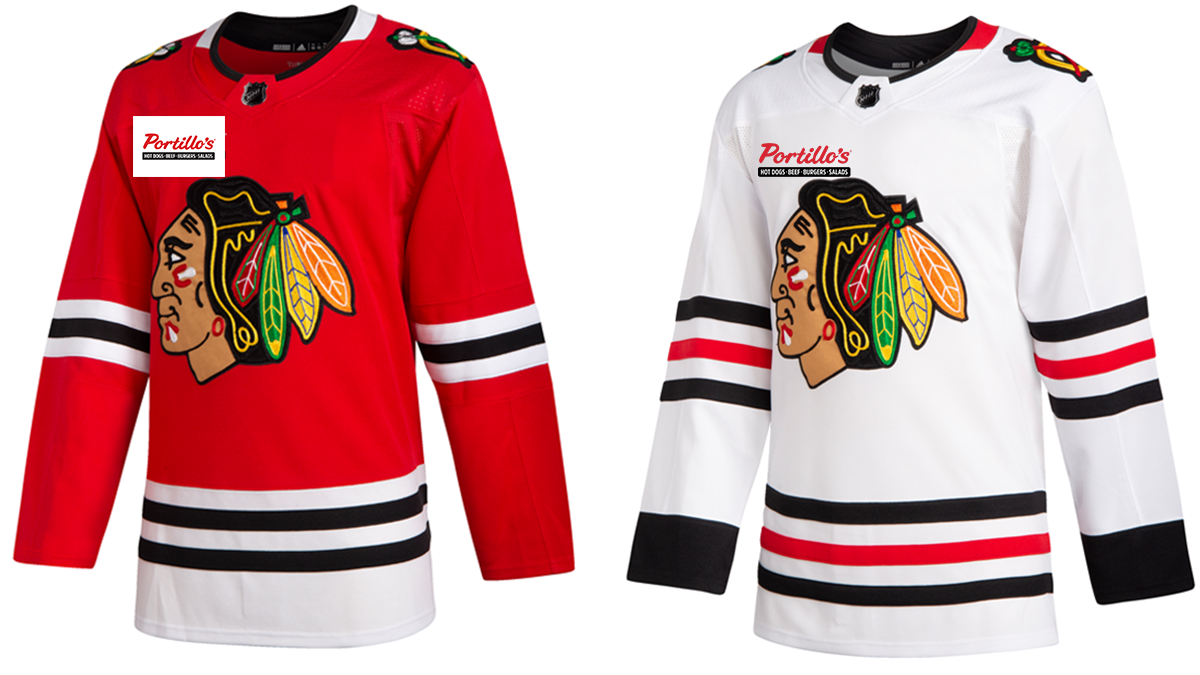
    What we want: Portillo’s
    What we’ll get: United

    Look, between Walgreens, Sears and Portillo’s there’s a few legendary brands that Chicago could partner with as their first jersey ad in franchise history (not including practice jerseys).

    Obviously only one of the three mentioned above is the right choice and its the one that might lead you to Walgreens later if you have a weak stomach. Besides, Sears is fading from our collective memory whether it is out of business already or not.

    Clark Griswold would be proud of Portillo’s proudly being displayed on a, well, if a WHL team can rebrand, so can you, Chicago.

    Colorado Avalanche

    What we want: Chipotle or Coors
    What we’ll get: Ball

    Look, whether or not Nathan MacKinnon eats Chipotle is a debate for another day, but one thing’s for sure– both Chipotle and MacKinnon started their careers in Colorado.

    Though Coors or Coors Light would make more sense, we have to consider the fact that kids might be wearing these jerseys to the game and we haven’t heard whether or not the jerseys that are sold in the proshops in 2022-23 and beyond will include the front jersey ad or not.

    If they do, then we probably can’t market beer to children.

    I’m pretty sure there’s a law about that and it’s also the reason why all my 1:64 scale diecast Rusty Wallace and Dale Earnhardt, Jr. cars from when I was a kid said “Team Rusty” and “Dale Jr.” on them, respectively, instead of Miller Lite and Budweiser.

    Columbus Blue Jackets

    What we want: Wendy’s
    What we’ll get: Nationwide

    Coinciding with the uptick in Columbus born and raised players on the Blue Jackets roster, it would be a great idea to add Wendy’s– which was founded in Columbus in 1969– to the team in such a way that perhaps Jack Roslovic and Sean Kuraly star in local commercials to the Blue Jackets viewing area during the 2022-23 season.

    I know that’s assuming Roslovic signs an extension, but the pending-restricted free agent at the end of the 2021-22 season helped facilitate the Pierre-Luc Dubois for Patrik Laine trade with the Winnipeg Jets by forcing Winnipeg into trading him to his hometown team.

    Unlike several recent stars that left the city via free agency, Roslovic will stick around for the long term.

    Especially if there’s some goods in kind involved with a Wendy’s sponsorship. I mean, I would at least.

    Dallas Stars

    What we want: Whataburger
    What we’ll get: AT&T

    Though Whataburger would be a welcome party in the burger wars when Columbus and Dallas would “meat” up, there’s no beef to be found in this hypothetical because AT&T has already made that decision for us.

    Sometimes you just can’t think too hyperlocal and AT&T fetches a more national audience than a regional chain that primarily serves Texas.

    Besides, if you go to Dallas for a Stars game, you can always just get Whataburger then. It’s not like they’re going to send you a meal with a jersey if ads are on the jerseys sold to fans in 2022-23.

    Detroit Red Wings

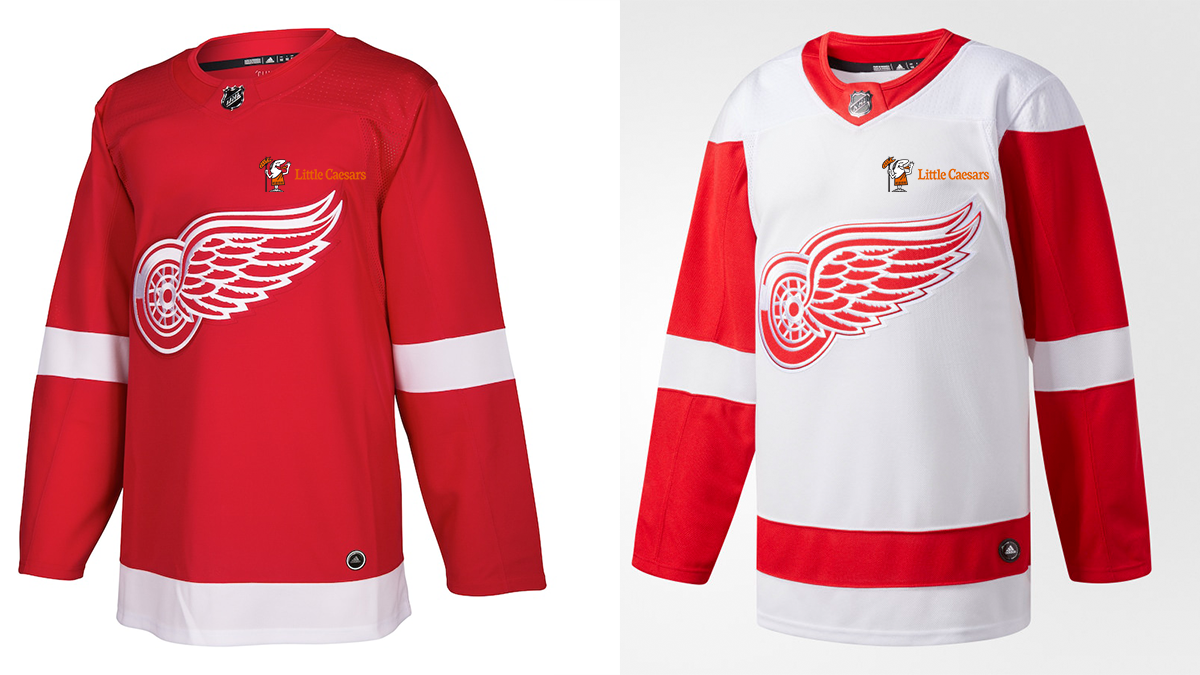
    What we want: Little Caesars
    What we’ll get: Little Caesars

    The last few teams have all involved food and we’re going to be stuck on this theme for at least one more team after this.

    Both the Red Wings and Little Caesars are owned by the Ilitch family and if you think adding one more connection between Detroit and pizza is a bad thing then you clearly don’t understand the marketing behind this.

    Kids love pizza. Adults love pizza. There’s a lot of good memories involving pizza.

    Plus, with General Manager, Steve Yzerman, in charge, the Red Wings are on the rise, which will only further tap into the nostalgia from when Detroit was doing what the Tampa Bay Lightning are currently doing to the rest of the league.

    Edmonton Oilers

    What we want: Boston Pizza
    What we’ll get: Rogers

    Edmonton thought they could replicate the success Ken Holland had in Detroit by hiring Holland as their General Manager and when they see that we’ve got a pizza establishment heading for the front of the Red Wings’ jersey, then the Oilers will think it’s also a good idea to snag a slice.

    That’s where Boston Pizza comes in.

    Whether or not they’ll get Connor McDavid to do an ad read or be left with whatever scraps surround him on the Oilers roster remains to be seen.

    In all likelihood, Rogers Communications will probably just get to slap their logo on another element of Edmonton’s brand.

    Florida Panthers

    What we want: Royal Caribbean International
    What we’ll get: Baptist Health or something

    The Blockbuster guy (the late Wayne Huizenga) founded the team and almost named them the “Florida Block Busters”, so it’d be neat to incorporate an homage to the days of Blockbuster (rest in peace) with the almost Blockbuster-like colors of Royal Caribbean International on the jersey.

    Plus, who among us hasn’t uttered the words “I need a vacation from my vacation” before?

    If you’re an out of town fan visiting the Panthers in Florida or watching the Panthers come to your town— there’s a cruise line for you even if you wouldn’t go remotely near a cruise before the ongoing pandemic began.

    Los Angeles Kings

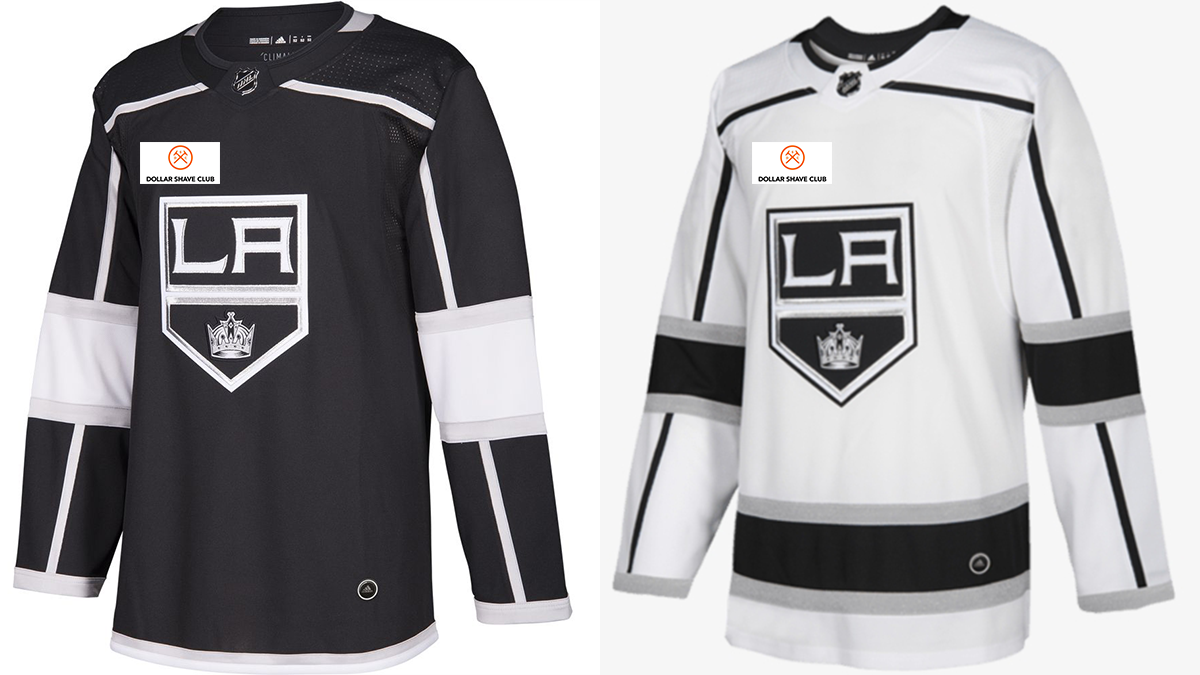
    What we want: Dollar Shave Club
    What we’ll get: Anschutz Entertainment Group

    Never doubt for a second that a team owner wouldn’t give up the chance to toot their own horn, which is why it’s quite possible that one of the world’s biggest entertainment entities would slap their own logo on the front of a Kings jersey.

    If you’re not able to finagle a way to write things off as a deduction, then Dollar Shave Club presents a unique opportunity despite the fact that shaving isn’t something that’s in Drew Doughty’s vernacular (or any hockey player, for that matter, when the Stanley Cup Playoffs roll around).

    Manscaped could also make a run here and in any case, fine.

    Minnesota Wild

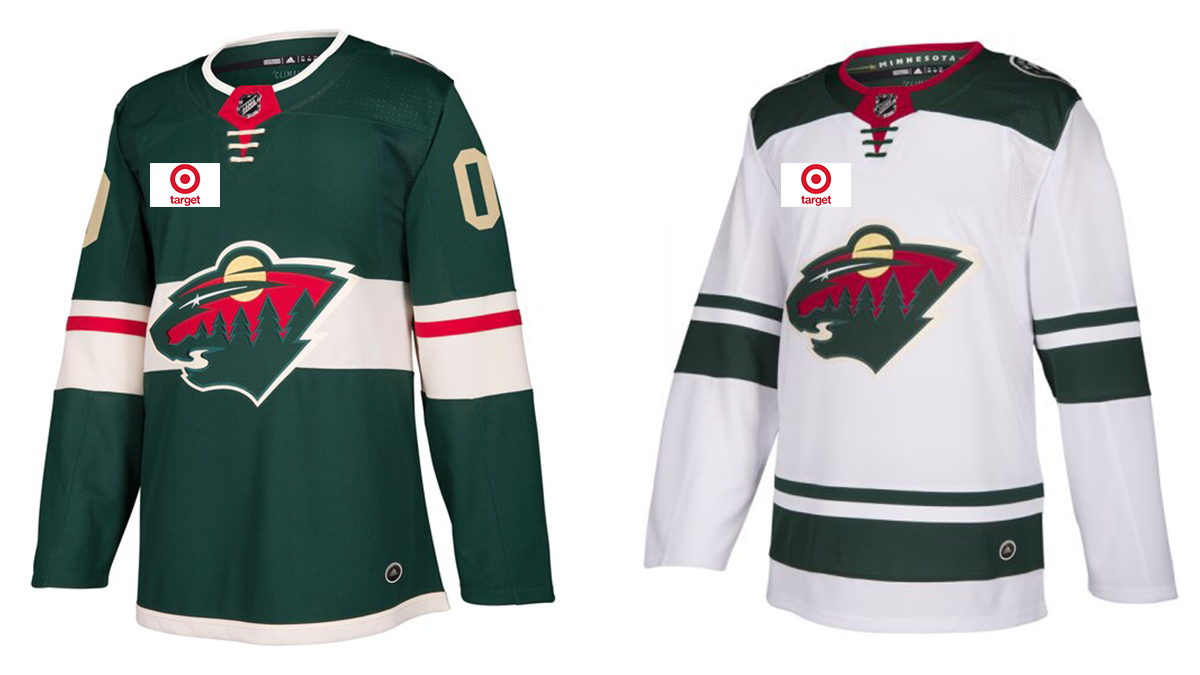
    What we want: Target or General Mills
    What we’ll get: Xcel Energy

    When you think of Minnesota what’s the first thing you think about?

    That’s right, the very place where you could be standing right now reading this while you’re waiting for a cash register to open up or aimlessly perusing the aisles for those impulse purchases you somehow always make at Target.

    It fits the Wild color scheme well and if we’re not going to get General Mills involved then at least getting more than the standard 5% discount for having a Target RedCard via goods in kind might be enough to convince Kirill Kaprizov to stay in Minnesota long-term.

    Montréal Canadiens

    What we want: CCM and/or Molson
    What we’ll get: Bell

    CCM makes more than just jerseys, but it’s not like adidas would be just fine with a CCM logo appearing on the front of an adidas ADIZERO jersey.

    So, we’re left with two obvious choices– Molson or Bell.

    If there’s nothing against a Canadian team bearing an alcoholic beverage on the front of their jersey with the potential for that brand to be marketed towards kids, then perhaps Molson– whose family ties own the Habs– might make an appearance near the crest.

    That or we’ll just get more airtime for Bell. Either way, Montréal would be attractive enough as a franchise to bring in more than one jersey ad sponsor if the league doesn’t have any specific rules outside of the size of the ad.

    Nashville Predators

    What we want: Curb Records or CMT
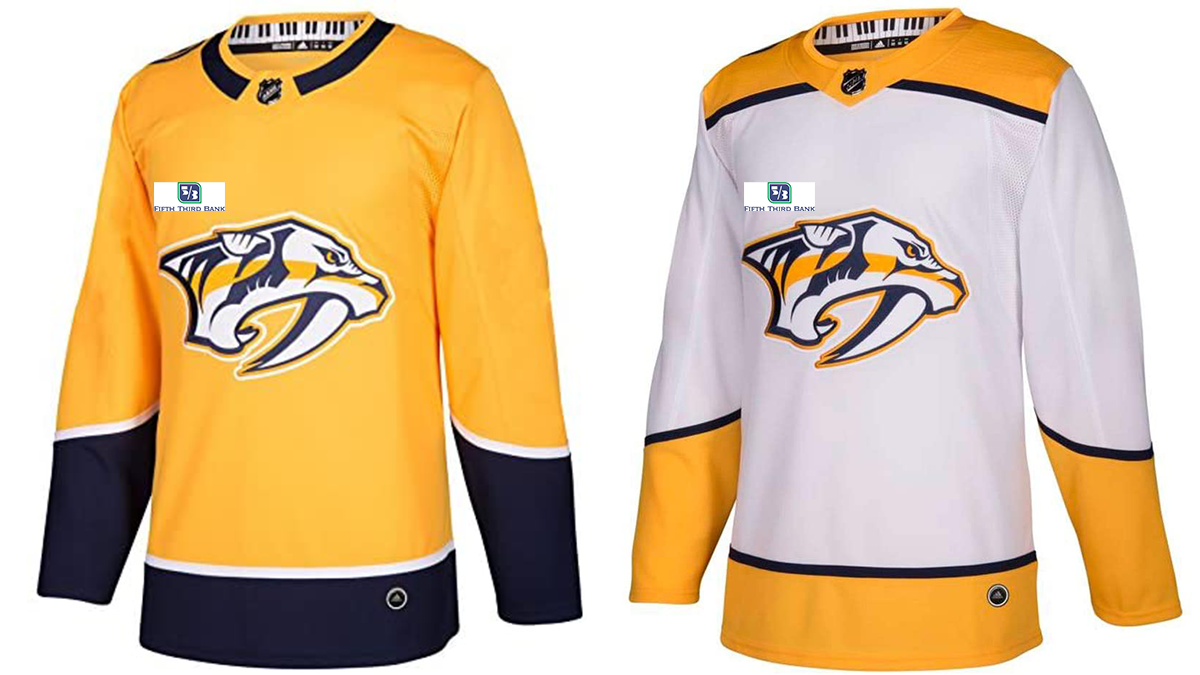
    What we’ll get: Fifth Third Bank

    The music city could attract a music label if they wanted to, but Fifth Third Bank loves investing in Nashville for some reason– like, a lot, despite being headquartered in Cincinnati, Ohio and primarily serving Ohio, Kentucky, Indiana, Illinois, Michigan, West Virginia, North Carolina, Georgia and Florida more than all of Tennessee.

    In any case, good for the Predators. They’ll have some deep pockets to reach into while other teams surely will have to squabble for seven figures related to the going rate for the prime ad space.

    Still feels like we’d be missing out on a sweet Curb Records patch close enough to the guitar pick on the right shoulder though.

    New Jersey Devils

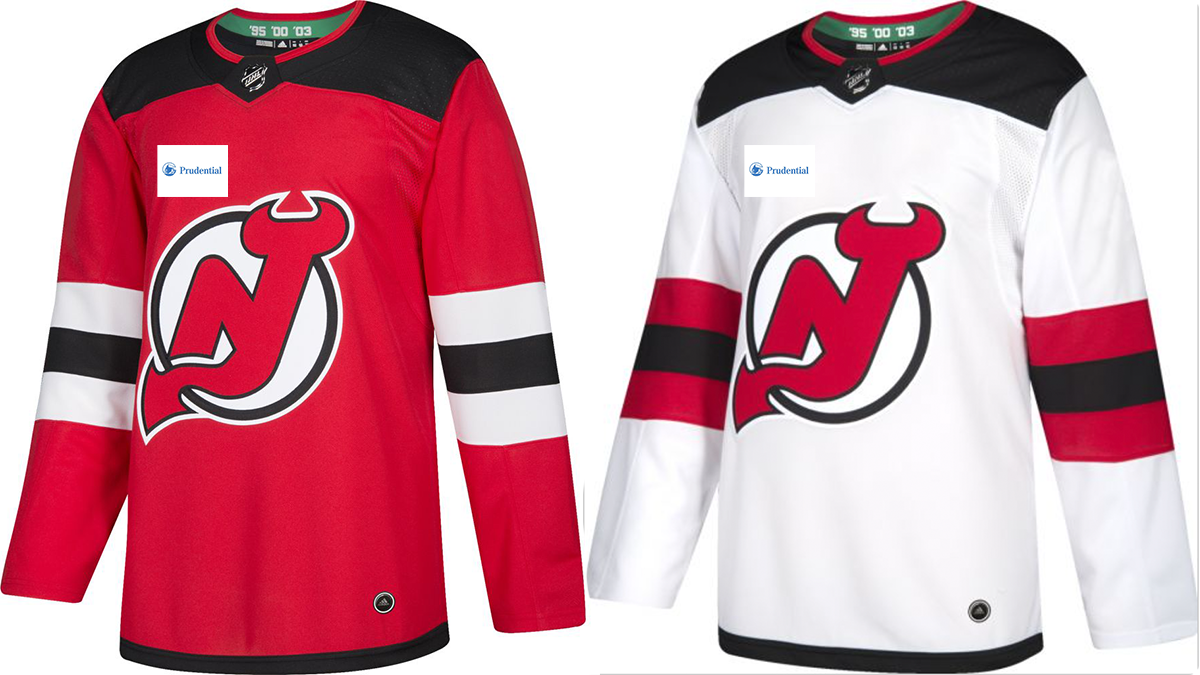
    What we want: Honestly, just Prudential is fine
    What we’ll get: Prudential

    The Devils are overlooked and let’s admit it, you couldn’t think of something distinctly New Jersey either– besides not being allowed to fill your own gas tank.

    Bruce Springsteen is not sponsoring the Devils alone.

    Whether it’s settling on an old reliable or simply making use of what’s trustworthy and already available, Prudential and New Jersey just seem like a good fit.

    New York Islanders

    What we want: Gorton’s
    What we’ll get: Not Gorton’s

    “We want fishsticks!”

    O.K., you got them. Take that, Rangers fans. The Islanders are cool now because they’re steering into the skid.

    They just won’t go as far as bringing back the fisherman jersey from the dead, but alas, they’ll show a spark of creativity and even crack a smile on Lou Lamoriello’s face with the real Gorton’s fisherman making an appearance on the jersey.

    Obviously this will never happen.

    New York Rangers

    What we want: Liberty Mutual if they’re bringing back the “Lady Liberty” jerseys as an alternate
    What we’ll get: Chase for sure, maybe New York Life too

    Liberty Mutual (a Boston company) on the “Lady Liberty” jersey would be a sight to see, but New York will never let it happen.

    Instead, Chase, which already has quite a great partnership with the team, Madison Square Garden, Manhattan, etc. will likely just step up and foot the bill for one– if not all– of the jerseys in full.

    That’s fine. The Rangers will suffer the same consequences of having a diagonal wordmark on their jersey like Carolina’s road jersey, but at least New York’s pretty much always been this way so they should have some ideas of how to work around that.

    Ottawa Senators

    What we want: Canada Post
    What we’ll get: Bell, Scotiabank or Canadian Tire

    Canada’s capital city gets the honor of having Canada Post on their jerseys because it breaks up the trend of having the same three or four companies sponsoring all seven Canadian teams (like how their helmets were for 2020-21).

    In reality, we’ll probably get more of the same from the Sens and either Bell, Canadian Tire or Scotiabank will make an appearance on Ottawa’s jersey.

    At the very least, Canada’s postal service sponsoring a team is more economically viable than the United States Postal Service sponsoring a team.

    Philadelphia Flyers

    What we want: Wawa or Audacy
    What we’ll get: Comcast or GlaxoSmithKline

    Remember how I said you don’t want to go too local for a jersey ad? Well, Wawa on a Flyers jersey is an exception.

    That said, it probably wouldn’t have the staying power to work on a road jersey too, so Philadelphia could tap into the artist formerly known as Entercom, since rebanded as Audacy, for more.

    Audacy maintained their Philadelphia headquarters and covers a broad range of Internet radio, digital content, regular radio and podcasting platforms, plus their logo is orange which fits the Flyers brand.

    It’s either that or Comcast will slap their own logo on the jersey or something.

    Pittsburgh Penguins

    What we want: Duolingo
    What we’ll get: PPG Industries

    Duolingo is headquartered in Pittsburgh and as a website and mobile app, every sports league with ads on jerseys needs at least one that makes you scratch your head at first before realizing the connection between the company and the city.

    The dating app, Bumble, once was featured on the NBA’s Los Angeles Clippers jerseys prior to the Clippers replacing Bumble with their more jersey ad with the online browser extension coupon company, Honey.

    Dating and living expenses in Los Angeles are probably harder than learning a few new languages through Duolingo, so combining Duolingo with the Penguins makes perfect sense since hockey players can come from all over and speak many languages.

    Besides, it might give your team an advantage if they can communicate with one another in a setting that is more comfortable for them.

    St. Louis Blues

    What we want: Busch
    What we’ll get: Enterprise

    I know we’ve been over the whole “can they market beer to kids with these jerseys” thing, but St. Louis is the city of Anheuser-Busch, so it’s only fitting that the Blues get a jersey ad that 1) is Anheuser-Busch related and 2) works with their color palette.

    If Major League Baseball’s St. Louis Cardinals play in Busch Stadium and get Budweiser by default with red as a primary color for the ball club, then the Blues naturally get Busch blue and Busch beer. I don’t make the rules.

    Plus Midwesterners really like the stuff.

    San Jose Sharks

    What we want: Adobe
    What we’ll get: SAP or Zoom

    Look, we weren’t going to get away with making these in Photoshop and not having to give Adobe something— and with headquarters in San Jose it only made sense.

    The Sharks have a deep relationship with SAP, though, so it’s more likely than not that the team will just go further with the brand that also is featured on their helmets at home and holds the current naming rights for SAP Center.

    Plus with the uptick in the use of Zoom, San Jose could double-dip and match SAP on the home jersey with SAP stickers on their helmets with Zoom covering the road set (jersey ad and helmet ads).

    Seattle Kraken

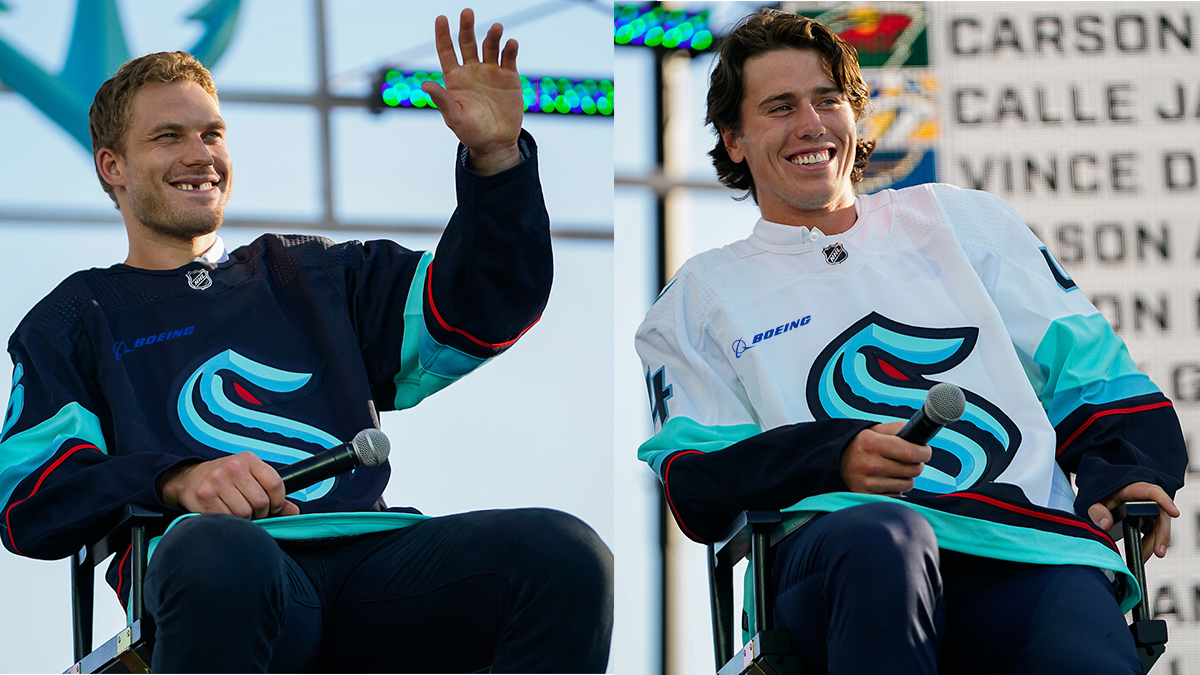
    What we want: Boeing
    What we’ll get: Alaska Airlines

    The Kraken already have a deal with Alaska Airlines as the official airline of the franchise, but what’s bigger than an airline itself?

    That’s right, Boeing, the company that makes a lot of planes and other aerospace stuff, was founded in Seattle and still has a major presence in Washington as the largest private employer in the state.

    Want to see your newest expansion team take flight? Just add some Boeing engineering to the jerseys.

    You might have thought Microsoft would make sense for a Seattle-based team, but the league’s agreement with Apple probably puts a quick end to that.

    Tampa Bay Lightning

    What we want: Accusoft
    What we’ll get: DEX Imaging

    Every sport with ads on jerseys has that one company that nobody’s really sure what they do, but they appreciate that they’re spending their money on their favorite team.

    That just might be Accusoft’s relationship with the Lightning come time for ads on jerseys in 2022-23.

    The private computer software company is headquartered in Tampa and was founded back in 1991, as Pegasus Imaging– one year prior to the Lightning’s debut season as an NHL team in 1992-93.

    Toronto Maple Leafs

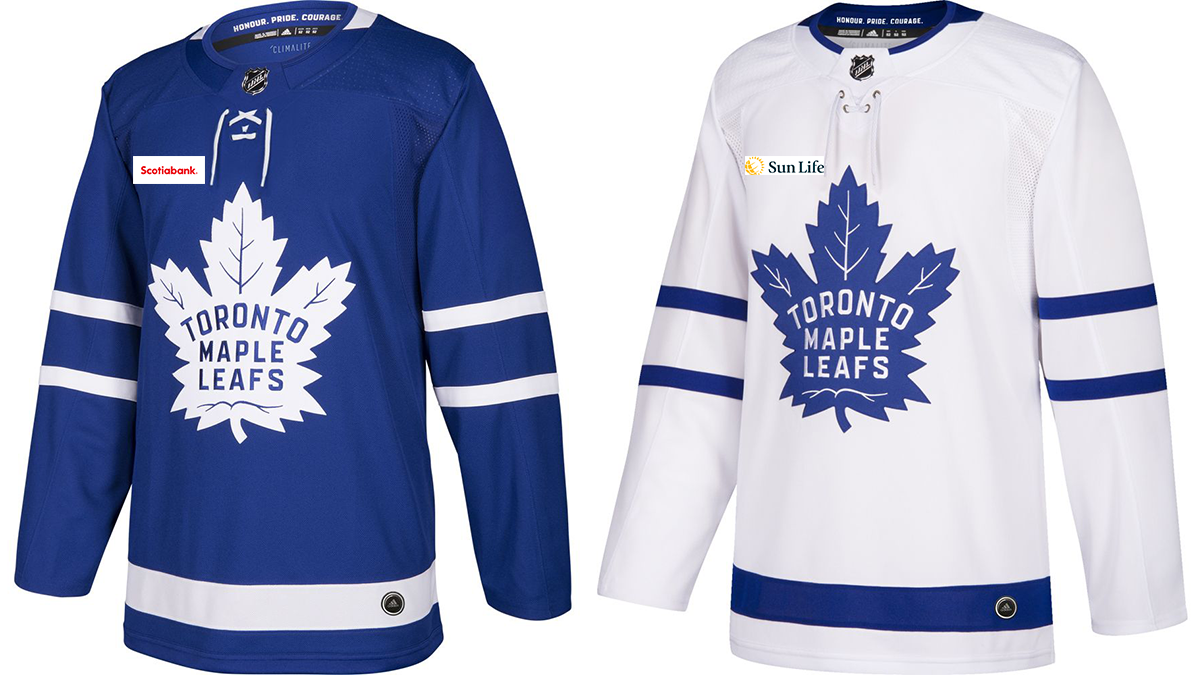
    What we want: Swiss Chalet, Sun Life Financial
    What we’ll get: Scotiabank, Sun Life Financial

    Scotiabank already has a stronghold on Toronto both financially and in the sense that the Maple Leafs play inside Scotiabank Arena and proudly display Scotiabank’s logo on their helmets, so it seems inevitable that Scotiabank would also make an appearance on the Leafs jersey.

    But Toronto is strong enough to maximize the value of a 3-by-3.5-inch ad and capitalize on the Maple Leaf Sports and Entertainment (MLSE) brand.

    MLSE already has an agreement with Sun Life Financial on their NBA team’s jerseys and the Toronto Raptors were able to go on to win their first championship in 2019.

    Perhaps the key to ending the Maple Leafs’ Stanley Cup drought lies within attracting Sun Life Financial to an NHL jersey ad.

    Vancouver Canucks

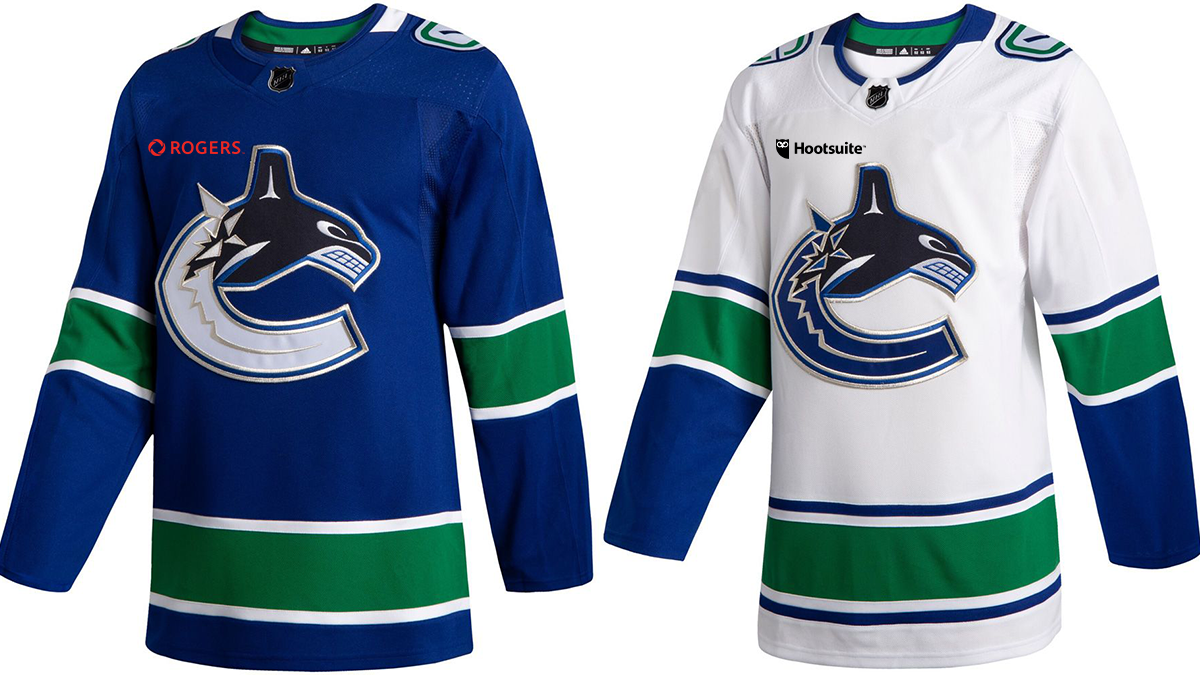
    What we want: Hootsuite
    What we’ll get: Rogers

    Remember when you’d see Hootsuite on just about every tweet with a photo? Am I the only one imagining that?

    In any case, Hootsuite was founded and is based in Vancouver and still plays a major role in social media management for brands.

    Whereas Rogers is accessible to most every day Canadians, Hootsuite would be more of a “corporate” target audience and you need sponsors at all levels to attract a wide base of potential clients, fans, etc.

    That said, the Canucks have had a long relationship with Rogers in that they play in Rogers Arena, so it’s probably going to be Rogers.

    Vegas Golden Knights

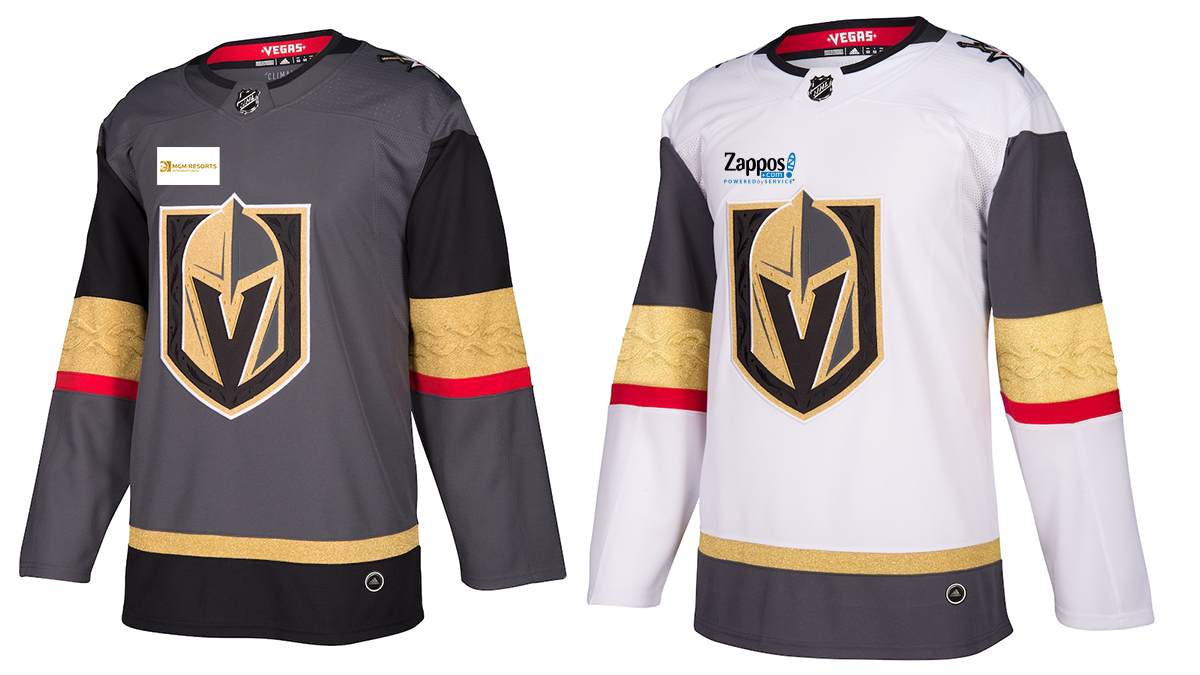
    What we want: Zappos.com
    What we’ll get: MGM Resorts International or Allegiant Air

    Want to have fun with a local Nevada brand? Zappos is the way to go!

    Want to be realistic and attract out of town fans to a destination like Las Vegas? MGM Resorts International is your sponsor and with Allegiant Air as an ultra-low cost airline that’ll gladly bring you to Vegas for a Golden Knights game…

    Yeah, it’s inevitable that between MGM and Vegas’ current road helmet sponsor (Allegiant) that there’d quickly be no room for a company like Zappos.

    Credit One Bank is on the home helmets for the Golden Knights, so don’t be surprised if they’re a wild card for a jersey ad too.

    Washington Capitals

    What we want: Marriott International
    What we’ll get: Capital One, Custom Ink

    Sportswriters rejoice! Your Marriott points may soon reward you with a Capitals jersey or something like that.

    Headquartered in Bethesda, Maryland, Marriott International would make sense from a local and international brand recognition stance.

    But you know what we’re probably going to get instead? Sheer confusion as Capital One places an ad on front of a jersey that already says “Washington Capitals”. The Capital One Washington Capitals– live at Capital One Arena!

    Either that or Caps owner, Ted Leonsis, might like to make a connection between making custom jerseys for local adult league co-ed softball teams or something and, well, Custom Ink’s logo appearing on Capitals jerseys.

    Winnipeg Jets

    What we want: A&W or SkipTheDishes
    What we’ll get: Canada Life or Bell

    A&W was founded in Winnipeg, while SkipTheDishes is headquartered in Winnipeg.

    Since it’s 2021, and not 1956, we’re more than likely to see SkipTheDishes on a Jets jersey, but if their helmet ads from 2020-21 are any indication for 2022-23 and beyond, then Bell is probably going to land a spot near Winnipeg’s crest.

    Canada Life is taking over as the new naming rights holder for Canada Life Centre where the Jets play, so there’s always a chance they’ll end up with their logo on the front of the jersey too.

  • Analysis: Getting back together isn’t always bad (for the Avs, anyway)

    The Colorado Avalanche reunited with an old friend on Friday when they acquired defender, Patrik Nemeth, from the Detroit Red Wings in exchange for a 2022 4th round pick.

    Detroit retained 50% of Nemeth’s cap hit in the deal as Avs General Manager, Joe Sakic, bolstered his blue line depth ahead of Monday’s trade deadline.

    Colorado already has a tremendous roster on paper, but likely could use a solid backup goaltender and whatever added depth they can find for the stretch run in the event of injury.

    The Avalanche are in “win now” mode as 2021 Stanley Cup contenders, especially as free agency looms for key components of their roster.

    Meanwhile, the Red Wings are looking to move expendable pieces as the team is bound to miss the postseason for the fifth consecutive year.

    Nemeth, 29, enters his second stint with Colorado, having recently played with the Avalanche from 2017-19, after the Avs claimed him off waivers ahead of the 2017-18 season from the Dallas Stars.

    The 6-foot-3, 228-pound native of Stockholm, Sweden was originally drafted by the Stars in the 2nd round (41st overall) of the 2010 NHL Draft and had 2-6–8 totals in 39 games with the Red Wings this season.

    He has 7-49–56 totals in 353 career NHL games with the Stars, Avalanche and Red Wings, as well as one assist in 18 career Stanley Cup Playoff games.

    Nemeth most recently contributed a plus-4 rating from Colorado’s blue line in seven games in the 2019 Stanley Cup Playoffs.

    With Detroit retaining 50% of his cap hit, Nemeth carries a $1.500 million cap hit through season’s end and is a pending-unrestricted free agent.

    Red Wings General Manager, Steve Yzerman, kicked off his approach to the 2021 trade deadline by shipping Nemeth to the Avalanche for a 2022 4th round pick on Friday.

    Detroit also announced on Friday that forward, Bobby Ryan, would miss the rest of the season with an upper body injury, likely taking the 34-year-old winger off the trade market as a potential depth addition for any playoff contender.

    Yzerman has all the incentive in the world to make whatever trade he sees fit to improve his team as an overwhelming majority of Red Wings players are pending free agents at season’s end– 15 players to be exact, at least on the active roster according to CapFriendly.

    Colorado and Detroit might not be done as potential trading partners before Monday’s 3 p.m. ET deadline, as former Avs goaltender turned current Red Wing, Jonathan Bernier, would be an excellent solution to the backup role behind Philipp Grubauer in the Avalanche’s quest for the Cup.

  • 2020 Mock Draft: The Complete First Round

    It’s June October and the Stanley Cup has been awarded and already cleaned more than a few times from all of the beer and other things that the Tampa Bay Lightning have done with it, which means it’s the perfect time to gather in a city around your TV screen and be ready to throw on any of the 31 National Hockey League team draft hats (excluding the Seattle Kraken– we’ll deal with them next season) when your name is called.

    Well, if you’re one of the 31 prospects lucky enough to go in the first round of the 2020 NHL Entry Draft on Tuesday night, at least. Rounds 2-7 will take place Wednesday, starting at 11:30 a.m. ET as always– kind of.

    For the first time in NHL history, this year’s draft is virtual thanks to the ongoing COVID-19 pandemic.

    NHL

    Montreal was set to play host to the 2020 NHL Draft at Bell Centre back on June 26th and 27th, but it’s 2020 and with the global pandemic still going on, the league originally postponed the event back on March 25th before announcing it as a virtual draft at a later date (this week).

    It’s also the first time that the draft is being held outside of June since the 2005 NHL Entry Draft, which was held at the Westin Hotel Ottawa in Canada’s capital city– Ottawa, Ontario– on July 30th of that year and it’s the first time that the draft is being held completely on weekday(s) for the first time since the 1994 NHL Entry Draft in Hartford, Connecticut, which was on Tuesday, June 28th of that year (remember the Whalers?).

    The projected first overall pick– Alexis Lafrenfière– will get his moment in the spotlight sometime once the 2020-21 regular season begins, but until then he’ll have to settle for whatever lights his parents have in the living room.

    Coverage of this year’s first round begins Tuesday night at 7 p.m. ET on NBCSN in the United States, as well as SN and TVAS in Canada. Rounds 2-7 will be televised on NHLN in the U.S. and SN1 in Canada.

    1. New York Rangers–> LW Alexis Lafrenière, Rimouski, (QMJHL)

    Considered the best player to come out of the Québec Major Junior Hockey League since Sidney Crosby– who also played for Rimouski Océanic back in his Junior days– Lafrenière is a no-brainer for the New York Rangers.

    He might be the best player in the draft since Connor McDavid was selected 1st overall by the Edmonton Oilers in 2015, and for good reason.

    Lafrenière had 35 goals and 77 assists (112 points) in 52 games for Rimouski this season until the rest of the regular season, as well as all of the postseason and Memorial Cup were cancelled due to the ongoing pandemic.

    There’s nothing wrong with the Rangers stacking up on talent on the left side with Artemi Panarin and Chris Kreider already in play. Simply put Lafrenière on the third line if you must and watch the forward depth lead the club into a playoff contender.

    2. Los Angeles Kings–> C Quinton Byfield, Sudbury (OHL)

    Byfield had 32-50–82 totals in 45 games with the Ontario Hockey Leagues’s Sudbury Wolves this season. His 6-foot-4 , 215-pound frame will help ease the transition for the Los Angeles Kings from Anze Kopitar and Jeff Carter down the middle to whatever’s next with Byfield taking center stage.

    His speed and skating ability is already a cut above the rest in the draft and having a two-time Frank J. Selke Trophy winner (Kopitar) as a teammate should further elevate Byfield’s game into one of the better two-way centers as he’ll be sure to learn a thing or two from him.

    3. Ottawa Senators (from San Jose Sharks)–> C/LW Tim Stützle, Mannheim (DEL)

    The best German prospect since Leon Draisaitl, Stützle amassed 7-27–34 totals in 41 games with Adler Mannheim in the DEL last season. He’s a dynamic forward that plays a mature game for his age, which is a promising sign for the Ottawa Senators that ensured they’d be having “unparalleled success from 2021-25”.

    It’s not off to that promising of a start for the Sens, but with their rebrand, Stützle at 3rd overall and the 5th overall pick at their hands, Ottawa’s brighter days are ahead if not now. They’ll just need to find a new starting goaltender to really make them a playoff contender with Craig Anderson’s departure as part of Ottawa’s plan.

    4. Detroit Red Wings–> D Jamie Drysdale, Erie (OHL)

    While Detroit Red Wing General Manager, Steve Yzerman, could make a splash later in the week trying to attract Alex Pietrangelo or Michigan native, Torey Krug, to Detroit’s blue line, it’s about time the Red Wings took another defender to potentially anchor the defensive zone in the future with last year’s first round pick, Moritz Seider.

    Drysdale checks off all the boxes for the Red Wings as the best defender in the draft and you know what wins championships in “Hockeytown”? Defense.

    That said, he had 9-38–47 totals in 49 games with the Erie Otters of the Ontario Hockey League in 2019-20 and is capable of utilizing his 5-foot-11, 175-pound build to his advantage in a two-way game.

    5. Ottawa Senators–> RW Lucas Raymond, Frölunda (SHL)

    Everybody loves Raymond and his playmaking abilities– drawing comparisons to Ottawa’s intra-province rival, Toronto Maple Leafs forward, Mitch Marner, according to scouts and mock draft experts alike.

    His skill, two-way style and high hockey IQ are what sets him apart from other players his age and pairs well with Stützle in the picture for the Sens as a pair of players that could change the face of a franchise on their own. In 33 games last season with Frölunda HC, Raymond had 10 points (four goals, six assists) playing as a teenager among men in the SHL.

    He has one goal and one assist (two points) in four games this season already.

    6. Anaheim Ducks–> C/LW Cole Perfetti, Saginaw (OHL)

    The Anaheim Ducks need some scoring power as they stockpile youth on the roster and Perfetti brings the right amount of scoring prowess combined with an all-around ability that sets him apart as a forward.

    Perfetti’s vision is one that will generate scoring chances– whether for himself or a teammate– as he amassed 37 goals and 74 assists (111 points) with the Saginaw Spirit (OHL) in 61 games last season.

    At 5-foot-10, 177-pounds, he’s not flashy, but he creates space for his own game and that’ll compliment well with Anaheim’s need for a true top-six forward in the coming years– be it first or second line center or just a solid option at left wing.

    7. New Jersey Devils–> C Marco Rossi, Ottawa (OHL)

    Like the Senators, the New Jersey Devils have three picks in the first round of this year’s draft and if everything goes according to plan, the Devils will make off with a pretty solid core of forwards to intersperse among their organizational depth.

    Rossi lit up the OHL in scoring last season with 39 goals and 81 assists (120 points) in 56 games with the Ottawa 67’s, while drawing comparisons to that of Claude Giroux. Meanwhile, he could join the likes of Thomas Vanek, Michael Grabner and others as one of few Austrian born players to be drafted in the first round.

    8. Buffalo Sabres–> C Anton Lundell, HFIK (Liiga)

    Lundell had 10-18–28 totals in 44 games with HIFK last season in Finland’s top professional league (Liiga) and has a knack for protecting the puck rather well.

    One of the better two-way centers in the draft, the 6-foot-1, 185-pound 19-year-old has some room to grow into a top-six role with the Buffalo Sabres in the near future– especially if Casey Mittelstadt and/or Tage Thompson can’t solidify their game in terms of a long-term second line center companion to Jack Eichel’s standout status as the first line center.

    The Sabres need to shore up their strength down the middle– regardless of Eric Staal’s presence for this season on the second or third line.

    9. Minnesota Wild–> C/RW Seth Jarvis, Portland (WHL)

    Jarvis had 98 points (42 goals, 56 assists) in 58 games with the Portland Winterhawks of the Western Hockey League last season before the pandemic cut things short.

    He’s a crafty new-age center that has room to grow and has shown he can be more of a second-half of the season player that could one day peak at the right time for something the Minnesota Wild haven’t seen in a while– a deep playoff run.

    With the Wild moving on from Mikko Koivu, Minnesota will need to replenish the pipeline down the middle both in the immediate and for the future.

    10. Winnipeg Jets–> D Jake Sanderson, USA U-18 (USHL)

    Sanderson could go higher in the draft or lower reminiscent of how Cam Fowler fell from 5th in the final rankings coming into the 2010 NHL Draft to being selected 12th overall by the Ducks.

    He plays with aggression and has a 6-foot-2, 185-pound frame that could make losing Dustin Byfuglien prior to last season a little bit easier for the Jets– though Sanderson has big shoes to fill on a diminished Winnipeg blue line, unless GM Kevin Cheveldayoff flips Patrik Laine for an incredible return to shore up some own zone help for 2019-20 Vezina Trophy winning goaltender, Connor Hellebuyck.

    With some polishing of his skills at the University of North Dakota whenever the 2020-21 season is expected to begin, Sanderson could improve from his 7-22–29 totals in 47 games with the U.S. National Development Program into a power play specialist that loves to use the body.

    11. Nashville Predators–> D Kaiden Guhle, Prince Albert (WHL)

    One of David Poile’s strengths as Nashville Predators GM has long been drafting defenders and Guhle is no exception to the rule. At 6-foot-2, 186-pounds, he could fit in with reigning Norris Trophy winner, Roman Josi, as well as Mattias Ekholm and friends on the blue line.

    With 11-29–40 totals in 64 games for the Prince Albert Raiders in the WHL last season, Guhle is a consummate two-way defender that can grind his way out of battles and move the puck out of his own zone– a strong suit of Nashville’s defensive core for at least the last 15 years.

    12. Florida Panthers–> RW Alexander Holtz, Djurgårdens (SHL)

    Holtz had 16 points (nine goals, seven assists) in 35 games with Djurgårdens IF last season in the SHL as a pure goal scorer that’s waiting to emerge with a plethora of shots to take.

    He led players 18 and under in Sweden’s top league in scoring and has decent size (6-foot, 192-pounds) to go with adapting well to the increased intensity of NHL-level hockey in due time, though he’ll probably use another season to develop as a more prominent scorer with Djurgårdens in 2020-21.

    That said, new Florida Panthers GM, Bill Zito, will take to stocking up prospects in Florida’s new affiliation with the Charlotte Checkers (AHL) with pleasure if the American Hockey League is able to make a season happen in the face of the ongoing pandemic.

    13. Carolina Hurricanes (from Toronto Maple Leafs)–> RW Jack Quinn, Ottawa (OHL)

    Though the Carolina Hurricanes could go with taking a goaltender in the first round, GM Don Waddell just might be satisfied enough with how Alex Nedeljkovic continues to develop with Carolina’s new AHL affiliate– the Chicago Wolves– and instead opt for the next best available player in Quinn.

    Carolina is much more satisfied crafting a plan via free agency or through a trade to add a goaltender this offseason for what could hopefully bolster their chances as a Cup contender– that’s right, it’s time for the Canes to unleash a storm on the rest of the league as a big improvement from last season to this season.

    Quinn was one of two 50-goal scorers in the OHL last season as he finished the year with 52 goals and 89 points in 62 games. He’s also one of eight OHL players to score at least 50 goals in their first NHL draft eligible season since 2000-01.

    You know who else did that? Guys like Patrick Kane, Steven Stamkos, John Tavares, Jeff Skinner and Alex DeBrincat. Not too shabby.

    14. Edmonton Oilers–> G Yaroslav Askarov, SKA-Neva St. Petersburg (VHL)

    The best goaltender in the draft, Askarov had a 12-3 record in 18 games in Russia’s second-tier league last season. He amassed a 2.45 goals against average and a .920 save percentage in the process and has a .974 SV%, as well as a 0.74 GAA through three games with SKA St. Petersburg in the KHL this season.

    As the Edmonton Oilers continue to find their way while trying to avoid wasting the primes of once in a generation talents like Connor McDavid and Leon Draisaitl, it’d make perfect sense for the Oilers to nail down a solid goaltending prospect for once.

    Especially as there’s an immediate need for someone to replace Mikko Koskinen and/or whoever Edmonton chases after in free agency.

    While the team that beat the Oilers in the 2006 Stanley Cup Final passed over him in this hypothetical mock first round, Edmonton was sure to snag Askarov before anyone else could.

    15. Toronto Maple Leafs (from Pittsburgh Penguins)–> D Braden Schneider, Brandon (WHL)

    While serving as an alternate captain of the Brandon Wheat Kings (WHL) for the second year of his three full Junior seasons thus far, Schneider brought forth a solid two-way game to contribute to his team on the ice in addition to his leadership in the dressing room.

    He had 7-35–42 totals in 60 games last season with the Wheat Kings, while utilizing his 6-foot-2, 202-pound body to shutdown opponents with his two-way game.

    Schneider won’t be ready to hit the NHL ice in 2020-21, but he should be able to slide into a prominent role with the Toronto Maple Leafs in due time.

    16. Montreal Canadiens–> C/RW Dawson Mercer, Chicoutimi (QMJHL)

    Mercer is a versatile forward that could be beneficial to fitting in with the Montreal Canadiens current game plan– find as many Nick Suzuki’s as possible among their forwards and roll four lines while hoping for the best in Shea Weber, Jeff Petry and others on defense, as well as Carey Price in goal.

    The Habs are at a transition point from their old core to a new-age dynamic with the added bonus of head coach, Claude Julien, reconstructing his coaching strategies to propel the Canadiens forward from their .500 season in 2019-20, to hopefully a more legitimate standing as a playoff team in 2020-21.

    Mercer amassed 60 points between the Drummondville Voltigeurs and Chicoutimi Saguenéens in 42 games in the OHL last season and should be able to add a little bit of a power forward component to Montreal’s roster in the near future.

    17. Chicago Blackhawks–> D Justin Barron, Halifax (QMJHL)

    Barron missed a chunk of time last season with the Halifax Mooseheads (QMJHL) due to a blood clot issue, but still managed to put up 4-15–19 totals in 34 games from the blue line while playing an efficient physical game.

    The Chicago Blackhawks have a solid group of young forwards emerging that it’s about time they start focusing a little more on developing a defense– whether it’s from within by selecting Barron or through free agency and making trades. In either case, Duncan Keith and Brent Seabrook aren’t getting any younger and they can’t play forever.

    18. New Jersey Devils (from Arizona Coyotes)–> RW Jacob Perreault, Sarnia (OHL)

    With their second pick in the first round, New Jersey snags a versatile winger with a knack for shooting the puck and scoring. Perreault had 39-31–70 totals in 57 games with the Sarnia Sting (OHL) last season and should be ready to make an impact on the Devils’ NHL roster sooner rather than later.

    He also led Sarnia with 15 power-play goals last season and could help load up New Jersey’s talent pool on the special teams.

    19. Calgary Flames–> C Connor Zary, Kamloops (WHL)

    If the Calgary Flames are serious about making some big changes to their core, they’re going to need to find a long-term solution down the middle and, luckily, Zary brings just that.

    A dynamic skater with decent hands, he had 38 goals and 48 assists (86 points) in 57 games with the Kamloops Blazers (WHL) last season and lends himself to a suitable role as a team player with his 6-foot, 178-pound build at center.

    20. New Jersey Devils (from Vancouver Canucks via Tampa Bay Lightning)–> C Hendrix Lapierre, Chicoutimi (QMJHL)

    Upper body injuries limited Lapierre to 19 games last season, but he managed to put up 17 points (two goals, 15 assists) in that span as one of the better playmakers his age.

    The Devils complete their trifecta of first round picks with a bit of a gamble, but a high upside if everything works out and Lapierre’s health doesn’t end up being a concern. New Jersey’s influx of speed, skill and youth should be able to get them to attract some key role players in the coming years to fill out bottom-six roles on a playoff contending roster.

    21. Columbus Blue Jackets–> C/LW Dylan Holloway, Wisconsin (NCAA)

    The Columbus Blue Jackets have taken to college hockey players with a lot of love in recent years and there’s no love lost for scooping up Holloway and his 6-foot, 203-pound frame as either a center or left wing in the near future in Flavortown.

    He had 8-9–17 totals in 35 games in his freshman year with the Wisconsin Badgers and will likely need at least one more year under his belt in the college program before making the jump, but with the addition of Max Domi via trade ahead of the draft on Tuesday, the Blue Jackets can take their time to craft a heavy hitting lineup down the middle.

    22. New York Rangers (from Carolina Hurricanes)–> C Ridly Greig, Brandon (OHL)

    Despite being 5-foot-11 and 163-pounds, Greig can play in any role and has a good hockey IQ that comes in handy at both ends of the rink. His 26-34–60 totals in 56 games with the Wheat Kings last season should be decent enough for the Rangers to supplement their first round choice in Lafrenière in due time.

    23. Philadelphia Flyers–> C Brendan Brisson, Chicago (USHL)

    Brisson had 24-35–59 totals in 45 games with the Chicago Steel (USHL) last season and will be attending the University of Michigan to further develop his two-way game.

    His consistency should only improve, as well as his scoring ability, which is promising for the Philadelphia Flyers as Claude Giroux peaks in his prime about the time Brisson could make his NHL debut.

    24. Washington Capitals–> LW Rodion Amirov, Ufa (KHL)

    In what’s not a surprise to anyone, the Washington Capitals aren’t afraid to take a shot on a Russian forward as Amirov had 22 points (10 goals, 12 assists) in Russia’s second-tier league last season. His shot and playmaking skills are good, but he’ll need a little time to develop and get stronger before hitting the ice at the NHL level.

    25. Colorado Avalanche–> RW Tyson Foerster, Barrie (OHL)

    At 6-foot-2, 194-pounds, Foerster brings some size to the Colorado Avalanche’s pool of prospects to go along with his 80 points (36 goals, 44 assists) in 62 games last season with the Barrie Colts (OHL). He’s also a decent playmaker, which fits right in with the team mentality of the Avs in their current era.

    26. St. Louis Blues–> LW John-Jason Peterka, München (DEL)

    Peterka led Germany with four goals in seven games at the 2020 World Junior Championship and has an impressive skating ability for his age, which lends itself to playing amongst the professionals in the DEL. He had 7-4–11 totals in 42 games with EHC München last season and is expected to continue to develop his game and work on using his size (5-foot-11, 192-pounds) to his advantage.

    27. Anaheim Ducks (from Boston Bruins)–> D Jérémie Poirier, Saint John (QMJHL)

    With their second pick in the first round, the Ducks don’t mind taking a defender and letting him take his time to get better in his own zone before making an impact in Anaheim. Poirier had 20 goals and 33 assists (53 points) in 64 games last season with the Saint John Sea Dogs (QMJHL) and plays a “live by the sword, die by the sword” game that can really come into its own as a shutdown defender with some more development.

    28. Ottawa Senators (from New York Islanders)–> D Helge Grans, Malmö (SWE J20)

    Grans is a right-shot defender that has a great understanding of the game and decent vision to go along with his 4-23–27 totals in 27 games in Sweden’s junior lead last season, as well as one goal and two assists for Malmö in 21 games in the SHL last season.

    He impressed coaches enough to begin the 2020-21 season in Sweden’s top league and should round out a great first round draft for the Senators.

    29. Vegas Golden Knights–> D Ryan O’Rourke, Sault Ste. Marie (OHL)

    A two-way defender, O’Rourke has a good hockey sense and had 7-30–37 totals in 54 games with the Sault Ste. Marie Greyhounds (OHL) last season. The Vegas Golden Knights already have a solid defensive core, but would be establishing an even better foundation for the future by taking the 6-foot, 178-pound defender.

    30. Dallas Stars–> C Thomas Bordeleau, USA U-18 (USHL)

    Bordeleau had 16-30–46 totals in 47 games with the U.S. National Development Program last season and has room to grow, but has time to develop within the Stanley Cup runners’ up, Dallas Stars’, system. A native of Texas, he’ll be attending the University of Michigan this fall.

    31. San Jose Sharks (from Tampa Bay Lightning)–> D William Wallinder, MoDo (SWE J20)

    Rounding out the first round of the 2020 NHL Draft, the Tampa Bay Lightning sent the San Jose Sharks the 31st overall pick for Barclay Goodrow back when the global pandemic hadn’t put an early end to the regular season and before the Bolts won the Cup. As a result, the Sharks have the last pick in the first round since they traded their 2020 1st round pick to Ottawa in the Erik Karlsson trade.

    As such, it’s only fitting that San Jose continue to build up their defense with Wallinder as a solid option for moving the puck out of his own zone– either by carrying it on his own or finding an open teammate, while shutting down opponents with his 6-foot-4, 191-pound build.

  • DTFR Podcast #204- Late For Everything!

    DTFR Podcast #204- Late For Everything!

    Nick and Colby talk about what went wrong for the Toronto Maple Leafs and other teams eliminated in the 2020 Stanley Cup Qualifier, as well as preview the already in progress 2020 Stanley Cup Playoffs First Round.

    Subscribe to the podcast on Apple PodcastsStitcher and/or on Spotify.

  • DTFR Podcast #199- Cheese!

    DTFR Podcast #199- Cheese!

    Colby’s back, Jack.

    Subscribe to the podcast on Apple PodcastsStitcher and/or on Spotify.

  • Why the Boston Bruins Might Never Retire No. 30

    For a lot of Boston Bruins fans, the term “goalie controversy” often draws up images of people shouting at each other on Twitter about Tim Thomas vs. Tuukka Rask– yes, even to this day, despite the fact that 1) Thomas was traded to the New York Islanders in 2013 and 2) that he effectively retired after the 2013-14 season split between the Florida Panthers and Dallas Stars (he never announced his retirement officially, anyway). 

    Both have a Stanley Cup ring to their names as they were members of the 2011 Stanley Cup champion Bruins roster, with Thomas leading the way to Boston’s first championship since 1972, while Rask was biding his time as the team’s backup before taking over as the full-time B’s starter since the 2012-13 season– racking up multiple franchise records in the process and two more Stanley Cup Final appearances in 2013 and 2019.

    But this “goalie controversy” has nothing to do with the galaxy brain Thomas vs. Rask arguments on Twitter.

    This is about the “controversial” debate that rages surrounding retiring No. 30 in Boston and the controversies that surround two of its most prominent Bruins to wear it.

    When considering whether or not to retire a number in Bruins lore, first consider what other Original Six teams have done, since they’re the only comparable franchises with almost as many– if not more– years of history than Boston.

    Then consider the fact that Boston has never retired a number for a goalie. For quick reference, retired numbers of goalies are in bold.

    Boston Bruins retired numbers

    • 2 Eddie Shore
    • 3 Lionel Hitchman
    • 4 Bobby Orr
    • 5 “Dit” Clapper
    • 7 Phil Esposito
    • 8 Cam Neely
    • 9 Johnny Bucyk
    • 15 Milt Schmidt
    • 16 Rick Middleton
    • 24 Terry O’Reilly
    • 77 Ray Bourque

    Chicago Blackhawks retired numbers

    • 1 Glenn Hall
    • 3 Keith Magnuson/Pierre Pilote
    • 9 Bobby Hull
    • 18 Denis Savard
    • 21 Stan Mikita
    • 35 Tony Esposito

    Detroit Red Wings retired numbers

    • 1 Terry Sawchuk
    • 4 Red Kelly
    • 5 Nicklas Lidstrom
    • 7 Ted Lindsay
    • 9 Gordie Howe
    • 10 Alex Delvecchio
    • 12 Sid Abel
    • 19 Steve Yzerman

    Montreal Canadiens retired numbers

    • 1 Jacques Plante
    • 2 Doug Harvey
    • 3 Emile Bouchard
    • 4 Jean Beliveau
    • 5 Bernie Geoffrion/Guy Lapointe
    • 7 Howie Morenz
    • 9 Maurice Richard
    • 10 Guy Lafleur
    • 12 Yvan Cournoyer/Dickie Moore
    • 16 Henri Richard/Elmer Lach
    • 18 Serge Savard
    • 19 Larry Robinson
    • 23 Bob Gainey
    • 29 Ken Dryden
    • 33 Patrick Roy

    New York Rangers retired numbers

    • 1 Eddie Giacomin
    • 2 Brian Leetch
    • 3 Harry Howell
    • 7 Rod Gilbert
    • 9 Andy Bathgate/Adam Graves
    • 11 Vic Hadfield/Mark Messier
    • 19 Jean Ratelle
    • 35 Mike Ritcher

    Toronto Maple Leafs retired numbers

    • 1 Turk Broda/Johnny Bower
    • 4 Hap Day/Red Kelly
    • 5 Bill Barilko
    • 6 Irvine “Ace” Bailey
    • 7 King Clancy/Tim Horton
    • 9 Ted Kennedy/Charlie Conacher
    • 10 Syl Apps/George Armstrong
    • 13 Mats Sundin
    • 14 Dave Keon
    • 17 Wendell Clark
    • 21 Borje Salming
    • 27 Frank Mahovlich/Darryl Sittler
    • 93 Doug Gilmour

    There’s not many retired goalie numbers among Original Six teams, let alone the rest of the NHL. Plus Boston hasn’t even retired No. 1 for Cecil “Tiny” Thompson and/or Frank Brimsek.

    Next, think about Hockey Hall of Fame status, as well as career longevity (in Boston and outside of Boston).

    Especially since there is no “Boston Bruins Hall of Fame” (which is a shame, really– they built The Hub on Causeway and they couldn’t dedicate more to team history/histories (if you include the NBA’s Boston Celtics) than just the entrance to the old Boston Garden standing inside of Banners Kitchen & Tap?).

    Sure there’s The Sports Museum inside TD Garden, but the Montreal Canadiens have a Montreal Canadiens Hall of Fame underneath Bell Centre. Your move, Mr. Jacobs.

    Cam Neely– He didn’t play nearly enough games for his era due to Ulf Samuelsson, but Neely is a Hockey Hall of Fame member.

    Rick Middleton– He played a lot, scored a ton, but Middleton isn’t a member of the Hockey Hall of Fame.

    Terry O’Reilly– He was like Milt Schmidt in that he did a lot for the Bruins organization (player and later coach), but O’Reilly isn’t a Hockey Hall of Fame member.

    As with everything, there are exceptions to the rule and O’Reilly and Middleton are deservingly so in their own right.

    Gerry Cheevers is a Hockey Hall of Fame goaltender. Tim Thomas is a U.S. Hockey Hall of Fame goaltender. He’s still eligible for the Hockey Hall of Fame, but he hasn’t gotten in and there’s no guarantees that he’ll make it.

    Interestingly enough, however, while Thomas might never be inducted into the Hockey Hall of Fame, Cheevers made it in 1985, but never won a Vezina (Thomas has two, 2008-09 and 2010-11) and was never named to an All-Star Team at season’s end (Thomas was named to two, 2008-09 and 2010-11).

    Then think about how they left Boston.

    In 1972, the World Hockey Association (WHA) came into fruition as a direct rival of the National Hockey League (NHL). The WHA promised better pay for players and the same– if not better– experience for fans.

    It was created by a pair of American promoters who also made the American Basketball Association (ABA), which, if you’re a fan of basketball, you already know the ABA merger story with the National Basketball Association (NBA) to form the National Basketball Association (NBA, 1976-present).

    From the onset, the ABA was poised to one day merge with the NBA in its efforts for success a la the American Football League (AFL) and National Football League (NFL) merger prior to the 1970 NFL season.

    The WHA was all about what the NHL wasn’t about.

    They wanted to capitalize on markets where hockey could flourish, but were otherwise overlooked by the NHL, as well as attract the best players in the game by paying more than what NHL teams would– especially attracting European talent whereas the NHL was stuck as a “North American” game at the time. 

    Free agency was a new concept for professional sports in the 1970s and it reigned supreme in the emerging shift towards player’s rights and the evolution of players’ associations.

    The NHL’s reserve clause at the time meant players couldn’t become the equivalent of today’s unrestricted free agent until they were 31-years-old. These days, there’s restricted free agency, unrestricted free agency, as well as one-way and two-way contracts to worry about, but that’s another topic for another day.

    Cheevers left the Bruins for the WHA, which was deplorable in the eyes of the NHL back then as much as it is now. 

    Though fans might have loved seeing the Cleveland Crusaders jerseys, NHL owners hated them. 

    Though players loved making more money at a time when all the other major professional sports were seeing significant raises, NHL owners hated them. 

    Though WHA franchises thought they’d be on the fast track to continuing operations in the NHL after the WHA ceased to exist, the NHL went all out to slash and burn the remnants of the WHA. 

    Seriously though, when the WHA initiated discussions for a merger in 1977, NHL owners voted down a plan to merge six WHA teams into the NHL.

    The Edmonton Oilers, New England Whalers, Quebec Nordiques, Cincinnati Stingers, Houston Aeros and Winnipeg Jets wanted out of a league that was hemorrhaging money and into the safe arms of the NHL and its tradition. 

    By 1976, there were 32 major professional hockey teams between the NHL and WHA, which diluted the talent pool of a sport that was nowhere near the numbers of popularity and youth through junior league development as it is today.

    When it came time to re-negotiate a merger in 1978, Houston was no longer in the plan, since the Aeros ended up having to fold.

    The Indianapolis Racers folded in the middle of December 1978, which set the final nail in the merger. Cincinnati and the Birmingham Bulls would each be compensated to disband elsewhere, while Edmonton, New England, Quebec and Winnipeg would join the NHL at the WHA’s insistence.

    Except it wasn’t that easy for the Oilers, Whalers, Nordiques and Jets. 

    Each team would be stripped of its history– rendering them as NHL expansion teams for the start of the 1979-80 season, subject to expansion fees, an expansion draft and penalizing them by allowing NHL teams to reclaim players that jumped ship to the WHA.

    Additionally, the Bruins petitioned the “New England Whalers” moniker, resulting in the Whalers having to drop “New England” in favor of “Hartford” since Boston didn’t want any confusion that the Whalers were playing on their turf (despite Massachusetts and Connecticut both being part of New England). 

    The Bruins owned New England. 

    That only strengthened the underdog status of the Whalers and the hatred between the two clubs in their Adams Division rivalry after realignment for the 1981-82 season (Hartford kicked things off in their NHL tenure in the Norris Division from 1979-81).

    Anyway, back to Cheevers and his departure from the Hub.

    After winning his second Cup with Boston in 1972, Cheevers jumped at the opportunity Cleveland created to make a lot more money than what the Bruins were offering their two-time Stanley Cup winning goaltender. 

    Cheevers lasted parts of three seasons as a Crusader from 1972-73 to 1975-76, when a financial dispute with Cleveland’s management resulted in Cheevers jumping back into the NHL fold with Boston in the middle of the 1975-76 season.

    Since becoming a starting goaltender in the 1967-68 season through Boston’s 1971-72 Cup winning season, Cheevers amassed a 126-52-40 record in 221 games with a 2.72 goals against average and a .915 save percentage in that span, as well as 15 shutouts.

    Prior to his departure from the Bruins for Cleveland, he had a career best 2.50 GAA and .920 SV% in 41 games in the 1971-72 season alone as a 31-year-old goaltender (he wouldn’t turn 32 until Dec. 7, 1972).

    Though Cheevers returned in 1975-76, things never were really the same.

    His WHA tenure racked up a 99-78-9 record in 191 career games for the Crusaders from 1972 through part of the 1975-76 season– with a 3.12 GAA and 14 shutouts in that span.

    On Jan. 27, 1976, he returned to Boston as a free agent after being released by Cleveland– two days after the Crusaders suspended him for not showing up and refusing to play.

    By that point, Cheevers was 35-years-old and finished off the 1975-76 NHL season with an 8-2-5 record, as well as a 2.74 GAA and a .900 SV% in 15 games played for the Bruins.

    In his full seasons for Boston that followed from 1976-77 to his retirement after the 1979-80 season, Cheevers went 87-35-24 in 151 games, with a 2.96 GAA, an .878 SV% and nine shutouts in that span.

    Though the emergence of Wayne Gretzky to the NHL scene may have shifted the offensive output across the league since 1979, Cheevers’ NHL playing days only coincided with Gretzky in Gretzky’s rookie season (1979-80).

    Though Cheevers had a .524 winning percentage in his first NHL stint with Toronto (two games)  and Boston (250 games) from 1961-72 and a .572 winning percentage after his WHA days in 166 games with Boston from 1976-80, his goals against average and save percentage suffered dramatically from a 2.85 GAA and a .911 SV% in 1961-72 to a 2.94 GAA and an .880 SV% from 1976-80.

    Of course, age and the inevitable “wall” that players hit at the twilight of their prime is likely a factor here.

    Still, the fact remains the same.

    Despite leading the Bruins as a head coach after his retirement as a player from 1980-85, his defection from the NHL to the WHA crushed his immediate chances at being honored for his work on the ice in a sweater with the spoked-B on the front and the No. 30 on the back.

    And all these years later, he might still be paying for it.

    Thomas, on the other hand, chose to sit out the 2012-13 season, citing a need for more connection to his faith, family and friends.

    Though it’s certainly understandable these days, given the presumptive hell he must have gone through with all of his concussions and finding the love for the game again– albeit watching as a fan these days– since his retirement from the NHL after the 2013-14 season, Thomas’ 2012-13 plans weren’t the first time he angered the Bruins fanbase, let alone, Boston’s front office.

    After winning the Cup in 2011, he skipped out on the team’s White House invitation— citing (to paraphrase) that both major political parties are at fault for the federal government’s overbearance on its citizens.

    Other than that, there’s his staunch– if not, outlandish at times– political views that cannot be overlooked (his support for Chick-fil-A amidst the company’s anti-equal marriage stance) in a day and age where Hockey Is (supposed to be) For Everyone.

    Like the rest of us, however, Thomas is human– complex, contradicting, well-defined and unique as an individual. We all struggle through our own cognitive dissonance through life. 

    For some, his on-ice performance can be separated from what his private off-ice personal life ensues. 

    For others, he might not be as high on the pedestal of Boston sports lore due to his complicated nature– one that contradicts research and the science behind traumatic brain injuries, therapy and experimental treatments with conspiracy theories related to climate change, among other things.

    All of this begs the question “should there be a character component to retiring numbers,” which could lead to further discussion surrounding whether or not teams should permanently unretire numbers when legendary players don’t live up to being role models off the ice (see, Bobby Hull and the Chicago Blackhawks and Arizona Coyotes). 

    Likewise, the same argument could be applied to hall of fame inductions, but both are discussions for another time.

    But Thomas’ decision to sit out the 2012-13 season with one-year remaining on his contract and a $5.000 million cap hit in a time when Boston was built for contending for another Cup run while spending $8.500 million combined between Thomas and Tuukka Rask in the crease as the team sat uncomfortably below the salary cap at about $68.868 million out of the $70.200 million ceiling, struck a nerve with then General Manager, Peter Chiarelli, and Co.

    Oh and to further add to the uncertainty, the league hit a lockout prior to the start of the 2012-13 season, which saw the usual 82-game schedule reduced to 48 games that season once play resumed in January.

    On Feb. 7, 2013, the Bruins traded Thomas to the New York Islanders to free up much needed cap space in an attempt to re-sign Rask, Nathan Horton, Andrew Ference, Anton Khudobin, Jaromir Jagr and others in the 2013 offseason after losing in six games to the Chicago Blackhawks in the 2013 Stanley Cup Final.

    Only Rask remained as Ference’s free agent status priced himself out of Boston, Jagr was deemed “too old” (joke’s on them!) and Horton left for the Columbus Blue Jackets in a shroud of “word on the street” rumors. Khudobin, meanwhile, went to the Carolina Hurricanes on a one-year, $800,000 deal after Boston signed Chad Johnson for $200,000 less to be Rask’s backup for the 2013-14 season.

    Thomas returned to the NHL for the 2013-14 season with the Florida Panthers after signing a one-year deal on Sept. 26, 2013, before later being traded to the Dallas Stars on March 5, 2014– one day after Florida re-acquired Roberto Luongo from the Vancouver Canucks.

    His comeback season didn’t go well (posting a 16-20-3 record, a 2.87 goals against average and a .909 save percentage in 40 games with the Panthers, as well as a 2-4-1 record, a 2.97 GAA and a .902 SV% in eight games with the Stars) and Thomas rode off into the sunset after Dallas was eliminated in six games in the 2014 First Round by the Anaheim Ducks.

    The Bruins may let bygones be bygones and welcome Thomas with open arms for a “Tim Thomas Night” or special ceremony one day in the future, but it likely won’t be before Rask retires.

    As it is, Thomas isn’t planning on traveling much outside of his Washington, D.C. appearance for his induction into the U.S. Hockey Hall of Fame in Dec. 2019.

    So, what goaltender could have their number retired by Boston?

    If there’s one Bruins goaltender that will have his number retired sooner rather than later, it’s Rask.

    His current contract expires at the end of next season and Rask has expressed he might retire, but he also might not.

    There’s three probable options for Rask when all is said and done in 2021;

    1) to sign a short term deal and remain with Boston for his entire NHL career,

    2) to sign a contract elsewhere or

    3) to retire– finishing his career as one of the greatest goaltenders in Bruins history as he currently ranks 1st in wins (291– Tiny Thompson is 2nd with 252), 1st in games played (536– Thompson is 2nd with 468), 1st in saves (13,711– Eddie Johnston is 2nd with 12,375), 1st in save percentage among goalies with a minimum of 100 games played as a Bruin (.922– Thomas is 2nd with a .921), 1st in goals against average among goalies with a minimum of 100 games played for Boston (2.26– Byron Dafoe is 2nd with a 2.30), 2nd in shutouts among goalies with a minimum 100 games played for Boston (50– Thompson leads with 74) and– as a bonus– Rask leads with the most points by a goaltender with the Bruins (15, all assists– Cheevers is 2nd with 11, also all assists).

    That’s no slouch and not just a result of suiting up in a bunch of games for one team without any real success whatsoever.

    That same 2011 Stanley Cup championship year for the Bruins?

    Rask was part of that.

    Doesn’t matter if you’re the starter or the backup when your name goes on the Cup for a job well done as one of the best goaltending tandems that season. Besides, in today’s NHL, there’s an ever increasing importance for a 1A/1B solution in the crease.

    Rask also backstopped the team to two more Stanley Cup Final appearances since then in 2013 and 2019.

    He also won the Vezina Trophy in 2014 and was likely on track to pick up his second Vezina this season– number of games played compared to his peers, like Andrei Vasilevskiy, be damned– at its pause due to the ongoing COVID-19 pandemic with a 2.12 GAA and a .929 SV%, as well as a 26-8-6 record in 41 games played.

    No. 40 in black and gold led the NHL in goals against average this season and was second in save percentage, while sharing second place in shutouts with five.

    Whether he wins this season’s Vezina Trophy or not, he’ll still have a consolation prize shared with his backup, Jaroslav Halak, as the duo won the William M. Jennings Trophy for the 2019-20 season as the goaltender(s) that have played a minimum of 25 games in a season for the team(s) with the fewest goals scored against it.

    Rask and Halak allowed 174 goals this season in 70 games played, whereas Ben Bishop and Khudobin allowed 177 goals against for the Stars in 69 games.

    This season’s hardware is Rask’s first Jennings Trophy win and Halak’s second career Jennings honors after previously sharing the title with Brian Elliott in the 2011-12 season with the Blues.

    As for Rask’s jersey retirement case, it helps that he is tied for the best save percentage in league history (.922) with Dominik Hasek and 11th overall in the NHL’s all-time goals against averages with a 2.26 in his career.

    Oh and the B’s have won the Presidents’ Trophy twice with Rask in the crease (2013-14 and 2019-20), something Thomas never did in his tenure with Boston and Cheevers could never do, since the award wasn’t presented for the first time until the 1985-86 season.

    It’s possible the Bruins retire No. 40 before they make up for lost time and retire No. 30 for two players, like how the Toronto Maple Leafs retired No. 1 twice (Turk Broda and Johnny Bower).

    After all, if you’re worried about running out of numbers that are typically used by a goaltender, Nos. 1, 29, 31, 35, 45 and any other number that isn’t already or won’t be retired by the time Boston gets around to retiring a goaltender’s jersey number (assuming the B’s retire No. 33 for Zdeno Chara, No. 37 for Patrice Bergeron, No. 46 for David Krejci and perhaps No. 63 and No. 88 by that time) will still be available.

  • DTFR Podcast #182- Back In A New Year Groove

    The DTFR Podcast is back from hiatus as Nick provides a State of the Podcast, reviews a few things from the last couple of months and delves into all of the transactions leading up to the 2020 NHL trade deadline.

    Subscribe to the podcast on Apple PodcastsStitcher and/or on Spotify. Support the show on Patreon.