Tag: Stefan Matteau

  • Preview: Game 50- Avalanche @ Bruins

    Preview: Game 50- Avalanche @ Bruins

    Monday afternoon at TD Garden, the Colorado Avalanche visit the Boston Bruins in the conclusion of their regular season series– in which the Avs are in the midst of their second-longest road winning streak in club history at seven games.

    Colorado’s longest road win streak in franchise history was set during the 2019-20 season when the Avs won nine consecutive games on the road from Feb. 4-March 2, 2020.

    The last time the Avalanche won seven straight road games was back in the 1998-99 season, when Colorado won seven games away from home from Jan. 10-Feb. 7, 1999.

    Boston, on the other hand, is coming off of a, 3-2, overtime win in Ottawa on Saturday– having finished their four-game road trip with a 2-1-1 record.

    On Jan. 26th, the Bruins lost, 4-3, in overtime at Ball Arena as the Avalanche continued their franchise record 18-game home win streak in the process.

    B’s head coach, Bruce Cassidy, told reporters after practice on Sunday that Jeremy Swayman would likely get the start in the crease after consulting with goaltending coach, Bob Essensa, and that Derek Forbort would return to the lineup after serving as a healthy scratch in the win against the Senators.

    As a result of Forbort returning to action, Connor Clifton will likely return to the press box for Monday’s matinée matchup.

    The Bruins will be without the services of Jakub Zboril and Brad Marchand as Zboril remains out for the rest of the season due to his right ACL injury, while Marchand will serve the sixth game out of his six-game suspension on Monday for his antics against Pittsburgh Penguins goaltender, Tristan Jarry, back on Feb. 8th.

    Linus Ullmark is expected to serve as Swayman’s backup against Colorado, while Anton Blidh likely remains out of the lineup with Marchand out until Feb. 24th amidst other temporary roster adjustments.

    For instance, Cassidy remains committed to Charlie Coyle as the second line center with Trent Frederic at left wing and Craig Smith on right wing while Taylor Hall is required to fill-in for Marchand on the first line alongside Patrice Bergeron and David Pastrnak.

    As a result, Erik Haula was slotted on the left side of Jack Studnicka in Ottawa while Nick Foligno served as the third line right wing.

    Jake DeBrusk scored a goal in Saturday’s win and played alongside fourth line regulars, Tomáš Nosek and Curtis Lazar, leaving no room for Blidh to get back into the lineup until Marchand returns, at least.

    In summary, Boston will likely be without Zboril, Marchand, Blidh and Clifton on Monday.

    The Bruins (28-17-4, 60 points) enter Monday 4th place in the Atlantic Division and in command of the second wild card berth in the Eastern Conference, while Coloardo leads the Central Division, Western Conference as well as the entire National Hockey League standings with a 36-9-4 record (76 points).

    Both teams have played in 49 games and will take part in their 50th game of the season against one another.

    Boston is 15-10-1 at home this season and 4-4-2 in their last ten games, while the Avalanche are 15-6-2 on the road and 8-1-1 in their last ten games.

    The Bruins are 73-58-15-3 in 149 regular season games against the Avalanche/Québec Nordiques in franchise history with 557 goals for and 488 goals against in that span.

    Marchand leads the B’s in scoring this season with 21-28–49 totals in 39 games played, while Pastrnak leads the team in goals (25) and ranks second in points (46) in 49 games.

    Bergeron rounds out the top-three in team scoring with 35 points (12 goals, 23 assists) in 45 games.

    A few milestones are within reach in Monday’s matinée meeting with the Avalanche.

    Bergeron (20) is one shorthanded goal away from tying Don Marcotte (21) for the 4th-most shorthanded goals in franchise history, Coyle (198) is two assists away from his 200th career NHL assist and Haula (99) is one goal away from his 100th career NHL goal.

    At the other end of the rink, the Avalanche are 13-2-1-1 in 17 games at TD Garden– outscoring the Bruins, 45-28, in that span– and 4-0-0 in day games this season.

    Colorado is 12-2-1 in matinée games dating back to the start of the 2019-20 season.

    Nazem Kadri leads the Avs in scoring so far this season with 63 points (21 goals, 42 assists) in 46 games, while Mikko Rantanen (26-32–58 totals in 46 games) and Cale Makar (18-32–50 totals in 45 games) round out the top-three on the roster.

    Makar had an assist in Colorado’s, 5-3, win at Buffalo on Saturday and reached the 50-point plateau for his second time in three seasons (he’s yet to appear in 57 or more games in a regular season thus far) and did so in his 45th game of the season.

    He trails only Brian Leetch (38 games in 1991-92, 43 games in 1990-91), Mike Green (43 games in 2008-09), Gary Suter (44 games in 1987-88) and Steve Duchesne (44 games in 1988-89) among defenders aged 23 or younger in reaching 50 points in as few games since 1986-87.

    In the crease, Swayman (10-7-3, 2.14 goals-against average, .923 save percentage in 21 games played) is expected to get the start for the Bruins after making 29 saves on 31 shots faced in Saturday’s, 3-2, overtime win in Ottawa.

    Darcy Kuemper (25-5-2, 2.40 goals-against average, .920 save percentage in 35 games played) is likely to get the start for the Avalanche after making 29 saves on 32 shots faced in Saturday’s, 5-3, win against the Sabres in Buffalo.

    He made 29 saves on 32 shots against in Colorado’s, 4-3, overtime victory against Boston on Jan. 26th, while Ullmark turned aside 37 out of 41 shots faced in the overtime loss for the B’s.

    The Bruins host the Avalanche before embarking on a six-game road trip through Seattle, San Jose, Los Angeles, Anaheim, Vegas and Columbus, while Colorado finishes up a four-game road trip in Detroit on Wednesday after Monday’s matinée in Boston.

    Expected lineups

    Boston Bruins

    BRUINS LINES

    71 Taylor Hall 37 Patrice Bergeron (C) 88 David Pastrnak (A)

    11 Trent Frederic 13 Charlie Coyle 12 Craig Smith

    56 Erik Haula 23 Jack Studnicka 17 Nick Foligno

    74 Jake DeBrusk 92 Tomáš Nosek 20 Curtis Lazar

    58 Urho Vaakanainen 73 Charlie McAvoy

    48 Matt Grzelcyk 25 Brandon Carlo (A)

    28 Derek Forbort 6 Mike Reilly

    1 Jeremy Swayman

    35 Linus Ullmark

    Healthy scratches and injured members (officially TBA, below is only a prediction based on last game)

    John Moore (unlisted), Brad Marchand (suspension), Jakub Zboril (right ACL), Connor Clifton, Anton Blidh

    Colorado Avalanche

    92 Gabriel Landeskog (C) 29 Nathan MacKinnon (A) 96 Mikko Rantanen (A)

    13 Valeri Nichuskin 91 Nazem Kadri 95 Andre Burakovsky

    17 Tyson Jost 37 J.T. Compher 16 Nicolas Aube-Kubel

    43 Darren Helm 18 Alex Newhook 25 Logan O’Connor

    7 Devon Toews 8 Cale Makar

    3 Jack Johnson 49 Samuel Girard

    28 Ryan Murray 6 Erik Johnson

    35 Darcy Kuemper

    39 Pavel Francouz

    Healthy scratches and injured members (officially TBA, below is only a prediction based on last game)

    Bowen Byram (upper body), Stefan Matteau (IR), Kurtis MacDermid

    Goaltending stats entering Monday

    Boston Bruins

    1 Jeremy Swayman 10-7-3 in 21 GP, 2.14 GAA .923 SV%, 2 SO

    35 Linus Ullmark 16-8-1 in 26 GP, 2.79 GAA .909 SV%, 0 SO

    Colorado Avalanche

    35 Darcy Kuemper 25-5-2 in 35 GP, 2.40 GAA, .920 SV%, 3 SO

    39 Pavel Francouz 7-2-0 in 9 GP, 2.39 GAA, .921 SV%, 2 SO

  • Colorado Avalanche 2021-22 Season Preview

    Colorado Avalanche 2021-22 Season Preview

    2020-21 record 39-13-4, 82 points

    1st in the Honda NHL West Division

    Eliminated in the Second Round by Vegas

    Additions: F Darren Helm, F Mikhail Maltsev (acquired from NJD), F Dylan Sikura, D Jordan Gross, D Jack Johnson (signed to a PTO), D Kurtis MacDermid (acquired from SEA), D Stefan Matteau, D Roland McKeown, D Ryan Murray, G Darcy Kuemper (acquired from ARI)

    Subtractions: F Pierre-Edouard Bellemare (signed with TBL), F Matt Calvert (retired), F Joonas Donskoi (expansion, SEA), F Sheldon Dries (signed with VAN), F Ty Lewis (retired), F Liam O’Brien (signed with Tucson Roadrunners, AHL), F Brandon Saad (signed with STL), F Miikka Salomäki (SHL), F Carl Söderberg (SHL), F Mike Vecchione (signed with WSH), D Kyle Burroughs (signed with VAN), D Ryan Graves (traded to NJD), D Patrik Nemeth (signed with NYR), D Dan Renouf (signed with DET), D Conor Timmins (traded to ARI), G Philipp Grubauer (signed with SEA), G Peyton Jones (signed with Colorado Eagles, AHL), G Adam Werner (signed with CGY)

    Still Unsigned: F Travis Barron, G Devan Dubnyk

    Re-signed: F Tyson Jost, F Gabriel Landeskog, F Jayson Megna, F Kiefer Sherwood, D Dennis Gilbert, D Cale Makar, G Jonas Johansson

    Offseason Analysis: If next spring doesn’t bring the desired results to Colorado, it’ll be 20 years since the Avalanche last made an appearance in the Western Conference Final.

    Back in 2002, the Detroit Red Wings were in the prime of their dominance and the Red Wings-Avalanche rivalry was red hot as the two teams went at it for not only regular season titles, but Stanley Cup rings as well.

    Colorado had won in 1996 and 2001, Detroit won in 1997, 1998 and would do so again in 2002, as well as 2008– five years after Patrick Roy played his last National Hockey League game.

    In the 2002 Western Conference Final, the defending Stanley Cup champion Avs were once again the team to beat, but the Red Wings took the series in seven games and went on to win the Cup.

    Since then, both teams have had a bit of a falling out.

    When Joe Sakic took over as General Manager of the Avalanche, the goal was simple– return the franchise to its glory days.

    The bump in the road that was the 2016-17 season brought the team the 4th overall pick after losing in the draft lottery, yet at 4th overall in 2017, Colorado selected their biggest game-changing defender since the acquisition of Ray Bourque in Cale Makar.

    Sakic turned his attention to a Makar extension when it seemed like things had gone south with keeping captain, Gabriel Landeskog, in town.

    The 22-year-old defender signed a six-year extension worth $9.000 million per season after finishing second in Norris Trophy voting to New York Rangers defender, Adam Fox, for the 2020-21 season.

    Makar had 44 points (eight goals, 36 assists) in 44 games– exactly a point-a-game in his sophomore campaign, limited again due to injury after amassing 12-38–50 totals in 57 games in his first NHL season in 2019-20.

    Sakic signed Makar to an extension on July 24th and then in the 11th hour as free agency drew near, signed Landeskog to an eight-year extension worth $7.000 million per season.

    The 28-year-old captain was Colorado’s 2011 1st round pick (2nd overall) and has 218-294–512 totals in 687 games since making his league debut in the 2011-12 season with the Avs.

    Landeskog had a promising 52-point season (22 goals, 30 assists) in 82 games in his first year in the league, then the 2012-13 48-game lockout shortened season kept him to 9-8–17 totals in 36 games.

    The Avalanche missed out on the playoffs from 2011-13, but in 2014, Colorado squared off against the Minnesota Wild in the First Round– only to lose in seven games.

    That playoff series, however, was the first taste of playoff hockey for Nathan MacKinnon and went decently for Landeskog as well.

    After amassing 65 points (26 goals, 39 assists) in 81 games in the regular season, Landeskog had 3-1–4 totals in the seven-game series against the Wild.

    Then his production dropped to 59 points in 82 games in 2014-15, and 53 points in 75 games in 2015-16– coinciding with Colorado’s fall from grace.

    In the dismal 2016-17 campaign for the Avalanche, in which the team amassed 48 points on the season with a 22-56-4 record, Landeskog had just 33 points (18 goals, 15 assists) and had a minus-25 rating.

    But the Avs have made the playoffs every season since then– succumbing to the Nashville Predators in six games in the 2018 First Round, bowing out to the San Jose Sharks in seven games in the 2019 Second Round, losing to the Dallas Stars in seven games in the 2020 Second Round and dropping out in six games against the Vegas Golden Knights in the 2021 Second Round.

    In that span, Landeskog’s had a career resurgence. He had 62 points in 78 games in 2017-18, 75 points in 73 games in 2018-19, 44 points in 54 games while battling injury and the COVID-19 pandemic shortened regular season in 2019-20, as well as 52 points in 54 games in last season’s 56-game regular season schedule.

    Some say his resurgence can be accredited to the emergence of Colorado’s dominant first line with MacKinnon at center, Landeskog at left wing and Mikko Rantanen at right wing, but then how can that attribute to his own individual playoff success?

    Landeskog had seven points (four goals, three assists) in six postseason games in 2018, 3-5–8 totals in Colorado’s 12-game 2019 Stanley Cup Playoff experience, 2-11–13 totals in 14 games during their 2020 Stanley Cup Playoff bubble run and 13 points (four goals, nine assists) in ten games in the Avalanche’s 2021 postseason run.

    It’s plain to see that whereas MacKinnon is the superstar forward, Landeskog is the lifeblood of the organization– both as the captain and as a clutch performer when it matters most.

    Landeskog’s reasonable cap hit should take some pressure off of Sakic as he negotiates extensions with MacKinnon after the 2022-23 season and Rantanen after the 2024-25 season, when the salary cap ceiling is expected to have risen due to the increased revenue from the current U.S. broadcasting rights packages.

    Two big pieces were taken care of, so naturally Sakic set his sights on Philipp Grubauer… …who chose to leave for the Seattle Kraken in free agency.

    Grubauer signed a six-year contract worth $5.900 million per season with the Kraken on July 28th– the day that free agency began and a week after Seattle claimed Joonas Donskoi from the Avs in the 2021 NHL Expansion Draft.

    Last season, Grubauer went 30-9-1 in 40 games played, had seven shutouts (tied for the most with New York Islanders goaltender, Semyon Varlamov) and amassed a 1.95 goals-against average, as well as a .922 save percentage in that span.

    It was a breakout year for the 29-year-old goaltender, so why not cash in while you can?

    The downside for Colorado, however, is that it left them briefly with uncertainty in the crease until they acquired Darcy Kuemper from the Arizona Coyotes later that same day.

    Sakic worked the phones quite a bit this summer between agents and fellow general managers.

    On July 15th, Colorado swapped defender, Ryan Graves, with the New Jersey Devils for forward, Mikhail Maltsev, and a 2021 2nd round pick (from NYI via NJD- 61st overall, Sean Behrens).

    On July 27th, Sakic sent a 2023 4th round pick to the Kraken for defender, Kurtis MacDermid, whose father, Paul, played for the Québec Nordiques from 1993-95.f

    After losing Grubauer to Seattle in free agency, Sakic dealt defender, Conor Timmins, a 2022 1st round pick and a conditional 2024 3rd round pick to the Coyotes for Kuemper.

    Much like Linus Ullmark going from the Buffalo Sabres to the Boston Bruins via free agency this summer, it’s hard to tell what to expect out of Kuemper in an Avalanche uniform.

    He should be better considering the overall quality and depth of defenders on Colorado’s blue line a la Ullmark’s upgrade from Buffalo’s defense to Boston’s defense in front of him.

    That said, Kuemper hasn’t really been a starting goaltender for long. It’s a risk, like when Colorado sought after Grubauer in the first place from the Washington Capitals a few summers ago.

    In his first season as a starter, Kuemper went 27-20-8 in 55 games with Arizona– notching five shutouts and recording a 2.33 goals-against average, as well as a .925 save percentage. Good stuff.

    In 2019-20, he went 16-11-2 in 29 games, had two shutouts and yielded a 2.22 goals-against average, as well as a .928 save percentage.

    Last season, he went 10-11-3 in 27 games, dropping to a 2.56 goals-against average, a .907 save percentage and once again recording two shutouts.

    Kuemper is 31-years-old and made his league debut with the Minnesota Wild back in the 2012-13 season– the same season that Grubauer broke into the league with the Capitals, albeit two years younger in age.

    How will a full 82-game schedule as the starting netminder with Pavel Francouz returning from an injury that prevented him from being the backup in Colorado last season impact Kuemper’s performance in the crease?

    There’s kind of a lot at stake here. No pressure or anything, but the Avalanche are trying to win the Cup now rather than later.

    Speaking of “win-now” mode, the loss of Donskoi, Brandon Saad and Pierre-Edouard Bellemare puts Colorado in a difficult spot.

    They don’t have the dominant bottom-six players on paper that they had last season that made them as much of a threat as the Golden Knights or Tampa Bay Lightning.

    Instead, they’ll be relying on the emergence of youth in Alex Newhook, Logan O’Connor and Maltsev mixed with a combination of young players getting better in Tyson Jost and J.T. Compher, as well as a veteran in Darren Helm.

    Much like how Saad brought in Cup winning experience to the dressing room last season, however, Helm is doing so for the Avs this season as he happened to be on the 2008 Stanley Cup champion Red Wings– appearing in seven games in the 2007-08 regular season, then 18 postseason games for Detroit in their 2008 Cup run.

    It was Helm’s first taste of NHL action and he already was on top of the mountain. Now 34, he’s looking for more.

    Offseason Grade: B-

    Sakic has a way of taking reclamation projects and maximizing their production in Colorado, though we’ll see if the same effect can be applied to Stefan Matteau and Ryan Murray on the blue line, as well as other moves already mentioned.

    The Avalanche have depth, but do they have enough depth?

    Despite winning the Presidents’ Trophy last season, Colorado finished the 2020-21 regular season with 39 wins– one shy of Vegas (40 wins) for the most in the league– and eliminated in the Second Round by that same Golden Knights team (the Avs won the tiebreaker with 35 regulation wins to Vegas’ 30).

    That said most of the Avalanche roster remains the same and there’s the feeling that one of these year’s they’ll get over the hump and back into the later end of the postseason.

    Super teams don’t always win, but having a (super) consistent performance down the stretch and in the playoffs does and that’s what the Lightning have done best for the last two years– turning it on when it counts and sustaining the pressure.

  • Columbus Blue Jackets 2021-22 Season Preview

    Columbus Blue Jackets 2021-22 Season Preview

    2020-21 record 18-26-12, 48 points

    8th in the Discover NHL Central Division

    Missed the postseason for the first time since 2016

    Additions: F Sean Kuraly, F Zac Rinaldo, F Jakub Voracek (acquired from PHI), D Jake Bean (acquired from CAR), D Adam Boqvist (acquired from CHI)

    Subtractions: F Cam Atkinson (traded to PHI), F Zac Dalpe (signed with FLA), F Mikhail Grigorenko (KHL), F Mikko Koivu (retired), F Ryan MacInnis (signed with BUF), F Stefan Matteau (signed with COL), F Cliff Pu (ICEHL), F Kole Sherwood (signed with OTT), F Daniel Zaar (KHL), D Adam Clendening (signed with PHI), D Michael Del Zotto (signed with OTT), D Seth Jones (traded to CHI)

    Still Unsigned: F Brandon Dubinsky, F Calvin Thürkauf (NL, CBJ reserve list)

    Re-signed: F Patrik Laine, F Alexandre Texier, D Gavin Bayreuther (expansion, SEA, then signed as UFA with CBJ), D Mikko Lehtonen

    Offseason Analysis: First off, where do we even start with how hard this offseason has been for the Blue Jackets organization?

    The loss of Matiss Kivlenieks is paramount in how Columbus approaches the season– honoring their fallen teammate along the way– as well as where they go from here with respect to future decisions in the crease.

    Kivlenieks had potential to be selected by the Seattle Kraken at the expansion draft. He had potential to become the Blue Jackets’ backup in the near future if the team had moved Joonas Korpisalo or Elvis Merzlikins prior to choosing one or the other next July anyway as both Korpisalo and Merzlikins are pending-unrestricted free agents.

    In what’s become an all too familiar reminder lately, tragedy, as with death, is part of life.

    He was a kind soul that was taken from us too soon.


    Columbus welcomed home Dublin, Ohio native, Sean Kuraly on a four-year contract worth $2.500 million per season as the 28-year-old departed his bottom-six role with the Boston Bruins for more money and a change of scenery as his production dropped from 23 points (six goals, 17 assists) in 69 games in 2019-20 to nine points (four goals, five assists) in 47 games last season.

    The Blue Jackets are hoping Kuraly’s arrival will feature a resurgence unlike when Riley Nash left Boston on a high-note and faltered in his Columbus tenure before being traded at last season’s trade deadline to the Toronto Maple Leafs.

    Whereas Mikko Koivu joined Columbus for the 2020-21 season prior to retiring from the NHL after seven games in a Blue Jackets uniform, Blue Jackets General Manager, Jarmo Kekäläinen, can count on Kuraly to patch up the bottom-six– especially the fourth line– without the prospect of sudden retirement.

    There’s a familiar face in town this season as Jakub Voracek is back in a Blue Jackets jersey for the first time since the 2010-11 season after Kekäläinen dealt Cam Atkinson to the Philadelphia Flyers in a one-for-one trade as the Flyers looked to save some salary for other important areas.

    Voracek, like Kuraly, could use a bit of a resurgence as of late after his numbers dropped from 66 points in 78 games with Philadelphia in 2018-19 to 56 points in 69 games with Philly in 2019-20 and, most recently, 9-34–43 totals in 53 games with the Flyers last season.

    Interestingly enough, the 32-year-old forward has never scored more than 23 goals in a season (set back in 82 games in 2013-14 with Philadelphia) and had three consecutive seasons of 20 or more goals from 2012-13 through 2014-15 and again from 2016-17 through 2018-19.

    Columbus also grabbed the rights to Jake Bean in a trade with the Carolina Hurricanes and signed Bean to a three-year extension– incorporating the 23-year-old defender as part of the Blue Jackets’ blue line reform in the aftermath of one of the biggest trades this offseason.

    After stating that he wouldn’t sign an extension with Columbus, Seth Jones was dealt to Chicago with a 2021 1st round pick (32nd overall, Nolan Allan) and a 2022 6th round pick for Adam Boqvist, a 2021 1st round pick (12th overall, Cole Sillinger), a 2021 2nd round pick that was when flipped to Carolina for Bean and a conditional 2022 1st round pick.

    If Chicago wins one of the 2022 draft lotteries, then the 2022 1st round pick becomes a 2023 1st round pick and in any case, the Blue Jackets aren’t paying Jones $9.500 million per season when his new extension kicks in next season.

    Except Columbus then turned around and gave Zach Werenski a six-year extension worth $9.583 million that goes into effect starting with the 2022-23 season through 2027-28.

    At the very least, it shows that the Blue Jackets are willing to commit dollars and term to a player in their organization, though with the steep prices paid by teams for defensive talent via free agency, trades and in extensions this offseason, only time will tell if it was truly worth it.

    Werenski is 24-years-old and will be turning 31 shortly after this extension expires.

    The good news is that it’ll cover his defensive prime, as long as he can stay healthy and at that high level of competition.

    The bad news is that Columbus could be playing with fire if their ongoing overhaul doesn’t pan out soon enough.

    Speaking of the changing of seasons, Brad Larsen went from being an assistant coach with the team to being named the 10th head coach in franchise history after John Tortorella was told his contract would not be renewed.

    Larsen’s been around in the Blue Jackets organization since the 2010-11 season when he was named as an assistant coach with the Springfield Falcons (AHL). He spent two seasons in that role before becoming the Falcons’ head coach from 2012-14, prior to being called up to being behind the bench in Columbus as an assistant coach from the 2014-15 season through 2020-21.

    Perhaps Patrik Laine can get a chance to relax and play his game his way– as with the rest of the young Blue Jackets players– growing and developing in accordance with their preferred styles instead of being told to conform to a universal 200-foot style game.

    That’s not to say that Tortorella’s tenure with Columbus wasn’t worth it, but rather to point out that it takes the right kind of players to perform under a certain structure and the Blue Jackets shifted away from that over the years.

    Offseason Grade: C

    Columbus didn’t do anything irrational and avoided the potential salary cap hell that might come with Jones’ extension in Chicago given his recent decline.

    That said, they also then willingly gave Werenski what Jones was asking for and then some because surely they weren’t afraid of history repeating itself or anything.

    Regardless, Kekäläinen still has about $10.4 million in cap space for 2021-22, which means they won’t necessarily be good enough for playoff contention, but that’s the point.

    Either Columbus will get lucky and strike it rich with what they’ve got, the systems Larsen develops and the new additions here and there or they’ll fall further in the standings and get lucky in the 2022 Draft Lottery.

  • Columbus Blue Jackets 2020-21 Forecast and 20-Game Update

    Columbus Blue Jackets 2020-21 Forecast and 20-Game Update

    Welcome back to another exciting rendition of “let’s trust the guy with a degree in communication to do some basic math stuff”.

    As you are hopefully already aware, I kept the 2019-20 forecasts under wraps simply because I didn’t have the time and/or motivation to write up an explanation for each and every one of them.

    Even still, I’m “behind” on 2020-21 posts given that the Columbus Blue Jackets have already reached the 20-game mark of the season.

    That’s why we’re looking at both what the expectations were coming into the condensed 56-game schedule, as well as how things are holding up after the first, well, almost half the season.

    If you’re a fan of numbers and things, you probably already read about this “catch-up format” in my first forecast for the Boston Bruins roster entering 2020-21. If you’re just a Blue Jackets fan, I’ve done my best to paraphrase my own writing, but you can go back and read it if you feel inclined.

    As always, keep in mind that my degree is in communication and my minor was in sport management. My Intro to Stats class only fulfilled the math portion of my “general education” and met once-a-week at night for two-and-a-half hours in the fall 2013 semester.

    I actually learned how to use the forecast function in Microsoft Excel in one of my sport management classes. Besides that, I got a “C” in that Intro to Stats class, so my credentials for doing this seem promising, right?

    First year players are impossible to predict until they’ve had at least one National Hockey League game under their belt.

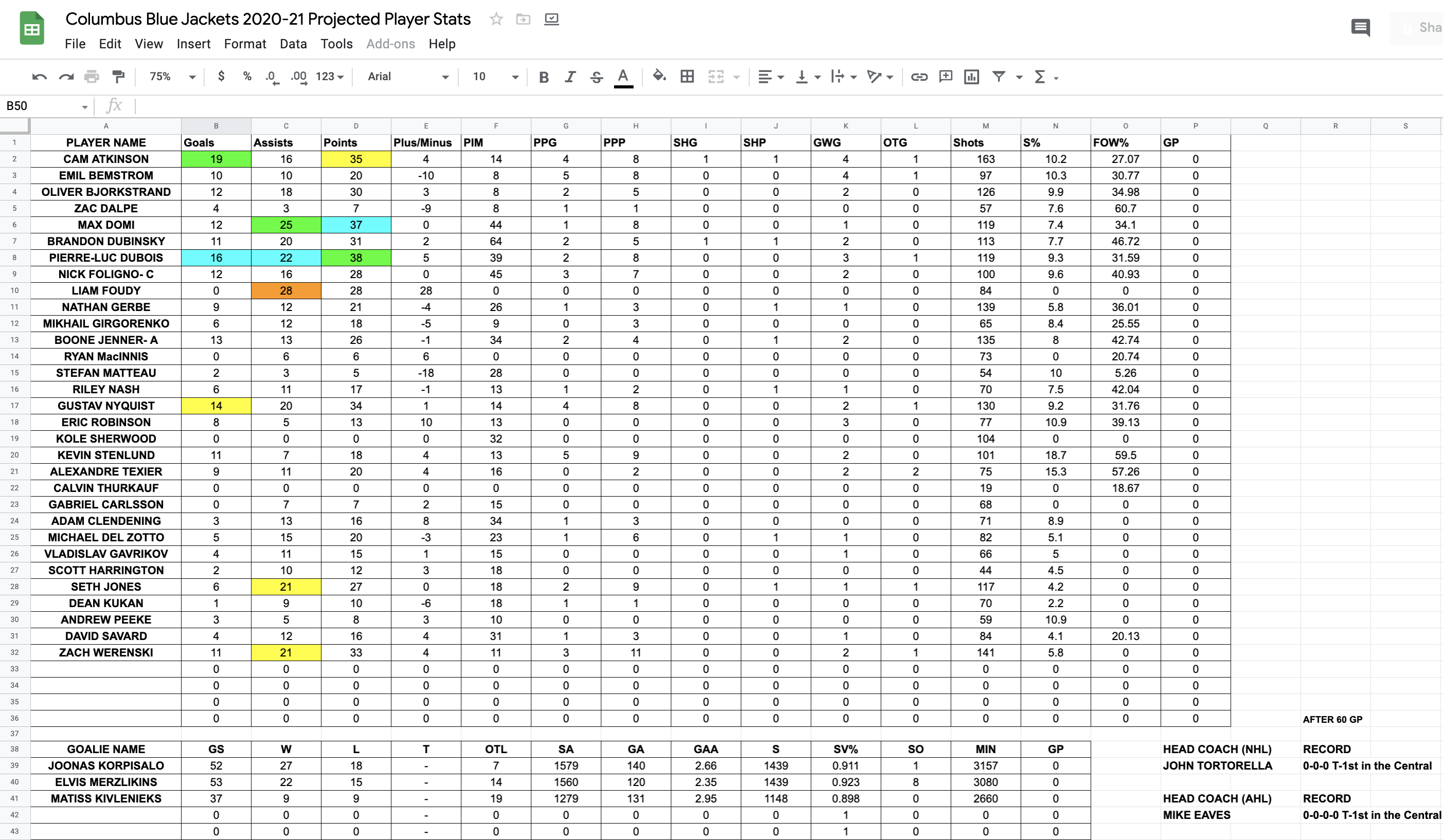
    Young players that have had minimal NHL experience may also reflect “inflated” results– Liam Foudy’s forecasted assists entering the 2020-21 season has been highlighted for this reason.

    Entering this season, he had only been part of two career NHL games and had one assist in that span. The forecasting function accounts for a player’s entire career and does some mathematics to come up with something over a predetermined number of games for the upcoming season (in this year’s case, 56).

    In other words, Foudy’s forecast after 20 team games played should look a bit more “realistic”, for the lack of a better term.

    A forecast is not the same as predicting pace.

    Foudy has three assists in 12 games played in 2020-21, for example, and is forecasted to finish with about 11 on the season, whereas he is currently on pace for about eight helpers.

    There are numerous variables that can, and will, impact a players’ performance throughout the year, including injuries, being a healthy scratch (or on the taxi squad), other American Hockey League related or waiver related transactions, sickness, COVID protocol, suspensions and general superstitions related to individual routines, beliefs, etc. (getting enough sleep before a game, wearing a certain lucky tie, using the same undershirt or shoulder pads for the last 13 years or whatever).

    Players can get “hot” or “cold” at any point.

    It’s not something that can be accounted for in a numerical forecast that sets aside the “eye test” until you try to figure out the nuances of how or why a player is playing the way they are playing.

    In a perfect timeline, this forecast pretends nothing bad could ever happen and every Blue Jackets player lives up to their expectations. In reality, some will pan out, some will exceed expectations and some will fall short for whatever reason.

    It’s an educated guess for an outcome in a sport that’s highly unpredictable due to its collectivistic nature and sheer puck luck.


    Columbus Blue Jackets Forecast Through 0 Games (56 Games Remaining)

    First up, let’s take a look at how things were expected to go coming into the 2020-21 season.

    Prior to being traded to the Winnipeg Jets for Patrik Laine and Jack Roslovic, Dubois was forecasted to lead Columbus in scoring with 16-22–38 totals this season.

    New acquisition, Max Domi, was forecasted as a close second to Dubois with 37 points– leading the team in assists in the process with 25 (among NHL regulars last season, since Foudy technically was forecasted to lead in assists among Blue Jackets with 28).

    Of course, Dubois was traded and Laine and Roslovic are off to hot starts with Columbus– scoring goals in bunches when they find the scoresheet, it seems. We’ll get to that in a minute.

    Cam Atkinson was forecasted to score 19 goals prior to the start of the 2020-21 season, which leads Dubois’ 16 forecasted goals and Gustav Nyquist’s 14 forecasted goals on the roster.

    Dubois, of course, was traded and Nyquist is out due to injury for most of this season, so… that checks out.

    On defense, Zach Werenski and Seth Jones were expected to continue to lead with the way with 33 and 27 points, respectively, from the blue line.

    Both defenders are expected to amass 21 assists this season– good enough for the third most forecasted among Blue Jackets skaters entering this season.

    In the crease, John Tortorella will have to find the right balance between Joonas Korpisalo and Elvis Merzlikins.

    There’s potential for a really solid goaltending duo in Columbus if Korpisalo is the starter and can best his 2.66 forecasted goals against average, as well as his forecasted .911 save percentage, while Merzlikins manages to find a way to reach his 2.35 forecasted GAA and .923 forecasted SV%.

    Of course, after 20 team games played, Merzlikins is currently out with an upper body injury, so time will tell if he can return to form.

    Columbus Blue Jackets Forecast Through 20 Games (36 Games Remaining)

    Through 20 games of the 2020-21 season, the Blue Jackets are three points outside of the last playoff spot in the Discover NHL Central Division, trailing the Chicago Blackhawks for this season’s 4th place cutoff line.

    The acquisition of Laine and Roslovic have been quite a welcome sight for Columbus fans, though consistency from the rest of the lineup remains to be an issue.

    Laine, however, is currently forecasted to lead the team in goals (26) and points (46), while Roslovic is on track for 10-17–27 totals, which is about what he had in 71 games with the Jets last season (29 points).

    Using the current forecasted totals, Roslovic is on track for about .551 points per game this season. He had .408 points per game with Winnipeg in 2019-20.

    Atkinson remains in the top-three in scoring, trailing Laine in goals and points with 20 forecasted goals and 39 forecasted points, respectively, while Oliver Bjorkstrand is currently forecasted to amass 15-21–36 totals (the third most on the current roster).

    On the blue line, Jones leads the way among defenders in points (32), as well as all skaters in assists with 27 forecasted assists through 20 team games played in the 2020-21 season.

    Werenski is more in line with what you’d expect from a young defender of his caliber (8-16–24 forecasted totals) and has missed time due to injury, so that’s clearly a factor in his forecasted drop from before the season began to now.

    In the crease, Korpisalo is sure to get more starts than Merzlikins as the latter is currently injured.

    Korpisalo’s current forecast yields a goals against average between 2.59-2.63, while Merzlikins is on track for a 2.29-2.33 in however many games he ends up getting.

    Why the range in GAA?

    That’s new for this season.

    It’s just to show a range between what the forecasted total is according to the model and what the adjusted forecast shows (calculated based on the forecasted goals allowed/forecasted minutes multiplied by 60, as one would traditionally do with goals allowed/minutes played multiplied by 60 to determine GAA).

    I’m no statistician and I felt like there might be a way to try to get a better read on how things are going for goaltenders (with or without enough necessary data to yield a “realistic” result).

    Don’t make any bets using only this forecast. If you’re a professional, you probably already know that.

    Anyway, Korpisalo has a forecasted range between .912 and .913 in save percentage through 20 team games played and Merzlikins is on track for between a .923 and a .924 in SV%.

    Again, a similar principle applies here.

    One end of the range is the straight up forecast, while the other is influenced by forecasted saves/forecasted shots against.

    Well, that does it for this forecast. Tune in after 40 team games played to see how things might go down the stretch (the final 16 games this season).

  • Vegas Golden Knights 2019-20 Season Preview

    Vegas Golden Knights

    43-32-7, 93 points, 3rd in the Pacific Division

    Eliminated in the First Round by San Jose

    Additions: F Patrick Brown, F Tyrell Goulbourne, F Nicolas Roy (acquired from CAR), D Brett Lernout, D Jaycob Megna, G Garret Sparks (acquired from TOR)

    Subtractions: F Pierre-Edouard Bellemare (signed with COL), F Ryan Carpenter (signed with CHI), F Daniel Carr (signed with NSH), F David Clarkson (traded to TOR), F Alex Gallant (signed with Stockton, AHL), F Nikita Gusev (traded to NJD), F Erik Haula (traded to CAR), F Tomas Hyka (KHL), F Tobias Lindberg (SHL), F Brooks Macek (KHL), F Stefan Matteau (signed with Cleveland, AHL), F Teemu Pulkkinen (KHL), F T.J. Tynan (signed with COL), D Philip Holm (signed with CHI), D Zachary Leslie (signed with Stockton, AHL), D Colin Miller (traded to BUF), G Zach Fucale (signed with TBL), G Maxime Lagace (signed with BOS)

    Still Unsigned: D Griffin Reinhart

    Re-signed: F Tomas Nosek, F Brandon Pirri, D Jake Bischoff, D Deryk Engelland, G Malcolm Subban

    Offseason Analysis: Entering their third season in existence, the Vegas Golden Knights are looking to avenge a colossal collapse in Game 7 of their First Round matchup with San Jose Sharks.

    To do so, Vegas needed to improve their special teams and ensure fans that their penalty kill won’t allow four unanswered goals on a major penalty this time around.

    Whether or not they actually did remains to be seen.

    The Golden Knights are tight against the salary cap with $1,025,001 to work with after trading some key components to their roster depth this offseason.

    While George McPhee was still in charge as General Manager, Vegas shipped Erik Haula to the Carolina Hurricanes on June 27th for Nicolas Roy and a conditional 2021 5th round pick.

    If Haula is on Carolina’s roster past this season or if the Hurricanes trade him for a player, multiple draft picks or a draft pick in any of the rounds 1-5, then the Golden Knights receive the 5th round pick.

    McPhee followed up his cap clearing maneuvers by sending defender, Colin Miller, to the Buffalo Sabres the following day for a 2021 2nd round pick (originally belonging to the St. Louis Blues) and a 2022 5th round pick.

    Miller’s play in Vegas took a step backwards last season to the point that he was a non-factor. While he remains top-six NHL defender status in the league, the Sabres are the fourth organization that he’s been with since being drafted by the Los Angeles Kings 151st overall in the 5th round of the 2012 NHL Draft.

    He’s in demand, but he’s also a commodity.

    The Golden Knights helped the Toronto Maple Leafs make some much need cap space on July 23rd by sending the Leafs David Clarkson’s contract and a 2020 4th round pick in exchange for backup goaltender (who will likely start the season with the Chicago Wolves, AHL), Garret Sparks, on July 23rd.

    Less than a week later, Vegas shipped Nikita Gusev’s signing rights to the New Jersey Devils for a 2020 3rd round pick and a 2021 2nd round pick on July 29th.

    In the meantime, McPhee signed William Karlsson to an eight-year contract with a $5.900 million cap hit per season. Not bad, not bad at all.

    Karlsson scored 43 goals in Vegas’ first season, but only had 24 goals last season.

    As was announced in the spring, McPhee handed the GM reigns over to Kelly McCrimmon as both members of the Golden Knights’ front office were promoted effective Sept. 1st.

    With much of the roster from last season back for another year, the question isn’t what can Gerard Gallant inspire his players to do this season, but rather, can Vegas’ goaltending provide enough of a balance in work load for Marc-Andre Fleury while the rest of the team prevents themselves from getting behind the eight-ball?

    Owner Bill Foley hopes that the third time’s a charm as he laid out instructions– before the organization even had a name– to win the Stanley Cup in the franchise’s third season of existence.

    Offseason Grade: C+

    Signing Karlsson at an affordable price as long as he remains a 50-60 point player, while capitalizing on better than normal returns for expandable parts in the salary cap era have left the Golden Knights with a slightly above average offseason by all standards.

    That said, if Vegas doesn’t make a deep playoff run in 2020, it’s important to note just how close they’ve set themselves up for being irrelevant one way or another as a playoff team or a bubble team until they sort their laundry (salary cap space).

  • Vegas Golden Knights 2018-19 Forecast Through 62 Games

    Coming off a 3-2 shootout loss to the Boston Bruins on Wednesday, the Vegas Golden Knights (32-25-5, 69 points, 3rd in the Pacific Division) have 20 games remaining in the 2018-19 regular season.

    These aren’t your father’s Golden Knights, as production is down from their inaugural season in just their 2nd season of existence.

    Though Marc-Andre Fleury (29-18-5 record, 2.60 goals against average, .908 save percentage in 52 games played) remains Vegas’ starter on an almost nightly basis, backup goaltender, Malcolm Subban (3-6-0, 2.76 GAA, .912 SV% in 10 GP) has struggled to carry his own weight.

    Despite bringing in Paul Stastny via free agency and Max Pacioretty via trade, the Golden Knights haven’t been immune to the injury bug this season.

    Stastny and Pacioretty themselves have joined Reilly Smith and others throughout the lineup on the injured reserve or out of playing action for various points of the season.

    While the Pacific Division title might be out of reach for Vegas this season, a divisional spot in the 2019 Stanley Cup Playoffs is all but assured as long as the floor doesn’t fallout from underneath Gerard Gallant and his players.

    Of note, the Arizona Coyotes are emerging once again with a late season push for the playoffs– and this time around, they’re doing it without their starting goaltender, Antti Raanta (out for the season due to injury).

    Plus the Vancouver Canucks are still in contention and, well, that’s about it, realistically among Pacific Division teams that still have a chance for the last divisional spot and/or a Western Conference wild card berth.

    Anyway, back to the Golden Knights.

    Here’s a look at the latest Vegas forecast– keeping in mind there are many variables that can and will effect the final outcome, such as injuries and/or being called up, assigned, traded, lucky or unlucky.

    This forecast is just an educated guess. It’s a glimpse of what could be or could’ve been by the end of the regular season.

    As always, my degree is in communication– not math– and hockey is naturally steeped in context and holistic unpredictability. Nothing can account for sheer puck luck, the odd bounce or a blown call.

    If a player reaches the expected outcome, they’ve met expectations. If said player exceeds the forecasted stats, they’ve exceeded expectations (naturally). Of course, if a player does not perform, then they did not live up to expectations.

    On a game-to-game basis, whatever’s on the scoresheet can indicate general trends that can be further broken down into an educated forecast.

    At best, it’s a guess. At worst, well, it doesn’t really matter– it’s not like Golden Knights General Manager George McPhee is reading this and making his roster decisions based on what’s here, right?

    If he is, I’d like a job, please. Thanks.

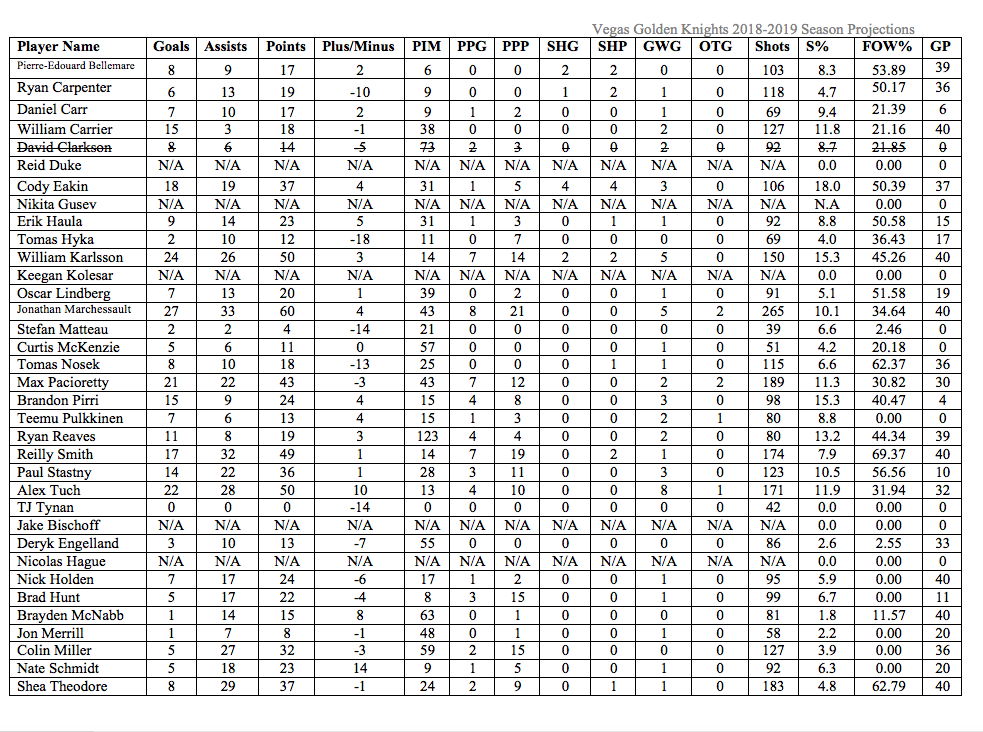
    Vegas Golden Knights Forecast Through 62 Games (20 Games Remaining)
    WordPress, when are you going to make the ”gallery” option again (and actually make it good like how it used to be)?

    Among forwards, Vegas’ consistent first line last season of Jonathan Marchessault, William Karlsson and Smith hasn’t had as much consistent luck and skill this season.

    Though Smith has battled injury this season, Marchessault remains one of the Golden Knights most consistent performers expected to lead his team in goals (25) and points (54) with 25-29–54 expected totals.

    Now what about Karlsson?

    Good question, what about him? Things haven’t gone exactly as planned in terms of capitalizing on his breakout season last season with a new contract in the offseason and higher expectations for this season.

    Karlsson’s bridge, one-year, extension last summer coming off the backs of a 43-goal season has only managed 18 goals thus far– including four goals in the last 22 games for the Golden Knights.

    Given his current trend, Karlsson is expected to amass 21-23–44 totals. He’d be tied with Pacioretty for 2nd place in expected goals (21) and 3rd in expected points (44) on the roster, but nowhere near the emergent star in the making that he was last season.

    While he very well could bounce back– similar to Smith in nature, following a good-year, bad-year, good-year, bad-year pattern– the phrase “what have you done for me yesterday” won’t help him in his next contract negotiation this summer unless McPhee gives him the benefit of the doubt.

    Meanwhile, Alex Tuch is expected to finish the season with a career-high 20-33–53 expected totals.

    That’s comforting to hear for a team that needs to rely on secondary scoring in the midst of a recession in primary production.

    Tuch is expected to lead in assists (33), followed by Smith (30) and Marchessault (29), while Marchessault is destined to lead in points (54) over Tuch (53) and Karlsson (44).

    On defense, Vegas’ blue line will finish off the season being led by Shea Theodore (11-21–32 expected totals), followed by Colin Miller (30 expected points) and Nate Schmidt (25 expected points despite missing the first 20 games of the season while serving a suspension for testing positive for a performance enhancing drug).

    In net, Fleury looks like he’s bound to break under the weight of all the minutes he’s been playing and will play this season. A 2.74 expected GAA and .909 expected SV% is not starting goaltender material, unless we’re talking about Sergei Bobrovsky with the Columbus Blue Jackets or something.

    But it’s not like Gallant can really count on his current backup to offset some of Fleury’s load. Subban’s expected 2.70 GAA and .912 SV% isn’t tremendous either.

    If anything, it’s an indication that McPhee could help bolster his team with the acquisition of an extra goaltender by the trade deadline.

    Someone like Ryan Miller, 38-years-old, could help steal some crucial points for the Golden Knights down the stretch if the San Jose Sharks aren’t already in the process of completing a trade for the goaltender with the Anaheim Ducks.

    Growing pains are a fact of life– especially in sports– and Vegas is going through puberty already in its 2nd season. This season’s been full of highs, lows and awkward phases that hopefully will end in a glow up.

    Otherwise we’ll all be looking back at this season shaking our heads at how it could pull off that much denim or something back in the day.

  • Vegas Golden Knights Forecast Through 40 Games

    It’s not the most recent forecast, since the Vegas Golden Knights played Game 41 of their 2018-19 regular season on Saturday against the Los Angeles Kings.

    Nevertheless, it’s time to take a quick check of the pulse of the Golden Knights– how their season has progressed so far and where it appears to be going from here.

    Thanks to some extenuating circumstances, perhaps Vegas fans will forgive me for not being able to get around to their quick forecasted glance after 20 games played this season.

    Why? Because it would’ve been pretty dismal and you don’t need that kind of negativity in your life.

    Although, now at the halfway mark (officially after the game against the Kings, technically unofficially as of this forecast), things have improved, but with a few concerns remaining.

    Nate Schmidt served his 20 game suspension for a performance enhancing drug and for the most part, Vegas’ blue line got the job done.

    The team’s record wasn’t desirable, but guys like Shea Theodore and Colin Miller continued to rise past expectations in their ability– even more so now that Schmidt is back and solidified the defensive zone for the Golden Knights.

    One thing that has plagued the team all season is subpar goaltending.

    Marc-Andre Fleury isn’t getting any younger and Malcolm Subban regressed quite a bit from his debut season as a backup netminder at the NHL level last season.

    Managing playing time in the crease is something to keep in mind and we’ll take a closer look in a minute.

    For now, Vegas stands in a divisional spot in the playoffs in the Pacific. Not nearly as dominant as last season, but keeping up with the legitimate(?) playoff contenders in an otherwise weaker division compared to the rest of the league.

    Without further ado, here’s a look at the remaining 42 games (now 41) on the season and what to expect from the latest forecast.

    Keep in mind, there are many variables that can and will change what goes down from now through the end of the regular season in April, like trades, injuries, general lineup changes, roster moves and anything else unbeknownst to the Microsoft Excel spreadsheet that generates this forecast.

    My degree is in communication– not math. It’s “not my fault”.

    If a player meets the forecasted stats, then they’ve met expectations. If they exceed their forecasted stats, then they’ve exceed expectations.

    And of course, if a player does not live up to the latest forecast, then something went awry (the player could’ve been injured, been unlucky or regressed– a.k.a. didn’t meet expectations).

    Puck luck cannot be predicted, but general trends and estimated gut feelings can indicate a sense of what’s to come based on the results of each and every scoresheet night-in and night-out.

    Vegas Golden Knights Forecast Through 40 Games (42 Games Remaining)

    (Just click on the image if you’re having trouble seeing it– WordPress changed their layout so there’s no more slideshow options.)

    Every set of blessings comes with a set of curses and this year, that rings truer more than ever before for the Golden Knights. Of course, it’s only their second season in franchise history, but it’s still true.

    William Karlsson (24-26–50 expected totals) is having a “down” year compared to last season’s breakout career-year of 43 goals and 35 assists (78 points). Reaching the 50-point plateau is still respectable, but doesn’t scream any guarantees of being on the first line should the postseason roll around.

    Head coach, Gerard Gallant, has enough top-six forward depth to play around with if Karlsson starts to head south, considering Alex Tuch‘s expected 22-28–50 totals, Paul Stastny‘s expected 14-22–36 totals and Max Pacioretty‘s expected 21-22–43 totals.

    Despite the ever-consistent qualities of Jonathan Marchessault (27-33–60 expected totals) and Reilly Smith (17-32–49 expected totals), this year’s Golden Knights team point spread is more spread out.

    As it is, while Marchessault should lead in goals (27), assists (30) and points (60) and Karlsson should be second in goals (24) and points (50), one would think Smith would be second or third in whatever stats Marchessault and Karlsson aren’t leading in.

    However, Tuch’s expected point outcome (50) is tied with Karlsson for the second-most points behind Marchessault and Tuch is expected to rank third on Vegas’ roster in goals behind Marchessault and Karlsson with Smith a distant 5th behind Pacioretty’s 21 expected goals this season.

    While the offense isn’t as impactful from the forwards, the blue line has really come into its own in Vegas.

    Shea Theodore’s expected 8-29–37 totals will be the best of his teammates and fellow defenders in a Golden Knights uniform, leading Colin Miller (5-27–32 expected totals) and Nick Holden (7-17–24 expected totals).

    Nick Holden. That’s right. Holden is ahead of Nate Schmidt (5-18–23 expected totals) in the latest forecast.

    But that speaks to Holden’s resiliency in his career and the chemistry Gallant has found in his pairing every night– coupled, of course, with the fact that Holden is seeing more time on the ice (in the literal “games played” sense) than he has the last couple of seasons with the New York Rangers and Boston Bruins.

    He is a durable top-four defender that’s still in his athletic prime and it is exactly that kind of depth that can take teams deep into a Stanley Cup Final run.

    In goal, Marc-Andre Fleury should land around a 2.61 goals against average and .911 save percentage in a season in which he has been overworked thus far.

    He will continue to be overworked unless Malcolm Subban regains his footing, Gallant argues for calling someone up from the Chicago Wolves (AHL) or Golden Knights General Manager George McPhee makes an acquisition for a suitable backup option if all else fails.

    Fleury has played in 35 of the 40 games up to this forecast. He’s since played in 35 out of the 41 games played by the club this season.

    Subban has played in six games and is 0-5-0 in that span. His expected outcomes are a 2.76 GAA and .907 SV%– both below average goaltending the backup role.

    Whereas if Vegas wanted to try Oscar Dansk or Maxime Lagace without the pressures of coming into the dressing room in an emergency recall situation– unlike last season– a little healthy competition for the backup role might nudge Subban in the right direction and take off some of Fleury’s workload.

    It’s not that Fleury can’t handle 50-plus games anymore as a starting goaltender, but rather, it’s just that he shouldn’t be relied on for about 85% of the games in the regular season as is his current going rate.

  • Vegas Golden Knights 2018-19 Season Projections

    It’s forecasting season, well, actually it’s the regular season and I’m just a little behind, but until I pointed that out, you didn’t know I was behind on my little passion project here, did you?

    I know I wrote “[i]n the coming days I’ll reveal what teams I’ll be forecasting/tracking all season long, so stay tuned because it’s about to get messier than ever before and I’m up for the challenge,” in my Boston Bruins 2018-19 forecast, but life and the fact that I’m moving all my data into a new format has slowed my turnaround for the time being.

    Nevertheless, my Vegas Golden Knights forecast for 2018-19 is here and let’s pretend the first week of the regular season hasn’t already happened or something.

    Additionally, if you’re wondering what other teams I’m preparing to post (before we get too far into the first quarter of the season) they are the Carolina Hurricanes and Columbus Blue Jackets.

    I always keep tabs on the Bruins every year because I grew up a Boston fan and I decided to track Vegas last season because there hadn’t been nearly as much hype surrounding an expansion team since Columbus and the Minnesota Wild in 2000. Additionally, I’ve previously tracked the Arizona Coyotes simply because they follow us on Twitter (and I’ll get back around to them hopefully before season’s end, if you’re interested).

    But I’m adding Carolina and Columbus to my forecast portfolio this season because 1) the Hurricanes are supposed to be better than last season, plus they have some exciting youth in the lineup and 2) a lot of Blue Jackets fans are also fans of our brand around here, so shouts 5th Liners.

    Please be patient on the timeline for when I’ll get my Hurricanes and Blue Jackets forecasts posted– it’ll be by the end of the month for sure.

    Anyway, on with the Golden Knights, shall we?


    Vegas is coming off of their inaugural season having finished 1st in the Pacific Division with 109 points and a 51-24-7 record under head coach Gerard Gallant. Not only did they finish at the top of their division in their first season, but they did so with over 100 points and a 50-plus win season.

    Oh yeah and they played the Washington Capitals in the 2018 Stanley Cup Final.

    Despite the loss in five games to Washington, the Golden Knights were and still are well ahead of owner Bill Foley’s “Cup in three [seasons]” masterplan– what with General Manager George McPhee‘s offseason additions of Paul Stastny and Max Pacioretty and everything.

    This year, of course, the competition has gotten a lot tougher. There are expectations now when opponents play the Golden Knights.

    Gallant and his Vegas lineup are going to have to get more creative than ever before in franchise history to avoid the hangover of a Stanley Cup Final appearance run and to avoid getting too predictable.

    Things are different now. They’re no longer the new kids on the block. They’re the 2018 Western Conference champions and a team to beat.

    As always, I’d like to remind you my degree is in communication– not math– therefore anything that looks wrong is either adjusted with a little gut-feeling and/or Microsoft Excel’s fault. My expertise resides in the written, spoken and nonverbal language of communicating– not numbers on a spreadsheet.

    These forecasted stats are to be seen as an utopian perspective, as though nothing bad could happen this season at any point to any player– where every player at least lives up to their forecast and then some.

    Some will pan out and some will fall flat. It’s a suggested outcome for a sport that’s played on ice in a highly unpredictable collective environment of action and sheer puck luck.

    vegas_golden_knights_logo

    Vegas Golden Knights Forecast Through 0 Games (82 Games Remaining)

    This slideshow requires JavaScript.

    After a breakout 78-point season (43 goals, 35 assists) for William Karlsson, the Golden Knights number-one center is prime for a respectable 41-point season as part of the natural regression of the game– unless Karlsson is truly an outlier, like he was coming from Columbus to Vegas last season.

    Meanwhile, Reilly Smith (19-27–46 expected totals) and Jonathan Marchessault (28-35–63 expected totals) bolster the Golden Knights first line with respectable performances of their own, while the point spread has really been shared with the second line.

    Newcomers Paul Stastny (22-43–65 expected totals) and Max Pacioretty (33-30–63 expected totals) are set to become the key contributors to the fiery Vegas offense in their first season with the club.

    The Golden Knights top-six core of forwards is deeper than last season, whereas the majority of their offense was reliant upon Marchessault, Karlsson and Smith. This year there’s more emphasis on Alex Tuch and Erik Haula inside the top-nine.

    On defense, Gallant’s crew will have to do without Nate Schmidt for the first 20 games of the season while Schmidt serves a suspension for a performance enhancing drug.

    Luckily, Brad Hunt, Colin Miller and Shea Theodore are prime for an uptick in time-on-ice and production, with Hunt and Miller expected to reach the 30-point plateau, while offseason addition, Nick Holden should see a pleasant rebound from his 17 points split between the Bruins and New York Rangers last season to a 25-point effort in 2018-19 with Vegas, provided he can remain in the top-six on the depth chart.

    Upon Schmidt’s return, he should still have 4-23–27 totals from the blue line, which is not great like last season’s 5-31–36 totals, but not terrible for a top-four defender.

    In goal, Marc-Andre Fleury is expected to return to Earth from his superhuman season last year (a 2.24 goals against average and .927 save percentage in 46 games) to a 2.49 GAA and .913 SV% in 2018-19. As the Golden Knights starter continues to get older, limiting his workload to keep him fresher for the postseason is the way to go.

    Granted, Fleury’s playing time was limited last season due to a concussion, he still went on to have solid regular season numbers and an impeccable 2018 Stanley Cup Playoff run up until the Stanley Cup Final.

    Meanwhile, Malcolm Subban‘s 2.68 GAA and .910 SV% in 22 games played look to be improved upon to a 2.65 GAA and .911 SV% in somewhere around 30 appearances as the backup netminder for Vegas.

    As always, we’ll get more into the goalies once the team has played through a quarter of the season.

  • Numbers Game: Vegas Through 60

    Derick Brassard was briefly a Golden Knight. Yes, he was flipped from Ottawa to Vegas to Pittsburgh as part of Friday’s three-team trade and technically speaking, he never suited up for Vegas so it doesn’t actually count, but Brassard was once a Golden Knight.

    Now, as a result of the Brassard trade, Ryan Reaves is the newest player in Vegas.

    Through 60 games (entering Friday), the Vegas Golden Knights are still 1st in the Pacific Division. William Karlsson is in the midst of a career year, Marc-Andre Fleury and James Neal probably won’t be traded at the deadline like everyone thought they would and there’s a real possibility this whole “Cup in One” mantra actually works out.

    Thanks in part to the crazy scheduling this time of year– between the NHL, the Winter Games in PyeongChang, the upcoming trade deadline on Monday and much, much more– I was finally able to squeeze in the time to update Golden Knights projections with 22 games remaining in their schedule.

    The only problem is that they’ve now played Game 61 of 82 and added Ryan Reaves. So basically, here’s everything I had before anything that happened on Friday.

    I’ll try to come up with some projections for Reaves and any other potential acquisitions Vegas makes between now and the deadline, but there’s no promises. Every year around the deadline my database needs constant updating and as a result some things get bogged down until I physically go through every stat.

    I do get around to it (eventually) and these players will be reflected in any subsequent projection posts.

    Anyway, on with the show…

    The Golden Knights aren’t good. They’re great.

    Check out the latest forecast in the charts below. Keep in mind, as always, that anything that sounds ridiculous is Microsoft Excel’s fault. I’m just kidding. There are always outliers and unrealistic projections. Alas, these are merely utopian, Excel driven, guesses.

    Standard disclaimer, my degree is in communication– not math or #fancystats.

    vegas_golden_knights_logo

    Vegas Golden Knights Projections Through 60 Games (22 Games Remaining)

    This slideshow requires JavaScript.

    The sensational season continues and down the stretch as Erik Haula, Karlsson, Jonathan Marchessault, Neal, David Perron and Reilly Smith are all expected to amass somewhere around 60-points (or more).

    Colin Miller‘s emergence as a top defenseman in the Western Conference continues as he nears the 40-point plateau by seasons end. Also, look at Shea Theodore fitting right in as a top-4 quality defenseman just entering his prime. Miller, Nate Schmidt and Theodore for years to come in Vegas should mean many great things.

    Meanwhile, Fleury’s incredible run in goal begins to cool off just a little. His goals against average begins to reflect an “average” year for Fleury, which– granted– is still better than a lot of goaltenders in the NHL. Fleury’s save percentage should be just fine down the stretch– if not potentially league-leading.

  • Numbers Game: Vegas at Halftime (Through 41 GP in 2017-18)

    The Western Conference leading Vegas Golden Knights entered their bye week at exactly 41 games played.

    Due to an unintentional– completely accidental– oversight on my behalf, I didn’t remember to look at their stats after 40 games played (like I normally would every 20 games throughout the season). But for the perfectionists in the world out there– it’s better to split things right down the middle.

    Vegas is back in action for the second half of their inaugural season on Saturday after going 29-10-2 (60 points) in their first 41 games in franchise history.

    Earlier in the week, I pointed out that the New Jersey Devils have been quite a pleasant surprise this season. Of course, I made sure to mention the Golden Knights as one of the other pleasant surprises.

    It’s not that nobody expected this team to fail as much as all the other expansion teams in the 100-year history of the league.

    Given the talent pool to choose from and the overall development of professional hockey players/the league itself since the 1990s (it’s a younger, faster, game where great players last well into their 30s and good players are buried in the AHL or playing overseas by the time they’re 30-35 years old), it really shouldn’t surprise anyone that the Golden Knights are at the very least, a competitive– young– team.

    Even still, it’s been quite the euphoric ride.

    A team that poached the Florida Panthers– and many others– at the 2017 Expansion Draft, laid the foundation in 50-plus point scorer, Jon Marchessault, let alone with three-time Stanley Cup champion goaltender, Marc-Andre Fleury. Surely they would have some highlights in their first season.

    Nobody could’ve imagined that same team would be seriously considering keeping Fleury or a guy like James Neal at the trade deadline in the midst of what could shape up to be a long playoff run in their first season, but alas, here we are.

    It’s more than just “Real Deal” James Neal in Sin City. The Golden Knights are the real deal.

    And their forecasted stats for the remaining half of the regular season show it. Though now is about the time where I make sure to mention one little standard disclaimer– my degree is in communication– not math– so any miscalculations or accolades that seem nearly impossible to ascertain are Microsoft Excel’s fault.

    vegas_golden_knights_logo

    Vegas Golden Knights Projections Through 41 Games (41 Games Remaining)

    This slideshow requires JavaScript.

    Simply put, Erik Haula (26-24–50 expected totals), William Karlsson (32-23–55 expected totals) and Marchessault (30-38–68 expected totals) are blazing through the rest of the league and showing no signs of flaming out any time soon.

    It certainly helps that Neal and David Perron are both expected to reach the 60-point plateau, with Reilly Smith not so far behind amassing 19-38–57 expected totals.

    On defense, Deryk Engelland, Colin Miller, Nate Schmidt and Shea Theodore have been leading the charge from the blue line all season long. For Engelland, the adopted son of Las Vegas, a revitalized season defending the league’s newest team might just keep him playing in his backyard for longer than just this season.

    Miller and Schmidt were expected to take on more pronounced top-4 roles with the expectation that at least one of them would develop into a surefire top-2 shutdown defenseman. Miller should max out around 40 points, while Schmidt should put up a cool 30-point season in his first year outside of the United States capital.

    After being sent to the AHL early on in the season, Shea Theodore was only motivated to work harder.

    It wasn’t that he was not desired by an NHL team as clearly Vegas saw value in his game at the Expansion Draft, claiming Theodore from the Anaheim Ducks. Now that the Golden Knights front office and coaches have righted their wrong, Theodore could very well put up 24 points on the season in what is– by all means– a breakout season for the defenseman entering his prime.

    In the net, the Golden Knights have been spectacular. Not only has general manager, George McPhee, come away looking even more like the genius that he already is, but Vegas is stacked at depth in the crease.

    Malcolm Subban‘s playing like a backup that’s capable of taking on a starting role. That’ll be something to keep an eye on, given Fleury’s aging out of his prime– though he has yet to show it. It’s not often that a team has the right pieces to play two goalies almost equally in minutes and be successful.

    In 2011, the Boston Bruins rode the backs of Tim Thomas and Tuukka Rask to the Stanley Cup Final. Interestingly enough, the Vancouver Canucks did the same with Roberto Luongo and Cory Schneider.

    Thomas played his last game as a Bruin in 2012. Luongo was traded by the Canucks in 2014– a year after Vancouver dumped Schneider in New Jersey.

    Two tremendous goalies are better than one from a team record standpoint, but at some point general managers are either forced with a difficult decision due to the salary cap or fall into the fallacy that is the “there can only be one” mantra.

    And Gerard Gallant might end up with some tough decisions down the stretch regarding who to start each night, reminiscent of Mike Sullivan‘s Fleury-Matt Murray swapping during en route to Pittsburgh’s 2016 and 2017 Stanley Cup championships.

    Nonetheless, Oscar Dansk filled in flawlessly when Fleury and Subban were out of the lineup with injuries. Meanwhile, Maxime Lagace performed on another level shortly after Dansk’s introduction to the game when Dansk went down himself due to injury.

    With enough depth in goal to try to get something good in return, the ball is in Vegas’s court as the trade deadline approaches. Though the Golden Knights don’t have to rush things. A little competition for every goaltending job isn’t always a bad thing.

    Being in first place in the Western Conference isn’t good enough for the Golden Knights. They’ve got their sights set even higher, like on a 2018 Stanley Cup Final run, for instance.

    Sin City is looking to shine like gold. Vegas wants the Cup.