Tag: Seth Jones

  • Grzelcyk ensures overtime victory for Bruins on the road in Chicago

    Grzelcyk ensures overtime victory for Bruins on the road in Chicago

    Matt Grzelcyk ended a 21-game goal-scoring drought with his game-winning goal in overtime as the Boston Bruins beat Chicago, 2-1, Tuesday night at United Center.

    Linus Ullmark (18-9-2, 2.75 goals-against average, .908 save percentage in 30 games played) made 19 saves on 20 shots against in the win for the Bruins.

    Chicago netminder, Marc-Andre Fleury (19-20-5, 2.85 goals-against average, .909 save percentage in 44 games played), turned aside 46 out of 48 shots faced in the overtime loss.

    Boston improved to 37-18-5 (79 points) on the season and remain in command of 4th place in the Atlantic Division, as well as the first wild card spot in the Eastern Conference.

    The Bruins are also two points behind the Toronto Maple Leafs for the 3rd in the Atlantic.

    Chicago fell to 22-30-9 overall (53 points) and stuck in 7th place in the Central Division as a result of the overtime loss.

    With the win on Tuesday, Boston swept Chicago 2-0-0 in their 2021-22 regular season series after last meeting in 2019-20, when the Bruins went 1-0-1 against Chicago.

    The B’s were without Jakub Zboril (right ACL) and Urho Vaakanainen (undisclosed) on Tuesday, while head coach, Bruce Cassidy, made no changes to his lineup from Saturday night’s, 3-2, victory against the Arizona Coyotes to Tuesday night’s action in Chicago.

    Nick Foligno suited up for his 1,000th career National Hockey League game– becoming the 364th player in league history to do so and the second father-son duo, as well, since Mike Foligno’s NHL career spanned 1,018 games.

    Foligno’s younger brother, Marcus, has played in 658 games entering Tuesday split between the Buffalo Sabres and Minnesota Wild.

    Nick, meanwhile, has played in 351 games with the Ottawa Senators, 599 games with the Columbus Blue Jackets, seven games with the Toronto Maple Leafs and 43 games with the Bruins so far.

    Boston announced that they’d honor Foligno for his 1,000th career NHL game on April 2nd prior to their matchup against the Blue Jackets at TD Garden.

    Meanwhile, Tuesday night in Chicago, Jack Ahcan and Anton Blidh served as healthy scratches for the Bruins.

    Before scoring the game-winning goal Tuesday night, Grzelcyk was penalized for interference at 5:02 of the first period and presented Chicago with the first power play opportunity of the game.

    Chicago did not convert on the ensuing skater advantage, however, and followed up with a penalty of their own when Dylan Strome tripped Brad Marchand– giving Boston their first chance on the power play at 10:26.

    Entering the first intermission, however, the score remained tied, 0-0, despite the Bruins outshooting Chicago, 14-4.

    Chicago held the advantage in blocked shots (3-1) and giveaways (4-2), while the B’s led in takeaways (4-3), hits (15-11) and faceoff win percentage (59-41).

    Both teams were 0/1 on the power play heading into the middle frame.

    Patrick Kane caught Charlie McAvoy with a high stick and gave Boston another chance on the skater advantage at 3:05 of the second period, but once again the Bruins’ power play was powerless.

    Late in the period, Sam Lafferty cut a rut to the sin bin for interference at 16:22, but Boston followed their power play with a penalty kill of their own when Mike Reilly tripped Brandon Hagel at 19:15.

    Chicago failed to capitalize on their skater advantage, which extended into the final frame of regulation as the horn signaled the end of the second period and the commencement of the second intermission.

    The score was still, 0-0, despite the Bruins outshooting Chicago, 35-11, including, 21-7, in the second period alone.

    Boston held the advantage in takeaways (7-6), giveaways (6-4), hits (22-20) and faceoff win% (56-44), while Chicago led in blocked shots (10-7).

    Chicago was 0/2 on the power play, while the B’s were 0/3 on the skater advantage through 40 minutes of action.

    Calvin de Haan tripped Curtis Lazar and presented Boston with their fourth power play opportunity of the game at 2:34 of the third period, but the Bruins couldn’t muster a shot past Fleury while on the advantage.

    Instead, however, the B’s caught Chicago in the vulnerable minute after special teams play, as Marchand picked a rebound out of the air after Fleury swatted the puck away from the crease– that’s when Patrice Bergeron (17) ultimately came in and cleaned up the home run– batting the puck into the twine from mid-air after Marchand kept it free.

    Marchand (35) and Taylor Hall (31) notched the assists as the Bruins took a, 1-0, lead at 4:43 of the third period.

    Hall briefly received some glue on the bench after catching a close shave by a skate in the scramble in front of the net in the lead-up to Bergeron’s goal.

    Moments later, despite scoring first, Boston couldn’t hold onto the momentum as Chicago led a charge into their attacking zone and worked the puck around until Caleb Jones sent a shot from the point to the slot where Hagel (21) tipped the rubber biscuit past Ullmark.

    Jones (8) and Jake McCabe (12) tallied the assists as Chicago tied the game, 1-1, at 9:36 of the third period.

    Late in the period, the Bruins thought they scored a beautiful goal as Charlie Coyle followed a rebound with a spin-o-rama shot past Fleury’s glove side while crashing the net, but the would-be go-ahead goal was immediately waved off for incidental goaltender intererence.

    The only problem was that– despite Craig Smith’s net front presence– there was no overt goaltender interference to be seen within reason to believe that there had, in fact, been an infraction prior to the goal.

    Thus, Cassidy used a coach’s challenge on the basis that there was not enough evidence to support the call on the ice and it should therefore be overturned as Chicago’s own defender, Riley Stillman, had knocked over his own goaltender and Smith battled someone in front of the crease– barely getting his skate into the blue paint on the opposite side from where Fleury was standing.

    No, apparently that meant nothing in the long run– or rather, perhaps that’s why the on-ice officials made the call in the first place because it was reminiscent of the controversial conclusion to the 1999 Stanley Cup Final.

    Ask any Buffalo Sabres fan if Brett Hull’s foot was in the crease and then ask any Dallas Stars fan if Hull’s foot even mattered, I’ll wait.

    Meanwhile in Chicago, Cassidy’s challenge was no good and the call on the ice stood as “no goal”.

    As a result, Boston was assessed a bench minor for delay of game at 15:13 of the third period with Smith sent across the sheet of ice to the box to serve the penalty.

    The Bruins managed to make the kill and in the closing minutes of regulation had a couple quality chances turned aside by Fleury– necessitating overtime (at the very least) to determine a winner.

    After 60 minutes of action, the two teams were tied, 1-1, despite the B’s outshooting Chicago, 46-20, overall– including an, 11-9, advantage in the third period alone.

    Boston held the advantage in giveaways (8-7) and faceoff win% (52-48), while Chicago led in blocked shots (18-14) and hits (29-28).

    Both teams had nine takeaways each.

    As there were no penalties called in overtime, Chicago finished the night 0/3 on the power play, while Boston went 0/4.

    In overtime, Cassidy started Bergeron, Marchand and McAvoy for Boston, while Derek King countered with Jonathan Toews, Hagel and Seth Jones for Chicago.

    The two teams skated up and down the ice a couple times before the Bruins controlled possession in the attacking zone.

    Hall faked retreating back into the neutral zone for a different play and sent a pass over to David Pastrnak at the point before Pastrnak dropped the puck back to Hall, whereby Hall pushed towards the net as Kane and Alex DeBrincat bought what Hall was originally selling and chased after Pastrnak.

    Hall then worked a pass to Grzelcyk through the slot while Chicago’s only defender tried to block the passing lane, but Grzelcyk (3) settled the puck on a catch and release blast before wiring it behind Fleury for the game-winning goal at 1:40 of the overtime period.

    Hall (32) and Pastrnak (28) had the assists on Grzelcyk’s goal– giving Hall two assists on the night and the 400th of his NHL career as a result.

    With the, 2-1, overtime win, the B’s improved to 10-1-1 in their last 12 games and left United Center leading in shots on goal, 48-20, including a, 2-0, advantage in the extra frame.

    Boston also left the ice leading in blocked shots (19-14), giveaways (9-8) and faceoff win% (52-48), while Chicago exited their own building leading in hits (30-28).

    The Bruins improved to 5-3 in overtime this season and 7-5 overall past regulation, while Chicago dropped to 4-7 in the extra frame and 6-9 past 60 minutes in 2021-22.

    Boston also improved to 10-5-2 (6-2-1 on the road) when tied after the first period, 8-3-0 (3-2-0 on the road) when tied after the second period and 27-7-2 (15-3-1 on the road) when scoring first this season.

    Chicago fell to 10-13-4 (6-10-3 at home) when tied after one, 5-3-3 (2-1-3 at home) after two and 5-24-6 (2-13-4 at home) when allowing the game’s first goal in 2021-22.

    The Bruins continue their four-game road trip (1-0-0) Wednesday night in Minnesota before venturing to Winnipeg on Friday and Montréal next Monday, which also coincides with the 2022 NHL Trade Deadline (March 21st).

    Boston returns home to host the Tampa Bay Lightning on March 24th.

  • Carolina Hurricanes 2021-22 Season Preview

    Carolina Hurricanes 2021-22 Season Preview

    2020-21 record 36-12-8, 80 points

    1st in the Discover NHL Central Division

    Eliminated in the Second Round by Tampa

    Additions: F Jesperi Kotkaniemi (signed to an offersheet, not matched by MTL), F Josh Leivo, F Maxim Letunov, F Sam Miletic, F Stefan Noesen, F Andrew Poturalski, F C.J. Smith, F Derek Stepan, D Ethan Bear (acquired from EDM), D Ian Cole, D Jalen Chatfield, D Tony DeAngelo, D Eric Gelinas, D Josh Jacobs, D Brendan Smith, G Frederik Andersen, G Alex Lyon, G Antti Raanta

    Subtractions: F Warren Foegele (traded to EDM), F Morgan Geekie (expansion, SEA), F Dave Gust (signed with Chicago Wolves, AHL), F Egor Korshkov (KHL), F Saku Maenalanen (Liiga), F Brock McGinn (signed with PIT), F Cedric Paquette (signed with MTL), F Sheldon Rempal (signed with VAN), D Jake Bean (traded to CBJ), D Jani Hakanpää (signed with DAL), D Dougie Hamilton (signed with NJD), D Rolan McKeown (signed with COL), D Joakim Ryan (SHL), D David Warsofsky (DEL), G Jonathan Bernier (rights acquired from DET, signed with NJD), G Petr Mrázek (signed with TOR), G Alex Nedeljkovic (traded to DET), G James Reimer (signed with SJS)

    Still Unsigned: F Max McCormick, F Drew Shore, G Jeremy Helvig, G Dylan Wells (acquired from EDM, CAR reserve list, AHL- Chicago Wolves)

    Re-signed: F Jordan Martinook, F Spencer Smallman, F Andrei Svechnikov, D Maxime Lajoie

    Offseason Analysis: Whoa boy, what didn’t the Canes do this offseason?

    Carolina was all over the place– both in transactions and scrambling to assemble some semblance of a message in press conferences afterward while trying to convince everyone (perhaps more so themselves, at times) that they’re still a competitive team heading in the right direction and that they totally didn’t overreact.

    Unlike how the New York Rangers reacted to one player on another team apparently dismantling their franchise, the Hurricanes reacted to– egad! The salary cap! The horror, the horror!

    Canes General Manager, Don Waddell, didn’t like the optics of a team that’s been improving in each of the last three seasons despite First Round exits in back-to-back years after making the 2019 Eastern Conference Final.

    Though owner, Tom Dundon, denies having any say in the approach to the offseason short of just signing the cheques, Carolina didn’t want to spend more than they absolutely had to on fielding a roster that can probably make the playoffs, generate some additional revenue and peter out before anyone catches Stanley Cup fever.

    At the very least, the team is spending more than when Peter Karmanos, Jr. spent from season-to-season on a team that made the postseason in 2009, then again in 2019, with nothing happening in-between, for example.

    The team didn’t have to lose both Dougie Hamilton and Alex Nedeljkovic while re-signing Andrei Svechnikov this offseason, but they did.

    Hamilton received a low-ball offer and got what he felt he deserved on a seven-year deal with the New Jersey Devils worth $9.000 million per season. Compared to the rest of the defenders on the market and other extensions that begin in 2022-23 for Seth Jones with Chicago and Zach Werenski in Columbus, Hamilton’s deal with the Devils is a steal.

    He could’ve made $10.000 or $11.000 million per season and you might say “what’s the difference of a couple million dollars” and well, everything in the sense that he’s saved New Jersey a couple million to spend on glue guys on the roster, like Tomas Tatar.

    Carolina could’ve done that, but with a few more additional steps required to make space.

    Fine, move on from Hamilton, then re-sign Nedeljkovic– oh.

    The Hurricanes were not willing to spend $3.500 million per season on a two-year deal for the goaltender they drafted and brought up the ranks as their “goaltender of the future”.

    Instead, Waddell traded him to the Detroit Red Wings for the rights to unrestricted free agent, Jonathan Bernier, who also joined Hamilton in New Jersey.

    Petr Mrázek and James Reimer were both turned loose as the former went to the Toronto Maple Leafs and the latter joined the San Jose Sharks.

    Waddell then signed Frederik Andersen– who’s had about as much playoff success as Nedeljkovic, regardless of the number of games played– to a two-year deal worth $4.500 million per season and Antti Raanta to a two-year contract worth $2.000 million per season.

    Make it make sense.

    Add to that, Carolina lost depth in the departure of Brock McGinn to the Pittsburgh Penguins via free agency and traded Jake Bean to the Columbus Blue Jackets at the draft.

    In their place, enter a mixture of bottom-six talent in Derek Stepan, Josh Leivo and others, as well as bottom-six defenders in Tony DeAngelo and Brendan Smith.

    At the very least, Carolina’s not spending much to “replace” what they’ve lost in an asset for asset sense.

    They spent their money on goaltenders, an eight-year extension worth $7.750 million per season for Svechnikov and signed Jesperi Kotkaniemi to an offer sheet from the Montréal Canadiens for one-year at $6.100 million.

    That makes up for signing DeAngelo to a one-year, $1.000 million contract, right?

    Not even close.

    Last year’s roster carried the threat of Hamilton, Jaccob Slavin, Brett Pesce, Brady Skjei, Bean and Haydn Fleury until he was traded for Jani Hakanpää at the 2021 deadline.

    Only three defenders are returning to Carolina’s core on the blue line as Ian Cole, DeAngelo and Smith were brought in via free agency and Warren Foegele was dealt for Ethan Bear.

    Oh and the same three defenders returning from last season are the only defenders under contract through next season.

    There’s just no logic for whatever reaction– overreaction or, perhaps, under-reaction is going on here.

    It begs the question that Canes fans have heard for far too long, “what, exactly, is the plan?”

    Offseason Grade: D

    The Hurricanes had a challenging, yet simple premise heading into the offseason– add without subtracting and limit the inevitable damage in the loss of a key player.

    Instead, they chose violence (that’s a phrase kids say on Twitter these days, I’m told).

    Keeping Svechnikov, Hamilton and Nedeljkovic satisfied was going to be a challenge and it was going to be the most strenuous negotiations that Waddell would have to go through in recent summers as Carolina continues building towards Stanley Cup contenders.

    It’s likely that the Canes could’ve kept Svechnikov, Nedeljkovic and still added to the roster this offseason– whether they’d land Andersen, Raanta or someone else as a solid counterpart in the crease.

    In any case, Hamilton was likely going to walk due to the constraints of the salary cap era and possible looming extensions for Martin Necas, Nino Niederreiter, Vincent Trocheck, Jordan Staal, Teuvo Teräväinen and Sebastian Aho in one-to-three summers from now.

    After the marketing and promotions team led the way in showing the rest of the league how Pride Night could feel more like a celebration for the local fan base and not just a corporate shill– an organization that took the pledge to Get Uncomfortable by teaming up with Black Girl Hockey Club– the values of a kinder society were tossed aside in the interest of signing noted actual jerks.

    This team did not get better. No matter the rehabilitation that may or may not occur with Rod Brind’Amour as head coach.

    One step forward, two steps back.

  • Chicago Blackhawks 2021-22 Season Preview

    Chicago Blackhawks 2021-22 Season Preview

    2020-21 record 24-25-7, 55 points

    6th in the Discover NHL Central Division

    Missed the postseason for the first time since 2020

    Additions: F Tyler Johnson (acquired from TBL), F Jujhar Khaira, D Caleb Jones (acquired from EDM), D Seth Jones (acquired from CBJ), D Jake McCabe, G Marc-Andre Fleury (acquired from VGK)

    Subtractions: F Josh Dickinson (signed with Toledo Walleye, ECHL), F Mikael Hakkarainen (traded to VGK), F Vinnie Hinostroza (signed with BUF), F David Kampf (signed with TOR), F John Quenneville (expansion, SEA), F Tim Soderlund (traded to EDM), F Pius Suter (signed with DET), D Adam Boqvist (traded to CBJ), D Duncan Keith (traded to EDM), D Anton Lindholm (KHL), D Brent Seabrook (contract traded to TBL), D Nikita Zadorov (traded to CGY), G Matt Tomkins (SHL)

    Still Unsigned: F Brandon Pirri, F Zack Smith

    Re-signed: F Mackenzie Entwistle, F Adam Gaudette, F Brandon Hagel, F Mike Hardman, F Alex Nylander

    Offseason Analysis: Stan Bowman has been busy this offseason, though he shouldn’t be able to carry out his duties as General Manager like normal these days and if you’ve been under a rock, TSN‘s Rick Westhead has lots more, and more, and so much more— in addition to another lawsuit against Chicago that’s been resolved over the use of facial recognition software at United Center.

    There’s been a few changes to the roster as Chicago moves on from their near-dynasty (remember, the definition of a dynasty is three championships in a four-year span– Chicago won three Stanley Cups in five years, 2010, 2013 and 2015).

    Duncan Keith and Brent Seabrook (his contract, anyway) both departed the organization this offseason– first with Keith and Tim Soderlund having been traded to the Edmonton Oilers for defender, Caleb Jones, and a conditional 2022 3rd round pick on July 12th, then Seabrook later that month.

    If the Oilers make the 2022 Stanley Cup Final and Keith is in the top-four in postseason time on ice on the roster during the first three rounds, then Edmonton will give Chicago a 2022 2nd round pick instead of a 2022 3rd round pick.

    Keith broke into the NHL with Chicago in the 2005-06 season and amassed 105-520–625 totals in 1,192 games since then. Now at 38-years-old, he’s about to embark on a new season with a new team– one that’s closer to home, as he’s desired to be nearer to family after spending most of the last 12 months isolated in accordance with NHL COVID-19 protocols– with two years remaining on his contract.

    Caleb Jones, meanwhile, joins Chicago as the younger brother of Seth Jones, who was acquired ahead of the 2021 NHL Draft in a trade with the Columbus Blue Jackets on July 23.

    Seth was acquired with a 2021 1st round pick (originally belonging to the Tampa Bay Lightning– 32nd overall, Nolan Allan) and a 2022 6th round pick in exchange for young defender, Adam Boqvist, a 2021 1st round pick (12th overall, Cole Sillinger) and a 2021 2nd round pick (later traded by Columbus to the Carolina Hurricanes– 44th overall, Aleksi Heimosalmi).

    The older Jones signed an eight-year extension through the 2029-30 season worth $9.500 million per season, despite his decline since setting career-highs in goals (16), assists (41) and points (57) in 78 games with Columbus in 2017-18.

    Since then, Seth’s production dropped to 46 points (nine goals, 37 assists) in 75 games in 2018-19, then 30 points (six goals, 24 assists) in an injury filled 56-game 2019-20 season and 5-23–28 totals in 56 games last season.

    Caleb, meanwhile, had four assists in 33 games with Edmonton last season and is signed through 2022-23.

    On July 27th, Chicago acquired goaltender, Marc-Andre Fleury, from the Vegas Golden Knights for forward, Mikael Hakkarainen.

    At 36-years-old and not wanting to be traded from the Golden Knights, Fleury contemplated retiring, despite having one season left on his current contract with a $7.000 million cap hit.

    After consulting with Chicago about the organization’s future plans and city life, Fleury is “refreshed and ready” to lead from the crease and mentor Kevin Lankinen, while Lankinen, Colin Delia and Malcolm Subban compete for the backup job.

    Last season, Fleury went 26-10-0 in 36 games– recording a 1.98 goals-against average, a .928 save percentage and six shutouts in that span, en route to winning his first Vezina Trophy in his 17-year NHL career.

    Since breaking into the league in the 2003-04 season with the Pittsburgh Penguins after he was the 1st overall pick for Pittsburgh in the 2003 NHL Draft, he’s amassed a 492-276-2-80 record in 883 career NHL games for the Penguins and Golden Knights.

    Though he won the Vezina last season and posted a 2.04 goals-against average in 16 playoff games in 2021, Fleury had a goals-against average of 2.50 or more in three out of the four prior seasons, so it’d be wise to balance his workload with whoever wins the backup job.

    As Chicago is hungry for one last run at the Cup with Patrick Kane and Jonathan Toews in a Chicago uniform, you can’t risk running Fleury into the ground– especially if this is his last season.

    Chicago also added Tyler Johnson and a 2023 2nd round pick in a separate trade with the Tampa Bay Lightning on July 27th in exchange for the Seabrook’s contract.

    Seabrook’s career-ending hip injury will help Tampa utilize cap relief via the same long-term injured reserve clause in the collective bargaining agreement that drove some fans around the NHL nuts while the Lightning stockpiled their weapons for their back-to-back Cup championship run.

    Meanwhile, Johnson carries a $5.000 million cap hit through 2023-24, and his 8-14–22 totals in 55 games as a 31-year-old last season into Chicago’s middle-six meat of the lineup.

    A day later, Chicago traded the rights to Nikita Zadorov to the Calgary Flames for a 2022 3rd round pick after Zadorov spent one season in Chicago and had 1-7–8 totals in 55 games after reaching double-digit points in four out of five prior seasons with the Colorado Avalanche.

    Zadorov was rewarded with a one-year deal in Calgary worth $3.750 million, which was $3.750 million more than Chicago wanted to spend on a primarily physical game– and physical game only– defender.

    Meanwhile, Chicago’s forward, Andrew Shaw, is heading to the long-term injured reserve for salary cap relief of about $3.900 million in the final year of his contract– forced into retirement due to multiple concussions sustained over his 10-year career.


    Offseason Grade: C

    Johnson and Fleury bring name brand recognition to a lineup that’s remained mostly unchanged from last season to this season– even with the addition of Seth Jones to the defense in light of Keith’s planned departure.

    Pius Suter put up 14-13–27 totals in 55 games in an impressive NHL debut for a 25-year-old last season and Chicago chose not to tender him a qualifying offer– allowing Suter to walk and sign with the Detroit Red Wings for a little more than half of what Chicago is paying Johnson for about the same results.

    Chicago took a risk this offseason as they’re desperate for Toews and Kane to remain in good faith with the organization– with Toews returning to the lineup after missing all of the 2020-21 season due to a bout with a chronic illness– as both players could leave the organization for greener pastures after the 2022-23 season when their matching eight-year contracts with $10.500 million cap hits expire.

    The fact of the matter is that Chicago took their foot off the gas after winning it all for the third time in five years in 2015.

    There’s no clear “goaltender of the future” and the prospect pool is being restocked after years of sustained success depleted it.

    After the Nashville Predators swept Chicago in the 2017 First Round, Bowman could’ve made sweeping moves to keep Chicago competitive– a la the Pittsburgh Penguins for the greater part of the last 15 years– but he didn’t having over-relied on what was familiar, like most NHL GMs.

    Then again, inaction when the situation necessitates action seems like it’s on brand for Bowman and the organization.

  • Columbus Blue Jackets 2021-22 Season Preview

    Columbus Blue Jackets 2021-22 Season Preview

    2020-21 record 18-26-12, 48 points

    8th in the Discover NHL Central Division

    Missed the postseason for the first time since 2016

    Additions: F Sean Kuraly, F Zac Rinaldo, F Jakub Voracek (acquired from PHI), D Jake Bean (acquired from CAR), D Adam Boqvist (acquired from CHI)

    Subtractions: F Cam Atkinson (traded to PHI), F Zac Dalpe (signed with FLA), F Mikhail Grigorenko (KHL), F Mikko Koivu (retired), F Ryan MacInnis (signed with BUF), F Stefan Matteau (signed with COL), F Cliff Pu (ICEHL), F Kole Sherwood (signed with OTT), F Daniel Zaar (KHL), D Adam Clendening (signed with PHI), D Michael Del Zotto (signed with OTT), D Seth Jones (traded to CHI)

    Still Unsigned: F Brandon Dubinsky, F Calvin Thürkauf (NL, CBJ reserve list)

    Re-signed: F Patrik Laine, F Alexandre Texier, D Gavin Bayreuther (expansion, SEA, then signed as UFA with CBJ), D Mikko Lehtonen

    Offseason Analysis: First off, where do we even start with how hard this offseason has been for the Blue Jackets organization?

    The loss of Matiss Kivlenieks is paramount in how Columbus approaches the season– honoring their fallen teammate along the way– as well as where they go from here with respect to future decisions in the crease.

    Kivlenieks had potential to be selected by the Seattle Kraken at the expansion draft. He had potential to become the Blue Jackets’ backup in the near future if the team had moved Joonas Korpisalo or Elvis Merzlikins prior to choosing one or the other next July anyway as both Korpisalo and Merzlikins are pending-unrestricted free agents.

    In what’s become an all too familiar reminder lately, tragedy, as with death, is part of life.

    He was a kind soul that was taken from us too soon.


    Columbus welcomed home Dublin, Ohio native, Sean Kuraly on a four-year contract worth $2.500 million per season as the 28-year-old departed his bottom-six role with the Boston Bruins for more money and a change of scenery as his production dropped from 23 points (six goals, 17 assists) in 69 games in 2019-20 to nine points (four goals, five assists) in 47 games last season.

    The Blue Jackets are hoping Kuraly’s arrival will feature a resurgence unlike when Riley Nash left Boston on a high-note and faltered in his Columbus tenure before being traded at last season’s trade deadline to the Toronto Maple Leafs.

    Whereas Mikko Koivu joined Columbus for the 2020-21 season prior to retiring from the NHL after seven games in a Blue Jackets uniform, Blue Jackets General Manager, Jarmo Kekäläinen, can count on Kuraly to patch up the bottom-six– especially the fourth line– without the prospect of sudden retirement.

    There’s a familiar face in town this season as Jakub Voracek is back in a Blue Jackets jersey for the first time since the 2010-11 season after Kekäläinen dealt Cam Atkinson to the Philadelphia Flyers in a one-for-one trade as the Flyers looked to save some salary for other important areas.

    Voracek, like Kuraly, could use a bit of a resurgence as of late after his numbers dropped from 66 points in 78 games with Philadelphia in 2018-19 to 56 points in 69 games with Philly in 2019-20 and, most recently, 9-34–43 totals in 53 games with the Flyers last season.

    Interestingly enough, the 32-year-old forward has never scored more than 23 goals in a season (set back in 82 games in 2013-14 with Philadelphia) and had three consecutive seasons of 20 or more goals from 2012-13 through 2014-15 and again from 2016-17 through 2018-19.

    Columbus also grabbed the rights to Jake Bean in a trade with the Carolina Hurricanes and signed Bean to a three-year extension– incorporating the 23-year-old defender as part of the Blue Jackets’ blue line reform in the aftermath of one of the biggest trades this offseason.

    After stating that he wouldn’t sign an extension with Columbus, Seth Jones was dealt to Chicago with a 2021 1st round pick (32nd overall, Nolan Allan) and a 2022 6th round pick for Adam Boqvist, a 2021 1st round pick (12th overall, Cole Sillinger), a 2021 2nd round pick that was when flipped to Carolina for Bean and a conditional 2022 1st round pick.

    If Chicago wins one of the 2022 draft lotteries, then the 2022 1st round pick becomes a 2023 1st round pick and in any case, the Blue Jackets aren’t paying Jones $9.500 million per season when his new extension kicks in next season.

    Except Columbus then turned around and gave Zach Werenski a six-year extension worth $9.583 million that goes into effect starting with the 2022-23 season through 2027-28.

    At the very least, it shows that the Blue Jackets are willing to commit dollars and term to a player in their organization, though with the steep prices paid by teams for defensive talent via free agency, trades and in extensions this offseason, only time will tell if it was truly worth it.

    Werenski is 24-years-old and will be turning 31 shortly after this extension expires.

    The good news is that it’ll cover his defensive prime, as long as he can stay healthy and at that high level of competition.

    The bad news is that Columbus could be playing with fire if their ongoing overhaul doesn’t pan out soon enough.

    Speaking of the changing of seasons, Brad Larsen went from being an assistant coach with the team to being named the 10th head coach in franchise history after John Tortorella was told his contract would not be renewed.

    Larsen’s been around in the Blue Jackets organization since the 2010-11 season when he was named as an assistant coach with the Springfield Falcons (AHL). He spent two seasons in that role before becoming the Falcons’ head coach from 2012-14, prior to being called up to being behind the bench in Columbus as an assistant coach from the 2014-15 season through 2020-21.

    Perhaps Patrik Laine can get a chance to relax and play his game his way– as with the rest of the young Blue Jackets players– growing and developing in accordance with their preferred styles instead of being told to conform to a universal 200-foot style game.

    That’s not to say that Tortorella’s tenure with Columbus wasn’t worth it, but rather to point out that it takes the right kind of players to perform under a certain structure and the Blue Jackets shifted away from that over the years.

    Offseason Grade: C

    Columbus didn’t do anything irrational and avoided the potential salary cap hell that might come with Jones’ extension in Chicago given his recent decline.

    That said, they also then willingly gave Werenski what Jones was asking for and then some because surely they weren’t afraid of history repeating itself or anything.

    Regardless, Kekäläinen still has about $10.4 million in cap space for 2021-22, which means they won’t necessarily be good enough for playoff contention, but that’s the point.

    Either Columbus will get lucky and strike it rich with what they’ve got, the systems Larsen develops and the new additions here and there or they’ll fall further in the standings and get lucky in the 2022 Draft Lottery.

  • 2021 NHL Entry Draft Round 1 Recap

    2021 NHL Entry Draft Round 1 Recap

    Round 1 of the 2021 NHL Entry Draft was held virtually Friday night for the second-straight year as the ongoing COVID-19 pandemic delayed the league’s plans for a draft at Bell Centre in Montréal until 2022 at the earliest.

    Coverage of this year’s first round began Friday night at 8 p.m. ET on ESPN2 in the United States, as well as SN and TVAS in Canada. Rounds 2-7 will be televised on Saturday at 11:00 a.m. ET on NHLN in the U.S. and Sportsnet in Canada.

    As always, there were plenty of surprises and (possibly) a lack of trades. Here’s how it all went down.

    2021 NHL Entry Draft Round 1

    1.Buffalo Sabres –>  D Owen Power, Michigan (NCAA)

    2. Seattle Kraken –> C Matthew Beniers, Michigan (NCAA)

    3. Anaheim Ducks –> C Mason McTavish, Peterborough Petes (OHL)

    4. New Jersey Devils –> D Luke Hughes, USA-U18 (USHL)

    5. Columbus Blue Jackets –> C Kent Johnson, Michigan (NCAA)

    6. Detroit Red Wings –> D Simon Edvinsson, Frölunda HC (SHL)

    7. San Jose Sharks –> LW William Eklund, Djurgårdens IF (SHL)

    8. Los Angeles Kings –> D Brandt Clarke, Barrie Colts (OHL)

    9. Arizona Coyotes (from Vancouver Canucks) –> RW Dylan Guenther, Edmonton Oil Kings (WHL)

    10. Ottawa Senators –> RW Tyler Boucher, USA-U18 (USHL)

    11. Arizona Coyotes –> Forfeited pick

    12. Columbus Blue Jackets (from Chicago) –> C Cole Sillinger, Sioux City Musketeers (USHL)

    13. Calgary Flames –> RW Matthew Coronato, Chicago Steel (USHL)

    14. Buffalo Sabres (from Philadelphia Flyers) –> RW Isak Rosen, Leksands IF (SHL)

    15. Detroit Red Wings (from Dallas Stars) –> G Sebastian Cossa, Edmonton Oil Kings (WHL)

    16. New York Rangers –> LW Brennan Othmann, EHC Olten (Swiss League)

    17. St. Louis Blues –> C Zachary Bolduc, Rimouski Océanic (QMJHL)

    18. Winnipeg Jets –> C Chaz Lucius, USA-U18 (USHL)

    19. Nashville Predators –> C Fedor Svechkov, HC Lada Togliatti (VHL)

    20. Minnesota Wild (from Edmonton Oilers) –> G Jesper Wallstedt, Luleå HF (SHL)

    21. Boston Bruins –> RW Fabian Lysell, Luleå HF (SHL)

    22. Edmonton Oilers (from Minnesota Wild) –> C Xavier Bourgault, Shawinigan Cataractes (QMJHL)

    23. Dallas Stars (from Washington Capitals via Detroit Red Wings) –> C Wyatt Johnston, Windsor Spitfires (OHL)

    24. Florida Panthers –> RW Mackie Samoskevich, Chicago Steel (USHL)

    25. Columbus Blue Jackets (from Toronto Maple Leafs) –> D Corson Ceulemans, Brooks Bandits (AJHL)

    26. Minnesota Wild (from Pittsburgh Penguins) –> D Carson Lambos, Winnipeg Ice (WHL)

    27. Nashville Predators (from Carolina Hurricanes) –> LW Zachary L’Heureux, Halifax Mooseheads (QMJHL)

    28. Colorado Avalanche –> RW Oskar Olausson, HV71 (SHL)

    29. New Jersey Devils (from New York Islanders) –> RW Chase Stillman, Sudbury Wolves (OHL)

    30. Vegas Golden Knights –> C Zach Dean, Gatineau Olympiques (QMJHL)

    31. Montréal Canadiens –> D Logan Mailloux, SK Lejon

    32. Chicago (from Tampa Bay Lightning via Columbus Blue Jackets) –> D Nolan Allan, Prince Albert Raiders (WHL)

    Trades made during the first round of the draft:

    • The Dallas Stars traded the 15th overall pick to the Detroit Red Wings for the 23rd overall pick, 48th overall pick and 138th overall pick in this year’s draft.
    • The Edmonton Oilers traded the 20th overall pick to the Minnesota Wild for the 22nd overall pick and 90th overall pick in this year’s draft.
    • The Carolina Hurricanes traded the 27th overall pick to the Nashville Predators for the 40th overall and 51st overall picks in this year’s draft.

    Trades made earlier in the day prior to the first round of the draft:

    • The Buffalo Sabres traded D Rasmus Ristolainen to the Philadelphia Flyers for D Robert Hagg, a 2021 1st round pick (14th overall) and a 2023 2nd round pick.
    • F Pavel Buchnevich was traded by the New York Rangers to the St. Louis Blues for F Sammy Blais and a 2022 2nd round pick.
    • The Arizona Coyotes acquired F Antoine Roussel, F Jay Beagle, F Loui Eriksson, a 2021 1st round pick (9th overall), a 2022 2nd round pick and a 2023 7th round pick from the Vancouver Canucks for D Oliver Ekman-Larsson and F Conor Garland. Arizona retained 12% of Ekman-Larsson’s cap hit (about $990,000) in the deal.
    • Chicago traded D Adam Boqvist, a 2021 1st round pick (12th overall), a 2021 2nd round pick and a conditional 2022 1st round pick to the Columbus Blue Jackets for D Seth Jones, a 2021 1st round pick (32nd overall) and a 2022 6th round pick. If Chicago wins one of the 2022 draft lotteries, the conditional 2022 1st round pick becomes a 2023 1st round pick in the transaction.
    • The Carolina Hurricanes dealt D Jake Bean to the Columbus Blue Jackets for a 2021 2nd round pick (originally belonging to Chicago).
  • Columbus Blue Jackets 2020-21 Forecast and 20-Game Update

    Columbus Blue Jackets 2020-21 Forecast and 20-Game Update

    Welcome back to another exciting rendition of “let’s trust the guy with a degree in communication to do some basic math stuff”.

    As you are hopefully already aware, I kept the 2019-20 forecasts under wraps simply because I didn’t have the time and/or motivation to write up an explanation for each and every one of them.

    Even still, I’m “behind” on 2020-21 posts given that the Columbus Blue Jackets have already reached the 20-game mark of the season.

    That’s why we’re looking at both what the expectations were coming into the condensed 56-game schedule, as well as how things are holding up after the first, well, almost half the season.

    If you’re a fan of numbers and things, you probably already read about this “catch-up format” in my first forecast for the Boston Bruins roster entering 2020-21. If you’re just a Blue Jackets fan, I’ve done my best to paraphrase my own writing, but you can go back and read it if you feel inclined.

    As always, keep in mind that my degree is in communication and my minor was in sport management. My Intro to Stats class only fulfilled the math portion of my “general education” and met once-a-week at night for two-and-a-half hours in the fall 2013 semester.

    I actually learned how to use the forecast function in Microsoft Excel in one of my sport management classes. Besides that, I got a “C” in that Intro to Stats class, so my credentials for doing this seem promising, right?

    First year players are impossible to predict until they’ve had at least one National Hockey League game under their belt.

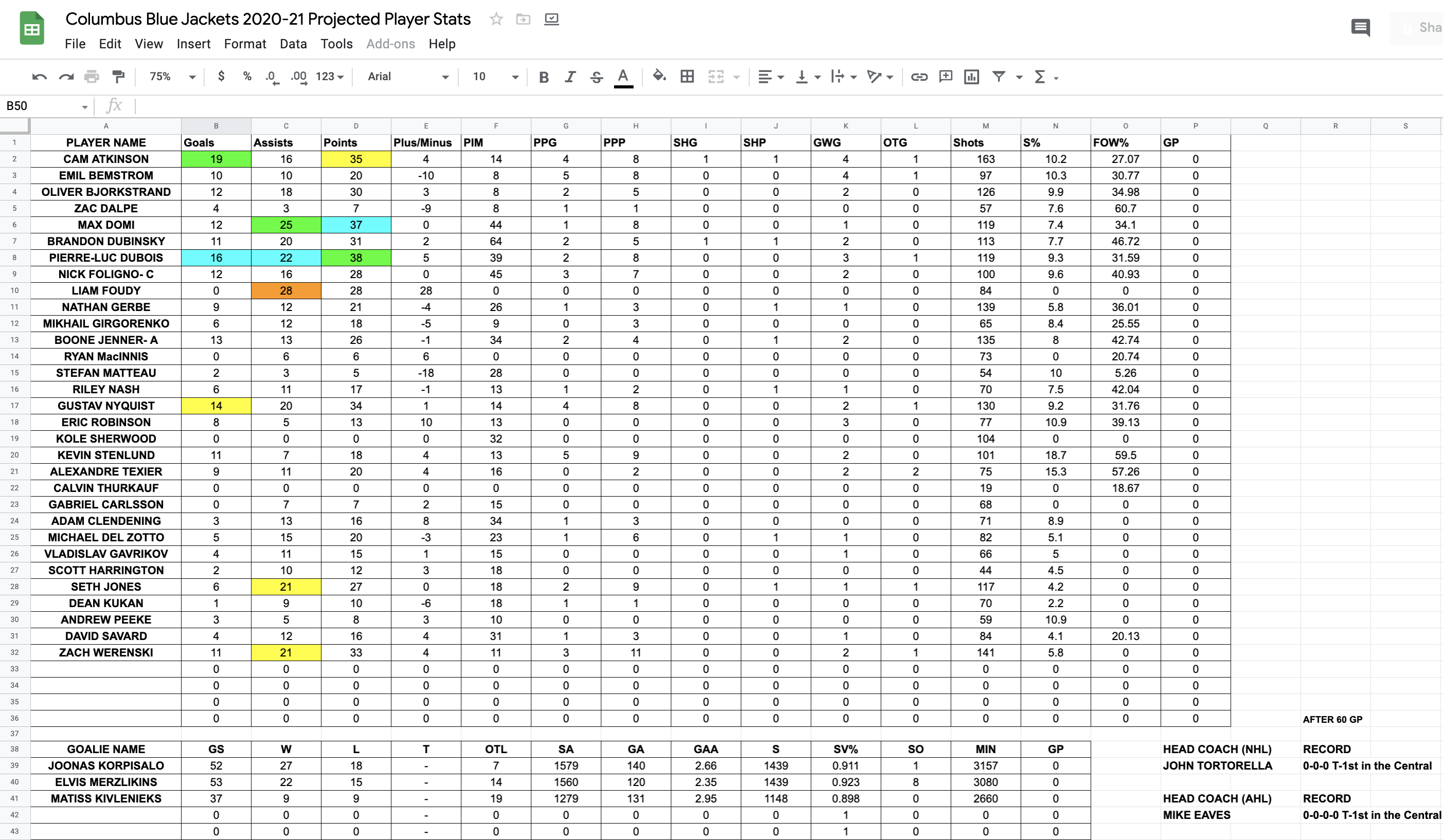
    Young players that have had minimal NHL experience may also reflect “inflated” results– Liam Foudy’s forecasted assists entering the 2020-21 season has been highlighted for this reason.

    Entering this season, he had only been part of two career NHL games and had one assist in that span. The forecasting function accounts for a player’s entire career and does some mathematics to come up with something over a predetermined number of games for the upcoming season (in this year’s case, 56).

    In other words, Foudy’s forecast after 20 team games played should look a bit more “realistic”, for the lack of a better term.

    A forecast is not the same as predicting pace.

    Foudy has three assists in 12 games played in 2020-21, for example, and is forecasted to finish with about 11 on the season, whereas he is currently on pace for about eight helpers.

    There are numerous variables that can, and will, impact a players’ performance throughout the year, including injuries, being a healthy scratch (or on the taxi squad), other American Hockey League related or waiver related transactions, sickness, COVID protocol, suspensions and general superstitions related to individual routines, beliefs, etc. (getting enough sleep before a game, wearing a certain lucky tie, using the same undershirt or shoulder pads for the last 13 years or whatever).

    Players can get “hot” or “cold” at any point.

    It’s not something that can be accounted for in a numerical forecast that sets aside the “eye test” until you try to figure out the nuances of how or why a player is playing the way they are playing.

    In a perfect timeline, this forecast pretends nothing bad could ever happen and every Blue Jackets player lives up to their expectations. In reality, some will pan out, some will exceed expectations and some will fall short for whatever reason.

    It’s an educated guess for an outcome in a sport that’s highly unpredictable due to its collectivistic nature and sheer puck luck.


    Columbus Blue Jackets Forecast Through 0 Games (56 Games Remaining)

    First up, let’s take a look at how things were expected to go coming into the 2020-21 season.

    Prior to being traded to the Winnipeg Jets for Patrik Laine and Jack Roslovic, Dubois was forecasted to lead Columbus in scoring with 16-22–38 totals this season.

    New acquisition, Max Domi, was forecasted as a close second to Dubois with 37 points– leading the team in assists in the process with 25 (among NHL regulars last season, since Foudy technically was forecasted to lead in assists among Blue Jackets with 28).

    Of course, Dubois was traded and Laine and Roslovic are off to hot starts with Columbus– scoring goals in bunches when they find the scoresheet, it seems. We’ll get to that in a minute.

    Cam Atkinson was forecasted to score 19 goals prior to the start of the 2020-21 season, which leads Dubois’ 16 forecasted goals and Gustav Nyquist’s 14 forecasted goals on the roster.

    Dubois, of course, was traded and Nyquist is out due to injury for most of this season, so… that checks out.

    On defense, Zach Werenski and Seth Jones were expected to continue to lead with the way with 33 and 27 points, respectively, from the blue line.

    Both defenders are expected to amass 21 assists this season– good enough for the third most forecasted among Blue Jackets skaters entering this season.

    In the crease, John Tortorella will have to find the right balance between Joonas Korpisalo and Elvis Merzlikins.

    There’s potential for a really solid goaltending duo in Columbus if Korpisalo is the starter and can best his 2.66 forecasted goals against average, as well as his forecasted .911 save percentage, while Merzlikins manages to find a way to reach his 2.35 forecasted GAA and .923 forecasted SV%.

    Of course, after 20 team games played, Merzlikins is currently out with an upper body injury, so time will tell if he can return to form.

    Columbus Blue Jackets Forecast Through 20 Games (36 Games Remaining)

    Through 20 games of the 2020-21 season, the Blue Jackets are three points outside of the last playoff spot in the Discover NHL Central Division, trailing the Chicago Blackhawks for this season’s 4th place cutoff line.

    The acquisition of Laine and Roslovic have been quite a welcome sight for Columbus fans, though consistency from the rest of the lineup remains to be an issue.

    Laine, however, is currently forecasted to lead the team in goals (26) and points (46), while Roslovic is on track for 10-17–27 totals, which is about what he had in 71 games with the Jets last season (29 points).

    Using the current forecasted totals, Roslovic is on track for about .551 points per game this season. He had .408 points per game with Winnipeg in 2019-20.

    Atkinson remains in the top-three in scoring, trailing Laine in goals and points with 20 forecasted goals and 39 forecasted points, respectively, while Oliver Bjorkstrand is currently forecasted to amass 15-21–36 totals (the third most on the current roster).

    On the blue line, Jones leads the way among defenders in points (32), as well as all skaters in assists with 27 forecasted assists through 20 team games played in the 2020-21 season.

    Werenski is more in line with what you’d expect from a young defender of his caliber (8-16–24 forecasted totals) and has missed time due to injury, so that’s clearly a factor in his forecasted drop from before the season began to now.

    In the crease, Korpisalo is sure to get more starts than Merzlikins as the latter is currently injured.

    Korpisalo’s current forecast yields a goals against average between 2.59-2.63, while Merzlikins is on track for a 2.29-2.33 in however many games he ends up getting.

    Why the range in GAA?

    That’s new for this season.

    It’s just to show a range between what the forecasted total is according to the model and what the adjusted forecast shows (calculated based on the forecasted goals allowed/forecasted minutes multiplied by 60, as one would traditionally do with goals allowed/minutes played multiplied by 60 to determine GAA).

    I’m no statistician and I felt like there might be a way to try to get a better read on how things are going for goaltenders (with or without enough necessary data to yield a “realistic” result).

    Don’t make any bets using only this forecast. If you’re a professional, you probably already know that.

    Anyway, Korpisalo has a forecasted range between .912 and .913 in save percentage through 20 team games played and Merzlikins is on track for between a .923 and a .924 in SV%.

    Again, a similar principle applies here.

    One end of the range is the straight up forecast, while the other is influenced by forecasted saves/forecasted shots against.

    Well, that does it for this forecast. Tune in after 40 team games played to see how things might go down the stretch (the final 16 games this season).

  • Blue Jackets beat Bruins, 4-1, in meaningless exhibition Game

    This might sound like a postmodern lede, but nothing matters anymore.

    Well, nothing yet, anyway, as the Columbus Blue Jackets beat the Boston Bruins, 4-1, on Thursday night at Scotiabank Arena in Toronto, Ontario in their exhibition matchup before the Blue Jackets face the Toronto Maple Leafs in their 2020 Stanley Cup Qualifier matchup and the Bruins take on the Eastern Conference Round Robin for the top-4 seeds.

    Joonas Korpisalo made 11 saves on 11 shots faced in 29:51 minutes played, while Elvis Merzlikins allowed one goal on 13 shots against in 30:06 en route to Columbus’ win over Boston.

    Bruins goaltender, Tuukka Rask stopped 17 out of 20 shots faced in 29:54– as well as a lackluster first period effort for the entire B’s roster– while Jaroslav Halak turned aside all ten shots he faced in the remaining 28:50 he played as the netminder for Boston.

    Both Blue Jackets head coach, John Tortorella, and Bruins head coach, Bruce Cassidy, planned on using both netminders as a quick tune-up for the postseason.

    Meanwhile, Cassidy opted to dress an extra forward (Karson Kuhlman) and an extra defender (John Moore) in the effort as allowed for the one-off exhibition game before the NHL action officially restarts.

    Boone Jenner (1) kicked off the game’s scoring with a redirection goal at 4:27 of the first period to give the Blue Jackets the, 1-0, lead courtesy of a saucer pass from Liam Foudy.

    Foudy (1) had the only assist on the goal.

    Midway through the first period, Moore, caught Cam Atkinson without the puck and received a minor penalty for interference at 13:18– yielding the first power play of the game to Columbus.

    Shortly after killing off Moore’s infraction, the B’s were shorthanded once again after Matt Grzelcyk hooked Alexandre Texier at 16:16, but the ensuing power play for the Blue Jackets didn’t last long.

    Four seconds after the face-off in Boston’s defensive zone, Seth Jones slashed Jeremy Lauzon and was sent to the penalty box with a minor infraction at 16:20.

    Almost two minutes later, Brad Marchand hooked Texier and was sent to the box at 18:12.

    Just six seconds later, Zach Werenski (1) doubled Columbus’ lead on a one-timer shot from the point– scoring from about the blue line to give the Blue Jackets the, 2-0, lead.

    Atkinson (1) and Oliver Bjorkstrand (1) tallied the assists on Werenski’s goal at 18:18 of the opening frame.

    Less than 30 seconds later, Gustav Nyquist (1) scored on a one-timer while Rask was left diving across the crease– trailing the play as Nyquist was left wide open by Boston’s penalty kill.

    Pierre-Luc Dubois (1) and Bjorkstrand (2) had the assists on Nyquist’s power-play goal and the Blue Jackets led, 3-0, at 18:36 of the first period.

    Entering the first intermission, Columbus had a three-goal lead on the scoreboard and led, 13-7, in shots on goal.

    Meanwhile, the B’s held the advantage in just about every other category including blocked shots (5-4), takeaways (4-0), giveaways (8-1), hits (9-8) and faceoff win percentage (78-22).

    The Blue Jackets were 1/3 on the power play, while the Bruins had yet to see any time on the skater advantage heading into the middle frame.

    Almost midway into the second period, Brandon Carlo was penalized for tripping Dubois at 7:18.

    This time, Boston’s penalty kill held off Columbus’ power play units and escaped without any further damage.

    After a stoppage at 9:54 of the second period, both teams changed goaltenders as part of their Phase 4 plans for getting up to full speed for the postseason.

    Merzlikins replaced Korpisalo and Halak replaced Rask– ending each starter’s night with about 29 minutes played in the game.

    Shortly thereafter, David Pastrnak (1) faked a shot and slid the puck through Merzlikins’ gapping five-hole that No. 88 in black and gold managed to open up with his pump fake.

    Sean Kuraly (1) and Charlie McAvoy (1) had the assists on Pastrnak’s goal and the Bruins got on the scoreboard, despite trailing, 3-1, at 12:16 of the second period.

    A couple minutes later, Jones caught Anders Bjork without the puck and cut a rut to the penalty box for interference at 14:57, but Boston’s power play was powerless and the Blue Jackets made the kill.

    Through 40 minutes of exhibition action, Columbus led the B’s, 3-1, on the scoreboard and, 25-16, in shots on goal– including a, 12-9, advantage in the second period alone.

    Columbus also took the advantage in blocked shots (7-6), but Boston still held onto the lead in takeaways (7-0), giveaways (16-5), hits (18-14) and faceoff win% (72-28).

    The Blue Jackets were 1/4 on the skater advantage and the Bruins were 0/1 entering the second intermission.

    Early in the final frame, Dubois cross checked Marchand and was sent to the sin bin for a couple of minutes at 4:09 of the third period, but Boston’s power play came up short once more.

    Shortly after Columbus killed off Dubois’ minor, the Blue Jackets were on the skater advantage once more when Par Lindholm collided with Merzlikins in an “accidentally on purpose” out of the way skate-by-fruiting– to steal a phrase from Mrs. Doubtfire (1993).

    Lindholm received a minor penalty for goaltender interference at 7:28, but the Blue Jackets failed to capitalize on the resulting power play.

    With 1:16 remaining in regulation, Cassidy pulled Halak for an extra attacker, but it was to no avail– especially more so after Texier (1) pocketed an empty net goal at 19:58 of the third period.

    Nyquist (1) recorded the only assist and the Blue Jackets waltzed away with the, 4-1, victory.

    At the final horn, Columbus finished ahead of Boston in both the scoreboard and in shots on goal (31-24)– despite the Bruins outshooting the Blue Jackets, 8-6, in the third period alone.

    The Blue Jackets finished the night leading in blocked shots (9-8), while the B’s finished Thursday night’s action with the advantage in giveaways (22-8), hits (30-21) and faceoff win% (66-34).

    Columbus went 1/5 on the power play and Boston went 0/2.

    The Bruins take on the Philadelphia Flyers on Sunday at 3 PM ET– on NBC in the United States, as well as Sportsnet and TVAS in Canada– in their first Round Robin matchup, while the Blue Jackets face the Toronto Maple Leafs for Game 1 of their Qualifier series Sunday night at 8 PM ET.

    Tune to NHL Network in the States for the Blue Jackets and Leafs Game 1 or for viewers in Canada, either Sportsnet or TVAS. Likewise, residents in Ohio can catch the action on FoxSports Ohio and anyone with an NHL.TV subscription can also watch the game that way.

  • Dubois lifts Columbus over Boston, 2-1, in OT

    The Columbus Blue Jackets came back to beat the Boston Bruins, 2-1, in overtime at TD Garden on Thursday in their first meeting with Boston since being eliminated by the Bruins in the Second Round of the 2019 Stanley Cup Playoffs.

    Elvis Merzlikins (2-4-4 record, 2.92 goals against average, .905 save percentage in 12 games played) made 25 saves on 26 shots against for a .962 SV% in the win for Columbus.

    Bruins goaltender, Tuukka Rask (15-4-6, 2.30 GAA, .923 SV% in 25 games played) stopped 31 out of 33 shots faced for a .939 SV% in the overtime loss.

    Boston fell to 24-7-11 (59 points) on the season, but remained atop the Atlantic Division, while Columbus improved to 19-14-8 (46 points) and remained in 6th place in the Metropolitan Division.

    The Bruins also fell to 14-1-9 at home this season and are now on a two-game losing streak.

    Boston was without the services of Kevan Miller (knee) and Connor Clifton (upper body) on Thursday. Miller has yet to make his season debut and Clifton was ruled out of the two-game homestand after being injured against Buffalo on Dec. 29th.

    That was the only bad news for the Bruins heading into Thursday night’s matchup with the Blue Jackets as Torey Krug (upper body), Charlie McAvoy (lower body) and David Krejci (lower body) all returned to the lineup.

    McAvoy was a game-time decision, but took part in full practice on Thursday and was on the ice for warmups– indicating that his return was imminent.

    Due to all the returns, Jeremy Lauzon was reassigned to the Providence Bruins (AHL) on Wednesday and Anton Blidh was assigned to Providence on a long-term injury conditioning loan.

    Blidh was injured in the second-to-last preseason game for Boston and has yet to make his season debut within the Bruins’ organization (Boston or Providence).

    Bruce Cassidy made some changes to his lineup against Columbus since Tuesday’s, 3-2, shootout loss in New Jersey, moving Charlie Coyle to the second line right wing slot with Jake DeBrusk and Krejci, while bumping up Sean Kuraly to center the third line with Anders Bjork on his left side and Danton Heinen on his right side.

    The fourth line comprised of Joakim Nordstrom at left wing, Par Lindholm at center and Chris Wagner at right wing.

    On defense, McAvoy and Krug went back to their usual roles while Matt Grzelcyk slid over to the right side of the third pairing with John Moore on his left.

    Brett Ritchie, David Backes and Steven Kampfer were all healthy scratches for Boston on Thursday night.

    At puck drop, B’s captain, Zdeno Chara, became the 12th player in NHL history to play in at least one game across four decades.

    San Jose Sharks forwards, Joe Thornton and Patrick Marleau became the 13th and 14th players in league history to do the same thing upon puck drop between the Sharks and the Penguins in Pittsburgh on Thursday.

    Gustav Nyquist thought he scored off a rebound 17 seconds into the game, but Cassidy used a coach’s challenge to review the call on the ice (goal) on the basis that Rask was actually interfered with as Boone Jenner appeared to be in the crease before the puck crossed the blue paint.

    Upon review, it was determined that Jenner did, in fact, more than just encroach Rask’s territory, but had actually bumped into the goaltender– impeding his reaction to the play and thereby causing goaltender interference.

    The call on the ice was overturned and the score reverted back to, 0-0.

    It was the first time the Bruins challenged a call this season, as well as their first successful coach’s challenge this season.

    Boston has had five calls overturned on six prior challenges against them thus far, which leads the league.

    After Nyquist had a goal overturned, nothing else happened for the rest of the first period. Seriously.

    There were no goals and no penalties called in the opening frame and both teams spent the last 7:10 span of the period uninterrupted.

    Through one period of play on Thursday, the Bruins and Blue Jackets were tied, 0-0, with Columbus leading in shots on goal, 9-8.

    Columbus also held the advantage in blocked shots (5-1), takeaways (3-2), giveaways (6-4) and hits (14-9), while Boston led in faceoff win percentage (67-33).

    Early in the middle frame, Nick Foligno hooked Brad Marchand and was assessed a minor penalty at 4:48 of the second period.

    The Bruins did not convert on their first power play of the night, but got a second chance on the skater advantage at 11:02 when Dean Kukan tripped DeBrusk.

    This time around, however, Boston capitalized on the power play five seconds into the skater advantage– winning the ensuing faceoff back to the point, then sliding a pass over to David Pastrnak (30) for the one-timer that went off Blue Jackets forward, Riley Nash, and over Merzlikins’ glove to give the B’s the first lead of the night.

    Krug (22) and Patrice Bergeron (19) notched the assists on Pastrnak’s power play goal at 11:07 of the second period and the Bruins led, 1-0.

    With his 30th goal of the season, Pastrnak became the first Bruin in franchise history to score 30 or more goals in four of his first six seasons, as well as the fastest Bruin to score 30 goals (in 42 games) since Cam Neely scored 30 goals in 27 games in the 1993-94 season.

    Almost 90 seconds later, McAvoy was caught interfering with Kevin Stenlund and subsequently sent to the penalty box at 12:36, but the Blue Jackets couldn’t muster anything on the power play.

    Columbus had one more chance on the skater advantage at 19:15 as Chara cut a rut to the sin bin for holding against Nyquist, but the Blue Jackets didn’t capitalize on the power play once again– even though the skater advantage was split over the course of the final seconds of the second period and the opening minute of the third period.

    The Bruins have killed off 21 consecutive penalties as a result of killing off Chara’s minor.

    After 40 minutes in Boston, the Bruins led the Blue Jackets, 1-0, on the scoreboard, despite Columbus maintaining the advantage in shots on goal, 23-20– including a, 14-12, advantage in the second period alone.

    The Blue Jackets also led in blocked shots (12-1) and hits (23-15) entering the second intermission and the Bruins led in takeaways (6-5), giveaways (10-6) and faceoff win% (70-30).

    As there were no more penalties called for the rest of the night, Boston finished 1/2 on the power play and Columbus went 0/2 on the skater advantage.

    Early in the final frame of regulation, Sonny Milano (4) pounced on a turnover by Coyle, then fired a shot with purpose from the goal line along the boards that deflected off of Grzelcyk and dipped through Rask’s five-hole– tying the game, 1-1, in the process.

    Nathan Gerbe (2) and Alexander Wennberg (12) tallied the assists on Milano’s goal at 2:06 of the third period and there were no more goals scored until overtime.

    At the end of regulation, the Blue Jackets led in shots on goal, 32-26, but were even on the scoreboard with the Bruins, 1-1.

    Columbus held the advantage in blocked shots (15-2) and hits (32-25), while Boston led in giveaways (13-8) and faceoff win% (65-35).

    Both teams had six takeaways aside heading into overtime.

    Cassidy started Krejci, Pastrnak and McAvoy for the B’s and Blue Jackets head coach, John Tortorella, opted for Nyquist, Jenner and Seth Jones for the opening faceoff before quickly replacing Jenner with Pierre-Luc Dubois.

    Just 52 seconds into the ensuing extra frame, Dubois and Jones entered the attacking zone on a 2-on-1 and made McAvoy look foolish before Jones sent the puck to Dubois (14) for the one-timer goal from close range.

    Jones (19) had the only assist on Dubois’ game-winning overtime goal and the Blue Jackets took home the, 2-1, win in Boston.

    Columbus finished the night with the advantage in shots on goal (33-26), blocked shots (15-2) and hits (33-25), while the Bruins ended Thursday’s effort with the lead in giveaways (14-8) and faceoff win% (66-34).

    The Bruins fell to 5-1-6 when tied after one period, 13-0-5 when leading after two periods and 17-5-7 when scoring the game’s first goal this season. The B’s also fell to 2-5 in overtime this season.

    Meanwhile, the Blue Jackets improved to 6-6 in ovetime this season and 11-5-3 when tied after one period.

    Boston concludes their two-game homestand (0-0-1) against the Edmonton Oilers on Saturday before traveling to Nashville to face the Predators next Tuesday.

    The Bruins return home for a Thursday night (Jan. 9th) matchup with the Winnipeg Jets before venturing on the road to visit the New York Islanders on Jan. 11th, the Philadelphia Flyers on Jan. 13th and the Blue Jackets on Jan. 14th.

  • DTFR Podcast #173- Rage Against The Other Team

    DTFR Podcast #173- Rage Against The Other Team

    The Philadelphia Flyers are all the rage these days, the Carolina Hurricanes are still causing a storm, what’s bedeviling the New Jersey Devils and, uh, is Sergei Bobrovsky still good?

    Subscribe to the podcast on Apple PodcastsStitcher and/or on Spotify. Support the show on Patreon.

  • DTFR Podcast #168- 2019-20 Season Preview: Pacific Division

    DTFR Podcast #168- 2019-20 Season Preview: Pacific Division

    The U.S. Hockey Hall of Fame Class of 2019 was announced, a major shakeup in the Board of Governors may be ahead, extensions were signed, Jake Gardiner joined the Carolina Hurricanes and it’s time for our DTFR Podcast season previews (starting with the Pacific Division).

    Subscribe to the podcast on Apple PodcastsStitcher and/or on Spotify. Support the show on Patreon.