Tag: San Jose Sharks

  • Your Team Will Rise/Fail: 2021-22 Standings Projections

    It is time. The 2021-22 season is upon us.

    Technically it already started, but we’ll ignore the fact that the Pittsburgh Penguins spoiled the Tampa Bay Lightning’s 2021 Stanley Cup champion banner night with a, 6-2, victory on the road before the Vegas Golden Knights held off a Seattle Kraken comeback in a, 4-3, win at T-Mobile Arena on Tuesday night.

    And then Wednesday’s games happened too.

    Let’s hit the “reset” button for a second and pretend the 2021-22 is about to get underway. All 32 National Hockey League teams have a chance at clinching 16 available playoff berths.

    Any of the 16 teams that make the 2022 Stanley Cup Playoffs could etch 52 names from their roster, front office and organization on the Stanley Cup next June.

    The usual divisions– Atlantic, Central, Metropolitan and Pacific– have returned as have the Eastern Conference and Western Conference. The regular playoff format is back (three teams per division, two wild cards per conference qualify, plus the Conference Finals round returns in place of the Stanley Cup Semfinals in 2021).

    A full 82-game regular season schedule is slated from October through the end of April with a three-week break in February for the 2022 All Star Game in Las Vegas and the 2022 Winter Games taking precedence before a return to NHL action down the stretch with the postseason kicking off in May like last year and the 2022-23 season likely returning to the pre-pandemic timeline (2023 Stanley Cup Playoffs starting in April).

    The 2022 NHL Entry Draft will be in Montréal on July 7th and 8th, while free agency begins on July 13th, but between now and then, we’ve got the 2021-22 regular season to enjoy.

    Using last season’s team goals for and team goals against, plus some other “magic numbers” as part of an expected points model, we’re able to project what 2021-22 could be for all 32 teams (yes, even the Seattle Kraken, despite this year being their first season)– though you’ll have to pretend there were no transactions made in the offseason.

    In other words, don’t think that any of what you’re about to see is set in stone– view it more as a suggestion for a possible outcome.

    Also, please remember my degree is in communication, so any math beyond figuring out “goals + assists = season point totals” doesn’t exist.

    In a normal year (like from 2017-18 to 2018-19, for example), you just take all the data from the 82-game schedule for each team plug it into a formula in a spreadsheet, then line things up accordingly in each division.

    However, just like how the shortened 2019-20 season disrupted the regular process for projecting a 2020-21 standings outlook, going from last season’s stats in a 56-game schedule to projecting a regular 82-game season in 2021-22 necessitated the use of forecasting point pace as part of the formula.

    As for Seattle, a simple means of taking the NHL stats from last season for every player on their roster and plugging it in for a 2021-22 result is exactly what I did.

    We’re all just making it up as we go along, folks. These are projections. They are not absolutes.

    For the sake of keeping it simple, here’s a look at how things could go (but probably not) in each division for the upcoming 2021-22 season.
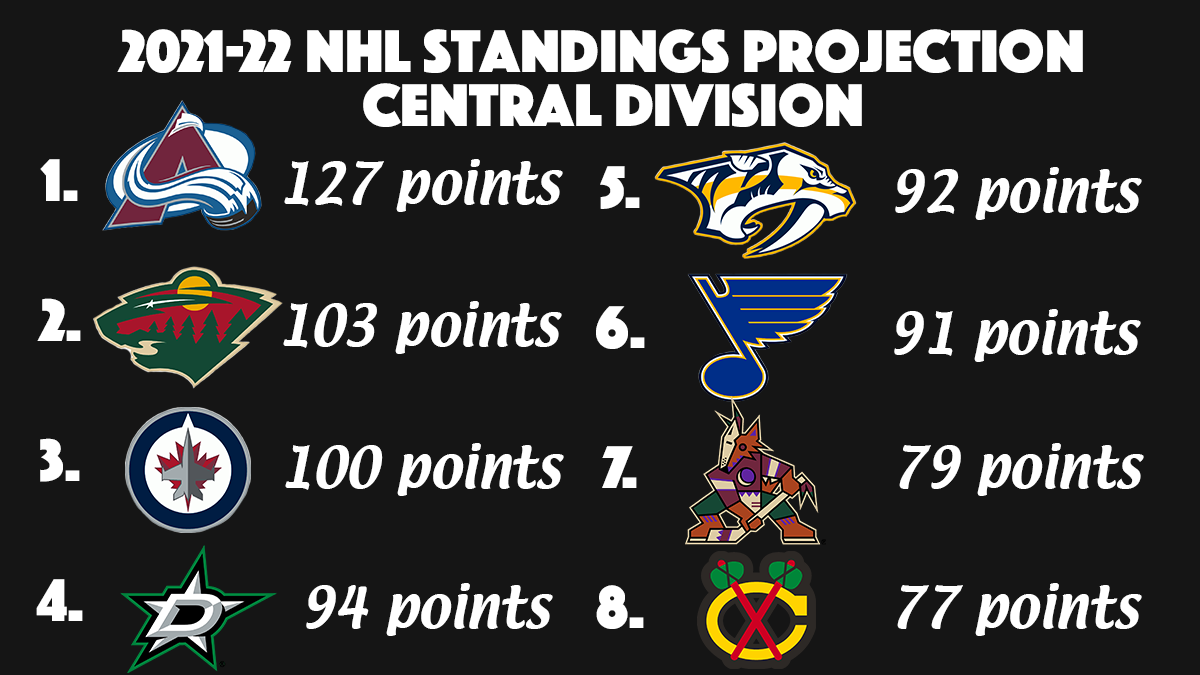
    The overall vibe of the Central Division for 2021-22 is that it’s just more of exactly what you’d expect. The Colorado Avalanche are lightyears ahead of everyone else, while Kirill Kaprizov and the Minnesota Wild continue to be on the rise and everyone else fights for what they can earn.

    Meanwhile, the jury is still out on whether or not the Winnipeg Jets can breakthrough as Canada’s team and break the Canadian curse (become the first Canadian club to win the Cup since 1993).

    Will Colorado finally break through the Second Round and win the Cup?

    Are the Avalanche just the Toronto Maple Leafs but with a little more success? My column:

    No, but really, it’s worth asking if the Avs making it back to the Western Conference Final for the first time since 2002, is more like Toronto’s struggle to make it out of the First Round for the first time since 2004, or is Colorado’s struggle more like the Washington Capitals pre-2018?

    The Caps won three Presidents’ Trophies in 2009-10, 2015-16 and 2016-17, but couldn’t make it past the Second Round– let alone the Pittsburgh Penguins– until they finally did and ended up surging in momentum all the way to their first Stanley Cup in franchise history.

    Colorado, on the other hand, has already won the Cup twice (1996 and 2001) and also has three Presidents’ Trophies to their name in 1996-97, 2000-01 and 2020-21, so if recent history has anything to tell us it’s that yet another team with high expectations for at least a few seasons now only to come up short could very well go on to win it all after winning the Presidents’ Trophy the previous year.

    Either that or they’ll have to win it in back-to-back seasons like Washington did before they won the Cup in 2018.

    Then again, the Tampa Bay Lightning tied the Detroit Red Wings’ record for most wins in the regular season (62), securing the Presidents’ Trophy in the process in 2018-19, then got swept by the Columbus Blue Jackets in the 2019 First Round.

    The very next year, however, Tampa kicked off back-to-back Cup rings in 2020 and 2021, to be where they are now as the two-time defending champions likely standing in the path as the only other favorites outside of the Avalanche this season.

    Anyway, the Avs mostly kept things the same from last season to this season, losing Joonas Donskoi to the Seattle Kraken in the 2021 NHL Expansion Draft, Brandon Saad to the St. Louis Blues in free agency and making minor swaps among replacement level bottom-six forwards and bottom-pairing defenders.

    Oh, then there’s this whole thing about how Philipp Grubauer left for Seattle in free agency too, so Colorado acquired Darcy Kuemper from the Arizona Coyotes.

    Between Dallas, Nashville and St. Louis, who will realistically make the playoffs?

    The Stars are projected to finish with about 94 points, the Predators sit at 92 points and the Blues are around 91 points in this one projection, but don’t let the points alone be your deciding factor.

    Given the strength of the Central Division compared to the Pacific Division, you can bet on five teams making out of the Central among Western Conference playoff berths.

    As such, the spread is the difference maker between these three teams expected to be in the wild card hunt– it’s going to come down to the wire one way or another.

    Dallas bolstered their goaltending depth by signing Braden Holtby, Nashville traded Ryan Ellis to the Philadelphia Flyers and St. Louis is… …better than last season on paper?

    I mean, the Blues signed Saad, acquired Pavel Buchnevich from the New York Rangers in exchange for Sammy Blais, let Seattle claim Vince Dunn at the expansion draft and let Mike Hoffman walk to the Montréal Canadiens in July.

    You could say they took a hit here or there, but those aren’t “nobody names” by any means, however.

    If Jordan Binnington and Ville Husso can stabilize things in the crease, then St. Louis has a better situation than the Predators.

    The Stars, meanwhile, should benefit from a longer season where more of their core guys– like Tyler Seguin, for example– are healthy. Last season’s COVID-19 outbreak to kick things off in January really killed Dallas’ momentum as a team on the verge of being in the 2021 postseason.

    Dallas should get back into the swing of things and St. Louis should be able to stay relevant for at least another year, but how hard the Preds rely on Juuse Saros as their starting goaltender will dictate whether or not they’re able to play spoiler with David Rittich as their backup since Pekka Rinne retired.

    Can Arizona avoid the basement?

    Anything is possible at this point. Loui Eriksson and Andrew Ladd were scoring goals in the postseason, so a fresh start could be just what both players needed for the last few years at least.

    That said, Coyotes General Manager, Bill Armstrong, gave a Masterclass™️ in how to go about rebuilding by selling everything over the summer and taking on “bad” contracts with only one or two years remaining in hopes of playing just well enough to be bad enough without making it look obvious that you’re aiming to win the 2022 NHL Draft Lottery.

    The Pacific Division is the new Scotia NHL North Division from last season. In other words, it’s the worst– which is great news for the Seattle Kraken as the league’s schedule allots more division play than any other opponents (though the Kraken will play every other team in the league at least twice).

    Seattle’s riding the waves of new-age expansion, while the Vegas Golden Knights lead the charge for the Presidents’ Trophy campaign in 2021-22.

    Wait, Seattle in 2nd in the Pacific, really?

    Yes, really.

    The Kraken have a great front office that goes beyond just Ron Francis as General Manager and have done their due diligence in scouting the best talent available to try to replicate the success of the Vegas Golden Knights’ inaugural season in 2017-18, as well as grow beyond just 2021-22.

    That said, Seattle probably isn’t going to make it out of the First Round of the 2022 Stanley Cup Playoffs, even if they have to face the Edmonton Oilers according to this projection.

    It’s a best case scenario for the NHL’s newest expansion team to be in the weakest division, but aside from having recent Stanley Cup champions Yanni Gourde, Philipp Grubauer, Jaden Schwartz and Dunn on their roster, the Kraken have a plethora of players that are relatively inexperienced with deep postseason runs.

    Head coach, Dave Hakstol, also hasn’t had the consistency of making the playoffs and making it out of the First Round in his NHL coaching days, but as a team that, again, is looking to develop long-term success, these are mere growing pains Francis and Co. are willing to accept as the fan base grows.

    Why aren’t the Kings making the cut this year when everyone else says they’ll be the most improved?

    The simple answer is that everyone’s overrating Los Angeles when it comes to the “ready now” factor.

    Sure, Kings General Manager, Rob Blake, did a good thing by getting Viktor Arvidsson in a trade with Nashville this summer to solidify his top-six forward group and signed Alex Edler to fortify his defense, but Los Angeles’ goaltending leaves something to be desired.

    Here’s hoping Jonathan Quick can find a little resurgence at this point in his career, while Cal Petersen continues to come into his own.

    If Los Angeles has any injuries– and they already have with Arvidsson likely missing some time due to an injury in the last preseason game– they’re already close enough to the bubble that they’ll only fall further behind.

    That said, if the Kings don’t make it back to the postseason hunt in 2022, there’s a good chance they make it in 2023.

    Los Angeles is improving, but by how much remains to be seen.

    Will winning the Presidents’ Trophy hurt Vegas?

    Eh, it’s hard to say.

    The Golden Knights have packed in just about every type of heartbreak since their inception in 2017, that fans of other franchises have only experienced over the course of at least 50 years, so if Vegas pulls out the Presidents’ Trophy win in 2021-22, don’t be surprised when the inevitable happens and they win the Cup instead of doing what most other Presidents’ Trophy winners in the salary cap era have done.

    Only the 2007-08 Detroit Red Wings and Chicago in 2012-13, have been able to win the Presidents’ Trophy and the Stanley Cup since the salary cap was introduced ahead of the 2005-06 season.

    Vegas would probably join Detroit and Chicago in doing so just so the Hockey Gods can spite us again.
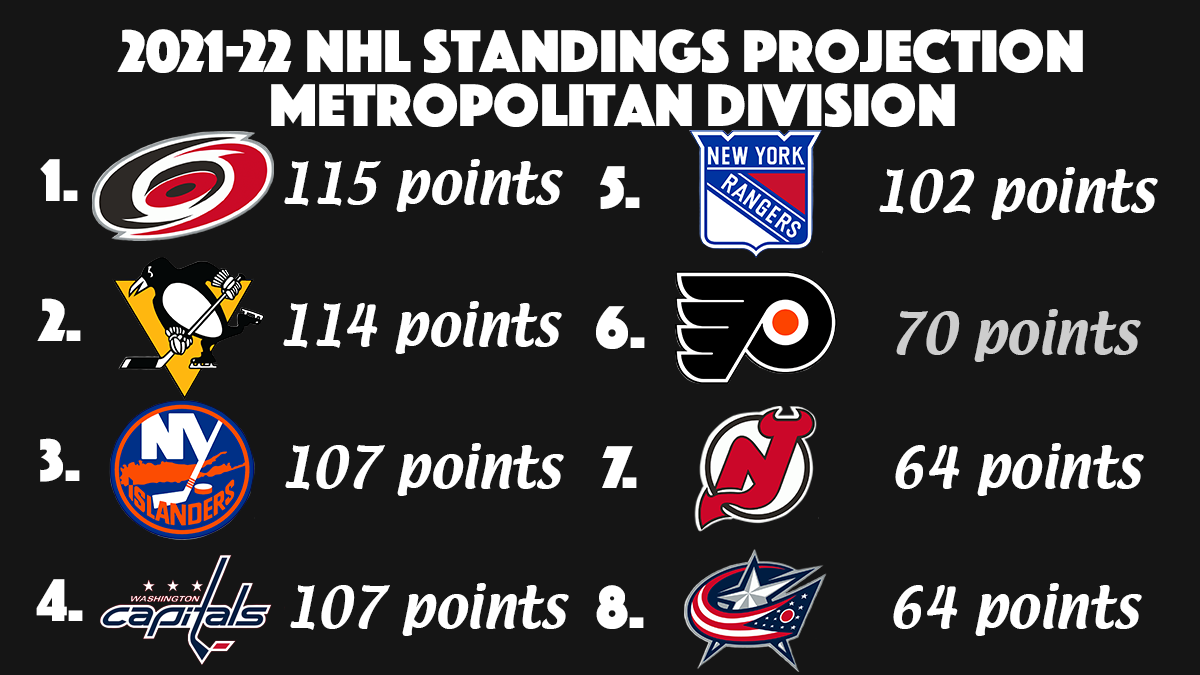
    It’s not easy to be in the Metropolitan Division these days because, well, let’s save that for the three questions below.

    Is this the toughest division to project?

    Absolutely.

    The Carolina Hurricanes decided to just get rid of a few parts and pieces that helped make them good for the last few seasons, so they’re bound to regress even with Sebastian Aho, Andrei Svechnikov, Teuvo Teräväinen and Martin Necas still existing.

    The Pittsburgh Penguins since 2009, have always found a way to be near the top of the division standings by the end of the regular season no matter whether or not you believe they’ll inevitably miss the playoffs for the first time since 2006, so anything could happen there.

    The New York Islanders have made back-to-back appearances in the Eastern Conference Final, so I’d expect them to be good.

    The Washington Capitals are better than the Philadelphia Flyers and New York Rangers, at least, but are probably the only team on the bubble if the New Jersey Devils can come out of nowhere and be competitive this season after signing Dougie Hamilton, Tomas Tatar and Jonathan Bernier in the offseason.

    Meanwhile, it’s time for a short rebuild in Columbus as the Blue Jackets would be quite pleased with a top draft pick in 2022.

    What if Chris Drury never was promoted as General Manager of the Rangers?

    They’d still fire David Quinn and hire Gerard Gallant. I don’t think that’s such a bad idea, but they’d definitely reconsider about 90% of the roster decisions made this summer.

    There’s no reason why the Rangers have to go down this path and yet, here they are, fumbling at the one-yard line and possibly plunging their franchise back into the Dark Ages of another rebuild. Or is it the same ongoing rebuild?

    What about a team to watch like New Jersey, for example?

    I’m big on the Devils this season for some strange reason.

    Maybe it’s because a part of me deep down misses the trap game of the 1990s and 2000s that led to Stanley Cups for New Jersey in 1995, 2000 and 2003.

    Maybe it’s because they signed Hamilton, Tatar, Bernier and acquired Ryan Graves from the Colorado Avalanche as a supporting cast for Jack Hughes, Nico Hischier, Pavel Zacha, Yegor Sharangovich, Ty Smith and friends.

    Seriously, the Devils should be good in the next few seasons, but this year could be the biggest stride forward in terms of their improvement from the basement to their development as a playoff contender.

    First, pour one out for Jack Eichel. Now, let’s move on and talk about everyone else.

    What does this mean for the Leafs?

    Just like how the Stars, Preds and Blues are all right on top of one another in the Central Division standings, the Atlantic Division is stacked from 1st through 4th, so though Toronto leads the way in this projection, I wouldn’t feel too comfortable as a Leafs fan.

    The Maple Leafs played in the worst of the four divisions last year in the temporarily realigned divisions in wake of the ongoing pandemic.

    No, it’s not just because they played all the other Canadian teams across 56 games, but rather it’s due to the fact that they haven’t been able to matchup with the Tampa Bay Lightning, Florida Panthers and even the Boston Bruins since the 2019-20 season.

    A lot and not a lot has changed since then.

    Tampa is still dominant as ever, Florida has emerged as a team that’s on the rise and Boston is unpredictable in that– much like the Penguins– it could really go either way with the Bruins this season.

    So now Toronto has to take on better competition within their own division and square off with teams like the Vegas Golden Knights, Colorado Avalanche, New York Islanders and others that emerge towards the top of the standings outside of the Canadian teams that the Leafs are all too familiar with at this point.

    That said, Toronto still has a great chance at winning the Atlantic Division regular season title or finishing 2nd and having home ice advantage in the First Round for the second-straight postseason.

    Can anyone other than Toronto, Florida, Tampa or Boston make it out of the Atlantic this year?

    No. Let’s be realistic here.

    The Montréal Canadiens made it to the 2021 Stanley Cup Final despite being below .500 in the standings because every division produced four playoff berths and intra-divisional play through two rounds.

    In 2020, they upset the Pittsburgh Penguins in the Qualifier despite finishing right at .500.

    In any other non-pandemic timeline, the Canadiens would still be looking for their first playoff appearance since they lost to the New York Rangers in six games in the 2017 First Round.

    That’s not to say that Nick Suzuki can’t lead the Habs back to glory, but rather that they need to improve all-around in the regular season and peaking in performance in the playoffs.

    Though the Ottawa Senators promised unprecedented success from 2021-25, it’s looking like it’ll realistically be anytime between 2024-25 as in the 2024-25 season itself at this point.

    Ottawa’s goaltending needs to improve, their defense could use some tweaks and the Sens are banking on their offense getting their feet underneath them and bursting in production in the coming years.

    A little more patience won’t hurt them.

    The same can be said for the Detroit Red Wings in that Red Wings fans already know– trust in General Manager, Steve Yzerman, is paramount. He’ll work his magic.

    It just takes a little time to build a solid foundation and the first floor is almost ready to start going up.

    As for the Buffalo Sabres, well…

    At least they’ll hopefully give Rick Jeanneret a proper send-off before he retires as their play-by-play announcer for the last 51 years on television.

    Hopefully.

    Will Tampa win three consecutive Stanley Cup championships?

    Probably not.

    I’m not ruling it out entirely, but the Lightning have a better chance of winning three Cups in four years than they do three Cups in as many years as things stand currently.

    The loss of their entire third line (Blake Coleman, Yanni Gourde and Barclay Goodrow) from last season to this season is sure to leave a mark on the development and restructuring of their bottom-six forwards.

    That said, Tampa’s top-six forwards still exist and, if you haven’t already noticed, they’re very good on their own, but the best teams in the playoffs have four lines that can roll without a doubt and the Bolts might just be off the ball for a year in terms of depth.


    Alright, if you’ve made it this far, thanks for your patience. By now the season’s already going on a few days into the 2021-22 calendar, so the two of us (or more if you’re reading this to a group) should probably get back to watching games.

    Stay tuned for more forecasts for both standings and assorted teams throughout the season.

  • Montréal Canadiens 2021-22 Season Preview

    Montréal Canadiens 2021-22 Season Preview

    2020-21 record 24-21-11, 59 points

    4th in the Scotia NHL North Division

    Eliminated in the Stanley Cup Final by Tampa

    Additions: F Jean-Sébastien Dea, F Christian Dvorak (acquired from ARI), F Mike Hoffman, F Cedric Paquette, F Mathieu Perreault, D Louis Belpedio, D Sami Niku, D David Savard, D Chris Wideman, G Sam Montembeault (claimed off waivers from FLA)

    Subtractions: F Phillip Danault (signed with LAK), F Charles Hudon (signed with TBL), F Jesperi Kotkaniemi (offer sheet signed with CAR, not matched), F Jake Lucchini (signed with Laval Rocket, AHL), F Corey Perry (signed with TBL), F Tomas Tatar (signed with NJD), F Jordan Weal (KHL), D Cale Fleury (expansion, SEA), D Erik Gustafsson (signed with CHI), D Otto Leskinen (Liiga), D Jon Merrill (signed with MIN), D Gustav Olofsson (signed with SEA), G Vasili Demchenko (KHL), G Charlie Lindgren (signed with STL)

    Still Unsigned: F Joseph Blandisi, F Michael Frolik, F Eric Staal

    Re-signed: F Joel Armia, F Brandon Baddock, F Alex Belzile, F Laurent Dauphin, F Artturi Lehkonen, F Michael Pezzetta, F Ryan Poehling, F Lukas Vejdemo, G Michael McNiven

    Offseason Analysis: After back-to-back miracle runs to the postseason aided by the circumstances of the ongoing COVID-19 pandemic, the Montréal Canadiens are expected to fall back to Earth in 2021-22.

    The Canadiens were a .500 team that upset the Pittsburgh Penguins in the 2020 Stanley Cup Qualifiers, then Montréal was a below .500 team that benefitted from the four teams per division playoff format in 2021.

    Any of the 16 teams that make the playoffs can win the Cup and the Canadiens almost bested the 2012 Los Angeles Kings in terms of being a long shot to do so, but the Tampa Bay Lightning had other plans in the 2021 Stanley Cup Final.

    Instead, the Bolts repeated as back-to-back Stanley Cup champions while Montréal was eliminated in five games in a Game 5 that was decided by one goal– the only goal, scored by Ross Colton a little past the midpoint of the second period, as the Lightning emerged victorious with a, 1-0, win on home ice to secure their third Stanley Cup ring in franchise history.

    Corey Perry lost to Tampa in back-to-back years and, as such, as taken the “if you can’t beat them, join them” mantra to heart in the offseason, signing a two-year contract worth $1.000 million per season with the Lightning.

    Fear not, Habs fans, unlike when Marian Hossa bounced from the Pittsburgh Penguins to the Detroit Red Wings before landing in Chicago ahead of the 2009-10 season, Perry’s already won a Cup ring. He’s just in search of his second before the twilight of his career reaches sunset.

    Montréal’s cast of characters in Perry, Eric Staal and others that joined the leadership of captain, Shea Weber– whether via free agency ahead of the 2020-21 season or prior to the 2021 trade deadline– has mostly disbanded.

    Whether or not Canadiens General Manager, Marc Bergevin, planned on making an appearance in the 2021 Stanley Cup Final or not as the 56-game regular season approached last season, it’s hard to say that he didn’t give the Habs their best roster in recent years.

    They replaced Claude Julien with Dominique Ducharme behind the bench after a shaky start and rode the waves of change into a fourth-place finish in the one-off Scotia NHL North Division to take on the Toronto Maple Leafs in the 2021 First Round.

    They didn’t surrender when they trailed in the series 3-1, as Cole Caufield, Nick Suzuki and Jesperi Kotkaniemi followed the examples of Perry, Staal, Joel Armia, Tyler Toffoli and other veterans that led the charge.

    Montréal beat Toronto in seven games. They swept the Winnipeg Jets in the Second Round and upset the Vegas Golden Knights in six games in the 2021 Stanley Cup Semifinals.

    Then David faced Goliath, but Goliath won.

    Because of the nature of the salary cap era, Bergevin couldn’t hold onto all of his puzzle pieces.

    Perry, Staal, Jordan Weal, Phillip Danault, Charlie Lindgren, Jon Merrill, Tomas Tatar, Kotkaniemi and Erik Gustafsson are all gone for one reason or another, while Mike Hoffman, Cedric Paquette, David Savard, Chris Wideman, Mathieu Perreault, Sami Niku and Sam Montembeault have all been signed to take their place on the depth chart.

    The heart of the Canadiens– however recently formed– is changing. The identity of the team last season– forged with the additions of Perry and Staal to the already existent tenures of Danault, Weber, Price and Co. is in transition.

    Whereas Suzuki was already leading the charge in Montréal’s new core, this offseason has solidified the inevitable. It may not be a rebuild, but it may be a few more stagnant years in-between before long term success and growth.

    It’s crazy to write about how the Habs– a team that made the 2021 Stanley Cup Final– are not going to be as “good” as they were good enough to reach the Final, but it also makes the most sense.

    Again, in a normal 82-game season without the pandemic, the Canadiens likely wouldn’t have even made the playoffs in the last two years.

    The fact that they have has provided valuable experience for Suzuki, Jake Evans, Ryan Poehling and more, but the veteran turnover from last season to this season is palpable.

    The additions of Hoffman, Paquette, Savard, Wideman and Perreault signal a distinct shift in character.

    Heart and grit be damned– Montréal is wholly embracing the speed and skill era. Sort of.

    Hoffman joined the St. Louis Blues on a one-year deal last season after amassing five consecutive seasons with at least 55 points or more dating back to the 2015-16 season. His play in an Ottawa Senators uniform was consistent, but his dressing room presence earned him a ticket to the San Jose Sharks in a trade before being flipped to the Florida Panthers ahead of the 2018-19 season.

    After amassing 70 points in 82 games with the Panthers in his first season in Florida, Hoffman had 59 points in 69 games in the 2019-20 regular season that was cut short by the ongoing pandemic.

    Then he had 17-19–36 totals in 52 games with the Blues last season after a slow start.

    As a top-nine forward, Hoffman’s one-dimensional game as a sniper isn’t that bad as long as he scores.

    Since being traded by the Lightning, Paquette had a little bit of a journey on his way to Montréal. First, in nine games with the Senators last season he had one goal. Then in 38 games with the Carolina Hurricanes, he amassed seven points (three goals, four assists) for a grand total of 4-4–8 totals in 47 games combined between his Sens and Canes tenure.

    As a fourth liner, it’s a low-risk, high-reward move for the Habs, but that’s assuming he’ll be in the lineup from night-to-night as the Canadiens have a backlog of bottom-six talent looking to earn a regular role.

    Savard might just be the best value signing this summer by Bergevin. The 30-year-old defender was signed to a four-year contract worth $3.500 million per season and had six points (one goal, five assists) from the blue line in 54 games with the Columbus Blue Jackets and Lightning last season en route to winning his first Stanley Cup ring.

    Don’t let his offensive shortfalls fool you, Savard is a quality shutdown defender of the top-four variety.

    Seriously, it’s a good signing by the Canadiens.

    Wideman hasn’t made an appearance in the NHL since the 2018-19 season, when he played for the Senators until the infamous Uber ride, then was traded to the Edmonton Oilers and finally traded again to the Panthers.

    In 181 career NHL games, he’s had 16-29–45 totals from the point and spent 2019-20 in the American Hockey League with the San Diego Gulls after signing with the Anaheim Ducks and missing out on the roster after training camp and spending last season in the Kontinental Hockey League (KHL) in Russia.

    While in the KHL, Wideman reinvented his game– compiling 9-32–41 totals in 59 games with Torpedo Nizhny Novgorod.

    With Niku on the injured reserve to start the season and Weber’s career in doubt, Wideman is a welcome addition to the bottom pairing as Montréal looks to hold things together in their own end with Carey Price out indefinitely (Price entered the NHL/NHLPA player assistance program last Thursday) and Jake Allen as their last resort as the de facto starting goaltender.

    Meanwhile, Perreault’s arrival shores up the fourth line and Montembeault should provide an added cushion as a backup option to Allen in the crease.

    By now, you’ve read almost 1,300 words on Montréal’s summer and we haven’t even gotten around to talking about the ongoing feud with the Hurricanes as a result of the Kotkaniemi offer sheet, as well as the Christian Dvorak acquisition.

    Let’s try to keep this brief, O.K.?

    Carolina signing Kotkaniemi wasn’t revenge (allegedly) for Montréal signing Sebastian Aho to an offer sheet, but it was an offer that was too good to refuse (for Kotkaniemi, anyway).

    A one-year deal worth about $6.100 million with a $20 signing bonus (symbolism!) means that Kotkaniemi will be due for a decent payday if he’s tendered a qualifying offer next summer.

    The Canadiens didn’t have the cap space and even the Hurricanes had to make a move to finagle his salary on the books. The Habs will gladly take Carolina’s 2022 1st round and 2022 3rd round draft picks, despite losing one of their better centers for the future.

    It was hard enough to let Danault walk to the Los Angeles Kings in free agency, surely things only got harder for Montréal to find a replacement after Kotkaniemi left too– oh.

    After swapping draft picks on the second day of the 2021 NHL Entry Draft in three separate trades, Bergevin made his only trade that resulted in a change to Montréal’s roster this offseason on Sept. 4th.

    The Canadiens dealt a conditional 2022 1st round pick and a 2024 2nd round pick to the Arizona Coyotes for Dvorak and with that brought in his 17-14–31 totals in 56 games from last season to their top-six forward group.

    Since making his league debut in 2016-17, Dvorak has never reached the 40-point plateau, but with teammates like Toffoli, Hoffman, Jonathan Drouin, Josh Anderson, Caufield and anyone else that might bounced around inside the top two lines on any given night– Dvorak is sure to have a more consistent supporting cast around him than in his Coyotes days.

    Offseason Grade: C

    It’s not a great look to have mismanaged Kotkaniemi over the years– culminating in the loss of his talent via an offer sheet, but what’s more concerning for the Canadiens is just how much of what made them pernicious in their Cinderella run to the Final last year that they lost.

    It wasn’t just one or two minor moves that were made to improve from last season to this season– Bergevin made some sweeping changes, by necessity or otherwise.

    The top-six forward group should be fine, but do the Habs have the same level of depth that they had last season? That’s another question entirely.

    At the very least, they’re not getting caught up having an overstayed welcome with replacement level talent, yet their window in the Price era may be coming to a close.

    Hopefully Price gets the help that he needs most as there’s a lot more to life than just hockey. In the meantime, time marches on as the 34-year-old goaltender is susceptible to the inevitable fallout from a goaltender’s prime.

    Montréal may very well win another Cup someday soon, but Price might be in a more limited role as the club’s backup by then, if all things go according to plan with this ideally seamless transition from a team that lucked into postseason runs.

    The Habs need to improve in the regular season in a division that’s already tough enough to compete in with Tampa, Toronto, Florida and Boston expected to be in the playoff hunt in the Atlantic Division.

  • DTFR Podcast #231- Be More Pacific (feat. Jess Belmosto)

    DTFR Podcast #231- Be More Pacific (feat. Jess Belmosto)

    Jess joins the show to talk all things Calgary Flames and preview the Pacific Division for the 2021-22 season. She also rescues Cam in this week’s “Off the Cuff”.

    Subscribe to the podcast on Apple PodcastsStitcherSpotifyAmazon Music and/or Audible.

  • Colorado Avalanche 2021-22 Season Preview

    Colorado Avalanche 2021-22 Season Preview

    2020-21 record 39-13-4, 82 points

    1st in the Honda NHL West Division

    Eliminated in the Second Round by Vegas

    Additions: F Darren Helm, F Mikhail Maltsev (acquired from NJD), F Dylan Sikura, D Jordan Gross, D Jack Johnson (signed to a PTO), D Kurtis MacDermid (acquired from SEA), D Stefan Matteau, D Roland McKeown, D Ryan Murray, G Darcy Kuemper (acquired from ARI)

    Subtractions: F Pierre-Edouard Bellemare (signed with TBL), F Matt Calvert (retired), F Joonas Donskoi (expansion, SEA), F Sheldon Dries (signed with VAN), F Ty Lewis (retired), F Liam O’Brien (signed with Tucson Roadrunners, AHL), F Brandon Saad (signed with STL), F Miikka Salomäki (SHL), F Carl Söderberg (SHL), F Mike Vecchione (signed with WSH), D Kyle Burroughs (signed with VAN), D Ryan Graves (traded to NJD), D Patrik Nemeth (signed with NYR), D Dan Renouf (signed with DET), D Conor Timmins (traded to ARI), G Philipp Grubauer (signed with SEA), G Peyton Jones (signed with Colorado Eagles, AHL), G Adam Werner (signed with CGY)

    Still Unsigned: F Travis Barron, G Devan Dubnyk

    Re-signed: F Tyson Jost, F Gabriel Landeskog, F Jayson Megna, F Kiefer Sherwood, D Dennis Gilbert, D Cale Makar, G Jonas Johansson

    Offseason Analysis: If next spring doesn’t bring the desired results to Colorado, it’ll be 20 years since the Avalanche last made an appearance in the Western Conference Final.

    Back in 2002, the Detroit Red Wings were in the prime of their dominance and the Red Wings-Avalanche rivalry was red hot as the two teams went at it for not only regular season titles, but Stanley Cup rings as well.

    Colorado had won in 1996 and 2001, Detroit won in 1997, 1998 and would do so again in 2002, as well as 2008– five years after Patrick Roy played his last National Hockey League game.

    In the 2002 Western Conference Final, the defending Stanley Cup champion Avs were once again the team to beat, but the Red Wings took the series in seven games and went on to win the Cup.

    Since then, both teams have had a bit of a falling out.

    When Joe Sakic took over as General Manager of the Avalanche, the goal was simple– return the franchise to its glory days.

    The bump in the road that was the 2016-17 season brought the team the 4th overall pick after losing in the draft lottery, yet at 4th overall in 2017, Colorado selected their biggest game-changing defender since the acquisition of Ray Bourque in Cale Makar.

    Sakic turned his attention to a Makar extension when it seemed like things had gone south with keeping captain, Gabriel Landeskog, in town.

    The 22-year-old defender signed a six-year extension worth $9.000 million per season after finishing second in Norris Trophy voting to New York Rangers defender, Adam Fox, for the 2020-21 season.

    Makar had 44 points (eight goals, 36 assists) in 44 games– exactly a point-a-game in his sophomore campaign, limited again due to injury after amassing 12-38–50 totals in 57 games in his first NHL season in 2019-20.

    Sakic signed Makar to an extension on July 24th and then in the 11th hour as free agency drew near, signed Landeskog to an eight-year extension worth $7.000 million per season.

    The 28-year-old captain was Colorado’s 2011 1st round pick (2nd overall) and has 218-294–512 totals in 687 games since making his league debut in the 2011-12 season with the Avs.

    Landeskog had a promising 52-point season (22 goals, 30 assists) in 82 games in his first year in the league, then the 2012-13 48-game lockout shortened season kept him to 9-8–17 totals in 36 games.

    The Avalanche missed out on the playoffs from 2011-13, but in 2014, Colorado squared off against the Minnesota Wild in the First Round– only to lose in seven games.

    That playoff series, however, was the first taste of playoff hockey for Nathan MacKinnon and went decently for Landeskog as well.

    After amassing 65 points (26 goals, 39 assists) in 81 games in the regular season, Landeskog had 3-1–4 totals in the seven-game series against the Wild.

    Then his production dropped to 59 points in 82 games in 2014-15, and 53 points in 75 games in 2015-16– coinciding with Colorado’s fall from grace.

    In the dismal 2016-17 campaign for the Avalanche, in which the team amassed 48 points on the season with a 22-56-4 record, Landeskog had just 33 points (18 goals, 15 assists) and had a minus-25 rating.

    But the Avs have made the playoffs every season since then– succumbing to the Nashville Predators in six games in the 2018 First Round, bowing out to the San Jose Sharks in seven games in the 2019 Second Round, losing to the Dallas Stars in seven games in the 2020 Second Round and dropping out in six games against the Vegas Golden Knights in the 2021 Second Round.

    In that span, Landeskog’s had a career resurgence. He had 62 points in 78 games in 2017-18, 75 points in 73 games in 2018-19, 44 points in 54 games while battling injury and the COVID-19 pandemic shortened regular season in 2019-20, as well as 52 points in 54 games in last season’s 56-game regular season schedule.

    Some say his resurgence can be accredited to the emergence of Colorado’s dominant first line with MacKinnon at center, Landeskog at left wing and Mikko Rantanen at right wing, but then how can that attribute to his own individual playoff success?

    Landeskog had seven points (four goals, three assists) in six postseason games in 2018, 3-5–8 totals in Colorado’s 12-game 2019 Stanley Cup Playoff experience, 2-11–13 totals in 14 games during their 2020 Stanley Cup Playoff bubble run and 13 points (four goals, nine assists) in ten games in the Avalanche’s 2021 postseason run.

    It’s plain to see that whereas MacKinnon is the superstar forward, Landeskog is the lifeblood of the organization– both as the captain and as a clutch performer when it matters most.

    Landeskog’s reasonable cap hit should take some pressure off of Sakic as he negotiates extensions with MacKinnon after the 2022-23 season and Rantanen after the 2024-25 season, when the salary cap ceiling is expected to have risen due to the increased revenue from the current U.S. broadcasting rights packages.

    Two big pieces were taken care of, so naturally Sakic set his sights on Philipp Grubauer… …who chose to leave for the Seattle Kraken in free agency.

    Grubauer signed a six-year contract worth $5.900 million per season with the Kraken on July 28th– the day that free agency began and a week after Seattle claimed Joonas Donskoi from the Avs in the 2021 NHL Expansion Draft.

    Last season, Grubauer went 30-9-1 in 40 games played, had seven shutouts (tied for the most with New York Islanders goaltender, Semyon Varlamov) and amassed a 1.95 goals-against average, as well as a .922 save percentage in that span.

    It was a breakout year for the 29-year-old goaltender, so why not cash in while you can?

    The downside for Colorado, however, is that it left them briefly with uncertainty in the crease until they acquired Darcy Kuemper from the Arizona Coyotes later that same day.

    Sakic worked the phones quite a bit this summer between agents and fellow general managers.

    On July 15th, Colorado swapped defender, Ryan Graves, with the New Jersey Devils for forward, Mikhail Maltsev, and a 2021 2nd round pick (from NYI via NJD- 61st overall, Sean Behrens).

    On July 27th, Sakic sent a 2023 4th round pick to the Kraken for defender, Kurtis MacDermid, whose father, Paul, played for the Québec Nordiques from 1993-95.f

    After losing Grubauer to Seattle in free agency, Sakic dealt defender, Conor Timmins, a 2022 1st round pick and a conditional 2024 3rd round pick to the Coyotes for Kuemper.

    Much like Linus Ullmark going from the Buffalo Sabres to the Boston Bruins via free agency this summer, it’s hard to tell what to expect out of Kuemper in an Avalanche uniform.

    He should be better considering the overall quality and depth of defenders on Colorado’s blue line a la Ullmark’s upgrade from Buffalo’s defense to Boston’s defense in front of him.

    That said, Kuemper hasn’t really been a starting goaltender for long. It’s a risk, like when Colorado sought after Grubauer in the first place from the Washington Capitals a few summers ago.

    In his first season as a starter, Kuemper went 27-20-8 in 55 games with Arizona– notching five shutouts and recording a 2.33 goals-against average, as well as a .925 save percentage. Good stuff.

    In 2019-20, he went 16-11-2 in 29 games, had two shutouts and yielded a 2.22 goals-against average, as well as a .928 save percentage.

    Last season, he went 10-11-3 in 27 games, dropping to a 2.56 goals-against average, a .907 save percentage and once again recording two shutouts.

    Kuemper is 31-years-old and made his league debut with the Minnesota Wild back in the 2012-13 season– the same season that Grubauer broke into the league with the Capitals, albeit two years younger in age.

    How will a full 82-game schedule as the starting netminder with Pavel Francouz returning from an injury that prevented him from being the backup in Colorado last season impact Kuemper’s performance in the crease?

    There’s kind of a lot at stake here. No pressure or anything, but the Avalanche are trying to win the Cup now rather than later.

    Speaking of “win-now” mode, the loss of Donskoi, Brandon Saad and Pierre-Edouard Bellemare puts Colorado in a difficult spot.

    They don’t have the dominant bottom-six players on paper that they had last season that made them as much of a threat as the Golden Knights or Tampa Bay Lightning.

    Instead, they’ll be relying on the emergence of youth in Alex Newhook, Logan O’Connor and Maltsev mixed with a combination of young players getting better in Tyson Jost and J.T. Compher, as well as a veteran in Darren Helm.

    Much like how Saad brought in Cup winning experience to the dressing room last season, however, Helm is doing so for the Avs this season as he happened to be on the 2008 Stanley Cup champion Red Wings– appearing in seven games in the 2007-08 regular season, then 18 postseason games for Detroit in their 2008 Cup run.

    It was Helm’s first taste of NHL action and he already was on top of the mountain. Now 34, he’s looking for more.

    Offseason Grade: B-

    Sakic has a way of taking reclamation projects and maximizing their production in Colorado, though we’ll see if the same effect can be applied to Stefan Matteau and Ryan Murray on the blue line, as well as other moves already mentioned.

    The Avalanche have depth, but do they have enough depth?

    Despite winning the Presidents’ Trophy last season, Colorado finished the 2020-21 regular season with 39 wins– one shy of Vegas (40 wins) for the most in the league– and eliminated in the Second Round by that same Golden Knights team (the Avs won the tiebreaker with 35 regulation wins to Vegas’ 30).

    That said most of the Avalanche roster remains the same and there’s the feeling that one of these year’s they’ll get over the hump and back into the later end of the postseason.

    Super teams don’t always win, but having a (super) consistent performance down the stretch and in the playoffs does and that’s what the Lightning have done best for the last two years– turning it on when it counts and sustaining the pressure.

  • Carolina Hurricanes 2021-22 Season Preview

    Carolina Hurricanes 2021-22 Season Preview

    2020-21 record 36-12-8, 80 points

    1st in the Discover NHL Central Division

    Eliminated in the Second Round by Tampa

    Additions: F Jesperi Kotkaniemi (signed to an offersheet, not matched by MTL), F Josh Leivo, F Maxim Letunov, F Sam Miletic, F Stefan Noesen, F Andrew Poturalski, F C.J. Smith, F Derek Stepan, D Ethan Bear (acquired from EDM), D Ian Cole, D Jalen Chatfield, D Tony DeAngelo, D Eric Gelinas, D Josh Jacobs, D Brendan Smith, G Frederik Andersen, G Alex Lyon, G Antti Raanta

    Subtractions: F Warren Foegele (traded to EDM), F Morgan Geekie (expansion, SEA), F Dave Gust (signed with Chicago Wolves, AHL), F Egor Korshkov (KHL), F Saku Maenalanen (Liiga), F Brock McGinn (signed with PIT), F Cedric Paquette (signed with MTL), F Sheldon Rempal (signed with VAN), D Jake Bean (traded to CBJ), D Jani Hakanpää (signed with DAL), D Dougie Hamilton (signed with NJD), D Rolan McKeown (signed with COL), D Joakim Ryan (SHL), D David Warsofsky (DEL), G Jonathan Bernier (rights acquired from DET, signed with NJD), G Petr Mrázek (signed with TOR), G Alex Nedeljkovic (traded to DET), G James Reimer (signed with SJS)

    Still Unsigned: F Max McCormick, F Drew Shore, G Jeremy Helvig, G Dylan Wells (acquired from EDM, CAR reserve list, AHL- Chicago Wolves)

    Re-signed: F Jordan Martinook, F Spencer Smallman, F Andrei Svechnikov, D Maxime Lajoie

    Offseason Analysis: Whoa boy, what didn’t the Canes do this offseason?

    Carolina was all over the place– both in transactions and scrambling to assemble some semblance of a message in press conferences afterward while trying to convince everyone (perhaps more so themselves, at times) that they’re still a competitive team heading in the right direction and that they totally didn’t overreact.

    Unlike how the New York Rangers reacted to one player on another team apparently dismantling their franchise, the Hurricanes reacted to– egad! The salary cap! The horror, the horror!

    Canes General Manager, Don Waddell, didn’t like the optics of a team that’s been improving in each of the last three seasons despite First Round exits in back-to-back years after making the 2019 Eastern Conference Final.

    Though owner, Tom Dundon, denies having any say in the approach to the offseason short of just signing the cheques, Carolina didn’t want to spend more than they absolutely had to on fielding a roster that can probably make the playoffs, generate some additional revenue and peter out before anyone catches Stanley Cup fever.

    At the very least, the team is spending more than when Peter Karmanos, Jr. spent from season-to-season on a team that made the postseason in 2009, then again in 2019, with nothing happening in-between, for example.

    The team didn’t have to lose both Dougie Hamilton and Alex Nedeljkovic while re-signing Andrei Svechnikov this offseason, but they did.

    Hamilton received a low-ball offer and got what he felt he deserved on a seven-year deal with the New Jersey Devils worth $9.000 million per season. Compared to the rest of the defenders on the market and other extensions that begin in 2022-23 for Seth Jones with Chicago and Zach Werenski in Columbus, Hamilton’s deal with the Devils is a steal.

    He could’ve made $10.000 or $11.000 million per season and you might say “what’s the difference of a couple million dollars” and well, everything in the sense that he’s saved New Jersey a couple million to spend on glue guys on the roster, like Tomas Tatar.

    Carolina could’ve done that, but with a few more additional steps required to make space.

    Fine, move on from Hamilton, then re-sign Nedeljkovic– oh.

    The Hurricanes were not willing to spend $3.500 million per season on a two-year deal for the goaltender they drafted and brought up the ranks as their “goaltender of the future”.

    Instead, Waddell traded him to the Detroit Red Wings for the rights to unrestricted free agent, Jonathan Bernier, who also joined Hamilton in New Jersey.

    Petr Mrázek and James Reimer were both turned loose as the former went to the Toronto Maple Leafs and the latter joined the San Jose Sharks.

    Waddell then signed Frederik Andersen– who’s had about as much playoff success as Nedeljkovic, regardless of the number of games played– to a two-year deal worth $4.500 million per season and Antti Raanta to a two-year contract worth $2.000 million per season.

    Make it make sense.

    Add to that, Carolina lost depth in the departure of Brock McGinn to the Pittsburgh Penguins via free agency and traded Jake Bean to the Columbus Blue Jackets at the draft.

    In their place, enter a mixture of bottom-six talent in Derek Stepan, Josh Leivo and others, as well as bottom-six defenders in Tony DeAngelo and Brendan Smith.

    At the very least, Carolina’s not spending much to “replace” what they’ve lost in an asset for asset sense.

    They spent their money on goaltenders, an eight-year extension worth $7.750 million per season for Svechnikov and signed Jesperi Kotkaniemi to an offer sheet from the Montréal Canadiens for one-year at $6.100 million.

    That makes up for signing DeAngelo to a one-year, $1.000 million contract, right?

    Not even close.

    Last year’s roster carried the threat of Hamilton, Jaccob Slavin, Brett Pesce, Brady Skjei, Bean and Haydn Fleury until he was traded for Jani Hakanpää at the 2021 deadline.

    Only three defenders are returning to Carolina’s core on the blue line as Ian Cole, DeAngelo and Smith were brought in via free agency and Warren Foegele was dealt for Ethan Bear.

    Oh and the same three defenders returning from last season are the only defenders under contract through next season.

    There’s just no logic for whatever reaction– overreaction or, perhaps, under-reaction is going on here.

    It begs the question that Canes fans have heard for far too long, “what, exactly, is the plan?”

    Offseason Grade: D

    The Hurricanes had a challenging, yet simple premise heading into the offseason– add without subtracting and limit the inevitable damage in the loss of a key player.

    Instead, they chose violence (that’s a phrase kids say on Twitter these days, I’m told).

    Keeping Svechnikov, Hamilton and Nedeljkovic satisfied was going to be a challenge and it was going to be the most strenuous negotiations that Waddell would have to go through in recent summers as Carolina continues building towards Stanley Cup contenders.

    It’s likely that the Canes could’ve kept Svechnikov, Nedeljkovic and still added to the roster this offseason– whether they’d land Andersen, Raanta or someone else as a solid counterpart in the crease.

    In any case, Hamilton was likely going to walk due to the constraints of the salary cap era and possible looming extensions for Martin Necas, Nino Niederreiter, Vincent Trocheck, Jordan Staal, Teuvo Teräväinen and Sebastian Aho in one-to-three summers from now.

    After the marketing and promotions team led the way in showing the rest of the league how Pride Night could feel more like a celebration for the local fan base and not just a corporate shill– an organization that took the pledge to Get Uncomfortable by teaming up with Black Girl Hockey Club– the values of a kinder society were tossed aside in the interest of signing noted actual jerks.

    This team did not get better. No matter the rehabilitation that may or may not occur with Rod Brind’Amour as head coach.

    One step forward, two steps back.

  • Minnesota Wild 2021-22 Season Preview

    Minnesota Wild 2021-22 Season Preview

    2020-21 record 35-16-5, 75 points

    3rd in the Honda NHL West Division

    Eliminated in the First Round by Vegas

    Additions: F Frédérick Gaudreau, F Dominic Turgeon, D Jordie Benn, D Kevin Czuczman, D Alex Goligoski, D Joe Hicketts, D Dmitry Kulikov, D Jon Lizotte, D Jon Merrill

    Subtractions: F Nick Bonino (signed with SJS), F Gabriel Dumont (signed with TBL), F Marcus Johansson (signed with SEA), F Luke Johnson (signed with WPG), F Gerald Mayhew (signed with PHI), F Zach Parise (buyout, signed with NYI), F Dmitry Sokolov (NMHL), D Matt Bartkowski (signed to a PTO with PIT), D Louie Belpedio (signed with MTL), D Ian Cole (signed with CAR), D Brad Hunt (signed with VAN), D Brennan Menell (traded to TOR), D Carson Soucy (expansion, SEA), D Ryan Suter (buyout, signed with DAL)

    Still Unsigned: D Ian McCoshen

    Re-signed: F Will Bitten, F Nick Bjugstad, F Joseph Cramarossa, F Brandon Duhaime, F Joel Eriksson Ek, F Kevin Fiala, F Kirill Kaprizov, F Kyle Rau, F Mason Shaw, D Dakota Mermis, G Andrew Hammond

    Offseason Analysis: It took all summer, but it didn’t linger into the fall as Wild General Manager, Bill Guerin, and forward, Kirill Kaprizov, were able to hammer out a five-year extension worth $9.000 million per season– forcing this entire offseason recap/season preview to be re-written.

    Going into Tuesday, Minnesota was bound to receive a letter grade in the “D” range for failing to secure Kaprizov before training camp, despite a few other moves that have actually been pretty good for them– salary cap penalties via buyouts aside.

    Late Tuesday, Kaprizov re-signed and all is just about forgiven for the Wild.

    Since joining the league as an expansion team in 2000, Minnesota has rarely had a competitive team that can make a deep run into the postseason. They’ve consistently been good, but never good enough.

    Marian Gaborik came and went, Mikko Koivu stayed loyal until he joined the Columbus Blue Jackets for a brief stint last season prior to retiring less than a month into the 2020-21 schedule and then the dawn of the Kaprizov Era began.

    After spending time in the Kontinental Hockey League for his early development, Kaprizov amassed 27-24–51 totals in 55 games in his debut season with Minnesota as a 24-year-old left wing.

    He’s the real deal and the Wild are leaning into it.

    Though Nick Bonino, Marcus Johansson and others weren’t re-signed as part of Minnesota’s depth that got them all the way to a Game 7 at T-Mobile Arena against the Vegas Golden Knights in the 2021 First Round, Guerin held things down where it counts– the core.

    Joel Eriksson Ek signed an eight-year extension worth $5.250 million per season after a breakout season with 30 points (19 goals, 11 assists) in 56 games last season after amassing 8-21–29 totals in 62 games in 2019-20.

    If the last two seasons are an indication of what’s to come, then the Wild have a steal of a deal in Eriksson Ek’s cap hit as the 24-year-old emerges in his prime.

    Guerin brought back Kevin Fiala on a one-year extension worth $5.100 million– retaining restricted-free agency status over the 25-year-old forward heading into next offseason– after putting up 101 points (46 goals, 55 assists) in 133 games with the Wild in parts of three seasons since he was acquired on Feb. 25, 2019.

    In parts of five seasons with the Nashville Predators from 2014-15 through 2018-19, Fiala had 45-52–97 totals in 204 games.

    Don’t fix what isn’t broken, because clearly something is clicking in Minnesota and the Wild are reaping the benefits.

    Alex Goligoski and Jon Merrill are fine additions to the defense, though as for how efficient they’ll be compared to the loss of Ryan Suter remains to be seen.

    Guerin bought out the remainder of Zach Parise and Suter’s matching contracts on July 13, 2021, and in doing so saved Minnesota some valuable cap space to sign Kaprizov and build off of the new core.

    That said, Parise and Suter will cost the Wild about $4.744 million in dead cap space for 2021-22, then $12.744 million in dead cap space in 2022-23, before the buyout penalties reach a crescendo with a combined $14.744 million in dead cap money from 2023-24 through 2024-25 before Parise and Suter’s penalties taper off with a combined cost of $1.667 million in 2025-26, as well as 2026-27.

    This offseason might have been a breeze, but next offseason is a different story– especially as building and maintaining contender status gets difficult in the next few seasons too.

    Ultimately, the cost of buying out Parise and Suter may or may not even be a headache for Guerin to deal with. It all depends on how the team performs between now and a couple of seasons from now.

    For now, Guerin has about $3.215 million in cap space to play with for the 2021-22 season.

    Over the summer, the Seattle Kraken formed their first roster and did Minnesota a favor without asking.

    Seattle could’ve selected Kaapo Kähkönen, since the Wild protected Cam Talbot, but the Kraken went in a different direction and snagged Carson Soucy from Minnesota’s depth on the blue line.

    Offseason Grade: B+

    Though it took a little longer than both sides had probably hoped– and with more frustration than expected– Guerin re-signed his No. 1 priority in Kaprizov before the start of training camp.

    The biggest challenge for Minnesota– other than improving on last season’s success before a First Round exit– is finding a way to keep the band together next offseason, when Fiala, Jordan Greenway and Kähkönen are on the short list of important pending-restricted free agents.

    Meanwhile, guys like Victor Rask, Nick Bjugstad, Kyle Rau, Nico Sturm, Goligoski, Jordie Benn and Merrill have a little more flexibility to come and go as they please– assuming there’s enough cap space in face of the Parise and Suter buyout penalty crunch on top of what might still be a flat cap for the 2022-23 season due to the ongoing pandemic.

    At the very least, 2023-24 should be a bit more optimistic with the latest U.S. broadcasting rights deals for ESPN and Turner Sports inflating league revenue all-around and likely bumping up the salary cap as a result.

    For now, Minnesota’s transition continues, but for once there’s a sense of stability given their best players are 25 and under and enjoy being in a Wild uniform.

    Though they didn’t bring the alleged “State of Hockey” a Stanley Cup championship in their tenure, Parise and Suter made playing for Minnesota cool as the franchise found its footing now entering its second generation.

  • Dallas Stars 2021-22 Season Preview

    Dallas Stars 2021-22 Season Preview

    2020-21 record 23-19-14, 60 points

    5th in the Discover NHL Central Division

    Missed the postseason for the first time since 2020

    Additions: F Luke Glendening, F Michael Raffl, D Jani Hakanpää, D Alexander Petrovic, D Ryan Suter, G Braden Holtby

    Subtractions: F Andrew Cogliano (signed with SJS), F Jason Dickinson (traded to VAN), F Matej Stansky (NL), D Taylor Fedun (signed with PIT), D Julius Honka (SHL), D Stephen Johns (retired), D Jamie Oleksiak (expansion, SEA), D Mark Pysyk (signed with BUF), G Landon Bow (ELH)

    Still Unsigned: F Adam Mascherin (SHL, DAL reserve list), D Sami Vatanen

    Re-signed: F Nick Caamano, F Blake Comeau, F Rhett Gardner, F Tanner Kero, F Joel Kiviranta, D Joseph Cecconi, D Ben Gleason, D Miro Heiskanen, D Jerad Rosburg, G Colton Point

    Offseason Analysis: When the Minnesota Wild decided to buyout Zach Parise and Ryan Suter, the Stars saw a chance to make one of the best low-risk, high-reward moves of the offseason in signing Suter to a four-year contract worth $3.650 million per season.

    Though there is a slight concern the 36-year-old defender will not be able to maintain his pace of play as the years go by in the deal, signing Suter to a cap hit under $4 million makes him easy to move in the later years and gives you the flexibility to keep guys like Miro Heiskanen and John Klingberg on your roster at the same time.

    At least for the 2021-22 season before Dallas General Manager, Jim Nill, gets to deal with the headache that is possibly signing the 29-year-old pending-unrestricted free agent, Klingberg, to an extension.

    With Heiskanen earning an eight-year extension with an $8.450 million cap hit, it’s hard to imagine that Klingberg’s asking price won’t be at least $9.000 million per season.

    At least the Stars are projected to have about $23.300 million in cap space next offseason, whereas there’s no wiggle room now that the 2021-22 roster is full with not even a penny to spend towards the ceiling.

    Anyway, since the 2011-12 season, Suter has only missed the 40-point plateau from the blue line three times.

    In 2012-13, Suter had 32 points in a 48-game lockout shortened season. In 2014-15, he had 38 points in 77 games.

    But when the ongoing COVID-19 pandemic cut short the 2019-20 regular season, Suter had already amassed 48 points in 69 games for Minnesota.

    He had 19 points in 56 games with the Wild last season, however.

    Nevertheless, the Stars overhauled their defense in the offseason, so Suter should slide in as a top-four shutdown guy with years of experience having amassed 93-514–607 totals in 1,198 career games with the Nashville Predators and Wild since breaking into the league in the 2005-06 season after Nashville drafted him in the 1st round (7th overall) of the 2003 NHL Entry Draft.

    Veteran depth and replacement-level players were Nill’s primary focus this offseason as he extended younger guys like Heiskanen, Tanner Kero, Rhett Gardner, Nick Caamano and Joel Kiviranta.

    Kiviranta had 6-5–11 totals in 26 games while battling a lower body injury in what otherwise would’ve likely been his first full season glance in a Stars uniform.

    As a result, he’s on a two-year bridge deal worth $1.050 million per season having been a pleasant surprise for Dallas as a clutch-role player in the top-nine.

    With Heiskanen’s cap hit set at $8.450 million per season on his eight-year extension and the 2021 NHL Expansion Draft in mind as the Seattle Kraken were four days away from taking a player from the Stars for nothing after Heiskanen signed his new deal on July 17th, Nill knew there’d be little he could do to keep Jamie Oleksiak around.

    Dallas could’ve tried to convince Seattle to not select Oleksiak in an expansion draft day trade, but the Stars ultimately chose not to as Oleksiak was claimed and signed a steep five-year extension worth $4.600 million per season– a little out of Dallas’ price range for what they deemed a replaceable asset.

    With Stephen Johns having retired, Oleksiak gone to Seattle and Julius Honka off to the Swedish Hockey League (SHL), Nills brought in Suter and Jani Hakanpää as a pair of durable defenders.

    At 6-foot-5, 218-pounds, Hakanpää can pack a punch with his noted physical play– he finished third in the league in hits last season with 215, for the record.

    In 57 games with the Anaheim Ducks and Carolina Hurricanes last season, Hakanpää might not be a name-brand player given his age (29) or totals (2-2–4), but he is sure to be a fan favorite among those that love quality, hard-hitting, third pairing defenders.

    Luke Glendening and Michael Raffl are new to Dallas this season– replacing the likes of Andrew Cogliano and Jason Dickinson as Nill chose not to re-sign the former and traded the latter.

    Cogliano joined the San Jose Sharks, while Dickinson was shipped to the Vancouver Canucks for a 2021 3rd round pick (Ayrton Martino).

    It’s important to keep your bottom-six forwards fresh, inexpensive and producing and Nill felt it was about time for a little shakeup down in the depth of the roster.

    Nill also made a move at the 2021 NHL Entry Draft, trading his 2021 1st round pick (15th overall, Sebastian Cossa) down with the Detroit Red Wings for a 2021 1st round pick (originally belonging to the Washington Capitals– 23rd overall, Wyatt Johnston), a 2021 2nd round pick (originally belonging to the New York Rangers– 48th overall, Artyom Grushnikov) and a 2021 5th round pick (originally belonging to the Ottawa Senators via Montréal and Detroit– 138th overall, Jack Bar).

    Outside of the crease, the plans for the 2021-22 season have come into existence.

    But in the net, the Stars face the difficult task of juggling three goaltenders of varying quality.

    Jake Oettinger is the future full-time starter if the future isn’t already now. Anton Khudobin played well enough to earn an extended stay as a result of his fill-in heroics leading to Dallas’ 2020 Stanley Cup Final appearance.

    Meanwhile, Braden Holtby was bought out by Vancouver and joined the Stars for a career-resurgence.

    Oh and Ben Bishop is still out due to injury, though sources close to the Stars seem to indicate his playing days may be over (as if signing Holtby wasn’t enough of a giveaway).

    Oettinger went 11-8-7 in 29 games played last season with a 2.36 goals-against average and a .911 save percentage, as well as one shutout in that span as he made his regular season debut.

    Khudobin regressed a little bit back to his norm after a rejuvenating 2019-20 season– posting a 12-11-7 record in 32 games with a 2.54 goals-against average, a .903 save percentage and three shutouts in 2020-21 after going 16-8-4 in 30 games with a 2.22 goals-against average and a .930 save percentage the season prior.

    Both Stars goaltenders were fine as they were, then Holtby became part of the equation on a one-year, $2.000 million contract.

    In his one season with Vancouver, the floor fell out. Holtby went 7-11-3 in 21 games with a 3.67 goals-against average and an .889 save percentage.

    The good news, however, is that Dallas has a better defense on paper than the Canucks and the results should translate as such– no matter who’s in the crease.

    Offseason Grade: A

    Last season was a fluke. For starters, the Stars were rocked by COVID-19 early in the 2020-21 calendar, which delayed their start to the regular season.

    Tyler Seguin missed a significant portion of the season (all but three games) after having surgery after the 2020 Stanley Cup Final and a long rehab for a torn labrum in his hip.

    With only the top-four teams in each temporarily realigned division making the 2021 Stanley Cup Playoffs last season, nobody is blaming Dallas for coming up short and missing out on what likely would’ve been a quick First Round exit.

    This offseason, Nill’s made significant improvements in depth and signed affordable deals to continue to build around his core for the immediate future while the team is still competitive.

    The Stars are on track to get back into the playoff picture in 2021-22 and maybe– just maybe– turn some heads again and make it back to the Stanley Cup Final if everything falls into place.

  • Philadelphia Flyers 2021-22 Season Preview

    Philadelphia Flyers 2021-22 Season Preview

    2020-21 record 25-23-8, 55 points

    6th in the MassMutual NHL East Division

    Missed the postseason for the first time since 2020

    Additions: F Cam Atkinson (acquired from CBJ), F Derick Brassard, F Ryan Fitzgerald, F Gerry Mayhew, F Nate Thompson, D Adam Clendening, D Ryan Ellis (acquired from NSH), D Rasmus Ristolainen (acquired from BUF), D Nick Seeler, D Keith Yandle, D Cooper Zech, G Martin Jones

    Subtractions: F David Kase (ELH), F Pascal Laberge (signed with Maine Mariners, ECHL), F Nolan Patrick (traded to NSH, flipped to VGK), F Carsen Twarynski (expansion, SEA), F Jakub Voracek (traded to CBJ), D Chris Bigras (signed with Wilkes-Barre/Scranton Penguins, AHL), D Shayne Gostisbehere (traded to ARI), D Robert Hagg (traded to BUF), D Philippe Myers (traded to NSH), D Matt Niskanen (retired prior to 2020-21, contract officially expired), D Derrick Pouliot (signed with Henderson Silver Knights, AHL), G Brian Elliott (signed with TBL), G Alex Lyon (signed with CAR)

    Still Unsigned: F Andy Andreoff, D Nate Prosser, D Tyler Wotherspoon

    Re-signed: F Connor Bunnaman, F German Rubstov, F Linus Sandin, D Samuel Morin, D Travis Sanheim, G Carter Hart, G Felix Sandström

    Offseason Analysis: Not satisfied with their disappointing 2020-21 performance, Flyers General Manager, Chuck Fletcher, knew something would have to change.

    Jakub Voracek broke into the NHL with the Columbus Blue Jackets in the 2008-09 season after the Blue Jackets drafted him in the 1st round (7th overall) of the 2007 NHL Draft and spent three seasons in Columbus before being packaged with a 2011 1st round pick and a 2011 3rd round pick in a trade with Philadelphia for Jeff Carter on June 23, 2011.

    In 968 career NHL games, Voracek has 214-520–734 totals, including 601 points (176 goals and 425 assists) in 727 games with the Flyers from 2011-21.

    That 2011 1st round pick became Sean Couturier and the 3rd round pick was used to select Nick Cousins as Philadelphia was one-year removed from making the 2010 Stanley Cup Final.

    Adding Voracek was to provide a spark for a player in need of a change of scenery and provide Philly’s top-six forward group with a better fit.

    After serving primarily as a playmaker for a decade of waffling in and out of the playoffs, the Flyers dealt Voracek back to Columbus for Cam Atkinson, who proudly wore his wife’s Gritty t-shirt in his introductory Zoom with media members after the trade on July 24th.

    Atkinson joins Philadelphia after amassing 213-189–402 totals in 627 games with the Blue Jackets since the 2011-12 season after Columbus drafted him in the 6th round (157th overall) of the 2008 NHL Draft.

    But that’s not the only trade that Fletcher made to supplment his new-age core as Couturier, Travis Konecny, Claude Giroux, Joel Farabee, Kevin Hayes, Ivan Provorov and their teammates seek the franchise’s first Stanley Cup championship since 1975.

    Fletcher kicked the summer off by trading Philippe Myers and Nolan Patrick to the Nashville Predators for defender, Ryan Ellis, on July 17th.

    Nashville flipped Patrick after the deal in a separate trade with the Vegas Golden Knights, while Philadelphia added Ellis to bolster their top-four defenders.

    For the first time in his career this October, Ellis will don a uniform that isn’t Predators marigold, but rather Flyers orange.

    After being drafted in the 1st round (11th overall) in 2009, by Nashville, Ellis emerged in the 2011-12 season, putting up 3-8–11 totals in 32 games as he broke into the league. Since then, he’s produced 270 points (75 goals, 195 assists) in 562 games from parts of the 2011-12 season through 2020-21.

    Due to an upper body injury, Ellis was limited to 35 games last season and only had 18 points (five goals, 13 assists) from the blue line, but his ability to move the puck out of his own zone and start a rush is important as the Flyers try to balance out Provorov’s prowess with someone that can keep up on his pairing.

    Five days after acquiring Ellis, Fletcher dumped Shayne Gostisbehere’s $4.500 million cap hit in the Arizona desert with a 2022 2nd round pick and a 2022 7th round pick also going to the Coyotes for future considerations to make room for Ellis’ $6.250 million cap hit through the 2026-27 season.

    Then Fletcher did something unprompted and– depending if you’re a Flyers fan or not– unhinged as he made a deal with the Buffalo Sabres, though not for Jack Eichel as Philly fans can only dream of to compete with Couturier for the first line center job, while Hayes would likely be demoted to the third line.

    Rather, the Flyers traded Robert Hagg’s $1.600 million cap hit, a 2021 1st round pick (14th overall, Isak Rosén) and a 2023 2nd round pick to the Sabres for Rasmus Ristolainen and his $5.400 million cap hit on July 23rd.

    Hagg managed 2-3–5 totals and was a minus-3 in 34 games last season with Philadelphia, while Ristolainen had 4-14–18 totals in 49 games and, uh, was a minus-18 to match Buffalo’s 18-game losing streak at one point last season.

    Some would argue the points are an upgrade, but at what cost when it seems to be live by the sword, die by the sword.

    Then Fletcher acquired Atkinson and free agency began on July 28th.

    Seeking veteran experience to aid the younger players in making a long run, Fletcher signed Keith Yandle, Derick Brassard and took a chance on Martin Jones, while also brining back Nate Thompson for another stint with the Flyers in the bottom-six.

    Yandle was bought out by the Florida Panthers and can command a power-play unit while not having missed a game since the 2008-09 season.

    He had 3-24–27 totals with the Panthers after Joel Quenneville utilized him as an afterthought and nearly scratched the 35-year-old defender.

    Brassard earned a one-year, $825,000 contract late in the summer on Aug. 25th as a low-risk, high-reward move as a recent league-journeyman that had 20 points (eight goals, 12 assists) in 53 games with Arizona last season after a career-resurgence with the New York Islanders (32 points in 66 games) in 2019-20.

    At the very least, he’ll give Philadelphia depth down the middle in the top-nine.

    Jones, meanwhile, was bought out by the San Jose Sharks and is looking to salvage whatever’s left of his career as the presumptive backup to Carter Hart on a one-year, $2.000 million contract.

    The 31-year-old Canadian goaltender went 15-13-4 in 34 games last season and had a 3.28 goals-against average, as well as an .896 save percentage and one shutout in that span.

    Meanwhile, Brian Elliott departed for the Tampa Bay Lightning– replacing Curtis McElhinney as the Bolts’ backup.

    McElhinney went 4-6-2 in 12 games last season for Tampa and had a 3.09 goals-against average as well as an .875 save percentage and one shutout.

    Elliott had a 15-9-2 record in 30 games last season and sustained a 3.06 goals-against average, an .889 save percentage and two shutouts in that span with the Flyers.

    Hart, meanwhile, had a disastrous run.

    In 27 games played, the 23-year-old netminder went 9-11-5, had one shutout and amassed a 3.67 goals-against average, as well as an .877 save percentage– one season removed from going 24-13-3 in 43 games with a 2.42 goals-against average, a .914 save percentage and one shutout in 2019-20.

    He earned a three-year extension worth $3.979 per season as a bridge contract with a lot to prove to get back to his once promising form.

    Finally, Fletcher locked down Couturier and Farabee with long-term extensions that won’t begin until the 2022-23 season.

    Couturier’s earned an eight-year deal worth $7.750 million per season, while Farabee’s nailed a six-year contract with a $5.000 million cap hit– presenting the Flyers with their greatest challenge yet– being tight against the cap and having high expectations.

    Offseason Grade: B

    It kind of feels like a “make or break” year for Philadelphia, even though there’s no way of really knowing what’s in store for the Flyers.

    Fletcher made some admirable moves signing veterans that Philly could use in top-nine or specialty roles, but it’s also a risk to take on Jones while Hart is already on shaky ground heading into the 2021-22 season.

    If the ghost of the revolving door of goaltenders in a Flyers uniform is to be kept out of Wells Fargo Center, then Philadelphia’s going to need to hope their goaltending coach is ready with a plan that’s different from whatever happened last season.

    Flyers head coach, Alain Vigneault, can bring immediate success to an organization and make them hard to play against, but he tends to carry a time limit in the modern NHL as the game continues to evolve.

    With about $381,500 left in cap space entering this season, Philadelphia had to move out at least one big contract in favor of something smaller– though they’ve taken on Ellis with term and Giroux is due for an extension unless he decides to walk in unrestricted free agency next summer.

    The Flyers may have almost $15.6 million to spend next offseason, but they need to show forward progress, if not win now.

  • Arizona Coyotes 2021-22 Season Preview

    Arizona Coyotes 2021-22 Season Preview

    2020-21 record 24-26-6, 54 points

    5th in the Honda NHL West Division

    Missed the postseason for the first time since 2020

    Additions: F Jay Beagle (acquired from VAN), F Travis Boyd, F Ryan Dzingel, F Loui Eriksson (acquired from VAN), F Dmitrij Jaskin, F Bokondji Imama (acquired from LAK), F Andrew Ladd (acquired from NYI), F Liam O’Brien, F Antoine Roussel (acquired from VAN), D Shayne Gostisbehere (acquired from PHI), D Cole Hults (acquired from LAK), D Vladislav Kolyachonok (acquired from FLA), D Anton Strålman (acquired from FLA), D Conor Timmins (acquired from COL), G Carter Hutton, G Josef Korenar (acquired from SJS)

    Subtractions: F Michael Bunting (signed with TOR), F Brayden Burke (traded to LAK), F Derick Brassard (signed with PHI), F Michael Chaput (signed with PIT), F Christian Dvorak (traded to MTL), F Conor Garland (traded to VAN), F John Hayden (signed with BUF), F Dryden Hunt (signed with NYR), F Tyler Pitlick (expansion, SEA), F Lane Pederson (rights traded to and signed with SJS), F Emil Pettersson (KHL), F Tyler Steenburgen (traded to LAK), F Nathan Sucese (signed with Iowa Wild, AHL), D Oliver Ekman-Larsson (traded to VAN), D Alex Goligoski (signed with MIN), D Jordan Gross (signed with COL), D Niklas Hjalmarsson (retired), D Jordan Oesterle (signed with DET), G Adin Hill (traded to SJS), G Darcy Kuemper (traded to COL), G Antti Raanta (signed with CAR)

    Still Unsigned: F Frédérik Gauthier, F Marian Hossa (retired, contract expired), D Jason Demers, D Aaron Ness

    Re-signed: F Hudson Fasching, F Blake Speers, D Cam Dineen, D Dysin Mayo

    Offseason Analysis: Arizona took on a bunch of contracts this offseason, but still has about $11.946 million in cap space as Coyotes General Manager, Bill Armstrong, put on a masterclass of how to effectively clean house to rebuild.

    The Coyotes are paying a combined $1.500 million this season for the services of Carter Hutton and Josef Korenar in the crease after signing Hutton in free agency and acquiring Korenar and a 2022 2nd round pick via a trade with the San Jose Sharks that sent Adin Hill in return.

    Antti Raanta, meanwhile, left for the Carolina Hurricanes, seeking a career resurgence after a rocky, injury filled, tenure in Arizona, while Darcy Kuemper was traded the same day free agency began on July 28th to the Colorado Avalanche for defender, Conor Timmins, a 2022 1st round pick and a conditional 2024 3rd round pick.

    Whereas the Buffalo Sabres viewed goaltending as an afterthought this offseason, the Coyotes, uhh, planned this?

    Hutton had a 1-10-1 record in 13 games for the Sabres last season and recorded a 3.47 goals-against average and an .886 save percentage in that span, while Korenar made his NHL debut for the Sharks and went 3-5-0 in 10 games with a 3.17 goals-against average and an .899 save percentage.

    But goaltending wasn’t the biggest focus for Arizona this offseason as they completely stripped down their roster and planned for a major reset between now and next summer.

    Only 19 players throughout the organization are signed through the 2022-23 season, including six players currently on the NHL roster.

    After trading Hill and a 2022 7th round pick to the Sharks for Korenar and a 2022 2nd round pick on July 17th, Armstrong made sure to add salary to work his way to the cap floor that same day by acquiring Andrew Ladd from the New York Islanders in addition to a 2021 2nd round pick that originally belonged to Colorado (60th overall, Janis Jerome Moser), as well as a conditional 2023 3rd round pick for future considerations.

    Ladd’s been buried in the American Hockey League (AHL) in recent years with the Bridgeport Sound Tigers (now Bridgeport Islanders) and last played at the NHL level in four games with New York in 2019-20– scoring one goal that season.

    As crazy as it sounds, Arizona might use Ladd on their roster. At 35-years-old, he’s in his final run, but with two years remaining on his contract at a $5.500 million cap hit, he’s one of the few players left on the team entering 2022-23– unless he’s moved before then or retires.

    Philadelphia saw what the Islanders did and said “hey, we can do that too” and traded defender, Shayne Gostisbehere, to the Coyotes with a 2022 2nd round pick and a 2022 7th round pick in exchange for future considerations.

    Arizona takes on Gostisbehere’s remaining two years of his current contract at $4.500 million per season and looks to resurrect his offensive game from the blue line since his career-high 65 points in 78 games with the Flyers in 2017-18.

    Last season, Gostisbehere bounced back from 12 points in 42 games in 2019-20 with a respectable 20 points in 41 games, but it’s not enough to justify his price tag amid a plethora of defenders looking to crack Philadelphia’s lineup on a regular basis, so the Coyotes are glad to give Gostisbehere a warm welcome.

    A day after acquiring Gostisbehere, Arizona made waves when they traded their captain, Oliver Ekman-Larsson with the rights to then restricted-free agent forward, Conor Garland, to the Vancouver Canucks for Loui Eriksson, Jay Beagle, Antoine Roussel, a 2021 1st round pick (9th overall, Dylan Guenther), a 2022 2nd round pick and a 2023 7th round pick in return on July 23rd.

    Ekman-Larsson’s production has been in decline since recording 21-34–55 totals in 75 games with the Coyotes in 2015-16. He followed that season up with 39 points in 79 games in 2016-17, and 42 points in 82 games in 2017-18, before signing an eight-year extension with an $8.250 million cap hit on July 1, 2018, that would go into effect for the 2019-20 season.

    In 2018-19, Ekman-Larsson had 14-30–44 totals. In 2019-20, he had 30 points (nine goals, 21 assists) in 66 games and just last season, Ekman-Larsson had 24 points (three goals, 21 assists) in 46 games for Arizona.

    So the Coyotes packaged him with Garland to a team that Ekman-Larsson had expressed a desire in being traded to entering last offseason (Ekman-Larsson would only accept a trade to the Boston Bruins or Vancouver, but Arizona held out and kept him for the 2020-21 season).

    Garland signed an extension with the Canucks, while Arizona also retained 12% of Ekman-Larsson’s salary (about $990,000 per season through 2026-27) in the aftermath of the deal.

    Meanwhile, Eriksson, Beagle and Roussel are looking for a fresh start in a new market– though they each have one-year remaining on their contracts, so they probably shouldn’t get too comfortable.

    Eriksson managed to earn one assist in seven games last season for Vancouver, while Beagle was limited to 30 games due to injury and had 1-4–5 totals and Roussel chipped in four points (one goal, three assists) in 35 games.

    So they’re not offensive powerhouses, but the Coyotes aren’t going for a Cup ring this season– they’re going for a complete reset as they continued to wheel and deal this offseason.

    Arizona swapped minor leagues with the Los Angeles Kings in a trade on July 24th, then took July 25th off before acquiring defender, Anton Stålman, from the Florida Panthers for a 2023 7th round pick on July 26th.

    Strålman fell out of favor in Florida after scoring 19 points from the blue line in 69 games in 2019-20 before dropping to nine points in 38 games last season with the Panthers.

    Needing cap space, the Panthers moved on from Strålman, dropping him and his $5.500 million cap hit, along with defender, Vladislav Kolyachonok, off with the Coyotes for the 2021-22 season, where the 35-year-old defender is hungry to keep his playing days alive in the twilight of his career.

    With a few new faces on defense, Arizona is ready for life in a post-Niklas Hjalmarsson world, since the 34-year-old native of Sweden retired after five points (all assists) in 41 games with the Coyotes last season.

    On July 28th, Arizona executed the Kuemper trade, then the phone lines went silent for about a month until the Carolina Hurricanes signed Jesperi Kotkaniemi to an offer sheet that the Montréal Canadiens wouldn’t match.

    Montréal inquired the Coyotes about the availability of Christian Dvorak on the trade market and he was shipped off the Habs on Sept. 4th for a conditional 2022 1st round pick (the worse of the Canadiens’ own or Carolina’s) and a 2024 2nd round pick.

    By the way, Arizona hired a new head coach this offseason, naming André Tourigny as the designated leader to guide the rebuild down to the depths and back to the surface of playoff contention.

    That should be fun.

    At least Tourigny has a good repertoire among major junior players and can settle into the NHL level with whoever the Coyotes draft in 2022.

    Offseason Grade: A-

    Look, just because the offseason grade says “A-” doesn’t mean this team will actually be competitive.

    Yes, the Coyotes are going to finish last in the Central Division– by the way, they’re new to the Central this season since the Seattle Kraken joined the league and took Arizona’s spot in the Pacific Division.

    But it’s also true that Armstrong made most of the right moves that aligned with Arizona’s offseason philosophy– embrace the tank.

    The Coyotes are loading up on draft picks, prospects and whatever scraps you can find with other teams’ bad contracts and should turn things around in the next few years.

    Of course, there’s the fact that this seems to happen way too often in Arizona and the concern among the fanbase that things might not go as planned with their expected relocation from Glendale to Tempe, Arizona as the City of Glendale has booted the team out of their space at Gila River Arena after the 2021-22 season– opting out of their current lease agreement, as the city could in accordance with agreed upon clauses.

    But for all things considered, the Coyotes have a plan. The same can’t be said for Buffalo.

  • San Jose Sharks 2021-22 Season Preview

    San Jose Sharks 2021-22 Season Preview

    2020-21 record 21-28-7, 49 points

    7th in the Honda NHL West Division

    Missed the postseason for the second-straight year

    Additions: F Nick Bonino, F Andrew Cogliano, F Nick Merkley (acquired from NJD), F Lane Pederson, D Jaycob Megna, G Adin Hill (acquired from ARI), G James Reimer

    Subtractions: F Kurtis Gabriel (signed with TOR), F Fredrik Händemark (KHL), F Maxim Letunov (signed with CAR), F Marcus Sörensen (SHL), F Alex True (expansion, SEA), D Christian Jaros (traded to NJD), D Greg Pateryn (signed with ANA), G Martin Jones (buyout), G Josef Korenar (traded to ARI)

    Still Unsigned: F Ryan Donato, F Noah Gregor (RFA), F Patrick Marleau

    Re-signed: F Rüdolfs Balcers, F Joachim Blichfeld, F Jonathan Dahlén, F Dylan Gambrell, F Matt Nieto, F Jeffrey Viel, D Nicolas Meloche

    Offseason Analysis: The Sharks have been quiet– too quiet– this offseason for a team that proclaims they’re “definitely not rebuilding” and “totally going to be back in the playoffs in 2022”.

    Whether you buy into the speculation that Tomas Hertl is going to be shopped by the team or not, there is some uneasiness in the dressing room as Evander Kane’s bankruptcy court ongoings continue to unfurl in public amidst separation from his wife while San Jose is tight against the salary cap with about $3.361 million in cap space heading into the 2021-22 season.

    Erik Karlsson’s made it known that he doesn’t want to experience another rebuild in his career– having been dealt to the Sharks originally as a casualty of the Ottawa Senators’ demise and subsequent retool/rebuild.

    It’s not hard to feel empathy for the precarious position that Doug Wilson is in as General Manager, though it’s through much of his own doing.

    For starters, Karlsson carries an $11.500 million cap hit through the 2026-27 season, which contributed to Joe Pavelski leaving for the Dallas Stars via free agency on July 1, 2019, and with it San Jose’s character amongst the Sharks’ leadership core.

    Kane carries a $7.000 million cap hit through 2024-25, though he may reach a termination agreement at any point in time with San Jose to restructure his debt and may or may not end up signing for much less as a result with the Sharks if he isn’t forced to take a step back from hockey to focus on that whole debt thing that keeps getting mentioned.

    Seriously, we’re hoping for the best here.

    Forced to make minor moves due to a stagnant salary cap, Wilson signed Matt Nieto to a two-year extension worth $850,000 per season and continued to fill out his middle of the lineup/bottom-six forwards with Andrew Cogliano and Nick Bonino via free agency.

    Cogliano received a one-year, $1.000 million deal, while Bonino earned a two-year contract that carries a $2.050 million cap hit.

    Nieto recorded three consecutive seasons of 20 or more points with the Colorado Avalanche from 2017-18 through 2019-20 as he experienced a career resurgence as a bottom-six forward, prior to amassing 5-2–7 totals in 28 games last season with San Jose before a lower body injury cut his 2020-21 season short.

    After spending the last few seasons in Dallas, Cogliano left the Stars for the Sharks in free agency after managing 11 points (five goals, six assists) in 54 games last season.

    At this point, the 34-year-old center is just trying to hold onto what is likely the twilight of his career and looking for a way to either spice up his remaining playing days and extend his tenure in the league or find a way to be moved by the trade deadline to a Cup contender as the 14-year NHL veteran has only been to one Stanley Cup Final in his career thus far– losing in six games with Dallas to the Tampa Bay Lightning in 2020.

    Bonino, on the other hand, brings some Cup winning experience to San Jose’s dressing room as the 33-year-old center won his first of two Cup rings with the Pittsburgh Penguins in six games against the Sharks in the 2016 Stanley Cup Final.

    After winning back-to-back Cups in 2016 and 2017, with Pittsburgh, Bonino made his way to the Nashville Predators and, most recently, the Minnesota Wild, where he had 10-16–26 totals in 55 games while the Wild rose to prominence and endured a seven-game First Round series loss to the Vegas Golden Knights in the 2021 Stanley Cup Playoffs.

    Bonino may be at the point where he bounces around the league every other season or so, but he’s shown that he can still prove to be a valuable piece down the middle as a glue guy, which is welcome news for San Jose as they look for Logan Couture and Hertl to remain steady as a 1-2 punch at center on the first and second lines.

    Drafting William Eklund 7th overall in the 2021 NHL Draft, then signing him to a three-year entry-level contract was another quality move made by Wilson in the ongoing restructuring of the organization’s depth and future foundation.

    Ranked as the No. 1 European skater by NHL Central Scouting, Eklund fell to the Sharks in the draft and could end up playing this season for San Jose. Sure it might be throwing him to the fire a bit early, but if he’s as good as he looked with Djurgårdens IF, then it’s worth it to spur the *ahem* rebuild in San Jose as he managed to have 11-12–23 totals in 40 games in the SHL last season.

    But the biggest change this offseason for the Sharks comes in the crease, where San Jose has bought out Martin Jones– freeing themselves from his 15-13-4 record in 34 games last season, with a 3.28 goals-against average, an .896 save percentage and one shutout in that span– and traded for Adin Hill before signing Hill to an extension and landing James Reimer in free agency.

    Jones will carry a $1.917 million buyout penalty on San Jose’s cap through the 2026-27 season, but at least he’s the Philadelphia Flyers’ reclamation project now.

    In the meantime, Hill was acquired in exchange for Josef Korenar and a 2022 2nd round pick back on July 17th.

    The 25-year-old former Arizona Coyotes goaltender was given a two-year extension worth $2.175 million per season and went 9-9-1 in 19 games last season, recording a 2.74 goals-against average, a .913 save percentage and two shutouts in that span.

    It’s important to note that he had a 2.62 goals-against average and a .918 save percentage in 13 games in 2019-20 with the Coyotes and has shown that, perhaps, in a better defensive situation, he just might improve.

    Meanwhile, Reimer reunites with the Sharks for the first time since San Jose’s 2016 Stanley Cup Final appearance as he was acquired by the team on Feb. 28, 2016, with Jeremy Morin for a 2018 3rd round pick, Ben Smith and Alex Stalock in return to the Toronto Maple Leafs back in the day.

    Since then, Reimer had a stop with the Florida Panthers and, most recently, with the Carolina Hurricanes as a tandem duo with Petr Mrazek.

    The 33-year-old goaltender might have an edge going into the season over Hill as Reimer managed to record a 15-5-2 record in 22 games last season for Carolina and had a 2.66 goals-against average, as well as a .906 save percentage in that span.

    He signed a two-year deal worth $2.250 million per season with the Sharks on July 28th.

    In both cases, it’s a low-risk, high-reward move that Wilson can defend simply as a placeholder if it all goes south while searching for a long-term solution in net.

    Offseason Grade: C-

    It’s time for the Sharks to make some serious roster decisions in a proactive manner instead of forcing their own hands tied and reacting to the alarming situation that may only worsen as the team desperately tries to avoid using the term “rebuild”.

    San Jose’s unprecedented success in the regular season throughout the 2000s and 2010s meant that the team never really had to rely on the uncertainty of going through growing pains and struggles, but for the first time since franchise’s infancy it appears that it’s inevitable once more.

    Whether removing Wilson is something to be done sooner rather than later or not hinges upon whether or not Sharks ownership is informed of a solidified plan.

    There cannot be any wavering any longer for a team that, sure, finished ahead of the Anaheim Ducks last season, but is expected to bottom out in the Pacific Division by virtually every expert and analyst on paper going into 2021-22– and that’s even with the uncertain nature of the expansion, Seattle Kraken, to consider.

    San Jose is close to getting a “D+”, but cutting their losses and buying out Jones now brings them up to a “C-“.