Tag: San Jose Sharks

  • Hurricanes sweep season series against Boston for first time in 10 years

    Hurricanes sweep season series against Boston for first time in 10 years

    The Carolina Hurricanes shutout the Boston Bruins, 6-0, Thursday night at TD Garden to sweep their regular season series (3-0-0) against Boston for the first time since the 2011-12 season.

    Andrei Svechnikov had a three-point night (one goal, two assists), while Frederik Andersen (25-6-1, 2.01 goals-against average, .930 save percentage in 32 games played) made 34 saves on 34 shots against for his second shutout of the season.

    Bruins goaltender, Linus Ullmark (16-7-1, 2.78 goals-against average, .910 save percentage in 25 games played) stopped 37 out of 43 shots faced in the loss.

    Dating back to the 2019-20 season– as the two teams did not meet in the temporarily realigned division-based schedules in 2020-21– three out of their last four regular season games have been shutouts with the Hurricanes amassing two shutouts this season against Boston, while the B’s shutout the Canes in their only meeting in 2019-20.

    In 2021-22 alone, Carolina outscored Boston, 16-1.

    The Bruins last beat the Hurricanes, 2-0, on Dec. 3, 2019, at TD Garden as Jaroslav Halak made 24 saves en route to a shutout victory.

    Thursday night in Boston, the Bruins fell to 26-16-3 (57 points) on the season, but remain in 4th place in the Atlantic Division, as well as in command of the second wild card berth in the Eastern Conference.

    Carolina, meanwhile, improved to 32-10-3 (67 points) overall and sit perched atop the Metropolitan Division– two points behind the Florida Panthers for first overall in the entire Eastern Conference– and three points behind the Colorado Avalanche in the race for the 2021-22 Presidents’ Trophy as the Avs beat the Tampa Bay Lightning, 3-2, Thursday night.

    The Bruins were without the likes of Jakub Zboril (right ACL), Urho Vaakanainen (upper body), Patrice Bergeron (upper body) and Brad Marchand (suspension) in the, 6-0, loss Thursday.

    34-year-old goaltender, Tuukka Rask, announced his retirement from the National Hockey League after 15 NHL seasons (all with Boston).

    Ultimately, Rask’s body was not responding well enough from offseason hip surgery to continue to play at the level of competition that the Finnish goaltender desired after signing a one-year deal with Boston on Jan. 11th and playing in four games (2-2-0, 4.29 goals-against average, .884 save percentage) this season.

    Rask leaves the game leading the franchise in wins (308), games played by a goaltender (564), saves (14,345), minutes played by a goaltender (32,404:55) and second in career goals-against average (2.28), as well as shutouts (52).

    He is tied with Tim Thomas for the lead in career save percentage as a Bruin (.921) and was a member of the 2011 Stanley Cup championship roster, serving as Thomas’ backup in the 2010-11 and 2011-12 regular seasons after briefly usurping Thomas for the role of the starter in 2009-10.

    Rask was named to the All Star Game in 2017, as well as in 2020, but chose not to go, thereby serving a mandatory one-game suspension in the following game after the All Star break.

    He won the Vezina Trophy as the league’s best goaltender in 2013-14 and shared the honor of winning the William M. Jennings Trophy with Halak in 2019-20.

    Tiny Thompson spent parts of 11 seasons with Boston, while Frank Brimsek played in nine, Gerry Cheevers played in 12 and Thomas spent eight years with the club.

    Rask made his league debut in the 2007-08 season and played in 15 seasons for Boston. All for Boston.

    Thompson was traded to the Detroit Red Wings as Brimsek forced Art Ross’ hand in the 1938-39 season. Brimsek was dealt to Chicago at the twilight of his career prior to the 1949-50 season.

    Cheevers left for a stint in the World Hockey Association in Cleveland from 1972-76, before returning to the Bruins.

    Thomas sat out the lockout shortened 2012-13 season and was subsequently traded to the New York Islanders on Feb. 7, 2013, as a result before making an NHL comeback with the Florida Panthers in 2013-14, prior to being traded to the Dallas Stars at the 2014 trade deadline, where he finished his career.

    The Bruins traded Andrew Raycroft to the Toronto Maple Leafs for Rask on June 24, 2006, after the Leafs selected Rask 21st overall in 2005.

    Rask backstopped Boston to three playoff series wins against Toronto in 2013, 2018, and 2019– leading the Bruins to a pair of Stanley Cup Final appearances in 2013, and 2019.

    The torch in the crease passes as Ullmark and Jeremy Swayman look to compete for the starting role in the years to come.

    As Bergeron and Marchand were out of the lineup on Thursday, the Bruins had no players remaining from the 2011 Stanley Cup Final in the night’s action for just the second time (previous, Dec. 16th at the Islanders in a, 3-1, loss this season while Bergeron and Marchand were in COVID-19 protocol).

    Jack Studnicka and Tyler Lewington were recalled from the Providence Bruins (AHL), while Oskar Steen was reassigned ahead of Thursday night’s loss to Carolina.

    Bruins head coach, Bruce Cassidy, placed Studnicka on the second line with Jake DeBrusk and Craig Smith on his wings– promoting the usual second line to first line duties for the night.

    Meanwhile, Trent Frederic and Anton Blidh returned to action with Frederic at left wing on the third line and Blidh at left wing on the fourth line.

    Charlie Coyle and Nick Foligno joined Frederic on the checking line, while Tomáš Nosek and Curtis Lazar were the usual suspects with Blidh on the fourth line.

    Bergeron, Lewington, Vaakanainen, Marchand and Zboril were all out of the lineup due to injury, suspension or healthy scratch purposes on Thursday.

    Cassidy informed reporters after the game that Bergeron would not be traveling with the team to Ottawa for Saturday’s matinée on the road against the Senators and remains “day-to-day” with a head injury.

    Martin Nečas cross checked Charlie McAvoy and presented Boston with the night’s first power play at 1:29 of the first period on Thursday.

    The Bruins, however, did not convert on the ensuing skater advantage.

    A few minutes later, Ian Cole caught Lazar with a high stick at 4:21, but once again the B’s were powerless on the power play.

    Frederic cut a rut to the box for cross checking Svechnikov at 7:43 of the first period and yielded Carolina their first power play of the game as a result.

    It didn’t take the Hurricanes long before they converted on the skater advantage as Vincent Trocheck (13) stood in the right place at the right time to kick a pass to himself and score on the far side on a rebound.

    Teuvo Teräväinen (22) and Svechnikov (23) tallied the assists on Trocheck’s power-play goal as the Canes pulled ahead, 1-0, at 8:26 of the first period.

    About a minute later, McAvoy unloaded on a clean hit in the neutral zone on Sebastian Aho– drawing the ire and a response from Tony DeAngelo as the two defenders exchanged fisticuffs and received fighting majors at 9:35.

    Moments later, Connor Clifton cut a rut to the sin bin or interference at 13:17, but Teräväinen shortly followed at 14:17 for hooking.

    After one minute of 4-on-4 action and an abbreviated power play for the Bruins, neither team could muster another goal on the scoreboard, despite Carolina receiving a power play that bled into the middle frame courtesy of a high stick from David Pastrnak on Nečas at 18:07 of the first period.

    Entering the first intermission, the Hurricanes led, 1-0, on the scoreboard and, 18-11, in shots on goal.

    The Canes also held the advantage in blocked shots (3-1), takeaways (3-0), giveaways (3-2) and faceoff win percentage (59-41). Meanwhile, the Bruins held the advantage in hits (22-9).

    Carolina went 1/3 and Boston went 0/3 on the power play heading into the middle frame.

    The Bruins failed to clear their own zone and turned the puck over right to Svechnikov (18) for an unassisted shot that had eyes and beat Ullmark high on the blocker side.

    The Hurricanes jumped out to a, 2-0, lead as a result at 2:35 of the second period and kept pouring it on as the period continued.

    Almost midway through the second period, Nečas sent a shot towards the net that Teräväinen deflected off Ullmark and generated a fortunate rebound to Aho (20) as Aho crashed the net in open ice– extending Carolina’s lead to three goals in the process.

    Teräväinen (23) and Nečas (16) notched the assists on Aho’s goal as a result and the Hurricanes pulled ahead, 3-0, at 8:01.

    Late in the period, while dominating attacking zone possession, the Canes generated yet another rebound that Jesper Fast scooped up and dropped a pass back to the point where Brett Pesce (3) fluttered a shot past the Boston netminder to give Carolina a four-goal lead.

    Fast (8) and Jordan Staal (11) had the assists as the Hurricanes took a, 4-0, lead at 14:02 of the second period.

    Minutes later, Svechnikov and Matt Grzelcyk collided awkwardly in the corner as Grzelcyk went down in pain– clutching his right shoulder.

    After a minute on the ice, Grzelcyk skated off on his own power and went down the tunnel, but did not return to the night’s action.

    Through 40 minutes of action Thursday night, the Hurricanes led, 4-0, on the scoreboard, as well as in shots on goal, 29-22, despite both teams amassing 11 shots on net each in the second period alone.

    Carolina held the advantage in blocked shots (7-1), takeaways (4-1) and faceoff win% (52-48), while Boston led in hits (36-26).

    Both teams had eight giveaways each, while the Canes remained 1/3 and the B’s were 0/3 on the power play heading into the final frame.

    Foligno thought he scored a goal and got the Bruins on the board 22 seconds into the third period– only, the on-ice officials quickly waved off the would-be goal.

    The official call on ice was no goal by rule of incidental contact with the goaltender as Foligno’s momentum brought him into touch with Andersen– up close and personal as he bowled into the Hurricanes goaltender.

    Cassidy challenged the call on the ice on the grounds that he believed his Boston forward was pushed by Brady Skjei, which caused Foligno to continue his path towards the net instead of having a last second chance to bail out.

    Video review did not agree with Cassidy’s interpretation of events and the call on the ice was confirmed– no goal.

    The Bruins were assessed a bench minor for delay of game as a result of losing the challenge and sent DeBrusk to serve the infraction in the box.

    Late on the ensuing power play, Teräväinen gathered a pass from Svechnikov, twirled and spun the rubber biscuit over to Aho (21) for Aho’s second goal of the game– giving Carolina a, 5-0, lead on the scoreboard.

    Teräväinen (24) and Svechnikov (24) tallied the assists on Aho’s power-play goal at 1:58 of the third period.

    Shortly thereafter, Steven Lorentz tripped Derek Forbort at 6:50, but Boston’s power play went by the wayside (by now you should probably realize this, since Carolina shutout the Bruins on Thursday).

    There was no change in the number of skaters on the ice when McAvoy and Aho got into a shoving match and exchanged slashing minors at 8:13.

    Things started to quiet down thereafter before Carolina made one more mark on the scoreboard courtesy of a great display of hand-eye coordination from Staal.

    Off of an attacking zone faceoff win, Skjei received a pass at the point and wound up to take a shot.

    Skjei sent the puck fluttering through the air whereby Staal (3) tipped the shot close past Smith and over Ullmark’s glove to give the Hurricanes a, 6-0, advantage on the scoreboard.

    Skjei (12) recorded the only assist on Staal’s goal at 15:24 of the third period.

    After that, there were no more goals and no more penalties for the rest of the night– just the sound of the final horn when time ticked down to zeros across the clock.

    Carolina won, 6-0, and finished the night leading in shots on goal, 43-34, while also amassing a, 14-12, advantage in shots on goal in the third period alone.

    The Hurricanes left TD Garden leading in blocked shots (13-4), giveaways (10-9) and faceoff win% (51-49), while the Bruins exited their own building leading in hits (42-32).

    The Canes went 2/4 on the power play on Thursday, while the B’s finished the night 0/4 on the skater advantage.

    Andersen, meanwhile, picked up his second shutout of the season, as well as the 21st of his career in the process as Carolina finished their regular season series with Boston– outscoring the Bruins by a combined score of, 16-1, over three games.

    Both of Andersen’s shutouts so far in 2021-22, came against the Bruins as the Hurricanes swept their regular season series against the B’s.

    Boston fell to 9-10-3 (6-6-1 at home) when allowing the game’s first goal, 4-10-2 (4-6-1 at home) when trailing after the first period and 3-13-2 (3-8-1 at home) when trailing after two periods this season.

    Carolina, meanwhile, improved to 23-3-2 (12-2-2 on the road) when scoring first, 19-1-1 (8-1-1 on the road) when leading after one and 22-1-1 (8-0-1 on the road) when leading after the second period in 2021-22.

    The Bruins hit the road for the next four games and will pay a visit to the Ottawa Senators on Saturday, New York Rangers next Tuesday, New York Islanders next Thursday and Senators once more next Saturday.

    Boston returns home to host the Colorado Avalanche on Feb. 21st before swinging through Seattle, San Jose and Los Angeles to close out the month of February.


  • Bruins beat Jets in first matchup in almost two years

    Bruins beat Jets in first matchup in almost two years

    The last time the Boston Bruins and Winnipeg Jets faced each other, Canada Life Centre was still known as Bell MTS Place and the World Health Organization (WHO) was still a little over a month away from declaring the outbreak of the SARS-CoV-2 virus (also known as COVID-19) a global pandemic.

    Seriously, it’s been that long.

    722 days since they last played each other to be exact.

    Saturday afternoon at TD Garden in Boston, the Bruins beat the Jets, 3-2, courtesy of a game-winning power-play goal for David Pastrnak in a game that had a little bit of everything.

    Tuukka Rask (2-1-0, 3.86 goals-against average, .857 save percentage in three games played) made 22 saves on 24 shots against for a .917 SV% in the win for Boston.

    Winnipeg goaltender, Connor Hellebuyck (14-12-5, 2.83 goals-against average, .912 save percentage in 31 games played), stopped 29 out of 32 shots faced for a .906 SV% in the loss.

    The Bruins improved to 24-12-2 (50 points) overall and– prior to Toronto’s win later Saturday evening– were temporarily one point behind the Toronto Maple Leafs for 3rd place in the Atlantic Division.

    Instead, the B’s remain 4th in the division, but in command of the second wild card spot in the Eastern Conference.

    Meanwhile, the Jets fell to 17-14-6 (40 points) this season and remain in 6th place in the Central Division. Winnipeg is four points behind the San Jose Sharks for the second wild card spot in the Western Conference.

    Though he missed most of Thursday night’s, 4-3, win against the Washington Capitals after sustaining an upper body injury, Brad Marchand took part in warmup and did not skip a beat as Bruce Cassidy made a few minor changes to his lineup.

    With Anton Blidh (upper body) fresh out of the action due to an injury against the Capitals, Oskar Steen went back in on the third line with Jake DeBrusk on the opposite wing and Charlie Coyle centering the two.

    Meanwhile, Nick Foligno slotted in on the fourth line in Blidh’s usual role at left wing with Tomáš Nosek at center and Curtis Lazar at right wing.

    Boston was without the services of Jakub Zboril (right ACL), Trent Frederic (upper body), John Moore (upper body), Mike Reilly (COVID-19 protocol) and Blidh (upper body) on Saturday.

    Moore practiced with the team on Friday and is close to returning to the action if Cassidy is to make any changes to his defensive pairings between now and then.

    Steven Fogarty and Jesper Frödén were recalled from the Providence Bruins (AHL) ahead of Saturday’s matinée and assigned to the taxi squad with the expectation that Fogarty would make his Boston debut if Marchand wasn’t ready to go.

    Looks like Fogarty is waiting to don the Spoked-B in a National Hockey League game another day.

    Fogarty and Frödén were joined by Tyler Lewington in the press box on Saturday.

    Dominic Toninato dropped a pass back to Jansen Harkins (4), who snuck a shot off of Rask’s arm and under the glove side to give Winnipeg a, 1-0, lead at 2:46 of the first period.

    Toninato (3) had the only assist on the goal as the Bruins gave up a goal on their opponents’ first shot of the game for the second consecutive game.

    About a few minutes later, Connor Clifton dropped the gloves with Harkins and exchanged fisticuffs in what was Clifton’s second fight of the season and Harkins’ first.

    Both players received five-minute fighting majors at 5:19 of the opening frame.

    Shortly thereafter, Pierre-Luc Dubois sent Matt Grzelcyk awkwardly into the boards from behind, leaving the Bruins defender struggling to make his way down the tunnel.

    Grzelcyk would return for the second period, however.

    Midway through the first period, DeBrusk worked the puck deep in the attacking zone and sent a pass to Coyle, who one-touch redirected it over to Steen (2) for a spin, sweep and throw goal.

    Coyle (9) and DeBrusk (7) tallied the assists on Steen’s goal as the Bruins tied the game, 1-1, at 11:37.

    Almost two minutes later, Brandon Carlo and Austin Poganski exchanged pleasantries behind the Boston net yielding fighting majors in the process at 13:07.

    Six seconds after the ensuing faceoff, Derek Forbort caught Dubois with a high stick and cut a rut to the penalty box at 13:13.

    Winnipeg wasn’t able to convert on the ensuing skater advantage, however.

    Instead, the Jets sustained the pressure as they had been doing virtually the entire period.

    Mark Scheifele sent a shot towards the slot that caught a double deflection– first off of his own teammate, Andrew Copp’s, skate and then again off of the skate of Boston defender, Urho Vaakanainen before making its way to the back of the twine.

    Copp (11) gave Winnipeg a, 2-1, lead courtesy of being in the right place a the right time and with a little more luck than just that at 19:34 of the first period.

    Scheifele (17) had the only assist on the goal as the Jets took a, 2-1, lead on the scoreboard, as well as an, 11-4, advantage in shots on net into the first intermission.

    It was the worst offensive output for the Bruins so far this season as they only managed four shots on net in the first period.

    That said, the B’s led in blocked shots (4-3), takeaways (5-3) and hits (13-11), while the Jets led in giveaways (4-1).

    Both teams split faceoff win percentage, 50-50, while only Winnipeg had witnessed any action on the power play– going 0/1 in the process– entering the middle frame.

    Forbort blasted a shot from the point that likely was going for Hellebuyck’s five-hole early in the second period had it not been for Coyle’s (9) excellent hand-eye coordination to tip the puck past the Winnipeg goaltender’s right pad instead.

    Forbort (4) had the only assist on Coyle’s goal as the Bruins tied things up, 2-2, at 2:31 of the second period.

    A few minutes later, Boston got their first chance on the power play courtesy of an interference minor against Toninato at 5:15, but the B’s were powerless on their first skater advantage of the night.

    Nobody else scored and nobody else took a trip to the penalty box for the rest of the second period as the two teams were tied, 2-2, after 40 minutes of action with the Bruins leading in shots on goal, 20-17– rallying for a, 16-6, advantage in shots in the second period alone.

    Boston also held the lead in blocked shots (13-9), hits (21-20) and faceoff win% (55-45), while Winnipeg led in takeaways (9-6) and giveaways (8-2).

    Both teams were 0/1 on the power play heading into the final frame.

    Dubois checked Coyle early in the final frame and popped a pane of glass out behind the Winnipeg net.

    The TD Garden “Bull Gang” (rink crew) quickly put it back in place and made the necessary repairs in about 90 seconds before play resumed.

    Adam Lowry tripped up Coyle at 2:27 of the third period to the dismay of his father and Jets interim head coach, Dave Lowry– presenting another power play to Boston in the process.

    A blocked shot found its way back to the point as Grzelcyk corralled the loose puck as the Bruins established an umbrella setup in the attacking zone.

    Grzelcyk worked the puck over to Pastrnak (19) for a one-timer blast from his usual spot at the faceoff circle to give the B’s their first lead of the afternoon, 3-2, at 3:59 of the third period.

    Grzelcyk (14) and Marchand (24) had the assists on Pastrnak’s power-play goal that became the game-winning goal on account of the fact that no one else scored afterwards.

    Steen cut a rut to the sin bin for catching Dubois with a high stick at 5:19 of the third period, but the Bruins killed off the minor infraction.

    Boston stood tall once again on the penalty kill when Rask sent an errant puck over the glass and out of play, yielding an automatic delay of game penalty that was served by Taylor Hall at 8:15.

    With 1:49 remaining in regulation and down by a goal, Winnipeg used their timeout to draw up a plan to try to tie the game at the very least and force overtime.

    Hellebuyck vacated the crease with 1:34 remaining for an extra attacker, which quickly became a de facto two skater advantage for the Jets as Nosek caught Copp with a high stick and was sent to the box at 18:33.

    Winnipeg had a 6-on-4 opportunity, but Boston kept blocking shots mixed in with a few more clutch saves from Rask as time winded down and the final horn sounded.

    The Bruins had won, 3-2, and finished the afternoon leading in shots on goal, 32-24– including a, 12-7, advantage in the third period alone.

    The B’s left their own building with the advantage in blocked shots (17-13), hits (28-25) and faceoff win% (52-48), while the Jets left Boston holding the advantage in giveaways (9-8).

    Winnipeg went 0/4 on the power play, while the Bruins went 1/2 on the skater advantage Saturday afternoon.

    Boston improved to 9-7-2 (6-4-1 at home) when allowing the game’s first goal, 4-7-1 (4-4-1 at home) when trailing after one period and 5-2-0 (5-1-0 at home) when tied after two periods this season.

    The Jets fell to 12-4-3 (5-3-3 on the road) when scoring first, 6-3-1 (3-2-1 on the road) when leading after the first period and 3-3-5 (3-2-4 on the road) when tied after the second period in 2021-22.

    The Bruins (5-1-0) conclude their seven-game homestand against the Anaheim Ducks next Monday before hitting the road for a few games in Colorado next Wednesday (Jan. 26th), Arizona next Friday (Jan. 28th) and Dallas next Sunday (Jan. 30th) to close out the month of January.

  • What does Don Sweeney need to do to make it up to you by the 2022 trade deadline? (Part 1)

    What does Don Sweeney need to do to make it up to you by the 2022 trade deadline? (Part 1)

    Chapter One- In The Beginning… (2016)

    With over two months until the 2022 NHL trade deadline on March 21st, there’s plenty of time to start speculating about what kind of moves— if any— would make the most sense for the Boston Bruins in their 2021-22 endeavor.

    Though it wasn’t easy at the start of his tenure as General Manager, Don Sweeney, has significantly improved his trading prowess as the deadline approaches from season to season in Boston.

    That said, not every trade has yielded a gold mine for the Bruins and they’ve yet to win the Stanley Cup since 2011, despite making it all the way to Game 7 of the 2019 Stanley Cup Final on home ice and winning the Presidents’ Trophy the following season (2019-20).

    For the record, a lot has changed in both the league itself, as well as the team’s development since the days of acquiring guys like John-Michael Liles and Lee Stempniak on Feb. 29, 2016, instead of swinging for the fences and landing, uh, guys like Pat Maroon, Kris Russell or Mikkel Boedker at the 2016 trade deadline.

    In retrospect, maybe there really wasn’t that much of a market that season.

    Sure, Eric Staal was traded to the New York Rangers the day before the 2016 trade deadline on Feb. 28th, but he only managed to amass six points in 20 games with the Rangers down the stretch.

    Staal then joined the Minnesota Wild in free agency on July 1, 2016, and had four seasons of a career resurgence before he was traded to the Buffalo Sabres prior to the 2020-21 season— whereby he was later flipped to the Montréal Canadiens— only to end up losing in the 2021 Stanley Cup Final to the Tampa Bay Lightning in five games.

    These days he has been invited to Team Canada’s training camp for the 2022 Winter Games as he’s currently an unrestricted free agent.

    More and more recently, the bigger trades happen in the last couple of weeks leading up to the deadline itself, so let’s widen the scope a bit for 2016, just for a second.

    The Florida Panthers added Jakub Kindl from the Detroit Red Wings, Jiri Hudler from the Calgary Flames and Teddy Purcell from the Edmonton Oilers on Feb. 27th that year.

    Kindl spent parts of two seasons in Florida before leaving for Europe after the 2016-17 season, Hudler joined the Dallas Stars for 2016-17, and promptly retired thereafter, while Purcell joined the Los Angeles Kings in 2016-17, before joining the Bruins on a PTO at training camp in 2017, prior to being released then spent the 2017-18 season in the Kontinental Hockey League (KHL) and retired thereafter.

    One other team tried going for it in the rental market, as Chicago acquired Tomáš Fleischmann and Dale Weise from the Montréal Canadiens for Phillip Danault and a 2018 2nd round pick (38th overall, Alexander Romanov), added Christian Ehrhoff from Los Angeles for Rob Scuderi and dealt Marko Dano, a 2016 1st round pick (later flipped to the Philadelphia Flyers, 22nd overall—selected German Rubtsov) and a conditional 2018 3rd round pick (the condition was not met) to the Winnipeg Jets for Jay Harrison, Andrew Ladd and Matt Fraser.

    Fleischmann retired after that season, Weise left for the Philadelphia Flyers in free agency that summer, Ehrhoff went back to Europe, Harrison never suited up for Chicago, Ladd had 12 points in 19 games— then joined the New York Islanders in free agency— and Fraser also never suited up in a Chicago uniform.

    So, the rental market didn’t really pan out that year.

    The San Jose Sharks added James Reimer and Jeremy Morin from the Toronto Maple Leafs in exchange for Ben Smith, Alex Stalock and a 2018 3rd round pick (83rd overall, Riley Stotts) the same day the Panthers made all of their moves.

    Reimer went on to serve as a decent backup to Martin Jones in San Jose’s 2016 Stanley Cup Final appearance before ultimately losing in six games to the Pittsburgh Penguins.

    The Sharks also bolstered their blue line five days prior in a separate trade with Toronto on the 22nd, in which San Jose acquired Roman Polák and Nick Spaling from the Maple Leafs for Raffi Torres, a 2017 2nd round pick (later flipped to the Anaheim Ducks, 50th overall— Maxime Comtois) and a 2018 2nd round pick (52nd overall, Sean Durzi), but again, neither of those deals were earth-shattering.

    Polák was in search of a Cup ring late in his career (despite playing four more seasons afterward) and had three assists in 24 games with San Jose in the regular season before failing to put up a point in 24 Stanley Cup Playoff games as a Shark prior to rejoining Toronto via free agency that summer.

    Spaling at least had 2-4—6 totals in 24 games down the stretch with the Sharks and even recorded an assist in 24 playoff games before— like the rest of the team— losing to the Penguins in the Final and leaving the NHL for the Swiss League that summer.

    In terms of immediate impact, the Sharks got their money’s worth (kind of), but for a trio of rental players.

    San Jose’s deals might have been the biggest trades not involving the Bruins in the buildup to one of Sweeney’s most often criticized trade deadlines because first impressions mean a lot to some in the Boston fanbase.

    What was made available, however, didn’t amount to much.

    Although, there is enough credibility to the thought that the Bruins should’ve sold high on Loui Eriksson at the time when they could’ve shipped him out of the Hub at a premium before missing the playoffs for a second-straight year.

    Instead, Eriksson went on to amass 63 points (30 goals, 33 assists) in all 82 games with Boston in his first healthy season in the three years he had been there after the Tyler Seguin trade (which happened under previous General Manager, Peter Chiarelli, while Sweeney worked in a player development role)— and signed on the dotted line with the Vancouver Canucks on July 1, 2016, leaving Boston with nothing in his wake.

    This, after the Bruins (42-31-9, 93 points, 4th in the Atlantic Division) missed the 2016 Stanley Cup Playoffs by virtue of a tiebreaker with the Red Wings (41-30-11, 93 points, 3rd in the Atlantic) who had 39 regulation plus overtime wins (ROW) to Boston’s 38.

    Two teams from the Metropolitan Division— the Islanders and the Flyers— clinched the Eastern Conference wild card playoff berths with 100 and 96 points, respectively, in the standings.

    As for the biggest deal leading up to the 2016 trade deadline, you’d probably have to move the goalposts a little bit on the “within two weeks before the deadline itself” rule to find the best deal.

    But the Ottawa Senators were the beneficiary of a revival on Feb. 9, 2016, when they traded Colin Greening, Milan Michalek, Jared Cowen, Tobias Lindberg and a 2017 2nd round pick (59th overall, Eemeli Räsänen) to Toronto for Dion Phaneuf (captain of the Maple Leafs at the time), Matt Frattin, Ryan Rupert, Casey Bailey and Cody Donaghey.

    Phaneuf had a late career renaissance with the Sens and proved to be pivotal in their run to the 2017 Eastern Conference Final the following year— only to lose on the road in a Game 7 against the Penguins, 3-2, in double overtime.

    Pittsburgh, by the way, went on to repeat as Stanley Cup champions that June.

    Frattin never suited up for the Senators and left for the KHL after spending a year with the Stockton Heat (AHL) in 2016-17.

    Rupert was mired in the minors until going to Europe in 2018-19, while Bailey played in seven games for Ottawa in 2016-17, then spent time split between the American Hockey League and Europe since then (currently in the DEL).

    Donaghey, on the other hand, played in one AHL game in 2017-18, before spending the majority of his time in the ECHL prior to leaving for Europe last season (currently in the ELH).

    But Phaneuf brought his $7.000 million cap hit to the Sens and actually saved the team money since they shipped out Greening ($2.650 million), Michalek ($4.000 million) and Cowen ($3.100 million) as part of the package— adding about $2.750 million towards the cap for Toronto in the deal.

    Of course, the Leafs went on to win the 2016 Draft Lottery and selected Auston Matthews 1st overall that June, so it wasn’t all that bad.

    In 51 games with the Maple Leafs prior to the trade in the 2015-16 season, Phaneuf had 3-21—24 totals. In 20 games with Ottawa, he had 1-7—8 totals.

    The following year, he had 9-21—30 totals in 81 games and put up five points (one goal, four assists) from the blue line in 19 playoff games in 2017.

    He then had 3-13—16 totals in 53 games with Ottawa in 2017-18, before he was traded to the Los Angeles Kings in another deal that— you guessed it, saved the Senators some money (only about $1.100 million this time around).

    Phaneuf had 10 points (three goals, seven assists) in 26 games with Los Angeles and recorded an assist in the 2018 Stanley Cup Playoffs as the Kings were swept by the Vegas Golden Knights in the 2018 First Round.

    Then in 2018-19, he amassed 1-5—6 totals in 67 games and had the last two years of his contract bought out by Los Angeles on June 15, 2019.

    He didn’t officially retire until Nov. 16, 2021, and spent parts of two seasons following Brendan Shanahan around in his role as president and alternate governor of the Leafs.

    Though he wasn’t scoring 40, 50 or even 60 points as a defender like he did in his prime with the Calgary Flames, Phaneuf was still the rugged and durable veteran blue liner that he was in his short tenure from before the 2016 deadline until about his final season and injury was really the only thing that did him in at the end due to his physical style.

    He had value and the Leafs just gave him up to their intra-provincial rivals about three years before Toronto repeated themselves in giving Ottawa a better defender (Nikita Zaitsev) for a younger defender (Cody Ceci) that just didn’t really pan out as part of a larger package in a trade on July 1, 2019.

    Anyway, that last part was really just for those of you that made it this far and care about things outside of just the Bruins organization.

    We’ll move on to analyzing Sweeney’s deadline deals since 2016, in the next chapter.

  • Bruins top Senators in first meeting in almost two years

    Bruins top Senators in first meeting in almost two years

    Bruce Cassidy picked up his 200th win as head coach of the Boston Bruins, while Patrice Bergeron scored the game-winning goal late in the second period to lift the B’s over the Ottawa Senators, 3-2, Tuesday night at TD Garden.

    Jeremy Swayman (3-2-0, 2.22 goals-against average, .906 save percentage in five games played) made 25 saves on 27 shots against in the win for Boston.

    Senators goaltender, Matt Murray (0-4-0, 3.10 goals-against average, .897 save percentage in five games played), stopped 33 out of 36 shots faced in the loss.

    The Bruins improved to 6-4-0 (12 points) overall and moved into 5th place in the Atlantic Division, while Ottawa dropped to 3-8-1 (seven points) on the season and remained in 7th place in the Atlantic.

    Boston is 5-0-0 at home this season, which marks their best start on home ice since the 1990-91 season, when the B’s also went 5-0-0 at home to start the year.

    The longest home winning streak is eight games, set by the 1983-84 Bruins on the old Boston Garden ice.

    Cassidy, meanwhile, became the sixth head coach in franchise history to reach the 200-win plateau with the club, joining Claude Julien (419 wins, 2008-17), Art Ross (387, 1925-45), Milt Schmidt (245, 1955-66), Don Cherry (231, 1975-79) and Gerry Cheevers (204, 1981-85) in doing so.

    Prior to Tuesday night, the last time the Bruins met the Senators in the regular season was on Dec. 9, 2019, in a, 5-2, loss at Canadian Tire Centre.

    Additionally, the last time the Sens won in Boston was on April 6, 2017, in a, 2-1, shootout victory at TD Garden.

    The two teams will face each other three more times this season.

    The Bruins were without the services of Nick Foligno (upper body) and Anton Blidh (upper body) on Tuesday, while Cassidy made a couple of changes to his lineup after Saturday night’s, 5-2, loss in Toronto.

    Jack Studnicka made his return to Boston’s lineup at right wing on the third line with Jake DeBrusk at left wing and Erik Haula at center, while Curtis Lazar took over Karson Kuhlman’s role on the right side of the fourth line.

    Kuhlman joined Jakub Zboril on the short list of healthy scratches for the B’s on Tuesday.

    Taylor Hall turned the puck over in his own zone on a blind pass while trying to generate a rush the other direction, but Ottawa took the puck to the net, generated a rebound and that’s where Zach Sanford (1) came in to clean up the garbage with his first goal of the season– giving the Senators a, 1-0, lead 1:14 into the first period.

    Ottawa’s 10th captain in franchise history, Brady Tkachuk (3) had the only assist on Sanford’s goal in what was the earliest goal against allowed by Boston so far this season.

    About a minute later, Charlie McAvoy cut a rut to the penalty box for holding and presented the Senators with the night’s first power play at 2:47.

    The Sens were not successful on the ensuing skater advantage, however.

    Midway through the opening frame, Drake Batherson caught Charlie Coyle with a high stick and was assessed a minor infraction at 12:43, but Boston’s ensuing power play was cut short when McAvoy tripped up Alex Formenton at 13:14, yielding an allotted span of 4-on-4 action for the next 1:29– until Coyle slashed Nick Paul and went to the box at 13:42, however.

    Ottawa was given a rare 4-on-3 power play for about 1:02 and used their timeout with 5:19 remaining in the first period to rally on the scoreboard, but the Bruins stood tall on the penalty kill as both teams resumed full strength 5-on-5 action shortly thereafter.

    Sens defender, Erik Brännström, tripped Coyle at 16:27 and presented the B’s with another power play opportunity that went by the wayside as the first period came to an end with the Senators leading on the scoreboard, 1-0.

    Through 20 minutes of play, the Bruins led in shots on goal, 14-11, and held the advantage in giveaways (3-2), hits (11-6) and faceoff win percentage (61-39).

    Meanwhile, Ottawa dominated in blocked shots (6-1) and takeaways (4-3) heading into the first intermission.

    The Senators were 0/3 and the Bruins were 0/2 on the power play after one period.

    Six seconds into the second period, David Pastrnak was assessed with a roughing minor after knocking down Thomas Chabot away from the play.

    Ottawa did not convert on the resulting power play, however.

    A few minutes later, Artem Zub delivered a quick, swift, cross check to Pastrnak and earned a couple minutes in the sin bin as a result at 3:46 of the second period.

    This time the Bruins capitalized on the ensuing skater advantage.

    Late in the power play, McAvoy worked the puck to Pastrnak, who wired a shot towards the net off of his teammate, Brad Marchand’s (5) chest and into the twine– tying the game, 1-1, in the process.

    Pastrnak (4) and McAvoy (5) tallied the assists on Marchand’s power-play goal at 5:12 of the second period.

    About five minutes later, the Bruins were dominating attacking zone possession when Hall worked the puck to Coyle, who promptly set up Derek Forbort (2) for a shot from inside the faceoff dot to Murray’s right side– beating the Senators goaltender high, glove side, across the crease while pinching in from the point.

    Coyle (3) and Hall (4) were credited with the assists as Boston snagged their first lead of the night, 2-1, at 10:58.

    Less than a few minutes later, after Paul gingerly made his way off the ice with an apparent leg injury (he’d return to the action in the third period), Nikita Zaitsev (1) skated along the boards to get to a loose puck first and sent a shot through Swayman into the net to tie the game, 2-2, at 13:09.

    Tyler Ennis (6) and Chabot (4) tallied the assists on Zaitsev’s first goal of the season and the Senators were surging.

    A couple minutes later, Trent Frederic went down the tunnel after Josh Brown made a hit in open ice that knocked Frederic out of the rest of Tuesday night’s action with an upper body, as the B’s would later tweet prior to the start of the third period.

    With tensions rising, it didn’t take much for Connor Clifton and Formenton to get tangled up while the puck was making its way to the other end of the ice.

    Clifton and Formenton dropped the gloves and exchanged fisticuffs as a result in what was Boston’s second fighting major of the season– the first since Frederic fought Jacob Middleton on Oct. 24th, when the San Jose Sharks were in town in a, 4-3, win for Boston.

    Rather than heading to the box at 18:10 of the second period, both Clifton and Formenton got a head start in the showers before the second intermission began.

    Shortly after the fight, a scrum ensued when Murray froze the puck, leading Marchand and Chabot into a bit of a shoving match that resulted in roughing minors for each player at 18:24.

    For the next two minutes, the Bruins and Senators would skate at 4-on-4 once more.

    Less than a minute after fisticuffs were exchanged and roughing minors were dealt, Bergeron (5) settled an indirect pass from Pastrnak that ricocheted off of a broken stick before firing the rubber biscuit under Murray’s arm.

    Pastrnak (5) and McAvoy (6) had the assists on Bergeron’s goal and the Bruins led, 3-2, at 18:40 of the second period.

    Entering the second intermission, Boston was atop the scoreboard, 3-2, and in shots on goal, 29-17, including a, 15-6, advantage in shots on net in the second period alone.

    Ottawa held the lead in blocked shots (16-2) and hits (20-16), while Boston led in faceoff win% (58-42) and both teams split takeaways (5-5), as well as giveaways (3-3).

    The Sens were 0/4 on the power play, while the B’s were 1/3 heading into the final frame of regulation.

    There was no scoring in the third period, though there were a pair of minor penalties against Boston as the Bruins looked to hold off the Senators for the win.

    Studnicka tripped up Zub at 2:11 of the third, but the Sens couldn’t muster anything on the ensuing power play.

    Boston’s penalty kill remained effective in doing their job when Hall was sent to the box for hooking Brännström at 11:42.

    Ottawa was down to their last hope with about 1:34 remaining in the game as head coach, D.J. Smith, pulled Murray for an extra attacker.

    Despite his best efforts at hitting the empty net, Pastrnak iced the puck with 1:26 remaining, but Boston went unscathed in the ensuing defensive zone faceoff.

    At the final horn, the Bruins had won, 3-2, and finished the night leading in shots on goal, 36-27, despite trailing the Senators, 10-7, in shots on net in the third period alone.

    Ottawa wrapped up Tuesday night’s action leading in blocked shots (19-4) and giveaways (5-4), while Boston exited their own building with the advantage in hits (27-26) and faceoff win% (58-42).

    The Sens finished the night 0/6 on the skater advantage while the B’s went 1/3 on the power play.

    The Bruins improved to 1-2-0 (1-0-0 at home) when allowing the game’s first goal, 1-2-0 (1-0-0 at home) when trailing after the first period and 4-0-0 (3-0-0 at home) when leading after two periods this season.

    Meanwhile, the Senators fell to 2-4-0 (1-1-0 on the road) when scoring first, 2-3-0 (1-1-0 on the road) when leading after the first period and 0-6-0 (0-3-0 on the road) when trailing after the second period in 2021-22.

    Boston wraps up a two-game homestand on Thursday against the Edmonton Oilers before hitting the road for a Saturday matinee with the New Jersey Devils prior to returning home to face the Montréal Canadiens on Sunday.

  • Slightly late, but better than never 2021-22 standings forecast

    Slightly late, but better than never 2021-22 standings forecast

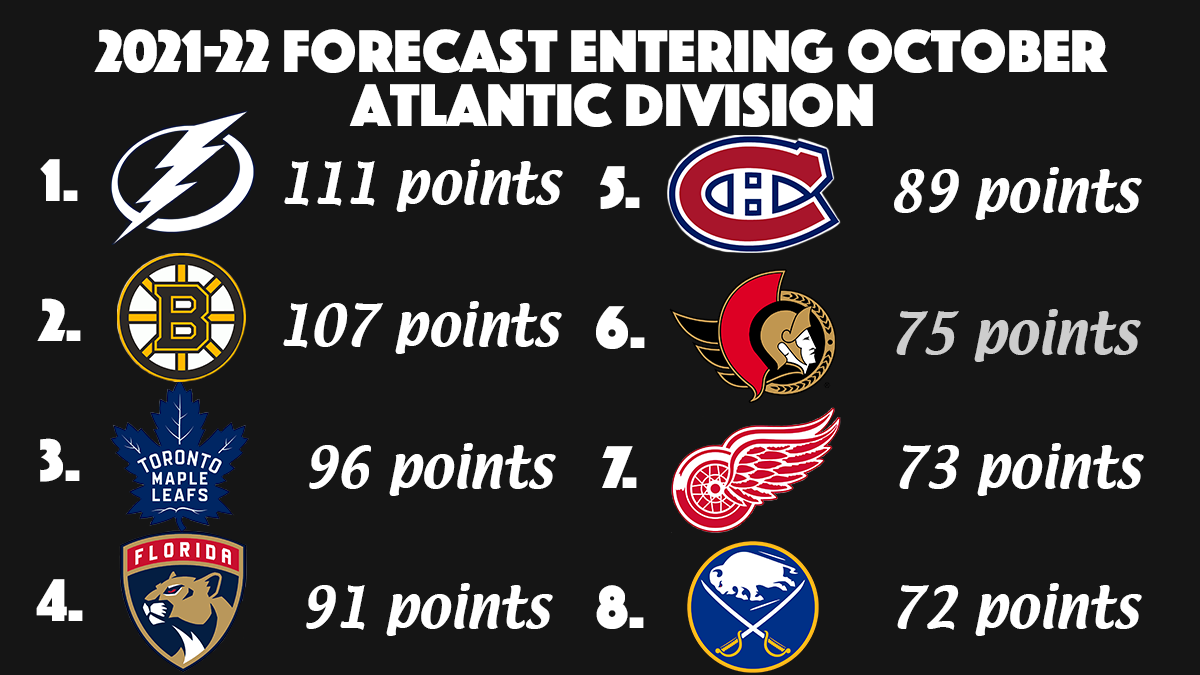
    Every year on DTFR you may recall seeing division standings forecasts for the National Hockey League from month-to-month and, well, I didn’t forget about it this year, don’t worry.

    When the Vegas Golden Knights joined the league in 2017-18, the initial forecast entering October was infused with an educated guess (*ahem*, gut feeling) for each and every team– but especially Vegas since they had never played before– in addition to the usual arithmetic utilized to compile the average of three different forecasts ranging from the last 10, five and three seasons.

    Entering the 2021-22 National Hockey League calendar, with the inaugural season of Seattle Kraken hockey set to begin, I shifted my focus on a “gut feeling” projection for the Kraken to that of the standings projections that I’ve done for at least the last few seasons now.

    In other words, the forecast you’re about to see uses the forecast function in your spreadsheet of choice (Microsoft Excel or Google Sheets), whereas the standings projections in the link above is based on an expected points totals model using last season’s offense and a whole bunch of other things I won’t bore you with.

    As such, Seattle received a projected points total based on the loosely projected offense using a composite of what the Kraken could have had, if every player on their roster entering training camp had scored goals last season for Seattle instead of their respective teams.

    But for this edition of standings predictions– using the forecast function– since the Kraken never played a game entering October 2021, they were given an 8th place standing in the Pacific Division with an asterisk– signifying that their results are incomplete until they hit the ice.

    Now, of course, entering November, the Kraken have played some games, so the forecast reflects that (albeit limited in the variance of possible outcomes, since they don’t have quite the same backlog as the 31 other NHL franchises).

    If you’re confused, let’s move on and talk about how things looked entering October for each division and whether or not things have changed that much entering November– keeping in mind that all 32 teams played anywhere from as few as seven games to as many as 10 games in October.

    And remember, my degree is in communication, not statistics.


    Entering October, the two-time defending Stanley Cup champion, Tampa Bay Lightning were a safe bet to lead the Atlantic Division standings over the course of a return to the usual 82-game schedule.

    The Boston Bruins, who made quite a few moves in the offseason, would do their usual thing under head coach, Bruce Cassidy, and display a strong effort, though how realistic is this expectation, you ask?

    Probably not as spot on as you’d think.

    Last season’s temporarily realigned divisions– featuring intra-divisional play only– helped teams like the Bruins beat teams like the Philadelphia Flyers almost every time they squared off.

    This season, Boston will have to face a stronger than ever before– if not as good as they were in 1995-96– Florida Panthers roster, for example, which is more likely to be reflected in a later forecast after a couple of months are in the record books.

    So that’s actually a perfect explanation for why the Toronto Maple Leafs and Panthers don’t look quite as dominant as they were last season in the forecast entering October.

    The reduced schedule alone yielded similar point totals to regular-length seasons in the past, which downplays this year’s projected outcome, logically, right?

    Keep that in mind for the Colorado Avalanche later, though there may be more to it than just the fact that the 2016-17 season is still accounted for in both the 10-year and five-year models, which drags down the average.

    Anyway, the Montréal Canadiens aren’t a playoff team and the spread between the Ottawa Senators, Detroit Red Wings and Buffalo Sabres reveals each of those three teams is likely to be more competitive than in season’s past, but like Montréal likely on the outside looking in.

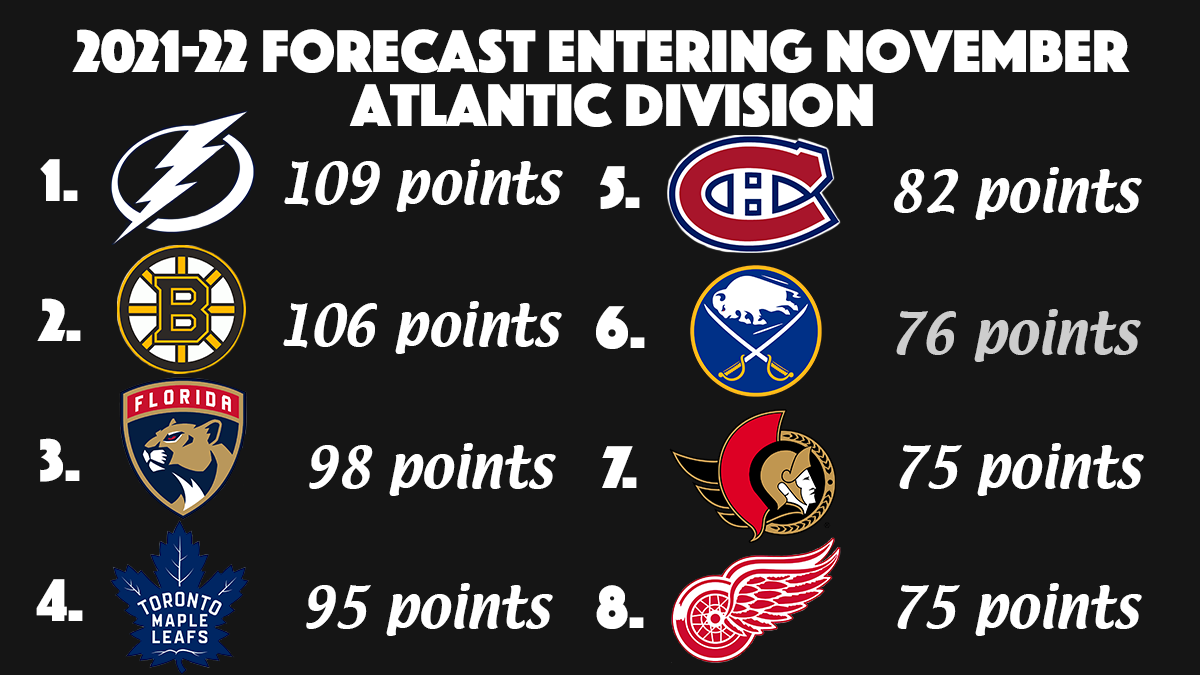
    Entering November, the Bruins and Senators have played the fewest games in the division (seven games each), resulting in not that much change, while Florida gained seven points in the current forecast– moving themselves into a divisional playoff berth in the process.

    Should the Panthers’ success be of concern to Leafs fans if Toronto isn’t in the top-3 in the Atlantic Division?

    No.

    The Lightning haven’t had as much spark as they usually do, which can be attributed to the price of winning back-to-back Cups in a span of, what, like, 10 months?

    They’re tired, but not too tired, because Jon Cooper will ensure his team bounces back when the real season starts as the trade deadline approaches and the push for the playoffs begins.

    Though the Sabres are quick out of the gate, reality should set in as the calendar flips to December and Buffalo will slip out of playoff contention and into being surprisingly somewhere in the middle.

    That isn’t to say that Ottawa and Detroit have been that much worse than the Sabres to start the 2021-22 season, but, yeah, things are better than last season for Buffalo, at least.

    If you’re going to put stock into anything, invest in the Panthers rising to 1st or 2nd place in the Atlantic by season’s end.

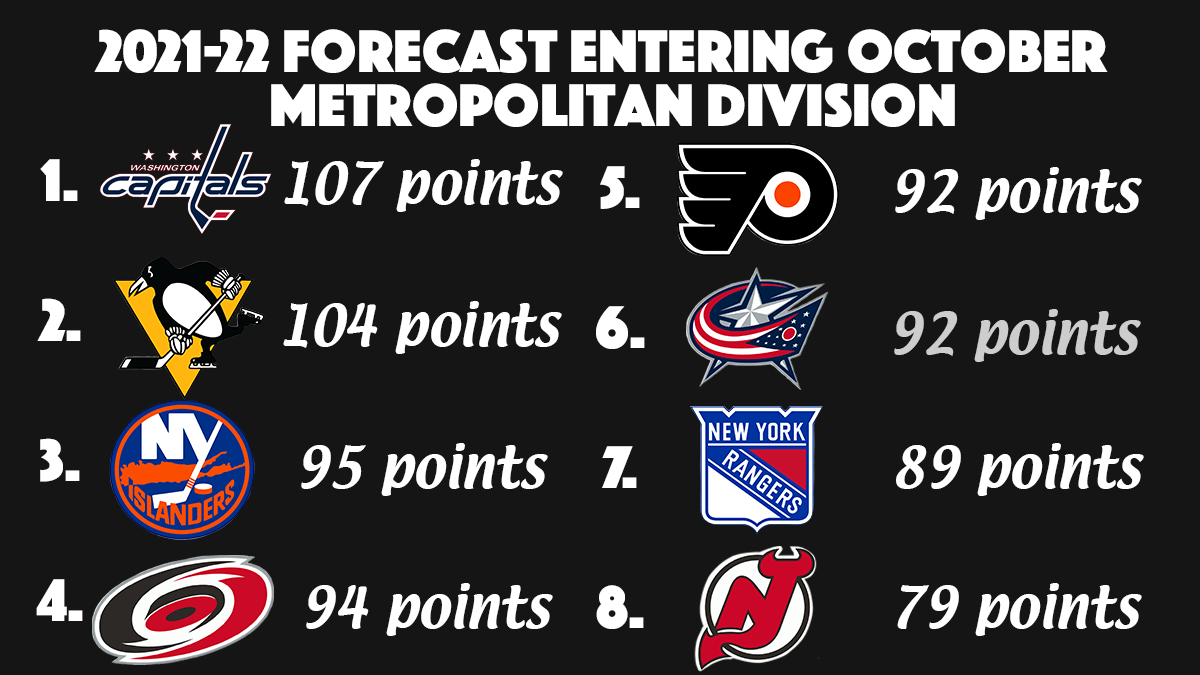
    Taking a look at the Metropolitan Division entering the 2021-22 season, it seems like it’s more of the same for the last four or five seasons now.

    Somehow the Washington Capitals or Pittsburgh Penguins win the division, while the New York Islanders and Carolina Hurricanes upset either team in the First Round. I don’t make the rules.

    While there’s a lot of optimism for the Islanders to make a significant jump in the standings given their recent runs to the Eastern Conference Final, it wouldn’t surprise me if they’re like the Lightning and take a little dip in just about everything.

    It’s not a reset, but a refresh with high expectations for a big 2022-23 season to finally get over the hump and reach their first Stanley Cup Final appearance since 1984.

    Maybe by then Tampa will have succumbed to the salary cap era, so they won’t be in New York’s way in the postseason.

    As for the other New York team, well, the Rangers are sure to frustrate more than just their own fans as they’ll agitate their opponents, sure, but won’t play much of a spoiler in their quest for whatever it is James Dolan has told General Manager, Chris Drury, to do this offseason.

    At the very least, the fact that the Metropolitan Division is a close spread reveals what we already know– that it’s truly anyone’s guess as to who will make the playoffs this year.

    The last decade has conditioned us to expect Pittsburgh or Washington to be the top team, but the Philadelphia Flyers or New Jersey Devils could sneak in and disrupt things enough for the Hurricanes to run away with the Metropolitan title in the regular season.

    Though the Columbus Blue Jackets are forecasted to have the same number of points as the Flyers in both October and November, it’s worth noting that Philadelphia is forecasted to amass 29 regulation wins to Columbus’ 23 regulation wins in the latest projection, so yeah, they’re a team.

    The Blue Jackets could be within striking distance of a playoff spot or they could simply be better than the Rangers and Devils and that’s about it in their attempt to do something.

    Is it a rebuild or are they just holding out for the right offseason moves? Time will tell, but the time may be ticking on prolonged irrelevance.

    Anyway, Washington and Pittsburgh have cooled off as Carolina got out to the best start among all 32 teams, which, given the eight points between 1st and 3rd in the November forecast, could indicate that the Hurricanes will usurp the Capitals and Penguins for division control.

    Meanwhile, the longer the Islanders go without setting a tone, the better chance the Flyers have at making the postseason.

    In the Central Division, the St. Louis Blues are expected to return to form entering October from a pure forecast standpoint.

    Is it realistic? Probably not, though St. Louis should be better than their 2021 First Round exit in four games at the hands of the Avalanche.

    That said, Colorado may surprise you being so low in this forecast.

    Again, remember that it’s an average of models based on the last decade, five seasons and three seasons, so the Avs rise to division dominance in recent years is better reflected on the contingency that they continue to play well.

    Right now, they aren’t playing that well, but again the graphic above reads “entering October” not “entering November”, so perhaps I should’ve saved that tidbit for a minute.

    Meanwhile, the Nashville Predators, Winnipeg Jets and Minnesota Wild have all been consistent enough in recent years to earn better praise entering the 2021-22 calendar, but at least one of those teams is sure to reveal themselves as a pretender by about the quarter-mark of the season.

    As for the Dallas Stars, Chicago and the Arizona Coyotes, well, if Dallas can stay healthy, they should improve. Chicago hasn’t done themselves any favors in terms of roster makeup and the Coyotes are intentionally steering the ship aground for a top lottery draft pick in 2022.

    Not much has changed after one month of NHL action in the Central Division forecast, though it should be noted just how quickly Arizona’s fallen off (even though they were already expected to be a basement team given the immense roster turnover over the summer).

    The Wild and Jets flipped positions courtesy of Minnesota gaining a point between October and November’s forecast, as well as the regulation win tiebreaker (entering November, the Wild are forecasted to have 36 regulation wins, while the Jets are forecasted to finish with 31).

    The Blues have had a hot start and, as a result, remain atop the Central forecast while nearly every expert analyst’s Stanley Cup favorite not named the Lightning (Colorado) remains in 5th.

    Weird times!

    Entering the 2021-22 season, the Vegas Golden Knights made a big trade, but looked to be on the verge of contending for the Presidents’ Trophy in back-to-back seasons.

    Though they lost the Presidents’ race to the Avalanche last season on a tiebreaker, the Golden Knights could benefit from an overall weaker division they’re in. And yet… (keep reading)

    The Calgary Flames are surprisingly hot in the Pacific forecast entering October, but considering the three California teams, the uncertainty of Seattle and the volatile wishy-washiness of the Vancouver Canucks, it kind of makes sense.

    What doesn’t make sense is the Edmonton Oilers– with Connor McDavid and Leon Draisaitl on their roster– seated in 5th place in the Pacific Division.

    Then again, to repeat myself, this forecast is an average based on the last 10, five and three seasons, so the Oilers have really only been a consistent playoff contender for the last five seasons or so, which means that they won’t rise in the forecasted standings quite as fast as you’d hope.

    It pays to be consistently good over a longer period of time in this model.

    Finally, after their first nine games in NHL history, the Kraken have entered the chat in the 2021-22 forecast entering November, but they’re forecasted for a league-worst 64 points.

    Seattle isn’t bad, necessarily, they’re just figuring out the chemistry on the ice, in the room and giving Philipp Grubauer plenty of time to learn the system and get acquainted with being the No. 1 goaltender on a new team– both in the brand new expansion team sense and since leaving the Avalanche for the Kraken in free agency.

    The Flames are continuing to turn heads by being within striking range of taking the forecasted division lead from Vegas– especially as the Golden Knights roll slowly out of the gate.

    Meanwhile, Edmonton’s on course for significant gains in the next forecast entering December, while everything else looks to be about the same because, after all, it is the Pacific Division.

    It’s not great!


    If you’ve read every word of this, congrats. Give yourself a sticker or something.

    Stay tuned for the next forecast in about a month. It should be a little quicker to update the stats, write a few words and hit “publish” than it took this time around.

  • Bruins beat Sharks in first meeting in almost two years

    Bruins beat Sharks in first meeting in almost two years

    Jake DeBrusk’s second period goal proved to be the game-winner as the Boston Bruins withstood a third period surge and held off the San Jose Sharks in a, 4-3, victory at TD Garden on Sunday afternoon.

    Linus Ullmark (2-0-0, 2.00 goals-against average, .935 save percentage in two games played) turned aside 23 out of 26 shots against in the win for the Bruins.

    Meanwhile, Adin Hill (3-1-0, 2.93 goals-against average, .890 save percentage in four games played) and James Reimer (1-0-0, 0.65 goals-against average, .980 save percentage in two games played) split the effort in the loss for the Sharks.

    Hill made 10 saves on 14 shots faced for a .714 save percentage in 25:41 time on ice before he was replaced by Reimer, who stopped all 20 shots against in relief.

    Boston improved to 3-1-0 (six points) on the season and– at the time of this writing– moved into 3rd place in the Atlantic Division, while San Jose dropped to 4-1-0 (eight points) overall and remained in command of 2nd place in the Pacific Division standings.

    The B’s also improved to 2-0-0 at home this season, as well as 25-12-5-0 all time against the Sharks in 42 regular season meetings.

    The Bruins were without the services of Curtis Lazar (upper body), Nick Foligno (upper body), Anton Blidh (upper body) and Craig Smith (undisclosed) on Sunday afternoon.

    Foligno was placed on injured reserve, while Jack Studnicka and Oskar Steen were recalled from the Providence Bruins (AHL). Veteran defender, John Moore, was assigned to Providence as a result.

    B’s head coach, Bruce Cassidy, told reporters prior to Sunday’s matinee with San Jose that Foligno and Blidh are unlikely to play in the team’s upcoming road trip on Wednesday and Thursday.

    As a result of the recent rash of injuries, Cassidy continued to tweak to his lineup, promoting Tomáš Nosek to center the second line and sliding Charlie Coyle to the right wing in place of Smith as a result.

    Cassidy inserted Steen on the third line in Nosek’s usual spot and returned Trent Frederic to the fourth line left wing with Studnicka at center and Karson Kuhlman on the right wing.

    On defense, Connor Clifton returned to his spot on the third pairing alongside Derek Forbort with Moore assigned to Providence.

    Jakub Zboril was the only healthy scratch on Sunday.

    It only took 28 seconds into the action on Sunday afternoon for David Pastrnak to work the puck to Patrice Bergeron through the trapezoid behind the net before Bergeron found Brad Marchand (4) in the high slot for a catch and release goal to give the Bruins a, 1-0, lead.

    Bergeron (2) and Pastrnak (3) notched the assists on Marchand’s goal as Boston got off to a fast start in the first period.

    Less than a few minutes later, Clifton worked the puck to Marchand, who sent the rubber biscuit along the point to Forbort (1) for a wrist shot that floated past Hill’s blocker side as a Sharks defender partially screened his own goaltender– extending Boston’s lead to two-goals in the process.

    Marchand (3) and Clifton (1) had the assists on Forbort’s first goal in a Bruins uniform and the B’s led, 2-0, at 3:18 of the first period.

    Almost midway through the opening frame, Nosek tripped up Tomáš Hertl and cut a rut to the penalty box with a minor infraction at 9:44.

    San Jose’s power play, however, could not convert on the skater advantage.

    The Sharks got another chance on the power play moments later when Charlie McAvoy caught Logan Couture with a high stick at 13:01, but once again Boston’s penalty kill stood tall as Ullmark kept the puck out of the back of the net.

    Shortly after killing off McAvoy’s minor, Brent Burns knocked down Taylor Hall away from the puck and was assessed and interference minor at 15:59– presenting the Bruins with their first power play of the afternoon as a result.

    It didn’t take long for Boston to capitalize on the ensuing skater advantage as Bergeron rang a shot off the crossbar before setting up Pastrnak (2) for one of his trademark one-timer power-play goals from the faceoff circle– right above the dot– to give the Bruins a three-goal lead.

    Bergeron (3) had the only assist on Pastrnak’s goal as the B’s extended their lead, 3-0, at 16:12 of the first period.

    Less than a minute later, however, San Jose got on the scoreboard with a quick break into the attacking zone and a little bit of a give-and-go that resulted in a short side goal for Jasper Weatherby (2) to cut Boston’s lead back to two-goals.

    Jonah Gadjovich (1) and Andrew Cogliano (2) tabbed the assists on Weatherby’s goal at 16:44. With the primary assist, Gadjovich recorded his first career National Hockey League point in his second career game (Gadjovich made his season debut with the Sharks on Sunday and appeared in one game last season for the Vancouver Canucks).

    After one period of action, the Bruins led the Sharks, 3-1, on the scoreboard despite both teams amassing 11 shots on goal each.

    Boston also held the advantage in blocked shots (10-2), while San Jose led the way in takeaways (3-1), giveaways (4-3), hits (13-7) and faceoff win percentage (58-42).

    The Sharks were 0/2 and the Bruins were 1/1 on the power play heading into the first intermission.

    Early in the middle frame, Forbort sent Steen up through the neutral zone on a rush with DeBrusk before Steen bounced an indirect pass to DeBrusk off the boards.

    DeBrusk (2) entered the attacking zone and wired a shot over Hill’s glove to put Boston ahead by three goals once more, 4-1, at 5:41 of the second period.

    Steen (1) and Forbort (1) recorded the assists, marking the first career NHL point for Steen and the first assist as a Bruin for Forbort in the process.

    Sharks head coach, Bob Boughner, replaced Hill with Reimer as a result of DeBrusk’s goal and tried to spur momentum in San Jose’s favor as a result of the goalie change.

    Late in the period, Nick Bonino and Clifton exchanged pleasantries in a post-whistle scrum that resulted in minor penalties for roughing for each player as well as an addition two minutes for slashing for Bonino at 17:29.

    As a result, the Bruins finished off most of the rest of the second period on the power play, though they couldn’t muster anything past Reimer as the second intermission commenced.

    Through 40 minutes of action, the B’s led, 4-1, on the scoreboard and, 22-16, in shots on goal, including an, 11-5, advantage in the second period alone.

    Boston also held the advantage in blocked shots (12-6), while San Jose led in takeaways (8-5), giveaways (10-5), hits (20-13) and faceoff win% (53-48).

    The Sharks were still 0/2 on the power play, while the Bruins dropped to 1/2 on the skater advantage heading into the final frame.

    With tensions rising as the second period came to an end, Frederic and Jacob Middleton kicked things off in the third period with five-minute majors for fighting at 3:02 of the final frame in the first fight of the 2021-22 calendar for Boston.

    Less than a couple of minutes later, Mario Ferraro took an interference penalty at 5:48 of the third period, but the Bruins weren’t able to capitalize on the final power play of the afternoon.

    Midway through the third, the Sharks scored a pair of quick goals as Hertl (2) deflected a shot from Marc-Edouard Vlasic at the point amidst net front traffic to pull San Jose back to within two goals, 4-2, at 13:19.

    Vlasic (2) and Alexander Barabanov (1) tallied the assists on Hertl’s goal.

    Minutes later, Timo Meier (3) redirected a shot from Couture from outside the slot to bring the Sharks to a one-goal deficit, 4-3, at 15:08 of the third period.

    Couture (5) and Burns (4) had the assists on Meier’s goal which was reviewed for a high stick, but determined to be a good goal– the call on the ice was confirmed.

    Boston’s lead had shrunk to a close, 4-3, game in the dying minutes of Sunday’s action.

    Boughner pulled Reimer for an extra attacker with 1:45 remaining in the game and used his timeout with 1:02 left on the clock after a stoppage, but it wasn’t enough to rally his team to force overtime (at least) as the Bruins managed to hold off San Jose’s comeback.

    At the final horn, Boston had won, 4-3, and finished the afternoon leading in shots on goal, 34-26, including a, 12-10, advantage in the third period alone.

    The Bruins finished the afternoon leading in blocked shots (14-6) and faceoff win% (52-48), while the Sharks exited TD Garden with the advantage in giveaways (16-7) and hits (25-23).

    San Jose went 0/2 on the power play, while Boston went 1/3 on the skater advantage on Sunday.

    The B’s improved to 3-0-0 (2-0-0 at home) when scoring the game’s first goal, 3-0-0 (2-0-0 at home) when leading after the first period and 2-0-0 (1-0-0 at home) when leading after two periods this season.

    The Sharks dropped to 2-1-0 (1-1-0 on the road) when allowing the game’s first goal, 2-1-0 (1-1-0 on the road) when trailing after one period and 0-1-0 (0-1-0 on the road) when trailing after the second period in 2021-22 as a result of the loss.

    The Bruins hit the road for a pair of games against the Florida Panthers and Carolina Hurricanes at FLA Live Arena on Wednesday and PNC Arena on Thursday, respectively, before returning home to finish the month of October against the Panthers on Saturday (Oct. 30th).

  • DTFR Podcast #232- Participation Trophies After One Game/One Week (Part VI) (feat. Chris Gere)

    DTFR Podcast #232- Participation Trophies After One Game/One Week (Part VI) (feat. Chris Gere)

    The 2021-22 season is well underway, so let’s bring back our 6th Annual Participation Trophies After One Game awards ceremony!

    Subscribe to the podcast on Apple PodcastsStitcherSpotifyAmazon Music and/or Audible.

  • Ullmark makes Bruins debut in, 4-1, win against former team

    Ullmark makes Bruins debut in, 4-1, win against former team

    Linus Ullmark (1-0-0, 1.00 goals-against average, .972 save percentage in one game played) made 35 saves on 36 shots against en route to the, 4-1, victory for the Boston Bruins against the Buffalo Sabres at KeyBank Center on Friday.

    Ullmark made his Bruins debut against his former team on the road, while Craig Anderson (2-1-0, 2.98 goals-against average, .933 save percentage in three games played) stopped 22 out of 25 shots faced in the loss for Buffalo.

    The Bruins improved to 2-1-0 (four points) on the season and into a tie with the Ottawa Senators and Tampa Bay Lightning for 5th place in the Atlantic Division standings, while the Sabres fell to 3-1-0 (six points) and slipped to 2nd in the same division.

    Boston went 7-1-0 against Buffalo last season and 3-0-0 against the Sabres in 2019-20.

    Nick Foligno (upper body) joined Curtis Lazar (upper body), Jakub Zboril and Connor Clifton on the short list of Bruins players out of the lineup due to injury or simply being a healthy scratch on Friday as B’s head coach, Bruce Cassidy, juggled his lines.

    The top-six forwards remained the same, while Tomáš Nosek was promoted to the third line right wing alongside Erik Haula and Jake DeBrusk, while Anton Blidh slid in on the fourth line left wing as Trent Frederic took over at center with Karson Kuhlman on his right side.

    On defense, Cassidy reunited Matt Grzelcyk with Charlie McAvoy on the first pairing, while Derek Forbort began the night alongside John Moore, who made his season debut in place of Clifton.

    Early in the action, Brad Marchand worked Rasmus Dahlin along the endboards and freed the puck to Patrice Bergeron in the trapezoid, whereby Bergeron dished a short pass to Marchand for the setup to David Pastrnak (1) on a one-timer that was roofed over Anderson’s shoulder.

    Marchand (1) and Bergeron (1) collected the assists on Pastrnak’s 201st career National Hockey League goal as the Bruins jumped out to a, 1-0, lead at 3:49 of the first period.

    Late in the period, despite an onslaught in momentum from the Sabres, Boston skated the other way towards their attacking zone as Charlie Coyle moved the puck from Taylor Hall to Nosek (1) on a tic-tac-goal from point blank on the rush to give the Bruins a two-goal lead.

    Coyle (1) and Hall (1) tallied the assists on Nosek’s first goal as a Bruin and the B’s led, 2-0, at 15:50 of the opening frame.

    Less than a minute later, Boston was shorthanded as Haula slashed Drake Caggiula and cut a rut to the penalty box.

    Buffalo’s power play was not effective on their first opportunity.

    A couple of minutes later, Moore was assessed a high-sticking minor infraction at 18:34, yielding a power play that would spill into the middle frame for Buffalo, but the Sabres were once again outdone by Boston’s penalty kill in the ensuing special teams action.

    Entering the first intermission, the B’s led, 2-0, on the scoreboard, despite trailing the Sabres, 15-7, in shots on goal.

    Boston held the advantage in blocked shots (10-1), takeaways (3-1), hits (6-4) and faceoff win percentage (65-35), while Buffalo led in giveaways (4-3).

    The Sabres were 0/2 on the power play and the Bruins had yet to see time on the skater advantage heading into the middle period.

    Dahlin hooked Pastrnak at 3:42 of the second period and presented Boston with their first power play of the night.

    Late in the ensuing advantage, Marchand sent a pass through the slot to Coyle (1) for the catch and release shot past Anderson’s short side as the Sabres goaltender slid across the crease but to no avail as the puck hit the twine.

    Marchand (2) and Mike Reilly (1) collected the assists on Coyle’s power-play goal at 5:17, and the B’s led, 3-0, as a result.

    As the second intermission drew near, Hall hooked Dylan Cozens and cut a rut to the sin bin at 17:50, but Buffalo couldn’t capitalize on the skater advantage in the dying minutes of the second period.

    Through 40 minutes of action, the Bruins led, 3-0, on the scoreboard despite being outshot by the Sabres, 26-18.

    Both teams managed to fire 11 shots each on net in the second period alone, however.

    Boston still held the advantage in blocked shots (15-5), hits (13-8) and faceoff win% (61-39), while Buffalo led in giveaways (6-4) and both teams managed to amass five takeaways aside.

    The Sabres were 0/3 and the Bruins were 1/1 on the power play heading into the final frame.

    The Bruins were without Blidh to start the third period and would later tweet that Blidh (upper body) would not return to Friday night’s action about midway through the final frame.

    At 7:00 of the third period, Caggiula found himself on the way to the penalty box after hooking Nosek.

    This time around, however, Boston did not score on the ensuing power play.

    Late in the period, Victor Olofsson (2) scored from close range to disrupt Ullmark’s bid for the shutout in his Boston debut.

    Rasmus Asplund (1) and Colin Miller (5) notched the assists on Olofsson’s goal as the Sabres trailed, 3-1, at 14:35 of the third period.

    Less than a couple of minutes later, Hall tripped up Miller and presented Buffalo with another power play that went by the wayside at 16:02 of the final period.

    With 2:47 remaining in the game, Sabres head coach, Don Granato, pulled his netminder for an extra attacker, but it was to no avail as Hall (2) emerged from the penalty box without issue and cleared the Bruins of what would’ve been an icing call before tapping the rubber biscuit into the empty goal frame for the insurance marker.

    Coyle (2) had the only assist on Hall’s goal as the Bruins took a, 4-1, lead at 18:12 of the third period and with it the victory on the road in Buffalo.

    At the final horn, Boston had won, 4-1, and finished the night trailing the Sabres in shots on goal, 36-26, including a, 10-8, advantage for Buffalo in the third period alone.

    The Bruins wrapped up the night leading in blocked shots (22-6), hits (14-12) and faceoff win% (63-37), while Buffalo exited their own building leading in giveaways (8-4).

    The Sabres went 0/4 on the power play, while Boston went 1/2 on the skater advantage Friday night.

    As a result of the win, the Bruins improved to 2-0-0 (1-0-0 on the road) when scoring the game’s first goal, 2-0-0 (1-0-0 on the road) when leading after the first period and 1-0-0 (1-0-0 on the road) when leading after two periods this season.

    Buffalo, meanwhile, fell to 2-1-0 (2-1-0 at home) when allowing the game’s first goal, 2-1-0 (2-1-0 at home) when trailing after the first period and 0-1-0 (0-1-0 at home) when trailing through two periods in 2021-22.

    Boston returns home to host the San Jose Sharks on Sunday before heading back on the road for a pair of games against the Florida Panthers and Carolina Hurricanes next Wednesday and Thursday, respectively.

    After swinging through Sunrise, Florida and Raleigh, North Carolina, the Bruins finish the month of October on home ice against the Panthers next Saturday (Oct. 30th).

  • Flyers ground Bruins in, 6-3, loss on the road

    Flyers ground Bruins in, 6-3, loss on the road

    Despite outshooting the Philadelphia Flyers, 40-25, the Boston Bruins lost, 6-3, on the road at Wells Fargo Center on Wednesday night in front of a national TV audience in their first regular season matchup on TNT.

    Martin Jones (1-0-0, 3.00 goals-against average, .925 save percentage in one game played) made 37 saves on 40 shots against en route to the win in his Flyers debut.

    Meanwhile, Jeremy Swayman (1-1-0, 3.03 goals-against average, .885 save percentage in two games played) stopped 19 out of 24 shots faced for Boston in the loss.

    Cam Atkinson had a pair of goals, while Sean Couturier, Joel Farabee, Derick Brassard and Keith Yandle each had a pair of points in Philadelphia’s victory.

    The Bruins fell to 1-1-0 (two points) on the season and remain 7th in the Atlantic Division standings, while Philly improved to 2-0-1 (five points) and jumped into a three-way tie for 2nd in the Metropolitan Division.

    Once again, Curtis Lazar (upper body) was out of the lineup for Boston as head coach, Bruce Cassidy, declined to make any adjustments to his group of forwards and defenders after opening the season with a, 3-1, win against the Dallas Stars last Saturday.

    As such, John Moore, Jakub Zboril and Anton Blidh joined Lazar in the press box as healthy scratches.

    As a result of the loss, the Bruins are 0-1-0 against the Flyers so far this season. Boston went 6-1-1 against Philadelphia in 2020-21, and 1-0-2 against Philly in 2019-20.

    Atkinson (2) kicked things off on a 2-on-1, where instead of passing the puck, he faked a pass and fired a shot off of Swayman’s glove side and into the twine to give the Flyers a, 1-0, lead.

    Brassard (3) and Justin Braun (2) tallied the assists on Atkinson’s first goal of the game at 8:08 of the first period.

    Moments later, Rasmus Ristolainen cut a rut to the penalty box for interference away from the rubber biscuit as he tied up and took down Bruins captain, Patrice Bergeron, at 13:52.

    Boston’s ensuing power play couldn’t get anything going on the skater advantage, but took advantage of the vulnerable minute after special teams play as Trent Frederic sent a shot inadvertently off of a Philadelphia defender before Karson Kuhlman (1) sent the rolling puck under Jones’ blocker side– tying the game, 1-1, in the process.

    Frederic (1) and Tomas Nosek (1) notched the assists on Kuhlman’s goal at 16:48.

    Less than a couple of minutes later, however, Charlie Coyle tripped up Travis Sanheim and was sent to the sin bin with a minor infraction at 18:25.

    Philadelphia didn’t waste too much time on the ensuing skater advantage as Ryan Ellis sent a shot from the point off of Brassard before Farabee (3) banked it in off of Swayman’s paddle while the B’s netminder reached in desperation for the puck.

    Farabee’s power-play goal put the Flyers back on top, 2-1, at 19:51 of the first period.

    Entering the first intermission, the Bruins trailed, 2-1, on the scoreboard despite leading in shots on goal, 10-7.

    Philadelphia held the advantage in blocked shots (10-6), takeaways (3-1), giveaways (6-1), hits (13-9) and faceoff win percentage (60-40) after 20 minutes.

    Philly was 1/1 on the power play, while Boston was 0/1 on the skater advantage heading into the middle frame.

    Yandle sent a dump pass off the endboards indirectly to James van Riemsdyk whereby No. 25 on the Flyers flung a shot on goal that rebounded to Scott Laughton in the slot.

    Laughton (1) capitalized on the errant puck and hit the twine to give Philadelphia a two-goal lead, 3-1, at 1:58 of the second period.

    van Riemsdyk (2) and Yandle (5) were credited with the assists.

    Almost midway through the middle period, Charlie McAvoy sent Taylor Hall up through the neutral zone into the attacking zone on a breakaway whereby Hall (1) beat Jones with an elevated shot under the bar on Jones’ glove side.

    McAvoy (1) had the only assist on Hall’s first goal of the season as Boston pulled to within one– trailing, 3-2, at 8:38 of the second period.

    With about a minute left on the clock until the second intermission, McAvoy worked the puck low into the attacking zone to David Pastrnak behind the net.

    Pastrnak wrapped the rubber biscuit around the goal frame before slipping the puck through the crease to Brad Marchand (3) for a bit of slight redirection goal, tying the game, 3-3, in the process.

    Pastrnak (2) and McAvoy (2) notched the assists at 19:00.

    With a pair of assists on the night, McAvoy reached a career milestone of 100 assists in 237 career NHL games since making his league debut with the Bruins in the 2017-18 season.

    Doesn’t sound too bad for a defender that just signed an eight-year extension worth $9.500 million per season that starts next season.

    Through 40 minutes of action, the game was tied, 3-3, despite Boston outshooting the Flyers, 28-17, including an, 18-10, advantage in the second period alone.

    Philadelphia, however, still dominated in just about everything else, including blocked shots (17-15), takeaways (6-4), giveaways (9-4) and hits (24-19), while both teams split faceoff win%, 50-50.

    As there were no penalties called in the middle frame, the Flyers remained 1/1 on the power play, while the Bruins were still 0/1.

    Less than a minute into the final frame, Farabee set up Atkinson (3) for a one-timed redirection goal past Swayman’s pad to give the Flyers the advantage on the scoreboard once more.

    Farabee (3) had the only assists on what turned out to be the game-winning goal 58 seconds into the third period as Philadelphia emerged with a, 4-3, lead.

    Midway through the final period, Couturier dropped a pass back to Travis Konecny (3) for an easy shot over Swayman’s glove and under the bar from about mid-range.

    Couturier (3) and Claude Giroux (1) had the assists as the Flyers pulled ahead, 5-3, at 11:17 of the third.

    Shortly thereafter, the Bruins tweeted that forward, Nick Foligno, would not return to Wednesday night’s action with an upper-body injury.

    Late in the period, Brandon Carlo took a roughing minor and was sent to the box at 17:43.

    With 1:18 remaining in the action, Swayman vacated his crease for an extra attacker while shorthanded.

    Yandle worked the puck to Couturier (1) who flung a clearing attempt towards the empty net for the empty net power-play goal– sealing the deal on Philadelphia’s, 6-3, victory at 19:01 of the third period.

    Yandle (5) had the only assist on Couturier’s goal from way downtown where Ben Simmons normally misses three pointers– further than that really.

    At the final horn, the Flyers had won, 6-3, despite finishing the night trailing in shots on goal, 40-25.

    Boston held the advantage in shots on net in the third period alone (12-8), while Philadelphia left their own building leading in blocked shots (23-18), giveaways (12-6), hits (35-32) and faceoff win% (52-48).

    The Flyers went 2/2 on the power play on Wednesday, while the Bruins went 0/1.

    The B’s fell to 0-1-0 (0-1-0 on the road) when allowing the game’s first goal, 0-1-0 (0-1-0 on the road) when trailing after the first period and 1-1-0 (0-1-0 on the road) when tied after two periods this season.

    Philly, meanwhile, improved to 2-0-1 (2-0-1 at home) when scoring the game’s first goal, 2-0-1 (2-0-1 at home) when leading after the first period and 1-0-0 (1-0-0 at home) when tied after the second period in 2021-22.

    The Bruins wrap up their two-game road trip on Friday at KeyBank Center against the Buffalo Sabres before returning home on Sunday to host the San Jose Sharks.

    The B’s travel again for another two-game road trip next week on Wednesday at FLA Live Arena against the Florida Panthers and Thursday at PNC Arena against the Carolina Hurricanes before closing out the month of October at home against the Panthers on next Saturday (Oct. 30th).

  • Bruins open 2021-22 season with, 3-1, victory over Dallas

    Bruins open 2021-22 season with, 3-1, victory over Dallas

    Brad Marchand kicked things off with a rare feat in the National Hockey League– opening a season with a penalty shot goal– before adding a late empty net goal for insurance in the Boston Bruins’, 3-1, win against the Dallas Stars at TD Garden on Saturday.

    For the first time in nine years, a goaltender other than Tuukka Rask served as the starter for Boston on Opening Night, while Jeremy Swayman also became the first Bruins rookie to earn the start since Blaine Lacher did just that on Jan. 22, 1995, in the lockout shortened 48-game 1994-95 season.

    Swayman (1-0-0, 1.00 goals-against average, .964 save percentage in one game played) turned aside 27 out of 28 shots faced in the win for Boston.

    Meanwhile, Stars netminder, Braden Holtby (0-1-0, 2.26 goals-against average, .939 save percentage in two games played), made 37 saves on 39 shots against for a .949 save percentage in the loss.

    With the win, the Bruins kicked off their season 1-0-0 (2 points) and moved into a tie for sixth place in the Atlantic Division with the Ottawa Senators, while Dallas fell to 1-1-0 (4 points) and tied for third in the Central Division with the Colorado Avalanche.

    Curtis Lazar (upper body) missed the Opening Night action as he remains week-to-week since sustaining an injury during the preseason.

    Boston captain, Patrice Bergeron, centered the first line in his usual role between Marchand and David Pastrnak on his wings, while Taylor Hall and Craig Smith surrounded Charlie Coyle on the second line.

    Bruins newcomers, Erik Haula and Nick Foligno were slotted on the third line at center and right wing, respectively, while Jake DeBrusk suited up at left wing.

    Tomas Nosek centered the fourth line in his Boston debut with Trent Frederic on his left and Karson Kuhlman on his right side.

    Derek Forbort made his Bruins debut on the first defensive pairing alongside the newly extended, $76 million richer, Charlie McAvoy, while Mike Reilly was paired with Brandon Carlo and Matt Grzelcyk suited up alongside Connor Clifton.

    In the crease, Linus Ullmark served as Swayman’s backup.

    John Moore, Jakub Zboril and Anton Blidh joined Lazar on the short list of healthy scratches and injured players for Boston.

    Not much was happening until about midway through the opening frame as the Bruins dominated in shots on goal, while end-to-end play ensued.

    Then, at 9:35 of the first period, former Minnesota Wild turned Stars defender, Ryan Suter, hooked DeBrusk and was assessed a minor infraction.

    Boston’s ensuing power play was cut short, however, as Smith tripped up Andrej Sekera along the endboards at 10:58.

    The two teams skated at 4-on-4 for about 37 seconds before Dallas earned an abbreviated power play that went by the wayside.

    Late in the period, Marchand skated towards Holtby on a breakaway with Suter hot on his tail, whereby Suter promptly held Marchand’s stick denying No. 63 in black and gold of a scoring opportunity while on the breakaway– yielding a penalty shot for Boston at 17:38.

    Marchand (1) skated towards the crease with speed and beat Holtby with a clean shot above the pad, but under the blocker to give the Bruins the, 1-0, lead on a penalty shot goal.

    It was the first penalty shot goal in a season opener for Boston since now current assistant coach, Chris Kelly, scored on a penalty shot goal against the Tampa Bay Lightning on Oct. 3, 2013.

    Marchand’s penalty shot goal in a season opener was also just the third instance of such an Opening Night goal in league history as Mats Sundin had done so first with the Toronto Maple Leafs on Oct. 4, 2006, prior to Kelly’s penalty shot goal in 2013, and Marchand’s on Saturday night.

    About a minute later, Roope Hintz caught a skate to the face and bled profusely as he skated off the ice and went down the tunnel. Hintz later returned to the game after the first intermission.

    The Bruins presented the Stars with another power play opportunity to close out the opening frame as McAvoy smothered the puck with his hand, yielding a delay of game infraction at 19:08.

    Once more, however, Dallas’ power play unit couldn’t get anything going as the horn sounded to signal the end of the first period with Boston ahead on the scoreboard, 1-0, and in shots on goal, 17-4.

    The Bruins also held the advantage in hits (15-14), while the Stars led in blocked shots (3-2), takeaways (3-2), giveaways (5-2) and faceoff win percentage (54-46).

    Dallas was 0/2 on the power play while the B’s were 0/1 heading into the middle frame.

    Jacob Peterson caught Pastrnak away from the puck and was sent to the penalty box with an interference minor to kick things off at 4:51 of the second period, but Boston’s power play– like Dallas’ special teams– couldn’t get anything past Holtby on the skater advantage.

    Shortly thereafter, Luke Glendening (1) capitalized on some open space in the slot where he received a pass from Tanner Kero before wiring a shot past Swayman to tie the game, 1-1, after the Bruins botched a clearing attempt in their own zone.

    Kero (1) had the only assist on Glendening’s first goal in a Stars uniform at 9:15 of the second period.

    Almost two minutes later, Jamie Benn cross checked Smith and cut a rut to the sin bin at 11:29, but Boston’s resulting power play was cut short by a hook when McAvoy tugged his stick around Glendening at 12:40.

    Once more, the two teams skated at 4-on-4 before a brief power play for the Stars– which later turned into a short 5-on-3 advantage for Dallas as Marchand tripped Esa Lindell behind the Stars’ own net at 14:30.

    Dallas couldn’t send another puck behind Swayman, however.

    Through 40 minutes of action at TD Garden on Saturday night, the Bruins and Stars were tied, 1-1, on the scoreboard despite Boston leading in shots on goal, 28-14, including an, 11-9, advantage in the second period alone.

    Dallas led in blocked shots (9-7), takeaways (4-3), hits (25-19) and faceoff win% (51-49), while Boston led in giveaways (7-6) after two periods.

    The Stars were 0/4 and the Bruins were 0/3 on the power play heading into the second intermission.

    Early in the final frame, Haula rushed into the attacking zone before dropping a pass for Foligno, whereby the Bruins winger flung the rubber biscuit towards the net as DeBrusk cycled down low.

    Foligno’s initial attempt couldn’t get through, but DeBrusk (1) collected the loose puck and slipped it through Holtby to give Boston a, 2-1, lead at 4:43 of the third period, as well as Foligno (1) and Haula (1) their first points in a Bruins uniform with the primary and secondary assists, respectively.

    Midway through the period, Foligno interfered with Alexander Radulov, but the Stars couldn’t muster anything on the ensuing power play opportunity at 11:12.

    Hintz hooked Forbort at 14:25, but Boston’s bench miscalculated the number of skaters on the ice and was assessed a bench minor for too many men at the whistle, resulting in two minutes of 4-on-4 action.

    With 2:05 remaining in the game, Stars head coach, Rick Bowness, pulled Holtby for an extra attacker, but it wasn’t enough to keep the puck in Dallas’ possession for a late comeback as Marchand (2) emerged from the neutral zone with plenty of space and time to assure the Bruins of the victory with an empty net goal at 18:23 of the third period.

    Pastrnak (1) had the only assist on the goal as Marchand made it, 3-1, Boston.

    Holtby vacated his crease for an extra skater with about 1:14 remaining and then again with about 38.3 seconds left in the game as Reilly sent the puck out of play for an automatic delay of game penalty at 19:21.

    At the final horn, the Bruins had won, 3-1, and finished the night leading in shots on goal, 40-28, despite Dallas leading a valiant effort in the third period with a, 14-12, advantage in shots on goal in the final frame alone.

    The Stars left Boston leading in blocked shots (11-8), giveaways (11-7), hits (33-25) and faceoff win% (53-47).

    Dallas went 0/6, while the Bruins went 0/3 on the power play in their season opener.

    The B’s improved to 1-0-0 (1-0-0 at home) when scoring the game’s first goal, 1-0-0 (1-0-0 at home) when leading after the first period and 1-0-0 (1-0-0 at home) when tied after two periods in 2021-22.

    The Stars, meanwhile, fell to 0-1-0 (0-1-0 on the road) when allowing the game’s first goal, 0-1-0 (0-1-0 on the road) when trailing after one period and 1-1-0 (1-1-0 on the road) when tied after two periods this season.

    The Bruins hit the road for their first road trip of the 2021-22 season with a pair of games next week.

    Boston heads to Wells Fargo Center next Wednesday to take on the Philadelphia Flyers before venturing up to KeyBank Center to square off with the Buffalo Sabres next Friday.

    The B’s return home to TD Garden on Oct. 24th against the San Jose Sharks.