Tag: Sammy Blais

  • Your Team Will Rise/Fail: 2021-22 Standings Projections

    It is time. The 2021-22 season is upon us.

    Technically it already started, but we’ll ignore the fact that the Pittsburgh Penguins spoiled the Tampa Bay Lightning’s 2021 Stanley Cup champion banner night with a, 6-2, victory on the road before the Vegas Golden Knights held off a Seattle Kraken comeback in a, 4-3, win at T-Mobile Arena on Tuesday night.

    And then Wednesday’s games happened too.

    Let’s hit the “reset” button for a second and pretend the 2021-22 is about to get underway. All 32 National Hockey League teams have a chance at clinching 16 available playoff berths.

    Any of the 16 teams that make the 2022 Stanley Cup Playoffs could etch 52 names from their roster, front office and organization on the Stanley Cup next June.

    The usual divisions– Atlantic, Central, Metropolitan and Pacific– have returned as have the Eastern Conference and Western Conference. The regular playoff format is back (three teams per division, two wild cards per conference qualify, plus the Conference Finals round returns in place of the Stanley Cup Semfinals in 2021).

    A full 82-game regular season schedule is slated from October through the end of April with a three-week break in February for the 2022 All Star Game in Las Vegas and the 2022 Winter Games taking precedence before a return to NHL action down the stretch with the postseason kicking off in May like last year and the 2022-23 season likely returning to the pre-pandemic timeline (2023 Stanley Cup Playoffs starting in April).

    The 2022 NHL Entry Draft will be in Montréal on July 7th and 8th, while free agency begins on July 13th, but between now and then, we’ve got the 2021-22 regular season to enjoy.

    Using last season’s team goals for and team goals against, plus some other “magic numbers” as part of an expected points model, we’re able to project what 2021-22 could be for all 32 teams (yes, even the Seattle Kraken, despite this year being their first season)– though you’ll have to pretend there were no transactions made in the offseason.

    In other words, don’t think that any of what you’re about to see is set in stone– view it more as a suggestion for a possible outcome.

    Also, please remember my degree is in communication, so any math beyond figuring out “goals + assists = season point totals” doesn’t exist.

    In a normal year (like from 2017-18 to 2018-19, for example), you just take all the data from the 82-game schedule for each team plug it into a formula in a spreadsheet, then line things up accordingly in each division.

    However, just like how the shortened 2019-20 season disrupted the regular process for projecting a 2020-21 standings outlook, going from last season’s stats in a 56-game schedule to projecting a regular 82-game season in 2021-22 necessitated the use of forecasting point pace as part of the formula.

    As for Seattle, a simple means of taking the NHL stats from last season for every player on their roster and plugging it in for a 2021-22 result is exactly what I did.

    We’re all just making it up as we go along, folks. These are projections. They are not absolutes.

    For the sake of keeping it simple, here’s a look at how things could go (but probably not) in each division for the upcoming 2021-22 season.
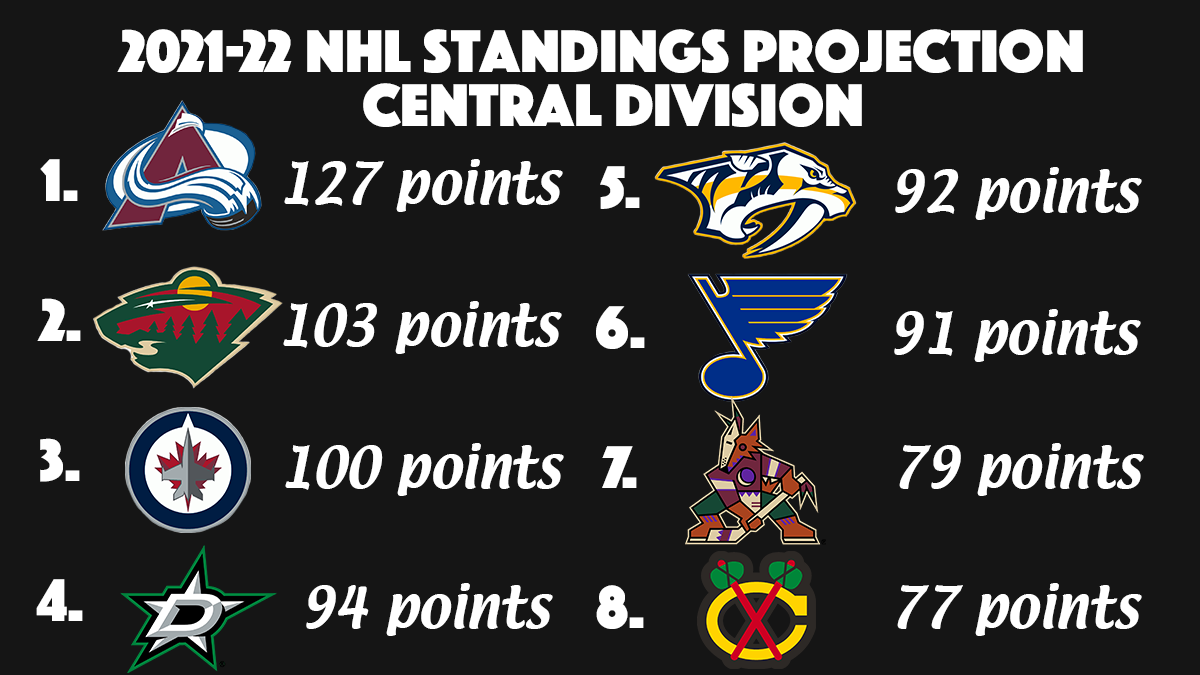
    The overall vibe of the Central Division for 2021-22 is that it’s just more of exactly what you’d expect. The Colorado Avalanche are lightyears ahead of everyone else, while Kirill Kaprizov and the Minnesota Wild continue to be on the rise and everyone else fights for what they can earn.

    Meanwhile, the jury is still out on whether or not the Winnipeg Jets can breakthrough as Canada’s team and break the Canadian curse (become the first Canadian club to win the Cup since 1993).

    Will Colorado finally break through the Second Round and win the Cup?

    Are the Avalanche just the Toronto Maple Leafs but with a little more success? My column:

    No, but really, it’s worth asking if the Avs making it back to the Western Conference Final for the first time since 2002, is more like Toronto’s struggle to make it out of the First Round for the first time since 2004, or is Colorado’s struggle more like the Washington Capitals pre-2018?

    The Caps won three Presidents’ Trophies in 2009-10, 2015-16 and 2016-17, but couldn’t make it past the Second Round– let alone the Pittsburgh Penguins– until they finally did and ended up surging in momentum all the way to their first Stanley Cup in franchise history.

    Colorado, on the other hand, has already won the Cup twice (1996 and 2001) and also has three Presidents’ Trophies to their name in 1996-97, 2000-01 and 2020-21, so if recent history has anything to tell us it’s that yet another team with high expectations for at least a few seasons now only to come up short could very well go on to win it all after winning the Presidents’ Trophy the previous year.

    Either that or they’ll have to win it in back-to-back seasons like Washington did before they won the Cup in 2018.

    Then again, the Tampa Bay Lightning tied the Detroit Red Wings’ record for most wins in the regular season (62), securing the Presidents’ Trophy in the process in 2018-19, then got swept by the Columbus Blue Jackets in the 2019 First Round.

    The very next year, however, Tampa kicked off back-to-back Cup rings in 2020 and 2021, to be where they are now as the two-time defending champions likely standing in the path as the only other favorites outside of the Avalanche this season.

    Anyway, the Avs mostly kept things the same from last season to this season, losing Joonas Donskoi to the Seattle Kraken in the 2021 NHL Expansion Draft, Brandon Saad to the St. Louis Blues in free agency and making minor swaps among replacement level bottom-six forwards and bottom-pairing defenders.

    Oh, then there’s this whole thing about how Philipp Grubauer left for Seattle in free agency too, so Colorado acquired Darcy Kuemper from the Arizona Coyotes.

    Between Dallas, Nashville and St. Louis, who will realistically make the playoffs?

    The Stars are projected to finish with about 94 points, the Predators sit at 92 points and the Blues are around 91 points in this one projection, but don’t let the points alone be your deciding factor.

    Given the strength of the Central Division compared to the Pacific Division, you can bet on five teams making out of the Central among Western Conference playoff berths.

    As such, the spread is the difference maker between these three teams expected to be in the wild card hunt– it’s going to come down to the wire one way or another.

    Dallas bolstered their goaltending depth by signing Braden Holtby, Nashville traded Ryan Ellis to the Philadelphia Flyers and St. Louis is… …better than last season on paper?

    I mean, the Blues signed Saad, acquired Pavel Buchnevich from the New York Rangers in exchange for Sammy Blais, let Seattle claim Vince Dunn at the expansion draft and let Mike Hoffman walk to the Montréal Canadiens in July.

    You could say they took a hit here or there, but those aren’t “nobody names” by any means, however.

    If Jordan Binnington and Ville Husso can stabilize things in the crease, then St. Louis has a better situation than the Predators.

    The Stars, meanwhile, should benefit from a longer season where more of their core guys– like Tyler Seguin, for example– are healthy. Last season’s COVID-19 outbreak to kick things off in January really killed Dallas’ momentum as a team on the verge of being in the 2021 postseason.

    Dallas should get back into the swing of things and St. Louis should be able to stay relevant for at least another year, but how hard the Preds rely on Juuse Saros as their starting goaltender will dictate whether or not they’re able to play spoiler with David Rittich as their backup since Pekka Rinne retired.

    Can Arizona avoid the basement?

    Anything is possible at this point. Loui Eriksson and Andrew Ladd were scoring goals in the postseason, so a fresh start could be just what both players needed for the last few years at least.

    That said, Coyotes General Manager, Bill Armstrong, gave a Masterclass™️ in how to go about rebuilding by selling everything over the summer and taking on “bad” contracts with only one or two years remaining in hopes of playing just well enough to be bad enough without making it look obvious that you’re aiming to win the 2022 NHL Draft Lottery.

    The Pacific Division is the new Scotia NHL North Division from last season. In other words, it’s the worst– which is great news for the Seattle Kraken as the league’s schedule allots more division play than any other opponents (though the Kraken will play every other team in the league at least twice).

    Seattle’s riding the waves of new-age expansion, while the Vegas Golden Knights lead the charge for the Presidents’ Trophy campaign in 2021-22.

    Wait, Seattle in 2nd in the Pacific, really?

    Yes, really.

    The Kraken have a great front office that goes beyond just Ron Francis as General Manager and have done their due diligence in scouting the best talent available to try to replicate the success of the Vegas Golden Knights’ inaugural season in 2017-18, as well as grow beyond just 2021-22.

    That said, Seattle probably isn’t going to make it out of the First Round of the 2022 Stanley Cup Playoffs, even if they have to face the Edmonton Oilers according to this projection.

    It’s a best case scenario for the NHL’s newest expansion team to be in the weakest division, but aside from having recent Stanley Cup champions Yanni Gourde, Philipp Grubauer, Jaden Schwartz and Dunn on their roster, the Kraken have a plethora of players that are relatively inexperienced with deep postseason runs.

    Head coach, Dave Hakstol, also hasn’t had the consistency of making the playoffs and making it out of the First Round in his NHL coaching days, but as a team that, again, is looking to develop long-term success, these are mere growing pains Francis and Co. are willing to accept as the fan base grows.

    Why aren’t the Kings making the cut this year when everyone else says they’ll be the most improved?

    The simple answer is that everyone’s overrating Los Angeles when it comes to the “ready now” factor.

    Sure, Kings General Manager, Rob Blake, did a good thing by getting Viktor Arvidsson in a trade with Nashville this summer to solidify his top-six forward group and signed Alex Edler to fortify his defense, but Los Angeles’ goaltending leaves something to be desired.

    Here’s hoping Jonathan Quick can find a little resurgence at this point in his career, while Cal Petersen continues to come into his own.

    If Los Angeles has any injuries– and they already have with Arvidsson likely missing some time due to an injury in the last preseason game– they’re already close enough to the bubble that they’ll only fall further behind.

    That said, if the Kings don’t make it back to the postseason hunt in 2022, there’s a good chance they make it in 2023.

    Los Angeles is improving, but by how much remains to be seen.

    Will winning the Presidents’ Trophy hurt Vegas?

    Eh, it’s hard to say.

    The Golden Knights have packed in just about every type of heartbreak since their inception in 2017, that fans of other franchises have only experienced over the course of at least 50 years, so if Vegas pulls out the Presidents’ Trophy win in 2021-22, don’t be surprised when the inevitable happens and they win the Cup instead of doing what most other Presidents’ Trophy winners in the salary cap era have done.

    Only the 2007-08 Detroit Red Wings and Chicago in 2012-13, have been able to win the Presidents’ Trophy and the Stanley Cup since the salary cap was introduced ahead of the 2005-06 season.

    Vegas would probably join Detroit and Chicago in doing so just so the Hockey Gods can spite us again.
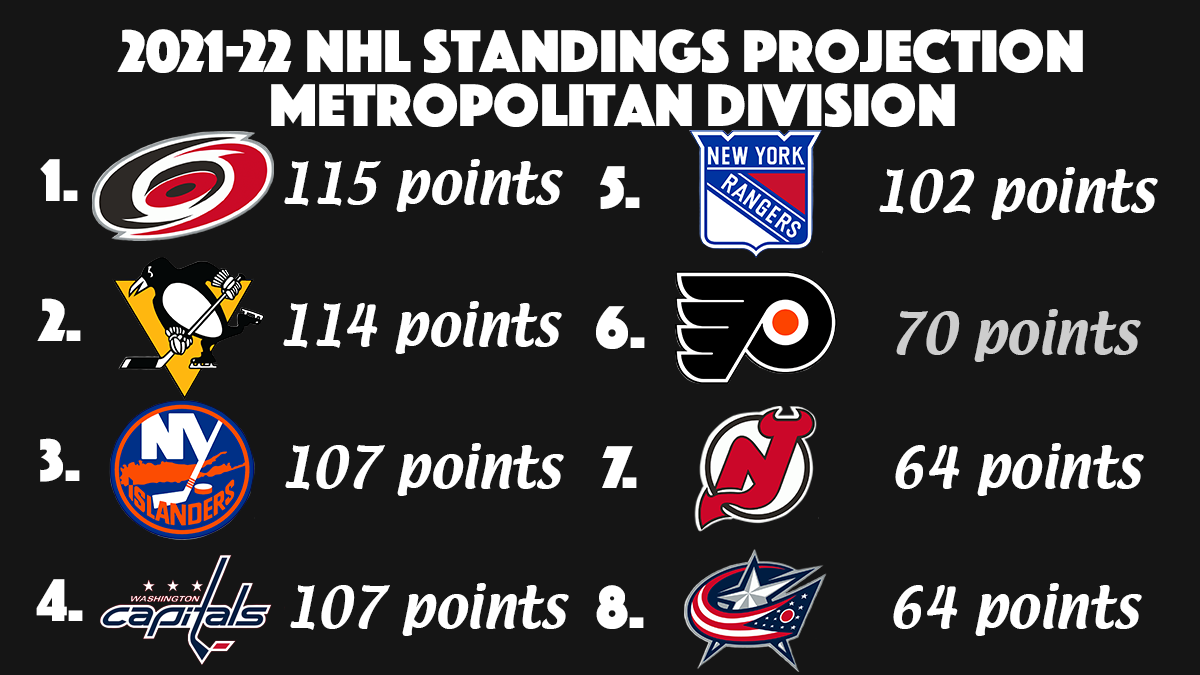
    It’s not easy to be in the Metropolitan Division these days because, well, let’s save that for the three questions below.

    Is this the toughest division to project?

    Absolutely.

    The Carolina Hurricanes decided to just get rid of a few parts and pieces that helped make them good for the last few seasons, so they’re bound to regress even with Sebastian Aho, Andrei Svechnikov, Teuvo Teräväinen and Martin Necas still existing.

    The Pittsburgh Penguins since 2009, have always found a way to be near the top of the division standings by the end of the regular season no matter whether or not you believe they’ll inevitably miss the playoffs for the first time since 2006, so anything could happen there.

    The New York Islanders have made back-to-back appearances in the Eastern Conference Final, so I’d expect them to be good.

    The Washington Capitals are better than the Philadelphia Flyers and New York Rangers, at least, but are probably the only team on the bubble if the New Jersey Devils can come out of nowhere and be competitive this season after signing Dougie Hamilton, Tomas Tatar and Jonathan Bernier in the offseason.

    Meanwhile, it’s time for a short rebuild in Columbus as the Blue Jackets would be quite pleased with a top draft pick in 2022.

    What if Chris Drury never was promoted as General Manager of the Rangers?

    They’d still fire David Quinn and hire Gerard Gallant. I don’t think that’s such a bad idea, but they’d definitely reconsider about 90% of the roster decisions made this summer.

    There’s no reason why the Rangers have to go down this path and yet, here they are, fumbling at the one-yard line and possibly plunging their franchise back into the Dark Ages of another rebuild. Or is it the same ongoing rebuild?

    What about a team to watch like New Jersey, for example?

    I’m big on the Devils this season for some strange reason.

    Maybe it’s because a part of me deep down misses the trap game of the 1990s and 2000s that led to Stanley Cups for New Jersey in 1995, 2000 and 2003.

    Maybe it’s because they signed Hamilton, Tatar, Bernier and acquired Ryan Graves from the Colorado Avalanche as a supporting cast for Jack Hughes, Nico Hischier, Pavel Zacha, Yegor Sharangovich, Ty Smith and friends.

    Seriously, the Devils should be good in the next few seasons, but this year could be the biggest stride forward in terms of their improvement from the basement to their development as a playoff contender.

    First, pour one out for Jack Eichel. Now, let’s move on and talk about everyone else.

    What does this mean for the Leafs?

    Just like how the Stars, Preds and Blues are all right on top of one another in the Central Division standings, the Atlantic Division is stacked from 1st through 4th, so though Toronto leads the way in this projection, I wouldn’t feel too comfortable as a Leafs fan.

    The Maple Leafs played in the worst of the four divisions last year in the temporarily realigned divisions in wake of the ongoing pandemic.

    No, it’s not just because they played all the other Canadian teams across 56 games, but rather it’s due to the fact that they haven’t been able to matchup with the Tampa Bay Lightning, Florida Panthers and even the Boston Bruins since the 2019-20 season.

    A lot and not a lot has changed since then.

    Tampa is still dominant as ever, Florida has emerged as a team that’s on the rise and Boston is unpredictable in that– much like the Penguins– it could really go either way with the Bruins this season.

    So now Toronto has to take on better competition within their own division and square off with teams like the Vegas Golden Knights, Colorado Avalanche, New York Islanders and others that emerge towards the top of the standings outside of the Canadian teams that the Leafs are all too familiar with at this point.

    That said, Toronto still has a great chance at winning the Atlantic Division regular season title or finishing 2nd and having home ice advantage in the First Round for the second-straight postseason.

    Can anyone other than Toronto, Florida, Tampa or Boston make it out of the Atlantic this year?

    No. Let’s be realistic here.

    The Montréal Canadiens made it to the 2021 Stanley Cup Final despite being below .500 in the standings because every division produced four playoff berths and intra-divisional play through two rounds.

    In 2020, they upset the Pittsburgh Penguins in the Qualifier despite finishing right at .500.

    In any other non-pandemic timeline, the Canadiens would still be looking for their first playoff appearance since they lost to the New York Rangers in six games in the 2017 First Round.

    That’s not to say that Nick Suzuki can’t lead the Habs back to glory, but rather that they need to improve all-around in the regular season and peaking in performance in the playoffs.

    Though the Ottawa Senators promised unprecedented success from 2021-25, it’s looking like it’ll realistically be anytime between 2024-25 as in the 2024-25 season itself at this point.

    Ottawa’s goaltending needs to improve, their defense could use some tweaks and the Sens are banking on their offense getting their feet underneath them and bursting in production in the coming years.

    A little more patience won’t hurt them.

    The same can be said for the Detroit Red Wings in that Red Wings fans already know– trust in General Manager, Steve Yzerman, is paramount. He’ll work his magic.

    It just takes a little time to build a solid foundation and the first floor is almost ready to start going up.

    As for the Buffalo Sabres, well…

    At least they’ll hopefully give Rick Jeanneret a proper send-off before he retires as their play-by-play announcer for the last 51 years on television.

    Hopefully.

    Will Tampa win three consecutive Stanley Cup championships?

    Probably not.

    I’m not ruling it out entirely, but the Lightning have a better chance of winning three Cups in four years than they do three Cups in as many years as things stand currently.

    The loss of their entire third line (Blake Coleman, Yanni Gourde and Barclay Goodrow) from last season to this season is sure to leave a mark on the development and restructuring of their bottom-six forwards.

    That said, Tampa’s top-six forwards still exist and, if you haven’t already noticed, they’re very good on their own, but the best teams in the playoffs have four lines that can roll without a doubt and the Bolts might just be off the ball for a year in terms of depth.


    Alright, if you’ve made it this far, thanks for your patience. By now the season’s already going on a few days into the 2021-22 calendar, so the two of us (or more if you’re reading this to a group) should probably get back to watching games.

    Stay tuned for more forecasts for both standings and assorted teams throughout the season.

  • St. Louis Blues 2021-22 Season Preview

    St. Louis Blues 2021-22 Season Preview

    2020-21 record 27-20-9, 63 points

    4th in the Honda NHL West Division

    Eliminated in the First Round by Colorado

    Additions: F Pavel Buchnevich (acquired from NYR), F Matthew Peca, F Brandon Saad, F Nathan Todd, D Tommy Cross, D Calle Rosén, G Charlie Lindgren

    Subtractions: F Sammy Blais (traded to NYR), F Mike Hoffman (signed with MTL), F Curtis McKenzie (signed with Texas Stars, AHL), F Jaden Schwartz (signed with SEA), F Alexander Steen (retired), D Vince Dunn (expansion, SEA), D Carl Gunnarsson (retired), D Petteri Lindbohm (KHL)

    Still Unsigned: F Robert Thomas (RFA), G Jon Gillies

    Re-signed: F Ivan Barbashev, F Tyler Bozak, F Dakota Joshua, F Tanner Kaspick, F Jordan Kyrou, F Zach Sanford, F Nolan Stevens, F Nathan Walker

    Offseason Analysis: Winning the Cup comes with a blessing and a curse. It’s a blessing to win it (especially as the Blues had never won prior to 2019, since their inception in 1967) and it’s a curse because it sets an expectation for success.

    St. Louis might have had a short window to win their second Cup in franchise history.

    After being swept by the Colorado Avalanche in the First Round of the 2021 Stanley Cup Playoffs, their face of the franchise before Ryan O’Reilly’s arrival, Vladimir Tarasenko, requested a trade.

    Blues General Manager, Doug Armstrong, has yet to fulfill that request and has indicated that he’s in no rush to do so– after all, he’s in control of the cards at hand and like when Avs General Manager, Joe Sakic, ultimately traded Matt Duchene, Armstrong can command a steep price for Tarasenko if he’s patient enough.

    Injuries have limited Tarasenko to 34 games in the last two seasons, including 3-7–10 totals in 10 games in 2019-20 and 4-10–14 totals in 24 games in 2020-21.

    From 2014-15 through the 2018-19 season Tarasenko recorded five consecutive seasons with at least 65 points– including his career-high 75 points in 82 games in 2016-17, as well as a 40-goal season in 80 games in 2015-16.

    Tarasenko’s situation isn’t the only concern in St. Louis, however, as the depth of the Blues that made them Cup contenders turned champions in 2019, has withered away– leaving Armstrong with the difficult task of overhauling both the top-six forward group and experimenting with the right mixture of replacement players.

    Jake Allen, Sammy Blais, Jay Bouwmeester, Vince Dunn, Joel Edmundson, Robby Fabbri, Carl Gunnarsson, Patrick Maroon, Alex Pietrangelo, Jaden Schwartz and Alexander Steen have all left one way or another since winning the Cup in St. Louis.

    In their place, guys like Ivan Barbashev, Klim Kostin, Jordan Kyrou and Mackenzie MacEachern have climbed the development ladder, while Torey Krug, Justin Faulk and Marco Scandella were acquired by other means.

    Some will rise and exceed expectations. Others will be gifted contracts through their prime– though their use may be time limited and the chemistry pulled apart.

    At the very least, Barbashev and Kyrou’s extensions this summer lead the youth movement for the Blues in an ever-changing league.

    Meanwhile, the introduction of Brandon Saad on a five-year deal worth $4.500 million per season– only a smidge more than what Mike Hoffman was making on a one-year contract that wasn’t renewed– and Pavel Buchnevich via trade and subsequent four-year, $23.200 million extension has solidified St. Louis’ top-six forward group for the foreseeable future.

    Saad spent last season with the Avalanche and had 15-9–24 totals in 44 regular season games before coming up clutch in the postseason– albeit at times the only goal scorer, it seemed, for Colorado– with 7-1–8 totals in 10 games.

    At 28-years-old, the Blues should have him for what’s left of his prime in what’s been a respectable career thus far with 371 points (184 goals, 187 assists) in 632 career games since making his league debut in the 2011-12 season with Chicago, winning two Stanley Cup rings with the organization in 2013 and 2015, then spending time with the Columbus Blue Jackets, Chicago again and Colorado.

    Armstrong acquired Buchnevich from the New York Rangers in exchange for Blais and a 2022 2nd round pick on July 23rd in the only trade that involved roster players for St. Louis this offseason.

    Blais leaves the Blues after breaking into the league in the 2017-18 season and amassing 17-18–35 totals in 119 games with St. Louis, including 8-7–15 totals in 36 games last season.

    Buchnevich joins the Blues riding a productive season with the Rangers– notching 48 points (20 goals, 28 assists) in 54 games in 2020-21, as well as 79-116–195 totals in 301 career games with New York since making his league debut in the 2016-17 season.

    After nine loyal seasons with the Toronto Maple Leafs, Tyler Bozak won the Cup in his first season with St. Louis in 2018-19.

    Through three seasons with the Blues, Bozak’s amassed 31-53–84 totals in 170 games– despite injuries that kept him to 31 games out of the 56-game schedule in 2020-21.

    At 35-years-old and in love with the St. Louis uniform, Bozak is ready to be part of the transitional plans from 2019 Stanley Cup champions to getting back to Cup contention for the Blues– signing a one-year extension worth $750,000 against the cap.

    He’ll either be back to full health as a low-risk, high-reward gamble to hang onto or he’ll be trade bait for another team looking to add a touch of experience at the deadline.

    It might have been a blessing in disguise for the Blues to have kept Bozak and lost Schwartz this offseason.

    Schwartz’s five-year contract worth $5.500 million per season with the Seattle Kraken contains a no-movement clause in the first three seasons for a player that’s suffered from a recent decline in production at 29-years-old.

    Contrasted with Phillip Danault’s two-way style that ultimately went to the Los Angeles Kings with an additional sixth-year in his contract– albeit their similar scoring totals– the Blues were never going to be able to afford to keep Schwartz and account for patching a couple of holes at the same time.

    After skyrocketing to the top of the league standings and winning the Cup in 2019, Jordan Binnington’s looking to reinvent himself as a surefire starter in the National Hockey League.

    On the wings of a six-year extension worth $6.000 million per season, he better prove it.

    A 30-13-7 record in 50 games played with a 2.56 goals-against average, a .912 save percentage and three shutouts in that span in 2019-20, was followed by an 18-14-8 record in 42 games played with a 2.65 goals-against average and a .910 save percentage.

    That doesn’t exactly scream long-term option in net if it worsens.

    In five postseason games in 2020, Binnington went 0-5 and had a 4.72 goals-against average, as well as an .851 save percentage.

    In 2021, he went 0-4 with a 3.59 goals-against average and an .899 save percentage. While that is better than his 2020 performance, it also means that the two postseason wins since winning the Cup in 2019, were recorded by a goaltender not named “Binnington” (they were, in fact, recorded by current Montréal Canadiens backup and former Blues netminder, Jake Allen).

    If St. Louis can’t get things tamed in the crease, then they might have even more issues to resolve than already planned.

    Offseason Grade: C

    While Saad and Buchnevich are quality pickups for the Blues, most teams in playoff contention make one or two moves and otherwise stand pat.

    St. Louis got an upgrade over Hoffman’s departure, sure, but they are limited in spending power with about $782,000 left in cap space and burdened by lengthy contracts that haven’t really gone one way or another yet.

    Armstrong knows how to build a team up over a period of time, but hasn’t encountered what it means to sustain that success over the years in the postseason, as well as through the course of developing a system to supplement it while talent comes and goes in the ebbs and flows of the salary cap era.

    Whereas the Blues once mastered building the foundation for a team that could contend for a decade or more, it seems as though there are cracks starting to form and if they’re not careful, serious structural damage could affect their core.

  • New York Rangers 2021-22 Season Preview

    New York Rangers 2021-22 Season Preview

    2020-21 record 27-23-6, 60 points

    5th in the MassMutual NHL East Division

    Missed the postseason for the first time since 2020

    Additions: F Sammy Blais (acquired from STL), F Barclay Goodrow (acquired from TBL), F Dryden Hunt, F Greg McKegg, F Ryan Reaves (acquired from VGK), D Patrik Nemeth, D Jarred Tinordi

    Subtractions: F Colin Blackwell (expansion, SEA), F Pavel Buchnevich (traded to STL), F Phillip Di Giuseppe (signed with VAN), F Brett Howden (traded to VGK), F Patrick Newell (Eliteserien), D Tony DeAngelo (buyout, signed with CAR), D Nick DeSimone (rights acquired from VGK, signed with CGY), D Jack Johnson (signed to a PTO with COL), D Darren Raddysh (signed with TBL), D Yegor Rykov (KHL), D Brendan Smith (signed with CAR)

    Still Unsigned: F Gabriel Fontaine, D Brandon Crawley

    Re-signed: F Filip Chytil, F Julien Gauthier, F Tim Gettinger, F Ty Ronning, D Libor Hajek, G Adam Huska, G Igor Shesterkin

    Offseason Analysis: Well, this offseason happened.

    Because nobody sought vengeance for Tom Wilson’s shenanigans, Rangers owner, James Dolan, arose from his desk and remembered that he owns more than just the New York Knicks.

    Heads were rolling as Chris Drury was instated as New York’s General Manager before last season ended– leaving Jeff Gorton to take a role with NHL Network during the 2021 NHL Entry Draft. Gerard Gallant replaced David Quinn behind the bench.

    If the Rangers had a good thing going from the second-half of last season onward, well, they’ve surely burned it to the ground in a scorched-Earth search for guys that’ll punch other guys in the face for their 2021-22 roster.

    Greg McKegg and Dryden Hunt are extra bodies to stockpile with the Hartford Wolf Pack (AHL) until somebody gets injured or booted out of the Rangers’ lineup because they’re suspended for trying to take Wilson’s head off or something.

    New York was one or two pieces away from being a playoff contender and currently has about $8.872 million in cap space with almost $30 million to spend next summer when pending-restricted free agent, Kaapo Kakko, needs a new deal.

    But for the time being, the Rangers decided to punt.

    Sure, Jack Eichel is still available if the Buffalo Sabres ever decide to trade him one of these days (with or without letting him get his desired surgery done).

    Drury’s logic, however, doesn’t necessarily see a fit for Eichel on the team– I mean, is he even tough enough?!?

    Mika Zibanejad’s name is out there for some reason. He’s not too pleased by the rumor mill churning up whatever it can to excite Rangers fans about a team that took one step forward and two steps back on paper.

    Pavel Buchnevich didn’t have to be traded. But he was.

    Nothing makes sense anymore.

    On July 17th, Drury traded a 2022 7th round pick to the Tampa Bay Lightning for the rights to restricted free agent forward, Barclay Goodrow, then signed Goodrow to a six-year extension worth about $3.642 million per season.

    The 28-year-old had 6-14–20 totals in 55 games last season en route to winning his second-straight Stanley Cup ring with the Lightning, but Buchnevich, 26, had 20-28–48 totals in 54 games.

    Somebody’s got to replace the scoring.

    That same day, Brett Howden was dealt to the Vegas Golden Knights for Nick DeSimone’s rights and a 2022 4th round pick, but DeSimone tested the waters of free agency and signed with the Calgary Flames.

    On July 23rd, Buchnevich was traded to the St. Louis Blues for Sammy Blais and a 2022 2nd round pick.

    Blais had 8-7–15 totals in 36 games for St. Louis last season while battling injury and bouts on the league’s COVID-19 protocol list.

    There’s still 13 points to replace to makeup for trading Buchnevich.

    On July 29th, Drury listened to Gallant’s preferences for a rougher style, if not a personal request for a familiar face as New York traded a 2022 3rd round pick to Vegas for Ryan Reaves, who, at 34-years-old had 1-4–5 totals in 37 games for the Golden Knights.

    Though he kept his penalty minutes relatively low with only 27 minutes spent in the box in 2020-21, he was suspended for two games in the 2021 Stanley Cup Playoffs for his intent to injure then Colorado Avalanche defender, Ryan Graves, on an unnecessary roughing incident in front of Colorado’s own net.

    But hey, an eye for an eye, right?

    If you can’t beat them on the scoreboard– just beat them up instead.

    It’s worked well for the Philadelphia Flyers since 1975.

    Don’t want to fight Goodrow or Reaves? How about Jarred Tinordi on the defense? Maybe Patrik Nemeth?

    Both were signed in free agency– Nemeth to a three-year contract worth $2.500 million per season and Tinordi on a two-year deal with a $900,000 cap hit.

    Ryan Strome and Zibanejad are pending-unrestricted free agents and if Drury’s done enough to alienate them from whatever plan they bought into when the Rangers were on the rise coming out of their recent rebuild, then they’re the biggest pieces of trade bait for the team going into the deadline.

    That’s not what you’d like to hear if you have aspirations of acquiring Eichel, since New York can’t guarantee that either player would want to stick around in Buffalo for longer than this season.

    At the very least, Ryan Lindgren’s three-year extension with a $3.000 million cap hit looks pretty nice on the blue line and Igor Shesterkin’s four-year extension worth $5.667 million per season is good enough to foster healthy competition between Alexandar Georgiev and Shesterkin for the surefire starting goaltender role.

    Offseason Grade: D

    The Rangers didn’t have to do this to themselves and yet, here we are.

    They were a team on the verge of something special with one or two more pieces to go and a little more experience to gain as the younger players learn and grow.

    Instead, New York chose to go in the opposite direction– to overreact rather than react accordingly. A few irrational decisions means is the difference between middle of the road insanity and making the playoffs.

    It seems like the Rangers are destined for the former once again in 2021-22.

  • 2021 NHL Entry Draft Round 1 Recap

    2021 NHL Entry Draft Round 1 Recap

    Round 1 of the 2021 NHL Entry Draft was held virtually Friday night for the second-straight year as the ongoing COVID-19 pandemic delayed the league’s plans for a draft at Bell Centre in Montréal until 2022 at the earliest.

    Coverage of this year’s first round began Friday night at 8 p.m. ET on ESPN2 in the United States, as well as SN and TVAS in Canada. Rounds 2-7 will be televised on Saturday at 11:00 a.m. ET on NHLN in the U.S. and Sportsnet in Canada.

    As always, there were plenty of surprises and (possibly) a lack of trades. Here’s how it all went down.

    2021 NHL Entry Draft Round 1

    1.Buffalo Sabres –>  D Owen Power, Michigan (NCAA)

    2. Seattle Kraken –> C Matthew Beniers, Michigan (NCAA)

    3. Anaheim Ducks –> C Mason McTavish, Peterborough Petes (OHL)

    4. New Jersey Devils –> D Luke Hughes, USA-U18 (USHL)

    5. Columbus Blue Jackets –> C Kent Johnson, Michigan (NCAA)

    6. Detroit Red Wings –> D Simon Edvinsson, Frölunda HC (SHL)

    7. San Jose Sharks –> LW William Eklund, Djurgårdens IF (SHL)

    8. Los Angeles Kings –> D Brandt Clarke, Barrie Colts (OHL)

    9. Arizona Coyotes (from Vancouver Canucks) –> RW Dylan Guenther, Edmonton Oil Kings (WHL)

    10. Ottawa Senators –> RW Tyler Boucher, USA-U18 (USHL)

    11. Arizona Coyotes –> Forfeited pick

    12. Columbus Blue Jackets (from Chicago) –> C Cole Sillinger, Sioux City Musketeers (USHL)

    13. Calgary Flames –> RW Matthew Coronato, Chicago Steel (USHL)

    14. Buffalo Sabres (from Philadelphia Flyers) –> RW Isak Rosen, Leksands IF (SHL)

    15. Detroit Red Wings (from Dallas Stars) –> G Sebastian Cossa, Edmonton Oil Kings (WHL)

    16. New York Rangers –> LW Brennan Othmann, EHC Olten (Swiss League)

    17. St. Louis Blues –> C Zachary Bolduc, Rimouski Océanic (QMJHL)

    18. Winnipeg Jets –> C Chaz Lucius, USA-U18 (USHL)

    19. Nashville Predators –> C Fedor Svechkov, HC Lada Togliatti (VHL)

    20. Minnesota Wild (from Edmonton Oilers) –> G Jesper Wallstedt, Luleå HF (SHL)

    21. Boston Bruins –> RW Fabian Lysell, Luleå HF (SHL)

    22. Edmonton Oilers (from Minnesota Wild) –> C Xavier Bourgault, Shawinigan Cataractes (QMJHL)

    23. Dallas Stars (from Washington Capitals via Detroit Red Wings) –> C Wyatt Johnston, Windsor Spitfires (OHL)

    24. Florida Panthers –> RW Mackie Samoskevich, Chicago Steel (USHL)

    25. Columbus Blue Jackets (from Toronto Maple Leafs) –> D Corson Ceulemans, Brooks Bandits (AJHL)

    26. Minnesota Wild (from Pittsburgh Penguins) –> D Carson Lambos, Winnipeg Ice (WHL)

    27. Nashville Predators (from Carolina Hurricanes) –> LW Zachary L’Heureux, Halifax Mooseheads (QMJHL)

    28. Colorado Avalanche –> RW Oskar Olausson, HV71 (SHL)

    29. New Jersey Devils (from New York Islanders) –> RW Chase Stillman, Sudbury Wolves (OHL)

    30. Vegas Golden Knights –> C Zach Dean, Gatineau Olympiques (QMJHL)

    31. Montréal Canadiens –> D Logan Mailloux, SK Lejon

    32. Chicago (from Tampa Bay Lightning via Columbus Blue Jackets) –> D Nolan Allan, Prince Albert Raiders (WHL)

    Trades made during the first round of the draft:

    • The Dallas Stars traded the 15th overall pick to the Detroit Red Wings for the 23rd overall pick, 48th overall pick and 138th overall pick in this year’s draft.
    • The Edmonton Oilers traded the 20th overall pick to the Minnesota Wild for the 22nd overall pick and 90th overall pick in this year’s draft.
    • The Carolina Hurricanes traded the 27th overall pick to the Nashville Predators for the 40th overall and 51st overall picks in this year’s draft.

    Trades made earlier in the day prior to the first round of the draft:

    • The Buffalo Sabres traded D Rasmus Ristolainen to the Philadelphia Flyers for D Robert Hagg, a 2021 1st round pick (14th overall) and a 2023 2nd round pick.
    • F Pavel Buchnevich was traded by the New York Rangers to the St. Louis Blues for F Sammy Blais and a 2022 2nd round pick.
    • The Arizona Coyotes acquired F Antoine Roussel, F Jay Beagle, F Loui Eriksson, a 2021 1st round pick (9th overall), a 2022 2nd round pick and a 2023 7th round pick from the Vancouver Canucks for D Oliver Ekman-Larsson and F Conor Garland. Arizona retained 12% of Ekman-Larsson’s cap hit (about $990,000) in the deal.
    • Chicago traded D Adam Boqvist, a 2021 1st round pick (12th overall), a 2021 2nd round pick and a conditional 2022 1st round pick to the Columbus Blue Jackets for D Seth Jones, a 2021 1st round pick (32nd overall) and a 2022 6th round pick. If Chicago wins one of the 2022 draft lotteries, the conditional 2022 1st round pick becomes a 2023 1st round pick in the transaction.
    • The Carolina Hurricanes dealt D Jake Bean to the Columbus Blue Jackets for a 2021 2nd round pick (originally belonging to Chicago).
  • Avs beat Blues, 5-1, and take a strong 3-0 series lead on the road

    Avs beat Blues, 5-1, and take a strong 3-0 series lead on the road

    The Colorado Avalanche are one win away from sweeping the St. Louis Blues and advancing to the 2021 Second Round after winning, 5-1, in Game 3 at Enterprise Center on the road Friday night.

    Philipp Grubauer (3-0, 1.67 goals-against average, .944 save percentage in three games played) turned aside 31 out of 32 shots faced in the win for Colorado.

    St. Louis netminder, Jordan Binnington (0-3, 4.11 goals-against average, .897 save percentage in three games played), made 21 saves on 25 shots against in the loss.

    David Perron (COVID protocol) remained out of the lineup for the Blues, while Mitch Reinke and Steven Santini made their Stanley Cup Playoff debuts for St. Louis in Game 3.

    Meanwhile, Colorado forward, Nazem Kadri, was given an eight-game suspension for his blindside hit on Blues defender, Justin Faulk, in Game 2 shortly after puck drop, as the NHL Department of Player Safety announced late Friday night.

    Carl Soderberg entered the lineup for the Avalanche, as Kadri was already removed from Jared Bednar’s plans heading into Game 3.

    Brayden Schenn was penalized for interference at 6:49 of the first period and presented the game’s first skater advantage to the Avalanche as a result.

    Colorado’s ensuing power play didn’t go well and came to an end before Schenn’s minor was fully served as Samuel Girard tripped up Ivan Barbashev at 8:41 of the opening frame.

    After eight seconds of 4-on-4 action, the Blues had an abbreviated power play.

    St. Louis was powerless on the resulting skater advantage.

    Late in the period, Barbashev got tangled up with Ryan Graves and the two skaters each received roughing minors at 19:49.

    The score was still tied, 0-0, heading into the first intermission with St. Louis outshooting Colorado, 9-5, and both clubs slated to begin the middle frame at 4-on-4 for less than two minutes.

    The Blues held the advantage in blocked shots (5-3) and hits (21-7), while the Avalanche led in giveaways (5-2) and faceoff win percentage (54-46) after one period.

    Both teams had one takeaway each and were 0/1 on the power play heading into the middle period.

    As Graves and Barbashev exited the box, a wayward pass made its way to Colorado’s attacking zone where Graves met Binnington as the Blues goaltender played aggressive.

    Graves (1) sent the rubber biscuit off of Binnington’s paddle and into the empty twine behind the St. Louis goalie for an unassisted goal at 1:57 of the second period.

    Just like that, Colorado led, 1-0.

    Midway through the second period, Sammy Blais was penalized for interference at 9:53.

    Though the Avs didn’t score on the ensuing power play, they did take advantage of the vulnerable minute after special teams action– pouncing on a rebound and extending their lead to two-goals as Alex Newhook (1) scored his first career Stanley Cup Playoff goal.

    Graves (2) and Valeri Nichushkin (1) tallied the assists on Newhook’s goal as the Avalanche pulled ahead, 2-0, at 12:37 of the second period.

    Minutes later, Tyson Jost (1) notched his first of the postseason after St. Louis sustained pressure in the attacking zone before Colorado turned things around with a fast breakout prior to Gabriel Landeskog giving Jost the puck on a rush.

    Jost scored on his own rebound from almost at the goal line while Landeskog skated near Binnington– never coming in contact with the goaltender, but nevertheless, Blues head coach, Craig Berube, challenged the call on the ice.

    Video review confirmed that Landeskog never made contact with the goaltender and thus, Landeskog (5) and Girard (2) each had an assist on Jost’s goal and the Blue Notes received a bench minor for delay of game, having lost the coach’s challenge at 16:08.

    Colorado had a, 3-0, lead as Vladimir Tarasenko served Berube’s blunder.

    While digging the puck out of his own zone, Cale Makar, turned the vulcanized piece of rubber over to Ryan O’Reilly, whereby the Blues captain dished it back to Tyler Bozak (1) as Bozak was entering the zone for a one-timer goal that cut Colorado’s lead to two-goals.

    O’Reilly (1) and Colton Parayko (1) had the assists on Bozak’s shorthanded goal as the Blues trailed the Avs, 3-1, at 16:17.

    Heading into the second intermission, the Avalanche led, 3-1, on the scoreboard despite St. Louis leading in shots on goal, 26-17, including a, 17-12, advantage for the Blue Notes in the second period alone.

    Colorado led in blocked shots (9-7), but St. Louis dominated in just about everything else including takeaways (2-1), giveaways (8-6) and hits (34-14).

    Both teams had split faceoff win%, 50-50, while the Blues were 0/1 and the Avalanche were 0/3 on the power play entering the final frame.

    Schenn hooked Nathan MacKinnon to kickoff the third period at 3:13, presenting Colorado with another power play that went untouched.

    Midway through the third, MacKinnon cut a rut to the box for interference at 10:06, but St. Louis was unsuccessful on the ensuing power play.

    A few minutes later, Brandon Saad (2) snuck behind Schenn into the slot, received a pass from Andre Burakovsky and buried the puck in the net on a backhand shot.

    Burakovsky (1) and Soderberg (1) recorded the assists as Saad’s goal put Colorado ahead, 4-1, at 13:42 of the third period.

    Landeskog was guilty of holding at 17:36, but the Avs’ penalty kill stood tall and didn’t budge in the face of St. Louis’ power play units.

    With about one minute left in the game, Berube pulled Binnington for an extra attacker, but his plans to rally a comeback were quickly ignored as J.T. Compher (1) delivered the final blow.

    Compher sent a billiard shot off the boards in the neutral zone from his own zone all the way into the empty net.

    Graves (3) and Pierre-Edouard Bellemare (1) notched the assists as the Avalanche went ahead, 5-1, at 19:06 of the third period.

    At the final horn, Colorado secured the 3-0 series lead with a, 5-1, road victory at Enterprise Center on Friday.

    The Blues finished the night leading in shots on goal, 32-26, despite being outshot by the Avalanche in the third period alone, 9-6.

    The Avs exited the building with the advantage in blocked shots (17-10) and faceoff win% (52-48), while St. Louis led in giveaways (16-9) and hits (46-20).

    St. Louis finished 0/3 and Colorado went 0/4 on the power play in Game 3.

    The Avalanche have a chance to sweep the Blues while in St. Louis and punch their ticket to the Second Round of the 2021 Stanely Cup Playoffs on Sunday.

    Puck drop for Game 4 is expected around 5 p.m. ET and fans looking for national coverage of the game in the United States can tune their television sets and more to NBCSN, while those in Canada can view the game on SN360 or TVAS.

  • MacKinnon’s hat trick gives Avs 2-0 series lead

    MacKinnon’s hat trick gives Avs 2-0 series lead

    Nathan MacKinnon scored a hat trick as the Colorado Avalanche defeated the St. Louis Blues, 6-3, in Game 2 of their 2021 Stanley Cup Playoffs First Round series on Wednesday, but that’s not the only big thing to have happened in the matchup.

    Avalanche forward, Nazem Kadri, is likely to face supplemental discipline from the league’s Department of Player Safety for his high, blindside, hit on Blues defender, Justin Faulk, in the third period of Wednesday night’s action at Ball Arena.

    Kadri has not been suspended since the 2019 First Round when he retaliated– then as a member of the Toronto Maple Leafs– with a cross check to the face of Boston Bruins forward, Jake DeBrusk.

    He has faced numerous fines and suspensions before prior to the DeBrusk incident– though in accordance with the league’s 18-month timeline for repeat offenders it’s more than likely that Kadri won’t be defined as one in whatever additional discipline he’s about to face.

    Nevertheless, the hit was bad.

    Whether Kadri will be back at all in this series or at all in the remainder of the 2021 postseason remains to be seen.

    Philipp Grubauer (2-0, 2.00 goals-against average, .931 save percentage in two games played) made 32 saves on 35 shots against in the win for Colorado.

    St. Louis goaltender, Jordan Binnington (0-2, 4.07 goals-against average, .915 save percentage in two games played), made 29 saves on 33 shots faced in the loss.

    David Perron remained on the league’s COVID protocol list as the Blues, Vegas Golden Knights and a few other teams across the National Hockey League, National Basketball Association and Major League Baseball had an issue with COVID testing at a lab.

    Though Perron was unaffected by the mass false positive tests produced, the Blues and Golden Knights were promptly retested and cleared to play.

    Joonas Donskoi (1) kicked things off with a deflection goal 35 seconds into the first period as the Avs went up, 1-0, on the scoreboard thanks to his presence in front of the net while Ryan Graves got a shot off from the point.

    Graves (1) and Kadri (1) had the assists on Donskoi’s first goal of the night and the Avalanche got off to a hot start– wasting little time to pull ahead of the Blues on home ice.

    Late in the period, St. Louis’ Robert Thomas sent the puck over the glass and out of play, yielding an automatic delay of game penalty and presenting Colorado with the night’s first chance on the power play at 17:35.

    It took the Avalanche less than a minute to dominate on the skater advantage and capitalize on their first power play of the game as MacKinnon (3) cut to the middle of the point with heavy traffic in front of Binnington before firing a shot through the legs of a Blues defender, as well as MacKinnon’s own teammate, Gabriel Landeskog, and into the twine.

    Cale Makar (1) and Donskoi (1) notched the assists on MacKinnon’s power-play goal and the Avs led, 2-0, at 18:05.

    After one period of action, Colorado led, 2-0, on the scoreboard and, 19-6, in shots on goal.

    The Avalanche also dominated in blocked shots (7-6), takeaways (4-1), giveaways (4-0) and faceoff win percentage (70-30), while St. Louis held the advantage in hits (13-8).

    The Blues had yet to see time on the power play, while the Avs were already 1/1 heading into the first intermission.

    Early in the middle frame, Ivan Barbashev hooked MacKinnon and presented the Avalanche with a power play at 2:48 of the second period.

    Less than a minute into the ensuing skater advantage, MacKinnon sent a shot from the point that Donskoi (2) deflected while acting as a screen in the slot with Landeskog.

    MacKinnon (2) and Mikko Rantanen (3) picked up the assists on Donskoi’s power-play goal as the Avalanche extended their lead to, 3-0, at 3:14 of the second period.

    Late in the middle frame, Sammy Blais (1) sent the puck off of Grubauer from about the goal line as the rubber biscuit had eyes and trickled through the Colorado netminder’s five-hole and into the net.

    Kyle Clifford (1) and Torey Krug (1) recorded their first assists of the postseason on Blais’ goal as the Blues cut Colorado’s lead to two-goals, 3-1, at 16:17.

    Though the Avs led, 3-1, on the scoreboard and, 28-20, in shots on goal after two periods, St. Louis held the advantage in second period shots alone, 14-9.

    The Blue Notes also led in blocked shots (11-8) and hits (23-16) after 40 minutes, while the Avalanche maintained an advantage in takeaways (8-3), giveaways (9-5) and faceoff win% (68-33).

    Colorado was 2/2 on the power play heading into the final period as the Blues had still yet to encounter a legal skater advantage in the action.

    Then it happened.

    Early in the third period, Kadri hit Faulk from a blindside angle, right to the head.

    Faulk was visibly unwell and laying facedown on the ice– the CNBC broadcast briefly showed Faulk motionless on the ice, looking dazed and– even to the untrained eye– clearly unconscious as a scrum gathered along the side boards closest to the penalty benches.

    Kadri was given a five-minute major for an illegal hit to the head, which was reviewed and confirmed. He was also given a match penalty at 6:30 of the third period.

    St. Louis was already down a skater in Robert Bortuzzo– who had taken something up high earlier in the night– and was now short Faulk on the bench for the remainder of Wednesday’s action.

    Late in the five-minute power play, Brayden Schenn (1) buried a rebound off of a rush that he generated with Tyler Bozak entering the zone– with Bozak firing the initial shot before Schenn collected the garbage.

    Bozak (1) and Krug (2) had the assists on Schenn’s power-play goal as the Blues pulled to within one, 3-2, at 10:07 of the third period.

    About five minutes later, however, Colorado answered.

    MacKinnon (4) sent another shot from the point over Binnington’s blocker side with traffic in front of the net.

    Devon Toews (1) and Landeskog (3) collected the assists as the Avalanche bumped their lead back to two-goals, 4-2, at 15:25.

    But 15 seconds later, Mike Hoffman (1) had a quick breakout the other way and sent one of his patented quick-release shots off of Grubauer under his blocker side and into the top left corner of the goalframe.

    Niko Mikkola (1) and Thomas (2) had the assists on Hoffman’s goal as the Blues pulled back to within one, 4-3, at 15:40.

    St. Louis’ head coach, Craig Berube, pulled Binnington for an extra attacker with about 2:18 remaining in the game.

    It didn’t take long for Colorado to score.

    Brandon Saad (1) simply cleared the puck from behind the red line into the open 4×6 net as Tyson Jost (1) and Toews (2) picked up the assists to make it, 5-3, Colorado at 17:51.

    Once more the Blue Notes pulled their goaltender for an extra attacker after getting possession deep into the attacking zone.

    Though the Avalanche would also once again capitalize on the empty net– this time as MacKinnon (5) completed his hat trick with the assists going to Rantanen (4) and Landeskog (4) as the Avs pulled ahead, 6-3, at 19:48.

    At the final horn, the Avalanche secured a 2-0 series lead with a commanding, 6-3, victory in Game 2 at Ball Arena in Denver.

    Colorado finished the night leading in blocked shots (17-14), giveaways (11-5) and faceoff win% (64-36), while St. Louis exited the building leading in hits (26-19).

    Both teams finished with 35 shots apiece, though the Blues led in shots on goal in the third period alone, 15-7.

    St. Louis went 1/2 on the skater advantage while Colorado was a perfect 2/2 on the power play on Wednesday.

    The Avs lead the series 2-0 as the venue shifts to Enterprise Center for Game 3 in St. Louis on Friday.

    Puck drop is expected a little after 9:30 p.m. ET and viewers in the United States can tune to national coverage on USA Network, while those in Canada can watch the action on SN360 or TVAS2.

  • MacKinnon’s pair powers Avs past Blues, 4-1, in Game 1

    MacKinnon’s pair powers Avs past Blues, 4-1, in Game 1

    Cale Makar opened the scoring for the Colorado Avalanche in their, 4-1, victory over the St. Louis Blues in Game 1 of their 2021 Stanley Cup Playoffs First Round matchup, but it was Nathan MacKinnon that scored the eventual game-winner as well as an empty net goal and Gabriel Landeskog that had a “Gordie Howe hat trick” in the bout.

    Philipp Grubauer (1-0, 1.00 goals-against average, .957 save percentage in one game played) turned aside 22 out of 23 shots in the win for Colorado in front of their home crowd at Ball Arena.

    St. Louis goaltender, Jordan Binnington (0-1, 3.05 goals-against average, .939 save percentage in one game played), made 46 saves on 49 shots faced in the loss.

    The Avalanche and Blues are meeting for just the second time in Stanley Cup Playoffs history with Colorado having beaten St. Louis in five games in their only previous series matchup in the 2001 Western Conference Final.

    Colorado, of course, would go on to win the Cup that year– and their second in franchise history– while the Blues would wait until 2019 for their first Stanley Cup ring.

    The Avalanche are making their 26th appearance in the postseason dating back to their days as the Québec Nordiques, while the Blues are appearing in the Stanley Cup Playoffs for the 44th time in their history.

    Colorado went 5-3-0 in the regular season against the Blue Notes in 2020-21.

    St. Louis was without David Perron for Game 1 as Perron remains in the league’s COVID protocol.

    Landeskog and Brayden Schenn kicked things off with an exchange of fisticuffs at 10:47 of the first period after Landeskog took exception for a perceived cheap shot by Schenn directed toward Mikko Rantanen.

    The two skaters received fighting majors and were sent to the penalty box.

    Moments later, Blues captain, Ryan O’Reilly, tripped MacKinnon and presented Colorado with their first power play of the night at 14:04.

    It didn’t take the Avs long to convert on the resulting skater advantage as Rantanen fed Makar a pass off of an attacking zone faceoff, whereby Makar (1) waltzed along the blue line before wiring a shot from the point past Binnington to give the Avalanche a, 1-0, lead.

    Rantanen (1) had the only assist on Makar’s power-play goal at 15:15 of the first period.

    Entering the first intermission, the Avs led, 1-0, and were outshooting the Blues, 18-5.

    St. Louis held the advantage in blocked shots (8-4) and hits (9-7), while Colorado led in giveaways (2-1) and faceoff win percentage (57-44). Both teams had four takeaways aside, while only the Avalanche had seen any time on the skater advantage and were 1/1 in that department heading into the middle frame.

    Blues defender, Justin Faulk, caught Avalanche blue liner, Samuel Girard with a slash one minute into the second period.

    This time, however, Colorado could not beat the Blue Notes on the ensuing power play.

    Ryan Graves sent the puck over the glass and out of play for an automatic delay of game minor infraction at 7:10 of the second period and presented St. Louis with their first power play of the night.

    The Blues, however, were no match for Colorado’s penalty kill.

    Midway through the middle frame, Sammy Blais hooked Andre Burakovsky at 10:21, but once more the Avalanche were stumped on the power play.

    Late in the period, Jordan Kyrou (1) sent a one-timer past Grubauer’s blocker side as Nazem Kadri was separated from the puck in the neutral zone– leading to St. Louis’ break and Colorado’s defense to be out of position.

    Ivan Barbashev (1) and Robert Thomas (1) had the assists on Kyrou’s goal as the Blues tied the game, 1-1, at 16:31.

    Through 40 minutes of action at Ball Arena, the Avs and Blues were even, 1-1, on the scoreboard, despite Colorado outshooting St. Louis by a 2:1 ratio (32-16, to be exact, including a, 14-11, advantage in the second period alone).

    The Avalanche maintained an advantage in takeaways (8-7), giveaways (7-5) and faceoff win% (52-48), while the Blues led in blocked shots (14-11) and hits (16-8).

    Colorado was 1/3 and St. Louis was 0/1 on the power play heading into the final frame.

    It didn’t take the Avalanche very long to get going in the third period as Rantanen sacrificed his body to absorb a hit while Landeskog pursued a loose puck in the attacking zone.

    The two players quickly exchanged touches while Rantanen setup MacKinnon (1) with a pass for the top-shelf one-timer goal.

    Rantanen (2) and Landeskog (1) had the assists as Colorado’s first line trio put the Avs ahead, 2-1, 30 seconds into the third period.

    Moments later, Graves cut another rut to the sin bin– this time for tripping Blais at 5:32– but the Avalanche’s penalty kill managed to kill off the minor with ease.

    A few minute later, Devon Toews sent the puck to Rantanen along the boards, who dealt it back to the point where Girard then moved the rubber biscuit to MacKinnon for a blast from the high slot.

    MacKinnon’s shot was deflected by Landeskog (1), however, as the Avalanche captain was battling in front of the net as a screen.

    Landeskog’s goal made it, 3-1, Colorado at 8:30 of the third period and MacKinnon (1) and Girard (1) were credited with the assists as Landeskog completed the “Gordie Howe hat trick” (goal, assist and a fight) on the event sheet.

    With 1:32 remaining in regulation, Blues head coach, Craig Berube, pulled Binnington for an extra attacker, but it was to no avail as Jared Bednar’s Avalanche kept St. Louis from establishing a prolonged 6-on-5 advantage in the attacking zone.

    Landeskog broke up a play with a diving poke check at the blue line that led MacKinnon into a race for the loose puck before MacKinnon (2) scooped it up and buried an empty net goal with punctuation.

    It wasn’t just a nonchalant tap-in. It was a statement.

    Colorado had taken a three-goal lead, 4-1, with Landeskog (2) earning his third point of the night on MacKinnon’s second goal of the game at 19:20.

    As the final horn sounded and a scrum ensued after the, 4-1, victory was complete for the Avalanche in Game 1, Binnington charged down the ice like a bat out of hell looking to fight what we can only assume to have been Grubauer had an on-ice official not grabbed the Blues netminder before he could enter the slot.

    Binnington previously charged then San Jose Sharks goaltender turned current Avalanche backup, Devan Dubnyk, earlier in the regular season in the calendar year, 2021.

    Though St. Louis came back to beat the Sharks that night, Binnington’s nightmare in the crease didn’t end in Game 1– not at least until he was pulled away and sent to the dressing room with the loss.

    Colorado finished the night with the advantage in shots on goal, 50-23, including an, 18-7, advantage in the third period alone.

    St. Louis, on the other hand, had wrapped up the action leading in blocked shots (19-15), giveaways (8-7), hits (21-16) and faceoff win% (53-47) despite being outplayed.

    The Blues went 0/2 and the Avalanche went 1/3 on the power play on Monday.

    Colorado takes a 1-0 series lead heading into Game 2 on home ice Wednesday night at Ball Arena. Puck drop is expected a little after 10:30 p.m. ET.

    Viewers looking to catch the action in the United States can tune to CNBC for national coverage, while those in Canada can choose from SN360 and TVAS.

  • DTFR Podcast #180- Turning Over A New Leaf

    DTFR Podcast #180- Turning Over A New Leaf

    The Toronto Maple Leafs finally did the thing! Congrats to the 2019 Hockey Hall of Fame Class and taking a look at who might join them in 2020.

    Subscribe to the podcast on Apple PodcastsStitcher and/or on Spotify. Support the show on Patreon.

  • DTFR Podcast #177- And A Dollar Short

    DTFR Podcast #177- And A Dollar Short

    2020 Winter Classic sweater reviews, a standings update and Top-10 NHL power rankings.

    Subscribe to the podcast on Apple PodcastsStitcher and/or on Spotify. Support the show on Patreon.

  • DTFR Podcast #171- 2019-20 Season Preview: Central Division

    DTFR Podcast #171- 2019-20 Season Preview: Central Division

    All of the (good) RFAs have been re-signed, the Carolina Hurricanes keep making moves, 2020 Winter Classic logos have been revealed and DTFR’s season previews conclude with the Central Division.

    Subscribe to the podcast on Apple PodcastsStitcher and/or on Spotify. Support the show on Patreon.