Tag: Ryan Carpenter

  • Pastrnak scores game-winner for Boston with 17 seconds left

    Pastrnak scores game-winner for Boston with 17 seconds left

    Sometimes The Hockey Gods work a little poetic justice into an ultimately meaningless game.

    Thursday night at TD Garden, the Boston Bruins beat Chicago, 4-3, courtesy of a game-winning goal from David Pastrnak with 17.2 seconds remaining in the third period– you know, about the same timespan it took Chicago to score a pair of goals in the third period of Game 6 of the 2013 Stanley Cup Final to clinch the series in Boston.

    In the grand scheme of things, Chicago won the Cup in 2013, whereas Boston only got two points in the win column towards the regular season standings in 2022, and it doesn’t even matter that much between the clubs since the two teams play in opposite conferences.

    Regardless, Jeremy Swayman (16-7-3, 2.06 goals-against average, .925 save percentage in 27 games played) made 22 saves on 25 shots against in the win for the Bruins.

    Chicago goaltender, Kevin Lankinen (3-7-4, 3.60 goals-against average, .885 save percentage in 16 games played), stopped 32 out of 36 shots faced in the loss.

    Boston improved to 35-18-5 (75 points) on the season and the B’s remain in command of 4th place in the Atlantic Division, as well as the first wild card spot in the Eastern Conference– trailing the Toronto Maple Leafs by four points for 3rd in the Atlantic and Tampa Bay Lightning by five points for 2nd in the Atlantic.

    The Bruins are currently 10 points behind the Florida Panthers for the top spot in their division.

    Meanwhile, Chicago fell to 21-30-8 overall (50 points) and stuck in 7th place in the Central Division– 10 points ahead of the Arizona Coyotes from the basement in their division.

    Boston and Chicago met for the first time in the regular season since the ongoing COVID-19 pandemic began.

    The Bruins won, 2-1, in overtime at United Center on Feb. 5, 2020, in Chicago in their last meeting.

    The B’s are now 1-0-0 against Chicago this season and can sweep the 2021-22 regular season series on the road in Chicago on March 15th.

    The Bruins were without the services of Jakub Zboril (right ACL), Urho Vaakanainen (undisclosed) and Matt Grzelcyk (upper body) on Thursday.

    Vaakanainen may return to the lineup on Saturday, while Grzelcyk remains day-to-day.

    B’s head coach, Bruce Cassidy, made no changes to his lines and defensive pairings from Monday night’s, 3-2, overtime loss against Los Angeles to Thursday night’s win against Chicago.

    Jesper Frödén and Anton Blidh served as the only healthy scratches for the Bruins on Thursday.

    Charlie McAvoy hooked Alex DeBrincat and presented Chicago with the night’s first power play 28 seconds into the first period, but Boston’s penalty killing units did their job as McAvoy was released from the box without issue at 2:28.

    Less than a few minutes later, Connor Clifton pinched in from the point and entered the slot for a shot with purpose on goal that rebounded off of Lankinen to the right dot where Charlie Coyle (13) swooped in and buried the loose puck to give the Bruins a, 1-0, lead.

    Clifton (3) had the only assist on Coyle’s goal at 4:12 of the first period.

    Boston didn’t hold the lead for long as the year of Murphy’s Law (everything that can go wrong, will go wrong) continued to follow Brandon Carlo as the veteran blue liner pinched at the attacking blue line and was caught between the uprights on a Chicago rush the other direction– leading to a 4-on-1 with Jack Ahcan as the only defender left standing in front of Swayman.

    Patrick Kane tossed a pass over to DeBrincat (34) for the one-timer goal as Chicago evened things up, 1-1, at 6:41.

    Kane (46) had the only assist on the goal as Chicago answered back 2:29 after the Bruins took the first lead of the night. His assist also marked his 1,153rd career National Hockey League point– tying Kane for the second-most points in Chicago’s history and trailing only Stan Mikita’s 1,467 points in a Chicago uniform in the process.

    Late in the period, Trent Frederic cut a rut to the penalty box for holding at 14:43, but Boston managed to kill off the minor infraction.

    Entering the first intermission, the score was tied, 1-1, while Chicago outshot the Bruins, 10-8, despite Boston holding a clear advantage in faceoff win percentage, 58-42.

    Early in the middle frame, Chicago took their first lead of the night, 2-1, after Nick Foligno chipped the puck inadvertently off of a linesman in the neutral zone– forcing a turnover to Brandon Hagel in the process.

    Hagel (19) entered the attacking zone with speed and wrapped the puck around Swayman at 4:12 of the second period, while Jonathan Toews (17) and Kirby Dach (14) were credited with the assists on Hagel’s first goal of the game on just the second shot on net in the second period alone.

    About a couple minutes later, Henrik Borgström hooked Pastrnak and presented the Bruins with their first power play of the night at 6:55 of the second period.

    Boston’s power play was powerless, but they got another chance at the skater advantage when Jake McCabe caught Taylor Hall with a high stick at 10:02.

    This time the B’s were successful in their quest for a power-play goal.

    Ahcan (1) pounced on a loose puck and poked it around a Chicago skater while maintaining possession and entering the slot before wiring a shot past Lankinen for his first career NHL goal (and point in the process) in just his eight career NHL game.

    Brad Marchand (34) and Pastrnak (27) tallied the assists on Ahcan’s power-play goal as the Bruins tied the game, 2-2, at 11:57 of the second period as a result.

    Moments later, Connor Murphy cut a rut to the sin bin for interference at 14:31.

    Boston went to work on the power play once again and made quicker work of their efficiency on the skater advantage– this time with McAvoy working the rubber biscuit down deep along the wall before sending a pass through the slot to Pastrnak (32) for a one-timer from his usual spot at the dot.

    McAvoy (29) and Patrice Bergeron (27) notched the assists on Pastrnak’s power-play goal and the B’s took the lead, 3-2, at 15:23 of the second period.

    Through 40 minutes of play, the Bruins led, 3-2, on the scoreboard and, 17-13, in shots on goal– including a, 9-3, advantage in the second period alone. Boston also maintained the advantage in faceoff win%, 51-49.

    Chicago was 0/2 and Boston was 2/3 on the power play heading into the final frame.

    Coyle hooked Dylan Strome to kick things off at 1:25 of the third period by handing a power play to Chicago with relatively fresh ice from the second intermission still intact.

    Chicago rushed up the ice as Kane worked the puck to Strome, who passed it to the other wing where DeBrincat fired a shot at Swayman that dropped to the ice in front of the crease.

    Swayman bungled the puck while trying to cover it with his glove and instead sent a rebound to Hagel as Hagel (20) crashed the net and pocketed the puck on a chip shot power-play goal at 3:24 of the third period.

    DeBrincat (21) and Strome (16) had the assists on Hagel’s second goal of the game– tying things up, 3-3, with plenty of time left in regulation.

    Moments later, the Bruins recorded their first shot on goal in the third period right about at the 7:47 mark.

    Alec Regula tripped up Hall at 11:56 of the third period, but wasn’t the only skater heading to the box as Hall was assessed a minor infraction for embellishment– yielding 4-on-4 action for a pair of minutes past the midpoint of the final frame.

    Neither team could score despite Boston generating momentum as the period continued.

    Chicago iced the puck in the dying minute of the third period.

    Ryan Carpenter won the ensuing faceoff in his own defensive zone and kicked the puck to the corner where Hall stepped in between his opponent and the puck– thereby winning the resulting battle along the boards and working a solid bounce to Pastrnak in the slot.

    Pastrnak (33) chipped it past Lankinen to put the Bruins ahead, 4-3, at 19:42 of the third period. Hall (30) had the only assist on what would be the game-winning goal with 17.2 seconds remaining in the action.

    Chicago’s interim head coach, Derek King, used his timeout to draw up a last-ditch effort, but despite pulling the goalie with 17.2 seconds left there would be no repeat of a miracle in Boston for Chicago.

    At the final horn, the Bruins had won, 4-3, and finished the night leading in shots on goal, 36-25, including a, 19-12, advantage in the third period alone.

    Boston also held an advantage in faceoff win%, 52-48, while Chicago led in every other category including blocked shots (12-11), giveaways (6-5) and hits (28-26).

    Chicago finished the night 1/3 on the power play, while the Bruins left their own ice 2/3 on the skater advantage Thursday.

    With the win, the B’s improved to 8-1-1 in their last ten games while Swayman picked up his eighth win in his last nine games.

    Boston also improved to 25-7-2 (11-4-1 at home) when scoring first, 9-5-2 (4-3-1 at home) when tied after the first period and 24-1-3 (9-1-1 at home) when leading after two periods this season.

    Chicago fell to 4-24-5 (2-12-2 on the road) when allowing the game’s first goal, 10-13-3 (4-3-1 on the road) when tied after one and 2-25-3 (0-12-1 on the road) when trailing through the second period in 2021-22.

    The Arizona Coyotes visit TD Garden on Saturday before the Bruins hit the road for a four-game road trip through Chicago next Tuesday (March 15th), Minnesota next Wednesday (March 16th), Winnipeg next Friday (March 18th) and Montréal on March 21st.


  • McAvoy lifts B’s over Blackhawks, 2-1, in OT

    Charlie McAvoy scored his first goal of the season to lift the Boston Bruins over the Chicago Blackhawks, 2-1, in overtime Wednesday night at United Center.

    Boston goaltender, Jaroslav Halak (14-6-6 record, 2.36 goals against average, .921 save percentage in 26 games played), made 21 saves on 22 shots against for a .955 SV% in the overtime win.

    Meanwhile, Chicago netminder, Robin Lehner (15-8-5, 2.83 GAA, .923 SV% in 30 games played) stopped 38 out of 40 shots faced for a .950 SV% in the overtime loss.

    The Bruins improved to 33-10-12 (78 points) and took over 1st place in the entire league standings, while maintaining their 1st place standing in the Atlantic Division.

    The Blackhawks, meanwhile, fell to 25-21-8 (58 points) and moved into 4th place in the Central Division.

    Boston improved to 15-8-3 on the road this season as Bruce Cassidy earned his 150th win behind the bench as head coach of the Bruins.

    The B’s are now on a five-game winning streak and have won six out of their last seven games.

    Once more, Kevan Miller (knee), Connor Clifton (upper body) and Joakim Nordstrom (allergy complications) were out of the lineup for Boston on Wednesday.

    Meanwhile, Danton Heinen (undisclosed/healthy scratch) also remained out of the lineup as Cassidy made no changes to his lineup from Tuesday night’s, 4-0, victory over the Vancouver Canucks in Boston to Wednesday night’s matchup with the Blackhawks in Chicago.

    John Moore was the only healthy scratch for the B’s (if Heinen technically wasn’t a healthy scratch for the 2nd game in a row).

    Late in the opening frame, Blackhawks defender, Slater Koekkoek, was guilty of holding Bruins forward, Sean Kuraly, and assessed a minor penalty at 15:56 of the first period.

    Boston did not convert on the ensuing power play opportunity– their first skater advantage of the night.

    After one period of play at United Center on Wednesday, the score was still tied, 0-0, while the Bruins led in shots on goal, 16-5.

    Chicago held the advantage in blocked shots (7-2), giveaways (4-1) and faceoff win percentage (61-39), while Boston led in hits (14-5). Both teams had five takeaways aside entering the first intermission.

    The Blackhawks had yet to see time on the skater advantage and the Bruins were 0/1 on the power play heading into the middle frame.

    Early in the middle period, David Krejci boarded Adam Boqvist and sent the young Blackhawks skater out of the game as Chicago’s media relations crew would later tweet that Boqvist was done for the night with a right shoulder injury.

    Chicago went on the power play at 6:13 of the second period and took less than a minute to capitalize on the skater advantage.

    Patrick Kane pinched along the boards to cut off a clearing attempt by Brad Marchand and stole the puck in the process.

    Kane sent the rubber biscuit towards the net where Kirby Dach got a chance before Alex DeBrincat (13) pocketed a rebound off Halak and through the Bruins goaltender’s seven-hole to give the Blackhawks the game’s first goal at 6:50 of the second period.

    DeBrincat’s power play goal was assisted by Dach (10) and Kane (41) and gave Chicago the, 1-0, lead.

    Almost a few minutes past the midpoint of regulation, Kuraly (5) skated wide around the net and threw the puck towards the goal whereby the puck bounced off of Lehner’s stick and went through the Blackhawks netminder’s five-hole– tying the game, 1-1, in the process.

    Matt Grzelcyk (14) and Anders Bjork (9) tallied the assists on Kuraly’s goal at 12:49 and the B’s were on the scoreboard.

    Moments later, Jeremy Lauzon caught Kane with an errant stick and was assessed a high sticking minor at 16:43.

    Chicago did not score on the ensuing power play.

    Both teams entered the second intermission tied on the scoreboard, 1-1, despite the Bruins leading in shots on goal, 27-13.

    Through 40 minutes of action, the Blackhawks led in blocked shots (14-9) and giveaways (6-3), while Boston held the advantage in takeaways (11-10), hits (21-12) and faceoff win% (51-49).

    Chicago was 1/2 on the power play and the Bruins were 0/1 entering the third period.

    Brandon Saad opened the final frame of regulation with a slashing penalty against Bjork at 5:53 of the third period.

    Boston did not score on the ensuing power play.

    Midway through the third period, Alexander Nylander tripped up David Pastrnak, but Pastrnak embellished the call and the two skaters received minor penalties– yielding 4-on-4 action for two minutes at 11:41.

    Three minutes later, Chris Wagner was called for slashing against Dach while the Blackhawks forward nearly had a breakaway at 14:41.

    This time, however, Chicago was not able to convert on the skater advantage.

    Less than a few minutes later, Zack Smith delivered an illegal check to the head of Torey Krug along the glass just about in the neutral zone near the penalty box and received a minor penalty at 17:34.

    Seconds into Boston’s power play, Ryan Carpenter received a misconduct from the officials at 17:48 for something he did or said that only the refs would know about.

    Almost 90 seconds into Boston’s power play, Krug tripped up Olli Maatta as the Blackhawks defender appeared to deliver a hand pass to move the puck through the neutral zone, which led to what otherwise might have been a goal for Chicago had it not been immediately waved off.

    Regardless, the Bruins’ skater advantage was no more, resulting in an abbreviated 4-on-4 stint at 18:55 of the third period before the Blackhawks would go on an abbreviated power play to close out regulation time.

    After three periods of play at United Center on Wednesday, the two teams required overtime as the game was deadlocked, 1-1, on the scoreboard.

    Boston held the advantage in shots on goal (38-22) and hits (25-16) through 60 minutes of play, while Chicago led in blocked shots (18-14), giveaways (10-5) and faceoff win% (51-49).

    Both teams had 13 takeaways aside as the Blackhawks were 1/4 on the power play and the B’s were 0/3 entering the extra frame.

    Chicago began the overtime period with about 55 seconds left on the power play and a 4-on-3 advantage to begin what is usually 3-on-3 action in overtime (except for when there’s a power play involved).

    Cassidy elected to start Patrice Bergeron, Zdeno Chara and Brandon Carlo in overtime, while Blackhawks head coach, Jeremy Colliton, matched Boston’s skaters with Jonathan Toews, Kane, DeBrincat and Erik Gustafsson.

    Shortly after killing off Krug’s minor, the Bruins raced up-ice on a give-and-go.

    Jake DeBrusk flung the puck towards the slot where McAvoy (1) was awaiting the perfect chance to redirect the rubber biscuit with his blade from the edge of the crease to give the B’s the, 2-1, overtime victory with his 3rd career regular season overtime goal.

    DeBrusk (16) and Krejci (25) notched the assists as Boston finished the night off with the win at 1:19 of the overtime period.

    The Bruins finished the night leading in shots on goal (40-22) and hits (25-16), while the Blackhawks left Wednesday night’s matchup with the lead in blocked shots (18-14), giveaways (11-5) and faceoff win% (52-48).

    Chicago went 1/4 on the power play on Wednesday and Boston went 0/3.

    The Bruins, in the meantime, improved to 9-1-6 when tied after one period, 10-2-3 when tied after two periods and 4-5 in overtime this season. The B’s are now 4-12 past regulation overall.

    Chicago fell to 4-4 in overtime this season and 7-8 past regulation overall.

    Boston returns home for a matchup with the Arizona Coyotes on Saturday before traveling to Detroit to face the Red Wings on Sunday.

  • Boston Toews Party, Blackhawks beat B’s, 4-3, in OT

    Jonathan Toews ended the Boston Bruins’ eight-game win streak with his game-winning goal in overtime to lift the Chicago Blackhawks over the B’s, 4-3, at TD Garden on Thursday.

    Robin Lehner (6-5-3 record, 2.71 goals against average, .929 save percentage in 15 games played) stopped 37 out of 40 shots faced for a .925 SV% in the overtime win for the Blackhawks.

    Bruins goaltender, Tuukka Rask (13-2-3, 2.14 GAA, .929 SV% in 18 GP) made 27 saves on 31 shots against (.871 SV%) in the overtime loss.

    Boston hosted Chicago on Thursday after defeating the Carolina Hurricanes, 2-0, on Tuesday night in Jaroslav Halak’s 500th NHL game.

    David Krejci became the 19th player in Bruins franchise history to reach 200 career goals with the club in Tuesday night’s shutout over the Hurricanes, by the way. If you noticed, we had the night off from recapping the game.

    The Bruins fell to 20-3-6 (46 points) on the season, but remained in 1st place in the Atlantic Division. Meanwhile, the Blackhawks improved to 11-12-5 (27 points), but stayed in 7th place (last) in the Central Division.

    Boston fell to 12-0-5 at home this season, while Chicago improved to 5-5-1 in their last 11 games.

    Kevan Miller (knee), Karson Kuhlman (fractured tibia), Zach Senyshyn (lower body) and Patrice Bergeron (lower body) were all out of the lineup due to injury against the Blackhawks.

    Brett Ritchie (upper body) was once again in limbo (he wasn’t in the lineup, but he also technically wasn’t listed as being injured).

    Ritchie is practicing as normal and ready to go after dealing with his lingering infection, but Bruins head coach, Bruce Cassidy, opted not to replace anyone in his lineup in favor of the winger.

    Meanwhile, John Moore, made his season debut against Chicago after missing the first 28 games this season due to offseason shoulder surgery.

    Moore had one assist in one game with the Providence Bruins (AHL) in his conditioning stint on Sunday. He was placed on the left side of the third defensive pairing alongside Matt Grzelcyk, while Connor Clifton served as a healthy scratch.

    Once more, Cassidy elected to keep Brad Marchand with Charlie Coyle and Danton Heinen on the “first line”, while Jake DeBrusk, Krejci and David Pastrnak made up the “second line”.

    Cassidy left his bottom six forwards untouched from Tuesday night’s action against Carolina.

    Steven Kampfer joined Clifton as Boston’s only healthy scratches on Thursday.

    Less than a minute into the action, Patrick Kane hooked Marchand on a scoring chance 33 seconds into the first period.

    Boston did not score on the ensuing power play, but got another chance on the skater advantage at 16:35, when Anton Wedin tripped Coyle.

    Despite being shorthanded, the Blackhawks found a way to make the most of being down a skater by scoring a goal on the penalty kill.

    Ryan Carpenter (1) pocketed a rebound off of an initial shout from the point by Connor Murphy after the Hawks caught Charlie McAvoy playing catchup since the Bruins defender blew a chance in Boston’s offensive zone seconds prior.

    Murphy (1) had the only assist on Carpenter’s goal at 18:14 of the first period and Chicago jumped out to the, 1-0, lead with Boston’s first shorthanded goal against this season.

    Less than a minute later, Pastrnak lifted Dennis Gilbert’s stick out of Gilbert’s hands while the Blackhawks skater didn’t have the puck and was charged with an interference infraction at 18:41.

    Chicago only needed 10 seconds on the power play to let Dylan Strome (6) go undetected and tip-in a goal from point blank in front of Rask, giving the Blackhawks two goals in a span of 27 seconds.

    Erik Gustafsson (7) and Kane (20) notched the assists on Strome’s goal and Chicago led, 2-0, at 18:51.

    After one period, the Blackhawks held the advantage on the scoreboard, 2-0, while trailing the Bruins in shots on goal, 12-8.

    Boston held the advantage in hits (9-8) and faceoff win percentage (60-40), while Chicago led in blocked shots (8-1), takeaways (5-3) and giveaways (4-2).

    The Blackhawks were 1/1 on the power play heading into the first intermission and the B’s were 0/2 on the skater advantage.

    Chicago kicked things off with a bench minor for too many skaters on the ice 53 seconds into the second period, resulting in the third power play of the night for Boston.

    Ironically, the Bruins weren’t able to do anything with the skater advantage as a result of Chicago’s illegal skater advantage.

    After serving the Blackhawks’ bench minor, Alexander Nylander cut a rut back to the penalty box for catching Boston defender, McAvoy, with a high stick at 10:35 of the second period.

    Boston didn’t capitalize on their fourth power play of the game.

    Seconds after finishing their power play, the Bruins found themselves going on the penalty kill after Pastrnak retaliated in front of the Chicago net and received a roughing minor against Murphy at 12:58.

    The Blackhawks did not score on their second skater advantage of the night and held the, 2-0, lead after 40 minutes of play.

    Despite having a, 12-10, advantage in shots on goal in the second period alone, Chicago trailed Boston in shots on net after two periods, 22-20.

    The Bruins held the advantage in giveaways (12-6), hits (20-18) and faceoff win% (59-41), but the Blackhawks led in blocked shots (15-6) and takeaways (10-8) entering the third period.

    Chicago was 1/2 on the power play, while the B’s were 0/4.

    Things went from bad to worse before they got better (then finally worse again) for the Bruins as Alex DeBrincat (6) shot the puck off the post on the short side over Rask’s blocker, giving the Blackhawks a, 3-0, lead 17 seconds into the third period.

    Strome (13) and Calvin de Haan (4) had the assists on DeBrincat’s goal off the opening faceoff for the final frame of regulation.

    Chicago’s three-goal lead marked the first time this season that Boston trailed by three goals.

    Former Blackhawk, Joakim Nordstrom (3) got the B’s on the scoreboard with his first goal in 11 games after David Backes generated a rebound off of Lehner’s leg pad that Nordstrom pocketed into the twine to cut Chicago’s lead to two goals.

    Backes (2) and McAvoy (9) had the assists on Nordstrom’s goal at 1:49 of the third period and the Blackhawks led, 3-1.

    Midway through the third period, after Zack Smith launched high into Pastrnak along the glass, Moore immediately stepped in and dropped the gloves with the Chicago forward.

    In what was just the 5th fight this season for Boston, Moore was toppled quickly by Smith at 11:46 and headed down the tunnel before returning moments later.

    Less than two minutes later, Coyle was penalized for roughing against Slater Koekkoek at 13:40, but the Blackhawks couldn’t muster a power play goal and instead gave up a shorthanded goal against when Chris Wagner (2) skated in on a breakaway and fired a shot past Lehner for his first goal in 17 games.

    Sean Kuraly (8) and Grzelcyk (7) notched the assists on Wagner’s goal at 15:01 and the Bruins trailed, 3-2.

    Not to be outdone in the quick back-to-back goal scoring department, Boston rallied to tie the game, 3-3, with two goals in a span of 2:26 after Torey Krug (4) skated into the slot and squeaked a shot through Lehner’s seven-hole at 17:27.

    DeBrusk (7) recorded the only assist on the goal as the Bruins tied the game and kept their no regulation losses on home ice this season streak alive.

    After 60 minutes of hockey, the score was tied, 3-3, and the Bruins were leading in shots on goal, 40-30.

    Boston also held the advantage in third period shots on net alone (18-10), as well as in giveaways (16-9) and hits (30-24), while Chicago led in blocked shots (18-10), takeaways (14-10) and faceoff win% (51-49).

    As there were no penalties called in the overtime period, the Blackhawks finished the night 1/3 on the skater advantage and the Bruins went 0/4 on the power play.

    After Cassidy started Krejci, Pastrnak and Krug, Chicago’s head coach, Jeremy Colliton, countered with Toews, Kane and Murphy.

    Less than a minute into overtime, Toews (5) ensured Pastrnak wouldn’t get the puck in Chicago’s defensive zone and generated his own breakaway down the open ice, stickhandling and scoring on Rask’s five-hole to win the game, 4-3, in overtime.

    Murphy (2) had the only assist on Toews’ goal 54 seconds into the extra frame, yielding the only shot on goal in the overtime period.

    Boston finished the night leading in shots on goal (40-31), giveaways (16-9) and hits (30-25), while Chicago left the Commonwealth of Massachusetts with the overtime win and the advantage in blocked shots (18-10), as well as faceoff win% (52-48).

    The Blackhawks improved to 3-2 in overtime this season, while the Bruins faltered to 2-2 in the extra period.

    Chicago also improved to 10-2-3 when scoring first this season and the B’s fell to 4-2-3 when trailing after two periods.

    Boston concludes their current five-game homestand (3-0-1) on Saturday against the Colorado Avalanche. The B’s then begin a four-game road trip in Ottawa on Monday.

  • Vegas Golden Knights 2019-20 Season Preview

    Vegas Golden Knights

    43-32-7, 93 points, 3rd in the Pacific Division

    Eliminated in the First Round by San Jose

    Additions: F Patrick Brown, F Tyrell Goulbourne, F Nicolas Roy (acquired from CAR), D Brett Lernout, D Jaycob Megna, G Garret Sparks (acquired from TOR)

    Subtractions: F Pierre-Edouard Bellemare (signed with COL), F Ryan Carpenter (signed with CHI), F Daniel Carr (signed with NSH), F David Clarkson (traded to TOR), F Alex Gallant (signed with Stockton, AHL), F Nikita Gusev (traded to NJD), F Erik Haula (traded to CAR), F Tomas Hyka (KHL), F Tobias Lindberg (SHL), F Brooks Macek (KHL), F Stefan Matteau (signed with Cleveland, AHL), F Teemu Pulkkinen (KHL), F T.J. Tynan (signed with COL), D Philip Holm (signed with CHI), D Zachary Leslie (signed with Stockton, AHL), D Colin Miller (traded to BUF), G Zach Fucale (signed with TBL), G Maxime Lagace (signed with BOS)

    Still Unsigned: D Griffin Reinhart

    Re-signed: F Tomas Nosek, F Brandon Pirri, D Jake Bischoff, D Deryk Engelland, G Malcolm Subban

    Offseason Analysis: Entering their third season in existence, the Vegas Golden Knights are looking to avenge a colossal collapse in Game 7 of their First Round matchup with San Jose Sharks.

    To do so, Vegas needed to improve their special teams and ensure fans that their penalty kill won’t allow four unanswered goals on a major penalty this time around.

    Whether or not they actually did remains to be seen.

    The Golden Knights are tight against the salary cap with $1,025,001 to work with after trading some key components to their roster depth this offseason.

    While George McPhee was still in charge as General Manager, Vegas shipped Erik Haula to the Carolina Hurricanes on June 27th for Nicolas Roy and a conditional 2021 5th round pick.

    If Haula is on Carolina’s roster past this season or if the Hurricanes trade him for a player, multiple draft picks or a draft pick in any of the rounds 1-5, then the Golden Knights receive the 5th round pick.

    McPhee followed up his cap clearing maneuvers by sending defender, Colin Miller, to the Buffalo Sabres the following day for a 2021 2nd round pick (originally belonging to the St. Louis Blues) and a 2022 5th round pick.

    Miller’s play in Vegas took a step backwards last season to the point that he was a non-factor. While he remains top-six NHL defender status in the league, the Sabres are the fourth organization that he’s been with since being drafted by the Los Angeles Kings 151st overall in the 5th round of the 2012 NHL Draft.

    He’s in demand, but he’s also a commodity.

    The Golden Knights helped the Toronto Maple Leafs make some much need cap space on July 23rd by sending the Leafs David Clarkson’s contract and a 2020 4th round pick in exchange for backup goaltender (who will likely start the season with the Chicago Wolves, AHL), Garret Sparks, on July 23rd.

    Less than a week later, Vegas shipped Nikita Gusev’s signing rights to the New Jersey Devils for a 2020 3rd round pick and a 2021 2nd round pick on July 29th.

    In the meantime, McPhee signed William Karlsson to an eight-year contract with a $5.900 million cap hit per season. Not bad, not bad at all.

    Karlsson scored 43 goals in Vegas’ first season, but only had 24 goals last season.

    As was announced in the spring, McPhee handed the GM reigns over to Kelly McCrimmon as both members of the Golden Knights’ front office were promoted effective Sept. 1st.

    With much of the roster from last season back for another year, the question isn’t what can Gerard Gallant inspire his players to do this season, but rather, can Vegas’ goaltending provide enough of a balance in work load for Marc-Andre Fleury while the rest of the team prevents themselves from getting behind the eight-ball?

    Owner Bill Foley hopes that the third time’s a charm as he laid out instructions– before the organization even had a name– to win the Stanley Cup in the franchise’s third season of existence.

    Offseason Grade: C+

    Signing Karlsson at an affordable price as long as he remains a 50-60 point player, while capitalizing on better than normal returns for expandable parts in the salary cap era have left the Golden Knights with a slightly above average offseason by all standards.

    That said, if Vegas doesn’t make a deep playoff run in 2020, it’s important to note just how close they’ve set themselves up for being irrelevant one way or another as a playoff team or a bubble team until they sort their laundry (salary cap space).

  • Chicago Blackhawks 2019-20 Season Preview

    Chicago Blackhawks

    36-34-12, 84 points, 6th in the Central Division

    Missed the postseason for the second straight year

    Additions: F Ryan Carpenter, F Alexander Nylander (acquired from BUF), F John Quenneville (acquired from NJD), F Aleksi Saarela (acquired from CAR), F Andrew Shaw (acquired from MTL), F Zack Smith (acquired from OTT), D Calvin de Haan (acquired from CAR), D Philip Holm, D Olli Maatta (acquired from PIT), G Robin Lehner

    Subtractions: F Artem Anisimov (traded to OTT), F Victor Ejdsell (SHL), F John Hayden (traded to NJD), F Peter Holland (KHL), F Dominik Kahun (traded to PIT), F Marcus Kruger (NLA), F Chris Kunitz (retired), F Luke Johnson (signed with MIN), F Anthony Louis (signed with Charlotte, AHL), F Andreas Martinsen (signed with ANA), F Jordan Schroeder (KHL), F Tyler Sikura (signed with Rockford, AHL), F Spencer Watson (signed with Indy, ECHL), D Brandon Davidson (signed with CGY), D Gustav Forsling (traded to CAR), D Blake Hillman (signed with Toledo, ECHL), D Henri Jokiharju (traded to BUF), G Anton Forsberg (traded to CAR), G Cam Ward (retired)

    Still Unsigned: F Andrew Campbell

    Re-signed: F David Kampf, F Brendan Perlini

    Offseason Analysis: Chicago Blackhawks General Manager, Stan Bowman, had a busy offseason making six trades that involved players and navigating a transition period for the franchise that has won three Stanley Cup championships in the last decade, but found themselves outside of the playoffs for the last two seasons.

    First, Bowman dealt forward, Dominik Kahun, and a 2019 5th round pick to the Pittsburgh Penguins for defender, Olli Maatta, on June 15th, then the Blackhawks GM followed things up with a minor swap with the New Jersey Devils a week later.

    Acquiring Maatta wasn’t the only adjustment made to Chicago’s blue line as Bowman traded Gustav Forsling and Anton Forsberg to the Carolina Hurricanes for Calvin de Haan and Aleksi Saarela on June 24th.

    By the end of the month, Bowman was reunited with former Blackhawk turned current Blackhawk once more– Andrew Shaw– in a trade with the Montreal Canadiens involving draft picks and Shaw.

    Maatta brings a $4.083 million cap hit, de Haan carries a $4.550 million cap hit and Shaw costs $3.900 million per season. All three players are under contract through the 2021-22 season.

    On July 1st, the Blackhawks strengthened their crease by signing Robin Lehner to a one-year, $5.000 million contract. The 28-year-old Bill Masterton Memorial Trophy winner is slated to backup 34-year-old, Corey Crawford, but could easily split time with the two-time Stanley Cup champion.

    Lehner could also become a valuable option if Crawford misses any time due to injury.

    Both goaltenders are in contract years.

    One (Crawford) is getting older and may not be able to keep playing indefinitely and the other (Lehner) just signed his one-year deal with the possibility of cashing in if Crawford cannot continue to be the goaltender for Chicago, let alone an NHL starter.

    Crawford managed a 14-18-5 record in 39 games played last season– while battling injuries– with a 2.93 goals against average and a .908 save percentage. In 2011-12, Crawford had a 2.72 GAA and a .903 SV% in 57 games as a starter.

    Lehner amassed a 25-13-5 record in 46 games last season with a 2.13 GAA and a .930 SV% en route to splitting the William M. Jennings Trophy honors for 2018-19 with his backup on the New York Islanders, Thomas Greiss.

    It’s no easy task to replace Crawford with the next goaltender in the post-Cup dynasty era, but Bowman’s already strategizing for the inevitable as time doesn’t wait for anyone.

    On July 9th, Bowman continued his offseason moves and dealt Henri Jokiharju to the Buffalo Sabres for Alexander Nylander– a player who’s yet to make an impact at the NHL level and looking for a change in scenery (you know, like how Dylan Strome turned things around after the Arizona Coyotes sent him to Chicago).

    Finally, Bowman completed his offseason trading with another one-for-one swap, sending Artem Anisimov to the Ottawa Senators for Zack Smith, saving the Blackhawks $1.300 million in the process for a durable third line center.

    Head coach, Jeremy Colliton, has a lot of new puzzle pieces to play with and figure out what’s the best fit.

    With an aging core, new acquisitions and plenty of fresh, young, faces emerging, Chicago is under no pressure to win it all in 2020, but they are hoping to make a serious dent in the regular season and make it back into the playoffs for the first time since 2017.

    Offseason Grade: A-

    The Blackhawks didn’t overpay anyone in free agency, but they did trade a 2020 2nd round pick, a 2020 7th round pick and a 2021 3rd round pick to the Canadiens for Shaw and a 2021 7th round pick. That’s… not ideal.

    Drafting Kirby Dach 3rd overall in June is sure to help speed up Chicago’s transition and avoid a rebuild, plus Bowman is remaining active in his roster construction with the future in mind instead of getting too attached to components from their Cup winning days.

  • Vegas Golden Knights 2018-19 Forecast Through 62 Games

    Coming off a 3-2 shootout loss to the Boston Bruins on Wednesday, the Vegas Golden Knights (32-25-5, 69 points, 3rd in the Pacific Division) have 20 games remaining in the 2018-19 regular season.

    These aren’t your father’s Golden Knights, as production is down from their inaugural season in just their 2nd season of existence.

    Though Marc-Andre Fleury (29-18-5 record, 2.60 goals against average, .908 save percentage in 52 games played) remains Vegas’ starter on an almost nightly basis, backup goaltender, Malcolm Subban (3-6-0, 2.76 GAA, .912 SV% in 10 GP) has struggled to carry his own weight.

    Despite bringing in Paul Stastny via free agency and Max Pacioretty via trade, the Golden Knights haven’t been immune to the injury bug this season.

    Stastny and Pacioretty themselves have joined Reilly Smith and others throughout the lineup on the injured reserve or out of playing action for various points of the season.

    While the Pacific Division title might be out of reach for Vegas this season, a divisional spot in the 2019 Stanley Cup Playoffs is all but assured as long as the floor doesn’t fallout from underneath Gerard Gallant and his players.

    Of note, the Arizona Coyotes are emerging once again with a late season push for the playoffs– and this time around, they’re doing it without their starting goaltender, Antti Raanta (out for the season due to injury).

    Plus the Vancouver Canucks are still in contention and, well, that’s about it, realistically among Pacific Division teams that still have a chance for the last divisional spot and/or a Western Conference wild card berth.

    Anyway, back to the Golden Knights.

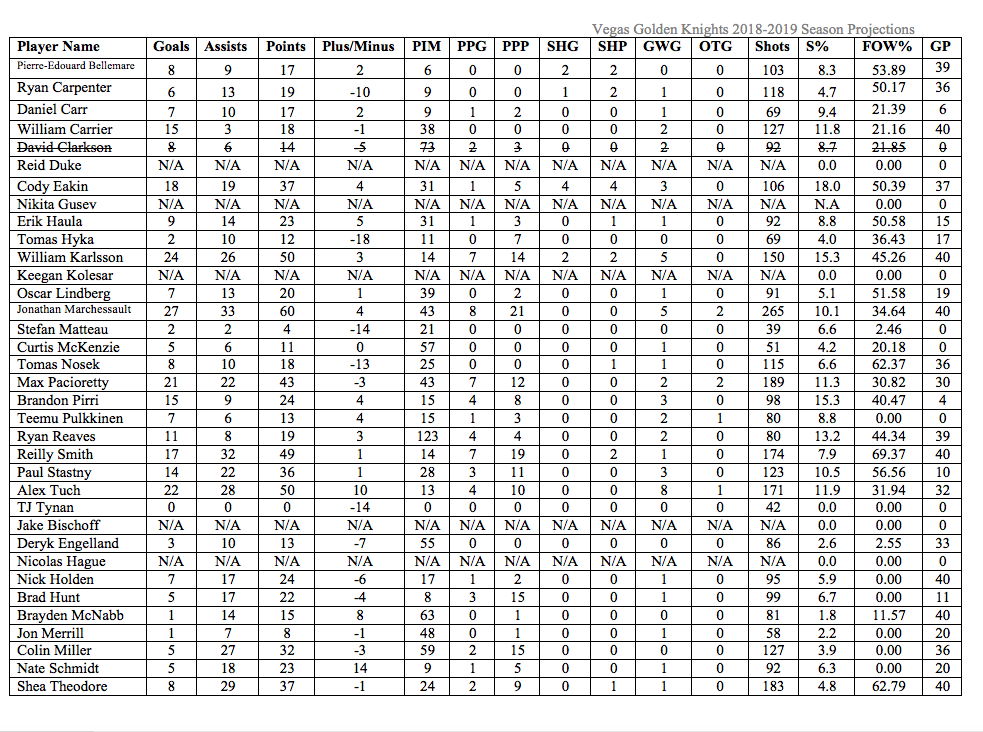
    Here’s a look at the latest Vegas forecast– keeping in mind there are many variables that can and will effect the final outcome, such as injuries and/or being called up, assigned, traded, lucky or unlucky.

    This forecast is just an educated guess. It’s a glimpse of what could be or could’ve been by the end of the regular season.

    As always, my degree is in communication– not math– and hockey is naturally steeped in context and holistic unpredictability. Nothing can account for sheer puck luck, the odd bounce or a blown call.

    If a player reaches the expected outcome, they’ve met expectations. If said player exceeds the forecasted stats, they’ve exceeded expectations (naturally). Of course, if a player does not perform, then they did not live up to expectations.

    On a game-to-game basis, whatever’s on the scoresheet can indicate general trends that can be further broken down into an educated forecast.

    At best, it’s a guess. At worst, well, it doesn’t really matter– it’s not like Golden Knights General Manager George McPhee is reading this and making his roster decisions based on what’s here, right?

    If he is, I’d like a job, please. Thanks.

    Vegas Golden Knights Forecast Through 62 Games (20 Games Remaining)
    WordPress, when are you going to make the ”gallery” option again (and actually make it good like how it used to be)?

    Among forwards, Vegas’ consistent first line last season of Jonathan Marchessault, William Karlsson and Smith hasn’t had as much consistent luck and skill this season.

    Though Smith has battled injury this season, Marchessault remains one of the Golden Knights most consistent performers expected to lead his team in goals (25) and points (54) with 25-29–54 expected totals.

    Now what about Karlsson?

    Good question, what about him? Things haven’t gone exactly as planned in terms of capitalizing on his breakout season last season with a new contract in the offseason and higher expectations for this season.

    Karlsson’s bridge, one-year, extension last summer coming off the backs of a 43-goal season has only managed 18 goals thus far– including four goals in the last 22 games for the Golden Knights.

    Given his current trend, Karlsson is expected to amass 21-23–44 totals. He’d be tied with Pacioretty for 2nd place in expected goals (21) and 3rd in expected points (44) on the roster, but nowhere near the emergent star in the making that he was last season.

    While he very well could bounce back– similar to Smith in nature, following a good-year, bad-year, good-year, bad-year pattern– the phrase “what have you done for me yesterday” won’t help him in his next contract negotiation this summer unless McPhee gives him the benefit of the doubt.

    Meanwhile, Alex Tuch is expected to finish the season with a career-high 20-33–53 expected totals.

    That’s comforting to hear for a team that needs to rely on secondary scoring in the midst of a recession in primary production.

    Tuch is expected to lead in assists (33), followed by Smith (30) and Marchessault (29), while Marchessault is destined to lead in points (54) over Tuch (53) and Karlsson (44).

    On defense, Vegas’ blue line will finish off the season being led by Shea Theodore (11-21–32 expected totals), followed by Colin Miller (30 expected points) and Nate Schmidt (25 expected points despite missing the first 20 games of the season while serving a suspension for testing positive for a performance enhancing drug).

    In net, Fleury looks like he’s bound to break under the weight of all the minutes he’s been playing and will play this season. A 2.74 expected GAA and .909 expected SV% is not starting goaltender material, unless we’re talking about Sergei Bobrovsky with the Columbus Blue Jackets or something.

    But it’s not like Gallant can really count on his current backup to offset some of Fleury’s load. Subban’s expected 2.70 GAA and .912 SV% isn’t tremendous either.

    If anything, it’s an indication that McPhee could help bolster his team with the acquisition of an extra goaltender by the trade deadline.

    Someone like Ryan Miller, 38-years-old, could help steal some crucial points for the Golden Knights down the stretch if the San Jose Sharks aren’t already in the process of completing a trade for the goaltender with the Anaheim Ducks.

    Growing pains are a fact of life– especially in sports– and Vegas is going through puberty already in its 2nd season. This season’s been full of highs, lows and awkward phases that hopefully will end in a glow up.

    Otherwise we’ll all be looking back at this season shaking our heads at how it could pull off that much denim or something back in the day.

  • Vegas Golden Knights Forecast Through 40 Games

    It’s not the most recent forecast, since the Vegas Golden Knights played Game 41 of their 2018-19 regular season on Saturday against the Los Angeles Kings.

    Nevertheless, it’s time to take a quick check of the pulse of the Golden Knights– how their season has progressed so far and where it appears to be going from here.

    Thanks to some extenuating circumstances, perhaps Vegas fans will forgive me for not being able to get around to their quick forecasted glance after 20 games played this season.

    Why? Because it would’ve been pretty dismal and you don’t need that kind of negativity in your life.

    Although, now at the halfway mark (officially after the game against the Kings, technically unofficially as of this forecast), things have improved, but with a few concerns remaining.

    Nate Schmidt served his 20 game suspension for a performance enhancing drug and for the most part, Vegas’ blue line got the job done.

    The team’s record wasn’t desirable, but guys like Shea Theodore and Colin Miller continued to rise past expectations in their ability– even more so now that Schmidt is back and solidified the defensive zone for the Golden Knights.

    One thing that has plagued the team all season is subpar goaltending.

    Marc-Andre Fleury isn’t getting any younger and Malcolm Subban regressed quite a bit from his debut season as a backup netminder at the NHL level last season.

    Managing playing time in the crease is something to keep in mind and we’ll take a closer look in a minute.

    For now, Vegas stands in a divisional spot in the playoffs in the Pacific. Not nearly as dominant as last season, but keeping up with the legitimate(?) playoff contenders in an otherwise weaker division compared to the rest of the league.

    Without further ado, here’s a look at the remaining 42 games (now 41) on the season and what to expect from the latest forecast.

    Keep in mind, there are many variables that can and will change what goes down from now through the end of the regular season in April, like trades, injuries, general lineup changes, roster moves and anything else unbeknownst to the Microsoft Excel spreadsheet that generates this forecast.

    My degree is in communication– not math. It’s “not my fault”.

    If a player meets the forecasted stats, then they’ve met expectations. If they exceed their forecasted stats, then they’ve exceed expectations.

    And of course, if a player does not live up to the latest forecast, then something went awry (the player could’ve been injured, been unlucky or regressed– a.k.a. didn’t meet expectations).

    Puck luck cannot be predicted, but general trends and estimated gut feelings can indicate a sense of what’s to come based on the results of each and every scoresheet night-in and night-out.

    Vegas Golden Knights Forecast Through 40 Games (42 Games Remaining)

    (Just click on the image if you’re having trouble seeing it– WordPress changed their layout so there’s no more slideshow options.)

    Every set of blessings comes with a set of curses and this year, that rings truer more than ever before for the Golden Knights. Of course, it’s only their second season in franchise history, but it’s still true.

    William Karlsson (24-26–50 expected totals) is having a “down” year compared to last season’s breakout career-year of 43 goals and 35 assists (78 points). Reaching the 50-point plateau is still respectable, but doesn’t scream any guarantees of being on the first line should the postseason roll around.

    Head coach, Gerard Gallant, has enough top-six forward depth to play around with if Karlsson starts to head south, considering Alex Tuch‘s expected 22-28–50 totals, Paul Stastny‘s expected 14-22–36 totals and Max Pacioretty‘s expected 21-22–43 totals.

    Despite the ever-consistent qualities of Jonathan Marchessault (27-33–60 expected totals) and Reilly Smith (17-32–49 expected totals), this year’s Golden Knights team point spread is more spread out.

    As it is, while Marchessault should lead in goals (27), assists (30) and points (60) and Karlsson should be second in goals (24) and points (50), one would think Smith would be second or third in whatever stats Marchessault and Karlsson aren’t leading in.

    However, Tuch’s expected point outcome (50) is tied with Karlsson for the second-most points behind Marchessault and Tuch is expected to rank third on Vegas’ roster in goals behind Marchessault and Karlsson with Smith a distant 5th behind Pacioretty’s 21 expected goals this season.

    While the offense isn’t as impactful from the forwards, the blue line has really come into its own in Vegas.

    Shea Theodore’s expected 8-29–37 totals will be the best of his teammates and fellow defenders in a Golden Knights uniform, leading Colin Miller (5-27–32 expected totals) and Nick Holden (7-17–24 expected totals).

    Nick Holden. That’s right. Holden is ahead of Nate Schmidt (5-18–23 expected totals) in the latest forecast.

    But that speaks to Holden’s resiliency in his career and the chemistry Gallant has found in his pairing every night– coupled, of course, with the fact that Holden is seeing more time on the ice (in the literal “games played” sense) than he has the last couple of seasons with the New York Rangers and Boston Bruins.

    He is a durable top-four defender that’s still in his athletic prime and it is exactly that kind of depth that can take teams deep into a Stanley Cup Final run.

    In goal, Marc-Andre Fleury should land around a 2.61 goals against average and .911 save percentage in a season in which he has been overworked thus far.

    He will continue to be overworked unless Malcolm Subban regains his footing, Gallant argues for calling someone up from the Chicago Wolves (AHL) or Golden Knights General Manager George McPhee makes an acquisition for a suitable backup option if all else fails.

    Fleury has played in 35 of the 40 games up to this forecast. He’s since played in 35 out of the 41 games played by the club this season.

    Subban has played in six games and is 0-5-0 in that span. His expected outcomes are a 2.76 GAA and .907 SV%– both below average goaltending the backup role.

    Whereas if Vegas wanted to try Oscar Dansk or Maxime Lagace without the pressures of coming into the dressing room in an emergency recall situation– unlike last season– a little healthy competition for the backup role might nudge Subban in the right direction and take off some of Fleury’s workload.

    It’s not that Fleury can’t handle 50-plus games anymore as a starting goaltender, but rather, it’s just that he shouldn’t be relied on for about 85% of the games in the regular season as is his current going rate.

  • Bruins first line leads B’s to 4-1 win over Vegas

    Secondary scoring had its fair share Sunday night at TD Garden, but league leader in goals, David Pastrnak is not done producing by any means as he added a goal and an assist in the Boston Bruins, 4-1, winning effort against the Vegas Golden Knights.

    Jaroslav Halak (6-1-2, 1.72 goals against average, .945 save percentage in 11 games played) made 37 saves on 38 shots against (.974 SV%) in the win for Boston, while Malcolm Subban (2-1-0, 3.17 GAA, .885 SV% in 4 GP) turned aside 33 out of 37 shots faced for an .892 SV% in the loss for Vegas.

    Both teams were playing their second game in two nights, with the Bruins having hosted the Toronto Maple Leafs on Saturday and the Golden Knights having visited the Montreal Canadiens as part of their four-game road trip.

    Boston finished their four-game homestand, 3-1-0, while Vegas went 1-3-0 on their Eastern Conference swing.

    The Bruins improved to 10-5-2 (22 points) on the season, good enough for 3rd in the Atlantic Division– tied in points for 2nd place with Toronto, but trailing by one regulation-plus-overtime win.

    The Golden Knights fell to 7-10-1 (15 points) so far this season and remained in 7th place in the Pacific Division with the loss– four points ahead of the Los Angeles Kings from the basement of the division.

    Bruce Cassidy made two changes to his lineup on the blue line as a result of an injury, but didn’t mix things up among the forwards. Cassidy announced Sunday morning that Brandon Carlo was “questionable” and would be a game-time decision with an upper body injury.

    Jeremy Lauzon was an emergency recall on Sunday and would be in the lineup in place of Carlo if No. 25 in black-and-gold wasn’t ready to go.

    Matt Grzelcyk slid up to the first defensive pairing with Zdeno Chara, as Lauzon played on the third pair with Steven Kampfer. Torey Krug and John Moore were left together from Saturday night.

    Cassidy also indicated that he expected to talk with Tuukka Rask about his return from a personal leave of absence with a decision in place by Tuesday before the Bruins hit the road for a four-game road trip. Cassidy suspects Rask will rejoin the team on Tuesday, but wouldn’t commit to a definitive answer until having the appropriate time and place discussion with the goaltender.

    Noel Acciari remained a healthy scratch on Sunday, with Urho Vaakanainen (concussion), Charlie McAvoy (concussion) and Kevan Miller (hand) still out of the lineup for Boston.

    Unknown-7

    Rushing through the neutral zone early in the first period, Danton Heinen worked the puck to Anders Bjork as the Bruins forwards entered the attacking zone. Bjork flipped the puck back to Heinen (2) for the game’s first goal as No. 43 tipped a redirection past Subban to give Boston a 1-0 lead at 2:54 of the first period.

    Bjork (2) had the only assist on the goal.

    Fellow third liner– and centering the line for the second straight game– Jakob Forsbacka Karlsson had a run in with the penalty calling threshold after he got his stick between the legs of Golden Knights forward and former Bruin, Reilly Smith.

    Forsbacka Karlsson went to the box for tripping at 5:43 and Vegas went on the power play for the first time of the night. The Golden Knights failed to convert on the skater advantage.

    Almost four minutes later, Pastrnak hooked Jonathan Marchessault and was sent to the sin bin at 9:27 of the first period. Vegas failed to score on the ensuing power play.

    For the fifth time in three games, Kampfer found his way to the box with a tripping minor against Ryan Carpenter at 11:55, but the Golden Knights weren’t able to make the Bruins brass pay on the resulting skater advantage.

    Late in the first period the Golden Knights caught Halak out of position and sent a chance through the slot that was intercepted by Moore as the Bruins defender was in the right place at the right time with his stick.

    Moore then sent Sean Kuraly on rush back the other way and with a dump into the corner and Lauzon chasing, Subban came out of his crease to make a play on the loose puck– except Subban overcommitted.

    With a gift sent by the hockey gods themselves, Lauzon (1) had the easiest conversion on his first career National Hockey League goal at 17:51 of the first period. Kuraly (2) and Moore (2) had the primary and secondary assists, respectively.

    William Carrier tripped up David Krejci at 18:29 of the first period and gave the Bruins their first power play of the night.

    Not to be outdone, while on a rush to the net, Brad Marchand got tripped by Subban in front of the goal, yielding a 5-on-3 skater advantage for Boston at 18:58 that would extend into the second period if the Bruins didn’t score by the end of the first.

    Krejci dove to keep the puck in the zone as time was expiring in the opening frame and generated one last chance before the first intermission on all-around dominant 5-on-3 opportunity to close out the period.

    After 20 minutes of game action, the Bruins led, 2-0, on the scoreboard and trailed the Golden Knights, 15-11, in shots on goal. Boston held onto an advantage in blocked shots (3-2), takeaways (5-4) and face-off win percentage (81-19). Vegas led in hits (11-6) after one period and both teams had one giveaway each.

    Entering the dressing room for the first intermission the Golden Knights were 0/3 on the power play, while the Bruins were 0/2. That would change in the first minute of the second period.

    Patrice Bergeron sent a pass to Pastrnak that got bent out of shape just enough by a Vegas defender for Pastrnak’s only option in the low slot to be to send the vulcanized piece of rubber back to Bergeron off a body.

    From there, Marchand (6) was in front of the goal at the right time to receive a quick bumper pass from Bergeron and redirect the puck with elevation into the twine just as the power play was expiring.

    Bergeron (16) and Pastrnak (7) had the assist’s on Marchand’s goal at 58 seconds of the second period and the Bruins led, 3-0.

    vegas_golden_knights_logo

    Midway through the middle frame, Alex Tuch stripped Moore of the puck in front of the Boston goal and prior to breaking into the trapezoid, Tuch slid a one-handed pass back to Cody Eakin (5) for a one-timer that beat Halak as Krug was out of position behind the play.

    Vegas was on the scoreboard and cut the lead to two-goals as the B’s led, 3-1. Tuch (5) had the only assist on Eakin’s goal at 10:55 of the second period.

    Late in the second period, Vegas again gave Boston a 5-on-3 power play for 42 seconds after Brayden McNabb was penalized for holding Marchand at 15:05 and Tomas Nosek was called for tripping Bergeron at 16:24.

    The B’s did not convert on either power play opportunity.

    Entering the second intermission, Boston led, 3-1, on the scoreboard and, 28-27, in shots on goal. Vegas had an advantage in blocked shots (6-5) and hits (17-13), while the Bruins led in takeaways (9-6), giveaways (7-3) and face-off win% (63-38). The Golden Knights were 0/3 on the power play after 40 minutes and Boston was 0/4.

    Vegas notched another penalty as a team at 6:42 of third period having sustained a delay of game face-off violation bench minor infraction. Tomas Hyka served the penalty for the Golden Knights and the Bruins went on the power play.

    The B’s did not convert on the ensuing advantage.

    Moments later, Kuraly exchanged words with former teammate and current Golden Knights defender, Colin Miller, at 12:04 of third period and earned himself a minor penalty for roughing. Vegas did not score on the resulting power play.

    Late in the third, the Golden Knights sent themselves back in momentum with two consecutive tripping penalties being called at the same time thanks to Max Pacioretty tripping Bergeron and Deryk Engelland subsequently getting his stick between the legs of Marchand and bringing the Bruins forward down at 15:40.

    Boston converted on the 5-on-3 power play after working the puck around from Pastrnak to Krejci, then across the point to Krug for a bumper pass back to Pastrnak (16) whereby the league’s leading goal scorer one-timed a shot past Subban to give the Bruins a three-goal lead.

    Krug (6) and Krejci (13) had the assists on Pastrnak’s power play goal at 16:08 of the third period and Boston led, 4-1.

    At the final horn, the Bruins solidified a 4-1 victory with a 7-0-1 record when scoring first this season. Boston also improved to 8-0-0 when leading after two periods.

    The B’s led in face-off win% 58-42 and the Golden Knights dominated just about every other statistical category after 60 minutes. Vegas led in shots on goal (38-37), blocked shots (8-7), giveaways (9-8) and hits (25-20).

    Boston finished the night 1/7 on the power play, while the Golden Knights were powerless on the skater advantage, finishing 0/4 on Sunday night.

    One consolation prize for the Vegas franchise is that through 100 regular season games in franchise history, the Golden Knights have the most wins among all expansion franchises in their first 100 regular season games with 58.

    Sunday night was former Montreal Canadien and noted Bruins mood-killer, Max Pacioretty’s first matchup against the Bruins since being traded to Vegas, while it was also Danton Heinen and Sean Kuraly’s 100th career NHL games.

    The Bruins carry a two-game winning streak heading onto the road for a four-game road trip beginning in Colorado (Nov. 14th) and swinging through Dallas (Nov. 16th), Arizona (Nov. 17th) and Detroit (Nov. 21st) before returning home for Black Friday’s matchup with the Pittsburgh Penguins.

  • Vegas Golden Knights 2018-19 Season Projections

    It’s forecasting season, well, actually it’s the regular season and I’m just a little behind, but until I pointed that out, you didn’t know I was behind on my little passion project here, did you?

    I know I wrote “[i]n the coming days I’ll reveal what teams I’ll be forecasting/tracking all season long, so stay tuned because it’s about to get messier than ever before and I’m up for the challenge,” in my Boston Bruins 2018-19 forecast, but life and the fact that I’m moving all my data into a new format has slowed my turnaround for the time being.

    Nevertheless, my Vegas Golden Knights forecast for 2018-19 is here and let’s pretend the first week of the regular season hasn’t already happened or something.

    Additionally, if you’re wondering what other teams I’m preparing to post (before we get too far into the first quarter of the season) they are the Carolina Hurricanes and Columbus Blue Jackets.

    I always keep tabs on the Bruins every year because I grew up a Boston fan and I decided to track Vegas last season because there hadn’t been nearly as much hype surrounding an expansion team since Columbus and the Minnesota Wild in 2000. Additionally, I’ve previously tracked the Arizona Coyotes simply because they follow us on Twitter (and I’ll get back around to them hopefully before season’s end, if you’re interested).

    But I’m adding Carolina and Columbus to my forecast portfolio this season because 1) the Hurricanes are supposed to be better than last season, plus they have some exciting youth in the lineup and 2) a lot of Blue Jackets fans are also fans of our brand around here, so shouts 5th Liners.

    Please be patient on the timeline for when I’ll get my Hurricanes and Blue Jackets forecasts posted– it’ll be by the end of the month for sure.

    Anyway, on with the Golden Knights, shall we?


    Vegas is coming off of their inaugural season having finished 1st in the Pacific Division with 109 points and a 51-24-7 record under head coach Gerard Gallant. Not only did they finish at the top of their division in their first season, but they did so with over 100 points and a 50-plus win season.

    Oh yeah and they played the Washington Capitals in the 2018 Stanley Cup Final.

    Despite the loss in five games to Washington, the Golden Knights were and still are well ahead of owner Bill Foley’s “Cup in three [seasons]” masterplan– what with General Manager George McPhee‘s offseason additions of Paul Stastny and Max Pacioretty and everything.

    This year, of course, the competition has gotten a lot tougher. There are expectations now when opponents play the Golden Knights.

    Gallant and his Vegas lineup are going to have to get more creative than ever before in franchise history to avoid the hangover of a Stanley Cup Final appearance run and to avoid getting too predictable.

    Things are different now. They’re no longer the new kids on the block. They’re the 2018 Western Conference champions and a team to beat.

    As always, I’d like to remind you my degree is in communication– not math– therefore anything that looks wrong is either adjusted with a little gut-feeling and/or Microsoft Excel’s fault. My expertise resides in the written, spoken and nonverbal language of communicating– not numbers on a spreadsheet.

    These forecasted stats are to be seen as an utopian perspective, as though nothing bad could happen this season at any point to any player– where every player at least lives up to their forecast and then some.

    Some will pan out and some will fall flat. It’s a suggested outcome for a sport that’s played on ice in a highly unpredictable collective environment of action and sheer puck luck.

    vegas_golden_knights_logo

    Vegas Golden Knights Forecast Through 0 Games (82 Games Remaining)

    This slideshow requires JavaScript.

    After a breakout 78-point season (43 goals, 35 assists) for William Karlsson, the Golden Knights number-one center is prime for a respectable 41-point season as part of the natural regression of the game– unless Karlsson is truly an outlier, like he was coming from Columbus to Vegas last season.

    Meanwhile, Reilly Smith (19-27–46 expected totals) and Jonathan Marchessault (28-35–63 expected totals) bolster the Golden Knights first line with respectable performances of their own, while the point spread has really been shared with the second line.

    Newcomers Paul Stastny (22-43–65 expected totals) and Max Pacioretty (33-30–63 expected totals) are set to become the key contributors to the fiery Vegas offense in their first season with the club.

    The Golden Knights top-six core of forwards is deeper than last season, whereas the majority of their offense was reliant upon Marchessault, Karlsson and Smith. This year there’s more emphasis on Alex Tuch and Erik Haula inside the top-nine.

    On defense, Gallant’s crew will have to do without Nate Schmidt for the first 20 games of the season while Schmidt serves a suspension for a performance enhancing drug.

    Luckily, Brad Hunt, Colin Miller and Shea Theodore are prime for an uptick in time-on-ice and production, with Hunt and Miller expected to reach the 30-point plateau, while offseason addition, Nick Holden should see a pleasant rebound from his 17 points split between the Bruins and New York Rangers last season to a 25-point effort in 2018-19 with Vegas, provided he can remain in the top-six on the depth chart.

    Upon Schmidt’s return, he should still have 4-23–27 totals from the blue line, which is not great like last season’s 5-31–36 totals, but not terrible for a top-four defender.

    In goal, Marc-Andre Fleury is expected to return to Earth from his superhuman season last year (a 2.24 goals against average and .927 save percentage in 46 games) to a 2.49 GAA and .913 SV% in 2018-19. As the Golden Knights starter continues to get older, limiting his workload to keep him fresher for the postseason is the way to go.

    Granted, Fleury’s playing time was limited last season due to a concussion, he still went on to have solid regular season numbers and an impeccable 2018 Stanley Cup Playoff run up until the Stanley Cup Final.

    Meanwhile, Malcolm Subban‘s 2.68 GAA and .910 SV% in 22 games played look to be improved upon to a 2.65 GAA and .911 SV% in somewhere around 30 appearances as the backup netminder for Vegas.

    As always, we’ll get more into the goalies once the team has played through a quarter of the season.

  • Capitals raise the Cup for the first time, win Game 5 in Vegas

    vegas_golden_knights_logoWashington Capitals Logo


    15,948 days after their first puck drop in franchise history, 3,701 games (regular season and postseason combined), 1,124 games played by Alex Ovechkin, 44 years, 20 years between Stanley Cup Final appearances and 1 Stanley Cup championship— their first in franchise history— the Washington Capitals are your 2018 Stanley Cup champions.

    The Capitals won Game 5 on the road, 4-3, Thursday night at T-Mobile Arena and defeated the Vegas Golden Knights, 4-1, in the series.

    Washington wasn’t one of the teams expected to win the Cup from day one back in October, unlike the last four or five years, but they won it anyway— clinching every series on the road and as the best road team this postseason.

    Oh yeah, in case you haven’t already heard, Ovechkin finally won the Cup in his 13th NHL season. The captain of the Caps, Ovechkin was also named the 2018 Conn Smythe Trophy winner as the Most Valuable Player of the 2018 Stanley Cup Playoffs— becoming just the 2nd Russian born NHL player in league history to capture the MVP award.

    Washington netminder Braden Holtby made 28 saves on 31 shots against for a .903 save percentage in the Cup clinching win, while Vegas goaltender Marc-Andre Fleury made 29 saves on 33 shots faced for an .879 SV% in 57:56 time on ice in the loss.

    Lars Eller scored the game-winning goal with a little more than seven minutes remaining in the game after Devante Smith-Pelly scored the game-tying goal while falling in what’s sure to become the most iconic photo in D.C. hockey history.

    David Perron, Tomas Tatar and William Carrier were in the lineup for the Golden Knights on Thursday, with Ryan Reaves and Ryan Carpenter as a couple of healthy scratches after playing in prior Stanley Cup Final games leading up to Thursday’s Game 5 action.

    Tom Wilson bumped into William Karlsson early in the first period with the night’s first big hit of the game, leaving Karlsson a little wobbly on his way back to the bench.

    Colin Miller was guilty of the action’s first penalty, having received an infraction for interference against Washington defender, Michal Kempny, at 11:44 of the first period. Vegas killed off the penalty, however, and the score remained, 0-0, despite Ovechkin having dented the post on the ensuing power play.

    After one period, the score remained tied, 0-0, with the Capitals leading in shots on goal, 9-7. Both teams had four blocked shots aside and the Golden Knights had the advantage in just about everything else, including hits (18-10), takeaways (5-1), giveaways (7-1) and faceoff win percentage (62-39).

    There was only one penalty called after 20 minutes. As a result, the Caps were 0/1 on the power play entering the first intermission.

    Teetering with danger isn’t normally advised, but it’s what Vegas goers live for in forms of entertainment— like magicians, acrobats and the like— but hockey? Maybe not a great idea, though Shea Theodore put the dangerous Capitals power play unit on the ice without him as the Golden Knights defender was guilty of tripping T.J. Oshie 21 seconds into the second period.

    Nevertheless, the home team prevailed unscathed.

    The Golden Knights went on the power play themselves for the first time Thursday night when Christian Djoos delivered a high-stick to Reilly Smith moments later at 3:19. Vegas did not convert on their first player advantage of the game.

    A few minutes later, after Las Vegas resident Deryk Engelland fired a shot high over the crossbar, Jakub Vrana had the puck on his stick, transitioning from the center redline into the attacking zone on a breakaway for Washington.

    Vrana (3) sniped a shot upstairs— top-shelf, glove side— on Fleury, giving the Capitals the 1-0 lead and scoring the game’s first goal.

    Wilson (10) and leading point scorer in the 2018 Stanley Cup Playoffs, Evgeny Kuznetsov (20), had the assists on Vrana’s goal at 6:24 of the second period. Depth scoring remained a major key to Washington’s success and ultimate victory.

    But the Golden Knights weren’t going down without a fight, having reached back into their young franchise history of comebacks and quick responses to being scored on in the postseason.

    Nate Schmidt (3) tied the game, 1-1, with a slap shot at 9:40 of the second period. Smith (17) and Jon Marchessault (13) had the assists and Vegas came alive— not just the team, but the entire home crowd.

    With their backs against the wall, there was no backing down from the immense pressure of elimination.

    But with pressure comes susceptibility to making costly errors.

    Brayden McNabb yanked down Ovechkin with a trip on a breakaway 11 seconds after Schmidt scored, giving Washington’s deadly power play another chance. This time the Capitals wouldn’t pass up the opportunity to capitalize on the player advantage.

    In stereotypical fashion, it was Ovechkin (15) breaking the hearts of Vegas’s penalty killing unit, rocketing his 15th goal of the playoffs past Fleury on the power play at 10:14. Not only did he set a franchise record for most goals in one postseason with the goal, but he became the first player to score 15 goals in a postseason since his biggest rival, Sidney Crosby, did so in 2009 with the Pittsburgh Penguins.

    It seemed like poetic justice. It seemed like fate. Perhaps to the Hockey Gods, it was destiny.

    Whatever it was, Nicklas Backstrom (18) and pending-unrestricted free agent, John Carlson (15), had the assists on Ovechkin’s goal that made it 2-1 Washington.

    Almost a few minutes later, Vegas was rocking again on a double deflection, ultimately put in the back of the net by Perron (1)— the healthy scratch for most of the Stanley Cup Final, that had yet to score this postseason.

    Perron’s goal was challenged for goaltender interference by Capitals head coach, Barry Trotz, but after review, the call on the ice was confirmed; it was a good goal.

    Video replay indicated Washington defender Djoos pushed Perron into the crease and made no difference on the play as Holtby was already in desperation, scrambling outside of the crease to get back square to the shooter.

    The Golden Knights had tied it, 2-2, in part, thanks to the assists on Perron’s goal from Tatar (1) and Miller (4) at 12:56.

    Having lost the coach’s challenge, Washington forfeited their timeout.

    For the next five minutes, the game descended into organized chaos. Shift changes on-the-fly, shots ringing off the iron, save-after-save was made and bodies were flying either by contact or by propulsion on skates.

    Then Ovechkin was guilty himself— guilty of tripping Karlsson late in the period as the Golden Knights were surging.

    Vegas’s power play took their time to set up the perfect play. Holtby was out of position as a result of second, third and fourth chances, leaving an open net for Smith (5) to cash in the power play goal on a pass across the low slot from Alex Tuch, giving the Golden Knights their first lead of the night, 3-2.

    Tuch (4) and Theodore (7) had the assists on the Smith’s goal at 19:31 of the second period and as the home crowd experienced euphoria, gloves and shoves were being exchanged after the goal horn.

    Washington’s Brooks Orpik and Jay Beagle picked up matching roughing minors with Vegas’s Smith and Tuch. Both teams remained at full strength and headed into the second intermission with the Golden Knights holding on to a one-goal lead.

    Entering Thursday night, the Golden Knights were 10-0 when leading after 40 minutes this postseason. Exiting Thursday night, they’d finish their Stanley Cup Final run, 10-1.

    But through two periods of intense action, Vegas led, 3-2, on the scoreboard and shots on goal were even, 20-20. The Golden Knights led in everything else, including blocked shots (9-6), hits (29-16), takeaways (13-8), giveaways (11-3) and faceoff win percentage (51-49). Both teams had scored a power play goal entering the second intermission. Washington was 1/3 and Vegas was 1/2 on the man advantage.

    Tatar opened the third period with a hooking minor against Eller at 5:37.

    Once again the Capitals set up Ovechkin on the ensuing power play, but this time Fleury was able to slam the door shut on the prolific goal scorer and keep his team ahead.

    Yet Washington’s onslaught lasted longer than the power play, pressing as hard as ever to tie the game and take back momentum as the midway point of the third period approached.

    Orpik kept the puck in the zone at the blue line and threw the rubber biscuit to the front of the net where Smith-Pelly (7) gained possession, dangled as Fleury went through the routine of doing the splits to go from one side of the goal to the other, but Smith-Pelly had just enough to muster a shot while falling, past Fleury’s leg pad and in.

    The Caps forward tied it, 3-3, at 9:52 of the third period, matching his goal scoring output from the regular season (seven goals in 75 games played) in just 24 postseason games. Orpik (4) notched the only assist on the now iconic goal in Washington sports lore.

    Then Eller (7) pocketed the go-ahead goal and game-winner, as a result of yet another scramble in front of the net, traffic, pounding and collecting a garbage goal— Washington led, 4-3, with a little more than seven-and-a-half minutes left in regulation.

    Brett Connolly (3) and Andre Burakovsky (4) were credited with the primary and secondary assists on Eller’s Cup-winner at 12:23.

    After a stoppage in play with 2:04 remaining in their season, Golden Knights head coach Gerard Gallant used his team’s timeout to rally his troops and pulled Fleury for an extra attacker.

    Washington kept getting the puck out of their own zone, sometimes icing it, sometimes just sending it wide of the empty net, but as long as time ticked down and it didn’t end up behind Holtby, nothing else mattered.

    Not even a score-clock malfunction inside the arena, whereby (thankfully) the backup timekeeping apparatus was still working and kept the officials on top of everything, right down until the very last second.

    For D.C. sports fans, the agony was over. Their Capitals had won.

    For the first time in franchise history— dating back to 1974— Washington is home to Stanley Cup champions and Capitals owner Ted Leonsis can celebrate.

    After a 60-minute effort in Game 5, the Capitals won, 4-3, and led in final shots on goal, 33-31. Washington also finished the night leading in blocked shots (13-11), while Vegas held the advantage in hits (39-27) and giveaways (15-6). Both teams finished the night scoring a power play goal, with Washington (1/4) and the Golden Knights (1/2).

    The teams shook hands, Ovechkin was named the Conn Smythe Trophy winner as the fans wearing Vegas gold and Caps red both booed league commissioner, Gary Bettman, and finally, Ovechkin was presented with the hardest trophy to win in all professional sports— the Stanley Cup— for the first time in his career.

    Entering Thursday night, Washington had lost nine out of their last 10 Game 5s on the road. That didn’t matter. Teams leading the series 3-1 in the Stanley Cup Final were 32-1 all-time, until the Capitals made them 33-1.

    Veteran forward Jay Beagle became the first player to win the ECHL’s Kelly Cup, AHL’s Calder Cup and NHL’s Stanley Cup in a professional career, while Ovechkin became just the first Russian captain to lead his team to a Cup victory in NHL history.

    Ovechkin also became the 16th player in league history to play at least 1,000 regular season games before winning his first Cup (joining legendary Detroit Red Wings star and current Tampa Bay Lightning GM, Steve Yzerman, to do so all with one team).

    Kuznetsov finished the postseason as the third Russian-born player to lead the NHL in playoff scoring during the league’s modern era (since 1943-44), joining Sergei Fedorov (1995) and Evgeni Malkin (2009, 2017) in doing so.

    As for Barry Trotz, the Washington Capitals head coach who is now technically a free agent in search of his next contract (and just won his first Cup in his 20th year as an NHL head coach), Capitals general manager Brian MacLellan told reporters after the game, “if he wants to be back, he’ll be back.”