Tag: Rogers Arena

  • Miller and Horvat sink Bruins in shootout, 2-1

    Miller and Horvat sink Bruins in shootout, 2-1

    J.T. Miller and Bo Horvat had the only goals past regulation in a, 2-1, shootout victory for the Vancouver Canucks against the Boston Bruins Wednesday night at Rogers Arena.

    Thatcher Demko (10-11-1, 2.73 goals-against average, .915 save percentage in 22 games played) made 35 saves on 36 shots faced in the shootout win for Vancouver.

    Boston netminder, Jeremy Swayman (7-4-2, 2.15 goals-against average, .922 save percentage in 13 games played) stopped 31 out of 32 shots against in the shootout loss.

    The Bruins fell to 12-8-2 (26 points) overall and remain in 5th place in the Atlantic Division, while the Canucks improved to 10-15-2 (22 points) and moved into 7th place in the Pacific Division– ahead of the Seattle Kraken by two points out of the division basement.

    The B’s went 1-0-1 in their regular season series with Vancouver in 2021-22.

    Anton Blidh (upper body) took part in morning skate for Boston in a regular practice jersey, but isn’t quite ready to resume in-game action just yet.

    Blidh was joined by Jakub Zboril (lower body) and Tomáš Nosek (non-COVID related illness) among the Bruins that weren’t able to compete on Wednesday night due to injury or illness.

    Zboril will be re-evaluated in two weeks, while Nosek did not travel with the team to Vancouver.

    Meanwhile, Charlie McAvoy was back in the lineup after missing one game due to a non-COVID related illness and Brad Marchand returned from his three-game suspension.

    As a result, acting head coach, Joe Sacco, made a number of changes to his lines– reuniting Marchand with Patrice Bergeron and David Pastrnak on the first line, while relegating Taylor Hall back to his normal spot on the second line left wing with Charlie Coyle at center and Craig Smith at right wing.

    Trent Frederic centered the third line with Erik Haula to his left and Nick Foligno on his right side, while Curtis Lazar shifted over to the fourth line center role with Nosek out on Wednesday.

    Jake DeBrusk flanked Lazar’s left side and Oskar Steen took on right wing duties on the fourth line after he was recalled from the Providence Bruins (AHL) on Tuesday.

    In addition to Steen, Boston recalled Jack Ahcan and John Moore, who joined Karson Kuhlman in the press box as healthy scratches for the B’s in Vancouver.

    Bruins head coach, Bruce Cassidy, remains in the National Hockey League’s COVID-19 protocol and likely won’t be back before the Bruins return from their Western Canada road trip.

    Midway through the opening frame, McAvoy was assessed a holding minor when he got tied up with Jason Dickinson at 12:30 of the first period.

    The Canucks, however, were not able to score on the ensuing skater advantage.

    Vancouver got another chance on the power play in the dying seconds of the first period as Foligno was given an unsportsmanlike conduct minor at 19:57.

    The Bruins would be shorthanded for about 1:58 to kick things off in the middle frame as a result.

    After one period of play at Rogers Arena, Boston and Vancouver were tied, 0-0, on the scoreboard and even in shots on goal, 8-8.

    The B’s held the advantage in blocked shots (8-5), giveaways (4-3) and hits (14-4), while the Canucks led in takeaways (2-1) and faceoff win percentage (54-46).

    Only Vancouver had seen any action on the power play heading into the first intermission and the home team was 0/2 thus far.

    Tyler Myers knocked Smith around without the puck and received an interference minor as a result– yielding Boston their first power play of the night at 8:14 of the second period.

    The Bruins couldn’t convert on the ensuing skater advantage however.

    Boston thought they had scored the game’s first goal when Haula received a pass on a breakaway entering the attacking zone before deking and scoring on a backhand shot that was elevated over Demko’s outstretched right pad, but the call on the ice was overturned as a result of Canucks head coach, Bruce Boudreau, using a coach’s challenge.

    Boudreau argued that the Bruins had, in fact, not scored because Haula was offside prior to bringing the puck into Vancouver’s own zone.

    Video review confirmed that Haula had both skates over the plane along the blue line while the rubber biscuit was still in the neutral zone along the line– negating the would-be goal.

    Instead of a, 1-0, lead for Boston, later in the period Marchand was assessed an interference minor for a light collision with Dickinson away from the play at 14:27.

    Whether the penalty was justified or not, it came back to bite the Bruins as Miller flung a shot pass towards the slot whereby Brock Boeser (6) redirected the puck past Swayman for the game’s first official goal.

    Miller (17) and Quinn Hughes (19) tallied the assists to give the Canucks a, 1-0, lead on Boeser’s power-play goal at 15:01 of the second period.

    Through 40 minutes of action at Rogers Arena, Vancouver led, 1-0, on the scoreboard despite trailing Boston, 17-16, in shots on net– including a, 9-8, advantage for the Bruins in the second period alone.

    The B’s also led in blocked shots (14-10), giveaways (5-4) and hits (20-12) entering the second intermission, while the Canucks maintained an advantage in takeaways (5-2) and faceoff win% (52-48).

    Vancouver was 1/3 on the power play, while Boston was 0/1 on the skater advantage heading into the final frame of regulation.

    Juho Lammiko slashed Pastrnak to kick things off in the third period with a power play for the Bruins at 3:26.

    Boston went on the two-skater advantage after Miller tripped up Swayman while passing through the crease at 4:42 of the second period– presenting the Bruins with 45 seconds of prime real estate in the attacking zone.

    The B’s made quick work of the 5-on-3 advantage as they wrapped the puck around the zone prior to Pastrnak sending a shot pass in from the point to Bergeron (9) in the bumper for the redirection off of Demko’s left pad and under the bar.

    Pastrnak (12) and Coyle (7) notched the assists on Bergeron’s power-play goal and the Bruins tied the game, 1-1, at 4:51 of the third period.

    Moments later, Boston had another chance on the power play when Tanner Pearson sent an errant puck over the glass and out of play for an automatic minor at 7:22, but the B’s weren’t able to put the go-ahead goal on the board– especially not after Bergeron cut down Dickinson with a trip in the neutral zone while trying to steal the puck at 7:36, yielding a span of 1:46 at 4-on-4.

    Vancouver didn’t convert on their abbreviated power play upon Pearson’s re-emergence from the box.

    At the horn, the two teams required overtime to settle a, 1-1, score.

    Boston led in shots on goal, 33-29, including a, 16-13, advantage in the third period alone, while also maintaining an advantage in blocked shots (19-15) and hits (27-19).

    Meanwhile, the Canucks amassed a lead in takeaways (7-3), and giveaways (10-5) as both teams split faceoff win%, 50-50, entering the extra frame.

    As there were no penalties called in overtime, both teams finished the night 1/4 on the power play.

    Sacco sent out Bergeron, Marchand and McAvoy to begin the 3-on-3 overtime action, while Boudreau countered with Horvat, Dickinson and Myers.

    Despite swapping chances and a few great saves by each goaltender, neither team could top the other in overtime, yielding a shootout and finalizing the stat lines at a, 36-32, total shots advantage for Boston (each team had three shots on goal in overtime alone).

    The Bruins also wrapped up Wednesday night’s action before the shootout leading in blocked shots (19-15), hits (28-20) and faceoff win% (52-48).

    Vancouver, meanwhile, finished the night leading in giveaways, 11-6, after 65 minutes wasn’t enough.

    Boudreau sent out Elias Pettersson with the first shot attempt in the first round of the shootout, but Swayman poke checked the puck away as Pettersson tried a serpentine route towards the net.

    Next, Pastrnak drew close to the net from a wide approach before sending a shot off of Demko’s glove and wide of the goal frame.

    In the second round of the shootout, Miller started things with a wide skate towards the slot before cutting in and wrapping the puck around Swayman as Miller sold a fake and the Bruins netminder bought it.

    Miller put the Canucks up, 1-0, in the shootout with Coyle designated as Boston’s second shooter.

    Coyle came right at Demko and fired a shot off of the Canucks goaltenders’ blocker– low on the short side.

    All Horvat had to do was score and the game would be over before the Bruins even had a third attempt.

    Horvat curled towards the slot and beat Swayman high on the glove side with a clean shot– giving Vancouver the, 2-0, advantage in the shootout and a, 2-1, win on the final scoreboard as a result.

    The Canucks improved to 2-1 in shootouts this season, while the Bruins fell to 1-1 in the shootout in 2021-22.

    Boston also fell to 1-5-1 (0-2-1 on the road) when tied after the first period, 4-4-2 (1-2-1 on the road) when allowing the game’s first goal and 2-5-2 (0-3-1 on the road0 when trailing after two periods this season.

    Vancouver, meanwhile, improved to 6-7-0 (3-3-0 at home) when tied after one period, 6-4-0 (3-0-0 at home) when scoring first and 8-1-0 (4-0-0 at home) when leading after two periods in 2021-22.

    The Bruins continue their road trip (0-0-1) through Western Canada with a matchup against the Edmonton Oilers on Thursday, followed by a visit to the Calgary Flames on Saturday.

    Boston returns home to host the Vegas Golden Knights on Dec. 14th before another three-game road trip thereafter.

  • Marchand leads third period comeback against Canucks

    Marchand leads third period comeback against Canucks

    Brad Marchand’s third period effort spurred the Boston Bruins to a, 3-2, win over the Vancouver Canucks Sunday night at TD Garden.

    Marchand tallied a goal and an assist on the game-winning goal in the third period as Linus Ullmark (5-3-0, 2.76 goals-against average, .914 save percentage in eight games played) turned aside 36 out of 38 shots faced in the victory for Boston.

    Vancouver netminder, Jaroslav Halak (0-4-1, 2.85 goals-against average, .910 save percentage in six games played), made 39 saves on 42 shots against in the loss.

    The Bruins improved to 11-7-0 (22 points) on the season and remain in 5th place in the Atlantic Division– one point behind the Detroit Red Wings for 4th– while the Canucks fell to 6-14-2 (14 points) overall and stuck in 8th place in the Pacific Division.

    Prior to the ongoing pandemic, Vancouver beat Boston, 9-3, at Rogers Arena on Feb. 22, 2020.

    Trent Frederic returned to the lineup for Boston after missing the last seven games with an upper body injury, while Ullmark returned to the crease after missing a scheduled start in Buffalo on Nov. 24th when he tweaked something at morning skate ahead of Boston’s, 5-1, win against the Sabres.

    Bruins head coach, Bruce Cassidy, made a few changes to his lines coming off of a, 5-2, loss to the New York Rangers on Friday– inserting Frederic at center on the third line with Nick Foligno and Karson Kuhlman on his wings, for starters.

    Kuhlman returned to the lineup after serving as a healthy scratch for the last four games.

    Craig Smith was promoted back to his regular role on the second line at right wing, while Tomáš Nosek was relegated to the fourth line center slot with Frederic returning to the lineup and Erik Haula joining Jake DeBrusk and Connor Clifton as Sunday’s scratches.

    Sunday night marked the first time this season that Haula and DeBrusk were scratched.

    Jakub Zboril kicked things off with an interference infraction at 1:50 of the first period, yielding the night’s first power play to Vancouver.

    Late in the ensuing skater advantage, the Canucks took advantage of a mishap in the crease when Ullmark and nearest defender, Mike Reilly, miscommunicated on a puck that bounced off of the Bruins goaltender and ended up in prime real estate in front of Tanner Pearson.

    Pearson (3) poked the loose puck over the goal line from point blank and gave Vancouver a, 1-0, lead at 3:33 of the first period.

    Brock Boeser (5) and Nils Höglander (5) had the assists on Pearson’s power-play goal as the Canucks took an early lead and momentum that was ultimately cut short about two minutes later.

    Anton Blidh (1) skated into Boston’s attacking zone and wired a shot past Halak’s glove side from afar– about two strides into the zone from the blue line in the high point, that is.

    Blidh’s unassisted effort tied the game, 1-1, at 5:51.

    Minutes later, Conor Garland was penalized for holding the stick and presented the Bruins with their first chance on the power play at 10:14, but the B’s weren’t able to capitalize on the skater advantage.

    Late in the period, Nosek caught Tyler Motte with a high stick and was assessed a minor infraction as a result at 15:44.

    Vancouver entered the zone while on the ensuing power play and Garland ripped a shot from along the boards past Ullmark’s glove on the short side, but Cassidy used a coach’s challenge on the grounds that he and the Bruins’ video crew believed the Canucks were offside prior to the goal.

    Video replay revealed that Höglander was, in fact, over the blue line with both skates prior to the puck entering the attacking zone, rendering Garland’s would be goal useless and reversing the call on the ice.

    The score remained tied, 1-1, heading into the first intermission, while the Bruins led in shots on goal, 11-10.

    Boston held the advantage in blocked shots (5-1) and hits (8-4), while the Canucks led in takeaways (2-1), giveaways (4-1) and faceoff win percentage (56-44).

    Vancouver was 1/2 on the power play, while the B’s were 0/1 on the skater advantage heading into the middle frame.

    Nosek thought he put the Bruins ahead within about a minute of action in the second period, but the call on the ice was “no goal” and upheld after a quick official review confirmed that– while Nosek’s initial kick of the puck to his stick blade was fine, his subsequent kick while falling that resulted in the rubber biscuit finding the twine was no good.

    Minutes later, Marchand slashed Garland and was sent to the box at 6:54 of the second period.

    Vancouver wasn’t able to capitalize on the resulting skater advantage, however.

    Midway through the period, Garland (6) got the goal that he was looking for earlier in the night when he sent a shot with eyes through Jason Dickinson’s legs and Ullmark’s five-hole while Dickinson screened the Boston netminder.

    Garland’s goal was unassisted and gave the Canucks a, 2-1, lead at 12:31 of the second period.

    And so, 2-1, it remained as Vancouver led on the scoreboard through 40 minutes of action and in shots on goal, 27-24, including a, 17-13, advantage in the second period alone.

    The Canucks dominated in takeaways (3-1), giveaways (8-3) and faceoff win% (52-48), while the Bruins led in blocked shots (11-8) and hits (17-13).

    Vancouver went 1/3 on the power play, while Boston remained 0/1 on the skater advantage heading into the second intermission.

    Matt Grzelcyk caught Höglander with a quick hook and cut a rut to the penalty box as a result at 3:51 of the third period as a result, but Vancouver couldn’t muster anything on the scoreboard.

    Höglander, himself, was the next player off to the sin bin after he tripped Foligno at 7:21 of the third period.

    This time the Bruins found the back of the net on the power play after Ullmark stoned Motte on a shorthanded breakaway at the other end.

    David Pastrnak sent a shot attempt off the post where the puck pinballed around in the ensuing chaos off of Patrice Bergeron before settling outside the slot while a mass of bodies gathered in front of Halak.

    Marchand (9) scooped up the puck and buried it to tie the game, 2-2, with a power-play goal at 8:45 of the third period.

    Foligno (4) and Bergeron (9) notched the assists on Marchand’s goal as the Bruins surged to life.

    Chances were traded at both ends when Oliver Ekman-Larsson raced Blidh into the corner and promptly boarded the Boston skater, resulting in a minor penalty that Garland ended up serving while Ekman-Larsson had to tend to an errant skate blade that popped out from the force of the collision with Blidh at 15:23.

    Once more, it didn’t take the Bruins long to convert on the ensuing power play.

    Marchand thread a pass through the slot to Pastrnak (7) for the redirection goal while crashing the net to give Boston their first lead of the night, 3-2, at 16:36 of the third period.

    Marchand (15) and Bergeron (10) tallied the assists on Pastrnak’s power-play goal and the Bruins had their first lead of the night.

    With their goaltender pulled and a stoppage in play with 46 seconds left on the clock, Canucks head coach, Travis Green, used his timeout to rally his skaters, but it was to no avail.

    Though the Bruins didn’t end up scoring an empty net goal– despite Marchand’s best efforts to give Bergeron an easy lay-up, Bergeron had entered the zone offside to negate an insurance goal after Green challenged the call on the ice– the final horn sounded without issue.

    Boston had won, 3-2, and finished the night leading in shots on goal, 42-38, including an, 18-11, advantage in shots on net in the third period alone.

    The Bruins finished the night leading in blocked shots (12-11), hits (28-18) and faceoff win% (51-49), while Vancouver exited the building with the advantage in giveaways (10-3).

    The Canucks finished Sunday night’s effort 1/4 on the power play, while Boston went 2/3 on the skater advantage.

    The B’s improved to 4-3-0 (3-1-0 at home) when allowing the game’s first goal, 1-4-0 (1-2-0 at home) when tied after the first period and 2-4-0 (2-1-0 at home) when trailing after two periods this season.

    Vancouver fell to 2-4-0 (1-4-0 on the road) when scoring first, 2-6-0 (1-4-0 on the road) when tied after one period and 4-1-0 (2-1-0 on the road) when leading after two periods in 2021-22.

    The Bruins wrap up their three-game homestand against the Detroit Red Wings to close out the month of November on Tuesday.

    Boston begins the month of December with a one-off road game at Bridgestone Arena against the Nashville Predators on Thursday (Dec. 2nd) before returning home to host the Tampa Bay Lightning for a game next Saturday (Dec. 4th).

  • Let’s pretend we have any say in jersey sponsors

    Let’s pretend we have any say in jersey sponsors

    Apparently the National Hockey League’s Board of Governors were up to something this month as it was reported by Sportico on Tuesday that the Board unanimously approved ads on the front of NHL jerseys beginning with the 2022-23 season.

    The ads will be no bigger than a 3-inch-by-3.5-inch rectangle, which is slightly larger than the ads featured on the front of National Basketball Association (NBA) jerseys.

    It was only a matter of time before the NHL followed the NBA in generating additional revenue by doing what professional hockey leagues outside of North America have been doing for many years, as well as what’s been done for at least a few seasons now in the American Hockey League (AHL) and ECHL minor league levels on this side of the pond.

    As always, hockey Twitter is taking the news well.

    Let’s embrace the chaos for a moment and pick some sponsors for all 32 NHL teams that would make so much sense they’ll obviously be overlooked for, well, actual revenue generating streams instead.

    Anaheim Ducks

    What we want: Disney+ or TCL
    What we’ll get: Honda

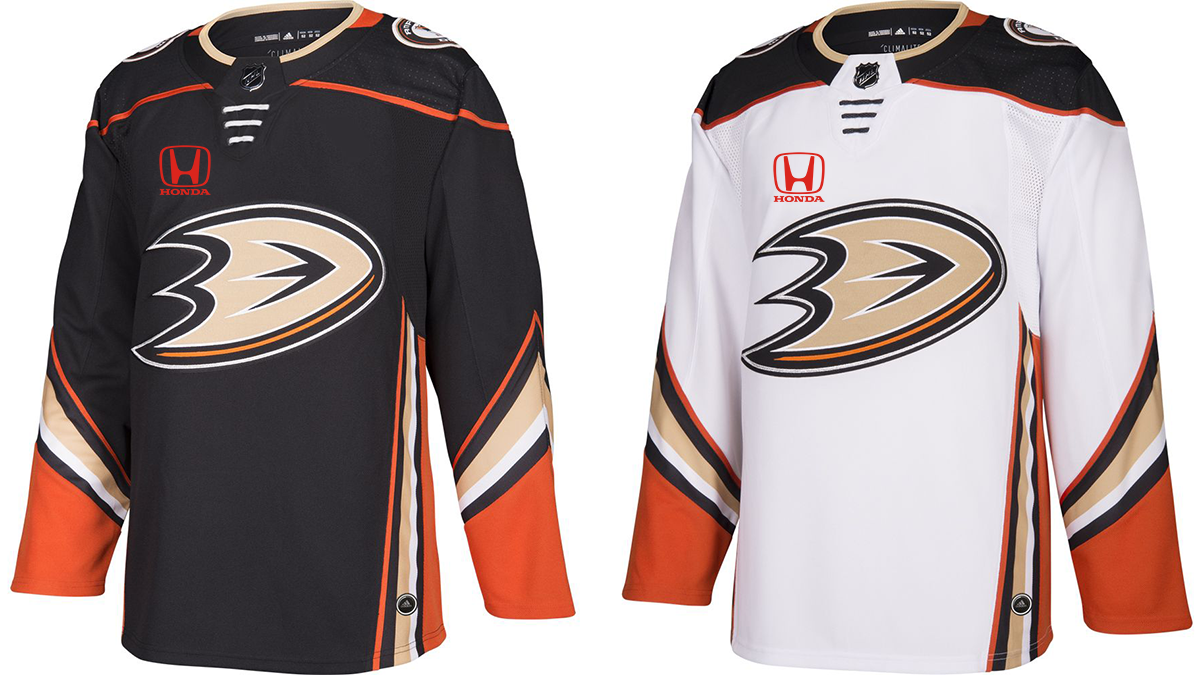
    The Ducks play at Honda Center and, yeah, there’s really nothing besides Disney swooping in and sponsoring the team that they used to own as a means of cross promoting both the Ducks and The Mighty Ducks: Game Changers on Disney+, so we’re stuck with a Honda logo at center ice and on the front of Anaheim’s jerseys.

    In any case, Honda’s red logo works pretty well with the Orange County orange featured as an accent color on Anaheim’s home and road jerseys.

    NHL teams have a tendency to go back to the well with their partners– think of how many teams have either the same helmet sponsor as another team or just slapped on the same brand as their venue’s naming rights deal– but if we want to expand the playground a little bit perhaps TCL could be of interest for the Ducks.

    Come to think of it, that’s probably a better option.

    *Opens up Photoshop*

    Arizona Coyotes

    What we want: P.F. Chang’s or Cold Stone Creamery
    What we’ll get: Fry’s or something, probably

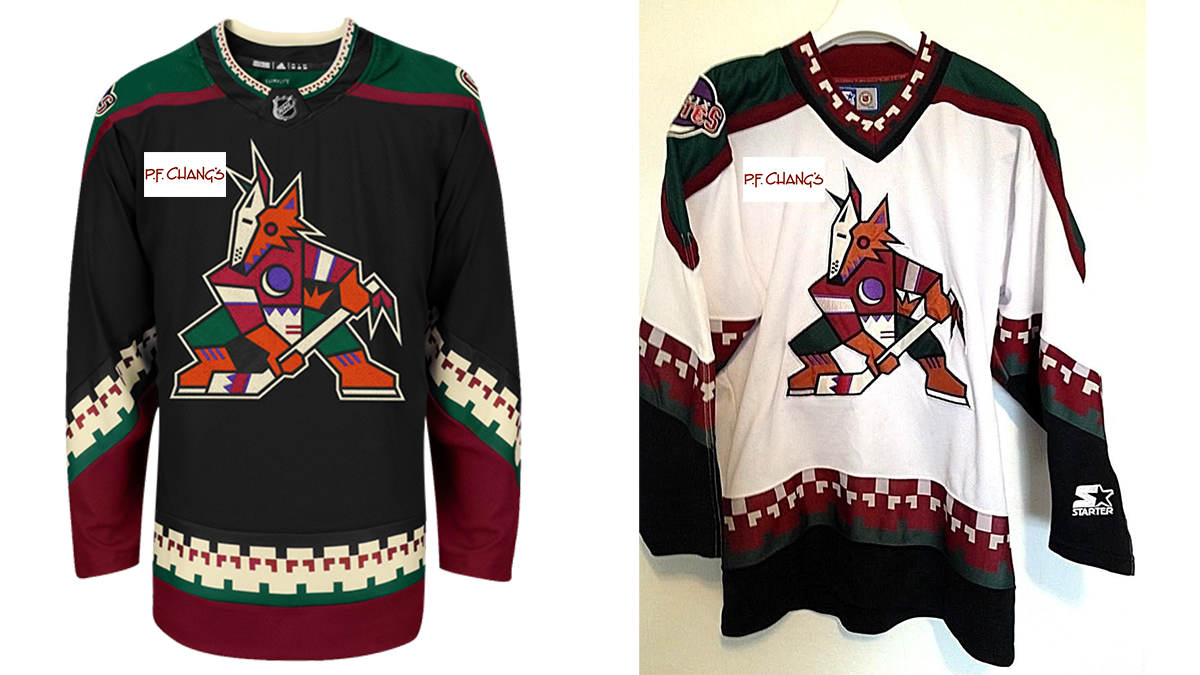
    Believe it or not the Los Angeles Chargers won’t be the only team tweeting about P.F. Chang’s for long as the restaurant chain was founded in 1993, and opened their first location in Scottsdale, Arizona, so it only makes sense to go back to their roots and toss an ad on the Coyotes’ jersey.

    Also founded in Arizona– Cold Stone Creamery.

    We figured that’d probably make sense on an AHL team’s jersey, though, despite the obvious cold ice, cold ice cream connection.

    The Coyotes had Mountain America on their helmets at home and Dignity Health on their road helmets in 2020-21, so in reality we’ll probably get one of those two on the front of their jerseys in 2022-23.

    Boston Bruins

    What we want: Dunkin’ or bust
    What we’ll get: TD Bank or O.R.G. Packaging, probably

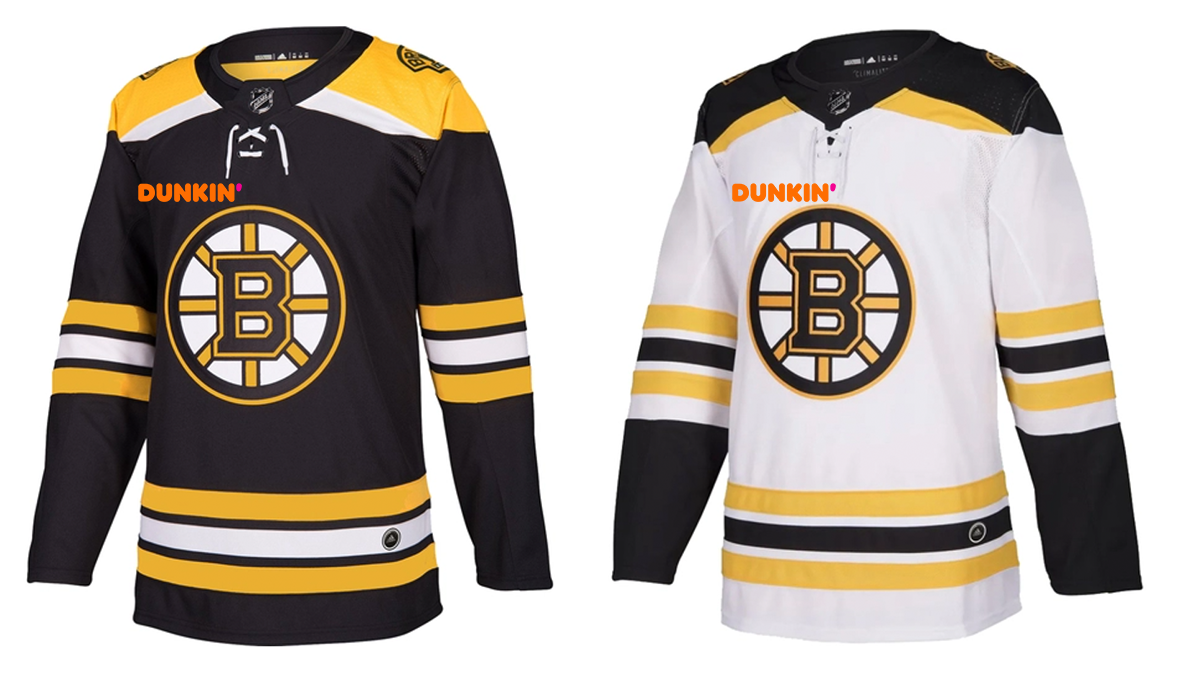
    What could possibly be more Boston than a Bruins jersey with a Dunkin’ logo on it?

    Their AHL affiliate– the Providence Bruins– already play in the Dunkin’ Donuts Center in Rhode Island and have a Dunkin’ ad patch on their jerseys. Why not call it up to the major league?

    That said, with some NBA teams earning up to about $20 million in jersey ad space revenue, the B’s likely will reach for a brand with deeper pockets than doughnuts and coffee.

    Delaware North likes their relationship with a certain bank from Toronto (TD Bank) and has had one of the league’s longest relationships with a Chinese company (O.R.G. Packaging) as part of the NHL’s intended growth beyond the continents of North America and Europe, so one of the two brands is more likely to appear on a Bruins jersey.

    Buffalo Sabres

    What we want: Super Chexx
    What we’ll get: KeyBank

    The Sabres could use some fun in their lives these days and you know what really helps put the mind at ease? Bubble hockey.

    That’s right, Innovative Concepts in Entertainment, Inc. (ICE)– the manufacturers of the popular bar and arcade classic, Super Chexx, that your rich friend down the street growing up also had in the comforts of their home– is based outside Buffalo and would be a match made in heaven right about now.

    Especially as Sabres fans are looking for something to do while the game’s on TV.

    So yeah, we’re definitely going to get KeyBank, Tim Horton’s or something else entirely instead.

    Calgary Flames

    What we want: WestJet or Duraflame
    What we’ll get: Scotiabank

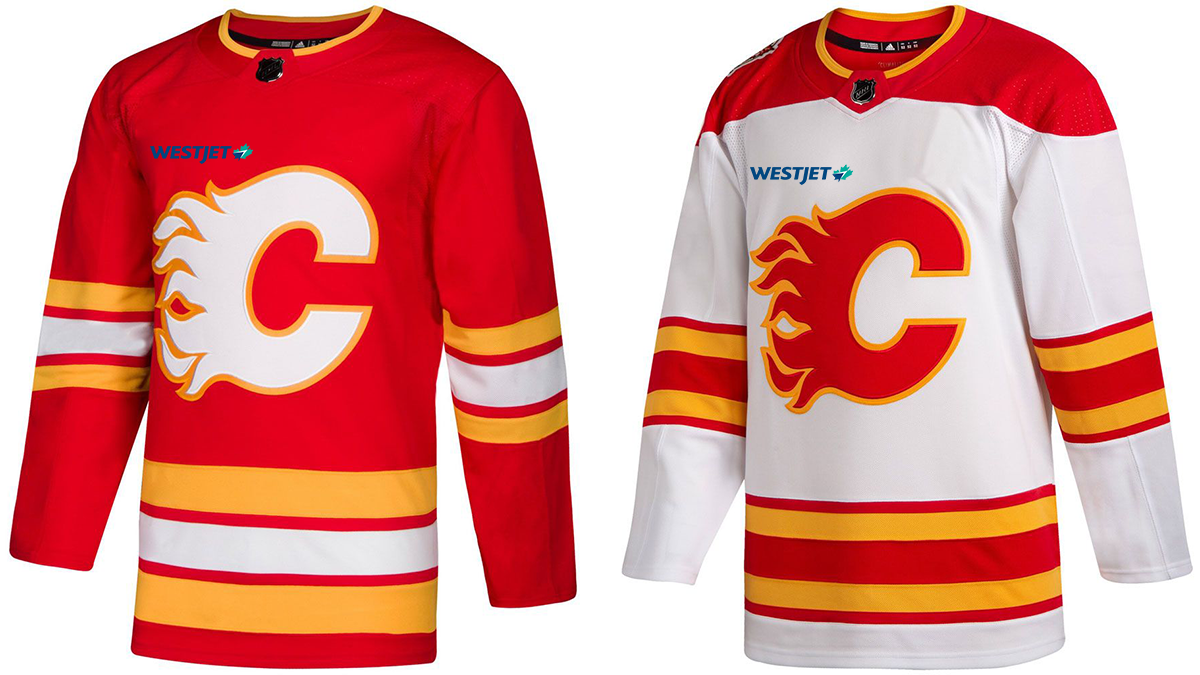
    If you, as an American, can name any other Canadian airline other than Air Canada, then congratulations. If you can’t, then may I introduce you to WestJet?

    WestJet’s headquarters are next to Calgary International Airport and it’d be nice to prove to the world that Canada is more than just a land of Tim Horton’s, Roots, Canadian Tire, Rogers, Scotiabank and Mr. Sub.

    If Duraflame isn’t available, then you might as well dip into the low-cost airline industry as a means of attracting tourists to Banff National Park, Calgary Stampede or whatever it is that sets Calgary apart from the rest of Alberta (so… not being Edmonton).

    Carolina Hurricanes

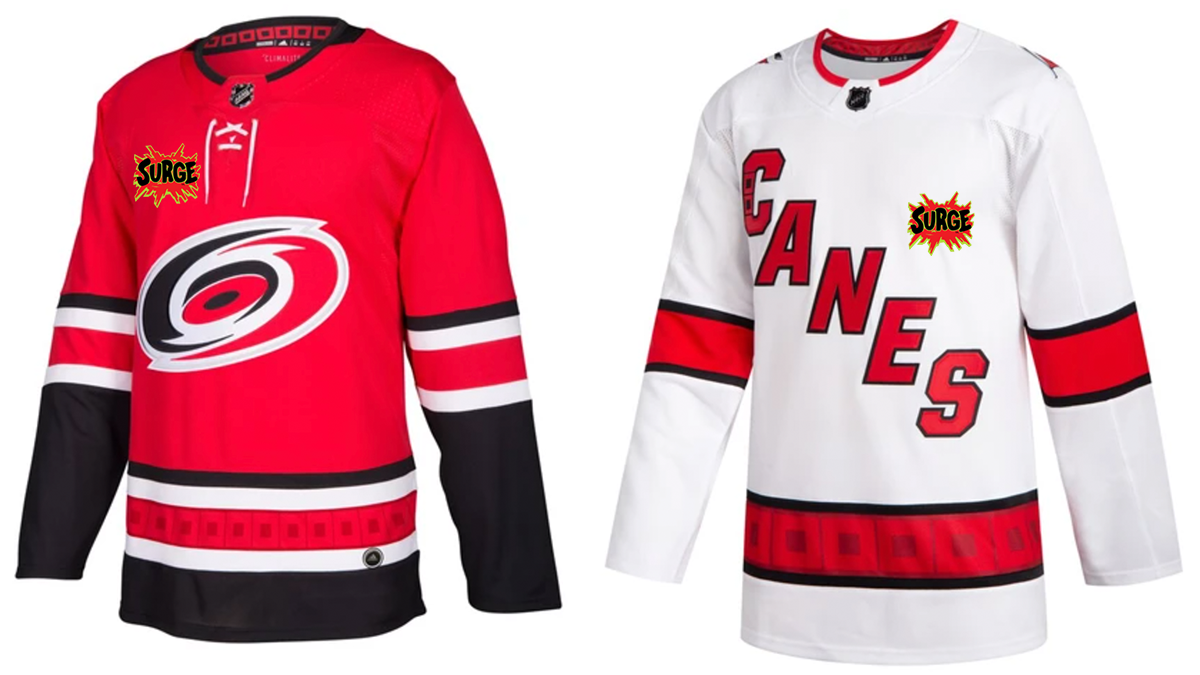
    What we want: Surge
    What we’ll get: PNC, Diehard, maybe Cheerwine or something else

    This should be obvious, but if you haven’t paid attention to the Hurricanes for at least the last few seasons now they do a “Storm Surge” celebration after every win on home ice in the regular season (and sometimes playoffs).

    Surge (the soda) is one of those drinks that makes headlines every few years for being pulled straight out of the vault and placed back on grocery store shelves– speaking of which, does anyone know if it’s currently available?

    If not, it’ll definitely be back by the 2022-23 season.

    Yes, it’s hard to envision where an ad will be placed on the road jersey as the prime real estate is used up by the diagonal “CANES” letters and– for a few players– the captain’s “C” or alternate captain’s “A”.

    Chicago

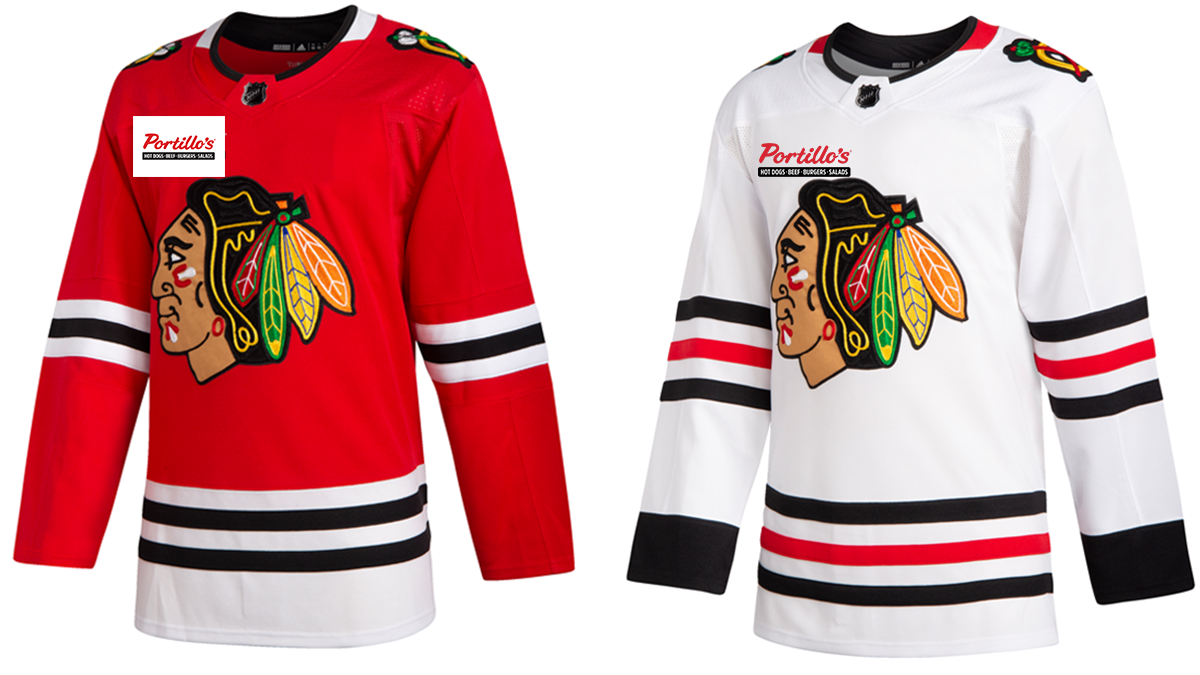
    What we want: Portillo’s
    What we’ll get: United

    Look, between Walgreens, Sears and Portillo’s there’s a few legendary brands that Chicago could partner with as their first jersey ad in franchise history (not including practice jerseys).

    Obviously only one of the three mentioned above is the right choice and its the one that might lead you to Walgreens later if you have a weak stomach. Besides, Sears is fading from our collective memory whether it is out of business already or not.

    Clark Griswold would be proud of Portillo’s proudly being displayed on a, well, if a WHL team can rebrand, so can you, Chicago.

    Colorado Avalanche

    What we want: Chipotle or Coors
    What we’ll get: Ball

    Look, whether or not Nathan MacKinnon eats Chipotle is a debate for another day, but one thing’s for sure– both Chipotle and MacKinnon started their careers in Colorado.

    Though Coors or Coors Light would make more sense, we have to consider the fact that kids might be wearing these jerseys to the game and we haven’t heard whether or not the jerseys that are sold in the proshops in 2022-23 and beyond will include the front jersey ad or not.

    If they do, then we probably can’t market beer to children.

    I’m pretty sure there’s a law about that and it’s also the reason why all my 1:64 scale diecast Rusty Wallace and Dale Earnhardt, Jr. cars from when I was a kid said “Team Rusty” and “Dale Jr.” on them, respectively, instead of Miller Lite and Budweiser.

    Columbus Blue Jackets

    What we want: Wendy’s
    What we’ll get: Nationwide

    Coinciding with the uptick in Columbus born and raised players on the Blue Jackets roster, it would be a great idea to add Wendy’s– which was founded in Columbus in 1969– to the team in such a way that perhaps Jack Roslovic and Sean Kuraly star in local commercials to the Blue Jackets viewing area during the 2022-23 season.

    I know that’s assuming Roslovic signs an extension, but the pending-restricted free agent at the end of the 2021-22 season helped facilitate the Pierre-Luc Dubois for Patrik Laine trade with the Winnipeg Jets by forcing Winnipeg into trading him to his hometown team.

    Unlike several recent stars that left the city via free agency, Roslovic will stick around for the long term.

    Especially if there’s some goods in kind involved with a Wendy’s sponsorship. I mean, I would at least.

    Dallas Stars

    What we want: Whataburger
    What we’ll get: AT&T

    Though Whataburger would be a welcome party in the burger wars when Columbus and Dallas would “meat” up, there’s no beef to be found in this hypothetical because AT&T has already made that decision for us.

    Sometimes you just can’t think too hyperlocal and AT&T fetches a more national audience than a regional chain that primarily serves Texas.

    Besides, if you go to Dallas for a Stars game, you can always just get Whataburger then. It’s not like they’re going to send you a meal with a jersey if ads are on the jerseys sold to fans in 2022-23.

    Detroit Red Wings

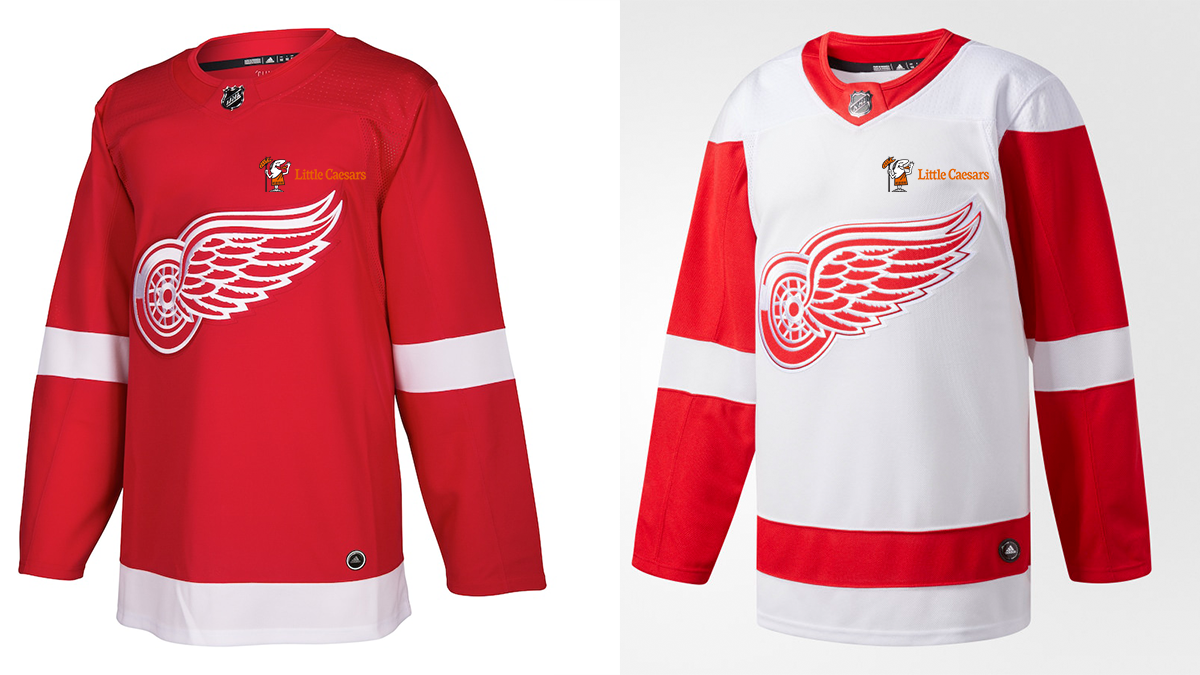
    What we want: Little Caesars
    What we’ll get: Little Caesars

    The last few teams have all involved food and we’re going to be stuck on this theme for at least one more team after this.

    Both the Red Wings and Little Caesars are owned by the Ilitch family and if you think adding one more connection between Detroit and pizza is a bad thing then you clearly don’t understand the marketing behind this.

    Kids love pizza. Adults love pizza. There’s a lot of good memories involving pizza.

    Plus, with General Manager, Steve Yzerman, in charge, the Red Wings are on the rise, which will only further tap into the nostalgia from when Detroit was doing what the Tampa Bay Lightning are currently doing to the rest of the league.

    Edmonton Oilers

    What we want: Boston Pizza
    What we’ll get: Rogers

    Edmonton thought they could replicate the success Ken Holland had in Detroit by hiring Holland as their General Manager and when they see that we’ve got a pizza establishment heading for the front of the Red Wings’ jersey, then the Oilers will think it’s also a good idea to snag a slice.

    That’s where Boston Pizza comes in.

    Whether or not they’ll get Connor McDavid to do an ad read or be left with whatever scraps surround him on the Oilers roster remains to be seen.

    In all likelihood, Rogers Communications will probably just get to slap their logo on another element of Edmonton’s brand.

    Florida Panthers

    What we want: Royal Caribbean International
    What we’ll get: Baptist Health or something

    The Blockbuster guy (the late Wayne Huizenga) founded the team and almost named them the “Florida Block Busters”, so it’d be neat to incorporate an homage to the days of Blockbuster (rest in peace) with the almost Blockbuster-like colors of Royal Caribbean International on the jersey.

    Plus, who among us hasn’t uttered the words “I need a vacation from my vacation” before?

    If you’re an out of town fan visiting the Panthers in Florida or watching the Panthers come to your town— there’s a cruise line for you even if you wouldn’t go remotely near a cruise before the ongoing pandemic began.

    Los Angeles Kings

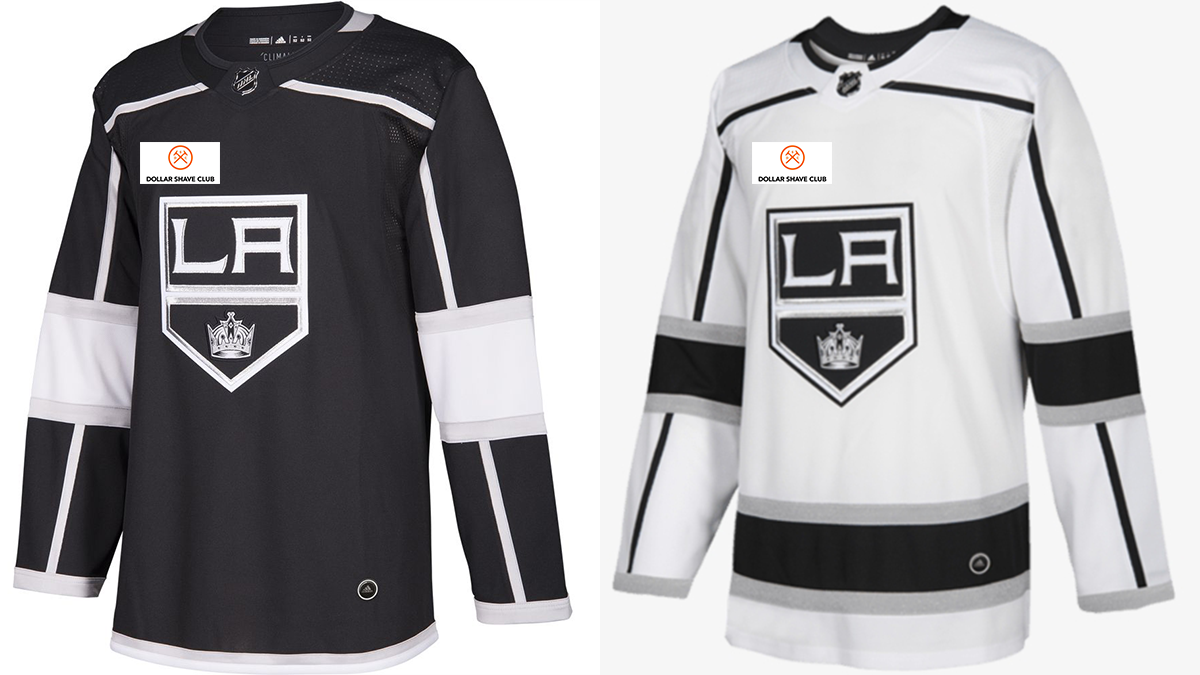
    What we want: Dollar Shave Club
    What we’ll get: Anschutz Entertainment Group

    Never doubt for a second that a team owner wouldn’t give up the chance to toot their own horn, which is why it’s quite possible that one of the world’s biggest entertainment entities would slap their own logo on the front of a Kings jersey.

    If you’re not able to finagle a way to write things off as a deduction, then Dollar Shave Club presents a unique opportunity despite the fact that shaving isn’t something that’s in Drew Doughty’s vernacular (or any hockey player, for that matter, when the Stanley Cup Playoffs roll around).

    Manscaped could also make a run here and in any case, fine.

    Minnesota Wild

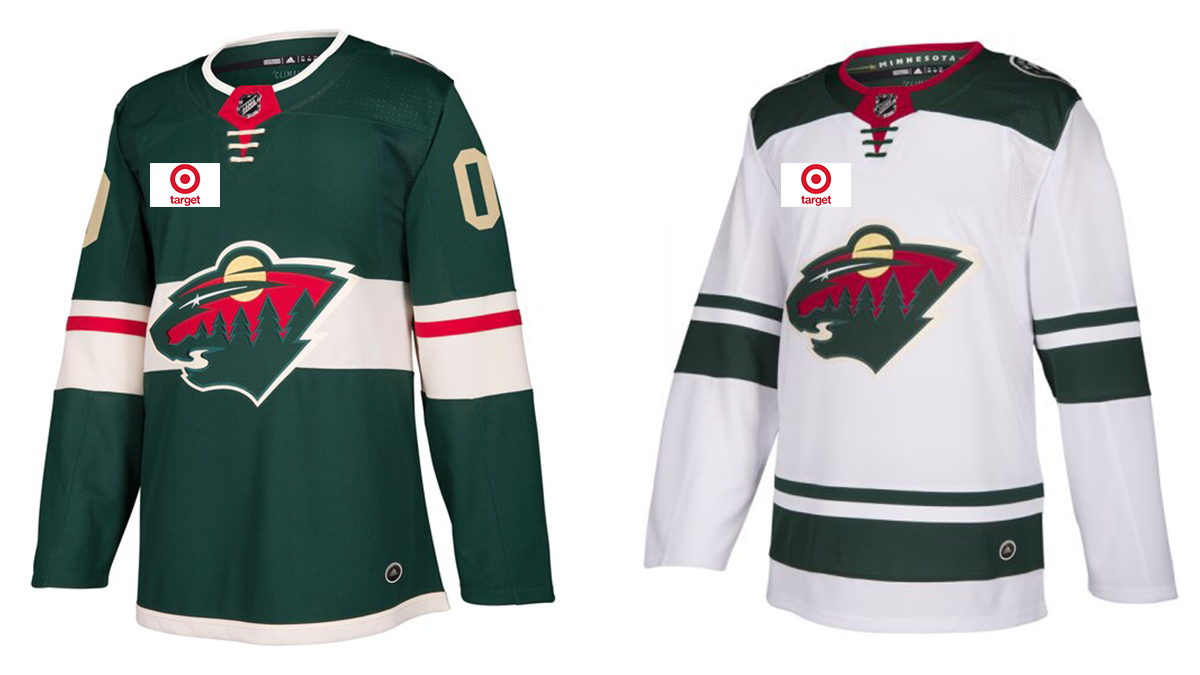
    What we want: Target or General Mills
    What we’ll get: Xcel Energy

    When you think of Minnesota what’s the first thing you think about?

    That’s right, the very place where you could be standing right now reading this while you’re waiting for a cash register to open up or aimlessly perusing the aisles for those impulse purchases you somehow always make at Target.

    It fits the Wild color scheme well and if we’re not going to get General Mills involved then at least getting more than the standard 5% discount for having a Target RedCard via goods in kind might be enough to convince Kirill Kaprizov to stay in Minnesota long-term.

    Montréal Canadiens

    What we want: CCM and/or Molson
    What we’ll get: Bell

    CCM makes more than just jerseys, but it’s not like adidas would be just fine with a CCM logo appearing on the front of an adidas ADIZERO jersey.

    So, we’re left with two obvious choices– Molson or Bell.

    If there’s nothing against a Canadian team bearing an alcoholic beverage on the front of their jersey with the potential for that brand to be marketed towards kids, then perhaps Molson– whose family ties own the Habs– might make an appearance near the crest.

    That or we’ll just get more airtime for Bell. Either way, Montréal would be attractive enough as a franchise to bring in more than one jersey ad sponsor if the league doesn’t have any specific rules outside of the size of the ad.

    Nashville Predators

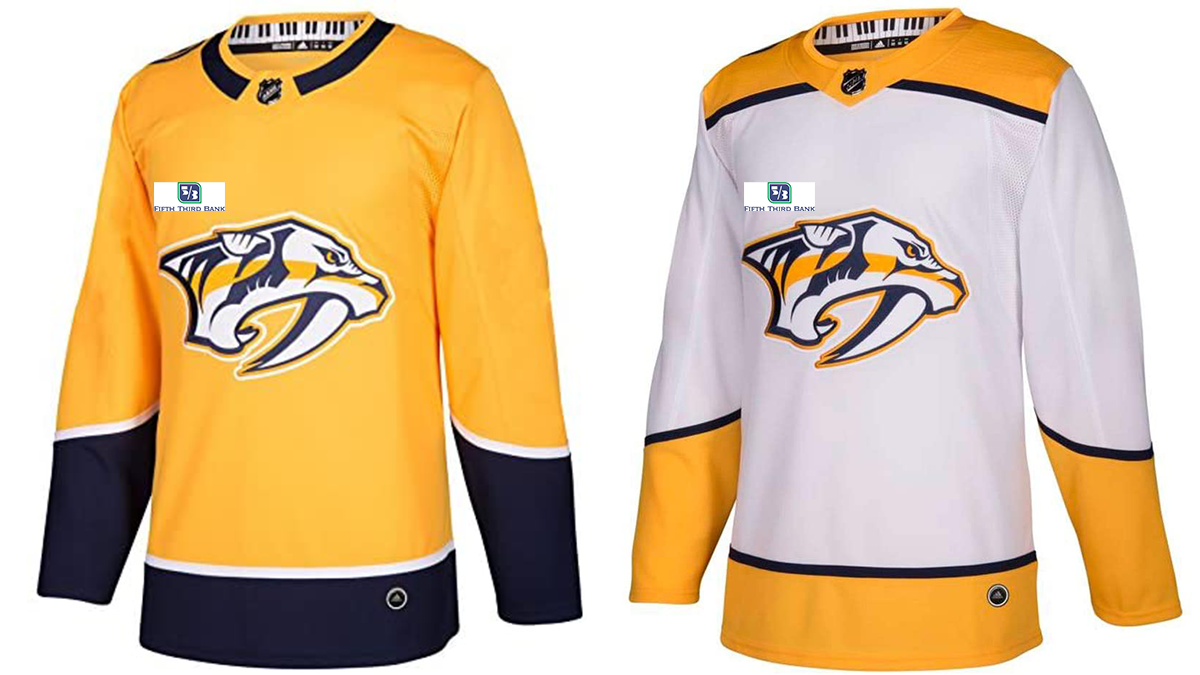
    What we want: Curb Records or CMT
    What we’ll get: Fifth Third Bank

    The music city could attract a music label if they wanted to, but Fifth Third Bank loves investing in Nashville for some reason– like, a lot, despite being headquartered in Cincinnati, Ohio and primarily serving Ohio, Kentucky, Indiana, Illinois, Michigan, West Virginia, North Carolina, Georgia and Florida more than all of Tennessee.

    In any case, good for the Predators. They’ll have some deep pockets to reach into while other teams surely will have to squabble for seven figures related to the going rate for the prime ad space.

    Still feels like we’d be missing out on a sweet Curb Records patch close enough to the guitar pick on the right shoulder though.

    New Jersey Devils

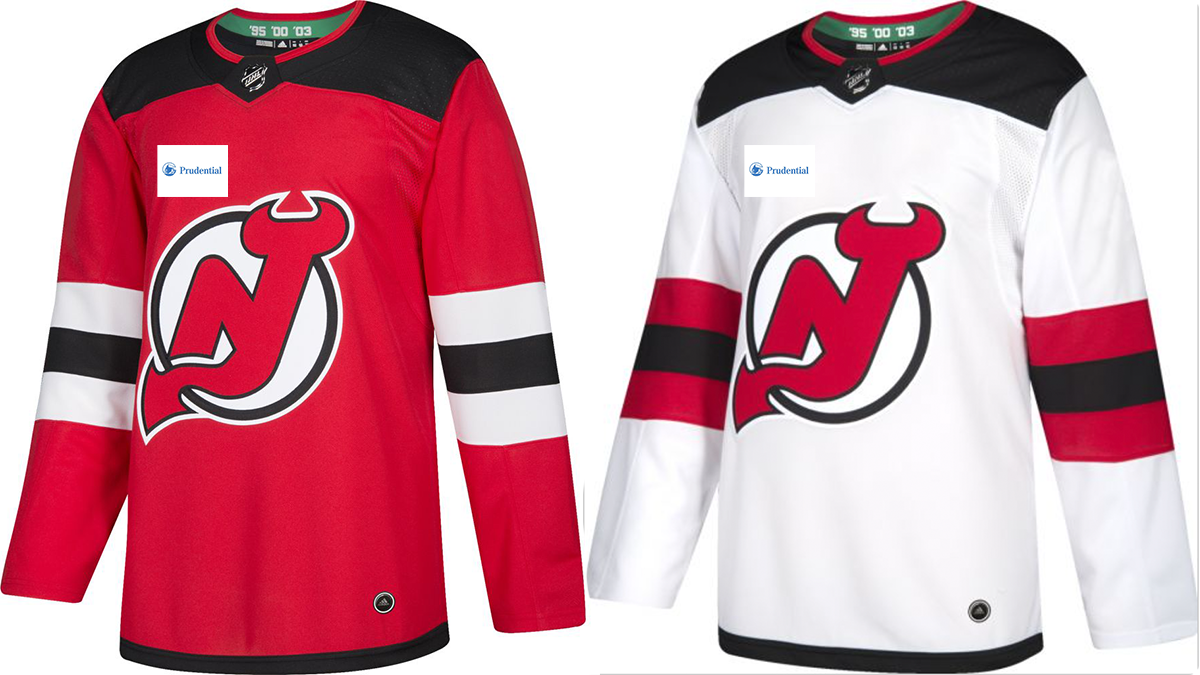
    What we want: Honestly, just Prudential is fine
    What we’ll get: Prudential

    The Devils are overlooked and let’s admit it, you couldn’t think of something distinctly New Jersey either– besides not being allowed to fill your own gas tank.

    Bruce Springsteen is not sponsoring the Devils alone.

    Whether it’s settling on an old reliable or simply making use of what’s trustworthy and already available, Prudential and New Jersey just seem like a good fit.

    New York Islanders

    What we want: Gorton’s
    What we’ll get: Not Gorton’s

    “We want fishsticks!”

    O.K., you got them. Take that, Rangers fans. The Islanders are cool now because they’re steering into the skid.

    They just won’t go as far as bringing back the fisherman jersey from the dead, but alas, they’ll show a spark of creativity and even crack a smile on Lou Lamoriello’s face with the real Gorton’s fisherman making an appearance on the jersey.

    Obviously this will never happen.

    New York Rangers

    What we want: Liberty Mutual if they’re bringing back the “Lady Liberty” jerseys as an alternate
    What we’ll get: Chase for sure, maybe New York Life too

    Liberty Mutual (a Boston company) on the “Lady Liberty” jersey would be a sight to see, but New York will never let it happen.

    Instead, Chase, which already has quite a great partnership with the team, Madison Square Garden, Manhattan, etc. will likely just step up and foot the bill for one– if not all– of the jerseys in full.

    That’s fine. The Rangers will suffer the same consequences of having a diagonal wordmark on their jersey like Carolina’s road jersey, but at least New York’s pretty much always been this way so they should have some ideas of how to work around that.

    Ottawa Senators

    What we want: Canada Post
    What we’ll get: Bell, Scotiabank or Canadian Tire

    Canada’s capital city gets the honor of having Canada Post on their jerseys because it breaks up the trend of having the same three or four companies sponsoring all seven Canadian teams (like how their helmets were for 2020-21).

    In reality, we’ll probably get more of the same from the Sens and either Bell, Canadian Tire or Scotiabank will make an appearance on Ottawa’s jersey.

    At the very least, Canada’s postal service sponsoring a team is more economically viable than the United States Postal Service sponsoring a team.

    Philadelphia Flyers

    What we want: Wawa or Audacy
    What we’ll get: Comcast or GlaxoSmithKline

    Remember how I said you don’t want to go too local for a jersey ad? Well, Wawa on a Flyers jersey is an exception.

    That said, it probably wouldn’t have the staying power to work on a road jersey too, so Philadelphia could tap into the artist formerly known as Entercom, since rebanded as Audacy, for more.

    Audacy maintained their Philadelphia headquarters and covers a broad range of Internet radio, digital content, regular radio and podcasting platforms, plus their logo is orange which fits the Flyers brand.

    It’s either that or Comcast will slap their own logo on the jersey or something.

    Pittsburgh Penguins

    What we want: Duolingo
    What we’ll get: PPG Industries

    Duolingo is headquartered in Pittsburgh and as a website and mobile app, every sports league with ads on jerseys needs at least one that makes you scratch your head at first before realizing the connection between the company and the city.

    The dating app, Bumble, once was featured on the NBA’s Los Angeles Clippers jerseys prior to the Clippers replacing Bumble with their more jersey ad with the online browser extension coupon company, Honey.

    Dating and living expenses in Los Angeles are probably harder than learning a few new languages through Duolingo, so combining Duolingo with the Penguins makes perfect sense since hockey players can come from all over and speak many languages.

    Besides, it might give your team an advantage if they can communicate with one another in a setting that is more comfortable for them.

    St. Louis Blues

    What we want: Busch
    What we’ll get: Enterprise

    I know we’ve been over the whole “can they market beer to kids with these jerseys” thing, but St. Louis is the city of Anheuser-Busch, so it’s only fitting that the Blues get a jersey ad that 1) is Anheuser-Busch related and 2) works with their color palette.

    If Major League Baseball’s St. Louis Cardinals play in Busch Stadium and get Budweiser by default with red as a primary color for the ball club, then the Blues naturally get Busch blue and Busch beer. I don’t make the rules.

    Plus Midwesterners really like the stuff.

    San Jose Sharks

    What we want: Adobe
    What we’ll get: SAP or Zoom

    Look, we weren’t going to get away with making these in Photoshop and not having to give Adobe something— and with headquarters in San Jose it only made sense.

    The Sharks have a deep relationship with SAP, though, so it’s more likely than not that the team will just go further with the brand that also is featured on their helmets at home and holds the current naming rights for SAP Center.

    Plus with the uptick in the use of Zoom, San Jose could double-dip and match SAP on the home jersey with SAP stickers on their helmets with Zoom covering the road set (jersey ad and helmet ads).

    Seattle Kraken

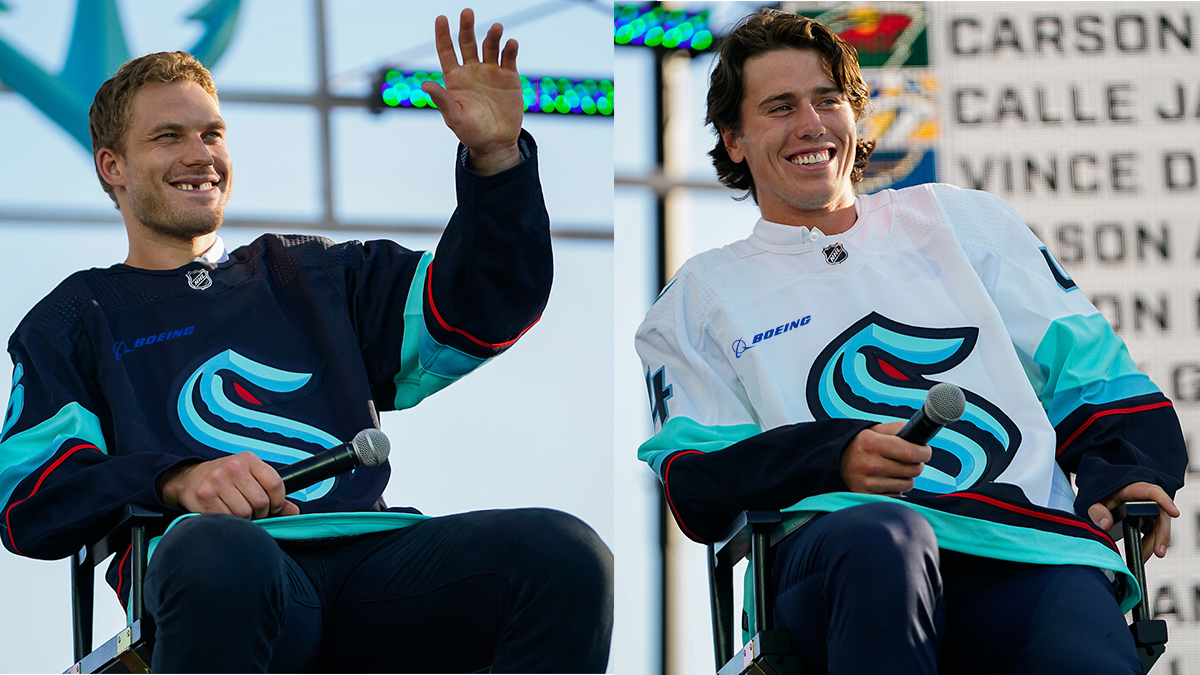
    What we want: Boeing
    What we’ll get: Alaska Airlines

    The Kraken already have a deal with Alaska Airlines as the official airline of the franchise, but what’s bigger than an airline itself?

    That’s right, Boeing, the company that makes a lot of planes and other aerospace stuff, was founded in Seattle and still has a major presence in Washington as the largest private employer in the state.

    Want to see your newest expansion team take flight? Just add some Boeing engineering to the jerseys.

    You might have thought Microsoft would make sense for a Seattle-based team, but the league’s agreement with Apple probably puts a quick end to that.

    Tampa Bay Lightning

    What we want: Accusoft
    What we’ll get: DEX Imaging

    Every sport with ads on jerseys has that one company that nobody’s really sure what they do, but they appreciate that they’re spending their money on their favorite team.

    That just might be Accusoft’s relationship with the Lightning come time for ads on jerseys in 2022-23.

    The private computer software company is headquartered in Tampa and was founded back in 1991, as Pegasus Imaging– one year prior to the Lightning’s debut season as an NHL team in 1992-93.

    Toronto Maple Leafs

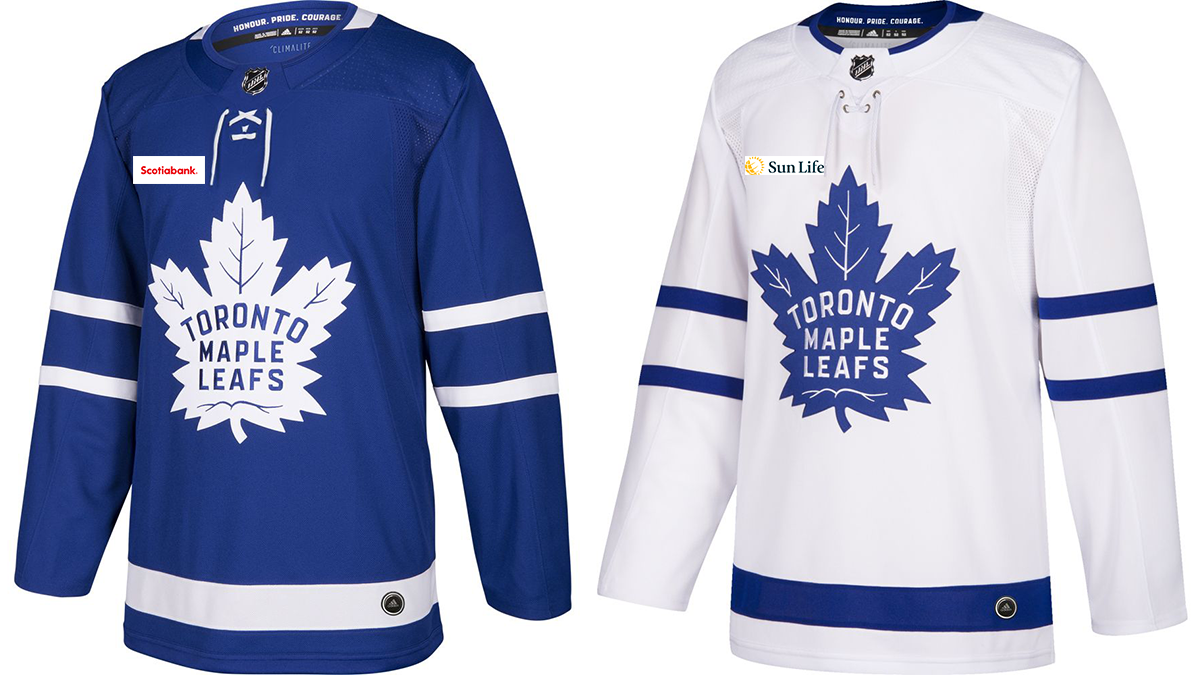
    What we want: Swiss Chalet, Sun Life Financial
    What we’ll get: Scotiabank, Sun Life Financial

    Scotiabank already has a stronghold on Toronto both financially and in the sense that the Maple Leafs play inside Scotiabank Arena and proudly display Scotiabank’s logo on their helmets, so it seems inevitable that Scotiabank would also make an appearance on the Leafs jersey.

    But Toronto is strong enough to maximize the value of a 3-by-3.5-inch ad and capitalize on the Maple Leaf Sports and Entertainment (MLSE) brand.

    MLSE already has an agreement with Sun Life Financial on their NBA team’s jerseys and the Toronto Raptors were able to go on to win their first championship in 2019.

    Perhaps the key to ending the Maple Leafs’ Stanley Cup drought lies within attracting Sun Life Financial to an NHL jersey ad.

    Vancouver Canucks

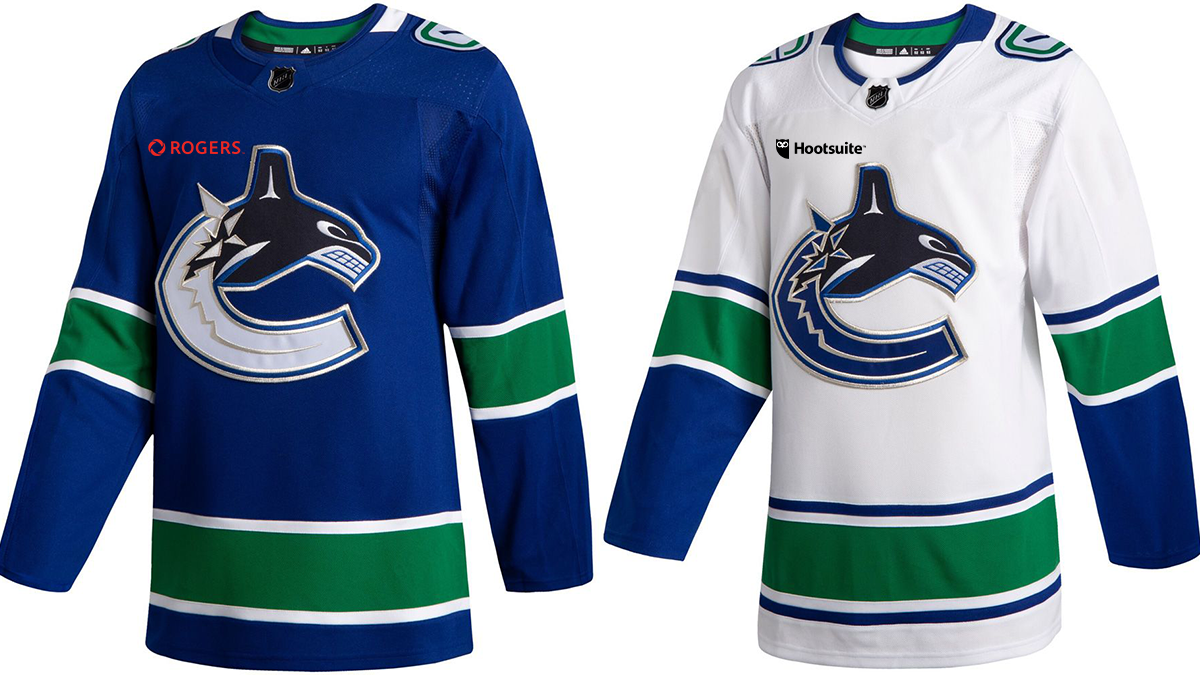
    What we want: Hootsuite
    What we’ll get: Rogers

    Remember when you’d see Hootsuite on just about every tweet with a photo? Am I the only one imagining that?

    In any case, Hootsuite was founded and is based in Vancouver and still plays a major role in social media management for brands.

    Whereas Rogers is accessible to most every day Canadians, Hootsuite would be more of a “corporate” target audience and you need sponsors at all levels to attract a wide base of potential clients, fans, etc.

    That said, the Canucks have had a long relationship with Rogers in that they play in Rogers Arena, so it’s probably going to be Rogers.

    Vegas Golden Knights

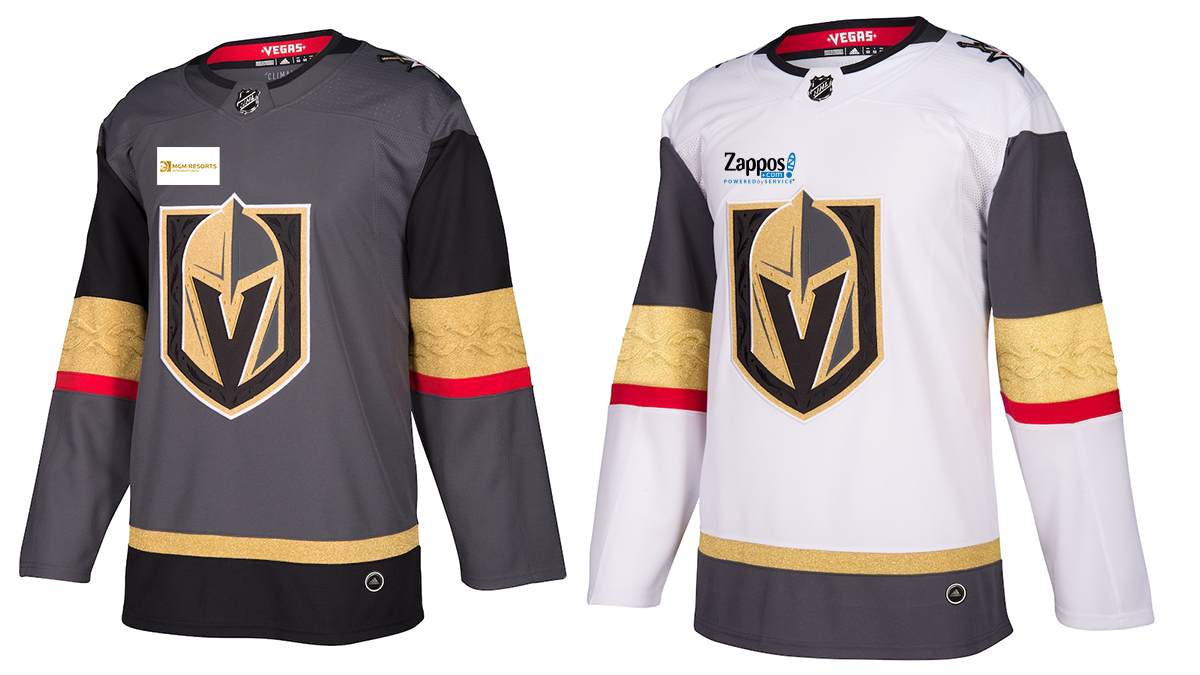
    What we want: Zappos.com
    What we’ll get: MGM Resorts International or Allegiant Air

    Want to have fun with a local Nevada brand? Zappos is the way to go!

    Want to be realistic and attract out of town fans to a destination like Las Vegas? MGM Resorts International is your sponsor and with Allegiant Air as an ultra-low cost airline that’ll gladly bring you to Vegas for a Golden Knights game…

    Yeah, it’s inevitable that between MGM and Vegas’ current road helmet sponsor (Allegiant) that there’d quickly be no room for a company like Zappos.

    Credit One Bank is on the home helmets for the Golden Knights, so don’t be surprised if they’re a wild card for a jersey ad too.

    Washington Capitals

    What we want: Marriott International
    What we’ll get: Capital One, Custom Ink

    Sportswriters rejoice! Your Marriott points may soon reward you with a Capitals jersey or something like that.

    Headquartered in Bethesda, Maryland, Marriott International would make sense from a local and international brand recognition stance.

    But you know what we’re probably going to get instead? Sheer confusion as Capital One places an ad on front of a jersey that already says “Washington Capitals”. The Capital One Washington Capitals– live at Capital One Arena!

    Either that or Caps owner, Ted Leonsis, might like to make a connection between making custom jerseys for local adult league co-ed softball teams or something and, well, Custom Ink’s logo appearing on Capitals jerseys.

    Winnipeg Jets

    What we want: A&W or SkipTheDishes
    What we’ll get: Canada Life or Bell

    A&W was founded in Winnipeg, while SkipTheDishes is headquartered in Winnipeg.

    Since it’s 2021, and not 1956, we’re more than likely to see SkipTheDishes on a Jets jersey, but if their helmet ads from 2020-21 are any indication for 2022-23 and beyond, then Bell is probably going to land a spot near Winnipeg’s crest.

    Canada Life is taking over as the new naming rights holder for Canada Life Centre where the Jets play, so there’s always a chance they’ll end up with their logo on the front of the jersey too.

  • 2020 Stanley Cup Playoffs Second Round Preview: Western Conference

    The turnaround from the Qualifier to the First Round was too quick to get this out of the way (other than on the podcast), but at least the league and broadcasting partners gave us all a day or two between the First and Second Round– oh.

    By the time that you’ll be reading this, the Colorado Avalanche and Dallas Stars will likely already be well into the first period (at least) of Game 1 in their 2020 Stanley Cup Playoffs Second Round matchup.

    Once again, this postseason is unpredictable– and that’s besides whatever happens on the ice.

    At any point in time things could be shutdown again, because– you know– of the ongoing COVID-19 pandemic.

    The players, coaches, team and league staff, as well as broadcasting crews and essential arena/hotel employees have all been in the bubble for almost a month now.

    There aren’t enough words to express how taxing on the mind the isolation really is, despite teammates being in the bubble together, etc.

    None on the league staff or team staff will see their families, romantic partners, roommates back home, etc. until they’re either eliminated or heading home with the Stanley Cup in their arms *fingers crossed*.

    Luckily, the league’s made it this far into Phase 4 with no positive tests for COVID-19 out of the thousands of tests they’ve conducted.

    For one reason or another (TV broadcast deals, probably), they’ve decided to make the Second Round feature a multitude of “back-to-backs”– that’s two games in two nights, whereas normally by this point in the playoffs there’s always (except for extenuating arena availability circumstances) a day off between each game in a series.

    Alas, being in two bubble cities (Edmonton and Toronto), the league can do whatever it wants.

    For now, let’s focus on the Western Conference teams in the Second Round. We’ll get to the Eastern Conference later.

    As a reminder, the Conference Finals and Stanley Cup Final will be held at Rogers Place in Edmonton, Alberta, if everything goes according to plan.

    Sadly, families won’t allowed to join the players in the Conference Finals and beyond as was first anticipated at the beginning of the bubble.

    (1) Vegas Golden Knights (39-24-8, 86 points) vs (5) Vancouver Canucks (36-27-6, 78 points)

    Vegas: 71 games played, .606 points percentage, 30 regulation wins.

    Vancouver: 69 games played, .565 points percentage, 27 regulation wins.

    The Vegas Golden Knights took care of the Chicago Blackhawks in five games (4-1) in the First Round and (if you remember, they didn’t have to play in any Qualifier by virtue of being one of the best four Western Conference teams– seeding determined by a Round Robin tournament) are set to experience what it’s like to face the Vancouver Canucks in the Second Round.

    Vancouver hasn’t been back to the Second Round since their 2011 Stanley Cup Final appearance, so good news for them– they won a series for the first time in nine years.

    The Golden Knights were led by Max Pacioretty (32-34–66 totals in 71 games played) in the regular season, with Mark Stone (63 points in 65 games) and Reilly Smith (54 points in 71 games) rounding out the top-three scorers on the team.

    Through eight games this postseason, Vegas has looked like their usual selves.

    Sure, the goaltending is a hot topic these days, but the team can jump out to a quick, 1-0, lead or play a long-range game where the club takes absolute control of the third period and beats their opponent into submission– both on the ice and on the scoreboard.

    Stone (four goals, four assists) and Smith (three goals, five assists) lead the Golden Knights with eight points each in eight games thus far in the 2020 postseason.

    Shea Theodore (four goals, three assists) and Jonathan Marchessault (two goals, five assists) have the second most points thus far for Vegas– each of them have seven points in eight games.

    Oh and William Karlsson– the other usual suspect for Golden Knights offense– has 2-4–6 totals in eight games.

    In the regular season, Marc-Andre Fleury amassed a 27-16-5 record in 49 games (48 starts) for the Golden Knights with a 2.77 goals against average and a .905 save percentage in the process, as well as five shutouts.

    Malcolm Subban played the role of the backup with a 9-7-3 record in 20 games (19 starts), a 3.18 GAA and an .890 SV% until he was traded at the deadline to the Blackhawks in a three-team trade that witnessed Robin Lehner exchange hands from Chicago to the Toronto Maple Leafs to Vegas.

    Lehner, in the meantime, went 3-0-0 with a 1.67 GAA, a .940 SV% and one shutout for Vegas until the stoppage due to the pandemic.

    Oscar Dansk also made one appearance in 2019-20 for the Golden Knights, amassing a 6.00 GAA and an .838 SV% to go with his 0-1-0 record.

    In the playoffs, there’s a growing goalie controversy– no, not mentioning Fleury’s agent posting… …whatever that was— but Fleury’s posted a 2-0 record in two games (two starts) with a 2.50 GAA and an .886 SV.

    Meanwhile, Lehner has amassed a 5-1 record in six games with a 2.44 GAA and a .904 SV% in the process.

    Lehner’s had his moments, but he’s looked more confident and able to carry himself so far since returning after, what, five months off from the regular season to Phase 4?

    Fleury, on the other hand, has let in some goals that are reminiscent of his pre-three Stanley Cup rings with the Pittsburgh Penguins days.

    Is it his age or simply a byproduct of not being able to get quite restarted after a pandemic stoppage? Well, we may never know, because despite the “controversy” he still managed to win both games he was in and now– after more of a workload than Fleury– Lehner is regressing to some sort of standard trend for Vegas goaltenders this season.

    At the other end of the rink, the Canucks broke through with their first series win since 2011, by beating the Minnesota Wild in four games (3-1) to make the playoffs, then defeated the St. Louis Blues in six games (4-2) to meetup with the Golden Knights in the Second Round.

    J.T. Miller (27-45–72 totals in 69 games) led Vancouver in scoring, while Elias Pettersson (66 points in 69 games) had the second most points and Bo Horvat (53 points in 69 games) was third.

    Pettersson leads his team through 10 games with 4-9–13 totals this postseason as Miller (5-5–10 totals) and Quinn Hughes (1-9–10 totals) each battle it out for second in Canucks playoff scoring.

    Horvat (six goals, two assists) and Brock Boeser (three goals, five assists) each had eight points for the third most in offensive production for Vancouver thus far.

    In the crease, Jacob Markstrom led the way in the regular season with a 23-16-4 record in 43 games (43 starts), as well as a 2.75 GAA, a .918 SV% and two shutouts in 2019-20.

    Thatcher Demko put up a 13-10-2 record in 27 games (25 starts) and had a 3.06 GAA, as well as a .905 SV% as Vancouver’s backup, while Louis Domingue made an appearance this season while the Canucks were depleted due to injury and amassed a 4.08 GAA and an .882 SV% to go with his 0-1-0 record in one game.

    In the playoffs, it’s been all Markstrom, who is 7-3 in ten games with a 2.44 GAA, a .929 SV% and one shutout in that span.

    Golden Knights head coach, Peter DeBoer, usually makes it to at least the Conference Finals– if not Stanley Cup Final– in his first season/partial season with a new team after being fired by his old team.

    Good news for Vegas fans, DeBoer is behind the bench.

    Canucks head coach, Travis Green, has been a long-time coming coaching prospect turned annual “is he in the hot seat?”– but not really– extraordinaire that, with the help of youth, time and forward progress, has been presented a roster that can and will turn heads both in the now and near future.

    Basically, these two teams met on Dec. 15th and Dec. 19th and each won a game.

    Vegas beat Vancouver, 6-3, at T-Mobile Arena on Dec. 15th, while the Canucks took home a, 5-4, overtime win on Dec. 19th at Rogers Arena.

    The Golden Knights had a combined 89 shots against the Canucks, who had a combined 63 shots against Vegas this season.

    Neither team’s goaltending looked solid in their head-to-head matchups, but entering the Second Round, Markstrom clearly has the upper hand.

    That said, Vegas has the powerful offense– with recent playoff experience to boot– and their tried and true defense that saw the addition of clutch playoff performer and underrated leader when it really counts, Alec Martinez, at the trade deadline from the Los Angeles Kings.

    It’s their first time ever meeting and it’s likely one that will last longer than most fans might think– because, again, Markstrom is a huge factor. Whether or not he’s actually this good all the time doesn’t matter.

    He’s a hot goaltender this year and he’s been consistent thus far since returning from the stoppage.

    It won’t be easy, but the Golden Knights should advance, however, to the 2020 Western Conference Final in six games when all is said and done.

    Regular season outcomes:

    6-3 VGK at T-Mobile Arena on Dec. 15th, 5-4 F/OT VAN at Rogers Arena on Dec. 19th

    Schedule:

    8/23- Game 1 VAN @ VGK in Edmonton 10:30 PM ET on NBCSN, CBC, SN, TVAS

    8/25- Game 2 VAN @ VGK in Edmonton 9:45 PM ET on NBCSN, CBC, SN, TVAS

    8/27- Game 3 VGK @ VAN in Edmonton, 8 PM ET on NBCSN, CBC, SN, TVAS

    8/29- Game 4 VGK @ VAN in Edmonton, 8 PM ET on NBCSN, CBC, SN, TVAS

    8/31- Game 5 VAN @ VGK in Edmonton*

    9/1- Game 6 VGK @ VAN in Edmonton*

    9/3- Game 7 VAN @ VGK in Edmonton*

    *If necessary

    (2) Colorado Avalanche (42-20-8, 92 points) vs (3) Dallas Stars (37-24-8, 82 points)

    Colorado: 70 games played, .657 points percentage, 37 regulation wins.

    Dallas: 69 games played, .594 points percentage, 26 regulation wins.

    Both the Colorado Avalanche and Dallas Stars were good enough in the Western Conference to participate in the Round Robin tournament while the Stanley Cup Qualifier was going on, after which, the Avs beat the Arizona Coyotes in five games in the First Round, while the Stars eliminated the Calgary Flames in six games.

    Nathan MacKinnon led the way for Colorado in the regular season with 35 goals and 58 assists for 93 points in 69 games played. Rookie defender, Cale Makar, was second in team scoring with 50 points in an injury shortened 57-game season, while offseason acquisition, Andre Burakovsky amassed 20-25–45 totals in 58 games for the third most points on the team.

    In the postseason, MacKinnon is still leading the way for the Avalanche with 13 points (four goals, nine assists) in eight games entering the Second Round. Nazem Kadri is a close-second with 11 points (six goals, five assists) through eight games, while Mikko Rantanen is third with 10 points (three goals, seven assists) in eight games.

    In the net, Philipp Grubauer split time with Pavel Francouz.

    Grubauer amassed an 18-12-4 record in 36 games played (36 starts), while putting up a 2.63 GAA, a .916 SV% and two shutouts.

    Francouz had a 21-7-4 record in 34 games (31 starts) and yielded a 2.41 GAA, a .923 SV% and one shutout in that span.

    Meanwhile, Michael Hutchinson made one appearance and recorded a 1.00 GAA, as well as a .944 SV% in that game for Colorado after being acquired at the deadline.

    In the playoffs, Grubauer’s carried the weight with a 5-0-1 record in six games, a 1.49 GAA, a .937 SV% and one shutout in that span, while Francouz has made two appearances with a 1-1-0 record, a 1.02 GAA, a .958 SV% and one shutout in that stretch.

    Entering Game 1, Grubauer was likely to see more time in the crease (but that’s changed now with his lower body injury that he sustained).

    Across the ice, the Dallas Stars advanced to the Second Round after ousting the Flames and were led by Tyler Seguin’s 50 points (17 goals, 33 assists) in 69 games in the regular season, while Jamie Benn (19-20–39 totals in 69 games) and Miro Heiskanen (8-27–35 totals in 69 games) also played major roles leading up to the pause.

    Entering the Second Round, Heiskanen has emerged as a generational talent for Dallas’ blue line with three goals and nine assists (12 points) in nine games thus far. Free agent signing, Joe Pavelski, has paid off with his usual clutch playoff performance– eight points (six goals, two assists) in nine games so far.

    Meanwhile, rookie, Denis Gurianov (6-1–7 totals in nine games) and John Klingberg (1-6–7 totals in eight games) are battling it out for the third most points on the roster thus far in the 2020 postseason.

    Gurianov had four goals and an assist against Calgary in Game 6– tying Chicago’s Dominik Kubalik for the most points in a playoff game by a rookie this postseason with five– one shy of the NHL record (Mikko Leinonen had six points– all assists– for the New York Rangers in Game 2 of their Patrick Division Semifinal against the Philadelphia Flyers on April 8, 1982).

    In net, Ben Bishop and Anton Khudobin made a solid goaltending tandem for the Stars with Bishop amassing a 21-16-4 record in 44 games (43 starts), a 2.50 GAA, a .920 SV% and two shutouts while battling injury at times.

    Khudobin, meanwhile, held things down with a 16-8-4 record in 30 games (26 starts), a 2.22 GAA and a .930 SV%.

    In the postseason, Bishop has been “unfit to play” for the majority of Stars games, while managing to put up a 1-1 record in two games, with a 4.04 GAA and an .862 SV%.

    As a result, Dallas interim head coach, Rick Bowness, has had to rely on Khudobin, who’s amassed a 4-3 record in seven games, with a 2.49 GAA and a .919 SV% entering the Second Round.

    Now is where the fun begins.

    Despite all of their dominance in the regular season, Jared Bednar’s Avalanche have yet to crack the code on the Stars.

    Dallas won all four matchups with Colorado, with the Avs dropping a game in overtime and in a shootout to the Stars this season.

    Colorado outshot Dallas, 162-137, in combined shots on goal in their head-to-head meetings in 2019-20, but they managed exactly zero wins with Grubauer in net for all four matchups.

    Now, of course, with Grubauer hurt in Game 1, they’ll have to be bailed out by Francouz if all else fails.

    But coming into the series, for all the mighty strength the Avalanche have in scoring depth, a youthful defense that moves the puck with speed and skill– there’s a very real possibility the Stars overtake them.

    For the most part, Colorado has a mix of playoff experience, but Dallas experienced the heartbreak of losing in a Game 7 to the St. Louis Blues that went to double overtime.

    That alone is motivation enough for the Stars to make quick work of the Avs and get back to the Western Conference Final for the first time since 2008, when they lost to the eventual 2008 Stanley Cup champion Detroit Red Wings in six games.

    For Colorado, however, it’s been an even longer wait since their last appearance in the Western Conference Final. The Avalanche last made it in 2002, when they lost in seven games to the eventual 2002 Stanley Cup champion Red Wings.

    But then there’s Colorado’s recent strides to improve from a First Round exit in 2018 to a Second Round exit last year to consider. There’s a chance they just keep marching forward and at least make it to the Western Conference Final in 2020.

    Entering the series, the Avalanche would be a lock for eliminating the Stars in seven games.

    But with the result of Game 1’s injury to Grubauer, it’s possible the Avalanche can’t get over the mountain and collapse.

    Regardless, the Stars are riding the momentum of an emotional comeback from a three-goal deficit in Game 6 against the Flames in the First Round that it shouldn’t be/wasn’t a surprise that Dallas wins/won Game 1.

    The regular season record means nothing– especially more so when the playoffs are five months after a shortened regular season due to a pandemic and completely isolated to two buildings (one per conference).

    Colorado can get over the Stars if they first shoot for the moon and a seven-game series victory. It’ll be a good test for how they’ll measure up with the Golden Knights in the predicted 2020 Western Conference Final in this post.

    And, boy, what a series that would be.

    But first, it’s two teams that haven’t met since the 2006 Western Conference Quarterfinal, when the Avalanche won in five games– like they did in the 2004 Western Conference Quarterfinal.

    The all-time playoff series between Colorado and Dallas is even at, 2-2, since the Stars initially beat the Avs in the 1999 and 2000 Western Conference Final– both years went all seven games.

    Regular season outcomes:

    2-1 DAL at Pepsi Center on Nov. 1st, 4-1 DAL at American Airlines Center on Nov. 5th, 3-2 F/SO DAL at American Airlines Center on Dec. 28th, 3-2 F/OT DAL at Pepsi Center on Jan. 14th

    Schedule:

    8/22- Game 1 DAL @ COL in Edmonton 8 PM ET on NBC, CBC, SN, TVAS

    8/24- Game 2 DAL @ COL in Edmonton 9:45 PM ET on NBCSN, SN, TVAS

    8/26- Game 3 COL @ DAL in Edmonton 10:30 PM ET on NBCSN, SN, TVAS

    8/28- Game 4 COL @ DAL in Edmonton 10 PM ET on NBCSN, SN, TVAS

    8/30- Game 5 DAL @ COL in Edmonton*

    8/31- Game 6 COL @ DAL in Edmonton*

    9/2- Game 7 DAL @ COL in Edmonton*

  • 2020 Stanley Cup Qualifier Preview: Western Conference

    Hockey’s back. In August!?! In this economy?!?

    Yes, truer words have never been spoken. Hockey. Is. Back.

    But not in the way you’re probably thinking if you’ve been under a rock for the last– let’s see, what month is it now?

    The National Hockey League paused the 2019-20 regular season on March 12th due to the ongoing COVID-19 pandemic before canceling the rest of the regular season in late May and announcing a 24-team playoff format for 2020.

    Make no mistake, whether you put an asterisk next to the winners of the 2020 Stanley Cup Final or not– it’ll be the hardest Cup to win since Lord Stanley of Preston announced he’d donate the silver rose bowl to the best hockey team in the world (so Canada) on March 18, 1892.

    Despite all the training world class athletes do in contemporary times, nothing could prepare any athlete to stop playing, go through training camp after months of (in some cases) not being able to skate on any ice, then go full throttle for a championship tournament.

    If anything, the asterisk next to the 2020 Stanley Cup champions will simply be a marker for the challenging times and remarkable feats of athleticism that team went through to put it all together and lift a 35-pound trophy at the end.

    By now you’ve probably heard how the 2020 postseason will work– 24 teams vying for 16 spots, with eight teams (four in each conference) already locked into the playoffs, but fighting for the top-four seeds as the other 16 teams compete in a best-of-five series to punch a ticket into the playoffs.

    Those 16 teams are in the 2020 Stanley Cup Qualifiers, which technically isn’t part of the 2020 postseason according to the NHL, but the individual player and team stats will count towards the playoffs in the record books.

    So for Arizona Coyotes fans, the long standing playoff drought since 2012, technically isn’t over yet. They’d have to beat the Nashville Predators first.

    With all of that in mind, let’s take a look at the Western Conference Qualifiers, while the St. Louis Blues, Colorado Avalanche, Vegas Golden Knights and Dallas Stars sort themselves out.

    All Western Conference games will be at Rogers Place in Edmonton, Alberta, including the Western Conference Final and all of the Stanley Cup Final.

    (5) Edmonton Oilers (37-25-9, 83 points) vs (12) Chicago Blackhawks (32-30-8, 72 points)

    Edmonton: 71 games played, .585 points percentage, 31 regulation wins.

    Chicago: 70 games played, .514 points percentage, 23 regulation wins.

    The Edmonton Oilers finished second in the Pacific Division with 83 points– three points behind the Vegas Golden Knights for the division lead. That’s how good the Oilers were at times and/or how far behind the Pacific Division was at times leading up to the premature end of the regular season due to the ongoing COVID-19 pandemic.

    One thing is for sure about the always home-ice even without fans in the bubble Oilers team, their top players were much better than they were last season.

    2019-20 Art Ross Trophy winner and Hart Memorial Trophy finalist, Leon Draisaitl had 110 points this season in 71 games played. He was on pace for 126 points had the regular season reached its original conclusion.

    That would’ve been 21 points better than his previous high of 105 points in 82 games last season. Luckily for Draisaitl, he still set a new career-high in a pandemic– two new career-highs, actually.

    Though 43 goals this season did not top the 50 goals he scored in 2018-19, Draisaitl set career-highs in assists (67) and points (110)– and yet, somehow he still was a minus-seven on the season.

    Is it worth exploring moving Draisaitl out of Edmonton? MY COLUMN:

    (If you’re wondering, that’s four consecutive seasons of at least 70 points and back-to-back 100-plus point seasons for Draisaitl, so no, he’s not going anywhere.)

    Oilers captain, Connor McDavid, had 34 goals and 63 assists (97 points) in 64 games this season, which was 19 points shy of his career-high 116-points last season in 78 games in 2018-19. McDavid was on pace for 124 points this season at the time of the stoppage.

    Ryan Nugent-Hopkins was third in scoring for Edmonton with 22-39–61 totals in 65 games this season, then the next highest skater had 34 points in 59 games (Zack Kassian). This season marked back-to-back 60-point seasons for Nugent-Hopkins for the first time in his career.

    In goal, Mike Smith (19-12-6 in 39 games played, 37 starts, 2.95 goals against average, .905 save percentage and one shutout) split time with Mikko Koskinen (18-13-3 in 38 GP, 34 starts, 2.75 GAA, .917 SV% and one shutout in that span) this season.

    The 38-year-old veteran goaltender, Smith, has a 2.17 GAA, a .938 SV% and four shutouts over 24 career Stanley Cup Playoff games.

    Meanwhile, 32-year-old Koskinen has yet to appear in a postseason NHL game.

    Smith’s .938 SV% in the playoffs, however, is league-leading among active NHL goaltenders with a minimum of 20 Stanley Cup Playoff games played.

    Oilers head coach, Dave Tippett, might be smart to start Smith over Koskinen in Game 1, considering Smith’s career playoff numbers, but he did post a 3.20 GAA and a .917 SV% in five games with the Calgary Flames in the 2019 First Round en route to Calgary’s defeat at the hands of the Colorado Avalanche.

    Smith did record one shutout in last year’s playoffs, however, and faced 205 shots against in those five games against the Avs.

    That was about 34% of the number of shots he faced (602) in 16 games with the then known as Phoenix Coyotes en route to their 2012 Western Conference Final appearance against the eventual 2012 Stanley Cup champion Los Angeles Kings.

    At the other end of the rink, Patrick Kane led the way for the Chicago Blackhawks this season with 33-51–84 totals in 70 games, which was 24 points more than Jonathan Toews’ 60-point effort in 70 games for Chicago this season.

    2019-20 Calder Memorial Trophy finalist, Dominik Kubalik, was third in Blackhawks scoring with 30 goals and 16 assists (46 points) in 68 games played.

    For Kane, the pandemic shortened 2019-20 regular season marked five consecutive seasons with at least 70 points, while he was on pace for about 98 points had the regular season witnessed a full 82-game conclusion.

    For Toews, he has never had a season with 82 games schedule below 50 points (though he had 48 points in 47 games in the lockout shortened 2012-13 season), but he did see a decrease in production from 81 points in 82 games last season to 60 points in 70 games this season. He was on pace for 70 points over an 82-game schedule in 2019-20.

    In goal, Corey Crawford led the Blackhawks with a 16-20-3 record in 40 games played (39 starts), a 2.77 GAA, .917 SV% and one shutout this season.

    Prior to being traded to the Vegas Golden Knights at the trade deadline via the Toronto Maple Leafs in a three-team trade– in which Chicago acquired, in part, Malcolm Subban– Robin Lehner served as Crawford’s tandem goaltender with a 16-10-5 record in 33 games played (31 starts), a 3.01 GAA, .918 SV% and no shutouts in that span with the Blackhawks.

    Subban, on the other hand, made one appearance with Chicago after the trade and played in one minute as a Blackhawk. He had a 3.18 GAA and an .890 SV% in 20 games (19 starts) with the Golden Knights this season, however.

    Should Blackhawks head coach, Jeremy Colliton, be given any reason not to opt for Crawford as his Qualifier starter, then there’s cause for concern as to whether or not Chicago can upset the Oilers if Subban can’t right the ship from his worst season as an NHL backup goaltender.

    Four months off with plenty of rest to get in the right mindset might have been a good thing for his rhythm, however, as Crawford and Subban made a combined shutout effort in Chicago’s, 4-0, win over the St. Louis Blues in their exhibition matchup.

    What’s more, the Blackhawks went 2-1-0 in three games against the Oilers this season, but before you start thinking there’s a chance Chicago upsets Edmonton with a sweep or anything, take caution as the Hawks had ten goals for and nine goals against in their season series.

    This will be Colliton’s first appearance behind the bench as head coach in a postseason (but also not technically postseason) appearance for the Blackhawks– and Chicago’s first postseason action without Joel Quenneville at the reigns since before Quenneville was hired four games into the 2008-09 season.

    It truly is a new era for Chicago, despite much of the core remaining from their three Cup championships in a five-year span.

    Look for the Oilers to get the job done in four games with Tippett looking to punch his ticket back to the postseason since leading the Coyotes to the 2012 Western Conference Final, while The Hockey Gods favor Edmonton since the tragic loss of their teammate, Colby Cave, in April after the 25-year-old forward suffered a brain bleed and died days later after being placed in a medically induced coma.

    Regular season outcomes:

    3-1 CHI at United Center on Oct. 14th, 5-3 EDM at Rogers Place on Feb. 11th, 4-3 CHI at United Center on March 5th

    Schedule:

    8/1- Game 1 CHI @ EDM 3 PM ET on NBC, SN

    8/3- Game 2 CHI @ EDM 10:30 PM ET on NBCSN, NHL.TV, SN

    8/5- Game 3 EDM @ CHI in Edmonton 10:30 PM ET on NBCSN, NHL.TV, SN

    8/7- Game 4 EDM @ CHI in Edmonton*

    8/8- Game 5 CHI @ EDM*

    *If necessary

    (6) Nashville Predators (35-26-8, 78 points) vs (11) Arizona Coyotes (33-29-8, 74 points)

    Nashville: 69 games played, .565 points percentage, 28 regulation wins.

    Arizona: 70 games played, .529 points percentage, 26 regulation wins.

    There’s something in the water in Nashville– and it’s not just catfish. Predators defender– and 2019-20 James Norris Trophy finalist– Roman Josi led the Preds in scoring this season with 65 points (16 goals, 49 assists) in 69 games.

    He was on pace for 77 points at the time of the stoppage and trailed Washington Capitals defender– and fellow Norris finalist– John Carlson by ten points for the most points by a defender this season.

    It was a career-season for Josi in goals, assists and points, by the way.

    Nashville’s top-three in scoring, in fact, nearly contained two defenders as Josi led the way and Ryan Ellis notched 38 points in an injury-riddled 49-game season (a 64-point pace had the full 82-game schedule been completed if the pandemic never happened).

    Ellis trailed Filip Forsberg (21-27–48 totals in 63 games) and Matt Duchene (13-29–42 totals in 66 games) in scoring on the Predators roster.

    Juuse Saros finally emerged as a de facto starting goaltender for Nashville after amassing a 17-12-4 record in 40 games played (34 starts), as well as a 2.70 GAA, .914 SV% and four shutouts on the season.

    Pekka Rinne, meanwhile, had an 18-14-4 record in 36 games (35 starts), which wasn’t bad, but his numbers past his overall record were actually a career-worst with a 3.17 GAA and an .895 SV% in 2019-20.

    Rinne previously had a 3.80 GAA in a season, but that was only when he played in two games in 2005-06.

    This was a season to forget for Rinne, but perhaps a larger indicator of more worries to come for Nashville in the net– especially more so after Saros didn’t exactly light it up as a starter with a goals against average that would even make a backup goaltender look, well, average.

    The Arizona Coyotes enter the 2020 Stanley Cup Qualifier with a new owner, as well as a new Interim General Manager in Steve Sullivan, as well as Nick Schmaltz leading the way in scoring with 11 goals and 34 assists for 45 points in 70 games played.

    Not ideal, ideally speaking.

    Clayton Keller had 44 points (17 goals, 27 assists) in 70 games and was on pace for 52 points had the pandemic not cut the regular season short.

    Meanwhile, Conor Garland was third on the team in scoring with 39 points in 68 games, while establishing career-highs in goals (22), assists (17) and points (39) in the process.

    Christian Dvorak and Phil Kessel each had 38 points in 70 games. Over an 82-game schedule, that’s about a 45-point pace, which would’ve still been a career-season for Dvorak and a disappointment for Kessel in his first season in the desert.

    Granted, Kessel’s not playing with guys like Sidney Crosby or Evgeni Malkin in his new home in Arizona.

    He failed to reach the 20-goal plateau for the first time since the 2007-08 season, in which Kessel scored 19 goals in 82 games for the Boston Bruins in his sophomore season.

    Kessel also failed to reach 30-assists for the first time since his first season as a Toronto Maple Leaf in 2009-10, in which he had 25 helpers in 70 games.

    Finally, No. 81 on Arizona’s roster failed to amass at least 40 points in a season for just the third time in his career (29 points in 70 games while missing time battling testicular cancer with the Bruins in his rookie season in 2006-07, and 37 points in 82 games the following season in 2007-08 with Boston).

    Granted, Kessel likely could have passed the 40-point plateau had the COVID-19 pandemic not interrupted plans for him and his Coyotes teammates.

    In goal, Antti Raanta appeared in 33 games (32 starts) and had a 15-14-3 record, as well as a 2.63 GAA, a .921 SV% and two shutouts in that span.

    Darcy Kuemper went 16-11-2 in 29 games played (all starts) and amassed a 2.22 GAA, while putting up a .928 SV% and two shutouts this season for the Coyotes.

    If there’s any doubt Rick Tocchet has over deciding which goaltender to start in Game 1 against Nashville, there shouldn’t be any question– it has to be Kuemper.

    Simply put, it’s Kuemper’s net to lose right now in Arizona and a little healthy competition isn’t a bad idea to try to spur Raanta in the right direction if he wants to be a starter in this league.

    Boy, home ice advantage really would be something in this series by default, right? After all, each team won their only home game in their regular season matchups prior to the premature conclusion to the 2019-20 regular season due to the pandemic.

    Since home ice is without fans in Edmonton for all Western Conference teams in the 2020 postseason, there’s not much to go off of in terms of these two clubs’ head-to-head meetings.

    But the Predators have more than a few things going in their favor among their forwards and defenders who could also play forward, arguably.

    The one thing Arizona has that Nashville hasn’t seen much of this season is a consistent starter in the crease.

    If the Coyotes win the series, it’ll likely have something with Kuemper stealing a few games.

    If the Preds sweep Arizona, it might have something to do with the sheer fire power in a last-ditch effort at what’s otherwise a closing window for a potential Cup contending roster.

    At the very least John Hynes probably doesn’t have to worry about getting the same treatment as Peter Laviolette– who Hynes replaced in January– if the Predators dropped the ball in this series.

    Let’s say Nashville in three, but give props to Kuemper for honing in his talents to tend the crease this well in his career. It hasn’t been easy, but he’s arrived and here to stay, unlike former Coyotes GM John Chayka.

    Regular season outcomes:

    5-2 ARI at Gila River Arena on Oct. 17th, 3-2 NSH at Bridgestone Arena on Dec. 23rd

    Schedule:

    8/2- Game 1 ARI @ NSH in Edmonton 2 PM ET on USA, NHL.TV, SN360

    8/4- Game 2 ARI @ NSH in Edmonton 2:30 PM ET on NHLN, NHL.TV, SN1, SN360

    8/5- Game 3 NSH @ ARI in Edmonton 2:30 PM ET on NHLN, NHL.TV, SN360

    8/7- Game 4 NSH @ ARI in Edmonton*

    8/9- Game 5 ARI @ NSH in Edmonton*

    *If necessary

    (7) Vancouver Canucks (36-27-6, 78 points) vs (10) Minnesota Wild (35-27-7, 77 points)

    Vancouver: 69 games played, .565 points percentage, 27 regulation wins.

    Minnesota: 69 games played, .558 points percentage, 30 regulation wins.

    Entering the 2019-20 season, Vancouver Canucks General Manager, Jim Benning, added J.T. Miller to the fold in a trade with the Tampa Bay Lightning.

    Benning then went out and got Tyler Toffoli from the Los Angeles Kings leading up to the 2020 trade deadline.

    As a result, the Canucks are much improved from last season to this season.

    Miller led the team in scoring with 27-45–72 totals in 69 games played and was on pace for about 86 points at the time of the stoppage due to the pandemic.

    Elias Pettersson (66 points in 69 games), Bo Horvat (53 points in 69 games) and Quinn Hughes (53 points in 69 games) rounded out the top-three in scoring for Vancouver.

    Horvat and Hughes were tied for the third most points on the team as Hughes left his mark on the 2019-20 season by earning Calder Memorial Trophy finalist honors.

    Meanwhile, Jacob Markstrom led the Canucks in the crease with a 23-16-4 record in 43 games played (all starts), as well as a 2.75 GAA, a .918 SV% and two shutouts in that span.

    Thatcher Demko made 27 appearances (25 starts) as the backup goaltender and went 13-10-2 on the season with a 3.06 GAA and a .905 SV% in that span.

    Louis Domingue also appeared in one game (one start) in the regular season for the Canucks and had a 4.08 GAA and an .882 SV%.

    Markstrom will be the starter for Vancouver’s postseason run, but he’ll have to be a tad better in cutting down his goals against average for a deep run.

    For Canucks head coach, Travis Green, it’s more of the same game plan to try to spur the Canucks back into the playoffs for the first time since their 2015 First Round appearance and elimination at the hands of the Calgary Flames in six games.

    The Minnesota Wild removed the “interim” tag from their head coach, Dean Evason’s title since the pause in play and are looking to upset the Canucks and get back into the playoffs since missing the postseason last season.

    Kevin Fiala led the way for the Wild in scoring with 54 points (23 goals, 31 assists) in 64 games played. He was on pace for 69 points had the season gone all 82 games, but still established career-highs in goals, assists and points in the shortened season regardless.

    Ryan Suter led defenders and was second in scoring on the roster with 48 points (eight goals, 40 assists) in 69 games, while Eric Staal was ahead of Zach Parise by one point for third in scoring with 47 points in 66 games.

    In goal, Alex Stalock (20-11-4 in 38 games played, 36 starts, 2.67 goals against average, .985 save percentage, four shutouts) outplayed Minnesota’s usual starter Devan Dubnyk (12-15-2 in 30 GP, 28 starts, 3.35 GAA, .890 SV%, one shutout) and will likely backstop the team in Game 1 against Vancouver.

    Kaapo Kahkonen also made his NHL debut this season in the crease for the Wild in five games– amassing a 3-1-1 record, as well as a 2.96 GAA and a .913 SV%.

    Both teams had nine goals for and nine goals against one another in their season series. They also each had 89 total shots on goal against one another in the 2019-20 regular season.

    Though the Wild made strides this season at potentially avoiding a rebuild, it’s still an uphill climb for Minnesota against the Canucks on paper– regardless of their head-to-head matchups from the season.

    Vancouver has the right combination of speed, skill and youth to limit Minnesota’s chances and, at times, lackluster offense.

    The Canucks core is more defined than Minnesota’s fluid situation as Wild GM Bill Guerin evolves the roster over the next season or two.

    It’s a transition period, nonetheless.

    Benning and the Canucks are emerging from their transition and look to be ready to get back into the playoff hunt with what should be a four-game series win against the Wild.

    Regular season outcomes:

    4-1 VAN at Xcel Energy Center on Jan. 12th, 4-2 MIN at Xcel Energy Center on Feb. 6th, 4-3 F/SO MIN at Rogers Arena on Feb. 19th

    Schedule:

    8/2- Game 1 MIN @ VAN in Edmonton 10:30 PM ET on NBCSN, NHL.TV, SN

    8/4- Game 2 MIN @ VAN in Edmonton 10:45 PM ET on USA, NHL.TV, SN

    8/6- Game 3 VAN @ MIN in Edmonton TBD

    8/7- Game 4 VAN @ MIN in Edmonton*

    8/9- Game 5 MIN @ VAN in Edmonton*

    *If necessary

    (8) Calgary Flames (36-27-7, 79 points) vs (9) Winnipeg Jets (37-28-6, 80 points)

    Calgary: 70 games played, .564 points percentage, 25 regulation wins.

    Winnipeg: 71 games played, .563 points percentage, 30 regulation wins.

    The Calgary Flames were led in scoring this season by their hottest controversial player, Matthew Tkachuk. Tkachuk ruffled some feathers en route to re-igniting the “Battle of Alberta” and managed to amass 23-38–61 totals in 69 games played in 2019-20.

    He was on pace for 72 points this season at the time of the stoppage, but still had back-to-back seasons with at least 60 points nonetheless.

    Johnny Gaudreau was second on the roster in points with 58 points (18 goals, 40 assists) in 70 games played, which was down from his 99 points in 82 games last season. That said, Gaudreau was still on pace for about 68 points when the regular season was cut short by the ongoing pandemic.

    Instead, his streak of consecutive 60-plus point seasons was over at five seasons thanks to the pandemic.

    Finally, Elias Lindholm managed to set a new career-high in goals (29), while scoring 54 points in 70 games this season– ranking third on the team in scoring.

    In the crease, Calgary was saved by David “Big Save Dave” Rittich, who went 24-17-6 in 48 games played (all starts), had a 2.97 goals against average, a .907 save percentage and two shutouts this season.

    Actually, on second thought, maybe that’s not very good numbers to have for a *checks notes* starting goaltender.

    Alright, let’s check the backup…

    Cam Talbot went 12-10-1 in 26 games played (22 starts), had a 2.63 GAA, a .919 SV% and two shutouts this season. Hmm, not much better.

    Oh and did you remember that interim head coach, Geoff Ward, replaced Bill Peters after everyone found out Peters is racist?

    The Winnipeg Jets landed in fifth place in the Central Division with 80 points this season– two points behind the Dallas Stars, who were the fourth best team in the Western Conference by points percentage and have earned themselves home ice in at least the First Round, which only matters so much in a bubble, but still, this was meant to show how close the Jets came to being a Round Robin team instead of playing in a Qualifier series.

    Anyway, Kyle Connor soared as a Jet this season– establishing new career-highs in goals (38), assists (35) and points (73) in the process while playing in 71 games until the pandemic cut the regular season short.

    Connor was on pace for 84 points this season if the full 82-game schedule could’ve occurred uninterrupted.

    Meanwhile, Mark Scheifele actually tied Connor for the most points on the roster with 73, as Scheifele tallied 29 goals and had 44 helpers in 71 games. Not quite a career-season, but still respectable after setting career-high totals (38-46–84) last season in all 82 games.

    Winnipeg’s captain, Blake Wheeler, contributed more than just actions and words in defense of the Constitution and human rights this season, scoring 22 goals and amassing 43 assists for third place on the roster in points (65) in 71 games played.

    Patrik Laine, for those wondering, was fourth on the team with 63 points, which was back to his usual self, albeit with more assists (35) than goals (28) in 68 games.

    Laine hasn’t been a bust for the Jets– he’s never had a season with fewer than 50 points (last season, 82 games) and was on pace for about 76 points had the season been played in full.

    This was, however, the first season he failed to reach the 30-goal plateau, but he only missed it by two goals and, hello, the pandemic? Remember it? Yeah, that’s why he missed the mark, otherwise he would’ve (probably) scored a pair of goals in the remaining 11 games for Winnipeg on the 2019-20 regular season schedule at the time of the pause.

    In goal, Paul Maurice relied on old reliable to bail him out even more so in the wake of Dustin Byfuglien’s decision to sit out the 2019-20 season and eventual mutual termination of his contract with the club.

    2019-20 Vezina Trophy finalist, Connor Hellebuyck, held the fort down with a 31-21-5 record in 58 games played (56 starts), amassed a 2.57 goals against average and had a .922 save percenrage– as well as a league-leading six shutouts this season.

    Yeah, it was kind of a big season for Hellebucyk and if he’s not the favorite among the NHL GMs that vote for the Vezina, well, who knows what games they were watching (presumably their own).

    Laurent Brossoit went 6-7-1 in 19 games (15 starts) this season and had a dismal 3.28 GAA and an .895 SV% in that span. Yikes.

    The defense looks different without Byfuglien, but Hellebuyck remained stable as their primary alternative to keeping the puck away from their own net.

    That might not pay off against some of the powerhouses in the league, but luckily the Jets have enough time to let Maurice come up with a plan and enact it to cut down on Hellebuyck’s workload in the Qualifier if they want a chance to advance.

    Oh, speaking of the Winnipeg and Calgary series– nobody knows what to expect!

    The Jets and Flames met once this season– back in the 2019 Heritage Classic outdoors at Mosaic Stadium in Regina, Saskatchewan.

    Winnipeg won in overtime in comeback fashion that night, 2-1.

    They peppered Rittich with 45 shots (43 saves) and kept Hellebuyck to an ideal workload of 30 shots faced (29 saves).

    If the Jets don’t win this series, it’ll be a huge disappointment– perhaps even bigger than making the First Round and getting stomped out by their next opponent after the phenomenal performance by Hellebucyk in the crease all season.

    Then again, momentum no longer exists since everyone had about five months off.

    Let’s say this one goes all five games for one reason or another and that Winnipeg can pull it off and advance to the 2020 Stanley Cup Playoffs.

    Regular season outcomes:

    2-1 F/OT WPG at Mosaic Stadium, Regina, Saskatchewan on Oct. 26th

    Schedule:

    8/1- Game 1 WPG @ CGY in Edmonton 10:30 PM ET on NBCSN, NHL.TV, CBC, SN

    8/3- Game 2 WPG @ CGY in Edmonton 2:30 PM ET on NHLN, NHL.TV, SN

    8/4- Game 3 CGY @ WPG in Edmonton 4:45 PM ET on NHLN, NHL.TV, SN

    8/6- Game 4 CGY @ WPG in Edmonton*

    8/8- Game 5 WPG @ CGY in Edmonton*

    *If necessary


    2020 Western Conference Round Robin Action

    Here’s a quick glance at the Round Robin schedule for the top-four Western Conference teams if you’re not at all interested in the Qualifiers for some reason.

    Again, all games in the Western Conference are in Edmonton this year and all times Eastern.

    St. Louis Blues

    42-19-10, 94 points, 71 GP, .662 PTS%, 33 RW

    Aug. 2nd @ COL in Edmonton 6:30 PM ET on NBCSN, NHL.TV, SN360

    Aug. 6th vs. VGK in Edmonton, TBD

    Aug. 9th vs. DAL in Edmonton, TBD

    Colorado Avalanche

    42-20-8, 92 points, 70 GP, .657 PTS%, 37 RW

    Aug. 2nd vs. STL in Edmonton 6:30 PM ET on NBCSN, NHL.TV, SN360

    Aug. 5th @ DAL in Edmonton 6:30 PM ET on NHLN, NHL.TV

    Aug. 8th vs. VGK in Edmonton, TBD

    Vegas Golden Knights

    39-24-8, 86 points, 71 GP, .606 PTS%, 30 RW

    Aug. 3rd vs. DAL in Edmonton 6:30 PM ET on NHLN, NHL.TV, SN1

    Aug. 6th @ STL in Edmonton, TBD

    Aug. 8th @ COL in Edmonton, TBD

    Dallas Stars

    37-24-8, 82 points, 69 GP, .594 PTS%, 26 RW

    Aug. 3rd @ VGK in Edmonton 6:30 PM ET on NHLN, NHL.TV, SN1

    Aug. 5th vs. COL in Edmonton 6:30 PM ET on NHLN, NHL.TV

    Aug. 9th @ STL in Edmonton, TBD

  • Canucks down Bruins, 9-3

    The Vancouver Canucks routed the Boston Bruins, 9-3, at Rogers Arena on Saturday night in what was Boston’s third game in four nights of traveling.

    That said, Canucks goaltender, Jacob Markstrom (23-16-4 record, 2.75 goals against average, .918 save percentage in 43 games played) made 34 saves on 37 shots against for a .918 SV% in 58:12 time on ice en route to the win.

    Meanwhile, his teammate and Canucks backup goaltender, Thatcher Demko (10-6-2, 3.03 GAA, .905 SV% in 20 games played) made a brief relief appearance for a 1:48 span after Markstrom took an inadvertent stick through the cage of his mask early in the first period.

    Bruins goaltender, Tuukka Rask (23-6-6, 2.17 GAA, .928 SV% in 36 games played) stopped 21 out of 27 shots faced for a .778 SV% in the loss.

    Rask was replaced by Jaroslav Halak (16-6-6, 2.42 GAA, .918 SVT in 29 games played) after amassing 46:28 TOI and allowing six goals.

    Halak came into the game during a stoppage in play after a Bruins power play goal in the second period and turned aside five out of the eight shots he faced for a .625 SV% en route to no decision in Boston’s loss.

    All four goaltenders that dressed for the game took part in the action on Saturday– on a night in the National Hockey League where, 42-year-old, emergency backup goaltender, Dave Ayres, stole the show for the Carolina Hurricanes in their, 6-3, victory over the Toronto Maple Leafs on the road.

    Also, the Arizona Coyotes beat the Tampa Bay Lightning, 7-3, on Saturday night.

    Apparently goaltending was optional league wide for one night only!

    Boston fell to 39-12-12 (90 points) on the season, but remained in command of the entire league standings, while Vancouver improved to 33-22-6 (72 points) and rose to 2nd place in the Pacific Division.

    The B’s also fell to 18-10-3 on the road this season, while the Canucks improved to 20-7-4 at home this season.

    February 9, 2016 was the last time Boston allowed nine goals (a, 9-2, loss on home ice to the Los Angeles Kings).

    Once more, the Bruins were without the services of Kevan Miller (knee) and Connor Clifton (upper body/conditioning loan) on Saturday night.

    B’s head coach, Bruce Cassidy, made no changes to his lineup from Friday night’s, 4-3, win in Calgary to Saturday night’s action in Vancouver.

    Joakim Nordstrom, Par Lindholm and John Moore were healthy scratches for Boston, while Ondrej Kase was a de facto healthy scratch as he won’t meet up with the team until Monday for practice at Warrior Ice Arena after having been acquired by the Bruins on Friday.

    Kase hasn’t played since Feb. 7th due to an illness and was skating with the Anaheim Ducks on Thursday prior to being traded the following day.

    A little past the four-minute mark in the action, the Canucks struck first with a blast from Troy Stecher (4) from the faceoff dot, off of Rask, then off the post and over the goal line– giving Vancouver the game’s first lead, 1-0.

    Tyler Motte (4) and Jay Beagle (5) recorded the assists on Stecher’s goal at 4:14 of the first period.

    Less than a few minutes later, Boston responded on the scoreboard with a goal of their own– tying the game, 1-1, when David Pastrnak (44) deked and wrapped the rubber biscuit around Markstrom with a forehand goal after breaking into the zone on a breakaway thanks to a stretch pass from Matt Grzelcyk through the neutral zone.

    Grzelcyk (15) had the only assist on Pastrnak’s first goal of the night at 7:06 of the first period. The goal tied Pastrnak for the most goals by a Bruin in a season since Glen Murray scored 44 goals in the 2002-03 season.

    Moments later, Danton Heinen caught Markstrom with an errant stick while engaged in a net front battle and accidentally clipped the Canucks goaltender inside the cage with the blade of his stick.

    There was no penalty on the play and Markstrom was forced to briefly leave the game before returning almost two minutes later.

    In the meantime, Jeremy Lauzon received a holding infraction against Elias Pettersson at the other end of the ice at 10:21 of the first period, which provided Markstrom with the chance to replace Demko at the stoppage in the action.

    Less than a minute later, Canucks captain, Bo Horvat (19), rocketed a one-timer from the high slot past Rask while Zdeno Chara and Brandon Carlo were split chasing J.T. Miller deep into the corner (from where the one-timer opportunity was generated by Miller to Horvat) and protecting the front of the crease.

    Miller (36) and Vancouver’s newest forward, Tyler Toffoli (18), tallied the assists on Horvat’s power play goal and the Canucks led, 2-1, at 11:08 of the opening frame.

    About four minutes later, Horvat took a trip to the penalty box for a holding minor against Brad Marchand and presented Boston with their first power play opportunity of the night at 15:34.

    Boston’s power play was cut short when Patrice Bergeron also cut a rut to the sin bin for holding against Motte at 17:13– resulting in 21 seconds of 4-on-4 action before the Canucks had an abbreviated power play.

    Neither team was able to score on the special teams action.

    After one period of play in Vancouver on Saturday, the Canucks led the Bruins, 2-1, on the scoreboard and, 17-12, in shots on goal.

    Vancouver also held the advantage in every other statistical category, including blocked shots (4-1), takeaways (7-4), giveaways (5-0), hits (14-10) and faceoff win percentage (57-43).

    The Canucks were 1/2 on the power play, while the Bruins were 0/1 on the skater advantage heading into the first intermission.

    Early in the middle frame, Adam Gaudette (11) wired a shot under the bar and over Rask’s glove from close range to extend Vancouver’s lead to two-goals.

    Quinn Hughes (40) notched the only assist on Gaudette’s goal and Vancouver led, 3-1, at 5:32 of the second period.

    Late in the period, the Canucks added a pair of goals when Tanner Pearson (18) pocketed a rebound to extend Vancouver’s lead to three-goals at 14:48.

    Loui Eriksson (6) and Tyler Myers (13) had the assists on Pearson’s goal, which made it, 4-1, for the Canucks before Eriksson (6) tallied a goal of his own after stuffing in a loose puck off a deflection in the slot to make it, 5-1, for the Canucks.

    Horvat (29) and Alexander Edler (21) recorded the primary and secondary assists on Eriksson’s goal at 15:39 of the second period.

    Less than a minute later, Chara took exception to Myers’ hit on Karson Kuhlman in front of the benches and attempted to engage the Vancouver defender in an exchange of fisticuffs, but the Canucks blue liner didn’t want any part of it.

    As a result, Myers was assessed a minor for roughing, while Chara picked up two roughing minors at 16:37– yielding a power play to the Canucks in the waning moments of the middle frame.

    With less than a minute left in the second period, Charlie Coyle and Horvat got into a scrap and traded punches.

    Both players received five-minute majors for fighting at 19:30 and were sent to the dressing room 30 seconds ahead of everyone else.

    Through 40 minutes of action in Vancouver, the Canucks led on the scoreboard, 5-1, and in shots on goal, 25-24.

    The Canucks also maintained the advantage in blocked shots (11-2), takeaways (12-6), giveaways (8-3) and faceoff win% (56-44), while the Bruins led in hits (25-23).

    Vancouver was 1/3 on the skater advantage, while Boston was 0/1 on the power play heading into the third period.

    Less than a minute into the final frame of regulation, Pettersson (25) snapped a wrist shot over Rask’s blocker side and into the twine.

    Miller (37) and Stecher (9) had the assists on Pettersson’s goal and the Canucks led, 6-1, 46 seconds into the third period.

    Moments later, Antoine Roussel caught Torey Krug with a high stick at 5:25 of the third period and presented the B’s with their second power play of the night.

    This time around, Boston made sure to capitalize on the skater advantage.

    Pastrnak (45) blasted one of his patented power play goals behind Markstrom to cut the deficit to four-goals at 6:28.

    Krug (34) and Marchand (54) tallied the assists as Pastrnak picked up his 45th goal of the season– becoming the highest goal-scoring Bruin since Murray in 2002-03– and the B’s trailed, 6-2.

    Before the ensuing faceoff, Cassidy replaced Rask with Halak in the crease.

    Less than two minutes later, Boston began to mount some momentum with another quick goal from Chris Wagner (5)– his first goal in 18 games– after Wagner followed up on his own rebound and slipped in a backhand goal to make it, 6-3, at 8:11 of the third period.

    Grzelcyk (16) and Sean Kuraly (16) had the assists on Wagner’s first goal since Jan. 7th.

    Boston’s surge in momentum didn’t last long as Toffoli (19) slapped a one-timer past Halak about three minutes later.

    Miller (38) had the only assist on Toffoli’s first goal and once again worked the puck from the end boards back to a teammate for the surefire one-timer goal at 11:10 of the third period and the Canucks led, 7-3.

    Less than two minutes later, after Halak managed to stop multiple consecutive shots, finally the Canucks slipped a shot through as chaos ensued in front of the net.

    Toffoli (20) mustered his second goal of the game and extended Vancouver’s lead back to five-goals.

    Hughes (41) had the only assist on Toffoli’s second goal at 13:03 and the Canucks led, 8-3.

    Finally, Jake Virtanen (17) snaked his way through the neutral zone and beat Halak clean with a wrist shot goal past Halak’s glove at 18:15 of the third period and extended Vancouver’s lead to six-goals.

    Edler (22) and Stecher (10) each amassed their second assists of the night on Virtanen’s goal and the Canucks finished off the Bruins, 9-3.

    At the final horn, Vancouver had beaten Boston, despite trailing the Bruins in shots on goal, 37-35.

    The Canucks finished the night leading in every other stat, including blocked shots (18-6), giveaways (12-4), hits (31-29) and faceoff win% (55-46).

    Vancouver wrapped up Saturday night’s action 1/3 on the skater advantage, while the B’s went 1/2 on the power play in the 60-minute effort.

    Boston fell to 6-5-3 when trailing after one period and 5-9-4 when trailing after two periods this season, while Vancouver improved to 17-3-2 when leading after one period and 21-1-1 when leading after two periods this season.

    Hughes became the 2nd Canucks rookie defender to record 40 or more assists in a season, joining Dale Tallon (14-42–56 totals) in 1970-71. Hughes joined Bryan Berard (40 in 1996-97), Janne Niinimaa (40 in 1996-97) and Nicklas Lidstrom (49 in 1991-92) as just the fourth rookie defender in the last 30 years to amass at least 40 assists in a single season.

    Vancouver became the third different team this season to score nine goals, joining the Lightning (9-3, win against the New York Rangers on Nov. 14, 2019 and a, 9-2, win against Vancouver on Jan. 7, 2020) and Colorado Avalanche (9-4, win against the Nashville Predators on Nov. 7, 2019).

    Boston finished their four-game road trip (3-1-0).

    The B’s return home for a two-game homestand on Tuesday, Feb. 25th and Thursday, Feb. 27th for meetings with the Calgary Flames and Dallas Stars, respectively, before wrapping up the month of February with a road game against the New York Islanders on Feb. 29th.

  • Canucks rout Bruins, 8-5

    One more goal and the Vancouver Canucks dressing room could’ve been singing Dolly Parton’s “9 to 5” after Thursday night’s win on the road.

    Jaroslav Halak (4-1-2, .936 save percentage, 1.96 goals against average in 9 games played) got the start in goal for the Boston Bruins, but was pulled after allowing five goals in favor of Tuukka Rask (4-4-0, .901 SV% and 3.05 GAA in 8 GP).

    Halak stopped 14 shots out of 19 shots faced (.737 SV%) in 34:53 time on ice in the loss, while Rask made 11 saves on 14 shots against (.786 SV%) in 25:07 TOI.

    Jacob Markstrom (7-3-1, .921 SV%, 3.28 GAA in 11 GP) made 23 saves on 28 shots faced for an .821 SV% in 60-minutes played en route to the, 8-5, win for the Canucks.

    11 players recorded at least a point for Vancouver in the victory, while eight players recorded points for the Bruins. David Krejci had a team-high three assists and Jake DeBrusk also had three points (2-1–3 totals) for Boston.

    As a result of the loss, Boston fell to 4th in the Atlantic Division with an 8-5-2 record (18 points) on the season. The Canucks maintained possession of 1st place in the Pacific Division, improving to 10-6-1 (21 points) so far.

    Vancouver waltzed to sweep the season series against Boston, 2-0-0, with a 2-1 win on home ice at Rogers Arena in overtime on Oct. 20th in addition to Thursday’s 8-5 win at TD Garden.

    Thursday night also marked the first time Vancouver scored eight goals in a game since doing so on Nov. 14, 2009 at Colorado.

    Bruce Cassidy kept his lines the same from Monday’s matchup (and 2-1 win in overtime) against the Dallas Stars, while only three Bruins remained out of the lineup due to injury (Charlie McAvoy, upper body, Kevan Miller, hand and Urho Vaakanainen, concussion).

    Miller and Vaakanainen have been skating on their own at practice, while McAvoy’s status remains shrouded in mystery (other than being on the injured reserve).

    With Alex Edler out of the lineup for the Canucks Thursday night, only five players from the 2011 Stanley Cup Final were in action for both teams– incidentally, all of them still on the Bruins (Patrice Bergeron, Zdeno Chara, Krejci, Brad Marchand and Rask).

    imgres-2

    Early in the action, Bo Horvat (6) broke the 0-0 tie, capitalizing on a bad bounce and firing the puck past Halak’s glove side while his own defender, John Moore, provided a partial screen in front.

    Horvat’s goal was unassisted and gave Vancouver a 1-0 lead at 2:46 of the first period.

    The Canucks entered Thursday night 4-0-1 when scoring first this season and they would improve to 5-0-1 by the final horn. Meanwhile, the B’s were 3-4-1 when allowing the first goal against so far this season and are now 3-5-1 when doing so.

    But for all the blunders that built up to giving up the game’s first goal, the Bruins regathered themselves and fought back in a strenuous first period.

    Matt Grzelcyk (1) slapped one past Markstrom for his first goal of the season from the point at 13:41 and tied the game, 1-1.

    Krejci (9) and DeBrusk (2) picked up the assist’s on the goal and the score remained tied, 1-1, heading into the first intermission.

    After 20 minutes of play, the game was tied, 1-1, and Vancouver was leading in shots on goal (8-5), as well as face-off win percentage (57-44). Boston had the advantage in blocked shots (5-4), takeaways (5-2), giveaways (7-2) and hits (12-8). Neither team had yet to see any action on the skater advantage.

    Just 36 seconds into the second period, Bergeron (8) gathered a rebound and pocketed it behind Markstrom to give the Bruins their first lead of the night, 2-1.

    Torey Krug (3) had the only assist on the goal as a result of purposefully shooting the puck to generate a rebound with Bergeron standing right in front of the goal ready to collect the garbage.

    Bruins defender, Steven Kampfer, checked Vancouver forward, Antoine Roussel without the puck and received a minor penalty for interference at 3:58 of the second period, sending the Canucks on their first power play of the night.

    Vancouver was not able to convert on their first power play opportunity, but set the tone for the remainder of their skater advantages for the rest of the game with some quality chances.

    Former Bruin, Loui Eriksson (2) struck go[aled] adding a tally at 7:02 of the second period, tying the game, 2-2, when Boston failed to clear the puck out of their own zone and couldn’t even come up with possession as Brandon Carlo was without a stick.

    The Canucks smashed a shot wide off the end boards and capitalized on the carom with Halak out of position, thereby letting Eriksson tie the game.

    Erik Gudbranson (5) and Markus Granlund (4) had the assists on Eriksson’s first of the night.

    Nine seconds later, Grzelcyk cut a rut to the sin bin for high-sticking Vancouver’s Brendan Leipsic at 7:11.

    While on the penalty kill, Bergeron and Marchand almost perfected a break-in with a one-timer opportunity from Bergeron to Marchand, but the puck went wide of the goal and the Canucks pounced back the other way.

    Ben Hutton (4) sent a wrist shot past Halak from the blue line after the Canucks moved the puck quickly in the attacking zone while on the power play. Hutton’s power play goal gave Vancouver two unanswered goals in 1:26 and the lead, 3-2, at 8:28 of the second period.

    Horvat (5) and Nikolay Goldobin (7) had the assists on the goal.

    Vancouver’s lead wasn’t for long as the Bruins struck back 32 seconds later, with DeBrusk (4) tipping the puck past Markstrom to tie the game, 3-3, at 9:00.

    Krejci (10) and Joakim Nordstrom (1) recorded the primary and secondary assist’s, respectively, on DeBrusk’s first goal of the night.

    Kampfer couldn’t get enough of Roussel after his first penalty moments earlier, so he reached out and got just enough of a hold on him to be assessed a minor infraction for holding at 11:30, sending the Canucks back on the power play at 11:30 of the second period.

    Eriksson (3) continued to get revenge on his former team by adding his second goal of the night– this time on the power play– with a tip-in goal at 13:23. Hutton (2) and Leipsic (2) had the assists on the goal that put Vancouver ahead, 4-3.

    90 seconds later, Roussel (3) added a goal to make it a two-goal lead for the Canucks at 14:53 of the second period. Granlund (5) and Michael Del Zotto (2) had the assist’s on Roussel’s wacky redirection past Halak to make it, 5-3, Vancouver.

    Having surrendered five goals against, Cassidy replaced Halak with Rask after Roussel’s tally.

    Late in the second period, Horvat was sent to the penalty box with a two-minute minor penalty for slashing Bruins defenseman, Torey Krug, at 16:13.

    Unknown-7

    Boston converted on the ensuing power play by working the puck to the dashers and sending a saucer pass to DeBrusk (5) for the redirection past Markstrom from right in front of the net.

    DeBrusk had his second goal of the night– his first on the power play– and entered his name in the hat trick watch competition with his opponent, Eriksson, though neither player would complete the rarity of a three-goal game Thursday night.

    Krug (4) and Marchand (12) had the assist’s on DeBrusk’s goal at 17:18 of the second period and the Bruins pulled to within one, 5-4.

    There was little cause for celebration as Gudbranson (1) notched his first goal of the season for Vancouver moments later on yet another embarrassing effort by the Bruins brass on defense and in goal.

    Horvat (6) and Eriksson (6) collected the assist’s on Gudbranson’s goal at 19:28 and the Canucks led, 6-4.

    Through 40 minutes of play, Vancouver led, 6-4, on the scoreboard and, 22-16, in shots on goal. The Canucks outshot the Bruins, 14-11, in the second period alone, while the B’s held onto an advantage in blocked shots (9-6), takeaways (8-7), giveaways (10-3) and hits (22-9). Vancouver maintained an advantage in face-off win% (53-47).

    The Canucks were 2/3 on the power play heading into the second intermission, while Boston went into the dressing room 1/1 on the skater advantage.

    Horvat tripped up David Pastrnak 38 seconds into the third period, putting Boston on the power play, but it would be a short-lived extra skater advantage as Marchand retaliated with a slash on Hutton at 1:32 of the third.

    Both teams would play 4-on-4 for 1:06, then have an abbreviated 5-on-4 power play for Vancouver.

    Horvat went back to the penalty box for the third time of the night when he caught Krug with a high-stick at 7:27 of the third period.

    The B’s ended up with a 5-on-3 advantage about a minute later after Hutton slashed Pastrnak at 8:52, but Boston’s power play was powerless on the 35-second two-skater advantage and in the vulnerable minute after when Horvat lucked out with a shorthanded goal of his own individual effort at 9:40.

    Rask tried to clear the puck, but sent it awry off of Horvat’s stick as the Canucks forward was pressuring the Bruins netminder. While Rask scrambled to make a last ditch effort play, Horvat buried the puck in the empty twine to make it, 7-4, Vancouver.

    Through 10 road games this season, Horvat now has eight goals.

    After a stoppage in play at 9:49 of the third period, Troy Stecher and DeBrusk exchanged some words and DeBrusk wound up with the take-down. Both players were assessed roughing minors and went to the penalty box to serve their infractions.

    Jake Virtanen (6) added the final goal of the night for the Canucks on a crazy changeup shot that deflected off of Bergeron’s stick and past his own goaltender at 11:12 of the third.

    Goldobin (8) and Elias Pettersson (7) had the assists on the goal that made it, 8-4, for the Canucks.

    Hutton went back to the penalty box at 11:50 for slashing Bruins veteran, David Backes, and Boston responded on the ensuing power play with Danton Heinen (1) redirecting a slap pass from Grzelcyk past Markstrom at 13:38.

    The Bruins once again trailed by three-goals, 8-5, and Grzelcyk (6) and Krejci (11) recorded the assists on Heinen’s first goal of the season– ending his goal-scoring drought at 13 games.

    Darren Archibald and Krug mixed things up with an unequal (in size) fight at 17:48 of the third period, as Krug expressed his frustration with a disappointing effort.

    No. 47 in black-and-gold picked up an extra two-minutes for instigating and as a result was charged with an automatic ten-minute misconduct.

    Anders Bjork served Krug’s minor infraction for instigating, while Krug was sent to the dressing room early. Archibald, meanwhile, was charged with five minutes for fighting.

    At the final horn, the Canucks had beaten the Bruins, 8-5, in a high-scoring, wildly all-over-the-place effort form both teams– with only slightly more sparks of brilliance from the team from Vancouver than unfortunate, unlucky, odd bounces and misplays for the team from Boston.

    Vancouver finished the 60-minute effort ahead of the Bruins in shots on goal (33-28), despite being outshot in the third period, 12-11. Boston held onto an advantage in blocked shots (12-9), giveaways (14-6) and hits (23-15), while the Canucks led in face-off win% (52-48).

    Both teams finished Thursday night 2/5 on the power play.

    As a result of the loss, the Bruins faltered to 1-1-0 on their current four-game homestand with the Toronto Maple Leafs in town Saturday night and the Vegas Golden Knights paying a visit on Sunday.

    Toronto is 6-0-0 on the road this season, while the Golden Knights are 3-6-0 away from T-Mobile Arena so far this season.

    Boston wraps up their homestand against Vegas on Sunday before heading off to begin a four-game road trip with a matchup on the road against the Colorado Avalanche on Wednesday, Nov. 14th.

  • Canucks slip past Bruins, 2-1, in OT

    Saturday night at Rogers Arena, the Vancouver Canucks defeated the Boston Bruins, 2-1, in overtime thanks to a little puck luck all night.

    Brandon Sutter snuck the puck past Jaroslav Halak early in the first period to give Vancouver a 1-0 lead. Joakim Nordstrom tied the game in the third period and Bo Horvat worked a little magic to ding the post and trickle the biscuit past Halak in overtime for the game-winning goal.

    Halak (2-0-2, 1.74 goals against average, .933 save percentage) stopped 20 out 22 shots faced for a .909 SV% Saturday night in the loss, while Jacob Markstrom (2-2-0, 3.22 GAA, .903 SV%) made 30 saves on 31 shots against for a .968 SV% in the win.

    The Bruins (4-2-2, 10 points) were looking to end a two-game losing streak and instead came out of Vancouver with a three-game skid. They are now 0-1-2 on their current four-game road trip which ends Tuesday night in Kanata, Ontario against the Ottawa Senators (4-2-1, 9 points).

    imgres-2

    Vancouver improved to 5-3-0 (10 points) on the season, good enough for 2nd place in the Pacific Division behind the Anaheim Ducks by one point in the division standings.

    Urho Vaakanainen made his National Hockey League debut for Boston after being recalled on emergency basis when the Bruins announced that they had sent defenders Kevan Miller and Charlie McAvoy back to Boston for further evaluation pertaining to Miller’s hand injury sustained while blocking a shot against the Oilers on Thursday and McAvoy (undisclosed, though likely upper body).

    The 19-year-old, Vaakanainen was drafted by the Bruins in the 1st round of the 2017 NHL Draft (18th overall) and played for the Providence Bruins (AHL) on Friday before hopping on a flight to Vancouver prior to Saturday’s action. He wore No. 58 for the black-and-gold and played 12:26 time on ice, recording one shot on goal while being paired with Steven Kampfer and Matt Grzelcyk at times.

    Kampfer returned to the Bruins lineup for the first time since being re-acquired in the Adam McQuaid preseason trade with the New York Rangers. Kampfer last played for Boston in 2012 and had three hits in Saturday’s action.

    David Backes wasn’t feeling well and became a late scratch, having not participated in warmups, so Bruce Cassidy planned on having Nordstrom center the third line with Ryan Donato to his left side and Anders Bjork at right wing.

    Danton Heinen remained on the left side of David Krejci and Jake DeBrusk, while Chris Wagner was moved to the fourth line with Sean Kuraly and Noel Acciari to begin the action.

    Wagner, Nordstrom and Bjork would later become an effective matchup of their own in the game– leading to Nordstrom’s game-tying goal in the third period– while Cassidy juggled the lines.

    With Miller and McAvoy out on the blue line, Zdeno Chara laced up alongside Brandon Carlo, with John Moore starting the game with Kampfer on the second defensive pair. Vaakanainen and Grzelcyk filled out the remainder of the top-six.

    Of note, only Patrice Bergeron, Chara, Krejci, Brad Marchand and Tuukka Rask remain on the Bruins roster from the 2011 Stanley Cup Final against the Canucks. Alex Edler is the only connection to that series against Boston for Vancouver.

    Brandon Sutter (3) kicked off scoring early in the first period when he snuck the puck underneath Halak for a soft opening goal to give the Canucks a 1-0 lead. Jake Virtanen (2) and Troy Stecher (2) had the assists at 3:40.

    Erik Gudbranson was penalized for tripping Kuraly at 11:13 of the first period, but the Bruins brass was unable to convert on the ensuing power play.

    Chara went to the box to serve a tripping minor of his own for pulling down Brock Boeser at 13:37 and the Canucks failed to convert on their only power play of the night.

    After one period, Vancouver held on to a 1-0 lead, while also leading in shots on goal, 8-5. The Canucks also led in giveaways (3-2) and hits (9-4), while the B’s led in face-off win percentage (54-46). Blocked shots were even (3-3), as well as takeaways (2-2) after 20 minutes of play and both teams were 0/1 on the skater advantage.

    Noel Acciari took exception to a clean hit by Bo Horvat delivered on Joakim Nordstrom as Nordstrom was attempting to play the puck out of mid-air and the two exchanged fisticuffs at 2:14 of the second period.

    Acciari and Horvat were handed fighting majors, while Acciari received some slight medical attention for a cut on the left side of his face.

    It was the second career fight for Horvat and fourth fight of the season for the Bruins.

    Markstrom made a spectacular save without his stick moments later, while sprawling in the crease to recover the puck from going past the goal line, then rolling away on his back to keep it out.

    Despite Canucks head coach, Travis Green‘s best intentions, Vancouver was called for too many men on the ice at 5:19 of the second period and Virtanen served the bench minor while the Bruins went on the power play.

    Boston did not convert on the advantage.

    Markus Granlund committed the final penalty of the game by slashing Bruins forward, Jake DeBrusk at 16:07. Once again, Boston’s power play was power-less.

    Through 40 minutes of game action, the Canucks held onto a 1-0 lead, while Boston was outshooting Vancouver, 20-13 (and 15-5 in the second period alone). The Canucks had an advantage in blocked shots (9-6), takeaways (8-2), giveaways (7-2) and hits (18-7), while the Bruins maintained dominance on the face-off dot, winning 54% of the face-offs entering the second intermission.

    Vancouver was 0/1 on the power play and Boston was 0/3 entering the third period.

    Unknown-7

    The quest for the Canucks first regular season home shutout against the Bruins in franchise history continues as Joakim Nordstrom (2) sniped a snap shot past Markstrom at 7:45 of the third period to tie the game, 1-1.

    John Moore (1) collected the primary assist– and his 100th career NHL point– on the goal, while Matt Grzelcyk (4) notched the secondary helper.

    Nordstrom’s goal was high-glove side off of a solid breakout through the neutral zone and matched his total goal-scoring output from last season (two goals in 75 games for the Carolina Hurricanes) in just his seventh game this season.

    With the score tied, 1-1, at the end of regulation, 3-on-3 overtime was to commence at Rogers Arena late Saturday night.

    The Bruins were outshooting Vancouver, 30-19, after 60 minutes of play– including a 10-6 shots on goal advantage in the third period alone.

    But the Canucks got the last laugh as Boston was unable to generate any sustainable pressure in the offensive zone in overtime, especially after Brandon Carlo bungled a play to stay onside and lost the puck to Brock Boeser in the neutral zone.

    Boeser moved in with Horvat on a two-on-one with Carlo in desperation to get back, while Patrice Bergeron attempted to make a last-ditch effort.

    The Vancouver forwards toyed with the puck long enough for Carlo to stumble to the ice in front of his own net and let Horvat (5) deke and send one off the iron and bouncing past Halak for the game-winning goal in overtime.

    Boeser (3) had the only assist on the goal at 3:12.

    The Bruins finished the night leading in shots on goal, 31-22, though the Canucks led in shots, 3-1, in overtime. Vancouver also ended the night leading in blocked shots (14-9), giveaways (8-4) and hits (26-11), while Boston led in face-off win% (56-44).

    Among other stats…

    Krejci, Acciari, Marchand, Carlo and Vaakanainen were all minus-one for Boston in the loss, while Bjork (plus-one) and Moore (plus-one) were the only positive plus/minus skaters for the Bruins.

    Kampfer led the B’s in the physicality department without Backes, McAvoy and Miller in the lineup, with three hits on the night, while Nordstrom and Kuraly were the next closest (each with two).

    Wagner and David Pastrnak led Boston in shots on goal with five each.

    Chara and Nordstrom each had two blocked shots as Nordstrom was the most complete all-around skater for Boston Saturday night.

    Boeser, Horvat, Virtanen and Chris Tanev were all plus-one for the Canucks. Edler and Gudbranson recorded a team-high four hits apiece for Vancouver in the victory, while Edler also led in blocked shots with three.

    Sven Baertschi led the Canucks in shots on goal with three on Saturday.

    The Bruins fell to 0-1-2 on their current four-game road trip, swinging through Ottawa on Oct. 23rd before returning to TD Garden in Boston for a matchup against the Philadelphia Flyers on Oct. 25th.

  • Oilers win home opener in OT, 3-2, over Boston

    Connor McDavid‘s two assists helped the Edmonton Oilers beat the Boston Bruins, 3-2, in overtime Thursday night in Edmonton’s home opener at Rogers Place since starting 2018-19 regular season over in Sweden against the New Jersey Devils and journeying the long road back.

    Leon Draisaitl scored the game-winning goal 37 seconds into overtime to oust the Bruins, while Cam Talbot (3-2-0) made 27 saves on 29 shots faced for a .931 save percentage to go along with the victory.

    Boston netminder, Jaroslav Halak (2-0-1), turned aside 19 shots out of 22 shots against for an .864 SV% in the loss (Halak’s first of the season).

    The Bruins are now 4-2-1 (9 points) and tied for 2nd place in the Atlantic Division on points, but are technically situated 3rd in the division standings, thanks to the Montreal Canadiens having a game-in-hand on Boston.

    The B’s fell to 1-2-1 on the road so far this season, recording a 7-0 loss on Oct. 3rd in Washington, a 4-0 win on Oct. 4th in Buffalo and a 5-2 loss on Oct. 17th in Calgary in addition to Thursday’s overtime loss to the Oilers. Of their four road games thus far, three of them have been the home opener for their opponent.

    220px-Logo_Edmonton_Oilers.svg

    Edmonton jumped to 5th in the Pacific Division standings with a 3-2-0 (6 points) record in five games played. The Oilers have two games-in-hand over the Vegas Golden Knights (who also have 6 points on the season), therefore maintaining the tiebreaker for now.

    In addition to being happy about the win, Edmonton was just as happy to return home after playing a preseason matchup with the German club, Kölner Haie (DEL), then starting the regular season against New Jersey in Sweden and being on the road ever since.

    Bruins bench boss, Bruce Cassidy, kept Jake DeBrusk on the second line right wing with David Krejci, but inserted Danton Heinen back into the lineup to the left of the Czech center, demoting Joakim Nordstrom to the fourth line left wing slot.

    Chris Wagner replaced Anders Bjork on the third line right side of Ryan Donato and David Backes. Bjork and Steven Kampfer were healthy scratches while Torey Krug remains out due to injury.

    Boston blue liner, Kevan Miller, left Thursday’s game in the third period with an upper body injury and did not return to action– this, after Matt Benning caught Backes up high with a shoulder to the chin of No. 42 in black-and-gold, causing concerns among the Bruins brass in the first period given Backes’ concussion history.

    Backes would return to action, unlike Miller.

    Adam Larsson was guilty of the game’s first penalty for slashing Boston forward, Brad Marchand, at 6:51 of the first period. The Bruins did not convert on the ensuing power play.

    Brandon Carlo was called for holding Oilers rookie Kailer Yamamoto at 15:10 and Edmonton failed to take full advantage of the skater advantage that followed.

    Entering the first intermission, the score was tied, 0-0. Shots on goal were 12-5 in favor of the Bruins, while the Oilers led in blocked shots (8-5), giveaways (7-4) and face-off win percentage (63-37). Boston led in hits (12-11) and takeaways were even (3-3). Both teams were 0/1 on the special teams advantage.

    Oilers defender, Kris Russell, tripped up Marchand 6:18 into the second period and gave the Bruins their second power play of the night. Boston failed to convert, yet again, on the man advantage and play continued at even strength.

    Unknown-7

    Matt Grzelcyk received the puck from Heinen and sent a pristine cross-ice pass to Krejci (1) for the Bruins second line center’s first goal of the season– and the first goal of the night for either team– to give Boston a 1-0 lead at 11:17.

    Grzelcyck (3) and Heinen (1) were tabbed with the assists on Krejci’s goal.

    After recording zero points in the first four games and being scratched for the matchup in Calgary, Heinen earned his first point of the season in the form of an assist on Krejci’s tally.

    Not to be outdone, Edmonton responded quickly with a first of their own.

    Yamamoto (1) led a fast break-in for the Oilers on a long transition pass from Larsson in his own defensive zone to the rookie forward at the blue line and got past Bruins defender, Charlie McAvoy, to go high-glove side past Halak and tie the game, 1-1.

    Larsson (1) and Russell (1) had the assists on Yamamoto’s first career NHL goal at 13:24 of the second period.

    Shortly thereafter, Edmonton announced Benning would not return to the night’s action with an injury and Marchand even briefly went down the tunnel for Boston in some discomfort before returning to play.

    Through 40 minutes of gameplay, the game was tied, 1-1, and the Bruins were leading in shots on goal, 19-15 (despite being outshot, 10-7, in the second period). Boston also held onto the lead in blocked shots (12-11) and takeaways (8-7), while Edmonton had an advantage in giveaways (14-10), hits (21-17) and face-off win% (58-42).

    After two periods, the Oilers were 0/1 on the power play and the Bruins were 0/2.

    McAvoy was guilty of holding the stick of No. 97 in orange-and-blue and was subsequently dealt a minor penalty at 6:31 of the third period.

    McDavid bounced an errant indirect pass off the endboards, giving Ryan Nugent-Hopkins (2) a prime carom to pounce on and score the power play goal that gave Edmonton a 2-1 lead at 7:33.

    The Oilers captain, McDavid (6), and Oscar Klefbom (2) had the assists on the go-ahead goal, but it wasn’t enough offense to secure the deal just yet.

    Brad Marchand worked the puck from Wayne Gretzky‘s office behind the goal in the attacking zone and found David Pastrnak creeping in from the right point as McAvoy was pinching in down low.

    Pastrnak (8) scored on the short side of Talbot on a one-timer snap shot and tied the game, 2-2, at 11:26 of the third period. Marchand (10) and McAvoy (5) had the assists for Boston.

    Just over a minute later, tempers were tested as McDavid failed to convert on a scoring chance and sought to take out a little frustration on Wagner while returning to the bench. Wagner sought retaliation and found Ryan Strome before everyone on the ice was involved in a minor scrum.

    Edmonton’s Milan Lucic and Strome received minor penalties for roughing, while Boston forwards Wagner and Nordstrom each earned two minutes for roughing as well. All penalties were matching at 12:31 of the third period so the action remained 5-on-5.

    Shortly after the gaggle of players in the penalty box were freed, Tobias Rieder took a trip to the sin bin– coincidentally– for tripping Backes at 14:37.

    Boston did not score on the ensuing power play.

    After regulation, the game was tied, 2-2, with Boston leading in shots on goal (29-21) and outshooting the Oilers, 10-6, in the third period. Edmonton held onto the advantage in blocked shots (17-14), takeaways (12-9), giveaways (17-14) and hits (34-29). Face-off win% was even (50-50) after 60 minutes and Edmonton was 1/2 on the power play. The Bruins were 0/3 on the skater advantage.

    Marchand turned over the puck in the neutral zone to McDavid who found Leon Draisaitl (2) for the prompt conversion on the scoreboard and game-winning goal 37 seconds in to overtime. McDavid (7) recorded his second assist of the night on the goal and Edmonton walked away with the, 3-2, victory in their home opener.

    The Bruins accrued one giveaway in overtime– and a costly one at that– while the Oilers notched a shot on goal and one hit to add to their game totals. Edmonton also finished the night with the slight advantage in face-off win% (52-48).

    Among other stats…

    Boston captain, Zdeno Chara, played in his 900th game for the Bruins Thursday night, becoming just the sixth player in franchise history to do so. Ray Bourque (1,518 games played for Boston), Johnny Bucyk (1,436), current General Manager Don Sweeney (1,052), Wayne Cashman (1,027) and current teammate Patrice Bergeron (970) are the others.

    Ryan Donato, David Backes and Chris Wagner finished the night each as minus-one, while Wagner led the Bruins in hits with eight. Noel Acciari, Sean Kuraly and Kevan Miller were the next closest with three hits each.

    Miller led in blocked shots with three, while fellow defenders John Moore and Charlie McAvoy, as well as forward, Patrice Bergeron each had two.

    Brad Marchand led the way for Boston in shots on goal with four, while his linemates (Bergeron and Pastrnak) were the next closest with three shots on net apiece.

    Darnell Nurse and Evan Bouchard were each a minus-two for Edmonton, while Larsson and Lucic each recorded seven hits. Larsson and Russell led the Oilers in blocked shots with four apiece and Nugent-Hopkins led his teammates in shots on goal with four.

    Boston and Edmonton split their season series with the Bruins going 1-0-1 in two games against the Oilers. The B’s take on the Vancouver Canucks Saturday night at Rogers Arena before paying a visit to the Ottawa Senators on Oct. 23rd.

  • Flames burn Bruins, 5-2

    The Calgary Flames erupted for five goals (including one empty net goal) against the Boston Bruins on home ice Wednesday night at Scotiabank Saddledome to improve to 4-2-0 (8 points) on the season. Calgary remains 2nd in the Pacific Division standings, while the Bruins fell to 3rd in the Atlantic with a 4-2-0 (8 points) record of their own.

    Unknown-4

    Mike Smith stopped 24 shots out of the 26 shots he faced for a .923 save percentage in the win, while Boston netminder, Tuukka Rask turned aside 24 shots on 28 shots against for an .857 SV% in the loss.

    Michael Frolik had two goals as part of Calgary’s victory, while Patrice Bergeron and Brad Marchand each recorded a goal for the Bruins.

    Boston travels to Rogers Place Thursday night to take on the Edmonton Oilers before Saturday’s matchup at Rogers Arena against the Vancouver Canucks to round out the Western Canada portion of their four-game road trip.

    Bruce Cassidy made no changes to his Bruins lineup from Saturday’s 8-2 win against the Detroit Red Wings as Boston was unable to put together their fifth consecutive win Wednesday night. The Bruins are now 1-2-0 on the road this season, suffering a 7-0 loss in Washington, D.C. at the hands of the Capitals on Opening Night (Oct. 3rd) in addition to Wednesday’s loss to the Flames.

    The B’s shutout the Buffalo Sabres, 4-0, in Buffalo on Oct. 4th.

    Frolik (2) opened the game’s scoring 5:34 into the first period on a one-timed shot past Rask thanks to the setup from Matthew Tkachuk to Mikael Backlund before the puck reached Frolik’s stick.

    Tkachuk’s spin and pass to Backlund freed up enough space for Frolik to sneak in down the right side and catch Rask lagging in time behind the play as his defenders in front of him were catching up themselves.

    Backlund (2) and Tkachuk (7) had the primary and secondary assists on Frolik’s goal, respectively, and the Flames led, 1-0.

    Midway through the opening frame, Tkachuk again had a great break-in, dropped a pass for the one-timer, but Rask made the sprawling save from one end to the other side of the crease with about 8:24 remaining in the period.

    Moments later, Johnny Gaudreau (3) recorded the 100th goal of his NHL career on a rebound off Rask that bounced wide left to Gaudreau as the Bruins netminder was attempting to cover the loose puck up.

    Sean Monahan (3) and Noah Hanifin (2) had the assists on Gaudreau’s goal and Calgary jumped out to a 2-0 lead at 15:20.

    Less than a minute later, Juuso Valimaki (1) threw a shot on net that got a chunk of Rask, deflected high, then landed just behind the Boston goalie with enough force to trickle in behind the goal line for his first career NHL goal and a 3-0 lead for the Flames.

    Mark Jankowski (1) had the only assist on Valimaki’s goal at 16:08 of the first period.

    The Bruins lacked effort in their own end throughout the first period and thought they had a quick response to going down by three goals, but David Pastrnak‘s would-be goal was overturned by Calgary’s head coach, Bill Peters’ intelligent use of the coach’s challenge for offside as Patrice Bergeron had just barely entered the zone ahead of John Moore‘s initial dump-in.

    Moore later received a minor penalty for holding Calgary’s Rasmus Andersson at 19:39 of the first period.

    The Flames power play would carry over into the middle frame.

    After one period of play, Calgary had a 3-0 lead over the Bruins and led in shots on goal, 14-10. Blocked shots were even, 7-7, but the Flames also led in takeaways (3-2), giveaways (9-7), hits (8-6) and face-off win percentage (63-38). Boston had yet to see any time on the skater advantage, while Calgary was technically 0/1 after 20 minutes.

    Bergeron caught Flames blue liner Mark Giordano with a high-stick 24 seconds into the second period and gave Calgary a 5-on-3 advantage for about 1:16.

    The B’s successfully managed to go unscathed and killed off the minor penalties, yielding a scoring chance as David Krejci worked the puck to Bergeron fresh on a rush out of the box in the low slot.

    Unknown-7

    No. 37 in black-and-gold spin and batted the puck out of the air past Smith to put Boston on the board, making it 3-1, in favor of the Flames. The goal was Bergeron’s 6th of the season and assisted by Krejci (5) at 2:40 of the second period.

    Not to be outdone, Calgary responded less than a minute later, as Frolik (3) added his second of the night on a forced turnover by Backlund that led to the one-timer opportunity with Frolik in the low slot charging in to the right of Rask.

    Backlund (3) had his second assist of the night as the Flames lead– once-again– grew to three goals.

    Despite the initial turnover from the Bruins’ first line in their own end, Matt Grzelcyk and Charlie McAvoy looked dumbfounded as Calgary worked the puck past the Boston defenders for the 4-1 lead at 3:32 of the second period.

    Flames defender, Michael Stone, got in some hot water of his own when he interfered with Bruins captain, Zdeno Chara, at 4:48 of the middle frame.

    The ensuing power play for Boston was largely powerless as Calgary forced two incredible shorthanded breakaway opportunities of their own– including one in which Frolik was on the hunt for the hat trick completing goal, but sent the vulcanized rubber biscuit high and wide of the 4-by-6 net.

    Bruins rookie, Ryan Donato, tripped up Gaudreau while trying to avoid knee-on-knee contact– inadvertently going knee-on-knee but not as bad as it would’ve been. Regardless, Donato went to the box on a tripping minor after a small scrum ensued post-whistle, at 7:00 of the second period.

    Calgary did not convert on the ensuing power play.

    Brad Marchand (2) brought the B’s to a two-goal deficit at 13:45, after Pastrnak entered the zone and left the puck for Bergeron to dish to his longtime left wing wearing No. 63.

    Bergeron (7) and Pastrnak (3) notched the assists on Marchand’s 8th goal against the Flames in his last 12 games versus Calgary.

    Garnet Hathaway tripped up Joakim Nordstrom at 14:04, but the Bruins didn’t score on the power play and Nordstrom would draw another penalty about four minutes later– this time, T.J. Brodie for holding.

    Once again, however, Boston didn’t score on the power play, but Backlund took a hooking minor against David Backes at time expired on the second period, resulting in 58 seconds of a 5-on-3 advantage for the Bruins to start the 3rd period.

    The Bruins trailed the Flames, 4-2, after 40 minutes of action and did not convert on the two-skater advantage in the third period.

    Instead, nearly midway into the final period of regulation, Gaudreau found a crazy carom off the boards that ended up on his stick, leading to a fast breakout with McAvoy trailing– ultimately diving to poke check the puck away from the Flames forward.

    Rask stoned Gaudreau with the right pad and the young Bruins defender demolished the smaller Flames skater after he got the shot away.

    McAvoy was given a minor for interference after a scrum at 8:29 of the third.

    Keeping with the theme of the night, Calgary did not convert on the power play.

    Cassidy pulled his goaltender with about 2:12 remaining in the game, opting for the an extra attacker to try to knot things up, but Tkachuk (2) would find the open twine at 19:09 to put the game away, 5-2.

    Stone (3) recorded the only assist on Tkachuk’s empty net goal.

    After 60 minutes, the Flames defeated the Bruins, 5-2, and led in shots on goal, 29-26. Boston held onto an advantage in blocked shots (19-15) and face-off win% (54-46), but trailed Calgary in giveaways (22-17). Hits were even 16-16 and both teams went 0/4 on the power play Wednesday night.

    Among other stats from the action…

    No Bruins skater recorded more than two hits, while Noel Acciari, Jake DeBrusk (who turned 22-years-old on Wednesday) and Grzelcyk were all a minus-two for Boston.

    Bergeron led the way for the Bruins in shots on goal with seven, while Pastrnak was the next closest player for Boston with three shots on net. Moore blocked four shots, while McAvoy blocked three.

    Hathaway took credit for the most hits in the game for Calgary with six, while no other member of the Flames had more than two. Frolik led the way for the flaming-C’s as a plus-three in plus/minus and Backlund, Gaudreau, Frolik and Valimaki all had three shots on goal.

    Derek Ryan led the Flames in blocked shots with three.