Tag: Riley Nash

  • Toronto Maple Leafs 2021-22 Season Preview

    Toronto Maple Leafs 2021-22 Season Preview

    2020-21 record 35-14-7, 77 points

    1st in the Scotia NHL North Division

    Eliminated in the First Round by Montréal

    Additions: F Michael Amadio, F Michael Bunting, F Kurtis Gabriel, F Joshua Ho-Sang (signed to a PTO), F David Kämpf, F Ondrej Kaše, F Nikita Gusev (signed to a PTO), F Nick Ritchie, F Brett Seney, D Alex Biega, D Carl Dahlström, D Brennan Menell, G Petr Mrázek

    Subtractions: F Kenny Agostino (KHL), F Nick Foligno (signed with BOS), F Alex Galchenyuk (signed to a PTO with ARI), F Zach Hyman (signed with EDM), F Denis Malgin (NL), F Jared McCann (acquired from PIT, expansion, SEA), F Riley Nash (signed with WPG), F Joe Thornton (signed with FLA), D Zach Bogosian (signed with TBL), G Frederik Andersen (signed with CAR)

    Still Unsigned: D Ben Hutton

    Re-signed: F Wayne Simmonds, F Jason Spezza, D Travis Dermott, D Joseph Duszak, G Joseph Woll

    Offseason Analysis: Whereas the Maple Leafs loaded up on veterans you may have heard of before last offseason in Wayne Simmonds, Joe Thornton and others, then acquired Nick Foligno and Riley Nash at the trade deadline, this year’s approach for Toronto has gone in a different direction.

    This year, Leafs General Manager, Kyle Dubas, is signing guys you might not even know exist, plus a few underdogs.

    Michael Bunting and David Kämpf might not be the first players you think of when you think about quality depth down the lineup, but Toronto is out to prove the naysayers wrong this season and show forward progress in the postseason– at the very least, if not win it all.

    Though it’s a small sample size, Bunting had 10-3–13 totals in 21 games with the Arizona Coyotes last season. In 26 career NHL games, he has 11-3–14 totals, but again, that was with players not of the same caliber as Auston Matthews, Mitch Marner, John Tavares or William Nylander.

    Now he finds himself in competition for a top-six role– if he can beat his competition in Nick Ritchie and Ilya Mikheyev among top-nine forwards on the left wing.

    Kämpf, meanwhile, can switch out with Jason Spezza at center on the fourth line and amassed 1-11-12 totals with Chicago in 56 games last season.

    In 2019-20, Kämpf had 8-8–16 totals in 70 games– three points shy of his career-high 19 points (four goals, 15 assists) in 63 games in 2018-19 with Chicago.

    Playing alongside Simmonds and Spezza should make Toronto’s fourth line more competitive with Kurtis Gabriel rotated in for some added oomph.

    Speaking of Ritchie, however, Leafs-centric media might have you thinking he’s the next Matthews, but buyer beware– his 26 points (15 goals, 11 assists) in 56 games with the Boston Bruins last season wasn’t so much of a breakout or a fluke as it was a return to his expectations.

    Ritchie played up in Boston’s lineup due to injury and became a unique piece of their power play at one point in that (strangely enough) it worked.

    He spent pretty much the first half of last season playing with David Krejci at center and that’s not to say Matthews isn’t as skilled or better than Krejci, but rather a testament to Krejci’s status as a playmaker that elevates all around him.

    Luckily for Toronto, Krejci’s gone back to Czechia to play in front of family and friends in his home country, so the Maple Leafs are better matched down the middle against the Bruins.

    Yet, Ritchie’s impressive first half of the season regressed to the norm by the second half and down the stretch. He’s no Zach Hyman, but anything over 30 points in the upcoming season is a success for a player that had 9-22-31 totals with the Anaheim Ducks in 60 games in the 2018-19 season.

    At the very least, Ritchie’s two-year deal worth $2.500 million per season is manageable. In fact, it’s the most Dubas spent on a skater this offseason.

    If you can’t beat them– steal them.

    Former Bruin, Ondrej Kaše, also joins Ritchie as a new Leaf and Kaše’s really looking to turn over a new leaf, since he’s coming off of a season in which he played three games and was sidelined by a concussion between Game 2 and Game 55 of a 56-game regular season.

    In nine games as a Bruin, Kaše amassed one point, an assist, after he was acquired by Boston for David Backes, Axel Andersson and a 2020 1st round pick on Feb. 21, 2020.

    Whether or not Kaše can get back up to speed– let alone continue his career– remains to be seen, but for now he’s signed to a one-year deal worth $1.250 million per season.

    The defense is the same, Alexander Kerfoot did not get selected by the Seattle Kraken at the 2021 NHL Expansion Draft and Toronto essentially traded goaltenders with the Carolina Hurricanes without actually making a trade.

    No, David Ayres isn’t taking his talents to Scotiabank Arena in a Leafs uniform, but Petr Mrázek is on a three-year deal worth $3.800 million per season.

    At 29-years-old, he’s the same age as Jack Campbell and signed through 2023-24, whereas Campbell is a pending-unrestricted free agent as of July 2022.

    Mrázek was limited to 12 games due to injury last season and went 6-2-3 with three shutouts, a 2.06 goals-against average and a .923 save percentage in that span.

    It was his best performance in three seasons with the Canes, though in both 2018-19 and 2019-20, he played in 40 games, so was last season just a testament to Carolina’s defense or….

    Nevertheless, when the Hurricanes faced the Tampa Bay Lightning in the Second Round, Mrázek was called upon to replace Alex Nedeljkovic for a pair of starts.

    Though he extended Carolina’s postseason to a Game 5 against Tampa in the Second Round, Mrázek went 1-1 with a 3.90 goals-against average and an .873 save percentage.

    So it appears as though there’ll be healthy competition for the starting job– at least come time for the 2022 Stanley Cup Playoffs as it wasn’t entirely Campbell’s fault the Leafs blew a 3-1 series lead against a low-scoring Montréal Canadiens offense.

    Anyway, Frederik Andersen left for the Hurricanes– the team that originally drafted him in the 7th round (187th overall) in 2010, before he re-entered the draft and was selected in the 3rd round (87th overall) by Anaheim in 2012.

    Before we grade the Toronto’s offseason, let’s review a pair of trades that Dubas made this summer.

    First, on July 17th, he dealt Filip Hallander and a 2023 7th round pick to the Pittsburgh Penguins for Jared McCann, who was then left exposed for the Kraken to take over Kerfoot. Whoops.

    Then on July 26th, James (J.D.) Greenway was traded to Boston for future considerations.

    Maybe that’s all it takes to get out of the First Round for the first time since 2004.

    Offseason Grade: B-

    With about $80,200 in cap space, the Maple Leafs aren’t doing themselves any favors if they’re looking to add without subtracting around the 2022 trade deadline.

    That said, Dubas would likely have to get creative if things are dire anyway, since the runway is getting shorter and shorter year-by-year.

    Nylander is not the problem when a trio of players are getting paid more than him against the cap and producing… …not as much.

    Sometimes points per dollar in the playoffs should be accounted for more than points per game in the regular season or something like that– not looking to stir up any more arguments than there already are on Leafs Twitter.

    Though it may not look it on paper like last season, Toronto has made improvements where it counts and trimmed the excess where it dragged them down in crucial moments, but if all else fails yet again this season– they still need to resolve a true “goaltender of the future” problem, tweak the defense and make some big, bold, moves.


  • Winnipeg Jets 2021-22 Season Preview

    Winnipeg Jets 2021-22 Season Preview

    2020-21 record 30-23-3, 63 points

    3rd in the Scotia NHL North Division

    Eliminated in the Second Round by Montréal

    Additions: F Michael Eyssimont, F Luke Johnson, F Riley Nash, F Austin Poganski, D Brenden Dillon (acquired from WSH), D Nate Schmidt (acquired from VAN)

    Subtractions: F Mason Appleton (expansion, SEA), F Marko Dano (ELH), F Trevor Lewis (signed with CGY), F Skyler McKenzie (HockeyAllsvenskan), F Mathieu Perreault (signed with MTL), F Nate Thompson (signed with PHI), D Jordie Benn (signed with MIN), D Derek Forbort (signed with BOS), D Tucker Poolman (signed with VAN), G Laurent Brossoit (signed with VGK)

    Still Unsigned: D Luke Green, G Cole Kehler

    Re-signed: F Andrew Copp, F Paul Stastny, F Dominic Toninato, D Jonathan Kovacevic, D Neal Pionk, D Logan Stanley, G Eric Comrie

    Offseason Analysis: After sweeping the Edmonton Oilers in the First Round to the surprise of, well, the Oilers themselves, the Jets were promptly swept by the Montréal Canadiens in the Second Round to the surprise of everyone that thought the Montréal vs. Winnipeg matchup would be a little more competitive.

    The Jets, however, beat Edmonton by one-goal in three out of their four games in the First Round– with the latter two in comeback fashion and all three one-goal victories needing at least one overtime period (the series finale, in fact, needed three overtime periods).

    Winnipeg bet the Oilers, 4-1, in Game 1, 1-0 (OT), in Game 2, 5-4 (OT) in Game 3 and, 4-3 (3OT) in Game 4, then played Montréal about a week-and-a-half after eliminating Edmonton.

    The Canadiens beat the Jets, 5-3, in Game 1, 1-0, in Game 2, 5-1, in Game 3 and, 3-2 (OT), in Game 4 while Mark Scheifele sat on the sidelines for the majority of the series– serving a four-game suspension for his Game 1 charge that left Jake Evans with a concussion.

    In addition to playing Connor Hellebuyck less and giving Eric Comrie more responsibility as the backup goaltender, Winnipeg could solve some of their problems by simply having a defense.

    Whether or not head coach, Paul Maurice, has overextended his stay behind the bench with the Jets (he has), it’s getting closer and closer to “win-now or rebuild” time in Winnipeg.

    Jets General Manager, Kevin Cheveldayoff, kept most of his forwards together– signing Andrew Copp and Paul Stastny to one-year extensions worth $3.640 million and $3.750 million, respectively– while adding Riley Nash and Austin Poganski to the mix on matching one-year $750,000 contracts.

    Nash reached a career-high 41 points in 76 games with the Boston Bruins in 2017-18, before signing a three-year deal with the Columbus Blue Jackets where his production dropped to 12 points in 78 games in his first season with the Blue Jackets in 2018-19, then 14 points (five goals, nine assists) in 64 games and seven points (two goals, five assists) in 37 games last season prior to being traded to the Toronto Maple Leafs at the deadline while injured.

    The 32-year-old forward was drafted in the 1st round (21st overall) by the Oilers in 2007, and made his league debut with the Carolina Hurricanes in the 2011-12 season.

    Nash is a low-risk, high-reward signing for bottom-six depth– especially if he can reach about 20 points in a full 82-game season with the Jets, but he’s not winning the Maurice “Rocket” Richard Trophy in 2021-22 (or anytime soon, for that matter).

    Copp had a breakout year last season with 15-24–39 totals in 55 games, which was good news for the Jets in the wake of trading Patrik Laine and Jack Roslovic to Columbus for Pierre-Luc Dubois early in the 2020-21 season.

    Though Copp may be a late bloomer, at 27-years-old, he is still in the midst of his prime and can only have an upward projection over the course of a regular 82-game schedule.

    Dubois managed 20 points in 41 games with Winnipeg last season after scoring one goal in five games with the Blue Jackets prior to the trade.

    Compared to Laine’s 12-12–24 totals in 46 games with Winnipeg and Columbus last season, the trade didn’t really spark either player in fresh change of scenery.

    Roslovic, meanwhile, produced his best results– 34 points (12 goals, 22 assists)– in 48 games with the Blue Jackets, versus his 12-17–29 totals in 71 games with the Jets in 2019-20.

    There shouldn’t be any distractions entering the season or disruptions during the season for Dubois to get back on track, however.

    As for Stastny, the 35-year-old center is still in search of his first Stanley Cup ring after passing 1,000 career games in 2020-21.

    In 1,001 career NHL games with the Colorado Avalanche, St. Louis Blues, Jets, Vegas Golden Knights and Jets again, Stastny has 263-492–755 totals, including 29 points (13 goals, 16 assists) in 56 games last season in his first year back in his second stint with Winnipeg.

    He’s usually good enough for about 40 points every season, so that should help solidify the Jets’ center depth as long as he’s healthy.

    Despite a plus-16 goal differential in the regular season, when it mattered most, Winnipeg couldn’t keep the puck out of their own net in the Second Round.

    That’s not just something for Hellebuyck to work on by himself, but rather a defensive strategy issue in and of itself.

    Luckily for the Jets, they worked the phones to acquire Brenden Dillon from the Washington Capitals and Nate Schmidt from the Vancouver Canucks in separate trades a day after one another in July.

    On July 26th, Winnipeg sent a 2022 2nd round pick and a 2023 2nd round pick to Washington for Dillon and on July 27th, the Jets dealt a 2022 3rd round pick to Vancouver for Schmidt.

    Dillon had a quietly productive season as a top-four defender with 2-17–19 totals in 56 games with the Capitals, while Schmidt’s production dropped from 31 points (seven goals, 24 assists) in 59 games in 2019-20 with Vegas to 15 points (five goals, 10 assists) in 54 games with the Canucks.

    It’s a risk, but the Jets are hoping that Schmidt can bounce back to being a 30-point scoring defender in the mix with with Neal Pionk and Josh Morrissey, as well as Dillon.

    Speaking of Pionk, he signed a four-year extension worth $5.875 million per season this offseason after amassing 3-29–32 totals in 54 games in 2020-21.

    It seems like a fair deal all around for a productive defender that plays a leading role as a power play specialist at only 26-years-old.

    Offseason Grade: B-

    The Jets addressed a need (improving their defense), but weren’t able to be as aggressive in either the free agent or trade market, despite remaining a piece or two away from being able to be a Stanley Cup contender.

    At the very least, Winnipeg could see forward progress in the postseason with better asset management, but the problem remains the same from year-to-year– over-reliance on Hellebuyck and an unwillingness to move on from Maurice’s system.

    If Cheveldayoff isn’t getting frustrated by the same results over the years, then True North Sports & Entertainment better start putting the pressure on the Jets’ front office to succeed or face the consequences of insanity (trying the same thing and expecting different results).

    They’re in better shape than other teams in the Central Division, but are they as good as the Avalanche or Golden Knights on paper if they’re able to get to the Western Conference Final and have to play one of the league’s more dominant teams?

  • Columbus Blue Jackets 2021-22 Season Preview

    Columbus Blue Jackets 2021-22 Season Preview

    2020-21 record 18-26-12, 48 points

    8th in the Discover NHL Central Division

    Missed the postseason for the first time since 2016

    Additions: F Sean Kuraly, F Zac Rinaldo, F Jakub Voracek (acquired from PHI), D Jake Bean (acquired from CAR), D Adam Boqvist (acquired from CHI)

    Subtractions: F Cam Atkinson (traded to PHI), F Zac Dalpe (signed with FLA), F Mikhail Grigorenko (KHL), F Mikko Koivu (retired), F Ryan MacInnis (signed with BUF), F Stefan Matteau (signed with COL), F Cliff Pu (ICEHL), F Kole Sherwood (signed with OTT), F Daniel Zaar (KHL), D Adam Clendening (signed with PHI), D Michael Del Zotto (signed with OTT), D Seth Jones (traded to CHI)

    Still Unsigned: F Brandon Dubinsky, F Calvin Thürkauf (NL, CBJ reserve list)

    Re-signed: F Patrik Laine, F Alexandre Texier, D Gavin Bayreuther (expansion, SEA, then signed as UFA with CBJ), D Mikko Lehtonen

    Offseason Analysis: First off, where do we even start with how hard this offseason has been for the Blue Jackets organization?

    The loss of Matiss Kivlenieks is paramount in how Columbus approaches the season– honoring their fallen teammate along the way– as well as where they go from here with respect to future decisions in the crease.

    Kivlenieks had potential to be selected by the Seattle Kraken at the expansion draft. He had potential to become the Blue Jackets’ backup in the near future if the team had moved Joonas Korpisalo or Elvis Merzlikins prior to choosing one or the other next July anyway as both Korpisalo and Merzlikins are pending-unrestricted free agents.

    In what’s become an all too familiar reminder lately, tragedy, as with death, is part of life.

    He was a kind soul that was taken from us too soon.


    Columbus welcomed home Dublin, Ohio native, Sean Kuraly on a four-year contract worth $2.500 million per season as the 28-year-old departed his bottom-six role with the Boston Bruins for more money and a change of scenery as his production dropped from 23 points (six goals, 17 assists) in 69 games in 2019-20 to nine points (four goals, five assists) in 47 games last season.

    The Blue Jackets are hoping Kuraly’s arrival will feature a resurgence unlike when Riley Nash left Boston on a high-note and faltered in his Columbus tenure before being traded at last season’s trade deadline to the Toronto Maple Leafs.

    Whereas Mikko Koivu joined Columbus for the 2020-21 season prior to retiring from the NHL after seven games in a Blue Jackets uniform, Blue Jackets General Manager, Jarmo Kekäläinen, can count on Kuraly to patch up the bottom-six– especially the fourth line– without the prospect of sudden retirement.

    There’s a familiar face in town this season as Jakub Voracek is back in a Blue Jackets jersey for the first time since the 2010-11 season after Kekäläinen dealt Cam Atkinson to the Philadelphia Flyers in a one-for-one trade as the Flyers looked to save some salary for other important areas.

    Voracek, like Kuraly, could use a bit of a resurgence as of late after his numbers dropped from 66 points in 78 games with Philadelphia in 2018-19 to 56 points in 69 games with Philly in 2019-20 and, most recently, 9-34–43 totals in 53 games with the Flyers last season.

    Interestingly enough, the 32-year-old forward has never scored more than 23 goals in a season (set back in 82 games in 2013-14 with Philadelphia) and had three consecutive seasons of 20 or more goals from 2012-13 through 2014-15 and again from 2016-17 through 2018-19.

    Columbus also grabbed the rights to Jake Bean in a trade with the Carolina Hurricanes and signed Bean to a three-year extension– incorporating the 23-year-old defender as part of the Blue Jackets’ blue line reform in the aftermath of one of the biggest trades this offseason.

    After stating that he wouldn’t sign an extension with Columbus, Seth Jones was dealt to Chicago with a 2021 1st round pick (32nd overall, Nolan Allan) and a 2022 6th round pick for Adam Boqvist, a 2021 1st round pick (12th overall, Cole Sillinger), a 2021 2nd round pick that was when flipped to Carolina for Bean and a conditional 2022 1st round pick.

    If Chicago wins one of the 2022 draft lotteries, then the 2022 1st round pick becomes a 2023 1st round pick and in any case, the Blue Jackets aren’t paying Jones $9.500 million per season when his new extension kicks in next season.

    Except Columbus then turned around and gave Zach Werenski a six-year extension worth $9.583 million that goes into effect starting with the 2022-23 season through 2027-28.

    At the very least, it shows that the Blue Jackets are willing to commit dollars and term to a player in their organization, though with the steep prices paid by teams for defensive talent via free agency, trades and in extensions this offseason, only time will tell if it was truly worth it.

    Werenski is 24-years-old and will be turning 31 shortly after this extension expires.

    The good news is that it’ll cover his defensive prime, as long as he can stay healthy and at that high level of competition.

    The bad news is that Columbus could be playing with fire if their ongoing overhaul doesn’t pan out soon enough.

    Speaking of the changing of seasons, Brad Larsen went from being an assistant coach with the team to being named the 10th head coach in franchise history after John Tortorella was told his contract would not be renewed.

    Larsen’s been around in the Blue Jackets organization since the 2010-11 season when he was named as an assistant coach with the Springfield Falcons (AHL). He spent two seasons in that role before becoming the Falcons’ head coach from 2012-14, prior to being called up to being behind the bench in Columbus as an assistant coach from the 2014-15 season through 2020-21.

    Perhaps Patrik Laine can get a chance to relax and play his game his way– as with the rest of the young Blue Jackets players– growing and developing in accordance with their preferred styles instead of being told to conform to a universal 200-foot style game.

    That’s not to say that Tortorella’s tenure with Columbus wasn’t worth it, but rather to point out that it takes the right kind of players to perform under a certain structure and the Blue Jackets shifted away from that over the years.

    Offseason Grade: C

    Columbus didn’t do anything irrational and avoided the potential salary cap hell that might come with Jones’ extension in Chicago given his recent decline.

    That said, they also then willingly gave Werenski what Jones was asking for and then some because surely they weren’t afraid of history repeating itself or anything.

    Regardless, Kekäläinen still has about $10.4 million in cap space for 2021-22, which means they won’t necessarily be good enough for playoff contention, but that’s the point.

    Either Columbus will get lucky and strike it rich with what they’ve got, the systems Larsen develops and the new additions here and there or they’ll fall further in the standings and get lucky in the 2022 Draft Lottery.

  • Habs upset Leafs in Game 7: Three reasons why

    Habs upset Leafs in Game 7: Three reasons why

    For just the second time in the 104-year-old history of the Toronto Maple Leafs franchise, the club squared off with the Montréal Canadiens in a Game 7.

    Back in 1964, the Leafs came out on top, 3-1, at the Montreal Forum. Monday night at Scotiabank Arena, history repeated itself. Almost.

    Though the final score was the same, 3-1, it was Montréal that found a way to steal the victory on the road this time around– becoming just the second team in National Hockey League history to win a Game 7 in Toronto, joining the 1993 Los Angeles Kings in doing so.

    Brendan Gallagher opened the scoring in the second period for the Habs before Corey Perry’s power-play goal went on to become eventual game-winner later in that same middle frame.

    Tyler Toffoli completed the run of three unanswered goals for the Canadiens late in the third period with an empty net goal before William Nylander ended Carey Price’s bid for a shutout about a minute later.

    But enough about the game itself, since it’s been a couple of days now– let’s get into some reasons why Montréal won, why Toronto didn’t and where the Leafs can go from here, if it’s even possible to still win with this core.

    Why Montréal won

    The Price is right: Carey Price managed to amass a 2.24 goals-against average and a .932 save percentage in the seven games against the Maple Leafs, which is a pleasant surprise given Price’s bleaker regular season numbers in an injury plagued 2020-21 season (2.64 goals-against average, .901 save percentage in 25 games).

    Price’s career 2.50 goals-against average in 707 games from the 2007-08 season through 2020-21 is better than Patrick Roy’s 2.78 goals-against average in Roy’s 551-game tenure with the Habs, fun fact.

    Consistency: Tyler Toffoli led the Canadiens in scoring in the regular season with 28-16–44 totals in 52 games, while Nick Suzuki was third in team scoring with 41 points (15 goals, 26 assists) in 56 games.

    Corey Perry chipped in 9-12–21 totals in 49 games and even Jesperi Kotkaniemi, despite a slow start, managed to amass 20 points (five goals, 15 assists) in 56 games.

    In the First Round, Toffoli led the Habs with 2-3–5 totals in seven games, Perry, Suzuki, Joel Armia and Eric Staal managed to score four points and Kotkaniemi had three goals in six games after serving as a healthy scratch in Game 1.

    The Habs played their game– the long game– throughout the series, built on wearing down their opponent on the forecheck in the attacking zone and really just keeping things as simple as they come.

    It doesn’t always work, but in this case it did! Good for them.

    Seconds: At one point, Montréal had a minus-seven goal differential in the second period alone in the series. That was entering Game 5, when the Maple Leafs held a 3-1 series lead.

    They brought it up to a minus-five by the end of the series, which, albeit still leaves more to be desired from their effort in the middle frame as they approach the Second Round against the Winnipeg Jets, but goes to show that in low-scoring affairs, goal scoring is paramount in a 60-minute effort.

    Kind of obvious, right?

    The Canadiens scored more than three goals in a game just once in the series when they won, 4-3, in overtime in Game 5.

    Why Toronto lost and what now

    Lineups: Losing John Tavares in Game 1 limited Maple Leafs head coach, Sheldon Keefe, in his options when it came time to try something new to get anything going, but it still should’ve been explored.

    How many times did Toronto go back to the well with Auston Matthews and Mitchell Marner on the same line?

    Between the two players, the Leafs had 1-8–9 totals combined.

    Assists are nice because it means that at least somebody scored for your team, but if given the chance, Toronto probably should’ve bumped Marner down to the second line while giving William Nylander more of a chance to shine on the first line– at least for a period, if not just to spark Matthews’ play at 5-on-5.

    If anything, Tavares’ injury revealed a desperate need for the Maple Leafs in the offseason– a third line center.

    Marner musings: Alright, before everyone starts arguing over whether or not to trade the best playmaker in Toronto not named “Joe Thornton”, let’s assess the feasibility of moving a guy with a $10.903 million cap hit through the 2024-25 season in a flat cap due to the ongoing COVID-19 pandemic.

    Marner was on pace for about 98 points in an 82-game season, had 2020-21 not been condensed into a 56-game schedule.

    That said, he still managed to equal his scoring output from last season in fewer games– 67 points in 55 games this season, 67 points in 59 games last season while battling injury.

    For the third time in his career, Marner had at least 20 goals in a season and he has 358 points (103 goals, 255 assists) in 355 career games.

    If Matthews (the goal scorer) and Marner (the playmaker) are to Toronto what Patrick Kane (a goal scorer) and Jonathan Toews (a playmaker) are to the Chicago Blackhawks, then Marner is doing pretty fine.

    Toews had 144-180–324 totals in his first five seasons (361 games).

    But– and it’s a pretty big one– Kane and Toews won the Stanley Cup twice before signing matching extensions worth $10.500 million per season through 2022-23, that, at the time of their signing on July 9, 2014, didn’t go into effect until the 2015-16 season, so… after the duo ended up winning their third Cup ring with Chicago in 2015.

    Sure, Chicago hasn’t won a playoff series since then, but they did end their longest drought before (over)paying their core– and at the very least, they made sure to commit to no more than two players at that rate.

    Maple Leafs General Manager, Kyle Dubas, has spent about half of his salary cap on Matthews, Marner, Tavares and Nylander alone.

    Trading Marner would probably mean parting with a high value draft pick or prospect if there’s no salary retained in the transaction and moving Matthews or Tavares wouldn’t make sense because Toronto needs a first and second line center to remain central to their core.

    If Dubas is confident in Marner being able to find that elusive second-gear in the postseason– along with Matthews– then the team’s in the odd position of moving someone like Nylander, who’s shown an ability to produce in the second-half of the season, as well as the playoffs, instead.

    The intangibles: Yes, having the veteran leadership of guys like Joe Thornton, Jason Spezza and more is good in keeping the day-to-day vibe nice and relaxed as a long, grueling, regular season goes on, but did anyone do their research on past postseason performances or… …lack thereof from guys like Spezza, Thornton, Nick Folingo and others?

    Foligno was hampered by injury, which gets somewhat of a pass, Spezza finished tied for third in team scoring in the playoffs with three goals and two assists (five points) in seven games from the fourth line, while Thornton managed to score a goal in the 2021 Stanley Cup Playoffs.

    Alex Galchenyuk is not a long term solution, but a quick bandage for larger problems.

    Wayne Simmonds’ offensive production was almost nowhere to be found and if you’re using Simmonds solely for the energy that he can provide, then adding Foligno at the cost spent in April does not merit enough of a return on investment for one, if not both, of essentially the same player.

    Especially when you’re left trying to rotate Simmonds, Foligno, Thornton, Spezza and guys like, Riley Nash (another deadline acquisition), on the fourth line on any given night, while trying to balance some youth and speed in ongoing projects in Pierre Engvall and Ilya Mikheyev.

    And that’s not to mention wherever Alexander Kerfoot fits in on all of this when Tavares isn’t injured.

    Sometimes it’s not about buying in bulk, but buying the right component at a discount or on the clearance rack to solidify, well, mostly that third line.

    It’s fine to have three, four or five guys that are expendable and being rotated on the fourth line throughout the season, then narrowed down for situations in the postseason.

    It’s not necessarily recommended to have seven, eight or nine players vying for the same roles in the bottom-six– with tryouts lingering into the playoffs and results mixed as though the team had two fourth lines instead.

  • Habs steal Game 1 on the road, 2-1, Leafs lose Tavares to injury

    Habs steal Game 1 on the road, 2-1, Leafs lose Tavares to injury

    Paul Byron scored the game-winning goal midway through the third period as the Montréal Canadiens beat the Toronto Maple Leafs, 2-1, on the road at Scotiabank Arena in Game 1 of their 2021 Stanley Cup Playoffs First Round matchup on Thursday.

    Maple Leafs captain, John Tavares, suffered an upper body injury and was hospitalized as a result of a freak accident about midway into the first period.

    Ben Chiarot hit Tavares in the open ice as Tavares was entering the neutral zone, before Corey Perry inadvertently clipped Tavares in the head as the Leafs forward’s body bounced along the ice like a rag-doll from Chiarot’s initial check.

    Perry had leapt to avoid making a major collision with Tavares, but everything had happened so quickly that Perry might have made things worse– if not just as bad as they would’ve been had he not attempted to bail out with nowhere else to go at the last second.

    Toronto’s medical staff assisted Tavares– being deliberate and careful with every move due to the immediate uncertainty of the severity of Tavares’ injury.

    The Leafs captain tried to get up and nearly fell backwards head first onto the ice if it weren’t for Toronto’s trainers grabbing hold of their injured player.

    As Tavares was being placed on the stretcher, visibly shaken shots of Auston Matthews, Mitchell Marner, Joe Thornton, other teammates and the Canadiens bench were interspersed on the national broadcast with too many cuts of the hit and subsequent second impact on replay.

    Tavares gave his teammates a thumbs up as he was stretchered off the ice and was “communicating well,” at a local hospital according to Maple Leafs head coach, Sheldon Keefe, after the game. His initial tests were clear.

    Perry and Tavares are good friends and were teammates on Canada’s national team several times over their careers and the Habs forward wished Tavares well with a pat as Tavares was stretchered off the ice and thoughtful remarks after the game for the best possible outcome.

    Though Nick Foligno and Perry fought after the ensuing faceoff, it cannot be stressed enough that Perry had no malicious intent in the unfortunate circumstance that led to Tavares’ injury.

    Known as a power forward for much of his career, Perry’s offensive talent has waned over the years as last season’s Dallas Stars and this year’s Canadiens have relied on his presence more so for his big frame and grit.

    He was most recently suspended five games for elbowing Nashville Predators defender, Ryan Ellis, in the 2020 Winter Classic as a member of the Stars and received a major, as well as a match penalty as a result of the injury to Ellis.

    Unlike the supplemental discipline that awaits Colorado Avalanche forward, Nazem Kadri, for his blindside hit on St. Louis Blues defender, Justin Faulk, on Wednesday night, Perry’s knee to Tavares’ head on Thursday was not a deliberate act to injure.

    Canadiens goaltender, Carey Price (1-0, 1.00 goals-against average, .972 save percentage in one game played), made 35 saves on 36 shots against in the win for Montréal.

    Jack Campbell (0-1, 2.07 goals-against average, .933 save percentage in one game played) stopped 28 out of 30 shots faced in the loss for Toronto.

    For the first time since 1979, the Maple Leafs and Canadiens are facing each other in a postseason series. Montréal swept Toronto in four games in the 1979 Quarterfinals, while the last time the Leafs beat the Habs in a playoff series was back in the 1967 Stanley Cup Final (Toronto won in six games).

    Riley Nash made his Leafs debut on Thursday after being acquired ahead of the trade deadline and immediately being placed on the long term injured reserve.

    After Tavares’ injury, Foligno and Perry dropped the gloves at 10:30 of the first period and received five-minute major penalties for fighting.

    Almost two minutes later, Josh Anderson (1) had a breakaway and fired a wrist shot over Campbell’s glove to give the Canadiens a, 1-0, lead at 12:08 of the first period.

    Eric Staal (1) and Tyler Toffoli (1) tallied the assists on Anderson’s goal.

    Late in the opening frame, Toffoli hooked Zach Hyman and presented the Maple Leafs with the night’s first power play at 18:43.

    Toronto did not capitalize on the ensuing skater advantage.

    Entering the first intermission, Montréal led, 1-0, on the scoreboard, despite trialing the Maple Leafs, 14-13, in shots on goal.

    The Canadiens held the advantage in blocked shots (5-3), hits (28-13) and faceoff win percentage (72-28), while Toronto led in takeaways (3-1).

    Both teams had four giveaways each, while only the Leafs had encountered a skater advantage and were 0/1 heading into the middle frame.

    Montréal got a taste of a power play at 1:25 of the second period when Justin Holl sent the puck over the glass and out of play, yielding an automatic delay of game minor penalty as a result.

    The Habs weren’t able to convert on the resulting skater advantage, however.

    Morgan Rielly sent a shot on Price that generated a rebound whereby William Nylander (1) collected the garbage from aside the crease– tying the game, 1-1, in the process.

    Rielly (1) and Holl (1) had the assists on Nylander’s goal at 4:28 of the second period.

    A couple minutes later, Chiarot was assessed a roughing minor at 6:43, but the Canadiens managed to kill off the penalty without issue.

    Late in the period, Montréal got another chance on the power play at 14:35, after Jason Spezza hooked Nick Suzuki, but the Habs couldn’t muster anything on the skater advantage.

    Through 40 minutes of action, the score was tied, 1-1, despite Toronto leading in shots on goal, 22-20, including an, 8-7, advantage in the second period alone.

    Montréal led in blocked shots (9-5), hits (44-19) and faceoff win% (59-42), while Toronto held the advantage in takeaways (9-5) and giveaways (11-8) entering the second intermission.

    Both teams were 0/2 on the power play heading into the final frame.

    Marner sent an errant puck over the glass at 2:48 and presented Montréal with another power play at 2:48 of the third period.

    Nylander did the same at 7:15.

    Both times the Canadiens failed to score on the skater advantage.

    Moments later, Tomas Tatar caught Jake Muzzin with a high stick at 11:29 of the third period, leading to a power play for the Leafs.

    About a minute later, however, the Habs capitalized on the penalty kill as Joel Armia poked the puck off of Thornton’s blade, leading to a quick breakout for Byron that turned into a short breakaway for the Habs forward.

    Byron (1) was tripped before chipping the puck over Campbell’s glove side– negating a delayed penalty– and giving the Canadiens a, 2-1, lead at 12:44 of the third period.

    Armia (1) had the only assist on the goal that would go on to be the game-winner as the clock eventually ticked down to zero.

    Spezza tripped Shea Weber at 13:54, but the Habs failed to convert on the ensuing power play.

    Phillip Danault tripped Hyman at 16:42, but the Leafs couldn’t muster anything on the resulting power play.

    Keefe pulled Campbell for an extra attacker with about 2:15 remaining in the game, but it was to no avail– even after Toronto drew up plans to tie the game after a stoppage in play led to Keefe using his timeout with 1:51 remaining in regulation.

    At the final horn, the Canadiens had won, 2-1, and taken a 1-0 series lead.

    The Maple Leafs finished the night leading in shots on goal, 36-30, including a, 14-10, advantage in the third period alone.

    The Habs wrapped up Thursday night’s action leading in blocked shots (13-10), hits (55-27) and faceoff win% (56-44), while both teams had 16 giveaways each.

    Montréal finished the night 0/5 on the power play and Toronto went 0/4 on the skater advantage in Game 1.

    Montréal has a chance to take a 2-0 series lead on the road Saturday night in Toronto.

    Puck drop at Scotiabank Arena is expected to be a little after 7 p.m. ET and fans in the United States can tune to CNBC, while those in Canada can catch the action on CBC, SN or TVAS.

  • Analysis: Leafs add depth and vital cap space in Nash

    The Toronto Maple Leafs acquired center, Riley Nash, from the Columbus Blue Jackets for a conditional 2022 7th round pick on Friday. If Nash appears in 25% of Toronto’s 2021 postseason games, then the 2022 7th round pick is upgraded to the Maple Leafs’ own 2022 6th round pick.

    Nash, in the meantime, was placed on the long-term injured reserve on Tuesday (ahead of Friday’s deal) with a lower body injury that is expected to keep him sidelined for six weeks at most.

    While Columbus continues to fall out of the playoff picture, Maple Leafs General Manager, Kyle Dubas, got some much needed depth in the event of injury and relief in salary cap spending as the trade deadline approaches on Monday, April 12th at 3 p.m. ET.

    Toronto won’t have to worry about working Nash into the lineup or his salary for the time being, while Dubas is free to work the phones for potential additions without subtraction as the Leafs look to win their first Stanley Cup ring since 1967.

    Nash, 31, had seven points (two goals, five assists) in 37 games with Columbus this season at the time of the trade on Friday.

    A Consort, Alberta native, he has 63-109–172 totals in 578 career NHL games with the Carolina Hurricanes, Boston Bruins and Blue Jackets and was originally drafted by the Edmonton Oilers in the 1st round (21st overall) of the 2007 NHL Draft.

    The 6-foot-2, 188-pound center made his league debut with the Hurricanes in 2011-12, and has 2-6–8 totals in 32 career Stanley Cup Playoff games, including one goal and one assist in 10 postseason games in 2020 with Columbus.

    He set career-highs in goals (15), assists (26) and points (41) in 76 games with the Bruins in 2017-18, and has made a career out of being one of the better penalty killing forwards in today’s game.

    Nash carries a $2.750 million cap hit and is a pending-unrestricted free agent at season’s end.

    The 2022 7th round pick that the Blue Jackets acquired in the Nash trade is Toronto’s own, which likely won’t pan out to be much unless Columbus General Manager, Jarmo Kekäläinen, has other ideas in mind, such as utilizing his scouting staff to the utmost of their ability and finding a diamond in the rough or flipping the pick as part of a deal at a later date.

    In the meantime, Kekäläinen has bigger fish to fry with head coach, John Tortorella’s, contract expiring at season’s end and virtually no reason to keep Tortorella in the dressing room if the Blue Jackets are indeed to miss 2021 Stanley Cup Playoffs action.

    Columbus could fire Tortorella now and try to save face when it comes time to re-sign valuable free agents like pending restricted free agent, Patrik Laine, or they could let Tortorella go without renewing his current deal (and thus owing nothing in severance packages or whatever) and face whatever consequences that has on their roster.

    Additionally, Kekäläinen will have to assess whether it’s worth selling off further expendable parts to gear up for the 2021 Seattle Kraken Expansion Draft, as well as the 2021-22 season.

  • Columbus Blue Jackets 2020-21 Forecast and 20-Game Update

    Columbus Blue Jackets 2020-21 Forecast and 20-Game Update

    Welcome back to another exciting rendition of “let’s trust the guy with a degree in communication to do some basic math stuff”.

    As you are hopefully already aware, I kept the 2019-20 forecasts under wraps simply because I didn’t have the time and/or motivation to write up an explanation for each and every one of them.

    Even still, I’m “behind” on 2020-21 posts given that the Columbus Blue Jackets have already reached the 20-game mark of the season.

    That’s why we’re looking at both what the expectations were coming into the condensed 56-game schedule, as well as how things are holding up after the first, well, almost half the season.

    If you’re a fan of numbers and things, you probably already read about this “catch-up format” in my first forecast for the Boston Bruins roster entering 2020-21. If you’re just a Blue Jackets fan, I’ve done my best to paraphrase my own writing, but you can go back and read it if you feel inclined.

    As always, keep in mind that my degree is in communication and my minor was in sport management. My Intro to Stats class only fulfilled the math portion of my “general education” and met once-a-week at night for two-and-a-half hours in the fall 2013 semester.

    I actually learned how to use the forecast function in Microsoft Excel in one of my sport management classes. Besides that, I got a “C” in that Intro to Stats class, so my credentials for doing this seem promising, right?

    First year players are impossible to predict until they’ve had at least one National Hockey League game under their belt.

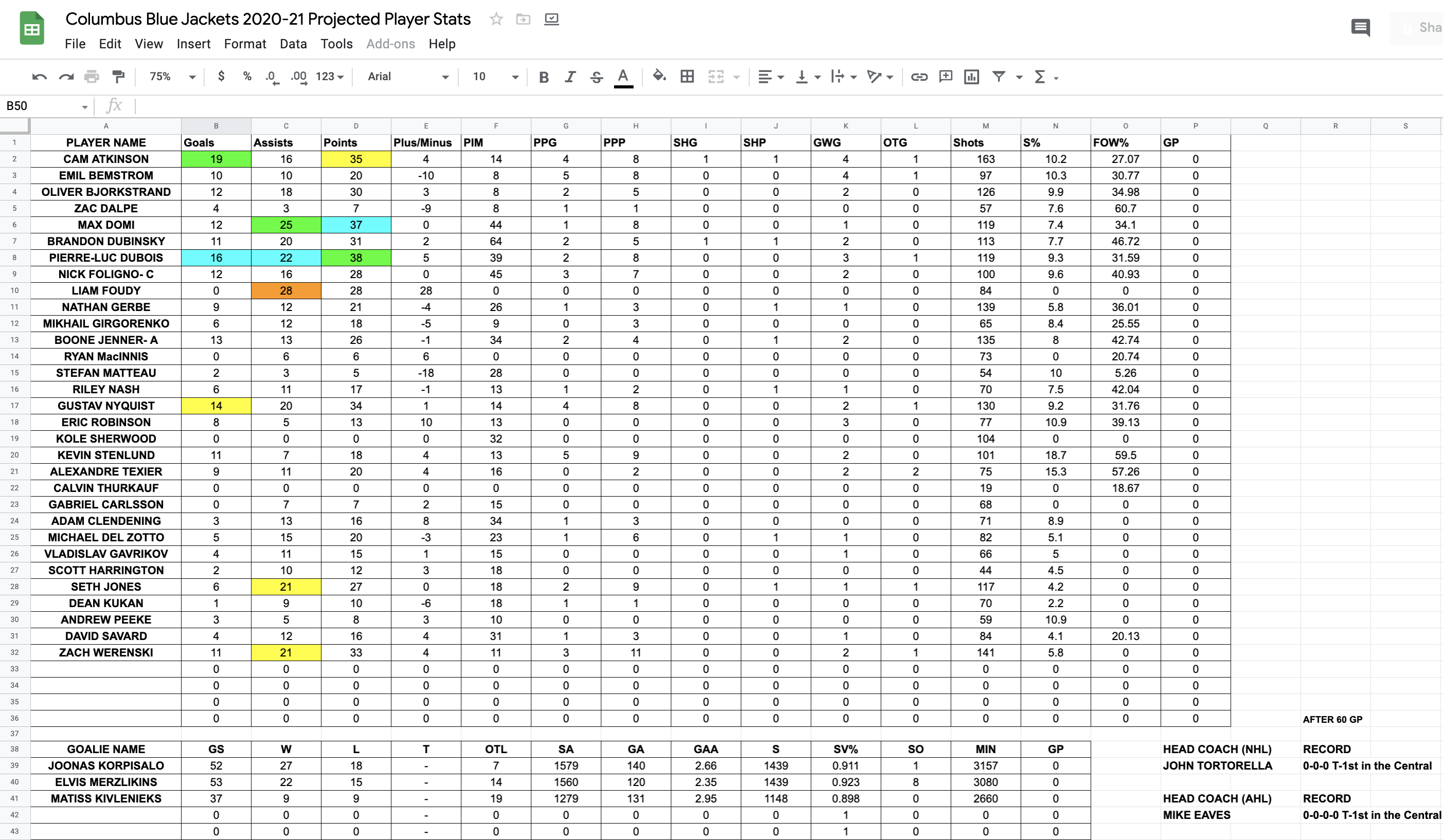
    Young players that have had minimal NHL experience may also reflect “inflated” results– Liam Foudy’s forecasted assists entering the 2020-21 season has been highlighted for this reason.

    Entering this season, he had only been part of two career NHL games and had one assist in that span. The forecasting function accounts for a player’s entire career and does some mathematics to come up with something over a predetermined number of games for the upcoming season (in this year’s case, 56).

    In other words, Foudy’s forecast after 20 team games played should look a bit more “realistic”, for the lack of a better term.

    A forecast is not the same as predicting pace.

    Foudy has three assists in 12 games played in 2020-21, for example, and is forecasted to finish with about 11 on the season, whereas he is currently on pace for about eight helpers.

    There are numerous variables that can, and will, impact a players’ performance throughout the year, including injuries, being a healthy scratch (or on the taxi squad), other American Hockey League related or waiver related transactions, sickness, COVID protocol, suspensions and general superstitions related to individual routines, beliefs, etc. (getting enough sleep before a game, wearing a certain lucky tie, using the same undershirt or shoulder pads for the last 13 years or whatever).

    Players can get “hot” or “cold” at any point.

    It’s not something that can be accounted for in a numerical forecast that sets aside the “eye test” until you try to figure out the nuances of how or why a player is playing the way they are playing.

    In a perfect timeline, this forecast pretends nothing bad could ever happen and every Blue Jackets player lives up to their expectations. In reality, some will pan out, some will exceed expectations and some will fall short for whatever reason.

    It’s an educated guess for an outcome in a sport that’s highly unpredictable due to its collectivistic nature and sheer puck luck.


    Columbus Blue Jackets Forecast Through 0 Games (56 Games Remaining)

    First up, let’s take a look at how things were expected to go coming into the 2020-21 season.

    Prior to being traded to the Winnipeg Jets for Patrik Laine and Jack Roslovic, Dubois was forecasted to lead Columbus in scoring with 16-22–38 totals this season.

    New acquisition, Max Domi, was forecasted as a close second to Dubois with 37 points– leading the team in assists in the process with 25 (among NHL regulars last season, since Foudy technically was forecasted to lead in assists among Blue Jackets with 28).

    Of course, Dubois was traded and Laine and Roslovic are off to hot starts with Columbus– scoring goals in bunches when they find the scoresheet, it seems. We’ll get to that in a minute.

    Cam Atkinson was forecasted to score 19 goals prior to the start of the 2020-21 season, which leads Dubois’ 16 forecasted goals and Gustav Nyquist’s 14 forecasted goals on the roster.

    Dubois, of course, was traded and Nyquist is out due to injury for most of this season, so… that checks out.

    On defense, Zach Werenski and Seth Jones were expected to continue to lead with the way with 33 and 27 points, respectively, from the blue line.

    Both defenders are expected to amass 21 assists this season– good enough for the third most forecasted among Blue Jackets skaters entering this season.

    In the crease, John Tortorella will have to find the right balance between Joonas Korpisalo and Elvis Merzlikins.

    There’s potential for a really solid goaltending duo in Columbus if Korpisalo is the starter and can best his 2.66 forecasted goals against average, as well as his forecasted .911 save percentage, while Merzlikins manages to find a way to reach his 2.35 forecasted GAA and .923 forecasted SV%.

    Of course, after 20 team games played, Merzlikins is currently out with an upper body injury, so time will tell if he can return to form.

    Columbus Blue Jackets Forecast Through 20 Games (36 Games Remaining)

    Through 20 games of the 2020-21 season, the Blue Jackets are three points outside of the last playoff spot in the Discover NHL Central Division, trailing the Chicago Blackhawks for this season’s 4th place cutoff line.

    The acquisition of Laine and Roslovic have been quite a welcome sight for Columbus fans, though consistency from the rest of the lineup remains to be an issue.

    Laine, however, is currently forecasted to lead the team in goals (26) and points (46), while Roslovic is on track for 10-17–27 totals, which is about what he had in 71 games with the Jets last season (29 points).

    Using the current forecasted totals, Roslovic is on track for about .551 points per game this season. He had .408 points per game with Winnipeg in 2019-20.

    Atkinson remains in the top-three in scoring, trailing Laine in goals and points with 20 forecasted goals and 39 forecasted points, respectively, while Oliver Bjorkstrand is currently forecasted to amass 15-21–36 totals (the third most on the current roster).

    On the blue line, Jones leads the way among defenders in points (32), as well as all skaters in assists with 27 forecasted assists through 20 team games played in the 2020-21 season.

    Werenski is more in line with what you’d expect from a young defender of his caliber (8-16–24 forecasted totals) and has missed time due to injury, so that’s clearly a factor in his forecasted drop from before the season began to now.

    In the crease, Korpisalo is sure to get more starts than Merzlikins as the latter is currently injured.

    Korpisalo’s current forecast yields a goals against average between 2.59-2.63, while Merzlikins is on track for a 2.29-2.33 in however many games he ends up getting.

    Why the range in GAA?

    That’s new for this season.

    It’s just to show a range between what the forecasted total is according to the model and what the adjusted forecast shows (calculated based on the forecasted goals allowed/forecasted minutes multiplied by 60, as one would traditionally do with goals allowed/minutes played multiplied by 60 to determine GAA).

    I’m no statistician and I felt like there might be a way to try to get a better read on how things are going for goaltenders (with or without enough necessary data to yield a “realistic” result).

    Don’t make any bets using only this forecast. If you’re a professional, you probably already know that.

    Anyway, Korpisalo has a forecasted range between .912 and .913 in save percentage through 20 team games played and Merzlikins is on track for between a .923 and a .924 in SV%.

    Again, a similar principle applies here.

    One end of the range is the straight up forecast, while the other is influenced by forecasted saves/forecasted shots against.

    Well, that does it for this forecast. Tune in after 40 team games played to see how things might go down the stretch (the final 16 games this season).

  • Rask injured in, 3-0, shutout in Columbus

    Three players scored their 4th goal of the season as the Columbus Blue Jackets shutout the Boston Bruins, 3-0, Tuesday night at Nationwide Arena.

    Elvis Merzlikins (6-6-4 record, 2.53 goals against average, .921 save percentage in 18 games played) made 34 saves on 34 shots against for his 2nd consecutive shutout– becoming the first rookie Blue Jackets goaltender since Steve Mason to record back-to-back shutouts in consecutive appearances (Dec. 27-31, 2008).

    Meanwhile, Bruins goaltender, Tuukka Rask (17-4-6, 2.27 GAA, .925 SV% in 28 games played) was injured 1:12 into the action after Emil Bemstrom delivered an elbow to Rask’s head.

    Rask sustained a concussion on the play and was replaced by Jaroslav Halak (10-5-6, 2.49 GAA, .925 SV% in 27 games played), who made 24 saves on 27 shots faced for an .889 SV% in the loss.

    Boston fell to 27-9-12 (66 points) on the season, but remained in 1st place in the Atlantic Division, while Columbus improved to 23-16-8 (54 points) on the season and remained steady in 6th place in the Metropolitan Division.

    The Bruins also fell to 12-7-3 on the road this season.

    The Bruins were without the services of Kevan Miller (knee) and Connor Clifton (upper body) on Tuesday night as Boston visited Columbus for the first time since defeating the Blue Jackets in Game 6 of their 2019 Second Round matchup.

    Bruce Cassidy made no changes to his forwards, but replaced Matt Grzelcyk with Steven Kampfer on the blue line alongside John Moore on the third defensive pairing.

    Par Lindholm and David Backes joined Grzelcyk as healthy scratches for the B’s in Columbus, while David Krejci tied Terry O’Reilly for the 7th most games played as a Bruin in franchise history (891 games).

    Rask was replaced by Halak at 1:12 of the first period after Bemstrom struck the Bruins goaltender with an errant elbow.

    Moments later, Pierre-Luc Dubois was sent to the penalty box with a cross checking infraction, yielding the first power play of the night to Boston at 5:53.

    The Bruins did not convert on the ensuing skater advantage.

    Almost midway through the opening frame, David Savard thought he scored a goal when he crashed the net and bumped into Halak, but the play was blown dead and there was no goal as a result due to goaltender interference that occurred.

    Some harm, no foul– in a way. No goal, but no minor penalty either.

    Past the midpoint of the first period, Alexander Wennberg (4) let go of a weak shot that slipped through Halak’s five-hole and reached the back of the twine– giving the Blue Jackets a, 1-0, lead.

    Wennberg’s soft goal was assisted by Vladislav Gavrikov (5) and Nathan Gerbe (4) at 13:27.

    Late in the period, Charlie McAvoy was guilty of holing against Gustav Nyquist and Columbus received their first power play opportunity at 18:59.

    The Blue Jackets did not score on the resulting advantage, despite the fact that the power play overlapped into the second period.

    After one period in Columbus, the Blue Jackets led the Bruins, 1-0, on the scoreboard and, 9-7, in shots on goal.

    The B’s led in takeaways (2-1), hits (11-7) and faceoff win percentage (53-47), while the Blue Jackets had the advantage in blocked shots (5-4).

    Both teams had two giveaways aside and were 0/1 on the power play heading into the middle frame.

    Boston announced that Rask would not return to the game in a tweet after the puck dropped on the second period.

    Midway through the middle frame, Gavrikov held Anders Bjork and was sent to the sin bin with a minor infraction at 9:36 of the second period.

    Boston’s power play was powerless as Columbus killed off Gavrikov’s minor with ease.

    A few minutes later, Joakim Nordstrom tried to engage Bemstrom in response for his elbow to Rask’s head that knocked Boston’s starting goaltender out of action, but Dubois stepped in between the two skaters and both Nordstorm and Dubois ended up receiving roughing minors at 12:35.

    After two minutes of 4-on-4 action, the two teams resumed full strength play for the remainder of the period.

    Through 40 minutes at Nationwide Arena, Columbus still held onto their, 1-0, lead over Boston and a, 22-21, advantage in shots on goal– despite the Bruins leading in second period shots alone, 14-13.

    The Blue Jackets led in blocked shots (14-6), takeaways (7-1) and giveaways (7-3), while the B’s led in hits (19-14) and faceoff win% (56-44).

    Columbus was 0/1 and Boston was 0/2 on the power play heading into the second intermission.

    Early in the final frame of regulation, Sonny Milano slashed Charlie Coyle at 1:34 of the third period and presented the Bruins with another power play that did not yield a goal on the advantage.

    A few minutes later, Brad Marchand caught Gavrikov with a high stick at 4:41 and presented Columbus with a skater advantage.

    About a minute into the ensuing power play, Kevin Stenlund (4) blasted a one-timer over Halak’s blocker side and gave the Blue Jackets a two-goal lead with a power play goal.

    Nick Foligno (14) and Bemstrom (7) notched the assists on Stenlund’s goal at 5:46 of the third period and Columbus led, 2-0.

    Three seconds after resuming play, Eric Robinson interfered with Bjork off the ensuing faceoff and was sent to the penalty box at 5:49.

    Midway through the third period, Riley Nash (4) capitalized on an individual effort and gave the Blue Jackets a, 3-0, lead on an unassisted goal over Halak’s blocker side at 13:05.

    At the final horn, Columbus had won, 3-0, despite trailing in shots on goal, 34-27.

    Though Boston had held the advantage in third periods shots on net alone, 13-5, the Bruins failed to find the back of the net on any of their shots.

    The Blue Jackets finished Tuesday night with the advantage in blocked shots (19-8) and giveaways (10-7), while the B’s left Nationwide Arena with the advantage in hits (28-17) and faceoff win% (55-45).

    The Blue Jackets went 1/2 on the power play on the night and the Bruins finished 0/4.

    Columbus handed Boston their first shutout of the season as the Bruins fell to 1-4-3 when trailing after one period and 4-7-4 when trailing after two periods this season.

    Boston finished their three-game road trip (1-1-1) and returns home for a home-and-home series with the Pittsburgh Penguins on Thursday at TD Garden and Sunday in Pittsburgh at PPG Paints Arena.

    After the Bruins swing through Pittsburgh, the B’s finish their game action before the All-Star break with a home game against the Vegas Golden Knights on Jan. 21st. 

  • Dubois lifts Columbus over Boston, 2-1, in OT

    The Columbus Blue Jackets came back to beat the Boston Bruins, 2-1, in overtime at TD Garden on Thursday in their first meeting with Boston since being eliminated by the Bruins in the Second Round of the 2019 Stanley Cup Playoffs.

    Elvis Merzlikins (2-4-4 record, 2.92 goals against average, .905 save percentage in 12 games played) made 25 saves on 26 shots against for a .962 SV% in the win for Columbus.

    Bruins goaltender, Tuukka Rask (15-4-6, 2.30 GAA, .923 SV% in 25 games played) stopped 31 out of 33 shots faced for a .939 SV% in the overtime loss.

    Boston fell to 24-7-11 (59 points) on the season, but remained atop the Atlantic Division, while Columbus improved to 19-14-8 (46 points) and remained in 6th place in the Metropolitan Division.

    The Bruins also fell to 14-1-9 at home this season and are now on a two-game losing streak.

    Boston was without the services of Kevan Miller (knee) and Connor Clifton (upper body) on Thursday. Miller has yet to make his season debut and Clifton was ruled out of the two-game homestand after being injured against Buffalo on Dec. 29th.

    That was the only bad news for the Bruins heading into Thursday night’s matchup with the Blue Jackets as Torey Krug (upper body), Charlie McAvoy (lower body) and David Krejci (lower body) all returned to the lineup.

    McAvoy was a game-time decision, but took part in full practice on Thursday and was on the ice for warmups– indicating that his return was imminent.

    Due to all the returns, Jeremy Lauzon was reassigned to the Providence Bruins (AHL) on Wednesday and Anton Blidh was assigned to Providence on a long-term injury conditioning loan.

    Blidh was injured in the second-to-last preseason game for Boston and has yet to make his season debut within the Bruins’ organization (Boston or Providence).

    Bruce Cassidy made some changes to his lineup against Columbus since Tuesday’s, 3-2, shootout loss in New Jersey, moving Charlie Coyle to the second line right wing slot with Jake DeBrusk and Krejci, while bumping up Sean Kuraly to center the third line with Anders Bjork on his left side and Danton Heinen on his right side.

    The fourth line comprised of Joakim Nordstrom at left wing, Par Lindholm at center and Chris Wagner at right wing.

    On defense, McAvoy and Krug went back to their usual roles while Matt Grzelcyk slid over to the right side of the third pairing with John Moore on his left.

    Brett Ritchie, David Backes and Steven Kampfer were all healthy scratches for Boston on Thursday night.

    At puck drop, B’s captain, Zdeno Chara, became the 12th player in NHL history to play in at least one game across four decades.

    San Jose Sharks forwards, Joe Thornton and Patrick Marleau became the 13th and 14th players in league history to do the same thing upon puck drop between the Sharks and the Penguins in Pittsburgh on Thursday.

    Gustav Nyquist thought he scored off a rebound 17 seconds into the game, but Cassidy used a coach’s challenge to review the call on the ice (goal) on the basis that Rask was actually interfered with as Boone Jenner appeared to be in the crease before the puck crossed the blue paint.

    Upon review, it was determined that Jenner did, in fact, more than just encroach Rask’s territory, but had actually bumped into the goaltender– impeding his reaction to the play and thereby causing goaltender interference.

    The call on the ice was overturned and the score reverted back to, 0-0.

    It was the first time the Bruins challenged a call this season, as well as their first successful coach’s challenge this season.

    Boston has had five calls overturned on six prior challenges against them thus far, which leads the league.

    After Nyquist had a goal overturned, nothing else happened for the rest of the first period. Seriously.

    There were no goals and no penalties called in the opening frame and both teams spent the last 7:10 span of the period uninterrupted.

    Through one period of play on Thursday, the Bruins and Blue Jackets were tied, 0-0, with Columbus leading in shots on goal, 9-8.

    Columbus also held the advantage in blocked shots (5-1), takeaways (3-2), giveaways (6-4) and hits (14-9), while Boston led in faceoff win percentage (67-33).

    Early in the middle frame, Nick Foligno hooked Brad Marchand and was assessed a minor penalty at 4:48 of the second period.

    The Bruins did not convert on their first power play of the night, but got a second chance on the skater advantage at 11:02 when Dean Kukan tripped DeBrusk.

    This time around, however, Boston capitalized on the power play five seconds into the skater advantage– winning the ensuing faceoff back to the point, then sliding a pass over to David Pastrnak (30) for the one-timer that went off Blue Jackets forward, Riley Nash, and over Merzlikins’ glove to give the B’s the first lead of the night.

    Krug (22) and Patrice Bergeron (19) notched the assists on Pastrnak’s power play goal at 11:07 of the second period and the Bruins led, 1-0.

    With his 30th goal of the season, Pastrnak became the first Bruin in franchise history to score 30 or more goals in four of his first six seasons, as well as the fastest Bruin to score 30 goals (in 42 games) since Cam Neely scored 30 goals in 27 games in the 1993-94 season.

    Almost 90 seconds later, McAvoy was caught interfering with Kevin Stenlund and subsequently sent to the penalty box at 12:36, but the Blue Jackets couldn’t muster anything on the power play.

    Columbus had one more chance on the skater advantage at 19:15 as Chara cut a rut to the sin bin for holding against Nyquist, but the Blue Jackets didn’t capitalize on the power play once again– even though the skater advantage was split over the course of the final seconds of the second period and the opening minute of the third period.

    The Bruins have killed off 21 consecutive penalties as a result of killing off Chara’s minor.

    After 40 minutes in Boston, the Bruins led the Blue Jackets, 1-0, on the scoreboard, despite Columbus maintaining the advantage in shots on goal, 23-20– including a, 14-12, advantage in the second period alone.

    The Blue Jackets also led in blocked shots (12-1) and hits (23-15) entering the second intermission and the Bruins led in takeaways (6-5), giveaways (10-6) and faceoff win% (70-30).

    As there were no more penalties called for the rest of the night, Boston finished 1/2 on the power play and Columbus went 0/2 on the skater advantage.

    Early in the final frame of regulation, Sonny Milano (4) pounced on a turnover by Coyle, then fired a shot with purpose from the goal line along the boards that deflected off of Grzelcyk and dipped through Rask’s five-hole– tying the game, 1-1, in the process.

    Nathan Gerbe (2) and Alexander Wennberg (12) tallied the assists on Milano’s goal at 2:06 of the third period and there were no more goals scored until overtime.

    At the end of regulation, the Blue Jackets led in shots on goal, 32-26, but were even on the scoreboard with the Bruins, 1-1.

    Columbus held the advantage in blocked shots (15-2) and hits (32-25), while Boston led in giveaways (13-8) and faceoff win% (65-35).

    Both teams had six takeaways aside heading into overtime.

    Cassidy started Krejci, Pastrnak and McAvoy for the B’s and Blue Jackets head coach, John Tortorella, opted for Nyquist, Jenner and Seth Jones for the opening faceoff before quickly replacing Jenner with Pierre-Luc Dubois.

    Just 52 seconds into the ensuing extra frame, Dubois and Jones entered the attacking zone on a 2-on-1 and made McAvoy look foolish before Jones sent the puck to Dubois (14) for the one-timer goal from close range.

    Jones (19) had the only assist on Dubois’ game-winning overtime goal and the Blue Jackets took home the, 2-1, win in Boston.

    Columbus finished the night with the advantage in shots on goal (33-26), blocked shots (15-2) and hits (33-25), while the Bruins ended Thursday’s effort with the lead in giveaways (14-8) and faceoff win% (66-34).

    The Bruins fell to 5-1-6 when tied after one period, 13-0-5 when leading after two periods and 17-5-7 when scoring the game’s first goal this season. The B’s also fell to 2-5 in overtime this season.

    Meanwhile, the Blue Jackets improved to 6-6 in ovetime this season and 11-5-3 when tied after one period.

    Boston concludes their two-game homestand (0-0-1) against the Edmonton Oilers on Saturday before traveling to Nashville to face the Predators next Tuesday.

    The Bruins return home for a Thursday night (Jan. 9th) matchup with the Winnipeg Jets before venturing on the road to visit the New York Islanders on Jan. 11th, the Philadelphia Flyers on Jan. 13th and the Blue Jackets on Jan. 14th.

  • DTFR Podcast #170- 2019-20 Season Preview: Atlantic Division

    DTFR Podcast #170- 2019-20 Season Preview: Atlantic Division

    Brayden Point re-signed with the Tampa Bay Lightning, a bunch of other RFAs signed extensions, the Boston Pride were sold, Dan Girardi retired and DTFR’s season previews continued with the Atlantic Division.

    Subscribe to the podcast on Apple PodcastsStitcher and/or on Spotify. Support the show on Patreon.