Tag: Philadelphia Flyers

  • Your Team Will Rise/Fail: 2021-22 Standings Projections

    It is time. The 2021-22 season is upon us.

    Technically it already started, but we’ll ignore the fact that the Pittsburgh Penguins spoiled the Tampa Bay Lightning’s 2021 Stanley Cup champion banner night with a, 6-2, victory on the road before the Vegas Golden Knights held off a Seattle Kraken comeback in a, 4-3, win at T-Mobile Arena on Tuesday night.

    And then Wednesday’s games happened too.

    Let’s hit the “reset” button for a second and pretend the 2021-22 is about to get underway. All 32 National Hockey League teams have a chance at clinching 16 available playoff berths.

    Any of the 16 teams that make the 2022 Stanley Cup Playoffs could etch 52 names from their roster, front office and organization on the Stanley Cup next June.

    The usual divisions– Atlantic, Central, Metropolitan and Pacific– have returned as have the Eastern Conference and Western Conference. The regular playoff format is back (three teams per division, two wild cards per conference qualify, plus the Conference Finals round returns in place of the Stanley Cup Semfinals in 2021).

    A full 82-game regular season schedule is slated from October through the end of April with a three-week break in February for the 2022 All Star Game in Las Vegas and the 2022 Winter Games taking precedence before a return to NHL action down the stretch with the postseason kicking off in May like last year and the 2022-23 season likely returning to the pre-pandemic timeline (2023 Stanley Cup Playoffs starting in April).

    The 2022 NHL Entry Draft will be in Montréal on July 7th and 8th, while free agency begins on July 13th, but between now and then, we’ve got the 2021-22 regular season to enjoy.

    Using last season’s team goals for and team goals against, plus some other “magic numbers” as part of an expected points model, we’re able to project what 2021-22 could be for all 32 teams (yes, even the Seattle Kraken, despite this year being their first season)– though you’ll have to pretend there were no transactions made in the offseason.

    In other words, don’t think that any of what you’re about to see is set in stone– view it more as a suggestion for a possible outcome.

    Also, please remember my degree is in communication, so any math beyond figuring out “goals + assists = season point totals” doesn’t exist.

    In a normal year (like from 2017-18 to 2018-19, for example), you just take all the data from the 82-game schedule for each team plug it into a formula in a spreadsheet, then line things up accordingly in each division.

    However, just like how the shortened 2019-20 season disrupted the regular process for projecting a 2020-21 standings outlook, going from last season’s stats in a 56-game schedule to projecting a regular 82-game season in 2021-22 necessitated the use of forecasting point pace as part of the formula.

    As for Seattle, a simple means of taking the NHL stats from last season for every player on their roster and plugging it in for a 2021-22 result is exactly what I did.

    We’re all just making it up as we go along, folks. These are projections. They are not absolutes.

    For the sake of keeping it simple, here’s a look at how things could go (but probably not) in each division for the upcoming 2021-22 season.
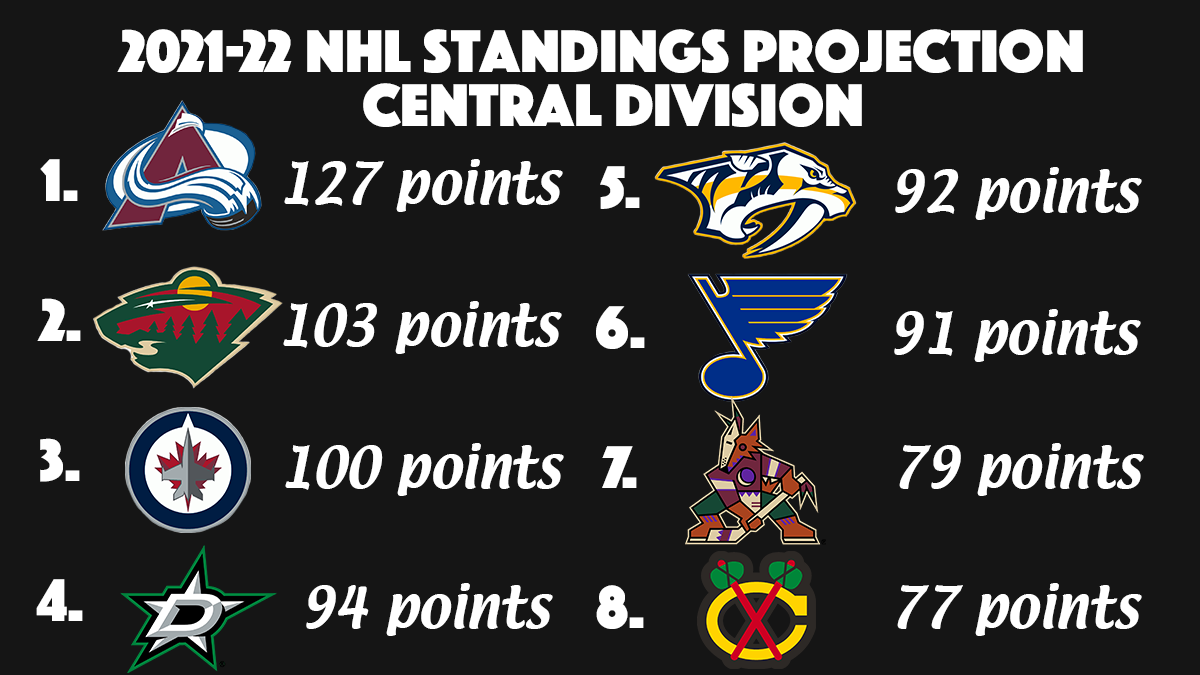
    The overall vibe of the Central Division for 2021-22 is that it’s just more of exactly what you’d expect. The Colorado Avalanche are lightyears ahead of everyone else, while Kirill Kaprizov and the Minnesota Wild continue to be on the rise and everyone else fights for what they can earn.

    Meanwhile, the jury is still out on whether or not the Winnipeg Jets can breakthrough as Canada’s team and break the Canadian curse (become the first Canadian club to win the Cup since 1993).

    Will Colorado finally break through the Second Round and win the Cup?

    Are the Avalanche just the Toronto Maple Leafs but with a little more success? My column:

    No, but really, it’s worth asking if the Avs making it back to the Western Conference Final for the first time since 2002, is more like Toronto’s struggle to make it out of the First Round for the first time since 2004, or is Colorado’s struggle more like the Washington Capitals pre-2018?

    The Caps won three Presidents’ Trophies in 2009-10, 2015-16 and 2016-17, but couldn’t make it past the Second Round– let alone the Pittsburgh Penguins– until they finally did and ended up surging in momentum all the way to their first Stanley Cup in franchise history.

    Colorado, on the other hand, has already won the Cup twice (1996 and 2001) and also has three Presidents’ Trophies to their name in 1996-97, 2000-01 and 2020-21, so if recent history has anything to tell us it’s that yet another team with high expectations for at least a few seasons now only to come up short could very well go on to win it all after winning the Presidents’ Trophy the previous year.

    Either that or they’ll have to win it in back-to-back seasons like Washington did before they won the Cup in 2018.

    Then again, the Tampa Bay Lightning tied the Detroit Red Wings’ record for most wins in the regular season (62), securing the Presidents’ Trophy in the process in 2018-19, then got swept by the Columbus Blue Jackets in the 2019 First Round.

    The very next year, however, Tampa kicked off back-to-back Cup rings in 2020 and 2021, to be where they are now as the two-time defending champions likely standing in the path as the only other favorites outside of the Avalanche this season.

    Anyway, the Avs mostly kept things the same from last season to this season, losing Joonas Donskoi to the Seattle Kraken in the 2021 NHL Expansion Draft, Brandon Saad to the St. Louis Blues in free agency and making minor swaps among replacement level bottom-six forwards and bottom-pairing defenders.

    Oh, then there’s this whole thing about how Philipp Grubauer left for Seattle in free agency too, so Colorado acquired Darcy Kuemper from the Arizona Coyotes.

    Between Dallas, Nashville and St. Louis, who will realistically make the playoffs?

    The Stars are projected to finish with about 94 points, the Predators sit at 92 points and the Blues are around 91 points in this one projection, but don’t let the points alone be your deciding factor.

    Given the strength of the Central Division compared to the Pacific Division, you can bet on five teams making out of the Central among Western Conference playoff berths.

    As such, the spread is the difference maker between these three teams expected to be in the wild card hunt– it’s going to come down to the wire one way or another.

    Dallas bolstered their goaltending depth by signing Braden Holtby, Nashville traded Ryan Ellis to the Philadelphia Flyers and St. Louis is… …better than last season on paper?

    I mean, the Blues signed Saad, acquired Pavel Buchnevich from the New York Rangers in exchange for Sammy Blais, let Seattle claim Vince Dunn at the expansion draft and let Mike Hoffman walk to the Montréal Canadiens in July.

    You could say they took a hit here or there, but those aren’t “nobody names” by any means, however.

    If Jordan Binnington and Ville Husso can stabilize things in the crease, then St. Louis has a better situation than the Predators.

    The Stars, meanwhile, should benefit from a longer season where more of their core guys– like Tyler Seguin, for example– are healthy. Last season’s COVID-19 outbreak to kick things off in January really killed Dallas’ momentum as a team on the verge of being in the 2021 postseason.

    Dallas should get back into the swing of things and St. Louis should be able to stay relevant for at least another year, but how hard the Preds rely on Juuse Saros as their starting goaltender will dictate whether or not they’re able to play spoiler with David Rittich as their backup since Pekka Rinne retired.

    Can Arizona avoid the basement?

    Anything is possible at this point. Loui Eriksson and Andrew Ladd were scoring goals in the postseason, so a fresh start could be just what both players needed for the last few years at least.

    That said, Coyotes General Manager, Bill Armstrong, gave a Masterclass™️ in how to go about rebuilding by selling everything over the summer and taking on “bad” contracts with only one or two years remaining in hopes of playing just well enough to be bad enough without making it look obvious that you’re aiming to win the 2022 NHL Draft Lottery.

    The Pacific Division is the new Scotia NHL North Division from last season. In other words, it’s the worst– which is great news for the Seattle Kraken as the league’s schedule allots more division play than any other opponents (though the Kraken will play every other team in the league at least twice).

    Seattle’s riding the waves of new-age expansion, while the Vegas Golden Knights lead the charge for the Presidents’ Trophy campaign in 2021-22.

    Wait, Seattle in 2nd in the Pacific, really?

    Yes, really.

    The Kraken have a great front office that goes beyond just Ron Francis as General Manager and have done their due diligence in scouting the best talent available to try to replicate the success of the Vegas Golden Knights’ inaugural season in 2017-18, as well as grow beyond just 2021-22.

    That said, Seattle probably isn’t going to make it out of the First Round of the 2022 Stanley Cup Playoffs, even if they have to face the Edmonton Oilers according to this projection.

    It’s a best case scenario for the NHL’s newest expansion team to be in the weakest division, but aside from having recent Stanley Cup champions Yanni Gourde, Philipp Grubauer, Jaden Schwartz and Dunn on their roster, the Kraken have a plethora of players that are relatively inexperienced with deep postseason runs.

    Head coach, Dave Hakstol, also hasn’t had the consistency of making the playoffs and making it out of the First Round in his NHL coaching days, but as a team that, again, is looking to develop long-term success, these are mere growing pains Francis and Co. are willing to accept as the fan base grows.

    Why aren’t the Kings making the cut this year when everyone else says they’ll be the most improved?

    The simple answer is that everyone’s overrating Los Angeles when it comes to the “ready now” factor.

    Sure, Kings General Manager, Rob Blake, did a good thing by getting Viktor Arvidsson in a trade with Nashville this summer to solidify his top-six forward group and signed Alex Edler to fortify his defense, but Los Angeles’ goaltending leaves something to be desired.

    Here’s hoping Jonathan Quick can find a little resurgence at this point in his career, while Cal Petersen continues to come into his own.

    If Los Angeles has any injuries– and they already have with Arvidsson likely missing some time due to an injury in the last preseason game– they’re already close enough to the bubble that they’ll only fall further behind.

    That said, if the Kings don’t make it back to the postseason hunt in 2022, there’s a good chance they make it in 2023.

    Los Angeles is improving, but by how much remains to be seen.

    Will winning the Presidents’ Trophy hurt Vegas?

    Eh, it’s hard to say.

    The Golden Knights have packed in just about every type of heartbreak since their inception in 2017, that fans of other franchises have only experienced over the course of at least 50 years, so if Vegas pulls out the Presidents’ Trophy win in 2021-22, don’t be surprised when the inevitable happens and they win the Cup instead of doing what most other Presidents’ Trophy winners in the salary cap era have done.

    Only the 2007-08 Detroit Red Wings and Chicago in 2012-13, have been able to win the Presidents’ Trophy and the Stanley Cup since the salary cap was introduced ahead of the 2005-06 season.

    Vegas would probably join Detroit and Chicago in doing so just so the Hockey Gods can spite us again.
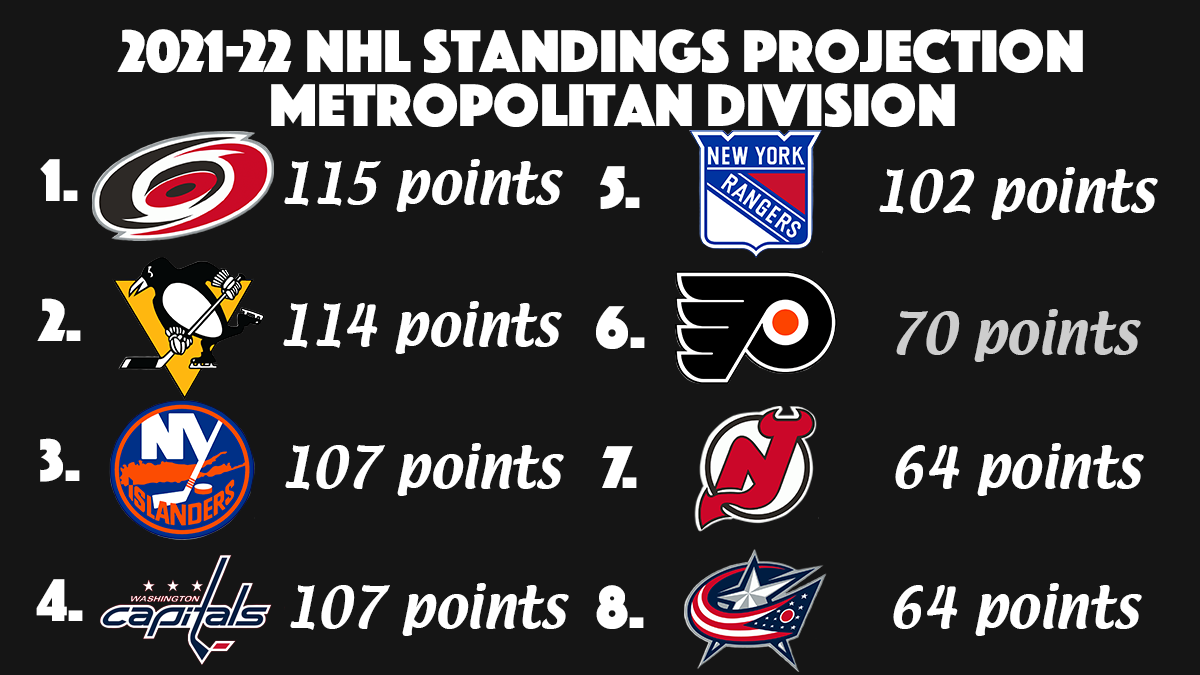
    It’s not easy to be in the Metropolitan Division these days because, well, let’s save that for the three questions below.

    Is this the toughest division to project?

    Absolutely.

    The Carolina Hurricanes decided to just get rid of a few parts and pieces that helped make them good for the last few seasons, so they’re bound to regress even with Sebastian Aho, Andrei Svechnikov, Teuvo Teräväinen and Martin Necas still existing.

    The Pittsburgh Penguins since 2009, have always found a way to be near the top of the division standings by the end of the regular season no matter whether or not you believe they’ll inevitably miss the playoffs for the first time since 2006, so anything could happen there.

    The New York Islanders have made back-to-back appearances in the Eastern Conference Final, so I’d expect them to be good.

    The Washington Capitals are better than the Philadelphia Flyers and New York Rangers, at least, but are probably the only team on the bubble if the New Jersey Devils can come out of nowhere and be competitive this season after signing Dougie Hamilton, Tomas Tatar and Jonathan Bernier in the offseason.

    Meanwhile, it’s time for a short rebuild in Columbus as the Blue Jackets would be quite pleased with a top draft pick in 2022.

    What if Chris Drury never was promoted as General Manager of the Rangers?

    They’d still fire David Quinn and hire Gerard Gallant. I don’t think that’s such a bad idea, but they’d definitely reconsider about 90% of the roster decisions made this summer.

    There’s no reason why the Rangers have to go down this path and yet, here they are, fumbling at the one-yard line and possibly plunging their franchise back into the Dark Ages of another rebuild. Or is it the same ongoing rebuild?

    What about a team to watch like New Jersey, for example?

    I’m big on the Devils this season for some strange reason.

    Maybe it’s because a part of me deep down misses the trap game of the 1990s and 2000s that led to Stanley Cups for New Jersey in 1995, 2000 and 2003.

    Maybe it’s because they signed Hamilton, Tatar, Bernier and acquired Ryan Graves from the Colorado Avalanche as a supporting cast for Jack Hughes, Nico Hischier, Pavel Zacha, Yegor Sharangovich, Ty Smith and friends.

    Seriously, the Devils should be good in the next few seasons, but this year could be the biggest stride forward in terms of their improvement from the basement to their development as a playoff contender.

    First, pour one out for Jack Eichel. Now, let’s move on and talk about everyone else.

    What does this mean for the Leafs?

    Just like how the Stars, Preds and Blues are all right on top of one another in the Central Division standings, the Atlantic Division is stacked from 1st through 4th, so though Toronto leads the way in this projection, I wouldn’t feel too comfortable as a Leafs fan.

    The Maple Leafs played in the worst of the four divisions last year in the temporarily realigned divisions in wake of the ongoing pandemic.

    No, it’s not just because they played all the other Canadian teams across 56 games, but rather it’s due to the fact that they haven’t been able to matchup with the Tampa Bay Lightning, Florida Panthers and even the Boston Bruins since the 2019-20 season.

    A lot and not a lot has changed since then.

    Tampa is still dominant as ever, Florida has emerged as a team that’s on the rise and Boston is unpredictable in that– much like the Penguins– it could really go either way with the Bruins this season.

    So now Toronto has to take on better competition within their own division and square off with teams like the Vegas Golden Knights, Colorado Avalanche, New York Islanders and others that emerge towards the top of the standings outside of the Canadian teams that the Leafs are all too familiar with at this point.

    That said, Toronto still has a great chance at winning the Atlantic Division regular season title or finishing 2nd and having home ice advantage in the First Round for the second-straight postseason.

    Can anyone other than Toronto, Florida, Tampa or Boston make it out of the Atlantic this year?

    No. Let’s be realistic here.

    The Montréal Canadiens made it to the 2021 Stanley Cup Final despite being below .500 in the standings because every division produced four playoff berths and intra-divisional play through two rounds.

    In 2020, they upset the Pittsburgh Penguins in the Qualifier despite finishing right at .500.

    In any other non-pandemic timeline, the Canadiens would still be looking for their first playoff appearance since they lost to the New York Rangers in six games in the 2017 First Round.

    That’s not to say that Nick Suzuki can’t lead the Habs back to glory, but rather that they need to improve all-around in the regular season and peaking in performance in the playoffs.

    Though the Ottawa Senators promised unprecedented success from 2021-25, it’s looking like it’ll realistically be anytime between 2024-25 as in the 2024-25 season itself at this point.

    Ottawa’s goaltending needs to improve, their defense could use some tweaks and the Sens are banking on their offense getting their feet underneath them and bursting in production in the coming years.

    A little more patience won’t hurt them.

    The same can be said for the Detroit Red Wings in that Red Wings fans already know– trust in General Manager, Steve Yzerman, is paramount. He’ll work his magic.

    It just takes a little time to build a solid foundation and the first floor is almost ready to start going up.

    As for the Buffalo Sabres, well…

    At least they’ll hopefully give Rick Jeanneret a proper send-off before he retires as their play-by-play announcer for the last 51 years on television.

    Hopefully.

    Will Tampa win three consecutive Stanley Cup championships?

    Probably not.

    I’m not ruling it out entirely, but the Lightning have a better chance of winning three Cups in four years than they do three Cups in as many years as things stand currently.

    The loss of their entire third line (Blake Coleman, Yanni Gourde and Barclay Goodrow) from last season to this season is sure to leave a mark on the development and restructuring of their bottom-six forwards.

    That said, Tampa’s top-six forwards still exist and, if you haven’t already noticed, they’re very good on their own, but the best teams in the playoffs have four lines that can roll without a doubt and the Bolts might just be off the ball for a year in terms of depth.


    Alright, if you’ve made it this far, thanks for your patience. By now the season’s already going on a few days into the 2021-22 calendar, so the two of us (or more if you’re reading this to a group) should probably get back to watching games.

    Stay tuned for more forecasts for both standings and assorted teams throughout the season.

  • Tampa Bay Lightning 2021-22 Season Preview

    Tampa Bay Lightning 2021-22 Season Preview

    2020-21 record 36-17-3, 75 points

    3rd in the Discover NHL Central Division

    Defeated Montréal in the Stanley Cup Final

    Additions: F Pierre-Édouard Bellemare, F Gabriel Dumont, F Remi Elie, F Charles Hudon, F Corey Perry, D Zach Bogosian, D Brent Seabrook (acquired from CHI), D Andrej Sustr, G Brian Elliott, G Maxime Lagacé

    Subtractions: F Alex Barré-Boulet (re-signed, then claimed off waivers by SEA), F Blake Coleman (signed with CGY), F Marian Gaborik (contract expired, informally retired), F Barclay Goodrow (traded to NYR), F Yanni Gourde (expansion, SEA), F Tyler Johnson (traded to CHI), F Ryan Lohin (signed with Charlotte Checkers, AHL), F Mitchell Stephens (traded to DET), F/D Luke Witkowski (signed with DET), D Andreas Borgman (signed with DAL), D Brian Lashoff (signed with DET), D David Savard (signed with MTL), D Luke Schenn (signed with VAN), D Ben Thomas (SHL), G Christopher Gibson (signed with FLA), G Spencer Martin (traded to VAN), G Curtis McElhinney (retired), G Anders Nilsson (retired)

    Still Unsigned: F Boo Nieves

    Re-signed: F Ross Colton, F Boris Katchouk, F Taylor Raddysh, F Gemel Smith, F Otto Somppi, D Fredrik Claesson, D Sean Day, D Cal Foote

    Offseason Analysis: One of the good things about winning the Cup is that the following season’s expectations are wiped clean. Sure, fans and analysts may want to see you win it again in back-to-back seasons, but that’s just icing on the cake and any run that comes up short in the year following a Cup ring can be forgiven.

    Luckily for Tampa, they won back-to-back Stanley Cup championships in 2020 and 2021, so if they don’t happen to become the first team to win three consecutive titles since the New York Islanders won four Stanley Cup rings in a row from 1980-83, that’s fine.

    The Lightning don’t get two straight years of postseason forgiveness, however.

    Rather, the Bolts are on the quest for the first dynasty in the National Hockey League since the Edmonton Oilers won three Cups in four years from 1987-90.

    That’s right, folks, Chicago didn’t have a dynasty when they won in 2010, 2013 and 2015. There’s a few too many years in-between.

    Steven Stamkos, Nikita Kucherov, Brayden Point, Victor Hedman and Andrei Vasilevskiy and the rest of the Lightning, however, have a chance of doing something not even Sidney Crosby, Evgeni Malkin and Marc-Andre Fleury with the Pittsburgh Penguins, nor Patrick Kane, Jonathan Toews, Marian Hossa, Duncan Keith, Brent Seabrook, Corey Crawford and the rest in Chicago were able to do– win three-straight Stanley Cup Finals.

    Oh and the dynasty thing too, which is a given.

    But success comes with a price in the loss of depth over time– whether it’s because of lower draft picks over time or simply due to salary cap constraints that pressure Cup winners into shipping out some of the glue guys from the team that just won it all in the middle of a summer-long party.

    It is, after all, a business.

    Blake Coleman, Barclay Goodrow and Yanni Gourde– Tampa’s third line that could be a second line on any other roster– was broken up over the summer.

    Coleman joined the Calgary Flames in free agency, Goodrow was traded to the New York Rangers and Gourde was a victim of the 2021 NHL Expansion Draft– in other words, the first certified star forward in the making for the Seattle Kraken.

    Though the Lightning will miss out on the speed and production of that line in their bottom-six, Tampa is more than ready to promote some bottom-six breakout stars from last season into genuine full-time roles, while also accommodating for general turnover after winning back-to-back Cups.

    Tampa General Manager, Julien BriseBois, signed Corey Perry to a two-year deal worth $1.000 million per season as a low-risk, high-reward veteran that can manage bottom-six minutes with efficiency at this point in his career– yielding 21 points in each of the last two seasons (5-16–21 totals in 57 games with the Dallas Stars in 2019-20, 9-12–21 totals in 49 games with the Montréal Canadiens in 2020-21), while finishing as the first runner up to the Lightning in back-to-back Stanley Cup Final appearances.

    BriseBois also added Pierre-Édouard Bellemare to the Bolts’ fourth line after Bellemare spent the last two seasons in a Colorado Avalanche uniform, recording 11 points (nine goals, two assists) in 53 games for the Avs last season, as well as a career-high 22 points (nine goals, 13 assists) in 69 gamed with Colorado in 2019-20.

    Among internal options to move up into the top-nine or make the fourth line after spending last year on the taxi squad or bouncing around in recent years between stints in the NHL, AHL, Major Junior or college, Ross Colton, Boris Katchouk, Mathieu Joseph, Gemel Smith and Taylor Raddysh all present themselves as options to compete for– if not rotate in and out of– a spot on the fourth line.

    Colton scored the Cup clinching goal in the second period of Game 5 of the 2021 Stanley Cup Final– the only goal of the, 1-0, victory over the Canadiens that secured Tampa’s second Cup ring in as many years.

    In 30 games last season, he had 9-3–12 totals. Not bad for a 25-year-old on the rise after spending parts of the last three seasons with the Syracuse Crunch (AHL).

    Joseph managed 26 points (13 goals, 13 assists) in 70 games with the Bolts in 2018-19, before being limited to 4-3–7 totals in just 37 games in 2019-20.

    Last season, he bounced back with 19 points (12 goals, seven assists) in 56 games and is sure to continue to mesh well with Tampa’s influx of youth in the bottom-six as a 24-year-old forward.

    Entering 2021-22, Katchouk and Raddysh are still looking to make their NHL debuts, though Raddysh is slated to be in the lineup against Pittsburgh on Opening Night.

    While Tampa sorts out their supporting cast, one thing that’s remained consistent is the Lightning’s top-six as Kucherov returns to regular season action for a full 82-game slate alongside Point and Ondrej Palat on the first line.

    Meanwhile, Anthony Cirelli leads Alex Killorn and Stamkos on the second line as Hedman, Jan Rutta, Ryan McDonagh and Erik Cernak lead the defenders with Mikhail Sergachev paired alongside Zach Bogosian (he’s back!).

    Curtis McElhinney retired over the summer, though not before BriseBois upgraded his backup goaltender role with Brian Elliott first.

    Elliott’s looking to rebound from a rough stint with the Philadelphia Flyers over the last four seasons, in which he most recently went 15-9-2 with a 3.06 goals-against average, an .889 save percentage and two shutouts in 30 games played.

    He’s sure to benefit from 1) Tampa’s defense and 2) Vasilevskiy yielding an overwhelming majority of games in the regular season.

    Vasilevskiy produced a 31-10-1 record in 42 games last season with a 2.21 goals-against average, a .925 save percentage and five shutouts in that span.

    As for what else is missing from this summer’s tactical overhaul with the salary cap in mind after winning back-to-back Cups?

    Let’s review all of Tampa’s trades from after the Final through now real quick, shall we?

    Goodrow was dealt to the New York Rangers for a 2022 7th round pick on July 17th, then BriseBois swapped a 2022 4th round pick for a 2021 4th round pick with Montréal at the second day of the 2021 NHL Entry Draft on July 24th.

    A few days later, he cleared out some salary by shipping Tyler Johnson to Chicago with a 2023 2nd round pick for Seabrook’s contract that is currently on the long-term injured reserve thanks to a career-ending injury that renders Seabrook as a forgiven cap hit on the books.

    Mitchell Stephens packed his bags out of Tampa for the Detriot Red Wings in exchange for a 2022 6th round pick on July 30th, then the Lightning sent Spencer Martin to the Vancouver Canucks for future considerations on July 31st.

    Offseason Grade: C

    Down the road, Point’s eight-year extension at $9.500 million per season is an excellent move made by BriseBois, but since that contract goes into effect starting next season (2022-23), it doesn’t sway the offseason grade for 2021.

    If it were just a postseason grade, the Bolts would get an “A”, but since this is a measure of everything that happened after the 2021 Stanley Cup Final and before the 2021-22 season gets underway, well, Tampa had an average summer.

    They filled some holes, shed some salary and were forced to make difficult decisions in other areas thanks to the existence of the salary cap and some key players being healthy for a change as the Lightning embark on their two-time defending Stanley Cup champion season.

    All in all, it’s not too bad to be a fan of the Lightning these days or a member of the organization– as long as you got here before the 2021 Stanley Cup Final wrapped up.

    This isn’t to say that Tampa will be bad by any means, but rather that they’re content with contending for the next few years to come– at least– so if they don’t win three Cup rings in as many years, that’s fine. They’ll be quite alright.

  • DTFR Podcast #229- Metro Madness (2021-22 Edition)

    DTFR Podcast #229- Metro Madness (2021-22 Edition)

    We preview the Metropolitan Division for the 2021-22 season. “Off the Cuff” makes its long-awaited return as your favorite game show segment.

    Subscribe to the podcast on Apple PodcastsStitcherSpotifyAmazon Music and/or Audible.

  • Pittsburgh Penguins 2021-22 Season Preview

    Pittsburgh Penguins 2021-22 Season Preview

    2020-21 record 37-16-3, 77 points

    1st in the MassMutual NHL East Division

    Eliminated in the First Round by N.Y. Islanders

    Additions: F Brian Boyle (signed to a PTO), F Michael Chaput, F Filip Hållander (acquired from TOR), F Danton Heinen, F Brock McGinn, F Dominik Simon, D Matt Barkowski (signed to a PTO), D Taylor Fedun, G Louis Domingue

    Subtractions: F Pontus Åberg (signed with Belleville Senators, AHL), F Josh Currie (KHL), F Frederick Gaudreau (signed with MIN), F Mark Jankowski (signed to a PTO with NJD), F Jared McCann (traded to TOR), F Sam Miletic (signed with Chicago Wolves, AHL), F Colton Sceviour (signed to a PTO with EDM), F Brandon Tanev (expansion, SEA), D Lukas Bengtsson (KHL), D Cody Ceci (signed with EDM), D Kevin Czuczman (signed with MIN), D Jesper Lindgren (HockeyAllsvenskan), D Andrey Pedan (KHL), D Zach Trotman (retired), D Yannick Weber (NL), G Maxime Lagacé (signed with TBL), G Emil Larmi (Liiga)

    Still Unsigned: None

    Re-signed: F Zach Aston-Reese, F Kasper Björkqvist, F Teddy Blueger, F Evan Rodrigues, F Radim Zohorna

    Offseason Analysis: Penguins General Manager, Ron Hextall, had a realtively quiet offseason outside of the announcements that Sidney Crosby and Evgeni Malkin would miss some action to start the 2021-22 season.

    After making some depth signings, Pittsburgh is left with about $121,800 in cap space. In other words, it might be a little bumpy out of the gate without Crosby and Malkin– especially since the Pens dealt Jared McCann to the Toronto Maple Leafs for Filip Hallander and a 2023 7th round pick ahead of the 2021 NHL Expansion Draft.

    In retrospect, perhaps it would’ve been worth keeping McCann and convincing the Seattle Kraken to take almost anyone else– there’s still a chance they would’ve taken Brandon Tanev anyway, especially if Pittsburgh had crafted a deal with the Kraken to agree to not select McCann in exchange for some draft picks or something.

    Nevertheless, Hextall made a conscious decision to move on from McCann’s 14-18–32 totals in 43 games last season and Tanev’s 7-9–16 totals in 32 games with the Penguins in 2020-21 and live with the consequences of his own actions. At least there’s Jeff Carter.

    At some point, the magic will wear out in Pittsburgh.

    Though the Penguins may have calmed the waters of the Malkin trade rumors under the previous regime ruled by Jim Rutherford, there’s the reality of a post-Crosby and Malkin era soon to sink in.

    Malkin is a pending-unrestricted free agent at season’s end and Crosby is under contract through the 2024-25 season.

    If the Penguins aren’t able to escape the First Round in 2022, and Malkin determines there’s no future in sight for success in a Pittsburgh jersey, there’s a good chance he could leave– not in search of a big cheque, but rather another chance at one more Cup ring on a contender’s roster.

    But let’s not get too bogged down by the grips of reality.

    Penguins head coach, Mike Sullivan, has some juggling to do with the lineup– like always– and with a new cast of characters that includes Hållander, Danton Heinen, Brock McGinn and the return of Dominik Simon– there’s a lot of depth to go around.

    At 21-years-old, Hållander might be ready for some NHL action, whether out of necessity or to simply prove his skill level.

    Heinen, meanwhile, is looking for a fresh start after the Anaheim Ducks chose not to tender him a qualifying offer, leading him to sign a one-year deal with the Penguins worth $1.100 million.

    In 43 games with the Ducks last season, Heinen had 14 points (seven goals, seven assists), scoring fewer points than he had in the previous season for third-straight season since he broke out with 16-31–47 totals in 77 games for the Boston Bruins in 2017-18.

    McGinn was due for a payday and cashed in on a longer contract than he could’ve expected from the Carolina Hurricanes, signing a four-year deal worth $2.750 million per season with Pittsburgh this summer.

    In 345 career NHL games, McGinn’s had 51-55–106 totals, including 13 points (eight goals, five assists) in 37 games while battling injury last season.

    He remains to be an effective penalty killing fourth liner and should fit Sullivan’s mold well as a means of ensuring his top-six forwards are rested and ready to go between shifts.

    Simon begins his second stint with the Penguins after taking part in 11 games with the Calgary Flames last season and yielding four shots on goal, as well as no points in that span.

    As for the biggest question mark entering the 2021-22 season for Pittsburgh, can Tristan Jarry come into his own as a starting goaltender?

    Last season, Jarry went 25-9-3 in 39 games, which at first glance is great! He had 25 wins in almost 40 games played in the midst of a 56-game regular season schedule– backstopping Pittsburgh to a postseason appearance before losing in six games to the New York Islanders.

    But in 39 games last season, Jarry had a 2.75 goals-against average, a .909 save percentage and two shutouts in that span, whereas he went 20-12-1 in 33 games with a 2.43 goals-against average, a .921 save percentage and three shutouts in 2019-20.

    In his most recent season as Pittsburgh’s backup, Jarry has a goals-against average below 2.50 and a stellar save percentage over .920, but in all his other cumulative appearances each season since breaking into the league with a game in 2016-17, he’s been all over the place statistically speaking.

    Casey DeSmith, meanwhile, broke into the league in 2017-18, and went 6-4-1 in 14 games with a 2.40 goals-against average, a .921 save percentage and one shutout– following things up with a 15-11-5 record in 36 games played in 2018-19, when he had a 2.75 goals-against average, a .916 save percentage and three shutouts.

    Last season, DeSmith was back as the backup goaltender to Jarry and posted an 11-7-0 record in 20 games with a 2.54 goals-against average, a .912 save percentage and two shutouts.

    At 30-years-old, it’s likely that DeSmith won’t have as high of a ceiling as Jarry, who’s only 26, but then again goaltenders vary in the crux of their prime.

    For Jarry, he may soon start to peak, while DeSmith may simply be an outlier as one of those goaltenders that comes into fruition later than even the most “average” of delayed primes for goalies.

    In either case, it’s certainly not an enviable position to be in for Sullivan to have to figure out.

    Offseason Grade: C

    Let’s be real here, the Penguins didn’t go out and attract any stars and they didn’t lose that much (though McCann was a great piece of depth and Tanev probably exceeded his expectations due to the “Crosby factor”, both should make fine additions to the Kraken).

    Pittsburgh had an average offseason for an average team that made the playoffs and had an average early ending.

    They’re not a dominant force, though they finished atop the MassMutual NHL East Division last season. Sullivan has his ways of commanding his team in the regular season, but the roster lacks something to drag them across the line in the postseason these days– to take their play up a notch and crank it at 11.

    The Pens aren’t as much of a concern for missing out on the playoffs in the Metropolitan Division race this season, but it should be harder to compete for dominance with the sustained improvement from the Islanders and the emergence of another team like the Philadelphia Flyers, New York Rangers or New Jersey Devils that could breakout and play spoiler among the division leaders.

  • Minnesota Wild 2021-22 Season Preview

    Minnesota Wild 2021-22 Season Preview

    2020-21 record 35-16-5, 75 points

    3rd in the Honda NHL West Division

    Eliminated in the First Round by Vegas

    Additions: F Frédérick Gaudreau, F Dominic Turgeon, D Jordie Benn, D Kevin Czuczman, D Alex Goligoski, D Joe Hicketts, D Dmitry Kulikov, D Jon Lizotte, D Jon Merrill

    Subtractions: F Nick Bonino (signed with SJS), F Gabriel Dumont (signed with TBL), F Marcus Johansson (signed with SEA), F Luke Johnson (signed with WPG), F Gerald Mayhew (signed with PHI), F Zach Parise (buyout, signed with NYI), F Dmitry Sokolov (NMHL), D Matt Bartkowski (signed to a PTO with PIT), D Louie Belpedio (signed with MTL), D Ian Cole (signed with CAR), D Brad Hunt (signed with VAN), D Brennan Menell (traded to TOR), D Carson Soucy (expansion, SEA), D Ryan Suter (buyout, signed with DAL)

    Still Unsigned: D Ian McCoshen

    Re-signed: F Will Bitten, F Nick Bjugstad, F Joseph Cramarossa, F Brandon Duhaime, F Joel Eriksson Ek, F Kevin Fiala, F Kirill Kaprizov, F Kyle Rau, F Mason Shaw, D Dakota Mermis, G Andrew Hammond

    Offseason Analysis: It took all summer, but it didn’t linger into the fall as Wild General Manager, Bill Guerin, and forward, Kirill Kaprizov, were able to hammer out a five-year extension worth $9.000 million per season– forcing this entire offseason recap/season preview to be re-written.

    Going into Tuesday, Minnesota was bound to receive a letter grade in the “D” range for failing to secure Kaprizov before training camp, despite a few other moves that have actually been pretty good for them– salary cap penalties via buyouts aside.

    Late Tuesday, Kaprizov re-signed and all is just about forgiven for the Wild.

    Since joining the league as an expansion team in 2000, Minnesota has rarely had a competitive team that can make a deep run into the postseason. They’ve consistently been good, but never good enough.

    Marian Gaborik came and went, Mikko Koivu stayed loyal until he joined the Columbus Blue Jackets for a brief stint last season prior to retiring less than a month into the 2020-21 schedule and then the dawn of the Kaprizov Era began.

    After spending time in the Kontinental Hockey League for his early development, Kaprizov amassed 27-24–51 totals in 55 games in his debut season with Minnesota as a 24-year-old left wing.

    He’s the real deal and the Wild are leaning into it.

    Though Nick Bonino, Marcus Johansson and others weren’t re-signed as part of Minnesota’s depth that got them all the way to a Game 7 at T-Mobile Arena against the Vegas Golden Knights in the 2021 First Round, Guerin held things down where it counts– the core.

    Joel Eriksson Ek signed an eight-year extension worth $5.250 million per season after a breakout season with 30 points (19 goals, 11 assists) in 56 games last season after amassing 8-21–29 totals in 62 games in 2019-20.

    If the last two seasons are an indication of what’s to come, then the Wild have a steal of a deal in Eriksson Ek’s cap hit as the 24-year-old emerges in his prime.

    Guerin brought back Kevin Fiala on a one-year extension worth $5.100 million– retaining restricted-free agency status over the 25-year-old forward heading into next offseason– after putting up 101 points (46 goals, 55 assists) in 133 games with the Wild in parts of three seasons since he was acquired on Feb. 25, 2019.

    In parts of five seasons with the Nashville Predators from 2014-15 through 2018-19, Fiala had 45-52–97 totals in 204 games.

    Don’t fix what isn’t broken, because clearly something is clicking in Minnesota and the Wild are reaping the benefits.

    Alex Goligoski and Jon Merrill are fine additions to the defense, though as for how efficient they’ll be compared to the loss of Ryan Suter remains to be seen.

    Guerin bought out the remainder of Zach Parise and Suter’s matching contracts on July 13, 2021, and in doing so saved Minnesota some valuable cap space to sign Kaprizov and build off of the new core.

    That said, Parise and Suter will cost the Wild about $4.744 million in dead cap space for 2021-22, then $12.744 million in dead cap space in 2022-23, before the buyout penalties reach a crescendo with a combined $14.744 million in dead cap money from 2023-24 through 2024-25 before Parise and Suter’s penalties taper off with a combined cost of $1.667 million in 2025-26, as well as 2026-27.

    This offseason might have been a breeze, but next offseason is a different story– especially as building and maintaining contender status gets difficult in the next few seasons too.

    Ultimately, the cost of buying out Parise and Suter may or may not even be a headache for Guerin to deal with. It all depends on how the team performs between now and a couple of seasons from now.

    For now, Guerin has about $3.215 million in cap space to play with for the 2021-22 season.

    Over the summer, the Seattle Kraken formed their first roster and did Minnesota a favor without asking.

    Seattle could’ve selected Kaapo Kähkönen, since the Wild protected Cam Talbot, but the Kraken went in a different direction and snagged Carson Soucy from Minnesota’s depth on the blue line.

    Offseason Grade: B+

    Though it took a little longer than both sides had probably hoped– and with more frustration than expected– Guerin re-signed his No. 1 priority in Kaprizov before the start of training camp.

    The biggest challenge for Minnesota– other than improving on last season’s success before a First Round exit– is finding a way to keep the band together next offseason, when Fiala, Jordan Greenway and Kähkönen are on the short list of important pending-restricted free agents.

    Meanwhile, guys like Victor Rask, Nick Bjugstad, Kyle Rau, Nico Sturm, Goligoski, Jordie Benn and Merrill have a little more flexibility to come and go as they please– assuming there’s enough cap space in face of the Parise and Suter buyout penalty crunch on top of what might still be a flat cap for the 2022-23 season due to the ongoing pandemic.

    At the very least, 2023-24 should be a bit more optimistic with the latest U.S. broadcasting rights deals for ESPN and Turner Sports inflating league revenue all-around and likely bumping up the salary cap as a result.

    For now, Minnesota’s transition continues, but for once there’s a sense of stability given their best players are 25 and under and enjoy being in a Wild uniform.

    Though they didn’t bring the alleged “State of Hockey” a Stanley Cup championship in their tenure, Parise and Suter made playing for Minnesota cool as the franchise found its footing now entering its second generation.

  • Boston Bruins 2021-22 Season Preview

    Boston Bruins 2021-22 Season Preview

    2020-21 record 33-16-7, 73 points

    3rd in the MassMutual NHL East Division

    Eliminated in the Second Round by N.Y. Islanders

    Additions: F Samuel Asselin, F Steven Fogarty, F Nick Foligno, F Jesper Frödén, F Erik Haula, F Tomas Nosek, D Derek Forbort, D James Greenway (acquired from TOR), D Tyler Lewington, G Troy Grosenick, G Linus Ullmark

    Subtractions: F Paul Carey (SHL), F Sean Kuraly (signed with CBJ), F David Krejci (ELH), F Robert Lantosi (SHL), F Greg McKegg (signed with NYR), F Ondrej Kase (signed with TOR), F Nick Ritchie (signed with TOR), D Steven Kampfer (KHL), D Jeremy Lauzon (expansion, SEA), D Kevan Miller (retired), D Jarred Tinordi (signed with NYR), G Jaroslav Halak (signed with VAN), G Dan Vladar (traded to CGY)

    Still Unsigned: F Alex Khokhlachev (KHL, BOS reserve list), G Tuukka Rask

    Re-signed: F Anton Blidh, F Trent Frederic, F Taylor Hall, F Cameron Hughes, F Joona Koppanen, F Zach Senyshyn, D Brandon Carlo, D Mike Reilly, D Nick Wolff, G Callum Booth

    Offseason Analysis: The Bruins are in a period of transition. Stop calling them favorites.

    They might still be playoff contenders, but they’ll have to focus on even making the postseason first to begin with shortly– if not already– this upcoming season.

    Boston’s General Manager, Don Sweeney, had his work cut out for him this summer and managed it pretty well– all things considered.

    Sure, the B’s don’t have David Krejci and we’ll get into that, but instead of signing one or two free agents and calling it a day, then talking about needing to fill a hole that he’s left empty for years or created going into the new season, Sweeney signed five key players and then some for depth.

    It’s a transition, not a purposeful tank to rebuild– yet, anyway.

    As long as Patrice Bergeron is under contract, Boston has assured him they’ll do whatever he and Brad Marchand say the dressing room needs.

    Speaking of Bergeron, though, he’s put off contract extension talks until the 2021-22 season is over, so for any Bruins fans that have gone through the pain of watching Zdeno Chara play in a different uniform last season with the Washington Capitals and again this upcoming season with the New York Islanders, as well as watching Krejci return to Czechia this year, well… …it happens. Time waits for no one.

    All good things must come to an end and a new era dawns. Just hope it’s a good one.

    Oh, and, Tuukka Rask is currently unsigned after offseason hip surgery, though the 34-year-old goaltender has expressed a desire to only play for the Bruins if he’s healthy enough to go for the 2021-22 season by the time December rolls around.

    He’ll even sign for league minimum and “tons of Bud Lights”, which a certain podcast would love, even if it isn’t their preferred light beer (shameless plug for some Twitter pals).

    Anyway, Sweeney’s saved about $1.089 million in cap space to sign Rask to a low, one-year, deal if he’s good enough to return to action, which wouldn’t complicate matters in the crease with the arrival of Linus Ullmark via free agency and the development of Jeremy Swayman.

    Rask and Swayman were always going to share the spotlight as Swayman comes into his own. Rask’s injury, however, slightly changes matters in the handoff.

    Ullmark joins the Bruins on a four-year contract worth $5.000 million per season through 2024-25. He was the winningest goaltender for the Buffalo Sabres last season with a 9-6-3 record in 20 games, a 2.63 goals-against average and a .917 save percentage in that span.

    Given the workload that he faced in Buffalo compared to Boston’s more structured defense, Ullmark’s numbers should improve as he’s had moments of brilliance in his short spurts thus far– only really coming into the league as a starter or backup goaltender in the last two seasons.

    At 28-years-old, he’s right on track for goaltender development and if things head south, the Bruins can use 2021-22 as a write off, plus 2022-23 as a means of giving Swayman full-time starter duties at the earliest.

    Swayman, at 22-years-old, has already played 10 National Hockey League games and amassed a 7-3-0 record with a 1.50 goals-against average, a .945 save percentage and two shutouts, but that kind of luck is unheard of for a goaltender.

    Eventually, given his unconventional style, his stats will come back to Earth and you don’t want to let reality cut down a goaltender’s confidence so soon while they’re young (see, Philadelphia Flyers goaltender, Carter Hart’s 2020-21 season, for example).

    It’s nice to have Swayman as a future ace, but that’s just it– the future. Though the future is now in transition, it’s not quite the time to make the jump in the crease– especially while there’s more pressing matters like replacing Krejci.

    Charlie Coyle is, ideally, Boston’s second line center entering this season, but if things go south with Coyle centering Taylor Hall and Craig Smith, then that’s where Nick Foligno or Erik Haula come in handy, if Jack Studnicka can’t make the jump from the Providence Bruins (AHL) to Boston.

    Krejci finally could’ve had wingers in Hall and Smith for a full season, but the 35-year-old has always wanted to play in front of his parents and brother in the Czech Republic– especially after leaving for North America in his teens to play hockey for a living.

    It’ll also help introduce his kids to his Czech native tongue, so they’ll be able to communicate with their grandparents.

    Having spent his entire career with Boston through 962 regular season games since breaking into the league in the 2006-07 season, he’s earned every right to do as he pleases.

    He might be back for the 2022-23 season, but absolutely do not hold him to it.

    Hall, meanwhile, signed a four-year extension worth $6.000 million per season in the offseason, so Boston at least still only has one hole to fill on the second line if Coyle can’t return to form.

    Foligno signed a two-year deal with a $3.800 million cap hit and Haula signed a two-year deal worth $2.375 million per season.

    In 957 career NHL games, Foligno’s had 203-283–486 totals for the Ottawa Senators, Columbus Blue Jackets and Toronto Maple Leafs. He had been Columbus’ captain until the deadline when he was dealt to Toronto to add some punch to their lineup, only to blow a 3-1 series lead over the Montréal Canadiens in the 2021 First Round.

    Foligno had 7-13–20 totals in 49 games with the Blue Jackets and Maple Leafs in 2020-21.

    If nothing else, Foligno adds valuable leadership in the absence of Krejci and should hold things over as someone that gives it their all on a night-to-night basis. Bruins fans should warm up to him quickly if they haven’t already.

    Haula, on the other hand, spent last season with the Nashville Predators, where he had 9-12–21 totals in 51 games last season, which was about the same production he had with the Carolina Hurricanes and Florida Panthers in 2019-20.

    He hasn’t been able to find his breakout scoring touch that he had with the Vegas Golden Knights in 2017-18, when he had 55 points (29 goals, 26 assists) in 76 games, but he should be fine as a third liner flanked by Jake DeBrusk and Foligno.

    Boston needs to get a consistent offense going and they at least seem to have the right level of talent for each line this season.

    As long as everyone stays healthy it’s a good thing with an overhauled defense due to the Seattle Kraken taking Jeremy Lauzon in the 2021 NHL Expansion Draft, Kevan Miller retiring and the uneasiness of delegating more time to Jakub Zboril after his– at times– lackluster 2020-21 season.

    Speaking of the revamped bottom-six, however, Tomas Nosek is new in town on a two-year deal worth $1.750 million per season, joining Trent Frederic– fresh off of an extension this offseason for two years and a $1.050 million cap hit– and Chris Wagner on the fourth line.

    He’s been a fun player to watch come into his own with the Golden Knights since Vegas took him from the Detroit Red Wings in their expansion draft in 2017, and just had a career-year with 8-10–18 totals in 38 games last season.

    Anything at or above 15 points from a fourth line center is a job well done for less than a $2.000 million cap hit.

    Sean Kuraly’s gone home to Columbus, but after dropping from 23 points (six goals, 17 assists) in 69 games in 2019-20, to just nine points (four goals, five assists) in 47 games last season, needing a change of scenery was a welcome excuse for Boston to let him go.

    Meanwhile, Ondrej Kase and Nick Ritchie also departed in the offseason for Toronto, though Kase’s future is shrouded by the ever-looming cloud of concussions and Ritchie outperformed expectations last season in the first half of the season before regressing to his ways.

    Jaroslav Halak also left for the Vancouver Canucks, though that was inevitable with the long line for Boston’s backup goaltender being cut by Swayman’s emergence.

    Even Dan Vladar was traded to the Calgary Flames for a 2022 3rd round pick as a result.

    A couple of days prior, on July 26th, Boston acquired the rights to James Greenway from the Maple Leafs for future considerations. He’ll need a little more time in the system, for now.

    With Miller retired, Steven Kampfer off to the Kontinental Hockey League (KHL) in Russia and Jarred Tinordi gone to the New York Rangers in free agency, Sweeney signed Derek Forbort to a three-year contract worth $3.000 million per season.

    Mike Reilly also played well enough after being acquired at the trade deadline to earn a three-year extension with a $3.000 million cap hit as well.

    Additionally, Brandon Carlo signed a six-year extension worth $4.100 million per season, so the Bruins have a defensive core with Carlo, Forbort, Matt Grzelcyk and Reilly under contract after 2021-22.

    Charlie McAvoy, meanwhile is a pending-restricted free agent by the time July 1, 2022, rolls around (unless he’s signed to an extension before then).

    Forbort, meanwhile, joins Boston after spending last season with the Winnipeg Jets where he had 2-10–12 totals in 56 games from the blue line. At 6-foot-4, 219-pounds, he adds much needed size to Boston’s defense.

    In the meantime, John Moore, remains under contract and likely on the long term injured reserve to start the season, leaving his $2.750 million cap hit mostly off the books until the Bruins come to some sort of a resolution on that one.

    Time will tell if the B’s will sink or swim, but you can’t say they didn’t try to put something together on paper this offseason.

    Offseason Grade: B

    In Boston, you either like or hate Sweeney. There’s no such thing as love unless you win championship rings these days.

    While Sweeney’s made some blunders along the way, his overall approach as the Bruins’ GM has established a foundation of being in the room– being in consideration and among the conversation from year-to-year for attracting talent and making trades.

    Sometimes it’s panned out, like the acquisition of Hall. Sometimes it’s fallen short, like when Sweeney paid a hefty price for Rick Nash (though only Ryan Lindgren remains a threat on the Rangers and Nash’s career-ending concussion couldn’t have been accounted for at the time of the trade).

    Boston was stuck in the mud when he replaced Peter Chiarelli and Sweeney’s hands were tied in 2015, but he’s always been an active general manager and is tactical in his approach of replacing expendable assets.

    At the same time, that very process irks Bruins fans because it comes across as overthinking or not trying hard enough to sign the player instead of a (better fit be damned) player.

    Well, that and every guy these days isn’t Tim Thomas or Bobby Orr.

  • Nashville Predators 2021-22 Season Preview

    Nashville Predators 2021-22 Season Preview

    2020-21 record 31-23-2, 64 points

    4th in the Discover NHL Central Division

    Eliminated in the First Round by Carolina

    Additions: F Cody Glass (acquired from VGK), F Matt Luff, D Philippe Myers (acquired from PHI), G David Rittich

    Subtractions: F Viktor Arvidsson (traded to LAK), F Michael Carcone (signed with Tucson Roadrunners, AHL), F Lukas Craggs (signed with Rochester Americans, AHL), F Erik Haula (signed with BOS), F Calle Järnkrok (expansion, SEA), F Sean Malone (signed with Rochester Americans, AHL), F Nolan Patrick (acquired from PHI, traded to VGK), F Brad Richardson (signed with CGY), F Josh Wilkins (HockeyAllsvenskan), D Erik Gudbranson (signed with CGY), D Josh Healey (signed with Milwaukee Admirals, AHL), D Tyler Lewington (signed with BOS), G Pekka Rinne (retired), G Kasimir Kaskisuo (SHL)

    Still Unsigned: D Luca Sbisa

    Re-signed: F Mikael Granlund, F Tanner Jeannot, F Michael McCarron, F Mathieu Olivier, F Rem Pitlick, F Anthony Richard, F Cole Smith, F Eeli Tolvanen, D Frédéric Allard, D Jeremy Davies, D Dante Fabbro, D Ben Harpur, D Matt Tennyson, G Juuse Saros

    Offseason Analysis: The transition in the crease initiated last season as Juuse Saros took on the role of the starter from Pekka Rinne prior to Rinne’s final time around in 2020-21.

    Rinne retired this offseason– wrapping up a National Hockey League career that spanned 15 seasons and garnered the Vezina Trophy in 2017-18 and King Clancy Memorial Trophy honors in 2020-21, as well as 60 shutouts to go with his 369-213-75 record in 683 career games.

    The 38-year-old amassed a career 2.43 goals-against average and a .917 career save percentage since making his league debut in the 2005-06 season after the Predators drafted him in the 8th round (258th overall) of the 2004 NHL Draft.

    Rinne exits his playing days as the leader in games played by a goalie (683), wins (369), losses (213), ties plus overtime/shootout losses (75), goals against (1,598), shots against (19,225), saves (17,627), goals-against average (2.43), shutouts (60) and minutes (39,413) in Preds franchise history.

    Only Saros (.920) has a better save percentage in his Nashville tenure than Rinne (.917), while guys like Tomas Vokoun (.913), Dan Ellis (.912) and Chris Mason (.910) round out the top-five.

    Rinne took the Predators to their only Stanley Cup Final appearance in franchise history thus far, where they faltered in six games to the Pittsburgh Penguins in the 2017 Stanley Cup Final.

    Nashville hasn’t missed the playoffs since the 2013-14 season, but things are going to be different heading into 2021-22.

    The Preds are in transition as they are about to embark on the new season after being eliminated by the Carolina Hurricanes in six games in the 2021 First Round.

    Rinne is gone, Ryan Ellis was traded and General Manager, David Poile, didn’t hold onto much depth in the offseason.

    Though it may feel like trying to convince Nashville or the Dallas Stars to make the playoffs down the stretch last season felt like pulling teeth, the Preds made it to the postseason and gained some experience for their young players in thrilling overtimes before bowing out.

    Don’t expect it to be the same this season, despite a return to normal division alignments and a full 82-game schedule.

    Viktor Arvidsson, Erik Haula, Calle Järnkrok and Brad Richardson are gone, love them or hate them.

    John Hynes is still head coach. Poile made four trades– two of which involved players.

    The depth departures might be a sign of things to come as the Predators look to restock their patented Poile system (draft a ton of defenders and pick from the best while trading the rest).

    There is a promising sign in the last couple of entry drafts for Nashville to replenish their prospect pool quickly– not that it’s really dwindled, short of the players that have made and/or are currently making the jump to the NHL-level.

    Anyway, on July 17th Poile made a pair of related trades. First, he dealt Ryan Ellis to the Philadelphia Flyers for Philippe Myers and Nolan Patrick.

    Patrick was then flipped to the Vegas Golden Knights for Cody Glass.

    Ellis was limited to 35 games last season and had 5-13–18 totals in that span, while Myers produced 1-10–11 totals in 44 games. At 24-years-old, Myers is still entering his prime as a defender, while Ellis departs Nashville for Philadelphia as a grizzled 30-year-old veteran with a chance to take the Flyers’ defense to the next level.

    Glass, meanwhile, had 4-6–10 totals in 27 games for Vegas after making his NHL debut over 39 games with the Golden Knights in 2019-20. As a result of trading Glass to Nashville, the Golden Knights have traded away all three of their first 1st round picks in franchise history from the 2017 NHL Draft.

    Vegas is looking for a career revival for Patrick, who missed the entire 2019-20 season due to migraines as a result of post concussion syndrome. He had nine points (four goals, five assists) in 52 games with the Flyers last season and previously had 13-18–31 totals in 72 games with Philadelphia in 2018-19.

    David Rittich joins the picture in Nashville as Saros’ backup netminder after spending last season with the Calgary Flames and Toronto Maple Leafs.

    In 134 career NHL games since breaking into the league with the Flames in the 2016-17 season, Rittich has a 64-40-16 record, as well as four shutouts, a 2.82 goals-against average and a .907 save percentage in that span.

    Last season, he went 5-8-2 in 19 games played with a 2.86 goals-against average and a .901 save percentage. Rittich recorded one shutout in his time with Calgary in 2020-21 prior to being traded to Toronto at the trade deadline.

    Don’t expect the 29-year-old goaltender to get too comfortable, however, as he only signed a one-year deal worth $1.250 million.

    That said, the Preds have about $11.284 million in cap space to work with, so Poile could get quite creative down the line.

    Offseason Grade: C

    Nashville didn’t get better and (probably) didn’t get that much worse this offseason as Rinne retired and the team continues to transition from what was once a competitive team built for a deep postseason run to just a playoff contender looking to survive on scraps until they’re ready to strike again.

    In short, the Predators could make the playoffs in 2022, but they likely won’t go much further than the Second Round.

    Or they could miss the postseason entirely– ending a decent seven-year run of playing extra hockey– and be just fine with a little bit higher of a draft pick and whatever else might come with buying and selling.

  • Winnipeg Jets 2021-22 Season Preview

    Winnipeg Jets 2021-22 Season Preview

    2020-21 record 30-23-3, 63 points

    3rd in the Scotia NHL North Division

    Eliminated in the Second Round by Montréal

    Additions: F Michael Eyssimont, F Luke Johnson, F Riley Nash, F Austin Poganski, D Brenden Dillon (acquired from WSH), D Nate Schmidt (acquired from VAN)

    Subtractions: F Mason Appleton (expansion, SEA), F Marko Dano (ELH), F Trevor Lewis (signed with CGY), F Skyler McKenzie (HockeyAllsvenskan), F Mathieu Perreault (signed with MTL), F Nate Thompson (signed with PHI), D Jordie Benn (signed with MIN), D Derek Forbort (signed with BOS), D Tucker Poolman (signed with VAN), G Laurent Brossoit (signed with VGK)

    Still Unsigned: D Luke Green, G Cole Kehler

    Re-signed: F Andrew Copp, F Paul Stastny, F Dominic Toninato, D Jonathan Kovacevic, D Neal Pionk, D Logan Stanley, G Eric Comrie

    Offseason Analysis: After sweeping the Edmonton Oilers in the First Round to the surprise of, well, the Oilers themselves, the Jets were promptly swept by the Montréal Canadiens in the Second Round to the surprise of everyone that thought the Montréal vs. Winnipeg matchup would be a little more competitive.

    The Jets, however, beat Edmonton by one-goal in three out of their four games in the First Round– with the latter two in comeback fashion and all three one-goal victories needing at least one overtime period (the series finale, in fact, needed three overtime periods).

    Winnipeg bet the Oilers, 4-1, in Game 1, 1-0 (OT), in Game 2, 5-4 (OT) in Game 3 and, 4-3 (3OT) in Game 4, then played Montréal about a week-and-a-half after eliminating Edmonton.

    The Canadiens beat the Jets, 5-3, in Game 1, 1-0, in Game 2, 5-1, in Game 3 and, 3-2 (OT), in Game 4 while Mark Scheifele sat on the sidelines for the majority of the series– serving a four-game suspension for his Game 1 charge that left Jake Evans with a concussion.

    In addition to playing Connor Hellebuyck less and giving Eric Comrie more responsibility as the backup goaltender, Winnipeg could solve some of their problems by simply having a defense.

    Whether or not head coach, Paul Maurice, has overextended his stay behind the bench with the Jets (he has), it’s getting closer and closer to “win-now or rebuild” time in Winnipeg.

    Jets General Manager, Kevin Cheveldayoff, kept most of his forwards together– signing Andrew Copp and Paul Stastny to one-year extensions worth $3.640 million and $3.750 million, respectively– while adding Riley Nash and Austin Poganski to the mix on matching one-year $750,000 contracts.

    Nash reached a career-high 41 points in 76 games with the Boston Bruins in 2017-18, before signing a three-year deal with the Columbus Blue Jackets where his production dropped to 12 points in 78 games in his first season with the Blue Jackets in 2018-19, then 14 points (five goals, nine assists) in 64 games and seven points (two goals, five assists) in 37 games last season prior to being traded to the Toronto Maple Leafs at the deadline while injured.

    The 32-year-old forward was drafted in the 1st round (21st overall) by the Oilers in 2007, and made his league debut with the Carolina Hurricanes in the 2011-12 season.

    Nash is a low-risk, high-reward signing for bottom-six depth– especially if he can reach about 20 points in a full 82-game season with the Jets, but he’s not winning the Maurice “Rocket” Richard Trophy in 2021-22 (or anytime soon, for that matter).

    Copp had a breakout year last season with 15-24–39 totals in 55 games, which was good news for the Jets in the wake of trading Patrik Laine and Jack Roslovic to Columbus for Pierre-Luc Dubois early in the 2020-21 season.

    Though Copp may be a late bloomer, at 27-years-old, he is still in the midst of his prime and can only have an upward projection over the course of a regular 82-game schedule.

    Dubois managed 20 points in 41 games with Winnipeg last season after scoring one goal in five games with the Blue Jackets prior to the trade.

    Compared to Laine’s 12-12–24 totals in 46 games with Winnipeg and Columbus last season, the trade didn’t really spark either player in fresh change of scenery.

    Roslovic, meanwhile, produced his best results– 34 points (12 goals, 22 assists)– in 48 games with the Blue Jackets, versus his 12-17–29 totals in 71 games with the Jets in 2019-20.

    There shouldn’t be any distractions entering the season or disruptions during the season for Dubois to get back on track, however.

    As for Stastny, the 35-year-old center is still in search of his first Stanley Cup ring after passing 1,000 career games in 2020-21.

    In 1,001 career NHL games with the Colorado Avalanche, St. Louis Blues, Jets, Vegas Golden Knights and Jets again, Stastny has 263-492–755 totals, including 29 points (13 goals, 16 assists) in 56 games last season in his first year back in his second stint with Winnipeg.

    He’s usually good enough for about 40 points every season, so that should help solidify the Jets’ center depth as long as he’s healthy.

    Despite a plus-16 goal differential in the regular season, when it mattered most, Winnipeg couldn’t keep the puck out of their own net in the Second Round.

    That’s not just something for Hellebuyck to work on by himself, but rather a defensive strategy issue in and of itself.

    Luckily for the Jets, they worked the phones to acquire Brenden Dillon from the Washington Capitals and Nate Schmidt from the Vancouver Canucks in separate trades a day after one another in July.

    On July 26th, Winnipeg sent a 2022 2nd round pick and a 2023 2nd round pick to Washington for Dillon and on July 27th, the Jets dealt a 2022 3rd round pick to Vancouver for Schmidt.

    Dillon had a quietly productive season as a top-four defender with 2-17–19 totals in 56 games with the Capitals, while Schmidt’s production dropped from 31 points (seven goals, 24 assists) in 59 games in 2019-20 with Vegas to 15 points (five goals, 10 assists) in 54 games with the Canucks.

    It’s a risk, but the Jets are hoping that Schmidt can bounce back to being a 30-point scoring defender in the mix with with Neal Pionk and Josh Morrissey, as well as Dillon.

    Speaking of Pionk, he signed a four-year extension worth $5.875 million per season this offseason after amassing 3-29–32 totals in 54 games in 2020-21.

    It seems like a fair deal all around for a productive defender that plays a leading role as a power play specialist at only 26-years-old.

    Offseason Grade: B-

    The Jets addressed a need (improving their defense), but weren’t able to be as aggressive in either the free agent or trade market, despite remaining a piece or two away from being able to be a Stanley Cup contender.

    At the very least, Winnipeg could see forward progress in the postseason with better asset management, but the problem remains the same from year-to-year– over-reliance on Hellebuyck and an unwillingness to move on from Maurice’s system.

    If Cheveldayoff isn’t getting frustrated by the same results over the years, then True North Sports & Entertainment better start putting the pressure on the Jets’ front office to succeed or face the consequences of insanity (trying the same thing and expecting different results).

    They’re in better shape than other teams in the Central Division, but are they as good as the Avalanche or Golden Knights on paper if they’re able to get to the Western Conference Final and have to play one of the league’s more dominant teams?

  • New York Rangers 2021-22 Season Preview

    New York Rangers 2021-22 Season Preview

    2020-21 record 27-23-6, 60 points

    5th in the MassMutual NHL East Division

    Missed the postseason for the first time since 2020

    Additions: F Sammy Blais (acquired from STL), F Barclay Goodrow (acquired from TBL), F Dryden Hunt, F Greg McKegg, F Ryan Reaves (acquired from VGK), D Patrik Nemeth, D Jarred Tinordi

    Subtractions: F Colin Blackwell (expansion, SEA), F Pavel Buchnevich (traded to STL), F Phillip Di Giuseppe (signed with VAN), F Brett Howden (traded to VGK), F Patrick Newell (Eliteserien), D Tony DeAngelo (buyout, signed with CAR), D Nick DeSimone (rights acquired from VGK, signed with CGY), D Jack Johnson (signed to a PTO with COL), D Darren Raddysh (signed with TBL), D Yegor Rykov (KHL), D Brendan Smith (signed with CAR)

    Still Unsigned: F Gabriel Fontaine, D Brandon Crawley

    Re-signed: F Filip Chytil, F Julien Gauthier, F Tim Gettinger, F Ty Ronning, D Libor Hajek, G Adam Huska, G Igor Shesterkin

    Offseason Analysis: Well, this offseason happened.

    Because nobody sought vengeance for Tom Wilson’s shenanigans, Rangers owner, James Dolan, arose from his desk and remembered that he owns more than just the New York Knicks.

    Heads were rolling as Chris Drury was instated as New York’s General Manager before last season ended– leaving Jeff Gorton to take a role with NHL Network during the 2021 NHL Entry Draft. Gerard Gallant replaced David Quinn behind the bench.

    If the Rangers had a good thing going from the second-half of last season onward, well, they’ve surely burned it to the ground in a scorched-Earth search for guys that’ll punch other guys in the face for their 2021-22 roster.

    Greg McKegg and Dryden Hunt are extra bodies to stockpile with the Hartford Wolf Pack (AHL) until somebody gets injured or booted out of the Rangers’ lineup because they’re suspended for trying to take Wilson’s head off or something.

    New York was one or two pieces away from being a playoff contender and currently has about $8.872 million in cap space with almost $30 million to spend next summer when pending-restricted free agent, Kaapo Kakko, needs a new deal.

    But for the time being, the Rangers decided to punt.

    Sure, Jack Eichel is still available if the Buffalo Sabres ever decide to trade him one of these days (with or without letting him get his desired surgery done).

    Drury’s logic, however, doesn’t necessarily see a fit for Eichel on the team– I mean, is he even tough enough?!?

    Mika Zibanejad’s name is out there for some reason. He’s not too pleased by the rumor mill churning up whatever it can to excite Rangers fans about a team that took one step forward and two steps back on paper.

    Pavel Buchnevich didn’t have to be traded. But he was.

    Nothing makes sense anymore.

    On July 17th, Drury traded a 2022 7th round pick to the Tampa Bay Lightning for the rights to restricted free agent forward, Barclay Goodrow, then signed Goodrow to a six-year extension worth about $3.642 million per season.

    The 28-year-old had 6-14–20 totals in 55 games last season en route to winning his second-straight Stanley Cup ring with the Lightning, but Buchnevich, 26, had 20-28–48 totals in 54 games.

    Somebody’s got to replace the scoring.

    That same day, Brett Howden was dealt to the Vegas Golden Knights for Nick DeSimone’s rights and a 2022 4th round pick, but DeSimone tested the waters of free agency and signed with the Calgary Flames.

    On July 23rd, Buchnevich was traded to the St. Louis Blues for Sammy Blais and a 2022 2nd round pick.

    Blais had 8-7–15 totals in 36 games for St. Louis last season while battling injury and bouts on the league’s COVID-19 protocol list.

    There’s still 13 points to replace to makeup for trading Buchnevich.

    On July 29th, Drury listened to Gallant’s preferences for a rougher style, if not a personal request for a familiar face as New York traded a 2022 3rd round pick to Vegas for Ryan Reaves, who, at 34-years-old had 1-4–5 totals in 37 games for the Golden Knights.

    Though he kept his penalty minutes relatively low with only 27 minutes spent in the box in 2020-21, he was suspended for two games in the 2021 Stanley Cup Playoffs for his intent to injure then Colorado Avalanche defender, Ryan Graves, on an unnecessary roughing incident in front of Colorado’s own net.

    But hey, an eye for an eye, right?

    If you can’t beat them on the scoreboard– just beat them up instead.

    It’s worked well for the Philadelphia Flyers since 1975.

    Don’t want to fight Goodrow or Reaves? How about Jarred Tinordi on the defense? Maybe Patrik Nemeth?

    Both were signed in free agency– Nemeth to a three-year contract worth $2.500 million per season and Tinordi on a two-year deal with a $900,000 cap hit.

    Ryan Strome and Zibanejad are pending-unrestricted free agents and if Drury’s done enough to alienate them from whatever plan they bought into when the Rangers were on the rise coming out of their recent rebuild, then they’re the biggest pieces of trade bait for the team going into the deadline.

    That’s not what you’d like to hear if you have aspirations of acquiring Eichel, since New York can’t guarantee that either player would want to stick around in Buffalo for longer than this season.

    At the very least, Ryan Lindgren’s three-year extension with a $3.000 million cap hit looks pretty nice on the blue line and Igor Shesterkin’s four-year extension worth $5.667 million per season is good enough to foster healthy competition between Alexandar Georgiev and Shesterkin for the surefire starting goaltender role.

    Offseason Grade: D

    The Rangers didn’t have to do this to themselves and yet, here we are.

    They were a team on the verge of something special with one or two more pieces to go and a little more experience to gain as the younger players learn and grow.

    Instead, New York chose to go in the opposite direction– to overreact rather than react accordingly. A few irrational decisions means is the difference between middle of the road insanity and making the playoffs.

    It seems like the Rangers are destined for the former once again in 2021-22.

  • Philadelphia Flyers 2021-22 Season Preview

    Philadelphia Flyers 2021-22 Season Preview

    2020-21 record 25-23-8, 55 points

    6th in the MassMutual NHL East Division

    Missed the postseason for the first time since 2020

    Additions: F Cam Atkinson (acquired from CBJ), F Derick Brassard, F Ryan Fitzgerald, F Gerry Mayhew, F Nate Thompson, D Adam Clendening, D Ryan Ellis (acquired from NSH), D Rasmus Ristolainen (acquired from BUF), D Nick Seeler, D Keith Yandle, D Cooper Zech, G Martin Jones

    Subtractions: F David Kase (ELH), F Pascal Laberge (signed with Maine Mariners, ECHL), F Nolan Patrick (traded to NSH, flipped to VGK), F Carsen Twarynski (expansion, SEA), F Jakub Voracek (traded to CBJ), D Chris Bigras (signed with Wilkes-Barre/Scranton Penguins, AHL), D Shayne Gostisbehere (traded to ARI), D Robert Hagg (traded to BUF), D Philippe Myers (traded to NSH), D Matt Niskanen (retired prior to 2020-21, contract officially expired), D Derrick Pouliot (signed with Henderson Silver Knights, AHL), G Brian Elliott (signed with TBL), G Alex Lyon (signed with CAR)

    Still Unsigned: F Andy Andreoff, D Nate Prosser, D Tyler Wotherspoon

    Re-signed: F Connor Bunnaman, F German Rubstov, F Linus Sandin, D Samuel Morin, D Travis Sanheim, G Carter Hart, G Felix Sandström

    Offseason Analysis: Not satisfied with their disappointing 2020-21 performance, Flyers General Manager, Chuck Fletcher, knew something would have to change.

    Jakub Voracek broke into the NHL with the Columbus Blue Jackets in the 2008-09 season after the Blue Jackets drafted him in the 1st round (7th overall) of the 2007 NHL Draft and spent three seasons in Columbus before being packaged with a 2011 1st round pick and a 2011 3rd round pick in a trade with Philadelphia for Jeff Carter on June 23, 2011.

    In 968 career NHL games, Voracek has 214-520–734 totals, including 601 points (176 goals and 425 assists) in 727 games with the Flyers from 2011-21.

    That 2011 1st round pick became Sean Couturier and the 3rd round pick was used to select Nick Cousins as Philadelphia was one-year removed from making the 2010 Stanley Cup Final.

    Adding Voracek was to provide a spark for a player in need of a change of scenery and provide Philly’s top-six forward group with a better fit.

    After serving primarily as a playmaker for a decade of waffling in and out of the playoffs, the Flyers dealt Voracek back to Columbus for Cam Atkinson, who proudly wore his wife’s Gritty t-shirt in his introductory Zoom with media members after the trade on July 24th.

    Atkinson joins Philadelphia after amassing 213-189–402 totals in 627 games with the Blue Jackets since the 2011-12 season after Columbus drafted him in the 6th round (157th overall) of the 2008 NHL Draft.

    But that’s not the only trade that Fletcher made to supplment his new-age core as Couturier, Travis Konecny, Claude Giroux, Joel Farabee, Kevin Hayes, Ivan Provorov and their teammates seek the franchise’s first Stanley Cup championship since 1975.

    Fletcher kicked the summer off by trading Philippe Myers and Nolan Patrick to the Nashville Predators for defender, Ryan Ellis, on July 17th.

    Nashville flipped Patrick after the deal in a separate trade with the Vegas Golden Knights, while Philadelphia added Ellis to bolster their top-four defenders.

    For the first time in his career this October, Ellis will don a uniform that isn’t Predators marigold, but rather Flyers orange.

    After being drafted in the 1st round (11th overall) in 2009, by Nashville, Ellis emerged in the 2011-12 season, putting up 3-8–11 totals in 32 games as he broke into the league. Since then, he’s produced 270 points (75 goals, 195 assists) in 562 games from parts of the 2011-12 season through 2020-21.

    Due to an upper body injury, Ellis was limited to 35 games last season and only had 18 points (five goals, 13 assists) from the blue line, but his ability to move the puck out of his own zone and start a rush is important as the Flyers try to balance out Provorov’s prowess with someone that can keep up on his pairing.

    Five days after acquiring Ellis, Fletcher dumped Shayne Gostisbehere’s $4.500 million cap hit in the Arizona desert with a 2022 2nd round pick and a 2022 7th round pick also going to the Coyotes for future considerations to make room for Ellis’ $6.250 million cap hit through the 2026-27 season.

    Then Fletcher did something unprompted and– depending if you’re a Flyers fan or not– unhinged as he made a deal with the Buffalo Sabres, though not for Jack Eichel as Philly fans can only dream of to compete with Couturier for the first line center job, while Hayes would likely be demoted to the third line.

    Rather, the Flyers traded Robert Hagg’s $1.600 million cap hit, a 2021 1st round pick (14th overall, Isak Rosén) and a 2023 2nd round pick to the Sabres for Rasmus Ristolainen and his $5.400 million cap hit on July 23rd.

    Hagg managed 2-3–5 totals and was a minus-3 in 34 games last season with Philadelphia, while Ristolainen had 4-14–18 totals in 49 games and, uh, was a minus-18 to match Buffalo’s 18-game losing streak at one point last season.

    Some would argue the points are an upgrade, but at what cost when it seems to be live by the sword, die by the sword.

    Then Fletcher acquired Atkinson and free agency began on July 28th.

    Seeking veteran experience to aid the younger players in making a long run, Fletcher signed Keith Yandle, Derick Brassard and took a chance on Martin Jones, while also brining back Nate Thompson for another stint with the Flyers in the bottom-six.

    Yandle was bought out by the Florida Panthers and can command a power-play unit while not having missed a game since the 2008-09 season.

    He had 3-24–27 totals with the Panthers after Joel Quenneville utilized him as an afterthought and nearly scratched the 35-year-old defender.

    Brassard earned a one-year, $825,000 contract late in the summer on Aug. 25th as a low-risk, high-reward move as a recent league-journeyman that had 20 points (eight goals, 12 assists) in 53 games with Arizona last season after a career-resurgence with the New York Islanders (32 points in 66 games) in 2019-20.

    At the very least, he’ll give Philadelphia depth down the middle in the top-nine.

    Jones, meanwhile, was bought out by the San Jose Sharks and is looking to salvage whatever’s left of his career as the presumptive backup to Carter Hart on a one-year, $2.000 million contract.

    The 31-year-old Canadian goaltender went 15-13-4 in 34 games last season and had a 3.28 goals-against average, as well as an .896 save percentage and one shutout in that span.

    Meanwhile, Brian Elliott departed for the Tampa Bay Lightning– replacing Curtis McElhinney as the Bolts’ backup.

    McElhinney went 4-6-2 in 12 games last season for Tampa and had a 3.09 goals-against average as well as an .875 save percentage and one shutout.

    Elliott had a 15-9-2 record in 30 games last season and sustained a 3.06 goals-against average, an .889 save percentage and two shutouts in that span with the Flyers.

    Hart, meanwhile, had a disastrous run.

    In 27 games played, the 23-year-old netminder went 9-11-5, had one shutout and amassed a 3.67 goals-against average, as well as an .877 save percentage– one season removed from going 24-13-3 in 43 games with a 2.42 goals-against average, a .914 save percentage and one shutout in 2019-20.

    He earned a three-year extension worth $3.979 per season as a bridge contract with a lot to prove to get back to his once promising form.

    Finally, Fletcher locked down Couturier and Farabee with long-term extensions that won’t begin until the 2022-23 season.

    Couturier’s earned an eight-year deal worth $7.750 million per season, while Farabee’s nailed a six-year contract with a $5.000 million cap hit– presenting the Flyers with their greatest challenge yet– being tight against the cap and having high expectations.

    Offseason Grade: B

    It kind of feels like a “make or break” year for Philadelphia, even though there’s no way of really knowing what’s in store for the Flyers.

    Fletcher made some admirable moves signing veterans that Philly could use in top-nine or specialty roles, but it’s also a risk to take on Jones while Hart is already on shaky ground heading into the 2021-22 season.

    If the ghost of the revolving door of goaltenders in a Flyers uniform is to be kept out of Wells Fargo Center, then Philadelphia’s going to need to hope their goaltending coach is ready with a plan that’s different from whatever happened last season.

    Flyers head coach, Alain Vigneault, can bring immediate success to an organization and make them hard to play against, but he tends to carry a time limit in the modern NHL as the game continues to evolve.

    With about $381,500 left in cap space entering this season, Philadelphia had to move out at least one big contract in favor of something smaller– though they’ve taken on Ellis with term and Giroux is due for an extension unless he decides to walk in unrestricted free agency next summer.

    The Flyers may have almost $15.6 million to spend next offseason, but they need to show forward progress, if not win now.