Tag: Phil Esposito

  • HOT TAKES: Is It Time To Trade Marc-Andre Fleury?

    By: Nick Lanciani

    With Matt Murray’s impressive 2016 Stanley Cup Playoff run for the Pittsburgh Penguins, is it time for them to think about their future in goal and realize the future is now? Let’s decide whether or not it’s time for the Penguins to trade Marc-Andre Fleury.

    Pittsburgh Penguins Logo

    Trade Him, Trade Him Now

    Everyone’s making a big fuss over goaltenders these days, yet it seems like the smart thing to do would be to stick with your number one goalie all along. The St. Louis Blues fallout in Game 6 of the Western Conference Final against the now-headed to their first Stanley Cup Final in franchise history, San Jose Sharks, had nothing to do with shaky goaltending, despite being outscored by a large margin.

    Brian Elliott was the Blues clear starting goalie in the 2016 Stanley Cup Playoffs as Jake Allen lost his way in the final month and a half of the regular season and was relegated to the backup role in the playoffs. Allen’s Game 5 loss to the Sharks comes as no surprise, given well, let’s just say Elliott is the clear number one goaltender as of right now for St. Louis’s 2016-2017 season opener (and I’m not just saying that because of a bet I made with Connor).

    The Penguins rode the momentum of their tremendous run on the backs of Marc-Andre Fleury, Matt Murray and Jeff Zatkoff this season, but one thing has emerged as a clear choice to make. Is it time to replace Fleury?

    Look, that might sound surprising— okay, I’m even surprising myself— but let’s face it, Fleury is coming off his greatest season ever and there’s no greater time to amass a significant return than right now. Especially when Matt Murray put up similar numbers in the regular season to the currently elite Washington Capitals goaltender, Braden Holtby’s rookie year.

    Fleury went 35-17-6 is 58 games played this season with a 2.29 GAA and a .921 SV%. He recorded five shutouts this year, which put him at 20 shutouts over the last three seasons. Last year, Fleury went 34-20-9 in 64 appearances, with a league leading and career high 10 shutouts and a 2.32 GAA and .920 SV%. For the lack of a better summarization, Fleury’s been on fire in recent years.

    His success seems to be unusual, considering how Fleury often flutters out of peak performance in the playoffs— oh wait.

    Having been out of the lineup since March 31st with a concussion, Fleury returned to his first game action in relief of Murray in Game 4 of the Eastern Conference Final against the Lightning on May 20th. Fleury made his first start in nearly two months on May 22nd in Game 5.

    In two playoff appearances, Fleury is 0-1-1 with a 3.03 GAA and an .875 SV%. In other words, not good for his first couple of games back on the wings of a spectacular Vezina Trophy worthy season (it beats me why Jonathan Quick is a finalist this year and Fleury is not). A good playoff goalie is expected to make an impact on the series, bar none.

    I get it, he’s coming back from being mostly inactive for the last couple of months, but he is considered a regular at what he does for a living and should not have even started Game 5, based on Murray’s performance in the playoffs as a whole. You don’t change your goalie in a series unless it’s goalie change in a relief appearance or heading into an elimination game— otherwise you’re only tinkering with momentum and robbing a goalie’s confidence (and perhaps the rest of the team’s confidence).

    But Matt Murray is ten years younger and making an impact as good, if not better than Fleury, when it comes to crunch time in the Stanley Cup Playoffs.

    In Murray’s 13 regular season games this season, he went 9-2-1 with a 2.00 GAA and a .930 SV%. His rookie season save percentage almost mirror’s Holtby’s .934 SV% as a rookie 21-year-old back in the 2010-2011 season. Holtby also went 12-10-2 in 14 games with a 1.79 GAA, for the record, that year.

    While Holtby set himself apart from the rest in 12 playoff appearances this year with a 1.72 GAA and .942 SV% at 26-years old, Murray’s been Holtby-esque spectacular, all while defeating the Capitals and taking his team further than Holtby’s ever been in the playoffs.

    In 14 playoff appearances, Murray is 10-4-1 with a 2.30 GAA and a .924 SV% in his first run through the Stanley Cup Playoffs heading into Game 7 of the Eastern Conference Final. Holtby went 7-7-4 in 14 games played with a .935 SV% and a 1.95 GAA in the 2012 Stanley Cup Playoffs (his first taste of playoff hockey). While the numbers might seem misleading, Holtby allowed 30 goals on 459 shots against that year and Murray’s allowed 32 goals on 420 shots against thus far in the 2016 Stanley Cup Playoffs.

    For a 21— 22-year-old goaltender, this kind of a run is insanity, no matter how you look at it.

    For a general manager, living in the Braden Holtby-as-top-dog-in-net era, it’s certainly worth considering moving Murray up not only from the third-string position, but to your number one spot for good.

    I have nothing against Marc-Andre Fleury as he is now.

    I’ll repeat that. I have nothing against Marc-Andre Fleury.

    However, at $5.75 million with 4 years left on his contract and Murray only costing $620K with two years left and a plethora of other talented pending RFA’s in the next couple of seasons for the Penguins, it’s worth the time to see what other teams would give up for a surefire number one goalie for at least the next five years (if not longer- Fleury isn’t showing signs of turning into the next Ryan Miller anytime soon).

    And given the relationship between the Penguins and the Toronto Maple Leafs after the Phil Kessel deal in the offseason, it might be worth investigating just how badly Toronto needs a goaltender. Let alone other teams scampering around the Maple Leafs in the standings.

    One more tidbit of information; Fleury’s rookie campaign of the 2003-2004 season only saw a 4-win, 14 losses and 2 ties performances in 21 games played with a 3.64 GAA and a .896 SV% at the age of 18 going on 19.

    The fact of the matter is that the Penguins could lengthen the life of their success with a young goalie like Murray putting on a performance similar to their rival in Washington’s goalie (Holtby) and still be built on the currently successful Chicago model of running a team.

    A team built on interchangeable scoring, a shutdown defense and a goalie that is clutch when you need him to be, but can be bailed out as he grows with the team in front of him.

    Trade Fleury while you can. Make a pure hockey move, reminiscent of the days when the Boston Bruins acquired prolific goal scorer Phil Esposito in a deal that worked out for everyone involved— Blackhawks included— or like when the Colorado Avalanche landed Patrick Roy from the Montréal Canadiens— except the Canadiens didn’t really get much out of that deal and it was kind of forced on them (or by themselves, depending of who you ask).

    Bottom line, hockey is a business and in a business you’re always looking for the here and now and where you’re headed in the future. Otherwise you’re only doomed to mismanagement at its finest. Pittsburgh has a chance to avoid poor management by trading Fleury while the price is still high and avoid falling in the standings by the grace of the rest of their organization and Matt Murray in goal.

  • Should he stay or should he go? (feat. Loui Eriksson)

    By: Nick Lanciani

    The Boston Bruins have a big decision to make leading up to this year’s trade deadline. If you haven’t heard by now, there’s a lot of speculation surrounding Boston’s RW Loui Eriksson and his future with the franchise.

    UnknownBased on the latest trades in the NHL, the market value of someone of Eriksson’s stature could yield more than enough to satisfy the Bruins front office for the next few years. Just think, the Toronto Maple Leafs were able to get two 2nd round picks (and Raffi Torres) from the San Jose Sharks for Roman Polak and Nick Spaling.
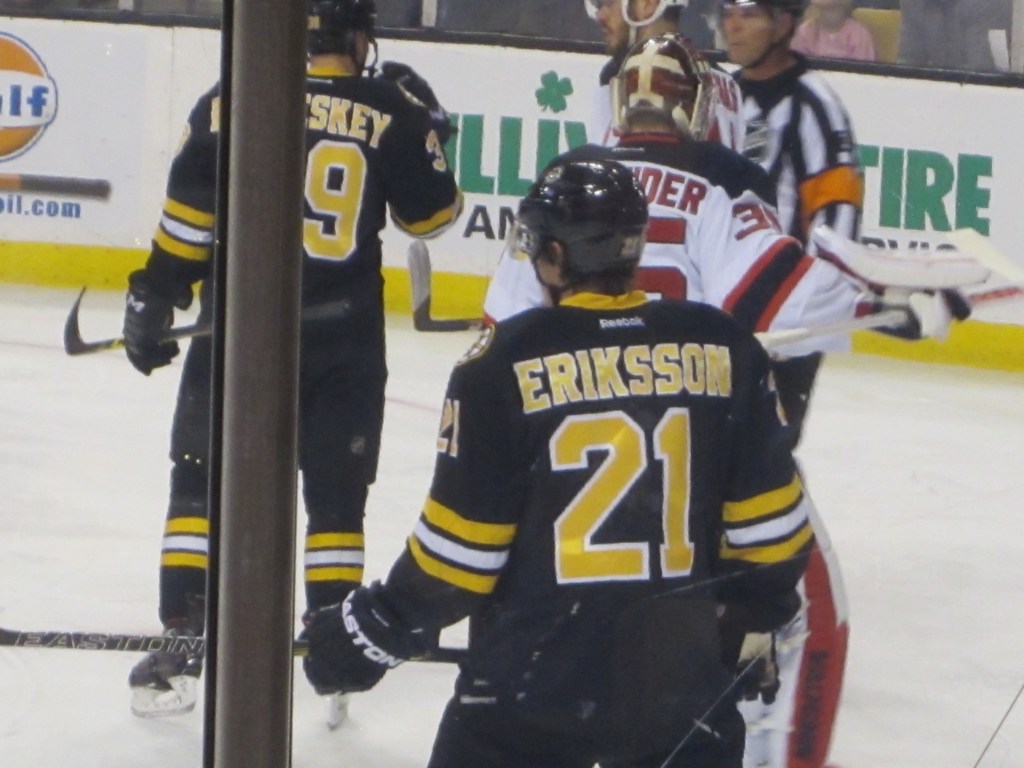

    If the Maple Leafs could get two 2nd round picks for their fire sale, think of what the Bruins could get for a player on the verge of his best season since at least the 2011-2012 regular season and on pace to reach the 70 point plateau.

    The fact of the matter is that Loui Eriksson is a very versatile player. Three years removed from the infamous Tyler Seguin trade with the Dallas Stars, Boston has finally seen what they expected all along from Eriksson on the ice. He goes to the right places, can be found on the rush and is dependable on the power play, if not deadly on special teams on a night-to-night basis.

    IMG_4341
    Could it be the end of Loui Eriksson in Black and Gold? (Photo via author)

    Eriksson has 23-25-48 totals so far in 60 games played this season; already besting his 22-25-47 totals last season over 81 games played and significantly improving upon his 10-27-37 total production in an injury plagued 61 game season in his first year in Boston during the 2013-2014 run that culminated in a Bruins second round playoff exit to the rival Montreal Canadiens. In 12 career playoff games with the B’s, Eriksson has put up two goals and three assists.

    The offensive upside to Eriksson’s game is crucial to his role as a top six forward. Yet, the 30-year old is on the final year of a six-year, $4.250 million AAV deal and is only expected to earn more, much more, in comparison to what the Bruins might be able to offer in an extension. Had the two sides discussed a deal much earlier in the season (prior to Eriksson’s rampage on the scoresheet), Boston might have been able to secure Eriksson to a similar deal to the one that is soon to expire.

    He is a dependable forward that brings a lot more to the table than Nick Spaling will bring to San Jose. By comparison, Eriksson makes Spaling look like a fourth liner (if not a depth forward) on just about any NHL roster.

    Compared to a player of similar caliber, but only a couple of years younger, Loui Eriksson could be raking in a well deserved raise similar to the 28-year old Anze Kopitar’s $80 million over 8 years extension with the Los Angeles Kings. Somewhere in the ballpark between $6.000 to $8.000 million AAV for any amount of time is well worth the chance for Eriksson to take the money and run.

    And the Bruins don’t have the room for that. Granted, their salary cap crunch days are much better than last year’s numbers.

    In the next two free agency cycles the Boston Bruins will have to resign a plethora of young stars including, Ryan Spooner ($950,000), David Pastrnak ($925,000), Brett Connolly ($1.000 million), Brad Marchand- who by the way is having a career year himself this year- ($4.500 million), Torey Krug ($3.400 million), Colin Miller ($600,000), Seth Griffith ($750,000) and quite possibly Alexander Khokhlachev ($800,000) assuming the Bruins don’t try to package the disgruntled Providence Bruin who has hinted at jettisoning the spoked-B for the KHL.

    IMG_4870
    Will the Bruins give up on second chances for Alexander Khokhlachev? (Photo via author)

    At least for Boston, they have some comfort in knowing that Milan Lucic’s retained salary of $2.750 million is coming off the books after this season and that forwards, Chris Kelly ($3.000 million) and Max Talbot ($900,000) may not be resigned. Kelly for sure will likely be forced to search for a job elsewhere in the league or face retirement in his comeback from a fractured left femur just 11 games into the season.

    So it all comes back down to what is here and now- Loui Eriksson.

    Without a doubt, Eriksson has a long future left in the NHL with any team in the league. Where he might end up is not necessarily clear, but the Bruins should seek to land a 1st round pick, a prospect, and a solid forward or top-4 defenseman at the very least in an exchange for just Loui Eriksson.

    The more pieces you add to the puzzle, the more things appear to stack up in favor of Boston (at least from a negotiating side). The Bruins have plenty of chips to put on the table with Eriksson, Khokhlachev and even Kevan Miller (who’s superb on the physical aspect of defense and shot blocking) to offer to a team that’s on the border or well within the cutoff of the playoff picture. Bruins GM Don Sweeney also has a couple of 1st round picks that he could dangle in front of an attractive trading partner.

    So while it might be sad to see such a productive player go in one of his best seasons, it just might be one of those classic examples of a “good hockey trade”- something reminiscent of when the Bruins brought in Phil Esposito or the like. Who knows, it just might be enough to put them in Cup contention for 2016.

    (And as requested by our in-house music guru, Connor, he wouldn’t let me get away with the title without alluding to this).

  • Numbers Game: Look to the Rafters- Boston Bruins

    Numbers Game: Look to the Rafters- Boston Bruins

    By: Nick Lanciani

    I continue to explore an important element of the game and what retired numbers around the league may look like in the future. While there’s only a finite set of numbers to utilize on the back of a jersey, many teams choose to retire (or honor) some numbers based on extraordinary circumstances, dedication to the organization, or legendary status.

    Many thoughts went through my head in each and every consideration. Feel free to agree or disagree- I want to know what you, the fans, consider worthy when evaluating a player, their career, and whether or not their number should be retired by a franchise. I am interested in seeing what you have to say, assuming you are actually a fan of the team and/or player that you argue for or against. Drop us a line in the comments or tweet to @DtFrozenRiver using #DTFRNumbersGame.

    For each team, I thought of former and current players that should have their numbers retired now or once they hang up the skates.

    UnknownBoston Bruins

    Current Retired Numbers- 2 Eddie Shore, 3 Lionel Hitchman, 4 Bobby Orr, 5 Dit Clapper, 7 Phil Esposito, 8 Cam Neely, 9 John Bucyk, 15 Milt Schmidt, 24 Terry O’Reilly, 77 Ray Bourque

    Recommended Numbers to Retire-

    16 Derek Sanderson

    Honestly, there’s got to be somebody out there wondering why the Bruins haven’t retired Sanderson’s number 16 yet, despite his short tenure with the Bruins (and overall short NHL career). If anything, his off the ice story is the ultimate combination of tragic and inspirational- and the work he does now is remarkable. Wouldn’t it be great to say one day to your kids at the TD Garden “and there’s number 16, which was worn by Derek Sanderson, a man who overcame many things, just like how you can overcome anything and make your dreams come true if you work hard enough and never give up hope.”

    Sanderson was sensational on the ice, having won two Stanley Cups with the Bruins in 1970 and 1972. He won the Calder Memorial Trophy in 1968 and had a career high 146 penalty minutes in his 2nd season with Boston in the 1968-1969 season as the ultimate definition of tough in the spoked-B.

    His fast track to success was marred by his equally fast track to nearly destroying his life. If it weren’t for his new found faith and good friend Bobby Orr, Sanderson would be a distant memory in a tragic loss of superstar talent.

    Since he turned his life around, Sanderson has become a financial advisor and a mentor to many young athletes in the sport as well as an immortal legend in Boston for his time spent with NESN alongside Fred Cusick in the mid ’80s to the mid ’90s.

    It’s time the Bruins truly honored Sanderson for the remarkable man that he’s become off the ice. Sanderson and Orr defined not only a decade in hockey, but an entire era and playing style. It’s only fitting that they are equally honored by Boston.

    37 Patrice Bergeron

    Bergeron just turned 30- hard to believe- and has already spent a little over a decade in the league. It’s looking like Bergeron will be another legendary player in the category of “spent all of his time with one organization,” so it will be deserving of the current definition of what it means to be a Bruin.

    Patrice Bergeron is the current definition of what it means to be a Bruin and what it means to be part of Boston sports lore. (Getty Images)
    Patrice Bergeron is the current definition of what it means to be a Bruin and what it means to be part of Boston sports lore. (Getty Images)

    While he’s not Milt Schmidt, Bergeron could share the “Mr. Bruin” nickname with Schmidt by the end of his career.

    Bergeron became the 25th member of the Triple Gold Club, having completed the trifecta in 2011 after having won the Stanley Cup with the Bruins. He’s won three Selke Trophies, a King Clancy Memorial Trophy, and the NHL Foundation Player Award in his career thus far.

    The two-time member of Team Canada in the Winter Olympics has also won two gold medals in 2010 and 2014. The only question for Bergeron someday will be, what hasn’t he done or been a part of?

    Bergeron is adored by Boston fans for every little thing he does in what could otherwise be best summed up as perfection.

    The perfect leader, the perfect teammate, the perfect two-way center, and even the perfect well respected rival- when it comes to facing the Montreal Canadiens. His impact on the franchise is insurmountable, considering he was barely penciled in on the roster, at 18 years old, for the 2003-2004 season.

    33 Zdeno Chara

    Zdeno Chara should see his number 33 raised to the rafters of the TD Garden as one of the best defensemen and leaders in the locker room in franchise history. (AP Photo/Julie Jacobson)
    Zdeno Chara should see his number 33 raised to the rafters of the TD Garden as one of the best defensemen and leaders in Boston’s locker room in franchise history. (AP Photo/Julie Jacobson)

    Chara often gets a bad rap for no reason from some Boston fans. The fact of the matter is that Chara is one of the best defensemen in the league. He’s a six-time Norris Trophy Finalist (2004, 2008, 2009, 2011, 2012, 2014) having won in 2009.

    If it weren’t for Niklas Lidstrom’s swan song season, Chara would have at least another Norris Trophy. Do I need to mention he’s the current record holder of the Hardest Shot competition with a blistering 108.8 mph slap shot?

    Aside from being able to speak seven languages and sell real estate in the State of Massachusetts, Chara was the first player born inside the Iron Curtain to captain his team to a Stanley Cup championship in 2011.

    Without a doubt, there is no question surrounding his leadership off the ice and in the locker room. On the ice he’s well respected by league officials, perhaps supplemented by his 6’9” (7’0” on skates), 255-pound, stature.

    He’s aging, yes, but what player doesn’t age after every season? He’s still insanely fit and athletic and capable of holding his own as a top-2 defenseman for the Boston Bruins. While it might take some convincing of Boston fans currently, Zdeno Chara absolutely deserves to have his number retired by the Bruins someday. He remains an influential piece to their turnaround and run to the Cup from 2006 to 2011 and leadership in their current roster and front office transition.

    Tim Thomas will be best remembered for chasing a dream and reaching its mountaintop. (Photo by Elsa/Getty Images)
    Tim Thomas will be best remembered for chasing a dream and reaching its mountaintop. (Photo by Elsa/Getty Images)
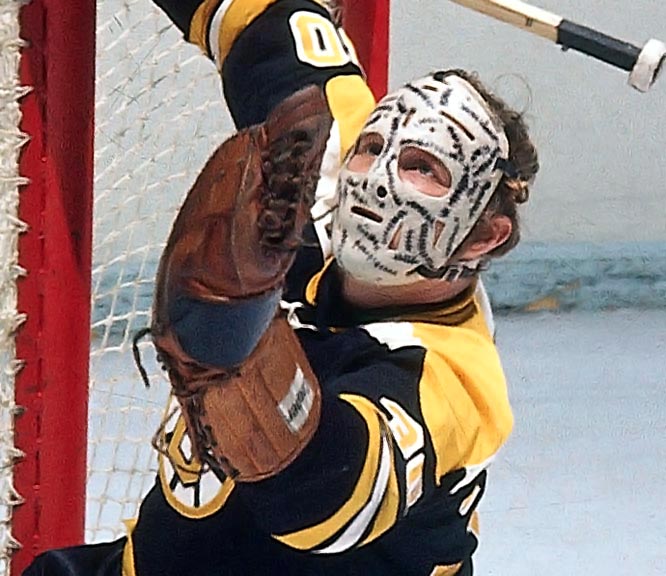
    Gerry Cheevers backstopped some legendary teams in Boston and had the mask to match their toughness. Photo: Denis Brodeur/NHLI via Getty Images
    Gerry Cheevers backstopped some legendary teams in Boston and had the mask to match their toughness. (Photo: Denis Brodeur/NHLI via Getty Images)

    Honorable Mention

    30 Gerry Cheevers/Tim Thomas

    By this point, it’s probably a long shot for the Bruins to retire number 30 out of respect for Gerry Cheevers. He played remarkably well for a dominate Boston team in the 1970s and if it weren’t for the World Hockey Association having diluted the NHL’s talent pool, probably would’ve led the Bruins to some more greatness.

    Likewise, Tim Thomas overcame a lot of doubt to be at the top of the NHL mountain as the Conn Smythe Trophy winner and 2011 Stanley Cup champion. It would certainly be a classy move by the organization, but one that likely will never happen for either (or both) former sensational Boston goaltenders.

    Other Notes

    Personally, I wouldn’t be opposed to setting aside Mark Recchi’s number 28. Not necessarily retiring it, but only using it for special players, which I guess is kind of the reason why nobody has been assigned number 28 on the Bruins since Recchi retired. Same goes with Marc Savard’s number 91.

    It’s a shame that good players don’t always get to have extravagant careers. Players like Savard or Norm Léveillé will always be remembered for how they played on the ice by diehard Boston fans.