Tag: Pavel Zacha

  • Your Team Will Rise/Fail: 2021-22 Standings Projections

    It is time. The 2021-22 season is upon us.

    Technically it already started, but we’ll ignore the fact that the Pittsburgh Penguins spoiled the Tampa Bay Lightning’s 2021 Stanley Cup champion banner night with a, 6-2, victory on the road before the Vegas Golden Knights held off a Seattle Kraken comeback in a, 4-3, win at T-Mobile Arena on Tuesday night.

    And then Wednesday’s games happened too.

    Let’s hit the “reset” button for a second and pretend the 2021-22 is about to get underway. All 32 National Hockey League teams have a chance at clinching 16 available playoff berths.

    Any of the 16 teams that make the 2022 Stanley Cup Playoffs could etch 52 names from their roster, front office and organization on the Stanley Cup next June.

    The usual divisions– Atlantic, Central, Metropolitan and Pacific– have returned as have the Eastern Conference and Western Conference. The regular playoff format is back (three teams per division, two wild cards per conference qualify, plus the Conference Finals round returns in place of the Stanley Cup Semfinals in 2021).

    A full 82-game regular season schedule is slated from October through the end of April with a three-week break in February for the 2022 All Star Game in Las Vegas and the 2022 Winter Games taking precedence before a return to NHL action down the stretch with the postseason kicking off in May like last year and the 2022-23 season likely returning to the pre-pandemic timeline (2023 Stanley Cup Playoffs starting in April).

    The 2022 NHL Entry Draft will be in Montréal on July 7th and 8th, while free agency begins on July 13th, but between now and then, we’ve got the 2021-22 regular season to enjoy.

    Using last season’s team goals for and team goals against, plus some other “magic numbers” as part of an expected points model, we’re able to project what 2021-22 could be for all 32 teams (yes, even the Seattle Kraken, despite this year being their first season)– though you’ll have to pretend there were no transactions made in the offseason.

    In other words, don’t think that any of what you’re about to see is set in stone– view it more as a suggestion for a possible outcome.

    Also, please remember my degree is in communication, so any math beyond figuring out “goals + assists = season point totals” doesn’t exist.

    In a normal year (like from 2017-18 to 2018-19, for example), you just take all the data from the 82-game schedule for each team plug it into a formula in a spreadsheet, then line things up accordingly in each division.

    However, just like how the shortened 2019-20 season disrupted the regular process for projecting a 2020-21 standings outlook, going from last season’s stats in a 56-game schedule to projecting a regular 82-game season in 2021-22 necessitated the use of forecasting point pace as part of the formula.

    As for Seattle, a simple means of taking the NHL stats from last season for every player on their roster and plugging it in for a 2021-22 result is exactly what I did.

    We’re all just making it up as we go along, folks. These are projections. They are not absolutes.

    For the sake of keeping it simple, here’s a look at how things could go (but probably not) in each division for the upcoming 2021-22 season.
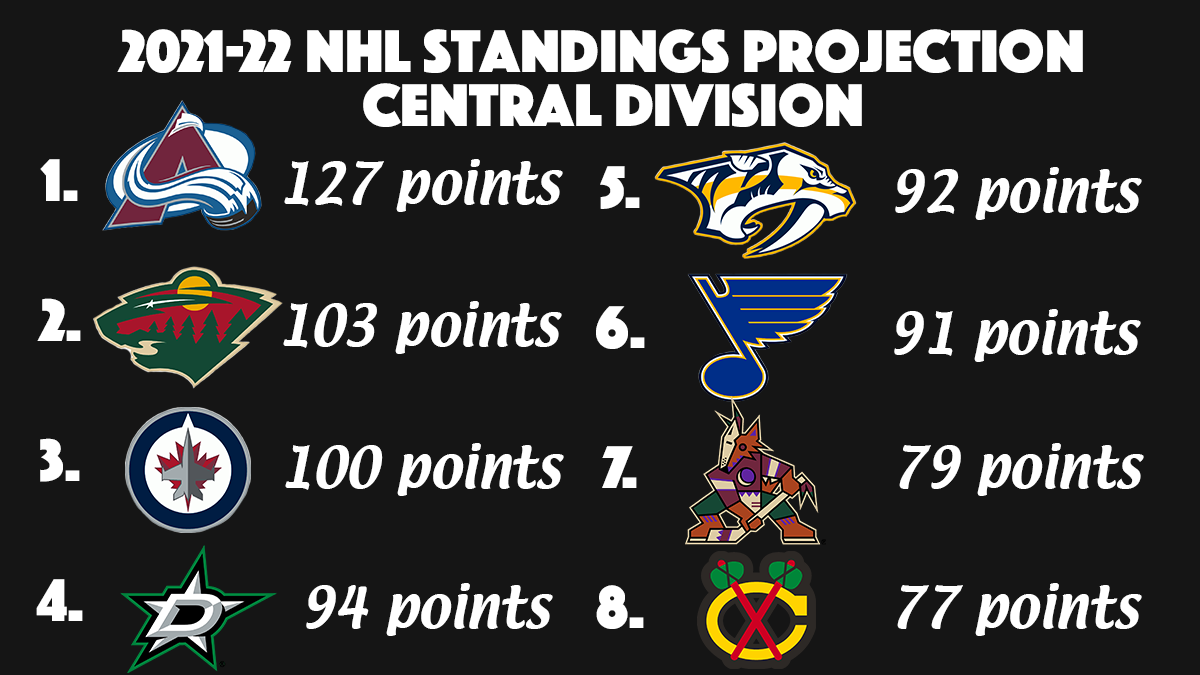
    The overall vibe of the Central Division for 2021-22 is that it’s just more of exactly what you’d expect. The Colorado Avalanche are lightyears ahead of everyone else, while Kirill Kaprizov and the Minnesota Wild continue to be on the rise and everyone else fights for what they can earn.

    Meanwhile, the jury is still out on whether or not the Winnipeg Jets can breakthrough as Canada’s team and break the Canadian curse (become the first Canadian club to win the Cup since 1993).

    Will Colorado finally break through the Second Round and win the Cup?

    Are the Avalanche just the Toronto Maple Leafs but with a little more success? My column:

    No, but really, it’s worth asking if the Avs making it back to the Western Conference Final for the first time since 2002, is more like Toronto’s struggle to make it out of the First Round for the first time since 2004, or is Colorado’s struggle more like the Washington Capitals pre-2018?

    The Caps won three Presidents’ Trophies in 2009-10, 2015-16 and 2016-17, but couldn’t make it past the Second Round– let alone the Pittsburgh Penguins– until they finally did and ended up surging in momentum all the way to their first Stanley Cup in franchise history.

    Colorado, on the other hand, has already won the Cup twice (1996 and 2001) and also has three Presidents’ Trophies to their name in 1996-97, 2000-01 and 2020-21, so if recent history has anything to tell us it’s that yet another team with high expectations for at least a few seasons now only to come up short could very well go on to win it all after winning the Presidents’ Trophy the previous year.

    Either that or they’ll have to win it in back-to-back seasons like Washington did before they won the Cup in 2018.

    Then again, the Tampa Bay Lightning tied the Detroit Red Wings’ record for most wins in the regular season (62), securing the Presidents’ Trophy in the process in 2018-19, then got swept by the Columbus Blue Jackets in the 2019 First Round.

    The very next year, however, Tampa kicked off back-to-back Cup rings in 2020 and 2021, to be where they are now as the two-time defending champions likely standing in the path as the only other favorites outside of the Avalanche this season.

    Anyway, the Avs mostly kept things the same from last season to this season, losing Joonas Donskoi to the Seattle Kraken in the 2021 NHL Expansion Draft, Brandon Saad to the St. Louis Blues in free agency and making minor swaps among replacement level bottom-six forwards and bottom-pairing defenders.

    Oh, then there’s this whole thing about how Philipp Grubauer left for Seattle in free agency too, so Colorado acquired Darcy Kuemper from the Arizona Coyotes.

    Between Dallas, Nashville and St. Louis, who will realistically make the playoffs?

    The Stars are projected to finish with about 94 points, the Predators sit at 92 points and the Blues are around 91 points in this one projection, but don’t let the points alone be your deciding factor.

    Given the strength of the Central Division compared to the Pacific Division, you can bet on five teams making out of the Central among Western Conference playoff berths.

    As such, the spread is the difference maker between these three teams expected to be in the wild card hunt– it’s going to come down to the wire one way or another.

    Dallas bolstered their goaltending depth by signing Braden Holtby, Nashville traded Ryan Ellis to the Philadelphia Flyers and St. Louis is… …better than last season on paper?

    I mean, the Blues signed Saad, acquired Pavel Buchnevich from the New York Rangers in exchange for Sammy Blais, let Seattle claim Vince Dunn at the expansion draft and let Mike Hoffman walk to the Montréal Canadiens in July.

    You could say they took a hit here or there, but those aren’t “nobody names” by any means, however.

    If Jordan Binnington and Ville Husso can stabilize things in the crease, then St. Louis has a better situation than the Predators.

    The Stars, meanwhile, should benefit from a longer season where more of their core guys– like Tyler Seguin, for example– are healthy. Last season’s COVID-19 outbreak to kick things off in January really killed Dallas’ momentum as a team on the verge of being in the 2021 postseason.

    Dallas should get back into the swing of things and St. Louis should be able to stay relevant for at least another year, but how hard the Preds rely on Juuse Saros as their starting goaltender will dictate whether or not they’re able to play spoiler with David Rittich as their backup since Pekka Rinne retired.

    Can Arizona avoid the basement?

    Anything is possible at this point. Loui Eriksson and Andrew Ladd were scoring goals in the postseason, so a fresh start could be just what both players needed for the last few years at least.

    That said, Coyotes General Manager, Bill Armstrong, gave a Masterclass™️ in how to go about rebuilding by selling everything over the summer and taking on “bad” contracts with only one or two years remaining in hopes of playing just well enough to be bad enough without making it look obvious that you’re aiming to win the 2022 NHL Draft Lottery.

    The Pacific Division is the new Scotia NHL North Division from last season. In other words, it’s the worst– which is great news for the Seattle Kraken as the league’s schedule allots more division play than any other opponents (though the Kraken will play every other team in the league at least twice).

    Seattle’s riding the waves of new-age expansion, while the Vegas Golden Knights lead the charge for the Presidents’ Trophy campaign in 2021-22.

    Wait, Seattle in 2nd in the Pacific, really?

    Yes, really.

    The Kraken have a great front office that goes beyond just Ron Francis as General Manager and have done their due diligence in scouting the best talent available to try to replicate the success of the Vegas Golden Knights’ inaugural season in 2017-18, as well as grow beyond just 2021-22.

    That said, Seattle probably isn’t going to make it out of the First Round of the 2022 Stanley Cup Playoffs, even if they have to face the Edmonton Oilers according to this projection.

    It’s a best case scenario for the NHL’s newest expansion team to be in the weakest division, but aside from having recent Stanley Cup champions Yanni Gourde, Philipp Grubauer, Jaden Schwartz and Dunn on their roster, the Kraken have a plethora of players that are relatively inexperienced with deep postseason runs.

    Head coach, Dave Hakstol, also hasn’t had the consistency of making the playoffs and making it out of the First Round in his NHL coaching days, but as a team that, again, is looking to develop long-term success, these are mere growing pains Francis and Co. are willing to accept as the fan base grows.

    Why aren’t the Kings making the cut this year when everyone else says they’ll be the most improved?

    The simple answer is that everyone’s overrating Los Angeles when it comes to the “ready now” factor.

    Sure, Kings General Manager, Rob Blake, did a good thing by getting Viktor Arvidsson in a trade with Nashville this summer to solidify his top-six forward group and signed Alex Edler to fortify his defense, but Los Angeles’ goaltending leaves something to be desired.

    Here’s hoping Jonathan Quick can find a little resurgence at this point in his career, while Cal Petersen continues to come into his own.

    If Los Angeles has any injuries– and they already have with Arvidsson likely missing some time due to an injury in the last preseason game– they’re already close enough to the bubble that they’ll only fall further behind.

    That said, if the Kings don’t make it back to the postseason hunt in 2022, there’s a good chance they make it in 2023.

    Los Angeles is improving, but by how much remains to be seen.

    Will winning the Presidents’ Trophy hurt Vegas?

    Eh, it’s hard to say.

    The Golden Knights have packed in just about every type of heartbreak since their inception in 2017, that fans of other franchises have only experienced over the course of at least 50 years, so if Vegas pulls out the Presidents’ Trophy win in 2021-22, don’t be surprised when the inevitable happens and they win the Cup instead of doing what most other Presidents’ Trophy winners in the salary cap era have done.

    Only the 2007-08 Detroit Red Wings and Chicago in 2012-13, have been able to win the Presidents’ Trophy and the Stanley Cup since the salary cap was introduced ahead of the 2005-06 season.

    Vegas would probably join Detroit and Chicago in doing so just so the Hockey Gods can spite us again.
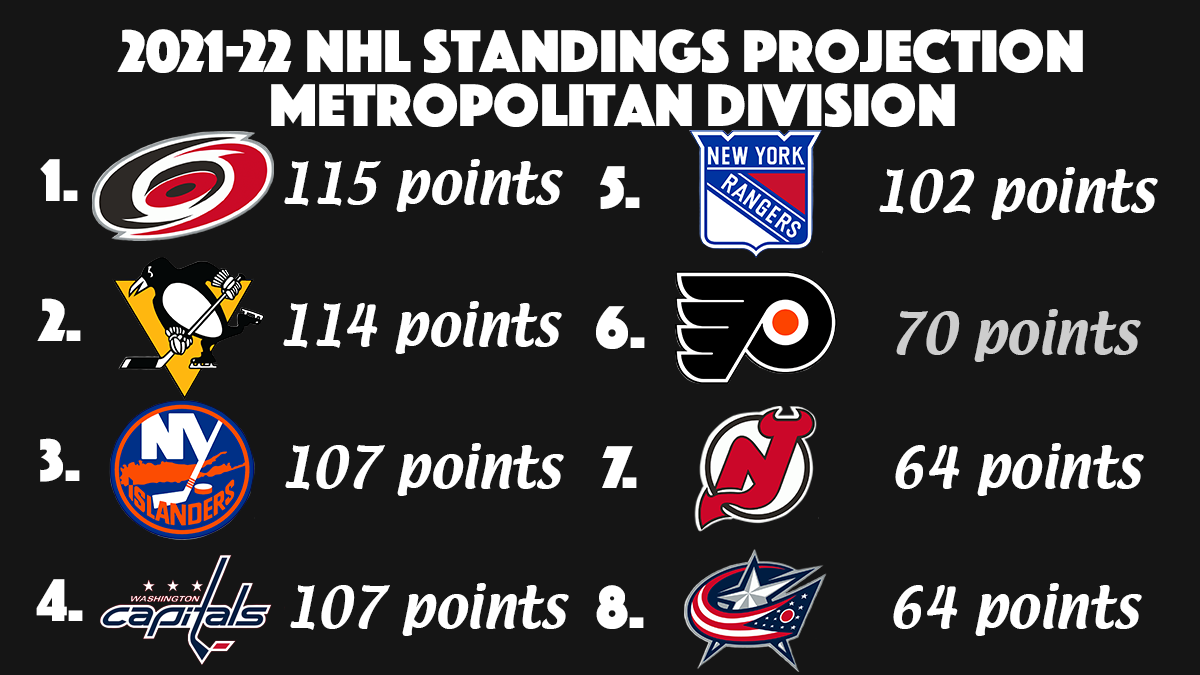
    It’s not easy to be in the Metropolitan Division these days because, well, let’s save that for the three questions below.

    Is this the toughest division to project?

    Absolutely.

    The Carolina Hurricanes decided to just get rid of a few parts and pieces that helped make them good for the last few seasons, so they’re bound to regress even with Sebastian Aho, Andrei Svechnikov, Teuvo Teräväinen and Martin Necas still existing.

    The Pittsburgh Penguins since 2009, have always found a way to be near the top of the division standings by the end of the regular season no matter whether or not you believe they’ll inevitably miss the playoffs for the first time since 2006, so anything could happen there.

    The New York Islanders have made back-to-back appearances in the Eastern Conference Final, so I’d expect them to be good.

    The Washington Capitals are better than the Philadelphia Flyers and New York Rangers, at least, but are probably the only team on the bubble if the New Jersey Devils can come out of nowhere and be competitive this season after signing Dougie Hamilton, Tomas Tatar and Jonathan Bernier in the offseason.

    Meanwhile, it’s time for a short rebuild in Columbus as the Blue Jackets would be quite pleased with a top draft pick in 2022.

    What if Chris Drury never was promoted as General Manager of the Rangers?

    They’d still fire David Quinn and hire Gerard Gallant. I don’t think that’s such a bad idea, but they’d definitely reconsider about 90% of the roster decisions made this summer.

    There’s no reason why the Rangers have to go down this path and yet, here they are, fumbling at the one-yard line and possibly plunging their franchise back into the Dark Ages of another rebuild. Or is it the same ongoing rebuild?

    What about a team to watch like New Jersey, for example?

    I’m big on the Devils this season for some strange reason.

    Maybe it’s because a part of me deep down misses the trap game of the 1990s and 2000s that led to Stanley Cups for New Jersey in 1995, 2000 and 2003.

    Maybe it’s because they signed Hamilton, Tatar, Bernier and acquired Ryan Graves from the Colorado Avalanche as a supporting cast for Jack Hughes, Nico Hischier, Pavel Zacha, Yegor Sharangovich, Ty Smith and friends.

    Seriously, the Devils should be good in the next few seasons, but this year could be the biggest stride forward in terms of their improvement from the basement to their development as a playoff contender.

    First, pour one out for Jack Eichel. Now, let’s move on and talk about everyone else.

    What does this mean for the Leafs?

    Just like how the Stars, Preds and Blues are all right on top of one another in the Central Division standings, the Atlantic Division is stacked from 1st through 4th, so though Toronto leads the way in this projection, I wouldn’t feel too comfortable as a Leafs fan.

    The Maple Leafs played in the worst of the four divisions last year in the temporarily realigned divisions in wake of the ongoing pandemic.

    No, it’s not just because they played all the other Canadian teams across 56 games, but rather it’s due to the fact that they haven’t been able to matchup with the Tampa Bay Lightning, Florida Panthers and even the Boston Bruins since the 2019-20 season.

    A lot and not a lot has changed since then.

    Tampa is still dominant as ever, Florida has emerged as a team that’s on the rise and Boston is unpredictable in that– much like the Penguins– it could really go either way with the Bruins this season.

    So now Toronto has to take on better competition within their own division and square off with teams like the Vegas Golden Knights, Colorado Avalanche, New York Islanders and others that emerge towards the top of the standings outside of the Canadian teams that the Leafs are all too familiar with at this point.

    That said, Toronto still has a great chance at winning the Atlantic Division regular season title or finishing 2nd and having home ice advantage in the First Round for the second-straight postseason.

    Can anyone other than Toronto, Florida, Tampa or Boston make it out of the Atlantic this year?

    No. Let’s be realistic here.

    The Montréal Canadiens made it to the 2021 Stanley Cup Final despite being below .500 in the standings because every division produced four playoff berths and intra-divisional play through two rounds.

    In 2020, they upset the Pittsburgh Penguins in the Qualifier despite finishing right at .500.

    In any other non-pandemic timeline, the Canadiens would still be looking for their first playoff appearance since they lost to the New York Rangers in six games in the 2017 First Round.

    That’s not to say that Nick Suzuki can’t lead the Habs back to glory, but rather that they need to improve all-around in the regular season and peaking in performance in the playoffs.

    Though the Ottawa Senators promised unprecedented success from 2021-25, it’s looking like it’ll realistically be anytime between 2024-25 as in the 2024-25 season itself at this point.

    Ottawa’s goaltending needs to improve, their defense could use some tweaks and the Sens are banking on their offense getting their feet underneath them and bursting in production in the coming years.

    A little more patience won’t hurt them.

    The same can be said for the Detroit Red Wings in that Red Wings fans already know– trust in General Manager, Steve Yzerman, is paramount. He’ll work his magic.

    It just takes a little time to build a solid foundation and the first floor is almost ready to start going up.

    As for the Buffalo Sabres, well…

    At least they’ll hopefully give Rick Jeanneret a proper send-off before he retires as their play-by-play announcer for the last 51 years on television.

    Hopefully.

    Will Tampa win three consecutive Stanley Cup championships?

    Probably not.

    I’m not ruling it out entirely, but the Lightning have a better chance of winning three Cups in four years than they do three Cups in as many years as things stand currently.

    The loss of their entire third line (Blake Coleman, Yanni Gourde and Barclay Goodrow) from last season to this season is sure to leave a mark on the development and restructuring of their bottom-six forwards.

    That said, Tampa’s top-six forwards still exist and, if you haven’t already noticed, they’re very good on their own, but the best teams in the playoffs have four lines that can roll without a doubt and the Bolts might just be off the ball for a year in terms of depth.


    Alright, if you’ve made it this far, thanks for your patience. By now the season’s already going on a few days into the 2021-22 calendar, so the two of us (or more if you’re reading this to a group) should probably get back to watching games.

    Stay tuned for more forecasts for both standings and assorted teams throughout the season.

  • New Jersey Devils 2021-22 Season Preview

    New Jersey Devils 2021-22 Season Preview

    2020-21 record 19-30-7, 45 points

    7th in the MassMutual NHL East Division

    Missed the postseason for the third-straight year

    Additions: F Tomas Tatar, D Ryan Graves (acquired from COL), D Dougie Hamilton, D Christian Jaros (acquired from SJS), G Jonathan Bernier

    Subtractions: F Nathan Bastian (expansion, SEA), F Christoph Bertschy (NL), F Brandon Gignac (signed with Laval, AHL), F Mason Jobst (signed with Rochester, AHL), F Mikhail Maltsev (traded to COL), F Nicholas Merkley (traded to SJS), F Brett Seney (signed with TOR), F Ben Street (DEL), D Will Butcher (traded to BUF), D Connor Carrick (signed with SEA), D Josh Jacobs (signed with CAR), D Ryan Murray (signed with COL), D David Quenneville (SHL), D Colby Sissons (HockeyAllsvenskan), D Matt Tennyson (signed with NSH), G Corey Crawford (retired), G Aaron Dell (signed with BUF)

    Still Unsigned: G Gilles Senn (NL, NJD reserve list), G Evan Cormier

    Re-signed: F A.J. Greer, F Janne Kuokkanen, F Yegor Sharangovich, F Marian Studenic

    Offseason Analysis: The Devils, like Chicago, turned some heads in the first half of the 2020-21 season. Unlike Chicago, New Jersey wasn’t really anywhere near the top of the standings in their division, but at least Yegor Sharangovich’s emergence and Ty Smith’s performance was a welcome reception for a team that’s yearning for more.

    Jack Hughes, Nico Hischier, Pavel Zacha and Miles Wood are all growing in their roles and looking for supporting cast members that haven’t been traded in recent years (think Blake Coleman, Kyle Palmieri and others) as the winds of change sweep through the Devils organization.

    Now, it appears, is the time for New Jersey to blossom into something. What that something might be remains to be seen, however.

    Sharangovich signed a two-year extension worth $2.000 million per season as a solid bridge contract after putting up 30 points (16 goals, 14 assists) in 54 games in his first NHL season after starting the 2020-21 calendar in the Kontinental Hockey League with Dinamo Minsk, where he had 17-8–25 totals in 34 games.

    His speed is impressive, but his hands and quick shot might be even more so.

    Zacha may have led the team in scoring with 35 points last season, while Hughes trailed with 31 points, but Sharangovich was tied with Jesper Bratt for the third-most points on the roster. Few people outside of New Jersey could’ve seen that coming.

    On defense, Smith was a welcome addition to re-igniting some semblance of an offense from the backend.

    That said, P.K. Subban managed to score 19 points in 44 games and was on pace for about 27 points in a regular 82-game schedule.

    After bottoming out with 18 points in 68 games in 2019-20, Subban’s rise back to relevance times out pretty well entering a contract year for 2021-22– and with Dougie Hamilton locked up via free agency to a seven-year deal at Subban’s $9.000 million cap hit, a little healthy competition might just be the thing that he needs.

    Hamilton had 42 points (10 goals, 32 assists) in 55 games with the Carolina Hurricanes last season, which was down from his .852 points-per-game production in 2019-20, when he had 14-26–40 totals in 47 games prior to injury.

    At .764 points-per-game in 2020-21, though, and being only 28-years-old, Hamilton is in the peak of his defensive prime and should be a power play specialist– quarterbacking New Jersey’s defense for a long time in the new-age era of two-way defenders.

    Plus Hamilton is four years younger than Subban, so there’s less risk of things backfiring up front in Hamilton’s tenure with the Devils than Subban’s tumultuous drop in production from Nashville to New Jersey.

    It’s a risk worth taking for a team that’s looking to get back into the Stanley Cup Playoffs for the first time since 2018, when Taylor Hall went on his Hart Memorial Trophy winning MVP of the regular season run prior to being eliminated in five games in the 2018 First Round by the Tampa Bay Lightning.

    Hall is a member of the Boston Bruins these days– a team the Devils went 5-1-2 against last season.

    The additions of Tomas Tatar and Jonathan Bernier via free agency should shore up depth in the middle-six and in the crease where Mackenzie Blackwood and Scott Wedgewood looked fine, but in desperate need of veteran leadership– especially as Blackwood continues to emerge in the league.

    New Jersey General Manager, Tom Fitzgerald, shouldn’t have to worry about any unexpected retirements like how Corey Crawford signed with the Devils before retiring prior to the 2020-21 season getting underway.

    Offseason Grade: A-

    Fitzgerald added one of the better free agents in the market to his roster and still has about $12.100 million in cap space to work with, which is the only reason why the Devils didn’t get an “A” since it seems like they could’ve done a little more.

    Nobody’s really expecting New Jersey to make a deep run, but they should align themselves with better chances at playoff contention given the moves made this offseason.

    For a team that’s been out of a serious run since making the Stanley Cup Final in 2012, it’s about time that the Devils get back into the playoff picture and adding Hamilton to New Jersey’s core certainly speeds things up by making the Devils a desirable destination at least.

    Whereas other teams in the highly competitive Metropolitan Division are expected to falter, New Jersey’s stock is starting to rise so right about now would be the perfect time to buy in.

    Ideally, they should be in wild card contention.

  • Devils down Bruins, 4-3, in overtime

    Devils down Bruins, 4-3, in overtime

    For the first time this season on home ice, the New Jersey Devils forced a comeback after trailing in the second period and won as they defeated the Boston Bruins, 4-3, in overtime Tuesday night at Prudential Center’s final home game of the 2020-21 season.

    Mackenzie Blackwood (13-16-4, 3.05 goals-against average, .902 save percentage in 33 games played) made 33 saves on 36 shots against in the win for New Jersey.

    Boston goaltender, Jaroslav Halak (9-6-4, 2.53 goals-against average, .905 save percentage in 19 games played) turned aside 17 out of 21 shots faced in the overtime loss.

    The Bruins fell to 31-14-7 (69 points) on the season, but remained in control of 3rd place in the MassMutual NHL East Division, while the Devils improved to 18-28-7 (43 points) overall and stuck in 7th place in the division.

    Boston finished their regular season series with New Jersey 3-3-2 overall in 2020-21.

    The Bruins were without the services of Ondrej Kase (upper body) and John Moore (hip) on Tuesday, while Kevan Miller (maintenance) and Jakub Zboril were removed from the lineup as Brandon Carlo returned to action from his most recent oblique injury that he sustained on April 1st against the Pittsburgh Penguins.

    Mike Reilly returned in Zboril’s place on the third pairing with Connor Clifton after missing Monday night’s game due to being “pretty banged up,” to paraphrase B’s head coach, Bruce Cassidy.

    Cassidy made one change among his forwards, inserting Trent Frederic on the fourth line in place of Karson Kuhlman.

    Meanwhile, Jeremy Swayman served as Halak’s backup on Tuesday– giving Tuukka Rask the night off as the playoffs draw near.

    Boston’s long list of healthy scratches, taxi squad members and injured players included Chris Wagner, Greg McKegg, Moore, Kase, Rask, Steven Kampfer, Zboril, Callum Booth, Anton Blidh, Kuhlman, Jarred Tinordi and Miller.

    Matt Grzelcyk tied up Miles Wood away from the puck and yielded the game’s first power play to the Devils as Grzelcyk cut a rut to the penalty box for interference at 4:16 of the first period.

    New Jersey was not successful on their first skater advantage of the night, but Boston began a run of three consecutive infractions as Grzelcyk was the first to commit a minor infraction, then Clifton slashed Yegor Sharangovich at 6:42 and finally, Charlie McAvoy tripped Sharangovich at 8:39– resulting in three seconds of a 5-on-3 advantage for the Devils.

    New Jersey’s two-skater advantage quickly dwindled down to a regular 5-on-4 power play, but not for long as Pavel Zacha (14) wired a one-timer past Halak off of the ensuing faceoff while Clifton was set to exit the sin bin and McAvoy was in the box.

    Jack Hughes (19) and Nico Hischier (3) tallied the assists on Zacha’s first goal of the game as the Devils took a, 1-0, lead thanks to the power-play goal at 8:42 of the first period.

    As Clifton’s minor expired, McAvoy was freed from the box thanks to Boston’s penalty kill allowing a power-play goal against and the game resumed at full strength.

    Moments later, Nathan Bastian hooked Brad Marchand and cut a rut to the box at 11:27, presenting the Bruins with their first power play opportunity of the night.

    The B’s did not convert on the skater advantage, however.

    Entering the first intermission, the Devils led, 1-0, on the scoreboard, despite trailing the Bruins, 15-9, in shots on goal.

    New Jersey led in blocked shots (5-1) and giveaways (2-0), while Boston held the advantage in hits (13-5) and faceoff win percentage (68-32).

    Both teams had four takeaways each, while the Devils were 1/3 and the B’s were 0/1 on the power play heading into the middle frame.

    Nicholas Merkley kicked off the second period with a hooking infraction at 3:36 and presented Boston with their second power play of the game.

    This time, Patrice Bergeron (21) fired a one-timer over Blackwood’s glove from his usual spot as the bumper on the power play to tie the game, 1-1.

    David Pastrnak (25) and Grzelcyk (13) had the assists on Bergeron’s power-play goal at 4:36.

    Moments later, Pastrnak hooked Wood and cut a rut to the box at 7:49, but Boston’s penalty kill managed to kill off Pastrnak’s minor infraction without issue.

    Late in the period, Taylor Hall dropped a pass back to Grzelcyk for a shot before the puck deflected off of Hall’s (8) leg and found its way into the back of net– giving Boston their first lead of the night in the process, 2-1.

    Grzelcyk (14) and David Krejci (30) had the assists on Hall’s goal at 14:02 of the second period.

    As Hall was passing through Blackwood’s “no fly zone”, New Jersey’s head coach, Lindy Ruff, used a coach’s challenge on the grounds that he believed Hall had made contact with the Devils’ netminder and therefore interfered with Blackwood’s ability to make a save.

    Video review confirmed that Hall, in fact, had never touched Blackwood, yielding an automatic delay of game penalty against New Jersey, which was served by Jesper Boqvist at 14:02.

    Though Boston did not score on the ensuing power play, they entered the second intermission with the lead on the scoreboard, 2-1, and in shots on goal, 27-13, including a, 12-4, advantage in the second period alone.

    After 40 minutes of action, the Devils held the advantage in blocked shots (7-4) and takeaways (6-5), while the Bruins led in hits (18-10) and faceoff win% (64-36).

    Both teams had four giveaways each as New Jersey was 1/4 and Boston was 1/3 on the power play heading into the final frame of regulation.

    Bovqist (4) tied the game on a loose puck that was initially shot by Damon Severson, then blocked by McAvoy.

    Severson (16) and Marián Studenič (1) had the assists on Boqvist’s garbage goal from the doorstep as the Devils tied the game, 2-2, at 9:10 of the third period.

    Boston answered back in a hurry as Sean Kuraly (4) redirected a shot pass from Pastrnak with his skate as he was skating backwards through the low slot towards the goal line to put the B’s ahead, 3-2, at 10:42.

    Pastrnak (26) and Reilly (26) had the assists on Kuraly’s goal, but the Bruins didn’t have the lead for that long.

    Once again, New Jersey tied things up as Sharangovich (16) sent a wrist shot clean past Halak on a breakaway under the Bruins goaltender’s blocker less than two minutes after the B’s took the lead.

    Severson (17) and Kevin Bahl (2) notched the assists on Sharangovich’s goal as the Devils tied the game, 3-3, at 12:41 of the third period.

    There were no more goals, nor any penalties as the two clubs necessitated overtime to determine a winner on Tuesday night.

    After regulation, the Bruins and Devils were tied, 3-3, on the scoreboard, while Boston held the advantage in shots on goal, 36-19, including a, 9-6, advantage in the third period alone.

    New Jersey led in blocked shots (11-9), takeaways (9-8) and giveaways (10-6), while the B’s led in hits (26-18) and faceoff win% (64-36).

    As there were no penalties called in overtime (despite a delayed penalty waiting to be called against Boston that was ultimately negated by New Jersey’s game-winning goal), the Devils finished 1/4 and the Bruins went 1/3 on the power play on Tuesday.

    About midway through the extra frame, Zacha (15) waltzed through the lot slot and pulled the puck to his backhand before elevating a shot over Halak’s glove side– leaving the Bruins goaltender in a fit of rage afterward as he skated off the ice and took out his frustrations on his stick.

    Hughes (20) and Will Butcher (9) celebrated their assists on Zacha’s second goal of the game, as well as the, 4-3, win.

    Meanwhile, reality had set in for Boston’s backup goaltender as Halak made his first start since April 3rd– amidst an appearance on the league’s COVID protocol list, as well as the emergence of Swayman as Boston’s likely backup netminder entering the postseason– Tuesday night’s effort did not help his case for a regular role with the Bruins.

    New Jersey finished the night with a, 2-0, advantage in shots on goal in the overtime period alone, but trailed Boston in total shots on goal, 36-21.

    The Devils also wrapped up Tuesday night’s action leading in blocked shots (11-10) and giveaways (10-7), while the Bruins finished the game leading in hits (26-18) and faceoff win% (64-36).

    The B’s fell to 3-5 in overtime (7-7 past regulation) this season, while the Devils improved to 4-2 in overtime and 4-7 overall past regulation in 2020-21.

    Boston also fell to 8-9-4 (3-3-3 on the road) when allowing the game’s first goal, 5-8-3 (2-5-3 on the road) when trailing after the first period and 22-0-3 (9-0-1 on the road) when leading after two periods this season.

    Meanwhile, New Jersey is now 15-10-2 (7-8-0 at home) when scoring the game’s first goal, 13-3-1 (7-2-0 at home) when leading after one period and 2-22-2 (1-13-1 at home) when trailing after the second period in 2020-21.

    The Bruins return home to host the New York Rangers on Thursday and Saturday before taking on the New York Islanders in the final home game of the regular season on May 10th.

    Boston concludes the 2020-21 regular season on the road against the Washington Capitals on May 11th.

  • Third period rally sparks Boston’s, 5-4, shootout win over Devils

    Third period rally sparks Boston’s, 5-4, shootout win over Devils

    For the fourth time this season, the Boston Bruins came back from trailing in the third period to winning past regulation with a, 5-4, shootout victory over the New Jersey Devils on Tuesday night at TD Garden.

    The B’s lead the league in third period multi-goal comeback wins this season with four– setting a franchise record in the process.

    Jaroslav Halak (8-5-3, 2.27 goals-against average, .916 save percentage in 16 games played) stopped 31 out of 35 shots faced in the shootout win for Boston.

    Devils goaltender, Mackenzie Blackwood (9-9-2, 2.87 goals-against average, .911 save percentage in 20 games played) made 44 saves on 48 shots against in the shootout loss.

    Boston improved to 18-9-5 (41 points) on the season and remained in command of 4th place in the MassMutual NHL East Division, while New Jersey fell to 13-16-5 (31 points) and remained in 7th place in the division.

    Tuesday night, the Bruins were without Ondrej Kase (upper body), Kevan Miller (knee), Tuukka Rask (upper body), John Moore (hip), Sean Kuraly (COVID protocol) and Jake DeBrusk (COVID protocol), while Brandon Carlo and Brad Marchand made their returns to the lineup.

    Carlo made his first appearance in 10 games since sustaining an upper body injury (concussion, though it was never officially stated by the team) against the Washington Capitals on March 5th, while Marchand returned from COVID protocol after a false positive kept him out of the last two games.

    Bruins head coach, Bruce Cassidy, adjusted his lineup, returning Marchand to his usual role on the first line left wing alongside B’s captain, Patrice Bergeron, at center and David Pastrnak at right wing.

    Cassidy moved Trent Frederic to center the fourth line as a result and scratched Jack Studnicka.

    On defense, Jeremy Lauzon suited up alongside Charlie McAvoy on the first pairing, while Matt Grzelcyk was partnered with Carlo to round out the top-four defenders.

    Cassidy put Jakub Zboril and Connor Clifton together on the third pairing, while Chris Wagner, Greg McKegg, Studnicka, Moore, Kase, Rask, Steven Kampfer, Kuraly, DeBrusk, Jarred Tinordi, Callum Booth and Miller made up Boston’s list of taxi squad members, healthy scratches and/or injured players out of the lineup on Tuesday.

    Jack Ahcan was reassigned from Boston’s taxi squad to the Providence Bruins (AHL) on Monday.

    Miles Wood (11) kicked things off with the game’s first goal on New Jersey’s first shot of the night after stopping P.K. Subban’s shot pass before firing it over Halak’s glove from the slot.

    Subban (12) had the only assist on the goal as the Devils took a, 1-0, lead at 1:28 of the first period.

    Moments later, the Bruins evened things up, 1-1, when Nick Ritchie (10) mustered a shot from just above the faceoff circle off of Blackwood’s glove hand and into the twine for Boston’s first 5-on-5 goal against New Jersey this season.

    David Krejci (18) and Craig Smith (6) tallied the assists on Ritchie’s goal at 5:55.

    Almost midway into the opening frame, an odd bounce didn’t go Karson Kuhlman’s way while the Bruins forward was pressuring to keep the puck in the attacking zone led to a New Jersey breakaway the other way for Devils forward, Michael McLeod.

    McLeod (5) deked, pulled the puck to his backhand and beat Halak down low to give the Devils a, 2-1, lead at 9:34 of the first period.

    Jesper Boqvist (1) and Ryan Murray (5) notched the assists on McLeod’s goal.

    Entering the first intermission, New Jersey led, 2-1, on the scoreboard, despite trailing Boston in shots on goal, 12-11.

    The Bruins also led in blocked shots (2-1), takeaways (4-2) and hits (12-6), while both teams had two giveaways each and were 50-5o in faceoff win percentage after one period of action.

    Neither team had yet to see any time on the power play heading into the middle frame.

    Travis Zajac (5) tipped a shot from Jesper Bratt through Halak’s seven-hole on the blocker side to give the Devils a two-goal lead, 3-1, at 3:45 of the second period.

    Bratt (15) and Murray (6) had the assists on Zajac’s goal, which was his 200th tally of his National Hockey League career in 1,021 games (all with New Jersey).

    Moments later, Marchand yielded the first power play of the night to the Devils after receiving a roughing minor at 9;20 of the second period.

    New Jersey did not convert on the ensuing skater advantage, however.

    Shortly after being free from the penalty box, Marchand made a big hit in the attacking zone that resulted in Bratt and Marchand exchanging pleasantries and receiving roughing infractions at 12:59 after the Bruins winger landed a takedown of the Devils defender.

    About a minute later, Subban slashed Krejci and presented Boston with a 4-on-3 advantage for about 52 seconds before the Bruins would have an abbreviated 5-on-4 power play.

    Nearly three minutes after his second roughing penalty of the game, Marchand (13) wired a catch and release snap shot past Blackwood’s blocker to pull Boston to within one.

    Bergeron (17) and Krejci (19) had the assists on Marchand’s power-play goal and the Bruins trailed, 3-2, at 15:48.

    Less than two minutes later, a costly turnover for Lauzon in his own zone off of a faceoff benefited Kyle Palmieri (8) with a quick unassisted goal to put New Jersey on top, 4-2, at 17:06.

    Through 40 minutes of play, the Devils led, 4-2, on the scoreboard, despite trailing the Bruins in shots on goal, 25-23.

    Boston held the advantage in takeaways (9-6), hits (18-15) and faceoff win% (57-43), while New Jersey led in blocked shots (8-4) and giveaways (4-3).

    The Devils were 0/1 on the power play, while the B’s were 1/1 on the skater advantage heading into the final frame of regulation.

    Midway through the third period, McAvoy (4) buried a rebound to bring the Bruins back to within one– trialing, 4-3, at 10:22 of the third period.

    Smith (7) and Marchand (23) had the assists on McAvoy’s goal.

    Boston went on the power play at 13:43 when Damon Severson caught McAvoy with a high stick, but didn’t convert on the ensuing advantage.

    Moments later, however, Grzelcyk (3) sent a wrist shot from the high slot off an attacking zone faceoff win past Blackwood on the far side to tie the game, 4-4.

    Smith (8) and Krejci (20) each had their third assist of the night on Grzlecyk’s goal at 16:00 of the third period– forcing overtime after Bergeron’s hooking minor at 16:18 was successfully killed by Boston’s penalty kill.

    The Bruins finished the 60-minute effort leading in shots on goal, 44-32, including a, 19-9, advantage in the third period alone.

    The B’s also led in hits (23-19), while the Devils led in blocked shots (11-7) and giveaways (8-3) entering the overtime period.

    Both teams had 11 takeaways each and were 50-50 in faceoff win% heading into the extra frame.

    New Jersey was 0/2 and Boston was 1/2 on the power play entering overtime.

    Devils head coach, Lindy Ruff, started Pavel Zacha, Bratt and Severson in overtime, while Cassidy countered with Bergeron, Marchand and McAvoy to kick things off.

    McAvoy slashed Severson while trailing on a play about midway through the overtime period, yielding a 4-on-3 advantage to New Jersey at 2:39 of overtime.

    Boston then utilized their timeout to counter New Jersey’s power play and hold things off until the seconds ticked down and a shootout commenced.

    Entering the shootout, Boston and New Jersey were tied, 4-4, on the scoreboard, while the Bruins led in shots on goal, 48-35, including a, 4-3, advantage in overtime alone.

    The B’s finished the night leading in hits (24-22) and and faceoff win% (51-49), while the Devils wrapped up the night leading in blocked shots (12-8) and giveaways (8-3).

    New Jersey finished Tuesday night’s action 0/3 on the power play, while Boston went 1/2 on the skater advantage.

    The Bruins elected to shoot second in the shootout.

    Ruff sent out Zacha, but the Devils forward’s attempt was stopped by Halak with a routine pad save.

    Cassidy countered with Charlie Coyle, who promptly deked while skating towards Blackwood, pulling the New Jersey netminder out of position.

    Coyle went from his backhand to his forehand while wrapping the puck around Blackwood– slipping it between the Devils goalie and the post to give Boston the, 1-0, advantage after the first round of the shootout.

    New Jersey turned to Palmieri to even things up, but Halak got a chunk of the puck with his blocker before the rubber biscuit was deflected wide of the net.

    Pastrnak mimicked Coyle’s goal– going from his backhand to his forehand and slipping the rubber biscuit between Blackwood’s outstretched pad and the post, only this time with less room between the Devils’ goaltender’s skate and the metal goal frame.

    The Bruins won the shootout, 2-0, and added to their final total on the scoreboard– defeating the Devils in the process, 5-4.

    Boston improved to 2-3-1 against New Jersey in 2020-21, as well as 3-2 in shootouts overall this season.

    The Devils, meanwhile, fell to 0-4 in shootouts this season.

    The Bruins improved to 6-6-2 (3-4-0 at home) when allowing the game’s first goal this season, while the Devils dropped to 11-7-1 (7-2-1 on the road) when scoring first in 2020-21.

    Boston is now 4-6-2 (2-2-0 at home) when trailing after one period and 4-5-1 (3-3-0 at home) when trailing after two periods this season, while New Jersey fell to 8-3-1 (4-1-1 on the road) when leading after the first period and 7-2-1 (5-1-1 on the road) when leading after the second period this season.

    The B’s finished the month of March with a 6-4-3 record and will begin April with a pair of home games against the Pittsburgh Penguins on Thursday and Saturday.

    Boston is 2-1-1 in their current seven-game homestand.

  • Wedgewood stops 40 for New Jersey in, 1-0, shutout over Bruins

    Wedgewood stops 40 for New Jersey in, 1-0, shutout over Bruins

    Smithtown, New York native, Kyle Palmieri had the game’s only goal in a, 1-0, shutout win for the New Jersey Devils over the Boston Bruins at TD Garden as USA Hockey and NBC Sports Group celebrated “Hockey Day in America” on Sunday.

    Scott Wedgewood (2-3-1, 2.33 goals against average, .923 save percentage in six games played) made 40 saves for his second shutout of the season for the Devils.

    Bruins goaltender, Tuukka Rask (8-4-2, 2.46 GAA, .906 SV% in 14 games played) stopped 24 out of 25 shots faced for a .960 SV% in the loss.

    New Jersey improved to 6-2-1 on the road this season with the win, while Boston fell to 6-2-1 at home in 2020-21, as well as 1-2-1 against New Jersey this season.

    The Bruins fell to 13-6-3 (29 points) and remained in 3rd place in the MassMutual NHL East Division, while the Devils improved to 8-11-2 (18 points) and stagnant in 7th place in the division.

    Brandon Carlo (upper body) joined Ondrej Kase (upper body), Kevan Miller (knee) and Jeremy Lauzon (fractured left hand) on Boston’s list of injured players that were out of the lineup on Sunday.

    Carlo was released from the hospital early Saturday morning and is feeling better, but likely going to be out of the lineup for a while.

    Washington Capitals forward, Tom Wilson, was suspended seven games late Saturday night as a result of his in-person hearing via Zoom for his high hit on Carlo in Friday night’s game.

    The National Hockey League’s Department of Player Safety’s key points in their ruling mentioned that Wilson’s hit was an example of boarding, resulted in an injury and by a player with a suspension history (Wilson has now been suspended five times in his NHL career).

    There was no penalty called on the play.

    On Sunday, Wilson’s agent announced that Wilson and the National Hockey League Players’ Association would not appeal the suspension, citing a review of “all the pros and cons of an appeal and ultimately decid[ing] not to.”

    Meanwhile, Bruins head coach, Bruce Cassidy left his foward lines the same as they were on Friday night.

    He did, however, jumble his defensive pairings, placing Matt Grzelcyk with Charlie McAvoy on the top pairing, Jakub Zboril with Connor Clifton on the second pairing and Jarred Tinordi with Urho Vaakanainen on his opposite hand.

    John Moore, Sean Kuraly, Greg McKegg, Steven Kampfer and Callum Booth served as Boston’s healthy scratches and/or taxi squad members on Sunday.

    Almost midway through the opening frame, Vaakanainen caught Janne Kuokkanen with a high stick and was sent to the penalty box at 7:19 of the first period.

    New Jersey did not convert on the ensuing power play.

    Moments later, Chris Wagner tripped Mikhail Maltsev at 13:34. Once again, the Devils were not successful on the resulting skater advantage.

    After one period of play in Boston, the game remained tied, 0-0, with the Bruins leading in shots on goal, 12-10.

    New Jersey, meanwhile, held the advantage in blocked shots (4-1), giveaways (4-3) and faceoff win percentage (58-42). Both teams had five takeaways and nine hits aside entering the first intermission.

    The Devils were 0/2 on the power play and the B’s had yet to see any time on the skater advantage.

    The middle frame brought more of the same.

    Jake DeBrusk caught Travis Zajac with a high stick and was assessed a minor infraction at 9:14 of the second period, but New Jersey wasn’t able to score on the resulting power play– their third skater advantage of the night.

    Late in the period, Jack Hughes settled the puck and whipped a shot past Rask’s glove side, but the goal was immediately waved off due to a hand pass.

    Entering the second intermission, the Bruins and Devils were still tied, 0-0, despite Boston holding a, 22-19, advantage in shots on goal, including a, 10-9, advantage in the second period alone.

    The B’s also led in blocked shots (7-6), takeaways (13-7) and giveaways (10-8), while New Jersey led in hits (17-14) and faceoff win% (53-47).

    The Devils were 0/3 on the skater advantage, while the Bruins had yet to see any action on the power play through 40 minutes.

    Early in the final frame of regulation, Dmitry Kulikov hooked Brad Marchand and was sent to the box.

    Boston had their first power play of the evening at 5:26 of the third period, but failed to convert on the advantage.

    Midway through the third, the Devils were shorthanded once again when Maltsev hooked Anders Bjork at 11:13. The Bruins did not score on the resulting power play.

    Late in the third period, Palmieri (4) pocketed a rebound from point blank to give New Jersey the game’s first goal.

    Pavel Zacha (10) and P.K. Subban (8) had the assists on the game’s only goal as the Devils took a, 1-0, lead at 15:23.

    Cassidy pulled his goaltender with 1:45 remaining in the action, though Rask was holding his lower back and skating gingerly to the bench in pain.

    The Bruins used their timeout after a stoppage in play with 1:17 remaining in the game, but could not muster a successful plan to tie the game and force overtime.

    At the final horn, the Devils sealed the deal on a, 1-0, shutout.

    Boston finished the night leading in shots on goal, 40-25, including an, 18-6, advantage in the third period alone.

    The B’s also wrapped up Sunday’s action leading in giveaways (14-9), hits (22-19) and faceoff win% (54-46), while New Jersey finished the night leading in blocked shots (13-12).

    The Devils finished Sunday’s action 0/3 on the skater advantage, while the Bruins went 0/2 on the power play.

    Boston fell to 4-3-1 (2-2-1 at home) when tied after the first period and 3-4-2 (0-1-1 at home) when tied after the second period this season, while New Jersey improved to 3-4-1 (3-0-1 on the road) when tied after one period and 3-3-1 (2-0-1 on the road) when tied after two periods this season.

    The B’s also fell to 4-4-2 (1-2-0 at home) when allowing the game’s first goal this season.

    The Devils improved to 7-4-0 (5-1-0 on the road) when scoring the game’s first goal in 2020-21.

    The Bruins travel to Long Island for a matchup with the New York Islanders on Tuesday night before returning home for a two-game homestand against the New York Rangers on Thursday and Saturday.

  • Palmieri nets two as Devils defeat Bruins, 3-2

    Palmieri nets two as Devils defeat Bruins, 3-2

    Kyle Palmieri scored a pair of goals as the New Jersey Devils beat the Boston Bruins, 3-2, at TD Garden on Thursday night in Boston.

    Mackenzie Blackwood (4-0-1, 1.94 goals against average, .945 save percentage in five games played) made 25 saves on 27 shots faced for a .926 SV% in the win for New Jersey.

    Boston netminder, Jaroslav Halak (4-1-1, 1.66 GAA, .928 SV% in six games played) stopped 23 out of 26 shots against (.885 SV%) in the loss.

    The Bruins fell to 10-3-2 (22 points) on the season, but remained in command of the MassMutual NHL East Division lead, while the Devils improved to 6-3-2 (14 points) overall and stagnant in 6th place in the division.

    Once more, the Bruins were without the services of Ondrej Kase (upper body) and Matt Grzelcyk (lower body), but Jakub Zboril (upper body) joined the pair of injured teammates in the press box on Thursday night– missing his first game of the season due to an injury sustained on Feb. 13th in the, 4-2, loss at the Islanders.

    Kase missed his 13th game due to an injury sustained on Jan. 16th in New Jersey, while Grzelcyk missed his ninth game due to an injury originally sustained on Jan. 21st against Philadelphia, then re-aggravated on Jan. 28th against Pittsburgh and on Feb. 10th in New York (against the Rangers).

    As a result of the injuries and more, Boston’s head coach, Bruce Cassidy, jumbled his lines.

    Jake DeBrusk replaced David Pastrnak on the first line right wing with Brad Marchand at left wing and captain, Patrice Bergeron, at center.

    Pastrnak was “demoted” to the second line with Nick Ritchie and David Krejci, while Trent Frederic, Charlie Coyle and Craig Smith were reunited on the third line.

    Anders Bjork, Sean Kuraly and Chris Wagner made up the fourth line.

    On defense, Cassidy left Jeremy Lauzon with Charlie McAvoy on the first defensive pairing, while John Moore filled in Grzelcyk’s usual role on the second pairing with Brandon Carlo and Connor Clifton was slotted into Zboril’s spot alongside Kevan Miller.

    Greg McKegg, Steven Kampfer, Urho Vaakanainen, Callum Booth and Karson Kuhlman made up Boston’s taxi squad on Thursday, while Anton Blidh was assigned to the Providence Bruins (AHL) on Wednesday and Par Lindholm had his contract terminated by the club on Monday after being placed on waivers for the purpose of terminating his deal on Sunday.

    Lindholm signed a multiyear contract with Skellefteå AIK in his return to the Swedish Hockey League (SHL).

    Not much happened in the first period. In fact, so much not much that the only event on the scoresheet was a penalty against Wagner for tripping Devils forward, Miles Wood, at 10:29.

    New Jersey did not convert on the ensuing power play.

    After one period of action Thursday night at TD Garden, the game was tied, 0-0, on the scoreboard and in shots on goal, 7-7.

    Boston held the advantage in blocked shots (7-4) and giveaways (5-3), while New Jersey led in hits (9-8).

    Both teams managed three takeaways aside and split faceoff win percentage (50-50).

    The Devils were 0/1 on the power play, while the Bruins had yet to see time on the skater advantage heading into the first intermission.

    Early in the middle period, Jack Hughes pulled both Boston defenders out of position before dropping a pass to Palmieri (1) for the wrist shot goal over Halak’s glove side.

    Hughes (6) had the only assist on Palmieri’s first goal of the night as the Devils took the lead, 1-0, at 1:34 of the second period.

    Less than a minute later, Palmieri cut a rut to the penalty box with McAvoy after the two players roughed each other up a bit after a stoppage in play, resulting in 4-on-4 action for a pair of minutes at 2:14 of the middle frame.

    Moments later, Moore tripped Jesper Bratt and was sent to the sin bin at 8:01, yielding a power play to New Jersey in the process.

    Once again the Devils weren’t able to convert on the skater advantage, however, as P.K. Subban caught Bjork with a high stick and drew blood at 9:05 of the second period, resulting in a four-minute double minor penalty on Subban.

    The two clubs shared 56 seconds of 4-on-4 action before the Bruins began an extended power play for a span of 3:04.

    While shorthanded, the Devils forced a turnover in the neutral zone, presenting Palmieri (2) with a clear lane to the net for his second goal of the night on a similar shot to his first goal of the game.

    Damon Severson (5) and Bratt (3) tallied the assists on Palmieri’s shorthanded goal as New Jersey led, 2-0, at 10:39 of the second period.

    In the waning minute of their power play, DeBrusk (1) found a loose puck in the slot and buried a shot over Blackwood’s blocker side to cut New Jersey’s lead in half, 2-1, and give Boston their first goal of the night.

    DeBrusk’s power-play goal was unassisted at 12:36.

    Moments later, the Bruins tweeted that Krejci (lower body) would not return to the night’s action– necessitating some changes to Cassidy’s in-game lineup.

    Late in the period, Nathan Bastian and Coyle received matching roughing minors after yet another post-whistle scrum at 15:08.

    On the ensuing 4-on-4 action, New Jersey worked the puck in the offensive zone while Moore and Carlo struggled to remain in proper positioning in their own end.

    Andreas Johnsson sent a pass to Pavel Zacha (4) for a one-timer goal over Halak’s blocker from the inside circle to the Bruins netminder’s right side.

    Johnsson (2) and Will Butcher (1) notched the assists on Zacha’s goal and the Devils led, 3-1, at 15:37 of the second period.

    Through 40 minutes of play on Thursday, New Jersey led, 3-1, on the scoreboard and, 18-15, in shots on goal, including an, 11-8, advantage in the second period alone while Boston struggled on home ice.

    The Bruins led in blocked shots (11-8), giveaways (8-6) and faceoff win% (58-43), while the Devils led in takeaways (5-4) and hits (16-15).

    New Jersey was 0/2 on the power play, while Boston was 1/2 on the skater advantage entering the final frame of regulation.

    The Bruins found themselves shorthanded when Lauzon tripped Palmieri at 7:01 of the third period, but made matters worse when Marchand caught Hughes with a high stick at 7:36 and presented the Devils with a two-skater advantage for 1:25.

    Boston’s penalty kill got the job done, however.

    Late in the final frame, Ty Smith sent an errant puck clear over the glass and received a minor infraction for delay of game at 17:49, presenting the B’s with a power play that– if they couldn’t score– would expire with 11 seconds left in the game.

    Cassidy pulled Halak for an extra attacker to make it a 6-on-4 advantage for Boston.

    About a minute into the ensuing power play, Pastrnak fired a shot from the point that McAvoy (2) deflected while battling Dmitry Kulikov in the slot to pull Boston to within one goal.

    Pastrnak (6) and Ritchie (6) were credited with the assists on the power-play goal and the Bruins trailed, 3-2, at 18:54 of the third period.

    With 1:06 to go, Cassidy used his timeout to rally Boston for another goal, but it was too little, too late as the final horn sounded 66 seconds later.

    New Jersey emerged victorious, 3-2, as time expired.

    The Bruins finished with the advantage in shots on goal, 27-26, including a, 12-8, advantage in shots on goal in the third period alone.

    Boston also wrapped up Thursday night’s action leading in blocked shots (16-13), giveaways (11-9) and faceoff win% (61-39), while the New Jersey finished the night leading in hits (24-21).

    The Devils went 0/4 on the skater advantage while the B’s converted on 2/3 power play opportunities.

    The B’s fell to 3-2-0 (1-1-0 at home) when tied after the first period, 2-1-1 (1-1-0 at home) when trailing after two periods and 4-2-2 (1-1-0 at home) when allowing the game’s first goal this season.

    New Jersey, meanwhile, improved to 2-1-1 (2-0-1 on the road) when tied after the first period, 4-0-0 (3-0-0 on the road) when leading after two periods and 6-1-0 (4-0-0 on the road) when scoring the game’s first goal this season.

    The Bruins hit the road for a home game outdoors at Lake Tahoe against the Philadelphia Flyers on Sunday (2 p.m. ET on NBC) before returning to the road for a three-game road trip against the New York Islanders on Feb. 25th and New York Rangers on Feb. 26th, as well as Feb. 28th.

  • Pastrnak and Grzelcyk score a pair in B’s, 5-1, win over Devils

    David Pastrnak and Matt Grzelcyk had a pair of goals in the Boston Bruins’, 5-1, victory over the New Jersey Devils Tuesday night at Prudential Center.

    Tuukka Rask (9-2-2 record, 2.06 goals against average, .930 save percentage in 13 games played) made 25 saves on 26 shots against for a .962 SV% in the win for the Bruins.

    Devils goaltender, Mackenzie Blackwood (7-5-3, 2.94 GAA, .899 SV% in 15 GP) stopped 23 out of 28 shots faced for an .821 SV% in the loss.

    Boston maintained the Atlantic Division lead, while improving to 13-3-5 (31 points) on the season and 6-3-1 on the road.

    New Jersey fell to 7-9-4 overall (18 points) and slipped to last place (8th) in the Metropolitan Division.

    The Bruins were without the services of Kevan Miller (knee), John Moore (shoulder), Karson Kuhlman (fractured tibia), David Backes (upper body), Torey Krug (upper body) and Zach Senyshyn (lower body) on Tuesday.

    Meanwhile, Boston welcomed Jake DeBrusk and Brett Ritchie back to the lineup after the pair of forwards missed the last five games due to injuries.

    Patrice Bergeron (lower body) was a game-time decision and did not participate in warmups. As a result, he missed his 2nd consecutive game this season.

    With a laundry list of injuries hampering the lineup, Paul Carey and Trent Frederic were reassigned to the Providence Bruins (AHL) on Sunday.

    Urho Vaakanainen was originally sent down as well in a paper transaction, but later recalled from Providence on Monday.

    Brendan Gaunce joined Vaakanainen on Monday’s recall as the forward was added as an extra body for the B’s in their short trip to New Jersey in case DeBrusk or Ritchie were not ready to go.

    Gaunce has four goals and three assists (seven points) in 11 games with Providence this season and signed with the Bruins as an unrestricted free agent on July 1, 2019.

    He was later reassigned to Providence before warmups in New Jersey.

    Bergeron and Krug did not practice on Monday, but Krug skated earlier in the morning before Monday’s full practice group. He is likely to return later this week.

    With Bergeron out of the lineup for the second game in a row, David Krejci resumed his status as the first line center with Brad Marchand and Pastrnak as his wings.

    Bruins head coach, Bruce Cassidy, left Anders Bjork with Charlie Coyle and Danton Heinen on the second line.

    Par Lindholm remained in charge of centering the third line with DeBrusk on the left side and Ritchie on the right side in their return to game action, while Joakim Nordstrom, Sean Kuraly and Chris Wagner comprised the fourth line as usual.

    Cassidy left his defensive pairings alone from Saturday night’s, 3-2, shootout loss to the Washington Capitals, while Steven Kampfer remained the only healthy scratch for Boston on Tuesday.

    Midway through the opening frame, DeBrusk tripped up Pavel Zacha and was assessed a minor infraction at 12:12 of the first period.

    New Jersey’s ensuing power play did not go as planned.

    After Boston killed off DeBrusk’s minor, the Devils found themselves trapped in their own zone as a fresh from the box– fresh off a quick change– Bruins team pounced.

    Grzelcyk (1) fired a shot from the point that rang the iron, bounced off of Blackwood’s back and ended up in the twine to give Boston the game’s first goal.

    Marchand (20) and Krejci (10) had the assists on Grzelcyk’s goal as the Bruins jumped out to a, 1-0, lead at 14:26 of the first period.

    New Jersey barely had enough time to reset before Boston was again on the offensive– this time with Marchand setting up Pastrnak (18) for a one-timer blast that gave the Bruins a two-goal lead at 14:40.

    Marchand (21) and Krejci (11) had the assists once more as the B’s took a, 2-0, lead with a pair of goals in 14 seconds.

    Seven seconds after Pastrnak scored, Heinen tripped up Blake Coleman and was sent to the penalty box at 14:47.

    The Devils didn’t convert on the ensuing skater advantage.

    With less than two minutes left in the first period, pending-unrestricted free agent, Taylor Hall, caught Charlie McAvoy with an errant stick and tripped the Boston defender, yielding a power play for the Bruins for the first time of the night at 18:06.

    Through one period in New Jersey, the Bruins led, 2-0, on the scoreboard and held the advantage in shots on goal (6-5), hits (5-2) and faceoff win percentage (59-41), while the Devils led in blocked shots (4-3) and giveaways (9-2) entering the first intermission.

    Both teams had two takeaways aside heading into the second period as New Jersey was 0/2 on the power play and the Bruins were 0/1.

    An almost uneventful (on the event sheet anyway) second period wrapped up with a late goal in the middle frame from Coleman (5).

    New Jersey defender, Will Butcher, led a rush up-ice and completed a short pass to Nikita Gusev as the Devils entered the attacking zone.

    Gusev found Coleman as Coleman cut to the low slot– where he was able to ring a shot off the post and in over Rask’s blocker side to cut Boston’s lead in half and put New Jersey on the scoreboard, 2-1.

    Gusev (3) and Butcher (5) tallied the assists on Coleman’s goal at 18:11 of the second period.

    After 40 minutes of play, the Bruins led on the scoreboard, 2-1, and in shots on goal, 18-16– including a, 12-11, advantage in the second period alone.

    Boston also maintained an advantage in blocked shots (10-7), takeaways (5-4) and faceoff win% (56-44), while the Devils led in giveaways (14-5) and hits (12-11).

    New Jersey was still 0/2 on the skater advantage and the B’s were still 0/1 on the power play as there were no penalties called in the middle period.

    Early in the final frame of regulation, P.K. Subban tripped up Pastrnak and was assessed a minor penalty at 3:11 of the third period.

    Eight seconds later, Pastrnak (19) scored his 2nd goal of the game with a one-timer blast from the point on the power play.

    The B’s won the ensuing faceoff, moved the puck quickly to Marchand along the boards, then flipped it back to Pastrnak for the one-timer goal at 3:19.

    Marchand (22) tallied his third assist of the night, while Coyle (7) picked up the secondary assist and the Bruins led, 3-1.

    Midway through the third period, Grzelcyk (2) danced around Subban while entering Boston’s offensive zone, then snapped a shot bardown over Blackwood’s glove to make it, 4-1, Bruins.

    McAvoy (7) had the only assist on Grzelcyk’s 2nd goal of the night at 10:33– marking the first two-goal game of Grzelcyk’s NHL career.

    A few minutes later, Connor Clifton (2) rocketed a slap shot from the point while preventing the puck from clearing the zone– sending it over Blackwood’s glove, off the iron and into the twine in the process.

    Clifton’s unassisted goal made it, 5-1, for Boston at 13:42 as the New Jersey native notched a goal in his home state.

    At the sound of the final horn, the Bruins had won, 5-1, and finished the night leading in shots on goal, 28-26, despite both teams amassing ten shots on net aside in the third period.

    The Devils finished the game leading in giveaways (15-6) and hits (18-15), while the Bruins wrapped up the action with the advantage in blocked shots (14-7) and faceoff win% (60-40)

    New Jersey went 0/2 on the power play, while Boston finished 1/2 on the skater advantage Tuesday night.

    With his goal in the first period, Pastrnak (341 games) became 2nd fastest to score 150 goals with the Bruins among players who made their NHL debuts with the franchise. Only Barry Pederson (316 games) did it faster.

    The Bruins improved to 11-2-3 when scoring first this season, 10-1-0 when leading after the first period and 8-0-2 when leading after two periods.

    Boston begins a two-game homestand against the Buffalo Sabres on Thursday and hosts the Minnesota Wild on Saturday.

    The B’s close out November with back to back nights in Montreal (Nov. 26th) and Ottawa (Nov. 27th) before finishing the month at home against the New York Rangers in a Black Friday matinee on Nov. 29th.

  • DTFR Podcast #169- 2019-20 Season Preview: Metropolitan Division

    DTFR Podcast #169- 2019-20 Season Preview: Metropolitan Division

    Mitch Marner finally re-signed with the Toronto Maple Leafs, the Boston Bruins announced a couple key extensions, more RFA deals were signed and the NHLPA decided not to re-open the current collective bargaining agreement as DTFR’s season previews continued with the Metropolitan Division.

    Subscribe to the podcast on Apple PodcastsStitcher and/or on Spotify. Support the show on Patreon.

  • New Jersey Devils 2019-20 Season Preview

    New Jersey Devils

    31-41-10, 72 points, 8th in the Metropolitan Division

    Missed the playoffs for the sixth time in the last seven seasons

    Additions: F Nikia Gusev (acquired from VGK), F John Hayden (acquired from CHI), F Wayne Simmonds, F Ben Street, D Dakota Mermis, D P.K. Subban (acquired from NSH), D Matt Tennyson

    Subtractions: F Kenny Agostino (signed with TOR), F Kurtis Gabriel (signed with PHI), F Adam Helewka (KHL), F Nick Lappin (signed with STL), F Stefan Noesen (signed a PTO with DAL), F Blake Pietila (signed with ANA), F John Quenneville (traded to CHI), F Eric Tangradi (KHL), D Jeremy Davies (traded to NSH), D Ryan Murphy (KHL), D Steven Santini (traded to NSH), D John Ramage (KHL), D Egor Yakovlev (KHL), G Cam Johnson (signed with Milwaukee, AHL)

    Still unsigned: F Drew Stafford, F Pavel Zacha, D Eric Gryba, G Eddie Lack

    Re-signed: F Brandon Baddock, D Will Butcher, D Connor Carrick, D Josh Jacobs, D Mirco Mueller

    Offseason Analysis: Ray Shero is an active General Manager and he was quite the active dealer this offseason– most recently acquiring Nikita Gusev from the Vegas Golden Knights in exchange for a 2020 3rd round pick and a 2021 2nd round pick, while also sending Steven Santini, Jeremy Davies, a 2019 2nd round pick and a 2020 2nd round pick to the Nashville Predators to acquire P.K. Subban in June.

    Gusev signed a two-year deal worth $4.500 million per season to begin his NHL career at the age of 27, while Subban joins New Jersey with three years remaining on his eight-year, $72 million contract that he originally signed as an extension with the Montreal Canadiens on August 2, 2014 before being traded to Nashville in June 2016.

    Shero then went on to sign Wayne Simmonds to a one-year, $5.000 million contract in free agency in an effort to bolster New Jersey’s top-six forwards.

    Taylor Hall is a pending-unrestricted free agent at the end of the season.

    It’s not known whether or not the 2018 Hart Trophy winner has any desire to stay with the Devils or not, but Shero’s making every effort to keep his team relevant for what’s likely to be the rest of Hall’s prime.

    Adding Jack Hughes with the 1st overall selection in the 2019 Draft is sure to help, while Nico Hischier and Jesper Bratt come into their own among the forwards and Will Butcher (signed to a three-year extension this offseason worth $3.733 million per season) and Subban lead the new-age Devils blue line from the backend.

    Pavel Zacha, the 22-year-old native of Brno, Czech Republic, scored 24 points in 70 games in his rookie season of 2016-17 and 25 points in each of the last two seasons (8-17–25 totals in 69 games in 2017-18 and 13-12–25 totals in 61 games in 2018-19).

    Zacha is currently an unsigned-restricted free agent who should fit under New Jersey’s $8.712 million in currently available cap space, but shouldn’t be more than a one or two-year bridge deal as he has yet to prove himself of a larger role and the Devils are looking to avoid restricting themselves from next summer’s negotiations with Hall, Simmonds and others.

    The one thing Shero hasn’t touched– mostly because he can’t– is goaltending.

    Cory Schneider has a $6.000 million cap hit and three-years remaining on his contract and is coming off a career-worst, 3.06 goals against average and .903 save percentage in 26 games played as an NHL regular goaltender.

    Mackenzie Blackwood emerged with a hot start to the season in 2018-19, but was limited both by the lack of protection in front of him, as well as injury, to just 23 games and a 2.61 GAA and a .918 SV% in his rookie campaign.

    Blackwood’s .918 SV% is promising, but his 2.61 GAA is more endemic of an anemic defense the Devils are looking to get more out of– hence the addition of Subban.

    Offseason Grade C+

    New Jersey played it safe this offseason by not overpaying for a free agent (Simmonds), while keeping the term short and sweet– leaving the door open for further relations if it is mutually beneficial, but also at risk of being left for someone else if Simmonds looks to cash-in on a superb 2019-20 season elsewhere.

    Shero bolstered his defense out of necessity, but might not have a playoff-ready roster without more work to be done. If the Devils were a yearly playoff contender, this offseason would look much better than it actually is. Sadly, it’s just a little above average for a team in transition from free-fall to “stable” rebuilder.

  • DTFR Podcast #166- New New New York

    DTFR Podcast #166- New New New York

    Nick and Colby recap the headlines from the last month as well as take a look at all of the New York market teams and try to figure out if any of them are actually any good as Season Six of the podcast begins.

    Subscribe to the podcast on Apple Podcasts (iTunes)Stitcher and/or on Spotify. Support the show on Patreon.