Tag: Paul Stastny

  • It’s July 1st… Here’s some UFAs*

    *Technically speaking, these players cannot sign until noon on Sunday, but thanks to a week long interview period with all the other teams, they might already have agreements in place.

    With that in mind, let’s try to weigh the options in front of the best options in the market this summer, keeping in mind these rankings are completely arbitrary and ultimately meaningless– like everything in the postmodern world (that was for you, Islanders fans, in case You-Know-Who doesn’t re-sign).

    First, let’s get this out of the way– signing Ryan Reaves for two-years at $2.775 million per season is… bad. Yeah, not great. That’s over half of what James Neal was making (at least according to his $5.000 million cap hit in Vegas) in 2017-18 and, well, Reaves is a fourth liner.

    Neal can still reach the 30-goal plateau.

    Granted, his stock will undoubtedly rise too, given a remarkable Golden Knights inaugural season run all the way to the Stanley Cup Final.

    Anyway, on with the show, eh (Happy Canada Day, Canadian readers).

    Five of the best UFA forwards:

    1) John Tavares, 27, 36-47–83 totals in 82 games played, $5.500 million cap hit (2017-18)

    Tavares may leave the New York Islanders, then again he may stick around. Also at play (at the time of this writing around 1:30 a.m. ET and in no particular order), the Toronto Maple Leafs, Tampa Bay Lightning, San Jose Sharks, Boston Bruins and Dallas Stars.

    He can only sign for a maximum of seven years and will likely cost around $10 million per season. For contending teams, his decision means everything for the rest of the dominoes to fall in place.

    For those outside the playoff picture looking to get back into the swing of things, well, expect those small deals to be announced right away at noon.

    2) James van Riemsdyk, 29, 36-18–54 totals in 81 games played, $4.250 million cap hit (2017-18)

    van Riemsdyk shouldn’t be in the $9.000 million range, but stranger things always happen on July 1st every offseason. All indications thus far point to a reunion with the team that drafted him 2nd overall in 2007– the Philadelphia Flyers.

    Will it be a smart deal? Yes and no.

    Assuming Philadelphia rids themselves of Jori Lehtera‘s $4.700 million per season on the books next summer and finds a way to keep Wayne Simmonds around, this is a lateral move that fills what could become a hole in their top-six forwards. Then again, perhaps the Flyers are already thinking of moving on from Simmonds via a trade? Time will tell.

    Meanwhile van Riemsdyk is a two-time 30-goal scorer, so that should offset Philadelphia’s lackluster goaltending, right?

    3) James Neal, 30, 25-19–44 totals in 71 games played, $5.000 million cap hit (2017-18)

    Neal is two years younger than the next guy on this list, but he’s been more consistent as a glue-guy that can slide up on your second line when necessary. Will he be overpaid? For sure. Will he score more than 30 goals in 2018-19? It’s possible. Neal tends to have two or three seasons under 30 goals before a “breakout” year like in 2011-12 (40 goals) and 2015-16 (31 goals).

    Anything longer than five years is a bad deal in the long run (not for Neal though). Even five years is pushing it as he’ll be well past his prime by then.

    4) Paul Stastny, 32, 16-37–53 totals in 82 games played, $7.000 million cap hit (2017-18)

    Stastny is one of the best playmakers in the league that doesn’t always get enough recognition. Unfortunately for one general manager, that’ll mean a lot of money packed into too long of a deal this summer.

    Oft injured and not quite the dominant force he was when he broke into the league in 2006-07, Stastny doesn’t come with any receipts or refunds, but rather a “buyer beware” tag. In the right role, he’ll elevate your team to the Western Conference Final, a la his run down the stretch with the Winnipeg Jets.

    Otherwise, paying him more than $7.000 million and expecting different results as a first or second line center without support is insane.

    5) Tyler Bozak, 32, 11-32–43 totals in 81 games played, $4.200 million cap hit (2017-18)

    Bozak had one season past the 50-point plateau (he had 55 points in 2016-17), but he consistently manages upper-40s from season to season. That’s points, not goals alone, mind you.

    Something in the $6.000 million range sounds perfect. Especially if you’re putting Bozak on the second line on your roster. Similar to Stastny, though, the right support around him can elevate his production. Unlike Stastny, however, Bozak is less injury prone.

    If you can’t sign one of these five forwards, take a pamphlet on David Perron (66 points), Thomas Vanek (56 points), Riley Nash (41 points), Patrick Maroon (40 points) or Michael Grabner (36 points).

    Five of the best UFA defenders:

    1) Thomas Hickey, 29, 5-19–24 totals in 69 games played, $2.200 million cap hit (2017-18)

    Hickey didn’t play a full season in any of the three seasons of his most recent contract with the Islanders. Baring any setbacks, he should be due for a raise and an increased role as a top-4 defender looking for a fresh start (assuming he leaves New York).

    Look, there are no surefire 30 or 40-point scorer defenders available on the market this summer unless you take a gander at some RFA blueliners like Matt Dumba (49 points), Colin Miller (41), Brandon Montour (32), Noah Hanifin (31) and Ryan Pulock (30).

    If you’re simply trying to fill a need and have done enough scouting, Hickey could be your guy. Just saying.

    2) Ian Cole, 29, 5-15–20 totals in 67 games played, $2.100 million cap hit (2017-18)

    Buy low, sell (potentially) high is what one can expect from Cole.

    Considering how the Pittsburgh Penguins traded him to the Ottawa Senators as part of the Derick Brassard trade, then was flipped to the Columbus Blue Jackets for Nick Moutrey and a 2020 third round pick, Cole at least brings interested eyes from playoff hopeful general managers looking to add to the blueline.

    He could be a big steal or expendable. The choice is yours.

    3) Dylan DeMelo, 25, 0-20–20 totals in 62 games played, $650,000 cap hit (2017-18)

    DeMelo is a top-6 blueliner that for some reason, wasn’t in the plans for the San Jose Sharks and their latest attempt at the “Cup or bust” mantra (hey, it worked for Washington finally– despite abandoning the “Cup or bust” mentality thanks, in part, to the salary cap).

    Yes, he didn’t score a goal in 2017-18, but 20 assists is still something as a defenseman. Also, not every defenseman is counted on to score. That’s offense and they’re defensemen after all.

    4) Calvin de Haan, 27, 1-11–12 totals in 33 games played, $3.300 million cap hit (2017-18)

    Injuries and surgery kept de Haan from playing a full season. Otherwise, yes, the production of optimal defenders to attract this offseason really does fall off in the UFA category.

    de Haan is only 27, so he’s still in his playing prime and ripe as a defender (blueliners really tapper off around 33-years-old if you use the eye test– there are always exceptions, however). If the Islanders can’t keep him around, there’s a good chance he’ll do better elsewhere in a legitimate role.

    5) Andrej Sustr, 27, 2-5–7 totals in 44 games played, $1.950 million cap hit (2017-18)

    Being 6-foot-7 and 220-pounds should be good enough to prevent other players that are (on average) half-a-foot shorter from breaking into the offensive zone.

    Sustr was the odd man out in Tampa as the Lightning exploded with youth on the blueline this season. He could lock up a $3.000-$4.000 million AAV deal easily this summer and do well in a top-4 role for a team needing a right shot defender to make the difference.

    If you can’t sign one of these five defensemen, perhaps take a chance on John Moore (18 points), Nick Holden (17), Luca Sbisa (14), Roman Polak (12) or yes, Brooks Orpik (10) for his rough-and-tough qualities.

    Five of the best UFA goaltenders:

    1) Carter Hutton, 32, .931 save percentage and 2.09 goals against average in 32 GP, $1.125 million cap hit (2017-18)

    Hutton realistically has three solid years left as a goaltender and will likely end up with the Buffalo Sabres as they plan to transition the rights to tending the net from Hutton to Linus Ullmark, theoretically, right?

    At least Hutton’s been above average as a backup for the last three seasons with a 2.33 GAA and .918 SV% in 17 games for the Nashville Predators in 2015-16, 2.39 GAA and .913 SV% in 30 games for St. Louis in 2016-17 and his 2.09 and .931 this season for the Blues.

    If he’s signed for more than three years that’s not great. Considering he’s about to cash in on $4.000 million per season, probably.

    2) Kari Lehtonen, 34, .912 SV% and 2.56 GAA in 37 GP, $5.900 million cap hit (2017-18)

    Any team looking to add a backup on a one or two-year deal while they’re waiting for a prospect to make the full-time backup role would be smart to land Lehtonen in net for that transition period.

    Especially if that team has a solid defense in front of him and an offense to steal a game or two. While Lehtonen was 15-14-3 this season in 37 games for the Dallas Stars, that’s still only three games below .500.

    Think about that. He played more games than usual for a backup– appearing in almost half of the season for Dallas– and the net result was only a few points out of the postseason. A nice two-year deal gives Lehtonen some job security as he joins the 35-year-old club in November.

    Another plus, for those interested, he won’t be at a $5.900 million cap hit on his next deal.

    3) Anton Khudobin, 32, .913 SV% and 2.56 GAA in 31 GP, $1.200 million cap hit (2017-18)

    In his two-year reunion with the Boston Bruins, Khudobin went from a 2.64 GAA and .904 SV% in 2016-17 (16 games played) to a 2.56 GAA and .913 SV% in 2017-18 (31 games played).

    The last time he played over 30 games was for the Carolina Hurricanes in 2013-14, when he went on to suit up for 34 appearances and yielded a 2.72 GAA and .900 SV%. Ouch.

    Khudobin will be overpaid simply because he’s a “durable” backup, but mostly because he’s younger than Lehtonen (34), Cam Ward (34) and Jaroslav Halak (33).

    Sample size is everything. Was 2017-18 a lucky fluke or a product of having a good team in front of him? His next team in 2018-19 will be more telling (and it just might be the Dallas Stars). Approach with caution.

    4) Cam Ward, 34, .906 SV% and 2.73 GAA in 43 GP, $3.300 million cap hit (2017-18)

    Ward is no longer a starting goaltender and was over-relied on in Carolina this season thanks to Scott Darling‘s vanishing act as a starter (albeit in his first season as a starting goaltender).

    At 34, Ward isn’t getting any younger, but signs are pointing to the Chicago Blackhawks, where, at least they have Brent Seabrook and Duncan Keith on the blueline to limit shots against.

    Oh and a healthy Corey Crawford, hopefully, to really limit Ward’s workload. This is going to be like that time Marty Turco was Chicago’s backup, isn’t it?

    5) Jonathan Bernier, 29, .913 SV% and 2.85 GAA in 37 GP, $2.750 million cap hit (2017-18)

    Bernier literally saved Colorado’s season when Semyon Varlamov went down with yet another injury. Now Philipp Grubauer is manning the pipes for the Avalanche with Varlamov moving into a refined role unless General Manager Joe Sakic can find a trading partner and keep Bernier from going where he is expected to go on Sunday.

    The Detroit Red Wings are calling Bernier’s number as the next backup to Jimmy Howard and it’s a lateral move from Petr Mrazek‘s 2.89 GAA and .910 SV% in 22 games in 2017-18 with Detroit before he was traded to the Philadelphia Flyers.

    Seriously, Bernier’s only saving grace was that the 2017-18 Avalanche were a lot better than the 2016-17 Avalanche had they been in front of the netminder (Bernier was with the Anaheim Ducks in 2016-17).

    Regardless, the Red Wings are rebuilding, so it makes sense (somehow).

    If you can’t sign one of these UFA goalies, hopefully you’re not looking to sign a starter from the market this offseason, much less a backup. Start working those phonelines for a trade, because Halak, Robin Lehner and others are your UFA options. *shudders*

  • Top-10 pending-UFAs based on 2017-18 cap hit

    The 2018 offseason is sure to bring lots of spending with several high-caliber talents testing the waters of unrestricted free agency. Here’s a look at the top-10 available players with the highest cap hits from 2017-18 courtesy of CapFriendly.com.

    The free agent market opens Sunday at noon ET.

    1) C Joe Thornton (San Jose Sharks), $8.000 million

    Thornton has yet to win a Cup and re-signed with the Sharks last July for a little more than what Patrick Marleau got in his average annual value on his way out of San Jose with his three-year deal with the Toronto Maple Leafs. At 38-years-old, Thornton’s entering– if not well beyond– the twilight of his career and may retire.

    Or he’ll come back for one last ride with San Jose as General Manager Doug Wilson looks to stockpile another Cup-or-bust roster with Evander Kane having re-signed for another seven years and the Sharks as a legitimate contender for John Tavares and others. Much like last season, Thornton could be playing the waiting game to a) not tie up any spending money San Jose has yet and b) to see what Wilson brings in.

    He had 13-23–36 totals in 47 games played with the Sharks last season and battled injuries that kept him out of postseason action.

    2) LW/RW Rick Nash (New York Rangers –> Boston Bruins), $7.800 million

    Nash will gauge the open market and wait to sign a deal after July 1st as he is contemplating retirement altogether.

    Bruins General Manager Don Sweeney has indicated he’s open to bringing the 34-year-old winger back for another season in black-and-gold after Boston failed to snag 35-year-old KHLer returning to the NHL, Ilya Kovalchuk, last week.

    Sweeney also has plans to pursue John Tavares, James van Riemsdyk, Michael Grabner and others to solidify Boston’s second line as the Bruins are open to moving David Backes in a trade.

    In 71 games with the Bruins and Rangers, Nash had 21-13–34 totals. He also scored three goals and had two assists (five points) in 12 postseason games with Boston after suffering a concussion in March.

    3) C Paul Stastny (St. Louis Blues –> Winnipeg Jets), $7.000 million

    Winnipeg and Stastny, 32, have had a mutual interest in each other since the Jets acquired the veteran center at the trade deadline, however, Stastny could cash in as one of the better centers left in the market. The Montreal Canadiens have been rumored to be in touch with Stastny’s camp and may take a stab at the son of former intra-province rival Québec Nordiques legend, Peter Stastny.

    Paul Stastny had 16-37–53 totals in 81 games with the Jets and Blues this season.

    4) D Mike Green (Detroit Red Wings), $6.000 million

    After spending his first 10 NHL seasons with the Washington Capitals, Green spent the last three seasons with the Red Wings. The 32-year-old blueliner cashed in on a three-year, $6.000 million AAV deal in the midst of his prime and is beginning to reach the tail-end of optimal athletic ability in the modern game.

    Despite having a no-movement clause, Green was open to whatever Detroit General Manager Ken Holland had in mind around the deadline as the defender is still in search of his first Cup. Green was not traded and had 8-25–33 totals in 66 games this season with the Red Wings as a top-6 defender.

    5) C Tomas Plekanec (Montreal Canadiens –> Toronto Maple Leafs), $6.000 million

    Plekanec broke into the NHL as a member of the Canadiens in 2003-04 and spent his entire career in Montreal before being traded to Toronto around the deadline this season in search of a Cup.

    The 35-year-old shaved his trademark goatee at Lou Lamoriello’s discretion and even bought a new turtleneck, but amassed two assists in 17 games for the Maple Leafs down the stretch. Plekanec did, however, yield 6-20–26 totals in 77 games for Toronto and Montreal this season and added four points (two goals, two assists) in the Leafs seven-game series loss to the Boston Bruins in the First Round this postseason.

    All signs point point Plekanec rejoining the Habs this summer.

    6) G Kari Lehtonen (Dallas Stars), $5.900 million

    Lehtonen, 34, shifted to a full-time backup role in Dallas this season as a result of Ben Bishop joining the Stars last summer and– despite a 14-14-1 record in 36 games (slightly below .500)– it paid off. His 2.58 goals against average and .911 save percentage is exactly what you ask from an average-to-slightly-above-average backup goaltender.

    Stars General Manager Jim Nill doesn’t have a plan laid out for the eventual backup behind Bishop for the remainder of Bishop’s contract, but Nill’s in luck as this year’s backup goalie market is full of quality candidates for at least a year or two.

    Lehtonen could be back on a smaller deal or Nill could pursue Carter Hutton, Anton Khudobin or literally anyone else and get a few more wins while Bishop rests.

    7) D Toby Enstrom (Winnipeg Jets), $5.750 million

    The Winnipeg Jets youth movement ultimately forced 33-year-old Toby Enstrom into the land of the obsolete. He had one goal and five assists (six points) in 43 games played.

    He won’t be making anywhere near his $5.750 million cap hit from this season, but he still can provide an organization with some much needed defensive depth as a bottom-pair blueliner or seventh defender.

    Meanwhile, Jets General Manager Kevin Cheveldayoff can utilize the newfound salary on other important pieces, like Patrik Laine‘s next contract after the 2018-19 season, for example.

    T-8) D Brooks Orpik (Washington Capitals/Colorado Avalanche/UFA), $5.500 million

    Orpik won his second Cup this season (first with the Capitals) and was subsequently traded with Philipp Grubauer to the Colorado Avalanche as part of Washington’s salary dump venture to re-sign John Carlson (spoiler alert: it worked) at the 2018 NHL Entry Draft.

    Avalanche General Manager Joe Sakic bought-out the remaining year on Orpik’s contract, making the 37-year-old defender a free agent a year ahead of schedule. Before he makes a comeback, he’ll have to sign elsewhere for much less than his $5.500 million cap hit.

    T-8) C John Tavares (New York Islanders), $5.500 million

    If Tavares doesn’t re-sign with the Islanders this offseason, he’ll become the biggest prize on the free agent market. Thanks to the interview period, we already know he’s met with representatives from six organizations (in no particular order)– the New York Islanders, Toronto Maple Leafs, Boston Bruins, Dallas Stars, San Jose Sharks and Tampa Bay Lightning.

    The Islanders have a new General Manager (Lou Lamoriello) and new head coach (Barry Trotz), but will front office moves that are sure to shake up components of the roster ultimately sway Tavares to stay or is the 27-year-old star-center going to pursue a chance to win the Cup elsewhere a lot sooner rather than later? We’ll know as soon as Tavares’s agent or a team announces a deal.

    T-10) C/LW Valtteri Filppula (Philadelphia Flyers), $5.000 million

    At 34-years-old, 11-22–33 totals in 80 games played isn’t terrible for someone that’d make a great third liner on any organization. Unfortunately for Filppula, a $5.000 million cap hit will.

    The Flyers will undoubtedly move on and replace the veteran forward with someone younger from Lehigh Valley or elsewhere in the system, while Filppula should be able to secure a two or three year deal elsewhere at less value as a key “glue guy”.

    T-10) LW/RW James Neal (Vegas Golden Knights), $5.000 million

    Instead of trading Neal by the trade deadline, Vegas General Manager George McPhee held onto the veteran winger for the ride and the Golden Knights came three wins away from winning the Stanley Cup in their inaugural season.

    All season long, the 30-year-old NHL veteran came in clutch with dazzling highlight reel goals and 44 points (25 goals, 19 assists) on the season in 71 games for the Knights. With a $5.000 million cap hit, Neal’s value could skyrocket– thanks to supply and demand– or stay around the same and provide a Cup contending team with the necessary offense and depth to get them over the hump.

    T-10) C/RW Mikhail Grabovski (Vegas Golden Knights), $5.000 million

    Career-ending concussion related issues prevented Grabovski, 34, from suiting up with the Golden Knights in their inaugural season as Vegas utilized his $5.000 million cap hit to surpass the salary cap floor.

  • Down the Frozen River Podcast #112- Draft, Tavares and Museums

    Down the Frozen River Podcast #112- Draft, Tavares and Museums

    The Original Trio splices together some thoughts on the 2018 Hockey Hall of Fame Inductees, Dan Bylsma, the 2018 Draft, recent trades and John Tavares. Go check out your local museums while you’re at it. It’s the offseason, surely you have nothing going on.

    Subscribe to the podcast on Apple Podcasts (iTunes) and/or on Stitcher.

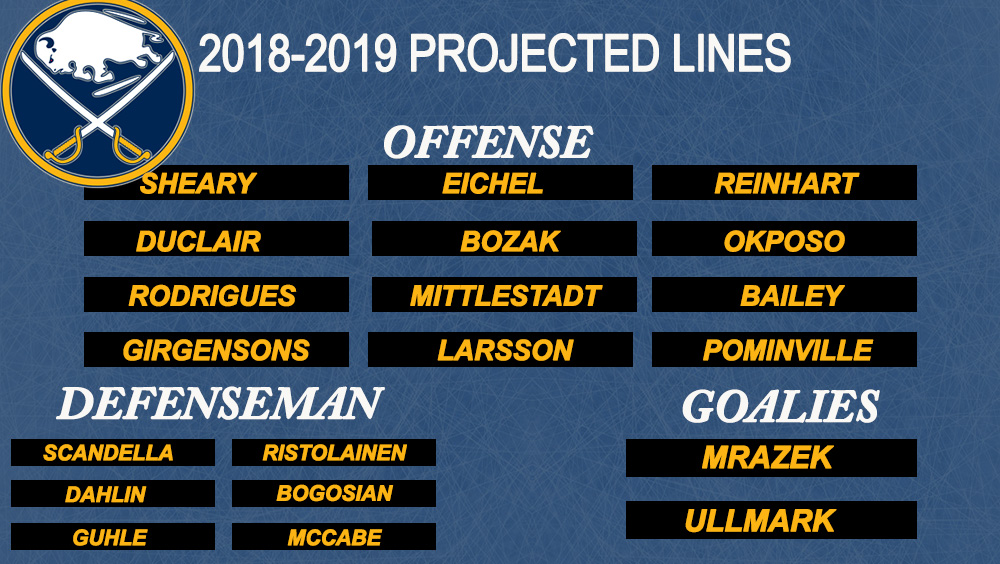
  • Dahlin, Now What? Projected Lines and Free Agent Targets

    Dahlin, Now What? Projected Lines and Free Agent Targets

    The Buffalo Sabres were the lucky team that got to draft franchise-changing defenseman Rasmus Dahlin with the first-overall pick. He automatically improves the team before stepping on the ice for his first NHL game.

    But, the Sabres – a team that was dead-last in the league in three out of the last five seasons – need more than just Dahlin to turn the ship around . They need to keep improving through trades like the one GM Jason Botterill made with the Pittsburgh Penguins for Conor Sheary and Matt Hunwick in exchange for a conditional 4th round pick.

    Sheary, the major point of the trade, has had some solid years playing alongside one of the league’s best players in Sidney Crosby. In the 2016-17 season that saw him spend extended time on Pittsburgh’s top line, Sheary posted 23-30-53 totals, but those numbers dipped to 18 goals, 12 assists and 30 points last year while he floated between the top-three units.

    The belief in Buffalo is that Sheary has the pace to skate with Jack Eichel, so he could be first-line LW this coming season.

    Free agency is another way for Botterill to strengthen this team. The Sabres have roughly $18 million in cap space.

    Now time to have some fun and share my projected lines for the upcoming season.

    LW2

    The left wing is a major void on the Sabres’ roster. Botterill tried to fill that void by acquiring Sheary, but there is still a decent hole in the left wing that they need to figure out.

    In the System

    If the hole can be filled from within the organization, they will do it. There are two names that stand a chance for me in this position: C.J. Smith and Victor Olofsson.

    Smith had a great rookie season down in the AHL, registering 17-27-44 marks with the Rochester Americans. In fact, his campaign was so good, he would’ve been a favorite for the American League’s Rookie of the Year if he hadn’t gotten hurt and missed a couple months.

    Meanwhile, Olofsson led the SHL in goals this past season as a 22-year-old. He has one of the best shots in the system, and the Sabres hope it can translate into the NHL.

    Honorable mention: If Alexander Nylander has a good camp and preseason, he stands a chance for the spot. His style seems to fit the NHL more than AHL as proven in his couple games last season in the blue and gold.

    Free Agents

    Now to show my cards before I get into free agents: I hate overpaying guys on July 1 and weigh risk and reward more than anything.

    Anthony Duclair is one of my ideal targets. He has to prove himself with his next contract/organization or he will be AHL-bound. Last season, he put up 11 goals and 12 assists between Chicago and Arizona.

    Tobias Rieder is a fast-paced winger who could add speed to a very slow Buffalo Sabres team. He didn’t have very good numbers last year, with 12 goals and 13 assists again between two organizations (Arizona and LA).

    Matthew Peca, formerly of the Tampa Bay Lightning, never got a chance to be a regular with the Bolts as they are a loaded organization at wing. He posted 2 goals and 3 assist in 10 games played.

    All of these guys won’t require big contracts, but if they work out, Botterill would look like a genius for finding a gem.

    C2

    The second-line center only becomes available if Ryan O’Reilly gets traded. There is a lot of speculation around him being moved, but the Sabres could move him and bump Casey Mittelstadt to the second-line if they feel he is ready. Other than him, Buffalo doesn’t have anyone ready for their second-line center position.

    Free Agents

    The three names I like for this position are Tyler Bozak, Paul Stastny and Derek Ryan.

    I have said many times that if the Sabres trade O’Reilly, Bozak could be a good replacement. Bozak and Ryan are players you use as the second-line center for half the season until Mittlestadt is ready to take over that role.

    Stastny is a little different: if the Sabres overpay Stastny, which they would to land him, then he becomes theirr second-line center for a couple years.

    Stat line comparison:

    Stastny  16 G 37 A 53 P

    Ryan 15 G 23 A 38 P

    Bozak 11 G 31 A 42 P

    RW3

    Within the organization, this position is the total opposite of second-line center. The Sabres have this player in the system and don’t need to waste money on a free agent.

    This position is either Justin Bailey‘s or Nicholas Baptiste‘s. Both guys have been trying to become NHL regulars and this is the season to do it. I favor Bailey over Baptiste, but I think either player complements Evan Rodrigues and Mittelstadt well and the pace of this line will be fun to watch night in and out.

    G1

    It was no surprise to see Robin Lehner not get qualified after another poor year in the crease. Botterill says Ullmark will start off the season as the number two goalie. So, who’s the number one?

    Free Agents

    I feel goaltending this offseason is horrible as a whole; every team needed to land one of three goalies: Carter Hutton, Jonathan Bernier or Petr Mrazek. All three have had a lot of interest and I feel Hutton and Bernier will get overpaid. I also find it hard to believe two players from good teams last year would want to sign with the last-place team in the league.

    So that leaves me with Mrazek, and I feel it’s not a bad thing. Mrazek posted a 14-13-6 record between Detroit and Philadelphia with a 0.902 save percentage and 3.03 goals against average. Ullmark will take the number one spot from him halfway through the year and, if all goes well, he won’t lose it from there.

    Next Year

    Ideally, this is how I hope the Sabres’ lineup opening night against the Bruins. 

  • 2018 Offseason Preview: Winnipeg Jets

    Our offseason previews for all 31 National Hockey League teams continues with the Winnipeg Jets and their outlook for the summer.

    jetslogo

    The Winnipeg Jets soared high in 2017-18, amassing 114 points on the season with a–franchise best– 52-20-10 record to finish 2nd in the Central Division and 2nd in the Western Conference (both in the regular season and postseason, by virtue of having been eliminated by the Vegas Golden Knights in the Western Conference Final).

    General Manager Kevin Cheveldayoff went all-in on a potential Stanley Cup run at the trade deadline, acquiring Paul Stastny from the St. Louis Blues in exchange for Winnipeg’s 2018 first round pick and prospect, Erik Foley.

    Blake Wheeler, Patrik Laine and Dustin Byfuglien were great at their positions as always, while Connor Hellebuyck backstopped the team to glory. Meanwhile, Kyle Connor had one of the quietest sensational rookie seasons in recent memory, scoring 31 goals and 26 assists (57 points) in 76 games played.

    Things are only looking up for the Jets despite their Western Conference Final defeat in five games to the expansion Golden Knights.

    Both Winnipeg and Vegas were dominant teams in the West and if one of them hadn’t made the Stanley Cup Final, the Nashville Predators probably would have, but the Jets defeated the Preds in seven games in the Second Round after easily finishing off the Minnesota Wild in five games in the First Round.

    Paul Maurice got to the Conference Finals for the first time since 2002 as a member of the Carolina Hurricanes head coach, while the Jets made the third round for the first time in franchise history dating back to their days as the Atlanta Thrashers (R.I.P.).

    2018 NHL Entry Draft

    Winnipeg doesn’t have a selection in the first round currently, thanks to Cheveldayoff’s deadline acquisition bargain hunting.

    It’s not entirely clear if the Jets will take a stab at jumping into the first round, but at least they’ve got some pretty sweet third jerseys finally coming along seven years into their tenure at Bell MTS Place since relocating from Atlanta.

    Nic Petan, as always, is on the trade bait list and could yield the club a first round pick as part of a return on a transaction.

    Pending free agents

    The Jets have almost $20.600 million to spend on free agents this summer with their captain, Blake Wheeler, ($5.600 million cap hit) and young superstar, Patrik Laine, ($925,000 cap hit– final year of his entry-level deal) entering contract years.

    In other words, next summer is going to be expensive.

    Winnipeg has three pending-UFAs in Shawn Matthias, Matt Hendricks and Paul Stastny.

    Matthias, 30, had one goal and two assists (three points) in 27 games, while Hendricks, 37, had 5-8–13 totals in 60 games this season. Neither of them have to be brought back for the Jets to remain a contender in the Central Division, but what Cheveldayoff does with Stastny could mean a world of a difference.

    Stastny, 32, had clear chemistry with his teammates in Winnipeg from the moment he was on the ice with them, right through the postseason. He’s such a great playmaker and dependable on the faceoff dot that it only makes sense you’d let him be the one feeding Wheeler and Laine for as long as you can.

    In 82 games with the Jets and Blues, Stastny had 16 goals and 37 assists (53 points). He then went on to have 6-9–15 totals in 17 postseason games. Re-sign him.

    Winnipeg has a lot of cap space and a plethora of pending-RFAs to re-sign or let go.

    Brandon Tanev, Joel Armia, Marko Dano and Adam Lowry all need new deals and contributed in some way to the club’s deep playoff run.

    Tanev, 26, is a solid bottom-six forward. Armia, 25, goes hand-in-hand with the rest of the glue guys. Meanwhile, Dano, 23, and Lowry, 25, have made a case for one to be preserved over the other (it’s Lowry, obviously).

    On defense, Toby Enstrom, 33, already knows he’ll be hitting the waters of the open market as he has both price himself out of a Jets jersey and been bumped out of contention for ice-time with the likes of Byfuglien, Tyler Myers, Dmitry Kulikov and Ben Chiarot holding down the fort.

    What’s that? I didn’t even mention Jacob Trouba, Tucker Poolman, Joe Morrow or Josh Morrissey? Well, that’s because they’re all pending-RFAs.

    24-year-old Jacob Trouba’s bridge-deal is expiring and he’ll need a raise. Poolman, 25, emerged as a top-6 quality defender. Morrow, 25, was acquired at the deadline from the Montreal Canadiens and should return as a top-6 guy that came in clutch under Maurice’s instructions.

    Morrow was never really utilized under Claude Julien in Montreal and Boston. Prior to that he was a journeyman from the Dallas Stars and Pittsburgh Penguins (where he was originally drafted). Winnipeg seems like it should be home for the 25-year-old blueliner.

    Make of Morrissey what you will, but the 23-year-old defender had 26 points this season setting career highs in goals (7), assists (19) and points (26). He’ll be sticking around.

    The real problem with Winnipeg is what they’re going to have to do with their goaltenders.

    Starter, Connor Hellebuyck, is a pending-RFA. The 25-year-old solidified his status as a clear number one goaltender with a cut above the rest in the league, winning 44 games out of 67 appearances this season. He had a 2.36 goals against average and .924 save percentage.

    Hellebuyck’s earned a raise, but the only problem is it leaves the Jets paying 30-year-old, Steve Mason, his $4.100 million cap hit in his final year of his two-year deal. In 13 games as a backup, he wasn’t great, amassing a 3.24 GAA and .906 SV%. Good luck trying to convince a team to take on his contract at full value.

    Cheveldayoff will likely have to ship Mason out while retaining close to 50% of his remaining salary (the maximum allowed per the collective bargaining agreement).

    28-year-old, Michael Hutchinson, in the meantime is a pending-UFA and regressed in 2017-18. Though he only played in three games, Hutchinson had a 3.26 GAA and .907 SV%.

    For much less than Mason, Hutchinson could rebound back to a goals against average under 3.00, which is the least you expect from a backup– anything between 2.50 and 3.00 is right on target, anything better than 2.50 is godlike (for a backup) and anything over 3.00 is usually a poor investment in an easily overlooked position.

    Sure, Eric Comrie is developing in the system, but wait, he’s a pending-RFA this summer too.

    Winnipeg looks like they finally have this goaltending thing figured out, but Cheveldayoff cannot afford to mess any part of it up or else he risks long-term success, a la the Ondrej Pavelec saga from Atlanta to Winnipeg until Hellebuyck and Hutchinson overtook him.

    Buyouts on the books: Mark Stuart at $583,333 through the end of 2018-19.

    Other pending free agents throughout the organization include:

    Buddy Robinson (UFA), Michael Sgarbossa (UFA), Chase De Leo (RFA), Jamie Phillips (RFA), Cameron Schilling (UFA), Jan Kostalek (RFA), James Lodge (RFA), Eric Comrie (RFA), Nic Petan (RFA), JC Lipon (RFA), Julian Melchiori (UFA)

  • 2018 Offseason Preview: St. Louis Blues

    Our offseason previews for all 31 National Hockey League teams continues with the St. Louis Blues and their outlook for the summer.

    imgres-1

    One game. One game made all the difference for the St. Louis Blues in making or missing the 2018 Stanley Cup Playoffs and you’ll never guess what happened.

    They lost.

    Yes, after compiling a 44-31-6 record, the Blues were ahead of the Colorado Avalanche by one point in the wild card race to secure the last spot in the postseason.

    Despite a season-long lackluster performance in goal from Jake Allen (a career worst 2.75 goals against average and second worst .906 save percentage in 59 games played), St. Louis needed a win in any fashion in the final game of the regular season against the Avs to go up against the Nashville Predators in the First Round.

    Instead, the club finished 44-32-6 on the season with 94 points– one point out of the wild card spot– and 5th in the Central Division.

    Mike Yeo missed the playoffs in his first year as head coach of the Blues without any assistance from Ken Hitchcock and General Manager Doug Armstrong was left scratching his head.

    2018 NHL Entry Draft

    Fans were left scratching their heads after Armstrong traded hometown hero Paul Stastny to the Winnipeg Jets in a surprise move at the trade deadline in exchange for a 2018 first round pick (29th overall) and prospect Erik Foley.

    Stastny’s dad, Peter– the famous Québec Nordique– was left stunned.

    Armstrong replaced the first round pick that he swapped with the Philadelphia Flyers at the 2017 Draft as part of the Jori Lehtera, a 2017 first round pick and a conditional 2018 first round pick for Brayden Schenn transaction, but at the cost of one of the better faceoff-winning centers in the league.

    With the 29th overall selection in this year’s draft, Armstrong will be left picking the best available or surprising everyone– yet again– and going off the board.

    Hopefully for the better, considering the organization is teetering on the edge of a retooling/rebuild.

    Pending free agents

    What else is there to expect from a front office that’s had to move Kevin Shattenkirk and T.J. Oshie, while letting David Backes walk in free agency in years past, thanks to a tight salary cap situation?

    Armstrong can make some sweeping changes by figuring out the future of St. Louis’s crease protection plan (more on that later), but he can also restructure the team’s offensive outlook by ridding themselves of some underperforming second through fourth liners.

    Thankfully, the Blues have about $12.900 million to spend with the cap expected to rise this summer.

    That’s not a lot to work with, but it can bring in a difference maker, while still providing enough room to work a deal that might send Vladimir Sobotka and his $3.500 million cap hit through the 2019-20 season (or an equivalent) packing via a trade.

    Both pending unrestricted free agent forwards, Scottie Upshall and Kyle Brodziak are 34-years-old with one trending in opposite directions of the other.

    Upshall has loved St. Louis and its fans have responded in kind, but the time is now for the Blues to make a clean break in this relationship. He’s averaged 17 points over the last three seasons. That’s not great with an aging roster.

    Brodziak, on the other hand, has bounced back from shortened seasons due to injury and doubled his point total from 15 points (69 games played) in 2016-17 to 33 points (81 GP) this season.

    At first look, keeping a 34-year-old that was trending in the wrong direction when he came to St. Louis in 2015-16 isn’t great, but Brodziak is proving people wrong as part of a comeback tour with the Blues (albeit lasting three seasons). If you don’t re-sign Upshall, you can at least afford to bring back Brodziak.

    But we’ll see what kind of logic Armstrong is working with this offseason.

    Then there’s pending restricted free agent forwards, Robby Fabbri, Dmitrij Jaskin, Oskar Sundqvist and Nikita Soshnikov.

    Fabbri, 22, had 11-18–29 totals in 51 GP, down from his 18-19–37 totals in 72 games in 2016-17. That’s still respectable as a bottom-six forward, however.

    Jaskin, 25, had six more points this season in 25 more games played than in 2016-17. That means he had 17 points in 76 GP this season and 11 points in 51 GP last season. The Blues can move on if they’d like.

    Sundqvist, 24, was acquired last June along with a first round pick as part of the Ryan Reaves trade and had one goal and four assists (five points) in 42 games for St. Louis this season. That’s not great, but he finally played the most games he’s ever seen in one season, since breaking into the NHL in 2015-16 with the Pittsburgh Penguins.

    Soshnikov, 24, had one goal and one assist (two points) in 12 games with the Blues after being acquired in a trade with the Toronto Maple Leafs. He also had no points in three games with Toronto this season and has 8-8–16 totals in 82 career NHL games since 2015-16.

    Unless Yeo can perform a miracle as a head coach, there’s no point in seeing if anything’s left in the potential tank.

    The Blues have two pending-RFA defenders in Jordan Schmaltz and Joel Edmundson. Both are 24-years-old.

    Schmaltz had one assist in 13 games this season. He clearly isn’t part of St. Louis’s current plan, leaving one of two options– stick around as a depth blueliner or not return.

    Edmundson set a career-high in goals (7) and points (17) in 69 games played this season. Nice. He’s a top-six defender and should see another year or two in a sweater with a giant blue music note on it.

    If anyone’s willing to take on all or some of Jay Bouwmeester‘s $5.400 million cap hit with one year remaining– provided the 34-year-old defenseman waives his no-trade-clause– then St. Louis should pursue that avenue.

    Okay, now for the future of St. Louis’s goaltending.

    Jordan Binnington, 24, is a pending-RFA and should get a chance at the NHL level.

    Then again, Carter Hutton, 32, is a pending-UFA and outplayed the 27-year-old starter, Jake Allen at times this season.

    If St. Louis is fine staying the course as a middle of the road team that’ll come up short for a year or two, then there’s no need to worry and Hutton should be re-signed and see more time in net to offset Allen’s workload.

    But if any of that clashes with what Armstrong and the rest of his front office envisions for the club, well… that’s the million dollar question.

    A rebuild is not out of the question, but certainly frowned upon, given how star-forward, Vladimir Tarasenko is in his prime now.

    Other pending free agents throughout the organization include:

    Justin Selman (RFA), Beau Bennett (RFA), Mackenzie MacEachern (RFA), Thomas Vannelli (RFA), Jordan Binnington (RFA), Petteri Lindbohm (RFA), Wade Megan (UFA)

  • Down the Frozen River Podcast #107- Stanley Cup Final Preview (Not Live in Vegas)

    Down the Frozen River Podcast #107- Stanley Cup Final Preview (Not Live in Vegas)

    Nick and Connor contemplate going to Vegas in addition to a complete breakdown, preview and predictions for the 2018 Stanley Cup Final.

    Subscribe to the podcast on Apple Podcasts (iTunes) and/or on Stitcher.

  • Jets land Golden Knights a loss in WCF Game 1

    vegas_golden_knights_logojetslogo


    Three unanswered goals almost eight minutes into the first period held up over the rest of the game, Saturday night at Bell MTS Place as the Winnipeg Jets beat the Vegas Golden Knights 4-2 in Game 1 of the 2018 Western Conference Final.

    Connor Hellebuyck made 19 saves on 21 shots faced for a .905 save percentage in the win for the Jets, while Marc-Andre Fleury stopped 22 shots out of 26 shots against for an .846 SV% in 57:21 time on ice in the loss for Vegas.

    It didn’t take long for Winnipeg’s home-ice advantage to kick in as Dustin Byfuglien (5) blasted a slap shot past Fleury 65 seconds into the action Saturday night, giving the Jets a 1-0 lead.

    Mark Scheifele (6) and Blake Wheeler (13) had the assists on the goal that was made possible thanks to a turnover in Vegas’s attacking zone.

    Not long after, Alex Tuch took the game’s first penalty— a minor for hooking Winnipeg’s Bryan Little— and the Golden Knights found themselves shorthanded against one of the best power play units in this postseason.

    Wheeler worked a cross-ice pass through the low slot to Patrik Laine on the ensuing player advantage and Laine (4) promptly sent a one-timer past Fleury to give the Jets a two-goal lead. Wheeler (14) and Paul Stastny (9) had the assists on the goal at 6:49 of the first period and Winnipeg led, 2-0.

    Less than a minute later, the Jets worked another one past the Vegas netminder on a deflection thanks to the skates of Joel Armia (2).

    Though the goal was originally waved off, after review (courtesy of a coach’s challenge) it was determined there was no goaltender interference and the call on the ice was overturned. In the eyes of the situation room, Armia had not entered the crease and interfered with Fleury’s ability to make a save too close to receiving/deflecting the puck anyway, despite the fact that Armia had bumped into the Golden Knights goalie prior to scoring.

    Nevertheless, Ben Chiarot (3) had the only assist on the goal and the Jets led, 3-0, at 7:35 of the first period.

    Fleury and the Golden Knights had allowed three goals on eight shots against in less than eight minutes into the action.

    Despite this, Vegas was determined to get one of their own past Hellebuyck and begin the slow climb back on the scoreboard.

    Jonathan Marchessault worked the puck from behind the goal line back to Brayden McNabb (2) as the Vegas blueliner snuck in the attacking zone on a delayed call against the Jets. McNabb quickly fired a shot that deflected off of Winnipeg rookie Kyle Connor’s stick and behind Hellebuyck, high-glove side.

    The Golden Knights cut the lead to two and Marchessault (8) and Reilly Smith (11) notched the assists on McNabb’s goal at 8:10 of the first period. Winnipeg led, 3-1, and the home crowd was unfazed.

    In fact, Jets fans continued taunting Fleury with Bronx cheers for every save and the introduction of the phrase “we want Subban” (as in, Golden Knights backup goaltender, Malcolm Subban) to their lexicon.

    Winnipeg’s captain, Blake Wheeler, however, took a trip into the away bench on a hit delivered from Golden Knights tough guy, Ryan Reaves. Vegas, to their credit, did help Wheeler get back on his feet after flipping head first over the boards.

    Past the halfway mark in the first period, Erik Haula slashed Laine and the Jets went on their second power play of the night. It was not as successful as their first man advantage of the game and the Golden Knights generated a couple quality shorthanded scoring chances.

    Jets defender, Jacob Trouba, interfered with Tuch at 16:51 of the first period and the Golden Knights went on the power play for the first time, but did not convert on the ensuing advantage.

    After one period, Winnipeg led, 3-1, on the scoreboard and 2:1 in shots on goal (12-6). Both teams had blocked five shots each, while Vegas had an advantage in hits (18-13) and Winnipeg led in takeaways (3-0), giveaways (7-5) and faceoff win percentage (72-28). The Golden Knights were 0/1 on the power play and the Jets were 1/2 on the advantage after 20 minutes of play.

    Four players took matching minor penalties for roughing just over five minutes into the second period as things heated up on the ice after the whistle. Colin Miller, Oscar Lindberg, Mathieu Perreault and Brandon Tanev each went to the sin bin for their respective sides and play remained even at 5-on-5.

    McNabb hooked Wheeler on a breakaway at 9:10 of the second period as Wheeler shot the puck wide through the crease while Fleury was in desperation save mode.

    The Jets didn’t waste much time on the player advantage before converting as it only took 44 seconds for Scheifele (12) to redirect a shot from the point by Byfuglien past Fleury to make it a three-goal game.

    Scheifele’s goal on the power play came at 9:54 of the second period and made it, 4-1, Winnipeg. Byfuglien (10) and Wheeler (15) had the assists, capping off a three-assist night for Wheeler.

    Late in the period, Chiarot tripped James Neal and the Golden Knights went on the power play with just under five minutes to go until the second intermission.

    William Karlsson (5) redirected a pass from Marchessault into the twine and cut the lead to two at 15:55 of the second period. Marchessault (9) and Shea Theodore (4) notched the assists on the power play goal for Vegas that made it, 4-2.

    Through 40 minutes of play, the Jets were in control, 4-2, on the scoreboard and, 22-13, in shots on goal. Winnipeg also led in blocked shots (13-7), hits (27-25), takeaways (8-1), giveaways (10-9) and faceoff win percentage (62-38). The Golden Knights were 1/2 on the power play while Winnipeg was 2/3 on the man advantage after two periods.

    Reaves tripped Adam Lowry early in the third period, but the Jets did not convert on the ensuing advantage in the only penalty called in the game’s final frame.

    Neither team found the back of the twine as the Golden Knights frantically searched for a way to score two goals to tie the game, having pulled their goaltender with about 2:35 remaining in regulation.

    Gerard Gallant used his team’s only timeout at the next stoppage in play to try to draw up a plan, but Vegas’s best efforts were no match for Paul Maurice’s Winnipeg Jets, despite Winnipeg’s inability to land a shot in the empty net.

    At the final horn the Jets had won, 4-2, and jumped out to a 1-0 series lead in sheer dominance in Game 1 of the Western Conference Final.

    Winnipeg finished the night leading in shots on goal (26-21), blocked shots (22-10), hits (33-30), giveaways (14-11), and faceoff win percentage (56-44). Both teams went .500 on the power play as the Jets went 2/4 and Vegas went 1/2 on the man advantage.

    Game 2 is Monday night in Winnipeg, where the Bell MTS Centre crowd looks to energize their team to a 2-0 series lead. Puck drop is set for a little after 8:00 p.m. ET and viewers in the United States can tune in on NBCSN, while fans in Canada can catch the action on CBC, SN or TVAS.

  • Jettisoned: Predators bow out in Game 7, Jets punch Conference Finals ticket


    Well there you have it, folks. The second round of the 2018 Stanley Cup Playoffs has come to a close with an almost-fitting end to the series that played out exactly how we thought it would without ever really playing out how we thought it would.

    Perhaps the most hyped matchup of the postseason, it was nearly-universally agreed upon that Winnipeg/Nashville would go seven games, but how we got there was anything but predictable. A seven-game series that saw only two games end in one-goal margins (those in fact being the only games that ended with a margin of less than three tallies) and was more a story of attack/counter-attack. Nearly every game swung wildly to one team’s favor, usually on the back of explosive starts that took the wind out of the sails of the opponent before they knew what had happened.

    Game 4 was a tight 2-1 affair, though hardly memorable on the back of a 7-4 gongshow victory in Game 3 for Winnipeg on home ice. Game 1 and Games 5-7 were all complete visiting team dominations silencing notoriously loud buildings. Game 2 was really our only look at what many expected from this series, with Nashville grabbing a thrilling 5-4 victory in double-overtime on home ice.

    But since we’re here, let’s take a look at how this strange series came to a close.

    Winnipeg controlled things early, hemming Nashville on their own side of center ice for most of the opening minutes. The Predators looked to be skating in deep sand, oftentimes unable to advance the puck forward at all, thanks to a stifling forecheck from the Jets and some careless puck control of their own doing. Surely, though, Pekka Rinne would be able to help his team survive the early problems and gain their footing…

    Then Tyler Myers sent up a prayer from below the goal line to Rinne’s left that deflected into the net off of the stunned Nashville netminder, and just like that we had a 1-0 game 8:41 into the first period. But, again, no problem. We’re less than halfway through the first period, it’s just a one-goal deficit, Rinne will obviously shake this one off and…

    2:06 later Rinne inexplicably abandons the near post after stopping a Paul Stastny stuff attempt, the rebound landing right back on his blade for him to chip over the pad and into the net for a Charmin Ultra-Soft 2-0 goal. Has anyone seen the wheels for this bus lately? We seem to have misplaced them.

    Peter Laviolette, either wishing to settle things down without wasting a precious timeout, or knowing enough about his goaltender’s complete inability to recover from shaky starts in playoff games to realize that this ship needed immediate abandoning (third pull in the series for Rinne, you be the judge), yanked the big Finn in favor of the little Finn, inserting Juuse Saros into the net for the remainder of the game.

    To their credit, the Predators responded to the move by finally picking up their game. P.K. Subban first drew a penalty, then fired a one-time Howitzer off the post and in on the resulting power play, bringing his team back within one with just over four minutes to play in the first.

    Unfortunately for Nashville, this only seemed to fire up the opposition, with the Winnipeg defense vacuum-sealing their end from that point on, and Connor Hellebuyck dispelling any further offensive chances that came his way. The two goaltenders spent the next 20+ minutes countering everything thrown their way (which admittedly was not a lot as the two teams were basically stuck in a neutral zone traffic jam).

    Late in the second period the Jets grabbed the momentum back when Blake Wheeler jumped on a turnover (a theme in this one, with the Predators committing 24 vs Winnipeg’s paltry 10) and hung Subban out to dry in no man’s land, sending a pass over to Scheifele who quickly lifted one over the shoulder of Saros to regain the two-goal lead with 2:10 left to play in the second frame.

    The second period was really the finest display of a brilliant tactic Winnipeg utilized all night long, essentially using their team speed to actually slow the game down. No matter what Nashville tried to do, every puck carrier was instantly met by at least one, often multiple Jets. Passing lanes were non-existent due to some incredible defensive stickwork, and even when there appeared to be open space, it would close up immediately, leaving the Predators dumbfounded, and holding them to just six shots in the second period.

    The Preds did gain some offensive traction in the third, but Hellebuyck always had the answer and the defense in front of him made sure he had a clear line of sight to every shot and limited follow-up opportunities for anything that their goaltender didn’t manage to grab onto. Of note, Dustin Byfuglien played a lights-out game defensively, basically making it impossible for any Predators player to get to the front of the net to set up screens. Toby Enstrom was also stellar, making countless beautiful stick and positioning plays throughout the night to break up some of the few rushes Nashville was able to start.

    Nashville fought and clawed for every chance all throughout the third period, but their efforts came to a screeching halt at the 11:59 mark when Paul Stastny tallied his second goal of the game on Winnipeg’s lone power play of the night, banging home the rebound from a Laine blast before Saros could close down the five hole. That was Stastny’s fifth goal of this series, continuing a terrific playoff run for the deadline acquisition (lol remember that time the Blues traded him to the Jets for a lottery-protected first round pick?).

    Mark Scheifele would add the 5-1 empty netter to tally his league-leading 11th goal of the playoffs with 2:33 remaining, but even with the extra man on the ice the Predators were just lost trying to find the answer to Winnipeg’s flawless defensive scheme.

    So Winnipeg takes the series largely on the strength of winning three-of-four games in Nashville, all by convincing scores (4-1, 6-2, 5-1), and move on to face probably the only team in the Western Conference that can match their speed, the ‘Remember when we didn’t exist last year?’ Vegas Golden Knights in the Conference Finals. Game 1 of that series comes to you this Saturday night (May 12th) at 7 p.m. ET with DTFR recap coverage brought to you by @nlanciani53.

  • Down the Frozen River Podcast #105- Lateral Postseason

    Down the Frozen River Podcast #105- Lateral Postseason

    Nick and Connor roadmap the offseason for Pittsburgh and Boston, figure out why Washington has been so good (and Tampa), pick a winner in tonight’s Game 7 (WPG @ NSH) and explain how Vegas is going to win the Cup in their inaugural season. Also discussed, Jim Montgomery, Rod Brind’Amour, Don Waddell, the Charlotte Checkers (so Carolina as a whole) and Mark Hamill.

    Subscribe to the podcast on Apple Podcasts (iTunes) and/or on Stitcher.