Tag: Pacific Division

  • Bruins beat Sharks in first meeting in almost two years

    Bruins beat Sharks in first meeting in almost two years

    Jake DeBrusk’s second period goal proved to be the game-winner as the Boston Bruins withstood a third period surge and held off the San Jose Sharks in a, 4-3, victory at TD Garden on Sunday afternoon.

    Linus Ullmark (2-0-0, 2.00 goals-against average, .935 save percentage in two games played) turned aside 23 out of 26 shots against in the win for the Bruins.

    Meanwhile, Adin Hill (3-1-0, 2.93 goals-against average, .890 save percentage in four games played) and James Reimer (1-0-0, 0.65 goals-against average, .980 save percentage in two games played) split the effort in the loss for the Sharks.

    Hill made 10 saves on 14 shots faced for a .714 save percentage in 25:41 time on ice before he was replaced by Reimer, who stopped all 20 shots against in relief.

    Boston improved to 3-1-0 (six points) on the season and– at the time of this writing– moved into 3rd place in the Atlantic Division, while San Jose dropped to 4-1-0 (eight points) overall and remained in command of 2nd place in the Pacific Division standings.

    The B’s also improved to 2-0-0 at home this season, as well as 25-12-5-0 all time against the Sharks in 42 regular season meetings.

    The Bruins were without the services of Curtis Lazar (upper body), Nick Foligno (upper body), Anton Blidh (upper body) and Craig Smith (undisclosed) on Sunday afternoon.

    Foligno was placed on injured reserve, while Jack Studnicka and Oskar Steen were recalled from the Providence Bruins (AHL). Veteran defender, John Moore, was assigned to Providence as a result.

    B’s head coach, Bruce Cassidy, told reporters prior to Sunday’s matinee with San Jose that Foligno and Blidh are unlikely to play in the team’s upcoming road trip on Wednesday and Thursday.

    As a result of the recent rash of injuries, Cassidy continued to tweak to his lineup, promoting Tomáš Nosek to center the second line and sliding Charlie Coyle to the right wing in place of Smith as a result.

    Cassidy inserted Steen on the third line in Nosek’s usual spot and returned Trent Frederic to the fourth line left wing with Studnicka at center and Karson Kuhlman on the right wing.

    On defense, Connor Clifton returned to his spot on the third pairing alongside Derek Forbort with Moore assigned to Providence.

    Jakub Zboril was the only healthy scratch on Sunday.

    It only took 28 seconds into the action on Sunday afternoon for David Pastrnak to work the puck to Patrice Bergeron through the trapezoid behind the net before Bergeron found Brad Marchand (4) in the high slot for a catch and release goal to give the Bruins a, 1-0, lead.

    Bergeron (2) and Pastrnak (3) notched the assists on Marchand’s goal as Boston got off to a fast start in the first period.

    Less than a few minutes later, Clifton worked the puck to Marchand, who sent the rubber biscuit along the point to Forbort (1) for a wrist shot that floated past Hill’s blocker side as a Sharks defender partially screened his own goaltender– extending Boston’s lead to two-goals in the process.

    Marchand (3) and Clifton (1) had the assists on Forbort’s first goal in a Bruins uniform and the B’s led, 2-0, at 3:18 of the first period.

    Almost midway through the opening frame, Nosek tripped up Tomáš Hertl and cut a rut to the penalty box with a minor infraction at 9:44.

    San Jose’s power play, however, could not convert on the skater advantage.

    The Sharks got another chance on the power play moments later when Charlie McAvoy caught Logan Couture with a high stick at 13:01, but once again Boston’s penalty kill stood tall as Ullmark kept the puck out of the back of the net.

    Shortly after killing off McAvoy’s minor, Brent Burns knocked down Taylor Hall away from the puck and was assessed and interference minor at 15:59– presenting the Bruins with their first power play of the afternoon as a result.

    It didn’t take long for Boston to capitalize on the ensuing skater advantage as Bergeron rang a shot off the crossbar before setting up Pastrnak (2) for one of his trademark one-timer power-play goals from the faceoff circle– right above the dot– to give the Bruins a three-goal lead.

    Bergeron (3) had the only assist on Pastrnak’s goal as the B’s extended their lead, 3-0, at 16:12 of the first period.

    Less than a minute later, however, San Jose got on the scoreboard with a quick break into the attacking zone and a little bit of a give-and-go that resulted in a short side goal for Jasper Weatherby (2) to cut Boston’s lead back to two-goals.

    Jonah Gadjovich (1) and Andrew Cogliano (2) tabbed the assists on Weatherby’s goal at 16:44. With the primary assist, Gadjovich recorded his first career National Hockey League point in his second career game (Gadjovich made his season debut with the Sharks on Sunday and appeared in one game last season for the Vancouver Canucks).

    After one period of action, the Bruins led the Sharks, 3-1, on the scoreboard despite both teams amassing 11 shots on goal each.

    Boston also held the advantage in blocked shots (10-2), while San Jose led the way in takeaways (3-1), giveaways (4-3), hits (13-7) and faceoff win percentage (58-42).

    The Sharks were 0/2 and the Bruins were 1/1 on the power play heading into the first intermission.

    Early in the middle frame, Forbort sent Steen up through the neutral zone on a rush with DeBrusk before Steen bounced an indirect pass to DeBrusk off the boards.

    DeBrusk (2) entered the attacking zone and wired a shot over Hill’s glove to put Boston ahead by three goals once more, 4-1, at 5:41 of the second period.

    Steen (1) and Forbort (1) recorded the assists, marking the first career NHL point for Steen and the first assist as a Bruin for Forbort in the process.

    Sharks head coach, Bob Boughner, replaced Hill with Reimer as a result of DeBrusk’s goal and tried to spur momentum in San Jose’s favor as a result of the goalie change.

    Late in the period, Nick Bonino and Clifton exchanged pleasantries in a post-whistle scrum that resulted in minor penalties for roughing for each player as well as an addition two minutes for slashing for Bonino at 17:29.

    As a result, the Bruins finished off most of the rest of the second period on the power play, though they couldn’t muster anything past Reimer as the second intermission commenced.

    Through 40 minutes of action, the B’s led, 4-1, on the scoreboard and, 22-16, in shots on goal, including an, 11-5, advantage in the second period alone.

    Boston also held the advantage in blocked shots (12-6), while San Jose led in takeaways (8-5), giveaways (10-5), hits (20-13) and faceoff win% (53-48).

    The Sharks were still 0/2 on the power play, while the Bruins dropped to 1/2 on the skater advantage heading into the final frame.
    With tensions rising as the second period came to an end, Frederic and Jacob Middleton kicked things off in the third period with five-minute majors for fighting at 3:02 of the final frame in the first fight of the 2021-22 calendar for Boston.

    Less than a couple of minutes later, Mario Ferraro took an interference penalty at 5:48 of the third period, but the Bruins weren’t able to capitalize on the final power play of the afternoon.

    Midway through the third, the Sharks scored a pair of quick goals as Hertl (2) deflected a shot from Marc-Edouard Vlasic at the point amidst net front traffic to pull San Jose back to within two goals, 4-2, at 13:19.

    Vlasic (2) and Alexander Barabanov (1) tallied the assists on Hertl’s goal.

    Minutes later, Timo Meier (3) redirected a shot from Couture from outside the slot to bring the Sharks to a one-goal deficit, 4-3, at 15:08 of the third period.

    Couture (5) and Burns (4) had the assists on Meier’s goal which was reviewed for a high stick, but determined to be a good goal– the call on the ice was confirmed.

    Boston’s lead had shrunk to a close, 4-3, game in the dying minutes of Sunday’s action.

    Boughner pulled Reimer for an extra attacker with 1:45 remaining in the game and used his timeout with 1:02 left on the clock after a stoppage, but it wasn’t enough to rally his team to force overtime (at least) as the Bruins managed to hold off San Jose’s comeback.

    At the final horn, Boston had won, 4-3, and finished the afternoon leading in shots on goal, 34-26, including a, 12-10, advantage in the third period alone.

    The Bruins finished the afternoon leading in blocked shots (14-6) and faceoff win% (52-48), while the Sharks exited TD Garden with the advantage in giveaways (16-7) and hits (25-23).

    San Jose went 0/2 on the power play, while Boston went 1/3 on the skater advantage on Sunday.

    The B’s improved to 3-0-0 (2-0-0 at home) when scoring the game’s first goal, 3-0-0 (2-0-0 at home) when leading after the first period and 2-0-0 (1-0-0 at home) when leading after two periods this season.

    The Sharks dropped to 2-1-0 (1-1-0 on the road) when allowing the game’s first goal, 2-1-0 (1-1-0 on the road) when trailing after one period and 0-1-0 (0-1-0 on the road) when trailing after the second period in 2021-22 as a result of the loss.

    The Bruins hit the road for a pair of games against the Florida Panthers and Carolina Hurricanes at FLA Live Arena on Wednesday and PNC Arena on Thursday, respectively, before returning home to finish the month of October against the Panthers on Saturday (Oct. 30th).
  • Your Team Will Rise/Fail: 2021-22 Standings Projections

    It is time. The 2021-22 season is upon us.

    Technically it already started, but we’ll ignore the fact that the Pittsburgh Penguins spoiled the Tampa Bay Lightning’s 2021 Stanley Cup champion banner night with a, 6-2, victory on the road before the Vegas Golden Knights held off a Seattle Kraken comeback in a, 4-3, win at T-Mobile Arena on Tuesday night.

    And then Wednesday’s games happened too.

    Let’s hit the “reset” button for a second and pretend the 2021-22 is about to get underway. All 32 National Hockey League teams have a chance at clinching 16 available playoff berths.

    Any of the 16 teams that make the 2022 Stanley Cup Playoffs could etch 52 names from their roster, front office and organization on the Stanley Cup next June.

    The usual divisions– Atlantic, Central, Metropolitan and Pacific– have returned as have the Eastern Conference and Western Conference. The regular playoff format is back (three teams per division, two wild cards per conference qualify, plus the Conference Finals round returns in place of the Stanley Cup Semfinals in 2021).

    A full 82-game regular season schedule is slated from October through the end of April with a three-week break in February for the 2022 All Star Game in Las Vegas and the 2022 Winter Games taking precedence before a return to NHL action down the stretch with the postseason kicking off in May like last year and the 2022-23 season likely returning to the pre-pandemic timeline (2023 Stanley Cup Playoffs starting in April).

    The 2022 NHL Entry Draft will be in Montréal on July 7th and 8th, while free agency begins on July 13th, but between now and then, we’ve got the 2021-22 regular season to enjoy.

    Using last season’s team goals for and team goals against, plus some other “magic numbers” as part of an expected points model, we’re able to project what 2021-22 could be for all 32 teams (yes, even the Seattle Kraken, despite this year being their first season)– though you’ll have to pretend there were no transactions made in the offseason.

    In other words, don’t think that any of what you’re about to see is set in stone– view it more as a suggestion for a possible outcome.

    Also, please remember my degree is in communication, so any math beyond figuring out “goals + assists = season point totals” doesn’t exist.

    In a normal year (like from 2017-18 to 2018-19, for example), you just take all the data from the 82-game schedule for each team plug it into a formula in a spreadsheet, then line things up accordingly in each division.

    However, just like how the shortened 2019-20 season disrupted the regular process for projecting a 2020-21 standings outlook, going from last season’s stats in a 56-game schedule to projecting a regular 82-game season in 2021-22 necessitated the use of forecasting point pace as part of the formula.

    As for Seattle, a simple means of taking the NHL stats from last season for every player on their roster and plugging it in for a 2021-22 result is exactly what I did.

    We’re all just making it up as we go along, folks. These are projections. They are not absolutes.

    For the sake of keeping it simple, here’s a look at how things could go (but probably not) in each division for the upcoming 2021-22 season.

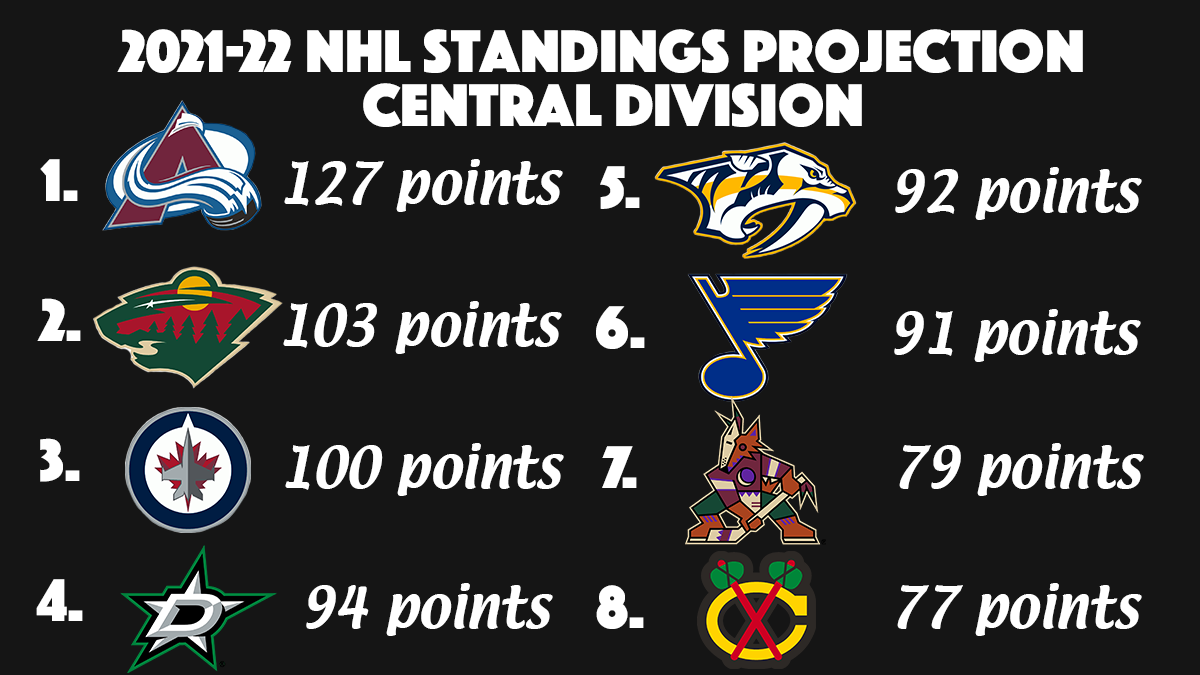
    The overall vibe of the Central Division for 2021-22 is that it’s just more of exactly what you’d expect. The Colorado Avalanche are lightyears ahead of everyone else, while Kirill Kaprizov and the Minnesota Wild continue to be on the rise and everyone else fights for what they can earn.

    Meanwhile, the jury is still out on whether or not the Winnipeg Jets can breakthrough as Canada’s team and break the Canadian curse (become the first Canadian club to win the Cup since 1993).

    Will Colorado finally break through the Second Round and win the Cup?

    Are the Avalanche just the Toronto Maple Leafs but with a little more success? My column:

    No, but really, it’s worth asking if the Avs making it back to the Western Conference Final for the first time since 2002, is more like Toronto’s struggle to make it out of the First Round for the first time since 2004, or is Colorado’s struggle more like the Washington Capitals pre-2018?

    The Caps won three Presidents’ Trophies in 2009-10, 2015-16 and 2016-17, but couldn’t make it past the Second Round– let alone the Pittsburgh Penguins– until they finally did and ended up surging in momentum all the way to their first Stanley Cup in franchise history.

    Colorado, on the other hand, has already won the Cup twice (1996 and 2001) and also has three Presidents’ Trophies to their name in 1996-97, 2000-01 and 2020-21, so if recent history has anything to tell us it’s that yet another team with high expectations for at least a few seasons now only to come up short could very well go on to win it all after winning the Presidents’ Trophy the previous year.

    Either that or they’ll have to win it in back-to-back seasons like Washington did before they won the Cup in 2018.

    Then again, the Tampa Bay Lightning tied the Detroit Red Wings’ record for most wins in the regular season (62), securing the Presidents’ Trophy in the process in 2018-19, then got swept by the Columbus Blue Jackets in the 2019 First Round.

    The very next year, however, Tampa kicked off back-to-back Cup rings in 2020 and 2021, to be where they are now as the two-time defending champions likely standing in the path as the only other favorites outside of the Avalanche this season.

    Anyway, the Avs mostly kept things the same from last season to this season, losing Joonas Donskoi to the Seattle Kraken in the 2021 NHL Expansion Draft, Brandon Saad to the St. Louis Blues in free agency and making minor swaps among replacement level bottom-six forwards and bottom-pairing defenders.

    Oh, then there’s this whole thing about how Philipp Grubauer left for Seattle in free agency too, so Colorado acquired Darcy Kuemper from the Arizona Coyotes.

    Between Dallas, Nashville and St. Louis, who will realistically make the playoffs?

    The Stars are projected to finish with about 94 points, the Predators sit at 92 points and the Blues are around 91 points in this one projection, but don’t let the points alone be your deciding factor.

    Given the strength of the Central Division compared to the Pacific Division, you can bet on five teams making out of the Central among Western Conference playoff berths.

    As such, the spread is the difference maker between these three teams expected to be in the wild card hunt– it’s going to come down to the wire one way or another.

    Dallas bolstered their goaltending depth by signing Braden Holtby, Nashville traded Ryan Ellis to the Philadelphia Flyers and St. Louis is… …better than last season on paper?

    I mean, the Blues signed Saad, acquired Pavel Buchnevich from the New York Rangers in exchange for Sammy Blais, let Seattle claim Vince Dunn at the expansion draft and let Mike Hoffman walk to the Montréal Canadiens in July.

    You could say they took a hit here or there, but those aren’t “nobody names” by any means, however.

    If Jordan Binnington and Ville Husso can stabilize things in the crease, then St. Louis has a better situation than the Predators.

    The Stars, meanwhile, should benefit from a longer season where more of their core guys– like Tyler Seguin, for example– are healthy. Last season’s COVID-19 outbreak to kick things off in January really killed Dallas’ momentum as a team on the verge of being in the 2021 postseason.

    Dallas should get back into the swing of things and St. Louis should be able to stay relevant for at least another year, but how hard the Preds rely on Juuse Saros as their starting goaltender will dictate whether or not they’re able to play spoiler with David Rittich as their backup since Pekka Rinne retired.

    Can Arizona avoid the basement?

    Anything is possible at this point. Loui Eriksson and Andrew Ladd were scoring goals in the postseason, so a fresh start could be just what both players needed for the last few years at least.

    That said, Coyotes General Manager, Bill Armstrong, gave a Masterclass™️ in how to go about rebuilding by selling everything over the summer and taking on “bad” contracts with only one or two years remaining in hopes of playing just well enough to be bad enough without making it look obvious that you’re aiming to win the 2022 NHL Draft Lottery.

    The Pacific Division is the new Scotia NHL North Division from last season. In other words, it’s the worst– which is great news for the Seattle Kraken as the league’s schedule allots more division play than any other opponents (though the Kraken will play every other team in the league at least twice).

    Seattle’s riding the waves of new-age expansion, while the Vegas Golden Knights lead the charge for the Presidents’ Trophy campaign in 2021-22.

    Wait, Seattle in 2nd in the Pacific, really?

    Yes, really.

    The Kraken have a great front office that goes beyond just Ron Francis as General Manager and have done their due diligence in scouting the best talent available to try to replicate the success of the Vegas Golden Knights’ inaugural season in 2017-18, as well as grow beyond just 2021-22.

    That said, Seattle probably isn’t going to make it out of the First Round of the 2022 Stanley Cup Playoffs, even if they have to face the Edmonton Oilers according to this projection.

    It’s a best case scenario for the NHL’s newest expansion team to be in the weakest division, but aside from having recent Stanley Cup champions Yanni Gourde, Philipp Grubauer, Jaden Schwartz and Dunn on their roster, the Kraken have a plethora of players that are relatively inexperienced with deep postseason runs.

    Head coach, Dave Hakstol, also hasn’t had the consistency of making the playoffs and making it out of the First Round in his NHL coaching days, but as a team that, again, is looking to develop long-term success, these are mere growing pains Francis and Co. are willing to accept as the fan base grows.

    Why aren’t the Kings making the cut this year when everyone else says they’ll be the most improved?

    The simple answer is that everyone’s overrating Los Angeles when it comes to the “ready now” factor.

    Sure, Kings General Manager, Rob Blake, did a good thing by getting Viktor Arvidsson in a trade with Nashville this summer to solidify his top-six forward group and signed Alex Edler to fortify his defense, but Los Angeles’ goaltending leaves something to be desired.

    Here’s hoping Jonathan Quick can find a little resurgence at this point in his career, while Cal Petersen continues to come into his own.

    If Los Angeles has any injuries– and they already have with Arvidsson likely missing some time due to an injury in the last preseason game– they’re already close enough to the bubble that they’ll only fall further behind.

    That said, if the Kings don’t make it back to the postseason hunt in 2022, there’s a good chance they make it in 2023.

    Los Angeles is improving, but by how much remains to be seen.

    Will winning the Presidents’ Trophy hurt Vegas?

    Eh, it’s hard to say.

    The Golden Knights have packed in just about every type of heartbreak since their inception in 2017, that fans of other franchises have only experienced over the course of at least 50 years, so if Vegas pulls out the Presidents’ Trophy win in 2021-22, don’t be surprised when the inevitable happens and they win the Cup instead of doing what most other Presidents’ Trophy winners in the salary cap era have done.

    Only the 2007-08 Detroit Red Wings and Chicago in 2012-13, have been able to win the Presidents’ Trophy and the Stanley Cup since the salary cap was introduced ahead of the 2005-06 season.

    Vegas would probably join Detroit and Chicago in doing so just so the Hockey Gods can spite us again.

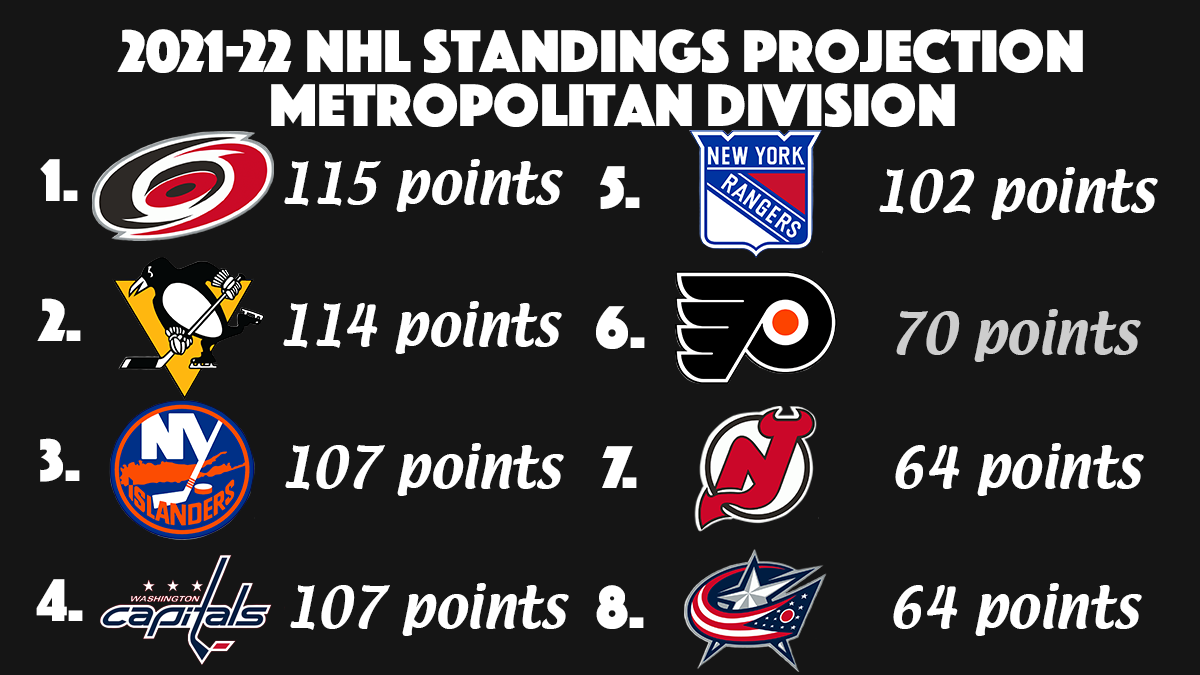
    It’s not easy to be in the Metropolitan Division these days because, well, let’s save that for the three questions below.

    Is this the toughest division to project?

    Absolutely.

    The Carolina Hurricanes decided to just get rid of a few parts and pieces that helped make them good for the last few seasons, so they’re bound to regress even with Sebastian Aho, Andrei Svechnikov, Teuvo Teräväinen and Martin Necas still existing.

    The Pittsburgh Penguins since 2009, have always found a way to be near the top of the division standings by the end of the regular season no matter whether or not you believe they’ll inevitably miss the playoffs for the first time since 2006, so anything could happen there.

    The New York Islanders have made back-to-back appearances in the Eastern Conference Final, so I’d expect them to be good.

    The Washington Capitals are better than the Philadelphia Flyers and New York Rangers, at least, but are probably the only team on the bubble if the New Jersey Devils can come out of nowhere and be competitive this season after signing Dougie Hamilton, Tomas Tatar and Jonathan Bernier in the offseason.

    Meanwhile, it’s time for a short rebuild in Columbus as the Blue Jackets would be quite pleased with a top draft pick in 2022.

    What if Chris Drury never was promoted as General Manager of the Rangers?

    They’d still fire David Quinn and hire Gerard Gallant. I don’t think that’s such a bad idea, but they’d definitely reconsider about 90% of the roster decisions made this summer.

    There’s no reason why the Rangers have to go down this path and yet, here they are, fumbling at the one-yard line and possibly plunging their franchise back into the Dark Ages of another rebuild. Or is it the same ongoing rebuild?

    What about a team to watch like New Jersey, for example?

    I’m big on the Devils this season for some strange reason.

    Maybe it’s because a part of me deep down misses the trap game of the 1990s and 2000s that led to Stanley Cups for New Jersey in 1995, 2000 and 2003.

    Maybe it’s because they signed Hamilton, Tatar, Bernier and acquired Ryan Graves from the Colorado Avalanche as a supporting cast for Jack Hughes, Nico Hischier, Pavel Zacha, Yegor Sharangovich, Ty Smith and friends.

    Seriously, the Devils should be good in the next few seasons, but this year could be the biggest stride forward in terms of their improvement from the basement to their development as a playoff contender.

    First, pour one out for Jack Eichel. Now, let’s move on and talk about everyone else.

    What does this mean for the Leafs?

    Just like how the Stars, Preds and Blues are all right on top of one another in the Central Division standings, the Atlantic Division is stacked from 1st through 4th, so though Toronto leads the way in this projection, I wouldn’t feel too comfortable as a Leafs fan.

    The Maple Leafs played in the worst of the four divisions last year in the temporarily realigned divisions in wake of the ongoing pandemic.

    No, it’s not just because they played all the other Canadian teams across 56 games, but rather it’s due to the fact that they haven’t been able to matchup with the Tampa Bay Lightning, Florida Panthers and even the Boston Bruins since the 2019-20 season.

    A lot and not a lot has changed since then.

    Tampa is still dominant as ever, Florida has emerged as a team that’s on the rise and Boston is unpredictable in that– much like the Penguins– it could really go either way with the Bruins this season.

    So now Toronto has to take on better competition within their own division and square off with teams like the Vegas Golden Knights, Colorado Avalanche, New York Islanders and others that emerge towards the top of the standings outside of the Canadian teams that the Leafs are all too familiar with at this point.

    That said, Toronto still has a great chance at winning the Atlantic Division regular season title or finishing 2nd and having home ice advantage in the First Round for the second-straight postseason.

    Can anyone other than Toronto, Florida, Tampa or Boston make it out of the Atlantic this year?

    No. Let’s be realistic here.

    The Montréal Canadiens made it to the 2021 Stanley Cup Final despite being below .500 in the standings because every division produced four playoff berths and intra-divisional play through two rounds.

    In 2020, they upset the Pittsburgh Penguins in the Qualifier despite finishing right at .500.

    In any other non-pandemic timeline, the Canadiens would still be looking for their first playoff appearance since they lost to the New York Rangers in six games in the 2017 First Round.

    That’s not to say that Nick Suzuki can’t lead the Habs back to glory, but rather that they need to improve all-around in the regular season and peaking in performance in the playoffs.

    Though the Ottawa Senators promised unprecedented success from 2021-25, it’s looking like it’ll realistically be anytime between 2024-25 as in the 2024-25 season itself at this point.

    Ottawa’s goaltending needs to improve, their defense could use some tweaks and the Sens are banking on their offense getting their feet underneath them and bursting in production in the coming years.

    A little more patience won’t hurt them.

    The same can be said for the Detroit Red Wings in that Red Wings fans already know– trust in General Manager, Steve Yzerman, is paramount. He’ll work his magic.

    It just takes a little time to build a solid foundation and the first floor is almost ready to start going up.

    As for the Buffalo Sabres, well…

    At least they’ll hopefully give Rick Jeanneret a proper send-off before he retires as their play-by-play announcer for the last 51 years on television.

    Hopefully.

    Will Tampa win three consecutive Stanley Cup championships?

    Probably not.

    I’m not ruling it out entirely, but the Lightning have a better chance of winning three Cups in four years than they do three Cups in as many years as things stand currently.

    The loss of their entire third line (Blake Coleman, Yanni Gourde and Barclay Goodrow) from last season to this season is sure to leave a mark on the development and restructuring of their bottom-six forwards.

    That said, Tampa’s top-six forwards still exist and, if you haven’t already noticed, they’re very good on their own, but the best teams in the playoffs have four lines that can roll without a doubt and the Bolts might just be off the ball for a year in terms of depth.


    Alright, if you’ve made it this far, thanks for your patience. By now the season’s already going on a few days into the 2021-22 calendar, so the two of us (or more if you’re reading this to a group) should probably get back to watching games.

    Stay tuned for more forecasts for both standings and assorted teams throughout the season.

  • DTFR Podcast #231- Be More Pacific (feat. Jess Belmosto)

    DTFR Podcast #231- Be More Pacific (feat. Jess Belmosto)

    Jess joins the show to talk all things Calgary Flames and preview the Pacific Division for the 2021-22 season. She also rescues Cam in this week’s “Off the Cuff”.

    Subscribe to the podcast on Apple PodcastsStitcherSpotifyAmazon Music and/or Audible.

  • Edmonton Oilers 2021-22 Season Preview

    Edmonton Oilers 2021-22 Season Preview

    2020-21 record 35-19-2, 72 points

    2nd in the Scotia NHL North Division

    Eliminated in the First Round by Winnipeg

    Additions: F Warren Foegele (acquired from CAR), F Zach Hyman, F Brendan Perlini, F Derek Ryan, F Colton Sceviour (signed to a PTO), F Tim Soderlund (acquired from CHI), D Cody Ceci, D Duncan Keith (acquired from CHI)

    Subtractions: F Adam Cracknell (signed with Bakersfield Condors, AHL), F Tyler Ennis (signed to a PTO with OTT), F Joseph Gambardella (signed with Utica Comets, AHL), F Gaëtan Haas (NL), F Dominik Kahun (NL), F Jujhar Khaira (signed with CHI), F James Neal (buyout), F Joakim Nygård (SHL), F Alan Quine (signed with Henderson Silver Knights, AHL), F Patrick Russell (SHL), F Anton Slepyshev (KHL), D Ethan Bear (traded to CAR), D Caleb Jones (traded to CHI), D Dmitry Kulikov (signed with MIN), D Adam Larsson (expansion, SEA), D Theodor Lennström (KHL), G Dylan Wells (traded to CAR)

    Still Unsigned: F Alex Chiasson

    Re-signed: F Tyler Benson, F Cooper Marody, F Ryan Nugent-Hopkins, F Devin Shore, F Kailer Yamamoto, D Tyson Barrie, D Slater Koekkoek, G Stuart Skinner, G Mike Smith

    Offseason Analysis: The second-best team in the Scotia NHL North Division would’ve been the fourth-best team in the other three divisions last season.

    No matter what, the Oilers would’ve been a playoff team in 2020-21, but it’s the embarrassment that came with being swept in the 2021 First Round by the Winnipeg Jets and subsequent offseason moves that have left many scratching their heads.

    Instead of overreacting and making big, sweeping, changes, Edmonton went for a big piece and a few smaller moves that still ate up their valuable cap space in the midst of a flat salary cap due to the ongoing COVID-19 pandemic.

    So really it’s just more of the same from the Oilers.

    Let’s start with the good news…

    Ryan Nugent-Hopkins, Kailer Yamamoto and Tyson Barrie are back and solidify some semblance of depth for Edmonton with Nugent-Hopkins on an affordable eight-year extension worth $5.125 million per season– the Oilers will have a surefire center on the second or third line for years to come.

    The 28-year-old was Edmonton’s 1st overall pick in the 2011 NHL Draft and had 35 points (16 goals, 19 assists) in 52 games last season after reaching the 60-point plateau in back-to-back seasons from 2018-19 through 2019-20.

    Had there been an 82-game schedule in 2020-21, Nugent-Hopkins likely would’ve at least eclipsed the 50-point mark.

    At 5-foot-8, 135-pounds, Yamamoto has a lot in common with guys like Martin St. Louis in his stature and– like St. Louis– is better off developing on his own as he had 8-13–21 totals in 52 games in his first full season run with the Oilers last season.

    Though he made his league debut in 2017-18, Yamamoto has only been utilized by Edmonton sparingly in parts of three seasons leading up to his full-time status in 2020-21.

    His game should be fine in due time, though offering him a supporting cast (a theme for the Oilers in general) would be fine.

    After he had 59 points in 78 games with the Colorado Avalanche in 2018-19, Barrie was shipped as part of a package to the Toronto Maple Leafs in a trade that, well, didn’t exactly live up to the high expectations in Toronto.

    Barrie’s production from the point plummeted to 39 points (five goals, 34 assists) in 70 games with the Maple Leafs in 2019-20.

    He joined the Oilers on a one-year deal last October and bounced back with an admirable 48 points (eight goals, 40 assists) in 56 games.

    He had 25 points on the power play in his last season in Colorado, then just 12 points as a quarterback on Toronto’s power play unit before rebounding with 23 points from the blue line while on the skater advantage last season for Edmonton.

    For his efforts, Barrie was rewarded with a sweet three-year deal worth $4.500 million per season and at 29-years-old that’s about right for a defender on the cusp of beginning the eventual decline from a defensive prime.

    Zach Hyman joins the Oilers on a seven-year contract worth $5.500 million per season, which isn’t completely terrible for a 29-year-old forward in his prime that had 15-18–33 totals in 43 games with the Maple Leafs last season and has reached the 40-point plateau twice before.

    As a top-six forward, Hyman is a welcome addition to Edmonton’s Art Ross Trophy-winning powerhouse offense (Connor McDavid and Leon Draisaitl).

    An additional positive from this offseason?

    Edmonton’s rid themselves of James Neal via a buyout. Granted, he’ll still be on the books through the 2024-25 season at about a $1.917 million cap penalty, but after parts of two seasons with the Oilers since being acquired for Milan Lucic, at least that branch of franchise history has come to a close.

    Neal had five goals and five assists (10 points) in 29 games last season after bouncing back from 19 points (seven goals, 12 assists) in 63 games with the Calgary Flames in 2018-19 to 31 points (19 goals, 12 assists) in 55 games for Edmonton in 2019-20.

    He’s a shell of his former self, but on a low-risk contract, he could fit in fine just about anywhere else that needs a touch of veteran experience.

    Now for the bad stuff that… …isn’t necessarily that bad, it’s just disappointing from the Oilers (who seemingly have chosen to make the Buffalo Sabres look good for at least being salary cap smart this offseason and that’s about it).

    At 39-years-old, Mike Smith could’ve called it a career, but when Jimmy Howard turned down Oilers General Manager, Ken Holland, Smith was rewarded with two-year (not just one-year!) extension worth $2.200 million per season.

    The cap hit is fine, considering he recored a goals-against average under 2.50 for the first time since the 2011-12 season with the Phoenix Coyotes.

    Back then, in 67 games with Phoenix, Smith had a 38-18-10 record, a 2.21 goals-against average, a .930 save percentage and eight shutouts en route to backstopping the Coyotes to the 2012 Western Conference Final, where the Los Angeles Kings eliminated Phoenix in five games.

    Last season with the Oilers, Smith went 21-6-2 in 32 games, had three shutouts and amassed a 2.31 goals-against average as well as a .923 save percentage.

    In 2019-20, he had a 19-12-6 record in 39 games, one shutout, a .902 save percentage and a whopping 2.95 goals-against average.

    Whether it’s the introduction of Barrie to Edmonton’s defense that helped singlehandedly reduce the workload Smith faced or not– Smith had a fantastic season in 2020-21.

    However, time stops for nobody and with an average age of 35.3 between Smith, Mikko Koskinen and Alex Stalock as reliable options in the crease under contract at the NHL level, well, it’s easy to feel uneasy about Edmonton’s chances at stopping the puck from night-to-night as their bodies collectively wear down through an 82-game schedule.

    Then again, they are athletes and you and I are not.

    Yet, it’s worth noting since unlike Smith, Koskinen went from an 18-13-3 record in 38 games with a 2.75 goals-against average, a .917 save percentage and one shutout in 2019-20 with the Oilers to a dismal 13-13-0 record in 26 games with a 3.17 goals-against average and an .899 save percentage in 2020-21.

    For all the good that Barrie and Co. on Edmonton’s blue line have done, there’s two new additions that, uh, might undo some of the forward progress.

    Connor McDavid (ever heard of him?) vouched for Holland to acquire Duncan Keith from Chicago and then Holland went along and signed Cody Ceci in free agency.

    Though Keith recorded 6-34–40 totals in 82 games in 2018-19 with Chicago, he’s been in decline, notching 27 points (three goals, 24 assists) in 61 games in 2019-20 and just 15 points (four goals, 11 assists) in 54 games last season.

    The 38-year-old defender would’ve accepted any trade to a team close to the pacific northwest as he expressed a desire to be closer to family, having been isolated playing hockey for a living for most of the time during the ongoing pandemic and spending roughly five months combined with his son prior to being traded to Edmonton.

    In 1,192 career NHL games, he’s won three Stanley Cup rings, was named playoff MVP in 2015, and has 105-520–625 totals in the regular season.

    With two years left on his contract, Keith’s $5.538 million cap hit is a bit steep for what could be a defensive liability as the aging process continues and– turns out– Holland could’ve done better by waiting another day and signing Keith Yandle for much less after the Florida Panthers bought him out. Who knew?!

    Though the Internet likes to make fun of Ceci, the 27-year-old defender really hasn’t been all that bad.

    Sure 17 points (four goals, 13 assists) in 53 games with the Pittsburgh Penguins last season isn’t great, but he’s not expected to be a top-four defender– or at least he shouldn’t be.

    Mistakes and weird things will happen. Sometimes you’re just unlucky like that.

    Wait, Holland gave him four-years at $3.250 million per season? Yikes.

    And to put the icing on the cake, Holland traded Ethan Bear to the Carolina Hurricanes for Warren Foegele. Not that Foegele’s bad, but for a team that could use a better defense, Bear fit in pretty well.

    Has this McDavid guy ever tried watching the Oilers?

    Offseason Grade: C+

    For the Nugent-Hopkins extension, sensible new deal for Barrie and Yamamoto bridge contract, Holland deserves some praise for keeping the right pieces happy and on the roster heading into 2021-22.

    That said, he also made some errors in judgment acquiring Keith at the price he paid, as well as handing out Ceci a contract with a steep cap hit and term for a guy that’s probably not that good.

    In other words, it was just another normal offseason for the Oilers.

    Edmonton made some smart moves, but then overreacted in other areas, while still searching for the second coming of Andy Moog in net or whatever.

  • Calgary Flames 2021-22 Season Preview

    Calgary Flames 2021-22 Season Preview

    2020-21 record 26-27-3, 55 points

    5th in the Scotia NHL North Division

    Missed the postseason for the first time since 2020

    Additions: F Blake Coleman, F Alex Gallant (signed to a PTO), F Trevor Lewis, F Tyler Pitlick (acquired from SEA), F Brad Richardson, D Nick DeSimone, D Erik Gudbranson, D Kevin Gravel, D Andy Welinski, D Nikita Zadorov (acquired from CHI), G Adam Werner, G Dan Vladar (acquired from BOS)

    Subtractions: F Spencer Foo (KHL), F Josh Leivo (signed with CAR), F Joakim Nordström (KHL), F Zac Rinaldo (signed with CBJ), F Buddy Robinson (signed with ANA), F Derek Ryan (signed with EDM), F Dominik Simon (signed with PIT), D Mark Giordano (expansion, SEA), D Carl-Johan Lerby (SHL), D Nikita Nesterov (KHL), D Alexander Petrovic (signed with DAL), D Alexander Yelesin (KHL), G Louis Domingue (signed with PIT)

    Still Unsigned: G Artyom Zagidulin

    Re-signed: F Dillon Dubé, F Glenn Gawdin, F Justin Kirkland, F Matthew Phillips, F Luke Philp, F Brett Ritchie, D Oliver Kylington, D Connor Mackey, D Colton Poolman, D Michael Stone, D Juuso Välimäki, G Tyler Parsons

    Offseason Analysis: Calgary is facing an existential crisis.

    They can either trust in their core players that they just might get it done if they’ve become frustrated by years of falling short (or not even making the playoffs at all, as they missed the postseason in 2021) or they can begin to move forward by hitting the “reset” button.

    This offseason, Flames General Manager, Brad Treliving, chose to add without subtracting– to overhaul, rather than to rebuild (at least for now).

    Joakim Nordström, Derek Ryan, Zac Rinaldo and more are gone. They’ve left for other professional leagues around the world, Edmonton and Columbus, respectively.

    Mark Giordano was claimed by the Seattle Kraken in the 2021 NHL Expansion Draft after breaking into the league with the Flames in the 2005-06 season. He spent 15 years in Calgary and amassed 143-366–509 totals in 949 games in a Flames uniform and had been captain in the “C of Red” since the 2013-14 season.

    Though many fans in Calgary would like to belive the 37-year-old will spend one season in Seattle and return to the Flames, there are no guarantees.

    Calgary’s already worked on developing a good-standing relationship with their new Pacific Division rivals as they got traded a 2022 4th round pick to the Kraken for forward, Tyler Pitlick, on July 22nd– a day after the expansion draft.

    Pitlick slides in as a quality top-nine forward for the Flames and had 6-5–11 totals in 38 games for the Arizona Coyotes last season while battling injury.

    He’s reached the 20-point plateau twice in his career in 2017-18 with Dallas (27 points in 80 games) and 2019-20 with Philadelphia (20 points in 63 games) and should be a low-risk high-reward depth move.

    Treliving made a splash when free agency opened on July 28th, signing two-time defending Stanley Cup champion, Blake Coleman, to a six-year contract worth $4.900 million per season.

    Coleman’s speed and skill solidifies Calgary’s middle-six as he should be on the second or third line at all times.

    He’s had three consecutive seasons with at least 30 points since the 2018-19 season and notched 31 points (14 goals, 17 assists) in 55 games for the Tampa Bay Lightning in 2020-21.

    Coleman on a line with Andrew Mangiapane is a game-changer for Calgary’s offense– especially as they’ve re-signed Dillon Dubé and still have Sean Monahan down the middle to fill out the top-nine with Mikael Backlund, Johnny Gaudreau, Elias Lindholm and Matthew Tkachuk on the roster.

    The same day that free agency began, Treliving also made a pair of trades–first acquiring defender, Nikita Zadorov, from Chicago for a 2022 3rd round pick (originally belonging to the Toronto Maple Leafs) and later acquiring goaltender, Dan Vladar, from the Boston Bruins for Calgary’s own 2022 3rd round pick.

    Zadorov, 26, signed a one-year deal worth $3.750 million with the Flames and had 1-7–8 totals in 55 games with Chicago last season, as well as 23-60–83 totals in 411 career NHL games with the Buffalo Sabres, Colorado Avalanche and Chicago.

    The 6-foot-6, 235-pound Russian native isn’t an offensive powerhouse from the blue line, but rather a top-four shutdown defensive defender. At his best, Zadorov can make hit after hit and pummel an opposing team’s offense into submission in his own zone, though the occasional bad penalty may result.

    Vladar, 24, made his regular season debut last season for the Bruins and went 2-2-1 in five games played with a 3.40 goals-against average and an .886 save percentage in that span.

    Don’t let the stats fool you, though, as Boston allowed eight goals against in Vladar’s last start against the Washington Capitals on April 11th before the emergence of Jeremy Swayman and return from injury for Tuukka Rask forced B’s head coach, Bruce Cassidy’s, hand down the stretch and through the postseason.

    Vladar is capable of holding his own in the NHL and should be a decent backup behind Jacob Markström in net for Calgary.

    In 2019-20, Vladar had a 1.79 goals-against average and a .936 save percentage in 25 games with the Providence Bruins (AHL). He followed that effort up with a 2.19 goals-against average and a .923 save percentage in 10 games with Providence last season.

    Treliving signed unrestricted free agents, Brad Richardson, Trevor Lewis and Erik Gudbranson, to one-year contracts over the summer– adding Richardson on an $800,000 cap hit for depth, Lewis as a fourth liner with an $800,000 cap hit and Gudbranson ($1.950 million cap hit) as a defender that just might push Oliver Kylington or Juuso Välimäki out of regular ice time.

    Richardson, 36, was limited to 17 games with the Nashville Predators last season and had 1-3–4 totals after spending 16 prior seasons with the Avalanche, Los Angeles Kings, Vancouver Canucks, Coyotes and Predators.

    He won a Stanley Cup ring with then Los Angeles head coach, Darryl Sutter, in 2012, while Lewis won two Cups in his Kings tenure in 2012 and 2014.

    Lewis joins the Flames after spending last season with the Winnipeg Jets– notching 5-5–10 totals in 56 games after spending 674 games in a Los Angeles uniform from parts of the 2008-09 season through 2019-20.

    Gudbranson bounced from the Ottawa Senators to the Predators at the 2021 deadline after amassing 1-2–3 totals in 36 games with the Sens before contributing one assist in nine games with Nashville afterward.

    With only four points in 45 games, Gudbranson isn’t much competition for Välimäki, who had 2-9–11 totals in 49 games for Calgary last season, but the clock is ticking on Kylington’s tenure in the “C of Red”.

    Ranked 24th by TSN in the final draft rankings ahead of the 2015 NHL Draft, Kylington fell to the Flames in the 2nd round at 60th overall and has only appeared in 95 career games approaching seven years out of his draft year.

    He had one assist in eight games last season and re-signed with Calgary on a one-year, two-way contract and has 16 points in his career, while Välimäki already has 14 points in 73 games in parts of two seasons since breaking into the NHL with the Flames in 2018-19.

    Just like with Calgary’s core, time might be running out for a serious chance.

    Offseason Grade: A-

    If you were hoping for the Flames to tear things down this offseason, then they failed this summer.

    If you’re looking at things from the perspective that adding without subtracting while still having enough of a core to make something happen, well, then signing Coleman alone is enough to laud Treliving praise for making a move instead of sticking to the script.

    Of course, now the pressure is on for Calgary to succeed or risk fraying their relationship with Gaudreau and other Flames veterans, which would mean that Treliving would be forced to make some big trades by the deadline or next summer.

    That said, the biggest detractor from the Flames this offseason might just be the Flames themselves as Sutter’s coaching style hasn’t adapted to the NHL in 2021.

    If you don’t let your best players play their games and try to box them into a mold they don’t fit, then you’re only bringing yourself down in the league currently.

  • Los Angeles Kings 2021-22 Season Preview

    Los Angeles Kings 2021-22 Season Preview

    2020-21 record 21-28-7, 49 points

    6th in the Honda NHL West Division

    Missed the postseason for the third-straight year

    Additions: F Viktor Arvidsson (acquired from NSH), F Brayden Burke (acquired from ARI), F Phillip Danault, F T.J. Tynan, D Alexander Edler, G Garret Sparks

    Subtractions: F Michael Eyssimont (signed with WPG), F Bokondji Imama (traded to ARI), F Matt Luff (signed with NSH), F Tyler Steenburgen (acquired from ARI, signed Liiga), D Mark Alt (signed with San Jose Barracuda, AHL), D Daniel Brickley (signed with Chicago Wolves, AHL), D Cole Hults (traded to ARI), D Kurtis MacDermid (expansion, SEA), G Troy Grosenick (signed with BOS)

    Still Unsigned: F Drake Rymsha

    Re-signed: F Lias Andersson, F Andreas Athanasiou, F Blake Lizotte, F Trevor Moore, D Kale Clague, D Jacob Moverare, D Austin Strand, D Christian Wolanin

    Offseason Analysis: The Kings looked competitive and ahead of schedule, but couldn’t carry the momentum down the stretch and make a surprise appearance in the playoff hunt.

    Los Angeles has a great pool of prospects and Quinton Byfield is shaping up to make an impact in his first full season, while General Manager, Rob Blake, was tasked with finding the right fit for a few pieces in the offseason that very well might put the Kings over the edge and back into Stanley Cup Playoff contention.

    In a few years, they might be trending down the path of a Cup contender instead of going through a long, strenuous, rebuild.

    Despite Anze Kopitar’s $10.000 million cap hit (which runs through 2023-24) and Drew Doughty’s $11.500 million cap hit (which expires after the 2026-27 season), Los Angeles was able to add without subtracting and could salvage the remnants of Jonathan Quick and Dustin Brown from the Kings’ glory days to their current days while Cal Petersen continues to emerge in the crease.

    The addition of Alexander Edler on a one-year, $3.500 million contract brings some stability to the blue line and valuable experience to leave an impression on the younger defenders, like Michael Anderson and Tobias Björnfot.

    Edler’s presence and shot blocking capabilities should also prove vital in shaping how guys like Olli Määttä, Matt Roy, Sean Walker and Christian Wolanin– already in their defensive primes– compete with each other for their jobs and evolve.

    But Edler alone wasn’t the biggest move that Blake made in the offseason.

    Sure, there’s the Viktor Arvidsson trade that brings the 28-year-old winger to Los Angeles after breaking into the league with the Nashville Predators in the 2014-15 season and scoring 10-15–25 totals in 50 games in 2020-21 with the Preds, but Blake went a step further and found the answer to a hole down the middle.

    The Kings signed Phillip Danault to a six-year contract worth $5.500 million per season, bringing the 28-year-old Victoriaville, Québec native to Los Angeles’ second line for a good stretch of his prime.

    Though his production was down from 47 points (13 goals, 34 assists) in 71 games with the Montréal Canadiens in 2019-20 to 5-19–24 totals in 53 games with the Habs in 2020-21, Danault has reached 40 or more points in three out of his last five seasons with varying degrees of talent around him.

    Now in Los Angeles, Danault could suit up between guys like Alex Iafallo, Arvidsson, Adrian Kempe or Brown– bringing a balance of youth, speed, experience and playmaking abilities to go with the scoring prowess of any of the aforementioned wingers.

    Arvidsson and Danault bring more of a two-way, contemporary, game that aligns well with Kopitar’s two-time Frank J. Selke Trophy winning style

    Brown recorded 17 goals in 49 games last season, while Iafallo had 13 goals in 55 games and Kempe notched 14 goals in 56 games. There’s no reason to believe that all three players can’t reach the 20-goal plateau in a full 82-game schedule.

    But for all the improvements made among their skaters, the Kings might continue to encounter some growing pains in net as Petersen continues to make his mark on the league as a starting goaltender, while Quick’s dominant days wane in the twilight of his career.

    Petersen went 9-18-5 in 35 games last season and had a 2.89 goals-against average, as well as a .911 save percentage in that span.

    Through 54 games at the NHL level, Petersen has a career 2.79 goals-against average and a career .916 save percentage and only one shutout.

    For comparison’s sake, Quick has a 2.81 goals-against average in his last two seasons combined (64 appearances), but a .902 save percentage in that span.

    Quick was Los Angeles’ starter in 2019-20 and had a 16-22-4 record in 42 games played with a 2.79 goals-against average and a .904 save percentage in that span, as well as one shutout.

    Last season, Quick went 11-9-2 in 22 games and recorded two shutouts to go along with his 2.86 goals-against average and an .898 save percentage.

    For all the promise that Petersen showed in his collegiate days at Notre Dame, he’s yet to make the transition to the professional game and as the years go by, so does his chance at emerging in the average goaltending prime.

    If Los Angeles is to make the playoffs next season, Petersen will need to improve.

    If the Kings falter, Petersen still has a chance at redeeming himself, though he won’t see much of a pay raise next offseason– but he could still be a late bloomer and sign a short-term bridge extension, awaiting a larger payday after sustained success and better numbers at the NHL level.

    This is where it’s important to note that Petersen is a pending-unrestricted free agent come July 1, 2022, while Quick’s contract expires after the 2022-23 season.

    If winning with the remnants of their 2012 and 2014 Stanley Cup championship core is important to the Kings, then winning again sooner rather than later is paramount.

    Offseason Grade: A-

    The Danault signing alone is an exceptionally good contract for a player that could really come into his own with the depth and talent of the Kings around him.

    Blake’s given Todd McLellan some better pieces to work with– now it’s up to Los Angeles’ head coach to find the right chemistry among his players to get them back into the hunt.

    The return of the usual division alignments for 2021-22 is a welcome sign for the Kings’ chances of making the playoffs in 2022, as they should be better than their counterparts in California, as well as the rebuilding Arizona Coyotes and stagnant teams north of the border in Vancouver and Calgary.

    Now as for how far things will go? Well, that depends on if they make the playoffs first and whether or not Los Angeles lucks out having to face a relatively inexperienced team in the postseason.

  • San Jose Sharks 2021-22 Season Preview

    San Jose Sharks 2021-22 Season Preview

    2020-21 record 21-28-7, 49 points

    7th in the Honda NHL West Division

    Missed the postseason for the second-straight year

    Additions: F Nick Bonino, F Andrew Cogliano, F Nick Merkley (acquired from NJD), F Lane Pederson, D Jaycob Megna, G Adin Hill (acquired from ARI), G James Reimer

    Subtractions: F Kurtis Gabriel (signed with TOR), F Fredrik Händemark (KHL), F Maxim Letunov (signed with CAR), F Marcus Sörensen (SHL), F Alex True (expansion, SEA), D Christian Jaros (traded to NJD), D Greg Pateryn (signed with ANA), G Martin Jones (buyout), G Josef Korenar (traded to ARI)

    Still Unsigned: F Ryan Donato, F Noah Gregor (RFA), F Patrick Marleau

    Re-signed: F Rüdolfs Balcers, F Joachim Blichfeld, F Jonathan Dahlén, F Dylan Gambrell, F Matt Nieto, F Jeffrey Viel, D Nicolas Meloche

    Offseason Analysis: The Sharks have been quiet– too quiet– this offseason for a team that proclaims they’re “definitely not rebuilding” and “totally going to be back in the playoffs in 2022”.

    Whether you buy into the speculation that Tomas Hertl is going to be shopped by the team or not, there is some uneasiness in the dressing room as Evander Kane’s bankruptcy court ongoings continue to unfurl in public amidst separation from his wife while San Jose is tight against the salary cap with about $3.361 million in cap space heading into the 2021-22 season.

    Erik Karlsson’s made it known that he doesn’t want to experience another rebuild in his career– having been dealt to the Sharks originally as a casualty of the Ottawa Senators’ demise and subsequent retool/rebuild.

    It’s not hard to feel empathy for the precarious position that Doug Wilson is in as General Manager, though it’s through much of his own doing.

    For starters, Karlsson carries an $11.500 million cap hit through the 2026-27 season, which contributed to Joe Pavelski leaving for the Dallas Stars via free agency on July 1, 2019, and with it San Jose’s character amongst the Sharks’ leadership core.

    Kane carries a $7.000 million cap hit through 2024-25, though he may reach a termination agreement at any point in time with San Jose to restructure his debt and may or may not end up signing for much less as a result with the Sharks if he isn’t forced to take a step back from hockey to focus on that whole debt thing that keeps getting mentioned.

    Seriously, we’re hoping for the best here.

    Forced to make minor moves due to a stagnant salary cap, Wilson signed Matt Nieto to a two-year extension worth $850,000 per season and continued to fill out his middle of the lineup/bottom-six forwards with Andrew Cogliano and Nick Bonino via free agency.

    Cogliano received a one-year, $1.000 million deal, while Bonino earned a two-year contract that carries a $2.050 million cap hit.

    Nieto recorded three consecutive seasons of 20 or more points with the Colorado Avalanche from 2017-18 through 2019-20 as he experienced a career resurgence as a bottom-six forward, prior to amassing 5-2–7 totals in 28 games last season with San Jose before a lower body injury cut his 2020-21 season short.

    After spending the last few seasons in Dallas, Cogliano left the Stars for the Sharks in free agency after managing 11 points (five goals, six assists) in 54 games last season.

    At this point, the 34-year-old center is just trying to hold onto what is likely the twilight of his career and looking for a way to either spice up his remaining playing days and extend his tenure in the league or find a way to be moved by the trade deadline to a Cup contender as the 14-year NHL veteran has only been to one Stanley Cup Final in his career thus far– losing in six games with Dallas to the Tampa Bay Lightning in 2020.

    Bonino, on the other hand, brings some Cup winning experience to San Jose’s dressing room as the 33-year-old center won his first of two Cup rings with the Pittsburgh Penguins in six games against the Sharks in the 2016 Stanley Cup Final.

    After winning back-to-back Cups in 2016 and 2017, with Pittsburgh, Bonino made his way to the Nashville Predators and, most recently, the Minnesota Wild, where he had 10-16–26 totals in 55 games while the Wild rose to prominence and endured a seven-game First Round series loss to the Vegas Golden Knights in the 2021 Stanley Cup Playoffs.

    Bonino may be at the point where he bounces around the league every other season or so, but he’s shown that he can still prove to be a valuable piece down the middle as a glue guy, which is welcome news for San Jose as they look for Logan Couture and Hertl to remain steady as a 1-2 punch at center on the first and second lines.

    Drafting William Eklund 7th overall in the 2021 NHL Draft, then signing him to a three-year entry-level contract was another quality move made by Wilson in the ongoing restructuring of the organization’s depth and future foundation.

    Ranked as the No. 1 European skater by NHL Central Scouting, Eklund fell to the Sharks in the draft and could end up playing this season for San Jose. Sure it might be throwing him to the fire a bit early, but if he’s as good as he looked with Djurgårdens IF, then it’s worth it to spur the *ahem* rebuild in San Jose as he managed to have 11-12–23 totals in 40 games in the SHL last season.

    But the biggest change this offseason for the Sharks comes in the crease, where San Jose has bought out Martin Jones– freeing themselves from his 15-13-4 record in 34 games last season, with a 3.28 goals-against average, an .896 save percentage and one shutout in that span– and traded for Adin Hill before signing Hill to an extension and landing James Reimer in free agency.

    Jones will carry a $1.917 million buyout penalty on San Jose’s cap through the 2026-27 season, but at least he’s the Philadelphia Flyers’ reclamation project now.

    In the meantime, Hill was acquired in exchange for Josef Korenar and a 2022 2nd round pick back on July 17th.

    The 25-year-old former Arizona Coyotes goaltender was given a two-year extension worth $2.175 million per season and went 9-9-1 in 19 games last season, recording a 2.74 goals-against average, a .913 save percentage and two shutouts in that span.

    It’s important to note that he had a 2.62 goals-against average and a .918 save percentage in 13 games in 2019-20 with the Coyotes and has shown that, perhaps, in a better defensive situation, he just might improve.

    Meanwhile, Reimer reunites with the Sharks for the first time since San Jose’s 2016 Stanley Cup Final appearance as he was acquired by the team on Feb. 28, 2016, with Jeremy Morin for a 2018 3rd round pick, Ben Smith and Alex Stalock in return to the Toronto Maple Leafs back in the day.

    Since then, Reimer had a stop with the Florida Panthers and, most recently, with the Carolina Hurricanes as a tandem duo with Petr Mrazek.

    The 33-year-old goaltender might have an edge going into the season over Hill as Reimer managed to record a 15-5-2 record in 22 games last season for Carolina and had a 2.66 goals-against average, as well as a .906 save percentage in that span.

    He signed a two-year deal worth $2.250 million per season with the Sharks on July 28th.

    In both cases, it’s a low-risk, high-reward move that Wilson can defend simply as a placeholder if it all goes south while searching for a long-term solution in net.

    Offseason Grade: C-

    It’s time for the Sharks to make some serious roster decisions in a proactive manner instead of forcing their own hands tied and reacting to the alarming situation that may only worsen as the team desperately tries to avoid using the term “rebuild”.

    San Jose’s unprecedented success in the regular season throughout the 2000s and 2010s meant that the team never really had to rely on the uncertainty of going through growing pains and struggles, but for the first time since franchise’s infancy it appears that it’s inevitable once more.

    Whether removing Wilson is something to be done sooner rather than later or not hinges upon whether or not Sharks ownership is informed of a solidified plan.

    There cannot be any wavering any longer for a team that, sure, finished ahead of the Anaheim Ducks last season, but is expected to bottom out in the Pacific Division by virtually every expert and analyst on paper going into 2021-22– and that’s even with the uncertain nature of the expansion, Seattle Kraken, to consider.

    San Jose is close to getting a “D+”, but cutting their losses and buying out Jones now brings them up to a “C-“.

  • Anaheim Ducks 2021-22 Season Preview

    Anaheim Ducks 2021-22 Season Preview

    2020-21 record 17-30-9, 43 points

    8th in the Honda NHL West Division

    Missed the postseason for the third-straight year

    Additions: F Danny O’Regan, F Buddy Robinson, D Greg Pateryn, D Brogan Rafferty

    Subtractions: F Andrew Agozzino (signed with OTT), F Danton Heinen (signed with PIT), F Chase De Leo (signed with NJD), F Andrew Poturalski (signed with CAR), D Haydn Fleury (expansion, SEA), D Andy Welinski (signed with CGY), G Ryan Miller (retired)

    Still Unsigned: F David Backes, F Carter Rowney

    Re-signed: F Max Comtois, F Ryan Getzlaf, F Max Jones, F Isac Lundestrom, F Sam Steel, D Josh Mahura

    Offseason Analysis: All three California-based NHL teams missed out on the playoffs for the second year in a row (and third time overall since 1996), but there’s hope for 2/3 of the California teams in terms of turning things around a lot sooner rather than later.

    Both of them happen to be in southern California.

    Though the Ducks are behind the Los Angeles Kings by a year or two in both time spent in their ongoing rebuilds– as well as when they’re expected to be a playoff contender once again– Anaheim’s trending in the direction of a younger team with a tinge of experience gained from last season as Max Comtois led the way in scoring on the roster with 16-17–33 totals in 55 games.

    Troy Terry solidified a spot on the NHL roster and won’t have to spend any time fluctuating back and forth between the Ducks and the San Diego Gulls (AHL) after he managed to amass 7-13–20 totals in 48 games.

    Though Rickard Rakell and Jakob Silfverberg are often the subjects of trade rumors out of Anaheim, Rakell led the Ducks in assists last season with 19 helpers in 52 games, while Silfverberg had a more pedestrian season– notching 16 points in 47 games.

    At the very least, they’re two veterans that head coach, Dallas Eakins, can lean on as Anaheim’s youth continues to emerge and Ryan Getzlaf’s aging body wears down over time.

    That’s not to say that Getzlaf’s 17 points (five goals, 12 assists) in 48 games didn’t mean much for the Ducks, but rather that they won’t have to count on their 36-year-old captain for nearly as much as they used to get out of him– especially as his production is projected to continue to decline.

    Getting a full season on defense from Jamie Drysdale is likely to be a difference maker as the 19-year-old managed to put up 3-5–8 totals in 24 games from the blue line last season in his league debut after being selected 6th overall in the 2020 NHL Draft.

    His offensive contributions from the defense– at the very least as a two-way defender– should spark more rushes from a team that got stuck playing catch-up while attempting to bear hug their opponents from night-to-night in recent years.

    Cam Fowler and Josh Manson are set to turn 30 during the 2021-22 season, while Kevin Shattenkirk is currently the oldest defender on the roster at 32-years-old, but Hampus Lindholm and Jacob Larsson are familiar names that are just entering the cusp of their defensive primes, so really the Ducks just need to hit the back of the net more– as if that wasn’t already evidenced enough by their minus-53 goal differential last season.

    Granted, that does mean they’ll have to shore things up in their own end somewhat, but yeah, score more goals than the other team, win the game. Who would’ve thought?

    Don’t overplay John Gibson in the crease (seriously, no goaltender should be facing more than, like, 55 games in an 82-game schedule) and give Anthony Stolarz a chance to be a legitimate backup goaltender in the league– something in the Ducks’ coaching staff is working for him in the last two seasons.

    Gibson went 9-19-7 in 35 games with a 2.98 goals-against average, a .903 save percentage and three shutouts in that span, which was better and worse than his 20-26-5 record in 51 games in 2019-20, in which he had a 3.00 goals-against average and a .904 save percentage– as well as one shutout.

    With the exception of last season’s 56-game schedule, Gibson hasn’t faced fewer than 1,500 shots against since the 2016-17 season, which featured a run to the Western Conference Final for the Ducks.

    A drop in goals for production has hurt Gibson like a lack of run support spurns a starting pitcher in baseball.

    Meanwhile, Stolarz took on a bigger role as Anaheim’s backup towards the tale end of the season– forcing Ryan Miller into an early retirement, even though Miller earned the honors of the last game of the season.

    Stolarz put up a 4-3-0 record in eight games played and had a 2.20 goals-against average, a .926 save percentage and one shutout in that span, which was much better than Miller’s 4-8-2 record in 16 games to go with a 3.51 goals-against average and an .882 save percentage.

    Ideally, Anaheim would find a way to give both Gibson and Stolarz about 41 games each to generate healthy competition, but that’s not likely– especially with Gibson’s high profile around the league as one of the better goaltenders that’s just stuck in the unfortunate rut of a rebuilding team.

    Ducks General Manager, Bob Murray, had one thing to do this offseason and that was to not do anything, so he did (nothing, that is).

    Let things play out on their own and Anaheim will either show forward progress or get a chance to speed up their rebuild with another top-10 draft pick in 2022.

    At best they’ll be 6th in the Pacific Division and ahead of their counterparts in northern California– the San Jose Sharks. At worst they’ll be stuck in 8th.

    Offseason Grade: C

    If subjectivity had any influence on an offseason grade, Murray and the Ducks would get an “A” for doing what was recommended– virtually nothing. Seriously.

    It’s time for Anaheim to figure out what they have, where they still need to make a few improvements and otherwise to let their youth get experience and grow in their game.

    The Ducks recognize their situation and they have enough patience for now to be smart about things.

    With about $14 million to spend in cap space this season, Anaheim can be a trade deadline broker flipping and retaining salary on expiring or short-term contracts while yielding the profits of prospects and draft picks– that is how you rebuild.

    Even better, they’ll have about $44.4 million to spend next offseason, though with Getzlaf, Rakell, Lindholm and Manson headlining their pending-unrestricted free agent class.

  • Seattle Kraken 2021-22 Season Preview

    Seattle Kraken 2021-22 Season Preview

    2020-21 record 0-0-0, 0 points

    Making their debut in the Pacific Division

    Newest expansion team entering their 1st season

    Additions: F Mason Appleton (from WPG), F Nathan Bastian (from NJD), F Colin Blackwell (from NYR), F Joonas Donskoi (from COL), F Jordan Eberle (from NYI), F Yanni Gourde (from TBL), F Morgan Geekie (from CAR), F Luke Henman, F Calle Järnkrok (from NSH), F Marcus Johansson (UFA from MIN), F Jared McCann (from TOR), F Jaden Schwartz (UFA from STL), F Brandon Tanev (from PIT), F Alexander Wennberg (UFA from FLA), D Connor Carrick (UFA from NJD), D Mark Giordano (from CGY), D Haydn Fleury (from ANA), D Adam Larsson (from EDM), D Jeremy Lauzon (from BOS), D Jamie Oleksiak (from DAL), D Gustav Olofsson (UFA from MTL), D Carson Soucy (from MIN), G Antoine Bibeau (UFA from COL), G Joey Daccord (from OTT), G Chris Driedger (from FLA), G Philipp Grubauer (UFA from COL)

    Subtractions: F Tyler Pitlick (traded to CGY), F John Quenneville (NL), D Gavin Bayreuther (signed with CBJ), D Kurtis MacDermid (traded to COL), G Vitek Vanecek (traded to WSH)

    Still Unsigned: D Dennis Cholowski (from DET)

    Re-signed: F Kole Lind (from VAN), F Alexander True (from SJS), F Carsen Twarynski (from PHI), D Will Borgen (from BUF), D Vince Dunn (from STL), D Cale Fleury (from MTL)

    Offseason Analysis: The NHL’s newest franchise is set to take to the ice for their first season on Oct. 12th as the Kraken pay a visit to the Vegas Golden Knights to kickoff a five-game road trip before hosting the Vancouver Canucks on Oct. 16th in the first home game in the freshly renovated Climate Pledge Arena in Seattle.

    Vegas didn’t do Seattle any favors in terms of establishing new-age expansion team expectations, since the Golden Knights found a way to make the 2018 Stanley Cup Final in their first season, but Kraken fans are just happy to have a professional hockey team competing for the Cup back in the city for the first time since the Seattle Metropolitans folded in 1924.

    The Kraken are going to draw many comparisons to the Golden Knights despite adopting different strategies in roster compesition.

    Vegas hit the ground running with a “win now” mentality, while Seattle’s built to grind their opponents down by rolling four lines similar to how the New York Islanders play a modified version of “the trap”.

    Kraken General Manager, Ron Francis, has a great scouting department down the hall and knows how to construct a foundation for the future.

    Francis’ track record as the General Manager of the Carolina Hurricanes prior to Don Waddell’s arrival saw the likes of Martin Neceas, Morgan Geekie, Jake Bean, Julien Gauthier, Noah Hanifin, Sebastian Aho, Nicolas Roy, Haydn Fleury, Alex Nedeljkovic, Warren Foegele, Lucas Wallmark, Elias Lindholm, Brett Pesce, Brock McGinn and Jaccob Slavin rise through the ranks to the NHL– whether they still remain in a Canes uniform or not.

    The future is bright for Seattle, while Dave Hakstol is getting a second chance behind the bench of an NHL team after a brief stint as an assistant coach with the Toronto Maple Leafs most recently.

    Hakstol’s time as the head coach of the Philadelphia Flyers followed the rollercoaster that the organization’s been stuck in since Ron Hextall vacated the net.

    One year showed promise, the next year was average, but then Hakstol and the team found another gear and were on the rise again– finishing 3rd in the Metropolitan Division in 2017-18, before his ultimate downfall and firing– though Philadelphia’s revolving door of goaltenders may have been a contribution.

    Yanni Gourde had 17-19–36 totals in 56 games with the Tampa Bay Lightning last season en route to back-to-back Stanley Cup championships.

    He will miss the start of the 2021-22 season, though, which could put a damper on the expectations that he’ll be a breakout player in a Kraken uniform.

    That said, glue guys like Joonas Donskoi, Alexander Wennberg, Brandon Tanev and Mason Appleton should compliment the roster well and help fill the void, while Jordan Eberle and Jaden Schwartz work on solidifying a top-six forward group.

    On defense, Mark Giordano provides a touch of leadership and experience with Jamie Oleksiak and Adam Larsson on an otherwise young blue line filled with the likes of Will Borgen, Vince Dunn, Haydn Fleury and Jeremy Lauzon.

    In the crease, Seattle signed Philipp Grubauer after selecting Chris Driedger, Vitek Vanecek (later traded back to the Washington Capitals) and Joey Daccord in the expansion draft.

    Driedger was the expected starter until Grubauer came along and left the Colorado Avalanche after the last three seasons.

    Grubauer had seven shutouts to go with his 30-9-1 record in 40 games played last season, as well as a 1.95 goals-against average and a .922 save percentage in that span.

    While Driedger’s 2.07 goals-against average and .927 save percentage was pretty great for the Florida Panthers last season, his 14-6-3 record and three shutouts pale in comparison to Grubauer.

    That said, the two should make a dynamic duo as one of the most promising goaltending tandems on paper entering the 2021-22 season.

    Seattle may or may not make the playoffs in their first season, but they’re sure to be better than a lot of expansion teams before the Golden Knights came around and flipped the script.

    Offseason Grade: B-

    Both the Golden Knights and the Kraken benefitted from some of the most generous expansion draft rules in league history– though Seattle dealt with the aftermath of Vegas’ wrath in swindling other teams via side deals in 2017, and couldn’t make a trade at the 2021 NHL Expansion Draft itself as a result.

    Admit it, you would’ve taken Alex Ovechkin, Carey Price, Gabriel Landeskog and Vladimir Tarasenko if they were made available to you in an NHL 22 fantasy draft– salary cap be damned.

    But that’s just it– a fantasy.

    Even Vegas was laughed at for some of their expansion draft choices, but both the Golden Knights and Kraken experienced quite a turnover between when they filled out a roster for the first time on paper and when they hit the ice.

    For having to put together a team from scratch, Francis didn’t do a bad job. For trying to win a Cup in their first season, well, the jury’s still out on that one, Seattle.

    In any case, the city has more Stanley Cup rings before the Kraken even existed than 11 other current NHL teams thanks to the Metropolitans winning it all as the first American team to win the Cup in 1917.

  • 2021 NHL Expansion Draft Results

    2021 NHL Expansion Draft Results

    The Seattle Kraken announced the results of the 2021 NHL Expansion Draft Wednesday night outdoors at Gas Works Park in Seattle, Washington on ESPN2 in the United States and Sportsnet in Canada, despite several NHL Insiders getting a hold of Seattle’s selections shortly after the Kraken turned in their picks to the league on Wednesday morning.

    Seattle had to meet several requirements and select no more than one player from 30 out of the 31 other NHL franchises as the Vegas Golden Knights were exempted from the league’s latest round of expansion.

    The Kraken had to draft at least 14 forwards, nine defenders and three goaltenders with a minimum of 20 players under contract for 2021-22 while being between 60-100% of the NHL’s $81.500 million salary cap in the process.

    Kraken General Manager, Ron Francis, was allowed to talk to exposed pending-free agents prior to the draft and secured a few contracts in the process– thereby selecting said players as a result and counting towards the 30-player roster in the expansion draft.

    Seattle’s selections were announced by division in alphabetical order by team, starting with the Boston Bruins of the Atlantic Division and so on until they finished the night with the teams that makeup the Pacific Division.

    We’ve taken the liberty of sorting the draft results by forwards, defenders and goaltenders in the order they were announced.

    Forwards

    Tampa Bay Lightning– C Yanni Gourde

    Toronto Maple Leafs– C Jared McCann

    Carolina Hurricanes– C Morgan Geekie

    New Jersey Devils– RW Nathan Bastian

    New York Islanders– RW Jordan Eberle

    New York Rangers– C Colin Blackwell

    Philadelphia Flyers– LW Carsen Twarynski

    Pittsburgh Penguins– LW Brandon Tanev

    Arizona Coyotes– C Tyler Pitlick

    Chicago– LW/C John Quenneville

    Colorado Avalanche– RW Joonas Donskoi

    Nashville Predators– C Calle Jarnkrok

    Winnipeg Jets– LW Mason Appleton

    San Jose Sharks– C Alex True

    Vancouver Canucks– RW Kole Lind

    Defenders

    Boston Bruins– Jeremy Lauzon

    Buffalo Sabres– Will Borgen

    Detroit Red Wings– Dennis Cholowski

    Montréal Canadiens– Cale Fleury

    Columbus Blue Jackets– Gavin Bayreuther

    Dallas Stars– Jamie Oleksiak

    Minnesota Wild– Carson Soucy

    St. Louis Blues– Vince Dunn

    Anaheim Ducks– Haydn Fleury

    Calgary Flames– Mark Giordano

    Edmonton Oilers– Adam Larsson

    Los Angeles Kings– Kurtis MacDermid

    Goaltenders

    Florida Panthers– Chris Driedger

    Ottawa Senators– Joey Daccord

    Washington Capitals– Vitek Vanecek