Tag: Oscar Dansk

  • Vegas Golden Knights 2021-22 Season Preview

    Vegas Golden Knights 2021-22 Season Preview

    2020-21 record 40-14-2, 82 points

    2nd in the Honda NHL West Division

    Eliminated in the Stanley Cup Semifinal by Montréal

    Additions: F Sven Baertschi, F Evgenii Dadonov (acquired from OTT), F Brett Howden (acquired from NYR), F Nolan Patrick (acquired from NSH, re-signed), G Laurent Brossoit

    Subtractions: F Reid Duke (signed with Henderson Silver Knights, AHL), F Cody Glass (traded to NSH), F Tyrell Goulbourne (signed with Belleville Senators, AHL), F Mikael Hakkarainen (acquired from VGK, signed with TPS, Liiga),F Tomas Nosek (signed with BOS), F Danny O’Regan (signed with ANA), F Ryan Reaves (traded to NYR), F Dylan Sikura (signed with COL), D Carl Dahlström (signed with TOR), D Nick DeSimone (traded to NYR), D Nick Holden (traded to OTT), D Jimmy Schuldt (signed with Rochester Americans, AHL), G Oscar Dansk (KHL), G Marc-Andre Fleury (traded to CHI)

    Still Unsigned: F Tomas Jurco

    Re-signed: F Patrick Brown, F Mattias Janmark, F Gage Quinney, D Dylan Coghlan, D Alec Martinez

    Offseason Analysis: Well, at least Vegas didn’t try to sign the market’s best free agent to a long-term deal this summer and instead chose to do some introspection.

    Looks like that didn’t last too long (on a technicality, of course).

    Sure, the Golden Knights didn’t sign anyone to a massive contract this summer, but they did dump quite a hefty salary in an otherwise inexplicable trade this offseason.

    Rather than lose out on recent acquisitions and stay the course with Marc-Andre Fleury and Robin Lehner as a goaltending tandem, Golden Knights General Manager, Kelly McCrimmon, did the one thing Vegas’ majority owner, Bill Foley, promised would never be done– McCrimmon traded Fleury.

    The move stunned the goaltender and nearly made the Sorel, Québec native retire, but after a quick tour of Chicago, Fleury decided to play out the remainder of his contract as a pending-unrestricted free agent after the 2021-22 season.

    With an additional $7.000 million to spend towards the cap ceiling, McCrimmon was able to keep Mattias Janmark and Alec Martinez in Vegas– despite likely angering some locals with the loss of Fleury.

    Before we discuss the extensions for Janmark and Martinez, let’s talk goaltending.

    Whereas Fleury had a 26-10-0 record in 36 games last season with six shutouts, as well as a 1.98 goals-against average and a .918 save percentage en route to his first Vezina Trophy in his 17-year NHL career, Lehner had a 13-4-2 record with one shutout, a 2.29 goals-against average and a .913 save percentage in 19 games last season.

    If you want a starting goaltender to be around 2.00 in goals-against average and about .920 in save percentage, while your backup is pegged around a 2.50 in goals-against average and .910 or so in save percentage, then the dynamic duo did just that last season for the Golden Knights.

    For the first time since his time with the New York Islanders in the 2018-19 season, Lehner is back to being a starting netminder. Back then, he went 25-13-5 in 46 games with six shutouts, a 2.13 goals-against average and a .930 save percentage.

    Now, he’ll be tasked with handling anywhere from four additional games to about a dozen more (give or take a few), since McCrimmon signed Laurent Brossoit on a two-year deal worth $2.325 million per season as Vegas’ backup.

    Last season, the Golden Knights spent about $12 million on goaltenders. This season, they’re spending a little more than Fleury’s cap hit alone– $7.325 million for Lehner and Brossoit, compared to Fleury’s $7.000 million price tag against the cap.

    Brossoit hasn’t been able to maintain consistency from year-to-year, but he’s a durable backup coming off of a solid performance with the Winnipeg Jets in 2020-21, amassing a 6-6-0 record in 14 games with a 2.42 goals-against average, one shutout and a .918 save percentage.

    Vegas was always going to transition from Fleury to Lehner once Lehner became a part of the equation for the future. Doing so now may look bad in the manner that they did it, but it was always going to be inevitable as long as the Golden Knights were spending close to the salary cap.

    Anyway, Janmark and Martinez are staying in town– Janmark on a one-year extension worth $2.000 million and Martinez on a three-year deal with a $5.250 million cap hit.

    In 56 games last season, Janmark had 11-13–24 totals between Chicago and Vegas, where he went on to contribute eight points (four goals, four assists) in 16 playoff games as the Golden Knights advanced to the 2021 Stanley Cup Semifinal before being eliminated by the Montréal Canadiens in six games.

    Martinez, meanwhile, amassed 9-23–32 totals in 53 games in his first full season with the Golden Knights since Vegas acquired him from the Los Angeles Kings ahead of the 2020 trade deadline.

    He had twice the points in 2020-21 than he had in 2019-20 in roughly the same number of games and chipped in six points (four goals, two assists) from the blue line in 19 playoff games in 2021 for Vegas.

    At 34-years-old, signing Martinez until he’s nearly 37 is both a risk and an assurance that he pretty much won’t be playing anywhere else for the rest of his career (unless Vegas flips him later on or he decides to sign elsewhere in the summer of 2024.

    For now, the extensions bolster Vegas’ vital depth for both regular season play and postseason clutch performances when you need it most from players you might otherwise least expect down the lineup.

    Among other choices made this offseason, McCrimmon was busy working the phones for trade calls and landed a pair of reclamation projects for the 2021-22 season and beyond in Nolan Patrick and Evgenii Dadonov, but first a quick recap of all the trades Vegas made this summer.

    On July 17th, the Golden Knights dealt defender, Nick DeSimone, and a 2022 4th round pick to the New York Rangers for forward, Brett Howden.

    That same day, Vegas completed a transaction with the Nashville Predators, acquiring Patrick in exchange for Cody Glass and sealed the door on trading all three of their 2017 1st round picks (Glass, Nick Suzuki and Erik Brännström) for other assets.

    At the second day of the 2021 NHL Entry Draft, McCrimmon got in touch with Detroit Red Wings General Manager, Steve Yzerman, and swapped draft picks all day– sending 2021 2nd round pick (36th overall) to Detroit for a 2021 2nd round pick (38th overall) and a 2021 4th round pick (128th overall) in one trade, as well as dealing a 2021 4th round pick (114th overall) and a 2021 5th round pick (155th overall) to the Red Wings for a 2021 4th round pick (102nd overall).

    A few days later on July 27th, the Golden Knights traded Fleury to Chicago for forward, Mikael Hakkarainen, who went unsigned and joined a team in Finland instead.

    The next day, Vegas traded defender, Nick Holden, and a 2022 3rd round pick to the Ottawa Senators for Dadonov.

    Then on July 29th, McCrimmon shipped fourth line forward, Ryan Reaves, to the Rangers for a 2022 3rd round pick.

    Alright, back to Patrick and Dadonov for a second.

    Last season, Patrick amassed 4-5–9 totals in 52 games with the Philadelphia Flyers in his first season back since missing all of 2019-20 due to migraines stemming from post concussion syndrome. The 23-year-old is feeling refreshed and looking for a career rejuvenation in the desert with the Golden Knights.

    Meanwhile, Dadonov is coming off a down year in which he recorded 20 points (13 goals, seven assists) in 55 games with the Ottawa Senators after amassing 25-22–47 totals in 69 games with the Florida Panthers in 2019-20 after back-to-back seasons with at least 65 points.

    The 32-year-old forward is looking to avoid further decline as he is soon to enter the twilight of his prime– approaching his mid-30s having yet to reach the 30-goal plateau or live up to his $5.000 million cap hit through 2022-23.

    Time will tell if Vegas can help right the ship.

    Offseason Grade: C-

    Trading Fleury in the way that they did is hard to swallow– especially since it broke up one of the better goaltending tandems in the league from last season to this season.

    At the very least, moving on from Fleury allowed Vegas to hold onto Janmark and Martinez in the manner that they did rather than court this summer’s top free agent, thereby forcing their own hand by trading another “core” player due to salary cap restraints and possibly disrupting the chemistry in the dressing room.

    Overall, McCrimmon’s moves this summer seem like lateral transactions for a team that has $0 in salary cap space and should be contending for a Cup ring, but always seems to fall short for one reason or another.

    Entering their fifth season of existence, the Golden Knights have this two more years to beat or match the Flyers’ record for the fastest expansion team to win their first Stanley Cup championship in league history.

    Though their offseason may be unconvincing on paper, let’s hope they’ll prove us wrong and surprise the hockey world like they did when they made the 2018 Stanley Cup Final in their first season, but with a different outcome.


  • Pacioretty or Suzuki, hope you made the right choice in 2018

    Pacioretty or Suzuki, hope you made the right choice in 2018

    There are four teams remaining in the 2021 Stanley Cup Playoffs and for the first time since 1981, there are no Conference Finals going on.

    Due to the ongoing global pandemic, the National Hockey League was forced to temporarily realign the divisions and get rid of conferences for a season as the league and it’s players’ union did what they could to get an abbreviated 56-game regular season schedule and a full Stanley Cup Playoffs experience in the history books.

    In May, ESPN‘s Greg Wyshynski reported that the league would not award the Prince of Wales Trophy and the Clarence S. Campbell Bowl to the victors of the equivalent third round, but after the Vegas Golden Knights eliminated the Colorado Avalanche in six games to conclude the Second Round of this year’s postseason last Thursday, the league apparently changed its mind.

    With a regular all-Eastern Conference matchup between the Tampa Bay Lightning and New York Islanders, as well as 50% of the teams representing the Western Conference in the other Semifinal series, both trophies will be awarded to the third round series winners after all.

    The winner of the Lightning and Islanders series will take home the Prince of Wales Trophy, while either the Golden Knights or the Montréal Canadiens will win the Clarence S. Campbell Bowl.

    Montréal can join a short list of teams to have won both trophies in franchise history, as only the Detroit Red Wings, Philadelphia Flyers, Chicago Blackhawks and Islanders have won each before.

    How is this possible, you ask?

    Well, for starters, the Clarence S. Campbell Bowl was introduced in the 1967-68 season and awarded to the team that finished with the best regular season record in the West Division (the precursor to the Western Conference in the modern era), while the Prince of Wales Trophy dates back to the 1925-26 season and, you guessed it, eventually became the East Division (pre-Eastern Conference days) equivalent.

    Ahead of the 1981-82 season, however, the league changed its postseason to include a Conference Finals round, thus involving these trophies in the playoffs and eventually leading to the creation of the Presidents’ Trophy for the team with the best regular season record since the 1985-86 season.

    So anyway, the teams mentioned above that won both have changed conferences and divisions over time.

    Now let’s talk about the other half of the Semifinal matchups– the Golden Knights and the Canadiens.

    (1) Vegas Golden Knights (40-14-2, 82 points) vs (4) Montréal Canadiens (24-21-11, 59 points)

    Vegas: 56 games played, .732 points percentage, 30 regulation wins.

    Montréal: 56 games played, .527 points percentage, 20 regulation wins.

    The Vegas Golden Knights eliminated the Minnesota Wild in seven games (4-3) in the First Round before ousting the 2020-21 Presidents’ Trophy winning, Colorado Avalanche, in six games (4-2) in the Second Round to advance to the 2021 Stanley Cup Semifinals as the representative club from the Honda NHL West Division.

    Vegas is making their second appearance in the third round of the playoffs– their first since 2018– and is in search of the franchise’s first Stanley Cup ring in just their fourth season of existence.

    Mark Stone (21-40–61 totals in 55 games) lead the Golden Knights in team scoring in the regular season and was named a finalist for the Frank J. Selke Trophy, while Max Pacioretty (24-27–51 totals in 48 games) and Jonathan Marchessault (18-26–44 totals in 55 games) rounded out the top-three in scoring on the roster.

    Through 13 postseason games thus far, William Karlsson leads the Golden Knights in playoff scoring with 11 points (four goals, seven assists) in that span.

    Marchessault, Stone, Pacioretty and Alex Pietrangelo are tied for the second-most points in the playoffs for Vegas so far with eight points each in 13 games (except for Pacioretty, who has eight points in seven games).

    Alex Tuch, Mattias Janmark and Reilly Smith are tied for the sixth-most points on the roster in postseason scoring with seven points each.

    In the crease, Marc-Andre Fleury led the way with a 26-10-0 record in 36 games played (36 starts) in the regular season, as well as a 1.98 goals-against average, a .928 save percentage and six shutouts in that span.

    Meanwhile, Robin Lehner amassed a 13-4-2 record in 19 games (19 starts) to go with a 2.29 goals-against average, a .913 save percentage and one shutout.

    Oscar Dansk even made an appearance with a 1-0-0 record in one game (one start), as well as a 3.93 goals-against average and an .862 save percentage, while Logan Thompson made a relief appearance in one game, earned no decision and had a 1.000 save percentage as a result.

    Fleury’s gone on to have an 8-4 record in 12 games (12 stars) this postseason, as well as a 1.91 goals-against average, a .923 save percentage and one shutout entering the Semifinals.

    Meanwhile, Lehner made one appearance (one start) thus far in the playoffs and went 0-1 with a 7.03 goals-against average and an .811 save percentage.

    At the other end of the rink, the Montréal Canadiens were the winners of the Scotia NHL North Division, having overcome a 3-1 series deficit in seven games (4-3) against the Toronto Maple Leafs in the First Round prior to sweeping the Winnipeg Jets (4-0) in the Second Round to advance to the 2021 Stanley Cup Semifinals.

    Poised as Canada’s team, the Habs have not won the Cup since 1993, and were last in the third round in the 2014 Eastern Conference Final– losing to the New York Rangers in six games (4-2) in the process.

    The Canadiens haven’t even been back to the Stanley Cup Final since 1993, when they defeated Wayne Gretzky and the Los Angeles Kings in five games (4-1).

    Tyler Toffoli (28-16–44 totals in 52 games) led the way for Montréal in team scoring this season in a prolific display of offensive prowess over a shorter than normal regular season schedule.

    Jeff Petry chipped in 42 points (12 goals, 30 assists) from the defense in 55 games and Nick Suzuki (15-26–41 totals in 56 games) rounded out the top-three in Canadiens scoring in 2020-21.

    Thus far in the 2021 Stanley Cup Playoffs, Toffoli’s continued to lead his teammates with 4-6–10 totals in 11 games, while Suzuki has eight points (four goals, four assists) in that span.

    Joel Armia and Eric Staal are each tied for the third-most points on the Habs’ postseason roster, notching seven points through 11 games for Armia and 10 games for Staal.

    In the crease, Jake Allen actually played in more games than Carey Price as Price dealt with injuries throughout the season.

    Allen amassed an 11-12-5 record in 29 games (27 starts) and had a 2.68 goals-against average, as well as a .907 save percentage in the process, while Price managed to put up a 12-7-5 record in 25 games (25 starts) and had a 2.64 goals-against average, a .901 save percentage and one shutout in that span.

    Cayden Primeau also had some action in the crease for Montréal this season, recording a 1-2-1 record in four games (four starts), as well as a 4.16 goals-against average and an .849 save percentage.

    Thus far in the playoffs, it’s been all Price for Montréal as the Canadiens longtime starter has an 8-3 record in 11 games (11 starts), a 1.97 goals-against average, a .935 save percentage and one shutout in that span.


    These two teams– the oldest in the league that predates the NHL (Montréal) and the new kids on the block (Vegas) at least until the Seattle Kraken pick players for their team next month in the 2021 Expansion Draft– are meeting for the first time in a playoff series in what is sure to be more than just an incredible experience.

    They also didn’t get to play each other in the regular season because of the league’s temporary realignment, let alone the fact that the United States and Canadian border was closed.

    It’ll be the first international matchup in the league this season with the Canadian government providing an exemption for games at Bell Centre.

    Now, for starters, there’s the obvious “this would never happen regularly at least until the Stanley Cup Final” factor, but there’s also a shared history that has these clubs intertwined– the Max Pacioretty trade.

    On Sept. 10, 2018, the Golden Knights made a splash by trading their second-highest drafted player in franchise history– Nick Suzuki at 13th overall in 2017– along with Tomas Tatar and a 2019 2nd round pick originally belonging to the Columbus Blue Jackets to the Canadiens for Pacioretty.

    Vegas may have stumbled into “win now” mode to the average eye, but Golden Knights owner, Bill Foley, has long intended to replicate– if not beat– the Philadelphia Flyers’ emergence on the Stanley Cup scene.

    Foley cried out for his team’s first Cup ring within three years of existence and something had to be done to spruce up their top-six forward group.

    Enter Pacioretty, the longtime Canadien and former captain in Montréal in a bit of a disagreement regarding whether or not he and Habs General Manager, Marc Bergevin, could ever reach terms of a deal on an extension.

    So Bergevin got bold.

    He dealt Montréal’s most recognizable skater (not goaltender named “Price”, mind you) to Vegas for a high-caliber prospect, Tatar and a second round pick that he later flipped.

    At the time, the Golden Knights claimed victory in the trade– acquiring the biggest star in the here and now, though they’re still searching for that elusive first Cup– while Canadiens fans lamented the loss of their prolific scorer in Pacioretty, but remained hopeful for the future with Suzuki coming into the fold as the team had just drafted Jesperi Kotkaniemi 3rd overall in the 2018 Draft in June.

    Three years later, the Habs are a Cinderella team, while Vegas is right where they expected to be– except neither expected to play each other before the Stanley Cup Final, which only amplifies the magnitude of the Pacioretty trade even more.

    Oh, then there’s the battle of Fleury and Price in net too, which by now, is worth pointing out that we haven’t even gotten into how each team could win the series.

    For the Golden Knights, it’s their potent offense that’s generated throughout the lineup.

    Vegas head coach, Peter DeBoer, rolls four lines and three defensive pairings and any and all players on the ice can find a way to wire a puck into the twine one way or another.

    For the Canadiens, it all comes down to Price as the team’s offense has mostly relied upon a top-heavy approach.

    That’s not to say that Corey Perry or Staal can’t be a determining factor in the clutch, but rather that in a standard “which team has the better offense, better defense and/or better goaltending” checklist, well, Vegas has scored 40 goals this postseason to Montréal’s 28 goals for.

    Price should help the Canadiens steal a game or two in the series, but unless their miracle run finds a way to continue, the Golden Knights should wrap things up in six games.

    Schedule:

    6/14- Game 1 MTL @ VGK 9 PM ET on NBCSN, CBC, SN, TVAS

    6/16- Game 2 MTL @ VGK 9 PM ET on NBCSN, CBC, SN, TVAS

    6/18- Game 3 VGK @ MTL 8 PM ET on USA, CBC, SN, TVAS

    6/20- Game 4 VGK @ MTL 8 PM ET on NBCSN, CBC, SN, TVAS

    6/22- Game 5 MTL @ VGK 9 PM ET on NBCSN, SN, TVAS*

    6/24- Game 6 VGK @ MTL 8 PM ET on USA, CBC, SN, TVAS*

    6/26- Game 7 MTL @ VGK 8 PM ET on NBCSN, CBC, SN, TVAS*

    *If necessary

  • 2020 Stanley Cup Playoffs Western Conference Final Preview

    The calendar flipped to September and it’s time to gear up for preseason hockey— I mean the Conference Finals!

    Yes, for the first time in recorded history, the National Hockey League is hosting both the Western Conference Final and the Eastern Conference Final in one hub city as Edmonton, Alberta plays host to the third round of the 2020 Stanley Cup Playoffs, as well as the 2020 Stanley Cup Final, but we’ll get there in a moment.

    First, there’s a little leftover business to take care of and that’s figuring out which of the two Western Conference finalists will emerge victorious at Rogers Place and remain in the bubble to contend for what every NHL player dreams of– raising Lord Stanley’s mug high over their shoulders and going for a skate.

    Though they were at first excluded from the bubble, some family members will be allowed to partake in the Conference Final and Stanley Cup Final festivities as long as they are Canadian citizens that are currently in Canada, but they have to self-isolate at home for seven days and produce three negative COVID-19 tests before traveling.

    Then, of course, they’ll have to remain in quarantine in a separate hotel room in the bubble and produce four more negative tests before they can interact with the players.

    The NHL is still waiting for clearance from the Canadian government, as well as the provincial government in Alberta, with regards to allowing citizens from outside of Canada into the Edmonton bubble and remains in ongoing discussions with the NHLPA, as well as the respective governments to work on a plan.

    ESPN‘s, Emily Kaplan, goes into great detail to explain the precautions, plans and policies the entities are creating, working through and dealing with in the face of the pandemic with regards to allowing families into the bubble.

    And no, none of the family members and/or romantic partners of any the players are a distraction.

    If anything, they are a welcome sense of normalcy while the four remaining teams, staff and workers in the bubble have been isolated from the outside world for the last six weeks.

    For now, let’s get back to breaking down the 2020 Western Conference Final and trying to predict a winner in some number of games.

    (1) Vegas Golden Knights (39-24-8, 86 points) vs (3) Dallas Stars (37-24-8, 82 points)

    Vegas: 71 games played, .606 points percentage, 30 regulation wins.

    Dallas: 69 games played, .594 points percentage, 26 regulation wins.

    The Vegas Golden Knights are fresh off of a, 3-0, shutout of the Vancouver Canucks in Game 7 of their 2020 Second Round matchup and previously eliminated the Chicago Blackhawks in five games in their First Round battle.

    Max Pacioretty led the Golden Knights in the regular season with 32-34–66 totals in 71 games in the regular season, while Mark Stone (63 points in 65 games) and Reilly Smith (54 points in 71 games) were second and third on the roster, respectively, in scoring.

    In the 2020 postseason, Shea Theodore has emerged as the leader scorer all the way from the blue line with six goals and 10 assists (16 points) in 15 games after being treated for testicular cancer prior to the 2019-20 regular season.

    Theodore set career-highs in goals (13), assists (33) and points (46) in 71 games in the regular season and was a plus-12 for Vegas.

    Hot on his tail, Stone has 6-9–15 totals through 15 playoff games entering the Western Conference Final, while Smith has 13 points (four goals, nine assists) in 15 games for Vegas.

    Alex Tuch, who’s goal scoring ability lead the Golden Knights with eight goals this postseason, is fourth on the roster in playoff points with 8-2–10 totals in 15 games.

    In the crease, Marc-Andre Fleury led the way in the regular season as Vegas’ starter with a 27-16-5 record in 49 games played (48 starts) with a 2.77 goals against average, a .905 save percentage and a five shutouts in that span.

    Malcolm Subban posted a 9-7-3 record in 20 games (19 starts) with a 3.18 GAA and an .890 SV% before being traded to the Chicago Blackhawks as part of a three-team trade at the deadline with the Toronto Maple Leafs mitigating the acquisition of Robin Lehner from Chicago to Vegas.

    Lehner finished the regular season with a 3-0-0 record in three games played (all starts) for the Golden Knights, while amassing a 1.67 GAA, a .940 SV% and one shutout.

    Oscar Dansk made an appearance in one game (one start) and had a 6.00 GAA, as well as an .838 SV% to go with his 0-1-0 record this season.

    Controversy swirls Golden Knights head coach, Peter DeBoer, entering the Western Conference Final for going with Lehner as his playoff starter over Fleury, but the results speak for themselves.

    Lehner is 8-4 in 12 games with a 1.99 GAA, a .918 SV% and three shutouts this postseason, while Fleury has a 3-0 record in three games with a 2.67 GAA, an .893 SV% and no shutouts in that span.

    At the other end of the rink, the Dallas Stars beat the Calgary Flames in six games in the First Round and held off the Colorado Avalanche in a, 5-4, overtime win in Game 7 of their Second Round matchup– preventing a, 3-1, series lead collapse in the process.

    Tyler Seguin led the way for Dallas in the regular season with 17-33–50 totals in 69 games, while Jamie Benn (39 points in 69 games) and Miro Heiskanen (35 points in 69 games) were second and third in scoring on the roster, respectively.

    Second-year defender, Heiskanen has broken out into a two-way prowess leading the Stars with 5-16–21 totals in 16 playoff games entering the Western Conference Final.

    First year-forward, Denis Gurianov, is second in points this postseason for Dallas with eight goals and seven assists (15 points) in 16 postseason games, while Benn rounds out the top-three in scoring for Dallas in the 2020 playoffs with 5-8–13 totals in 16 games.

    Joe Pavelski– seeking revenge (despite his team winning the game) on the Golden Knights for his injury in Game 7 of the 2019 First Round series while a member of the San Jose Sharks– and John Klingberg each have 12 points in 16 and 15 games respectively heading into Sunday night’s Game 1 meeting with Vegas.

    In net, Ben Bishop had a 21-16-4 record in 44 games (43 starts) with a 2.50 GAA, a .920 SV% and two shutouts as Dallas’ starting goaltender, while Anton Khudobin went 16-8-4 in 30 games (26 starts) and had a 2.22 GAA, as well as a .930 SV% in that span.

    Bishop has been limited due to injury to a 1-2 record in three games this postseason– amassing a 5.43 GAA and an .844 SV% in the process.

    Enter, Khudobin, the fringe starter turned de facto starter for the Stars that’s put up an 8-5 record in 14 games played (13 starts) with a 2.94 GAA and a .909 SV% in that span.

    Vegas and Dallas went head-to-head in two games this season before the pandemic truncated the 2019-20 regular season– with the Golden Knights amassing a 1-1-0 record and the Stars going 1-0-1 in the season series.

    As this is only the third season in Golden Knights franchise history, these two franchises have never met in the postseason until now.

    Dallas is riding the hot hands of consistent scoring, while Vegas has the advantage in the crease if they play their cards right (it has to be Lehner).

    The Stars are trying to make their first Stanley Cup Final appearance since 2000, while Vegas is hoping to make it back to the Stanley Cup Final after losing to the Washington Capitals in five games in 2018.

    If Vegas can’t translate their numerous shots on goal into concrete goals like how they struggled to score against the Canucks, then Dallas has a great chance of dragging the series in favor of the Stars.

    Regardless, this one feels like it’ll go all seven games in favor of the Golden Knights.

    Regular season outcomes:

    4-2 DAL at American Airlines Center on Nov. 25th, 3-2 F/OT VGK at American Airlines Center on Dec. 13th

    Schedule:

    9/6- Game 1 DAL @ VGK in Edmonton 8 PM ET on NBC, CBC, SN, TVAS

    9/8- Game 2 DAL @ VGK in Edmonton 8 PM ET on NBCSN, CBC, SN, TVAS

    9/10- Game 3 VGK @ DAL in Edmonton 8 PM ET on NBCSN, CBC, SN, TVAS

    9/12- Game 4 VGK @ DAL in Edmonton 8 PM ET on NBC, CBC, SN, TVAS

    9/14- Game 5 DAL @ VGK in Edmonton 8 PM ET on NBCSN, CBC, SN, TVAS*

    9/16- Game 6 VGK @ DAL in Edmonton 8 PM ET on NBCSN, CBC, SN, TVAS*

    9/18- Game 7 DAL @ VGK in Edmonton 9 PM ET on NBCSN, CBC, SN, TVAS*

    *If necessary

  • 2020 Stanley Cup Playoffs Second Round Preview: Western Conference

    The turnaround from the Qualifier to the First Round was too quick to get this out of the way (other than on the podcast), but at least the league and broadcasting partners gave us all a day or two between the First and Second Round– oh.

    By the time that you’ll be reading this, the Colorado Avalanche and Dallas Stars will likely already be well into the first period (at least) of Game 1 in their 2020 Stanley Cup Playoffs Second Round matchup.

    Once again, this postseason is unpredictable– and that’s besides whatever happens on the ice.

    At any point in time things could be shutdown again, because– you know– of the ongoing COVID-19 pandemic.

    The players, coaches, team and league staff, as well as broadcasting crews and essential arena/hotel employees have all been in the bubble for almost a month now.

    There aren’t enough words to express how taxing on the mind the isolation really is, despite teammates being in the bubble together, etc.

    None on the league staff or team staff will see their families, romantic partners, roommates back home, etc. until they’re either eliminated or heading home with the Stanley Cup in their arms *fingers crossed*.

    Luckily, the league’s made it this far into Phase 4 with no positive tests for COVID-19 out of the thousands of tests they’ve conducted.

    For one reason or another (TV broadcast deals, probably), they’ve decided to make the Second Round feature a multitude of “back-to-backs”– that’s two games in two nights, whereas normally by this point in the playoffs there’s always (except for extenuating arena availability circumstances) a day off between each game in a series.

    Alas, being in two bubble cities (Edmonton and Toronto), the league can do whatever it wants.

    For now, let’s focus on the Western Conference teams in the Second Round. We’ll get to the Eastern Conference later.

    As a reminder, the Conference Finals and Stanley Cup Final will be held at Rogers Place in Edmonton, Alberta, if everything goes according to plan.

    Sadly, families won’t allowed to join the players in the Conference Finals and beyond as was first anticipated at the beginning of the bubble.

    (1) Vegas Golden Knights (39-24-8, 86 points) vs (5) Vancouver Canucks (36-27-6, 78 points)

    Vegas: 71 games played, .606 points percentage, 30 regulation wins.

    Vancouver: 69 games played, .565 points percentage, 27 regulation wins.

    The Vegas Golden Knights took care of the Chicago Blackhawks in five games (4-1) in the First Round and (if you remember, they didn’t have to play in any Qualifier by virtue of being one of the best four Western Conference teams– seeding determined by a Round Robin tournament) are set to experience what it’s like to face the Vancouver Canucks in the Second Round.

    Vancouver hasn’t been back to the Second Round since their 2011 Stanley Cup Final appearance, so good news for them– they won a series for the first time in nine years.

    The Golden Knights were led by Max Pacioretty (32-34–66 totals in 71 games played) in the regular season, with Mark Stone (63 points in 65 games) and Reilly Smith (54 points in 71 games) rounding out the top-three scorers on the team.

    Through eight games this postseason, Vegas has looked like their usual selves.

    Sure, the goaltending is a hot topic these days, but the team can jump out to a quick, 1-0, lead or play a long-range game where the club takes absolute control of the third period and beats their opponent into submission– both on the ice and on the scoreboard.

    Stone (four goals, four assists) and Smith (three goals, five assists) lead the Golden Knights with eight points each in eight games thus far in the 2020 postseason.

    Shea Theodore (four goals, three assists) and Jonathan Marchessault (two goals, five assists) have the second most points thus far for Vegas– each of them have seven points in eight games.

    Oh and William Karlsson– the other usual suspect for Golden Knights offense– has 2-4–6 totals in eight games.

    In the regular season, Marc-Andre Fleury amassed a 27-16-5 record in 49 games (48 starts) for the Golden Knights with a 2.77 goals against average and a .905 save percentage in the process, as well as five shutouts.

    Malcolm Subban played the role of the backup with a 9-7-3 record in 20 games (19 starts), a 3.18 GAA and an .890 SV% until he was traded at the deadline to the Blackhawks in a three-team trade that witnessed Robin Lehner exchange hands from Chicago to the Toronto Maple Leafs to Vegas.

    Lehner, in the meantime, went 3-0-0 with a 1.67 GAA, a .940 SV% and one shutout for Vegas until the stoppage due to the pandemic.

    Oscar Dansk also made one appearance in 2019-20 for the Golden Knights, amassing a 6.00 GAA and an .838 SV% to go with his 0-1-0 record.

    In the playoffs, there’s a growing goalie controversy– no, not mentioning Fleury’s agent posting… …whatever that was— but Fleury’s posted a 2-0 record in two games (two starts) with a 2.50 GAA and an .886 SV.

    Meanwhile, Lehner has amassed a 5-1 record in six games with a 2.44 GAA and a .904 SV% in the process.

    Lehner’s had his moments, but he’s looked more confident and able to carry himself so far since returning after, what, five months off from the regular season to Phase 4?

    Fleury, on the other hand, has let in some goals that are reminiscent of his pre-three Stanley Cup rings with the Pittsburgh Penguins days.

    Is it his age or simply a byproduct of not being able to get quite restarted after a pandemic stoppage? Well, we may never know, because despite the “controversy” he still managed to win both games he was in and now– after more of a workload than Fleury– Lehner is regressing to some sort of standard trend for Vegas goaltenders this season.

    At the other end of the rink, the Canucks broke through with their first series win since 2011, by beating the Minnesota Wild in four games (3-1) to make the playoffs, then defeated the St. Louis Blues in six games (4-2) to meetup with the Golden Knights in the Second Round.

    J.T. Miller (27-45–72 totals in 69 games) led Vancouver in scoring, while Elias Pettersson (66 points in 69 games) had the second most points and Bo Horvat (53 points in 69 games) was third.

    Pettersson leads his team through 10 games with 4-9–13 totals this postseason as Miller (5-5–10 totals) and Quinn Hughes (1-9–10 totals) each battle it out for second in Canucks playoff scoring.

    Horvat (six goals, two assists) and Brock Boeser (three goals, five assists) each had eight points for the third most in offensive production for Vancouver thus far.

    In the crease, Jacob Markstrom led the way in the regular season with a 23-16-4 record in 43 games (43 starts), as well as a 2.75 GAA, a .918 SV% and two shutouts in 2019-20.

    Thatcher Demko put up a 13-10-2 record in 27 games (25 starts) and had a 3.06 GAA, as well as a .905 SV% as Vancouver’s backup, while Louis Domingue made an appearance this season while the Canucks were depleted due to injury and amassed a 4.08 GAA and an .882 SV% to go with his 0-1-0 record in one game.

    In the playoffs, it’s been all Markstrom, who is 7-3 in ten games with a 2.44 GAA, a .929 SV% and one shutout in that span.

    Golden Knights head coach, Peter DeBoer, usually makes it to at least the Conference Finals– if not Stanley Cup Final– in his first season/partial season with a new team after being fired by his old team.

    Good news for Vegas fans, DeBoer is behind the bench.

    Canucks head coach, Travis Green, has been a long-time coming coaching prospect turned annual “is he in the hot seat?”– but not really– extraordinaire that, with the help of youth, time and forward progress, has been presented a roster that can and will turn heads both in the now and near future.

    Basically, these two teams met on Dec. 15th and Dec. 19th and each won a game.

    Vegas beat Vancouver, 6-3, at T-Mobile Arena on Dec. 15th, while the Canucks took home a, 5-4, overtime win on Dec. 19th at Rogers Arena.

    The Golden Knights had a combined 89 shots against the Canucks, who had a combined 63 shots against Vegas this season.

    Neither team’s goaltending looked solid in their head-to-head matchups, but entering the Second Round, Markstrom clearly has the upper hand.

    That said, Vegas has the powerful offense– with recent playoff experience to boot– and their tried and true defense that saw the addition of clutch playoff performer and underrated leader when it really counts, Alec Martinez, at the trade deadline from the Los Angeles Kings.

    It’s their first time ever meeting and it’s likely one that will last longer than most fans might think– because, again, Markstrom is a huge factor. Whether or not he’s actually this good all the time doesn’t matter.

    He’s a hot goaltender this year and he’s been consistent thus far since returning from the stoppage.

    It won’t be easy, but the Golden Knights should advance, however, to the 2020 Western Conference Final in six games when all is said and done.

    Regular season outcomes:

    6-3 VGK at T-Mobile Arena on Dec. 15th, 5-4 F/OT VAN at Rogers Arena on Dec. 19th

    Schedule:

    8/23- Game 1 VAN @ VGK in Edmonton 10:30 PM ET on NBCSN, CBC, SN, TVAS

    8/25- Game 2 VAN @ VGK in Edmonton 9:45 PM ET on NBCSN, CBC, SN, TVAS

    8/27- Game 3 VGK @ VAN in Edmonton, 8 PM ET on NBCSN, CBC, SN, TVAS

    8/29- Game 4 VGK @ VAN in Edmonton, 8 PM ET on NBCSN, CBC, SN, TVAS

    8/31- Game 5 VAN @ VGK in Edmonton*

    9/1- Game 6 VGK @ VAN in Edmonton*

    9/3- Game 7 VAN @ VGK in Edmonton*

    *If necessary

    (2) Colorado Avalanche (42-20-8, 92 points) vs (3) Dallas Stars (37-24-8, 82 points)

    Colorado: 70 games played, .657 points percentage, 37 regulation wins.

    Dallas: 69 games played, .594 points percentage, 26 regulation wins.

    Both the Colorado Avalanche and Dallas Stars were good enough in the Western Conference to participate in the Round Robin tournament while the Stanley Cup Qualifier was going on, after which, the Avs beat the Arizona Coyotes in five games in the First Round, while the Stars eliminated the Calgary Flames in six games.

    Nathan MacKinnon led the way for Colorado in the regular season with 35 goals and 58 assists for 93 points in 69 games played. Rookie defender, Cale Makar, was second in team scoring with 50 points in an injury shortened 57-game season, while offseason acquisition, Andre Burakovsky amassed 20-25–45 totals in 58 games for the third most points on the team.

    In the postseason, MacKinnon is still leading the way for the Avalanche with 13 points (four goals, nine assists) in eight games entering the Second Round. Nazem Kadri is a close-second with 11 points (six goals, five assists) through eight games, while Mikko Rantanen is third with 10 points (three goals, seven assists) in eight games.

    In the net, Philipp Grubauer split time with Pavel Francouz.

    Grubauer amassed an 18-12-4 record in 36 games played (36 starts), while putting up a 2.63 GAA, a .916 SV% and two shutouts.

    Francouz had a 21-7-4 record in 34 games (31 starts) and yielded a 2.41 GAA, a .923 SV% and one shutout in that span.

    Meanwhile, Michael Hutchinson made one appearance and recorded a 1.00 GAA, as well as a .944 SV% in that game for Colorado after being acquired at the deadline.

    In the playoffs, Grubauer’s carried the weight with a 5-0-1 record in six games, a 1.49 GAA, a .937 SV% and one shutout in that span, while Francouz has made two appearances with a 1-1-0 record, a 1.02 GAA, a .958 SV% and one shutout in that stretch.

    Entering Game 1, Grubauer was likely to see more time in the crease (but that’s changed now with his lower body injury that he sustained).

    Across the ice, the Dallas Stars advanced to the Second Round after ousting the Flames and were led by Tyler Seguin’s 50 points (17 goals, 33 assists) in 69 games in the regular season, while Jamie Benn (19-20–39 totals in 69 games) and Miro Heiskanen (8-27–35 totals in 69 games) also played major roles leading up to the pause.

    Entering the Second Round, Heiskanen has emerged as a generational talent for Dallas’ blue line with three goals and nine assists (12 points) in nine games thus far. Free agent signing, Joe Pavelski, has paid off with his usual clutch playoff performance– eight points (six goals, two assists) in nine games so far.

    Meanwhile, rookie, Denis Gurianov (6-1–7 totals in nine games) and John Klingberg (1-6–7 totals in eight games) are battling it out for the third most points on the roster thus far in the 2020 postseason.

    Gurianov had four goals and an assist against Calgary in Game 6– tying Chicago’s Dominik Kubalik for the most points in a playoff game by a rookie this postseason with five– one shy of the NHL record (Mikko Leinonen had six points– all assists– for the New York Rangers in Game 2 of their Patrick Division Semifinal against the Philadelphia Flyers on April 8, 1982).

    In net, Ben Bishop and Anton Khudobin made a solid goaltending tandem for the Stars with Bishop amassing a 21-16-4 record in 44 games (43 starts), a 2.50 GAA, a .920 SV% and two shutouts while battling injury at times.

    Khudobin, meanwhile, held things down with a 16-8-4 record in 30 games (26 starts), a 2.22 GAA and a .930 SV%.

    In the postseason, Bishop has been “unfit to play” for the majority of Stars games, while managing to put up a 1-1 record in two games, with a 4.04 GAA and an .862 SV%.

    As a result, Dallas interim head coach, Rick Bowness, has had to rely on Khudobin, who’s amassed a 4-3 record in seven games, with a 2.49 GAA and a .919 SV% entering the Second Round.

    Now is where the fun begins.

    Despite all of their dominance in the regular season, Jared Bednar’s Avalanche have yet to crack the code on the Stars.

    Dallas won all four matchups with Colorado, with the Avs dropping a game in overtime and in a shootout to the Stars this season.

    Colorado outshot Dallas, 162-137, in combined shots on goal in their head-to-head meetings in 2019-20, but they managed exactly zero wins with Grubauer in net for all four matchups.

    Now, of course, with Grubauer hurt in Game 1, they’ll have to be bailed out by Francouz if all else fails.

    But coming into the series, for all the mighty strength the Avalanche have in scoring depth, a youthful defense that moves the puck with speed and skill– there’s a very real possibility the Stars overtake them.

    For the most part, Colorado has a mix of playoff experience, but Dallas experienced the heartbreak of losing in a Game 7 to the St. Louis Blues that went to double overtime.

    That alone is motivation enough for the Stars to make quick work of the Avs and get back to the Western Conference Final for the first time since 2008, when they lost to the eventual 2008 Stanley Cup champion Detroit Red Wings in six games.

    For Colorado, however, it’s been an even longer wait since their last appearance in the Western Conference Final. The Avalanche last made it in 2002, when they lost in seven games to the eventual 2002 Stanley Cup champion Red Wings.

    But then there’s Colorado’s recent strides to improve from a First Round exit in 2018 to a Second Round exit last year to consider. There’s a chance they just keep marching forward and at least make it to the Western Conference Final in 2020.

    Entering the series, the Avalanche would be a lock for eliminating the Stars in seven games.

    But with the result of Game 1’s injury to Grubauer, it’s possible the Avalanche can’t get over the mountain and collapse.

    Regardless, the Stars are riding the momentum of an emotional comeback from a three-goal deficit in Game 6 against the Flames in the First Round that it shouldn’t be/wasn’t a surprise that Dallas wins/won Game 1.

    The regular season record means nothing– especially more so when the playoffs are five months after a shortened regular season due to a pandemic and completely isolated to two buildings (one per conference).

    Colorado can get over the Stars if they first shoot for the moon and a seven-game series victory. It’ll be a good test for how they’ll measure up with the Golden Knights in the predicted 2020 Western Conference Final in this post.

    And, boy, what a series that would be.

    But first, it’s two teams that haven’t met since the 2006 Western Conference Quarterfinal, when the Avalanche won in five games– like they did in the 2004 Western Conference Quarterfinal.

    The all-time playoff series between Colorado and Dallas is even at, 2-2, since the Stars initially beat the Avs in the 1999 and 2000 Western Conference Final– both years went all seven games.

    Regular season outcomes:

    2-1 DAL at Pepsi Center on Nov. 1st, 4-1 DAL at American Airlines Center on Nov. 5th, 3-2 F/SO DAL at American Airlines Center on Dec. 28th, 3-2 F/OT DAL at Pepsi Center on Jan. 14th

    Schedule:

    8/22- Game 1 DAL @ COL in Edmonton 8 PM ET on NBC, CBC, SN, TVAS

    8/24- Game 2 DAL @ COL in Edmonton 9:45 PM ET on NBCSN, SN, TVAS

    8/26- Game 3 COL @ DAL in Edmonton 10:30 PM ET on NBCSN, SN, TVAS

    8/28- Game 4 COL @ DAL in Edmonton 10 PM ET on NBCSN, SN, TVAS

    8/30- Game 5 DAL @ COL in Edmonton*

    8/31- Game 6 COL @ DAL in Edmonton*

    9/2- Game 7 DAL @ COL in Edmonton*

  • Vegas Golden Knights 2018-19 Forecast Through 62 Games

    Coming off a 3-2 shootout loss to the Boston Bruins on Wednesday, the Vegas Golden Knights (32-25-5, 69 points, 3rd in the Pacific Division) have 20 games remaining in the 2018-19 regular season.

    These aren’t your father’s Golden Knights, as production is down from their inaugural season in just their 2nd season of existence.

    Though Marc-Andre Fleury (29-18-5 record, 2.60 goals against average, .908 save percentage in 52 games played) remains Vegas’ starter on an almost nightly basis, backup goaltender, Malcolm Subban (3-6-0, 2.76 GAA, .912 SV% in 10 GP) has struggled to carry his own weight.

    Despite bringing in Paul Stastny via free agency and Max Pacioretty via trade, the Golden Knights haven’t been immune to the injury bug this season.

    Stastny and Pacioretty themselves have joined Reilly Smith and others throughout the lineup on the injured reserve or out of playing action for various points of the season.

    While the Pacific Division title might be out of reach for Vegas this season, a divisional spot in the 2019 Stanley Cup Playoffs is all but assured as long as the floor doesn’t fallout from underneath Gerard Gallant and his players.

    Of note, the Arizona Coyotes are emerging once again with a late season push for the playoffs– and this time around, they’re doing it without their starting goaltender, Antti Raanta (out for the season due to injury).

    Plus the Vancouver Canucks are still in contention and, well, that’s about it, realistically among Pacific Division teams that still have a chance for the last divisional spot and/or a Western Conference wild card berth.

    Anyway, back to the Golden Knights.

    Here’s a look at the latest Vegas forecast– keeping in mind there are many variables that can and will effect the final outcome, such as injuries and/or being called up, assigned, traded, lucky or unlucky.

    This forecast is just an educated guess. It’s a glimpse of what could be or could’ve been by the end of the regular season.

    As always, my degree is in communication– not math– and hockey is naturally steeped in context and holistic unpredictability. Nothing can account for sheer puck luck, the odd bounce or a blown call.

    If a player reaches the expected outcome, they’ve met expectations. If said player exceeds the forecasted stats, they’ve exceeded expectations (naturally). Of course, if a player does not perform, then they did not live up to expectations.

    On a game-to-game basis, whatever’s on the scoresheet can indicate general trends that can be further broken down into an educated forecast.

    At best, it’s a guess. At worst, well, it doesn’t really matter– it’s not like Golden Knights General Manager George McPhee is reading this and making his roster decisions based on what’s here, right?

    If he is, I’d like a job, please. Thanks.

    Vegas Golden Knights Forecast Through 62 Games (20 Games Remaining)
    WordPress, when are you going to make the ”gallery” option again (and actually make it good like how it used to be)?

    Among forwards, Vegas’ consistent first line last season of Jonathan Marchessault, William Karlsson and Smith hasn’t had as much consistent luck and skill this season.

    Though Smith has battled injury this season, Marchessault remains one of the Golden Knights most consistent performers expected to lead his team in goals (25) and points (54) with 25-29–54 expected totals.

    Now what about Karlsson?

    Good question, what about him? Things haven’t gone exactly as planned in terms of capitalizing on his breakout season last season with a new contract in the offseason and higher expectations for this season.

    Karlsson’s bridge, one-year, extension last summer coming off the backs of a 43-goal season has only managed 18 goals thus far– including four goals in the last 22 games for the Golden Knights.

    Given his current trend, Karlsson is expected to amass 21-23–44 totals. He’d be tied with Pacioretty for 2nd place in expected goals (21) and 3rd in expected points (44) on the roster, but nowhere near the emergent star in the making that he was last season.

    While he very well could bounce back– similar to Smith in nature, following a good-year, bad-year, good-year, bad-year pattern– the phrase “what have you done for me yesterday” won’t help him in his next contract negotiation this summer unless McPhee gives him the benefit of the doubt.

    Meanwhile, Alex Tuch is expected to finish the season with a career-high 20-33–53 expected totals.

    That’s comforting to hear for a team that needs to rely on secondary scoring in the midst of a recession in primary production.

    Tuch is expected to lead in assists (33), followed by Smith (30) and Marchessault (29), while Marchessault is destined to lead in points (54) over Tuch (53) and Karlsson (44).

    On defense, Vegas’ blue line will finish off the season being led by Shea Theodore (11-21–32 expected totals), followed by Colin Miller (30 expected points) and Nate Schmidt (25 expected points despite missing the first 20 games of the season while serving a suspension for testing positive for a performance enhancing drug).

    In net, Fleury looks like he’s bound to break under the weight of all the minutes he’s been playing and will play this season. A 2.74 expected GAA and .909 expected SV% is not starting goaltender material, unless we’re talking about Sergei Bobrovsky with the Columbus Blue Jackets or something.

    But it’s not like Gallant can really count on his current backup to offset some of Fleury’s load. Subban’s expected 2.70 GAA and .912 SV% isn’t tremendous either.

    If anything, it’s an indication that McPhee could help bolster his team with the acquisition of an extra goaltender by the trade deadline.

    Someone like Ryan Miller, 38-years-old, could help steal some crucial points for the Golden Knights down the stretch if the San Jose Sharks aren’t already in the process of completing a trade for the goaltender with the Anaheim Ducks.

    Growing pains are a fact of life– especially in sports– and Vegas is going through puberty already in its 2nd season. This season’s been full of highs, lows and awkward phases that hopefully will end in a glow up.

    Otherwise we’ll all be looking back at this season shaking our heads at how it could pull off that much denim or something back in the day.

  • Vegas Golden Knights Forecast Through 40 Games

    It’s not the most recent forecast, since the Vegas Golden Knights played Game 41 of their 2018-19 regular season on Saturday against the Los Angeles Kings.

    Nevertheless, it’s time to take a quick check of the pulse of the Golden Knights– how their season has progressed so far and where it appears to be going from here.

    Thanks to some extenuating circumstances, perhaps Vegas fans will forgive me for not being able to get around to their quick forecasted glance after 20 games played this season.

    Why? Because it would’ve been pretty dismal and you don’t need that kind of negativity in your life.

    Although, now at the halfway mark (officially after the game against the Kings, technically unofficially as of this forecast), things have improved, but with a few concerns remaining.

    Nate Schmidt served his 20 game suspension for a performance enhancing drug and for the most part, Vegas’ blue line got the job done.

    The team’s record wasn’t desirable, but guys like Shea Theodore and Colin Miller continued to rise past expectations in their ability– even more so now that Schmidt is back and solidified the defensive zone for the Golden Knights.

    One thing that has plagued the team all season is subpar goaltending.

    Marc-Andre Fleury isn’t getting any younger and Malcolm Subban regressed quite a bit from his debut season as a backup netminder at the NHL level last season.

    Managing playing time in the crease is something to keep in mind and we’ll take a closer look in a minute.

    For now, Vegas stands in a divisional spot in the playoffs in the Pacific. Not nearly as dominant as last season, but keeping up with the legitimate(?) playoff contenders in an otherwise weaker division compared to the rest of the league.

    Without further ado, here’s a look at the remaining 42 games (now 41) on the season and what to expect from the latest forecast.

    Keep in mind, there are many variables that can and will change what goes down from now through the end of the regular season in April, like trades, injuries, general lineup changes, roster moves and anything else unbeknownst to the Microsoft Excel spreadsheet that generates this forecast.

    My degree is in communication– not math. It’s “not my fault”.

    If a player meets the forecasted stats, then they’ve met expectations. If they exceed their forecasted stats, then they’ve exceed expectations.

    And of course, if a player does not live up to the latest forecast, then something went awry (the player could’ve been injured, been unlucky or regressed– a.k.a. didn’t meet expectations).

    Puck luck cannot be predicted, but general trends and estimated gut feelings can indicate a sense of what’s to come based on the results of each and every scoresheet night-in and night-out.

    Vegas Golden Knights Forecast Through 40 Games (42 Games Remaining)

    (Just click on the image if you’re having trouble seeing it– WordPress changed their layout so there’s no more slideshow options.)

    Every set of blessings comes with a set of curses and this year, that rings truer more than ever before for the Golden Knights. Of course, it’s only their second season in franchise history, but it’s still true.

    William Karlsson (24-26–50 expected totals) is having a “down” year compared to last season’s breakout career-year of 43 goals and 35 assists (78 points). Reaching the 50-point plateau is still respectable, but doesn’t scream any guarantees of being on the first line should the postseason roll around.

    Head coach, Gerard Gallant, has enough top-six forward depth to play around with if Karlsson starts to head south, considering Alex Tuch‘s expected 22-28–50 totals, Paul Stastny‘s expected 14-22–36 totals and Max Pacioretty‘s expected 21-22–43 totals.

    Despite the ever-consistent qualities of Jonathan Marchessault (27-33–60 expected totals) and Reilly Smith (17-32–49 expected totals), this year’s Golden Knights team point spread is more spread out.

    As it is, while Marchessault should lead in goals (27), assists (30) and points (60) and Karlsson should be second in goals (24) and points (50), one would think Smith would be second or third in whatever stats Marchessault and Karlsson aren’t leading in.

    However, Tuch’s expected point outcome (50) is tied with Karlsson for the second-most points behind Marchessault and Tuch is expected to rank third on Vegas’ roster in goals behind Marchessault and Karlsson with Smith a distant 5th behind Pacioretty’s 21 expected goals this season.

    While the offense isn’t as impactful from the forwards, the blue line has really come into its own in Vegas.

    Shea Theodore’s expected 8-29–37 totals will be the best of his teammates and fellow defenders in a Golden Knights uniform, leading Colin Miller (5-27–32 expected totals) and Nick Holden (7-17–24 expected totals).

    Nick Holden. That’s right. Holden is ahead of Nate Schmidt (5-18–23 expected totals) in the latest forecast.

    But that speaks to Holden’s resiliency in his career and the chemistry Gallant has found in his pairing every night– coupled, of course, with the fact that Holden is seeing more time on the ice (in the literal “games played” sense) than he has the last couple of seasons with the New York Rangers and Boston Bruins.

    He is a durable top-four defender that’s still in his athletic prime and it is exactly that kind of depth that can take teams deep into a Stanley Cup Final run.

    In goal, Marc-Andre Fleury should land around a 2.61 goals against average and .911 save percentage in a season in which he has been overworked thus far.

    He will continue to be overworked unless Malcolm Subban regains his footing, Gallant argues for calling someone up from the Chicago Wolves (AHL) or Golden Knights General Manager George McPhee makes an acquisition for a suitable backup option if all else fails.

    Fleury has played in 35 of the 40 games up to this forecast. He’s since played in 35 out of the 41 games played by the club this season.

    Subban has played in six games and is 0-5-0 in that span. His expected outcomes are a 2.76 GAA and .907 SV%– both below average goaltending the backup role.

    Whereas if Vegas wanted to try Oscar Dansk or Maxime Lagace without the pressures of coming into the dressing room in an emergency recall situation– unlike last season– a little healthy competition for the backup role might nudge Subban in the right direction and take off some of Fleury’s workload.

    It’s not that Fleury can’t handle 50-plus games anymore as a starting goaltender, but rather, it’s just that he shouldn’t be relied on for about 85% of the games in the regular season as is his current going rate.

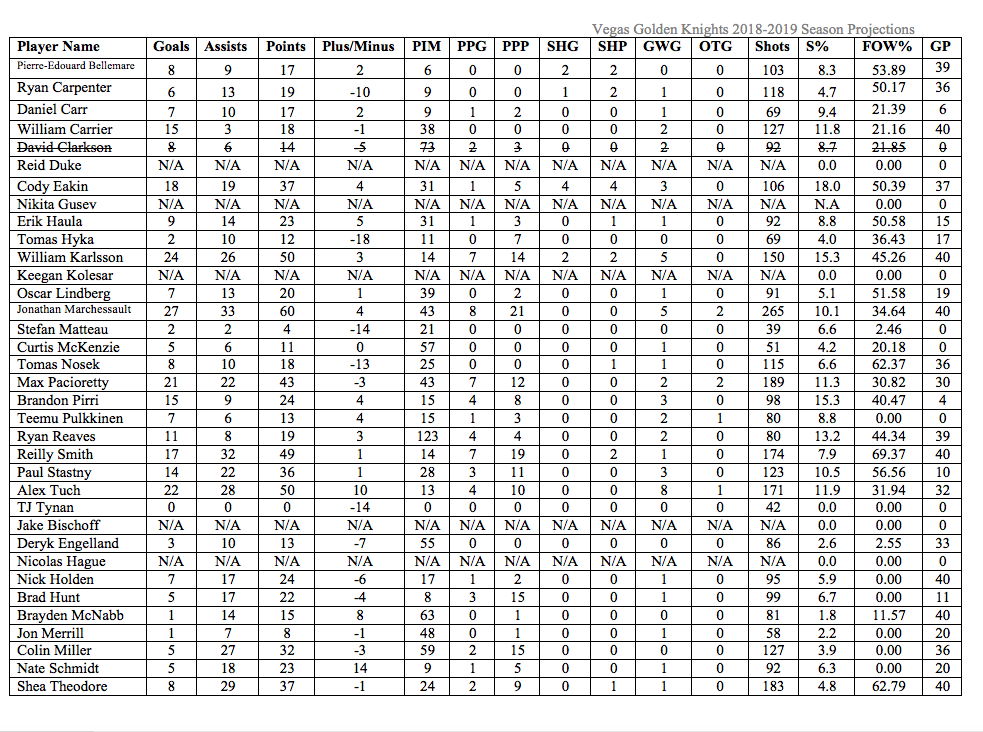
  • Vegas Golden Knights 2018-19 Season Projections

    It’s forecasting season, well, actually it’s the regular season and I’m just a little behind, but until I pointed that out, you didn’t know I was behind on my little passion project here, did you?

    I know I wrote “[i]n the coming days I’ll reveal what teams I’ll be forecasting/tracking all season long, so stay tuned because it’s about to get messier than ever before and I’m up for the challenge,” in my Boston Bruins 2018-19 forecast, but life and the fact that I’m moving all my data into a new format has slowed my turnaround for the time being.

    Nevertheless, my Vegas Golden Knights forecast for 2018-19 is here and let’s pretend the first week of the regular season hasn’t already happened or something.

    Additionally, if you’re wondering what other teams I’m preparing to post (before we get too far into the first quarter of the season) they are the Carolina Hurricanes and Columbus Blue Jackets.

    I always keep tabs on the Bruins every year because I grew up a Boston fan and I decided to track Vegas last season because there hadn’t been nearly as much hype surrounding an expansion team since Columbus and the Minnesota Wild in 2000. Additionally, I’ve previously tracked the Arizona Coyotes simply because they follow us on Twitter (and I’ll get back around to them hopefully before season’s end, if you’re interested).

    But I’m adding Carolina and Columbus to my forecast portfolio this season because 1) the Hurricanes are supposed to be better than last season, plus they have some exciting youth in the lineup and 2) a lot of Blue Jackets fans are also fans of our brand around here, so shouts 5th Liners.

    Please be patient on the timeline for when I’ll get my Hurricanes and Blue Jackets forecasts posted– it’ll be by the end of the month for sure.

    Anyway, on with the Golden Knights, shall we?


    Vegas is coming off of their inaugural season having finished 1st in the Pacific Division with 109 points and a 51-24-7 record under head coach Gerard Gallant. Not only did they finish at the top of their division in their first season, but they did so with over 100 points and a 50-plus win season.

    Oh yeah and they played the Washington Capitals in the 2018 Stanley Cup Final.

    Despite the loss in five games to Washington, the Golden Knights were and still are well ahead of owner Bill Foley’s “Cup in three [seasons]” masterplan– what with General Manager George McPhee‘s offseason additions of Paul Stastny and Max Pacioretty and everything.

    This year, of course, the competition has gotten a lot tougher. There are expectations now when opponents play the Golden Knights.

    Gallant and his Vegas lineup are going to have to get more creative than ever before in franchise history to avoid the hangover of a Stanley Cup Final appearance run and to avoid getting too predictable.

    Things are different now. They’re no longer the new kids on the block. They’re the 2018 Western Conference champions and a team to beat.

    As always, I’d like to remind you my degree is in communication– not math– therefore anything that looks wrong is either adjusted with a little gut-feeling and/or Microsoft Excel’s fault. My expertise resides in the written, spoken and nonverbal language of communicating– not numbers on a spreadsheet.

    These forecasted stats are to be seen as an utopian perspective, as though nothing bad could happen this season at any point to any player– where every player at least lives up to their forecast and then some.

    Some will pan out and some will fall flat. It’s a suggested outcome for a sport that’s played on ice in a highly unpredictable collective environment of action and sheer puck luck.

    vegas_golden_knights_logo

    Vegas Golden Knights Forecast Through 0 Games (82 Games Remaining)

    This slideshow requires JavaScript.

    After a breakout 78-point season (43 goals, 35 assists) for William Karlsson, the Golden Knights number-one center is prime for a respectable 41-point season as part of the natural regression of the game– unless Karlsson is truly an outlier, like he was coming from Columbus to Vegas last season.

    Meanwhile, Reilly Smith (19-27–46 expected totals) and Jonathan Marchessault (28-35–63 expected totals) bolster the Golden Knights first line with respectable performances of their own, while the point spread has really been shared with the second line.

    Newcomers Paul Stastny (22-43–65 expected totals) and Max Pacioretty (33-30–63 expected totals) are set to become the key contributors to the fiery Vegas offense in their first season with the club.

    The Golden Knights top-six core of forwards is deeper than last season, whereas the majority of their offense was reliant upon Marchessault, Karlsson and Smith. This year there’s more emphasis on Alex Tuch and Erik Haula inside the top-nine.

    On defense, Gallant’s crew will have to do without Nate Schmidt for the first 20 games of the season while Schmidt serves a suspension for a performance enhancing drug.

    Luckily, Brad Hunt, Colin Miller and Shea Theodore are prime for an uptick in time-on-ice and production, with Hunt and Miller expected to reach the 30-point plateau, while offseason addition, Nick Holden should see a pleasant rebound from his 17 points split between the Bruins and New York Rangers last season to a 25-point effort in 2018-19 with Vegas, provided he can remain in the top-six on the depth chart.

    Upon Schmidt’s return, he should still have 4-23–27 totals from the blue line, which is not great like last season’s 5-31–36 totals, but not terrible for a top-four defender.

    In goal, Marc-Andre Fleury is expected to return to Earth from his superhuman season last year (a 2.24 goals against average and .927 save percentage in 46 games) to a 2.49 GAA and .913 SV% in 2018-19. As the Golden Knights starter continues to get older, limiting his workload to keep him fresher for the postseason is the way to go.

    Granted, Fleury’s playing time was limited last season due to a concussion, he still went on to have solid regular season numbers and an impeccable 2018 Stanley Cup Playoff run up until the Stanley Cup Final.

    Meanwhile, Malcolm Subban‘s 2.68 GAA and .910 SV% in 22 games played look to be improved upon to a 2.65 GAA and .911 SV% in somewhere around 30 appearances as the backup netminder for Vegas.

    As always, we’ll get more into the goalies once the team has played through a quarter of the season.

  • Vegas Golden Knights 2018-19 Season Preview

    vegas_golden_knights_logo

    Vegas Golden Knights

    51-24-7, 109 points, 1st in the Pacific Division

    Lost in Stanley Cup Final to WSH, 4-1

    Additions: F Daniel Carr, G Zach Fucale, F Alex Gallant, D Nick Holden, F Curtis McKenzie, D Jimmy Oligny, F Max Pacioretty (acquired from MTL), F Paul Stastny

    Subtractions: D Philip Holm (signed, KHL), F James Neal (signed with CGY), F David Perron (signed with STL), F Teemu Pulkkinen (signed, KHL), D Luca Sbisa (signed with NYI), F Nick Suzuki (traded to MTL), F Tomas Tatar (traded to MTL), F Paul Thompson (signed with FLA)

    Still Unsigned: D Chris Casto, D Jason Garrison, F Mikhail Grabovski, D Clayton Stoner

    Re-signed: F William Carrier, G Oscar Dansk, F William Karlsson, D Colin Miller, F Tomas Nosek, F Brandon Pirri, F Ryan Reaves, D Shea Theodore

    Offseason Analysis: Only one team in the NHL’s more than a century of existence has ever won the Cup in their inaugural season. The 2017-18 Vegas Golden Knights almost joined the 1917-18 Toronto Arenas as the only teams to win the Cup in their inaugural season. Toronto beat the Pacific Coast Hockey Association’s (PCHA) Vancouver Millionaires 3-2 in a best of five-game series.

    Vegas came up three wins short of winning it all in the modern-day best-of-seven game series against the Washington Capitals that the Stanley Cup Final has become.

    The Golden Knights didn’t have an unfair advantage in the 2017 Expansion Draft. General Manager George McPhee worked the trade market to his advantage, primarily building the inaugural season’s core group of players through acquisitions.

    Owner Bill Foley has touted the “Cup-in-three” mantra, meaning it’s his goal as an organization to win the Cup in their first three years of existence. Upon league expansion in 1967, it took the Philadelphia Flyers seven years to win their first Cup.

    Foley wants to do it in half the time.

    McPhee’s already gone to work on improving his roster from year one to year two. He’s added Paul Stastny via free agency and Max Pacioretty in a trade with the Montreal Canadiens.

    Stastny, 32, joins the Golden Knights after spending last season with the St. Louis Blues and Winnipeg Jets. In 82 games split between the Blues and Jets, Stastny had 16-37–53 totals.

    A deadline acquisition by Winnipeg, he had 13 points down the stretch in the remaining 19 games of the regular season, then had his best career performance in the postseason (15 points in 17 games) en route to the Western Conference Final against (his now current team) Vegas.

    Despite Stastny’s playmaking style and ability to elevate the players around him in Patrik Laine and friends in Winnipeg, the Jets were no match for the hard-charging Golden Knights.

    If you can’t beat them, join them.

    The old saying rings true for Stastny, despite Winnipeg’s intentions on re-signing the veteran NHL center entering his 13th season in the league. He’ll slide in on Vegas’ second line behind William Karlsson and play alongside one of his best friends since they played together at the 2010 Winter Games, Max Pacioretty.

    Yes, that’s right, Pacioretty is a Golden Knight– in case you’ve been under a rock since training camp.

    At its surface, the price of the Pacioretty trade is one well spent for both teams. Vegas acquired Pacioretty in exchange for Tomas Tatar, prospect Nick Suzuki and a 2019 2nd round pick. That’s right about what you’d expect as a going rate for a top-six scorer– one current roster player, a prospect and a draft pick.

    But for all that McPhee dealt to the Detroit Red Wings to add Tatar at the trade deadline last season, this Pacioretty deal carries a hefty trade-tree baggage, whereby a lot of assets were ultimately tossed in the pot for Pacioretty’s services.

    At the very least, McPhee not only added a five-time 30-goal scorer, but he signed him to a four-year extension right away too. So if things don’t work out this season, the Golden Knights will remain in the hunt for the next few years.

    Why’s that?

    On top of their solid core group of forwards, Vegas has a crafty defense that’s capable of doing more than turning heads like they did last season. There’s just one catch though– they’ll have to do it without Nate Schmidt for the first quarter of the regular season.

    Schmidt will be serving a 20-game suspension for a performance enhancing drug, leaving Colin Miller and Shea Theodore to do the bulk of the work with Brayden McNabb and Deryk Engelland rounding out the rest of the top-four defenders.

    Brad Hunt and Nick Holden, in the meantime, seek to use the first 20 games as an audition for the sixth defenseman role upon Schmidt’s return to the lineup.

    Miller signed a four-year extension this summer and Theodore signed a seven-year deal worth $5.200 million per season. While seven years might be a bit more than the Golden Knights can chew if Theodore’s play heads south, at least he’s signed to a manageable $5.200 million cap hit– up to 50% of which can be retained in a trade.

    With an immense top-nine group of forwards and questions surrounding who will step up on defense in Schmidt’s absence, head coach Gerard Gallant must adjust accordingly as he’s always done– on-the-fly and with the complete buy-in of the dressing room.

    In goal, Marc-Andre Fleury— now signed through the 2021-22 season, thanks to a three-year extension this summer on top of the remaining year on his current contract– must find a way to continue his rejuvenated play in net. Last season’s 2.24 goals against average and .927 save percentage are more than likely unattainable in back-to-back seasons.

    One thing working in Fleury’s favor is his reduced workload. In his second-straight season under 50 games played, Fleury appeared in 46 games last season after battling a concussion.

    Malcolm Subban (2.68 GAA, .910 SV% in 22 games played last season) is still in line to become the next Golden Knights starting netminder in the post-Fleury era, but he undoubtedly must see an increase in playing time this season.

    It’s not quite a 1A, 1B option for Vegas, but rather a precaution for Fleury and a means of keeping their starter fresh for what could be another long postseason run.

    Unless any of the other Pacific Division teams have anything to say about it.

    Offseason Grade: B+

    McPhee bolstered his top-six forward group this offseason with two simple moves, while preserving the large-scale depth of the Golden Knights prospect pool. They didn’t land Erik Karlsson, John Tavares or Ilya Kovalchuk, but they did get Max Pacioretty.

    And they still have quite an impressive amount of cap space to work with next offseason as the franchise continues to settle into existence.

  • 2018 Offseason Preview: Vegas Golden Knights

    Our offseason previews for all 31 National Hockey League teams continues with the Vegas Golden Knights and their outlook for the summer.

    vegas_golden_knights_logo

    After shattering record after record set by previous expansion teams in their inaugural seasons, the Vegas Golden Knights compiled a 51-24-7 record and 109 points on the season in 2017-18. It was not only good enough for a playoff berth, but good enough for 1st place in the Pacific Division.

    Head coach Gerard Gallant got the most out of General Manager George McPhee‘s roster, which was mostly built on trades and a mix of 2017 Expansion Draft claims, bringing the Golden Knights all the way to the Stanley Cup Final– in their first season. First postseason. First Western Conference championship. First everything.

    Well, almost everything (except the Cup, which I hear Alex Ovechkin is, yep, still attached to it).

    Jon Marchessault and Reilly Smith dominated the first line, while William Karlsson emerged from the shadows of the Columbus Blue Jackets into the limelight as one of the league’s top goal scorers.

    He’s also a pending-RFA this summer.

    But Vegas doesn’t have to worry about whatever anyone else thinks of them. They’ve already smashed through all the walls that others thought would surely contain them back Earth, yet here they are– with almost $26.500 million to spend this summer.

    2018 NHL Entry Draft

    McPhee’s Golden Knights do not have a first round pick in the 2018 Draft currently as Vegas packaged a 2018 first round pick, 2019 second round pick and 2021 third round pick at the trade deadline in exchange for Tomas Tatar from the Detroit Red Wings.

    Tatar signed a four-year extension with Detroit last offseason and is on Vegas’s books through 2020-21 at a whopping $5.300 million cap hit. I say whopping, because that’s the most expensive cap hit on the roster currently.

    Pending free agents

    With almost $26.500 million to work with this offseason and some big-time renewals to hand out, McPhee’s work isn’t cut out for him, but the Golden Knights look good heading into 2018-19.

    Sure, maybe they won’t get back to the Stanley Cup Final in 2019, but…

    Who am I kidding? They’ve defied all logic and we’ll never see an expansion team as good as this one in their inaugural season again. No, not because of any pending changes to future expansion drafts (I’m talking post-Seattle here).

    James Neal, Mikhail Grabovski, David Perron and Ryan Reaves are all pending-UFAs for Vegas.

    Neal, 30, was an alternate captain this season and 25-19–44 totals in 71 games as a clutch goal-scorer and early face of the franchise. He’ll get top-dollar on the market if he doesn’t re-sign and is the only priority pending-UFA for McPhee to consider bringing back.

    Grabovski, 34, is likely to never play in the NHL again, since missing the entire 2016-17 season with ongoing concussion issues.

    Perron, 30, was another alternate captain on Vegas’s squad and had 16-50–66 totals in 70 games. His point production was up 20 from last season to this season and he could have some staying power as a playmaker or he could test the waters.

    McPhee isn’t rushing to re-sign Neal or Perron because the future’s looking pretty bright with the Golden Knights core, plus the tremendous cap space available that could make Vegas a dark horse for John Tavares, Ilya Kovalchuk or a landing spot for an Erik Karlsson trade.

    Reaves, 31, was acquired in a three-team trade with the Pittsburgh Penguins and Ottawa Senators, fitting in on Vegas’s fourth line as a tough guy that scored two important goals in the postseason. He’s a cheap bottom-six forward if McPhee likes grit, otherwise there’ll be other opportunities for Reaves to seek.

    Pending-RFAs, William Karlsson, Tomas Nosek and William Carrier are more important to McPhee’s immediate plan.

    Karlsson, 25, is likely to receive the biggest salary on the roster, thanks, in part to his forthcoming raise, but mostly due to his scoring ability. He had 43-35–78 totals in 82 games with the Golden Knights this season and 7-8–15 totals in 20 postseason games.

    Pay up.

    Nosek, 25, eased into a comfortable seven goals and eight assists (15 points) in 67 games this season, then added another four goals and two assists (six points) in 17 playoff games. By comparison, he’s no William Karlsson, but he is a dependable top-9 forward in his prime.

    Likewise, Carrier, 23, is still young and coming into his own as a bottom-six forward that could see more time or about the same number of games this season (37) as next season. For depth purposes alone, Carrier matters a lot to the team.

    28-year-old pending-UFA, Luca Sbisa, played a part in 30 regular season games and could remain as a depth defender if he stays, while 33-year-old pending-UFA, Clayton Stoner, is without a doubt searching for a new place to play.

    If re-signing Karlsson and his other pending-RFAs is a pretty big deal for McPhee this summer, then so is locking up Colin Miller, 25, and Shea Theodore, 22, to viable contracts that won’t cost an arm and a leg, assuming the top-6 defenders continue to develop and capitalize on career seasons.

    In goal, Marc-Andre Fleury, 33, has one-year left on his current deal at $5.750 million and will be looking to sign what might be his last NHL contract next summer, while backup goaltender, Malcolm Subban, 24, is also entering the final year of his $650,000 per year deal.

    Subban isn’t likely to overtake Fleury in the next year or two, so both goalies should be back, but let’s not get too far ahead of ourselves, okay? It’s only 2018, not 2019.

    Retained salary: Derick Brassard ($2.000 million) through 2018-19.

    Other pending free agents throughout the organization include:

    Brandon Pirri (UFA), Chris Casto (UFA), Paul Thompson (UFA), Maxime Lagace (UFA), Jason Garrison (UFA), Teemu Pulkkinen (RFA), Oscar Dansk (RFA), and Philip Holm (RFA)

  • How the Vegas Golden Knights got here

    The Vegas Golden Knights had 500-1 odds of winning the Stanley Cup in their inaugural season back in October. Now, they’re just four wins away.

    vegas_golden_knights_logo

    Let’s clarify a few things here:

    1. The team has a lot of leadership.

    Whether it’s Jon Marchessault, James Neal, David Perron, Deryk Engelland or Marc-Andre Fleury, the Golden Knights have a deep locker room of leaders.

    And that’s not doing enough justice to give their head coach, Gerard Gallant, some credit for the way the team’s carried themselves.

    2. The team has a lot of playoff experience.

    Vegas general manager George McPhee didn’t look for just a bunch of nobody’s. This is Fleury’s fifth appearance in the Stanley Cup Final– and third straight.

    Entering this postseason, only the following Golden Knights regulars had zero games of playoff experience– Ryan Carpenter, William Carrier, Tomas Nosek, Malcolm Subban (their backup goaltender, not likely to see any playing time with Fleury existing) and Alex Tuch.

    Fleury (115 games), Neal (80), Perron (42), Ryan Reaves (36), Engelland (28), Erik Haula (24), Nate Schmidt (21), Luca Sbisa (20) and Shea Thoedore (20) all had at least 20 games of playoff experience coming into the 2018 Stanley Cup Playoffs.

    Reaves, of course, was acquired prior to the trade deadline. Primarily for his scoring prowess in an elimination game, obviously. Wait.

    3. The 2017 Expansion Draft was not rigged.

    Nobody told Florida Panthers general manager Dale Tallon he had to a) leave Marchessault exposed and b) trade Reilly Smith to Vegas to ensure they wouldn’t select someone other than Marchessault at the Expansion Draft.

    Let’s reword that a bit.

    Marchessault was left exposed and the Panthers did not specify that he was untouchable as part of the Smith deal. Florida encouraged Vegas to take on Smith’s $5.000 million cap hit through the 2021-22 season after one down year with the Panthers.

    The Golden Knights were the scapegoat for salary cap mismanagement by other NHL teams and everyone thought Vegas wouldn’t turn out to be this way.

    Fleury was assured of being selected by McPhee and Co. thanks to Pittsburgh’s tight cap after winning back-to-back Cups along with their goaltending situation in which Matt Murray had rightfully taken the starting goaltender role. The Penguins even sent a 2018 second round pick in the trade to persuade Vegas to select Fleury in the Expansion Draft instead of a guy like Brian Dumoulin.

    William Karlsson had underperformed with the Columbus Blue Jackets and was left exposed to Vegas as part of a deal that saw the Golden Knights take on David Clarkson‘s deadweight contract.

    A happy accident– or more accurately, superb scouting and foresight. That same scouting led to nailing more than one needle in a haystack.

    Alex Tuch? Traded by the Minnesota Wild to Vegas as part of an agreement that McPhee would select Erik Haula.

    The Anaheim Ducks traded Theodore to Vegas so the Golden Knights would take Clayton Stoner and not one of Anaheim’s young core players of the future.

    Finally, the talent pool is better than ever before. The Golden Knights were bound to stockpile a few good players as a result of stacked rosters (in theory) across the 30 other NHL clubs.

    McPhee also worked the phones and made more than a few trades and depth signings in free agency.

    Maxime Lagace and Oscar Dansk were both free agent signings that held things over for Vegas in the net while Fleury and Subban were injured for almost the first quarter of the regular season. Dansk went down with an injury himself four games into the Golden Knights third-string goaltending emergency relief plan.

    When the Golden Knights turned to Dylan Ferguson in goal it was only possible because of McPhee’s deal with the Dallas Stars in which defender Marc Methot, who was claimed at the Expansion Draft by Vegas, was flipped to Dallas for Ferguson and a 2020 second round pick.

    Not every selection made by Vegas in the 2017 Expansion Draft suited up for the Golden Knights.

    Trevor van Riemsdyk was packaged with a 2018 seventh round pick to the Carolina Hurricanes for Pittsburgh’s 2017 second round pick (Jake Leschyshyn).

    David Schlemko was flipped to the Montreal Canadiens for a 2019 fifth round pick.

    Alexei Emelin was sent to the Nashville Predators for a 2018 third round pick.

    Despite appearing in preseason action for Vegas, last season’s backup goaltender with the Colorado Avalanche– turned AHL backup goaltender with the Toronto Marlies this season– Calvin Pickard was dealt to the Maple Leafs for a 2018 sixth round pick and Tobias Lindberg.

    Pickard’s trade was spurned by McPhee finding a better backup goaltender at no cost to the organization– Malcolm Subban.

    Subban was claimed off waivers from Boston after the Bruins waited a few days after waivers went into effect to decide on sending him to Providence.

    Ryan Carpenter? Another claim off waivers– midseason— from the San Jose Sharks.

    It’s a professional league. It’s a free market. Something, something, stop complaining because your team has a history of letting you down. The Golden Knights will let their fans down in time, just like every other professional sports franchise in the history of all major professional North American sports.

    But for now, why not enjoy the ride?

    They swept a 1967 expansion team in the First Round, they defeated a 1990s expansion team in the Second Round and now they’ve beaten a late-1990s expansion franchise that relocated to Winnipeg in 2011 for the Western Conference championship.

    There’s never going to be another run quite like this and if it ends in a Stanley Cup championship maybe we should all meet in Vegas for the afterparty. Celebrate the sport.