Tag: Nikita Gusev

  • 2019-20 Metropolitan Division Outlook

    As the entire hockey world awaits training camp action next month, let’s make some (un)educated guesses about the upcoming season that will totally pan out because everything always goes as expected. (It doesn’t.)

    The projected standings below are only a forecast.

    They are based on recent indications– as well as the last few seasons of stats– and cannot account for variations in roster construction (a.k.a. trades and free agency moves).

    There’s a lot of variables that will turn the tables upside down, including transactions, injuries and otherwise. Anything can happen.

    As always, it’s more important to remember 1) the spread and 2) the positioning.

    Just how many points separate the projected division winner from the last wild card spot (the spread) and where a team is supposed to finish in the division standings (the position) can imply that things aren’t always what they seem.

    A team that’s projected to win it all still has to play an 82-game regular season, qualify for the playoffs and go on to amass 16 wins in the postseason.

    Projected Standings After ZERO Months

    Metropolitan Division

    1. y-Washington Capitals, 107 points
    2. x-Pittsburgh Penguins, 102 points
    3. x-Columbus Blue Jackets, 93 points
    4. wc1-New York Islanders, 91 points
    5. wc2-Philadelphia Flyers, 91 points
    6. New York Rangers, 89 points
    7. Carolina Hurricanes, 87 points
    8. New Jersey Devils, 84 points

    Washington Capitals: Pros and Cons

    Year after year, Washington finds themselves at the top of the Metropolitan Division with or without any sort of logical explanation.

    The last time the Capitals didn’t finish 1st in the division? It was the 2014-15 season when the New York Rangers followed up a 2014 Stanley Cup Final appearance with 113 points and the President’s Trophy.

    Once again, the Caps will find a way to turn things on late into the season and manage the top spot in the Metropolitan Division, but they’ll be doing so without a long list of members from their 2018 Stanley Cup championship roster.

    After matching his regular season goal scoring total in the 2018 Stanley Cup Playoffs, Devante Smith-Pelly wasn’t able to get back to form and subsequently reassigned to the American Hockey League’s Hershey Bears during the 2018-19 season.

    Now, he’s an unrestricted free agent.

    Also departing Washington this summer were the likes of Brett Connolly (signed with Florida), Andre Burakovsky (traded to Colorado for Scott Kosmachuk, a 2nd round pick in 2020 and a 3rd round pick in 2020), Nathan Walker (signed with St. Louis), Matt Niskanen (traded to Philadelphia in exchange for Radko Gudas) and Brooks Orpik (retired)

    Madison Bowey was traded to Detroit in February. Jakub Jerabek left via free agency last season and is now playing in the KHL. Philipp Grubauer was traded to the Avalanche last June. Jay Beagle signed with the Vancouver Canucks last July. Alex Chiasson joined the Edmonton Oilers last October.

    With such a quick turnover in the makeup of their lineup, the Capitals’ championship window may already be closing– and fast.

    At least Garnet Hathaway, Richard Panik and Carl Hagelin all signed four-year contracts with cap hits under $3.000 million.

    How would the Capitals fail?

    Radko Gudas and Tom Wilson end up suspended for the entire season somehow and get the rest of the Capitals in trouble for something.

    Pittsburgh Penguins: Pros and Cons

    Phil Kessel is signed through 2021-22 at $6.800 million per season. Alex Galchenyuk is signed through 2019-20 with a cap hit of $4.900 million.

    Using the money saved from trading Kessel to Arizona and hoping Galchenyuk will suddenly become a 30 or 40 goal scorer simply because he’s now on the same roster as Sidney Crosby, Penguins General Manager, Jim Rutherford, figured it’d be a smart move to lock up Brandon Tanev in free agency with a six-year contract at $3.500 million per season and a modified no-trade clause one offseason removed from signing Jack Johnson.

    If there’s any positives for Pittsburgh, it’s that Crosby still exists and Mike Sullivan remains the head coach. Oh and Evgeni Malkin exists too, though some would find it hard to believe, since he wasn’t included in the top-100 players of the last century list.

    As long as Matt Murray and Casey DeSmith can weather the storm of an insufficient defense, injuries and inadequacy from last season, then there’s a good chance the current longest active playoff appearance streak remains alive.

    If not, well, just look for Rutherford to continue to move chairs around on the Titanic.

    This team is starting to spring a leak. If they’re not careful, they’ll sink in the standings.

    But since the season really doesn’t start until January anyway for the Pens, they’ll work their way into a playoff berth as they’ve done for the last dozen years or so.

    How would the Penguins fail?

    Rutherford trades another goal scorer for a “glue guy” and clones Tanev and/or Johnson. Realistically, Murray continues to cool down from his meteoric rise a couple of seasons ago and won’t cost too much as a pending-RFA.

    Columbus Blue Jackets: Pros and Cons

    All my ex’s live in… everywhere but Columbus.

    The Blue Jackets lost Artemi Panarin to the New York Rangers, Sergei Bobrovsky to the Florida Panthers, Matt Duchene to the Nashville Predators and Ryan Dzingel to the Carolina Hurricanes, but they brought in Gustav Nyquist and brought back Marko Dano via free agency.

    Yeah, ok, so it wasn’t a great summer for Columbus GM Jarmo Kekalainen and Blue Jackets fans– even if they knew at least one of their big names (Bobrovsky) was never going to re-sign.

    But while a lot of armchair GMs think the Blue Jackets are destined for a rebuild, there’s a glimmer of optimism if Joonas Korpisalo and Elvis Merzlikins can carry the weight of the crease, while younger players like Alexandre Texier, Pierre-Luc Dubois and Josh Anderson continue to emerge.

    Making it as far as they did into the Second Round of the 2019 Stanley Cup Playoffs was vital to the experience gained by Columbus’ core.

    Though they’re likely not going to a be a dominant force in 2019-20, they should be in contention for what would be a fifth playoff berth in seven years under Kekalainen’s reign.

    And if they turn heads again like they did when they swept the President’s Trophy winning Tampa Bay Lightning in the First Round, then there’s sure to be some interest in lacing up the skates for the Blue Jackets in the future.

    Then again, it could be tank city until Korpisalo or Merzlikins becomes a legitimate starter and somebody becomes an 80-point scorer again.

    It just takes some time… Oh and someone should probably re-sign Zach Werenski while you’re at it.

    How would the Blue Jackets fail?

    The Union doesn’t lose. Ok, if everybody leaves, then it might.

    New York Islanders: Pros and Cons

    Having Lou Lamoriello as your General Manager means some players are going to love him (if they’ve already been with him for many years before) and some players are going to be chased out of the city when they are told they are going in a different direction, but then don’t quite land who they think they’re getting, only to leave you once again for… well, Semyon Varlamov isn’t really an upgrade at this point.

    But Robin Lehner’s gone after winning the Bill Masterton Memorial Trophy with the Rangers Islanders last season after having a remarkable career-year in the face of addiction and other struggles.

    New York’s only getting older and Anders Lee took a “hometown discount” to stay on Long Island.

    Speaking of Long Island, is it too early to start construction on the Belmont Park arena yet?

    Something has to distract everyone from the undercutting of several prospect’s development– whether they’ve rightfully had a chance to prove themselves at the NHL level or not.

    Barry Trotz is a great head coach, but how much more can he do with a middle of the road team that gives up on prospects too early?

    Get them back to the Second Round only to be crushed by a team that’s mixing youth, speed, skill, grit and actually playing 21st century hockey?

    It’s almost as though the Islanders learned nothing from 1995-2006.

    How would the Islanders fail?

    It’s [the] trap!

    Philadelphia Flyers: Pros and Cons

    Flyers General Manager, Chuck Fletcher, actually hasn’t had that bad of an offseason– at least when it comes to tweaking his roster.

    Sure Matt Niskanen and Justin Braun are both 32-years-old, but they’re decent top-4 defenders that should be able to lead from the back end with Shayne Gostisbehere as Travis Sanheim and Ivan Provorov come into their own.

    Speaking of Provorov, he’s still an unsigned-RFA and Philadelphia has more than enough money (about $13.400 million in cap space) to get some sort of a deal done right now. Why wait until the last minute? What’s that? Travis Konecny needs a contract right now too? Oh never mind. Let’s make things complicated!

    Besides giving Kevin Hayes a seven-year contract worth $7.143 million per season with a no-movement clause, the Flyers should have– a lot of explaining to do when their experiment doesn’t work out.

    The Hayes contract is bad, but just how bad can things get with Hayes back on a team that’s coached by… Alain Vigneault!?!

    Vigneault’s the real wild card here as the jury is still out on whether or not his style still fits the game or if the Rangers were just that bad in his final year with New York.

    All things considered, Philadelphia should be back into playoff contention. Just not Cup contention in 2019-20.

    How much more of this can Claude Giroux take?

    How would the Flyers fail?

    Alain Vigneault, Mike Yeo and Michel Therrien can’t figure out who is actually the head coach on a night-to-night basis even though Vigneault technically owns the job (Yeo and Therrien are assistant coaches for the Flyers, if you haven’t heard). Oh and goaltending if Carter Hart gets injured.

    New York Rangers: Pros and Cons

    The Rangers landed the biggest prize in free agency, signing Artemi Panarin to a seven-year contract worth $11.643 million per season.

    Though they are still in a rebuild, Panarin’s addition to the roster helps make New York more of an attractive destination and speeds things up in the overall plan.

    It doesn’t hurt that GM Jeff Gorton had the 2nd overall pick in this year’s draft too. Kaapo Kakko is ready for the limelight in Manhattan as Henrik Lundqvist’s reign is in its twilight days.

    Lundqvist is under contract through the 2020-21 season and at 37-years-old– it’d take a miracle for the Rangers to win him a Cup at this point.

    The Rangers only have one forward over the age of 30 (Matt Beleskey’s 31) and two defenders 30 or older as well (Brendan Smith, 30, and Marc Staal, 32).

    Beleskey is likely to bounce around the organization between New York and Hartford (AHL), while there’s a good chance Smith could be buried as well.

    But their “veteran presence” is valuable to time on ice management among the younger skaters that might not be quite as NHL ready as Kakko and friends.

    Jacob Trouba is new to the Rangers and destined to anchor their new-age defense from the top pairing, while Kevin Shattenkirk joins the long list of buyouts in recent years by New York.

    The Rangers are short almost $5.400 million in dead cap space thanks to Shattenkirk, Dan Girardi and Ryan Spooner’s buyouts around the league (Shattenkirk and Girardi were Rangers buyouts, but Spooner had retained salary and was bought out by the Vancouver Canucks this offseason).

    Next year, New York faces almost $7.500 million in cap penalties from the trio of buyouts before Spooner comes off the books entirely and the number dips down to about $2.544 million from 2021-22 to 2022-23.

    Also another Harvard product– Adam Fox– is the new Jimmy Vesey experiment, but on the blue line. And Vesey? He was traded to Buffalo.

    Panarin and Kakko are worth watching this season, while the rest of the team remains to be seen.

    How would the Rangers fail?

    Henrik Lundqvist stops looking so good all of a sudden. That man is stunning.

    Carolina Hurricanes: Pros and Cons

    Though the forecast says otherwise, Carolina should actually be closer to playoff contention than you may think coming off their 2019 Eastern Conference Final appearance.

    Hurricanes General Manager, Don Waddell, has weathered the storm this offseason. Actually, his job was made pretty easy when the Montreal Canadiens signed Sebastian Aho to a five-year offer sheet worth $8.454 million per season.

    Considering the value Aho brings and the potential that’s still there– that’s a steal.

    Though a little more than $21 million in signing bonuses through the first two years is considered a “hefty” price for an owner to pay, let’s remember that we’re talking about professional sports.

    If Montreal really wanted to make things difficult for Canes owner, Tom Dundon, then they should’ve offered something with a larger cap hit, but that would’ve meant a steeper price to pay in compensation had Carolina not matched the deal. #AdvantageCarolina

    Aho will be 27 by the time his new contract runs out, which means he’ll be a pending-UFA in 2024, but there’s plenty of time to worry about the next contract when the time comes.

    Right now, the Hurricanes have added some much needed top-six/top-nine forward depth in Erik Haula (acquired from Vegas) and Ryan Dzingel (signed via free agency), while adding a 1st round pick in 2020 (or 2021 if Toronto’s 2020 1st rounder is a top-10 overall selection) and swapping Calvin de Haan with the Chicago Blackhawks for Gustav Forsling (there were other pieces involved, like Anton Forsberg going to Carolina too).

    The average age of Carolina’s skaters? 25.

    Considering how far the core went in 2018-19, that’s beyond impressive and it’s a testament to head coach, Rod Brind’Amour.

    In July, Petr Mrazek re-signed with the Hurricanes on a two-year deal and James Reimer was acquired in a trade with the Florida Panthers as Curtis McElhinney signed with the Tampa Bay Lightning.

    Though Alex Nedeljkovic might be another year out from competing for the starting job, the crease is Mrazek’s to lose once again with Reimer looking to rebound from a dismal time in Florida.

    Carolina is poised for another deep run, but how soon will it be given the fact that their emergence as a contender means that every other team wants to beat them that much more from night-to-night?

    How would the Hurricanes fail?

    The Canes have a strong analytics department, so the only thing that could naturally disrupt their plans? Regression (and no WiFi).

    New Jersey Devils: Pros and Cons

    The Devils won the draft lottery and procured Jack Hughes with the 1st overall pick in June.

    New Jersey was third-to-last in overall standings last season.

    Though they added P.K. Subban in a trade with the Nashville Predators in June, drafted Hughes and have Taylor Hall, Nico Hischier and Will Butcher on their roster, the Devils still need a lot of pieces to improve.

    Hall’s a pending-UFA at season’s end. His next deal– whether it’s with New Jersey or not– determines the fate of this team.

    Cory Schneider’s still under contract through 2021-22 and Mackenzie Blackwood is only 22-years-old.

    Goaltenders are rarely superstars when they’re that young, so while Blackwood may be the starter heading into the season and goalie of the future for the organization– it wouldn’t be a surprise to see some ups and downs before the dust settles.

    Now for the good news.

    Nikita Gusev was acquired in a trade with the Golden Knights and Ray Shero doesn’t have a lot of no-trade clauses to deal with if the Devils look to sell at the trade deadline.

    How would the Devils fail?

    If they somehow lose the Taylor Hall trade a few years after winning it.

  • DTFR Podcast #164- The Free Agency Mega-Hour

    DTFR Podcast #164- The Free Agency Mega-Hour

    Nick, Cap’n and Pete recap the last two weeks of trades and first few days of free agency 2K19.

    Subscribe to the podcast on Apple Podcasts (iTunes)Stitcher and/or on Spotify. Support the show on Patreon.

  • Vegas Golden Knights 2018-19 Forecast Through 62 Games

    Coming off a 3-2 shootout loss to the Boston Bruins on Wednesday, the Vegas Golden Knights (32-25-5, 69 points, 3rd in the Pacific Division) have 20 games remaining in the 2018-19 regular season.

    These aren’t your father’s Golden Knights, as production is down from their inaugural season in just their 2nd season of existence.

    Though Marc-Andre Fleury (29-18-5 record, 2.60 goals against average, .908 save percentage in 52 games played) remains Vegas’ starter on an almost nightly basis, backup goaltender, Malcolm Subban (3-6-0, 2.76 GAA, .912 SV% in 10 GP) has struggled to carry his own weight.

    Despite bringing in Paul Stastny via free agency and Max Pacioretty via trade, the Golden Knights haven’t been immune to the injury bug this season.

    Stastny and Pacioretty themselves have joined Reilly Smith and others throughout the lineup on the injured reserve or out of playing action for various points of the season.

    While the Pacific Division title might be out of reach for Vegas this season, a divisional spot in the 2019 Stanley Cup Playoffs is all but assured as long as the floor doesn’t fallout from underneath Gerard Gallant and his players.

    Of note, the Arizona Coyotes are emerging once again with a late season push for the playoffs– and this time around, they’re doing it without their starting goaltender, Antti Raanta (out for the season due to injury).

    Plus the Vancouver Canucks are still in contention and, well, that’s about it, realistically among Pacific Division teams that still have a chance for the last divisional spot and/or a Western Conference wild card berth.

    Anyway, back to the Golden Knights.

    Here’s a look at the latest Vegas forecast– keeping in mind there are many variables that can and will effect the final outcome, such as injuries and/or being called up, assigned, traded, lucky or unlucky.

    This forecast is just an educated guess. It’s a glimpse of what could be or could’ve been by the end of the regular season.

    As always, my degree is in communication– not math– and hockey is naturally steeped in context and holistic unpredictability. Nothing can account for sheer puck luck, the odd bounce or a blown call.

    If a player reaches the expected outcome, they’ve met expectations. If said player exceeds the forecasted stats, they’ve exceeded expectations (naturally). Of course, if a player does not perform, then they did not live up to expectations.

    On a game-to-game basis, whatever’s on the scoresheet can indicate general trends that can be further broken down into an educated forecast.

    At best, it’s a guess. At worst, well, it doesn’t really matter– it’s not like Golden Knights General Manager George McPhee is reading this and making his roster decisions based on what’s here, right?

    If he is, I’d like a job, please. Thanks.

    Vegas Golden Knights Forecast Through 62 Games (20 Games Remaining)
    WordPress, when are you going to make the ”gallery” option again (and actually make it good like how it used to be)?

    Among forwards, Vegas’ consistent first line last season of Jonathan Marchessault, William Karlsson and Smith hasn’t had as much consistent luck and skill this season.

    Though Smith has battled injury this season, Marchessault remains one of the Golden Knights most consistent performers expected to lead his team in goals (25) and points (54) with 25-29–54 expected totals.

    Now what about Karlsson?

    Good question, what about him? Things haven’t gone exactly as planned in terms of capitalizing on his breakout season last season with a new contract in the offseason and higher expectations for this season.

    Karlsson’s bridge, one-year, extension last summer coming off the backs of a 43-goal season has only managed 18 goals thus far– including four goals in the last 22 games for the Golden Knights.

    Given his current trend, Karlsson is expected to amass 21-23–44 totals. He’d be tied with Pacioretty for 2nd place in expected goals (21) and 3rd in expected points (44) on the roster, but nowhere near the emergent star in the making that he was last season.

    While he very well could bounce back– similar to Smith in nature, following a good-year, bad-year, good-year, bad-year pattern– the phrase “what have you done for me yesterday” won’t help him in his next contract negotiation this summer unless McPhee gives him the benefit of the doubt.

    Meanwhile, Alex Tuch is expected to finish the season with a career-high 20-33–53 expected totals.

    That’s comforting to hear for a team that needs to rely on secondary scoring in the midst of a recession in primary production.

    Tuch is expected to lead in assists (33), followed by Smith (30) and Marchessault (29), while Marchessault is destined to lead in points (54) over Tuch (53) and Karlsson (44).

    On defense, Vegas’ blue line will finish off the season being led by Shea Theodore (11-21–32 expected totals), followed by Colin Miller (30 expected points) and Nate Schmidt (25 expected points despite missing the first 20 games of the season while serving a suspension for testing positive for a performance enhancing drug).

    In net, Fleury looks like he’s bound to break under the weight of all the minutes he’s been playing and will play this season. A 2.74 expected GAA and .909 expected SV% is not starting goaltender material, unless we’re talking about Sergei Bobrovsky with the Columbus Blue Jackets or something.

    But it’s not like Gallant can really count on his current backup to offset some of Fleury’s load. Subban’s expected 2.70 GAA and .912 SV% isn’t tremendous either.

    If anything, it’s an indication that McPhee could help bolster his team with the acquisition of an extra goaltender by the trade deadline.

    Someone like Ryan Miller, 38-years-old, could help steal some crucial points for the Golden Knights down the stretch if the San Jose Sharks aren’t already in the process of completing a trade for the goaltender with the Anaheim Ducks.

    Growing pains are a fact of life– especially in sports– and Vegas is going through puberty already in its 2nd season. This season’s been full of highs, lows and awkward phases that hopefully will end in a glow up.

    Otherwise we’ll all be looking back at this season shaking our heads at how it could pull off that much denim or something back in the day.

  • Vegas Golden Knights Forecast Through 40 Games

    It’s not the most recent forecast, since the Vegas Golden Knights played Game 41 of their 2018-19 regular season on Saturday against the Los Angeles Kings.

    Nevertheless, it’s time to take a quick check of the pulse of the Golden Knights– how their season has progressed so far and where it appears to be going from here.

    Thanks to some extenuating circumstances, perhaps Vegas fans will forgive me for not being able to get around to their quick forecasted glance after 20 games played this season.

    Why? Because it would’ve been pretty dismal and you don’t need that kind of negativity in your life.

    Although, now at the halfway mark (officially after the game against the Kings, technically unofficially as of this forecast), things have improved, but with a few concerns remaining.

    Nate Schmidt served his 20 game suspension for a performance enhancing drug and for the most part, Vegas’ blue line got the job done.

    The team’s record wasn’t desirable, but guys like Shea Theodore and Colin Miller continued to rise past expectations in their ability– even more so now that Schmidt is back and solidified the defensive zone for the Golden Knights.

    One thing that has plagued the team all season is subpar goaltending.

    Marc-Andre Fleury isn’t getting any younger and Malcolm Subban regressed quite a bit from his debut season as a backup netminder at the NHL level last season.

    Managing playing time in the crease is something to keep in mind and we’ll take a closer look in a minute.

    For now, Vegas stands in a divisional spot in the playoffs in the Pacific. Not nearly as dominant as last season, but keeping up with the legitimate(?) playoff contenders in an otherwise weaker division compared to the rest of the league.

    Without further ado, here’s a look at the remaining 42 games (now 41) on the season and what to expect from the latest forecast.

    Keep in mind, there are many variables that can and will change what goes down from now through the end of the regular season in April, like trades, injuries, general lineup changes, roster moves and anything else unbeknownst to the Microsoft Excel spreadsheet that generates this forecast.

    My degree is in communication– not math. It’s “not my fault”.

    If a player meets the forecasted stats, then they’ve met expectations. If they exceed their forecasted stats, then they’ve exceed expectations.

    And of course, if a player does not live up to the latest forecast, then something went awry (the player could’ve been injured, been unlucky or regressed– a.k.a. didn’t meet expectations).

    Puck luck cannot be predicted, but general trends and estimated gut feelings can indicate a sense of what’s to come based on the results of each and every scoresheet night-in and night-out.

    Vegas Golden Knights Forecast Through 40 Games (42 Games Remaining)

    (Just click on the image if you’re having trouble seeing it– WordPress changed their layout so there’s no more slideshow options.)

    Every set of blessings comes with a set of curses and this year, that rings truer more than ever before for the Golden Knights. Of course, it’s only their second season in franchise history, but it’s still true.

    William Karlsson (24-26–50 expected totals) is having a “down” year compared to last season’s breakout career-year of 43 goals and 35 assists (78 points). Reaching the 50-point plateau is still respectable, but doesn’t scream any guarantees of being on the first line should the postseason roll around.

    Head coach, Gerard Gallant, has enough top-six forward depth to play around with if Karlsson starts to head south, considering Alex Tuch‘s expected 22-28–50 totals, Paul Stastny‘s expected 14-22–36 totals and Max Pacioretty‘s expected 21-22–43 totals.

    Despite the ever-consistent qualities of Jonathan Marchessault (27-33–60 expected totals) and Reilly Smith (17-32–49 expected totals), this year’s Golden Knights team point spread is more spread out.

    As it is, while Marchessault should lead in goals (27), assists (30) and points (60) and Karlsson should be second in goals (24) and points (50), one would think Smith would be second or third in whatever stats Marchessault and Karlsson aren’t leading in.

    However, Tuch’s expected point outcome (50) is tied with Karlsson for the second-most points behind Marchessault and Tuch is expected to rank third on Vegas’ roster in goals behind Marchessault and Karlsson with Smith a distant 5th behind Pacioretty’s 21 expected goals this season.

    While the offense isn’t as impactful from the forwards, the blue line has really come into its own in Vegas.

    Shea Theodore’s expected 8-29–37 totals will be the best of his teammates and fellow defenders in a Golden Knights uniform, leading Colin Miller (5-27–32 expected totals) and Nick Holden (7-17–24 expected totals).

    Nick Holden. That’s right. Holden is ahead of Nate Schmidt (5-18–23 expected totals) in the latest forecast.

    But that speaks to Holden’s resiliency in his career and the chemistry Gallant has found in his pairing every night– coupled, of course, with the fact that Holden is seeing more time on the ice (in the literal “games played” sense) than he has the last couple of seasons with the New York Rangers and Boston Bruins.

    He is a durable top-four defender that’s still in his athletic prime and it is exactly that kind of depth that can take teams deep into a Stanley Cup Final run.

    In goal, Marc-Andre Fleury should land around a 2.61 goals against average and .911 save percentage in a season in which he has been overworked thus far.

    He will continue to be overworked unless Malcolm Subban regains his footing, Gallant argues for calling someone up from the Chicago Wolves (AHL) or Golden Knights General Manager George McPhee makes an acquisition for a suitable backup option if all else fails.

    Fleury has played in 35 of the 40 games up to this forecast. He’s since played in 35 out of the 41 games played by the club this season.

    Subban has played in six games and is 0-5-0 in that span. His expected outcomes are a 2.76 GAA and .907 SV%– both below average goaltending the backup role.

    Whereas if Vegas wanted to try Oscar Dansk or Maxime Lagace without the pressures of coming into the dressing room in an emergency recall situation– unlike last season– a little healthy competition for the backup role might nudge Subban in the right direction and take off some of Fleury’s workload.

    It’s not that Fleury can’t handle 50-plus games anymore as a starting goaltender, but rather, it’s just that he shouldn’t be relied on for about 85% of the games in the regular season as is his current going rate.

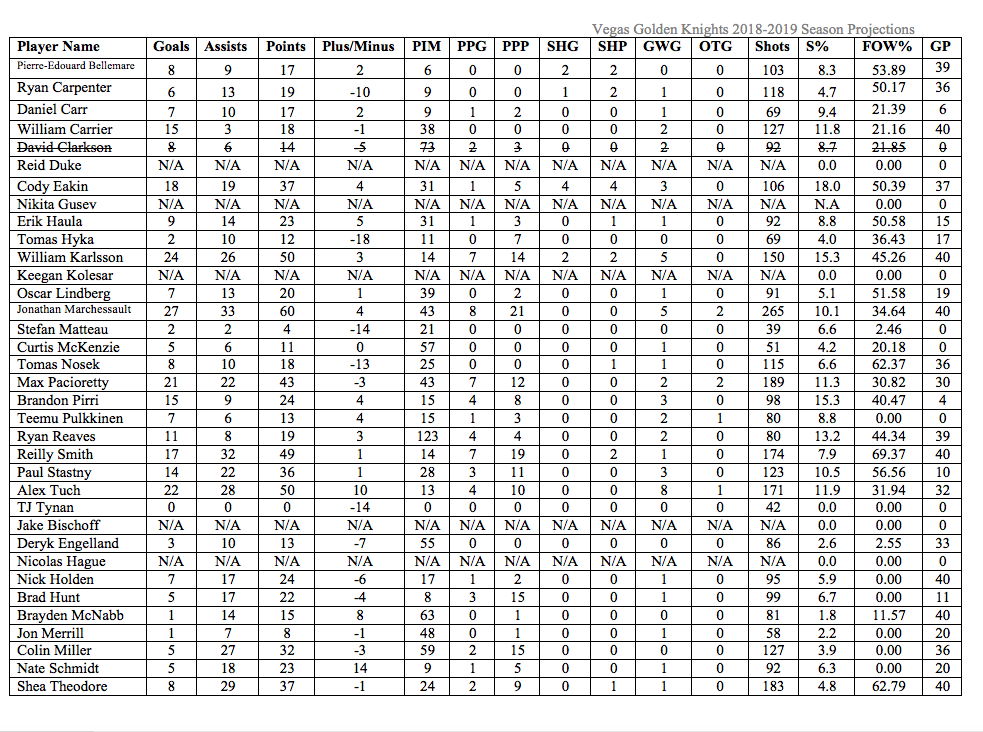
  • Vegas Golden Knights 2018-19 Season Projections

    It’s forecasting season, well, actually it’s the regular season and I’m just a little behind, but until I pointed that out, you didn’t know I was behind on my little passion project here, did you?

    I know I wrote “[i]n the coming days I’ll reveal what teams I’ll be forecasting/tracking all season long, so stay tuned because it’s about to get messier than ever before and I’m up for the challenge,” in my Boston Bruins 2018-19 forecast, but life and the fact that I’m moving all my data into a new format has slowed my turnaround for the time being.

    Nevertheless, my Vegas Golden Knights forecast for 2018-19 is here and let’s pretend the first week of the regular season hasn’t already happened or something.

    Additionally, if you’re wondering what other teams I’m preparing to post (before we get too far into the first quarter of the season) they are the Carolina Hurricanes and Columbus Blue Jackets.

    I always keep tabs on the Bruins every year because I grew up a Boston fan and I decided to track Vegas last season because there hadn’t been nearly as much hype surrounding an expansion team since Columbus and the Minnesota Wild in 2000. Additionally, I’ve previously tracked the Arizona Coyotes simply because they follow us on Twitter (and I’ll get back around to them hopefully before season’s end, if you’re interested).

    But I’m adding Carolina and Columbus to my forecast portfolio this season because 1) the Hurricanes are supposed to be better than last season, plus they have some exciting youth in the lineup and 2) a lot of Blue Jackets fans are also fans of our brand around here, so shouts 5th Liners.

    Please be patient on the timeline for when I’ll get my Hurricanes and Blue Jackets forecasts posted– it’ll be by the end of the month for sure.

    Anyway, on with the Golden Knights, shall we?


    Vegas is coming off of their inaugural season having finished 1st in the Pacific Division with 109 points and a 51-24-7 record under head coach Gerard Gallant. Not only did they finish at the top of their division in their first season, but they did so with over 100 points and a 50-plus win season.

    Oh yeah and they played the Washington Capitals in the 2018 Stanley Cup Final.

    Despite the loss in five games to Washington, the Golden Knights were and still are well ahead of owner Bill Foley’s “Cup in three [seasons]” masterplan– what with General Manager George McPhee‘s offseason additions of Paul Stastny and Max Pacioretty and everything.

    This year, of course, the competition has gotten a lot tougher. There are expectations now when opponents play the Golden Knights.

    Gallant and his Vegas lineup are going to have to get more creative than ever before in franchise history to avoid the hangover of a Stanley Cup Final appearance run and to avoid getting too predictable.

    Things are different now. They’re no longer the new kids on the block. They’re the 2018 Western Conference champions and a team to beat.

    As always, I’d like to remind you my degree is in communication– not math– therefore anything that looks wrong is either adjusted with a little gut-feeling and/or Microsoft Excel’s fault. My expertise resides in the written, spoken and nonverbal language of communicating– not numbers on a spreadsheet.

    These forecasted stats are to be seen as an utopian perspective, as though nothing bad could happen this season at any point to any player– where every player at least lives up to their forecast and then some.

    Some will pan out and some will fall flat. It’s a suggested outcome for a sport that’s played on ice in a highly unpredictable collective environment of action and sheer puck luck.

    vegas_golden_knights_logo

    Vegas Golden Knights Forecast Through 0 Games (82 Games Remaining)

    This slideshow requires JavaScript.

    After a breakout 78-point season (43 goals, 35 assists) for William Karlsson, the Golden Knights number-one center is prime for a respectable 41-point season as part of the natural regression of the game– unless Karlsson is truly an outlier, like he was coming from Columbus to Vegas last season.

    Meanwhile, Reilly Smith (19-27–46 expected totals) and Jonathan Marchessault (28-35–63 expected totals) bolster the Golden Knights first line with respectable performances of their own, while the point spread has really been shared with the second line.

    Newcomers Paul Stastny (22-43–65 expected totals) and Max Pacioretty (33-30–63 expected totals) are set to become the key contributors to the fiery Vegas offense in their first season with the club.

    The Golden Knights top-six core of forwards is deeper than last season, whereas the majority of their offense was reliant upon Marchessault, Karlsson and Smith. This year there’s more emphasis on Alex Tuch and Erik Haula inside the top-nine.

    On defense, Gallant’s crew will have to do without Nate Schmidt for the first 20 games of the season while Schmidt serves a suspension for a performance enhancing drug.

    Luckily, Brad Hunt, Colin Miller and Shea Theodore are prime for an uptick in time-on-ice and production, with Hunt and Miller expected to reach the 30-point plateau, while offseason addition, Nick Holden should see a pleasant rebound from his 17 points split between the Bruins and New York Rangers last season to a 25-point effort in 2018-19 with Vegas, provided he can remain in the top-six on the depth chart.

    Upon Schmidt’s return, he should still have 4-23–27 totals from the blue line, which is not great like last season’s 5-31–36 totals, but not terrible for a top-four defender.

    In goal, Marc-Andre Fleury is expected to return to Earth from his superhuman season last year (a 2.24 goals against average and .927 save percentage in 46 games) to a 2.49 GAA and .913 SV% in 2018-19. As the Golden Knights starter continues to get older, limiting his workload to keep him fresher for the postseason is the way to go.

    Granted, Fleury’s playing time was limited last season due to a concussion, he still went on to have solid regular season numbers and an impeccable 2018 Stanley Cup Playoff run up until the Stanley Cup Final.

    Meanwhile, Malcolm Subban‘s 2.68 GAA and .910 SV% in 22 games played look to be improved upon to a 2.65 GAA and .911 SV% in somewhere around 30 appearances as the backup netminder for Vegas.

    As always, we’ll get more into the goalies once the team has played through a quarter of the season.

  • Numbers Game: Vegas Through 60

    Derick Brassard was briefly a Golden Knight. Yes, he was flipped from Ottawa to Vegas to Pittsburgh as part of Friday’s three-team trade and technically speaking, he never suited up for Vegas so it doesn’t actually count, but Brassard was once a Golden Knight.

    Now, as a result of the Brassard trade, Ryan Reaves is the newest player in Vegas.

    Through 60 games (entering Friday), the Vegas Golden Knights are still 1st in the Pacific Division. William Karlsson is in the midst of a career year, Marc-Andre Fleury and James Neal probably won’t be traded at the deadline like everyone thought they would and there’s a real possibility this whole “Cup in One” mantra actually works out.

    Thanks in part to the crazy scheduling this time of year– between the NHL, the Winter Games in PyeongChang, the upcoming trade deadline on Monday and much, much more– I was finally able to squeeze in the time to update Golden Knights projections with 22 games remaining in their schedule.

    The only problem is that they’ve now played Game 61 of 82 and added Ryan Reaves. So basically, here’s everything I had before anything that happened on Friday.

    I’ll try to come up with some projections for Reaves and any other potential acquisitions Vegas makes between now and the deadline, but there’s no promises. Every year around the deadline my database needs constant updating and as a result some things get bogged down until I physically go through every stat.

    I do get around to it (eventually) and these players will be reflected in any subsequent projection posts.

    Anyway, on with the show…

    The Golden Knights aren’t good. They’re great.

    Check out the latest forecast in the charts below. Keep in mind, as always, that anything that sounds ridiculous is Microsoft Excel’s fault. I’m just kidding. There are always outliers and unrealistic projections. Alas, these are merely utopian, Excel driven, guesses.

    Standard disclaimer, my degree is in communication– not math or #fancystats.

    vegas_golden_knights_logo

    Vegas Golden Knights Projections Through 60 Games (22 Games Remaining)

    This slideshow requires JavaScript.

    The sensational season continues and down the stretch as Erik Haula, Karlsson, Jonathan Marchessault, Neal, David Perron and Reilly Smith are all expected to amass somewhere around 60-points (or more).

    Colin Miller‘s emergence as a top defenseman in the Western Conference continues as he nears the 40-point plateau by seasons end. Also, look at Shea Theodore fitting right in as a top-4 quality defenseman just entering his prime. Miller, Nate Schmidt and Theodore for years to come in Vegas should mean many great things.

    Meanwhile, Fleury’s incredible run in goal begins to cool off just a little. His goals against average begins to reflect an “average” year for Fleury, which– granted– is still better than a lot of goaltenders in the NHL. Fleury’s save percentage should be just fine down the stretch– if not potentially league-leading.

  • February 24 – Day 136 – Olympic midnight

    Settle in and watch all 14 of today’s games. You owe it to yourself.

    As I write, the Czech Republic and Canada are playing for the bronze medal at the Olympics. That game started at 7:10 a.m. Eastern time.

    Back in North America, the NHL has scheduled a dozen tilts this fine Saturday, starting with Philadelphia at Ottawa (NHLN/TVAS) at 2 p.m. At 4 p.m., Colorado at Calgary is the next matinee scheduled, followed by the New York Islanders at New Jersey to clean up the day slate. The usual starting time of 7 p.m. brings seven puck drops (Winnipeg at Dallas [SN1/SN360], Boston at Toronto [SN], Tampa Bay at Montréal [CITY/TVAS], Carolina at Detroit, Pittsburgh at Florida, Buffalo at Washington and Chicago at Columbus [NHLN]), followed by Anaheim at Arizona an hour later. Finally, tonight’s nightcap – Edmonton at Los Angeles (CITY/SN/SN360) – is slated for 10 p.m. All times Eastern.

    Last but not least, Olympic gold is up for grabs between the OAR and Germany at 11:10 Eastern time at Gangneung Hockey Centre.

    Of quite a list of games, there’s more than a few that are worthy of our attention.

    • Czech Republic vs. Canada: For a Canadian team without its NHL players, bronze has to be considered a success.
    • New York at New Jersey: Patrik Elias was an excellent Devil for 20 years. Tonight, his 26 sweater will be lifted to the Prudential Center rafters alongside Martin Brodeur‘s 30, Ken Daneyko‘s 3, Scott Niedermayer‘s 27 and Scott Stevens‘ 4.
    • Boston at Toronto: Original Six action between teams separated by only one point in the standings? Sign me up.
    • Chicago at Columbus: Brandon Saad makes his return to Nationwide Arena tonight after being traded back to the Windy City this offseason.
    • Edmonton at Los Angeles: Old rivalries die hard, right?
    • OAR vs. Germany: It’s the favorites against what could be one of the best Cinderella stories of all time. Who wins the medal they want tonight?

    Almost all of the games listed above have the potential to be excellent, but there’s obviously only one clear choice for today’s featured matchup.


    I said something similar in my OAR vs. the Czech Republic semifinal preview, but it bears repeating: no team has been as impressive at the 4-0-0-1 Olympics than the Olympic Athletes from Russia.

    Of course, what should we expect from a team consisting of players from three of the best teams in the world’s second-best league?

    Красная Машина – The Red Machine – so dominant is its imposing offense. The OAR are managing a ridiculous 4.6 goals per game through their first five games, well above Finland’s second-best effort of 3.2 goals per game.

    While almost every skater on the OAR’s roster is capable of finding the scorecard, four in particular have stood out above the rest. F Nikita Gusev leads the way with 2-6-8 totals in five showings, followed by F Ilya Kovalchuk (5-2-7), F Pavel Datsyuk (0-5-5) and F Kirill Kaprizov (4-1-5). All four players are distributed through the Machine’s top two lines.

    Of course, one of the bonuses of having such an impressive attack is that it limits the opponent’s opportunities. In addition to averaging the most goals, the OAR are also limiting opponents shots on goal to only 21.6 – the second-fewest of any team in South Korea.

    Not that he needs all that much help, that keeps the workload off G Vasili Koshechkin. Having allowed only five goals all tournament, he’s posted an impressive .951 save percentage and 1.08 GAA.

    While almost everyone had predicted the OAR to qualify for tonight’s gold medal game, no one expected the 1-3-0-2 Germans to advance this far. Germany has never won either a silver or gold at the Olympics, meaning this will easily be its best performance at the tournament regardless of this game unfolds.

    Unfortunately for Träger der Adler – The Eagle Carriers – the odds are not stacked in their favor. Not only is the OAR going to be the most imposing team Germany has faced, but the Germans’ stats simply don’t stack up in comparison.

    Let’s start on offense, where Germany’s 2.33 goals per game is sixth-worst of any team in the tournament. No German skater has been more impressive than F Patrick Hager, who’s 3-3-6 totals through six games are easily the best marks of any player on the team.

    Meanwhile, considering the Eagle Carriers have allowed a fifth-worst 26.83 shots on goal per game, the defensive end has totally relied on the efforts of G Danny aus den Birken.

    If an MVP award is distributed at the Olympics, aus den Birken is certainly the most deserving German considering his .904 save percentage and 2.54 GAA. Though those numbers pale in comparison to Koshechkin’s marks, he’s been able to provide the biggest, most important saves for Germany to keep it alive in this tournament.

    Germany’s unprecedented run to the top of this Olympic tournament has been fun to watch, and I’m certainly pulling for the Eagle Carriers in tonight’s game. However, I don’t see them pulling off the massive upset against the OAR.


    Midnight has yet to strike in PyeongChang, as Germany – the Olympics’ Cinderella story – advanced to the gold medal game by beating Canada 4-3 at Gangneung Hockey Centre in yesterday’s DtFR Game of the Day.

    Though hockey is a game divided into thirds, this semifinal was a tale of two halves. Germany dominated the first half, as they had a 3-0 advantage through the first 28 minutes.

    Only one goal was struck in the first period, and it was a result of some very undisciplined play by the Canadians. With 6:41 remaining in the frame, F Linden Vey earned himself a seat in the penalty box for high sticking, and that infraction was compounded by the Canadian bench also being assessed a delay of game penalty (served by F Rene Bourque). As a result, Germany earned itself a 50-second five-on-three power play once F Felix Schutz was released from the penalty box (boarding). F Brooks Macek (F Dominik Kahun) needed only 14 seconds of that advantage to beat G Kevin Poulin, setting the score at 1-0.

    Where Germany really turned on the jets was in the second period, as they posted an imposing three goals in the frame. First up was F Matthias Plachta (F Patrick Hager), scoring only 3:21 into the period to give the Germans a two-goal advantage. That tally was followed only 3:28 later by F Frank Mauer (F Marcel Goc and F David Wolf), setting the score at 3-0. Canada finally got on the scoreboard at the 8:17 mark of the period courtesy of a F Gilbert Brule (D Chris Lee and D Maxim Noreau) power play goal, but the Germans answered right back only 4:14 later when Hager (Plachta and Schutz) registered a power play goal of his own.

    Though Hager’s goal was the last of the second period, there was one final major event in the frame. Only 28 seconds after Hager set the score at 4-1, Brule was ejected from the game for checking to the head and neck area.

    There’s a difference between winning a period and dominating a period. Germany won the first two periods, but – even with three goals – I wouldn’t say it dominated either frame.

    On the other hand, Canada absolutely dominated the third period. Not only did they fire 15 shots on goal – the most of either team in any period – but the Canadians also limited Germany to only one shot against Poulin.

    One.

    With that in mind, perhaps its no surprise Team Canada fought its way back into this game, starting with M Robinson’s (C Thomas and M Raymond) tally 2:42 into the frame. The next scoring opportunity of the frame belonged to Germany, as Kahun was tripped by C Goloubef while attempting a shot 39 seconds after the horn stopped blaring for Robinson. Fortunately for Canada, Poulin stood tall to keep the score at 4-2, meaning F Derek Roy‘s (Lee and Noreau) power play goal at the 9:42 mark of the game pulled it back within a goal.

    But the remaining 10:18 belonged to G Danny aus den Birken. No matter how many shots the Canadians fired, he would not yield the game-tying goal to earn the victory for Germany.

    Aus den Birken earned the victory after saving 28-of-31 shots faced (.903 save percentage), leaving the loss to Poulin, who saved 11-of-15 (.733).

    With that victory, Germany has already clinched its best finish at any Olympic tournament, as the Eagle Carriers are ensured at least silver by qualifying for the gold medal game. As stated above, they play for the Olympic title tonight at 11:10 p.m. Eastern time against the Olympic Athletes from Russia.

    Additionally, the 73-46-17 home teams in the DtFR Game of the Day series have recaptured a 21-point advantage over the road teams.

  • February 22 – Day 134 – Russian to Czechmate

    It’s the best day of the hockey week! A dozen games are on this Thursday’s schedule!

    We begin today’s slate in North America with 11 NHL tilts, starting with three (the New York Islanders at Toronto, Minnesota at New Jersey and Columbus at Philadelphia) at 7 p.m. and four more (the New York Rangers at Montréal [RDS/TSN2], Tampa Bay at Ottawa [RDS2], Buffalo at Detroit and Washington at Florida [TVAS]) half an hour later. San Jose at Nashville drops the puck at 8 p.m., followed an hour later by a pair of Western Conference matchups (Colorado at Edmonton [SN1] and Calgary at Arizona). Finally, Dallas visits Los Angeles at 10:30 p.m. to close out the league’s action. All times Eastern.

    Of course, there’s also the Olympics to keep in mind. The first men’s semifinal between the Czech Republic and the OAR is scheduled for 2:40 a.m. Eastern time Friday morning.

    Of those games, I’ll have my eye on three:

    • New York at Montréal: Not only is this an Original Six rivalry, but it’s also a rematch from last season’s Eastern Quarterfinals.
    • Calgary at Arizona: G Mike Smith (injured) and D Michael Stone are making their first trips back to Glendale to take on the Coyotes, the team they both spent six seasons with before joining Calgary.
    • Czech Republic vs. the OAR: The top two remaining seeds are going at it for a chance to play for a gold medal!

    We’ve featured Olympic action the past six days, and I see no reason to stop that trend now. Let’s see who’s advancing to the gold medal game!


    Let’s start with the 3-1-0-0 Czech Republic, which posted a 2-1-0-0 record in Group A against the likes of Canada (3-2 SO), Switzerland (4-1) and South Korea (2-1) to clinch a first round bye into the quarterfinals, where it beat the United States in a 3-2 shootout victory.

    Offensively, there are few teams in this Olympic tournament that can rival the Czechs, as their three goals-per-game is (t)third-best among all 12 participating nations and (t)second-best of the four squads remaining.

    For those wondering: no, you will not witness any of the Czech Republic’s legendary right wings in this game. Instead of Jaromir Jagr, Martin Prochazka and David Vyborny, you should be looking forward to witnessing F Michal Repik (3-1-4 totals) and F Jan Kovar (2-2-4) continuing their stellar tournaments, as both are averaging a point per game.

    29-year-old Repik’s performance is of particular interest, as he’s managed his impressive marks from the Czechs’ fourth line and, more importantly, from both special teams. All three of his goals have been scored in different situations: one at even strength, one on the power play and one on the penalty kill. He’s a dangerous Swiss army knife of a player that should be taken seriously on every shift.

    The Czechs have also played decently in their own zone, as they’ve held their opponents to an average of only 25 shots against per game – the (t)fifth-lowest mark of all Olympic teams and third-lowest among the semifinalists.

    That’s left G Pavel Francouz to shine, and shine he has. Having been the lone goaltender Head Coach Josef Jandac has employed throughout this tournament, he’s posted a solid .94 save percentage for a 1.41 GAA.

    Mix all that defensive work together and you get a Czech Republic team that has allowed only 1.5 goals per game for the entire tournament, the (t)third-best mark in comparison to all 12 teams that have participated in PyeongChang and (t)second-best among the semifinalists.

    One final advantage the Czech Republic has in its back pocket is its support in the stands. With the exception of the South Koreans, no team has enjoyed larger crowds than the Czechs, who average 5460.25 fans in attendance at each game – almost 450 more than the Russians, who rank fourth in attendance. With both teams bringing their large fanbases, Gangneung Hockey Centre could very well sell each and every one of its 10,000 seats.

    Of course, that’s not a knock on fans of the Olympic Athletes from Russia, who’ve had the pleasure of cheering one of the most dominant teams in South Korea. After dropping their first tilt against Slovakia 3-2, the OAR has earned a 3-0-0-1 overall record, beating Slovenia (8-2) and the United States (4-0) to win Group B, and then Norway (6-1) in the quarterfinals.

    Not a bad rebound for Красная Машина – The Red Machine – after pundits were already accusing them of choking as favorites at a second-consecutive Olympic tournament.

    The strength in the OAR’s game relies heavily on their dominant offense maintaining almost constant possession of the puck, similar to the style the Boston Bruins have employed in the NHL this season. Not only is this a great way to generate goals – which the OAR does, averaging an Olympic-leading five goals per game – but it also limits opposing opportunities. The 19.25 shots faced per game by G Vasili Koshechkin are the fewest any of the 12 defenses in South Korea have allowed, and he’s been able to post a cool .929 save percentage for a 1.37 GAA as a result.

    Pair all that together, and the 1.5 goals against per game the OAR has allowed in their first four games is the (t)third-best mark at the Olympics and (t)second-fewest among the final four.

    Anyways, back to the offense. The OAR has more than a few stellar skaters at its disposal, but none have been better than F Nikita Gusev, a Vegas Golden Knights prospect should he choose to join them when his contract expires after next season. During this stint with the Red Machine, he’s posted incredible 1-6-7 totals to average almost two points per game.

    But the Czechs shouldn’t focus all their efforts on Gusev, or else one of the other six Russians averaging at least a point per game will fly right by them. F Ilya Kovalchuk, Minnesota Wild prospect F Kirill Kaprizov, F Sergei Mozyakin, D Vyacheslav Voinov, F Sergei Andronov and F Pavel Datsyuk have united to form what may be the strongest Russian team since its days as the USSR.

    It’s like they should have been favored to win this tournament or something.

    Usually this is where I jump into recent matchups, but I’d instead like to point out how each team handled a common opponent: Team USA. The OAR manhandled the United States in their Group B finale, dominating the game to a 4-0 final score. By comparison, the Czechs required not just overtime, but also a shootout to knock off the Americans 3-2 in the quarterfinals.

    There’s certainly much to be said about how the Americans approached either game. The US appeared nervous when playing the OAR, remembering the stories their parents, coaches and just about any other American hockey fan had told them about that fateful day 38 years ago.

    There was no second act of the Miracle on Ice for Team USA in this tournament against the OAR, and the Russians made them pay for their inability to string together more than a pass or two.

    Comparatively, the rivalry between Team USA and the Czech Republic ranks just above the rivalry between the American and Mexican hockey teams – in other words, its non-existent. Pairing the lack of heightened emotion with G Ryan Zapolski’s excellent play, the Americans rode out the Czechs’ stellar play and countered at just the right times to stave off elimination as long as they could.

    Now, this is not supposed to be a summary of Team USA, even if it did seem that way. Instead, I simply pose the question: if the Americans weren’t so riled up to play this game, would they have been as big a thorn in the Russians’ side as they were to the Czechs?

    I feel the answer is yes, but the OAR still would not have needed a shootout to knock them off. With that in mind, I feel safe in my prediction that the Olympic Athletes from Russia will be playing for the gold medal after beating the Czech Republic.


    With a 3-2 shootout victory in yesterday’s DtFR Game of the Day, the curse has been lifted on the United States’ women’s hockey team as it beat Team Canada to clinch the gold medal at the 2018 Winter Olympics.

    Penalties were the big story in the first period, as Team USA earned a whopping three power plays. The first two opportunities amounted to only a combined two shots on goal, but F Sarah Nurse’s interference infraction with 1:34 remaining in the frame turned into a F Hilary Knight (D Sidney Morin and F Brianna Decker) deflection 68 seconds later to give the American’s a 1-0 advantage going into the first intermission.

    It didn’t take long for the Canadians to level the game. Only two minutes into the second period, F Haley Irwin (F Blayre Turnbull) set the score at 1-1 by deflecting a Turnbull pass pass past G Maddie Rooney out of mid-air. 4:55 later, who else to give Team Canada than F Marie-Philip Poulin (F Meghan Agosta and F Melodie Daoust)? With Agosta firing a reverse pass from the goal line, Poulin lifted her snap shot from the left face-off circle to the near post.

    That 2-1 Canadian advantage lasted into the second intermission and through the midway point of the final frame. If any doubt was beginning to creep into the Americans’ minds that they couldn’t beat G Shannon Szabados one more time to level the game, it was dashed with 6:21 remaining in regulation when F Monique Lamoureux-Morando (F Kelly Pannek) scored to tie the game and force overtime.

    With no goal struck in the 10-minute four-on-four overtime period, the gold medal would be awarded to the team that won the six-round shootout.

    1. F Natalie Spooner was the first Canadian to try to beat Rooney, but the netminder stood tall to keep her off the board.
    2. F Gigi Marvin gave Team USA an early lead in the shootout by beating Szabados.
    3. Facing an early hole, Agosta leveled the shootout score at one-apiece, but Szabados still had to face her second shooter to complete the turnaround.
    4. She did just that by keeping F Hannah Brandt’s attempt out of the back of her net. The shootout score read 1-1 through two rounds.
    5. Having already beaten Rooney in regulation, Poulin was Canada’s third shooter. However, she didn’t find the same success, as the American kept her net clean.
    6. Usually playing defense, Emily Pfalzer was given her opportunity to make an offensive contribution in the third round. Her shot was saved by Szabados, leaving the shootout tied through three rounds.
    7. Canada’s next hope was Daoust, and she made good on her opportunity by beating Rooney.
    8. However, that advantage didn’t last long, as F Amanda Kessel was able to level the shootout at 2-2 in her half of the fourth round.
    9. With the opportunity to force a miss-and-lose situation for the Americans, F Brianne Jenner’s attempt to set the shootout score at 3-2 were nullified by Rooney.
    10. That gave Team USA its first opportunity to win the shootout. Who else to send to center ice than Knight? However, her attempt was saved by Szabados, forcing an extra shootout frame.
    11. The Americans won the coin toss and elected to shoot first. F Jocelyne Lamoureux-Davidson made good on that decision, employing a triple move against Szabados to force a miss-and-lose on Team Canada.
    12. The Canadians called on Agosta to find the leveling goal, but Rooney was there to clinch the Americans’ second gold medal in women’s ice hockey.

    Rooney earned the shootout victory after saving 29-of-31 (.935 save percentage), leaving the shootout loss to Szabados, who saved an impressive 39-of-41 (.951).

  • February 17 – Day 129 – No collusion here

    Get ready to take in some hockey, because there’s a deluge of 15 games on today’s slate!

    The men’s Olympic action continues this morning at 7:10 a.m. Eastern time when the OAR squares off against Team USA to determine the winner of Group B, not to mention a tilt between Slovenia and Slovakia at the same time.

    Back in North America, there’s a whopping 11 games of NHL action on the schedule. The festivities begin at 1 p.m. when Los Angeles visits Buffalo (NHLN), followed an hour later by a pair of tilts (Anaheim at Minnesota and the New York Rangers at Ottawa [TVAS]). The final matinee featuring Edmonton at Arizona drops the puck at 4 p.m. Three games (Montréal at Vegas [CITY/SN360/TVAS], New Jersey at Tampa Bay and Toronto at Pittsburgh [NHLN/SN]) get underway at the usual 7 p.m. starting time, followed an hour later by Detroit at Nashville and Washington at Chicago at 8:30 p.m. Finally, the last two NHL games of the day (Boston at Vancouver [SN/SN360] and Florida at Calgary [CITY]) find their starts at 10 p.m. All times Eastern.

    Back in South Korea, there’s only four games left to be played in the men’s group stage – two of which will be played tonight. Germany takes on Norway at 10:10 p.m. in Group C action, followed by the Czech Republic vs. Switzerland at 2:40 a.m. in Group A. All times Eastern.

    Some of the games that stuck out to me when the schedule was released include…

    • OAR vs. USA: If the Olympic Athletes from Russia win this game, they could earn an automatic entry into the Olympic quarterfinals. Should they lose, they could fall all the way to fourth in the four-team Group B.
    • Slovenia vs. Slovakia: Those scenarios are dependent on the result of this game, as Slovakia – having beaten the OAR – would clinch the group with a victory and an American loss of any variety.
    • New York at Ottawa: Though these teams look nothing like they did this time last year, tonight is a rematch of the 2017 Eastern Semifinals.
    • Montréal at Vegas: D David Schlemko was a member of the Golden Knights for less than a day before he was shipped to Montréal for a fifth-round pick in next year’s draft.
    • Germany vs. Norway: It’s a battle for third place in Group C!
    • Czech Republic vs. Switzerland: Umm… I wrote this post before Group A’s second games, so I don’t know important or unimportant this game will be. I guess we’ll just hope its a good match!

    Beyond those games at the Olympics, I’m most drawn to the tilt between Anaheim and Minnesota, as the winner of that game will take a major step towards qualifying for the playoffs. However, since no club is officially qualifying or being eliminated from Stanley Cup playoff contention today, I think we have to take in the important game in Group B!


    Before you say it: yes, I know the Russians are officially the “Olympic Athletes from Russia,” meaning the Russian flag shouldn’t be used. However, I am way too scared of the International Olympic Committee to be throwing the Olympic Rings around on this website.

    We ain’t playing that game.

    Anyways, back to the hockey. With a 1-0-1-0 record, Team USA is currently atop Group B – though only by a  slim one-point margin. If they can hold onto that position (easiest done with a regulation victory in this game), the Americans would earn a first-round bye and automatic entry into the quarterfinals.

    Through two games, I’ve been most impressed with the United States’ effort on the defensive end – especially the effort of G Ryan Zapolski. Though his overall form has left more to be desired by this American fan, he’s managed to post a .915 save percentage and 1.99 GAA. Pair that with the group’s second-best defense, which has allowed an average of 23.5 shots against in its first two showings, and the Stars and Stripes have allowed only two goals per game – the (t)best in Group B.

    Speaking of leaving much to be desired, the Americans’ offense has been nothing short of anemic by scoring only two goals apiece in their first showings.

    That being said, F Ryan Donato (the Bruins’ second-round pick in the 2014 NHL Entry Draft) has been far and away the most exciting skater Team USA has to offer. His 2-1-3 totals lead the squad, and he owns the distinction of being the only American to score in the USA’s 2-1 victory over Slovakia Thursday night, both on the power play.

    Joining Donato in averaging a point-per-game are F Brian O’Neill (1-1-2 totals) and F Chris Bourque (0-2-2). Bourque was a major part of Donato’s two-goal performance a couple days ago, as he provided the secondary assist on both of the youngster’s markers.

    As for the 1-0-0-1 Olympic Athletes from Russia, it’s a question of which side is going to show up for this morning’s tilt: the team that lost 3-2 in regulation to Slovakia, or the team that dominated Slovenia to a frightening 8-2 victory.

    Considering I wasn’t alone in pegging the OAR – which currently occupies third place in the group – to come away with gold medals at the end of the tournament, I’m sure the Americans are planning on another positive showing from today’s opposition.

    Even factoring in the statistics from their disappointing showing against the Slovaks, the OAR still ranks among the best in Group B. That is no more apparent than when looking at Красная Машина‘s (The Red Machine) offense, which has averaged a group-leading five goals per period.

    If these Olympic Games are a proper representation, it looks like the Minnesota Wild found a steal of a player in the fifth round of the 2015 NHL Entry Draft by selecting F Kirill Kaprizov, as he’s posted dominating 4-0-4 totals in only two games played.

    Hold on, I want to make sure you caught that. By averaging two goals per game, Kaprizov has single-handedly matched the entirety of Team USA’s offensive effort. If that doesn’t make American Head Coach Tony Granato‘s heart beat a bit faster, he doesn’t deserve his job anymore.

    Another major player in the Russian attack is F Nikita Gusev, who’s matched Kaprizov’s four goals with four assists of his own – three of which were apples on Kaprizov markers. In total, a whopping nine OAR skaters are averaging a point per game, including the likes of F Ilya Kovalchuk (2-1-3 totals), Columbus’ sixth-round pick in the 2015 NHL Entry Draft D Vladislav Gavrikov (1-1-2) and F Pavel Datsyuk (0-2-2).

    Allowing an average of only 2.5 goals against per game, the Red Machine is just as strong in its defensive end, as its 17 shots allowed per game is far and away the best performance of the group. That’s allowed G Vasili Koshechkin a pretty easy tournament so far, as even though his .852 save percentage is far from impressive, it’s been good enough for him to post a 2.43 GAA.

    The last time Team USA and the Russians squared off was on May 16 in group play of the 2017 IIHF World Championship in Cologne, Germany. The Americans won that game 5-3, thanks in large part to a two-goal game – including the game-winner – by F Kevin Hayes.

    Perhaps the most important hint to how this game will end is found in the fact that Hayes, who provided the big goals in the last meeting between these sides, is in Ottawa today instead of PyeongChang. With that in mind, the OAR should be able to pull off the victory this morning.

    However, perhaps the USA’s biggest weapon in this game is its goaltender. As Jokerit’s starter in the KHL, Zapolski has seen many of the OAR’s players. Considering he’s posted a .932 save percentage and 1.73 GAA with his professional club, perhaps he can bring that edge against the skaters he sees on a regular basis.


    In yesterday’s DtFR Game of the Day, Finland’s women’s hockey team dominated Sweden to a 7-2 victory at Kwandong Hockey Centre, setting up a rematch against the United States in the Olympic semifinals.

    Everything was going the Lady Lions’ way from the opening puck drop, as they found their game-winning goal in the first period by entering the first intermission with a 3-0 advantage. F Petra Nieminen (F Venla Hovi) scored the game’s opening goal at the 6:12 mark, followed only 5:20 later by F Riikka Valila (D Isa Rahunen) scoring to set the score at 2-0.

    The game-winning play started with 4:10 remaining in the frame, as that’s when Sweden’s F Maria Lindh was caught tripping a Finn to earn herself a seat in the penalty box. With the five-on-four advantage, Suomi did not disappoint, scoring with only six seconds remaining before Lindh was released. F Susanna Tapani (F Noora Tulus and F Linda Valimaki) was the one to complete the play, beating G Sara Grahn to set to give the Lady Lions a three-goal advantage.

    When play resumed in the second period, Finland’s winning ways continued as it needed only 7:14 of action for F Michelle Karvinen (D Minnamari Tuominen and D Ronja Savolainen) to score what was at the time a third insurance tally. Sweden finally got on the scoreboard at the 8:53 mark when F Emma Nordin (F Erika Grahm and D Annie Svedin) sneaked a shot past G Noora Raty, but Finland once again had a four-goal advantage only 36 later when Valila (Karvinen and Tapani) scored her second goal of the match. The second period ended with a 5-2 score thanks to F Rebecca Stenberg (D Maja Nylen Persson) burying  a shorthanded goal with 48 seconds remaining before the second intermission.

    Any chance of a comeback by the Lady Crowns was demolished in the third period when F Emma Nuutinen (Tulus and Rahunen) and F Sanni Hakala (F Annina Rajahuhta) scored Finland’s final insurance braces, setting the score at the 7-2 final.

    Raty and her defense performed marvelously in this game, as she saved 19-of-21 shots faced (.905 save percentage) for the victory. Meanwhile, Grahn took the loss after saving only eight-of-11 (.727). Following her poor performance in the first period, G Sarah Berglind took over goaltending duties for the final two frames, and she saved 16-of-20 (.8) for no decision.

    Officially listed as the visitor in yesterday’s quarterfinal, the road teams in the DtFR Game of the Day have pulled back within 24 points of the 70-42-17 hosts in the series.

  • Numbers Game: Vegas at Halftime (Through 41 GP in 2017-18)

    The Western Conference leading Vegas Golden Knights entered their bye week at exactly 41 games played.

    Due to an unintentional– completely accidental– oversight on my behalf, I didn’t remember to look at their stats after 40 games played (like I normally would every 20 games throughout the season). But for the perfectionists in the world out there– it’s better to split things right down the middle.

    Vegas is back in action for the second half of their inaugural season on Saturday after going 29-10-2 (60 points) in their first 41 games in franchise history.

    Earlier in the week, I pointed out that the New Jersey Devils have been quite a pleasant surprise this season. Of course, I made sure to mention the Golden Knights as one of the other pleasant surprises.

    It’s not that nobody expected this team to fail as much as all the other expansion teams in the 100-year history of the league.

    Given the talent pool to choose from and the overall development of professional hockey players/the league itself since the 1990s (it’s a younger, faster, game where great players last well into their 30s and good players are buried in the AHL or playing overseas by the time they’re 30-35 years old), it really shouldn’t surprise anyone that the Golden Knights are at the very least, a competitive– young– team.

    Even still, it’s been quite the euphoric ride.

    A team that poached the Florida Panthers– and many others– at the 2017 Expansion Draft, laid the foundation in 50-plus point scorer, Jon Marchessault, let alone with three-time Stanley Cup champion goaltender, Marc-Andre Fleury. Surely they would have some highlights in their first season.

    Nobody could’ve imagined that same team would be seriously considering keeping Fleury or a guy like James Neal at the trade deadline in the midst of what could shape up to be a long playoff run in their first season, but alas, here we are.

    It’s more than just “Real Deal” James Neal in Sin City. The Golden Knights are the real deal.

    And their forecasted stats for the remaining half of the regular season show it. Though now is about the time where I make sure to mention one little standard disclaimer– my degree is in communication– not math– so any miscalculations or accolades that seem nearly impossible to ascertain are Microsoft Excel’s fault.

    vegas_golden_knights_logo

    Vegas Golden Knights Projections Through 41 Games (41 Games Remaining)

    This slideshow requires JavaScript.

    Simply put, Erik Haula (26-24–50 expected totals), William Karlsson (32-23–55 expected totals) and Marchessault (30-38–68 expected totals) are blazing through the rest of the league and showing no signs of flaming out any time soon.

    It certainly helps that Neal and David Perron are both expected to reach the 60-point plateau, with Reilly Smith not so far behind amassing 19-38–57 expected totals.

    On defense, Deryk Engelland, Colin Miller, Nate Schmidt and Shea Theodore have been leading the charge from the blue line all season long. For Engelland, the adopted son of Las Vegas, a revitalized season defending the league’s newest team might just keep him playing in his backyard for longer than just this season.

    Miller and Schmidt were expected to take on more pronounced top-4 roles with the expectation that at least one of them would develop into a surefire top-2 shutdown defenseman. Miller should max out around 40 points, while Schmidt should put up a cool 30-point season in his first year outside of the United States capital.

    After being sent to the AHL early on in the season, Shea Theodore was only motivated to work harder.

    It wasn’t that he was not desired by an NHL team as clearly Vegas saw value in his game at the Expansion Draft, claiming Theodore from the Anaheim Ducks. Now that the Golden Knights front office and coaches have righted their wrong, Theodore could very well put up 24 points on the season in what is– by all means– a breakout season for the defenseman entering his prime.

    In the net, the Golden Knights have been spectacular. Not only has general manager, George McPhee, come away looking even more like the genius that he already is, but Vegas is stacked at depth in the crease.

    Malcolm Subban‘s playing like a backup that’s capable of taking on a starting role. That’ll be something to keep an eye on, given Fleury’s aging out of his prime– though he has yet to show it. It’s not often that a team has the right pieces to play two goalies almost equally in minutes and be successful.

    In 2011, the Boston Bruins rode the backs of Tim Thomas and Tuukka Rask to the Stanley Cup Final. Interestingly enough, the Vancouver Canucks did the same with Roberto Luongo and Cory Schneider.

    Thomas played his last game as a Bruin in 2012. Luongo was traded by the Canucks in 2014– a year after Vancouver dumped Schneider in New Jersey.

    Two tremendous goalies are better than one from a team record standpoint, but at some point general managers are either forced with a difficult decision due to the salary cap or fall into the fallacy that is the “there can only be one” mantra.

    And Gerard Gallant might end up with some tough decisions down the stretch regarding who to start each night, reminiscent of Mike Sullivan‘s Fleury-Matt Murray swapping during en route to Pittsburgh’s 2016 and 2017 Stanley Cup championships.

    Nonetheless, Oscar Dansk filled in flawlessly when Fleury and Subban were out of the lineup with injuries. Meanwhile, Maxime Lagace performed on another level shortly after Dansk’s introduction to the game when Dansk went down himself due to injury.

    With enough depth in goal to try to get something good in return, the ball is in Vegas’s court as the trade deadline approaches. Though the Golden Knights don’t have to rush things. A little competition for every goaltending job isn’t always a bad thing.

    Being in first place in the Western Conference isn’t good enough for the Golden Knights. They’ve got their sights set even higher, like on a 2018 Stanley Cup Final run, for instance.

    Sin City is looking to shine like gold. Vegas wants the Cup.