Tag: Nicolas Hague

  • Canadiens advance to first Stanley Cup Final in 28 years

    Canadiens advance to first Stanley Cup Final in 28 years

    For the first time since the last time they won the Stanley Cup in 1993, the Montréal Canadiens are heading back to the Stanley Cup Final after defeating the Vegas Golden Knights, 3-2, in overtime on home ice in Game 6 at Bell Centre on Thursday night.

    With the Clarence S. Campbell Bowl secured, the Canadiens have now won every trophy in National Hockey League history and join the Detroit Red Wings, Philadelphia Flyers, Chicago Blackhawks and New York Islanders as the only teams to have won both the Campbell Bowl and Prince of Wales Trophy in franchise history.

    Artturi Lehkonen scored the biggest goal of his short five-year NHL career thus far a little more than 90 seconds into overtime as the Canadiens won the series 4-2 to advance to the 2021 Stanley Cup Final.

    Habs netminder, Carey Price (12-5, 2.02 goals-against average, .934 save percentage in 17 games played), stopped 37 out of 39 shots faced in the win.

    Robin Lehner (1-2, 3.63 goals-against average, .887 save percentage in three games played) made 29 saves on 32 shots against in the loss.

    Golden Knights head coach, Peter DeBoer, fell to 12-7 when facing elimination all time in his career behind the bench of an NHL team in the Stanley Cup Playoffs.

    Meanwhile, Montréal improved to 11-2 when scoring first this postseason and 11-0 when scoring at least two goals in the 2021 Stanley Cup Playoffs.

    They’re also the first Canadian NHL team in the Stanley Cup Final since the Vancouver Canucks lost to the Boston Bruins in seven games (4-3) in 2011.

    Jake Evans remained out of the lineup for Montréal, while DeBoer swapped Nick Holden on his defense with Nic Hague and gave Lehner the start over Marc-Andre Fleury on Thursday.

    Luke Richardson led the Canadiens behind the bench for the fourth time in the series while Dominique Ducharme remains in isolation after testing positive for COVID-19 prior to Game 3.

    Vegas General Manager, Kelly McCrimmon, remains out of commission in isolation as well, having tested positive for COVID-19 ahead of Game 4.

    Nicolas Roy caught Jon Merrill with a high stick and presented the Habs with the first power play of the night at 1:56 of the first period.

    Montréal was unsuccessful on the ensuing skater advantage, however.

    It wouldn’t take the Canadiens all night before they found a way to convert on the power play as Alex Pietrangelo presented the Habs with their second advantage of the night as a result of a roughing infraction at 12:36.

    This time, Montréal used up about 90 seconds of power play time before Alec Martinez went to clear the puck out of the zone but failed as a result of his stick shattering and an errant puck landing on Shea Weber’s blade instead.

    Weber (1) unloaded on an unassisted slap shot past Lehner’s blocker side while Jesperi Kotkaniemi screened the Vegas goaltender to give the Canadiens a, 1-0, lead on a power-play goal at 14:06 of the first period.

    Less than a minute later, though, the Golden Knights responded and tied things up, 1-1, thanks to a shot pass from Shea Theodore that Reilly Smith (3) redirected behind Price on the low blocker side.

    Theodore (9) and William Karlsson (11) tallied the assists on Smith’s goal at 14:54.

    Entering the first intermission, the score was tied, 1-1, despite the Golden Knights leading in shots on goal, 10-8.

    Vegas also held the advantage in blocked shots (6-5), giveaways (11-5) and faceoff win percentage (52-48), while Montréal led in takeaways (1-0) and hits (10-7).

    The Canadiens were 1/2 on the power play, while the Golden Knights had yet to see time on the skater advantage after one period on Thursday.

    Tyler Toffoli hooked Smith early in the middle frame and cut a rut to the box at 3:15 of the second period– presenting Vegas with their first power play of the night as a result.

    The Golden Knights couldn’t convert on the ensuing advantage, however, and would go back on the penalty kill shortly after Montréal killed off Toffoli’s minor.

    Vegas had too many skaters on the ice and sent Keegan Kolesar to serve the bench infraction at 5:42 of the second period.

    The Canadiens failed to score on the resulting power play.

    Moments later, Jeff Petry and Joel Edmundson worked to get the puck out of their own zone as Edmundson fed Cole Caufield with a lead pass through the neutral zone that Caufield deflected over Brayden McNabb’s stick while breaking into the attacking zone.

    Caufield (4) drove to the net and elevated a shot high on Lehner’s glove side to put the Habs up, 2-1, midway through the second period.

    Edmundson (6) and Petry (5) notched the assists on Caufield’s goal at 9:36.

    Eric Staal hooked Kolesar at 11:04 of the second period and presented Vegas with their second and final power play of the evening, but the Golden Knights couldn’t muster anything on the skater advantage as the Canadiens went on to kill off their 30th consecutive infraction this postseason– extending their ongoing franchise record as a result.

    Through 40 minutes of play, the Habs led, 2-1, on the scoreboard despite trailing Vegas, 22-21, in shots on goal.

    Montréal actually held the advantage in shots on net in the second period alone, 13-12, and led in blocked shots (11-7), takeaways (8-2) and hits (20-19) heading into the dressing room for the second intermission.

    Vegas led in giveaways (17-13) and faceoff win% (56-44) after two periods.

    As there were no penalties called in the final frame of regulation, as well as in the extra frame, the Habs finished the night 1/3 on the power play, while the Golden Knights went 0/2.

    Pietrangelo wired a shot on net that rebounded in and out of Price’s glove before Martinez (4) did what he does best in the postseason– score clutch goals– this time off of Price and through the five-hole to tie the game, 2-2, at 1:08 of the third period.

    Pietrangelo (8) and Karlsson (12) were credited with the helpers on Martinez’ goal as both teams continued to swap chances throughout the third period.

    Vegas couldn’t get anything going with their surge in momentum as Smith continued to be a prominent figure on the ice among their top-six forwards as Phillip Danault and his Canadiens teammates continued to shutdown Golden Knights captain, Mark Stone, in every way imaginable.

    Stone expressed remorse to reporters after the game for failing to record a single point in the series and had 5-3–8 totals in 19 games this postseason for Vegas– down from 17 points (seven goals, 10 assists) in 20 games last postseason for the Golden Knights.

    The horn sounded to indicate the end of the third period and the necessity for overtime as the two teams remained tied, 2-2, after 60 minutes.

    Vegas led in shots on goal, 37-31, and held a, 15-10, advantage in the third period alone.

    The Golden Knights continued to lead in giveaways (25-19), hits (31-28) and faceoff win% (52-48), while the Canadiens led in blocked shots (13-12) and takeaways (11-5).

    For the third time in the series, Vegas and Montréal were heading to overtime.

    Though the Golden Knights got two quick shots on the board to start the extra frame, it didn’t take long before the Canadiens emerged victorious as they won a battle in their own end before sprinting down the ice, whereby Danault released a pass to Lehkonen (3) for the one-timer goal on Lehner’s short side that eliminated Vegas and sent Montréal to the Stanley Cup Final.

    Danault (3) and Brendan Gallagher (3)– two of the Habs’ longest tenured players not named Price– had the assists on Lehkonen’s game-winner at 1:39 of the overtime period as the Canadiens took home a, 3-2, victory.

    Vegas exited Bell Centre leading in the final shots on goal total, 39-32, including a, 2-1, advantage in overtime alone, as well as the lead in giveaways (25-21), hits (31-29) and faceoff win% (53-47).

    Meanwhile, Montréal delighted their home crowd with the win, pictures with the Clarence S. Campbell Bowl and the final advantage in blocked shots (14-13) on the night.

    Speaking of the trophy that’s normally been presented to the winner of the Western Conference Final (or its Campbell Conference Finals equivalent from 1982-93), with the Clarence S. Campbell Bowl now belonging to the Canadiens for the 2021 postseason, Montréal has won every trophy in league history.

    As a result of the Game 6 win in overtime, the Habs improved to 5-1 past regulation this postseason, while the Golden Knights finished 2-4.

    The Canadiens are 1-2 in all time Stanley Cup Playoff series’ against Tampa and 3-1 in all time postseason series’ against New York.

    Montréal will face the winner of the Islanders vs. Lightning series on Monday night (June 28th) on the road in Game 1 of the 2021 Stanley Cup Final.
  • Golden Knights rally late for Game 3 victory in front of capacity crowd

    Golden Knights rally late for Game 3 victory in front of capacity crowd

    A pair of goals in 45 seconds were enough to tie the game and take the lead in the third period as the Vegas Golden Knights beat the Colorado Avalanche, 3-2, in front of a full capacity crowd at T-Mobile Arena in Game 3 of their 2021 Second Round series on Friday.

    17,504 fans were in attendance in the first full capacity crowd since the ongoing pandemic was declared in March 2020, as the Golden Knights cut Colorado’s series lead to 2-1.

    Marc-Andre Fleury (5-4, 1.88 goals-against average, .922 save percentage in nine games played) made 18 saves on 20 shots against in the win for Vegas.

    Avalanche goaltender, Philipp Grubauer (6-1, 1.86 goals-against average, .941 save percentage in seven games played), stopped 40 out of 43 shots faced in the loss.

    Once more, Logan Thompson served as Fleury’s backup in Game 3 as he did for Game 2 with Robin Lehner (undisclosed) out of the lineup.

    Nazem Kadri and Ryan Reaves continued to serve their own individual suspensions on Friday– with Reaves completing his two-game suspension in Game 3 (so he’ll be back for the Golden Knights in Game 4).

    Kadri has three games remaining in his suspension for a blindside hit on St. Louis Blues defender, Justin Faulk, in Game 2 of the First Round.

    Neither team managed to score a goal in the opening frame as Colorado presented Vegas with the first two power plays of the night.

    First, Gabriel Landeskog cut a rut to the penalty box for hooking Max Pacioretty at 7:13 of the first period, then late in the opening frame, Patrik Nemeth was penalized for interference at 17:54.

    The Golden Knights were unsuccessful on the power play in each case.

    Entering the first intermission, the score still read, 0-0, despite Vegas outshooting the Avalanche, 14-3.

    The Golden Knights also held the advantage in takeaways (4-3), giveaways (4-3) and faceoff win percentage (67-33), while the Avs led in blocked shots (8-5) and hits (21-19).

    Vegas was 0/2 on the power play, while Colorado had yet to see any action on the skater advantage.

    William Karlsson (3) pounced on a rebound with a backhand tap-in around Grubauer’s pad to give the Golden Knights a, 1-0, lead at 4:38 of the second period.

    Alex Pietrangelo (4) and Alec Martinez (1) tallied the assists on the game’s first goal early in the middle frame, but Vegas didn’t hold onto the lead for long.

    Almost 90 seconds after Karlsson put his team on the scoreboard first, Carl Soderberg (1) buried a rebound off of Fleury’s glove and into the twine– tying the game, 1-1, in the process.

    Pierre-Edouard Bellemare (2) had the initial shot and recorded the primary assist, while Kiefer Sherwood (1) was credited with the secondary helper as Soderberg’s goal evened things up at 6:07 of the second period.

    Late in the period, Shea Theodore sent the puck over the glass and out of play for an automatic delay of game infraction at 14:41.

    The Avs were not successful on the ensuing skater advantage.

    With about 1:50 remaining in the second period, Pacioretty had a breakaway that Grubauer denied– keeping the game even at, 1-1, as the second intermission got underway shortly thereafter.

    Through 40 minutes of action at T-Mobile Arena, the Golden Knights and Avalanche were tied, 1-1, on the scoreboard despite Vegas leading in shots on goal, 24-12, including a, 10-9, advantage in the second period alone.

    Colorado held the advantage in blocked shots (16-12) and hits (38-37), while Vegas led in giveaways (8-6) and faceoff win% (65-35). Both teams had nine takeaways each heading into the final frame.

    The Avs were 0/1 and the Golden Knights were 0/2 on the power play after two periods.

    Nicolas Roy hooked Sherwood early at 4:56 of the third period and the Avalanche made quick work of the ensuing power play.

    Colorado won the ensuing attacking zone faceoff and worked the puck around the zone before Mikko Rantanen (4) blasted a one-timer off of Fleury’s glove and into the back of the net while Joonas Donskoi served as a screen in front of the crease.

    Cale Makar (7) and Landeskog (8) had the assists on Rantanen’s power-play goal as the Avs took their first lead of the night, 2-1, at 5:04 of the third period.

    Rantanen’s goal extended his postseason point streak to 17 games dating back to the 2020 Stanley Cup Playoffs.

    Less than a minute later, Zach Whitecloud lost his own footing– perhaps with the ever so slight nudge or push from Landeskog– and crashed hard in the corner, clutching his right arm as he skated off the ice on his own power.

    Late in the third, Jonathan Marchessault (2) stuck with a broken play, following up on his own mishandling before banking the puck off of Grubauer and into the net from behind the goal line.

    Reilly Smith (3) and Nicolas Hague (1) notched the assists on Marchessault’s goal as the Golden Knights tied the game, 2-2, at 14:42.

    Less than a minute later, Vegas capitalized on the momentum swing with their second goal in 45 seconds as Nick Holden sent a shot from the point that Pacioretty (2) deflected under Grubauer to put the Golden Knights back into the lead, 3-2, at 15:27 of the third period.

    Holden (5) and Mark Stone (2) had the assists on Pacioretty’s deflection goal, which wound up becoming the game-winning goal as neither team could add to the scoreboard total as time winded down to the final horn.

    Colorado couldn’t tie the game with Grubauer pulled for an extra attacker with 1:53 remaining, nor could they draw up the right plan to force overtime when Avalanche head coach, Jared Bednar, used his timeout with 44.1 seconds left on the clock.

    At the final horn, Vegas had won, 3-2, and cut into Colorado’s series lead.

    The Golden Knights wrapped up Friday’s effort leading in shots on goal, 43-20, including a, 19-8, advantage in the third period alone.

    Vegas also led in givewaways (14-7), while Colorado finished the game leading in blocked shots (22-19).

    The two clubs split hits, 50-50, and faceoff win%, 50-50, as well, while the Avs went 1/2 on the power play and the Golden Knights finished 0/2 on the skater advantage in Game 3.

    The Avalanche lead the series 2-1 heading into Game 4 in Vegas on Sunday. Puck drop at T-Mobile Arena is scheduled for a little after 8:30 p.m. ET and viewers in the United States can tune to NBCSN for game coverage, while fans in Canada can choose from SN or TVAS.

  • Rantanen lifts Avs over Golden Knights, 3-2, in OT

    Rantanen lifts Avs over Golden Knights, 3-2, in OT

    Mikko Rantanen drew a penalty less than a minute into the extra frame before scoring on the ensuing power play to give the Colorado Avalanche a, 3-2, win over the Vegas Golden Knights in Game 2 of their 2021 Second Round matchup at Ball Arena on Wednesday.

    Philipp Grubauer (6-0, 1.66 goals-against average, .943 save percentage in six games played) made 39 saves on 41 shots against in the win for the Avs while becoming just the 10th goaltender in National Hockey League history to earn 10 consecutive postseason victories.

    In addition, the Avalanche took command of a 2-0 series lead over the Golden Knights in light of Wednesday night’s win.

    Meanwhile, Vegas netminder, Marc-Andre Fleury (4-4, 1.86 goals-against average, .924 save percentage in eight games played), stopped 22 out of 25 shots faced in the loss.

    With the start in Game 2, Fleury joined Patrick Roy as the only goaltenders in league history to face 20 different postseason opponents.

    Logan Thompson suited up as Vegas’ backup, while Robin Lehner (undisclosed) was given the night off and did not dress– not even for warmup.

    Meanwhile, Nazem Kadri continued to serve his eight-game suspension for his blindside hit on St. Louis Blues defender, Justin Faulk, in Game 2 of Colorado’s First Round matchup with St. Louis.

    Kadri has four games remaining in his suspension.

    Ryan Reaves was out of the lineup for the Golden Knights– serving the first half of his two-game suspension for roughing/unsportsmanlike conduct against Ryan Graves in Game 1 against the Avs.

    Brandon Saad (5) kicked off the night’s scoring after fanning on a shot that ended up trickling over the goal line through Fleury’s five-hole to give Colorado a, 1-0, lead early in the opening frame.

    Samuel Girard (4) and Graves (5) notched the assists on Saad’s goal at 3:39 of the first period as No. 20 in burgundy and blue extended his goal scoring streak to five games.

    Moments later, Nicolas Hague cut a rut to the penalty box for holding at 6:13, presenting the game’s first power play to the Avalanche, but Colorado couldn’t convert on the ensuing skater advantage.

    Shortly after killing off Hague’s minor, Vegas exchanged their penalty kill unit for their power play unit as Alex Newhook was assessed a holding minor at 8:36 of the first period.

    It didn’t take the Golden Knights long to score on the power play as Alec Martinez (2) sent a one-timer past Grubauer’s glove side— tying the game, 1-1, at 9:32.

    Max Pacioretty (2) and Shea Theodore (3) had the assists on Martinez’s power-play goal as Vegas looked much more competitive than they had been in Game 1.

    Pacioretty cut a rut to the box for holding at 11:45, but Colorado couldn’t convert on the resulting power play.

    Minutes later, Jonathan Marchessault slashed Nathan MacKinnon and took a seat in the sin bin at 15:38 of the first period as a result.

    The Avs nearly used up the entire length of the ensuing skater advantage, but pulled ahead, 2-1, on a power-play goal from Tyson Jost (2) at 17:08.

    Girard (5) and Devon Toews (4) notched the assists on Jost’s tally.

    The Avalanche got another chance on the power play at 17:50 when Theodore cleared the puck over the glass and received an automatic delay of game infraction, but Colorado struggled to get anything else on the scoreboard as the advantage expired and— shortly thereafter— the first period itself.

    After 20 minutes of action at Ball Arena on Wednesday, the Avs were in command, 2-1, on the scoreboard and, 11-9, in shots on goal.

    Vegas led in blocked shots (12-10), giveaways (1-0), hits (9-7) and faceoff win percentage (74-26), while both teams amassed one takeaway each.

    The Golden Knights were 1/1 on the power play, while Colorado was 1/4 on the skater advantage heading into the first intermission.

    Midway through the middle frame, Reilly Smith (2) broke through Girard and Graves after Vegas forced a turnover before deking and elevating a backhand shot over Grubauer’s glove to tie the game, 2-2.

    Marchessault (2) and Theodore (4) tallied the assists on Smith’s goal for the Golden Knights at 10:28 of the second period.

    About a few minutes later, Patrik Nemeth caught Marchessault with a slash at 13:05, but Vegas was unsuccessful on the ensuing power play.

    The score was tied, 2-2, heading into the second intermission, with the Golden Knights leading in shots on goal, 25-17, including an impressive, 16-6, advantage in the second period alone.

    Vegas managed to dominate in blocked shots (18-7), takeaways (4-2), hits (19-18) and faceoff win% (63-38), while Colorado led in giveaways (5-1) after two periods.

    The Golden Knights were 1/2 and the Avs were 1/4 on the power play through 40 minutes of play.

    Alex Tuch slashed MacKinnon midway through the final frame of regulation, but the Avalanche were powerless on the power play at 10:08 of the third period.

    Toews tripped Alex Pietrangelo at 16:39, but Vegas couldn’t get another one last Grubauer as their skater advantage came and went late in the period— despite using their timeout with 3:21 remaining to draw up a potentially game-winning play.

    At the horn, the Avalanche and Golden Knights were heading for overtime in Denver as Wednesday night drifted into Thursday morning on the East Coast.

    Vegas continued to lead in shots on goal, 40-23, through 60 minutes, including a, 15-6, advantage in the third period alone.

    Meanwhile, Colorado led in giveaways (6-3) and hits (22-21) after three periods and the Golden Knights held the advantage in blocked shots (27-17) and faceoff win% (58-42).

    Both teams managed to have five takeaways aside heading into the extra frame.

    Vegas was 1/3 and Colorado was 1/5 on the power play after regulation.

    44 seconds into overtime, Smith slashed Rantanen with a soft one-handed chop that might otherwise be seen as a “soft” call, depending on your vantage point as a fan.

    Nevertheless, Colorado went on the power play less than a minute into overtime.

    A little more than a minute later, after working the puck around the attacking zone and ringing the iron, Cale Makar sent the puck to MacKinnon for a spin move to throw off William Karlsson from making a defensive play in his own zone.

    The Avalanche phenom then sent the puck across the slot to Rantanen (3) for the catch and release past Fleury’s short side— over the left shoulder of the Golden Knights goaltender and into the twine— to secure the victory for Colorado.

    MacKinnon (5) and Makar (6) had the assists on Rantanen’s game-winning power-play goal in overtime at 2:07 of the extra frame.

    The goal lifted Colorado over Vegas, 3-2, and marked the second career overtime winner for Rantanen in the playoffs, as well as his fourth career postseason game-winning goal.

    Vegas finished the night leading in shots on goal, 41-25, despite trailing Colorado, 2-1, in overtime alone.

    The Golden Knights also exited Ball Arena with the advantage in blocked shots (28-17) and faceoff win% (56-44), while the Avs led in giveaways (8-3) and hits (22-21).

    Vegas went 1/3, while Colorado went 2/6 on the power play in Game 2.

    The Avalanche improved to 6-0 in the 2021 Stanley Cup Playoffs and matched a franchise record for the longest winning streak at any point in the postseason, a club record previously set by the 1987 Québec Nordiques.

    The Avs also became the third Presidents’ Trophy winner to start the postseason at least 6-0, joining the 1994 New York Rangers and 1999 Dallas Stars in doing so.

    The Rangers went 7-0 to begin their quest for the Cup in 1994, while the Stars went 6-0 en route to winning their first Stanley Cup ring in 1999.

    Colorado is in good company if they are to continue the trend, leading their Second Round series 2-0 heading into Vegas for Game 3 at T-Mobile Arena on Friday.

    Viewers in the United States can catch the game on NBCSN, while those in Canada can choose from CBC, SN or TVAS with puck drop expected a little after 10 p.m. ET.

  • Avalanche pile on Golden Knights, 7-1, in Game 1

    Avalanche pile on Golden Knights, 7-1, in Game 1

    A little bit of everything in both the good and bad sense happened in Sunday night’s, 7-1, victory at Ball Arena for the Colorado Avalanche in Game 1 of their Second Round series with the Vegas Golden Knights.

    Colorado’s first line scored five goals, Cale Makar (one goal, three assists) had a four-point night and Philipp Grubauer (5-0, 1.60 goals-against average, .941 save percentage in five games played) made 24 saves on 25 shots against in the win.

    The Avalanche were battered, but every player was able to make their way back to the game by the end of the night.

    Vegas opted to start Robin Lehner (0-1, 7.00 goals-against average, .811 save percentage in one game played) over Marc-Andre Fleury with two days off in between Games 1 and 2 from Sunday to Wednesday– giving Fleury more time to rest between a Game 7 victory against the Minnesota Wild and the now ongoing Second Round.

    Lehner, meanwhile, stopped 30 out of 37 shots faced in the loss.

    The Golden Knights also wracked up penalty minutes, including a nine-minute power play for the Avalanche in the third period.

    We’ll get there. Keep reading.

    Nazem Kadri remains suspended for the Avalanche with five games remaining in his eight-game suspension for a blindside hit on St. Louis Blues defender, Justin Faulk, back in Game 2 of the First Round.

    There may be another suspension before Colorado is even involved in another Game 2 this postseason– only this time around, it might not be one of their players on the receiving end.

    Mikko Rantanen (2) beat Lehner with a backhand shot off the post and in on the glove side to give the Avalanche a, 1-0, lead at 4:55 of the first period.

    Devon Toews (3) and Makar (3) tallied the assists on the night’s first goal.

    Moments later, Brandon Saad caught Zach Whitecloud with a high stick and was assessed a minor penalty at 7:26, but the Golden Knights weren’t able to convert on the ensuing skater advantage.

    Instead, Gabriel Landeskog (3) scored on a catch and release goal from the low slot over Lehner’s blocker side to make it, 2-0, Colorado at 10:13 of the first period.

    Makar (4) and Samuel Girard (3) had the assists on Landeskog’s goal as the Avs extended their lead to two-goals.

    Heading into the first intermission, Colorado led, 2-0, on the scoreboard and, 14-8, in shots on goal.

    Vegas dominated in just about everything else, leading in blocked shots (5-4), giveaways (2-1) and hits (12-9), while the Avalanche led in faceoff win percentage (56-44).

    Both teams had a pair of takeaways after one period, while only the Golden Knights had seen time on the skater advantage and were 0/1 heading into the middle frame.

    Valeri Nichushkin fanned on a shot, then dished the puck to Saad (4) for a goal underneath Lehner’s blocker to give Colorado a, 3-0, lead at 1:04 of the second period.

    Nichushkin (2) and Makar (5) tallied the assists on Saad’s goal.

    A few minutes later, Nathan MacKinnon (7) sent a catch and release shot through Lehner’s five-hole to make it, 4-0, for the Avalanche at 4:03, while Ryan Graves (4) had the only assist on the tally.

    Shortly thereafter, Graves hit Mattias Janmark up high, causing Janmark to whack the back of his head off the glass from the force of the check and take a few minutes to get up and off the ice on his own power.

    Graves received a two-minute minor for interference on the late hit, while Tyson Jost and Nicolas Roy picked up matching roughing minors at 8:26 of the second period.

    The Golden Knights couldn’t capitalize on the ensuing 5-on-4 advantage and wound up taking the next penalty at 10:49, as William Carrier received a roughing minor.

    Almost as soon as Carrier was released, he went right back to the sin bin for roughing while trying to get back at Graves at 13:15.

    This time, however, Colorado made the Golden Knights pay on the scoreboard as Landeskog (4) notched his second goal of the night on a doorstep redirection to make it, 5-0, for the Avalanche.

    Rantanen (7) and MacKinnon (4) had the assists on Landeskog’s power-play goal at 14:23 of the second period.

    Less than a minute later, though, Vegas ended Grubauer’s bid for a shutout as William Karlsson (2) knocked down Girard to clear some space for his own doorstep redirection goal– low on the far side.

    Max Pacioretty (1) and Jonathan Marchessault (1) had the assists as Vegas trailed, 5-1, at 14:59.

    Meanwhile, Andre Burakovsky took a high hit behind the play and was left with a cut on his face and bleeding.

    If ever there was a moment for on-ice officials to read the temperature of the game and be proactive, well, it was soon to come.

    Almost two minutes later, MacKinnon (8) created his own breakaway with his incredible speed, utilized his stickhandling skills and elevated a shot over the glove side to give Colorado another five-goal lead, 6-1, at 17:05 of the second period.

    Joonas Donskoi (2) and Landeskog (7) had the assists on MacKinnon’s cheat code goal as the clock ticked down on the middle frame.

    Through 40 minutes of action at Ball Arena on Sunday night, the Avs led, 6-1, on the scoreboard and, 27-17, in shots on goal, including a, 13-9, advantage in the second period alone.

    Vegas led in blocked shots (8-6), giveaways (5-2), hits (17-15) and faceoff win% (54-46), while both teams had four takeaways each.

    The Golden Knights were 0/2 on the power play, while the Avalanche were 1/2 on the skater advantage after two periods.

    Early in the final frame, Pacioretty caught Girard up high with what looked like a cross check at first.

    A crowd gathered and a scrum ensued while Girard took a moment to get off the ice, but upon official review, Pacioretty’s double minor for cross checking was rescinded.

    The Golden Knights winger hadn’t actually made contact with the Avalanche defender– with his stick in an illegal manner, at least.

    Meanwhile, Pacioretty, Nicolas Hague, J.T. Compher and Burakovsky all received roughing minors of their own volition at 3:47 of the third period.

    Each infraction canceled another as they were all deemed “matching minors”, thus rendering the game to remain at full strength while the penalties were being served.

    Then, moments later, it happened.

    After a Grubauer covered the puck and got a whistle, Ryan Reaves delivered a quick shot to the head of the Colorado netminder.

    Whether it was a sucker punch or a cross check, it did not matter to Grubauer, who returned with a quick chop at Reaves’ leg while Graves and other skaters on the ice crowded around Reaves and a scrum developed.

    Reaves got a couple jabs at Graves before tugging him to the ice, whereupon Reaves had the high ground in that he was literally on top of Graves’ head– pushing down on the Avalanche defender’s helmet and driving his head into the ice.

    Graves ended up laying motionless for a minute or two while an on-ice official worked to get Reaves off of the defenseless player as the two teams became entangled with another.

    Reaves was assessed two roughing minor penalties, an attempt to injure minor infraction, as well as a match penalty for his actions against Graves at 8:04 of the third period.

    The match penalty immediate considers Reaves to be suspended until a decision is made by the league commissioner, Gary Bettman, himself.

    To repeat, Reaves is not available to suit up in Game 2 for the Golden Knights until and unless Bettman intervenes, reviews the reason for the match penalty and makes an assessment as to whether enough was done in ending Reaves’ night early on Sunday or whether Reaves should face further discipline for his actions in Game 1.

    Meanwhile, Alex Pietrangelo, Whitecloud, Nichushkin and Saad all received ten-minute misconducts at 8:04 of the third period.

    As a result of Reaves’ minors and major penalty, Colorado ended up with a rare nine-minute power play.

    Despite being shorthanded for almost half of a period, Vegas’ penalty kill did pretty well until Makar (2) buried a one-timer from the point over Lehner’s glove and just under the bar while Compher acted as a screen in the slot.

    Jost (2) and Burakovsky (2) had the assists on Makar’s power-play goal as the Avalanche took a, 7-1, lead at 15:49 of the third period.

    At the final horn, the Avs had won, 7-1, and finished the night leading in shots on goal, 37-25.

    Colorado held the advantage in shots on goal in the third period alone, 10-8, while wrapping up Sunday night’s action leading in blocked shots (11-10).

    Vegas finished Game 1 leading in giveaways (7-3), hits (26-17) and faceoff win% (57-43).

    The Golden Knights went 0/2, while the Avalanche went 2/5 on the power play on Sunday.

    The Avs take a 1-0 series lead heading into Game 2 on Wednesday night. Puck drop in Denver is set for 10 p.m. ET and fans in the United States can tune to NBCSN for coverage, while those in Canada can choose from CBC, SN or TVAS.

  • Battle of the behemoths in the West set after Vegas downs Wild, 6-2, in Game 7

    Battle of the behemoths in the West set after Vegas downs Wild, 6-2, in Game 7

    For the first time in Las Vegas, T-Mobile Arena played host to a Game 7 in the Stanley Cup Playoffs and the 2021 First Round matchup between the Vegas Golden Knights and Minnesota Wild did not disappoint.

    Both teams swapped chances early and often before the Golden Knights pulled ahead in the second period and did not look back in their, 6-2, victory over the Wild to clinch the series 4-3 and advance to a Second Round matchup with the 2020-21 Presidents’ Trophy winning Colorado Avalanche.

    Trade deadline acquisition, Mattias Janmark, notched a hat trick in the series clinching game, while Marc-Andre Fleury (4-3, 1.71 goals-against average, .931 save percentage in seven games played) made 18 saves on 20 shots against in the win for the Golden Knights.

    Cam Talbot (3-4, 2.45 goals-against average, .923 save percentage in seven games played) stopped 28 out of 33 shots faced in the loss for the Wild.

    Vegas was without Brayden McNabb (COVID protocol) on Friday, while Max Pacioretty made his series debut after missing some time due to injury.

    The Golden Knights improved to 2-1 all time in Game 7s, while the Wild fell to 3-1 overall in Game 7s. Minnesota has never hosted a Game 7 on home ice.

    Vegas head coach, Peter DeBoer, improved to 6-0 in Game 7s in his National Hockey League career behind the bench.

    Friday night also marked the first Game 7 of the 2021 Stanley Cup Playoffs with the Toronto Maple Leafs and Montréal Canadiens heading to a Game 6 in the only remaining First Round series, leaving the door open for another Game 7 on Monday if the Canadiens can beat Toronto in Montréal on Saturday.

    Midway through the opening frame Janmark (1) got a breakaway and drove to the net with two-hands corralling a forehand wrap around Talbot reminiscent of “the Forsberg” if Peter Forsberg had used both hands on the stick and stuck with his dominant shot instead of his backhand.

    Nicolas Roy (1) and Nick Holden (4) tallied the assists on Janmark’s first goal of the night as the Golden Knights grabbed a, 1-0, lead at 5:09 of the first period.

    Moments later, Roy checked Jonas Brodin along the wall and sidelined the Wild defender for the rest of the night in the process with an undisclosed injury.

    Midway through the opening frame, William Karlsson was sent to the box for boarding against Jared Spurgeon at 10:32.

    Minnesota did not convert on the ensuing power play– their first skater advantage of the night on Friday.

    Moments later, Zach Parise (2) sent a no-look backhand shot between his legs and through Fleury’s five-hole to tie the game, 1-1, at 16:49 of the first period.

    Joel Eriksson Ek (1) and Ryan Suter (1) had the assists on Parise’s goal.

    Entering the first intermission, the score was tied, 1-1, despite Minnesota leading in shots on goal, 10-8.

    The Wild also held the advantage in blocked shots (9-6), giveaways (2-1) and faceoff win percentage (56-44), while the Golden Knights led in takeaways (5-2) and hits (24-21).

    Minnesota was 0/1 on the power play, while Vegas had yet to see time on the skater advantage heading into the middle frame.

    Nicolas Hague (1) sent a shot from the point through traffic– beating Talbot clean on the short side over the blocker– off of an attacking zone faceoff to put Vegas ahed, 2-1, at 2:05 of the second period.

    Karlsson (3) had the only assist on Hague’s first career Stanley Cup Playoff goal.

    A couple minutes later, Ryan Reaves cut a rut to the sin bin for interference after he sent Suter face first into his own crossbar at 4:22 of the second period.

    It didn’t take the Wild long to capitalize on the resulting power play as Kirill Kaprizov (2) sent a one-timer past Fleury while crashing the net as Mats Zuccarello fed the Minnesota rookie with a pass while skating through “Gretzky’s office” (no, not TNT) behind the net in the trapezoid.

    Zuccarello (3) and Spurgeon (3) recorded the assists on Kaprizov’s power-play goal as Minnesota tied things up, 2-2, at 4:35 of the second period.

    About a few minutes later, Pacioretty (1) put the Golden Knights in front for good– scoring the eventual game-winner on a one-timer from the slot after Shea Theodore sent the puck around the boards on a dump-in before Chandler Stephenson worked it to No. 67 in a Vegas uniform.

    Stephenson (4) and Theodore (1) had the assists on Pacioretty’s goal as the Golden Knights took a, 3-2, lead at 7:44.

    Midway through the middle frame, Ian Cole was penalized for interference, presenting Vegas with their first and only skater advantage of the night at 10:32.

    Though the Golden Knights didn’t score on the power play, they did happen to catch the Wild in the vulnerable minute after special teams action as Zach Whitecloud (1) sent a catch and release shot over Talbot’s blocker on the far side from the faceoff dot to the left of the Minnesota netminder at 13:38.

    Theodore (2) and Stephenson (5) notched the assists on Whitecloud’s goal as the Golden Knights extended their lead to, 4-2.

    Moments later, Hague and Nick Bjugstad got tangled up and exchanged pleasantries, resulting in coincidental minor infractions for roughing at 17:09 of the second period and two minutes of ensuing 4-on-4 action to close off the first 40 minutes of action.

    Through two periods of play, Vegas led, 4-2, on the scoreboard and, 25-16, in shots on goal, including a, 17-6, advantage in second period shots alone.

    The Golden Knights led in takeaways (10-6), giveaways (5-3), hits (38-34) and faceoff win% (63-37), while the Wild led in blocked shots (17-12) entering the second intermission.

    As there were no penalties that resulting in any skater advantages in the final frame, Minnesota finished the night 1/2 on the power play, while Vegas went 0/1.

    Eriksson Ek, Jordan Greenway, Reilly Smith and Jonathan Marchessault got involved in a bit of a scrum and each received matching roughing minors at 6:00 of the third period.

    The four penalties were the final calls of the night and resulted in no skater advantages for either club.

    Midway through the third, Janmark (2) redirected his second goal of the game past Talbot as Roy’s forecheck on Suter freed the puck for Vegas, leading to the goal.

    Roy (2) had the only assist on the marker as the Golden Knights took a, 5-2, lead at 12:36.

    With less than five minutes remaining in regulation, Wild head coach, Dean Evason, pulled Talbot for an extra attacker.

    It did not go as planned for Minnesota.

    Janmark (3) casually swiped at the puck with a one-handed backhand stroke while diving for possession and buried it into the empty net to give Vegas a, 6-2, lead at 16:53 of the third period– sealing the deal on a Game 7 win, as well as the series victory.

    Alex Tuch (2) and Alex Pietrangelo (3) had the assists on Janmark’s hat trick goal– the first career postseason hat trick for Janmark, as well as the first hat trick in a Stanley Cup Playoff game in Golden Knights franchise history.

    At the final horn, Vegas had won, 6-2, and eliminated the Wild in seven games, clinching the series 4-3 in the process.

    Vegas also became the third franchise to win a playoff series in three of their first four seasons, joining the New York Rangers and St. Louis Blues in the NHL history books.

    The Golden Knights finished Friday night’s action leading in shots on goal, 34-20, including a, 9-4, advantage in the third period alone.

    Minnesota finished the night leading in blocked shots (20-18) and hits (53-49), while Vegas led in giveaways (10-5) and faceoff win% (66-34).

    The Golden Knights are now 2-1 in all time Game 7s after defeating the Wild on Friday and advanced to the Second Round of the 2021 Stanley Cup Playoffs as a result.

    Vegas will face the Colorado Avalanche in the next round with Game 1 scheduled for Sunday night at Ball Arena in Denver, Colorado.

  • Bruins “Perfection Line” has residency in Vegas in, 4-3, win

    Brad Marchand scored two goals in the Boston Bruins’, 4-3, victory over the Vegas Golden Knights at T-Mobile Arena Tuesday night, while Tuukka Rask (2-0-0, 2.00 goals against average, .937 save percentage in two games played) stopped 31 out of 34 shots faced (.912 SV%) for the win.

    Golden Knights goaltender, Marc-Andre Fleury (2-1-0, 2.02 GAA, .935 SV% in three games played) made 31 saves on 35 shots against for an .886 SV% in the loss.

    Patrice Bergeron recorded an assist, Marchand had three points (two goals, one assist) and David Pastrnak had a three-point night (one goal, two assists) as Boston’s “Perfection Line” led the way in the Bruins’ comeback win.

    The B’s improved to 3-0-0 (6 points) on the season and are now 1st in the Atlantic Division, while Vegas fell to 3rd in the Pacific Division with a 2-1-0 (4 points) record.

    For the third game in a row, Kevan Miller (knee), John Moore (shoulder) and Joakim Nordstrom (foot) were all out of Boston’s lineup due to injury.

    Bruce Cassidy told reporters late last week that Nordstrom could return at some point on the road trip and indicated prior to Tuesday night’s matchup that the veteran forward was medically cleared and targeting a return to game action on Thursday in Colorado.

    Cassidy made one change to his lineup– he jumbled his fourth line.

    David Backes was inserted on the right wing, Chris Wagner slid over to the left side and Sean Kuraly was placed at center while Par Lindholm was a healthy scratch on Tuesday.

    Lindholm joined Steven Kampfer as Boston’s healthy scratches in the press box of T-Mobile Arena, while the rest of the lineup remained the same.

    Just 35 seconds into the first period, Bruins defender, Matt Grzelcyk, blocked a shot with his left leg and did not partake in another shift in the opening frame. He did return for the second period, however.

    Early in the period, Brett Ritchie collided with the Golden Knights goaltender and was assessed a minor penalty for goaltender interference at 5:15 of the first period.

    It didn’t take Vegas long to convert on their first power play of the night as Mark Stone (2) gave the Golden Knights their first lead of the night, 1-0, with a power play goal.

    Max Pacioretty (2) and Cody Glass (1) notched the assists on Stone’s goal at 6:36 of the first period.

    Less than a couple of minutes later, Reilly Smith (3) sneaked his way past the Bruins defense and elevated a one-timer under the crossbar from point blank, while the B’s defenders were out of position.

    Jonathan Marchessault (1) and William Karlsson (4) tabbed the assists on Smith’s goal at 8:20 of the first period and the Golden Knights jumped out to a, 2-0, lead.

    After a dismal first half of the opening frame, Boston turned on their offensive prowess– kickstarted by a much needed boost from “The Perfection Line” as Pastrnak (1) tallied his first goal of the season.

    Bergeron worked the puck to Marchand, who sent Pastrnak a pass into the low slot, whereby the Bruins right winger scored on a one-timer while Fleury stretched across the crease.

    Marchand (1) and Bergeron (2) recorded the assists on Pastrnak’s goal at 11:21 and the B’s cut the lead in half, 2-1.

    Vegas thought they had pulled ahead with another two-goal lead almost 15 minutes into the first period, but despite Marchessault’s best efforts to redirect Nic Hague’s shot from the point, Marchessault did so with a high-stick.

    Late in the period, Brandon Pirri slashed Danton Heinen and sent the Bruins on their first power play of the night at 17:38.

    Boston found the back of the net less than a minute into the power play thanks to Marchand’s (2) short-range blast that deflected off of Golden Knights defender, Jon Merrill, and found its way behind Fleury to tie the game, 2-2.

    Pastrnak (1) and Torey Krug (1) had the assists on Marchand’s first goal of the game at 18:58.

    After one period in Vegas, the scoreboard was very ill.

    Tied, 2-2, in goals, the Golden Knights led in shots on goal (12-11), blocked shots (7-4) and hits (13-9), while the Bruins led in takeaways (8-5), giveaways (3-2), and faceoff win percentage (59-41).

    Both teams were 1/1 on the power play entering the first intermission.

    Marchand (3) kicked things off less than a minute into the second period with his second goal of the game after picking up the puck in the neutral zone, entering the attacking zone and unloading a wrist shot past Fleury’s glove side.

    Pastrnak (2) had the only assist on Marchand’s goal 33 seconds into the second period as the Bruins took their first lead of the night, 3-2.

    Almost two minutes later, Krug (1) rocketed a shot from the point past the Golden Knights netminder to give Boston a two-goal lead, 4-2, at 2:27 of the second period.

    Brandon Carlo (1) and Kuraly (1) picked up their first assists of the season on Krug’s first goal of the year as the Bruins scored a pair of goals in a span in 1:54.

    About a minute later, Backes was penalized for interference and the B’s were shorthanded at 3:18.

    Vegas did not capitalize on the ensuing power play.

    Cassidy had adjusted his second and third lines when his forwards looked flat in the opening frame and continued to utilize Brett Ritchie on the second line right wing with Jake DeBrusk and David Krejci, while Karson Kuhlman took Ritchie’s spot on the second line with Heinen and Charlie Coyle.

    Through 40 minutes of action, Boston led, 4-2, on the scoreboard.

    Meanwhile, Vegas led in shots on goal (27-24, including a, 15-13, advantage in the second period alone), blocked shots (10-7), takeaways (10-9), giveaways (8-6) and hits (23-20).

    The Bruins led in faceoff win% (56-44) entering the second intermission.

    Heading into the third period, the Golden Knights were 1/2 on the power play and the B’s were 1/1.

    Hague hooked Heinen two minutes into the third period and was sent to the penalty box, resulting in a Boston power play, but the Bruins weren’t able to capitalize on the scoreboard on their second skater advantage of the night.

    Almost midway through the final frame of regulation, Brayden McNabb was penalized for holding at 9:34 of the third period, but once again the B’s couldn’t score on the ensuing power play.

    Late in the game, Marchand was guilty of cross checking McNabb at 14:22, yielding another power play to the Golden Knights.

    This time, Vegas made sure to capitalize on the skater advantage opportunity as Pacioretty (1) scored his first goal of the season from the faceoff dot to left of Rask– firing a shot past the Bruins goaltender’s short side over his glove while Glass acted as a screen in front.

    Shea Theodore (2) and Stone (4) had the assists on Pacioretty’s power play goal at 14:42 and the Golden Knights pulled to within one, 4-3.

    With about 90 seconds left in the action after a stoppage in play, Vegas head coach, Gerard Gallant, used his timeout to rally his skaters and pull his goaltender, but it was too little too late as time expired about a minute later.

    The Bruins had defeated the Golden Knights, 4-3, on road ice.

    Boston finished the night leading in shots on goal (35-34) and faceoff win% (56-44), but Vegas dominated in just about every other statistical category– holding the advantage in blocked shots (14-12), giveaways (12-8) and hits (33-24).

    The Golden Knights finished the game 2/3 on the power play, while the Bruins went 1/3 on the skater advantage.

    Vegas had a 96-56-14 record all time entering Tuesday night and remain four wins away from their 100th in franchise history. They are now 96-57-14 in 167 regular season games in their existence.

    The Bruins are 3-0-0 on their current four-game road trip and will finish their current trip Thursday night in Denver with a matchup against the Colorado Avalanche.

    Puck drop is expected a little after 9 p.m. ET.

    For the first time since the 2001-02 season, the Bruins are 3-0-0 to begin the regular season.

    Boston will take on the New Jersey Devils in Saturday’s home opener at TD Garden.

  • 2019-20 Pacific Division Outlook

    As the entire hockey world awaits training camp action next month, let’s make some (un)educated guesses about the upcoming season that will totally pan out because everything always goes as expected. (It doesn’t.)

    The projected standings below are only a forecast.

    They are based on recent indications– as well as the last few seasons of stats– and cannot account for variations in roster construction (a.k.a. trades and free agency moves).

    There’s a lot of variables that will turn the tables upside down, including transactions, injuries and otherwise. Anything can happen.

    As always, it’s more important to remember 1) the spread and 2) the positioning.

    Just how many points separate the projected division winner from the last wild card spot (the spread) and where a team is supposed to finish in the division standings (the position) can imply that things aren’t always what they seem.

    A team that’s projected to win it all still has to play an 82-game regular season, qualify for the playoffs and go on to amass 16 wins in the postseason.

    Projected Standings After ZERO Months

    Pacific Division

    1. y-Vegas Golden Knights, 101 points
    2. x-San Jose Sharks, 100 points
    3. x-Anaheim Ducks, 96 points
    4. wc1- Calgary Flames, 93 points
    5. Los Angeles Kings, 89 points
    6. Vancouver Canucks, 83 points
    7. Arizona Coyotes, 78 points
    8. Edmonton Oilers, 77 points

    Vegas Golden Knights: Pros and Cons

    Despite a colossal collapse in Game 7 of their First Round matchup with the San Jose Sharks this spring, the Golden Knights are ready for what could be another deep playoff run in 2020.

    A full season of Mark Stone– plus the rest of the original and supporting cast (Jonathan Marchessault, Reilly Smith, Paul Stastny, Max Pacioretty, Marc-Andre Fleury, etc.)– should provide Vegas with enough scoring power, while Nate Schmidt anchors the defense with Shea Theodore, Brayden McNabb, Jon Merrill and adopted Vegas son, Deryk Engelland.

    Aside from working on the penalty kill and the peaceful transition of power from George McPhee to Kelly McCrimmon as General Manager of the organization (effective Sept. 1st), the Golden Knights have had a quiet offseason.

    Sure, they traded Colin Miller to the Buffalo Sabres which hurts their blue line depth in the event of injuries, but Vegas has a few notable prospects with the Chicago Wolves (AHL) in Jake Bischoff, Nic Hague and Jimmy Schudlt that should be ready for a taste of NHL action if necessary.

    Owner, Bill Foley, has his sights set on his original vision for the franchise– winning a Cup within the first three seasons of its existence.

    The only downside for the Golden Knights heading into the 2019-20 season? Goaltending.

    No, Fleury isn’t in decline from his status as one of the better goaltenders in the league, but his time in the crease has to be managed.

    Though he was limited to 46 games in 2017-18 due to injury, Fleury amassed a 29-13-4 record with a 2.24 goals against average and a .927 save percentage. Vegas’ backup goaltender, Malcolm Subban, managed a 13-4-2 record in 22 games played that season with a 2.68 GAA and a .910 SV% in his rookie season.

    Last season, Subban’s numbers took a turn for the worse.

    He had an 8-10-2 record in 21 games played with a 2.93 GAA and a .902 SV%– all while Fleury was forced to carry a heavier schedule load, seeing his stat line slip to a 2.51 GAA and a .913 SV% in the process, but improving his overall record to 35-21-5 in 61 games.

    Vegas added Garret Sparks, who carries a career GAA (3.09) and SV% (.898) that’s worst than Subban in six fewer games played over two full-time seasons as a backup (Sparks appeared in 37 games with Toronto, while Subban’s played in 43 with Vegas since 2017-18).

    Gerard Gallant can’t rely on a fallback plan if one of them doesn’t yield a significant turnaround at this point in their careers (because there isn’t one) and he also can’t overexert Fleury in the buildup to the postseason.

    This is why you can never have too many goaltenders in the system.

    How would the Golden Knights fail?

    If an Uber driver records their players complaining about their special teams play and/or said Uber driver can’t do a better job at not allowing four power play goals against on a five-minute major penalty kill.

    San Jose Sharks: Pros and Cons

    San Jose has about $4.683 million in cap space and Joe Thornton is still unsigned. Are we really ready to live in a world where Thornton isn’t on the Sharks and it’s not 1997-2005 again?

    Also, Patrick Marleau is still unsigned too, but that’s besides the point– plus he spent the last two years with the Toronto Maple Leafs.

    Anyway, the Sharks went all in on Erik Karlsson’s extension, shelling out $11.500 million per season for the next eight years through the 2026-27 season.

    As long as Karlsson can remain healthy (and the rest of the roster for that matter, unlike in this spring’s Western Conference Final run), then San Jose’s blue line remains one of the most dynamic forces of offensive capabilities from an otherwise non-traditional source of scoring production.

    Kevin Labanc is an emerging star in a Sharks uniform and will carry a bigger role this season with the departure of Joe Pavelski to the Dallas Stars via free agency.

    Meanwhile, it’s officially the Logan Couture Era in Silicon Valley– if General Manager Doug Wilson is truly moving on from the days of Thornton and Marleau– with supporting roles from Tomas Hertl and Evander Kane.

    While Karlsson’s cap hit tops the league on an otherwise unnerving contract if something goes wrong, Wilson managed to keep Timo Meier in teal for the next four seasons at an affordable $6.000 million cap hit.

    Other than injuries, the only thing that could scare the Sharks out of the waters of contention is the inconsistency of Martin Jones and Aaron Dell in the crease.

    Despite compiling 36 wins on the season in 62 games played, Jones had a career-worst GAA (2.94) and SV% (.896), while Dell also managed to have a career-worst performance as a backup with a 3.17 GAA and a .886 SV% in 25 games played (of which he won 10).

    Yikes.

    How would the Sharks fail?

    San Jose has had everything imaginable happen to them in the postseason, so what seems irrational, inexplicable and/or unimaginable, because that’s probably how they’d lose (again).

    Anaheim Ducks: Pros and Cons

    The Ducks have about $8.500 million in cap space with a good mix of pending-unrestricted free agents and pending-restricted free agents next summer, which means they’ll only have more money to spend and reallocate to their better, younger players like Troy Terry and Daniel Sprong.

    What’s the bad news?

    It’s Anaheim. They’re suffering from buying out Corey Perry’s contract for the next four seasons ($2.625 million in 2019-20, $6.625 million in 2020-21 and $2.000 million from 2021-23), Ryan Getzlaf is signed through 2020-21 and has a no-movement clause, Ryan Kesler may never play again and is also signed through 2021-22 with a no-movement clause and finally, Adam Henrique has a modified no-trade clause and is signed through 2023-24.

    Yes, Kesler can be place on long-term injured reserve and shelved for the remainder of his contract and/or traded elsewhere (after waiving his NMC) to free up cap space if he truly cannot return, but the fact of the matter is the Ducks are still too tied up to takeoff and fly.

    The depth of prospects is sketchy with the Ducks, considering not much is known about their overall plan.

    Are they overcooking some prospects for a better immediate impact in the NHL or should they just play the kids, wait around near the basement of the standings and rebuild?

    Though this forecast has Anaheim tabbed for a divisional spot, they’re likely to be looking from outside the division with perhaps only the saving grace of a wild card spot thanks to John Gibson’s existence as one of the best goaltenders in the game (until the skaters in front of him let him down).

    At the very least, Dallas Eakins is back as a head coach in the NHL, so all is right with the world (and he did a decent job resurrecting his career with a strong performance in San Diego (AHL) after his dismal days in Edmonton).

    How would the Ducks fail?

    General Manager Bob Murray holds onto his cards for too long, talent development stalls and/or Eakins turns out to not be one of those classic examples of a coach that just came into the league a little too early, then got a second chance and succeeded.

    Calgary Flames: Pros and Cons

    The Flames couldn’t win the Cup with two-time All Star goaltender, Mike Smith, on their roster, so they rolling with David Rittich and Cam Talbot– who joins Calgary from their intra-province rival Edmonton Oilers.

    Speaking of the Oilers, that’s where Smith ended up. Goalie swap! But without any actual trading involved, since Talbot was most recently serving as a “Plan C” for the Philadelphia Flyers if Carter Hart, Brian Elliott and Co. weren’t ready to go down the stretch.

    Anyway, back to the “C of Red”.

    Calgary sent James Neal to Edmonton in exchange for Milan Lucic and ended up saving $500,000 per season for the remainder of Lucic’s contract (signed through 2022-23) in the process. The Oilers retained salary in the trade. You heard that right.

    Matthew Tkachuk and Andrew Mangiapane are still unsigned RFAs and General Manager Brad Treliving has about $7.757 million to work with in cap space.

    Get a deal done with Tkachuk and the Flames will go on without any interruption as a team that pleasantly turned a lot of heads in the regular season last year, then sputtered out in the First Round in five games to the Colorado Avalanche.

    Bill Peters is ready for his second season behind the bench in Calgary and the roster looks set to remain in contention for a divisional berth, if not leading the Western Conference once again.

    How would the Flames fail?

    Simply put, if they flame out at the end of the regular season like they did last season– March was a bad month, which led to their demise in five games against Colorado in the First Round.

    Los Angeles Kings: Pros and Cons

    The good news for the Kings? Tyler Toffoli, Trevor Lewis, Kyle Clifford, Mario Kempe, Derek Forbort, Paul LaDue, Joakim Ryan and Jack Campbell are all pending-UFAs after next season and Carl Grundstrom, Austin Wagner, Sean Walker and Kurtis MacDermid are all pending-RFAs.

    The bad news? Drew Doughty is signed through 2026-27 at $11.000 million per season, Anze Kopitar is making $10.000 million per season through 2023-24 and Adrian Kempe is currently an unsigned RFA.

    General Manager Rob Blake has a lot to sort through this season, but he’s already made some corrections to his blunders in his first two seasons as an NHL GM.

    For starters, he replaced Dion Phaneuf with Ryan in free agency, brought back his stable backup goaltender in Campbell on a one-year deal and didn’t give up on Ilya Kovalchuk, but rather hired an actual NHL head coach fit for the contemporary game in Todd McLellan.

    Though Marco Sturm remains one of the best looking assistant coaches in the league, we’ll let this one slide, Los Angeles.

    Are the Kings actually that much better than they were last season? Time will surely tell, but one thing’s for sure– they can’t possibly be much worse, right? Right!?!

    If anything, the Kings are a wild card team at best or situated behind either Vancouver or Arizona at worst in the standings, but they should be lightyears from the basement in the division this season with some solid additions through the draft over the years in Alex Turcotte, Jaret Anderson-Dolan and Gabriel Vilardi.

    Los Angeles should be able to (somewhat) bounce back from their regression last season, but at the same time, the year isn’t 2012 or 2014 anymore. It’s time to start cutting the chord with former “glue guys” turned placeholders on a roster that needs an influx of youth sooner rather than later.

    How would the Kings fail?

    If Jonathan Quick gets hurt in any fashion and Blake can’t get rid of at least one of the eight players on the 23-player roster over aged 30 or older.

    Vancouver Canucks: Pros and Cons

    The Canucks are looking to make it back into the Stanley Cup Playoffs for the first time since 2015, but did General Manager, Jim Benning do enough this offseason to set Vancouver back on the right track for 2020?

    Benning went out and acquired J.T. Miller from the Tampa Bay Lightning in exchange for Marek Mazanec, a 2019 3rd round pick and a conditional 2020 1st round pick in June, then signed 29-year-old defender, Tyler Myers to a five-year, $30.000 million contract.

    Miller and Myers are two quality assets compared to previous transactions made in the offseason by the Canucks. For once, Benning didn’t overpay an aging veteran player, but he also hasn’t cleaned up what might be a costly (both in price and on ice) fourth line in a league that runs four lines deep.

    There’s a very real chance that none of the players on Vancouver’s fourth line any given night are making less than $3.000 million per season.

    That’s unfathomable in a salary cap driven sport and only speaks to the number of misguided happenings in asset management by the Canucks.

    Come to think of it, Vancouver only has five players out of a possible 23-player roster making less than $1.000 million per season. Sure, nobody’s making $10.000 million, but all those $2.000 million-plus, $3.000 million-plus, $4.000 million-plus and $5.000 million-plus contracts add up.

    At least Elias Pettersson, Bo Horvat and Brock Boeser are worth watching night-in and night-out. Plus, Thatcher Demko should pan out to be one of the league’s better goaltenders.

    There’s just one concern for Benning as the offseason continues– Boeser and Nikolay Goldobin are still unsigned RFAs.

    And Boeser is certainly worth the four-year, $7.000 million cap hit he’s looking for. Too bad the Canucks only have $5.058 million in cap space though.

    How would the Canucks fail?

    By being close, but not close enough in yet another race for the playoffs. Things are heading in the right direction, however.

    Arizona Coyotes: Pros and Cons

    Mastermind GM John Chayka has landed this offseason’s biggest prize in a trade with the Pittsburgh Penguins– two-time Stanley Cup champion, Team USA representative and hot dog enthusiast, Phil “The Thrill” Kessel.

    Kessel brings his goalscoring prowess to the Western Conference for the first time in his career, having been drafted by the Boston Bruins 5th overall in the 2006 NHL draft, then playing with Boston until being traded to the Toronto Maple Leafs in 2009 and then again the Pittsburgh in 2015.

    No. 81 had 82 points in 82 games played last season, which was down from career-high 34-58–92 totals in 2017-18. Additionally, he hasn’t missed a game since 2010.

    Along with Carl Soderberg– another offseason acquisition in a trade with the Colorado Avalanche– Kessel and the Coyotes are revamped and poised to make a run for the postseason.

    Arizona’s only ranked low in this forecast because of nearly a decade of middle of the road rosters and missed opportunities since losing in the 2012 Western Conference Final in five games to Los Angeles.

    The Coyotes haven’t been back to the playoffs since, but they’re trending upward.

    With Nick Schmaltz, Jakob Chychrun and Oliver Ekman-Larsson locked up on long-term contracts, the core has really come into fruition while Chayka remains active in the draft and trade market.

    Now they just need a little luck on their side to avoid losing Antti Raanta to the injury bug again.

    How would the Coyotes fail?

    If this forecast actually turns out to be true and Arizona finished 7th in the division, because otherwise who would actually want to see them fail?

    Edmonton Oilers: Pros and Cons

    Pro: New GM (Ken Holland) and a new head coach (Dave Tippett).

    Con: Another new GM and a new head coach.

    Pro: Connor McDavid!

    Con: Plays for the Oilers.

    Pro: They were able to trade Milan Lucic.

    Con: While acquiring James Neal and retaining part of Lucic’s salary in the process, thereby spending more money than in the first place.

    Pro: They should actually be better this year.

    Con: We keep saying every year, even about a team that has the second-greatest player in the game behind Sidney Crosby on the roster.

    Pro: There’s a lot of pending UFAs and RFAs on the roster.

    Con: That means at least half of them are now going to have a career-year in a contract year and be overpaid either by Edmonton or other teams in the next offseason.

    Pro: Two-time All Star Mike Smith signed a one-year deal to backup Mikko Koskinen.

    Con: The average age of Edmonton’s goaltending duo is 34.

    How would the Oilers fail?

    How there’s any such thing as optimism besides having McDavid and Leon Draisaitl in Edmonton is incredible. If they make it to a wild card berth, it’d take McDavid playing every position, probably.

  • Vegas Golden Knights 2018-19 Forecast Through 62 Games

    Coming off a 3-2 shootout loss to the Boston Bruins on Wednesday, the Vegas Golden Knights (32-25-5, 69 points, 3rd in the Pacific Division) have 20 games remaining in the 2018-19 regular season.

    These aren’t your father’s Golden Knights, as production is down from their inaugural season in just their 2nd season of existence.

    Though Marc-Andre Fleury (29-18-5 record, 2.60 goals against average, .908 save percentage in 52 games played) remains Vegas’ starter on an almost nightly basis, backup goaltender, Malcolm Subban (3-6-0, 2.76 GAA, .912 SV% in 10 GP) has struggled to carry his own weight.

    Despite bringing in Paul Stastny via free agency and Max Pacioretty via trade, the Golden Knights haven’t been immune to the injury bug this season.

    Stastny and Pacioretty themselves have joined Reilly Smith and others throughout the lineup on the injured reserve or out of playing action for various points of the season.

    While the Pacific Division title might be out of reach for Vegas this season, a divisional spot in the 2019 Stanley Cup Playoffs is all but assured as long as the floor doesn’t fallout from underneath Gerard Gallant and his players.

    Of note, the Arizona Coyotes are emerging once again with a late season push for the playoffs– and this time around, they’re doing it without their starting goaltender, Antti Raanta (out for the season due to injury).

    Plus the Vancouver Canucks are still in contention and, well, that’s about it, realistically among Pacific Division teams that still have a chance for the last divisional spot and/or a Western Conference wild card berth.

    Anyway, back to the Golden Knights.

    Here’s a look at the latest Vegas forecast– keeping in mind there are many variables that can and will effect the final outcome, such as injuries and/or being called up, assigned, traded, lucky or unlucky.

    This forecast is just an educated guess. It’s a glimpse of what could be or could’ve been by the end of the regular season.

    As always, my degree is in communication– not math– and hockey is naturally steeped in context and holistic unpredictability. Nothing can account for sheer puck luck, the odd bounce or a blown call.

    If a player reaches the expected outcome, they’ve met expectations. If said player exceeds the forecasted stats, they’ve exceeded expectations (naturally). Of course, if a player does not perform, then they did not live up to expectations.

    On a game-to-game basis, whatever’s on the scoresheet can indicate general trends that can be further broken down into an educated forecast.

    At best, it’s a guess. At worst, well, it doesn’t really matter– it’s not like Golden Knights General Manager George McPhee is reading this and making his roster decisions based on what’s here, right?

    If he is, I’d like a job, please. Thanks.

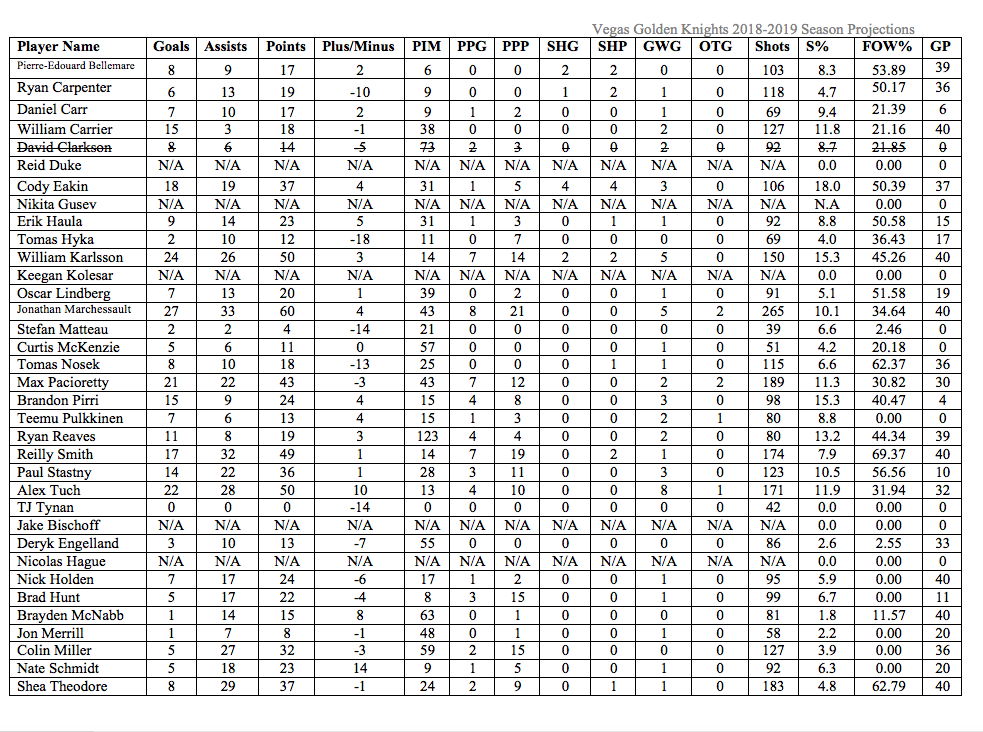
    Vegas Golden Knights Forecast Through 62 Games (20 Games Remaining)
    WordPress, when are you going to make the ”gallery” option again (and actually make it good like how it used to be)?

    Among forwards, Vegas’ consistent first line last season of Jonathan Marchessault, William Karlsson and Smith hasn’t had as much consistent luck and skill this season.

    Though Smith has battled injury this season, Marchessault remains one of the Golden Knights most consistent performers expected to lead his team in goals (25) and points (54) with 25-29–54 expected totals.

    Now what about Karlsson?

    Good question, what about him? Things haven’t gone exactly as planned in terms of capitalizing on his breakout season last season with a new contract in the offseason and higher expectations for this season.

    Karlsson’s bridge, one-year, extension last summer coming off the backs of a 43-goal season has only managed 18 goals thus far– including four goals in the last 22 games for the Golden Knights.

    Given his current trend, Karlsson is expected to amass 21-23–44 totals. He’d be tied with Pacioretty for 2nd place in expected goals (21) and 3rd in expected points (44) on the roster, but nowhere near the emergent star in the making that he was last season.

    While he very well could bounce back– similar to Smith in nature, following a good-year, bad-year, good-year, bad-year pattern– the phrase “what have you done for me yesterday” won’t help him in his next contract negotiation this summer unless McPhee gives him the benefit of the doubt.

    Meanwhile, Alex Tuch is expected to finish the season with a career-high 20-33–53 expected totals.

    That’s comforting to hear for a team that needs to rely on secondary scoring in the midst of a recession in primary production.

    Tuch is expected to lead in assists (33), followed by Smith (30) and Marchessault (29), while Marchessault is destined to lead in points (54) over Tuch (53) and Karlsson (44).

    On defense, Vegas’ blue line will finish off the season being led by Shea Theodore (11-21–32 expected totals), followed by Colin Miller (30 expected points) and Nate Schmidt (25 expected points despite missing the first 20 games of the season while serving a suspension for testing positive for a performance enhancing drug).

    In net, Fleury looks like he’s bound to break under the weight of all the minutes he’s been playing and will play this season. A 2.74 expected GAA and .909 expected SV% is not starting goaltender material, unless we’re talking about Sergei Bobrovsky with the Columbus Blue Jackets or something.

    But it’s not like Gallant can really count on his current backup to offset some of Fleury’s load. Subban’s expected 2.70 GAA and .912 SV% isn’t tremendous either.

    If anything, it’s an indication that McPhee could help bolster his team with the acquisition of an extra goaltender by the trade deadline.

    Someone like Ryan Miller, 38-years-old, could help steal some crucial points for the Golden Knights down the stretch if the San Jose Sharks aren’t already in the process of completing a trade for the goaltender with the Anaheim Ducks.

    Growing pains are a fact of life– especially in sports– and Vegas is going through puberty already in its 2nd season. This season’s been full of highs, lows and awkward phases that hopefully will end in a glow up.

    Otherwise we’ll all be looking back at this season shaking our heads at how it could pull off that much denim or something back in the day.

  • Vegas Golden Knights Forecast Through 40 Games

    It’s not the most recent forecast, since the Vegas Golden Knights played Game 41 of their 2018-19 regular season on Saturday against the Los Angeles Kings.

    Nevertheless, it’s time to take a quick check of the pulse of the Golden Knights– how their season has progressed so far and where it appears to be going from here.

    Thanks to some extenuating circumstances, perhaps Vegas fans will forgive me for not being able to get around to their quick forecasted glance after 20 games played this season.

    Why? Because it would’ve been pretty dismal and you don’t need that kind of negativity in your life.

    Although, now at the halfway mark (officially after the game against the Kings, technically unofficially as of this forecast), things have improved, but with a few concerns remaining.

    Nate Schmidt served his 20 game suspension for a performance enhancing drug and for the most part, Vegas’ blue line got the job done.

    The team’s record wasn’t desirable, but guys like Shea Theodore and Colin Miller continued to rise past expectations in their ability– even more so now that Schmidt is back and solidified the defensive zone for the Golden Knights.

    One thing that has plagued the team all season is subpar goaltending.

    Marc-Andre Fleury isn’t getting any younger and Malcolm Subban regressed quite a bit from his debut season as a backup netminder at the NHL level last season.

    Managing playing time in the crease is something to keep in mind and we’ll take a closer look in a minute.

    For now, Vegas stands in a divisional spot in the playoffs in the Pacific. Not nearly as dominant as last season, but keeping up with the legitimate(?) playoff contenders in an otherwise weaker division compared to the rest of the league.

    Without further ado, here’s a look at the remaining 42 games (now 41) on the season and what to expect from the latest forecast.

    Keep in mind, there are many variables that can and will change what goes down from now through the end of the regular season in April, like trades, injuries, general lineup changes, roster moves and anything else unbeknownst to the Microsoft Excel spreadsheet that generates this forecast.

    My degree is in communication– not math. It’s “not my fault”.

    If a player meets the forecasted stats, then they’ve met expectations. If they exceed their forecasted stats, then they’ve exceed expectations.

    And of course, if a player does not live up to the latest forecast, then something went awry (the player could’ve been injured, been unlucky or regressed– a.k.a. didn’t meet expectations).

    Puck luck cannot be predicted, but general trends and estimated gut feelings can indicate a sense of what’s to come based on the results of each and every scoresheet night-in and night-out.

    Vegas Golden Knights Forecast Through 40 Games (42 Games Remaining)

    (Just click on the image if you’re having trouble seeing it– WordPress changed their layout so there’s no more slideshow options.)

    Every set of blessings comes with a set of curses and this year, that rings truer more than ever before for the Golden Knights. Of course, it’s only their second season in franchise history, but it’s still true.

    William Karlsson (24-26–50 expected totals) is having a “down” year compared to last season’s breakout career-year of 43 goals and 35 assists (78 points). Reaching the 50-point plateau is still respectable, but doesn’t scream any guarantees of being on the first line should the postseason roll around.

    Head coach, Gerard Gallant, has enough top-six forward depth to play around with if Karlsson starts to head south, considering Alex Tuch‘s expected 22-28–50 totals, Paul Stastny‘s expected 14-22–36 totals and Max Pacioretty‘s expected 21-22–43 totals.

    Despite the ever-consistent qualities of Jonathan Marchessault (27-33–60 expected totals) and Reilly Smith (17-32–49 expected totals), this year’s Golden Knights team point spread is more spread out.

    As it is, while Marchessault should lead in goals (27), assists (30) and points (60) and Karlsson should be second in goals (24) and points (50), one would think Smith would be second or third in whatever stats Marchessault and Karlsson aren’t leading in.

    However, Tuch’s expected point outcome (50) is tied with Karlsson for the second-most points behind Marchessault and Tuch is expected to rank third on Vegas’ roster in goals behind Marchessault and Karlsson with Smith a distant 5th behind Pacioretty’s 21 expected goals this season.

    While the offense isn’t as impactful from the forwards, the blue line has really come into its own in Vegas.

    Shea Theodore’s expected 8-29–37 totals will be the best of his teammates and fellow defenders in a Golden Knights uniform, leading Colin Miller (5-27–32 expected totals) and Nick Holden (7-17–24 expected totals).

    Nick Holden. That’s right. Holden is ahead of Nate Schmidt (5-18–23 expected totals) in the latest forecast.

    But that speaks to Holden’s resiliency in his career and the chemistry Gallant has found in his pairing every night– coupled, of course, with the fact that Holden is seeing more time on the ice (in the literal “games played” sense) than he has the last couple of seasons with the New York Rangers and Boston Bruins.

    He is a durable top-four defender that’s still in his athletic prime and it is exactly that kind of depth that can take teams deep into a Stanley Cup Final run.

    In goal, Marc-Andre Fleury should land around a 2.61 goals against average and .911 save percentage in a season in which he has been overworked thus far.

    He will continue to be overworked unless Malcolm Subban regains his footing, Gallant argues for calling someone up from the Chicago Wolves (AHL) or Golden Knights General Manager George McPhee makes an acquisition for a suitable backup option if all else fails.

    Fleury has played in 35 of the 40 games up to this forecast. He’s since played in 35 out of the 41 games played by the club this season.

    Subban has played in six games and is 0-5-0 in that span. His expected outcomes are a 2.76 GAA and .907 SV%– both below average goaltending the backup role.

    Whereas if Vegas wanted to try Oscar Dansk or Maxime Lagace without the pressures of coming into the dressing room in an emergency recall situation– unlike last season– a little healthy competition for the backup role might nudge Subban in the right direction and take off some of Fleury’s workload.

    It’s not that Fleury can’t handle 50-plus games anymore as a starting goaltender, but rather, it’s just that he shouldn’t be relied on for about 85% of the games in the regular season as is his current going rate.

  • Vegas Golden Knights 2018-19 Season Projections

    It’s forecasting season, well, actually it’s the regular season and I’m just a little behind, but until I pointed that out, you didn’t know I was behind on my little passion project here, did you?

    I know I wrote “[i]n the coming days I’ll reveal what teams I’ll be forecasting/tracking all season long, so stay tuned because it’s about to get messier than ever before and I’m up for the challenge,” in my Boston Bruins 2018-19 forecast, but life and the fact that I’m moving all my data into a new format has slowed my turnaround for the time being.

    Nevertheless, my Vegas Golden Knights forecast for 2018-19 is here and let’s pretend the first week of the regular season hasn’t already happened or something.

    Additionally, if you’re wondering what other teams I’m preparing to post (before we get too far into the first quarter of the season) they are the Carolina Hurricanes and Columbus Blue Jackets.

    I always keep tabs on the Bruins every year because I grew up a Boston fan and I decided to track Vegas last season because there hadn’t been nearly as much hype surrounding an expansion team since Columbus and the Minnesota Wild in 2000. Additionally, I’ve previously tracked the Arizona Coyotes simply because they follow us on Twitter (and I’ll get back around to them hopefully before season’s end, if you’re interested).

    But I’m adding Carolina and Columbus to my forecast portfolio this season because 1) the Hurricanes are supposed to be better than last season, plus they have some exciting youth in the lineup and 2) a lot of Blue Jackets fans are also fans of our brand around here, so shouts 5th Liners.

    Please be patient on the timeline for when I’ll get my Hurricanes and Blue Jackets forecasts posted– it’ll be by the end of the month for sure.

    Anyway, on with the Golden Knights, shall we?


    Vegas is coming off of their inaugural season having finished 1st in the Pacific Division with 109 points and a 51-24-7 record under head coach Gerard Gallant. Not only did they finish at the top of their division in their first season, but they did so with over 100 points and a 50-plus win season.

    Oh yeah and they played the Washington Capitals in the 2018 Stanley Cup Final.

    Despite the loss in five games to Washington, the Golden Knights were and still are well ahead of owner Bill Foley’s “Cup in three [seasons]” masterplan– what with General Manager George McPhee‘s offseason additions of Paul Stastny and Max Pacioretty and everything.

    This year, of course, the competition has gotten a lot tougher. There are expectations now when opponents play the Golden Knights.

    Gallant and his Vegas lineup are going to have to get more creative than ever before in franchise history to avoid the hangover of a Stanley Cup Final appearance run and to avoid getting too predictable.

    Things are different now. They’re no longer the new kids on the block. They’re the 2018 Western Conference champions and a team to beat.

    As always, I’d like to remind you my degree is in communication– not math– therefore anything that looks wrong is either adjusted with a little gut-feeling and/or Microsoft Excel’s fault. My expertise resides in the written, spoken and nonverbal language of communicating– not numbers on a spreadsheet.

    These forecasted stats are to be seen as an utopian perspective, as though nothing bad could happen this season at any point to any player– where every player at least lives up to their forecast and then some.

    Some will pan out and some will fall flat. It’s a suggested outcome for a sport that’s played on ice in a highly unpredictable collective environment of action and sheer puck luck.

    vegas_golden_knights_logo

    Vegas Golden Knights Forecast Through 0 Games (82 Games Remaining)

    This slideshow requires JavaScript.

    After a breakout 78-point season (43 goals, 35 assists) for William Karlsson, the Golden Knights number-one center is prime for a respectable 41-point season as part of the natural regression of the game– unless Karlsson is truly an outlier, like he was coming from Columbus to Vegas last season.

    Meanwhile, Reilly Smith (19-27–46 expected totals) and Jonathan Marchessault (28-35–63 expected totals) bolster the Golden Knights first line with respectable performances of their own, while the point spread has really been shared with the second line.

    Newcomers Paul Stastny (22-43–65 expected totals) and Max Pacioretty (33-30–63 expected totals) are set to become the key contributors to the fiery Vegas offense in their first season with the club.

    The Golden Knights top-six core of forwards is deeper than last season, whereas the majority of their offense was reliant upon Marchessault, Karlsson and Smith. This year there’s more emphasis on Alex Tuch and Erik Haula inside the top-nine.

    On defense, Gallant’s crew will have to do without Nate Schmidt for the first 20 games of the season while Schmidt serves a suspension for a performance enhancing drug.

    Luckily, Brad Hunt, Colin Miller and Shea Theodore are prime for an uptick in time-on-ice and production, with Hunt and Miller expected to reach the 30-point plateau, while offseason addition, Nick Holden should see a pleasant rebound from his 17 points split between the Bruins and New York Rangers last season to a 25-point effort in 2018-19 with Vegas, provided he can remain in the top-six on the depth chart.

    Upon Schmidt’s return, he should still have 4-23–27 totals from the blue line, which is not great like last season’s 5-31–36 totals, but not terrible for a top-four defender.

    In goal, Marc-Andre Fleury is expected to return to Earth from his superhuman season last year (a 2.24 goals against average and .927 save percentage in 46 games) to a 2.49 GAA and .913 SV% in 2018-19. As the Golden Knights starter continues to get older, limiting his workload to keep him fresher for the postseason is the way to go.

    Granted, Fleury’s playing time was limited last season due to a concussion, he still went on to have solid regular season numbers and an impeccable 2018 Stanley Cup Playoff run up until the Stanley Cup Final.

    Meanwhile, Malcolm Subban‘s 2.68 GAA and .910 SV% in 22 games played look to be improved upon to a 2.65 GAA and .911 SV% in somewhere around 30 appearances as the backup netminder for Vegas.

    As always, we’ll get more into the goalies once the team has played through a quarter of the season.