Tag: New York Rangers

  • Petry petrifies Bruins in OT, Habs win, 3-2

    Jeff Petry batted in his game-winning goal in overtime just 15 seconds into the five-minute, 3-on-3, overtime period to secure the, 3-2, victory for the Montreal Canadiens over the Boston Bruins Monday night at TD Garden.

    Carey Price (18-13-4 record, 2.65 goals against average, .912 save percentage in 36 games played) made 41 saves on 43 shots against for a .953 SV% in the win for the Habs.

    Tuukka Rask (13-8-3, 2.44 GAA, .919 SV% in 24 GP) turned aside 19 out of 22 shots faced for an .864 SV% in the loss for Boston.

    The Bruins fell to 26-14-5 (57 points) on the season and remain in 3rd place in the Atlantic Division, while the Canadiens remain in 4th with a 25-17-3 record (55 points).

    Boston fell to 16-3-3 when scoring first this season as Brad Marchand had opened the game’s scoring in the first period before Montreal added two unanswered goals.

    It was the final regular season matchup between these two rival clubs, with the Bruins having won eight of the last nine games against Montreal entering Monday night.

    Boston placed Colby Cave on waivers for the purpose of assigning the young center to Providence (AHL) prior to the game on Monday as Bruce Cassidy made no changes to his lineup with Steven Kampfer and John Moore serving as his only healthy scratches and Joakim Nordstrom (non-displaced fibula fracture) still out due to injury.

    Despite the loss, one Bruins player reached a milestone in the action with David Pastrnak having appeared in his 300th career NHL game.

    For just the second time since being fired by the Bruins, Monreal head coach, Claude Julien beat his former team (that he previously beat a bunch of times in his first stint with the Habs).

    Mike Reilly tripped up Marchand at 8:16 of the first period and provided the Bruins their first power play of the night. Boston did not convert on the ensuing skater advantage.

    Past the midpoint of the opening frame, Zdeno Chara interfered with Jesperi Kotkaniemi, who– as a result– tripped up Charlie McAvoy while falling.

    Both Chara and Kotkaniemi were sent to the box at 13:46, leaving Boston and Montreal at even strength, 4-on-4, for the next two minutes.

    While both teams were short a skater, Marchand (17) received an exceptional pass from Patrice Bergeron, then skated past Shea Weber and sniped a wrist shot past Price’s glove side a la Joe Sakic on any goaltender in his prime.

    Bergeron (25) and Matt Grzelcyk (12) notched the assists on Marchand’s goal at 14:09 of the first period and the B’s led, 1-0.

    Moments later, tempers flared as Kevan Miller and Nicolas Deslauriers dropped the gloves and exchanged fisticuffs. Both players received five-minute majors for fighting at 16:10 as Miller perhaps sought revenge for his shoulder injury that he suffered back in the day when Deslauriers was a member of the Buffalo Sabres.

    Is it your modern day Milan Lucic vs. Mike Komisarek matchup? No, but it was a great fight nonetheless and we’ll take it considering the B’s and Habs rivalry.

    Late in the first period on a face-off in Montreal’s offensive zone, Phillip Danault won the draw back to Petry for the shot from the point that Brendan Gallagher (18) tipped with incredible hand-eye coordination through Rask’s five-hole.

    Petry (23) and Danault (24) had the assists on Gallagher’s goal at 18:27 and the Canadiens had tied the game, 1-1.

    Heading into the dressing room for the first intermission, the Bruins led in shots on goal (11-6), blocked shots (8-3) and takeaways (9-6), while Montreal led in giveaways (3-2), hits (14-9) and face-off win percentage (57-44).

    The Habs had yet to see any time on the power play– and, in fact, wouldn’t see any skater advantage opportunities all night as it was a relatively quiet night for penalties– while the B’s were 0/1 on the power play after one period.

    Late in the second period, Victor Mete hooked Miller at 16:16 and the ensuing skater advantage for Boston did not go as the B’s had planned.

    Less than a minute into their power play, the Bruins turned the puck over as Paul Byron (10) went unchallenged, breaking into Montreal’s offensive zone with speed and beating Rask with an elevated backhander to give the Canadiens the lead, 2-1, at 17:09.

    Byron’s shorthanded goal was unassisted and was the league-leading 10th shorthanded goal allowed by Boston this season.

    In the final minute of the middle frame, a scrum ensued post whistle, whereby Max Domi sought out Jake DeBrusk and everyone pulled on a member of the opposing team’s sweater.

    Brandon Carlo received a two-minute minor for roughing, as did Domi, and the two players were sent to their dressing rooms early as the period was coming to a close.

    Through 40 minutes of play, Montreal led, 2-1, on the scoreboard, while Boston led, 26-17, in shots on goal.

    The Bruins maintained an advantage in blocked shots (11-6), takeaways (11-10) and giveaways (7-4) after two periods, while the Canadiens led in hits (22-17). Both teams were 50-50 in face-off win% heading into the third period and the B’s were 0/2 on the power play.

    Boston couldn’t put anything past Price as the Habs struggled to generate shots on goal in the third period.

    Late in the third, Michael Chaput sent the puck over the glass and received an automatic delay of game minor at 17:55.

    Cassidy pulled his netminder with about 1:35 remaining in regulation while on the power play to try to tie the game and force overtime.

    As the seconds were ticking down– both in the power play and in the game itself– David Krejci (10) found himself with ample opportunity to unload a wrist shot past the blocker side of Price while the Montreal goaltender was screened by DeBrusk in front of the goal.

    Krejci’s power play goal tied the game, 2-2, and was assisted by Marchand (32) and Pastrnak (28) at 19:22 of the third period.

    At the end of regulation, the Bruins led in shots on goal, 43-21, despite the scoreboard only reading, 2-2.

    It took 15 seconds after puck drop in the overtime period for the Habs to work the puck in the offensive zone, generate a shot on goal and a rebound that Petry (10) batted out of the air for the odd, sheer good puck luck, overtime game-winning goal.

    Domi (26) and Byron (7) were credited with the assists as the Canadiens defeated the Bruins, 3-2.

    Upon the final horn, Montreal had stolen the extra point on the road, despite the Bruins leading in shots on goal (43-22), blocked shots (14-11), giveaways (13-7) and face-off win% (53-47).

    Montreal finished the night leading in hits (29-23) and never had a power play opportunity. Meanwhile, Boston went 1/3 on the skater advantage.

    The Bruins embark on three games in four nights with a game in Philadelphia against the Flyers on Wednesday, then back home at TD Garden for a matchup Thursday night against the St. Louis Blues and finish off their third game in four nights with their final game before the All-Star break on Saturday against the New York Rangers.


  • Capitals extend regular season win streak versus Boston with 4-2 victory

    Stop me if you’ve heard this before, but the Washington Capitals beat the Boston Bruins in a regular season game.

    Thursday night at TD Garden, the Capitals ended Boston’s five-game winning streak with a 4-2 victory on the road as Nicklas Backstrom scored the game-winning goal in the third period prior to Alex Ovechkin adding the insurance goal (his second of the night) with the Bruins net empty as time ticked away in regulation.

    Braden Holtby (17-10-2 record, 2.86 goals against average, .912 save percentage in 30 games played) stopped 39 out of 41 shots faced for a .951 SV% in the win for Washington and improved to 16-2 in 18 career games against Boston.

    B’s netminder, Jaroslav Halak (13-7-2, 2.39 GAA, .924 SV% in 24 GP), made 18 saves on 21 shots against for an .857 SV% in the loss.

    The Bruins are now 0-11-3 in their last 14 regular season games against Washington.

    Boston falls to 25-15-4 (54 points) on the season and remains in 3rd place in the Atlantic Division standings, while the Capitals improved to 27-12-4 (58 points) so far this season and remain in 1st place in the Metropolitan Division standings.

    Bruins head coach, Bruce Cassidy, made no changes to his lineup, save for Halak getting the start over Tuukka Rask, based on the logic Cassidy used against the Anaheim Ducks last month (starting Halak in goal against a team the Bruins haven’t beaten in a while).

    It worked against the Ducks. It didn’t against the Caps.

    The moral of the story is it’s not the goaltender. It’s the overall effort of the team.

    Boston’s scratches on Thursday night included Colby Cave and Steven Kampfer as healthy scratches, as well as Joakim Nordstrom (non-displaced fibula fracture) and Charlie McAvoy (lower body).

    Cassidy indicated McAvoy could be back in the lineup on Saturday in Toronto, earlier in the day on Thursday.

    Jonas Siegenthaler was guilty of holding Bruins forward, Brad Marchand, at 1:51 of the first period and was sent to the penalty box, resulting in Boston’s first power play of the night.

    The Bruins did not convert on the skater advantage and the Caps swung momentum in their favor.

    Jakub Vrana (15) entered the attacking zone on a breakaway resulting from T.J. Oshie‘s lead pass, which Vrana used to springboard himself in on a defenseless Halak, sniping the puck past Boston’s goaltender and giving Washington the lead, 1-0, at 6:38 of the first period.

    Oshie (6) had the only assist on the goal.

    Late in the opening frame, Marchand drew another penalty, this time when Michal Kempny tripped up the Bruins winger at 14:13.

    The Capitals entered the dressing room for the first intermission with the lead, 1-0, while being outshot by Boston, 17-5. The Caps also led in blocked shots (8-2), giveaways (7-1) and hits (10-5), while the Bruins led in takeaways (4-3) and face-off win percentage (53-47).

    Washington had yet to see any time on the power play after one period, but Boston was already 0/2 on the skater advantage heading into the middle frame.

    Early in the second period, Patrice Bergeron tripped Vrana and gave Washington their first power play of the night at 5:10.

    Shortly after their power play expired, Lars Eller received a two-minute minor infraction for unsportsmanlike conduct directed towards Marchand at 7:43 of the second period and the Bruins went on the power play for the third time Thursday evening.

    Boston did not yield a goal on the skater advantage and shortly followed up with a penalty of their own as Brandon Carlo was penalized for tripping Ovechkin at 10:57.

    The Bruins managed to kill off Carlo’s minor and surged enough in momentum to generate some zone time over the course of the vulnerable minute after Washington’s power play ended.

    Torey Krug sent a pass to Ryan Donato as Donato was out high on his own from about the face-off circle to the left of Holtby.

    The rookie Bruins winger settled the puck and fired his patented wrist shot past the Capitals goaltender to tie the game, 1-1, at 14:11 of the second period.

    Krug (25) and Jakob Forsbacka Karlsson (4) had the assists on Donato’s (6) goal, which set a new career-high for No. 17 in black-and-gold.

    Less than a minute later, Ovechkin (31) found his revenge on the scoreboard as he sent a shot from close range past Halak’s short side as Tom Wilson found Ovechkin in the face-off circle to the right of the Bruins goalie.

    Wilson (9) had the only assist on Ovechkin’s goal at 14:50 and the Caps led, 2-1.

    In the dying seconds of the middle frame, former Bruin, Brett Connolly received a minor penalty for holding Krug at 19:52.

    Boston’s ensuing power play would carry on into the third period, with the Capitals still in command of the scoreboard, 2-1, after 40 minutes of play.

    The B’s led in shots on goal, 28-12, after two periods– outshooting Washington, 11-7, in the second period alone.

    Washington led in blocked shots (13-7), giveaways (10-5) and hits (24-17) through two periods of action, while Boston led in takeaways (11-5) and face-off win% (62-38).

    Entering the second intermission, the Capitals were 0/2 on the power play and the Bruins were 0/4.

    After a bungled line change cost Washington a too many men on the ice bench minor at 3:58 of the third period, Capitals head coach sent Ovechkin to serve the penalty.

    While Ovechkin was in the box, David Krejci (8) was scoring goals– a power play goal, blasted from the outer edge of the face-off circle to Holtby’s left, tying the game, 2-2, at 4:37 of the third.

    Danton Heinen (7) and David Backes (8) notched the assists on Krejci’s goal and the Bruins looked like they might have enough confidence to get over their regular season slump against the Capitals, but Washington had other things in mind.

    Backstrom (11) scored the game-winning goal, high, glove-side past Halak with a wrong-footed wrist shot at 5:46– just over a minute after Krejci tied the game for Boston.

    Oshie (7) and Siegenthaler (4) had the assists on Backstrom’s goal as the Capitals took the lead, 3-2, in the final frame.

    Down by a goal with about 1:39 remaining on the clock, Cassidy pulled Halak for an extra skater, but four seconds later, Ovechkin (32) cleared the puck from his own zone into the empty net in Boston’s defensive end.

    Ovechkin’s goal put the game away, 4-2, and was unassisted at 18:25. It was his second goal of the night and his 128th career two-goal game, as a result.

    Halak vacated the net once more about 20 seconds later, but it was too little, too late, as the final horn sounded and the Capitals secured the win in Boston.

    The Bruins finished the night leading in shots on goal (41-22) and face-off win% (66-34), but Washington dominated the scoreboard, 4-2, and led in blocked shots (18-7), giveaways (14-6), as well as hits (32-25).

    The Caps went 0/2 on the power play, while the B’s finished 1/5 on the skater advantage.

    Boston travels to Toronto to face the Maple Leafs this Saturday night before heading back home for a matchup with the Montreal Canadiens on Monday.

    The Bruins then hit the road for the start of two games in two nights, starting with a Wednesday night game in Philadelphia against the Flyers before venturing back home to host the St. Louis Blues next Thursday. The B’s host the New York Rangers next Saturday (Jan. 19th) in their last game before the All-Star break.


  • DTFR Podcast #140- All-Star Finnish Trivia

    DTFR Podcast #140- All-Star Finnish Trivia

    Thoughts on the conclusion and controversies of the 2019 IIHF World Junior Championship, as well as a look at the schedule around the league as we near the All-Star Weekend festivities and bye week(s). Nick puts Connor on the spot and asks him some trivia questions that only went so well.

    Subscribe to the podcast on Apple Podcasts (iTunes)Stitcher and/or on Spotify. Support the show on Patreon.

  • Bruins score wild goals in 4-0 win over Minnesota

    Don’t look now, but the Boston Bruins are on a five-game winning streak after shutting out the Minnesota Wild, 4-0, Tuesday night at TD Garden. The Bruins haven’t lost since Dec. 29th’s, 3-2, comeback win in overtime against the Sabres in Buffalo.

    Boston improved to 15-3-2 when scoring first this season, as Danton Heinen recorded the game’s first goal. Brad Marchand, Jake DeBrusk and Patrice Bergeron each added goals of their own in the Bruins’ win.

    Tuukka Rask (12-8-2 record, 2.43 goals against average, .920 save percentage in 22 games played) made 24 saves on 24 shots against for the win and his first shutout of the season.

    Rask’s last shutout came on March 17, 2018 against the Tampa Bay Lightning. Tuesday night’s shutout was the 42nd of his career.

    Alex Stalock (5-4-0, 2.75 GAA, .894 SV% in 11 GP) stopped 23 out of 27 shots faced for an .852 SV% in the loss for the Wild.

    The B’s improved to 25-14-4 (54 points) on the season and remain 3rd in the Atlantic Division– two points behind the Toronto Maple Leafs for 2nd place and two points ahead of the 4th place Sabres.

    Minnesota fell to 21-18-3 (45 points) and remained 5th place in the Central Division.

    Bruce Cassidy left his lines alone for Boston with Joakim Nordstrom (non-displaced fibular fracture) and Charlie McAvoy (lower body) still out of the lineup due to injury and Colby Cave, as well as Steven Kampfer, as the only healthy scratches Tuesday.

    Heinen (5) notched the game’s first goal early in the first period after Torey Krug went d-to-d with a pass across the point to John Moore.

    Moore fired a shot that Heinen tipped in past Stalock at 5:23 to give Boston the, 1-0, lead with Moore (6) and Krug (23) tallying the assists.

    Moments later, Bruins captain, Zdeno Chara, cut a rut to the penalty box after being penalized for interference, having bumped into Minnesota’s Jordan Greenway without the puck at 7:00 of the first period.

    The Bruins successfully killed off Chara’s minor infraction and momentum further swung to their side as almost a few minutes after the Wild’s power play failed, Marchand was in the right place at the right time.

    Moore worked the puck over to Bergeron, who then fired a shot that went wide of the goal and caromed off the end-boards to Marchand as No. 63 in black-and-gold crashed the net.

    Marchand (16) put home the rebound as Stalock was moving a step behind across the crease, giving Moore his first two-point game in a Bruins uniform.

    Bergeron (23) and Moore (7) were credited with the assists at 11:29.

    Late in the opening frame, the B’s and Wild swapped minor penalties with Kevan Miller going to the box first for holding Nino Niederreiter at 16:16, then Minnesota’s Eric Staal following up with a tripping minor against Rask at 17:42.

    After an abbreviated 4-on-4 sequence, the Bruins went on an abbreviated power play that yielded their third goal of the period and first of two power play goals on the night.

    Bergeron fired a shot towards the goal that deflected off of DeBrusk’s (14) chest and went past Stalock to give Boston a three-goal lead.

    Bergeron (24) and Marchand (30) had the assists on DeBrusk’s goal at 19:15 of the first period and the B’s led, 3-0.

    DeBrusk has four goals and one assist (five points) in his six games since returning from concussion-like symptoms.

    Entering the first intermission, Boston was ahead by three goals and led in shots on goal, 15-6. Minnesota led in blocked shots (4-1), giveaways (5-2) and hits (13-9) after 20 minutes, while the Bruins led in face-off win percentage (67-33).

    Both teams had two takeaways each through one period as the Wild went 0/2 on the power play and the B’s went 1/1.

    Early in the second period, Zach Parise tripped Bergeron just past the six-minute mark of the middle frame and the Bruins went back on the power play.

    Less than 20 seconds later, Bergeron (14) got his revenge on the scoreboard, redirecting a shot past Stalock for the power play goal at 6:24 of the second period.

    Marchand (31) and Krug (24) had the assists on Bergeron’s goal and the Bruins led, 4-0.

    Almost midway through the second period, with the pace in play rather deflated, Moore was charged with interference against Luke Kunin, resulting in the Wild’s final power play of the night and last chance to muster anything resembling the commencement of a comeback.

    Minnesota did not convert on the ensuing skater advantage.

    Through 40 minutes of play at TD Garden, the Bruins led, 4-0, on the scoreboard and, 20-18, in shots on goal. Minnesota actually outshot Boston, 12-5, in the second period alone, but the Wild couldn’t get past the brick wall of Rask in Boston’s crease.

    The B’s led in blocked shots (13-5) and face-off win% (59-41) after two periods. Minnesota led in takeaways (6-3), giveaways (8-5) and hits (23-16), while finishing the night 0/3 on the power play.

    The Bruins went 2/2 on the skater advantage Tuesday night.

    There were no penalties and there was no scoring in the third period from either club as the Bruins secured the, 4-0, victory and finished the night leading in shots on goal (27-24), blocked shots (18-9), giveaways (12-11) and face-off win% (54-46).

    The Wild finished the night leading in hits (28-21).

    Boston hosts the Washington Capitals this Thursday night at the Garden before traveling to Scotiabank Arena for a battle with the Toronto Maple Leafs on Sunday night.

    The Bruins return home for a Monday night (Jan. 14th) rivalry matchup with the Montreal Canadiens, before traveling to Philadelphia for the first of back-to-back games on the road at Wells Fargo Center against the Flyers next Wednesday (Jan. 16th) and at home against the St. Louis Blues next Thursday (Jan. 17th).

    They’ll play one more game after that against the New York Rangers at home next Saturday (Jan. 19th) before the All-Star break and bye week begins for Boston.

  • DTFR Podcast #139- They Ran Out Of Beer!

    DTFR Podcast #139- They Ran Out Of Beer!

    A bunch of minor trades were made in the last week, the 2019 Honda NHL All-Star Game rosters were released, as well as the 2019-20 outdoor game schedule. Nick and Connor also discuss the legacy that was the 2019 Bridgestone NHL Winter Classic and the 2019 IIHF World Junior Quarterfinal upsets.

    Subscribe to the podcast on Apple Podcasts (iTunes)Stitcher and/or on Spotify. Support the show on Patreon.

    *Editor’s Note: Of course, after recording this week’s episode, the Philadelphia Flyers claimed G Mike McKenna off waivers from the Vancouver Canucks.

  • Numbers Game: 2018-19 League Forecast Entering January

    Happy New Year!

    It’s time to figure out whether or not your team has a legitimate chance of winning the Stanley Cup, making the playoffs, being a seller at the trade deadline or a basement dwelling rebuilder in desperate need of anything but what is happening right now.

    Teams have begun to reach the official halfway point in the regular season (41 games played out of an 82-game schedule) as the calendar flips from 2018 to 2019.

    Here’s a glance at the latest forecast based on how the league standings were through December 31, 2018.

    Keeping in mind, there’s no guarantees with any forecast, but rather general trends and “educated” guesses. It’s not always about the exact number of points expected on the season. Sometimes the focus is on the spread or each team’s positioning in the standings.

    There’s always context. Plus, nothing’s impossible until it’s mathematically impossible.

    So let’s take a look around the league and figure out the future– well, rest of this season, at least.

    Projected Standings After Three Months

    Eastern Conference

    Atlantic Division

    1. p-Tampa Bay Lightning, 125 points (40 GP entering Jan. 1st)
    2. x-Toronto Maple Leafs, 111 points (39 GP)
    3. x-Boston Bruins, 98 points (39 GP)
    4. wc2-Montreal Canadiens, 97 points (40 GP)
    5. Buffalo Sabres, 96 points (40 GP)
    6. Florida Panthers, 84 points (38 GP)
    7. Detroit Red Wings, 75 points (41 GP)
    8. Ottawa Senators, 72 points (40 GP)

    The Tampa Bay Lightning are the dominant team in the NHL right now. There’s no other comparison. They’re in a league of their own.

    Though the Toronto Maple Leafs have surged into one of the league’s most prominent teams this season, they’re no match for the Lightning in the regular season standings Atlantic Division race.

    The postseason might be another story– too bad we won’t get to see these teams meet up in the Eastern Conference Final with the current playoff format.

    For the Boston Bruins, a lackluster 7-7-0 month of December has taken a toll on their outlook. Sure, winning five out of their last seven games is a good sign and all, but missed opportunities and blown chances regardless of the injury status of many of their players this season has brought them back to Earth this season.

    Regression in hockey, however, is to be expected– even for teams that outperformed expectations. Last season was just that– exceeded expectations in the regular season for Boston.

    How will Bruce Cassidy jumpstart scoring depth throughout his lineup if General Manager Don Sweeney doesn’t do anything to add? Time will tell.

    But they’re running out of time as long as Claude Julien and Phil Housley are in consideration for some Jack Adams Award nominations.

    Though the Buffalo Sabres have slumped a bit in the last month, the Montreal Canadiens have solidified themselves as a potential spoiler in the 2019 Stanley Cup Playoffs.

    If it’s not them, it’s definitely Buffalo for sure.

    The race for the Eastern Conference wild card spots should come down to three teams– Buffalo, Montreal and the New York Islanders (unless the Islanders snag a divisional spot in the Metropolitan Divsion– more on that later).

    Look, as good as some players on the Florida Panthers are, it’s not happening this year.

    And for all the hype regarding the Detroit Red Wings early in the season? Yeah, it’s the same as last year. They’re not doing so hot either.

    There’s some good news if you’re an Ottawa Senators fan– wait, they traded their 2019 1st round pick in the draft to the Colorado Avalanche as part of the three-team Matt Duchene trade and didn’t protect it (because they chose to protect 2018’s 1st round pick and offer up 2019’s instead)? Oh. Never mind.

    Metropolitan Division

    1. y-Washington Capitals, 109 points (38 GP)
    2. x-Pittsburgh Penguins, 103 points (39 GP)
    3. x-Columbus Blue Jackets, 102 points (39 GP)
    4. wc1-New York Islanders, 98 points (38 GP)
    5. New York Rangers, 90 points (38 GP)
    6. Carolina Hurricanes, 80 points (38 GP)
    7. New Jersey Devils, 80 points (38 GP)
    8. Philadelphia Flyers, 78 points (38 GP)

    As we get closer to “the stretch” things are heating up in the Metropolitan Division, which might not be as full of garbage as once thought earlier in the year.

    For now, the Washington Capitals appear to be in a serious “defend the castle” mood. They’re the defending champions and they’re pretty hard to beat.

    But the Pittsburgh Penguins are surging. The Pens are on a seven-game winning streak and they’re outscoring their opponents, 28-9, during that span.

    What’s necessary to take into account in the divisional spots in the Metropolitan Division is not that the Capitals should lead the way, but rather, that Washington only has a six-point lead in the current forecast over the Penguins– and seven points over the Columbus Blue Jackets (who somehow find themselves in the “top dog” conversation?)– therefore, anything is up for grabs.

    If the Islanders don’t scratch and claw their way into a divisional spot, they’ll be a wild card team.

    It’s not a completely lost season for the New York Rangers, but it’s not one that’ll end with a playoff berth either.

    The same could almost be said for the Carolina Hurricanes and New Jersey Devils, except one’s a little more inconsistent (and worse off), while the other’s just worse.

    Sure, the Devils are nowhere to be found this season, but Mackenzie Blackwood could change that outlook next year.

    And if Carter Hart‘s ready to take on the full-time role of starting netminder for the Philadelphia Flyers that probably wouldn’t do much for them this season, but it’s promising moving forward.

    This year’s Flyers team just goes to show that the problem’s beyond a GM and coaching change, so don’t be surprised to see some roster turnover.

    Western Conference

    Central Division

    1. z-Winnipeg Jets, 107 points (39 GP)
    2. x-Nashville Predators, 96 points (40 GP)
    3. x-Colorado Avalanche, 91 points (40 GP)
    4. wc2-Dallas Stars, 89 points (40 GP)
    5. Minnesota Wild, 87 points (38 GP)
    6. St. Louis Blues, 81 points (37 GP)
    7. Chicago Blackhawks, 77 points (41 GP)

    The Winnipeg Jets are one of two teams in serious contention for the Western Conference regular season title– and the Nashville Predators won’t even get to raise a banner next season for it.

    Nashville’s been on shaky ground for the last month and, as a result, it shows in the latest forecast. Inadequacy ruptures standards or expectations.

    Anyway, between Winnipeg and the Calgary Flames one of those teams will be the best in the West at the end of the regular season.

    It says something as a whole about the Central Division when the Colorado Avalanche are currently forecasted to slip into a divisional spot in the postseason with 91 points in the standings.

    Usually about 95 points puts you within the wild card range and anything 98 or above brings you into serious contention for a divisional berth.

    What all of this means is there’s a lot of uncertainty from the Avs, Dallas Stars and Minnesota Wild in terms of where they end up, ultimately.

    All three teams have been all over the place– at times– this season.

    Fear not, though, they’re nothing like the St. Louis Blues and Chicago Blackhawks. Nothing makes sense in St. Louis, short of obvious locker room problems and a lack of leadership.

    Whereas, in Chicago, the game plan was already reset to “longterm” last season by default (having finished last in the division). Jeremy Colliton‘s job security is safe for now.

    There weren’t high expectations coming into the season for the Blackhawks and there weren’t immediate expectations for Colliton in their transition from Joel Quenneville to their 33-year-old head coach.

    Essentially, firing Quenneville when they did was an easy way out of having to make things more awkward(?) with a rebuild, but it kind of was anyway given when they did it.

    At least they’re not their rivals in St. Louis– let alone the Los Angeles Kings– where expectations were high after reaping some rewards in the offseason.

    Pacific Division

    1. y-Calgary Flames, 103 points (40 GP)
    2. x-Vegas Golden Knights, 100 points (42 GP)
    3. x-San Jose Sharks, 98 points (41 GP)
    4. wc1-Anaheim Ducks, 92 points (41 GP)
    5. Vancouver Canucks, 83 points (42 GP)
    6. Edmonton Oilers, 82 points (39 GP)
    7. Arizona Coyotes, 76 points (39 GP)
    8. Los Angeles Kings, 75 points (40 GP)

    The Flames are red hot. Can they make 2019 more like 1989 and less like 2004? Does having a goaltender even matter any more?

    Luck’s starting to turn in Vegas as the Golden Knights have come alive and look to make a serious claim at potentially knocking Calgary off from the Pacific Division lead– if they can catch them first.

    Despite their ups and downs, the San Jose Sharks are still a divisional playoff berth kind of team. Expect them to be out of the playoffs before the Western Conference Final though. Surely Martin Jones‘ below average season has to catch up to him at some point, regardless of scoring power.

    With no real competition below them, the Anaheim Ducks are a wild card team that will likely continue to live in the First Round elimination hell until John Gibson single handedly plays every position for the club.

    The Vancouver Canucks have Elias Pettersson and look ready to bring up Thatcher Demko for a full-time role in net, so it’s kind of on, but a little late. Next season!

    Everyone said Ken Hitchcock would turn around the Edmonton Oilers and was dancing in the streets when his first half-dozen games brought the Oilers back into being relevant.

    Well, everyone, except me. Hitchcock’s shtick isn’t fit for the contemporary NHL anymore and his last (and only) Cup win came 20 years ago.

    Sure he might impart some lessons on leadership, but as long as Peter Chiarelli is trading away Drake Caggiula for Brandon Manning and ensuring guys like Milan Lucic are part of the longterm vision…

    The Arizona Coyotes haven’t panned out and it’s not the numbers that have been lying to them. Dylan Strome, their 3rd overall pick in 2015, didn’t develop as planned– whether through the fault of the Coyotes or not– and they traded him.

    That draft was four years ago and Mitch Marner was selected after Strome by the Maple Leafs. Hindsight is 20/20, but still.

    If it’s any consolation, Mikko Rantanen was selected by Colorado, 10th overall, so Carolina, New Jersey, Philly, Columbus and San Jose all missed out on one of the current leaders in scoring.

    Scouting’s not Arizona’s strong-suit from year-to-year, or rather, asset management as a whole it’s just… …not there.

    Finally, Los Angeles, the Grim Reaper’s at the door. Bring out your dead (Cup hopes and dreams for 2019). It’s time to rebuild.

  • Vegas Golden Knights Forecast Through 40 Games

    It’s not the most recent forecast, since the Vegas Golden Knights played Game 41 of their 2018-19 regular season on Saturday against the Los Angeles Kings.

    Nevertheless, it’s time to take a quick check of the pulse of the Golden Knights– how their season has progressed so far and where it appears to be going from here.

    Thanks to some extenuating circumstances, perhaps Vegas fans will forgive me for not being able to get around to their quick forecasted glance after 20 games played this season.

    Why? Because it would’ve been pretty dismal and you don’t need that kind of negativity in your life.

    Although, now at the halfway mark (officially after the game against the Kings, technically unofficially as of this forecast), things have improved, but with a few concerns remaining.

    Nate Schmidt served his 20 game suspension for a performance enhancing drug and for the most part, Vegas’ blue line got the job done.

    The team’s record wasn’t desirable, but guys like Shea Theodore and Colin Miller continued to rise past expectations in their ability– even more so now that Schmidt is back and solidified the defensive zone for the Golden Knights.

    One thing that has plagued the team all season is subpar goaltending.

    Marc-Andre Fleury isn’t getting any younger and Malcolm Subban regressed quite a bit from his debut season as a backup netminder at the NHL level last season.

    Managing playing time in the crease is something to keep in mind and we’ll take a closer look in a minute.

    For now, Vegas stands in a divisional spot in the playoffs in the Pacific. Not nearly as dominant as last season, but keeping up with the legitimate(?) playoff contenders in an otherwise weaker division compared to the rest of the league.

    Without further ado, here’s a look at the remaining 42 games (now 41) on the season and what to expect from the latest forecast.

    Keep in mind, there are many variables that can and will change what goes down from now through the end of the regular season in April, like trades, injuries, general lineup changes, roster moves and anything else unbeknownst to the Microsoft Excel spreadsheet that generates this forecast.

    My degree is in communication– not math. It’s “not my fault”.

    If a player meets the forecasted stats, then they’ve met expectations. If they exceed their forecasted stats, then they’ve exceed expectations.

    And of course, if a player does not live up to the latest forecast, then something went awry (the player could’ve been injured, been unlucky or regressed– a.k.a. didn’t meet expectations).

    Puck luck cannot be predicted, but general trends and estimated gut feelings can indicate a sense of what’s to come based on the results of each and every scoresheet night-in and night-out.

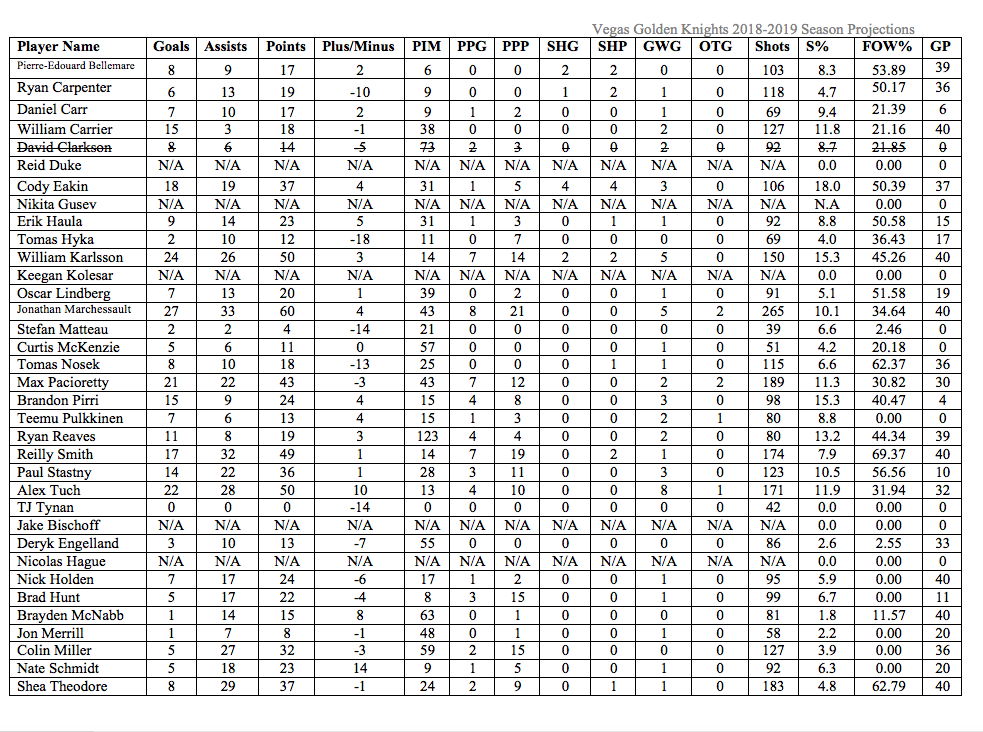
    Vegas Golden Knights Forecast Through 40 Games (42 Games Remaining)

    (Just click on the image if you’re having trouble seeing it– WordPress changed their layout so there’s no more slideshow options.)

    Every set of blessings comes with a set of curses and this year, that rings truer more than ever before for the Golden Knights. Of course, it’s only their second season in franchise history, but it’s still true.

    William Karlsson (24-26–50 expected totals) is having a “down” year compared to last season’s breakout career-year of 43 goals and 35 assists (78 points). Reaching the 50-point plateau is still respectable, but doesn’t scream any guarantees of being on the first line should the postseason roll around.

    Head coach, Gerard Gallant, has enough top-six forward depth to play around with if Karlsson starts to head south, considering Alex Tuch‘s expected 22-28–50 totals, Paul Stastny‘s expected 14-22–36 totals and Max Pacioretty‘s expected 21-22–43 totals.

    Despite the ever-consistent qualities of Jonathan Marchessault (27-33–60 expected totals) and Reilly Smith (17-32–49 expected totals), this year’s Golden Knights team point spread is more spread out.

    As it is, while Marchessault should lead in goals (27), assists (30) and points (60) and Karlsson should be second in goals (24) and points (50), one would think Smith would be second or third in whatever stats Marchessault and Karlsson aren’t leading in.

    However, Tuch’s expected point outcome (50) is tied with Karlsson for the second-most points behind Marchessault and Tuch is expected to rank third on Vegas’ roster in goals behind Marchessault and Karlsson with Smith a distant 5th behind Pacioretty’s 21 expected goals this season.

    While the offense isn’t as impactful from the forwards, the blue line has really come into its own in Vegas.

    Shea Theodore’s expected 8-29–37 totals will be the best of his teammates and fellow defenders in a Golden Knights uniform, leading Colin Miller (5-27–32 expected totals) and Nick Holden (7-17–24 expected totals).

    Nick Holden. That’s right. Holden is ahead of Nate Schmidt (5-18–23 expected totals) in the latest forecast.

    But that speaks to Holden’s resiliency in his career and the chemistry Gallant has found in his pairing every night– coupled, of course, with the fact that Holden is seeing more time on the ice (in the literal “games played” sense) than he has the last couple of seasons with the New York Rangers and Boston Bruins.

    He is a durable top-four defender that’s still in his athletic prime and it is exactly that kind of depth that can take teams deep into a Stanley Cup Final run.

    In goal, Marc-Andre Fleury should land around a 2.61 goals against average and .911 save percentage in a season in which he has been overworked thus far.

    He will continue to be overworked unless Malcolm Subban regains his footing, Gallant argues for calling someone up from the Chicago Wolves (AHL) or Golden Knights General Manager George McPhee makes an acquisition for a suitable backup option if all else fails.

    Fleury has played in 35 of the 40 games up to this forecast. He’s since played in 35 out of the 41 games played by the club this season.

    Subban has played in six games and is 0-5-0 in that span. His expected outcomes are a 2.76 GAA and .907 SV%– both below average goaltending the backup role.

    Whereas if Vegas wanted to try Oscar Dansk or Maxime Lagace without the pressures of coming into the dressing room in an emergency recall situation– unlike last season– a little healthy competition for the backup role might nudge Subban in the right direction and take off some of Fleury’s workload.

    It’s not that Fleury can’t handle 50-plus games anymore as a starting goaltender, but rather, it’s just that he shouldn’t be relied on for about 85% of the games in the regular season as is his current going rate.

  • DTFR Podcast #137- His Hart Grew Three Sizes That Day

    DTFR Podcast #137- His Hart Grew Three Sizes That Day

    Nick and Connor review the Vegas Golden Knights draft history, praise Carter Hart’s NHL debut, talk about Scott Gordon’s introduction as interim head coach of the Philadelphia Flyers, as well as the Patrik Berglund situation, Whalers Night and a teaser 2019 IIHF World Junior Championship preview.

    Merry Gritmas.

    Subscribe to the podcast on Apple Podcasts (iTunes)Stitcher and/or on Spotify. Support the show on Patreon.

    *Editor’s note: Paris is hosting the 2024 Summer Games and Los Angeles is hosting the 2028 Summer Games. The 2026 and 2030 Winter Games host cities have yet to be selected.

  • Trading B’s-ness: Sweeney’s Promise

    Don Sweeney is having his Peter Chiarelli moment.

    The current Boston Bruins General Manager is at a crossroads similar in nature to that of his predecessor in Chiarelli– except this time it’s forward thinking.

    No, not that forward thinking.

    Sweeney’s masterplan has made up for Chiarelli’s deficits in both defense and cap management. Yet, for a team that’s tied with the Nashville Predators for allowing the fewest goals against (88), its offense is nothing spectacular– ranking 25th in goals for so far this season (94).

    Through 34 games, the Bruins are 4th in the Atlantic Division with a 18-12-4 record and 40 points on the season despite numerous injuries.

    At one point in time this season, five of Boston’s regular six defenders were injured.

    In Chiarelli’s final years with the Bruins, defense became a problem. 

    The 2013-14 President’s Trophy winning Bruins team amassed 117 points on the season with a plus-84 goal differential. The 2014-15 Bruins missed the postseason and had 93 points on the season and a plus-10 goal differential.

    The franchise’s second ever President’s Trophy winning roster had Johnny Boychuk in his prime to rely on. The 2014-15 team did not, thanks to a trade made by Chiarelli prior to the start of the season.

    Boychuk was traded out of salary cap constraints that could have been avoided had Chiarelli a) moved other assets or b) not signed those other assets to such inflated extensions in the first place.

    Chiarelli promised he’d find a fix for the opening he created, but that never came to fruition as he was later fired in the 2015 offseason.

    Upon Sweeney’s hiring, it was clear the Bruins needed a revival on the blue line.

    In addition to that, Sweeney was walking into an organization that was needing to negotiate with then pending-RFA Dougie Hamilton.

    Hamilton was coming off his entry-level contract and emerging as a prominent two-way defender with the offensive likes of Torey Krug, in addition to that of a more traditionally framed defender.

    When Hamilton wanted out of Boston, Sweeney was looked at poorly for trading the RFA defender to the Calgary Flames in the midst of a foundation collapse in defense.

    The problem was that the problem didn’t start then.

    It worsened as a result of Chiarelli’s dealing of Boychuk, while Dennis Seidenberg got older and more susceptible to injury without anything in the pipeline to act as an adhesive bandage in a worst case scenario (Sweeney would later use a buyout on Seidenberg’s contract on June 30, 2016).

    Sweeney’s Hamilton trade was meant to address the long-term scope, as Zach Senyshyn, Jakob Forsbacka Karlsson and Jeremy Lauzon were all selected with the 1st and 2nd round picks in the 2015 Draft the Flames gave the Bruins in return for adding Hamilton.

    Though Forsbacka Karlsson has only emerged as far as the third line center in Boston for now, his chemistry alongside Ryan Donato and Danton Heinen is to be lauded with pleasure as those three forwards remain central to the core in a not-so-distant post-Patrice Bergeron era (Forsbacka Karlsson may end up centering the first or second line someday).

    Senyshyn’s been seasoning in Providence as Sweeney brought in the Washington Capitals’ approach to “over-cooking” their prospects in the AHL before calling them up for a seamless transition to the NHL (though, in fairness, it remains to be seen where Senyshyn fits into the long-term plan, if he even makes it).

    And Lauzon is near the top of the depth chart in defensive prospects within the organization alongside Urho Vaakanainen and Connor Clifton– if not number one.

    Though the blue line is not of concern for Boston, when healthy, the depth of the team in the top-six forwards, as well as run-of-the-mill finds to play on the fourth line has come into question.

    Sweeney must take an action to address the need for a winger to play alongside David Krejci and Jake DeBrusk on the second line– something Sweeney aimed to bring in since he began his tenure with the Bruins as General Manager.

    Again, scoring fell from the 2013-14 dominant team to Chiarelli’s missteps in 2014-15, so Sweeney dealt a struggling Milan Lucic to the Los Angeles Kings at the 2015 Draft for a 1st round pick (Jakub Zboril), Colin Miller and Martin Jones.

    Jones was flipped later that summer to the San Jose Sharks for a 2016 1st round pick (Trent Frederic) and Sean Kuraly. More recently, Miller was claimed by the Vegas Golden Knights at the 2017 Expansion Draft.

    In the aftermath of the Lucic trade– and with a spot on the second line to fill– Sweeney signed 2015 Stanley Cup Playoffs star, Matt Beleskey to a five-year deal worth $3.800 million per season.

    Beleskey set career-highs in assists (22) and points (37) in 80 games played in his first season in Boston (2015-16), then injuries cut his sophomore season with the Bruins to just eight points in 49 games.

    In 2016-17, Beleskey had yet to score a point in 14 games with the B’s prior to being assigned to the Providence Bruins (AHL). He was added as an afterthought turned salary cap balancing equation in the Rick Nash trade last season with the New York Rangers.

    When Beleskey’s first season with Boston didn’t yield as much of a breakout as Sweeney expected, he signed David Backes to a five-year, $6.000 million AAV contract on July 1, 2016, expecting the forward to shift from center to right wing alongside Krejci.

    In his first season with Boston, Backes had 17 goals and 21 assists (38 points) in 74 games played. He followed that up with 33 points (14 goals, 19 assists) last season in 57 games while battling injury.

    Though he has been plagued by injury the last two seasons, Backes  (3-5–8 totals in 29 games) has been relegated to the fourth line when DeBrusk is in the lineup.

    Sweeney’s plan to let the kids takeover led to exceeded expectations last season, but with that comes an even higher benchmark for success set for this season. Anything less is a disappointment.

    Add to that the expectation for a Cup in three years time from when Sweeney was hired. At least, that’s what Boston’s internal operations was calculating when the front office sat down with Sweeney to interview for his current job.

    For a GM that was active in his first month on the job and laid out a plan to take the organization up to where it is now– what’s next?

    Sweeney’s not in the hot seat from the standpoint about imminent job security, but rather, he’s being put to the test.

    This season, of all seasons, matters that much more.

    His track record at the trade deadline hasn’t had any staying power, save for an extra year of John-Michael Liles as a depth defender for 2016-17.

    He doesn’t have to hit it out of the park with a trade if he truly believes in the youth movement, which is why the Bruins probably aren’t going to be in the market for acquiring the services of Artemi Panarin.

    Then again, if DeBrusk is going to be out long term and head coach Bruce Cassidy can’t split up Donato, Forsbacka Karlsson and Heinen, then it’s going to be worth acquiring a top-six forward that’s a legitimate top-six forward.

    Adding Jeff Carter from the Los Angeles Kings would be like adding Rick Nash last season, except for the fact that the 33-year-old Carter is signed through the 2021-22 season at about $5.273 million per season.

    If you even want to have a chance to potentially sit down with a guy like Panarin or pending-UFA Jeff Skinner in July, you can’t afford to chip away at your available spending money.

    Unless Krejci or Backes is involved, that is.

    Even still, Carter’s not set on playing anywhere outside of Los Angeles and might retire if he’s shipped elsewhere. Besides that,  he only has six goals and nine assists (15 points) in 35 games this season.

    The only other recent rumors swirling around have been tied to Minnesota Wild forward– and Weymouth, Massachusetts native– Charlie Coyle and New York Rangers forward– and Boston native– Kevin Hayes.

    Both Coyle and Hayes are 26-years-old with Coyle having a cap hit of $3.200 million through 2019-20 and Hayes as a pending-UFA this offseason at $5.175 million.

    Minnesota’s in the hunt for a wild card spot currently in the Western Conference and sits 17th in the league table. The Rangers are fifth in the Metropolitan Division, 21st in the league standings and falling.

    Coyle has five goals and 10 assists (15 points) in 33 games. Though he has the same offensive production as Carter has with the Kings, Coyle is younger and in the midst of his prime, leaving room for potential– especially should he be placed on a line with Krejci and DeBrusk.

    But Coyle (6-foot-3, 220 pounds) has only surpassed the 20-goal plateau once in his career (21 goals in 82 games, 2015-16).

    Hayes has 9-18–27 totals in 33 games with New York so far this season. At 6-foot-5, 216 pounds, he’s had the hotter hands of the three potential trade targets.

    He’s also only reached the 20-goal plateau once in his career (25 goals in 76 games last season), but never had a season below 36 points.

    Both the Wild and the Rangers will have enough cap room at the deadline should Boston look to flip a player like Backes to fit either player comfortably on their payroll and still have something to give pending-RFAs Charlie McAvoy, Brandon Carlo, Forsbacka Karlsson, Donato and Heinen in the offseason.

    (Regardless, if there’s a team willing to take on Backes’ $6.000 million cap hit now as opposed to flipping him to the Arizona Coyotes later…)

    Plus there’s the odd hold-out that the Bruins find themselves in conversation with one of the offseason’s biggest prizes like how they were finalists in the John Tavares arms race last summer.

    Sweeney has a plethora of prospects to wager if– and only if– he can lop off one of the larger contracts on his books and land a legitimate top-six forward.

    Can he do what Chiarelli failed to do in his final year with Boston and deliver on an as of yet unfulfilled promise?

    Come to think of it, if he does acquire a top-six forward that can play with Krejci and leads to a Cup, then he does have a lot more in common with Chiarelli.

    It’d just be more like when Chiarelli traded Dennis Wideman to the Florida Panthers in June 2010 for Nathan Horton and Gregory Campbell.

  • DTFR Podcast #136- We’ve Got The Future Blues

    DTFR Podcast #136- We’ve Got The Future Blues

    More on the Arizona Coyotes latest debacle with Seattle expansion looming, Brent Seabrook and Duncan Keith did something never done before, the Calgary Flames rise in the Western Conference and the St. Louis Blues dismal season. Bob Murray and the Anaheim Ducks made a few moves– signing Murray to an extension, claiming Chad Johnson off waivers and a minor trade.

    Plus, Nick and Connor review the last 15 years of first round picks by the Pittsburgh Penguins and do a deep dive on their future and what it might look like.

    Subscribe to the podcast on Apple Podcasts (iTunes)Stitcher and/or on Spotify. Support the show on Patreon.