Tag: NBA

  • Let’s pretend we have any say in jersey sponsors

    Let’s pretend we have any say in jersey sponsors

    Apparently the National Hockey League’s Board of Governors were up to something this month as it was reported by Sportico on Tuesday that the Board unanimously approved ads on the front of NHL jerseys beginning with the 2022-23 season.

    The ads will be no bigger than a 3-inch-by-3.5-inch rectangle, which is slightly larger than the ads featured on the front of National Basketball Association (NBA) jerseys.

    It was only a matter of time before the NHL followed the NBA in generating additional revenue by doing what professional hockey leagues outside of North America have been doing for many years, as well as what’s been done for at least a few seasons now in the American Hockey League (AHL) and ECHL minor league levels on this side of the pond.

    As always, hockey Twitter is taking the news well.

    Let’s embrace the chaos for a moment and pick some sponsors for all 32 NHL teams that would make so much sense they’ll obviously be overlooked for, well, actual revenue generating streams instead.

    Anaheim Ducks
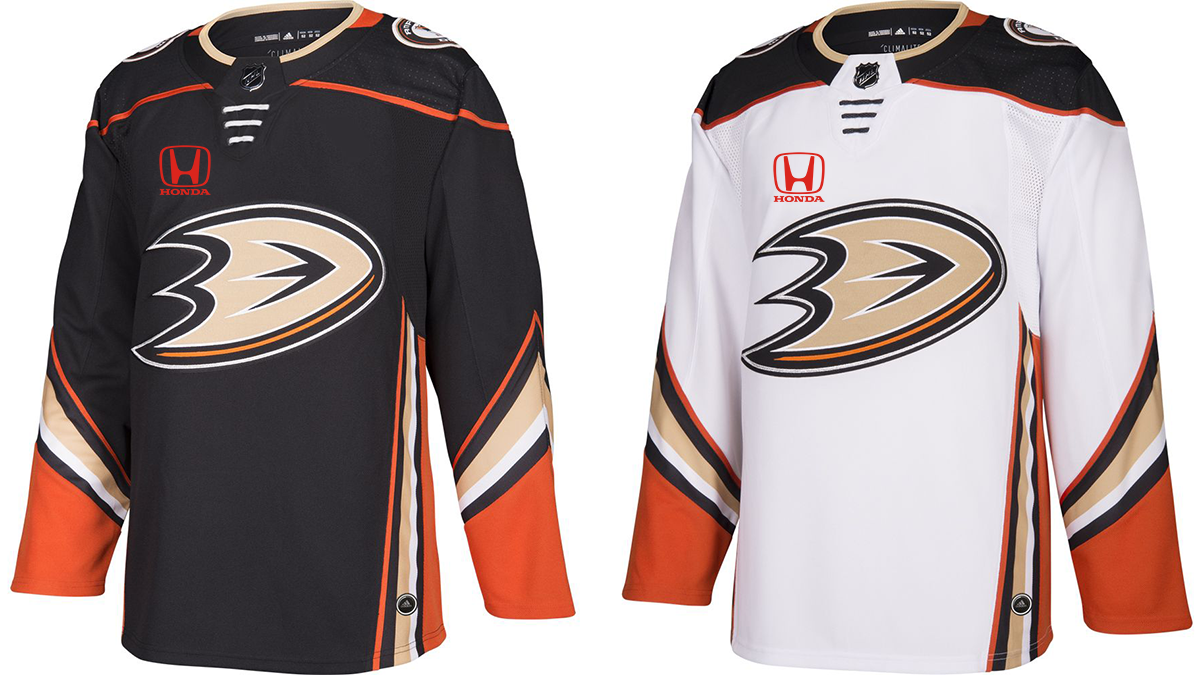
    What we want: Disney+ or TCL
    What we’ll get: Honda

    The Ducks play at Honda Center and, yeah, there’s really nothing besides Disney swooping in and sponsoring the team that they used to own as a means of cross promoting both the Ducks and The Mighty Ducks: Game Changers on Disney+, so we’re stuck with a Honda logo at center ice and on the front of Anaheim’s jerseys.

    In any case, Honda’s red logo works pretty well with the Orange County orange featured as an accent color on Anaheim’s home and road jerseys.

    NHL teams have a tendency to go back to the well with their partners– think of how many teams have either the same helmet sponsor as another team or just slapped on the same brand as their venue’s naming rights deal– but if we want to expand the playground a little bit perhaps TCL could be of interest for the Ducks.

    Come to think of it, that’s probably a better option.

    *Opens up Photoshop*

    Arizona Coyotes
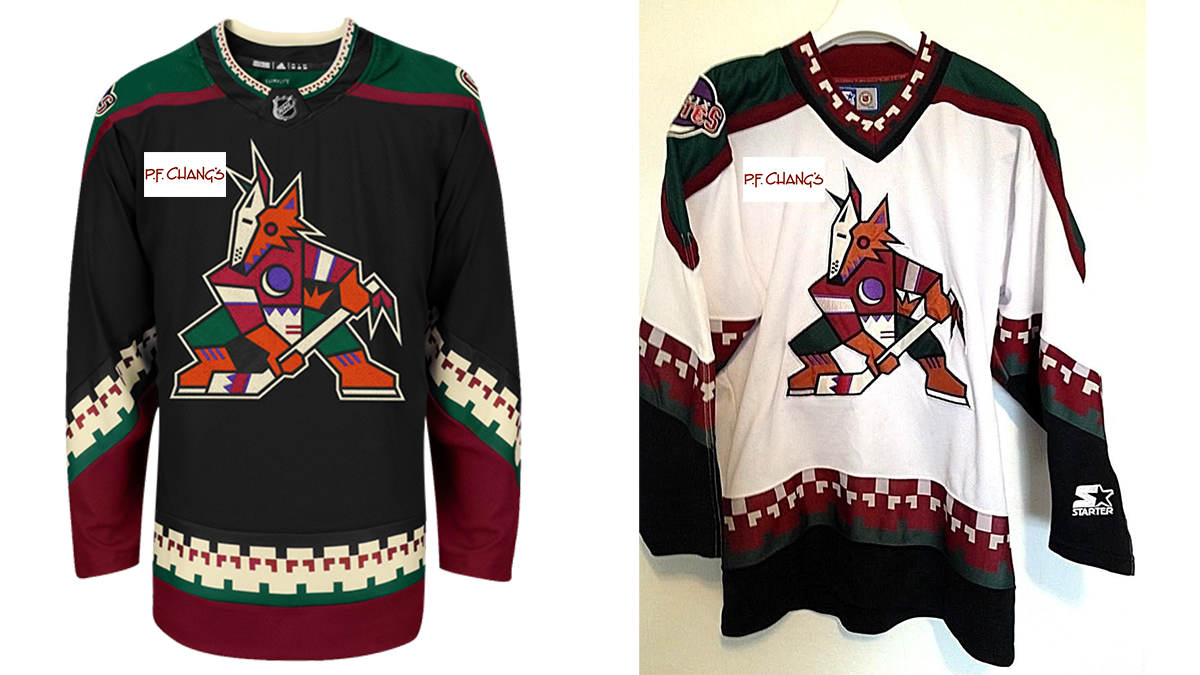
    What we want: P.F. Chang’s or Cold Stone Creamery
    What we’ll get: Fry’s or something, probably

    Believe it or not the Los Angeles Chargers won’t be the only team tweeting about P.F. Chang’s for long as the restaurant chain was founded in 1993, and opened their first location in Scottsdale, Arizona, so it only makes sense to go back to their roots and toss an ad on the Coyotes’ jersey.

    Also founded in Arizona– Cold Stone Creamery.

    We figured that’d probably make sense on an AHL team’s jersey, though, despite the obvious cold ice, cold ice cream connection.

    The Coyotes had Mountain America on their helmets at home and Dignity Health on their road helmets in 2020-21, so in reality we’ll probably get one of those two on the front of their jerseys in 2022-23.

    Boston Bruins
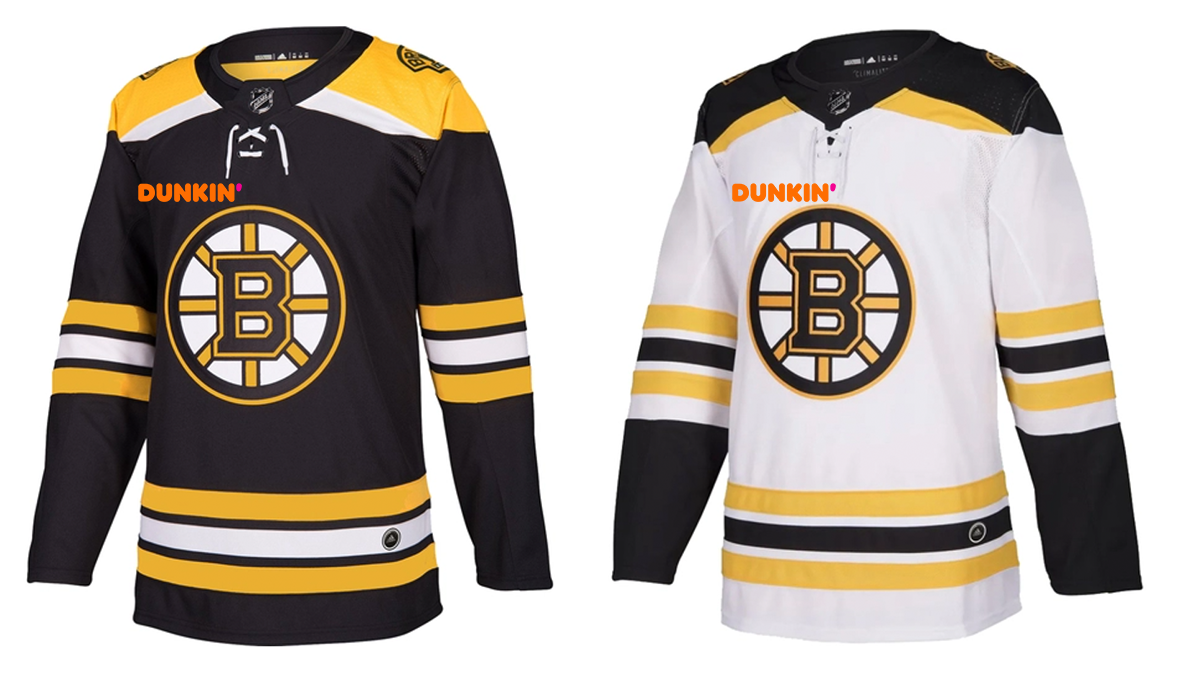
    What we want: Dunkin’ or bust
    What we’ll get: TD Bank or O.R.G. Packaging, probably

    What could possibly be more Boston than a Bruins jersey with a Dunkin’ logo on it?

    Their AHL affiliate– the Providence Bruins– already play in the Dunkin’ Donuts Center in Rhode Island and have a Dunkin’ ad patch on their jerseys. Why not call it up to the major league?

    That said, with some NBA teams earning up to about $20 million in jersey ad space revenue, the B’s likely will reach for a brand with deeper pockets than doughnuts and coffee.

    Delaware North likes their relationship with a certain bank from Toronto (TD Bank) and has had one of the league’s longest relationships with a Chinese company (O.R.G. Packaging) as part of the NHL’s intended growth beyond the continents of North America and Europe, so one of the two brands is more likely to appear on a Bruins jersey.

    Buffalo Sabres

    What we want: Super Chexx
    What we’ll get: KeyBank

    The Sabres could use some fun in their lives these days and you know what really helps put the mind at ease? Bubble hockey.

    That’s right, Innovative Concepts in Entertainment, Inc. (ICE)– the manufacturers of the popular bar and arcade classic, Super Chexx, that your rich friend down the street growing up also had in the comforts of their home– is based outside Buffalo and would be a match made in heaven right about now.

    Especially as Sabres fans are looking for something to do while the game’s on TV.

    So yeah, we’re definitely going to get KeyBank, Tim Horton’s or something else entirely instead.

    Calgary Flames
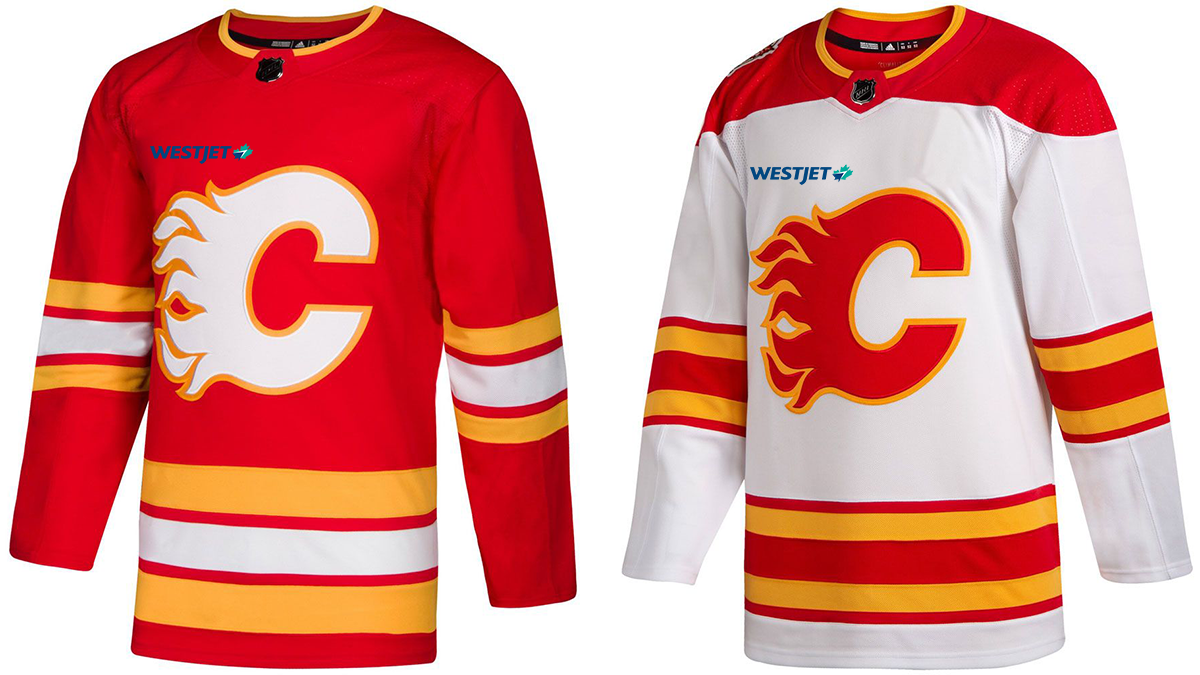
    What we want: WestJet or Duraflame
    What we’ll get: Scotiabank

    If you, as an American, can name any other Canadian airline other than Air Canada, then congratulations. If you can’t, then may I introduce you to WestJet?

    WestJet’s headquarters are next to Calgary International Airport and it’d be nice to prove to the world that Canada is more than just a land of Tim Horton’s, Roots, Canadian Tire, Rogers, Scotiabank and Mr. Sub.

    If Duraflame isn’t available, then you might as well dip into the low-cost airline industry as a means of attracting tourists to Banff National Park, Calgary Stampede or whatever it is that sets Calgary apart from the rest of Alberta (so… not being Edmonton).

    Carolina Hurricanes
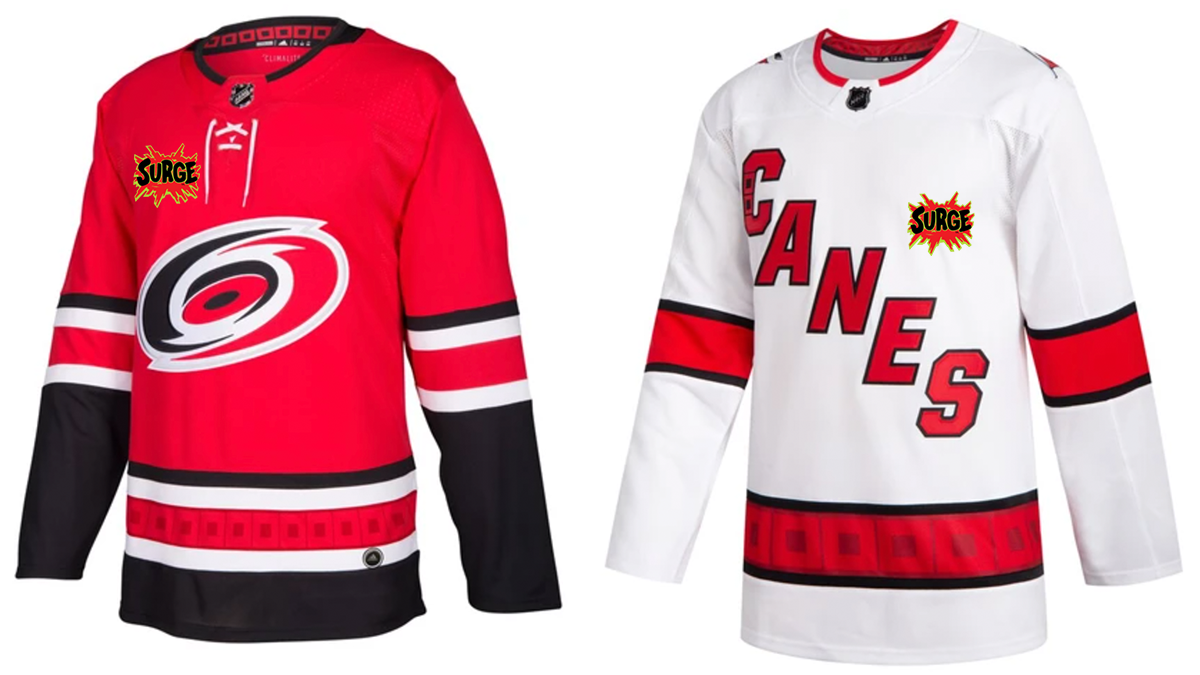
    What we want: Surge
    What we’ll get: PNC, Diehard, maybe Cheerwine or something else

    This should be obvious, but if you haven’t paid attention to the Hurricanes for at least the last few seasons now they do a “Storm Surge” celebration after every win on home ice in the regular season (and sometimes playoffs).

    Surge (the soda) is one of those drinks that makes headlines every few years for being pulled straight out of the vault and placed back on grocery store shelves– speaking of which, does anyone know if it’s currently available?

    If not, it’ll definitely be back by the 2022-23 season.

    Yes, it’s hard to envision where an ad will be placed on the road jersey as the prime real estate is used up by the diagonal “CANES” letters and– for a few players– the captain’s “C” or alternate captain’s “A”.

    Chicago
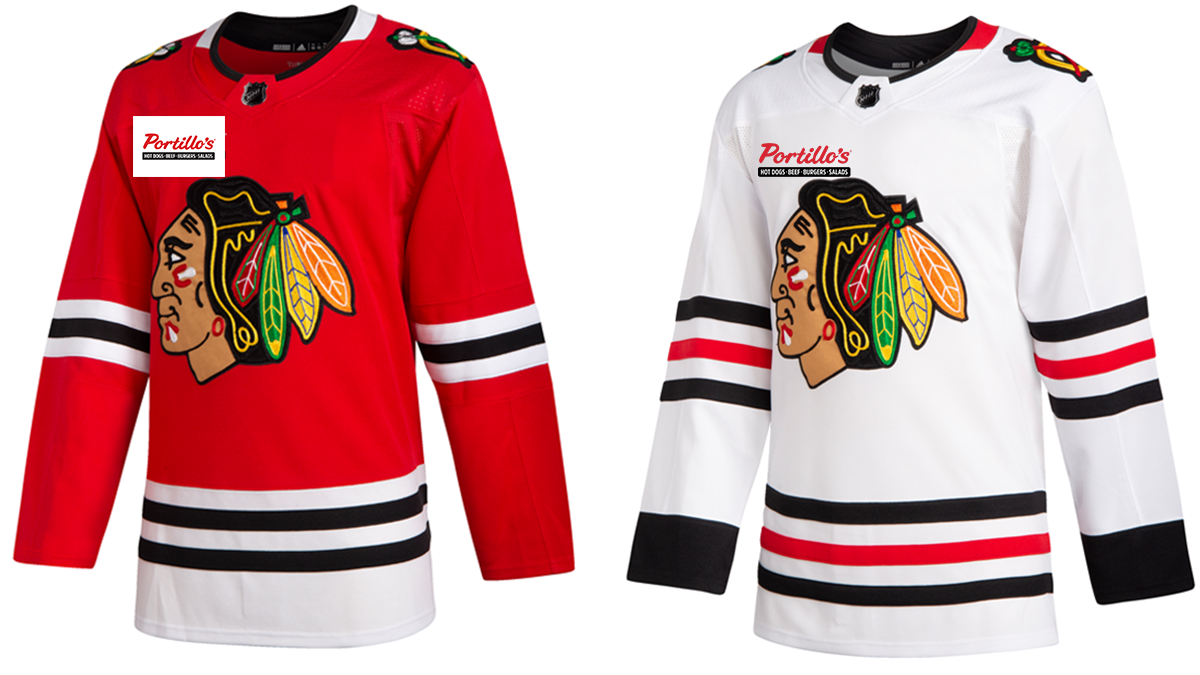
    What we want: Portillo’s
    What we’ll get: United

    Look, between Walgreens, Sears and Portillo’s there’s a few legendary brands that Chicago could partner with as their first jersey ad in franchise history (not including practice jerseys).

    Obviously only one of the three mentioned above is the right choice and its the one that might lead you to Walgreens later if you have a weak stomach. Besides, Sears is fading from our collective memory whether it is out of business already or not.

    Clark Griswold would be proud of Portillo’s proudly being displayed on a, well, if a WHL team can rebrand, so can you, Chicago.

    Colorado Avalanche

    What we want: Chipotle or Coors
    What we’ll get: Ball

    Look, whether or not Nathan MacKinnon eats Chipotle is a debate for another day, but one thing’s for sure– both Chipotle and MacKinnon started their careers in Colorado.

    Though Coors or Coors Light would make more sense, we have to consider the fact that kids might be wearing these jerseys to the game and we haven’t heard whether or not the jerseys that are sold in the proshops in 2022-23 and beyond will include the front jersey ad or not.

    If they do, then we probably can’t market beer to children.

    I’m pretty sure there’s a law about that and it’s also the reason why all my 1:64 scale diecast Rusty Wallace and Dale Earnhardt, Jr. cars from when I was a kid said “Team Rusty” and “Dale Jr.” on them, respectively, instead of Miller Lite and Budweiser.

    Columbus Blue Jackets

    What we want: Wendy’s
    What we’ll get: Nationwide

    Coinciding with the uptick in Columbus born and raised players on the Blue Jackets roster, it would be a great idea to add Wendy’s– which was founded in Columbus in 1969– to the team in such a way that perhaps Jack Roslovic and Sean Kuraly star in local commercials to the Blue Jackets viewing area during the 2022-23 season.

    I know that’s assuming Roslovic signs an extension, but the pending-restricted free agent at the end of the 2021-22 season helped facilitate the Pierre-Luc Dubois for Patrik Laine trade with the Winnipeg Jets by forcing Winnipeg into trading him to his hometown team.

    Unlike several recent stars that left the city via free agency, Roslovic will stick around for the long term.

    Especially if there’s some goods in kind involved with a Wendy’s sponsorship. I mean, I would at least.

    Dallas Stars

    What we want: Whataburger
    What we’ll get: AT&T

    Though Whataburger would be a welcome party in the burger wars when Columbus and Dallas would “meat” up, there’s no beef to be found in this hypothetical because AT&T has already made that decision for us.

    Sometimes you just can’t think too hyperlocal and AT&T fetches a more national audience than a regional chain that primarily serves Texas.

    Besides, if you go to Dallas for a Stars game, you can always just get Whataburger then. It’s not like they’re going to send you a meal with a jersey if ads are on the jerseys sold to fans in 2022-23.

    Detroit Red Wings
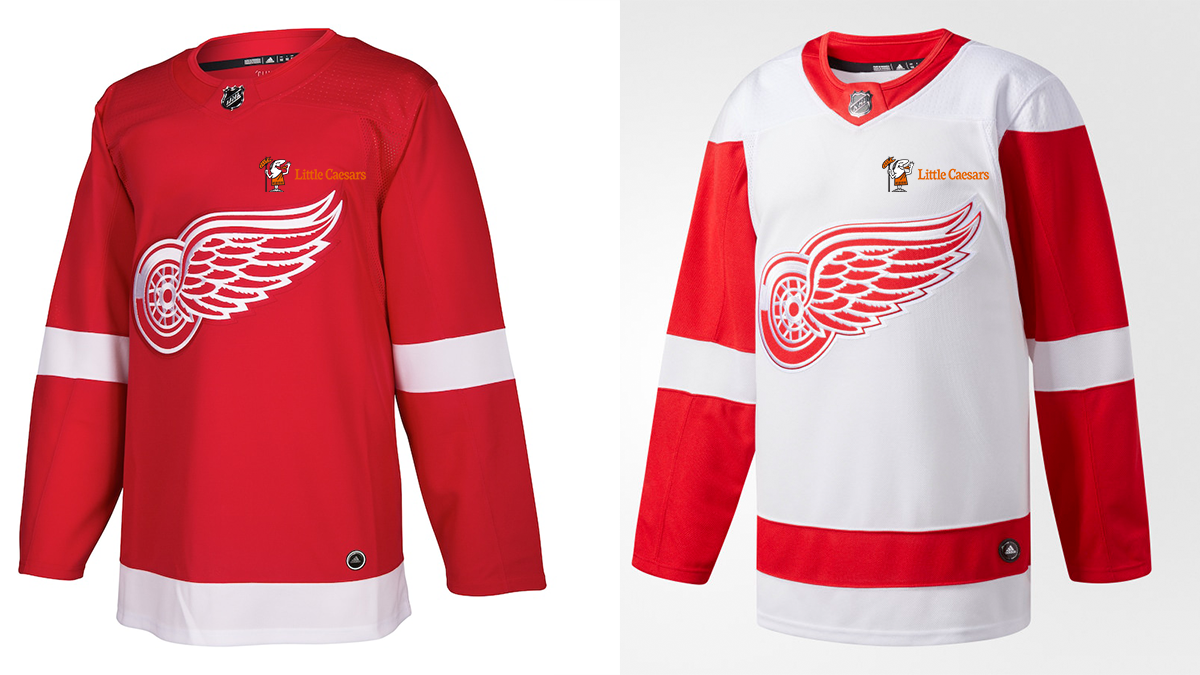
    What we want: Little Caesars
    What we’ll get: Little Caesars

    The last few teams have all involved food and we’re going to be stuck on this theme for at least one more team after this.

    Both the Red Wings and Little Caesars are owned by the Ilitch family and if you think adding one more connection between Detroit and pizza is a bad thing then you clearly don’t understand the marketing behind this.

    Kids love pizza. Adults love pizza. There’s a lot of good memories involving pizza.

    Plus, with General Manager, Steve Yzerman, in charge, the Red Wings are on the rise, which will only further tap into the nostalgia from when Detroit was doing what the Tampa Bay Lightning are currently doing to the rest of the league.

    Edmonton Oilers

    What we want: Boston Pizza
    What we’ll get: Rogers

    Edmonton thought they could replicate the success Ken Holland had in Detroit by hiring Holland as their General Manager and when they see that we’ve got a pizza establishment heading for the front of the Red Wings’ jersey, then the Oilers will think it’s also a good idea to snag a slice.

    That’s where Boston Pizza comes in.

    Whether or not they’ll get Connor McDavid to do an ad read or be left with whatever scraps surround him on the Oilers roster remains to be seen.

    In all likelihood, Rogers Communications will probably just get to slap their logo on another element of Edmonton’s brand.

    Florida Panthers

    What we want: Royal Caribbean International
    What we’ll get: Baptist Health or something

    The Blockbuster guy (the late Wayne Huizenga) founded the team and almost named them the “Florida Block Busters”, so it’d be neat to incorporate an homage to the days of Blockbuster (rest in peace) with the almost Blockbuster-like colors of Royal Caribbean International on the jersey.

    Plus, who among us hasn’t uttered the words “I need a vacation from my vacation” before?

    If you’re an out of town fan visiting the Panthers in Florida or watching the Panthers come to your town— there’s a cruise line for you even if you wouldn’t go remotely near a cruise before the ongoing pandemic began.

    Los Angeles Kings
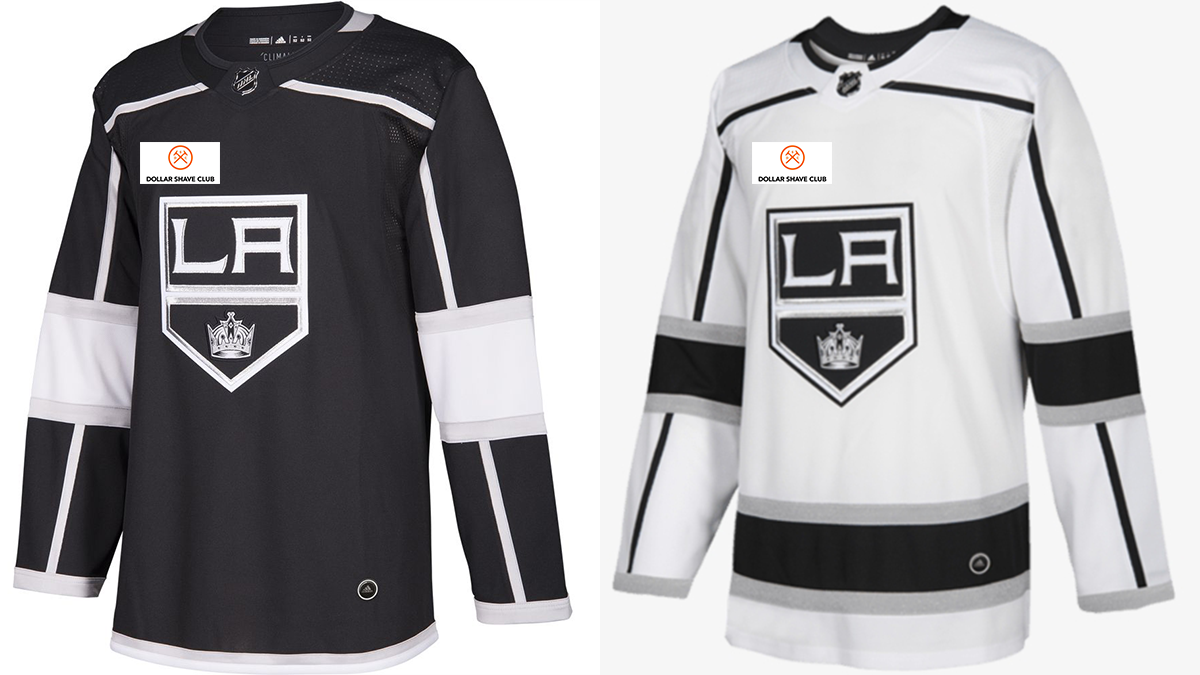
    What we want: Dollar Shave Club
    What we’ll get: Anschutz Entertainment Group

    Never doubt for a second that a team owner wouldn’t give up the chance to toot their own horn, which is why it’s quite possible that one of the world’s biggest entertainment entities would slap their own logo on the front of a Kings jersey.

    If you’re not able to finagle a way to write things off as a deduction, then Dollar Shave Club presents a unique opportunity despite the fact that shaving isn’t something that’s in Drew Doughty’s vernacular (or any hockey player, for that matter, when the Stanley Cup Playoffs roll around).

    Manscaped could also make a run here and in any case, fine.

    Minnesota Wild
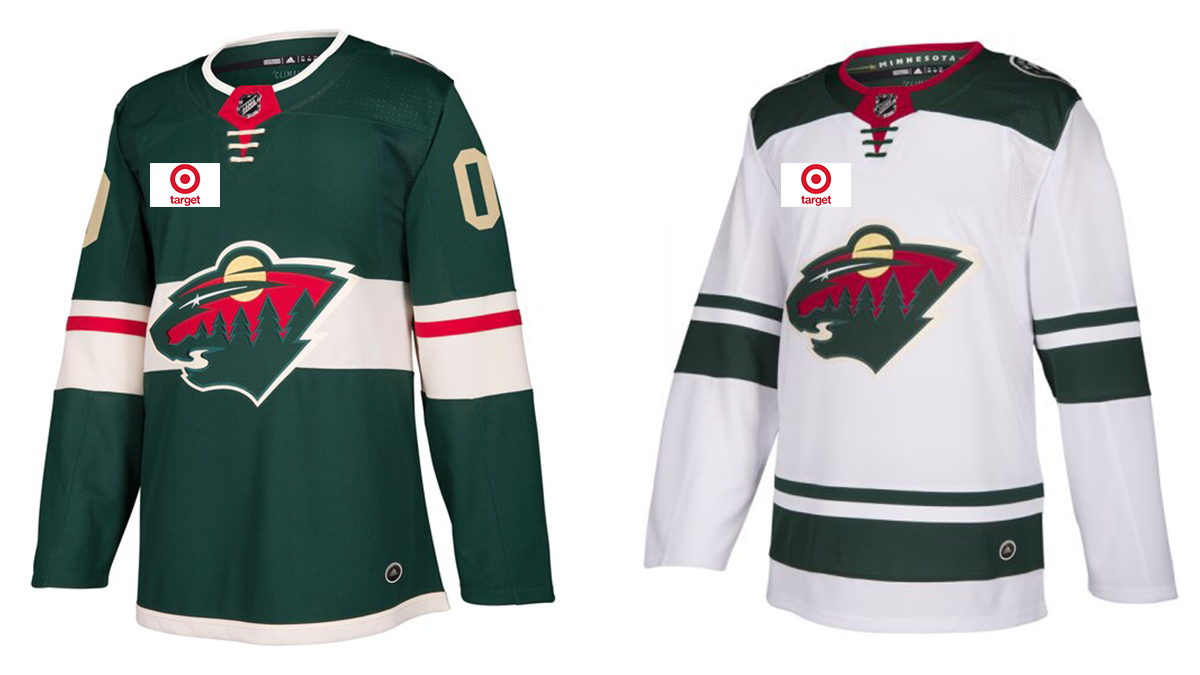
    What we want: Target or General Mills
    What we’ll get: Xcel Energy

    When you think of Minnesota what’s the first thing you think about?

    That’s right, the very place where you could be standing right now reading this while you’re waiting for a cash register to open up or aimlessly perusing the aisles for those impulse purchases you somehow always make at Target.

    It fits the Wild color scheme well and if we’re not going to get General Mills involved then at least getting more than the standard 5% discount for having a Target RedCard via goods in kind might be enough to convince Kirill Kaprizov to stay in Minnesota long-term.

    Montréal Canadiens

    What we want: CCM and/or Molson
    What we’ll get: Bell

    CCM makes more than just jerseys, but it’s not like adidas would be just fine with a CCM logo appearing on the front of an adidas ADIZERO jersey.

    So, we’re left with two obvious choices– Molson or Bell.

    If there’s nothing against a Canadian team bearing an alcoholic beverage on the front of their jersey with the potential for that brand to be marketed towards kids, then perhaps Molson– whose family ties own the Habs– might make an appearance near the crest.

    That or we’ll just get more airtime for Bell. Either way, Montréal would be attractive enough as a franchise to bring in more than one jersey ad sponsor if the league doesn’t have any specific rules outside of the size of the ad.

    Nashville Predators
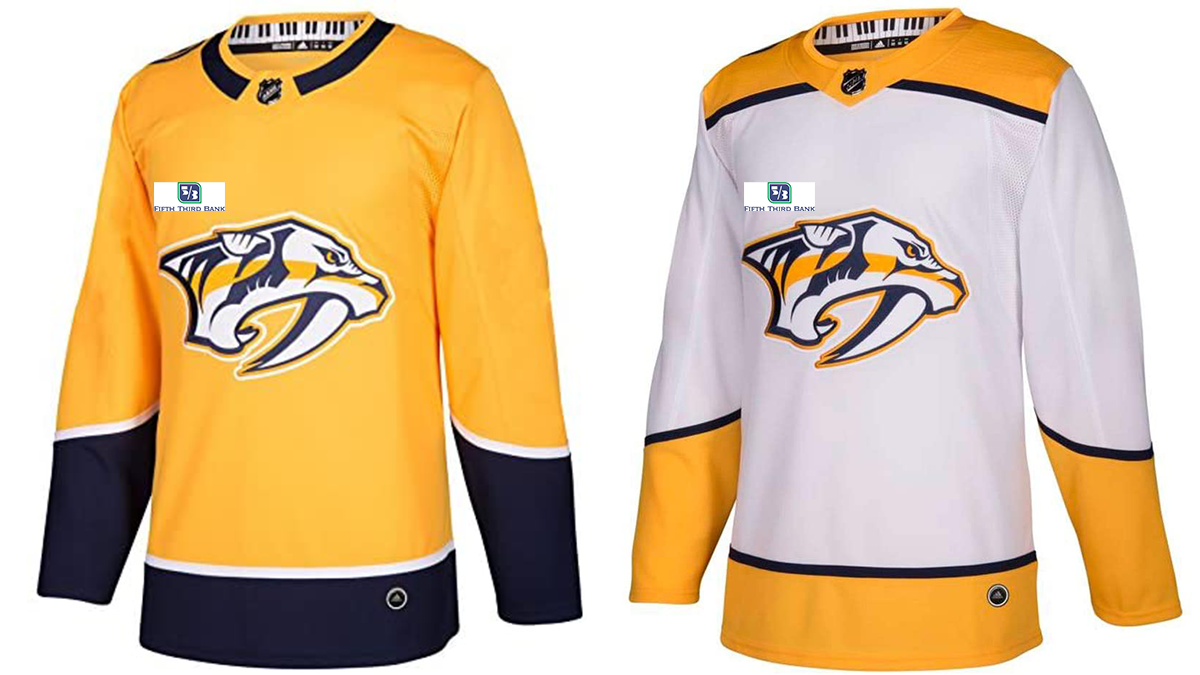
    What we want: Curb Records or CMT
    What we’ll get: Fifth Third Bank

    The music city could attract a music label if they wanted to, but Fifth Third Bank loves investing in Nashville for some reason– like, a lot, despite being headquartered in Cincinnati, Ohio and primarily serving Ohio, Kentucky, Indiana, Illinois, Michigan, West Virginia, North Carolina, Georgia and Florida more than all of Tennessee.

    In any case, good for the Predators. They’ll have some deep pockets to reach into while other teams surely will have to squabble for seven figures related to the going rate for the prime ad space.

    Still feels like we’d be missing out on a sweet Curb Records patch close enough to the guitar pick on the right shoulder though.

    New Jersey Devils
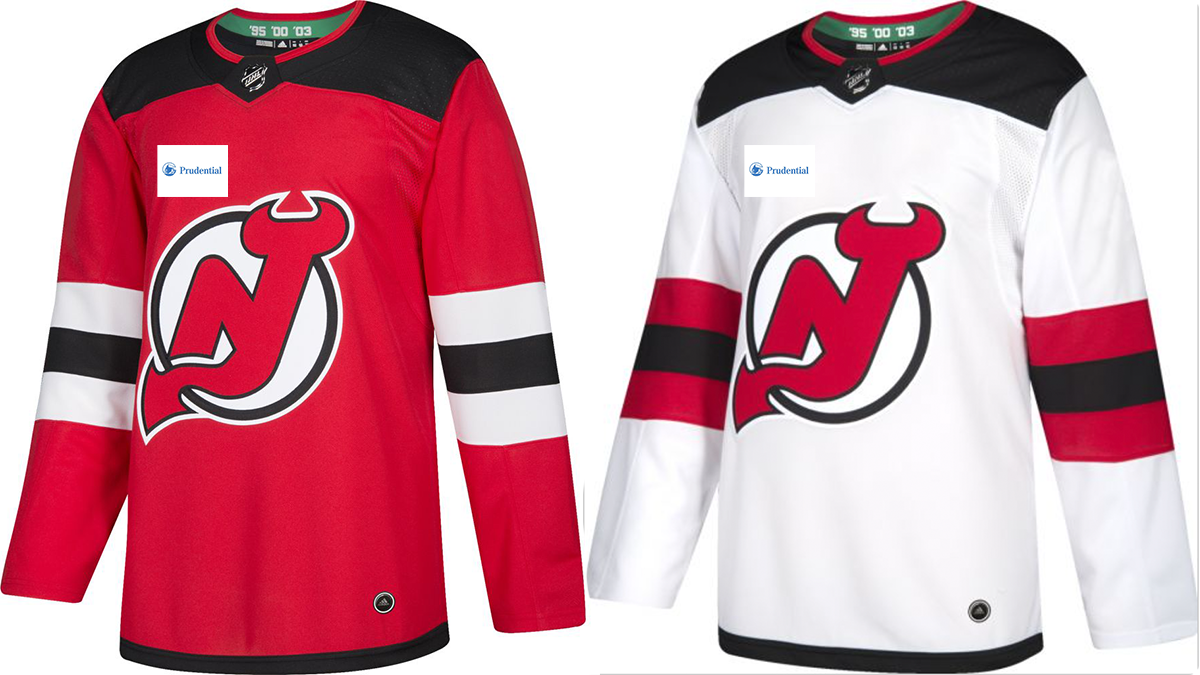
    What we want: Honestly, just Prudential is fine
    What we’ll get: Prudential

    The Devils are overlooked and let’s admit it, you couldn’t think of something distinctly New Jersey either– besides not being allowed to fill your own gas tank.

    Bruce Springsteen is not sponsoring the Devils alone.

    Whether it’s settling on an old reliable or simply making use of what’s trustworthy and already available, Prudential and New Jersey just seem like a good fit.

    New York Islanders

    What we want: Gorton’s
    What we’ll get: Not Gorton’s

    “We want fishsticks!”

    O.K., you got them. Take that, Rangers fans. The Islanders are cool now because they’re steering into the skid.

    They just won’t go as far as bringing back the fisherman jersey from the dead, but alas, they’ll show a spark of creativity and even crack a smile on Lou Lamoriello’s face with the real Gorton’s fisherman making an appearance on the jersey.

    Obviously this will never happen.

    New York Rangers

    What we want: Liberty Mutual if they’re bringing back the “Lady Liberty” jerseys as an alternate
    What we’ll get: Chase for sure, maybe New York Life too

    Liberty Mutual (a Boston company) on the “Lady Liberty” jersey would be a sight to see, but New York will never let it happen.

    Instead, Chase, which already has quite a great partnership with the team, Madison Square Garden, Manhattan, etc. will likely just step up and foot the bill for one– if not all– of the jerseys in full.

    That’s fine. The Rangers will suffer the same consequences of having a diagonal wordmark on their jersey like Carolina’s road jersey, but at least New York’s pretty much always been this way so they should have some ideas of how to work around that.

    Ottawa Senators

    What we want: Canada Post
    What we’ll get: Bell, Scotiabank or Canadian Tire

    Canada’s capital city gets the honor of having Canada Post on their jerseys because it breaks up the trend of having the same three or four companies sponsoring all seven Canadian teams (like how their helmets were for 2020-21).

    In reality, we’ll probably get more of the same from the Sens and either Bell, Canadian Tire or Scotiabank will make an appearance on Ottawa’s jersey.

    At the very least, Canada’s postal service sponsoring a team is more economically viable than the United States Postal Service sponsoring a team.

    Philadelphia Flyers

    What we want: Wawa or Audacy
    What we’ll get: Comcast or GlaxoSmithKline

    Remember how I said you don’t want to go too local for a jersey ad? Well, Wawa on a Flyers jersey is an exception.

    That said, it probably wouldn’t have the staying power to work on a road jersey too, so Philadelphia could tap into the artist formerly known as Entercom, since rebanded as Audacy, for more.

    Audacy maintained their Philadelphia headquarters and covers a broad range of Internet radio, digital content, regular radio and podcasting platforms, plus their logo is orange which fits the Flyers brand.

    It’s either that or Comcast will slap their own logo on the jersey or something.

    Pittsburgh Penguins

    What we want: Duolingo
    What we’ll get: PPG Industries

    Duolingo is headquartered in Pittsburgh and as a website and mobile app, every sports league with ads on jerseys needs at least one that makes you scratch your head at first before realizing the connection between the company and the city.

    The dating app, Bumble, once was featured on the NBA’s Los Angeles Clippers jerseys prior to the Clippers replacing Bumble with their more jersey ad with the online browser extension coupon company, Honey.

    Dating and living expenses in Los Angeles are probably harder than learning a few new languages through Duolingo, so combining Duolingo with the Penguins makes perfect sense since hockey players can come from all over and speak many languages.

    Besides, it might give your team an advantage if they can communicate with one another in a setting that is more comfortable for them.

    St. Louis Blues

    What we want: Busch
    What we’ll get: Enterprise

    I know we’ve been over the whole “can they market beer to kids with these jerseys” thing, but St. Louis is the city of Anheuser-Busch, so it’s only fitting that the Blues get a jersey ad that 1) is Anheuser-Busch related and 2) works with their color palette.

    If Major League Baseball’s St. Louis Cardinals play in Busch Stadium and get Budweiser by default with red as a primary color for the ball club, then the Blues naturally get Busch blue and Busch beer. I don’t make the rules.

    Plus Midwesterners really like the stuff.

    San Jose Sharks

    What we want: Adobe
    What we’ll get: SAP or Zoom

    Look, we weren’t going to get away with making these in Photoshop and not having to give Adobe something— and with headquarters in San Jose it only made sense.

    The Sharks have a deep relationship with SAP, though, so it’s more likely than not that the team will just go further with the brand that also is featured on their helmets at home and holds the current naming rights for SAP Center.

    Plus with the uptick in the use of Zoom, San Jose could double-dip and match SAP on the home jersey with SAP stickers on their helmets with Zoom covering the road set (jersey ad and helmet ads).

    Seattle Kraken
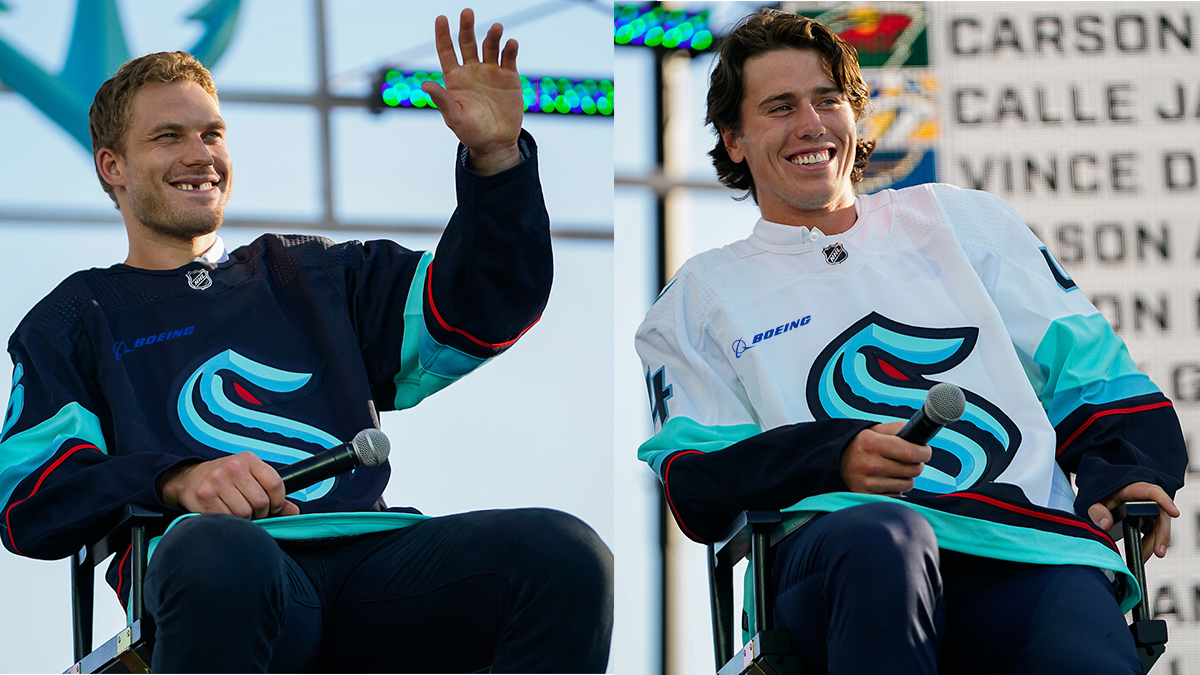
    What we want: Boeing
    What we’ll get: Alaska Airlines

    The Kraken already have a deal with Alaska Airlines as the official airline of the franchise, but what’s bigger than an airline itself?

    That’s right, Boeing, the company that makes a lot of planes and other aerospace stuff, was founded in Seattle and still has a major presence in Washington as the largest private employer in the state.

    Want to see your newest expansion team take flight? Just add some Boeing engineering to the jerseys.

    You might have thought Microsoft would make sense for a Seattle-based team, but the league’s agreement with Apple probably puts a quick end to that.

    Tampa Bay Lightning

    What we want: Accusoft
    What we’ll get: DEX Imaging

    Every sport with ads on jerseys has that one company that nobody’s really sure what they do, but they appreciate that they’re spending their money on their favorite team.

    That just might be Accusoft’s relationship with the Lightning come time for ads on jerseys in 2022-23.

    The private computer software company is headquartered in Tampa and was founded back in 1991, as Pegasus Imaging– one year prior to the Lightning’s debut season as an NHL team in 1992-93.

    Toronto Maple Leafs
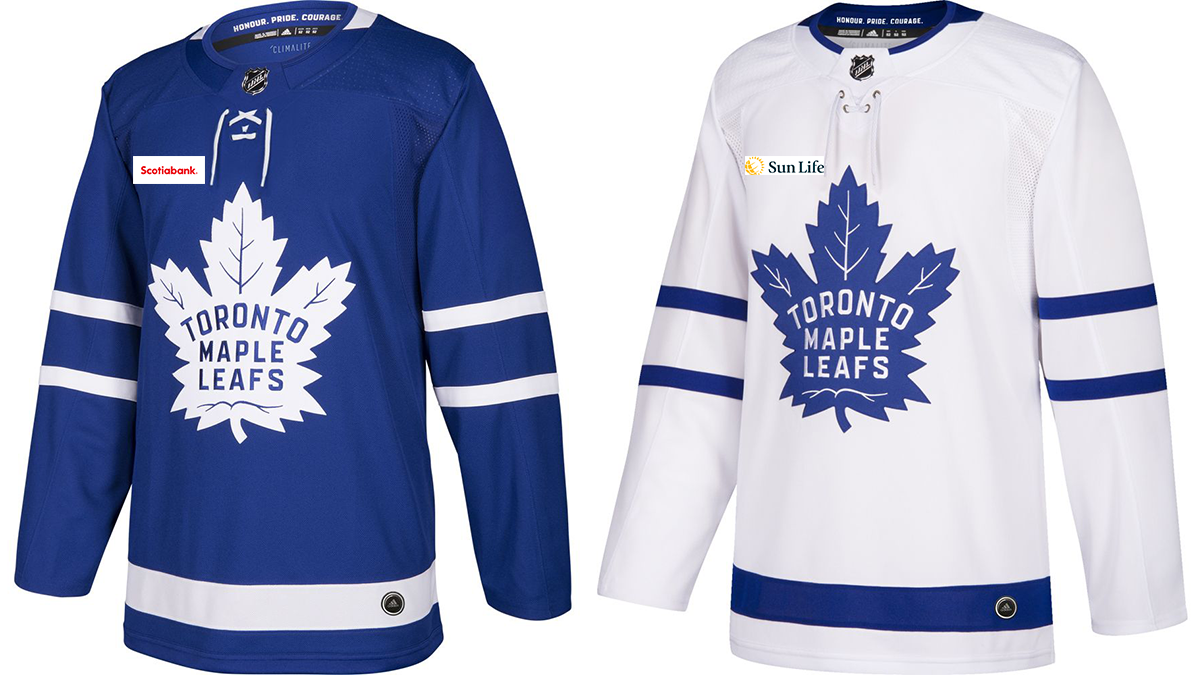
    What we want: Swiss Chalet, Sun Life Financial
    What we’ll get: Scotiabank, Sun Life Financial

    Scotiabank already has a stronghold on Toronto both financially and in the sense that the Maple Leafs play inside Scotiabank Arena and proudly display Scotiabank’s logo on their helmets, so it seems inevitable that Scotiabank would also make an appearance on the Leafs jersey.

    But Toronto is strong enough to maximize the value of a 3-by-3.5-inch ad and capitalize on the Maple Leaf Sports and Entertainment (MLSE) brand.

    MLSE already has an agreement with Sun Life Financial on their NBA team’s jerseys and the Toronto Raptors were able to go on to win their first championship in 2019.

    Perhaps the key to ending the Maple Leafs’ Stanley Cup drought lies within attracting Sun Life Financial to an NHL jersey ad.

    Vancouver Canucks
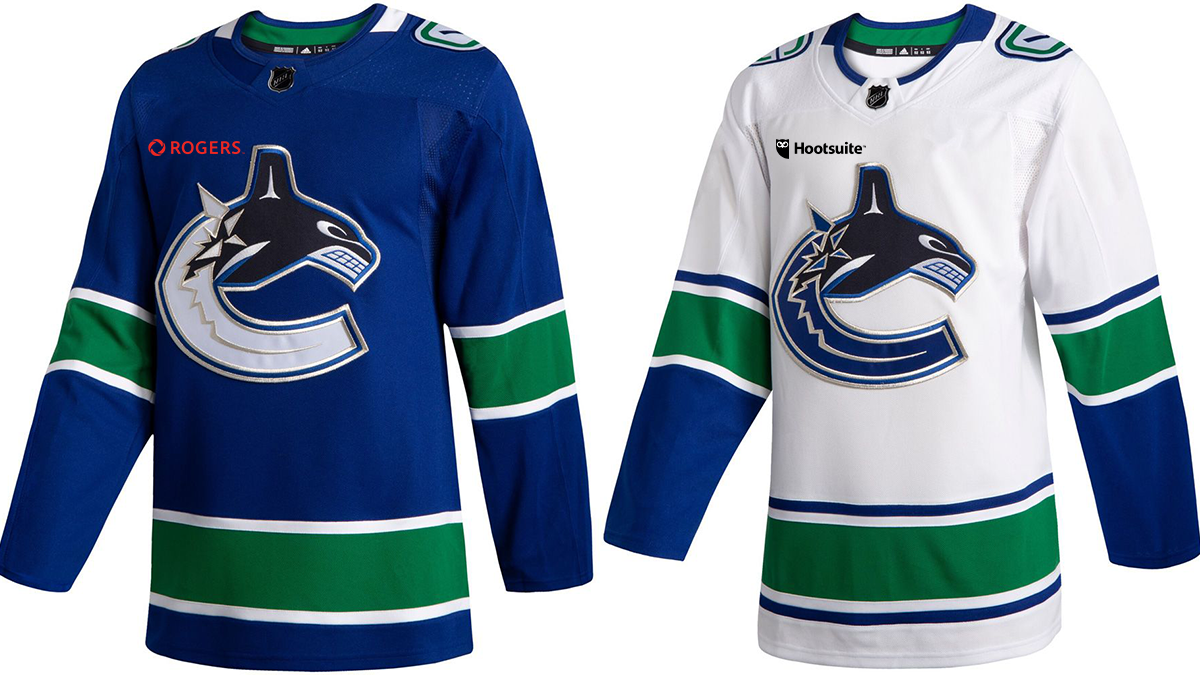
    What we want: Hootsuite
    What we’ll get: Rogers

    Remember when you’d see Hootsuite on just about every tweet with a photo? Am I the only one imagining that?

    In any case, Hootsuite was founded and is based in Vancouver and still plays a major role in social media management for brands.

    Whereas Rogers is accessible to most every day Canadians, Hootsuite would be more of a “corporate” target audience and you need sponsors at all levels to attract a wide base of potential clients, fans, etc.

    That said, the Canucks have had a long relationship with Rogers in that they play in Rogers Arena, so it’s probably going to be Rogers.

    Vegas Golden Knights
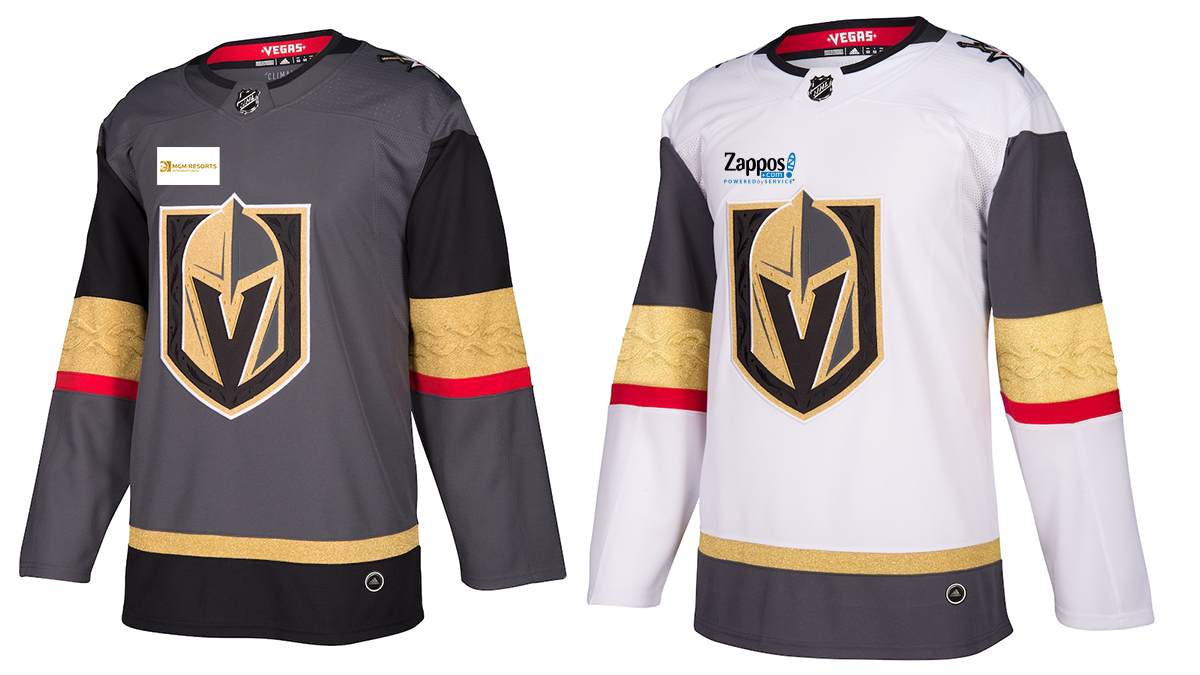
    What we want: Zappos.com
    What we’ll get: MGM Resorts International or Allegiant Air

    Want to have fun with a local Nevada brand? Zappos is the way to go!

    Want to be realistic and attract out of town fans to a destination like Las Vegas? MGM Resorts International is your sponsor and with Allegiant Air as an ultra-low cost airline that’ll gladly bring you to Vegas for a Golden Knights game…

    Yeah, it’s inevitable that between MGM and Vegas’ current road helmet sponsor (Allegiant) that there’d quickly be no room for a company like Zappos.

    Credit One Bank is on the home helmets for the Golden Knights, so don’t be surprised if they’re a wild card for a jersey ad too.

    Washington Capitals

    What we want: Marriott International
    What we’ll get: Capital One, Custom Ink

    Sportswriters rejoice! Your Marriott points may soon reward you with a Capitals jersey or something like that.

    Headquartered in Bethesda, Maryland, Marriott International would make sense from a local and international brand recognition stance.

    But you know what we’re probably going to get instead? Sheer confusion as Capital One places an ad on front of a jersey that already says “Washington Capitals”. The Capital One Washington Capitals– live at Capital One Arena!

    Either that or Caps owner, Ted Leonsis, might like to make a connection between making custom jerseys for local adult league co-ed softball teams or something and, well, Custom Ink’s logo appearing on Capitals jerseys.

    Winnipeg Jets

    What we want: A&W or SkipTheDishes
    What we’ll get: Canada Life or Bell

    A&W was founded in Winnipeg, while SkipTheDishes is headquartered in Winnipeg.

    Since it’s 2021, and not 1956, we’re more than likely to see SkipTheDishes on a Jets jersey, but if their helmet ads from 2020-21 are any indication for 2022-23 and beyond, then Bell is probably going to land a spot near Winnipeg’s crest.

    Canada Life is taking over as the new naming rights holder for Canada Life Centre where the Jets play, so there’s always a chance they’ll end up with their logo on the front of the jersey too.
  • MacKinnon’s hat trick gives Avs 2-0 series lead

    MacKinnon’s hat trick gives Avs 2-0 series lead

    Nathan MacKinnon scored a hat trick as the Colorado Avalanche defeated the St. Louis Blues, 6-3, in Game 2 of their 2021 Stanley Cup Playoffs First Round series on Wednesday, but that’s not the only big thing to have happened in the matchup.

    Avalanche forward, Nazem Kadri, is likely to face supplemental discipline from the league’s Department of Player Safety for his high, blindside, hit on Blues defender, Justin Faulk, in the third period of Wednesday night’s action at Ball Arena.

    Kadri has not been suspended since the 2019 First Round when he retaliated– then as a member of the Toronto Maple Leafs– with a cross check to the face of Boston Bruins forward, Jake DeBrusk.

    He has faced numerous fines and suspensions before prior to the DeBrusk incident– though in accordance with the league’s 18-month timeline for repeat offenders it’s more than likely that Kadri won’t be defined as one in whatever additional discipline he’s about to face.

    Nevertheless, the hit was bad.

    Whether Kadri will be back at all in this series or at all in the remainder of the 2021 postseason remains to be seen.

    Philipp Grubauer (2-0, 2.00 goals-against average, .931 save percentage in two games played) made 32 saves on 35 shots against in the win for Colorado.

    St. Louis goaltender, Jordan Binnington (0-2, 4.07 goals-against average, .915 save percentage in two games played), made 29 saves on 33 shots faced in the loss.

    David Perron remained on the league’s COVID protocol list as the Blues, Vegas Golden Knights and a few other teams across the National Hockey League, National Basketball Association and Major League Baseball had an issue with COVID testing at a lab.

    Though Perron was unaffected by the mass false positive tests produced, the Blues and Golden Knights were promptly retested and cleared to play.

    Joonas Donskoi (1) kicked things off with a deflection goal 35 seconds into the first period as the Avs went up, 1-0, on the scoreboard thanks to his presence in front of the net while Ryan Graves got a shot off from the point.

    Graves (1) and Kadri (1) had the assists on Donskoi’s first goal of the night and the Avalanche got off to a hot start– wasting little time to pull ahead of the Blues on home ice.

    Late in the period, St. Louis’ Robert Thomas sent the puck over the glass and out of play, yielding an automatic delay of game penalty and presenting Colorado with the night’s first chance on the power play at 17:35.

    It took the Avalanche less than a minute to dominate on the skater advantage and capitalize on their first power play of the game as MacKinnon (3) cut to the middle of the point with heavy traffic in front of Binnington before firing a shot through the legs of a Blues defender, as well as MacKinnon’s own teammate, Gabriel Landeskog, and into the twine.

    Cale Makar (1) and Donskoi (1) notched the assists on MacKinnon’s power-play goal and the Avs led, 2-0, at 18:05.

    After one period of action, Colorado led, 2-0, on the scoreboard and, 19-6, in shots on goal.

    The Avalanche also dominated in blocked shots (7-6), takeaways (4-1), giveaways (4-0) and faceoff win percentage (70-30), while St. Louis held the advantage in hits (13-8).

    The Blues had yet to see time on the power play, while the Avs were already 1/1 heading into the first intermission.

    Early in the middle frame, Ivan Barbashev hooked MacKinnon and presented the Avalanche with a power play at 2:48 of the second period.

    Less than a minute into the ensuing skater advantage, MacKinnon sent a shot from the point that Donskoi (2) deflected while acting as a screen in the slot with Landeskog.

    MacKinnon (2) and Mikko Rantanen (3) picked up the assists on Donskoi’s power-play goal as the Avalanche extended their lead to, 3-0, at 3:14 of the second period.

    Late in the middle frame, Sammy Blais (1) sent the puck off of Grubauer from about the goal line as the rubber biscuit had eyes and trickled through the Colorado netminder’s five-hole and into the net.

    Kyle Clifford (1) and Torey Krug (1) recorded their first assists of the postseason on Blais’ goal as the Blues cut Colorado’s lead to two-goals, 3-1, at 16:17.

    Though the Avs led, 3-1, on the scoreboard and, 28-20, in shots on goal after two periods, St. Louis held the advantage in second period shots alone, 14-9.

    The Blue Notes also led in blocked shots (11-8) and hits (23-16) after 40 minutes, while the Avalanche maintained an advantage in takeaways (8-3), giveaways (9-5) and faceoff win% (68-33).

    Colorado was 2/2 on the power play heading into the final period as the Blues had still yet to encounter a legal skater advantage in the action.

    Then it happened.

    Early in the third period, Kadri hit Faulk from a blindside angle, right to the head.

    Faulk was visibly unwell and laying facedown on the ice– the CNBC broadcast briefly showed Faulk motionless on the ice, looking dazed and– even to the untrained eye– clearly unconscious as a scrum gathered along the side boards closest to the penalty benches.

    Kadri was given a five-minute major for an illegal hit to the head, which was reviewed and confirmed. He was also given a match penalty at 6:30 of the third period.

    St. Louis was already down a skater in Robert Bortuzzo– who had taken something up high earlier in the night– and was now short Faulk on the bench for the remainder of Wednesday’s action.

    Late in the five-minute power play, Brayden Schenn (1) buried a rebound off of a rush that he generated with Tyler Bozak entering the zone– with Bozak firing the initial shot before Schenn collected the garbage.

    Bozak (1) and Krug (2) had the assists on Schenn’s power-play goal as the Blues pulled to within one, 3-2, at 10:07 of the third period.

    About five minutes later, however, Colorado answered.

    MacKinnon (4) sent another shot from the point over Binnington’s blocker side with traffic in front of the net.

    Devon Toews (1) and Landeskog (3) collected the assists as the Avalanche bumped their lead back to two-goals, 4-2, at 15:25.

    But 15 seconds later, Mike Hoffman (1) had a quick breakout the other way and sent one of his patented quick-release shots off of Grubauer under his blocker side and into the top left corner of the goalframe.

    Niko Mikkola (1) and Thomas (2) had the assists on Hoffman’s goal as the Blues pulled back to within one, 4-3, at 15:40.

    St. Louis’ head coach, Craig Berube, pulled Binnington for an extra attacker with about 2:18 remaining in the game.

    It didn’t take long for Colorado to score.

    Brandon Saad (1) simply cleared the puck from behind the red line into the open 4×6 net as Tyson Jost (1) and Toews (2) picked up the assists to make it, 5-3, Colorado at 17:51.

    Once more the Blue Notes pulled their goaltender for an extra attacker after getting possession deep into the attacking zone.

    Though the Avalanche would also once again capitalize on the empty net– this time as MacKinnon (5) completed his hat trick with the assists going to Rantanen (4) and Landeskog (4) as the Avs pulled ahead, 6-3, at 19:48.

    At the final horn, the Avalanche secured a 2-0 series lead with a commanding, 6-3, victory in Game 2 at Ball Arena in Denver.

    Colorado finished the night leading in blocked shots (17-14), giveaways (11-5) and faceoff win% (64-36), while St. Louis exited the building leading in hits (26-19).

    Both teams finished with 35 shots apiece, though the Blues led in shots on goal in the third period alone, 15-7.

    St. Louis went 1/2 on the skater advantage while Colorado was a perfect 2/2 on the power play on Wednesday.

    The Avs lead the series 2-0 as the venue shifts to Enterprise Center for Game 3 in St. Louis on Friday.

    Puck drop is expected a little after 9:30 p.m. ET and viewers in the United States can tune to national coverage on USA Network, while those in Canada can watch the action on SN360 or TVAS2.

  • DTFR Podcast #202- What Are Your Qualifications?/Let’s Get Kraken

    DTFR Podcast #202- What Are Your Qualifications?/Let’s Get Kraken

    Using Qualifiers to enhance this postseason (it’s a breakdown of the 2020 Stanley Cup Qualifiers and Round Robin action). Plus the Seattle Kraken!

    Subscribe to the podcast on Apple PodcastsStitcher and/or on Spotify.

  • Why the Boston Bruins Might Never Retire No. 30

    For a lot of Boston Bruins fans, the term “goalie controversy” often draws up images of people shouting at each other on Twitter about Tim Thomas vs. Tuukka Rask– yes, even to this day, despite the fact that 1) Thomas was traded to the New York Islanders in 2013 and 2) that he effectively retired after the 2013-14 season split between the Florida Panthers and Dallas Stars (he never announced his retirement officially, anyway). 

    Both have a Stanley Cup ring to their names as they were members of the 2011 Stanley Cup champion Bruins roster, with Thomas leading the way to Boston’s first championship since 1972, while Rask was biding his time as the team’s backup before taking over as the full-time B’s starter since the 2012-13 season– racking up multiple franchise records in the process and two more Stanley Cup Final appearances in 2013 and 2019.

    But this “goalie controversy” has nothing to do with the galaxy brain Thomas vs. Rask arguments on Twitter.

    This is about the “controversial” debate that rages surrounding retiring No. 30 in Boston and the controversies that surround two of its most prominent Bruins to wear it.

    When considering whether or not to retire a number in Bruins lore, first consider what other Original Six teams have done, since they’re the only comparable franchises with almost as many– if not more– years of history than Boston.

    Then consider the fact that Boston has never retired a number for a goalie. For quick reference, retired numbers of goalies are in bold.

    Boston Bruins retired numbers

    • 2 Eddie Shore
    • 3 Lionel Hitchman
    • 4 Bobby Orr
    • 5 “Dit” Clapper
    • 7 Phil Esposito
    • 8 Cam Neely
    • 9 Johnny Bucyk
    • 15 Milt Schmidt
    • 16 Rick Middleton
    • 24 Terry O’Reilly
    • 77 Ray Bourque

    Chicago Blackhawks retired numbers

    • 1 Glenn Hall
    • 3 Keith Magnuson/Pierre Pilote
    • 9 Bobby Hull
    • 18 Denis Savard
    • 21 Stan Mikita
    • 35 Tony Esposito

    Detroit Red Wings retired numbers

    • 1 Terry Sawchuk
    • 4 Red Kelly
    • 5 Nicklas Lidstrom
    • 7 Ted Lindsay
    • 9 Gordie Howe
    • 10 Alex Delvecchio
    • 12 Sid Abel
    • 19 Steve Yzerman

    Montreal Canadiens retired numbers

    • 1 Jacques Plante
    • 2 Doug Harvey
    • 3 Emile Bouchard
    • 4 Jean Beliveau
    • 5 Bernie Geoffrion/Guy Lapointe
    • 7 Howie Morenz
    • 9 Maurice Richard
    • 10 Guy Lafleur
    • 12 Yvan Cournoyer/Dickie Moore
    • 16 Henri Richard/Elmer Lach
    • 18 Serge Savard
    • 19 Larry Robinson
    • 23 Bob Gainey
    • 29 Ken Dryden
    • 33 Patrick Roy

    New York Rangers retired numbers

    • 1 Eddie Giacomin
    • 2 Brian Leetch
    • 3 Harry Howell
    • 7 Rod Gilbert
    • 9 Andy Bathgate/Adam Graves
    • 11 Vic Hadfield/Mark Messier
    • 19 Jean Ratelle
    • 35 Mike Ritcher

    Toronto Maple Leafs retired numbers

    • 1 Turk Broda/Johnny Bower
    • 4 Hap Day/Red Kelly
    • 5 Bill Barilko
    • 6 Irvine “Ace” Bailey
    • 7 King Clancy/Tim Horton
    • 9 Ted Kennedy/Charlie Conacher
    • 10 Syl Apps/George Armstrong
    • 13 Mats Sundin
    • 14 Dave Keon
    • 17 Wendell Clark
    • 21 Borje Salming
    • 27 Frank Mahovlich/Darryl Sittler
    • 93 Doug Gilmour

    There’s not many retired goalie numbers among Original Six teams, let alone the rest of the NHL. Plus Boston hasn’t even retired No. 1 for Cecil “Tiny” Thompson and/or Frank Brimsek.

    Next, think about Hockey Hall of Fame status, as well as career longevity (in Boston and outside of Boston).

    Especially since there is no “Boston Bruins Hall of Fame” (which is a shame, really– they built The Hub on Causeway and they couldn’t dedicate more to team history/histories (if you include the NBA’s Boston Celtics) than just the entrance to the old Boston Garden standing inside of Banners Kitchen & Tap?).

    Sure there’s The Sports Museum inside TD Garden, but the Montreal Canadiens have a Montreal Canadiens Hall of Fame underneath Bell Centre. Your move, Mr. Jacobs.

    Cam Neely– He didn’t play nearly enough games for his era due to Ulf Samuelsson, but Neely is a Hockey Hall of Fame member.

    Rick Middleton– He played a lot, scored a ton, but Middleton isn’t a member of the Hockey Hall of Fame.

    Terry O’Reilly– He was like Milt Schmidt in that he did a lot for the Bruins organization (player and later coach), but O’Reilly isn’t a Hockey Hall of Fame member.

    As with everything, there are exceptions to the rule and O’Reilly and Middleton are deservingly so in their own right.

    Gerry Cheevers is a Hockey Hall of Fame goaltender. Tim Thomas is a U.S. Hockey Hall of Fame goaltender. He’s still eligible for the Hockey Hall of Fame, but he hasn’t gotten in and there’s no guarantees that he’ll make it.

    Interestingly enough, however, while Thomas might never be inducted into the Hockey Hall of Fame, Cheevers made it in 1985, but never won a Vezina (Thomas has two, 2008-09 and 2010-11) and was never named to an All-Star Team at season’s end (Thomas was named to two, 2008-09 and 2010-11).

    Then think about how they left Boston.

    In 1972, the World Hockey Association (WHA) came into fruition as a direct rival of the National Hockey League (NHL). The WHA promised better pay for players and the same– if not better– experience for fans.

    It was created by a pair of American promoters who also made the American Basketball Association (ABA), which, if you’re a fan of basketball, you already know the ABA merger story with the National Basketball Association (NBA) to form the National Basketball Association (NBA, 1976-present).

    From the onset, the ABA was poised to one day merge with the NBA in its efforts for success a la the American Football League (AFL) and National Football League (NFL) merger prior to the 1970 NFL season.

    The WHA was all about what the NHL wasn’t about.

    They wanted to capitalize on markets where hockey could flourish, but were otherwise overlooked by the NHL, as well as attract the best players in the game by paying more than what NHL teams would– especially attracting European talent whereas the NHL was stuck as a “North American” game at the time. 

    Free agency was a new concept for professional sports in the 1970s and it reigned supreme in the emerging shift towards player’s rights and the evolution of players’ associations.

    The NHL’s reserve clause at the time meant players couldn’t become the equivalent of today’s unrestricted free agent until they were 31-years-old. These days, there’s restricted free agency, unrestricted free agency, as well as one-way and two-way contracts to worry about, but that’s another topic for another day.

    Cheevers left the Bruins for the WHA, which was deplorable in the eyes of the NHL back then as much as it is now. 

    Though fans might have loved seeing the Cleveland Crusaders jerseys, NHL owners hated them. 

    Though players loved making more money at a time when all the other major professional sports were seeing significant raises, NHL owners hated them. 

    Though WHA franchises thought they’d be on the fast track to continuing operations in the NHL after the WHA ceased to exist, the NHL went all out to slash and burn the remnants of the WHA. 

    Seriously though, when the WHA initiated discussions for a merger in 1977, NHL owners voted down a plan to merge six WHA teams into the NHL.

    The Edmonton Oilers, New England Whalers, Quebec Nordiques, Cincinnati Stingers, Houston Aeros and Winnipeg Jets wanted out of a league that was hemorrhaging money and into the safe arms of the NHL and its tradition. 

    By 1976, there were 32 major professional hockey teams between the NHL and WHA, which diluted the talent pool of a sport that was nowhere near the numbers of popularity and youth through junior league development as it is today.

    When it came time to re-negotiate a merger in 1978, Houston was no longer in the plan, since the Aeros ended up having to fold.

    The Indianapolis Racers folded in the middle of December 1978, which set the final nail in the merger. Cincinnati and the Birmingham Bulls would each be compensated to disband elsewhere, while Edmonton, New England, Quebec and Winnipeg would join the NHL at the WHA’s insistence.

    Except it wasn’t that easy for the Oilers, Whalers, Nordiques and Jets. 

    Each team would be stripped of its history– rendering them as NHL expansion teams for the start of the 1979-80 season, subject to expansion fees, an expansion draft and penalizing them by allowing NHL teams to reclaim players that jumped ship to the WHA.

    Additionally, the Bruins petitioned the “New England Whalers” moniker, resulting in the Whalers having to drop “New England” in favor of “Hartford” since Boston didn’t want any confusion that the Whalers were playing on their turf (despite Massachusetts and Connecticut both being part of New England). 

    The Bruins owned New England. 

    That only strengthened the underdog status of the Whalers and the hatred between the two clubs in their Adams Division rivalry after realignment for the 1981-82 season (Hartford kicked things off in their NHL tenure in the Norris Division from 1979-81).

    Anyway, back to Cheevers and his departure from the Hub.

    After winning his second Cup with Boston in 1972, Cheevers jumped at the opportunity Cleveland created to make a lot more money than what the Bruins were offering their two-time Stanley Cup winning goaltender. 

    Cheevers lasted parts of three seasons as a Crusader from 1972-73 to 1975-76, when a financial dispute with Cleveland’s management resulted in Cheevers jumping back into the NHL fold with Boston in the middle of the 1975-76 season.

    Since becoming a starting goaltender in the 1967-68 season through Boston’s 1971-72 Cup winning season, Cheevers amassed a 126-52-40 record in 221 games with a 2.72 goals against average and a .915 save percentage in that span, as well as 15 shutouts.

    Prior to his departure from the Bruins for Cleveland, he had a career best 2.50 GAA and .920 SV% in 41 games in the 1971-72 season alone as a 31-year-old goaltender (he wouldn’t turn 32 until Dec. 7, 1972).

    Though Cheevers returned in 1975-76, things never were really the same.

    His WHA tenure racked up a 99-78-9 record in 191 career games for the Crusaders from 1972 through part of the 1975-76 season– with a 3.12 GAA and 14 shutouts in that span.

    On Jan. 27, 1976, he returned to Boston as a free agent after being released by Cleveland– two days after the Crusaders suspended him for not showing up and refusing to play.

    By that point, Cheevers was 35-years-old and finished off the 1975-76 NHL season with an 8-2-5 record, as well as a 2.74 GAA and a .900 SV% in 15 games played for the Bruins.

    In his full seasons for Boston that followed from 1976-77 to his retirement after the 1979-80 season, Cheevers went 87-35-24 in 151 games, with a 2.96 GAA, an .878 SV% and nine shutouts in that span.

    Though the emergence of Wayne Gretzky to the NHL scene may have shifted the offensive output across the league since 1979, Cheevers’ NHL playing days only coincided with Gretzky in Gretzky’s rookie season (1979-80).

    Though Cheevers had a .524 winning percentage in his first NHL stint with Toronto (two games)  and Boston (250 games) from 1961-72 and a .572 winning percentage after his WHA days in 166 games with Boston from 1976-80, his goals against average and save percentage suffered dramatically from a 2.85 GAA and a .911 SV% in 1961-72 to a 2.94 GAA and an .880 SV% from 1976-80.

    Of course, age and the inevitable “wall” that players hit at the twilight of their prime is likely a factor here.

    Still, the fact remains the same.

    Despite leading the Bruins as a head coach after his retirement as a player from 1980-85, his defection from the NHL to the WHA crushed his immediate chances at being honored for his work on the ice in a sweater with the spoked-B on the front and the No. 30 on the back.

    And all these years later, he might still be paying for it.

    Thomas, on the other hand, chose to sit out the 2012-13 season, citing a need for more connection to his faith, family and friends.

    Though it’s certainly understandable these days, given the presumptive hell he must have gone through with all of his concussions and finding the love for the game again– albeit watching as a fan these days– since his retirement from the NHL after the 2013-14 season, Thomas’ 2012-13 plans weren’t the first time he angered the Bruins fanbase, let alone, Boston’s front office.

    After winning the Cup in 2011, he skipped out on the team’s White House invitation— citing (to paraphrase) that both major political parties are at fault for the federal government’s overbearance on its citizens.

    Other than that, there’s his staunch– if not, outlandish at times– political views that cannot be overlooked (his support for Chick-fil-A amidst the company’s anti-equal marriage stance) in a day and age where Hockey Is (supposed to be) For Everyone.

    Like the rest of us, however, Thomas is human– complex, contradicting, well-defined and unique as an individual. We all struggle through our own cognitive dissonance through life. 

    For some, his on-ice performance can be separated from what his private off-ice personal life ensues. 

    For others, he might not be as high on the pedestal of Boston sports lore due to his complicated nature– one that contradicts research and the science behind traumatic brain injuries, therapy and experimental treatments with conspiracy theories related to climate change, among other things.

    All of this begs the question “should there be a character component to retiring numbers,” which could lead to further discussion surrounding whether or not teams should permanently unretire numbers when legendary players don’t live up to being role models off the ice (see, Bobby Hull and the Chicago Blackhawks and Arizona Coyotes). 

    Likewise, the same argument could be applied to hall of fame inductions, but both are discussions for another time.

    But Thomas’ decision to sit out the 2012-13 season with one-year remaining on his contract and a $5.000 million cap hit in a time when Boston was built for contending for another Cup run while spending $8.500 million combined between Thomas and Tuukka Rask in the crease as the team sat uncomfortably below the salary cap at about $68.868 million out of the $70.200 million ceiling, struck a nerve with then General Manager, Peter Chiarelli, and Co.

    Oh and to further add to the uncertainty, the league hit a lockout prior to the start of the 2012-13 season, which saw the usual 82-game schedule reduced to 48 games that season once play resumed in January.

    On Feb. 7, 2013, the Bruins traded Thomas to the New York Islanders to free up much needed cap space in an attempt to re-sign Rask, Nathan Horton, Andrew Ference, Anton Khudobin, Jaromir Jagr and others in the 2013 offseason after losing in six games to the Chicago Blackhawks in the 2013 Stanley Cup Final.

    Only Rask remained as Ference’s free agent status priced himself out of Boston, Jagr was deemed “too old” (joke’s on them!) and Horton left for the Columbus Blue Jackets in a shroud of “word on the street” rumors. Khudobin, meanwhile, went to the Carolina Hurricanes on a one-year, $800,000 deal after Boston signed Chad Johnson for $200,000 less to be Rask’s backup for the 2013-14 season.

    Thomas returned to the NHL for the 2013-14 season with the Florida Panthers after signing a one-year deal on Sept. 26, 2013, before later being traded to the Dallas Stars on March 5, 2014– one day after Florida re-acquired Roberto Luongo from the Vancouver Canucks.

    His comeback season didn’t go well (posting a 16-20-3 record, a 2.87 goals against average and a .909 save percentage in 40 games with the Panthers, as well as a 2-4-1 record, a 2.97 GAA and a .902 SV% in eight games with the Stars) and Thomas rode off into the sunset after Dallas was eliminated in six games in the 2014 First Round by the Anaheim Ducks.

    The Bruins may let bygones be bygones and welcome Thomas with open arms for a “Tim Thomas Night” or special ceremony one day in the future, but it likely won’t be before Rask retires.

    As it is, Thomas isn’t planning on traveling much outside of his Washington, D.C. appearance for his induction into the U.S. Hockey Hall of Fame in Dec. 2019.

    So, what goaltender could have their number retired by Boston?

    If there’s one Bruins goaltender that will have his number retired sooner rather than later, it’s Rask.

    His current contract expires at the end of next season and Rask has expressed he might retire, but he also might not.

    There’s three probable options for Rask when all is said and done in 2021;

    1) to sign a short term deal and remain with Boston for his entire NHL career,

    2) to sign a contract elsewhere or

    3) to retire– finishing his career as one of the greatest goaltenders in Bruins history as he currently ranks 1st in wins (291– Tiny Thompson is 2nd with 252), 1st in games played (536– Thompson is 2nd with 468), 1st in saves (13,711– Eddie Johnston is 2nd with 12,375), 1st in save percentage among goalies with a minimum of 100 games played as a Bruin (.922– Thomas is 2nd with a .921), 1st in goals against average among goalies with a minimum of 100 games played for Boston (2.26– Byron Dafoe is 2nd with a 2.30), 2nd in shutouts among goalies with a minimum 100 games played for Boston (50– Thompson leads with 74) and– as a bonus– Rask leads with the most points by a goaltender with the Bruins (15, all assists– Cheevers is 2nd with 11, also all assists).

    That’s no slouch and not just a result of suiting up in a bunch of games for one team without any real success whatsoever.

    That same 2011 Stanley Cup championship year for the Bruins?

    Rask was part of that.

    Doesn’t matter if you’re the starter or the backup when your name goes on the Cup for a job well done as one of the best goaltending tandems that season. Besides, in today’s NHL, there’s an ever increasing importance for a 1A/1B solution in the crease.

    Rask also backstopped the team to two more Stanley Cup Final appearances since then in 2013 and 2019.

    He also won the Vezina Trophy in 2014 and was likely on track to pick up his second Vezina this season– number of games played compared to his peers, like Andrei Vasilevskiy, be damned– at its pause due to the ongoing COVID-19 pandemic with a 2.12 GAA and a .929 SV%, as well as a 26-8-6 record in 41 games played.

    No. 40 in black and gold led the NHL in goals against average this season and was second in save percentage, while sharing second place in shutouts with five.

    Whether he wins this season’s Vezina Trophy or not, he’ll still have a consolation prize shared with his backup, Jaroslav Halak, as the duo won the William M. Jennings Trophy for the 2019-20 season as the goaltender(s) that have played a minimum of 25 games in a season for the team(s) with the fewest goals scored against it.

    Rask and Halak allowed 174 goals this season in 70 games played, whereas Ben Bishop and Khudobin allowed 177 goals against for the Stars in 69 games.

    This season’s hardware is Rask’s first Jennings Trophy win and Halak’s second career Jennings honors after previously sharing the title with Brian Elliott in the 2011-12 season with the Blues.

    As for Rask’s jersey retirement case, it helps that he is tied for the best save percentage in league history (.922) with Dominik Hasek and 11th overall in the NHL’s all-time goals against averages with a 2.26 in his career.

    Oh and the B’s have won the Presidents’ Trophy twice with Rask in the crease (2013-14 and 2019-20), something Thomas never did in his tenure with Boston and Cheevers could never do, since the award wasn’t presented for the first time until the 1985-86 season.

    It’s possible the Bruins retire No. 40 before they make up for lost time and retire No. 30 for two players, like how the Toronto Maple Leafs retired No. 1 twice (Turk Broda and Johnny Bower).

    After all, if you’re worried about running out of numbers that are typically used by a goaltender, Nos. 1, 29, 31, 35, 45 and any other number that isn’t already or won’t be retired by the time Boston gets around to retiring a goaltender’s jersey number (assuming the B’s retire No. 33 for Zdeno Chara, No. 37 for Patrice Bergeron, No. 46 for David Krejci and perhaps No. 63 and No. 88 by that time) will still be available.

  • DTFR Podcast #167- And Now We Wait

    DTFR Podcast #167- And Now We Wait

    Nick talks a little about the state of the league, plus retirements and other news around the league.

    Subscribe to the podcast on Apple Podcasts (iTunes)Stitcher and/or on Spotify. Support the show on Patreon.

  • DTFR Podcast #160- Battle For Gloria (Part Two- 2019 Stanley Cup Final Preview)

    DTFR Podcast #160- Battle For Gloria (Part Two- 2019 Stanley Cup Final Preview)

    Nick and Pete preview the 2019 Stanley Cup Final between the Boston Bruins and St. Louis Blues.

    Subscribe to the podcast on Apple Podcasts (iTunes)Stitcher and/or on Spotify. Support the show on Patreon.

  • DTFR Podcast #146- Cory In The [Win Column]

    DTFR Podcast #146- Cory In The [Win Column]

    The St. Louis Blues just keep on winning (11 straight, to be exact). Can they win it all? The Tampa Bay Lightning are not Stanley Cup favorites according to Nick– nobody is! Did the Edmonton Oilers win a trade? Cory Schneider won a game! and other milestones from the last week, as well as whatever happened in the Boston Bruins vs San Jose Sharks game on Monday.

    Subscribe to the podcast on Apple Podcasts (iTunes)Stitcher and/or on Spotify. Support the show on Patreon.

  • DTFR Podcast #138- 2019’s Already Going Down

    DTFR Podcast #138- 2019’s Already Going Down

    Nick and Connor recap and react to the 2019 IIHF World Junior Championship so far, review the latest suspensions and injuries, look to the future of the NHL in 2019 and beyond, discuss 2019 All-Star Game captains, Jake Guentzel’s new extension and Jim Lites’ quotes on Tyler Seguin and Jamie Benn.

    Subscribe to the podcast on Apple Podcasts (iTunes), Stitcher and/or on Spotify. Support the show on Patreon.

  • DTFR Podcast #137- His Hart Grew Three Sizes That Day

    DTFR Podcast #137- His Hart Grew Three Sizes That Day

    Nick and Connor review the Vegas Golden Knights draft history, praise Carter Hart’s NHL debut, talk about Scott Gordon’s introduction as interim head coach of the Philadelphia Flyers, as well as the Patrik Berglund situation, Whalers Night and a teaser 2019 IIHF World Junior Championship preview.

    Merry Gritmas.

    Subscribe to the podcast on Apple Podcasts (iTunes)Stitcher and/or on Spotify. Support the show on Patreon.

    *Editor’s note: Paris is hosting the 2024 Summer Games and Los Angeles is hosting the 2028 Summer Games. The 2026 and 2030 Winter Games host cities have yet to be selected.

  • DTFR Podcast #135- Welcome to Seattle

    DTFR Podcast #135- Welcome to Seattle

    This week’s episode is chock full of coffee infused, Seattle inspired, artisanal Seattle expansion discussion in addition to William Nylander’s new deal with the Toronto Maple Leafs. Plus, waivers and trades are rampant this time of year, Tom Wilson: The Bad and the Bad Things That Happened This Week, Chuck Fletcher was hired as General Manager of the Philadelphia Flyers and a 15-year first round draft pick look back of the Los Angeles Kings.

    Subscribe to the podcast on Apple Podcasts (iTunes)Stitcher and/or on Spotify. Support the show on Patreon.