The Boston Bruins have finally decided to retire Willie O’Ree’s No. 22 on Feb. 18th. A bunch of signings, waiver transactions and retirements were announced in the last week. Patrice Bergeron is now captain of the Bruins and we preview the East Division for the 2020-21 season.
As the calendar flipped from 2020 to 2021 at midnight while New Year’s Eve turned into New Year’s Day, the ongoing global pandemic continued without a second thought despite the world’s optimism for the New Year and, thus, shifted the 2020-21 National Hockey League season into an abbreviated 56-game schedule from Jan. 13th through the first week of May.
Usually, it’d be fine to present divisional projections in accordance with a normal 82-game expected points total formula, but the aforementioned 56-game season schedule would render those numbers inaccurate from the beginning.
82 games is 26 games too many this season.
It would be fine to run a “what if the 2020-21 season were a regular-length season?” piece, but it’s more fun to tackle a challenge when everything’s made up and the points don’t matter.
Seriously, don’t look into this too much unless you’re an employee of a team looking to hire someone right now, in which case please ignore the “C” I had in Intro to Stats in college.
Anyway, I’ve taken the liberties of calculating what an 82-game 2020-21 season would’ve looked like, then based the projections for what the 56-game 2020-21 season could look like using this little thing called “pace”.
That’s right. Points pace.
You know, like “if a team earned two points with a win in their first game in an 82-game season, they’d be on a 164-point pace for the season”.
In actuality, the team could go 3-6-1 over their first ten games, yielding seven points on the season through that span and being on a 57.4-point pace over the course of an 82-game season.
If this is too much math you can just tell me to shut up and get to the graphs.
For the sake of keeping it simple, here’s a look at how things might go in each division for the upcoming 2020-21 season.
Starting with the NHL’s all-Canadian North Division for the 2020-21 regular season, there’s a few things that jump out immediately as a result of the current projections.
Did realignment have any impact on what the projections look like?
No. For the record, this season’s temporary realignment had no impact on any of the divisions other than how they’re organized.
Instead of seeing the Montreal Canadiens, Toronto Maple Leafs and Ottawa Senators in the Atlantic Division, the Winnipeg Jets in the Central Division and the Calgary Flames, Edmonton Oilers and Vancouver Canucks in the Pacific Division– they’re all just in the same division.
The expected points total is calculated by first adding marginal goals for and marginal goals against, then multiplying that result by league points per goal.
Divide the number of points expected based on the formula’s derived for what an 82-game season in 2020-21 would’ve looked like by 82 games, then multiply that result by 56 (the number of games in actuality for 2020-21) and you get… …the same exact results you would’ve had for each team if the divisions hadn’t been realigned.
So Montreal would’ve still had an expected points total of 52 points regardless of being in the Atlantic Division or North Division.
The schedule plays no impact on the expected points model.
So every team is just going to earn about a point-a-game?
Not necessarily.
Either all the Canadian teams are playing at about the same level of intensity, which makes for great parity– especially in a division solely comprised of Canadian market clubs.
Or they just would’ve been wherever they would’ve been within their own usual division, but when they’re thrown together it looks… …worse?
In a non-pandemic timeline, the Canadian clubs would be scattered all over the standings with the Oilers competing for the top spot in the Pacific Division with the Vegas Golden Knights, while the Senators would likely be bottom dwellers in the Atlantic.
With the all-Canadian North Division, the best teams could really run away with things or all seven teams could eat each other alive in the division.
What’s the good news then?
At least one Canadian team will make it into the 2021 Stanley Cup Semifinal, since the first two rounds will be intra-divisional matchups.
Under the current projection, Winnipeg would face Vancouver in the First Round, while Edmonton would take on Toronto in the First Round.
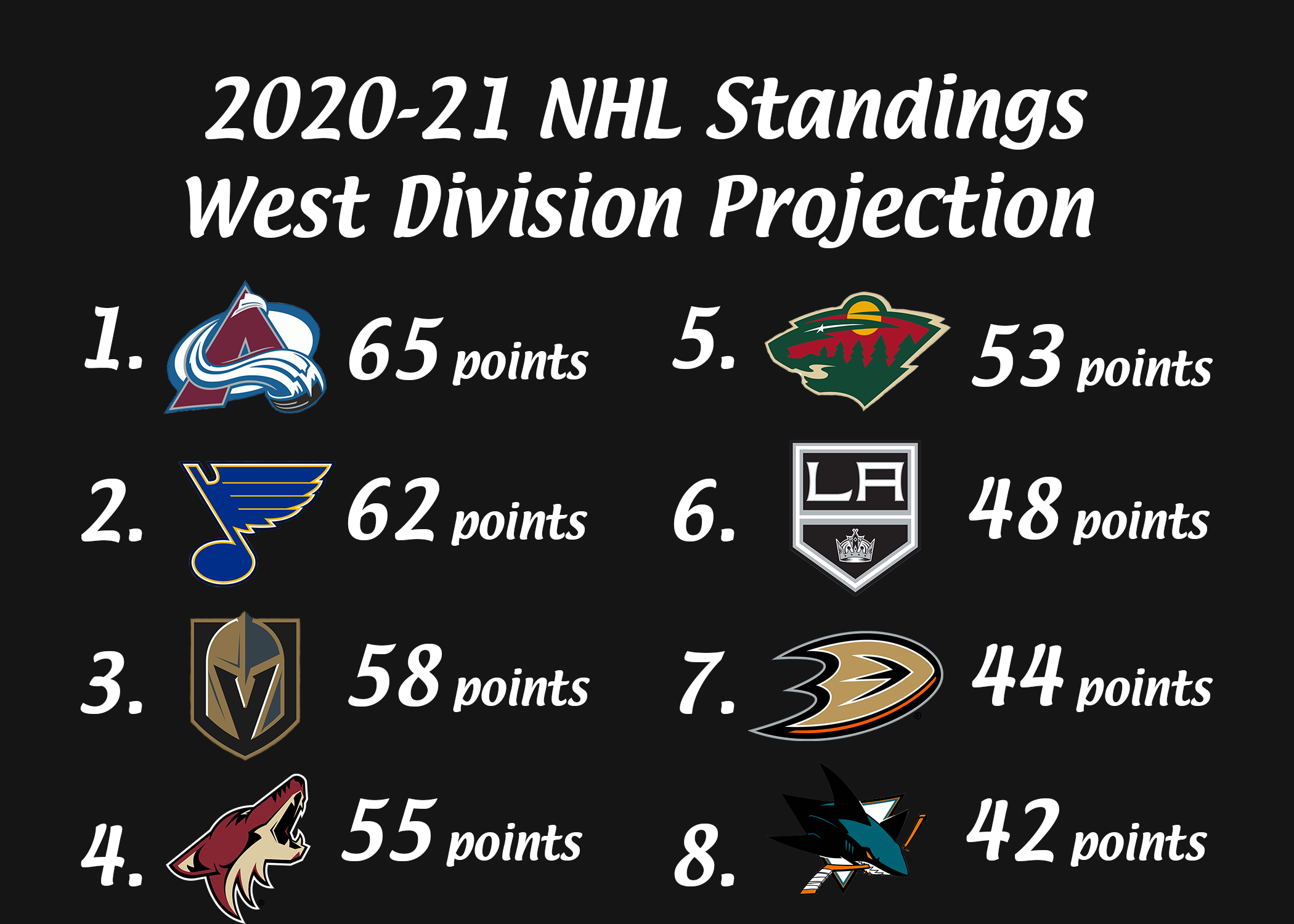
In the West Division, the Colorado Avalanche are the team to beat. The Avs are hungry to avenge their Second Round exit against the Dallas Stars in the 2020 Stanley Cup Playoffs if they can stay healthy and bring the Cup back to Denver for the first time since 2001.
Meanwhile, the St. Louis Blues might have some questions surrounding their goaltending, but the additions of Mike Hoffman and Torey Krug greatly outweigh the subtraction of Alex Pietrangelo– at least when it comes to regular season production.
In terms of experience and leadership, the Vegas Golden Knights picked up Pietrangelo’s talents via free agency and should be in contention for home ice advantage if they’re able to overcome St. Louis’ projected standing.
What about the meat of the order?
Both the Minnesota Wild and Arizona Coyotes are in a lot better shape than the Californian hockey teams.
The Wild have Kaapo Kähkönen coming down the pipeline in the crease and depending on how soon he can arrive might influence their final standing compared to Arizona.
Whereas Minnesota must rely on aging veterans, Cam Talbot and Alex Stalock in net, the Coyotes have Darcy Kuemper and Antti Raanta– a serviceable tandem for Arizona’s needs.
Mikko Koivu was sent out to find a new home as an influx of youth should make the Wild more competitive, but how much will Arizona’s playoff experience play into their drive for making at least another First Round appearance this season– despite losing Carl Söderberg in free agency to the Chicago Blackhawks and trading Derek Stepan to the Ottawa in the offseason.
Time will tell.
Is this the weakest division?
The all-Canadian North Division has the advantage of playing each other and sorting things out themselves instead of spreading their Canadian talents (or lack thereof depending on the team) throughout the league, so yes, the West Division is likely the weakest.
The Los Angeles Kings have some growing pains and salary cap hell to sort out. The Anaheim Ducks are a young team that’s finding their chemistry and building their experience, but are one or two years away from playoff contention.
Finally, the San Jose Sharks have an ever-regressing duo of Martin Jones and Devan Dubnyk in the crease to go along with whatever’s left on their blue line that’s not named Brent Burns and (a supposedly 100% healthy) Erik Karlsson.
At least the Sharks brought back Patrick Marleau (third time’s a charm) and other than that, they don’t have that bad of a forward group.
In the 2012-13 lockout shortened 48-game season, 20 out of the league’s then 30 teams at the time finished with at least 49 points or more in the season.
The 2012-13 Chicago Blackhawks finished 19 points away from a perfect 96-point season– amassing 77 points in 48 games with a 36-7-5 record.
Chicago is going through a rebuild without Jonathan Toews for possibly an extended period of time and with Malcolm Subban and Collin Delia in the crease.
The good news? They’ll likely end up with a solid lottery pick in the 2021 NHL Draft.
The bad news? They’re not going to find themselves having a repeat of their 2013 Stanley Cup championship.
Will any team from the Central Division be like those 2012-13 Blackhawks though?
It’s funny that you ask, because the defending Stanley Cup champion Tampa Bay Lightning would have to win at least 75% of their games if they want to be anything like the 2012-13 Blackhawks.
Whereas Chicago won 36 out of 48, Tampa would have to win 42 out of 56 games.
It’s not that the Lightning can’t reach 84 points in the 2020-21 season– especially since the Blackhawks almost reached 80 in a shorter span, but rather how good will the rest of the Central Division be and how will the intra-divisional games only schedule impact, well, everything?
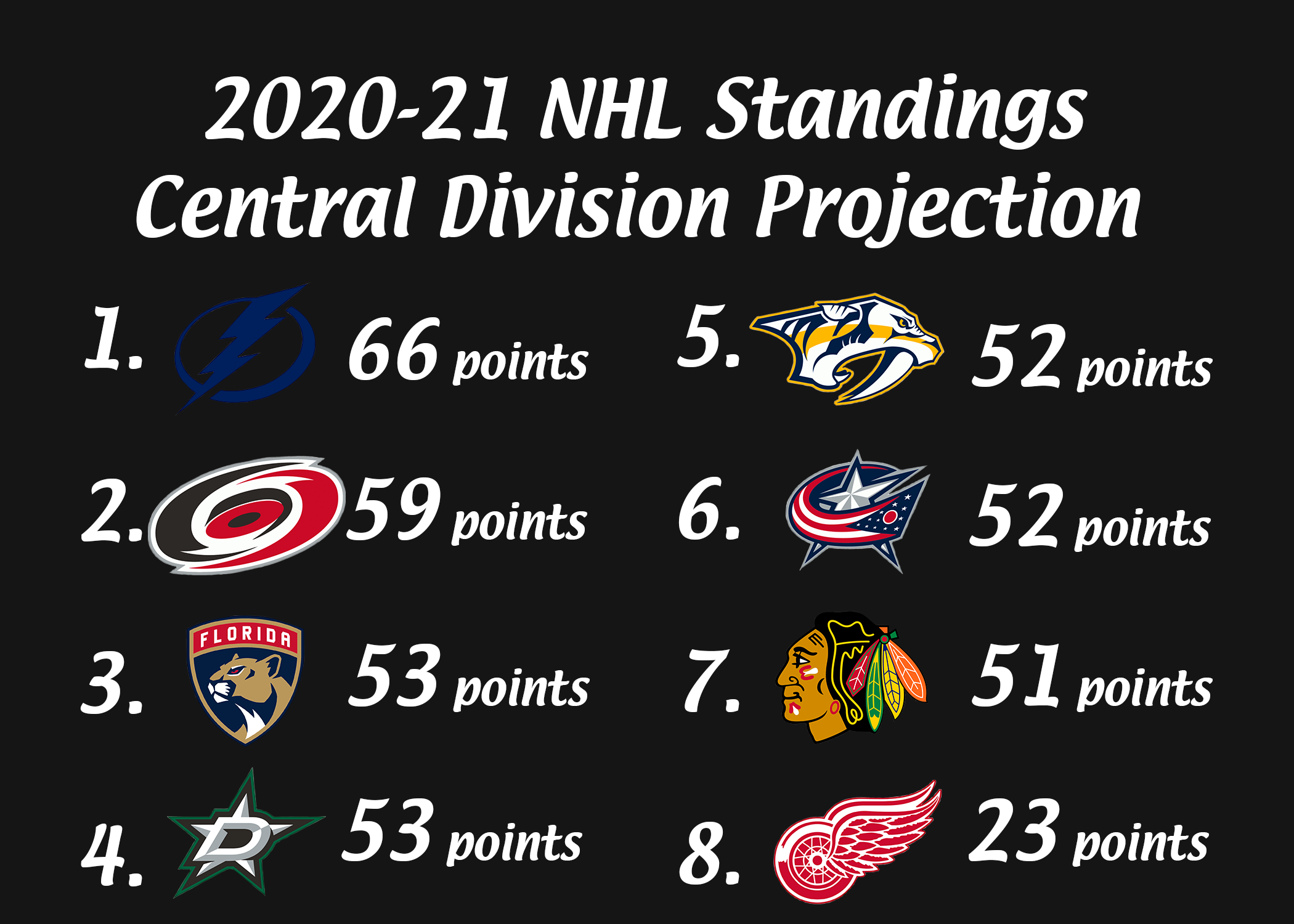
Tampa is projected as the regular season division winners with 66 points on the season.
The formula doesn’t take into account the loss of Braydon Coburn and Cedric Paquette in a trade with the Senators or the loss of Nikita Kucherov for the regular season due to an injury.
It doesn’t take into consideration the intra-divisional schedule, other injuries that are sure to occur, transactions, acts of The Hockey Gods, etc.
The 2012-13 Blackhawks had the advantage of facing mostly regular opponents over 48 games, then progressing through the old format of the playoffs where teams were seeded 1-8 among six divisions of five teams.
Tampa just has to be one of the top-four teams in their division over 56 games against all too familiar faces from night-to-night, then emerge victorious out of the Central to defend their title.
Anything is possible.
Can the Florida Panthers really be a playoff team?
Yes, the expected points model seems to indicate that the Florida Panthers were pretty good at finding the net in the regular season last year and that they should improve their standing, at least.
It doesn’t, however, determine whether or not Sergei Bobrovsky returns to form in quality starts, shutouts, etc.
New Panthers General Manager, Bill Zito, has added Markus Nutivaara and Radko Gudas to the blue line, as well as Anthony Duclair and Patric Hörnqvist to the forwards, so they should definitely be harder to play than in years past.
Gut feeling says three-time Stanley Cup champion head coach, Joel Quenneville, can make something more out of the pieces he’s been handed this season than in 2019-20.
Are the Detroit Red Wings really that bad?
No, but they didn’t do themselves any favors when it comes to utilizing last season’s data for determining this season’s expected points total.
Marginal goals for and marginal goals against can be a cruel animal, but it’s one of the best things to take into account of recency bias.
Red Wings GM Steve Yzerman added Vladislav Namestnikov, Bobby Ryan, Marc Staal, Troy Stecher, Jon Merrill, Alex Biega and Thomas Greiss to his team, so they won’t at least be intentional pushovers like last season.
The loss of Zdeno Chara and Torey Krug in the offseason for the Boston Bruins comes with a price– having to face Chara eight times in the regular season, then possibly Krug and the St. Louis Blues in a 2019 Stanley Cup Final rematch in the 2021 Stanley Cup Final.
Just kidding, the window appears mostly shut in the Hub.
It’s not that Boston can’t win, but rather that they have a bit of an uphill battle to get there.
Yes, their defense is younger, but it’s also more inexperienced. Yes, they added Craig Smith for goal scoring power, but it’s no Mike Hoffman.
At least David Pastrnak is looking to make a return ahead of schedule from his offseason surgery, but don’t be fooled by their six-point lead over the Philadelphia Flyers in the East Division projection.
Every second matters in a 56-game season. If they get off to a rocky start, they risk going from a surefire playoff contender (for at least another year or two) to missing out on the 2021 postseason.
The Buffalo Sabres added Taylor Hall, what gives?
Again, if you haven’t learned by now, expected points totals do not take signing the 2017-18 Hart Memorial Trophy winner to a one-year, $8.000 million contract into account.
Hall could be the winger Jack Eichel needs to convince him not to ask for a trade request as much as Eichel could be what Hall needs for a little rejuvenation and to be convinced to stay longer in his reunion with Sabres head coach, Ralph Krueger.
No matter what, though, the addition of Eric Staal and more in Buffalo means there’s sure to be improvement this season.
If it was the regular Atlantic Division, the Sabres might be looking at a wild card situation.
But since it’s the temporarily realigned East Division for 2020-21, yeah, there’s a lot more harder competition. Take the Hall pass and try again next season (maybe you’ll get the 1st overall pick).
Explain to me how the New York Rangers and New York Islandersmiss the playoffs?
This one is fairly simple.
The East Division is just six teams out of the regular Metropolitan Division, plus the Bruins (pretty good) and Sabres (pretty bad).
As such, it’s almost as if nothing ever happened in terms of the compete level of the overall division, but the playoff format yields only the top-four teams from each division for 2020-21.
Instead of getting, say, seven Metropolitan teams (impossible, yes, but let’s pretend) in the upcoming postseason, you can only have four.
If the B’s are taking one of those spots like they are in this projection, that limits the usual Metropolitan contenders to three leftover playoff berths.
If anything, the Pittsburgh Penguins are at the greatest risk of sliding out of the postseason picture with Tristan Jarry as their starting goaltender and Casey DeSmith as their backup after trading Matt Murray to Ottawa in the offseason.
That’s good news for the Islanders, probably, though the Rangers have more talent on paper (especially if Mathew Barzal isn’t re-signed when the puck drops on Jan. 13th).
So that’s it.
If you’ve made it this far and read every word– congrats, it’s probably time for puck drop already. Surely the calendar must read Jan. 13th by now and you can get back to watching that game you just tuned into.
Stay tuned for more forecasts and (un)related things that don’t have anything to do with expected points totals.
Zdeno Chara signed with the Washington Capitals, the AHL announced plans for the 2020-21 season, the NHL divisions are sponsored for 2020-21, what’s going on with the New York Islanders, Pierre-Luc Dubois wants out (maybe) and we preview the West Division for the 2020-21 season.
The Ottawa Senators did the Tampa Bay Lightning a huge favor. About a $17 million favor, when all is said and done. Meanwhile, a bunch of contracts were signed, we finally know an answer to the Mike Hoffman question, Craig Anderson signed a PTO and might replace Henrik Lundqvist as the Washington Capitals’ backup goaltender and we preview the Central Division for the 2020-21 season.
The NHL and NHLPA agreed to a deal on a 56-game season, realignment for 2020-21, dates and more. A bunch of players were signed in the last week, Ryan O’Reilly was named captain of the St. Louis Blues and Henrik Lundqvist will not suit up for the Washington Capitals this season.
The Boston Bruins’ long-time captain since the 2006-07 season, 43-year-old Zdeno Chara remains unsigned as the end of the calendar year, 2020, draws near.
Chara’s agent, Matt Keator, has been reported as noting that the defender has had contact from more than 20 teams this offseason, but is focused on re-signing with the Bruins if there’s a deal to be had.
Of course, he could also just flat-out retire.
Chara’s agent Matt Keator says he expects to have talks with Boston the next few days: “I’ve had 20-plus teams reach out to me, but his focus right now is to talk to Boston. … He still has the option to retire. But he seems very interested in playing if it’s the right fit.’’
It’s not that Boston couldn’t use the services of their longtime cornerstone on the blue line, but the Bruins are shaking things up this offseason on defense– partially because of necessity and partially because that’s just how time works.
Torey Krug left for the St. Louis Blues in free agency and guys like Jakub Zboril, Jeremy Lauzon, Connor Clifton and Urho Vaakanainen are all vying for potentially the same couple of spots.
Kevan Miller was brought back on a one-year, $1.250 million deal and John Moore is still on the books through the 2022-23 season at a $2.750 million cap hit.
With a little under $3.000 million in available cap room, the B’s could be looking to sign Chara to a short-term league minimum contract– one-year, $700,000– and present themselves with at least $2.300 million to offer someone like Mike Hoffman or lure back Carl Soderberg into the mix for added scoring touch or depth, respectively.
If they can’t land Hoffman, then Soderberg is likely the best consolation prize as the offseason drags on and two-week quarantine periods might affect how call-ups from the Providence Bruins (AHL) work.
That’s the latest on how AHL roster transactions might be handled this season, by the way. It all depends on what your state, province or region (if short-term bubbles get involved) has to say about moving players within your own organization.
Soderberg might not be better than playing Jack Studnicka every night, but in a pinch he’d be better than nothing.
After all, he did have 35 points in 70 games with the Arizona Coyotes last season and that’s nothing to sneeze at for a bottom-six forward.
As for Chara, it might be a matter of swallowing a little pride.
He certainly is deserving of almost whatever he wants for the career he’s had and role he’s played in Boston’s leadership for almost 15 years.
But if he’s wanting $1.000 million or more for what’s likely his last season in the league, then the Bruins would be smart to bow out unless they’re able to trade someone like Moore and find a durable top-four defender while convincing Chara to minimize his minutes as a bottom-six defender.
Yet that’d mean they wouldn’t be able to find a guy to play on David Krejci’s wing. You know, kind of what they’ve needed since 2015.
As for Hoffman, the one-time 30-goal scorer has reached the 50-point plateau in the last five seasons and somehow remains on the free agent market.
Whereas the Columbus Blue Jackets have about $9.200 million to spend, how much is Hoffman willing to pull a move similar to Taylor Hall’s one-year deal with the Buffalo Sabres and try to match Hall’s $8.000 million cap hit this season?
Columbus could be a great landing spot for the 31-year-old winger, but would the Blue Jackets be spurned by yet another player in free agency next offseason? Especially if John Tortorella is what could be holding players up from staying long-term?
To play with the Blue Jackets you have to be a 200-foot player in accordance with Tortorella’s style. That’s likely to keep Hoffman from possibly capitalizing on short-term monetary gain with limited options elsewhere unless he can do more than just score.
He might be the one-dimensional sniper Columbus needs, but not if General Manager, Jarmo Kekäläinen, and Tortorella can’t see eye-to-eye on the team’s plan.
For the Bruins to sign Hoffman and bring his 29-30–59 totals in 69 games with the Florida Panthers last season to the Hub of the Universe, Boston would have to shed some salary in a swap for either a defender as they’re reportedly looking for or some draft picks.
Source: The Bruins are looking at a trade to improve the defense before re-signing Zdeno Chara. https://t.co/uPczsq9PR9
That’s where Anders Bjork could be a suitable asset to send to a team in return for, like, a third round pick or something.
Nevertheless, Boston’s not the “Cup contenders” that they were going into last season.
They might figure out a way to win the East Division regular season standings or they could finish fourth in the division and barely make their way into the postseason.
Regardless, the Bruins need to land a top-six forward if Craig Smith is to settle in and get comfy on the third line and patch the defense for a short term fix if management thinks otherwise about the team’s “Cup contender” status.
It’s this year or bust– and in a 56-game regular season every early season game matters that much more.
Getting off on the right foot without Brad Marchand (possibly) and David Pastrnak on opening night (and missing Pastrnak for at least a month) is vital.
While the season’s upon us, there are still a few decisions to made regarding current unsigned free agents and more. Several teams are over the National Hockey League’s $81.5 million salary cap and will need to be compliant before the season begins on Jan. 13th.
One of those teams is the Vegas Golden Knights, who currently sit over the cap at $82,474,104.
Max Pacioretty’s name has come up in the latest round of trade rumors, but he’ll be the first to admit that’s nothing new, since he was subject to many rumors in his time with the Montreal Canadiens for about a decade before the Habs shipped him to Vegas on Sept. 10, 2018, for Tomas Tatar, Nick Suzuki and a 2019 2nd round pick (that originally belonged to the Columbus Blue Jackets and was later flipped to the Los Angeles Kings).
Pacioretty carries a $7.000 million cap hit through the 2022-23 season and has a modified no-trade clause.
Considering his longstanding disdain for the Boston Bruins as an opponent, as well as the fact that Boston doesn’t really have the workable cap space (about $3.000 million) to take on Pacioretty without giving up part of the core, the B’s aren’t likely to take a flyer unless they’re bold enough to go all-in on “win now” mode.
There’s actually something most of the Golden Knights core has in common, however– they all have modified no-trade clauses except for defender, Shea Theodore, who just had a bit of a breakout year (13-33–46 totals in 71 games last season).
It’s not likely that Vegas will shift from scooping up William Karlsson, making him into a 40-goal scorer in their inaugural season, then sending him packing in only their fourth season of existence, but they could try to move someone that’s a little more cap friendly by about $900,000 in annual cap hit.
Jonathan Marchessault has come up in the rumor mill and would be a quality second line asset for the Bruins to inquire about.
He reached the 30-goal plateau in 75 games with the Florida Panthers in 2016-17– his first full season– and has put up three consecutive seasons of 20 goals or more since with the Golden Knights, recording career-highs in assists (48) and points (75) in 77 games with Vegas in 2017-18.
At 29-years-old, Marchessault is in the midst of his prime, can play left or right wing and carries a $5.000 million cap hit through the 2023-24 season.
Though David Krejci is in the final year of his current contract, the Bruins wouldn’t just be looking to land someone that’s compatible with No. 46 on their roster, but rather someone that’s reliable for if and when Krejci moves on and someone like Charlie Coyle or Jack Studnicka slots into the second line center role.
There’s one more familiar face Boston could consider asking Vegas about, though he might have to fight Greg McKegg to get his old number back.
It’s Reilly Smith.
At 29, Smith is also in the midst of his prime and carries a cap hit worth $5.000 million per season through 2021-22, with a modified no-trade clause to boot.
Since departing the Bruins in a trade with the Panthers on July 1, 2015, Smith has become a consistent playoff performer, recording eight points in six games with Florida in 2016, 22 points with Vegas in 20 games en route to losing in five games to the Washington Capitals in the 2018 Stanley Cup Final, six points in Vegas’ seven-game run in 2019 and 14 points in 20 games with the Golden Knights in the 2020 postseason.
Smith’s numbers in the regular season have also been pretty good– reaching at least 40 points in six out of his seven full seasons, including five seasons of 50 or more points and setting a career-high in goals last season with 27 in 71 games.
Since their inaugural season in 2017-18, Smith has worn an “A” on his Golden Knights jersey.
Vegas also presented Pacioretty with an “A” last season, but has never given Marchessault the designation as an alternate captain.
Not that that’s really too much to look into or anything, but all signs seem to indicate it’d be harder to pry one someone from the Golden Knights’ leadership group, let alone their core rather than Marchessault and his versatile style.
Of course, Vegas would also have to be convinced to take something on from Boston and the Bruins wouldn’t exactly be giving Golden Knights GM Kelly McCrimmon and their head coach, Peter DeBoer, much to work with other than cap space.
Anders Bjork signed a three-year extension on July 29th with the Bruins that carries a cap hit of $1.600 million through 2022-23.
He’ll be a pending-restricted free agent by the end of his current deal, which might be incentive for Vegas to latch onto him in any potential trade, but Bjork has struggled to stay healthy and hasn’t exactly dazzled pro scouts with 9-10–19 totals in 58 games last season for the B’s.
Again, though, if Vegas is trying to save money, they might be convinced to take on a reclamation project with a prospect or two and/or a draft pick invovled.
At 24-years-old, Bjork might just need a change of scenery if he can’t tap into his scoring ways with Boston.
Of course, most Bruins fans would like to see Boston’s General Manager, Don Sweeney, try to sell high on Nick Ritchie while he still can– to put it lightly.
Ritchie had 21 points last season in 48 games split between the Anaheim Ducks and Bruins, is 25-years-old and has a $1,498,925 cap hit, which is somehow better than Bjork’s production and value.
He only has one-year left on his current contract, so he’ll be a pending-restricted free agent at season’s end.
But then, of course, there’s a few problems for Boston with trying to move Bjork or Ritchie.
Players are expendable components of the business side of hockey, but they’re human and humans like a little loyalty in their relationships– business or otherwise.
To be signed to an extension over the summer, then dealt to another team before the new season begins or to be acquired at last season’s deadline and moved so early on in your tenure in a new market might put a damper on Boston’s reputation as a free agent destination.
It could also backfire among players with modified no-trade clauses or that are willing to nullify their NTC or no-movement clause, but might reconsider if the Bruins come up in the conversation if that player’s looking for their next stop to have a little more longevity to it.
Oh and there’s the general fact that a team isn’t likely to just hand you a good player for bits and pieces, so Boston could still be working from behind on any potential trades with Vegas.
Well, Henrik Lundvqist won’t be suiting up for the Washington Capitals this season after all as the 15-season NHL veteran netminder is sitting out the 2020-21 season due to a heart condition.
Lundqvist made the announcement in a statement on social media before the Capitals followed it up with a video that offered a little more insight– if not more emotion– to the gravity of the situation.
Here’s hoping “King Henrik” can rest easy and recover in time for what very well could be his last shot at a Stanley Cup ring in 2021-22 if this isn’t already it for his playing days.
Lundqvist amassed 459 wins– the 6th most among goaltenders in league history– all with the New York Rangers prior to being bought out of the final year of his contract this offseason and signing with Washington back on Oct. 9th.
He has a 459-310-96 record in 887 games from the 2005-06 season through 2019-20, as well as a career 2.43 goals against average, a career .918 save percentage and 64 shutouts.
Lundqvist holds the regular season records for most games played (887), wins (459), shutouts (64) and points (27), as well as the most Stanley Cup Playoff games played (130), postseason wins (61) and shutouts (10) in Rangers franchise history.
As for Washington’s backup goaltender situation, the search might just continue with Lundqvist’s one-year, $1.500 million contract landing on the long term injured reserve for this season.
Ryan Miller, Cory Schneider, Jimmy Howard and Craig Anderson are some of the bigger names remaining on the free agent market, while the Caps could opt for a backup from within the organization in Pheonix Copley, Vitek Vanecek or Zachary Fucale.
The Capitals were projected to be about a million dollars over the NHL’s $81.5 million salary cap ceiling prior to Lundqvist’s announcement, so General Manager, Brian MacLellan, will likely already have his hand dealt to him as a result.
The Vegas Golden Knights definitely *aren’t* shopping that player you’re probably thinking about, ad space is unlimited and we’re stuck previewing the 2021 IIHF World Junior Championship for now.
Something’s brewing in Toronto and it’s the annual “let’s talk trading Frederik Andersen because surely he’s the reason for a lack of playoff success as a team in recent years”. Ah, the sight of Maple Leafs in the fall.
Andersen is entering the final year of his five-year deal with the Toronto Maple Leafs that he signed back on June 20, 20216– shortly after his rights were traded to Canada’s largest city by the Anaheim Ducks for a 2016 1st round pick (Sam Steel) and a conditional 2017 2nd round pick (Maxime Comtois).
His cap hit is a reasonable $5.000 million, but on a roster that’s currently projected to spend $82,549,325– which, you know, is slightly over the league’s $81.5 million upper limit– something’s got to give.
If Maple Leafs General Manager, Kyle Dubas, was serious about trading Andersen heading into the season, he likely would’ve found a partner by now and made a deal– regardless of stagnant revenue streams due to the ongoing COVID-19 pandemic.
But sure, let’s say the Leafs are set on trading Andersen in order to become cap compliant.
First of all, who are you going to get in return?
And second, the playoffs would be out of the picture altogether.
The answer to the first question is easy since most of the free agent goaltenders have been scooped up and Toronto’s not likely to take a flyer on Cory Schneider, Craig Anderson, Jimmy Howard or Ryan Miller.
In 2010, maybe. In 2020, definitely not.
None of those goalies had a goals against average better than 3.10 or a save percentage better than a .907.
One of those goalies, however, had those stats exactly and it’s the one that spent last season as a backup in 23 games with the Anaheim Ducks (Miller).
Naturally, Dubas would have to look to trade Andersen instead, which means you might be looking at a deal with the Vegas Golden Knights for Marc-Andre Fleury or (let’s get crazy) send Andersen back to the team that originally drafted him before he re-entered the draft and was taken by the Ducks in the 3rd round (87th overall) of the 2012 NHL Draft– the Carolina Hurricanes.
Why the Hurricanes? Because James Reimer, of course.
Andersen had a 29-13-7 record in 52 games last season (all starts), while amassing a 2.85 goals against average, a .909 save percentage and three shutouts in the process.
Though he recorded two more shutouts in 2019-20 than he did in 2018-19, his goals against average and save percentage were worse than his 2.77 GAA and .917 SV% in 60 games two season’s ago.
It’s important to remember, however, that in Toronto had guys like Ron Hainsey and Nikita Zaitsev on the blue line to help suppress the oncoming attack in 2018-19.
Hainsey joined the Ottawa Senators in free agency on July 1, 2019, while Zaitsev was packaged with Connor Brown and Michael Carcone in a trade with (you guessed it) the Senators on the same day for Cody Ceci, Ben Harpur, Aaron Luchuk and a 2020 3rd round pick that originated from the Columbus Blue Jackets (Alex Laferriere).
The Leafs made the trade to save $4.500 million in cap space that they then turned around and gave to Ceci. Kind of.
Trading Zaitsev wasn’t necessarily about saving money in the immediate future as much as it was about lopping off his contract from the books before his modified no-trade clause kicked in.
The now 29-year-old Russian defender is under contract through the 2023-24 season with Ottawa, whereas Ceci was a restricted free agent at the time and agreed to a one-year deal with the Leafs.
Dubas had to protect his club’s ability to integrate young prospects on the blue line and remain competitive in future trade or free agent markets, so Zaitsev was a casualty of league parity.
That, or fans, coaches and media members alike were tired of watching him in Toronto.
Meanwhile, the Leafs went in a different direction for their blue line last season with the additions of Ceci in the Zaitsev trade and Tyson Barrie at a discount as their alleged biggest prize in the Nazem Kadri trade with the Colorado Avalanche.
While Sens fans knew what Toronto was getting themselves into with Ceci’s playing ability as a bottom-pairing defender, Barrie experienced a significant drop-off in his game.
Barrie amassed 14-45–59 points in 78 games with Colorado in back-to-back seasons with at least 55 points before the trade and was a minus-3 in 2018-19. He put up 39 points (five goals, 34 assists) in 70 games with Toronto and was a minus-7.
For the record, Ceci had 7-19–26 totals in 74 games with the Sens and was a minus-22 in 2018-19, then mustered eight points (one goal, seven asissts) in 56 games with the Leafs– but at least he was a plus-7.
So it’s not entirely Andersen’s fault for instability in front of him.
The defensive depth wasn’t the same from 2018-19 to 2019-20 in front of Andersen, and, of course, Toronto fired Mike Babcock and promoted Sheldon Keefe as head coach after Fleury made a big save on Nov. 19, 2019 in Vegas.
Which is actually the perfect segue back to what it would mean for the Leafs to trade Andersen.
If Dubas flipped Andersen to the Golden Knights for Fleury strictly because of the “playoff experience” narrative, well, it’s worth noting that despite his improved performance from 2019’s 3-4 record, 2.70 GAA, .909 SV% and one shutout in seven games to 2020’s 3-1 record, 2.27 GAA and .910 SV% in four games, Robin Lehner still outperformed Fleury.
Lehner amassed a 9-7 record in 16 games for Vegas in the 2020 postseason with a 1.99 GAA, a .917 SV% and four shutouts in that span.
Andersen is 31, while Fleury is 36.
In simple terms, one is still in their goaltending prime and the other is in the twilight of his playing days– even if he is able to return to form after the second-straight season of faltering numbers.
Fleury’s first season in Vegas saw him rock a 29-13-4 record in 46 games with a 2.24 GAA, .927 SV% and four shutouts despite missing time due to injury.
In 2018-19, Fleury was overplayed. He notched a respectable 35-21-5 record, 2.51 GAA, .913 SV% and eight shutouts in 61 games, but couldn’t remain hot enough against the San Jose Sharks in the 2019 First Round.
In 2019-20, Gerard Gallant and, later, Peter DeBoer handled his number of games better, playing Fleury 49 times, but the 36-year-old netminder amassed a 27-16-5 record with a 2.77 GAA, .905 SV% and five shutouts.
Season-by-season, Fleury has shown signs of regressing.
Even if he is able to win one more Cup, his role on that team is likely best suited as the backup, if not at least in the 1B role of a 1A/1B tandem.
In his last three seasons with the Pittsburgh Penguins, Fleury faced 4,677 shots against and made 4,292 saves (.918 SV%) while amassing 16 shutouts from 2014-17.
In his first three seasons with the Golden Knights, Fleury’s faced 4,520 shots and made 4,135 saves (.915 SV%) while racking up 17 shutouts.
The ageless wonder would be a great addition to the Maple Leafs if Toronto could only have Andersen and Fleury.
But there’s a little pesky number that ruins any hope of swinging a deal unless Dubas is willing to part with larger pieces in a true “hockey trade”.
It’s Fleury’s cap hit.
He carries a price tag of $7.000 million against the salary cap through next season (2021-22) and, like Andersen, has a modified no-trade clause.
Vegas is also feeling the stress of the salary cap, considering they’re currently on the books for $82,474,104 and need to dump salary before the season can likely begin in January.
No, Max Pacioretty’s $7.000 million cap hit or Jonathan Marchessault’s $5.000 million cap hit won’t do the Leafs any favors if Toronto somehow decided they’d be fine with Dubas including a piece of their core– like Mitch Marner’s $10.893 million cap hit, for example– in the hypothetical transaction.
Both teams would still be over the cap unless they’d be able to make separate trades elsewhere to shed salary.
Even still, if someone is trying to pry Fleury from Vegas, they’re likely asking the Golden Knights to retain some salary or involve a third team in the deal for that sole purpose.
So if Fleury’s out, what about Reimer? You know, the last guy to bring “stability” to the crease in Toronto before Andersen.
Reimer hasn’t posted a sub-2.50 goals against average since his 2.49 with the Maple Leafs in 32 games prior to being traded to the Sharks ahead of the 2016 trade deadline.
He also hasn’t bested his .918 SV% from the time he spent with the Leafs that season.
It might be tempting to resort to Reimer as a starter, but he’s been worse than Andersen at a fraction of the workload that the current Leafs starter gets from year-to-year.
Thanks to the pandemic shortened regular season last year, Andersen played under 60 games for the first time since his days in Anaheim.
Toronto’s defense is nothing like Carolina’s defense.
Despite Reimer’s impressive 14-6-2 record in 25 games with the Hurricanes last season, there’s no guarantees he’d be able to match that or better with Morgan Rielly taking on the roles of Jaccob Slavin, Dougie Hamilton, Brett Pesce, Brady Skjei and Co. combined for the Maple Leafs.
Besides, Jack Campbell’s 3-2-1 record in six games with Toronto last season came with a 2.63 GAA and a .915 SV%, which, on its own is about the same as Reimer’s 2.66 GAA and .914 SV% with the Canes last season, but at a cheaper price for a backup caliber goaltender (Campbell is signed through 2021-22 at $1.650 million per season, while Reimer is a pending-UFA at season’s end with a $3.400 million cap hit).
But remember Campbell spent last season with the Los Angeles Kings and Maple Leafs and finished 2019-20 with a combined 11-12-3 record in 26 games for Los Angeles and Toronto, while amassing a 2.80 GAA and a .904 SV% in the process.
Unless Dubas signed Michael Hutchinson and Aaron Dell to compete with Campbell and (hypothetically) Reimer to save some money by trading Andersen this season, then Toronto’s goaltending woes would only get worse.
That’s right, we haven’t even started talking about who the eventual “goalie of the future” might be for the Leafs, but that’s a subject for another time (spoiler alert: the jury is out on that one for now).
It’s ride or die with Andersen this season.
And next summer’s free agent goalie market doesn’t look like it’s any better.
Unless a familiar Maple Leafs draft pick returns to Toronto, but he still wears No. 40 on the Boston Bruins for now.







 Down the Frozen River
You must be logged in to post a comment.