Tag: National Hockey League

  • Buffalo Sabres 2021-22 Season Preview

    Buffalo Sabres 2021-22 Season Preview

    2020-21 record 15-34-7, 37 points

    8th in the MassMutual NHL East Division

    Missed the postseason for the 10th-straight year

    Additions: F John Hayden, F Vinnie Hinostroza, D Will Butcher (acquired from NJD), D Robert Hagg (acquired from PHI), D Ethan Prow, G Craig Anderson, G Aaron Dell, G Devon Levi (acquired from FLA)

    Subtractions: F Jean-Sébastien Dea (signed with MTL), F Steven Fogarty (signed with BOS), F Sam Reinhart (traded to FLA), F C.J. Smith (signed with CAR), D Will Borgen (expansion, SEA), D Matt Irwin (signed with WSH), D Jake McCabe (signed with CHI), D Casey Nelson (retired), D Rasmus Ristolainen (traded to PHI), G Michael Houser (signed with Rochester, AHL), G Carter Hutton (signed with ARI), G Stefanos Lekkas (signed with Fort Wayne, ECHL), G Linus Ullmark (signed with BOS)

    Still Unsigned: F Dawson Dipietro, F Casey Mittelstadt (RFA), F Tobias Rieder, F Riley Sheahan, D Rasmus Dahlin (RFA), D Henri Jokiharju (RFA)

    Re-signed: F Rasmus Asplund, D Brandon Davidson, D Casey Fitzgerald

    Offseason Analysis: Apparently the Buffalo Sabres have never heard the phrase “don’t count your chickens before they hatch” except in this case it’s not even about making the playoffs– it has everything to do with the makeup of their roster this offseason.

    For starters, the 1st overall pick in the 2021 NHL Draft, Owen Power, is sticking around at the University of Michigan for another season, which is honestly for the better. He can develop as a defender at his own pace and avoid wracking up an insurmountable minus-rating.

    When it seemed like Sabres General Manager, Kevyn Adams, could count on somebody, anybody, wanting to stay in Buffalo, well…

    Turns out after an 18-game losing streak last season, a lot of players don’t want to be back.

    After a disastrous 2020-21 season that featured six goaltenders making at least one appearance in a Sabres uniform, including Linus Ullmark, Michael Houser, Carter Hutton, Dustin Tokarski, Jonas Johansson and Ukko-Pekka Luukkonen, Adams was left with some difficult decisions to make as only one goaltender recorded a goals-against average below a 3.00.

    Ullmark had the only winning record for the Sabres last season– amassing a 9-6-3 record in 20 games, while posting a 2.63 goals-against average and a .917 save percentage in that span.

    He was interested in signing an extension during the season, despite Buffalo’s defensive struggles and offensive inefficiency, but the Sabres wouldn’t budge and opted to kick the can down the road for a renewal in the offseason.

    Adams didn’t want contract negotiations to distract his only productive goaltender, it seemed.

    That didn’t sit well with Ullmark, though, as the Boston Bruins courted him away on a four-year contract worth $20 million shortly after Hutton departed Buffalo for the Arizona Coyotes on a one-year, $750,000 deal earlier in the day when free agency opened on July 28th.

    Going into free agency, the Sabres could afford to lose Hutton as he struggled through 13 games in 2020-21, with a 3.47 goals-against average, an .886 save percentage and a 1-10-1 record in that span.

    Hutton never really made the jump from being a backup with the St. Louis Blues to being a legitimate starting goaltender for Buffalo, but with Luukkonen as the “goaltender of the future” for the franchise, Adams probably thought he could lose Hutton and keep Ullmark around for the transition of power in the crease– until they couldn’t.

    With Hutton and Ullmark now out of the picture, Adams passed on re-signing Houser, who made his NHL debut and played similar to Hutton in that he had a 3.46 goals-against average and a .901 save percentage– though Houser had a better record (2-2-0) in four games played.

    Houser will still be in upstate New York for the 2021-22 season, though, as he signed an AHL contract with the Rochester Americans.

    Johansson was dealt to the Colorado Avalanche ahead of the trade deadline and Tokarski couldn’t hold things down in the NHL, but still has a year left on his contract with the Sabres.

    The Seattle Kraken landed Philipp Grubauer. The Avalanche traded for Darcy Kuemper. Toronto and Carolina swapped goaltenders even though it wasn’t a trade– it was just a product of free agency!

    But don’t worry, the Sabres didn’t forget to sign a goalie in the offseason– they actually remembered to sign two goaltenders.

    Both received one-year deals worth $750,000 and one of them put off retirement to play for Buffalo.

    That’s right, Craig Anderson and Aaron Dell are the new guys in the crease for the Sabres for 2021-22.

    At 40-years-old, Anderson isn’t as limber as he used to be, but he managed to put up a 2-1-0 record in four games played with the Washington Capitals last season. He also had a 2.13 goals-against average and a .915 save percentage in that span.

    Meanwhile, 32-year-old Dell had a rough time rotating as the third-string goaltender with the New Jersey Devils last season– amassing a 1-5-0 record in seven games and a 4.14 goals-against average, as well as an .857 save percentage.

    Given the league’s COVID-19 protocols and taxi squad rules for last season, both goalies were a safety net option in the event of an injury or COVID-19 outbreak.

    The two goaltenders played a combined 11 games last season in a 56-game schedule and that’s the only big story out of the Sabres this offseason.

    Yep. Nothing else going on between the end of 2020-21 and the start of 2021-22.

    Surely Jack Eichel is happy with– wait, what?

    That’s right, Buffalo still has to work on trading Eichel– their once cornerstone player turned injured and fed up modern-day Matt Duchene at the end of his tenure with Colorado saga (part 2, kind of).

    Plus, Adams shipped out Sam Reinhart to the Florida Panthers and Rasmus Ristolainen to the Philadelphia Flyers via trades this offseason.

    Reinhart became a casualty of a rebuilding team still going through another rebuild, but at least the Panthers gave Buffalo a 2022 1st round pick and goaltending prospect, Devon Levi, in return.

    Ristolainen had been wanting out of Buffalo for at least a year or two now and finally got his wish, while helping the Sabres rob the Flyers of a 2021 1st round pick (Isak Rosén), a 2023 2nd round pick and defender, Robert Hagg.

    Draft day trades and free agent defenders went for a premium this year.

    The Sabres also added Will Butcher and a 2022 5th round pick in a salary cap dump move from the Devils in exchange for future considerations while New Jersey went on to sign Dougie Hamilton to a long-term deal in free agency.

    Butcher should be an upgrade on the blue line (think Colin Miller, but better), though there’s not much else around him– especially with Rasmus Dahlin still waiting on a new contract.

    Offseason Grade: D

    The Sabres should receive an “F” for not having cashed in on Eichel yet, but the return on Reinhart and Ristolainen in separate trades is promising.

    At the very least, Adams knows he can command a high-value yield for young players that have shown NHL-caliber talent (at the very least) and are in demand– albeit Ristolainen in Philadelphia is a reclamation project, but we’ll save that for the Flyers preview.

    Since Eichel is a star player, Buffalo automatically loses out on an inevitable trade, but anything less than what they got for Reinhart or Ristolainen is worthy of firing Adams this early in his tenure as GM.

    Nothing– absolutely nothing– went well for the Sabres last season. An 18-game losing streak will do that to you.

    The good news is that it appears they’ve reached rock bottom. The bad news is that they could still be at rock bottom this season.

    Buffalo can only go up, but it’s a question of when.

  • DTFR Podcast #227- Hello Hurricane

    DTFR Podcast #227- Hello Hurricane

    Nick recaps some things from the last month including a couple of big-name retirements, other news and recent tragedies.

    Subscribe to the podcast on Apple PodcastsStitcher and/or on Spotify.

  • Let’s pretend we have any say in jersey sponsors

    Let’s pretend we have any say in jersey sponsors

    Apparently the National Hockey League’s Board of Governors were up to something this month as it was reported by Sportico on Tuesday that the Board unanimously approved ads on the front of NHL jerseys beginning with the 2022-23 season.

    The ads will be no bigger than a 3-inch-by-3.5-inch rectangle, which is slightly larger than the ads featured on the front of National Basketball Association (NBA) jerseys.

    It was only a matter of time before the NHL followed the NBA in generating additional revenue by doing what professional hockey leagues outside of North America have been doing for many years, as well as what’s been done for at least a few seasons now in the American Hockey League (AHL) and ECHL minor league levels on this side of the pond.

    As always, hockey Twitter is taking the news well.

    Let’s embrace the chaos for a moment and pick some sponsors for all 32 NHL teams that would make so much sense they’ll obviously be overlooked for, well, actual revenue generating streams instead.

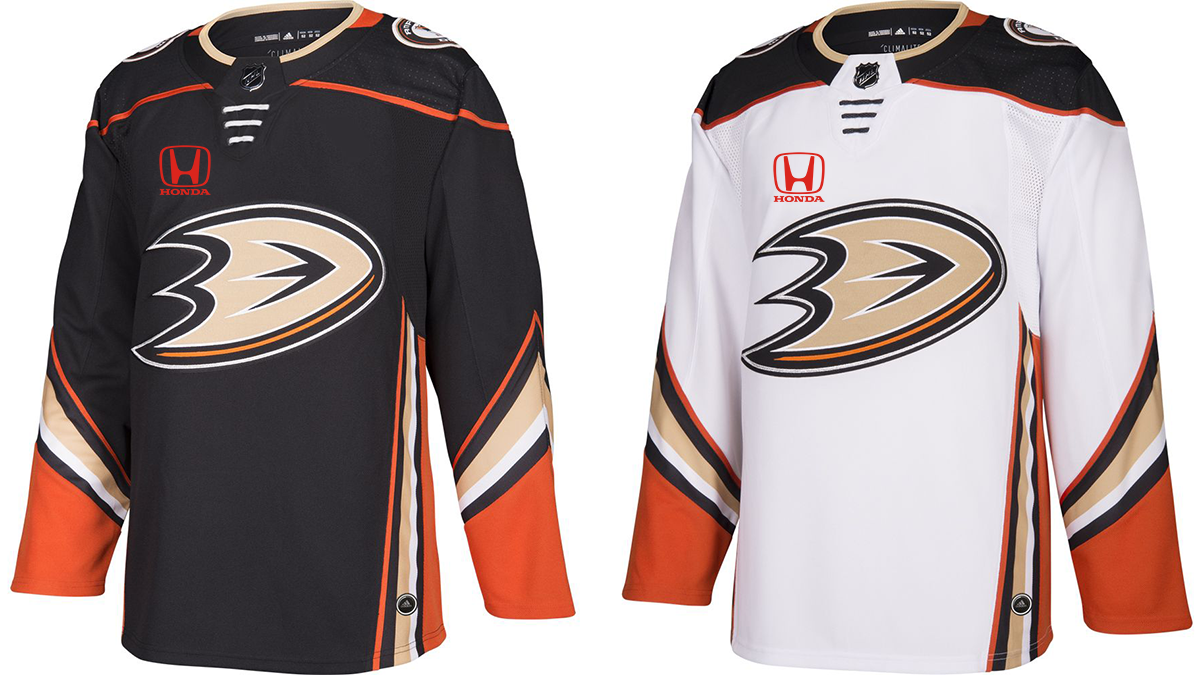
    Anaheim Ducks

    What we want: Disney+ or TCL
    What we’ll get: Honda

    The Ducks play at Honda Center and, yeah, there’s really nothing besides Disney swooping in and sponsoring the team that they used to own as a means of cross promoting both the Ducks and The Mighty Ducks: Game Changers on Disney+, so we’re stuck with a Honda logo at center ice and on the front of Anaheim’s jerseys.

    In any case, Honda’s red logo works pretty well with the Orange County orange featured as an accent color on Anaheim’s home and road jerseys.

    NHL teams have a tendency to go back to the well with their partners– think of how many teams have either the same helmet sponsor as another team or just slapped on the same brand as their venue’s naming rights deal– but if we want to expand the playground a little bit perhaps TCL could be of interest for the Ducks.

    Come to think of it, that’s probably a better option.

    *Opens up Photoshop*

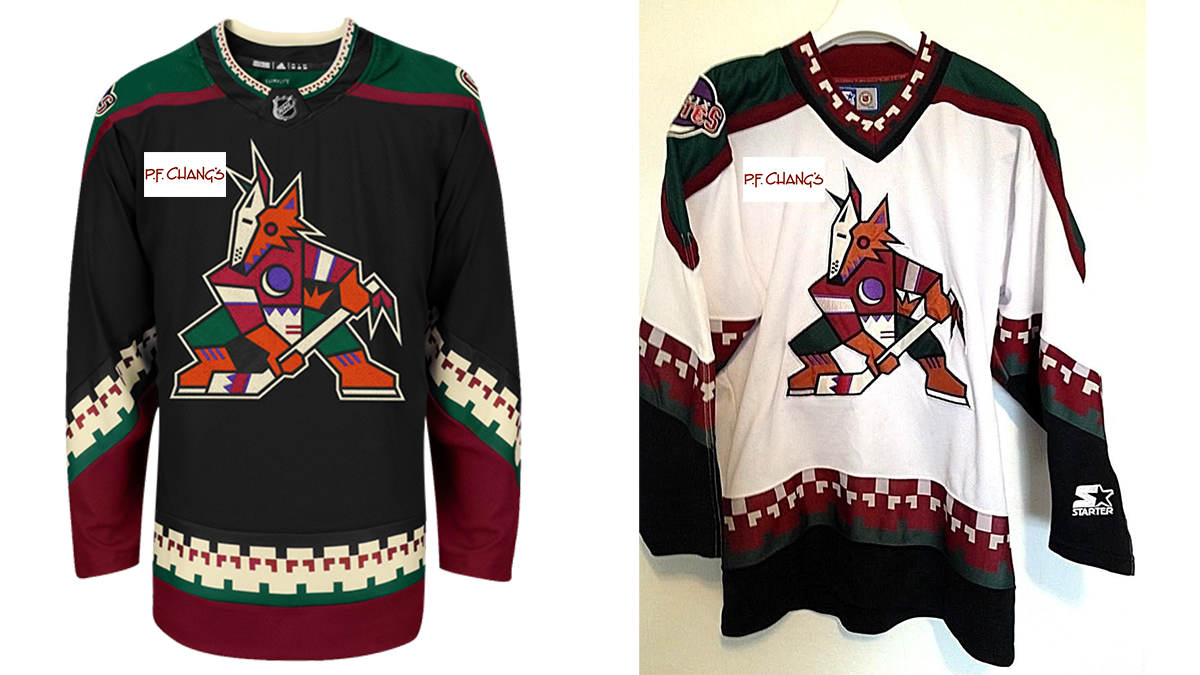
    Arizona Coyotes

    What we want: P.F. Chang’s or Cold Stone Creamery
    What we’ll get: Fry’s or something, probably

    Believe it or not the Los Angeles Chargers won’t be the only team tweeting about P.F. Chang’s for long as the restaurant chain was founded in 1993, and opened their first location in Scottsdale, Arizona, so it only makes sense to go back to their roots and toss an ad on the Coyotes’ jersey.

    Also founded in Arizona– Cold Stone Creamery.

    We figured that’d probably make sense on an AHL team’s jersey, though, despite the obvious cold ice, cold ice cream connection.

    The Coyotes had Mountain America on their helmets at home and Dignity Health on their road helmets in 2020-21, so in reality we’ll probably get one of those two on the front of their jerseys in 2022-23.

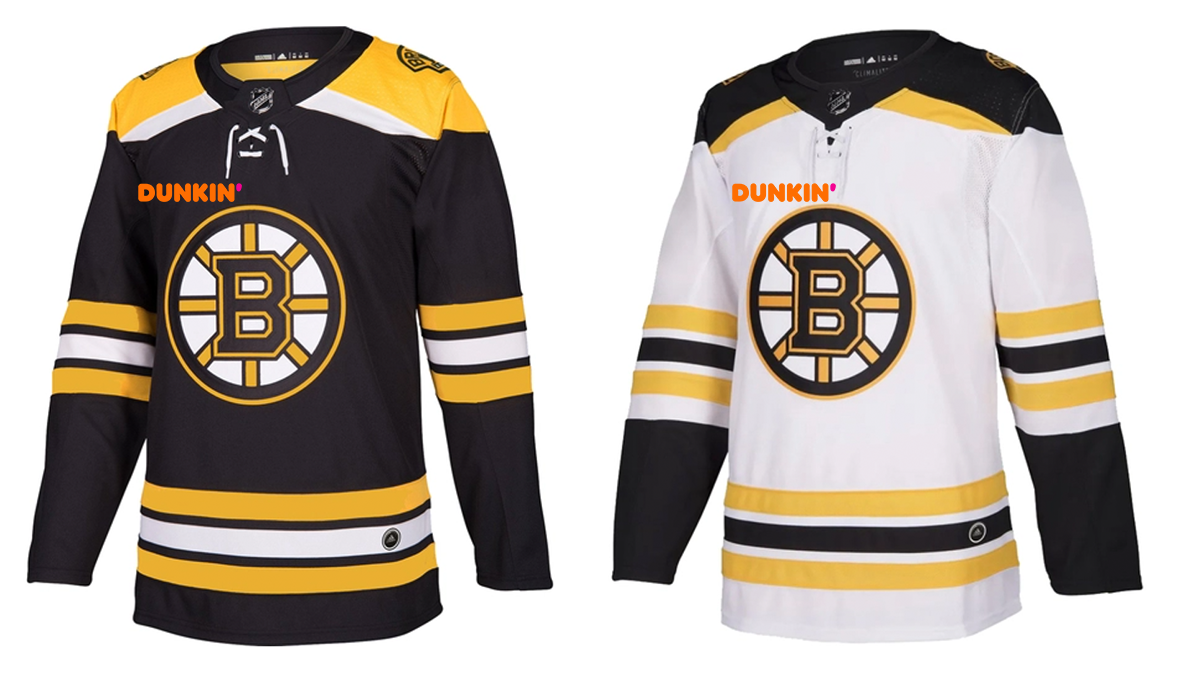
    Boston Bruins

    What we want: Dunkin’ or bust
    What we’ll get: TD Bank or O.R.G. Packaging, probably

    What could possibly be more Boston than a Bruins jersey with a Dunkin’ logo on it?

    Their AHL affiliate– the Providence Bruins– already play in the Dunkin’ Donuts Center in Rhode Island and have a Dunkin’ ad patch on their jerseys. Why not call it up to the major league?

    That said, with some NBA teams earning up to about $20 million in jersey ad space revenue, the B’s likely will reach for a brand with deeper pockets than doughnuts and coffee.

    Delaware North likes their relationship with a certain bank from Toronto (TD Bank) and has had one of the league’s longest relationships with a Chinese company (O.R.G. Packaging) as part of the NHL’s intended growth beyond the continents of North America and Europe, so one of the two brands is more likely to appear on a Bruins jersey.

    Buffalo Sabres

    What we want: Super Chexx
    What we’ll get: KeyBank

    The Sabres could use some fun in their lives these days and you know what really helps put the mind at ease? Bubble hockey.

    That’s right, Innovative Concepts in Entertainment, Inc. (ICE)– the manufacturers of the popular bar and arcade classic, Super Chexx, that your rich friend down the street growing up also had in the comforts of their home– is based outside Buffalo and would be a match made in heaven right about now.

    Especially as Sabres fans are looking for something to do while the game’s on TV.

    So yeah, we’re definitely going to get KeyBank, Tim Horton’s or something else entirely instead.

    Calgary Flames

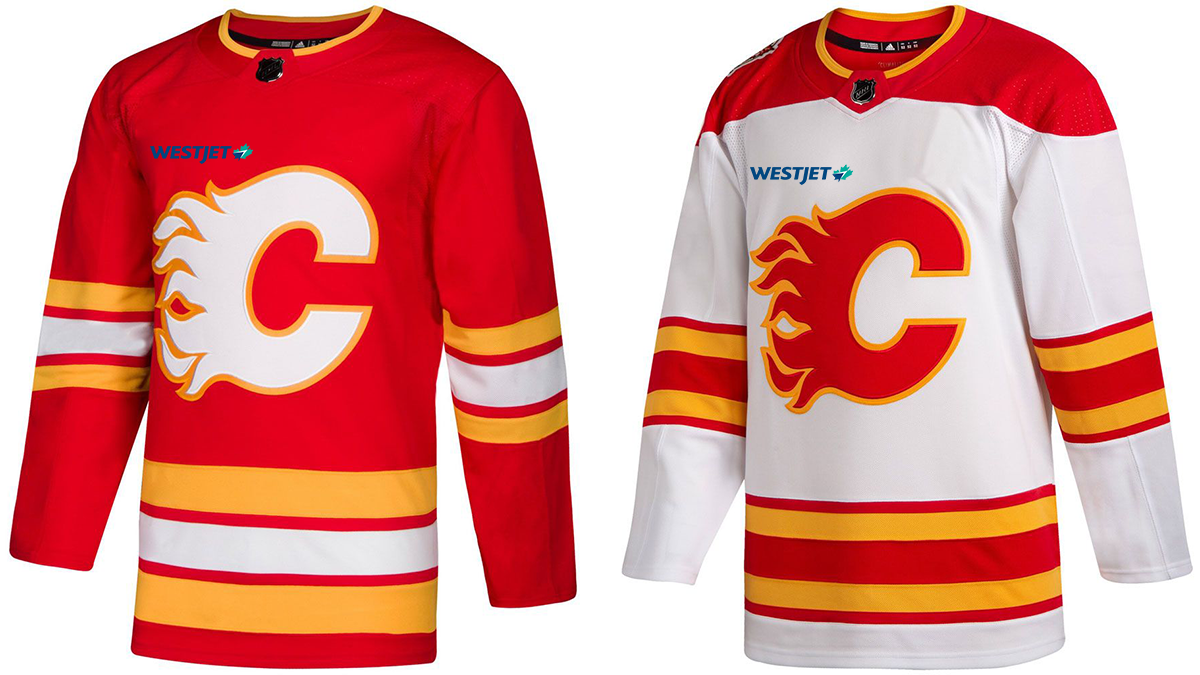
    What we want: WestJet or Duraflame
    What we’ll get: Scotiabank

    If you, as an American, can name any other Canadian airline other than Air Canada, then congratulations. If you can’t, then may I introduce you to WestJet?

    WestJet’s headquarters are next to Calgary International Airport and it’d be nice to prove to the world that Canada is more than just a land of Tim Horton’s, Roots, Canadian Tire, Rogers, Scotiabank and Mr. Sub.

    If Duraflame isn’t available, then you might as well dip into the low-cost airline industry as a means of attracting tourists to Banff National Park, Calgary Stampede or whatever it is that sets Calgary apart from the rest of Alberta (so… not being Edmonton).

    Carolina Hurricanes

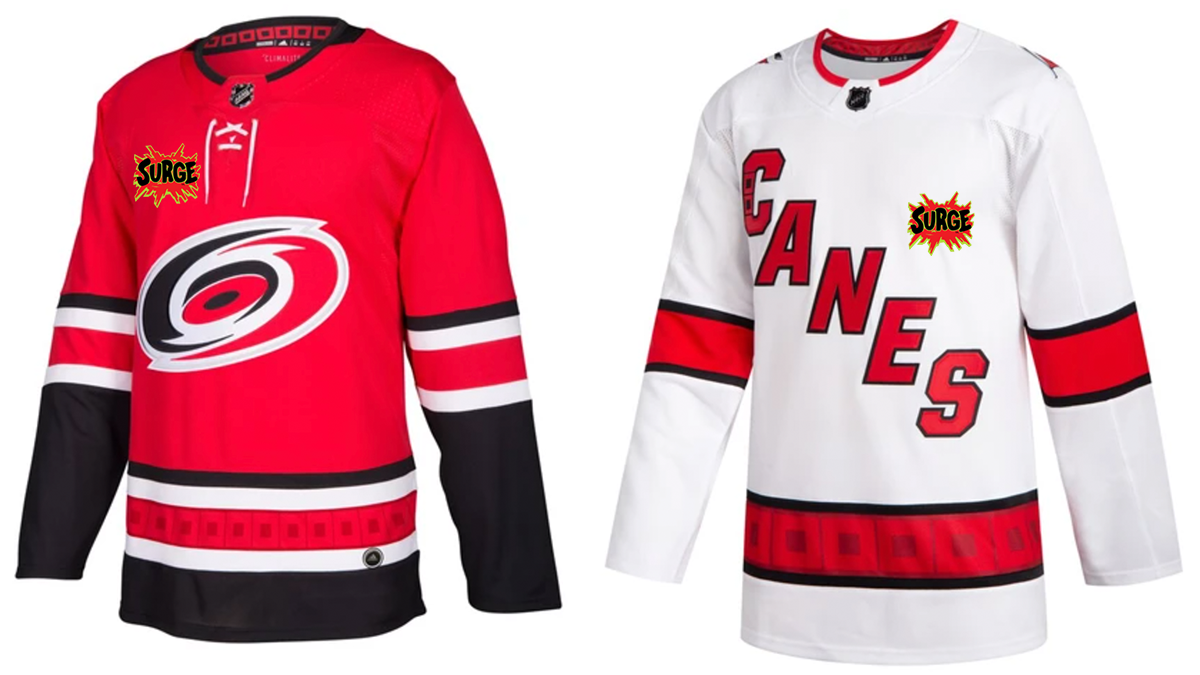
    What we want: Surge
    What we’ll get: PNC, Diehard, maybe Cheerwine or something else

    This should be obvious, but if you haven’t paid attention to the Hurricanes for at least the last few seasons now they do a “Storm Surge” celebration after every win on home ice in the regular season (and sometimes playoffs).

    Surge (the soda) is one of those drinks that makes headlines every few years for being pulled straight out of the vault and placed back on grocery store shelves– speaking of which, does anyone know if it’s currently available?

    If not, it’ll definitely be back by the 2022-23 season.

    Yes, it’s hard to envision where an ad will be placed on the road jersey as the prime real estate is used up by the diagonal “CANES” letters and– for a few players– the captain’s “C” or alternate captain’s “A”.

    Chicago

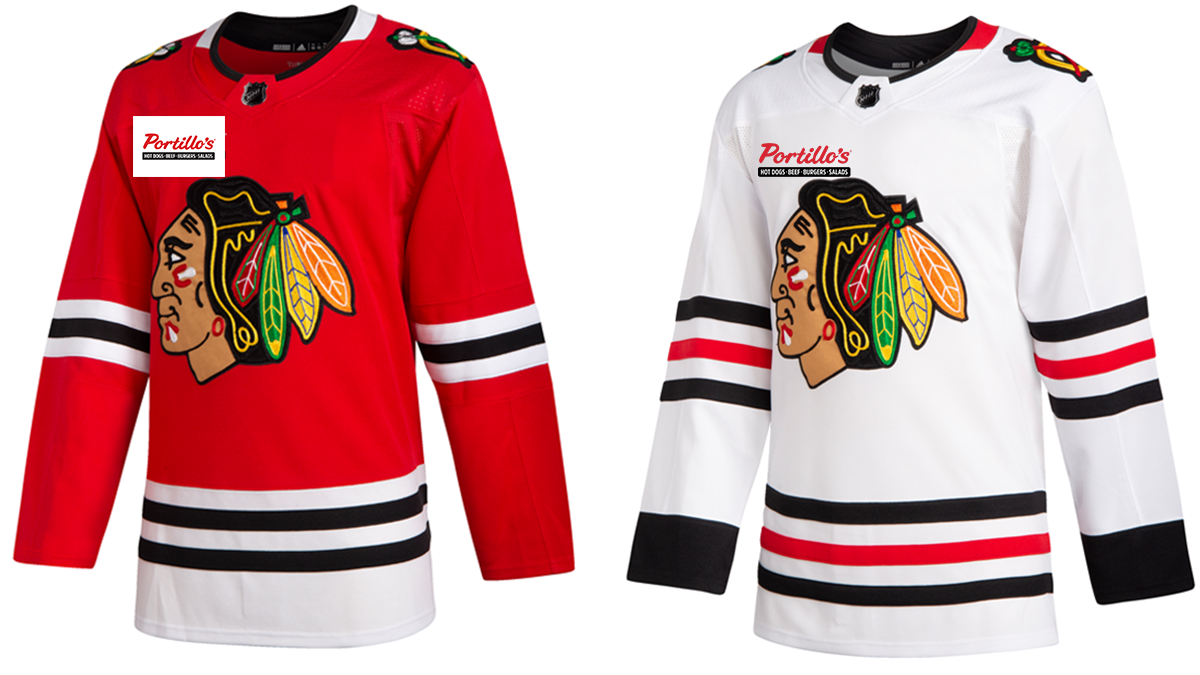
    What we want: Portillo’s
    What we’ll get: United

    Look, between Walgreens, Sears and Portillo’s there’s a few legendary brands that Chicago could partner with as their first jersey ad in franchise history (not including practice jerseys).

    Obviously only one of the three mentioned above is the right choice and its the one that might lead you to Walgreens later if you have a weak stomach. Besides, Sears is fading from our collective memory whether it is out of business already or not.

    Clark Griswold would be proud of Portillo’s proudly being displayed on a, well, if a WHL team can rebrand, so can you, Chicago.

    Colorado Avalanche

    What we want: Chipotle or Coors
    What we’ll get: Ball

    Look, whether or not Nathan MacKinnon eats Chipotle is a debate for another day, but one thing’s for sure– both Chipotle and MacKinnon started their careers in Colorado.

    Though Coors or Coors Light would make more sense, we have to consider the fact that kids might be wearing these jerseys to the game and we haven’t heard whether or not the jerseys that are sold in the proshops in 2022-23 and beyond will include the front jersey ad or not.

    If they do, then we probably can’t market beer to children.

    I’m pretty sure there’s a law about that and it’s also the reason why all my 1:64 scale diecast Rusty Wallace and Dale Earnhardt, Jr. cars from when I was a kid said “Team Rusty” and “Dale Jr.” on them, respectively, instead of Miller Lite and Budweiser.

    Columbus Blue Jackets

    What we want: Wendy’s
    What we’ll get: Nationwide

    Coinciding with the uptick in Columbus born and raised players on the Blue Jackets roster, it would be a great idea to add Wendy’s– which was founded in Columbus in 1969– to the team in such a way that perhaps Jack Roslovic and Sean Kuraly star in local commercials to the Blue Jackets viewing area during the 2022-23 season.

    I know that’s assuming Roslovic signs an extension, but the pending-restricted free agent at the end of the 2021-22 season helped facilitate the Pierre-Luc Dubois for Patrik Laine trade with the Winnipeg Jets by forcing Winnipeg into trading him to his hometown team.

    Unlike several recent stars that left the city via free agency, Roslovic will stick around for the long term.

    Especially if there’s some goods in kind involved with a Wendy’s sponsorship. I mean, I would at least.

    Dallas Stars

    What we want: Whataburger
    What we’ll get: AT&T

    Though Whataburger would be a welcome party in the burger wars when Columbus and Dallas would “meat” up, there’s no beef to be found in this hypothetical because AT&T has already made that decision for us.

    Sometimes you just can’t think too hyperlocal and AT&T fetches a more national audience than a regional chain that primarily serves Texas.

    Besides, if you go to Dallas for a Stars game, you can always just get Whataburger then. It’s not like they’re going to send you a meal with a jersey if ads are on the jerseys sold to fans in 2022-23.

    Detroit Red Wings

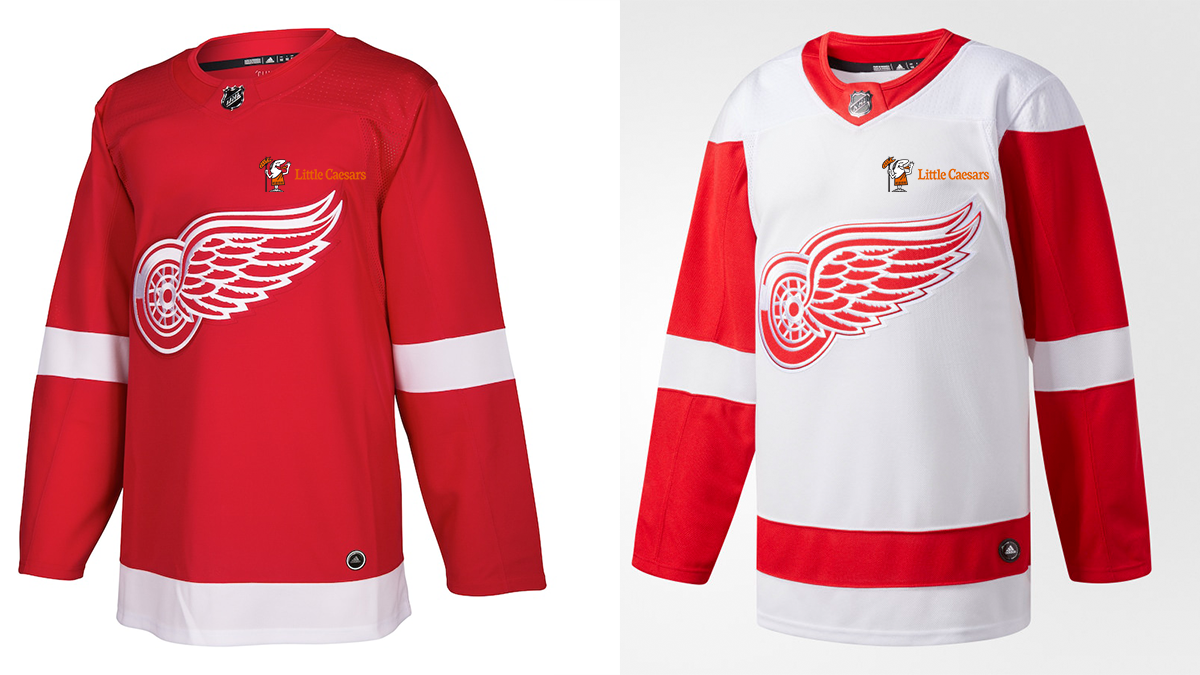
    What we want: Little Caesars
    What we’ll get: Little Caesars

    The last few teams have all involved food and we’re going to be stuck on this theme for at least one more team after this.

    Both the Red Wings and Little Caesars are owned by the Ilitch family and if you think adding one more connection between Detroit and pizza is a bad thing then you clearly don’t understand the marketing behind this.

    Kids love pizza. Adults love pizza. There’s a lot of good memories involving pizza.

    Plus, with General Manager, Steve Yzerman, in charge, the Red Wings are on the rise, which will only further tap into the nostalgia from when Detroit was doing what the Tampa Bay Lightning are currently doing to the rest of the league.

    Edmonton Oilers

    What we want: Boston Pizza
    What we’ll get: Rogers

    Edmonton thought they could replicate the success Ken Holland had in Detroit by hiring Holland as their General Manager and when they see that we’ve got a pizza establishment heading for the front of the Red Wings’ jersey, then the Oilers will think it’s also a good idea to snag a slice.

    That’s where Boston Pizza comes in.

    Whether or not they’ll get Connor McDavid to do an ad read or be left with whatever scraps surround him on the Oilers roster remains to be seen.

    In all likelihood, Rogers Communications will probably just get to slap their logo on another element of Edmonton’s brand.

    Florida Panthers

    What we want: Royal Caribbean International
    What we’ll get: Baptist Health or something

    The Blockbuster guy (the late Wayne Huizenga) founded the team and almost named them the “Florida Block Busters”, so it’d be neat to incorporate an homage to the days of Blockbuster (rest in peace) with the almost Blockbuster-like colors of Royal Caribbean International on the jersey.

    Plus, who among us hasn’t uttered the words “I need a vacation from my vacation” before?

    If you’re an out of town fan visiting the Panthers in Florida or watching the Panthers come to your town— there’s a cruise line for you even if you wouldn’t go remotely near a cruise before the ongoing pandemic began.

    Los Angeles Kings

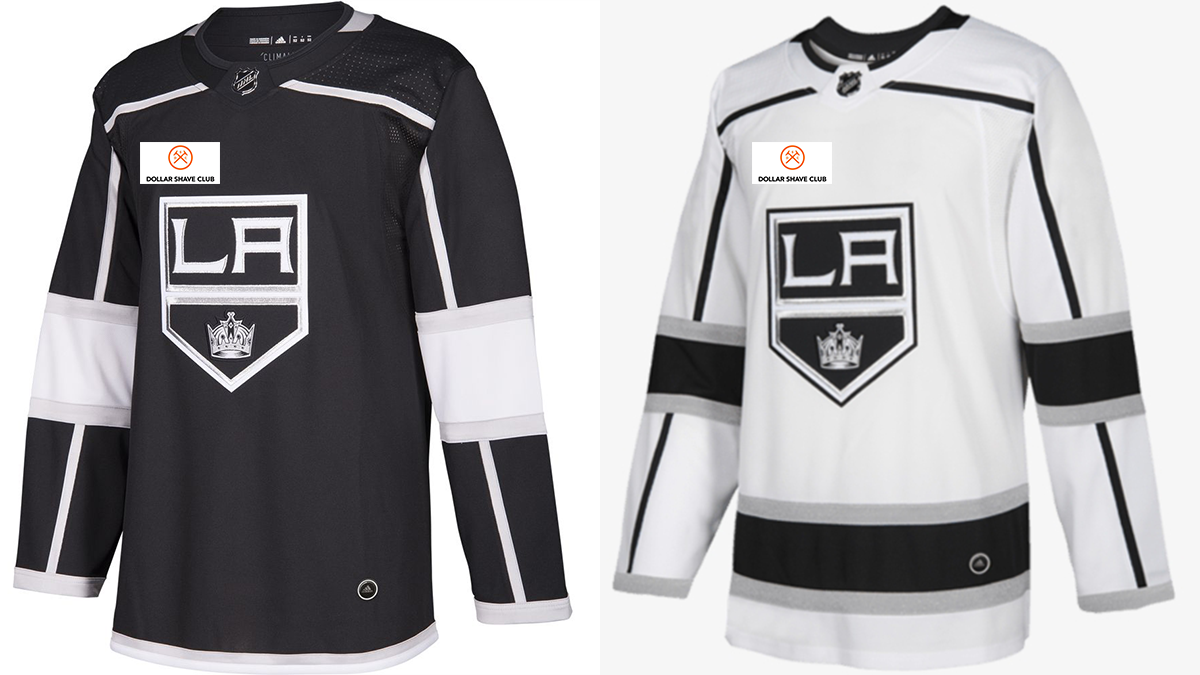
    What we want: Dollar Shave Club
    What we’ll get: Anschutz Entertainment Group

    Never doubt for a second that a team owner wouldn’t give up the chance to toot their own horn, which is why it’s quite possible that one of the world’s biggest entertainment entities would slap their own logo on the front of a Kings jersey.

    If you’re not able to finagle a way to write things off as a deduction, then Dollar Shave Club presents a unique opportunity despite the fact that shaving isn’t something that’s in Drew Doughty’s vernacular (or any hockey player, for that matter, when the Stanley Cup Playoffs roll around).

    Manscaped could also make a run here and in any case, fine.

    Minnesota Wild

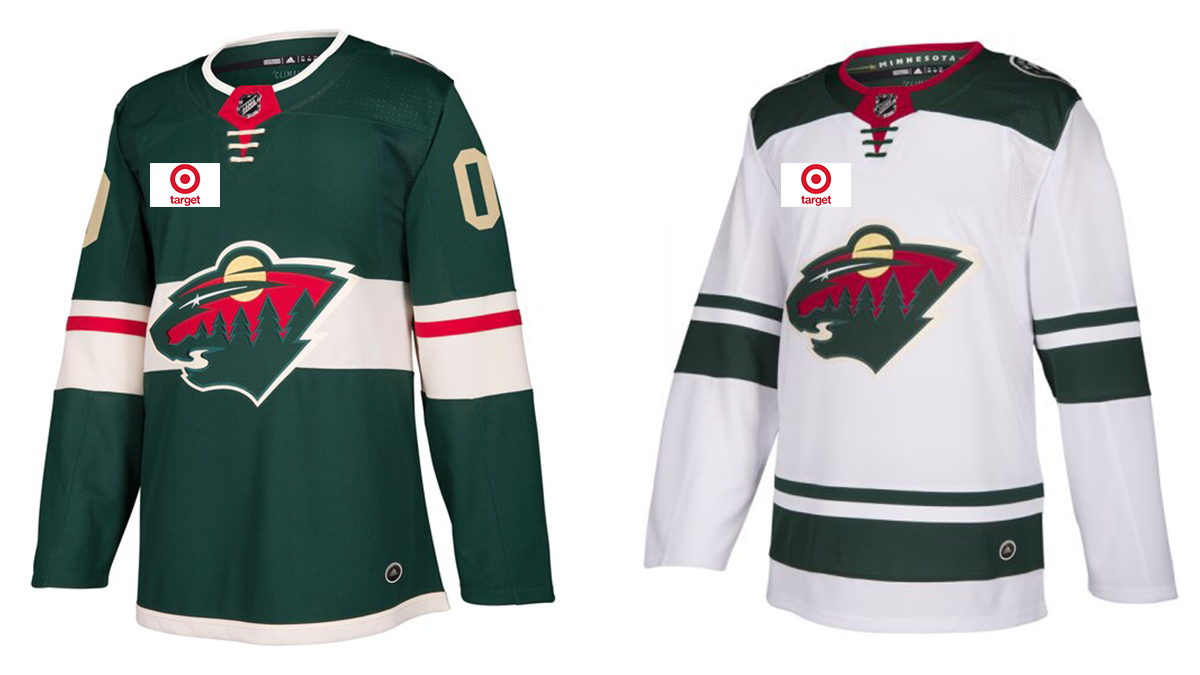
    What we want: Target or General Mills
    What we’ll get: Xcel Energy

    When you think of Minnesota what’s the first thing you think about?

    That’s right, the very place where you could be standing right now reading this while you’re waiting for a cash register to open up or aimlessly perusing the aisles for those impulse purchases you somehow always make at Target.

    It fits the Wild color scheme well and if we’re not going to get General Mills involved then at least getting more than the standard 5% discount for having a Target RedCard via goods in kind might be enough to convince Kirill Kaprizov to stay in Minnesota long-term.

    Montréal Canadiens

    What we want: CCM and/or Molson
    What we’ll get: Bell

    CCM makes more than just jerseys, but it’s not like adidas would be just fine with a CCM logo appearing on the front of an adidas ADIZERO jersey.

    So, we’re left with two obvious choices– Molson or Bell.

    If there’s nothing against a Canadian team bearing an alcoholic beverage on the front of their jersey with the potential for that brand to be marketed towards kids, then perhaps Molson– whose family ties own the Habs– might make an appearance near the crest.

    That or we’ll just get more airtime for Bell. Either way, Montréal would be attractive enough as a franchise to bring in more than one jersey ad sponsor if the league doesn’t have any specific rules outside of the size of the ad.

    Nashville Predators

    What we want: Curb Records or CMT
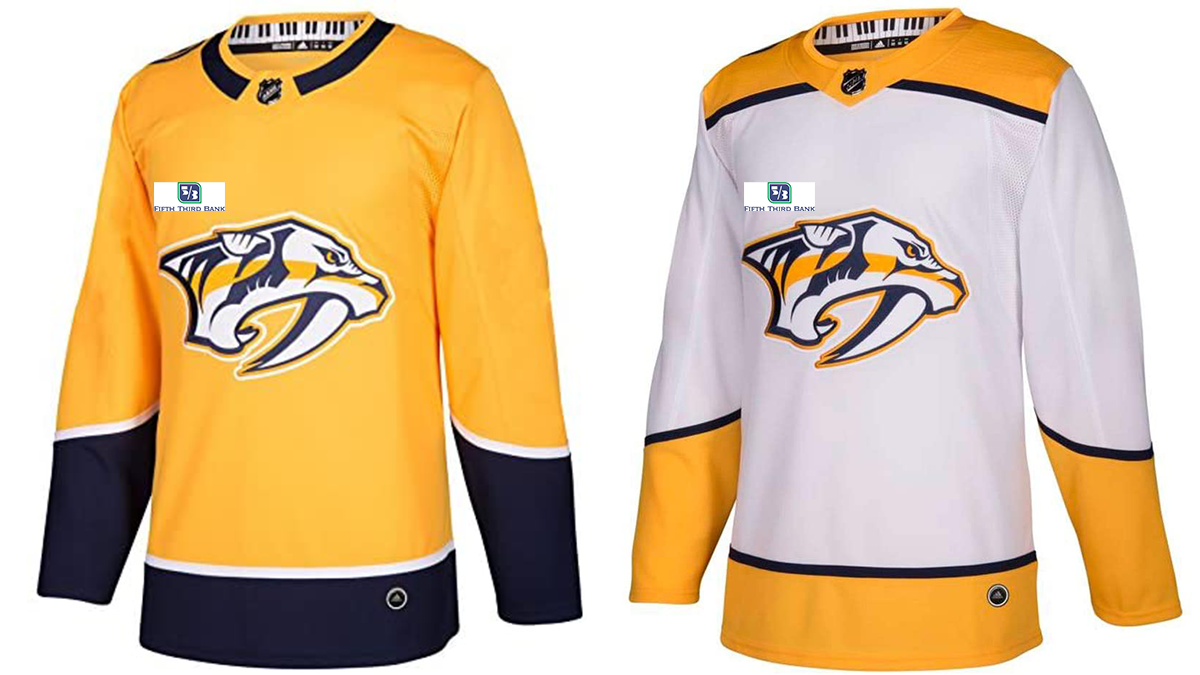
    What we’ll get: Fifth Third Bank

    The music city could attract a music label if they wanted to, but Fifth Third Bank loves investing in Nashville for some reason– like, a lot, despite being headquartered in Cincinnati, Ohio and primarily serving Ohio, Kentucky, Indiana, Illinois, Michigan, West Virginia, North Carolina, Georgia and Florida more than all of Tennessee.

    In any case, good for the Predators. They’ll have some deep pockets to reach into while other teams surely will have to squabble for seven figures related to the going rate for the prime ad space.

    Still feels like we’d be missing out on a sweet Curb Records patch close enough to the guitar pick on the right shoulder though.

    New Jersey Devils

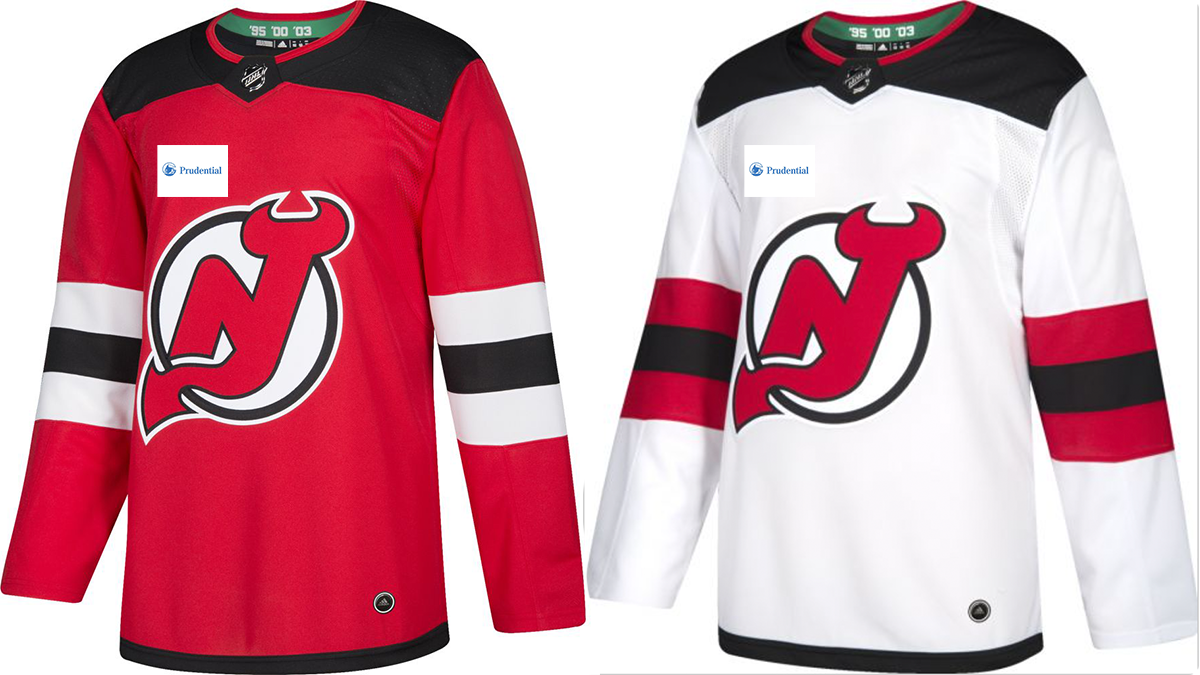
    What we want: Honestly, just Prudential is fine
    What we’ll get: Prudential

    The Devils are overlooked and let’s admit it, you couldn’t think of something distinctly New Jersey either– besides not being allowed to fill your own gas tank.

    Bruce Springsteen is not sponsoring the Devils alone.

    Whether it’s settling on an old reliable or simply making use of what’s trustworthy and already available, Prudential and New Jersey just seem like a good fit.

    New York Islanders

    What we want: Gorton’s
    What we’ll get: Not Gorton’s

    “We want fishsticks!”

    O.K., you got them. Take that, Rangers fans. The Islanders are cool now because they’re steering into the skid.

    They just won’t go as far as bringing back the fisherman jersey from the dead, but alas, they’ll show a spark of creativity and even crack a smile on Lou Lamoriello’s face with the real Gorton’s fisherman making an appearance on the jersey.

    Obviously this will never happen.

    New York Rangers

    What we want: Liberty Mutual if they’re bringing back the “Lady Liberty” jerseys as an alternate
    What we’ll get: Chase for sure, maybe New York Life too

    Liberty Mutual (a Boston company) on the “Lady Liberty” jersey would be a sight to see, but New York will never let it happen.

    Instead, Chase, which already has quite a great partnership with the team, Madison Square Garden, Manhattan, etc. will likely just step up and foot the bill for one– if not all– of the jerseys in full.

    That’s fine. The Rangers will suffer the same consequences of having a diagonal wordmark on their jersey like Carolina’s road jersey, but at least New York’s pretty much always been this way so they should have some ideas of how to work around that.

    Ottawa Senators

    What we want: Canada Post
    What we’ll get: Bell, Scotiabank or Canadian Tire

    Canada’s capital city gets the honor of having Canada Post on their jerseys because it breaks up the trend of having the same three or four companies sponsoring all seven Canadian teams (like how their helmets were for 2020-21).

    In reality, we’ll probably get more of the same from the Sens and either Bell, Canadian Tire or Scotiabank will make an appearance on Ottawa’s jersey.

    At the very least, Canada’s postal service sponsoring a team is more economically viable than the United States Postal Service sponsoring a team.

    Philadelphia Flyers

    What we want: Wawa or Audacy
    What we’ll get: Comcast or GlaxoSmithKline

    Remember how I said you don’t want to go too local for a jersey ad? Well, Wawa on a Flyers jersey is an exception.

    That said, it probably wouldn’t have the staying power to work on a road jersey too, so Philadelphia could tap into the artist formerly known as Entercom, since rebanded as Audacy, for more.

    Audacy maintained their Philadelphia headquarters and covers a broad range of Internet radio, digital content, regular radio and podcasting platforms, plus their logo is orange which fits the Flyers brand.

    It’s either that or Comcast will slap their own logo on the jersey or something.

    Pittsburgh Penguins

    What we want: Duolingo
    What we’ll get: PPG Industries

    Duolingo is headquartered in Pittsburgh and as a website and mobile app, every sports league with ads on jerseys needs at least one that makes you scratch your head at first before realizing the connection between the company and the city.

    The dating app, Bumble, once was featured on the NBA’s Los Angeles Clippers jerseys prior to the Clippers replacing Bumble with their more jersey ad with the online browser extension coupon company, Honey.

    Dating and living expenses in Los Angeles are probably harder than learning a few new languages through Duolingo, so combining Duolingo with the Penguins makes perfect sense since hockey players can come from all over and speak many languages.

    Besides, it might give your team an advantage if they can communicate with one another in a setting that is more comfortable for them.

    St. Louis Blues

    What we want: Busch
    What we’ll get: Enterprise

    I know we’ve been over the whole “can they market beer to kids with these jerseys” thing, but St. Louis is the city of Anheuser-Busch, so it’s only fitting that the Blues get a jersey ad that 1) is Anheuser-Busch related and 2) works with their color palette.

    If Major League Baseball’s St. Louis Cardinals play in Busch Stadium and get Budweiser by default with red as a primary color for the ball club, then the Blues naturally get Busch blue and Busch beer. I don’t make the rules.

    Plus Midwesterners really like the stuff.

    San Jose Sharks

    What we want: Adobe
    What we’ll get: SAP or Zoom

    Look, we weren’t going to get away with making these in Photoshop and not having to give Adobe something— and with headquarters in San Jose it only made sense.

    The Sharks have a deep relationship with SAP, though, so it’s more likely than not that the team will just go further with the brand that also is featured on their helmets at home and holds the current naming rights for SAP Center.

    Plus with the uptick in the use of Zoom, San Jose could double-dip and match SAP on the home jersey with SAP stickers on their helmets with Zoom covering the road set (jersey ad and helmet ads).

    Seattle Kraken

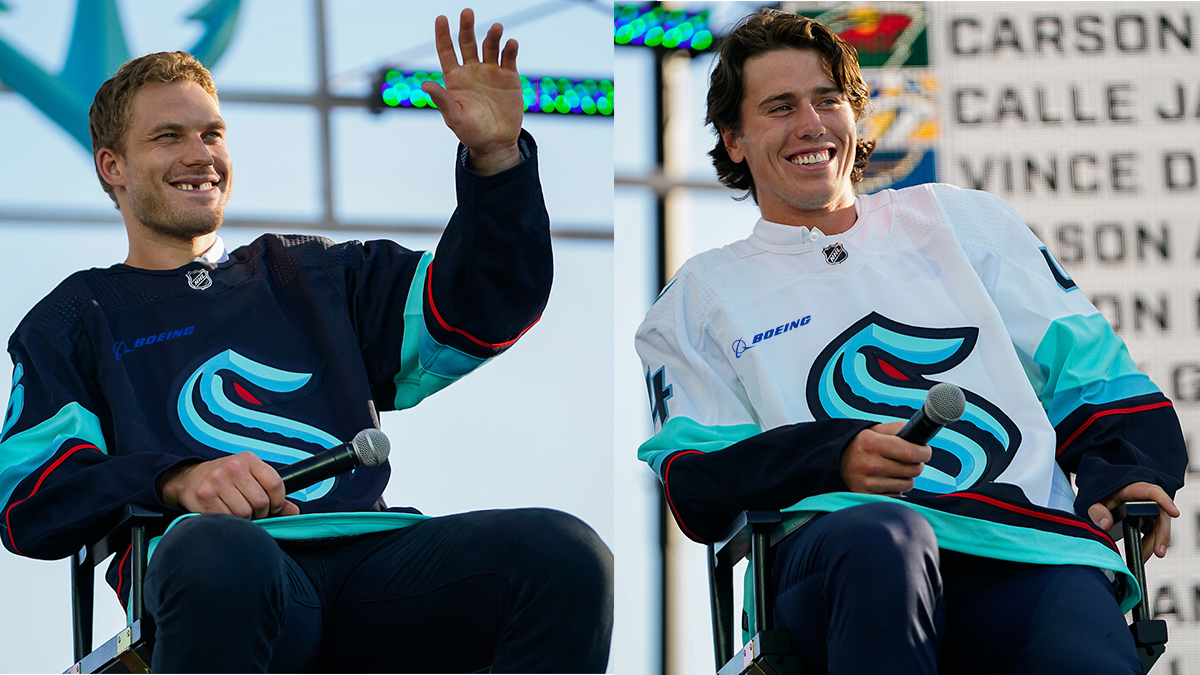
    What we want: Boeing
    What we’ll get: Alaska Airlines

    The Kraken already have a deal with Alaska Airlines as the official airline of the franchise, but what’s bigger than an airline itself?

    That’s right, Boeing, the company that makes a lot of planes and other aerospace stuff, was founded in Seattle and still has a major presence in Washington as the largest private employer in the state.

    Want to see your newest expansion team take flight? Just add some Boeing engineering to the jerseys.

    You might have thought Microsoft would make sense for a Seattle-based team, but the league’s agreement with Apple probably puts a quick end to that.

    Tampa Bay Lightning

    What we want: Accusoft
    What we’ll get: DEX Imaging

    Every sport with ads on jerseys has that one company that nobody’s really sure what they do, but they appreciate that they’re spending their money on their favorite team.

    That just might be Accusoft’s relationship with the Lightning come time for ads on jerseys in 2022-23.

    The private computer software company is headquartered in Tampa and was founded back in 1991, as Pegasus Imaging– one year prior to the Lightning’s debut season as an NHL team in 1992-93.

    Toronto Maple Leafs

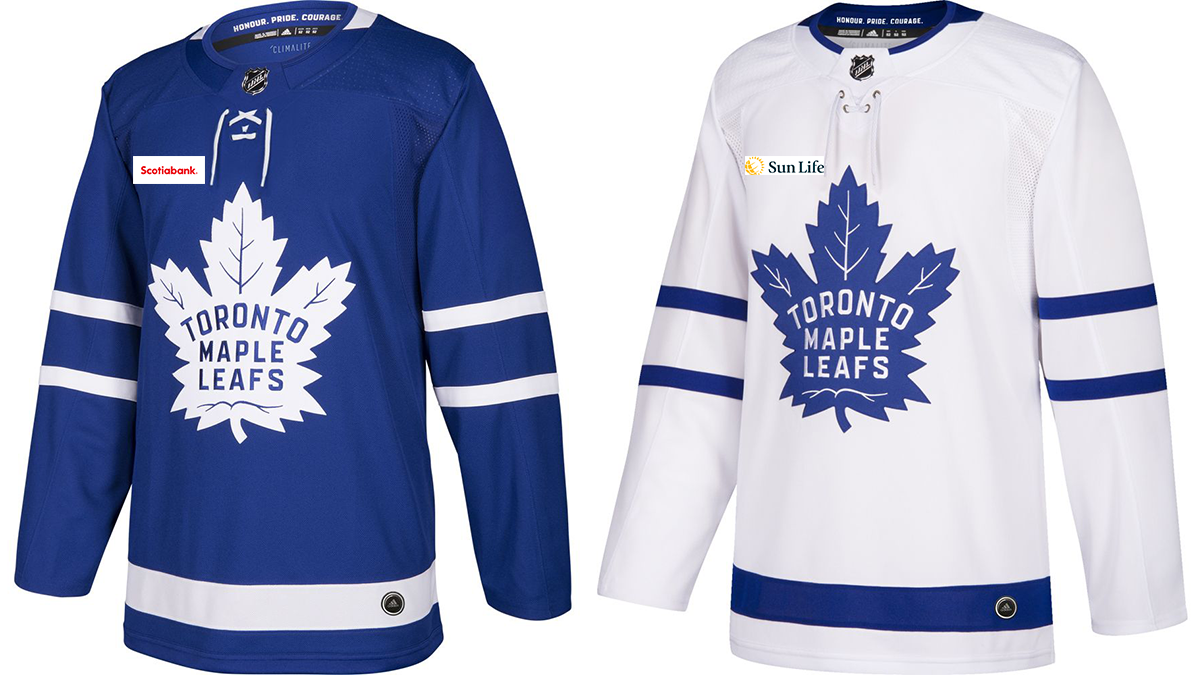
    What we want: Swiss Chalet, Sun Life Financial
    What we’ll get: Scotiabank, Sun Life Financial

    Scotiabank already has a stronghold on Toronto both financially and in the sense that the Maple Leafs play inside Scotiabank Arena and proudly display Scotiabank’s logo on their helmets, so it seems inevitable that Scotiabank would also make an appearance on the Leafs jersey.

    But Toronto is strong enough to maximize the value of a 3-by-3.5-inch ad and capitalize on the Maple Leaf Sports and Entertainment (MLSE) brand.

    MLSE already has an agreement with Sun Life Financial on their NBA team’s jerseys and the Toronto Raptors were able to go on to win their first championship in 2019.

    Perhaps the key to ending the Maple Leafs’ Stanley Cup drought lies within attracting Sun Life Financial to an NHL jersey ad.

    Vancouver Canucks

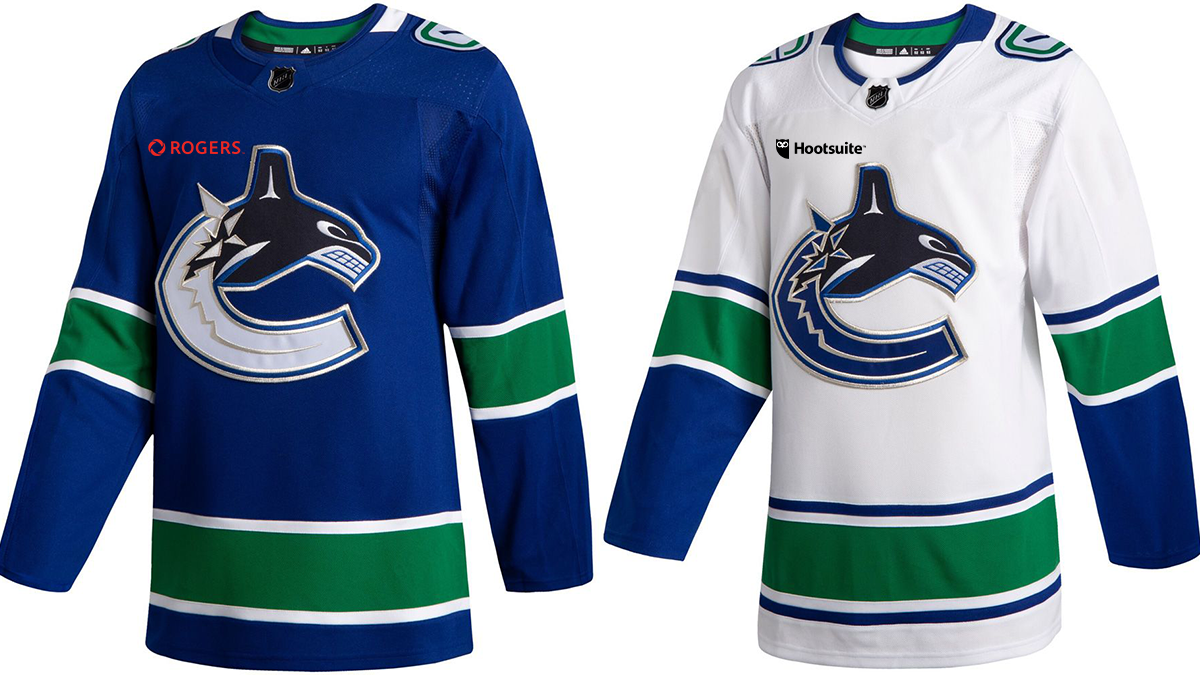
    What we want: Hootsuite
    What we’ll get: Rogers

    Remember when you’d see Hootsuite on just about every tweet with a photo? Am I the only one imagining that?

    In any case, Hootsuite was founded and is based in Vancouver and still plays a major role in social media management for brands.

    Whereas Rogers is accessible to most every day Canadians, Hootsuite would be more of a “corporate” target audience and you need sponsors at all levels to attract a wide base of potential clients, fans, etc.

    That said, the Canucks have had a long relationship with Rogers in that they play in Rogers Arena, so it’s probably going to be Rogers.

    Vegas Golden Knights

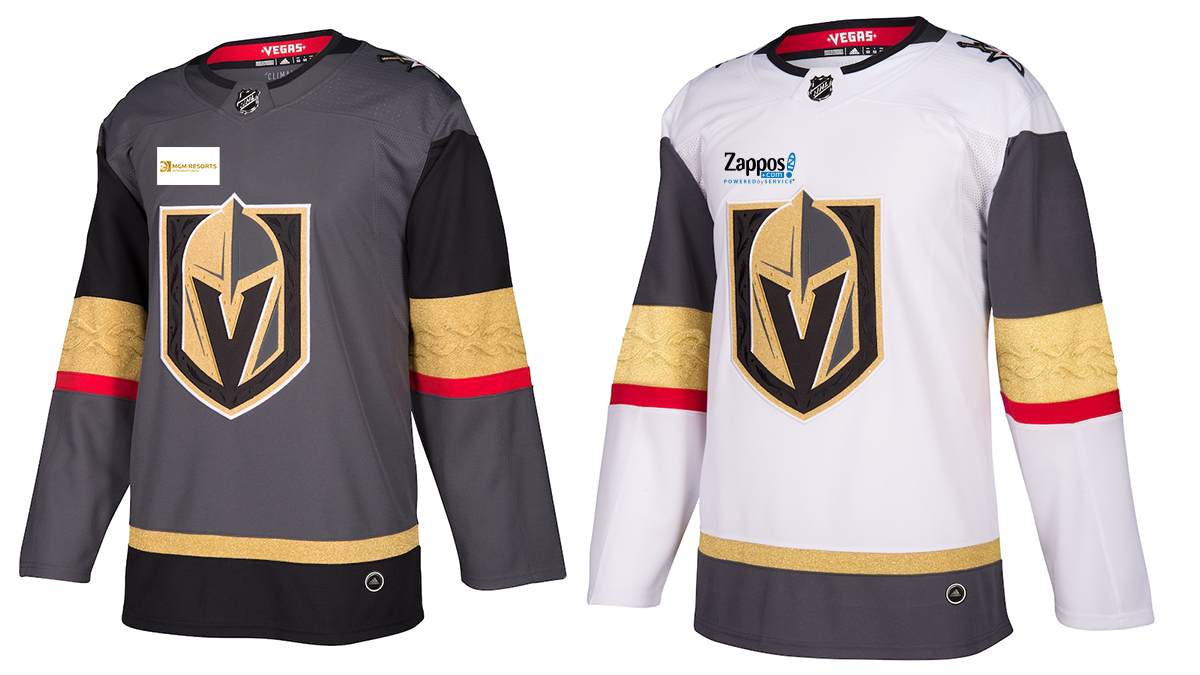
    What we want: Zappos.com
    What we’ll get: MGM Resorts International or Allegiant Air

    Want to have fun with a local Nevada brand? Zappos is the way to go!

    Want to be realistic and attract out of town fans to a destination like Las Vegas? MGM Resorts International is your sponsor and with Allegiant Air as an ultra-low cost airline that’ll gladly bring you to Vegas for a Golden Knights game…

    Yeah, it’s inevitable that between MGM and Vegas’ current road helmet sponsor (Allegiant) that there’d quickly be no room for a company like Zappos.

    Credit One Bank is on the home helmets for the Golden Knights, so don’t be surprised if they’re a wild card for a jersey ad too.

    Washington Capitals

    What we want: Marriott International
    What we’ll get: Capital One, Custom Ink

    Sportswriters rejoice! Your Marriott points may soon reward you with a Capitals jersey or something like that.

    Headquartered in Bethesda, Maryland, Marriott International would make sense from a local and international brand recognition stance.

    But you know what we’re probably going to get instead? Sheer confusion as Capital One places an ad on front of a jersey that already says “Washington Capitals”. The Capital One Washington Capitals– live at Capital One Arena!

    Either that or Caps owner, Ted Leonsis, might like to make a connection between making custom jerseys for local adult league co-ed softball teams or something and, well, Custom Ink’s logo appearing on Capitals jerseys.

    Winnipeg Jets

    What we want: A&W or SkipTheDishes
    What we’ll get: Canada Life or Bell

    A&W was founded in Winnipeg, while SkipTheDishes is headquartered in Winnipeg.

    Since it’s 2021, and not 1956, we’re more than likely to see SkipTheDishes on a Jets jersey, but if their helmet ads from 2020-21 are any indication for 2022-23 and beyond, then Bell is probably going to land a spot near Winnipeg’s crest.

    Canada Life is taking over as the new naming rights holder for Canada Life Centre where the Jets play, so there’s always a chance they’ll end up with their logo on the front of the jersey too.

  • 2021 NHL Free Agency Signings Quick Recap

    2021 NHL Free Agency Signings Quick Recap

    This post will be updated as signings are officially announced. Be sure to check our Twitter account (@DtFrozenRiver) for all of the latest signings, news, and analysis.

    Free agency begins at noon (technically 12:01 PM ET) on July 28th.

    For the second-straight year, the ongoing COVID-19 pandemic has shifted the schedule a bit for the National Hockey League, but after the free agency signing period opens to kickoff the 2021-22 league calendar year, things will be back on track for a full 82-game schedule (albeit about a week later than usual).

    All that is known is shown and will be updated throughout the day. More analysis will come as we play catch-up.

    ESPN+ is streaming TSN’s coverage of free agency from 11 a.m. ET onward and NHL Network has the Sportsnet/their own feed, probably (we like the former, in all partiality).

    Reported free agent signings

    These are reported agreements in place that are yet to be confirmed and/or announced by a playing club.

    F Kyle Palmieri has likely re-signed with the New York Islanders.

    Announced free agent signings

    These are confirmed/announced signings by playing clubs.

    F Carter Verhaeghe signed a three-year extension worth about $4.167 million per season with the Florida Panthers that goes into effect starting with the 2022-23 season.

    The Edmonton Oilers re-signed D Tyson Barrie to a three-year contract worth $4.500 million per season.

    The Vegas Golden Knights signed D Alec Martinez to a three-year extension worth $5.250 million per season.

    The Carolina Hurricanes signed G Frederik Andersen to a two-year deal worth $4.500 million per season.

    G Petr Mrazek signed a three-year deal with the Toronto Maple Leafs worth $3.800 million per season.

    F Nick Bonino agreed to a two-year contract with the San Jose Sharks.

    F Brandon Sutter signed a one-year extension worth $1.125 million with the Vancouver Canucks.

    G Antti Raanta reportedly signed a two-year deal worth $2.000 million per season with the Carolina Hurricanes.

    The Los Angeles Kings re-signed F Andreas Athanasiou to a one-year deal worth $2.700 million.

    D Dougie Hamilton signed a seven-year contract worth $9.000 million per season with the New Jersey Devils.

    F Blake Coleman signed a six-year deal worth $4.900 million per season with the Calgary Flames.

    The Montréal Canadiens signed D David Savard to a four-year contract worth $3.500 million per season.

    G Brian Elliott signed a deal with the Tampa Bay Lightning.

    D Tucker Poolman agreed to a four-year contract worth $2.500 million per season with the Vancouver Canucks.

    The Dallas Stars signed F Luke Glendening to a two-year deal worth $1.500 million per season.

    D Andreas Borgman signed a one-year, two-way deal worth $750,000 at the NHL level with the Dallas Stars.

    D Travis Hamonic signed a two-year extension worth $3.000 million per season with the Vancouver Canucks.

    F Dominik Simon signed a one-year, two-way contract extension with the Pittsburgh Penguins.

    F Charles Hudon signed a deal with the Tampa Bay Lightning.

    D Zach Bogosian signed a three-year contract worth $850,000 per season with the Tampa Bay Lightning.

    The San Jose Sharks signed F Andrew Cogliano to a one-year contract worth $1.000 million.

    The Montréal Canadiens signed F Cedric Paquette to a one-year contract worth $950,000.

    D Brady Keeper signed a two-year deal worth $762,500 per season with the Vancouver Canucks.

    The Vegas Golden Knights signed G Laurent Brossoit to a two-year deal worth $2.325 million per season.

    F Jean-Sébastien Dea signed a one-year deal worth $750,000 with the Montréal Canadiens.

    The San Jose Sharks signed G James Reimer to a two-year deal worth $4.500 million per season.

    F Michael Bunting signed a two-year deal worth $900,000 with the Toronto Maple Leafs.

    D Patrik Nemeth signed a three-year contract worth $2.500 million per season with the New York Rangers.

    F Maxim Mamin signed a one-year deal worth $975,000 with the Florida Panthers.

    D Louis Belpedio signed a one-year, two-way contract worth $750,000 with the Montréal Canadiens.

    The Vancouver Canucks signed F Danila Klimovich to a three-year entry-level contract worth $886,667 per season.

    The Dallas Stars signed D Alex Petrovic to a one-year, two-way contract.

    F Michael Amadio signed a one-year, two-way deal worth $750,000 at the NHL level with the Toronto Maple Leafs.

    The Vancouver Canucks signed D Luke Schenn to a two-year contract worth $850,000 per season.

    F Josh Leivo has signed a deal with the Carolina Hurricanes.

    The Carolina Hurricanes signed D Ian Cole to a one-year, $2.900 million deal.

    F Nic Petan signed a one-year, two-way deal worth $750,000 at the NHL level with the Vancouver Canucks.

    D Jake McCabe signed a four-year contract with Chicago worth $4.000 million per season.

    The Detroit Red Wings signed D Jordan Oesterle to a two-year deal worth $1.350 million per season.

    F Andrew Agozzino signed a two-way contract with the Ottawa Senators.

    D Adam Clendening signed a two-way deal with the Philadelphia Flyers.

    D Ryan Murphy signed a two-way contract with the Detroit Red Wings.

    The Los Angeles Kings have signed D Alex Edler to a one-year contract worth $3.500 million per season.

    The Boston Bruins signed F Erik Haula to a two-year deal worth $2.375 million per season.

    F Tomas Nosek signed a two-year contract worth $3.500 million per season with the Boston Bruins.

    F Phil Di Giuseppe signed a two-way contract worth $750,000 at the NHL level with the Vancouver Canucks.

    The Tampa Bay Lightning signed F Pierre-Edouard Bellemare to a two-year contract worth $1.000 million per season.

    F Matt Luff signed a one-year, two-way, $750,000 deal with the Nashville Predators.

    F Jon Lizotte signed a one-year, two-way, contract worth $750,000 at the NHL level with the Minnesota Wild.

    F Ryan Getzlaf agreed to a one-year extension with the Anaheim Ducks worth $4.500 million.

    F Ryan Dzingel signed a one-year, $1.100 million deal with the Arizona Coyotes.

    D Matt Tennyson signed a two-year, two-way contract with the Nashville Predators.

    F Mattias Janmark reached an agreement on an extension with the Vegas Golden Knights.

    F Josh Ho-Sang signed a PTO with the Toronto Maple Leafs.

    F Mike Hoffman signed a three-year deal with the Montréal Canadiens worth $4.500 million per season.

    G Linus Ullmark signed a four-year deal worth $5.000 million per season with the Boston Bruins.

    G Garret Sparks reached an agreement on a one-year, two-way contract with the Los Angeles Kings worth $750,000 at the NHL level.

    F Sam Gagner agreed to an extension with the Detroit Red Wings.

    The Red Wings also agreed to an extension with G Calvin Pickard.

    D Ryan Suter signed a four-year deal worth $3.650 million per season with the Dallas Stars.

    The Columbus Blue Jackets signed F Boone Jenner to a four-year extension.

    The Pittsburgh Penguins signed F Evan Rodrigues to a one-year extension worth $1.000 million.

    F Patrik Laine signed his qualifying offer with the Columbus Blue Jackets and will make $7.500 million on a one-year deal as a result.

    F Eric Robinson agreed to terms on a two-year extension worth $3.200 million with the Columbus Blue Jackets.

    The Philadelphia Flyers signed D Keith Yandle to a one-year deal worth $900,000.

    D Alex Goligoski signed a one-year deal worth $5.000 million with the Minnesota Wild.

    G Braden Holtby signed a one-year contract worth $2.000 million with the Dallas Stars.

    The Minnesota Wild signed F Frederick Gaudreau to a two-year deal worth $1.200 million per season.

    D Jarred Tinordi signed a two-year deal worth $900,000 per season with the New York Rangers.

    F Justin Bailey signed a one-year, two-way contract extension with the Vancouver Canucks.

    The Vegas Golden Knights signed F Sven Baertschi to a one-year, two-way, contract worth $750,000 at the NHL level.

    The Tampa Bay Lightning signed F Gabriel Dumont, D Darren Raddysh, D Andrej Sustr and G Maxime Lagacé to one-year, two-way contracts.

    F Gage Quinney signed a one-year, two-way contract extension with the Vegas Golden Knights.

    The Ottawa Senators signed D Michael Del Zotto to a two-year contract worth $2.000 million per season.

    Chicago signed F Jujhar Khaira to a two-year deal worth $975,000 per season.

    F Alexander Wennberg agreed to a three-year deal worth $4.500 million per season with the Seattle Kraken.

    The Nashville Predators signed F Anthony Richard to a one-year, two-way contract worth $750,000 at the NHL level.

    F Phillip Danault signed a six-year contract worth $5.500 million per season with the Los Angeles Kings.

    The Seattle Kraken reached an agreement with F Jaden Schwartz on a five-year deal worth $5.500 million per season.

    F Michael McCarron signed a two-year, two-way contract worth $750,000 at the NHL level with the Nashville Predators.

    G Martin Jones signed a one-year, $2.000 million contract with the Philadelphia Flyers.

    F Nate Thompson signed a one-year, $800,000 contract with the Philadelphia Flyers.

    G Philipp Grubauer is signed a six-year deal worth $5.900 million per season with the Seattle Kraken.

    F Greg McKegg signed a one-year, two-way contract worth $750,000 at the NHL level with the New York Rangers.

    F Dryden Hunt signed a two-year deal with the New York Rangers.

    The Florida Panthers signed D Brandon Montour to a three-year contract worth $3.500 million per season.

    D Chris Wideman signed a one-year deal worth $750,000 with the Montréal Canadiens.

    The Columbus Blue Jackets signed F Sean Kuraly to a four-year contract worth $2.500 million per season.

    The San Jose Sharks signed F Lane Pederson to a two-year contract worth $750,000 per season.

    D Tony DeAngelo signed a one-year contract with the Carolina Hurricanes worth $1.000 million.

    D Gavin Bayreuther signed a two-year, two-way contract with the Columbus Blue Jackets.

    The Edmonton Oilers signed D Cody Ceci to a four-year deal worth $3.250 million per season.

    F Kurtis Gabriel signed a one-year, $750,000 contract with the Toronto Maple Leafs.

    F Zachary L’Heureux signed a three-year, entry-level deal with the Nashville Predators.

    The Toronto Maple Leafs signed F David Kampf to a two-year contract worth $1.500 million per season.

    The Pittsburgh Penguins signed F Brock McGinn to a four-year contract worth $2.750 million per season.

    The Arizona Coyotes signed F Dmitrij Jaškin to a one-year contract.

    The Carolina Hurricanes re-signed F Jordan Martinook to a three-year contract worth $1.800 million per season.

    F Juho Lammikko signed a one-year extension with the Florida Panthers.

    G Jonathan Bernier signed a two-year deal worth $4.125 million per season with the New Jersey Devils.

    The Buffalo Sabres signed F Vinnie Hinostroza to a one-year contract worth $1.050 million.

    F Zach Hyman reached an agreement with the Edmonton Oilers on a seven-year contract worth $5.500 million per season.

    G Filip Lindberg signed a two-year entry-level contract with the Pittsburgh Penguins.

    F Brayden Point signed an eight-year extension worth $9.500 million per season with the Tampa Bay Lightning that goes into effect starting with the 2022-23 season.

    The Boston Bruins agreed to a three-year deal with D Derek Forbort worth $3.000 million per season.

    The Boston Bruins signed F Nick Foligno to a two-year deal.

    G David Rittich agreed to a one-year deal worth $1.250 million with the Nashville Predators.

    G Carter Hutton signed a one-year deal worth $750,000 with the Arizona Coyotes.

    The Colorado Avalanche signed D Roland McKeown to a one-year contract.

    The Columbus Blue Jackets signed F Alexandre Texier to a two-year contract extension worth $3.050 million.

    F C.J. Smith signed a one-year, two-way contract worth $750,000 at the NHL level with the Carolina Hurricanes.

    G Chris Gibson signed a one-year, two-way contract with the Florida Panthers.

    The Detroit Red Wings signed F Pius Suter to a two-year contract.

    D Brandon Davidson signed a one-year contract extension worth $750,000 with the Buffalo Sabres.

    The Nashville Predators re-signed F Mikael Granlund to a four-year contract worth $5.000 million per season.

    The Calgary Flames signed F Trevor Lewis to a one-year deal worth $800,000.

    G Jaroslav Halak agreed to a one-year deal worth $1.500 million with the Vancouver Canucks.

  • DTFR Podcast #226- Kraken Unleashed, Draft Happenings, Free Agency Preview

    DTFR Podcast #226- Kraken Unleashed, Draft Happenings, Free Agency Preview

    The Seattle Kraken have their first roster and a bunch of other moves have been made leading up to free agency. Plus, the Montréal Canadiens are a disgrace!

    Subscribe to the podcast on Apple PodcastsStitcher and/or on Spotify.

  • 2021 NHL Entry Draft Round 1 Recap

    2021 NHL Entry Draft Round 1 Recap

    Round 1 of the 2021 NHL Entry Draft was held virtually Friday night for the second-straight year as the ongoing COVID-19 pandemic delayed the league’s plans for a draft at Bell Centre in Montréal until 2022 at the earliest.

    Coverage of this year’s first round began Friday night at 8 p.m. ET on ESPN2 in the United States, as well as SN and TVAS in Canada. Rounds 2-7 will be televised on Saturday at 11:00 a.m. ET on NHLN in the U.S. and Sportsnet in Canada.

    As always, there were plenty of surprises and (possibly) a lack of trades. Here’s how it all went down.

    2021 NHL Entry Draft Round 1

    1.Buffalo Sabres –>  D Owen Power, Michigan (NCAA)

    2. Seattle Kraken –> C Matthew Beniers, Michigan (NCAA)

    3. Anaheim Ducks –> C Mason McTavish, Peterborough Petes (OHL)

    4. New Jersey Devils –> D Luke Hughes, USA-U18 (USHL)

    5. Columbus Blue Jackets –> C Kent Johnson, Michigan (NCAA)

    6. Detroit Red Wings –> D Simon Edvinsson, Frölunda HC (SHL)

    7. San Jose Sharks –> LW William Eklund, Djurgårdens IF (SHL)

    8. Los Angeles Kings –> D Brandt Clarke, Barrie Colts (OHL)

    9. Arizona Coyotes (from Vancouver Canucks) –> RW Dylan Guenther, Edmonton Oil Kings (WHL)

    10. Ottawa Senators –> RW Tyler Boucher, USA-U18 (USHL)

    11. Arizona Coyotes –> Forfeited pick

    12. Columbus Blue Jackets (from Chicago) –> C Cole Sillinger, Sioux City Musketeers (USHL)

    13. Calgary Flames –> RW Matthew Coronato, Chicago Steel (USHL)

    14. Buffalo Sabres (from Philadelphia Flyers) –> RW Isak Rosen, Leksands IF (SHL)

    15. Detroit Red Wings (from Dallas Stars) –> G Sebastian Cossa, Edmonton Oil Kings (WHL)

    16. New York Rangers –> LW Brennan Othmann, EHC Olten (Swiss League)

    17. St. Louis Blues –> C Zachary Bolduc, Rimouski Océanic (QMJHL)

    18. Winnipeg Jets –> C Chaz Lucius, USA-U18 (USHL)

    19. Nashville Predators –> C Fedor Svechkov, HC Lada Togliatti (VHL)

    20. Minnesota Wild (from Edmonton Oilers) –> G Jesper Wallstedt, Luleå HF (SHL)

    21. Boston Bruins –> RW Fabian Lysell, Luleå HF (SHL)

    22. Edmonton Oilers (from Minnesota Wild) –> C Xavier Bourgault, Shawinigan Cataractes (QMJHL)

    23. Dallas Stars (from Washington Capitals via Detroit Red Wings) –> C Wyatt Johnston, Windsor Spitfires (OHL)

    24. Florida Panthers –> RW Mackie Samoskevich, Chicago Steel (USHL)

    25. Columbus Blue Jackets (from Toronto Maple Leafs) –> D Corson Ceulemans, Brooks Bandits (AJHL)

    26. Minnesota Wild (from Pittsburgh Penguins) –> D Carson Lambos, Winnipeg Ice (WHL)

    27. Nashville Predators (from Carolina Hurricanes) –> LW Zachary L’Heureux, Halifax Mooseheads (QMJHL)

    28. Colorado Avalanche –> RW Oskar Olausson, HV71 (SHL)

    29. New Jersey Devils (from New York Islanders) –> RW Chase Stillman, Sudbury Wolves (OHL)

    30. Vegas Golden Knights –> C Zach Dean, Gatineau Olympiques (QMJHL)

    31. Montréal Canadiens –> D Logan Mailloux, SK Lejon

    32. Chicago (from Tampa Bay Lightning via Columbus Blue Jackets) –> D Nolan Allan, Prince Albert Raiders (WHL)

    Trades made during the first round of the draft:

    • The Dallas Stars traded the 15th overall pick to the Detroit Red Wings for the 23rd overall pick, 48th overall pick and 138th overall pick in this year’s draft.
    • The Edmonton Oilers traded the 20th overall pick to the Minnesota Wild for the 22nd overall pick and 90th overall pick in this year’s draft.
    • The Carolina Hurricanes traded the 27th overall pick to the Nashville Predators for the 40th overall and 51st overall picks in this year’s draft.

    Trades made earlier in the day prior to the first round of the draft:

    • The Buffalo Sabres traded D Rasmus Ristolainen to the Philadelphia Flyers for D Robert Hagg, a 2021 1st round pick (14th overall) and a 2023 2nd round pick.
    • F Pavel Buchnevich was traded by the New York Rangers to the St. Louis Blues for F Sammy Blais and a 2022 2nd round pick.
    • The Arizona Coyotes acquired F Antoine Roussel, F Jay Beagle, F Loui Eriksson, a 2021 1st round pick (9th overall), a 2022 2nd round pick and a 2023 7th round pick from the Vancouver Canucks for D Oliver Ekman-Larsson and F Conor Garland. Arizona retained 12% of Ekman-Larsson’s cap hit (about $990,000) in the deal.
    • Chicago traded D Adam Boqvist, a 2021 1st round pick (12th overall), a 2021 2nd round pick and a conditional 2022 1st round pick to the Columbus Blue Jackets for D Seth Jones, a 2021 1st round pick (32nd overall) and a 2022 6th round pick. If Chicago wins one of the 2022 draft lotteries, the conditional 2022 1st round pick becomes a 2023 1st round pick in the transaction.
    • The Carolina Hurricanes dealt D Jake Bean to the Columbus Blue Jackets for a 2021 2nd round pick (originally belonging to Chicago).
  • 2021 NHL Expansion Draft Results

    2021 NHL Expansion Draft Results

    The Seattle Kraken announced the results of the 2021 NHL Expansion Draft Wednesday night outdoors at Gas Works Park in Seattle, Washington on ESPN2 in the United States and Sportsnet in Canada, despite several NHL Insiders getting a hold of Seattle’s selections shortly after the Kraken turned in their picks to the league on Wednesday morning.

    Seattle had to meet several requirements and select no more than one player from 30 out of the 31 other NHL franchises as the Vegas Golden Knights were exempted from the league’s latest round of expansion.

    The Kraken had to draft at least 14 forwards, nine defenders and three goaltenders with a minimum of 20 players under contract for 2021-22 while being between 60-100% of the NHL’s $81.500 million salary cap in the process.

    Kraken General Manager, Ron Francis, was allowed to talk to exposed pending-free agents prior to the draft and secured a few contracts in the process– thereby selecting said players as a result and counting towards the 30-player roster in the expansion draft.

    Seattle’s selections were announced by division in alphabetical order by team, starting with the Boston Bruins of the Atlantic Division and so on until they finished the night with the teams that makeup the Pacific Division.

    We’ve taken the liberty of sorting the draft results by forwards, defenders and goaltenders in the order they were announced.

    Forwards

    Tampa Bay Lightning– C Yanni Gourde

    Toronto Maple Leafs– C Jared McCann

    Carolina Hurricanes– C Morgan Geekie

    New Jersey Devils– RW Nathan Bastian

    New York Islanders– RW Jordan Eberle

    New York Rangers– C Colin Blackwell

    Philadelphia Flyers– LW Carsen Twarynski

    Pittsburgh Penguins– LW Brandon Tanev

    Arizona Coyotes– C Tyler Pitlick

    Chicago– LW/C John Quenneville

    Colorado Avalanche– RW Joonas Donskoi

    Nashville Predators– C Calle Jarnkrok

    Winnipeg Jets– LW Mason Appleton

    San Jose Sharks– C Alex True

    Vancouver Canucks– RW Kole Lind

    Defenders

    Boston Bruins– Jeremy Lauzon

    Buffalo Sabres– Will Borgen

    Detroit Red Wings– Dennis Cholowski

    Montréal Canadiens– Cale Fleury

    Columbus Blue Jackets– Gavin Bayreuther

    Dallas Stars– Jamie Oleksiak

    Minnesota Wild– Carson Soucy

    St. Louis Blues– Vince Dunn

    Anaheim Ducks– Haydn Fleury

    Calgary Flames– Mark Giordano

    Edmonton Oilers– Adam Larsson

    Los Angeles Kings– Kurtis MacDermid

    Goaltenders

    Florida Panthers– Chris Driedger

    Ottawa Senators– Joey Daccord

    Washington Capitals– Vitek Vanecek

  • Let’s pretend to be the Seattle Kraken

    Let’s pretend to be the Seattle Kraken

    The 2021 NHL Expansion Draft welcomes the Seattle Kraken to the league as its 32nd member club Wednesday night at 8 p.m. ET on ESPN2 in the United States and Sportsnet in Canada.

    Because of a lot going on right now, this mock expansion draft got delayed until the day of the actual draft and ultimately is arbitrary. If there’s even one prediction right here, then Kraken General Manager, Ron Francis, apparently reads DTFR.

    We’ll make that assumption, thank you very much.

    Seattle has run numerous mock drafts at this point and gone through many scenarios, but who would’ve imagined that players like Alex Ovechkin, Ondrej Palat and more would be available?

    Of course, keep in mind that the Kraken have to spend between 60-100% of the previous season’s salary cap ($81.500 million).

    For the sake of keeping things simple here, we’ve provided some built-in scenarios that would allow Seattle to be cap compliant as a result of the 2021 NHL Expansion Draft.

    The Kraken will be selecting one player from 30 NHL clubs as the Vegas Golden Knights are exempt from this round of expansion. The 30 other teams had the option to protect seven forwards, three defenders and one goaltender or any combination of eight skaters and one goaltender.

    For more on the protection and exposure requirements, check out the protected lists and 2021 NHL Expansion Draft rules.

    The majority of this was written before the leaked selections were revealed, so let’s just pretend we’re all in an alternate universe for a bit longer.

    ANAHEIM DUCKS

    LD/RD Haydn Fleury

    25-years-old, 1 year left, $1.300 million cap hit

    Fleury was dealt to Anaheim at the trade deadline as the Carolina Hurricanes feared they would probably lose him anyway to former Canes GM Ron Francis at the 2021 NHL Expansion Draft.

    Turns out their fears were based in reality as the Ducks experience déjà vu that harkens back to when they lost Shea Theodore to the Golden Knights in the 2017 NHL Expansion Draft.

    Fleury had 3-1–4 totals in 47 games for Anaheim and Carolina in 2020-21.

    ARIZONA COYOTES

    RW/LW Christian Fischer

    24, 1 year left, $1.000 million cap hit

    Fischer (3-8–11 totals in 52 games) is a safe bet for Seattle as he’s entering his prime and carries a low-risk, high-reward type of contract with the expectation that he could blossom into an attractive bottom-six forward.

    It’s either that, or he’ll be a sweetener in another transaction as the deadline approaches if there’s a team looking to bolster their depth.

    BOSTON BRUINS

    LD/RD Connor Clifton

    26, 2 years left, $1.000 million cap hit

    Boston is more than likely going to lose a defender– whether it’s Clifton, Jeremy Lauzon or Jakub Zboril– rather than a forward, like Nick Ritchie, for example. Between Clifton and Lauzon, the Kraken can’t go wrong.

    If they’d prefer the younger of the two, then Lauzon is your choice. Of course, if Seattle is looking for an NHL ready bottom-pairing and/or seventh defender, then look no further than the hard-hitting Clifton (1-6–7 totals in 44 games) despite his 5-foot-11, 175-pound frame.

    BUFFALO SABRES

    LD Jake McCabe

    27, pending-unrestricted free agent, $2.850 million cap hit in 2020-21

    Like more than a few players in Buffalo this offseason, McCabe could benefit from a change of scenery and can be best utilized as a bottom-pairing or depth defender.

    Perhaps the Kraken can’t come to an agreement on a new contract or they find a way to flip him at the Expansion Draft– ether way, Seattle’s looking to get more out of his 1-2–3 totals in 13 games in 2020-21.

    CALGARY FLAMES

    LD Mark Giordano

    37, 1 year remaining, $6.750 million cap hit

    Though Seattle wouldn’t go wrong with either Milan Lucic or Giordano in terms of drafting leadership out of the Flames’ dressing room, it turns out the Kraken liked the Golden Knights’ model enough and pried a veteran defender out of Calgary to lead the first generation Kraken roster.

    With 26 points (nine goals, 17 assists) in 56 games in 2020-21, a Mark Messier Leadership Award and a James Norris Memorial Trophy under his belt in 2019-20 and 2018-19, respectively, Giordano’s had a late career resurgence and could prove to be an effective piece on Seattle’s blue line.

    CAROLINA HURRICANES

    RD Dougie Hamilton

    28, pending-UFA, $5.750 million cap hit in 2020-21

    Hamilton arrived to Carolina after Francis left the organization, but that doesn’t rule out the six degrees of Kevin Bacon factor here, which allows the Kraken to select the right-shot defender that had 10-32–42 totals in 55 games this season.

    Though he’s a pending-UFA, Seattle has the space to get creative with either a new contract or the ability to trade his negotiating rights for more assets before free agency begins on July 28th.

    CHICAGO BLACKHAWKS

    LD/RD Calvin de Haan

    30, 1 year left, $4.550 million cap hit

    de Haan’s (1-9–10 totals in 44 games) been a journeyman for three out of the last four seasons having gone from the New York Islanders in 2017-18, to the Hurricanes in 2018-19, then Chicago from 2019-present.

    He’d either play a bigger role with Seattle or would continue wracking up the airline rewards points by being used as trade bait for another club in the offseason similar to how the Golden Knights used Marc Methot and David Schlemko in their Expansion Draft year.

    COLORADO AVALANCHE

    LW/C Gabriel Landeskog

    28, pending-UFA, $5.571 million cap hit in 2020-21

    Vegas was wheeling and dealing at the 2017 NHL Expansion Draft and Seattle will likely be doing the same in this year’s 2021 NHL Expansion Draft, so why not take a chance on Landeskog and see what happens?

    At best, he sticks around. At worst, you trade his negotiating rights before July 28th or play it safe and claim Joonas Donskoi instead to provide yourself with some quality top-nine forward depth.

    Landeskog, however, brings his 20-32–52 totals in 54 games this season, as well as his leadership qualities as the current captain in Colorado to Seattle if he were to sign a long-term extension to guide the Kraken through their formative years. He’d be the surefire captain for the new club, no doubt.

    COLUMBUS BLUE JACKETS

    C/LW Max Domi

    26, 1 year left, $5.300 million cap hit

    Columbus took a gamble and it didn’t pay off as Domi’s 44 points (17 goals, 27 assists) in 71 games with the Montréal Canadiens in 2019-20, faltered to 24 points (nine goals, 15 assists) in 54 games with the Blue Jackets in 2020-21.

    As such, Domi was exposed to the elements and that’s where the Kraken come in to take a flyer on a top-six forward looking for the right system and something to be built around. If all else fails, it’s only one season to get Seattle off the ground and provide a spark.

    DALLAS STARS

    LD/RD Andrej Sekera

    35, 1 year left, $1.500 million cap hit

    Sekera’s five points (three goals, two assists) in 46 games won’t be attracting any buyers for his offensive capabilities from the point, but if it’s a shutdown defender that can play throughout the lineup you need, then he’ll come in handy as a Swiss Army knife of sorts.

    If the Kraken trade from the rest of their plethora of defenders and Sekera remains, it’s not the end of the world. If Seattle sends him packing after claiming him from Dallas, then the Stars won’t have lost that much for nothing with bigger fish to fry.

    Either that or the Kraken could just snag Jamie Oleksiak and call it a day.

    DETROIT RED WINGS

    RW/LW/C Vladislav Namestnikov

    28, 1 year left, $2.000 million cap hit

    Remember when Namestnikov was a household name in a Tampa Bay Lightning uniform? Or when he was a New York Ranger? These days, it seems like he’s been everywhere– especially since he’s suited up for the Rangers, Ottawa Senators, Colorado Avlanche and Red Wings in the last two seasons.

    His best season came in 2017-18, when he amassed 48 points between the Lightning and Rangers in 81 games played, but Namestnikov only managed 8-9–17 totals in 53 games with Detroit this season.

    At $2.000 million for one season, he’s a suitable asset in your bottom-six forward group with a low-cost, high-reward 30-40 point potential at best or easy to move at the deadline at worst.

    EDMONTON OILERS

    RD Adam Larsson

    28, pending-UFA, $4.167 million cap hit in 2020-21

    Larsson (4-6–10 totals in 56 games) is sure to hit the open market on July 28th, but if the Kraken find themselves in position to stake their claim to his negotiating rights and sign him before anyone else can even submit an offer it wouldn’t be unwise.

    At best, Seattle lands a top-four defender. At worst, they avoid having to take something else from the Oilers. James Neal likely isn’t getting another call from an expansion team this time around and Kyle Turris might be the only decent cheap contract if he can find his game again.

    FLORIDA PANTHERS

    G Chris Driedger

    27, pending-UFA, $850,000 cap hit in 2020-21

    Seattle was enchanted by his emergence in the last couple of seasons and with Spencer Knight coming out of the shadows behind Sergei Bobrovksy’s contract in Florida, Driedger finds himself hitting the open waters of Puget Sound and/or free agency.

    Whether or not Driedger’s 14-6-3 record, 2.07 goals-against average and .9217 save percentage in 23 games (23 starts, three shutouts) is a promising sign of things to come or simply a solid mark of defensive work in front of him remains to be seen.

    That said, Driedger is one of the better goaltenders on the open market– if he even makes it there first.

    LOS ANGELES KINGS 

    RW/LW Austin Wagner

    24, 2 years left, $1.133 million cap hit

    Despite having one of the best prospect pools in the league right now, the Kings don’t have too much to offer via expansion, so the Kraken will have to settle for a fourth-liner that has yet to reveal whether or not this is really all that there is to his game.

    Wagner had 4-4–8 totals in 44 games with Los Angeles in 2020-21.

    MINNESOTA WILD

    G Kaapo Kähkönen

    24, 1 year left, $725,000

    The Wild chose to protect Cam Talbot over their future potential starting goaltender in Kähkönen which is good news for Kraken fans and bad news for Minnesota fans.

    Unless Seattle has a deal in place to acquire assets from the Wild to not select Kähkönen, this is a dangerous game for Minnesota GM, Bill Guerin, to play– but then again, he’s put an emphasis on change at the forefront of his tenure in Minnesota’s front office.

    Meanwhile, Kähkönen went 16-8-0 in 24 games (23 starts, two shutouts) and had a 2.88 goals-against average and a .902 save percentage in that span in 2020-21.

    MONTRÉAL CANADIENS

    G Carey Price

    33, 5 years left, $10.500 million cap hit

    Whether or not Price is even being considered by the Kraken hinges upon two things 1) his health and 2) if Seattle and Montréal have already worked out some sort of trade.

    The league has already informed the clubs that they would be circumventing the salary cap if the Kraken select Price, retain 50% of his salary and deal him back to Montréal.

    But, Seattle could take the 2021 Stanley Cup Final runner-up goaltender that amassed a 12-7-5 record in 25 games (25 starts, one shutout) in the regular season and had a 2.64 goals-against average, as well as a .901 save percentage in that span and play him, place him on long-term injured reserve or eat some salary and trade him elsewhere.

    In any case, Price to Seattle would be as big a deal as Marc-Andre Fleury to Vegas in 2017.

    NASHVILLE PREDATORS

    LD Mark Borowiecki

    32, 1 year left, $2.000 million cap hit

    Borowiecki’s 2020-21 campaign was cut short and limited to 22 games due to injury, but don’t let his one assist fool you– he’s a physical defender that will do anything to make a hit, block a shot and lead in the dressing room when he’s not on the ice.

    If he’s healthy, he’d be effective in Seattle as the Kraken look to establish their workplace culture and team identity.

    NEW JERSEY DEVILS

    LW/RW Andreas Johnsson

    26, 2 years left, $3.400 million cap hit

    Johnsson had 43 points in 73 games with the Toronto Maple Leafs in his first full season at the NHL level in 2018-19. He then had just 21 points in 43 games with the Leafs in 2019-20 and 5-6–11 totals in 50 games with the Devils this season.

    In the right situation, he could bounce back. In New Jersey, it doesn’t look like that’d be happening anytime soon– regardless of Nico Hischier and Jack Hughes’ emergence with Ty Smith and Yegor Sharangovich playing a part in the club’s turnaround.

    Some, however, have Mackenzie Blackwood pegged as being selected by the Kraken as they certainly have plenty of goaltenders to choose from and trade thereafter.

    NEW YORK ISLANDERS

    RW/LW Josh Bailey

    31, 3 years left, $5.000 million cap hit

    Bailey had 8-27–35 totals in 54 games with the Islanders this season and would provide some meat in the middle of our hypothetical Kraken roster.

    Between Bailey and Jordan Eberle, however, Seattle can’t go wrong. The former tends to score clutch goals in the playoffs and has a cap hit that’s $500,000 less than the latter, though that’s not much to worry about.

    NEW YORK RANGERS

    RW Julien Gauthier

    23, 1 year left, $775,000 cap hit

    It’s not always about size, but having the option to use a 6-foot-4, 227-pound winger in your lineup certainly will help the Kraken in the physical elements of the game– especially against their rivals in the Pacific Division.

    Gauthier had 2-6–8 totals in 30 games with the Rangers in 2020-21.

    OTTAWA SENATORS

    G Joey Daccord

    24, 2 years left, $750,000 cap hit

    Daccord appeared in eight games (six games) this season as the Senators struggled to stay healthy in the crease and went on to amass a 1-3-1 record in the process with a 3.27 goals-against average and an .897 save percentage in that span– revealing two things 1) he’s a young goaltender and 2) the Sens really need a better roster in front of any and all of their goaltenders.

    But choosing Daccord is O.K. for Seattle since he’ll develop in due time and it takes care of having to pick something else from Ottawa’s scraps.

    PHILADELPHIA FLYERS

    RW/LW Jakub Voracek

    31, 3 years left, $8.250 million cap hit

    Want to get messy? Let’s have the Kraken select Voracek from the Flyers and see what happens!

    No, this isn’t about postgame press conference outbursts or anything (though Voracek was in the right in that regard), but rather, there’s a lot of teams that would take Voracek at a reduced rate and Seattle could make bank off trading him.

    Or they could keep the guy that had 9-34–43 totals in 53 games in 2020-21 and see what happens in 2021-22, but Francis isn’t likely going to take on that big of a contract unless it’s a free agent signing.

    PITTSBURGH PENGUINS

    RW/LW Brandon Tanev

    29, 4 years left, $3.500 million cap hit

    Tanev can skate, hit and compete, so… …in other words, he’s a hockey player. He’s also got the long hair to go with it.

    In 2020-21, he had 7-9–16 totals in 32 games in his second season with the Penguins. Though he was on the cusp of the 30-point plateau with the Winnipeg Jets in 2018-19, Tanev’s career-high 29 points is about the most Seattle could get out of him, but that’s fine for the meat of their lineup.

    SAN JOSE SHARKS

    C Dylan Gambrell

    24, 1 year left, $1.100 million cap hit

    Be honest, did you really want to have to take anything from the Sharks?

    Gambrell matched his career-high in goals (five) and set career-highs in assists (seven) and points (12) in 49 games with San Jose this season, but aside from being young, he’s still very much a fourth liner in the NHL, so the Kraken have that going for them, at least.

    ST. LOUIS BLUES

    RW Vladimir Tarasenko

    29, 2 years left, $7.500 million cap hit

    Name brand power. Seattle would assure themselves of having some top jersey sales if they’d just take Tarasenko and keep him on the roster.

    Then again, he’s missed significant portions of the last two seasons and already wants out of St. Louis, so what’s not to say he won’t be disgruntled about going to a completely new franchise and any growing pains?

    With 4-10–14 totals in 24 games in 2020-21, and 442 points in 531 career NHL games, it’s probably worth at least being in control of his next destination– whether that’s the Kraken or elsewhere.

    TAMPA BAY LIGHTNING

    C/LW/RW Yanni Gourde

    29, 4 years left, $5.167 million cap hit

    Gourde is an affordable player to build a brand new roster around, but just how far up the lineup can he play? Will Seattle try to make him like William Karlsson in Vegas’ first year and demand first line minutes or are they comfortable with taking a more conservative approach and, say, making him a second liner at best?

    In any case, 17-19–36 totals in 56 games en route to back-to-back Stanley Cup rings with the Lightning brings the right amount of depth scoring and valuable playoff experience to the Kraken’s roster.

    TORONTO MAPLE LEAFS

    LW/C Jared McCann

    25, 1 year left, $2.940 million cap hit

    There was a reason why the Maple Leafs went out and got McCann in a trade with the Pittsburgh Penguins ahead of the expansion draft, but it clearly wasn’t as an insurance plan in the event that Seattle took Alexander Kerfoot and Toronto needed a new third line center or something.

    Instead, the Leafs left both available and the Kraken took the guy with the better offensive production in 2020-21, as McCann had 14-18–32 totals in 43 games with Pittsburgh, while Kerfoot had 8-15–23 totals in 56 games with Toronto.

    VANCOUVER CANUCKS

    C/RW Zack MacEwen

    25, 1 year left, $825,000

    All of Vancouver’s bad contracts are coming to bite them just as everyone expected. Sure, some attractive salary cap hits were available if the Kraken needed a boost, but for the point scoring output, none of them would’ve made sense in a million years– even as a favor to the Canucks, you know, the closest geographical rival to Seattle.

    Thus, MacEwen’s taking his talents and 1-1–2 totals in 34 games with the Canucks this season to the Kraken, where he’ll become intertwined with some semblance of depth.

    WASHINGTON CAPITALS

    G Vitek Vanecek

    25, 1 year left, $716,667

    Yeah, there’s no way around it, really, but this is the worst thing that could happen for the Capitals short of the Kraken getting bold and taking Alex Ovechkin.

    Vanecek (21-10-4 in 37 games, 36 starts, 2.69 goals-against average, .908 save percentage, two shutouts) provides a great 1A/1B punch with Ilya Samsonov as both goaltenders develop, but since Washington couldn’t get a deal done with the team that plays in Washington (state, that is), then it’s a solid grab for Seattle.

    Whether or not they keep Vanecek in the mix with all the other goaltenders (or any of the other goaltenders, for that matter) remains to be seen.

    WINNIPEG JETS

    RD Dylan DeMelo

    28, 3 years left, $3.000 million

    It’s simple, draft DeMelo from Winnipeg and either end up with a decent top-4 defender or use him as trade bait a la the Vegas way in 2017.

    Nine assists in 52 games won’t get you much offense from the point when DeMelo is on the ice, but his shutdown style and decent cap hit is attractive around the league.


    Total Cap Hit (excluding players already on SEA roster): $80,681,666

    Average age: 27.7 years old

    Seattle won’t actually be spending to the cap from the expansion draft alone kind of like how the Golden Knights did in 2017, but in this mock draft, let’s get crazy.

    Spend every penny and sell high, why not!?!

    Yes, Price carries a hefty price tag, but that doesn’t have to be your problem if you find a team desperate enough for goaltending. Imagine trading Price to the Maple Leafs and watching all of Québec sit through the uneasiness of another Toronto-Montréal matchup in the postseason by the time his contract expires.

    Or just imagine all of the possible side deals from taking a team that’s loaded with talent and stripping it down to the essentials, plus a foundation for the future.

    Ron Francis is kind of good at that.

  • Where do the 2020-21 Boston Bruins go from here?

    Where do the 2020-21 Boston Bruins go from here?

    To some, the 2020-21 Boston Bruins season ended in disappointment. To others, it made sense. Not for the reasons that you’re probably thinking.

    No, there’s no arguments to be made around here regarding the departures of Zdeno Chara and Torey Krug from 2019-20 to 2020-21, though there certainly is something to be said about what moves were made (or not made) since then.

    Chara made his own decision to leave and pursue a challenge that was unique to his own career, while Krug and the Bruins just… …never really saw eye-to-eye in the end.

    Boston’s General Manager, Don Sweeney, has a long offseason ahead with some tough decisions regarding his roster composition— the draft, free agency, possible trades and the looming Seattle Kraken expansion draft (not necessarily in that order).

    For starters, it’d be unwise for the Bruins to trade their 2021 1st round pick unless it’s one of those “home run” deals where you’ve all but assured yourself of a slam dunk that’ll take you all the way to the 2022 Stanley Cup Final.

    Then again, the Colorado Avalanche were built to be a super team and they were eliminated in the same Second Round that Boston was ousted from this year. Hockey is weird.

    Let’s not focus on Seattle too much just yet and sort through just about every player that hit the ice in a Bruins uniform this season instead.

    EDITOR’S NOTE: “Control” or “Command” “F”, then type your favorite player’s name is your best friend here. It’s a long read, folks.

    Forward Line 1

    BRAD MARCHAND (29-40—69 totals in 53 games)

    Marchand remains under contract through the 2024-25 season and is currently 33-years-old which means he’s only just entering the other side of his prime.

    That said, he’s still in his prime and he’s expressed his desire to remain a Bruin for a long time (that was a given when he signed his current contract as an eight-year extension on Sept. 26, 2016, well ahead of when he would’ve reached free agency on July 1, 2017).

    PATRICE BERGERON (23-25—48 totals in 54 games)

    Along with Marchand, the Bruins captain has expressed to B’s President, Cam Neely, that he would like to go for another Cup with his current team. That doesn’t necessarily rule out whether or not Bergeron would stick around for a rebuild, but it also means that Boston can’t rebuild until Bergeron says so, basically.

    He’s earned that right since being drafted by the team in the 2nd round (45th overall) in 2003, and making the roster out of training camp as an 18-year-old for the 2003-04 season— going on to spend the last 17 NHL seasons with Boston.

    Bergeron’s entering the final year of his current contract, which means he’ll be a pending-unrestricted free agent after the 2021-22 season. He’ll also be 36-years-old, so if Jack Studnicka and/or John Beecher aren’t already being trained to become the next first line center sooner rather than later, then that’s going to be something Sweeney will need to fix.

    Bergeron has the makeup of a lifetime Bruin, but even Bobby Orr left via free agency (though Alan Eagleson had more to do with that) and Boston was forced to trade Ray Bourque after not being able to win the Cup with him over a 20-year span (regardless of your views on Harry Sinden and penny-pinching).

    At least Bergeron already has a 2011 Stanley Cup ring with the Bruins to his name, but it wouldn’t be crazy to see him take one or two more chances elsewhere if things head south.

    DAVID PASTRNAK (20-28—48 totals in 48 games)

    Pastrnak had a late start to the already months behind 2020-21 league calendar as he recovered from offseason surgery. At times he appeared at the top of his game, but there were a few cold streaks here and there— whether it was injury related or not, sometimes a season just goes like that.

    Though he was on pace for 29 goals in a regular 82-game schedule—down from 48 goals in 70 games in a pandemic shortened 2019-20 season, well, again none of that really matters. He was on pace for 56 goals last season at the time the league shut down due to the World Health Organization’s COVID-19 pandemic declaration and he’s probably on pace for almost 1,000,000 goals in his career.

    Pastrnak is one of two or three biggest components in Boston’s new core (the others being Charlie McAvoy and, if you will, Jeremy Swayman) and has two more years left on his current contract with a $6.667 million cap hit through 2022-23.

    Forward Line 2

    TAYLOR HALL (10-23—33 totals in 53 games)

    Hall arrived via a trade with the Buffalo Sabres with Curtis Lazar in tow in exchange for Anders Bjork and a 2021 2nd round pick, which is one of the best ways to get good value in a deal involving a 1st overall pick (Hall in 2010).

    The fact that Hall only had two goals in 37 games with the Sabres is certainly a wild one, but at least he had 17 assists to make up for things, right?

    With the exception of his Hart Memorial Trophy winning 93-point performance in 2017-18, Hall has never reached the 30-goal plateau (he had 39 in 2017-18) and plays with a little bit more of a playmaker style to what some might consider a power forward frame or whatever.

    He’s got speed, hands and great vision, but he won’t score 50 goals. That’s fine.

    He’s still one of the league’s best top-six forwards and pairing him on a line with David Krejci is almost certainly a no brainer. Give him the best fit to excel and it’s no wonder why Hall had 8-6—14 totals in 16 games with the Bruins after the trade.

    Buffalo retained 50% of Hall’s salary in the deal, which was great for Boston as he only had a one-year, $8.000 million contract in the first place, so it was much easier to fit $4.000 million under the cap than the full value the Sabres paid for his services back in last October during free agency.

    Boston hasn’t had a suitable winger on their second line since the days of, well, Milan Lucic basically.

    Bringing Hall back is a top priority for Sweeney this offseason and should get done on a three or four-year deal worth about $6.000 million per season.

    DAVID KREJCI (8-36—44 totals in 51 games)

    Krejci has previously indicated a desire to finish his professional playing days back home in Czechia and was asked again at the end of season press conference about his desires to return Czech Republic and couldn’t provide a response— citing that he hasn’t even been able to answer his own parents on that question.

    Would he like to get another Cup ring? Probably.

    Would he also like to play back in his native country for at least a couple of seasons so his children can learn Czech and be able to communicate with their grandparents? Also, probably.

    Krejci’s $7.250 million cap hit is expiring this offseason as the 35-year-old will become an unrestricted free agent for the first time in his career.

    In 962 career NHL games— all with Boston— since making his league debut in the 2006-07 season, he’s amassed 215-515—730 totals, while spending five out of the last six seasons without a winger that best fits his “pass first” playmaking abilities.

    Taylor Hall is destined to re-sign with the Bruins as they have about $27 million in cap space this summer.

    If the B’s find a solution on the right wing of the second line or simply continue to operate with Craig Smith as such, then Krejci should want to get a full season out of it just to say that he tried.

    Realistically, Krejci could be one of those players that retires from the game at 38 or 39, which might sound early for some, but let’s remember that he’s already been part of 15 NHL seasons— he’s played a lot longer than the average NHL career (about three times longer, in fact).

    The best solution for Boston as they transition from Patrice Bergeron and Krejci down the middle in the top-six to Jack Studnicka, Charlie Coyle, John Beecher or whoever else is in the fold— might be to sign Krejci to a one-year deal and give him time for at least two seasons afterwards back in the Czech Republic.

    CRAIG SMITH (13-19—32 totals in 54 games)

    Smith was highly touted as a decent signing in free agency last offseason and performed as expected for Boston in 2020-21. Though he might’ve made the roster deeper as a whole spending more time on the third line, Smith elevated his game with Ondrej Kase out for most of the season.

    He was on pace for 47 points in a regular 82-game schedule, which would’ve been his best performance since he had 51 points in 79 games with the Nashville Predators in 2017-18.

    With two years left on his contract at $3.100 million per season, Smith is well worth every penny thus far.

    Forward Line 3

    JAKE DeBRUSK (5-9—14 totals in 41 games)

    There’s no way around it, but DeBrusk had a disappointing season in 2020-21.

    Whether you’re on the fence about criticizing his performance given the ongoing pandemic and league protocol related restrictions in relation to how that affects a player’s mindset or one of those people that calls in to a show to complain about nonsense someone made up, DeBrusk was demoted to the fourth line and spent some nights as a healthy scratch.

    He established a career-high 27 goals in his second season over 68 games in 2018-19, despite missing some games due to injuries that season and has more offsensive skill to his game and a speed component that his father, Louie, perhaps didn’t have in his NHL playing days.

    Where Jake might lack in physicality, he makes up for in his scoring prowess, ability to move the puck and line chemistry.

    Yes, there are times when it would seem that he needs to be reminded of forechecking and staying on an opponent, but he’s also provided a versatility along the left side or rarely on his opposite wing when the Bruins have struggled with bottom-six depth over the season.

    Things may be coming to a crescendo with Boston, however, given the opportunity to sell before things continue on a downward spiral, even though his $3.675 million cap hit through next season is pretty affordable for what— in the best of times— is a top-nine forward.

    The chance to avoid retaining salary is now, rather than later as the 2022 trade deadline approaches and if there’s a team out there that wants to prioritize DeBrusk in their plans, they may very well like that fact that he’s only 24-years-old and will be a pending-restricted free agent at season’s end in 2021-22.

    For Boston, he’s a cheaper alternative to the one-dimensional style of Mike Hoffman when he’s on his game and producing goals.

    But he’s also trade bait this offseason for the B’s, since a change of scenery might just help him find solid ground in things that bigger than just the game and net the Bruins the depth they badly needed in the playoffs.

    NICK RITCHIE (15-11—26 totals in 56 games)

    Ritchie amassed a career-high 15 goals in his first full season with the Bruins. That would’ve been phenomenal if he did all from the fourth line, but also highly unrealistic even for the new-age “roll four lines” style of the contemporary NHL.

    He looked a lot better overall, though, than when Boston traded Danton Heinen for him on Feb. 24, 2020.

    It’s going to be hard to try to finagle a fair contract, though, given his offensive outburst and pending-RFA status coming off of a previous deal where he had a cap hit of about $1.499 million.

    Paying Ritchie $3.000 million a year and expecting him to reach almost 20 goals would be very unwise and should earn comparisons to the previous GM in Boston.

    If he stays or goes, he’s earned another look in a Bruins uniform— just for the right price, in the right role and as long as he doesn’t stray too far from whatever worked this season (again, namely playing well beyond his expectations alongside David Krejci out of necessity until Taylor Hall was acquired, so that’s unrealistic if Hall and Krejci are re-signed).

    If nothing else can be done in free agency regarding the third line (Blake Coleman would be great) and the fourth line is gutted, then Ritchie deserves another “prove it” contract in Boston.

    CHARLIE COYLE (6-10—16 totals in 51 games)

    In 2015-16, Coyle broke the 40-point plateau with 21-21—42 totals in 82 games with the Minnesota Wild. The following season, Coyle set career-highs in assists (38) and points (56) in 82 games with the Wild.

    He’s averaged about 33 points per season over 621 games in his nine-year NHL career between Minnesota and Boston.

    Had 2020-21 been a regular 82-game schedule, Coyle would’ve been on pace for 23 points. Instead, he notched 16 points in 51 games— missing some time due to a stint on the league’s COVID protocol list and due to injury— over the course of the league’s 56-game season in light of the ongoing pandemic.

    Like most people, Coyle would probably like to forget the last year.

    Especially if you were hoping for him to start making the transition from being the third line center to a possible short-term replacement for David Krejci if Krejci doesn’t return.

    One season is not worth overreacting to, but it also might not be considered an overreaction if you find the right way to be proactive. Just don’t mess up either way.

    That said, Coyle usually bounces back from a “down” (in reality, just average) year. His $5.250 million cap hit through 2025-26 is the least of Boston’s worries.

    Sure, you’d like to see more from him in goal production, but the Bruins had bigger problems than just one player having an off year. He’s fine, but doesn’t have as much of a leash as he might have had coming into 2020-21.

    It’s also possible that fans and media members alike are overvaluing someone that’s always been on the cusp of reaching top-six status, but otherwise has only been good in a third line role.

    As always, it wouldn’t be a bad thing to be proven wrong.

    ONDREJ KASE (0-0—0 totals in 3 games)

    Kase sustained an upper body injury (concussion) in the second game of the season on Jan. 16th and played in part of one more game after that in the last week of the regular season on May 10th.

    In nine games with the Bruins, he’s had one point and missed 55 games during his Boston tenure— though the majority of that lost time was in this season alone.

    That said, Kase’s got bigger things to think about— like the rest of his life, for example. Given his concussion history, it might mean shutting things down for a while, if not possibly for good.

    Boston could bring him back on a cheap contract and place him on long term injured reserve if necessary. At best, Kase recovers and is signed—by the Bruins or not— and goes on to have a lengthy career in the NHL.

    Only Kase will be able to tell when his body is ready, if it’s ever ready again. In any case, it’s an unfortunate situation for everyone involved in the hard decisions that are to be made.

    KARSON KUHLMAN (2-0—2 totals in 20 games)

    In 56 career NHL games, Kuhlman’s had 6-7—13 totals so far. He made his league debut in the 2018-19 season and put up five points (three goals, two assists) in 11 games in what looked like it was going to be a fast start for the prolific college scorer.

    He then had 1-5—6 totals in 25 games in the 2019-20 season while bouncing around and getting some work with the Providence Bruins (AHL) before recording two goals in 20 games with Boston after a late start to the 2020-21 season due to being in COVID protocol as the short training camp in January got underway.

    Kuhlman’s been able to hold his own with his speed among the bottom-six forwards, though with Blake Coleman potentially being available in free agency, the Bruins would have better options to pursue moving forward for the time being.

    While Boston remains in “win now” mode, they can gently guide Kuhlman’s NHL career into… …whatever it may be at this point. Sure, defenders and goaltenders take a little bit longer to develop, but whether you think Kuhlman’s gotten enough ice time or too little at the NHL level it seems there’s been a stalling point.

    Either his role will evolve as a third or fourth line regular for 2021-22 or he’ll be the next young player out of college on his way out a la Ryan Donato, Danton Heinen and Anders Bjork in recent years, which means something’s not clicking among the B’s scouting department.

    All of them still have potential and could become better players, but they’d be doing so after moving on from your club. If your deals don’t land a Cup, then that’s just poor asset management as a result of bad player scouting and development.

    Forward Line 4

    SEAN KURALY (4-5—9 totals in 47 games)

    Kuraly was on pace for 13 points in a regular 82-game season, which would’ve been his worst performance out of his four full seasons at the NHL level. That’s a down year for sure— even for nine points in 47 games in a 56-game schedule— but is it really that bad?

    While he’s expected to be a 20-point scorer as an effective fourth line center and penalty killer (with the chance that he might crack the top-nine forward lineup), scoring primarily from the fourth line isn’t a good strategy to win hockey games in 2021.

    That’s not to say that the Bruins didn’t have scoring problems as a whole in a league where rolling four lines is vital, though.

    Yes, Kuraly’s 2020-21 season was not great— especially in a contract year, do you think he’ll make another $1.275 million cap hit in Boston? But, he’s still a durable 28-year-old NHLer that should bounce back with a regular schedule.

    It might be time to move on, though it wouldn’t be surprising if he’s kept inhouse as an affordable utility player.

    Maybe he’s the next Austin Czarnik and simply has to move on elsewhere.

    Nothing would be surprising at this point. The Bruins need to reevaluate their bottom-six and they know it’ll mean letting go of some guys that have been around for at least a few seasons.

    If you’re going to hold Kuraly to Jake DeBrusk or Charlie Coyle-levels of expectations, well, it might be time to reevaluate your own opinion really quick. At least two of those players should be solid top-nine forward options for any NHL club and scoring at least 15 goals and 30-40 points a season in a third line role.

    Kuraly, on the other hand, should be closer to 20 points (at best) no matter how it comes.

    TRENT FREDERIC (4-1—5 totals in 42 games)

    It’s fine to think that Frederic should’ve been given more games.

    It’s crazy, however, to think that Frederic was going to be the determining factor— especially if that was your only lineup change down the stretch.

    He’s a young player with an edge, so he’s susceptible to taking unnecessary penalties, plus it’s always easier to have a learning experience conversation with a younger player craving to become an NHL regular than an older veteran that might not take being forced to sit out too well.

    “But they’re professional players! They should know it’s for the common good— the benefit of the team!”

    Yes, but how would you like it if a younger replacement was slotted into your job at your office and you were forced to watch and couldn’t help whoever you enjoyed working with from about nine floors above?

    Doesn’t sound as enticing now, doesn’t it?

    That’s not to say you shouldn’t play younger players in a youth driven league, but Boston’s bottom-six wasn’t filled with old players as the season came to an end.

    It was filled with players that couldn’t score and struggled to get the puck out of their own zone.

    Frederic has the makings of a power forward, but he was on pace for about six goals in a regular 82-game schedule. It’s hard to argue whether his 4-1—5 totals in 42 games look better or worse than Chris Wagner’s 2-3—5 totals in 41 games— after all, they each had five points.

    If you like Frederic because he fights, makes hits and puts the puck in the net occasionally like what Milan Lucic used to do in a Bruins uniform, that’s fine, but don’t overvalue the reality that’s in front of you.

    Frederic is young, though, so he’s developing and some mistakes are bound to be overlooked by the fanbase for a year or two— at least until someone in the balcony demands he be placed on the first line, then wonders why he doesn’t have, like, 50 goals out of nowhere by that point.

    His two-year extension at $1.050 million per season through the 2022-23 league calendar is just fine. He’ll be an NHL regular in 2021-22, which means he’s in control of his own destiny at this point.

    ANTON BLIDH (1-0—1 totals in 10 games)

    Blidh’s sticking around with the organization on a one-year, two-way contract worth the league minimum $750,000. That guy really likes I-95, huh?

    At 26-years-old, there’s not much more to the ceiling for Blidh’s potential, but it is nice to have someone that’s as dedicated as Trent Whitfield was as a player to the club (and still is as a coach in Providence).

    As a utility guy in Boston, Blidh fits the role well. In a season where taxi squads were a thing, there really wasn’t anyone better as a durable “emergency use only” player. Here’s hoping things continue to go up for him with the team in whatever role he’s in for 2021-22.

    CAMERON HUGHES (0-0—0 totals in 1 game)

    In parts of four seasons with the Providence Bruins since making his professional debut at the tail end of the 2017-18 season, Hughes has been getting better each year in one way or another.

    In 25 games with Providence in 2020-21, he had 21 points (five goals, 16 assists). He’ll be someone to watch in training camp in September as a potential option for the fourth line in some capacity.

    Hughes is sure to get more than just the honorary treatment as a fill-in for the last game of the regular season with the Boston regulars having already clinched a playoff spot and earning a night off to rest for the playoffs.

    This coming season is a contract year for him and could be his big step up to the major league as the Bruins deal with building the foundation for eventual first and second line centers.

    CURTIS LAZAR (7-6—13 totals in 50 games)

    Acquired ahead of the trade deadline with Taylor Hall for Anders Bjork and a 2nd round pick in 2021, Lazar had four points (two goals, two assists) in 17 games with Boston after he departed the Buffalo Sabres.

    The 26-year-old provides speed and an influx of determination to the fourth line as someone that’s fought for just about every second of his NHL career.

    No, not necessarily speaking with the fisticuffs here, but since his first two seasons in the league with the Ottawa Senators in 2014-15 and 2015-16, he’s never really been given a fair shake at a full season until he played in 50 games with the Sabres and Bruins this season.

    He’s bounced from the Sens to the Calgary Flames, Buffalo and now Boston, but it looks like the B’s just might have a home for Lazar.

    His numbers reflect that of a true fourth liner, so don’t expect too much, but he was on pace for 19 points in 2020-21 if it had been a regular 82-game season.

    Lazar’s entering a contract year in 2021-22 with an $800,000 cap hit and there’s reason to believe he’ll do everything he can to prove his worth to Boston.

    Assembling a roster isn’t so much about having all the best players and young, enticing prospects, so much as it is about having the right players.

    The 2011 Stanley Cup champion Bruins had Gregory Campbell, Daniel Paille and Shawn Thornton on the fourth line and— though the league was different 10 years ago— remember what it was like going into the 2010-11 season wondering who the hell this Campbell guy from the Florida Panthers was as an almost afterthought in the Dennis Wideman for Nathan Horton and Campbell trade.

    Now come back to reality and remind yourself that the 2021-22 Bruins are not going to be Stanley Cup contenders, but anything can happen if you make the playoffs and play a Conference Finals round that lasts longer than the other one.

    JACK STUDNICKA (1-2—3 totals in 20 games)

    Well, Studnicka didn’t really pan out this season like some had hoped, but the 21-year-old is only entering his fifth professional season after being drafted in the 2nd round (53rd overall) by Boston in 2017.

    Three points in 20 games just seems like a case of bad luck given the way Studnicka plays with control in his game. Seven points in 11 games with Providence this season— despite all of them coming in the form of assists— is promising considering what he had to go through being in and out of Boston’s lineup, being on the taxi squad and dealing with the exceptionally condense AHL season in both division travel and the varying schedule itself from team to team.

    The pandemic has been detrimental to the development of young players across the board, but it doesn’t mean that some of these players won’t go on to be stars in their own right.

    Studnicka may have his name penciled on the roster for 2021-22, but don’t be surprised if he needs a little fine tuning in Providence for another year.

    GREG McKEGG (1-0—1 totals in 5 games)

    McKegg is probably gone in the offseason, but he served well as a utility player for Boston and even had a pair of assists in two games with Providence at one point in the 2020-21 season. His five appearances for the B’s this season were the fewest games he played in a season since his early days with the Toronto Maple Leafs when he played in three games as a 22-year-old in 2014-15.

    Now 29, McKegg finds himself in the difficult position of being an NHL journeyman doomed to a fourth line role if he can find one, being a top AHL forward on the verge of either sticking  to it or retiring or he could just sign overseas for more money, probably.

    CHRIS WAGNER (2-3—5 totals in 41 games)

    Wagner was on pace for seven points if the 2020-21 season was a regular 82-game schedule.

    That’s right. Seven.

    He had a career-high 19 points in 76 games with Boston in 2018-19, when the Bruins went all the way to the Stanley Cup Final on the backs of tremendous bottom-six scoring depth—considering Wagner was responsible for 12 goals that season.

    Since then he had 10 points in 67 games in 2019-20 and, well, the five points that he had in 41 games for Boston in 2020-21.

    Injuries and the insurmountable expectations placed upon a local kid playing for the local team (as the unofficial mayor of Walpole), well, this season left much to be desired— especially considering it was the first year of his three-year extension worth $1.350 million per season. Oops.

    If he bounces back, great! If he doesn’t, then the writing is on the wall and you already have to rework the fourth line anyway, so…

    That said, Wagner admitted to suffering from some previously unexperienced anxiety related to the pandemic and the league’s COVID-19 protocols that limited teammate interaction with the cities they traveled to, as well as with each other, to try to curb the spread of COVID-19.

    Hopefully the 2021-22 season provides a sense of normalcy that’ll allow him to get back on his game— even if he is limited in the number of games played, which he probably should be at this point.

    OSKAR STEEN (0-0—0 totals in 3 games)

    One of the bright spots for the Bruins this season was Steen’s NHL debut. Though he didn’t register anything on the scoresheet and hasn’t in his first three career NHL games, Steen’s provided a spark and some physicality despite his 5-foot-9, 188-pound frame.

    Brad Marchand once went 20 games without scoring a goal in a season back when he made his league debut in the 2009-10 season. He’s also 5-foot-9 and about seven pounds lighter than Steen.

    Not trying to make comparisons here that might otherwise set unrealistic expectations, but Steen certainly could see more ice time in the 2021-22 season among Boston’s bottom-six if they’re trying to make any kinds of repairs to the team’s depth from within.

    ZACH SENYSHYN (0-0—0 totals in 8 games)

    Look, Senyshyn only played in eight games this season, but in 14 career NHL games spanning parts of three seasons, he has 1-2—3 totals. Zach Hamill had four points (all assists) in 20 games from when he made his league debut in the 2009-10 season through the 2011-12 season with Boston.

    That’s what we’re looking at here.

    The pending-RFA could be tendered a qualifying offer, could have his negotiating rights traded or could just be off into the unknown.

    In 42 games with Providence in 2019-20, he had 7-9—16 totals (or about .381 points per game). In 18 games with the P-Bruins in 2020-21, he wore an “A” on the front of his sweater and had 7-6—13 totals (about .722 points per game).

    He had a career-high 26 points (12 goals, 14 assists) in 66 games with Providence in his first full professional season in 2017-18.

    Whether he’s back among the Bruins organization next season depends on how patient both the club and the player are with each other.

    At 24-years-old, he could just be a late bloomer. He could also just need a change of scenery. Or he could be like Hamill. Those are the possibilities at this point.

    Can his hot hands in Providence last season continue moving forward?

    Defensive Pairing 1

    MATT GRZELCYK (5-15—20 totals in 37 games)

    Despite injuries limiting Grzelcyk to 37 games in 2020-21, he was on pace for 29 points if the season had been a regular 82-game schedule, so 20 points in 37 games in an already condensed 56-game season is actually not that bad, considering the Bruins were looking for someone to step up and replace Torey Krug’s stature as an offensive defender from the point.

    Grzelcyk had five goals, while Krug had two this season. Grzelcyk had 20 points in 37 games (.541 points per game), while Krug had 32 points in 51 games (.627 points per game).

    One player is just a little bit better on the power play and it’s Krug, which is to be expected given his 10 years in the NHL at this point to Grzelcyk’s five-year career thus far.

    Sure, Grzelcyk’s defensive lapses are noticeable at times, but then again, what defender isn’t going to standout when a goal against is scored.

    That’s not to say that Boston can’t do better with the addition of a solidified left shot blue liner for the first pairing, but Grzelcyk gets a lot blame for something that is largely mismanagement.

    Again, not to go too deep into the “should’ve kept the band together” argument, but the Bruins at least should’ve had a backup plan that wasn’t just “play the kids and hope for the best”— not while they’re trying to win one more Cup with their old core, at least.

    More on that in a minute.

    CHARLIE McAVOY (5-25—30 totals in 51 games)

    McAvoy is a stud. He’s the new core to build around on the back end and he had a great season all things considered.

    He’s also on the verge of a breakout it seems, but when remains to be seen. That said, you want him on your team for the ride. Imagine if the Bruins dealt Ray Bourque, like, 20 years before they actually traded Bourque to the Colorado Avalanche in 2000. Yeah, see, that would’ve been one of the franchise’s worst mistakes in this hypothetical situation.

    When McAvoy breaks out, he’ll get Norris Trophy attention. Until then, he’s considered to be a star in Boston, but otherwise just a really good defender that’s young— even as a 23-year-old with four seasons under his belt— and has time to learn to become a master.

    Enough said.

    Defensive Pairing 2

    MIKE REILLY (0-27—27 totals in 55 games)

    If Alec Martinez is too costly and Jamie Oleksiak or Ryan Suter aren’t options, then it’s fine to stick with Reilly on Boston’s defense.

    No, he probably shouldn’t be on the second pairing, but a career-year and the way he moves the puck up through the neutral zone will draw some attention to giving him more ice time and seeing what he can handle.

    In a perfect world, nobody gets injured and the Bruins sign a guy like Suter or whoever to cement the left side with Grzelcyk, some guy and Reilly.

    It wouldn’t be like, say, the Tampa Bay Lightning’s defense, but it would be more competitive than when all of your defenders are injured and you’re left reaching for Jack Ahcan or Urho Vaakanainen a bit too soon (not that they’re bad players, for the record).

    BRANDON CARLO (3-1—4 totals in 27 games)

    Carlo was limited to 27 games due to multiple injuries and had four points this season before his postseason run was cut short by yet another concussion. His new six-year extension with Boston carries a $4.100 million cap hit which is both 1) a steal if he’s healthy and remains a solid shutdown defender on the second pairing and 2) a bit of an overpay if he can’t play.

    The good news, however, is that long term injured reserve exists for a reason, so, you know, just legally circumvent the salary cap if you have to.

    Here’s hoping his traumatic brain injury days are behind him.

    Defensive Pairing 3

    JEREMY LAUZON (1-7—8 totals in 41 games)

    It’s honestly kind of surprising that Lauzon only had a goal this season. He’s managed to hit the back of the net in each of the parts of three seasons that he’s played for Boston, but he’s yet to record two goals in one league calendar year.

    At 24-years-old, he’s the same age as Brandon Carlo, though Carlo is a late 1996 birthday, whereas Lauzon is an early 1997 Gen-Zer or whatever.

    If he’s not taken by the Seattle Kraken at the 2021 Expansion Draft, then that’s a good thing. One mistake alone by Lauzon didn’t cost Boston their Second Round series against the New York Islanders and he seems to be the kind of player that will learn quickly and correct things in-game just by continuing to play.

    Lauzon doesn’t get disgruntled and he doesn’t give up. Sure, he might be battling his own youth and inexperience at times, but he likes to hit and play a bit of a physical game, which is in demand for Boston’s defense.

    The Bruins should try to coerce Seattle to take someone that might otherwise be hoping for a fresh change of scenery in Jakub Zboril.

    KEVAN MILLER (1-3—4 totals in 28 games)

    After numerous knee injuries, surgeries, rehab and more, a concussion in the 2021 Stanley Cup Playoffs was the final blow for the 33-year-old Miller as he announced his retirement on Wednesday.

    Though he was signed to a one-year, $1.250 million contract last offseason, the Bruins could’ve used that money elsewhere on, say, a different defender.

    Instead, Brandon Carlo now gets Miller’s cap hit added on to his freshly expired $2.850 million AAV contract for Carlo’s new six-year, $24.6 million deal.

    Whereas last season anyone else could’ve been signed for that price or less and not have missed half of the season, this season with the flat cap and everything, Boston is destined to make a trade if they’re able to re-sign some of their pending-UFAs in Taylor Hall, David Krejci and others before assessing what else needs to be done.

    CONNOR CLIFTON (1-6—7 totals in 44 games)

    Clifton set career-highs in assists (six) and points (seven), while playing in a career-high 44 games in the 2020-21 season. As he came into the league, Clifton was a bit more of a run of the mill seventh defender, but he’s played well enough to earn a shot at being on the last pairing full-time.

    At 5-foot-11, 175-pounds, Clifton still plays hard and bangs bodies with ease.

    With a $1.000 million cap hit through the 2022-23 season, he’s the perfect low-cost, high-reward player to have in the toolbox as Boston continues to overhaul their blue line.

    JARRED TINORDI (0-1—1 totals in 21 games)

    Claimed off waivers during the season, Tinordi had one assist in 14 games with Boston as a depth defender. He’s got a big frame at 6-foot-6, 205-pounds and can fight when necessary, so he’ll pack an extra punch when the team needs a physical boost or someone to provide a spark.

    He’ll be a pending-UFA though and with Steven Kampfer heading off to the Kontinental Hockey League (KHL), it’d make sense to keep Tinordi around on another league minimum contract as the new seventh defender.

    JAKUB ZBORIL (0-9—9 totals in 44 games)

    Zboril can move the puck. How well can he do that? Depends on who you ask.

    He’s been frustrated by the fact that he’s not yet set in stone on Boston’s roster full-time, was given that chance in the 2020-21 season and really didn’t live up to expectations.

    Nine assists are fine for defender that was projected to be on the bottom pairing for most of the year, but Zboril couldn’t play up the lineup when teammates went down with injuries and was exposed as a young, inexperienced, blue liner time and time again.

    It’d probably take a lot of convincing for Seattle to see something in him rather than a couple other potential options from the Bruins at the expansion draft, but if Boston somehow lost Zboril for nothing to the Kraken, they wouldn’t be losing too much.

    Sure, Zboril could go on to develop into a fine defender for Seattle, but that’s just it. Maybe it’s time for a change of scenery.

    Defenders take a few extra years to develop sometimes, but unless everyone understands that rushing things right now is unwise or that there’s a lot of work to be done, then it’s time to do yourself a favor and stop the bleeding.

    JOHN MOORE (0-2—2 totals in 5 games)

    Moore has two more years remaining on his five-year contract worth $2.750 million per season and appeared in five games in 2020-21 in between some pretty major season ending injuries.

    Is he the new Kevan Miller, you ask? Probably.

    Moore’s latest surgery back in March was a hip arthroscopy and labral repair and will keep him out until about time for training camp in September at the earliest, but if he’s not ready to go then at least there’s the long-term injured reserve.

    Unless you find a trading partner to take on his cap hit.

    The Moore experiment wasn’t necessarily a failure, but it also hasn’t really worked out so far.

    Was it a long contract to sign at the time? Yes, but the cap hit is low enough to be manageable in the event that, well, this happens.

    Now on the wrong side of 30, Moore will be turning 31 in November and if his body can’t take what’s being thrown at him, he’ll be on his way out of the league sooner rather than later.

    If the Bruins don’t do anything substantial to their defense and Moore can return to full health, he’s not a bad bottom-pairing solution to rotate among the youth, but that’s also the problem facing Boston.

    They have too many bottom-pairing defenders with little to no upside and not enough jobs for each of them.

    STEVEN KAMPFER (2-3—5 totals in 20 games)

    Kampfer contributed a lot this season in a limited role as a seventh defender that ended up playing almost half the season and bounced back and forth between Providence and Boston on a few occasions.

    Despite making his league debut in his first stint with the Bruins during the 2010-11 season, Kampfer never really made a full-time impact anywhere he went in the NHL, whether it was with the B’s, Minnesota Wild, Florida Panthers, New York Rangers and Bruins again.

    Now, he’s got a chance to make more money playing in the KHL and could flourish given his NHL development over his nine-year NHL career.

    JACK AHCAN (0-0—0 totals in 3 games)

    Ahcan made his NHL debut this season with Boston and looked fine. Probably not ready for a full-time role, but just fine. That’s about it on that.

    URHO VAAKANAINEN (0-2—2 totals in 9 games)

    Vaakanainen is only 22, so if you’re going to freak out about development of a defender taking a normal length of time that it should take, then there’s not much else to say, I guess.

    He recorded his first pair of points in the NHL in nine games this season and did fine, but probably will spend more time in Providence this season.

    Starting Goaltender

    TUUKKA RASK (15-5-2 in 24 GP, 24 GS, 2.28 GAA, .913 SV%, 2 SO)

    Rask is a pending-UFA that won’t be able to play until January at the earliest while he recovers from offseason hip surgery. As one of the greatest goaltenders in league history— statistically speaking— as well as one of the best Finnish-born netminders, there will certainly be a lot of teams interested in his services regardless of when he can get back into the crease for the 2021-22 season.

    But for Rask, there’s only one option— playing for Boston.

    He’s been a Bruin ever since the Rask-for-Raycroft trade on June 24, 2006, that sent 2003-04 Calder Memorial Trophy winner, Andrew Raycroft, to the Toronto Maple Leafs for a then considered expendable goaltending prospect in Rask.

    Talk about one of the best deals for Boston since the Phil Esposito trade, which also landed the Bruins Ken Hodge and Fred Stanfield for Jack Norris, Pit Martin and Gilles Marotte in return to Chicago on May 15, 1967.

    Though some would consider that to be a “hockey trade”.

    Rask’s indicated that he would like to be part of the transition in the crease as the B’s are expected to make Jeremy Swayman their full-time starter within the next two to three seasons (though out of necessity to start 2021-22) and he’s earned every right to wind down his career as he sees fit.

    It’s Boston or bust and Rask is sure to come back for at least one more season before ultimately retiring.

    Bruins GM, Don Sweeney, can take his time with a new deal for Rask— both with expansion in mind and as it relates to either starting the season on long term injured reserve or just signing No. 40 almost midway through the year.

    Backup Goaltender

    JEREMY SWAYMAN (7-3-0 in 10 GP, 10 GS, 1.50 GAA, .945 SV%, 2 SO)

    With Tuukka Rask out until January (if he sticks around for another year in Boston), there’s good news and bad news for the Bruins in the crease.

    The good news is that it looks like Swayman’s ready to start taking on a prominent role as a goaltender in the NHL.

    The bad news is that it comes without Rask able to guide him as much in the first half of the season and because of the fact that Swayman’s developed into at least a surefire backup goaltender for the B’s, Jaroslav Halak is leaving in free agency to find a stable job elsewhere with another team.

    Oh, plus if the defense doesn’t improve— from within or due to external influences, well…

    At the very least, Boston should probably sign another goaltender to take some of the stress off of Swayman and Dan Vladar so they don’t try to rush the young phenom into too big of a role too quickly.

    Philadelphia Flyers goaltender, Carter Hart’s 2020-21 season is the last thing you want to happen to Swayman, ultimately.

    Third String Goaltender

    JAROSLAV HALAK (9-6-4 in 19 GP, 17 GS, 2.53 GAA, .905 SV%, 2 SO)

    Despite putting up a solid goals-against average for a backup goaltender in the NHL, two shutouts and winning almost ten games in a 56-game condensed season due to the ongoing pandemic, Halak was relegated to the third string goaltender role as Jeremy Swayman emerged and Tuukka Rask returned to the lineup at the end of the 2020-21 season.

    Halak’s .905 save percentage was a bit low for the average backup (usually around .910) and a few of his outings didn’t do him any favors in the eyes of those that are tasked with assessing his game and figuring out whether he’s ready to go take the load off of the starter for a night.

    Whether Halak ended up on Bruce Cassidy or Don Sweeney’s bad side doesn’t really matter here, though. His play was average to below-average while Swayman played lights out down the stretch.

    Generally speaking, you go with the hotter goaltender more often than you don’t.

    Halak’s short Bruins tenure has run its course after three seasons and though the 36-year-old didn’t win a Cup ring with Boston, he did exactly what he needed to for the organization and went above and beyond at times— winning the William M. Jennings Trophy for his second time with Rask in 2019-20.

    Fourth String Goaltender

    DAN VLADAR (2-2-1 in 5 GP, 5 GS, 3.40 GAA, .886 SV%, 0 SO)

    Vladar and the B’s were blown out by the Washington Capitals, 8-1, in his last start of the season in his 2020-21 campaign, but otherwise looked great in his regular season debut and subsequent minutes.

    Though he’s likely projected as Boston’s backup goaltender in both the immediate sense with Jeremy Swayman as the projected starter for 2021-22 while Tuukka Rask is out due to offseason surgery, Vladar has the chance to solidify himself as a capable contender for the long-term starting job in a Bruins uniform or perhaps elsewhere if it comes down to that.

    Right now, though, he’ll be Boston’s protected goaltender in the Seattle Kraken expansion draft since Rask and Jaroslav Halak are pending-UFAs and Swayman isn’t eligible to be exposed.

    The Bruins will have tendered a qualifying offer to Callum Booth— the long-time taxi squad practice goaltender during the 2020-21 season, though the Kraken will likely pry a defender or a forward away from the organization instead.


  • DTFR Podcast #225- Thunderstruck

    DTFR Podcast #225- Thunderstruck

    The Tampa Bay Lightning are now back-to-back Stanley Cup champions after beating the Montréal Canadiens in five games in the 2021 Stanley Cup Final.

    Also, Duncan Keith was traded to the Edmonton Oilers, Vladimir Tarasenko requested a trade from the St. Louis Blues, Pekka Rinne retired after spending his entire career with the Nashville Predators and the Minnesota Wild bought out Zach Parise and Ryan Suter.

    Subscribe to the podcast on Apple PodcastsStitcher and/or on Spotify.