Tag: Max Talbot

  • DTFR Overtime: Just Killing Prime

    On the most recent episode of the Down the Frozen River Podcast, @connorzkeith expressed the sentiment that the Boston Bruins have been wasting the prime of their core group of players– not including David Pastrnak, or really anyone since the 2014 NHL Entry Draft currently on the roster.

    Rather, Connor suggested that the Bruins were once a dominant team of the early 2010s with a core group of Patrice Bergeron, Brad Marchand, David Krejci, Zdeno Chara and Tuukka Rask that’s still very much left intact from their 2011 Stanley Cup championship, but that they’ve been wasting the arc of the aforementioned players’s prime.

    Luckily, Down the Frozen River has an in-house Boston historian and I am here to set the record straight. This is DTFR Overtime and what I’ve thought about after recording the last podcast.


    Unknown-7

    Hockey is a game of inches and odd puck bounces. It’s a collective game of skill with an over-reliance on luck. Whatever you believe, you better believe in the Hockey Gods. It’s only fate, destiny and just a game at the end of the day, right?

    Wrong.

    The business of hockey has played a huge part in impacting the game of hockey as we know it– impacting teams and how rosters are constructed, directly through the introduction of a salary cap as of the last full-season lockout in 2004-2005 and indirectly, through many other external factors (family, injuries, et cetera).

    It was because of league expansion in the 1970s and because of the rival World Hockey Association (WHA) that Bobby Orr, Phil Esposito, Derek Sanderson and the Bruins didn’t nail down a dynasty. Of course, the Montreal Canadiens also played a part in it in 1971, 1977 and 1978, but the B’s lost star goaltender, Gerry Cheevers, to the Cleveland Crusaders of WHA from 1972 through 1976– right after winning the Cup in 1972 and during Boston’s appearance and subsequent loss to the Philadelphia Flyers in the 1974 Stanley Cup Final.

    Cheevers alone wasn’t the only difference maker in a Bruins uniform that left the black and gold for the higher paying WHA.

    Sanderson jettisoned Boston for the Philadelphia Blazers in the summer of ’72 for a $2.600 million contract that made him the highest paid athlete in the world at the time, though he went on to only play in eight games with the Blazers due to injury and returned to Boston after the WHA’s 1972-1973 season on a $1 million deal. From 1972 through 1974 with the Bruins, Sanderson only played 54 out of 156 games and was sent down to the Boston Braves of the American Hockey League before being traded to the New York Rangers in June 1974.

    John “Pie” McKenzie, a gifted point scorer known by his unconventional nickname left the Bruins for the WHA’s Blazers as a player-coach after the 1972 Stanley Cup Final and never returned to the NHL. McKenzie finished his playing days with the New England Whalers in 1979.

    In the 1980s and early 90s, injuries and the emergence of the Edmonton Oilers as a top team in the National Hockey League plagued the primes of Ray Bourque, Brad Park, Cam Neely and the Big Bad Bruins.

    Boston lost the 1988 and 1990 Stanley Cup Finals to the Oilers. Boston lost the 1991 and 1992 Eastern Conference Finals to the Pittsburgh Penguins. Boston Garden itself was closed in 1995– and then Boston missed the playoffs in 1997 for the first time in 30 years.

    Good teams aren’t meant to remain on top forever.

    There’s a reason why the Stanley Cup is the hardest trophy to win in all professional sports.

    Claude Julien, the winningest coach (419 wins) in Bruins franchise history– having surpassed Art Ross‘s 387 wins mark with the team during his tenure in Boston– led the black and gold to two appearances in the Stanley Cup Final and one President’s Trophy (just the second in franchise history during the 2013-2014 campaign).

    In 2011, the Bruins rode the backs of Nathan Horton, Marchand and Tim Thomas‘s insanity in goal. In 2013, a more experienced Boston team rallied from a 4-1 deficit in a Game 7 against the Toronto Maple Leafs in the first round and charged all the way to a six game series battle with the Chicago Blackhawks that ultimately ended in defeat.

    Thomas was no longer part of the story after 2012. Rask took over the reigns and never looked back. Jaromir Jagr came and went in a largely forgettable time in the spoked-B.

    But the Bruins could skate with the best. Until they missed the playoffs in 2015 and 2016.

    In the Salary Cap Era, teams are built up and ripped to shreds by massive longterm contracts and dollars being improperly allocated throughout the roster.

    Peter Chiarelli got the Bruins in a salary cap hell, what with their fourth line center, Chris Kelly, making $3.000 million in his final years as a Bruin. In the broad scope of things, that was the least of Chiarelli’s mismanagement that ultimately ended his time in Boston. Neither the Tyler Seguin trade nor the Johnny Boychuk trade alone could be what led to the Bruins going from a top team deep in every roster spot to a team outside the playoff picture looking in with some mediocre placeholders.

    Brett Connolly and Max Talbot didn’t yield the same results in Chiarelli’s last season with the Bruins– tangible or intangible– than any of the bottom-six forwards (Gregory Campbell, Shawn Thornton, Daniel Paille, Rich Peverley, Kelly and Michael Ryder) provided for the 2011.

    Just one year removed from a President’s Trophy season that ended with an early First Round exit to Montreal, the Bruins found themselves on the verge of an uncomfortable position that they hadn’t been in since missing the playoffs in 2006 and 2007. They went on to miss the playoffs in 2015 and 2016.

    So the Bruins did the only thing they’ve ever known. They reset themselves while still carrying a core group of players.

    In the 70s, Boston rebuilt themselves around Orr, Esposito and friends when Sanderson left (then returned and left again via trade), Cheevers departed and McKenzie stormed off to the WHA. They drafted Terry O’Reilly in 1971, Stan Johnathan in 1975 and acquired Peter McNab from the Buffalo Sabres after the 1975 Stanley Cup Final.

    The new identity Bruins flipped Esposito along with Carol Vadnais during the 1975-76 season to the New York Rangers for Brad Park, Jean Ratelle and Joe Zanussi and still had Orr until his departure via free agency in 1976.

    Boston still had Johnny Bucyk, Wayne Cashman, Ken Hodge and Don Marcotte as key aspects of their 70s rosters.

    They could have dismantled a team that won two Stanley Cups (and should have won more, if it weren’t for the WHA) after the franchise’s slow start in 1975. They didn’t.

    Hockey has never been kind to good teams with the right players at what seems like it’s the right time (just ask last year’s Washington Capitals). But that’s the nature of the sport. No matter how much of a powerhouse you build– with or without a salary cap, with or without expansion or injuries– you can’t control the way the puck bounces.

    Some players stick around in the league for long enough to become seasoned veterans of the NHL and never sniff a Stanley Cup Final appearance, let alone the postseason. It took Ron Hainsey until just last year with the Penguins to make his Stanley Cup Playoff debut and it took Bourque and Dave Andreychuk at least a couple of decades each to win it all.

    Just because Bergeron, Marchand, Krejci, Chara and Rask only have a 2011 Stanley Cup championship together doesn’t mean they’ve been wasting their time, killing the prime of their careers.

    For Boston, they ended a 39-year Stanley Cup-less drought.

    They’ve already won once more than thousands of others who were lucky enough to make it to the NHL.

    And they’ve forever cemented themselves in the history of the franchise, as well as the City of Boston as adopted sons and representatives of the Hub everywhere they go and in everything they do related to the sport or not.

    Fans want rings and that’s one thing, but to say they’ve wasted their primes is another. They’ve contributed so much on and off the ice for the youth movement once again creeping up on the Bruins. Pastrnak is destined for stardom. Charlie McAvoy is an apprentice to Chara as Bourque was to Park in 1979.

    Even Kevan Miller‘s found a bit of a resurgence in his offensive game, going end-to-end to throw the puck in front of the net to find Danton Heinen like Orr did with anyone.

    The torch gets passed on. We’re all in for the ride.

    And you pray to the Hockey Gods that they’ll let you win at least once.

  • Should he stay or should he go? (feat. Loui Eriksson)

    By: Nick Lanciani

    The Boston Bruins have a big decision to make leading up to this year’s trade deadline. If you haven’t heard by now, there’s a lot of speculation surrounding Boston’s RW Loui Eriksson and his future with the franchise.

    UnknownBased on the latest trades in the NHL, the market value of someone of Eriksson’s stature could yield more than enough to satisfy the Bruins front office for the next few years. Just think, the Toronto Maple Leafs were able to get two 2nd round picks (and Raffi Torres) from the San Jose Sharks for Roman Polak and Nick Spaling.
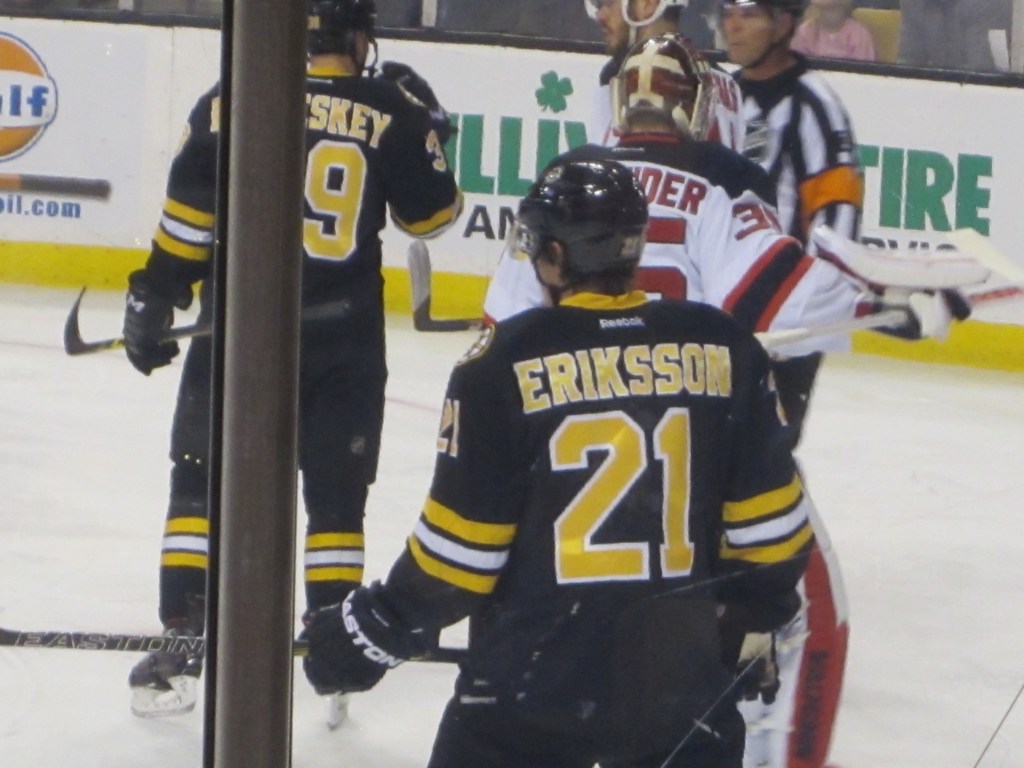

    If the Maple Leafs could get two 2nd round picks for their fire sale, think of what the Bruins could get for a player on the verge of his best season since at least the 2011-2012 regular season and on pace to reach the 70 point plateau.

    The fact of the matter is that Loui Eriksson is a very versatile player. Three years removed from the infamous Tyler Seguin trade with the Dallas Stars, Boston has finally seen what they expected all along from Eriksson on the ice. He goes to the right places, can be found on the rush and is dependable on the power play, if not deadly on special teams on a night-to-night basis.

    IMG_4341
    Could it be the end of Loui Eriksson in Black and Gold? (Photo via author)

    Eriksson has 23-25-48 totals so far in 60 games played this season; already besting his 22-25-47 totals last season over 81 games played and significantly improving upon his 10-27-37 total production in an injury plagued 61 game season in his first year in Boston during the 2013-2014 run that culminated in a Bruins second round playoff exit to the rival Montreal Canadiens. In 12 career playoff games with the B’s, Eriksson has put up two goals and three assists.

    The offensive upside to Eriksson’s game is crucial to his role as a top six forward. Yet, the 30-year old is on the final year of a six-year, $4.250 million AAV deal and is only expected to earn more, much more, in comparison to what the Bruins might be able to offer in an extension. Had the two sides discussed a deal much earlier in the season (prior to Eriksson’s rampage on the scoresheet), Boston might have been able to secure Eriksson to a similar deal to the one that is soon to expire.

    He is a dependable forward that brings a lot more to the table than Nick Spaling will bring to San Jose. By comparison, Eriksson makes Spaling look like a fourth liner (if not a depth forward) on just about any NHL roster.

    Compared to a player of similar caliber, but only a couple of years younger, Loui Eriksson could be raking in a well deserved raise similar to the 28-year old Anze Kopitar’s $80 million over 8 years extension with the Los Angeles Kings. Somewhere in the ballpark between $6.000 to $8.000 million AAV for any amount of time is well worth the chance for Eriksson to take the money and run.

    And the Bruins don’t have the room for that. Granted, their salary cap crunch days are much better than last year’s numbers.

    In the next two free agency cycles the Boston Bruins will have to resign a plethora of young stars including, Ryan Spooner ($950,000), David Pastrnak ($925,000), Brett Connolly ($1.000 million), Brad Marchand- who by the way is having a career year himself this year- ($4.500 million), Torey Krug ($3.400 million), Colin Miller ($600,000), Seth Griffith ($750,000) and quite possibly Alexander Khokhlachev ($800,000) assuming the Bruins don’t try to package the disgruntled Providence Bruin who has hinted at jettisoning the spoked-B for the KHL.

    IMG_4870
    Will the Bruins give up on second chances for Alexander Khokhlachev? (Photo via author)

    At least for Boston, they have some comfort in knowing that Milan Lucic’s retained salary of $2.750 million is coming off the books after this season and that forwards, Chris Kelly ($3.000 million) and Max Talbot ($900,000) may not be resigned. Kelly for sure will likely be forced to search for a job elsewhere in the league or face retirement in his comeback from a fractured left femur just 11 games into the season.

    So it all comes back down to what is here and now- Loui Eriksson.

    Without a doubt, Eriksson has a long future left in the NHL with any team in the league. Where he might end up is not necessarily clear, but the Bruins should seek to land a 1st round pick, a prospect, and a solid forward or top-4 defenseman at the very least in an exchange for just Loui Eriksson.

    The more pieces you add to the puzzle, the more things appear to stack up in favor of Boston (at least from a negotiating side). The Bruins have plenty of chips to put on the table with Eriksson, Khokhlachev and even Kevan Miller (who’s superb on the physical aspect of defense and shot blocking) to offer to a team that’s on the border or well within the cutoff of the playoff picture. Bruins GM Don Sweeney also has a couple of 1st round picks that he could dangle in front of an attractive trading partner.

    So while it might be sad to see such a productive player go in one of his best seasons, it just might be one of those classic examples of a “good hockey trade”- something reminiscent of when the Bruins brought in Phil Esposito or the like. Who knows, it just might be enough to put them in Cup contention for 2016.

    (And as requested by our in-house music guru, Connor, he wouldn’t let me get away with the title without alluding to this).

  • Monday Roundup- 2015 Offseason Thoughts

    Monday Roundup- 2015 Offseason Thoughts

    By: Nick Lanciani

    It’s been a busy offseason around the NHL- and by that I mean it’s been a rather unusual offseason around the NHL.

    The Ryan O’Reilly saga finally ended in Colorado and began in Buffalo, but took a side trip into the side of a Tim Horton’s somewhere in Ontario. While the Sabres could use his offense, they could do without his legal offenses (moral of the story, everyone, don’t drink and drive- have a designated driver, be responsible- use common sense).

    Mikhail Grigorenko’s been reunited with Patrick Roy in Colorado, although sadly the rest of the 2011-2012 and 2012-2013 Quebec Remparts will not be joining the party in Denver.

    T.J. Oshie, Brandon Saad, Milan Lucic, Dougie Hamilton, Patrick Sharp, Cam Talbot, Phil Kessel, and others have all been on the move as the result of blockbuster trades.

    600x400_Sweeney_Development_Camp
    Boston Bruins general manager, Don Sweeney (pictured), has been wheeling and dealing this offseason- in stark contrast of his predecessor, Peter Chiarelli (bruins.nhl.com).

    Don Sweeney’s been on a rampage (more on that later), Peter Chiarelli’s turned around the Edmonton Oilers in one offseason (at least on paper), and the Toronto Maple Leafs front office might be the smartest guys in the game for the first time in a longtime. Wait, what did I just say?

    That’s right, on Thursday, 72-year-old hockey front office legend, Lou Lamoriello, resigned as president of the New Jersey Devils only to join the Toronto Maple Leafs (announced on Twitter a mere two minutes apart) as their 16th general manager in franchise history.

    Fun fact: Back in 1987, Lamoriello drafted now fellow colleague, Brendan Shanahan, 2nd overall in his first season as the president and general manager of the Devils.

    Now, Lamoriello joins Shanahan in Toronto’s front office. Things certainly are weird right now in New Jersey, in the meantime, by the way- where Ray Shero is currently their GM and Marty Brodeur is, well, among the front office of the St. Louis Blues. Yep, it’s safe to say nobody would have predicted that both Brodeur and Lamoriello would move on from the Devils.

    In 2009, Lamoriello praised Shanahan after Shanahan attempted one final go in the NHL, with the Devils, only to decide he would not continue his career and thus stepped aside from playing, retiring before the 2009-2010 season. Lamoriello expressed so much praise, in fact, that he blatantly stated that should Shanahan want a job in the Devils front office, Lamoriello would go out of his way to make it happen.

    But here we are in 2015, where Shanahan recently transitioned to the helm of the Maple Leafs front office and instead of going to his former boss for a position, he brought in his former boss.

    Brendan Shanahan (left) introduces Lou Lamoniello (right) as the new general manager of the Toronto Maple Leafs. (Galit Rodan/The Canadian Press via AP)
    Brendan Shanahan (left) introduces Lou Lamoniello (right) as the new general manager of the Toronto Maple Leafs. (Galit Rodan/The Canadian Press via AP)

    Lamoriello spent 28 years with the New Jersey Devils organization, but now he’s about to embark on his first season with a different organization- just his second as a general manager- the Toronto Maple Leafs.

    The Maple Leafs, if you recall, hired Mike Babcock this offseason as their latest head coach, by the way. Babcock too, left an organization he spent a lot of time with for the Maple Leafs this summer. Babcock spent the last 10 years with the Detroit Red Wings before joining Toronto.

    Both Lamoriello and Babcock have something in common, they both left teams that used red as a primary color for a team that wears a blue maple leaf proudly displayed prominently on their jersey (it’s a bit slow right now in the offseason, cut me some slack).

    In other news, the National Hockey League began the formal expansion process this summer, having accepted expansion applications up until Monday.

    Two cities formally submitted a bid before the deadline- Las Vegas, Nevada and Quebec City, Quebec.

    Las Vegas billionaire, Bill Foley, continues to headman the construction of an arena in Las Vegas as well as a drive for season tickets while aiming to land an expansion team. Meanwhile, Montreal-based media conglomerate, Quebecor, aims to bring the NHL back to Quebec City.

    One of Canada’s hockey gods, Don Cherry, has already provided his blessing for a return to Quebec City.

    This is the first time the league has formally gone through the expansion process since the late 1990s when the league quickly grew in size adding the Nashville Predators, the Atlanta Thrashers, the Minnesota Wild, and the Columbus Blue Jackets between 1998 and 2000 to become the 30 team league that we all know and love today (with the minor relocation of the Thrashers to Winnipeg having occurred prior to the 2011-2012 season, of course).

    Since the Thrashers relocation to Winnipeg, the NHL has continued to take a firm stance against having to move another team for a while. Prior to the formal announcement of the expansion process being officially explored, the Arizona Coyotes and the City of Glendale, Arizona were at odds with one another.

    Despite IceArizona’s firm commitment to the State of Arizona, many thought the Coyotes would be on their way out of Glendale this offseason. Given how a short move back to Phoenix in such a short period of time would not be feasible, speculation led to the Coyotes packing their bags and moving to an NHL ready arena.

    Downtown Phoenix does not have an appropriate sporting arena for hockey currently, thereby handing the Coyotes a double whammy when their Gila River Arena lease agreement with Glendale was pulled out from under them by the city.

    After threatening substantial legal action, IceArizona and the City of Glendale came to terms on amending their agreement- eliminating an outclause from its initial version and adjusting some revenue sharing between the hockey club and the city (the team will now get a larger share, with the city footing less of the bill).

    Again, the Coyotes are staying put. No escape route to Seattle, no move from one desert to another desert (Las Vegas), and no move to Quebec City that would further imbalance the conferences in the league.

    But then again, the amended lease agreement is only for two years, so the Coyotes aren’t fully out of the woods yet.

    There remains so much yet to be seen concerning the Arizona Coyotes and their strained relations with the City of Glendale. While a short-term deal is necessary for their immediate survival in the market, their ultimate situation is not comforting. Things still could get quite ugly in a couple of years, yet the two sides have something to work with right now and can always chip away at improving viability of the franchise in Glendale.

    CIdjKkyVEAAIx7x
    The Arizona Coyotes will be debuting new jerseys this season, but their future in Arizona, despite glimmers of hope, is still uncertain in the long run (coyotes.nhl.com).

    If not, perhaps the next two years is all the time the Coyotes need to convince Phoenix, Arizona and the NBA’s Phoenix Suns to construct a new- joint- arena that would be suitable for hockey in the desert and a return to downtown Phoenix for the Coyotes franchise. Otherwise, it could be enough for Seattle to scrap together some plans for a NHL-ready arena and sway the Coyotes into relocation.

    Or there’s always Quebec City or Las Vegas, that, should either location not see the expansion process include them in the more immediate future of the league, could always have a stronger say in relocation. Both cities have strong interest from potential ownership groups and physical arena’s that are state of the art and nearing completion.

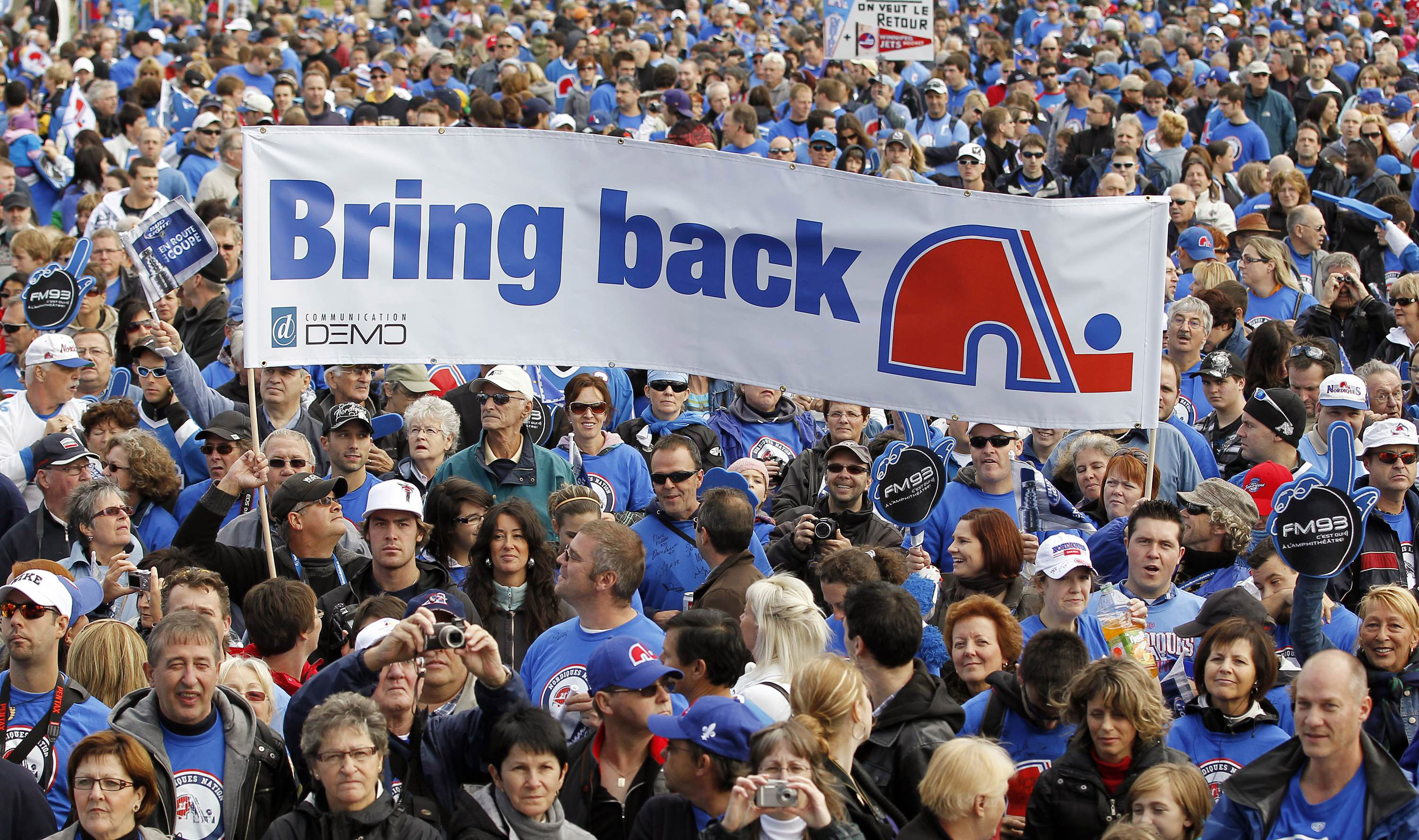
    Speaking of Quebec City and Las Vegas, now is the perfect time to reach into these markets. A return of the Nordiques to the hockey crazed Ville de Québec would be a golden opportunity for the league to return the game to where it belongs and can further drive marketability.

    For those that are opposed to adding another team in the Eastern Conference, kindly show yourself to the door. Realignment is never a fun topic, but I think we can all agree that sending the Detroit Red Wings and the Columbus Blue Jackets back to the Western Conference would be a good thing. As fans, we’d see a return of more Detroit and Chicago matchups, providing more fuel to the fire- built into the regular season schedule- when it comes to that longstanding rivalry.

    And with the addition of a team in Las Vegas, well, it’s the same old, same old. It’s a never before seen market in all of professional sports and it would balance the conferences under the aforementioned scenario.

    REUTERS/Mathieu Belanger
    REUTERS/Mathieu Belanger

    So at the end of the day, why disappoint the good people of Quebec City once again, NHL?

    Then again, balanced conferences are overrated, aren’t they?

    Come to think of it, the European model for professional sports isn’t too bad when it comes to league structure. Yet, the North American model of conferences, divisions, and such makes for a much more exciting game. We’ll never see the NHL switch to a relegation model based upon Premier League association football, but maybe we’ll see the NHL become more at ease with unbalanced conferences.

    Hey if the game works in a market, why ruin it by taking it away from that market just to satisfy conference structure? If the owners are going to squabble over that then they really aren’t looking out for the best interest of the league are they? Management’s number one goal is to profit from growing the game.

    Without an interest, there aren’t any fans. Without any fans, there aren’t any marketing opportunities from potential sponsors looking to reach fans. Without any cash flow, there is no game. If there’s an economically viable market or situation, go for it.

    UnknownLast, but not least, the Boston Bruins have been a busy team this offseason. One can only think that the B’s will make another move or two before training camp in September. Don Sweeney and the Big Bad Bruins front office are in on trying to sign defensemen, Cody Franson, or Christian Ehrhoff.

    The Boston fanbase continues to grumble and gripe about the presence of Chris Kelly and Dennis Seidenberg on the Bruins roster. One of the two could be moved before the puck drops in October.

    And while we’re still at it, the Bruins still need a backup goaltender. While Peter Budaj or Jonas Gustavsson may not be the first names that come to mind when it comes to free agent backup goalies that are still available and could be dispensable for the Bruins, well, one of them might be all that the Bruins need.

    Of course, Ray Emery and Ron Zepp are always still out there, granted Emery is a proven goaltender in the league (well mostly- he could be a backup for Tuukka Rask, but he’s past his number of chances of ever being a number one goalie in the NHL) and Zepp parallels Tim Thomas thus far in his career (minus the two Vezina Trophies, a Conn Smythe, and a Stanley Cup championship).

    Stephen Dunn/Getty Images
    Matt Beleskey (airborne) has found a new landing spot with the Boston Bruins this offseason. Stephen Dunn/Getty Images

    I’ll go more into detail about the Boston Bruins offseason conundrum in another post prior to the season. Quite frankly, I’m still trying to piece together what their plan might be. For now it looks as though Patrice Bergeron could be set with (a recently spotted dancing in Montreal) Brad Marchand and David Pastrnak, with Matt Beleskey-David Krejci-Jimmy Hayes, Loui Eriksson-Ryan Spooner-Brett Connolly, Zac Rinaldo-Chris Kelly-Max Talbot filling out the forward lines.

    Their blue line still needs work, but can be corrected within a few seasons. What’s more important right now is that the Bruins sign a top four defenseman and obtain a backup goaltender (or at least, implement a plan for a successful backup goaltender). While not necessarily a problem with an elite starting goaltender of Rask’s quality, the revolving door of backup goalies the Bruins have had the last few seasons is something they must work on for the remainder of Rask’s dominance in net.

    Anyway, this ends my stream of consciousness. I’ll go back to waiting for Cody Franson to make up his mind and sign somewhere now.

  • 2015 NHL Trade Deadline Recap

    By: Nick Lanciani

    I finally got a chance to get around to recapping all of the trades made today at the deadline, so I present to you my hard work. This post will be updated throughout the day. What is known is shown.

    The Boston Bruins started the day off with the acquisition of F Brett Connolly (who is a pending restricted free agent) from the Tampa Bay Lightning in exchange for a 2015 2nd round pick and a 2016 2nd round pick.

    The Tampa Bay Lightning then made a move to get D Braydon Coburn and sent D Radko Gudas, a 2015 1st round pick, and a 2015 3rd round pick to the Philadelphia Flyers.

    In the third move of the day, the Montreal Canadiens acquired D Jeff Petry from the Edmonton Oilers in exchange for a 2015 2nd round pick and a 2015 conditional 5th round pick. If Montreal wins in the first round of the 2015 Stanley Cup Playoffs, then the pick becomes a 4th round pick. If Montreal advances to the Eastern Conference Finals, then the pick becomes a 3rd round pick.

    Montreal then made their second move at the deadline, as the Canadiens sent a 2016 5th round pick to the Buffalo Sabres for F Brian Flynn.

    The St. Louis Blues acquired D Zbynek Michalek and a 2015 conditional 3rd round pick from the Arizona Coyotes in exchange for Maxim Letunov.

    Chicago Blackhawks F Ben Smith was traded to the San Jose Sharks for F Andrew Desjardins. San Jose retained 50% of Desjardins’s salary on his current contract (he’s a pending unrestricted free agent).

    New Jersey Devils D Marek Zidlicky was sent to the Detroit Red Wings for a 3rd round draft pick. New Jersey retained $1 million of Zidlicky’s salary.

    The San Jose Sharks traded F Tyler Kennedy to the New York Islanders for a 2016 conditional 3rd round pick.

    San Jose sent F Freddie Hamilton to the Colorado Avalanche in exchange for D Karl Stollery.

    The Pittsburgh Penguins traded D Robert Bortuzzo and a 2016 7th round pick to the St. Louis Blues for D Ian Cole.

    The New York Islanders sent backup goalie G Chad Johnson and a 2016 3rd round draft pick to the Buffalo Sabres in exchange for G Michal Neuvirth.

    In their second move of the day, the New York Islanders sent F Cory Conacher to the Vancouver Canucks in a swap for F Dustin Jeffrey.

    The Columbus Blue Jackets traded D Jordan Leopold to the Minnesota Wild for D Justin Falk and a 5th round pick.

    Toronto Maple Leafs F Olli Jokinen was traded to the St. Louis Blues for F Joakim Lindstrom and a 2016 conditional 6th round pick. The draft pick can become a 4th round pick in 2015 if the Blues reach the Stanley Cup Finals and Jokinen plays a role in it.

    Buffalo Sabres F Torrey Mitchell was traded to the Montreal Canadiens for F Jack Nevins and a 2016 7th round pick. Buffalo retains 50% of Mitchell’s salary.

    D Ben Lovejoy returned to the Pittsburgh Penguins in a deal with the Anaheim Ducks that sent D Simon Despres to Anaheim.

    The Minnesota Wild kept their friendship going with the Sabres and acquired F Chris Stewart from Buffalo in exchange for a 2017 2nd round pick. The Sabres retained 50% of Stewart’s contract (so $2.1 million if you’re curious).

    F Sven Baertschi has been traded from the Calgary Flames to the Vancouver Canucks for a 2015 2nd round pick.

    The Columbus Blue Jackets traded D James Wisniewski and a 2015 3rd round pick (DET) to the Anaheim Ducks and got F William Karlsson, F Rene Bourque, and a 2015 2nd round pick in return.

    The Arizona Coyotes acquired G David Leggio from the New York Islanders in exchange for D Mark Louis.

    The Boston Bruins sent F Jordan Caron and a 2016 6th round pick to the Colorado Avalanche for F Max Talbot and F Paul Carey. The Avalanche will retain half of Talbot’s salary.

    Toronto Maple Leafs D Korbinian Holzer was traded to the Anaheim Ducks for D Eric Brewer and a 2016 5th round pick.

    Anaheim also acquired F Michael Sgarbossa from the Colorado Avalanche for D Mat Clark.

    F Jared Knight of the Boston Bruins was traded to the Minnesota Wild for F Zack Phillips.

  • Viable Trade Options- Part Two- Central Division

    By: Nick Lanciani

    The Trade Deadline is fast approaching, is your team ready for this year’s fire sale? I take a look at some reasonable ideas for deals, as well as the overall consideration of buying or selling for each team in the league in this month long series. Buyer beware, all sales are final on March 2nd, 2015.

    Current Central Division Standings

    1. NSH 78 pts. (36-12-6) 54 GP
    2. STL 74 pts. (35-15-4) 54 GP
    3. CHI 69 pts. (33-18-3) 54 GP
    4. WPG 66 pts. (28-18-10) 56 GP
    5. MIN 59 pts. (26-20-7) 53 GP
    6. DAL 58 pts. (25-21-8) 54 GP
    7. COL 55 pts. (22-21-11) 54 GP

    Unknown Nashville Predators (1st in the Central Division, 54 GP 36-12-6 record, 78 points)

    The Nashville Predators are having themselves a remarkable season with a healthy goaltender, Pekka Rinne, in their lineup and everyone else playing their position fluidly. Filip Forsberg has been a tremendous surprise as a rookie with 18-30-48 totals in 54 games played. What might be more impressive is that their young defense has been able to step up to the task on most nights.

    The Predators are holding up on the injury front, with only Ryan Ellis currently on the injured reserve, and lead the Central Division standings. While last season proved to be a bit shaky, their consistency this year should come as no surprise given their elite goaltending in Rinne and their head coach, Peter Laviolette’s, brilliance.

    Nashville, surprisingly, has yet to see a long playoff run, though. This year is no exception to their hunger for more and they could be active in trying to acquire that one last key piece or two in order to perfect their roster and bolster up for the Stanley Cup Playoffs. Then again, the age-old adage “if it ain’t broke, don’t fix it” could work well for the Predators when it comes to deadline day.

    However, going into the stretch run of the season, it might be smart for the Nashville to pick up a depth defenseman or two, as well as a possible depth forward. Especially with the moves their division rival, Winnipeg Jets, have made acquiring Tyler Myers and Drew Stafford- both of which will likely be regular components to their lineup, but in both cases, the Jets added to their plethora of options. That is just about the only thing advisable to the Nashville Predators organization heading into the trade deadline and I’m sure they are already well aware.

    Unknown-1 St. Louis Blues (2nd in the Central Division, 54 GP 35-15-4 record, 74 points)

    Despite some recent struggles, the St. Louis Blues are rolling along this season. Brian Elliott and Jake Allen have held up strong in goal, Vladimir Tarasenko emerged as one of the league’s most prolific scorers, and their defense has been solidifying their presence on the ice on a nightly basis.

    Much like the Nashville Predators, though, the St. Louis Blues could use some depth. We are reaching the point in the season where any injury could make or break your chances of a deep run in the playoffs. With only Kevin Shattenkirk and Chris Porter on the injured reserve, the Blues have found a way to remain healthy at this point in the season.

    There really are no holes in their roster that contains an excellent mixture of youth and experience, so there’s nothing that immediately needs filling or getting rid of. Sure, Saint Louis could go with this roster moving forward, but I think their best bet would be to try to add without subtracting in order to avoid yet another early playoff exit.

    As it is right now, the Blues would be playing the Chicago Blackhawks and I’m pretty certain history would show that Saint Louis wouldn’t fare too well against Chicago. That is why the Blues must focus on depth skaters to combat injury and give them options heading into the playoffs.

    Unknown-2 Chicago Blackhawks (3rd in the Central Division, 54 GP 33-18-3 record, 69 points)

    The Chicago Blackhawks, in recent years, are annual contenders for the Cup. Their legitimacy is what keeps the rest of the Western Conference teams trembling and stockpiling as much bang for their buck on their rosters.

    Currently the Blackhawks are just trucking along in 3rd place in Central Division standings. With a roster that includes superstars, Jonathan Toews, Patrick Kane, Marian Hossa, Duncan Keith, Brent Seabrook, and (when it really counts) Corey Crawford, how could Chicago A) have any more room for talent and B) be able to keep them all with the uncertainty of next year’s salary cap figure?

    Regardless, nothing is plaguing the Blackhawks in the current state of the league. So it comes as no surprise that I don’t expect Chicago to be wheeling and dealing at the deadline. Could they bring in a depth skater or two? Certainly. I think most successful teams looking to make a deep playoff run operate on a basis of trying to get a depth rental player if they can- in order to have a dependable player to fall back on if an injury were to occur.

    To summarize, it’s a keep on keeping on mentality in Chicago at this point of the year. As long as they have home ice in the playoffs, it doesn’t really matter where they end up in the standings, although I’m sure they’d prefer to be at the top anyway.

    Unknown-3 Winnipeg Jets (4th in the Central Division, 56 GP 28-18-10 record, 66 points 1st Wild Card in the Western Conference)

    The Winnipeg Jets have made the biggest splash in both the terms of being a delightful surprise this season, as well as on the trade market so far with the acquisition of Tyler Myers, Drew Stafford, Joel Armia, and Branden Lemieux from the Buffalo Sabres.

    The Jets are currently the first wild card representative from the Western Conference and are situated in a tight battle for the Central Division. With the Buffalo deal, Winnipeg stockpiled on talent and could even still make further moves come March 2nd.

    There are no guarantees, but then again, there also doesn’t seem to be that much needed within Winnipeg’s roster (at least on paper). Michael Hutchinson has played some stellar goaltending and the league’s smallest market has certainly been heard all season as one of the loudest voices talking serious about playoff hockey hopes, chances, and a potential run for the Cup.

    But cool your jets before you get too far ahead of yourself. While the entire Central Division may be the NHL’s strongest division in the league, only a couple of teams from the division may even advance far enough into the playoffs.

    Based on recent playoff experience and success alone, the Jets have a mountain to climb to overcome the playoff dominant Chicago Blackhawks and the annual playoff contending St. Louis Blues, in their division alone. If either team stays quiet on the trade front, then I’d expect Winnipeg to make at least one more move to get them over the hump- and trust me, they’re already getting plenty of calls.

     Unknown-4Minnesota Wild (5th in the Central Division, 53 GP 26-20-7 record, 59 points)

    The Minnesota Wild are one of those teams you just got to feel bad for this season. Despite their recent growth in depth and playoff experience, the injury bug continues to plague the Wild organization.

    No one is certain what the future in goal holds for Minnesota. How much older can Niklas Backstrom get and still be considered their starting goaltender? Has Devan Dubnyk finally found a stable place to play? And then there’s always Darcy Kuemper and whatever the future brings for his goalie career.

    While the Wild might not be able to pull off a deal at the deadline, I wouldn’t be surprised to see them shopping around Backstrom, given his age and the uncertainty of how he’ll hold up, injury wise (one can’t forget his recent injury struggles).

    But the problem for Minnesota may not reside in their goaltending. Perhaps their roster could get younger, at least among the forwards. A player like Stephane Veilleux might be expendable enough to bring in something fresh. The Wild have a young, largely unexperienced defensive core and it probably wouldn’t be a good idea to take away from it. I tend not to think that Minnesota is in dire need of anything really (much like the rest of the Central Division), however if they could acquire some healthy players, that would be a good thing.

    The strength of the Central Division is so strong currently, that if your roster even has one or two players on the injured reserve, you could be in for a dismal season. Minnesota has four players on the injured reserve, meaning that hope is likely gone for this season (by no means, technically, is their season a complete lost cause), but their future may be brighter. I’d expect the Wild to continue doing what they’ve been doing recently- building from free agency.

    Unknown-5 Dallas Stars (6th in the Central Division, 54 GP 25-21-8 record, 58 points)

    Fans of the Dallas Stars are riding a rollercoaster of emotion for the last couple of seasons. After finally getting back to the playoffs last season for the first time since the Detroit Red Wings knocked the Stars out of the 2008 Stanley Cup Playoffs, Dallas finds themselves on the outside looking in.

    While none of the Central Division teams are mathematically out of contention for a playoff run, the jury remains on recess in the spiritual and realistic manners. Dallas only has two players on the injured reserve currently (Patrik Nemeth and Valeri Nichushkin) and they just acquired some much needed backup goaltending in their trade with Buffalo this week for Jhonas Enroth- finally ridding themselves of the overhyped Anders Lindback.

    Yet with stars on the Stars, such as Tyler Seguin, Jamie Benn, Jason Spezza, Alex Goligoski, and Kari Lehtonen, how is it possible for Dallas to be situated 6th in the division? The answer may reside in their forwards, who surprisingly can provide enough of a spark some nights, but other nights lack consistency.

    A player like Vernon Fiddler may be very attractive to a team looking to make a playoff run and would probably fit well with a team like the Washington Capitals or the Pittsburgh Penguins with the way he currently is playing, especially as a valuable second or third liner (something that at least the Penguins could use). Come to think of it, perhaps the Boston Bruins could find a way to fit in a guy like Vernon Fiddler into their roster. Either way, if Dallas is forced to sell at all on the deadline, the phone lines should remain open on Fiddler.

    Another forward worth dangling on the fishing line for a potential trade is Erik Cole. The veteran has found a way to find the net again with the Stars and at the very least would bring in a veteran presence to any playoff inexperienced team looking for some locker room stability in the long run.

    Last but not least- well, maybe least- Shawn Horcoff is 36 and definitely has got to be on the move from the Stars. The center has proven to be inconsistent and an injury waiting to happen in recent years. If the Stars seek to improve, they’d at least move Horcoff and either Fiddler or Cole for a younger player to compliment the likes of Spezza, Patrick Eaves, and Ales Hemsky in their currently over thirty-years-old lineup.

    If the magic works out and the Stars start to go on a tear with their veterans leading the charge up in the Central Division standings, then go ahead and prove me wrong and don’t trade anyone. But if inconsistencies continue to plague the organization, then it might make sense to move on in the right way.

    Colorado Avalanche Logo Colorado Avalanche (7th in the Central Division, 54 GP 22-21-11 record, 55 points)

    The Colorado Avalanche have taken a page from the book of the Boston Red Sox apparently, as they have gone from one of the worst teams in their division to first in the Central Division last year- back to their current status of last in the division so far this season. Their rise and fall in divisional standings has been one of the most perplexing situations this season.

    While injury has troubled last season’s Vezina Trophy finalist, Semyon Varlamov, in goal, surely an offense with the likes of Matt Duchene, Gabriel Landeskog, Nathan MacKinnon, and Jarome Iginla (a thirty goal scorer last season with the Boston Bruins) would’ve be able to compensate for the carousel of goalies earlier in the year and the young defensemen.

    Yet, here they are with six players on the injured reserve (Patrick Bordeleau, Jamie McGinn, Borna Rendulic, Jesse Winchester, Erik Johnson, and Ryan Wilson) at the bottom of the Central Division. Johnson’s absence certainly would send shockwaves through the Avalanche’s defensive unit, as it would to any team that loses their number one defenseman for any extended period of time.

    Given that Daniel Briere clearly isn’t working out in Colorado, wouldn’t it make sense to try to move him by the deadline in (if not a desperate attempt to save the season) an attempt to bring in some talent youth that could build on whatever success is left in this season for next season? With the Colorado’s plethora of prospects coming up in the rankings, would it be crazy to think that they could work out a deal with Toronto for Dion Phaneuf, Phil Kessel, Daniel Winnik (a former Av), or Cody Franson?

    Any one of those players would be an attractive option for the Avalanche organization, as well as an attractive destination for Toronto to send some or all of those players. Colorado meets several aspects of the Maple Leaf’s trading partner’s checklist. The Avalanche are a non factor this year, they’re in the Western Conference, and if the Avalanche turn things around at all, while the Maple Leafs continue to fall- the odds are that Toronto would end up with a higher draft pick than the Avalanche.

    Among Cody McLeod, John Mitchell, Maxime Talbot, Alex Tanguay, and Jesse Winchester, the Avalanche should only commit to two or three of them. Given that Winchester is currently on the IR, a trade involving an injured player won’t happen. With Talbot having mild success in Colorado, he’s one to keep. Tanguay, on the right line, fits the Avalanche style of play (especially since they are the team that drafted him, after all).

    But what kind of offers could the Avalanche get in return for the 30 year old Mitchell, who plays center, but could also probably play wing for a playoff contending team? This has to be something that Colorado is at least willing to listen to. And as great as McLeod has been for the Avalanche as an enforcer, perhaps it’s time for someone younger to step into his role and carry the team’s energetic side.

    Jan Hejda, Brad Stuart, or Nate Guenin could be valuable older defensemen for any contending team in search of a depth defenseman or someone to get them to the Cup Finals. But the consequences of trading any of their veteran defenseman could be dire, unless Colorado is able to acquire a veteran defenseman or guarantee a veteran defenseman in free agency.

    While the Avalanche aren’t quite in the same position as say the Minnesota Wild when it comes to young inexperienced defensemen, Colorado should continue to tread the waters carefully as Johnson and Wilson get back from injury and the rest of the defensemen develop.

    Ultimately, Colorado is faced with the choice to buy or sell. Right now, it looks like they’ll be doing some clearance rack shopping, and used merchandise sales.