The Toronto Maple Leafs finally did the thing! Congrats to the 2019 Hockey Hall of Fame Class and taking a look at who might join them in 2020.
Subscribe to the podcast on Apple Podcasts, Stitcher and/or on Spotify. Support the show on Patreon.

The Toronto Maple Leafs finally did the thing! Congrats to the 2019 Hockey Hall of Fame Class and taking a look at who might join them in 2020.
Subscribe to the podcast on Apple Podcasts, Stitcher and/or on Spotify. Support the show on Patreon.

Florida Panthers
36-32-14, 86 points, 5th in the Atlantic Division
Missed the postseason for the third straight year
Additions: F Noel Acciari, F Brett Connolly, F Joel Lowry, F Kevin Roy, F Dominic Toninato (acquired from COL), D Gustav Bouramman (acquired from MIN), D Tommy Cross, D Ethan Prow, D Anton Stralman, G Sergei Bobrovsky, G Philippe Desrosiers
Subtractions: F Jean-Sebastien Dea (signed with BUF), F Henrik Haapala (KHL), F Juho Lammikko (Liiga), F Derek MacKenzie (retired), F Maxim Mamin (KHL), F Vincent Praplan (NLA), F Riley Sheahan (signed with EDM), D Ludwig Bystrom (Liiga), D Michael Downing (signed with Florida, ECHL), D Jacob MacDonald (traded to COL), D Julian Melchiori (signed with Binghamton, AHL), G Scott Darling (acquired from CAR, then bought out), G Roberto Luongo (retired), G James Reimer (traded to CAR)
Still Unsigned: F Jamie McGinn
Re-signed: F Troy Brouwer (signed to a PTO), F Anthony Greco, F Jayce Hawryluk, F Dryden Hunt, F Denis Malgin, D Ian McCoshen, D Thomas Schemitsch, D MacKenzie Weegar, G Sam Montembeault
Offseason Analysis: The rules of the offseason are pretty simple. Don’t be that person that overpays.
But for Florida Panthers General Manager, Dale Tallon, apparently the rules don’t apply.
Yes, fixing the hole in the net left behind by Roberto Luongo’s decision to retire was a good idea. No, signing Sergei Bobrovsky to a seven-year, $70 million contract isn’t a steal.
A $10.000 million cap hit for a goaltender that’s 30-years-old and only getting older won’t exactly look too great by the fourth year of the deal, but by then it might not even be Tallon’s problem.
Tallon is in “win now” mode.
The Panthers haven’t been back to the Stanley Cup Final since their lone appearance in 1996, in which they were swept in four games– the final two on home ice– by the Colorado Avalanche.
As it is, Florida hasn’t been back to the Stanley Cup Playoffs since 2016’s First Round loss to the New York Islanders in six games.
So they’ve bolstered their roster with Bobrovsky in the crease and three other players that were signed on July 1st– Noel Acciari, Brett Connolly and Anton Stralman.
Acciari’s a bottom-six forward who likes to hit and can hit clean, but at three-years and $1.667 million per season, might be a bit much to pay for someone who only had 14 points last season. Sure it was career-year, but his goal scoring production was down from 10 goals in 2017-18 to six goals in 2018-19.
Connolly signed a four-year contract worth $3.500 million per season and with a Stanley Cup championship to his name with the Washington Capitals in 2018, he brings more than just winning pedigree– he had career-highs in goals (22), assists (24) and points (46) in 81 games for the Caps last season.
The Tampa Bay Lightning’s 6th overall pick in the 2010 NHL Draft is finally coming around to his potential at age 27. Better late than never and that’s why the Panthers are taking this gamble.
An improved offense in the top-nine forwards to go with Aleksander Barkov, Jonathan Huberdeau, Mike Hoffman, Evgeni Dadonov, Vincent Trocheck and Frank Vatrano, as well as an addition to the blue line in Anton Stralman’s three-year contract worth $5.500 million per season has the Panthers with high hopes for the 2019-20 season.
Especially when you consider the fact that their new head coach behind the bench is three-time Stanley Cup champion, Joel Quenneville.
Tallon, Quenneville and Florida’s roster don’t just have their sights set on a First Round appearance.
What if they don’t pull things off right away and age catches up to their free agent signings from this offseason? Is it right back to square one as an older, slower, knock-off version of their intra-state rival up in Tampa?
Ten players on the current NHL roster are pending free agents of the unrestricted and restricted variety after this season.
Florida currently has about $781,330 in cap space with Hoffman and Dadonov as their biggest pending-UFAs next July.
Thanks to Luongo’s early retirement, the Panthers will be stifled with a cap recapture penalty that’s not as significant as the one the Vancouver Canucks will face, but nonetheless costing Florida $1,094,128 per season through 2021-22.
But Tallon is used to maxing out the books to put his team in a position to win sooner rather than later– just ask the Chicago Blackhawks how their Cup winning core worked out for them.
Offseason Grade: B
Florida going “all-in” in free agency is out of character for their franchise history, it would seem. While nabbing top-end talent at a premium price lands the Panthers as a winner of the bidding war for free agents, there’s a lot of risk involved.
Long-term growth may have been stalled by short-term planning for gains that may or may not pan out as the season has yet to begin. As such, Tallon’s offseason was “above average”, but now comes the time to prove whether it was all worth it or else risk becoming the more expensive version of the Columbus Blue Jackets at the 2019 trade deadline.
If you only went off the NHL schedule, you might think that today is a Saturday, but it is in fact a Tuesday.
Have I lost you yet?
Allow me to explain: the day’s first game, Carolina at Toronto, is slated to drop the puck at 2 p.m. today, five hours before you’d expect for a week game. Once the matinee is out of the way, three games (Detroit at the New York Islanders, Anaheim at the New York Rangers and Minnesota at Ottawa [RDS]) will get started at 7 p.m., followed by Boston at Buffalo (NBCSN/SN/TVAS) half an hour later. Winnipeg at Nashville finds its start at 8 p.m., trailed 30 minutes later by Washington at Dallas and Florida at Arizona at 9 p.m. Finally, tonight’s co-nightcaps – Montréal at Vancouver (RDS/TSN2) and Tampa Bay at Vegas (SN1) – get green lit at 10 p.m. to close the evening out. All times Eastern.
The Bruins-Sabres rivalry comes to life tonight, and W Jamie McGinn and RW Radim Vrbata are making their first return to Gila River Arena since joining the Panthers this offseason. However, it’s hard to ignore the action in Tennessee, so it’s off to Nashville with us!


You’re hard pressed to find many better teams in the NHL than these two.
Of course, after a trip to the Stanley Cup Finals last season, 21-7-4 Nashville leading the Western Conference wasn’t exactly unexpected. The Preds’ month of December has been a shining example of their style of play, as they’ve earned a commanding 6-0-1 record.
18-4-3 G Pekka Rinne has been nothing short of exemplary since flipping to the last page of his calendar. Having earned five starts this month, he’s posted a .948 save percentage and 1.74 GAA (both top-five efforts among the 41 goalies with at least three starts since December 2) to elevate his season numbers to a .93 save percentage and 2.25 GAA, making him the third-best goaltender in the NHL so far this campaign.
Making Rinne’s effort even more incredible is the fact that his defense, given its offensive contributions, leaves him more than his fair share of work. Even with D Alexei Emelin‘s team-leading 3.42 hits-per-game, F Filip Forsberg‘s seven takeaways and D Roman Josi‘s 2.28 blocks-per-game (all over the past seven games), he and 3-3-1 G Juuse Saros have faced 263 shots this month, the seventh-most in the NHL.
Of course, if any team is going to break through Rinne and Nashville’s defense, I’d bank on 19-10-5 Winnipeg, the Central Division’s third place team. Though they don’t come into tonight’s game on quite the hot streak the Predators are experiencing, the fact that the Jets’ offense enters the night averaging 3.26 goals-per-game to rank fifth in the league shows that they’re capable of going any night of the week that ends in -day.
If I’ve said it once, I’ve said it 1000 times: The Jets’ first line – specifically the talents of C Mark Scheifele (15-21-36 totals) and RW Blake Wheeler (8-31-39) – needs to be in the discussion for the most dominant in the Western Conference, if not the NHL as a whole (yes, Tampa Bay, we know you exist). Scheifele and Wheeler on their own might be able to take on most lines in the league, while adding LW Kyle Connor (10-9-19) into the mix to complete the line is not too shabby either.
Of course, it also doesn’t hurt that Winnipeg is fortunate enough to employ W Nikolaj Ehlers (15-10-25 totals), RW Patrik Laine (16-11-27) and F Bryan Little (5-14-19) on the second line. Between the efforts of these two lines, Nashville’s defense just might be forced to consider performing their primary job descriptions a bit more than they would like this evening.
Given how often these teams have been featured in the DtFR Game of the Day series (a combined 19 times), it’s probably no surprise that I really enjoy watching both of these clubs and am confident they’ll be mighty forces in the postseason. However, only one team can win this evening, and I’m siding with the Preds. They’ve been nigh unstoppable this month, and the fact that they’re playing within the friendly confines of Bridgestone Arena should ensure they continue leading the conference for at least another night.
Even though C Adam Henrique buried a nifty backhanded shot in his return to the Prudential Center, the New Jersey Devils beat the Anaheim Ducks 5-3 in yesterday’s DtFR Game of the Day.
The first period was a defensive affair, as only a combined 13 shots were fired. That being said, the scoreboard read 2-0 at the first intermission in favor of the Ducks thanks to C Ryan Getzlaf‘s (F Rickard Rakell and D Josh Manson) snap shot at the 6:44 mark and W Jakob Silfverberg‘s (F Andrew Cogliano and Henrique) snapper 3:46 later.
New Jersey finally got on the board at the 8:11 mark of the second period on a power play tip-in by Second Star of the Game LW Miles Wood (D Sami Vatanen and Third Star W Jesper Bratt). Henrique (Manson) lobbed the puck over Vatanen to effectively assist himself to a backhander 3:10 later to set the score at 3-1, but the Devils pulled themselves back within a goal on Wood’s (C Pavel Zacha) second tally of the night, a wrist shot with 1:44 remaining before the second intermission.
If the Ducks controlled the first period, Jersey absolutely dominated the third, as they scored three unanswered goals to earn the victory. The first of those was buried at the 5:49 mark courtesy of Bratt (F Blake Coleman and F Brian Boyle) to level the game at three-all. That tie held until 4:07 remained in regulation when First Star RW Stefan Noesen (Boyle and D Andy Greene) scored the game-winning marker.
After Boyle centered a pass to him from the blue line, Noesen tried to rip a wrister past G Ryan Miller, but the netminder aggressively deflected the puck away. Unfortunately for him, that move left his cage yawning, and Noesen was able to collect the loose puck and bury it into the back of the net.
With seven seconds remaining in the game, Noesen (Boyle) scored a wrister on an empty net to secure the Devils’ second-consecutive victory.
G Cory Schneider earned the victory after saving 21-of-24 shots faced (.875 save percentage), leaving the loss to Miller, who saved 29-of-33 (.879).
There’s no stopping home teams lately in the DtFR Game of the Day series, as hosts have won four consecutive contests. This run of success has improved their record to 43-24-9 in the series, 20 points better than the visitors.
If you’re a regular here at Down the Frozen River then you know Colby Kephart, Connor Keith and I discussed our ideal Vegas Golden Knights rosters on last week’s episode of the DTFR Podcast.
Well, after careful (re)consideration, thanks to Sunday’s release of the protected and available lists for the 2017 NHL Expansion Draft, Connor and I have decided to reselect our Golden Knights rosters. Special thanks to CapFriendly for having such an amazing “mock expansion draft” tool available to everyone all season long leading up to this moment.
Without further ado, here they are…

Nick Lanciani’s mock 2017-2018 Vegas Golden Knights roster:
ANAHEIM DUCKS– D Sami Vatanen (26 years old, 3 years left, $4.875 million cap hit):
The logic behind this one is fairly simple– Vegas picks the best player available from Anaheim’s pool of available players and either 1) utilizes his services or 2) flips him for even more assets (current or future, the choice is yours, Golden Knights GM George McPhee). Vatanen had 3-21-24 totals in 71 games with Anaheim in 2016-2017.
ARIZONA COYOTES– LW/RW Jamie McGinn (28, 2 years left, $3.333 million cap hit):
Choosing McGinn (9-8-17 totals in 72 games played last season) provides the Golden Knights with the safest pick from the Coyotes organization. He’s not expected to be the best player, but his contract is the perfect fit for a team that’s just starting out. It he does well, he’ll stick around, but if he doesn’t perform, then Vegas didn’t waste too much on being able to have a NHL caliber forward right out of the gate.
BOSTON BRUINS– D Colin Miller (24, 1 year left, $1.000 million cap hit):
While Boston does not want to have to see Colin Miller heading to Vegas, there wasn’t much the Bruins could do to protect the young blue liner, considering their vast expanse of core forwards to protect and defensive prospects lining up to take Miller’s current job in Boston. The Golden Knights luck out on this one, if Miller’s brilliance returns.
Despite playing in 19 more games this season than in 2015-2016, Miller had 6 goals and 7 assists (13 points) for Boston (whereas he had 3-13-16 totals in 42 games in 2015-2016).
BUFFALO SABRES– LW Matt Moulson (33, 2 years left, $5.000 million cap hit):
Moulson’s time with the Buffalo Sabres was up and down, but he gets a fresh start in Sin City. There shouldn’t be any hard feelings between the Sabres and Moulson on what otherwise seems like a natural, mutual, separation.
He had 14-18-32 totals in 81 games played in 2016-2017, which was better than his eight goals, 13 assists (21 points) in 81 games in 2015-2016 (after amassing three consecutive 40-plus point seasons).
CALGARY FLAMES– C/LW/RW Lance Bouma (27, 1 year remaining, $2.200 million cap hit):
Three goals and four assists (7 points) in 61 games played this year with Calgary doesn’t scream “exceptional forward”, however, it’s his intangibles that make him a quality asset for a franchise that has to build its identity from the ground up. Also, his durability as a forward (he can play either wing or center) makes him an attractive option for a franchise that won’t nearly have as much minor league depth to call up in the event of injuries throughout the season.
CAROLINA HURRICANES– LW Joakim Nordstrom (25, 1 year remaining, $1.275 million cap hit):
His production was cut in half (7-5-12 totals) this season despite taking part in 81 games with Carolina, however, Joakim Nordstrom is just one season removed from an impressive stint in his first full year with the Hurricanes (10-14-24 totals in 71 games played in 2015-2016) since being traded by the Chicago Blackhawks in the 2015 offseason. At 25 years old, he should be entering his prime.
CHICAGO BLACKHAWKS– D Trevor van Riemsdyk (25, 1 year remaining, $825,000 cap hit):
The Golden Knights hit the lottery with their selection from the Blackhawks in the sense that Trevor van Riemsdyk is an exceptional, young, defenseman, who should otherwise be stepping into a more prominent role as the future of Chicago’s blue line, but instead will become a household name in Vegas. Limited to only 58 games this season, van Riemsdyk notched 5-11-16 totals in his sophomore year after amassing three goals and 11 assists (14 points) in a full 82-game season his rookie year.
COLORADO AVALANCHE– C Carl Soderberg (31, 3 years left, $4.750 million cap hit):
Carl Soderberg went from a 51 point season in his first year with the Avalanche to just 6-8-14 totals in 80 games played this season, but the former Boston Bruin and three-time 40-plus point scorer can rejuvenate his career with the right combination of forwards around him in Vegas. Plus he’s not too shabby on the faceoff dot (Soderberg won 52% of his faceoffs this season alone).
COLUMBUS BLUE JACKETS– D Jack Johnson (30, 1 year remaining, $4.357 million cap hit):
Simply put, Jack Johnson would be the oldest defenseman on my version of the Vegas Golden Knights and that’s exactly where you’d want them to be, just starting out. He contributed 18 assists to go along with his 23 points for the Blue Jackets in 82 games this season, after being hampered by injury to just 6-8-14 totals in 60 games last season.
DALLAS STARS– D Greg Pateryn (26, 1 year remaining, $800,000 cap hit):
Pateryn has yet to play a full season, but perhaps the Golden Knights can give him more of a taste of being a regular in the NHL than the Dallas Stars and Montreal Canadiens did. He has 16 career points to his name and at best, is a depth guy that becomes a top-6 blue liner. At worst, he sees no time in the lineup and watches a season from the comfortable press box seats at T-Mobile Arena.
DETROIT RED WINGS– G Petr Mrazek (25, 1 year remaining, $4.000 million cap hit):
Once again, we have another offseason rendition of Character Issues (season two, 2017, starring Petr Mrazek, guest starring references made to season one (2016) star, P.K. Subban).
Whoever the Golden Knights choose to actually be their backup goaltender will be their backup goaltender, otherwise this guy is getting flipped *copies and pastes to every possible backup goaltender scenario*.
EDMONTON OILERS– D Eric Gryba (29, pending UFA on July 1st):
Since Gryba tallied 12 assists in 75 games played in the 2014-2015 season with the Ottawa Senators (one more point than the previous season in 18 more games), he hasn’t produced and has become a depth defenseman at best. A second, second chance with the Vegas Golden Knights might finally prove that Gryba is worth more to a franchise than just as a go-to healthy scratch. Or then again, he might just be a roster placeholder until free agency begins on July 1st.
FLORIDA PANTHERS– LW/RW Reilly Smith (26, 5 years left, $5.000 million cap hit):
Who didn’t have a down year with the Florida Panthers this season? Reilly Smith failed to reach the 40-point plateau for the first time since his 37 games played as a newcomer with the Dallas Stars in the lockout-shortened 2012-2013 season. Instead, he had 15-22-37 totals in 80 games with the Panthers, following his trend of “on again, off again” performance. By Smith’s standards, he’s due for a spectacular season in 2017-2018 and he’s not the only surprise Florida left unprotected *cough cough Jonathan Marchessault cough*.
LOS ANGELES KINGS– D Brayden McNabb (26, 1 year remaining, $1.700 million cap hit):
Two goals and two assists (4 points) were all that McNabb put on the scoresheet for the Kings this season in 49 games. In 2014-2015 with Los Angeles, he had 22 assists in 71 games played (his first full season in the NHL and first appearance in the league since his acquisition by the Kings from the Buffalo Sabres). But nobody’s paying him to score goals and rack up points when they consider his heavy hitting approach to protecting his own zone.
MINNESOTA WILD– C Eric Staal (32, 2 years left, $3.500 million cap hit):
Why not? Make things interesting, George McPhee, and take Eric Staal over the plethora of defensemen that seem to be rumored in and out of Minnesota every other day. True to form, he had 65 points (28 goals, 37 assists) in 82 games with the Wild last season after a dismal 39 points (13 goals, 26 assists) in 83 games with the Hurricanes and the Rangers in 2015-2016. He makes everyone around him better, so he’s worth it.
MONTRÉAL CANADIENS– C Tomas Plekanec (34, 1 year remaining, $6.000 million):
I said it on last week’s episode of the podcast, but this is the easiest way for the Canadiens to avoid the awkward breakup with Plekanec reminiscent of their uncoupling with Saku Koivu almost a decade ago.
He had 10-18-28 totals in 78 games with Montreal this season a year after notching 54 points in 82 games and two years after reaching 60 points in 82 games played. He’s not the 70-point scorer like he was in 2009-2010, but he’s still a gifted center that brings a veteran presence to the new franchise.
NASHVILLE PREDATORS– C Colton Sissons (23, 2 years left, $625,000 cap hit):
Colton Sissons only had two goals and eight assists (10 points) in 58 games played this season for Nashville, but he came up clutch in their Stanley Cup Final run (and eventual defeat to the Pittsburgh Penguins). Someone good and young on the Predators is bound to be lost to the Golden Knights, unless they’ve already worked out a trade to avoid the inevitable scenario. Take a hard pass on James Neal, if you can.
NEW JERSEY DEVILS– RW Stefan Noesen (24, pending RFA on July 1st):
There’s really no stellar selection to make from the Devils, so why not go with a young, pending RFA forward? Besides, he had eight goals in 44 games with Anaheim and New Jersey this season.
NEW YORK ISLANDERS– LW Shane Prince (24, 1 year remaining, $850,000 cap hit):
Shane Prince had 18 points (5 goals, 13 assists) in 50 games with the Islanders this season, which bested his scoring output from last year in a dozen fewer games, so just imagine what a full season could do for him in the right situation.
NEW YORK RANGERS– G Antti Raanta (28, 1 year remaining, $1.000 million cap hit):
Whoever the Golden Knights choose to actually be their backup goaltender will be their backup goaltender, otherwise this guy is getting flipped *copies and pastes to every possible backup goaltender scenario*.
OTTAWA SENATORS– D Fredrik Claesson (24, 1 year remaining, $650,000 cap hit):
Claesson amassed 3-8-11 totals in 33 games with the Senators this season, one year after recording 2 assists in 16 games played. So there’s room for improvement if he’s only just entering his prime. Otherwise he’s a tactically smart depth defenseman addition to Vegas’s roster.
PHILADELPHIA FLYERS– C/LW Michael Raffl (28, 2 years left, $2.350 million cap hit):
Michael Raffl’s 2016-2017 campaign was shortened due to injury and was largely one to forget (8-3-11 totals in 52 games played, down from 13-18-31 totals in a healthy 82-game 2015-2016 season). However, Raffl is durable and should be back to being a dependable depth scoring glue guy in a top-9 forward spot with Vegas.
PITTSBURGH PENGUINS– G Marc-Andre Fleury (32, 2 years left, $5.750 million cap hit):
Should I even have to explain this one? I’m going to go with “no”.
SAN JOSE SHARKS– D Brenden Dillon (26, 3 years left, $3.270 million cap hit):
Brenden Dillon is a solid top-4 defenseman that has some time left on his contract that’ll see him into his prime with the Vegas Golden Knights. Did I mention he’s a good defenseman? He likes to hit people and stuff.
ST. LOUIS BLUES– RW/LW Dmitrij Jaskin (24, 1 year remaining, $1.000 million cap hit):
In 2014-2015, Jaskin had 13-5-18 totals in 54 games. Since then, he had 4-9-13 totals in 65 games (2015-2016) and just one goal and ten assists (11 points) in 51 games this season. He seems to be the odd man out for the St. Louis Blues and may be sparked by a change of scenery to shape up or lose a full-time NHL job– destined for the life of an AHL Lifer™.
TAMPA BAY LIGHTNING– RW J.T. Brown (26, 1 year remaining, $1.250 million cap hit):
Okay, so 3-3-6 totals in 64 games played was a step backwards from a career year, 8-14-22 totals in 78 games in 2015-2016 for J.T. Brown, but he’s a gritty fourth liner. It’s well worth the risk/reward factor of taking him on for a season, trying him out and either 1) keeping him around because he’s won the hearts of the fans in Vegas, 2) let him go or 3) begin stockpiling veteran AHL Lifers™.
TORONTO MAPLE LEAFS– D Martin Marincin (25, 1 year remaining, $1.250 million cap hit):
Toronto doesn’t seem to be entirely sold on Martin Marincin and that’s understandable given his 1-6-7 totals in the last two seasons (but over 25 games played this season and 65 games played in 2015-2016). He’s not an offensive minded defenseman, that’s fine, just hit somebody or block a shot. Auston Matthews and the rest of the teens on the Maple Leafs aren’t available, so let’s go with Marincin.
VANCOUVER CANUCKS– G Richard Bachman (29, 1 year remaining, $650,000):
Whoever the Golden Knights choose to actually be their backup goaltender will be their backup goaltender, otherwise this guy is getting flipped *copies and pastes to every possible backup goaltender scenario*. **Actually, Bachman’s probably going to be their AHL starter with the Chicago Wolves, so we’ll leave it at that.
WASHINGTON CAPITALS– G Philipp Grubauer (25, pending RFA on July 1st):
Whoever the Golden Knights choose to actually be their backup goaltender will be their backup goaltender, otherwise this guy is getting flipped *copies and pastes to every possible backup goaltender scenario*.
WINNIPEG JETS– G Michael Hutchinson (27, 1 year remaining, $1.150 million cap hit):
Whoever the Golden Knights choose to actually be their backup goaltender will be their backup goaltender, otherwise this guy is getting flipped *copies and pastes to every possible backup goaltender scenario*.
Total Cap Hit (excluding players already on VGK roster): $68.410 million
Average age: 27 years old
At the end of the day, my thought process was to build around a few guys, bring in a lot of short-term contracts, flip a lot of goalies and attain a ton of draft picks (just like Danny Ainge, but in hockey). Don’t try to build your team via free agency in your first year. Do that next year and win the Cup in 2019, obviously.
By: Connor Keith
Connor Keith’s mock 2017-2018 Vegas Golden Knights roster:
After making my initial selections (effectively my preferred player off each roster), I found myself lacking forwards, a few 2018-’19 (or beyond) contracts and almost $10 million under the salary floor. This led to three or four modifications to my original selections.
ANAHEIM – G Dustin Tokarski
Patrick Eaves, Josh Manson and Sami Vatanen were all available, but I decided to go with the 27-year-old netminder. Spending much of the 2016-’17 season in San Diego with the Ducks’ AHL affiliate, he posted a .898 save percentage for a 2.93 GAA, 17-win season. Yes, that’s not all that impressive, but he did post a 10-minute shutout (that’s a thing, right?) in his only NHL action this year. Tokarski’s true upside is that he has only one year remaining on his $650,000 two-way contract, meaning Vegas can send him to Chicago to prove himself or provide competition for their other goaltending prospects and not be committed to him long-term.
ARIZONA – RW Radim Vrbata
Is there any question of the best available Coyote? He notched 55 points (fourth-most among all Expansion Draft-eligible forwards) with a lackluster Arizona club that managed only a measly 191 goals all season, including 35 assists (fifth-best among forwards in the draft). Vrbata is not currently under contract, so George McPhee might need an impressive offer sheet to ensure 36-year-old veteran doesn’t run off in pursuit of a Stanley Cup in the twilight of his career.
BOSTON – D Adam McQuaid
There are few things I love more than a physical, stay-at-home defenseman – and McQuaid is just that. He blocked an impressive 144 shots this last season (eighth-best among defensemen in the draft) while also throwing 157 hits (10th-most among draft-eligible blue-liners). Not much gets past this 30-year-old (be it the puck or a skater), and he’ll be able to impart some wisdom among the youngsters while also making a few defensive contributions of his own.
BUFFALO – G Linus Ullmark
There’s not many skaters of value to Vegas in Upstate New York, but both available netminders could be solid picks. In particular, 23-year-old Ullmark is four years younger than Anders Nilsson and is under contract for two more seasons at the low price of $750,000, but the cherry on top is that he’s still waivers-exempt, meaning he can still be sent to Chicago if needed without other teams having the opportunity to sign him.
CALGARY – C Freddie Hamilton
Hamilton isn’t the sexy pick, but I’m not willing to pick free agent Michael Stone and have to fight to keep him, as he’s coming off a $4 million deal. Instead, we’ll take the 25-year-old youngster that was sneaky-good at the face-off dot in his 26 games played this season. He won almost 60 percent of his 126 play-resuming scrums to rank third-best among the centers available for the Golden Knights to select. If he can be convinced to put on a little more weight, he could be an effective fourth-liner.
CAROLINA – RW Lee Stempniak
Other than a 33-year-old long-time starting goaltender, the Hurricanes’ offerings are sparse. That leaves Stempniak as the obvious choice for McPhee and the Knights. He provided 40 points for a Carolina club that narrowly missed the postseason, but his biggest strength is his ability to steal the puck away from the opposition. He committed 57 takeaways during last season, the third-most among draft-eligible forwards.
CHICAGO – D Trevor van Riemsdyk
There are a few star-studded rosters that couldn’t protect everyone, and the Blackhawks are one of those. That leaves this stud of a young defenseman out to dry, and Vegas would be wise to bring him to the desert. At only 25 years of age, he notched 16 points during ’16-’17 and a +17 rating. The future is bright for this youngster, and he’s a perfect piece to build the first 10 years of Vegas’ defense around.
COLORADO – C Samuel Henley
If Chicago is on one end of the spectrum in terms of roster quality, Colorado is on the other – made apparent by its terrible 22-win season. Because of that, I decided to take a chance on one of the Avalanche’s prospects, a 23-year-old center. He only played in one NHL game this season, but it was a head-turner: he tied the December 1 game against the Blue Jackets at two-all in the second period (Columbus went on to win 3-2). He’s currently a restricted free-agent, but it shouldn’t be too hard to sign him to a low-cost contract.
COLUMBUS – D Jack Johnson
Speaking of the Blue Jackets, they have a resurgent defenseman available to be selected. Johnson joined the Jackets during the 2011-‘12 season, and it’s been an up-and-down affair. This last campaign was certainly an “up,” as he registered a +23 rating and scored five goals (tied for ninth-most among draft-eligible defensemen). Though he comes in at a price tag exceeding $4 million, the offensive threat from the blue-line is worth the money.
DALLAS – F Mark McNeill
If there’s anything Jim Nill and the Stars know how to do, it’s how to identify offensive talent (Exhibit A: the 2015-’16 season). Unfortunately, there are only four forwards (including Adam Cracknell) available for the Expansion Draft with more than 41 NHL games played this season, meaning McPhee might be led to snag a prospect. If for no other reason than his versatility (he can play both center and right wing), I’m drawn to McNeill. He registered only 39 points between Rockford and Texas in the AHL this season, but he proved his willingness to get his nose dirty by blocking a shot in his only game with Dallas on April 28. He’s currently a restricted free agent, so it shouldn’t be difficult to sign him to another minor league contract.
DETROIT – F Luke Glendening
For whatever reason (*ahem* tank *ahem*), the Wings decided to leave this versatile forward exposed for the draft. Vegas would be crazy to leave Glendening off its club. Locked into his contract until 2021 at the relatively low price of $1.8 million, he accounted for 14 points in 74 games played this season. Of course, Glendening isn’t known so much for his offensive contributions as much as his defensive presence. With 62 blocks to his credit last year, he registered the seventh-most among draft-eligible forwards.
EDMONTON – RW Iiro Pakarinen
Colby made fun of me for picking Pakarinen in our podcast last week, but I’m holding my ground with the right wing. The Oilers are a hard team to select from with a lot of their talented youth being ineligible for the expansion draft. I thought about selecting Kris Russell, but ended up needing a player signed through next year. Pakarinen has only one year remaining on his contract, but maybe he’ll be able to impress and earn a new contract.
FLORIDA – C Jonathan Marchessault
Since I had this center on my fantasy team this year, it must have been destiny that I’d choose him for the Golden Knights in the Expansion Draft. Marchessault is an excellent pick having scored a whopping 51 points – including 30 goals (third-most among draft-eligible forwards) – for the Panthers in 2016-’17. Making him even more attractive, he also leads draft-eligible forwards in takeaways with 64. In short, Marchessault is a must for Vegas.
LOS ANGELES – G Jack Campbell
Though he only has two NHL appearances for his entire career, Campbell is an attractive goaltending prospect. In 52 games with Ontario in the AHL, he posted a .914 save percentage for a 2.52 GAA, 31-win season – not to mention his perfect 20-minute shutout in his single appearance for the Kings.
MINNESOTA – D Matt Dumba
It is my opinion that the basis for a successful club is a solid defense, and this 22-year-old blue-liner is exactly the guy for the job. Pairing with fellow youngster van Riemsdyk, these two have the potential to grow into one of the best defenses in the league.
MONTRÉAL – LW Charles Hudon
To put it simply, I needed players under contract for next season. That being said, this left wing has also shown promise as a physical player. Throwing 11 hits in his three NHL games this season, he actually led all draft-eligible forwards in hits-per-game.
So there’s that.
NASHVILLE – RW Miikka Salomaki
There are quite a few solid players available from Nashville’s roster, including Mike Fisher, Matt Irwin, James Neal, Colton Sissons and Austin Watson just to name a few. Unfortunatley, at least a few of those are not under contract for next season, so I was led to draft Salomaki. The young right wing doesn’t seem attractive on the surface, but he actually averaged the third-most blocks-per-game at 1.8.
NEW JERSEY – D Ben Lovejoy
Not much is going right in New Jersey these days, but since Cory Schneider wasn’t available I had to make another pick. Though he comes with a considerable price tag of $2.7 million for the next two years, I think Lovejoy should be high on the Golden Knights’ list. If there’s one thing the defenseman does well, it’s block shots. He rejected 149 over the course of last season to rank sixth-best among draft-eligible blue-liners.
NEW YORK ISLANDERS – D Calvin de Haan
While we’re near the Big Apple, let’s grab another defenseman from the Isles. Similar to Lovejoy, de Haan has been a shot-blocking stud for a while now, as his 190 is the third-best total available among the expansion draft class’ defensemen. But he’s so much more than a simple blue-liner, as he also managed an impressive 25 points, including 20 assists.
NEW YORK RANGERS – RW Michael Grabner
Need a goal scorer that’s definitely under contract for next season? Since T.J. Oshie is a free agent, look no further than the Rangers’ incredible right wing. Not only did Grabner bury the fifth-most goals at 27, but he also didn’t yield many, as his +22 rating is the second-best among all draft-eligible forwards.
OTTAWA – RW Mike Blunden
I have no good reason for Vegas to draft Blunden other than he’s a decent pest at three hits-per-game this NHL season and that he’s under contract next year. If it weren’t for the contract rule, I was looking at Tom Pyatt.
PHILADELPHIA – D Michael del Zotto
This blue-liner is a free agent this summer, but I don’t expect him to garner a contract similar to the nearly $4 million deal he’s coming off of with the Flyers seeing as they were trying to trade him at the deadline and no other club took him. He’s a physical, two-way player that scored the fourth-most goals by a defenseman eligible for Vegas’ roster.
PITTSBURGH – D Ian Cole
Everybody that’s anybody is choosing Marc-Andre Fleury to go to Vegas, but I’ve come to the conclusion that (1) the Penguins are holding him out as bait to keep the Knights away from the true treasure that is Cole and (2) I want to be different. Overshadowed by Kris Letang and his known offensive talents, Cole is an excellent, physical two-way defenseman that not only notched 26 points in 2016-’17 (tied for sixth-most among draft-eligible blue-liners), but also an impressive +26 rating – the second-best among his peers eligible for Vegas – and 194 blocks – another stat he ranks second-best in among exposed blue-liners. At the age of 28, he still has a few more good seasons in him to make a real contribution to a club.
SAN JOSE – D Paul Martin
If Vegas doesn’t select Cole, they have another opportunity to pick a similar player in Martin. Though not as physical, Martin can still earn his wages with the puck on his stick by registering 26 points. What sets Martin apart is not only his ability to contribute offensively, but also his skill at stealing the puck. With 36 takeaways, he leads all Vegas-eligible defensemen in steals.
ST. LOUIS – W David Perron
Able to play either wing, Perron is a no-brainer for the Golden Knights given the rest of the Blues’ offerings. Under contract through next season, Perron registered the ninth-most assists among forwards with 28, but of even more significance is his ability to maintain possession. During the entire 2016-‘17 season, he gave the puck away only 21 times. Pair that with his 48 takeaways and he has a +27 turnover differential that ties for third-best among all available forwards.
TAMPA BAY – G Peter Budaj
Forwards, forwards, forwards – yet few of them have any real quality, and the ones that do aren’t under contract for long. Instead, let’s snag a goaltender that spent most of last season in the Pacific Division before being traded to the Bolts at the deadline. Especially without Fleury being selected in my draft, Budaj provides a quality immediate starter in net while the Knights establish their franchise goaltender.
TORONTO – G Antoine Bibeau
Speaking of, Bibeau could be just that guy should Ullmark not work out. He didn’t have an excellent showing with the Marlies this year, posting a .894 save percentage for a 13-win, 3.08 GAA campaign, but his two games in the NHL were relatively decent. Over 121 minutes, he posted a .927 save percentage and 1.98 GAA. It remains to be seen if that was a sampling of the future or just a solid two weeks.
VANCOUVER – RW Derek Dorsett
I had originally selected Alex Biega, but was forced to choose Dorsett to meet the proper number of contracts. If that doesn’t explain the Canucks’ situation, nothing will.
WASHINGTON – D Brooks Orpik
I wanted so badly to select Karl Alzner from Washington, but – similar to Vancouver – was forced to change my pick to meet contract rules. Orpik was easily the second-best selection even with his $5.5 million price tag for no reason other than his +32 rating, the best of any expansion draft-eligible defenseman. Pair that with his physicality, and Vegas should have a solid defense.
WINNIPEG – D Brian Strait
In only five NHL games played this season, Strait notched two points. Though it doesn’t sound like much, his points-per-game is actually sixth-best among all draft-eligible defensemen. Here’s hoping that effort continues if he can make it back to the league.
At the end of the draft, my Vegas Golden Knights cost a measly $45.1 million (only $1.3 million over the salary floor) with an average age of 28-years-old. Built into the roster are four two-way contracts eligible to be moved between Chicago (AHL) and Vegas as Gerard Gallant and McPhee see fit with another two being waivers-exempt (meaning they can be sent to the Wolves without going through the waiver process).
Though this draft may not maximize all the players under contract, it does provide the Knights almost $28 million to sign free agents and a draft pick or two. With that room, they might be able to attract names as elusive as Eaves, Oshie, Kevin Shattenkirk or Thomas Vanek.
30 of the NHL’s 31 teams submitted their protected lists on Saturday by 5 p.m. ET. The protected lists were made public at 10:30 a.m. ET (originally scheduled for 10 a.m.) on Sunday. Additionally, the available lists of players to choose from were released.
The Vegas Golden Knights will now spend the next few days constructing their roster, with the full reveal set for Wednesday night during the NHL Awards Ceremony at T-Mobile Arena in Las Vegas.
Vegas can choose from the following available players:
Anaheim Ducks
Forwards: Spencer Abott, Jared Boll, Sam Carrick, Patrick Eaves, Emerson Etem, Ryan Garbutt, Max Gortz, Nicolas Kerdiles, Andre Petersson, Logan Shaw, Nick Sorensen, Nate Thompson, Corey Tropp, Chris Wagner
Defensemen: Nate Guenin, Korbinian Holzer, Josh Manson, Jaycob Megna, Jeff Schultz, Clayton Stoner, Sami Vatanen
Goalies: Jonathan Bernier, Jhonas Enroth, Ryan Faragher, Matt Hackett, Dustin Tokarski
Arizona Coyotes
Forwards: Alexander Burmistrov, Shane Doan, Tyler Gaudet, Peter Holland, Josh Jooris, Jamie McGinn, Jeremy Morin, Mitchell Moroz, Chris Mueller, Teemu Pulkkinen, Brad Richardson, Garret Ross, Branden Troock, Radim Vrbata, Joe Whitney
Defensemen: Kevin Connauton, Jamie McBain, Zbynek Michalek, Jarred Tinordi
Goalies: Louis Domingue
Boston Bruins
Forwards: Matt Beleskey, Brian Ferlin, Jimmy Hayes, Alex Khokhlachev, Dominic Moore, Tyler Randell, Zac Rinaldo, Tim Schaller, Drew Stafford
Defensemen: Linus Arnesson, Chris Casto, Tommy Cross, Alex Grant, John-Michael Liles, Adam McQuaid, Colin Miller, Joe Morrow
Goalies: Anton Khudobin, Malcolm Subban
Buffalo Sabres
Forwards: William Carrier, Nicolas Deslauriers, Brian Gionta, Derek Grant, Justin Kea, Matt Moulson, Cal O’Reilly, Cole Schneider
Defensemen: Brady Austin, Mathew Bodie, Zach Bogosian, Justin Falk, Taylor Fedun, Cody Franson, Josh Gorges, Dmitry Kulikov
Goalies: Anders Nilsson, Linus Ullmark
Calgary Flames
Forwards: Brandon Bollig, Lance Bouma, Troy Brouwer, Alex Chiasson, Freddie Hamilton, Emile Poirier, Hunter Shinkaruk, Matt Stajan, Kris Versteeg, Linden Vey
Defensemen: Matt Bartkowski, Ryan Culkin, Deryk Engelland, Michael Kostka, Brett Kulak, Ladislav Smid, Michael Stone, Dennis Wideman, Tyler Wotherspoon
Goalies: Brian Elliott, Tom McCollum
Carolina Hurricanes
Forwards: Bryan Bickell, Connor Brickley, Patrick Brown, Erik Karlsson, Danny Kristo, Jay McClement, Andrew Miller, Andrej Nestrasil, Joakim Nordstrom, Lee Stempniak, Brendan Woods
Defensemen: Klas Dahlbeck, Dennis Robertson, Philip Samuelsson, Matt Tennyson
Goalies: Daniel Altshuller, Eddie Lack, Michael Leighton, Cam Ward
Chicago Blackhawks
Forwards: Kyle Baun, Andrew Desjardins, Marcus Kruger, Pierre-Cedric Labrie, Michael Latta, Brandon Mashinter, Dennis Rasmussen, Jordin Tootoo
Defensemen: Brian Campbell, Dillon Fournier, Shawn Lalonde, Johnny Oduya, Ville Pokka, Michal Rozsival, Viktor Svedberg, Trevor van Riemsdyk
Goalies: Mac Carruth, Jeff Glass
Colorado Avalanche
Forwards: Troy Bourke, Gabriel Bourque, Rene Bourque, Joe Colborne, Turner Elson, Felix Girard, Mikhail Grigorenko, Samuel Henley, John Mitchell, Jim O’Brien, Brendan Ranford, Mike Sislo, Carl Soderberg
Defensemen: Mark Barberio, Mat Clark, Eric Gelinas, Cody Goloubef, Duncan Siemens, Fedor Tyutin, Patrick Wiercioch
Goalies: Joe Cannata, Calvin Pickard, Jeremy Smith
Columbus Blue Jackets
Forwards: Josh Anderson, Alex Broadhurst, Matt Calvert, Zac Dalpe, Sam Gagner, Brett Gallant, William Karlsson, Lauri Korpikoski, Lukas Sedlak, T.J. Tynan, Daniel Zaar
Defensemen: Marc-Andre Bergeron, Scott Harrington, Jack Johnson, Kyle Quincey, John Ramage, Jaime Sifers, Ryan Stanton
Goalies: Oscar Dansk, Anton Forsberg, Joonas Korpisalo
Dallas Stars
Forwards: Adam Cracknell, Justin Dowling, Cody Eakin, Ales Hemsky, Jiri Hudler, Curtis McKenzie, Mark McNeill, Travis Morin, Patrick Sharp, Gemel Smith, Matej Stransky
Defensemen: Mattias Backman, Andrew Bodnarchuk, Ludwig Bystrom, Nick Ebert, Justin Hache, Dan Hamhuis, Patrik Nemeth, Jamie Oleksiak, Greg Pateryn, Dustin Stevenson
Goalies: Henri Kiviaho, Maxime Lagace, Kari Lehtonen, Antti Niemi, Justin Peters
Detroit Red Wings
Forwards: Louis-Marc Aubry, Mitch Callahan, Colin Campbell, Martin Frk, Luke Glendening, Darren Helm, Drew Miller, Tomas Nosek, Riley Sheahan, Ben Street, Eric Tangradi
Defensemen: Adam Almquist, Jonathan Ericsson, Niklas Kronwall, Brian Lashoff, Dylan McIlrath, Xavier Ouellet, Ryan Sproul
Goalies: Jared Coreau, Petr Mrazek, Edward Pasquale, Jake Paterson
Edmonton Oilers
Forwards: David Desharnais, Justin Fontaine, Matt Hendricks, Roman Horak, Jujhar Khaira, Anton Lander, Iiro Pakarinen, Tyler Pitlick, Zach Pochiro, Benoit Pouliot, Henrik Samuelsson, Bogdan Yakimov
Defensemen: Mark Fayne, Andrew Ference, Mark Fraser, Eric Gryba, David Musil, Jordan Oesterle, Griffin Reinhart, Kris Russell, Dillon Simpson
Goalies: Laurent Brossoit, Jonas Gustavsson
Florida Panthers
Forwards: Graham Black, Tim Bozon, Jaromir Jagr, Jussi Jokinen, Derek MacKenzie, Jonathan Marchessault, Colton Sceviour, Michael Sgarbossa, Reilly Smith, Brody Sutter, Paul Thompson, Shawn Thornton, Thomas Vanek
Defensemen: Jason Demers, Jakub Kindl, Brent Regner, Reece Scarlett, MacKenzie Weegar
Goalies: Reto Berra, Sam Brittain, Roberto Luongo
Los Angeles Kings
Forwards: Andy Andreoff, Justin Auger, Dustin Brown, Kyle Clifford, Andrew Crescenzi, Nic Dowd, Marian Gaborik, Jarome Iginla, Trevor Lewis, Michael Mersch, Jordan Nolan, Teddy Purcell, Devin Setoguchi, Nick Shore
Defensemen: Matt Greene, Vincent Loverde, Brayden McNabb, Cameron Schilling, Rob Scuderi, Zach Trotman
Goalies: Jack Campbell, Jeff Zatkoff
Minnesota Wild
Forwards: Brady Brassart, Patrick Cannone, Ryan Carter, Kurtis Gabriel, Martin Hanzal, Erik Haula, Zack Mitchell, Jordan Schroeder, Eric Staal, Chris Stewart, Ryan White
Defensemen: Victor Bartley, Matt Dumba, Christian Folin, Guillaume Gelinas, Alexander Gudbranson, Gustav Olofsson, Nate Prosser, Marco Scandella, Mike Weber
Goalies: Johan Gustafsson, Darcy Kuemper, Alex Stalock
Montreal Canadiens
Forwards: Daniel Carr, Connor Crisp, Jacob De La Rose, Bobby Farnham, Brian Flynn, Max Friberg, Charles Hudon, Dwight King, Stefan Matteau, Torrey Mitchell, Joonas Nattinen, Steve Ott, Tomas Plekanec, Alexander Radulov, Chris Terry
Defensemen: Brandon Davidson, Alexei Emelin, Keegan Lowe, Andrei Markov, Nikita Nesterov, Zach Redmond, Dalton Thrower
Goalies: Al Montoya
Nashville Predators
Forwards: Pontus Aberg, Cody Bass, Vernon Fiddler, Mike Fisher, Cody McLeod, James Neal, P.A. Parenteau, Adam Payerl, Mike Ribeiro, Miikka Salomaki, Colton Sissons, Craig Smith, Trevor Smith, Austin Watson, Colin Wilson, Harry Zolnierczyk
Defensemen: Taylor Aronson, Anthony Bitetto, Stefan Elliott, Petter Granberg, Brad Hunt, Matt Irwin, Andrew O’Brien, Adam Pardy, Jaynen Rissling, Scott Valentine, Yannick Weber
Goalies: Marek Mazanec
New Jersey Devils
Forwards: Beau Bennett, Michael Cammalleri, Carter Camper, Luke Gazdic, Shane Harper, Jacob Josefson, Ivan Khomutov, Stefan Noesen, Marc Savard, Devante Smith-Pelly, Petr Straka, Mattias Tedenby, Ben Thomson, David Wohlberg
Defensemen: Seth Helgeson, Viktor Loov, Ben Lovejoy, Andrew MacWilliam, Jon Merrill, Dalton Prout, Karl Stollery, Alexander Urbom
Goalies: Keith Kinkaid, Scott Wedgewood
New York Islanders
Forwards: Josh Bailey, Steve Bernier, Eric Boulton, Jason Chimera, Casey Cizikas, Cal Clutterbuck, Stephen Gionta, Ben Holmstrom, Bracken Kearns, Nikolay Kulemin, Brock Nelson, Shane Prince, Alan Quine, Ryan Strome, Johan Sundstrom
Defensemen: Calvin de Haan, Matthew Finn, Jesse Graham, Thomas Hickey, Loic Leduc, Scott Mayfield, Dennis Seidenberg
Goalies: Jean-Francois Berube, Christopher Gibson, Jaroslav Halak
New York Rangers
Forwards: Taylor Beck, Chris Brown, Daniel Catenacci, Jesper Fast, Tanner Glass, Michael Grabner, Marek Hrivik, Nicklas Jensen, Carl Klingberg, Oscar Lindberg, Brandon Pirri, Matt Puempel
Defensemen: Adam Clendening, Tommy Hughes, Steven Kampfer, Kevin Klein, Michael Paliotta, Brendan Smith, Chris Summers
Goalies: Magnus Hellberg, Antti Raanta, Mackenzie Skapski
Ottawa Senators
Forwards: Casey Bailey, Mike Blunden, Alexandre Burrows, Stephane Da Costa, Christopher DiDomenico, Nikita Filatov, Chris Kelly, Clarke MacArthur, Max McCormick, Chris Neil, Tom Pyatt, Ryan Rupert, Bobby Ryan, Viktor Stalberg, Phil Varone, Tommy Wingels
Defensemen: Mark Borowiecki, Fredrik Claesson, Brandon Gormley, Jyrki Jokipakka, Marc Methot, Patrick Sieloff, Chris Wideman, Mikael Wikstrand
Goalies: Mike Condon, Chris Driedger, Andrew Hammond
Philadelphia Flyers
Forwards: Pierre-Edouard Bellemare, Greg Carey, Chris Conner, Boyd Gordon, Taylor Leier, Colin McDonald, Andy Miele, Michael Raffl, Matt Read, Chris VandeVelde, Jordan Weal, Dale Weise, Eric Wellwood
Defensemen: Mark Alt, T.J. Brennan, Michael Del Zotto, Andrew MacDonald, Will O’Neill, Jesper Pettersson, Nick Schultz
Goalies: Steve Mason, Michal Neuvirth
Pittsburgh Penguins
Forwards: Josh Archibald, Nick Bonino, Matt Cullen, Jean-Sebastien Dea, Carl Hagelin, Tom Kuhnhackl, Chris Kunitz, Kevin Porter, Bryan Rust, Tom Sestito, Oskar Sundqvist, Dominik Uher, Garrett Wilson, Scott Wilson
Defensemen: Ian Cole, Frank Corrado, Trevor Daley, Tim Erixon, Cameron Gaunce, Ron Hainsey, Stuart Percy, Derrick Pouliot, Chad Ruhwedel, Mark Streit, David Warsofsky
Goalies: Marc-Andre Fleury
San Jose Sharks
Forwards: Mikkel Boedker, Barclay Goodrow, Micheal Haley, Patrick Marleau, Buddy Robinson, Zack Stortini, Joe Thornton, Joel Ward
Defensemen: Dylan DeMelo, Brenden Dillon, Dan Kelly, Paul Martin, David Schlemko
Goalies: Aaron Dell, Troy Grosenick, Harri Sateri
St. Louis Blues
Forwards: Kenny Agostino, Andrew Agozzino, Kyle Brodziak, Jordan Caron, Jacob Doty, Landon Ferraro, Alex Friesen, Evgeny Grachev, Dmitrij Jaskin, Jori Lehtera, Brad Malone, Magnus Paajarvi, David Perron, Ty Rattie, Scottie Upshall, Nail Yakupov
Defensemen: Robert Bortuzzo, Chris Butler, Morgan Ellis, Carl Gunnarsson, Jani Hakanpaa, Petteri Lindbohm, Reid McNeill
Goalies: Jordan Binnington, Carter Hutton
Tampa Bay Lightning
Forwards: Carter Ashton, Michael Bournival, J.T. Brown, Cory Conacher, Erik Condra, Gabriel Dumont, Stefan Fournier, Byron Froese, Yanni Gourde, Mike Halmo, Henri Ikonen, Pierre-Luc Letourneau-Leblond, Tye McGinn, Greg McKegg, Cedric Paquette, Tanner Richard, Joel Vermin
Defensemen: Dylan Blujus, Jake Dotchin, Jason Garrison, Slater Koekkoek, Jonathan Racine, Andrej Sustr, Matt Taormina, Luke Witkowski
Goalies: Peter Budaj, Kristers Gudlevskis, Jaroslav Janus, Mike McKenna
Toronto Maple Leafs
Forwards: Brian Boyle, Eric Fehr, Colin Greening, Seth Griffith, Teemu Hartikainen, Brooks Laich, Brendan Leipsic, Joffrey Lupul, Milan Michalek, Kerby Rychel, Ben Smith
Defensemen: Andrew Campbell, Matt Hunwick, Alexey Marchenko, Martin Marincin, Steve Oleksy, Roman Polak
Goalies: Antoine Bibeau, Curtis McElhinney, Garret Sparks
Vancouver Canucks
Forwards: Reid Boucher, Michael Chaput, Joseph Cramarossa, Derek Dorsett, Brendan Gaunce, Alexandre Grenier, Jayson Megna, Borna Rendulic, Anton Rodin, Drew Shore, Jack Skille, Michael Zalewski
Defensemen: Alex Biega, Philip Larsen, Tom Nilsson, Andrey Pedan, Luca Sbisa
Goalies: Richard Bachman, Ryan Miller
Washington Capitals
Forwards: Jay Beagle, Chris Bourque, Paul Carey, Brett Connolly, Stanislav Galiev, Tyler Graovac, Liam O’Brien, T.J. Oshie, Zach Sill, Chandler Stephenson, Chrisitan Thomas, Nathan Walker, Justin Williams, Daniel Winnik
Defensemen: Karl Alzner, Taylor Chorney, Cody Corbett, Darren Dietz, Christian Djoos, Tom Gilbert, Aaron Ness, Brooks Orpik, Nate Schmidt, Kevin Shattenkirk
Goalies: Pheonix Copley, Philipp Grubauer
Winnipeg Jets
Forwards: Marko Dano, Quinton Howden, Scott Kosmachuk, Tomas Kubalik, J.C. Lipon, Shawn Matthias, Ryan Olsen, Anthony Peluso, Chris Thorburn
Defensemen: Ben Chiarot, Toby Enstrom, Brenden Kichton, Julian Melchiori, Paul Postma, Brian Strait, Mark Stuart
Goalies: Michael Hutchinson, Ondrej Pavelec
Can’t seem to recall what happened at last year’s trade deadline? Fear not, because we remember everything.
Below is a recap of all the trades made the day of the 2016 NHL Trade Deadline.
2016 NHL Trade Deadline- February 29, 2016
 Anaheim Ducks
Acquired: F Jamie McGinn from Buffalo.
F Brandon Pirri from Florida.
F Corey Tropp from Chicago.
D Martin Gernat and a 2016 4th round pick from Edmonton.
Traded: A 6th round pick in the 2016 NHL Entry Draft to Florida
A conditional 2016 3rd round pick to Buffalo.
F Tim Jackman and a 2017 7th round pick to Chicago.
F Patrick Maroon to Edmonton.
 Arizona Coyotes
Acquired: F Sergei Plotnikov from Pittsburgh.
F Alex Tanguay, F Conner Bleackley and D Kyle Wood from Colorado.
F Matia Marcantuoni from Pittsburgh.
Future considerations from Arizona.
Traded: F Matthias Plachta and a 7th round pick in the 2017 NHL Entry Draft to Pittsburgh.
F Mikkel Boedker to Colorado.
F Dustin Jeffrey, F Dan O’Donoghue and D James Melindy to Pittsburgh.
D Corey Potter to Nashville.
 Boston Bruins
Acquired: D John-Michael Liles from Carolina.
F Lee Stempniak from New Jersey.
Traded: F Anthony Camara, a 3rd round pick in the 2016 NHL Entry Draft and a 5th round pick in the 2017 NHL Entry Draft to Carolina.
2017 2nd round pick and 2016 4th round pick to New Jersey.
 Buffalo Sabres
Acquired: A conditional 2016 3rd round pick from Anaheim.
Traded: F Jamie McGinn to Anaheim.
 Calgary Flames
Acquired: D Jyrki Jokipakka, D Brett Pollock and a conditional 2nd round pick in the 2016 NHL Entry Draft from Dallas.
G Niklas Backstrom and a 2016 6th round pick from Minnesota.
Traded: D Kris Russell to Dallas.
F David Jones to Minnesota.
 Carolina Hurricanes
Acquired: F Anthony Camara, a 3rd round pick in the 2016 NHL Entry Draft and a 5th round pick in the 2017 NHL Entry Draft from Boston.
D Dennis Robertson from Chicago.
Traded: D John-Michael Liles to Boston.
G Drew MacIntyre to Chicago.
 Chicago Blackhawks
Acquired: G Drew MacIntyre from Carolina.
F Tim Jackman and a 2017 7th round pick from Anaheim.
Traded: D Dennis Robertson to Carolina.
F Corey Tropp to Anaheim.
 Colorado Avalanche
Acquired: F Taylor Beck from New York (I).
F Mikkel Boedker from Arizona.
D Eric Gelinas from New Jersey.
Traded: F Marc-Andre Cliche to New York (I).
F Alex Tanguay, F Conner Bleackley and D Kyle Wood to Arizona.
2017 3rd round pick to New Jersey.
 Columbus Blue Jackets
Did not make a trade at the deadline.
 Dallas Stars
Acquired: D Kris Russell from Calgary.
Traded: D Jyrki Jokipakka, D Brett Pollock and a conditional 2nd round pick in the 2016 NHL Entry Draft to Calgary.
 Detroit Red Wings
Did not make a trade at the deadline.
 Edmonton Oilers
Acquired: F Patrick Maroon from Anaheim.
Traded: D Martin Gernat and a 2016 4th round pick to Anaheim.
 Florida Panthers
Acquired: A 6th round pick in the 2016 NHL Entry Draft from Anaheim.
Traded: F Brandon Pirri to Anaheim.
 Los Angeles Kings
Acquired: F Brett Sutter from Minnesota.
Traded: F Scott Sabourin to Minnesota.
 Minnesota Wild
Acquired: F Scott Sabourin from Los Angeles.
F Michael Keränen from Ottawa.
F David Jones from Calgary.
Traded: F Brett Sutter to Los Angeles.
D Conor Allen to Ottawa.
G Niklas Backstrom and a 2016 6th round pick to Calgary.
 Montreal Canadiens
Acquired: F Stefan Matteau from New Jersey.
Traded: F Devante Smith-Pelly to New Jersey.
 Nashville Predators
Acquired: D Corey Potter from Arizona.
Traded: Future considerations from Arizona.
 New Jersey Devils
Acquired: 2017 3rd round pick from Colorado.
2017 2nd round pick and 2016 4th round pick from Boston.
F Devante Smith-Pelly from Montreal.
Traded: D Eric Gelinas to Colorado.
F Lee Stempniak to Boston.
F Stefan Matteau to Montreal.
 New York Islanders
Acquired: F Marc-Andre Cliche from Colorado.
F Shane Prince and a 2016 7th round pick from Ottawa.
Traded: F Taylor Beck to Colorado.
A 2016 3rd round pick to Ottawa.
 New York Rangers
Did not make a trade at the deadline.
 Ottawa Senators
Acquired: D Conor Allen from Minnesota.
A 2016 3rd round pick from New York (I).
Traded: F Michael Keränen to Minnesota.
F Shane Prince and a 2016 7th round pick to New York (I).
 Philadelphia Flyers
Did not make a trade at the deadline.
 Pittsburgh Penguins
Acquired: F Matthias Plachta and a 7th round pick in the 2017 NHL Entry Draft from Arizona .
F Dustin Jeffrey, F Dan O’Donoghue and D James Melindy from Arizona.
Traded: F Sergei Plotnikov to Arizona.
F Matia Marcantuoni to Arizona.
 San Jose Sharks
Did not make a trade at the deadline.
 St. Louis Blues
Did not make a trade at the deadline.
 Tampa Bay Lightning
Did not make a trade at the deadline.
 Toronto Maple Leafs
Did not make a trade at the deadline.
 Vancouver Canucks
Did not make a trade at the deadline.
 Washington Capitals
Did not make a trade at the deadline.
 Winnipeg Jets
Did not make a trade at the deadline.
It’s Friday!
Everybody’s getting off work, including most of the hockey players as there’s only six games going on this evening. The limited action finds its start at the usual time of 7 p.m. with Montréal visiting Columbus (RDS), followed half an hour later by Winnipeg at Detroit (NHLN/TVAS). When those games are complete, you can flip over to Arizona at Anaheim, which drops the puck at 10 p.m. All times eastern.
If the standings are any indicator, the most competitive game of the night should be taking place in Orange County, so we’ll head there.


While it is not major, one aspect of this game that does make it a touch more intriguing is the presence of Jamie McGinn. The left wing started last season in Buffalo, but was traded at the deadline to the Ducks to bolster their forward situation. He scored 39 total points all last season – the best season of his career – but only two in the postseason as Anaheim fell in the Western Conference Quarterfinals.
This off-season, he tested free agency to eventually sign with Arizona. Already this season McGinn has found the back of the net twice en route to a three-point campaign so far.
The addition of McGinn does not appear to be a major solution for the Coyotes, as they are the proud owners of a 4-6-0 record. In fact, goal scoring really hasn’t been the issue for the Coyotes as much as it has been their defense and goaltending.
Already this season in only 10 games played, Arizona has given up 37 goals, a total that exceeds the league average by 10 scores. That responsibility starts with the man between the pipes: Louis Domingue. Before last night’s shootout victory over Nashville, the 24-year-old goaltender had saved only 88.7% of the shots he’d faced for a 3.95 GAA – not numbers becoming an NHL starting goaltender, or at least one that will keep his job for long.
But he is far from the only one to take credit for the Coyotes‘ struggles. Before last night’s game, Arizona‘s goaltenders have been tasked with blocking 312 shots – approximately 35 per game. When the league average is a touch under 29, that’s a lot. Connor Murphy‘s 18 blocks have been good, but more skaters than him and Alex Goligoski need to contribute defensively.
Based on last year’s efforts, the team they’re facing tonight, the 4-5-2 Ducks, would be the perfect team to emulate, as Anaheim‘s 188 goals allowed last season was best in the NHL.
That was last year though. They’ve regressed to the mean so far this campaign, allowing 28 tallies after 11 games. John Gibson has a .911 save percentage to his credit, good for a 2.58 GAA. Gibson does have the luxury of Sami Vatanen playing in front of him, whose 26 blocks are tied for ninth-most in the league, but it could be argued that the top-two blockers for Arizona are doing better than Vatanen and Cam Fowler (13).
Some players to keep an eye on in tonight’s game include Anaheim‘s Gibson (one shutout [tied for sixth-most in the league]) and Arizona‘s Oliver Ekman-Larsson (five goals [leads the team]).
The Ducks are a solid favorite coming into this game with an impressive -208 associated with their name. With a line like that, it is probably unwise to pick against them.
Hockey Birthday
The Battle of the QEW usually favors the home team, but that was not the case in yesterday’s Game of the Day when Toronto beat Buffalo 2-1.
The Maple Leafs waited only 4:08 before scoring their first goal of the night. Second Star of the Game Mitchell Marner (Tyler Bozak and James van Riemsdyk) takes credit for the tally with a solid wrister. The lone score of the frame, Toronto took the 1-0 lead into the dressing room.
1:50 after returning to the ice, Marner struck again with an unassisted wrister to notch the eventual game-winner. It took that winning status only 4:08 later when Third Star Marcus Foligno (Johan Larsson and Sam Reinhart) buried a backhander to set the score at 2-1, the same score that held the remaining 34:02.
First Star Frederik Andersen saved 42-of-43 (97.7%) shots faced to earn the victory, while Robin Lehner falls after saving 27-of-29 (93.1%).
Toronto‘s first win in the DtFR Game of the Day series pulls the road squads within two points of the hosts, but the home team still has a winning 13-9-3 record.
By: Nick Lanciani
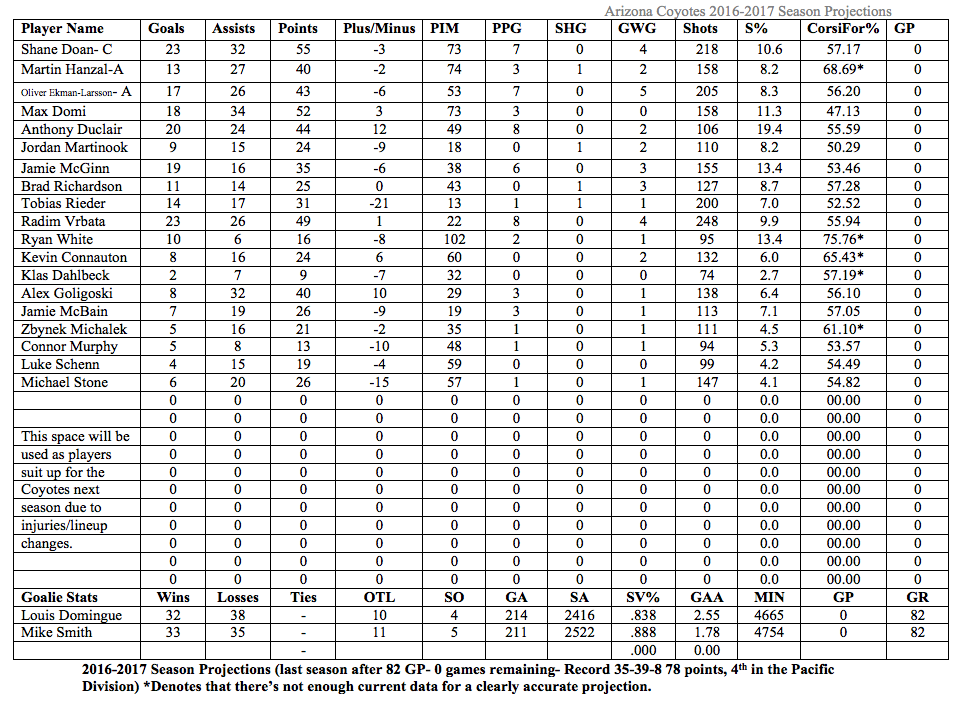
Since the Arizona Coyotes follow us on Twitter (shouts to you, Coyotes social media department), I’m going to do my best to keep track of some projections for how their players will perform next season.
And since the season’s not even here yet and I’m not quite as organized as I would like to be to formally present these numbers to you, the reader, I’m just going to leave you with a look at how things might go next season for Arizona.
But that’s not all, I’m not just leaving you with one chart for now, but two charts! One is before John Chayka was hired as the Coyotes general manager and the other incorporates all of the moves Chayka’s made since becoming Arizona’s GM.
Just by giving Chayka’s roster a quick glance it is evident that the Coyotes will be much better this season. Continuous improvement among their youth will be evident as they develop in time, but a huge thing for Arizona next season will be the addition of Alex Goligoski on the blue line.
In fact, nearly all of the defensemen that Chayka picked up for the club will have a solid impact on keeping the score close and limiting the amount of work Mike Smith and Louis Domingue have to put in on a nightly basis. Closing the gap on the scoring differential is essential to give your offense room to grow, if you’re building from the back-out.
Analytics aside, Chayka has made very tactical moves.
The Coyotes model is clear on building up their defense where necessary, while allowing their young forwards to develop. They aren’t rushing to add any young blue liners, but they did draft Jakob Chychrun, so it’s not like it’ll be too long before Arizona inserts a highly coveted, tactical, young defenseman. Besides, Anthony DeAngelo should be good enough for now, in terms of rotating some youth on the back end this year.
Needless to say, the Coyotes won’t be a number one team, but they’ll certainly be a competitive team that’ll be exciting to watch come February and March (and maybe deep into April too). And there’s a good chance a rookie or two could still surprise us all and crack the roster.
A note about my projections: For each stat, I amass the totals of every season in a player’s NHL career onto a spreadsheet in Excel and simply use the Forecast function, so some stats might not line up with one another in the projected outcome (i.e. shots and shooting percentage). Likewise, if I find something cooler than just using Excel, I’ll figure that out and make changes accordingly. For a better look at the charts, I advise that you zoom-in or click on each chart, thanks.
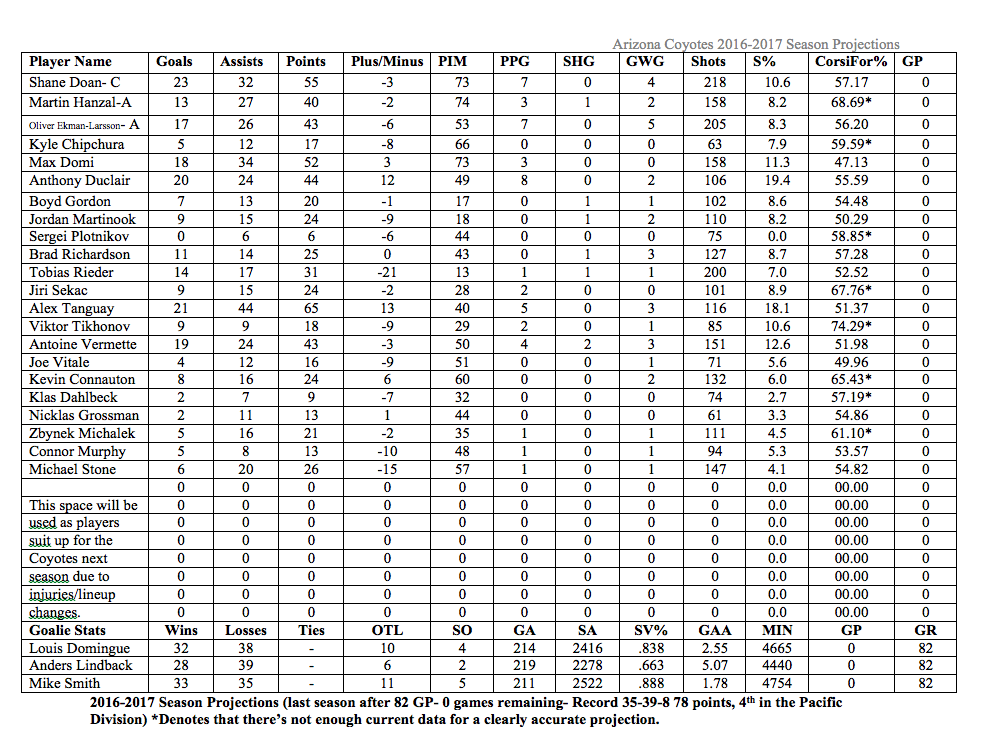
If last year’s team came back to play this year (above), it doesn’t appear they’d be much different than the current roster (below) heading into the 2016-2017 season, except for the fact that Chayka’s a genius on paper so far (contract wise, in relation to performance, that is).
By: Nick Lanciani
This post will be updated throughout the day as signings are officially announced. Be sure to check our Twitter account (@DtFrozenRiver) for all of the latest signings, news, and analysis throughout the day.
Free agency begins at noon (technically 12:01 PM ET) on July 1st. All that is known is shown and will be updated throughout the day. More analysis will come later as the day wraps up.

LW Loui Eriksson signed a 6 year, $6.000 million AAV contract with the Vancouver Canucks.
F Andrew Ladd signed a 7 year deal with the New York Islanders worth $38.5 million ($5.500 million AAV).
D Stuart Percy has signed a 1 year, two-way contract with the Pittsburgh Penguins worth $575,000 at the NHL level, $200,000 at the AHL level.
G James Reimer signed a 5 year, $3.4 million AAV contract with the Florida Panthers.
LW Milan Lucic has signed a 7 year deal with the Edmonton Oilers worth $6.000 million AAV.
D Michael Kostka signed a 1 year, two-way contract with the Ottawa Senators.
RW Colton Sceviour signed a 2 year deal with the Florida Panthers.
F Jonathan Marchessault signed a 2 year, $750,000 contract with the Florida Panthers.
G Anton Khudobin has signed a 2 year, $1.2 million contract with the Boston Bruins.
F David Perron signed a 2 year, $3.75 million contract with the St. Louis Blues.
C Frans Nielsen and the Detroit Red Wings agreed to terms on a 6 year deal worth $5.250 million AAV.
G Alex Stalock signed a 1 year deal with the Minnesota Wild.
C David Backes signed a 5 year, $6.000 million AAV contract with the Boston Bruins.
D John-Michael Liles signed a 1 year, $2.000 million contract with the Boston Bruins (re-signed).
D Brian Campbell signed a 1 year contract with the Chicago Blackhawks.
F Kyle Okposo signed a 7 year, $6.000 million AAV, contract with the Buffalo Sabres.
F Phil Varone signed a 1 year, two-way contact with the Ottawa Senators.
F Troy Brouwer signed a 4 year, $4.5 million AAV contract with the Calgary Flames.
C Eric Staal has signed a 3 year, $3.500 million AAV deal with the Minnesota Wild.
G Carter Hutton signed a 2 year, $1.125 million deal with the St. Louis Blues.
D Tom Gilbert signed a 1 year, $1.400 million deal with the Los Angeles Kings.
The Chicago Blackhawks signed F Sam Carrick and F Pierre-Cedric Larie to 1 year contracts.
F Jason Chimera signed a 2 year, $2.250 million contract with the New York Islanders.
G Chad Johnson signed a 1 year, $1.700 million deal with the Calgary Flames.
D Ben Lovejoy signed a 3 year, $2.666 million AAV deal with the New Jersey Devils.
C Casey Bailey signed a 1 year, two-way contract with the Ottawa Senators.
LW Matt Lorito signed a 2 year deal with the Detroit Red Wings.
F Chris Stewart signed a 2 year, $1.150 million AAV contract with the Minnesota Wild.
F Jamie McGinn signed a 3 year, $10 million contract with the Arizona Coyotes (worth $3.300 million AAV).
F Vernon Fiddler has signed a 1 year, $1.250 million contract with the New Jersey Devils.
D Adam Clendening signed a $600,000 contract with the New York Rangers, worth $300,000 at the AHL level.
D David Warsofsky signed a 1 year, two-way contract with the Pittsburgh Penguins.
The San Jose Sharks signed D David Schlemko to a 4 year contract worth $2.100 million AAV.
D Klas Dahlbeck signed a 1 year, $750,000 contract with the Arizona Coyotes.
F Max McCormick signed a 1 year, two-way contract with the Ottawa Senators.
F Dale Weise signed a 4 year contract with the Philadelphia Flyers worth $2.350 million AAV.
D Cameron Gaunce signed a 1 year, two-way contract with the Pittsburgh Penguins.
D Zach Trotman signed a $650,000 contract with the Los Angeles Kings.
G Jonas Gustavsson signed a 1 year contract worth $800,000 with the Edmonton Oilers.
F Viktor Stalberg signed a 1 year deal with the Carolina Hurricanes.
F Christian Thomas signed a 1 year deal with the Washington Capitals.
D Chad Ruhwedel signed a 1 year, two-way contract with the Pittsburgh Penguins.
D Jamie McBain signed a two-way contract with the Arizona Coyotes.
F Michael Chaput signed a two-way contract with the Vancouver Canucks.
G Al Montoya signed a 1 year, $950,000 deal with the Montreal Canadiens.
F Shawn Matthias signed a 2 year deal with the Winnipeg Jets worth $2.125 million AAV.
F Andy Miele signed a 1 year deal with the Philadelphia Flyers.
F Devante Smith-Pelly signed a 2 year deal with the New Jersey Devils worth $1.300 million AAV.
D Matt Irwin signed a 2 year deal with the Nashville Predators.
F Andrew Miller signed a 1 year, two-way contract with the Carolina Hurricanes.
F Alexander Radulov signed a 1 year, $5.750 million contract with the Montreal Canadiens.
The New Jersey Devils signed D Jon Merrill to a 2 year contract.
D Dan Hamhuis signed a 2 year contract with the Dallas Stars worth $3.750 million AAV.
G Jeff Zatkoff signed a 2 year, $900,000 AAV deal with the Los Angeles Kings.
The New Jersey Devils re-signed F Beau Bennett to a 1 year contract worth $725,000 (they had acquired him at the NHL Draft).
F Michael Grabner and the New York Rangers agreed to terms on a 2 year contract worth $1.600 million AAV.
The Colorado Avalanche signed D Ryan Stanton and F Turner Elson to two-way contracts.
D Zach Redmond signed a 2 year, $1.225 million contract with the Montreal Canadiens.
F Nathan Gerbe signed a deal with the New York Rangers.
F Boyd Gordon and the Philadelphia Flyers agreed to a 1 year contract, worth $950,000.
F Michael Latta signed a 1 year deal with the Los Angeles Kings.
F Andrew Agozzino signed a 1 year deal with the St. Louis Blues.
D Chad Billins signed a contract with the Vancouver Canucks.
F Lee Stempniak signed a 2 year, $2.5 million AAV contract with the Carolina Hurricanes.
The Ottawa Senators signed F Chad Nehring to a 1 year, two-way contract.
F Pat Cannone signed a 1 year, two-way contract with the Minnesota Wild.
D Patrick Wiercioch signed a 1 year, $800,000 deal with the Colorado Avalanche.
C Joe Colborne signed a 2 year, $2.500 million AAV contract with the Colorado Avalanche.
D Fedor Tyutin signed a 1 year, $2 million contract with the Colorado Avalanche.
D Ian McCoshen signed an Entry-Level Contract with the Florida Panthers.
RW Brett Connolly signed a 1 year, $850,000 contract with the Washington Capitals.
D Justin Falk signed a 1 year, $850,000 contract with the Buffalo Sabres.
F Jeremy Morin signed a 1 year, two-way, deal with the Tampa Bay Lightning.
D Mikhail Sergachev signed a 3 year Entry-Level Contract with the Montreal Canadiens.
F Quinton Howden signed a 1 year, two-way contract worth $650,000 with the Winnipeg Jets.
D Kevin Connauton signed a 2 year deal with the Arizona Coyotes.
F Patrick Eaves signed a 1 year, $1 million contract with the Dallas Stars (re-signed).
F Greg Carey signed a deal with the Philadelphia Flyers.
D Will O’Neill and the Philadelphia Flyers agreed to terms on a contract.
D Philip Larsen signed a 1 year, $1.025 million contract with the Vancouver Canucks.
F Michael Bournival signed a 1 year, two-way contract with the Tampa Bay Lightning.
F Gabriel Dumont signed a 1 year, two-way contract worth $575,000 with the Tampa Bay Lightning.
The Montreal Canadiens signed LW Daniel Carr to a 2 year contract worth $725,000 AAV.
D Mark Fraser signed a 1 year, two-way contract with the Edmonton Oilers.
F Pierre-Luc Letourneau-Leblond signed a 1 year deal with the Tampa Bay Lightning.
G Justin Peters signed a 1 year contract with the Arizona Coyotes.
F Matt Martin signed a 4 year contract with the Toronto Maple Leafs, worth $2.500 million AAV.
G Joe Cannata signed a deal with the Washington Capitals.
D Darren Dietz agreed to terms with the Washington Capitals.
F Thomas Vanek signed a 1 year, $2.600 million deal with the Detroit Red Wings.
F Ryan White signed a 1 year deal, worth $1.000 million, with the Arizona Coyotes.
F Steve Ott signed a 1 year, $800,000 contract with the Detroit Red Wings.
The Winnipeg Jets and D Brian Strait agreed to terms on a 1 year, $600,000 contract.
F Mikkel Boedker signed a 4 year contract with the San Jose Sharks.
D Victor Bartley signed a 1 year, two-way contract, worth $650,000 in the NHL/$350,000 in the AHL with the Minnesota Wild.
F Spencer Abbott signed a 1 year contract with the Chicago Blackhawks.
The Dallas Stars signed D Andrew Bodnarchuk to a 2 year contract.
D Dustin Stevenson agreed to a 1 year contract with the Dallas Stars.
F Michael Blunden signed a 2 year, two-way contract with the Ottawa Senators.
D Michael Paliotta agreed to terms with the New York Rangers.
D Karl Stollery signed a 1 year, two-way contract, worth $575,000 at the NHL level with the New Jersey Devils.
The Vancouver Canucks signed C Jayson Megna to a 1 year deal.
RW Borna Rendulic signed a 1 year, two-way contact with the Vancouver Canucks.
The Detroit Red Wings signed G Edward Pasquale to a 1 year contract.
F Chris Mueller signed a 1 year, two-way contract with the Arizona Coyotes.
F Dennis Yan signed a 3 year Entry-Level Contract with the Tampa Bay Lightning.
D Yannick Weber signed a 1 year contract with the Nashville Predators.
F Riley Nash signed a 2 year contract, worth $900,000 AAV with the Boston Bruins.
G Jeremy Smith signed a 1 year contract with the Colorado Avalanche.
The Colorado Avalanche also agreed to terms with F Jim O’Brien, F Mike Sislo and F Joe Whitney to 1 year deals.
F Reid Petryk and F Trent Vogelhuber signed 2 year deals with the Colorado Avalanche.
RW Carter Camper signed a 1 year, two-way contract, worth $575,000 at the NHL level with the New Jersey Devils.
D Andrew MacWilliam signed a 1 year, two-way deal with the New Jersey Devils, worth $575,000 at the NHL level.


Pekka Rinne saved all but one of his shots faced to lead his Predators to a Game 7 2-1 victory in Anaheim.
Colin Wilson scored the first goal of the night at the 6:19 mark on an unassisted backhander. Mattias Ekholm started the play in Nashville‘s defensive zone. After collecting the puck along the near boards, he flipped it through the neutral zone to Wilson at the far blue line. Mike Fisher entered the zone with him and split the defensemen while trying to collect a pass from Wilson, but the trio ended up skating past, leaving Wilson the opportunity to collect, advance towards the crease and score over Frederik Andersen’s glove hand.
Probably the most impressive feat of the period was actually Anaheim‘s defense, as they held the Predators off the board even through two overlapping penalties that caused a 40 second 5-on-3.
No, it continued to be the even-strength goal chances that bit the Ducks. With 4:07 remaining in the frame, Paul Gaustad scored his first goal of the playoffs after assists from Shea Weber and Viktor Arvidsson. As Anaheim was unable to score in the remainder of the frame, Nashville took a two-goal lead into the dressing room.
Arguably the strongest measure of Nashville‘s early success is the face-off dot, as they were victorious on 63% of puck drops.
The first real opportunity of the second period was for the Ducks on a delayed penalty against Roman Josi, but David Perron was unable to both corral the puck and put it past First Star of the Game Rinne. The ensuing power play only yielded three shots, including a Jamie McGinn attempt that ricocheted off the crossbar of a wide open net. Nashville actually committed three penalties during the frame, but the Ducks were not able to capitalize.
Once again, it was the Predators defense that stood tall. Through two periods, Nashville had 18 blocks to their credit to Anaheim‘s nine, meaning that Rinne had faced only 22 shots. In total, Josi had a game-leading seven blocks by the time the clock read zero.
Second Star Ryan Kesler finally got the Ducks on the board at the 1:45 on a carryover power play from the second. His slap shot was assisted by Jakob Silfverberg and Hampus Lindholm. It was a tic-tac-toe play, as Lindholm passed to Silfverberg behind the net, who immediately centered the puck into the crease for Kesler to score, but that was all the Ducks had in them as they lost 2-1.
It didn’t help that they didn’t play very aggressively. The game almost effectively ended on a delayed penalty against the Ducks, as the Predators worked the clock for almost an entire minute before the play was ruled dead. Although they put up a good fight during the remaining minute or so, Rinne continued his stellar night to secure the win.
Rinne ended the night saving 36 of 37 shots faced (97.3%), while Andersen takes the loss, saving 18 of 20 (90%).
With that win, Nashville earns a spot in the Western Conference Semifinals and a date with the San Jose Sharks. That series will begin at 10:30 p.m. eastern on Friday, April 29. Those games can be watched on NBCSN, SN or TVAS.

 Down the Frozen River
You must be logged in to post a comment.