Tag: James Reimer

  • Boston extends win streak to four games after, 3-1, victory in San Jose

    Boston extends win streak to four games after, 3-1, victory in San Jose

    Brad Marchand scored a pair of goals before Patrice Bergeron added the insurance marker as the Boston Bruins beat the San Jose Sharks, 3-1, Saturday night at SAP Center.

    Jeremy Swayman (12-7-3, 2.04 goals-against average, .926 save percentage) made 15 saves on 16 shots faced (.938 save percentage) for his fifth-straight quality start over Boston’s last seven games (Linus Ullmark tended the crease on Feb. 17th and Feb. 24th).

    Meanwhile, San Jose netminder, James Reimer (14-12-5, 2.90 goals-against average, .913 save percentage in 32 games played), stopped 34 out of 37 shots faced in the loss.

    The Bruins improved to 31-17-4 (66 points) on the season and remained in 4th place in the Atlantic Division, while surpassing the Washington Capitals for control of the first wild card berth in the Eastern Conference.

    The Sharks fell to 23-23-6 (52 points) overall and remain in 7th place in the Pacific Division– 15 points ahead of the Seattle Kraken from the basement of the division.

    Boston visited San Jose for the first time since their thrilling, 6-5, overtime victory on Feb. 18, 2019, as the pandemic cut the 2019-20 regular season short before their annual visit to SAP Center and the 2020-21 season featured temporarily realigned divisions with travel limited to within said divisions.

    The B’s have not lost in San Jose since March 15, 2016, when the Sharks beat Boston, 3-2– marking the longest string of games the Bruins have won at SAP Center since then (four games).

    Boston swept their 2021-22 regular season series against San Jose with a 2-0-0 record.

    Curtis Lazar (upper body) joined Jakub Zboril (right ACL) and Urho Vaakanainen (undisclosed) on the list of players that were out of the lineup due to injury for the Bruins Saturday night in San Jose.

    Boston’s head coach, Bruce Cassidy, told reporters on Friday that Lazar would be “day-to-day” and out of the lineup against the Sharks.

    As a result, Jesper Frödén suited up in Lazar’s place on the fourth line right wing.

    Cassidy made no other changes from Thursday night’s, 3-2, overtime victory in Seattle to Saturday night’s action in San Jose.

    Jack Ahcan and Anton Blidh served as Boston’s healthy scratches in the press box at SAP Center.

    Erik Haula caught Tomáš Hertl with a high stick and yielded the first power play of the game to the Sharks at 1:44 of the first period.

    San Jose wasn’t able to convert on the ensuing skater advantage, however, as the Bruins made the kill and Haula re-emerged from the penalty box.

    Late in the period, Haula sent a pass to Jake DeBrusk as DeBrusk entered the attacking zone with Marchand on a 2-on-1, setting up Marchand (22) for a one-timer goal to put the B’s ahead, 1-0, as a result.

    DeBrusk (9) and Haula (14) had the assists on Marchand’s first goal of the game at 14:24 of the first period.

    About a minute later, Boston botched a line change and was assessed a bench minor for too many skaters on the ice at 15:28.

    Craig Smith served the penalty and the Bruins were unscathed on the ensuing penalty kill.

    Entering the first intermission, Boston held a, 1-0, lead on the scoreboard and a, 9-5, advantage in shots on goal.

    The Bruins also held the advantage in blocked shots (10-4), while the Sharks led in takeaways (4-3), giveaways (6-2) and faceoff win percentage (63-38).

    Both teams had nine hits apiece, while San Jose was 0/3 on the power play heading into the middle frame. Boston had yet to see any action on the skater advantage.

    DeBrusk briefly exited the ice after a routine check along the boards left him with a bit of a stinger somewhere in his lower body, but he returned to action without missing a beat as the two teams got underway in the second period.

    Mario Ferraro presented the Bruins with their first power play of the night at 3:34 of the second period as the Sharks forward cut a rut to the sin bin for holding.

    San Jose killed off Ferraro’s minor and wouldn’t see him much more for the rest of the night as about midway through the action, Taylor Hall shoved Ferraro a little too far away from the puck to be assessed an interference minor, while Ferraro lost his footing and went awkwardly into the boards– bending his leg around the ankle in precisely the wrong direction that it is normally supposed to look like.

    Ferraro would not return to Saturday night’s game, while Hall went to the box at 12:03 of the second period.

    It didn’t take the Sharks long to convert on the power play as Brent Burns sent a pass across the slot to Timo Meier (24) for a one-timer goal from the left dot with eyes through Swayman into the twine.

    Burns (31) and Logan Couture (21) tallied the assists on Meier’s power-play goal as San Jose tied things up, 1-1, at 12:50 of the second period.

    A couple of minutes later, the Sharks were guilty of having too many skaters on the ice– sending Ryan Dzingel to serve the bench minor at 14:56 as a result.

    Boston failed to capitalize on the ensuing power play.

    Both teams went into the second intermission with a goal on the scoreboard– tied, 1-1, despite the Bruins dominating shots on goal, 24-9, including a, 15-4, advantage in the middle frame alone.

    The B’s held the lead in blocked shots (13-12), while the Sharks led in takeaways (7-5), giveaways (8-6) and hits (19-14).

    Both teams amassed a, 50-50, faceoff win% through two periods.

    San Jose was 1/4 on the power play, while Boston was 0/2 on the skater advantage heading into the final frame.

    Noah Gregor caught Bergeron with a high stick to kick things off at 1:12 of the third period, yielding a power play to the Bruins as a result.

    Boston nearly converted on the power play, but Gregor was freed from the box about six seconds prior to Marchand’s (23) second goal of the game– this time on a one-timer from the low left circle– below the dot and off of Reimer’s mask and into the twine.

    Hall (26) and Smith (12) tallied the assists as Marchand’s goal put the Bruins ahead, 2-1, at 3:18 of the third period.

    The two teams continued to swap chances as things got a little heated late in the third, resulting in a pair of minutes at 4-on-4 courtesy of Connor Clifton and Jeffrey Viel’s roughing minors at 15:38.

    In the final minutes of the game, San Jose whiffed at a couple of chances on a mostly empty net with Swayman in desperation– making save after save as the Sharks pressed.

    In one instance the Boston goaltender held his glove up in a last-ditch effort while sprawled out across the crease and snagged the puck out of mid-air.

    With less than a minute remaining in regulation, the Sharks didn’t even get a chance to pull Reimer for an extra attacker as the Bruins were in the offensive zone.

    Marchand sent a pass across the width of the ice to David Pastrnak before Pastrnak connected with Bergeron (14) in the bumper to give the B’s an insurance goal and a, 3-1, lead at 19:20 of the third period.

    Pastrnak (23) and Marchand (29) had the assists as the seconds ticked down to Boston’s fourth consecutive win since losing, 4-1, to the New York Islanders at UBS Arena on Feb. 17th.

    The Bruins beat the Sharks, 3-1, and finished Saturday night leading in shots on goal, 37-16, including a, 13-7, advantage in the third period alone.

    Boston left SAP Center with two points in the regular season standings and the advantage in blocked shots (17-15), as well as faceoff win% (55-45), while San Jose vacated their own ice leading in giveaways (12-8) and hits (24-20).

    The Sharks finished the night 1/4 on the power play, while the B’s went 0/3.

    Boston improved to 21-7-1 (11-3-1 on the road) when scoring first, 19-2-1 (10-1-1 on the road) when leading after one period and 7-3-0 (2-2-0 on the road) when tied after two periods this season.

    San Jose fell to 8-19-3 (5-11-1 at home) when allowing the game’s first goal, 4-18-1 (3-10-1 at home) when trailing after the first period and 7-3-3 (4-2-2 at home) when tied after the second period in 2021-22.

    The Bruins continue their six-game road trip (2-0-0) next Monday (Feb. 28th) in Los Angeles before visiting Anaheim next Tuesday (March 1st) to finish up the month of February.

    Boston kicks off March next Thursday (March 3rd) in Vegas and wraps up their road trip in Columbus next Saturday (March 5th) before returning home to host the Kings on March 7th.

  • What does Don Sweeney need to do to make it up to you by the 2022 trade deadline? (Part 1)

    What does Don Sweeney need to do to make it up to you by the 2022 trade deadline? (Part 1)

    Chapter One- In The Beginning… (2016)

    With over two months until the 2022 NHL trade deadline on March 21st, there’s plenty of time to start speculating about what kind of moves— if any— would make the most sense for the Boston Bruins in their 2021-22 endeavor.

    Though it wasn’t easy at the start of his tenure as General Manager, Don Sweeney, has significantly improved his trading prowess as the deadline approaches from season to season in Boston.

    That said, not every trade has yielded a gold mine for the Bruins and they’ve yet to win the Stanley Cup since 2011, despite making it all the way to Game 7 of the 2019 Stanley Cup Final on home ice and winning the Presidents’ Trophy the following season (2019-20).

    For the record, a lot has changed in both the league itself, as well as the team’s development since the days of acquiring guys like John-Michael Liles and Lee Stempniak on Feb. 29, 2016, instead of swinging for the fences and landing, uh, guys like Pat Maroon, Kris Russell or Mikkel Boedker at the 2016 trade deadline.

    In retrospect, maybe there really wasn’t that much of a market that season.

    Sure, Eric Staal was traded to the New York Rangers the day before the 2016 trade deadline on Feb. 28th, but he only managed to amass six points in 20 games with the Rangers down the stretch.

    Staal then joined the Minnesota Wild in free agency on July 1, 2016, and had four seasons of a career resurgence before he was traded to the Buffalo Sabres prior to the 2020-21 season— whereby he was later flipped to the Montréal Canadiens— only to end up losing in the 2021 Stanley Cup Final to the Tampa Bay Lightning in five games.

    These days he has been invited to Team Canada’s training camp for the 2022 Winter Games as he’s currently an unrestricted free agent.

    More and more recently, the bigger trades happen in the last couple of weeks leading up to the deadline itself, so let’s widen the scope a bit for 2016, just for a second.

    The Florida Panthers added Jakub Kindl from the Detroit Red Wings, Jiri Hudler from the Calgary Flames and Teddy Purcell from the Edmonton Oilers on Feb. 27th that year.

    Kindl spent parts of two seasons in Florida before leaving for Europe after the 2016-17 season, Hudler joined the Dallas Stars for 2016-17, and promptly retired thereafter, while Purcell joined the Los Angeles Kings in 2016-17, before joining the Bruins on a PTO at training camp in 2017, prior to being released then spent the 2017-18 season in the Kontinental Hockey League (KHL) and retired thereafter.

    One other team tried going for it in the rental market, as Chicago acquired Tomáš Fleischmann and Dale Weise from the Montréal Canadiens for Phillip Danault and a 2018 2nd round pick (38th overall, Alexander Romanov), added Christian Ehrhoff from Los Angeles for Rob Scuderi and dealt Marko Dano, a 2016 1st round pick (later flipped to the Philadelphia Flyers, 22nd overall—selected German Rubtsov) and a conditional 2018 3rd round pick (the condition was not met) to the Winnipeg Jets for Jay Harrison, Andrew Ladd and Matt Fraser.

    Fleischmann retired after that season, Weise left for the Philadelphia Flyers in free agency that summer, Ehrhoff went back to Europe, Harrison never suited up for Chicago, Ladd had 12 points in 19 games— then joined the New York Islanders in free agency— and Fraser also never suited up in a Chicago uniform.

    So, the rental market didn’t really pan out that year.

    The San Jose Sharks added James Reimer and Jeremy Morin from the Toronto Maple Leafs in exchange for Ben Smith, Alex Stalock and a 2018 3rd round pick (83rd overall, Riley Stotts) the same day the Panthers made all of their moves.

    Reimer went on to serve as a decent backup to Martin Jones in San Jose’s 2016 Stanley Cup Final appearance before ultimately losing in six games to the Pittsburgh Penguins.

    The Sharks also bolstered their blue line five days prior in a separate trade with Toronto on the 22nd, in which San Jose acquired Roman Polák and Nick Spaling from the Maple Leafs for Raffi Torres, a 2017 2nd round pick (later flipped to the Anaheim Ducks, 50th overall— Maxime Comtois) and a 2018 2nd round pick (52nd overall, Sean Durzi), but again, neither of those deals were earth-shattering.

    Polák was in search of a Cup ring late in his career (despite playing four more seasons afterward) and had three assists in 24 games with San Jose in the regular season before failing to put up a point in 24 Stanley Cup Playoff games as a Shark prior to rejoining Toronto via free agency that summer.

    Spaling at least had 2-4—6 totals in 24 games down the stretch with the Sharks and even recorded an assist in 24 playoff games before— like the rest of the team— losing to the Penguins in the Final and leaving the NHL for the Swiss League that summer.

    In terms of immediate impact, the Sharks got their money’s worth (kind of), but for a trio of rental players.

    San Jose’s deals might have been the biggest trades not involving the Bruins in the buildup to one of Sweeney’s most often criticized trade deadlines because first impressions mean a lot to some in the Boston fanbase.

    What was made available, however, didn’t amount to much.

    Although, there is enough credibility to the thought that the Bruins should’ve sold high on Loui Eriksson at the time when they could’ve shipped him out of the Hub at a premium before missing the playoffs for a second-straight year.

    Instead, Eriksson went on to amass 63 points (30 goals, 33 assists) in all 82 games with Boston in his first healthy season in the three years he had been there after the Tyler Seguin trade (which happened under previous General Manager, Peter Chiarelli, while Sweeney worked in a player development role)— and signed on the dotted line with the Vancouver Canucks on July 1, 2016, leaving Boston with nothing in his wake.

    This, after the Bruins (42-31-9, 93 points, 4th in the Atlantic Division) missed the 2016 Stanley Cup Playoffs by virtue of a tiebreaker with the Red Wings (41-30-11, 93 points, 3rd in the Atlantic) who had 39 regulation plus overtime wins (ROW) to Boston’s 38.

    Two teams from the Metropolitan Division— the Islanders and the Flyers— clinched the Eastern Conference wild card playoff berths with 100 and 96 points, respectively, in the standings.

    As for the biggest deal leading up to the 2016 trade deadline, you’d probably have to move the goalposts a little bit on the “within two weeks before the deadline itself” rule to find the best deal.

    But the Ottawa Senators were the beneficiary of a revival on Feb. 9, 2016, when they traded Colin Greening, Milan Michalek, Jared Cowen, Tobias Lindberg and a 2017 2nd round pick (59th overall, Eemeli Räsänen) to Toronto for Dion Phaneuf (captain of the Maple Leafs at the time), Matt Frattin, Ryan Rupert, Casey Bailey and Cody Donaghey.

    Phaneuf had a late career renaissance with the Sens and proved to be pivotal in their run to the 2017 Eastern Conference Final the following year— only to lose on the road in a Game 7 against the Penguins, 3-2, in double overtime.

    Pittsburgh, by the way, went on to repeat as Stanley Cup champions that June.

    Frattin never suited up for the Senators and left for the KHL after spending a year with the Stockton Heat (AHL) in 2016-17.

    Rupert was mired in the minors until going to Europe in 2018-19, while Bailey played in seven games for Ottawa in 2016-17, then spent time split between the American Hockey League and Europe since then (currently in the DEL).

    Donaghey, on the other hand, played in one AHL game in 2017-18, before spending the majority of his time in the ECHL prior to leaving for Europe last season (currently in the ELH).

    But Phaneuf brought his $7.000 million cap hit to the Sens and actually saved the team money since they shipped out Greening ($2.650 million), Michalek ($4.000 million) and Cowen ($3.100 million) as part of the package— adding about $2.750 million towards the cap for Toronto in the deal.

    Of course, the Leafs went on to win the 2016 Draft Lottery and selected Auston Matthews 1st overall that June, so it wasn’t all that bad.

    In 51 games with the Maple Leafs prior to the trade in the 2015-16 season, Phaneuf had 3-21—24 totals. In 20 games with Ottawa, he had 1-7—8 totals.

    The following year, he had 9-21—30 totals in 81 games and put up five points (one goal, four assists) from the blue line in 19 playoff games in 2017.

    He then had 3-13—16 totals in 53 games with Ottawa in 2017-18, before he was traded to the Los Angeles Kings in another deal that— you guessed it, saved the Senators some money (only about $1.100 million this time around).

    Phaneuf had 10 points (three goals, seven assists) in 26 games with Los Angeles and recorded an assist in the 2018 Stanley Cup Playoffs as the Kings were swept by the Vegas Golden Knights in the 2018 First Round.

    Then in 2018-19, he amassed 1-5—6 totals in 67 games and had the last two years of his contract bought out by Los Angeles on June 15, 2019.

    He didn’t officially retire until Nov. 16, 2021, and spent parts of two seasons following Brendan Shanahan around in his role as president and alternate governor of the Leafs.

    Though he wasn’t scoring 40, 50 or even 60 points as a defender like he did in his prime with the Calgary Flames, Phaneuf was still the rugged and durable veteran blue liner that he was in his short tenure from before the 2016 deadline until about his final season and injury was really the only thing that did him in at the end due to his physical style.

    He had value and the Leafs just gave him up to their intra-provincial rivals about three years before Toronto repeated themselves in giving Ottawa a better defender (Nikita Zaitsev) for a younger defender (Cody Ceci) that just didn’t really pan out as part of a larger package in a trade on July 1, 2019.

    Anyway, that last part was really just for those of you that made it this far and care about things outside of just the Bruins organization.

    We’ll move on to analyzing Sweeney’s deadline deals since 2016, in the next chapter.

  • Bruins beat Sharks in first meeting in almost two years

    Bruins beat Sharks in first meeting in almost two years

    Jake DeBrusk’s second period goal proved to be the game-winner as the Boston Bruins withstood a third period surge and held off the San Jose Sharks in a, 4-3, victory at TD Garden on Sunday afternoon.

    Linus Ullmark (2-0-0, 2.00 goals-against average, .935 save percentage in two games played) turned aside 23 out of 26 shots against in the win for the Bruins.

    Meanwhile, Adin Hill (3-1-0, 2.93 goals-against average, .890 save percentage in four games played) and James Reimer (1-0-0, 0.65 goals-against average, .980 save percentage in two games played) split the effort in the loss for the Sharks.

    Hill made 10 saves on 14 shots faced for a .714 save percentage in 25:41 time on ice before he was replaced by Reimer, who stopped all 20 shots against in relief.

    Boston improved to 3-1-0 (six points) on the season and– at the time of this writing– moved into 3rd place in the Atlantic Division, while San Jose dropped to 4-1-0 (eight points) overall and remained in command of 2nd place in the Pacific Division standings.

    The B’s also improved to 2-0-0 at home this season, as well as 25-12-5-0 all time against the Sharks in 42 regular season meetings.

    The Bruins were without the services of Curtis Lazar (upper body), Nick Foligno (upper body), Anton Blidh (upper body) and Craig Smith (undisclosed) on Sunday afternoon.

    Foligno was placed on injured reserve, while Jack Studnicka and Oskar Steen were recalled from the Providence Bruins (AHL). Veteran defender, John Moore, was assigned to Providence as a result.

    B’s head coach, Bruce Cassidy, told reporters prior to Sunday’s matinee with San Jose that Foligno and Blidh are unlikely to play in the team’s upcoming road trip on Wednesday and Thursday.

    As a result of the recent rash of injuries, Cassidy continued to tweak to his lineup, promoting Tomáš Nosek to center the second line and sliding Charlie Coyle to the right wing in place of Smith as a result.

    Cassidy inserted Steen on the third line in Nosek’s usual spot and returned Trent Frederic to the fourth line left wing with Studnicka at center and Karson Kuhlman on the right wing.

    On defense, Connor Clifton returned to his spot on the third pairing alongside Derek Forbort with Moore assigned to Providence.

    Jakub Zboril was the only healthy scratch on Sunday.

    It only took 28 seconds into the action on Sunday afternoon for David Pastrnak to work the puck to Patrice Bergeron through the trapezoid behind the net before Bergeron found Brad Marchand (4) in the high slot for a catch and release goal to give the Bruins a, 1-0, lead.

    Bergeron (2) and Pastrnak (3) notched the assists on Marchand’s goal as Boston got off to a fast start in the first period.

    Less than a few minutes later, Clifton worked the puck to Marchand, who sent the rubber biscuit along the point to Forbort (1) for a wrist shot that floated past Hill’s blocker side as a Sharks defender partially screened his own goaltender– extending Boston’s lead to two-goals in the process.

    Marchand (3) and Clifton (1) had the assists on Forbort’s first goal in a Bruins uniform and the B’s led, 2-0, at 3:18 of the first period.

    Almost midway through the opening frame, Nosek tripped up Tomáš Hertl and cut a rut to the penalty box with a minor infraction at 9:44.

    San Jose’s power play, however, could not convert on the skater advantage.

    The Sharks got another chance on the power play moments later when Charlie McAvoy caught Logan Couture with a high stick at 13:01, but once again Boston’s penalty kill stood tall as Ullmark kept the puck out of the back of the net.

    Shortly after killing off McAvoy’s minor, Brent Burns knocked down Taylor Hall away from the puck and was assessed and interference minor at 15:59– presenting the Bruins with their first power play of the afternoon as a result.

    It didn’t take long for Boston to capitalize on the ensuing skater advantage as Bergeron rang a shot off the crossbar before setting up Pastrnak (2) for one of his trademark one-timer power-play goals from the faceoff circle– right above the dot– to give the Bruins a three-goal lead.

    Bergeron (3) had the only assist on Pastrnak’s goal as the B’s extended their lead, 3-0, at 16:12 of the first period.

    Less than a minute later, however, San Jose got on the scoreboard with a quick break into the attacking zone and a little bit of a give-and-go that resulted in a short side goal for Jasper Weatherby (2) to cut Boston’s lead back to two-goals.

    Jonah Gadjovich (1) and Andrew Cogliano (2) tabbed the assists on Weatherby’s goal at 16:44. With the primary assist, Gadjovich recorded his first career National Hockey League point in his second career game (Gadjovich made his season debut with the Sharks on Sunday and appeared in one game last season for the Vancouver Canucks).

    After one period of action, the Bruins led the Sharks, 3-1, on the scoreboard despite both teams amassing 11 shots on goal each.

    Boston also held the advantage in blocked shots (10-2), while San Jose led the way in takeaways (3-1), giveaways (4-3), hits (13-7) and faceoff win percentage (58-42).

    The Sharks were 0/2 and the Bruins were 1/1 on the power play heading into the first intermission.

    Early in the middle frame, Forbort sent Steen up through the neutral zone on a rush with DeBrusk before Steen bounced an indirect pass to DeBrusk off the boards.

    DeBrusk (2) entered the attacking zone and wired a shot over Hill’s glove to put Boston ahead by three goals once more, 4-1, at 5:41 of the second period.

    Steen (1) and Forbort (1) recorded the assists, marking the first career NHL point for Steen and the first assist as a Bruin for Forbort in the process.

    Sharks head coach, Bob Boughner, replaced Hill with Reimer as a result of DeBrusk’s goal and tried to spur momentum in San Jose’s favor as a result of the goalie change.

    Late in the period, Nick Bonino and Clifton exchanged pleasantries in a post-whistle scrum that resulted in minor penalties for roughing for each player as well as an addition two minutes for slashing for Bonino at 17:29.

    As a result, the Bruins finished off most of the rest of the second period on the power play, though they couldn’t muster anything past Reimer as the second intermission commenced.

    Through 40 minutes of action, the B’s led, 4-1, on the scoreboard and, 22-16, in shots on goal, including an, 11-5, advantage in the second period alone.

    Boston also held the advantage in blocked shots (12-6), while San Jose led in takeaways (8-5), giveaways (10-5), hits (20-13) and faceoff win% (53-48).

    The Sharks were still 0/2 on the power play, while the Bruins dropped to 1/2 on the skater advantage heading into the final frame.

    With tensions rising as the second period came to an end, Frederic and Jacob Middleton kicked things off in the third period with five-minute majors for fighting at 3:02 of the final frame in the first fight of the 2021-22 calendar for Boston.

    Less than a couple of minutes later, Mario Ferraro took an interference penalty at 5:48 of the third period, but the Bruins weren’t able to capitalize on the final power play of the afternoon.

    Midway through the third, the Sharks scored a pair of quick goals as Hertl (2) deflected a shot from Marc-Edouard Vlasic at the point amidst net front traffic to pull San Jose back to within two goals, 4-2, at 13:19.

    Vlasic (2) and Alexander Barabanov (1) tallied the assists on Hertl’s goal.

    Minutes later, Timo Meier (3) redirected a shot from Couture from outside the slot to bring the Sharks to a one-goal deficit, 4-3, at 15:08 of the third period.

    Couture (5) and Burns (4) had the assists on Meier’s goal which was reviewed for a high stick, but determined to be a good goal– the call on the ice was confirmed.

    Boston’s lead had shrunk to a close, 4-3, game in the dying minutes of Sunday’s action.

    Boughner pulled Reimer for an extra attacker with 1:45 remaining in the game and used his timeout with 1:02 left on the clock after a stoppage, but it wasn’t enough to rally his team to force overtime (at least) as the Bruins managed to hold off San Jose’s comeback.

    At the final horn, Boston had won, 4-3, and finished the afternoon leading in shots on goal, 34-26, including a, 12-10, advantage in the third period alone.

    The Bruins finished the afternoon leading in blocked shots (14-6) and faceoff win% (52-48), while the Sharks exited TD Garden with the advantage in giveaways (16-7) and hits (25-23).

    San Jose went 0/2 on the power play, while Boston went 1/3 on the skater advantage on Sunday.

    The B’s improved to 3-0-0 (2-0-0 at home) when scoring the game’s first goal, 3-0-0 (2-0-0 at home) when leading after the first period and 2-0-0 (1-0-0 at home) when leading after two periods this season.

    The Sharks dropped to 2-1-0 (1-1-0 on the road) when allowing the game’s first goal, 2-1-0 (1-1-0 on the road) when trailing after one period and 0-1-0 (0-1-0 on the road) when trailing after the second period in 2021-22 as a result of the loss.

    The Bruins hit the road for a pair of games against the Florida Panthers and Carolina Hurricanes at FLA Live Arena on Wednesday and PNC Arena on Thursday, respectively, before returning home to finish the month of October against the Panthers on Saturday (Oct. 30th).

  • Carolina Hurricanes 2021-22 Season Preview

    Carolina Hurricanes 2021-22 Season Preview

    2020-21 record 36-12-8, 80 points

    1st in the Discover NHL Central Division

    Eliminated in the Second Round by Tampa

    Additions: F Jesperi Kotkaniemi (signed to an offersheet, not matched by MTL), F Josh Leivo, F Maxim Letunov, F Sam Miletic, F Stefan Noesen, F Andrew Poturalski, F C.J. Smith, F Derek Stepan, D Ethan Bear (acquired from EDM), D Ian Cole, D Jalen Chatfield, D Tony DeAngelo, D Eric Gelinas, D Josh Jacobs, D Brendan Smith, G Frederik Andersen, G Alex Lyon, G Antti Raanta

    Subtractions: F Warren Foegele (traded to EDM), F Morgan Geekie (expansion, SEA), F Dave Gust (signed with Chicago Wolves, AHL), F Egor Korshkov (KHL), F Saku Maenalanen (Liiga), F Brock McGinn (signed with PIT), F Cedric Paquette (signed with MTL), F Sheldon Rempal (signed with VAN), D Jake Bean (traded to CBJ), D Jani Hakanpää (signed with DAL), D Dougie Hamilton (signed with NJD), D Rolan McKeown (signed with COL), D Joakim Ryan (SHL), D David Warsofsky (DEL), G Jonathan Bernier (rights acquired from DET, signed with NJD), G Petr Mrázek (signed with TOR), G Alex Nedeljkovic (traded to DET), G James Reimer (signed with SJS)

    Still Unsigned: F Max McCormick, F Drew Shore, G Jeremy Helvig, G Dylan Wells (acquired from EDM, CAR reserve list, AHL- Chicago Wolves)

    Re-signed: F Jordan Martinook, F Spencer Smallman, F Andrei Svechnikov, D Maxime Lajoie

    Offseason Analysis: Whoa boy, what didn’t the Canes do this offseason?

    Carolina was all over the place– both in transactions and scrambling to assemble some semblance of a message in press conferences afterward while trying to convince everyone (perhaps more so themselves, at times) that they’re still a competitive team heading in the right direction and that they totally didn’t overreact.

    Unlike how the New York Rangers reacted to one player on another team apparently dismantling their franchise, the Hurricanes reacted to– egad! The salary cap! The horror, the horror!

    Canes General Manager, Don Waddell, didn’t like the optics of a team that’s been improving in each of the last three seasons despite First Round exits in back-to-back years after making the 2019 Eastern Conference Final.

    Though owner, Tom Dundon, denies having any say in the approach to the offseason short of just signing the cheques, Carolina didn’t want to spend more than they absolutely had to on fielding a roster that can probably make the playoffs, generate some additional revenue and peter out before anyone catches Stanley Cup fever.

    At the very least, the team is spending more than when Peter Karmanos, Jr. spent from season-to-season on a team that made the postseason in 2009, then again in 2019, with nothing happening in-between, for example.

    The team didn’t have to lose both Dougie Hamilton and Alex Nedeljkovic while re-signing Andrei Svechnikov this offseason, but they did.

    Hamilton received a low-ball offer and got what he felt he deserved on a seven-year deal with the New Jersey Devils worth $9.000 million per season. Compared to the rest of the defenders on the market and other extensions that begin in 2022-23 for Seth Jones with Chicago and Zach Werenski in Columbus, Hamilton’s deal with the Devils is a steal.

    He could’ve made $10.000 or $11.000 million per season and you might say “what’s the difference of a couple million dollars” and well, everything in the sense that he’s saved New Jersey a couple million to spend on glue guys on the roster, like Tomas Tatar.

    Carolina could’ve done that, but with a few more additional steps required to make space.

    Fine, move on from Hamilton, then re-sign Nedeljkovic– oh.

    The Hurricanes were not willing to spend $3.500 million per season on a two-year deal for the goaltender they drafted and brought up the ranks as their “goaltender of the future”.

    Instead, Waddell traded him to the Detroit Red Wings for the rights to unrestricted free agent, Jonathan Bernier, who also joined Hamilton in New Jersey.

    Petr Mrázek and James Reimer were both turned loose as the former went to the Toronto Maple Leafs and the latter joined the San Jose Sharks.

    Waddell then signed Frederik Andersen– who’s had about as much playoff success as Nedeljkovic, regardless of the number of games played– to a two-year deal worth $4.500 million per season and Antti Raanta to a two-year contract worth $2.000 million per season.

    Make it make sense.

    Add to that, Carolina lost depth in the departure of Brock McGinn to the Pittsburgh Penguins via free agency and traded Jake Bean to the Columbus Blue Jackets at the draft.

    In their place, enter a mixture of bottom-six talent in Derek Stepan, Josh Leivo and others, as well as bottom-six defenders in Tony DeAngelo and Brendan Smith.

    At the very least, Carolina’s not spending much to “replace” what they’ve lost in an asset for asset sense.

    They spent their money on goaltenders, an eight-year extension worth $7.750 million per season for Svechnikov and signed Jesperi Kotkaniemi to an offer sheet from the Montréal Canadiens for one-year at $6.100 million.

    That makes up for signing DeAngelo to a one-year, $1.000 million contract, right?

    Not even close.

    Last year’s roster carried the threat of Hamilton, Jaccob Slavin, Brett Pesce, Brady Skjei, Bean and Haydn Fleury until he was traded for Jani Hakanpää at the 2021 deadline.

    Only three defenders are returning to Carolina’s core on the blue line as Ian Cole, DeAngelo and Smith were brought in via free agency and Warren Foegele was dealt for Ethan Bear.

    Oh and the same three defenders returning from last season are the only defenders under contract through next season.

    There’s just no logic for whatever reaction– overreaction or, perhaps, under-reaction is going on here.

    It begs the question that Canes fans have heard for far too long, “what, exactly, is the plan?”

    Offseason Grade: D

    The Hurricanes had a challenging, yet simple premise heading into the offseason– add without subtracting and limit the inevitable damage in the loss of a key player.

    Instead, they chose violence (that’s a phrase kids say on Twitter these days, I’m told).

    Keeping Svechnikov, Hamilton and Nedeljkovic satisfied was going to be a challenge and it was going to be the most strenuous negotiations that Waddell would have to go through in recent summers as Carolina continues building towards Stanley Cup contenders.

    It’s likely that the Canes could’ve kept Svechnikov, Nedeljkovic and still added to the roster this offseason– whether they’d land Andersen, Raanta or someone else as a solid counterpart in the crease.

    In any case, Hamilton was likely going to walk due to the constraints of the salary cap era and possible looming extensions for Martin Necas, Nino Niederreiter, Vincent Trocheck, Jordan Staal, Teuvo Teräväinen and Sebastian Aho in one-to-three summers from now.

    After the marketing and promotions team led the way in showing the rest of the league how Pride Night could feel more like a celebration for the local fan base and not just a corporate shill– an organization that took the pledge to Get Uncomfortable by teaming up with Black Girl Hockey Club– the values of a kinder society were tossed aside in the interest of signing noted actual jerks.

    This team did not get better. No matter the rehabilitation that may or may not occur with Rod Brind’Amour as head coach.

    One step forward, two steps back.

  • San Jose Sharks 2021-22 Season Preview

    San Jose Sharks 2021-22 Season Preview

    2020-21 record 21-28-7, 49 points

    7th in the Honda NHL West Division

    Missed the postseason for the second-straight year

    Additions: F Nick Bonino, F Andrew Cogliano, F Nick Merkley (acquired from NJD), F Lane Pederson, D Jaycob Megna, G Adin Hill (acquired from ARI), G James Reimer

    Subtractions: F Kurtis Gabriel (signed with TOR), F Fredrik Händemark (KHL), F Maxim Letunov (signed with CAR), F Marcus Sörensen (SHL), F Alex True (expansion, SEA), D Christian Jaros (traded to NJD), D Greg Pateryn (signed with ANA), G Martin Jones (buyout), G Josef Korenar (traded to ARI)

    Still Unsigned: F Ryan Donato, F Noah Gregor (RFA), F Patrick Marleau

    Re-signed: F Rüdolfs Balcers, F Joachim Blichfeld, F Jonathan Dahlén, F Dylan Gambrell, F Matt Nieto, F Jeffrey Viel, D Nicolas Meloche

    Offseason Analysis: The Sharks have been quiet– too quiet– this offseason for a team that proclaims they’re “definitely not rebuilding” and “totally going to be back in the playoffs in 2022”.

    Whether you buy into the speculation that Tomas Hertl is going to be shopped by the team or not, there is some uneasiness in the dressing room as Evander Kane’s bankruptcy court ongoings continue to unfurl in public amidst separation from his wife while San Jose is tight against the salary cap with about $3.361 million in cap space heading into the 2021-22 season.

    Erik Karlsson’s made it known that he doesn’t want to experience another rebuild in his career– having been dealt to the Sharks originally as a casualty of the Ottawa Senators’ demise and subsequent retool/rebuild.

    It’s not hard to feel empathy for the precarious position that Doug Wilson is in as General Manager, though it’s through much of his own doing.

    For starters, Karlsson carries an $11.500 million cap hit through the 2026-27 season, which contributed to Joe Pavelski leaving for the Dallas Stars via free agency on July 1, 2019, and with it San Jose’s character amongst the Sharks’ leadership core.

    Kane carries a $7.000 million cap hit through 2024-25, though he may reach a termination agreement at any point in time with San Jose to restructure his debt and may or may not end up signing for much less as a result with the Sharks if he isn’t forced to take a step back from hockey to focus on that whole debt thing that keeps getting mentioned.

    Seriously, we’re hoping for the best here.

    Forced to make minor moves due to a stagnant salary cap, Wilson signed Matt Nieto to a two-year extension worth $850,000 per season and continued to fill out his middle of the lineup/bottom-six forwards with Andrew Cogliano and Nick Bonino via free agency.

    Cogliano received a one-year, $1.000 million deal, while Bonino earned a two-year contract that carries a $2.050 million cap hit.

    Nieto recorded three consecutive seasons of 20 or more points with the Colorado Avalanche from 2017-18 through 2019-20 as he experienced a career resurgence as a bottom-six forward, prior to amassing 5-2–7 totals in 28 games last season with San Jose before a lower body injury cut his 2020-21 season short.

    After spending the last few seasons in Dallas, Cogliano left the Stars for the Sharks in free agency after managing 11 points (five goals, six assists) in 54 games last season.

    At this point, the 34-year-old center is just trying to hold onto what is likely the twilight of his career and looking for a way to either spice up his remaining playing days and extend his tenure in the league or find a way to be moved by the trade deadline to a Cup contender as the 14-year NHL veteran has only been to one Stanley Cup Final in his career thus far– losing in six games with Dallas to the Tampa Bay Lightning in 2020.

    Bonino, on the other hand, brings some Cup winning experience to San Jose’s dressing room as the 33-year-old center won his first of two Cup rings with the Pittsburgh Penguins in six games against the Sharks in the 2016 Stanley Cup Final.

    After winning back-to-back Cups in 2016 and 2017, with Pittsburgh, Bonino made his way to the Nashville Predators and, most recently, the Minnesota Wild, where he had 10-16–26 totals in 55 games while the Wild rose to prominence and endured a seven-game First Round series loss to the Vegas Golden Knights in the 2021 Stanley Cup Playoffs.

    Bonino may be at the point where he bounces around the league every other season or so, but he’s shown that he can still prove to be a valuable piece down the middle as a glue guy, which is welcome news for San Jose as they look for Logan Couture and Hertl to remain steady as a 1-2 punch at center on the first and second lines.

    Drafting William Eklund 7th overall in the 2021 NHL Draft, then signing him to a three-year entry-level contract was another quality move made by Wilson in the ongoing restructuring of the organization’s depth and future foundation.

    Ranked as the No. 1 European skater by NHL Central Scouting, Eklund fell to the Sharks in the draft and could end up playing this season for San Jose. Sure it might be throwing him to the fire a bit early, but if he’s as good as he looked with Djurgårdens IF, then it’s worth it to spur the *ahem* rebuild in San Jose as he managed to have 11-12–23 totals in 40 games in the SHL last season.

    But the biggest change this offseason for the Sharks comes in the crease, where San Jose has bought out Martin Jones– freeing themselves from his 15-13-4 record in 34 games last season, with a 3.28 goals-against average, an .896 save percentage and one shutout in that span– and traded for Adin Hill before signing Hill to an extension and landing James Reimer in free agency.

    Jones will carry a $1.917 million buyout penalty on San Jose’s cap through the 2026-27 season, but at least he’s the Philadelphia Flyers’ reclamation project now.

    In the meantime, Hill was acquired in exchange for Josef Korenar and a 2022 2nd round pick back on July 17th.

    The 25-year-old former Arizona Coyotes goaltender was given a two-year extension worth $2.175 million per season and went 9-9-1 in 19 games last season, recording a 2.74 goals-against average, a .913 save percentage and two shutouts in that span.

    It’s important to note that he had a 2.62 goals-against average and a .918 save percentage in 13 games in 2019-20 with the Coyotes and has shown that, perhaps, in a better defensive situation, he just might improve.

    Meanwhile, Reimer reunites with the Sharks for the first time since San Jose’s 2016 Stanley Cup Final appearance as he was acquired by the team on Feb. 28, 2016, with Jeremy Morin for a 2018 3rd round pick, Ben Smith and Alex Stalock in return to the Toronto Maple Leafs back in the day.

    Since then, Reimer had a stop with the Florida Panthers and, most recently, with the Carolina Hurricanes as a tandem duo with Petr Mrazek.

    The 33-year-old goaltender might have an edge going into the season over Hill as Reimer managed to record a 15-5-2 record in 22 games last season for Carolina and had a 2.66 goals-against average, as well as a .906 save percentage in that span.

    He signed a two-year deal worth $2.250 million per season with the Sharks on July 28th.

    In both cases, it’s a low-risk, high-reward move that Wilson can defend simply as a placeholder if it all goes south while searching for a long-term solution in net.

    Offseason Grade: C-

    It’s time for the Sharks to make some serious roster decisions in a proactive manner instead of forcing their own hands tied and reacting to the alarming situation that may only worsen as the team desperately tries to avoid using the term “rebuild”.

    San Jose’s unprecedented success in the regular season throughout the 2000s and 2010s meant that the team never really had to rely on the uncertainty of going through growing pains and struggles, but for the first time since franchise’s infancy it appears that it’s inevitable once more.

    Whether removing Wilson is something to be done sooner rather than later or not hinges upon whether or not Sharks ownership is informed of a solidified plan.

    There cannot be any wavering any longer for a team that, sure, finished ahead of the Anaheim Ducks last season, but is expected to bottom out in the Pacific Division by virtually every expert and analyst on paper going into 2021-22– and that’s even with the uncertain nature of the expansion, Seattle Kraken, to consider.

    San Jose is close to getting a “D+”, but cutting their losses and buying out Jones now brings them up to a “C-“.

  • 2021 NHL Free Agency Signings Quick Recap

    2021 NHL Free Agency Signings Quick Recap

    This post will be updated as signings are officially announced. Be sure to check our Twitter account (@DtFrozenRiver) for all of the latest signings, news, and analysis.

    Free agency begins at noon (technically 12:01 PM ET) on July 28th.

    For the second-straight year, the ongoing COVID-19 pandemic has shifted the schedule a bit for the National Hockey League, but after the free agency signing period opens to kickoff the 2021-22 league calendar year, things will be back on track for a full 82-game schedule (albeit about a week later than usual).

    All that is known is shown and will be updated throughout the day. More analysis will come as we play catch-up.

    ESPN+ is streaming TSN’s coverage of free agency from 11 a.m. ET onward and NHL Network has the Sportsnet/their own feed, probably (we like the former, in all partiality).

    Reported free agent signings

    These are reported agreements in place that are yet to be confirmed and/or announced by a playing club.

    F Kyle Palmieri has likely re-signed with the New York Islanders.

    Announced free agent signings

    These are confirmed/announced signings by playing clubs.

    F Carter Verhaeghe signed a three-year extension worth about $4.167 million per season with the Florida Panthers that goes into effect starting with the 2022-23 season.

    The Edmonton Oilers re-signed D Tyson Barrie to a three-year contract worth $4.500 million per season.

    The Vegas Golden Knights signed D Alec Martinez to a three-year extension worth $5.250 million per season.

    The Carolina Hurricanes signed G Frederik Andersen to a two-year deal worth $4.500 million per season.

    G Petr Mrazek signed a three-year deal with the Toronto Maple Leafs worth $3.800 million per season.

    F Nick Bonino agreed to a two-year contract with the San Jose Sharks.

    F Brandon Sutter signed a one-year extension worth $1.125 million with the Vancouver Canucks.

    G Antti Raanta reportedly signed a two-year deal worth $2.000 million per season with the Carolina Hurricanes.

    The Los Angeles Kings re-signed F Andreas Athanasiou to a one-year deal worth $2.700 million.

    D Dougie Hamilton signed a seven-year contract worth $9.000 million per season with the New Jersey Devils.

    F Blake Coleman signed a six-year deal worth $4.900 million per season with the Calgary Flames.

    The Montréal Canadiens signed D David Savard to a four-year contract worth $3.500 million per season.

    G Brian Elliott signed a deal with the Tampa Bay Lightning.

    D Tucker Poolman agreed to a four-year contract worth $2.500 million per season with the Vancouver Canucks.

    The Dallas Stars signed F Luke Glendening to a two-year deal worth $1.500 million per season.

    D Andreas Borgman signed a one-year, two-way deal worth $750,000 at the NHL level with the Dallas Stars.

    D Travis Hamonic signed a two-year extension worth $3.000 million per season with the Vancouver Canucks.

    F Dominik Simon signed a one-year, two-way contract extension with the Pittsburgh Penguins.

    F Charles Hudon signed a deal with the Tampa Bay Lightning.

    D Zach Bogosian signed a three-year contract worth $850,000 per season with the Tampa Bay Lightning.

    The San Jose Sharks signed F Andrew Cogliano to a one-year contract worth $1.000 million.

    The Montréal Canadiens signed F Cedric Paquette to a one-year contract worth $950,000.

    D Brady Keeper signed a two-year deal worth $762,500 per season with the Vancouver Canucks.

    The Vegas Golden Knights signed G Laurent Brossoit to a two-year deal worth $2.325 million per season.

    F Jean-Sébastien Dea signed a one-year deal worth $750,000 with the Montréal Canadiens.

    The San Jose Sharks signed G James Reimer to a two-year deal worth $4.500 million per season.

    F Michael Bunting signed a two-year deal worth $900,000 with the Toronto Maple Leafs.

    D Patrik Nemeth signed a three-year contract worth $2.500 million per season with the New York Rangers.

    F Maxim Mamin signed a one-year deal worth $975,000 with the Florida Panthers.

    D Louis Belpedio signed a one-year, two-way contract worth $750,000 with the Montréal Canadiens.

    The Vancouver Canucks signed F Danila Klimovich to a three-year entry-level contract worth $886,667 per season.

    The Dallas Stars signed D Alex Petrovic to a one-year, two-way contract.

    F Michael Amadio signed a one-year, two-way deal worth $750,000 at the NHL level with the Toronto Maple Leafs.

    The Vancouver Canucks signed D Luke Schenn to a two-year contract worth $850,000 per season.

    F Josh Leivo has signed a deal with the Carolina Hurricanes.

    The Carolina Hurricanes signed D Ian Cole to a one-year, $2.900 million deal.

    F Nic Petan signed a one-year, two-way deal worth $750,000 at the NHL level with the Vancouver Canucks.

    D Jake McCabe signed a four-year contract with Chicago worth $4.000 million per season.

    The Detroit Red Wings signed D Jordan Oesterle to a two-year deal worth $1.350 million per season.

    F Andrew Agozzino signed a two-way contract with the Ottawa Senators.

    D Adam Clendening signed a two-way deal with the Philadelphia Flyers.

    D Ryan Murphy signed a two-way contract with the Detroit Red Wings.

    The Los Angeles Kings have signed D Alex Edler to a one-year contract worth $3.500 million per season.

    The Boston Bruins signed F Erik Haula to a two-year deal worth $2.375 million per season.

    F Tomas Nosek signed a two-year contract worth $3.500 million per season with the Boston Bruins.

    F Phil Di Giuseppe signed a two-way contract worth $750,000 at the NHL level with the Vancouver Canucks.

    The Tampa Bay Lightning signed F Pierre-Edouard Bellemare to a two-year contract worth $1.000 million per season.

    F Matt Luff signed a one-year, two-way, $750,000 deal with the Nashville Predators.

    F Jon Lizotte signed a one-year, two-way, contract worth $750,000 at the NHL level with the Minnesota Wild.

    F Ryan Getzlaf agreed to a one-year extension with the Anaheim Ducks worth $4.500 million.

    F Ryan Dzingel signed a one-year, $1.100 million deal with the Arizona Coyotes.

    D Matt Tennyson signed a two-year, two-way contract with the Nashville Predators.

    F Mattias Janmark reached an agreement on an extension with the Vegas Golden Knights.

    F Josh Ho-Sang signed a PTO with the Toronto Maple Leafs.

    F Mike Hoffman signed a three-year deal with the Montréal Canadiens worth $4.500 million per season.

    G Linus Ullmark signed a four-year deal worth $5.000 million per season with the Boston Bruins.

    G Garret Sparks reached an agreement on a one-year, two-way contract with the Los Angeles Kings worth $750,000 at the NHL level.

    F Sam Gagner agreed to an extension with the Detroit Red Wings.

    The Red Wings also agreed to an extension with G Calvin Pickard.

    D Ryan Suter signed a four-year deal worth $3.650 million per season with the Dallas Stars.

    The Columbus Blue Jackets signed F Boone Jenner to a four-year extension.

    The Pittsburgh Penguins signed F Evan Rodrigues to a one-year extension worth $1.000 million.

    F Patrik Laine signed his qualifying offer with the Columbus Blue Jackets and will make $7.500 million on a one-year deal as a result.

    F Eric Robinson agreed to terms on a two-year extension worth $3.200 million with the Columbus Blue Jackets.

    The Philadelphia Flyers signed D Keith Yandle to a one-year deal worth $900,000.

    D Alex Goligoski signed a one-year deal worth $5.000 million with the Minnesota Wild.

    G Braden Holtby signed a one-year contract worth $2.000 million with the Dallas Stars.

    The Minnesota Wild signed F Frederick Gaudreau to a two-year deal worth $1.200 million per season.

    D Jarred Tinordi signed a two-year deal worth $900,000 per season with the New York Rangers.

    F Justin Bailey signed a one-year, two-way contract extension with the Vancouver Canucks.

    The Vegas Golden Knights signed F Sven Baertschi to a one-year, two-way, contract worth $750,000 at the NHL level.

    The Tampa Bay Lightning signed F Gabriel Dumont, D Darren Raddysh, D Andrej Sustr and G Maxime Lagacé to one-year, two-way contracts.

    F Gage Quinney signed a one-year, two-way contract extension with the Vegas Golden Knights.

    The Ottawa Senators signed D Michael Del Zotto to a two-year contract worth $2.000 million per season.

    Chicago signed F Jujhar Khaira to a two-year deal worth $975,000 per season.

    F Alexander Wennberg agreed to a three-year deal worth $4.500 million per season with the Seattle Kraken.

    The Nashville Predators signed F Anthony Richard to a one-year, two-way contract worth $750,000 at the NHL level.

    F Phillip Danault signed a six-year contract worth $5.500 million per season with the Los Angeles Kings.

    The Seattle Kraken reached an agreement with F Jaden Schwartz on a five-year deal worth $5.500 million per season.

    F Michael McCarron signed a two-year, two-way contract worth $750,000 at the NHL level with the Nashville Predators.

    G Martin Jones signed a one-year, $2.000 million contract with the Philadelphia Flyers.

    F Nate Thompson signed a one-year, $800,000 contract with the Philadelphia Flyers.

    G Philipp Grubauer is signed a six-year deal worth $5.900 million per season with the Seattle Kraken.

    F Greg McKegg signed a one-year, two-way contract worth $750,000 at the NHL level with the New York Rangers.

    F Dryden Hunt signed a two-year deal with the New York Rangers.

    The Florida Panthers signed D Brandon Montour to a three-year contract worth $3.500 million per season.

    D Chris Wideman signed a one-year deal worth $750,000 with the Montréal Canadiens.

    The Columbus Blue Jackets signed F Sean Kuraly to a four-year contract worth $2.500 million per season.

    The San Jose Sharks signed F Lane Pederson to a two-year contract worth $750,000 per season.

    D Tony DeAngelo signed a one-year contract with the Carolina Hurricanes worth $1.000 million.

    D Gavin Bayreuther signed a two-year, two-way contract with the Columbus Blue Jackets.

    The Edmonton Oilers signed D Cody Ceci to a four-year deal worth $3.250 million per season.

    F Kurtis Gabriel signed a one-year, $750,000 contract with the Toronto Maple Leafs.

    F Zachary L’Heureux signed a three-year, entry-level deal with the Nashville Predators.

    The Toronto Maple Leafs signed F David Kampf to a two-year contract worth $1.500 million per season.

    The Pittsburgh Penguins signed F Brock McGinn to a four-year contract worth $2.750 million per season.

    The Arizona Coyotes signed F Dmitrij Jaškin to a one-year contract.

    The Carolina Hurricanes re-signed F Jordan Martinook to a three-year contract worth $1.800 million per season.

    F Juho Lammikko signed a one-year extension with the Florida Panthers.

    G Jonathan Bernier signed a two-year deal worth $4.125 million per season with the New Jersey Devils.

    The Buffalo Sabres signed F Vinnie Hinostroza to a one-year contract worth $1.050 million.

    F Zach Hyman reached an agreement with the Edmonton Oilers on a seven-year contract worth $5.500 million per season.

    G Filip Lindberg signed a two-year entry-level contract with the Pittsburgh Penguins.

    F Brayden Point signed an eight-year extension worth $9.500 million per season with the Tampa Bay Lightning that goes into effect starting with the 2022-23 season.

    The Boston Bruins agreed to a three-year deal with D Derek Forbort worth $3.000 million per season.

    The Boston Bruins signed F Nick Foligno to a two-year deal.

    G David Rittich agreed to a one-year deal worth $1.250 million with the Nashville Predators.

    G Carter Hutton signed a one-year deal worth $750,000 with the Arizona Coyotes.

    The Colorado Avalanche signed D Roland McKeown to a one-year contract.

    The Columbus Blue Jackets signed F Alexandre Texier to a two-year contract extension worth $3.050 million.

    F C.J. Smith signed a one-year, two-way contract worth $750,000 at the NHL level with the Carolina Hurricanes.

    G Chris Gibson signed a one-year, two-way contract with the Florida Panthers.

    The Detroit Red Wings signed F Pius Suter to a two-year contract.

    D Brandon Davidson signed a one-year contract extension worth $750,000 with the Buffalo Sabres.

    The Nashville Predators re-signed F Mikael Granlund to a four-year contract worth $5.000 million per season.

    The Calgary Flames signed F Trevor Lewis to a one-year deal worth $800,000.

    G Jaroslav Halak agreed to a one-year deal worth $1.500 million with the Vancouver Canucks.

  • Boston Bruins 2020-21 Forecast Through 40 Games

    Boston Bruins 2020-21 Forecast Through 40 Games

    “The stretch” is here. No, not the 7th inning stretch. It’s the Push for the Playoffs™️ as the NHL on NBC broadcasts will tell you.

    Sure, the Boston Bruins have played 43 games and this forecast is already a little behind, but this time of year is loaded with things to do, stats to track and storylines to follow.

    At least it’s not as far behind as other forecasts I still owe.

    Everything that you’re about to see is done by hand. Kind of.

    Sure, it all started in Microsoft Excel then migrated over to a GoogleDoc one day, but the premise is the same– I have no idea what I am doing.

    My degree is in communication and my minor was in sport management. As part of my “Gen Ed” requirement to graduate, I got a “C” in Intro to Stats. Later, one of my sport management professors taught me how to use the “forecast” function in Excel (shouts Dr. Lyons).

    It’s been four years since being told to step out of line and wait off to the side while my school searched high and low to find my diploma only to realize that it had been on the table in front of them the whole time (yes, this is a true story– my roommate even called me wondering where the hell I was for pictures with everyone).

    The rest is history. Let’s get to talking about Boston’s forecast through 40 games, shall we?

    First year players are hard to predict (if not impossible altogether) until they’ve had some experience in the National Hockey League under their belts. At least a game will make do, though their numbers will look a tad inflated until more time goes by and reality sets in.

    That’s just a blanket statement that usually comes with an example– like Zach Senyshyn in recent years– though after 40 team games in a 56-game regular season schedule, there’s not enough data (this season, forecasted or otherwise) to really point out where making bets on a young player’s forecasted stats might be inadvisable.

    Forecast is not pace.

    While looking things over in both this current forecast and previous editions, please remember that there’s many variables that can (and will) disrupt a player’s season like injuries, lineup changes (being a healthy scratch, taxi squad member or otherwise), other American Hockey League related or waiver related transactions, trades, sickness, COVID protocol and intangible things like general superstitions, hot and cold streaks, etc.

    Sadly, nobody’s been able to find a way to quantify all of that in a forecast function 2.0. In a perfect world, every player plays a full season.

    Every player can reach, exceed or miss expectations in an exciting game of collective actions and puck luck. Unpredictability is part of many reasons why we watch sports.


    Boston Bruins Forecast Through 40 Games Played (16 Games Remaining)

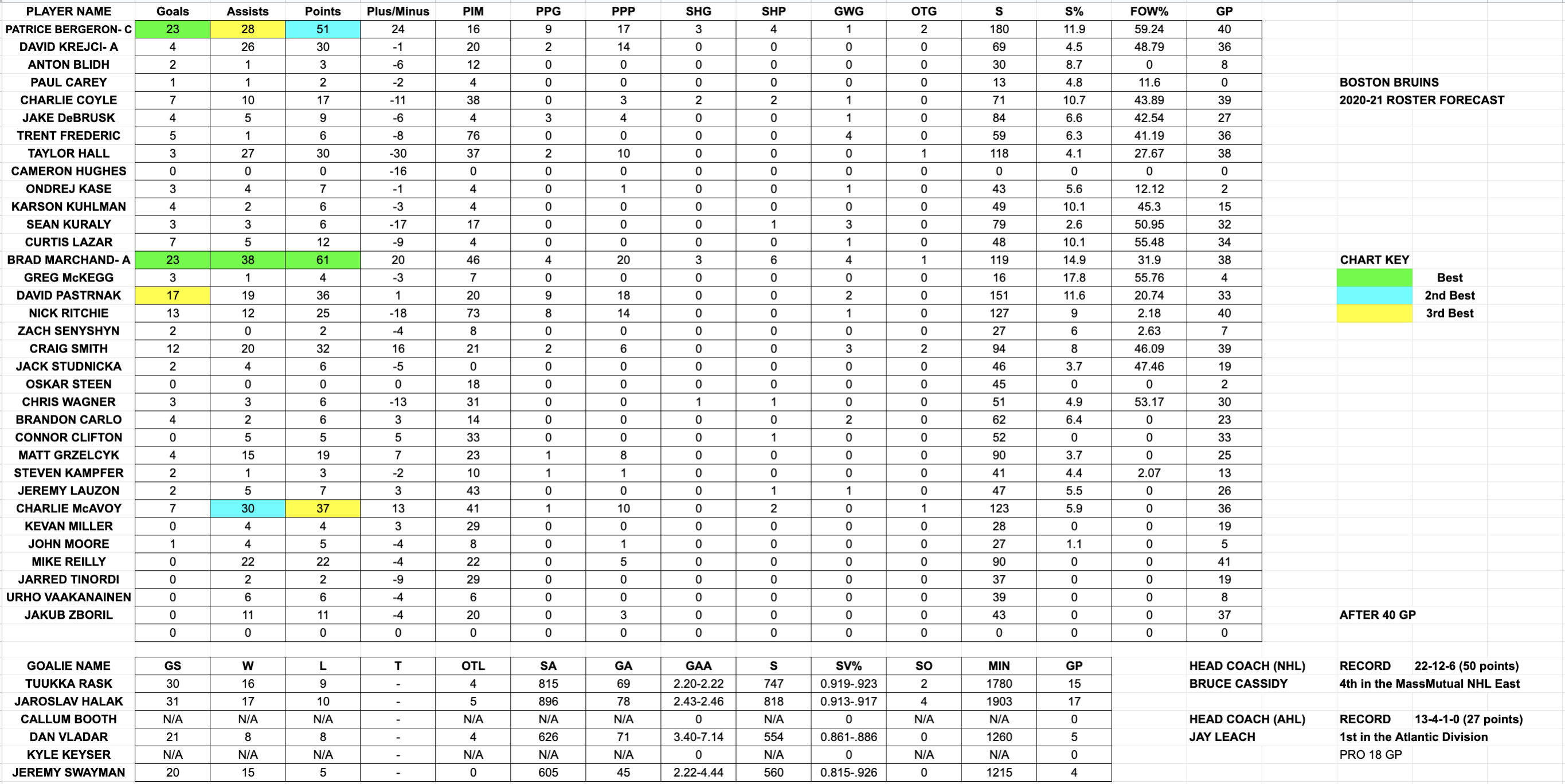
    Brad Marchand remains on track to receive Hart Memorial Trophy attention as he’s in the midst of having a strong pull in Boston’s playoff direction.

    The Bruins winger is forecasted to have 23-38–61 totals when all is said and done in 2020-21, which would’ve put him on pace for about 90 points in a regular length 82-game season had the ongoing pandemic never happened.

    For the first time this season, David Pastrnak (17-19–36 forecasted totals) is not forecasted to lead his team in goals.

    Instead, Marchand and Patrice Bergeron (23-28–51 forecasted totals) are forecasted to split the team lead in goals with 23 each, while Pastrnak trails with the second-most (17).

    Nick Ritchie and Craig Smith are on track for 13 and 12 goals, respectively, as some of the better components of Boston’s depth this season, while third line center, Charlie Coyle’s down year continues with seven forecasted goals this season, which… …actually isn’t that bad?

    Sure, 2021 hasn’t been the best year for Coyle, but it seems like a “bad year” for Coyle works much in the same that a “bad year” does for David Krejci.

    It’s not that Coyle and Krejci are superhuman, but rather just human.

    Plus, Krejci has already surpassed the four goals that he was forecasted to score in this 40 team games played model. Relax, folks. Every year can’t be golden.

    On defense, Charlie McAvoy leads the team in points from the blue line with 7-30–37 forecasted totals, while newcomer Mike Reilly continues to impress with 22 forecasted assists (that’ll probably be too few).

    In the meantime, upon returning to full health, Matt Grzelcyk can carve out 19 points in a battered season for Boston’s defenders.

    While Reilly is destined to continue being a playmaker from the back end, newly acquired forwards Taylor Hall and Curtis Lazar are each expected to contribute offensively with Hall forecasted for 30 points by season’s end alongside Krejci and Smith, while Lazar should be good for 12 points on the season from the fourth line.

    Oh and as for the since departed Anders Bjork? Well, at the time of the trade, he was forecasted to produce eight points this season.

    That said, with consistent ice time in a top-six role in Buffalo, the new Sabres forward could yield respectable double-digit totals in such a short timespan. Nothing crazy, but 10 points or more isn’t out of reach if he was already on track to get about eight.

    As long as the Bruins’ new-found offense can continue to produce and spur bottom-six scoring, then there’s a good chance with enough time to heal that the B’s can reset themselves on course for a playoff run with something to prove.

    Sure the 2021 Expansion Draft for the Seattle Kraken got a bit more complicated with pending-unrestricted free agents in Hall and Reilly added to the fold, but if this is truly it for Boston’s core with Bergeron, Krejci, Marchand and Tuukka Rask (Krejci and Rask also being pending-UFA’s) then the time is now to go all-in and go for it.

    Rask (2.20-2.22 forecasted goals-against average, .919-.923 forecasted save percentage) is expected to be rejuvenated by a decreased workload due to injury and the emergence of a hot hand in Jeremy Swayman– Boston’s fourth-string goaltender that, along with Dan Vladar, has literally saved the season.

    Upon Jaroslav Halak’s (2.43-2.46 forecasted goals-against average, .913-.917 forecasted save percentage) return from COVID protocol, there’s a chance the usual duo of netminders for the Bruins could show signs of rust as they ease back into the routine for the long run.

    That’s where Swayman and his best case scenario 2.22 forecasted goals-against average and .926 forecasted save percentage can provide relief as the B’s workout a three goaltender rotation similar to the Carolina Hurricanes’ situation with Petr Mrazek, James Reimer and Alex Nedeljkovic.

    Whether it was inevitable that the NHL as a whole adopts a three-goaltender system because goaltending tandems were already catching on or simply a product of the contemporary times in a pandemic whereby carrying a third goaltender becomes a necessity by default, it’s not a bad idea for Boston to assess what they’ve got for the future.

    Next season could very well be Rask and Swayman in net if the Bruins re-sign No. 40 this summer as the Finnish goaltender has indicated he’d like to be part of Boston’s transition in the crease a la the days of the transfer in power from Tim Thomas to Rask himself.

    For a look at how things might have gone for the Bruins entering the 2020-21 season, feel free to read the original forecast through zero games played and how things looked through 20 games played.

  • Trading Frederik Andersen is the wrong idea

    Something’s brewing in Toronto and it’s the annual “let’s talk trading Frederik Andersen because surely he’s the reason for a lack of playoff success as a team in recent years”. Ah, the sight of Maple Leafs in the fall.

    Andersen is entering the final year of his five-year deal with the Toronto Maple Leafs that he signed back on June 20, 20216– shortly after his rights were traded to Canada’s largest city by the Anaheim Ducks for a 2016 1st round pick (Sam Steel) and a conditional 2017 2nd round pick (Maxime Comtois).

    His cap hit is a reasonable $5.000 million, but on a roster that’s currently projected to spend $82,549,325– which, you know, is slightly over the league’s $81.5 million upper limit– something’s got to give.

    If Maple Leafs General Manager, Kyle Dubas, was serious about trading Andersen heading into the season, he likely would’ve found a partner by now and made a deal– regardless of stagnant revenue streams due to the ongoing COVID-19 pandemic.

    But sure, let’s say the Leafs are set on trading Andersen in order to become cap compliant.

    First of all, who are you going to get in return?

    And second, the playoffs would be out of the picture altogether.

    The answer to the first question is easy since most of the free agent goaltenders have been scooped up and Toronto’s not likely to take a flyer on Cory Schneider, Craig Anderson, Jimmy Howard or Ryan Miller.

    In 2010, maybe. In 2020, definitely not.

    None of those goalies had a goals against average better than 3.10 or a save percentage better than a .907.

    One of those goalies, however, had those stats exactly and it’s the one that spent last season as a backup in 23 games with the Anaheim Ducks (Miller).

    Naturally, Dubas would have to look to trade Andersen instead, which means you might be looking at a deal with the Vegas Golden Knights for Marc-Andre Fleury or (let’s get crazy) send Andersen back to the team that originally drafted him before he re-entered the draft and was taken by the Ducks in the 3rd round (87th overall) of the 2012 NHL Draft– the Carolina Hurricanes.

    Why the Hurricanes? Because James Reimer, of course.

    Andersen had a 29-13-7 record in 52 games last season (all starts), while amassing a 2.85 goals against average, a .909 save percentage and three shutouts in the process.

    Though he recorded two more shutouts in 2019-20 than he did in 2018-19, his goals against average and save percentage were worse than his 2.77 GAA and .917 SV% in 60 games two season’s ago.

    It’s important to remember, however, that in Toronto had guys like Ron Hainsey and Nikita Zaitsev on the blue line to help suppress the oncoming attack in 2018-19.

    Hainsey joined the Ottawa Senators in free agency on July 1, 2019, while Zaitsev was packaged with Connor Brown and Michael Carcone in a trade with (you guessed it) the Senators on the same day for Cody Ceci, Ben Harpur, Aaron Luchuk and a 2020 3rd round pick that originated from the Columbus Blue Jackets (Alex Laferriere).

    The Leafs made the trade to save $4.500 million in cap space that they then turned around and gave to Ceci. Kind of.

    Trading Zaitsev wasn’t necessarily about saving money in the immediate future as much as it was about lopping off his contract from the books before his modified no-trade clause kicked in.

    The now 29-year-old Russian defender is under contract through the 2023-24 season with Ottawa, whereas Ceci was a restricted free agent at the time and agreed to a one-year deal with the Leafs.

    Dubas had to protect his club’s ability to integrate young prospects on the blue line and remain competitive in future trade or free agent markets, so Zaitsev was a casualty of league parity.

    That, or fans, coaches and media members alike were tired of watching him in Toronto.

    Meanwhile, the Leafs went in a different direction for their blue line last season with the additions of Ceci in the Zaitsev trade and Tyson Barrie at a discount as their alleged biggest prize in the Nazem Kadri trade with the Colorado Avalanche.

    While Sens fans knew what Toronto was getting themselves into with Ceci’s playing ability as a bottom-pairing defender, Barrie experienced a significant drop-off in his game.

    Barrie amassed 14-45–59 points in 78 games with Colorado in back-to-back seasons with at least 55 points before the trade and was a minus-3 in 2018-19. He put up 39 points (five goals, 34 assists) in 70 games with Toronto and was a minus-7.

    For the record, Ceci had 7-19–26 totals in 74 games with the Sens and was a minus-22 in 2018-19, then mustered eight points (one goal, seven asissts) in 56 games with the Leafs– but at least he was a plus-7.

    So it’s not entirely Andersen’s fault for instability in front of him.

    The defensive depth wasn’t the same from 2018-19 to 2019-20 in front of Andersen, and, of course, Toronto fired Mike Babcock and promoted Sheldon Keefe as head coach after Fleury made a big save on Nov. 19, 2019 in Vegas.

    Which is actually the perfect segue back to what it would mean for the Leafs to trade Andersen.

    If Dubas flipped Andersen to the Golden Knights for Fleury strictly because of the “playoff experience” narrative, well, it’s worth noting that despite his improved performance from 2019’s 3-4 record, 2.70 GAA, .909 SV% and one shutout in seven games to 2020’s 3-1 record, 2.27 GAA and .910 SV% in four games, Robin Lehner still outperformed Fleury.

    Lehner amassed a 9-7 record in 16 games for Vegas in the 2020 postseason with a 1.99 GAA, a .917 SV% and four shutouts in that span.

    Andersen is 31, while Fleury is 36.

    In simple terms, one is still in their goaltending prime and the other is in the twilight of his playing days– even if he is able to return to form after the second-straight season of faltering numbers.

    Fleury’s first season in Vegas saw him rock a 29-13-4 record in 46 games with a 2.24 GAA, .927 SV% and four shutouts despite missing time due to injury.

    In 2018-19, Fleury was overplayed. He notched a respectable 35-21-5 record, 2.51 GAA, .913 SV% and eight shutouts in 61 games, but couldn’t remain hot enough against the San Jose Sharks in the 2019 First Round.

    In 2019-20, Gerard Gallant and, later, Peter DeBoer handled his number of games better, playing Fleury 49 times, but the 36-year-old netminder amassed a 27-16-5 record with a 2.77 GAA, .905 SV% and five shutouts.

    Season-by-season, Fleury has shown signs of regressing.

    Even if he is able to win one more Cup, his role on that team is likely best suited as the backup, if not at least in the 1B role of a 1A/1B tandem.

    In his last three seasons with the Pittsburgh Penguins, Fleury faced 4,677 shots against and made 4,292 saves (.918 SV%) while amassing 16 shutouts from 2014-17.

    In his first three seasons with the Golden Knights, Fleury’s faced 4,520 shots and made 4,135 saves (.915 SV%) while racking up 17 shutouts.

    The ageless wonder would be a great addition to the Maple Leafs if Toronto could only have Andersen and Fleury.

    But there’s a little pesky number that ruins any hope of swinging a deal unless Dubas is willing to part with larger pieces in a true “hockey trade”.

    It’s Fleury’s cap hit.

    He carries a price tag of $7.000 million against the salary cap through next season (2021-22) and, like Andersen, has a modified no-trade clause.

    Vegas is also feeling the stress of the salary cap, considering they’re currently on the books for $82,474,104 and need to dump salary before the season can likely begin in January.

    No, Max Pacioretty’s $7.000 million cap hit or Jonathan Marchessault’s $5.000 million cap hit won’t do the Leafs any favors if Toronto somehow decided they’d be fine with Dubas including a piece of their core– like Mitch Marner’s $10.893 million cap hit, for example– in the hypothetical transaction.

    Both teams would still be over the cap unless they’d be able to make separate trades elsewhere to shed salary.

    Even still, if someone is trying to pry Fleury from Vegas, they’re likely asking the Golden Knights to retain some salary or involve a third team in the deal for that sole purpose.

    So if Fleury’s out, what about Reimer? You know, the last guy to bring “stability” to the crease in Toronto before Andersen.

    Reimer hasn’t posted a sub-2.50 goals against average since his 2.49 with the Maple Leafs in 32 games prior to being traded to the Sharks ahead of the 2016 trade deadline.

    He also hasn’t bested his .918 SV% from the time he spent with the Leafs that season.

    It might be tempting to resort to Reimer as a starter, but he’s been worse than Andersen at a fraction of the workload that the current Leafs starter gets from year-to-year.

    Thanks to the pandemic shortened regular season last year, Andersen played under 60 games for the first time since his days in Anaheim.

    Toronto’s defense is nothing like Carolina’s defense.

    Despite Reimer’s impressive 14-6-2 record in 25 games with the Hurricanes last season, there’s no guarantees he’d be able to match that or better with Morgan Rielly taking on the roles of Jaccob Slavin, Dougie Hamilton, Brett Pesce, Brady Skjei and Co. combined for the Maple Leafs.

    Besides, Jack Campbell’s 3-2-1 record in six games with Toronto last season came with a 2.63 GAA and a .915 SV%, which, on its own is about the same as Reimer’s 2.66 GAA and .914 SV% with the Canes last season, but at a cheaper price for a backup caliber goaltender (Campbell is signed through 2021-22 at $1.650 million per season, while Reimer is a pending-UFA at season’s end with a $3.400 million cap hit).

    But remember Campbell spent last season with the Los Angeles Kings and Maple Leafs and finished 2019-20 with a combined 11-12-3 record in 26 games for Los Angeles and Toronto, while amassing a 2.80 GAA and a .904 SV% in the process.

    Unless Dubas signed Michael Hutchinson and Aaron Dell to compete with Campbell and (hypothetically) Reimer to save some money by trading Andersen this season, then Toronto’s goaltending woes would only get worse.

    That’s right, we haven’t even started talking about who the eventual “goalie of the future” might be for the Leafs, but that’s a subject for another time (spoiler alert: the jury is out on that one for now).

    It’s ride or die with Andersen this season.

    And next summer’s free agent goalie market doesn’t look like it’s any better.

    Unless a familiar Maple Leafs draft pick returns to Toronto, but he still wears No. 40 on the Boston Bruins for now.

  • DTFR Podcast #205- Flaming Out (feat. Jess Belmosto)

    DTFR Podcast #205- Flaming Out (feat. Jess Belmosto)

    Jess Belmosto joins the show to talk about Tuukka Rask, Game 6 between the Calgary Flames and Dallas Stars, First Round eliminations and more.

    Subscribe to the podcast on Apple PodcastsStitcher and/or on Spotify.

    Subscribe to Garden Gals as well as Locked on Flames and read Jess’ work at Couch Guy Sports and PuckerUp Sports by clicking on any of the hyperlinks we have just provided for you.

  • DeBrusk leads B’s in, 4-3, comeback over Canes in Game 4

    Jake DeBrusk had a pair of goals as the Boston Bruins scored four goals in the third period to erase a two-goal deficit and win, 4-3, in Game 4 of their 2020 Stanley Cup Playoffs First Round matchup with the Carolina Hurricanes at Scotiabank Arena in Toronto on Monday.

    For the 11th time in franchise history, the Bruins rallied from a multi-goal deficit in the final period of a playoff game and won as Jaroslav Halak (2-1-0 in three games, 2.73 goals against average, .897 save percentage this postseason) made 16 saves on 19 shots (.842 SV%) in the win.

    Hurricanes goaltender, James Reimer (2-1 in three games, 2.34 GAA, .934 SV% this postseason) stopped 29 out of 33 shots faced for an .879 SV% in the loss.

    Once again, David Pastrnak (unfit to play) was out of the lineup for Boston ahead of Game 4 and missed his third game this postseason due to injury.

    Carolina forward, Andrei Svechnikov (unfit to play), missed his first game of the series after sustaining a lower body injury in the third period of Game 3 last Saturday and is likely out for the rest of the First Round series.

    Bruins head coach, Bruce Cassidy, made no changes to his lineup from Saturday’s, 3-1, win in Game 3 to Monday night’s Game 4.

    Hurricanes head coach, Rod Brind’Amour, re-inserted Jake Gardiner on the defense in place of Trevor van Riemsdyk, while Ryan Dzingel was dressed in place of Svechnikov.

    Brind’Amour opted for Jordan Martinook on the left side of Sebastian Aho with Teuvo Teravainen in his usual right wing role, while Dzingel fit in on the second line with Vincent Trocheck at center and Justin Williams on the right side.

    On the third line, Brind’Amour began the night with Jordan Staal at center– flanked by Warren Foegele at left wing and Brock McGinn at right wing.

    Meanwhile, Nino Niederreiter, Morgan Geekie and Martin Necas comprised the fourth line for the Canes.

    On defense, Jaccob Slavin was paired with Dougie Hamilton on the first pairing, Brady Skjei suited up alongside Sami Vatanen and Gardiner was flanked by Haydn Fleury.

    Boston’s list of scratches for Game 4 included Zach Senyshyn, Nick Ritchie, John Moore, Maxime Lagacé, Urho Vaakanainen, Jakub Zboril, Jeremy Lauzon, Trent Frederic, Karson Kuhlman and Pastrnak.

    The Canes were without the services of Joel Edmundson, Jake Bean, Max McCormick, Svechnikov, Roland McKeown, van Riemsdyk, Clark Bishop, Steven Lorentz, Anton Forsberg and Alex Nedeljkovic.

    Dzingel caught Connor Clifton with a high stick and presented the B’s with the first power play opportunity of the night at 1:38 of the first period.

    Boston wasn’t able to convert on the ensuing skater advantage, however, and found themselves on the penalty kill shortly after the Hurricanes killed off Dzingel’s minor.

    Jack Studnicka cut a rut to the penalty box after slashing Skjei’s stick out of his hands and gave Carolina their first power play of the night at 4:55.

    The Canes did not score on the resulting advantage, however.

    Almost midway through the opening frame, Williams (1) fired a shot that had eyes through bodies from both teams in front of the net and clunked its way through Halak to give the Hurricanes the game’s first lead, 1-0.

    Trocheck (2) and Gardiner (1) tallied the assists on Williams’ goal at 9:17.

    Carolina took the, 1-0, lead all the way into the dressing room for the first intermission as neither team found its way onto the event sheet in goals or penalties after Williams opened the scoring.

    The Hurricanes led in shots on goal (7-6), takeaways (4-0), hits (15-14) and faceoff win percentage (71-29) after 20 minutes of play, while the Bruins led in blocked shots (4-2) and giveaways (5-3).

    Both teams were 0/1 on the power play heading into the middle frame.

    Teravainen hooked Studnicka and was sent to the box at 9:31 of the second period for the middle frame’s first action on the event sheet, but Boston wasn’t able to convert on the power play.

    Less than a minute after Carolina killed off Teravainen’s minor infraction, Martinook (2) snapped a shot past Halak’s glove side on what otherwise looked like a preventable outcome.

    Aho (8) had the only assist on Martinook’s goal as the Hurricanes extended their lead to, 2-0, at 12:08 of the second period.

    Moments later, Martinook thought he had scored again when he deflected the rubber biscuit into the back of the twine, but his stick was well above the crossbar and immediately negated what would’ve been a three-goal lead for the Hurricanes.

    Late in the period, Hamilton was guilty of holding Studnicka and cut a run to the sin bin for a pair of minutes that would extend into the third period at 19:37.

    After 40 minutes of action Monday night, the Canes led, 2-0, on the scoreboard and shots on goal were even at 17 aside– despite Boston’s, 11-10, advantage in shots on net in the second period alone.

    Carolina led in blocked shots (12-11), takeaways (9-2), hits (27-23) and faceoff win% (62-38) after two periods, while both teams had eight giveaways each.

    The Hurricanes finished 0/1 and the Bruins went 0/3 on the power play entering the second intermission, as there were no penalties called in the third period.

    Almost midway through the third period, DeBrusk chased after a puck in the offensive zone while Reimer came out of his net to also make an attempt at the loose puck in the high slot before DeBrusk (2) scored a goal while falling in avoidance from a major collision with Reimer as Fleury also bumped into his own goaltender.

    Ondrej Kase (3) and Clifton (1) had the assists on DeBrusk’s first goal of the game and the Bruins cut Carolina’s lead in half, 2-1, at 7:26 of the third period.

    It was the first five-on-five goal for Boston in a little more than eight periods dating back to Game 2.

    With about ten minutes left in regulation, Charlie McAvoy made a huge, clean hit on Staal that forced Staal down the tunnel and out of the game.

    Seconds later, Clifton (1) rocketed a one-timer from inside the faceoff dot to Reimer’s left off of a setup by Joakim Nordstrom from behind the goal line to tie the game, 2-2.

    Clifton’s shot sailed over Reimer’s blocker, while Nordstrom (2) and Chris Wagner (1) notched the assists on the goal at 10:10 of the third period– marking two goals for the Bruins in a span of 1:44.

    Upon giving up two quick goals like that, Brind’Amour used his timeout to ease his team’s nerves and draw up a plan to take the lead back and defender it, but nothing went according to plan for the Canes in the final frame.

    Shortly after returning to play, Torey Krug sent Brad Marchand (3) in on a breakaway, whereby No. 63 in black and gold stickhandled the puck as he strolled in, made Reimer open the five-hole and slipped the rubber biscuit through the gaping five-hole to put Boston in command for the first time in the game.

    Krug (3) had the only assist and the Bruins led, 3-2, at 11:40.

    Less than a few minutes later, DeBrusk (3) scored his second goal of the night from point blank thanks to a great setup from Kase to make it, 4-2, for the Bruins.

    Kase (4) and David Krejci (5) had the primary and secondary assists, respectively, as Boston pulled ahead by two goals at 14:17 of the third period– having scored four unanswered goals in a span of 6:51.

    With about 1:37 remaining in the game, Brind’Amour pulled Reimer for an extra attacker.

    Seconds later, Teravainen (3) scored on a shot that looked like it might have intended to be a pass, but broke through a screen in front of Halak and slid right through the Bruins goaltender’s five-hole on the first shot of the third period for the Canes.

    Skjei (2) and Hamilton (1) had the assists on Teravainen’s goal and Carolina pulled to within one, 4-3, at 18:33.

    Despite pulling their goaltender again for an extra skater with about 1:10 remaining, the Hurricanes could not force overtime.

    At the final horn the Bruins had won, 4-3, and taken a, 3-1, series lead as a result.

    Boston finished the night leading in shots on goal, 33-19, and had a, 16-2, advantage in the third period alone.

    Meanwhile, Carolina finished the night leading in blocked shots (18-15), giveaways (14-11), hits (37-36) and faceoff win% (53-48).

    Boston improved to 27-2 all time in a postseason game when Marchand scores a goal, while Clifton earned his first career multi-point playoff game.

    The Bruins have the chance to eliminate the Hurricanes and advance to the Second Round of the 2020 Stanley Cup Playoffs in Game 5, which is set for Wednesday afternoon with puck drop set for a little after 4 p.m. ET.

    Fans in the United States can catch the game on NBCSN, NESN or FOX Sports Carolinas, while those in Canada can tune to Sportsnet (SN) or TVA Sports (TVAS) for the action.