Tag: James Dolan

  • Slightly late, but better than never 2021-22 standings forecast

    Slightly late, but better than never 2021-22 standings forecast

    Every year on DTFR you may recall seeing division standings forecasts for the National Hockey League from month-to-month and, well, I didn’t forget about it this year, don’t worry.

    When the Vegas Golden Knights joined the league in 2017-18, the initial forecast entering October was infused with an educated guess (*ahem*, gut feeling) for each and every team– but especially Vegas since they had never played before– in addition to the usual arithmetic utilized to compile the average of three different forecasts ranging from the last 10, five and three seasons.

    Entering the 2021-22 National Hockey League calendar, with the inaugural season of Seattle Kraken hockey set to begin, I shifted my focus on a “gut feeling” projection for the Kraken to that of the standings projections that I’ve done for at least the last few seasons now.

    In other words, the forecast you’re about to see uses the forecast function in your spreadsheet of choice (Microsoft Excel or Google Sheets), whereas the standings projections in the link above is based on an expected points totals model using last season’s offense and a whole bunch of other things I won’t bore you with.

    As such, Seattle received a projected points total based on the loosely projected offense using a composite of what the Kraken could have had, if every player on their roster entering training camp had scored goals last season for Seattle instead of their respective teams.

    But for this edition of standings predictions– using the forecast function– since the Kraken never played a game entering October 2021, they were given an 8th place standing in the Pacific Division with an asterisk– signifying that their results are incomplete until they hit the ice.

    Now, of course, entering November, the Kraken have played some games, so the forecast reflects that (albeit limited in the variance of possible outcomes, since they don’t have quite the same backlog as the 31 other NHL franchises).

    If you’re confused, let’s move on and talk about how things looked entering October for each division and whether or not things have changed that much entering November– keeping in mind that all 32 teams played anywhere from as few as seven games to as many as 10 games in October.

    And remember, my degree is in communication, not statistics.
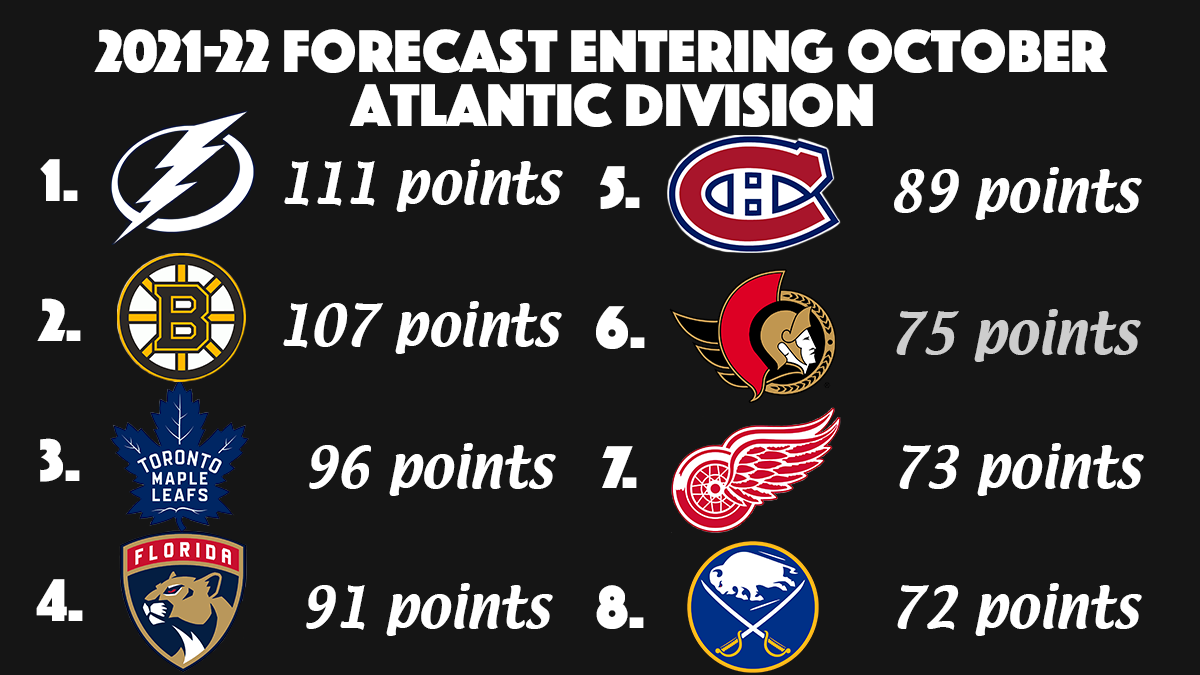

    Entering October, the two-time defending Stanley Cup champion, Tampa Bay Lightning were a safe bet to lead the Atlantic Division standings over the course of a return to the usual 82-game schedule.

    The Boston Bruins, who made quite a few moves in the offseason, would do their usual thing under head coach, Bruce Cassidy, and display a strong effort, though how realistic is this expectation, you ask?

    Probably not as spot on as you’d think.

    Last season’s temporarily realigned divisions– featuring intra-divisional play only– helped teams like the Bruins beat teams like the Philadelphia Flyers almost every time they squared off.

    This season, Boston will have to face a stronger than ever before– if not as good as they were in 1995-96– Florida Panthers roster, for example, which is more likely to be reflected in a later forecast after a couple of months are in the record books.

    So that’s actually a perfect explanation for why the Toronto Maple Leafs and Panthers don’t look quite as dominant as they were last season in the forecast entering October.

    The reduced schedule alone yielded similar point totals to regular-length seasons in the past, which downplays this year’s projected outcome, logically, right?

    Keep that in mind for the Colorado Avalanche later, though there may be more to it than just the fact that the 2016-17 season is still accounted for in both the 10-year and five-year models, which drags down the average.

    Anyway, the Montréal Canadiens aren’t a playoff team and the spread between the Ottawa Senators, Detroit Red Wings and Buffalo Sabres reveals each of those three teams is likely to be more competitive than in season’s past, but like Montréal likely on the outside looking in.
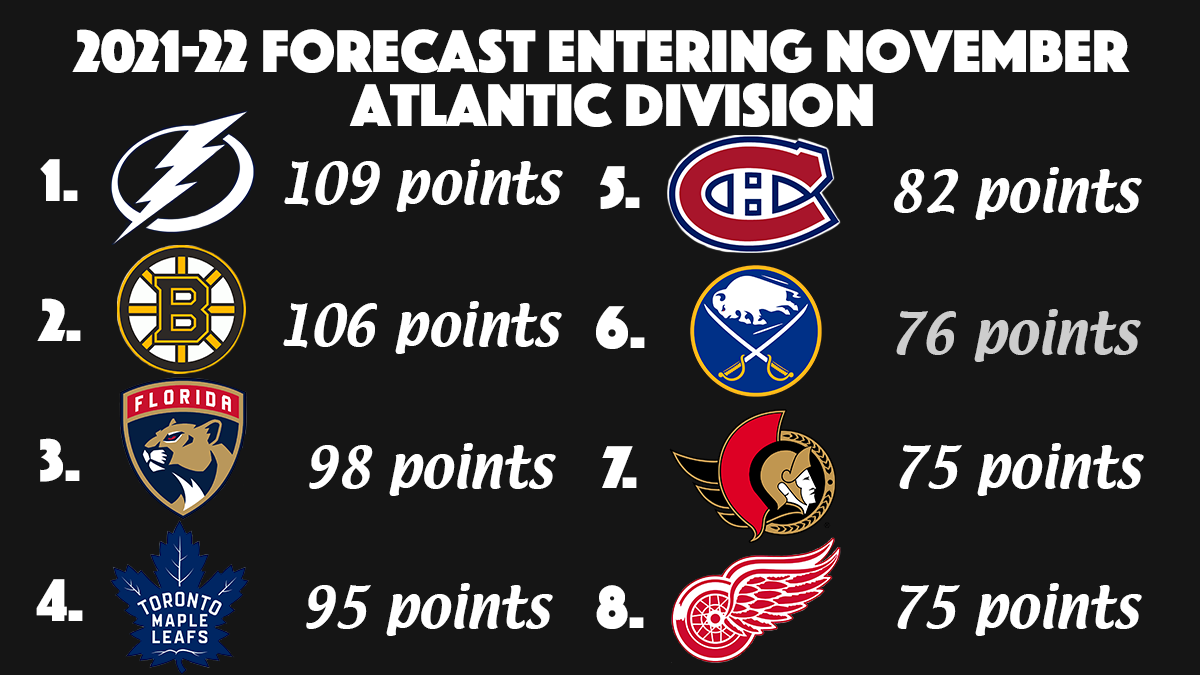
    Entering November, the Bruins and Senators have played the fewest games in the division (seven games each), resulting in not that much change, while Florida gained seven points in the current forecast– moving themselves into a divisional playoff berth in the process.

    Should the Panthers’ success be of concern to Leafs fans if Toronto isn’t in the top-3 in the Atlantic Division?

    No.

    The Lightning haven’t had as much spark as they usually do, which can be attributed to the price of winning back-to-back Cups in a span of, what, like, 10 months?

    They’re tired, but not too tired, because Jon Cooper will ensure his team bounces back when the real season starts as the trade deadline approaches and the push for the playoffs begins.

    Though the Sabres are quick out of the gate, reality should set in as the calendar flips to December and Buffalo will slip out of playoff contention and into being surprisingly somewhere in the middle.

    That isn’t to say that Ottawa and Detroit have been that much worse than the Sabres to start the 2021-22 season, but, yeah, things are better than last season for Buffalo, at least.

    If you’re going to put stock into anything, invest in the Panthers rising to 1st or 2nd place in the Atlantic by season’s end.
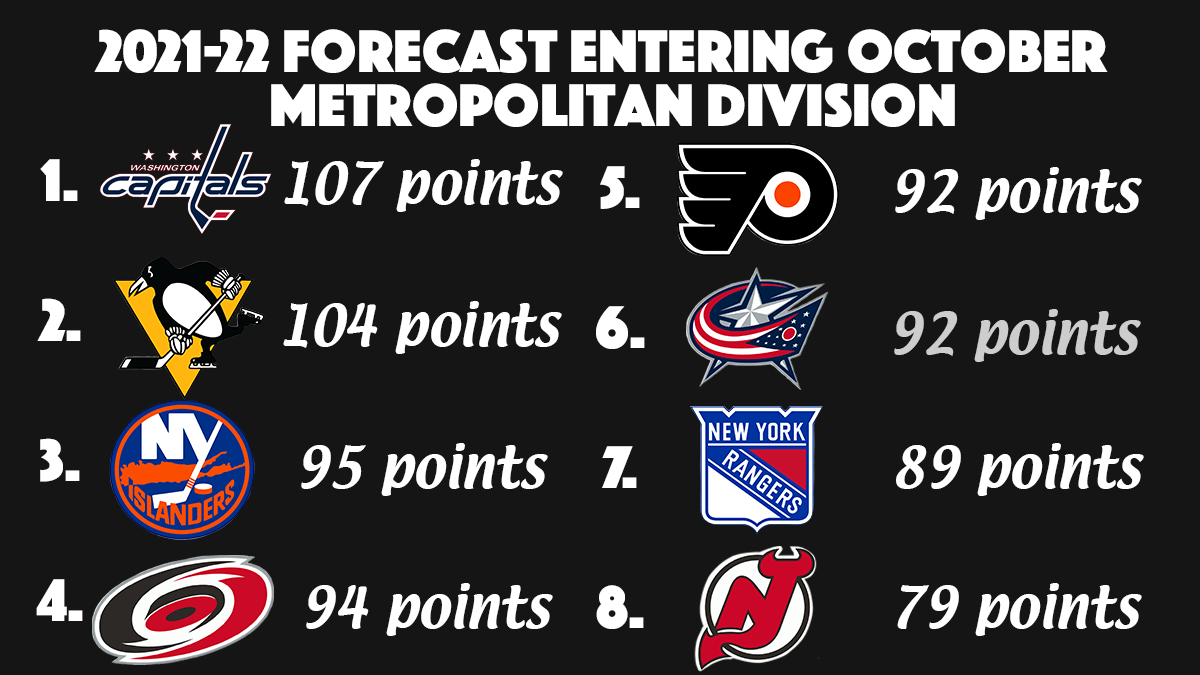
    Taking a look at the Metropolitan Division entering the 2021-22 season, it seems like it’s more of the same for the last four or five seasons now.

    Somehow the Washington Capitals or Pittsburgh Penguins win the division, while the New York Islanders and Carolina Hurricanes upset either team in the First Round. I don’t make the rules.

    While there’s a lot of optimism for the Islanders to make a significant jump in the standings given their recent runs to the Eastern Conference Final, it wouldn’t surprise me if they’re like the Lightning and take a little dip in just about everything.

    It’s not a reset, but a refresh with high expectations for a big 2022-23 season to finally get over the hump and reach their first Stanley Cup Final appearance since 1984.

    Maybe by then Tampa will have succumbed to the salary cap era, so they won’t be in New York’s way in the postseason.

    As for the other New York team, well, the Rangers are sure to frustrate more than just their own fans as they’ll agitate their opponents, sure, but won’t play much of a spoiler in their quest for whatever it is James Dolan has told General Manager, Chris Drury, to do this offseason.

    At the very least, the fact that the Metropolitan Division is a close spread reveals what we already know– that it’s truly anyone’s guess as to who will make the playoffs this year.

    The last decade has conditioned us to expect Pittsburgh or Washington to be the top team, but the Philadelphia Flyers or New Jersey Devils could sneak in and disrupt things enough for the Hurricanes to run away with the Metropolitan title in the regular season.

    Though the Columbus Blue Jackets are forecasted to have the same number of points as the Flyers in both October and November, it’s worth noting that Philadelphia is forecasted to amass 29 regulation wins to Columbus’ 23 regulation wins in the latest projection, so yeah, they’re a team.

    The Blue Jackets could be within striking distance of a playoff spot or they could simply be better than the Rangers and Devils and that’s about it in their attempt to do something.

    Is it a rebuild or are they just holding out for the right offseason moves? Time will tell, but the time may be ticking on prolonged irrelevance.

    Anyway, Washington and Pittsburgh have cooled off as Carolina got out to the best start among all 32 teams, which, given the eight points between 1st and 3rd in the November forecast, could indicate that the Hurricanes will usurp the Capitals and Penguins for division control.

    Meanwhile, the longer the Islanders go without setting a tone, the better chance the Flyers have at making the postseason.

    In the Central Division, the St. Louis Blues are expected to return to form entering October from a pure forecast standpoint.

    Is it realistic? Probably not, though St. Louis should be better than their 2021 First Round exit in four games at the hands of the Avalanche.

    That said, Colorado may surprise you being so low in this forecast.

    Again, remember that it’s an average of models based on the last decade, five seasons and three seasons, so the Avs rise to division dominance in recent years is better reflected on the contingency that they continue to play well.

    Right now, they aren’t playing that well, but again the graphic above reads “entering October” not “entering November”, so perhaps I should’ve saved that tidbit for a minute.

    Meanwhile, the Nashville Predators, Winnipeg Jets and Minnesota Wild have all been consistent enough in recent years to earn better praise entering the 2021-22 calendar, but at least one of those teams is sure to reveal themselves as a pretender by about the quarter-mark of the season.

    As for the Dallas Stars, Chicago and the Arizona Coyotes, well, if Dallas can stay healthy, they should improve. Chicago hasn’t done themselves any favors in terms of roster makeup and the Coyotes are intentionally steering the ship aground for a top lottery draft pick in 2022.

    Not much has changed after one month of NHL action in the Central Division forecast, though it should be noted just how quickly Arizona’s fallen off (even though they were already expected to be a basement team given the immense roster turnover over the summer).

    The Wild and Jets flipped positions courtesy of Minnesota gaining a point between October and November’s forecast, as well as the regulation win tiebreaker (entering November, the Wild are forecasted to have 36 regulation wins, while the Jets are forecasted to finish with 31).

    The Blues have had a hot start and, as a result, remain atop the Central forecast while nearly every expert analyst’s Stanley Cup favorite not named the Lightning (Colorado) remains in 5th.

    Weird times!

    Entering the 2021-22 season, the Vegas Golden Knights made a big trade, but looked to be on the verge of contending for the Presidents’ Trophy in back-to-back seasons.

    Though they lost the Presidents’ race to the Avalanche last season on a tiebreaker, the Golden Knights could benefit from an overall weaker division they’re in. And yet… (keep reading)

    The Calgary Flames are surprisingly hot in the Pacific forecast entering October, but considering the three California teams, the uncertainty of Seattle and the volatile wishy-washiness of the Vancouver Canucks, it kind of makes sense.

    What doesn’t make sense is the Edmonton Oilers– with Connor McDavid and Leon Draisaitl on their roster– seated in 5th place in the Pacific Division.

    Then again, to repeat myself, this forecast is an average based on the last 10, five and three seasons, so the Oilers have really only been a consistent playoff contender for the last five seasons or so, which means that they won’t rise in the forecasted standings quite as fast as you’d hope.

    It pays to be consistently good over a longer period of time in this model.

    Finally, after their first nine games in NHL history, the Kraken have entered the chat in the 2021-22 forecast entering November, but they’re forecasted for a league-worst 64 points.

    Seattle isn’t bad, necessarily, they’re just figuring out the chemistry on the ice, in the room and giving Philipp Grubauer plenty of time to learn the system and get acquainted with being the No. 1 goaltender on a new team– both in the brand new expansion team sense and since leaving the Avalanche for the Kraken in free agency.

    The Flames are continuing to turn heads by being within striking range of taking the forecasted division lead from Vegas– especially as the Golden Knights roll slowly out of the gate.

    Meanwhile, Edmonton’s on course for significant gains in the next forecast entering December, while everything else looks to be about the same because, after all, it is the Pacific Division.

    It’s not great!


    If you’ve read every word of this, congrats. Give yourself a sticker or something.

    Stay tuned for the next forecast in about a month. It should be a little quicker to update the stats, write a few words and hit “publish” than it took this time around.


  • New York Rangers 2021-22 Season Preview

    New York Rangers 2021-22 Season Preview

    2020-21 record 27-23-6, 60 points

    5th in the MassMutual NHL East Division

    Missed the postseason for the first time since 2020

    Additions: F Sammy Blais (acquired from STL), F Barclay Goodrow (acquired from TBL), F Dryden Hunt, F Greg McKegg, F Ryan Reaves (acquired from VGK), D Patrik Nemeth, D Jarred Tinordi

    Subtractions: F Colin Blackwell (expansion, SEA), F Pavel Buchnevich (traded to STL), F Phillip Di Giuseppe (signed with VAN), F Brett Howden (traded to VGK), F Patrick Newell (Eliteserien), D Tony DeAngelo (buyout, signed with CAR), D Nick DeSimone (rights acquired from VGK, signed with CGY), D Jack Johnson (signed to a PTO with COL), D Darren Raddysh (signed with TBL), D Yegor Rykov (KHL), D Brendan Smith (signed with CAR)

    Still Unsigned: F Gabriel Fontaine, D Brandon Crawley

    Re-signed: F Filip Chytil, F Julien Gauthier, F Tim Gettinger, F Ty Ronning, D Libor Hajek, G Adam Huska, G Igor Shesterkin

    Offseason Analysis: Well, this offseason happened.

    Because nobody sought vengeance for Tom Wilson’s shenanigans, Rangers owner, James Dolan, arose from his desk and remembered that he owns more than just the New York Knicks.

    Heads were rolling as Chris Drury was instated as New York’s General Manager before last season ended– leaving Jeff Gorton to take a role with NHL Network during the 2021 NHL Entry Draft. Gerard Gallant replaced David Quinn behind the bench.

    If the Rangers had a good thing going from the second-half of last season onward, well, they’ve surely burned it to the ground in a scorched-Earth search for guys that’ll punch other guys in the face for their 2021-22 roster.

    Greg McKegg and Dryden Hunt are extra bodies to stockpile with the Hartford Wolf Pack (AHL) until somebody gets injured or booted out of the Rangers’ lineup because they’re suspended for trying to take Wilson’s head off or something.

    New York was one or two pieces away from being a playoff contender and currently has about $8.872 million in cap space with almost $30 million to spend next summer when pending-restricted free agent, Kaapo Kakko, needs a new deal.

    But for the time being, the Rangers decided to punt.

    Sure, Jack Eichel is still available if the Buffalo Sabres ever decide to trade him one of these days (with or without letting him get his desired surgery done).

    Drury’s logic, however, doesn’t necessarily see a fit for Eichel on the team– I mean, is he even tough enough?!?

    Mika Zibanejad’s name is out there for some reason. He’s not too pleased by the rumor mill churning up whatever it can to excite Rangers fans about a team that took one step forward and two steps back on paper.

    Pavel Buchnevich didn’t have to be traded. But he was.

    Nothing makes sense anymore.

    On July 17th, Drury traded a 2022 7th round pick to the Tampa Bay Lightning for the rights to restricted free agent forward, Barclay Goodrow, then signed Goodrow to a six-year extension worth about $3.642 million per season.

    The 28-year-old had 6-14–20 totals in 55 games last season en route to winning his second-straight Stanley Cup ring with the Lightning, but Buchnevich, 26, had 20-28–48 totals in 54 games.

    Somebody’s got to replace the scoring.

    That same day, Brett Howden was dealt to the Vegas Golden Knights for Nick DeSimone’s rights and a 2022 4th round pick, but DeSimone tested the waters of free agency and signed with the Calgary Flames.

    On July 23rd, Buchnevich was traded to the St. Louis Blues for Sammy Blais and a 2022 2nd round pick.

    Blais had 8-7–15 totals in 36 games for St. Louis last season while battling injury and bouts on the league’s COVID-19 protocol list.

    There’s still 13 points to replace to makeup for trading Buchnevich.

    On July 29th, Drury listened to Gallant’s preferences for a rougher style, if not a personal request for a familiar face as New York traded a 2022 3rd round pick to Vegas for Ryan Reaves, who, at 34-years-old had 1-4–5 totals in 37 games for the Golden Knights.

    Though he kept his penalty minutes relatively low with only 27 minutes spent in the box in 2020-21, he was suspended for two games in the 2021 Stanley Cup Playoffs for his intent to injure then Colorado Avalanche defender, Ryan Graves, on an unnecessary roughing incident in front of Colorado’s own net.

    But hey, an eye for an eye, right?

    If you can’t beat them on the scoreboard– just beat them up instead.

    It’s worked well for the Philadelphia Flyers since 1975.

    Don’t want to fight Goodrow or Reaves? How about Jarred Tinordi on the defense? Maybe Patrik Nemeth?

    Both were signed in free agency– Nemeth to a three-year contract worth $2.500 million per season and Tinordi on a two-year deal with a $900,000 cap hit.

    Ryan Strome and Zibanejad are pending-unrestricted free agents and if Drury’s done enough to alienate them from whatever plan they bought into when the Rangers were on the rise coming out of their recent rebuild, then they’re the biggest pieces of trade bait for the team going into the deadline.

    That’s not what you’d like to hear if you have aspirations of acquiring Eichel, since New York can’t guarantee that either player would want to stick around in Buffalo for longer than this season.

    At the very least, Ryan Lindgren’s three-year extension with a $3.000 million cap hit looks pretty nice on the blue line and Igor Shesterkin’s four-year extension worth $5.667 million per season is good enough to foster healthy competition between Alexandar Georgiev and Shesterkin for the surefire starting goaltender role.

    Offseason Grade: D

    The Rangers didn’t have to do this to themselves and yet, here we are.

    They were a team on the verge of something special with one or two more pieces to go and a little more experience to gain as the younger players learn and grow.

    Instead, New York chose to go in the opposite direction– to overreact rather than react accordingly. A few irrational decisions means is the difference between middle of the road insanity and making the playoffs.

    It seems like the Rangers are destined for the former once again in 2021-22.

  • Swayman leads Bruins to, 4-0, shutout over Rangers

    Swayman leads Bruins to, 4-0, shutout over Rangers

    Jeremy Swayman earned his second shutout of the season, as well as of his career in Thursday night’s, 4-0, victory for the Boston Bruins over the New York Rangers at TD Garden.

    Swayman (7-2-0, 1.41 goals-against average, .946 save percentage in nine games played) made 15 saves in the shutout win for Boston.

    New York goaltender, Igor Shesterkin (15-14-3, 2.57 goals-against average, .917 save percentage in 34 games played) stopped 30 out of 34 shots faced in the loss.

    The Bruins improved to 32-14-7 (71 points) on the season and remain in command of 3rd place in the MassMutual NHL East Division, while the Rangers fell to 26-23-6 (58 points) overall and stuck in 5th place in the same division.

    The B’s are now 5-2-0 against New York this season with one game remaining in their regular season series on Saturday.

    The Bruins were without Ondrej Kase (upper body), John Moore (hip) and Charlie Coyle (upper body) on Thursday. B’s head coach, Bruce Cassidy, informed reporters ahead of the game on Thursday that Coyle is “day-to-day” and would be out of the lineup against New York.

    With Coyle out of the lineup, Karson Kuhlman was back in on the fourth line with Trent Frederic at left wing and Curtis Lazar at center.

    Jake DeBrusk, meanwhile, was promoted to the third line in place of Coyle with Nick Ritchie at left wing and Sean Kuraly at center.

    On defense, Kevan Miller returned after missing Tuesday night’s game as a precaution so as not to re-aggravate any recent injuries and was paired with Mike Reilly on the third pairing, though Cassidy ended up juggling the defensive pairings early on in the action.

    Jaroslav Halak served as Swayman’s backup, giving Tuukka Rask another night off though Boston’s No. 1 goaltender will be getting the start on Saturday.

    Coyle was joined by Chris Wagner, Greg McKegg, Moore, Kase, Rask, Steven Kampfer, Jakub Zboril, Callum Booth, Anton Blidh and Jarred Tinordi on Boston’s long list of healthy scratches, taxi squad members and injured players on Thursday.

    To coincide with their final home game of the regular season and in accordance with the Commonwealth of Massachusetts’ COVID-19 reopening protocols, TD Garden will increase their limited seating capacity from 12% to 25% beginning with Monday, May 10th’s matchup with the New York Islanders.

    Patrice Bergeron (22) kicked off the game’s scoring with a one-timer goal from the bumper over Shesterkin’s blocker to give the Bruins a, 1-0, lead at 7:11 of the first period.

    Brad Marchand (37) had the only assist on Bergeron’s goal as Boston jumped out of the gate with fresh legs compared to New York’s exhausted skaters on the second night of back-to-back games.

    The Rangers entered TD Garden coming off of a, 4-2, loss to the Washington Capitals on Wednesday night in a physical battle that featured six fights after the National Hockey League’s Department of Player Safety failed to suspend Tom Wilson for his actions in Monday night’s, 6-3, loss to Washington.

    Wilson was fined $5,000 for his actions against Pavel Buchnevich, but New York’s owner, James Dolan, thought that wasn’t enough as the Capitals forward received no punishment for his takedown of Rangers star forward, Artemiy Panarin, immediately thereafter.

    A statement released by the team in a tweet that alleged “…a dereliction of duty by NHL head of player safety, George Parros…” and went on to exclaim that “[the Rangers] believe he is unfit to continue in his current role,” ended up costing Dolan a $250,000 fine from the league.

    Anyway, Libor Hajek caught DeBrusk with a high stick at 7:43 of the first period on Thursday night and presented the Bruins with the game’s first power play.

    Boston did not convert on the ensuing skater advantage, but got a second chance at 5-on-4 action when Ryan Strome tripped DeBrusk at 16:44.

    This time, however, the B’s capitalized on the power play late in the skater advantage when Charlie McAvoy (5) blasted a shot from the point past Shesterkin on the blocker side.

    McAvoy’s power-play goal was assisted by Marchand (38) and David Pastrnak (27) and gave Boston a, 2-0, lead at 18:35 of the first period.

    Entering the first intermission, the Bruins led, 2-0, on the scoreboard and, 9-4, in shots on goal.

    New York held the advantage in blocked shots (7-2), giveaways (2-0), hits (9-6) and faceoff win percentage (73-37), while both teams amassed four takeaways aside after one period.

    The Rangers had yet to see any time on the power play, while the Bruins were 1/2 on the skater advantage heading into the middle frame.

    There were no penalties called in the second period, but David Krejci setup DeBrusk (5) for a nifty breakaway goal on an indirect pass off the boards, leading DeBrusk into the attacking zone for the shot off of Shesterkin’s blocker and into the twine.

    Krejci (31) and Taylor Hall (23) had the assists as the Bruins extended their lead to three-goals at 14:01 of the second period.

    Through 40 minutes of play, Boston led, 3-0, on the scoreboard and, 28-7, in shots on goal– including a, 19-3, advantage in the second period alone.

    The B’s also led in takeaways (11-4), while the Rangers led in blocked shots (10-3), giveaways (9-5) and hits (16-9).

    Both teams were 50-50 in faceoff win% as New York remained 0/0 and Boston was 1/2 on the power play heading into the final frame.

    Brandon Carlo (3) sent an errant puck from the goal line off of Shesterkin’s skate and over the goal line through the Rangers netminder’s five-hole– giving Boston a four-goal lead at 1:07 of the third period.

    Krejci (32) had the only assist on Carlo’s goal and the Bruins led, 4-0.

    Late in the period, Carlo delivered a swift cross check to Phil Di Giuseppe behind the net in Boston’s own zone and cut a rut to the penalty box at 18:06 of the third period, yielding a power play to New York for the first time of the night in the waning minutes of the action.

    The Rangers did not convert on the skater advantage as the clock ticked down to the final horn.

    The Bruins secured a, 4-0, shutout victory and finished the night leading in shots on goal, 34-15, despite New York outshooting the B’s, 8-6, in the third period alone.

    New York wrapped up Thursday night’s action leading in blocked shots (11-6), giveaways (14-9) and hits (22-17), while Boston led the night in faceoff win% (57-43).

    The Blueshirts finished 0/1 and the B’s went 1/2 on the power play.

    Boston improved to 24-5-3 (12-0-2 at home) when scoring the game’s first goal, 19-0-2 (11-0-1 at home) when leading after one period and 23-0-3 (14-0-2 at home) when leading after two periods this season.

    New York fell to 6-16-4 (3-6-2 on the road) when allowing the game’s first goal, 5-12-4 (3-6-2 on the road) when trailing after the first period and 1-16-0 (0-9-0 on the road) when trailing after the second period in 2020-21.

    The Bruins finish their regular season series against the Rangers on Saturday afternoon before hosting the New York Islanders for their final home game of the regular season on Monday, May 10th.

    Boston concludes the 2020-21 regular season on the road against the Washington Capitals on May 11th.