Tag: Jaden Schwartz

  • Your Team Will Rise/Fail: 2021-22 Standings Projections

    It is time. The 2021-22 season is upon us.

    Technically it already started, but we’ll ignore the fact that the Pittsburgh Penguins spoiled the Tampa Bay Lightning’s 2021 Stanley Cup champion banner night with a, 6-2, victory on the road before the Vegas Golden Knights held off a Seattle Kraken comeback in a, 4-3, win at T-Mobile Arena on Tuesday night.

    And then Wednesday’s games happened too.

    Let’s hit the “reset” button for a second and pretend the 2021-22 is about to get underway. All 32 National Hockey League teams have a chance at clinching 16 available playoff berths.

    Any of the 16 teams that make the 2022 Stanley Cup Playoffs could etch 52 names from their roster, front office and organization on the Stanley Cup next June.

    The usual divisions– Atlantic, Central, Metropolitan and Pacific– have returned as have the Eastern Conference and Western Conference. The regular playoff format is back (three teams per division, two wild cards per conference qualify, plus the Conference Finals round returns in place of the Stanley Cup Semfinals in 2021).

    A full 82-game regular season schedule is slated from October through the end of April with a three-week break in February for the 2022 All Star Game in Las Vegas and the 2022 Winter Games taking precedence before a return to NHL action down the stretch with the postseason kicking off in May like last year and the 2022-23 season likely returning to the pre-pandemic timeline (2023 Stanley Cup Playoffs starting in April).

    The 2022 NHL Entry Draft will be in Montréal on July 7th and 8th, while free agency begins on July 13th, but between now and then, we’ve got the 2021-22 regular season to enjoy.

    Using last season’s team goals for and team goals against, plus some other “magic numbers” as part of an expected points model, we’re able to project what 2021-22 could be for all 32 teams (yes, even the Seattle Kraken, despite this year being their first season)– though you’ll have to pretend there were no transactions made in the offseason.

    In other words, don’t think that any of what you’re about to see is set in stone– view it more as a suggestion for a possible outcome.

    Also, please remember my degree is in communication, so any math beyond figuring out “goals + assists = season point totals” doesn’t exist.

    In a normal year (like from 2017-18 to 2018-19, for example), you just take all the data from the 82-game schedule for each team plug it into a formula in a spreadsheet, then line things up accordingly in each division.

    However, just like how the shortened 2019-20 season disrupted the regular process for projecting a 2020-21 standings outlook, going from last season’s stats in a 56-game schedule to projecting a regular 82-game season in 2021-22 necessitated the use of forecasting point pace as part of the formula.

    As for Seattle, a simple means of taking the NHL stats from last season for every player on their roster and plugging it in for a 2021-22 result is exactly what I did.

    We’re all just making it up as we go along, folks. These are projections. They are not absolutes.

    For the sake of keeping it simple, here’s a look at how things could go (but probably not) in each division for the upcoming 2021-22 season.
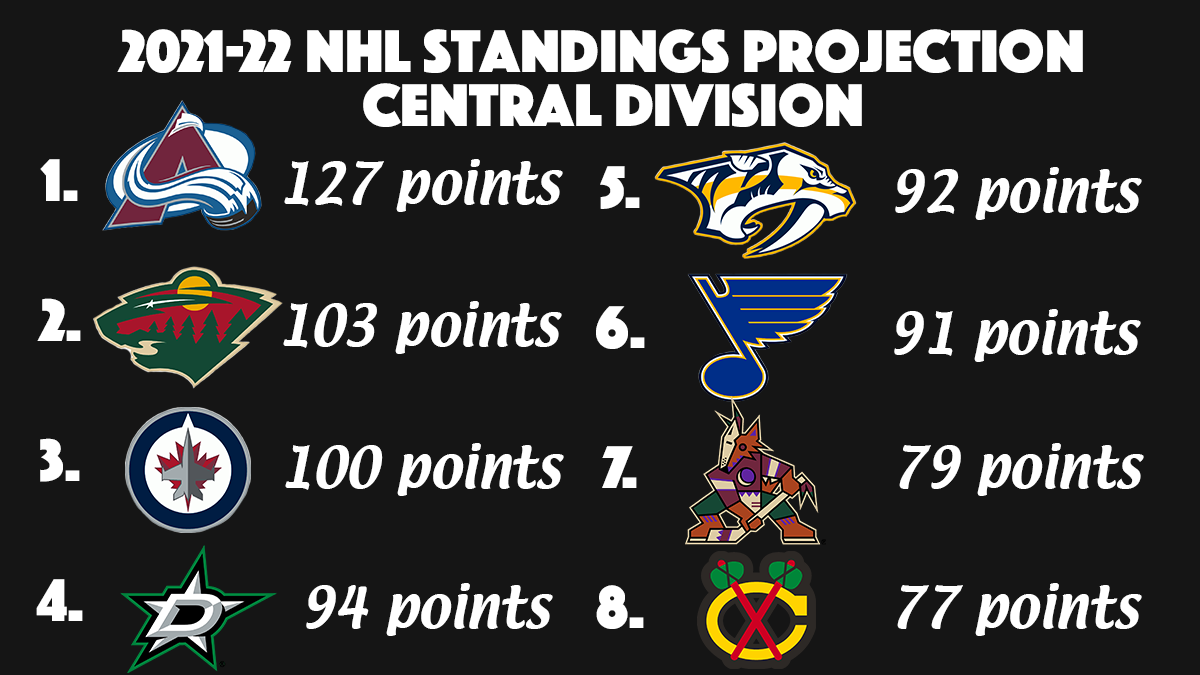
    The overall vibe of the Central Division for 2021-22 is that it’s just more of exactly what you’d expect. The Colorado Avalanche are lightyears ahead of everyone else, while Kirill Kaprizov and the Minnesota Wild continue to be on the rise and everyone else fights for what they can earn.

    Meanwhile, the jury is still out on whether or not the Winnipeg Jets can breakthrough as Canada’s team and break the Canadian curse (become the first Canadian club to win the Cup since 1993).

    Will Colorado finally break through the Second Round and win the Cup?

    Are the Avalanche just the Toronto Maple Leafs but with a little more success? My column:

    No, but really, it’s worth asking if the Avs making it back to the Western Conference Final for the first time since 2002, is more like Toronto’s struggle to make it out of the First Round for the first time since 2004, or is Colorado’s struggle more like the Washington Capitals pre-2018?

    The Caps won three Presidents’ Trophies in 2009-10, 2015-16 and 2016-17, but couldn’t make it past the Second Round– let alone the Pittsburgh Penguins– until they finally did and ended up surging in momentum all the way to their first Stanley Cup in franchise history.

    Colorado, on the other hand, has already won the Cup twice (1996 and 2001) and also has three Presidents’ Trophies to their name in 1996-97, 2000-01 and 2020-21, so if recent history has anything to tell us it’s that yet another team with high expectations for at least a few seasons now only to come up short could very well go on to win it all after winning the Presidents’ Trophy the previous year.

    Either that or they’ll have to win it in back-to-back seasons like Washington did before they won the Cup in 2018.

    Then again, the Tampa Bay Lightning tied the Detroit Red Wings’ record for most wins in the regular season (62), securing the Presidents’ Trophy in the process in 2018-19, then got swept by the Columbus Blue Jackets in the 2019 First Round.

    The very next year, however, Tampa kicked off back-to-back Cup rings in 2020 and 2021, to be where they are now as the two-time defending champions likely standing in the path as the only other favorites outside of the Avalanche this season.

    Anyway, the Avs mostly kept things the same from last season to this season, losing Joonas Donskoi to the Seattle Kraken in the 2021 NHL Expansion Draft, Brandon Saad to the St. Louis Blues in free agency and making minor swaps among replacement level bottom-six forwards and bottom-pairing defenders.

    Oh, then there’s this whole thing about how Philipp Grubauer left for Seattle in free agency too, so Colorado acquired Darcy Kuemper from the Arizona Coyotes.

    Between Dallas, Nashville and St. Louis, who will realistically make the playoffs?

    The Stars are projected to finish with about 94 points, the Predators sit at 92 points and the Blues are around 91 points in this one projection, but don’t let the points alone be your deciding factor.

    Given the strength of the Central Division compared to the Pacific Division, you can bet on five teams making out of the Central among Western Conference playoff berths.

    As such, the spread is the difference maker between these three teams expected to be in the wild card hunt– it’s going to come down to the wire one way or another.

    Dallas bolstered their goaltending depth by signing Braden Holtby, Nashville traded Ryan Ellis to the Philadelphia Flyers and St. Louis is… …better than last season on paper?

    I mean, the Blues signed Saad, acquired Pavel Buchnevich from the New York Rangers in exchange for Sammy Blais, let Seattle claim Vince Dunn at the expansion draft and let Mike Hoffman walk to the Montréal Canadiens in July.

    You could say they took a hit here or there, but those aren’t “nobody names” by any means, however.

    If Jordan Binnington and Ville Husso can stabilize things in the crease, then St. Louis has a better situation than the Predators.

    The Stars, meanwhile, should benefit from a longer season where more of their core guys– like Tyler Seguin, for example– are healthy. Last season’s COVID-19 outbreak to kick things off in January really killed Dallas’ momentum as a team on the verge of being in the 2021 postseason.

    Dallas should get back into the swing of things and St. Louis should be able to stay relevant for at least another year, but how hard the Preds rely on Juuse Saros as their starting goaltender will dictate whether or not they’re able to play spoiler with David Rittich as their backup since Pekka Rinne retired.

    Can Arizona avoid the basement?

    Anything is possible at this point. Loui Eriksson and Andrew Ladd were scoring goals in the postseason, so a fresh start could be just what both players needed for the last few years at least.

    That said, Coyotes General Manager, Bill Armstrong, gave a Masterclass™️ in how to go about rebuilding by selling everything over the summer and taking on “bad” contracts with only one or two years remaining in hopes of playing just well enough to be bad enough without making it look obvious that you’re aiming to win the 2022 NHL Draft Lottery.

    The Pacific Division is the new Scotia NHL North Division from last season. In other words, it’s the worst– which is great news for the Seattle Kraken as the league’s schedule allots more division play than any other opponents (though the Kraken will play every other team in the league at least twice).

    Seattle’s riding the waves of new-age expansion, while the Vegas Golden Knights lead the charge for the Presidents’ Trophy campaign in 2021-22.

    Wait, Seattle in 2nd in the Pacific, really?

    Yes, really.

    The Kraken have a great front office that goes beyond just Ron Francis as General Manager and have done their due diligence in scouting the best talent available to try to replicate the success of the Vegas Golden Knights’ inaugural season in 2017-18, as well as grow beyond just 2021-22.

    That said, Seattle probably isn’t going to make it out of the First Round of the 2022 Stanley Cup Playoffs, even if they have to face the Edmonton Oilers according to this projection.

    It’s a best case scenario for the NHL’s newest expansion team to be in the weakest division, but aside from having recent Stanley Cup champions Yanni Gourde, Philipp Grubauer, Jaden Schwartz and Dunn on their roster, the Kraken have a plethora of players that are relatively inexperienced with deep postseason runs.

    Head coach, Dave Hakstol, also hasn’t had the consistency of making the playoffs and making it out of the First Round in his NHL coaching days, but as a team that, again, is looking to develop long-term success, these are mere growing pains Francis and Co. are willing to accept as the fan base grows.

    Why aren’t the Kings making the cut this year when everyone else says they’ll be the most improved?

    The simple answer is that everyone’s overrating Los Angeles when it comes to the “ready now” factor.

    Sure, Kings General Manager, Rob Blake, did a good thing by getting Viktor Arvidsson in a trade with Nashville this summer to solidify his top-six forward group and signed Alex Edler to fortify his defense, but Los Angeles’ goaltending leaves something to be desired.

    Here’s hoping Jonathan Quick can find a little resurgence at this point in his career, while Cal Petersen continues to come into his own.

    If Los Angeles has any injuries– and they already have with Arvidsson likely missing some time due to an injury in the last preseason game– they’re already close enough to the bubble that they’ll only fall further behind.

    That said, if the Kings don’t make it back to the postseason hunt in 2022, there’s a good chance they make it in 2023.

    Los Angeles is improving, but by how much remains to be seen.

    Will winning the Presidents’ Trophy hurt Vegas?

    Eh, it’s hard to say.

    The Golden Knights have packed in just about every type of heartbreak since their inception in 2017, that fans of other franchises have only experienced over the course of at least 50 years, so if Vegas pulls out the Presidents’ Trophy win in 2021-22, don’t be surprised when the inevitable happens and they win the Cup instead of doing what most other Presidents’ Trophy winners in the salary cap era have done.

    Only the 2007-08 Detroit Red Wings and Chicago in 2012-13, have been able to win the Presidents’ Trophy and the Stanley Cup since the salary cap was introduced ahead of the 2005-06 season.

    Vegas would probably join Detroit and Chicago in doing so just so the Hockey Gods can spite us again.
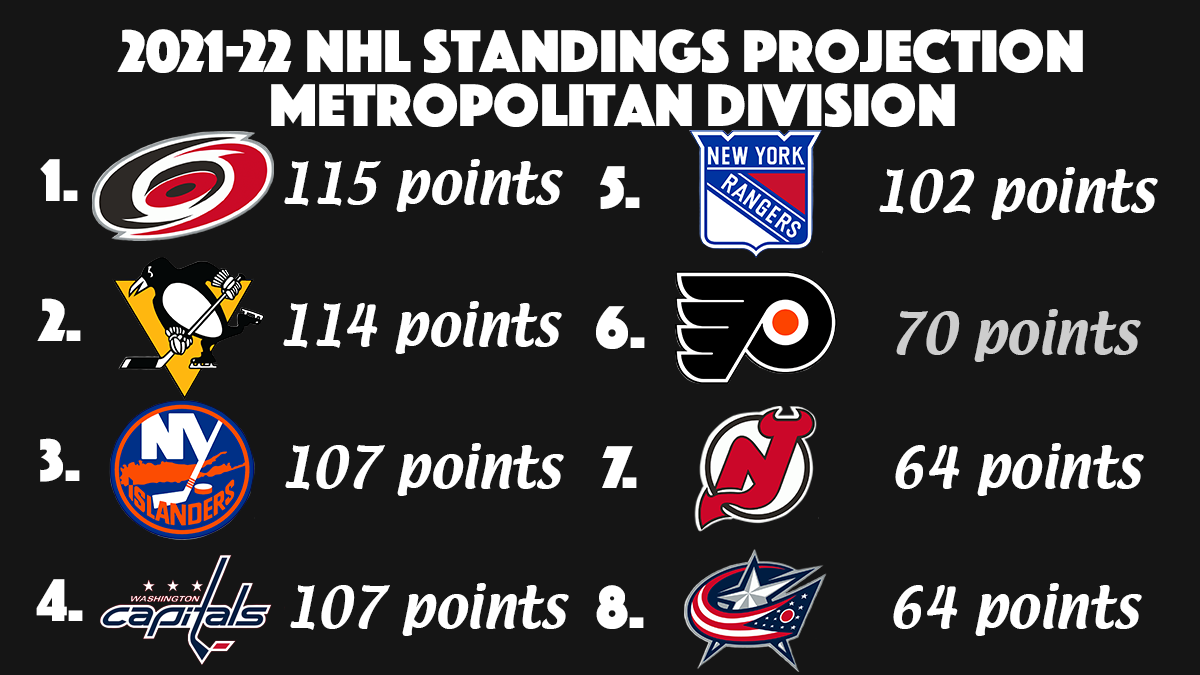
    It’s not easy to be in the Metropolitan Division these days because, well, let’s save that for the three questions below.

    Is this the toughest division to project?

    Absolutely.

    The Carolina Hurricanes decided to just get rid of a few parts and pieces that helped make them good for the last few seasons, so they’re bound to regress even with Sebastian Aho, Andrei Svechnikov, Teuvo Teräväinen and Martin Necas still existing.

    The Pittsburgh Penguins since 2009, have always found a way to be near the top of the division standings by the end of the regular season no matter whether or not you believe they’ll inevitably miss the playoffs for the first time since 2006, so anything could happen there.

    The New York Islanders have made back-to-back appearances in the Eastern Conference Final, so I’d expect them to be good.

    The Washington Capitals are better than the Philadelphia Flyers and New York Rangers, at least, but are probably the only team on the bubble if the New Jersey Devils can come out of nowhere and be competitive this season after signing Dougie Hamilton, Tomas Tatar and Jonathan Bernier in the offseason.

    Meanwhile, it’s time for a short rebuild in Columbus as the Blue Jackets would be quite pleased with a top draft pick in 2022.

    What if Chris Drury never was promoted as General Manager of the Rangers?

    They’d still fire David Quinn and hire Gerard Gallant. I don’t think that’s such a bad idea, but they’d definitely reconsider about 90% of the roster decisions made this summer.

    There’s no reason why the Rangers have to go down this path and yet, here they are, fumbling at the one-yard line and possibly plunging their franchise back into the Dark Ages of another rebuild. Or is it the same ongoing rebuild?

    What about a team to watch like New Jersey, for example?

    I’m big on the Devils this season for some strange reason.

    Maybe it’s because a part of me deep down misses the trap game of the 1990s and 2000s that led to Stanley Cups for New Jersey in 1995, 2000 and 2003.

    Maybe it’s because they signed Hamilton, Tatar, Bernier and acquired Ryan Graves from the Colorado Avalanche as a supporting cast for Jack Hughes, Nico Hischier, Pavel Zacha, Yegor Sharangovich, Ty Smith and friends.

    Seriously, the Devils should be good in the next few seasons, but this year could be the biggest stride forward in terms of their improvement from the basement to their development as a playoff contender.

    First, pour one out for Jack Eichel. Now, let’s move on and talk about everyone else.

    What does this mean for the Leafs?

    Just like how the Stars, Preds and Blues are all right on top of one another in the Central Division standings, the Atlantic Division is stacked from 1st through 4th, so though Toronto leads the way in this projection, I wouldn’t feel too comfortable as a Leafs fan.

    The Maple Leafs played in the worst of the four divisions last year in the temporarily realigned divisions in wake of the ongoing pandemic.

    No, it’s not just because they played all the other Canadian teams across 56 games, but rather it’s due to the fact that they haven’t been able to matchup with the Tampa Bay Lightning, Florida Panthers and even the Boston Bruins since the 2019-20 season.

    A lot and not a lot has changed since then.

    Tampa is still dominant as ever, Florida has emerged as a team that’s on the rise and Boston is unpredictable in that– much like the Penguins– it could really go either way with the Bruins this season.

    So now Toronto has to take on better competition within their own division and square off with teams like the Vegas Golden Knights, Colorado Avalanche, New York Islanders and others that emerge towards the top of the standings outside of the Canadian teams that the Leafs are all too familiar with at this point.

    That said, Toronto still has a great chance at winning the Atlantic Division regular season title or finishing 2nd and having home ice advantage in the First Round for the second-straight postseason.

    Can anyone other than Toronto, Florida, Tampa or Boston make it out of the Atlantic this year?

    No. Let’s be realistic here.

    The Montréal Canadiens made it to the 2021 Stanley Cup Final despite being below .500 in the standings because every division produced four playoff berths and intra-divisional play through two rounds.

    In 2020, they upset the Pittsburgh Penguins in the Qualifier despite finishing right at .500.

    In any other non-pandemic timeline, the Canadiens would still be looking for their first playoff appearance since they lost to the New York Rangers in six games in the 2017 First Round.

    That’s not to say that Nick Suzuki can’t lead the Habs back to glory, but rather that they need to improve all-around in the regular season and peaking in performance in the playoffs.

    Though the Ottawa Senators promised unprecedented success from 2021-25, it’s looking like it’ll realistically be anytime between 2024-25 as in the 2024-25 season itself at this point.

    Ottawa’s goaltending needs to improve, their defense could use some tweaks and the Sens are banking on their offense getting their feet underneath them and bursting in production in the coming years.

    A little more patience won’t hurt them.

    The same can be said for the Detroit Red Wings in that Red Wings fans already know– trust in General Manager, Steve Yzerman, is paramount. He’ll work his magic.

    It just takes a little time to build a solid foundation and the first floor is almost ready to start going up.

    As for the Buffalo Sabres, well…

    At least they’ll hopefully give Rick Jeanneret a proper send-off before he retires as their play-by-play announcer for the last 51 years on television.

    Hopefully.

    Will Tampa win three consecutive Stanley Cup championships?

    Probably not.

    I’m not ruling it out entirely, but the Lightning have a better chance of winning three Cups in four years than they do three Cups in as many years as things stand currently.

    The loss of their entire third line (Blake Coleman, Yanni Gourde and Barclay Goodrow) from last season to this season is sure to leave a mark on the development and restructuring of their bottom-six forwards.

    That said, Tampa’s top-six forwards still exist and, if you haven’t already noticed, they’re very good on their own, but the best teams in the playoffs have four lines that can roll without a doubt and the Bolts might just be off the ball for a year in terms of depth.


    Alright, if you’ve made it this far, thanks for your patience. By now the season’s already going on a few days into the 2021-22 calendar, so the two of us (or more if you’re reading this to a group) should probably get back to watching games.

    Stay tuned for more forecasts for both standings and assorted teams throughout the season.

  • St. Louis Blues 2021-22 Season Preview

    St. Louis Blues 2021-22 Season Preview

    2020-21 record 27-20-9, 63 points

    4th in the Honda NHL West Division

    Eliminated in the First Round by Colorado

    Additions: F Pavel Buchnevich (acquired from NYR), F Matthew Peca, F Brandon Saad, F Nathan Todd, D Tommy Cross, D Calle Rosén, G Charlie Lindgren

    Subtractions: F Sammy Blais (traded to NYR), F Mike Hoffman (signed with MTL), F Curtis McKenzie (signed with Texas Stars, AHL), F Jaden Schwartz (signed with SEA), F Alexander Steen (retired), D Vince Dunn (expansion, SEA), D Carl Gunnarsson (retired), D Petteri Lindbohm (KHL)

    Still Unsigned: F Robert Thomas (RFA), G Jon Gillies

    Re-signed: F Ivan Barbashev, F Tyler Bozak, F Dakota Joshua, F Tanner Kaspick, F Jordan Kyrou, F Zach Sanford, F Nolan Stevens, F Nathan Walker

    Offseason Analysis: Winning the Cup comes with a blessing and a curse. It’s a blessing to win it (especially as the Blues had never won prior to 2019, since their inception in 1967) and it’s a curse because it sets an expectation for success.

    St. Louis might have had a short window to win their second Cup in franchise history.

    After being swept by the Colorado Avalanche in the First Round of the 2021 Stanley Cup Playoffs, their face of the franchise before Ryan O’Reilly’s arrival, Vladimir Tarasenko, requested a trade.

    Blues General Manager, Doug Armstrong, has yet to fulfill that request and has indicated that he’s in no rush to do so– after all, he’s in control of the cards at hand and like when Avs General Manager, Joe Sakic, ultimately traded Matt Duchene, Armstrong can command a steep price for Tarasenko if he’s patient enough.

    Injuries have limited Tarasenko to 34 games in the last two seasons, including 3-7–10 totals in 10 games in 2019-20 and 4-10–14 totals in 24 games in 2020-21.

    From 2014-15 through the 2018-19 season Tarasenko recorded five consecutive seasons with at least 65 points– including his career-high 75 points in 82 games in 2016-17, as well as a 40-goal season in 80 games in 2015-16.

    Tarasenko’s situation isn’t the only concern in St. Louis, however, as the depth of the Blues that made them Cup contenders turned champions in 2019, has withered away– leaving Armstrong with the difficult task of overhauling both the top-six forward group and experimenting with the right mixture of replacement players.

    Jake Allen, Sammy Blais, Jay Bouwmeester, Vince Dunn, Joel Edmundson, Robby Fabbri, Carl Gunnarsson, Patrick Maroon, Alex Pietrangelo, Jaden Schwartz and Alexander Steen have all left one way or another since winning the Cup in St. Louis.

    In their place, guys like Ivan Barbashev, Klim Kostin, Jordan Kyrou and Mackenzie MacEachern have climbed the development ladder, while Torey Krug, Justin Faulk and Marco Scandella were acquired by other means.

    Some will rise and exceed expectations. Others will be gifted contracts through their prime– though their use may be time limited and the chemistry pulled apart.

    At the very least, Barbashev and Kyrou’s extensions this summer lead the youth movement for the Blues in an ever-changing league.

    Meanwhile, the introduction of Brandon Saad on a five-year deal worth $4.500 million per season– only a smidge more than what Mike Hoffman was making on a one-year contract that wasn’t renewed– and Pavel Buchnevich via trade and subsequent four-year, $23.200 million extension has solidified St. Louis’ top-six forward group for the foreseeable future.

    Saad spent last season with the Avalanche and had 15-9–24 totals in 44 regular season games before coming up clutch in the postseason– albeit at times the only goal scorer, it seemed, for Colorado– with 7-1–8 totals in 10 games.

    At 28-years-old, the Blues should have him for what’s left of his prime in what’s been a respectable career thus far with 371 points (184 goals, 187 assists) in 632 career games since making his league debut in the 2011-12 season with Chicago, winning two Stanley Cup rings with the organization in 2013 and 2015, then spending time with the Columbus Blue Jackets, Chicago again and Colorado.

    Armstrong acquired Buchnevich from the New York Rangers in exchange for Blais and a 2022 2nd round pick on July 23rd in the only trade that involved roster players for St. Louis this offseason.

    Blais leaves the Blues after breaking into the league in the 2017-18 season and amassing 17-18–35 totals in 119 games with St. Louis, including 8-7–15 totals in 36 games last season.

    Buchnevich joins the Blues riding a productive season with the Rangers– notching 48 points (20 goals, 28 assists) in 54 games in 2020-21, as well as 79-116–195 totals in 301 career games with New York since making his league debut in the 2016-17 season.

    After nine loyal seasons with the Toronto Maple Leafs, Tyler Bozak won the Cup in his first season with St. Louis in 2018-19.

    Through three seasons with the Blues, Bozak’s amassed 31-53–84 totals in 170 games– despite injuries that kept him to 31 games out of the 56-game schedule in 2020-21.

    At 35-years-old and in love with the St. Louis uniform, Bozak is ready to be part of the transitional plans from 2019 Stanley Cup champions to getting back to Cup contention for the Blues– signing a one-year extension worth $750,000 against the cap.

    He’ll either be back to full health as a low-risk, high-reward gamble to hang onto or he’ll be trade bait for another team looking to add a touch of experience at the deadline.

    It might have been a blessing in disguise for the Blues to have kept Bozak and lost Schwartz this offseason.

    Schwartz’s five-year contract worth $5.500 million per season with the Seattle Kraken contains a no-movement clause in the first three seasons for a player that’s suffered from a recent decline in production at 29-years-old.

    Contrasted with Phillip Danault’s two-way style that ultimately went to the Los Angeles Kings with an additional sixth-year in his contract– albeit their similar scoring totals– the Blues were never going to be able to afford to keep Schwartz and account for patching a couple of holes at the same time.

    After skyrocketing to the top of the league standings and winning the Cup in 2019, Jordan Binnington’s looking to reinvent himself as a surefire starter in the National Hockey League.

    On the wings of a six-year extension worth $6.000 million per season, he better prove it.

    A 30-13-7 record in 50 games played with a 2.56 goals-against average, a .912 save percentage and three shutouts in that span in 2019-20, was followed by an 18-14-8 record in 42 games played with a 2.65 goals-against average and a .910 save percentage.

    That doesn’t exactly scream long-term option in net if it worsens.

    In five postseason games in 2020, Binnington went 0-5 and had a 4.72 goals-against average, as well as an .851 save percentage.

    In 2021, he went 0-4 with a 3.59 goals-against average and an .899 save percentage. While that is better than his 2020 performance, it also means that the two postseason wins since winning the Cup in 2019, were recorded by a goaltender not named “Binnington” (they were, in fact, recorded by current Montréal Canadiens backup and former Blues netminder, Jake Allen).

    If St. Louis can’t get things tamed in the crease, then they might have even more issues to resolve than already planned.

    Offseason Grade: C

    While Saad and Buchnevich are quality pickups for the Blues, most teams in playoff contention make one or two moves and otherwise stand pat.

    St. Louis got an upgrade over Hoffman’s departure, sure, but they are limited in spending power with about $782,000 left in cap space and burdened by lengthy contracts that haven’t really gone one way or another yet.

    Armstrong knows how to build a team up over a period of time, but hasn’t encountered what it means to sustain that success over the years in the postseason, as well as through the course of developing a system to supplement it while talent comes and goes in the ebbs and flows of the salary cap era.

    Whereas the Blues once mastered building the foundation for a team that could contend for a decade or more, it seems as though there are cracks starting to form and if they’re not careful, serious structural damage could affect their core.

  • Seattle Kraken 2021-22 Season Preview

    Seattle Kraken 2021-22 Season Preview

    2020-21 record 0-0-0, 0 points

    Making their debut in the Pacific Division

    Newest expansion team entering their 1st season

    Additions: F Mason Appleton (from WPG), F Nathan Bastian (from NJD), F Colin Blackwell (from NYR), F Joonas Donskoi (from COL), F Jordan Eberle (from NYI), F Yanni Gourde (from TBL), F Morgan Geekie (from CAR), F Luke Henman, F Calle Järnkrok (from NSH), F Marcus Johansson (UFA from MIN), F Jared McCann (from TOR), F Jaden Schwartz (UFA from STL), F Brandon Tanev (from PIT), F Alexander Wennberg (UFA from FLA), D Connor Carrick (UFA from NJD), D Mark Giordano (from CGY), D Haydn Fleury (from ANA), D Adam Larsson (from EDM), D Jeremy Lauzon (from BOS), D Jamie Oleksiak (from DAL), D Gustav Olofsson (UFA from MTL), D Carson Soucy (from MIN), G Antoine Bibeau (UFA from COL), G Joey Daccord (from OTT), G Chris Driedger (from FLA), G Philipp Grubauer (UFA from COL)

    Subtractions: F Tyler Pitlick (traded to CGY), F John Quenneville (NL), D Gavin Bayreuther (signed with CBJ), D Kurtis MacDermid (traded to COL), G Vitek Vanecek (traded to WSH)

    Still Unsigned: D Dennis Cholowski (from DET)

    Re-signed: F Kole Lind (from VAN), F Alexander True (from SJS), F Carsen Twarynski (from PHI), D Will Borgen (from BUF), D Vince Dunn (from STL), D Cale Fleury (from MTL)

    Offseason Analysis: The NHL’s newest franchise is set to take to the ice for their first season on Oct. 12th as the Kraken pay a visit to the Vegas Golden Knights to kickoff a five-game road trip before hosting the Vancouver Canucks on Oct. 16th in the first home game in the freshly renovated Climate Pledge Arena in Seattle.

    Vegas didn’t do Seattle any favors in terms of establishing new-age expansion team expectations, since the Golden Knights found a way to make the 2018 Stanley Cup Final in their first season, but Kraken fans are just happy to have a professional hockey team competing for the Cup back in the city for the first time since the Seattle Metropolitans folded in 1924.

    The Kraken are going to draw many comparisons to the Golden Knights despite adopting different strategies in roster compesition.

    Vegas hit the ground running with a “win now” mentality, while Seattle’s built to grind their opponents down by rolling four lines similar to how the New York Islanders play a modified version of “the trap”.

    Kraken General Manager, Ron Francis, has a great scouting department down the hall and knows how to construct a foundation for the future.

    Francis’ track record as the General Manager of the Carolina Hurricanes prior to Don Waddell’s arrival saw the likes of Martin Neceas, Morgan Geekie, Jake Bean, Julien Gauthier, Noah Hanifin, Sebastian Aho, Nicolas Roy, Haydn Fleury, Alex Nedeljkovic, Warren Foegele, Lucas Wallmark, Elias Lindholm, Brett Pesce, Brock McGinn and Jaccob Slavin rise through the ranks to the NHL– whether they still remain in a Canes uniform or not.

    The future is bright for Seattle, while Dave Hakstol is getting a second chance behind the bench of an NHL team after a brief stint as an assistant coach with the Toronto Maple Leafs most recently.

    Hakstol’s time as the head coach of the Philadelphia Flyers followed the rollercoaster that the organization’s been stuck in since Ron Hextall vacated the net.

    One year showed promise, the next year was average, but then Hakstol and the team found another gear and were on the rise again– finishing 3rd in the Metropolitan Division in 2017-18, before his ultimate downfall and firing– though Philadelphia’s revolving door of goaltenders may have been a contribution.

    Yanni Gourde had 17-19–36 totals in 56 games with the Tampa Bay Lightning last season en route to back-to-back Stanley Cup championships.

    He will miss the start of the 2021-22 season, though, which could put a damper on the expectations that he’ll be a breakout player in a Kraken uniform.

    That said, glue guys like Joonas Donskoi, Alexander Wennberg, Brandon Tanev and Mason Appleton should compliment the roster well and help fill the void, while Jordan Eberle and Jaden Schwartz work on solidifying a top-six forward group.

    On defense, Mark Giordano provides a touch of leadership and experience with Jamie Oleksiak and Adam Larsson on an otherwise young blue line filled with the likes of Will Borgen, Vince Dunn, Haydn Fleury and Jeremy Lauzon.

    In the crease, Seattle signed Philipp Grubauer after selecting Chris Driedger, Vitek Vanecek (later traded back to the Washington Capitals) and Joey Daccord in the expansion draft.

    Driedger was the expected starter until Grubauer came along and left the Colorado Avalanche after the last three seasons.

    Grubauer had seven shutouts to go with his 30-9-1 record in 40 games played last season, as well as a 1.95 goals-against average and a .922 save percentage in that span.

    While Driedger’s 2.07 goals-against average and .927 save percentage was pretty great for the Florida Panthers last season, his 14-6-3 record and three shutouts pale in comparison to Grubauer.

    That said, the two should make a dynamic duo as one of the most promising goaltending tandems on paper entering the 2021-22 season.

    Seattle may or may not make the playoffs in their first season, but they’re sure to be better than a lot of expansion teams before the Golden Knights came around and flipped the script.

    Offseason Grade: B-

    Both the Golden Knights and the Kraken benefitted from some of the most generous expansion draft rules in league history– though Seattle dealt with the aftermath of Vegas’ wrath in swindling other teams via side deals in 2017, and couldn’t make a trade at the 2021 NHL Expansion Draft itself as a result.

    Admit it, you would’ve taken Alex Ovechkin, Carey Price, Gabriel Landeskog and Vladimir Tarasenko if they were made available to you in an NHL 22 fantasy draft– salary cap be damned.

    But that’s just it– a fantasy.

    Even Vegas was laughed at for some of their expansion draft choices, but both the Golden Knights and Kraken experienced quite a turnover between when they filled out a roster for the first time on paper and when they hit the ice.

    For having to put together a team from scratch, Francis didn’t do a bad job. For trying to win a Cup in their first season, well, the jury’s still out on that one, Seattle.

    In any case, the city has more Stanley Cup rings before the Kraken even existed than 11 other current NHL teams thanks to the Metropolitans winning it all as the first American team to win the Cup in 1917.

  • 2021 NHL Free Agency Signings Quick Recap

    2021 NHL Free Agency Signings Quick Recap

    This post will be updated as signings are officially announced. Be sure to check our Twitter account (@DtFrozenRiver) for all of the latest signings, news, and analysis.

    Free agency begins at noon (technically 12:01 PM ET) on July 28th.

    For the second-straight year, the ongoing COVID-19 pandemic has shifted the schedule a bit for the National Hockey League, but after the free agency signing period opens to kickoff the 2021-22 league calendar year, things will be back on track for a full 82-game schedule (albeit about a week later than usual).

    All that is known is shown and will be updated throughout the day. More analysis will come as we play catch-up.

    ESPN+ is streaming TSN’s coverage of free agency from 11 a.m. ET onward and NHL Network has the Sportsnet/their own feed, probably (we like the former, in all partiality).

    Reported free agent signings

    These are reported agreements in place that are yet to be confirmed and/or announced by a playing club.

    F Kyle Palmieri has likely re-signed with the New York Islanders.

    Announced free agent signings

    These are confirmed/announced signings by playing clubs.

    F Carter Verhaeghe signed a three-year extension worth about $4.167 million per season with the Florida Panthers that goes into effect starting with the 2022-23 season.

    The Edmonton Oilers re-signed D Tyson Barrie to a three-year contract worth $4.500 million per season.

    The Vegas Golden Knights signed D Alec Martinez to a three-year extension worth $5.250 million per season.

    The Carolina Hurricanes signed G Frederik Andersen to a two-year deal worth $4.500 million per season.

    G Petr Mrazek signed a three-year deal with the Toronto Maple Leafs worth $3.800 million per season.

    F Nick Bonino agreed to a two-year contract with the San Jose Sharks.

    F Brandon Sutter signed a one-year extension worth $1.125 million with the Vancouver Canucks.

    G Antti Raanta reportedly signed a two-year deal worth $2.000 million per season with the Carolina Hurricanes.

    The Los Angeles Kings re-signed F Andreas Athanasiou to a one-year deal worth $2.700 million.

    D Dougie Hamilton signed a seven-year contract worth $9.000 million per season with the New Jersey Devils.

    F Blake Coleman signed a six-year deal worth $4.900 million per season with the Calgary Flames.

    The Montréal Canadiens signed D David Savard to a four-year contract worth $3.500 million per season.

    G Brian Elliott signed a deal with the Tampa Bay Lightning.

    D Tucker Poolman agreed to a four-year contract worth $2.500 million per season with the Vancouver Canucks.

    The Dallas Stars signed F Luke Glendening to a two-year deal worth $1.500 million per season.

    D Andreas Borgman signed a one-year, two-way deal worth $750,000 at the NHL level with the Dallas Stars.

    D Travis Hamonic signed a two-year extension worth $3.000 million per season with the Vancouver Canucks.

    F Dominik Simon signed a one-year, two-way contract extension with the Pittsburgh Penguins.

    F Charles Hudon signed a deal with the Tampa Bay Lightning.

    D Zach Bogosian signed a three-year contract worth $850,000 per season with the Tampa Bay Lightning.

    The San Jose Sharks signed F Andrew Cogliano to a one-year contract worth $1.000 million.

    The Montréal Canadiens signed F Cedric Paquette to a one-year contract worth $950,000.

    D Brady Keeper signed a two-year deal worth $762,500 per season with the Vancouver Canucks.

    The Vegas Golden Knights signed G Laurent Brossoit to a two-year deal worth $2.325 million per season.

    F Jean-Sébastien Dea signed a one-year deal worth $750,000 with the Montréal Canadiens.

    The San Jose Sharks signed G James Reimer to a two-year deal worth $4.500 million per season.

    F Michael Bunting signed a two-year deal worth $900,000 with the Toronto Maple Leafs.

    D Patrik Nemeth signed a three-year contract worth $2.500 million per season with the New York Rangers.

    F Maxim Mamin signed a one-year deal worth $975,000 with the Florida Panthers.

    D Louis Belpedio signed a one-year, two-way contract worth $750,000 with the Montréal Canadiens.

    The Vancouver Canucks signed F Danila Klimovich to a three-year entry-level contract worth $886,667 per season.

    The Dallas Stars signed D Alex Petrovic to a one-year, two-way contract.

    F Michael Amadio signed a one-year, two-way deal worth $750,000 at the NHL level with the Toronto Maple Leafs.

    The Vancouver Canucks signed D Luke Schenn to a two-year contract worth $850,000 per season.

    F Josh Leivo has signed a deal with the Carolina Hurricanes.

    The Carolina Hurricanes signed D Ian Cole to a one-year, $2.900 million deal.

    F Nic Petan signed a one-year, two-way deal worth $750,000 at the NHL level with the Vancouver Canucks.

    D Jake McCabe signed a four-year contract with Chicago worth $4.000 million per season.

    The Detroit Red Wings signed D Jordan Oesterle to a two-year deal worth $1.350 million per season.

    F Andrew Agozzino signed a two-way contract with the Ottawa Senators.

    D Adam Clendening signed a two-way deal with the Philadelphia Flyers.

    D Ryan Murphy signed a two-way contract with the Detroit Red Wings.

    The Los Angeles Kings have signed D Alex Edler to a one-year contract worth $3.500 million per season.

    The Boston Bruins signed F Erik Haula to a two-year deal worth $2.375 million per season.

    F Tomas Nosek signed a two-year contract worth $3.500 million per season with the Boston Bruins.

    F Phil Di Giuseppe signed a two-way contract worth $750,000 at the NHL level with the Vancouver Canucks.

    The Tampa Bay Lightning signed F Pierre-Edouard Bellemare to a two-year contract worth $1.000 million per season.

    F Matt Luff signed a one-year, two-way, $750,000 deal with the Nashville Predators.

    F Jon Lizotte signed a one-year, two-way, contract worth $750,000 at the NHL level with the Minnesota Wild.

    F Ryan Getzlaf agreed to a one-year extension with the Anaheim Ducks worth $4.500 million.

    F Ryan Dzingel signed a one-year, $1.100 million deal with the Arizona Coyotes.

    D Matt Tennyson signed a two-year, two-way contract with the Nashville Predators.

    F Mattias Janmark reached an agreement on an extension with the Vegas Golden Knights.

    F Josh Ho-Sang signed a PTO with the Toronto Maple Leafs.

    F Mike Hoffman signed a three-year deal with the Montréal Canadiens worth $4.500 million per season.

    G Linus Ullmark signed a four-year deal worth $5.000 million per season with the Boston Bruins.

    G Garret Sparks reached an agreement on a one-year, two-way contract with the Los Angeles Kings worth $750,000 at the NHL level.

    F Sam Gagner agreed to an extension with the Detroit Red Wings.

    The Red Wings also agreed to an extension with G Calvin Pickard.

    D Ryan Suter signed a four-year deal worth $3.650 million per season with the Dallas Stars.

    The Columbus Blue Jackets signed F Boone Jenner to a four-year extension.

    The Pittsburgh Penguins signed F Evan Rodrigues to a one-year extension worth $1.000 million.

    F Patrik Laine signed his qualifying offer with the Columbus Blue Jackets and will make $7.500 million on a one-year deal as a result.

    F Eric Robinson agreed to terms on a two-year extension worth $3.200 million with the Columbus Blue Jackets.

    The Philadelphia Flyers signed D Keith Yandle to a one-year deal worth $900,000.

    D Alex Goligoski signed a one-year deal worth $5.000 million with the Minnesota Wild.

    G Braden Holtby signed a one-year contract worth $2.000 million with the Dallas Stars.

    The Minnesota Wild signed F Frederick Gaudreau to a two-year deal worth $1.200 million per season.

    D Jarred Tinordi signed a two-year deal worth $900,000 per season with the New York Rangers.

    F Justin Bailey signed a one-year, two-way contract extension with the Vancouver Canucks.

    The Vegas Golden Knights signed F Sven Baertschi to a one-year, two-way, contract worth $750,000 at the NHL level.

    The Tampa Bay Lightning signed F Gabriel Dumont, D Darren Raddysh, D Andrej Sustr and G Maxime Lagacé to one-year, two-way contracts.

    F Gage Quinney signed a one-year, two-way contract extension with the Vegas Golden Knights.

    The Ottawa Senators signed D Michael Del Zotto to a two-year contract worth $2.000 million per season.

    Chicago signed F Jujhar Khaira to a two-year deal worth $975,000 per season.

    F Alexander Wennberg agreed to a three-year deal worth $4.500 million per season with the Seattle Kraken.

    The Nashville Predators signed F Anthony Richard to a one-year, two-way contract worth $750,000 at the NHL level.

    F Phillip Danault signed a six-year contract worth $5.500 million per season with the Los Angeles Kings.

    The Seattle Kraken reached an agreement with F Jaden Schwartz on a five-year deal worth $5.500 million per season.

    F Michael McCarron signed a two-year, two-way contract worth $750,000 at the NHL level with the Nashville Predators.

    G Martin Jones signed a one-year, $2.000 million contract with the Philadelphia Flyers.

    F Nate Thompson signed a one-year, $800,000 contract with the Philadelphia Flyers.

    G Philipp Grubauer is signed a six-year deal worth $5.900 million per season with the Seattle Kraken.

    F Greg McKegg signed a one-year, two-way contract worth $750,000 at the NHL level with the New York Rangers.

    F Dryden Hunt signed a two-year deal with the New York Rangers.

    The Florida Panthers signed D Brandon Montour to a three-year contract worth $3.500 million per season.

    D Chris Wideman signed a one-year deal worth $750,000 with the Montréal Canadiens.

    The Columbus Blue Jackets signed F Sean Kuraly to a four-year contract worth $2.500 million per season.

    The San Jose Sharks signed F Lane Pederson to a two-year contract worth $750,000 per season.

    D Tony DeAngelo signed a one-year contract with the Carolina Hurricanes worth $1.000 million.

    D Gavin Bayreuther signed a two-year, two-way contract with the Columbus Blue Jackets.

    The Edmonton Oilers signed D Cody Ceci to a four-year deal worth $3.250 million per season.

    F Kurtis Gabriel signed a one-year, $750,000 contract with the Toronto Maple Leafs.

    F Zachary L’Heureux signed a three-year, entry-level deal with the Nashville Predators.

    The Toronto Maple Leafs signed F David Kampf to a two-year contract worth $1.500 million per season.

    The Pittsburgh Penguins signed F Brock McGinn to a four-year contract worth $2.750 million per season.

    The Arizona Coyotes signed F Dmitrij Jaškin to a one-year contract.

    The Carolina Hurricanes re-signed F Jordan Martinook to a three-year contract worth $1.800 million per season.

    F Juho Lammikko signed a one-year extension with the Florida Panthers.

    G Jonathan Bernier signed a two-year deal worth $4.125 million per season with the New Jersey Devils.

    The Buffalo Sabres signed F Vinnie Hinostroza to a one-year contract worth $1.050 million.

    F Zach Hyman reached an agreement with the Edmonton Oilers on a seven-year contract worth $5.500 million per season.

    G Filip Lindberg signed a two-year entry-level contract with the Pittsburgh Penguins.

    F Brayden Point signed an eight-year extension worth $9.500 million per season with the Tampa Bay Lightning that goes into effect starting with the 2022-23 season.

    The Boston Bruins agreed to a three-year deal with D Derek Forbort worth $3.000 million per season.

    The Boston Bruins signed F Nick Foligno to a two-year deal.

    G David Rittich agreed to a one-year deal worth $1.250 million with the Nashville Predators.

    G Carter Hutton signed a one-year deal worth $750,000 with the Arizona Coyotes.

    The Colorado Avalanche signed D Roland McKeown to a one-year contract.

    The Columbus Blue Jackets signed F Alexandre Texier to a two-year contract extension worth $3.050 million.

    F C.J. Smith signed a one-year, two-way contract worth $750,000 at the NHL level with the Carolina Hurricanes.

    G Chris Gibson signed a one-year, two-way contract with the Florida Panthers.

    The Detroit Red Wings signed F Pius Suter to a two-year contract.

    D Brandon Davidson signed a one-year contract extension worth $750,000 with the Buffalo Sabres.

    The Nashville Predators re-signed F Mikael Granlund to a four-year contract worth $5.000 million per season.

    The Calgary Flames signed F Trevor Lewis to a one-year deal worth $800,000.

    G Jaroslav Halak agreed to a one-year deal worth $1.500 million with the Vancouver Canucks.

  • DTFR Podcast #177- And A Dollar Short

    DTFR Podcast #177- And A Dollar Short

    2020 Winter Classic sweater reviews, a standings update and Top-10 NHL power rankings.

    Subscribe to the podcast on Apple PodcastsStitcher and/or on Spotify. Support the show on Patreon.

  • Blues win first Cup in franchise history

    In a scene of poetic justice, if you will, the St. Louis Blues raised the 35-pound Stanley Cup high over their heads Wednesday night against the team that beat them the last time they were in the Final 49 years ago– the Boston Bruins.

    The Blues are your 2019 Stanley Cup champions after defeating the Bruins, 4-1, in Game 7 of the 2019 Stanley Cup Final– capturing the series 4-3.

    For the first time in franchise history, a St. Louis captain skated out to meet with NHL Commissioner Gary Bettman, shake Bettman’s hand, take a photo and accept the hardest silverware to win in professional sports.

    Alex Pietrangelo gets to be the first person in league history to say that he lifted the trophy as a member of the Blues.

    They were dead last in the league standings entering 2019.

    For the first time in their 52-year existence (51 seasons), the Blues are Stanley Cup champions thanks to Jordan Binnington’s NHL rookie record 16 wins in the postseason, as well as his 32 saves on 33 shots against en route to the win in Game 7.

    Binnington (16-10 record, 2.46 goals against average, .914 save percentage in 26 games played this postseason) also recorded an 8-2 record on the road in the postseason– tying Nikolai Khabibulin (2004), Miikka Kiprusoff (2004) and Ron Hextall (1987) for the most road wins by a goaltender in a playoff year.

    He made 187 saves on 205 shots against (.913 SV%) and had a 2.76 GAA in the series.

    Ryan O’Reilly took home the Conn Smythe Trophy as this year’s Stanley Cup Playoffs MVP. He finished with a six-game point streak in the Final.

    Boston goaltender, Tuukka Rask (15-9, 2.02 GAA, .934 SV% in 24 GP this postseason) stopped 16 out of 20 shots faced in the loss.

    Rask finished the 2019 Stanley Cup Final with 176 saves on 193 shots against (.912 SV%) and a 2.46 GAA.

    Eight years after winning the Cup in the last Game 7 in a Stanley Cup Final in Vancouver, the Bruins will have to wait until another day to earn their seventh title in franchise history.

    For the first time in their 95-year franchise history, the Bruins hosted a Game 7 in the Stanley Cup Final (though the Final only became a best-of-seven series since 1939).

    Boston joined the Chicago Blackhawks as the only other team to lose the only Game 7 in the Stanley Cup Final that they’ve ever hosted among the first six financially stable franchises from 1942-67– after the league’s inception in 1917 (otherwise referred to as the “Original Six” teams).

    The other “Original Six” teams have hosted at least one such contest with the Detroit Red Wings (3-2 in five Stanley Cup Final Game 7s on home ice) as the most successful team.

    The Toronto Maple Leafs (2-0), Montreal Canadiens (1-0) and New York Rangers (1-0) have all never lost a Game 7 in the Stanley Cup Final on home ice.

    St. Louis finished 10-3 on the road this postseason, while Binnington improved to 14-2 in games after a loss in the regular season and playoffs in his young career.

    The Blues became the fifth road team to win a Game 7 in the Stanley Cup Final– and third in-a-row since the Pittsburgh Penguins in 2009 and Bruins in 2011.

    Home teams are now 12-5 in 17 total Game 7s in the Stanley Cup Final.

    No home team has won the Cup since the 2015 Blackhawks.

    The Bruins fell to 14-9 in Game 7s on home ice (last loss prior to Wednesday night was against Montreal, 3-1, in the Second Round of the 2014 Stanley Cup Playoffs).

    This postseason run wrapped up the longest season (regular and playoffs) in Blues franchise history as St. Louis participated in 108 games total (26 postseason games).

    It was the 2nd longest season in Bruins franchise history as Boston played 106 total games (82 regular season and 24 playoff games)– one game short of their 2010-11 record (107 games, 82 regular season and 25 playoff games).

    Boston is now 2-1 all time in a playoff series against St. Louis, winning the Cup in four games in 1970, sweeping the Blues in four games in the 1972 Semifinals and losing in seven games in the 2019 Stanley Cup Final.

    Bruins head coach, Bruce Cassidy, told reporters ahead of Game 7 that defender, Matt Grzelcyk, would be a game-time decision and was cleared from concussion protocol.

    After warmups, Grzelcyk was good-to-go and placed alongside John Moore on the third defensive pairing in place of Connor Clifton.

    Joining Clifton among the long list of healthy scratches for Boston Wednesday night was Chris Wagner, Lee Stempniak, Zachary Senyshyn, Peter Cehlarik, Zane McIntyre, Paul Carey, Ryan Fitzgerald, David Backes, Steven Kampfer, Jack Studnicka, Urho Vaakanainen, Jakub Zboril, Jeremy Lauzon, Anton Blidh, and Trent Frederic.

    Once again, Kevan Miller (lower body) remained out of the lineup for the final time this season due to injury.

    B’s captain, Zdeno Chara, set an NHL record for the most Game 7 appearances by a player with his 14th Game 7 on Wednesday.

    Meanwhile, Blues interim head coach, Craig Berube had the services of Ivan Barbashev back in the lineup after Barbashev served his one-game suspension in Game 6 for an illegal hit to head of Boston forward, Marcus Johansson, in Game 5.

    Berube also scratched Robert Bortuzzo and re-inserted Joel Edmundson on his blue line for Game 7.

    Nearly halfway through the opening frame, St. Louis defender, Colton Parayko, sent the puck over the glass and out of play for an automatic delay of game minor penalty at 7:57 of the first period.

    Though they moved the puck around with ease on the ensuing power play, Boston couldn’t muster a goal on their first skater advantage of the night.

    The Bruins fired three shots on goal on the power play– including a point-blank attempt by David Krejci to deke and stuff the puck through Binnington’s five-hole.

    Late in the period, after Boston’s fourth line couldn’t clear their own zone, Jay Bouwmeester let go of a shot from the point that O’Reilly (8) redirected through Rask’s five-hole to give St. Louis the fist goal of the game.

    Bouwmeester (7) and Pietrangelo (16) had the assists on O’Reilly’s goal and the Blues led, 1-0, at 16:47 of the first period.

    The goal came on just the third shot on goal for St. Louis after they got the first shot in the game 27 seconds into the action.

    For the first time since Wayne Gretzky did so in 1985, O’Reilly scored a goal in four consecutive Stanley Cup Final games. It was also his 22nd point of the postseason– establishing a Blues franchise record for points in a playoff year.

    With eight seconds left in the first period, Jaden Schwartz evaded an attempt by Brad Marchand to make a check while Marchand was a de facto defenseman on a botched line chance by the Bruins.

    Schwartz skated with the puck deep into the corner and dropped a pass back to Pietrangelo (3) whereby the Blues captain walked right into the slot, pulled the puck to his backhand and flipped it through Rask’s seven-hole to make it, 2-0, St. Louis.

    Pietrangelo’s goal officially came at 19:52 of the first period and was assisted by Schwartz (7).

    After one period of play at TD Garden, the Blues led, 2-0, on the scoreboard, while the Bruins dominated shots on goal, 12-4.

    The B’s also led in takeaways (5-2), giveaways (5-0) and face-off win percentage (61-39), while the Notes led in blocked shots (9-2) and hits (14-11).

    St. Louis had yet to see any action on the skater advantage heading into the first intermission, while Boston was 0/1 on the power play entering the second period.

    Despite being badly outshot in the first period, the Blues emerged as hockey normally has its way swinging games back-and-forth for a full-press middle frame.

    Brayden Schenn had a shot midway in the second period that went off Rask’s stick, off the crossbar and stayed out of the twine thanks to Chara’s stick work keeping the puck out of the goal while chaos befell the rest of the players on the ice all around the crease.

    Through 40 minutes of play, St. Louis still led, 2-0, and trailed Boston in shots on goal, 23-10– including an, 11-6, advantage in shots on goal in the second period alone for the Bruins.

    The B’s led in takeaways (6-5), giveaways (12-4) and face-off win% (51-49), while the Notes led in blocked shots (15-7) and hits (27-21).

    The Blues still hadn’t seen any time on the power play entering the third period and the Bruins were 0/1.

    Midway through the final frame, Vladimir Tarasenko chased a loose puck in the attacking zone and threw a pass to Schenn (5) in the slot for the one-timer to give St. Louis a three-goal lead and all but assure themselves of their first Stanley Cup championship in franchise history.

    Tarasenko (6) and Schwartz (8) tallied the assists on Schenn’s goal at 11:25 of the third period and the Blues led, 3-0.

    St. Louis capitalized on the scoreboard moments after Joakim Nordstrom was denied at the other end by Binnington’s right pad.

    Late in the period, the Blues did it again as David Perron threw the puck through the slot to Zach Sanford (1) for his first career Stanley Cup Playoff and Stanley Cup Final goal.

    The New Hampshire native made it, 4-0, St. Louis with a goal that was assisted by Perron (9) and O’Reilly (15) at 15:22 of the third period.

    With the secondary assist on the goal, O’Reilly boosted his own Blues franchise record for the most points in a single postseason to 23 points (8-15–23 totals).

    Cassidy pulled Rask with 3:54 remaining in regulation out of a desperate attempt to just get on the scoreboard and it worked.

    As the seconds counted down, Grzelcyk (4) sent a shot off the crossbar and into the back of the net over Binnington’s blocker side to cut St. Louis’ lead to three goals.

    Krejci (12) had the only assist on the goal at 17:50 of the third period.

    The Blues were still in command, 4-1, and even after Boston pulled their goaltender for an extra attacker again with about 1:48 left on the clock, that three-goal deficit was all St. Louis needed.

    At the final horn, the Notes had done it.

    They finally won their first Stanley Cup championship in franchise history.

    This, despite trailing in shots on goal, 33-20, in Game 7. The Bruins also finished the night leading in giveaways (13-7) and face-off win% (51-49), while the Blues led in blocked shots (21-7) and hits (36-28).

    There was only one penalty called in the game and thus St. Louis’ power play never saw a second of ice time, while Boston went 0/1 on the skater advantage– way back in the first period after Parayko sent the puck over the glass for an automatic infraction.

    The team that scored first won Games 3, 4, 5, 6 and 7 in the series, while the home team only won two games in the entire seven game series.

    Boston finished 5-1 in elimination games in the 2019 Stanley Cup Playoffs (won Games 6 and 7 in the First Round against Toronto, won Game 6 against Columbus, won Game 4 against Carolina and forced Game 7 against St. Louis by winning Game 6– then lost in the final game).

    Exactly 35 years ago, Wednesday night, the Boston Celtics defeated the Los Angeles Lakers to win the NBA Championship in the last Game 7 hosted in Boston.

    That was at the old Boston Garden (1928-95). Wednesday night’s action was at TD Garden (1995-present) and the opposing team won.

    The Bruins have not won the Cup on home ice since beating St. Louis on May 10, 1970. Bobby Orr scored his iconic– sports photography defining– goal in overtime to clinch the Cup for Boston for the first time since 1941 that night– ending a 29-year drought.

    In 2019, it was the Blues quenching their thirst by winning their first.

  • O’Reilly nets two, Blues even series in Game 4

    Ryan O’Reilly scored two goals and helped even up the series as the St. Louis Blues beat the Boston Bruins, 4-2, on home ice Monday night

    It was the first home win in the Stanley Cup Final for the Blues at Enterprise Center and in their entire franchise history.

    Jordan Binnington (14-9 record, 2.52 goals gainst average, .909 save percentage in 23 games played this postseason) turned aside 21 out of 23 shots faced in the win for St. Louis.

    Meanwhile, Bruins goaltender, Tuukka Rask (14-7, 1.96 GAA, .938 SV% in 21 GP this postseason) made 34 saves on 37 shots against in the loss.

    Binnington now has seven wins following a loss this postseason and trails only Nikolai Khabibulin (2004), Mikka Kiprusoff (2004) and Ron Hextall (1987) who all had eight wins following a loss in their respective playoff years.

    In the 25 instances in which the team that tied the series 2-2 in the best-of-seven Stanley Cup Final format– prior to Monday night– that team has gone on to win the Cup 10 times.

    Three out of the last five instances have resulted in Cup championships, including 2015, 2013 and 2011 (Chicago, Chicago and Boston, respectively).

    Bruce Cassidy made no changes to his lineup for the Bruins, while Chris Wagner (upper body), Kevan Miller (lower body) and Matt Grzelcyk (undisclosed) remained out of the action for Game 4.

    Boston’s long list of healthy scratches including Lee Stempniak, Zachary Senyshyn, Peter Cehlarik, Zane McIntyre, Paul Carey, Ryan Fitzgerald, Steven Kampfer, Jack Studnicka, Urho Vaakanainen, Jakub Zboril, Jeremy Lauzon, Anton Blidh, Trent Frederic and Karson Kuhlman.

    Blues head coach, Craig Berube, had Oskar Sundqvist and Vince Dunn back in his lineup for Game 4. Sundqvist returned from his one-game suspension and Dunn made his first appearance in this series after being injured in the Western Conference Final and missing the last six games.

    Robert Thomas remained out for St. Louis, while Zach Sanford suited up in his place for the second straight game.

    O’Reilly (4) scored the game’s first goal in the opening minute of the action on Monday after jumping on a loose puck and wrapping around the goalframe.

    Boston couldn’t clear the zone and Sanford made just enough of a redirection to yield a rebound for O’Reilly to pounce on and bury in the twine as Rask was forced to go end-to-end in the crease.

    Sanford (2) and Dunn (6) tallied the assists on O’Reilly’s goal 43 seconds into the first period and St. Louis led, 1-0.

    With the secondary assist, Dunn collected his first point of the series in his first game back from injury.

    Midway through the opening frame, Danton Heinen absorbed a hit while bringing the puck into the attacking zone, whereby Zdeno Chara scooped up the rubber biscuit and sent it to the net– generating a rebound.

    Charlie Coyle (9) collected the puck and pocketed it in the twine to tie the game, 1-1, at 13:14 of the first period– his third goal in as many games, joining Devante Smith-Pelly (2018) and Jake Guentzel (2017) as the only players to score a goal in three straight games in the Stanley Cup Final in the last three years.

    Chara (4) had the only assist on the goal as the B’s got on the scoreboard.

    Almost a couple minutes later, Vladimir Tarasenko (11) banked in a rebound past Rask after Alex Pietrangelo kept the puck in the zone while entering fresh off the bench in the midst of a line change.

    Pietrangelo (12) and Brayden Schenn (7) notched the assists on Tarasenko’s goal and the Blues led, 2-1, at 15:30 of the first period.

    After one period of play, St. Louis was leading on the scoreboard, 2-1, and in shots on goal, 13-9. The Blues also held the advantage in giveaways (6-4) and hits (24-16), while the Bruins led in blocked shots (5-0) and face-off win percentage (52-48).

    Both teams had four takeaways aside and neither team had yet to see time on the skater advantage heading into the first intermission.

    With 16:53 left in the second period, Chara took a shot that ricocheted off his own stick and into his mouth, causing the 6-foot-9 defender to bleed and leave the ice for repair.

    Early in the middle frame, Coyle caught Carl Gunnarsson with a high-stick and was assessed a minor penalty at 5:47 of the second period.

    St. Louis did not convert on their first power play opportunity of the night.

    Gunnarsson, in turn, flipped the puck over the glass without any deflections, yielding an automatic minor penalty for delay of game at 8:31 of the second period.

    Though the Blue Notes almost scored a shorthanded goal, nothing happened on the special teams opportunity– Boston’s first power play of the game– and both teams resumed 5-on-5 action two minutes later.

    Shortly thereafter, Connor Clifton caught Tarasenko with an illegal hit to the head as Tarasenko attempted to back-check the Bruins defender.

    Clifton was sent to the penalty box with a minor penalty at 13:53 after finishing a shift that spanned 3:06.

    While shorthanded, Brad Marchand sent Patrice Bergeron up-ice in the attacking zone whereby the longest-tenured alternate captain in the NHL fired a shot and generated a rebound off Binnington.

    Brandon Carlo (1) buried the rebound for his first career Stanley Cup Final goal and tied the game, 2-2, with Boston’s first shorthanded goal of the series.

    Bergeron (8) and Marchand (13) had the primary and secondary assists, respectively, on Carlo’s goal at 14:19 of the second period.

    Carlo’s goal was also the first shothanded goal by a defender since Scott Niedermayer scored a shorthanded goal for the New Jersey Devils in Game 6 of the 2000 Stanley Cup Final.

    No. 25 in black-and-gold scored the 19th shorthanded goal by a defender since the league began tracking the stat in the 1933-34 season.

    The Blues did not capitalize on the power play as both teams went to the second intermission tied, 2-2, on the scoreboard with St. Louis still ahead in shots on goal, 25-19 (including a, 12-10, advantage in the second period alone for the Notes).

    Through 40 minutes of play, the Blues maintained an advantage in takeaways (9-8), giveaways (9-6), hits (32-29) and face-off win% (51-49), while the Bruins led in blocked shots (12-3).

    St. Louis was 0/2 on the skater advantage– while allowing a shorthanded goal– and the Bruins were 0/1 on the power play.

    Chara returned to the bench for the third period– wearing a fishbowl– but did not take a shift. He is one of the few remaining players that were grandfathered in after the mandatory visor rule was put in place prior to the 2013-14 season.

    Early in the final frame of regulation, Heinen tripped up Jaden Schwartz and was sent to the box at 2:08 of the third period.

    Once again, St. Louis was not able to capitalize on the power play, but at least the Blues didn’t allow a shorthanded goal against this time around.

    Jay Bouwmeester caught Coyle with a high-stick at 6:42 of the third period and was charged with a minor penalty.

    Boston did not score on the resulting power play.

    Midway through the third period, Pietrangelo sent a shot off of Rask’s blocker and generated enough of a rebound for O’Reilly (5) to bury for his second goal of the game.

    Pietrangelo (13) and Gunnarsson (2) had the assists on O’Reilly’s goal at 10:38 of the third period and the Blues took the, 3-2, lead thanks to O’Reilly’s eventual game-winning goal.

    Cassidy pulled Rask for an extra attacker with about 1:43 left in the action and Schenn (4) subsequently forced a turnover, then buried the puck in the empty net to seal the deal on St. Louis’ Game 4 efforts.

    Torey Krug and Bouwmeester got into a fracas that resulted in a slashing minor for Krug and an elbowing infraction for Bouwmeester at 19:34, yielding 4-on-4 action to finish the night.

    At the final horn, the Blues had won their first Stanley Cup Final game on home ice in franchise history with a, 4-2, victory over the Bruins and evened the series 2-2.

    St. Louis finished the night leading in shots on goal (38-23), giveaways (9-6), hits (44-41) and face-off win% (52-48), while Boston led in blocked shots (15-7).

    The Blues went 0/3 on the power play and the B’s went 0/2 on the skater advantage on Monday.

    The team that has scored first in each game has now won the last two games in the series as Boston took down St. Louis, 7-2, in Game 3 and St. Louis beat Boston, 4-2, in Game 4.

    Binnington improved to 13-2 after a loss in his career (regular season and playoffs), while the Blues improved to 7-2 when leading after one period this postseason.

    Of note, as a result of Carlo’s goal, the Bruins have now had 20 different goal scores in this postseason– the most in franchise history, surpassing the previous record (19) established in 1988.

    The series shifts back to Boston for Game 5 at TD Garden on Thursday. Puck drop is expected a little after 8 p.m. ET and viewers in the United States can catch the game on NBC. Fans in Canada can tune in on CBC, SN or TVAS for the action.

    Whoever wins on Thursday will have a chance to win the Cup back in St. Louis in Game 6.

  • Kuraly leaps Bruins over Blues, 4-2, in Game 1

    For the first time since the 1974 Stanley Cup Final, the Boston Bruins won Game 1 in a Stanley Cup Final as the Bruins scored four unanswered goals to win in a comeback, 4-2, over the St. Louis Blues.

    Boston leads the series 1-0 thanks to Sean Kuraly’s game-winning goal in the third period and Brad Marchand’s empty net insurance goal thereafter.

    Tuukka Rask (13-5 record, 1.85 goals against average, .940 save percentage in 18 games played this postseason) made 18 saves on 20 shots against (.900 SV%) in the win for the Bruins.

    St. Louis goaltender, Jordan Binnington (12-8, 2.40 GAA, .915 SV% in 20 GP) stopped 34 out of 37 shots faced (.919 SV%) in the loss, which was the Blues’ ninth-straight loss to the B’s in a playoff series.

    The Bruins improved to 9-0 in nine all-time playoff contests against St. Louis, joining the Edmonton Oilers (16-0 against the original Winnipeg Jets from 1983 to 1988) and Montreal Canadiens (12-0 against the Blues from 1968 to 1977) as the third team in NHL history to win each of its first nine-plus playoff games against one opponent.

    Since the best-of-seven series format was adopted for the Stanley Cup Final in 1939, the team that won Game 1 went on to win the Cup in 61 out of 79 series’ (a 77.2% success rate).

    Bruins head coach, Bruce Cassidy, kept his lineup the same from Game 4 of the Eastern Conference Final in Carolina to Game 1 of the 2019 Stanley Cup Final in Boston.

    Zdeno Chara, David Krejci and Marchand were all good to go after missing practice time for various reasons, while Kevan Miller (lower body) and Chris Wagner (upper body) are out for the Final.

    Boston’s long list of healthy scratches this time of year included Lee Stempniak, Zachary Senyshyn, Peter Cehlarik, John Moore, Zane McIntyre, Paul Carey, Ryan Fitzgerald, Steven Kampfer, Jack Studnicka, Urho Vaakanainen, Jakub Zboril, Jeremy Lauzon, Anton Blidh, Trent Frederic and Karson Kuhlman.

    St. Louis head coach, Craig Berube, was without the service of Vince Dunn (upper body) for Game 1. In addition, the Blues had a long list of healthy scratches of their own, including Robby Fabbri, Michael Del Zotto, Zach Sanford, Mackenzie MacEachern, Chris Thorburn and Ville Husso.

    A little over a few minutes into the opening frame, Kuraly tripped up Brayden Schenn– catching a skate behind his leg– yielding the first power play of the series to St. Louis at 3:37 of the first period.

    The Blues did not convert on their first skater advantage opportunity.

    A couple of minutes after killing off Kuraly’s minor infraction, the Bruins couldn’t clear their own zone as the Blues sneaked their way around the attacking zone with ease.

    Charlie McAvoy dove to block a shot that Schenn (3) ripped over the blocker side of Rask for the first goal of the 2019 Stanley Cup Final– and first Stanley Cup Final for the Blues since 1970.

    St. Louis’ leading scorer, Jaden Schwartz (5), had the primary assist, while Jay Bouwmeester (6) picked up the secondary assist on Schenn’s goal at 7:23 of the first period. The Blues led, 1-0.

    Past the midpoint of the first period, David Perron tripped Danton Heinen and was sent to the penalty box at 13:15.

    Boston was not able to capitalize on their first power play of the night, despite Marcus Johansson ringing the far right post on an individual scoring chance.

    Late in the period, Robert Thomas hooked Patrice Bergeron and sent the Blues back on the penalty kill at 16:45.

    This time on the power play, the B’s struggled to maintain offensive zone time, but mustered a quick one-timer opportunity in the closing seconds of the skater advantage that Marchand fanned on while Binnington was behind the play.

    Through one period of the 2019 Stanley Cup Final, St. Louis led, 1-0, on the scoreboard, while both teams had eight shots on goal aside.

    Boston led in blocked shots (5-2), while the Blues led in takeaways (5-3), giveaways (4-3), hits (12-11) and face-off win percentage (57-43).

    Neither team had found the back of the net on the power play, as St. Louis went 0/1 in the first period and the Bruins went 0/2.

    One minute into the middle frame, Vladimir Tarasenko (9) received a pass while breaking into the slot and one-time a wrist shot past Rask after David Pastrnak botched a play behind the net intended for one of his defenders.

    Instead, Pastrnak’s turnover went right to Schenn then Tarasenko to make it, 2-0, St. Louis at 1:00 of the second period. Schenn (6) had the only assist on the goal.

    A little over a minute later, Boston answered back in a hurry and cut the Blues’ lead in half, 2-1, with a one-timed tip-in of their own from Connor Clifton (2) on a pass through the slot from Kuraly while Binnington was left in the dust behind the play– reaching around with his blocker in desperation.

    Kuraly (4) and Joakim Nordstrom (3) had the assists on Clifton’s goal at 2:16 of the second period and the Bruins were on the scoreboard.

    Moments later, Joel Edmundson caught former Blues captain, David Backes, with a high-stick to the face and presented the B’s with their third power play opportunity of the night at 5:25.

    Boston did not convert on the ensuing skater advantage.

    Past the midpoint of regulation, Oskar Sundqvist cross-checked Clifton in front of the Bruins bench at 11:04 and was sent to the sin bin for his deed.

    Late in the ensuing power play, McAvoy waltzed in through the neutral zone after St. Louis barely cleared the zone and broke through the penalty killers.

    McAvoy (2) ripped a shot past Binnington’s glove side through the seven-hole to tie the game, 2-2, with an unassisted power play goal at 12:41.

    After 40 minutes of play, the scoreboard remained tied, 2-2, heading into the second intermission. The Bruins led in shots on goal, 26-11, and had an, 18-3, advantage in the second period alone.

    Boston also led in takeaways (7-6) and giveaways (8-7), while St. Louis led in face-off win% (53-47). Both teams had seven blocked shots and 21 hits aside.

    The Blues were 0/1 on the skater advantage heading into the third period, while the B’s were 1/4 on the power play.

    About a quarter of a way into the third period, Kuraly (3) stashed the puck into the back of the net after receiving a pass off his right leg and kicking the puck to his stick.

    Noel Acciari (2) and Chara (3) tallied the assists on Kuraly’s would-be game-winning goal at 5:21 of the third period after both Bruins worked hard to keep the puck in the attacking zone.

    Chara became the first Bruin age 42 or older to record a point in the Stanley Cup Final since Mark Recchi did so in the 2011 Stanley Cup Final at the age of 43. Recchi had 3-4–7 totals in seven games en route to Boston defeating the Vancouver Canucks.

    Almost 90 seconds later, Krejci clipped Sammy Blais with an unintentional elbow to the head while Blais lost his balance and was falling in the neutral zone.

    Nevertheless, by the book, it was the right call as Krejci took a short skate to the penalty box at 6:55 of the third period.

    Blais was drafted by the Blues in the 6th round (176th overall) of the 2014 NHL Draft after St. Louis acquired what was originally a conditional 7th round pick in 2014 from Boston in exchange for defenseman, Wade Redden, on April 3, 2013.

    The Blues had one shot on goal on the resulting power play.

    After being on the receiving end of a penalty, Blais put his name on the event sheet with an interference minor of his own at 13:28, yielding the fifth power play of the night for the Bruins.

    Boston did not score on the ensuing skater advantage.

    Late in the final frame of regulation, after a stoppage of play with 2:13 remaining on the clock, Berube used his timeout and had his assistant coach, Steve Ott, draw up a way to try to tie the game.

    Prior to play resuming, Berube pulled Binnington for an extra attacker.

    It did not take St. Louis long to lose possession of the puck as Marchand started heading through the neutral zone, dumping the puck just wide of the empty net, whereby Krejci chased it down and the Blues tried to bail out of their own zone.

    Marchand (8) came up with the rubber biscuit and pocketed an empty net goal to give the B’s a two-goal lead, 4-2, at 18:11.

    St. Louis pulled their goaltender once more with about 1:28 left on the clock in regulation, but it was too little, too late as time expired and the Bruins won Game 1.

    Boston finished the night dominating in shots on goal (38-20), blocked shots (12-7) and face-off win% (54-46), while the Blues led in hits (33-32).

    Each team had 10 giveaways aside, the Notes went 0/2 on the skater advantage.

    The Bruins finished Monday night 1/5 on the power play.

    As a result of their win, the B’s have now won eight consecutive postseason games– their third longest playoff winning streak in franchise history (behind runs of 10-0 in 1970 and 9-0 in 1972). Boston is outscoring their opponent, 32-11, in the current streak.

    Kuraly’s game-winning goal was the 28th time the Bruins won a playoff game in which they trailed by two-plus goals– and the first time they did so in the Final.

    Game 1 also marked the 5th time that Boston had multiple defenders score a goal (Clifton and McAvoy) in a Stanley Cup Final game– and the first time since Game 2 (Ray Bourque and Greg Hawgood) of the 1990 Stanley Cup Final against Edmonton.

    The B’s trailed more in Game 1 against St. Louis than they did in their entire series against the Carolina Hurricanes (13:08) and pulled off the first multi-goal comeback win in the Stanley Cup Final since the Los Angeles Kings beat the New York Rangers, 5-4, in double overtime in Game 2 of the 2014 Stanley Cup Final.

    Monday night marked the 100th game of the regular season and playoffs for Boston.

    The Bruins are hosting the Stanley Cup Final for the first time since 1990, as the series shifts to Game 2 on Wednesday. Puck drop at TD Garden is expected a little after 8 p.m. ET and viewers in the United States can tune in on NBCSN. Canadian fans have an array of options to choose from to catch the action on CBC, SN or TVAS.

  • 2019 Stanley Cup Final Preview

    After what seems like an eternity has passed (drop the puck already), the 2019 Stanley Cup Final between the Eastern Conference champion, Boston Bruins, and the Western Conference champion, St. Louis Blues, kicks off Monday night at TD Garden.

    Here’s a look at how the best-of-seven series should pan out.

    A2 Boston Bruins (49-24-9, 107 points) vs C3 St. Louis Blues (45-28-9, 99 points)

    Boston is making their third appearance in the Final in the last eight years– winning the Cup against the Vancouver Canucks in seven games in 2011 and losing to the Chicago Blackhawks in six games in 2013.

    St. Louis is making their first Stanley Cup Final appearance in 49 years– losing in four games to the Bruins in 1970.

    Regardless of the series outcome– history will be made.

    The Bruins outlasted the Toronto Maple Leafs in seven games in the First Round, bested the Columbus Blue Jackets in six games in the Second Round and swept the “Bunch of Jerks” known as the Carolina Hurricanes in the Eastern Conference Final.

    The Blues grounded the Winnipeg Jets in six games in the First Round, beat the Dallas Stars in seven games in the Second Round and took a bite out of the San Jose Sharks in six games in the Western Conference Final.

    Both teams have incredible depth scoring, solid defense and out-of-this-world goaltending.

    Only one team can win it all, however.

    Both cities have met in all four major North American professional sports championship games and/or series, with St. Louis last beating Boston in the 1967 World Series as the Cardinals defeated the “Impossible Dream” Red Sox.

    Since then, the B’s beat the Blue Notes in the 1970 Stanley Cup Final as Bobby Orr soared through the air after scoring “The Goal”, the New England Patriots defeated the St. Louis Rams (R.I.P.) in Super Bowl XXXVI and the Red Sox beat the Cardinals twice in 2004 and 2013.

    Brad Marchand led his team in scoring in the regular season with 100 points and his 18 points in 17 games played this postseason lead David Pastrnak (15 points), David Krejci (14), Patrice Bergeron (13), Charlie Coyle (12), Torey Krug (12) and the rest of the Bruins.

    Bergeron leads his roster in goals so far in the 2019 Stanley Cup Playoffs with eight, including a postseason leading six power play goals– the most by a Bruin since Cam Neely scoring nine goals on the power play in 1991.

    Marchand is tied with Pastrnak for the second-most goals for Boston, trailing Bergeron with seven goals each, followed by Coyle (six) and Krejci (four).

    The only Bruins without a goal this postseason are Brandon Carlo (a lineup regular), John Moore (primarily a scratch throughout this postseason) and Karson Kuhlman (appeared in six games in the First and Second Round before David Backes took over in each round on the second line right wing).

    There have been 19 different scorers for Boston in the 2019 Stanley Cup Playoffs.

    General Manager, Don Sweeney, addressed his apparent lack of secondary scoring with the acquisitions on Coyle (6-6–12 totals in 17 games this postseason) and Marcus Johansson (3-6–9 totals in 15 games) leading up to the trade deadline.

    Head coach, Bruce Cassidy, has adjusted his game on-the-fly, mixing up the lines when necessary to rejuvenate the scoring touch of “The Perfection Line” (Marchand-Bergeron-Pastrnak), while lighting a fire under the annual playoff performer in Krejci and his wingers Jake DeBrusk and Backes.

    Marchand and Krug are tied for the lead in assists with 11, while defender and captain, Zdeno Chara, leads his crew in plus/minus with a plus-11 rating in 16 games played this postseason.

    Chara, 42, missed Game 4 of the Eastern Conference Final in Carolina, but is ready and refreshed to try to earn four more wins against St. Louis and join Johnny Bower (42, 1967), Dominik Hasek (43, 2008), Mark Recchi (43, 2011) and Chris Chelios (46, 2008) as the only players to win the Cup at the age of 42 or older.

    The rest of the B’s defenders have played a shutdown style that has led to the Bruins in control of all the important statistical categories at the end of the night– the final score.

    Boston is 11-0 when leading after two periods this postseason and has only trailed in 9.9% of their minutes played since the start of the Second Round.

    They’re also on a seven-game winning streak– their third longest in franchise history in the postseason– behind only runs of 10-0 in 1970 and 9-0 in 1972.

    Both of those years, the Bruins won the Cup.

    Though Chris Wagner (upper body) and Kevan Miller (lower body) are out for the remainder of the playoffs, the next man up mentality has landed Noel Acciari a spot on the fourth line with Joakim Nordstrom and Sean Kuraly in place of Walpole, Massachusetts native Wagner, as well as regular time for Connor Clifton on the blue line in place of Miller.

    Coyle, Wagner and defender, Matt Grzelcyk, are seeking to join Myles Lane as the only Massachusetts-born players to win a Cup with the Bruins. Lane did so in Boston’s first Stanley Cup championship back in 1929.

    Meanwhile, Tuukka Rask (12-5 record, 1.84 goals against average, .942 save percentage in 17 games played this postseason) is having a Conn Smythe worthy performance in the net for the B’s.

    Rask’s stats are better than his 1.88 GAA and .940 SV% in 22 games played in the 2013 Stanley Cup Final and better than Tim Thomas’ 1.98 GAA and .940 SV% in 25 games played en route to the 2011 Stanley Cup championship.

    The B’s have gone ten full days without a game, but that’s not necessarily a bad thing for Rask as his workload was reduced with the help of backup goaltender, Jaroslav Halak, in the regular season.

    Sweeney and Cassidy and wanted a dynamic duo of goaltenders that would let their starter in Rask find his groove and work efficiently.

    There’s no better efficiency than the way he’s playing right now.

    With the shutout in Game 4 against the Hurricanes, Rask improved to 8-0 in eight career appearances in the Conference Finals, as well as franchise record holder for most series-clinching shutouts in Bruins history with three (surpassing Gerry Cheevers and Thomas’ previous mark of two series-clinching shutouts).

    Boston held an intra-squad scrimmage last Thursday to keep the game-flow going and charged fans $20 to attend and see their players in action that they might not otherwise be able to afford to see (with Stanley Cup Final tickets on the secondary market going for $1,000).

    Every dollar went to the Boston Bruins Foundation, which redistributes funds to charities throughout New England that help enrich the lives of children in the region.

    The Bruins are facing the St. Louis Blues for the 3rd time in a playoff series (previous, 1972 Semifinals, BOS W, 4-0). Boston also swept St. Louis in the 1970 SCF.

    St. Louis is well-familiar with “The Hub of the Universe”. They were swept by Boston in the 1970 Stanley Cup Final– the Blues third appearance in their first three years of existence as a franchise in the Final.

    Then the two clubs met again in the 1972 Semifinals. Once more, the Blues were swept by the Bruins.

    The team with a blue music note with wings for a crest has yet to win a game in the Stanley Cup Final. 1968, 1969 and 1970 resulted in 12 straight Stanley Cup Final losses to the Montreal Canadiens and Boston.

    A lot of franchise history has passed for St. Louis and names like Wayne Gretzky have even gone through the club (albeit for 31 games in the regular season and playoffs in 1996).

    49 years later, hometown heroes, like Pat Maroon, and adopted hometown heroes, like David Perron (in his third stint with the organization) have led from the back-end of the top-nine group of forwards out.

    Jaden Schwartz leads St. Louis in scoring with 12 goals– the second most in franchise history in a postseason, trailing Brett Hull’s 13 goals in 12 games played in the 1990 Stanley Cup Playoffs– and 16 points in 19 games in the 2019 Stanley Cup Playoffs.

    Schwartz even has two hat tricks this postseason and is the first NHLer to record two hat tricks in one postseason since Johan Franzen did so with the Detroit Red Wings en route to their 2008 Stanley Cup championship.

    Offseason acquisition, Ryan O’Reilly, has proven General Manager, Doug Armstrong, worthy of being named a finalist for GM of the Year this season, as O’Reilly has 3-11–14 totals in 19 games

    Vladimir Tarasenko– St. Louis’ regular star– has eight goals and five assists (13 points) and is tied for third in scoring on the roster with Perron (6-7–13 totals) and Alex Pietrangelo (2-11–13 totals).

    All of the Blues are in search of their first Stanley Cup championship ring and must face former captain and current Bruin, David Backes. After 10 years with the organization, Backes joined Boston on July 1, 2016. In his 13th career season, he’ll face his former team for the Cup.

    St. Louis has had helping hands on the blue line in Pietrangelo’s 13 points and Colton Parayko’s 11 points this postseason.

    Among their regulars, only Jay Bouwmeester and Carl Gunnarsson have yet to score a goal in this year’s playoffs (Zach Sanford also hasn’t recorded a point in three games played).

    Backes’ storyline isn’t the only familiarity with the Blues, however.

    Rookie goaltender, Jordan Binnington (12-7, 2.37 GAA, .914 SV% in 19 GP) holds the franchise record for most wins in a postseason by a rookie netminder, but spent last season on loan to the Providence Bruins (AHL).

    If there’s team with more internal notes on the goaltender that they’re facing in this year’s Stanley Cup Final– it’s the Boston Bruins.

    But Binnington’s not nervous– he hasn’t been all postseason long, en route to eliminating the Jets, Stars and Sharks.

    He is, however, about to face his biggest challenge yet in the Bruins, unless Craig Berube finds a way to coach his team into taming the bears charging at them down the ice.

    While Robert Thomas is likely good to go in Boston for Game 1, Vince Dun will be out of the lineup and day-to-day.

    That’s no worry for the cool, calm and collected Berube– who’s guided his team from 31st (dead last) in the league on the morning of Jan. 3rd to the Stanley Cup Final after being named interim head coach back in November, replacing Mike Yeo.


    Ten out of the last 13 Cup winners have had the shorter turnaround from the Conference Finals to the Stanley Cup Final, but we’re talking a difference of a few days as opposed to an average of just over a week for the two opponents this year.

    The winner of Game 1– since the best-of-seven series format was adopted for the Final in 1939– has gone on to win the Cup in 61 out of 79 series’ (77.2% success rate).

    Though both teams expect to play sloppy coming out of the gate, it is vital for Cassidy to keep his players on edge at the top of their game.

    Play your game and you control the game. Play the Blues’ game and you’ll fall behind.

    Berube managed to frustrate the Jets and Stars, while St. Louis lucked out against a battered Sharks roster.

    That’s not to say the Blues are any less dangerous this time of year. In fact, they’re quite good. They won the Western Conference.

    However, this time of year is both a sprint and a marathon. How fast can you skate up and down the ice for a full 60-minute (sometimes more) effort and can you maintain that for up to seven games?

    Boston is a team with enough experience to go the distance, but St. Louis is a team with enough history to overcome.

    In the end, the Bruins should be the ones raising the Cup above their heads for what might the be final time in their current core group of players’ careers as Bergeron, Krejci, Chara, Marchand and Rask continue to leave their mark on franchise history– defining careers worthy of recognition in the rafters of TD Garden.

    Time will tell over six games in the series as the events unfold.

    Regular season outcomes:

    2-1 F/SO STL at Enterprise Center on Feb. 23rd, 5-2 BOS at TD Garden on Jan. 17th

    Schedule:

    5/27- Game 1 STL @ BOS 8 PM ET on NBC, CBC, SN, TVAS

    5/29- Game 2 STL @ BOS 8 PM ET on NBCSN, CBC, SN, TVAS

    6/1-Game 3 BOS @ STL 8 PM ET on NBCSN, CBC, SN, TVAS

    6/3- Game 4 BOS @ STL 8 PM ET on NBC, CBC, SN, TVAS

    6/6- Game 5 STL @ BOS 8 PM ET on NBC, CBC, SN, TVAS*

    6/9- Game 6 BOS @ STL 8 PM ET on NBC, CBC, SN, TVAS*

    6/12- Game 7 STL @ BOS 8 PM ET on NBC, CBC, SN, TVAS*

    *If necessary

  • DTFR Podcast #160- Battle For Gloria (Part Two- 2019 Stanley Cup Final Preview)

    DTFR Podcast #160- Battle For Gloria (Part Two- 2019 Stanley Cup Final Preview)

    Nick and Pete preview the 2019 Stanley Cup Final between the Boston Bruins and St. Louis Blues.

    Subscribe to the podcast on Apple Podcasts (iTunes)Stitcher and/or on Spotify. Support the show on Patreon.