Alex Tuch had a pair of goals– including the game-winner– as the Vegas Golden Knights tied their 2021 Stanley Cup Playoffs First Round matchup with the Minnesota Wild in a, 3-1, win at T-Mobile Arena in Game 2.
The series is now tied 1-1 as Marc-Andre Fleury (1-1, 0.98 goals-against average, .969 save percentage in two games played) made 34 saves on 35 shots faced in the win for Vegas on Tuesday.
Wild goaltender, Cam Talbot (1-1, 1.48 goals-against average, .957 save percentage in two games played) turned aside 25 out of 28 shots against in the loss.
Once more, the Golden Knights were without the services of Max Pacioretty on Tuesday.
No goals were scored in the opening frame, but there was one thing on the event sheet thanks to Alec Martinez’s hooking penalty at 4:13 of the first period.
Minnesota did not convert on the ensuing power play, however.
After 20 minutes of action, the score still read, 0-0, while the Wild led in shots on goal, 17-10.
The Golden Knights held the advantage in takeaways (4-2), giveaways (3-2), hits (20-14) and faceoff win percentage (53-47), while Minnesota led in blocked shots (6-5).
Only the Wild had seen any time on the skater advantage, though they were 0/1 on the power play heading into the first intermission.
Midway through the middle frame, Matt Dumba (1) opened the game’s scoring with a shot from the point that beat Fleury over the blocker while Marcus Foligno acted as a screen in front of the crease.
Jonas Brodin (1) and Jordan Greenway (2) had the primary and secondary assists, respectively, on Dumba’s goal as the Wild jumped out to a, 1-0, lead at 12:07 of the second period.
It wasn’t long before Vegas evened things up, however.
In fact, just 18 seconds after Dumba notched his fourth career Stanley Cup Playoffs goal, the Golden Knights shifted momentum their way as Reilly Smith fed Jonathan Marchessault while entering the zone.
Marchessault (1) snapped a shot over Talbot’s glove, off the post and into the back of the twine to tie the game, 1-1, at 12:25.
Smith (1) and William Karlsson (1) had the assists on Marchessault’s goal.
Less than a few minutes later, Ian Cole tripped William Carrier and presented the Golden Knights with their first power play of the night at 15:04 of the second period. Vegas did not convert on the resulting skater advantage, however.
Minnesota was caught in the vulnerable minute after special teams play, though, as Alex Pietrangelo kickstarted a rush, whereby Mattias Janmark found Tuch (1) for his first goal of the night– giving the Golden Knights their first lead thus far in the series.
Janmark (1) and Pietrangelo (1) had the assists as Vegas took the lead, 2-1, on Tuch’s first goal of the game at 17:19.
Heading into the second intermission, the Golden Knights led, 2-1, on the scoreboard, despite trailing, 27-22, in shots on goal (Vegas had the advantage in second period shots on goal alone, though, 12-10).
The Wild led in blocked shots (21-10), while Vegas dominated in takeaways (8-4), giveaways (8-5), hits (44-32) and faceoff win% (52-48).
Both teams were 0/1 on the power play heading into the final frame Tuesday night.
Dumba and Pietrangelo got tangled up almost midway through the third period and received roughing infractions at 7:50 of the final frame, yielding 4-on-4 action for a pair of minutes.
With 1:53 left in the action, Wild head coach, Dean Evason, pulled Talbot for an extra attacker only to lose the 6-on-5 advantage shortly thereafter when Kirill Kaprizov got a stick underneath Marchessault and tripped up the Golden Knights forward at 18:30 of the third period.
It didn’t take Vegas long for Chandler Stephenson to to pinch along the boards, work the puck below the goal line, then send a pass to Tuch (2) in the low slot for a one-timer off of Talbot’s pad and through the short side.
Stephenson (1) and Mark Stone (1) tallied the assists on Tuch’s power-play goal and the Golden Knights led, 3-1, at 19:07.
Talbot vacated the crease once again with 52.3 seconds left but it was to no avail as the seconds ticked down until the final horn sounded and Vegas had officially sealed the deal on a, 3-1, win in Game 2– tying their best-of-seven series with Minnesota 1-1.
The Wild finished the night leading in shots on goal, 35-28, including an, 8-6, advantage in the third period alone.
Minnesota also held the advantage in blocked shots (26-20), while the Golden Knights dominated in just about every other category, including giveaways (11-7), hits (63-46) and faceoff win% (60-40).
Vegas finished 1/2 on the power play, while the Wild went 0/1 on the skater advantage on Tuesday.
The series is tied 1-1 heading into Minnesota for Game 3 at Xcel Energy Center on Thursday. Puck drop is scheduled for a little after 9:30 p.m. ET and fans in the United States can tune to NBCSN for national coverage, while those in Canada can catch the action on SN360 or TVAS2.
Cale Makar opened the scoring for the Colorado Avalanche in their, 4-1, victory over the St. Louis Blues in Game 1 of their 2021 Stanley Cup Playoffs First Round matchup, but it was Nathan MacKinnon that scored the eventual game-winner as well as an empty net goal and Gabriel Landeskog that had a “Gordie Howe hat trick” in the bout.
Philipp Grubauer (1-0, 1.00 goals-against average, .957 save percentage in one game played) turned aside 22 out of 23 shots in the win for Colorado in front of their home crowd at Ball Arena.
St. Louis goaltender, Jordan Binnington (0-1, 3.05 goals-against average, .939 save percentage in one game played), made 46 saves on 49 shots faced in the loss.
The Avalanche and Blues are meeting for just the second time in Stanley Cup Playoffs history with Colorado having beaten St. Louis in five games in their only previous series matchup in the 2001 Western Conference Final.
Colorado, of course, would go on to win the Cup that year– and their second in franchise history– while the Blues would wait until 2019 for their first Stanley Cup ring.
The Avalanche are making their 26th appearance in the postseason dating back to their days as the Québec Nordiques, while the Blues are appearing in the Stanley Cup Playoffs for the 44th time in their history.
Colorado went 5-3-0 in the regular season against the Blue Notes in 2020-21.
St. Louis was without David Perron for Game 1 as Perron remains in the league’s COVID protocol.
Landeskog and Brayden Schenn kicked things off with an exchange of fisticuffs at 10:47 of the first period after Landeskog took exception for a perceived cheap shot by Schenn directed toward Mikko Rantanen.
The two skaters received fighting majors and were sent to the penalty box.
Moments later, Blues captain, Ryan O’Reilly, tripped MacKinnon and presented Colorado with their first power play of the night at 14:04.
It didn’t take the Avs long to convert on the resulting skater advantage as Rantanen fed Makar a pass off of an attacking zone faceoff, whereby Makar (1) waltzed along the blue line before wiring a shot from the point past Binnington to give the Avalanche a, 1-0, lead.
Rantanen (1) had the only assist on Makar’s power-play goal at 15:15 of the first period.
Entering the first intermission, the Avs led, 1-0, and were outshooting the Blues, 18-5.
St. Louis held the advantage in blocked shots (8-4) and hits (9-7), while Colorado led in giveaways (2-1) and faceoff win percentage (57-44). Both teams had four takeaways aside, while only the Avalanche had seen any time on the skater advantage and were 1/1 in that department heading into the middle frame.
Blues defender, Justin Faulk, caught Avalanche blue liner, Samuel Girard with a slash one minute into the second period.
This time, however, Colorado could not beat the Blue Notes on the ensuing power play.
Ryan Graves sent the puck over the glass and out of play for an automatic delay of game minor infraction at 7:10 of the second period and presented St. Louis with their first power play of the night.
The Blues, however, were no match for Colorado’s penalty kill.
Midway through the middle frame, Sammy Blais hooked Andre Burakovsky at 10:21, but once more the Avalanche were stumped on the power play.
Late in the period, Jordan Kyrou (1) sent a one-timer past Grubauer’s blocker side as Nazem Kadri was separated from the puck in the neutral zone– leading to St. Louis’ break and Colorado’s defense to be out of position.
Ivan Barbashev (1) and Robert Thomas (1) had the assists on Kyrou’s goal as the Blues tied the game, 1-1, at 16:31.
Through 40 minutes of action at Ball Arena, the Avs and Blues were even, 1-1, on the scoreboard, despite Colorado outshooting St. Louis by a 2:1 ratio (32-16, to be exact, including a, 14-11, advantage in the second period alone).
The Avalanche maintained an advantage in takeaways (8-7), giveaways (7-5) and faceoff win% (52-48), while the Blues led in blocked shots (14-11) and hits (16-8).
Colorado was 1/3 and St. Louis was 0/1 on the power play heading into the final frame.
It didn’t take the Avalanche very long to get going in the third period as Rantanen sacrificed his body to absorb a hit while Landeskog pursued a loose puck in the attacking zone.
The two players quickly exchanged touches while Rantanen setup MacKinnon (1) with a pass for the top-shelf one-timer goal.
Rantanen (2) and Landeskog (1) had the assists as Colorado’s first line trio put the Avs ahead, 2-1, 30 seconds into the third period.
Moments later, Graves cut another rut to the sin bin– this time for tripping Blais at 5:32– but the Avalanche’s penalty kill managed to kill off the minor with ease.
A few minute later, Devon Toews sent the puck to Rantanen along the boards, who dealt it back to the point where Girard then moved the rubber biscuit to MacKinnon for a blast from the high slot.
MacKinnon’s shot was deflected by Landeskog (1), however, as the Avalanche captain was battling in front of the net as a screen.
Landeskog’s goal made it, 3-1, Colorado at 8:30 of the third period and MacKinnon (1) and Girard (1) were credited with the assists as Landeskog completed the “Gordie Howe hat trick” (goal, assist and a fight) on the event sheet.
With 1:32 remaining in regulation, Blues head coach, Craig Berube, pulled Binnington for an extra attacker, but it was to no avail as Jared Bednar’s Avalanche kept St. Louis from establishing a prolonged 6-on-5 advantage in the attacking zone.
Landeskog broke up a play with a diving poke check at the blue line that led MacKinnon into a race for the loose puck before MacKinnon (2) scooped it up and buried an empty net goal with punctuation.
It wasn’t just a nonchalant tap-in. It was a statement.
Colorado had taken a three-goal lead, 4-1, with Landeskog (2) earning his third point of the night on MacKinnon’s second goal of the game at 19:20.
As the final horn sounded and a scrum ensued after the, 4-1, victory was complete for the Avalanche in Game 1, Binnington charged down the ice like a bat out of hell looking to fight what we can only assume to have been Grubauer had an on-ice official not grabbed the Blues netminder before he could enter the slot.
Binnington previously charged then San Jose Sharks goaltender turned current Avalanche backup, Devan Dubnyk, earlier in the regular season in the calendar year, 2021.
Though St. Louis came back to beat the Sharks that night, Binnington’s nightmare in the crease didn’t end in Game 1– not at least until he was pulled away and sent to the dressing room with the loss.
Colorado finished the night with the advantage in shots on goal, 50-23, including an, 18-7, advantage in the third period alone.
St. Louis, on the other hand, had wrapped up the action leading in blocked shots (19-15), giveaways (8-7), hits (21-16) and faceoff win% (53-47) despite being outplayed.
The Blues went 0/2 and the Avalanche went 1/3 on the power play on Monday.
Colorado takes a 1-0 series lead heading into Game 2 on home ice Wednesday night at Ball Arena. Puck drop is expected a little after 10:30 p.m. ET.
Viewers looking to catch the action in the United States can tune to CNBC for national coverage, while those in Canada can choose from SN360 and TVAS.
Cam Talbot stopped all 42 shots that he faced as Joel Eriksson Ek scored the game’s only goal early in overtime to lift the Minnesota Wild over the Vegas Golden Knights, 1-0, in Game 1 of their 2021 Stanley Cup Playoffs First Round matchup at T-Mobile Arena in Las Vegas.
With the win, the Wild jumped out to a 1-0 series lead on the road as the Golden Knights are the higher seed in the series.
Talbot (1-0, 0.00 goals-against average, 1.000 save percentage in one game) picked up his fifth career postseason shutout– his first with Minnesota– and is tied with six goaltenders behind Curtis Joseph for the most shutouts among different franchises in Stanley Cup Playoff history.
Joseph had at least one shutout in his playoff tenure with the Toronto Maple Leafs, Edmonton Oilers, St. Louis Blues and Detroit Red Wings, while Talbot has now recorded at least one shutout in the postseason with the Oilers, Calgary Flames and Wild.
At the other end of the rink, Marc-Andre Fleury (0-1, 0.95 goals-against average, .967 save percentage in one game) had 29 saves on 30 shots against in the loss for Vegas.
As a result of starting the game, Fleury became the first goaltender in National Hockey League history to play in 15 consecutive postseasons.
Fleury made his NHL debut in the 2003-04 regular season with the Pittsburgh Penguins before appearing in a playoff game with the club in 2007, as the team made the postseason for the first time since 2001.
He’s amassed 15 shutouts in 147 career Stanley Cup Playoff games with the Penguins (10) and Golden Knights (5), which leads all active netminders in the postseason.
The Golden Knights and Wild are meeting for the first time in a Stanley Cup Playoff series as the two teams have never met before the 2021 First Round.
Vegas has never missed the postseason– making their 4th consecutive appearance in the playoffs since joining the league as an expansion team for the 2017-18 season.
Minnesota is making their 11th appearance in franchise history in the postseason, dating back to their founding as an expansion club in the 2000-01 season.
Max Pacioretty (undisclosed) wasn’t available for Game 1, so the Golden Knights clearly missed having one of their prolific scorers in the low-scoring matchup.
Matt Dumba sent the puck over the glass and out of play, yielding an automatic minor infraction for delay of game and presenting the Golden Knights with the first power play of the afternoon at 2:55 of the first period.
Vegas couldn’t convert on the ensuing skater advantage, however.
Late in the opening frame, Kevin Fiala caught Alex Pietrangelo with a slash and was assessed a minor penalty– cutting a rut to the sin bin at 18:38.
Though the resulting power play for Vegas would spill over into the middle frame, the Golden Knights weren’t able to beat Minnesota’s penalty kill.
After one period of play on Sunday afternoon, the score remained even at, 0-0.
The Golden Knights led in shots on goal, 19-5, while also holding the advantage in takeaways (5-1) and faceoff win percentage (65-35).
The Wild held the lead in blocked shots (11-1) and hits (25-23), while both teams had yet to record a giveaway and only Vegas (0/2) had seen action on the power play.
There were no goals in the second period as Fleury turned aside all 18 shots that he faced through 40 minutes and Talbot stopped 30 out of 30 shots against heading into the second intermission.
Late in the middle frame, however, Pietrangelo tripped Nico Sturm, presenting the Wild with their first power play of the game at 19:33 of the second period.
Minnesota’s skater advantage would yield some remaining time with 5-on-4 action to kick off the final frame of regulation.
Though the score was tied, 0-0, the Golden Knights led in shots on goal, 30-18, despite the Wild outshooting Vegas, 13-11, in the second period alone.
Minnesota held the advantage in blocked shots (17-7) and hits (53-40), while Vegas led in takeaways (9-5), giveaways (6-1) and faceoff win% (66-34) after two periods.
The Golden Knights were 0/2 and the Wild were 0/1 on the power play in that span.
Midway through the third period, Dumba hooked Mark Stone and presented the Golden Knights with another power play at 8:36, though Vegas was not able to capitalize on the skater advantage.
After 60 minutes of action, the score remained tied, 0-0, despite Vegas leading in shots on goal, 40-27, including a, 10-9, advantage in the third period alone.
Minnesota dominated in blocked shots (23-12) and hits 69-57), while the Golden Knights led in takeaways (12-10), giveaways (10-4) and faceoff win% (61-39).
Vegas was 0/3 and the Wild were 0/1 on the power play heading into the extra frame.
For the first time in NHL history, the league’s first three games in the Stanley Cup Playoffs all required overtime as the extra frame got underway at T-Mobile Arena Sunday afternoon.
Jonathan Marchessault hooked Ryan Hartman as the Wild forward had a opportunity in the attacking zone, presenting Minnesota with a power play in sudden death overtime at 1:11 of the extra frame.
Though the power play went unresolved, the Wild caught Vegas in the vulnerable minute after special teams action as Pietrangelo had a clearing attempt from behind his own goal line broken up.
Minnesota jumped on the loose puck off the boards and cycled it down to the goal line before working it around to Eriksson Ek (1) in the slot for the game-winning goal off of Golden Knights defender, Alec Martinez, and in behind Fleury on the change in direction.
Marcus Foligno (1) and Jordan Greenway (1) had the only assists on the goal at 3:20 of the overtime period.
Vegas finished the afternoon leading in shots on goal, 42-30, though Minnesota held the advantage in overtime alone, 3-2.
The Wild also wrapped up the afternoon leading in blocked shots (23-13) and hits (71-57), while the Golden Knights exited with the advantage in giveaways (10-5) and faceoff win% (62-38).
Vegas finished 0/3 and Minnesota went 0/2 on the power play in Game 1.
The Wild lead the series 1-0 with Game 2 scheduled for Tuesday night in Vegas. Puck drop is expected to be a little after 10 p.m. ET and viewers in the United States can catch national coverage on NBCSN, while fans in Canada can tune to SN360 or TVAS for the action from T-Mobile Arena.
As the calendar flipped from 2020 to 2021 at midnight while New Year’s Eve turned into New Year’s Day, the ongoing global pandemic continued without a second thought despite the world’s optimism for the New Year and, thus, shifted the 2020-21 National Hockey League season into an abbreviated 56-game schedule from Jan. 13th through the first week of May.
Usually, it’d be fine to present divisional projections in accordance with a normal 82-game expected points total formula, but the aforementioned 56-game season schedule would render those numbers inaccurate from the beginning.
82 games is 26 games too many this season.
It would be fine to run a “what if the 2020-21 season were a regular-length season?” piece, but it’s more fun to tackle a challenge when everything’s made up and the points don’t matter.
Seriously, don’t look into this too much unless you’re an employee of a team looking to hire someone right now, in which case please ignore the “C” I had in Intro to Stats in college.
Anyway, I’ve taken the liberties of calculating what an 82-game 2020-21 season would’ve looked like, then based the projections for what the 56-game 2020-21 season could look like using this little thing called “pace”.
That’s right. Points pace.
You know, like “if a team earned two points with a win in their first game in an 82-game season, they’d be on a 164-point pace for the season”.
In actuality, the team could go 3-6-1 over their first ten games, yielding seven points on the season through that span and being on a 57.4-point pace over the course of an 82-game season.
If this is too much math you can just tell me to shut up and get to the graphs.
For the sake of keeping it simple, here’s a look at how things might go in each division for the upcoming 2020-21 season.
Starting with the NHL’s all-Canadian North Division for the 2020-21 regular season, there’s a few things that jump out immediately as a result of the current projections.
Did realignment have any impact on what the projections look like?
No. For the record, this season’s temporary realignment had no impact on any of the divisions other than how they’re organized.
Instead of seeing the Montreal Canadiens, Toronto Maple Leafs and Ottawa Senators in the Atlantic Division, the Winnipeg Jets in the Central Division and the Calgary Flames, Edmonton Oilers and Vancouver Canucks in the Pacific Division– they’re all just in the same division.
The expected points total is calculated by first adding marginal goals for and marginal goals against, then multiplying that result by league points per goal.
Divide the number of points expected based on the formula’s derived for what an 82-game season in 2020-21 would’ve looked like by 82 games, then multiply that result by 56 (the number of games in actuality for 2020-21) and you get… …the same exact results you would’ve had for each team if the divisions hadn’t been realigned.
So Montreal would’ve still had an expected points total of 52 points regardless of being in the Atlantic Division or North Division.
The schedule plays no impact on the expected points model.
So every team is just going to earn about a point-a-game?
Not necessarily.
Either all the Canadian teams are playing at about the same level of intensity, which makes for great parity– especially in a division solely comprised of Canadian market clubs.
Or they just would’ve been wherever they would’ve been within their own usual division, but when they’re thrown together it looks… …worse?
In a non-pandemic timeline, the Canadian clubs would be scattered all over the standings with the Oilers competing for the top spot in the Pacific Division with the Vegas Golden Knights, while the Senators would likely be bottom dwellers in the Atlantic.
With the all-Canadian North Division, the best teams could really run away with things or all seven teams could eat each other alive in the division.
What’s the good news then?
At least one Canadian team will make it into the 2021 Stanley Cup Semifinal, since the first two rounds will be intra-divisional matchups.
Under the current projection, Winnipeg would face Vancouver in the First Round, while Edmonton would take on Toronto in the First Round.
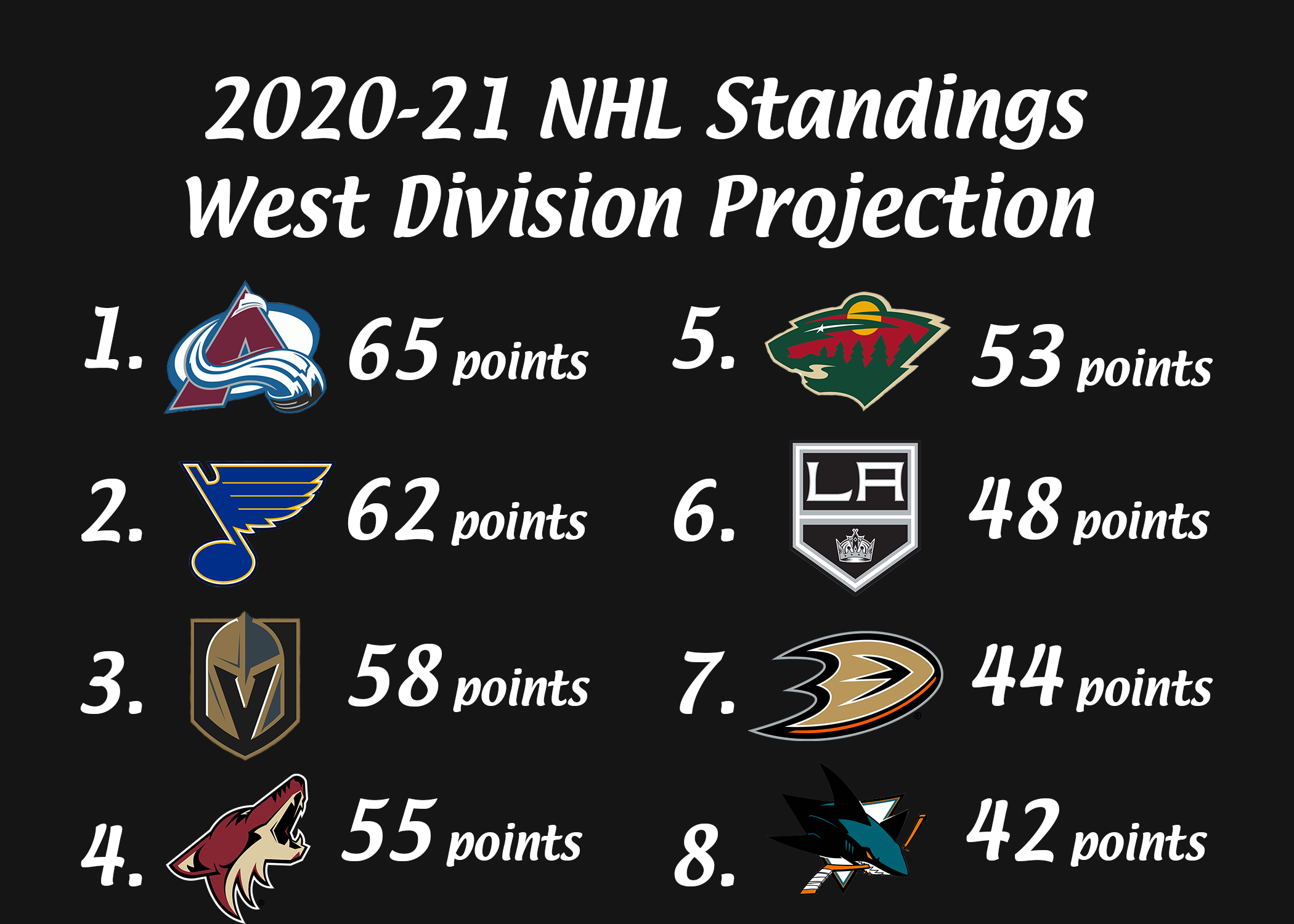
In the West Division, the Colorado Avalanche are the team to beat. The Avs are hungry to avenge their Second Round exit against the Dallas Stars in the 2020 Stanley Cup Playoffs if they can stay healthy and bring the Cup back to Denver for the first time since 2001.
Meanwhile, the St. Louis Blues might have some questions surrounding their goaltending, but the additions of Mike Hoffman and Torey Krug greatly outweigh the subtraction of Alex Pietrangelo– at least when it comes to regular season production.
In terms of experience and leadership, the Vegas Golden Knights picked up Pietrangelo’s talents via free agency and should be in contention for home ice advantage if they’re able to overcome St. Louis’ projected standing.
What about the meat of the order?
Both the Minnesota Wild and Arizona Coyotes are in a lot better shape than the Californian hockey teams.
The Wild have Kaapo Kähkönen coming down the pipeline in the crease and depending on how soon he can arrive might influence their final standing compared to Arizona.
Whereas Minnesota must rely on aging veterans, Cam Talbot and Alex Stalock in net, the Coyotes have Darcy Kuemper and Antti Raanta– a serviceable tandem for Arizona’s needs.
Mikko Koivu was sent out to find a new home as an influx of youth should make the Wild more competitive, but how much will Arizona’s playoff experience play into their drive for making at least another First Round appearance this season– despite losing Carl Söderberg in free agency to the Chicago Blackhawks and trading Derek Stepan to the Ottawa in the offseason.
Time will tell.
Is this the weakest division?
The all-Canadian North Division has the advantage of playing each other and sorting things out themselves instead of spreading their Canadian talents (or lack thereof depending on the team) throughout the league, so yes, the West Division is likely the weakest.
The Los Angeles Kings have some growing pains and salary cap hell to sort out. The Anaheim Ducks are a young team that’s finding their chemistry and building their experience, but are one or two years away from playoff contention.
Finally, the San Jose Sharks have an ever-regressing duo of Martin Jones and Devan Dubnyk in the crease to go along with whatever’s left on their blue line that’s not named Brent Burns and (a supposedly 100% healthy) Erik Karlsson.
At least the Sharks brought back Patrick Marleau (third time’s a charm) and other than that, they don’t have that bad of a forward group.
In the 2012-13 lockout shortened 48-game season, 20 out of the league’s then 30 teams at the time finished with at least 49 points or more in the season.
The 2012-13 Chicago Blackhawks finished 19 points away from a perfect 96-point season– amassing 77 points in 48 games with a 36-7-5 record.
Chicago is going through a rebuild without Jonathan Toews for possibly an extended period of time and with Malcolm Subban and Collin Delia in the crease.
The good news? They’ll likely end up with a solid lottery pick in the 2021 NHL Draft.
The bad news? They’re not going to find themselves having a repeat of their 2013 Stanley Cup championship.
Will any team from the Central Division be like those 2012-13 Blackhawks though?
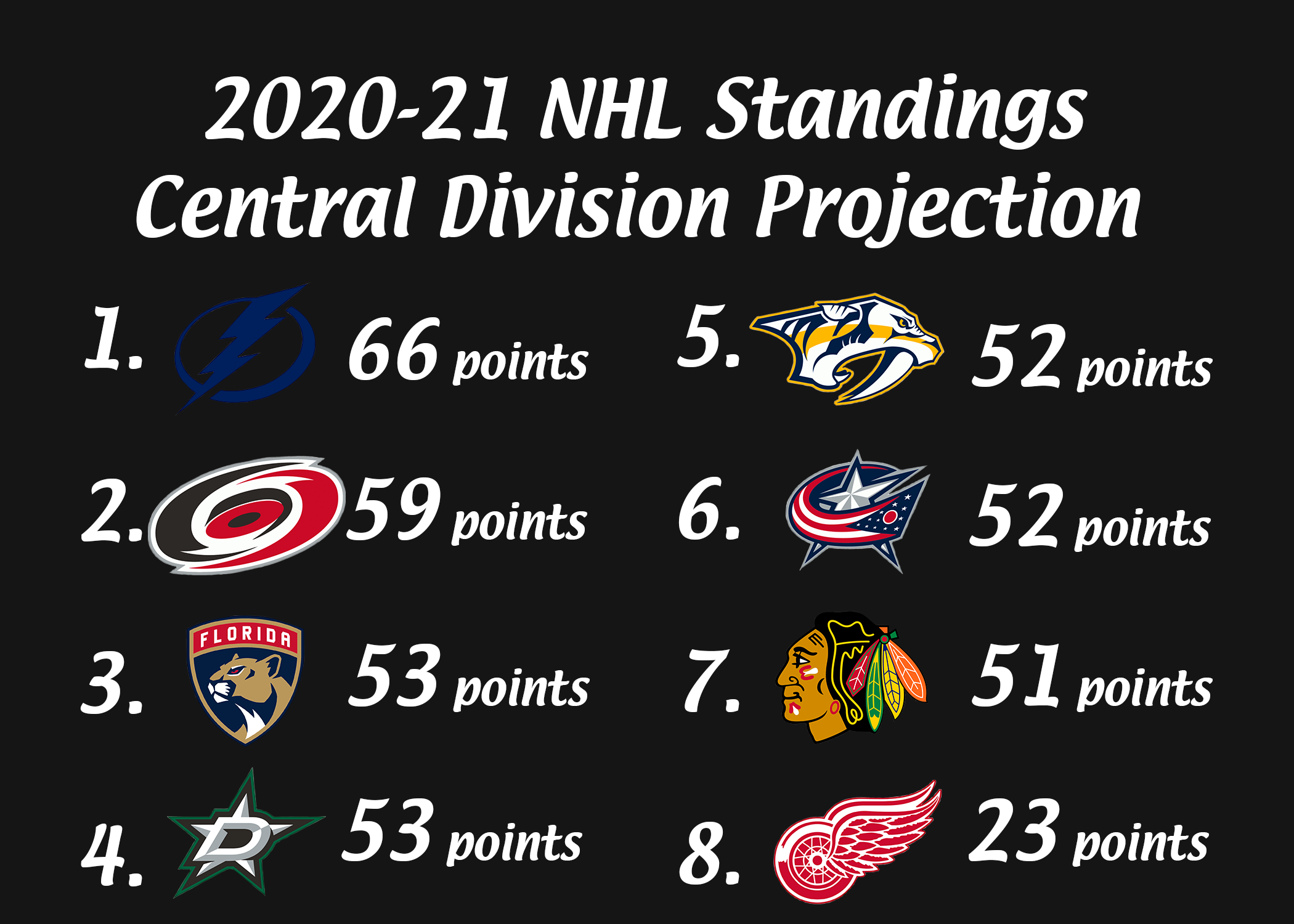
It’s funny that you ask, because the defending Stanley Cup champion Tampa Bay Lightning would have to win at least 75% of their games if they want to be anything like the 2012-13 Blackhawks.
Whereas Chicago won 36 out of 48, Tampa would have to win 42 out of 56 games.
It’s not that the Lightning can’t reach 84 points in the 2020-21 season– especially since the Blackhawks almost reached 80 in a shorter span, but rather how good will the rest of the Central Division be and how will the intra-divisional games only schedule impact, well, everything?
Tampa is projected as the regular season division winners with 66 points on the season.
The formula doesn’t take into account the loss of Braydon Coburn and Cedric Paquette in a trade with the Senators or the loss of Nikita Kucherov for the regular season due to an injury.
It doesn’t take into consideration the intra-divisional schedule, other injuries that are sure to occur, transactions, acts of The Hockey Gods, etc.
The 2012-13 Blackhawks had the advantage of facing mostly regular opponents over 48 games, then progressing through the old format of the playoffs where teams were seeded 1-8 among six divisions of five teams.
Tampa just has to be one of the top-four teams in their division over 56 games against all too familiar faces from night-to-night, then emerge victorious out of the Central to defend their title.
Anything is possible.
Can the Florida Panthers really be a playoff team?
Yes, the expected points model seems to indicate that the Florida Panthers were pretty good at finding the net in the regular season last year and that they should improve their standing, at least.
It doesn’t, however, determine whether or not Sergei Bobrovsky returns to form in quality starts, shutouts, etc.
New Panthers General Manager, Bill Zito, has added Markus Nutivaara and Radko Gudas to the blue line, as well as Anthony Duclair and Patric Hörnqvist to the forwards, so they should definitely be harder to play than in years past.
Gut feeling says three-time Stanley Cup champion head coach, Joel Quenneville, can make something more out of the pieces he’s been handed this season than in 2019-20.
Are the Detroit Red Wings really that bad?
No, but they didn’t do themselves any favors when it comes to utilizing last season’s data for determining this season’s expected points total.
Marginal goals for and marginal goals against can be a cruel animal, but it’s one of the best things to take into account of recency bias.
Red Wings GM Steve Yzerman added Vladislav Namestnikov, Bobby Ryan, Marc Staal, Troy Stecher, Jon Merrill, Alex Biega and Thomas Greiss to his team, so they won’t at least be intentional pushovers like last season.
The loss of Zdeno Chara and Torey Krug in the offseason for the Boston Bruins comes with a price– having to face Chara eight times in the regular season, then possibly Krug and the St. Louis Blues in a 2019 Stanley Cup Final rematch in the 2021 Stanley Cup Final.
Just kidding, the window appears mostly shut in the Hub.
It’s not that Boston can’t win, but rather that they have a bit of an uphill battle to get there.
Yes, their defense is younger, but it’s also more inexperienced. Yes, they added Craig Smith for goal scoring power, but it’s no Mike Hoffman.
At least David Pastrnak is looking to make a return ahead of schedule from his offseason surgery, but don’t be fooled by their six-point lead over the Philadelphia Flyers in the East Division projection.
Every second matters in a 56-game season. If they get off to a rocky start, they risk going from a surefire playoff contender (for at least another year or two) to missing out on the 2021 postseason.
The Buffalo Sabres added Taylor Hall, what gives?
Again, if you haven’t learned by now, expected points totals do not take signing the 2017-18 Hart Memorial Trophy winner to a one-year, $8.000 million contract into account.
Hall could be the winger Jack Eichel needs to convince him not to ask for a trade request as much as Eichel could be what Hall needs for a little rejuvenation and to be convinced to stay longer in his reunion with Sabres head coach, Ralph Krueger.
No matter what, though, the addition of Eric Staal and more in Buffalo means there’s sure to be improvement this season.
If it was the regular Atlantic Division, the Sabres might be looking at a wild card situation.
But since it’s the temporarily realigned East Division for 2020-21, yeah, there’s a lot more harder competition. Take the Hall pass and try again next season (maybe you’ll get the 1st overall pick).
Explain to me how the New York Rangers and New York Islandersmiss the playoffs?
This one is fairly simple.
The East Division is just six teams out of the regular Metropolitan Division, plus the Bruins (pretty good) and Sabres (pretty bad).
As such, it’s almost as if nothing ever happened in terms of the compete level of the overall division, but the playoff format yields only the top-four teams from each division for 2020-21.
Instead of getting, say, seven Metropolitan teams (impossible, yes, but let’s pretend) in the upcoming postseason, you can only have four.
If the B’s are taking one of those spots like they are in this projection, that limits the usual Metropolitan contenders to three leftover playoff berths.
If anything, the Pittsburgh Penguins are at the greatest risk of sliding out of the postseason picture with Tristan Jarry as their starting goaltender and Casey DeSmith as their backup after trading Matt Murray to Ottawa in the offseason.
That’s good news for the Islanders, probably, though the Rangers have more talent on paper (especially if Mathew Barzal isn’t re-signed when the puck drops on Jan. 13th).
So that’s it.
If you’ve made it this far and read every word– congrats, it’s probably time for puck drop already. Surely the calendar must read Jan. 13th by now and you can get back to watching that game you just tuned into.
Stay tuned for more forecasts and (un)related things that don’t have anything to do with expected points totals.
Zdeno Chara signed with the Washington Capitals, the AHL announced plans for the 2020-21 season, the NHL divisions are sponsored for 2020-21, what’s going on with the New York Islanders, Pierre-Luc Dubois wants out (maybe) and we preview the West Division for the 2020-21 season.








 Down the Frozen River
You must be logged in to post a comment.