Tag: Dean Kukan

  • Bruins outlast Blue Jackets in shootout victory on the road, 5-4

    Bruins outlast Blue Jackets in shootout victory on the road, 5-4

    Four different goal scorers for each team kept things close Saturday night at Nationwide Arena, while David Pastrnak scored the only goal in the, 5-4, shootout win for the Boston Bruins against the Columbus Blue Jackets.

    Jeremy Swayman (15-7-3, 2.03 goals-against average, .927 save percentage in 26 games played) made 20 saves on 24 shots against in the win for Boston, while spoiling the night’s festivities after the Blue Jackets held a jersey retirement ceremony for Rick Nash prior to the game.

    Columbus goaltender, Elvis Merzlikins (19-14-3, 3.42 goals-against average, .903 save percentage in 36 games played), stopped 28 out of 32 shots faced in the shootout loss.

    The Bruins improved to 34-18-4 (72 points) on the season, while remaining in command of 4th place in the Atlantic Division, as well as the first wild card spot in the Eastern Conference.

    The Blue Jackets fell to 28-25-2 (58 points) overall and remained 5th in the Metropolitan Division.

    Saturday night marked the first time the two teams met in the regular season since Jan. 14, 2020, before the pandemic shortened the 2019-20 regular season and led to temporary divisional realignment for a condensed 56-game regular season schedule in 2020-21.

    Columbus won, 3-0, at Nationwide Arena in their last game against Boston prior to Saturday’s, 5-4, shootout loss.

    Curtis Lazar returned to the lineup after missing the last four games with an upper body injury.

    As a result, Bruins head coach, Bruce Cassidy, made one change to his lineup from Thursday night’s, 5-2, victory in Las Vegas to Saturday night’s action in Columbus.

    Lazar returned to his usual role on the fourth line right wing, while Jesper Frödén joined Anton Blidh and Jack Achan in the press box as Boston’s trio of healthy scratches against the Blue Jackets.

    Jakub Zboril (right ACL) and Urho Vaakanainen (undisclosed) remained out due to injury, though Vaakanainen has resumed skating back in Boston.

    Prior to the game Saturday night, the Blue Jackets retired Nash’s No. 61– marking the first time in franchise history that the club retired a players’ jersey number.

    Nash was drafted by Columbus with the 1st overall pick in the 2002 NHL Entry Draft and spent the first nine seasons of his career in a Blue Jackets uniform before he was traded to the New York Rangers on July 23, 2012.

    He left Columbus as the franchise leader in games played (674), goals (289), assists (258) and points (547).

    After parts of six seasons in New York, he was traded to Boston ahead of the 2018 trade deadline, where he finished the season and playoffs despite missing some time that March with what ultimately became a career-ending concussion and ensuing post-concussion symptoms since then.

    In 1,060 career NHL games with the Blue Jackets, Rangers and Bruins, Nash amassed 437-368–805 totals, appeared in 89 career Stanley Cup Playoff games (18-28–46 career playoff totals)– including the 2014 Stanley Cup Final– and shared Maurice “Rocket” Richard Trophy winning honors with Jarome Iginla and Ilya Kovalchuk in the 2003-04 season as the league’s leader in goals scored with 41.

    He formally announced his retirement on Jan. 11, 2019, and was named Director of Player Development for the Blue Jackets in June 2021.

    A franchise record 19,434 fans were in attendance for Nash’s Jersey Retirement Night at Nationwide Arena in Columbus as announced by the team on Saturday.

    Midway through the opening frame, Brad Marchand spun and threw the puck to the slot where Jake DeBrusk (15) deflected the rubber biscuit past Merzlikins to give Boston a, 1-0, lead at 10:39 of the first period.

    Marchand (32) and Charlie McAvoy (28) tallied the assists as the Bruins recorded the first goal of the game.

    The B’s didn’t hold the lead for too long, however, as the Blue Jackets roared back with a goal of their own– tying the game, 1-1, at 16:57, courtesy of Gustav Nyquist’s (14), cool, calm and collected reception of a drop pass from Boone Jenner and shot over Swayman’s left shoulder while Boston’s defenders were split like the Red Sea.

    Jenner (21) and Patrik Laine (19) notched the assists on Nyquist’s goal as Columbus surged in momentum.

    A couple minutes later, Vladislav Gavrikov (3) was in the right place in the right time to bury a loose puck as Swayman couldn’t get a paddle on it in desperation– giving the Blue Jackets their first lead of the night, 2-1, in the process at 19:00 of the first period.

    Gavrikov’s goal was unassisted as Columbus recorded a pair of goals in a span of 2:03.

    Entering the first intermission, the Blue Jackets carried a, 2-1, lead into the dressing room, despite being outshot by the Bruins, 12-6, in the first period.

    Columbus held the advantage in faceoff win percentage, 64-36, while neither team had seen any action on the skater advantage heading into the middle frame.

    Marchand took a hit in the neutral zone while Erik Haula (8) scooped up the puck and rushed into the attacking zone before wiring shot through Merzlikins’ five-hole– tying the game, 2-2, in the process at 1:51 of the second period.

    Marchand (33) had the only assist on Haula’s goal in the process.

    Less than a couple minutes later, Dean Kukan cut a rut to the penalty box for holding and presented Boston with the first power play of the night at 3:26 of the second period.

    The Bruins’ power play went by the wayside, however, as the Blue Jackets made the kill and went on their first power play shortly thereafter as Craig Smith tripped up former Bruin, Sean Kuraly, at 5:33.

    Columbus didn’t convert on their first skater advantage, but the Blue Jackets got another crack at special teams play when Charlie Coyle slashed Oliver Bjorkstrand at 13:13 of the second period.

    About a minute later, Zach Werenski (9) pinched in from the point at the top of the faceoff circle and sent a shot inadvertently off of Bruins defender, Charlie McAvoy’s knee and over Swayman’s glove side to give Columbus a, 3-2, lead at 14:28.

    Jakub Voracek (39) and Bjorkstrand (20) had the assists on Werenski’s power-play goal and the Blue Jackets took a, 3-2, lead at 14:28 of the second period.

    Through 40 minutes of action, Columbus led, 3-2, on the scoreboard despite trailing in shots on goal, 19-14. The Blue Jackets, however, held the advantage in shots on net in the middle frame alone, 8-7, and controlled faceoff win% (58-42).

    Boston was 0/1 on the power play, while Columbus was 1/2 on the skater advantage heading into the final frame of regulation.

    Smith (10) buried a one-timer off of Merzlikins’ blocker and into the twine while crashing the net– tying the game, 3-3, at 4:40 of the third period in the process.

    Connor Clifton (2) and Nick Foligno (8) tallied the assists as the latter sent a pass to the former prior to Clifton setting up Smith for the goal– marking four goals in his last two games and nine points (four goals, five assists) in Smith’s last 10 games.

    Late in the period, Bjorkstrand caught Pastrnak with a high stick at 14:23 of the third period, yielding another power play to Boston in the process.

    It didn’t take the Bruins long to go ahead, 4-3, on the scoreboard as Patrice Bergeron (16) nudged a goal on the forehand as the puck sat in the crease after ringing the iron twice and Taylor Hall flubbed an attempt while Merzlikins was sprawled out in desperation.

    Hall (29) and Pastrnak (26) had the assists on Bergeron’s power-play goal at 14:58 of the third period.

    With 1:18 remaining in the action, Brad Larsen pulled his netminder for an extra attacker.

    Foligno hooked Nyuquist at 19:29 and yielded another power play to the Blue Jackets as a result.

    Larsen used the extra few seconds before the ensuing faceoff on the skater advantage to rally his skaters with 30.7 seconds remaining in the action.

    Columbus worked the puck around the attacking zone before Voracek (3) winded up on a half speed slap shot and scored under the blocker– clipping Swayman’s jersey in the process and tying the game, 4-4, with 2.8 seconds remaining in regulation.

    Laine (20) and Kuraly (13) had the assists on Voracek’s power-play goal at 19:57 as the Blue Jackets forced overtime despite trailing Boston in shots on goal, 31-23, including a, 12-9, advantage for the Bruins in the third period alone.

    As there were no penalties called in overtime, Columbus finished the night 2/3 on the power play while Boston went 0/2 on the skater advantage.

    Neither team scored in overtime as both squads recorded one shot on goal each in the extra frame.

    The Bruins finished the night leading in shots on goal, 32-24, as well as in blocked shots (16-12), while the Blue Jackets wrapped up 65 minutes of action leading in hits (28-20) and faceoff win% (51-49).

    Both teams had two giveaways aside.

    Boston shot first in the shootout as Coyle waltzed into the zone from the right side before cutting right at Merzlikins and being denied by a left pad save.

    Laine countered for Columbus with a medium speed effort and a pump fake before pulling the puck to his backhand, but Swayman made the save.

    DeBrusk entered with speed before trying an offspeed shot that Merzlikins cast aside with his blocker.

    Larsen sent out Nyquist to try to get things going as his second shooter, but despite cutting in from wide left to the middle of the ice, Swayman made a routine save on Nyquist’s five-hole shot attempt.

    Finally, Pastrnak skated in wide left before cutting to the middle with speed and coming to a stop prior to elevating the puck into the upper-90 on Merzlikins’ glove side– giving Boston a, 1-0, advantage in the third round of the shootout.

    Voracek had to score on the following attempt or the Bruins would win the game.

    The Blue Jackets forward carried speed towards the net before Swayman made a blocker save to seal the deal on the shootout victory as the B’s were awarded the shootout goal in the final score, 5-4, Saturday night at Nationwide Arena– securing 10 out of 12 possible points in their six-game road trip in the process.

    Boston improved to 2-2 in shootouts this season, while Columbus fell to 3-2 in the best-of-three skills competition.

    The Bruins also improved to 24-7-1 (14-3-1 on the road) when scoring first, 5-11-2 (1-5-1 on the road) when trailing after one and 4-14-2 (1-6-1 on the road) when trailing after two periods this season.

    The Blue Jackets dropped to 14-17-2 (7-6-2 at home) when allowing the game’s first goal, 10-4-1 (4-1-1 at home) when leading after the first period and 15-4-2 (7-2-2 at home) when leading after the second period in 2021-22.

    The Bruins went 5-1-0 on their six-game road trip through the Pacific Division and Columbus and will return home to begin a three-game homestand on Monday.

    Boston will host Los Angeles (March 7th), Chicago (March 10th)  and Arizona (March 12th) before hitting the road again on March 15th.

  • Columbus Blue Jackets 2020-21 Forecast and 20-Game Update

    Columbus Blue Jackets 2020-21 Forecast and 20-Game Update

    Welcome back to another exciting rendition of “let’s trust the guy with a degree in communication to do some basic math stuff”.

    As you are hopefully already aware, I kept the 2019-20 forecasts under wraps simply because I didn’t have the time and/or motivation to write up an explanation for each and every one of them.

    Even still, I’m “behind” on 2020-21 posts given that the Columbus Blue Jackets have already reached the 20-game mark of the season.

    That’s why we’re looking at both what the expectations were coming into the condensed 56-game schedule, as well as how things are holding up after the first, well, almost half the season.

    If you’re a fan of numbers and things, you probably already read about this “catch-up format” in my first forecast for the Boston Bruins roster entering 2020-21. If you’re just a Blue Jackets fan, I’ve done my best to paraphrase my own writing, but you can go back and read it if you feel inclined.

    As always, keep in mind that my degree is in communication and my minor was in sport management. My Intro to Stats class only fulfilled the math portion of my “general education” and met once-a-week at night for two-and-a-half hours in the fall 2013 semester.

    I actually learned how to use the forecast function in Microsoft Excel in one of my sport management classes. Besides that, I got a “C” in that Intro to Stats class, so my credentials for doing this seem promising, right?

    First year players are impossible to predict until they’ve had at least one National Hockey League game under their belt.

    Young players that have had minimal NHL experience may also reflect “inflated” results– Liam Foudy’s forecasted assists entering the 2020-21 season has been highlighted for this reason.

    Entering this season, he had only been part of two career NHL games and had one assist in that span. The forecasting function accounts for a player’s entire career and does some mathematics to come up with something over a predetermined number of games for the upcoming season (in this year’s case, 56).

    In other words, Foudy’s forecast after 20 team games played should look a bit more “realistic”, for the lack of a better term.

    A forecast is not the same as predicting pace.

    Foudy has three assists in 12 games played in 2020-21, for example, and is forecasted to finish with about 11 on the season, whereas he is currently on pace for about eight helpers.

    There are numerous variables that can, and will, impact a players’ performance throughout the year, including injuries, being a healthy scratch (or on the taxi squad), other American Hockey League related or waiver related transactions, sickness, COVID protocol, suspensions and general superstitions related to individual routines, beliefs, etc. (getting enough sleep before a game, wearing a certain lucky tie, using the same undershirt or shoulder pads for the last 13 years or whatever).

    Players can get “hot” or “cold” at any point.

    It’s not something that can be accounted for in a numerical forecast that sets aside the “eye test” until you try to figure out the nuances of how or why a player is playing the way they are playing.

    In a perfect timeline, this forecast pretends nothing bad could ever happen and every Blue Jackets player lives up to their expectations. In reality, some will pan out, some will exceed expectations and some will fall short for whatever reason.

    It’s an educated guess for an outcome in a sport that’s highly unpredictable due to its collectivistic nature and sheer puck luck.


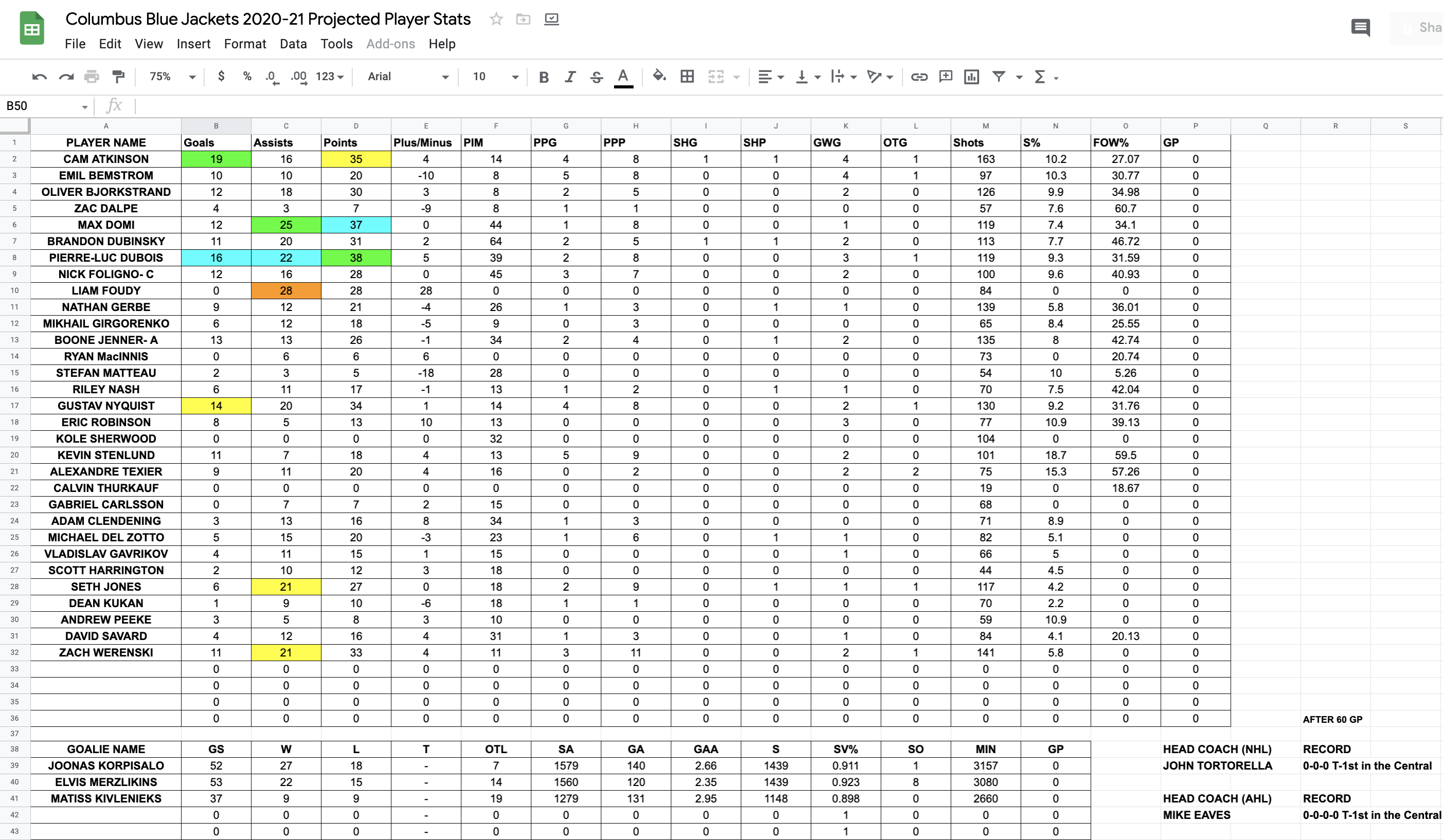
    Columbus Blue Jackets Forecast Through 0 Games (56 Games Remaining)

    First up, let’s take a look at how things were expected to go coming into the 2020-21 season.

    Prior to being traded to the Winnipeg Jets for Patrik Laine and Jack Roslovic, Dubois was forecasted to lead Columbus in scoring with 16-22–38 totals this season.

    New acquisition, Max Domi, was forecasted as a close second to Dubois with 37 points– leading the team in assists in the process with 25 (among NHL regulars last season, since Foudy technically was forecasted to lead in assists among Blue Jackets with 28).

    Of course, Dubois was traded and Laine and Roslovic are off to hot starts with Columbus– scoring goals in bunches when they find the scoresheet, it seems. We’ll get to that in a minute.

    Cam Atkinson was forecasted to score 19 goals prior to the start of the 2020-21 season, which leads Dubois’ 16 forecasted goals and Gustav Nyquist’s 14 forecasted goals on the roster.

    Dubois, of course, was traded and Nyquist is out due to injury for most of this season, so… that checks out.

    On defense, Zach Werenski and Seth Jones were expected to continue to lead with the way with 33 and 27 points, respectively, from the blue line.

    Both defenders are expected to amass 21 assists this season– good enough for the third most forecasted among Blue Jackets skaters entering this season.

    In the crease, John Tortorella will have to find the right balance between Joonas Korpisalo and Elvis Merzlikins.

    There’s potential for a really solid goaltending duo in Columbus if Korpisalo is the starter and can best his 2.66 forecasted goals against average, as well as his forecasted .911 save percentage, while Merzlikins manages to find a way to reach his 2.35 forecasted GAA and .923 forecasted SV%.

    Of course, after 20 team games played, Merzlikins is currently out with an upper body injury, so time will tell if he can return to form.

    Columbus Blue Jackets Forecast Through 20 Games (36 Games Remaining)

    Through 20 games of the 2020-21 season, the Blue Jackets are three points outside of the last playoff spot in the Discover NHL Central Division, trailing the Chicago Blackhawks for this season’s 4th place cutoff line.

    The acquisition of Laine and Roslovic have been quite a welcome sight for Columbus fans, though consistency from the rest of the lineup remains to be an issue.

    Laine, however, is currently forecasted to lead the team in goals (26) and points (46), while Roslovic is on track for 10-17–27 totals, which is about what he had in 71 games with the Jets last season (29 points).

    Using the current forecasted totals, Roslovic is on track for about .551 points per game this season. He had .408 points per game with Winnipeg in 2019-20.

    Atkinson remains in the top-three in scoring, trailing Laine in goals and points with 20 forecasted goals and 39 forecasted points, respectively, while Oliver Bjorkstrand is currently forecasted to amass 15-21–36 totals (the third most on the current roster).

    On the blue line, Jones leads the way among defenders in points (32), as well as all skaters in assists with 27 forecasted assists through 20 team games played in the 2020-21 season.

    Werenski is more in line with what you’d expect from a young defender of his caliber (8-16–24 forecasted totals) and has missed time due to injury, so that’s clearly a factor in his forecasted drop from before the season began to now.

    In the crease, Korpisalo is sure to get more starts than Merzlikins as the latter is currently injured.

    Korpisalo’s current forecast yields a goals against average between 2.59-2.63, while Merzlikins is on track for a 2.29-2.33 in however many games he ends up getting.

    Why the range in GAA?

    That’s new for this season.

    It’s just to show a range between what the forecasted total is according to the model and what the adjusted forecast shows (calculated based on the forecasted goals allowed/forecasted minutes multiplied by 60, as one would traditionally do with goals allowed/minutes played multiplied by 60 to determine GAA).

    I’m no statistician and I felt like there might be a way to try to get a better read on how things are going for goaltenders (with or without enough necessary data to yield a “realistic” result).

    Don’t make any bets using only this forecast. If you’re a professional, you probably already know that.

    Anyway, Korpisalo has a forecasted range between .912 and .913 in save percentage through 20 team games played and Merzlikins is on track for between a .923 and a .924 in SV%.

    Again, a similar principle applies here.

    One end of the range is the straight up forecast, while the other is influenced by forecasted saves/forecasted shots against.

    Well, that does it for this forecast. Tune in after 40 team games played to see how things might go down the stretch (the final 16 games this season).

  • Dubois lifts Columbus over Boston, 2-1, in OT

    The Columbus Blue Jackets came back to beat the Boston Bruins, 2-1, in overtime at TD Garden on Thursday in their first meeting with Boston since being eliminated by the Bruins in the Second Round of the 2019 Stanley Cup Playoffs.

    Elvis Merzlikins (2-4-4 record, 2.92 goals against average, .905 save percentage in 12 games played) made 25 saves on 26 shots against for a .962 SV% in the win for Columbus.

    Bruins goaltender, Tuukka Rask (15-4-6, 2.30 GAA, .923 SV% in 25 games played) stopped 31 out of 33 shots faced for a .939 SV% in the overtime loss.

    Boston fell to 24-7-11 (59 points) on the season, but remained atop the Atlantic Division, while Columbus improved to 19-14-8 (46 points) and remained in 6th place in the Metropolitan Division.

    The Bruins also fell to 14-1-9 at home this season and are now on a two-game losing streak.

    Boston was without the services of Kevan Miller (knee) and Connor Clifton (upper body) on Thursday. Miller has yet to make his season debut and Clifton was ruled out of the two-game homestand after being injured against Buffalo on Dec. 29th.

    That was the only bad news for the Bruins heading into Thursday night’s matchup with the Blue Jackets as Torey Krug (upper body), Charlie McAvoy (lower body) and David Krejci (lower body) all returned to the lineup.

    McAvoy was a game-time decision, but took part in full practice on Thursday and was on the ice for warmups– indicating that his return was imminent.

    Due to all the returns, Jeremy Lauzon was reassigned to the Providence Bruins (AHL) on Wednesday and Anton Blidh was assigned to Providence on a long-term injury conditioning loan.

    Blidh was injured in the second-to-last preseason game for Boston and has yet to make his season debut within the Bruins’ organization (Boston or Providence).

    Bruce Cassidy made some changes to his lineup against Columbus since Tuesday’s, 3-2, shootout loss in New Jersey, moving Charlie Coyle to the second line right wing slot with Jake DeBrusk and Krejci, while bumping up Sean Kuraly to center the third line with Anders Bjork on his left side and Danton Heinen on his right side.

    The fourth line comprised of Joakim Nordstrom at left wing, Par Lindholm at center and Chris Wagner at right wing.

    On defense, McAvoy and Krug went back to their usual roles while Matt Grzelcyk slid over to the right side of the third pairing with John Moore on his left.

    Brett Ritchie, David Backes and Steven Kampfer were all healthy scratches for Boston on Thursday night.

    At puck drop, B’s captain, Zdeno Chara, became the 12th player in NHL history to play in at least one game across four decades.

    San Jose Sharks forwards, Joe Thornton and Patrick Marleau became the 13th and 14th players in league history to do the same thing upon puck drop between the Sharks and the Penguins in Pittsburgh on Thursday.

    Gustav Nyquist thought he scored off a rebound 17 seconds into the game, but Cassidy used a coach’s challenge to review the call on the ice (goal) on the basis that Rask was actually interfered with as Boone Jenner appeared to be in the crease before the puck crossed the blue paint.

    Upon review, it was determined that Jenner did, in fact, more than just encroach Rask’s territory, but had actually bumped into the goaltender– impeding his reaction to the play and thereby causing goaltender interference.

    The call on the ice was overturned and the score reverted back to, 0-0.

    It was the first time the Bruins challenged a call this season, as well as their first successful coach’s challenge this season.

    Boston has had five calls overturned on six prior challenges against them thus far, which leads the league.

    After Nyquist had a goal overturned, nothing else happened for the rest of the first period. Seriously.

    There were no goals and no penalties called in the opening frame and both teams spent the last 7:10 span of the period uninterrupted.

    Through one period of play on Thursday, the Bruins and Blue Jackets were tied, 0-0, with Columbus leading in shots on goal, 9-8.

    Columbus also held the advantage in blocked shots (5-1), takeaways (3-2), giveaways (6-4) and hits (14-9), while Boston led in faceoff win percentage (67-33).

    Early in the middle frame, Nick Foligno hooked Brad Marchand and was assessed a minor penalty at 4:48 of the second period.

    The Bruins did not convert on their first power play of the night, but got a second chance on the skater advantage at 11:02 when Dean Kukan tripped DeBrusk.

    This time around, however, Boston capitalized on the power play five seconds into the skater advantage– winning the ensuing faceoff back to the point, then sliding a pass over to David Pastrnak (30) for the one-timer that went off Blue Jackets forward, Riley Nash, and over Merzlikins’ glove to give the B’s the first lead of the night.

    Krug (22) and Patrice Bergeron (19) notched the assists on Pastrnak’s power play goal at 11:07 of the second period and the Bruins led, 1-0.

    With his 30th goal of the season, Pastrnak became the first Bruin in franchise history to score 30 or more goals in four of his first six seasons, as well as the fastest Bruin to score 30 goals (in 42 games) since Cam Neely scored 30 goals in 27 games in the 1993-94 season.

    Almost 90 seconds later, McAvoy was caught interfering with Kevin Stenlund and subsequently sent to the penalty box at 12:36, but the Blue Jackets couldn’t muster anything on the power play.

    Columbus had one more chance on the skater advantage at 19:15 as Chara cut a rut to the sin bin for holding against Nyquist, but the Blue Jackets didn’t capitalize on the power play once again– even though the skater advantage was split over the course of the final seconds of the second period and the opening minute of the third period.

    The Bruins have killed off 21 consecutive penalties as a result of killing off Chara’s minor.

    After 40 minutes in Boston, the Bruins led the Blue Jackets, 1-0, on the scoreboard, despite Columbus maintaining the advantage in shots on goal, 23-20– including a, 14-12, advantage in the second period alone.

    The Blue Jackets also led in blocked shots (12-1) and hits (23-15) entering the second intermission and the Bruins led in takeaways (6-5), giveaways (10-6) and faceoff win% (70-30).

    As there were no more penalties called for the rest of the night, Boston finished 1/2 on the power play and Columbus went 0/2 on the skater advantage.

    Early in the final frame of regulation, Sonny Milano (4) pounced on a turnover by Coyle, then fired a shot with purpose from the goal line along the boards that deflected off of Grzelcyk and dipped through Rask’s five-hole– tying the game, 1-1, in the process.

    Nathan Gerbe (2) and Alexander Wennberg (12) tallied the assists on Milano’s goal at 2:06 of the third period and there were no more goals scored until overtime.

    At the end of regulation, the Blue Jackets led in shots on goal, 32-26, but were even on the scoreboard with the Bruins, 1-1.

    Columbus held the advantage in blocked shots (15-2) and hits (32-25), while Boston led in giveaways (13-8) and faceoff win% (65-35).

    Both teams had six takeaways aside heading into overtime.

    Cassidy started Krejci, Pastrnak and McAvoy for the B’s and Blue Jackets head coach, John Tortorella, opted for Nyquist, Jenner and Seth Jones for the opening faceoff before quickly replacing Jenner with Pierre-Luc Dubois.

    Just 52 seconds into the ensuing extra frame, Dubois and Jones entered the attacking zone on a 2-on-1 and made McAvoy look foolish before Jones sent the puck to Dubois (14) for the one-timer goal from close range.

    Jones (19) had the only assist on Dubois’ game-winning overtime goal and the Blue Jackets took home the, 2-1, win in Boston.

    Columbus finished the night with the advantage in shots on goal (33-26), blocked shots (15-2) and hits (33-25), while the Bruins ended Thursday’s effort with the lead in giveaways (14-8) and faceoff win% (66-34).

    The Bruins fell to 5-1-6 when tied after one period, 13-0-5 when leading after two periods and 17-5-7 when scoring the game’s first goal this season. The B’s also fell to 2-5 in overtime this season.

    Meanwhile, the Blue Jackets improved to 6-6 in ovetime this season and 11-5-3 when tied after one period.

    Boston concludes their two-game homestand (0-0-1) against the Edmonton Oilers on Saturday before traveling to Nashville to face the Predators next Tuesday.

    The Bruins return home for a Thursday night (Jan. 9th) matchup with the Winnipeg Jets before venturing on the road to visit the New York Islanders on Jan. 11th, the Philadelphia Flyers on Jan. 13th and the Blue Jackets on Jan. 14th.

  • Pastrnak, Bruins pull off, 4-3, win in Game 5, can advance in Columbus

    Not to beat a dead horse, but the Boston Bruins’ first line got the job done again in Game 5, as the B’s topped the Columbus Blue Jackets, 4-3, at TD Garden on Saturday night.

    After blowing a two-goal lead in the final ten minutes of the game, Boston overcame incredible shifts in momentum to give themselves the series lead, 3-2, heading back to Nationwide Arena for Game 6 on Monday.

    Tuukka Rask (7-5 record, 2.19 goals against average, .932 save percentage in 12 games played this postseason) turned aside 33 out of 36 shots faced (.917 SV%) for the win.

    Columbus goaltender, Sergei Bobrovsky (6-3, 2.33 GAA, .928 SV% in nine games played this postseason) had 32 saves on 36 shots against (.889 SV%) in the loss.

    John Moore (upper body) and Kevan Miller (lower body) remained out of the lineup on Saturday, while Noel Acciari (undisclosed) was a game-time decision and did not dress for action.

    Bruins head coach, Bruce Cassidy, replaced Acciari on the fourth line right wing with Chris Wagner and did not make any other adjustments to his lineup.

    Wagner was a healthy scratch for the last two games.

    Boston had a plethora of healthy scratches to go with Moore, Miller and Acciari in the press box for Game 5, including Lee Stempniak, Zachary Senyshyn, Jordan Szwarz, Peter Cehlarik, Jakob Forsbacka Karlsson, Zane McIntyre, Paul Carey, Ryan Fitzgerald, Steven Kampfer, Jack Studnicka, Urho Vaakanainen, Jakub Zboril, Jeremy Lauzon, Anton Blidh, Trent Frederic and Karson Kuhlman.

    Blue Jackets head coach, John Tortorella dressed seven defenders– including Vladislav Gavrikov, who made his NHL debut as a result– and scratched Alexandre Texier for Game 5.

    Almost midway through the opening frame, Cam Atkinson slashed Marcus Johansson at 9:03 of the first period and the Bruins went on the power play for the first time of the night.

    The B’s failed to convert on the skater advantage opportunity.

    After killing off Atkinson’s minor infraction, Columbus found themselves rewarded with a power play of their own seconds later when Charlie McAvoy slashed Boone Jenner at 11:35 of the first period.

    The Blue Jackets did not capitalize on their first power play of the game and shortly followed things up with another penalty of their own– this time a bench minor for too many men on the ice.

    Gavrikov was sent to the box to serve the infraction at 13:43 and the Bruins went back on the skater advantage.

    Entering the first intermission, the game remained tied, 0-0, with the Bruins leading in shots on goal, 9-8.

    Boston also held the advantage in hits, 14-13, while Columbus led in just about every other category, including blocked shots (6-2), takeaways (6-1), giveaways (5-4) and face-off win percentage (62-39).

    Heading into the second period, the Blue Jackets were 0/1 and the Bruins were 0/2 on the power play.

    Early in the middle frame, the pace of play quickened as both teams jumped out of the gate– yielding end-to-end action.

    While on a rush up the ice, David Backes dropped a pass back to Jake DeBrusk, who then sent the puck cross-ice to David Krejci as the veteran center for Boston trailed the play.

    Krejci (3) settled the puck and trickled an off-speed shot through Bobrovksy’s five-hole to give the Bruins the lead, 1-0, at 1:39 of the second period.

    DeBrusk (2) and Backes (3) notched the assists on the goal.

    As the midpoint of the night approached, Torey Krug held Nick Foligno inside the B’s crease and was charged with a holding minor at 9:52 of the second period.

    Columbus did not convert on their ensuing power play.

    Through 40 minutes of play, Boston led, 1-0, on the scoreboard, despite trailing, 23-21, in shots on goal.

    The Blue Jackets maintained their dominance in every statistical category, leading in blocked shots (9-7), takeaways (11-2), giveaways (8-4), hits (31-23) and face-off win% (52-48) after two periods.

    Both clubs were 0/2 on the power play heading into the third period.

    Boston started things off with strong possession in the final frame of regulation and worked their way to scoring chance after scoring chance on Bobrovsky.

    It wasn’t long before Brad Marchand (5) got his own rebound from close range– after the Columbus goaltender made the initial glove save– and fired the puck into the twine to give the B’s a two-goal lead.

    Connor Clifton (1) and Patrice Bergeron (3) were credited with the assists on Marchand’s goal at 4:51 of the third period as the Bruins extended their lead to, 2-0.

    With the primary assist on the goal, Clifton earned his first career Stanley Cup Playoff point in his seventh career postseason game.

    Midway through the third period, Seth Jones (3) squeaked a puck between Rask’s pad and inside the post to cut the Bruins’ lead in half, 2-1, at 10:33.

    The goal was originally reviewed and confirmed as a good goal more than a few minutes after the play itself occurred.

    Zach Werenski (5) and Atkinson (6) had the assists on the goal after the official timeout helped wake up tired legs on both squads.

    David Pastrnak (5) broke the other way after a Columbus scoring chance was denied and sent a shot past Bobrovsky’s blocker side to give Boston the lead, 3-1, at 11:16 of the third period.

    Marchand (7) had the only assist on Pastrnak’s goal.

    Not even a quick response was enough to stop the freight train of goals scored by both clubs in the final ten minutes of regulation, as after the B’s answered back in a hurray, the Blue Jackets replied.

    Matt Duchene setup Ryan Dzingel (1) for a one-timer that Dzingel elevated through the roof of the twine to bring Columbus back to within one-goal at 12:07.

    Duchene (5) and David Savard (2) had the primary and secondary assists respectively.

    Just over a minute later, Dean Kukan (1) scored his first career Stanley Cup Playoff goal as the Blue Jackets defender blasted a shot from the slot over Rask’s glove without a body in the shooting lane to tie the game, 3-3, at 13:58.

    Both Artemi Panarin (6) and Josh Anderson (2) had an assist on Kukan’s goal.

    Late in the period, Marchand worked up ice with Pastrnak and threw a pass across the slot for Pastrnak (6) to redirect behind Bobrovsky to put Boston ahead, 4-3, at 18:32.

    Marchand (8) and Brandon Carlo (1) had the assists on what would become Pastrnak’s first career Stanley Cup Playoff game-winning goal.

    Tortorella had no choice but to pull Bobrovsky for an extra attacker with 1:21 remaining in regulation and the Blue Jackets threw the kitchen sink at the Bruins.

    Duchene redirected a shot off the post behind Rask and Columbus nearly scored when Atkinson hacked away at a loose puck while Rask was desperate to get back across the crease less than a minute later.

    Finally, after McAvoy extended his leg to block a shot with his foot in the closing seconds of the game, the Bruins came away with the victory, 4-3, on home ice.

    Boston finished the night tied in shots on goal with Columbus, 36-36, and trailed in every other stat, including blocked shots (18-15), giveaways (11-4), hits (42-32) and face-off win% (54-46).

    Both teams finished the night 0/2 on the power play, while the Bruins improved to 7-0 this postseason when leading after two periods.

    The B’s take a 3-2 series lead to Columbus with the chance to punch their ticket to the 2019 Eastern Conference Final and host the Carolina Hurricanes in the next round of the 2019 Stanley Cup Playoffs with a win on Monday.

    Puck drop is set for a little after 7 p.m. ET and viewers in the United States can tune to NBCSN for the action. Fans in Canada will have the choice between CBC, SN and TVAS for their viewing pleasure.

  • Bruins win, 4-1, in Columbus, tie series 2-2

    The Boston Bruins forced their way back into the series with a, 4-1, win on Thursday night at Nationwide Arena in Game 4 of their 2019 Stanley Cup Playoffs Second Round series with the Columbus Blue Jackets.

    As a result of their win, the series is tied, 2-2, heading back to Boston for Game 5 on Saturday.

    Tuukka Rask (6-5 record, 2.11 goals against average, .933 save percentage in 11 games played this postseason) made 39 saves on 40 shots against for the .975 SV% in the win for the B’s.

    Blue Jackets goaltender, Sergei Bobrovsky (6-2, 2.13 GAA, .933 SV% in eight games played this postseason) stopped 42 out of 46 shots faced for a .913 SV% in the loss.

    Bruce Cassidy tweaked his lines from Tuesday night’s, 2-1, loss in Game 3 to Thursday night’s Game 4 action– re-inserting David Backes into the lineup on the second line right wing in place of Karson Kuhlman.

    Cassidy also swapped his first and third line right wings, reuniting David Pastrnak with Brad Marchand and Patrice Bergeron, as well as Danton Heinen with Marcus Johansson and Charlie Coyle.

    John Moore (upper body) and Kevan Miller (lower body) remain out of the lineup for Boston due to injury, while Chris Wagner, Zane McIntyre, Paul Carey, Steven Kampfer and Kuhlman joined the long list of healthy scratches at this time of the postseason.

    After taking a huge hit from Adam Clendening in the neutral zone, Pastrnak (4) blasted a one-timer past Bobrovsky as Charlie McAvoy setup Pastrnak with a pass cross ice in the attacking zone.

    McAvoy (5) had the only assist on the goal and for the first time this postseason, Columbus trailed on home ice as the Bruins jumped out to the, 1-0, lead at 3:33 of the first period.

    Moments later, Alexandre Texier tripped up Torey Krug in Boston’s defensive zone and was assessed a two-minute minor infraction at 6:38 of the first period.

    While on the power play, the B’s gave up a shorthanded opportunity to Blue Jackets forward, Boone Jenner, who was promptly brought down by a trip from Marchand at 6:52.

    As a result of being tripped while on the breakaway, Jenner received a penalty shot attempt that was denied by Rask.

    Less than a minute later, Bergeron (4) ripped a shot past Bobrovsky’s glove side for the power play goal and gave the Bruins a two-goal lead.

    Bergeron’s goal was assisted by Marchand (6) and Krug (5) at 7:18 of the first period and Boston led, 2-0, 26 seconds after Jenner’s penalty shot.

    About a minute later, after the puck hit the netting above the glass and technically had gone out of play, Columbus capitalized on a missed call by the on-ice officials and pocketed a goal from Artemi Panarin (5) to cut the lead in half, 2-1, at 8:46.

    Not even the official review of every goal in the postseason could overturn an otherwise non-reviewable play as the coach’s challenge only pertains to offside and goaltender interference calls.

    Oliver Bjorkstrand (3) and Pierre-Luc Dubois (3) notched the assists on Panarin’s goal– the second goal to be scored after the puck hit the netting above the glass in Columbus since the last time the Blue Jackets also tabbed a goal in similar fashion on Dec. 27, 2014 against– you guessed it– the Bruins.

    Nine seconds later, Josh Anderson hooked Pastrnak and skated his way over to the penalty box to serve a two-minute minor infraction. Boston did not convert on the ensuing power play.

    The Bruins would fail to score once more on a power play after Dean Kukan elbowed Backes in the face at 12:30 of the opening frame.

    Moments later, while struggling to clear the puck from their own zone, Marchand flung the puck over the glass and out of play for the automatic delay of game minor penalty at 16:00 of the first period.

    Columbus did not score on the resulting skater advantage.

    Through 20 minutes of the action in Game 4, the B’s led, 2-1, on the scoreboard and trailed the Blue Jackets, 15-13, in shots on goal. Columbus also held the advantage in blocked shots (3-2), takeaways (5-1), giveaways (3-2) and hits (20-10), while Boston led in face-off win percentage (63-38).

    The Blue Jackets were 0/1 on the power play entering the first intermission and the Bruins were 1/3.

    Early in the middle frame, Connor Clifton slashed Scott Harrington and was sent to the sin bin with a minor penalty at 6:48 of the second period.

    Columbus did not convert on their second power play opportunity of the night and failed to record a shot on goal on the skater advantage while Clifton was in the box.

    Moments later, Clendening interfered with Backes and was sent to the box with a minor penalty at 12:06. Boston did not convert on the ensuing skater advantage.

    After killing off the Clendening minor, Anderson cut a rut to the penalty box for interfering with McAvoy at 14:19 of the second period.

    For the fifth time of the night, the Bruins went on the power play, but for the fourth consecutive power play, Boston did not capitalize on the scoreboard.

    Late in the period, Marchand inadvertently tripped up Cam Atkinson in the neutral zone and was charged with a minor penalty at 18:01– leaving one second remaining on the power play for the Blue Jackets entering the third period.

    After two periods of play, the Bruins led, 2-1, on the scoreboard and trailed Columbus, 27-25, in shots on goal– despite splitting shots on goal in the second period, 12-12.

    The Blue Jackets maintained the advantage in blocked shots (7-6), takeaways (8-2) and hits (28-16), while the B’s led in face-off win% (62-38) heading into the second intermission.

    Both teams had five giveaways apiece after 40 minutes of action and Columbus was 0/3 on the skater advantage, while Boston was 1/5 on the power play heading into the third period.

    Midway through the third period, Dublin, Ohio native, Sean Kuraly (2) scored on the intentional carom off the endboards set up by Bruins captain, Zdeno Chara, to give Boston a two-goal lead once again.

    Chara (2) and Backes (2) were credited with the assists on Kuraly’s goal at 8:40 of the third period and the Bruins led, 3-1.

    Past the midpoint of the final frame of regulation, Jake DeBrusk tripped Bjorkstrand and was sent to the box at 12:12.

    Despite firing off four shots on goal on the resulting power play, the Blue Jackets were not able to get one past Rask.

    Shortly after having the skater advantage, Columbus found themselves on the skater disadvantage when Dubois held Brandon Carlo at 15:59 of the third period.

    For the sixth time of the night, Boston went on the power play.

    This time, they capitalized.

    Pastrnak received a pass from Krug and rocketed a shot off of Bobrovsky, yielding just enough of a rebound for Bergeron (5) to pot into the twine from just outside the crease to give the Bruins a, 4-1, lead with his second goal of the night at 17:30.

    Bergeron’s power play goal was assisted by Pastrnak (5) and Krug (6) and helped No. 37 in black and gold surpass Bobby Orr for 6th all-time in Bruins franchise history in Stanley Cup Playoff points.

    The longest-tenured assistant captain in the NHL, Bergeron has 36-57–93 totals in 123 career Stanley Cup Playoff games. Orr had 22-66–92 totals in 74 postseason games with Boston.

    At the final horn, Columbus’ cannon was silenced as the Bruins won Game 4 by a score of, 4-1.

    The B’s finished the night leading in shots on goal (46-40) and face-off win% (59-41), while the Blue Jackets exited the building leading in blocked shots (15-13), giveaways (8-6) and hits (30-25).

    Columbus finished Thursday night’s action 0/4 on the skater advantage, while Boston went 2/6 on the power play and improved to 6-0 this postseason when leading after two periods.

    For the first time in the series, a game was decided by more than a one-goal differential.

    Game 5 is back in Boston at TD Garden on Saturday. Puck drop is scheduled for a little after 7:15 p.m. ET and viewers in the United States can tune in on NBC. Canadian fans can catch the action on CBC, SN or TVAS.

  • Analysis: McQuaid’s a solid trade for Columbus

    Columbus Blue Jackets General Manager Jarmo Kekalainen checked everything off his shopping list, both in the days leading up to and including the 2019 NHL Trade Deadline.

    Kekalainen got a number one center on Friday in Matt Duchene, he added a quality top-nine forward in Ryan Dzingel on Saturday, added depth in the crease with Keith Kinkaid early Monday morning, then completed the puzzle among current NHLers in a transaction with the New York Rangers on Monday afternoon.

    The Blue Jackets acquired Adam McQuaid from the Rangers in exchange for Julius Bergman, a 2019 4th round pick and a 2019 7th round pick.

    McQuaid, 32, was originally drafted in the 2nd round (55th overall) by Columbus in the 2005 NHL Draft, but was traded to the Boston Bruins on May 16, 2007.

    He went on to become a solid top-six defender with the Bruins, winning the Stanley Cup in 2011, while remaining a stay-at-home, shot blocking machine.

    John Tortorella is going to like having him around in the defensive zone.

    For the first time since being drafted by the Blue Jackets, McQuaid will have a chance to suit up in Columbus red, white and blue.

    In 36 games for the Rangers this season, he has two goals and three assists (five points), with a plus-three rating and 33 penalty minutes.

    Hampered by injuries in his final season with Boston, McQuaid amassed 1-3–4 totals in 38 games with the Bruins in 2017-18 and has 15-56–71 totals in 498 career NHL games with New York and Boston.

    In 68 career Stanley Cup Playoff games, he has three goals and eight assists (11 points) along with a plus-13 rating and 30 penalty minutes.

    McQuaid scored the only goal in Boston’s series clinching sweep of the Pittsburgh Penguins in the 2013 Eastern Conference Final and had four assists in the B’s 2011 Stanley Cup championship.

    He should slide in place of Scott Harrington or Dean Kukan down the stretch for Columbus and help bring some vital postseason experience, along with veteran leadership, to the Blue Jackets blue line.

    Bergman, 23, was previously acquired by Columbus from the Ottawa Senators on Feb. 22nd as part of the Duchene trade and appeared in 33 American Hockey League games with the Belleville Senators this season prior to being assigned to the Cleveland Monsters (before being traded once again).

    The young defender had six assists with Belleville and has 16-51–67 totals in 223 career AHL games with the Worcester Sharks, San Jose Barracuda and Belleville.

    He was originally drafted by the San Jose Sharks in the 2nd round (46th overall) of the 2014 NHL Draft.

    With the addition of a 4th round and 7th round pick in this year’s draft, the Rangers now have ten picks in the 2019 NHL Entry Draft in June.

  • Columbus Blue Jackets Forecast Through 24 Games

    It’s past the quarter mark of the 2018-19 regular season for the Columbus Blue Jackets, but thanks to the way the calendar (and life) works out, I’m a few games behind on presenting my latest forecast for Columbus.

    Thankfully, the Blue Jackets have a couple of days between their game on Monday (a 7-5 victory against Detroit) and their next matchup against Minnesota on Thursday.

    As such, here’s a quick look at what to expect through the remaining 58 games this season.

    Keep in mind, there’s many unknown variables that will change what’s to come due to injury, lineup changes, roster moves and whatever else Microsoft Excel doesn’t already know. My degree is in communication– not math– and I’d like to keep things as brief as I can in John Tortorella fashion so you can look things over, get a gist of it and go back to watching the game.

    If a player meets the forecasted stats I’ve updated, they’ve met the latest expectations. If they do better, they’ve exceeded expectations. Of course, if they do worse– they just didn’t live up to expectations– it’s that simple. Well, either that or they missed a lot of action due to injury or something.

    Anyway, you can’t forecast puck luck, but you can indicate general trends and estimated hunches based on what the scoresheet indicates each night.

    download

    Columbus Blue Jackets Forecast Through 24 Games (58 Games Remaining)

    This slideshow requires JavaScript.

    Good news, Blue Jackets fans, Artemi Panarin should reach the 80-point plateau this season. Bad news, Blue Jackets fans, Panarin’s still a pending-unrestricted free agent at season’s end and still doesn’t seem intent on sticking around in Columbus.

    Other than that, Cam Atkinson is expected to amass 62 points this season (35 expected goals, 27 expected assists) and lead the team in goals, while Pierre-Luc Dubois sits one goal shy of reaching 30 this season.

    Josh Anderson should tie Panarin for third place on the roster in goals scored this season with 26 expected goals, while Nick Foligno and Boone Jenner contribute close to 20 goals each.

    Newcomer Anthony Ducliar continues his career revival with respectable 19-18–37 expected totals and Zach Werenski should lead all defenders in expected goals (14), assists (32) and points (46).

    Meanwhile, noted top-pairing blue liner Seth Jones, should amass 10-28–38 totals from the point with Werenski beating out Jones in goals from the blue line by four.

    Scott Harrinton’s expected 18 points fit perfectly behind Ryan Murray (30),  Markus Nutivaara (25) and David Savard (24) as the Blue Jackets defensive corps continues to improve at moving the puck out of their own zone and into quality scoring opportunities.

    Other than Panarin’s uncertain future, the only other concern for Columbus revolves around the franchise’s stability in net.

    Sergei Bobrovsky‘s expected goals against average has worsened after the first quarter of the season. It’s now set to be a 2.46 GAA by season’s end. Yeah, that’s not great.

    In fact, it would be Bobrovsky’s worst GAA since he posted a 2.75 in 37 games played in 2015-16. To begin with, he’s at a 2.74 currently with a .912 save percentage in 16 games this season.

    At least Bobrovsky’s save percentage is expected to improve to a .920 SV% by the time 2018-19 wraps up.

    Backup netminder, Joonas Korpisalo should end up with a 2.61 GAA and .919 SV% by season’s end, which would be significant improvements from last season’s 3.32 GAA and .897 SV% in 18 games.

    As is it, Korpisalo has a 3.73 GAA and .886 SV% through nine games played this season, so things can only get… better? That’s the hope anyway.

    Columbus has to work on suppressing shot attempts against, let alone shots on goal, since they’re evidently overworking their goaltenders and it’s showing (remember, a goalie has to move around and “make the save” regardless of whether or not the puck actually hits the net as an official shot on goal).

    It’s either that or maybe Bobrovsky isn’t worth as much as some might think he is (because he’s also a pending-UFA in July)– especially in a contract year.

    Somehow the Blue Jackets find themselves 2nd in the Metropolitan Division with 30 points on the season and a 14-8-2 record on the season and a plus-six goal differential.

    So has Columbus been under the radar and quietly good? Or are they just quietly lucky and surviving in a volatile division (whereby the Pittsburgh Penguins– remember them? they won back-to-back Cups in 2016 and 2017– are currently 6th in the division outside the playoff picture)?

    Time will tell or @capncornelius and/or @vanekatthedisco might fill you in on their outlook sometime.

  • Columbus Blue Jackets 2018-19 Season Projections

    Hello Columbus Blue Jackets fans, I’m not Cap’n Cornelius, but since we know each other and I visited your wonderful city in August, I was determined to deliver some Blue Jackets forecasted stats throughout the season.

    Alas, the regular season started almost a month ago, but I promised I’d have some forecasted stats for Columbus’ entire roster for the entire season by the end of the month and I have finally gotten around to it.

    These things take time when you’re transferring data into a new system and trying to watch every game on TV, as well as exist on Earth among its people.

    For now, let’s pretend the season hasn’t started or that we’ve all jumped into a time machine and gone back to October 1st. How would things play out for the Blue Jackets this season?

    Based on last season’s results– a 45-30-7 record, good enough for 97 points on the season and 4th place in the Metropolitan Division as the first wild card team in the Eastern Conference– Columbus is poised for a bit of a bounce-back in the division standings.

    Why? Because the other teams ahead of them got worse– namely the Philadelphia Flyers and Washington Capitals.

    The Flyers are off to their usual slow start (wait, I forgot, we’ve time travelled back to the beginning of October) just overall worse and the Capitals look to be dethroned by the Pittsburgh Penguins for the Metropolitan crown at the end of the regular season.

    Last season’s Blue Jackets won two playoff games on the road against the eventual Stanley Cup champions, then lost the next four games to extend Columbus’ misery as the only NHL franchise without a playoff series win.

    Ian Cole and Matt Calvert left for the Colorado Avalanche in the offseason and defender, Jack Johnson, signed a long-term five-year contract with the Penguins.

    Artemi Panarin and Sergei Bobrovsky survived an offseason of trade speculation, but they’ve both still pending-unrestricted free agents at the end of the 2018-19 season.

    That’s the major storyline to the Blue Jackets this year– will it be one last hurrah or will Panarin and/or Bobrovsky leave the city in the dust among the cornfields on its outskirts in what might become the franchise’s greatest departure(s) since trading Rick Nash to the New York Rangers in 2012?

    If this season is a failure, is it head coach, John Tortorella’s fault, a roster problem or General Manager Jarmo Kekalainen‘s inability to construct the necessary components of a successful organization?

    Critics will be sure to point out all the flaws that mar the franchise, but one thing’s for certain– there’s a lot of expectations.

    One way to generate an unnecessary buzz about expectations is to believe your educated guesses about how players should perform this season makes any difference to what actually goes on the ice.

    Fear not, for I am about to do just that.

    Before I do, however, I’d like to remind those of you in the audience that are familiar with my roster forecasts before and inform those of you that are new here for the first time of my actual area of expertise.

    It’s words. My degree is in communication.

    There’s nothing that I will present here that you cannot do yourself, better and/or read anywhere else. All of this is an educated guess– an educated expectation– thanks to one of my sport management classes from college.

    A player who performs better than their expected outcomes here is merely exceeding these presented expectations. A player who doesn’t meet the expectations could’ve been injured, a healthy scratch or on a chronic cold streak that’s technically unpredictable.

    Anything else is just an error outside my expertise and/or Microsoft Excel’s fault.

    That, or there’s a little gut-feeling added for players with substantially fewer career NHL games played than the rest of the data shows (basically, if someone’s projected to score 100 goals and has only played in nine games, I might tweak the result until they’ve played a quarter of the season and have either proven themselves as Wayne Gretzky 2.0 or nothing like “the Great One”).

    Take a look at the charts below as though everything were to fall in line and nothing bad could ever happen– an utopian view, if you will. Some things may pan out, some things may not– it’s just a suggested (expected) outcome in a sport that’s highly unpredictable thanks to its collective nature and sheer puck luck.

    download

    Columbus Blue Jackets Forecast Through 0 Games (82 Games Remaining)

    This slideshow requires JavaScript.

    As has been the custom since his arrival via trade with the Chicago Blackhawks, Artemi Panarin is expected to lead the Blue Jackets in points with 30-49–79 expected totals. The next best player on the team? Cam Atkinson.

    Atkinson’s bound for 27 goals and 24 assists (51 points) this season, while the third best forward on the team, Pierre-Luc Dubois, is expected to match his rookie season totals with another 48-point season, at least.

    Alexander Wennberg and Oliver Bjorkstrand are both landing somewhere in the mid-40s in total points as complementary complete players for the Blue Jackets this season.

    In the meantime several other forwards fall within the 40-point range, while free agent signing, Riley Nash isn’t expected to break into the 30-point plateau after amassing a career-high 41-point season with the Boston Bruins in 2017-18.

    On defense, by default (thanks to Seth Jones‘ delayed start due to injury) or by talent, Zach Werenski emerges as the best two-way defender in Columbus with 14 goals and 30 assists (44 points).

    Werenski’s expected totals tops Jones (9-28–37 expected totals) by seven points and is in a league of his own compared to his teammates on the blue line.

    Ryan Murray (4-19–23 expected totals) and David Savard (7-19–26 expected totals) land in a respectable range for top-4/top-6 defensemen.

    In goal, Sergei Bobrovsky is looking for redemption with an expected goals against average of 2.37 and an expected save percentage of .923 over the course of 2018-19. Backup netminder, Joonas Korpisalo seeks to provide healthy competition with an expected 2.68 GAA and .917 SV% prior to puck drop on the season.

    Of course, now that we’re a month into the regular season, it’ll be time to update this entire forecast once Columbus is about a quarter of the way through their 82-game schedule.


    Feel free to check out this season’s forecasts for Boston, Carolina or Vegas.

  • Columbus Blue Jackets 2018-19 Season Preview

    Columbus Blue Jackets

    45-30-7, 97 points, fourth in the Metropolitan Division

    First Wild Card in the East, lost in First Round to Washington (4-2)

    Additions: G Jean-Francois Berube, D Adam Clendening, D Tommy Cross, LW Anthony Duclair, C Liam Foudy (’18 1st round pick, signed ELC), C Ryan MacInnis, C Riley Nash, D Dillon Simpson

    Subtractions: LW Matt Calvert (signed with COL), D Taylor Chorney (signed with HC Lugano), D Ian Cole (signed with COL), D Cameron Gaunce (signed with TB), D Jack Johnson (signed with PIT), C Mark Letestu (unsigned UFA), RW Thomas Vanek (signed with DET)

    Re-signed: RW Oliver Bjorkstrand (3-year, $2.5M), LW Boone Jenner (4-year, $3.75M), D Ryan Murray (1 year, $2.825M)

    Offseason Analysis: The Jackets enjoyed a successful, if not slightly underwhelming ’17-’18 campaign, where all-time high hopes were somewhat cooled by some notable underachieving seasons from players like Boone Jenner, Brandon Dubinsky and even captain Nick Foligno. Fortunately these were offset somewhat by terrific years from players like rookie standout Pierre-Luc Dubois, emerging Norris Trophy candidate Seth Jones, and superstar Artemi Panarin. They’d close out the regular season on a 15-4-2 run over their final 21 games to lose out to Philadelphia for the final Metropolitan Division spot by a single point, instead drawing the first Wild Card spot and a date with the Washington Capitals.

    The Jackets shocked everyone by taking Games 1 and 2 of the series in Washington, both in thrilling overtime fashion, to head back home with a 2-0 hold on the series. Then came “The Promise”. Capitals captain Alex Ovechkin told the media they’d be back in Washington for Game 5 with the series tied. They did just that, and rode the momentum on through the Blue Jackets, and everyone else in their way as they went on to grab the first Stanley Cup in franchise history. This was no consolation prize in the minds of Jackets fans, though, as losing to the eventual Stanley Cup champions is sort of a calling card in Columbus’ recent history. *throws another dart at a poster of Sidney Crosby*

    Now, with another disappointing playoff performance on their record, a list of notable pending free agents on their plate, and the ever-looming Sergei Bobrovsky and Artemi Panarin contract situations on their hands, the Columbus brass faced a rather trying offseason. But, as has been his MO over the years, GM Jarmo Kekalainen wasn’t about to panic. Or really show any sort of human emotion of any kind. I think that’s just a Finnish thing.

    First came the NHL draft, where once again ‘J.K.’ and his staff went a bit off the board for their first round pick, drafting speedster Liam Foudy 18th overall. Generally projected as a very-late first or early second round pick, Foudy caught the eye of the CBJ scouting staff for his ability to inject speed into their lineup, something it could definitely use. While likely to spend at least another year in Juniors, Foudy did ink his entry level contract over the summer.

    When free agency opened, the Jackets very quickly lost longtime roster stalwarts Jack Johnson (fans weren’t that upset) and Matt Calvert (fans held memorial services), along with rentals Thomas Vanek, Ian Cole, and Mark Letestu. Kekalainen quickly nabbed penalty-killing specialist Riley Nash to replace Letestu’s bottom-six depth. Initially his $2.75 million cap hit over the next three years seemed slightly steep for a guy who projects as a third-line center at best, but with the raised cap and resulting numbers we saw on some other signings/re-signings over the summer, the deal has aged fairly well. A few days later the Jackets would pick up troubled youngster Anthony Duclair on a league-minimum $650 thousand, one-year deal. Likened to the ‘show me’ contract given to Sam Gagner by the Jackets a few years ago that paid dividends, Columbus is hedging bets on Duclair’s willingness to shed some of the baggage he’s accumulated over the past few seasons and work hard to get back to being the player that scored 20 goals and 44 points as a 20-year-old. If he can, he’s an absolute steal. If he can’t, he’s barely even a blip on the salary cap radar, and could be placed on waivers without much concern.

    Kekalainen decided to let his organizational depth fill the rest of the vacancies in the roster (which has definitely created one of the more intriguing training camps to watch). Instead, he invested a good portion of his time and effort over the summer into attempting to secure the future services of Artemi Panarin and, to a lesser extent, Sergei Bobrovsky. Bobrovsky only recently broke his silence about his situation, revealing that management knows his plans after his contract expires next summer, but declined to make public that information.

    Cryptic.

    The Panarin situation was much more public, and highlighted by Kekalainen flying to France to visit with Panarin and his agent while the dynamic winger was on vacation. No real progress was made on a contract extension, as Panarin seems likely to either test the waters of free agency or possibly even return to Russia after this season. Some reports indicated he’d prefer to play in a larger market than Columbus, or perhaps at least a market with a beach (he did spend the last month or so of the offseason training with friends Nikita Kucherov and Andrei Vasilevskiy in Tampa), but no solid proof of any of this ever emerged.

    The prospects of a future in Columbus that include neither their most potent offensive weapon nor their multi-time Vezina Trophy-winning goaltender are not fun to consider for the fanbase, but they do appear to be looming. In net, the Jackets do at least boast one of the strongest goaltending prospect pools in the league, but that’s far from a sure thing. Apart from possibly young Vitaly Abramov, they certainly don’t have anyone currently in the pipeline that could replace Panarin’s offensive production.

    Getting away from the doom and gloom, let’s circle back to the earlier claim of a very interesting training camp.

    The Jackets’ camp roster includes over 60 players, and there are some very tight battles for more than a few roster spots. The race for bottom-six wing minutes is hotly contested. Players with Blue Jackets tenure like Sonny Milano, Markus Hannikainen, and Lukas Sedlak now find themselves being challenged by newcomer Duclair, along with a serious pool of prospects like Sam Vigneault, Kevin Stenlund, Eric Robinson, Jonathan Davidsson, Paul Bittner and even 2018 draft picks Foudy and Traverse City tournament standout Trey Fix-Wolansky.

    While I don’t see the 2018 picks making the roster (more time in Juniors would serve their development better than limited fourth-line NHL minutes), the rest are interesting. Duclair obviously adds an element of offense and speed, but has also shown he’s not afraid to play with an edge as well. Vigneault and Stenlund are both every bit of 6-foot-5 and well over 200 pounds, but lack some speed and are both natural centers, a position that should be filled on the roster. Bittner is a superior skater to either of the ‘Twin Towers’, still comes in at 6-foot-4 and 215 pounds, and is a natural wing, but has struggled to adapt his offensive game to the pro level to this point. Robinson played one game with the Jackets last year coming in as a free agent after captaining the Princeton Tigers in his senior year where he put up 31 points in 36 games. His pro game has yet to really be seen, so training camp and preseason will be important for him. To me, the most interesting name at forward is the Swedish RW Davidsson. An effortless skater, he brings plenty of speed and agility to the lineup, and has shown to be an extremely intelligent playmaker, but he’s definitely not a physical presence nor a defensive stalwart, so not who you’d normally have in a bottom-six role. He could probably use another year in either the SHL or AHL to continue his physical and defensive development, but if he impresses in camp he could at least get a look.

    My projected forward lines are:
    Panarin – Dubois – Atkinson
    Jenner – Wennberg – Bjorkstrand
    Milano – Dubinsky – Foligno
    Sedlak – Nash – Anderson
    Extra forwards Hannikainen and Duclair

    On defense, Columbus has the luxury of one of the best top pairs in the league, with Seth Jones alongside blueline sniper Zach Werenski. Werenski set the franchise record for goals as a defenseman last year while playing basically the entire year with a destroyed shoulder. Offseason surgery will keep him slightly limited in camp and likely out of all preseason games, but he’s projected to be 100 percent ready to go for the beginning of the season. After the top pair, though, things are pretty fluid, with approximately seven players vying for the four remaining spots. Three of the four (David Savard, Ryan Murray and Markus Nutivaara) are pretty well locked into the lineup, just more a question of where exactly they’ll sit on the depth chart. But the competition for the No. 6 spot and final roster spot as the seventh man is tight. Dean Kukan and Scott Harrington both saw limited NHL action with the Jackets last year, with Kukan putting up a respectable 4 points in 11 games and Harrington proving to be a reliable No. 6 down the stretch run. Adam Clendening only saw five games with Arizona last year, and has bounced between the leagues a lot in the past few seasons, but his last full season in the AHL saw him put up 59 points in 74 games. He’s not always the most defensively reliable guy, but he’s the best puck mover of the contenders. My personal pick for not only the Jackets roster but also for the No. 6 slot is 6-foot-5 Gabriel Carlsson. While still working to put some bulk on his lanky frame, Carlsson has already adapted well to the North American game, being a steady presence on the Cleveland blueline last year in the AHL. While certainly not an offensive producer, he’s very poised with the puck and is a confident passer. He skates well and uses his lengthy reach to make sure he’s always in good position. He’s also capable of playing either side of the ice.

    I have the defense shaping up like this:
    Werenski – Jones
    Murray – Savard
    Carlsson – Nuutivaara
    Extra defenseman Harrington

    In net, things are unlikely to look any different than last year. While J.F. Berube was brought in to challenge for the backup position after Joonas Korpisalo had a bit of regression last year, he’ll likely head to Cleveland as Korpi’s deal is one-way. Elvis Merzilikins and Daniil Tarasov are both top goaltending prospects, but they’ll continue their development overseas for the time being.

    Offseason Grade: C+

    Though there seems to be a general sense that more should have been done to improve the team over the summer, the handful of moves made were smart. The big thing here is that there is a lot of potential turmoil brewing heading towards next year. Kekalainen was likely smart not to hedge any knee-jerk bets on this season and instead rely upon his strong organizational depth to improve the team.

    If the youngsters make an impact, and you get a rebound season from a vet or two, suddenly even the prospect of losing your two Russian dynamos seems less daunting. Panarin is definitely trade bait for a big return before the deadline if you need to go that route, and if the team gets better from within, that leaves big chunks of cap space to bring in other pieces if necessary.

    While they’ll obviously look to improve their fortunes (particularly in the playoffs) this year, it will really be next offseason where the brass will have to earn those shiny new contracts they received this month.

  • 2018 Offseason Preview: Columbus Blue Jackets

    Our offseason previews for all 31 National Hockey League teams continues with the Columbus Blue Jackets and their outlook for the summer.

    The Jackets finished the 2017-18 season with a record of 45-30-7, capping a strong (albeit inconsistent) campaign with 97 points, earning them fourth place in the Metropolitan Division and a playoff birth as the first wild card in the East.

    After taking two dramatic overtime victories in Washington to start the playoffs, the soldiers in Union Blue fell on their bayonets by dropping four-straight games (including three within the friendly confines of Nationwide Arena) to the eventual Stanley Cup Champion Washington Capitals and were once again eliminated from contention in the opening round of the playoffs.

    I mean, would they really be the Blue Jackets if they didn’t get your hopes up before firing them out of that cannon?

    Though the core of a solid-if-not-spectacular team is likely to remain through the summer, the front office is now feeling the pressure of raising a team that they drug out of the trenches by the bootstraps to the next level. The fanbase will no longer accept ‘just making the playoffs’, and though there’s still plenty of promising youth onboard, some key players like captain Nick Foligno are sliding into the back half of their careers. This is a team that needs to win, and needs to do it soon.

    How can they do that? I’m glad you asked. (If you didn’t actually ask, I’m still going to tell you.)

    2018 NHL Entry Draft

    The Jackets are decently well-stocked to try and score some talent in this year’s draft, with a pick in each of the first three rounds, along with another in both the sixth and seventh. It will be those early-round picks that are likely to mean the most to GM Jarmo Kekalainen and his staff, as this year’s extremely deep draft class means that you’re likely to nab some serious quality (or perhaps have a bigger bargaining chip should you decide to trade picks for another asset) deeper in than usual.

    It’s not overly likely that the CBJ will look to acquire further picks, though they could perhaps look to trade up from their 18th spot in line. With Jack Johnson a pending UFA who looks very likely to be on the move (his recent time in Columbus has been tumultuous, and a change of scenery could be the spark he needs to reignite his career) come July 1, it’s not out of the realm of possibility that we could see a deal made to send his negotiating rights and that 18th pick to a team further up the draft order.

    As for likely selections with whatever first round pick they happen to have (we’ll pretend that if they trade up, it will be a small swing, maybe in the 12-15 position at most), a few names stand out to me as filling potential needs.

    Serron Noel, a 6-foot-5, 205-pound right winger out of the OHL (Oshawa Generals) could be a fit on a team with few natural right wingers. A solid, if not outstanding scorer in juniors, Noel is still filling out his large frame and is likely to continue improving his burgeoning offensive game, drawing comparisons to power forwards like Wayne Simmonds. An eventual perhaps third-and-fourth line RW tandem of Noel and Josh Anderson would be a lot of meat to throw at opposing defenses.

    Bode Wilde, a 6-foot-2, 196-pound right shooting defenseman from the United States National Team Development Program, is a very good possibility. Regarded as one of the better all-round defenders in a draft that is not lacking them, Wilde could eventually complete a defense corps that boasts himself along with David Savard and Seth Jones down the right side. Not a bad lineup there. In particular, his booming slap shot would be a welcome addition on a power play unit that hasn’t had a true cannon since James Wisniewski‘s departure. Also, he has a sick hockey name.

    My personal pick for the most likely selection comes in the form of Swedish Elite League center Isac Lundestrom. At 6-feet and 185 pounds, he’s not far off from good NHL size, and with the additional polish his defensive game could use, he’d likely have plenty of time to hit the weight room before reaching the Jackets lineup. But his elite offensive capabilities and, in particular, blinding speed address two of the club’s biggest shortcomings. He also provides versatility, having proven himself capable of playing the left wing well. Regarded by some scouts as having potentially the highest ceiling of any center in the draft, he could be a mid-round steal for Columbus.

    Pending Free Agents

    The UFA list for Columbus isn’t huge, but it does contain a few potentially interesting names. NHL regulars Johnson (who’s possible fate has already been discussed, so we’ll skip over him in this section), Thomas Vanek, Matt Calvert, Ian Cole, and Mark Letestu are the most notable names (no offense to Jeff Zatkoff, Taylor Chorney, Andre Benoit, Cameron Gaunce, and Alex Broadhurst).

    Vanek’s stint in Columbus started off very well, gelling quickly with linemates Alexander Wennberg and Boone Jenner to put up great numbers in early games following his acquisition at the deadline. But the magic wore off and he was all-but-invisible during the playoffs, often looking far too slow to keep up with the game. Acquired for an absolute steal (Jussi Jokinen, a waiver wire pickup, and Tyler Motte, a throw-in on the Artemi Panarin trade that had bounced around between the AHL and the Jackets’ fourth line all year), it doesn’t hurt the organization at all to simply let him walk.

    Calvert was protected from the expansion draft in place of 2017-18 40-goal scorer William Karlsson. That isn’t necessarily relevant information, but I enjoy pain. Anyway, Calvert enjoyed a so-so year, producing nine goals and a career-high (tied) 24 points in 69 (nice) games played. A solid contributor on the penalty kill, and a constant spark plug on the fourth line, his never-quit playing style has endeared him to Columbus fans, but he may have to take a hometown discount if he wants to stay.

    Cole played extremely well down the stretch for Columbus after his acquisition from Pitt…Otta…it was weird, but you get the point. He basically made Jack Johnson expendable, and he has said many times that he absolutely loves the city and his new teammates. It’s of course always a matter of numbers, but don’t be surprised to see Cole back in Union Blue next year.

    Letestu loves Columbus, lives in Columbus (his family never left when he went to Edmonton), and has said he would like to finish his career there. Still a more-than-serviceable fourth line center that can help your special teams units, it’s likely he’ll take a hometown discount and remain with the organization.

    The RFA list is smaller, but contains three major names in Jenner, Oliver Bjorkstrand, and Ryan Murray.

    Jenner is a fan favorite, and one of the hardest-working 30-goal scorers you’ll ever find. But after a breakout 30-goal, 49-point 2015-16 campaign, he’s tallied just 31 goals and 65 points in 157 games since. If not for a late-season hot streak when paired with Wennberg and Vanek this season, his numbers would have been significantly lower. At times the game just seems too fast for his skating abilities, and even at just 24 years of age you wonder if he can improve it enough to stay useful. I’d expect him to get a bridge extension on a pay level similar to his current $2.9M, but Boone has a lot to prove going forward.

    Bjorkstrand is coming off of his entry level contract, and I’d expect a bridge-style deal similar to what I listed for Jenner. Posting 11 goals and 29 assists for 40 points this season, ‘Olli’ showed flashes of his potential, but still needs to get a little more confident in himself, and particularly in his laser beam wrist shot.

    Murray is a very intriguing topic. Though ever-dependable, the former WHL standout and second-overall pick has never really hit the stride he was projected to, particularly in the offensive department. Derailed time and time again by injuries (often to his legs, which are probably the silky-smooth skating defender’s greatest weapons), Murray has played all 82 games just once in 5 NHL seasons, and has missed no less than 19 games in any other campaign.

    At 24-years-old, he’s definitely still young enough to sell as ‘Still coming into his own’ and his potential ceiling should be alluring to many teams. With other good young left handed defenders waiting in the wings (Markus Nutivaara, Gabriel Carlsson, Dean Kukan, Vladislav Gavrikov), the time could be right to try and swing a sign-and-trade type of deal to send Murray out in exchange for some offensive power. The Senators come to mind as a potential trade partner, as a spoil of offensive firepower up front is countered by a defense corps that is suspect at best, especially with the likely departure of Erik Karlsson. Mike Hoffman‘s name was already tied to Columbus around the trade deadline last year, but former Ohio State standout Ryan Dzingel could be a potential fit, as well.

    I don’t expect a particularly busy or flashy offseason in Columbus, but Kekalainen and company can’t just rest on their laurels, either. They have a very good group that really needs just a few things to get them over the hump. Add another solid offensive threat or two to compliment the dynamic Panarin/Pierre-Luc Dubois line, sprinkle in a reliable veteran depth blueliner, and hinge your bets on a new goaltending coach for Sergei Bobrovsky (longtime man Ian Clark is departing the team this summer) helping him get past his playoff struggles, and you might be on to something.

    Oh, and you may want to figure out what to do with that abysmal Brandon Dubinsky contract…