Tag: Daniel Carr

  • Washington Capitals 2021-22 Season Preview

    Washington Capitals 2021-22 Season Preview

    2020-21 record 36-15-5, 77 points

    2nd in the MassMutual NHL East Division

    Eliminated in the First Round by Boston

    Additions: F Michael Vecchione, D Matt Irwin, D Dylan McIlrath, G Hunter Shepard

    Subtractions: F Daniel Carr (NL), F Phillippe Maillet (KHL), F Michael Raffl (signed with DAL), D Zdeno Chara (signed with NYI), D Brenden Dillon (traded to WPG), D Paul LaDue (signed with NYI), G Craig Anderson (signed with BUF), G Henrik Lundqvist (retired)

    Still Unsigned: D Cameron Schilling

    Re-signed: F Axel Jonsson-Fjällby, F Shane Gersich, F Beck Malenstyn, F Alex Ovechkin, F Garrett Pilon, F Michael Sgarbossa, F Joe Snively, D Lucas Johansen, D Bobby Nardella, G Ilya Samsonov

    Where do I put him? G Vitek Vanecek (expansion, SEA, acquired from SEA, then re-signed)

    Offseason Analysis: The Capitals keep telling themselves they can win another Stanley Cup title in the Alex Ovechkin Era, but after three-straight years of First Round exits– most recently in five games to the Boston Bruins– despite being the higher seed in each case might tell you something.

    This team is getting old.

    The core isn’t as young as they used to be and now Washington is scrambling to piece together some semblance of a run, which will undoubtedly cost them valuable pieces of their youth if they let it go to their heads– as already seen by trading Jakub Vrana for Anthony Mantha at the deadline.

    Though it may be unpopular with fans, it would’ve made more sense to try to get T.J. Oshie to submit a list of teams he wouldn’t agree to be traded to and try to save yourself $5.750 million per season through 2024-25 that you could spend elsewhere.

    Caps General Manager, Brian MacLellan, didn’t have much to do this summer, because Washington is sticking with their guns whether it works or not.

    They’ve tried it before– though with minor recurring character changes– and somehow it worked in 2018, surely it can happen all over again!

    MacLellan was more focused on signing Ovechkin to an extension.

    Despite the superstar forward’s scoring prowess, he is 36-years-old. That’s not to say that he won’t be able to usurp Wayne Gretzky for the most goals in National Hockey League history– especially if he plays for another 10 years– but it is worth noting that it’s generally not a good idea to hand out a five-year extension worth $9.500 million per season.

    That’s sealing your fate right there.

    Washington could win another Cup and everything is forgiven or Ovechkin’s cap hit comes back to bite the Capitals in the long run, regardless of increases in the cap ceiling down the road.

    Ovechkin could get hurt. Then what?

    Sure, there’s the long term injured reserve, but what if he can never play again? Now you’re out of your best talent and the rest of the supporting cast isn’t good enough to carry the show on their own, like The Office after Steve Carell left.

    Think about it.

    A 40-year-old player with a $9.500 million cap hit is unheard of– especially in the salary cap era. Luckily for the Caps, Ovechkin is only 36-years-old for now.

    If Ovechkin would’ve been fine with a two or three-year extension worth even just a $500,000 less per season than his current cap hit– you offer that extension.

    Once it starts reaching long-term status, that’s when negotiations should’ve gone from “whatever you want” to “whatever you want, within reason”.

    Whether Ovechkin stays or leaves is ultimately “whatever he wants” and, ultimately, the same is true with his new extension.

    Who knows, maybe in three years, Ovechkin will request a trade or something. ¯\_(ツ)_/¯

    Anyway, the Seattle Kraken took Vitek Vanecek in the expansion draft only to turn around and trade him back to Washington for a 2023 2nd round pick a week later.

    At least the social media teams had fun with it.

    Seattle got what they wanted from elsewhere and yielded a 2023 2nd round pick in the process, while Washington just… …opened the door and let him back inside from the rain.

    Vanecek went 21-10-4 in 37 games with a 2.69 goals-against average, a .908 save percentage and two shutouts in that span last season while emerging as the de facto starting goaltender for the Capitals after Ilya Samsonov had bouts on the COVID-19 protocol list interspersed with some inconsistent play.

    Samsonov went 13-4-1 in 19 games with a 2.69 goals-against average, a .902 save percentage and two shutouts in that span. In 2019-20, he went 16-6-2 in 26 games, amassing a 2.55 goals-against average and a .913 save percentage as well as one shutout.

    While both goaltenders are considered viable at the NHL level in Washington, there’s going to be a larger sample size to analyze which one is really better in the long run.

    There’s also no safety net if the healthy competition goes awry and with roughly $668,740 in cap space, things could get ugly– and fast.

    It’s not like the Capitals are teetering on the edge of a rebuild, but one more year of a First Round exit might thrust them into reactionary maneuvers instead of carefully crafting an exit strategy into a seamless transition from the old core to a new core– whatever that may be.

    Craig Anderson, Zdeno Chara and Brenden Dillon are gone.

    Anderson was going to retire until the Buffalo Sabres remembered they needed to sign a couple of goaltenders to play in the upcoming season like. Chara went back to the New York Islanders.

    Dillon, meanwhile, was traded to the Winnipeg Jets on July 26th for a 2022 2nd round pick and a 2023 2nd round pick, so that seems like a pretty good selling point for a defender that fell victim to the Caps’ cap crunch.

    The offense remains the same, the defense is intact and the goaltending leaves a little something to be desired.

    Washington proved the hockey world wrong when many said they should dismantle the team heading into the 2017-18 season. Can they recreate that magic again?

    Offseason Grade: C-

    Ovechkin might have signed a lucrative deal for a player over 35, but Washington’s tight squeeze against the salary cap isn’t the biggest question right now.

    Whereas when Braden Holtby began his regression to his present-day form with the Dallas Stars, Samsonov was just a young backup getting a pass for a respectable 2.55 goals-against average and a .913 save percentage in roughly 1/4 of the season.

    That was in 2019-20, when Holtby had a 25-14-6 record in 48 games with a 3.11 goals-against average, an .897 save percentage and no shutouts in that span.

    When one goalie faltered, the other goalie could step in and fill a hole.

    Entering 2021-22, Samsonov and Vanecek have both shown the same results. The former, however, may play a bit too aggressive, while the latter is more tactical in style– as long as he’s healthy, but nevertheless each had a 2.69 goals-against average in their respective stints last season.

    There’s no clear-cut winner for the starting job from day one. At the very least, that’ll be good motivation for whoever wants it more.

    Other than that, Washington shouldn’t be too worried about regular season results. It’s when it really counts that matters (so… …making it out of the First Round).

  • Smith lifts Bruins over Capitals, 3-2, in double OT

    Smith lifts Bruins over Capitals, 3-2, in double OT

    Craig Smith caught Ilya Samsonov mishandling the puck and wrapped around the net to give the Boston Bruins a 2-1 series lead in their, 3-2, double overtime victory over the Washington Capitals in Game 3 of their 2021 Stanley Cup Playoffs First Round matchup on Wednesday at TD Garden.

    Tuukka Rask (2-1, 2.27 goals-against average, .926 save percentage in three games played) made 35 saves on 37 shots faced in what became the 12th consecutive postseason game between the two clubs to be decided by one-goal.

    Oh and the Bruins had not led all night until the final result.

    Samsonov (0-1, 2.09 goals-against average, .930 save percentage in one game played), meanwhile, turned aside 40 out of 43 shots against in the loss for the Capitals.

    Boston was without the services of Ondrej Kase (upper body), John Moore (hip) and Jeremy Lauzon (upper body) on Wednesday.

    Bruins head coach, Bruce Cassidy, made no changes to his lineup from Monday night’s, 4-3, overtime win in Game 2 to Wednesday night’s Game 3.

    The B’s had a long list of healthy scratches, taxi squad members and injured players including, Nick Wolff, Trent Frederic, Greg McKegg, Zach Senyshyn, Jack Studnicka, Moore, Kase, Jaroslav Halak, Steven Kampfer, Cameron Hughes, Jack Ahcan, Lauzon, Urho Vaakanainen, Oskar Steen, Jakub Zboril, Callum Booth, Dan Vladar, Anton Blidh, Karson Kuhlman and Jarred Tinordi on Wednesday.

    At the other end of the rink, Evgeny Kuznetsov returned to the lineup for Washington, while Samsonov made his Stanley Cup Playoffs debut in the crease.

    Craig Anderson did not get the start in Game 3 due to “body maintenance” according to Capitals head coach, Peter Laviolette, while Lars Eller (lower body) missed Wednesday night’s action.

    The Caps became the second team in Stanley Cup Playoff history to start three different goaltenders in the team’s first three postseason games, joining the 1986 Winnipeg Jets in doing so.

    Alex Ovechkin was penalized for interference at 2:20 of the first period and presented Boston with the first power play of the night.

    The B’s did not capitalize on the ensuing skater advantage, however, and followed suit with a pair of penalties of their one– Mike Reilly for high sticking at 7:38, as well as a bench minor for too many skaters on the ice at 10:34– shortly after killing off Reilly’s infraction.

    Nick Ritchie served the bench minor as the Capitals failed to muster anything on back-to-back power plays.

    Washington defender, Zdeno Chara, caught former teammate in Boston, Charlie Coyle, with a slash while the two battled for a puck in the corner of the Bruins’ attacking zone, yielding a power play for the B’s at 13:18.

    Boston’s skater advantage soon became a 5-on-3 advantage as John Carlson sent the puck clear over the glass and induced an automatic delay of game minor at 14:24.

    The Bruins weren’t able to convert on the two-skater advantage.

    Finally, late in the opening frame, Sean Kuraly tripped Ovechkin and the Bruins were forced to kill off a minor infraction at 17:25.

    Heading into the first intermission, the score was still tied, 0-0, despite Boston outshooting Washington, 10-4.

    The Capitals dominated in just about everything else, leading in blocked shots (6-3), takeaways (4-2), giveaways (5-4) and hits (13-12), while both teams managed to split faceoff win percentage in the first period, 50-50.

    Both clubs were 0/3 on the power play entering the middle frame.

    Early in the second period, Nic Dowd blocked a shot from David Pastrnak and briefly went down the tunnel after hardly putting any weight on one of his legs.

    Dowd would return later in the period and, of course, score a goal, but first Brad Marchand took an unsportsmanlike minor at 6:56 of the second period, presenting the Capitals with another skater advantage opportunity.

    Late in the ensuing power play, Washington worked the puck deep into the attacking zone while Ovechkin (1) snuck into the slot, received a pass and fired a one-timer far on the glove side and just under the crossbar.

    Anthony Mantha (2) had the only assist on Ovechkin’s power-play goal at 8:21 of the second period and Washington jumped ahead, 1-0, in Game 3.

    Less than a minute later, however, the Bruins responded as Smith setup Taylor Hall with a behind the back pass to No. 71 in black and gold as Hall (2) spun around counterclockwise in front of the crease, pulled the puck from his backhand to his forehand and roofed a shout over the blocker, top-shelf.

    Smith (2) and Kevan Miller (1) tallied the assists as Hall tied the game, 1-1, at 9:17.

    Late in the period, Matt Grzelcyk caught Ovechkin with a high stick behind the Boston net and presented Washington with another power play at 15:45.

    Shortly after killing Grzelcyk’s minor, the Bruins were caught in the vulnerable minute on a giveaway while botching an exit out of their own zone.

    Garnet Hathaway fed Dowd with a shot pass under Reilly’s leg while the Bruins defender dove to breakup the passing lane that Dowd (2) redirected while crashing the slot to put the Capitals back in command, 2-1, at 18:15 of the second period.

    Hathaway (1) had the only assist on the effort.

    Through 40 minutes of action on Wednesday, the Caps led the B’s, 2-1, on the scoreboard despite Boston outshooting Washington, 21-20, in total shots on goal.

    The Capitals, however, outshot the Bruins, 16-11, in the second period alone and led in blocked shots (9-6), takeaways (7-6) and hits (32-28), while Boston held the advantage in giveaways (8-7).

    Washington was 1/5 on the power play, while the B’s were still 0/3 on the skater advantage heading into the final frame of regulation.

    Daniel Carr tripped Coyle at 3:25 of the third period, but the Bruins couldn’t get anything going on the resulting power play.

    Boston had another chance on the skater advantage when Dowd caught Charlie McAvoy with a high stick at 11:00 of the final frame of regulation and this time the B’s capitalized on the power play.

    Marchand (2) batted the puck out of mid-air off of a deflection from Patrice Bergeron that can best be described as a flubbed shot and/or a whiff.

    Anyway, Bergeron (1) and McAvoy (2) had the assists on Marchand’s power-play goal as the Bruins tied the action, 2-2, despite lacking a sustained offensive effort in the third period.

    Through 60 minutes, the score remained even, 2-2, despite Washington outshooting Boston, 29-24, including a, 9-3, advantage in the third period alone.

    The Capitals led in blocked shots (15-9), takeaways (12-8), hits (46-42) and faceoff win% (53-47), while the B’s led in giveaways (11-8).

    Both teams were 1/5 on the power play heading into the first overtime period.

    The refs had put their whistles away in the initial extra frame, yielding end-to-end action with more clutching and grabbing allowed as the two clubs swapped chances– though the Bruins dominated possession and shots on goal in the overtime alone.

    Laviolette started Nicklas Backstrom, Tom Wilson, Mantha, Dmitry Orlov and Carlson, while Cassidy countered with David Krejci, Smith, Hall, Reilly and Brandon Carlo at the opening draw in the extra frame.

    After 80 minutes of high intensity skating, the Bruins and Capitals were still tied, 2-2, on the scoreboard, despite Boston holding the advantage in shots on goal, 41-34, including a, 17-5, advantage in the first overtime period alone.

    Washington led in blocked shots (19-12), takeaways (15-11) and faceoff win% (52-48) through four peirods, while the B’s led in giveaways (12-9) and hits (58-55).

    Both teams were still 1/5 on the power play heading into the second overtime period.

    At the dawn of double overtime, Laviolette and Cassidy started the same lines that they had thrown out on the ice to kickoff the first overtime.

    Backstrom, Wilson and Mantha were countered by Krejci, Hall and Smith.

    On defense, Laviolette offered Brenden Dillon and Justin Schultz, while Cassidy tossed out Reilly and Carlo once more.

    Marchand nearly ended it, then Pastrnak had a breakaway, but misfired as he took a stick to the midsection, then crashed into the endboards and was slow to get up.

    He did not miss a shift, though, and no penalty was called.

    Moments later, Samsonov misplayed the puck in the trapezoid assuming one of his defenders might scoop it up right as Smith never gave up on the play, however.

    Smith (1) wrapped the rubber biscuit around the net and slid it behind the Caps netminder for the game-winning goal at 5:48 of the second overtime period.

    The individual effort was unassisted and provided Boston with a 2-1 series lead thanks to their, 3-2, double overtime victory in Game 3 on Wednesday.

    Yes, even after reaching double overtime, the game still managed to end before midnight thanks to a 6:30 p.m. ET start.

    The Bruins finished the night leading in shots on goal, 43-37, despite being outshot, 3-2, in the second overtime itself.

    Washington wrapped up the action leading in blocked shots (20-14) and faceoff win% (52-48), while Boston led in giveaways (12-10) and hits (60-57).

    The two each clubs finished 1/5 on the power play.

    The Bruins improved to 2-1 when tied after the first period, 1-1 when allowing the game’s first goal, 1-0 when trailing after two periods, 2-1 when tied after three periods and 1-0 when tied after the first overtime in this postseason.

    The Capitals, meanwhile, dropped to 1-2 when tied after one, 1-1 when scoring the game’s first goal, 0-1 when leading after two, 1-2 when tied after three and 0-1 when tied after the first overtime in the 2021 Stanley Cup Playoffs.

    Boston leads the series 2-1 with the chance to take a commanding 3-1 series lead in Game 4 on Friday night on home ice.

    Puck drop at TD Garden is expected a little after 6:30 p.m. ET and viewers in the United States can tune to NBCSN for national coverage, while those in Canada have the option to choose from SN360, SNE, SNO, SNP or TVAS depending on where you live.

  • Marchand, Swayman, lead Bruins over Capitals, 4-2

    Marchand, Swayman, lead Bruins over Capitals, 4-2

    Brad Marchand scored his 30th career shorthanded goal, while Jeremy Swayman picked up his second career National Hockey League win in as many consecutive games played in the Boston Bruins’, 4-2, victory over the Washington Capitals Thursday night at Capital One Arena.

    Swayman (2-0-0, 2.02 goals-against average, .947 save percentage in two games played) made 31 saves on 33 shots faced in the win for Boston.

    Washington netminder, Ilya Samsonov (9-3-1, 2.97 goals-against average, .894 save percentage in 14 games played), stopped 28 out of 32 shots on goal in the loss.

    The Bruins improved to 21-10-6 (48 points) on the season and remain in 4th place in the MassMutual NHL East Division– four points behind the Pittsburgh Penguins for 3rd place.

    Meanwhile, the Capitals fell to 25-11-4 (54 points) overall and fell to 2nd place in the same division as a result of the New York Islanders’, 3-2, shootout victory over the Philadelphia Flyers on Thursday.

    Boston is now 3-0-2 against Washington this season.

    The B’s were without Ondrej Kase (upper body), Tuukka Rask (upper body), John Moore (hip), Brandon Carlo (upper body), Charlie McAvoy (upper body), Trent Frederic (non-COVID protocol related illness) and Jaroslav Halak (COVID protocol) on Thursday.

    McAvoy is out until Sunday at least, according to Bruins head coach, Bruce Cassidy, as told to reporters via Zoom ahead of Thursday night’s action in Washington, D.C.

    Rask is still day-to-day and traveled with the team for their three-game road trip.

    With Frederic out due to an illness, Anton Blidh took over his role on the fourth line left wing. Cassidy made no other changes to his lineup, despite Jack Ahcan and Callum Booth rejoining Boston’s taxi squad.

    Anders Bjork was scratched for his third consecutive game, while Frederic, Zach Senyshyn, Carlo, Moore, Kase, Rask, Halak, Ahcan, Booth, McAvoy and Jarred Tinordi rounded out the list of healthy scratches, taxi squad members and/or injured players against the Capitals.

    Less than a minute into the action, Jeremy Lauzon (1) fired a shot from the point that had eyes and worked its way through Samsonov’s five-hole before trickling over the goal line to give Boston a, 1-0, lead 37 seconds into the first period.

    Marchand (28) and Craig Smith (12) tallied the assists on Lauzon’s first goal of the season and the Bruins were off to a fast start at Capital One Arena.

    Moments later, Tom Wilson tripped Jakub Zboril and was sent to the penalty box, presenting the B’s with the night’s first power play.

    Boston’s special teams could not convert on their first skater advantage of the night, however.

    Midway through the opening frame, Brenden Dillon cross checked Bruins captain, Patrice Bergeron, and cut a rut to the sin bin at 13:27.

    The B’s capitalized on the vulnerable minute after a power play when Capitals defender, Justin Schultz, tried to bounce the puck off the endboards behind the net to his teammate, Zdeno Chara, except the rubber biscuit took an odd bounce and rebounded to the side of the Washington net– right where Blidh was standing.

    Blidh (1) tapped in the gift from The Hockey Gods on the short side while Samsonov was caught not expecting the unexpected (but then again, who was?) and the Bruins had a two-goal lead as a result at 16:02.

    About 30 seconds later, Charlie Coyle, hooked Washington forward, Daniel Carr, at 16:31, but the Caps didn’t score on the resulting power play.

    In the dying minute of the first period, Nick Ritchie and Garnet Hathaway exchanged pleasantries– leading to the exchange of fisticuffs at 19:01.

    Both players received a five-minute major for fighting, while Ritchie picked up an extra minor for slashing that was served by Karson Kuhlman and would carry over into the middle frame.

    It was the ninth fight of the season for Boston and Ritchie’s second of the season– the first fight for Boston since Tinordi fought Wilson on March 5th in Boston’s, 5-1, win against Washington and the first fight for Ritchie since he fought then New York Rangers forward, Brendan Lemieux, in Boston’s, 4-1, win at Madison Square Garden on Feb. 28th.

    Through 20 minutes of play on Thursday night, the Bruins led the Capitals, 2-0, on the scoreboard at Capital One Arena.

    The B’s also held the advantage in shots on goal (17-9), blocked shots (5-4), takeaways (2-1), hits (10-7) and faceoff win percentage (64-36), while the Caps led in giveaways (5-0).

    Both teams were 0/2 on the power play heading into the middle frame.

    Zboril tripped Conor Sheary to kick off the second period with a power play for the Capitals at 2:44.

    The Bruins’ penalty kill, however, dominated the ensuing special teams action, featuring Marchand’s toe drag around Schultz while the Caps defender dove– sliding backwards toward the boards before Marchand (19) performed another quick move with the puck to his backhand for a shot over Samsonov’s glove and his second shorthanded goal of the season.

    Marchand’s individual effort was unassisted and the Bruins led, 3-0, at 4:09 of the second period.

    Moments later, Blidh was penalized for slashing and roughing against Lars Eller at 8:39, yielding an extended 5-on-4 advantage for Washington in the process.

    The Capitals went on a 5-on-3 advantage for two minutes when Zboril interfered with Sheary at 10:04.

    This time, however, Washington made quick work of their skater advantage.

    Alex Ovechkin (20) blasted a one-timer from his usual spot above the faceoff dot for his 266th career power-play goal– surpassing Brett Hull for sole possession of the second-most power-play goals in NHL history in the process.

    John Carlson (23) and T.J. Oshie (17) had the assists on Ovechkin’s goal and the Capitals trailed, 3-1, at 10:08.

    Less than 20 seconds later, Oshie (12) rocketed another power-play goal past Swayman to cut Boston’s lead to one-goal.

    Carlson (24) and Nicklas Backstrom (27) tabbed the assists on Oshie’s goal at 10:27 and the Capitals trailed, 3-2.

    Moments later, Oshie bumped Matt Grzelcyk with a borderline cross check, which resulted in Grzelcyk catching Eller with a stick up high.

    Eller fell to the ice and drew blood– stopping play while the puck was in Boston’s attacking zone at the other end of the rink– however no penalty was called on the play as Grzelcyk’s stick catching Eller’s face had been a result of Oshie’s initial shove.

    Moments after Eller spilled blood on the ice, Bruins defender, Steven Kampfer, leaked his own red bodily fluids in about the same area when he and Carl Hagelin went awkwardly into the boards.

    This time, however, despite Kampfer losing an edge, Hagelin had gone a step too far in remaining in contact with the Boston skater and drove him into the boards, yielding a boarding infraction at 14:45.

    Washington killed off Hagelin’s minor penalty, however, and despite bleeding, Kampfer was fine to continue the rest of the night (as was Eller).

    After two periods of play, the B’s led the Caps, 3-2, on the scoreboard, as well as in shots on goal, 24-23, despite trailing Washington, 14-7, in shots on goal in the second period alone.

    Boston had the advantage in blocked shots (10-6), takeaways (8-4) and faceoff win% (57-43), while Washington led in giveaways (5-1) and hits (21-17).

    The Capitals were 2/6 on the power play, while the Bruins were 0/3 heading into the final frame.

    Hathaway and Marchand drew matching unsportsmanlike minors at 6:43 of the third period, yielding two minutes of 4-on-4 play, but both clubs escaped without issue as 5-on-5 full strength resumed afterward.

    Late in the third period, Carr hooked Sean Kuraly at 15:20.

    About 90 seconds into resulting the power play, Smith (7) picked up a loose puck that had deflected off of Chara’s skate and sent a shot over Samsonov’s blocker side to give Boston a two-goal lead once again at 16:55.

    Coyle (7) and Zboril (8) tallied the assists on Smith’s power-play goal and the Bruins led, 4-2.

    With about 2:15 remaining in the game, Capitals head coach, Peter Laviolette, pulled his goaltender for an extra attacker, but it was to no avail, even after Washington used their timeout with 1:45 left in the action to drum up a game-tying, if not game-winning plan.

    Despite Marchand’s tripping minor at 19:55, the Capitals were empty handed as the Bruins emerged victorious at the final horn.

    Boston defeated Washington, 4-2, on the final scoreboard, despite trailing the Caps in total shots on goal, 33-32, including a, 10-8, advantage for Washington in the third period alone.

    The Bruins finished the night leading in blocked shots (18-9) and faceoff win% (58-42), while the Capitals wrapped up Thursday’s action leading in giveaways (6-2) and hits (26-19).

    The Caps went 2/7 and the B’s went 1/4 on the power play on Thursday as Boston picked up back-to-back wins for the second time in their last 24 games.

    The Bruins also improved to 14-3-3 (8-3-1 on the road) when scoring the game’s first goal, 11-0-2 (6-0-1 on the road) when leading after the first period and 12-0-2 (5-0-0 on the road) when leading after two periods this season.

    Washington, meanwhile, fell to 9-6-2 (5-3-1 at home) when allowing the game’s first goal, 4-7-1 (3-3-1 at home) when trailing after the first period and 2-7-0 (2-3-0 at home) when trailing after two periods in 2020-21.

    Boston finishes their three-game road trip (2-0-0) with a return to Philadelphia on Saturday afternoon to take on the Flyers before heading home to begin a five-game homestand and host the Capitals on Sunday.

  • Nashville Predators 2019-20 Season Preview

    Nashville Predators

    47-29-6, 100 points, 1st in the Central Division

    Eliminated in the First Round by Dallas

    Additions: F Daniel Carr, F Matt Duchene, D Jeremy Davies (acquired from NJD), D Steven Santini (acquired from NJD), G Connor Ingram (acquired from TBL)

    Subtractions: F Phillip Di Giuseppe (signed with NYR), F Tyler Gaudet (signed with TOR), F Adam Helewka (traded to NJD), F Justin Kirkland (signed with CGY), F Cody McLeod (signed with Iowa, AHL), F Zac Rinaldo (signed to a PTO with CGY), F Cole Schneider (signed with Milwaukee, AHL), F Wayne Simmonds (signed with NJD), D Taylor Aronson (DEL), D P.K. Subban (traded to NJD), G Tom McCollum (signed with Hartford, AHL)

    Still Unsigned: F Brian Boyle

    Re-signed: F Rocco Grimaldi, F Colton Sissons

    Offseason Analysis: The longest currently active general manager in the National Hockey League remained active this offseason as the Nashville Predators’ only GM in franchise history, David Poile, was wheeling and dealing.

    At this year’s draft, Poile traded veteran defender, P.K. Subban, to the New Jersey Devils for a small package in Steven Santini, Jeremy Davies, a 2019 2nd round pick and a 2020 2nd round pick.

    The trade cleared the Preds of Subban’s $9.000 million cap hit and remained in true Poile transaction fashion, whereby the Nashville GM flipped a defender in his prime for more, younger, assets.

    With more cap room to work with heading into free agency, Poile set his sights on securing a second line center to help give the Predators stability down the middle.

    Matt Duchene fit the bill perfectly for Nashville– both in his seven-year contract worth $56 million ($8.000 million per season) and due to the fact that he’s a big country music fan and was already building a house in the Music City.

    In a way, it was Duchene’s dream to play for the Predators (even if that dream of playing hockey for Nashville is second to living year-round in Nashville– it’s a win-win).

    Duchene emerged as a prominent player for the Columbus Blue Jackets in the 2019 Stanley Cup Playoffs and the Preds are hoping he’ll do just the same for them in their quest for another Stanley Cup Final run for the first time since their only appearance in the Final in 2017, when they lost to the Pittsburgh Penguins in six games.

    On top of identifying and filling a need, Poile also acquired goaltending prospect Connor Ingram from the Tampa Bay Lightning in June, giving Nashville a future outlook in the crease that may very well be a dynamic duo of Juuse Saros and Ingram.

    For now, Pekka Rinne remains the starter for the foreseeable future as both Rinne and Saros have two years remaining on their current contracts.

    Offseason Grade: B+

    Adding Duchene boosts Nashville’s presence as a playoff contender that could emerge as a deep postseason run performer. He wasn’t the best player available in the free agent market, but he was the best fit available for Poile’s roster.

    It very well might be Nashville’s last chance at a Cup with their current roster as 10 players are pending-unrestricted free agents at season’s end– ranging from core members to key depth contributors. It’s now or never for these Predators.

  • Vegas Golden Knights 2019-20 Season Preview

    Vegas Golden Knights

    43-32-7, 93 points, 3rd in the Pacific Division

    Eliminated in the First Round by San Jose

    Additions: F Patrick Brown, F Tyrell Goulbourne, F Nicolas Roy (acquired from CAR), D Brett Lernout, D Jaycob Megna, G Garret Sparks (acquired from TOR)

    Subtractions: F Pierre-Edouard Bellemare (signed with COL), F Ryan Carpenter (signed with CHI), F Daniel Carr (signed with NSH), F David Clarkson (traded to TOR), F Alex Gallant (signed with Stockton, AHL), F Nikita Gusev (traded to NJD), F Erik Haula (traded to CAR), F Tomas Hyka (KHL), F Tobias Lindberg (SHL), F Brooks Macek (KHL), F Stefan Matteau (signed with Cleveland, AHL), F Teemu Pulkkinen (KHL), F T.J. Tynan (signed with COL), D Philip Holm (signed with CHI), D Zachary Leslie (signed with Stockton, AHL), D Colin Miller (traded to BUF), G Zach Fucale (signed with TBL), G Maxime Lagace (signed with BOS)

    Still Unsigned: D Griffin Reinhart

    Re-signed: F Tomas Nosek, F Brandon Pirri, D Jake Bischoff, D Deryk Engelland, G Malcolm Subban

    Offseason Analysis: Entering their third season in existence, the Vegas Golden Knights are looking to avenge a colossal collapse in Game 7 of their First Round matchup with San Jose Sharks.

    To do so, Vegas needed to improve their special teams and ensure fans that their penalty kill won’t allow four unanswered goals on a major penalty this time around.

    Whether or not they actually did remains to be seen.

    The Golden Knights are tight against the salary cap with $1,025,001 to work with after trading some key components to their roster depth this offseason.

    While George McPhee was still in charge as General Manager, Vegas shipped Erik Haula to the Carolina Hurricanes on June 27th for Nicolas Roy and a conditional 2021 5th round pick.

    If Haula is on Carolina’s roster past this season or if the Hurricanes trade him for a player, multiple draft picks or a draft pick in any of the rounds 1-5, then the Golden Knights receive the 5th round pick.

    McPhee followed up his cap clearing maneuvers by sending defender, Colin Miller, to the Buffalo Sabres the following day for a 2021 2nd round pick (originally belonging to the St. Louis Blues) and a 2022 5th round pick.

    Miller’s play in Vegas took a step backwards last season to the point that he was a non-factor. While he remains top-six NHL defender status in the league, the Sabres are the fourth organization that he’s been with since being drafted by the Los Angeles Kings 151st overall in the 5th round of the 2012 NHL Draft.

    He’s in demand, but he’s also a commodity.

    The Golden Knights helped the Toronto Maple Leafs make some much need cap space on July 23rd by sending the Leafs David Clarkson’s contract and a 2020 4th round pick in exchange for backup goaltender (who will likely start the season with the Chicago Wolves, AHL), Garret Sparks, on July 23rd.

    Less than a week later, Vegas shipped Nikita Gusev’s signing rights to the New Jersey Devils for a 2020 3rd round pick and a 2021 2nd round pick on July 29th.

    In the meantime, McPhee signed William Karlsson to an eight-year contract with a $5.900 million cap hit per season. Not bad, not bad at all.

    Karlsson scored 43 goals in Vegas’ first season, but only had 24 goals last season.

    As was announced in the spring, McPhee handed the GM reigns over to Kelly McCrimmon as both members of the Golden Knights’ front office were promoted effective Sept. 1st.

    With much of the roster from last season back for another year, the question isn’t what can Gerard Gallant inspire his players to do this season, but rather, can Vegas’ goaltending provide enough of a balance in work load for Marc-Andre Fleury while the rest of the team prevents themselves from getting behind the eight-ball?

    Owner Bill Foley hopes that the third time’s a charm as he laid out instructions– before the organization even had a name– to win the Stanley Cup in the franchise’s third season of existence.

    Offseason Grade: C+

    Signing Karlsson at an affordable price as long as he remains a 50-60 point player, while capitalizing on better than normal returns for expandable parts in the salary cap era have left the Golden Knights with a slightly above average offseason by all standards.

    That said, if Vegas doesn’t make a deep playoff run in 2020, it’s important to note just how close they’ve set themselves up for being irrelevant one way or another as a playoff team or a bubble team until they sort their laundry (salary cap space).

  • Vegas Golden Knights 2018-19 Forecast Through 62 Games

    Coming off a 3-2 shootout loss to the Boston Bruins on Wednesday, the Vegas Golden Knights (32-25-5, 69 points, 3rd in the Pacific Division) have 20 games remaining in the 2018-19 regular season.

    These aren’t your father’s Golden Knights, as production is down from their inaugural season in just their 2nd season of existence.

    Though Marc-Andre Fleury (29-18-5 record, 2.60 goals against average, .908 save percentage in 52 games played) remains Vegas’ starter on an almost nightly basis, backup goaltender, Malcolm Subban (3-6-0, 2.76 GAA, .912 SV% in 10 GP) has struggled to carry his own weight.

    Despite bringing in Paul Stastny via free agency and Max Pacioretty via trade, the Golden Knights haven’t been immune to the injury bug this season.

    Stastny and Pacioretty themselves have joined Reilly Smith and others throughout the lineup on the injured reserve or out of playing action for various points of the season.

    While the Pacific Division title might be out of reach for Vegas this season, a divisional spot in the 2019 Stanley Cup Playoffs is all but assured as long as the floor doesn’t fallout from underneath Gerard Gallant and his players.

    Of note, the Arizona Coyotes are emerging once again with a late season push for the playoffs– and this time around, they’re doing it without their starting goaltender, Antti Raanta (out for the season due to injury).

    Plus the Vancouver Canucks are still in contention and, well, that’s about it, realistically among Pacific Division teams that still have a chance for the last divisional spot and/or a Western Conference wild card berth.

    Anyway, back to the Golden Knights.

    Here’s a look at the latest Vegas forecast– keeping in mind there are many variables that can and will effect the final outcome, such as injuries and/or being called up, assigned, traded, lucky or unlucky.

    This forecast is just an educated guess. It’s a glimpse of what could be or could’ve been by the end of the regular season.

    As always, my degree is in communication– not math– and hockey is naturally steeped in context and holistic unpredictability. Nothing can account for sheer puck luck, the odd bounce or a blown call.

    If a player reaches the expected outcome, they’ve met expectations. If said player exceeds the forecasted stats, they’ve exceeded expectations (naturally). Of course, if a player does not perform, then they did not live up to expectations.

    On a game-to-game basis, whatever’s on the scoresheet can indicate general trends that can be further broken down into an educated forecast.

    At best, it’s a guess. At worst, well, it doesn’t really matter– it’s not like Golden Knights General Manager George McPhee is reading this and making his roster decisions based on what’s here, right?

    If he is, I’d like a job, please. Thanks.

    Vegas Golden Knights Forecast Through 62 Games (20 Games Remaining)
    WordPress, when are you going to make the ”gallery” option again (and actually make it good like how it used to be)?

    Among forwards, Vegas’ consistent first line last season of Jonathan Marchessault, William Karlsson and Smith hasn’t had as much consistent luck and skill this season.

    Though Smith has battled injury this season, Marchessault remains one of the Golden Knights most consistent performers expected to lead his team in goals (25) and points (54) with 25-29–54 expected totals.

    Now what about Karlsson?

    Good question, what about him? Things haven’t gone exactly as planned in terms of capitalizing on his breakout season last season with a new contract in the offseason and higher expectations for this season.

    Karlsson’s bridge, one-year, extension last summer coming off the backs of a 43-goal season has only managed 18 goals thus far– including four goals in the last 22 games for the Golden Knights.

    Given his current trend, Karlsson is expected to amass 21-23–44 totals. He’d be tied with Pacioretty for 2nd place in expected goals (21) and 3rd in expected points (44) on the roster, but nowhere near the emergent star in the making that he was last season.

    While he very well could bounce back– similar to Smith in nature, following a good-year, bad-year, good-year, bad-year pattern– the phrase “what have you done for me yesterday” won’t help him in his next contract negotiation this summer unless McPhee gives him the benefit of the doubt.

    Meanwhile, Alex Tuch is expected to finish the season with a career-high 20-33–53 expected totals.

    That’s comforting to hear for a team that needs to rely on secondary scoring in the midst of a recession in primary production.

    Tuch is expected to lead in assists (33), followed by Smith (30) and Marchessault (29), while Marchessault is destined to lead in points (54) over Tuch (53) and Karlsson (44).

    On defense, Vegas’ blue line will finish off the season being led by Shea Theodore (11-21–32 expected totals), followed by Colin Miller (30 expected points) and Nate Schmidt (25 expected points despite missing the first 20 games of the season while serving a suspension for testing positive for a performance enhancing drug).

    In net, Fleury looks like he’s bound to break under the weight of all the minutes he’s been playing and will play this season. A 2.74 expected GAA and .909 expected SV% is not starting goaltender material, unless we’re talking about Sergei Bobrovsky with the Columbus Blue Jackets or something.

    But it’s not like Gallant can really count on his current backup to offset some of Fleury’s load. Subban’s expected 2.70 GAA and .912 SV% isn’t tremendous either.

    If anything, it’s an indication that McPhee could help bolster his team with the acquisition of an extra goaltender by the trade deadline.

    Someone like Ryan Miller, 38-years-old, could help steal some crucial points for the Golden Knights down the stretch if the San Jose Sharks aren’t already in the process of completing a trade for the goaltender with the Anaheim Ducks.

    Growing pains are a fact of life– especially in sports– and Vegas is going through puberty already in its 2nd season. This season’s been full of highs, lows and awkward phases that hopefully will end in a glow up.

    Otherwise we’ll all be looking back at this season shaking our heads at how it could pull off that much denim or something back in the day.

  • Vegas Golden Knights Forecast Through 40 Games

    It’s not the most recent forecast, since the Vegas Golden Knights played Game 41 of their 2018-19 regular season on Saturday against the Los Angeles Kings.

    Nevertheless, it’s time to take a quick check of the pulse of the Golden Knights– how their season has progressed so far and where it appears to be going from here.

    Thanks to some extenuating circumstances, perhaps Vegas fans will forgive me for not being able to get around to their quick forecasted glance after 20 games played this season.

    Why? Because it would’ve been pretty dismal and you don’t need that kind of negativity in your life.

    Although, now at the halfway mark (officially after the game against the Kings, technically unofficially as of this forecast), things have improved, but with a few concerns remaining.

    Nate Schmidt served his 20 game suspension for a performance enhancing drug and for the most part, Vegas’ blue line got the job done.

    The team’s record wasn’t desirable, but guys like Shea Theodore and Colin Miller continued to rise past expectations in their ability– even more so now that Schmidt is back and solidified the defensive zone for the Golden Knights.

    One thing that has plagued the team all season is subpar goaltending.

    Marc-Andre Fleury isn’t getting any younger and Malcolm Subban regressed quite a bit from his debut season as a backup netminder at the NHL level last season.

    Managing playing time in the crease is something to keep in mind and we’ll take a closer look in a minute.

    For now, Vegas stands in a divisional spot in the playoffs in the Pacific. Not nearly as dominant as last season, but keeping up with the legitimate(?) playoff contenders in an otherwise weaker division compared to the rest of the league.

    Without further ado, here’s a look at the remaining 42 games (now 41) on the season and what to expect from the latest forecast.

    Keep in mind, there are many variables that can and will change what goes down from now through the end of the regular season in April, like trades, injuries, general lineup changes, roster moves and anything else unbeknownst to the Microsoft Excel spreadsheet that generates this forecast.

    My degree is in communication– not math. It’s “not my fault”.

    If a player meets the forecasted stats, then they’ve met expectations. If they exceed their forecasted stats, then they’ve exceed expectations.

    And of course, if a player does not live up to the latest forecast, then something went awry (the player could’ve been injured, been unlucky or regressed– a.k.a. didn’t meet expectations).

    Puck luck cannot be predicted, but general trends and estimated gut feelings can indicate a sense of what’s to come based on the results of each and every scoresheet night-in and night-out.

    Vegas Golden Knights Forecast Through 40 Games (42 Games Remaining)

    (Just click on the image if you’re having trouble seeing it– WordPress changed their layout so there’s no more slideshow options.)

    Every set of blessings comes with a set of curses and this year, that rings truer more than ever before for the Golden Knights. Of course, it’s only their second season in franchise history, but it’s still true.

    William Karlsson (24-26–50 expected totals) is having a “down” year compared to last season’s breakout career-year of 43 goals and 35 assists (78 points). Reaching the 50-point plateau is still respectable, but doesn’t scream any guarantees of being on the first line should the postseason roll around.

    Head coach, Gerard Gallant, has enough top-six forward depth to play around with if Karlsson starts to head south, considering Alex Tuch‘s expected 22-28–50 totals, Paul Stastny‘s expected 14-22–36 totals and Max Pacioretty‘s expected 21-22–43 totals.

    Despite the ever-consistent qualities of Jonathan Marchessault (27-33–60 expected totals) and Reilly Smith (17-32–49 expected totals), this year’s Golden Knights team point spread is more spread out.

    As it is, while Marchessault should lead in goals (27), assists (30) and points (60) and Karlsson should be second in goals (24) and points (50), one would think Smith would be second or third in whatever stats Marchessault and Karlsson aren’t leading in.

    However, Tuch’s expected point outcome (50) is tied with Karlsson for the second-most points behind Marchessault and Tuch is expected to rank third on Vegas’ roster in goals behind Marchessault and Karlsson with Smith a distant 5th behind Pacioretty’s 21 expected goals this season.

    While the offense isn’t as impactful from the forwards, the blue line has really come into its own in Vegas.

    Shea Theodore’s expected 8-29–37 totals will be the best of his teammates and fellow defenders in a Golden Knights uniform, leading Colin Miller (5-27–32 expected totals) and Nick Holden (7-17–24 expected totals).

    Nick Holden. That’s right. Holden is ahead of Nate Schmidt (5-18–23 expected totals) in the latest forecast.

    But that speaks to Holden’s resiliency in his career and the chemistry Gallant has found in his pairing every night– coupled, of course, with the fact that Holden is seeing more time on the ice (in the literal “games played” sense) than he has the last couple of seasons with the New York Rangers and Boston Bruins.

    He is a durable top-four defender that’s still in his athletic prime and it is exactly that kind of depth that can take teams deep into a Stanley Cup Final run.

    In goal, Marc-Andre Fleury should land around a 2.61 goals against average and .911 save percentage in a season in which he has been overworked thus far.

    He will continue to be overworked unless Malcolm Subban regains his footing, Gallant argues for calling someone up from the Chicago Wolves (AHL) or Golden Knights General Manager George McPhee makes an acquisition for a suitable backup option if all else fails.

    Fleury has played in 35 of the 40 games up to this forecast. He’s since played in 35 out of the 41 games played by the club this season.

    Subban has played in six games and is 0-5-0 in that span. His expected outcomes are a 2.76 GAA and .907 SV%– both below average goaltending the backup role.

    Whereas if Vegas wanted to try Oscar Dansk or Maxime Lagace without the pressures of coming into the dressing room in an emergency recall situation– unlike last season– a little healthy competition for the backup role might nudge Subban in the right direction and take off some of Fleury’s workload.

    It’s not that Fleury can’t handle 50-plus games anymore as a starting goaltender, but rather, it’s just that he shouldn’t be relied on for about 85% of the games in the regular season as is his current going rate.

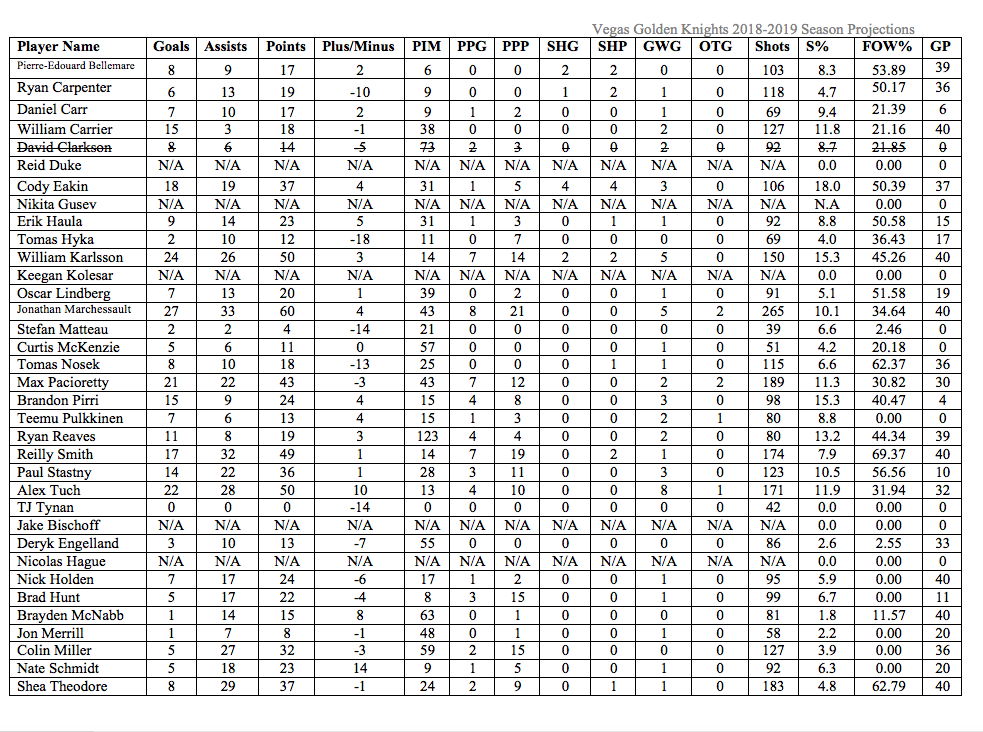
  • Vegas Golden Knights 2018-19 Season Projections

    It’s forecasting season, well, actually it’s the regular season and I’m just a little behind, but until I pointed that out, you didn’t know I was behind on my little passion project here, did you?

    I know I wrote “[i]n the coming days I’ll reveal what teams I’ll be forecasting/tracking all season long, so stay tuned because it’s about to get messier than ever before and I’m up for the challenge,” in my Boston Bruins 2018-19 forecast, but life and the fact that I’m moving all my data into a new format has slowed my turnaround for the time being.

    Nevertheless, my Vegas Golden Knights forecast for 2018-19 is here and let’s pretend the first week of the regular season hasn’t already happened or something.

    Additionally, if you’re wondering what other teams I’m preparing to post (before we get too far into the first quarter of the season) they are the Carolina Hurricanes and Columbus Blue Jackets.

    I always keep tabs on the Bruins every year because I grew up a Boston fan and I decided to track Vegas last season because there hadn’t been nearly as much hype surrounding an expansion team since Columbus and the Minnesota Wild in 2000. Additionally, I’ve previously tracked the Arizona Coyotes simply because they follow us on Twitter (and I’ll get back around to them hopefully before season’s end, if you’re interested).

    But I’m adding Carolina and Columbus to my forecast portfolio this season because 1) the Hurricanes are supposed to be better than last season, plus they have some exciting youth in the lineup and 2) a lot of Blue Jackets fans are also fans of our brand around here, so shouts 5th Liners.

    Please be patient on the timeline for when I’ll get my Hurricanes and Blue Jackets forecasts posted– it’ll be by the end of the month for sure.

    Anyway, on with the Golden Knights, shall we?


    Vegas is coming off of their inaugural season having finished 1st in the Pacific Division with 109 points and a 51-24-7 record under head coach Gerard Gallant. Not only did they finish at the top of their division in their first season, but they did so with over 100 points and a 50-plus win season.

    Oh yeah and they played the Washington Capitals in the 2018 Stanley Cup Final.

    Despite the loss in five games to Washington, the Golden Knights were and still are well ahead of owner Bill Foley’s “Cup in three [seasons]” masterplan– what with General Manager George McPhee‘s offseason additions of Paul Stastny and Max Pacioretty and everything.

    This year, of course, the competition has gotten a lot tougher. There are expectations now when opponents play the Golden Knights.

    Gallant and his Vegas lineup are going to have to get more creative than ever before in franchise history to avoid the hangover of a Stanley Cup Final appearance run and to avoid getting too predictable.

    Things are different now. They’re no longer the new kids on the block. They’re the 2018 Western Conference champions and a team to beat.

    As always, I’d like to remind you my degree is in communication– not math– therefore anything that looks wrong is either adjusted with a little gut-feeling and/or Microsoft Excel’s fault. My expertise resides in the written, spoken and nonverbal language of communicating– not numbers on a spreadsheet.

    These forecasted stats are to be seen as an utopian perspective, as though nothing bad could happen this season at any point to any player– where every player at least lives up to their forecast and then some.

    Some will pan out and some will fall flat. It’s a suggested outcome for a sport that’s played on ice in a highly unpredictable collective environment of action and sheer puck luck.

    vegas_golden_knights_logo

    Vegas Golden Knights Forecast Through 0 Games (82 Games Remaining)

    This slideshow requires JavaScript.

    After a breakout 78-point season (43 goals, 35 assists) for William Karlsson, the Golden Knights number-one center is prime for a respectable 41-point season as part of the natural regression of the game– unless Karlsson is truly an outlier, like he was coming from Columbus to Vegas last season.

    Meanwhile, Reilly Smith (19-27–46 expected totals) and Jonathan Marchessault (28-35–63 expected totals) bolster the Golden Knights first line with respectable performances of their own, while the point spread has really been shared with the second line.

    Newcomers Paul Stastny (22-43–65 expected totals) and Max Pacioretty (33-30–63 expected totals) are set to become the key contributors to the fiery Vegas offense in their first season with the club.

    The Golden Knights top-six core of forwards is deeper than last season, whereas the majority of their offense was reliant upon Marchessault, Karlsson and Smith. This year there’s more emphasis on Alex Tuch and Erik Haula inside the top-nine.

    On defense, Gallant’s crew will have to do without Nate Schmidt for the first 20 games of the season while Schmidt serves a suspension for a performance enhancing drug.

    Luckily, Brad Hunt, Colin Miller and Shea Theodore are prime for an uptick in time-on-ice and production, with Hunt and Miller expected to reach the 30-point plateau, while offseason addition, Nick Holden should see a pleasant rebound from his 17 points split between the Bruins and New York Rangers last season to a 25-point effort in 2018-19 with Vegas, provided he can remain in the top-six on the depth chart.

    Upon Schmidt’s return, he should still have 4-23–27 totals from the blue line, which is not great like last season’s 5-31–36 totals, but not terrible for a top-four defender.

    In goal, Marc-Andre Fleury is expected to return to Earth from his superhuman season last year (a 2.24 goals against average and .927 save percentage in 46 games) to a 2.49 GAA and .913 SV% in 2018-19. As the Golden Knights starter continues to get older, limiting his workload to keep him fresher for the postseason is the way to go.

    Granted, Fleury’s playing time was limited last season due to a concussion, he still went on to have solid regular season numbers and an impeccable 2018 Stanley Cup Playoff run up until the Stanley Cup Final.

    Meanwhile, Malcolm Subban‘s 2.68 GAA and .910 SV% in 22 games played look to be improved upon to a 2.65 GAA and .911 SV% in somewhere around 30 appearances as the backup netminder for Vegas.

    As always, we’ll get more into the goalies once the team has played through a quarter of the season.

  • Vegas Golden Knights 2018-19 Season Preview

    vegas_golden_knights_logo

    Vegas Golden Knights

    51-24-7, 109 points, 1st in the Pacific Division

    Lost in Stanley Cup Final to WSH, 4-1

    Additions: F Daniel Carr, G Zach Fucale, F Alex Gallant, D Nick Holden, F Curtis McKenzie, D Jimmy Oligny, F Max Pacioretty (acquired from MTL), F Paul Stastny

    Subtractions: D Philip Holm (signed, KHL), F James Neal (signed with CGY), F David Perron (signed with STL), F Teemu Pulkkinen (signed, KHL), D Luca Sbisa (signed with NYI), F Nick Suzuki (traded to MTL), F Tomas Tatar (traded to MTL), F Paul Thompson (signed with FLA)

    Still Unsigned: D Chris Casto, D Jason Garrison, F Mikhail Grabovski, D Clayton Stoner

    Re-signed: F William Carrier, G Oscar Dansk, F William Karlsson, D Colin Miller, F Tomas Nosek, F Brandon Pirri, F Ryan Reaves, D Shea Theodore

    Offseason Analysis: Only one team in the NHL’s more than a century of existence has ever won the Cup in their inaugural season. The 2017-18 Vegas Golden Knights almost joined the 1917-18 Toronto Arenas as the only teams to win the Cup in their inaugural season. Toronto beat the Pacific Coast Hockey Association’s (PCHA) Vancouver Millionaires 3-2 in a best of five-game series.

    Vegas came up three wins short of winning it all in the modern-day best-of-seven game series against the Washington Capitals that the Stanley Cup Final has become.

    The Golden Knights didn’t have an unfair advantage in the 2017 Expansion Draft. General Manager George McPhee worked the trade market to his advantage, primarily building the inaugural season’s core group of players through acquisitions.

    Owner Bill Foley has touted the “Cup-in-three” mantra, meaning it’s his goal as an organization to win the Cup in their first three years of existence. Upon league expansion in 1967, it took the Philadelphia Flyers seven years to win their first Cup.

    Foley wants to do it in half the time.

    McPhee’s already gone to work on improving his roster from year one to year two. He’s added Paul Stastny via free agency and Max Pacioretty in a trade with the Montreal Canadiens.

    Stastny, 32, joins the Golden Knights after spending last season with the St. Louis Blues and Winnipeg Jets. In 82 games split between the Blues and Jets, Stastny had 16-37–53 totals.

    A deadline acquisition by Winnipeg, he had 13 points down the stretch in the remaining 19 games of the regular season, then had his best career performance in the postseason (15 points in 17 games) en route to the Western Conference Final against (his now current team) Vegas.

    Despite Stastny’s playmaking style and ability to elevate the players around him in Patrik Laine and friends in Winnipeg, the Jets were no match for the hard-charging Golden Knights.

    If you can’t beat them, join them.

    The old saying rings true for Stastny, despite Winnipeg’s intentions on re-signing the veteran NHL center entering his 13th season in the league. He’ll slide in on Vegas’ second line behind William Karlsson and play alongside one of his best friends since they played together at the 2010 Winter Games, Max Pacioretty.

    Yes, that’s right, Pacioretty is a Golden Knight– in case you’ve been under a rock since training camp.

    At its surface, the price of the Pacioretty trade is one well spent for both teams. Vegas acquired Pacioretty in exchange for Tomas Tatar, prospect Nick Suzuki and a 2019 2nd round pick. That’s right about what you’d expect as a going rate for a top-six scorer– one current roster player, a prospect and a draft pick.

    But for all that McPhee dealt to the Detroit Red Wings to add Tatar at the trade deadline last season, this Pacioretty deal carries a hefty trade-tree baggage, whereby a lot of assets were ultimately tossed in the pot for Pacioretty’s services.

    At the very least, McPhee not only added a five-time 30-goal scorer, but he signed him to a four-year extension right away too. So if things don’t work out this season, the Golden Knights will remain in the hunt for the next few years.

    Why’s that?

    On top of their solid core group of forwards, Vegas has a crafty defense that’s capable of doing more than turning heads like they did last season. There’s just one catch though– they’ll have to do it without Nate Schmidt for the first quarter of the regular season.

    Schmidt will be serving a 20-game suspension for a performance enhancing drug, leaving Colin Miller and Shea Theodore to do the bulk of the work with Brayden McNabb and Deryk Engelland rounding out the rest of the top-four defenders.

    Brad Hunt and Nick Holden, in the meantime, seek to use the first 20 games as an audition for the sixth defenseman role upon Schmidt’s return to the lineup.

    Miller signed a four-year extension this summer and Theodore signed a seven-year deal worth $5.200 million per season. While seven years might be a bit more than the Golden Knights can chew if Theodore’s play heads south, at least he’s signed to a manageable $5.200 million cap hit– up to 50% of which can be retained in a trade.

    With an immense top-nine group of forwards and questions surrounding who will step up on defense in Schmidt’s absence, head coach Gerard Gallant must adjust accordingly as he’s always done– on-the-fly and with the complete buy-in of the dressing room.

    In goal, Marc-Andre Fleury— now signed through the 2021-22 season, thanks to a three-year extension this summer on top of the remaining year on his current contract– must find a way to continue his rejuvenated play in net. Last season’s 2.24 goals against average and .927 save percentage are more than likely unattainable in back-to-back seasons.

    One thing working in Fleury’s favor is his reduced workload. In his second-straight season under 50 games played, Fleury appeared in 46 games last season after battling a concussion.

    Malcolm Subban (2.68 GAA, .910 SV% in 22 games played last season) is still in line to become the next Golden Knights starting netminder in the post-Fleury era, but he undoubtedly must see an increase in playing time this season.

    It’s not quite a 1A, 1B option for Vegas, but rather a precaution for Fleury and a means of keeping their starter fresh for what could be another long postseason run.

    Unless any of the other Pacific Division teams have anything to say about it.

    Offseason Grade: B+

    McPhee bolstered his top-six forward group this offseason with two simple moves, while preserving the large-scale depth of the Golden Knights prospect pool. They didn’t land Erik Karlsson, John Tavares or Ilya Kovalchuk, but they did get Max Pacioretty.

    And they still have quite an impressive amount of cap space to work with next offseason as the franchise continues to settle into existence.

  • Montreal Canadiens 2018-19 Season Preview

    Unknown-1

    Montreal Canadiens

    29-40-13, 71 points, 6th in the Atlantic Division

    Additions: F Kenny Agostino, F Joel Armia (acquired from WPG), F Michael Chaput, F Max Domi (acquired from ARI), D Xavier Ouellet, F Matthew Peca, F Tomas Plekanec, F Hunter Shinkaruk (acquired from CGY)

    Subtractions: D Simon Bourque (traded to WPG), F Daniel Carr (signed with VGK), F Adam Cracknell (signed with TOR), F Markus Eisenschmid (signed, DEL), G Zach Fucale (signed with VGK), F Alex Galchenyuk (traded to ARI), F Jeremy Gregoire (signed with Milwaukee Admirals, AHL), G Steve Mason (acquired from WPG, buyout), F Joonas Nattinen (signed, KHL), D Tom Parisi (signed, Great Britain), F Kerby Rychel (traded to CGY), F Chris Terry (signed with DET)

    Still Unsigned: F Ales Hemsky, F Michael McCarron, F Logan Shaw

    Re-signed: F Phillip Danault, F Jacob de la Rose

    Offseason Analysis: They didn’t get Jeff Skinner, so now what?

    The Montreal Canadiens 2018-19 regular season campaign can’t be much worse than 2017-18. While the Buffalo Sabres are sure to climb out of eighth in the Atlantic Division, at least the Ottawa Senators will more than likely be the foundation of the division standings come April.

    Claude Julien‘s Canadiens had the third worst goal differential (a minus-55) in the league last season and with uncertainty surrounding Max Pacioretty‘s future in Montreal, well, that’s about to get worse. No amount of a healthy Carey Price can save the Canadiens porous defense, especially with star defender Shea Weber sidelined due to injury for at least a couple months.

    General Manager Marc Bergevin made a little splash in the trade market this offseason, sending Alex Galchenyuk to the Arizona Coyotes in exchange for Max Domi. While Domi brings grit to the Canadiens lineup, so does Andrew Shaw— just without the scoring power.

    Wait, Galchenyuk had six more points (19-32–51 totals in 82 GP for MTL) than Domi (9-36–45 in 82 GP for ARI) last season? And that was a “bad” year?

    Domi emerged onto the NHL spotlight with an 18-goal season in 2015-16 (81 GP). Injuries limited the young forward to just 59 games in 2016-17, a season in which he amassed 9-29–38 totals. In 23 more games from 2016-17 to 2017-18, Domi had seven more points.

    Meanwhile, Galchenyuk has reached the 40-point plateau for the last four seasons– including two 50-plus point seasons.

    Bergevin is gambling on Domi to return to form– and then some– but the question remains ever present– how long can these Bergevin gambles go on in Canada’s most prestigious club de hockey?

    Joel Armia, Matthew Peca and Xavier Ouellet are sneaky pickups by the Habs that may lead to improved depth, depth and a make-or-break season (for whatever reason), respectively.

    The ceremonious return of Tomas Plekanec to the franchise may at least bring back something right to the universe– a Plekanec goatee and turtleneck combo, unlike his short tenure with the Toronto Maple Leafs in which Lou Lamoriello’s oppressive regime on facial hair wrought havoc on the hockey universe.

    In all seriousness, though, Julien’s time in Montreal may be limited if the front office is looking for someone else to blame other than themselves for their colossal collapse the last few seasons. No amount of Jesperi Kotkaniemi (another gamble at 3rd overall in this year’s Draft) can make up for the inevitable– another long season for Habs fans.

    Offseason Grade: D

    Like the Ottawa Senators and Erik Karlsson, Montreal really should be receiving an “incomplete” grade until the Max Pacioretty situation is resolved. However, unlike the Sens, the Habs at least added some marginal talent in Max Domi this offseason (albeit at the expense of Alex Galchenyuk) compared to Ottawa’s… well, let’s not compare those two clubs by themselves, shall we?

    The Canadiens are like that guy in your class that has a 65 and is technically still passing the class. You know the school year won’t be great for that guy and you also know things could be worse, but they just can’t no matter how hard he tries (or doesn’t try?) because someone is always doing a little bit worse.

    Claude Julien is still a good coach, sure, but his system is becoming outdated for the contemporary game. Also, his last Cup win came outside of my “great coach” status (basically, you’re only a “great coach” if you’ve won a Cup within the last five seasons– you’re at the top of the game among the rest– until you retire, then you can lean back on your trophy case all you want to stack up), but that’s a hill worth dying on another day.