Tag: Conor Garland

  • Marchand leads third period comeback against Canucks

    Marchand leads third period comeback against Canucks

    Brad Marchand’s third period effort spurred the Boston Bruins to a, 3-2, win over the Vancouver Canucks Sunday night at TD Garden.

    Marchand tallied a goal and an assist on the game-winning goal in the third period as Linus Ullmark (5-3-0, 2.76 goals-against average, .914 save percentage in eight games played) turned aside 36 out of 38 shots faced in the victory for Boston.

    Vancouver netminder, Jaroslav Halak (0-4-1, 2.85 goals-against average, .910 save percentage in six games played), made 39 saves on 42 shots against in the loss.

    The Bruins improved to 11-7-0 (22 points) on the season and remain in 5th place in the Atlantic Division– one point behind the Detroit Red Wings for 4th– while the Canucks fell to 6-14-2 (14 points) overall and stuck in 8th place in the Pacific Division.

    Prior to the ongoing pandemic, Vancouver beat Boston, 9-3, at Rogers Arena on Feb. 22, 2020.

    Trent Frederic returned to the lineup for Boston after missing the last seven games with an upper body injury, while Ullmark returned to the crease after missing a scheduled start in Buffalo on Nov. 24th when he tweaked something at morning skate ahead of Boston’s, 5-1, win against the Sabres.

    Bruins head coach, Bruce Cassidy, made a few changes to his lines coming off of a, 5-2, loss to the New York Rangers on Friday– inserting Frederic at center on the third line with Nick Foligno and Karson Kuhlman on his wings, for starters.

    Kuhlman returned to the lineup after serving as a healthy scratch for the last four games.

    Craig Smith was promoted back to his regular role on the second line at right wing, while Tomáš Nosek was relegated to the fourth line center slot with Frederic returning to the lineup and Erik Haula joining Jake DeBrusk and Connor Clifton as Sunday’s scratches.

    Sunday night marked the first time this season that Haula and DeBrusk were scratched.

    Jakub Zboril kicked things off with an interference infraction at 1:50 of the first period, yielding the night’s first power play to Vancouver.

    Late in the ensuing skater advantage, the Canucks took advantage of a mishap in the crease when Ullmark and nearest defender, Mike Reilly, miscommunicated on a puck that bounced off of the Bruins goaltender and ended up in prime real estate in front of Tanner Pearson.

    Pearson (3) poked the loose puck over the goal line from point blank and gave Vancouver a, 1-0, lead at 3:33 of the first period.

    Brock Boeser (5) and Nils Höglander (5) had the assists on Pearson’s power-play goal as the Canucks took an early lead and momentum that was ultimately cut short about two minutes later.

    Anton Blidh (1) skated into Boston’s attacking zone and wired a shot past Halak’s glove side from afar– about two strides into the zone from the blue line in the high point, that is.

    Blidh’s unassisted effort tied the game, 1-1, at 5:51.

    Minutes later, Conor Garland was penalized for holding the stick and presented the Bruins with their first chance on the power play at 10:14, but the B’s weren’t able to capitalize on the skater advantage.

    Late in the period, Nosek caught Tyler Motte with a high stick and was assessed a minor infraction as a result at 15:44.

    Vancouver entered the zone while on the ensuing power play and Garland ripped a shot from along the boards past Ullmark’s glove on the short side, but Cassidy used a coach’s challenge on the grounds that he and the Bruins’ video crew believed the Canucks were offside prior to the goal.

    Video replay revealed that Höglander was, in fact, over the blue line with both skates prior to the puck entering the attacking zone, rendering Garland’s would be goal useless and reversing the call on the ice.

    The score remained tied, 1-1, heading into the first intermission, while the Bruins led in shots on goal, 11-10.

    Boston held the advantage in blocked shots (5-1) and hits (8-4), while the Canucks led in takeaways (2-1), giveaways (4-1) and faceoff win percentage (56-44).

    Vancouver was 1/2 on the power play, while the B’s were 0/1 on the skater advantage heading into the middle frame.

    Nosek thought he put the Bruins ahead within about a minute of action in the second period, but the call on the ice was “no goal” and upheld after a quick official review confirmed that– while Nosek’s initial kick of the puck to his stick blade was fine, his subsequent kick while falling that resulted in the rubber biscuit finding the twine was no good.

    Minutes later, Marchand slashed Garland and was sent to the box at 6:54 of the second period.

    Vancouver wasn’t able to capitalize on the resulting skater advantage, however.

    Midway through the period, Garland (6) got the goal that he was looking for earlier in the night when he sent a shot with eyes through Jason Dickinson’s legs and Ullmark’s five-hole while Dickinson screened the Boston netminder.

    Garland’s goal was unassisted and gave the Canucks a, 2-1, lead at 12:31 of the second period.

    And so, 2-1, it remained as Vancouver led on the scoreboard through 40 minutes of action and in shots on goal, 27-24, including a, 17-13, advantage in the second period alone.

    The Canucks dominated in takeaways (3-1), giveaways (8-3) and faceoff win% (52-48), while the Bruins led in blocked shots (11-8) and hits (17-13).

    Vancouver went 1/3 on the power play, while Boston remained 0/1 on the skater advantage heading into the second intermission.

    Matt Grzelcyk caught Höglander with a quick hook and cut a rut to the penalty box as a result at 3:51 of the third period as a result, but Vancouver couldn’t muster anything on the scoreboard.

    Höglander, himself, was the next player off to the sin bin after he tripped Foligno at 7:21 of the third period.

    This time the Bruins found the back of the net on the power play after Ullmark stoned Motte on a shorthanded breakaway at the other end.

    David Pastrnak sent a shot attempt off the post where the puck pinballed around in the ensuing chaos off of Patrice Bergeron before settling outside the slot while a mass of bodies gathered in front of Halak.

    Marchand (9) scooped up the puck and buried it to tie the game, 2-2, with a power-play goal at 8:45 of the third period.

    Foligno (4) and Bergeron (9) notched the assists on Marchand’s goal as the Bruins surged to life.

    Chances were traded at both ends when Oliver Ekman-Larsson raced Blidh into the corner and promptly boarded the Boston skater, resulting in a minor penalty that Garland ended up serving while Ekman-Larsson had to tend to an errant skate blade that popped out from the force of the collision with Blidh at 15:23.

    Once more, it didn’t take the Bruins long to convert on the ensuing power play.

    Marchand thread a pass through the slot to Pastrnak (7) for the redirection goal while crashing the net to give Boston their first lead of the night, 3-2, at 16:36 of the third period.

    Marchand (15) and Bergeron (10) tallied the assists on Pastrnak’s power-play goal and the Bruins had their first lead of the night.

    With their goaltender pulled and a stoppage in play with 46 seconds left on the clock, Canucks head coach, Travis Green, used his timeout to rally his skaters, but it was to no avail.

    Though the Bruins didn’t end up scoring an empty net goal– despite Marchand’s best efforts to give Bergeron an easy lay-up, Bergeron had entered the zone offside to negate an insurance goal after Green challenged the call on the ice– the final horn sounded without issue.

    Boston had won, 3-2, and finished the night leading in shots on goal, 42-38, including an, 18-11, advantage in shots on net in the third period alone.

    The Bruins finished the night leading in blocked shots (12-11), hits (28-18) and faceoff win% (51-49), while Vancouver exited the building with the advantage in giveaways (10-3).

    The Canucks finished Sunday night’s effort 1/4 on the power play, while Boston went 2/3 on the skater advantage.

    The B’s improved to 4-3-0 (3-1-0 at home) when allowing the game’s first goal, 1-4-0 (1-2-0 at home) when tied after the first period and 2-4-0 (2-1-0 at home) when trailing after two periods this season.

    Vancouver fell to 2-4-0 (1-4-0 on the road) when scoring first, 2-6-0 (1-4-0 on the road) when tied after one period and 4-1-0 (2-1-0 on the road) when leading after two periods in 2021-22.

    The Bruins wrap up their three-game homestand against the Detroit Red Wings to close out the month of November on Tuesday.

    Boston begins the month of December with a one-off road game at Bridgestone Arena against the Nashville Predators on Thursday (Dec. 2nd) before returning home to host the Tampa Bay Lightning for a game next Saturday (Dec. 4th).

  • Arizona Coyotes 2021-22 Season Preview

    Arizona Coyotes 2021-22 Season Preview

    2020-21 record 24-26-6, 54 points

    5th in the Honda NHL West Division

    Missed the postseason for the first time since 2020

    Additions: F Jay Beagle (acquired from VAN), F Travis Boyd, F Ryan Dzingel, F Loui Eriksson (acquired from VAN), F Dmitrij Jaskin, F Bokondji Imama (acquired from LAK), F Andrew Ladd (acquired from NYI), F Liam O’Brien, F Antoine Roussel (acquired from VAN), D Shayne Gostisbehere (acquired from PHI), D Cole Hults (acquired from LAK), D Vladislav Kolyachonok (acquired from FLA), D Anton Strålman (acquired from FLA), D Conor Timmins (acquired from COL), G Carter Hutton, G Josef Korenar (acquired from SJS)

    Subtractions: F Michael Bunting (signed with TOR), F Brayden Burke (traded to LAK), F Derick Brassard (signed with PHI), F Michael Chaput (signed with PIT), F Christian Dvorak (traded to MTL), F Conor Garland (traded to VAN), F John Hayden (signed with BUF), F Dryden Hunt (signed with NYR), F Tyler Pitlick (expansion, SEA), F Lane Pederson (rights traded to and signed with SJS), F Emil Pettersson (KHL), F Tyler Steenburgen (traded to LAK), F Nathan Sucese (signed with Iowa Wild, AHL), D Oliver Ekman-Larsson (traded to VAN), D Alex Goligoski (signed with MIN), D Jordan Gross (signed with COL), D Niklas Hjalmarsson (retired), D Jordan Oesterle (signed with DET), G Adin Hill (traded to SJS), G Darcy Kuemper (traded to COL), G Antti Raanta (signed with CAR)

    Still Unsigned: F Frédérik Gauthier, F Marian Hossa (retired, contract expired), D Jason Demers, D Aaron Ness

    Re-signed: F Hudson Fasching, F Blake Speers, D Cam Dineen, D Dysin Mayo

    Offseason Analysis: Arizona took on a bunch of contracts this offseason, but still has about $11.946 million in cap space as Coyotes General Manager, Bill Armstrong, put on a masterclass of how to effectively clean house to rebuild.

    The Coyotes are paying a combined $1.500 million this season for the services of Carter Hutton and Josef Korenar in the crease after signing Hutton in free agency and acquiring Korenar and a 2022 2nd round pick via a trade with the San Jose Sharks that sent Adin Hill in return.

    Antti Raanta, meanwhile, left for the Carolina Hurricanes, seeking a career resurgence after a rocky, injury filled, tenure in Arizona, while Darcy Kuemper was traded the same day free agency began on July 28th to the Colorado Avalanche for defender, Conor Timmins, a 2022 1st round pick and a conditional 2024 3rd round pick.

    Whereas the Buffalo Sabres viewed goaltending as an afterthought this offseason, the Coyotes, uhh, planned this?

    Hutton had a 1-10-1 record in 13 games for the Sabres last season and recorded a 3.47 goals-against average and an .886 save percentage in that span, while Korenar made his NHL debut for the Sharks and went 3-5-0 in 10 games with a 3.17 goals-against average and an .899 save percentage.

    But goaltending wasn’t the biggest focus for Arizona this offseason as they completely stripped down their roster and planned for a major reset between now and next summer.

    Only 19 players throughout the organization are signed through the 2022-23 season, including six players currently on the NHL roster.

    After trading Hill and a 2022 7th round pick to the Sharks for Korenar and a 2022 2nd round pick on July 17th, Armstrong made sure to add salary to work his way to the cap floor that same day by acquiring Andrew Ladd from the New York Islanders in addition to a 2021 2nd round pick that originally belonged to Colorado (60th overall, Janis Jerome Moser), as well as a conditional 2023 3rd round pick for future considerations.

    Ladd’s been buried in the American Hockey League (AHL) in recent years with the Bridgeport Sound Tigers (now Bridgeport Islanders) and last played at the NHL level in four games with New York in 2019-20– scoring one goal that season.

    As crazy as it sounds, Arizona might use Ladd on their roster. At 35-years-old, he’s in his final run, but with two years remaining on his contract at a $5.500 million cap hit, he’s one of the few players left on the team entering 2022-23– unless he’s moved before then or retires.

    Philadelphia saw what the Islanders did and said “hey, we can do that too” and traded defender, Shayne Gostisbehere, to the Coyotes with a 2022 2nd round pick and a 2022 7th round pick in exchange for future considerations.

    Arizona takes on Gostisbehere’s remaining two years of his current contract at $4.500 million per season and looks to resurrect his offensive game from the blue line since his career-high 65 points in 78 games with the Flyers in 2017-18.

    Last season, Gostisbehere bounced back from 12 points in 42 games in 2019-20 with a respectable 20 points in 41 games, but it’s not enough to justify his price tag amid a plethora of defenders looking to crack Philadelphia’s lineup on a regular basis, so the Coyotes are glad to give Gostisbehere a warm welcome.

    A day after acquiring Gostisbehere, Arizona made waves when they traded their captain, Oliver Ekman-Larsson with the rights to then restricted-free agent forward, Conor Garland, to the Vancouver Canucks for Loui Eriksson, Jay Beagle, Antoine Roussel, a 2021 1st round pick (9th overall, Dylan Guenther), a 2022 2nd round pick and a 2023 7th round pick in return on July 23rd.

    Ekman-Larsson’s production has been in decline since recording 21-34–55 totals in 75 games with the Coyotes in 2015-16. He followed that season up with 39 points in 79 games in 2016-17, and 42 points in 82 games in 2017-18, before signing an eight-year extension with an $8.250 million cap hit on July 1, 2018, that would go into effect for the 2019-20 season.

    In 2018-19, Ekman-Larsson had 14-30–44 totals. In 2019-20, he had 30 points (nine goals, 21 assists) in 66 games and just last season, Ekman-Larsson had 24 points (three goals, 21 assists) in 46 games for Arizona.

    So the Coyotes packaged him with Garland to a team that Ekman-Larsson had expressed a desire in being traded to entering last offseason (Ekman-Larsson would only accept a trade to the Boston Bruins or Vancouver, but Arizona held out and kept him for the 2020-21 season).

    Garland signed an extension with the Canucks, while Arizona also retained 12% of Ekman-Larsson’s salary (about $990,000 per season through 2026-27) in the aftermath of the deal.

    Meanwhile, Eriksson, Beagle and Roussel are looking for a fresh start in a new market– though they each have one-year remaining on their contracts, so they probably shouldn’t get too comfortable.

    Eriksson managed to earn one assist in seven games last season for Vancouver, while Beagle was limited to 30 games due to injury and had 1-4–5 totals and Roussel chipped in four points (one goal, three assists) in 35 games.

    So they’re not offensive powerhouses, but the Coyotes aren’t going for a Cup ring this season– they’re going for a complete reset as they continued to wheel and deal this offseason.

    Arizona swapped minor leagues with the Los Angeles Kings in a trade on July 24th, then took July 25th off before acquiring defender, Anton Stålman, from the Florida Panthers for a 2023 7th round pick on July 26th.

    Strålman fell out of favor in Florida after scoring 19 points from the blue line in 69 games in 2019-20 before dropping to nine points in 38 games last season with the Panthers.

    Needing cap space, the Panthers moved on from Strålman, dropping him and his $5.500 million cap hit, along with defender, Vladislav Kolyachonok, off with the Coyotes for the 2021-22 season, where the 35-year-old defender is hungry to keep his playing days alive in the twilight of his career.

    With a few new faces on defense, Arizona is ready for life in a post-Niklas Hjalmarsson world, since the 34-year-old native of Sweden retired after five points (all assists) in 41 games with the Coyotes last season.

    On July 28th, Arizona executed the Kuemper trade, then the phone lines went silent for about a month until the Carolina Hurricanes signed Jesperi Kotkaniemi to an offer sheet that the Montréal Canadiens wouldn’t match.

    Montréal inquired the Coyotes about the availability of Christian Dvorak on the trade market and he was shipped off the Habs on Sept. 4th for a conditional 2022 1st round pick (the worse of the Canadiens’ own or Carolina’s) and a 2024 2nd round pick.

    By the way, Arizona hired a new head coach this offseason, naming André Tourigny as the designated leader to guide the rebuild down to the depths and back to the surface of playoff contention.

    That should be fun.

    At least Tourigny has a good repertoire among major junior players and can settle into the NHL level with whoever the Coyotes draft in 2022.

    Offseason Grade: A-

    Look, just because the offseason grade says “A-” doesn’t mean this team will actually be competitive.

    Yes, the Coyotes are going to finish last in the Central Division– by the way, they’re new to the Central this season since the Seattle Kraken joined the league and took Arizona’s spot in the Pacific Division.

    But it’s also true that Armstrong made most of the right moves that aligned with Arizona’s offseason philosophy– embrace the tank.

    The Coyotes are loading up on draft picks, prospects and whatever scraps you can find with other teams’ bad contracts and should turn things around in the next few years.

    Of course, there’s the fact that this seems to happen way too often in Arizona and the concern among the fanbase that things might not go as planned with their expected relocation from Glendale to Tempe, Arizona as the City of Glendale has booted the team out of their space at Gila River Arena after the 2021-22 season– opting out of their current lease agreement, as the city could in accordance with agreed upon clauses.

    But for all things considered, the Coyotes have a plan. The same can’t be said for Buffalo.

  • Vancouver Canucks 2021-22 Season Preview

    Vancouver Canucks 2021-22 Season Preview

    2020-21 record 23-29-4, 50 points

    7th in the Scotia NHL North Division

    Missed the postseason for the first time since 2020

    Additions: F Justin Dowling, F Jason Dickinson (acquired from DAL), F Phil Di Giuseppe, F Sheldon Dries, F Conor Garland (acquired from ARI), F Nic Petan, F Sheldon Rempal, F John Stevens, D Kyle Burroughs, D Oliver Ekman-Larsson (acquired from ARI), D Brad Hunt, D Brady Keeper, D Tucker Poolman, D Luke Schenn, D Devante Stephens, G Jaroslav Halak, G Spencer Martin (acquired from TBL)

    Subtractions: F Sven Baertschi (signed with VGK), F Jay Beagle (traded to ARI), F Travis Boyd (signed with ARI), F Loui Eriksson (traded to ARI), F Tyler Graovac (KHL), F Jayce Hawryluk (SHL), F Kole Lind (expansion, SEA), F Lukas Jasek (Liiga), F Marc Michaelis (signed with Toronto Marlies, AHL), F Petrus Palmu (Liiga), F Antoine Roussel (traded to ARI), F Jake Virtanen (buyout, KHL), D Jalen Chatfield (signed with Chicago Wolves, AHL), D Alexander Edler (signed with LAK), D Mitch Eliot (signed with Rochester Americans, AHL), D Brogan Rafferty (signed with ANA), D Nate Schmidt (traded to WPG), D Ashton Sautner (signed with Abbotsford Canucks, AHL), D Josh Teves (signed with Rochester Americans, AHL), G Braden Holtby (buyout)

    Still Unsigned: F Elias Pettersson (RFA), F Jimmy Vesey, D Quinn Hughes (RFA), G Jake Kielly

    Re-signed: F Justin Bailey, F Brandon Sutter, D Guillaume Brisebois, D Travis Hamonic, D Olli Juolevi

    Offseason Analysis: Canucks General Manager, Jim Benning, has been busy this offseason undoing past misjudgments and moving Vancouver forward in other areas (however small they may be).

    At least he didn’t sign anyone to a head-scratching long-term contract the day that free agency began on July 28th this year.

    With about $10.664 million in cap space currently and Elias Pettersson as a restricted-free agent alongside Quinn Hughes, the Canucks still have some work to get done before the season begins or else they risk falling behind even further in the standings.

    While Pettersson would probably love to make about $9.000 or $10 million per season, he hasn’t exactly reached that status yet as a 22-year-old center with 153 points in 165 career games.

    A solid bridge contract is more likely in his future than, say, a long-term seven or eight-year deal.

    It may be kicking the can down the road to pay him later, but with 21 points (10 goals, 11 assists) in 26 games last season, there’s always the risk that his wrist injury might quite literally hurt his skilled hands in the near to long-term future.

    A bridge deal insures the Canucks of avoiding prolonging the salary cap hell that they’ve been through until Benning was able to dump most of it in Arizona via the trade with the Coyotes for Oliver Ekman-Larsson and Conor Garland.

    That said, Pettersson is worth paying a premium for to build off of Vancouver’s young core. He had 28-38–66 totals in 71 games in his first season in the league in 2018-19 and amassed 27-39–66 totals in 68 games prior to the COVID-19 pandemic being declared in the 2019-20 season.

    Hughes, on the other hand, is important to Vancouver’s future, but had a dip in production from 53 points (eight goals, 45 assists) in 68 games in his first full season in 2019-20 to 41 points (three goals, 38 assists) in 56 games last season.

    Nevertheless, for a defender to wrack up 40 or more points in a season is pretty good all things considered.

    Especially since Hughes is only 21-years-old and has plenty of track left on route to his potential.

    It should be easier to get a deal done with Hughes than Pettersson if the sticking point is that one sees themselves more valuable to the team than the other.

    If, for some reason, things went south between the Canucks and Pettersson, the Canucks could survive– albeit reminiscent of the last days of Pavel Bure with the franchise.

    In other words, you probably don’t want that to happen again.

    All right, what about what Vancouver has already taken care of this offseason, shall we?

    Jaroslav Halak left the Boston Bruins for the Canucks via free agency this summer and signed a one-year deal worth $1.500 million with another $1.500 million in performance bonuses to become the backup to Thatcher Demko, though Vancouver may prefer to utilize Halak and Demko as some sort of a 1A/1B tandem.

    Despite Halak’s 9-6-4 record in 19 games last season, he maintained a quality 2.53 goals-against average and a .905 save percentage with two shutouts in that span as Boston’s backup until Jeremy Swayman entered the conversation.

    In 2019-20, Halak and Tuukka Rask captured the William M. Jennings Trophy as the goaltender(s) with 25 or more games played that allowed the fewest goals against in that season.

    Halak went 18-6-6 in 31 games and had a 2.39 goals-against average, a .919 save percentage and three shutouts in that remarkable regular season run.

    It served as a reminder that Halak was once a surefire starting goaltender and could very well, in the event that was necessary, command a team from the crease as a starter once more.

    This after a 22-11-4 record in 40 games played with Boston in 2018-19, in which he had a 2.34 goals-against average, a .922 save percentage and five shutouts.

    But at 36-years-old, Halak’s time in the league is dwindling as he continues about the twilight of his career.

    At the very least, he brings in more stability in the crease than Braden Holtby did for Demko– and that’s precisely why the Canucks felt is was O.K. to buyout the remaining year of Holtby’s contract.

    The bulk of Benning’s work this offseason came via making trades.

    He most recently acquired goaltender, Spencer Martin, from the Tampa Bay Lightning on July 31st for future considerations to solidify depth in the event of injury or to at least provide the Abbotsford Canucks (AHL) with a quality starter.

    But earlier this summer, Benning kicked things off with a small grab for top-nine depth by sending the Dallas Stars a 2021 3rd round pick (73rd overall, Ayrton Martino) for forward, Jason Dickinson, on July 17th.

    Six days later, Benning phoned Bill Armstrong in Arizona and executed a trade that saved the Canucks almost $5.000 million in valuable cap space after sending Antoine Roussel, Jay Beagle, Loui Eriksson, a 2021 1st round pick (9th overall, Dylan Guenther), a 2022 2nd round pick and a 2023 7th round pick to the Coyotes for Ekman-Larsson and Garland’s signing rights before re-signing the latter to a five-year extension worth $4.950 million per season.

    Arizona retained 12% of Ekman-Larsson’s salary, thus shaving $990,000 off of his cap hit for Vancouver, who is assessed a cap hit of $7.260 million per season for Ekman-Larsson through 2026-27.

    With change coming to the blue line in Vancouver, Nate Schmidt reconsidered a trade he had initially rejected and informed Benning he would be fine being moved after all in a deal where the Canucks sent Schmidt to the Winnipeg Jets for a 2022 3rd round pick on July 27th.

    If Ekman-Larsson’s able to rebound from his decline– reaching 55 points in 75 games in 2015-16, then 39 points in 79 games the following season before rebounding with 42 points in 82 games in 2017-18 and 44 points in 81 games in 2018-19 prior to his dropoff again in 2019-20, where he had 30 points in 66 games and 2020-21, where he had 24 points in 46 games– then Benning might just be a mastermind after all.

    At the very least, Ekman-Larsson’s 24 points last season with Arizona was more than Schmidt had in 54 games with Vancouver, as Schmidt dropped from 31 points in 59 games with the Vegas Golden Knights in 2019-20 to 15 points in 54 games with the Canucks.

    Offseason Grade: B

    If the Canucks had signed Pettersson and Hughes to extensions already– and assuming they weren’t overpaying them– then Vancouver probably would get an “A” overall for their willingness to free themselves from past mistakes and try something new.

    Will they be as bad as they were last season? Probably not.

    Will they be “blow other teams out of the water” good this season? Also probably not.

    But at the very least, they’ve given themselves enough to work with in the next year or two to fill out the rest of their core and supplement their best players with better pieces of the puzzle.

    If, however, everything falls on their face, then I guess Vancouver is just cursed like that then, huh.

  • 2021 NHL Entry Draft Round 1 Recap

    2021 NHL Entry Draft Round 1 Recap

    Round 1 of the 2021 NHL Entry Draft was held virtually Friday night for the second-straight year as the ongoing COVID-19 pandemic delayed the league’s plans for a draft at Bell Centre in Montréal until 2022 at the earliest.

    Coverage of this year’s first round began Friday night at 8 p.m. ET on ESPN2 in the United States, as well as SN and TVAS in Canada. Rounds 2-7 will be televised on Saturday at 11:00 a.m. ET on NHLN in the U.S. and Sportsnet in Canada.

    As always, there were plenty of surprises and (possibly) a lack of trades. Here’s how it all went down.

    2021 NHL Entry Draft Round 1

    1.Buffalo Sabres –>  D Owen Power, Michigan (NCAA)

    2. Seattle Kraken –> C Matthew Beniers, Michigan (NCAA)

    3. Anaheim Ducks –> C Mason McTavish, Peterborough Petes (OHL)

    4. New Jersey Devils –> D Luke Hughes, USA-U18 (USHL)

    5. Columbus Blue Jackets –> C Kent Johnson, Michigan (NCAA)

    6. Detroit Red Wings –> D Simon Edvinsson, Frölunda HC (SHL)

    7. San Jose Sharks –> LW William Eklund, Djurgårdens IF (SHL)

    8. Los Angeles Kings –> D Brandt Clarke, Barrie Colts (OHL)

    9. Arizona Coyotes (from Vancouver Canucks) –> RW Dylan Guenther, Edmonton Oil Kings (WHL)

    10. Ottawa Senators –> RW Tyler Boucher, USA-U18 (USHL)

    11. Arizona Coyotes –> Forfeited pick

    12. Columbus Blue Jackets (from Chicago) –> C Cole Sillinger, Sioux City Musketeers (USHL)

    13. Calgary Flames –> RW Matthew Coronato, Chicago Steel (USHL)

    14. Buffalo Sabres (from Philadelphia Flyers) –> RW Isak Rosen, Leksands IF (SHL)

    15. Detroit Red Wings (from Dallas Stars) –> G Sebastian Cossa, Edmonton Oil Kings (WHL)

    16. New York Rangers –> LW Brennan Othmann, EHC Olten (Swiss League)

    17. St. Louis Blues –> C Zachary Bolduc, Rimouski Océanic (QMJHL)

    18. Winnipeg Jets –> C Chaz Lucius, USA-U18 (USHL)

    19. Nashville Predators –> C Fedor Svechkov, HC Lada Togliatti (VHL)

    20. Minnesota Wild (from Edmonton Oilers) –> G Jesper Wallstedt, Luleå HF (SHL)

    21. Boston Bruins –> RW Fabian Lysell, Luleå HF (SHL)

    22. Edmonton Oilers (from Minnesota Wild) –> C Xavier Bourgault, Shawinigan Cataractes (QMJHL)

    23. Dallas Stars (from Washington Capitals via Detroit Red Wings) –> C Wyatt Johnston, Windsor Spitfires (OHL)

    24. Florida Panthers –> RW Mackie Samoskevich, Chicago Steel (USHL)

    25. Columbus Blue Jackets (from Toronto Maple Leafs) –> D Corson Ceulemans, Brooks Bandits (AJHL)

    26. Minnesota Wild (from Pittsburgh Penguins) –> D Carson Lambos, Winnipeg Ice (WHL)

    27. Nashville Predators (from Carolina Hurricanes) –> LW Zachary L’Heureux, Halifax Mooseheads (QMJHL)

    28. Colorado Avalanche –> RW Oskar Olausson, HV71 (SHL)

    29. New Jersey Devils (from New York Islanders) –> RW Chase Stillman, Sudbury Wolves (OHL)

    30. Vegas Golden Knights –> C Zach Dean, Gatineau Olympiques (QMJHL)

    31. Montréal Canadiens –> D Logan Mailloux, SK Lejon

    32. Chicago (from Tampa Bay Lightning via Columbus Blue Jackets) –> D Nolan Allan, Prince Albert Raiders (WHL)

    Trades made during the first round of the draft:

    • The Dallas Stars traded the 15th overall pick to the Detroit Red Wings for the 23rd overall pick, 48th overall pick and 138th overall pick in this year’s draft.
    • The Edmonton Oilers traded the 20th overall pick to the Minnesota Wild for the 22nd overall pick and 90th overall pick in this year’s draft.
    • The Carolina Hurricanes traded the 27th overall pick to the Nashville Predators for the 40th overall and 51st overall picks in this year’s draft.

    Trades made earlier in the day prior to the first round of the draft:

    • The Buffalo Sabres traded D Rasmus Ristolainen to the Philadelphia Flyers for D Robert Hagg, a 2021 1st round pick (14th overall) and a 2023 2nd round pick.
    • F Pavel Buchnevich was traded by the New York Rangers to the St. Louis Blues for F Sammy Blais and a 2022 2nd round pick.
    • The Arizona Coyotes acquired F Antoine Roussel, F Jay Beagle, F Loui Eriksson, a 2021 1st round pick (9th overall), a 2022 2nd round pick and a 2023 7th round pick from the Vancouver Canucks for D Oliver Ekman-Larsson and F Conor Garland. Arizona retained 12% of Ekman-Larsson’s cap hit (about $990,000) in the deal.
    • Chicago traded D Adam Boqvist, a 2021 1st round pick (12th overall), a 2021 2nd round pick and a conditional 2022 1st round pick to the Columbus Blue Jackets for D Seth Jones, a 2021 1st round pick (32nd overall) and a 2022 6th round pick. If Chicago wins one of the 2022 draft lotteries, the conditional 2022 1st round pick becomes a 2023 1st round pick in the transaction.
    • The Carolina Hurricanes dealt D Jake Bean to the Columbus Blue Jackets for a 2021 2nd round pick (originally belonging to Chicago).
  • Boston Bruins 2020-21 Forecast Through 20 Games

    Boston Bruins 2020-21 Forecast Through 20 Games

    O.K., so I’m still behind on some things around here.

    Whether you’re new to DTFR or a long-time fan(?), you’re able to see the finished products around here and think “wow, that’s neat” and go about your day doing whatever the next thing on your mind happens to be.

    You don’t have to wake up everyday to all the shot charts, player and team forecasts, expected points total models, Photoshop files, running list of game notes, podcast notes (yes, that’ll be back soon) and more that’s related to the day-to-day DTFR operations around here or other seemingly useless bits of information that may or may not see the light of day.

    But that’s all the fun parts anyway. Hockey is my passion.

    The long, grueling, season is counteracted by moments like Nathan MacKinnon underhand tossing Conor Garland’s helmet back to him and being fined $5,000 in the process.

    https://platform.twitter.com/widgets.js

    Guess I’m going to have to start tracking how often that happens now.

    In addition to everything mentioned above, you might not know that I’m constantly applying to jobs, so sometimes little things like this forecast write up gets put on the back burner until there’s a minute or two between games, guest appearances on other podcasts and more job applications.

    Not trying to use anything as an excuse here, but please forgive me for being *checks notes* 15 games behind on the latest forecast, which will be irrelevant in another five games anyway, because it’ll be time to update Boston’s forecast through 40 games this season.

    I do this all by hand in Microsoft Excel, so you know I’m not a real mathematician or statistician.

    If you ask me to code something, I’ll ask you “what ‘R‘ you talking about? Get it? Did you see the pun I made there? Words, am I right?”

    15 games ago, I updated each individual Bruins player’s forecast after writing my recap about Zdeno Chara’s first game back in Boston as a member of the Washington Capitals then eventually got around to updating the corresponding chart that you’ll see below.

    Then I had to do that for whatever other teams I’ve been able to keep track of on time and I promise I’ll be writing about those forecasts… …eventually.

    Oh and apply to more jobs.

    Anyway, you probably don’t care about the life behind the screen, so let’s get to Boston’s forecast through 20 games, shall we?

    As always, remember that my degree is in communication and my minor was in sport management. I got a “C” in my Intro to Stats class back in my first semester of college, which was eight years ago this fall.

    Between then and now, I’ve worked in live sports production (TV and radio) and been unemployed, which explains why I’m constantly applying to jobs.

    First year players are impossible to predict until they’ve built up some time in the National Hockey League. Generally at least a game will suffice, but their numbers might look a little “inflated” (for the lack of a better term) until the season rolls on and their expectations fall back to Earth.

    In other words, Zach Senyshyn is now forecasted for 18 assists in this latest forecast, but that shouldn’t surprise you since he only had two assists in six career NHL games over the last two seasons.

    That will change in the 40-game update, since he’s played in at least seven more games between the time this report was originally intended to be done and the next one.

    Remember that forecast is different from pace.

    Finally, remember that there’s a lot of variables, like injuries, being a healthy scratch or on the taxi squad, other American Hockey League related or waiver related transactions, trades, sickness, COVID protocol, general superstitions, hot and cold streaks, etc. that can (whether scientifically proven or not) disrupt a player’s season.

    None of these can be accounted for in Microsoft Excel’s forecast function.

    In a perfect world, everyone plays a full season. Every player has a chance to live up to expectations, hit and/or exceed their mark or miss it by a little/a lot.

    Hockey is a game made up of collective actions and sheer puck luck. It’s unpredictable, which technically defeats the purpose of this (so if you’ve made it this far, give yourself a pat on the back).


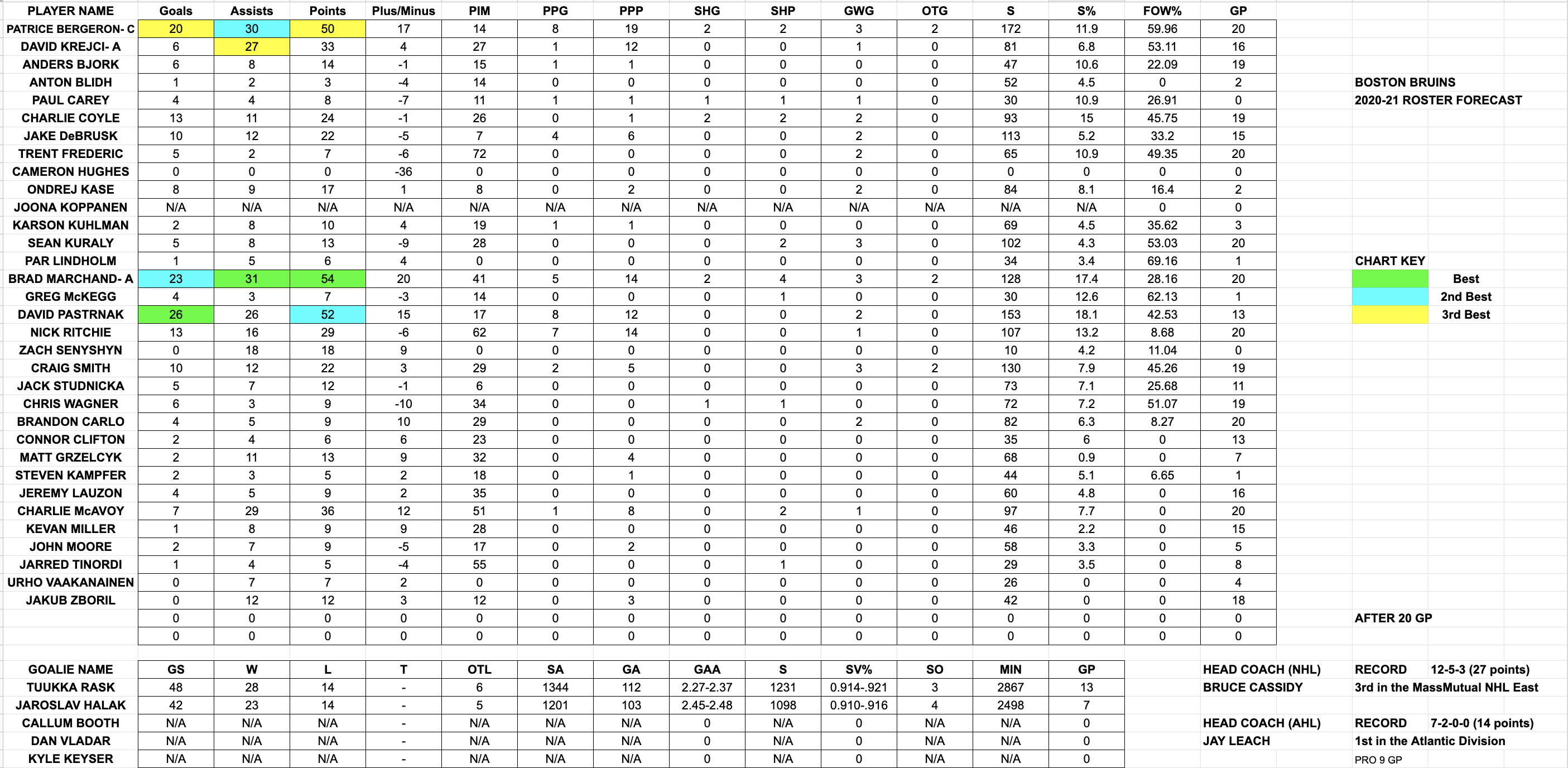
    Boston Bruins Forecast Through 20 Games (36 Games Remaining)

    David Pastrnak came back from offseason surgery and looked like he hadn’t missed a step, since his scoring prowess left an immediate impact on the team and kept him forecasted as the team’s leader in goals by season’s end with 26, though Boston’s forecasted points leader has now shifted from Pastrnak to Brad Marchand.

    Marchand’s forecasted 23-31–54 totals lead Pastrnak’s 26-26–52 totals, while B’s captain, Patrice Bergeron is on track to round out the top-3 in scoring with 20-30–50 forecasted totals– good enough for the second-most assists on the roster, one behind Marchand’s 31 and three ahead of David Krejci’s forecasted 27 assists.

    It’ll be fun to see just how much things have changed in the next forecast, since Krejci’s gone off in the assist department lately and Marchand missed a couple of games due to COVID protocol, but let’s save that speculation (or hindsight) for the 40-game report, O.K.?

    On defense, Charlie McAvoy continues to lead the way with 7-29–36 forecasted totals, while Matt Grzelcyk (13 points) and Jakub Zboril (12 points) are the only other defenders expected to reach double-digit points totals.

    That’s quite an area of concern for the Bruins.

    Not so much in the “oh no, who might get taken by the Seattle Kraken in the 2021 Expansion Draft” sense, but rather, the general “oh no, this team is not as good as they were last year, but we expected that, so they still need to acquire a defender and more at the trade deadline this year” sense (especially if one of the younger blue liners like Zboril, Jeremy Lauzon or Urho Vaakanainen aren’t developing as fast or as well as Boston desires).

    Nevertheless, what might be more pressing than ever before is the question of what comes next after Tuukka Rask and Jaroslav Halak?

    Rask (2.27-2.37 forecasted goals-against average, .914-.921 forecasted save percentage) is expected to have decent numbers this season if he can make a return to full health, while Halak (2.45-2.48 forecasted GAA, .910-.916 forecasted SV%) looks solid for a backup.

    Yet, at the time of this writing, both goaltenders are out of Boston’s lineup– Rask due to injury and Halak due to COVID protocol.

    Stay tuned for first impressions on Dan Vladar and Jeremy Swayman in the next forecast and what that might mean for the offseason’s plans with both Rask and Halak as pending-unrestricted free agents.

    For a look at how things might have gone for the Bruins entering the 2020-21 season, feel free to read the original forecast through zero games played.

  • 2020 Stanley Cup Qualifier Preview: Western Conference

    Hockey’s back. In August!?! In this economy?!?

    Yes, truer words have never been spoken. Hockey. Is. Back.

    But not in the way you’re probably thinking if you’ve been under a rock for the last– let’s see, what month is it now?

    The National Hockey League paused the 2019-20 regular season on March 12th due to the ongoing COVID-19 pandemic before canceling the rest of the regular season in late May and announcing a 24-team playoff format for 2020.

    Make no mistake, whether you put an asterisk next to the winners of the 2020 Stanley Cup Final or not– it’ll be the hardest Cup to win since Lord Stanley of Preston announced he’d donate the silver rose bowl to the best hockey team in the world (so Canada) on March 18, 1892.

    Despite all the training world class athletes do in contemporary times, nothing could prepare any athlete to stop playing, go through training camp after months of (in some cases) not being able to skate on any ice, then go full throttle for a championship tournament.

    If anything, the asterisk next to the 2020 Stanley Cup champions will simply be a marker for the challenging times and remarkable feats of athleticism that team went through to put it all together and lift a 35-pound trophy at the end.

    By now you’ve probably heard how the 2020 postseason will work– 24 teams vying for 16 spots, with eight teams (four in each conference) already locked into the playoffs, but fighting for the top-four seeds as the other 16 teams compete in a best-of-five series to punch a ticket into the playoffs.

    Those 16 teams are in the 2020 Stanley Cup Qualifiers, which technically isn’t part of the 2020 postseason according to the NHL, but the individual player and team stats will count towards the playoffs in the record books.

    So for Arizona Coyotes fans, the long standing playoff drought since 2012, technically isn’t over yet. They’d have to beat the Nashville Predators first.

    With all of that in mind, let’s take a look at the Western Conference Qualifiers, while the St. Louis Blues, Colorado Avalanche, Vegas Golden Knights and Dallas Stars sort themselves out.

    All Western Conference games will be at Rogers Place in Edmonton, Alberta, including the Western Conference Final and all of the Stanley Cup Final.

    (5) Edmonton Oilers (37-25-9, 83 points) vs (12) Chicago Blackhawks (32-30-8, 72 points)

    Edmonton: 71 games played, .585 points percentage, 31 regulation wins.

    Chicago: 70 games played, .514 points percentage, 23 regulation wins.

    The Edmonton Oilers finished second in the Pacific Division with 83 points– three points behind the Vegas Golden Knights for the division lead. That’s how good the Oilers were at times and/or how far behind the Pacific Division was at times leading up to the premature end of the regular season due to the ongoing COVID-19 pandemic.

    One thing is for sure about the always home-ice even without fans in the bubble Oilers team, their top players were much better than they were last season.

    2019-20 Art Ross Trophy winner and Hart Memorial Trophy finalist, Leon Draisaitl had 110 points this season in 71 games played. He was on pace for 126 points had the regular season reached its original conclusion.

    That would’ve been 21 points better than his previous high of 105 points in 82 games last season. Luckily for Draisaitl, he still set a new career-high in a pandemic– two new career-highs, actually.

    Though 43 goals this season did not top the 50 goals he scored in 2018-19, Draisaitl set career-highs in assists (67) and points (110)– and yet, somehow he still was a minus-seven on the season.

    Is it worth exploring moving Draisaitl out of Edmonton? MY COLUMN:

    (If you’re wondering, that’s four consecutive seasons of at least 70 points and back-to-back 100-plus point seasons for Draisaitl, so no, he’s not going anywhere.)

    Oilers captain, Connor McDavid, had 34 goals and 63 assists (97 points) in 64 games this season, which was 19 points shy of his career-high 116-points last season in 78 games in 2018-19. McDavid was on pace for 124 points this season at the time of the stoppage.

    Ryan Nugent-Hopkins was third in scoring for Edmonton with 22-39–61 totals in 65 games this season, then the next highest skater had 34 points in 59 games (Zack Kassian). This season marked back-to-back 60-point seasons for Nugent-Hopkins for the first time in his career.

    In goal, Mike Smith (19-12-6 in 39 games played, 37 starts, 2.95 goals against average, .905 save percentage and one shutout) split time with Mikko Koskinen (18-13-3 in 38 GP, 34 starts, 2.75 GAA, .917 SV% and one shutout in that span) this season.

    The 38-year-old veteran goaltender, Smith, has a 2.17 GAA, a .938 SV% and four shutouts over 24 career Stanley Cup Playoff games.

    Meanwhile, 32-year-old Koskinen has yet to appear in a postseason NHL game.

    Smith’s .938 SV% in the playoffs, however, is league-leading among active NHL goaltenders with a minimum of 20 Stanley Cup Playoff games played.

    Oilers head coach, Dave Tippett, might be smart to start Smith over Koskinen in Game 1, considering Smith’s career playoff numbers, but he did post a 3.20 GAA and a .917 SV% in five games with the Calgary Flames in the 2019 First Round en route to Calgary’s defeat at the hands of the Colorado Avalanche.

    Smith did record one shutout in last year’s playoffs, however, and faced 205 shots against in those five games against the Avs.

    That was about 34% of the number of shots he faced (602) in 16 games with the then known as Phoenix Coyotes en route to their 2012 Western Conference Final appearance against the eventual 2012 Stanley Cup champion Los Angeles Kings.

    At the other end of the rink, Patrick Kane led the way for the Chicago Blackhawks this season with 33-51–84 totals in 70 games, which was 24 points more than Jonathan Toews’ 60-point effort in 70 games for Chicago this season.

    2019-20 Calder Memorial Trophy finalist, Dominik Kubalik, was third in Blackhawks scoring with 30 goals and 16 assists (46 points) in 68 games played.

    For Kane, the pandemic shortened 2019-20 regular season marked five consecutive seasons with at least 70 points, while he was on pace for about 98 points had the regular season witnessed a full 82-game conclusion.

    For Toews, he has never had a season with 82 games schedule below 50 points (though he had 48 points in 47 games in the lockout shortened 2012-13 season), but he did see a decrease in production from 81 points in 82 games last season to 60 points in 70 games this season. He was on pace for 70 points over an 82-game schedule in 2019-20.

    In goal, Corey Crawford led the Blackhawks with a 16-20-3 record in 40 games played (39 starts), a 2.77 GAA, .917 SV% and one shutout this season.

    Prior to being traded to the Vegas Golden Knights at the trade deadline via the Toronto Maple Leafs in a three-team trade– in which Chicago acquired, in part, Malcolm Subban– Robin Lehner served as Crawford’s tandem goaltender with a 16-10-5 record in 33 games played (31 starts), a 3.01 GAA, .918 SV% and no shutouts in that span with the Blackhawks.

    Subban, on the other hand, made one appearance with Chicago after the trade and played in one minute as a Blackhawk. He had a 3.18 GAA and an .890 SV% in 20 games (19 starts) with the Golden Knights this season, however.

    Should Blackhawks head coach, Jeremy Colliton, be given any reason not to opt for Crawford as his Qualifier starter, then there’s cause for concern as to whether or not Chicago can upset the Oilers if Subban can’t right the ship from his worst season as an NHL backup goaltender.

    Four months off with plenty of rest to get in the right mindset might have been a good thing for his rhythm, however, as Crawford and Subban made a combined shutout effort in Chicago’s, 4-0, win over the St. Louis Blues in their exhibition matchup.

    What’s more, the Blackhawks went 2-1-0 in three games against the Oilers this season, but before you start thinking there’s a chance Chicago upsets Edmonton with a sweep or anything, take caution as the Hawks had ten goals for and nine goals against in their season series.

    This will be Colliton’s first appearance behind the bench as head coach in a postseason (but also not technically postseason) appearance for the Blackhawks– and Chicago’s first postseason action without Joel Quenneville at the reigns since before Quenneville was hired four games into the 2008-09 season.

    It truly is a new era for Chicago, despite much of the core remaining from their three Cup championships in a five-year span.

    Look for the Oilers to get the job done in four games with Tippett looking to punch his ticket back to the postseason since leading the Coyotes to the 2012 Western Conference Final, while The Hockey Gods favor Edmonton since the tragic loss of their teammate, Colby Cave, in April after the 25-year-old forward suffered a brain bleed and died days later after being placed in a medically induced coma.

    Regular season outcomes:

    3-1 CHI at United Center on Oct. 14th, 5-3 EDM at Rogers Place on Feb. 11th, 4-3 CHI at United Center on March 5th

    Schedule:

    8/1- Game 1 CHI @ EDM 3 PM ET on NBC, SN

    8/3- Game 2 CHI @ EDM 10:30 PM ET on NBCSN, NHL.TV, SN

    8/5- Game 3 EDM @ CHI in Edmonton 10:30 PM ET on NBCSN, NHL.TV, SN

    8/7- Game 4 EDM @ CHI in Edmonton*

    8/8- Game 5 CHI @ EDM*

    *If necessary

    (6) Nashville Predators (35-26-8, 78 points) vs (11) Arizona Coyotes (33-29-8, 74 points)

    Nashville: 69 games played, .565 points percentage, 28 regulation wins.

    Arizona: 70 games played, .529 points percentage, 26 regulation wins.

    There’s something in the water in Nashville– and it’s not just catfish. Predators defender– and 2019-20 James Norris Trophy finalist– Roman Josi led the Preds in scoring this season with 65 points (16 goals, 49 assists) in 69 games.

    He was on pace for 77 points at the time of the stoppage and trailed Washington Capitals defender– and fellow Norris finalist– John Carlson by ten points for the most points by a defender this season.

    It was a career-season for Josi in goals, assists and points, by the way.

    Nashville’s top-three in scoring, in fact, nearly contained two defenders as Josi led the way and Ryan Ellis notched 38 points in an injury-riddled 49-game season (a 64-point pace had the full 82-game schedule been completed if the pandemic never happened).

    Ellis trailed Filip Forsberg (21-27–48 totals in 63 games) and Matt Duchene (13-29–42 totals in 66 games) in scoring on the Predators roster.

    Juuse Saros finally emerged as a de facto starting goaltender for Nashville after amassing a 17-12-4 record in 40 games played (34 starts), as well as a 2.70 GAA, .914 SV% and four shutouts on the season.

    Pekka Rinne, meanwhile, had an 18-14-4 record in 36 games (35 starts), which wasn’t bad, but his numbers past his overall record were actually a career-worst with a 3.17 GAA and an .895 SV% in 2019-20.

    Rinne previously had a 3.80 GAA in a season, but that was only when he played in two games in 2005-06.

    This was a season to forget for Rinne, but perhaps a larger indicator of more worries to come for Nashville in the net– especially more so after Saros didn’t exactly light it up as a starter with a goals against average that would even make a backup goaltender look, well, average.

    The Arizona Coyotes enter the 2020 Stanley Cup Qualifier with a new owner, as well as a new Interim General Manager in Steve Sullivan, as well as Nick Schmaltz leading the way in scoring with 11 goals and 34 assists for 45 points in 70 games played.

    Not ideal, ideally speaking.

    Clayton Keller had 44 points (17 goals, 27 assists) in 70 games and was on pace for 52 points had the pandemic not cut the regular season short.

    Meanwhile, Conor Garland was third on the team in scoring with 39 points in 68 games, while establishing career-highs in goals (22), assists (17) and points (39) in the process.

    Christian Dvorak and Phil Kessel each had 38 points in 70 games. Over an 82-game schedule, that’s about a 45-point pace, which would’ve still been a career-season for Dvorak and a disappointment for Kessel in his first season in the desert.

    Granted, Kessel’s not playing with guys like Sidney Crosby or Evgeni Malkin in his new home in Arizona.

    He failed to reach the 20-goal plateau for the first time since the 2007-08 season, in which Kessel scored 19 goals in 82 games for the Boston Bruins in his sophomore season.

    Kessel also failed to reach 30-assists for the first time since his first season as a Toronto Maple Leaf in 2009-10, in which he had 25 helpers in 70 games.

    Finally, No. 81 on Arizona’s roster failed to amass at least 40 points in a season for just the third time in his career (29 points in 70 games while missing time battling testicular cancer with the Bruins in his rookie season in 2006-07, and 37 points in 82 games the following season in 2007-08 with Boston).

    Granted, Kessel likely could have passed the 40-point plateau had the COVID-19 pandemic not interrupted plans for him and his Coyotes teammates.

    In goal, Antti Raanta appeared in 33 games (32 starts) and had a 15-14-3 record, as well as a 2.63 GAA, a .921 SV% and two shutouts in that span.

    Darcy Kuemper went 16-11-2 in 29 games played (all starts) and amassed a 2.22 GAA, while putting up a .928 SV% and two shutouts this season for the Coyotes.

    If there’s any doubt Rick Tocchet has over deciding which goaltender to start in Game 1 against Nashville, there shouldn’t be any question– it has to be Kuemper.

    Simply put, it’s Kuemper’s net to lose right now in Arizona and a little healthy competition isn’t a bad idea to try to spur Raanta in the right direction if he wants to be a starter in this league.

    Boy, home ice advantage really would be something in this series by default, right? After all, each team won their only home game in their regular season matchups prior to the premature conclusion to the 2019-20 regular season due to the pandemic.

    Since home ice is without fans in Edmonton for all Western Conference teams in the 2020 postseason, there’s not much to go off of in terms of these two clubs’ head-to-head meetings.

    But the Predators have more than a few things going in their favor among their forwards and defenders who could also play forward, arguably.

    The one thing Arizona has that Nashville hasn’t seen much of this season is a consistent starter in the crease.

    If the Coyotes win the series, it’ll likely have something with Kuemper stealing a few games.

    If the Preds sweep Arizona, it might have something to do with the sheer fire power in a last-ditch effort at what’s otherwise a closing window for a potential Cup contending roster.

    At the very least John Hynes probably doesn’t have to worry about getting the same treatment as Peter Laviolette– who Hynes replaced in January– if the Predators dropped the ball in this series.

    Let’s say Nashville in three, but give props to Kuemper for honing in his talents to tend the crease this well in his career. It hasn’t been easy, but he’s arrived and here to stay, unlike former Coyotes GM John Chayka.

    Regular season outcomes:

    5-2 ARI at Gila River Arena on Oct. 17th, 3-2 NSH at Bridgestone Arena on Dec. 23rd

    Schedule:

    8/2- Game 1 ARI @ NSH in Edmonton 2 PM ET on USA, NHL.TV, SN360

    8/4- Game 2 ARI @ NSH in Edmonton 2:30 PM ET on NHLN, NHL.TV, SN1, SN360

    8/5- Game 3 NSH @ ARI in Edmonton 2:30 PM ET on NHLN, NHL.TV, SN360

    8/7- Game 4 NSH @ ARI in Edmonton*

    8/9- Game 5 ARI @ NSH in Edmonton*

    *If necessary

    (7) Vancouver Canucks (36-27-6, 78 points) vs (10) Minnesota Wild (35-27-7, 77 points)

    Vancouver: 69 games played, .565 points percentage, 27 regulation wins.

    Minnesota: 69 games played, .558 points percentage, 30 regulation wins.

    Entering the 2019-20 season, Vancouver Canucks General Manager, Jim Benning, added J.T. Miller to the fold in a trade with the Tampa Bay Lightning.

    Benning then went out and got Tyler Toffoli from the Los Angeles Kings leading up to the 2020 trade deadline.

    As a result, the Canucks are much improved from last season to this season.

    Miller led the team in scoring with 27-45–72 totals in 69 games played and was on pace for about 86 points at the time of the stoppage due to the pandemic.

    Elias Pettersson (66 points in 69 games), Bo Horvat (53 points in 69 games) and Quinn Hughes (53 points in 69 games) rounded out the top-three in scoring for Vancouver.

    Horvat and Hughes were tied for the third most points on the team as Hughes left his mark on the 2019-20 season by earning Calder Memorial Trophy finalist honors.

    Meanwhile, Jacob Markstrom led the Canucks in the crease with a 23-16-4 record in 43 games played (all starts), as well as a 2.75 GAA, a .918 SV% and two shutouts in that span.

    Thatcher Demko made 27 appearances (25 starts) as the backup goaltender and went 13-10-2 on the season with a 3.06 GAA and a .905 SV% in that span.

    Louis Domingue also appeared in one game (one start) in the regular season for the Canucks and had a 4.08 GAA and an .882 SV%.

    Markstrom will be the starter for Vancouver’s postseason run, but he’ll have to be a tad better in cutting down his goals against average for a deep run.

    For Canucks head coach, Travis Green, it’s more of the same game plan to try to spur the Canucks back into the playoffs for the first time since their 2015 First Round appearance and elimination at the hands of the Calgary Flames in six games.

    The Minnesota Wild removed the “interim” tag from their head coach, Dean Evason’s title since the pause in play and are looking to upset the Canucks and get back into the playoffs since missing the postseason last season.

    Kevin Fiala led the way for the Wild in scoring with 54 points (23 goals, 31 assists) in 64 games played. He was on pace for 69 points had the season gone all 82 games, but still established career-highs in goals, assists and points in the shortened season regardless.

    Ryan Suter led defenders and was second in scoring on the roster with 48 points (eight goals, 40 assists) in 69 games, while Eric Staal was ahead of Zach Parise by one point for third in scoring with 47 points in 66 games.

    In goal, Alex Stalock (20-11-4 in 38 games played, 36 starts, 2.67 goals against average, .985 save percentage, four shutouts) outplayed Minnesota’s usual starter Devan Dubnyk (12-15-2 in 30 GP, 28 starts, 3.35 GAA, .890 SV%, one shutout) and will likely backstop the team in Game 1 against Vancouver.

    Kaapo Kahkonen also made his NHL debut this season in the crease for the Wild in five games– amassing a 3-1-1 record, as well as a 2.96 GAA and a .913 SV%.

    Both teams had nine goals for and nine goals against one another in their season series. They also each had 89 total shots on goal against one another in the 2019-20 regular season.

    Though the Wild made strides this season at potentially avoiding a rebuild, it’s still an uphill climb for Minnesota against the Canucks on paper– regardless of their head-to-head matchups from the season.

    Vancouver has the right combination of speed, skill and youth to limit Minnesota’s chances and, at times, lackluster offense.

    The Canucks core is more defined than Minnesota’s fluid situation as Wild GM Bill Guerin evolves the roster over the next season or two.

    It’s a transition period, nonetheless.

    Benning and the Canucks are emerging from their transition and look to be ready to get back into the playoff hunt with what should be a four-game series win against the Wild.

    Regular season outcomes:

    4-1 VAN at Xcel Energy Center on Jan. 12th, 4-2 MIN at Xcel Energy Center on Feb. 6th, 4-3 F/SO MIN at Rogers Arena on Feb. 19th

    Schedule:

    8/2- Game 1 MIN @ VAN in Edmonton 10:30 PM ET on NBCSN, NHL.TV, SN

    8/4- Game 2 MIN @ VAN in Edmonton 10:45 PM ET on USA, NHL.TV, SN

    8/6- Game 3 VAN @ MIN in Edmonton TBD

    8/7- Game 4 VAN @ MIN in Edmonton*

    8/9- Game 5 MIN @ VAN in Edmonton*

    *If necessary

    (8) Calgary Flames (36-27-7, 79 points) vs (9) Winnipeg Jets (37-28-6, 80 points)

    Calgary: 70 games played, .564 points percentage, 25 regulation wins.

    Winnipeg: 71 games played, .563 points percentage, 30 regulation wins.

    The Calgary Flames were led in scoring this season by their hottest controversial player, Matthew Tkachuk. Tkachuk ruffled some feathers en route to re-igniting the “Battle of Alberta” and managed to amass 23-38–61 totals in 69 games played in 2019-20.

    He was on pace for 72 points this season at the time of the stoppage, but still had back-to-back seasons with at least 60 points nonetheless.

    Johnny Gaudreau was second on the roster in points with 58 points (18 goals, 40 assists) in 70 games played, which was down from his 99 points in 82 games last season. That said, Gaudreau was still on pace for about 68 points when the regular season was cut short by the ongoing pandemic.

    Instead, his streak of consecutive 60-plus point seasons was over at five seasons thanks to the pandemic.

    Finally, Elias Lindholm managed to set a new career-high in goals (29), while scoring 54 points in 70 games this season– ranking third on the team in scoring.

    In the crease, Calgary was saved by David “Big Save Dave” Rittich, who went 24-17-6 in 48 games played (all starts), had a 2.97 goals against average, a .907 save percentage and two shutouts this season.

    Actually, on second thought, maybe that’s not very good numbers to have for a *checks notes* starting goaltender.

    Alright, let’s check the backup…

    Cam Talbot went 12-10-1 in 26 games played (22 starts), had a 2.63 GAA, a .919 SV% and two shutouts this season. Hmm, not much better.

    Oh and did you remember that interim head coach, Geoff Ward, replaced Bill Peters after everyone found out Peters is racist?

    The Winnipeg Jets landed in fifth place in the Central Division with 80 points this season– two points behind the Dallas Stars, who were the fourth best team in the Western Conference by points percentage and have earned themselves home ice in at least the First Round, which only matters so much in a bubble, but still, this was meant to show how close the Jets came to being a Round Robin team instead of playing in a Qualifier series.

    Anyway, Kyle Connor soared as a Jet this season– establishing new career-highs in goals (38), assists (35) and points (73) in the process while playing in 71 games until the pandemic cut the regular season short.

    Connor was on pace for 84 points this season if the full 82-game schedule could’ve occurred uninterrupted.

    Meanwhile, Mark Scheifele actually tied Connor for the most points on the roster with 73, as Scheifele tallied 29 goals and had 44 helpers in 71 games. Not quite a career-season, but still respectable after setting career-high totals (38-46–84) last season in all 82 games.

    Winnipeg’s captain, Blake Wheeler, contributed more than just actions and words in defense of the Constitution and human rights this season, scoring 22 goals and amassing 43 assists for third place on the roster in points (65) in 71 games played.

    Patrik Laine, for those wondering, was fourth on the team with 63 points, which was back to his usual self, albeit with more assists (35) than goals (28) in 68 games.

    Laine hasn’t been a bust for the Jets– he’s never had a season with fewer than 50 points (last season, 82 games) and was on pace for about 76 points had the season been played in full.

    This was, however, the first season he failed to reach the 30-goal plateau, but he only missed it by two goals and, hello, the pandemic? Remember it? Yeah, that’s why he missed the mark, otherwise he would’ve (probably) scored a pair of goals in the remaining 11 games for Winnipeg on the 2019-20 regular season schedule at the time of the pause.

    In goal, Paul Maurice relied on old reliable to bail him out even more so in the wake of Dustin Byfuglien’s decision to sit out the 2019-20 season and eventual mutual termination of his contract with the club.

    2019-20 Vezina Trophy finalist, Connor Hellebuyck, held the fort down with a 31-21-5 record in 58 games played (56 starts), amassed a 2.57 goals against average and had a .922 save percenrage– as well as a league-leading six shutouts this season.

    Yeah, it was kind of a big season for Hellebucyk and if he’s not the favorite among the NHL GMs that vote for the Vezina, well, who knows what games they were watching (presumably their own).

    Laurent Brossoit went 6-7-1 in 19 games (15 starts) this season and had a dismal 3.28 GAA and an .895 SV% in that span. Yikes.

    The defense looks different without Byfuglien, but Hellebuyck remained stable as their primary alternative to keeping the puck away from their own net.

    That might not pay off against some of the powerhouses in the league, but luckily the Jets have enough time to let Maurice come up with a plan and enact it to cut down on Hellebuyck’s workload in the Qualifier if they want a chance to advance.

    Oh, speaking of the Winnipeg and Calgary series– nobody knows what to expect!

    The Jets and Flames met once this season– back in the 2019 Heritage Classic outdoors at Mosaic Stadium in Regina, Saskatchewan.

    Winnipeg won in overtime in comeback fashion that night, 2-1.

    They peppered Rittich with 45 shots (43 saves) and kept Hellebuyck to an ideal workload of 30 shots faced (29 saves).

    If the Jets don’t win this series, it’ll be a huge disappointment– perhaps even bigger than making the First Round and getting stomped out by their next opponent after the phenomenal performance by Hellebucyk in the crease all season.

    Then again, momentum no longer exists since everyone had about five months off.

    Let’s say this one goes all five games for one reason or another and that Winnipeg can pull it off and advance to the 2020 Stanley Cup Playoffs.

    Regular season outcomes:

    2-1 F/OT WPG at Mosaic Stadium, Regina, Saskatchewan on Oct. 26th

    Schedule:

    8/1- Game 1 WPG @ CGY in Edmonton 10:30 PM ET on NBCSN, NHL.TV, CBC, SN

    8/3- Game 2 WPG @ CGY in Edmonton 2:30 PM ET on NHLN, NHL.TV, SN

    8/4- Game 3 CGY @ WPG in Edmonton 4:45 PM ET on NHLN, NHL.TV, SN

    8/6- Game 4 CGY @ WPG in Edmonton*

    8/8- Game 5 WPG @ CGY in Edmonton*

    *If necessary


    2020 Western Conference Round Robin Action

    Here’s a quick glance at the Round Robin schedule for the top-four Western Conference teams if you’re not at all interested in the Qualifiers for some reason.

    Again, all games in the Western Conference are in Edmonton this year and all times Eastern.

    St. Louis Blues

    42-19-10, 94 points, 71 GP, .662 PTS%, 33 RW

    Aug. 2nd @ COL in Edmonton 6:30 PM ET on NBCSN, NHL.TV, SN360

    Aug. 6th vs. VGK in Edmonton, TBD

    Aug. 9th vs. DAL in Edmonton, TBD

    Colorado Avalanche

    42-20-8, 92 points, 70 GP, .657 PTS%, 37 RW

    Aug. 2nd vs. STL in Edmonton 6:30 PM ET on NBCSN, NHL.TV, SN360

    Aug. 5th @ DAL in Edmonton 6:30 PM ET on NHLN, NHL.TV

    Aug. 8th vs. VGK in Edmonton, TBD

    Vegas Golden Knights

    39-24-8, 86 points, 71 GP, .606 PTS%, 30 RW

    Aug. 3rd vs. DAL in Edmonton 6:30 PM ET on NHLN, NHL.TV, SN1

    Aug. 6th @ STL in Edmonton, TBD

    Aug. 8th @ COL in Edmonton, TBD

    Dallas Stars

    37-24-8, 82 points, 69 GP, .594 PTS%, 26 RW

    Aug. 3rd @ VGK in Edmonton 6:30 PM ET on NHLN, NHL.TV, SN1

    Aug. 5th vs. COL in Edmonton 6:30 PM ET on NHLN, NHL.TV

    Aug. 9th @ STL in Edmonton, TBD

  • DTFR Podcast #202- What Are Your Qualifications?/Let’s Get Kraken

    DTFR Podcast #202- What Are Your Qualifications?/Let’s Get Kraken

    Using Qualifiers to enhance this postseason (it’s a breakdown of the 2020 Stanley Cup Qualifiers and Round Robin action). Plus the Seattle Kraken!

    Subscribe to the podcast on Apple PodcastsStitcher and/or on Spotify.

  • Coyle notches pair in, 4-2, win for Bruins over Coyotes

    Charlie Coyle scored two goals in the Boston Bruins’, 4-2, victory over the Arizona Coyotes on Saturday afternoon at TD Garden– extending Boston’s winning streak to six-games in the process.

    In the meantime, Arizona has not defeated the Bruins in their last 16 meetings.

    Tuukka Rask (20-4-6 record, 2.15 goals against average, .930 save percentage in 31 games played) stopped 29 out of 31 shots faced for a .935 SV% in the win for Boston.

    The Bruins goaltender improved to 12-0-6 at TD Garden this season, which is the best home point streak record to start a season in B’s franchise history– surpassing Gilles Gilbert’s record set in the 1970-71 season.

    Only Bill Durnan (25 games with a point in 1943-44 with the Montreal Canadiens) and Tony Esposito (20 games with a point in 1970-71 with the Chicago Blackhawks) had longer point streaks in NHL history.

    Rask is now tied with Evgeny Nabokov (18-game point streak in 2008-09 with the San Jose Sharks), Ken Dryden (18-game point streak in 1978-79 with the Canadiens) and Billy Smith (18-game point streak in 1977-78 with the New York Islanders).

    Coyotes goaltender, Adin Hill (2-3-2, 2.54 GAA, .918 SV% in 11 games played), made 29 saves on 32 shots against for a .906 SV% in the loss.

    Boston improved to 34-10-12 (80 points) on the season and remain atop the NHL standings, as well as the Atlantic Division, while Arizona fell to 27-23-7 (61 points) and stuck in 4th place in the Pacific Division.

    The B’s also improved to 19-2-9 at home this season and have won seven out of their last eight games.

    The last time the Bruins lost to the Coyotes was on Oct. 9, 2010, when both teams opened the 2010-11 season with a pair of games against each other in Prague, Czech Republic. Boston lost the first game, 5-2, on Oct. 9th before defeating the then known as Phoenix Coyotes, 3-0, on Oct. 10th.

    The Bruins were without the services of Kevan Miller (knee), Connor Clifton (upper body), Joakim Nordstrom (allergy complications) and Brandon Carlo (personal leave) on Saturday.

    Danton Heinen served as the only healthy scratch for Boston against the Coyotes.

    Clifton participated in practice with the rest of the team, but in a red non-contact sweater, while Nordstrom and Carlo are expected to join the rest of the team in Detroit on Sunday (with Carlo at least being re-inserted into the lineup).

    As a result of Carlo’s personal matters, John Moore was the only change to Bruce Cassidy’s lineup from Wednesday night’s, 2-1, overtime win in Chicago to Saturday afternoon’s meeting with Arizona.

    Moore was paired with Torey Krug on the second defensive pairing for Boston.

    Meanwhile, Karson Kuhlman and Jeremy Lauzon were reassigned to the Providence Bruins (AHL) on Thursday and subsequently recalled on Friday in a paper transaction for salary cap related purposes.

    Prior to the game, Boston honored their captain, Zdeno Chara, for having surpassed 1,500 career NHL games played and 1,000 career games played as a Bruin earlier in the season.

    Midway through the opening frame, Charlie McAvoy hooked Taylor Hall and was sent to the penalty box with a minor infraction at 9:09 of the first period.

    The Coyotes did not convert on their first power play opportunity of the afternoon.

    Late in the first period, Conor Garland presented the Bruins with their first skater advantage of the game after Garland caught Chara with a high stick at 14:06.

    The B’s did not score on the ensuing power play.

    Moments later, Lauzon unintentionally returned the favor and caught Vinnie Hinostroza with a high stick at 17:27– yielding a power play to Arizona, but the Coyotes weren’t able to capitalize on their second power play of the game.

    Less than 20 seconds after getting out of the box, Lauzon charged down the ice in a race for a loose puck that Derek Stepan got to first, then delivered a miscalculated check on the vulnerable Arizona skater and was assessed a match penalty for an illegal hit to the head at 19:39 of the first period.

    The Coyotes earned a five-minute major power play as a result that would carry over into the second period as the horn sounded on the opening frame with the score still tied, 0-0.

    Boston led in shots on goal (9-6), blocked shots (7-4), takeaways (3-2) and faceoff win percentage (58-42), while Arizona led in giveaways (6-0) and hits (8-7) after 20 minutes of play.

    Entering the first intermission, the Coyotes were 0/3 on the power play and the B’s were 0/1.

    Boston almost made it the full five minutes without allowing a power play goal against until Phil Kessel (12) kicked off the game’s scoring with a garbage goal off a rebound to give Arizona the, 1-0, lead at 3:26 of the second period.

    Kessel’s goal was unassisted and marked the 15th time this season that the Bruins gave up the game’s first goal on home ice.

    A little over a minute later, Lawson Crouse was guilty of roughing McAvoy when he delivered a quick shot to the head while skating by at 4:46.

    Seconds after their power play ended, Boston scored on a beautiful setup when David Krejci dropped a short pass back to McAvoy, who then managed to send a quick backhand pass over to Coyle (11) for the one-timed redirection from point-blank to tie the game, 1-1.

    McAvoy (20) and Krejci (26) had the assists on Coyle’s first goal of the game at 6:50 of the second period.

    Midway through the middle frame, Brad Richardson bumped into Chris Wagner without the puck and was charged with an interference minor at 11:59.

    This time around, Boston was successful at capitalizing on the skater advantage as Patrice Bergeron won the faceoff to Brad Marchand, which led to Marchand tossing the puck back to the point whereby Krug corralled the puck and sent it across the blue line to David Pastrnak for the purposeful shot to the slot where Bergeron (23) outstretched his blade for the redirection goal to give the Bruins their first lead of the day, 2-1.

    Pastrnak (38) and Krug (31) tallied the assists on Bergeron’s power play goal at 12:06 of the second period.

    About a couple minutes later, Niklas Hjalmarsson hooked Wagner and was assessed a minor penalty at 14:13.

    This time the Bruins took a few extra seconds before hitting the back of the twine on a Jake DeBrusk (18) tip-in from the doorstep off of another shot from Pastrnak from the faceoff circle.

    Pastrnak (39) and Bergeron (22) notched the assists on DeBrusk’s power play goal and the B’s led, 3-1, at 14:35.

    Through 40 minutes of play on Saturday, the Bruins led, 3-1, on the scoreboard and shots on goal were even, 21-21. Boston also held the advantage in blocked shots (11-7), takeaways (5-2) and hits (14-12), while Arizona led in giveaways (10-2) and faceoff win% (56-44).

    The Coyotes were 1/4 on the skater advantage, while Boston was 2/4 on the power play heading into the third period.

    Just 26 seconds into the third period, Jakob Chychrun (11) sent a shot off of Rask’s glove and into the twine– cutting Boston’s lead in half to just one goal.

    Clayton Keller (22) and Hinostroza (15) notched the assists on Chychrun’s goal.

    Until about 1:40 remaining in regulation, both teams swapped chances, but neither team committed a penalty nor scored a goal.

    With less than two minutes left in the game, Coyotes head coach, Rick Tocchet, pulled his goaltender for an extra attacker, but it was not enough for Boston’s defensive efforts in their own zone as Coyle (12) cleared a loose puck from his own end down the ice and into the open twine at 19:11 of the third period.

    Bergeron (23) recorded the only assist on Coyle’s empty net goal and the Bruins secured the, 4-2, win against Arizona as a result.

    At the final horn, Boston finished the afternoon leading in shots on goal (33-31), blocked shots (15-12), hits (21-15) and faceoff win% (52-48).

    Arizona, meanwhile, led in giveaways (14-5) and finished the game 1/4 on the power play.

    The B’s went 2/4 on the skater advantage on Saturday and improved to 10-1-6 when tied after one period, as well as 18-1-6 when leading after two periods this season.

    Boston travels to Detroit to face the Red Wings on Sunday afternoon before returning home for a two-game homestand against the Montreal Canadiens next Wednesday (Feb. 12th) and Red Wings next Saturday (Feb. 15th) before going on a four-game road trip with stops against the New York Rangers, Edmonton Oilers, Calgary Flames and Vancouver Canucks.

  • DTFR Podcast #149- SnapFace with Zach Boychuk

    DTFR Podcast #149- SnapFace with Zach Boychuk

    We’re less than a month away from the 2019 Stanley Cup Playoffs, so let’s take a gander at how things should shape up for the Central Division.

    The Tampa Bay Lightning clinched the first postseason berth this season, Quinn Hughes signed his entry-level contract with the Vancouver Canucks, Shane Wright was granted exceptional status and the DTFR Duo presented the first few individual season awards.

    *Zach Boychuk wasn’t actually on… …this time around, anyway.*

    Subscribe to the podcast on Apple Podcasts (iTunes), Stitcher and/or on Spotify. Support the show onPatreon.