Tag: Columbus Blue Jackets

  • Islanders breakthrough with, 4-1, win & tie series 2-2 heading back to Boston for Game 5

    Islanders breakthrough with, 4-1, win & tie series 2-2 heading back to Boston for Game 5

    The New York Islanders managed to pull ahead midway through the third period before adding a pair of empty net goals to defeat the Boston Bruins, 4-1, in Game 4 of their 2021 Second Round series at Nassau Live at Nassau Veterans Memorial Coliseum on Saturday night.

    Semyon Varlamov (2-3, 2.48 goals-against average, .929 save percentage in five games played) made 28 saves on 29 shots against in the win for New York.

    Boston goaltender, Tuukka Rask (6-3, 2.04 goals-against average, .934 save percentage in nine games played) stopped 30 out of 32 shots faced in the loss.

    The Bruins were without Ondrej Kase (upper body), Kevan Miller (upper body), Brandon Carlo (undisclosed) and John Moore (hip) on Saturday.

    B’s head coach, Bruce Cassidy, informed reporters after Saturday’s morning skate that Miller continues to skate back in Boston and that Carlo is “feeling better” and rode the bike on Saturday, so he’s not yet ruled in or out of the lineup for Game 5.

    As a result of Carlo being out of the lineup for Game 4, Jarred Tinordi drew into Cassidy’s plans on the third pairing alongside Connor Clifton, while Jeremy Lauzon was promoted to the right side of Mike Reilly on the second defensive pair.

    Boston’s long list of healthy scratches, taxi squad members and injured players on Saturday included Nick Wolff, Trent Frederic, Greg McKegg, Zach Senyshyn, Jack Studnicka, Carlo, Kase, Jaroslav Halak, Steven Kampfer, Cameron Hughes, Jack Ahcan, Urho Vaakanainen, Oskar Steen, Jakub Zboril, Callum Booth, Dan Vladar, Anton Blidh, Karson Kuhlman and Miller.

    Tensions boiled midway through the opening frame as Taylor Hall and Scott Mayfield exchanged fisticuffs at 7:28 of the first period.

    Each player received a fighting major, while it was just the second fight ever for Hall (and his first postseason fight), who last fought Derek Dorsett– then of the Columbus Blue Jackets– back in the days when Hall was on the Edmonton Oilers on March 3, 2011.

    It was also the first fight of the 2021 Stanley Cup Playoffs for Boston.

    About a couple minutes later, Tinordi and Matt Martin dropped the gloves and exchanged punches before Tinordi wrestled Martin to the ice after a scrum ensued following Mathew Barzal’s cross check on Curtis Lazar at 9:23 of the opening period.

    Barzal was assessed a minor infraction, while Tinordi and Martin went to the box with five-minute majors for fighting.

    The Bruins weren’t able to convert on the ensuing power play.

    With about three minutes left in the first period, David Pastrnak sent a one-timer off the iron behind Varlamov, whereby the puck bounced off the post and struck the Isles netminder’s skate before Varlamov fell back onto the loose puck.

    Pastrnak’s missed shot on net came back to haunt Boston on the scoreboard as the two teams entered the first intermission still tied, 0-0, despite the Bruins leading in shots on goal (so, excluding Pastrnak’s shot off the post), 11-7.

    The B’s also led in takeaways (1-0), giveaways (3-1) and hits (17-12), while the two clubs each recorded eight blocked shots and went, 50-50, in faceoff win percentage in the first 20 minutes of action.

    New York had yet to see time on the power play, while Boston was 0/1 on the skater advantage heading into the middle frame.

    Martin went to the box for holding at 2:46 of the second period as the action resumed after the first intermission.

    The Bruins didn’t waste too much time on the resulting power play as David Krejci (1) buried a loose puck for the game’s first goal as Brad Marchand (3) picked up the primary assist– surpassing Phil Esposito for sole possession of the fourth-most postseason points as a Bruin in franchise history in the process– while Pastrnak (6) was charged with the secondary helper.

    Krejci’s power-play goal gave Boston a, 1-0, lead at 3:57 of the second period.

    It would be the first and last time that the Bruins led all night and it didn’t last long, despite Islanders head coach, Barry Trotz, challenging the call on the ice on the grounds that he believed there had been incidental goaltender interference that would otherwise negate the goal.

    Upon review, however, the call on the ice was upheld– Krejci’s goal would count, while New York’s bench was assessed a minor for delay of game, served by Jordan Eberle at 3:57 of the second period.

    Upon leaving the box Eberle had a couple of quick chances denied by Rask, but within the vulnerable minute after special teams action, the Bruins were caught lagging as Barzal worked a quick pass to Kyle Palmieri (5) for the one-timer goal from point blank.

    Both Boston defenders were below the goal line, while Charlie Coyle shattered his stick while trying to disrupt Palmieri’s reach in front of the crease (instead of just going for a stick lift or, you know, shoving Palmieri out of the way).

    Barzal (5) and Eberle (4) tallied the assists on Palmieri’s goal as the Isles tied the game, 1-1, at 6:38 of the second period.

    Moments later, Barzal delivered a few cross checks on Krejci, leading to No. 46 in black and gold retaliating with a swift spear, later determined to be a slash to Barzal.

    The ref at the other end of the rink with full sight of all of the events that transpired leading to the outcome determined that only the retaliation was worthy enough of a penalty– at first handing out a five-minute major, only to be reviewed and downgraded to a minor.

    Not only was it not the on-ice official closest to the play making the call, but the one at the other end with a clear line of sight for the multitude of infractions committed and yet… …at least there wasn’t another traumatic brain injury on full display.

    Anyway, Krejci went to the box at 11:16 and the Bruins killed off the minor penalty.

    Late in the middle frame, Charlie McAvoy caught Anthony Beauvillier with a high stick and was sent to the box at 19:06, yielding a power play to the Islanders that would extend into the final frame.

    Through 40 minutes of action, the score was tied, 1-1, and shots on goal were even, 21-21, despite New York leading in shots on goal in the second period alone, 14-10.

    Boston led in blocked shots (14-10), takeaways (2-1) and giveaways (8-5), while the Islanders lead in faceoff win% (55-45).

    Both teams managed to amass 20 hits apiece, while the Isles were 0/2 and the B’s were 1/3 on the power play heading into the second intermission.

    Barzal (2) batted a loose puck out of mid-air on an odd bounce past Rask to give the Islanders a, 2-1, lead at 13:03 of the third period and New York never looked back from that moment on.

    Mayfield (4) and Noah Dobson (4) had the assists on Barzal’s eventual game-winning goal.

    No penalties were called in the third period as the Bruins pulled Rask for an extra attacker with about 1:11 remaining in the game.

    A forced turnover led to a chance for Casey Cizikas (2) to put the icing on the cake with an empty net goal to make it, 3-1, Isles with an assist for Cal Clutterbuck (1) at 18:57.

    Rask vacated the crease once more as the Bruins were desperate to score a pair of goals in the final 63 seconds, but couldn’t muster anything as once more New York hit the back of the empty net– this time from Jean-Gabriel Pageau (3) with an assist by Leo Komarov (3) to make it, 4-1, for the Islanders at 19:57.

    At the final horn, the Isles had won, 4-1, and finished the night leading in shots on goal, 34-29, including a, 13-8, advantage in the thrid period alone.

    New York wrapped up Saturday night’s effort leading in giveaways (11-9) and hits (30-27), while Boston led in blocked shots (20-13). The two teams split faceoff win%, 50-50, while the Isles went 0/2 and the Bruins went 1/3 on the power play.

    The series is tied 2-2 as a result of the Islanders’ victory in Game 4 on Saturday, which means there will be a Game 6 after Game 5 on Monday in Boston.

    Puck drop at TD Garden is scheduled to be at 6:30 p.m. ET and viewers in the United States can tune to NBCSN for the action, while those in Canada can choose between SN1 and TVAS.

  • Analysis: Reilly adds much needed depth to Boston’s defense

    Even before Charlie McAvoy, Brandon Carlo and Matt Grzelcyk were out of the lineup for the Boston Bruins due to injury, the B’s needed a left-shot defender to combat inexperience and holes on the blue line.

    Late Sunday night, the Bruins traded a 2022 3rd round pick to the Ottawa Senators for defender, Mike Reilly.

    It was the first of a couple of moves within hours of each other that Boston General Manager, Don Sweeney, made after his team lost, 8-1, to the Washington Capitals on home ice.

    Reilly’s quietly been having a productive season and should slot in on a top-4 role in the Bruins defensive core with a chance to make matters much better than they currently are in terms of defending in their own zone, as well as generating a breakout– something Boston’s struggled to do without McAvoy and Grzelcyk in the lineup, especially.

    Reilly, 27, had 19 points (19 assists) in 40 games with Ottawa this season at the time of the trade on Sunday. He was originally drafted by the Columbus Blue Jackets in the 4th round (98th overall) of the 2011 Draft and has 8-64–72 totals in 244 career NHL games for the Minnesota Wild, Montreal Canadiens and Senators since making his league debut with the Wild in 2015-16.

    The 6-foot-1, 199-pound native of Chicago, Illinois, is having a career-year this season in assists (19) and points (19) and set a career-high in goals (3) in 57 games with Montreal in 2018-19).

    Reilly has never appeared in a Stanley Cup Playoff game, is a pending-unrestricted free agent and carries a $1.500 million cap hit through season’s end.

    Senators General Manager, Pierre Dorion, could make use of the 2022 3rd round pick that he acquired for Reilly in what is shaping up to be a stronger draft than in recent years or he could flip it at a later date.

    In the meantime, Ottawa’s got bigger fish to fry with young players like Brady Tkachuk and Drake Batherson as pending-restricted free agents at season’s end and a plethora of expendable talent that Dorion could cash in for rewards on Monday.

  • Analysis: Leafs add depth and vital cap space in Nash

    The Toronto Maple Leafs acquired center, Riley Nash, from the Columbus Blue Jackets for a conditional 2022 7th round pick on Friday. If Nash appears in 25% of Toronto’s 2021 postseason games, then the 2022 7th round pick is upgraded to the Maple Leafs’ own 2022 6th round pick.

    Nash, in the meantime, was placed on the long-term injured reserve on Tuesday (ahead of Friday’s deal) with a lower body injury that is expected to keep him sidelined for six weeks at most.

    While Columbus continues to fall out of the playoff picture, Maple Leafs General Manager, Kyle Dubas, got some much needed depth in the event of injury and relief in salary cap spending as the trade deadline approaches on Monday, April 12th at 3 p.m. ET.

    Toronto won’t have to worry about working Nash into the lineup or his salary for the time being, while Dubas is free to work the phones for potential additions without subtraction as the Leafs look to win their first Stanley Cup ring since 1967.

    Nash, 31, had seven points (two goals, five assists) in 37 games with Columbus this season at the time of the trade on Friday.

    A Consort, Alberta native, he has 63-109–172 totals in 578 career NHL games with the Carolina Hurricanes, Boston Bruins and Blue Jackets and was originally drafted by the Edmonton Oilers in the 1st round (21st overall) of the 2007 NHL Draft.

    The 6-foot-2, 188-pound center made his league debut with the Hurricanes in 2011-12, and has 2-6–8 totals in 32 career Stanley Cup Playoff games, including one goal and one assist in 10 postseason games in 2020 with Columbus.

    He set career-highs in goals (15), assists (26) and points (41) in 76 games with the Bruins in 2017-18, and has made a career out of being one of the better penalty killing forwards in today’s game.

    Nash carries a $2.750 million cap hit and is a pending-unrestricted free agent at season’s end.

    The 2022 7th round pick that the Blue Jackets acquired in the Nash trade is Toronto’s own, which likely won’t pan out to be much unless Columbus General Manager, Jarmo Kekäläinen, has other ideas in mind, such as utilizing his scouting staff to the utmost of their ability and finding a diamond in the rough or flipping the pick as part of a deal at a later date.

    In the meantime, Kekäläinen has bigger fish to fry with head coach, John Tortorella’s, contract expiring at season’s end and virtually no reason to keep Tortorella in the dressing room if the Blue Jackets are indeed to miss 2021 Stanley Cup Playoffs action.

    Columbus could fire Tortorella now and try to save face when it comes time to re-sign valuable free agents like pending restricted free agent, Patrik Laine, or they could let Tortorella go without renewing his current deal (and thus owing nothing in severance packages or whatever) and face whatever consequences that has on their roster.

    Additionally, Kekäläinen will have to assess whether it’s worth selling off further expendable parts to gear up for the 2021 Seattle Kraken Expansion Draft, as well as the 2021-22 season.

  • Columbus Blue Jackets 2020-21 Forecast and 20-Game Update

    Columbus Blue Jackets 2020-21 Forecast and 20-Game Update

    Welcome back to another exciting rendition of “let’s trust the guy with a degree in communication to do some basic math stuff”.

    As you are hopefully already aware, I kept the 2019-20 forecasts under wraps simply because I didn’t have the time and/or motivation to write up an explanation for each and every one of them.

    Even still, I’m “behind” on 2020-21 posts given that the Columbus Blue Jackets have already reached the 20-game mark of the season.

    That’s why we’re looking at both what the expectations were coming into the condensed 56-game schedule, as well as how things are holding up after the first, well, almost half the season.

    If you’re a fan of numbers and things, you probably already read about this “catch-up format” in my first forecast for the Boston Bruins roster entering 2020-21. If you’re just a Blue Jackets fan, I’ve done my best to paraphrase my own writing, but you can go back and read it if you feel inclined.

    As always, keep in mind that my degree is in communication and my minor was in sport management. My Intro to Stats class only fulfilled the math portion of my “general education” and met once-a-week at night for two-and-a-half hours in the fall 2013 semester.

    I actually learned how to use the forecast function in Microsoft Excel in one of my sport management classes. Besides that, I got a “C” in that Intro to Stats class, so my credentials for doing this seem promising, right?

    First year players are impossible to predict until they’ve had at least one National Hockey League game under their belt.

    Young players that have had minimal NHL experience may also reflect “inflated” results– Liam Foudy’s forecasted assists entering the 2020-21 season has been highlighted for this reason.

    Entering this season, he had only been part of two career NHL games and had one assist in that span. The forecasting function accounts for a player’s entire career and does some mathematics to come up with something over a predetermined number of games for the upcoming season (in this year’s case, 56).

    In other words, Foudy’s forecast after 20 team games played should look a bit more “realistic”, for the lack of a better term.

    A forecast is not the same as predicting pace.

    Foudy has three assists in 12 games played in 2020-21, for example, and is forecasted to finish with about 11 on the season, whereas he is currently on pace for about eight helpers.

    There are numerous variables that can, and will, impact a players’ performance throughout the year, including injuries, being a healthy scratch (or on the taxi squad), other American Hockey League related or waiver related transactions, sickness, COVID protocol, suspensions and general superstitions related to individual routines, beliefs, etc. (getting enough sleep before a game, wearing a certain lucky tie, using the same undershirt or shoulder pads for the last 13 years or whatever).

    Players can get “hot” or “cold” at any point.

    It’s not something that can be accounted for in a numerical forecast that sets aside the “eye test” until you try to figure out the nuances of how or why a player is playing the way they are playing.

    In a perfect timeline, this forecast pretends nothing bad could ever happen and every Blue Jackets player lives up to their expectations. In reality, some will pan out, some will exceed expectations and some will fall short for whatever reason.

    It’s an educated guess for an outcome in a sport that’s highly unpredictable due to its collectivistic nature and sheer puck luck.


    Columbus Blue Jackets Forecast Through 0 Games (56 Games Remaining)

    First up, let’s take a look at how things were expected to go coming into the 2020-21 season.

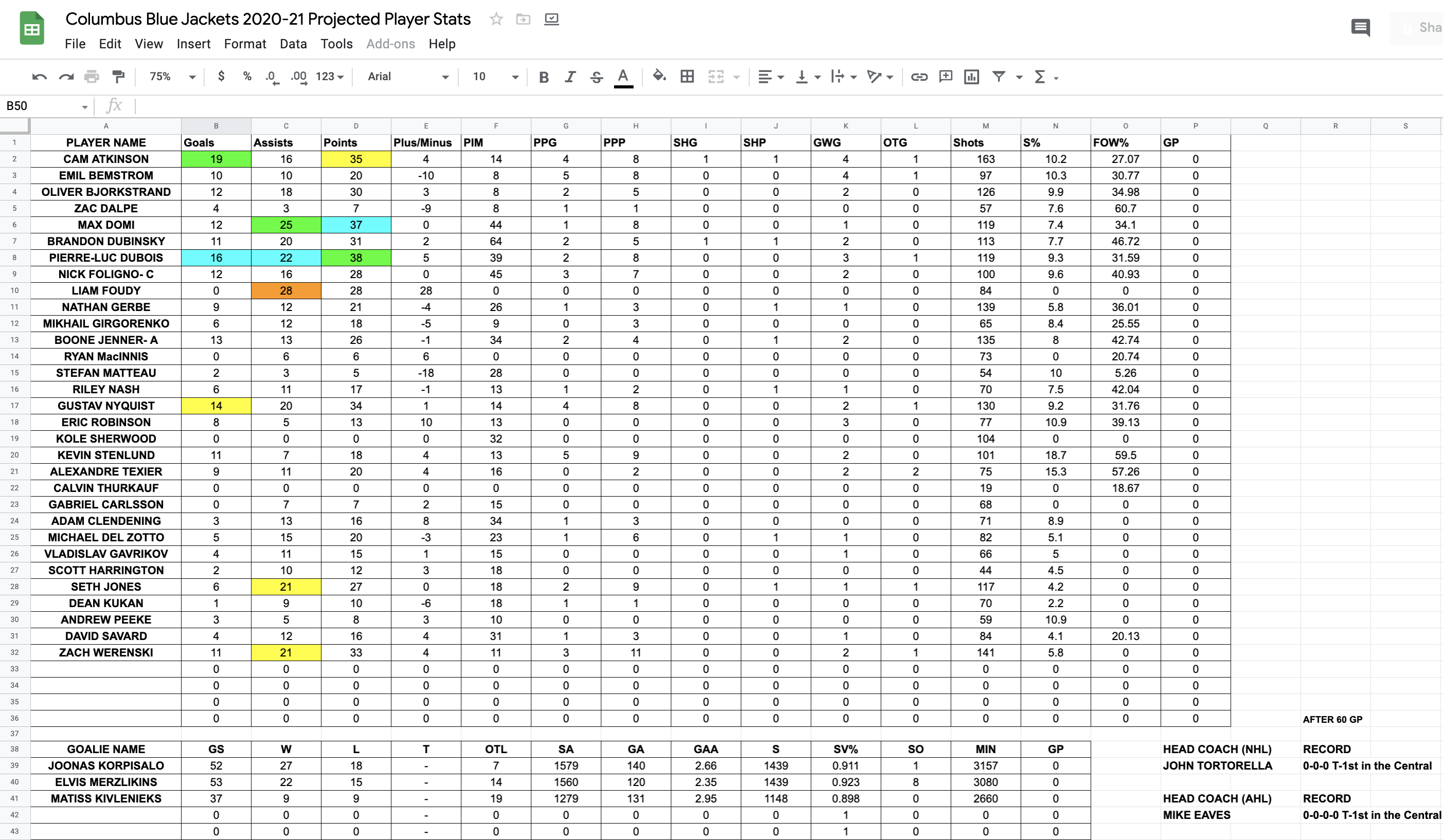
    Prior to being traded to the Winnipeg Jets for Patrik Laine and Jack Roslovic, Dubois was forecasted to lead Columbus in scoring with 16-22–38 totals this season.

    New acquisition, Max Domi, was forecasted as a close second to Dubois with 37 points– leading the team in assists in the process with 25 (among NHL regulars last season, since Foudy technically was forecasted to lead in assists among Blue Jackets with 28).

    Of course, Dubois was traded and Laine and Roslovic are off to hot starts with Columbus– scoring goals in bunches when they find the scoresheet, it seems. We’ll get to that in a minute.

    Cam Atkinson was forecasted to score 19 goals prior to the start of the 2020-21 season, which leads Dubois’ 16 forecasted goals and Gustav Nyquist’s 14 forecasted goals on the roster.

    Dubois, of course, was traded and Nyquist is out due to injury for most of this season, so… that checks out.

    On defense, Zach Werenski and Seth Jones were expected to continue to lead with the way with 33 and 27 points, respectively, from the blue line.

    Both defenders are expected to amass 21 assists this season– good enough for the third most forecasted among Blue Jackets skaters entering this season.

    In the crease, John Tortorella will have to find the right balance between Joonas Korpisalo and Elvis Merzlikins.

    There’s potential for a really solid goaltending duo in Columbus if Korpisalo is the starter and can best his 2.66 forecasted goals against average, as well as his forecasted .911 save percentage, while Merzlikins manages to find a way to reach his 2.35 forecasted GAA and .923 forecasted SV%.

    Of course, after 20 team games played, Merzlikins is currently out with an upper body injury, so time will tell if he can return to form.

    Columbus Blue Jackets Forecast Through 20 Games (36 Games Remaining)

    Through 20 games of the 2020-21 season, the Blue Jackets are three points outside of the last playoff spot in the Discover NHL Central Division, trailing the Chicago Blackhawks for this season’s 4th place cutoff line.

    The acquisition of Laine and Roslovic have been quite a welcome sight for Columbus fans, though consistency from the rest of the lineup remains to be an issue.

    Laine, however, is currently forecasted to lead the team in goals (26) and points (46), while Roslovic is on track for 10-17–27 totals, which is about what he had in 71 games with the Jets last season (29 points).

    Using the current forecasted totals, Roslovic is on track for about .551 points per game this season. He had .408 points per game with Winnipeg in 2019-20.

    Atkinson remains in the top-three in scoring, trailing Laine in goals and points with 20 forecasted goals and 39 forecasted points, respectively, while Oliver Bjorkstrand is currently forecasted to amass 15-21–36 totals (the third most on the current roster).

    On the blue line, Jones leads the way among defenders in points (32), as well as all skaters in assists with 27 forecasted assists through 20 team games played in the 2020-21 season.

    Werenski is more in line with what you’d expect from a young defender of his caliber (8-16–24 forecasted totals) and has missed time due to injury, so that’s clearly a factor in his forecasted drop from before the season began to now.

    In the crease, Korpisalo is sure to get more starts than Merzlikins as the latter is currently injured.

    Korpisalo’s current forecast yields a goals against average between 2.59-2.63, while Merzlikins is on track for a 2.29-2.33 in however many games he ends up getting.

    Why the range in GAA?

    That’s new for this season.

    It’s just to show a range between what the forecasted total is according to the model and what the adjusted forecast shows (calculated based on the forecasted goals allowed/forecasted minutes multiplied by 60, as one would traditionally do with goals allowed/minutes played multiplied by 60 to determine GAA).

    I’m no statistician and I felt like there might be a way to try to get a better read on how things are going for goaltenders (with or without enough necessary data to yield a “realistic” result).

    Don’t make any bets using only this forecast. If you’re a professional, you probably already know that.

    Anyway, Korpisalo has a forecasted range between .912 and .913 in save percentage through 20 team games played and Merzlikins is on track for between a .923 and a .924 in SV%.

    Again, a similar principle applies here.

    One end of the range is the straight up forecast, while the other is influenced by forecasted saves/forecasted shots against.

    Well, that does it for this forecast. Tune in after 40 team games played to see how things might go down the stretch (the final 16 games this season).

  • Boston Bruins 2020-21 Forecast

    Boston Bruins 2020-21 Forecast

    Hello, friend.

    Last season, I didn’t get around to posting my forecasts for the Boston Bruins, Carolina Hurricanes, Columbus Blue Jackets and Vegas Golden Knights’ rosters.

    I kept track of everything before the 2019-20 season began and after each quarter mark (roughly 20 games) as I normally do, but I just didn’t quite have the time and/or motivation to do a write up here on the blog for each one– let alone any of them.

    This season, I’m already behind in presenting my findings entering 2020-21, but I’ve prepared all four teams’ player forecasts as usual.

    To kick things off, we’ll take a look at how the 2020-21 season could’ve panned out if all Bruins players were healthy entering the 56-game season, but by the end of the month, Boston will already be 20 games into the season (provided nothing else is postponed) so it’ll be time for an updated forecast.

    For the rest of the teams– including the addition of the Colorado Avalanche for a total of five teams being tracked this season– we’ll just take a gander at how things looked coming into 2020-21 and where each player is tracking after their respective 20-game mark.

    In other words, Boston gets two posts (this one and another one in March) while Carolina, Colorado, Columbus and Vegas will each get a joint “forecast before the season began and forecast through 20 team games played” post, probably.

    If you’re a fan of those teams and my… …expertise(?), I’m sorry. Please be patient. You’ve already been waiting since the last forecast I published in the 2018-19 season.

    If you’re a fan of the B’s, well good news, let’s get into the forecast details.

    As always, keep in mind that my degree is in communication and my minor was in sport management. I got a “C” in my Intro to Stats class in my first semester of college way back in *checks notes* the fall of 2013.

    It was a night class and it was terrible, but I digress.

    First year players are impossible to predict until they’ve had at least one National Hockey League game under their belt.

    Young players that have had minimal NHL experience may also reflect “inflated” results.

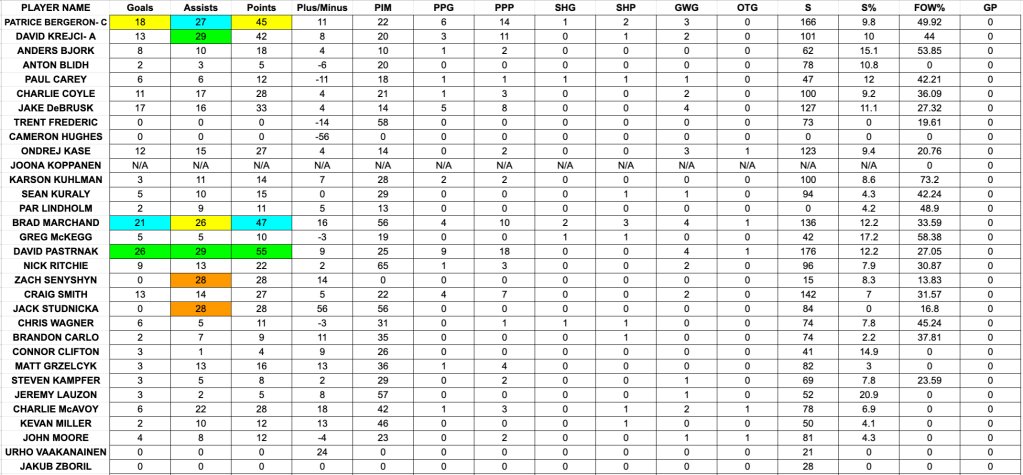
    No, Zach Senyshyn probably isn’t going to have 28 assists this season, but since he has two assists in six games over the last two seasons (his entire NHL career), the forecasting function in Microsoft Excel does math stuff based on his entire career as it would relate to if he played in all 56 games for Boston this season.

    This will fix itself as the season progresses.

    The same goes for Jack Studnicka’s forecasted 28 assists. Entering 2020-21, Studnicka has only played in two NHL games since just last season.

    He’s already had a goal in six games this season and in the next forecast (after 20 team games played), he’ll likely be forecasted to have 1-8–9 totals by season’s end (assuming he plays in the remaining 36 games).

    Forecast is different from pace.

    Injuries, being a healthy scratch or on the taxi squad, other American Hockey League related or waiver related transactions, sickness, COVID protocol and general superstitions (getting enough sleep the night before a game, taping your stick a certain way every time, putting on the right skate before the left skate or whatever) may disrupt a player’s season.

    These variables– tangible or not– are part of the game and cannot be accounted for in your everyday “straight up” forecast.

    In an utopian timeline, this forecast pretends nothing bad could ever happen and every player has a chance to live up to their expectations. Of course, some will pan out, some will exceed expectations and some will miss the mark.

    It’s merely a suggested outcome for a sport that’s highly unpredictable because of its collectivistic nature and sheer puck luck.


    Boston Bruins Forecast Through 0 Games (56 Games Remaining)

    Had the 2019-20 season gone according to schedule, David Pastrnak might not have missed any time to start the 2020-21 season.

    Nevertheless, we’ll pretend that an alternate timeline stills exists for a moment and mention that if he had played in all 56 games this season, he was forecasted to lead the Bruins with 26-29–55 totals.

    Brad Marchand was forecasted as the next highest scorer with 21 goals and 47 points, while David Krejci looked to lead the B’s in assists (29).

    Of course, none of this is how it really happened, but Pastrnak is still off to a hot start, Marchand is feeling “100-percent” and Krejci is only now just about to miss game action, having not traveled with the team to Lake Tahoe for their outdoor matchup with the Philadelphia Flyers on Sunday night.

    Senyshyn and Studnicka’s assist totals have been highlighted in the chart above in reference to what’s already been stated in the introduction to this post.

    Newcomer, Craig Smith, was forecasted to hit the twine 13 times and accrue 14 assists for 27 points this season, while Ondrej Kase was expected to notch 27 points in a 56-game season prior to injury.

    On defense, the loss of Zdeno Chara and Torey Krug is expected to be felt on the scoresheet, though we’re likely to see Charlie McAvoy’s stock rise in the next forecast after 20 team games played.

    Speaking of McAvoy, he was expected to lead the team in points from the blue line entering the 2020-21 season with 6-22–28 totals.

    In goal, Boston’s poised for another strong run from their goaltending tandem of Tuukka Rask and Jaroslav Halak.

    Though Rask is likely to get more starts than Halak, the two are prime for producing similar numbers this season in differing workloads.

    Rask is set for another season with a goals against average in the low two’s, between 2.28 and 2.34, while Halak is right on track for being one of– if not– the best “backups” in the league with a forecasted GAA between 2.48 and 2.72.

    Stay tuned for the next forecast in about four games– however soon that will be, provided nothing else is postponed and the Bruins can avoid piling up names on the league’s COVID Protocol list.

  • DTFR Podcast #217- Hurry Up, We’re Streaming

    DTFR Podcast #217- Hurry Up, We’re Streaming

    “Tracking pucks” are out (at least for now), Pierre-Luc Dubois and Patrik Laine were traded for one another, Jim Rutherford resigned as General Manager of the Pittsburgh Penguins and the “NDubble” is underway in Lake Placid.

    Subscribe to the podcast on Apple PodcastsStitcher and/or on Spotify.

  • DTFR Podcast #214- 2020-21 Season Preview: West Division

    DTFR Podcast #214- 2020-21 Season Preview: West Division

    Zdeno Chara signed with the Washington Capitals, the AHL announced plans for the 2020-21 season, the NHL divisions are sponsored for 2020-21, what’s going on with the New York Islanders, Pierre-Luc Dubois wants out (maybe) and we preview the West Division for the 2020-21 season.

    Subscribe to the podcast on Apple PodcastsStitcher and/or on Spotify.

  • DTFR Podcast #213- 2020-21 Season Preview: Central Division

    DTFR Podcast #213- 2020-21 Season Preview: Central Division

    The Ottawa Senators did the Tampa Bay Lightning a huge favor. About a $17 million favor, when all is said and done. Meanwhile, a bunch of contracts were signed, we finally know an answer to the Mike Hoffman question, Craig Anderson signed a PTO and might replace Henrik Lundqvist as the Washington Capitals’ backup goaltender and we preview the Central Division for the 2020-21 season.

    Subscribe to the podcast on Apple PodcastsStitcher and/or on Spotify.

  • Chara, Hoffman and now this?

    The Boston Bruins’ long-time captain since the 2006-07 season, 43-year-old Zdeno Chara remains unsigned as the end of the calendar year, 2020, draws near.

    Chara’s agent, Matt Keator, has been reported as noting that the defender has had contact from more than 20 teams this offseason, but is focused on re-signing with the Bruins if there’s a deal to be had.

    Of course, he could also just flat-out retire.

    It’s not that Boston couldn’t use the services of their longtime cornerstone on the blue line, but the Bruins are shaking things up this offseason on defense– partially because of necessity and partially because that’s just how time works.

    Torey Krug left for the St. Louis Blues in free agency and guys like Jakub Zboril, Jeremy Lauzon, Connor Clifton and Urho Vaakanainen are all vying for potentially the same couple of spots.

    Kevan Miller was brought back on a one-year, $1.250 million deal and John Moore is still on the books through the 2022-23 season at a $2.750 million cap hit.

    With a little under $3.000 million in available cap room, the B’s could be looking to sign Chara to a short-term league minimum contract– one-year, $700,000– and present themselves with at least $2.300 million to offer someone like Mike Hoffman or lure back Carl Soderberg into the mix for added scoring touch or depth, respectively.

    If they can’t land Hoffman, then Soderberg is likely the best consolation prize as the offseason drags on and two-week quarantine periods might affect how call-ups from the Providence Bruins (AHL) work.

    That’s the latest on how AHL roster transactions might be handled this season, by the way. It all depends on what your state, province or region (if short-term bubbles get involved) has to say about moving players within your own organization.

    Soderberg might not be better than playing Jack Studnicka every night, but in a pinch he’d be better than nothing.

    After all, he did have 35 points in 70 games with the Arizona Coyotes last season and that’s nothing to sneeze at for a bottom-six forward.

    As for Chara, it might be a matter of swallowing a little pride.

    He certainly is deserving of almost whatever he wants for the career he’s had and role he’s played in Boston’s leadership for almost 15 years.

    But if he’s wanting $1.000 million or more for what’s likely his last season in the league, then the Bruins would be smart to bow out unless they’re able to trade someone like Moore and find a durable top-four defender while convincing Chara to minimize his minutes as a bottom-six defender.

    Yet that’d mean they wouldn’t be able to find a guy to play on David Krejci’s wing. You know, kind of what they’ve needed since 2015.

    As for Hoffman, the one-time 30-goal scorer has reached the 50-point plateau in the last five seasons and somehow remains on the free agent market.

    Whereas the Columbus Blue Jackets have about $9.200 million to spend, how much is Hoffman willing to pull a move similar to Taylor Hall’s one-year deal with the Buffalo Sabres and try to match Hall’s $8.000 million cap hit this season?

    Columbus could be a great landing spot for the 31-year-old winger, but would the Blue Jackets be spurned by yet another player in free agency next offseason? Especially if John Tortorella is what could be holding players up from staying long-term?

    To play with the Blue Jackets you have to be a 200-foot player in accordance with Tortorella’s style. That’s likely to keep Hoffman from possibly capitalizing on short-term monetary gain with limited options elsewhere unless he can do more than just score.

    He might be the one-dimensional sniper Columbus needs, but not if General Manager, Jarmo Kekäläinen, and Tortorella can’t see eye-to-eye on the team’s plan.

    For the Bruins to sign Hoffman and bring his 29-30–59 totals in 69 games with the Florida Panthers last season to the Hub of the Universe, Boston would have to shed some salary in a swap for either a defender as they’re reportedly looking for or some draft picks.

    That’s where Anders Bjork could be a suitable asset to send to a team in return for, like, a third round pick or something.

    Nevertheless, Boston’s not the “Cup contenders” that they were going into last season.

    They might figure out a way to win the East Division regular season standings or they could finish fourth in the division and barely make their way into the postseason.

    Regardless, the Bruins need to land a top-six forward if Craig Smith is to settle in and get comfy on the third line and patch the defense for a short term fix if management thinks otherwise about the team’s “Cup contender” status.

    It’s this year or bust– and in a 56-game regular season every early season game matters that much more.

    Getting off on the right foot without Brad Marchand (possibly) and David Pastrnak on opening night (and missing Pastrnak for at least a month) is vital.

    It’s crunch time.

  • Assessing the Vegas market for Krejci’s wing

    While the season’s upon us, there are still a few decisions to made regarding current unsigned free agents and more. Several teams are over the National Hockey League’s $81.5 million salary cap and will need to be compliant before the season begins on Jan. 13th.

    One of those teams is the Vegas Golden Knights, who currently sit over the cap at $82,474,104.

    Max Pacioretty’s name has come up in the latest round of trade rumors, but he’ll be the first to admit that’s nothing new, since he was subject to many rumors in his time with the Montreal Canadiens for about a decade before the Habs shipped him to Vegas on Sept. 10, 2018, for Tomas Tatar, Nick Suzuki and a 2019 2nd round pick (that originally belonged to the Columbus Blue Jackets and was later flipped to the Los Angeles Kings).

    Pacioretty carries a $7.000 million cap hit through the 2022-23 season and has a modified no-trade clause.

    Considering his longstanding disdain for the Boston Bruins as an opponent, as well as the fact that Boston doesn’t really have the workable cap space (about $3.000 million) to take on Pacioretty without giving up part of the core, the B’s aren’t likely to take a flyer unless they’re bold enough to go all-in on “win now” mode.

    There’s actually something most of the Golden Knights core has in common, however– they all have modified no-trade clauses except for defender, Shea Theodore, who just had a bit of a breakout year (13-33–46 totals in 71 games last season).

    It’s not likely that Vegas will shift from scooping up William Karlsson, making him into a 40-goal scorer in their inaugural season, then sending him packing in only their fourth season of existence, but they could try to move someone that’s a little more cap friendly by about $900,000 in annual cap hit.

    Jonathan Marchessault has come up in the rumor mill and would be a quality second line asset for the Bruins to inquire about.

    He reached the 30-goal plateau in 75 games with the Florida Panthers in 2016-17– his first full season– and has put up three consecutive seasons of 20 goals or more since with the Golden Knights, recording career-highs in assists (48) and points (75) in 77 games with Vegas in 2017-18.

    At 29-years-old, Marchessault is in the midst of his prime, can play left or right wing and carries a $5.000 million cap hit through the 2023-24 season.

    Though David Krejci is in the final year of his current contract, the Bruins wouldn’t just be looking to land someone that’s compatible with No. 46 on their roster, but rather someone that’s reliable for if and when Krejci moves on and someone like Charlie Coyle or Jack Studnicka slots into the second line center role.

    There’s one more familiar face Boston could consider asking Vegas about, though he might have to fight Greg McKegg to get his old number back.

    It’s Reilly Smith.

    At 29, Smith is also in the midst of his prime and carries a cap hit worth $5.000 million per season through 2021-22, with a modified no-trade clause to boot.

    Since departing the Bruins in a trade with the Panthers on July 1, 2015, Smith has become a consistent playoff performer, recording eight points in six games with Florida in 2016, 22 points with Vegas in 20 games en route to losing in five games to the Washington Capitals in the 2018 Stanley Cup Final, six points in Vegas’ seven-game run in 2019 and 14 points in 20 games with the Golden Knights in the 2020 postseason.

    Smith’s numbers in the regular season have also been pretty good– reaching at least 40 points in six out of his seven full seasons, including five seasons of 50 or more points and setting a career-high in goals last season with 27 in 71 games.

    Since their inaugural season in 2017-18, Smith has worn an “A” on his Golden Knights jersey.

    Vegas also presented Pacioretty with an “A” last season, but has never given Marchessault the designation as an alternate captain.

    Not that that’s really too much to look into or anything, but all signs seem to indicate it’d be harder to pry one someone from the Golden Knights’ leadership group, let alone their core rather than Marchessault and his versatile style.

    Of course, Vegas would also have to be convinced to take something on from Boston and the Bruins wouldn’t exactly be giving Golden Knights GM Kelly McCrimmon and their head coach, Peter DeBoer, much to work with other than cap space.

    Anders Bjork signed a three-year extension on July 29th with the Bruins that carries a cap hit of $1.600 million through 2022-23.

    He’ll be a pending-restricted free agent by the end of his current deal, which might be incentive for Vegas to latch onto him in any potential trade, but Bjork has struggled to stay healthy and hasn’t exactly dazzled pro scouts with 9-10–19 totals in 58 games last season for the B’s.

    Again, though, if Vegas is trying to save money, they might be convinced to take on a reclamation project with a prospect or two and/or a draft pick invovled.

    At 24-years-old, Bjork might just need a change of scenery if he can’t tap into his scoring ways with Boston.

    Of course, most Bruins fans would like to see Boston’s General Manager, Don Sweeney, try to sell high on Nick Ritchie while he still can– to put it lightly.

    Ritchie had 21 points last season in 48 games split between the Anaheim Ducks and Bruins, is 25-years-old and has a $1,498,925 cap hit, which is somehow better than Bjork’s production and value.

    He only has one-year left on his current contract, so he’ll be a pending-restricted free agent at season’s end.

    But then, of course, there’s a few problems for Boston with trying to move Bjork or Ritchie.

    Players are expendable components of the business side of hockey, but they’re human and humans like a little loyalty in their relationships– business or otherwise.

    To be signed to an extension over the summer, then dealt to another team before the new season begins or to be acquired at last season’s deadline and moved so early on in your tenure in a new market might put a damper on Boston’s reputation as a free agent destination.

    It could also backfire among players with modified no-trade clauses or that are willing to nullify their NTC or no-movement clause, but might reconsider if the Bruins come up in the conversation if that player’s looking for their next stop to have a little more longevity to it.

    Oh and there’s the general fact that a team isn’t likely to just hand you a good player for bits and pieces, so Boston could still be working from behind on any potential trades with Vegas.