Tag: Central Division

  • Panthers complete, 6-5, OT comeback in Game 3 win on the road

    Panthers complete, 6-5, OT comeback in Game 3 win on the road

    Ryan Lomberg emerged as an unlikely protagonist– scoring the game-winning goal early in overtime at Amalie Arena on Thursday– while Sergei Bobrovsky looked solid in relief of Chris Driedger as the Florida Panthers staged a third period comeback capped by a, 6-5, overtime win over the Tampa Bay Lightning in Game 3 of their 2021 First Round series.

    Bobrovsky (1-1, 3.53 goals-against average, .898 save percentage in two games played) stopped all nine shots that he faced in relief (25:56 time on ice) en route to the victory for the Panthers.

    Meanwhile, Driedger (0-1, 4.29 goals-against average, .860 save percentage in two games played) stopped 17 out of 22 shots faced for no decision in 40:00 time on ice.

    Lightning goaltender, Andrei Vasilevskiy (2-1, 3.57 goals-against average, .908 save percentage in three games played), made 41 saves on 47 shots against in the loss.

    Keith Yandle was a healthy scratch for Florida and Sam Bennett returned from his one game suspension for a hit from behind on Blake Coleman in Game 1.

    Bennett (1) sent a one-timed redirection on the backhand past Vasilevskiy to give Florida an early, 1-0, lead at 4:31 of the first period.

    Jonathan Huberdeau (3) and Owen Tippett (2) tallied the assists as the Panthers jumped on the scoreboard first while on the road.

    Less than a few minutes later, Radko Gudas (1) stayed on the puck after his initial shot was blocked and wired the rubber biscuit past Vasilevskiy’s glove side to give the Panthers a two-goal lead.

    Gustav Forsling (1) and Huberdeau (4) had the assists on Gudas’ first career Stanley Cup Playoff goal and Florida led, 2-0, at 7:05 of the opening frame.

    There were no penalties in the first period, so after 20 minutes of action, the Panthers led, 2-0, on the scoreboard and, 12-10, in shots on goal entering the first intermission.

    Florida also held the advantage in blocked shots (4-3), while Tampa led in takeaways (4-0), giveaways (3-1), hits (20-15) and faceoff win percentage (58-42).

    Anthony Cirelli (1) buried a rebound from point blank to cut Florida’s lead in half, 2-1, and put the Lightning on the scoreboard as Victor Hedman (4) and Alex Killorn (2) tabbed the assists on Cirelli’s goal at 1:57 of the second period.

    Moments later, Ross Colton (1) won a battle in the attacking zone and sent a shot over Driedger’s glove with Yanni Gourde acting as a screen on the doorstep for his first career Stanley Cup Playoff goal.

    Coleman (1) had the only assist on Colton’s goal as the Bolts tied the game, 2-2, at 5:46 of the middle frame.

    Tampa took control of the game (at least for the time being) with their third unanswered goal in a span of 6:41 as Steven Stamkos (2) sent a redirection from the low slot past Driedger after Ryan McDonagh snagged a turnover and entered the zone, setting up Stamkos with the primary assist on the goal– his third helper of the postseason.

    Stamkos’ goal at 8:38 put the Bolts ahead, 3-2.

    Tampa defender, Jan Rutta, presented Florida with the night’s first power play after interfering with Forsling away from the puck, but the Panthers couldn’t muster anything on the resulting skater advantage at 10:38.

    Coleman and Bennett tangled up with one another and each received roughing minors at 11:17, but the number of skaters on the ice was unaffected.

    Late in the Panthers’ power play, Alex Wennberg (1) sent a shot off of Hedman that squeaked past Vasilevskiy’s glove side to even things up, 3-3, at 12:34.

    MacKenzie Weegar (1) and Tippett (3) tallied the assists on Wennberg’s goal, but the action didn’t remain tied for long.

    Mason Marchment hooked Stamkos at 13:46 and presented the Lightning with their first power play of the night.

    The Bolts capitalized on the resulting skater advantage as Brayden Point (3) let go of a one-timer off the iron and in from the bumper to make it.

    Nikita Kucherov (3) and Hedman (5) had the assists on Point’s power-play goal and Tampa pulled ahead, 4-3, at 14:17 of the second period.

    Almost two-and-a-half minutes later, Gudas hooked Ondrej Palat and presented the Lightning with another power play at 16:48.

    Once again, late in the ensuing skater advantage the Bolts pocketed a power-play goal as Killorn (1) caught a pass from Hedman and slid the rubber biscuit underneath Driedger’s paddle to make it, 5-3, Tampa at 18:17.

    After two periods of action in Tampa, the Lightning led, 5-3, on the scoreboard, despite the Panthers outshooting the Bolts, 29-22, including a, 17-12, advantage in the second period alone.

    The Lightning held the lead in blocked shots (9-8), takeaways (5-3) and faceoff win% (58-42), while Florida led in hits (36-28).

    Both teams had four giveaways each, while the Panthers were 1/1 and the Bolts were 2/2 on the power play entering the second intermission.

    Panthers head coach, Joel Quenneville, replaced Driedger with Bobrovsky for the third period as Driedger allowed five goals on 22 shots.

    Needless to say, while Bobrovsky stopped all nine shots that he would face in the remainder of the night’s action– Florida’s defense tightened up and suppressed the Lightning’s attack.

    Palat boarded Marchment 41 seconds into the third period and the Panthers went on the power play early in the final frame of regulation as a result.

    It didn’t take long for Huberdeau to get a shot towards the net that Patric Hornqvist (1) unintentionally redirected with his skate to bring Florida within one.

    Huberdeau (5) and Aleksander Barkov (3) had the assists on Hornqvist’s power-play goal as the Panthers trailed, 5-4, at 1:45 of the third period.

    Late in the period, Hedman turned the puck over to the point, whereby Hornqvist dished it to Wennberg, then Forsling (1) who threw it through Vailevskiy’s five-hole for his first career Stanley Cup Playoff goal– tying the game, 5-5, in the process.

    Wennberg (1) and Hornqvist (1) notched the assists on Forsling’s goal at 16:53 of the third period.

    Despite their surge in momentum, Florida had to kill off a minor infraction for cross checking when Anthony Duclair got tangled up with Killorn at 19:37.

    Tampa’s power play would carry over into the extra frame, but ultimately was powerless as the Panthers killed it off.

    Through 60 minutes of action at Amalie Arena on Thursday, the Panthers and Lightning were tied, 5-5, on the scoreboard, despite Florida leading in shots on goal, 43-28, including a, 14-6, advantage in the third period alone.

    The Panthers led a complete shutdown of Tampa’s potent offense in the final 20-minutes and then some.

    The Bolts still led in blocked shots (14-8), takeaways (7-5) and faceoff win% (52-48), while Florida held the advantage in hits (46-38).

    Both teams managed four giveaways each heading into overtime.

    As there were no penalties called in the extra period, Florida finished 2/2 and Tampa went 2/3 on the power play in Game 3.

    Early in the extra frame, Florida won a faceoff in their own zone and worked the puck from Gudas to Frank Vatrano, then hit up Lomberg as he broke through Tampa’s defense and emerged with a quick breakaway as he was running out of runway.

    Lomberg (1) shot the puck through Vasilevskiy– under the Tampa netminder’s glove– and into the back of the twine for his first career postseason goal and the game-winner in overtime.

    Vatrano (1) and Gudas (1) earned the assists on Lomberg’s game-winner at 5:56 of the overtime period as the Panthers won, 6-5.

    Florida cut Tampa’s series lead in half, 2-1, as a result as Lomberg– who scored two goals in 34 games with the Panthers in regular season– earned First Star honors for the night.

    The Panthers finished Thursday night leading in shots on goal, 47-31, including a, 4-3, advantage in the overtime period alone.

    Tampa finished the action leading in blocked shots (16-9), giveaways (5-4) and faceoff win% (52-48), while Florida wrapped things up with the lead in hits (46-40).

    The Lightning have a chance to take a commanding 3-1 series lead on home ice in Game 4 at Amalie Arena on Saturday.

    Puck drop is expected to be a little after 12:30 p.m. ET and viewers looking for national coverage in the United States can tune to CNBC, while those in Canada can catch the action on SN or TVAS2.

  • Aho and Nedeljkovic power Canes to, 3-0, shutout

    Aho and Nedeljkovic power Canes to, 3-0, shutout

    Sebastian Aho scored a pair of goals as Alex Nedeljkovic made 32 saves in a, 3-0, shutout win for the Carolina Hurricanes in Game 2 of their 2021 First Round series with the Nashville Predators at PNC Arena on Wednesday.

    Nedeljkovic (2-0, 1.01 goals-against average, .964 save percentage in two games played) became the second rookie goaltender in Hurricanes/Hartford Whalers franchise history to record a postseason shutout, joining Cam Ward in doing so.

    Ward notched a pair of shutouts in the 2006 Stanley Cup Playoffs en route to leading Carolina to the franchise’s first Stanley Cup championship.

    Meanwhile, Predators goaltender, Juuse Saros (0-2, 3.08 goals-against average, .910 save percentage in two games played) stopped 28 out of 30 shots faced in the loss.

    The Hurricanes were without Jaccob Slavin on the blue line, so Jake Gardiner was dressed for Carolina.

    Meanwhile, Predators head coach, John Hynes, had replaced Calle Jarnkrok (illness), Mathieu Olivier and Ben Harpur with Eeli Tolvanen, Brad Richardson and Matt Benning in the lineup on Wednesday.

    Early in the action, former Carolina forward, Erik Haula, got tangled up with Martin Necas and received a minor infraction for roughing– yielding the game’s first power play to the Hurricanes at 2:02 of the first period.

    The Canes were not successful on their first skater advantage of the game.

    Moments later, Nashville defender, Mattias Ekholm, tripped Warren Foegele and presented Carolina with another power play at 7:17 of the opening frame.

    The Hurricanes wouldn’t waste much time on the ensuing skater advantage before Aho (1) received a pass from Andrei Svechnikov through the high slot and one-timed the puck into the back of the twine.

    Svechnikov (1) and Dougie Hamilton (1) had the assists on Aho’s power-play goal and Carolina took a, 1-0, lead at 8:03.

    The Predators got their first skater advantage of the night at 8:47 when Vincent Trocheck roughed up Benning, but the Preds weren’t able to convert on the power play.

    Nor did Nashville have any success on the skater advantage moments later when Hamilton was penalized for interference at 13:04.

    No, the Preds also didn’t score on the power play at 15:59 when Aho roughed Haula and again the Predators were powerless on the advantage at 19:03 when Jordan Staal cut a rut to the sin bin for interference.

    Heading into the first intermission, the Hurricanes led, 1-0, on the scoreboard and were outshooting Nashville, 10-9.

    Carolina also led in blocked shots (4-2), takeaways (2-1), giveaways (5-3) and hits (20-18), while the Predators dominated the faceoff dot in faceoff win percentage (57-44).

    Nashville was 0/4 and the Canes were 0/2 on the power play entering the middle frame.

    Ryan Johansen got tangled up with Svechnikov as the two forwards exchanged pleasantries and received roughing minors at 4:16 of the second period.

    After two minutes of 4-on-4 action, the two teams resumed full strength with cooler heads (for a few minutes anyway).

    Brett Pesce was penalized for holding at 8:34, but Nashville continued to struggle on the power play as Nedeljkovic stood tall in the crease for Carolina.

    Viktor Arvidsson took a trip to the box at 9:38 for interference, but the Hurricanes couldn’t muster anything on the resulting power play.

    Shortly thereafter, Benning and Jordan Martinook got into a heated exchange, yielding roughing minors at 12:03 of the second period and plunging the game into another pair of minutes at 4-on-4.

    Late in the period, Nino Niederreiter hooked Richardson, but the Preds couldn’t get anything going on the ensuing power play at 16:37.

    Through 40 minutes of action, the Hurricanes held onto their, 1-0, lead on the scoreboard despite Nashville pulling ahead in shots on goal, 24-20, including a, 15-10, advantage in the second period alone.

    Carolina held the lead in blocked shots (10-6), giveaways (11-10) and hits (36-32), while the Predators had the advantage in takeaways (5-3) and faceoff win% (56-44).

    Nashville was 0/6 on the power play, while the Canes were 1/3 on the skater advantage heading into the final frame.

    Foegele sent the puck over the glass and out of play, yielding an automatic delay of game infraction almost midway through the third period at 9:24.

    The Preds couldn’t capitalize on the resulting power play.

    Late in the period, Hynes pulled Saros for an extra attacker, but Carolina worked to clear the puck out of their own zone.

    Pesce dumped the puck deep– missing the empty net– but didn’t ice the puck as Aho (2) charged into the attacking zone, pounced on the loose puck and buried the rubber biscuit into the net to give Carolina a two-goal lead.

    Pesce (3) had the only assist on Aho’s second goal of the night and the Hurricanes led, 2-0, at 19:07 of the third period.

    Less than a minute later, Foegele (1) worked the puck behind the goal line and wrapped around the net, sending an errant puck off of Ryan Ellis’ skate and through Saros for a three-goal lead.

    Jesper Fast (1) had the only assist on Foegele’s insurance goal as the Canes made it, 3-0, at 19:32.

    At the final horn, Carolina had secured a 2-0 series lead with a, 3-0, win as Nedeljkovic recorded the shutout– his first career postseason shutout.

    The Predators finished the night leading in shots on goal, 32-31, despite Carolina leading in shots on goal in the third period alone, 11-8.

    Nashville also wrapped up Wednesday night’s action with the lead in giveaways (19-16) and faceoff win% (53-48), while the Canes finished the night leading in blocked shots (17-10) and hits (52-39).

    The Preds went 0/7 and the Canes went 1/3 on the power play in Game 2.

    The Hurricanes lead the series 2-0 as the venue shifts to Bridgestone Arena for Game 3 in Nashville on Friday. Puck drop is expected a little after 7 p.m. ET and viewers in the United States can tune to national coverage on USA Network, while those in Canada can watch the action on FXX-Canada or TVAS2.

  • Lightning storm to 2-0 series lead in Game 2 victory

    Lightning storm to 2-0 series lead in Game 2 victory

    For just the 4th time in the last 15 years, the defending Stanley Cup champion has jumped out to a 2-0 series lead as the Tampa Bay Lightning beat the Florida Panthers, 3-1, on road ice in Game 2 on Tuesday.

    Tampa’s victory at BB&T Center dismantled Florida’s home ice advantage and cemented the Bolts’ legacy as a dominant team in the postseason, while Andrei Vasilevskiy (2-0, 2.52 goals-against average, .931 save percentage in two games played) made 32 saves on 33 shots against for a .970 save percentage in the win.

    Panthers goaltender, Chris Driedger (0-1, 2.07 goals-against average, .929 save percentage in one game played), made his Stanley Cup Playoffs debut and turned aside 26 out of 28 shots faced in the loss.

    Florida’s head coach, Joel Quenneville, opted to start Driedger over Sergei Bobrovsky after Bobrovsky’s poor showing in Game 1 and, though Game 2 was no better in the end result, Driedger had a solid night with the exception of the first period.

    Steven Stamkos (1) kicked off the game’s scoring on a shot that was intended to be the completion of a give-and-go attempt, but ended up deflecting off of former Lightning defender– turned current Panthers defender– Anton Stralman, and into the twine.

    Alex Killorn (1) and David Savard (1) had the assists on Stamkos’ accidental goal as the Bolts pulled ahead, 1-0, at 4:52 of the first period.

    Late in the opening frame, the Lightning extended their lead to two-goals after Brayden Point rang the crossbar to the right of the goal frame before Ondrej Palat (1) buried the rebound over Driedger’s blocker side far to the left inside the goalframe.

    Point (1) and Nikita Kucherov (2) tallied the assists on Palat’s goal as Tampa took a, 2-0, lead at 14:57.

    Heading into the first intermission, the Bolts led, 2-0, on the scoreboard and, 15-9, in shots on goal.

    Tampa also held the advantage in takeaways (5-1) and hits (18-14), while Florida led in giveaways (9-6) and faceoff win percentage (61-39). Both teams had three blocked shots each and had yet to see any action on the power play entering the middle frame.

    MacKenzie Weegar send the puck over the glass and received an automatic delay of game infraction 31 seconds into the second period, presenting the Lightning with the night’s first power play.

    Tampa’s power play was no match for Florida’s penalty kill, however.

    The Panthers got their first chance on the skater advantage at 11:33 of the second period when Point was sent to the box for holding.

    Though Florida did not capitalize on the resulting 5-on-4 action, the Panthers did catch the Lightning in the vulnerable minute after special teams action as Mason Marchment (1) buried a shot pass redirection behind Vasilevskiy to cut Tampa’s lead in half, 2-1.

    Carter Verhaeghe (1) and Aleksander Barkov (1) had the assists on Marchment’s goal at 14:21.

    Finally, after a scrum at the horn signaling the start of the second intermission, Weegar was assessed a roughing minor for hitting Blake Coleman from behind after the whistle at 20:00 of the second period.

    Through 40 minutes of action, the Bolts led the Panthers, 2-1, on the scoreboard, despite both teams amassing 20 shots on goal each. Florida, however, had an, 11-4, advantage in shots on goal in the second period alone.

    Florida also held the lead in blocked shots (11-10) and giveaways (13-12), while Tampa led in takeaways (8-7) and hits (28-26). Both teams were 50-50 in faceoff win% and 0/1 on the power play heading into the final frame.

    Kucherov tripped Anthony Duclair at 1:08 of the third period, which resulted in 52 seconds of 4-on-4 action before an abbreviated power play for the Panthers ultimately came up empty handed.

    Midway through the third, Pat Maroon tripped Stralman and presented Florida with their last power play at 9:06.

    The Panthers couldn’t muster anything on the ensuing skater advantage.

    With 2:17 remaining in the action, Quenneville pulled Driedger for an extra attacker, but it was to no avail– especially after Yanni Gourde (1) picked off a pass and fired the rubber biscuit into the empty net from the neutral zone at 18:35 of the third period.

    Gourde’s goal was unassisted and gave Tampa some insurance with a, 3-1, lead.

    Seconds later, Marchment and Erik Cernak got into a heated exchange, delivering some cross checks to one another and rough play, yielding roughing minors for each, while Ryan Lomberg picked up a roughing minor of his own– giving Tampa one last power play for the night.

    Lomberg also received a ten-minute misconduct as all of the penalties were announced at 18:53 of the third period.

    At the final horn, the Lightning had won Game 2 by a score of, 3-1, and taken a 2-0 series lead in their 2021 First Round matchup with the Panthers.

    Florida finished the night leading in shots on goal, 33-29, including a, 12-9, advantage in the third period alone.

    The Panthers also wrapped up Tuesday night’s action leading in giveaways (21-19) and faceoff win% (51-49), while Tampa exited the building with the lead in blocked shots (15-13) and hits (42-37).

    Florida finished the night 0/3 on the power play, while the Bolts went 0/2 on the skater advantage.

    The Lightning take a 2-0 series lead back to Amalie Arena on Thursday for Game 3 on home ice. Puck drop is scheduled for a little after 6:30 p.m. ET and fans in the United States can tune to USA Network for national coverage, while those in Canada can catch the action on FX Canada.

  • Numbers Game: 2020-21 Season Standings Projections

    As the calendar flipped from 2020 to 2021 at midnight while New Year’s Eve turned into New Year’s Day, the ongoing global pandemic continued without a second thought despite the world’s optimism for the New Year and, thus, shifted the 2020-21 National Hockey League season into an abbreviated 56-game schedule from Jan. 13th through the first week of May.

    Usually, it’d be fine to present divisional projections in accordance with a normal 82-game expected points total formula, but the aforementioned 56-game season schedule would render those numbers inaccurate from the beginning.

    82 games is 26 games too many this season.

    It would be fine to run a “what if the 2020-21 season were a regular-length season?” piece, but it’s more fun to tackle a challenge when everything’s made up and the points don’t matter.

    Seriously, don’t look into this too much unless you’re an employee of a team looking to hire someone right now, in which case please ignore the “C” I had in Intro to Stats in college.

    Anyway, I’ve taken the liberties of calculating what an 82-game 2020-21 season would’ve looked like, then based the projections for what the 56-game 2020-21 season could look like using this little thing called “pace”.

    That’s right. Points pace.

    You know, like “if a team earned two points with a win in their first game in an 82-game season, they’d be on a 164-point pace for the season”.

    In actuality, the team could go 3-6-1 over their first ten games, yielding seven points on the season through that span and being on a 57.4-point pace over the course of an 82-game season.

    If this is too much math you can just tell me to shut up and get to the graphs.

    For the sake of keeping it simple, here’s a look at how things might go in each division for the upcoming 2020-21 season.

    Starting with the NHL’s all-Canadian North Division for the 2020-21 regular season, there’s a few things that jump out immediately as a result of the current projections.

    Did realignment have any impact on what the projections look like?

    No. For the record, this season’s temporary realignment had no impact on any of the divisions other than how they’re organized.

    Instead of seeing the Montreal Canadiens, Toronto Maple Leafs and Ottawa Senators in the Atlantic Division, the Winnipeg Jets in the Central Division and the Calgary Flames, Edmonton Oilers and Vancouver Canucks in the Pacific Division– they’re all just in the same division.

    The expected points total is calculated by first adding marginal goals for and marginal goals against, then multiplying that result by league points per goal.

    Divide the number of points expected based on the formula’s derived for what an 82-game season in 2020-21 would’ve looked like by 82 games, then multiply that result by 56 (the number of games in actuality for 2020-21) and you get… …the same exact results you would’ve had for each team if the divisions hadn’t been realigned.

    So Montreal would’ve still had an expected points total of 52 points regardless of being in the Atlantic Division or North Division.

    The schedule plays no impact on the expected points model.

    So every team is just going to earn about a point-a-game?

    Not necessarily.

    Either all the Canadian teams are playing at about the same level of intensity, which makes for great parity– especially in a division solely comprised of Canadian market clubs.

    Or they just would’ve been wherever they would’ve been within their own usual division, but when they’re thrown together it looks… …worse?

    In a non-pandemic timeline, the Canadian clubs would be scattered all over the standings with the Oilers competing for the top spot in the Pacific Division with the Vegas Golden Knights, while the Senators would likely be bottom dwellers in the Atlantic.

    With the all-Canadian North Division, the best teams could really run away with things or all seven teams could eat each other alive in the division.

    What’s the good news then?

    At least one Canadian team will make it into the 2021 Stanley Cup Semifinal, since the first two rounds will be intra-divisional matchups.

    Under the current projection, Winnipeg would face Vancouver in the First Round, while Edmonton would take on Toronto in the First Round.

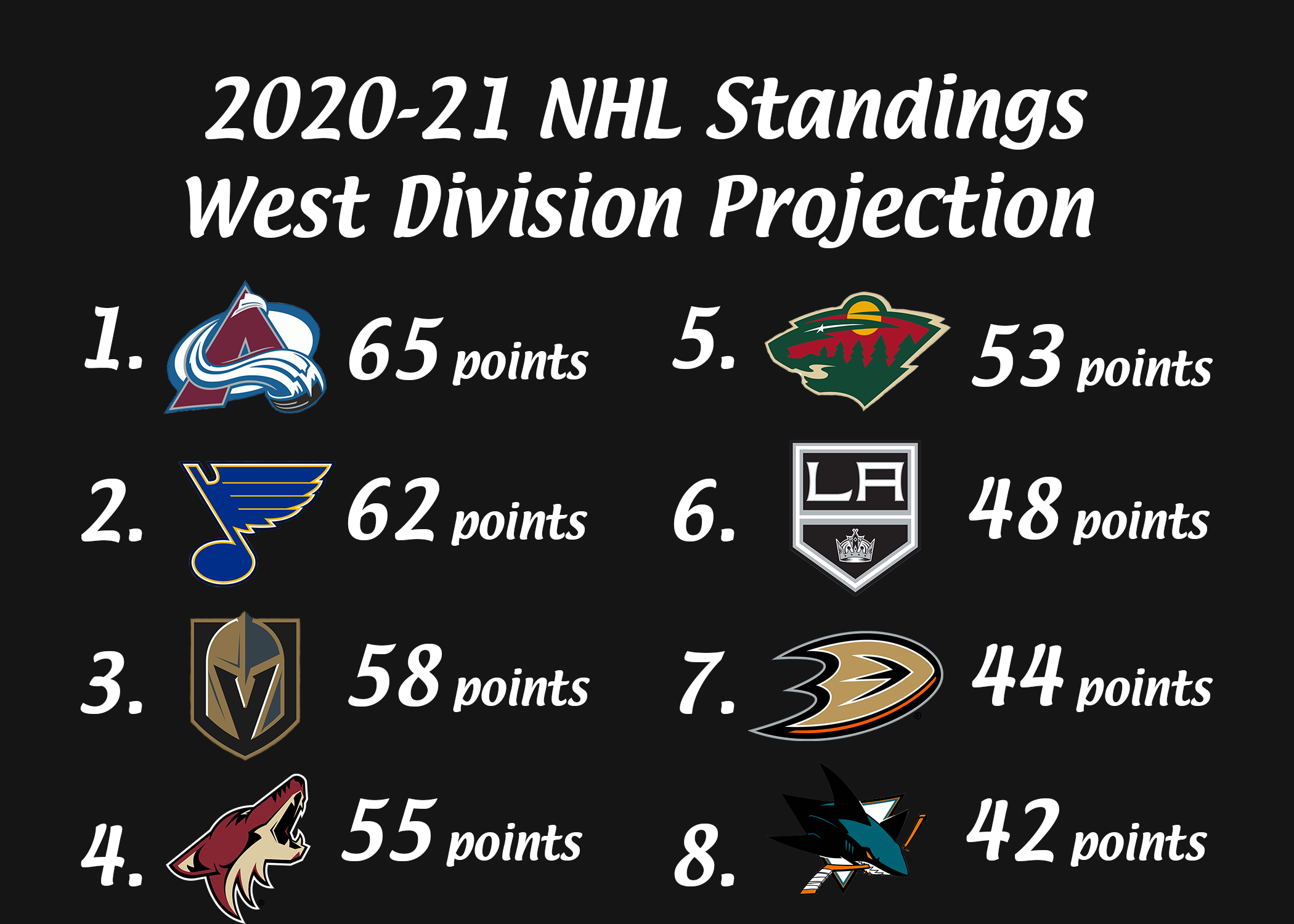
    In the West Division, the Colorado Avalanche are the team to beat. The Avs are hungry to avenge their Second Round exit against the Dallas Stars in the 2020 Stanley Cup Playoffs if they can stay healthy and bring the Cup back to Denver for the first time since 2001.

    Meanwhile, the St. Louis Blues might have some questions surrounding their goaltending, but the additions of Mike Hoffman and Torey Krug greatly outweigh the subtraction of Alex Pietrangelo– at least when it comes to regular season production.

    In terms of experience and leadership, the Vegas Golden Knights picked up Pietrangelo’s talents via free agency and should be in contention for home ice advantage if they’re able to overcome St. Louis’ projected standing.

    What about the meat of the order?

    Both the Minnesota Wild and Arizona Coyotes are in a lot better shape than the Californian hockey teams.

    The Wild have Kaapo Kähkönen coming down the pipeline in the crease and depending on how soon he can arrive might influence their final standing compared to Arizona.

    Whereas Minnesota must rely on aging veterans, Cam Talbot and Alex Stalock in net, the Coyotes have Darcy Kuemper and Antti Raanta– a serviceable tandem for Arizona’s needs.

    Mikko Koivu was sent out to find a new home as an influx of youth should make the Wild more competitive, but how much will Arizona’s playoff experience play into their drive for making at least another First Round appearance this season– despite losing Carl Söderberg in free agency to the Chicago Blackhawks and trading Derek Stepan to the Ottawa in the offseason.

    Time will tell.

    Is this the weakest division?

    The all-Canadian North Division has the advantage of playing each other and sorting things out themselves instead of spreading their Canadian talents (or lack thereof depending on the team) throughout the league, so yes, the West Division is likely the weakest.

    The Los Angeles Kings have some growing pains and salary cap hell to sort out. The Anaheim Ducks are a young team that’s finding their chemistry and building their experience, but are one or two years away from playoff contention.

    Finally, the San Jose Sharks have an ever-regressing duo of Martin Jones and Devan Dubnyk in the crease to go along with whatever’s left on their blue line that’s not named Brent Burns and (a supposedly 100% healthy) Erik Karlsson.

    At least the Sharks brought back Patrick Marleau (third time’s a charm) and other than that, they don’t have that bad of a forward group.

    In the 2012-13 lockout shortened 48-game season, 20 out of the league’s then 30 teams at the time finished with at least 49 points or more in the season.

    The 2012-13 Chicago Blackhawks finished 19 points away from a perfect 96-point season– amassing 77 points in 48 games with a 36-7-5 record.

    Chicago is going through a rebuild without Jonathan Toews for possibly an extended period of time and with Malcolm Subban and Collin Delia in the crease.

    The good news? They’ll likely end up with a solid lottery pick in the 2021 NHL Draft.

    The bad news? They’re not going to find themselves having a repeat of their 2013 Stanley Cup championship.

    Will any team from the Central Division be like those 2012-13 Blackhawks though?

    It’s funny that you ask, because the defending Stanley Cup champion Tampa Bay Lightning would have to win at least 75% of their games if they want to be anything like the 2012-13 Blackhawks.

    Whereas Chicago won 36 out of 48, Tampa would have to win 42 out of 56 games.

    It’s not that the Lightning can’t reach 84 points in the 2020-21 season– especially since the Blackhawks almost reached 80 in a shorter span, but rather how good will the rest of the Central Division be and how will the intra-divisional games only schedule impact, well, everything?

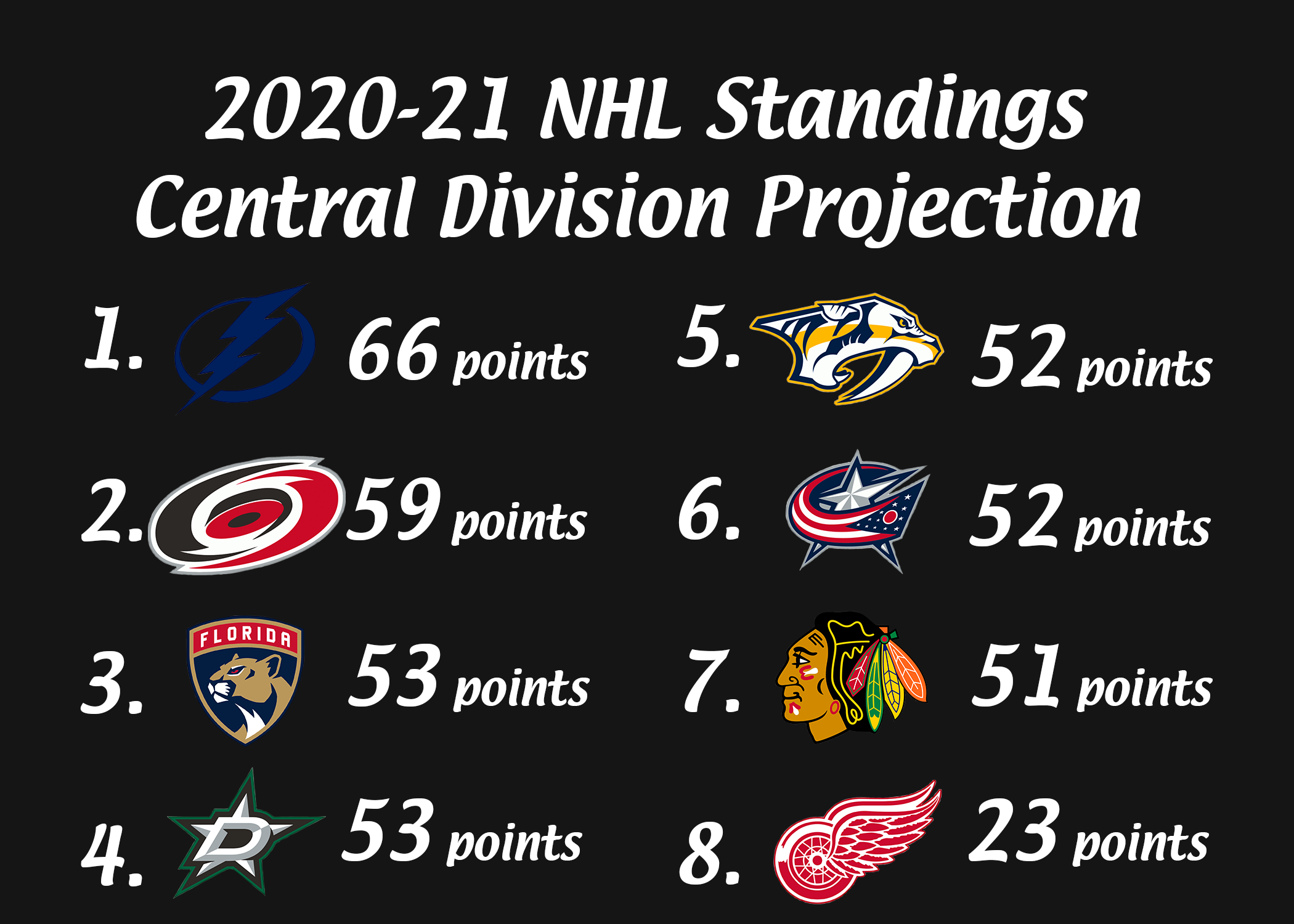
    Tampa is projected as the regular season division winners with 66 points on the season.

    The formula doesn’t take into account the loss of Braydon Coburn and Cedric Paquette in a trade with the Senators or the loss of Nikita Kucherov for the regular season due to an injury.

    It doesn’t take into consideration the intra-divisional schedule, other injuries that are sure to occur, transactions, acts of The Hockey Gods, etc.

    The 2012-13 Blackhawks had the advantage of facing mostly regular opponents over 48 games, then progressing through the old format of the playoffs where teams were seeded 1-8 among six divisions of five teams.

    Tampa just has to be one of the top-four teams in their division over 56 games against all too familiar faces from night-to-night, then emerge victorious out of the Central to defend their title.

    Anything is possible.

    Can the Florida Panthers really be a playoff team?

    Yes, the expected points model seems to indicate that the Florida Panthers were pretty good at finding the net in the regular season last year and that they should improve their standing, at least.

    It doesn’t, however, determine whether or not Sergei Bobrovsky returns to form in quality starts, shutouts, etc.

    New Panthers General Manager, Bill Zito, has added Markus Nutivaara and Radko Gudas to the blue line, as well as Anthony Duclair and Patric Hörnqvist to the forwards, so they should definitely be harder to play than in years past.

    Gut feeling says three-time Stanley Cup champion head coach, Joel Quenneville, can make something more out of the pieces he’s been handed this season than in 2019-20.

    Are the Detroit Red Wings really that bad?

    No, but they didn’t do themselves any favors when it comes to utilizing last season’s data for determining this season’s expected points total.

    Marginal goals for and marginal goals against can be a cruel animal, but it’s one of the best things to take into account of recency bias.

    Red Wings GM Steve Yzerman added Vladislav Namestnikov, Bobby Ryan, Marc Staal, Troy Stecher, Jon Merrill, Alex Biega and Thomas Greiss to his team, so they won’t at least be intentional pushovers like last season.

    The loss of Zdeno Chara and Torey Krug in the offseason for the Boston Bruins comes with a price– having to face Chara eight times in the regular season, then possibly Krug and the St. Louis Blues in a 2019 Stanley Cup Final rematch in the 2021 Stanley Cup Final.

    Just kidding, the window appears mostly shut in the Hub.

    It’s not that Boston can’t win, but rather that they have a bit of an uphill battle to get there.

    Yes, their defense is younger, but it’s also more inexperienced. Yes, they added Craig Smith for goal scoring power, but it’s no Mike Hoffman.

    At least David Pastrnak is looking to make a return ahead of schedule from his offseason surgery, but don’t be fooled by their six-point lead over the Philadelphia Flyers in the East Division projection.

    Every second matters in a 56-game season. If they get off to a rocky start, they risk going from a surefire playoff contender (for at least another year or two) to missing out on the 2021 postseason.

    The Buffalo Sabres added Taylor Hall, what gives?

    Again, if you haven’t learned by now, expected points totals do not take signing the 2017-18 Hart Memorial Trophy winner to a one-year, $8.000 million contract into account.

    Hall could be the winger Jack Eichel needs to convince him not to ask for a trade request as much as Eichel could be what Hall needs for a little rejuvenation and to be convinced to stay longer in his reunion with Sabres head coach, Ralph Krueger.

    No matter what, though, the addition of Eric Staal and more in Buffalo means there’s sure to be improvement this season.

    If it was the regular Atlantic Division, the Sabres might be looking at a wild card situation.

    But since it’s the temporarily realigned East Division for 2020-21, yeah, there’s a lot more harder competition. Take the Hall pass and try again next season (maybe you’ll get the 1st overall pick).

    Explain to me how the New York Rangers and New York Islanders miss the playoffs?

    This one is fairly simple.

    The East Division is just six teams out of the regular Metropolitan Division, plus the Bruins (pretty good) and Sabres (pretty bad).

    As such, it’s almost as if nothing ever happened in terms of the compete level of the overall division, but the playoff format yields only the top-four teams from each division for 2020-21.

    Instead of getting, say, seven Metropolitan teams (impossible, yes, but let’s pretend) in the upcoming postseason, you can only have four.

    If the B’s are taking one of those spots like they are in this projection, that limits the usual Metropolitan contenders to three leftover playoff berths.

    If anything, the Pittsburgh Penguins are at the greatest risk of sliding out of the postseason picture with Tristan Jarry as their starting goaltender and Casey DeSmith as their backup after trading Matt Murray to Ottawa in the offseason.

    That’s good news for the Islanders, probably, though the Rangers have more talent on paper (especially if Mathew Barzal isn’t re-signed when the puck drops on Jan. 13th).


    So that’s it.

    If you’ve made it this far and read every word– congrats, it’s probably time for puck drop already. Surely the calendar must read Jan. 13th by now and you can get back to watching that game you just tuned into.

    Stay tuned for more forecasts and (un)related things that don’t have anything to do with expected points totals.

  • DTFR Podcast #214- 2020-21 Season Preview: West Division

    DTFR Podcast #214- 2020-21 Season Preview: West Division

    Zdeno Chara signed with the Washington Capitals, the AHL announced plans for the 2020-21 season, the NHL divisions are sponsored for 2020-21, what’s going on with the New York Islanders, Pierre-Luc Dubois wants out (maybe) and we preview the West Division for the 2020-21 season.

    Subscribe to the podcast on Apple PodcastsStitcher and/or on Spotify.

  • DTFR Podcast #213- 2020-21 Season Preview: Central Division

    DTFR Podcast #213- 2020-21 Season Preview: Central Division

    The Ottawa Senators did the Tampa Bay Lightning a huge favor. About a $17 million favor, when all is said and done. Meanwhile, a bunch of contracts were signed, we finally know an answer to the Mike Hoffman question, Craig Anderson signed a PTO and might replace Henrik Lundqvist as the Washington Capitals’ backup goaltender and we preview the Central Division for the 2020-21 season.

    Subscribe to the podcast on Apple PodcastsStitcher and/or on Spotify.

  • 2020 Stanley Cup Qualifier Preview: Western Conference

    Hockey’s back. In August!?! In this economy?!?

    Yes, truer words have never been spoken. Hockey. Is. Back.

    But not in the way you’re probably thinking if you’ve been under a rock for the last– let’s see, what month is it now?

    The National Hockey League paused the 2019-20 regular season on March 12th due to the ongoing COVID-19 pandemic before canceling the rest of the regular season in late May and announcing a 24-team playoff format for 2020.

    Make no mistake, whether you put an asterisk next to the winners of the 2020 Stanley Cup Final or not– it’ll be the hardest Cup to win since Lord Stanley of Preston announced he’d donate the silver rose bowl to the best hockey team in the world (so Canada) on March 18, 1892.

    Despite all the training world class athletes do in contemporary times, nothing could prepare any athlete to stop playing, go through training camp after months of (in some cases) not being able to skate on any ice, then go full throttle for a championship tournament.

    If anything, the asterisk next to the 2020 Stanley Cup champions will simply be a marker for the challenging times and remarkable feats of athleticism that team went through to put it all together and lift a 35-pound trophy at the end.

    By now you’ve probably heard how the 2020 postseason will work– 24 teams vying for 16 spots, with eight teams (four in each conference) already locked into the playoffs, but fighting for the top-four seeds as the other 16 teams compete in a best-of-five series to punch a ticket into the playoffs.

    Those 16 teams are in the 2020 Stanley Cup Qualifiers, which technically isn’t part of the 2020 postseason according to the NHL, but the individual player and team stats will count towards the playoffs in the record books.

    So for Arizona Coyotes fans, the long standing playoff drought since 2012, technically isn’t over yet. They’d have to beat the Nashville Predators first.

    With all of that in mind, let’s take a look at the Western Conference Qualifiers, while the St. Louis Blues, Colorado Avalanche, Vegas Golden Knights and Dallas Stars sort themselves out.

    All Western Conference games will be at Rogers Place in Edmonton, Alberta, including the Western Conference Final and all of the Stanley Cup Final.

    (5) Edmonton Oilers (37-25-9, 83 points) vs (12) Chicago Blackhawks (32-30-8, 72 points)

    Edmonton: 71 games played, .585 points percentage, 31 regulation wins.

    Chicago: 70 games played, .514 points percentage, 23 regulation wins.

    The Edmonton Oilers finished second in the Pacific Division with 83 points– three points behind the Vegas Golden Knights for the division lead. That’s how good the Oilers were at times and/or how far behind the Pacific Division was at times leading up to the premature end of the regular season due to the ongoing COVID-19 pandemic.

    One thing is for sure about the always home-ice even without fans in the bubble Oilers team, their top players were much better than they were last season.

    2019-20 Art Ross Trophy winner and Hart Memorial Trophy finalist, Leon Draisaitl had 110 points this season in 71 games played. He was on pace for 126 points had the regular season reached its original conclusion.

    That would’ve been 21 points better than his previous high of 105 points in 82 games last season. Luckily for Draisaitl, he still set a new career-high in a pandemic– two new career-highs, actually.

    Though 43 goals this season did not top the 50 goals he scored in 2018-19, Draisaitl set career-highs in assists (67) and points (110)– and yet, somehow he still was a minus-seven on the season.

    Is it worth exploring moving Draisaitl out of Edmonton? MY COLUMN:

    (If you’re wondering, that’s four consecutive seasons of at least 70 points and back-to-back 100-plus point seasons for Draisaitl, so no, he’s not going anywhere.)

    Oilers captain, Connor McDavid, had 34 goals and 63 assists (97 points) in 64 games this season, which was 19 points shy of his career-high 116-points last season in 78 games in 2018-19. McDavid was on pace for 124 points this season at the time of the stoppage.

    Ryan Nugent-Hopkins was third in scoring for Edmonton with 22-39–61 totals in 65 games this season, then the next highest skater had 34 points in 59 games (Zack Kassian). This season marked back-to-back 60-point seasons for Nugent-Hopkins for the first time in his career.

    In goal, Mike Smith (19-12-6 in 39 games played, 37 starts, 2.95 goals against average, .905 save percentage and one shutout) split time with Mikko Koskinen (18-13-3 in 38 GP, 34 starts, 2.75 GAA, .917 SV% and one shutout in that span) this season.

    The 38-year-old veteran goaltender, Smith, has a 2.17 GAA, a .938 SV% and four shutouts over 24 career Stanley Cup Playoff games.

    Meanwhile, 32-year-old Koskinen has yet to appear in a postseason NHL game.

    Smith’s .938 SV% in the playoffs, however, is league-leading among active NHL goaltenders with a minimum of 20 Stanley Cup Playoff games played.

    Oilers head coach, Dave Tippett, might be smart to start Smith over Koskinen in Game 1, considering Smith’s career playoff numbers, but he did post a 3.20 GAA and a .917 SV% in five games with the Calgary Flames in the 2019 First Round en route to Calgary’s defeat at the hands of the Colorado Avalanche.

    Smith did record one shutout in last year’s playoffs, however, and faced 205 shots against in those five games against the Avs.

    That was about 34% of the number of shots he faced (602) in 16 games with the then known as Phoenix Coyotes en route to their 2012 Western Conference Final appearance against the eventual 2012 Stanley Cup champion Los Angeles Kings.

    At the other end of the rink, Patrick Kane led the way for the Chicago Blackhawks this season with 33-51–84 totals in 70 games, which was 24 points more than Jonathan Toews’ 60-point effort in 70 games for Chicago this season.

    2019-20 Calder Memorial Trophy finalist, Dominik Kubalik, was third in Blackhawks scoring with 30 goals and 16 assists (46 points) in 68 games played.

    For Kane, the pandemic shortened 2019-20 regular season marked five consecutive seasons with at least 70 points, while he was on pace for about 98 points had the regular season witnessed a full 82-game conclusion.

    For Toews, he has never had a season with 82 games schedule below 50 points (though he had 48 points in 47 games in the lockout shortened 2012-13 season), but he did see a decrease in production from 81 points in 82 games last season to 60 points in 70 games this season. He was on pace for 70 points over an 82-game schedule in 2019-20.

    In goal, Corey Crawford led the Blackhawks with a 16-20-3 record in 40 games played (39 starts), a 2.77 GAA, .917 SV% and one shutout this season.

    Prior to being traded to the Vegas Golden Knights at the trade deadline via the Toronto Maple Leafs in a three-team trade– in which Chicago acquired, in part, Malcolm Subban– Robin Lehner served as Crawford’s tandem goaltender with a 16-10-5 record in 33 games played (31 starts), a 3.01 GAA, .918 SV% and no shutouts in that span with the Blackhawks.

    Subban, on the other hand, made one appearance with Chicago after the trade and played in one minute as a Blackhawk. He had a 3.18 GAA and an .890 SV% in 20 games (19 starts) with the Golden Knights this season, however.

    Should Blackhawks head coach, Jeremy Colliton, be given any reason not to opt for Crawford as his Qualifier starter, then there’s cause for concern as to whether or not Chicago can upset the Oilers if Subban can’t right the ship from his worst season as an NHL backup goaltender.

    Four months off with plenty of rest to get in the right mindset might have been a good thing for his rhythm, however, as Crawford and Subban made a combined shutout effort in Chicago’s, 4-0, win over the St. Louis Blues in their exhibition matchup.

    What’s more, the Blackhawks went 2-1-0 in three games against the Oilers this season, but before you start thinking there’s a chance Chicago upsets Edmonton with a sweep or anything, take caution as the Hawks had ten goals for and nine goals against in their season series.

    This will be Colliton’s first appearance behind the bench as head coach in a postseason (but also not technically postseason) appearance for the Blackhawks– and Chicago’s first postseason action without Joel Quenneville at the reigns since before Quenneville was hired four games into the 2008-09 season.

    It truly is a new era for Chicago, despite much of the core remaining from their three Cup championships in a five-year span.

    Look for the Oilers to get the job done in four games with Tippett looking to punch his ticket back to the postseason since leading the Coyotes to the 2012 Western Conference Final, while The Hockey Gods favor Edmonton since the tragic loss of their teammate, Colby Cave, in April after the 25-year-old forward suffered a brain bleed and died days later after being placed in a medically induced coma.

    Regular season outcomes:

    3-1 CHI at United Center on Oct. 14th, 5-3 EDM at Rogers Place on Feb. 11th, 4-3 CHI at United Center on March 5th

    Schedule:

    8/1- Game 1 CHI @ EDM 3 PM ET on NBC, SN

    8/3- Game 2 CHI @ EDM 10:30 PM ET on NBCSN, NHL.TV, SN

    8/5- Game 3 EDM @ CHI in Edmonton 10:30 PM ET on NBCSN, NHL.TV, SN

    8/7- Game 4 EDM @ CHI in Edmonton*

    8/8- Game 5 CHI @ EDM*

    *If necessary

    (6) Nashville Predators (35-26-8, 78 points) vs (11) Arizona Coyotes (33-29-8, 74 points)

    Nashville: 69 games played, .565 points percentage, 28 regulation wins.

    Arizona: 70 games played, .529 points percentage, 26 regulation wins.

    There’s something in the water in Nashville– and it’s not just catfish. Predators defender– and 2019-20 James Norris Trophy finalist– Roman Josi led the Preds in scoring this season with 65 points (16 goals, 49 assists) in 69 games.

    He was on pace for 77 points at the time of the stoppage and trailed Washington Capitals defender– and fellow Norris finalist– John Carlson by ten points for the most points by a defender this season.

    It was a career-season for Josi in goals, assists and points, by the way.

    Nashville’s top-three in scoring, in fact, nearly contained two defenders as Josi led the way and Ryan Ellis notched 38 points in an injury-riddled 49-game season (a 64-point pace had the full 82-game schedule been completed if the pandemic never happened).

    Ellis trailed Filip Forsberg (21-27–48 totals in 63 games) and Matt Duchene (13-29–42 totals in 66 games) in scoring on the Predators roster.

    Juuse Saros finally emerged as a de facto starting goaltender for Nashville after amassing a 17-12-4 record in 40 games played (34 starts), as well as a 2.70 GAA, .914 SV% and four shutouts on the season.

    Pekka Rinne, meanwhile, had an 18-14-4 record in 36 games (35 starts), which wasn’t bad, but his numbers past his overall record were actually a career-worst with a 3.17 GAA and an .895 SV% in 2019-20.

    Rinne previously had a 3.80 GAA in a season, but that was only when he played in two games in 2005-06.

    This was a season to forget for Rinne, but perhaps a larger indicator of more worries to come for Nashville in the net– especially more so after Saros didn’t exactly light it up as a starter with a goals against average that would even make a backup goaltender look, well, average.

    The Arizona Coyotes enter the 2020 Stanley Cup Qualifier with a new owner, as well as a new Interim General Manager in Steve Sullivan, as well as Nick Schmaltz leading the way in scoring with 11 goals and 34 assists for 45 points in 70 games played.

    Not ideal, ideally speaking.

    Clayton Keller had 44 points (17 goals, 27 assists) in 70 games and was on pace for 52 points had the pandemic not cut the regular season short.

    Meanwhile, Conor Garland was third on the team in scoring with 39 points in 68 games, while establishing career-highs in goals (22), assists (17) and points (39) in the process.

    Christian Dvorak and Phil Kessel each had 38 points in 70 games. Over an 82-game schedule, that’s about a 45-point pace, which would’ve still been a career-season for Dvorak and a disappointment for Kessel in his first season in the desert.

    Granted, Kessel’s not playing with guys like Sidney Crosby or Evgeni Malkin in his new home in Arizona.

    He failed to reach the 20-goal plateau for the first time since the 2007-08 season, in which Kessel scored 19 goals in 82 games for the Boston Bruins in his sophomore season.

    Kessel also failed to reach 30-assists for the first time since his first season as a Toronto Maple Leaf in 2009-10, in which he had 25 helpers in 70 games.

    Finally, No. 81 on Arizona’s roster failed to amass at least 40 points in a season for just the third time in his career (29 points in 70 games while missing time battling testicular cancer with the Bruins in his rookie season in 2006-07, and 37 points in 82 games the following season in 2007-08 with Boston).

    Granted, Kessel likely could have passed the 40-point plateau had the COVID-19 pandemic not interrupted plans for him and his Coyotes teammates.

    In goal, Antti Raanta appeared in 33 games (32 starts) and had a 15-14-3 record, as well as a 2.63 GAA, a .921 SV% and two shutouts in that span.

    Darcy Kuemper went 16-11-2 in 29 games played (all starts) and amassed a 2.22 GAA, while putting up a .928 SV% and two shutouts this season for the Coyotes.

    If there’s any doubt Rick Tocchet has over deciding which goaltender to start in Game 1 against Nashville, there shouldn’t be any question– it has to be Kuemper.

    Simply put, it’s Kuemper’s net to lose right now in Arizona and a little healthy competition isn’t a bad idea to try to spur Raanta in the right direction if he wants to be a starter in this league.

    Boy, home ice advantage really would be something in this series by default, right? After all, each team won their only home game in their regular season matchups prior to the premature conclusion to the 2019-20 regular season due to the pandemic.

    Since home ice is without fans in Edmonton for all Western Conference teams in the 2020 postseason, there’s not much to go off of in terms of these two clubs’ head-to-head meetings.

    But the Predators have more than a few things going in their favor among their forwards and defenders who could also play forward, arguably.

    The one thing Arizona has that Nashville hasn’t seen much of this season is a consistent starter in the crease.

    If the Coyotes win the series, it’ll likely have something with Kuemper stealing a few games.

    If the Preds sweep Arizona, it might have something to do with the sheer fire power in a last-ditch effort at what’s otherwise a closing window for a potential Cup contending roster.

    At the very least John Hynes probably doesn’t have to worry about getting the same treatment as Peter Laviolette– who Hynes replaced in January– if the Predators dropped the ball in this series.

    Let’s say Nashville in three, but give props to Kuemper for honing in his talents to tend the crease this well in his career. It hasn’t been easy, but he’s arrived and here to stay, unlike former Coyotes GM John Chayka.

    Regular season outcomes:

    5-2 ARI at Gila River Arena on Oct. 17th, 3-2 NSH at Bridgestone Arena on Dec. 23rd

    Schedule:

    8/2- Game 1 ARI @ NSH in Edmonton 2 PM ET on USA, NHL.TV, SN360

    8/4- Game 2 ARI @ NSH in Edmonton 2:30 PM ET on NHLN, NHL.TV, SN1, SN360

    8/5- Game 3 NSH @ ARI in Edmonton 2:30 PM ET on NHLN, NHL.TV, SN360

    8/7- Game 4 NSH @ ARI in Edmonton*

    8/9- Game 5 ARI @ NSH in Edmonton*

    *If necessary

    (7) Vancouver Canucks (36-27-6, 78 points) vs (10) Minnesota Wild (35-27-7, 77 points)

    Vancouver: 69 games played, .565 points percentage, 27 regulation wins.

    Minnesota: 69 games played, .558 points percentage, 30 regulation wins.

    Entering the 2019-20 season, Vancouver Canucks General Manager, Jim Benning, added J.T. Miller to the fold in a trade with the Tampa Bay Lightning.

    Benning then went out and got Tyler Toffoli from the Los Angeles Kings leading up to the 2020 trade deadline.

    As a result, the Canucks are much improved from last season to this season.

    Miller led the team in scoring with 27-45–72 totals in 69 games played and was on pace for about 86 points at the time of the stoppage due to the pandemic.

    Elias Pettersson (66 points in 69 games), Bo Horvat (53 points in 69 games) and Quinn Hughes (53 points in 69 games) rounded out the top-three in scoring for Vancouver.

    Horvat and Hughes were tied for the third most points on the team as Hughes left his mark on the 2019-20 season by earning Calder Memorial Trophy finalist honors.

    Meanwhile, Jacob Markstrom led the Canucks in the crease with a 23-16-4 record in 43 games played (all starts), as well as a 2.75 GAA, a .918 SV% and two shutouts in that span.

    Thatcher Demko made 27 appearances (25 starts) as the backup goaltender and went 13-10-2 on the season with a 3.06 GAA and a .905 SV% in that span.

    Louis Domingue also appeared in one game (one start) in the regular season for the Canucks and had a 4.08 GAA and an .882 SV%.

    Markstrom will be the starter for Vancouver’s postseason run, but he’ll have to be a tad better in cutting down his goals against average for a deep run.

    For Canucks head coach, Travis Green, it’s more of the same game plan to try to spur the Canucks back into the playoffs for the first time since their 2015 First Round appearance and elimination at the hands of the Calgary Flames in six games.

    The Minnesota Wild removed the “interim” tag from their head coach, Dean Evason’s title since the pause in play and are looking to upset the Canucks and get back into the playoffs since missing the postseason last season.

    Kevin Fiala led the way for the Wild in scoring with 54 points (23 goals, 31 assists) in 64 games played. He was on pace for 69 points had the season gone all 82 games, but still established career-highs in goals, assists and points in the shortened season regardless.

    Ryan Suter led defenders and was second in scoring on the roster with 48 points (eight goals, 40 assists) in 69 games, while Eric Staal was ahead of Zach Parise by one point for third in scoring with 47 points in 66 games.

    In goal, Alex Stalock (20-11-4 in 38 games played, 36 starts, 2.67 goals against average, .985 save percentage, four shutouts) outplayed Minnesota’s usual starter Devan Dubnyk (12-15-2 in 30 GP, 28 starts, 3.35 GAA, .890 SV%, one shutout) and will likely backstop the team in Game 1 against Vancouver.

    Kaapo Kahkonen also made his NHL debut this season in the crease for the Wild in five games– amassing a 3-1-1 record, as well as a 2.96 GAA and a .913 SV%.

    Both teams had nine goals for and nine goals against one another in their season series. They also each had 89 total shots on goal against one another in the 2019-20 regular season.

    Though the Wild made strides this season at potentially avoiding a rebuild, it’s still an uphill climb for Minnesota against the Canucks on paper– regardless of their head-to-head matchups from the season.

    Vancouver has the right combination of speed, skill and youth to limit Minnesota’s chances and, at times, lackluster offense.

    The Canucks core is more defined than Minnesota’s fluid situation as Wild GM Bill Guerin evolves the roster over the next season or two.

    It’s a transition period, nonetheless.

    Benning and the Canucks are emerging from their transition and look to be ready to get back into the playoff hunt with what should be a four-game series win against the Wild.

    Regular season outcomes:

    4-1 VAN at Xcel Energy Center on Jan. 12th, 4-2 MIN at Xcel Energy Center on Feb. 6th, 4-3 F/SO MIN at Rogers Arena on Feb. 19th

    Schedule:

    8/2- Game 1 MIN @ VAN in Edmonton 10:30 PM ET on NBCSN, NHL.TV, SN

    8/4- Game 2 MIN @ VAN in Edmonton 10:45 PM ET on USA, NHL.TV, SN

    8/6- Game 3 VAN @ MIN in Edmonton TBD

    8/7- Game 4 VAN @ MIN in Edmonton*

    8/9- Game 5 MIN @ VAN in Edmonton*

    *If necessary

    (8) Calgary Flames (36-27-7, 79 points) vs (9) Winnipeg Jets (37-28-6, 80 points)

    Calgary: 70 games played, .564 points percentage, 25 regulation wins.

    Winnipeg: 71 games played, .563 points percentage, 30 regulation wins.

    The Calgary Flames were led in scoring this season by their hottest controversial player, Matthew Tkachuk. Tkachuk ruffled some feathers en route to re-igniting the “Battle of Alberta” and managed to amass 23-38–61 totals in 69 games played in 2019-20.

    He was on pace for 72 points this season at the time of the stoppage, but still had back-to-back seasons with at least 60 points nonetheless.

    Johnny Gaudreau was second on the roster in points with 58 points (18 goals, 40 assists) in 70 games played, which was down from his 99 points in 82 games last season. That said, Gaudreau was still on pace for about 68 points when the regular season was cut short by the ongoing pandemic.

    Instead, his streak of consecutive 60-plus point seasons was over at five seasons thanks to the pandemic.

    Finally, Elias Lindholm managed to set a new career-high in goals (29), while scoring 54 points in 70 games this season– ranking third on the team in scoring.

    In the crease, Calgary was saved by David “Big Save Dave” Rittich, who went 24-17-6 in 48 games played (all starts), had a 2.97 goals against average, a .907 save percentage and two shutouts this season.

    Actually, on second thought, maybe that’s not very good numbers to have for a *checks notes* starting goaltender.

    Alright, let’s check the backup…

    Cam Talbot went 12-10-1 in 26 games played (22 starts), had a 2.63 GAA, a .919 SV% and two shutouts this season. Hmm, not much better.

    Oh and did you remember that interim head coach, Geoff Ward, replaced Bill Peters after everyone found out Peters is racist?

    The Winnipeg Jets landed in fifth place in the Central Division with 80 points this season– two points behind the Dallas Stars, who were the fourth best team in the Western Conference by points percentage and have earned themselves home ice in at least the First Round, which only matters so much in a bubble, but still, this was meant to show how close the Jets came to being a Round Robin team instead of playing in a Qualifier series.

    Anyway, Kyle Connor soared as a Jet this season– establishing new career-highs in goals (38), assists (35) and points (73) in the process while playing in 71 games until the pandemic cut the regular season short.

    Connor was on pace for 84 points this season if the full 82-game schedule could’ve occurred uninterrupted.

    Meanwhile, Mark Scheifele actually tied Connor for the most points on the roster with 73, as Scheifele tallied 29 goals and had 44 helpers in 71 games. Not quite a career-season, but still respectable after setting career-high totals (38-46–84) last season in all 82 games.

    Winnipeg’s captain, Blake Wheeler, contributed more than just actions and words in defense of the Constitution and human rights this season, scoring 22 goals and amassing 43 assists for third place on the roster in points (65) in 71 games played.

    Patrik Laine, for those wondering, was fourth on the team with 63 points, which was back to his usual self, albeit with more assists (35) than goals (28) in 68 games.

    Laine hasn’t been a bust for the Jets– he’s never had a season with fewer than 50 points (last season, 82 games) and was on pace for about 76 points had the season been played in full.

    This was, however, the first season he failed to reach the 30-goal plateau, but he only missed it by two goals and, hello, the pandemic? Remember it? Yeah, that’s why he missed the mark, otherwise he would’ve (probably) scored a pair of goals in the remaining 11 games for Winnipeg on the 2019-20 regular season schedule at the time of the pause.

    In goal, Paul Maurice relied on old reliable to bail him out even more so in the wake of Dustin Byfuglien’s decision to sit out the 2019-20 season and eventual mutual termination of his contract with the club.

    2019-20 Vezina Trophy finalist, Connor Hellebuyck, held the fort down with a 31-21-5 record in 58 games played (56 starts), amassed a 2.57 goals against average and had a .922 save percenrage– as well as a league-leading six shutouts this season.

    Yeah, it was kind of a big season for Hellebucyk and if he’s not the favorite among the NHL GMs that vote for the Vezina, well, who knows what games they were watching (presumably their own).

    Laurent Brossoit went 6-7-1 in 19 games (15 starts) this season and had a dismal 3.28 GAA and an .895 SV% in that span. Yikes.

    The defense looks different without Byfuglien, but Hellebuyck remained stable as their primary alternative to keeping the puck away from their own net.

    That might not pay off against some of the powerhouses in the league, but luckily the Jets have enough time to let Maurice come up with a plan and enact it to cut down on Hellebuyck’s workload in the Qualifier if they want a chance to advance.

    Oh, speaking of the Winnipeg and Calgary series– nobody knows what to expect!

    The Jets and Flames met once this season– back in the 2019 Heritage Classic outdoors at Mosaic Stadium in Regina, Saskatchewan.

    Winnipeg won in overtime in comeback fashion that night, 2-1.

    They peppered Rittich with 45 shots (43 saves) and kept Hellebuyck to an ideal workload of 30 shots faced (29 saves).

    If the Jets don’t win this series, it’ll be a huge disappointment– perhaps even bigger than making the First Round and getting stomped out by their next opponent after the phenomenal performance by Hellebucyk in the crease all season.

    Then again, momentum no longer exists since everyone had about five months off.

    Let’s say this one goes all five games for one reason or another and that Winnipeg can pull it off and advance to the 2020 Stanley Cup Playoffs.

    Regular season outcomes:

    2-1 F/OT WPG at Mosaic Stadium, Regina, Saskatchewan on Oct. 26th

    Schedule:

    8/1- Game 1 WPG @ CGY in Edmonton 10:30 PM ET on NBCSN, NHL.TV, CBC, SN

    8/3- Game 2 WPG @ CGY in Edmonton 2:30 PM ET on NHLN, NHL.TV, SN

    8/4- Game 3 CGY @ WPG in Edmonton 4:45 PM ET on NHLN, NHL.TV, SN

    8/6- Game 4 CGY @ WPG in Edmonton*

    8/8- Game 5 WPG @ CGY in Edmonton*

    *If necessary


    2020 Western Conference Round Robin Action

    Here’s a quick glance at the Round Robin schedule for the top-four Western Conference teams if you’re not at all interested in the Qualifiers for some reason.

    Again, all games in the Western Conference are in Edmonton this year and all times Eastern.

    St. Louis Blues

    42-19-10, 94 points, 71 GP, .662 PTS%, 33 RW

    Aug. 2nd @ COL in Edmonton 6:30 PM ET on NBCSN, NHL.TV, SN360

    Aug. 6th vs. VGK in Edmonton, TBD

    Aug. 9th vs. DAL in Edmonton, TBD

    Colorado Avalanche

    42-20-8, 92 points, 70 GP, .657 PTS%, 37 RW

    Aug. 2nd vs. STL in Edmonton 6:30 PM ET on NBCSN, NHL.TV, SN360

    Aug. 5th @ DAL in Edmonton 6:30 PM ET on NHLN, NHL.TV

    Aug. 8th vs. VGK in Edmonton, TBD

    Vegas Golden Knights

    39-24-8, 86 points, 71 GP, .606 PTS%, 30 RW

    Aug. 3rd vs. DAL in Edmonton 6:30 PM ET on NHLN, NHL.TV, SN1

    Aug. 6th @ STL in Edmonton, TBD

    Aug. 8th @ COL in Edmonton, TBD

    Dallas Stars

    37-24-8, 82 points, 69 GP, .594 PTS%, 26 RW

    Aug. 3rd @ VGK in Edmonton 6:30 PM ET on NHLN, NHL.TV, SN1

    Aug. 5th vs. COL in Edmonton 6:30 PM ET on NHLN, NHL.TV

    Aug. 9th @ STL in Edmonton, TBD

  • DTFR Podcast #184- Deadline Oriented

    DTFR Podcast #184- Deadline Oriented

    Nick recaps the 2020 Trade Deadline and other headlines from the week in the NHL– including the latest Ottawa Senators scandal! Plus, a glimpse at what’s to come in the last month of the regular season.

    Subscribe to the podcast on Apple PodcastsStitcher and/or on Spotify. Support the show on Patreon.

  • New B’s help Bruins over Stars, 4-3

    The Boston Bruins beat the Dallas Stars, 4-3, Thursday night at TD Garden in a game that had a little bit of everything.

    Jaroslav Halak (17-6-6 record, 2.44 goals against average, .917 save percentage in 30 games played) turned aside 31 out of 34 shots faced for a .912 SV% in the win for the Bruins.

    Stars goaltender, Ben Bishop (21-14-4, 2.49 GAA, .921 SV% in 42 games played), made 24 saves on 28 shots against for an .857 SV% in the loss.

    Boston improved to 40-13-12 (92 points) on the season and remain in command of 1st place in the entire league, while Dallas fell to 37-21-6 (80 points) on the season, but remained in 3rd place in the Central Division.

    The B’s also improved to 22-3-9 at home this season.

    The Bruins were without the services of Kevan Miller (knee) and Connor Clifton (upper body) on Thursday.

    New acquisition, Ondrej Kase, made his Boston debut on the second line with David Krejci at center and Nick Ritchie at left wing.

    As a result, Bruce Cassidy moved Jake DeBrusk down to the third line left wing with Charlie Coyle and Anders Bjork– just like how he swapped DeBrusk and Ritchie during Tuesday night’s, 5-2, loss to the Calgary Flames.

    Cassidy made no other changes to the lineup, while Joakim Nordstrom, John Moore, Anton Blidh and Karson Kuhlman served as Boston’s healthy scratches against Dallas.

    Midway through the opening frame, Tyler Seguin tripped up Chris Wagner and was assessed a minor in fraction at 13:07 of the first period.

    Boston did not score on the ensuing power play– their first skater advantage of the night.

    Moments later, Matt Grzelcyk hooked Radek Faksa and was sent to the penalty box at 17:04.

    Dallas converted on the resulting power play when John Klingberg snapped a shot from the point that looked was tipped in by Jamie Benn (19) for his 300th career goal.

    Klingberg (25) and Joe Pavelski (16) had the assists on Benn’s goal, which made it, 1-0, for Dallas at 17:38.

    Benn became the fourth player in Dallas/Minnesota North Stars franchise history to amass at least 300 career regular season goals, joining Mike Modano (557 career goals), Brian Bellows (342) and Dino Ciccarelli (332).

    It marked the 18th time this season that Boston gave up the game’s first goal on home ice and the fifth straight game that Boston’s opponent scored first– regardless of the building.

    Less than a minute later, Andrew Cogliano was punished for slashing Coyle and sent to the sin bin at 18:18.

    While on the ensuing power play, Torey Krug sent a shot on goal from the point that rebounded off of Bishop and into Coyle’s strikezone whereby Coyle (16) batted the puck out of the air and into the twine for the home run power play goal.

    Krug (35) and Brad Marchand (55) tallied the assists and the B’s tied the game, 1-1, at 19:44 of the first period.

    Entering the first intermission, the score was even at, 1-1, while the Bruins led the Stars in shots on goal, 10-9.

    Boston also held the advantage in faceoff win percentage (53-47), while Dallas led in blocked shots (5-3), takeaways (3-1) and hits (9-8).

    Both teams had three giveaways each.

    The Stars were 1/1 on the power play and the Bruins were 1/2 on the skater advantage heading into the middle period.

    Things came to a crescendo when Krejci and Pavelski dropped the gloves and exchanged fisticuffs at 11:24 of the second period.

    The two players each received five-minute majors for fighting and play continued without any other major disruptions.

    A few minutes later, Charlie McAvoy tossed a pass from about the goal line to Marchand (26) in the slot for a point blank one-timer.

    McAvoy (24) and David Pastrnak (44) had the assists on Marchand’s goal and the Bruins led for the first time of the night, 2-1, at 14:44.

    Less than a couple minutes later, Boston went up by two-goals as Ritchie (9) scored his first goal as a Bruin after snapping a shot from the high slot through net front traffic, off of Seguin and past Bishop.

    Ritchie’s goal was unassisted and made it, 3-1, for the Bruins at 16:01 of the second period.

    Late in the period, Wagner tackled Mattias Janmark after a whistle in defense of a teammate, but received a roughing minor for his retaliatory actions at 18:49.

    Dallas didn’t score on the ensuing power play.

    Through 40 minutes of action, Boston was in command of the scoreboard, 3-1, and in shots on goal, 22-19.

    The Bruins also led in blocked shots (8-7), takeaways (4-3), giveaways (11-9) and faceoff win% (54-46), while the Stars held the advantage in hits (19-16).

    Both teams were 1/2 on the power play heading into the third period.

    Wagner wasn’t available to start the third period for the Bruins and later deemed “unlikely to return” to the game with an “upper body injury” by Boston’s media team.

    Meanwhile, Dallas cut Boston’s lead in half, 3-2, after Esa Lindell fired a shot that deflected off of Denis Gurianov’s (19) stick, then off of Krug’s leg and past Halak at 1:18 of the third period.

    Lindell (20) and Jason Dickinson (12) had the assists on Gurianov’s goal.

    Boston responded with a goal of their own when Pastrnak broke into the attacking zone on a rush with Ritchie, sent Ritchie a pass, then received a shot that Pastrnak (46) intentionally redirected into the open twine.

    Ritchie (12) and Jeremy Lauzon (1) notched the assists on Pastrnak’s goal and the B’s led, 4-2, at 3:53.

    Stars head coach, Rick Bowness, pulled Bishop for an extra attacker with less than three minutes remaining in the game.

    After Marchand missed the open net from just inside the blue line, Dallas charged down the length of the ice and sustained pressure in the attacking zone, while Boston was forced to defend.

    Miro Heiskanen (8) ripped a shot that rebounded off of Halak, but clipped Bruins captain, Zdeno Chara’s, skate at just the right angle to bounce off of the Bruin and slip between the post and the Boston goaltender to make it a one-goal game.

    Benn (18) and Seguin (33) tallied the assists on Heiskanen’s goal, but the Bruins still led, 4-3, at 17:36 of the third period.

    Dallas pulled their goaltender once more with 1:58 remaining in regulation, but despite their best efforts, Boston’s defense wasn’t about to make the same mistake twice and held on to the, 4-3, victory at the final horn.

    The Bruins won, 4-3, but finished the night trailing in shots on goal to the Stars, 34-28.

    Dallas also wrapped up Thursday night with the advantage in hits (28-25) and faceoff win% (51-49), while Boston finished the game leading in blocked shots (14-9).

    Both clubs had 11 giveaways and were 1/2 on the power play on Thursday.

    The Bruins are now 12-2-6 when tied after one period and 25-1-6 when leading after two periods this season.

    The Stars are 9-8-4 when tied after one period and 9-16-1 when trailing after two periods this season.

    Boston wrapped up their two-game homestand (1-1-0) on Thursday and finishes the month of February on the road against the New York Islanders on Saturday afternoon.

  • McAvoy lifts B’s over Blackhawks, 2-1, in OT

    Charlie McAvoy scored his first goal of the season to lift the Boston Bruins over the Chicago Blackhawks, 2-1, in overtime Wednesday night at United Center.

    Boston goaltender, Jaroslav Halak (14-6-6 record, 2.36 goals against average, .921 save percentage in 26 games played), made 21 saves on 22 shots against for a .955 SV% in the overtime win.

    Meanwhile, Chicago netminder, Robin Lehner (15-8-5, 2.83 GAA, .923 SV% in 30 games played) stopped 38 out of 40 shots faced for a .950 SV% in the overtime loss.

    The Bruins improved to 33-10-12 (78 points) and took over 1st place in the entire league standings, while maintaining their 1st place standing in the Atlantic Division.

    The Blackhawks, meanwhile, fell to 25-21-8 (58 points) and moved into 4th place in the Central Division.

    Boston improved to 15-8-3 on the road this season as Bruce Cassidy earned his 150th win behind the bench as head coach of the Bruins.

    The B’s are now on a five-game winning streak and have won six out of their last seven games.

    Once more, Kevan Miller (knee), Connor Clifton (upper body) and Joakim Nordstrom (allergy complications) were out of the lineup for Boston on Wednesday.

    Meanwhile, Danton Heinen (undisclosed/healthy scratch) also remained out of the lineup as Cassidy made no changes to his lineup from Tuesday night’s, 4-0, victory over the Vancouver Canucks in Boston to Wednesday night’s matchup with the Blackhawks in Chicago.

    John Moore was the only healthy scratch for the B’s (if Heinen technically wasn’t a healthy scratch for the 2nd game in a row).

    Late in the opening frame, Blackhawks defender, Slater Koekkoek, was guilty of holding Bruins forward, Sean Kuraly, and assessed a minor penalty at 15:56 of the first period.

    Boston did not convert on the ensuing power play opportunity– their first skater advantage of the night.

    After one period of play at United Center on Wednesday, the score was still tied, 0-0, while the Bruins led in shots on goal, 16-5.

    Chicago held the advantage in blocked shots (7-2), giveaways (4-1) and faceoff win percentage (61-39), while Boston led in hits (14-5). Both teams had five takeaways aside entering the first intermission.

    The Blackhawks had yet to see time on the skater advantage and the Bruins were 0/1 on the power play heading into the middle frame.

    Early in the middle period, David Krejci boarded Adam Boqvist and sent the young Blackhawks skater out of the game as Chicago’s media relations crew would later tweet that Boqvist was done for the night with a right shoulder injury.

    Chicago went on the power play at 6:13 of the second period and took less than a minute to capitalize on the skater advantage.

    Patrick Kane pinched along the boards to cut off a clearing attempt by Brad Marchand and stole the puck in the process.

    Kane sent the rubber biscuit towards the net where Kirby Dach got a chance before Alex DeBrincat (13) pocketed a rebound off Halak and through the Bruins goaltender’s seven-hole to give the Blackhawks the game’s first goal at 6:50 of the second period.

    DeBrincat’s power play goal was assisted by Dach (10) and Kane (41) and gave Chicago the, 1-0, lead.

    Almost a few minutes past the midpoint of regulation, Kuraly (5) skated wide around the net and threw the puck towards the goal whereby the puck bounced off of Lehner’s stick and went through the Blackhawks netminder’s five-hole– tying the game, 1-1, in the process.

    Matt Grzelcyk (14) and Anders Bjork (9) tallied the assists on Kuraly’s goal at 12:49 and the B’s were on the scoreboard.

    Moments later, Jeremy Lauzon caught Kane with an errant stick and was assessed a high sticking minor at 16:43.

    Chicago did not score on the ensuing power play.

    Both teams entered the second intermission tied on the scoreboard, 1-1, despite the Bruins leading in shots on goal, 27-13.

    Through 40 minutes of action, the Blackhawks led in blocked shots (14-9) and giveaways (6-3), while Boston held the advantage in takeaways (11-10), hits (21-12) and faceoff win% (51-49).

    Chicago was 1/2 on the power play and the Bruins were 0/1 entering the third period.

    Brandon Saad opened the final frame of regulation with a slashing penalty against Bjork at 5:53 of the third period.

    Boston did not score on the ensuing power play.

    Midway through the third period, Alexander Nylander tripped up David Pastrnak, but Pastrnak embellished the call and the two skaters received minor penalties– yielding 4-on-4 action for two minutes at 11:41.

    Three minutes later, Chris Wagner was called for slashing against Dach while the Blackhawks forward nearly had a breakaway at 14:41.

    This time, however, Chicago was not able to convert on the skater advantage.

    Less than a few minutes later, Zack Smith delivered an illegal check to the head of Torey Krug along the glass just about in the neutral zone near the penalty box and received a minor penalty at 17:34.

    Seconds into Boston’s power play, Ryan Carpenter received a misconduct from the officials at 17:48 for something he did or said that only the refs would know about.

    Almost 90 seconds into Boston’s power play, Krug tripped up Olli Maatta as the Blackhawks defender appeared to deliver a hand pass to move the puck through the neutral zone, which led to what otherwise might have been a goal for Chicago had it not been immediately waved off.

    Regardless, the Bruins’ skater advantage was no more, resulting in an abbreviated 4-on-4 stint at 18:55 of the third period before the Blackhawks would go on an abbreviated power play to close out regulation time.

    After three periods of play at United Center on Wednesday, the two teams required overtime as the game was deadlocked, 1-1, on the scoreboard.

    Boston held the advantage in shots on goal (38-22) and hits (25-16) through 60 minutes of play, while Chicago led in blocked shots (18-14), giveaways (10-5) and faceoff win% (51-49).

    Both teams had 13 takeaways aside as the Blackhawks were 1/4 on the power play and the B’s were 0/3 entering the extra frame.

    Chicago began the overtime period with about 55 seconds left on the power play and a 4-on-3 advantage to begin what is usually 3-on-3 action in overtime (except for when there’s a power play involved).

    Cassidy elected to start Patrice Bergeron, Zdeno Chara and Brandon Carlo in overtime, while Blackhawks head coach, Jeremy Colliton, matched Boston’s skaters with Jonathan Toews, Kane, DeBrincat and Erik Gustafsson.

    Shortly after killing off Krug’s minor, the Bruins raced up-ice on a give-and-go.

    Jake DeBrusk flung the puck towards the slot where McAvoy (1) was awaiting the perfect chance to redirect the rubber biscuit with his blade from the edge of the crease to give the B’s the, 2-1, overtime victory with his 3rd career regular season overtime goal.

    DeBrusk (16) and Krejci (25) notched the assists as Boston finished the night off with the win at 1:19 of the overtime period.

    The Bruins finished the night leading in shots on goal (40-22) and hits (25-16), while the Blackhawks left Wednesday night’s matchup with the lead in blocked shots (18-14), giveaways (11-5) and faceoff win% (52-48).

    Chicago went 1/4 on the power play on Wednesday and Boston went 0/3.

    The Bruins, in the meantime, improved to 9-1-6 when tied after one period, 10-2-3 when tied after two periods and 4-5 in overtime this season. The B’s are now 4-12 past regulation overall.

    Chicago fell to 4-4 in overtime this season and 7-8 past regulation overall.

    Boston returns home for a matchup with the Arizona Coyotes on Saturday before traveling to Detroit to face the Red Wings on Sunday.