Tag: Carolina Hurricanes

  • Canes take 3-2 series lead with win in Game 5

    Canes take 3-2 series lead with win in Game 5

    Martin Necas scored a pair of goals as Jordan Staal scored the game-winner in overtime to give the Carolina Hurricanes a, 3-2, victory in front of their home crowd at PNC Arena as the Canes took a 3-2 series lead over the Nashville Predators in Game 5 on Tuesday.

    Alex Nedeljkovic (3-2, 2.10 goals-against average, .927 save percentage in five games played) made 23 saves on 25 shots against int he win for Carolina.

    Predators netminder, Juuse Saros (2-3, 2.59 goals-against average, .928 save percentage in five games played) stopped 34 out of 37 shots faced in the loss.

    The biggest lineup change from Game 4 to Game 5 was the return of defender, Jaccob Slavin, to Carolina’s blue line. Slavin’s missed three games this postseason due to injury and brings a physical presence that the Hurricanes would be wise to utilize to combat Nashville’s big bodies.

    Dougie Hamilton cross checked Filip Forsberg as the two skaters barreled into Nedeljkovic early in the opening frame, yielding the night’s first power play to Nashville at 5:03 of the first period.

    The Predators weren’t successful on the ensuing skater advantage, but used the momentum gained from surviving the energy of the PNC Arena crowd as well as the power play opportunity to strike first moments later.

    Roman Josi sent a shot towards the net from the point that deflected off teammate, Yakov Trenin (1) and floated over Nedeljkovic’s shoulder like a “knuckle puck” would cut erratically through the air and into the twine in The Mighty Ducks.

    Josi (3) had the only assist on Trenin’s first career Stanley Cup Playoff goal as the Preds jumped out to a, 1-0, lead at 11:44 of the first period.

    About a couple minutes later, Luke Kunin hit Andrei Svechnikov hard along the boards, which sparked a response from Svechnikov as the two players exchanged pleasantries before a crowd gathered.

    In all, Kunin and Matt Benning, as well as Svechnikov picked up roughing minors, while the Hurricanes got a power play out of it at 13:10.

    About a minute later, Carolina converted on the skater advantage as Hamilton worked the puck over to Necas (1) for a snap shot over Saros’ glove to tie the game, 1-1, at 14:21.

    Hamilton (2) tallied the only assist on Necas’ first career Stanley Cup Playoff goal.

    Entering the first intermission, the Hurricanes and Predators were tied, 1-1, on the scoreboard, though Carolina led in shots on goal, 10-5.

    The Canes also held the advantage in giveaways (5-0) and faceoff win percentage (63-38), while the Preds led in blocked shots (8-7), takeaways (2-1) and hits (21-19).

    Nashville was 0/1 and Carolina was 1/1 on the power play heading into the middle frame.

    Less than a minute after returning from the first intermission, Trenin (2) scored on a catch-and-release goal on a 2-on-1 as Colton Sissons (2) provided the only assist to give the Predators a, 2-1, lead 53 seconds into the second period.

    Midway through the period, Forsberg cut a rut to the penalty box for tripping Sebastian Aho at 8:59, but the Hurricanes couldn’t muster anything on the ensuing power play.

    Moments later, Carolina thought they had tied the game on a shot by Slavin that appeared to hit Nashville forward, Ryan Johansen, and deflect past Saros, but Predators head coach, John Hynes, used a coach’s challenge to argue that there was goaltender interference on the play and the call on the ice should be reversed in that case.

    Though review confirmed to the eyes of Caniacs in the stands at PNC Arena and fans at home that Warren Foegele entered, then promptly exited the crease with his right skate with enough time for Saros to reset himself (nevertheless, he was unaffected anyway) before– what’s that? His own teammate barreled into him?

    Yes, Josi made contact with his own goaltender, pile-driving him out of position as the goal had been scored. Surely the on-ice officials would make the right call and…

    …well.

    In the eyes of the officials, Foegele had done enough to merely exist in the playing surface, despite not making any contact or direct impeding gesture to disrupt Saros’ play, but what’s a catch these days anyway?

    The call on the ice was reversed and the goal was taken off the board due to incidental goaltender interference.

    Nashville remained in command, 2-1, at 12:22 of the second period.

    And the Preds’, 2-1, lead was enough to get them into the dressing room for the second intermission unscathed as Carolina outshot the Predators, 24-16, through 40 minutes of action.

    The Hurricanes had a, 14-11, advantage in shots on net in the second period alone and led in giveaways (13-1), hits (48-30) and faceoff win% (64-36), while Nashville held the lead in blocked shots (12-7) and takeaways (6-2) after two periods.

    The Preds were still 0/1 and the Canes remained 1/2 on the power play heading into the final frame of regulation.

    Foegele was assessed a roughing minor for getting tangled up with Ben Harpur at 5:36 of the third period and presented the Predators with a power play as a result.

    Carolina’s penalty kill stood tall, however, as Foegele was released from the box two minutes later without issue.

    Midway through the period, Necas (2) raced up through the neutral zone with speed, broke into the attacking zone, cut for the trapezoid behind the net and wrapped the rubber biscuit around the goal frame and into the twine behind Saros to tie the game, 2-2, on an impressive display of athletic ability.

    Slavin (1) notched the assist on Necas’ second goal of the game as No. 88 for Carolina almost singlehandedly put the team on his back at 12:55 of the third period.

    Despite scoring a goal that was later waved off due to the magic of a coach’s challenge in the second period, the Hurricanes found themselves heading to overtime with the Predators tied, 2-2, on the scoreboard– even after outshooting Nashville, 35-25, in shots on goal, including an, 11-9, advantage in the third period alone.

    The Preds led in blocked shots (15-12) and takeaways (6-4) after regulation, while the Canes led in giveaways (20-4), hits (66-40) and faceoff win% (56-44).

    Nashville was 0/2 and Carolina was 1/2 on the power play as each team searched within themselves to find a game-winner and procure a 3-2 series lead as a result with overtime looming after the 15-minute intermission.

    Brady Skjei was sent to the box for holding 56 seconds into the extra frame, but Nashville’s ensuing power play was cut short as Alexandre Carrier interfered with Aho at 1:43.

    The two clubs would skate at 4-on-4 for 1:14 prior to Carolina yielding an abbreviated 5-on-4 power play.

    But the Hurricanes’ captain had other plans.

    Staal sent a shot on Saros that the Predators goaltender stopped while generating a rebound that he quickly batted away from the crease right to… …Staal as Staal (4) smacked the puck out of the air, got a lucky bounce and watched the vulcanized piece of rubber sneaked through Saros’ five-hole to give Carolina a, 3-2, overtime win.

    Staal’s unassisted effort at 2:03 of the overtime period secured a 3-2 series lead for the Hurricanes as the home team finished Tuesday night leading in shots on goal, 37-25, including a, 2-0, advantage in the extra frame alone.

    Carolina wrapped up the effort leading in blocked shots (21-4), hits (66-40) and faceoff win% (59-41), while Nashville exited PNC Arena with the lead in blocked shots (16-12).

    The Preds finished the night 0/3 on the skater advantage while the Canes went 1/3 on the power play in Game 5.

    The Hurricanes take a 3-2 series lead back on the road for Game 6 at Bridgestone Arena in Nashville on Thursday. Puck drop is expected a little after 9:30 p.m. ET and viewers in the United States can tune to NBCSN for national coverage, while fans in Canada can catch the game on SN360 or TVAS.

  • Luke Kunin Curtain Call: Nashville Ties the Series after 2OT

    Luke Kunin Curtain Call: Nashville Ties the Series after 2OT

    You thought these two would settle things in sixty? You thought wrong. Tied after 20. Tied after 40. Of course, they would be tied after 60!  Luke Kunin open and closed the curtain in Nashville. It took nearly 100 minutes but the Predators tied up the series before they head back to Raleigh. Things were off to a hot start in Nashville. Dougie Hamilton turned over the puck in the neutral zone and led to Luke Kunin scoring fifty seven seconds into the game. Emotions were high and bleeding over from Friday as both teams got chippy in front of Nashville’s net. Ben Harpur mopped up the ice with Nino Niederreiter. Niederreiter crosschecked Nick Cousins. Neither team was able to score on the 4 on 4. Carolina kept the shots flying through 20, outshooting Nashville 17-5. They were able to land one between the pipes with 1:57 left. After review, a double minor against Andrei Svechnikov was overturned. Eeli Tolvanen received a high stick from teammate Mattias Ekholm and then from Svechnikov. The penalty was overturned entirely. It could not be downgraded to a minor because of a rule change back in 2019. 

    Sebastian Aho’s backcheck. That’s it. That’s the sentence. Ryan Johansen scored the go-ahead goal about five minutes into the period. Nashville’s puck management and patience earned them that goal. Nashville has always been a team with an offensively talented defense. I mean, just look at SheaWeber’s freshly broken record by 2020 Norris Trophy winner, Roman Josi.. Alex Nedeljkovic had glorious saves that saved Nashville from taking a bigger lead. Matt Duchene went down the tunnel after throwing a big hit and cutting his face. Brock McGinn scored the tying goal with 1:55 to go. 

    Duchene returned to the bench for the final twenty. Ten seconds into the period, McGinn scored his second of the afternoon and Carolina’s third of the game. The Canes would go on their first penalty kill of the game after Dougie Hamilton tripped Josi. Nashville capitalized on the power play with a goal from Nick Cousins. Nashville had 3 goals on 18 shots. Svechnikov earned himself a two minute minor after crosschecking, sending the Preds back to the power play. Nedeljkovic was outstanding on the penalty kill and through the remainder of the third. Nashville looked beat by the time the second half of the third period rolled around. That’s not how you want to look against the speedy and skillful Canes. The Canes picked up on every one of the Preds’ mistakes and attempted to make the most of it. 

    It was a hard fought overtime. Two overtimes actually.  Both ends of the ice were getting some serious wear. The Predators killed a delay of game penalty, keeping themselves alive. Duchene was nearly the hero for the second night in a row. Hamilton had a strong offensive presence as well. Bridgestone was rocking through regulation and they certainly did not disappoint come over time. We may have used the “I thought it was full capacity” line a few too many times in the last week but I stand by it. Luke Kunin opened and closed the show in Nashville this afternoon. Juuse Saros set a franchise record with 58 saves on the day.  The Predators were outshot 61 to 43.

    The teams square off on Tuesday in Raleigh. Tune in to see who takes the series lead.

  • Nashville Halts Carolina in 2OT

    Nashville Halts Carolina in 2OT

    Nashville Predators avoid a potential sweep after putting on a show on home ice. Both teams had young goalies between the pipes while the offense as a whole came alive. That’s what makes great playoff hockey. 

    Ryan Ellis scored first, marking his first of the postseason. Nashville looked to capitalize on the early lead but would have to work twice as hard once Sebastian Aho tied it up. Aho now has 5 points in 3 games. Filip Forsberg did what he does best and notched the second of the night with a gorgeous goal. Mattias Ekholm had the primary assist but Juuse Saros is credited as well. 

    We hear players say things like, “we need to play a full game.” and that’s what both teams did. The goals kept coming until the very end. The Hurricanes outshot Nashville 56-54. Granted, it did go to double overtime but they understand the importance of not holding onto the puck for too long and letting the puck die on their stick. Four of Nashville’s goals were made from right in front of the net. 

    There is something really exciting about watching two young goaltenders battle it out during the playoffs. Alex Nedeljkovic has a .936SV% this series. He’s risen to the occasion for the Canes multiple times this season and we’ve seen that bleed over into the postseason. Pekka Rinne has just about fully passed the torch to Juuse Sarros. The 25 year old has a .919SV% through 3 games. He has stood on his head and the team has fallen short. Both net minders have plenty of potential which adds to the excitement of this series.

    The faceoffs were split right down the middle but the Canes were on the penalty kill seven times, successfully killing 6. Nashville killed two of three penalties. Nashville and Carolina both threw 30+ hits. The physicality has not been missing from this series. However, Carolina would benefit from playing a slightly more disciplined game. 

    Matt Duchene will have something new to talk about in his Uber. Scoring a game-winning goal in double overtime seems a bit more exciting than drama within the organization. Duchene had 6 goals and 7 assists this season. 

  • Aho and Nedeljkovic power Canes to, 3-0, shutout

    Aho and Nedeljkovic power Canes to, 3-0, shutout

    Sebastian Aho scored a pair of goals as Alex Nedeljkovic made 32 saves in a, 3-0, shutout win for the Carolina Hurricanes in Game 2 of their 2021 First Round series with the Nashville Predators at PNC Arena on Wednesday.

    Nedeljkovic (2-0, 1.01 goals-against average, .964 save percentage in two games played) became the second rookie goaltender in Hurricanes/Hartford Whalers franchise history to record a postseason shutout, joining Cam Ward in doing so.

    Ward notched a pair of shutouts in the 2006 Stanley Cup Playoffs en route to leading Carolina to the franchise’s first Stanley Cup championship.

    Meanwhile, Predators goaltender, Juuse Saros (0-2, 3.08 goals-against average, .910 save percentage in two games played) stopped 28 out of 30 shots faced in the loss.

    The Hurricanes were without Jaccob Slavin on the blue line, so Jake Gardiner was dressed for Carolina.

    Meanwhile, Predators head coach, John Hynes, had replaced Calle Jarnkrok (illness), Mathieu Olivier and Ben Harpur with Eeli Tolvanen, Brad Richardson and Matt Benning in the lineup on Wednesday.

    Early in the action, former Carolina forward, Erik Haula, got tangled up with Martin Necas and received a minor infraction for roughing– yielding the game’s first power play to the Hurricanes at 2:02 of the first period.

    The Canes were not successful on their first skater advantage of the game.

    Moments later, Nashville defender, Mattias Ekholm, tripped Warren Foegele and presented Carolina with another power play at 7:17 of the opening frame.

    The Hurricanes wouldn’t waste much time on the ensuing skater advantage before Aho (1) received a pass from Andrei Svechnikov through the high slot and one-timed the puck into the back of the twine.

    Svechnikov (1) and Dougie Hamilton (1) had the assists on Aho’s power-play goal and Carolina took a, 1-0, lead at 8:03.

    The Predators got their first skater advantage of the night at 8:47 when Vincent Trocheck roughed up Benning, but the Preds weren’t able to convert on the power play.

    Nor did Nashville have any success on the skater advantage moments later when Hamilton was penalized for interference at 13:04.

    No, the Preds also didn’t score on the power play at 15:59 when Aho roughed Haula and again the Predators were powerless on the advantage at 19:03 when Jordan Staal cut a rut to the sin bin for interference.

    Heading into the first intermission, the Hurricanes led, 1-0, on the scoreboard and were outshooting Nashville, 10-9.

    Carolina also led in blocked shots (4-2), takeaways (2-1), giveaways (5-3) and hits (20-18), while the Predators dominated the faceoff dot in faceoff win percentage (57-44).

    Nashville was 0/4 and the Canes were 0/2 on the power play entering the middle frame.

    Ryan Johansen got tangled up with Svechnikov as the two forwards exchanged pleasantries and received roughing minors at 4:16 of the second period.

    After two minutes of 4-on-4 action, the two teams resumed full strength with cooler heads (for a few minutes anyway).

    Brett Pesce was penalized for holding at 8:34, but Nashville continued to struggle on the power play as Nedeljkovic stood tall in the crease for Carolina.

    Viktor Arvidsson took a trip to the box at 9:38 for interference, but the Hurricanes couldn’t muster anything on the resulting power play.

    Shortly thereafter, Benning and Jordan Martinook got into a heated exchange, yielding roughing minors at 12:03 of the second period and plunging the game into another pair of minutes at 4-on-4.

    Late in the period, Nino Niederreiter hooked Richardson, but the Preds couldn’t get anything going on the ensuing power play at 16:37.

    Through 40 minutes of action, the Hurricanes held onto their, 1-0, lead on the scoreboard despite Nashville pulling ahead in shots on goal, 24-20, including a, 15-10, advantage in the second period alone.

    Carolina held the lead in blocked shots (10-6), giveaways (11-10) and hits (36-32), while the Predators had the advantage in takeaways (5-3) and faceoff win% (56-44).

    Nashville was 0/6 on the power play, while the Canes were 1/3 on the skater advantage heading into the final frame.

    Foegele sent the puck over the glass and out of play, yielding an automatic delay of game infraction almost midway through the third period at 9:24.

    The Preds couldn’t capitalize on the resulting power play.

    Late in the period, Hynes pulled Saros for an extra attacker, but Carolina worked to clear the puck out of their own zone.

    Pesce dumped the puck deep– missing the empty net– but didn’t ice the puck as Aho (2) charged into the attacking zone, pounced on the loose puck and buried the rubber biscuit into the net to give Carolina a two-goal lead.

    Pesce (3) had the only assist on Aho’s second goal of the night and the Hurricanes led, 2-0, at 19:07 of the third period.

    Less than a minute later, Foegele (1) worked the puck behind the goal line and wrapped around the net, sending an errant puck off of Ryan Ellis’ skate and through Saros for a three-goal lead.

    Jesper Fast (1) had the only assist on Foegele’s insurance goal as the Canes made it, 3-0, at 19:32.

    At the final horn, Carolina had secured a 2-0 series lead with a, 3-0, win as Nedeljkovic recorded the shutout– his first career postseason shutout.

    The Predators finished the night leading in shots on goal, 32-31, despite Carolina leading in shots on goal in the third period alone, 11-8.

    Nashville also wrapped up Wednesday night’s action with the lead in giveaways (19-16) and faceoff win% (53-48), while the Canes finished the night leading in blocked shots (17-10) and hits (52-39).

    The Preds went 0/7 and the Canes went 1/3 on the power play in Game 2.

    The Hurricanes lead the series 2-0 as the venue shifts to Bridgestone Arena for Game 3 in Nashville on Friday. Puck drop is expected a little after 7 p.m. ET and viewers in the United States can tune to national coverage on USA Network, while those in Canada can watch the action on FXX-Canada or TVAS2.

  • Carolina Hurricanes Offensive Surge Lead Them To Game 1 Win

    Carolina Hurricanes Offensive Surge Lead Them To Game 1 Win

    PNC Arena welcomed back 12,000 fans for game one against the Nashville Predators. The storm was just a little bit too strong for the Preds to fight off. The Carolina Hurricanes came out on top with a 5-2 win after sixty. 

    While it was not the best night for the Preds, it was a good night to be Filip Forsberg. He opened the night with a typical Forsberg beauty. The only other Predators goal would come from former Hurricanes player Eric Haula. 

    The Canes were an offensive force to be reckoned with. Teuvo Teravainen, who missed most of the season with a concussion tied it up. It was quite the third period for the Hurricanes. Nino Niederreiter kicked the door open with the go-ahead goal, making it 3-2.  Jordan Staal recorded his second goal of the night before the Predators were forced to pull Juuse Saros.  The world is not complete without Andrei Svechnikov meeting the empty net, 

    Of course, we must give credit where credit is due.  Alex Nedeljkovic had 22 saves on 24 shots. “Ned” as Canes fans call him, had himself a season. He earned himself a .932 SV% in a 23 game span. It appears that the Canes have found their guy. 

     The Canes faced a physical game and they didn’t let that slow them down. The momentum carried through the full sixty minutes of hockey which obviously bodes well for any hockey games, especially in the postseason. There was an arena filled with some of the most passionate fans in the game who were treated to quite the hockey game and will be treated to another great matchup come Wednesday night.

  • Boston Bruins 2020-21 Forecast Through 40 Games

    Boston Bruins 2020-21 Forecast Through 40 Games

    “The stretch” is here. No, not the 7th inning stretch. It’s the Push for the Playoffs™️ as the NHL on NBC broadcasts will tell you.

    Sure, the Boston Bruins have played 43 games and this forecast is already a little behind, but this time of year is loaded with things to do, stats to track and storylines to follow.

    At least it’s not as far behind as other forecasts I still owe.

    Everything that you’re about to see is done by hand. Kind of.

    Sure, it all started in Microsoft Excel then migrated over to a GoogleDoc one day, but the premise is the same– I have no idea what I am doing.

    My degree is in communication and my minor was in sport management. As part of my “Gen Ed” requirement to graduate, I got a “C” in Intro to Stats. Later, one of my sport management professors taught me how to use the “forecast” function in Excel (shouts Dr. Lyons).

    It’s been four years since being told to step out of line and wait off to the side while my school searched high and low to find my diploma only to realize that it had been on the table in front of them the whole time (yes, this is a true story– my roommate even called me wondering where the hell I was for pictures with everyone).

    The rest is history. Let’s get to talking about Boston’s forecast through 40 games, shall we?

    First year players are hard to predict (if not impossible altogether) until they’ve had some experience in the National Hockey League under their belts. At least a game will make do, though their numbers will look a tad inflated until more time goes by and reality sets in.

    That’s just a blanket statement that usually comes with an example– like Zach Senyshyn in recent years– though after 40 team games in a 56-game regular season schedule, there’s not enough data (this season, forecasted or otherwise) to really point out where making bets on a young player’s forecasted stats might be inadvisable.

    Forecast is not pace.

    While looking things over in both this current forecast and previous editions, please remember that there’s many variables that can (and will) disrupt a player’s season like injuries, lineup changes (being a healthy scratch, taxi squad member or otherwise), other American Hockey League related or waiver related transactions, trades, sickness, COVID protocol and intangible things like general superstitions, hot and cold streaks, etc.

    Sadly, nobody’s been able to find a way to quantify all of that in a forecast function 2.0. In a perfect world, every player plays a full season.

    Every player can reach, exceed or miss expectations in an exciting game of collective actions and puck luck. Unpredictability is part of many reasons why we watch sports.


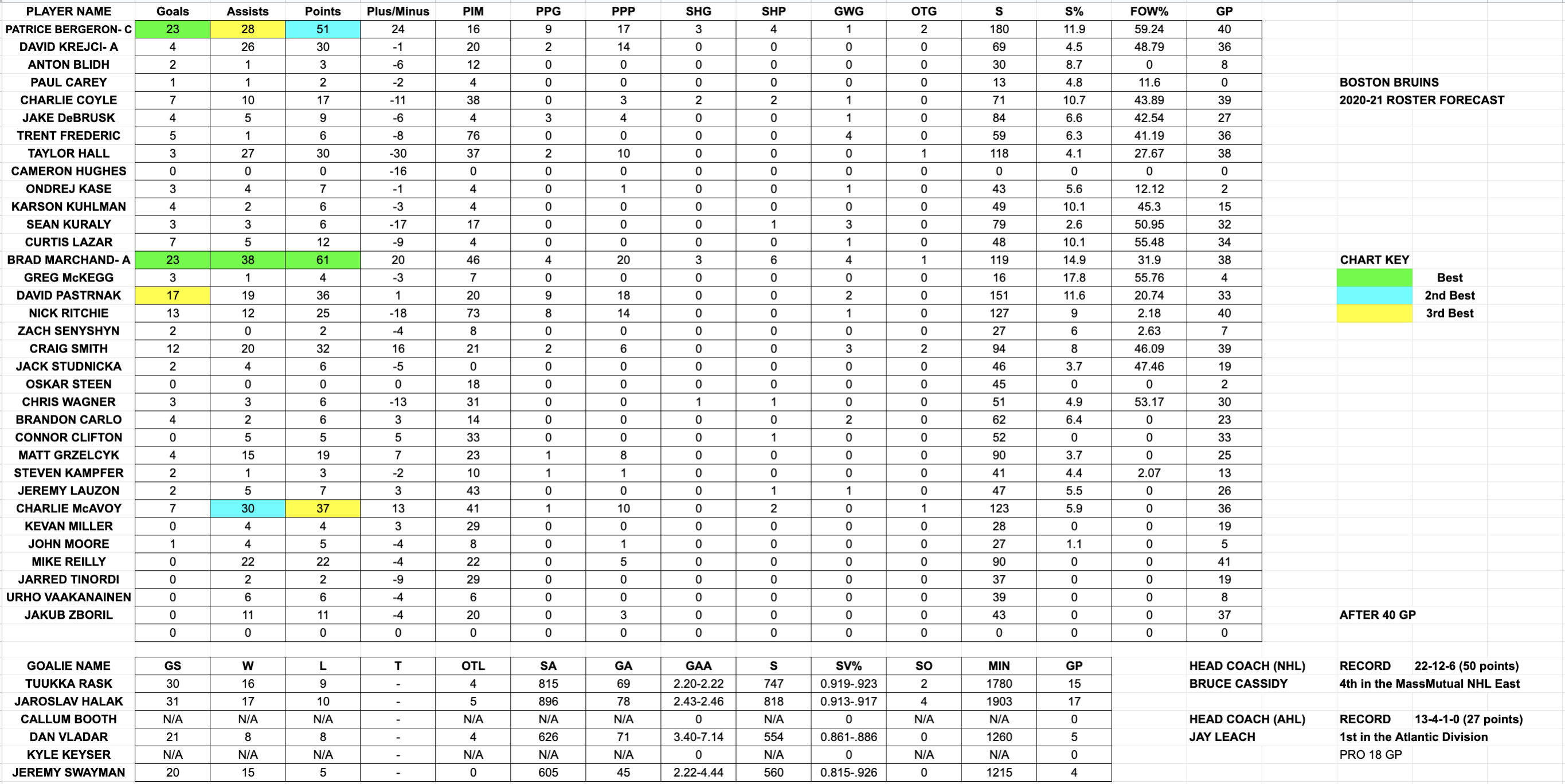
    Boston Bruins Forecast Through 40 Games Played (16 Games Remaining)

    Brad Marchand remains on track to receive Hart Memorial Trophy attention as he’s in the midst of having a strong pull in Boston’s playoff direction.

    The Bruins winger is forecasted to have 23-38–61 totals when all is said and done in 2020-21, which would’ve put him on pace for about 90 points in a regular length 82-game season had the ongoing pandemic never happened.

    For the first time this season, David Pastrnak (17-19–36 forecasted totals) is not forecasted to lead his team in goals.

    Instead, Marchand and Patrice Bergeron (23-28–51 forecasted totals) are forecasted to split the team lead in goals with 23 each, while Pastrnak trails with the second-most (17).

    Nick Ritchie and Craig Smith are on track for 13 and 12 goals, respectively, as some of the better components of Boston’s depth this season, while third line center, Charlie Coyle’s down year continues with seven forecasted goals this season, which… …actually isn’t that bad?

    Sure, 2021 hasn’t been the best year for Coyle, but it seems like a “bad year” for Coyle works much in the same that a “bad year” does for David Krejci.

    It’s not that Coyle and Krejci are superhuman, but rather just human.

    Plus, Krejci has already surpassed the four goals that he was forecasted to score in this 40 team games played model. Relax, folks. Every year can’t be golden.

    On defense, Charlie McAvoy leads the team in points from the blue line with 7-30–37 forecasted totals, while newcomer Mike Reilly continues to impress with 22 forecasted assists (that’ll probably be too few).

    In the meantime, upon returning to full health, Matt Grzelcyk can carve out 19 points in a battered season for Boston’s defenders.

    While Reilly is destined to continue being a playmaker from the back end, newly acquired forwards Taylor Hall and Curtis Lazar are each expected to contribute offensively with Hall forecasted for 30 points by season’s end alongside Krejci and Smith, while Lazar should be good for 12 points on the season from the fourth line.

    Oh and as for the since departed Anders Bjork? Well, at the time of the trade, he was forecasted to produce eight points this season.

    That said, with consistent ice time in a top-six role in Buffalo, the new Sabres forward could yield respectable double-digit totals in such a short timespan. Nothing crazy, but 10 points or more isn’t out of reach if he was already on track to get about eight.

    As long as the Bruins’ new-found offense can continue to produce and spur bottom-six scoring, then there’s a good chance with enough time to heal that the B’s can reset themselves on course for a playoff run with something to prove.

    Sure the 2021 Expansion Draft for the Seattle Kraken got a bit more complicated with pending-unrestricted free agents in Hall and Reilly added to the fold, but if this is truly it for Boston’s core with Bergeron, Krejci, Marchand and Tuukka Rask (Krejci and Rask also being pending-UFA’s) then the time is now to go all-in and go for it.

    Rask (2.20-2.22 forecasted goals-against average, .919-.923 forecasted save percentage) is expected to be rejuvenated by a decreased workload due to injury and the emergence of a hot hand in Jeremy Swayman– Boston’s fourth-string goaltender that, along with Dan Vladar, has literally saved the season.

    Upon Jaroslav Halak’s (2.43-2.46 forecasted goals-against average, .913-.917 forecasted save percentage) return from COVID protocol, there’s a chance the usual duo of netminders for the Bruins could show signs of rust as they ease back into the routine for the long run.

    That’s where Swayman and his best case scenario 2.22 forecasted goals-against average and .926 forecasted save percentage can provide relief as the B’s workout a three goaltender rotation similar to the Carolina Hurricanes’ situation with Petr Mrazek, James Reimer and Alex Nedeljkovic.

    Whether it was inevitable that the NHL as a whole adopts a three-goaltender system because goaltending tandems were already catching on or simply a product of the contemporary times in a pandemic whereby carrying a third goaltender becomes a necessity by default, it’s not a bad idea for Boston to assess what they’ve got for the future.

    Next season could very well be Rask and Swayman in net if the Bruins re-sign No. 40 this summer as the Finnish goaltender has indicated he’d like to be part of Boston’s transition in the crease a la the days of the transfer in power from Tim Thomas to Rask himself.

    For a look at how things might have gone for the Bruins entering the 2020-21 season, feel free to read the original forecast through zero games played and how things looked through 20 games played.

  • Analysis: Leafs add depth and vital cap space in Nash

    The Toronto Maple Leafs acquired center, Riley Nash, from the Columbus Blue Jackets for a conditional 2022 7th round pick on Friday. If Nash appears in 25% of Toronto’s 2021 postseason games, then the 2022 7th round pick is upgraded to the Maple Leafs’ own 2022 6th round pick.

    Nash, in the meantime, was placed on the long-term injured reserve on Tuesday (ahead of Friday’s deal) with a lower body injury that is expected to keep him sidelined for six weeks at most.

    While Columbus continues to fall out of the playoff picture, Maple Leafs General Manager, Kyle Dubas, got some much needed depth in the event of injury and relief in salary cap spending as the trade deadline approaches on Monday, April 12th at 3 p.m. ET.

    Toronto won’t have to worry about working Nash into the lineup or his salary for the time being, while Dubas is free to work the phones for potential additions without subtraction as the Leafs look to win their first Stanley Cup ring since 1967.

    Nash, 31, had seven points (two goals, five assists) in 37 games with Columbus this season at the time of the trade on Friday.

    A Consort, Alberta native, he has 63-109–172 totals in 578 career NHL games with the Carolina Hurricanes, Boston Bruins and Blue Jackets and was originally drafted by the Edmonton Oilers in the 1st round (21st overall) of the 2007 NHL Draft.

    The 6-foot-2, 188-pound center made his league debut with the Hurricanes in 2011-12, and has 2-6–8 totals in 32 career Stanley Cup Playoff games, including one goal and one assist in 10 postseason games in 2020 with Columbus.

    He set career-highs in goals (15), assists (26) and points (41) in 76 games with the Bruins in 2017-18, and has made a career out of being one of the better penalty killing forwards in today’s game.

    Nash carries a $2.750 million cap hit and is a pending-unrestricted free agent at season’s end.

    The 2022 7th round pick that the Blue Jackets acquired in the Nash trade is Toronto’s own, which likely won’t pan out to be much unless Columbus General Manager, Jarmo Kekäläinen, has other ideas in mind, such as utilizing his scouting staff to the utmost of their ability and finding a diamond in the rough or flipping the pick as part of a deal at a later date.

    In the meantime, Kekäläinen has bigger fish to fry with head coach, John Tortorella’s, contract expiring at season’s end and virtually no reason to keep Tortorella in the dressing room if the Blue Jackets are indeed to miss 2021 Stanley Cup Playoffs action.

    Columbus could fire Tortorella now and try to save face when it comes time to re-sign valuable free agents like pending restricted free agent, Patrik Laine, or they could let Tortorella go without renewing his current deal (and thus owing nothing in severance packages or whatever) and face whatever consequences that has on their roster.

    Additionally, Kekäläinen will have to assess whether it’s worth selling off further expendable parts to gear up for the 2021 Seattle Kraken Expansion Draft, as well as the 2021-22 season.

  • Analysis: Connolly move opens door for more

    The Florida Panthers dealt forward, Brett Connolly, defender Riley Stillman, the signing rights to forward, Henrik Borgström, and a 2021 7th round pick to the Chicago Blackhawks on Thursday in exchange for forward, Lucas Wallmark, and defender, Lucas Carlsson.

    Thursday’s move comes as the Panthers are in the midst of their best season in about 25 years and prime for further addition by next Monday’s 3 p.m. ET trade deadline.

    From Taylor Hall speculations to strengthening their blue line due to the loss of Aaron Ekblad to injury, Florida freed up cap space by moving Connolly’s $2.425 million cap hit off the books as a result of moving him to the taxi squad prior to the trade with Chicago.

    Nothing is imminent, but Panthers General Manager, Bill Zito, has ushered in an era of proactivity that we’re all just waiting for the other shoe to drop.

    Meanwhile, the Panthers reunited with a familiar face in Wallmark as he was previously acquired by the team in a transaction with the Carolina Hurricanes as part of a larger package in exchange for Vincent Trocheck on Feb. 24, 2020.

    The Blackhawks, meanwhile, bolstered their bottom six depth and taxi squad members as a result of the deal in the wake of their surprise contention for a playoff berth this season.

    Most experts agreed entering 2020-21, that this season would be one in which Chicago General Manager, Stan Bowman, would have to navigate an impending rebuild, but that might not be the case as the Blackhawks have had pleasant surprises in production and NHL readiness in Pius Suter, Kevin Lankinen and others.

    Connolly, 28, had four points (two goals, two assists) in 21 games with the Panthers this season at the time of the trade on Thursday. He has 100-92–192 totals in 517 career NHL games for the Tampa Bay Lightning, Boston Bruins, Washington Capitals and Panthers since being drafted in the 1st round (6th overall) by Tampa in 2010, and making his league debut with the Lightning in 2011-12.

    A native of Campbell River, British Columbia, the 6-foot-3, 198-pound right wing carries a $2.425 million cap hit this season, as well as a $2.375 million cap hit from 2021-22 through 2022-23, when he will then be an unrestricted free agent.

    While Connolly is on pace for three goals this season, he experienced a career resurgence with Washington, tallying career-highs in goals (22), assists (24) and points (46) in 81 games with the Capitals in 2018-19.

    He recorded 19-14–33 totals in 69 games with Florida last season prior to the ongoing COVID-19 pandemic shortening the regular season.

    In 42 career Stanley Cup Playoff games, Connolly has 8-3–11 totals, including nine points (six goals, three assists) in 24 games with the Caps en route to their 2018 Stanley Cup championship.

    Stillman, 23, had no points and 14 penalty minutes in eight games this season with Florida to go along with his plus-2 rating.

    The 6-foot-1, 196-pound native of Peterborough, Ontario and son of two-time Stanley Cup winner, Cory Stillman, has five assists in 43 career NHL games since making his league debut with the Panthers in the 2018-19 season after being drafted by Florida in the 4th round (114th overall) in 2016.

    Stillman has appeared in three career postseason games, has no points and was a minus-3 in Florida’s 2020 Stanley Cup Qualifier series loss to the New York Islanders.

    As he went from the taxi squad on the Panthers to the taxi squad on the Blackhawks, he currently does not count against Chicago’s salary cap and is a pending-restricted free agent at season’s end.

    Borgström, 23, has 11-8–19 totals in 28 games with HIFK in Liiga over in Finland this season. The 6-foot-3, 199-pound Helsinki native was originally drafted by the Panthers in the 1st round (23rd overall) in 2016, and made his league debut in the 2017-18 season.

    In 58 career NHL games with Florida, Borgström had 9-10–19 totals and has yet to appear in a Stanley Cup Playoff game.

    Wallmark, 25, had three assists in 16 games with Chicago this season at the time of the trade on Thursday and has 23-36–59 totals in 183 career NHL games with the Carolina Hurricanes, Panthers and Blackhawks.

    Originally drafted by Carolina in the 4th round (97th overall) in 2014, the 6-foot, 178-pound native of Umea, Sweden is in his second stint with the Panthers organization.

    He had a career-high 12 goals with the Hurricanes and Panthers in 67 games last season and set career-highs in assists (18) and points (28) in 81 games with Carolina in 2018-19, recording five points (one goal, four assists) in 15 playoff games with the Hurricanes en route to their 2019 Eastern Conference Final appearance.

    He had no points in two postseason games with Florida in 2020 and is a pending-restricted free agent at season’s end with a $950,000 cap hit if he weren’t already on the taxi squad.

    Carlsson, 23, had one assist in 12 games with Chicago this season at the time of the trade and has two points (two assists) in 18 career games since making his league debut last season with the Blackhawks.

    A native of Gävle, Sweden, the 6-foot, 189-pound defender was originally drafted by Chicago in the 4th round (110th overall) of the 2016 NHL Draft and has appeared in one career postseason game in 2020.

    Carlsson had 5-21–26 totals with the Rockford IceHogs (AHL) in 48 games last season, as well as three points (one goal, two assists) in seven games with Rockford in 2020-21.

    Though he technically carries a $792,500 cap hit, the Blackhawks won’t be charged anything against their cap as long as he is on the taxi squad. He is a pending-restricted free agent at season’s end.

  • Boston Bruins 2020-21 Forecast

    Boston Bruins 2020-21 Forecast

    Hello, friend.

    Last season, I didn’t get around to posting my forecasts for the Boston Bruins, Carolina Hurricanes, Columbus Blue Jackets and Vegas Golden Knights’ rosters.

    I kept track of everything before the 2019-20 season began and after each quarter mark (roughly 20 games) as I normally do, but I just didn’t quite have the time and/or motivation to do a write up here on the blog for each one– let alone any of them.

    This season, I’m already behind in presenting my findings entering 2020-21, but I’ve prepared all four teams’ player forecasts as usual.

    To kick things off, we’ll take a look at how the 2020-21 season could’ve panned out if all Bruins players were healthy entering the 56-game season, but by the end of the month, Boston will already be 20 games into the season (provided nothing else is postponed) so it’ll be time for an updated forecast.

    For the rest of the teams– including the addition of the Colorado Avalanche for a total of five teams being tracked this season– we’ll just take a gander at how things looked coming into 2020-21 and where each player is tracking after their respective 20-game mark.

    In other words, Boston gets two posts (this one and another one in March) while Carolina, Colorado, Columbus and Vegas will each get a joint “forecast before the season began and forecast through 20 team games played” post, probably.

    If you’re a fan of those teams and my… …expertise(?), I’m sorry. Please be patient. You’ve already been waiting since the last forecast I published in the 2018-19 season.

    If you’re a fan of the B’s, well good news, let’s get into the forecast details.

    As always, keep in mind that my degree is in communication and my minor was in sport management. I got a “C” in my Intro to Stats class in my first semester of college way back in *checks notes* the fall of 2013.

    It was a night class and it was terrible, but I digress.

    First year players are impossible to predict until they’ve had at least one National Hockey League game under their belt.

    Young players that have had minimal NHL experience may also reflect “inflated” results.

    No, Zach Senyshyn probably isn’t going to have 28 assists this season, but since he has two assists in six games over the last two seasons (his entire NHL career), the forecasting function in Microsoft Excel does math stuff based on his entire career as it would relate to if he played in all 56 games for Boston this season.

    This will fix itself as the season progresses.

    The same goes for Jack Studnicka’s forecasted 28 assists. Entering 2020-21, Studnicka has only played in two NHL games since just last season.

    He’s already had a goal in six games this season and in the next forecast (after 20 team games played), he’ll likely be forecasted to have 1-8–9 totals by season’s end (assuming he plays in the remaining 36 games).

    Forecast is different from pace.

    Injuries, being a healthy scratch or on the taxi squad, other American Hockey League related or waiver related transactions, sickness, COVID protocol and general superstitions (getting enough sleep the night before a game, taping your stick a certain way every time, putting on the right skate before the left skate or whatever) may disrupt a player’s season.

    These variables– tangible or not– are part of the game and cannot be accounted for in your everyday “straight up” forecast.

    In an utopian timeline, this forecast pretends nothing bad could ever happen and every player has a chance to live up to their expectations. Of course, some will pan out, some will exceed expectations and some will miss the mark.

    It’s merely a suggested outcome for a sport that’s highly unpredictable because of its collectivistic nature and sheer puck luck.


    Boston Bruins Forecast Through 0 Games (56 Games Remaining)

    Had the 2019-20 season gone according to schedule, David Pastrnak might not have missed any time to start the 2020-21 season.

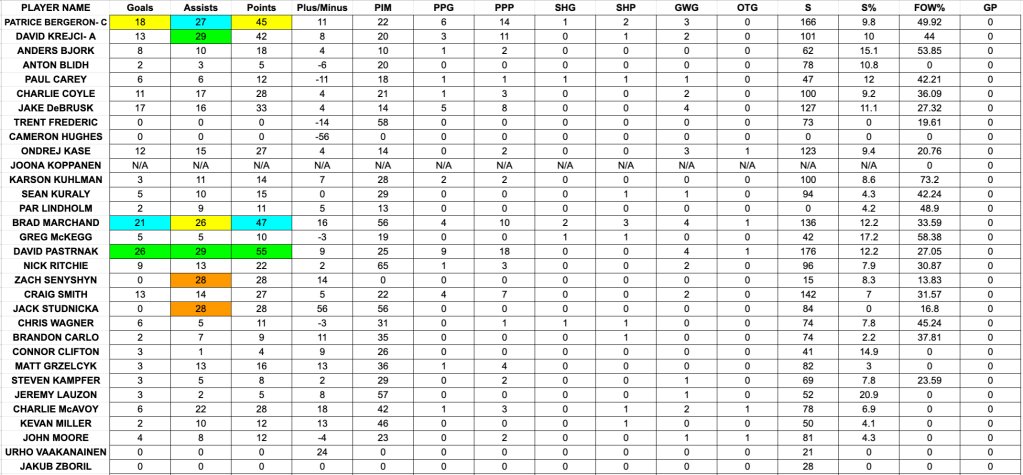
    Nevertheless, we’ll pretend that an alternate timeline stills exists for a moment and mention that if he had played in all 56 games this season, he was forecasted to lead the Bruins with 26-29–55 totals.

    Brad Marchand was forecasted as the next highest scorer with 21 goals and 47 points, while David Krejci looked to lead the B’s in assists (29).

    Of course, none of this is how it really happened, but Pastrnak is still off to a hot start, Marchand is feeling “100-percent” and Krejci is only now just about to miss game action, having not traveled with the team to Lake Tahoe for their outdoor matchup with the Philadelphia Flyers on Sunday night.

    Senyshyn and Studnicka’s assist totals have been highlighted in the chart above in reference to what’s already been stated in the introduction to this post.

    Newcomer, Craig Smith, was forecasted to hit the twine 13 times and accrue 14 assists for 27 points this season, while Ondrej Kase was expected to notch 27 points in a 56-game season prior to injury.

    On defense, the loss of Zdeno Chara and Torey Krug is expected to be felt on the scoresheet, though we’re likely to see Charlie McAvoy’s stock rise in the next forecast after 20 team games played.

    Speaking of McAvoy, he was expected to lead the team in points from the blue line entering the 2020-21 season with 6-22–28 totals.

    In goal, Boston’s poised for another strong run from their goaltending tandem of Tuukka Rask and Jaroslav Halak.

    Though Rask is likely to get more starts than Halak, the two are prime for producing similar numbers this season in differing workloads.

    Rask is set for another season with a goals against average in the low two’s, between 2.28 and 2.34, while Halak is right on track for being one of– if not– the best “backups” in the league with a forecasted GAA between 2.48 and 2.72.

    Stay tuned for the next forecast in about four games– however soon that will be, provided nothing else is postponed and the Bruins can avoid piling up names on the league’s COVID Protocol list.

  • DTFR Podcast #216- Participation Trophies After One Game/One Week (Part V)

    DTFR Podcast #216- Participation Trophies After One Game/One Week (Part V)

    The 2020-21 season is underway and it’s already been a week, so let’s bring back our 5th Annual Participation Trophies After One Game awards ceremony!

    Subscribe to the podcast on Apple PodcastsStitcher and/or on Spotify.