Tag: Cameron Hughes

  • Bruins take commanding 3-1 series lead with Game 4 victory

    Bruins take commanding 3-1 series lead with Game 4 victory

    The Boston Bruins are one win away from advancing to the Second Round of the 2021 Stanley Cup Playoffs after their, 4-1, win over the Washington Capitals at TD Garden Friday night in Game 4 of their First Round series.

    David Pastrnak had the eventual game-winning goal as Tuukka Rask (3-1, 1.99 goals-against average, .930 save percentage in four games played) made 19 saves on 20 shots faced en route to a franchise record setting 54th career Stanley Cup Playoffs win– surpassing Gerry Cheevers’ previous mark of 53 postseason wins in a Bruins uniform.

    Washington goaltender, Ilya Samsonov (0-2, 2.96 goals-against average, .913 save percentage in two games played), had 33 saves on 37 shots against in the loss.

    Boston took a 3-1 series lead as a result of their victory on Friday night and improved to 17-17 overall in Game 4s when leading a series 2-1.

    The Bruins were without the services of Ondrej Kase (upper body), John Moore (hip) and Jeremy Lauzon (upper body) in Game 4. Lauzon has missed the last three games, while Kase and Moore have missed the entire postseason with Moore out until next season.

    Bruce Cassidy made no changes to Boston’s lineup as a result.

    The B’s had a long list of healthy scratches, taxi squad members and injured players that included Nick Wolff, Trent Frederic, Greg McKegg, Zach Senyshyn, Jack Studnicka, Moore, Kase, Jaroslav Halak, Steven Kampfer, Cameron Hughes, Jack Ahcan, Lauzon, Urho Vaakanainen, Oskar Steen, Jakub Zboril, Callum Booth, Dan Vladar, Anton Blidh, Karson Kuhlman and Jarred Tinordi.

    In the meantime, Lars Eller was back in the lineup for Washington after missing Game 3 with a lower body injury as Samsonov got his second consecutive postseason start.

    One Bruin was half-stepping onto the bench, while another Bruin had just entered the action on a line change and landed a hit, but in the eyes of the on-ice officials, Boston had too many skaters on the ice.

    The Bruins were assessed a bench minor for too many skaters 49 seconds into the first period and the Capitals went on the power play for the first time in the action.

    Washington couldn’t capitalize on the ensuing skater advantage, however, while Nick Ritchie served Boston’s bench minor.

    Moments later, Charlie Coyle tripped up Nick Jensen as the Caps defender worked his way to the net.

    The Bruins went back on the penalty kill at 5:51 and proceeded to deny Washington’s power play of getting a stronghold in both possession and on the scoreboard.

    Late in the period, the Capitals presented Boston with their first power play of the night as Mike Reilly worked to get out of his own zone and was tripped up by Michael Raffl at 19:23.

    The Bruins’ skater advantage would extend into the middle frame as the B’s couldn’t muster anything on the power play– despite ringing the iron– as the horn sounded to signal the start of the first intermission.

    After one period of play, the score remained tied, 0-0, while the Bruins led in shots on goal, 11-4.

    Boston also held the advantage in blocked shots (7-6) and takeaways (9-1), while both teams managed three giveaways each, 14 hits aside and were, 50-50, in faceoff win percentage after 20 minutes of action.

    The Capitals were 0/2 and the Bruins were 0/1 on the power play heading into the middle frame.

    The B’s couldn’t take advantage of the remaining 1:24 that they had on the power play while Raffl was in the box to kickoff the second period.

    Early in the middle period, however, Taylor Hall got a breakaway and nearly scored while Samsonov was left looking a bit unnerved by a lower body ailment.

    Samsonov stayed in the game, however.

    Minutes later, Dmitry Orlov hit Kevan Miller up high after leaving his feet, which sent the Bruins defender backwards, falling head first into the ice.

    Orlov was originally assessed a major penalty, but it was reduced after review to a double minor for roughing, meanwhile Miller was helped off the ice in the third consecutive night of head injuries across the league.

    The Bruins provided an update prior to the third period that Miller was taken to a local hospital for scans and further evaluation.

    Coyle retaliated and picked up a roughing minor as Orlov was sent to the box with his four-minute double minor for roughing and the B’s had a power play at 7:27 of the second period.

    It didn’t take Boston long to find the back of the net on the ensuing skater advantage as Pastrnak ripped a shot from the faceoff circle that Brad Marchand (3) deflected from point blank past Samsonov.

    Pastrnak (3) and Charlie McAvoy (3) tallied the assists on Marchand’s power-play goal as the Bruins took a, 1-0, lead at 8:00 of the second period.

    Garnet Hathaway cut a rut to the sin bin for roughing against Patrice Bergeron at 11:01, but the Bruins failed to record a shot on net on the resulting power play.

    Moments later, Jake DeBrusk slashed Anthony Mantha and was sent to the box at 14:03, presenting the Caps with another power play as a result.

    The Capitals failed to convert while DeBrusk was in the box, but got another chance at the skater advantage when Bergeron sent the puck over the glass and out of play for an automatic delay of game infraction at 17:43.

    That too, however, went unconverted.

    Instead, Mantha interfered with McAvoy at 19:45 and presented Boston with another power play that would extend into the final frame.

    The Bruins led, 1-0, after two periods of play and had the advantage in shots on goal, 23-13, including a, 12-9, advantage in the second period alone.

    Boston dominated in blocked shots (14-8) and takeaways (12-3), while Washington led in giveaways (6-5), hits (25-21) and faceoff win% (54-46) heading into the second intermission.

    The Caps were 0/4 and the B’s were 1/4 on the power play heading into the final frame of regulation.

    Pastrnak (1) sent a shot from the faceoff dot under Samsonov’s blocker into the back of the net to give Boston a, 2-0, lead 29 seconds into the third period.

    McAvoy (4) and David Krejci (2) notched the assists on Pastrnak’s power-play goal as the Bruins turned up the intensity to begin the third.

    DeBrusk sent a shot off of Samsonov’s shoulder and high over the bar as the puck bounced off the glass and caromed to the side of the net where DeBrusk hacked at his own rebound before Coyle (1) pounced on the puck in the low slot to give Boston a three-goal lead.

    DeBrusk (1) had the only assist on Coyle’s goal as a result and the Bruins led, 3-0, at 1:03 of the third period.

    Tom Wilson just couldn’t resist watching the B’s score, so he decided to go at it with Ritchie after Coyle’s goal.

    As a scrum ensued instead of celebrating, Brandon Carlo mixed it up a bit with Wilson and the three of them– Wilson, Ritchie and Carlo– received minor infractions.

    Wilson and Ritchie went to the box for roughing, while Carlo earned an unsportsmanlike conduct infraction (it’s always the one that retaliates) at 1:03 of the third period.

    In turn, the Capitals failed to record a shot on goal on the ensuing power play.

    Marchand cut a rut to the box for interference at 4:16 and Washington wasted little time scoring on the resulting advantage.

    Alex Ovechkin (2) one-timed a shot from his usual spot while breaking his stick and inadvertently sending the puck off of Carlo’s blade– deflecting the rubber biscuit past Rask.

    John Carlson (2) and Nicklas Backstrom (1) tallied the assists on Ovechkin’s power-play goal as the Capitals trailed, 3-1, at 4:54 of the third period.

    Shortly thereafter, while trying to capitalize on the swing in momentum, Ovechkin checked Marchand along the wall.

    Pastrnak took exception to the hit and was sure to flatten Ovechkin seconds later as the Caps sustained pressure in the offensive zone, then Marchand hit Ovechkin in the open ice while the Capitals captain was still getting up from being knocked down by Pastrnak.

    The Bruins nearly scored about a minute later as Curtis Lazar fed Pastrnak on a 2-on-1 that nearly resulted in a goal if it weren’t for Samsonov’s sprawling save.

    Minutes later, Mantha went hard into the crease and beyond, yielding a minor infraction for goaltender interference at 13:31.

    Boston capitalized on the resulting power play as Matt Grzelcyk (1) blasted a one-timer from the faceoff dot over Samsonov’s glove on the short side to give the Bruins a, 4-1, lead.

    McAvoy (5) earned his third assist of the night, while Hall (1) picked up the secondary assist on Grzelcyk’s power-play goal at 14:50 of the third period.

    Late in the period, Coyle sent the puck over the glass at the bench, except the only trouble was that his stick was below the top of the boards so it really shouldn’t have been a penalty, but nevertheless…

    Boston killed off Coyle’s minor for delay of game at 16:22 as Washington struggled to keep the puck in the attacking zone.

    Caps head coach, Peter Laviolette, pulled Samsonov for an extra attacker to make the 5-on-4 a 6-on-4 advantage, but it was to no avail as the Bruins killed Coyle’s infraction and resumed play in a de facto shorthanded 6-on-5 situation.

    At the final horn, Boston had won, 4-1, in Game 4 and taken a 3-1 series lead.

    The Bruins finished the night leading in shots on goal, 37-20, including a, 14-7, advantage in the third period alone.

    Washington wrapped up Friday night’s action leading in giveaways (9-6) and hits (38-34), while Boston led in blocked shots (17-11) and faceoff win% (56-44).

    The Capitals went 1/7 on the power play, while the B’s were 3/5 on the skater advantage in Game 4.

    Boston improved to 3-1 when tied after the first period, 2-0 when scoring the game’s first goal and 1-0 when leading after two periods this postseason, while Washington fell to 1-3 when tied after one, 0-2 when allowing the game’s first goal and 0-1 when trailing after the second period in the 2021 Stanley Cup Playoffs.

    The Bruins now lead the series 3-1 as the teams head back to Washington, D.C. for Game 5 Sunday night at Capital One Arena. Puck drop is expected a little after 7 p.m. ET and fans in the United States can tune to USA Network for national coverage of the game, while those in Canada can choose between SN1 or TVAS2.

  • Smith lifts Bruins over Capitals, 3-2, in double OT

    Smith lifts Bruins over Capitals, 3-2, in double OT

    Craig Smith caught Ilya Samsonov mishandling the puck and wrapped around the net to give the Boston Bruins a 2-1 series lead in their, 3-2, double overtime victory over the Washington Capitals in Game 3 of their 2021 Stanley Cup Playoffs First Round matchup on Wednesday at TD Garden.

    Tuukka Rask (2-1, 2.27 goals-against average, .926 save percentage in three games played) made 35 saves on 37 shots faced in what became the 12th consecutive postseason game between the two clubs to be decided by one-goal.

    Oh and the Bruins had not led all night until the final result.

    Samsonov (0-1, 2.09 goals-against average, .930 save percentage in one game played), meanwhile, turned aside 40 out of 43 shots against in the loss for the Capitals.

    Boston was without the services of Ondrej Kase (upper body), John Moore (hip) and Jeremy Lauzon (upper body) on Wednesday.

    Bruins head coach, Bruce Cassidy, made no changes to his lineup from Monday night’s, 4-3, overtime win in Game 2 to Wednesday night’s Game 3.

    The B’s had a long list of healthy scratches, taxi squad members and injured players including, Nick Wolff, Trent Frederic, Greg McKegg, Zach Senyshyn, Jack Studnicka, Moore, Kase, Jaroslav Halak, Steven Kampfer, Cameron Hughes, Jack Ahcan, Lauzon, Urho Vaakanainen, Oskar Steen, Jakub Zboril, Callum Booth, Dan Vladar, Anton Blidh, Karson Kuhlman and Jarred Tinordi on Wednesday.

    At the other end of the rink, Evgeny Kuznetsov returned to the lineup for Washington, while Samsonov made his Stanley Cup Playoffs debut in the crease.

    Craig Anderson did not get the start in Game 3 due to “body maintenance” according to Capitals head coach, Peter Laviolette, while Lars Eller (lower body) missed Wednesday night’s action.

    The Caps became the second team in Stanley Cup Playoff history to start three different goaltenders in the team’s first three postseason games, joining the 1986 Winnipeg Jets in doing so.

    Alex Ovechkin was penalized for interference at 2:20 of the first period and presented Boston with the first power play of the night.

    The B’s did not capitalize on the ensuing skater advantage, however, and followed suit with a pair of penalties of their one– Mike Reilly for high sticking at 7:38, as well as a bench minor for too many skaters on the ice at 10:34– shortly after killing off Reilly’s infraction.

    Nick Ritchie served the bench minor as the Capitals failed to muster anything on back-to-back power plays.

    Washington defender, Zdeno Chara, caught former teammate in Boston, Charlie Coyle, with a slash while the two battled for a puck in the corner of the Bruins’ attacking zone, yielding a power play for the B’s at 13:18.

    Boston’s skater advantage soon became a 5-on-3 advantage as John Carlson sent the puck clear over the glass and induced an automatic delay of game minor at 14:24.

    The Bruins weren’t able to convert on the two-skater advantage.

    Finally, late in the opening frame, Sean Kuraly tripped Ovechkin and the Bruins were forced to kill off a minor infraction at 17:25.

    Heading into the first intermission, the score was still tied, 0-0, despite Boston outshooting Washington, 10-4.

    The Capitals dominated in just about everything else, leading in blocked shots (6-3), takeaways (4-2), giveaways (5-4) and hits (13-12), while both teams managed to split faceoff win percentage in the first period, 50-50.

    Both clubs were 0/3 on the power play entering the middle frame.

    Early in the second period, Nic Dowd blocked a shot from David Pastrnak and briefly went down the tunnel after hardly putting any weight on one of his legs.

    Dowd would return later in the period and, of course, score a goal, but first Brad Marchand took an unsportsmanlike minor at 6:56 of the second period, presenting the Capitals with another skater advantage opportunity.

    Late in the ensuing power play, Washington worked the puck deep into the attacking zone while Ovechkin (1) snuck into the slot, received a pass and fired a one-timer far on the glove side and just under the crossbar.

    Anthony Mantha (2) had the only assist on Ovechkin’s power-play goal at 8:21 of the second period and Washington jumped ahead, 1-0, in Game 3.

    Less than a minute later, however, the Bruins responded as Smith setup Taylor Hall with a behind the back pass to No. 71 in black and gold as Hall (2) spun around counterclockwise in front of the crease, pulled the puck from his backhand to his forehand and roofed a shout over the blocker, top-shelf.

    Smith (2) and Kevan Miller (1) tallied the assists as Hall tied the game, 1-1, at 9:17.

    Late in the period, Matt Grzelcyk caught Ovechkin with a high stick behind the Boston net and presented Washington with another power play at 15:45.

    Shortly after killing Grzelcyk’s minor, the Bruins were caught in the vulnerable minute on a giveaway while botching an exit out of their own zone.

    Garnet Hathaway fed Dowd with a shot pass under Reilly’s leg while the Bruins defender dove to breakup the passing lane that Dowd (2) redirected while crashing the slot to put the Capitals back in command, 2-1, at 18:15 of the second period.

    Hathaway (1) had the only assist on the effort.

    Through 40 minutes of action on Wednesday, the Caps led the B’s, 2-1, on the scoreboard despite Boston outshooting Washington, 21-20, in total shots on goal.

    The Capitals, however, outshot the Bruins, 16-11, in the second period alone and led in blocked shots (9-6), takeaways (7-6) and hits (32-28), while Boston held the advantage in giveaways (8-7).

    Washington was 1/5 on the power play, while the B’s were still 0/3 on the skater advantage heading into the final frame of regulation.

    Daniel Carr tripped Coyle at 3:25 of the third period, but the Bruins couldn’t get anything going on the resulting power play.

    Boston had another chance on the skater advantage when Dowd caught Charlie McAvoy with a high stick at 11:00 of the final frame of regulation and this time the B’s capitalized on the power play.

    Marchand (2) batted the puck out of mid-air off of a deflection from Patrice Bergeron that can best be described as a flubbed shot and/or a whiff.

    Anyway, Bergeron (1) and McAvoy (2) had the assists on Marchand’s power-play goal as the Bruins tied the action, 2-2, despite lacking a sustained offensive effort in the third period.

    Through 60 minutes, the score remained even, 2-2, despite Washington outshooting Boston, 29-24, including a, 9-3, advantage in the third period alone.

    The Capitals led in blocked shots (15-9), takeaways (12-8), hits (46-42) and faceoff win% (53-47), while the B’s led in giveaways (11-8).

    Both teams were 1/5 on the power play heading into the first overtime period.

    The refs had put their whistles away in the initial extra frame, yielding end-to-end action with more clutching and grabbing allowed as the two clubs swapped chances– though the Bruins dominated possession and shots on goal in the overtime alone.

    Laviolette started Nicklas Backstrom, Tom Wilson, Mantha, Dmitry Orlov and Carlson, while Cassidy countered with David Krejci, Smith, Hall, Reilly and Brandon Carlo at the opening draw in the extra frame.

    After 80 minutes of high intensity skating, the Bruins and Capitals were still tied, 2-2, on the scoreboard, despite Boston holding the advantage in shots on goal, 41-34, including a, 17-5, advantage in the first overtime period alone.

    Washington led in blocked shots (19-12), takeaways (15-11) and faceoff win% (52-48) through four peirods, while the B’s led in giveaways (12-9) and hits (58-55).

    Both teams were still 1/5 on the power play heading into the second overtime period.

    At the dawn of double overtime, Laviolette and Cassidy started the same lines that they had thrown out on the ice to kickoff the first overtime.

    Backstrom, Wilson and Mantha were countered by Krejci, Hall and Smith.

    On defense, Laviolette offered Brenden Dillon and Justin Schultz, while Cassidy tossed out Reilly and Carlo once more.

    Marchand nearly ended it, then Pastrnak had a breakaway, but misfired as he took a stick to the midsection, then crashed into the endboards and was slow to get up.

    He did not miss a shift, though, and no penalty was called.

    Moments later, Samsonov misplayed the puck in the trapezoid assuming one of his defenders might scoop it up right as Smith never gave up on the play, however.

    Smith (1) wrapped the rubber biscuit around the net and slid it behind the Caps netminder for the game-winning goal at 5:48 of the second overtime period.

    The individual effort was unassisted and provided Boston with a 2-1 series lead thanks to their, 3-2, double overtime victory in Game 3 on Wednesday.

    Yes, even after reaching double overtime, the game still managed to end before midnight thanks to a 6:30 p.m. ET start.

    The Bruins finished the night leading in shots on goal, 43-37, despite being outshot, 3-2, in the second overtime itself.

    Washington wrapped up the action leading in blocked shots (20-14) and faceoff win% (52-48), while Boston led in giveaways (12-10) and hits (60-57).

    The two each clubs finished 1/5 on the power play.

    The Bruins improved to 2-1 when tied after the first period, 1-1 when allowing the game’s first goal, 1-0 when trailing after two periods, 2-1 when tied after three periods and 1-0 when tied after the first overtime in this postseason.

    The Capitals, meanwhile, dropped to 1-2 when tied after one, 1-1 when scoring the game’s first goal, 0-1 when leading after two, 1-2 when tied after three and 0-1 when tied after the first overtime in the 2021 Stanley Cup Playoffs.

    Boston leads the series 2-1 with the chance to take a commanding 3-1 series lead in Game 4 on Friday night on home ice.

    Puck drop at TD Garden is expected a little after 6:30 p.m. ET and viewers in the United States can tune to NBCSN for national coverage, while those in Canada have the option to choose from SN360, SNE, SNO, SNP or TVAS depending on where you live.

  • Raffl sinks Bruins in dying seconds, Caps win, 2-1

    Raffl sinks Bruins in dying seconds, Caps win, 2-1

    Michael Raffl scored the game-winning goal off the back of Jeremy Swayman with about three seconds left on the game clock to give the Washington Capitals a, 2-1, victory over the Boston Bruins at Capital One Arena in both teams’ last game of the regular season.

    Vitek Vanecek (21-10-4, 2.70 goals-against average, .908 save percentage in 37 games played) made 24 saves on 25 shots against in the win for Washington.

    Swayman (7-3-0, 1.50 goals-against average, .945 save percentage in 10 games played), stopped 30 out of 32 shots faced in the loss.

    The Bruins finished the 2020-21 regular season 33-16-7 (73 points) overall and in 3rd place in the MassMutual NHL East Division, while the Capitals went 36-15-5 (77 points) this season and finished in 2nd place in the same division.

    The two clubs will face each other in the First Round of the 2021 Stanley Cup Playoffs.

    Boston also dropped to 15-9-4 on the road and 4-2-2 against Washington in 2020-21.

    The Bruins were without Ondrej Kase (upper body), John Moore (hip) and Charlie Coyle (upper body) due to injury on Tuesday, while head coach, Bruce Cassidy elected to rest Brad Marchand, Patrice Bergeron, David Pastrnak, Taylor Hall, David Krejci, Craig Smith, Sean Kuraly, Charlie Coyle, Matt Grzelcyk, Charlie McAvoy, Mike Reilly, Brandon Carlo, Jeremy Lauzon, Kevan Miller, Jaroslav Halak and Tuukka Rask for the final game of the regular season.

    Boston returns home after their evening in Washington, D.C. for a day off on Wednesday.

    The B’s return to practice at Warrior Ice Arena on Thursday and Friday ahead of Game 1 back in Washington, D.C. on Saturday night.

    By sitting most of his regular lineup, Cassidy jumbled his forwards and defenders on Tuesday night with Curtis Lazar centering the first line– flanked by Jake DeBrusk and Chris Wagner on his wings.

    Greg McKegg centered the second line with Nick Ritchie and Zach Senyshyn on the wings. Ritchie and Wagner each wore an “A” with Steven Kampfer wearing the third “A”, designated as alternate captains while Bruins captain, Bergeron, and regular alternates, Krejci and Marchand were withheld from Tuesday night’s action.

    Jack Studnicka centered the third line with Trent Frederic at left wing and Oskar Steen at right wing, while Cameron Hughes, Anton Blidh and Karson Kuhlman rounded out the bottom-six forwards.

    On defense, Jakub Zboril was paired with Connor Clifton on the first pairint, while Jarred Tinordi and Kampfer, as well as Jack Ahcan and Urho Vaakanainen rounded out the rest of the blue line.

    Dan Vladar served as Swayman’s backup with Rask and Halak given the night off.

    Boston’s long list of healthy scratches, taxi squad members and injured players included Reilly, Smith, Coyle, Carlo, Moore, Kase, Bergeron, Rask, Halak, Krejci, Grzelcyk, Kuraly, Lauzon, Marchand, Callum Booth, Hall, McAvoy, Miller and Pastrnak.

    Washington was without some big names in T.J. Oshie (lower body), John Carlson (lower body), Evgeny Kuznetsov (COVID protocol) and Ilya Samsonov (COVID protocol) on Tuesday.

    At puck drop, Ritchie became the only Bruin to play in all 56 games this season.

    Meanwhile, midway through the opening frame, Clifton caught Carl Hagelin with a slash and promptly presented the Capitals with the first power play of the night at 7:15 of the first period.

    Washington’s power play was cut short, however, when Anthony Mantha tripped Kampfer at 8:44, yielding 31 seconds of 4-on-4 action before the Bruins had an abbreviated power play.

    Boston’s special teams couldn’t muster anything on their brief skater advantage.

    Heading into the first intermission, the game was still tied, 0-0, despite Washington leading in shots on goal, 9-6.

    The Bruins led in blocked shots (9-2), takeaways (4-2), giveaways (2-1) and hits (16-13), while the Capitals held the advantage in faceoff win percentage (55-46).

    Both the Caps and the B’s were 0/1 on the power play heading into the middle frame.

    DeBrusk worked the puck up to Tinordi as the Bruins defender pinched into the attacking zone on a rush before sending a pass to Lazar (7) in the slot for a tap-in while Vanecek was out of position– giving Boston a, 1-0, lead in the process.

    Tinordi (1) and DeBrusk (9) tallied the assists on Lazar’s goal at 10:11 of the second period.

    The B’s did not hold the lead for long, however, as Hagelin (6) pocketed a rebound while Swayman was sprawling in effort to clear the crease.

    Garnet Hathaway (12) and Zdeno Chara (8) had the assists on Hagelin’s goal as the Caps tied the game, 1-1, at 16:15 of the second period.

    Through 40 minutes of play, the Bruins and Capitals were tied, 1-1, on the scoreboard despite Washington holding a, 26-14, advantage in shots on goal, including a, 17-8, advantage in the second period alone.

    Boston dominated in blocked shots (16-4) and hits (22-20), while the Caps led in takeaways (7-4) and faceoff win% (52-48).

    Both teams had three giveaways each and remained 0/1 on the power play heading into the final frame.

    Prior to the start of the third period, the Bruins tweeted that Zboril would not return to the night’s action with an upper body injury.

    Less than two minutes into the final frame, Frederic and Tom Wilson exchanged pleasantries leading to ten-minute misconducts for each player– a fair tradeoff for Boston to give up a bottom-six winger for Washington’s infamous forward at 1:49 of the third period.

    As each penalty was a misconduct, there was no change in strength as both teams remained at 5-on-5 for the rest of the night.

    No more penalties were called and no goals were scored until the dying seconds when Raffl (4) riffled a shot from behind the goal line off of Swayman’s back– bouncing just under the crossbar and back out from the twine.

    Justin Schultz (24) had the only assist on Raffl’s game-winning goal at 19:57 of the third period as the Capitals secured the, 2-1, victory at the final horn.

    Washington wrapped up the night’s action with the advantage in the final shot total, 32-25, despite being outshot by Boston, 11-5, in the third period alone.

    The Bruins finished the night leading in blocked shots (21-10), while the Capitals led in giveaways (9-4), hits (39-33) and faceoff win% (62-38).

    Both teams finished 0/1 on the night on the skater advantage.

    After the game, Cassidy informed reporters that Swayman would serve as Rask’s backup in the postseason and indicated that Coyle would likely be cleared for a return to the lineup for Game 1.

    Meanwhile, Kase’s status remains uncertain for Saturday night, at least.

    Boston finished the 2020-21 regular season 8-8-2 (5-4-0 on the road) when tied after the first period, 25-6-3 (12-6-1 on the road) when scoring the game’s first goal and 6-8-3 (5-6-2 on the road) when tied after two periods.

    Washington, on the other hand, wrapped up their 2020-21 regular season efforts 16-3-1 (7-2-1 at home) when tied after one period, 11-10-2 (7-6-1 at home) when allowing the game’s first goal and 8-2-5 (4-1-3 at home) when tied after the second period.

    The Bruins finished their 2020-21 regular season on Tuesday and will return to Boston for a day off on Wednesday before practicing on Thursday and Friday ahead of Saturday’s Game 1 matchup with the Capitals in Washington, D.C.

    Washington has home-ice advantage in their First Round series with Boston in the 2021 Stanley Cup Playoffs for the first time since their 1998 matchup with the Bruins in the Eastern Conference Quarterfinal that year. 

    This will be the fourth time that the two clubs go head-to-head in the playoffs with the Capitals holding an all-time 2-1 series advantage. 

    The Caps defeated the B’s most recently in seven games in the 2012 Eastern Conference Quarterfinal as well as in six games in the 1998 Eastern Conference Quarterfinal, while the Bruins swept Washington in the 1990 Wales Conference Final.

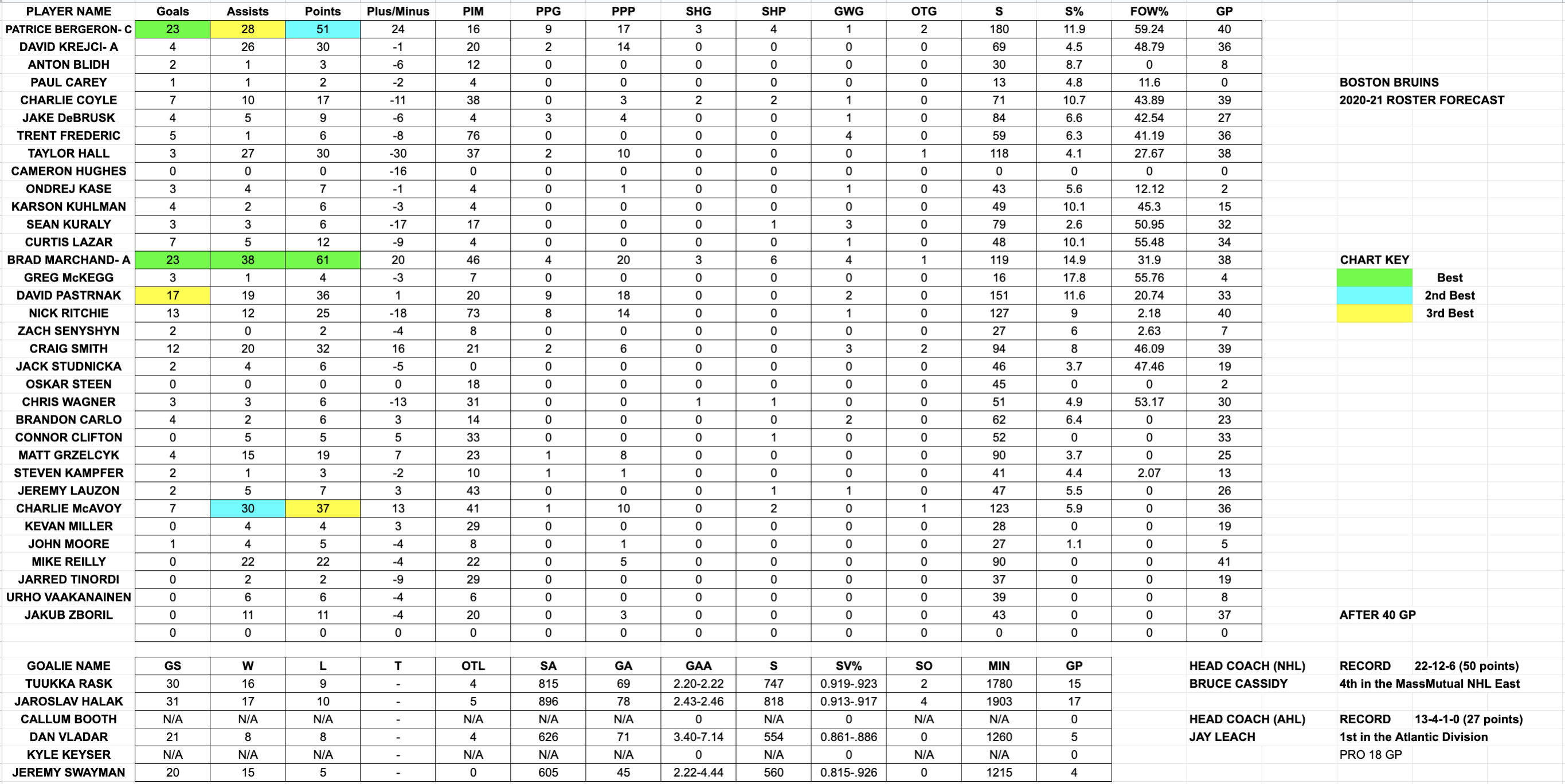
  • Boston Bruins 2020-21 Forecast Through 40 Games

    Boston Bruins 2020-21 Forecast Through 40 Games

    “The stretch” is here. No, not the 7th inning stretch. It’s the Push for the Playoffs™️ as the NHL on NBC broadcasts will tell you.

    Sure, the Boston Bruins have played 43 games and this forecast is already a little behind, but this time of year is loaded with things to do, stats to track and storylines to follow.

    At least it’s not as far behind as other forecasts I still owe.

    Everything that you’re about to see is done by hand. Kind of.

    Sure, it all started in Microsoft Excel then migrated over to a GoogleDoc one day, but the premise is the same– I have no idea what I am doing.

    My degree is in communication and my minor was in sport management. As part of my “Gen Ed” requirement to graduate, I got a “C” in Intro to Stats. Later, one of my sport management professors taught me how to use the “forecast” function in Excel (shouts Dr. Lyons).

    It’s been four years since being told to step out of line and wait off to the side while my school searched high and low to find my diploma only to realize that it had been on the table in front of them the whole time (yes, this is a true story– my roommate even called me wondering where the hell I was for pictures with everyone).

    The rest is history. Let’s get to talking about Boston’s forecast through 40 games, shall we?

    First year players are hard to predict (if not impossible altogether) until they’ve had some experience in the National Hockey League under their belts. At least a game will make do, though their numbers will look a tad inflated until more time goes by and reality sets in.

    That’s just a blanket statement that usually comes with an example– like Zach Senyshyn in recent years– though after 40 team games in a 56-game regular season schedule, there’s not enough data (this season, forecasted or otherwise) to really point out where making bets on a young player’s forecasted stats might be inadvisable.

    Forecast is not pace.

    While looking things over in both this current forecast and previous editions, please remember that there’s many variables that can (and will) disrupt a player’s season like injuries, lineup changes (being a healthy scratch, taxi squad member or otherwise), other American Hockey League related or waiver related transactions, trades, sickness, COVID protocol and intangible things like general superstitions, hot and cold streaks, etc.

    Sadly, nobody’s been able to find a way to quantify all of that in a forecast function 2.0. In a perfect world, every player plays a full season.

    Every player can reach, exceed or miss expectations in an exciting game of collective actions and puck luck. Unpredictability is part of many reasons why we watch sports.


    Boston Bruins Forecast Through 40 Games Played (16 Games Remaining)

    Brad Marchand remains on track to receive Hart Memorial Trophy attention as he’s in the midst of having a strong pull in Boston’s playoff direction.

    The Bruins winger is forecasted to have 23-38–61 totals when all is said and done in 2020-21, which would’ve put him on pace for about 90 points in a regular length 82-game season had the ongoing pandemic never happened.

    For the first time this season, David Pastrnak (17-19–36 forecasted totals) is not forecasted to lead his team in goals.

    Instead, Marchand and Patrice Bergeron (23-28–51 forecasted totals) are forecasted to split the team lead in goals with 23 each, while Pastrnak trails with the second-most (17).

    Nick Ritchie and Craig Smith are on track for 13 and 12 goals, respectively, as some of the better components of Boston’s depth this season, while third line center, Charlie Coyle’s down year continues with seven forecasted goals this season, which… …actually isn’t that bad?

    Sure, 2021 hasn’t been the best year for Coyle, but it seems like a “bad year” for Coyle works much in the same that a “bad year” does for David Krejci.

    It’s not that Coyle and Krejci are superhuman, but rather just human.

    Plus, Krejci has already surpassed the four goals that he was forecasted to score in this 40 team games played model. Relax, folks. Every year can’t be golden.

    On defense, Charlie McAvoy leads the team in points from the blue line with 7-30–37 forecasted totals, while newcomer Mike Reilly continues to impress with 22 forecasted assists (that’ll probably be too few).

    In the meantime, upon returning to full health, Matt Grzelcyk can carve out 19 points in a battered season for Boston’s defenders.

    While Reilly is destined to continue being a playmaker from the back end, newly acquired forwards Taylor Hall and Curtis Lazar are each expected to contribute offensively with Hall forecasted for 30 points by season’s end alongside Krejci and Smith, while Lazar should be good for 12 points on the season from the fourth line.

    Oh and as for the since departed Anders Bjork? Well, at the time of the trade, he was forecasted to produce eight points this season.

    That said, with consistent ice time in a top-six role in Buffalo, the new Sabres forward could yield respectable double-digit totals in such a short timespan. Nothing crazy, but 10 points or more isn’t out of reach if he was already on track to get about eight.

    As long as the Bruins’ new-found offense can continue to produce and spur bottom-six scoring, then there’s a good chance with enough time to heal that the B’s can reset themselves on course for a playoff run with something to prove.

    Sure the 2021 Expansion Draft for the Seattle Kraken got a bit more complicated with pending-unrestricted free agents in Hall and Reilly added to the fold, but if this is truly it for Boston’s core with Bergeron, Krejci, Marchand and Tuukka Rask (Krejci and Rask also being pending-UFA’s) then the time is now to go all-in and go for it.

    Rask (2.20-2.22 forecasted goals-against average, .919-.923 forecasted save percentage) is expected to be rejuvenated by a decreased workload due to injury and the emergence of a hot hand in Jeremy Swayman– Boston’s fourth-string goaltender that, along with Dan Vladar, has literally saved the season.

    Upon Jaroslav Halak’s (2.43-2.46 forecasted goals-against average, .913-.917 forecasted save percentage) return from COVID protocol, there’s a chance the usual duo of netminders for the Bruins could show signs of rust as they ease back into the routine for the long run.

    That’s where Swayman and his best case scenario 2.22 forecasted goals-against average and .926 forecasted save percentage can provide relief as the B’s workout a three goaltender rotation similar to the Carolina Hurricanes’ situation with Petr Mrazek, James Reimer and Alex Nedeljkovic.

    Whether it was inevitable that the NHL as a whole adopts a three-goaltender system because goaltending tandems were already catching on or simply a product of the contemporary times in a pandemic whereby carrying a third goaltender becomes a necessity by default, it’s not a bad idea for Boston to assess what they’ve got for the future.

    Next season could very well be Rask and Swayman in net if the Bruins re-sign No. 40 this summer as the Finnish goaltender has indicated he’d like to be part of Boston’s transition in the crease a la the days of the transfer in power from Tim Thomas to Rask himself.

    For a look at how things might have gone for the Bruins entering the 2020-21 season, feel free to read the original forecast through zero games played and how things looked through 20 games played.

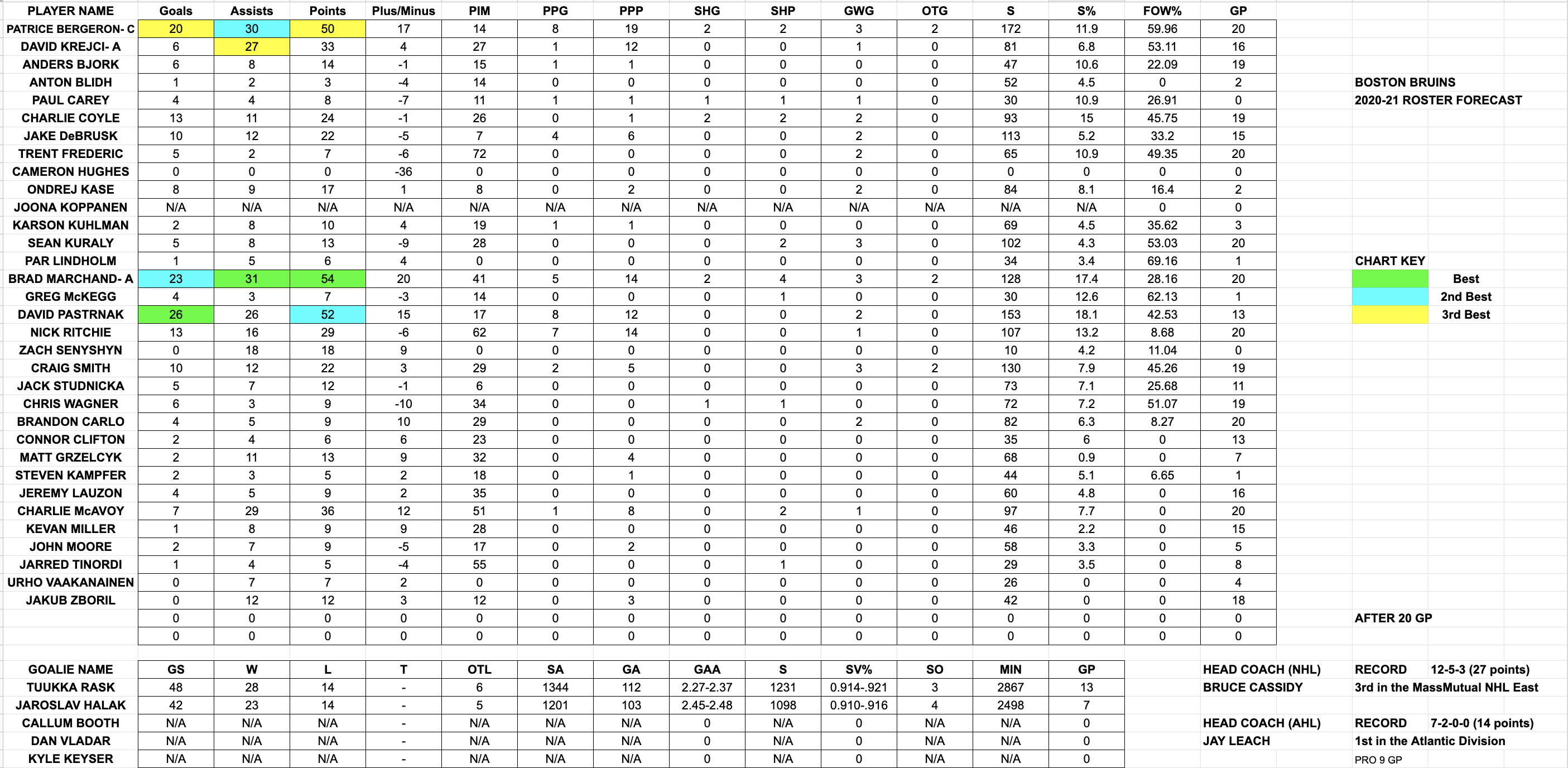
  • Boston Bruins 2020-21 Forecast Through 20 Games

    Boston Bruins 2020-21 Forecast Through 20 Games

    O.K., so I’m still behind on some things around here.

    Whether you’re new to DTFR or a long-time fan(?), you’re able to see the finished products around here and think “wow, that’s neat” and go about your day doing whatever the next thing on your mind happens to be.

    You don’t have to wake up everyday to all the shot charts, player and team forecasts, expected points total models, Photoshop files, running list of game notes, podcast notes (yes, that’ll be back soon) and more that’s related to the day-to-day DTFR operations around here or other seemingly useless bits of information that may or may not see the light of day.

    But that’s all the fun parts anyway. Hockey is my passion.

    The long, grueling, season is counteracted by moments like Nathan MacKinnon underhand tossing Conor Garland’s helmet back to him and being fined $5,000 in the process.

    https://platform.twitter.com/widgets.js

    Guess I’m going to have to start tracking how often that happens now.

    In addition to everything mentioned above, you might not know that I’m constantly applying to jobs, so sometimes little things like this forecast write up gets put on the back burner until there’s a minute or two between games, guest appearances on other podcasts and more job applications.

    Not trying to use anything as an excuse here, but please forgive me for being *checks notes* 15 games behind on the latest forecast, which will be irrelevant in another five games anyway, because it’ll be time to update Boston’s forecast through 40 games this season.

    I do this all by hand in Microsoft Excel, so you know I’m not a real mathematician or statistician.

    If you ask me to code something, I’ll ask you “what ‘R‘ you talking about? Get it? Did you see the pun I made there? Words, am I right?”

    15 games ago, I updated each individual Bruins player’s forecast after writing my recap about Zdeno Chara’s first game back in Boston as a member of the Washington Capitals then eventually got around to updating the corresponding chart that you’ll see below.

    Then I had to do that for whatever other teams I’ve been able to keep track of on time and I promise I’ll be writing about those forecasts… …eventually.

    Oh and apply to more jobs.

    Anyway, you probably don’t care about the life behind the screen, so let’s get to Boston’s forecast through 20 games, shall we?

    As always, remember that my degree is in communication and my minor was in sport management. I got a “C” in my Intro to Stats class back in my first semester of college, which was eight years ago this fall.

    Between then and now, I’ve worked in live sports production (TV and radio) and been unemployed, which explains why I’m constantly applying to jobs.

    First year players are impossible to predict until they’ve built up some time in the National Hockey League. Generally at least a game will suffice, but their numbers might look a little “inflated” (for the lack of a better term) until the season rolls on and their expectations fall back to Earth.

    In other words, Zach Senyshyn is now forecasted for 18 assists in this latest forecast, but that shouldn’t surprise you since he only had two assists in six career NHL games over the last two seasons.

    That will change in the 40-game update, since he’s played in at least seven more games between the time this report was originally intended to be done and the next one.

    Remember that forecast is different from pace.

    Finally, remember that there’s a lot of variables, like injuries, being a healthy scratch or on the taxi squad, other American Hockey League related or waiver related transactions, trades, sickness, COVID protocol, general superstitions, hot and cold streaks, etc. that can (whether scientifically proven or not) disrupt a player’s season.

    None of these can be accounted for in Microsoft Excel’s forecast function.

    In a perfect world, everyone plays a full season. Every player has a chance to live up to expectations, hit and/or exceed their mark or miss it by a little/a lot.

    Hockey is a game made up of collective actions and sheer puck luck. It’s unpredictable, which technically defeats the purpose of this (so if you’ve made it this far, give yourself a pat on the back).


    Boston Bruins Forecast Through 20 Games (36 Games Remaining)

    David Pastrnak came back from offseason surgery and looked like he hadn’t missed a step, since his scoring prowess left an immediate impact on the team and kept him forecasted as the team’s leader in goals by season’s end with 26, though Boston’s forecasted points leader has now shifted from Pastrnak to Brad Marchand.

    Marchand’s forecasted 23-31–54 totals lead Pastrnak’s 26-26–52 totals, while B’s captain, Patrice Bergeron is on track to round out the top-3 in scoring with 20-30–50 forecasted totals– good enough for the second-most assists on the roster, one behind Marchand’s 31 and three ahead of David Krejci’s forecasted 27 assists.

    It’ll be fun to see just how much things have changed in the next forecast, since Krejci’s gone off in the assist department lately and Marchand missed a couple of games due to COVID protocol, but let’s save that speculation (or hindsight) for the 40-game report, O.K.?

    On defense, Charlie McAvoy continues to lead the way with 7-29–36 forecasted totals, while Matt Grzelcyk (13 points) and Jakub Zboril (12 points) are the only other defenders expected to reach double-digit points totals.

    That’s quite an area of concern for the Bruins.

    Not so much in the “oh no, who might get taken by the Seattle Kraken in the 2021 Expansion Draft” sense, but rather, the general “oh no, this team is not as good as they were last year, but we expected that, so they still need to acquire a defender and more at the trade deadline this year” sense (especially if one of the younger blue liners like Zboril, Jeremy Lauzon or Urho Vaakanainen aren’t developing as fast or as well as Boston desires).

    Nevertheless, what might be more pressing than ever before is the question of what comes next after Tuukka Rask and Jaroslav Halak?

    Rask (2.27-2.37 forecasted goals-against average, .914-.921 forecasted save percentage) is expected to have decent numbers this season if he can make a return to full health, while Halak (2.45-2.48 forecasted GAA, .910-.916 forecasted SV%) looks solid for a backup.

    Yet, at the time of this writing, both goaltenders are out of Boston’s lineup– Rask due to injury and Halak due to COVID protocol.

    Stay tuned for first impressions on Dan Vladar and Jeremy Swayman in the next forecast and what that might mean for the offseason’s plans with both Rask and Halak as pending-unrestricted free agents.

    For a look at how things might have gone for the Bruins entering the 2020-21 season, feel free to read the original forecast through zero games played.

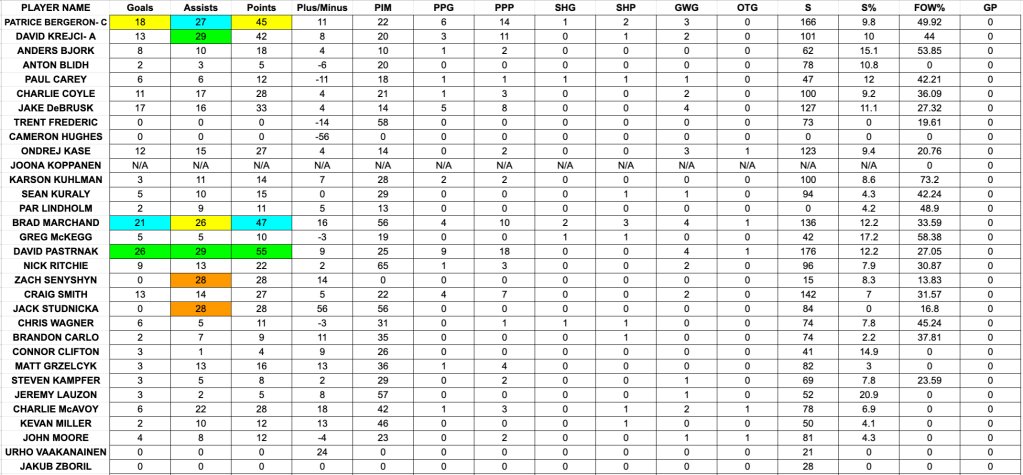
  • Boston Bruins 2020-21 Forecast

    Boston Bruins 2020-21 Forecast

    Hello, friend.

    Last season, I didn’t get around to posting my forecasts for the Boston Bruins, Carolina Hurricanes, Columbus Blue Jackets and Vegas Golden Knights’ rosters.

    I kept track of everything before the 2019-20 season began and after each quarter mark (roughly 20 games) as I normally do, but I just didn’t quite have the time and/or motivation to do a write up here on the blog for each one– let alone any of them.

    This season, I’m already behind in presenting my findings entering 2020-21, but I’ve prepared all four teams’ player forecasts as usual.

    To kick things off, we’ll take a look at how the 2020-21 season could’ve panned out if all Bruins players were healthy entering the 56-game season, but by the end of the month, Boston will already be 20 games into the season (provided nothing else is postponed) so it’ll be time for an updated forecast.

    For the rest of the teams– including the addition of the Colorado Avalanche for a total of five teams being tracked this season– we’ll just take a gander at how things looked coming into 2020-21 and where each player is tracking after their respective 20-game mark.

    In other words, Boston gets two posts (this one and another one in March) while Carolina, Colorado, Columbus and Vegas will each get a joint “forecast before the season began and forecast through 20 team games played” post, probably.

    If you’re a fan of those teams and my… …expertise(?), I’m sorry. Please be patient. You’ve already been waiting since the last forecast I published in the 2018-19 season.

    If you’re a fan of the B’s, well good news, let’s get into the forecast details.

    As always, keep in mind that my degree is in communication and my minor was in sport management. I got a “C” in my Intro to Stats class in my first semester of college way back in *checks notes* the fall of 2013.

    It was a night class and it was terrible, but I digress.

    First year players are impossible to predict until they’ve had at least one National Hockey League game under their belt.

    Young players that have had minimal NHL experience may also reflect “inflated” results.

    No, Zach Senyshyn probably isn’t going to have 28 assists this season, but since he has two assists in six games over the last two seasons (his entire NHL career), the forecasting function in Microsoft Excel does math stuff based on his entire career as it would relate to if he played in all 56 games for Boston this season.

    This will fix itself as the season progresses.

    The same goes for Jack Studnicka’s forecasted 28 assists. Entering 2020-21, Studnicka has only played in two NHL games since just last season.

    He’s already had a goal in six games this season and in the next forecast (after 20 team games played), he’ll likely be forecasted to have 1-8–9 totals by season’s end (assuming he plays in the remaining 36 games).

    Forecast is different from pace.

    Injuries, being a healthy scratch or on the taxi squad, other American Hockey League related or waiver related transactions, sickness, COVID protocol and general superstitions (getting enough sleep the night before a game, taping your stick a certain way every time, putting on the right skate before the left skate or whatever) may disrupt a player’s season.

    These variables– tangible or not– are part of the game and cannot be accounted for in your everyday “straight up” forecast.

    In an utopian timeline, this forecast pretends nothing bad could ever happen and every player has a chance to live up to their expectations. Of course, some will pan out, some will exceed expectations and some will miss the mark.

    It’s merely a suggested outcome for a sport that’s highly unpredictable because of its collectivistic nature and sheer puck luck.


    Boston Bruins Forecast Through 0 Games (56 Games Remaining)

    Had the 2019-20 season gone according to schedule, David Pastrnak might not have missed any time to start the 2020-21 season.

    Nevertheless, we’ll pretend that an alternate timeline stills exists for a moment and mention that if he had played in all 56 games this season, he was forecasted to lead the Bruins with 26-29–55 totals.

    Brad Marchand was forecasted as the next highest scorer with 21 goals and 47 points, while David Krejci looked to lead the B’s in assists (29).

    Of course, none of this is how it really happened, but Pastrnak is still off to a hot start, Marchand is feeling “100-percent” and Krejci is only now just about to miss game action, having not traveled with the team to Lake Tahoe for their outdoor matchup with the Philadelphia Flyers on Sunday night.

    Senyshyn and Studnicka’s assist totals have been highlighted in the chart above in reference to what’s already been stated in the introduction to this post.

    Newcomer, Craig Smith, was forecasted to hit the twine 13 times and accrue 14 assists for 27 points this season, while Ondrej Kase was expected to notch 27 points in a 56-game season prior to injury.

    On defense, the loss of Zdeno Chara and Torey Krug is expected to be felt on the scoresheet, though we’re likely to see Charlie McAvoy’s stock rise in the next forecast after 20 team games played.

    Speaking of McAvoy, he was expected to lead the team in points from the blue line entering the 2020-21 season with 6-22–28 totals.

    In goal, Boston’s poised for another strong run from their goaltending tandem of Tuukka Rask and Jaroslav Halak.

    Though Rask is likely to get more starts than Halak, the two are prime for producing similar numbers this season in differing workloads.

    Rask is set for another season with a goals against average in the low two’s, between 2.28 and 2.34, while Halak is right on track for being one of– if not– the best “backups” in the league with a forecasted GAA between 2.48 and 2.72.

    Stay tuned for the next forecast in about four games– however soon that will be, provided nothing else is postponed and the Bruins can avoid piling up names on the league’s COVID Protocol list.

  • Pastrnak scores hat trick as B’s light up Habs, 8-1

    Eight is great and eight is the number of goals the Boston Bruins scored en route to their, 8-1, victory over the Montreal Canadiens at Bell Centre on Tuesday night.

    Oh and by the way, David Pastrnak had a hat trick.

    Jaroslav Halak (5-1-3 record, 2.40 goals against average, .930 save percentage in nine games played) made 36 saves on 37 shots against for a .973 SV% in the win for the Bruins.

    Canadiens starter, Carey Price (10-7-3, 3.09 GAA, .900 SV% in 20 games played) turned aside six out of ten shots faced for a .545 SV% before being replaced by Keith Kinkaid (1-1-2, 4.29 GAA, .877 SV% in five games played) in the loss.

    Kinkaid made ten saves on 13 shots against (.769 SV%) for no decision.

    Boston improved to 16-3-5 (37 points) and remained atop the Atlantic Division– in command of 1st place of not just the division, but 1st place in the entire league by virtue of holding a game-in-hand over the Washington Capitals.

    Montreal, meanwhile, fell to 11-8-5 (27 points) on the season and stuck in 3rd in the Atlantic.

    The Bruins extended their current winning streak to four games and are now 7-3-1 on the road this season.

    They’re now also 10-0-2 when leading after two periods, 11-1-0 when leading after one period and 12-2-3 when scoring the game’s first goal this season.

    Kevan Miller (knee), John Moore (shoulder), Karson Kuhlman (fractured tibia), David Backes (upper body) and Zach Senyshyn (lower body) remained out of the lineup for Boston with Patrice Bergeron (lower body) and Brett Ritchie (upper body) joining the long list of injured Bruins for at least the next two games (Tuesday night in Montreal, Wednesday night in Ottawa).

    As a result of Bergeron and Ritchie’s injuries, Boston recalled Brendan Gaunce and Jack Studnicka from the Providence Bruins (AHL) on Monday.

    Gaunce, 25, has six goals and five assists (11 points) in 14 games with Providence this season and signed with Boston on July 1, 2019 as a free agent after spending 2015-19 with the Vancouver Canucks organization.

    Studnicka, 20, leads Providence in scoring with nine goals and nine assists (18 points), as well as a plus-seven rating in 21 games with the “Baby Bruins” this season. The 6’2″, 175-pound center was drafted by Boston in the second round (53rd overall) of the 2017 NHL Entry Draft.

    He made his NHL debut Tuesday night in Montreal, joining Cameron Hughes as the only other Bruin to make their NHL debuts this season.

    Par Lindholm returned to action after missing the last game while resting up after sustaining a cut in last Thursday’s, 3-2, win over the Buffalo Sabres.

    With Bergeron and Ritchie out, Bruce Cassidy made some adjustments to his lineup, starting Studnicka as the second line center with Jake DeBrusk on his left wing and Charlie Coyle on his right wing.

    David Krejci, in the meantime, was promoted to the first line center role with Brad Marchand and Pastrnak in their usual roles.

    Sean Kuraly centered the third line with Anders Bjork and Danton Heinen as his wingers, while Lindholm centered the fourth line with Joakim Nordstrom and Chris Wagner.

    Cassidy made one change to his defense, replacing Steven Kampfer with Connor Clifton on the third defensive pairing after keeping Kampfer fresh while in his role as the seventh defender for the B’s.

    Gaunce and Kampfer served as healthy scratches for the Bruins on Tuesday.

    Early in the opening frame, Montreal’s Brendan Gallagher tripped up Pastrnak while trailing the Boston forward behind his own net and was sent to the penalty box at 6:10 of the first period.

    Krejci sent Kuraly deep into the offensive zone on the ensuing power play, whereby Kuraly connected DeBrusk with a bump pass as DeBrusk (5) crashed the slot and sent a shot into the back of the twine to give the Bruins a, 1-0, lead on a power play goal.

    Kuraly (4) and Krejci (12) had the assists on DeBrusk’s goal at 8:03.

    The Canadiens responded with a goal of their own a little over a few minutes later on a three-on-two rush up the ice that left Shea Weber (8) wide open for a quick one-timer that beat Halak’s blocker side at 12:41.

    Gallagher (9) and Tomas Tatar (14) had the assists on Weber’s goal, tying the game, 1-1, midway through the first period.

    The score wasn’t tied for long before Nate Thompson “tripped” Clifton at 13:56 and was assessed an infraction for what appeared to be a phantom call.

    Boston went on the power play for the second time of the night and quickly converted on the skater advantage with a trademark one-timer blast from Pastrnak (21) at 14:24.

    Coyle (8) and Marchand (24) notched the assists on Pastrnak’s first goal of the night as the B’s regained the lead, 2-1.

    Eight seconds later, Charlie McAvoy was penalized for interference against Nick Suzuki at 14:32, presenting Montreal with their first power play of the night.

    The Habs did not convert on the ensuing skater advantage.

    With less than a minute remaining in the first period, Marchand (17) snagged a loose puck that floated off of Coyle’s stick while the Bruins forward attempted a wraparound, then elevated a backhand shot over Price while the Canadiens goaltender dove in effort to make a save.

    As a result, Coyle (9) had the only assist on Marchand’s goal at 19:23 and the Bruins led, 3-1, entering the first intermission.

    The goal marked Marchand’s 600th NHL point– becoming the 11th player in Bruins franchise history to record 600 points in a B’s sweater, joining Terry O’Reilly, Krejci, Ken Hodge, Wayne Cashman, Bergeron, Bobby Orr, Rick Middleton, Phil Esposito, Johnny Bucyk and Ray Bourque (per Ty Anderson of 98.5 The Sports Hub).

    Marchand’s also just the 4th Bruins player in the last 45 years to record his 40th point in 24 games or fewer, joining Adam Oates (24 games played in 1992-93), Esposito (22 GP in 1974-75) and Orr (21 GP in 1974-75).

    After one period in Montreal, Boston led, 3-1, on the scoreboard, despite trailing, 13-8, in shots on net.

    The B’s led in blocked shots (6-5) and giveaways (11-8), while the Habs led in hits (14-8) and faceoff win percentage (60-40).

    Both teams had three takeaways aside.

    The Canadiens were 0/1 on the power play and the Bruins were 2/2 entering the second period.

    Pastrnak (22) entered the attacking zone off the draw, deked past a Montreal defender and sniped a shot over Price’s blocker on the short side to give Boston a three-goal lead eight seconds into the second period.

    Marchand (25) and Zdeno Chara (7) had the assists on Pastrnak’s second goal of the game and the Bruins led, 4-1.

    Boston added another goal to their immense lead when Bjork (4) capitalized on a breakaway, sending a shot into the twine past Price’s glove side to make it, 5-1, for Boston at 1:10 of the second period.

    Kuraly (5) had the only assist on the goal.

    The Bruins had a pair of goals in a span of 62 seconds to chase Price out of the crease as Canadiens head coach, Claude Julien, replaced his starter with Kinkaid after Bjork made it, 5-1.

    Pastrnak (23) finalized his hat trick less than halfway through the game with a shot that beat Kinkaid at 9:06 of the second period– scoring his 2nd hat trick of the season and 6th of his career.

    Brandon Carlo (6) and Krejci (13) had the assists on Pastrnak’s hat trick goal as Boston made it, 6-1, in Montreal.

    The 23-year-old right winger for the Bruins, Pastrnak, leads the NHL with 23 goals in 24 team games– the most by any player within 25 team games since the 2005-06 season, when Simon Gagne had 23 goals through this point in the season with the Philadelphia Flyers.

    A few minutes later, Clifton caught Tatar with a high stick and was sent to the penalty box with a minor infraction at 12:43, but the Habs didn’t score on the ensuing power play.

    Through 40 minutes of play at Bell Centre, the Bruins led, 6-1, on the scoreboard, but trailed the Canadiens, 27-15, in shots on goal.

    Montreal held the advantage in shots on net in the second period alone (14-7) and led in hits (23-15), while Boston had the advantage in blocked shots (12-9), giveaways (18-16) and faceoff win% (51-49).

    Both teams had six takeaways aside, while the Canadiens were 0/2 on the power play and the B’s were still 2/2 on the skater advantage (only one penalty was called in the second period and it was against Boston).

    Almost midway through the final frame of regulation, Kuraly worked the puck to Torey Krug as Krug broke into the zone heading for the net, before dropping a pass back to Coyle (5) for the one-timer from the slot that beat Kinkaid to make it, 7-1, for Boston.

    Krug (14) and Kuraly (6) had the assists on Coyle’s goal at 8:26 of the third period.

    Midway through the third, Studnicka reacted to a cross check from Max Domi and the two were sent to the box– Studnicka for rouding and Domi for cross checking at 15:38.

    Just 20 seconds after both teams resumed full strength action, Studnicka sent a pass from the trapezoid to Heinen in the slot, whereby Heinen (5) one-timed a shot past Kinkaid.

    Studnicka (1) collected the primary assist and his first career NHL point– in his first career game, nonetheless– and Krug (15) tallied the secondary assist on Heinen’s goal as the Bruins led, 8-1, at 17:58.

    At the final horn, Boston had finished off Montreal, 8-1, in their first eight-goal game at Bell Centre since Oct. 28, 1998 (a, 9-2, win), as well as their first eight-goal game against the Habs in general since Feb. 9, 2011 (an, 8-6, win at TD Garden).

    The Canadiens finished the night leading in shots on goal (37-24)– including a, 10-9, advantage in the third period alone– and in hits (34-19).

    The B’s wrapped up Tuesday night leading in blocked shots (16-12) and giveaways (24-18), while both teams split faceoff win%, 50-50.

    Montreal finished the night 0/2 on the skater advantage, while Boston went 2/2 on the power play.

    The last time a Bruin scored a hat trick in Montreal was on Nov. 30, 1987, when Steve Kasper notched three goals in a, 6-4, loss at Montreal Forum.

    Boston finishes their quick two-game road trip (1-0-0) with a Wednesday night matchup in Ottawa against the Senators after traveling by train from Montreal overnight on Tuesday.

    The B’s return home after completing games in back-to-back nights with a Black Friday matinee against the New York Rangers in the NHL’s 2019 Discover Thanksgiving Showdown.

    Boston will debut their new third jersey in Friday’s matchup.

  • Red Wings down Bruins, 4-2

    The Detroit Red Wings beat the Boston Bruins, 4-2, at Little Caesars Arena on Friday– winning for just the 2nd time in their last 14 games.

    Jonathan Bernier (3-4-1 record, 3.35 goals against average, .891 save percentage in 10 games played) made 26 saves on 28 shots against for a .929 SV% in the win.

    The Red Wings goaltender also had two assists in the effort.

    Boston netminder, Tuukka Rask (7-2-1, 1.99 GAA, .933 SV% in 10 games played) stopped 28 out of 31 shots faced for a .903 SV% in the loss.

    Boston fell to 11-3-2 (24 points) on the season, but still in command of 1st place in the Atlantic Division, while Detroit improved to 5-12-1 (11 points) so far this season. The Red Wings are still 8th in the Atlantic.

    The Bruins fell to 4-3-1 on the road this season, while the Red Wings snapped a four-game losing streak in their win over the B’s.

    Boston also fell to 9-2-1 when scoring the game’s first goal this season and 1-2-1 when trailing after two periods.

    The Bruins were without the services of Kevan Miller (knee), John Moore (shoulder), Karson Kuhlman (fractured tibia), Joakim Nordstrom (infection), Par Lindholm (upper body), David Backes (upper body) and Jake DeBrusk (lower body) on Friday, but Miller, Lindholm and Nordstrom all practiced with the team while wearing red no-contact sweaters on Thursday at Warrior Ice Arena.

    Per B’s head coach, Bruce Cassidy, Nordstrom is the closest among the three to returning to the lineup.

    Miller and Moore have yet to make their 2019-20 season debuts, while DeBrusk is still being evaluated and did not travel with the team to Detroit.

    In an official scoring change made after Tuesday night’s loss in Montreal, Zach Senyshyn had an assist added to Connor Clifton and Anders Bjork’s goals against the Canadiens, yielding two assists for Senyshyn in his season debut in the process.

    Peter Cehlarik and Senyshyn were recalled from the Providence Bruins (AHL) on Thursday after Senyshyn and Cameron Hughes were originally assigned to Providence earlier in the week on Wednesday.

    With DeBrusk out of the lineup, Cehlarik took over the second line left wing slot alongside David Krejci at center and Danton Heinen on right wing.

    Senyshyn remained in his third line right wing spot with Bjork and Charlie Coyle.

    Brett Ritchie (upper body) did not take part in warmups prior to Boston’s matchup with the Red Wings and was a late scratch from the lineup.

    In his place, the Bruins went with seven defenders, allowing Steven Kampfer to join the lineup on the fourth line right wing in place of Ritchie– resulting in no healthy scratches for the B’s on Friday.

    Kampfer, however, did not play a shift in Detroit.

    On defense, Cassidy switched his first and third pairings up, moving Clifton to the first defensive pairing with Zdeno Chara to start the game and placing Charlie McAvoy with Matt Grzelcyk on the third pairing.

    Krejci (2) kicked things off with the game’s first goal 69 seconds into the first period after Cehlarik worked the puck into the attacking zone, circled back towards the slot and found Krejci for the wrist shot goal on Bernier’s short side.

    Cehlarik (1) had the only assist on Krejci’s goal and the Bruins jumped out to the, 1-0, lead.

    But it was short lived.

    Roughly 90 seconds after Boston scored, Dylan Larkin (5) skated past Clifton, wrapped around the net and banked the puck off of Patrice Bergeron’s skate and into the twine, tying the game, 1-1, in the process.

    Madison Bowey (3) and Bernier (1) notched the assists on Larkin’s goal as the Red Wings pulled even at 2:41 of the first period.

    A minute later, David Pastrnak hooked Detroit blue liner, Dennis Cholowski and was sent to the penalty box with a minor infraction at 3:40.

    The Bruins managed to kill off Pastrnak’s minor, but went undisciplined midway through the opening frame as Brad Marchand took an interference penalty against Filip Hronek at 11:12.

    Detroit only needed 37 seconds on the ensuing power play to capitalize on the skater advantage with Robby Fabbri (2) snapping a shot past Rask to give the Red Wings their first lead of the night, 2-1.

    Tyler Bertuzzi (9) and Anthony Mantha (7) tallied the assists on Fabbri’s first goal with the Red Wings since being acquired by Detroit in a trade with the St. Louis Blues on Wednesday.

    The Blues acquired Jacob de la Rose in the transaction.

    Fabbri’s first goal of the night came at 11:49 of the first period.

    Less than a minute later, Bowey was guilty of holding Heinen, but the B’s weren’t able to convert on the resulting power play opportunity.

    After one period at Little Caesars Arena, the Red Wings led, 2-1, and shots on goal were even, 12-12.

    Boston led in blocked shots (6-4) and takeaways (1-0) heading into the first intermission, while Detroit held the advantage in giveaways (6-2), hits (9-7) and faceoff win percentage (57-43).

    The Red Wings were 1/2 on the power play heading into the second period and the Bruins were 0/1.

    Pastrnak hooked Larkin 28 seconds into the second period and presented Detroit with an early skater advantage to begin the middle frame.

    Fabbri (3) made sure to capitalize on the power play opportunity, acting as the bumper in the slot and scoring his 2nd goal of the night on a one-timer at 1:30 of the second period.

    He became the 7th player in Red Wings history to score two or more goals in his team debut.

    Bertuzzi (10) and Cholowski (4) had the assists on Fabbri’s 2nd power play goal of the game and Detroit led, 3-1.

    Torey Krug sent the puck over the glass and out of play, yielding an automatic delay of game penalty at 3:30.

    Detroit’s resulting power play opportunity was cut short as Larkin tripped up Chara behind the Boston net at 3:50, resulting in 4-on-4 action for a 1:41 span before the Bruins would have an abbreviated power play.

    The B’s did not score on the skater advantage.

    Midway through the second period, Marchand and Hronek exchanged pleasantries and dropped the gloves. Each received a five-minute major for fighting at 11:16.

    It was just the 2nd fight of the season for the Bruins (previous, Ritchie vs. Barclay Goodrow on Oct. 29th against the San Jose Sharks).

    A couple of minutes later, things were still chippy as Krejci was penalized for roughing Valtteri Filppula at 13:35.

    In response, shortly after failing to convert on the skater advantage, Filppula tripped Pastrnak at 15:56 and elicited a power play chance for the Bruins.

    With only seconds to spare on the advantage, Krug ripped a shot from the point that was deflected by Bergeron (8) in front of the net to cut Detriot’s lead to one-goal.

    Krug (11) and Krejci (5) had the assists on Bergeron’s power play goal as the Bruins trailed, 3-2, at 17:52.

    Through 40 minutes of action in Detroit, the Red Wings led, 3-2, on the scoreboard, but trailed Boston in shots on goal, 24-22– including a, 12-10, advantage for the B’s in the second period alone.

    Detroit held the advantage in blocked shots (10-9), giveaways (12-2), hits (17-14) and faceoff win% (52-48), while Boston led in takeaways (3-0).

    The Red Wings were 2/5 on the skater advantage and the Bruins were 1/3 on the power play entering the third period,

    Early in the final frame, Bowey slashed Marchand and was sent to the sin bin with a minor infraction at 4:34 of the third period.

    Boston did not score on the ensuing power play.

    Neither team found the back of the net until the Bruins pulled their goaltender for an extra attacker with about two minutes left in regulation.

    Shortly thereafter, Mantha (10) pocketed an empty net goal at 18:32 and sealed the deal on the win for the Red Wings.

    Bernier (2) had the only assist on the goal as Detroit finished the night with a, 4-2, win over Boston– dominating the third period in shots on goal, 10-4, bolstering their total shots on net advantage to, 32-28.

    The Red Wings finished Friday night’s action leading in blocked shots (15-11), giveaways (17-7) and hits (27-21), while the Bruins finished the night leading in faceoff win% (51-49).

    Detroit went 2/5 on the power play and Boston went 1/4 on the skater advantage.

    The Bruins return home on Sunday for a two-game homestand against the Philadelphia Flyers (Sunday, Nov. 10th) and the Florida Panthers next Tuesday (Nov. 12th) before traveling to Toronto to face the Maple Leafs next Friday (Nov. 15th).

  • Habs end B’s winning streak at six, beat Boston, 5-4

    The Montreal Canadiens eked out a, 5-4, win over the Boston Bruins on Tuesday night at Bell Centre thanks to an overturned goal in the third period– snapping Boston’s six-game win streak in the process.

    Goaltending was optional as Montreal’s Carey Price (7-4-1 record, 2.75 goals against average, .883 save percentage in 12 games played) made 21 saves on 25 shots against for an .840 SV% in the win.

    Meanwhile, Boston netminder, Tuukka Rask (7-1-1, 1.88 GAA, .936 SV% in nine games played), stopped 26 out of 31 shots faced for an .839 SV% in the loss.

    The Bruins fell to 11-2-2 (24 points) on the season, but remained in control of 1st place in the Atlantic Division, while the Canadiens improved to 8-5-2 (18 points) and tied the Florida Panthers for 4th in the Atlantic in points (though the Panthers hold the tiebreaker, having played in one fewer game than Montreal).

    Kevan Miller (knee) and John Moore (shoulder) have yet to debut this season for the Bruins as both missed their 15th game Tuesday night due to lingering injuries from last spring.

    Karson Kuhlman (fractured tibia), Joakim Nordstrom (infection), Par Lindholm (upper body) and David Backes (upper body) were all still out against Montreal, with Lindholm as the latest Bruin to join the injured reserve prior to Tuesday’s matchup.

    Despite sustaining a nasty cut in Monday night’s, 6-4, win over the Pittsburgh Penguins, Charlie McAvoy was in the lineup against the Canadiens, as was Torey Krug (who caught a skate up high and drew some blood Monday night as well).

    Zach Senyshyn was recalled from the Providence Bruins (AHL) and inserted into the lineup on the right side of the third line with Anders Bjork and Charlie Coyle.

    Senyshyn has three points (two goals, one assist) in 12 games with Providence this season and one goal in two career NHL games (made his NHL debut last season).

    With Senyshyn entering the lineup, Boston head coach, Bruce Cassidy, bumped Brett Ritchie down to the fourth line right wing with Chris Wagner returning to the left side of Sean Kuraly.

    After making his NHL debut against Pittsburgh on Monday, Cameron Hughes joined Steven Kampfer as Boston’s only healthy scratches on Tuesday.

    B’s captain, Zdeno Chara, played in his 1,500th career game and became just the 21st player and sixth defender in league history to play in 1,500 or more games in their career.

    Chara joined Chris Chelios (1,651 career games), Scott Stevens (1,635), Larry Murphy (1,615), Ray Bourque (1,612) and Nicklas Lidstrom (1,564) as the only defenders to play in 1,500 or more games.

    Habs head coach, Claude Julien, reached the 1,200th game of his career behind the bench on Tuesday as well.

    Julien won the Cup with the Bruins in 2011 and received an ovation from the Bell Centre crowd before Chara’s milestone was acknowledged at the following media timeout in the first period.

    Victor Mete (2) kicked things off with a quick start for Montreal as the Canadiens defender jumped at the perfect opportunity to collect the game’s first goal after the puck deflected off of a teammate in front of the goal and rebounded into the low slot unattended.

    Mete’s goal was assisted by Joel Armia (4) and Jeff Petry (7) at 1:13 of the first period and the Habs jumped ahead with the, 1-0, lead.

    Late in the period, Mete hooked Senyshyn and was sent to the penalty box with a minor infraction at 14:49 of the first period.

    Boston only needed six seconds on the power play for Patrice Bergeron to win the faceoff back to Krug, then slide the puck over to David Pastrnak (15) for the one-timer slap shot power play goal.

    Krug (10) and Bergeron (9) tallied the assists as the Bruins tied the game, 1-1, at 14:55.

    With the goal, Pastrnak extended his current point streak to 13 games– setting a new career-high in the process. He also became the first Bruin to score 15 goals in their first 15 games of the season since Peter McNab did so in 1976-77.

    A couple of minutes later, Tomas Tatar (5) sent a shot off of Rask’s glove and into the twine to put the Canadiens ahead, 2-1.

    Brendan Gallagher (6) and Ben Chiarot (2) had the assists on Tatar’s goal at 16:45.

    Less than a minute after retaking the lead, Montreal extended their lead to two goals as Paul Byron (1) barely kept the puck in the attacking zone and succeeded on an individual effort– sending a shot through Rask’s five-hole– for his first goal of the season.

    Byron’s goal was unassisted at 17:16 of the first period and the Habs led, 3-1.

    Entering the first intermission, Montreal led Boston, 3-1, on the scoreboard and, 13-6, in shots on goal.

    The Canadiens also held the advantage in blocked shots (5-3), while the Bruins led in giveaways (10-9), hits (12-11) and faceoff win percentage (67-33).

    Both teams had two takeaways aside and the B’s were 1/1 on the power play, while the Habs had yet to see any action on the skater advantage heading into the second period.

    Less than a minute into the middle frame, Bergeron hooked Phillip Danault and presented the Canadiens with a power play 50 seconds into the second period.

    Boston killed Bergeron’s minor infraction without any issue, but followed up the special teams action with another hooking infraction– this time for Pastrnak against Shea Weber at 3:58.

    Montreal didn’t capitalize on the ensuing skater advantage.

    Almost midway through the period, Ryan Poehling blocked a shot by Krug that rocketed off of the side of Poehling’s helmet, sending the Montreal forward to the ice before the whistle was blown for the injured skater to head down the tunnel under his own power.

    While Poehling went down with an injury, so did Petry as the Canadiens defender caught the ice in an awkward manor with his leg.

    Petry returned from the dressing room shortly thereafter and had no issues. Poehling returned to the action too without any major damage.

    Connor Clifton (1) walzted around two Canadiens players, held the puck and sniped a shot over Price’s glove while Coyle screened the Montreal goaltender at 7:17 of the second period, bringing the Bruins to within one goal.

    Clifton’s unassisted effort cut Montreal’s lead to, 3-2, and was his first career regular season NHL goal in just his 32nd career game.

    Late in the period, Bjork (2) slid a rebound under Price’s pad from point blank to tie the game, 3-3.

    McAvoy (4) had the only assist on the goal at 18:13, but the game wouldn’t remain tied for long.

    Almost 40 seconds later, Mete (3) tucked in his 2nd goal of the ngiht with a shot from the point that floated over Rask, top-shelf, as Chara bumped Montreal center, Nate Thompson, into the Boston goaltender.

    Artturi Lehkonen (4) and Petry (8) collected the assists on Mete’s goal at 18:55 and the Canadiens regained the lead, 4-3.

    Through 40 minutes of action in Montreal, the Habs led the B’s, 4-3, on the scoreboard and, 25-15, in shots on goal (including a, 12-9, advantage for Montreal in the second period alone).

    The Canadiens also led in blocked shots (14-7) and takeaways (7-5), while the Bruins led in giveaways (16-15), hits (25-22) and faceoff win% (62-38) entering the second intermission.

    Montreal was 0/2 and Boston was still 1/1 on the power play heading into the third period.

    Weber caught Brad Marchand with a high stick 14 seconds into the third period and was sent to the sin bin for a minor penalty, but the Bruins weren’t able to capitalize on the ensuing power play.

    Instead, in the vulnerable minute after special teams action, Boston’s fourth line went to work with Wagner dishing a quick pass to Kuraly (1) for the fourth line center to bank the puck off of Price’s skate and into the net– tying the game, 4-4, at 3:03 of the third period.

    Wagner (4) had the only assist on the goal and the B’s had momentum on their side.

    Moments later, after Coyle thought he had scored by redirecting a pass from Senyshyn through Price’s five-hole while the Habs goaltender was without his stick, Julien used his coach’s challenge arguing that the Bruins had originally entered the zone offside.

    After review, it was determined that Coyle had just barely entered the zone by about half a skate ahead of the puck and was offside prior to the play that led to the goal and the call on the ice was overturned at 5:23.

    Instead of rallying against the overturned call, Boston went into a hole and found themselves clamoring towards the end of games in back-to-back nights.

    Chiarot (2) sent a shot of Rask’s glove and into the back of the net to give the Canadiens the lead once more, 5-4, at 9:06 of the third period after Montreal sustained tremendous pressure in the attacking zone.

    Weber (8) and Tatar (8) each had an assist on the game-winning goal as the Canadiens never looked back for the remaining half-a-period.

    After Boston iced the puck with 58.5 seconds remaining, Julien used his timeout to rally his attackers for one last push for a goal before the Bruins could pull their goaltender for an extra skater.

    Neither team could score as time expired and the final horn sounded at Bell Centre.

    The Canadiens had finished Boston’s six-game winning streak with a, 5-4, victory on home ice.

    Montreal wrapped up Tuesday night’s contest leading in shots on goal (31-25), blocked shots (27-11) and giveaways (24-19), while Boston led in shots on net in the third period alone (10-6), hits (36-31) and faceoff win% (60-40).

    The Canadiens went 0/2 on the power play and the B’s finished the game 1/2 on the skater advantage.

    Boston is now 4-2-1 on the road this season and 1-1-1 when trailing after two periods.

    The Bruins face the Detroit Red Wings on Friday at Little Caesars Arena. Boston returns home on Nov. 10th for a two-game homestand against the Philadelphia Flyers (Nov. 10th) and Florida (Nov. 12th).

  • Marchand’s five-point night leads Bruins to, 6-4, win over Penguins

    A wild night at TD Garden led to ten goals combined as Brad Marchand scored the game-winner late in the third period on a wacky play before Patrice Bergeron added an empty net goal to lift the Boston Bruins over the Pittsburgh Penguins, 6-4, on Monday.

    Jaroslav Halak (4-1-1 record, 2.83 goals against average, .917 save percentage in six games played) made 40 saves on 44 shots faced (.909 SV%) in the win for Boston.

    Meanwhile, Pittsburgh starter, Matt Murray (7-3-1, 2.35 GAA, .917 SV% in 12 games played), stopped eight shots on 11 shots against for a .727 SV% before being replaced by Tristan Jarry (1-3-0, 2.25 GAA, .929 SV% in four games played), who made 12 saves on 14 shots for an .857 SV% in 34:37.

    The Bruins improved to 11-1-2 (24 points) on the season and remained in 1st place in the Atlantic Division, while the Penguins fell to 8-6-1 (17 points), but didn’t move from 4th place in the Metropolitan Division.

    Marchand had 2-3–5 totals for his 2nd five-point night of the season and the 5th five-point night of his career.

    According to the NHL’s PR department, the 2019-20 season marks the third consecutive season in which the Bruins (8-0-2 in their last 10 games) have posted at least one point streak of 10 or more games. The longest such run in franchise history spanned five seasons from 1975-76 to 1979-80.

    Kevan Miller (knee) was still in a red no-contact sweater at practice and John Moore (shoulder) was still out of the lineup on Monday. Both players have yet to debut this season and have missed the first 14 games.

    Karson Kuhlman (fractured tibia), Joakim Nordstrom (elbow) and Par Lindholm (upper body) all remained out of the lineup for Boston due to their various injuries, but Brett Ritchie returned after missing Saturday night’s game against the Ottawa Senators due to an infection.

    David Backes (upper body), however, joined the long list of injuries for the Bruins and is doubtful for Monday and Tuesday’s action, but feeling better since being injured against Ottawa.

    As a result of all the injuries and with the penalty kill in mind, according to head coach, Bruce Cassidy, Peter Cehlarik was assigned to the Providence Bruins (AHL) and Cameron Hughes was recalled from Providence on Monday.

    Hughes made his NHL debut against the Penguins Monday night on the fourth line with Sean Kuraly at center and Chris Wagner back on the right side.

    He has two goals and four assists (six points) in 13 games with Providence this season and tallied 13-15–28 totals in 52 games with the Baby Bruins last season.

    Cassidy placed Ritchie back on the third line right wing with Anders Bjork and Charlie Coyle and replaced Steven Kampfer with Connor Clifton on the third defensive pairing as planned after Clifton served as a healthy scratch against the Senators to keep Kampfer fresh.

    Kampfer was the only healthy scratch for the B’s against Pittsburgh.

    The action between the Bruins and Penguins on Monday night kicked off with a tremendous pace that had no stoppages for the opening 4:44 span of non-stop action.

    Less than a minute later, Jake DeBrusk (3) intercepted a pass in the neutral zone, skated around a Pittsburgh defender and fired shot over Murray’s blocker on the short side to give Boston the game’s first lead, 1-0.

    DeBrusk’s individual effort was unassisted at 5:24 of the first period.

    Almost five minutes later, David Krejci was guilty of tripping Pens forward, Jared McCann, at 9:04 and was sent to the penalty box, yielding the first power play of the night to Pittsburgh.

    The B’s killed off Krejci’s minor with ease as Halak robbed Sidney Crosby with the glove while the Penguins were on the skater advantage.

    Midway through the first period, Zdeno Chara let go of a shot that found its way to David Pastrnak for a deflection.

    The loose puck bounced wildly in the low slot, whereby Marchand (9) batted it out of the air and over Murray’s glove from point blank to give Boston a two-goal lead.

    Pastrnak (15) and Chara (3) tallied the assists on Marchand’s goal and the Bruins led, 2-0, at 13:05.

    With the goal, Marchand extended his current point streak to 13 games– becoming just the 3rd Bruin in the last 25 years to record a point streak of at least 13 games in franchise history, joining Phil Kessel and Adam Oates.

    Meanwhile, Pastrnak collected his 28th point in 14 games this season– tying his career-high 12-game point streak in the process, set from Nov. 22- Dec. 18, 2017– becoming just the first player to record 28 points in 14 games to begin a season since Peter Forsberg and Daniel Alfredsson did so with the Philadelphia Flyers and Ottawa Senators, respectively, in the 2005-06 season.

    Late in the period, Kris Letang slashed Marchand and was assessed a minor penalty that resulted in a Bruins power play extending into the second period, since the B’s couldn’t capitalize on their chances before the horn signaled the end of the first period.

    Entering the first intermission, Boston led, 2-0, on the scoreboard and, 10-9, in shots on goal.

    Pittsburgh held the advantage in every other statistical category, however, leading in blocked shots (3-2), takeaways (2-1), giveaways (6-1), hits (11-7) and faceoff win percentage (62-39).

    Both teams were 0/1 on the power play heading into the second period.

    A couple of minutes into the middle frame, Evgeni Malkin made a pass behind his back to Alex Galchenyuk to send the Penguins forward in all alone on a breakaway against Halak, but the Bruins netminder stopped Galchenyuk’s attempt with a leg pad.

    Moments later, Pastrnak (14) sent a wrist shot over Murray’s blocker for a top-shelf goal and his 29th point of the season.

    Marchand (16) and Brandon Carlo (4) collected the assists on Pastrnak’s goal as Boston extended their lead to three unanswered goals at 4:22 of the second period.

    With the score reading, 3-0, for the Bruins, Penguins head coach, Mike Sullivan, replaced Murray with Jarry and effectively made his own timeout without using his timeout.

    The Pens reset and began a four-unanswered goal charge right back into the game– taking the lead in the process.

    First, Justin Schultz sent a shot intentionally wide of the net to force a carom over to McCann in the corner, who then tossed a pass through the low slot for Dominik Kahun (2) to send the puck past Halak with a one-timer as the Boston goaltender was forced to push side-to-side in the crease.

    Pittsburgh was on the board, 3-1, while McCann (2) and Schultz (6) nabbed the assists at 5:35 of the second period.

    Roughly four minutes later, a poor line change for the Bruins exposed their defense to a stretch pass from Letang up ice to Nick Bjugstad (1) for the breakaway and snap shot goal, bringing the Penguins to within one.

    Letang (8) and Brian Dumoulin (4) notched the assists on Bjugstad’s first goal of the season at 9:56.

    Nearly six minutes later– on almost the same play– Malkin received a stretch pass through the neutral zone, spun, and threw the puck to Bryan Rust (2) whereby Rust broke free of the B’s defense and scored on a quick shot from close range, tying the game, 3-3.

    Malkin (1) and Galchenyuk (3) were credited with the primary and secondary assists, respectively, as the Penguins tied the game at 15:59 of the middle frame.

    Boston had given up three unanswered goals almost as quick as they had scored three unanswered goals to begin the game.

    John Marino tripped Bergeron at 17:50 and sent the Bruins on their second power play of the night.

    Seven seconds into the vulnerable minute after special teams play, Marino was freed from the box and lucked out into a puck that split Boston’s defenders and was unattended in the neutral zone.

    Marino (1) completed Pittsburgh’s comeback with a breakaway goal– his first career NHL goal– in front of his hometown crowd, giving the Pens their first lead of the night, 4-3, at 19:57 on an unassisted effort.

    After 40 minutes of action in Boston on Monday night, the Penguins led the Bruins, 4-3, on the scoreboard and dominated shots on goal, 30-16– including a, 21-6, advantage in shots on net in the second period alone.

    Boston led in blocked shots (8-7), while Pittsburgh led in takeaways (4-2), hits (19-15) and faceoff win% (57-43) entering the second intermission.

    Both teams had eight giveaways aside, while the Penguins were 0/1 on the power play and the B’s were 0/2 on the skater advantage heading into the final frame of regulation.

    Midway through the third period, Carlo and Zach Aston-Reese received roughing minors after getting into a skirmish post-whistle at 7:02 of the final frame.

    The two teams played 4-on-4 for two minutes until full strength resumed, but in the meantime, Boston went to work on tying the game while even at four skaters aside.

    Marchand kept the play alive in the offensive zone at the point while protecting the puck and sent a pass to Torey Krug for a one-timer while the Bruins defender was down by the goal line in the attacking zone.

    Krug (2) rocketed his shot past Jarry for the tying goal, 4-4, at 8:14 of the third period as Marchand (17) and Krejci (3) picked up the assists.

    Nearly a few minutes later, Bjugstad caught DeBrusk with a high stick at 11:47 and was sent to the sin bin for his minor infraction.

    The Bruins did not score on the ensuing power play and nearly gave up a short handed goal against as Rust broke into the zone, but was denied by Halak while Charlie McAvoy crashed into the net– head first– while racing back to bail out his goaltender.

    McAvoy skated off on his own while bleeding profusely after Boston’s head athletic trainer, Don DelNegro, attended to the young defender.

    Nearly four minutes after McAvoy went down with an injury, Krug appeared to have been cut in a melee in front of the net after Pittsburgh thought they had scored with 2:59 remaining in the game, but had actually knocked the net off of its moorings by their own volition as Rust had bumped the net off its pegs while crashing into the goal.

    Less than a minute later, Marchand (10) rang the post with a shot that bounced off the iron, then off of Jarry’s back and just across the goal line before Crosby got his stick on the puck and banked it out of the net, off of his goaltender and back into the net (as if it hadn’t already gone in the first time).

    Needless to say, the Bruins had made it, 5-4, at 18:03 of the third period on a wacky bounce.

    With nothing left to lose, Sullivan pulled Jarry for an extra attacker with about 80 seconds left in the game, but it was to no avail as Boston cleared the zone in the dying seconds.

    Marchand freed the puck to Krejci who sent Bergeron (7) through the neutral zone for the empty net goal at 19:46– securing the victory for the Bruins, 6-4.

    Krejci (4) and Marchand (18) tabbed the assists on Bergeron empty netter and Boston finished the night with the win at the final horn, despite being outshot by Pittsburgh, 44-26– including a, 14-10, advantage in the third period alone for the Pens.

    The Bruins finished Monday night’s action leading in blocked shots (12-9), giveaways (13-11) and hits (29-26), while the Penguins left TD Garden leading in shots and in faceoff win% (54-46).

    Neither team found any success on the power play with Pittsburgh going 0/1 on the skater advantage and Boston finishing the night 0/3.

    The Bruins are 7-0-1 at home this season and are on a six-game winning streak.

    The B’s improved to 8-1-0 when leading after the first period and have scored first in all eight of their home games so far this season, while progressing to 9-1-1 when scoring first this season.

    Boston also improved to 1-0-1 when trailing after two periods this season as the Penguins fell to 5-2-0 when leading after 40 minutes.

    The Bruins finished their three-game homestand 3-0-0and head up to Montreal to face the Canadiens on Tuesday before traveling to Detroit to face the Red Wings on Friday. Boston returns home on Nov. 10th for a two-game homestand against the Philadelphia Flyers (Nov. 10th) and Florida Panthers (Nov. 12th).