Brad Marchand kicked things off with a rare feat in the National Hockey League– opening a season with a penalty shot goal– before adding a late empty net goal for insurance in the Boston Bruins’, 3-1, win against the Dallas Stars at TD Garden on Saturday.
For the first time in nine years, a goaltender other than Tuukka Rask served as the starter for Boston on Opening Night, while Jeremy Swayman also became the first Bruins rookie to earn the start since Blaine Lacher did just that on Jan. 22, 1995, in the lockout shortened 48-game 1994-95 season.
Swayman (1-0-0, 1.00 goals-against average, .964 save percentage in one game played) turned aside 27 out of 28 shots faced in the win for Boston.
Meanwhile, Stars netminder, Braden Holtby (0-1-0, 2.26 goals-against average, .939 save percentage in two games played), made 37 saves on 39 shots against for a .949 save percentage in the loss.
With the win, the Bruins kicked off their season 1-0-0 (2 points) and moved into a tie for sixth place in the Atlantic Division with the Ottawa Senators, while Dallas fell to 1-1-0 (4 points) and tied for third in the Central Division with the Colorado Avalanche.
Curtis Lazar (upper body) missed the Opening Night action as he remains week-to-week since sustaining an injury during the preseason.
Boston captain, Patrice Bergeron, centered the first line in his usual role between Marchand and David Pastrnak on his wings, while Taylor Hall and Craig Smith surrounded Charlie Coyle on the second line.
Bruins newcomers, Erik Haula and Nick Foligno were slotted on the third line at center and right wing, respectively, while Jake DeBrusk suited up at left wing.
Tomas Nosek centered the fourth line in his Boston debut with Trent Frederic on his left and Karson Kuhlman on his right side.
Derek Forbort made his Bruins debut on the first defensive pairing alongside the newly extended, $76 million richer, Charlie McAvoy, while Mike Reilly was paired with Brandon Carlo and Matt Grzelcyk suited up alongside Connor Clifton.
In the crease, Linus Ullmark served as Swayman’s backup.
John Moore, Jakub Zboril and Anton Blidh joined Lazar on the short list of healthy scratches and injured players for Boston.
Not much was happening until about midway through the opening frame as the Bruins dominated in shots on goal, while end-to-end play ensued.
Then, at 9:35 of the first period, former Minnesota Wild turned Stars defender, Ryan Suter, hooked DeBrusk and was assessed a minor infraction.
Boston’s ensuing power play was cut short, however, as Smith tripped up Andrej Sekera along the endboards at 10:58.
The two teams skated at 4-on-4 for about 37 seconds before Dallas earned an abbreviated power play that went by the wayside.
Late in the period, Marchand skated towards Holtby on a breakaway with Suter hot on his tail, whereby Suter promptly held Marchand’s stick denying No. 63 in black and gold of a scoring opportunity while on the breakaway– yielding a penalty shot for Boston at 17:38.
Marchand (1) skated towards the crease with speed and beat Holtby with a clean shot above the pad, but under the blocker to give the Bruins the, 1-0, lead on a penalty shot goal.
It was the first penalty shot goal in a season opener for Boston since now current assistant coach, Chris Kelly, scored on a penalty shot goal against the Tampa Bay Lightning on Oct. 3, 2013.
Marchand’s penalty shot goal in a season opener was also just the third instance of such an Opening Night goal in league history as Mats Sundin had done so first with the Toronto Maple Leafs on Oct. 4, 2006, prior to Kelly’s penalty shot goal in 2013, and Marchand’s on Saturday night.
About a minute later, Roope Hintz caught a skate to the face and bled profusely as he skated off the ice and went down the tunnel. Hintz later returned to the game after the first intermission.
The Bruins presented the Stars with another power play opportunity to close out the opening frame as McAvoy smothered the puck with his hand, yielding a delay of game infraction at 19:08.
Once more, however, Dallas’ power play unit couldn’t get anything going as the horn sounded to signal the end of the first period with Boston ahead on the scoreboard, 1-0, and in shots on goal, 17-4.
The Bruins also held the advantage in hits (15-14), while the Stars led in blocked shots (3-2), takeaways (3-2), giveaways (5-2) and faceoff win percentage (54-46).
Dallas was 0/2 on the power play while the B’s were 0/1 heading into the middle frame.
Jacob Peterson caught Pastrnak away from the puck and was sent to the penalty box with an interference minor to kick things off at 4:51 of the second period, but Boston’s power play– like Dallas’ special teams– couldn’t get anything past Holtby on the skater advantage.
Shortly thereafter, Luke Glendening (1) capitalized on some open space in the slot where he received a pass from Tanner Kero before wiring a shot past Swayman to tie the game, 1-1, after the Bruins botched a clearing attempt in their own zone.
Kero (1) had the only assist on Glendening’s first goal in a Stars uniform at 9:15 of the second period.
Almost two minutes later, Jamie Benn cross checked Smith and cut a rut to the sin bin at 11:29, but Boston’s resulting power play was cut short by a hook when McAvoy tugged his stick around Glendening at 12:40.
Once more, the two teams skated at 4-on-4 before a brief power play for the Stars– which later turned into a short 5-on-3 advantage for Dallas as Marchand tripped Esa Lindell behind the Stars’ own net at 14:30.
Dallas couldn’t send another puck behind Swayman, however.
Through 40 minutes of action at TD Garden on Saturday night, the Bruins and Stars were tied, 1-1, on the scoreboard despite Boston leading in shots on goal, 28-14, including an, 11-9, advantage in the second period alone.
Dallas led in blocked shots (9-7), takeaways (4-3), hits (25-19) and faceoff win% (51-49), while Boston led in giveaways (7-6) after two periods.
The Stars were 0/4 and the Bruins were 0/3 on the power play heading into the second intermission.
Early in the final frame, Haula rushed into the attacking zone before dropping a pass for Foligno, whereby the Bruins winger flung the rubber biscuit towards the net as DeBrusk cycled down low.
Foligno’s initial attempt couldn’t get through, but DeBrusk (1) collected the loose puck and slipped it through Holtby to give Boston a, 2-1, lead at 4:43 of the third period, as well as Foligno (1) and Haula (1) their first points in a Bruins uniform with the primary and secondary assists, respectively.
Midway through the period, Foligno interfered with Alexander Radulov, but the Stars couldn’t muster anything on the ensuing power play opportunity at 11:12.
Hintz hooked Forbort at 14:25, but Boston’s bench miscalculated the number of skaters on the ice and was assessed a bench minor for too many men at the whistle, resulting in two minutes of 4-on-4 action.
With 2:05 remaining in the game, Stars head coach, Rick Bowness, pulled Holtby for an extra attacker, but it wasn’t enough to keep the puck in Dallas’ possession for a late comeback as Marchand (2) emerged from the neutral zone with plenty of space and time to assure the Bruins of the victory with an empty net goal at 18:23 of the third period.
Pastrnak (1) had the only assist on the goal as Marchand made it, 3-1, Boston.
Holtby vacated his crease for an extra skater with about 1:14 remaining and then again with about 38.3 seconds left in the game as Reilly sent the puck out of play for an automatic delay of game penalty at 19:21.
At the final horn, the Bruins had won, 3-1, and finished the night leading in shots on goal, 40-28, despite Dallas leading a valiant effort in the third period with a, 14-12, advantage in shots on goal in the final frame alone.
The Stars left Boston leading in blocked shots (11-8), giveaways (11-7), hits (33-25) and faceoff win% (53-47).
Dallas went 0/6, while the Bruins went 0/3 on the power play in their season opener.
The B’s improved to 1-0-0 (1-0-0 at home) when scoring the game’s first goal, 1-0-0 (1-0-0 at home) when leading after the first period and 1-0-0 (1-0-0 at home) when tied after two periods in 2021-22.
The Stars, meanwhile, fell to 0-1-0 (0-1-0 on the road) when allowing the game’s first goal, 0-1-0 (0-1-0 on the road) when trailing after one period and 1-1-0 (1-1-0 on the road) when tied after two periods this season.
The Bruins hit the road for their first road trip of the 2021-22 season with a pair of games next week.
Boston heads to Wells Fargo Center next Wednesday to take on the Philadelphia Flyers before venturing up to KeyBank Center to square off with the Buffalo Sabres next Friday.
The B’s return home to TD Garden on Oct. 24th against the San Jose Sharks.
Technically it already started, but we’ll ignore the fact that the Pittsburgh Penguins spoiled the Tampa Bay Lightning’s 2021 Stanley Cup champion banner night with a, 6-2, victory on the road before the Vegas Golden Knights held off a Seattle Kraken comeback in a, 4-3, win at T-Mobile Arena on Tuesday night.
And then Wednesday’s games happened too.
Let’s hit the “reset” button for a second and pretend the 2021-22 is about to get underway. All 32 National Hockey League teams have a chance at clinching 16 available playoff berths.
Any of the 16 teams that make the 2022 Stanley Cup Playoffs could etch 52 names from their roster, front office and organization on the Stanley Cup next June.
The usual divisions– Atlantic, Central, Metropolitan and Pacific– have returned as have the Eastern Conference and Western Conference. The regular playoff format is back (three teams per division, two wild cards per conference qualify, plus the Conference Finals round returns in place of the Stanley Cup Semfinals in 2021).
A full 82-game regular season schedule is slated from October through the end of April with a three-week break in February for the 2022 All Star Game in Las Vegas and the 2022 Winter Games taking precedence before a return to NHL action down the stretch with the postseason kicking off in May like last year and the 2022-23 season likely returning to the pre-pandemic timeline (2023 Stanley Cup Playoffs starting in April).
The 2022 NHL Entry Draft will be in Montréal on July 7th and 8th, while free agency begins on July 13th, but between now and then, we’ve got the 2021-22 regular season to enjoy.
Using last season’s team goals for and team goals against, plus some other “magic numbers” as part of an expected points model, we’re able to project what 2021-22 could be for all 32 teams (yes, even the Seattle Kraken, despite this year being their first season)– though you’ll have to pretend there were no transactions made in the offseason.
In other words, don’t think that any of what you’re about to see is set in stone– view it more as a suggestion for a possible outcome.
Also, please remember my degree is in communication, so any math beyond figuring out “goals + assists = season point totals” doesn’t exist.
In a normal year (like from 2017-18 to 2018-19, for example), you just take all the data from the 82-game schedule for each team plug it into a formula in a spreadsheet, then line things up accordingly in each division.
However, just like how the shortened 2019-20 season disrupted the regular process for projecting a 2020-21 standings outlook, going from last season’s stats in a 56-game schedule to projecting a regular 82-game season in 2021-22 necessitated the use of forecasting point pace as part of the formula.
As for Seattle, a simple means of taking the NHL stats from last season for every player on their roster and plugging it in for a 2021-22 result is exactly what I did.
We’re all just making it up as we go along, folks. These are projections. They are not absolutes.
For the sake of keeping it simple, here’s a look at how things could go (but probably not) in each division for the upcoming 2021-22 season.
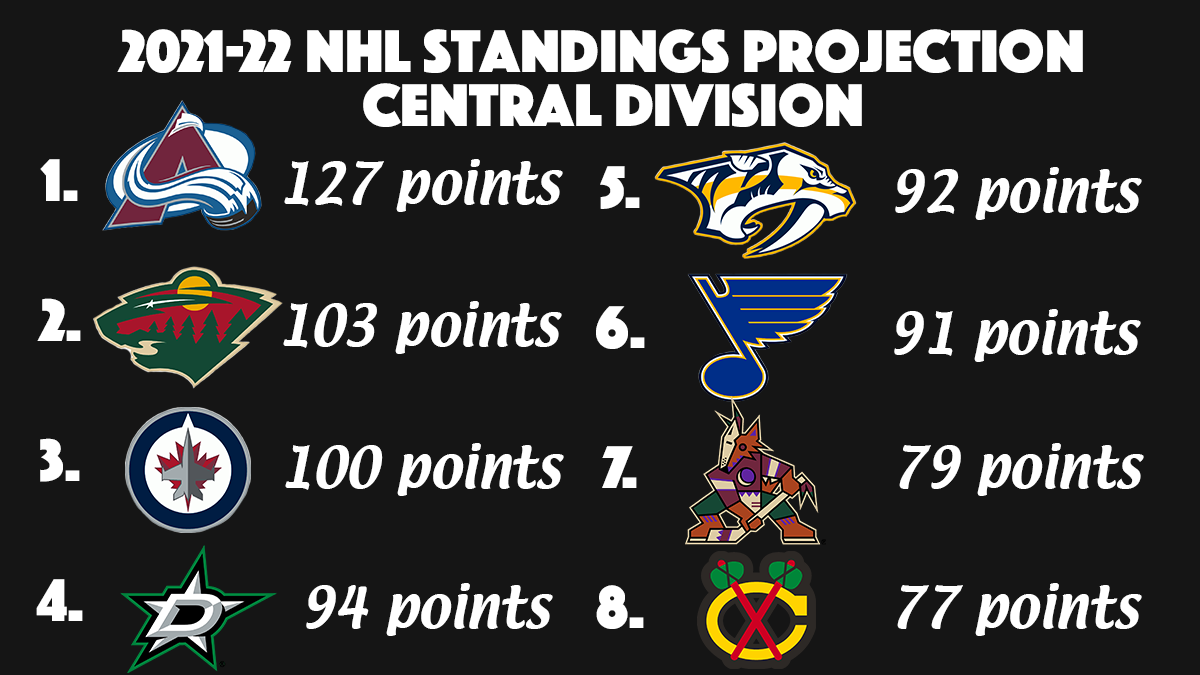
The overall vibe of the Central Division for 2021-22 is that it’s just more of exactly what you’d expect. The Colorado Avalanche are lightyears ahead of everyone else, while Kirill Kaprizov and the Minnesota Wild continue to be on the rise and everyone else fights for what they can earn.
Meanwhile, the jury is still out on whether or not the Winnipeg Jets can breakthrough as Canada’s team and break the Canadian curse (become the first Canadian club to win the Cup since 1993).
Will Coloradofinally break through the Second Round and win the Cup?
Are the Avalanche just the Toronto Maple Leafs but with a little more success? My column:
No, but really, it’s worth asking if the Avs making it back to the Western Conference Final for the first time since 2002, is more like Toronto’s struggle to make it out of the First Round for the first time since 2004, or is Colorado’s struggle more like the Washington Capitals pre-2018?
The Caps won three Presidents’ Trophies in 2009-10, 2015-16 and 2016-17, but couldn’t make it past the Second Round– let alone the Pittsburgh Penguins– until they finally did and ended up surging in momentum all the way to their first Stanley Cup in franchise history.
Colorado, on the other hand, has already won the Cup twice (1996 and 2001) and also has three Presidents’ Trophies to their name in 1996-97, 2000-01 and 2020-21, so if recent history has anything to tell us it’s that yet another team with high expectations for at least a few seasons now only to come up short could very well go on to win it all after winning the Presidents’ Trophy the previous year.
Either that or they’ll have to win it in back-to-back seasons like Washington did before they won the Cup in 2018.
Then again, the Tampa Bay Lightning tied the Detroit Red Wings’ record for most wins in the regular season (62), securing the Presidents’ Trophy in the process in 2018-19, then got swept by the Columbus Blue Jackets in the 2019 First Round.
The very next year, however, Tampa kicked off back-to-back Cup rings in 2020 and 2021, to be where they are now as the two-time defending champions likely standing in the path as the only other favorites outside of the Avalanche this season.
Anyway, the Avs mostly kept things the same from last season to this season, losing Joonas Donskoi to the Seattle Kraken in the 2021 NHL Expansion Draft, Brandon Saad to the St. Louis Blues in free agency and making minor swaps among replacement level bottom-six forwards and bottom-pairing defenders.
Oh, then there’s this whole thing about how Philipp Grubauer left for Seattle in free agency too, so Colorado acquired Darcy Kuemper from the Arizona Coyotes.
Between Dallas, Nashville and St. Louis, who will realistically make the playoffs?
The Stars are projected to finish with about 94 points, the Predators sit at 92 points and the Blues are around 91 points in this one projection, but don’t let the points alone be your deciding factor.
Given the strength of the Central Division compared to the Pacific Division, you can bet on five teams making out of the Central among Western Conference playoff berths.
As such, the spread is the difference maker between these three teams expected to be in the wild card hunt– it’s going to come down to the wire one way or another.
Dallas bolstered their goaltending depth by signing Braden Holtby, Nashville traded Ryan Ellis to the Philadelphia Flyers and St. Louis is… …better than last season on paper?
I mean, the Blues signed Saad, acquired Pavel Buchnevich from the New York Rangers in exchange for Sammy Blais, let Seattle claim Vince Dunn at the expansion draft and let Mike Hoffman walk to the Montréal Canadiens in July.
You could say they took a hit here or there, but those aren’t “nobody names” by any means, however.
If Jordan Binnington and Ville Husso can stabilize things in the crease, then St. Louis has a better situation than the Predators.
The Stars, meanwhile, should benefit from a longer season where more of their core guys– like Tyler Seguin, for example– are healthy. Last season’s COVID-19 outbreak to kick things off in January really killed Dallas’ momentum as a team on the verge of being in the 2021 postseason.
Dallas should get back into the swing of things and St. Louis should be able to stay relevant for at least another year, but how hard the Preds rely on Juuse Saros as their starting goaltender will dictate whether or not they’re able to play spoiler with David Rittich as their backup since Pekka Rinne retired.
Can Arizona avoid the basement?
Anything is possible at this point. Loui Eriksson and Andrew Ladd were scoring goals in the postseason, so a fresh start could be just what both players needed for the last few years at least.
That said, Coyotes General Manager, Bill Armstrong, gave a Masterclass™️ in how to go about rebuilding by selling everything over the summer and taking on “bad” contracts with only one or two years remaining in hopes of playing just well enough to be bad enough without making it look obvious that you’re aiming to win the 2022 NHL Draft Lottery.
The Pacific Division is the new Scotia NHL North Division from last season. In other words, it’s the worst– which is great news for the Seattle Kraken as the league’s schedule allots more division play than any other opponents (though the Kraken will play every other team in the league at least twice).
Seattle’s riding the waves of new-age expansion, while the Vegas Golden Knights lead the charge for the Presidents’ Trophy campaign in 2021-22.
Wait, Seattle in 2nd in the Pacific, really?
Yes, really.
The Kraken have a great front office that goes beyond just Ron Francis as General Manager and have done their due diligence in scouting the best talent available to try to replicate the success of the Vegas Golden Knights’ inaugural season in 2017-18, as well as grow beyond just 2021-22.
That said, Seattle probably isn’t going to make it out of the First Round of the 2022 Stanley Cup Playoffs, even if they have to face the Edmonton Oilers according to this projection.
It’s a best case scenario for the NHL’s newest expansion team to be in the weakest division, but aside from having recent Stanley Cup champions Yanni Gourde, Philipp Grubauer, Jaden Schwartz and Dunn on their roster, the Kraken have a plethora of players that are relatively inexperienced with deep postseason runs.
Head coach, Dave Hakstol, also hasn’t had the consistency of making the playoffs and making it out of the First Round in his NHL coaching days, but as a team that, again, is looking to develop long-term success, these are mere growing pains Francis and Co. are willing to accept as the fan base grows.
Why aren’t the Kings making the cut this year when everyone else says they’ll be the most improved?
The simple answer is that everyone’s overrating Los Angeles when it comes to the “ready now” factor.
Sure, Kings General Manager, Rob Blake, did a good thing by getting Viktor Arvidsson in a trade with Nashville this summer to solidify his top-six forward group and signed Alex Edler to fortify his defense, but Los Angeles’ goaltending leaves something to be desired.
Here’s hoping Jonathan Quick can find a little resurgence at this point in his career, while Cal Petersen continues to come into his own.
If Los Angeles has any injuries– and they already have with Arvidsson likely missing some time due to an injury in the last preseason game– they’re already close enough to the bubble that they’ll only fall further behind.
That said, if the Kings don’t make it back to the postseason hunt in 2022, there’s a good chance they make it in 2023.
Los Angeles is improving, but by how much remains to be seen.
Will winning the Presidents’ Trophy hurt Vegas?
Eh, it’s hard to say.
The Golden Knights have packed in just about every type of heartbreak since their inception in 2017, that fans of other franchises have only experienced over the course of at least 50 years, so if Vegas pulls out the Presidents’ Trophy win in 2021-22, don’t be surprised when the inevitable happens and they win the Cup instead of doing what most other Presidents’ Trophy winners in the salary cap era have done.
Only the 2007-08 Detroit Red Wings and Chicago in 2012-13, have been able to win the Presidents’ Trophy and the Stanley Cup since the salary cap was introduced ahead of the 2005-06 season.
Vegas would probably join Detroit and Chicago in doing so just so the Hockey Gods can spite us again.
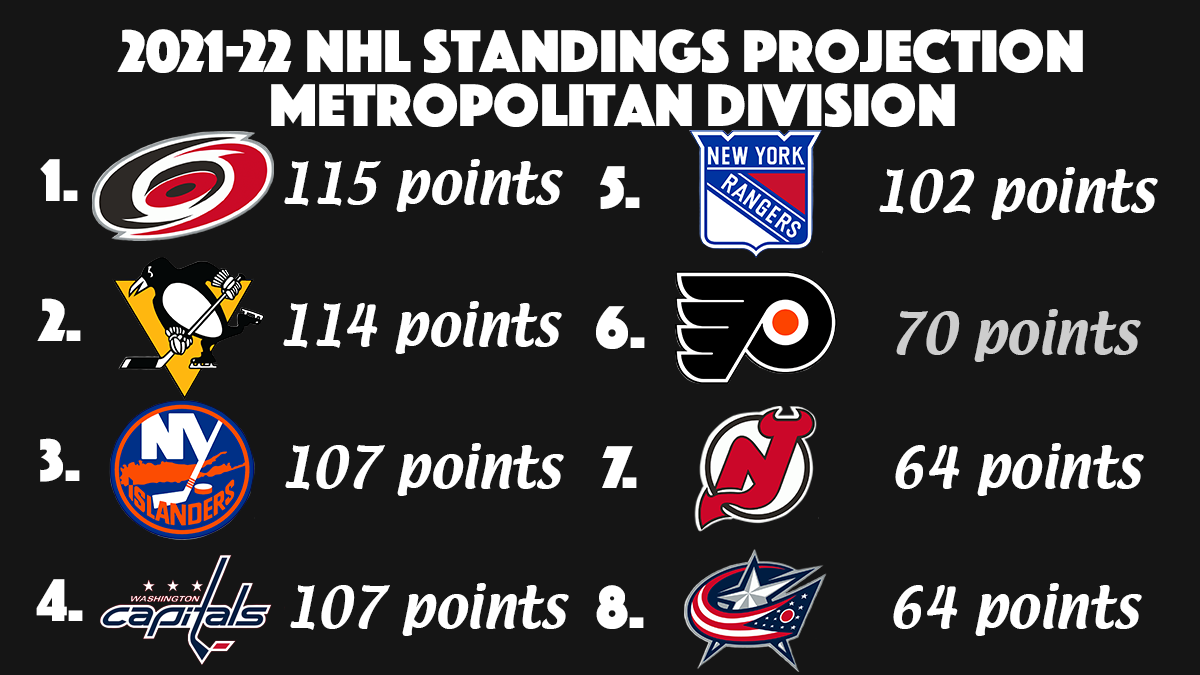
It’s not easy to be in the Metropolitan Division these days because, well, let’s save that for the three questions below.
Is this the toughest division to project?
Absolutely.
The Carolina Hurricanes decided to just get rid of a few parts and pieces that helped make them good for the last few seasons, so they’re bound to regress even with Sebastian Aho, Andrei Svechnikov, Teuvo Teräväinen and Martin Necas still existing.
The Pittsburgh Penguins since 2009, have always found a way to be near the top of the division standings by the end of the regular season no matter whether or not you believe they’ll inevitably miss the playoffs for the first time since 2006, so anything could happen there.
The New York Islanders have made back-to-back appearances in the Eastern Conference Final, so I’d expect them to be good.
The Washington Capitals are better than the Philadelphia Flyers and New York Rangers, at least, but are probably the only team on the bubble if the New Jersey Devils can come out of nowhere and be competitive this season after signing Dougie Hamilton, Tomas Tatar and Jonathan Bernier in the offseason.
Meanwhile, it’s time for a short rebuild in Columbus as the Blue Jackets would be quite pleased with a top draft pick in 2022.
What if Chris Drury never was promoted as General Manager of the Rangers?
They’d still fire David Quinn and hire Gerard Gallant. I don’t think that’s such a bad idea, but they’d definitely reconsider about 90% of the roster decisions made this summer.
There’s no reason why the Rangers have to go down this path and yet, here they are, fumbling at the one-yard line and possibly plunging their franchise back into the Dark Ages of another rebuild. Or is it the same ongoing rebuild?
What about a team to watch like New Jersey, for example?
I’m big on the Devils this season for some strange reason.
Maybe it’s because a part of me deep down misses the trap game of the 1990s and 2000s that led to Stanley Cups for New Jersey in 1995, 2000 and 2003.
Maybe it’s because they signed Hamilton, Tatar, Bernier and acquired Ryan Graves from the Colorado Avalanche as a supporting cast for Jack Hughes, Nico Hischier, Pavel Zacha, Yegor Sharangovich, Ty Smith and friends.
Seriously, the Devils should be good in the next few seasons, but this year could be the biggest stride forward in terms of their improvement from the basement to their development as a playoff contender.
First, pour one out for Jack Eichel. Now, let’s move on and talk about everyone else.
What does this mean for the Leafs?
Just like how the Stars, Preds and Blues are all right on top of one another in the Central Division standings, the Atlantic Division is stacked from 1st through 4th, so though Toronto leads the way in this projection, I wouldn’t feel too comfortable as a Leafs fan.
The Maple Leafs played in the worst of the four divisions last year in the temporarily realigned divisions in wake of the ongoing pandemic.
No, it’s not just because they played all the other Canadian teams across 56 games, but rather it’s due to the fact that they haven’t been able to matchup with the Tampa Bay Lightning, Florida Panthers and even the Boston Bruins since the 2019-20 season.
A lot and not a lot has changed since then.
Tampa is still dominant as ever, Florida has emerged as a team that’s on the rise and Boston is unpredictable in that– much like the Penguins– it could really go either way with the Bruins this season.
So now Toronto has to take on better competition within their own division and square off with teams like the Vegas Golden Knights, Colorado Avalanche, New York Islanders and others that emerge towards the top of the standings outside of the Canadian teams that the Leafs are all too familiar with at this point.
That said, Toronto still has a great chance at winning the Atlantic Division regular season title or finishing 2nd and having home ice advantage in the First Round for the second-straight postseason.
Can anyone other than Toronto, Florida, Tampa or Boston make it out of the Atlantic this year?
No. Let’s be realistic here.
The Montréal Canadiens made it to the 2021 Stanley Cup Final despite being below .500 in the standings because every division produced four playoff berths and intra-divisional play through two rounds.
In 2020, they upset the Pittsburgh Penguins in the Qualifier despite finishing right at .500.
In any other non-pandemic timeline, the Canadiens would still be looking for their first playoff appearance since they lost to the New York Rangers in six games in the 2017 First Round.
That’s not to say that Nick Suzuki can’t lead the Habs back to glory, but rather that they need to improve all-around in the regular season and peaking in performance in the playoffs.
Though the Ottawa Senators promised unprecedented success from 2021-25, it’s looking like it’ll realistically be anytime between 2024-25 as in the 2024-25 season itself at this point.
Ottawa’s goaltending needs to improve, their defense could use some tweaks and the Sens are banking on their offense getting their feet underneath them and bursting in production in the coming years.
A little more patience won’t hurt them.
The same can be said for the Detroit Red Wings in that Red Wings fans already know– trust in General Manager, Steve Yzerman, is paramount. He’ll work his magic.
It just takes a little time to build a solid foundation and the first floor is almost ready to start going up.
As for the Buffalo Sabres, well…
At least they’ll hopefully give Rick Jeanneret a proper send-off before he retires as their play-by-play announcer for the last 51 years on television.
Hopefully.
Will Tampa win three consecutive Stanley Cup championships?
Probably not.
I’m not ruling it out entirely, but the Lightning have a better chance of winning three Cups in four years than they do three Cups in as many years as things stand currently.
The loss of their entire third line (Blake Coleman, Yanni Gourde and Barclay Goodrow) from last season to this season is sure to leave a mark on the development and restructuring of their bottom-six forwards.
That said, Tampa’s top-six forwards still exist and, if you haven’t already noticed, they’re very good on their own, but the best teams in the playoffs have four lines that can roll without a doubt and the Bolts might just be off the ball for a year in terms of depth.
Alright, if you’ve made it this far, thanks for your patience. By now the season’s already going on a few days into the 2021-22 calendar, so the two of us (or more if you’re reading this to a group) should probably get back to watching games.
Stay tuned for more forecasts for both standings and assorted teams throughout the season.
Additions: F Michael Vecchione, D Matt Irwin, D Dylan McIlrath, G Hunter Shepard
Subtractions: F Daniel Carr (NL), F Phillippe Maillet (KHL), F Michael Raffl (signed with DAL), D Zdeno Chara (signed with NYI), D Brenden Dillon (traded to WPG), D Paul LaDue (signed with NYI), G Craig Anderson (signed with BUF), G Henrik Lundqvist (retired)
Still Unsigned: D Cameron Schilling
Re-signed: F Axel Jonsson-Fjällby, F Shane Gersich, F Beck Malenstyn, F Alex Ovechkin, F Garrett Pilon, F Michael Sgarbossa, F Joe Snively, D Lucas Johansen, D Bobby Nardella, G Ilya Samsonov
Where do I put him? G Vitek Vanecek (expansion, SEA, acquired from SEA, then re-signed)
Offseason Analysis: The Capitals keep telling themselves they can win another Stanley Cup title in the Alex Ovechkin Era, but after three-straight years of First Round exits– most recently in five games to the Boston Bruins– despite being the higher seed in each case might tell you something.
This team is getting old.
The core isn’t as young as they used to be and now Washington is scrambling to piece together some semblance of a run, which will undoubtedly cost them valuable pieces of their youth if they let it go to their heads– as already seen by trading Jakub Vrana for Anthony Mantha at the deadline.
Though it may be unpopular with fans, it would’ve made more sense to try to get T.J. Oshie to submit a list of teams he wouldn’t agree to be traded to and try to save yourself $5.750 million per season through 2024-25 that you could spend elsewhere.
Caps General Manager, Brian MacLellan, didn’t have much to do this summer, because Washington is sticking with their guns whether it works or not.
They’ve tried it before– though with minor recurring character changes– and somehow it worked in 2018, surely it can happen all over again!
MacLellan was more focused on signing Ovechkin to an extension.
Despite the superstar forward’s scoring prowess, he is 36-years-old. That’s not to say that he won’t be able to usurp Wayne Gretzky for the most goals in National Hockey League history– especially if he plays for another 10 years– but it is worth noting that it’s generally not a good idea to hand out a five-year extension worth $9.500 million per season.
That’s sealing your fate right there.
Washington could win another Cup and everything is forgiven or Ovechkin’s cap hit comes back to bite the Capitals in the long run, regardless of increases in the cap ceiling down the road.
Ovechkin could get hurt. Then what?
Sure, there’s the long term injured reserve, but what if he can never play again? Now you’re out of your best talent and the rest of the supporting cast isn’t good enough to carry the show on their own, like The Office after Steve Carell left.
Think about it.
A 40-year-old player with a $9.500 million cap hit is unheard of– especially in the salary cap era. Luckily for the Caps, Ovechkin is only 36-years-old for now.
If Ovechkin would’ve been fine with a two or three-year extension worth even just a $500,000 less per season than his current cap hit– you offer that extension.
Once it starts reaching long-term status, that’s when negotiations should’ve gone from “whatever you want” to “whatever you want, within reason”.
Whether Ovechkin stays or leaves is ultimately “whatever he wants” and, ultimately, the same is true with his new extension.
Who knows, maybe in three years, Ovechkin will request a trade or something. ¯\_(ツ)_/¯
Anyway, the Seattle Kraken took Vitek Vanecek in the expansion draft only to turn around and trade him back to Washington for a 2023 2nd round pick a week later.
At least the social media teams had fun with it.
Seattle got what they wanted from elsewhere and yielded a 2023 2nd round pick in the process, while Washington just… …opened the door and let him back inside from the rain.
Vanecek went 21-10-4 in 37 games with a 2.69 goals-against average, a .908 save percentage and two shutouts in that span last season while emerging as the de facto starting goaltender for the Capitals after Ilya Samsonov had bouts on the COVID-19 protocol list interspersed with some inconsistent play.
Samsonov went 13-4-1 in 19 games with a 2.69 goals-against average, a .902 save percentage and two shutouts in that span. In 2019-20, he went 16-6-2 in 26 games, amassing a 2.55 goals-against average and a .913 save percentage as well as one shutout.
While both goaltenders are considered viable at the NHL level in Washington, there’s going to be a larger sample size to analyze which one is really better in the long run.
There’s also no safety net if the healthy competition goes awry and with roughly $668,740 in cap space, things could get ugly– and fast.
It’s not like the Capitals are teetering on the edge of a rebuild, but one more year of a First Round exit might thrust them into reactionary maneuvers instead of carefully crafting an exit strategy into a seamless transition from the old core to a new core– whatever that may be.
Craig Anderson, Zdeno Chara and Brenden Dillon are gone.
Anderson was going to retire until the Buffalo Sabres remembered they needed to sign a couple of goaltenders to play in the upcoming season like. Chara went back to the New York Islanders.
Dillon, meanwhile, was traded to the Winnipeg Jets on July 26th for a 2022 2nd round pick and a 2023 2nd round pick, so that seems like a pretty good selling point for a defender that fell victim to the Caps’ cap crunch.
The offense remains the same, the defense is intact and the goaltending leaves a little something to be desired.
Washington proved the hockey world wrong when many said they should dismantle the team heading into the 2017-18 season. Can they recreate that magic again?
Offseason Grade:C-
Ovechkin might have signed a lucrative deal for a player over 35, but Washington’s tight squeeze against the salary cap isn’t the biggest question right now.
Whereas when Braden Holtby began his regression to his present-day form with the Dallas Stars, Samsonov was just a young backup getting a pass for a respectable 2.55 goals-against average and a .913 save percentage in roughly 1/4 of the season.
That was in 2019-20, when Holtby had a 25-14-6 record in 48 games with a 3.11 goals-against average, an .897 save percentage and no shutouts in that span.
When one goalie faltered, the other goalie could step in and fill a hole.
Entering 2021-22, Samsonov and Vanecek have both shown the same results. The former, however, may play a bit too aggressive, while the latter is more tactical in style– as long as he’s healthy, but nevertheless each had a 2.69 goals-against average in their respective stints last season.
There’s no clear-cut winner for the starting job from day one. At the very least, that’ll be good motivation for whoever wants it more.
Other than that, Washington shouldn’t be too worried about regular season results. It’s when it really counts that matters (so… …making it out of the First Round).
Missed the postseason for the first time since 2020
Additions: F Luke Glendening, F Michael Raffl, D Jani Hakanpää, D Alexander Petrovic, D Ryan Suter, G Braden Holtby
Subtractions: F Andrew Cogliano (signed with SJS), F Jason Dickinson (traded to VAN), F Matej Stansky (NL), D Taylor Fedun (signed with PIT), D Julius Honka (SHL), D Stephen Johns (retired), D Jamie Oleksiak (expansion, SEA), D Mark Pysyk (signed with BUF), G Landon Bow (ELH)
Still Unsigned: F Adam Mascherin (SHL, DAL reserve list), D Sami Vatanen
Re-signed: F Nick Caamano, F Blake Comeau, F Rhett Gardner, F Tanner Kero, F Joel Kiviranta, D Joseph Cecconi, D Ben Gleason, D Miro Heiskanen, D Jerad Rosburg, G Colton Point
Offseason Analysis: When the Minnesota Wild decided to buyout Zach Parise and Ryan Suter, the Stars saw a chance to make one of the best low-risk, high-reward moves of the offseason in signing Suter to a four-year contract worth $3.650 million per season.
Though there is a slight concern the 36-year-old defender will not be able to maintain his pace of play as the years go by in the deal, signing Suter to a cap hit under $4 million makes him easy to move in the later years and gives you the flexibility to keep guys like Miro Heiskanen and John Klingberg on your roster at the same time.
At least for the 2021-22 season before Dallas General Manager, Jim Nill, gets to deal with the headache that is possibly signing the 29-year-old pending-unrestricted free agent, Klingberg, to an extension.
With Heiskanen earning an eight-year extension with an $8.450 million cap hit, it’s hard to imagine that Klingberg’s asking price won’t be at least $9.000 million per season.
At least the Stars are projected to have about $23.300 million in cap space next offseason, whereas there’s no wiggle room now that the 2021-22 roster is full with not even a penny to spend towards the ceiling.
Anyway, since the 2011-12 season, Suter has only missed the 40-point plateau from the blue line three times.
In 2012-13, Suter had 32 points in a 48-game lockout shortened season. In 2014-15, he had 38 points in 77 games.
But when the ongoing COVID-19 pandemic cut short the 2019-20 regular season, Suter had already amassed 48 points in 69 games for Minnesota.
He had 19 points in 56 games with the Wild last season, however.
Nevertheless, the Stars overhauled their defense in the offseason, so Suter should slide in as a top-four shutdown guy with years of experience having amassed 93-514–607 totals in 1,198 career games with the Nashville Predators and Wild since breaking into the league in the 2005-06 season after Nashville drafted him in the 1st round (7th overall) of the 2003 NHL Entry Draft.
Veteran depth and replacement-level players were Nill’s primary focus this offseason as he extended younger guys like Heiskanen, Tanner Kero, Rhett Gardner, Nick Caamano and Joel Kiviranta.
Kiviranta had 6-5–11 totals in 26 games while battling a lower body injury in what otherwise would’ve likely been his first full season glance in a Stars uniform.
As a result, he’s on a two-year bridge deal worth $1.050 million per season having been a pleasant surprise for Dallas as a clutch-role player in the top-nine.
With Heiskanen’s cap hit set at $8.450 million per season on his eight-year extension and the 2021 NHL Expansion Draft in mind as the Seattle Kraken were four days away from taking a player from the Stars for nothing after Heiskanen signed his new deal on July 17th, Nill knew there’d be little he could do to keep Jamie Oleksiak around.
Dallas could’ve tried to convince Seattle to not select Oleksiak in an expansion draft day trade, but the Stars ultimately chose not to as Oleksiak was claimed and signed a steep five-year extension worth $4.600 million per season– a little out of Dallas’ price range for what they deemed a replaceable asset.
With Stephen Johns having retired, Oleksiak gone to Seattle and Julius Honka off to the Swedish Hockey League (SHL), Nills brought in Suter and Jani Hakanpää as a pair of durable defenders.
At 6-foot-5, 218-pounds, Hakanpää can pack a punch with his noted physical play– he finished third in the league in hits last season with 215, for the record.
In 57 games with the Anaheim Ducks and Carolina Hurricanes last season, Hakanpää might not be a name-brand player given his age (29) or totals (2-2–4), but he is sure to be a fan favorite among those that love quality, hard-hitting, third pairing defenders.
Luke Glendening and Michael Raffl are new to Dallas this season– replacing the likes of Andrew Cogliano and Jason Dickinson as Nill chose not to re-sign the former and traded the latter.
Cogliano joined the San Jose Sharks, while Dickinson was shipped to the Vancouver Canucks for a 2021 3rd round pick (Ayrton Martino).
It’s important to keep your bottom-six forwards fresh, inexpensive and producing and Nill felt it was about time for a little shakeup down in the depth of the roster.
Nill also made a move at the 2021 NHL Entry Draft, trading his 2021 1st round pick (15th overall, Sebastian Cossa) down with the Detroit Red Wings for a 2021 1st round pick (originally belonging to the Washington Capitals– 23rd overall, Wyatt Johnston), a 2021 2nd round pick (originally belonging to the New York Rangers– 48th overall, Artyom Grushnikov) and a 2021 5th round pick (originally belonging to the Ottawa Senators via Montréal and Detroit– 138th overall, Jack Bar).
Outside of the crease, the plans for the 2021-22 season have come into existence.
But in the net, the Stars face the difficult task of juggling three goaltenders of varying quality.
Jake Oettinger is the future full-time starter if the future isn’t already now. Anton Khudobin played well enough to earn an extended stay as a result of his fill-in heroics leading to Dallas’ 2020 Stanley Cup Final appearance.
Meanwhile, Braden Holtby was bought out by Vancouver and joined the Stars for a career-resurgence.
Oh and Ben Bishop is still out due to injury, though sources close to the Stars seem to indicate his playing days may be over (as if signing Holtby wasn’t enough of a giveaway).
Oettinger went 11-8-7 in 29 games played last season with a 2.36 goals-against average and a .911 save percentage, as well as one shutout in that span as he made his regular season debut.
Khudobin regressed a little bit back to his norm after a rejuvenating 2019-20 season– posting a 12-11-7 record in 32 games with a 2.54 goals-against average, a .903 save percentage and three shutouts in 2020-21 after going 16-8-4 in 30 games with a 2.22 goals-against average and a .930 save percentage the season prior.
Both Stars goaltenders were fine as they were, then Holtby became part of the equation on a one-year, $2.000 million contract.
In his one season with Vancouver, the floor fell out. Holtby went 7-11-3 in 21 games with a 3.67 goals-against average and an .889 save percentage.
The good news, however, is that Dallas has a better defense on paper than the Canucks and the results should translate as such– no matter who’s in the crease.
Offseason Grade:A
Last season was a fluke. For starters, the Stars were rocked by COVID-19 early in the 2020-21 calendar, which delayed their start to the regular season.
Tyler Seguin missed a significant portion of the season (all but three games) after having surgery after the 2020 Stanley Cup Final and a long rehab for a torn labrum in his hip.
With only the top-four teams in each temporarily realigned division making the 2021 Stanley Cup Playoffs last season, nobody is blaming Dallas for coming up short and missing out on what likely would’ve been a quick First Round exit.
This offseason, Nill’s made significant improvements in depth and signed affordable deals to continue to build around his core for the immediate future while the team is still competitive.
The Stars are on track to get back into the playoff picture in 2021-22 and maybe– just maybe– turn some heads again and make it back to the Stanley Cup Final if everything falls into place.
Missed the postseason for the first time since 2020
Additions: F Justin Dowling, F Jason Dickinson (acquired from DAL), F Phil Di Giuseppe, F Sheldon Dries, F Conor Garland (acquired from ARI), F Nic Petan, F Sheldon Rempal, F John Stevens, D Kyle Burroughs, D Oliver Ekman-Larsson (acquired from ARI), D Brad Hunt, D Brady Keeper, D Tucker Poolman, D Luke Schenn, D Devante Stephens, G Jaroslav Halak, G Spencer Martin (acquired from TBL)
Subtractions: F Sven Baertschi (signed with VGK), F Jay Beagle (traded to ARI), F Travis Boyd (signed with ARI), F Loui Eriksson (traded to ARI), F Tyler Graovac (KHL), F Jayce Hawryluk (SHL), F Kole Lind (expansion, SEA), F Lukas Jasek (Liiga), F Marc Michaelis (signed with Toronto Marlies, AHL), F Petrus Palmu (Liiga), F Antoine Roussel (traded to ARI), F Jake Virtanen (buyout, KHL), D Jalen Chatfield (signed with Chicago Wolves, AHL), D Alexander Edler (signed with LAK), D Mitch Eliot (signed with Rochester Americans, AHL), D Brogan Rafferty (signed with ANA), D Nate Schmidt (traded to WPG), D Ashton Sautner (signed with Abbotsford Canucks, AHL), D Josh Teves (signed with Rochester Americans, AHL), G Braden Holtby (buyout)
Still Unsigned: F Elias Pettersson (RFA), F Jimmy Vesey, D Quinn Hughes (RFA), G Jake Kielly
Re-signed: F Justin Bailey, F Brandon Sutter, D Guillaume Brisebois, D Travis Hamonic, D Olli Juolevi
Offseason Analysis: Canucks General Manager, Jim Benning, has been busy this offseason undoing past misjudgments and moving Vancouver forward in other areas (however small they may be).
At least he didn’t sign anyone to a head-scratching long-term contract the day that free agency began on July 28th this year.
With about $10.664 million in cap space currently and Elias Pettersson as a restricted-free agent alongside Quinn Hughes, the Canucks still have some work to get done before the season begins or else they risk falling behind even further in the standings.
While Pettersson would probably love to make about $9.000 or $10 million per season, he hasn’t exactly reached that status yet as a 22-year-old center with 153 points in 165 career games.
A solid bridge contract is more likely in his future than, say, a long-term seven or eight-year deal.
It may be kicking the can down the road to pay him later, but with 21 points (10 goals, 11 assists) in 26 games last season, there’s always the risk that his wrist injury might quite literally hurt his skilled hands in the near to long-term future.
A bridge deal insures the Canucks of avoiding prolonging the salary cap hell that they’ve been through until Benning was able to dump most of it in Arizona via the trade with the Coyotes for Oliver Ekman-Larsson and Conor Garland.
That said, Pettersson is worth paying a premium for to build off of Vancouver’s young core. He had 28-38–66 totals in 71 games in his first season in the league in 2018-19 and amassed 27-39–66 totals in 68 games prior to the COVID-19 pandemic being declared in the 2019-20 season.
Hughes, on the other hand, is important to Vancouver’s future, but had a dip in production from 53 points (eight goals, 45 assists) in 68 games in his first full season in 2019-20 to 41 points (three goals, 38 assists) in 56 games last season.
Nevertheless, for a defender to wrack up 40 or more points in a season is pretty good all things considered.
Especially since Hughes is only 21-years-old and has plenty of track left on route to his potential.
It should be easier to get a deal done with Hughes than Pettersson if the sticking point is that one sees themselves more valuable to the team than the other.
If, for some reason, things went south between the Canucks and Pettersson, the Canucks could survive– albeit reminiscent of the last days of Pavel Bure with the franchise.
In other words, you probably don’t want that to happen again.
All right, what about what Vancouver has already taken care of this offseason, shall we?
Jaroslav Halak left the Boston Bruins for the Canucks via free agency this summer and signed a one-year deal worth $1.500 million with another $1.500 million in performance bonuses to become the backup to Thatcher Demko, though Vancouver may prefer to utilize Halak and Demko as some sort of a 1A/1B tandem.
Despite Halak’s 9-6-4 record in 19 games last season, he maintained a quality 2.53 goals-against average and a .905 save percentage with two shutouts in that span as Boston’s backup until Jeremy Swayman entered the conversation.
In 2019-20, Halak and Tuukka Rask captured the William M. Jennings Trophy as the goaltender(s) with 25 or more games played that allowed the fewest goals against in that season.
Halak went 18-6-6 in 31 games and had a 2.39 goals-against average, a .919 save percentage and three shutouts in that remarkable regular season run.
It served as a reminder that Halak was once a surefire starting goaltender and could very well, in the event that was necessary, command a team from the crease as a starter once more.
This after a 22-11-4 record in 40 games played with Boston in 2018-19, in which he had a 2.34 goals-against average, a .922 save percentage and five shutouts.
But at 36-years-old, Halak’s time in the league is dwindling as he continues about the twilight of his career.
At the very least, he brings in more stability in the crease than Braden Holtby did for Demko– and that’s precisely why the Canucks felt is was O.K. to buyout the remaining year of Holtby’s contract.
The bulk of Benning’s work this offseason came via making trades.
He most recently acquired goaltender, Spencer Martin, from the Tampa Bay Lightning on July 31st for future considerations to solidify depth in the event of injury or to at least provide the Abbotsford Canucks (AHL) with a quality starter.
But earlier this summer, Benning kicked things off with a small grab for top-nine depth by sending the Dallas Stars a 2021 3rd round pick (73rd overall, Ayrton Martino) for forward, Jason Dickinson, on July 17th.
Six days later, Benning phoned Bill Armstrong in Arizona and executed a trade that saved the Canucks almost $5.000 million in valuable cap space after sending Antoine Roussel, Jay Beagle, Loui Eriksson, a 2021 1st round pick (9th overall, Dylan Guenther), a 2022 2nd round pick and a 2023 7th round pick to the Coyotes for Ekman-Larsson and Garland’s signing rights before re-signing the latter to a five-year extension worth $4.950 million per season.
Arizona retained 12% of Ekman-Larsson’s salary, thus shaving $990,000 off of his cap hit for Vancouver, who is assessed a cap hit of $7.260 million per season for Ekman-Larsson through 2026-27.
With change coming to the blue line in Vancouver, Nate Schmidt reconsidered a trade he had initially rejected and informed Benning he would be fine being moved after all in a deal where the Canucks sent Schmidt to the Winnipeg Jets for a 2022 3rd round pick on July 27th.
If Ekman-Larsson’s able to rebound from his decline– reaching 55 points in 75 games in 2015-16, then 39 points in 79 games the following season before rebounding with 42 points in 82 games in 2017-18 and 44 points in 81 games in 2018-19 prior to his dropoff again in 2019-20, where he had 30 points in 66 games and 2020-21, where he had 24 points in 46 games– then Benning might just be a mastermind after all.
At the very least, Ekman-Larsson’s 24 points last season with Arizona was more than Schmidt had in 54 games with Vancouver, as Schmidt dropped from 31 points in 59 games with the Vegas Golden Knights in 2019-20 to 15 points in 54 games with the Canucks.
Offseason Grade:B
If the Canucks had signed Pettersson and Hughes to extensions already– and assuming they weren’t overpaying them– then Vancouver probably would get an “A” overall for their willingness to free themselves from past mistakes and try something new.
Will they be as bad as they were last season? Probably not.
Will they be “blow other teams out of the water” good this season? Also probably not.
But at the very least, they’ve given themselves enough to work with in the next year or two to fill out the rest of their core and supplement their best players with better pieces of the puzzle.
If, however, everything falls on their face, then I guess Vancouver is just cursed like that then, huh.
This post will be updated as signings are officially announced. Be sure to check our Twitter account (@DtFrozenRiver) for all of the latest signings, news, and analysis.
Free agency begins at noon (technically 12:01 PM ET) on July 28th.
For the second-straight year, the ongoing COVID-19 pandemic has shifted the schedule a bit for the National Hockey League, but after the free agency signing period opens to kickoff the 2021-22 league calendar year, things will be back on track for a full 82-game schedule (albeit about a week later than usual).
All that is known is shown and will be updated throughout the day. More analysis will come as we play catch-up.
ESPN+ is streaming TSN’s coverage of free agency from 11 a.m. ET onward and NHL Network has the Sportsnet/their own feed, probably (we like the former, in all partiality).
Reported free agent signings
These are reported agreements in place that are yet to be confirmed and/or announced by a playing club.
F Kyle Palmieri has likely re-signed with the New York Islanders.
Announced free agent signings
These are confirmed/announced signings by playing clubs.
F Carter Verhaeghe signed a three-year extension worth about $4.167 million per season with the Florida Panthers that goes into effect starting with the 2022-23 season.
The Edmonton Oilers re-signed D Tyson Barrie to a three-year contract worth $4.500 million per season.
The Vegas Golden Knights signed D Alec Martinez to a three-year extension worth $5.250 million per season.
The Carolina Hurricanes signed G Frederik Andersen to a two-year deal worth $4.500 million per season.
G Petr Mrazek signed a three-year deal with the Toronto Maple Leafs worth $3.800 million per season.
F Nick Bonino agreed to a two-year contract with the San Jose Sharks.
F Brandon Sutter signed a one-year extension worth $1.125 million with the Vancouver Canucks.
G Antti Raanta reportedly signed a two-year deal worth $2.000 million per season with the Carolina Hurricanes.
The Los Angeles Kings re-signed F Andreas Athanasiou to a one-year deal worth $2.700 million.
D Dougie Hamilton signed a seven-year contract worth $9.000 million per season with the New Jersey Devils.
F Blake Coleman signed a six-year deal worth $4.900 million per season with the Calgary Flames.
The Montréal Canadiens signed D David Savard to a four-year contract worth $3.500 million per season.
G Brian Elliott signed a deal with the Tampa Bay Lightning.
D Tucker Poolman agreed to a four-year contract worth $2.500 million per season with the Vancouver Canucks.
The Dallas Stars signed F Luke Glendening to a two-year deal worth $1.500 million per season.
D Andreas Borgman signed a one-year, two-way deal worth $750,000 at the NHL level with the Dallas Stars.
D Travis Hamonic signed a two-year extension worth $3.000 million per season with the Vancouver Canucks.
F Dominik Simon signed a one-year, two-way contract extension with the Pittsburgh Penguins.
F Charles Hudon signed a deal with the Tampa Bay Lightning.
D Zach Bogosian signed a three-year contract worth $850,000 per season with the Tampa Bay Lightning.
The San Jose Sharks signed F Andrew Cogliano to a one-year contract worth $1.000 million.
The Montréal Canadiens signed F Cedric Paquette to a one-year contract worth $950,000.
D Brady Keeper signed a two-year deal worth $762,500 per season with the Vancouver Canucks.
The Vegas Golden Knights signed G Laurent Brossoit to a two-year deal worth $2.325 million per season.
F Jean-Sébastien Dea signed a one-year deal worth $750,000 with the Montréal Canadiens.
The San Jose Sharks signed G James Reimer to a two-year deal worth $4.500 million per season.
F Michael Bunting signed a two-year deal worth $900,000 with the Toronto Maple Leafs.
D Patrik Nemeth signed a three-year contract worth $2.500 million per season with the New York Rangers.
F Maxim Mamin signed a one-year deal worth $975,000 with the Florida Panthers.
D Louis Belpedio signed a one-year, two-way contract worth $750,000 with the Montréal Canadiens.
The Vancouver Canucks signed F Danila Klimovich to a three-year entry-level contract worth $886,667 per season.
The Dallas Stars signed D Alex Petrovic to a one-year, two-way contract.
F Michael Amadio signed a one-year, two-way deal worth $750,000 at the NHL level with the Toronto Maple Leafs.
The Vancouver Canucks signed D Luke Schenn to a two-year contract worth $850,000 per season.
F Josh Leivo has signed a deal with the Carolina Hurricanes.
The Carolina Hurricanes signed D Ian Cole to a one-year, $2.900 million deal.
F Nic Petan signed a one-year, two-way deal worth $750,000 at the NHL level with the Vancouver Canucks.
D Jake McCabe signed a four-year contract with Chicago worth $4.000 million per season.
The Detroit Red Wings signed D Jordan Oesterle to a two-year deal worth $1.350 million per season.
F Andrew Agozzino signed a two-way contract with the Ottawa Senators.
D Adam Clendening signed a two-way deal with the Philadelphia Flyers.
D Ryan Murphy signed a two-way contract with the Detroit Red Wings.
The Los Angeles Kings have signed D Alex Edler to a one-year contract worth $3.500 million per season.
The Boston Bruins signed F Erik Haula to a two-year deal worth $2.375 million per season.
F Tomas Nosek signed a two-year contract worth $3.500 million per season with the Boston Bruins.
F Phil Di Giuseppe signed a two-way contract worth $750,000 at the NHL level with the Vancouver Canucks.
The Tampa Bay Lightning signed F Pierre-Edouard Bellemare to a two-year contract worth $1.000 million per season.
F Matt Luff signed a one-year, two-way, $750,000 deal with the Nashville Predators.
F Jon Lizotte signed a one-year, two-way, contract worth $750,000 at the NHL level with the Minnesota Wild.
F Ryan Getzlaf agreed to a one-year extension with the Anaheim Ducks worth $4.500 million.
F Ryan Dzingel signed a one-year, $1.100 million deal with the Arizona Coyotes.
D Matt Tennyson signed a two-year, two-way contract with the Nashville Predators.
F Mattias Janmark reached an agreement on an extension with the Vegas Golden Knights.
F Josh Ho-Sang signed a PTO with the Toronto Maple Leafs.
F Mike Hoffman signed a three-year deal with the Montréal Canadiens worth $4.500 million per season.
G Linus Ullmark signed a four-year deal worth $5.000 million per season with the Boston Bruins.
G Garret Sparks reached an agreement on a one-year, two-way contract with the Los Angeles Kings worth $750,000 at the NHL level.
F Sam Gagner agreed to an extension with the Detroit Red Wings.
The Red Wings also agreed to an extension with G Calvin Pickard.
D Ryan Suter signed a four-year deal worth $3.650 million per season with the Dallas Stars.
The Columbus Blue Jackets signed F Boone Jenner to a four-year extension.
The Pittsburgh Penguins signed F Evan Rodrigues to a one-year extension worth $1.000 million.
F Patrik Laine signed his qualifying offer with the Columbus Blue Jackets and will make $7.500 million on a one-year deal as a result.
F Eric Robinson agreed to terms on a two-year extension worth $3.200 million with the Columbus Blue Jackets.
The Philadelphia Flyers signed D Keith Yandle to a one-year deal worth $900,000.
D Alex Goligoski signed a one-year deal worth $5.000 million with the Minnesota Wild.
G Braden Holtby signed a one-year contract worth $2.000 million with the Dallas Stars.
The Minnesota Wild signed F Frederick Gaudreau to a two-year deal worth $1.200 million per season.
D Jarred Tinordi signed a two-year deal worth $900,000 per season with the New York Rangers.
F Justin Bailey signed a one-year, two-way contract extension with the Vancouver Canucks.
The Vegas Golden Knights signed F Sven Baertschi to a one-year, two-way, contract worth $750,000 at the NHL level.
The Tampa Bay Lightning signed F Gabriel Dumont, D Darren Raddysh, D Andrej Sustr and G Maxime Lagacé to one-year, two-way contracts.
F Gage Quinney signed a one-year, two-way contract extension with the Vegas Golden Knights.
The Ottawa Senators signed D Michael Del Zotto to a two-year contract worth $2.000 million per season.
Chicago signed F Jujhar Khaira to a two-year deal worth $975,000 per season.
F Alexander Wennberg agreed to a three-year deal worth $4.500 million per season with the Seattle Kraken.
The Nashville Predators signed F Anthony Richard to a one-year, two-way contract worth $750,000 at the NHL level.
F Phillip Danault signed a six-year contract worth $5.500 million per season with the Los Angeles Kings.
The Seattle Kraken reached an agreement with F Jaden Schwartz on a five-year deal worth $5.500 million per season.
F Michael McCarron signed a two-year, two-way contract worth $750,000 at the NHL level with the Nashville Predators.
G Martin Jones signed a one-year, $2.000 million contract with the Philadelphia Flyers.
F Nate Thompson signed a one-year, $800,000 contract with the Philadelphia Flyers.
G Philipp Grubauer is signed a six-year deal worth $5.900 million per season with the Seattle Kraken.
F Greg McKegg signed a one-year, two-way contract worth $750,000 at the NHL level with the New York Rangers.
F Dryden Hunt signed a two-year deal with the New York Rangers.
The Florida Panthers signed D Brandon Montour to a three-year contract worth $3.500 million per season.
D Chris Wideman signed a one-year deal worth $750,000 with the Montréal Canadiens.
The Columbus Blue Jackets signed F Sean Kuraly to a four-year contract worth $2.500 million per season.
The San Jose Sharks signed F Lane Pederson to a two-year contract worth $750,000 per season.
D Tony DeAngelo signed a one-year contract with the Carolina Hurricanes worth $1.000 million.
D Gavin Bayreuther signed a two-year, two-way contract with the Columbus Blue Jackets.
The Edmonton Oilers signed D Cody Ceci to a four-year deal worth $3.250 million per season.
F Kurtis Gabriel signed a one-year, $750,000 contract with the Toronto Maple Leafs.
F Zachary L’Heureux signed a three-year, entry-level deal with the Nashville Predators.
The Toronto Maple Leafs signed F David Kampf to a two-year contract worth $1.500 million per season.
The Pittsburgh Penguins signed F Brock McGinn to a four-year contract worth $2.750 million per season.
The Arizona Coyotes signed F Dmitrij Jaškin to a one-year contract.
The Carolina Hurricanes re-signed F Jordan Martinook to a three-year contract worth $1.800 million per season.
F Juho Lammikko signed a one-year extension with the Florida Panthers.
G Jonathan Bernier signed a two-year deal worth $4.125 million per season with the New Jersey Devils.
The Buffalo Sabres signed F Vinnie Hinostroza to a one-year contract worth $1.050 million.
F Zach Hyman reached an agreement with the Edmonton Oilers on a seven-year contract worth $5.500 million per season.
G Filip Lindberg signed a two-year entry-level contract with the Pittsburgh Penguins.
F Brayden Point signed an eight-year extension worth $9.500 million per season with the Tampa Bay Lightning that goes into effect starting with the 2022-23 season.
The Boston Bruins agreed to a three-year deal with D Derek Forbort worth $3.000 million per season.
The Boston Bruins signed F Nick Foligno to a two-year deal.
G David Rittich agreed to a one-year deal worth $1.250 million with the Nashville Predators.
G Carter Hutton signed a one-year deal worth $750,000 with the Arizona Coyotes.
The Colorado Avalanche signed D Roland McKeown to a one-year contract.
The Columbus Blue Jackets signed F Alexandre Texier to a two-year contract extension worth $3.050 million.
F C.J. Smith signed a one-year, two-way contract worth $750,000 at the NHL level with the Carolina Hurricanes.
G Chris Gibson signed a one-year, two-way contract with the Florida Panthers.
The Detroit Red Wings signed F Pius Suter to a two-year contract.
D Brandon Davidson signed a one-year contract extension worth $750,000 with the Buffalo Sabres.
The Nashville Predators re-signed F Mikael Granlund to a four-year contract worth $5.000 million per season.
The Calgary Flames signed F Trevor Lewis to a one-year deal worth $800,000.
G Jaroslav Halak agreed to a one-year deal worth $1.500 million with the Vancouver Canucks.
Braden Holtby signed a two-year deal with the Vancouver Canucks worth $8.600 million ($4.300 million AAV) on Friday– moving on to the Canucks after the Washington Capitals picked up former New York Rangers goaltender, Henrik Lundqvist, as their new backup to Ilya Samsonov.
Holtby’s deal contains two minor interesting details.
One, it has a modified no trade clause in which Holtby can submit a list of up to four teams he won’t accept being traded to if Vancouver decides to move him. And two, it doesn’t contain a no movement clause, which means he’ll likely be available next offseason for the expansion draft for the Seattle Kraken, who will begin play in the 2021-22 season.
Last season Holtby went 25-14-6 in 48 games played (47 starts) and had a 3.11 goals against average, as well as an .897 save percentage to go along with 1,243 saves on 1,385 shots faced and 142 goals against.
For just the second time in his career he failed to record a shutout on the season.
With Thatcher Demko taking on a larger role for the Canucks– including some healthy competition with Holtby for the starting job, Holtby adds experience to the crease and is already willing to work with the young goaltender of the future in Vancouver.
The Tampa Bay Lightning completed their bubble journey and were crowned the 2020 Stanley Cup Champions… but that’s old news now. On Tuesday, the first round of the NHL draft happened followed by rounds 2-7 on Wednesday.
With all of that excitement now in the past (or still in the present for some), it’s time to move on in the NHL offseason. Friday, October 9th marks the first day of the NHL free agency period. An exciting day as fans are anxious to see if their team will make any moves, some will be happy, some on the other hand will experience heartbreak.
This offseason will be no different despite the COVID-19 pandemic. Many top stars are expected to be on the move, and here’s what I expect to happen to the top stars of this year’s NHL free agency class.
The crown jewel of this year’s free agency class is without a doubt St. Louis Blues defender Alex Pietrangelo. It has been reported that Pietrangelo will in fact test the free agent market to see who will offer him the best deal.
As we know, the St. Louis Blues had an impeccable run back in 2019, winning the Stanley Cup in seven games over Boston. However, the Blues won’t have any luck in resigning their captain. Here’s probably a prediction that fans of a team on the East Coast is going to love.
For the 2020-21 season, Alex Pietrangelo will be a member of the Boston Bruins. Yes, the 2019-20 Presidents’ Trophy winner will land the top free agent in this year’s free agent class.
With Torey Krug and Zdeno Chara as unrestricted free agents, Boston has money to spend (about 9 million). With Tampa Bay looking like an actual threat now, Boston is seeing its Stanley Cup window closing. Pietrangelo would be the perfect signing to boost Boston’s chances again of challenging for the Stanley Cup.
If teams miss out on Pietrangelo, the consolation prize is just as nice. This year it’s Taylor Hall. The former number one pick won the Hart Trophy back in the 2017-18 season, but since then, his production on the ice hasn’t been the same. It appears that Hall will not return to Arizona, so where will he go? Colorado.
Yes, the Avalanche will land Hall.
Hall needs to locate to another team to give him the confidence booster he had back in 2017. Nathan MacKinnon will do exactly that. Hall will join a contender and possibly push Colorado over the edge that they have desperately been trying to cross over.
As for the rest, here’s what I got.
Torey Krug (D) 2019-2020 (Boston) —> Detroit Red Wings
Tyson Barrie (D) 2019-2020 (Toronto) —> Toronto Maple Leafs
Jacob Markstrom (G) 2019-2020 (Vancouver) —> Edmonton Oilers
Mike Hoffman (LW/RW) 2019-2020 (Florida) —> Carolina Hurricanes
The DTFR Duo discuss Photoshop, Todd Reirden’s firing, Arizona Coyotes draft violations, the Kasperi Kapanen trade back to Pittsburgh and the Second Round of the 2020 Stanley Cup Playoffs.









 Down the Frozen River
You must be logged in to post a comment.