Tag: Brad Hunt

  • Minnesota Wild 2021-22 Season Preview

    Minnesota Wild 2021-22 Season Preview

    2020-21 record 35-16-5, 75 points

    3rd in the Honda NHL West Division

    Eliminated in the First Round by Vegas

    Additions: F Frédérick Gaudreau, F Dominic Turgeon, D Jordie Benn, D Kevin Czuczman, D Alex Goligoski, D Joe Hicketts, D Dmitry Kulikov, D Jon Lizotte, D Jon Merrill

    Subtractions: F Nick Bonino (signed with SJS), F Gabriel Dumont (signed with TBL), F Marcus Johansson (signed with SEA), F Luke Johnson (signed with WPG), F Gerald Mayhew (signed with PHI), F Zach Parise (buyout, signed with NYI), F Dmitry Sokolov (NMHL), D Matt Bartkowski (signed to a PTO with PIT), D Louie Belpedio (signed with MTL), D Ian Cole (signed with CAR), D Brad Hunt (signed with VAN), D Brennan Menell (traded to TOR), D Carson Soucy (expansion, SEA), D Ryan Suter (buyout, signed with DAL)

    Still Unsigned: D Ian McCoshen

    Re-signed: F Will Bitten, F Nick Bjugstad, F Joseph Cramarossa, F Brandon Duhaime, F Joel Eriksson Ek, F Kevin Fiala, F Kirill Kaprizov, F Kyle Rau, F Mason Shaw, D Dakota Mermis, G Andrew Hammond

    Offseason Analysis: It took all summer, but it didn’t linger into the fall as Wild General Manager, Bill Guerin, and forward, Kirill Kaprizov, were able to hammer out a five-year extension worth $9.000 million per season– forcing this entire offseason recap/season preview to be re-written.

    Going into Tuesday, Minnesota was bound to receive a letter grade in the “D” range for failing to secure Kaprizov before training camp, despite a few other moves that have actually been pretty good for them– salary cap penalties via buyouts aside.

    Late Tuesday, Kaprizov re-signed and all is just about forgiven for the Wild.

    Since joining the league as an expansion team in 2000, Minnesota has rarely had a competitive team that can make a deep run into the postseason. They’ve consistently been good, but never good enough.

    Marian Gaborik came and went, Mikko Koivu stayed loyal until he joined the Columbus Blue Jackets for a brief stint last season prior to retiring less than a month into the 2020-21 schedule and then the dawn of the Kaprizov Era began.

    After spending time in the Kontinental Hockey League for his early development, Kaprizov amassed 27-24–51 totals in 55 games in his debut season with Minnesota as a 24-year-old left wing.

    He’s the real deal and the Wild are leaning into it.

    Though Nick Bonino, Marcus Johansson and others weren’t re-signed as part of Minnesota’s depth that got them all the way to a Game 7 at T-Mobile Arena against the Vegas Golden Knights in the 2021 First Round, Guerin held things down where it counts– the core.

    Joel Eriksson Ek signed an eight-year extension worth $5.250 million per season after a breakout season with 30 points (19 goals, 11 assists) in 56 games last season after amassing 8-21–29 totals in 62 games in 2019-20.

    If the last two seasons are an indication of what’s to come, then the Wild have a steal of a deal in Eriksson Ek’s cap hit as the 24-year-old emerges in his prime.

    Guerin brought back Kevin Fiala on a one-year extension worth $5.100 million– retaining restricted-free agency status over the 25-year-old forward heading into next offseason– after putting up 101 points (46 goals, 55 assists) in 133 games with the Wild in parts of three seasons since he was acquired on Feb. 25, 2019.

    In parts of five seasons with the Nashville Predators from 2014-15 through 2018-19, Fiala had 45-52–97 totals in 204 games.

    Don’t fix what isn’t broken, because clearly something is clicking in Minnesota and the Wild are reaping the benefits.

    Alex Goligoski and Jon Merrill are fine additions to the defense, though as for how efficient they’ll be compared to the loss of Ryan Suter remains to be seen.

    Guerin bought out the remainder of Zach Parise and Suter’s matching contracts on July 13, 2021, and in doing so saved Minnesota some valuable cap space to sign Kaprizov and build off of the new core.

    That said, Parise and Suter will cost the Wild about $4.744 million in dead cap space for 2021-22, then $12.744 million in dead cap space in 2022-23, before the buyout penalties reach a crescendo with a combined $14.744 million in dead cap money from 2023-24 through 2024-25 before Parise and Suter’s penalties taper off with a combined cost of $1.667 million in 2025-26, as well as 2026-27.

    This offseason might have been a breeze, but next offseason is a different story– especially as building and maintaining contender status gets difficult in the next few seasons too.

    Ultimately, the cost of buying out Parise and Suter may or may not even be a headache for Guerin to deal with. It all depends on how the team performs between now and a couple of seasons from now.

    For now, Guerin has about $3.215 million in cap space to play with for the 2021-22 season.

    Over the summer, the Seattle Kraken formed their first roster and did Minnesota a favor without asking.

    Seattle could’ve selected Kaapo Kähkönen, since the Wild protected Cam Talbot, but the Kraken went in a different direction and snagged Carson Soucy from Minnesota’s depth on the blue line.

    Offseason Grade: B+

    Though it took a little longer than both sides had probably hoped– and with more frustration than expected– Guerin re-signed his No. 1 priority in Kaprizov before the start of training camp.

    The biggest challenge for Minnesota– other than improving on last season’s success before a First Round exit– is finding a way to keep the band together next offseason, when Fiala, Jordan Greenway and Kähkönen are on the short list of important pending-restricted free agents.

    Meanwhile, guys like Victor Rask, Nick Bjugstad, Kyle Rau, Nico Sturm, Goligoski, Jordie Benn and Merrill have a little more flexibility to come and go as they please– assuming there’s enough cap space in face of the Parise and Suter buyout penalty crunch on top of what might still be a flat cap for the 2022-23 season due to the ongoing pandemic.

    At the very least, 2023-24 should be a bit more optimistic with the latest U.S. broadcasting rights deals for ESPN and Turner Sports inflating league revenue all-around and likely bumping up the salary cap as a result.

    For now, Minnesota’s transition continues, but for once there’s a sense of stability given their best players are 25 and under and enjoy being in a Wild uniform.

    Though they didn’t bring the alleged “State of Hockey” a Stanley Cup championship in their tenure, Parise and Suter made playing for Minnesota cool as the franchise found its footing now entering its second generation.

  • Vancouver Canucks 2021-22 Season Preview

    Vancouver Canucks 2021-22 Season Preview

    2020-21 record 23-29-4, 50 points

    7th in the Scotia NHL North Division

    Missed the postseason for the first time since 2020

    Additions: F Justin Dowling, F Jason Dickinson (acquired from DAL), F Phil Di Giuseppe, F Sheldon Dries, F Conor Garland (acquired from ARI), F Nic Petan, F Sheldon Rempal, F John Stevens, D Kyle Burroughs, D Oliver Ekman-Larsson (acquired from ARI), D Brad Hunt, D Brady Keeper, D Tucker Poolman, D Luke Schenn, D Devante Stephens, G Jaroslav Halak, G Spencer Martin (acquired from TBL)

    Subtractions: F Sven Baertschi (signed with VGK), F Jay Beagle (traded to ARI), F Travis Boyd (signed with ARI), F Loui Eriksson (traded to ARI), F Tyler Graovac (KHL), F Jayce Hawryluk (SHL), F Kole Lind (expansion, SEA), F Lukas Jasek (Liiga), F Marc Michaelis (signed with Toronto Marlies, AHL), F Petrus Palmu (Liiga), F Antoine Roussel (traded to ARI), F Jake Virtanen (buyout, KHL), D Jalen Chatfield (signed with Chicago Wolves, AHL), D Alexander Edler (signed with LAK), D Mitch Eliot (signed with Rochester Americans, AHL), D Brogan Rafferty (signed with ANA), D Nate Schmidt (traded to WPG), D Ashton Sautner (signed with Abbotsford Canucks, AHL), D Josh Teves (signed with Rochester Americans, AHL), G Braden Holtby (buyout)

    Still Unsigned: F Elias Pettersson (RFA), F Jimmy Vesey, D Quinn Hughes (RFA), G Jake Kielly

    Re-signed: F Justin Bailey, F Brandon Sutter, D Guillaume Brisebois, D Travis Hamonic, D Olli Juolevi

    Offseason Analysis: Canucks General Manager, Jim Benning, has been busy this offseason undoing past misjudgments and moving Vancouver forward in other areas (however small they may be).

    At least he didn’t sign anyone to a head-scratching long-term contract the day that free agency began on July 28th this year.

    With about $10.664 million in cap space currently and Elias Pettersson as a restricted-free agent alongside Quinn Hughes, the Canucks still have some work to get done before the season begins or else they risk falling behind even further in the standings.

    While Pettersson would probably love to make about $9.000 or $10 million per season, he hasn’t exactly reached that status yet as a 22-year-old center with 153 points in 165 career games.

    A solid bridge contract is more likely in his future than, say, a long-term seven or eight-year deal.

    It may be kicking the can down the road to pay him later, but with 21 points (10 goals, 11 assists) in 26 games last season, there’s always the risk that his wrist injury might quite literally hurt his skilled hands in the near to long-term future.

    A bridge deal insures the Canucks of avoiding prolonging the salary cap hell that they’ve been through until Benning was able to dump most of it in Arizona via the trade with the Coyotes for Oliver Ekman-Larsson and Conor Garland.

    That said, Pettersson is worth paying a premium for to build off of Vancouver’s young core. He had 28-38–66 totals in 71 games in his first season in the league in 2018-19 and amassed 27-39–66 totals in 68 games prior to the COVID-19 pandemic being declared in the 2019-20 season.

    Hughes, on the other hand, is important to Vancouver’s future, but had a dip in production from 53 points (eight goals, 45 assists) in 68 games in his first full season in 2019-20 to 41 points (three goals, 38 assists) in 56 games last season.

    Nevertheless, for a defender to wrack up 40 or more points in a season is pretty good all things considered.

    Especially since Hughes is only 21-years-old and has plenty of track left on route to his potential.

    It should be easier to get a deal done with Hughes than Pettersson if the sticking point is that one sees themselves more valuable to the team than the other.

    If, for some reason, things went south between the Canucks and Pettersson, the Canucks could survive– albeit reminiscent of the last days of Pavel Bure with the franchise.

    In other words, you probably don’t want that to happen again.

    All right, what about what Vancouver has already taken care of this offseason, shall we?

    Jaroslav Halak left the Boston Bruins for the Canucks via free agency this summer and signed a one-year deal worth $1.500 million with another $1.500 million in performance bonuses to become the backup to Thatcher Demko, though Vancouver may prefer to utilize Halak and Demko as some sort of a 1A/1B tandem.

    Despite Halak’s 9-6-4 record in 19 games last season, he maintained a quality 2.53 goals-against average and a .905 save percentage with two shutouts in that span as Boston’s backup until Jeremy Swayman entered the conversation.

    In 2019-20, Halak and Tuukka Rask captured the William M. Jennings Trophy as the goaltender(s) with 25 or more games played that allowed the fewest goals against in that season.

    Halak went 18-6-6 in 31 games and had a 2.39 goals-against average, a .919 save percentage and three shutouts in that remarkable regular season run.

    It served as a reminder that Halak was once a surefire starting goaltender and could very well, in the event that was necessary, command a team from the crease as a starter once more.

    This after a 22-11-4 record in 40 games played with Boston in 2018-19, in which he had a 2.34 goals-against average, a .922 save percentage and five shutouts.

    But at 36-years-old, Halak’s time in the league is dwindling as he continues about the twilight of his career.

    At the very least, he brings in more stability in the crease than Braden Holtby did for Demko– and that’s precisely why the Canucks felt is was O.K. to buyout the remaining year of Holtby’s contract.

    The bulk of Benning’s work this offseason came via making trades.

    He most recently acquired goaltender, Spencer Martin, from the Tampa Bay Lightning on July 31st for future considerations to solidify depth in the event of injury or to at least provide the Abbotsford Canucks (AHL) with a quality starter.

    But earlier this summer, Benning kicked things off with a small grab for top-nine depth by sending the Dallas Stars a 2021 3rd round pick (73rd overall, Ayrton Martino) for forward, Jason Dickinson, on July 17th.

    Six days later, Benning phoned Bill Armstrong in Arizona and executed a trade that saved the Canucks almost $5.000 million in valuable cap space after sending Antoine Roussel, Jay Beagle, Loui Eriksson, a 2021 1st round pick (9th overall, Dylan Guenther), a 2022 2nd round pick and a 2023 7th round pick to the Coyotes for Ekman-Larsson and Garland’s signing rights before re-signing the latter to a five-year extension worth $4.950 million per season.

    Arizona retained 12% of Ekman-Larsson’s salary, thus shaving $990,000 off of his cap hit for Vancouver, who is assessed a cap hit of $7.260 million per season for Ekman-Larsson through 2026-27.

    With change coming to the blue line in Vancouver, Nate Schmidt reconsidered a trade he had initially rejected and informed Benning he would be fine being moved after all in a deal where the Canucks sent Schmidt to the Winnipeg Jets for a 2022 3rd round pick on July 27th.

    If Ekman-Larsson’s able to rebound from his decline– reaching 55 points in 75 games in 2015-16, then 39 points in 79 games the following season before rebounding with 42 points in 82 games in 2017-18 and 44 points in 81 games in 2018-19 prior to his dropoff again in 2019-20, where he had 30 points in 66 games and 2020-21, where he had 24 points in 46 games– then Benning might just be a mastermind after all.

    At the very least, Ekman-Larsson’s 24 points last season with Arizona was more than Schmidt had in 54 games with Vancouver, as Schmidt dropped from 31 points in 59 games with the Vegas Golden Knights in 2019-20 to 15 points in 54 games with the Canucks.

    Offseason Grade: B

    If the Canucks had signed Pettersson and Hughes to extensions already– and assuming they weren’t overpaying them– then Vancouver probably would get an “A” overall for their willingness to free themselves from past mistakes and try something new.

    Will they be as bad as they were last season? Probably not.

    Will they be “blow other teams out of the water” good this season? Also probably not.

    But at the very least, they’ve given themselves enough to work with in the next year or two to fill out the rest of their core and supplement their best players with better pieces of the puzzle.

    If, however, everything falls on their face, then I guess Vancouver is just cursed like that then, huh.

  • Bruins complete wild comeback over Wild, win, 5-4, in OT

    Torey Krug scored the game-winning goal in overtime in his return to the lineup for the Boston Bruins, while Patrice Bergeron contributed four assists in their, 5-4, comeback win over the Minnesota Wild on Saturday night at TD Garden.

    Tuukka Rask (11-2-2 record, 2.18 goals against average, .928 save percentage in 15 games played) made 32 saves on 36 shots faced (.889 SV%) in the overtime win for the Bruins.

    Jaroslav Halak was originally slated to start, but was sick and replaced by Rask ahead of warmups Saturday.

    Minnesota goaltender, Alex Stalock (5-3-1, 2.79 GAA, .908 SV% in 12 games played) had a season-high 34 saves on 39 shots against for an .872 SV% in the overtime loss.

    Boston improved to 15-3-5 (35 points) on the season, while maintaining their top of the Atlantic Division statues.

    Meanwhile, Minnesota slipped to 9-11-3 (21 points) on the season and remained last (7th) in the Central Division.

    The Bruins improved to 9-0-4 at home this season and the Wild fell to 8-4-1 all time in Boston.

    The B’s are now on a three-game winning streak.

    Kevan Miller (knee) suffered a setback in his ongoing efforts to return from his injuries near the end of last season and in the offseason and missed his 23rd game this season on Saturday.

    Miller and John Moore (shoulder) have yet to make their season debuts for Boston so far.

    The Bruins were also without the services of Karson Kuhlman (fractured tibia), David Backes (upper body), Zach Senyshyn (lower body) and Par Lindholm (laceration) on Saturday night against the Wild.

    Kuhlman’s been out for the last 15 games and is still wearing a boot after being injured in Toronto on Oct. 19th, while Backes participated in Saturday’s optional morning skate in a red no-contact sweater.

    Backes’ ongoing upper body injury– likely a concussion suffered in his collision with Ottawa Senators forward, Scott Sabourin, on Nov. 2nd– is one that the Bruins are not looking to rush his return, considering it would be at least his third concussion with the club since signing with Boston on July 1, 2016.

    Meanwhile, Senyshyn missed his 5th consecutive game and cannot be reassigned to the Providence Bruins (AHL) while injured, so even though most of Boston’s forwards are ready to go and his services are not needed, the focus is on his return to health before he can be assigned as necessary in whatever role the team feels is right for him.

    Lindholm sustained a cut in Thursday night’s matchup with the Buffalo Sabres, missed most of the first period, but returned and would have been a healthy scratch on Saturday with Brett Ritchie’s return to the lineup.

    Now, instead of Lindholm sitting comfortably in the press box on level nine at TD Garden, he is likely doing so while bandaged or stitched up and doing his best to heal while taking in the game.

    Bruce Cassidy juggled his lines for Boston’s matchup with Minnesota, moving Chris Wagner to the second line right wing slot with Jake DeBrusk on the left wing and David Krejci at center and returning Charlie Coyle to the third line center position between Anders Bjork and Danton Heinen.

    Ritchie’s return to action meant he’d skate on the fourth line right wing with Joakim Nordstrom on the left and Sean Kuraly down the middle.

    On defense, Krug returned to the action for the B’s after missing the last five games with an upper body injury and resumed his role as a second pairing defender on the left side with Brandon Carlo as his partner.

    Matt Grzelcyk returned to his usual spot on the third defensive pairing, but was matched up with Steven Kampfer on Saturday as Cassidy wanted to keep his veteran 7th defender fresh and scratched Connor Clifton for a night.

    As a result of Krug’s return, Urho Vaakanainen was reassigned to Providence.

    Jared Spurgeon kicked off the game’s action with a hooking penalty against Bjork at 1:07 of the first period. Boston didn’t convert on the ensuing power play opportunity.

    Less than a minute after their power play expired, the Bruins were shorthanded when Zdeno Chara hooked Jason Zucker at 3:55.

    Minnesota was unsuccessful on their first skater advantage of the night.

    But at 8:46 of the opening frame, Krug slashed Kevin Fiala in retaliation for some stick work that Fiala had initiated on Krug, resulting in the Wild’s second power play of the game.

    This time around, Minnesota was sure to notch a power play goal as Zucker (8) collected a goal off a rebound from Brad Hunt’s initial shot from the point to give the Wild the, 1-0, lead at 8:53, while on the skater advantage.

    Hunt (6) and Mats Zuccarello (6) tallied the assists on the goal.

    It was the 7th time this season that the Bruins gave up the first goal in a game– and for the 2nd consecutive game as the B’s allowed the first goal on Thursday against the Sabres.

    Midway through the period, Brad Marchand and Matt Dumba exchanged pleasantries along the wall, yielding roughing minors at 11:25 and resulting in 4-on-4 action.

    About 90 seconds later, the Wild went on a rare 4-on-3 power play thanks to Charlie McAvoy’s tripping infraction against Zucker at 12:56.

    Minnesota was unable to convert on the resulting abbreviated 4-on-3 and 5-on-4 opportunities.

    After one period of play at TD Garden on Saturday night, the Wild led the Bruins, 1-0, on the scoreboard with Minnesota holding the advantage in shots on goal, 15-10.

    The Wild also led in takeaways (5-2) and hits (9-7), while the Bruins led in faceoff win percentage (54-46).

    Both teams had four blocked shots aside and two giveaways each heading into the first intermission.

    Minnesota was 1/3 on the power play and Boston was 0/1 on the skater advantage entering the second period.

    Early in the middle frame, Chara blasted a shot from the blue line that was tipped in by DeBrusk (4), tying the game, 1-1, at 4:14 of the second period.

    Chara (6) and Ritchie (2) picked up the assists on DeBrusk’s goal, yielding Ritchie’s first assist on a goal since Oct. 19th in Toronto.

    Two minutes later, Victor Rask (2) turned and angled his skates flawlessly at a flying pass from Spurgeon to put Minnesota back into command of the scoreboard, 2-1, with a goal at 6:14.

    Spurgeon (9) and Ryan Suter (11) nabbed the assists as the Wild regained the lead.

    Midway through the period, Chara caught Zucker with a high stick that drew blood and resulted in a four-minute double-minor for Boston’s captain at 12:43.

    Eric Staal (7) deflected Suter’s shot on the ensuing power play to the empty space right in front of himself and utilized his hand-eye coordination to whack the loose puck into the twine as the Bruins netminder reacted to the initial shot by the Wild defender.

    Suter (12) and Zuccarello (7) each earned their second assist of the night as Minnesota pulled ahead, 3-1, at 14:26.

    Moments later, Marchand cross checked Carson Soucy and presented the Wild with yet another power play at 17:14. This time, Minnesota was unsuccessful on the advantage.

    With only seconds remaining in the period, Krug sent a shot that caromed off the boards and back into the slot whereby Marchand (16) snagged the rebound and sent the puck into the back of the twine– bringing the Bruins to within one-goal– at 19:56.

    Krug (12) and Bergeron (13) had the assists as the B’s trailed, 3-2, entering the second intermission.

    Through 40 minutes of action, the Wild led the Bruins, 3-2, on the scoreboard and, 26-23, in shots on goal– despite Boston holding a, 13-11, advantage in the second period alone.

    Boston led in blocked shots (12-11) and faceoff win% (52-48), while Minnesota led in takeaways (5-4) and hits (16-13) heading into the third period.

    Both teams had three giveaways aside and the Wild were 2/6 on the power play, while the Bruins were still 0/1.

    Just 30 seconds into the third period, Bergeron tripped Jonas Brodin and was charged with Boston’s 7th straight penalty of the night.

    Minnesota did not score while Bergeron was in the box, but capitalized on a lucky bounce early in the period when Fiala (5) tried to work a backhand deke through the low slow while attempting to shake off a Bruins defender and accidentally sent the puck airborne, deflecting it off of Krug’s stick and into Boston’s own net.

    Fiala’s unassisted effort gave the Wild a, 4-2, lead at 5:19 of the third period.

    Midway through the final frame of regulation, Minnesota’s Victor Rask, received a holding penalty at 14:39 and ended Boston’s run of seven consecutive penalties in the game.

    The Bruins did not score on their second power play of the night.

    With 2:22 remaining in regulation, Cassidy pulled his netminder for an extra attacker, which proved successful– not just once, but twice– first on Krejci’s (3) goal at 18:05 and then again on the power play with another goal from Krejci (4) at 18:53.

    On Krejci’s first goal of the game, DeBrusk couldn’t redirect an initial attempt into the net, leading to Bergeron’s quick tap of the puck to the veteran No. 2 center for the surefire goal on the unguarded side of the net while Stalock was out of position.

    Bergeron (14) and DeBrusk (4) had the assists as the Bruins pulled to within one, 4-3, at 18:05.

    Then at 18:29, Minnesota’s Luke Kunin tripped McAvoy, which led to Boston’s third power play opportunity of the game and Minnesota’s 2nd consecutive penalty of the night.

    While Kunin was in the box, the Bruins went to work on a 6-on-4 advantage with 1:31 remaining on the gameclock and their goalie pulled.

    That’s when, at 18:53, Krejci rocketed a one-timer pass from Bergeron into the back of the net after Bergeron had enough time to retrieve a new stick from the bench and chip in for his third assist of the night, tying the game, 4-4.

    Bergeron (15) and Krug (13) tallied the assists on Krejci’s second goal and the B’s forced overtime for the 6th time this season after scoring two goals in 48 seconds.

    After 60 minutes, Boston led Minnesota in shots on goal, 38-33, and had a, 15-7, advantage in shots on net in the third period alone.

    The Bruins also led in hits (25-23) and faceoff win% (52-48) heading into overtime, but the Wild led in blocked shots (15-13), takeaways (13-6) and giveaways (7-5) as the extra frame began.

    Since no penalties were called in overtime, Minnesota finished the night 2/7 on the power play and Boston went 1/3 on the skater advantage.

    Cassidy started overtime with Krug, Marchand and Bergeron on the ice while Bruce Boudreau opted for Joel Eriksson Ek, Suter and Spurgeon to kick things off for Minnesota.

    Midway through the overtime period, Krug (3) waltzed his way from end-to-end, skating right up the middle of the ice while the Wild players just… let him go by… …and slipped a shot through Stalock’s five-hole to complete Boston’s comeback and seal the deal on a, 5-4, overtime win.

    Once more, Bergeron (16) and Marchand (23) had the assists as Bergeron picked up his fourth assist of the game on Krug’s game-winning overtime goal at 2:41 of the extra frame– completing a span of three goals in 4:36 elapsed game time from the third period to the end of overtime for Boston.

    The Bruins finished the night leading in shots on goal, 39-36, despite trailing in shots on goal in the overtime period, 3-1, to the Wild.

    Minnesota wrapped the night up leading in blocked shots (16-13) and giveaways (7-5), while Boston ended the night leading in hits (25-23) and both teams split faceoff win% (50-50).

    The Wild fell to 0-3 on the season in overtime, but the Bruins improved to 1-1 in the extra frame this season, while improving to 2-2-2 when trailing after two periods.

    Boston finished their two-game homestand 2-0-0. 

    The B’s will begin a two-game road trip with games on back-to-back nights next Tuesday in Montreal and Wednesday in Ottawa before returning home to close out the month of November against the New York Rangers in a Black Friday matinee in the NHL’s 2019 Discover Thanksgiving Showdown.

    The Bruins will unveil their new alternate sweaters on Sunday at an event for season ticket holders and likely debut their new threads on the ice in their matchup with the Rangers.

  • Minnesota Wild 2019-20 Season Preview

    Minnesota Wild

    37-36-9, 83 points, 7th in the Central Division

    Missed the postseason for the first time in seven years

    Additions: F Gabriel Dumont, F Ryan Hartman, F Luke Johnson, F Drew Stafford (signed to a PTO), F Mats Zuccarello, D Fedor Gordeev (acquired from TOR)

    Subtractions: F Pontus Aberg (signed with TOR), F Eric Fehr (NLA), F Landon Ferraro (signed to a PTO with VAN), F Cal O’Reilly (signed with Lehigh Valley, AHL), F Matt Read (signed to a PTO with TOR), F Dante Salituro (signed with Indy, ECHL), D Anthony Bitetto (signed with WPG), D Gustav Bouramman (traded to FLA), D Michael Kapla (signed with Toronto, AHL), D Nate Prosser (signed with PHI), G Johan Gustafsson (DEL), G Andrew Hammond (signed with BUF)

    Still Unsigned: F Chase Lang

    Re-signed: F Ryan Donato, F Joel Eriksson Ek, F Kevin Fiala, D Brad Hunt, D Carson Soucy, D Hunter Warner

    Offseason Analysis: It’s a wild time for the Minnesota Wild on what will likely be a wild ride to the bottom of the standings before things get better.

    At the very least, Minnesota tried to jumpstart things and stave off a rebuild by firing Paul Fenton one season after naming Fenton as General Manager and replacing the now former GM of the franchise with Bill Guerin.

    Guerin– who spent parts of 18 seasons as winger with the New Jersey Devils, Edmonton Oilers, Boston Bruins, Dallas Stars, St. Louis Blues, San Jose Sharks, New York Islanders and Pittsburgh Penguins– was most recently the assistant general manager for the Penguins and is just the fourth general manager in franchise history for the Wild.

    Bruce Boudreau returns as head coach, despite finishing in last place in the Central Division en route to Minnesota missing the playoff last season for the first time since 2012.

    Before Fenton was fired, he signed Mats Zuccarello on July 1st to a five-year, $30 million contract worth $6.000 million per season.

    Zuccarello has never scored more than 26 goals in a season– a feat he accomplished in 81 games with the New York Rangers in 2015-16– and is 32-years-old.

    He usually amasses at least 50 points a season, however, so it’s not quite an overpay, but rather a bit of a concern due to the long-term nature of the contract, plus the fact that he has a no-movement clause through the first three years and a modified no-trade/no-movement clause in the final two years.

    Basically, it’s a great deal for Zuccarello because it protects him from the Seattle Expansion Draft in 2021, which is exactly why it could come back to bite the Wild.

    Minnesota’s defense is aging and the entire roster only has three pending-unrestricted free agents at the end of the upcoming season, which means Guerin’s going to have to get creative at restructuring some of the mess left behind without just letting players walk in free agency.

    If the Wild are confident this season will be better than last season– it’s make or break.

    When things don’t work out, at least the inevitable front office turmoil has already been taken care of (hopefully).

    Offseason Grade: F

    This offseason, Minnesota pulled the equivalent of making just enough of an effort on an exam to get one or two answers right, but missed the mark on everything else.

    Having said that, firing Fenton and hiring Guerin is probably the one or two questions on the exam that they got right. Other than that, there’s not much else that went well for the Wild to assure the Hockey Gods that they’re prepared for the 2019-20 season.

  • Halak leads Bruins to, 3-0, shutout over Wild

    Joakim Nordstrom scored the eventual game-winning goal in the second period en route to the Boston Bruins’, 3-0, shutout of the Minnesota Wild at Xcel Energy Center on Thursday.

    Jaroslav Halak (22-11-4 record, 2.34 goals against average, .922 save percentage in 40 games played) made 26 saves on 26 shots against for his 5th shutout of the season (37th of his career) in the win for Boston.

    Meanwhile, Wild goaltender, Alex Stalock (6-7-3, 2.99 GAA, .896 SV% in 20 GP) stopped 32 out of 34 shots faced for a .941 SV% in the loss.

    The Bruins improved to 49-23-9 (107 points) on the season and have already clinched 2nd place in the Atlantic Division. The Wild fell to 37-35-9 (83 points) and remain 6th in the Central Division– already eliminated from postseason contention.

    Boston improved to 20-15-6 on the road this season and 28-9-5 since Jan. 1st with the win.

    With two games left in the regular season entering Thursday and a First Round matchup with the Toronto Maple Leafs in the 2019 Stanley Cup Playoffs to prepare for, Bruins head coach, Bruce Cassidy rested Zdeno Chara, Brad Marchand, David Krejci and Charlie McAvoy and sat them out of the lineup.

    Chris Wagner (lower body) also missed Thursday night’s action, while John Moore (upper body) and Sean Kuraly (fractured right hand) remain week-to-week.

    Zach Senyshyn and Trent Frederic were recalled on emergency basis from the Providence Bruins (AHL) on Wednesday.

    Senyshyn made his NHL debut for the B’s Thursday night and was placed on the second line right wing with Marcus Johansson and Charlie Coyle.

    Cassidy left Jake DeBrusk, Patrice Bergeron and David Pastrnak as his first line, but did not play them much.

    Meanwhile, Danton Heinen returned from an illness on Tuesday and took the ice on the third line left wing with Frederic down the middle and Karson Kuhlman on the right side.

    Nordstrom, Noel Acciari and David Backes remained the usual suspects on the fourth line.

    With Chara and McAvoy out of the lineup, Cassidy slid every defender on the depth chart up a pairing.

    Torey Krug and Brandon Carlo were the first pair, Matt Grzelcyk and Kevan Miller were the second pair and Steven Kampfer suited up alongside Connor Clifton as the latter two defenders returned to the lineup after serving as healthy scratches on Tuesday in Columbus.

    There were no penalties and there was no scoring in the first period as Senyshyn became the 7th Bruin to make his NHL debut this season and Cassidy kicked off his 300th game as an NHL head coach.

    After one period, Minnesota held the advantage in shots on goal (9-8), blocked shots (5-4), takeaways (2-1), giveaways (3-0) and hits (7-4), while Boston led in face-off win percentage (53-47).

    Both clubs had yet to see time on the skater advantage entering the first intermission.

    The B’s had an injury scare 20 seconds into the 2nd period as Miller collided with Jordan Greenway and slid into the lower portion of the boards without being able to brace for impact. Miller left the game briefly to return later in the period, but did not return for the third period.

    Cassidy indicated Miller has a lower body injury, but should be good to go on Saturday.

    Midway through the period, Grzelcyk fired a shot that caromed off the end boards as Acciari worked the puck from the rebound to Nordstrom in front of the goal.

    Nordstrom (7) fired a shot past Stalock and the Bruins led, 1-0, at 8:21 of the second period.

    Acciari (8) and Grzelcyk (15) tallied the assists on the goal.

    Late in the period, Luke Kunin cross checked Clifton and was assessed a minor penalty at 14:54. Boston did not convert on the ensuing power play.

    Through 40 minutes of play, the Bruins led, 1-0, on the scoreboard and, 26-18, in shots on goal (including an, 18-9, advantage in the second period alone).

    The Wild led in blocked shots (13-4), takeaways (7-5), giveaways (4-1) and hits (13-8) after two periods, while Boston continued to lead in face-off win% (52-48).

    Minnesota had yet to see any time on the power play, but Boston was 0/1 entering the third period.

    Kunin exchanged pleasantries early in the third period with Carlo and the two received matching roughing minors at 1:58.

    Almost four minute later, Clifton was penalized for interference at 5:44 of the third period and the Wild went on the power play for their first time of the night.

    Minnesota failed to capitalized on their only skater advantage opportunity of the game.

    Midway through the final frame of regulation, Brad Hunt picked up an interference minor and the B’s went back on the power play at 11:30. Boston’s power play was unsuccessful.

    Moments later, after DeBrusk brought the puck deep into the offensive zone, No. 74 in black and gold flipped the rubber biscuit through the slot on a backhand pass to Pastrnak (38) for the two-goal lead.

    DeBrusk (15) and Carlo (8) notched the assists on Pastrnak’s goal at 17:15 and the Bruins led, 2-0.

    With almost two minutes remaining in regulation, Bruce Boudreau pulled his goaltender for an extra attacker as the Wild tried to even things up in their final home game of the season.

    Things did not go as planned.

    Less than a minute after Pastrnak’s goal, Senyshyn (1) received a pass from Johansson and buried the puck on the empty net to make it an insurmountable three-goal lead at 17:51.

    Johansson (17) and Kampfer (2) were credited with the assists as the Bruins led, 3-0, in Kampfer’s 200th career NHL game.

    At the final horn, Boston won the game, 3-0, and finished the night leading in shots on goal (35-26) and face-off win% (54-46). Minnesota wrapped up their last home game of the 2018-19 season leading in blocked shots (15-14), giveaways (7-3) and hits (18-13).

    The B’s were 0/2 on the power play and the Wild finished Thursday night 0/1 on the skater advantage.

    The Bruins finish the 2018-19 regular season at home on Saturday against the Tampa Bay Lightning.

    Boston will host the Maple Leafs in the First Round of the 2019 Stanley Cup Playoffs for Games 1 and 2 (5 and 7, if necessary).

  • DTFR Podcast #142- Chia’s Pets

    DTFR Podcast #142- Chia’s Pets

    The Edmonton Oilers fired their president of hockey operations and General Manager, Peter Chiarelli (April 2015-January 2019). The club officially made the announcement after the DTFR Duo finished recording this week’s episode.

    There won’t be a 2020 World Cup of Hockey and there were a few milestones to go along with a bunch of minor trades made this week.

    Subscribe to the podcast on Apple Podcasts (iTunes)Stitcher and/or on Spotify. Support the show on Patreon.

  • Vegas Golden Knights Forecast Through 40 Games

    It’s not the most recent forecast, since the Vegas Golden Knights played Game 41 of their 2018-19 regular season on Saturday against the Los Angeles Kings.

    Nevertheless, it’s time to take a quick check of the pulse of the Golden Knights– how their season has progressed so far and where it appears to be going from here.

    Thanks to some extenuating circumstances, perhaps Vegas fans will forgive me for not being able to get around to their quick forecasted glance after 20 games played this season.

    Why? Because it would’ve been pretty dismal and you don’t need that kind of negativity in your life.

    Although, now at the halfway mark (officially after the game against the Kings, technically unofficially as of this forecast), things have improved, but with a few concerns remaining.

    Nate Schmidt served his 20 game suspension for a performance enhancing drug and for the most part, Vegas’ blue line got the job done.

    The team’s record wasn’t desirable, but guys like Shea Theodore and Colin Miller continued to rise past expectations in their ability– even more so now that Schmidt is back and solidified the defensive zone for the Golden Knights.

    One thing that has plagued the team all season is subpar goaltending.

    Marc-Andre Fleury isn’t getting any younger and Malcolm Subban regressed quite a bit from his debut season as a backup netminder at the NHL level last season.

    Managing playing time in the crease is something to keep in mind and we’ll take a closer look in a minute.

    For now, Vegas stands in a divisional spot in the playoffs in the Pacific. Not nearly as dominant as last season, but keeping up with the legitimate(?) playoff contenders in an otherwise weaker division compared to the rest of the league.

    Without further ado, here’s a look at the remaining 42 games (now 41) on the season and what to expect from the latest forecast.

    Keep in mind, there are many variables that can and will change what goes down from now through the end of the regular season in April, like trades, injuries, general lineup changes, roster moves and anything else unbeknownst to the Microsoft Excel spreadsheet that generates this forecast.

    My degree is in communication– not math. It’s “not my fault”.

    If a player meets the forecasted stats, then they’ve met expectations. If they exceed their forecasted stats, then they’ve exceed expectations.

    And of course, if a player does not live up to the latest forecast, then something went awry (the player could’ve been injured, been unlucky or regressed– a.k.a. didn’t meet expectations).

    Puck luck cannot be predicted, but general trends and estimated gut feelings can indicate a sense of what’s to come based on the results of each and every scoresheet night-in and night-out.

    Vegas Golden Knights Forecast Through 40 Games (42 Games Remaining)

    (Just click on the image if you’re having trouble seeing it– WordPress changed their layout so there’s no more slideshow options.)

    Every set of blessings comes with a set of curses and this year, that rings truer more than ever before for the Golden Knights. Of course, it’s only their second season in franchise history, but it’s still true.

    William Karlsson (24-26–50 expected totals) is having a “down” year compared to last season’s breakout career-year of 43 goals and 35 assists (78 points). Reaching the 50-point plateau is still respectable, but doesn’t scream any guarantees of being on the first line should the postseason roll around.

    Head coach, Gerard Gallant, has enough top-six forward depth to play around with if Karlsson starts to head south, considering Alex Tuch‘s expected 22-28–50 totals, Paul Stastny‘s expected 14-22–36 totals and Max Pacioretty‘s expected 21-22–43 totals.

    Despite the ever-consistent qualities of Jonathan Marchessault (27-33–60 expected totals) and Reilly Smith (17-32–49 expected totals), this year’s Golden Knights team point spread is more spread out.

    As it is, while Marchessault should lead in goals (27), assists (30) and points (60) and Karlsson should be second in goals (24) and points (50), one would think Smith would be second or third in whatever stats Marchessault and Karlsson aren’t leading in.

    However, Tuch’s expected point outcome (50) is tied with Karlsson for the second-most points behind Marchessault and Tuch is expected to rank third on Vegas’ roster in goals behind Marchessault and Karlsson with Smith a distant 5th behind Pacioretty’s 21 expected goals this season.

    While the offense isn’t as impactful from the forwards, the blue line has really come into its own in Vegas.

    Shea Theodore’s expected 8-29–37 totals will be the best of his teammates and fellow defenders in a Golden Knights uniform, leading Colin Miller (5-27–32 expected totals) and Nick Holden (7-17–24 expected totals).

    Nick Holden. That’s right. Holden is ahead of Nate Schmidt (5-18–23 expected totals) in the latest forecast.

    But that speaks to Holden’s resiliency in his career and the chemistry Gallant has found in his pairing every night– coupled, of course, with the fact that Holden is seeing more time on the ice (in the literal “games played” sense) than he has the last couple of seasons with the New York Rangers and Boston Bruins.

    He is a durable top-four defender that’s still in his athletic prime and it is exactly that kind of depth that can take teams deep into a Stanley Cup Final run.

    In goal, Marc-Andre Fleury should land around a 2.61 goals against average and .911 save percentage in a season in which he has been overworked thus far.

    He will continue to be overworked unless Malcolm Subban regains his footing, Gallant argues for calling someone up from the Chicago Wolves (AHL) or Golden Knights General Manager George McPhee makes an acquisition for a suitable backup option if all else fails.

    Fleury has played in 35 of the 40 games up to this forecast. He’s since played in 35 out of the 41 games played by the club this season.

    Subban has played in six games and is 0-5-0 in that span. His expected outcomes are a 2.76 GAA and .907 SV%– both below average goaltending the backup role.

    Whereas if Vegas wanted to try Oscar Dansk or Maxime Lagace without the pressures of coming into the dressing room in an emergency recall situation– unlike last season– a little healthy competition for the backup role might nudge Subban in the right direction and take off some of Fleury’s workload.

    It’s not that Fleury can’t handle 50-plus games anymore as a starting goaltender, but rather, it’s just that he shouldn’t be relied on for about 85% of the games in the regular season as is his current going rate.

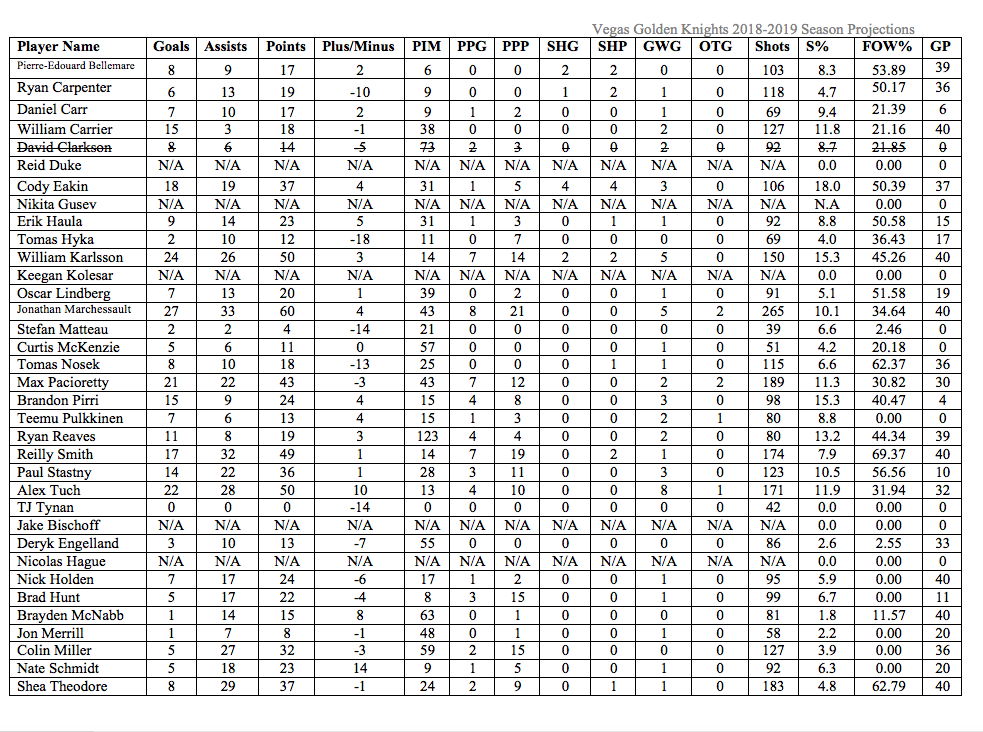
  • Vegas Golden Knights 2018-19 Season Projections

    It’s forecasting season, well, actually it’s the regular season and I’m just a little behind, but until I pointed that out, you didn’t know I was behind on my little passion project here, did you?

    I know I wrote “[i]n the coming days I’ll reveal what teams I’ll be forecasting/tracking all season long, so stay tuned because it’s about to get messier than ever before and I’m up for the challenge,” in my Boston Bruins 2018-19 forecast, but life and the fact that I’m moving all my data into a new format has slowed my turnaround for the time being.

    Nevertheless, my Vegas Golden Knights forecast for 2018-19 is here and let’s pretend the first week of the regular season hasn’t already happened or something.

    Additionally, if you’re wondering what other teams I’m preparing to post (before we get too far into the first quarter of the season) they are the Carolina Hurricanes and Columbus Blue Jackets.

    I always keep tabs on the Bruins every year because I grew up a Boston fan and I decided to track Vegas last season because there hadn’t been nearly as much hype surrounding an expansion team since Columbus and the Minnesota Wild in 2000. Additionally, I’ve previously tracked the Arizona Coyotes simply because they follow us on Twitter (and I’ll get back around to them hopefully before season’s end, if you’re interested).

    But I’m adding Carolina and Columbus to my forecast portfolio this season because 1) the Hurricanes are supposed to be better than last season, plus they have some exciting youth in the lineup and 2) a lot of Blue Jackets fans are also fans of our brand around here, so shouts 5th Liners.

    Please be patient on the timeline for when I’ll get my Hurricanes and Blue Jackets forecasts posted– it’ll be by the end of the month for sure.

    Anyway, on with the Golden Knights, shall we?


    Vegas is coming off of their inaugural season having finished 1st in the Pacific Division with 109 points and a 51-24-7 record under head coach Gerard Gallant. Not only did they finish at the top of their division in their first season, but they did so with over 100 points and a 50-plus win season.

    Oh yeah and they played the Washington Capitals in the 2018 Stanley Cup Final.

    Despite the loss in five games to Washington, the Golden Knights were and still are well ahead of owner Bill Foley’s “Cup in three [seasons]” masterplan– what with General Manager George McPhee‘s offseason additions of Paul Stastny and Max Pacioretty and everything.

    This year, of course, the competition has gotten a lot tougher. There are expectations now when opponents play the Golden Knights.

    Gallant and his Vegas lineup are going to have to get more creative than ever before in franchise history to avoid the hangover of a Stanley Cup Final appearance run and to avoid getting too predictable.

    Things are different now. They’re no longer the new kids on the block. They’re the 2018 Western Conference champions and a team to beat.

    As always, I’d like to remind you my degree is in communication– not math– therefore anything that looks wrong is either adjusted with a little gut-feeling and/or Microsoft Excel’s fault. My expertise resides in the written, spoken and nonverbal language of communicating– not numbers on a spreadsheet.

    These forecasted stats are to be seen as an utopian perspective, as though nothing bad could happen this season at any point to any player– where every player at least lives up to their forecast and then some.

    Some will pan out and some will fall flat. It’s a suggested outcome for a sport that’s played on ice in a highly unpredictable collective environment of action and sheer puck luck.

    vegas_golden_knights_logo

    Vegas Golden Knights Forecast Through 0 Games (82 Games Remaining)

    This slideshow requires JavaScript.

    After a breakout 78-point season (43 goals, 35 assists) for William Karlsson, the Golden Knights number-one center is prime for a respectable 41-point season as part of the natural regression of the game– unless Karlsson is truly an outlier, like he was coming from Columbus to Vegas last season.

    Meanwhile, Reilly Smith (19-27–46 expected totals) and Jonathan Marchessault (28-35–63 expected totals) bolster the Golden Knights first line with respectable performances of their own, while the point spread has really been shared with the second line.

    Newcomers Paul Stastny (22-43–65 expected totals) and Max Pacioretty (33-30–63 expected totals) are set to become the key contributors to the fiery Vegas offense in their first season with the club.

    The Golden Knights top-six core of forwards is deeper than last season, whereas the majority of their offense was reliant upon Marchessault, Karlsson and Smith. This year there’s more emphasis on Alex Tuch and Erik Haula inside the top-nine.

    On defense, Gallant’s crew will have to do without Nate Schmidt for the first 20 games of the season while Schmidt serves a suspension for a performance enhancing drug.

    Luckily, Brad Hunt, Colin Miller and Shea Theodore are prime for an uptick in time-on-ice and production, with Hunt and Miller expected to reach the 30-point plateau, while offseason addition, Nick Holden should see a pleasant rebound from his 17 points split between the Bruins and New York Rangers last season to a 25-point effort in 2018-19 with Vegas, provided he can remain in the top-six on the depth chart.

    Upon Schmidt’s return, he should still have 4-23–27 totals from the blue line, which is not great like last season’s 5-31–36 totals, but not terrible for a top-four defender.

    In goal, Marc-Andre Fleury is expected to return to Earth from his superhuman season last year (a 2.24 goals against average and .927 save percentage in 46 games) to a 2.49 GAA and .913 SV% in 2018-19. As the Golden Knights starter continues to get older, limiting his workload to keep him fresher for the postseason is the way to go.

    Granted, Fleury’s playing time was limited last season due to a concussion, he still went on to have solid regular season numbers and an impeccable 2018 Stanley Cup Playoff run up until the Stanley Cup Final.

    Meanwhile, Malcolm Subban‘s 2.68 GAA and .910 SV% in 22 games played look to be improved upon to a 2.65 GAA and .911 SV% in somewhere around 30 appearances as the backup netminder for Vegas.

    As always, we’ll get more into the goalies once the team has played through a quarter of the season.

  • Vegas Golden Knights 2018-19 Season Preview

    vegas_golden_knights_logo

    Vegas Golden Knights

    51-24-7, 109 points, 1st in the Pacific Division

    Lost in Stanley Cup Final to WSH, 4-1

    Additions: F Daniel Carr, G Zach Fucale, F Alex Gallant, D Nick Holden, F Curtis McKenzie, D Jimmy Oligny, F Max Pacioretty (acquired from MTL), F Paul Stastny

    Subtractions: D Philip Holm (signed, KHL), F James Neal (signed with CGY), F David Perron (signed with STL), F Teemu Pulkkinen (signed, KHL), D Luca Sbisa (signed with NYI), F Nick Suzuki (traded to MTL), F Tomas Tatar (traded to MTL), F Paul Thompson (signed with FLA)

    Still Unsigned: D Chris Casto, D Jason Garrison, F Mikhail Grabovski, D Clayton Stoner

    Re-signed: F William Carrier, G Oscar Dansk, F William Karlsson, D Colin Miller, F Tomas Nosek, F Brandon Pirri, F Ryan Reaves, D Shea Theodore

    Offseason Analysis: Only one team in the NHL’s more than a century of existence has ever won the Cup in their inaugural season. The 2017-18 Vegas Golden Knights almost joined the 1917-18 Toronto Arenas as the only teams to win the Cup in their inaugural season. Toronto beat the Pacific Coast Hockey Association’s (PCHA) Vancouver Millionaires 3-2 in a best of five-game series.

    Vegas came up three wins short of winning it all in the modern-day best-of-seven game series against the Washington Capitals that the Stanley Cup Final has become.

    The Golden Knights didn’t have an unfair advantage in the 2017 Expansion Draft. General Manager George McPhee worked the trade market to his advantage, primarily building the inaugural season’s core group of players through acquisitions.

    Owner Bill Foley has touted the “Cup-in-three” mantra, meaning it’s his goal as an organization to win the Cup in their first three years of existence. Upon league expansion in 1967, it took the Philadelphia Flyers seven years to win their first Cup.

    Foley wants to do it in half the time.

    McPhee’s already gone to work on improving his roster from year one to year two. He’s added Paul Stastny via free agency and Max Pacioretty in a trade with the Montreal Canadiens.

    Stastny, 32, joins the Golden Knights after spending last season with the St. Louis Blues and Winnipeg Jets. In 82 games split between the Blues and Jets, Stastny had 16-37–53 totals.

    A deadline acquisition by Winnipeg, he had 13 points down the stretch in the remaining 19 games of the regular season, then had his best career performance in the postseason (15 points in 17 games) en route to the Western Conference Final against (his now current team) Vegas.

    Despite Stastny’s playmaking style and ability to elevate the players around him in Patrik Laine and friends in Winnipeg, the Jets were no match for the hard-charging Golden Knights.

    If you can’t beat them, join them.

    The old saying rings true for Stastny, despite Winnipeg’s intentions on re-signing the veteran NHL center entering his 13th season in the league. He’ll slide in on Vegas’ second line behind William Karlsson and play alongside one of his best friends since they played together at the 2010 Winter Games, Max Pacioretty.

    Yes, that’s right, Pacioretty is a Golden Knight– in case you’ve been under a rock since training camp.

    At its surface, the price of the Pacioretty trade is one well spent for both teams. Vegas acquired Pacioretty in exchange for Tomas Tatar, prospect Nick Suzuki and a 2019 2nd round pick. That’s right about what you’d expect as a going rate for a top-six scorer– one current roster player, a prospect and a draft pick.

    But for all that McPhee dealt to the Detroit Red Wings to add Tatar at the trade deadline last season, this Pacioretty deal carries a hefty trade-tree baggage, whereby a lot of assets were ultimately tossed in the pot for Pacioretty’s services.

    At the very least, McPhee not only added a five-time 30-goal scorer, but he signed him to a four-year extension right away too. So if things don’t work out this season, the Golden Knights will remain in the hunt for the next few years.

    Why’s that?

    On top of their solid core group of forwards, Vegas has a crafty defense that’s capable of doing more than turning heads like they did last season. There’s just one catch though– they’ll have to do it without Nate Schmidt for the first quarter of the regular season.

    Schmidt will be serving a 20-game suspension for a performance enhancing drug, leaving Colin Miller and Shea Theodore to do the bulk of the work with Brayden McNabb and Deryk Engelland rounding out the rest of the top-four defenders.

    Brad Hunt and Nick Holden, in the meantime, seek to use the first 20 games as an audition for the sixth defenseman role upon Schmidt’s return to the lineup.

    Miller signed a four-year extension this summer and Theodore signed a seven-year deal worth $5.200 million per season. While seven years might be a bit more than the Golden Knights can chew if Theodore’s play heads south, at least he’s signed to a manageable $5.200 million cap hit– up to 50% of which can be retained in a trade.

    With an immense top-nine group of forwards and questions surrounding who will step up on defense in Schmidt’s absence, head coach Gerard Gallant must adjust accordingly as he’s always done– on-the-fly and with the complete buy-in of the dressing room.

    In goal, Marc-Andre Fleury— now signed through the 2021-22 season, thanks to a three-year extension this summer on top of the remaining year on his current contract– must find a way to continue his rejuvenated play in net. Last season’s 2.24 goals against average and .927 save percentage are more than likely unattainable in back-to-back seasons.

    One thing working in Fleury’s favor is his reduced workload. In his second-straight season under 50 games played, Fleury appeared in 46 games last season after battling a concussion.

    Malcolm Subban (2.68 GAA, .910 SV% in 22 games played last season) is still in line to become the next Golden Knights starting netminder in the post-Fleury era, but he undoubtedly must see an increase in playing time this season.

    It’s not quite a 1A, 1B option for Vegas, but rather a precaution for Fleury and a means of keeping their starter fresh for what could be another long postseason run.

    Unless any of the other Pacific Division teams have anything to say about it.

    Offseason Grade: B+

    McPhee bolstered his top-six forward group this offseason with two simple moves, while preserving the large-scale depth of the Golden Knights prospect pool. They didn’t land Erik Karlsson, John Tavares or Ilya Kovalchuk, but they did get Max Pacioretty.

    And they still have quite an impressive amount of cap space to work with next offseason as the franchise continues to settle into existence.

  • Numbers Game: Vegas Through 60

    Derick Brassard was briefly a Golden Knight. Yes, he was flipped from Ottawa to Vegas to Pittsburgh as part of Friday’s three-team trade and technically speaking, he never suited up for Vegas so it doesn’t actually count, but Brassard was once a Golden Knight.

    Now, as a result of the Brassard trade, Ryan Reaves is the newest player in Vegas.

    Through 60 games (entering Friday), the Vegas Golden Knights are still 1st in the Pacific Division. William Karlsson is in the midst of a career year, Marc-Andre Fleury and James Neal probably won’t be traded at the deadline like everyone thought they would and there’s a real possibility this whole “Cup in One” mantra actually works out.

    Thanks in part to the crazy scheduling this time of year– between the NHL, the Winter Games in PyeongChang, the upcoming trade deadline on Monday and much, much more– I was finally able to squeeze in the time to update Golden Knights projections with 22 games remaining in their schedule.

    The only problem is that they’ve now played Game 61 of 82 and added Ryan Reaves. So basically, here’s everything I had before anything that happened on Friday.

    I’ll try to come up with some projections for Reaves and any other potential acquisitions Vegas makes between now and the deadline, but there’s no promises. Every year around the deadline my database needs constant updating and as a result some things get bogged down until I physically go through every stat.

    I do get around to it (eventually) and these players will be reflected in any subsequent projection posts.

    Anyway, on with the show…

    The Golden Knights aren’t good. They’re great.

    Check out the latest forecast in the charts below. Keep in mind, as always, that anything that sounds ridiculous is Microsoft Excel’s fault. I’m just kidding. There are always outliers and unrealistic projections. Alas, these are merely utopian, Excel driven, guesses.

    Standard disclaimer, my degree is in communication– not math or #fancystats.

    vegas_golden_knights_logo

    Vegas Golden Knights Projections Through 60 Games (22 Games Remaining)

    This slideshow requires JavaScript.

    The sensational season continues and down the stretch as Erik Haula, Karlsson, Jonathan Marchessault, Neal, David Perron and Reilly Smith are all expected to amass somewhere around 60-points (or more).

    Colin Miller‘s emergence as a top defenseman in the Western Conference continues as he nears the 40-point plateau by seasons end. Also, look at Shea Theodore fitting right in as a top-4 quality defenseman just entering his prime. Miller, Nate Schmidt and Theodore for years to come in Vegas should mean many great things.

    Meanwhile, Fleury’s incredible run in goal begins to cool off just a little. His goals against average begins to reflect an “average” year for Fleury, which– granted– is still better than a lot of goaltenders in the NHL. Fleury’s save percentage should be just fine down the stretch– if not potentially league-leading.