Tag: Big Bad Bruins

  • Halak records 2nd shutout this season in Bruins 3-0 win

    Zdeno Chara kicked off Thursday night’s scoring for the Boston Bruins against the Philadelphia Flyers on home ice and Chara ended scoring too. Jake DeBrusk added a power play goal in between Chara’s goals as Jaroslav Halak and the Bruins shutout the Flyers, 3-0, at TD Garden.

    Boston improved to 6-2-2 (14 points) on the season with the win– good enough for 2nd in the Atlantic Division, despite being tied with the Toronto Maple Leafs for 1st on points (Toronto has one more regulation-plus-overtime win than the Bruins, yielding the tiebreaker).

    Philadelphia fell to 4-6-0 (8 points) through their first 10 games, currently sitting 6th in the Metropolitan Division.

    Unknown-7

    Halak (3-0-2, .945 save percentage, 1.43 goals against average in 6 games played) made 26 saves on 26 shots faced for a 1.000 SV% and his 2nd shutout of the season in the win, while Flyers netminder, Brian Elliott (2-5-0, .912 SV%, 3.38 GAA in 8 GP), stopped 22 out of 24 shots faced for a .917 SV% in the loss.

    After ending a three-game losing streak in Ottawa, the Bruins now have back-to-back wins with a chance of extending their current winning streak to three games against their arch-rival– the Montreal Canadiens– Saturday night on home ice.

    Boston head coach, Bruce Cassidy, didn’t make any changes to his lineup, save for the National Hockey League debut of Bruins defender, Jeremy Lauzon, out of necessity. Lauzon laced up on the third defensive pair alongside Steven Kampfer in place of the most-recently injured Bruins blue liner, Urho Vaakanainen (concussion).

    David Backes (upper body), Torey Krug (lower body), Charlie McAvoy (upper body) and Kevan Miller (hand) also remained out of the lineup Thursday night, though Krug has begun practicing and should return to action next week.

    Meanwhile, Lauzon became the first Bruin to wear No. 79 in a regular season game since current defender in the Colorado Avalanche organization (and Marshfield, Massachusetts native), David Warsofsky, did so in the 2014-15 season.

    David Pastrnak and Gritty’s favorite Flyer, Claude Giroux, were given matching minor penalties 7:11 into the first period as the opening frame featured largely dull action.

    Robert Hagg was guilty of slashing Brad Marchand at 11:27 of the first period and the Bruins went on their first power play of the night, but they failed to convert on the ensuing skater advantage.

    Late in the first period, Chara sent the puck over the glass and received a delay of game minor. The timing of the penalty came at 18:05 of the first period, so the ensuing Flyers power play would carryover into the first five seconds of the second period (unless Philadelphia scored before the end of the period).

    After 20 minutes of play, the score remained tied, 0-0, with both teams amassing seven shots on goal. Boston had the advantage in takeaways (7-4), giveaways (2-1) and hits (6-5) entering the first intermission, while both teams were 0/1 on the power play.

    The pace of play picked up in the second period, as both Elliott and Halak found themselves locked into a goaltending battle– in which the Bruins netminder made several impressive saves on 2-on-1 opportunities for the Flyers.

    Halak’s strong performance (and eventual shutout) serves as a reminder that while there is no goalie controversy in the Hub (Tuukka Rask is the long-term starter), Cassidy’s decision making in determining which goaltender to play any given night (for now) continues to get tougher. It’s generally advisable to go with the hotter hand until one can’t any longer.

    That said, Cassidy remained firm on his plans to start Rask Saturday night against the Canadiens after Thursday’s win.

    Time (and stats) will tell after that. A little competition is a healthy thing– especially if the team is still able to put up “W’s” in the “win” column.

    A little past midway in the second period, Danton Heinen worked the puck back to the point to Chara. The Bruins captain fired a slap shot– from just about the blue line in Boston’s attacking zone– high glove side past Elliott to give the B’s a 1-0 lead while David Krejci tried to screen the Philadelphia goalie from the slot.

    The goal was Chara’s 2nd of the season and assisted by Heinen (3) at 13:00 of the second period.

    download-1

    Shortly thereafter, Philadelphia’s bench bungled a line change and was handed a two-minute minor penalty for too many men at 15:32. Travis Konecny served the penalty.

    Late into the ensuing power play, the Bruins extended their lead on the scoreboard as Krejci threw a saucer pass to Jake DeBrusk (3) for the redirection from point blank and a 2-0 lead.

    Krejci (7) and Kampfer (1) were credited with the assists on DeBrusk’s goal at 17:28. Kampfer’s assist was his first point for Boston since being re-acquired by the Bruins in September and his first point in a black-and-gold sweater in over six years (he had two assists in 10 games for the Bruins in the 2011-12 season prior to being traded).

    Through two periods, Boston led Philadelphia, 2-0. Shots on goal were even, 18-18, while the Flyers led in blocked shots (12-9) and face-off win percentage (65-35). The Bruins held onto the advantage in takeaways (11-8) and hits (12-9) after 40 minutes of play.

    Both teams had five giveaways each entering the second intermission, while the Flyers were 0/1 on the power play and the Bruins were 1/2.

    Early in the third period, tempers started to flare as they usually do when the Big Bad Bruins square off with the Broad Street Bullies as Steven Kampfer and Scott Laughton got into a kerfuffle. Wayne Simmonds even jumped in as a third-man in and penalties soon followed.

    Despite clearly attempting to fight with his gloves off, Kampfer was handed a four-minute double minor penalty for roughing, while Laughton received a two-minute roughing penalty.

    Simmonds also received a roughing minor at 6:38 of the third period, resulting in a power play for the Flyers, thanks to Kampfer’s four-minute double minor.

    Ryan Donato served one of Kampfer’s penalties in the box.

    Late in the penalty kill for Boston, Chara tripped up Konecny and was sent to the box on a minor penalty for tripping (of course) at 8:34. The Flyers would have four seconds on a two-skater advantage before resuming play under a normal 5-on-4 power play scenario.

    Philadelphia did not convert on either power play opportunity.

    At 14:30 of the third period, Konecny himself was summoned to the sin bin for tripping Bruins forward, David Pastrnak.

    Just under two minutes later, while on the power play, DeBrusk got into a shoving match with Flyers defender, Andrew MacDonald.

    DeBrusk was going to be penalized for interference, while MacDonald received a slashing minor after a quick conference held by the refs once things settled down after the whistle.

    Why did it take so long in comparison to the other penalties? Well, a scrum ensued and a slew of penalties followed in the same stoppage as the original DeBrusk retaliation call based on MacDonald’s infraction.

    Laughton received another roughing minor– this time against DeBrusk– and was sent to the locker room early on a ten-minute misconduct. This additional two-minute penalty against the Flyers resulted in an abbreviated 5-on-3 power play for Boston for about 27 seconds, while Oskar Lindblom served Laughton’s penalty at 16:03 of the third period.

    As time expired on Lindblom’s time in the box, the door opened and the puck rolled right by as a Bruins player was chasing it down.

    Lindblom tried to play the puck while still in the penalty box. His feet had not set foot on the ice, thereby resulting in an automatic interference penalty and Boston went back on the power play at 18:06.

    With less than a minute remaining in regulation, Flyers head coach, Dave Hakstol pulled his goaltender for an extra attacker. Things didn’t go as planned.

    Halak sent the puck from the trapezoid to his captain along the boards behind the goal line, where Chara (3) then flung the puck through the air and into the empty net at the other end of the ice for the empty net power play goal at 19:37.

    That’s right, Chara scored from the endboards in his own zone for what’s undoubtedly the longest empty net power play goal in NHL history. For all intents and purposes, he could’ve been having a cannoli at Mike’s Pastry in the North End and hit the net.

    Halak (1) picked up his first point as a Bruin in the form of an assist on Chara’s goal and Boston secured the 3-0 victory at the final horn.

    The Bruins finished the night ahead on the scoreboard, but trailed the Flyers in shots on goal (26-25), blocked shots (14-13), giveaways (9-7), hits (17-16), penalty minutes (26-12) and face-off win% (60-40). Philadelphia went 0/3 on the power play, while the B’s went 2/5 on Thursday.

    Among other stats…

    Chara (41 years, 221 days) became the third defender in the NHL to score multiple goals in a game at 41 years of age or older, joining Tim Horton (41 years, 277 days) and Nicklas Lidstrom (41 years, 191 days).

    Despite winning, 3-0, no Bruins skater was more than a plus-one in plus/minus Thursday night. Heinen, Krejci, DeBrusk, Chara and John Moore were all plus-one, while Chara led the way for Boston in shots on goal with five.

    Patrice Bergeron, Pastrnak and DeBrusk were the next highest with three shots on net.

    Noel Acciari led the B’s in the physical department with three hits and Brandon Carlo led his team in blocked shots with four.

    Nolan Patrick, Laughton, Jakub Voracek, MacDonald and Shayne Gostisbehere were all minus-ones for the Flyers, while Claude Giroux led his teammates with five shots on goal. Travis Sanheim was the next closest with four.

    Gostisbehere, Hadd and Corban Knight each recorded two hits for Philadelphia and Gostisbehere led his teammates in blocked shots with four.

    The Bruins take on the Canadiens Saturday night on home ice for their next matchup before venturing out on the road to visit the Carolina Hurricanes on Oct. 30th and the Nashville Predators on Nov. 3rd as part of a quick, two-game, road trip.


  • DTFR Overtime: Just Killing Prime

    On the most recent episode of the Down the Frozen River Podcast, @connorzkeith expressed the sentiment that the Boston Bruins have been wasting the prime of their core group of players– not including David Pastrnak, or really anyone since the 2014 NHL Entry Draft currently on the roster.

    Rather, Connor suggested that the Bruins were once a dominant team of the early 2010s with a core group of Patrice Bergeron, Brad Marchand, David Krejci, Zdeno Chara and Tuukka Rask that’s still very much left intact from their 2011 Stanley Cup championship, but that they’ve been wasting the arc of the aforementioned players’s prime.

    Luckily, Down the Frozen River has an in-house Boston historian and I am here to set the record straight. This is DTFR Overtime and what I’ve thought about after recording the last podcast.


    Unknown-7

    Hockey is a game of inches and odd puck bounces. It’s a collective game of skill with an over-reliance on luck. Whatever you believe, you better believe in the Hockey Gods. It’s only fate, destiny and just a game at the end of the day, right?

    Wrong.

    The business of hockey has played a huge part in impacting the game of hockey as we know it– impacting teams and how rosters are constructed, directly through the introduction of a salary cap as of the last full-season lockout in 2004-2005 and indirectly, through many other external factors (family, injuries, et cetera).

    It was because of league expansion in the 1970s and because of the rival World Hockey Association (WHA) that Bobby Orr, Phil Esposito, Derek Sanderson and the Bruins didn’t nail down a dynasty. Of course, the Montreal Canadiens also played a part in it in 1971, 1977 and 1978, but the B’s lost star goaltender, Gerry Cheevers, to the Cleveland Crusaders of WHA from 1972 through 1976– right after winning the Cup in 1972 and during Boston’s appearance and subsequent loss to the Philadelphia Flyers in the 1974 Stanley Cup Final.

    Cheevers alone wasn’t the only difference maker in a Bruins uniform that left the black and gold for the higher paying WHA.

    Sanderson jettisoned Boston for the Philadelphia Blazers in the summer of ’72 for a $2.600 million contract that made him the highest paid athlete in the world at the time, though he went on to only play in eight games with the Blazers due to injury and returned to Boston after the WHA’s 1972-1973 season on a $1 million deal. From 1972 through 1974 with the Bruins, Sanderson only played 54 out of 156 games and was sent down to the Boston Braves of the American Hockey League before being traded to the New York Rangers in June 1974.

    John “Pie” McKenzie, a gifted point scorer known by his unconventional nickname left the Bruins for the WHA’s Blazers as a player-coach after the 1972 Stanley Cup Final and never returned to the NHL. McKenzie finished his playing days with the New England Whalers in 1979.

    In the 1980s and early 90s, injuries and the emergence of the Edmonton Oilers as a top team in the National Hockey League plagued the primes of Ray Bourque, Brad Park, Cam Neely and the Big Bad Bruins.

    Boston lost the 1988 and 1990 Stanley Cup Finals to the Oilers. Boston lost the 1991 and 1992 Eastern Conference Finals to the Pittsburgh Penguins. Boston Garden itself was closed in 1995– and then Boston missed the playoffs in 1997 for the first time in 30 years.

    Good teams aren’t meant to remain on top forever.

    There’s a reason why the Stanley Cup is the hardest trophy to win in all professional sports.

    Claude Julien, the winningest coach (419 wins) in Bruins franchise history– having surpassed Art Ross‘s 387 wins mark with the team during his tenure in Boston– led the black and gold to two appearances in the Stanley Cup Final and one President’s Trophy (just the second in franchise history during the 2013-2014 campaign).

    In 2011, the Bruins rode the backs of Nathan Horton, Marchand and Tim Thomas‘s insanity in goal. In 2013, a more experienced Boston team rallied from a 4-1 deficit in a Game 7 against the Toronto Maple Leafs in the first round and charged all the way to a six game series battle with the Chicago Blackhawks that ultimately ended in defeat.

    Thomas was no longer part of the story after 2012. Rask took over the reigns and never looked back. Jaromir Jagr came and went in a largely forgettable time in the spoked-B.

    But the Bruins could skate with the best. Until they missed the playoffs in 2015 and 2016.

    In the Salary Cap Era, teams are built up and ripped to shreds by massive longterm contracts and dollars being improperly allocated throughout the roster.

    Peter Chiarelli got the Bruins in a salary cap hell, what with their fourth line center, Chris Kelly, making $3.000 million in his final years as a Bruin. In the broad scope of things, that was the least of Chiarelli’s mismanagement that ultimately ended his time in Boston. Neither the Tyler Seguin trade nor the Johnny Boychuk trade alone could be what led to the Bruins going from a top team deep in every roster spot to a team outside the playoff picture looking in with some mediocre placeholders.

    Brett Connolly and Max Talbot didn’t yield the same results in Chiarelli’s last season with the Bruins– tangible or intangible– than any of the bottom-six forwards (Gregory Campbell, Shawn Thornton, Daniel Paille, Rich Peverley, Kelly and Michael Ryder) provided for the 2011.

    Just one year removed from a President’s Trophy season that ended with an early First Round exit to Montreal, the Bruins found themselves on the verge of an uncomfortable position that they hadn’t been in since missing the playoffs in 2006 and 2007. They went on to miss the playoffs in 2015 and 2016.

    So the Bruins did the only thing they’ve ever known. They reset themselves while still carrying a core group of players.

    In the 70s, Boston rebuilt themselves around Orr, Esposito and friends when Sanderson left (then returned and left again via trade), Cheevers departed and McKenzie stormed off to the WHA. They drafted Terry O’Reilly in 1971, Stan Johnathan in 1975 and acquired Peter McNab from the Buffalo Sabres after the 1975 Stanley Cup Final.

    The new identity Bruins flipped Esposito along with Carol Vadnais during the 1975-76 season to the New York Rangers for Brad Park, Jean Ratelle and Joe Zanussi and still had Orr until his departure via free agency in 1976.

    Boston still had Johnny Bucyk, Wayne Cashman, Ken Hodge and Don Marcotte as key aspects of their 70s rosters.

    They could have dismantled a team that won two Stanley Cups (and should have won more, if it weren’t for the WHA) after the franchise’s slow start in 1975. They didn’t.

    Hockey has never been kind to good teams with the right players at what seems like it’s the right time (just ask last year’s Washington Capitals). But that’s the nature of the sport. No matter how much of a powerhouse you build– with or without a salary cap, with or without expansion or injuries– you can’t control the way the puck bounces.

    Some players stick around in the league for long enough to become seasoned veterans of the NHL and never sniff a Stanley Cup Final appearance, let alone the postseason. It took Ron Hainsey until just last year with the Penguins to make his Stanley Cup Playoff debut and it took Bourque and Dave Andreychuk at least a couple of decades each to win it all.

    Just because Bergeron, Marchand, Krejci, Chara and Rask only have a 2011 Stanley Cup championship together doesn’t mean they’ve been wasting their time, killing the prime of their careers.

    For Boston, they ended a 39-year Stanley Cup-less drought.

    They’ve already won once more than thousands of others who were lucky enough to make it to the NHL.

    And they’ve forever cemented themselves in the history of the franchise, as well as the City of Boston as adopted sons and representatives of the Hub everywhere they go and in everything they do related to the sport or not.

    Fans want rings and that’s one thing, but to say they’ve wasted their primes is another. They’ve contributed so much on and off the ice for the youth movement once again creeping up on the Bruins. Pastrnak is destined for stardom. Charlie McAvoy is an apprentice to Chara as Bourque was to Park in 1979.

    Even Kevan Miller‘s found a bit of a resurgence in his offensive game, going end-to-end to throw the puck in front of the net to find Danton Heinen like Orr did with anyone.

    The torch gets passed on. We’re all in for the ride.

    And you pray to the Hockey Gods that they’ll let you win at least once.

  • Down the Frozen River Podcast #73- Jagr Signs! (Kind Of)

    Down the Frozen River Podcast #73- Jagr Signs! (Kind Of)

    Our hearts go out to everyone in Las Vegas as well as the family of Dave Strader. Jaromir Jagr watch comes to an end (sort of) and Nick and Connor have already moved on to the next guy. It’s Phil Kessel‘s birthday and two members of the Original Trio discuss training camp cut/non-cut surprises.

    Subscribe to the podcast on Apple Podcasts (iTunes) and/or on Stitcher.

  • Monday Roundup- 2015 Offseason Thoughts

    Monday Roundup- 2015 Offseason Thoughts

    By: Nick Lanciani

    It’s been a busy offseason around the NHL- and by that I mean it’s been a rather unusual offseason around the NHL.

    The Ryan O’Reilly saga finally ended in Colorado and began in Buffalo, but took a side trip into the side of a Tim Horton’s somewhere in Ontario. While the Sabres could use his offense, they could do without his legal offenses (moral of the story, everyone, don’t drink and drive- have a designated driver, be responsible- use common sense).

    Mikhail Grigorenko’s been reunited with Patrick Roy in Colorado, although sadly the rest of the 2011-2012 and 2012-2013 Quebec Remparts will not be joining the party in Denver.

    T.J. Oshie, Brandon Saad, Milan Lucic, Dougie Hamilton, Patrick Sharp, Cam Talbot, Phil Kessel, and others have all been on the move as the result of blockbuster trades.

    600x400_Sweeney_Development_Camp
    Boston Bruins general manager, Don Sweeney (pictured), has been wheeling and dealing this offseason- in stark contrast of his predecessor, Peter Chiarelli (bruins.nhl.com).

    Don Sweeney’s been on a rampage (more on that later), Peter Chiarelli’s turned around the Edmonton Oilers in one offseason (at least on paper), and the Toronto Maple Leafs front office might be the smartest guys in the game for the first time in a longtime. Wait, what did I just say?

    That’s right, on Thursday, 72-year-old hockey front office legend, Lou Lamoriello, resigned as president of the New Jersey Devils only to join the Toronto Maple Leafs (announced on Twitter a mere two minutes apart) as their 16th general manager in franchise history.

    Fun fact: Back in 1987, Lamoriello drafted now fellow colleague, Brendan Shanahan, 2nd overall in his first season as the president and general manager of the Devils.

    Now, Lamoriello joins Shanahan in Toronto’s front office. Things certainly are weird right now in New Jersey, in the meantime, by the way- where Ray Shero is currently their GM and Marty Brodeur is, well, among the front office of the St. Louis Blues. Yep, it’s safe to say nobody would have predicted that both Brodeur and Lamoriello would move on from the Devils.

    In 2009, Lamoriello praised Shanahan after Shanahan attempted one final go in the NHL, with the Devils, only to decide he would not continue his career and thus stepped aside from playing, retiring before the 2009-2010 season. Lamoriello expressed so much praise, in fact, that he blatantly stated that should Shanahan want a job in the Devils front office, Lamoriello would go out of his way to make it happen.

    But here we are in 2015, where Shanahan recently transitioned to the helm of the Maple Leafs front office and instead of going to his former boss for a position, he brought in his former boss.

    Brendan Shanahan (left) introduces Lou Lamoniello (right) as the new general manager of the Toronto Maple Leafs. (Galit Rodan/The Canadian Press via AP)
    Brendan Shanahan (left) introduces Lou Lamoniello (right) as the new general manager of the Toronto Maple Leafs. (Galit Rodan/The Canadian Press via AP)

    Lamoriello spent 28 years with the New Jersey Devils organization, but now he’s about to embark on his first season with a different organization- just his second as a general manager- the Toronto Maple Leafs.

    The Maple Leafs, if you recall, hired Mike Babcock this offseason as their latest head coach, by the way. Babcock too, left an organization he spent a lot of time with for the Maple Leafs this summer. Babcock spent the last 10 years with the Detroit Red Wings before joining Toronto.

    Both Lamoriello and Babcock have something in common, they both left teams that used red as a primary color for a team that wears a blue maple leaf proudly displayed prominently on their jersey (it’s a bit slow right now in the offseason, cut me some slack).

    In other news, the National Hockey League began the formal expansion process this summer, having accepted expansion applications up until Monday.

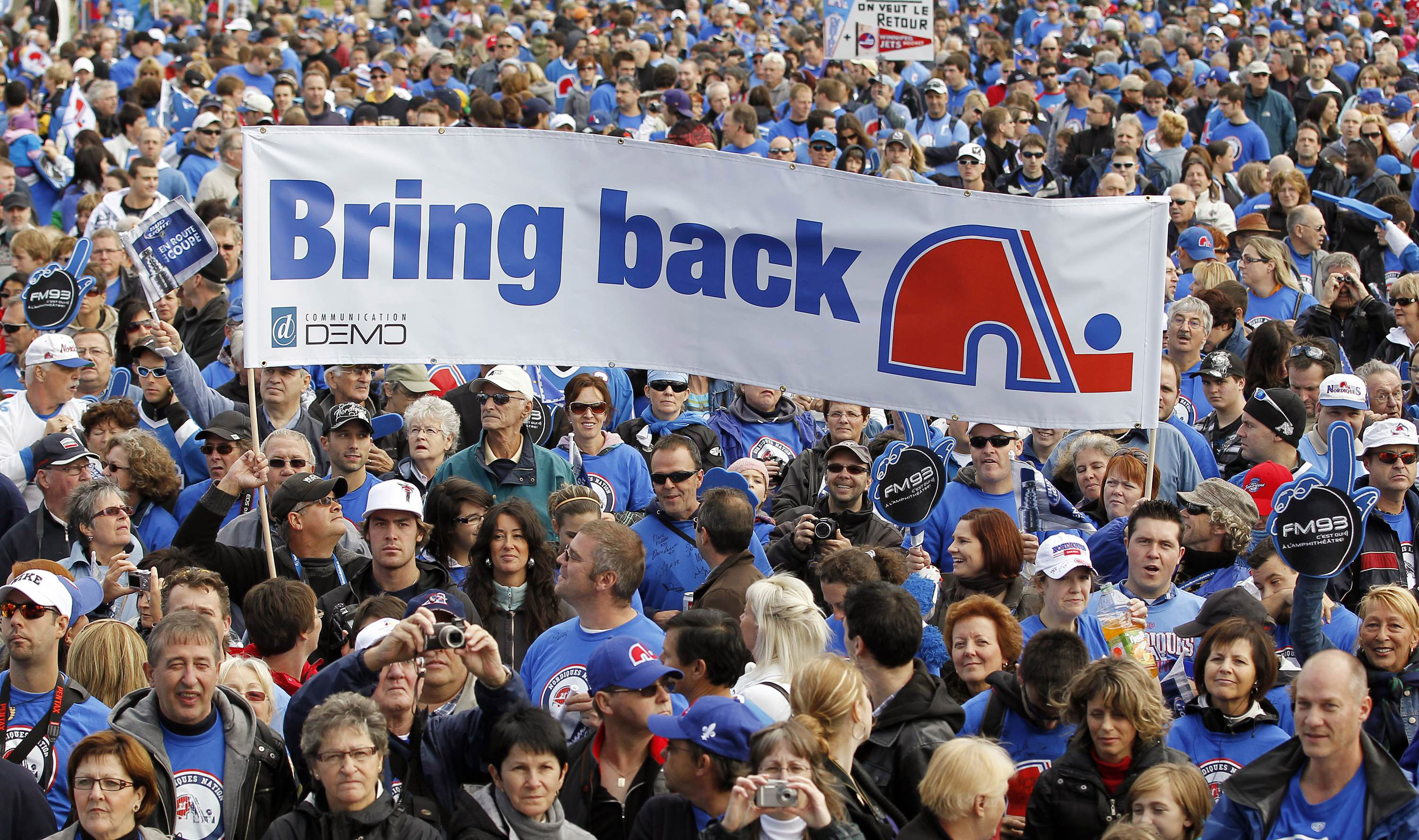
    Two cities formally submitted a bid before the deadline- Las Vegas, Nevada and Quebec City, Quebec.

    Las Vegas billionaire, Bill Foley, continues to headman the construction of an arena in Las Vegas as well as a drive for season tickets while aiming to land an expansion team. Meanwhile, Montreal-based media conglomerate, Quebecor, aims to bring the NHL back to Quebec City.

    One of Canada’s hockey gods, Don Cherry, has already provided his blessing for a return to Quebec City.

    This is the first time the league has formally gone through the expansion process since the late 1990s when the league quickly grew in size adding the Nashville Predators, the Atlanta Thrashers, the Minnesota Wild, and the Columbus Blue Jackets between 1998 and 2000 to become the 30 team league that we all know and love today (with the minor relocation of the Thrashers to Winnipeg having occurred prior to the 2011-2012 season, of course).

    Since the Thrashers relocation to Winnipeg, the NHL has continued to take a firm stance against having to move another team for a while. Prior to the formal announcement of the expansion process being officially explored, the Arizona Coyotes and the City of Glendale, Arizona were at odds with one another.

    Despite IceArizona’s firm commitment to the State of Arizona, many thought the Coyotes would be on their way out of Glendale this offseason. Given how a short move back to Phoenix in such a short period of time would not be feasible, speculation led to the Coyotes packing their bags and moving to an NHL ready arena.

    Downtown Phoenix does not have an appropriate sporting arena for hockey currently, thereby handing the Coyotes a double whammy when their Gila River Arena lease agreement with Glendale was pulled out from under them by the city.

    After threatening substantial legal action, IceArizona and the City of Glendale came to terms on amending their agreement- eliminating an outclause from its initial version and adjusting some revenue sharing between the hockey club and the city (the team will now get a larger share, with the city footing less of the bill).

    Again, the Coyotes are staying put. No escape route to Seattle, no move from one desert to another desert (Las Vegas), and no move to Quebec City that would further imbalance the conferences in the league.

    But then again, the amended lease agreement is only for two years, so the Coyotes aren’t fully out of the woods yet.

    There remains so much yet to be seen concerning the Arizona Coyotes and their strained relations with the City of Glendale. While a short-term deal is necessary for their immediate survival in the market, their ultimate situation is not comforting. Things still could get quite ugly in a couple of years, yet the two sides have something to work with right now and can always chip away at improving viability of the franchise in Glendale.

    CIdjKkyVEAAIx7x
    The Arizona Coyotes will be debuting new jerseys this season, but their future in Arizona, despite glimmers of hope, is still uncertain in the long run (coyotes.nhl.com).

    If not, perhaps the next two years is all the time the Coyotes need to convince Phoenix, Arizona and the NBA’s Phoenix Suns to construct a new- joint- arena that would be suitable for hockey in the desert and a return to downtown Phoenix for the Coyotes franchise. Otherwise, it could be enough for Seattle to scrap together some plans for a NHL-ready arena and sway the Coyotes into relocation.

    Or there’s always Quebec City or Las Vegas, that, should either location not see the expansion process include them in the more immediate future of the league, could always have a stronger say in relocation. Both cities have strong interest from potential ownership groups and physical arena’s that are state of the art and nearing completion.

    Speaking of Quebec City and Las Vegas, now is the perfect time to reach into these markets. A return of the Nordiques to the hockey crazed Ville de Québec would be a golden opportunity for the league to return the game to where it belongs and can further drive marketability.

    For those that are opposed to adding another team in the Eastern Conference, kindly show yourself to the door. Realignment is never a fun topic, but I think we can all agree that sending the Detroit Red Wings and the Columbus Blue Jackets back to the Western Conference would be a good thing. As fans, we’d see a return of more Detroit and Chicago matchups, providing more fuel to the fire- built into the regular season schedule- when it comes to that longstanding rivalry.

    And with the addition of a team in Las Vegas, well, it’s the same old, same old. It’s a never before seen market in all of professional sports and it would balance the conferences under the aforementioned scenario.

    REUTERS/Mathieu Belanger
    REUTERS/Mathieu Belanger

    So at the end of the day, why disappoint the good people of Quebec City once again, NHL?

    Then again, balanced conferences are overrated, aren’t they?

    Come to think of it, the European model for professional sports isn’t too bad when it comes to league structure. Yet, the North American model of conferences, divisions, and such makes for a much more exciting game. We’ll never see the NHL switch to a relegation model based upon Premier League association football, but maybe we’ll see the NHL become more at ease with unbalanced conferences.

    Hey if the game works in a market, why ruin it by taking it away from that market just to satisfy conference structure? If the owners are going to squabble over that then they really aren’t looking out for the best interest of the league are they? Management’s number one goal is to profit from growing the game.

    Without an interest, there aren’t any fans. Without any fans, there aren’t any marketing opportunities from potential sponsors looking to reach fans. Without any cash flow, there is no game. If there’s an economically viable market or situation, go for it.

    UnknownLast, but not least, the Boston Bruins have been a busy team this offseason. One can only think that the B’s will make another move or two before training camp in September. Don Sweeney and the Big Bad Bruins front office are in on trying to sign defensemen, Cody Franson, or Christian Ehrhoff.

    The Boston fanbase continues to grumble and gripe about the presence of Chris Kelly and Dennis Seidenberg on the Bruins roster. One of the two could be moved before the puck drops in October.

    And while we’re still at it, the Bruins still need a backup goaltender. While Peter Budaj or Jonas Gustavsson may not be the first names that come to mind when it comes to free agent backup goalies that are still available and could be dispensable for the Bruins, well, one of them might be all that the Bruins need.

    Of course, Ray Emery and Ron Zepp are always still out there, granted Emery is a proven goaltender in the league (well mostly- he could be a backup for Tuukka Rask, but he’s past his number of chances of ever being a number one goalie in the NHL) and Zepp parallels Tim Thomas thus far in his career (minus the two Vezina Trophies, a Conn Smythe, and a Stanley Cup championship).

    Stephen Dunn/Getty Images
    Matt Beleskey (airborne) has found a new landing spot with the Boston Bruins this offseason. Stephen Dunn/Getty Images

    I’ll go more into detail about the Boston Bruins offseason conundrum in another post prior to the season. Quite frankly, I’m still trying to piece together what their plan might be. For now it looks as though Patrice Bergeron could be set with (a recently spotted dancing in Montreal) Brad Marchand and David Pastrnak, with Matt Beleskey-David Krejci-Jimmy Hayes, Loui Eriksson-Ryan Spooner-Brett Connolly, Zac Rinaldo-Chris Kelly-Max Talbot filling out the forward lines.

    Their blue line still needs work, but can be corrected within a few seasons. What’s more important right now is that the Bruins sign a top four defenseman and obtain a backup goaltender (or at least, implement a plan for a successful backup goaltender). While not necessarily a problem with an elite starting goaltender of Rask’s quality, the revolving door of backup goalies the Bruins have had the last few seasons is something they must work on for the remainder of Rask’s dominance in net.

    Anyway, this ends my stream of consciousness. I’ll go back to waiting for Cody Franson to make up his mind and sign somewhere now.