Tag: Andrew Ladd

  • What does Don Sweeney need to do to make it up to you by the 2022 trade deadline? (Part 1)

    What does Don Sweeney need to do to make it up to you by the 2022 trade deadline? (Part 1)

    Chapter One- In The Beginning… (2016)

    With over two months until the 2022 NHL trade deadline on March 21st, there’s plenty of time to start speculating about what kind of moves— if any— would make the most sense for the Boston Bruins in their 2021-22 endeavor.

    Though it wasn’t easy at the start of his tenure as General Manager, Don Sweeney, has significantly improved his trading prowess as the deadline approaches from season to season in Boston.

    That said, not every trade has yielded a gold mine for the Bruins and they’ve yet to win the Stanley Cup since 2011, despite making it all the way to Game 7 of the 2019 Stanley Cup Final on home ice and winning the Presidents’ Trophy the following season (2019-20).

    For the record, a lot has changed in both the league itself, as well as the team’s development since the days of acquiring guys like John-Michael Liles and Lee Stempniak on Feb. 29, 2016, instead of swinging for the fences and landing, uh, guys like Pat Maroon, Kris Russell or Mikkel Boedker at the 2016 trade deadline.

    In retrospect, maybe there really wasn’t that much of a market that season.

    Sure, Eric Staal was traded to the New York Rangers the day before the 2016 trade deadline on Feb. 28th, but he only managed to amass six points in 20 games with the Rangers down the stretch.

    Staal then joined the Minnesota Wild in free agency on July 1, 2016, and had four seasons of a career resurgence before he was traded to the Buffalo Sabres prior to the 2020-21 season— whereby he was later flipped to the Montréal Canadiens— only to end up losing in the 2021 Stanley Cup Final to the Tampa Bay Lightning in five games.

    These days he has been invited to Team Canada’s training camp for the 2022 Winter Games as he’s currently an unrestricted free agent.

    More and more recently, the bigger trades happen in the last couple of weeks leading up to the deadline itself, so let’s widen the scope a bit for 2016, just for a second.

    The Florida Panthers added Jakub Kindl from the Detroit Red Wings, Jiri Hudler from the Calgary Flames and Teddy Purcell from the Edmonton Oilers on Feb. 27th that year.

    Kindl spent parts of two seasons in Florida before leaving for Europe after the 2016-17 season, Hudler joined the Dallas Stars for 2016-17, and promptly retired thereafter, while Purcell joined the Los Angeles Kings in 2016-17, before joining the Bruins on a PTO at training camp in 2017, prior to being released then spent the 2017-18 season in the Kontinental Hockey League (KHL) and retired thereafter.

    One other team tried going for it in the rental market, as Chicago acquired Tomáš Fleischmann and Dale Weise from the Montréal Canadiens for Phillip Danault and a 2018 2nd round pick (38th overall, Alexander Romanov), added Christian Ehrhoff from Los Angeles for Rob Scuderi and dealt Marko Dano, a 2016 1st round pick (later flipped to the Philadelphia Flyers, 22nd overall—selected German Rubtsov) and a conditional 2018 3rd round pick (the condition was not met) to the Winnipeg Jets for Jay Harrison, Andrew Ladd and Matt Fraser.

    Fleischmann retired after that season, Weise left for the Philadelphia Flyers in free agency that summer, Ehrhoff went back to Europe, Harrison never suited up for Chicago, Ladd had 12 points in 19 games— then joined the New York Islanders in free agency— and Fraser also never suited up in a Chicago uniform.

    So, the rental market didn’t really pan out that year.

    The San Jose Sharks added James Reimer and Jeremy Morin from the Toronto Maple Leafs in exchange for Ben Smith, Alex Stalock and a 2018 3rd round pick (83rd overall, Riley Stotts) the same day the Panthers made all of their moves.

    Reimer went on to serve as a decent backup to Martin Jones in San Jose’s 2016 Stanley Cup Final appearance before ultimately losing in six games to the Pittsburgh Penguins.

    The Sharks also bolstered their blue line five days prior in a separate trade with Toronto on the 22nd, in which San Jose acquired Roman Polák and Nick Spaling from the Maple Leafs for Raffi Torres, a 2017 2nd round pick (later flipped to the Anaheim Ducks, 50th overall— Maxime Comtois) and a 2018 2nd round pick (52nd overall, Sean Durzi), but again, neither of those deals were earth-shattering.

    Polák was in search of a Cup ring late in his career (despite playing four more seasons afterward) and had three assists in 24 games with San Jose in the regular season before failing to put up a point in 24 Stanley Cup Playoff games as a Shark prior to rejoining Toronto via free agency that summer.

    Spaling at least had 2-4—6 totals in 24 games down the stretch with the Sharks and even recorded an assist in 24 playoff games before— like the rest of the team— losing to the Penguins in the Final and leaving the NHL for the Swiss League that summer.

    In terms of immediate impact, the Sharks got their money’s worth (kind of), but for a trio of rental players.

    San Jose’s deals might have been the biggest trades not involving the Bruins in the buildup to one of Sweeney’s most often criticized trade deadlines because first impressions mean a lot to some in the Boston fanbase.

    What was made available, however, didn’t amount to much.

    Although, there is enough credibility to the thought that the Bruins should’ve sold high on Loui Eriksson at the time when they could’ve shipped him out of the Hub at a premium before missing the playoffs for a second-straight year.

    Instead, Eriksson went on to amass 63 points (30 goals, 33 assists) in all 82 games with Boston in his first healthy season in the three years he had been there after the Tyler Seguin trade (which happened under previous General Manager, Peter Chiarelli, while Sweeney worked in a player development role)— and signed on the dotted line with the Vancouver Canucks on July 1, 2016, leaving Boston with nothing in his wake.

    This, after the Bruins (42-31-9, 93 points, 4th in the Atlantic Division) missed the 2016 Stanley Cup Playoffs by virtue of a tiebreaker with the Red Wings (41-30-11, 93 points, 3rd in the Atlantic) who had 39 regulation plus overtime wins (ROW) to Boston’s 38.

    Two teams from the Metropolitan Division— the Islanders and the Flyers— clinched the Eastern Conference wild card playoff berths with 100 and 96 points, respectively, in the standings.

    As for the biggest deal leading up to the 2016 trade deadline, you’d probably have to move the goalposts a little bit on the “within two weeks before the deadline itself” rule to find the best deal.

    But the Ottawa Senators were the beneficiary of a revival on Feb. 9, 2016, when they traded Colin Greening, Milan Michalek, Jared Cowen, Tobias Lindberg and a 2017 2nd round pick (59th overall, Eemeli Räsänen) to Toronto for Dion Phaneuf (captain of the Maple Leafs at the time), Matt Frattin, Ryan Rupert, Casey Bailey and Cody Donaghey.

    Phaneuf had a late career renaissance with the Sens and proved to be pivotal in their run to the 2017 Eastern Conference Final the following year— only to lose on the road in a Game 7 against the Penguins, 3-2, in double overtime.

    Pittsburgh, by the way, went on to repeat as Stanley Cup champions that June.

    Frattin never suited up for the Senators and left for the KHL after spending a year with the Stockton Heat (AHL) in 2016-17.

    Rupert was mired in the minors until going to Europe in 2018-19, while Bailey played in seven games for Ottawa in 2016-17, then spent time split between the American Hockey League and Europe since then (currently in the DEL).

    Donaghey, on the other hand, played in one AHL game in 2017-18, before spending the majority of his time in the ECHL prior to leaving for Europe last season (currently in the ELH).

    But Phaneuf brought his $7.000 million cap hit to the Sens and actually saved the team money since they shipped out Greening ($2.650 million), Michalek ($4.000 million) and Cowen ($3.100 million) as part of the package— adding about $2.750 million towards the cap for Toronto in the deal.

    Of course, the Leafs went on to win the 2016 Draft Lottery and selected Auston Matthews 1st overall that June, so it wasn’t all that bad.

    In 51 games with the Maple Leafs prior to the trade in the 2015-16 season, Phaneuf had 3-21—24 totals. In 20 games with Ottawa, he had 1-7—8 totals.

    The following year, he had 9-21—30 totals in 81 games and put up five points (one goal, four assists) from the blue line in 19 playoff games in 2017.

    He then had 3-13—16 totals in 53 games with Ottawa in 2017-18, before he was traded to the Los Angeles Kings in another deal that— you guessed it, saved the Senators some money (only about $1.100 million this time around).

    Phaneuf had 10 points (three goals, seven assists) in 26 games with Los Angeles and recorded an assist in the 2018 Stanley Cup Playoffs as the Kings were swept by the Vegas Golden Knights in the 2018 First Round.

    Then in 2018-19, he amassed 1-5—6 totals in 67 games and had the last two years of his contract bought out by Los Angeles on June 15, 2019.

    He didn’t officially retire until Nov. 16, 2021, and spent parts of two seasons following Brendan Shanahan around in his role as president and alternate governor of the Leafs.

    Though he wasn’t scoring 40, 50 or even 60 points as a defender like he did in his prime with the Calgary Flames, Phaneuf was still the rugged and durable veteran blue liner that he was in his short tenure from before the 2016 deadline until about his final season and injury was really the only thing that did him in at the end due to his physical style.

    He had value and the Leafs just gave him up to their intra-provincial rivals about three years before Toronto repeated themselves in giving Ottawa a better defender (Nikita Zaitsev) for a younger defender (Cody Ceci) that just didn’t really pan out as part of a larger package in a trade on July 1, 2019.

    Anyway, that last part was really just for those of you that made it this far and care about things outside of just the Bruins organization.

    We’ll move on to analyzing Sweeney’s deadline deals since 2016, in the next chapter.
  • Your Team Will Rise/Fail: 2021-22 Standings Projections

    It is time. The 2021-22 season is upon us.

    Technically it already started, but we’ll ignore the fact that the Pittsburgh Penguins spoiled the Tampa Bay Lightning’s 2021 Stanley Cup champion banner night with a, 6-2, victory on the road before the Vegas Golden Knights held off a Seattle Kraken comeback in a, 4-3, win at T-Mobile Arena on Tuesday night.

    And then Wednesday’s games happened too.

    Let’s hit the “reset” button for a second and pretend the 2021-22 is about to get underway. All 32 National Hockey League teams have a chance at clinching 16 available playoff berths.

    Any of the 16 teams that make the 2022 Stanley Cup Playoffs could etch 52 names from their roster, front office and organization on the Stanley Cup next June.

    The usual divisions– Atlantic, Central, Metropolitan and Pacific– have returned as have the Eastern Conference and Western Conference. The regular playoff format is back (three teams per division, two wild cards per conference qualify, plus the Conference Finals round returns in place of the Stanley Cup Semfinals in 2021).

    A full 82-game regular season schedule is slated from October through the end of April with a three-week break in February for the 2022 All Star Game in Las Vegas and the 2022 Winter Games taking precedence before a return to NHL action down the stretch with the postseason kicking off in May like last year and the 2022-23 season likely returning to the pre-pandemic timeline (2023 Stanley Cup Playoffs starting in April).

    The 2022 NHL Entry Draft will be in Montréal on July 7th and 8th, while free agency begins on July 13th, but between now and then, we’ve got the 2021-22 regular season to enjoy.

    Using last season’s team goals for and team goals against, plus some other “magic numbers” as part of an expected points model, we’re able to project what 2021-22 could be for all 32 teams (yes, even the Seattle Kraken, despite this year being their first season)– though you’ll have to pretend there were no transactions made in the offseason.

    In other words, don’t think that any of what you’re about to see is set in stone– view it more as a suggestion for a possible outcome.

    Also, please remember my degree is in communication, so any math beyond figuring out “goals + assists = season point totals” doesn’t exist.

    In a normal year (like from 2017-18 to 2018-19, for example), you just take all the data from the 82-game schedule for each team plug it into a formula in a spreadsheet, then line things up accordingly in each division.

    However, just like how the shortened 2019-20 season disrupted the regular process for projecting a 2020-21 standings outlook, going from last season’s stats in a 56-game schedule to projecting a regular 82-game season in 2021-22 necessitated the use of forecasting point pace as part of the formula.

    As for Seattle, a simple means of taking the NHL stats from last season for every player on their roster and plugging it in for a 2021-22 result is exactly what I did.

    We’re all just making it up as we go along, folks. These are projections. They are not absolutes.

    For the sake of keeping it simple, here’s a look at how things could go (but probably not) in each division for the upcoming 2021-22 season.

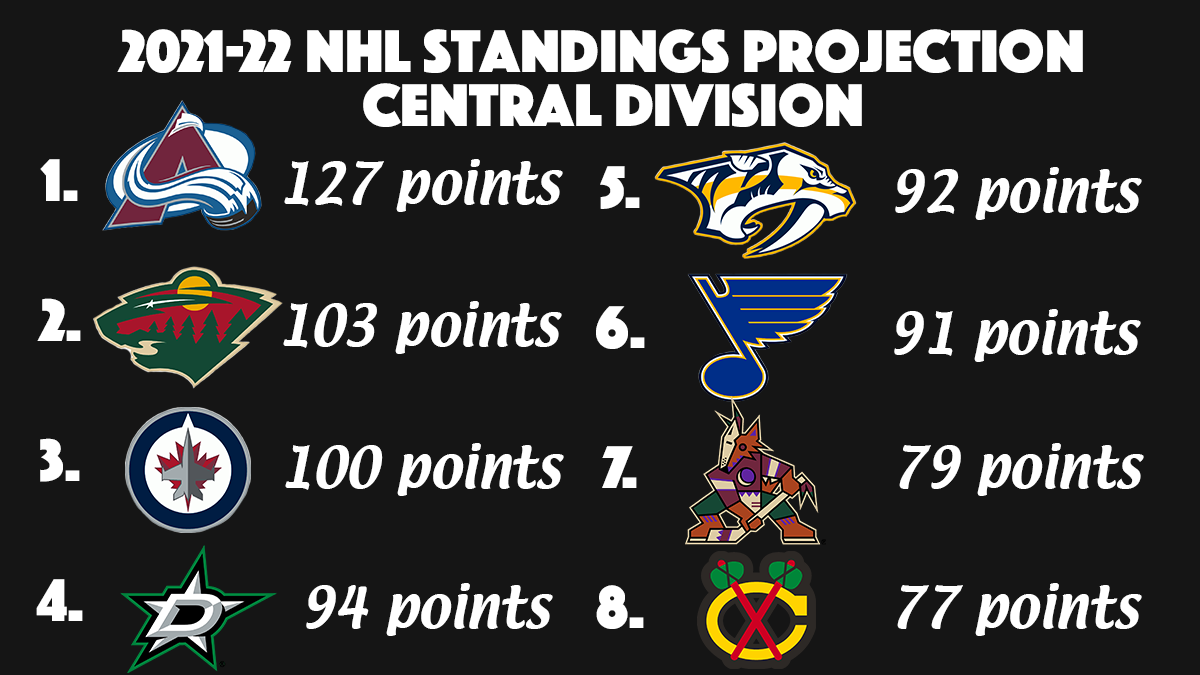
    The overall vibe of the Central Division for 2021-22 is that it’s just more of exactly what you’d expect. The Colorado Avalanche are lightyears ahead of everyone else, while Kirill Kaprizov and the Minnesota Wild continue to be on the rise and everyone else fights for what they can earn.

    Meanwhile, the jury is still out on whether or not the Winnipeg Jets can breakthrough as Canada’s team and break the Canadian curse (become the first Canadian club to win the Cup since 1993).

    Will Colorado finally break through the Second Round and win the Cup?

    Are the Avalanche just the Toronto Maple Leafs but with a little more success? My column:

    No, but really, it’s worth asking if the Avs making it back to the Western Conference Final for the first time since 2002, is more like Toronto’s struggle to make it out of the First Round for the first time since 2004, or is Colorado’s struggle more like the Washington Capitals pre-2018?

    The Caps won three Presidents’ Trophies in 2009-10, 2015-16 and 2016-17, but couldn’t make it past the Second Round– let alone the Pittsburgh Penguins– until they finally did and ended up surging in momentum all the way to their first Stanley Cup in franchise history.

    Colorado, on the other hand, has already won the Cup twice (1996 and 2001) and also has three Presidents’ Trophies to their name in 1996-97, 2000-01 and 2020-21, so if recent history has anything to tell us it’s that yet another team with high expectations for at least a few seasons now only to come up short could very well go on to win it all after winning the Presidents’ Trophy the previous year.

    Either that or they’ll have to win it in back-to-back seasons like Washington did before they won the Cup in 2018.

    Then again, the Tampa Bay Lightning tied the Detroit Red Wings’ record for most wins in the regular season (62), securing the Presidents’ Trophy in the process in 2018-19, then got swept by the Columbus Blue Jackets in the 2019 First Round.

    The very next year, however, Tampa kicked off back-to-back Cup rings in 2020 and 2021, to be where they are now as the two-time defending champions likely standing in the path as the only other favorites outside of the Avalanche this season.

    Anyway, the Avs mostly kept things the same from last season to this season, losing Joonas Donskoi to the Seattle Kraken in the 2021 NHL Expansion Draft, Brandon Saad to the St. Louis Blues in free agency and making minor swaps among replacement level bottom-six forwards and bottom-pairing defenders.

    Oh, then there’s this whole thing about how Philipp Grubauer left for Seattle in free agency too, so Colorado acquired Darcy Kuemper from the Arizona Coyotes.

    Between Dallas, Nashville and St. Louis, who will realistically make the playoffs?

    The Stars are projected to finish with about 94 points, the Predators sit at 92 points and the Blues are around 91 points in this one projection, but don’t let the points alone be your deciding factor.

    Given the strength of the Central Division compared to the Pacific Division, you can bet on five teams making out of the Central among Western Conference playoff berths.

    As such, the spread is the difference maker between these three teams expected to be in the wild card hunt– it’s going to come down to the wire one way or another.

    Dallas bolstered their goaltending depth by signing Braden Holtby, Nashville traded Ryan Ellis to the Philadelphia Flyers and St. Louis is… …better than last season on paper?

    I mean, the Blues signed Saad, acquired Pavel Buchnevich from the New York Rangers in exchange for Sammy Blais, let Seattle claim Vince Dunn at the expansion draft and let Mike Hoffman walk to the Montréal Canadiens in July.

    You could say they took a hit here or there, but those aren’t “nobody names” by any means, however.

    If Jordan Binnington and Ville Husso can stabilize things in the crease, then St. Louis has a better situation than the Predators.

    The Stars, meanwhile, should benefit from a longer season where more of their core guys– like Tyler Seguin, for example– are healthy. Last season’s COVID-19 outbreak to kick things off in January really killed Dallas’ momentum as a team on the verge of being in the 2021 postseason.

    Dallas should get back into the swing of things and St. Louis should be able to stay relevant for at least another year, but how hard the Preds rely on Juuse Saros as their starting goaltender will dictate whether or not they’re able to play spoiler with David Rittich as their backup since Pekka Rinne retired.

    Can Arizona avoid the basement?

    Anything is possible at this point. Loui Eriksson and Andrew Ladd were scoring goals in the postseason, so a fresh start could be just what both players needed for the last few years at least.

    That said, Coyotes General Manager, Bill Armstrong, gave a Masterclass™️ in how to go about rebuilding by selling everything over the summer and taking on “bad” contracts with only one or two years remaining in hopes of playing just well enough to be bad enough without making it look obvious that you’re aiming to win the 2022 NHL Draft Lottery.

    The Pacific Division is the new Scotia NHL North Division from last season. In other words, it’s the worst– which is great news for the Seattle Kraken as the league’s schedule allots more division play than any other opponents (though the Kraken will play every other team in the league at least twice).

    Seattle’s riding the waves of new-age expansion, while the Vegas Golden Knights lead the charge for the Presidents’ Trophy campaign in 2021-22.

    Wait, Seattle in 2nd in the Pacific, really?

    Yes, really.

    The Kraken have a great front office that goes beyond just Ron Francis as General Manager and have done their due diligence in scouting the best talent available to try to replicate the success of the Vegas Golden Knights’ inaugural season in 2017-18, as well as grow beyond just 2021-22.

    That said, Seattle probably isn’t going to make it out of the First Round of the 2022 Stanley Cup Playoffs, even if they have to face the Edmonton Oilers according to this projection.

    It’s a best case scenario for the NHL’s newest expansion team to be in the weakest division, but aside from having recent Stanley Cup champions Yanni Gourde, Philipp Grubauer, Jaden Schwartz and Dunn on their roster, the Kraken have a plethora of players that are relatively inexperienced with deep postseason runs.

    Head coach, Dave Hakstol, also hasn’t had the consistency of making the playoffs and making it out of the First Round in his NHL coaching days, but as a team that, again, is looking to develop long-term success, these are mere growing pains Francis and Co. are willing to accept as the fan base grows.

    Why aren’t the Kings making the cut this year when everyone else says they’ll be the most improved?

    The simple answer is that everyone’s overrating Los Angeles when it comes to the “ready now” factor.

    Sure, Kings General Manager, Rob Blake, did a good thing by getting Viktor Arvidsson in a trade with Nashville this summer to solidify his top-six forward group and signed Alex Edler to fortify his defense, but Los Angeles’ goaltending leaves something to be desired.

    Here’s hoping Jonathan Quick can find a little resurgence at this point in his career, while Cal Petersen continues to come into his own.

    If Los Angeles has any injuries– and they already have with Arvidsson likely missing some time due to an injury in the last preseason game– they’re already close enough to the bubble that they’ll only fall further behind.

    That said, if the Kings don’t make it back to the postseason hunt in 2022, there’s a good chance they make it in 2023.

    Los Angeles is improving, but by how much remains to be seen.

    Will winning the Presidents’ Trophy hurt Vegas?

    Eh, it’s hard to say.

    The Golden Knights have packed in just about every type of heartbreak since their inception in 2017, that fans of other franchises have only experienced over the course of at least 50 years, so if Vegas pulls out the Presidents’ Trophy win in 2021-22, don’t be surprised when the inevitable happens and they win the Cup instead of doing what most other Presidents’ Trophy winners in the salary cap era have done.

    Only the 2007-08 Detroit Red Wings and Chicago in 2012-13, have been able to win the Presidents’ Trophy and the Stanley Cup since the salary cap was introduced ahead of the 2005-06 season.

    Vegas would probably join Detroit and Chicago in doing so just so the Hockey Gods can spite us again.

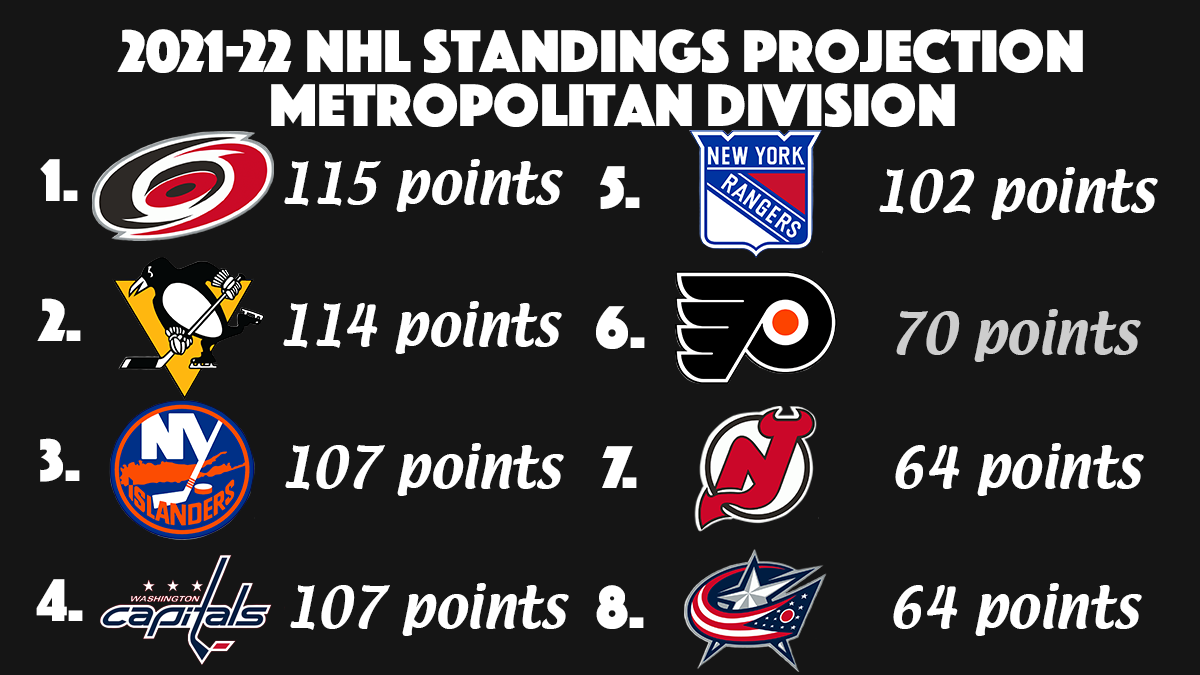
    It’s not easy to be in the Metropolitan Division these days because, well, let’s save that for the three questions below.

    Is this the toughest division to project?

    Absolutely.

    The Carolina Hurricanes decided to just get rid of a few parts and pieces that helped make them good for the last few seasons, so they’re bound to regress even with Sebastian Aho, Andrei Svechnikov, Teuvo Teräväinen and Martin Necas still existing.

    The Pittsburgh Penguins since 2009, have always found a way to be near the top of the division standings by the end of the regular season no matter whether or not you believe they’ll inevitably miss the playoffs for the first time since 2006, so anything could happen there.

    The New York Islanders have made back-to-back appearances in the Eastern Conference Final, so I’d expect them to be good.

    The Washington Capitals are better than the Philadelphia Flyers and New York Rangers, at least, but are probably the only team on the bubble if the New Jersey Devils can come out of nowhere and be competitive this season after signing Dougie Hamilton, Tomas Tatar and Jonathan Bernier in the offseason.

    Meanwhile, it’s time for a short rebuild in Columbus as the Blue Jackets would be quite pleased with a top draft pick in 2022.

    What if Chris Drury never was promoted as General Manager of the Rangers?

    They’d still fire David Quinn and hire Gerard Gallant. I don’t think that’s such a bad idea, but they’d definitely reconsider about 90% of the roster decisions made this summer.

    There’s no reason why the Rangers have to go down this path and yet, here they are, fumbling at the one-yard line and possibly plunging their franchise back into the Dark Ages of another rebuild. Or is it the same ongoing rebuild?

    What about a team to watch like New Jersey, for example?

    I’m big on the Devils this season for some strange reason.

    Maybe it’s because a part of me deep down misses the trap game of the 1990s and 2000s that led to Stanley Cups for New Jersey in 1995, 2000 and 2003.

    Maybe it’s because they signed Hamilton, Tatar, Bernier and acquired Ryan Graves from the Colorado Avalanche as a supporting cast for Jack Hughes, Nico Hischier, Pavel Zacha, Yegor Sharangovich, Ty Smith and friends.

    Seriously, the Devils should be good in the next few seasons, but this year could be the biggest stride forward in terms of their improvement from the basement to their development as a playoff contender.

    First, pour one out for Jack Eichel. Now, let’s move on and talk about everyone else.

    What does this mean for the Leafs?

    Just like how the Stars, Preds and Blues are all right on top of one another in the Central Division standings, the Atlantic Division is stacked from 1st through 4th, so though Toronto leads the way in this projection, I wouldn’t feel too comfortable as a Leafs fan.

    The Maple Leafs played in the worst of the four divisions last year in the temporarily realigned divisions in wake of the ongoing pandemic.

    No, it’s not just because they played all the other Canadian teams across 56 games, but rather it’s due to the fact that they haven’t been able to matchup with the Tampa Bay Lightning, Florida Panthers and even the Boston Bruins since the 2019-20 season.

    A lot and not a lot has changed since then.

    Tampa is still dominant as ever, Florida has emerged as a team that’s on the rise and Boston is unpredictable in that– much like the Penguins– it could really go either way with the Bruins this season.

    So now Toronto has to take on better competition within their own division and square off with teams like the Vegas Golden Knights, Colorado Avalanche, New York Islanders and others that emerge towards the top of the standings outside of the Canadian teams that the Leafs are all too familiar with at this point.

    That said, Toronto still has a great chance at winning the Atlantic Division regular season title or finishing 2nd and having home ice advantage in the First Round for the second-straight postseason.

    Can anyone other than Toronto, Florida, Tampa or Boston make it out of the Atlantic this year?

    No. Let’s be realistic here.

    The Montréal Canadiens made it to the 2021 Stanley Cup Final despite being below .500 in the standings because every division produced four playoff berths and intra-divisional play through two rounds.

    In 2020, they upset the Pittsburgh Penguins in the Qualifier despite finishing right at .500.

    In any other non-pandemic timeline, the Canadiens would still be looking for their first playoff appearance since they lost to the New York Rangers in six games in the 2017 First Round.

    That’s not to say that Nick Suzuki can’t lead the Habs back to glory, but rather that they need to improve all-around in the regular season and peaking in performance in the playoffs.

    Though the Ottawa Senators promised unprecedented success from 2021-25, it’s looking like it’ll realistically be anytime between 2024-25 as in the 2024-25 season itself at this point.

    Ottawa’s goaltending needs to improve, their defense could use some tweaks and the Sens are banking on their offense getting their feet underneath them and bursting in production in the coming years.

    A little more patience won’t hurt them.

    The same can be said for the Detroit Red Wings in that Red Wings fans already know– trust in General Manager, Steve Yzerman, is paramount. He’ll work his magic.

    It just takes a little time to build a solid foundation and the first floor is almost ready to start going up.

    As for the Buffalo Sabres, well…

    At least they’ll hopefully give Rick Jeanneret a proper send-off before he retires as their play-by-play announcer for the last 51 years on television.

    Hopefully.

    Will Tampa win three consecutive Stanley Cup championships?

    Probably not.

    I’m not ruling it out entirely, but the Lightning have a better chance of winning three Cups in four years than they do three Cups in as many years as things stand currently.

    The loss of their entire third line (Blake Coleman, Yanni Gourde and Barclay Goodrow) from last season to this season is sure to leave a mark on the development and restructuring of their bottom-six forwards.

    That said, Tampa’s top-six forwards still exist and, if you haven’t already noticed, they’re very good on their own, but the best teams in the playoffs have four lines that can roll without a doubt and the Bolts might just be off the ball for a year in terms of depth.


    Alright, if you’ve made it this far, thanks for your patience. By now the season’s already going on a few days into the 2021-22 calendar, so the two of us (or more if you’re reading this to a group) should probably get back to watching games.

    Stay tuned for more forecasts for both standings and assorted teams throughout the season.

  • New York Islanders 2021-22 Season Preview

    New York Islanders 2021-22 Season Preview

    2020-21 record 32-17-7, 71 points

    4th in the MassMutual NHL East Division

    Eliminated in the Stanley Cup Semifinal by Tampa

    Additions: F Andy Andreoff, F Richard Panik (acquired from DET), F Zach Parise, D Paul LaDue, D Zdeno Chara

    Subtractions: F Robert Carpenter (signed with Milwaukee Admirals, AHL), F Jordan Eberle (expansion, SEA), F Tanner Fritz (signed with Hartford Wolf Pack, AHL), F Joshua Ho-Sang (signed with Toronto Marlies, AHL), F Andrew Ladd (traded to ARI), F Travis Zajac (signed to one-day contract with NJD, retired), D Nick Leddy (traded to DET)

    Still Unsigned: F Kieffer Bellows (RFA), F Michael Dal Colle (RFA), D Braydon Coburn, G Cory Schneider

    Re-signed: F Cole Bardreau, F Anthony Beauvillier, F Casey Cizikas, F Otto Koivula, F Kyle Palmieri, F Dmytro Timashov, D Andy Greene, D Adam Pelech, G Ilya Sorokin

    Offseason Analysis: It’s October and we still don’t really know who is and who isn’t under contract with the New York Islanders because Isles General Manager, Lou Lamoriello, plays by his own rules.

    Well, not exactly like that, but he at least doesn’t like facial hair and won’t allow his players to sport a scruffy look. Not even a goatee (which bothers me as someone that looks much too young without sporting even a small patch of stubble on my chin to prove, in fact, that I am old enough to order a beer– let alone see an “R”-rated movie).

    Anyway, Lamoriello has slowly been announcing– though never disclosing the financial terms– deals that have been signed by players like Zach Parise and Zdeno Chara, as well as extensions for Kyle Palmieri, Adam Pelech, Andy Greene and Ilya Sorokin.

    Parise, 37, joins New York after amassing 393-417–810 totals in 1,060 career National Hockey League games for the New Jersey Devils and– most recently– the Minnesota Wild.

    Last season with the Wild, he had 18 points (seven goals, 11 assists) in 45 games, which was a bit of a steep decline in his production from 2019-20, albeit in much more limited time as Minnesota head coach, Dean Evason, felt his team was better with Parise scratched from time to time.

    New York head coach, Barry Trotz, on the other hand, thinks he can utilize Parise in the right amounts to maximize his value as a veteran of the league in search of his first Cup ring– let alone his first trip back to the Stanley Cup Final since 2012.

    Chara, 44, reunites with the Islanders– the team that drafted him in the 3rd round (56th overall) in the 1996 NHL Draft prior to breaking into the league with the Isles in the 1997-98 season and spending parts of four seasons on Long Island before then-General Manager Mike Milbury traded him to the Ottawa Senators ahead of the 2001-02 season.

    The long time veteran defender is entering his 24th season after amassing 207-459–666 totals in 1,608 games thus far with the Islanders, Senators, Boston Bruins and Washington Capitals. Chara was a member of the 2011 Stanley Cup champion Bruins roster and should pay dividends on the third pairing, as well as on the penalty kill, while Pelech and Ryan Pulock rest up for another long shift.

    After being acquired ahead of last season’s deadline, Palmieri put up four points (two goals, two assists) in 17 games down the stretch with New York after amassing 8-9–17 totals with the Devils in 34 games prior in 2020-21.

    In the 2021 Stanley Cup Playoffs, however, Palmieri found his scoring touch– notching seven goals and two assists (nine points) in 19 games en route to being eliminated by the Tampa Bay Lightning in seven games in the 2021 Stanley Cup Semifinal.

    Lamoriello added more veterans to an already veteran infused lineup while presumably remaining tight against the salary cap.

    Though New York had a bit of a bumpy ending to the regular season last year, they peaked at the right time to be one goal away from the franchise’s first Stanley Cup Final appearance since 1984.

    As an organization that’s been on the rise with Trotz behind the bench, the Islanders are sure to be out with something to prove in the league’s return to a normal 82-game schedule format and everything.

    Pelech’s eight-year extension worth $5.750 million per season at 27-years-old is Lamoriello’s greatest gift thus far to New York’s core as a good team friendly contract as Pulock enters a contract year in 2021-22 and Mathew Barzal carries two remaining years on his current deal.

    Love him or hate him, Lamoriello also did a decent job keeping Casey Cizikas in line with more conventional thinking for a top-nine forward on a new six-year deal worth $2.500 million per season compared to his last contract, which was a five-year deal with a $3.350 million cap hit.

    Generally speaking, first line forwards should be paid around $9.000 million, second liners between $4.000 to $6.000 million with third liners earning roughly $1.000 to $4.000 million and fourth liners taking home a cap hit between league minimum and $2.000 million per year at most.

    Follow that logic and you’ll be able to spread some wealth around on short-term contracts among your replacement level players or sign long term deals at a decent cap hit that’s expendable if you run into performance issues or cap related casualties down the road.

    Meanwhile, because of Lamoriello’s masterclass in contract negotiations this summer, Anthony Beauvillier got a three-year bridge deal at $4.150 million per season and Ilya Sorokin earned a three-year extension worth $4.000 million per season– keeping the Islanders competitive as Cup contenders for at least the next few years while balancing the growth and development of their core as they age into their prime.

    Of course, everything comes with a price as Lamoriello shipped out Nick Leddy to the Detroit Red Wings in a trade on July 16th for Richard Panik and a 2021 2nd round pick (originally from Edmonton, via Detroit- 52nd overall, Aatu Raty).

    Chara is 14 years Leddy’s senior, but Leddy’s $5.500 million cap hit was a roadblock in keeping the bulk of New York’s core together.

    To save some additional funds for redistribution this summer, the Islanders dealt Andrew Ladd, a 2021 2nd round pick (originally from Colorado via the Islanders, 60th overall- Janis Jerome Moser), as well as a conditional 2022 2nd round pick and a conditional 2023 3rd round pick to the Arizona Coyotes for future considerations.

    Arizona took on Ladd’s entire $5.500 million cap hit through the 2022-23 season.

    Offseason Grade: B

    For what needed to be done to protect the integrity of the Islanders as a Cup contender in the next few seasons (at least), Lamoriello made proper efforts to add without subtracting, while balancing the books in an efficient manner.

    There’s a lot to like about the respectable bridge contracts, but Pelech’s eight-year extension is a home run for what is otherwise New York’s cornerstone on defense with Pulock due for a bit of a pay raise next summer.

    That said, it wouldn’t surprise me to see the Isles off their game by just a little as the long runs into the third round of the Stanley Cup Playoffs in 2020 and 2021 take a toll on a team in every sense of the imagination.

    New York won’t need to hit “reset”, but rather “refresh” as they should comfortably reach the 2022 Stanley Cup Playoffs, but as for how far they go depends on if they can stay healthy and focused– especially with UBS Arena set to open in November, thereby giving the Islanders a long 13-game road streak to start the 2021-22 regular season.

    If they don’t win it all in 2022, they should be primed for a bounce-back in 2023, with their best chance at a Cup since their dynasty in the 1980s.

  • Arizona Coyotes 2021-22 Season Preview

    Arizona Coyotes 2021-22 Season Preview

    2020-21 record 24-26-6, 54 points

    5th in the Honda NHL West Division

    Missed the postseason for the first time since 2020

    Additions: F Jay Beagle (acquired from VAN), F Travis Boyd, F Ryan Dzingel, F Loui Eriksson (acquired from VAN), F Dmitrij Jaskin, F Bokondji Imama (acquired from LAK), F Andrew Ladd (acquired from NYI), F Liam O’Brien, F Antoine Roussel (acquired from VAN), D Shayne Gostisbehere (acquired from PHI), D Cole Hults (acquired from LAK), D Vladislav Kolyachonok (acquired from FLA), D Anton Strålman (acquired from FLA), D Conor Timmins (acquired from COL), G Carter Hutton, G Josef Korenar (acquired from SJS)

    Subtractions: F Michael Bunting (signed with TOR), F Brayden Burke (traded to LAK), F Derick Brassard (signed with PHI), F Michael Chaput (signed with PIT), F Christian Dvorak (traded to MTL), F Conor Garland (traded to VAN), F John Hayden (signed with BUF), F Dryden Hunt (signed with NYR), F Tyler Pitlick (expansion, SEA), F Lane Pederson (rights traded to and signed with SJS), F Emil Pettersson (KHL), F Tyler Steenburgen (traded to LAK), F Nathan Sucese (signed with Iowa Wild, AHL), D Oliver Ekman-Larsson (traded to VAN), D Alex Goligoski (signed with MIN), D Jordan Gross (signed with COL), D Niklas Hjalmarsson (retired), D Jordan Oesterle (signed with DET), G Adin Hill (traded to SJS), G Darcy Kuemper (traded to COL), G Antti Raanta (signed with CAR)

    Still Unsigned: F Frédérik Gauthier, F Marian Hossa (retired, contract expired), D Jason Demers, D Aaron Ness

    Re-signed: F Hudson Fasching, F Blake Speers, D Cam Dineen, D Dysin Mayo

    Offseason Analysis: Arizona took on a bunch of contracts this offseason, but still has about $11.946 million in cap space as Coyotes General Manager, Bill Armstrong, put on a masterclass of how to effectively clean house to rebuild.

    The Coyotes are paying a combined $1.500 million this season for the services of Carter Hutton and Josef Korenar in the crease after signing Hutton in free agency and acquiring Korenar and a 2022 2nd round pick via a trade with the San Jose Sharks that sent Adin Hill in return.

    Antti Raanta, meanwhile, left for the Carolina Hurricanes, seeking a career resurgence after a rocky, injury filled, tenure in Arizona, while Darcy Kuemper was traded the same day free agency began on July 28th to the Colorado Avalanche for defender, Conor Timmins, a 2022 1st round pick and a conditional 2024 3rd round pick.

    Whereas the Buffalo Sabres viewed goaltending as an afterthought this offseason, the Coyotes, uhh, planned this?

    Hutton had a 1-10-1 record in 13 games for the Sabres last season and recorded a 3.47 goals-against average and an .886 save percentage in that span, while Korenar made his NHL debut for the Sharks and went 3-5-0 in 10 games with a 3.17 goals-against average and an .899 save percentage.

    But goaltending wasn’t the biggest focus for Arizona this offseason as they completely stripped down their roster and planned for a major reset between now and next summer.

    Only 19 players throughout the organization are signed through the 2022-23 season, including six players currently on the NHL roster.

    After trading Hill and a 2022 7th round pick to the Sharks for Korenar and a 2022 2nd round pick on July 17th, Armstrong made sure to add salary to work his way to the cap floor that same day by acquiring Andrew Ladd from the New York Islanders in addition to a 2021 2nd round pick that originally belonged to Colorado (60th overall, Janis Jerome Moser), as well as a conditional 2023 3rd round pick for future considerations.

    Ladd’s been buried in the American Hockey League (AHL) in recent years with the Bridgeport Sound Tigers (now Bridgeport Islanders) and last played at the NHL level in four games with New York in 2019-20– scoring one goal that season.

    As crazy as it sounds, Arizona might use Ladd on their roster. At 35-years-old, he’s in his final run, but with two years remaining on his contract at a $5.500 million cap hit, he’s one of the few players left on the team entering 2022-23– unless he’s moved before then or retires.

    Philadelphia saw what the Islanders did and said “hey, we can do that too” and traded defender, Shayne Gostisbehere, to the Coyotes with a 2022 2nd round pick and a 2022 7th round pick in exchange for future considerations.

    Arizona takes on Gostisbehere’s remaining two years of his current contract at $4.500 million per season and looks to resurrect his offensive game from the blue line since his career-high 65 points in 78 games with the Flyers in 2017-18.

    Last season, Gostisbehere bounced back from 12 points in 42 games in 2019-20 with a respectable 20 points in 41 games, but it’s not enough to justify his price tag amid a plethora of defenders looking to crack Philadelphia’s lineup on a regular basis, so the Coyotes are glad to give Gostisbehere a warm welcome.

    A day after acquiring Gostisbehere, Arizona made waves when they traded their captain, Oliver Ekman-Larsson with the rights to then restricted-free agent forward, Conor Garland, to the Vancouver Canucks for Loui Eriksson, Jay Beagle, Antoine Roussel, a 2021 1st round pick (9th overall, Dylan Guenther), a 2022 2nd round pick and a 2023 7th round pick in return on July 23rd.

    Ekman-Larsson’s production has been in decline since recording 21-34–55 totals in 75 games with the Coyotes in 2015-16. He followed that season up with 39 points in 79 games in 2016-17, and 42 points in 82 games in 2017-18, before signing an eight-year extension with an $8.250 million cap hit on July 1, 2018, that would go into effect for the 2019-20 season.

    In 2018-19, Ekman-Larsson had 14-30–44 totals. In 2019-20, he had 30 points (nine goals, 21 assists) in 66 games and just last season, Ekman-Larsson had 24 points (three goals, 21 assists) in 46 games for Arizona.

    So the Coyotes packaged him with Garland to a team that Ekman-Larsson had expressed a desire in being traded to entering last offseason (Ekman-Larsson would only accept a trade to the Boston Bruins or Vancouver, but Arizona held out and kept him for the 2020-21 season).

    Garland signed an extension with the Canucks, while Arizona also retained 12% of Ekman-Larsson’s salary (about $990,000 per season through 2026-27) in the aftermath of the deal.

    Meanwhile, Eriksson, Beagle and Roussel are looking for a fresh start in a new market– though they each have one-year remaining on their contracts, so they probably shouldn’t get too comfortable.

    Eriksson managed to earn one assist in seven games last season for Vancouver, while Beagle was limited to 30 games due to injury and had 1-4–5 totals and Roussel chipped in four points (one goal, three assists) in 35 games.

    So they’re not offensive powerhouses, but the Coyotes aren’t going for a Cup ring this season– they’re going for a complete reset as they continued to wheel and deal this offseason.

    Arizona swapped minor leagues with the Los Angeles Kings in a trade on July 24th, then took July 25th off before acquiring defender, Anton Stålman, from the Florida Panthers for a 2023 7th round pick on July 26th.

    Strålman fell out of favor in Florida after scoring 19 points from the blue line in 69 games in 2019-20 before dropping to nine points in 38 games last season with the Panthers.

    Needing cap space, the Panthers moved on from Strålman, dropping him and his $5.500 million cap hit, along with defender, Vladislav Kolyachonok, off with the Coyotes for the 2021-22 season, where the 35-year-old defender is hungry to keep his playing days alive in the twilight of his career.

    With a few new faces on defense, Arizona is ready for life in a post-Niklas Hjalmarsson world, since the 34-year-old native of Sweden retired after five points (all assists) in 41 games with the Coyotes last season.

    On July 28th, Arizona executed the Kuemper trade, then the phone lines went silent for about a month until the Carolina Hurricanes signed Jesperi Kotkaniemi to an offer sheet that the Montréal Canadiens wouldn’t match.

    Montréal inquired the Coyotes about the availability of Christian Dvorak on the trade market and he was shipped off the Habs on Sept. 4th for a conditional 2022 1st round pick (the worse of the Canadiens’ own or Carolina’s) and a 2024 2nd round pick.

    By the way, Arizona hired a new head coach this offseason, naming André Tourigny as the designated leader to guide the rebuild down to the depths and back to the surface of playoff contention.

    That should be fun.

    At least Tourigny has a good repertoire among major junior players and can settle into the NHL level with whoever the Coyotes draft in 2022.

    Offseason Grade: A-

    Look, just because the offseason grade says “A-” doesn’t mean this team will actually be competitive.

    Yes, the Coyotes are going to finish last in the Central Division– by the way, they’re new to the Central this season since the Seattle Kraken joined the league and took Arizona’s spot in the Pacific Division.

    But it’s also true that Armstrong made most of the right moves that aligned with Arizona’s offseason philosophy– embrace the tank.

    The Coyotes are loading up on draft picks, prospects and whatever scraps you can find with other teams’ bad contracts and should turn things around in the next few years.

    Of course, there’s the fact that this seems to happen way too often in Arizona and the concern among the fanbase that things might not go as planned with their expected relocation from Glendale to Tempe, Arizona as the City of Glendale has booted the team out of their space at Gila River Arena after the 2021-22 season– opting out of their current lease agreement, as the city could in accordance with agreed upon clauses.

    But for all things considered, the Coyotes have a plan. The same can’t be said for Buffalo.

  • Take Five: Five takeaways from Game 3 of the 2020 Eastern Conference Final

    Matt Martin and Barclay Goodrow exchanged fisticuffs after a faceoff with 27.2 seconds left in the third period after the New York Islanders scored an empty net goal to seal the deal on a, 5-3, victory over the Tampa Bay Lightning in Game 3 of the 2020 Eastern Conference Final.

    In short, we have a series and the powder keg just might be ready to explode.

    Oh yeah and Brock Nelson scored the game-winning goal late in the third period before Jean-Gabriel Pageau added an insurance goal with the empty net tally while he was hooked and slashed by Lightning forward, Nikita Kucherov.

    Game 4 should contain a little bit of everything and a lot of excitement if things keep trending in the direction of a budding rivalry as Tampa leads the series 2-1. Puck drop on Sunday is set for a little after 3 p.m. ET and viewers in the United States can tune to NBC, while those in Canada can catch the action on CBC, SN or TVAS.

    1. Can’t give Tampa an inch.

    The Islanders have made a habit in the last couple of games where, despite playing more to the beat of their own drum, New York can’t seem to hold a lead on prevent defense alone.

    If New York is going to win more games, they’re going to need more offensive outbursts like they had– if you can call it that– in Game 3.

    The Isles are going to need their defenders to defend, their two-way bottom-six players to contribute 100% and their top-six forwards to outscore the Lightning who can, in fact, score from any position in their lineup.

    Well, we haven’t seen Bolts goaltender, Andrei Vasilevskiy, score yet, but I wouldn’t put it past him.

    Tampa is in the midst of one of those “anything is possible” postseasons and if New York wants to take control of that narrative– they can’t let the Lightning play their game.

    2. Matchups.

    A common theme from the Columbus Blue Jackets in the First Round to the Boston Bruins in the Second Round to, yes, even the Islanders in the Eastern Conference Final is that they simply don’t have the right matchups to go against the big scary, nasty, Lightning.

    New York’s head coach, Barry Trotz, scratched Casey Cizikas and Andrew Ladd for Derick Brassard and Michael Dal Colle.

    While Brassard’s (three hits, one blocked shot in 10:32 time on ice, 54 seconds of time on the power play) impact can be felt as a glue guy with a more well-rounded approach to today’s game– especially against Tampa– more so than a guy like Ladd, Trotz has kept Dal Colle’s time limited (9:54 TOI in Game 3).

    Nonetheless, Leo Komarov centering the fourth line with Brasard and Dal Colle is a significant improvement in speed and mustering the puck where you want it to go while giving your top forwards some time to recover before going over the boards to generate more offense.

    It should be ride or die with this fourth line for the time being.

    3. More of the same, kind of.

    The Islanders trailed the Lightning in shots on goal, 37-35, but stymied Tampa with some solid goaltending from Semyon Varlamov (10-5 in 17 games played, 16 starts, 2.26 goals against average, .913 save percentage, two shutouts) and the overall schematics interwoven in Trotz’s game plan.

    New York really wore Tampa down as the game progressed and capitalized on their chances, but the backdoor was left open for large stretches of the game, which the Bolts took full advantage of– tying the game, 1-1, at 16:31 of the first period, courtesy of Mikhail Sergachev’s second goal this postseason and even pulled even after trailing by two-goals, 3-1, entering the third period.

    Ondrej Palat (7) scored a power-play goal at 2:32 and Tyler Johnson (4) tied the game, 3-3, at 12:04 of the third period.

    Now, it’s important to note that Game 3 was more of the same for New York until they realized they needed a 60-minute effort and that nothing about Game 3 was the same for Tampa, since Brayden Point was not in the lineup due to injury.

    Yes, the Lightning did not have the services of their leading scorer and head coach, Jon Cooper, wouldn’t provide much of an update (if even an update at all, really) ahead of Friday night’s action.

    4. Nikita Kucherov has his moments. Don’t take the bait.

    Kucherov hooked and slashed Pageau while skating towards and immediately as/after he shot the rubber biscuit into the empty twine to secure the, 5-3, win for the Isles.

    Pageau took exception to what Kucherov was already going to be penalized for had Pageau inexplicably missed the open net and caused a scrum instead of a proper goal celebration at 19:24 of the third period.

    Kucherov has been suspended in the past– specifically for an illegal hit to the head last postseason– and shouldn’t distract the Islanders from stooping to his level when he crosses a line.

    The goal should always be to get your revenge on the scoreboard– especially if the officials on the ice are making the right call in accordance with the rule book.

    Otherwise, the Islanders don’t need to amass any retaliation penalties for what’s either an invite to the descent into an ugly outing or simply the overt frustrations of a player that has shown an intent to injure and should be reprimanded as such.

    None of that takes away from Kucherov’s ability to score, as long as he isn’t out of the lineup due to his own on-ice behavior.

    5. Is somebody getting the best, the best, the best of you?

    Don’t let emotions get in the way of the game.

    You could argue this goes hand-in-hand with the takeaway above, but 1) all five takeaways are pretty similar after Game 3 and 2) this one has more to do with the toughness of each team’s lineup.

    For the Islanders, there’s no need to fear Tampa’s tough guys. New York didn’t need to add any toughness at the trade deadline– they already had Martin, Komarov and crew.

    The Lightning did.

    They got Blake Coleman and Goodrow, which makes them tougher, but cannot negate the cohesion that Islanders General Manager, Lou Lamoriello, has planned since day one.

    As long as the Isles play their cards right, Tampa’s style might take them over the edge and into undisciplined turmoil.

    As always, make them pay on the scoreboard and in good, clean, hits.

    That goes for both teams, in case Lightning fans were thinking this was solely about New York.

  • DTFR Podcast #181- Hall-iday Shopping

    DTFR Podcast #181- Hall-iday Shopping

    What’s the right price to pay for Taylor Hall? Plus, Cap’n Cornelius joins the show to talk about new NHL policies and coaching changes.

    Subscribe to the podcast on Apple PodcastsStitcher and/or on Spotify. Support the show on Patreon.

  • DTFR Podcast #180- Turning Over A New Leaf

    DTFR Podcast #180- Turning Over A New Leaf

    The Toronto Maple Leafs finally did the thing! Congrats to the 2019 Hockey Hall of Fame Class and taking a look at who might join them in 2020.

    Subscribe to the podcast on Apple PodcastsStitcher and/or on Spotify. Support the show on Patreon.

  • DTFR Podcast #166- New New New York

    DTFR Podcast #166- New New New York

    Nick and Colby recap the headlines from the last month as well as take a look at all of the New York market teams and try to figure out if any of them are actually any good as Season Six of the podcast begins.

    Subscribe to the podcast on Apple Podcasts (iTunes)Stitcher and/or on Spotify. Support the show on Patreon.

  • 2019 Stanley Cup Playoffs First Round Preview: Eastern Conference

    *cue Andy Williams*

    It’s the most wonderful time of the year!

    The Stanley Cup Playoffs have returned and all is right with the world (unless your team missed the postseason).

    In the past, we here at Down the Frozen River have covered every game of every series.

    This year, we’re mixing it up a bit– starting with this preview of every First Round series in the Eastern Conference, continuing with a followup preview of every First Round series in the Western Conference and as much analysis as possible on the DTFR Podcast in addition to the blog.

    Ch-ch-ch-changes are inevitable and yours truly cannot cover all 16 teams in the postseason alone.

    A1 Tampa Bay Lightning (62-14-6, 128 points) vs EWC2 Columbus Blue Jackets (47-31-4, 98 points)

    The Tampa Bay Lightning clinched the President’s Trophy (for the first time in franchise history) by mid-March and finished with the 4th most points in a season in NHL history, while star forward, Nikita Kucherov, amassed 128 points (the most by a Russian born player in a season) and Andrei Vasilevskiy (39-10-4 record, 2.40 goals against average, .925 save percentage in 53 games played) turned in a Vezina Trophy worthy performance in the crease.

    Oh yeah and Steven Stamkos had 45 goals.

    The Bolts also tied the 1995-96 Detroit Red Wings for most wins in a regular season (62).

    Backup goaltender, Louis Domingue (21-5-0, 2.88 GAA, .908 SV% in 26 GP) posted respectable numbers as well in the Lightning’s thunderous run through the season.

    Tampa has home ice throughout the playoffs and kicks things off with a First Round matchup against the Columbus Blue Jackets, who punched their ticket to the 2019 Stanley Cup Playoffs with a, 3-2, shootout victory over the New York Rangers last Friday– eliminating the Montreal Canadiens from postseason contention in the process.

    Columbus was all over the Metropolitan Division this season, but went all-in at the trade deadline, adding Matt Duchene, Ryan Dzingel, Adam McQuaid and Keith Kinkaid for the stretch run.

    Duchene and Dzingel quickly fit in to their respective top-nine roles, while McQuaid struggled to find a suitor on the blue line at first in his return to the organization that originally drafted him 55th overall in the 2005 NHL Draft before he was traded to the Boston Bruins and broke into the league with the B’s in 2009-10.

    Kinkaid was added solely for goaltending depth as pending-unrestricted free agent, Sergei Bobrovsky (37-24-1, 2.58 GAA, .913 SV% in 62 GP) led the league with nine shutouts on the season.

    Blue Jackets backup goaltender, Joonas Korpisalo (10-7-3, 2.95 GAA, .897 SV% in 27 GP) hit some rough patches at times, but found a way to dig his team out from the backend when necessary.

    In the grand scheme of things, the Bolts won the season series, 3-0-0, and outscored Columbus, 17-3, in that span.

    While many consider Columbus as a Stanley Cup Playoffs pushover– given the franchise has never won a series– Blue Jackets head coach, John Tortorella always poses a tough challenge that can wear down his opponent.

    Lightning head coach, Jon Cooper, earns his own merit in his ability to keep his players cool, calm, collected and always in comeback mode, but it’s not unfathomable to see the Blue Jackets pestering Tampa about as much– if not more than– Columbus did to Washington in last season’s First Round matchup.

    After all, the Blue Jackets did lead that series, 2-0.

    That said, this is Tampa’s year for a Cup run or bust. The Lightning should win the series in six games.

    Regular season outcomes:

    5-1 TBL at Nationwide Arena on Feb. 18th, 4-0 TBL at Amalie Arena on Jan. 8th, 8-2 TBL at Amalie Arena on Oct. 13th

    Schedule:

    4/10- Game 1 CBJ @ TBL 7 PM ET on USA , SN360, TVAS

    4/12- Game 2 CBJ @ TBL 7 PM ET on CNBC, SN360, TVAS

    4/14- Game 3 TBL @ CBJ 7 PM ET on NBCSN, SN360, TVAS

    4/16- Game 4 TBL @ CBJ 7 PM ET on CNBC, SN360, TVAS

    4/19- Game 5 CBJ @ TBL*

    4/21- Game 6 TBL @ CBJ*

    4/23- Game 7 CBJ @ TBL*

    *If necessary

    A2 Boston Bruins (49-24-9, 107 points) vs A3 Toronto Maple Leafs (46-28-8, 100 points)

    For the second season in a row, the Boston Bruins are hosting the Toronto Maple Leafs in the First Round of the 2019 Stanley Cup Playoffs.

    Despite being without Patrice Bergeron and Zdeno Chara at one point this season, the Bruins rallied from their 12th defenseman on up through the rest of the lineup to finish one win shy of consecutive 50-win seasons in Bruce Cassidy‘s third season (second full season) as head coach.

    Speaking of Bergeron, however, the perfect two-way center finished the season with a career-high in points (79) and matched his career-high in goals (32) while battling injury early in the season. Bergeron’s 32-47–79 totals came in just 65 games. That’s only one more game played than last season for No. 37 in black-and-gold.

    Meanwhile, his linemates, Brad Marchand and David Pastrnak each reached milestones of their own. Marchand reached the 100-point plateau this season and became the first Bruin to do so since Joe Thornton recorded 101 points in 2002-03.

    The “Little Ball of Hate” also set a career-high in assists (64) and was not suspended in 79 games played this season (he was rested for the final two games in the regular season and missed one game due to injury).

    Pastrnak set a career-high in goals (38) and points (81) despite missing time due to a left thumb injury and being limited to 66 games played.

    The B’s were led in net this season by Tuukka Rask (27-13-5, 2.48 GAA, .912 SV% in 46 GP) and Jaroslav Halak (22-11-4, 2.34 GAA, .922 SV% in 40 GP) in a 1A/1B scenario. For the first time since the 1989-90 season, Boston had two goaltenders with 20-plus wins.

    Back north in Toronto, the Maple Leafs added a formidable center in John Tavares in free agency and his presence was immediate, notching career-highs in goals (47 ) and points (88) in 82 games.

    Auston Matthews (37-36–73 totals in 68 games) and Mitch Marner (26-68–94 totals in 82 games) continued to their thing as the $11.634 million man (starting next season) and the soon to be at least $10.000 million boy wonder man.

    Maple Leafs General Manager, Kyle Dubas, added Jake Muzzin in January in a trade with the Los Angeles Kings in effort to shore up his blue line, however, questions remain as to how head coach, Mike Babcock will limit time on ice for veterans, like Ron Hainsey, and mix in more opportunities for Morgan Rielly (20-52–72 totals in 82 games) in his breakout season.

    Boston won the season series, 3-1-0, outscoring Toronto, 16-10, in that span.

    Some experts are picking the Bruins in five games. They also said similar things in 2013 and 2018. This series is going six games (at least), with Boston overcoming the Maple Leafs defense in Game 7, once again.

    To their credit, Toronto always makes things interesting in what’s likely to be the most unpredictable First Round matchup.

    Regular season outcomes:

    3-2 BOS at Scotiabank Arena on Jan. 12th, 6-3 BOS at TD Garden on Dec. 8th, 4-2 TOR at Scotiabank Arena on Nov. 26th, 5-1 BOS at TD Garden on Nov. 10th

    Schedule:

    4/11- Game 1 TOR @ BOS 7 PM ET on NBCSN, CBC, SN, TVAS

    4/13- Game 2 TOR @ BOS 8 PM ET on NBC, CBC, TVAS

    4/15- Game 3 BOS @ TOR 7 PM ET on NBCSN, CBC, TVAS

    4/17- Game 4 BOS @ TOR 7 PM ET on NBCSN, CBC, TVAS

    4/19- Game 5 TOR @ BOS*

    4/21- Game 6 BOS @ TOR*

    4/23- Game 7 TOR @ BOS*

    *If necessary

    M1 Washington Capitals (48-26-8, 104 points) vs EWC1 Carolina Hurricanes (46-29-7, 99 points)

    Just as everyone expected, the Washington Capitals led the Metropolitan Division with 104 points after Barry Trotz left for the head coaching job on Long Island. Did I mention the Capitals are the defending Stanley Cup champions?

    Anyway, Alex Ovechkin scored 51 goals and collected his 8th career Maurice “Rocket” Richard Trophy as a result– though Edmonton Oilers forward, Leon Draisaitl, was hot on his tail with 50 goals this season.

    After the New York Islanders led the Metropolitan Division for what seemed like forever, it’s important to note the Metro was actually anybody’s game from puck drop in October. Here’s the thing, the Carolina Hurricanes were near the top of the division– they’ve been surging all season.

    Speaking of surging, Carolina introduced their “Storm Surge” post-win celebration and the Caniacs loved it.

    For those of you who haven’t been paying attention to the club in Raleigh, Brett Pesce is good. Also, Sebastian Aho (30-53–83 totals in 82 GP), Andrei Svechnikov (20-17–37 totals in 82 GP) and Teuvo Teravainen (21-55–76 totals in 82 games)– they’re pretty good too.

    Washington was led by Braden Holtby (32-19-5, 2.82 GAA, .911 SV% in 59 GP) between the pipes this season and is comforted to know Pheonix Copley (16-7-3, 2.90 GAA, .905 SV% in 27 GP) is quite capable of playing this season’s role of Philipp Grubauer (since traded to the Colorado Avalanche after last season’s Cup celebrations).

    The Canes were led by a duo of goaltenders who were once thought of as an after thought in Curtis McElhinney (20-11-2, 2.58 GAA, .912 SV% in 33 GP) and Petr Mrazek (23-14-3, 2.39 GAA, .914 SV% in 40 GP).

    Though his record might not show it, Mrazek has been hitting his stride for the last month and is locked in. Ride that wave until it crests.

    The Hurricanes had a league-leading ten skaters play in all 82 games. There’s no such thing as playing too much hockey– especially when it’s the first postseason appearance since 2009.

    Last year, the Columbus Blue Jackets gave the Caps some interruptions coming out of the gate.

    Despite Washington having swept the season series, 4-0-0, the Hurricanes kept things close in their most recent matchup with a, 3-2, loss at PNC Arena on March 28th.

    Carolina almost pulled off the victory in a shootout on Dec. 14th, but lost, 6-5, on home ice to the Capitals.

    Washington is beatable. Hurricanes head coach, Rod Brind’Amour knows that, his team just hasn’t done it yet. Caps head coach, Todd Reirden, is also making his postseason debut at the reigns behind the bench for his respective team.

    Though they won the Cup last season– that was then. This is now.

    This series is going seven games and the Hurricanes will make sure there’s no repeat Cup winner this year.

    Regular season outcomes:

    3-2 WSH at PNC Arena on March 28th, 4-1 WSH at Capital One Arena on March 26th, 3-1 WSH at Capital One Arena on Dec. 27th, 6-5 F/SO WSH at PNC Arena on Dec. 14th

    Schedule:

    4/11- Game 1 CAR @ WSH 7:30 PM ET on USA, SN360, TVAS2

    4/13- Game 2 CAR @ WSH 3 PM ET on NBC, SN, TVAS

    4/15- Game 3 WSH @ CAR 7 PM ET on CNBC, SN, TVAS2

    4/18- Game 4 WSH @ CAR 7 PM ET on TBD, SN360, TVAS

    4/20- Game 5 CAR @ WSH*

    4/22- Game 6 WSH @ CAR*

    4/24- Game 7 CAR @ WSH*

    *If necessary

    M2 New York Islanders (48-27-7, 103 points) vs M3 Pittsburgh Penguins (44-26-12, 100 points)

    Barry Trotz figured out how to beat the Pittsburgh Penguins last season with the defending Stanley Cup champion Washington Capitals. Trotz is the key. Trotz knows the secret stuff to beat Mike Sullivan and his Penguins.

    That’s why the William M. Jennings Trophy winning duo of Robin Lehner (25-13-5, 2.13 GAA, .930 SV% in 46 GP) and Thomas Greiss (23-14-2, 2.28 GAA, .927 SV% in 43 GP) will backstop the New York Islanders past Pittsburgh in their First Round matchup in six games.

    Am I getting ahead of myself? Probably.

    New York split the season series with the Pens, 2-1-1, with their most recent result against Pittsburgh coming in a, 2-1, shootout loss on Dec. 10th at NYCB Live (that’s the Nassau Coliseum, if you haven’t already heard. The Isles will host their First Round games there).

    Islanders General Manager Lou Lamoriello put together a team without John Tavares. Trotz figured out how to get the most out of his players– guys like Matt Martin, Leo Komarov, Casey Cizikas and even Andrew Ladd (until Ladd got injured)– while playing the trap.

    That same trap won the Cup last season.

    This season, Trotz has Mathew Barzal and Anders Lee as his main attractions instead of names like Alex Ovechkin and Evgeny Kuznetsov.

    Long Island residents have long memories– the Penguins are one of their greatest rivals– and the added energy of Tavares’ departure has only fueled more passion all season long.

    Can New York flip the switch from their late season bumps in the road?

    Obviously, Pittsburgh has Sidney Crosby. They also have Evgeni Malkin. Crosby and Malkin are ready to go for another deep postseason run after watching their biggest rival not only beat them in the Second Round last year, but go on to take the Cup out of the hands of the Penguins’ recent streak of dominance in 2016 and 2017.

    Patric Hornqvist is also another silent killer option for Sullivan when his team needs a clutch goal– and that’s on top of Jake Guentzel and Phil Kessel throughout the rest of the lineup.

    The Penguins were led in the crease by Matt Murray (29-14-6, 2.69 GAA, .919 SV% in 50 GP) this season with some helpful bailout backup goaltending from Casey DeSmith (15-11-5, 2.75 GAA, .916 SV% in 36 GP). If Murray shows any signs of wavering, Sullivan shouldn’t have a hard time going to DeSmith to push his team over the edge.

    How will Nick Bjugstad and Jared McCann play into the fold as Jim Rutherford‘s biggest prize acquisitions this season? Who might be the breakout star for Pittsburgh that outshines Crosby in the Conn Smythe Trophy vote?

    Aren’t these questions supposed to be answered in an editorial preview? Sure.

    Regular season outcomes:

    2-1 F/SO PIT at NYCB Live on Dec. 10th, 6-2 PIT at PPG Paints Arena on Dec. 6th, 3-2 F/SO NYI at Barclays Center on Nov. 1st, 6-3 NYI at PPG Paints Arena on Oct. 30th

    Schedule:

    4/10- Game 1 PIT @ NYI 7:30 PM ET on NBCSN, CBC, TVAS2

    4/12- Game 2 PIT @ NYI 7:30 PM ET on NBCSN, CBC, TVAS2

    4/14- Game 3 NYI @ PIT 12 PM ET on NBC, CBC, SN, TVAS

    4/16- Game 4 NYI @ PIT 7:30 PM ET on NBCSN, CBC, TVAS2

    4/18- Game 5 PIT @ NYI*

    4/20- Game 6 NYI @ PIT*

    4/22- Game 7 PIT @ NYI*

  • DTFR Podcast #151- Gritty’s European Vacation

    DTFR Podcast #151- Gritty’s European Vacation

    The DTFR Duo breaks down Jimmy Howard’s one-year extension with the Detroit Red Wings, Gritty’s allegiance in the 2019 NHL Global Series, the New York Islanders’ bottom-six dilemma, Ilya Kovalchuk’s relationship with the Los Angeles Kings, more awards and a look at how things should stack up in the Metropolitan Division for the 2019 Stanley Cup Playoffs.

    Subscribe to the podcast on Apple Podcasts (iTunes), Stitcher and/or on Spotify. Support the show onPatreon.