Tag: American Hockey League

  • Preview: Game No. 28– Bruins @ Sabres

    Preview: Game No. 28– Bruins @ Sabres

    For the first time this season, the Boston Bruins pay a visit to KeyBank Center to take on the Buffalo Sabres for Hockey Fights Cancer Night in Buffalo.

    Last season, Boston went 3-0-0 against Buffalo in the pandemic shortened 2019-20 regular season, winning all three of their matchups, 3-2, on Nov. 21st in Boston, 3-0, on Dec. 27th in Buffalo and, 3-2, on Dec. 29th in Boston.

    After Thursday night’s matchup, the two clubs will meet seven more times in 2020-21, including their next meeting on Saturday.

    A couple of previous matchups against the Sabres were postponed to later dates in the season due to a plethora of Buffalo players in COVID protocol last month.

    A coaching staff member for Buffalo and a Boston skater (Sean Kuraly) were placed in COVID protocol Thursday morning, resulting in both pregame skates being cancelled, but the game remains on schedule through contact tracing, etc.

    The Sabres return home after a, 3-2, loss to the Devils in New Jersey and without their now former head coach, Ralph Krueger, who was fired on Wednesday.

    Interim head coach Dom Granato was promoted from his position as an assistant coach in Buffalo, where he was hired in that role in 2019. He will be making his National Hockey League head coaching debut on Thursday.

    Granato previously served as the head coach of the Columbus Chill (ECHL, 1997-99), head coach of the Peoria Rivermen (ECHL, 1999-2000), head coach of the Worcester IceCats (AHL, 2000-05), an assistant coach with the St. Louis Blues (2005-06), head coach of the Chicago Wolves (AHL, parts of two seasons, 2008-09 and 2009-10), head coach of the USA Hockey National Team Development Program (2013-16), assistant coach with the Wisconsin Badgers (NCAA, 2016), assistant coach with the Chicago Blackhawks (2016-19).

    Buffalo, of course, is without their captain, Jack Eichel, due to injury.

    Boston, meanwhile, is suffering from a plethora of injuries, rendering Tuukka Rask unavailable for the last five games, which meant that Dan Vladar got his first career NHL start on Tuesday after Jaroslav Halak was handed a, 4-1, loss in Pittsburgh on Monday.

    Vladar made 34 saves on 35 shots to backstop the Bruins to a, 2-1, victory against the Penguins in his regular season debut in Pittsburgh on Tuesday night.

    Bruins head coach, Bruce Cassidy, is likely to tweak his lineup depending on player availability, as well as whether or not Rask will be good to go after missing six games this season due to an undisclosed injury.

    Rask did travel with the team as part of their four-game road trip (1-1-0).

    Boston will be without Ondrej Kase, Kevan Miller and Jeremy Lauzon, at least, as Kase has no timetable for a return, Miller is skating back in Boston and Lauzon is approaching one month since sustaining a fractured left hand, which takes four-to-six weeks recovery time.

    Brandon Carlo, John Moore and Zach Senyshyn will also be out of the lineup for Boston, while Jarred Tinordi is likely to miss Thursday night’s game in Buffalo as well after sustaining an upper body injury on a hit from Pittsburgh’s Brandon Tanev that resulted in a boarding major, as well as a game misconduct and a five-minute power play for Boston.

    Thursday marks the halfway point for the Bruins, who are 15-8-4 overall (34 points) and currently 4th place in the MassMutual NHL East Division, while the Sabres begin the second half of their season with a 6-18-4 record (16 points, last in the division).

    Boston is 3-2 in overtime and 2-2 in shootouts (5-4 past regulation) this season, while Buffalo is 0-2 in overtime and 2-2 in shootouts (2-4 past regulation) thus far in 2020-21.

    Boston is also 8-5-3 in 16 games on the road this season, including a 4-4-2 record in their last ten games, while Buffalo is 2-10-2 on home ice and 0-9-1 in their last ten games.

    The B’s are 142-113-29-12 in 296 all-time regular season matchups against Buffalo with 949 goals for and 926 goals against in that span.

    The Bruins are also 29-25-1-7 in 62 regular season games at KeyBank Center, though the Sabres have outscored Boston, 175-157, in that span.

    Brad Marchand leads the Bruins in scoring with 12-21–33 totals in 27 games, while Patrice Bergeron is second with 25 points in 27 games and David Pastrnak is third with 24 points in 20 games, while leading his teammates in goals scored (13).

    Marchand has a team-leading plus-nine rating in 27 games, while Chris Wagner is a minus-eight in 23 games this season.

    Sam Reinhart and Victor Olofsson lead the Sabres in scoring with 19 points in 26 and 28 games, repsectively. Eichel (18 in 21 games) ranks third in scoring, while Reinhart leads the roster in goals scored with 11.

    Jake McCabe is a plus-two in 13 games, while Rasmus Dahlin is a minus-27 in 28 games thus far.

    If Rask gets the start for Boston, he is one win away from his 300th career NHL win, which would also make him the first goaltender in a Bruins uniform to reach the 300-win plateau.

    David Krejci is one point away from his 700th career point and currently eighth all-time in scoring in a Bruins uniform with 699 career points.

    Wayne Cashman (793 points) is seventh in all-time scoring with Boston.

    Bruins captain, Patrice Bergeron (894 points) is four points away from tying Rick Middleton (898) for the fourth most points in a Boston uniform in franchise history.

    The Bruins wrap up their four-game road trip with a Saturday matinee (1 p.m. ET puck drop) in Buffalo before returning home on March 23rd against the New York Islanders in what will be Boston’s first game at TD Garden to feature fans since the ongoing global COVID-19 pandemic began last year.

    TD Garden will be limited to a 12% seating capacity.

    Expected lineups

    Boston Bruins

    63 Brad Marchand (A) 37 Patrice Bergeron (C) 88 David Pastrnak

    74 Jake DeBrusk 46 David Krejci (A) 12 Craig Smith

    21 Nick Ritchie 13 Charlie Coyle 62 Oskar Steen

    11 Trent Frederic 18 Greg McKegg 83 Karson Kuhlman

    48 Matt Grzelcyk 73 Charlie McAvoy

    67 Jakub Zboril 75 Connor Clifton

    54 Jack Ahcan 44 Steven Kampfer

    41 Jaroslav Halak

    80 Dan Vladar

    Healthy scratches, injured and taxi squad members (officially TBA, below is only a prediction based on last game)

    Jeremy Swayman, Anders Bjork, Chris Wagner, Greg McKegg, Zach Senyshyn (upper body), Brandon Carlo (upper body), John Moore (lower body), Ondrej Kase (upper body), Tuukka Rask (lower body), Sean Kuraly (COVID protocol), Jeremy Lauzon (fractured left hand), Urho Vaakanainen, Jarred Tinordi (upper body), Kevan Miller (right knee)

    Buffalo Sabres

    13 Tobias Rieder 12 Eric Staal 23 Sam Reinhart

    4 Taylor Hall 15 Riley Sheahan 72 Tage Thompson

    53 Jeff Skinner 27 Curtis Lazar 37 Casey Mittelstadt

    68 Victor Olofsson 20 Cody Eakin 21 Kyle Okposo

    78 Jacob Bryson 55 Rasmus Ristolainen

    44 Matt Irwin 62 Brandon Montour

    26 Rasmus Dahlin 33 Colin Miller

    40 Carter Hutton

    34 Jonas Johansson

    Healthy scratches, injured and taxi squad members (officially TBA, below is only a prediction based on last game)

    Jack Eichel, Henri Jokiharju, Dylan Cozens

    Goaltending stats entering Thursday

    Boston Bruins

    1 Jeremy Swayman 0-0-0 in 0 GP, 0.00 GAA, .000 SV%, 0 SO

    40 Tuukka Rask 8-4-2 in 14 GP, 2.46 GAA, .906 SV%, 0 SO

    41 Jaroslav Halak 6-4-2 in 12 GP, 2.15 GAA, .918 SV%, 2 SO

    80 Dan Vladar 1-0-0 in 1 GP, 1.00 GAA, .971 SV%, 0 SO

    Buffalo Sabres

    31 Dustin Tokarski 0-0-0 in 0 GP, 0.00 GAA, .000 SV%, 0 SO

    34 Jonas Johansson 0-5-1 in 7 GP, 3.79 GAA, .884 SV%, 0 SO

    35 Linus Ullmark 5-4-2 in 12 GP, 2.43 GAA, .919 SV%, 0 SO

    40 Carter Hutton 1-9-1 in 11 GP, 3.43 GAA, .884 SV%, 0 SO

  • Crosby, Jarry and Pens takedown Bruins, 4-1

    Crosby, Jarry and Pens takedown Bruins, 4-1

    A late first period comeback with Sidney Crosby’s eventual game-winning goal on top of Tristan Jarry’s 42-save performance led the Pittsburgh Penguins to a, 4-1, victory over the Boston Bruins on Monday night at PPG Paints Arena.

    Jarry (12-7-1, 2.90 goals-against average, .906 save percentage in 20 games played) turned aside 42 out of 43 shots faced for a .977 save percentage in the win for Pittsburgh.

    Boston goaltender, Jaroslav Halak (6-4-2, 2.15 goals-against average, .918 save percentage in 12 games played) made 22 saves on 25 shots against for an .880 save percentage in the loss.

    The Bruins fell to 14-8-4 (32 points) and remained in 4th place in the MassMutual NHL East Division, while the Penguins improved to 18-9-1 (37 points) and in control of 3rd place in the division.

    The B’s also dropped to 2-1-0 against the Pens this season.

    Jake DeBrusk returned to the lineup for Boston after missing last Saturday’s, 4-0, loss to the New York Rangers due to COVID protocol in what turned out to be a false positive test.

    Bruins head coach, Bruce Cassidy, re-inserted DeBrusk in his usual role on the second line left wing and made a few other adjustments to his forward lines.

    Craig Smith joined DeBrusk as David Krejci’s wings on the second line, while Nick Ritchie and Anders Bjork suited up on the left and right side of Charlie Coyle, respectively.

    Sean Kuraly centered the fourth line with Trent Frederic at left wing and Karson Kuhlman at right wing.

    On defense, Cassidy replaced Urho Vaakanainen on the third pairing with Steven Kampfer for a night alongside Jarred Tinordi.

    The Bruins were without the services of Ondrej Kase (upper body), Kevan Miller (right knee), Jeremy Lauzon (fractured left hand), Brandon Carlo (upper body), Tuukka Rask (lower body) and Zach Senyshyn (upper body) on Monday night.

    Rask traveled with the team and skated with the taxi squad members, but won’t be ready for Tuesday night’s rematch with the Penguins, which means Dan Vladar or Jeremy Swayman will make their National Hockey League regular season debut in Pittsburgh.

    Vladar made his postseason debut in relief of Halak in Game 3 of Boston’s 2020 Second Round matchup with the Tampa Bay Lightning, but has yet to start an NHL game in the regular season.

    He has a 2-2-1 record in five games with the Providence Bruins (AHL) so far this season with a 2.01 goals-against average and a .923 save percentage in that span, as well as one shutout.

    Swayman, meanwhile, is in his first professional season since leaving the University of Maine (2017-20) and has a 7-0-0 record in seven games with Providence this season, as well as a 1.57 goals-against average, a .942 save percentage and one shutout so far.

    Jack Ahcan, Kuhlman and Oskar Steen were recalled from the P-Bruins to Boston’s taxi squad ahead of the game on Monday.

    Chris Wagner, Senyshyn, Carlo, John Moore, Kase, Rask, Lauzon, Vaakanainen, Miller, Ahcan, Steen, Swayman and Greg McKegg were all out of the lineup due to being listed as a healthy scratch, injured or a taxi squad member for Boston.

    Anton Blidh was sent to Providence on Sunday.

    Bryan Rust slashed Brad Marchand and presented Boston with their first power play of the night at 6:17 of the first period.

    Matt Grzelcyk (1) sent a wrist shot from the point past Jarry while Ritchie screened the Penguins netminder and gave the B’s a, 1-0, lead.

    Marchand (20) and David Pastrnak (11) had the assists on Grzelcyk’s power-play goal at 6:47 of the opening frame.

    Late in the period, Pittsburgh’s Evan Rodrigues (2) fired a wrist shot off of Halak’s glove before the puck bounced through the Boston goaltender’s five-hole, tying the game, 1-1, in the process at 16:51.

    Kasperi Kapanen (12) and Evgeni Malkin (16) tallied the assists on Rodrigues’ first goal since Jan. 17th (he played in nine games between then).

    Less than two minutes later, Crosby (11) sent the rubber biscuit to Jake Guentzel as the pair of Penguins forwards entered the zone prior to Guentzel giving it back to the Pens captain for a one-timer off of Halak’s pad– between the Bruins goaltender’s pad and the post– and into the twine.

    Pittsburgh took their first lead of the night, 2-1, while Guentzel (15) and Brian Dumoulin (4) picked up the assists on Crosby’s goal at 18:34.

    Entering the first intermission, the Penguins led, 2-1, on the scoreboard despite trailing the Bruins, 20-10, in shots on goal.

    Boston held the advantage in blocked shots (6-5), takeaways (3-2), hits (19-8) and faceoff win percentage (64-36), while Pittsburgh led in giveaways (4-1) after 20 minutes.

    The Penguins had yet to see any action on the skater advantage, while the Bruins were 1/1 on the power play heading into the middle frame.

    Pastrnak opened up the second period with an interference infraction 28 seconds into the middle frame. Pittsburgh did not score on the ensuing power play.

    Moments later, Marcus Pettersson sent the puck over the glass and out of play, yielding an automatic delay of game minor at 6:59 of the second period.

    Boston did not convert on the resulting skater advantage.

    Past the midpoint in the action, Connor Clifton tripped Rodrigues and was sent to the penalty box at 10:31.

    A little more than a minute later, Malkin (8) flipped a shot over Halak’s glove side from the slot to yield his 1,100th career NHL point in his 935th career game.

    Crosby (17) and Kris Letang (15) had the assists on Malkin’s power-play goal and the Pens led, 3-1, at 11:40 of the second period.

    Clifton cut another rut to the sin bin at 12:13 on a roughing minor after getting tangled up with Colton Sceviour after a whistle. The Penguins did not score on the resulting power play.

    Through 40 minutes of action in Pittsburgh, the Pens led, 3-1, on the scoreboard, despite trailing the Bruins, 33-18, in shots on goal, including a, 13-8, advantage for Boston in the second period alone.

    The B’s held an advantage in blocked shots (10-5), hits (30-18) and faceoff win% (54-46), while the Penguins led in giveaways (6-4).

    Both teams had five takeaways aside, while Pittsburgh was 1/3 and Boston was 1/2 on the power play heading into the second intermission.

    Early in the final frame of the game, Crosby tripped Patrice Bergeron and cut a rut to the sin bin at 2:40 of the third period, but Boston did not score on the resulting 5-on-4 advantage.

    Midway through the third, Teddy Blueger hooked Pastrnak and presented the Bruins with another power play at 13:12, but the B’s were powerless on the power play once more.

    Jakub Zboril tripped Crosby at 16:24, but Pittsburgh’s power play was no match for Boston’s penalty kill.

    With one minute left in the game, Cassidy pulled his netminder for an extra attacker, but at 19:44, Guentzel (11) pocketed the puck in the empty twine to give the Penguins a three-goal advantage.

    Rust (11) and Crosby (18) notched the assists on Guentzel’s empty net goal as Pittsburgh won, 4-1, at the final horn.

    Boston finished the night leading in shots on goal, 43-26, including a, 10-8, advantage in the third period alone.

    The Bruins also wrapped up Monday night’s action leading in blocked shots (15-11), hits (38-26) and faceoff win% (57-43), while both teams finished the action with seven giveaways aside and were 1/4 on the power play.

    Pittsburgh extended their winning streak to six games, while Boston fell to 6-5-2 in their last 13 games.

    The B’s also fell to 10-3-2 (4-3-1 on the road) when scoring the game’s first goal this season, while the Pens improved to 10-6-1 (8-1-0 at home) when allowing the game’s first goal in 2020-21.

    The Penguins also improved to 8-2-0 (6-1-0 at home) when leading after one period and 8-1-0 (6-1-0 at home) when leading after two periods this season, while the Bruins dropped to 2-5-2 (2-4-2 on the road) when trailing after the first period and 2-4-1 (1-2-1 on the road) when trailing through 40 minutes in 2020-21.

    The last time Boston won in Pittsburgh was in a, 6-2, victory back on Dec. 18, 2015.

    The Bruins continue their four-game road trip (0-1-0) with another game against the Penguins on Tuesday before venturing north to take on the Buffalo Sabres on Thursday and Saturday.

    Boston’s next home game on March 23rd against the New York Islanders will be their first to feature fans at TD Garden since the pandemic began last year.

  • Halak picks up 2nd shutout this season as Bruins top Rangers, 4-0

    Halak picks up 2nd shutout this season as Bruins top Rangers, 4-0

    Jaroslav Halak moved into 26th all-time in shutouts as four different goal scorers for the Boston Bruins helped keep the New York Rangers off the scoreboard, 4-0, Thursday night at TD Garden.

    Halak (6-2-2, 1.88 goals-against average, .927 save percentage in 10 games played) made 27 saves on 27 shots against en route to his 52nd career shutout and his second shutout this season for Boston.

    Rangers goaltender, Alexandar Georgiev (4-4-2, 3.33 GAA, .887 SV% in 12 games played) made 10 saves on 14 shots (.714 SV%) before he was replaced by Keith Kinkaid (1-0-1, 2.21 GAA, .912 SV% in three games played) during the second period.

    Kinkaid turned aside all 13 shots that he faced in relief of Georgiev in 34:44 time on ice.

    The Bruins improved to 14-6-4 (32 points) on the season, but stagnant in 4th place in the MassMutual NHL East Division, while the Rangers fell to 10-12-3 (23 points), but comfortably in 6th place in the division.

    Boston is now 4-1-0 against the Rangers this season.

    The B’s were once again without the services of Ondrej Kase (upper body), Kevan Miller (right knee), Jeremy Lauzon (fractured left hand), Brandon Carlo (upper body) and Tuukka Rask (lower body) on Thursday night against the Rangers.

    Bruce Cassidy adjusted his lines as Jake DeBrusk returned to his usual role as the second line left wing after being a healthy scratch in Tuesday night’s, 2-1, shootout loss at the New York Islanders.

    As a result, Nick Ritchie was shifted to the second line right wing, while Jack Studnicka was bumped down to center the fourth line with Sean Kuraly and Zach Senyshyn on his wings.

    Senyshyn made his season debut for the Bruins, which also marked the first time that Senyshyn, DeBrusk and Jakub Zboril were all in the lineup for Boston since being drafted together in the first round of the 2015 NHL Draft (Zboril was selected 13th, DeBrusk 14th and Senyshyn 15th by the Bruins).

    Cassidy made no changes to his defensive pairings and Dan Vladar served as Halak’s backup while Rask remained out of the action due to a lingering injury.

    Anders Bjork, Chris Wagner and John Moore were healthy scratches for Boston, while Carlo, Kase, Rask, Lauzon and Miller were out of the lineup due to injury.

    Greg McKegg and Steven Kampfer were left on the taxi squad for the B’s as Callum Booth was assigned to the Providence Bruins (AHL) on Wednesday.

    David Pastrnak (12) kicked things off early in the opening frame with a one-timer blast from the point to give Boston a, 1-0, lead at 4:14 of the first period.

    Brad Marchand (17) and Patrice Bergeron (14) tallied the assists on Pastrnak’s goal.

    With the primary assist on the goal, Marchand passed Ken Hodge for sole possession of 9th place in all-time scoring in Bruins franchise history. Marchand finished the night with three assists and 677 points to Hodge’s 674 points with Boston.

    David Krejci is 8th on the list with 699 points with the B’s– having notched a goal and an assist in Thursday night’s effort.

    Late in the first period, Ritchie tripped Rangers defender, K’Andre Miller, and was assessed a minor infraction at 17:07– yielding the game’s first power play to New York as a result.

    But Boston penalty kill was better than the Rangers’ power play unit as Marchand forced the puck into the attacking zone before sending a backhand pass through the low slot to Bergeron (10) for a one-timer shorthanded goal to give the Bruins a two-goal lead.

    Marchand (18) had the only assist on Bergeron’s 19th career shorthanded goal and the Bruins led, 2-0, at 17:34.

    After one period of play, Boston led, 2-0, on the scoreboard, despite trailing New York, 14-9, in shots on goal entering the first intermission.

    The Rangers held the advantage in blocked shots (3-2), giveaways (6-2) and hits (14-8), while the Bruins led in faceoff win percentage (59-41).

    Both teams had two takeaways aside, while New York was 0/1 on the power play. The B’s had yet to see any action on the skater advantage entering the middle frame.

    Libor Hajek was assessed a holding minor at 2:14 of the second period, presenting the Bruins with their first power play opportunity of the night as a result.

    Boston took full advantage of their skater advantage as Krejci (1) blasted a one-timer from above the faceoff circle to Georgiev’s right side over the New York netminder’s glove.

    Matt Grzelcyk (6) and Marchand (19) tabbed the assists as the Bruins extended their lead, 3-0, thanks to Krejci’s power-play goal at 3:31 of the second period.

    Krejci, meanwhile, ended his second-longest streak without a goal in his 20th game this season.

    A little over a minute later, DeBrusk (2) fired a one-timer from the dot to Georgiev’s left side past the Rangers goaltender and gave the Bruins a four-goal lead at 4:52.

    Krejci (12) had the only assist on DeBrusk’s goal as Boston notched a pair of goals in a span of 1:21.

    Meanwhile, New York head coach, David Quinn, pulled Georgiev and replaced him with Kinkaid after Boston took a, 4-0, lead thanks to DeBrusk’s goal.

    Midway through the middle period, Ryan Lindgren slashed Trent Frederic and cut a rut to the sin bin at 12:12 as a result. Boston’s power play did not convert on the resulting advantage.

    Late in the period, Marchand hooked Miller and was sent to the box at 18:54, where he would remain as the B’s began the final frame shorthanded.

    Through 40 minutes of action on Thursday, Boston led, 4-0, on the scoreboard, despite trailing New York in shots on goal, 17-16, after two periods. The Bruins did, however, outshoot the Rangers, 7-3, in the second period alone.

    The B’s also led in blocked shots (7-5) and faceoff win% (53-47), while the Blue Shirts held the advantage in takeaways (5-4), giveaways (7-4) and hits (18-13).

    New York was 0/2 on the skater advantage, while Boston was 1/2 on the power play entering the second intermission.

    Midway through the third period, Pastrnak was sent to the box for holding at 10:47, but the Rangers weren’t able to get anything going on the ensuing power play.

    The same rang true when Ritchie tripped Brendan Lemieux at 17:15. New York did not score on the resulting skater advantage.

    At the final horn, the Bruins secured the, 4-0, shutout and finished the night tied in shots on goal, 27-27, despite holding an, 11-10, advantage in the third period alone.

    Boston wrapped up Thursday night’s action leading in blocked shots (14-6) and faceoff win% (55-45), while New York finished the night leading in giveaways (12-6) and hits (20-17).

    The Rangers finished the night 0/4 on the power play while the Bruins went 1/2.

    Boston improved to 10-2-2 (6-0-1 at home) when scoring the game’s first goal this season, while New York fell to 3-8-2 (2-2-1 on the road) when allowing the game’s first goal in 2020-21.

    The B’s also improved to 8-0-1 (5-0-0 at home) when leading after the first period and 9-0-0 (6-0-0 at home) when leading after two periods this season.

    Meanwhile, the Rangers fell to 1-5-0 (1-2-0 on the road) when trailing after one period and 0-9-0 (0-5-0 on the road) when losing after two periods this season.

    The Bruins go at it again with the Rangers on Saturday afternoon before venturing on a four-game road trip against the Pittsburgh Penguins and Buffalo Sabres next week.

  • Capitals down Bruins, 2-1, in shootout in Chara’s return

    Capitals down Bruins, 2-1, in shootout in Chara’s return

    Things got a little crispy in Zdeno Chara’s first game back at TD Garden as a visitor on Wednesday night as the Washington Capitals emerged with a, 2-1, shootout win over the Boston Bruins.

    Vitek Vanecek (10-4-3, 2.69 goals against average, .910 save percentage in 18 games played) made 18 saves on 19 shots against for a .947 SV% in the shootout win for Washington.

    Boston goaltender, Tuukka Rask (8-3-2, 2.57 GAA, .902 SV% in 13 games played) stopped 27 out of 28 shots faced for a .964 SV% in the shootout loss.

    The Bruins fell to 12-5-3 (27 points) on the season and remain in 3rd place in the MassMutual NHL East Division, while the Capitals improved to 13-5-4 (30 points) overall and widened their division standings lead by two points over the New York Islanders.

    Matt Grzelcyk returned to the lineup for the first time since being injured at Madison Square Garden against the New York Rangers on Feb. 10th.

    David Krejci was back in the lineup for Boston too for the first time since sustaining a lower body injury on Feb. 18th against the New Jersey Devils.

    As a result, Bruins head coach, Bruce Cassidy, made several changes to his lineup, including Grzelcyk and Krejci to their usual roles, as well as shuffling other forwards and defenders.

    Cassidy left the first line intact, but slotted Craig Smith on Krejci’s right wing on the second line with Nick Ritchie in his usual role on the left side.

    Jack Studnicka remained in the lineup– centering the third line with Trent Frederic and Jake DeBrusk on his wings, while Anders Bjork returned to the lineup after being a healthy scratch in Sunday’s, 4-1, win at Madison Square Garden against the New York Rangers.

    Bjork was back in his left wing role on the fourth line with Sean Kuraly returning to center and Chris Wagner on the right wing.

    On defense, Jakub Zboril was paired with Charlie McAvoy on the top pairing, while Grzelcyk was reunited in his return to game action with Brandon Carlo to round out the top-four defenders.

    Jarred Tinordi made his Boston debut on the third defensive pairing with Connor Clifton on the right side.

    The Bruins claimed Tinordi off waivers from the Nashville Predators on Saturday and he avoided a long time on the league’s COVID protocol list by driving from Nashville to Boston.

    He’s also the first player in Bruins history to wear No. 84 and has 11 points (one goal, ten assists) in 88 career National Hockey League games for the Montreal Canadiens, Arizona Coyotes and Predators since making his league debut as a 20-year-old in the 48-game lockout shortened 2012-13 season.

    The 6-foot-6, 205-pound Burnsville, Minnesota native will provide added depth to Boston’s blue line– already depleted by injuries throughout the 2020-21 season thus far.

    Charlie Coyle was added to the league’s COVID protocol list prior to Wednesday night’s action and missed his first game this season as a result.

    Coyle was the first Bruin to miss a game due to COVID protocol since Karson Kuhlman missed the first game of the season in New Jersey on Jan. 14th, due to a testing issue dating back to Jan. 5th, when Cassidy revealed why Kuhlman was “unfit to participate” in the club’s training camp activities.

    The B’s were also without the services of Ondrej Kase (upper body), Kevan Miller (knee) and Jeremy Lauzon (fractured left hand) on Wednesday against Washington.

    Coyle, John Moore, Greg McKegg, Steven Kampfer, Urho Vaakanainen and Callum Booth were all either in COVID protocol, a healthy scratch and/or taxi squad members for the B’s on Wednesday.

    Kuhlman was assigned to the Providence Bruins (AHL) on Tuesday.

    Wednesday night’s meeting with the Capitals also marked the first time that Chara returned to Boston as a member of the visiting team since March 16, 2006, when Chara was then a member of the Ottawa Senators defense.

    Chara had one shot, two blocked shots and three hits in Ottawa’s, 3-2, shootout loss to the Bruins that night.

    Brad Boyes and Patrice Bergeron each had a goal for Boston, while Jason Spezza and Antoine Vermette added goals for the Senators in the third period before Bergeron scored the only goal in the shootout.

    The Bruins honored Chara with a tribute video that included well wishes from fans via Zoom.

    Boston will not have fans at TD Garden until it is opened to about 12% capacity on March 22nd (with the first game featuring fans being a Bruins vs. Islanders matchup on March 23rd).

    Fans will be able to give Chara an in-person standing ovation if everything goes according to plan on April 18th, when Washington returns to Boston after Friday’s game.

    Early in the action, McAvoy was penalized for interference and presented the first power play of the night to the Capitals at 2:23 of the first period.

    Washington did not convert on the ensuing skater advantage.

    Moments later, David Pastrnak rang the post (twice on the same shot attempt) on a breakaway after the Bruins killed off McAvoy’s minor infraction.

    Midway through the opening frame, the Caps thought they scored when T.J. Oshie received a pass through the low slot and banked a shot off of Tinordi’s stick past Rask, but the B’s challenged the call on the ice on the basis that they believed Oshie had entered the attacking zone offside.

    Video review confirmed that the puck was airborne and not yet over the blue line while Oshie was well past breaking the plane and therefore offside.

    The call on the ice was reversed as the Bruins were successful on the coach’s challenge.

    The score remained, 0-0.

    Moments later, Krejci tripped Alex Ovechkin, but Washington’s power play was powerless on the ensuing advantage at 14:19 of the first period– in part because of Ovechkin’s interference minor at 14:36 that resulted in abbreviated 4-on-4 action before Boston saw a short power play thereafter.

    Ovechkin, meanwhile, collided with McAvoy in the neutral zone away from the puck resulting in his trip to the penalty box, but not before catching his breath a moment in light of the awkward collision.

    Less than a minute after Ovechkin was in the box, the Bruins recorded their first shot on goal in the game at 15:28.

    Late in the period, Richard Panik caught Wagner away from the play and received an interference penalty at 19:49.

    Boston’s resulting power play would extend into the second period as both teams entered the first intermission tied, 0-0, on the scoreboard, despite Washington holding a, 7-2, advantage in shots on goal.

    The Caps also led in blocked shots (3-2), takeaways (2-1) and faceoff win percentage (61-39), while the B’s held the advantage in giveaways (5-1) and hits (13-12).

    Both teams were 0/2 on the power play and would remain as such, despite Ovechkin and Frederic each receiving a minor penalty in the third period (they were matching).

    There were no goals and no penalties called in the second period as the two teams remained locked in a, 0-0, tie through 40 minutes of action, despite the Capitals holding an, 11-9, advantage in shots on goal.

    Boston actually held a, 7-4, advantage in shots on goal in the second period alone, but Washington dominated in blocked shots (10-4), takeaways (4-3), hits (25-21) and faceoff win% (64-36).

    The Bruins, meanwhile, led in giveaways (6-4) heading into the final frame of regulation.

    Brad Marchand fed Pastrnak (10) a pass that No. 88 in black and gold redirected through Vanecek’s five-hole to give the Bruins the game’s first goal and lead, 1-0, at 1:19 of the third period.

    Marchand (14) had the only assist on Pastrnak’s goal.

    Less than five minutes later, the Capitals tied the game, 1-1, after Kuraly turned the puck over in his own zone, whereby Oshie broke up the play and sent a pass to Nick Jensen.

    Jensen threw the puck on goal for a rebound that Panik scooped up and flipped to Lars Eller (5) for the surefire odd-angle shot from the side of the net that sneaked between Rask’s leg pad and the post over the goal line.

    Panik (5) and Jensen (7) tallied the assists on Eller’s goal at 6:14 of the third period.

    Late in the action, after Frederic checked Ovechkin and the two exchanged pleasantries behind Boston’s net– leaving Frederic with his gloves on the ice and ready to fight, Ovechkin and Frederic got tangled up once again near the boards in Boston’s attacking zone.

    This time, Frederic delivered a few quick cross checks in rapid succession followed by a swift spear below the belt from Ovechkin to the first-year Bruins forward.

    Ovechkin received a roughing minor, while Frederic picked up a cross checking minor infraction at 14:30.

    The two teams resumed full even strength after two minutes of 4-on-4 action unscathed.

    Three periods was not enough to decide Wednesday night’s action as the Bruins and Capitals were tied, 1-1, heading into overtime.

    After 60 minutes of play, the Caps led in shots on goal, 23-18, including a, 12-9, advantage in the third period alone.

    Washington also held the advantage in blocked shots (12-9), takeaways (7-3) and hits (28-25), while Boston led in giveaways (7-6). Both teams were 50-50 in faceoff win% and finished the night 0/2 on the power play as no penalties were called in the overtime period.

    Caps head coach, Peter Laviolette, started Nicklas Backstrom, Tom Wilson and John Carlson in overtime, while Cassidy countered with Bergeron, Marchand and McAvoy.

    Washington dominated play in overtime, while Rask made a pair of great saves that quite literally saved the game for Boston (at least holding the team over until the shootout).

    After the five-minute extra frame wasn’t enough with the game still tied, 1-1, and the Capitals leading in shots on goal, 28-19, including a, 5-1, advantage in shots on goal in the overtime period alone– a shootout was required.

    Washington finished the night leading in blocked shots (12-9) and hits (28-26), while Boston wrapped up Wednesday night’s action leading in faceoff win% (53-48). Both teams had seven giveaways aside.

    DeBrusk kicked off the shootout for Boston, but was denied by Vanecek with a glove save.

    Jakub Vrana countered with a deke for the Capitals before pulling the puck around Rask’s right pad and slipping the rubber biscuit between the post and the Bruins netminder’s skate to give Washington the, 1-0, edge after one round of the shootout.

    Pastrnak made a nifty move to send a backhanded attempt off of Vanecek’s pad while trying to go five-hole.

    Oshie responded with a shot that Rask gloved.

    The Capitals held a, 1-0, advantage in the shootout entering the third round. All Marchand had to do when he stepped up for his shot was score to force Rask to make another save and extend the shootout.

    Instead, Vanecek denied Marchand with a glove save and the Caps didn’t even need to take their third shot– winning the shootout in three rounds and sealing the deal on a, 2-1, shootout win in Boston.

    Washington improved to 2-2 in shootouts this season, while Boston fell to 2-1.

    The Bruins are now 5-3 past regulation this season, while the Capitals are 3-4 overall after 60 minutes.

    The B’s also fell to 4-2-1 (2-1-1 at home) when tied after the first period and 3-3-2 (0-0-1 at home) when tied after two periods this season.

    Meanwhile, Washington improved to 6-0-0 (4-0-0 on the road) when tied after the first period and 3-1-4 (1-0-2 on the road) when tied after two periods this season.

    Boston also fell to 8-2-1 (4-0-1 at home) when scoring the game’s first goal, while the Caps improved to 5-2-2 (2-1-1 on the road) when allowing the game’s first goal this season.

    The Bruins and Capitals go at it again on Friday before Boston finishes up their three-game homestand on Sunday against the New Jersey Devils.

  • Columbus Blue Jackets 2020-21 Forecast and 20-Game Update

    Columbus Blue Jackets 2020-21 Forecast and 20-Game Update

    Welcome back to another exciting rendition of “let’s trust the guy with a degree in communication to do some basic math stuff”.

    As you are hopefully already aware, I kept the 2019-20 forecasts under wraps simply because I didn’t have the time and/or motivation to write up an explanation for each and every one of them.

    Even still, I’m “behind” on 2020-21 posts given that the Columbus Blue Jackets have already reached the 20-game mark of the season.

    That’s why we’re looking at both what the expectations were coming into the condensed 56-game schedule, as well as how things are holding up after the first, well, almost half the season.

    If you’re a fan of numbers and things, you probably already read about this “catch-up format” in my first forecast for the Boston Bruins roster entering 2020-21. If you’re just a Blue Jackets fan, I’ve done my best to paraphrase my own writing, but you can go back and read it if you feel inclined.

    As always, keep in mind that my degree is in communication and my minor was in sport management. My Intro to Stats class only fulfilled the math portion of my “general education” and met once-a-week at night for two-and-a-half hours in the fall 2013 semester.

    I actually learned how to use the forecast function in Microsoft Excel in one of my sport management classes. Besides that, I got a “C” in that Intro to Stats class, so my credentials for doing this seem promising, right?

    First year players are impossible to predict until they’ve had at least one National Hockey League game under their belt.

    Young players that have had minimal NHL experience may also reflect “inflated” results– Liam Foudy’s forecasted assists entering the 2020-21 season has been highlighted for this reason.

    Entering this season, he had only been part of two career NHL games and had one assist in that span. The forecasting function accounts for a player’s entire career and does some mathematics to come up with something over a predetermined number of games for the upcoming season (in this year’s case, 56).

    In other words, Foudy’s forecast after 20 team games played should look a bit more “realistic”, for the lack of a better term.

    A forecast is not the same as predicting pace.

    Foudy has three assists in 12 games played in 2020-21, for example, and is forecasted to finish with about 11 on the season, whereas he is currently on pace for about eight helpers.

    There are numerous variables that can, and will, impact a players’ performance throughout the year, including injuries, being a healthy scratch (or on the taxi squad), other American Hockey League related or waiver related transactions, sickness, COVID protocol, suspensions and general superstitions related to individual routines, beliefs, etc. (getting enough sleep before a game, wearing a certain lucky tie, using the same undershirt or shoulder pads for the last 13 years or whatever).

    Players can get “hot” or “cold” at any point.

    It’s not something that can be accounted for in a numerical forecast that sets aside the “eye test” until you try to figure out the nuances of how or why a player is playing the way they are playing.

    In a perfect timeline, this forecast pretends nothing bad could ever happen and every Blue Jackets player lives up to their expectations. In reality, some will pan out, some will exceed expectations and some will fall short for whatever reason.

    It’s an educated guess for an outcome in a sport that’s highly unpredictable due to its collectivistic nature and sheer puck luck.


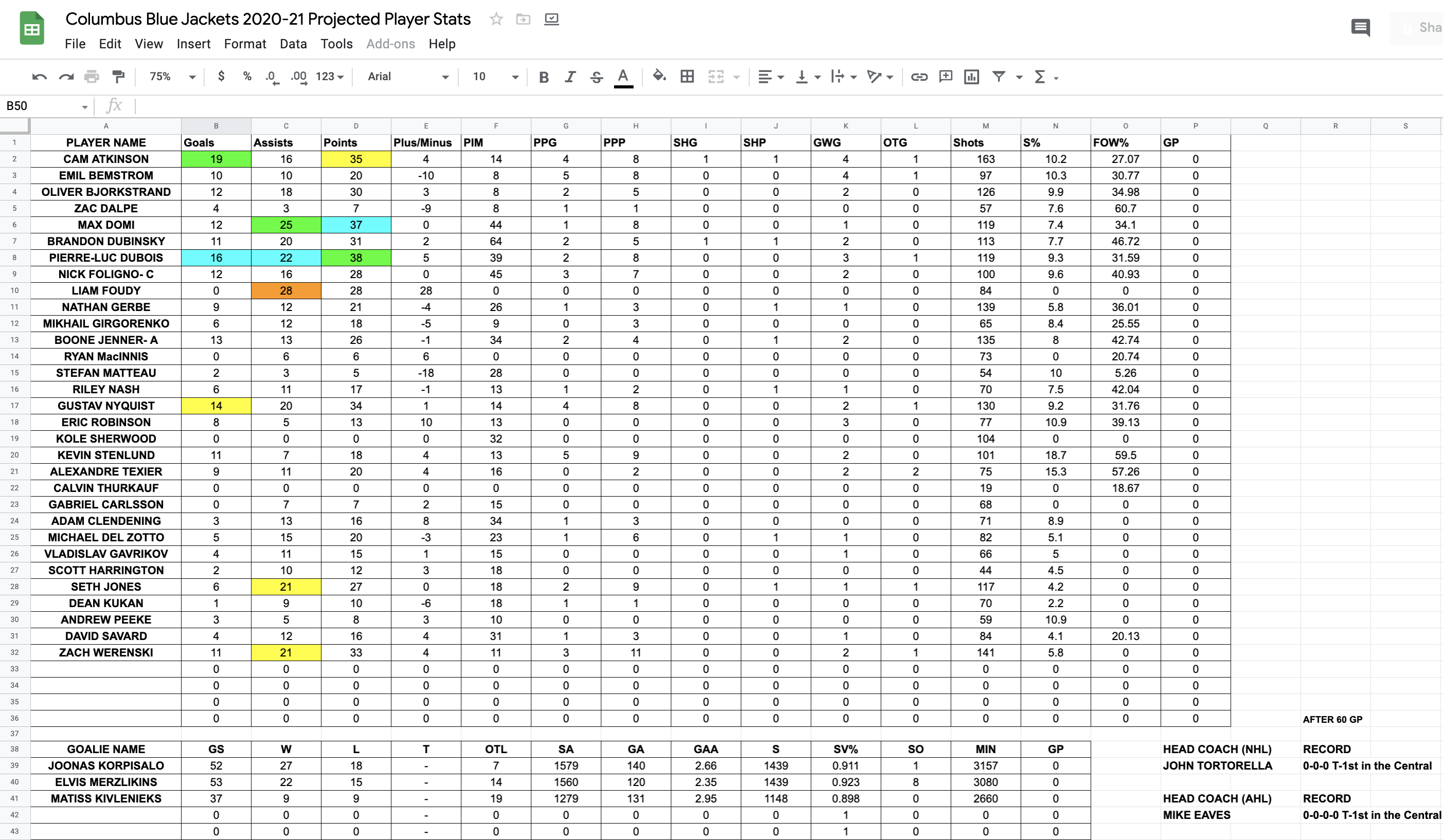
    Columbus Blue Jackets Forecast Through 0 Games (56 Games Remaining)

    First up, let’s take a look at how things were expected to go coming into the 2020-21 season.

    Prior to being traded to the Winnipeg Jets for Patrik Laine and Jack Roslovic, Dubois was forecasted to lead Columbus in scoring with 16-22–38 totals this season.

    New acquisition, Max Domi, was forecasted as a close second to Dubois with 37 points– leading the team in assists in the process with 25 (among NHL regulars last season, since Foudy technically was forecasted to lead in assists among Blue Jackets with 28).

    Of course, Dubois was traded and Laine and Roslovic are off to hot starts with Columbus– scoring goals in bunches when they find the scoresheet, it seems. We’ll get to that in a minute.

    Cam Atkinson was forecasted to score 19 goals prior to the start of the 2020-21 season, which leads Dubois’ 16 forecasted goals and Gustav Nyquist’s 14 forecasted goals on the roster.

    Dubois, of course, was traded and Nyquist is out due to injury for most of this season, so… that checks out.

    On defense, Zach Werenski and Seth Jones were expected to continue to lead with the way with 33 and 27 points, respectively, from the blue line.

    Both defenders are expected to amass 21 assists this season– good enough for the third most forecasted among Blue Jackets skaters entering this season.

    In the crease, John Tortorella will have to find the right balance between Joonas Korpisalo and Elvis Merzlikins.

    There’s potential for a really solid goaltending duo in Columbus if Korpisalo is the starter and can best his 2.66 forecasted goals against average, as well as his forecasted .911 save percentage, while Merzlikins manages to find a way to reach his 2.35 forecasted GAA and .923 forecasted SV%.

    Of course, after 20 team games played, Merzlikins is currently out with an upper body injury, so time will tell if he can return to form.

    Columbus Blue Jackets Forecast Through 20 Games (36 Games Remaining)

    Through 20 games of the 2020-21 season, the Blue Jackets are three points outside of the last playoff spot in the Discover NHL Central Division, trailing the Chicago Blackhawks for this season’s 4th place cutoff line.

    The acquisition of Laine and Roslovic have been quite a welcome sight for Columbus fans, though consistency from the rest of the lineup remains to be an issue.

    Laine, however, is currently forecasted to lead the team in goals (26) and points (46), while Roslovic is on track for 10-17–27 totals, which is about what he had in 71 games with the Jets last season (29 points).

    Using the current forecasted totals, Roslovic is on track for about .551 points per game this season. He had .408 points per game with Winnipeg in 2019-20.

    Atkinson remains in the top-three in scoring, trailing Laine in goals and points with 20 forecasted goals and 39 forecasted points, respectively, while Oliver Bjorkstrand is currently forecasted to amass 15-21–36 totals (the third most on the current roster).

    On the blue line, Jones leads the way among defenders in points (32), as well as all skaters in assists with 27 forecasted assists through 20 team games played in the 2020-21 season.

    Werenski is more in line with what you’d expect from a young defender of his caliber (8-16–24 forecasted totals) and has missed time due to injury, so that’s clearly a factor in his forecasted drop from before the season began to now.

    In the crease, Korpisalo is sure to get more starts than Merzlikins as the latter is currently injured.

    Korpisalo’s current forecast yields a goals against average between 2.59-2.63, while Merzlikins is on track for a 2.29-2.33 in however many games he ends up getting.

    Why the range in GAA?

    That’s new for this season.

    It’s just to show a range between what the forecasted total is according to the model and what the adjusted forecast shows (calculated based on the forecasted goals allowed/forecasted minutes multiplied by 60, as one would traditionally do with goals allowed/minutes played multiplied by 60 to determine GAA).

    I’m no statistician and I felt like there might be a way to try to get a better read on how things are going for goaltenders (with or without enough necessary data to yield a “realistic” result).

    Don’t make any bets using only this forecast. If you’re a professional, you probably already know that.

    Anyway, Korpisalo has a forecasted range between .912 and .913 in save percentage through 20 team games played and Merzlikins is on track for between a .923 and a .924 in SV%.

    Again, a similar principle applies here.

    One end of the range is the straight up forecast, while the other is influenced by forecasted saves/forecasted shots against.

    Well, that does it for this forecast. Tune in after 40 team games played to see how things might go down the stretch (the final 16 games this season).

  • Palmieri nets two as Devils defeat Bruins, 3-2

    Palmieri nets two as Devils defeat Bruins, 3-2

    Kyle Palmieri scored a pair of goals as the New Jersey Devils beat the Boston Bruins, 3-2, at TD Garden on Thursday night in Boston.

    Mackenzie Blackwood (4-0-1, 1.94 goals against average, .945 save percentage in five games played) made 25 saves on 27 shots faced for a .926 SV% in the win for New Jersey.

    Boston netminder, Jaroslav Halak (4-1-1, 1.66 GAA, .928 SV% in six games played) stopped 23 out of 26 shots against (.885 SV%) in the loss.

    The Bruins fell to 10-3-2 (22 points) on the season, but remained in command of the MassMutual NHL East Division lead, while the Devils improved to 6-3-2 (14 points) overall and stagnant in 6th place in the division.

    Once more, the Bruins were without the services of Ondrej Kase (upper body) and Matt Grzelcyk (lower body), but Jakub Zboril (upper body) joined the pair of injured teammates in the press box on Thursday night– missing his first game of the season due to an injury sustained on Feb. 13th in the, 4-2, loss at the Islanders.

    Kase missed his 13th game due to an injury sustained on Jan. 16th in New Jersey, while Grzelcyk missed his ninth game due to an injury originally sustained on Jan. 21st against Philadelphia, then re-aggravated on Jan. 28th against Pittsburgh and on Feb. 10th in New York (against the Rangers).

    As a result of the injuries and more, Boston’s head coach, Bruce Cassidy, jumbled his lines.

    Jake DeBrusk replaced David Pastrnak on the first line right wing with Brad Marchand at left wing and captain, Patrice Bergeron, at center.

    Pastrnak was “demoted” to the second line with Nick Ritchie and David Krejci, while Trent Frederic, Charlie Coyle and Craig Smith were reunited on the third line.

    Anders Bjork, Sean Kuraly and Chris Wagner made up the fourth line.

    On defense, Cassidy left Jeremy Lauzon with Charlie McAvoy on the first defensive pairing, while John Moore filled in Grzelcyk’s usual role on the second pairing with Brandon Carlo and Connor Clifton was slotted into Zboril’s spot alongside Kevan Miller.

    Greg McKegg, Steven Kampfer, Urho Vaakanainen, Callum Booth and Karson Kuhlman made up Boston’s taxi squad on Thursday, while Anton Blidh was assigned to the Providence Bruins (AHL) on Wednesday and Par Lindholm had his contract terminated by the club on Monday after being placed on waivers for the purpose of terminating his deal on Sunday.

    Lindholm signed a multiyear contract with Skellefteå AIK in his return to the Swedish Hockey League (SHL).

    Not much happened in the first period. In fact, so much not much that the only event on the scoresheet was a penalty against Wagner for tripping Devils forward, Miles Wood, at 10:29.

    New Jersey did not convert on the ensuing power play.

    After one period of action Thursday night at TD Garden, the game was tied, 0-0, on the scoreboard and in shots on goal, 7-7.

    Boston held the advantage in blocked shots (7-4) and giveaways (5-3), while New Jersey led in hits (9-8).

    Both teams managed three takeaways aside and split faceoff win percentage (50-50).

    The Devils were 0/1 on the power play, while the Bruins had yet to see time on the skater advantage heading into the first intermission.

    Early in the middle period, Jack Hughes pulled both Boston defenders out of position before dropping a pass to Palmieri (1) for the wrist shot goal over Halak’s glove side.

    Hughes (6) had the only assist on Palmieri’s first goal of the night as the Devils took the lead, 1-0, at 1:34 of the second period.

    Less than a minute later, Palmieri cut a rut to the penalty box with McAvoy after the two players roughed each other up a bit after a stoppage in play, resulting in 4-on-4 action for a pair of minutes at 2:14 of the middle frame.

    Moments later, Moore tripped Jesper Bratt and was sent to the sin bin at 8:01, yielding a power play to New Jersey in the process.

    Once again the Devils weren’t able to convert on the skater advantage, however, as P.K. Subban caught Bjork with a high stick and drew blood at 9:05 of the second period, resulting in a four-minute double minor penalty on Subban.

    The two clubs shared 56 seconds of 4-on-4 action before the Bruins began an extended power play for a span of 3:04.

    While shorthanded, the Devils forced a turnover in the neutral zone, presenting Palmieri (2) with a clear lane to the net for his second goal of the night on a similar shot to his first goal of the game.

    Damon Severson (5) and Bratt (3) tallied the assists on Palmieri’s shorthanded goal as New Jersey led, 2-0, at 10:39 of the second period.

    In the waning minute of their power play, DeBrusk (1) found a loose puck in the slot and buried a shot over Blackwood’s blocker side to cut New Jersey’s lead in half, 2-1, and give Boston their first goal of the night.

    DeBrusk’s power-play goal was unassisted at 12:36.

    Moments later, the Bruins tweeted that Krejci (lower body) would not return to the night’s action– necessitating some changes to Cassidy’s in-game lineup.

    Late in the period, Nathan Bastian and Coyle received matching roughing minors after yet another post-whistle scrum at 15:08.

    On the ensuing 4-on-4 action, New Jersey worked the puck in the offensive zone while Moore and Carlo struggled to remain in proper positioning in their own end.

    Andreas Johnsson sent a pass to Pavel Zacha (4) for a one-timer goal over Halak’s blocker from the inside circle to the Bruins netminder’s right side.

    Johnsson (2) and Will Butcher (1) notched the assists on Zacha’s goal and the Devils led, 3-1, at 15:37 of the second period.

    Through 40 minutes of play on Thursday, New Jersey led, 3-1, on the scoreboard and, 18-15, in shots on goal, including an, 11-8, advantage in the second period alone while Boston struggled on home ice.

    The Bruins led in blocked shots (11-8), giveaways (8-6) and faceoff win% (58-43), while the Devils led in takeaways (5-4) and hits (16-15).

    New Jersey was 0/2 on the power play, while Boston was 1/2 on the skater advantage entering the final frame of regulation.

    The Bruins found themselves shorthanded when Lauzon tripped Palmieri at 7:01 of the third period, but made matters worse when Marchand caught Hughes with a high stick at 7:36 and presented the Devils with a two-skater advantage for 1:25.

    Boston’s penalty kill got the job done, however.

    Late in the final frame, Ty Smith sent an errant puck clear over the glass and received a minor infraction for delay of game at 17:49, presenting the B’s with a power play that– if they couldn’t score– would expire with 11 seconds left in the game.

    Cassidy pulled Halak for an extra attacker to make it a 6-on-4 advantage for Boston.

    About a minute into the ensuing power play, Pastrnak fired a shot from the point that McAvoy (2) deflected while battling Dmitry Kulikov in the slot to pull Boston to within one goal.

    Pastrnak (6) and Ritchie (6) were credited with the assists on the power-play goal and the Bruins trailed, 3-2, at 18:54 of the third period.

    With 1:06 to go, Cassidy used his timeout to rally Boston for another goal, but it was too little, too late as the final horn sounded 66 seconds later.

    New Jersey emerged victorious, 3-2, as time expired.

    The Bruins finished with the advantage in shots on goal, 27-26, including a, 12-8, advantage in shots on goal in the third period alone.

    Boston also wrapped up Thursday night’s action leading in blocked shots (16-13), giveaways (11-9) and faceoff win% (61-39), while the New Jersey finished the night leading in hits (24-21).

    The Devils went 0/4 on the skater advantage while the B’s converted on 2/3 power play opportunities.

    The B’s fell to 3-2-0 (1-1-0 at home) when tied after the first period, 2-1-1 (1-1-0 at home) when trailing after two periods and 4-2-2 (1-1-0 at home) when allowing the game’s first goal this season.

    New Jersey, meanwhile, improved to 2-1-1 (2-0-1 on the road) when tied after the first period, 4-0-0 (3-0-0 on the road) when leading after two periods and 6-1-0 (4-0-0 on the road) when scoring the game’s first goal this season.

    The Bruins hit the road for a home game outdoors at Lake Tahoe against the Philadelphia Flyers on Sunday (2 p.m. ET on NBC) before returning to the road for a three-game road trip against the New York Islanders on Feb. 25th and New York Rangers on Feb. 26th, as well as Feb. 28th.

  • DTFR Podcast #215- Willie!/2020-21 Season Preview: East Division

    DTFR Podcast #215- Willie!/2020-21 Season Preview: East Division

    The Boston Bruins have finally decided to retire Willie O’Ree’s No. 22 on Feb. 18th. A bunch of signings, waiver transactions and retirements were announced in the last week. Patrice Bergeron is now captain of the Bruins and we preview the East Division for the 2020-21 season.

    Subscribe to the podcast on Apple PodcastsStitcher and/or on Spotify.

  • Chara, Hoffman and now this?

    The Boston Bruins’ long-time captain since the 2006-07 season, 43-year-old Zdeno Chara remains unsigned as the end of the calendar year, 2020, draws near.

    Chara’s agent, Matt Keator, has been reported as noting that the defender has had contact from more than 20 teams this offseason, but is focused on re-signing with the Bruins if there’s a deal to be had.

    Of course, he could also just flat-out retire.

    It’s not that Boston couldn’t use the services of their longtime cornerstone on the blue line, but the Bruins are shaking things up this offseason on defense– partially because of necessity and partially because that’s just how time works.

    Torey Krug left for the St. Louis Blues in free agency and guys like Jakub Zboril, Jeremy Lauzon, Connor Clifton and Urho Vaakanainen are all vying for potentially the same couple of spots.

    Kevan Miller was brought back on a one-year, $1.250 million deal and John Moore is still on the books through the 2022-23 season at a $2.750 million cap hit.

    With a little under $3.000 million in available cap room, the B’s could be looking to sign Chara to a short-term league minimum contract– one-year, $700,000– and present themselves with at least $2.300 million to offer someone like Mike Hoffman or lure back Carl Soderberg into the mix for added scoring touch or depth, respectively.

    If they can’t land Hoffman, then Soderberg is likely the best consolation prize as the offseason drags on and two-week quarantine periods might affect how call-ups from the Providence Bruins (AHL) work.

    That’s the latest on how AHL roster transactions might be handled this season, by the way. It all depends on what your state, province or region (if short-term bubbles get involved) has to say about moving players within your own organization.

    Soderberg might not be better than playing Jack Studnicka every night, but in a pinch he’d be better than nothing.

    After all, he did have 35 points in 70 games with the Arizona Coyotes last season and that’s nothing to sneeze at for a bottom-six forward.

    As for Chara, it might be a matter of swallowing a little pride.

    He certainly is deserving of almost whatever he wants for the career he’s had and role he’s played in Boston’s leadership for almost 15 years.

    But if he’s wanting $1.000 million or more for what’s likely his last season in the league, then the Bruins would be smart to bow out unless they’re able to trade someone like Moore and find a durable top-four defender while convincing Chara to minimize his minutes as a bottom-six defender.

    Yet that’d mean they wouldn’t be able to find a guy to play on David Krejci’s wing. You know, kind of what they’ve needed since 2015.

    As for Hoffman, the one-time 30-goal scorer has reached the 50-point plateau in the last five seasons and somehow remains on the free agent market.

    Whereas the Columbus Blue Jackets have about $9.200 million to spend, how much is Hoffman willing to pull a move similar to Taylor Hall’s one-year deal with the Buffalo Sabres and try to match Hall’s $8.000 million cap hit this season?

    Columbus could be a great landing spot for the 31-year-old winger, but would the Blue Jackets be spurned by yet another player in free agency next offseason? Especially if John Tortorella is what could be holding players up from staying long-term?

    To play with the Blue Jackets you have to be a 200-foot player in accordance with Tortorella’s style. That’s likely to keep Hoffman from possibly capitalizing on short-term monetary gain with limited options elsewhere unless he can do more than just score.

    He might be the one-dimensional sniper Columbus needs, but not if General Manager, Jarmo Kekäläinen, and Tortorella can’t see eye-to-eye on the team’s plan.

    For the Bruins to sign Hoffman and bring his 29-30–59 totals in 69 games with the Florida Panthers last season to the Hub of the Universe, Boston would have to shed some salary in a swap for either a defender as they’re reportedly looking for or some draft picks.

    That’s where Anders Bjork could be a suitable asset to send to a team in return for, like, a third round pick or something.

    Nevertheless, Boston’s not the “Cup contenders” that they were going into last season.

    They might figure out a way to win the East Division regular season standings or they could finish fourth in the division and barely make their way into the postseason.

    Regardless, the Bruins need to land a top-six forward if Craig Smith is to settle in and get comfy on the third line and patch the defense for a short term fix if management thinks otherwise about the team’s “Cup contender” status.

    It’s this year or bust– and in a 56-game regular season every early season game matters that much more.

    Getting off on the right foot without Brad Marchand (possibly) and David Pastrnak on opening night (and missing Pastrnak for at least a month) is vital.

    It’s crunch time.

  • The definitive review of all 31 Reverse Retro jerseys

    Adidas and the National Hockey League are trying something creative this season. It wouldn’t really be right to call it “new”, since most things are old anyway, but all 31 adidas Reverse Retro jerseys were revealed on Monday to mixed reviews by fans and jersey critics alike on social media.

    In theory, “everything that’s old is new again” can be a reassuring nostalgic feeling, but it works best when you’re reuniting with friends you haven’t seen in a while and some of them haven’t changed one bit or something.

    In reality, “everything that’s old is new again” is just a marketing ploy to sell jerseys and– to the dismay of my wallet– I’m sold. Somewhat.

    Not every jersey is perfect, but some are unique, some are good looking and others are downright attractive.

    Yes, it’s possible to be seduced by sweater threads. Ask any jersey collector.

    Before we begin, there’s just one question left to ask– what, exactly, were the prerequisites for determining what could be considered “retro”?

    There’s inconsistency across the board between all 31 teams, but that’s bound to happen since some have been around since before the league’s inception (see, Montreal Canadiens) and other teams are just entering their fourth season of existence (shoutout Vegas Golden Knights).

    Alright, let’s grade some sweaters.

    Editor’s note: Yes, adidas picked a single year that each jersey represents, but we’re going to present a more accurate timeline for when each original design was flying around the ice.

    Anaheim Ducks (based on the 1995-96 alternate)

    https://platform.twitter.com/widgets.js

    The Anaheim Ducks must have been browsing eBay one night, saw that the original “Wild Wing” (or “Mighty Wing”, if you prefer) jerseys often sell for double the price of a regular adidas authentic jersey these days and said to themselves “gee, we could make that money easily” without realizing that the sales on eBay do not– in any part– go to the Ducks themselves.

    Nevertheless, this is a good plan B, but almost everything from the Mighty Ducks era is beloved except for one thing– whatever’s happening on this jersey.

    For one season, it’s a good gimmick and a quick cash grab (especially for the drying up reserves due to the ongoing COVID-19 pandemic).

    It’s standard for an NHL team to reach back in time, change a thing or two and sell a lot of “new” jerseys. Solid effort, Anaheim.

    It shouldn’t come back out of the vault ever again.

    Grade: C

    Arizona Coyotes (based on the 1998-2003 alternate)

    https://platform.twitter.com/widgets.js

    This is one of my favorite jerseys in the Reverse Retro bunch simply for the fact that the Arizona Coyotes took an already legendary concept from the 1990s and made it better.

    Sure the original look wasn’t great (but also not as horrendous as you probably remember) back in the day, but this time around it looks much better with purple as the base color instead of green.

    Why? Because the Coyotes’ moon logo is primarily purple and purple is featured more prominently in the crest logo on this jersey than the green ever was– plus is makes the saguaro inspired cacti design at the bottom pop.

    Purple is the night sky of a desert sunset. It accentuates the mountains and rock formations in the lower third.

    In simple terms, this jersey is art. It’s a masterpiece.

    Grade: A

    Boston Bruins (based on the 1981-95 design)

    https://platform.twitter.com/widgets.js

    A simple remix of an iconic look that the Boston Bruins used for many years spanning the likenesses of Terry O’Reilly, Ray Bourque and Cam Neely in the “Big Bad Bruins”/”Lunchpail A.C.” era, this Reverse Retro redesign works well as a short-term implementation of the league’s fourth jersey rotation to Boston’s lineup.

    Could it become something that sticks in the Hub for a while? Sure, but the franchise would be best to use this for a few seasons and work on an incredible new gold design.

    Though it’s hard to argue not resurrecting the bear patch on the shoulders full-time. That bear has seen some things.

    The Bruins last used a gold-based jersey in the 2010 Winter Classic and a gold-based third jersey in 1995-96 (the first year of the NHL’s official third jersey program). Prior to that, the B’s actually wore gold for select games from 1940-44, then again as a primary design from 1955-67, when the team was mostly irrelevant to the overall league standings.

    It must be mentioned, however, that when Bobby Orr first laced up for Boston, he was wearing a gold uniform in his 1966-67 rookie season.

    Simply put, the Bruins need a gold jersey in their rotation. This one works (for now).

    Grade: A

    Buffalo Sabres (based on the 2000-06 alternate)

    https://platform.twitter.com/widgets.js

    The Buffa-goat is back. Kind of.

    It’s on the shoulders and modernized with the current color scheme (so… Buffalo’s original colors), but the Sabres opted to cancel out one of their positive changes made in the offseason with a negative resurrection.

    No, the two swords logo on the front isn’t bad, but one thing that never made me feel anything special for the original 2000-06 alternates was the fact that the city’s name appears in the lower striping pattern.

    It’s neat, but is it necessary?

    At least it looks better in traditional Sabres colors and the number font is just like “the good old days” when Buffalo dominated the league with players like Miroslav Satan, Maxim Afinogenov, Daniel Brière and others.

    If the Sabres make the playoffs for the first time since 2011, then we’ll know the real reason why the franchise has been awful for about a decade. It all comes down to style points.

    Grade: A

    Calgary Flames (based on the 1998-2006 alternate)

    https://platform.twitter.com/widgets.js

    Yes, folks, as the Calgary Flames’ tweet mentions– “Blasty” is back.

    Now get off your high horse if you think this is truly a “Reverse Retro” jersey and not just an updated alternate/fourth sweater.

    There was just one minor change to the eye in this design– aside from the white flaming “C” instead of how it looked originally on the shoulders in red– and it’s the striping pattern on the bottom.

    There’s significantly less red to this jersey. It isn’t bad, but just… …not great. It doesn’t really “reverse” anything major, which discredits the basic foundation and understanding of the Reverse Retro ideology.

    Had adidas gone in a different direction and made a white reversed version of the iconic “Blasty” look, then Calgary would be getting a better grade.

    Grade: C

    Carolina Hurricanes (based on the Hartford Whalers 1979-82, 1983-85 design)

    https://platform.twitter.com/widgets.js

    Prior to the 2018-19 season, the Carolina Hurricanes introduced a Hartford Whalers Throwback jersey that they wore three times between 2018-20 (twice against the Boston Bruins in 2018-19 and once against the Los Angeles Kings in 2019-20).

    Despite not playing in Hartford since relocating to North Carolina ahead of the 1997-98 season, Carolina made every effort to get into character– even dressing up PNC Arena in Whalers colors on the inside of the barn, but there was one thing missing from the look.

    This time around the Canes have added “Pucky” to the shoulders of this second iteration of a throwback sweater.

    It’s grey though, which isn’t so much of an inversion of the 1979 color scheme so much as it is a reversal of the 1992-97 final design before leaving Hartford.

    At the very least the Hurricanes deserve credit for going all-in on the retro requirement and not coming up with any “fauxback” shenanigans using Whalers colors on a Carolina logo.

    Grade: B+

    Chicago Blackhawks (based on the 1940-41 design)

    https://platform.twitter.com/widgets.js

    Well, this is… something.

    Back in 1940, the Chicago Blackhawks only had the crest on their dark jersey with the white jersey simply having numbers on the front and back a la American football teams.

    This is, in fact, a Reverse Retro with the overall design of the white jersey from the 1940-41 season now done in black, but the logo was understandably modified to make it… less racist than it was back then?

    Sure the Blackhawks name itself was done in honor of both a military division and a prominent Sauk nation member, Black Hawk, and the club does (at best) more than other professional teams that have recently changed their name (see, Washington Football Team) to honor indigenous people, but the logo isn’t great.

    The overall aesthetic is simplistic, but sharp. Why ruin it with a caricature?

    Grade: D+

    Colorado Avalanche (based on the Québec Nordiques 1991-95 design)

    https://platform.twitter.com/widgets.js

    It’s hard to imagine what the Québec Nordiques would look like today– especially since they were rebranding for the 1995-96 season anyway had they not relocated to Denver, Colorado, but the Avalanche have provided a clear look at what wouldn’t have been a terrible idea if the Nordiques had decided to go with the rebrand in the ’90s, then settle back down from a period of throwing caution to the wind.

    There’s nothing wrong with bringing something out of the closet once in a while, but someone might cry “jersey foul” if it’s exactly as things used to look before relocating.

    That makes things difficult for Carolina and Colorado to do a Reverse Retro sweater without leaving someone feeling like they’ve had their team “stolen” once again.

    But whatever, these are meant to make a profit off of nostalgic feelings and jersey collectors. Buy one or not, it doesn’t affect the feelings of the overall brand.

    The fact that the Avs and Canes lay claim to the old logos helps them make it out alive in the grueling course of Reverse Retro critics, unlike the Minnesota Wild’s attempt at being the Minnesota North Stars without stepping on the Dallas Stars’ history too much.

    Now the only question I have left for the Avalanche is should I get this in Nathan MacKinnon or Mikko Rantanen?

    Grade: A

    Columbus Blue Jackets (based on the 2000-01 design)

    https://platform.twitter.com/widgets.js

    The Columbus Blue Jackets read the directions for the assignment and nearly got a 100% on the final exam. These jerseys are incredible– even if they remind you of the early days of the Washington Capitals (and Washington’s current alternate jersey).

    Sure the original Blue Jackets logo is a bit out there, but Columbus set the bar in terms of doing something different and giving the fans in the heart of Ohio a red jersey for the first time in franchise history.

    It shouldn’t become commonplace, since– you know– they’re the Blue Jackets– “blue” is literally in their name, but for an “outlandish” marketing standpoint, this jersey has everything.

    Except for one thing. Stinger’s not on the shoulder patch.

    For whatever reason, adidas decided to include Columbus’ current cannon shoulder patch/alternate logo on this jersey instead of following the guidelines of simply reversing their original look.

    That’s why they almost got a “100” on their exam. Just a few points off for not including the most iconic thing about the franchise’s early years and current mascot.

    Grade: A

    Dallas Stars (based on their 1997-2006 design)

    https://platform.twitter.com/widgets.js

    Adidas claims this jersey is based on Dallas’ 1999 Stanley Cup champion look, but the star based design for the Stars began as a third jersey in 1997, before making its way to the full-time grounds for the home and road uniforms from 1999-2006.

    Since rebranding ahead of the 2013-14 season, Dallas has put an emphasis on one thing– being Dallas. Gone are the days of the Minnesota North Stars. By removing any semblance of gold from their jersey, the Stars fully completed their transition from pre-relocation to post-relocation.

    As a result, this monstrosity happened.

    It’s not that the star-shaped design isn’t appreciated– it’s that it shouldn’t be matched with white pants, white gloves, white socks and drained of any color or originality to begin with, since the crest is rather muted as a result of the change from gold to silver on a white background.

    Had the jersey been black with a white bottom star-striping pattern then it’d be a different story.

    Grade: D

    Detroit Red Wings (based on their 1987-2007 design)

    https://platform.twitter.com/widgets.js

    Once more, adidas claims that this Reverse Retro jersey harkens back to a championship winning year for the Detroit Red Wings back in 1998. In reality, the Red Wings wore the same look from 1987-2007, with the only difference being that since the 2003-04 season, the NHL deemed white jerseys to be the road set instead of the home uniform.

    This jersey seems to borrow the silver from Detroit’s 2017 Centennial Classic jersey to give it a little more definition than a long-sleeved plain white shirt with a logo slapped on the front and red numbers with a nameplate on the sides and back.

    If only they would’ve picked something from Detroit’s days as the Detroit Cougars or even the Detroit Falcons.

    The Cougars had some designs unlike any other in franchise history, while the Falcons used yellow with the usual red and white format for the club– marking the only time the team has ever used more than just red and white on a regular sweater.

    Reversing the Falcons colors would’ve been a hard sell, sure, but the Cougars, man. There was potential and it was left untapped.

    Grade: F

    Edmonton Oilers (based on the 1979-80 design)

    https://platform.twitter.com/widgets.js

    It’s simple, clean and a nod to the team’s inaugural NHL season, while subtly paying homage to their pre-Edmonton Oilers days as the Alberta Oilers in the World Hockey Association (WHA).

    Orange is more prominent in what would otherwise likely be a better companion to their home uniform as a road jersey than their current road set, but that’s just probably one of the reasons why the entire jersey wasn’t done in orange instead of white as the base design– because it already exists (sure, with the more modern shade of blue and traffic cone orange, but you get the point).

    These aren’t bad, but the Oilers never really stray far from the formula.

    Todd McFarlane at least had fun with the brand and nudged it towards the future with his 2001-07 alternate jersey– love it or hate it.

    There are just… …fine. The logo wasn’t reversed like some had hoped, but whatever.

    Grade: B-

    Florida Panthers (based on the 1993-98 design)

    https://platform.twitter.com/widgets.js

    The Florida Panthers have long had an identity crisis.

    For some, the leaping panther is a better looking logo than today’s spitting image of current head coach, Joel Quenneville, despite the modern logo dating back to the 2016-17 season, which was prior to Quenneville’s arrival behind the bench last season.

    Confused? That’s exactly how Florida feels.

    This team has probably flipped from red to blue and back again as many times as the state has in U.S. Presidential elections in the last few decades.

    Florida’s first dark based uniform was red, then added a blue alternate jersey to their rotation from 1998-2003, before swapping the red with the blue as their new home look from 2003-06, prior to de-arching the nameplates on the back of the jersey on an otherwise untouched design in 2006-07– which was prior to Reebok’s demands that the Panthers use a template with vertical piping centered between the underarms and crest from 2007-11.

    Anyway, the Panthers need a blue uniform in their set and this one utilizes the current colors of the franchise (red, blue, tan and white) well in the inverted aesthetic of how the club looked when the team first hit the ice in South Florida after almost being named the Florida Block Busters upon expansion in 1993.

    At this point anything else is just filler material to describe a masterpiece that doesn’t really need words to be observed.

    Grade: A

    Los Angeles Kings (based on the 1988-91 design)

    https://platform.twitter.com/widgets.js

    Purple “Forum Blue” is back and the Los Angeles Kings have never felt more royal– except for that time they won the Cup twice in a three-year span in 2012 and 2014.

    The timeless look of the Wayne Gretzky era jerseys were given a fresh paint job with old leftover colors, which begs the question “is this really a Reverse Retro look or something new entirely from recycled parts?”

    Has marketing gone too far?

    Probably not, since there’s no burgers involved this time around.

    While the Kings could’ve come up with something different, Los Angeles played it safe and went with something that encapsulates the spirit of the city– trying to be the Los Angeles Lakers.

    You might not know some of the struggling actors in Hollywood or if that really was just Anze Kopitar that walked by, but everyone can identity a favorite (or hated, if you’re a Boston Celtics fan) Laker.

    Grade: C+

    Minnesota Wild (based on the Minnesota North Stars 1978-79 design)

    https://platform.twitter.com/widgets.js

    Whereas the Carolina Hurricanes and Colorado Avalanche own and used some form of their old logo from prior to relocation for their Reverse Retro jerseys, the Minnesota Wild have no ties to the Minnesota North Stars because the North Stars moved to Dallas in 1993, so we’re left with the Wild logo as the crest on the front in 3-D and in North Stars colors.

    By default, these jerseys should’ve been what the Stars used, but with the North Stars stylized “N” on the front of the jersey or Dallas could’ve just let Minnesota buy back that old logo or whatever, but instead we get this jersey that looks more appropriate for a local beer league team sponsored by Subway.

    Some say the Wild should switch to these colors full time– especially with Dallas relinquishing gold from their palette ahead of the 2013-14 season, but those people should just move on like the North Stars did.

    The Wild are here to stay and could’ve been really creative with a red or tan based primary color in a true Reverse Retro design based on their original look from 2000-03.

    Besides, Minnesota could use a red jersey as an alternate, whether you like it or not. It is one of their team colors and it could go well with their more uniform approach to their jerseys since adidas took over ahead of the 2017-18 season.

    Otherwise these are just fine. The yellow on green number font gives off a “Da Beauty League” vibe, which just isn’t very like the NHL to have fun.

    Grade: C

    Montreal Canadiens (based on the 1974-2007 design with 1909 elements, etc.)

    https://platform.twitter.com/widgets.js

    While the Montreal Canadiens played it rather conservative with regards to their Reverse Retro look, the designers over at adidas really came up with something crisp, clean and hit it out of the park.

    Montreal last had a third sweater in 2006-07, and it was really well done for being the one and only regular alternate jersey in franchise history.

    Though the Habs have a timeless look that isn’t one to be messed with in any matter, there’s always an exception to every rule and this is it if the Canadiens are planning on using this blue jersey as an alternate in the long-term.

    Then again, people from Montreal might feel weird about wearing what would otherwise be considered the Nordiques’ primary color, so there’s the “Battle of Québec” to consider.

    If you’re a Habs diehard, maybe you don’t like this jersey. If you’re from Québec City and begrudgingly became a Habs fan after the Nordiques relocated to Colorado instead of joining the Boston Bruins fanbase north of the border or simply following the Avalanche, then perhaps this is the jersey for you.

    Grade: A

    Nashville Predators (based on the 1998-2001 design)

    https://platform.twitter.com/widgets.js

    If the Nashville Predators had walked out onto the ice wearing these in 1998, it would’ve explained their evolution to the modern marigold jerseys a lot better than the simple reversal of the colors that they originally made ahead of the 2011-12 season before Reverse Retro became a thing for 2020-21 (and beyond?).

    That said, Nashville’s original look inverted to a gold based jersey with the blue stripe separating the silver yoke that runs down the sleeves still looks fantastic– and with the old number and nameplate fonts too!

    The one thing that’s not true to the original 1998 design (other than the slightly modified original crest), however, is the shoulder patch that originally debuted on the mustard yellow alternate sweater from 2001-07, but made its way to the home and road uniform’s shoulders from 2005-07.

    Does that actually mean this look is really just based on the 2005-07 design and adidas doesn’t think that something as old as 15 years ago isn’t, you know, actually kind of old?

    No big deal though, these jerseys are still great, since the Predators went with the better shoulder patch from their early days.

    The guitar pick that’s been on their right shoulder of their regular jerseys since 2011 shouldn’t be afraid of going extinct.

    Grade: A

    New Jersey Devils (based on the 1982-92 design)

    https://platform.twitter.com/widgets.js

    Italy! Great to see they finally got an NHL team.

    The New Jersey Devils are paying homage to The Sopranos with these Italian flag inspired jerseys.

    Actually, it’s just the inverted color scheme of their original road jersey and the Devils have a quality Reverse Retro jersey on their hands. If they plan on keeping the Heritage Jersey long-term, then this brings a fine balance to The Force.

    If not, New Jersey should really design a black alternate jersey and roll with red, white, black and green as their main color scheme among the club’s four jersey options.

    Now why do I have a craving for Sbarro?

    Grade: A

    New York Islanders (based on the 1978-84 design)

    https://platform.twitter.com/widgets.js

    Was the Gorton’s Fisherman unavailable?

    It doesn’t really look like the New York Islanders even tried at all, but upon further inspection you’ll notice that the orange and white are reversed on this jersey– and that’s besides the fact that the blue is a darker shade than how it looked back in the day (and nowadays too).

    To the Isles’ credit, this jersey isn’t outlandish like most of their other attempts at creating a contemporary image for their club.

    It’s uninspiring and, frankly, not that original, but it works. It just doesn’t offer much for the Reverse Retro vibes, however, which takes major points off overall.

    At the very least it wasn’t oversimplified like their neighbors’ new threads in Manhattan.

    Grade: D

    New York Rangers (based on the 1996-98, 1999-2007 alternate)

    https://platform.twitter.com/widgets.js

    Want to know how to kill a good thing? Make it a practice jersey.

    These Statue of Liberty jerseys don’t scream “[g]ive me your tired “, but rather “I’m tired and I shouldn’t have been awoken. Now let me go back to sleep.”

    The striping pattern on the sleeves would look better on a New England Patriots pro-shop sweater, which should probably unnerve New York Giants and New York Jets fans that are also New York Rangers fans.

    It should’ve been red with blue, silver and white inverted stripes to truly make it “Reverse Retro”.

    Instead, New York gave us this. Whatever this is.

    Grade: F

    Ottawa Senators (based on the 1992-93 design with the 1997-2007 crest)

    https://platform.twitter.com/widgets.js

    Are you upset about the Ottawa Senators going back and modernizing an early version of their 2-D logo while casting off the red based home jerseys into the sunset? Well then here’s a red jersey for you!

    It’s the reverse of the original black jersey, which is sort of back (there’s some minor differences in number font, striping, etc.) and it’s fine, but it just feels like something Sens fans have come to know and despise in recent years– it feels cheap.

    Sure, Brady Tkachuk, Thomas Chabot, Matt Murray and Co. will look good in it, but introducing this jersey alongside the resurrected homage to the days of yore that the team currently has as home and road sweaters just makes this whole thing feel off.

    That said, Ottawa does need a red jersey to complete their otherwise timeless set and it wasn’t like we’re going to get a reversed barber pole jersey anytime soon.

    Usually something a little different is preferred, though, to make it feel like an alternate or at least a throwback to the original Senators franchise. This will work for now, however.

    Grade: B+

    Philadelphia Flyers (based on the 1984-97 design)

    https://platform.twitter.com/widgets.js

    The inside of the neck of the jersey says it’s inspired by Philadelphia’s look in 1995, but the Flyers wore this design for much longer before, during and after the mid-90s.

    Hell, the base of this design first emerged when “Cooperalls” were adorned, then promptly banned by the NHL because after two seasons they were found to be too much of a safety hazard (sliding on ice without any brakes became an issue because of the nature of the pants’ ability to act like a broom in curling and clear a path to the boards).

    Anyway, the Flyers already have a solid set of jerseys to the extent that this one isn’t really necessary.

    It might conjure images of Halloween, nightmares of Gritty or reminders of being sent down to the Lehigh Valley Phantoms (AHL) if you don’t perform well in them, but they’re fine, I guess.

    Unnecessary, but fine.

    Grade: C

    Pittsburgh Penguins (based on the 1992-97 design)

    https://platform.twitter.com/widgets.js

    The Pittsburgh Penguins became bold in the 1990s after winning their first Stanley Cup ring in franchise history.

    First, in 1992, they introduced the “Robo-Penguin” crest to the world, then they made a jersey with diagonal lettering on the front as their road uniform.

    Neither decision was very smart and only one of them was corrected on this Reverse Retro jersey, which– all things considered– doesn’t look that bad.

    Sure the Penguin on the shoulders is free from his triangle like on their current alternate jerseys (former 2017 Stadium Series look), but the “Pittsburgh” letting seems to standout better on the white edition of this timeless classic (for better or worse).

    More teams should experiment with diagonal alternates, but that’s not to say that every team can succeed– let alone barely get away with an acceptable look with just words on the front of their jersey.

    There’s a lot of rich jersey history for the Pens though and some of that potential went untapped. It’s a shame, really.

    Grade: C+

    St. Louis Blues (based on the 1995-98 design)

    https://platform.twitter.com/widgets.js

    Aside from the music, the St. Louis Blues are blue for a reason. Sure red is in the St. Louis city flag, but they’re the Blues. The BLUES.

    This is almost as bad as the trumpet jerseys that were rightfully spited to the gates of the underworld.

    It’d almost make sense to put the shoulder patch as the main crest on these, since then it’d at least make sense as an homage to what was almost the worst alternate jersey in the history of the league, but thankfully avoided due to Mike Keenan’s keen eye.

    Some things are just better in concept, but in reality they’re not. As a fashion jersey, this is probably fine. As something the team has to wear on the ice for a game, well… …that’s different.

    At least the team didn’t end up moving to Saskatoon back in 1983, right?

    Grade: D

    San Jose Sharks (based on the 1997-2007 design)

    https://platform.twitter.com/widgets.js

    Adidas stipulates that this jersey harkens back to 1998, but the San Jose Sharks originally used this template as an alternate jersey back in 1997-98– the final season that San Jose wore their original uniforms since joining the league in 1991 as an expansion team.

    The original Sharks logo is a timeless classic from the ’90s, while the fact that San Jose has already reached back and utilized their original setup to mark their 25th anniversary back in the 2015-16 season, it’s only fitting that they’d naturally move onto their second ever look for the subsequent nod to their franchise history.

    In other words, ten years from now, you can probably expect an orange Reverse Retro jersey based on the 2007-13 design, because that’d keep the pattern going.

    Anyway, these are fine. They’re nothing spectacular, since grey is a hard sell on a home uniform, but reviving an iconic look without murdering it by reversing it is exactly what the Reverse Retro jerseys are all about.

    Grade: B

    Tampa Bay Lightning (based on the 2001-07 design)

    https://platform.twitter.com/widgets.js

    They really like pointing out when teams won Cups years ago with these jerseys, huh? Once again, adidas points out that this is from “2004” (as in “the year the Tampa Bay Lightning won their first Stanley Cup championship in franchise history”), but the Bolts used this template from 2001-07 after originally debuting the frameworks of this jersey when they first hit the ice in 1992 as an expansion team.

    Tampa refined the look over the years by changing the number and nameplate font to italics, changing the font altogether and finally landing on the look that they wore the last time they won the Cup before 2020.

    As such, these Reverse Retro jerseys are a great nod to the Lightning’s history as a hockey market.

    Though their current uniforms might be a bit plain, a blue version of what is essentially their original design adds a spark of life to their complete jersey set.

    Teams sometimes go back to old motifs after a while and if these are popular enough, the Lightning would be smart to find a way to mix their current logo with this jersey template or something.

    Grade: A

    Toronto Maple Leafs (based on the 1967-70 design and 1970-72, 1973-75 design, etc.)

    https://platform.twitter.com/widgets.js

    What were they thinking? Seriously, what were they thinking?

    It’s one thing to pull out the old alternate Leaf logo on the shoulders from “the bad Leaf era” or whatever, but it’s another thing to use elements from the 1960s Toronto Maple Leafs jersey and slap it on the 1970s and 1980s jersey design.

    Toronto introduced new jerseys for the 1967 Stanley Cup Playoffs and went on to win the Cup wearing the Leafs logo that was brought back for its appearance on this Reverse Retro jersey, but again, it’s a sin according to Leafs fans and historians to put it on the base design of some of the worst Maple Leafs hockey in franchise history.

    Also, it’s a crime to put a blue maple leaf on a blue Maple Leafs jersey– and with blue numbers on the sides and back too!

    There’s so much adidas could’ve done with Toronto’s lengthy history of jerseys and instead they went for the most bland design.

    If they hadn’t used up the throwbacks to the Toronto Arenas and Toronto St. Pats over the last few years, then that would’ve been a great opportunity for a Reverse Retro look that was truly something special.

    Even still, they could’ve gone with anything from 1927-67 or 1992-2011 for a better retro feel.

    These are just insulting to the Leafs’ legacy.

    Grade: F

    Vancouver Canucks (based on the 2001-06 alternate)

    https://platform.twitter.com/widgets.js

    Gradients aren’t usually something that look great in sports– especially on a hockey jersey. Yet, this time around the Vancouver Canucks have made significant strides in gradient technology.

    When this template first hit the ice in 2001, Vancouver utilized a slow change from blue to maroon which– while being a little bit out there– didn’t look completely out of place for Canucks standards.

    It wasn’t the greatest thing ever seen, but it also wasn’t the worst, since Vancouver’s previous gradient design was a horizontal change as opposed to the almost symmetrical vertical approach.

    Plus, the Canucks had those “V” jerseys before, so it can’t possibly get any worse, right?

    This time around, instead of maroon, the Canucks are using green and a sharper looking number font. Sometimes progress takes time, but when it’s allowed the time to grow, the end result is something pretty special.

    These Reverse Retro threads get a seal of approval as one of the better nods to an organization’s more recent past.

    Grade: A

    Vegas Golden Knights (based on the Las Vegas Thunder 1993-98 design)

    https://platform.twitter.com/widgets.js

    The Vegas Golden Knights were born in 2017, therefore making it pretty difficult to reverse something retro that hadn’t even been born yet.

    If you were thinking “well, they could at least reverse the colors of their jerseys” then you must not have noticed the introduction of their gold alternate uniform this offseason, so that limits you further.

    Unless you get creative.

    “Sin City” used to have an International Hockey League (IHL) team known as the Las Vegas Thunder.

    The Thunder had a primarily a 1990s looking teal, silver, black and white color scheme and used the template that Vegas based their Reverse Retro jersey on to design this red edition with the Golden Knights’ alternate logo on the front of it.

    It works, but at what cost?

    Vegas could use a red jersey in their overall selection of jerseys to choose from, but this one probably won’t be getting too much time in the spotlight.

    Even for a place where “a bit much” is the standard, this jersey seems a bit too much.

    Grade: C

    Washington Capitals (based on the 1995-2000 road design)

    https://platform.twitter.com/widgets.js

    The Washington Capitals hit a home run by digging out the eagle and updating it with their current colors. The only thing that should change if these become part of their jersey rotation is the name and number font.

    It’s nice to see something from the past brought into the future, but it’d also be nice to see it get cleaned up a bit more than just the occasional dusting.

    It’s an iconic look from the days of a questionable change in the direction of the franchise’s branding, but in the end it made the team that much better.

    Or maybe this all just the nostalgia talking. Either way, it gets them an “A”.

    Grade: A

    Winnipeg Jets (based on the old 1979-80 Winnipeg Jets)

    https://platform.twitter.com/widgets.js

    Like the Minnesota Wild and their relation to the Minnesota North Stars, the current Winnipeg Jets have nothing to do with the old Winnipeg Jets, but at least the Jets have the ability to use the old Jets logo.

    They also have the ability to use the old Jets’ colors, which could’ve led to a unique red based Reverse Retro jersey, but we got something that looks like it was designed by Snow Miser instead.

    Did it really have to be grey?

    The Aviator Jersey is at least more colorful than this and did a better job inverting the color scheme than whatever’s going on here.

    The logo is fine, the rest of the jersey is, well, it leaves something to be desired.

    Grade: D-
  • Khudobin’s staying home, signs three-year extension with Dallas

    After a miraculous run that ultimately led to defeat in the Stanley Cup Final, Anton Khudobin re-signed with the Dallas Stars on a three-year contract worth $10 million ($3.333 million per season) through the 2022-23 season.

    The 34-year-old goaltender was originally drafted by the Minnesota Wild in the seventh round (206th overall) of the 2004 NHL Draft and made his league debut with Wild in the 2009-10 season and spent parts of two seasons with Minnesota.

    On Feb. 28, 2011, Khudobin was traded to the Boston Bruins, where he played until he joined the Carolina Hurricanes as a free agent on July 5, 2013.

    After parts of two seasons with Carolina, the Ust-Kamenogorsk, Kazakhstan native was dealt to the Anaheim Ducks on June 27, 2015, then appeared in nine games with the Ducks before he was sent down to the San Diego Gulls (AHL).

    He returned to Boston on July 1, 2016, with a two-year deal, then left the Bruins again via free agency for Dallas on July 1, 2018, serving as the Stars’ backup goaltender in a 1A/1B tandem with Ben Bishop for the last two seasons.

    Khudobin made his first NHL postseason start and earned his first career Stanley Cup Playoff shutout in the 2020 postseason and had a 16-8-4 record with a 2.22 goals against average and a .930 save percentage in 30 games played in the 2019-20 regular season for Dallas.

    He has a career 99-76-25 record in 218 NHL games spanning 11 seasons for the Wild, Bruins, Hurricanes, Ducks and Stars with a career 2.46 GAA and a career .919 SV%, as well as eight shutouts in that time.

    In 27 career Stanley Cup Playoff games, Khudobin has a 14-10 record with a 2.63 GAA, as well as a .919 SV% and one shutout.