Tag: Alexandre Texier

  • Columbus Blue Jackets 2021-22 Season Preview

    Columbus Blue Jackets 2021-22 Season Preview

    2020-21 record 18-26-12, 48 points

    8th in the Discover NHL Central Division

    Missed the postseason for the first time since 2016

    Additions: F Sean Kuraly, F Zac Rinaldo, F Jakub Voracek (acquired from PHI), D Jake Bean (acquired from CAR), D Adam Boqvist (acquired from CHI)

    Subtractions: F Cam Atkinson (traded to PHI), F Zac Dalpe (signed with FLA), F Mikhail Grigorenko (KHL), F Mikko Koivu (retired), F Ryan MacInnis (signed with BUF), F Stefan Matteau (signed with COL), F Cliff Pu (ICEHL), F Kole Sherwood (signed with OTT), F Daniel Zaar (KHL), D Adam Clendening (signed with PHI), D Michael Del Zotto (signed with OTT), D Seth Jones (traded to CHI)

    Still Unsigned: F Brandon Dubinsky, F Calvin Thürkauf (NL, CBJ reserve list)

    Re-signed: F Patrik Laine, F Alexandre Texier, D Gavin Bayreuther (expansion, SEA, then signed as UFA with CBJ), D Mikko Lehtonen

    Offseason Analysis: First off, where do we even start with how hard this offseason has been for the Blue Jackets organization?

    The loss of Matiss Kivlenieks is paramount in how Columbus approaches the season– honoring their fallen teammate along the way– as well as where they go from here with respect to future decisions in the crease.

    Kivlenieks had potential to be selected by the Seattle Kraken at the expansion draft. He had potential to become the Blue Jackets’ backup in the near future if the team had moved Joonas Korpisalo or Elvis Merzlikins prior to choosing one or the other next July anyway as both Korpisalo and Merzlikins are pending-unrestricted free agents.

    In what’s become an all too familiar reminder lately, tragedy, as with death, is part of life.

    He was a kind soul that was taken from us too soon.


    Columbus welcomed home Dublin, Ohio native, Sean Kuraly on a four-year contract worth $2.500 million per season as the 28-year-old departed his bottom-six role with the Boston Bruins for more money and a change of scenery as his production dropped from 23 points (six goals, 17 assists) in 69 games in 2019-20 to nine points (four goals, five assists) in 47 games last season.

    The Blue Jackets are hoping Kuraly’s arrival will feature a resurgence unlike when Riley Nash left Boston on a high-note and faltered in his Columbus tenure before being traded at last season’s trade deadline to the Toronto Maple Leafs.

    Whereas Mikko Koivu joined Columbus for the 2020-21 season prior to retiring from the NHL after seven games in a Blue Jackets uniform, Blue Jackets General Manager, Jarmo Kekäläinen, can count on Kuraly to patch up the bottom-six– especially the fourth line– without the prospect of sudden retirement.

    There’s a familiar face in town this season as Jakub Voracek is back in a Blue Jackets jersey for the first time since the 2010-11 season after Kekäläinen dealt Cam Atkinson to the Philadelphia Flyers in a one-for-one trade as the Flyers looked to save some salary for other important areas.

    Voracek, like Kuraly, could use a bit of a resurgence as of late after his numbers dropped from 66 points in 78 games with Philadelphia in 2018-19 to 56 points in 69 games with Philly in 2019-20 and, most recently, 9-34–43 totals in 53 games with the Flyers last season.

    Interestingly enough, the 32-year-old forward has never scored more than 23 goals in a season (set back in 82 games in 2013-14 with Philadelphia) and had three consecutive seasons of 20 or more goals from 2012-13 through 2014-15 and again from 2016-17 through 2018-19.

    Columbus also grabbed the rights to Jake Bean in a trade with the Carolina Hurricanes and signed Bean to a three-year extension– incorporating the 23-year-old defender as part of the Blue Jackets’ blue line reform in the aftermath of one of the biggest trades this offseason.

    After stating that he wouldn’t sign an extension with Columbus, Seth Jones was dealt to Chicago with a 2021 1st round pick (32nd overall, Nolan Allan) and a 2022 6th round pick for Adam Boqvist, a 2021 1st round pick (12th overall, Cole Sillinger), a 2021 2nd round pick that was when flipped to Carolina for Bean and a conditional 2022 1st round pick.

    If Chicago wins one of the 2022 draft lotteries, then the 2022 1st round pick becomes a 2023 1st round pick and in any case, the Blue Jackets aren’t paying Jones $9.500 million per season when his new extension kicks in next season.

    Except Columbus then turned around and gave Zach Werenski a six-year extension worth $9.583 million that goes into effect starting with the 2022-23 season through 2027-28.

    At the very least, it shows that the Blue Jackets are willing to commit dollars and term to a player in their organization, though with the steep prices paid by teams for defensive talent via free agency, trades and in extensions this offseason, only time will tell if it was truly worth it.

    Werenski is 24-years-old and will be turning 31 shortly after this extension expires.

    The good news is that it’ll cover his defensive prime, as long as he can stay healthy and at that high level of competition.

    The bad news is that Columbus could be playing with fire if their ongoing overhaul doesn’t pan out soon enough.

    Speaking of the changing of seasons, Brad Larsen went from being an assistant coach with the team to being named the 10th head coach in franchise history after John Tortorella was told his contract would not be renewed.

    Larsen’s been around in the Blue Jackets organization since the 2010-11 season when he was named as an assistant coach with the Springfield Falcons (AHL). He spent two seasons in that role before becoming the Falcons’ head coach from 2012-14, prior to being called up to being behind the bench in Columbus as an assistant coach from the 2014-15 season through 2020-21.

    Perhaps Patrik Laine can get a chance to relax and play his game his way– as with the rest of the young Blue Jackets players– growing and developing in accordance with their preferred styles instead of being told to conform to a universal 200-foot style game.

    That’s not to say that Tortorella’s tenure with Columbus wasn’t worth it, but rather to point out that it takes the right kind of players to perform under a certain structure and the Blue Jackets shifted away from that over the years.

    Offseason Grade: C

    Columbus didn’t do anything irrational and avoided the potential salary cap hell that might come with Jones’ extension in Chicago given his recent decline.

    That said, they also then willingly gave Werenski what Jones was asking for and then some because surely they weren’t afraid of history repeating itself or anything.

    Regardless, Kekäläinen still has about $10.4 million in cap space for 2021-22, which means they won’t necessarily be good enough for playoff contention, but that’s the point.

    Either Columbus will get lucky and strike it rich with what they’ve got, the systems Larsen develops and the new additions here and there or they’ll fall further in the standings and get lucky in the 2022 Draft Lottery.

  • 2021 NHL Free Agency Signings Quick Recap

    2021 NHL Free Agency Signings Quick Recap

    This post will be updated as signings are officially announced. Be sure to check our Twitter account (@DtFrozenRiver) for all of the latest signings, news, and analysis.

    Free agency begins at noon (technically 12:01 PM ET) on July 28th.

    For the second-straight year, the ongoing COVID-19 pandemic has shifted the schedule a bit for the National Hockey League, but after the free agency signing period opens to kickoff the 2021-22 league calendar year, things will be back on track for a full 82-game schedule (albeit about a week later than usual).

    All that is known is shown and will be updated throughout the day. More analysis will come as we play catch-up.

    ESPN+ is streaming TSN’s coverage of free agency from 11 a.m. ET onward and NHL Network has the Sportsnet/their own feed, probably (we like the former, in all partiality).

    Reported free agent signings

    These are reported agreements in place that are yet to be confirmed and/or announced by a playing club.

    F Kyle Palmieri has likely re-signed with the New York Islanders.

    Announced free agent signings

    These are confirmed/announced signings by playing clubs.

    F Carter Verhaeghe signed a three-year extension worth about $4.167 million per season with the Florida Panthers that goes into effect starting with the 2022-23 season.

    The Edmonton Oilers re-signed D Tyson Barrie to a three-year contract worth $4.500 million per season.

    The Vegas Golden Knights signed D Alec Martinez to a three-year extension worth $5.250 million per season.

    The Carolina Hurricanes signed G Frederik Andersen to a two-year deal worth $4.500 million per season.

    G Petr Mrazek signed a three-year deal with the Toronto Maple Leafs worth $3.800 million per season.

    F Nick Bonino agreed to a two-year contract with the San Jose Sharks.

    F Brandon Sutter signed a one-year extension worth $1.125 million with the Vancouver Canucks.

    G Antti Raanta reportedly signed a two-year deal worth $2.000 million per season with the Carolina Hurricanes.

    The Los Angeles Kings re-signed F Andreas Athanasiou to a one-year deal worth $2.700 million.

    D Dougie Hamilton signed a seven-year contract worth $9.000 million per season with the New Jersey Devils.

    F Blake Coleman signed a six-year deal worth $4.900 million per season with the Calgary Flames.

    The Montréal Canadiens signed D David Savard to a four-year contract worth $3.500 million per season.

    G Brian Elliott signed a deal with the Tampa Bay Lightning.

    D Tucker Poolman agreed to a four-year contract worth $2.500 million per season with the Vancouver Canucks.

    The Dallas Stars signed F Luke Glendening to a two-year deal worth $1.500 million per season.

    D Andreas Borgman signed a one-year, two-way deal worth $750,000 at the NHL level with the Dallas Stars.

    D Travis Hamonic signed a two-year extension worth $3.000 million per season with the Vancouver Canucks.

    F Dominik Simon signed a one-year, two-way contract extension with the Pittsburgh Penguins.

    F Charles Hudon signed a deal with the Tampa Bay Lightning.

    D Zach Bogosian signed a three-year contract worth $850,000 per season with the Tampa Bay Lightning.

    The San Jose Sharks signed F Andrew Cogliano to a one-year contract worth $1.000 million.

    The Montréal Canadiens signed F Cedric Paquette to a one-year contract worth $950,000.

    D Brady Keeper signed a two-year deal worth $762,500 per season with the Vancouver Canucks.

    The Vegas Golden Knights signed G Laurent Brossoit to a two-year deal worth $2.325 million per season.

    F Jean-Sébastien Dea signed a one-year deal worth $750,000 with the Montréal Canadiens.

    The San Jose Sharks signed G James Reimer to a two-year deal worth $4.500 million per season.

    F Michael Bunting signed a two-year deal worth $900,000 with the Toronto Maple Leafs.

    D Patrik Nemeth signed a three-year contract worth $2.500 million per season with the New York Rangers.

    F Maxim Mamin signed a one-year deal worth $975,000 with the Florida Panthers.

    D Louis Belpedio signed a one-year, two-way contract worth $750,000 with the Montréal Canadiens.

    The Vancouver Canucks signed F Danila Klimovich to a three-year entry-level contract worth $886,667 per season.

    The Dallas Stars signed D Alex Petrovic to a one-year, two-way contract.

    F Michael Amadio signed a one-year, two-way deal worth $750,000 at the NHL level with the Toronto Maple Leafs.

    The Vancouver Canucks signed D Luke Schenn to a two-year contract worth $850,000 per season.

    F Josh Leivo has signed a deal with the Carolina Hurricanes.

    The Carolina Hurricanes signed D Ian Cole to a one-year, $2.900 million deal.

    F Nic Petan signed a one-year, two-way deal worth $750,000 at the NHL level with the Vancouver Canucks.

    D Jake McCabe signed a four-year contract with Chicago worth $4.000 million per season.

    The Detroit Red Wings signed D Jordan Oesterle to a two-year deal worth $1.350 million per season.

    F Andrew Agozzino signed a two-way contract with the Ottawa Senators.

    D Adam Clendening signed a two-way deal with the Philadelphia Flyers.

    D Ryan Murphy signed a two-way contract with the Detroit Red Wings.

    The Los Angeles Kings have signed D Alex Edler to a one-year contract worth $3.500 million per season.

    The Boston Bruins signed F Erik Haula to a two-year deal worth $2.375 million per season.

    F Tomas Nosek signed a two-year contract worth $3.500 million per season with the Boston Bruins.

    F Phil Di Giuseppe signed a two-way contract worth $750,000 at the NHL level with the Vancouver Canucks.

    The Tampa Bay Lightning signed F Pierre-Edouard Bellemare to a two-year contract worth $1.000 million per season.

    F Matt Luff signed a one-year, two-way, $750,000 deal with the Nashville Predators.

    F Jon Lizotte signed a one-year, two-way, contract worth $750,000 at the NHL level with the Minnesota Wild.

    F Ryan Getzlaf agreed to a one-year extension with the Anaheim Ducks worth $4.500 million.

    F Ryan Dzingel signed a one-year, $1.100 million deal with the Arizona Coyotes.

    D Matt Tennyson signed a two-year, two-way contract with the Nashville Predators.

    F Mattias Janmark reached an agreement on an extension with the Vegas Golden Knights.

    F Josh Ho-Sang signed a PTO with the Toronto Maple Leafs.

    F Mike Hoffman signed a three-year deal with the Montréal Canadiens worth $4.500 million per season.

    G Linus Ullmark signed a four-year deal worth $5.000 million per season with the Boston Bruins.

    G Garret Sparks reached an agreement on a one-year, two-way contract with the Los Angeles Kings worth $750,000 at the NHL level.

    F Sam Gagner agreed to an extension with the Detroit Red Wings.

    The Red Wings also agreed to an extension with G Calvin Pickard.

    D Ryan Suter signed a four-year deal worth $3.650 million per season with the Dallas Stars.

    The Columbus Blue Jackets signed F Boone Jenner to a four-year extension.

    The Pittsburgh Penguins signed F Evan Rodrigues to a one-year extension worth $1.000 million.

    F Patrik Laine signed his qualifying offer with the Columbus Blue Jackets and will make $7.500 million on a one-year deal as a result.

    F Eric Robinson agreed to terms on a two-year extension worth $3.200 million with the Columbus Blue Jackets.

    The Philadelphia Flyers signed D Keith Yandle to a one-year deal worth $900,000.

    D Alex Goligoski signed a one-year deal worth $5.000 million with the Minnesota Wild.

    G Braden Holtby signed a one-year contract worth $2.000 million with the Dallas Stars.

    The Minnesota Wild signed F Frederick Gaudreau to a two-year deal worth $1.200 million per season.

    D Jarred Tinordi signed a two-year deal worth $900,000 per season with the New York Rangers.

    F Justin Bailey signed a one-year, two-way contract extension with the Vancouver Canucks.

    The Vegas Golden Knights signed F Sven Baertschi to a one-year, two-way, contract worth $750,000 at the NHL level.

    The Tampa Bay Lightning signed F Gabriel Dumont, D Darren Raddysh, D Andrej Sustr and G Maxime Lagacé to one-year, two-way contracts.

    F Gage Quinney signed a one-year, two-way contract extension with the Vegas Golden Knights.

    The Ottawa Senators signed D Michael Del Zotto to a two-year contract worth $2.000 million per season.

    Chicago signed F Jujhar Khaira to a two-year deal worth $975,000 per season.

    F Alexander Wennberg agreed to a three-year deal worth $4.500 million per season with the Seattle Kraken.

    The Nashville Predators signed F Anthony Richard to a one-year, two-way contract worth $750,000 at the NHL level.

    F Phillip Danault signed a six-year contract worth $5.500 million per season with the Los Angeles Kings.

    The Seattle Kraken reached an agreement with F Jaden Schwartz on a five-year deal worth $5.500 million per season.

    F Michael McCarron signed a two-year, two-way contract worth $750,000 at the NHL level with the Nashville Predators.

    G Martin Jones signed a one-year, $2.000 million contract with the Philadelphia Flyers.

    F Nate Thompson signed a one-year, $800,000 contract with the Philadelphia Flyers.

    G Philipp Grubauer is signed a six-year deal worth $5.900 million per season with the Seattle Kraken.

    F Greg McKegg signed a one-year, two-way contract worth $750,000 at the NHL level with the New York Rangers.

    F Dryden Hunt signed a two-year deal with the New York Rangers.

    The Florida Panthers signed D Brandon Montour to a three-year contract worth $3.500 million per season.

    D Chris Wideman signed a one-year deal worth $750,000 with the Montréal Canadiens.

    The Columbus Blue Jackets signed F Sean Kuraly to a four-year contract worth $2.500 million per season.

    The San Jose Sharks signed F Lane Pederson to a two-year contract worth $750,000 per season.

    D Tony DeAngelo signed a one-year contract with the Carolina Hurricanes worth $1.000 million.

    D Gavin Bayreuther signed a two-year, two-way contract with the Columbus Blue Jackets.

    The Edmonton Oilers signed D Cody Ceci to a four-year deal worth $3.250 million per season.

    F Kurtis Gabriel signed a one-year, $750,000 contract with the Toronto Maple Leafs.

    F Zachary L’Heureux signed a three-year, entry-level deal with the Nashville Predators.

    The Toronto Maple Leafs signed F David Kampf to a two-year contract worth $1.500 million per season.

    The Pittsburgh Penguins signed F Brock McGinn to a four-year contract worth $2.750 million per season.

    The Arizona Coyotes signed F Dmitrij Jaškin to a one-year contract.

    The Carolina Hurricanes re-signed F Jordan Martinook to a three-year contract worth $1.800 million per season.

    F Juho Lammikko signed a one-year extension with the Florida Panthers.

    G Jonathan Bernier signed a two-year deal worth $4.125 million per season with the New Jersey Devils.

    The Buffalo Sabres signed F Vinnie Hinostroza to a one-year contract worth $1.050 million.

    F Zach Hyman reached an agreement with the Edmonton Oilers on a seven-year contract worth $5.500 million per season.

    G Filip Lindberg signed a two-year entry-level contract with the Pittsburgh Penguins.

    F Brayden Point signed an eight-year extension worth $9.500 million per season with the Tampa Bay Lightning that goes into effect starting with the 2022-23 season.

    The Boston Bruins agreed to a three-year deal with D Derek Forbort worth $3.000 million per season.

    The Boston Bruins signed F Nick Foligno to a two-year deal.

    G David Rittich agreed to a one-year deal worth $1.250 million with the Nashville Predators.

    G Carter Hutton signed a one-year deal worth $750,000 with the Arizona Coyotes.

    The Colorado Avalanche signed D Roland McKeown to a one-year contract.

    The Columbus Blue Jackets signed F Alexandre Texier to a two-year contract extension worth $3.050 million.

    F C.J. Smith signed a one-year, two-way contract worth $750,000 at the NHL level with the Carolina Hurricanes.

    G Chris Gibson signed a one-year, two-way contract with the Florida Panthers.

    The Detroit Red Wings signed F Pius Suter to a two-year contract.

    D Brandon Davidson signed a one-year contract extension worth $750,000 with the Buffalo Sabres.

    The Nashville Predators re-signed F Mikael Granlund to a four-year contract worth $5.000 million per season.

    The Calgary Flames signed F Trevor Lewis to a one-year deal worth $800,000.

    G Jaroslav Halak agreed to a one-year deal worth $1.500 million with the Vancouver Canucks.

  • Columbus Blue Jackets 2020-21 Forecast and 20-Game Update

    Columbus Blue Jackets 2020-21 Forecast and 20-Game Update

    Welcome back to another exciting rendition of “let’s trust the guy with a degree in communication to do some basic math stuff”.

    As you are hopefully already aware, I kept the 2019-20 forecasts under wraps simply because I didn’t have the time and/or motivation to write up an explanation for each and every one of them.

    Even still, I’m “behind” on 2020-21 posts given that the Columbus Blue Jackets have already reached the 20-game mark of the season.

    That’s why we’re looking at both what the expectations were coming into the condensed 56-game schedule, as well as how things are holding up after the first, well, almost half the season.

    If you’re a fan of numbers and things, you probably already read about this “catch-up format” in my first forecast for the Boston Bruins roster entering 2020-21. If you’re just a Blue Jackets fan, I’ve done my best to paraphrase my own writing, but you can go back and read it if you feel inclined.

    As always, keep in mind that my degree is in communication and my minor was in sport management. My Intro to Stats class only fulfilled the math portion of my “general education” and met once-a-week at night for two-and-a-half hours in the fall 2013 semester.

    I actually learned how to use the forecast function in Microsoft Excel in one of my sport management classes. Besides that, I got a “C” in that Intro to Stats class, so my credentials for doing this seem promising, right?

    First year players are impossible to predict until they’ve had at least one National Hockey League game under their belt.

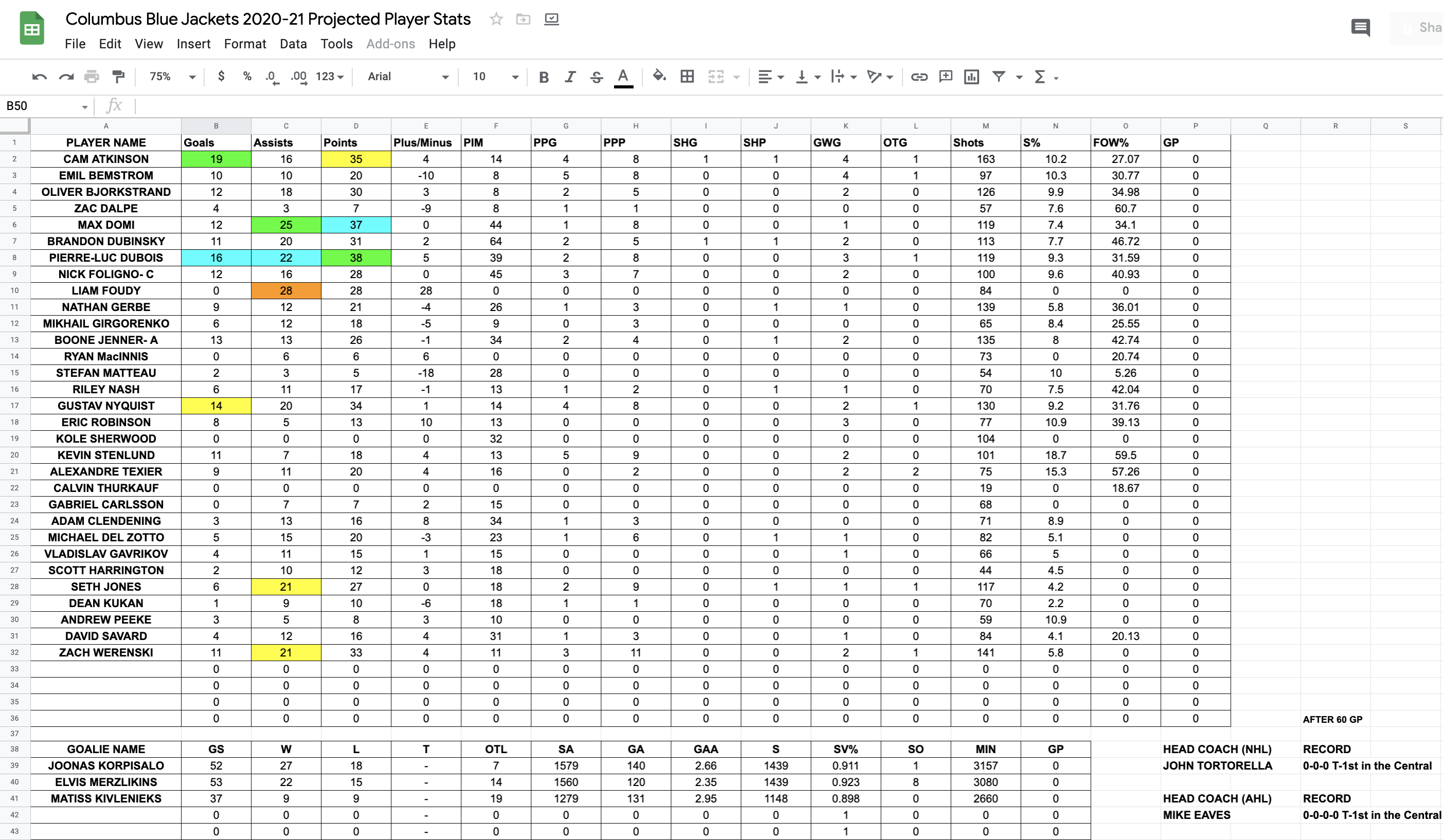
    Young players that have had minimal NHL experience may also reflect “inflated” results– Liam Foudy’s forecasted assists entering the 2020-21 season has been highlighted for this reason.

    Entering this season, he had only been part of two career NHL games and had one assist in that span. The forecasting function accounts for a player’s entire career and does some mathematics to come up with something over a predetermined number of games for the upcoming season (in this year’s case, 56).

    In other words, Foudy’s forecast after 20 team games played should look a bit more “realistic”, for the lack of a better term.

    A forecast is not the same as predicting pace.

    Foudy has three assists in 12 games played in 2020-21, for example, and is forecasted to finish with about 11 on the season, whereas he is currently on pace for about eight helpers.

    There are numerous variables that can, and will, impact a players’ performance throughout the year, including injuries, being a healthy scratch (or on the taxi squad), other American Hockey League related or waiver related transactions, sickness, COVID protocol, suspensions and general superstitions related to individual routines, beliefs, etc. (getting enough sleep before a game, wearing a certain lucky tie, using the same undershirt or shoulder pads for the last 13 years or whatever).

    Players can get “hot” or “cold” at any point.

    It’s not something that can be accounted for in a numerical forecast that sets aside the “eye test” until you try to figure out the nuances of how or why a player is playing the way they are playing.

    In a perfect timeline, this forecast pretends nothing bad could ever happen and every Blue Jackets player lives up to their expectations. In reality, some will pan out, some will exceed expectations and some will fall short for whatever reason.

    It’s an educated guess for an outcome in a sport that’s highly unpredictable due to its collectivistic nature and sheer puck luck.


    Columbus Blue Jackets Forecast Through 0 Games (56 Games Remaining)

    First up, let’s take a look at how things were expected to go coming into the 2020-21 season.

    Prior to being traded to the Winnipeg Jets for Patrik Laine and Jack Roslovic, Dubois was forecasted to lead Columbus in scoring with 16-22–38 totals this season.

    New acquisition, Max Domi, was forecasted as a close second to Dubois with 37 points– leading the team in assists in the process with 25 (among NHL regulars last season, since Foudy technically was forecasted to lead in assists among Blue Jackets with 28).

    Of course, Dubois was traded and Laine and Roslovic are off to hot starts with Columbus– scoring goals in bunches when they find the scoresheet, it seems. We’ll get to that in a minute.

    Cam Atkinson was forecasted to score 19 goals prior to the start of the 2020-21 season, which leads Dubois’ 16 forecasted goals and Gustav Nyquist’s 14 forecasted goals on the roster.

    Dubois, of course, was traded and Nyquist is out due to injury for most of this season, so… that checks out.

    On defense, Zach Werenski and Seth Jones were expected to continue to lead with the way with 33 and 27 points, respectively, from the blue line.

    Both defenders are expected to amass 21 assists this season– good enough for the third most forecasted among Blue Jackets skaters entering this season.

    In the crease, John Tortorella will have to find the right balance between Joonas Korpisalo and Elvis Merzlikins.

    There’s potential for a really solid goaltending duo in Columbus if Korpisalo is the starter and can best his 2.66 forecasted goals against average, as well as his forecasted .911 save percentage, while Merzlikins manages to find a way to reach his 2.35 forecasted GAA and .923 forecasted SV%.

    Of course, after 20 team games played, Merzlikins is currently out with an upper body injury, so time will tell if he can return to form.

    Columbus Blue Jackets Forecast Through 20 Games (36 Games Remaining)

    Through 20 games of the 2020-21 season, the Blue Jackets are three points outside of the last playoff spot in the Discover NHL Central Division, trailing the Chicago Blackhawks for this season’s 4th place cutoff line.

    The acquisition of Laine and Roslovic have been quite a welcome sight for Columbus fans, though consistency from the rest of the lineup remains to be an issue.

    Laine, however, is currently forecasted to lead the team in goals (26) and points (46), while Roslovic is on track for 10-17–27 totals, which is about what he had in 71 games with the Jets last season (29 points).

    Using the current forecasted totals, Roslovic is on track for about .551 points per game this season. He had .408 points per game with Winnipeg in 2019-20.

    Atkinson remains in the top-three in scoring, trailing Laine in goals and points with 20 forecasted goals and 39 forecasted points, respectively, while Oliver Bjorkstrand is currently forecasted to amass 15-21–36 totals (the third most on the current roster).

    On the blue line, Jones leads the way among defenders in points (32), as well as all skaters in assists with 27 forecasted assists through 20 team games played in the 2020-21 season.

    Werenski is more in line with what you’d expect from a young defender of his caliber (8-16–24 forecasted totals) and has missed time due to injury, so that’s clearly a factor in his forecasted drop from before the season began to now.

    In the crease, Korpisalo is sure to get more starts than Merzlikins as the latter is currently injured.

    Korpisalo’s current forecast yields a goals against average between 2.59-2.63, while Merzlikins is on track for a 2.29-2.33 in however many games he ends up getting.

    Why the range in GAA?

    That’s new for this season.

    It’s just to show a range between what the forecasted total is according to the model and what the adjusted forecast shows (calculated based on the forecasted goals allowed/forecasted minutes multiplied by 60, as one would traditionally do with goals allowed/minutes played multiplied by 60 to determine GAA).

    I’m no statistician and I felt like there might be a way to try to get a better read on how things are going for goaltenders (with or without enough necessary data to yield a “realistic” result).

    Don’t make any bets using only this forecast. If you’re a professional, you probably already know that.

    Anyway, Korpisalo has a forecasted range between .912 and .913 in save percentage through 20 team games played and Merzlikins is on track for between a .923 and a .924 in SV%.

    Again, a similar principle applies here.

    One end of the range is the straight up forecast, while the other is influenced by forecasted saves/forecasted shots against.

    Well, that does it for this forecast. Tune in after 40 team games played to see how things might go down the stretch (the final 16 games this season).

  • DTFR Podcast #204- Late For Everything!

    DTFR Podcast #204- Late For Everything!

    Nick and Colby talk about what went wrong for the Toronto Maple Leafs and other teams eliminated in the 2020 Stanley Cup Qualifier, as well as preview the already in progress 2020 Stanley Cup Playoffs First Round.

    Subscribe to the podcast on Apple PodcastsStitcher and/or on Spotify.

  • Blue Jackets beat Bruins, 4-1, in meaningless exhibition Game

    This might sound like a postmodern lede, but nothing matters anymore.

    Well, nothing yet, anyway, as the Columbus Blue Jackets beat the Boston Bruins, 4-1, on Thursday night at Scotiabank Arena in Toronto, Ontario in their exhibition matchup before the Blue Jackets face the Toronto Maple Leafs in their 2020 Stanley Cup Qualifier matchup and the Bruins take on the Eastern Conference Round Robin for the top-4 seeds.

    Joonas Korpisalo made 11 saves on 11 shots faced in 29:51 minutes played, while Elvis Merzlikins allowed one goal on 13 shots against in 30:06 en route to Columbus’ win over Boston.

    Bruins goaltender, Tuukka Rask stopped 17 out of 20 shots faced in 29:54– as well as a lackluster first period effort for the entire B’s roster– while Jaroslav Halak turned aside all ten shots he faced in the remaining 28:50 he played as the netminder for Boston.

    Both Blue Jackets head coach, John Tortorella, and Bruins head coach, Bruce Cassidy, planned on using both netminders as a quick tune-up for the postseason.

    Meanwhile, Cassidy opted to dress an extra forward (Karson Kuhlman) and an extra defender (John Moore) in the effort as allowed for the one-off exhibition game before the NHL action officially restarts.

    Boone Jenner (1) kicked off the game’s scoring with a redirection goal at 4:27 of the first period to give the Blue Jackets the, 1-0, lead courtesy of a saucer pass from Liam Foudy.

    Foudy (1) had the only assist on the goal.

    Midway through the first period, Moore, caught Cam Atkinson without the puck and received a minor penalty for interference at 13:18– yielding the first power play of the game to Columbus.

    Shortly after killing off Moore’s infraction, the B’s were shorthanded once again after Matt Grzelcyk hooked Alexandre Texier at 16:16, but the ensuing power play for the Blue Jackets didn’t last long.

    Four seconds after the face-off in Boston’s defensive zone, Seth Jones slashed Jeremy Lauzon and was sent to the penalty box with a minor infraction at 16:20.

    Almost two minutes later, Brad Marchand hooked Texier and was sent to the box at 18:12.

    Just six seconds later, Zach Werenski (1) doubled Columbus’ lead on a one-timer shot from the point– scoring from about the blue line to give the Blue Jackets the, 2-0, lead.

    Atkinson (1) and Oliver Bjorkstrand (1) tallied the assists on Werenski’s goal at 18:18 of the opening frame.

    Less than 30 seconds later, Gustav Nyquist (1) scored on a one-timer while Rask was left diving across the crease– trailing the play as Nyquist was left wide open by Boston’s penalty kill.

    Pierre-Luc Dubois (1) and Bjorkstrand (2) had the assists on Nyquist’s power-play goal and the Blue Jackets led, 3-0, at 18:36 of the first period.

    Entering the first intermission, Columbus had a three-goal lead on the scoreboard and led, 13-7, in shots on goal.

    Meanwhile, the B’s held the advantage in just about every other category including blocked shots (5-4), takeaways (4-0), giveaways (8-1), hits (9-8) and faceoff win percentage (78-22).

    The Blue Jackets were 1/3 on the power play, while the Bruins had yet to see any time on the skater advantage heading into the middle frame.

    Almost midway into the second period, Brandon Carlo was penalized for tripping Dubois at 7:18.

    This time, Boston’s penalty kill held off Columbus’ power play units and escaped without any further damage.

    After a stoppage at 9:54 of the second period, both teams changed goaltenders as part of their Phase 4 plans for getting up to full speed for the postseason.

    Merzlikins replaced Korpisalo and Halak replaced Rask– ending each starter’s night with about 29 minutes played in the game.

    Shortly thereafter, David Pastrnak (1) faked a shot and slid the puck through Merzlikins’ gapping five-hole that No. 88 in black and gold managed to open up with his pump fake.

    Sean Kuraly (1) and Charlie McAvoy (1) had the assists on Pastrnak’s goal and the Bruins got on the scoreboard, despite trailing, 3-1, at 12:16 of the second period.

    A couple minutes later, Jones caught Anders Bjork without the puck and cut a rut to the penalty box for interference at 14:57, but Boston’s power play was powerless and the Blue Jackets made the kill.

    Through 40 minutes of exhibition action, Columbus led the B’s, 3-1, on the scoreboard and, 25-16, in shots on goal– including a, 12-9, advantage in the second period alone.

    Columbus also took the advantage in blocked shots (7-6), but Boston still held onto the lead in takeaways (7-0), giveaways (16-5), hits (18-14) and faceoff win% (72-28).

    The Blue Jackets were 1/4 on the skater advantage and the Bruins were 0/1 entering the second intermission.

    Early in the final frame, Dubois cross checked Marchand and was sent to the sin bin for a couple of minutes at 4:09 of the third period, but Boston’s power play came up short once more.

    Shortly after Columbus killed off Dubois’ minor, the Blue Jackets were on the skater advantage once more when Par Lindholm collided with Merzlikins in an “accidentally on purpose” out of the way skate-by-fruiting– to steal a phrase from Mrs. Doubtfire (1993).

    Lindholm received a minor penalty for goaltender interference at 7:28, but the Blue Jackets failed to capitalize on the resulting power play.

    With 1:16 remaining in regulation, Cassidy pulled Halak for an extra attacker, but it was to no avail– especially more so after Texier (1) pocketed an empty net goal at 19:58 of the third period.

    Nyquist (1) recorded the only assist and the Blue Jackets waltzed away with the, 4-1, victory.

    At the final horn, Columbus finished ahead of Boston in both the scoreboard and in shots on goal (31-24)– despite the Bruins outshooting the Blue Jackets, 8-6, in the third period alone.

    The Blue Jackets finished the night leading in blocked shots (9-8), while the B’s finished Thursday night’s action with the advantage in giveaways (22-8), hits (30-21) and faceoff win% (66-34).

    Columbus went 1/5 on the power play and Boston went 0/2.

    The Bruins take on the Philadelphia Flyers on Sunday at 3 PM ET– on NBC in the United States, as well as Sportsnet and TVAS in Canada– in their first Round Robin matchup, while the Blue Jackets face the Toronto Maple Leafs for Game 1 of their Qualifier series Sunday night at 8 PM ET.

    Tune to NHL Network in the States for the Blue Jackets and Leafs Game 1 or for viewers in Canada, either Sportsnet or TVAS. Likewise, residents in Ohio can catch the action on FoxSports Ohio and anyone with an NHL.TV subscription can also watch the game that way.

  • 2019-20 Metropolitan Division Outlook

    As the entire hockey world awaits training camp action next month, let’s make some (un)educated guesses about the upcoming season that will totally pan out because everything always goes as expected. (It doesn’t.)

    The projected standings below are only a forecast.

    They are based on recent indications– as well as the last few seasons of stats– and cannot account for variations in roster construction (a.k.a. trades and free agency moves).

    There’s a lot of variables that will turn the tables upside down, including transactions, injuries and otherwise. Anything can happen.

    As always, it’s more important to remember 1) the spread and 2) the positioning.

    Just how many points separate the projected division winner from the last wild card spot (the spread) and where a team is supposed to finish in the division standings (the position) can imply that things aren’t always what they seem.

    A team that’s projected to win it all still has to play an 82-game regular season, qualify for the playoffs and go on to amass 16 wins in the postseason.

    Projected Standings After ZERO Months

    Metropolitan Division

    1. y-Washington Capitals, 107 points
    2. x-Pittsburgh Penguins, 102 points
    3. x-Columbus Blue Jackets, 93 points
    4. wc1-New York Islanders, 91 points
    5. wc2-Philadelphia Flyers, 91 points
    6. New York Rangers, 89 points
    7. Carolina Hurricanes, 87 points
    8. New Jersey Devils, 84 points

    Washington Capitals: Pros and Cons

    Year after year, Washington finds themselves at the top of the Metropolitan Division with or without any sort of logical explanation.

    The last time the Capitals didn’t finish 1st in the division? It was the 2014-15 season when the New York Rangers followed up a 2014 Stanley Cup Final appearance with 113 points and the President’s Trophy.

    Once again, the Caps will find a way to turn things on late into the season and manage the top spot in the Metropolitan Division, but they’ll be doing so without a long list of members from their 2018 Stanley Cup championship roster.

    After matching his regular season goal scoring total in the 2018 Stanley Cup Playoffs, Devante Smith-Pelly wasn’t able to get back to form and subsequently reassigned to the American Hockey League’s Hershey Bears during the 2018-19 season.

    Now, he’s an unrestricted free agent.

    Also departing Washington this summer were the likes of Brett Connolly (signed with Florida), Andre Burakovsky (traded to Colorado for Scott Kosmachuk, a 2nd round pick in 2020 and a 3rd round pick in 2020), Nathan Walker (signed with St. Louis), Matt Niskanen (traded to Philadelphia in exchange for Radko Gudas) and Brooks Orpik (retired)

    Madison Bowey was traded to Detroit in February. Jakub Jerabek left via free agency last season and is now playing in the KHL. Philipp Grubauer was traded to the Avalanche last June. Jay Beagle signed with the Vancouver Canucks last July. Alex Chiasson joined the Edmonton Oilers last October.

    With such a quick turnover in the makeup of their lineup, the Capitals’ championship window may already be closing– and fast.

    At least Garnet Hathaway, Richard Panik and Carl Hagelin all signed four-year contracts with cap hits under $3.000 million.

    How would the Capitals fail?

    Radko Gudas and Tom Wilson end up suspended for the entire season somehow and get the rest of the Capitals in trouble for something.

    Pittsburgh Penguins: Pros and Cons

    Phil Kessel is signed through 2021-22 at $6.800 million per season. Alex Galchenyuk is signed through 2019-20 with a cap hit of $4.900 million.

    Using the money saved from trading Kessel to Arizona and hoping Galchenyuk will suddenly become a 30 or 40 goal scorer simply because he’s now on the same roster as Sidney Crosby, Penguins General Manager, Jim Rutherford, figured it’d be a smart move to lock up Brandon Tanev in free agency with a six-year contract at $3.500 million per season and a modified no-trade clause one offseason removed from signing Jack Johnson.

    If there’s any positives for Pittsburgh, it’s that Crosby still exists and Mike Sullivan remains the head coach. Oh and Evgeni Malkin exists too, though some would find it hard to believe, since he wasn’t included in the top-100 players of the last century list.

    As long as Matt Murray and Casey DeSmith can weather the storm of an insufficient defense, injuries and inadequacy from last season, then there’s a good chance the current longest active playoff appearance streak remains alive.

    If not, well, just look for Rutherford to continue to move chairs around on the Titanic.

    This team is starting to spring a leak. If they’re not careful, they’ll sink in the standings.

    But since the season really doesn’t start until January anyway for the Pens, they’ll work their way into a playoff berth as they’ve done for the last dozen years or so.

    How would the Penguins fail?

    Rutherford trades another goal scorer for a “glue guy” and clones Tanev and/or Johnson. Realistically, Murray continues to cool down from his meteoric rise a couple of seasons ago and won’t cost too much as a pending-RFA.

    Columbus Blue Jackets: Pros and Cons

    All my ex’s live in… everywhere but Columbus.

    The Blue Jackets lost Artemi Panarin to the New York Rangers, Sergei Bobrovsky to the Florida Panthers, Matt Duchene to the Nashville Predators and Ryan Dzingel to the Carolina Hurricanes, but they brought in Gustav Nyquist and brought back Marko Dano via free agency.

    Yeah, ok, so it wasn’t a great summer for Columbus GM Jarmo Kekalainen and Blue Jackets fans– even if they knew at least one of their big names (Bobrovsky) was never going to re-sign.

    But while a lot of armchair GMs think the Blue Jackets are destined for a rebuild, there’s a glimmer of optimism if Joonas Korpisalo and Elvis Merzlikins can carry the weight of the crease, while younger players like Alexandre Texier, Pierre-Luc Dubois and Josh Anderson continue to emerge.

    Making it as far as they did into the Second Round of the 2019 Stanley Cup Playoffs was vital to the experience gained by Columbus’ core.

    Though they’re likely not going to a be a dominant force in 2019-20, they should be in contention for what would be a fifth playoff berth in seven years under Kekalainen’s reign.

    And if they turn heads again like they did when they swept the President’s Trophy winning Tampa Bay Lightning in the First Round, then there’s sure to be some interest in lacing up the skates for the Blue Jackets in the future.

    Then again, it could be tank city until Korpisalo or Merzlikins becomes a legitimate starter and somebody becomes an 80-point scorer again.

    It just takes some time… Oh and someone should probably re-sign Zach Werenski while you’re at it.

    How would the Blue Jackets fail?

    The Union doesn’t lose. Ok, if everybody leaves, then it might.

    New York Islanders: Pros and Cons

    Having Lou Lamoriello as your General Manager means some players are going to love him (if they’ve already been with him for many years before) and some players are going to be chased out of the city when they are told they are going in a different direction, but then don’t quite land who they think they’re getting, only to leave you once again for… well, Semyon Varlamov isn’t really an upgrade at this point.

    But Robin Lehner’s gone after winning the Bill Masterton Memorial Trophy with the Rangers Islanders last season after having a remarkable career-year in the face of addiction and other struggles.

    New York’s only getting older and Anders Lee took a “hometown discount” to stay on Long Island.

    Speaking of Long Island, is it too early to start construction on the Belmont Park arena yet?

    Something has to distract everyone from the undercutting of several prospect’s development– whether they’ve rightfully had a chance to prove themselves at the NHL level or not.

    Barry Trotz is a great head coach, but how much more can he do with a middle of the road team that gives up on prospects too early?

    Get them back to the Second Round only to be crushed by a team that’s mixing youth, speed, skill, grit and actually playing 21st century hockey?

    It’s almost as though the Islanders learned nothing from 1995-2006.

    How would the Islanders fail?

    It’s [the] trap!

    Philadelphia Flyers: Pros and Cons

    Flyers General Manager, Chuck Fletcher, actually hasn’t had that bad of an offseason– at least when it comes to tweaking his roster.

    Sure Matt Niskanen and Justin Braun are both 32-years-old, but they’re decent top-4 defenders that should be able to lead from the back end with Shayne Gostisbehere as Travis Sanheim and Ivan Provorov come into their own.

    Speaking of Provorov, he’s still an unsigned-RFA and Philadelphia has more than enough money (about $13.400 million in cap space) to get some sort of a deal done right now. Why wait until the last minute? What’s that? Travis Konecny needs a contract right now too? Oh never mind. Let’s make things complicated!

    Besides giving Kevin Hayes a seven-year contract worth $7.143 million per season with a no-movement clause, the Flyers should have– a lot of explaining to do when their experiment doesn’t work out.

    The Hayes contract is bad, but just how bad can things get with Hayes back on a team that’s coached by… Alain Vigneault!?!

    Vigneault’s the real wild card here as the jury is still out on whether or not his style still fits the game or if the Rangers were just that bad in his final year with New York.

    All things considered, Philadelphia should be back into playoff contention. Just not Cup contention in 2019-20.

    How much more of this can Claude Giroux take?

    How would the Flyers fail?

    Alain Vigneault, Mike Yeo and Michel Therrien can’t figure out who is actually the head coach on a night-to-night basis even though Vigneault technically owns the job (Yeo and Therrien are assistant coaches for the Flyers, if you haven’t heard). Oh and goaltending if Carter Hart gets injured.

    New York Rangers: Pros and Cons

    The Rangers landed the biggest prize in free agency, signing Artemi Panarin to a seven-year contract worth $11.643 million per season.

    Though they are still in a rebuild, Panarin’s addition to the roster helps make New York more of an attractive destination and speeds things up in the overall plan.

    It doesn’t hurt that GM Jeff Gorton had the 2nd overall pick in this year’s draft too. Kaapo Kakko is ready for the limelight in Manhattan as Henrik Lundqvist’s reign is in its twilight days.

    Lundqvist is under contract through the 2020-21 season and at 37-years-old– it’d take a miracle for the Rangers to win him a Cup at this point.

    The Rangers only have one forward over the age of 30 (Matt Beleskey’s 31) and two defenders 30 or older as well (Brendan Smith, 30, and Marc Staal, 32).

    Beleskey is likely to bounce around the organization between New York and Hartford (AHL), while there’s a good chance Smith could be buried as well.

    But their “veteran presence” is valuable to time on ice management among the younger skaters that might not be quite as NHL ready as Kakko and friends.

    Jacob Trouba is new to the Rangers and destined to anchor their new-age defense from the top pairing, while Kevin Shattenkirk joins the long list of buyouts in recent years by New York.

    The Rangers are short almost $5.400 million in dead cap space thanks to Shattenkirk, Dan Girardi and Ryan Spooner’s buyouts around the league (Shattenkirk and Girardi were Rangers buyouts, but Spooner had retained salary and was bought out by the Vancouver Canucks this offseason).

    Next year, New York faces almost $7.500 million in cap penalties from the trio of buyouts before Spooner comes off the books entirely and the number dips down to about $2.544 million from 2021-22 to 2022-23.

    Also another Harvard product– Adam Fox– is the new Jimmy Vesey experiment, but on the blue line. And Vesey? He was traded to Buffalo.

    Panarin and Kakko are worth watching this season, while the rest of the team remains to be seen.

    How would the Rangers fail?

    Henrik Lundqvist stops looking so good all of a sudden. That man is stunning.

    Carolina Hurricanes: Pros and Cons

    Though the forecast says otherwise, Carolina should actually be closer to playoff contention than you may think coming off their 2019 Eastern Conference Final appearance.

    Hurricanes General Manager, Don Waddell, has weathered the storm this offseason. Actually, his job was made pretty easy when the Montreal Canadiens signed Sebastian Aho to a five-year offer sheet worth $8.454 million per season.

    Considering the value Aho brings and the potential that’s still there– that’s a steal.

    Though a little more than $21 million in signing bonuses through the first two years is considered a “hefty” price for an owner to pay, let’s remember that we’re talking about professional sports.

    If Montreal really wanted to make things difficult for Canes owner, Tom Dundon, then they should’ve offered something with a larger cap hit, but that would’ve meant a steeper price to pay in compensation had Carolina not matched the deal. #AdvantageCarolina

    Aho will be 27 by the time his new contract runs out, which means he’ll be a pending-UFA in 2024, but there’s plenty of time to worry about the next contract when the time comes.

    Right now, the Hurricanes have added some much needed top-six/top-nine forward depth in Erik Haula (acquired from Vegas) and Ryan Dzingel (signed via free agency), while adding a 1st round pick in 2020 (or 2021 if Toronto’s 2020 1st rounder is a top-10 overall selection) and swapping Calvin de Haan with the Chicago Blackhawks for Gustav Forsling (there were other pieces involved, like Anton Forsberg going to Carolina too).

    The average age of Carolina’s skaters? 25.

    Considering how far the core went in 2018-19, that’s beyond impressive and it’s a testament to head coach, Rod Brind’Amour.

    In July, Petr Mrazek re-signed with the Hurricanes on a two-year deal and James Reimer was acquired in a trade with the Florida Panthers as Curtis McElhinney signed with the Tampa Bay Lightning.

    Though Alex Nedeljkovic might be another year out from competing for the starting job, the crease is Mrazek’s to lose once again with Reimer looking to rebound from a dismal time in Florida.

    Carolina is poised for another deep run, but how soon will it be given the fact that their emergence as a contender means that every other team wants to beat them that much more from night-to-night?

    How would the Hurricanes fail?

    The Canes have a strong analytics department, so the only thing that could naturally disrupt their plans? Regression (and no WiFi).

    New Jersey Devils: Pros and Cons

    The Devils won the draft lottery and procured Jack Hughes with the 1st overall pick in June.

    New Jersey was third-to-last in overall standings last season.

    Though they added P.K. Subban in a trade with the Nashville Predators in June, drafted Hughes and have Taylor Hall, Nico Hischier and Will Butcher on their roster, the Devils still need a lot of pieces to improve.

    Hall’s a pending-UFA at season’s end. His next deal– whether it’s with New Jersey or not– determines the fate of this team.

    Cory Schneider’s still under contract through 2021-22 and Mackenzie Blackwood is only 22-years-old.

    Goaltenders are rarely superstars when they’re that young, so while Blackwood may be the starter heading into the season and goalie of the future for the organization– it wouldn’t be a surprise to see some ups and downs before the dust settles.

    Now for the good news.

    Nikita Gusev was acquired in a trade with the Golden Knights and Ray Shero doesn’t have a lot of no-trade clauses to deal with if the Devils look to sell at the trade deadline.

    How would the Devils fail?

    If they somehow lose the Taylor Hall trade a few years after winning it.

  • DTFR Podcast #163- Cap’n Crunch

    DTFR Podcast #163- Cap’n Crunch

    The salary cap isn’t going up as much as everyone hoped. Also, there were plenty of trades, buyouts and extensions handed out in the last week. Nick, Colby, Cap’n and Pete examine each move and pick 2019 NHL Awards winners.

    Subscribe to the podcast on Apple Podcasts (iTunes)Stitcher and/or on Spotify. Support the show on Patreon.

  • DTFR Podcast #157- Play Gloria, You Jerks

    DTFR Podcast #157- Play Gloria, You Jerks

    Nick, Cap’n and Pete mourn the Columbus Blue Jackets, review the Vegas Golden Knights front office moves, Ken Holland to the Edmonton Oilers and the Philadelphia Flyers new assistant coaches. Finally, the guys preview the 2019 Eastern Conference Final matchup between the Boston Bruins and Carolina Hurricanes, as well as the 2019 Western Conference Final matchup between the San Jose Sharks and St. Louis Blues.

    Subscribe to the podcast on Apple Podcasts (iTunes), Stitcher and/or on Spotify. Support the show on Patreon.

  • Pastrnak, Bruins pull off, 4-3, win in Game 5, can advance in Columbus

    Not to beat a dead horse, but the Boston Bruins’ first line got the job done again in Game 5, as the B’s topped the Columbus Blue Jackets, 4-3, at TD Garden on Saturday night.

    After blowing a two-goal lead in the final ten minutes of the game, Boston overcame incredible shifts in momentum to give themselves the series lead, 3-2, heading back to Nationwide Arena for Game 6 on Monday.

    Tuukka Rask (7-5 record, 2.19 goals against average, .932 save percentage in 12 games played this postseason) turned aside 33 out of 36 shots faced (.917 SV%) for the win.

    Columbus goaltender, Sergei Bobrovsky (6-3, 2.33 GAA, .928 SV% in nine games played this postseason) had 32 saves on 36 shots against (.889 SV%) in the loss.

    John Moore (upper body) and Kevan Miller (lower body) remained out of the lineup on Saturday, while Noel Acciari (undisclosed) was a game-time decision and did not dress for action.

    Bruins head coach, Bruce Cassidy, replaced Acciari on the fourth line right wing with Chris Wagner and did not make any other adjustments to his lineup.

    Wagner was a healthy scratch for the last two games.

    Boston had a plethora of healthy scratches to go with Moore, Miller and Acciari in the press box for Game 5, including Lee Stempniak, Zachary Senyshyn, Jordan Szwarz, Peter Cehlarik, Jakob Forsbacka Karlsson, Zane McIntyre, Paul Carey, Ryan Fitzgerald, Steven Kampfer, Jack Studnicka, Urho Vaakanainen, Jakub Zboril, Jeremy Lauzon, Anton Blidh, Trent Frederic and Karson Kuhlman.

    Blue Jackets head coach, John Tortorella dressed seven defenders– including Vladislav Gavrikov, who made his NHL debut as a result– and scratched Alexandre Texier for Game 5.

    Almost midway through the opening frame, Cam Atkinson slashed Marcus Johansson at 9:03 of the first period and the Bruins went on the power play for the first time of the night.

    The B’s failed to convert on the skater advantage opportunity.

    After killing off Atkinson’s minor infraction, Columbus found themselves rewarded with a power play of their own seconds later when Charlie McAvoy slashed Boone Jenner at 11:35 of the first period.

    The Blue Jackets did not capitalize on their first power play of the game and shortly followed things up with another penalty of their own– this time a bench minor for too many men on the ice.

    Gavrikov was sent to the box to serve the infraction at 13:43 and the Bruins went back on the skater advantage.

    Entering the first intermission, the game remained tied, 0-0, with the Bruins leading in shots on goal, 9-8.

    Boston also held the advantage in hits, 14-13, while Columbus led in just about every other category, including blocked shots (6-2), takeaways (6-1), giveaways (5-4) and face-off win percentage (62-39).

    Heading into the second period, the Blue Jackets were 0/1 and the Bruins were 0/2 on the power play.

    Early in the middle frame, the pace of play quickened as both teams jumped out of the gate– yielding end-to-end action.

    While on a rush up the ice, David Backes dropped a pass back to Jake DeBrusk, who then sent the puck cross-ice to David Krejci as the veteran center for Boston trailed the play.

    Krejci (3) settled the puck and trickled an off-speed shot through Bobrovksy’s five-hole to give the Bruins the lead, 1-0, at 1:39 of the second period.

    DeBrusk (2) and Backes (3) notched the assists on the goal.

    As the midpoint of the night approached, Torey Krug held Nick Foligno inside the B’s crease and was charged with a holding minor at 9:52 of the second period.

    Columbus did not convert on their ensuing power play.

    Through 40 minutes of play, Boston led, 1-0, on the scoreboard, despite trailing, 23-21, in shots on goal.

    The Blue Jackets maintained their dominance in every statistical category, leading in blocked shots (9-7), takeaways (11-2), giveaways (8-4), hits (31-23) and face-off win% (52-48) after two periods.

    Both clubs were 0/2 on the power play heading into the third period.

    Boston started things off with strong possession in the final frame of regulation and worked their way to scoring chance after scoring chance on Bobrovsky.

    It wasn’t long before Brad Marchand (5) got his own rebound from close range– after the Columbus goaltender made the initial glove save– and fired the puck into the twine to give the B’s a two-goal lead.

    Connor Clifton (1) and Patrice Bergeron (3) were credited with the assists on Marchand’s goal at 4:51 of the third period as the Bruins extended their lead to, 2-0.

    With the primary assist on the goal, Clifton earned his first career Stanley Cup Playoff point in his seventh career postseason game.

    Midway through the third period, Seth Jones (3) squeaked a puck between Rask’s pad and inside the post to cut the Bruins’ lead in half, 2-1, at 10:33.

    The goal was originally reviewed and confirmed as a good goal more than a few minutes after the play itself occurred.

    Zach Werenski (5) and Atkinson (6) had the assists on the goal after the official timeout helped wake up tired legs on both squads.

    David Pastrnak (5) broke the other way after a Columbus scoring chance was denied and sent a shot past Bobrovsky’s blocker side to give Boston the lead, 3-1, at 11:16 of the third period.

    Marchand (7) had the only assist on Pastrnak’s goal.

    Not even a quick response was enough to stop the freight train of goals scored by both clubs in the final ten minutes of regulation, as after the B’s answered back in a hurray, the Blue Jackets replied.

    Matt Duchene setup Ryan Dzingel (1) for a one-timer that Dzingel elevated through the roof of the twine to bring Columbus back to within one-goal at 12:07.

    Duchene (5) and David Savard (2) had the primary and secondary assists respectively.

    Just over a minute later, Dean Kukan (1) scored his first career Stanley Cup Playoff goal as the Blue Jackets defender blasted a shot from the slot over Rask’s glove without a body in the shooting lane to tie the game, 3-3, at 13:58.

    Both Artemi Panarin (6) and Josh Anderson (2) had an assist on Kukan’s goal.

    Late in the period, Marchand worked up ice with Pastrnak and threw a pass across the slot for Pastrnak (6) to redirect behind Bobrovsky to put Boston ahead, 4-3, at 18:32.

    Marchand (8) and Brandon Carlo (1) had the assists on what would become Pastrnak’s first career Stanley Cup Playoff game-winning goal.

    Tortorella had no choice but to pull Bobrovsky for an extra attacker with 1:21 remaining in regulation and the Blue Jackets threw the kitchen sink at the Bruins.

    Duchene redirected a shot off the post behind Rask and Columbus nearly scored when Atkinson hacked away at a loose puck while Rask was desperate to get back across the crease less than a minute later.

    Finally, after McAvoy extended his leg to block a shot with his foot in the closing seconds of the game, the Bruins came away with the victory, 4-3, on home ice.

    Boston finished the night tied in shots on goal with Columbus, 36-36, and trailed in every other stat, including blocked shots (18-15), giveaways (11-4), hits (42-32) and face-off win% (54-46).

    Both teams finished the night 0/2 on the power play, while the Bruins improved to 7-0 this postseason when leading after two periods.

    The B’s take a 3-2 series lead to Columbus with the chance to punch their ticket to the 2019 Eastern Conference Final and host the Carolina Hurricanes in the next round of the 2019 Stanley Cup Playoffs with a win on Monday.

    Puck drop is set for a little after 7 p.m. ET and viewers in the United States can tune to NBCSN for the action. Fans in Canada will have the choice between CBC, SN and TVAS for their viewing pleasure.

  • Bruins win, 4-1, in Columbus, tie series 2-2

    The Boston Bruins forced their way back into the series with a, 4-1, win on Thursday night at Nationwide Arena in Game 4 of their 2019 Stanley Cup Playoffs Second Round series with the Columbus Blue Jackets.

    As a result of their win, the series is tied, 2-2, heading back to Boston for Game 5 on Saturday.

    Tuukka Rask (6-5 record, 2.11 goals against average, .933 save percentage in 11 games played this postseason) made 39 saves on 40 shots against for the .975 SV% in the win for the B’s.

    Blue Jackets goaltender, Sergei Bobrovsky (6-2, 2.13 GAA, .933 SV% in eight games played this postseason) stopped 42 out of 46 shots faced for a .913 SV% in the loss.

    Bruce Cassidy tweaked his lines from Tuesday night’s, 2-1, loss in Game 3 to Thursday night’s Game 4 action– re-inserting David Backes into the lineup on the second line right wing in place of Karson Kuhlman.

    Cassidy also swapped his first and third line right wings, reuniting David Pastrnak with Brad Marchand and Patrice Bergeron, as well as Danton Heinen with Marcus Johansson and Charlie Coyle.

    John Moore (upper body) and Kevan Miller (lower body) remain out of the lineup for Boston due to injury, while Chris Wagner, Zane McIntyre, Paul Carey, Steven Kampfer and Kuhlman joined the long list of healthy scratches at this time of the postseason.

    After taking a huge hit from Adam Clendening in the neutral zone, Pastrnak (4) blasted a one-timer past Bobrovsky as Charlie McAvoy setup Pastrnak with a pass cross ice in the attacking zone.

    McAvoy (5) had the only assist on the goal and for the first time this postseason, Columbus trailed on home ice as the Bruins jumped out to the, 1-0, lead at 3:33 of the first period.

    Moments later, Alexandre Texier tripped up Torey Krug in Boston’s defensive zone and was assessed a two-minute minor infraction at 6:38 of the first period.

    While on the power play, the B’s gave up a shorthanded opportunity to Blue Jackets forward, Boone Jenner, who was promptly brought down by a trip from Marchand at 6:52.

    As a result of being tripped while on the breakaway, Jenner received a penalty shot attempt that was denied by Rask.

    Less than a minute later, Bergeron (4) ripped a shot past Bobrovsky’s glove side for the power play goal and gave the Bruins a two-goal lead.

    Bergeron’s goal was assisted by Marchand (6) and Krug (5) at 7:18 of the first period and Boston led, 2-0, 26 seconds after Jenner’s penalty shot.

    About a minute later, after the puck hit the netting above the glass and technically had gone out of play, Columbus capitalized on a missed call by the on-ice officials and pocketed a goal from Artemi Panarin (5) to cut the lead in half, 2-1, at 8:46.

    Not even the official review of every goal in the postseason could overturn an otherwise non-reviewable play as the coach’s challenge only pertains to offside and goaltender interference calls.

    Oliver Bjorkstrand (3) and Pierre-Luc Dubois (3) notched the assists on Panarin’s goal– the second goal to be scored after the puck hit the netting above the glass in Columbus since the last time the Blue Jackets also tabbed a goal in similar fashion on Dec. 27, 2014 against– you guessed it– the Bruins.

    Nine seconds later, Josh Anderson hooked Pastrnak and skated his way over to the penalty box to serve a two-minute minor infraction. Boston did not convert on the ensuing power play.

    The Bruins would fail to score once more on a power play after Dean Kukan elbowed Backes in the face at 12:30 of the opening frame.

    Moments later, while struggling to clear the puck from their own zone, Marchand flung the puck over the glass and out of play for the automatic delay of game minor penalty at 16:00 of the first period.

    Columbus did not score on the resulting skater advantage.

    Through 20 minutes of the action in Game 4, the B’s led, 2-1, on the scoreboard and trailed the Blue Jackets, 15-13, in shots on goal. Columbus also held the advantage in blocked shots (3-2), takeaways (5-1), giveaways (3-2) and hits (20-10), while Boston led in face-off win percentage (63-38).

    The Blue Jackets were 0/1 on the power play entering the first intermission and the Bruins were 1/3.

    Early in the middle frame, Connor Clifton slashed Scott Harrington and was sent to the sin bin with a minor penalty at 6:48 of the second period.

    Columbus did not convert on their second power play opportunity of the night and failed to record a shot on goal on the skater advantage while Clifton was in the box.

    Moments later, Clendening interfered with Backes and was sent to the box with a minor penalty at 12:06. Boston did not convert on the ensuing skater advantage.

    After killing off the Clendening minor, Anderson cut a rut to the penalty box for interfering with McAvoy at 14:19 of the second period.

    For the fifth time of the night, the Bruins went on the power play, but for the fourth consecutive power play, Boston did not capitalize on the scoreboard.

    Late in the period, Marchand inadvertently tripped up Cam Atkinson in the neutral zone and was charged with a minor penalty at 18:01– leaving one second remaining on the power play for the Blue Jackets entering the third period.

    After two periods of play, the Bruins led, 2-1, on the scoreboard and trailed Columbus, 27-25, in shots on goal– despite splitting shots on goal in the second period, 12-12.

    The Blue Jackets maintained the advantage in blocked shots (7-6), takeaways (8-2) and hits (28-16), while the B’s led in face-off win% (62-38) heading into the second intermission.

    Both teams had five giveaways apiece after 40 minutes of action and Columbus was 0/3 on the skater advantage, while Boston was 1/5 on the power play heading into the third period.

    Midway through the third period, Dublin, Ohio native, Sean Kuraly (2) scored on the intentional carom off the endboards set up by Bruins captain, Zdeno Chara, to give Boston a two-goal lead once again.

    Chara (2) and Backes (2) were credited with the assists on Kuraly’s goal at 8:40 of the third period and the Bruins led, 3-1.

    Past the midpoint of the final frame of regulation, Jake DeBrusk tripped Bjorkstrand and was sent to the box at 12:12.

    Despite firing off four shots on goal on the resulting power play, the Blue Jackets were not able to get one past Rask.

    Shortly after having the skater advantage, Columbus found themselves on the skater disadvantage when Dubois held Brandon Carlo at 15:59 of the third period.

    For the sixth time of the night, Boston went on the power play.

    This time, they capitalized.

    Pastrnak received a pass from Krug and rocketed a shot off of Bobrovsky, yielding just enough of a rebound for Bergeron (5) to pot into the twine from just outside the crease to give the Bruins a, 4-1, lead with his second goal of the night at 17:30.

    Bergeron’s power play goal was assisted by Pastrnak (5) and Krug (6) and helped No. 37 in black and gold surpass Bobby Orr for 6th all-time in Bruins franchise history in Stanley Cup Playoff points.

    The longest-tenured assistant captain in the NHL, Bergeron has 36-57–93 totals in 123 career Stanley Cup Playoff games. Orr had 22-66–92 totals in 74 postseason games with Boston.

    At the final horn, Columbus’ cannon was silenced as the Bruins won Game 4 by a score of, 4-1.

    The B’s finished the night leading in shots on goal (46-40) and face-off win% (59-41), while the Blue Jackets exited the building leading in blocked shots (15-13), giveaways (8-6) and hits (30-25).

    Columbus finished Thursday night’s action 0/4 on the skater advantage, while Boston went 2/6 on the power play and improved to 6-0 this postseason when leading after two periods.

    For the first time in the series, a game was decided by more than a one-goal differential.

    Game 5 is back in Boston at TD Garden on Saturday. Puck drop is scheduled for a little after 7:15 p.m. ET and viewers in the United States can tune in on NBC. Canadian fans can catch the action on CBC, SN or TVAS.