Tag: Alexander Edler

  • Your Team Will Rise/Fail: 2021-22 Standings Projections

    It is time. The 2021-22 season is upon us.

    Technically it already started, but we’ll ignore the fact that the Pittsburgh Penguins spoiled the Tampa Bay Lightning’s 2021 Stanley Cup champion banner night with a, 6-2, victory on the road before the Vegas Golden Knights held off a Seattle Kraken comeback in a, 4-3, win at T-Mobile Arena on Tuesday night.

    And then Wednesday’s games happened too.

    Let’s hit the “reset” button for a second and pretend the 2021-22 is about to get underway. All 32 National Hockey League teams have a chance at clinching 16 available playoff berths.

    Any of the 16 teams that make the 2022 Stanley Cup Playoffs could etch 52 names from their roster, front office and organization on the Stanley Cup next June.

    The usual divisions– Atlantic, Central, Metropolitan and Pacific– have returned as have the Eastern Conference and Western Conference. The regular playoff format is back (three teams per division, two wild cards per conference qualify, plus the Conference Finals round returns in place of the Stanley Cup Semfinals in 2021).

    A full 82-game regular season schedule is slated from October through the end of April with a three-week break in February for the 2022 All Star Game in Las Vegas and the 2022 Winter Games taking precedence before a return to NHL action down the stretch with the postseason kicking off in May like last year and the 2022-23 season likely returning to the pre-pandemic timeline (2023 Stanley Cup Playoffs starting in April).

    The 2022 NHL Entry Draft will be in Montréal on July 7th and 8th, while free agency begins on July 13th, but between now and then, we’ve got the 2021-22 regular season to enjoy.

    Using last season’s team goals for and team goals against, plus some other “magic numbers” as part of an expected points model, we’re able to project what 2021-22 could be for all 32 teams (yes, even the Seattle Kraken, despite this year being their first season)– though you’ll have to pretend there were no transactions made in the offseason.

    In other words, don’t think that any of what you’re about to see is set in stone– view it more as a suggestion for a possible outcome.

    Also, please remember my degree is in communication, so any math beyond figuring out “goals + assists = season point totals” doesn’t exist.

    In a normal year (like from 2017-18 to 2018-19, for example), you just take all the data from the 82-game schedule for each team plug it into a formula in a spreadsheet, then line things up accordingly in each division.

    However, just like how the shortened 2019-20 season disrupted the regular process for projecting a 2020-21 standings outlook, going from last season’s stats in a 56-game schedule to projecting a regular 82-game season in 2021-22 necessitated the use of forecasting point pace as part of the formula.

    As for Seattle, a simple means of taking the NHL stats from last season for every player on their roster and plugging it in for a 2021-22 result is exactly what I did.

    We’re all just making it up as we go along, folks. These are projections. They are not absolutes.

    For the sake of keeping it simple, here’s a look at how things could go (but probably not) in each division for the upcoming 2021-22 season.
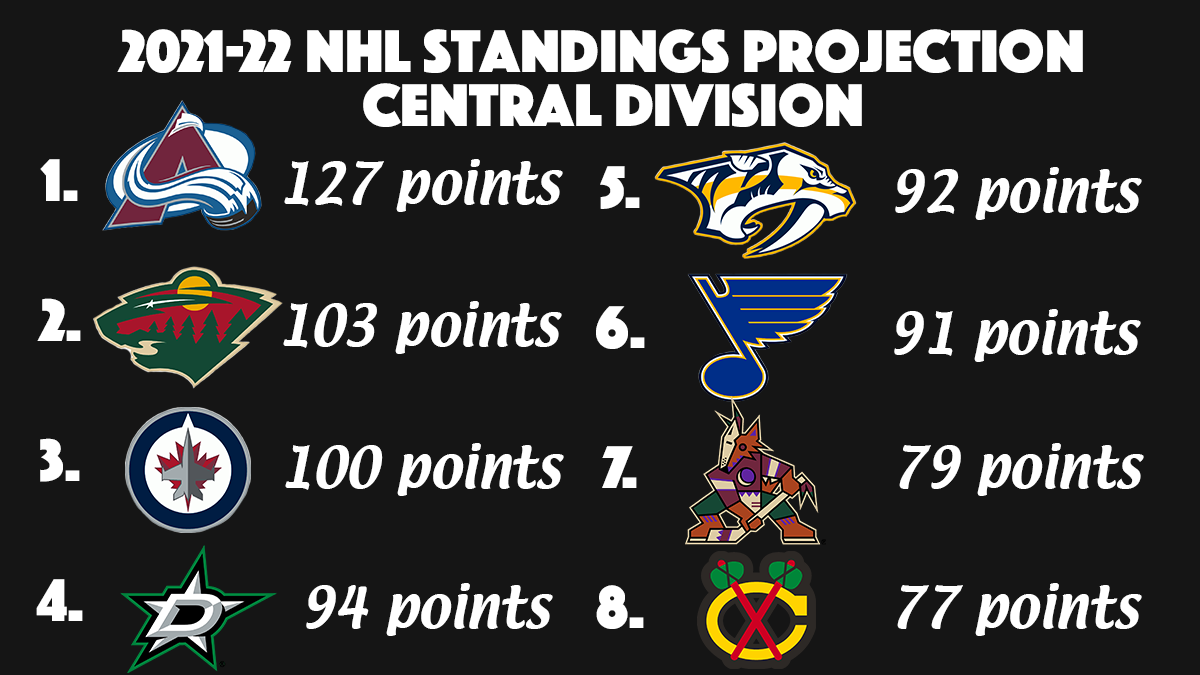
    The overall vibe of the Central Division for 2021-22 is that it’s just more of exactly what you’d expect. The Colorado Avalanche are lightyears ahead of everyone else, while Kirill Kaprizov and the Minnesota Wild continue to be on the rise and everyone else fights for what they can earn.

    Meanwhile, the jury is still out on whether or not the Winnipeg Jets can breakthrough as Canada’s team and break the Canadian curse (become the first Canadian club to win the Cup since 1993).

    Will Colorado finally break through the Second Round and win the Cup?

    Are the Avalanche just the Toronto Maple Leafs but with a little more success? My column:

    No, but really, it’s worth asking if the Avs making it back to the Western Conference Final for the first time since 2002, is more like Toronto’s struggle to make it out of the First Round for the first time since 2004, or is Colorado’s struggle more like the Washington Capitals pre-2018?

    The Caps won three Presidents’ Trophies in 2009-10, 2015-16 and 2016-17, but couldn’t make it past the Second Round– let alone the Pittsburgh Penguins– until they finally did and ended up surging in momentum all the way to their first Stanley Cup in franchise history.

    Colorado, on the other hand, has already won the Cup twice (1996 and 2001) and also has three Presidents’ Trophies to their name in 1996-97, 2000-01 and 2020-21, so if recent history has anything to tell us it’s that yet another team with high expectations for at least a few seasons now only to come up short could very well go on to win it all after winning the Presidents’ Trophy the previous year.

    Either that or they’ll have to win it in back-to-back seasons like Washington did before they won the Cup in 2018.

    Then again, the Tampa Bay Lightning tied the Detroit Red Wings’ record for most wins in the regular season (62), securing the Presidents’ Trophy in the process in 2018-19, then got swept by the Columbus Blue Jackets in the 2019 First Round.

    The very next year, however, Tampa kicked off back-to-back Cup rings in 2020 and 2021, to be where they are now as the two-time defending champions likely standing in the path as the only other favorites outside of the Avalanche this season.

    Anyway, the Avs mostly kept things the same from last season to this season, losing Joonas Donskoi to the Seattle Kraken in the 2021 NHL Expansion Draft, Brandon Saad to the St. Louis Blues in free agency and making minor swaps among replacement level bottom-six forwards and bottom-pairing defenders.

    Oh, then there’s this whole thing about how Philipp Grubauer left for Seattle in free agency too, so Colorado acquired Darcy Kuemper from the Arizona Coyotes.

    Between Dallas, Nashville and St. Louis, who will realistically make the playoffs?

    The Stars are projected to finish with about 94 points, the Predators sit at 92 points and the Blues are around 91 points in this one projection, but don’t let the points alone be your deciding factor.

    Given the strength of the Central Division compared to the Pacific Division, you can bet on five teams making out of the Central among Western Conference playoff berths.

    As such, the spread is the difference maker between these three teams expected to be in the wild card hunt– it’s going to come down to the wire one way or another.

    Dallas bolstered their goaltending depth by signing Braden Holtby, Nashville traded Ryan Ellis to the Philadelphia Flyers and St. Louis is… …better than last season on paper?

    I mean, the Blues signed Saad, acquired Pavel Buchnevich from the New York Rangers in exchange for Sammy Blais, let Seattle claim Vince Dunn at the expansion draft and let Mike Hoffman walk to the Montréal Canadiens in July.

    You could say they took a hit here or there, but those aren’t “nobody names” by any means, however.

    If Jordan Binnington and Ville Husso can stabilize things in the crease, then St. Louis has a better situation than the Predators.

    The Stars, meanwhile, should benefit from a longer season where more of their core guys– like Tyler Seguin, for example– are healthy. Last season’s COVID-19 outbreak to kick things off in January really killed Dallas’ momentum as a team on the verge of being in the 2021 postseason.

    Dallas should get back into the swing of things and St. Louis should be able to stay relevant for at least another year, but how hard the Preds rely on Juuse Saros as their starting goaltender will dictate whether or not they’re able to play spoiler with David Rittich as their backup since Pekka Rinne retired.

    Can Arizona avoid the basement?

    Anything is possible at this point. Loui Eriksson and Andrew Ladd were scoring goals in the postseason, so a fresh start could be just what both players needed for the last few years at least.

    That said, Coyotes General Manager, Bill Armstrong, gave a Masterclass™️ in how to go about rebuilding by selling everything over the summer and taking on “bad” contracts with only one or two years remaining in hopes of playing just well enough to be bad enough without making it look obvious that you’re aiming to win the 2022 NHL Draft Lottery.

    The Pacific Division is the new Scotia NHL North Division from last season. In other words, it’s the worst– which is great news for the Seattle Kraken as the league’s schedule allots more division play than any other opponents (though the Kraken will play every other team in the league at least twice).

    Seattle’s riding the waves of new-age expansion, while the Vegas Golden Knights lead the charge for the Presidents’ Trophy campaign in 2021-22.

    Wait, Seattle in 2nd in the Pacific, really?

    Yes, really.

    The Kraken have a great front office that goes beyond just Ron Francis as General Manager and have done their due diligence in scouting the best talent available to try to replicate the success of the Vegas Golden Knights’ inaugural season in 2017-18, as well as grow beyond just 2021-22.

    That said, Seattle probably isn’t going to make it out of the First Round of the 2022 Stanley Cup Playoffs, even if they have to face the Edmonton Oilers according to this projection.

    It’s a best case scenario for the NHL’s newest expansion team to be in the weakest division, but aside from having recent Stanley Cup champions Yanni Gourde, Philipp Grubauer, Jaden Schwartz and Dunn on their roster, the Kraken have a plethora of players that are relatively inexperienced with deep postseason runs.

    Head coach, Dave Hakstol, also hasn’t had the consistency of making the playoffs and making it out of the First Round in his NHL coaching days, but as a team that, again, is looking to develop long-term success, these are mere growing pains Francis and Co. are willing to accept as the fan base grows.

    Why aren’t the Kings making the cut this year when everyone else says they’ll be the most improved?

    The simple answer is that everyone’s overrating Los Angeles when it comes to the “ready now” factor.

    Sure, Kings General Manager, Rob Blake, did a good thing by getting Viktor Arvidsson in a trade with Nashville this summer to solidify his top-six forward group and signed Alex Edler to fortify his defense, but Los Angeles’ goaltending leaves something to be desired.

    Here’s hoping Jonathan Quick can find a little resurgence at this point in his career, while Cal Petersen continues to come into his own.

    If Los Angeles has any injuries– and they already have with Arvidsson likely missing some time due to an injury in the last preseason game– they’re already close enough to the bubble that they’ll only fall further behind.

    That said, if the Kings don’t make it back to the postseason hunt in 2022, there’s a good chance they make it in 2023.

    Los Angeles is improving, but by how much remains to be seen.

    Will winning the Presidents’ Trophy hurt Vegas?

    Eh, it’s hard to say.

    The Golden Knights have packed in just about every type of heartbreak since their inception in 2017, that fans of other franchises have only experienced over the course of at least 50 years, so if Vegas pulls out the Presidents’ Trophy win in 2021-22, don’t be surprised when the inevitable happens and they win the Cup instead of doing what most other Presidents’ Trophy winners in the salary cap era have done.

    Only the 2007-08 Detroit Red Wings and Chicago in 2012-13, have been able to win the Presidents’ Trophy and the Stanley Cup since the salary cap was introduced ahead of the 2005-06 season.

    Vegas would probably join Detroit and Chicago in doing so just so the Hockey Gods can spite us again.
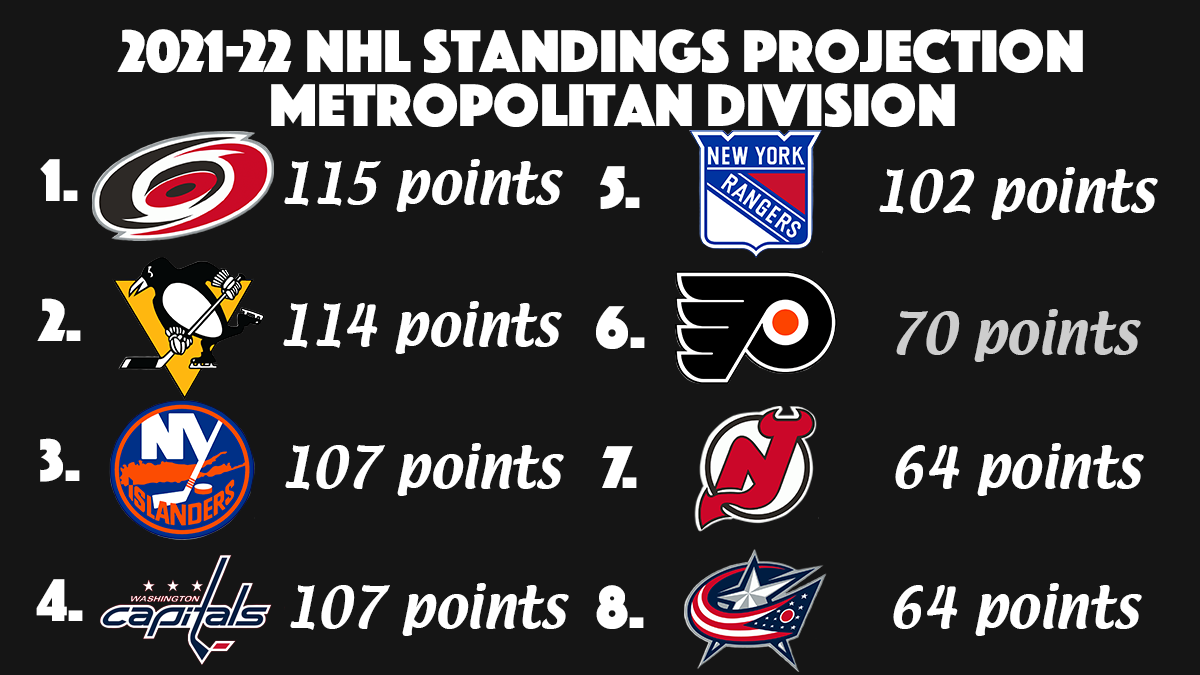
    It’s not easy to be in the Metropolitan Division these days because, well, let’s save that for the three questions below.

    Is this the toughest division to project?

    Absolutely.

    The Carolina Hurricanes decided to just get rid of a few parts and pieces that helped make them good for the last few seasons, so they’re bound to regress even with Sebastian Aho, Andrei Svechnikov, Teuvo Teräväinen and Martin Necas still existing.

    The Pittsburgh Penguins since 2009, have always found a way to be near the top of the division standings by the end of the regular season no matter whether or not you believe they’ll inevitably miss the playoffs for the first time since 2006, so anything could happen there.

    The New York Islanders have made back-to-back appearances in the Eastern Conference Final, so I’d expect them to be good.

    The Washington Capitals are better than the Philadelphia Flyers and New York Rangers, at least, but are probably the only team on the bubble if the New Jersey Devils can come out of nowhere and be competitive this season after signing Dougie Hamilton, Tomas Tatar and Jonathan Bernier in the offseason.

    Meanwhile, it’s time for a short rebuild in Columbus as the Blue Jackets would be quite pleased with a top draft pick in 2022.

    What if Chris Drury never was promoted as General Manager of the Rangers?

    They’d still fire David Quinn and hire Gerard Gallant. I don’t think that’s such a bad idea, but they’d definitely reconsider about 90% of the roster decisions made this summer.

    There’s no reason why the Rangers have to go down this path and yet, here they are, fumbling at the one-yard line and possibly plunging their franchise back into the Dark Ages of another rebuild. Or is it the same ongoing rebuild?

    What about a team to watch like New Jersey, for example?

    I’m big on the Devils this season for some strange reason.

    Maybe it’s because a part of me deep down misses the trap game of the 1990s and 2000s that led to Stanley Cups for New Jersey in 1995, 2000 and 2003.

    Maybe it’s because they signed Hamilton, Tatar, Bernier and acquired Ryan Graves from the Colorado Avalanche as a supporting cast for Jack Hughes, Nico Hischier, Pavel Zacha, Yegor Sharangovich, Ty Smith and friends.

    Seriously, the Devils should be good in the next few seasons, but this year could be the biggest stride forward in terms of their improvement from the basement to their development as a playoff contender.

    First, pour one out for Jack Eichel. Now, let’s move on and talk about everyone else.

    What does this mean for the Leafs?

    Just like how the Stars, Preds and Blues are all right on top of one another in the Central Division standings, the Atlantic Division is stacked from 1st through 4th, so though Toronto leads the way in this projection, I wouldn’t feel too comfortable as a Leafs fan.

    The Maple Leafs played in the worst of the four divisions last year in the temporarily realigned divisions in wake of the ongoing pandemic.

    No, it’s not just because they played all the other Canadian teams across 56 games, but rather it’s due to the fact that they haven’t been able to matchup with the Tampa Bay Lightning, Florida Panthers and even the Boston Bruins since the 2019-20 season.

    A lot and not a lot has changed since then.

    Tampa is still dominant as ever, Florida has emerged as a team that’s on the rise and Boston is unpredictable in that– much like the Penguins– it could really go either way with the Bruins this season.

    So now Toronto has to take on better competition within their own division and square off with teams like the Vegas Golden Knights, Colorado Avalanche, New York Islanders and others that emerge towards the top of the standings outside of the Canadian teams that the Leafs are all too familiar with at this point.

    That said, Toronto still has a great chance at winning the Atlantic Division regular season title or finishing 2nd and having home ice advantage in the First Round for the second-straight postseason.

    Can anyone other than Toronto, Florida, Tampa or Boston make it out of the Atlantic this year?

    No. Let’s be realistic here.

    The Montréal Canadiens made it to the 2021 Stanley Cup Final despite being below .500 in the standings because every division produced four playoff berths and intra-divisional play through two rounds.

    In 2020, they upset the Pittsburgh Penguins in the Qualifier despite finishing right at .500.

    In any other non-pandemic timeline, the Canadiens would still be looking for their first playoff appearance since they lost to the New York Rangers in six games in the 2017 First Round.

    That’s not to say that Nick Suzuki can’t lead the Habs back to glory, but rather that they need to improve all-around in the regular season and peaking in performance in the playoffs.

    Though the Ottawa Senators promised unprecedented success from 2021-25, it’s looking like it’ll realistically be anytime between 2024-25 as in the 2024-25 season itself at this point.

    Ottawa’s goaltending needs to improve, their defense could use some tweaks and the Sens are banking on their offense getting their feet underneath them and bursting in production in the coming years.

    A little more patience won’t hurt them.

    The same can be said for the Detroit Red Wings in that Red Wings fans already know– trust in General Manager, Steve Yzerman, is paramount. He’ll work his magic.

    It just takes a little time to build a solid foundation and the first floor is almost ready to start going up.

    As for the Buffalo Sabres, well…

    At least they’ll hopefully give Rick Jeanneret a proper send-off before he retires as their play-by-play announcer for the last 51 years on television.

    Hopefully.

    Will Tampa win three consecutive Stanley Cup championships?

    Probably not.

    I’m not ruling it out entirely, but the Lightning have a better chance of winning three Cups in four years than they do three Cups in as many years as things stand currently.

    The loss of their entire third line (Blake Coleman, Yanni Gourde and Barclay Goodrow) from last season to this season is sure to leave a mark on the development and restructuring of their bottom-six forwards.

    That said, Tampa’s top-six forwards still exist and, if you haven’t already noticed, they’re very good on their own, but the best teams in the playoffs have four lines that can roll without a doubt and the Bolts might just be off the ball for a year in terms of depth.


    Alright, if you’ve made it this far, thanks for your patience. By now the season’s already going on a few days into the 2021-22 calendar, so the two of us (or more if you’re reading this to a group) should probably get back to watching games.

    Stay tuned for more forecasts for both standings and assorted teams throughout the season.

  • Vancouver Canucks 2021-22 Season Preview

    Vancouver Canucks 2021-22 Season Preview

    2020-21 record 23-29-4, 50 points

    7th in the Scotia NHL North Division

    Missed the postseason for the first time since 2020

    Additions: F Justin Dowling, F Jason Dickinson (acquired from DAL), F Phil Di Giuseppe, F Sheldon Dries, F Conor Garland (acquired from ARI), F Nic Petan, F Sheldon Rempal, F John Stevens, D Kyle Burroughs, D Oliver Ekman-Larsson (acquired from ARI), D Brad Hunt, D Brady Keeper, D Tucker Poolman, D Luke Schenn, D Devante Stephens, G Jaroslav Halak, G Spencer Martin (acquired from TBL)

    Subtractions: F Sven Baertschi (signed with VGK), F Jay Beagle (traded to ARI), F Travis Boyd (signed with ARI), F Loui Eriksson (traded to ARI), F Tyler Graovac (KHL), F Jayce Hawryluk (SHL), F Kole Lind (expansion, SEA), F Lukas Jasek (Liiga), F Marc Michaelis (signed with Toronto Marlies, AHL), F Petrus Palmu (Liiga), F Antoine Roussel (traded to ARI), F Jake Virtanen (buyout, KHL), D Jalen Chatfield (signed with Chicago Wolves, AHL), D Alexander Edler (signed with LAK), D Mitch Eliot (signed with Rochester Americans, AHL), D Brogan Rafferty (signed with ANA), D Nate Schmidt (traded to WPG), D Ashton Sautner (signed with Abbotsford Canucks, AHL), D Josh Teves (signed with Rochester Americans, AHL), G Braden Holtby (buyout)

    Still Unsigned: F Elias Pettersson (RFA), F Jimmy Vesey, D Quinn Hughes (RFA), G Jake Kielly

    Re-signed: F Justin Bailey, F Brandon Sutter, D Guillaume Brisebois, D Travis Hamonic, D Olli Juolevi

    Offseason Analysis: Canucks General Manager, Jim Benning, has been busy this offseason undoing past misjudgments and moving Vancouver forward in other areas (however small they may be).

    At least he didn’t sign anyone to a head-scratching long-term contract the day that free agency began on July 28th this year.

    With about $10.664 million in cap space currently and Elias Pettersson as a restricted-free agent alongside Quinn Hughes, the Canucks still have some work to get done before the season begins or else they risk falling behind even further in the standings.

    While Pettersson would probably love to make about $9.000 or $10 million per season, he hasn’t exactly reached that status yet as a 22-year-old center with 153 points in 165 career games.

    A solid bridge contract is more likely in his future than, say, a long-term seven or eight-year deal.

    It may be kicking the can down the road to pay him later, but with 21 points (10 goals, 11 assists) in 26 games last season, there’s always the risk that his wrist injury might quite literally hurt his skilled hands in the near to long-term future.

    A bridge deal insures the Canucks of avoiding prolonging the salary cap hell that they’ve been through until Benning was able to dump most of it in Arizona via the trade with the Coyotes for Oliver Ekman-Larsson and Conor Garland.

    That said, Pettersson is worth paying a premium for to build off of Vancouver’s young core. He had 28-38–66 totals in 71 games in his first season in the league in 2018-19 and amassed 27-39–66 totals in 68 games prior to the COVID-19 pandemic being declared in the 2019-20 season.

    Hughes, on the other hand, is important to Vancouver’s future, but had a dip in production from 53 points (eight goals, 45 assists) in 68 games in his first full season in 2019-20 to 41 points (three goals, 38 assists) in 56 games last season.

    Nevertheless, for a defender to wrack up 40 or more points in a season is pretty good all things considered.

    Especially since Hughes is only 21-years-old and has plenty of track left on route to his potential.

    It should be easier to get a deal done with Hughes than Pettersson if the sticking point is that one sees themselves more valuable to the team than the other.

    If, for some reason, things went south between the Canucks and Pettersson, the Canucks could survive– albeit reminiscent of the last days of Pavel Bure with the franchise.

    In other words, you probably don’t want that to happen again.

    All right, what about what Vancouver has already taken care of this offseason, shall we?

    Jaroslav Halak left the Boston Bruins for the Canucks via free agency this summer and signed a one-year deal worth $1.500 million with another $1.500 million in performance bonuses to become the backup to Thatcher Demko, though Vancouver may prefer to utilize Halak and Demko as some sort of a 1A/1B tandem.

    Despite Halak’s 9-6-4 record in 19 games last season, he maintained a quality 2.53 goals-against average and a .905 save percentage with two shutouts in that span as Boston’s backup until Jeremy Swayman entered the conversation.

    In 2019-20, Halak and Tuukka Rask captured the William M. Jennings Trophy as the goaltender(s) with 25 or more games played that allowed the fewest goals against in that season.

    Halak went 18-6-6 in 31 games and had a 2.39 goals-against average, a .919 save percentage and three shutouts in that remarkable regular season run.

    It served as a reminder that Halak was once a surefire starting goaltender and could very well, in the event that was necessary, command a team from the crease as a starter once more.

    This after a 22-11-4 record in 40 games played with Boston in 2018-19, in which he had a 2.34 goals-against average, a .922 save percentage and five shutouts.

    But at 36-years-old, Halak’s time in the league is dwindling as he continues about the twilight of his career.

    At the very least, he brings in more stability in the crease than Braden Holtby did for Demko– and that’s precisely why the Canucks felt is was O.K. to buyout the remaining year of Holtby’s contract.

    The bulk of Benning’s work this offseason came via making trades.

    He most recently acquired goaltender, Spencer Martin, from the Tampa Bay Lightning on July 31st for future considerations to solidify depth in the event of injury or to at least provide the Abbotsford Canucks (AHL) with a quality starter.

    But earlier this summer, Benning kicked things off with a small grab for top-nine depth by sending the Dallas Stars a 2021 3rd round pick (73rd overall, Ayrton Martino) for forward, Jason Dickinson, on July 17th.

    Six days later, Benning phoned Bill Armstrong in Arizona and executed a trade that saved the Canucks almost $5.000 million in valuable cap space after sending Antoine Roussel, Jay Beagle, Loui Eriksson, a 2021 1st round pick (9th overall, Dylan Guenther), a 2022 2nd round pick and a 2023 7th round pick to the Coyotes for Ekman-Larsson and Garland’s signing rights before re-signing the latter to a five-year extension worth $4.950 million per season.

    Arizona retained 12% of Ekman-Larsson’s salary, thus shaving $990,000 off of his cap hit for Vancouver, who is assessed a cap hit of $7.260 million per season for Ekman-Larsson through 2026-27.

    With change coming to the blue line in Vancouver, Nate Schmidt reconsidered a trade he had initially rejected and informed Benning he would be fine being moved after all in a deal where the Canucks sent Schmidt to the Winnipeg Jets for a 2022 3rd round pick on July 27th.

    If Ekman-Larsson’s able to rebound from his decline– reaching 55 points in 75 games in 2015-16, then 39 points in 79 games the following season before rebounding with 42 points in 82 games in 2017-18 and 44 points in 81 games in 2018-19 prior to his dropoff again in 2019-20, where he had 30 points in 66 games and 2020-21, where he had 24 points in 46 games– then Benning might just be a mastermind after all.

    At the very least, Ekman-Larsson’s 24 points last season with Arizona was more than Schmidt had in 54 games with Vancouver, as Schmidt dropped from 31 points in 59 games with the Vegas Golden Knights in 2019-20 to 15 points in 54 games with the Canucks.

    Offseason Grade: B

    If the Canucks had signed Pettersson and Hughes to extensions already– and assuming they weren’t overpaying them– then Vancouver probably would get an “A” overall for their willingness to free themselves from past mistakes and try something new.

    Will they be as bad as they were last season? Probably not.

    Will they be “blow other teams out of the water” good this season? Also probably not.

    But at the very least, they’ve given themselves enough to work with in the next year or two to fill out the rest of their core and supplement their best players with better pieces of the puzzle.

    If, however, everything falls on their face, then I guess Vancouver is just cursed like that then, huh.

  • Los Angeles Kings 2021-22 Season Preview

    Los Angeles Kings 2021-22 Season Preview

    2020-21 record 21-28-7, 49 points

    6th in the Honda NHL West Division

    Missed the postseason for the third-straight year

    Additions: F Viktor Arvidsson (acquired from NSH), F Brayden Burke (acquired from ARI), F Phillip Danault, F T.J. Tynan, D Alexander Edler, G Garret Sparks

    Subtractions: F Michael Eyssimont (signed with WPG), F Bokondji Imama (traded to ARI), F Matt Luff (signed with NSH), F Tyler Steenburgen (acquired from ARI, signed Liiga), D Mark Alt (signed with San Jose Barracuda, AHL), D Daniel Brickley (signed with Chicago Wolves, AHL), D Cole Hults (traded to ARI), D Kurtis MacDermid (expansion, SEA), G Troy Grosenick (signed with BOS)

    Still Unsigned: F Drake Rymsha

    Re-signed: F Lias Andersson, F Andreas Athanasiou, F Blake Lizotte, F Trevor Moore, D Kale Clague, D Jacob Moverare, D Austin Strand, D Christian Wolanin

    Offseason Analysis: The Kings looked competitive and ahead of schedule, but couldn’t carry the momentum down the stretch and make a surprise appearance in the playoff hunt.

    Los Angeles has a great pool of prospects and Quinton Byfield is shaping up to make an impact in his first full season, while General Manager, Rob Blake, was tasked with finding the right fit for a few pieces in the offseason that very well might put the Kings over the edge and back into Stanley Cup Playoff contention.

    In a few years, they might be trending down the path of a Cup contender instead of going through a long, strenuous, rebuild.

    Despite Anze Kopitar’s $10.000 million cap hit (which runs through 2023-24) and Drew Doughty’s $11.500 million cap hit (which expires after the 2026-27 season), Los Angeles was able to add without subtracting and could salvage the remnants of Jonathan Quick and Dustin Brown from the Kings’ glory days to their current days while Cal Petersen continues to emerge in the crease.

    The addition of Alexander Edler on a one-year, $3.500 million contract brings some stability to the blue line and valuable experience to leave an impression on the younger defenders, like Michael Anderson and Tobias Björnfot.

    Edler’s presence and shot blocking capabilities should also prove vital in shaping how guys like Olli Määttä, Matt Roy, Sean Walker and Christian Wolanin– already in their defensive primes– compete with each other for their jobs and evolve.

    But Edler alone wasn’t the biggest move that Blake made in the offseason.

    Sure, there’s the Viktor Arvidsson trade that brings the 28-year-old winger to Los Angeles after breaking into the league with the Nashville Predators in the 2014-15 season and scoring 10-15–25 totals in 50 games in 2020-21 with the Preds, but Blake went a step further and found the answer to a hole down the middle.

    The Kings signed Phillip Danault to a six-year contract worth $5.500 million per season, bringing the 28-year-old Victoriaville, Québec native to Los Angeles’ second line for a good stretch of his prime.

    Though his production was down from 47 points (13 goals, 34 assists) in 71 games with the Montréal Canadiens in 2019-20 to 5-19–24 totals in 53 games with the Habs in 2020-21, Danault has reached 40 or more points in three out of his last five seasons with varying degrees of talent around him.

    Now in Los Angeles, Danault could suit up between guys like Alex Iafallo, Arvidsson, Adrian Kempe or Brown– bringing a balance of youth, speed, experience and playmaking abilities to go with the scoring prowess of any of the aforementioned wingers.

    Arvidsson and Danault bring more of a two-way, contemporary, game that aligns well with Kopitar’s two-time Frank J. Selke Trophy winning style

    Brown recorded 17 goals in 49 games last season, while Iafallo had 13 goals in 55 games and Kempe notched 14 goals in 56 games. There’s no reason to believe that all three players can’t reach the 20-goal plateau in a full 82-game schedule.

    But for all the improvements made among their skaters, the Kings might continue to encounter some growing pains in net as Petersen continues to make his mark on the league as a starting goaltender, while Quick’s dominant days wane in the twilight of his career.

    Petersen went 9-18-5 in 35 games last season and had a 2.89 goals-against average, as well as a .911 save percentage in that span.

    Through 54 games at the NHL level, Petersen has a career 2.79 goals-against average and a career .916 save percentage and only one shutout.

    For comparison’s sake, Quick has a 2.81 goals-against average in his last two seasons combined (64 appearances), but a .902 save percentage in that span.

    Quick was Los Angeles’ starter in 2019-20 and had a 16-22-4 record in 42 games played with a 2.79 goals-against average and a .904 save percentage in that span, as well as one shutout.

    Last season, Quick went 11-9-2 in 22 games and recorded two shutouts to go along with his 2.86 goals-against average and an .898 save percentage.

    For all the promise that Petersen showed in his collegiate days at Notre Dame, he’s yet to make the transition to the professional game and as the years go by, so does his chance at emerging in the average goaltending prime.

    If Los Angeles is to make the playoffs next season, Petersen will need to improve.

    If the Kings falter, Petersen still has a chance at redeeming himself, though he won’t see much of a pay raise next offseason– but he could still be a late bloomer and sign a short-term bridge extension, awaiting a larger payday after sustained success and better numbers at the NHL level.

    This is where it’s important to note that Petersen is a pending-unrestricted free agent come July 1, 2022, while Quick’s contract expires after the 2022-23 season.

    If winning with the remnants of their 2012 and 2014 Stanley Cup championship core is important to the Kings, then winning again sooner rather than later is paramount.

    Offseason Grade: A-

    The Danault signing alone is an exceptionally good contract for a player that could really come into his own with the depth and talent of the Kings around him.

    Blake’s given Todd McLellan some better pieces to work with– now it’s up to Los Angeles’ head coach to find the right chemistry among his players to get them back into the hunt.

    The return of the usual division alignments for 2021-22 is a welcome sign for the Kings’ chances of making the playoffs in 2022, as they should be better than their counterparts in California, as well as the rebuilding Arizona Coyotes and stagnant teams north of the border in Vancouver and Calgary.

    Now as for how far things will go? Well, that depends on if they make the playoffs first and whether or not Los Angeles lucks out having to face a relatively inexperienced team in the postseason.

  • Canucks down Bruins, 9-3

    The Vancouver Canucks routed the Boston Bruins, 9-3, at Rogers Arena on Saturday night in what was Boston’s third game in four nights of traveling.

    That said, Canucks goaltender, Jacob Markstrom (23-16-4 record, 2.75 goals against average, .918 save percentage in 43 games played) made 34 saves on 37 shots against for a .918 SV% in 58:12 time on ice en route to the win.

    Meanwhile, his teammate and Canucks backup goaltender, Thatcher Demko (10-6-2, 3.03 GAA, .905 SV% in 20 games played) made a brief relief appearance for a 1:48 span after Markstrom took an inadvertent stick through the cage of his mask early in the first period.

    Bruins goaltender, Tuukka Rask (23-6-6, 2.17 GAA, .928 SV% in 36 games played) stopped 21 out of 27 shots faced for a .778 SV% in the loss.

    Rask was replaced by Jaroslav Halak (16-6-6, 2.42 GAA, .918 SVT in 29 games played) after amassing 46:28 TOI and allowing six goals.

    Halak came into the game during a stoppage in play after a Bruins power play goal in the second period and turned aside five out of the eight shots he faced for a .625 SV% en route to no decision in Boston’s loss.

    All four goaltenders that dressed for the game took part in the action on Saturday– on a night in the National Hockey League where, 42-year-old, emergency backup goaltender, Dave Ayres, stole the show for the Carolina Hurricanes in their, 6-3, victory over the Toronto Maple Leafs on the road.

    Also, the Arizona Coyotes beat the Tampa Bay Lightning, 7-3, on Saturday night.

    Apparently goaltending was optional league wide for one night only!

    Boston fell to 39-12-12 (90 points) on the season, but remained in command of the entire league standings, while Vancouver improved to 33-22-6 (72 points) and rose to 2nd place in the Pacific Division.

    The B’s also fell to 18-10-3 on the road this season, while the Canucks improved to 20-7-4 at home this season.

    February 9, 2016 was the last time Boston allowed nine goals (a, 9-2, loss on home ice to the Los Angeles Kings).

    Once more, the Bruins were without the services of Kevan Miller (knee) and Connor Clifton (upper body/conditioning loan) on Saturday night.

    B’s head coach, Bruce Cassidy, made no changes to his lineup from Friday night’s, 4-3, win in Calgary to Saturday night’s action in Vancouver.

    Joakim Nordstrom, Par Lindholm and John Moore were healthy scratches for Boston, while Ondrej Kase was a de facto healthy scratch as he won’t meet up with the team until Monday for practice at Warrior Ice Arena after having been acquired by the Bruins on Friday.

    Kase hasn’t played since Feb. 7th due to an illness and was skating with the Anaheim Ducks on Thursday prior to being traded the following day.

    A little past the four-minute mark in the action, the Canucks struck first with a blast from Troy Stecher (4) from the faceoff dot, off of Rask, then off the post and over the goal line– giving Vancouver the game’s first lead, 1-0.

    Tyler Motte (4) and Jay Beagle (5) recorded the assists on Stecher’s goal at 4:14 of the first period.

    Less than a few minutes later, Boston responded on the scoreboard with a goal of their own– tying the game, 1-1, when David Pastrnak (44) deked and wrapped the rubber biscuit around Markstrom with a forehand goal after breaking into the zone on a breakaway thanks to a stretch pass from Matt Grzelcyk through the neutral zone.

    Grzelcyk (15) had the only assist on Pastrnak’s first goal of the night at 7:06 of the first period. The goal tied Pastrnak for the most goals by a Bruin in a season since Glen Murray scored 44 goals in the 2002-03 season.

    Moments later, Danton Heinen caught Markstrom with an errant stick while engaged in a net front battle and accidentally clipped the Canucks goaltender inside the cage with the blade of his stick.

    There was no penalty on the play and Markstrom was forced to briefly leave the game before returning almost two minutes later.

    In the meantime, Jeremy Lauzon received a holding infraction against Elias Pettersson at the other end of the ice at 10:21 of the first period, which provided Markstrom with the chance to replace Demko at the stoppage in the action.

    Less than a minute later, Canucks captain, Bo Horvat (19), rocketed a one-timer from the high slot past Rask while Zdeno Chara and Brandon Carlo were split chasing J.T. Miller deep into the corner (from where the one-timer opportunity was generated by Miller to Horvat) and protecting the front of the crease.

    Miller (36) and Vancouver’s newest forward, Tyler Toffoli (18), tallied the assists on Horvat’s power play goal and the Canucks led, 2-1, at 11:08 of the opening frame.

    About four minutes later, Horvat took a trip to the penalty box for a holding minor against Brad Marchand and presented Boston with their first power play opportunity of the night at 15:34.

    Boston’s power play was cut short when Patrice Bergeron also cut a rut to the sin bin for holding against Motte at 17:13– resulting in 21 seconds of 4-on-4 action before the Canucks had an abbreviated power play.

    Neither team was able to score on the special teams action.

    After one period of play in Vancouver on Saturday, the Canucks led the Bruins, 2-1, on the scoreboard and, 17-12, in shots on goal.

    Vancouver also held the advantage in every other statistical category, including blocked shots (4-1), takeaways (7-4), giveaways (5-0), hits (14-10) and faceoff win percentage (57-43).

    The Canucks were 1/2 on the power play, while the Bruins were 0/1 on the skater advantage heading into the first intermission.

    Early in the middle frame, Adam Gaudette (11) wired a shot under the bar and over Rask’s glove from close range to extend Vancouver’s lead to two-goals.

    Quinn Hughes (40) notched the only assist on Gaudette’s goal and Vancouver led, 3-1, at 5:32 of the second period.

    Late in the period, the Canucks added a pair of goals when Tanner Pearson (18) pocketed a rebound to extend Vancouver’s lead to three-goals at 14:48.

    Loui Eriksson (6) and Tyler Myers (13) had the assists on Pearson’s goal, which made it, 4-1, for the Canucks before Eriksson (6) tallied a goal of his own after stuffing in a loose puck off a deflection in the slot to make it, 5-1, for the Canucks.

    Horvat (29) and Alexander Edler (21) recorded the primary and secondary assists on Eriksson’s goal at 15:39 of the second period.

    Less than a minute later, Chara took exception to Myers’ hit on Karson Kuhlman in front of the benches and attempted to engage the Vancouver defender in an exchange of fisticuffs, but the Canucks blue liner didn’t want any part of it.

    As a result, Myers was assessed a minor for roughing, while Chara picked up two roughing minors at 16:37– yielding a power play to the Canucks in the waning moments of the middle frame.

    With less than a minute left in the second period, Charlie Coyle and Horvat got into a scrap and traded punches.

    Both players received five-minute majors for fighting at 19:30 and were sent to the dressing room 30 seconds ahead of everyone else.

    Through 40 minutes of action in Vancouver, the Canucks led on the scoreboard, 5-1, and in shots on goal, 25-24.

    The Canucks also maintained the advantage in blocked shots (11-2), takeaways (12-6), giveaways (8-3) and faceoff win% (56-44), while the Bruins led in hits (25-23).

    Vancouver was 1/3 on the skater advantage, while Boston was 0/1 on the power play heading into the third period.

    Less than a minute into the final frame of regulation, Pettersson (25) snapped a wrist shot over Rask’s blocker side and into the twine.

    Miller (37) and Stecher (9) had the assists on Pettersson’s goal and the Canucks led, 6-1, 46 seconds into the third period.

    Moments later, Antoine Roussel caught Torey Krug with a high stick at 5:25 of the third period and presented the B’s with their second power play of the night.

    This time around, Boston made sure to capitalize on the skater advantage.

    Pastrnak (45) blasted one of his patented power play goals behind Markstrom to cut the deficit to four-goals at 6:28.

    Krug (34) and Marchand (54) tallied the assists as Pastrnak picked up his 45th goal of the season– becoming the highest goal-scoring Bruin since Murray in 2002-03– and the B’s trailed, 6-2.

    Before the ensuing faceoff, Cassidy replaced Rask with Halak in the crease.

    Less than two minutes later, Boston began to mount some momentum with another quick goal from Chris Wagner (5)– his first goal in 18 games– after Wagner followed up on his own rebound and slipped in a backhand goal to make it, 6-3, at 8:11 of the third period.

    Grzelcyk (16) and Sean Kuraly (16) had the assists on Wagner’s first goal since Jan. 7th.

    Boston’s surge in momentum didn’t last long as Toffoli (19) slapped a one-timer past Halak about three minutes later.

    Miller (38) had the only assist on Toffoli’s first goal and once again worked the puck from the end boards back to a teammate for the surefire one-timer goal at 11:10 of the third period and the Canucks led, 7-3.

    Less than two minutes later, after Halak managed to stop multiple consecutive shots, finally the Canucks slipped a shot through as chaos ensued in front of the net.

    Toffoli (20) mustered his second goal of the game and extended Vancouver’s lead back to five-goals.

    Hughes (41) had the only assist on Toffoli’s second goal at 13:03 and the Canucks led, 8-3.

    Finally, Jake Virtanen (17) snaked his way through the neutral zone and beat Halak clean with a wrist shot goal past Halak’s glove at 18:15 of the third period and extended Vancouver’s lead to six-goals.

    Edler (22) and Stecher (10) each amassed their second assists of the night on Virtanen’s goal and the Canucks finished off the Bruins, 9-3.

    At the final horn, Vancouver had beaten Boston, despite trailing the Bruins in shots on goal, 37-35.

    The Canucks finished the night leading in every other stat, including blocked shots (18-6), giveaways (12-4), hits (31-29) and faceoff win% (55-46).

    Vancouver wrapped up Saturday night’s action 1/3 on the skater advantage, while the B’s went 1/2 on the power play in the 60-minute effort.

    Boston fell to 6-5-3 when trailing after one period and 5-9-4 when trailing after two periods this season, while Vancouver improved to 17-3-2 when leading after one period and 21-1-1 when leading after two periods this season.

    Hughes became the 2nd Canucks rookie defender to record 40 or more assists in a season, joining Dale Tallon (14-42–56 totals) in 1970-71. Hughes joined Bryan Berard (40 in 1996-97), Janne Niinimaa (40 in 1996-97) and Nicklas Lidstrom (49 in 1991-92) as just the fourth rookie defender in the last 30 years to amass at least 40 assists in a single season.

    Vancouver became the third different team this season to score nine goals, joining the Lightning (9-3, win against the New York Rangers on Nov. 14, 2019 and a, 9-2, win against Vancouver on Jan. 7, 2020) and Colorado Avalanche (9-4, win against the Nashville Predators on Nov. 7, 2019).

    Boston finished their four-game road trip (3-1-0).

    The B’s return home for a two-game homestand on Tuesday, Feb. 25th and Thursday, Feb. 27th for meetings with the Calgary Flames and Dallas Stars, respectively, before wrapping up the month of February with a road game against the New York Islanders on Feb. 29th.

  • Rask, Bruins shutout Canucks, 4-0

    The Boston Bruins extended their current winning streak to four games with a, 4-0, shutout victory over the Vancouver Canucks Tuesday night at TD Garden.

    Tuukka Rask (19-4-6 record, 2.15 goals against average, .929 save percentage in 30 games played) made 25 saves on 25 shots against in the win for his 3rd shutout this season (48th career shutout).

    In addition, Rask tied Gilles Gilbert’s Bruins franchise record set in 1970-71 for the longest home point streak to start a season. Rask is 11-0-6 through 17 individual games played on home ice this season.

    Canucks goaltender, Jacob Markstrom (20-14-3, 2.74 GAA, .917 SV% in 37 games played), stopped 38 out of 42 shots faced for a .905 SV% in the loss.

    Boston improved to 32-10-12 (76 points) on the season and remained in command of 1st place in the Atlantic Division, while Vancouver fell to 30-19-5 (65 points), but held onto their 1st place standing in the Pacific Division.

    The B’s have won five out of their last six games and also improved to 18-2-9 at home this season as a result of the win.


    Editor’s note: Welcome back to our regular coverage of Bruins recaps after a little extended vacation on both ends of the All Star break. It might happen again, possibly forever. Stay tuned.

    If you weren’t already aware, Boston defeated the Vegas Golden Knights (3-2, on Jan. 21st at TD Garden), as well as the Winnipeg Jets (2-1, on Jan. 31st at Bell MTS Place) and the Minnesota Wild (6-1, on Feb. 1st at Xcel Energy Center) while our coverage was on holiday.


    The Bruins were without the services of Kevan Miller (knee), Connor Clifton (upper body) and Joakim Nordstrom (allergy complications) against the Canucks on Tuesday.

    Boston head coach, Bruce Cassidy, made minor changes to his lineup from Saturday night’s win in Minnesota.

    The first line comprised of the usual “Perfection Line” trio of Brad Marchand, Patrice Bergeron and David Pastrnak, while the second line featured Jake DeBrusk at left wing, David Krejci at center and Karson Kuhlman on the right wing.

    Sean Kuraly was back in the lineup on the left side of the third line with Charlie Coyle down the middle and Anders Bjork on the right side, while Anton Blidh, Par Lindholm and Chris Wagner made up the fourth line.

    On defense, Zdeno Chara and Charlie McAvoy continued to serve as the top pairing with Torey Krug and Brandon Carlo filling out the rest of the top-4 defenders.

    Matt Grzelcyk suited up on the third pairing alongside Jeremy Lauzon, while John Moore and Danton Heinen served as Boston’s only healthy scratches Tuesday night.

    Late in the opening frame, Coyle (10) scooped up a loose puck on a rebound and elevated a quick backhand over Markstrom’s glove to give Boston the game’s first goal.

    McAvoy (18) and Bjork (8) tallied the assists on Coyle’s goal at 14:24 of the first period and the Bruins led, 1-0.

    But there was a catch (sort of).

    Canucks head coach, Travis Green, used his coach’s challenge on the basis that Vancouver was asking to review whether or not McAvoy had entered the zone offside– therefore negating the play that ultimately led to the goal, thus getting rid of the goal.

    However, after review, it was determined that the call on the ice stood and the Bruins had indeed scored a good goal when the officials confirmed via video that McAvoy did not actually skate over the blue line with the puck on his stick while Kuraly was making an effort to get back onside.

    McAvoy had somehow sidestepped for a split second while Kuraly checked up, then proceeded to touch the puck after assuring that he and his teammate were in the clear.

    Boston led, 1-0, and Vancouver was charged with a bench minor for delay of game at 14:24. Jake Virtanen served the time in the box for the Canucks.

    Entering the first intermission, the B’s were ahead on the scoreboard, 1-0, and led in shots on goal, 13-6.

    The Bruins also held the advantage in takeaways (4-3), giveaways (5-3), hits (9-7) and faceoff win percentage (53-47). The Canucks led in blocked shots (4-2) after one period.

    Vancouver had yet to see any time on the skater advantage, while Boston was 0/1 on the power play through 20 minutes of action Tuesday night.

    Early in the middle frame, Troy Stecher sent the puck over the glass and out of the playing surface– yielding an automatic delay of game minor infraction at 5:45 of the second period.

    The Canucks followed up their already shorthanded bid with another penalty about a minute later after Alexander Edler tripped up Marchand at 6:46.

    Boston had an abbreviated 5-on-3 advantage, but could not convert on the power play.

    Instead, the Bruins followed suit with a minor penalty of their own in the vulnerable minute after their advantage as Bjork hooked Canucks captain, Bo Horvat, at 9:48 of the second period.

    Vancouver did not capitalized on their first power play opportunity of the night.

    Late in the second period, Grzelcyk kickstarted a play from his own zone through the neutral zone whereby Marchand sent the puck to Bergeron for a quick redirection to McAvoy as the Bruins defender was gathering speed into the attacking zone.

    McAvoy then sent the puck back to Bergeron who then found Marchand (23) to give Boston a two-goal advantage at 15:35.

    Bergeron (21) and McAvoy (19) had the assists and the B’s led, 2-0.

    Less than 30 seconds later, Wagner cut a rut to the penalty box for hooking against Oscar Fantenberg and presented Vancouver with another power play opportunity at 15:57.

    Once more, the Canucks were denied on the skater advantage, however, and the Bruins carried a, 2-0, lead into the second intermission, as well as a, 30-15, advantage in shots on goal through 40 minutes of play.

    Boston dominated in takeaways (6-4) and hits (20-17), while Vancouver led in blocked shots (12-6), giveaways (11-6) and faceoff win% (51-49) heading into the final frame of regulation.

    The Canucks were 0/2 on the skater advantage and the B’s were 0/3 entering the third period.

    Midway through the final frame of the game, Krug slashed Virtanen and was promptly sent to the sin bin at 12:38 of the third period.

    Canucks rookie defender, Quinn Hughes, slashed Kuraly about a minute later and yielded 4-on-4 action for a 1:01 span before the Bruins had an abbreviated 5-on-4 power play.

    While at even strength with four skaters aside, Boston extended their lead to three goals after Krejci sent Kuraly into the corner before No. 52 in black and gold fished the puck back out to Krejci (13) in the slot whereby No. 46 sent a shot past Markstrom’s glove side at 14:09 of the third period.

    The Bruins led, 3-0, as Kuraly (14) and Carlo (13) collected the assists on Krejci’s goal.

    About a minute later, Jay Beagle didn’t make an effort to avoid contact with Rask and bowled into the Boston goaltender at 15:11– receiving the ire of McAvoy, a goaltender interference minor and a misconduct at the same time.

    As a result, the B’s had about 28 seconds worth of a 5-on-3 advantage until Tyler Myers sent the puck over the glass at 16:22 and reset the 5-on-3 advantage clock to 50 seconds worth of a two-skater advantage for Boston.

    While on the advantage, Coyle fired a shot towards the net that Kuhlman (1) redirected in the slot off a Canucks defender before the puck caught Markstrom’s leg pad and strolled over the goal line for his first goal of the season.

    Coyle (19) and Grzelcyk (13) tallied the assists on Kuhlman’s goal and the Bruins led, 4-0, at 18:10.

    At the final horn, Boston secured the shutout victory and finished the night leading in shots on goal, 42-25.

    The B’s also wrapped up Tuesday night’s action with the advantage in hits (29-27), while Vancouver left TD Garden with the lead in blocked shots (14-9), giveaways (12-9) and faceoff win% (54-46).

    The Canucks went 0/3 on the power play and the Bruins went 1/6.

    Boston improved to 3-0-0 out of the All Star break and bye week, while outscoring their opponents, 12-2, in that span.

    The Bruins also improved to 20-7-8 when scoring the game’s first goal, 19-5-3 when leading after the first period and 17-1-6 when leading after two periods this season.

    The B’s take on the Chicago Blackhawks at United Center in Chicago on Wednesday before returning home for a matchup with the Arizona Coyotes on Saturday before traveling to Detroit to face the Red Wings on Sunday.

  • DTFR Podcast #168- 2019-20 Season Preview: Pacific Division

    DTFR Podcast #168- 2019-20 Season Preview: Pacific Division

    The U.S. Hockey Hall of Fame Class of 2019 was announced, a major shakeup in the Board of Governors may be ahead, extensions were signed, Jake Gardiner joined the Carolina Hurricanes and it’s time for our DTFR Podcast season previews (starting with the Pacific Division).

    Subscribe to the podcast on Apple PodcastsStitcher and/or on Spotify. Support the show on Patreon.

  • 2018 Offseason Preview: Vancouver Canucks

    It’s the third day of our 2018 offseason previews for all 31 National Hockey League teams and today kicks off with the Vancouver Canucks.

    imgres-2

    Nobody expected the Vancouver Canucks to be a mid-pack team in 2017-18 and well, what do you know, they weren’t. The Canucks finished 7th in the Pacific Division this season with a 31-40-11 record and 73 points on the season.

    Vancouver was second-to-last in Western Conference standings, behind the Chicago Blackhawks by three points in the standings and just ahead of the Arizona Coyotes.

    Chicago was the only team in the Central Division to not reach the 90-point plateau, while Vancouver was one of three teams in the Pacific Division to amass less than 80 points on the season.

    Yes, Brock Boeser— the 2018 NHL All-Star Game MVP– emerged as a rookie sniper, but the faces of the franchise in Daniel and Henrik Sedin retired after almost 20 years in the NHL.

    Other than that, Vancouver still has two fringe starter/backup goaltenders, 32-year-old Loui Eriksson under contract with a cap hit of $6.000 million through the 2021-22 season and a lack of apparent depth throughout the lineup.

    At least Bo Horvat is part of the core and the team has gotten younger (due, in part, to the Sedin’s retiring).

    2018 NHL Entry Draft

    There’s no reason to sound all doom-and-gloom regarding the Canucks, because they’ve managed to establish a small pool of productive prospects in Thatcher Demko, Michael DiPietro, Olli Juolevi, Elias Pettersson and Jonathan Dahlén.

    Another down year can be expected, but there’s plenty of room to grow and turn a lot of heads in 2018-19.

    Thankfully, in the deep draft that is the 2018 NHL Entry Draft, Vancouver won’t miss out on a decent top-10 prospect with the 7th overall pick as long as General Manager Jim Benning doesn’t mess things up.

    It only makes sense that Benning goes with the best available player by the time the Canucks are on the clock– whether it’s (not listed in any particular order) Brady Tkachuk, Oliver Wahlstrom, Evan Bouchard, Quintin Hughes, Adam Boqvist, Rasmus Kupari or Joel Farabee– since there’s no immediate need on the NHL roster that can be filled by a player in this year’s draft.

    Pending free agents

    What it all comes down to for Vancouver is sticking to the plan. Now is the time to implement more youth with the likes of Demko, Juolevi, Pettersson and Dahlén in expanded or new roles altogether on the NHL club.

    However, Demko’s path to stealing a job in net for the Canucks is currently crowded by Jacob Markstrom and Anders Nilsson as 1A and 1B solutions to the fact that Vancouver does not have a true number one, starting goaltender.

    Markstrom, 28, has two-years remaining on his current contract with a $3.667 million cap hit. That’s a friendly value for any team that’s looking for a temporary placeholder in net as a low-cost, potentially high-reward, starting goaltender– as long as that team has a defense to limit shots against.

    Nilsson, 28, has one-year left on his contract and a $2.500 million cap hit. Again, also a bargain in the grand scheme of things, where top-notch goaltenders run organizations around $7.000 million in cap space.

    Both are in their goaltending prime, which is different from a skater’s prime in that it’s usually delayed in comparison by a few years, but neither Markstrom nor Nilsson have shown they are going to get better than their 2.71 and 3.44 goals against averages in 60 and 27 games played, respectively.

    That’s not just a case of a bad defense.

    Average is still average and below average is still below average. For the Canucks to get better, they almost have to get worse, which sounds horrible to diehard fans, but might not actually be that bad.

    Sure, Demko doesn’t have the level of experience that Markstrom and Nilsson have, but for a team that’s truly committed to a rebuild, it wouldn’t be a bad idea to let him get more playing time to help bring his NHL game up to speed.

    Aside from goaltending, Vancouver has six pending free agent forwards to assess. Three of them (Jussi Jokinen, Nic Dowd and Darren Archibald) are pending-unrestricted free agents and three of them are pending-restricted free agents (Jake Virtanen, Markus Granlund and Sven Baertschi).

    Of their pending-UFA forwards, Dowd should get a callback, while the priority remains on re-signing the 21-year-old Virtanent and 25-year-old Granlund this summer.

    Baertschi has only passed the 30-point plateau once in his career, but fills a role as a third line forward that the Canucks desperately need. Anything more than a bridge deal for the 25-year-old forward could come back to bite the organization if his offense doesn’t improve.

    Finally, the Canucks have a pair of pending-RFA defenders to re-sign this offseason in 24-year-olds Derrick Pouliot and Troy Stecher.

    Once expected to change the course of Pittsburgh’s blueline, Pouliot was the 8th overall selection in the 2012 NHL Entry Draft and only just played his first full NHL season with Vancouver in 2017-18. Plus/minus aside (he was a minus-22 in 71 games played), Pouliot is worthy of keeping around, so long as Erik Gudbranson is considered expendable.

    Stecher, on the other hand, has shown signs of being a puck-moving defender with flashes of a decent transition game, but had 1-10–11 totals in 68 games played as part of a sophomore slump.

    While the Canucks may have higher expectations for Stecher, given his homegrown development, Pouliot outplayed his teammate with double the production (22 points).

    If Vancouver is serious about moving Gudbranson and convinces Alexander Edler to waive his no-trade-clause for a transaction, then both Pouliot and Stecher have bigger roles and a proving ground to make the most of what should be bridge contract extensions.

    The Canucks have a little more than $22 million to work with in cap space this summer.

    Other pending free agents throughout the organization include:

    Joseph Labate (UFA), Anton Cederholm (RFA), Cole Cassels (RFA), Griffen Molino (RFA), MacKenze Stewart (RFA), Patrick Wiercioch (UFA), Jayson Megna (UFA), Richard Bachman (UFA), Reid Boucher (RFA), Michael Chaput (RFA)

  • 2017 NHL Expansion Draft: Protected Lists

    30 of the NHL’s 31 teams submitted their protected lists on Saturday by 5 p.m. ET. The protected lists were made public at 10:30 a.m. ET (originally scheduled for 10 a.m.) on Sunday. Additionally, the available lists of players to choose from were released.

    The Vegas Golden Knights will now spend the next few days constructing their roster, with the full reveal set for Wednesday night during the NHL Awards Ceremony at T-Mobile Arena in Las Vegas.

    To recap, here’s all of the protected players:

    Anaheim Ducks

    Forwards: Andrew Cogliano, Ryan Getzlaf, Ryan Kesler, Corey Perry, Rickard Rakell, Jakob Silfverberg, Antoine Vermette

    Defensemen: Kevin Bieksa, Cam Fowler, Hampus Lindholm

    Goaltender: John Gibson

    Arizona Coyotes

    Forwards: Nick Cousins, Anthony Duclair, Jordan Martinook, Tobias Rieder

    Defensemen: Oliver Ekman-Larsson, Alex Goligoski, Connor Murphy, Luke Schenn

    Goaltender: Chad Johnson

    Boston Bruins

    Forwards: David Backes, Patrice Bergeron, David Krejci, Brad Marchand, Riley Nash, David Pastrnak, Ryan Spooner

    Defensemen: Zdeno Chara, Torey Krug, Kevan Miller

    Goaltender: Tuukka Rask

    Buffalo Sabres

    Forwards: Tyler Ennis, Marcus Foligno, Zemgus Girgensons, Evander Kane, Johan Larsson, Ryan O’Reilly, Kyle Okposo

    Defensemen: Nathan Beaulieu, Jake McCabe, Rasmus Ristolainen

    Goaltender: Robin Lehner

    Calgary Flames

    Forwards: Mikael Backlund, Sam Bennett, Micheal Ferlund, Michael Frolik, Johnny Gaudreau, Curtis Lazar, Sean Monahan

    Defensemen: T.J. Brodie, Mark Giordano, Dougie Hamilton

    Goaltender: Mike Smith

    Carolina Hurricanes

    Forwards: Phillip Di Giuseppe, Elias Lindholm, Brock McGinn, Victor Rask, Jeff Skinner, Jordan Staal, Teuvo Teravainen

    Defensemen: Trevor Carrick, Justin Faulk, Ryan Murphy

    Goaltender: Scott Darling

    Chicago Blackhawks

    Forwards: Artem Anisimov, Ryan Hartman, Marian Hossa, Tomas Jurco, Patrick Kane, Richard Panik, Jonathan Toews

    Defensemen: Niklas Hjalmarsson, Duncan Keith, Brent Seabrook

    Goaltender: Corey Crawford

    Colorado Avalanche

    Forwards: Sven Andrighetto, Blake Comeau, Matt Duchene, Rocco Grimaldi, Gabriel Landeskog, Nathan MacKinnon, Matt Nieto

    Defensemen: Tyson Barrie, Erik Johnson, Nikita Zadorov

    Goaltender: Semyon Varlamov

    Columbus Blue Jackets

    Forwards: Cam Atkinson, Brandon Dubinsky, Nick Foligno, Scott Hartnell, Boone Jenner, Brandon Saad, Alexander Wennberg

    Defensemen: Seth Jones, Ryan Murray, David Savard

    Goaltender: Sergei Bobrovsky

    Dallas Stars

    Forwards: Jamie Benn, Radek Faksa, Valeri Nichushkin, Brett Ritchie, Antoine Roussel, Tyler Seguin, Jason Spezza

    Defensemen: Stephen Johns, John Klingberg, Esa Lindell

    Goaltender: Ben Bishop

    Detroit Red Wings

    Forwards: Justin Abdelkader, Andreas Athanasiou, Anthony Mantha, Frans Nielsen, Gustav Nyquist, Tomas Tatar, Henrik Zetterberg

    Defensemen: Danny DeKeyser, Mike Green, Nick Jensen

    Goaltender: Jimmy Howard

    Edmonton Oilers

    Forwards: Leon Draisaitl, Jordan Eberle, Zack Kassian, Mark Letestu, Milan Lucic, Patrick Maroon, Ryan Nugent-Hopkins

    Defensemen: Oscar Klefbom, Adam Larsson, Andrej Sekera

    Goaltender: Cam Talbot

    Florida Panthers

    Forwards: Aleksander Barkov, Nick Bjugstad, Jonathan Huberdeau, Vincent Trocheck

    Defensemen: Aaron Ekblad, Alex Petrovic, Mark Pysyk, Keith Yandle

    Goaltender: James Reimer

    Los Angeles Kings

    Forwards: Jeff Carter, Anze Kopitar, Tanner Pearson, Tyler Toffoli

    Defensemen: Drew Doughty, Derek Forbort, Alec Martinez, Jake Muzzin

    Goaltender: Jonathan Quick

    Minnesota Wild

    Forwards: Charlie Coyle, Mikael Granlund, Mikko Koivu, Nino Niederreiter, Zach Parise, Jason Pominville, Jason Zucker

    Defensemen: Jonas Brodin, Jared Spurgeon, Ryan Suter

    Goaltender: Devan Dubnyk

    Montreal Canadiens

    Forwards: Paul Byron, Phillip Danault, Jonathan Drouin, Alex Galchenyuk, Brendan Gallagher, Max Pacioretty, Andrew Shaw

    Defensemen: Jordie Benn, Jeff Petry, Shea Weber

    Goaltender: Carey Price

    Nashville Predators

    Forwards: Viktor Arvidsson, Filip Forsberg, Calle Jarnkrok, Ryan Johansen

    Defensemen: Mattias Ekholm, Ryan Ellis, Roman Josi, P.K. Subban

    Goaltender: Pekka Rinne

    New Jersey Devils

    Forwards: Taylor Hall, Adam Henrique, Kyle Palmieri, Travis Zajac

    Defensemen: Andy Greene, John Moore, Mirco Mueller, Damon Severson

    Goaltender: Cory Schneider

    New York Islanders

    Forwards: Andrew Ladd, Anders Lee, John Tavares

    Defensemen: Johnny Boychuk, Travis Hamonic, Nick Leddy, Adam Pelech, Ryan Pulock

    Goaltender: Thomas Greiss

    New York Rangers

    Forwards: Kevin Hayes, Chris Kreider, J.T. Miller, Rick Nash, Derek Stepan, Mika Zibanejad, Mats Zuccarello

    Defensemen: Nick Holden, Ryan McDonagh, Marc Staal

    Goaltender: Henrik Lundqvist

    Ottawa Senators

    Forwards: Derick Brassard, Ryan Dzingel, Mike Hoffman, Jean-Gabriel Pageau, Zack Smith, Mark Stone, Kyle Turris

    Defensemen: Cody Ceci, Erik Karlsson, Dion Phaneuf

    Goaltender: Craig Anderson

    Philadelphia Flyers

    Forwards: Sean Couturier, Valtteri Filppula, Claude Giroux, Scott Laughton, Brayden Schenn, Wayne Simmonds, Jakub Voracek

    Defensemen: Shayne Gostisbehere, Radko Gudas, Brandon Manning

    Goaltender: Anthony Stolarz

    Pittsburgh Penguins

    Forwards: Sidney Crosby, Patric Hornqvist, Phil Kessel, Evgeni Malkin

    Defensemen: Brian Dumoulin, Kris Letang, Olli Maatta, Justin Schultz

    Goaltender: Matt Murray

    San Jose Sharks

    Forwards: Ryan Carpenter, Logan Couture, Jannik Hansen, Tomas Hertl, Melker Karlsson, Joe Pavelski, Chris Tierney

    Defensemen: Justin Braun, Brent Burns, Marc-Edouard Vlasic

    Goaltender: Martin Jones

    St. Louis Blues

    Forwards: Patrik Berglund, Ryan Reaves, Jaden Schwartz, Vladimir Sobotka, Paul Stastny, Alexander Steen, Vladimir Tarasenko

    Defensemen: Jay Bouwmeester, Joel Edmundson, Alex Pietrangelo

    Goaltender: Jake Allen

    Tampa Bay Lightning

    Forwards: Ryan Callahan, Tyler Johnson, Alex Killorn, Nikita Kucherov, Vladislav Namestnikov, Ondrej Palat, Steven Stamkos

    Defensemen: Braydon Coburn, Victor Hedman, Anton Stralman

    Goaltender: Andrei Vasilevskiy

    Toronto Maple Leafs

    Forwards: Tyler Bozak, Connor Brown, Nazem Kadri, Leo Komarov, Josh Leivo, Matt Martin, James van Riemsdyk

    Defensemen: Connor Carrick, Jake Gardiner, Morgan Rielly

    Goaltender: Frederik Andersen

    Vancouver Canucks

    Forwards: Sven Baertschi, Loui Eriksson, Markus Granlund, Bo Horvat, Daniel Sedin, Henrik Sedin, Brandon Sutter

    Defensemen: Alexander Edler, Erik Gudbranson, Christopher Tanev

    Goaltender: Jacob Markstrom

    Washington Capitals

    Forwards: Nicklas Backstrom, Andre Burakovsky, Lars Eller, Marcus Johansson, Evgeny Kuznetsov, Alex Ovechkin, Tom Wilson

    Defensemen: John Carlson, Matt Niskanen, Dmitry Orlov

    Goaltender: Braden Holtby

    Winnipeg Jets

    Forwards: Joel Armia, Andrew Copp, Bryan Little, Adam Lowry, Mathieu Perreault, Mark Scheifele, Blake Wheeler

    Defensemen: Dustin Byfuglien, Tyler Myers, Jacob Trouba

    Goaltender: Connor Hellebuyck

  • January 17 – Day 94 – Making up like a country song

    Welcome to Tuesday hockey, one of the seven best days for the sport in the week. There’s nine games on the schedule this evening, starting with two at 7 p.m. (Dallas at the New York Rangers [SN/SN1/TVAS] and Carolina at Columbus) and Buffalo at Toronto half an hour later. 8 p.m. marks the puck drop of another pair of contests (Ottawa at St. Louis [RDS] and New Jersey at Minnesota), and another pair get underway an hour later (Chicago at Colorado [NBCSN] and Florida at Calgary). The final pair of games – Nashville at Vancouver and Tampa Bay at Anaheim (SN/SN1) – drop the puck at 10 p.m. All times eastern.

    Short list:

    • Buffalo at Toronto: It’s the Battle of the QEW this evening, one of the Sabres‘ fiercest rivalries.
    • Nashville at Vancouver: For the last three seasons, Yannick Weber played for the Canucks, but he returns tonight wearing a white sweater.

    Since I highly underestimated Cody McLeod‘s debut for Nashville, I feel I owe the Predators a feature. Looks like Weber 2.0 is our lucky guy.

    UnknownUnknown


    After playing the first five seasons of his professional career with the Canadiens, Weber made like a pioneer of old and headed west for brighter futures. He landed in Vancouver before the 2013-14 season.

    His first season with the Canucks was not one that turned league heads, but it was important for him personally. He had a goal of proving to Montréal that he was worthy of being kept, and he made that known by notching a then career-high of six goals.

    He followed that up in 2014-15 with his most impressive campaign to date, lighting the lamp 11 times and notching a career-best 21 points.

    With last season being a significant step back for the defenseman, Weber once again found himself looking for a new club. He found his way to Nashville, where he’s playing on the third blueline pairing and notching a season +8, easily the best mark of his career.

    Yannick and his Predators come into tonight’s game with a 20-16-7 record, the fourth-best mark in the Central Division and ninth in the Western Conference thanks to winning their last three games. On the outside looking in, the main concern for the Preds has been their offense that has scored only 118 goals, the 13th-fewest in the league.

    Ryan Johansen has been the biggest weapon in Nashville, as he has a team-leading 30 points. That being said, it’s been James Neal that has been the most dangerous to goaltenders with his club-leading 14 goals.

    Nashville‘s offensive struggles aren’t for a lack of effort. They’ve averaged 31 shots-per-game, the seventh-most in the NHL. Unfortunately Roman Josi, the man who accounts for nearly three shots per night, has a miserable 4% shot percentage – easily the worst mark of his successful career. If and when he finds his rhythm again, the Preds will surely be able to make some noise as they try to qualify for the postseason.

    Playing host this evening are the 20-19-6 Canucks, the sixth-best team in the Pacific Division and 10th in the Western Conference, and it’s almost funny that the Canucks‘ last three games have ended as overtime losses.

    Just like the Predators, Vancouver has struggled to score the puck this season, accounting for only 107 goals in 45 games – the sixth-worst scoring rate in the league.

    Bo Horvat has tried his hardest to keep the Canucks alive in the playoff race, as both his 30 points and 13 goals lead the club. Unfortunately, that goal total only ties for 50th against the rest of the NHL, which is probably most telling of Vancouver‘s situation.

    Much of the reason for the Canucks‘ struggles is due to their miserable power play. Successful on only 13.4% of attempts, they rank fourth-worst in the league. Both Daniel Sedin and Henrik Sedin lead the team with a whopping nine power play points. D. Sedin has been the most dangerous with the man-advantage, as he also tops the club with five man-advantage goals.

    The struggles continue on the penalty kill, where the Canucks‘ 79.8% success rate is ninth-worst in the NHL. Even though he’s only played 31 games, Alexander Edler has been the leading shot blocker when down a man, with 18 shorthanded blocks to his credit.

    For those like me who are already keeping tabs on the playoff races, this is certainly an important game – if only for a night. The biggest impact occurs if Nashville earns a victory. In that case, they for sure move into eighth place in the Western Conference and surpass Los Angeles for the second wildcard. But, if the Panthers win in regulation in Calgary, the Predators take control of seventh in the conference and the top wildcard.

    Although the Canucks can’t move into playoff position tonight, they can certainly continue their climb up the standings. A regulation win moves them past Nashville into ninth place and into a tie with Los Angeles, but the Canucks lose the games played tiebreaker to remain on the outside looking in.

    These clubs have only met once so far this season, and it was only a week ago in Nashville. Although the Predators did pull away with a 2-1 victory, they needed to overtime to do it.

    Some players to keep an eye on this evening include Nashville‘s Matt Irwin (+15 and 83 hits [both lead the team]) and Johansen (23 assists among 30 points [both lead the team]) & Vancouver‘s Horvat (13 goals among 30 points [both lead the team]) and Nikita Tryamkin (84 hits [leads the team]).

    Home ice does not always result in favoritism by Vegas, as Vancouver is the projected underdog a +110. Given the nice run the Predators are on right now, I have to side with the oddsmakers.

    Hockey Birthday

    • Busher Jackson (1911-1966) – Although he may not have been a role model off the ice, he was certainly one of the better players of his day. The Hall of Famer played 15 seasons in the NHL, most of which in Toronto where he hoisted the Stanley Cup in 1932. By the time his career was through, he had scored 241 goals.
    • Jacques Plante (1929-1986) – The man of hockey legend, this goaltender had difficulty keeping control of all the hardware he earned over his career. Elected to the Hockey Hall of Fame in 1978, he was an eight-time All Star, seven-time Vezina winner (record for the trophy), six-time Stanley Cup winner (all with Montréal) and the 1962 Hart Trophy winner.
    • Sylvain Turgeon (1965-) – Hartford selected this left wing second-overall in the 1983 NHL Entry Draft, and he quickly produced. He scored 72 points his rookie season, the second-best campaign of his career. He played most of his dozen seasons with the Whalers and played in one All Star game.
    • Jeremy Roenick (1970-) – Everyone’s favorite center-turned-analyst was drafted eighth-overall in the 1988 NHL Entry Draft by Chicago, where he played most of his career. By the time his 20-season career was through, the nine-time All Star had scored 1216 points.
    • Aaron Ward (1973-) – Although drafted fifth-overall by Winnipeg in the 1991 NHL Entry Draft, he never suited up for the Jets. Instead, this defenseman played most of his 15 seasons in Detroit where he won one of his two Stanley Cups.

    If offense is your thing, you missed the game of the season in yesterday’s DtFR Game of the Day. A combined 15 goals were scored in 60:34 of play, with Conor Sheary earning Pittsburgh an 8-7 victory over the Capitals.

    With so many goals, it’s going to be much easier just giving the game summary in list form.

    *Warning: Be prepared for an obnoxious second period.*

    First Period:

    1. 7:06 – Andre Burakovsky (Daniel Winnik) – Caps lead 1-0
    2. 17:09 – Nicklas Backstrom (T.J. Oshie and Alex Ovechkin) – Caps lead 2-0

    Second Period:

    1. 1:17 – Justin Williams (Evgeny Kuznetsov and Marcus Johansson) – Caps lead 3-0
    2. 6:28 – First Star of the Game Evgeni Malkin (Trevor Daley and Justin Schultz) – Caps lead 3-1
    3. 7:12 – Sheary (Second Star Sidney Crosby and Daley) – Caps lead 3-2
    4. 8:55 – Nick Bonino (Schultz and Phil Kessel) – Tied 3-3
    5. 13:47 – Bryan Rust (Daley and Olli Maatta) – Pens lead 4-3
    6. 14:37 – Malkin (Jake Guentzel and Schultz) – Pens lead 5-3
    7. 15:07 – Brett Connolly (Taylor Chorney and Andre Burakovsky) – Pens lead 5-4
    8. 16:54 – SH – Third Star Lars Eller (Nate Schmidt and Oshie) – Tied 5-5
    9. 17:19 – PP – Malkin (Patric Hornqvist and Crosby) – Pens lead 6-5

    Third Period:

    1. 5:55 – Crosby (Sheary and Rust) – Pens lead 7-5
    2. 9:29 – PP – Oshie (Ovechkin and Matt Niskanen) – Pens lead 7-6
    3. 14:38 – Eller (Dmitry Orlov and Niskanen) – Tied 7-7

    Overtime

    1. :34 – Sheary (Crosby and Schultz) – Pens win 8-7

    Matthew Murray holds on for the victory after saving 21-of-28 shots faced (75%), leaving the overtime loss to Philipp Grubauer, who saved eight-of-11 (72.7%). He came into the game in relief of starter Braden Holtby, who saved 21-of-26 (80.8%) before being pulled following Malkin’s second goal. Holtby obviously earned no-decision.

    In addition to ending their own losing skid and Washington‘s winning streak, Pittsburgh also broke the three-game trend of road victories in the DtFR Game of the Day series. The series record now favors the home squads by five points with their 50-32-14 record.

  • January 6 – Day 83 – Surging Canucks

    You did it. You made through your first week back to work after the long holiday. You deserve some hockey.

    Fortunately, the NHL has you covered with six contests this evening, starting with two at 7:30 p.m. (Toronto at New Jersey and Nashville at Florida [TVAS]) and Carolina at Chicago (NHLN) an hour later. 9 p.m. marks the puck drop of the New York Islanders at Colorado, followed 60 minutes later by tonight’s co-nightcaps: Calgary at Vancouver and Arizona at Anaheim.

    Short list:

    • Carolina at Chicago: Teuvo Teravainen played 115 games over three seasons in the United Center. Tonight, he wears white facing off against his old club.
    • Calgary at Vancouver: It’s rivalry night in British Columbia!

    As badly as I want to feature the Hurricanes for the first time this season, Teravainen is not enough to pull me away from the rivalry taking place this evening in the ever-tightening Pacific Division.

    Unknown-4Unknown


    The Flames relocating from Atlanta to Cowtown in 1980 fulfilled a rivalry that needed only Canada’s best arena to be made complete: a hockey rink. The Rocky Mountains used to be the only thing separating these differing  cultural and political hubs of Western Canada, but the NHL has joined Calgary and Vancouver with the opportunity to claim superiority in the most definitive way possible.

    Both all-time and as of late, Calgary has had the upper-hand in this matchup. In all regular and postseason meetings, the Flames have a 132-93-26-13 record against the rival Canucks, including a 111-76-26-13 record during the regular season.

    Seven times these clubs have met up in the playoffs, and almost every time it has gone the Flames‘ way. Most recently, Calgary won their 2015 Western Conference Quarterfinals series in six games to improve their postseason-series record against the Canucks to 5-2.

    Calgary enters tonight’s game on a two-game winning streak and with a 21-17-2 record, good enough for fourth place in the Pacific Division and, more importantly, seventh in the Western Conference. They’ve found that by playing a steady offense, scoring 107 goals – tied for 15th-most in the league.

    Fourth-year player Johnny Gaudreau has been at the head of that effort, notching 26 points for the highest mark on the club. He beats Mikael Backlund by a lone point, but the center has something the left wing hasn’t: a dozen goals, the most on the squad by two tallies.

    Part of that offensive success is due to a solid power play. The Flames are 10th-best with the man-advantage, burying 20.7% of their attempts. Gaudreau continues his excellent season in this department, with 10 power play points. Similarly, Backlund’s five extra-man goals is also still tops on the team.

    Don’t overlook the Canucks this season. Blessed (#blessed?) with a weak Western Conference, 19-18-3 Vancouver sits only a point out of playoff position, thanks in part to their current five-game winning streak. What’s held them back so far this season has been some slightly leaky defense and goaltending that has allowed 115 goals, tying them for sixth-most tallies given up.

    Although he’s seen only six more starts than Jacob Markstrom, 11-10-1 Ryan Miller has been the netminder of choice in Vancouver. In 23 starts, he’s notched a .912 save percentage and 2.65 GAA, the 29th-best effort in the league compared to the 47 other goalies with a dozen or more appearances.

    While those numbers are far from exemplary, Miller can’t take full responsibility for the Canucks‘ struggles. The defense playing in front of him hasn’t given him much help, allowing 30.5 shots-per-game to reach his crease – tied for the 11th-highest average. It’s not that Vancouver doesn’t have good defensemen. In fact, Alexander Edler, Ben Hutton and Luca Sbisa all tie for the team lead in shot blocks, with 61 to their credit (Edler has been especially impressive, playing only 26 games compared to Hutton and Sbisa’s 40 appearances), tying them for 58th in the league.

    Instead, it’s been the other three skaters that haven’t contributed. Combined, Troy Stecher and Nikita Tryamkin have blocked only 64 shots. Chris Tanev gets a pass, as tonight’s game will be only his 18th of the season. When he’s on the ice, Vancouver has an 11-4-2 record.

    Now that Edler and Tanev are back on the ice, Vancouver hopes to improve their lackluster penalty kill that ranks 10th-worst after neutralizing only 80.3% of opposing power plays. Even after missing so many games, Edler’s 16 shorthanded blocks are still best on the team by a wide margin.

    If I’m Vancouver, I’m more concerned about my power play, or lack thereof. The Canucks are fourth-worst in the NHL with the man-advantage, potting only 13.9% of their opportunities. Both Daniel Sedin and Henrik Sedin have eight power play points to the their names, which is just fine. It’s the fact that who’s scoring the goals – Loui Eriksson, D. Sedin and Brandon Sutter – are predictable. Combined, their 11 power play goals account for 65% of the man-advantage tallies. More skaters need to take responsibility for lighting the lamp, and in doing so, they’ll help increase the numbers of their established scoring stars.

    These clubs have already met twice this season, and Calgary already has a slight 1-0-1 advantage. They most recently met two days before Christmas at the Saddledome, where the Flames 4-1. Tonight’s game is the first-half of a home-and-home series that completes tomorrow night.

    Some players to keep an eye on this evening include Calgary‘s Chad Johnson (three shutouts [tied for fifth-most in the league]) should he play and Vancouver‘s Bo Horvat (12 goals among 27 points [both lead the team]).

    Vegas has given a slight edge to the Flames, putting a +102 next to Vancouver‘s name. I’m going to side with Vegas on this one. Even if the Canucks‘ defense starts to buckle down and prevent Calgary from finding any rhythm, the Flames‘ defense should still be able to prevent their rivals from scoring.

    Hockey Birthday:

    • Dickie Moore (1931-2015) – You know you’re good when you have won the Stanley Cup six times. That’s the case with this Hall-of-Fame left wing, who also has just as many All Star selections. A 12 season-alumnus of Montréal, the Art Ross Trophy collected dust on his mantle, as he won it two-straight seasons with a combined 180 points.
    • Scott Ferguson (1973-) – Although undrafted, this defenseman played in seven NHL seasons before calling it quits. Most of that time was with Edmonton, the team that gave him a chance out of juniors. He ended up playing in 201 games for the Oilers, earning 288 penalty minutes.
    • Richard Zednik (1976-) – A 10th-round pick by Washington in the 1994 NHL Entry Draft, this right wing proved to have a very good career given his draft position. Although he played seven seasons with the Capitals, he played most his 745 games with Montréal. He notched 379 points before he took his sweater off the last time.
    • Adam Burish (1983-) – Drafted in the ninth round of the 2002 NHL Entry Draft by Chicago, this right wing played a nine-year career. Spending most of his time with the club that drafted him, he was finally rewarded in 2010 with a Stanley Cup.

    With two goals in the third period, the Oilers were able to escape Boston with a 4-3 victory in yesterday’s DtFR Game of the Day.

    They got off to a hot start, capped by First Star of the Game Patrick Maroon‘s (Third Star Connor McDavid and Leon Draisaitl) wrister that lit the lamp only 1:08 into the game. That lead lasted only 6:08 before Colin Miller (Austin Czarnik and Torey Krug) leveled the score with a slap shot.

    They remained tied until 9:17 remained in the second period. Second Star Patrice Bergeron (David Pastrnak and Kevan Miller) is charged with breaking the draw with a solid snap shot. Just like earlier, that lead did not last long. Maroon (Eric Gryba and McDavid) waited only 3:26 before burying another wrister, once again knotting the game at two-all.

    That was the first of three-straight goals by the Oilers. 14 seconds into the final period, Ryan Nugent-Hopkins (Matthew Benning) gave Edmonton a 3-2 lead, followed 8:48 later by Maroon’s hat-trick and eventual game-clinching shot. Edmonton tried their hardest to let the Bruins back into the game, sending both Gryba and Benoit Pouliot to the penalty box to give Boston a five-on-three power play, but David Krejci (Bergeron and Brad Marchand) could only manage one goal on the opportunity.

    Cam Talbot earns the victory after saving 33-of-36 shots faced (91.7%), leaving the loss to Tuukka Rask, who saved 21-of-25 (84%).

    Edmonton‘s victory sets the DtFR Game of the Day series at 46-26-13 in favor of the home sides, who have a 12 point lead over the road sides.