Tag: 2019 NHL Entry Draft

  • Backes’ shootout winner lifts B’s, 3-2, over Vegas

    David Backes scored the game-winning shootout goal in the sixth round to lift the Boston Bruins over the Vegas Golden Knights, 3-2, at T-Mobile Arena on Wednesday.

    As a result, the Bruins are 4-0-0 on their current five-game road trip and a seven-game winning streak.

    Jake DeBrusk and Brad Marchand had goals for Boston, while Reilly Smith and Nate Schmidt scored in the loss for the Golden Knights.

    Jaroslav Halak (16-9-4 record, 2.33 goals against average, .924 save percentage in 31 games played) made 31 saves on 33 shots against for a .939 SV% in the shootout victory for the B’s.

    Vegas goaltender, Marc-Andre Fleury (29-18-5, 2.60 GAA, .908 SV% in 52 GP) stopped 25 out of 27 shots faced for a .926 SV% in the shootout loss.

    The Bruins improved to 36-17-8 (80 points) on the season and remain in 2nd place in the Atlantic Division, while the Golden Knights fell to 32-25-5 (69 points) and remained 3rd in the Pacific Division.

    Boston also improved to 9-0-1 in the month of February.

    Prior to puck drop in Wednesday night’s action, the Bruins completed a trade with the Minnesota Wild, sending Ryan Donato and a conditional 2019 5th round pick to Minnesota in exchange for Charlie Coyle. If Boston advances to the Second Round of the 2019 Stanley Cup Playoffs, the conditional 5th round pick becomes a 2019 4th round pick (originally from the New York Rangers).

    The 2019 4th round pick was previously acquired along with Steven Kampfer from New York in return for Adam McQuaid on Sept. 11, 2018.

    As a result of the acquisition, since the Bruins were already at the 23-player roster limit, Peter Cehlarik was reassigned to the Providence Bruins (AHL) during the first intermission of Boston’s Wednesday night battle with Vegas (at which point, the trade was officially announced).

    Bruce Cassidy kept the same lines from Monday night’s, 6-5, overtime win over the San Jose Sharks, while Kampfer joined John Moore as the only official healthy scratches at the arena (as Coyle had yet to join the team and Cehlarik was assigned).

    David Pastrnak remains out of the lineup due to surgery on his left thumb.

    Early in the first period, Schmidt was penalized for high-sticking when he got his stick up in Marchand’s face at 4:58 of the first period. Boston did not convert on the ensuing skater advantage.

    Midway through the first period, DeBrusk (19) struck first on the scoreboard after receiving a pass from David Krejci, spinning past a defending Golden Knight skater and scoring from the low slot to make it, 1-0, Bruins.

    Krejci (39) and Karson Kuhlman (1) tallied the assists on DeBrusk’s fifth goal in the last five games at 11:17.

    Moments later, Danton Heinen tripped up Vegas defender, Jon Merrill, sending the Golden Knights on the power play at 14:24 of the first period.

    Vegas did not convert on the ensuing power play.

    Two minutes after the Bruins killed off Heinen’s minor infraction, the Golden Knights were pressing with a shot from the point that rebounded off of Halak’s leg pad.

    Smith (10) jumped at the loose puck and pocketed his first goal in 13 games, tying the game, 1-1, at 18:24.

    Cody Eakin (17) and Merrill (8) notched the assists on the goal.

    After one period, the game was tied, 1-1, despite Vegas leading in shots on goal, 10-6. Boston led in blocked shots (9-6) entering the first intermission, while the Golden Knights led in takeaways (7-2), giveaways (4-2), hits (15-5) and face-off win% (57-44).

    Both teams were 0/1 on the power play heading into the second period.

    Vegas was caught with too many men on the ice early in the second period and was charged with a bench minor. Gerard Gallant sent Oscar Lindberg to serve the penalty and the Golden Knights’ penalty kill successfully thwarted Boston’s power play advances.

    Brayden McNabb was nabbed for holding Chris Wagner at 12:21 of the middle frame, but the Bruins struck out on the extra skater advantage once again.

    Through 40 minutes of play, the score was still tied, 1-1, with the Golden Knights outshooting the Bruins, 22-14.

    The B’s led in blocked shots (14-13) and giveaways (8-7) after two periods, while Vegas led in takeaways (14-4), hits (28-16) and face-off win% (52-48).

    Entering the third period the Golden Knights were 0/1 on the skater advantage and the Bruins were 0/3.

    Just 69 seconds into the third period, Marchand (24) ripped a one-timer past Fleury to give Boston the lead, 2-1, early in the final frame.

    Heinen (12) and Charlie McAvoy (14) had the assists on Marchand’s fifth goal in the last seven games for the Bruins.

    A mere 27 seconds after Marchand put the B’s ahead, Schmidt (7) waltzed past the B’s defense and roofed the puck past Halak’s glove side to tie the game, 2-2.

    Smith (24) and Jonathan Marchessault (22) had the assists on Schmidt’s goal at 1:36 of the third period.

    There were no other events on the scoresheet until the final horn in regulation.

    With the score knotted up at two goals aside, overtime would commence after the Golden Knights led in shots on goal (30-26) through 60 minutes of play. Vegas also led in blocked shots (18-17), takeaways (15-6), giveaways (12-9) and hits (37-24).

    Entering the five-minute, 3-on-3 overtime period, Boston led in face-off win% (53-47).

    Sean Kuraly, Wagner and Matt Grzelcyk started the overtime period for the Bruins, while Max Pacioretty, Marchessault and Shea Theodore kicked things off for the Golden Knights.

    After Boston was sluggish getting out of their own zone almost midway through overtime, they finally managed to change their forwards, leaving Krug behind the play.

    While Krug took his time getting off the ice, McAvoy jumped onto the playing surface and received a pass, but the whistle was blown– the Bruins had too many men on the ice.

    Cassidy sent Heinen to the penalty box to serve the bench minor at 2:14 of the overtime and Boston dug in deep to kill of the penalty.

    After 65 minutes of action, the score was still, 2-2, but the Golden Knights led in shots on goal, 33-27 (3-1 in OT).

    The Bruins finished the night leading in blocked shots (20-18) and face-off win% (52-48), while Vegas led in giveaways (12-9) and hits (38-24).

    Vegas went 0/2 on the power play, while Boston went 0/3 on the skater advantage Wednesday night.

    Gallant elected to have his team shoot first in the ensuing shootout, sending Brandon Pirri to the net against Halak with the first shot.

    Halak made the save.

    DeBrusk kicked things off in the shootout for Boston with a soft handed shot elevated just enough to ring the crossbar on its way into the net behind Fleury, giving the Bruins the lead in the shootout, 1-0, after one round.

    William Karlsson followed up DeBrusk’s goal with a snap shot goal of his own, tying the shootout, 1-1, through two rounds (Patrice Bergeron‘s attempt was denied by Fleury).

    Alex Tuch and Marchand were both denied in the third round. The same went for Marchessault and Heinen in the fourth round.

    Gallant and Cassidy sent out their defenders in the fifth round, with Theodore getting a chance (denied) and Krug getting a shot off on Fleury (easy save).

    In the sixth round, Gallant sent out Lindberg’s skilled hands, but Halak kept the paddle down to block his five-hole and make the save.

    Finally, Backes emerged from the Bruins bench and made his way towards the net with the puck casually on his stick.

    He unloaded a wrist shot up high on Fleury and scored the game-winning shootout goal, notching the, 3-2, victory for Boston in the sixth round of the shootout.

    Boston’s point streak was extended to 12 games as the B’s improved to 2-2 in shootouts this season. Vegas fell to 2-2 in shootouts and lost on home ice for the first time to the Bruins in Golden Knights franchise history.

    The Bruins improved to 24-4-5 when scoring first this season and improved to 15-10-5 on the road. They have not lost a game in regulation since Jan. 19th.

    Boston travels to St. Louis to wrap up their five-game road trip on Saturday against the Blues. Coyle is expected to make his Bruins debut with the team on the road before his homecoming debut at TD Garden next Tuesday (Feb. 26th) against the team that originally drafted him, the San Jose Sharks.

    The B’s close out the month of February with a home matchup with the Tampa Bay Lightning next Thursday (Feb. 28th).
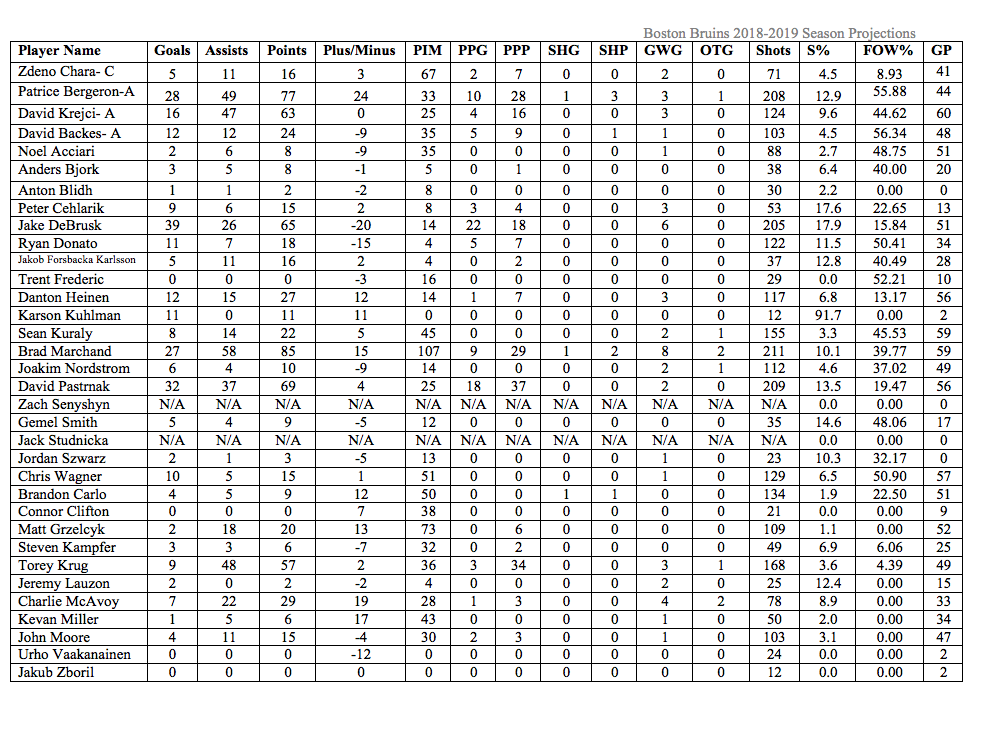


  • Boston Bruins 2018-19 Forecast Through 60 Games

    The Boston Bruins and the rest of the NHL are nearing the annual trade deadline. Through 60 games played, the Bruins are currently 2nd in the Atlantic Division with a 35-17-8 record (78 points) behind the Tampa Bay Lightning (46-11-4, 96 points).

    Wednesday night, the B’s will play their 61st game of the season when they visit the Vegas Golden Knights (new forecast coming soon for that club too), but before they do that, here’s a quick review and a glimpse of what could be based on this latest forecast with 22 games remaining in the 2018-19 regular season for Boston.

    After getting off to a quick start in October, despite a blowout on Opening Night, the Bruins fell into a bit of a lull in November and December.

    Jaroslav Halak (15-9-4 record, 2.35 goals against average, .923 save percentage in 30 games played) helped carry the weight through November, before regressing towards the end of December into January. As long as the wins rolled in, the team was making progress.

    Tuukka Rask (20-8-4, 2.45 GAA, .918 SV% in 33 GP) has not lost in regulation in his last 15 starts as the B’s carry a six-game winning streak into Vegas for Wednesday night’s matchup.

    Though Halak is expected to start against the Golden Knights, Rask and his counterpart have formed a solid 1A/1B option for the Bruins all season long– considering league scoring is up and the B’s have allowed the 3rd fewest goals against (155) in the league, behind only the New York Islanders (138) and Dallas Stars (154).

    The Bruins went 7-7-0 in December and improved to 6-3-3 in January.

    Yes, I know that’s still a .500 win-percentage, but points percentage wise, that’s 14 out of 28 possible points in December and 15 out of a possible 24 points in January (progress!).

    Yet, by the end of January and through all of February thus far, the B’s have been starting to reach another gear.

    The first line has been consistent all year, while General Manager Don Sweeney is in search of the last missing piece among top-six forwards to complete the second line.

    Meanwhile, Sweeney was working the trade deals on Wednesday, acquiring Charlie Coyle (10-18–28 totals in 60 games played this season, 91-151–242 totals in 479 career games) from the Minnesota Wild in exchange for Ryan Donato (3-6–9 totals in 34 games, 11-7–18 totals in 46 career NHL games) and a conditional 2019 5th round pick.

    If the Bruins advance to the Second Round of the 2019 Stanley Cup Playoffs, then the 5th round pick becomes a 2019 4th round pick (originally belonging to the New York Rangers, previously acquired by the Bruins along with Steven Kampfer in exchange for Adam McQuaid on Sept. 11, 2018).

    Coyle will boost Boston’s third line and can play second line minutes if necessary, but isn’t the end-all, be-all solution for a Cup run.

    Anyway, without further ado, here’s a look at the latest Bruins forecast– keeping in mind there are many variables that can and will change things, like injuries and/or being called up, assigned, traded, lucky or unlucky.

    This forecast is a glimpse at expected outcomes.

    If a player does better, then they exceeded expectations. If said player does worse, then they didn’t meet expectations (for one reason or another).

    My degree is in communication– not math– and hockey is naturally steeped in context and holistic unpredictability. Nothing can account for sheer puck luck, the odd bounce or a blown call.

    Whatever’s on the scoresheet every night can indicate general trends that can be deciphered to make educated guesses.

    Boston Bruins Forecast Through 60 Games Played (20 Games Remaining)
    I really miss the days of making a nice gallery, but WordPress messed around with that feature…

    First, I know what you’re thinking, “but Nick, how come you still have Donato on the roster still and haven’t included Coyle?”

    There’s two parts to my answer: 1) I ran this forecast after the conclusion of Monday night’s, 6-5, overtime win against the San Jose Sharks, so 2) the Coyle-Donato trade was made early in the writing of this post, so Coyle’s forecast will be reflected at a later date.

    Second, I know you’re also looking at Jake DeBrusk’s expected stats saying “uh, there’s only 20 games left, he can’t possibly score 21 more goals and amass 16 more assists for a total of 65 points this season” and you’re right.

    With DeBrusk’s recent scoring stretch over the last 20 games, his latest forecast gives a bit of a look at what could have been if he hadn’t been going through streaks like he has.

    The same can be applied to David Pastrnak’s expected 32-37–69 totals. Prior to getting injured, Pastrnak’s last forecast had him around the 40-goal plateau.

    After his left thumb surgery– in addition to having missed the last few games, as well as his recent decline in goal scoring over the last 20 games– his numbers are more in line with what to expect when he returns, whenever that is.

    At best, Pastrnak misses the “at least” two weeks he was supposed to miss, makes his return and picks up as close to where he left off as possible.

    At worst, he only scores a few more goals this season after returning later than expected (in the best-case scenario), but is back to being his normal self in a postseason run.

    Anyway, Boston’s offense looks like it’ll be led by Brad Marchand with 85 points on the season. Marchand also looks to lead the team in assists with 58 expected apples, topping Patrice Bergeron (49 expected assists), Torey Krug (48) and David Krejci (47).

    In goal scoring, Pastrnak remains supreme with 32 expected goals, leading Bergeron (28 expected goals), Marchand (27) and Krejci (16).

    On defense, Krug (9-48–57 expected totals) dominates the two-way aspect of the game from the blue line, despite missing a chunk of time due to injury earlier in the season.

    Meanwhile, Charlie McAvoy (7-22–29 expected totals) and Matt Grzelcyk (2-18–20 expected totals) continue to be vital assets alongside their captain and anchor, 41-year-old (soon to be 42-years-old on March 18th), Zdeno Chara (5-11–16).

    In goal, Rask is destined to settle in with a 2.37 GAA and a .921 SV%, while Halak backstops the team to a 2.40 GAA, as well as a .921 SV% himself.

    That’s some consistent goaltending in the crease and plenty to smile about if Sweeney can add more offensive prowess in secondary scoring and perhaps add a depth blue line asset for the playoffs.

  • DTFR Podcast #145- We Plan To Be Good In 2021-25

    DTFR Podcast #145- We Plan To Be Good In 2021-25

    Evgeni Malkin did a bad thing, the 2019 NWHL All-Star Game broke attendance records and more trades happened in the NHL. Patrice Bergeron reached 1,000 games and David Pastrnak is injured for the Boston Bruins leaving Nick in a glass case of emotion.

    Plus, Eugene Melnyk plans to spend money, the Tampa Bay Lightning have a new alternate sweater, Randy Carlyle was fired and Scott Niedermayer will have his number retired (again) this week. Finally, Connor has a new segment.

    Subscribe to the podcast on Apple Podcasts (iTunes), Stitcher and/or on Spotify. Support the show on Patreon.

  • Analysis: Time is the biggest gamble in Brassard, Bjugstad swap

    Midday Friday, the Pittsburgh Penguins and Florida Panthers completed a trade that left many scratching their heads.

    Pittsburgh sent Derick Brassard, Riley Sheahan, a 2019 2nd round pick and two 2019 4th round picks (Pittsburgh’s own and Minnesota’s previously acquired in a deal earlier this week with the Dallas Stars) to the Panthers in exchange for Nick Bjugstad and Jared McCann.

    Brassard, 31, was in his first full season with the Penguins and amassed 9-6–15 totals in 40 games played this season prior to the trade.

    He was acquired by Pittsburgh last February from the Vegas Golden Knights after the Golden Knights added Brassard in a separate deal with the Ottawa Senators first– prior to retaining salary on Brassard’s contract and flipping him along with Tobias Lindberg to the Penguins for Ryan Reaves and a 4th round pick originally belonging to the Vancouver Canucks in the 2018 NHL Entry Draft.

    In 14 games with the Penguins in 2017-18, Brassard added three goals and five assists (eight points) on top of his 18-20–38 totals in 58 games with the Senators prior to being trade deadline bait last season.

    He registered one goal and three assist (four points) in 12 Stanley Cup Playoff games with Pittsburgh in the 2018 postseason before the Penguins were eliminated by the eventual Stanley Cup champion Washington Capitals.

    Never mind what he’s done for you yesterday, Brassard carries a cap hit of $3.000 million per season and is a pending unrestricted free agent this July 1st.

    Not only that, but his salary can be retained one more time on his current contract if Florida desires to flip him by February 25th’s trade deadline.

    The Columbus Blue Jackets’ 6th overall pick of the 2006 NHL Draft, Brassard has 443 points (171 goals, 272 assists) in 756 career NHL games with the Blue Jackets, New York Rangers, Senators and Penguins.

    Sheahan, 27, had seven goals and two assists (nine points) in 49 games with Pittsburgh prior to the trade and was previously acquired by the Penguins in a transaction involving the Detroit Red Wings on Oct. 21, 2017 in exchange for Scott Wilson.

    He is a pending-UFA this July and carries a cap hit of $2.100 million.

    Despite failing to record a point with the Red Wings in eight games in the 2017-18 season, leading to his trade to the Penguins, Sheahan amassed his second-best season of 32 points (11 goals, 21 assists) in 81 games with Pittsburgh and Detroit last season.

    He established career-highs in assists (23) and points (36) in 79 games with the Red Wings in 2014-15 and had a career-high 14 goals in 81 games in 2015-16 with Detroit.

    In 414 career NHL games, the 21st overall pick of the 2010 NHL Draft has 139 career points (56 goals, 83 assists).

    In summary, the Panthers added to a list of growing draft picks in 2019 (presently with nine selections, including three picks in the 4th round), while potentially clearing out enough cap space to pursue some of the big names (*ahem* Artemi Panarin and Sergei Bobrovsky) that might hit the free agency market on July 1st.

    While the move looks like a haphazard approach to writing off this season, Panthers fans will have to be patient and wait for the other shoe to drop in General Manager Dale Tallon‘s masterplan.

    Even if that’s been said before.

    Bjugstad, 26, had five goals and seven assists (12 points) in 32 games with the Panthers at the time of the trade and was the last connection Florida had to the 2010 NHL Draft as their 19th overall selection.

    He posted a career-best 49 points (19 goals, 30 assists) in 82 games last season for the Panthers, establishing career-highs in assists and points.

    The most goals he’s ever scored in one season was 24 in 72 games in the 2014-15 season as a 22-year-old. In five career Stanley Cup Playoff games, Bjugstad has two goals and two assists (four points) with one game-winning goal and a plus-six rating.

    Bjugstad has two years left on his current contract with a $4.100 million cap hit and has 87-104–191 totals in 394 career games (all with the Panthers).

    McCann, 22, had eight goals and 10 assists (18 points) in 46 games for Florida prior to the trade and was originally selected 24th overall by the Canucks in the 2014 NHL Draft.

    He posted his career-best numbers last season for the Panthers with nine goals and 19 assists (28 points) in 68 games while earning a plus-11 rating (his first positive plus/minus outcome in four NHL seasons including the current 2018-19 season).

    McCann has two years left on his current contract at $1.250 million per season and can become a restricted free agent at the end of the 2019-20 season. He has 27-44–71 totals in 212 games with Vancouver and Florida in his young career and was previously acquired by the Panthers in exchange for Erik Gudbranson on May 25, 2016.

    Penguins General Manager Jim Rutherford has a knack for finding overlooked talent in an otherwise not as lively market and making them better in his current tenure with Pittsburgh, however, his latest move in snagging Bjugstad and McCann leaves more to be desired.

    While Rutherford brought in younger players with an additional year remaining on their contract, the gamble remains as to whether or not McCann will fully pan out– or if he does, whether or not he’ll price himself out of Pittsburgh with a tight cap situation and no trade or no movement clauses on some of their larger contracts that extend past 2019-20 currently on the books.

    Rutherford coveted McCann and now the next step will be figuring out how he can become part of the long-term solution.

    In addition to his oft-injured history, Bjugstad is a younger replacement for Brassard– one year after Rutherford made the move to get Brassard.

    Winning back-to-back Stanley Cups in 2016 and 2017 should be enough to overlook an otherwise mismanaged acquisition, however, Bjugstad costs more and now carries the added weight of living up to expectations or else further looking like the beginning of Rutherford’s mistakes on the way down from a Cup window.

    One positive takeaway for Penguins fans– who perhaps know this best– is that Rutherford is active. No one can take that away from him in his search for finding the right pieces to build a dynasty.

    As always, though, it is rare for any general manager in any sport to willingly depart an organization on their terms. Usually it’s the buildup of poor roster moves or repeated postseason failures that leads to “being relieved of duties” and kindly shown the door.

    In short, the biggest takeaway for this deal is… …time will tell.

  • DTFR Podcast #143- Overage Fees

    DTFR Podcast #143- Overage Fees

    The Dallas Stars and Pittsburgh Penguins swapped familiar assets, while the Toronto Maple Leafs added a defender in a deal with the Los Angeles Kings. Red Kelly’s number is going to be retired (again– this time by the Detroit Red Wings) and we now know the opponents in the 2020 Winter Classic and 2020 Stadium Series games.

    Subscribe to the podcast on Apple Podcasts (iTunes), Stitcher and/or on Spotify. Support the show on Patreon.

  • DTFR Podcast #142- Chia’s Pets

    DTFR Podcast #142- Chia’s Pets

    The Edmonton Oilers fired their president of hockey operations and General Manager, Peter Chiarelli (April 2015-January 2019). The club officially made the announcement after the DTFR Duo finished recording this week’s episode.

    There won’t be a 2020 World Cup of Hockey and there were a few milestones to go along with a bunch of minor trades made this week.

    Subscribe to the podcast on Apple Podcasts (iTunes)Stitcher and/or on Spotify. Support the show on Patreon.

  • DTFR Podcast #141- The Midseasonies

    DTFR Podcast #141- The Midseasonies

    Nick and Connor talk the latest trades, Torts drama (and latest record), Casey DeSmith’s extension with the Pittsburgh Penguins, as well as a tribute to the careers of Rick Nash and Josh Gorges who both announced their retirement this week.

    Additionally, what’s up with the Edmonton Oilers and St. Louis Blues this season and why can’t they just pick a side? Plus, it’s time to hand out awards for being slightly more than halfway through the 2018-19 regular season. #FlamingNotToFlamingHot

    Subscribe to the podcast on Apple Podcasts (iTunes), Stitcher and/or on Spotify. Support the show on Patreon.

  • DTFR Podcast #140- All-Star Finnish Trivia

    DTFR Podcast #140- All-Star Finnish Trivia

    Thoughts on the conclusion and controversies of the 2019 IIHF World Junior Championship, as well as a look at the schedule around the league as we near the All-Star Weekend festivities and bye week(s). Nick puts Connor on the spot and asks him some trivia questions that only went so well.

    Subscribe to the podcast on Apple Podcasts (iTunes)Stitcher and/or on Spotify. Support the show on Patreon.

  • DTFR Podcast #139- They Ran Out Of Beer!

    DTFR Podcast #139- They Ran Out Of Beer!

    A bunch of minor trades were made in the last week, the 2019 Honda NHL All-Star Game rosters were released, as well as the 2019-20 outdoor game schedule. Nick and Connor also discuss the legacy that was the 2019 Bridgestone NHL Winter Classic and the 2019 IIHF World Junior Quarterfinal upsets.

    Subscribe to the podcast on Apple Podcasts (iTunes)Stitcher and/or on Spotify. Support the show on Patreon.

    *Editor’s Note: Of course, after recording this week’s episode, the Philadelphia Flyers claimed G Mike McKenna off waivers from the Vancouver Canucks.

  • Numbers Game: 2018-19 League Forecast Entering January

    Happy New Year!

    It’s time to figure out whether or not your team has a legitimate chance of winning the Stanley Cup, making the playoffs, being a seller at the trade deadline or a basement dwelling rebuilder in desperate need of anything but what is happening right now.

    Teams have begun to reach the official halfway point in the regular season (41 games played out of an 82-game schedule) as the calendar flips from 2018 to 2019.

    Here’s a glance at the latest forecast based on how the league standings were through December 31, 2018.

    Keeping in mind, there’s no guarantees with any forecast, but rather general trends and “educated” guesses. It’s not always about the exact number of points expected on the season. Sometimes the focus is on the spread or each team’s positioning in the standings.

    There’s always context. Plus, nothing’s impossible until it’s mathematically impossible.

    So let’s take a look around the league and figure out the future– well, rest of this season, at least.

    Projected Standings After Three Months

    Eastern Conference

    Atlantic Division

    1. p-Tampa Bay Lightning, 125 points (40 GP entering Jan. 1st)
    2. x-Toronto Maple Leafs, 111 points (39 GP)
    3. x-Boston Bruins, 98 points (39 GP)
    4. wc2-Montreal Canadiens, 97 points (40 GP)
    5. Buffalo Sabres, 96 points (40 GP)
    6. Florida Panthers, 84 points (38 GP)
    7. Detroit Red Wings, 75 points (41 GP)
    8. Ottawa Senators, 72 points (40 GP)

    The Tampa Bay Lightning are the dominant team in the NHL right now. There’s no other comparison. They’re in a league of their own.

    Though the Toronto Maple Leafs have surged into one of the league’s most prominent teams this season, they’re no match for the Lightning in the regular season standings Atlantic Division race.

    The postseason might be another story– too bad we won’t get to see these teams meet up in the Eastern Conference Final with the current playoff format.

    For the Boston Bruins, a lackluster 7-7-0 month of December has taken a toll on their outlook. Sure, winning five out of their last seven games is a good sign and all, but missed opportunities and blown chances regardless of the injury status of many of their players this season has brought them back to Earth this season.

    Regression in hockey, however, is to be expected– even for teams that outperformed expectations. Last season was just that– exceeded expectations in the regular season for Boston.

    How will Bruce Cassidy jumpstart scoring depth throughout his lineup if General Manager Don Sweeney doesn’t do anything to add? Time will tell.

    But they’re running out of time as long as Claude Julien and Phil Housley are in consideration for some Jack Adams Award nominations.

    Though the Buffalo Sabres have slumped a bit in the last month, the Montreal Canadiens have solidified themselves as a potential spoiler in the 2019 Stanley Cup Playoffs.

    If it’s not them, it’s definitely Buffalo for sure.

    The race for the Eastern Conference wild card spots should come down to three teams– Buffalo, Montreal and the New York Islanders (unless the Islanders snag a divisional spot in the Metropolitan Divsion– more on that later).

    Look, as good as some players on the Florida Panthers are, it’s not happening this year.

    And for all the hype regarding the Detroit Red Wings early in the season? Yeah, it’s the same as last year. They’re not doing so hot either.

    There’s some good news if you’re an Ottawa Senators fan– wait, they traded their 2019 1st round pick in the draft to the Colorado Avalanche as part of the three-team Matt Duchene trade and didn’t protect it (because they chose to protect 2018’s 1st round pick and offer up 2019’s instead)? Oh. Never mind.

    Metropolitan Division

    1. y-Washington Capitals, 109 points (38 GP)
    2. x-Pittsburgh Penguins, 103 points (39 GP)
    3. x-Columbus Blue Jackets, 102 points (39 GP)
    4. wc1-New York Islanders, 98 points (38 GP)
    5. New York Rangers, 90 points (38 GP)
    6. Carolina Hurricanes, 80 points (38 GP)
    7. New Jersey Devils, 80 points (38 GP)
    8. Philadelphia Flyers, 78 points (38 GP)

    As we get closer to “the stretch” things are heating up in the Metropolitan Division, which might not be as full of garbage as once thought earlier in the year.

    For now, the Washington Capitals appear to be in a serious “defend the castle” mood. They’re the defending champions and they’re pretty hard to beat.

    But the Pittsburgh Penguins are surging. The Pens are on a seven-game winning streak and they’re outscoring their opponents, 28-9, during that span.

    What’s necessary to take into account in the divisional spots in the Metropolitan Division is not that the Capitals should lead the way, but rather, that Washington only has a six-point lead in the current forecast over the Penguins– and seven points over the Columbus Blue Jackets (who somehow find themselves in the “top dog” conversation?)– therefore, anything is up for grabs.

    If the Islanders don’t scratch and claw their way into a divisional spot, they’ll be a wild card team.

    It’s not a completely lost season for the New York Rangers, but it’s not one that’ll end with a playoff berth either.

    The same could almost be said for the Carolina Hurricanes and New Jersey Devils, except one’s a little more inconsistent (and worse off), while the other’s just worse.

    Sure, the Devils are nowhere to be found this season, but Mackenzie Blackwood could change that outlook next year.

    And if Carter Hart‘s ready to take on the full-time role of starting netminder for the Philadelphia Flyers that probably wouldn’t do much for them this season, but it’s promising moving forward.

    This year’s Flyers team just goes to show that the problem’s beyond a GM and coaching change, so don’t be surprised to see some roster turnover.

    Western Conference

    Central Division

    1. z-Winnipeg Jets, 107 points (39 GP)
    2. x-Nashville Predators, 96 points (40 GP)
    3. x-Colorado Avalanche, 91 points (40 GP)
    4. wc2-Dallas Stars, 89 points (40 GP)
    5. Minnesota Wild, 87 points (38 GP)
    6. St. Louis Blues, 81 points (37 GP)
    7. Chicago Blackhawks, 77 points (41 GP)

    The Winnipeg Jets are one of two teams in serious contention for the Western Conference regular season title– and the Nashville Predators won’t even get to raise a banner next season for it.

    Nashville’s been on shaky ground for the last month and, as a result, it shows in the latest forecast. Inadequacy ruptures standards or expectations.

    Anyway, between Winnipeg and the Calgary Flames one of those teams will be the best in the West at the end of the regular season.

    It says something as a whole about the Central Division when the Colorado Avalanche are currently forecasted to slip into a divisional spot in the postseason with 91 points in the standings.

    Usually about 95 points puts you within the wild card range and anything 98 or above brings you into serious contention for a divisional berth.

    What all of this means is there’s a lot of uncertainty from the Avs, Dallas Stars and Minnesota Wild in terms of where they end up, ultimately.

    All three teams have been all over the place– at times– this season.

    Fear not, though, they’re nothing like the St. Louis Blues and Chicago Blackhawks. Nothing makes sense in St. Louis, short of obvious locker room problems and a lack of leadership.

    Whereas, in Chicago, the game plan was already reset to “longterm” last season by default (having finished last in the division). Jeremy Colliton‘s job security is safe for now.

    There weren’t high expectations coming into the season for the Blackhawks and there weren’t immediate expectations for Colliton in their transition from Joel Quenneville to their 33-year-old head coach.

    Essentially, firing Quenneville when they did was an easy way out of having to make things more awkward(?) with a rebuild, but it kind of was anyway given when they did it.

    At least they’re not their rivals in St. Louis– let alone the Los Angeles Kings– where expectations were high after reaping some rewards in the offseason.

    Pacific Division

    1. y-Calgary Flames, 103 points (40 GP)
    2. x-Vegas Golden Knights, 100 points (42 GP)
    3. x-San Jose Sharks, 98 points (41 GP)
    4. wc1-Anaheim Ducks, 92 points (41 GP)
    5. Vancouver Canucks, 83 points (42 GP)
    6. Edmonton Oilers, 82 points (39 GP)
    7. Arizona Coyotes, 76 points (39 GP)
    8. Los Angeles Kings, 75 points (40 GP)

    The Flames are red hot. Can they make 2019 more like 1989 and less like 2004? Does having a goaltender even matter any more?

    Luck’s starting to turn in Vegas as the Golden Knights have come alive and look to make a serious claim at potentially knocking Calgary off from the Pacific Division lead– if they can catch them first.

    Despite their ups and downs, the San Jose Sharks are still a divisional playoff berth kind of team. Expect them to be out of the playoffs before the Western Conference Final though. Surely Martin Jones‘ below average season has to catch up to him at some point, regardless of scoring power.

    With no real competition below them, the Anaheim Ducks are a wild card team that will likely continue to live in the First Round elimination hell until John Gibson single handedly plays every position for the club.

    The Vancouver Canucks have Elias Pettersson and look ready to bring up Thatcher Demko for a full-time role in net, so it’s kind of on, but a little late. Next season!

    Everyone said Ken Hitchcock would turn around the Edmonton Oilers and was dancing in the streets when his first half-dozen games brought the Oilers back into being relevant.

    Well, everyone, except me. Hitchcock’s shtick isn’t fit for the contemporary NHL anymore and his last (and only) Cup win came 20 years ago.

    Sure he might impart some lessons on leadership, but as long as Peter Chiarelli is trading away Drake Caggiula for Brandon Manning and ensuring guys like Milan Lucic are part of the longterm vision…

    The Arizona Coyotes haven’t panned out and it’s not the numbers that have been lying to them. Dylan Strome, their 3rd overall pick in 2015, didn’t develop as planned– whether through the fault of the Coyotes or not– and they traded him.

    That draft was four years ago and Mitch Marner was selected after Strome by the Maple Leafs. Hindsight is 20/20, but still.

    If it’s any consolation, Mikko Rantanen was selected by Colorado, 10th overall, so Carolina, New Jersey, Philly, Columbus and San Jose all missed out on one of the current leaders in scoring.

    Scouting’s not Arizona’s strong-suit from year-to-year, or rather, asset management as a whole it’s just… …not there.

    Finally, Los Angeles, the Grim Reaper’s at the door. Bring out your dead (Cup hopes and dreams for 2019). It’s time to rebuild.